The reason behind this week’s review is simple: I got a tip-off. About chicken livers.
It came off the back of the World Cup Of Reading Restaurants I ran on Twitter just after Christmas – congratulations to Kungfu Kitchen for winning the title, by the way – when I received a message from a reader. She and her partner had been debating the merits of the various competitors, and they’d agreed that in their considered opinion the closest rival to surprise package Tasty Greek Souvlaki was not Bakery House but in fact Lebanese Village on Caversham Bridge. It served some of the best Lebanese food she’d ever eaten, she said, and their chicken livers were second to none.
It was appropriate, too, because I never liked chicken livers before I tried Lebanese food. Actually, it would be closer to the truth to say that I didn’t know I liked them until then. But the first time I had them, at Bakery House, experienced that contrast of caramelisation and silkiness unlike anything else, with sweet, sticky fried onions and a whisper of pomegranate molasses, I was hooked. And that was just the start of it – then I tried the chicken livers at Clay’s, dark and delicious, dusted with an intriguing spice mix including, of all things, dried mango and I became even more of a convert.
Then there were the happy occasions when the Lyndhurst served them – simply, on sourdough toast with a bright pesto. By then chicken livers were well and truly one of my favourite things, so the idea that somewhere in Reading served a reference version I’d yet to try was an aberration I needed to remedy, as soon as possible. So on what felt like the coldest night of the year so far, Zoë and I schlepped off to Caversham Bridge, stopping only for a fortifying beer at the warm, welcoming, wintry Greyfriar.
I’ve written about Reading’s history with Lebanese restaurants before, so I risk rehashing all that here. But in the early days, back in 2015, we had two and they were about as different as could be. La Courbe was a grown-up restaurant with sharp furniture, square plates, fancy glasses and an extensive list of Lebanese wines (true story, on my second or third visit there the English waitress, when clearing our glasses away, said “it’s not bad is it, the Lesbianese wine?”: bless her). And then came Bakery House, closer to the kind of thing you’d see on the Edgware Road, more informal, more casual, with no alcohol licence.
Bakery House won the war. It’s still going today, and has proved the more influential blueprint for Lebanese food in Reading: Palmyra and the not-too-sadly departed Alona are very much in that mould. La Courbe lasted a couple of years, though whether that’s because of their business acumen or the fact that they had John Sykes as a landlord we’ll never know. The owner moved on to run a Lebanese night at a café in Pangbourne for a little while, and then disappeared without trace. But I hope history is a kinder to La Courbe, because their food was absolutely terrific. Their skewers of lamb and chicken, their lamb koftas were, in truth, a level above anything that came off the grill at Bakery House, wonderful though Bakery House is. I still remember their taboulleh.
Looking at the menu at Lebanese Village in the run-up to my visit I wondered which kind of restaurant it would turn out to be. It sold alcohol – two Lebanese beers and a decent selection of Lebanese wine, including a couple I’d tried at La Courbe. The menu was more limited than Bakery House’s and potentially less casual, with no shawarma, no boneless baby chicken, fewer mezze. And I’d heard good things about Lebanese Village from a few people, so was it going to be the spiritual successor to La Courbe?
Subscribe to continue reading
Become a paid subscriber to get access to the rest of this post and other exclusive content.
For fuck’s sake, it’s Edible Reading, not Edible Clapham Junction.
I know, I know (Happy New Year to you too, by the way). But I found myself in the vicinity of arguably the United Kingdom’s most minging train station one January weekend – on an unsatisfactory excursion spectacle shopping, since you ask – and I always think it’s well worth structuring an expedition like that around lunch. That way if the shopping’s a bust, as it turned out to be, and the station is a hellscape, which it very much was, there’s still an outside chance of salvaging the day.
Not that I was in Clapham, by the way. I was shopping and mooching in an area that isn’t quite Clapham, isn’t quite Battersea, is a ten minute walk from Clapham Junction and is really rather lovely. Northcote Road is a long, prosperous street in the heart of what is apparently called Nappy Valley, and it’s a great place to amble and bimble. I hadn’t been in many years, although I was an occasional visitor in a former life.
I remember eating in this little place called Franco Manca there, once upon a time when there were only a handful of them, before they contracted the disease called private equity. There used to be a splendid tapas restaurant, too, called Lola Rojo, which did an olive oil ice cream I still think about sometimes: if I could have my time over again, I’d have ordered two portions (laugh all you like, but that might make my top 50 of Things I’d Do Differently). But anyway those were simpler times, over ten years ago, and remembering them it’s as if they happened to somebody else.
Returning in 2023, Northcote Road was still as fancy as I remembered. It’s still lined with swish looking cafés, delis and cheesemongers, bakeries, great shops, a branch of Aesop – always a sign that you’re somewhere spenny – and tons of opticians. There’s even a branch of upmarket wine merchant Philglass and Swiggott (true story: I used to frequent their Richmond branch and I had to have it explained to me that those weren’t in fact their real surnames).
Northcote Road also has restaurant after restaurant, and is full of those kinds of chains: Rosa’s Thai, Joe And The Juice, Patty & Bun, Ole & Steen, Meatliquor. The ones where simultaneously we’d rather like one in Reading but we know that if we got one, it would be because they’d jumped the shark. Not that you needed to eat in one if you were peckish – one food van sold beautiful-looking pizza, another was flogging porchetta sandwiches which looked so attractive that I almost cursed my foresight in having made a reservation.
But I had made a reservation, and I’d relied on Eater London for a recommendation. It had a list of the best restaurants in Battersea, although they were sparsely spread out and it would have taken you the best part of an hour to walk from one end of their map to the other (some of them, weirdly, also end up in their list of the best restaurants in Clapham, which tells you what a no man’s land it can be).
There were small plates wine bars and gastropubs, little BYOB Thai joints and a restaurant offering French-Korean fusion, whatever that is. But I was drawn to Osteria Antica Bologna, slap bang on Northcote Road. It had been going for over thirty years, which meant I had probably walked past it countless times a decade ago. And the clincher was this: I love Bologna and I haven’t been there in far too long. So Zoë and I turned up at lunchtime, our tote bag already full of treats for later from the cheesemonger, to see if it could transport me back, in spirit at least, to one of my favourite cities.
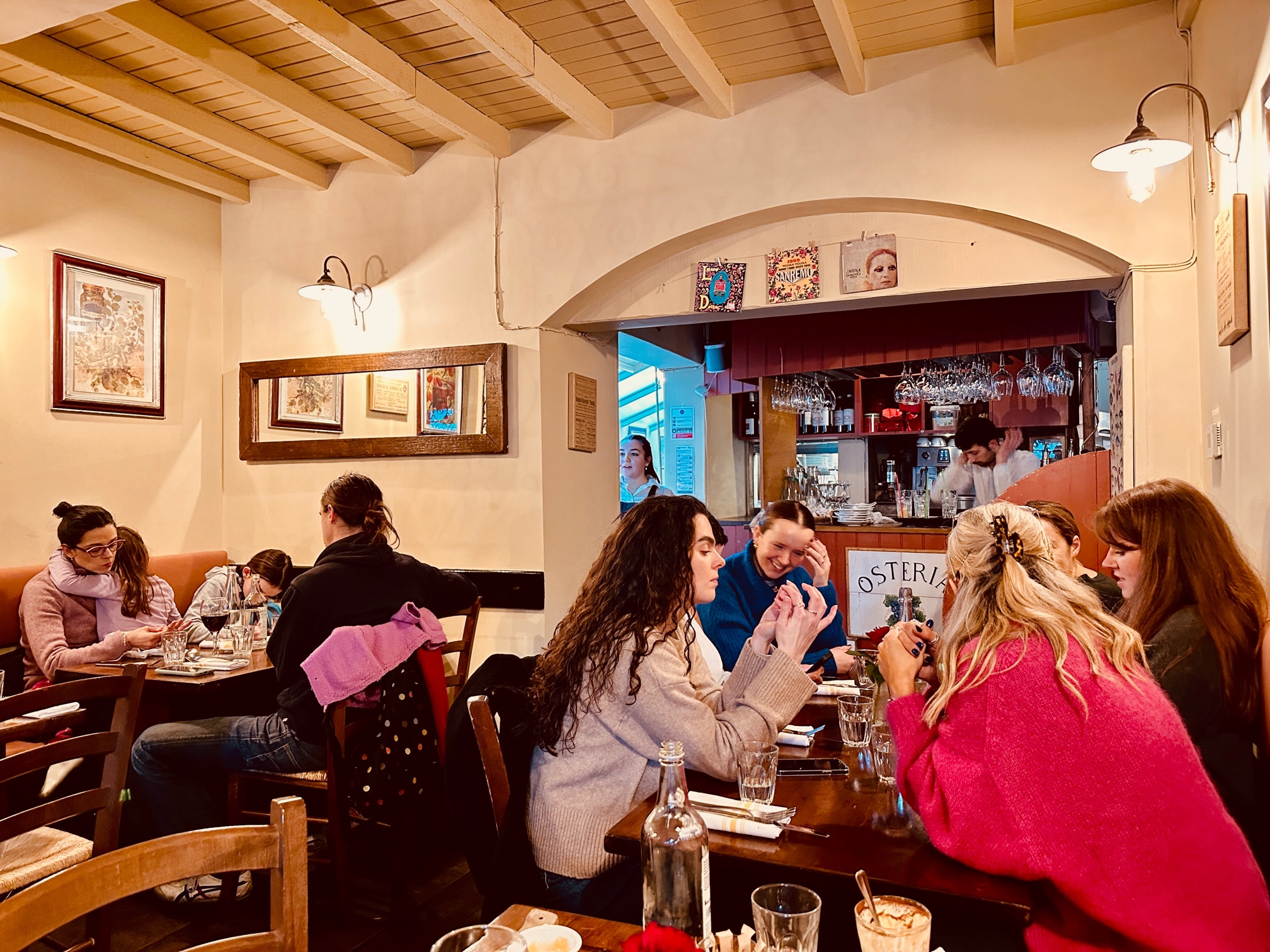
It was old school right from the beginning, with a burgundy and orange awning and a big sign at the front saying “DAL 1990”. And stepping inside I was reminded that it can be a fine line between dated and timeless, and sometimes you make it from the former to the latter merely by staying the course. For what it’s worth, I think Osteria Antica Bologna was the right side of the line, with a simple, rustic-looking dining room, a dusky pink banquette running along one side. On the other, tables were separated by a trellis-like partition that no doubt pre-dated the pandemic.
Beyond the archway in front of the bar, out back, was a more modern-looking dining room with a skylight, an extension I imagine, but I was glad they didn’t seat us there. Even the little things, like a circular table at the front with a big bowl of olives and a large bouquet of flowers, felt like something they had done for a very long time. It was a room with a lovely energy, a place harbouring the unspoken promise that you would eat well, and although only a handful of tables were occupied when we arrived at one o’clock, only a couple were empty when we left.
Another sign that the restaurant was resolutely old school came as I drank my – surprisingly bracing – Aperol Spritz and Zoë attacked her negroni. The menu was antipasti, pasta and main courses. If you wanted pizza, you should have headed to the food truck on the other side of the road, or to Franco Manca. But everything sounded marvellous, including the specials which were explained by our personable, enthusiastic waiter.
I almost tried some of their pasta but, and this was the only real disappointment on the menu, the difference between a starter and main-sized portion of pasta was just two pounds, which said to me that I was effectively choosing between that and a main. But there’s always next time, when the pumpkin and ricotta ravioli with sage will be calling to me – although not necessarily loud enough to drown out the siren song of the wild boar ragu, or the risotto with salsiccia and Barbera. A truly great menu always comes with regret baked in: that’s the nature of these things.
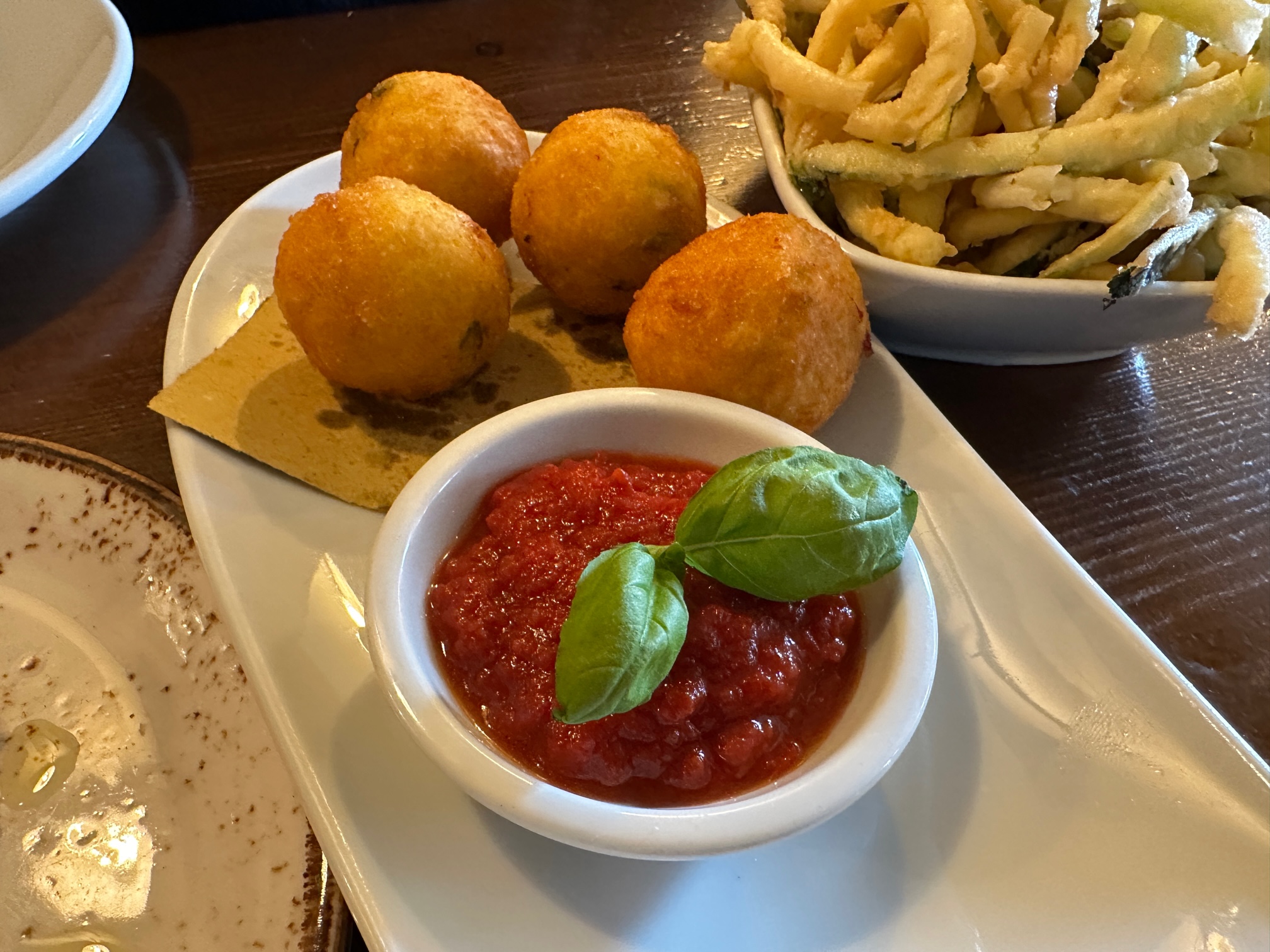
We’d ordered a trio of antipasti to start and if anything they intensified that regret: given just how good these were, what other treasures had we missed on the menu? Arancini were possibly the best I can remember, and simpler than many I’ve had. No thick crust of breadcrumbs here, just a feather-light seasoned shell. No stodge to wade through with a molten core, instead just a neat sphere of rice, cheese and peas retaining a little bite. And to go with it, an arrabiata sauce worthy of the name, just spiky enough. It reminded me of the difference between pretenders, as with my visit last year to Sauce & Flour, and the real deal – unshowy but superb.
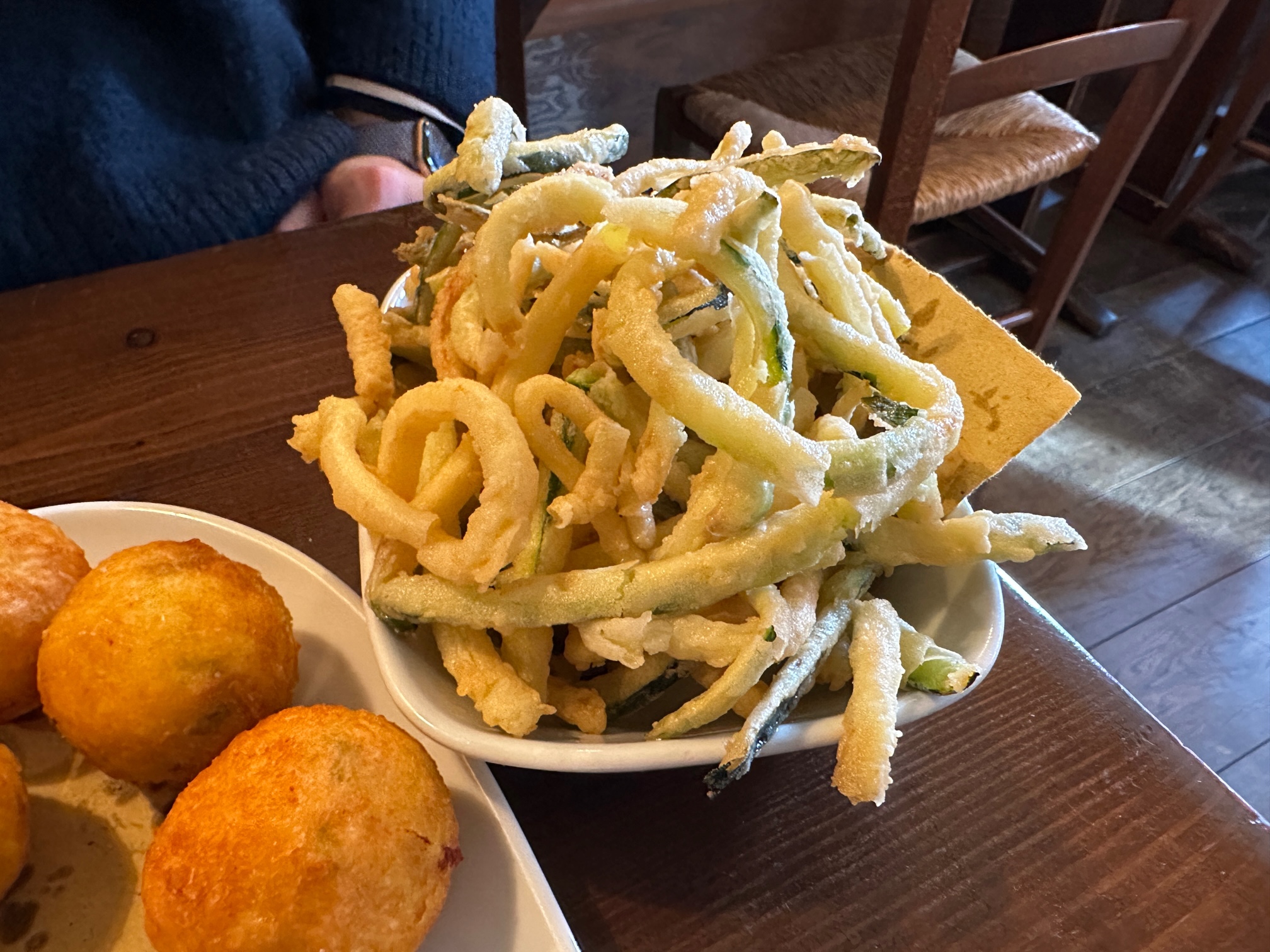
Also as good as I can remember were the zucchini fritti. No, scratch that: they were easily the best I’ve had anywhere. So often, including at a couple of Reading restaurants I actually really like, they can be soggy, limp things and you’re left to redeem them with some kind of dip. Here they were shoestring-thin, almost ethereal yet spot-on crispy, the way this dish always promises to be but somehow never is. And they didn’t need any kind of dip because they were so salty and zippy, so beautifully seasoned and cooked with a real lightness of touch. “The menu should tell you to order these with your drink while you make up your mind” said Zoë who was, as usual, entirely correct.
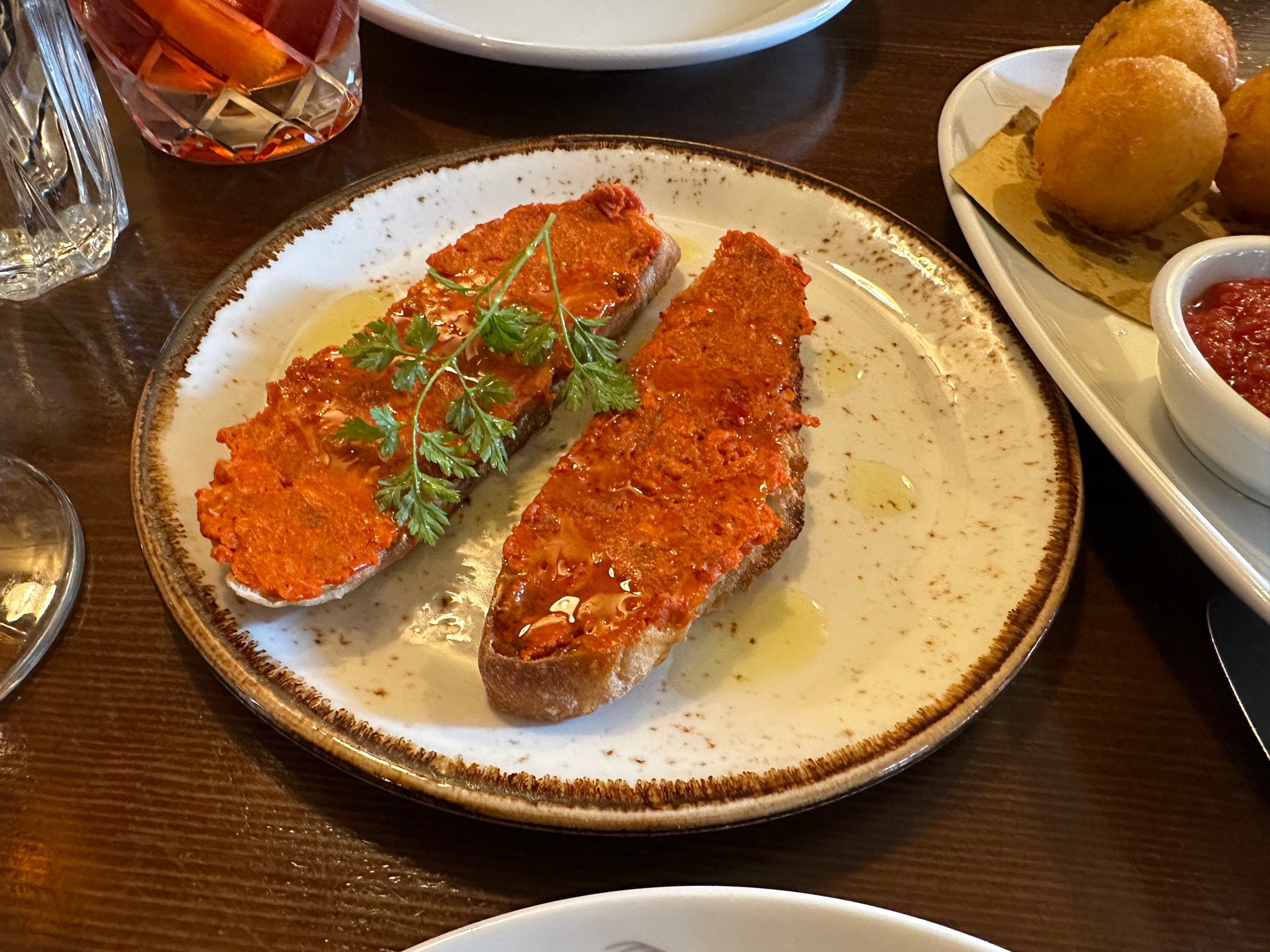
The other small dish we had, bruschetta with ‘nduja, was the least excellent but really, that just means it was still cracking. Two thin slices of toasted bread were loaded with a terrific ‘nduja – not stingily, either – with more depth and earthiness than I’m used to. So often ‘nduja dishes I’ve had are a one-note symphony relying on the acrid heat it can supply; I’ve lost track of the number of restaurants that make lazy use of the stuff. By contrast, this dish just said isn’t our ‘nduja amazing? and, having tasted it, it was impossible to argue. One thing you could potentially quibble, here, was the cost: eight pounds fifty for that. Sounds expensive, but is it 2023-in-London expensive? Your guess is as good as mine.
We grabbed a couple more drinks while we waited for our mains. My gavi, in an endearingly functional wine glass, had a pleasant zing to it and Zoë, sensibly, decided to move to gin and tonic. By this point the restaurant had a real buzz and all the temptations of elsewhere, the porchetta sandwiches and gelato places, had melted into air. All that mattered was the next course, and the course after that.
“This is very promising, isn’t it?” said Zoë. She was right about that too.
If I had to pick a main course to start my reviewing this year with, it would be hard to choose better than the dish Osteria Antica Bologna served me. A piece of cod with salty, crispy skin and soft, sumptuous flesh, cooked by someone who really understood how to get both those things right at once, perched on a little heap of chickpeas, tomatoes and spinach.
A single forkful was enough for me to know that I was in a happy place. I even turned to Zoë and told the tired joke I reserve for these occasions, I love it when a chickpea’s in my mouth, and she had the decency not to grimace; imagine what sitting opposite me at dinner dozens of times a year must be like. Only the fact that the promised salsa verde, which would have completed the dish perfectly, had been replaced by a smear of something closer to purée slightly blotted the copy book.
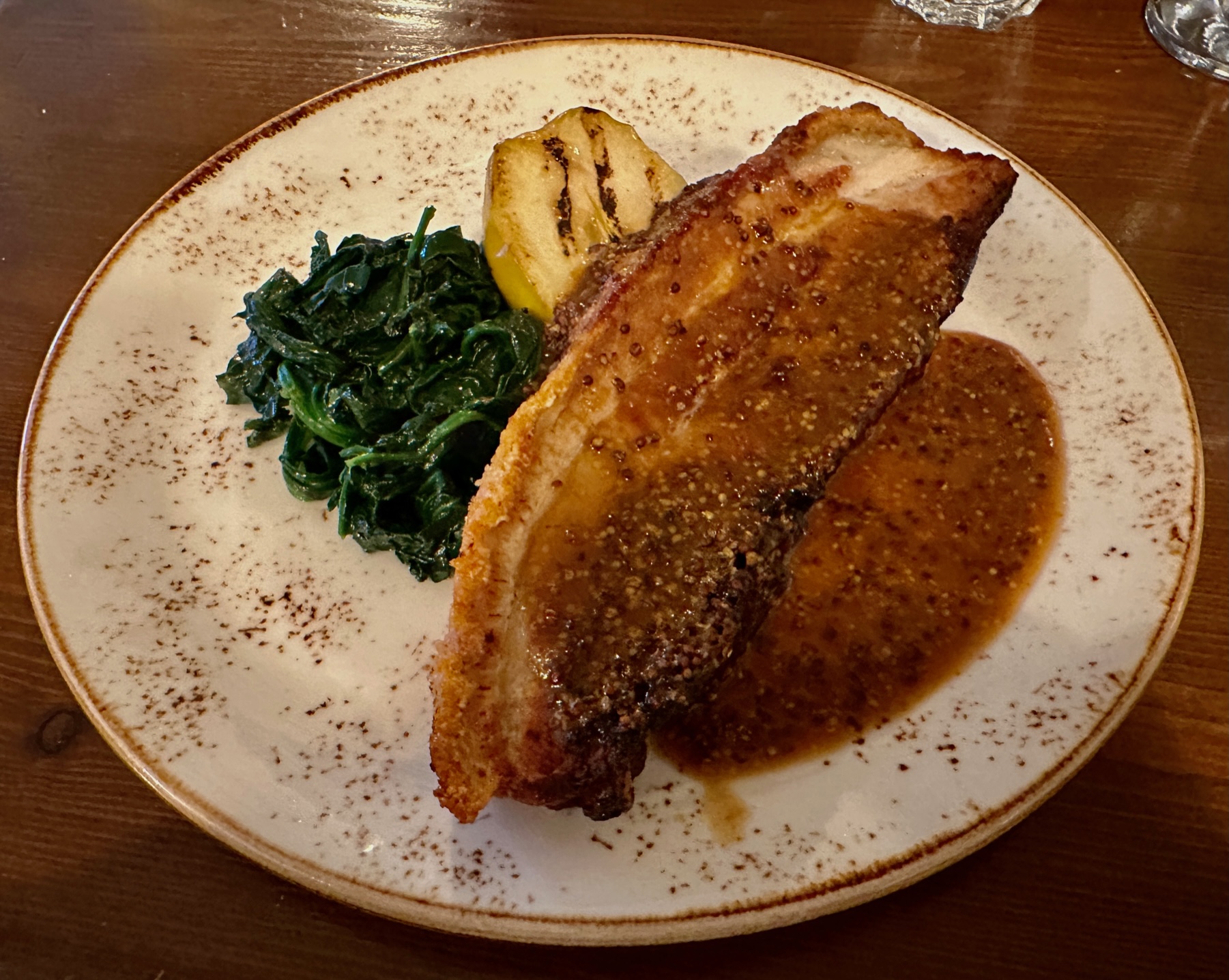
The problem is that if I had to pick a main course with which to start my reviewing year, it would be damn near impossible to choose better than the dish the restaurant served to Zoë. The menu called it pork belly with roasted apple, but that prosaic description comes nowhere near capturing what a marvel it was. A gargantuan slab of pork where, like the fish, everything was exactly how it was meant to be. The flesh was tender, the crackling brittle and intensely savoury. Between the two, arguably the best bit, that sticky, moreish layer of subcutaneous fat, rendered to the point where it was gorgeous but not beyond that to the point where it vanished. I was allowed a forkful, and then because of my expression I was allowed another, and another.
“Would you like to try some of my fish?”
“No, you’re all right.”
Just as sometimes you can only pick out one face in a crowd, it was hard to remember, eating that pork, that there were other things on the plate. But the gravy, shot through with mustard which never overpowered, was a terrific foil and I imagine the griddled apple was superb with it too. We’d ordered some chips with our dishes, which they really didn’t need, and those were predictably wonderful – light and salty and far too easy to pick at long after we’d cleared our mains. If they buy them in, they buy very well.
The dessert menu was also compact and leant heavily on the classics, and having seen the well-upholstered man and his Sloaney Alice-banded daughter at the next table make their choices simplified things nicely for me. My tiramisu was maybe the weakest link in the whole meal – not bad, per se, but a little too loose and liquid when I’d have liked it a tad more substantial. The slug of coffee and booze as you got to the bottom, though? That was still a wonderful moment in a meal full of them. And at the end of it I had an Amaro di Capo, as much medicine as booze, served without airs, graces, ice cubes or orange in a tall shot glass.
Zoë – here we go again – picked better. Her pear and chocolate tart was another home run, with a few pieces of baked pear, a pleasingly short pastry base and a very thick layer of chocolate; I thought it was a relatively airy ganache, Zoë thought it was a sponge, we had a heated debate about it and agreed to disagree. “That filling definitely has flour in it” were her last words on the subject, but I still say she’s dead wrong. I also managed to talk her out of ordering a Bailey’s and into trying a Frangelico instead. It was not a sponge: trust me on this.
I haven’t talked about service but it was another of the things that was great rather perfect. The staff are clearly a well-oiled unit, bright and happy, friendly and brilliant. But one thing they also were, slightly, was too efficient. Our plates were cleared away mere moments after we’d cleared them, to the point where it became a little bit too much (“there’s something OCD about it” Zoë said, bemusedly, just after they’d also cleared her G&T away when she hadn’t quite finished it).
But really, that was a small quibble about a magnificent place to eat. I could easily see how Osteria Antica Bologna had held its ground amid all that gentrification, all those pop-ups and top tier chains. At one point I saw one of the waiters leave the restaurant with some plates of food and take them out into the street to the people manning a flower stall outside: that, I thought, said it all. Our meal for two – three courses, three drinks each and an optional 12.5% service charge – came to just over a hundred and fifty pounds, and I thought it was worth every penny.
I’ve complained in the past about Reach plc and its pisspoor habit of saying a restaurant is “just like eating” in a foreign country. My problem with that is twofold. First, the poor unfortunate journalist in question has probably never been to the country in question. But more importantly, 99 times out of 100 they haven’t been to the restaurant either – why bother, when there’s TripAdvisor? But for once I’m going to do it myself: I’ve been to Osteria Antica Bologna, and I’ve been to osterias in the city from which it takes its name. And if I’d stepped out the front door to find myself looking at an orange portico dappled with sunlight, rather than being a two minute walk from a Farrow & Ball and a branch of JoJo Maman Bebe, I wouldn’t have been entirely surprised.
As I paid up, our meal at an end and so many around us barely beginning theirs, I thought about what it means to have a restaurant for over thirty years. To outlast fads and phases, to have ‘nduja and burrata on your menu before everybody discovers them, to steer your course without embracing small plates or no reservations, to serve pasta simply because it’s what you do rather than because suddenly pasta restaurants are in vogue. I thought about the fact that Osteria Antica Bologna was here before Northcote Road was all fancy and well-to-do, that they had sent thousands of customers away replete and happy. That they’d started doing that before I even finished my A levels.
And I thought that even though this restaurant was nowhere near my home town (and, let’s be honest, most of you will probably never go there) it was still the perfect place to kick off my reviews this year. Because to celebrate this restaurant, on some level, is to celebrate all great restaurants. Some people have a nasty tendency to use “neighbourhood restaurant” as a way of patting a place on the head. It’s okay I suppose, if you live there they seem to say. But a great neighbourhood restaurant, especially one that makes you wish it was your neighbourhood, is a truly special thing. Osteria Antica Bologna is every bit that special. I’ll find an excuse to be back near Clapham Junction: when I do, I intend to order everything.