Restaurant review: Juliet, Stroud

Stroud is lovely. Have you been? It’s so easy if you live in Reading: there’s a direct train that sets off once an hour, takes an hour and drops you close to the heart of things, less than five minutes from the foot of the town’s pretty, sweeping – somewhat steep – High Street. I’m there with my old friend Dave, who’s rapidly staking a claim to be my West Of England Correspondent, and he knows the town better than I do, so I let him lead the way.

The last time I was here was over four years ago, and it’s safe to say that although I liked it then, I didn’t remember it being quite this, well, good. Dave takes me into a mall called the Five Valleys Shopping Centre, to enjoy a brilliant latte at Rough Hands Coffee, along with a chocolate and sea salt cookie that is miles better than anything you could buy in any Reading mall. As he makes inroads into an almond croissant almost as big as his head, he tells me more about the place.

“It’s not like the rest of the Cotswolds, mate, it’s got a touch of Glastonbury about it. Let’s just say there are quite a few crystal shops.”

I look around. Although I’m sure Dave is right, I spot people queuing for coffee and baked goods, advertising their favourite brands on their totes. I see moustaches and those daft little Steve Zissou hats and more than a little Lucy & Yak – not all on the same person I might add – and truly, the place feels more hipster than hippy. You don’t get all this in Cirencester or Stow on the bloody Wold.

The edge blunted on my peckishness, we start exploring the Cotswolds’ most atypical town. The mall has a food court that, any other day, would make an excellent spot for lunch, and a boutique department store, Sandersons, that boasts a selection of niche fragrances to put many cities to shame. It’s so old school it no longer has a website, having decided to abandon e-commerce last summer.

But then we climb the high street and near the top, by a bookshop and an organic café, we reach the reason the place is buzzing so loudly on a sunny Saturday morning, the farmers’ market. It really is a delight, spreading from the splendidly named Shambles on one side of the street to the little maze of streets on the other, and perhaps the best way that I can describe it is to say that it’s a flagrant attempt to make me part with as much money as possible in the shortest possible time.

It’s like a deeply middle-class IKEA, where you arrive fully intending to buy just one thing but come away with a bag groaning with stuff you didn’t know you needed. I only planned to pick up some charcuterie, but also end up with a gorgeous seeded sourdough loaf from Hobbs House Bakery, a big bottle of grassy extra virgin olive oil and a business card from a lovely gentleman who may or may not end up making me a leather satchel by hand.

To limit myself to that takes all my strength, and on a cooler day I might have also left with cheeses, bean to bar chocolate, cakes, beer, doughnuts, pies, sausages, smoked salmon and a hernia; I reflect, later on, that it might be for the best that my slowly mending right arm still can’t carry more than a couple of kilos. It feels like every bourgeois need is catered for every Saturday from 9 to 2 in that compact but blissful space – did I mention the scented candles and room diffusers? – and that’s before we get on to the street food stalls or the little open air café using beans from nearby Rave Coffee.

It is, in short, idyllic. I can well understand why Stroud was named as one of the Sunday Times’ Best Places To Live this year, and why it won the whole thing five years ago. Last year Reading was mentioned in that august company, but this year the Sunday Times included Caversham in the list, a subtle way of saying “we got it wrong, only this bit of Reading is any cop”. For what it’s worth, even for the farmers’ market alone, Stroud pisses all over Caversham: Stroud is what Caversham would like to be if it grows up.

If I didn’t already have a restaurant reservation, and I hadn’t instead chosen to eat in the mall (pizzeria Fat Toni is meant to be good) I could easily have browsed and munched my way through the farmers’ market. I walk wistfully past a stall offering Thai food which smells better than any Thai restaurant I can remember. Lunch had better be good, I think.

Our venue for lunch is at the bottom of Union Street, the hill with that Thai food stall on it, opposite a disused pub and some vivid street art. It occupies the ground floor of a handsome building, The Old Music Centre, which had fallen into disrepair before sculptor Dan Chadwick bought it fifteen years ago. First it spent some time as a factory and another restaurant, and finally in late 2024 it reopened as Juliet, named after Chadwick’s wife.

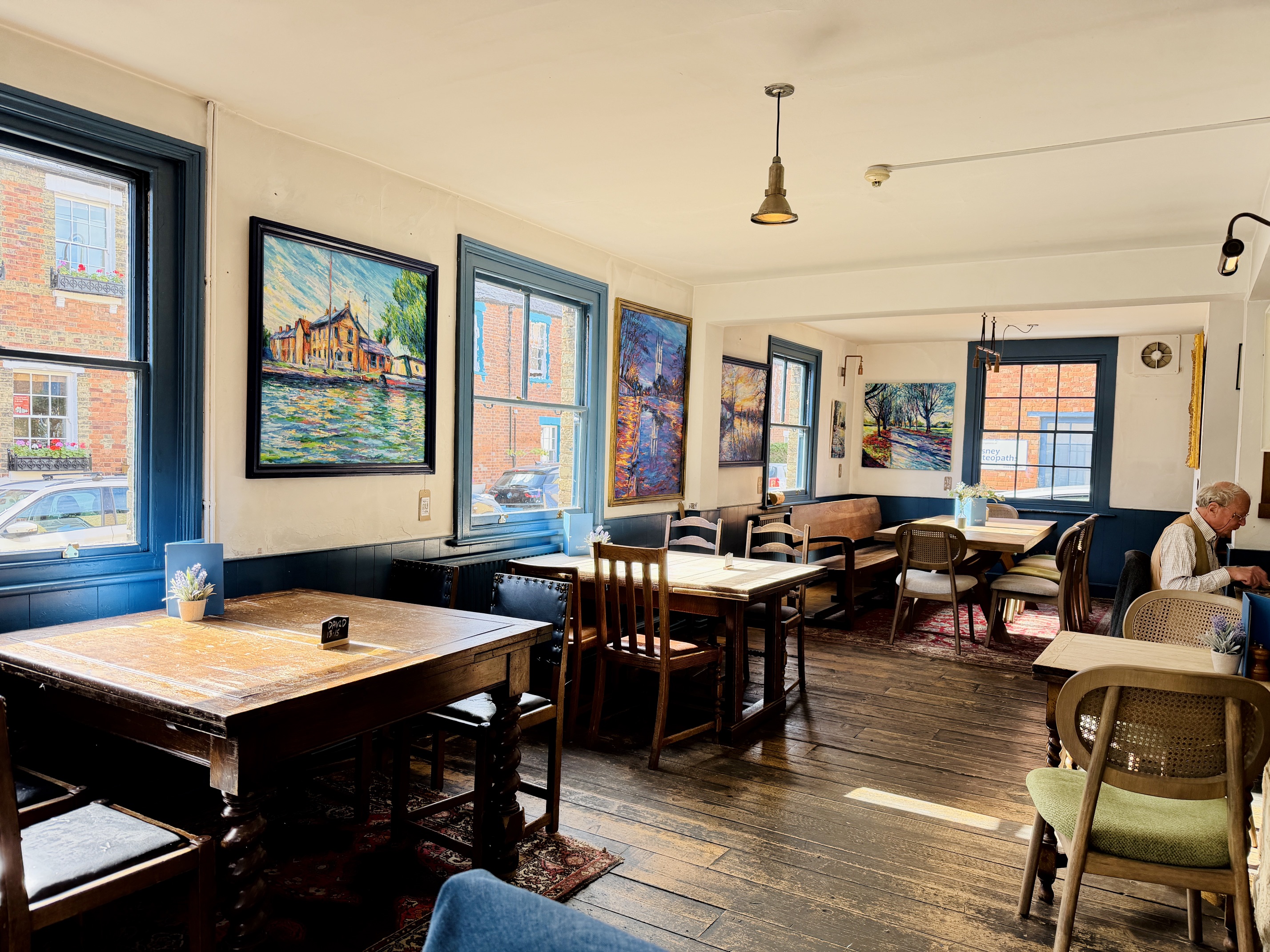
It’s a fetching space that makes full use of the building’s dimensions and huge windows: airy and busy without packing tables in like sardines. There’s a small private-ish dining room and a smaller terrace outside, but otherwise you’re in that long dining room, all black leather banquettes, parquet floor and clever use of mirrors to flood the place with light. It radiates confidence that you’ll eat well and have a thoroughly good time into the bargain.

The menu read well, divided into sections with a very enjoyable flow to them: snacks first, then starters, then mains with a small selection of desserts at the end. Decent pricing, too, with the majority of the snacks £5 or less, the dozen or so starters ranging mostly from £10 to £16 and most mains between £20 and £30.

So far so conventional, you might think, but as I ordered a Kir royale and Dave plumped for an alcohol free Peroni, our server – one of a uniformly charming brigade – chucked in a curveball by explaining the concept of the restaurant. Who doesn’t enjoy having a concept explained to them?

“All of our dishes are designed for sharing” she said. And I’m sorry to say that my heart sank a little.

Partly because I was not long back from Glasgow, where I’d got tired of that shtick, and partly because this menu didn’t read like that at all. There was a dissonance to it. It made sense with the small plates, pretty much, although not with the snacks (“you get halfway through the gazpacho then hand it to me”) but how did you share tagliatelle with rabbit ragu, unless you were in Lady And The Tramp? And who in their right mind shared steak frites unless it was a piece of beef big enough for that, which at £26 the steak on the menu almost certainly wasn’t?

“If you want to have the big plates to yourself that’s absolutely fine” she followed up, in a way that suggested my expression hadn’t been as subtle as I thought. “Just let us know so we can make sure they come out at the same time.”

This was very decent of her but, as so often with this concept, it rankled with me that eating simultaneously with your dining companion had become something you couldn’t take for granted, the Ryanair-isation of restaurants.

Anyway, no harm done: Dave and I agreed on some small plates to share, and picked a big plate each. All would be well. And we took long enough about it that I saw one of my original choices, the vitello tonnato, turn up at our neighbours’ table submerged in a thick mulchy sauce. I decided it was about as unshareable as could be.

First, though, a gilda: a perfectly pleasant mouthful of anchovy snaking its way between two plump olives and a pickled chilli, the whole thing a study in muted greens and browns. A very enjoyable first bite of a meal, flavours not to be sniffed at, perhaps slightly petite at £3.50 a pop. That balance – never mind the quality, mourn the quantity – would prove to be emblematic: in my beginning is my end, as T.S. Eliot put it.

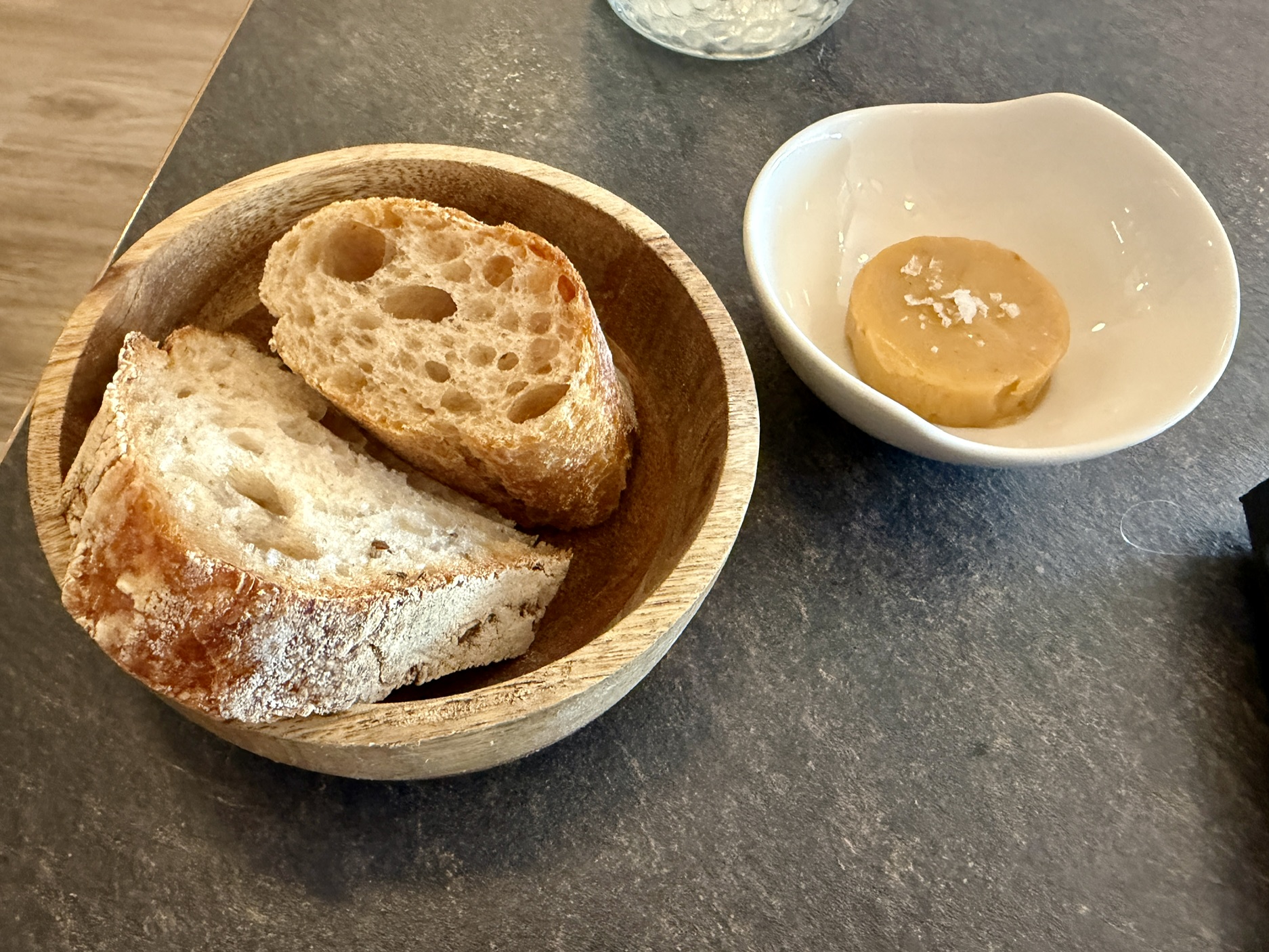
The other nibble we’d opted for was far better. I love salt cod, but I’ve never had it mantecato before – whipped, a litle like a brandade, velvety from all that emulsifying olive oil, salty, a beautiful golden hue. It was delightful, but the idea of sharing one of these between two really was for the birds.

Not only was it too good to share, but it would have been impractical to even try. The fact that the toast my salt cod was slathered on was also distinctly on the burnt side, making cutting it with cutlery or teeth more of a challenge than it should have been, reinforced that view. Fortunately we’d ordered two, and at £5 apiece they were infinitely better value than the gildas.

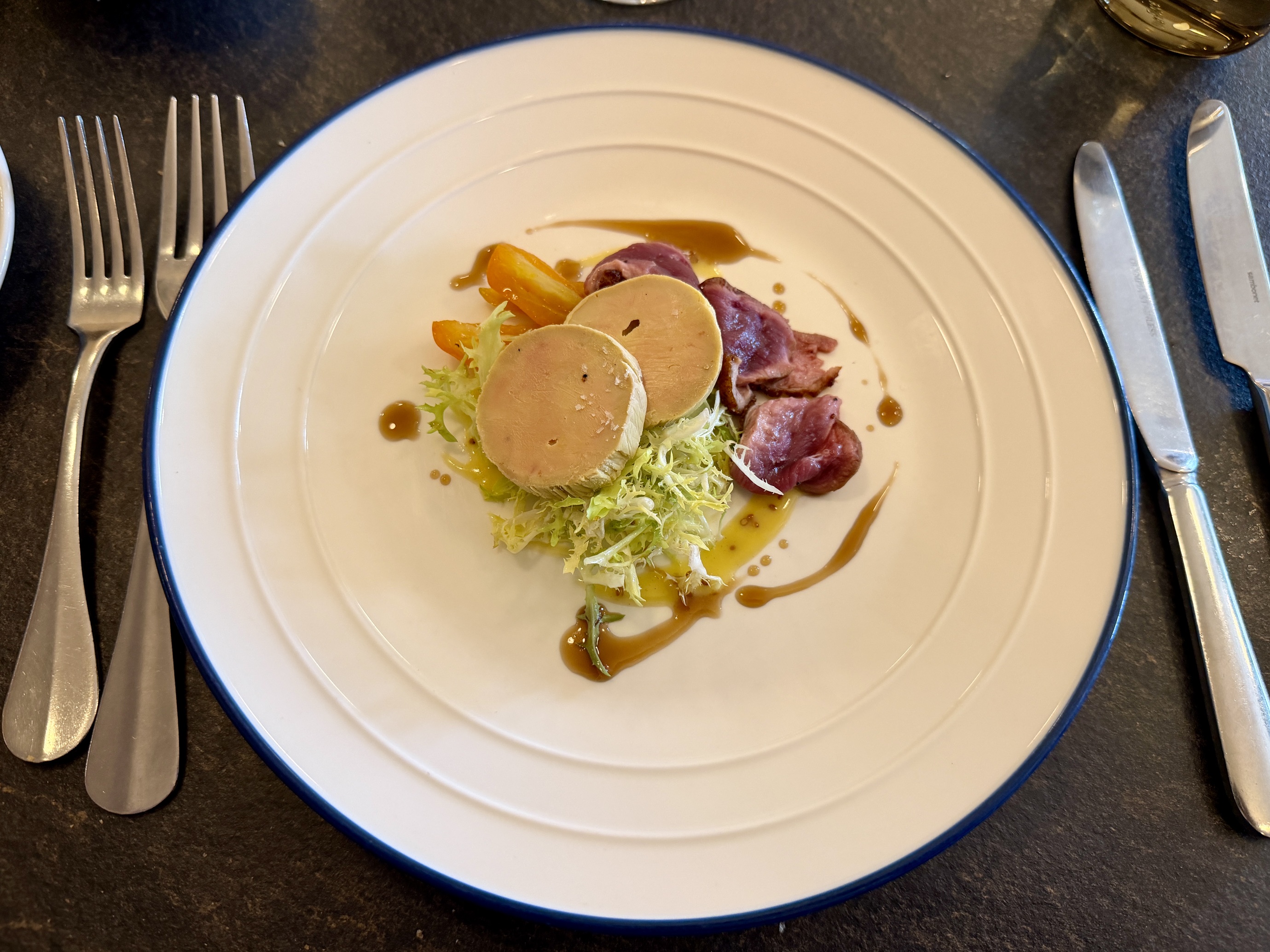
At this point things started progressing nicely, and the volley of small-plates-that-were-absolutely-not-starters-and-not-to-be-referred-to-as-such-under-any-circumstances showed off the best of what the kitchen could do, even if in one case that was ‘buy well’.

One of the strongest dishes of the meal was a really excellent sea bass crudo, taut leaves of fish brought to life with oil, bottarga, halved cherries and, I thought, a little orange zest. This was the gastronomic equivalent of dressing for the job you want, and for as long as we were eating it we could believe that the sunshine outside was the start of a glorious summer we had willed into being, by ordering dishes like this.

I had moved on to a really excellent glass of Muscadet: natural but not cloudy, with citrus and salt, which complemented this nicely. £9 a glass for a bottle which would cost you £19 online, a markup which might not sound unreasonable until you realise you’re only getting 125ml, a fact the menu neglected to mention anywhere. There’s that quality/quantity thing, again.

Also very enjoyable, if not terribly sophisticated, were two planks of panisse obscured by Parmesan. I liked this, but it was fairly one note: I’d rather they’d stuck the salt cod mantecata on a lozenge of panisse and made two decent dishes into one great one. Was it shareable? Yes. Was it worth £10 when the same money got you two of the salt cod snacks? Perhaps not.

Nobody could say that the last of our small plates wasn’t sharable. Two wedges of fragrant, sweet as you like honeymoon melon came draped with speck and pinned with a couple more pickled chillies. It’s funny, I’d turned up to Juliet thinking that it was a French restaurant but that must have been the Mandela effect: the menu ranged across Europe, spending more time in Italy than France or Spain.

What that does mean, though, is that I had plenty of experience of dishes like this to compare it to. Very good melon and very good ham might have fallen out of fashion until recently but it’s never going to be a bad combination, especially when the sourcing is as meticulous as it was here. But was this dish, at £15, miles better than similar plates I’d enjoyed at Bristol’s RAGÙ or Oxford’s Arbequina, both of which had cost less? Not really, no.

Still, lunch was well under way and I couldn’t say I wasn’t having a smashing time. Dave and I had much to catch up on from our various misadventures, and I was determined to get the discussion out of the way about my dad’s funeral and Dave’s continuing unhappy relationship with Liverpool FC, so we could look forward to happier times ahead.

And the room was full of happy chatting diners, but by this point Dave and I were among the youngest people in there: the scruff and vitality of Rough Hands, the High Street and the market felt like they could have belonged to another town altogether.

I had moved on to a light, juicy syrah from Minervois (£7 a glass, so a little less painful: still 125ml though) and Dave had been tempted to drink a Früh Kölsch, reminded of a very enjoyable trip to Cologne a few years back. It came in the traditional glass, which was pleasing and correct but also meant that you were paying £4.20 for 200ml of beer. Did the folks at Juliet not like you getting drunk? Was that what was going on?

Despite being far from drunk, Dave really enjoyed his large-plate-but-definitely-not-a-main-course. It was a decent slab of John Dory, skin nicely blackened, on the bone but coming away with little encouragement, and the forkful I had was excellent. It came in what the menu described as a sauce vierge, but the presence of olives and capers suggested to me that this particular virgin might have lapsed into puttanesca territory. It happens to the best of us.

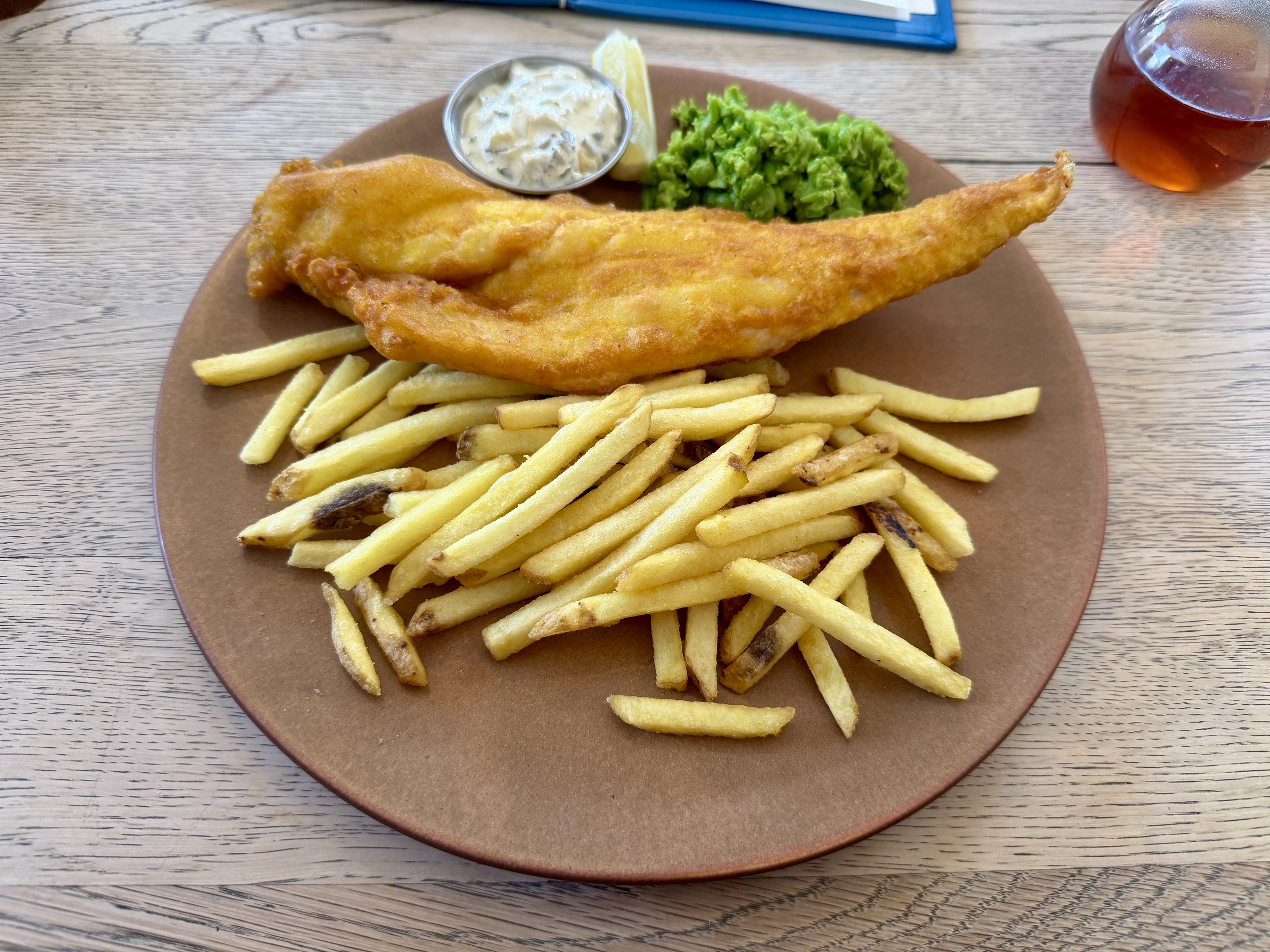
I wouldn’t say this dish was huge for £28, and I wouldn’t propose sharing it with anybody, but it was just about big enough, and went very well with Juliet’s frites, which were salty, light and well nigh flawless.

“I think if you’re paying that much for a main, it should come with some carbs” was Dave’s two pence. I’m glad it wasn’t just me.

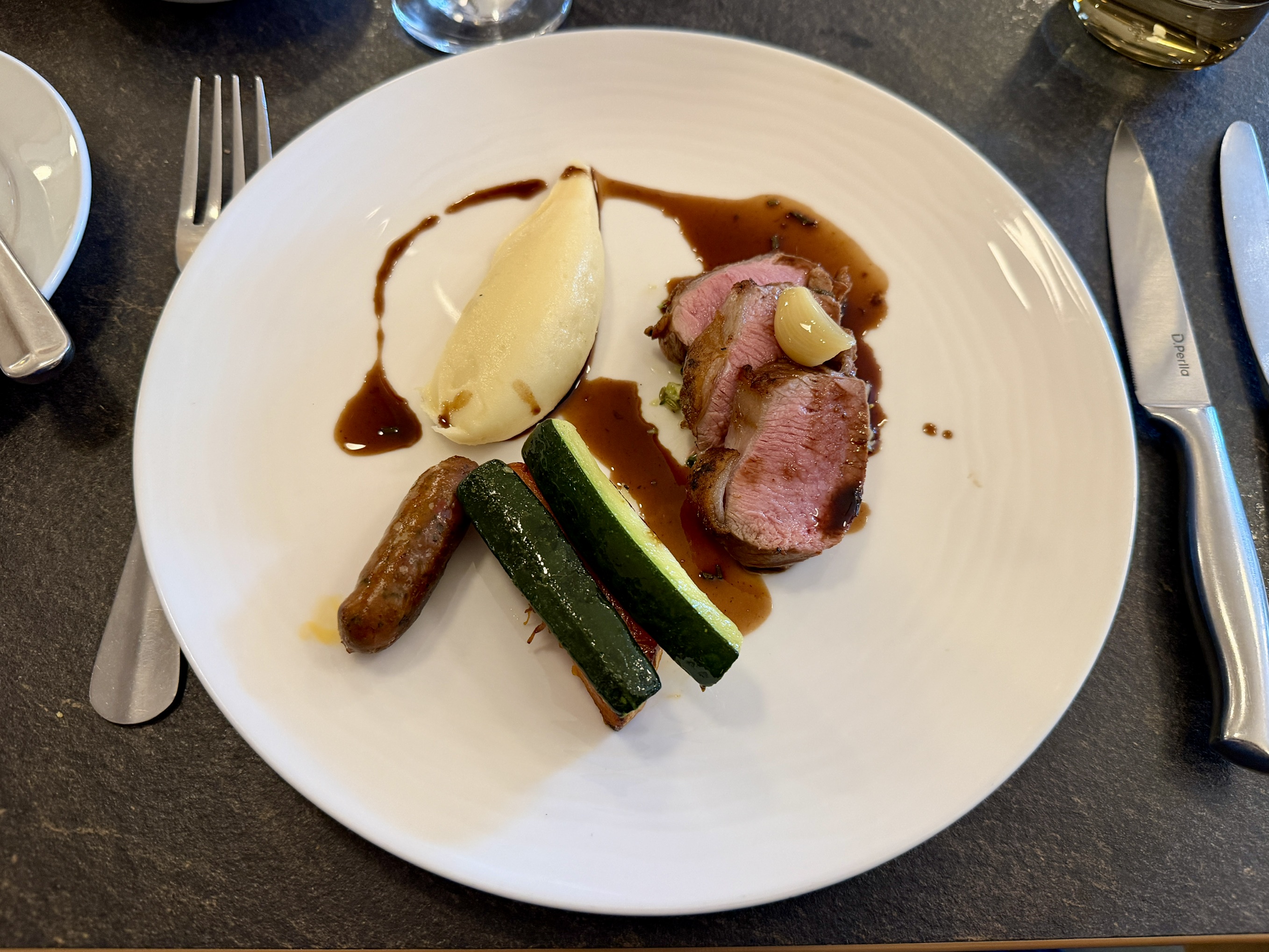
My main tasted gorgeous. Taste was not the problem. Four slices of lamb rump, blushing just the right amount, were served fanned out on a moat of jus with peas and meagre ribbons of guanciale. As a dish, for quality, you couldn’t fault it. Can you see where this is going?

It’s difficult to show dimensions in these pictures, but this was not a large plate. It had the same dimensions as the ones that had brought our not-starters earlier on, but it cost twice as much as any of them. “Our large plates are designed for sharing” is a laudable aim, but it only works if your plates (a) work for sharing and (b) are actually large. It made me think of the beautiful duck I’d had at Pompette earlier in the year: that dish was for sharing. This dish was for jealously guarding, and still feeling peckish at the end. Thank goodness for those frites.

The lag between our penultimate and final courses gave Dave and I plenty of time to compare notes.

“If I came here again I’d just stick to the smaller plates and share” said Dave.

“I know what you mean, but whether these plates are big or small, or work as sharers or not seems pretty random.”

“Yeah, and your main” – see, we were still calling them mains – “wasn’t very big. But it’s the menu’s fault: if something costs nearly £30 I’d expect it to be larger than that” said Dave, gesturing at my empty smaller-than-you’d-like plate.

On balance, although it was tempting to compare this place with the likes of RAGÙ or Arbequina, the restaurant we both ended up using as a yardstick was Upstairs At Landrace, in Bath. There we had shared some small plates, had a main course each, come away fuller and, I’m pretty sure, spent a fair amount less. The Bath restaurant felt like the far better execution of an idea both places had come up with.

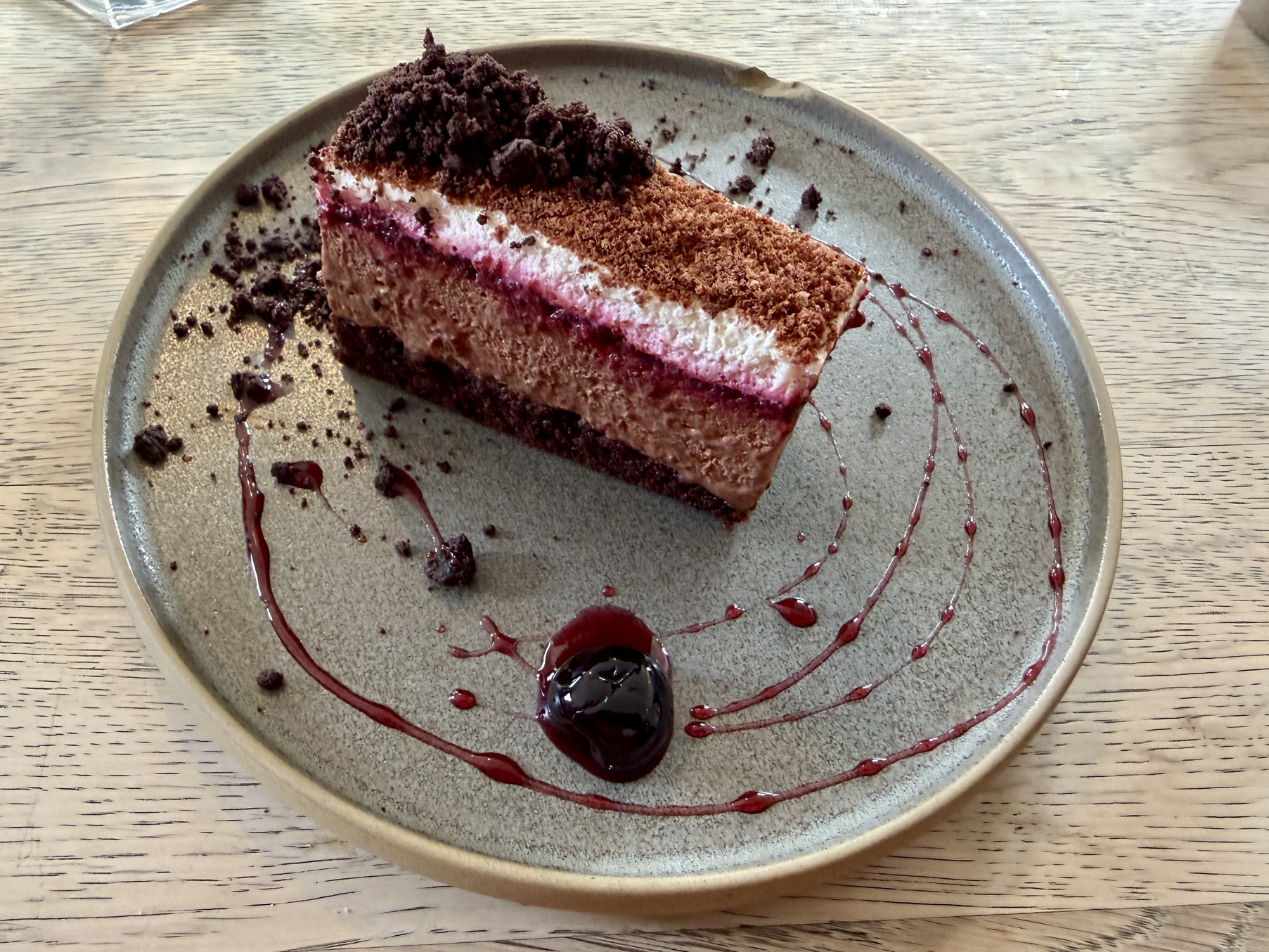
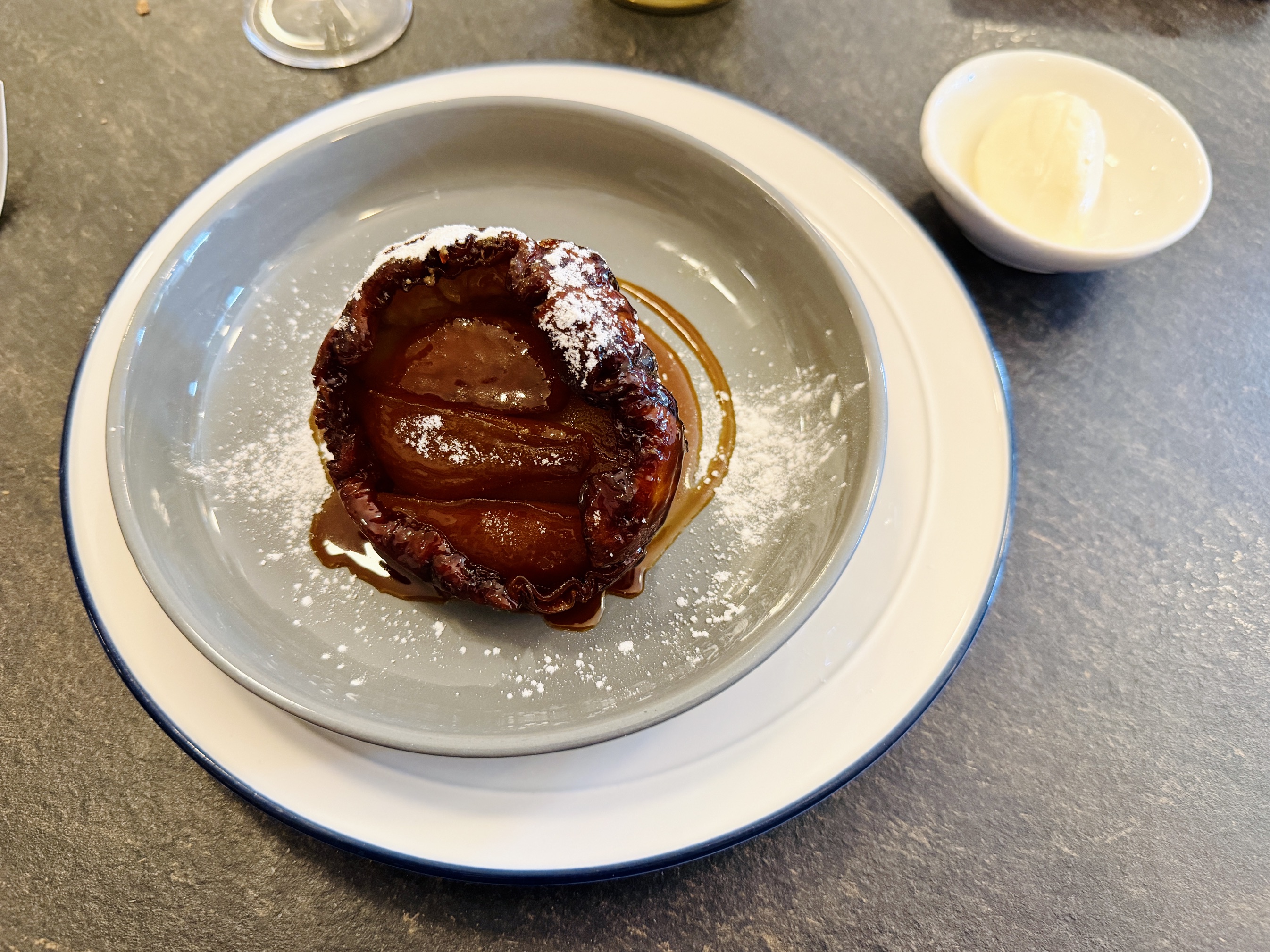
None of that, mind you, stopped us having dessert. Thankfully restaurants never try to make you share these, so we each had our own individual portion of chocolate cremeux. It was far and away the most successful thing we ate – glossy and moreish, just enough depth, not too much sweetness, and it came anointed with olive oil and sprinkled with flakes of salt. Truly unimpeachable, simple but superb. Why couldn’t it all have been like this?

It went really nicely with a glass of Banyuls, again a relatively stingy pour at 50ml, but for £5.50 you couldn’t complain. It’s not like me to quote exact prices like a local newspaper, or to dust off the Weights And Measures Act, but everything was so controlled at Juliet that I almost feel compelled to.

Last of all I ordered a ricciarello, a soft almond biscuit which is a speciality of Siena. It was gorgeous: ricciarelli are soft, irregular and crammed with almond, so not dissimilar to amaretti morbidi, but with an extra zing of citrus that makes them just a tad more interesting. I liked this a lot, and it was only a couple of quid. Ironically, considering it was one of the smallest things we ordered, I shared it with Dave.

After all that, we settled up: our bill for snacks, small plates, slightly less small plates, sides, dessert and small drinks came to £195, including a 12.5% service charge. Our bill at Upstairs At Landrace the previous year had been smaller: it was the only thing that was.

The rest of our day followed a well-trodden path. By the time lunch was over the market had packed up, and Stroud on a Saturday afternoon felt like Bruges after the coach trips pack up and leave or Mykonos when the cruise ships have moved on, a sleepy place with little sign of just how awake it had been mere hours before. We found a very nice pub called the Retreat that had striking red walls, gorgeous prints on them and Steady Rolling Man on draft, and we set the world to rights, or tried to, until it was time to take one of those regular trains back to our respective home towns.

Ordinarily, that is where this review would leave us, with Dave and I home from a day of fun, debriefing with our respective spouses. I would conclude by saying that Juliet is a good restaurant if not a great one, flawed in ways you could probably work around if you could be bothered, and possibly worth visiting if you found yourself in Stroud with £100 a head burning a hole in your pocket and more of an appetite to spend it there than on a cornucopia of fine goods from the market. But this week I have to close where I’d usually begin, by discussing the puzzling national consensus that Juliet is, in fact, an utterly phenomenal place.

The thing is, over the space of the twelve months since it first opened Juliet got unanimous rave reviews from almost every national critic. It’s rare for them to be of one mind, unless they know and like the owner – Jeremy King springs to mind – and rarer still that they reach that view about somewhere outside London. For any of them to stray that far afield is comparatively rare, but for all of them to descend on the same part of not-London is practically a unicorn.

Yet they all loved Juliet. Giles Coren, who had a house nearby at the time, said in the Times that “Juliet is not just great for a boondocks bistro; it’s great for anywhere in the world. It would be the best restaurant in Hampstead by miles. The best in Chelsea, no question.” Grace Dent in the Guardian, also writing to make sense of the provinces for Londoners, said it was “seriously worth a schlep to Stroud”.

What about William Sitwell in the Telegraph? “If this isn’t my favourite restaurant of 2025 I’m in for a year to remember” was his analysis. It goes on. Tom Parker Bowles said in the Mail On Sunday that he could stay all night and, not one to miss a Shakespeare pun, ended with “parting is indeed such sweet sorrow”: isn’t he erudite?

And then there’s arch bloviator Tim Hayward in the FT, what did he say? Well, your guess is as good as mine: in a windy old review entitled Raise your voices and howl for The Chefs he bibbled on about his trip there with “a small cadre of West Country foodisti”. Hayward’s writing always reminds me of the opening lyrics to the Beatles’ Julia, when John Lennon sings Half of what I say is meaningless. Even if that’s true, Lennon still had a better batting average than Hayward.

Sitwell’s was the only one of those reviews to explain that the menu is intended to be shared. None of them talked about whether the food lends itself to doing that, in terms of sizing or price. None of them really talked about cost or value at all, indeed Sitwell’s said that the price was “£126 excluding drinks and service”, which says to me that he spent more on booze than he’s comfortable admitting.

You would not get a good idea from any of those reviews whether Juliet is pricey, or will leave you feeling rinsed. This is what happens when you take advice from people who expense it all. They’re worse than cynics: they know the price of nothing and the value of nothing.

So what did they spend their word counts talking about? Parker Bowles had less than 400 words to play with, and name dropped the former restaurant critic he was having lunch with before discovering “another old mucker” up at the bar, who “is easily persuaded to join our table.” I’m sure his friend Dai Francis, whoever he is, was delighted to get a name check.

Coren told us that he bumped into Dom Joly there – thank god I wasn’t lunching at Juliet that day – before going on at length about how the owner Daniel Chadwick is “one of the best men ever to own a restaurant”. Was it ever going to be anything other than a rave? Maybe he should have recused himself, knowing that if he didn’t review Juliet another four restaurant critics still would.

But really, when three of the reviews manage to mention the sommelier by name but omit pretty crucial details about what a meal at Juliet is actually like, you do have to wonder if restaurant reviewing has started missing the point.

Amid all the showing off, name-dropping and knob-jostling, amid the florid hunt for the Next Big Simile, it feels to me like reviewers – critics and bloggers alike – have lost their way and forgotten what’s important: what’s it like to eat in a restaurant? Will I like it? How much does it cost? Is it worth the money? You can track chefs’ CVs all you like, you can talk about your buddies in the trade, you can vaguely patronise anywhere without an 020 area code, but all you’re really doing is bragging about what a great time you’ve had.

So there you go, they all had a ball. I’m not so sure, on balance, whether you would. But perhaps it doesn’t matter, because they sold their papers and it’s only money. Your money. And I can still finish by telling you that Juliet is a good restaurant but not a great one, flawed in ways you could probably work around if you could be bothered, and possibly worth visiting if you find yourself in Stroud with £100 a head burning a hole in your pocket and more of an appetite to spend it there than on a cornucopia of fine goods from the market.

I bet it’s a great day out on expenses, though.

Juliet – 7.6
49 London Road, Stroud, GL5 2AD
01453 367019

https://www.julietrestaurant.co.uk

Since January 2025, Edible Reading is partly supported by subscribers – click here if you want to read more about that, or click below to subscribe. By doing so you enable me to carry on doing what I do, and you also get access to subscriber only content. Whether you’re a subscriber or not, thanks for reading.
Restaurant review: Gooi Nara

There’s no such thing as Spotify Wrapped or Apple Music Replay for restaurants, as far as I know. But if there was, the restaurant whose food I ate most last year is almost certainly Gooi Nara, the Korean restaurant on Whitley Street that has been there for something like ten years, if not more. And yet returning to it a couple of Saturdays ago for dinner with Zoë was the first time I’d set foot inside since I reviewed it in 2018.

The thing is, as regular readers will remember, I moved to Katesgrove a couple of years ago, which means that, along with Kungfu Kitchen, Gooi Nara is probably the closest restaurant to where I live. And what that means is that on the nights when neither of us can face cooking we know that a delivery driver won’t get lost, won’t drop other orders off en route to our house and can be trusted to turn up pronto with piping hot food from just round the corner. Over the last two years, between us, we’ve developed quite a Gooi Nara habit.

It’s no coincidence that they won my “takeaway of the year” award in 2024 – but my love of a Gooi Nara delivery has continued ever since. It is refined and perfected now to the point where Zoë and I order exactly the same thing almost every time: dakgangjeong, or Korean fried chicken, for her and tang su juk, chicken in sweet and sour sauce for me. The latter comes ready to assemble, one plastic container of gorgeous fried chicken and a tub of sweet, sharp sauce with orange and pineapple bobbing in it (I was skeptical too, but don’t knock it until you’ve tried it). It has made me happy many, many times.

Sometimes we push the boat out and get some mandu, fried chicken dumplings, as well but otherwise those two and a couple of portions of rice are everything we need for a contented chomp in front of the telly after a hard day. I especially grew to love Gooi Nara when I was discharged from hospital and could only eat with one hand: I remember the first time I had their sweet and sour chicken after my accident I could only eat half, the rest popped in a LockNLock in the fridge. It was even better cold the next day: it remains the only occasion when I’ve had any leftovers at all.

That’s all well and good but I love their food so much, and always hear so many positive comments about it online, that it felt like we were doing them a disservice by only ever ordering the same two takeaway dishes. And my review was over eight years old, after all, so it felt like high time to go back. Early one Saturday evening Zoé and I took a short amble there, tracing the path of so many delivery riders in reverse, to check it out.

First things first: it was absolutely packed at 6.30pm on a Saturday evening. So much so that they could only just find room for us, tucked away at the very back with a great view of what was clearly a very successful restaurant. The decor didn’t feel like it had changed much in the intervening eight years: it still had a welcoming, homely feel, all wooden beams and faux slate walls.

The main difference, I would say, is just how well Gooi Nara appeared to be doing. It also started out very warm, and on a punishing day as the hot plate in the middle of our table got switched on it became even more sweltering.

In terms of the mix of customers, I would say that with the exception of the table next to ours later in the evening we were the only one exclusively made up of pasty Anglo-Saxons: I did envy my fellow WASPs at the other table who no doubt were getting an excellent introduction to the full gamut of the menu from people who knew exactly what to order.

It did appear, too, that Gooi Nara had a good reputation: I overheard a conversation at one of the big tables nearby to the effect that its occupants had converged at the restaurant from many places, some miles away. Maybe Gooi Nara filled that role for Southerners who couldn’t easily make it to New Malden, the Little Korea of the UK.

Gooi Nara’s menu has changed, I think, from when I visited it last. Back then I’m pretty sure it hedged its bets, with both a Korean and Japanese section, but now it’s all kind of thrown in together: edamame; takoyaki; agedashi tofu and pumpkin korokke feature, along with yaki soba and udon.

But the Korean elements of the menu are far more extensive, and the menu can be quite overwhelming with sections seemingly for everything: soup; rice; bibimbap; jeongol (or hotpot); noodles and of course Korean barbecue. The sides, to add to the confusion, appear at the very beginning, before everything they could conceivably be on the side of.

It made me wish I had my own food sherpa – is that cultural appropriation? – to guide me through the highlights of the menu, a feeling that only intensified as I saw some gorgeous dishes waft past to other tables. Was the delicious-looking tofu (I’m not even joking) that went to the table opposite the agedashi tofu, or the Korean doo-bu jeon? I decided on reflection it was the latter. And how good did the platter of various types of kimchi look when it arrived at the table next to me, a couple having one of the most Guardian conversations I’ve eavesdropped on in a very long time?

I came away from it all feeling silly and parochial, realising that really I only knew a handful of dishes on the menu and the various bits and bobs I’d ordered the best part of a decade ago. I was well aware that on this visit I would stay in my comfort zone, even if I’d insisted to Zoë that we couldn’t order any of the things we would invariably put in our takeaway order. So we ordered a couple of starters, a couple of mains and two items for the barbecue, and even then I’d say we played it extremely safe. We might have been outside it, but our comfort zone was only a short walk away.

Everything came if not all at once then really in a very short space of time. One minute we were necking our cold bottles of Cass, a perfectly decent lager I would struggle to tell apart from Asahi, Ha Noi or Singha in a blind taste test, let alone its Korean alternative Hite, and the next our grill was switched on and pretty much everything we’d ordered was cramming in on our table.

And the table looked big, but since the centre of it was given over to said grill you ended up playing the equivalent of those sliding tile puzzles trying to work out what could go where. Try to combine that with the timings of actually cooking some of your food and the whole experience became a little like patting your head and rubbing your belly at the same time, impressive training in multi-tasking. Forget my doing those six pointless LinkedIn games every morning: this would be much better at keeping me mentally sharp.

Vegetable mandu were, if anything, even more enjoyable than the chicken ones which had been dropped off by a friendly rider so many times in the last two years. A bit more crinkly and expansive than their chicken equivalents, they had a pleasingly light, grease-free texture and a filling I could almost convince myself was virtuous. Gooi Nara’s dip of soy, sesame oil, sesame seeds and quite possibly something else beginning with S had a gladdening sharpness that complemented them very nicely indeed.

A quirk of Gooi Nara’s menu is that, if it is to be believed, you get 5 chicken dumplings or 5 prawn dumplings but a strangely non-committal “5-6” vegetable dumplings. Fortunately on this occasion we got a shareable, even number, but I’m pretty sure whenever I’ve ordered the chicken mandu I’ve been given 6 of those too. Go figure, pun not intended.

Also decent were the prawn tempura, which I would say were better than they looked. In the picture below they come across as a little wan, a tad too blond, but they had a real deft lightness and, again, next to no grease. The dip they came with, almost exactly the same as the one that accompanied the mandu, was still good but the dimensions of the vessel and the size and length of those prawns made it, practically speaking, a faff: it was a bit like trying to get a pool cue in a beer glass. £12.30 for these, so as much as both of the main courses we’d chosen.

By this point we’d also started to avail ourselves of the barbecue. Sam gyap sal, unadorned sliced pork belly, turned up looking a bit like those cheap bacon-flavoured corn snacks you can get in supermarkets, and I did wonder whether we should have gone for the spicy version, but it crisped up beautifully on the barbecue, that fat rendering and permeating just enough.

We chose the pork to cook first precisely because it wasn’t marinated the way our other barbecued meat was, to try and avoid cross-contamination. We had a couple of dishes of condiments to dip them in, and I failed to make a note of either, but one was definitely soy and the other was definitely not: I think it might have been ssamjang, the traditional sauce used with Korean barbecue containing gochujang and soy beans.

It was only later that I realised we should have ordered some lettuce to wrap the pork in: it’s hidden away, chronologically speaking, in the list of side dishes at the beginning of the menu.

My main – although the concept of a main slightly falls away when it all comes at once – was the chicken dolsot bibimbap, a dish I haven’t eaten in a long time. For the uninitiated, this is rice, chicken, veg and an egg yolk brought to the table in a hot stone bowl, so it keeps cooking and sizzling as you work your way through it. I broke up and dispersed the egg and made my way through it, and by the end some of the rice had reached the crispy state known in Korean as nurungji (I suppose the closest European equivalent is the delectable socarrat at the bottom of a paella).

I would have described this dish as a little nondescript, a tiny bit bland, if it weren’t for the squeezy plastic bottle of gochujang which came with it. The more of this I added, the more I enjoyed it, and the more I enjoyed it the more I added it: I do wonder how much you’re meant to use, and how much was left in that bottle when I was done, but it turned what could have been a trudge into a frolic.

The other thing that whole experience taught me was patience. Ordinarily I would have a moan – god knows you’ve probably read enough of them – about everything arriving at the same time and forcing me to choose what to eat first.

Eating in Gooi Nara that evening, among all that good-natured, deceptively well controlled bedlam, I realised that it was probably a very English mindset: that your food is at its best the moment it arrives at your table and it’s downhill from there, that it’s a scramble to eat it before it goes cold and that too many dishes at once guarantees disappointment.

But it didn’t feel that way here. Those prawns and dumplings sat there, keeping their freshly fried heat. The pork sizzled on the barbecue, with more on the plate waiting to take their place. Our second barbecued meat hadn’t even made it to the front of the queue. And my bibimbap was still hot, gradually perfecting its texture. What was the rush? Everything would be eaten in its own good time, in the right order, with no need for conniptions.

Zoë loved her main, I don’t think I would have done. I managed to persuade her not to have her regular takeaway order, her chicken gam-poong gi, but she ordered it with prawns instead. I was expecting this to be prawns curled up, little inverted commas in a crisp coating, tossed in the gorgeous spicy sauce that makes this dish such a crowd pleaser in my house.

Instead they were fully extended like an accusatory index finger, the tempura prawns from earlier on making a reappearance with some sauce thrown in. So deeply impractical in many of the same ways as that starter, and downright impossible to eat with rice. I didn’t order them, and I certainly wasn’t allowed to try them, so it doesn’t really matter. Zoë really enjoyed it, and maybe in the free-for-all of our meal overall it didn’t really matter that they weren’t quite what I thought they would be.

The dish they didn’t go with, or at least I thought they didn’t, was Gooi Nara’s special egg fried rice with vegetables and shrimp. Zoë, again, seemed to enjoy it but I thought it was a bit steep at £11, especially considering that you could get a bibimbap for roughly 50p more. Plus I got a bit squeezy bottle of gochunjang, let’s not forget, and this looked like it badly needed that or something like it.

Finally, as we flagged in the heat, a little John Lewis portable fans valiantly whirring away to almost no avail, we barbecued the last dish in our order. By sheer coincidence I’d actually ended up ordering something from my 2018 visit to Gooi Nara – the ju-mul luk, beef with garlic and sesame oil. It was smothered in marinade there on the plate, slices much thinner and better cut than I remembered from my last encounter, and it smelled pretty amazing before it was ever even exposed to heat. As it cooked, the aroma got more and more gorgeous: perhaps we’d saved the best til last.

Tasting it at the end of the process, I rather thought we could have done. Every single piece was buttery-soft, that marination doing its work with no notes, and although it might have been nice to enclose each piece in a lettuce leaf and enjoy that contrast, I rather wonder if the lettuce might have wilted as badly as I did towards the end of an hour in that hot, noisy, oddly glorious room. By some tragedy, Zoë found herself full halfway through my final spell as the commis chef of our table. I buckled up and finished the rest: it had to be done.

Gooi Nara’s menu only has two desserts, both of which are Japanese, but we were too hot and too full to attempt either of them. Our bill for all that food and a couple of beers came to £95, not including service, and of course we were more than happy to tip: even just watching the constant parade of staff back and forward to tables, carrying a huge array of fascinating dishes without ever breaking rhythm, juggling orders for customers and brown bags out to delivery drivers, filled me with admiration.

It made me think of all the Saturday nights when we’d fired up a delivery app and our food – perfect, beautifully packed, prompt and piping hot – had arrived in what seemed like no time. Every evening that happened, the restaurant might well have been as busy as it was that evening. We emerged into the sunlight on Whitley Street feeling like we’d spent just over an hour somewhere totally not-Katesgrove, but also arguably in Katesgrove’s very best restaurant. We also resolved that, delicious and convenient though a Gooi Nara takeaway always was, we needed to visit again far, far sooner.

Rating Gooi Nara this time has been quite difficult. I definitely enjoyed it more than the previous time I went, but I have a feeling that the limitations on the rating it receives on this occasion have more to do with me than with them. So whatever mark Gooi Nara gets as a restaurant, I think this might be a review where I, as a reviewer, might struggle to scrape a 7. I have a feeling that if I’d been bolder, gone further to the perimeter of the menu, I could have enjoyed it even more and it would have done even better.

In that sense it would have been nice if Gooi Nara had, in the way that great communicators like Kungfu Kitchen, Clay’s, Kamal’s Kitchen and the Moderation do, tried more to tell the story of their food and bring newcomers in. But really, that’s not mandatory, especially when a restaurant has been going for about 10 years and is doing very nicely without having to do any of that. So much as I might have enjoyed having a bit more guidance on how to attack the menu, that was definitely a me problem, not a Gooi Nara problem.

I will be back, and when I do I will try some more esoteric dishes: if you have any recommendations drop them in the comments. In the meantime, I suspect another paper bag with my regular takeaway order lurks in my not too distant future. Eat-in, delivery: get yourself a restaurant that can do it all.

Gooi Nara – 8.1
39 Whitley Street, Reading, RG2 0EG
0118 9757889

https://gooinara.com/

Since January 2025, Edible Reading is partly supported by subscribers – click here if you want to read more about that, or click below to subscribe. By doing so you enable me to carry on doing what I do, and you also get access to subscriber only content. Whether you’re a subscriber or not, thanks for reading.
Café review: Baby Yolk

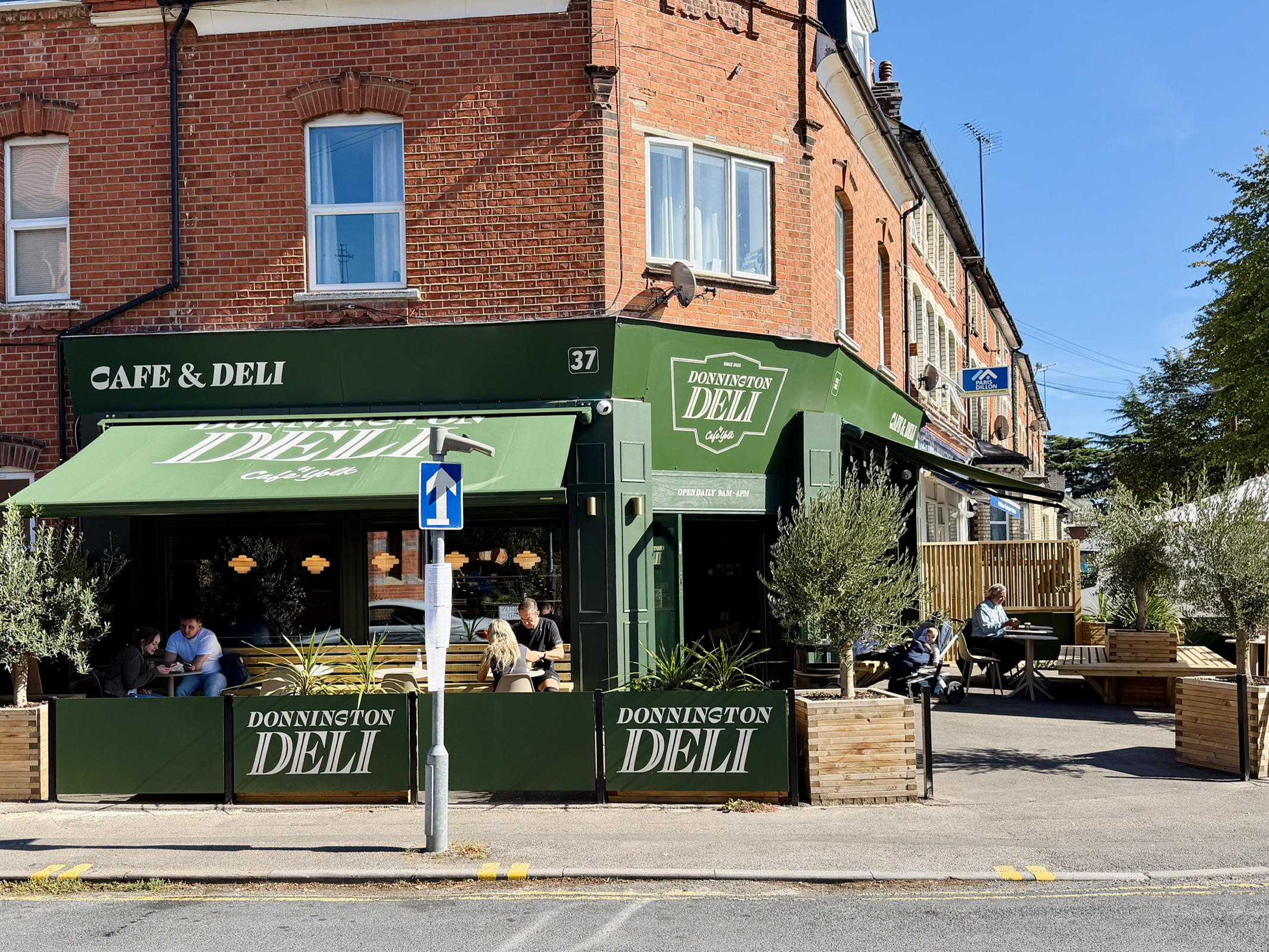
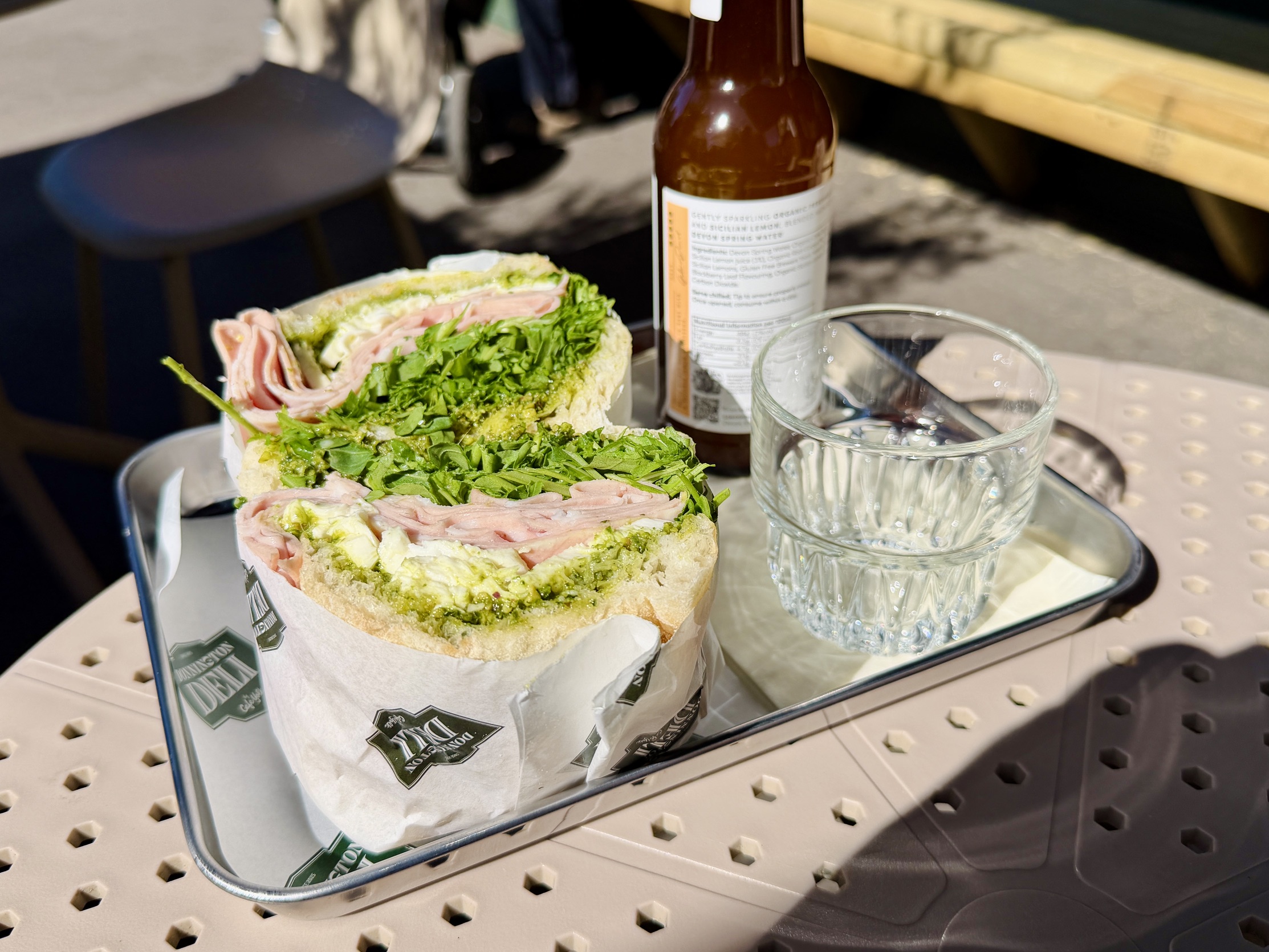
Alexandra Langlais, the owner of Insta-friendly Erleigh Road institution Café Yolk has had a busy twelve months. In January she opened Donnington Deli opposite Yolk’s original branch in a spot formerly occupied by a car dealership, offering huge deli-style sandwiches with a free cold drink thrown in (or, if you’re cynical, a cold drink you might not want priced in). I went the morning they opened and, perhaps peevishly, was disappointed that they weren’t a deli and didn’t serve coffee; I wandered off to have an enjoyable brunch at Monty’s instead.

The deli thing was probably an overreaction – nobody criticises Calcot’s Avenue Deli, after all, for not being a deli – and I’m reliably informed that Donnington Deli has finally put coffee on the menu. But I ate there a couple of times in quick succession in its opening month and, despite being impressed with the handsome fit out, it wasn’t entirely my bag. Sometimes less is more, and Donnington Deli’s almost comically overstuffed and stodgy focaccias didn’t do it for me; the prevalence of turkey, surely everybody’s least favourite meat, on the menu was also a bit of a curveball.

I’ll be back at some point once it’s settled in to try Donnington Deli again but the place was doing a roaring trade and doesn’t need any help from me either way: Langlais clearly knows exactly what she’s doing, understands her market and is expanding her business in a careful, considered way, staying close to a community she knows well. It’s mind-blowing, really, to think that Café Yolk traded solidly for over 10 years before it even considered branching out.

The more interesting development, for me, was Yolk’s actual second branch, colloquially known as Baby Yolk, which opened on Cemetery Junction last July. It was a deliberately stripped-back sequel to its older sibling, with a far narrower menu and a greater emphasis on grab and go options. It particularly appealed to me because my favourite thing at Yolk was always the breakfast burger, and that’s what Baby Yolk has built its menu around.

But in that part of town, only open daytimes, Baby Yolk had proved challenging for me to get to for brunch or lunch, and it wasn’t clear how much capacity it had for eating in. Last week, with a rare Friday off, I found myself in that neck of the woods just in time for a late breakfast, so I decided it was a sign and made my way there to see how it measured up to the other establishments in the Yolk family.

I was reminded as I approached it that businesses don’t always prosper in this location. The spot where Smash N Grab used to be was now occupied by a South Indian business called Mallu Nest, but the little hut looked like it was being gutted and it wasn’t clear whether it would reopen as Mallu Nest or something else. And of course before that it spent something like a year being the preposterously named Cozzy Bites, a smash burger place whose menu was so similar to Smash N Grab’s that you wondered if the names of the burgers had formed part of the terms and conditions of sale.

Come to think of it, before Baby Yolk came out of its shell that site was Cemetery Junction hairdresser the Funky Barnet for over 20 years, which means that – lucky Yolk – their landlord is famous Reading philanthropist John Sykes. Let’s hope they get on better with Sykes than the Funky Barnet did, given that they notoriously went to the local paper during Covid to ensure his humane conduct reached a wider audience. All that and a busy charitable foundation too: let’s get Danyl Johnson to give that man a gold plated Pride Of Reading Lifetime Award!

Still, as long as Yolk keeps making money and avoiding any kind of global pandemic I’m sure they and their landlord will rub along nicely, until it comes time to renegotiate the rent at least. But can they do that in this little corner of the Junction? I got there just after 10am, and one customer was sitting in, although there was a steady trickle of both eat-in and takeaway customers during my time there.

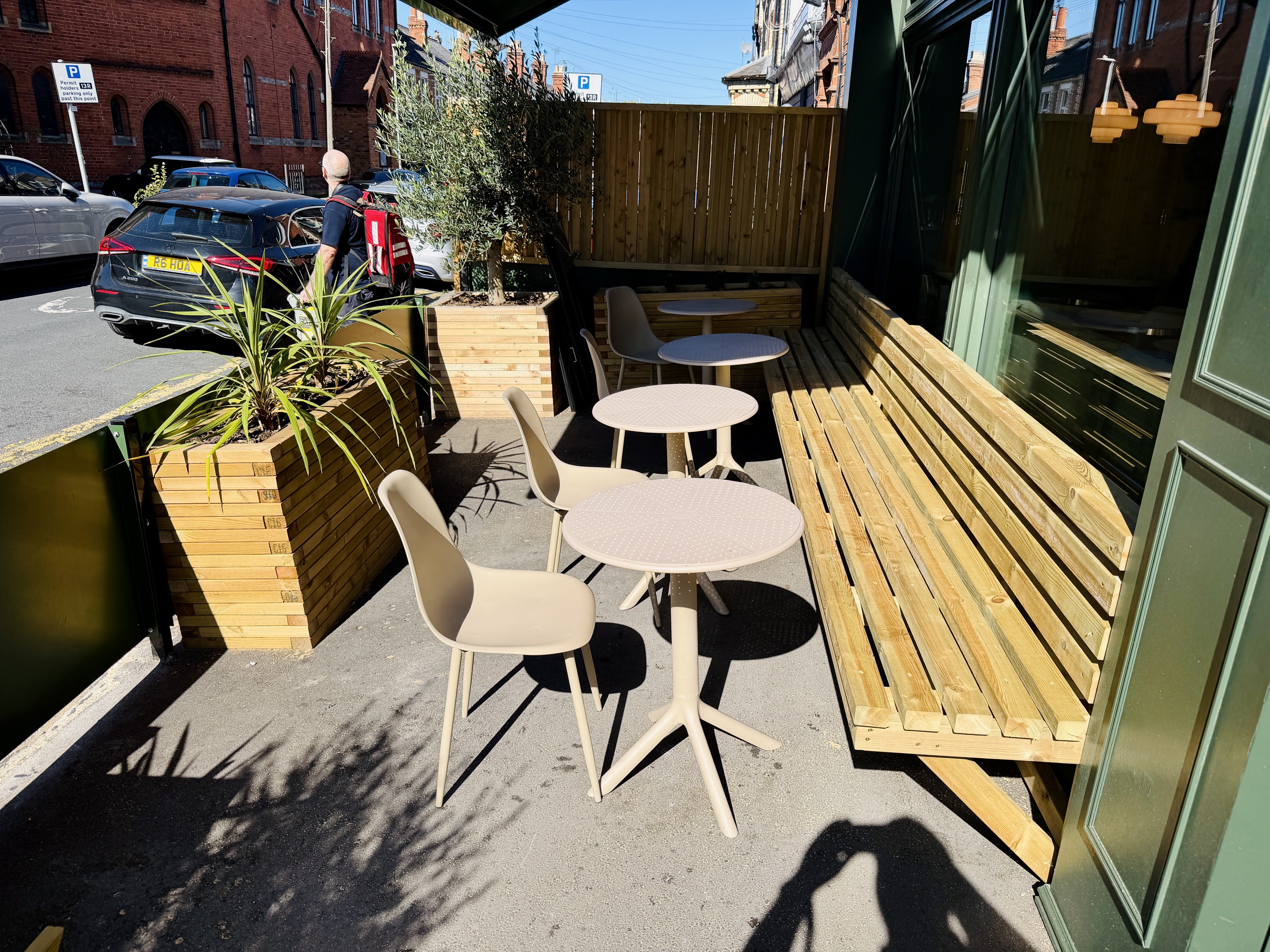
I loved the interior and the way Baby Yolk was styled. From the sunshine-yellow awning and shopfront to the almost space-age white shelves, showcasing Yolk’s beans and reusable cups for sale, the colour scheme is clever and witty, is bright and pops. It’s rare that the interiors of Reading hospitality businesses look this coherent and thought through, and I really appreciated it. Baby Yolk was also far bigger than I expected inside, with a mixture of high and low tables, stools, chairs and bright yellow banquettes, probably seating about a dozen people. Outside a little terrace had room for half a dozen more, and could be lovely on a sunny day.

Baby Yolk’s menu keeps it simple: five “breakfast burgers”, although the pedants among us – okay, maybe just me – could argue about whether any of the ones that don’t involve a sausagemeat patty technically qualify as burgers at all. For meat eaters you can have either sausage and egg, bacon and egg or the holy trinity of all three, for vegetarians it means egg, cheese and avocado in a bun.

Vegans get the same thing, but with scrambled tofu subbed in for the egg: I had scrambled tofu once, in 2016, and have never sought to repeat the experience. Let’s just say it was a strange time in my life.

The entry level breakfast burgers are £7 each and costs rise from there to £8.90 for the vegan not-a-burger. There are various extras you can chuck in: some, like sauce and crispy onions, are free whereas others can add up to £3 to the end product. It felt a little unfair that the vegetarian and vegan options were the most expensive things on the menu, and it also doesn’t suggest Yolk is using the fanciest meat in their sandwiches.

The majority of the menu board was given over to a plethora of beverages: frappes, smoothies, iced drinks, teas, coffees, matcha and chai. There were also some baked goods up at the counter – muffins, cookies and the like – although their price wasn’t listed. A sausage and egg burger and a latte set me back £10.70, which felt pretty reasonable, and I nabbed a table in the bay window with a good view of the room. Five minutes later, my coffee and my foil-wrapped burger were in front of me.

The first thing to say about Baby Yolk’s breakfast burger is that despite what you might think it is not a McMuffin or even Fidget & Bob’s Kennet Island homage, the O’Muffin. Part of that is the obvious: it’s a bun, not a muffin. And part is because, instead of a fried egg, Baby Yolk tops its patty with a little omelette, as its elder sibling does. Less messy, and possibly a little less indulgent.

Unlike the breakfast burger at Café Yolk the egg here doesn’t make a break for it past the perimeter of the bun. But again, this is designed for convenience and eating on the go, not attacking at a table with cutlery to hand if you need it. I didn’t mind that, but the egg itself was underseasoned: it meant the rest of the burger had to do a disproportionate amount of heavy lifting.

Similarly the patty was pleasant, if ever so slightly anaemic. When you have this dish on Erleigh Road there’s more caramelisation, more crisping of the edges. Here everything was a single texture, a perfectly pleasant spongey puck of sausagemeat which, again, could have done with more salt. All that makes it sound like I didn’t enjoy this, which is unfair: I did, and it was pretty much what I needed. But was it an upmarket reimagining of a Sausage & Egg McMuffin, or just a more expensive version in a nicer room?

What saved it, I suspect, were the extras. I’d gone for HP sauce and crispy onions and the latter in particular lifted and rescued what might otherwise have been a tad workmanlike. The onions were those ones you bought in a tub, but in a thick carpet between the bun and the patty, playing off the brown sauce, they made each mouthful better. I munched away contentedly, enjoying my bay window seat and watching the comings and goings of this interesting little café. Something about its simplicity, its deliberate lack of range, appealed to me: after all, the one thing Gordon Ramsay and restaurant critics have in common these days is a strongly held conviction that menus should not try to do too much.

When I reviewed Cafe Yolk last, nearly 5 years ago, a big draw was that they had started buying coffee from Anonymous Coffee. Then they binned it off, presumably on cost grounds, and used Kingdom Coffee instead: I discovered this one sad afternoon when my takeaway latte tasted worse than one you could have picked up from Costa or Nero.

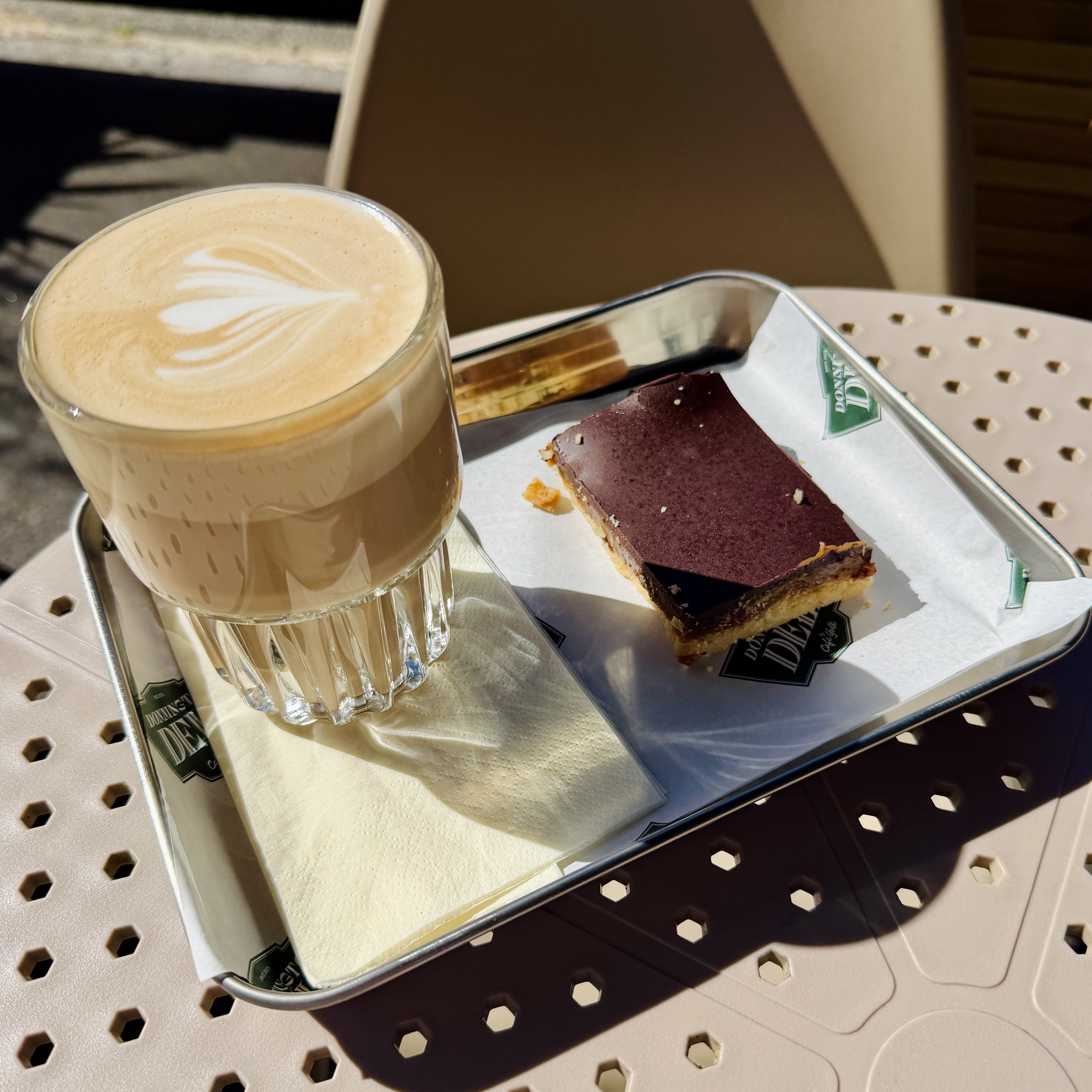
It’s unclear whether Yolk have stuck with Kingdom or even if they now get their own branded coffee roasted by someone else: although I saw their canary-coloured bags on those white shelves I didn’t go over to investigate, and it’s not clear whether they were for sale or for display only. Whoever Baby Yolk get its coffee from, I was delighted to find that it was a really serviceable, smooth latte without bitterness: a tall, generous one too for £3.70, which is pretty much the going rate for a latte nearly anywhere right now.

It is also, with the possible exception of Monty’s, the only place even vaguely in East Reading that does a latte worth ordering. The residents of New Town are quite lucky, I would say. The commuters of New Town, too, as Baby Yolk opens at 7am. The coffee was so nice, and the spot so welcoming, that I stayed longer than I intended to, nursing my coffee and cursing my bad luck that even I couldn’t justify a research-focused piece of cake at 10.30am.

It’s typical that perhaps Yolk’s most unsung move turns out to be my favourite. Baby Yolk opened last year to a comparative lack of fanfare, and significantly less comment and interest than Donnington Deli attracted less than six months later. But for what it’s worth, of all three of Yolk’s outposts Baby Yolk was the one I enjoyed most. It got everything right: I liked the concept, loved the design and enjoyed the execution.

It’s not a menu with much in the way of replay value, which might prove to be a limiting factor longer term, but it may have just enough. Also, like all of Alexandra Langlais’ businesses, it is not so concerned about getting Reading residents to cross town, as I did, to go there. It is very much targeted at its community and that community is lucky to have someone living in it who has the drive and the vision to make it a better place in which to eat and drink, whatever your preferences might be.

Yolk’s website states “Please note our Baby Yolk location is takeaway only” and they ought to change that, because it might deter people from doing what I did, wandering over on the off-chance and having a really pleasant, tranquil time watching the world go by, both inside and outside the café, the comings and goings of one of my favourite little pockets of the Ding.

Sadly Reading Old Cemetery is still closed, but my breakfast reminded me of all my happy lockdown wanderings there in the summer of 2020, a lifetime ago. If Baby Yolk had been open back then I have no doubt I would have perched outside afterwards with a coffee, or taken one with me and drunk it by the war memorial. I thought of my friend Graeme, who can practically walk past Baby Yolk on his commute to work, and simultaneously felt jealous and happy for him.

It also made me miss my old house in the Village, a short walk from Baby Yolk, and all the working from home lunches I wouldn’t get to enjoy. Truth be told, it made me slightly begrudge living in Katesgrove, which could badly do with a place like this: good luck finding a drinkable latte round there. Still, Reading as a whole is better for this kind of spot, and I just hope they spring up in some of its other unsung or underserved barrios.

Until then, it’s better that a café like this is somewhere, anywhere, rather than nowhere. A rising tide lifts all boats, and we have to hope that Cafe Yolk’s flurry of activity in the last year might serve as a blueprint for other imaginative entrepreneurs. Until then, East Reading is the lucky part. As this review goes to print we’re about to experience our first true heatwave of the year, but even without that Baby Yolk is doing a decent job of making Cemetery Junction the sunny side of town.

Baby Yolk – 7.3
14 Wokingham Road, Reading, RG6 1JG
0118 3131128

https://www.cafeyolk.com

Since January 2025, Edible Reading is partly supported by subscribers – click here if you want to read more about that, or click below to subscribe. By doing so you enable me to carry on doing what I do, and you also get access to subscriber only content. Whether you’re a subscriber or not, thanks for reading.
Restaurant review: Malmaison

This week’s review came about because several weeks ago I ate at Bill’s – and yes, if you don’t mind, I’d like to explain that statement. It wasn’t my choice, I should start by saying that. My Canadian cousin Claire was visiting the country for the first time in nearly forty years, her two twentysomething kids in tow, and my mother had chosen Bill’s as the venue for lunch.

Sometimes I wonder if she does this kind of thing to troll me – she likes a bit of Carluccio’s, too – but actually, once I was there, I sort of understood why. It remains one of Reading’s loveliest buildings, overlooking the churchyard of Reading Minster, and she tends to pick it when we have visiting Canadian relatives making the trip to town. They enjoy eating in a building older than their country, I think, and knowing that right outside is a church many hundreds of years older even than that.

And indeed that proved to be true. My cousin Claire and her kids were struck by the history of things, albeit more than a little jetlagged and already in sensory overload given how exponentially busy central London is compared to their bucolic pocket of provincial Ontario. But we had a lovely time, and Bill’s menu – which plays it safe and then some – suited everybody from my vegan mum to my aunt, whose dietary choices often seem shrouded in mystery, and to Ava, Claire’s daughter who apparently almost exclusively eats chicken tenders and fries.

My aunt ate avocado on toast without complaint, Ava had a chicken burger and everybody seemed happy. Both my first cousins once removed, James and Ava, were charming, polite – well, they are Canadian – and interested, and gave me hope that the future of humanity might not be hurtling in a downward spiral to despair after all.

Although I looked them both up on Instagram the next day: James’ Instagram bio pronounced Just roll me up and smoke me when I die, while Ava’s simply said My lil titties my fat belly. That reminded me that they might have been cordial to duffers like me but they were still Gen Z, and I remained many times older than I liked to think I was.

Anyway, the point is that I expected to dislike Bill’s and to resent spending money there – I’d not been since I reviewed it over ten years ago – so I was surprised to find that not only was the room nice, the company convivial and the service charming but the food was better than inoffensive.

I had an enjoyable chicken schnitzel that they’d thrown the kitchen sink at – fried eggs, capers, pink pickled onions, gherkins and coleslaw – and it was rather nice, along with fries which I approached with dread but finished with enthusiasm. Dessert was a chocolate and salted caramel tart and, again, if it wasn’t life-altering it was still remarkably above average. Perhaps my mother knew best after all: I’m sure she would say so, in any event.

My experience at Bill’s got me thinking about the other restaurants I’d put in that bracket – reviewed them many years ago, not been impressed, never went back – and made me wonder whether any were ripe for reappraisal. After a look through my list, because many restaurants fitting that description are no longer trading, I found the perfect candidate: Malmaison.

Subscribe to continue reading

Become a paid subscriber to get access to the rest of this post and other exclusive content.

Restaurant review: Nando’s, Wokingham

Here are just some of the many reasons why I should not be reviewing the Wokingham branch of Nando’s this week.

1. It’s Nando’s.

Everybody knows what eating at Nando’s is like: everyone will have an opinion about it already. This review won’t change anybody’s mind, because those minds were made up ages ago. In the opening paragraphs of a review I usually give the context, explain a restaurant’s history and all that. How long it has been around, what it does, what makes it special, all that jazz. It’s one of the things that makes the preambles to these reviews so fucking long, which I know so many of you love.

But what’s the point?

It’s Nando’s for Christ’s sake, it has its own Wikipedia page. You can look at that if you’re interested, and read about its 40 year history, its 450 branches in the U.K., yadda yadda. You can repeat the niche pedantic point I sometimes reach for, if you like, that Nando’s is technically South African rather than Portuguese. But you won’t do any of that, I’m guessing. Because it’s Nando’s, and everybody knows what eating at Nando’s is like, don’t they?

2. Nobody, and I mean nobody, is reviewing Nando’s in this day and age.

Why would you review somewhere that feels like it’s been part of the rich tapestry of British life forever? When it first opened here, John Major was Prime Minister, and what feels like an eternity later its only role in the national conversation is to be like Debenhams or Woolworths, there and taken for granted until one day it’s gone and missed, presumably by people who never spent money there.

The last time Nando’s got significant attention in the national media was 15 years ago. Miranda Sawyer wrote an article for the Observer in 2010 trying to claim that Nando’s was cool, and a burgeoning phenomenon. If that fact alone doesn’t make you feel ancient, and it certainly does me, the cultural figures she name-dropped were Tinchy Stryder and Tulisa from N-Dubz. And they weren’t even the Debenhams and Woolworths of popular music, then or ever.

Oh, and it got reviewed in the Guardian the following year by John Lanchester, the novelist who had a brief stint as the paper’s restaurant critic. He got stick at the time, but I quite enjoyed his stuff, partly because it read like C-3PO with an expense account. “I’ve been to Nando’s literally a billion times” he said, pre-dating the trend of using the word literally to mean something other than literally by literally a few years; just a guess, but I don’t think he had.

Since then Nando’s has barely troubled the broadsheets, except for Jay Rayner popping up occasionally to say that he doesn’t mind it, presumably to try hoodwink readers into thinking he’s a man of the people. The Observer published something to celebrate the chain’s thirtieth birthday, but that’s probably it until 2032. Meanwhile the chain ploughs on, without publicity, as one of the few restaurant groups in the United Kingdom that doesn’t need publicity at all.

3. Everybody has a Nando’s order.

If we do have to have identity cards – and the notion does seem to be making a comeback – I think they should contain two other pieces of info apart from your name, date of birth etc. There should be a square with a colour on it, the Farrow & Ball shade that corresponds to exactly how you like your cup of tea: just think how much time and embarrassment that would save when you visit friends and family. And there should be a little box that lists your Nando’s order.

Because everyone seems to have one, and I don’t think they deviate from it often. Every now and again we’ll try something wacky, have the pitta or the rainbow slaw or (god forbid) lemon and herb but we invariably revert to our core order. I don’t know how many combinations you can put together from the main components of the Nando’s menu, but it must be a lot: John Lanchester would probably say it’s literally billions.

So for instance the box on my ID card would say Four chicken thighs, medium, spicy rice, macho peas, halloumi on the side. Because 99% of the time, in a Nando’s, that’s what I’ll order. I didn’t, this week, just to mix things up and at least pretend to explore the menu, but the rest of the time you could put money on me eating this.

Other people, like my wife, will extol the virtues of the broccoli, and I have friends who think chicken doesn’t count if it’s not on the bone. Some far out types would even have the wing roulette on their regular order. But my point remains: the restaurant lacks any element of surprise, and what you eat there lacks it too. So why review the place?

I know some people don’t drink tea, or don’t like Nando’s. I was on a conference call last week and, to break the ice, I asked people what their Nando’s order is. “I can’t stand the place” said one of the otherwise perfectly agreeable chaps, safe in the comfort of his home office. I guess we can put those types in the same category as conscientious objectors.

By the way, the other advantage of my ID card proposal is that, finally, we could work out who’s ordering the chicken livers. That would be the equivalent of having AB- blood, only rarer.

4. It isn’t even a Reading branch.

I know, I know: Wokingham. I can just hear the cries of “it’s called Edible Reading, for god’s sake” – haven’t heard those for a while, come to think of it. And despite having eaten Nando’s all over the place, from London to Gatwick to Bath, it’s true that I have a soft spot for one of Reading’s branches. The one on Friar Street, not the cacophonous enormous space of the Oracle Riverside, even though the latter is the first Nando’s I ever visited, converted by my ex-wife.

I rather like the Friar Street branch’s small and gallant attempt at some outside space, its homeliness and lack of polish compared to its larger counterpart. But it also faces an uncertain future because I suspect that, like Cosmo, it will be swept away by redevelopment. So although it was tempting, were I to review a Nando’s, to visit that one, it felt like a surefire way not to future-proof a review.

(Sorry. You get a long overdue Reading review next time.)

5. It wasn’t even my first Nando’s that week.

I’m not joking. Two days before my visit to the Wokingham branch of Nando’s, I found myself at a work offsite event on a business park at the far end of the Basingstoke Road, and for lunch our big cheese took us to Nando’s. By this time my visit to Wokingham was already in the diary, but what could I do? Say “I’m sorry but I can’t, I’m keeping my powder dry”? For Nando’s?

So the eight of us crossed the road to the Reading Gate branch of Nando’s, which is a huge, featureless glass box on the outside and strikingly spacious inside, with a second floor and everything. It felt like one of the biggest Nando’s I’ve ever visited, and the website Rate Your Nando’s – it’s honestly a thing – gives it an average rating of 4.42 out of 5 (I felt gratified to see that my favourite branch on Friar Street, with a rating of 4.73, is currently considered the fourth best in the country).

Everybody conformed to type, almost, and everybody ordered their usual. Tom, our youngest team member and not even thirty yet, ordered the fino pitta, hot, and I made a hackneyed joke about him getting home and popping his moist toilet tissue in the fridge. My boss, not a regular visitor and slightly thrown by the menu, had something called a “garlic churrasco burger” which they might have introduced since I ate at Nando’s last a couple of years ago.

There were a few curveballs, because I work with interesting folk. Our big cheese insisted on having a bottle of Heinz tomato ketchup at the table – I guess it takes all sorts – and we had to stage an intervention to stop my colleague Natasha ordering the halloumi burger. Their ID cards would be on the quirky side, I think.

Afterwards we all concluded that it had been an enjoyable lunch, which had entirely lived up to expectations without ever threatening to exceed them. We went back to our meeting room to carry on achieving those pesky deliverables.

Even though it was a Thursday in a business park on the edge of Reading, the sun shining, this unspectacular, boxy branch of Nando’s was packed. We queued for ten minutes or so before they found us a table. If Nando’s has jumped the shark, nobody had told the people eating in there.

6. They treat chickens very badly indeed.

This should probably be top of the list, and for many of you I suspect it would be. In February Nando’s, along with a number of other restaurant chains including KFC, Popeyes and Wingstop, pulled out of something called the Better Chicken Commitment. And as animal welfare standards go, this was a minimal one: you could treat your chickens appallingly and still meet the requirements of the BCC.

It didn’t specify what you could feed your chickens, or that you had to let them roam outdoors, or that you wouldn’t pump them full of growth hormones. It was a very low bar, and the likes of Nando’s decided they still wanted to limbo under it.

The sticking point was that the BCC also required all those restaurants to swear off using what have been described in the media as ‘Frankenchickens’, a strain of chickens like the Ross 308 engineered to reach maturity sooner in order that they can be killed and eaten quicker. If you thought kids grew up too fast these days, spare a thought for the Frankenchickens: ready to be eaten in a mere 35 days. And they aren’t a fun 35 days, either – these breeds have higher rates of organ failure, muscle disease, premature death.

Here’s the most shameful thing of all: I know about this because hereditary columnist Giles Coren, of all people, wrote a column about it in the Times a couple of months ago. Nando’s might be a national institution but when you’re on the same side of the argument as Taco Bell and Frankie & Benny’s and you’re enabling Giles Coren to comfortably take the moral high ground, a period of reflection might be in order.

Here is the reason why you get a review of Nando’s this week.

1. My friend Jerry had never been to one before.

It’s true, I found the one person who had never been to Nando’s, my dear friend Jerry. I don’t even know how it came up but we were chatting over a pint after a very successful review in Oxford and he let slip that he had got all the way to a happy and fruitful retirement without once troubling a branch of Nando’s. That was that: I resolved there and then that he would pop his peri peri cherry, I’d be there when it happened and I’d write it up for the blog.

It would be an adventure! Besides, I was fascinated by the concept that any adult could make it to 2026 without ever setting foot in one. Forget what I thought of the place, what would Jerry make of it?

Picking Wokingham, though, was serendipity. Jerry is currently the artistic director of the Wokingham Theatre, and they were putting on one of my favourite plays, Who’s Afraid Of Virginia Woolf? So Zoë and I booked tickets – I talked her into it by claiming that it was a romantic comedy – Jerry agreed to join us and we decided on an early dinner at Nando’s before strolling to the theatre.

I’ve always liked the interior of the Wokingham branch. The front room is more bog standard but I have happy memories of the space at the back with its skylight and bold tiled wall, so I was glad we were seated there. We were there at 6, and the place was still quietish: by the time we left the tables along that tiled wall were all occupied by big groups. Nobody there thought Nando’s had jumped the shark either.

Normally in my reviews there’s a bit where I talk generally about the menu, how much everything costs and so forth. Is it all right if I skip that bit this week, and we take it on trust that you know all that? Excellent. I had downloaded the Nando’s app specially for this visit – like another British institution, Wetherspoons, they try to minimise the amount of time you spend on your feet – so after a bit of plea bargaining and talking Jerry through what was good and what wasn’t, I placed our order. The whole lot came to just shy of £120.

We ordered the majority of what Nando’s classes as starters, even though I expect many regulars don’t bother. Peri peri nuts were surprisingly bland and lacking in crunch, and padded out with macadamias, which I’ve always struggled to like. They didn’t feel like incredible value at £5.25 but, perhaps more significantly, because Nando’s lists this for everything it serves, you know that a portion contains nearly 800 calories. They felt unnecessary on multiple levels.

More reliable was that ever-present, Nando’s houmous with peri-peri drizzle. Nando’s houmous was about as good as the stuff you’d get in Marks, and the drizzle added a nice piquancy, even if the contents of the bowl started to look like a clumsily popped zit. The pitta wasn’t a great advert for ordering anything that’s served in one, being doughy, stodgy and manifestly ill-suited to dipping. Loading houmous on to a pitta with a fork felt against God and against nature, but we had no real choice.

This too was nearly 800 calories, more calorific than eating half a chicken. I don’t know if that’s a good advert for putting calorie counts on menus, but it’s not a good advert for Nando’s starters. The menu actually includes an item called “Dare To Share” where you can order three starters for just over £12: I’ve never considered ordering starters, or sharing them, an especially daring act so I’m not sure what they’re driving at there. What risk are you running exactly, besides obesity?

Nando’s halloumi fries came as a moderately tanned miniature jenga stack of five pieces of halloumi. You had to hand it to Nando’s for giving you a prime number of these, almost intended to make things difficult.

If you’ve never had halloumi before, or only had Nando’s halloumi, I imagine you’d be quite pleased with these. But I couldn’t help but compare them to the far superior ones at Honest Burgers where four larger, better halloumi fries cost you less. They’re also organic, served with a cracking chipotle jam rather than a hypersweet chilli jam, and somehow, magically, contain fewer calories. I promise this is the last time I’ll mention calories: I’m not that kind of writer and I’m hoping you’re not that kind of reader.

By this point Jerry and I were well into a glass of South African sauvignon blanc each (and I thought he didn’t like white wine) which was perfectly unobjectionable and a snip at just over £7 for a 250ml can. Zoë was on an AF beer – Nando’s stocks Beavertown’s Lazer Crush – and we also had some water and a bottomless Diet Coke on the go.

About 15 minutes after our starters all our variations on a theme came to the table with brutal efficiency. Zoë ordered a fino pitta with medium fries, spicy rice and some rainbow slaw: the latter was my mistake, as she’d wanted the macho peas. It was, I’m told, absolutely like every other fino pitta Zoë has had in the past, because that is what Nando’s do. If I went to Nando’s for dinner tonight and ordered this dish, this is what it would look and taste like.

Because Jerry and Zoë had both ordered chicken thighs, I went for the butterflied chicken breast. Back in the old days Nando’s didn’t do chicken thighs, and the butterflied chicken breast was my go to order. It was perfectly pleasant, maybe slightly dry and lacking the textural contrast and char you get from the thighs.

To try and order things I didn’t usually order, I’d asked for this as “Sweet Heat” rather than my usual Medium. The menu boasts that this is “BBQ for the bold” and is only available for a limited time. Hobble don’t walk to a Nando’s to try it would be my advice: what did I say about how people stray from their regular order and then go back to what they know? That evening, that was me.

I also had the spicy rice, which I always order: it was slightly clumpy in a manner that raised questions but otherwise tasted exactly like every spicy rice I have ever had in the past and every one I will have in the future. The same could be said of the garlic bread, a diamond-shaped ciabatta roll halved and toasted. It had magic powers: it didn’t taste much of garlic in the moment but gave unsubtle reminders for the rest of the evening. Just as it always does: you’re getting the idea by now, I imagine.

Jerry chose the boneless thighs, my usual selection, and ploughed through them with a gusto I found oddly touching. It reminded me that I’ve wished, many times, that I could forget I’d ever read one of my favourite books or listened to one of my favourite bands so I could experience the joy of discovering them all over again, a sort of benevolent Eternal Sunshine Of The Spotless Mind where you forget not to forget but so you can be reminded.

Would I use that power to wipe the memory of my first ever Nando’s? Of course not, but watching Jerry love his chicken and wonder where it had been all his life was the next best thing, I suppose. He was our very own Miranda: o brave new world, that has such restaurants in it. Jerry chose to pair this with more of that garlic bread and another relatively new innovation from Nando’s, the “Portuguese tomato salad”. Those tomatoes could be Portuguese, but I’d be amazed if they were.

We ordered two sides, one of which was negligible and the other of which was significant. First, Nando’s macaroni cheese, which allegedly comes “with a crunchy, garlicky peri-peri crumb topping”. It does not, really. It’s a ramekin of claggy blandness with some flavourless pale rubble on top: order it if you like macaroni cheese enough to eat average macaroni cheese, otherwise don’t bother. Who am I trying to fool? It’s already either part of your regular Nando’s order or it isn’t.

Our second side was a whole chicken.

I know, it sounds a bit Henry VIII and we didn’t really need it, but I insisted because I wanted Jerry – who am I kidding, all of us, especially me – to try the product without whistles, bells, pitta, butterflying, filleting or general fucking around. Actually, for me this was probably the best thing in the whole meal and something I don’t usually think to order. Fairly plump and generous, the meat rich and not dried out, the skin scored and scorched.

Maybe this is where it all started out and Nando’s lost its way with all the variations on a theme it had to introduce over the following thirty-four years to hold people’s interest. But eating this I almost remembered what eating there the first time could be like.

Poor Jerry couldn’t tackle much of this, because he’d experienced Nando’s overload, but I made inroads into it on his behalf. It felt rude not to. A whole chicken on its own will set you back just over £17 and paradoxically, I thought it was the best value of anything we ate all evening. And yes, I’m aware that calling it a side order is an understatement and a half.

So what did we all come away making of Nando’s? Zoë said during our meal that it had aspired to a status a little like the NHS: people in the U.K. had come to expect that it would always be there, be accessible at the point of demand and be available fairly close to where they lived.

I wondered if she’d oversold it, but I looked up the most godforsaken places I’ve ever visited in this country – Runcorn and Great Yarmouth – and the former has a Nando’s a couple of miles away in Widnes. If you live in Great Yarmouth you have to go all the way to Norwich, but if I lived in Great Yarmouth I’d be looking to buy a one way ticket to Norwich at my earliest convenience.

Jerry loved it. “I’ll be going there again, or at least the Reading one” he told me later. I can well believe it, although there’s always a risk he was just being nice.

And me? Well, it remains in a particular niche – I imagine I might fancy one of my own volition every couple of years, if I can get past my misgivings about their particular brand of animal cruelty. But if a friend proposed eating there I would rarely say no, and if a work offsite happened to include a lunch there I’d feel like that was a pleasant surprise.

I imagine that, like the NHS or like Woolworths or Debenhams, I will appreciate knowing it’s there until one day the grim realities of the public finances and market forces mean it no longer is. On this evidence, though, I think that day may still be decades away, unless people start caring about chicken welfare a lot more than they do today.

So there you have it, the review of Nando’s that literally nobody needed – except maybe Jerry, but he was there anyway. I realised afterwards that I can easily count the number of bad Nando’s I’ve had on the fingers of one hand. I can count the number of amazing Nando’s I’ve had on the fingers of one hand, too: bad and amazing just aren’t what they do. Or perhaps it’s truer to say that I’ve had bad or amazing times at Nando’s, but the food had nothing to do with it in either case. Whatever. On that basis this time, with two of my very favourite people, had to be one of the best.

Nando’s – 6.7
29 Market Place, Wokingham, RG40 1AP
0118 9773220

https://www.nandos.co.uk/restaurants/wokingham

Since January 2025, Edible Reading is partly supported by subscribers – click here if you want to read more about that, or click below to subscribe. By doing so you enable me to carry on doing what I do, and you also get access to subscriber only content. Whether you’re a subscriber or not, thanks for reading.