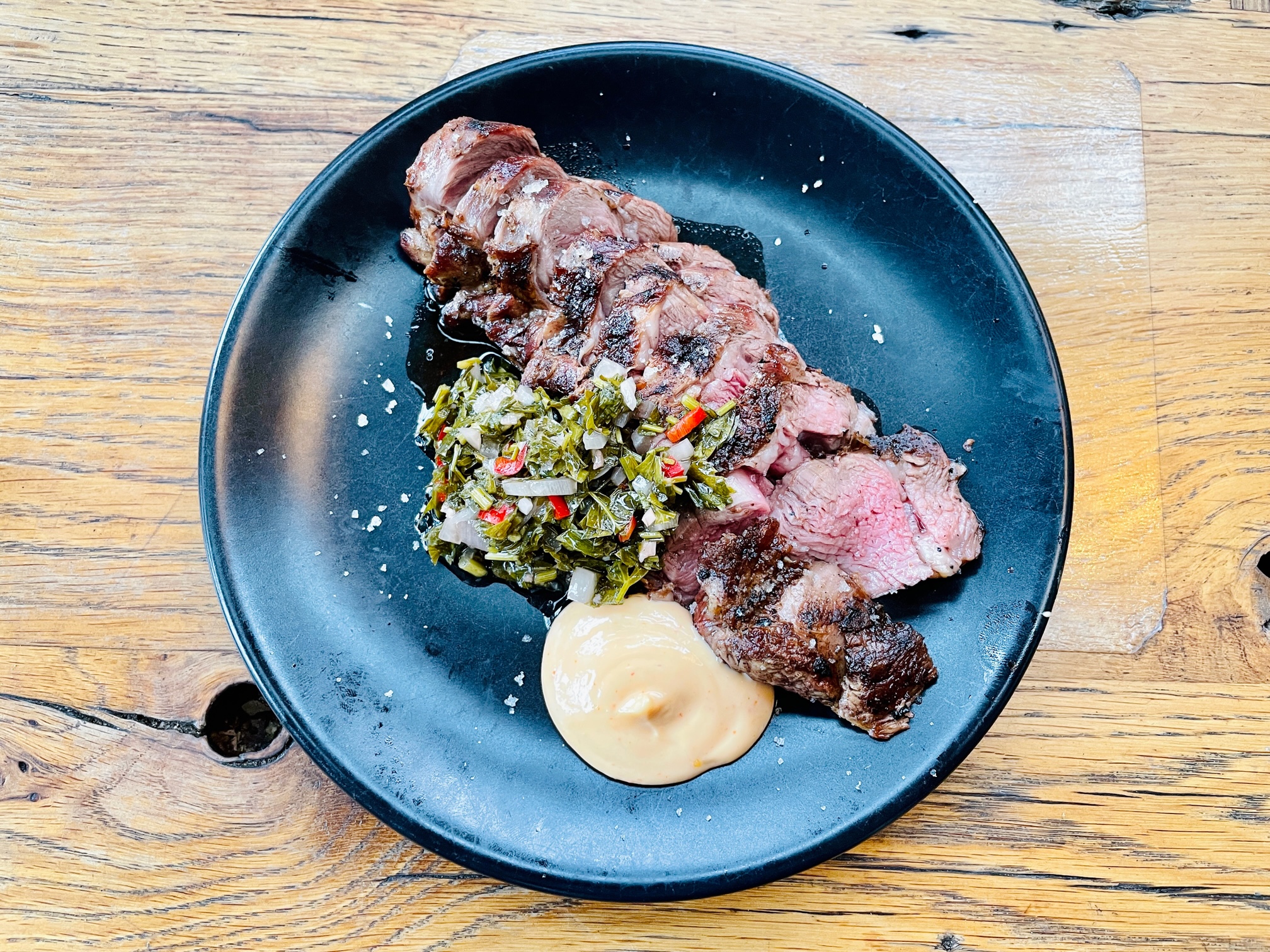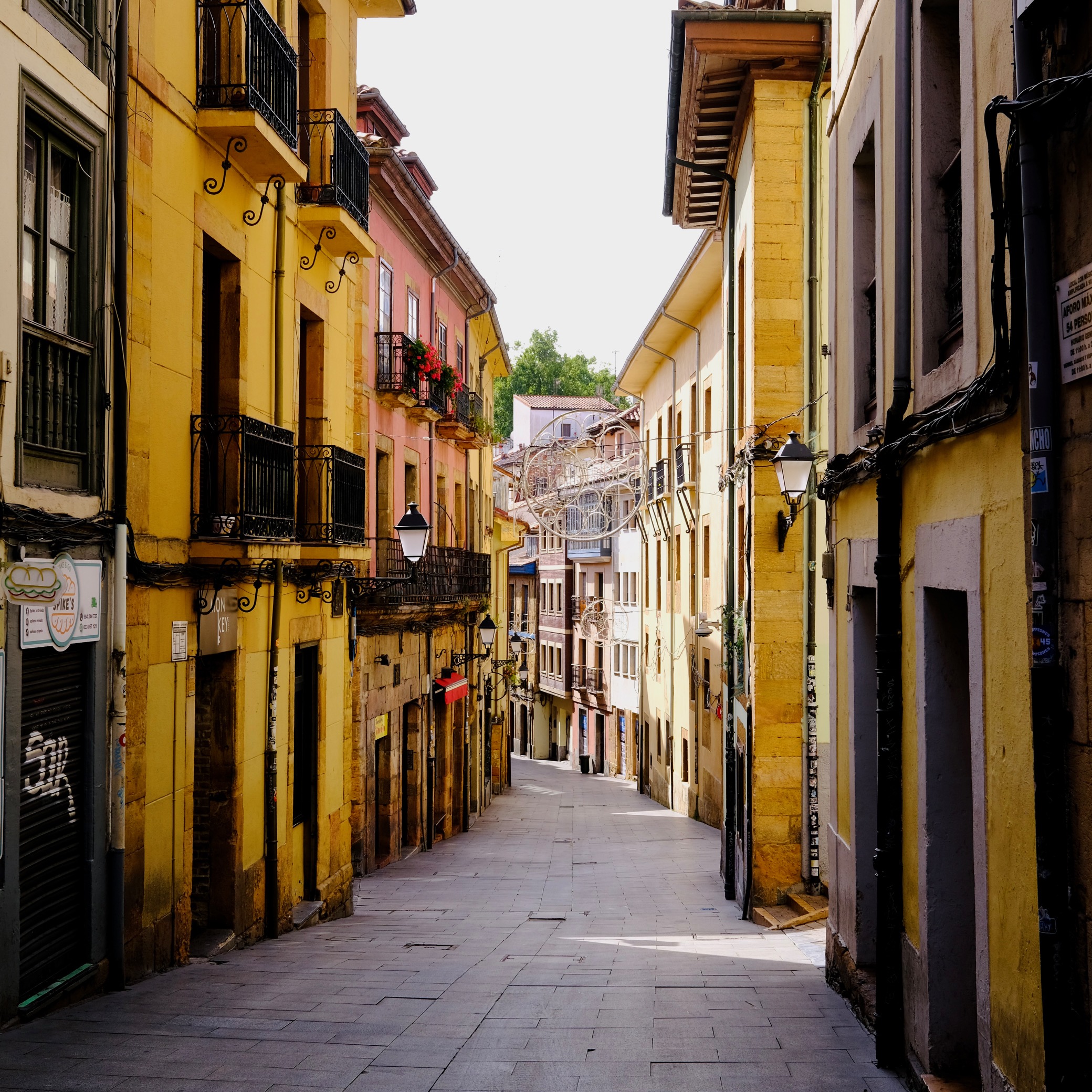
City guide: Oviedo

If you find yourself deciding to spend a city break in Oviedo, as I did, in the run-up to your holiday you will invariably be asked the same question by everybody you tell. Where? they will all say.

And you might well struggle, as I did, and wind up explaining that it’s sort of west of the Basque Country, but near the coast, in a region of Spain called Asturias that is still largely untroubled by tourists. You’ll probably, as I did, say that it’s famous for cider and blue cheese, and for fabada, a bean stew packed with pork which has a revered status in the city.

You might also mention that Oviedo features in the Woody Allen film Vicky Cristina Barcelona, and that Woody Allen loves the city and that there’s even a statue of him which, this being continental Europe, nobody has defaced or pulled up and lobbed into the nearest body of water. Actually, you might not mention that, because you might not know it. I knew it and I never mentioned it, because advertising that you’re a Woody Allen fan just isn’t done these days.

But in the run up to your trip, if you’re asked, you’ll probably just say that it’s west of Bilbao and mention the cider. And people will generally say “okay” or “I’ve never heard of it” and all of you will get on with your respective lives.

Having returned from Oviedo, if asked, I would instead say, firstly, that it’s one of the best cities I’ve visited for food and drink. At the end of a holiday Zoë and I always play a game where we both list the five best things we’ve eaten on the trip. Sitting having a beer on our final day in Oviedo we had to conclude that it was rarely this difficult to narrow it down, and then we went and had one last dinner which, if anything, made it even more complicated.

Asturian cuisine – and yes, it does at least slightly revolve around fabada and cachopo, an enormous slab made of two pieces of veal, cheese in the middle, breaded and fried – is very hearty indeed. Forget going to Malaga or Granada and picking over lots of small dishes: in Oviedo even a main course might be big enough that two people can quite easily share it. I am rarely defeated by meals, but even I had to wave the white flag a couple of times in Oviedo.

That might make it sound like it’s wall to wall gut-busters, but that doesn’t do the food justice. I had plenty of interesting, intelligent food across the city, and I also discovered – beyond the cider – great beer and coffee and a scene that had something for everyone. It was named Spain’s city of gastronomy last year, but even so it still feels like a relatively well-kept secret.

Not only that, but Oviedo is a handsome place. The old town is exceedingly pretty, steep streets meandering from one square to another, and there’s a beautiful cathedral, an imposing monastery and a picture perfect pastel-shaded food market. But there are also wide boulevards and, right in the centre, the Campo de San Francisco, the lungs of the city, a gorgeous and spacious park which lends itself gladly to a happy meander. On one side of its perimeter there are beautiful, brightly coloured houses on a sloping hill and you get a sense, almost, of another San Francisco.

Oviedo is not buzzy or boastful the way Malaga or even Barcelona is: it is a much more stately, sedate place and over the best part of a week I came to like it very much. It’s a grower not a shower, with nothing to prove, and it had a certain ease with itself that I very much admired. So different from many of the places I tend to visit on holiday – less scruffy, somehow more grown-up. On most of my holidays I come home with dozens of pictures of street art, snapped with my proper camera like the wannabe hipster I am. In Oviedo, there was comparatively little that I saw.

I must admit, though, that my first impressions of the city were distinctly mixed. The first day of my holiday, nothing went right. The shitty train to cruddy Gatwick decided to stop at Redhill and spit us all out with, it seems, no suggestions about how we should reach our final destination. Our plane sat on the runway for almost an hour because, and this appeared to be news to people, it needed a full tank to get to Spain and didn’t have one. The bus from Asturias airport felt like it took an eternity: the airport is far closer to Aviles than Oviedo, it turns out.

And then we decided to grab a late lunch on Calle Gascona, Oviedo’s famous cider boulevard, the one that features in every newspaper article about the place. Somehow it felt a little tired and unlovely, and grabbing a table outside at one of the places recommended by one of the broadsheets, a little too late for lunch, we felt like an inconvenience.

I won’t mention the place, although maybe I should, to encourage you not to go there, but it was not an experience for the ages. The croquetas were decent enough, the big slabs of cheese fridge-cold, the bread rock hard. A twenty Euro plate of calamari were thick bouncy straps of the stuff, no lightness or delicacy. And the American at the next table talked volubly and relentlessly at her tablemates, who appeared to be a captive audience. I think she might have been doing part of the Camino de Santiago, and I could picture her husband, back home, having a very pleasant fortnight in relative peace and tranquillity.

It turned out that she was a vet. I know this, because she mentioned it roughly half a dozen times in the space of thirty minutes, and as I dipped a piece of particularly rubbery squid through the crust on top of a purgatorial dish of alioli she started talking about prolapses and fistulas in more detail than I would personally have liked, i.e. in any detail at all. The squid bordered on inedible, the grey clouds overhead threatened rain. This doesn’t bode well, I thought to myself.

Anyway that was the last time I had a bad meal for a whole week, although it did put me off returning to Calle Gascona, and from that point onwards it was sunshine and strolls, coffee and cakes, beer and cider and terrific meal after terrific meal, and I was relieved to find that first experience a passing aberration, the exception that proved the rule, the rule being that Oviedo rules.

When I returned from holiday, thoroughly passionate about telling people why this grand yet modest city deserved more credit, I realised that because I’d been unable to find a decent guide to Oviedo in the run-up to my trip I’d just have to write one. So here it is, and I hope that if you’re considering an expedition to this most classy of cities – or have already decided on one, and have come here through the vagaries of Google looking for advice – it helps you to make the most of what I found to be a downright wonderful place.

And when you fly home, tell people that it’s not all about cider and blue cheese, because there’s miles more going on than that. Oviedo deserves a legion of ambassadors, and I for one am proud to be one. Fingers crossed this piece helps to create a few more.

1. La Corte de Pelayo
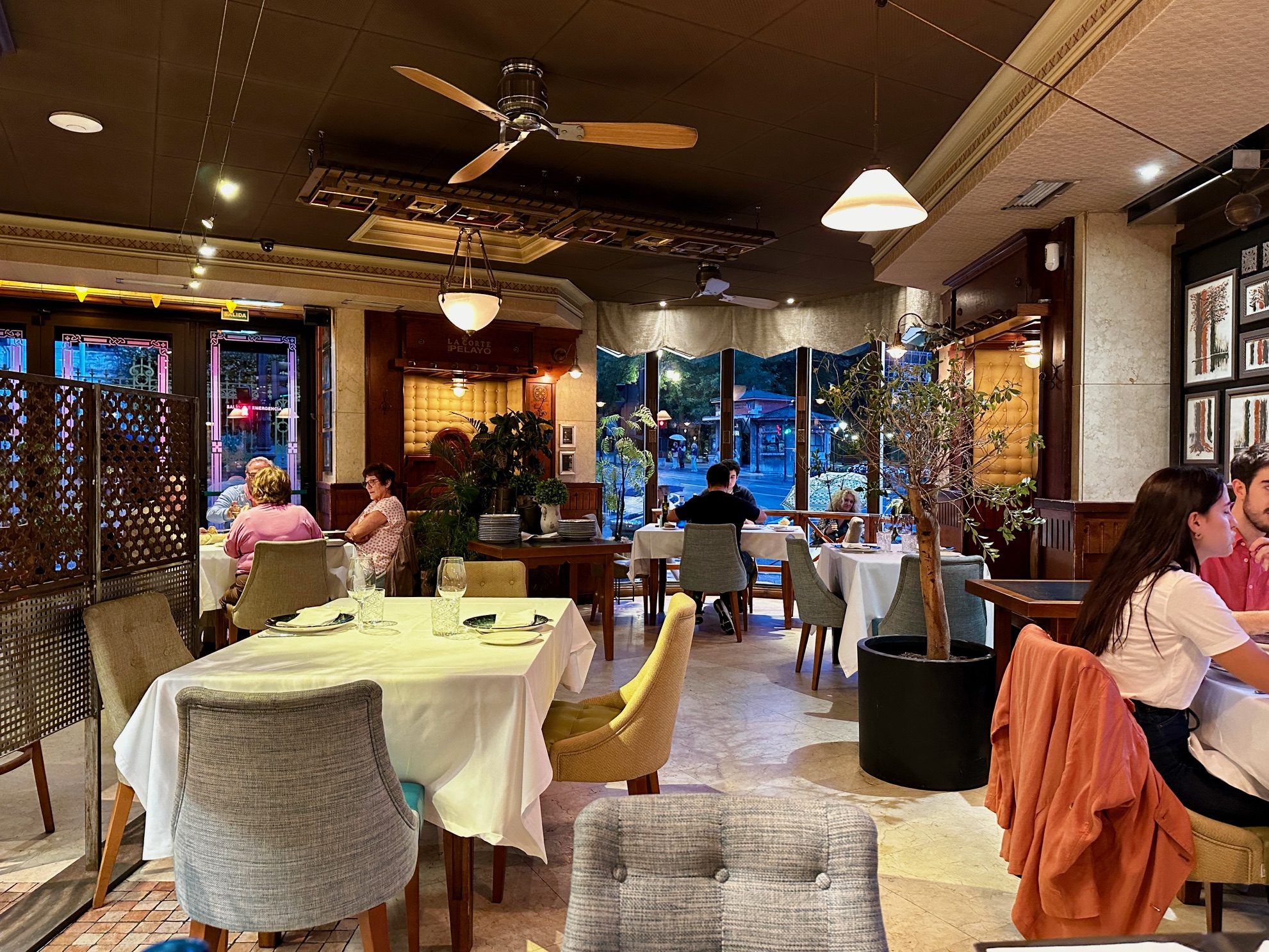
The evening after that awful lunch on Calle Gascona we had dinner at La Corte de Pelayo, on one corner of the Campo de San Francisco, and my holiday experienced the great reset.

It’s one of those places where from the moment you walk through the front door, you know that everything will be absolutely fine until the moment you leave: smooth, attentive service, a cosy, classic dining room and pockets of delighted diners everywhere you look. It’s been going for over 20 years, although that makes it a positive newborn compared to some of the businesses that feature in this city guide, and it had that air that it was probably exactly the same when it first opened and would be exactly the same in 2045. I loved that about it.

I was determined to immerse myself in Asturian food, so I ordered their fabada – which, I should add, is on the menu as a starter. I haven’t experienced anything quite like it: the pot of beans was brought to the table and ladled, with great ceremony, into the bowl in front of me before being set down on the table, in case I wanted a top up. The compango, a long plate with pork, pork sausage and morcilla, was placed nearby, looking for all the world like a carnivore’s idea of the best petit fours ever, for you to cut and add however you liked.

It was truly heavenly: the beans firm and creamy, the pork lending smoke and salt, the whole thing giving me complete clarity on why this dish, in this region at least, has attained a mythical status. I understood why every year they give out awards for the best fabada Asturiana (they also do this for cachopo, as we will see, and for Pote Asturiano for that matter), and why La Corte de Pelayo had been a finalist in those awards several times.

Don’t get me wrong, the meal had other dishes in it too. Zoë ate gorgeous jamon ibérico, sliced by hand as it should always be, and we shared some pixin, pieces of fried monkfish. She had secreto ibérico as a main, and I had an extraordinary shoulder of lamb, presented on the plate like one of those flying birds that adorned the walls of so many Seventies living rooms. There was an apple tart that made me very happy indeed, and a glass of ice cider – a drink I came to love far more than cider itself during my time in Oviedo.

But it was the fabada I have thought about countless times since. I put pictures of the meal on my Facebook page and a reader who knows Oviedo well told me to enjoy the city. I asked him if he had any recommendations and he said “I’m afraid you’ve been to the best place already!” I don’t know about that, because it turned out that there were many other superb meals to be had. But I didn’t order fabada again.

La Corte de Pelayo
Calle San Francisco, 21
https://lacortedepelayo.com

2. Cocina Cabal

Cocina Cabal, where I had lunch on my second day in Oviedo, was a thoroughly sophisticated spot. From the very start, when we waited by the gorgeous bar out front and had cold beer straight from the tank, to the bit where we were led into a tasteful, muted dining room and given a menu awash with temptations I liked it very much. It’s named after chef Vicente Cabal and most of the tables have a view of the open kitchen, although I had an even better view of my wife.

Everything was clever, pretty and carb-free – qualities I have aspired to for many years but seem fated never to attain – and although I found the plating somewhere between “fussy”, “geometric” and “designed by a serial killer” I thoroughly enjoyed all of what I ate. Octopus and stellar pork, edged with exceptionally light crackling, was a new take on surf and turf for me, and although I wasn’t entirely sure any of it went with celeriac purée or mango chutney I was happy to spend a few minutes eating (and completely failing to make sense of) it.

My veal with sweetbreads and salsify showed similarly worrying presentation, all parallel lines and artful smears, but I rather liked it, even if it could have done with more sweetbreads. But then, what dish couldn’t? Dessert was a white chocolate sphere full of passionfruit mousse that melted away when dark chocolate sauce was poured on it, an idea which I think was cutting edge quite some time ago, but I appreciated the execution all the same.

But perhaps the trick was in how you ordered. Zoë enjoyed two colossal ingots of foie gras with apple and Pedro Ximenez, and outrageously good suckling pig with a bright and moreish kumquat purée, so arguably the menu just had cheffier and less cheffy stuff, and I, ever the ponce, had skewed towards the former. Nevertheless it was a very good meal, and even pushing the boat out with wine and (more) ice cider it still cost us something like £160. When I consider some of the meals I’ve spent that on in the U.K. of late, I start to have dark thoughts.

Looking at Cocina Cabal’s menu again now, I see that their fabada was the best in the world back in 2022. Next time, I’m having that.

Cocina Cabal
Calle Suárez de la Riva, 5
https://cocinacabal.com

3. La Puerta de Cimadevilla

Although that fistula-ridden experience on my first day put me off Calle Gascona, it didn’t put me off sidrerias in general. It did, however, make me a bit more discerning about which ones to try, which is how we ended up at the more modern, more interesting La Puerta de Cimadevilla on Thursday lunchtime. On the edge of a pretty square in the old town, it was much less frowsty than some of its Gascona-based peers and was thoroughly fizzing with custom throughout my lunch there: we turned up early, without a reservation, but later on saw people getting turned away.

The staff at La Puerta de Cimadevilla were lovely, and brought us much more into the whole cider-pouring experience, and it was a real joy to watch them pouring it from a great height into the corner of our wide-bottomed glasses in the traditional style, the practice of escanciar or ‘throwing’ the cider, in order to aerate it. Zoë was a little more sceptical – “they’ve all got one wet shoe” was her take on this venerable custom – but even she got into the swing of it, I think.

Incidentally, we saw next to no British tourists in our week in Oviedo and I wonder if the cider has something to do with it: imagine our nation of binge drinkers having to attract the attention of serving staff every time you wanted another sip of your drink. It would never catch on. The thing to pair cider with in these parts is blue cheese, and La Puerta de Cimadevilla’s cabrales croquetas, sweetened with honey and topped with a walnut, were a properly knockout combination.

But really, the reason we were there was to try the other pillar of Asturian gastronomy, the cachopo. La Puerta de Cimadevilla is proud of theirs, with no less than four different ones on their menu. Not only that, but they include two that have been decorated: the cachopo that was declared the best in Spain back in 2023 – there’s a poster proclaiming this on the outside of the restaurant, no less – and another that was a finalist as recently as this year.

We ordered the 2023 champion because you would, wouldn’t you? And I loved everything about it, from the slightly preposterous presentation to literally everything else. It comes on its own special bespoke board, loudly proclaiming that it is indeed the ‘El Capricho del Rey Ramiro I’ and, just as endearingly, the restaurant’s other celebrated cachopo has its own unique, subtly different board. I don’t know how you can’t slightly love a place that gets so proud of its achievements: it was certainly beyond me.

But more than that, it was simultaneously delicious and colossal. There is no question at all that you couldn’t take one of these down on your own, and even between two it almost proved beyond us. The restaurant has a whole separate page on its website talking about every painstaking element of this, from the meat that’s used to the paleta ibérica laid on top of it, from the mixture of cheeses in its gooey core to the blend of breadcrumbs, corn and cheese that make up its ultra-crunchy coating. There’s even chestnut purée in the mix somewhere, the kind of thing some dullards would describe as the hero ingredient, no doubt.

All that sounds great, but the proof is in that moment when you make your first inadequate incision into the gigantic slab of Asturian food history and understand the fuss. Before that, my only experience of this kind of dish was the Andalusian flamenquin, a cigar of pork loin, jamon and cheese that I used to think was the best breadcrumbed thing ever. The cachopo has forced me to revise my opinion somewhat, but I also suspect more research is necessary.

Equally brilliant and frustrating was the fact that the menu contained countless other things I would have loved to try that were rendered impossible by the sheer volume of cachopo you had to put away. Of all the restaurants in the guide I think this was the one Zoë most wanted to return to, to eat their tomatoes with bonito. The table next to me was so struck by a neighbouring table’s ensaladilla russa that they specifically asked what it was and I could see them making a mental note for next time. They even do a fabada – who doesn’t? – and you wouldn’t bet against it being marvellous.

La Puerta de Cimadevilla
Calle Cimadevilla, 21
https://lapuertadecimadevilla.es

4. Gloria

The night I ate at Gloria, the heavens opened and the stars aligned: it was the one time during our stay in Oviedo that it properly chucked it down, which just so happened to be the night we had a reservation at the restaurant two minutes’ walk and a few doors down from our hotel.

Not just any restaurant, though. Chef Nacho Manzano has Oviedo’s only Michelin starred restaurant, NM, situated in the El Vasco mall, a huge shopping centre I really struggled to like. But Gloria is the restaurant he shares with his sister Esther, less showy but properly lovely. Strangely I can’t tell you what the main dining room looked like because we were seated in the front room, by the bar, with just one other table, occupied by a pair of friends catching up. But actually that made it feel intimate, like private dining almost, and if I was in the zone allocated to tourists I soon found I didn’t mind one bit.

Gloria’s was another of those menus – Oviedo seemed to be full of these – where the starters and main courses cost pretty much the same, leaving you with little or no idea how to structure a meal, what was to share and what was to eat on your own; I sometimes suspected that most of the servers in Oviedo thought we should share everything and couldn’t understand why we wouldn’t. But we were helped by a brilliant server at Gloria who very firmly told us when something was too big for us to order one apiece, and everything was so delicious that we ended up sharing it all anyway.

That meant, unusually, tuna two ways – an exquisite tataki just-cooked, dressed in impeccable extra virgin olive oil and strewn with garlic, and a hefty piece of loin halved and served blushing with gorgeous tomatoes sharpened with citrus, nutty beans like edamame and crispy onion. The former was maybe too delicate to share, the latter quite the opposite, and one of the best things I ate in the entire trip.

Our server talked us into splitting arroz con pitu de caleya between us, which was probably wise but did leave me wanting more at the end. Pitu de caleya, or roadside chicken, is a noted Asturian free-range chicken, and serving it with rice in this way is something Manzano reintroduced first at his three-starred restaurant Casa Marcial. If this was the diffusion line, it felt very far from being short changed: the rice was rich beyond measure with the juices from the chicken and the chicken itself – darker, leaner and gamier than the usual fare – was glorious.

Having been restrained thus far we earned the right to spoil ourselves for the rest of the meal, so we did. A cheeseboard full of Asturias’ finest completely redeemed the dismal Calle Gascona selection from our first meal in the city, and then a chocolate cremoso topped with the smoothest hazelnut ice cream, ringed with olive oil – yes, a whole one each – brought matters to a resoundingly successful conclusion. I probably don’t need, by now, to say that the latter was accompanied with another glass of ice cider but there you go, I’ve said so anyway.

The rain had died off by the time we walked back to our hotel to do some serious digesting. How could it have persisted, after a meal so good it had the power to banish pathetic fallacy?

Gloria
Calle Cervantes, 24
https://www.estasengloria.com

5. El Fartuquin

Let’s get this bit out of the way first: no, I don’t know where the name comes from, yes, it sells the bean dish and no, I didn’t order it. So snigger if you must, but El Fartuquin was possibly the most traditional sidreria we ate at, and a very successful and popular one at that. The basement room looked like the picture above when we sat down at 9 on a Friday night, but within half an hour every table was packed. Everything about it had that assured air which seemed to permeate much of the city, and everybody was having a terrific time; I heard no English spoken anywhere.

If it was only solid by the standards of this holiday, that didn’t mean it wouldn’t have been an outstanding meal in any other context. I really liked the pixin, nuggets of fried monkfish with a little pot of alioli, and I quite admired the brave plating choice to serve the skeleton of the monkfish next to it, like something cooked up by H.R. Giger, to leave you under no illusions about where those delectable morsels had come from.

I also rather enjoyed yet more pitu de caleya – I’d got a taste for it by then, you see – this time in a dark and potent stew which contained maybe a tad too much mustard for my personal liking, although I found a way to see past that. Zoë decided, more out of hope than expectation, to have her own personal cachopo and was even more defeated by it than she had been the last one. This is as good a point as any to reiterate that Asturias doesn’t do small portions: Oviedo would not, for instance, be an Ozempic-friendly city break.

I felt a little like El Fartuquin only really suffered by comparison with the other meals we had in Oviedo, rather than anywhere else, so it’s still one to consider if you find yourself in the city for an appreciable length of time and you’re disinclined to eat at the same place twice. I’d also add that, despite being a sidreria, it had an excellent list of reds, including many I’ve sampled on previous visits to Malaga. The kind pricing of wine in the city is another reason why the bill never stings anywhere near as much as it would back home.

El Fartuquin
Calle Carpio, 19
https://elfartuquin.es

6. El Ovetense

We had lunch at El Ovetense on our final full day of the holiday and it was a place I discovered entirely by chance that very morning.

How it happened was this: we were still buzzing from a very happy evening spent drinking at Cerveceria Cimmeria (number 10 on this list, just down there) and, following them on Instagram, I saw that they’d shared a beautiful picture of the place on their Instagram stories. The person who took it was a very talented local food photographer – I forget her Instagram handle – and all the photos in her grid were of food she’d cooked herself with one exception, a couple of dishes from a place called El Ovetense. And they looked good. Drop-everything-change-your-plans good.

So I did some more research, fell well and truly down the rabbit hole and found an article from last year in El Pais which left me with no doubt in my mind that I needed to snag a table there. El Ovetense, in the old town, is technically a hotel restaurant, and has been trading since 1959. The founder’s daughters Natalia and Ana run the place now, and it has achieved legendary status for two dishes. So naturally, after turning up at noon to ask Ana nicely for a table on the terrace, only to be told that they didn’t open until 1pm, those dishes are exactly what we (eventually) ordered.

One was the pollo con ajillo – chicken with garlic – which doesn’t begin to explain how incredible this dish was. Tons of the crispiest jointed chicken, skin cooked until brittle, the whole thing issuing a siren song to be parted from the bone, came festooned with industrial quantities of crunchy fried garlic, the whole lot sitting on a layer of the finest chips, which slowly became permeated with all that garlic and all those juices as the meal went on. Seventeen Euros for this, and it could easily have served two on its own. Seventeen Euros! I could honestly weep.

But the other dish, which is even more the signature of the restaurant, is their jamon asado “Serafin style”, named after the restaurant’s founder Serafin Garcia. I never got to try jamon asado when I visited Granada last year, and I felt like I’d missed out at the time, but I know now fate was keeping me waiting for this, a rendition which I can’t imagine being surpassed.

Picture a plate groaning with gorgeous sliced ham – apparently there are 16 slices per portion, carved with a special knife so fine and sharp that it’s like playing the violin. Picture that ham draped over a rubble of crunchy potatoes, and then picture a rich sauce, somewhere between a jus and a gravy, poured liberally over it all. Only Natalia and Ana handle the preparation of this dish, and they cook up to 20 kilos of ham a day for the purpose. It is the kind of dish that not only the restaurant, but also the city, deserves to be famous for.

The ham, the spuds, that gravy, the many phenomenal forkfuls made up of those elements… it was, as with many dishes in Oviedo, not for the faint hearted but one for the memory banks and the record books. We also had yet more spuds, this time in a salty and arresting cabrales sauce and we didn’t need them, with all that other food and all those permeated potatoes, but we ate them all the same because they were as fantastic as everything else.

It is probably for the best that I discovered El Ovetense on my final day, completely by chance, because if I’d been there on my first day I might not have gone anywhere else and then you wouldn’t have this guide to read. But if you decide you want to visit Oviedo, this is the place to make sure you visit and these are the dishes to make sure you have. And yet, I found myself wondering – if they are this good, what other unsung gems are hiding further down the menu, when they stick two absolute showstoppers right at the top?

El Ovetense
Calle de San Juan, 6

7. Casa Fermin

My final meal in Oviedo – unless you count something wolfed down at the airport the next day, which I’d rather not – was at Casa Fermin, just down from La Corte de Pelayo and so very near to the park. It was, I suppose, the Big Fancy Meal of the holiday, and after lunch at El Ovetense I was worried our trip would end with a whimper rather than a bang.

I worried needlessly, because although Casa Fermin was very different to El Ovetense it was, in its way, as good a meal as any we had on the trip. The dining room looks a smidgen sterile in pictures but was actually a very striking one to which photographs possibly don’t do justice. The enormous tablecloths that get caught under your feet seem to be a Spanish thing – Cocina Cabal had these too – and they’re a bit Total Eclipse Of The Heart, but the space was peaceful, hushed, luxe and poised.

And the food was very good indeed, in the same kind of bracket as Cocina Cabal but with, for my money, everything taken up a notch. We eschewed the tasting menu for the à la carte and were again rewarded with a slightly confusing range of options where some dishes were small and clearly to be consumed solo, others were big and clearly designed to share and, well, with the rest it was anybody’s guess.

This, though, is where the serving staff really came into their own. We ordered a few individual things, a few dishes to share which were brought to the table already divided and what that meant, all in all, was that we kind of designed our own tasting menu with the help of our server, very much the best of both worlds.

So we had a croissant each, deeply flaky and buttery, crammed with tuna tartare and we shared a feather-light rectangle of brioche topped with a translucent film of Iberian pancetta and piled with caviar. An arroz con pulpo, similarly, was divided into two bowls and was extremely generous for two: god knows how they expected one person to polish that off as a starter and have room for everything else.

I lucked out, though, with the suckling pig. Pressed into the most divine oblong, the meat all succulent and the crackling onomatopoeically doing exactly that, it was superlative stuff. I liked the hazelnut pesto they served it with perfectly fine, but I loved the smoked pineapple purée, something I would never have anticipated in a hundred years and which was an eye-opener and a half. It even made me think that possibly, just possibly, there might be a place for pineapple on pizza, provided you smoked it first.

All of that went beautifully with a white wine from the Canary Islands which was complex with almost oxidised notes, and even though everyone at the surrounding tables seemed more classy, more genteel and an awful lot more Spanish I had an absolute whale of a time throughout my meal.

Dessert was the best way I could imagine to finish a week of miraculous meals, a sort of ice cream cheesecake made with a local cheese called Gamonèu; I’d forgotten how the Spanish love to include savoury notes in cheesecake, and this had a little pungent punch which elevated it far above the workaday. It came with a tiny moat of ice cider: I took this as a cue to have one final golden glass to match.

Casa Fermin
Calle San Francisco, 8
https://www.casafermin.com

8. Casa González Suárez
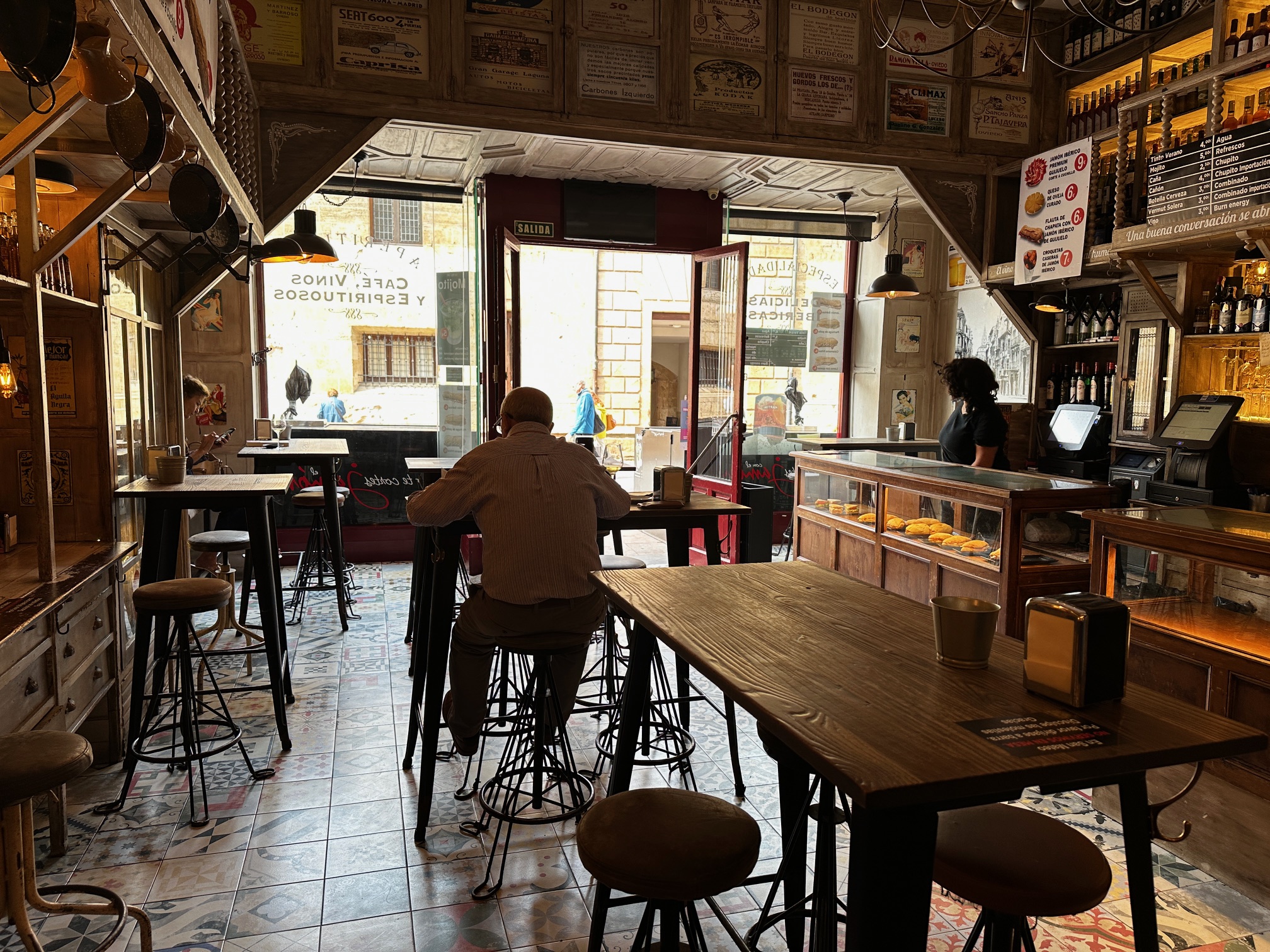
I had no real concept, before I went to Oviedo, of how different Asturias would be to Andalusia, where I’ve spent far more time. So I was expecting that, like Malaga or Granada, Oviedo would be awash with jamon shops with stacks of bocadillos in the window, ham shining under the spotlights, churrerias left right and centre and vermouth bars here and there.

Well, in my experience Oviedo is not like that. There is jamon, and I eventually chanced upon a couple of shops, and I didn’t make it to either branch of the only churreria, Churreria Guty, that I came across online. Next time, perhaps. And Oviedo is a cider city first, a wine city second and although it has a little grid of streets – the Ruta de los Vinos – around Calle Manuel Pedregal, I didn’t make it there either. I know, I know, what kind of a guide is this?

So the closest I got was Casa González Suarez, a little spot celebrating its centenary this year. It served vermouth, and had a limited menu of ham, cheese and bocadillos, and it was the perfect place for a short, casual pit stop after the morning coffee and before the afternoon amble. The ham was cut by hand, and came on a paper plate – it wasn’t bad, but I’ve had better. The cheese, also on a paper plate, was more refrigerated than I’d have liked.

The vermouth, though, and the service were splendid, and I liked the room. Lunch for the two of us cost less than twenty quid. Asturias is almost different enough to Andalusia to be a different country – they worship different ways to eat a pig there – but I enjoyed my brief, affordable excursion to the south.

Casa González Suárez
Calle Ramón y Cajal
https://casagonzalezsuarez.com

9. Cerveceria l’Artesana
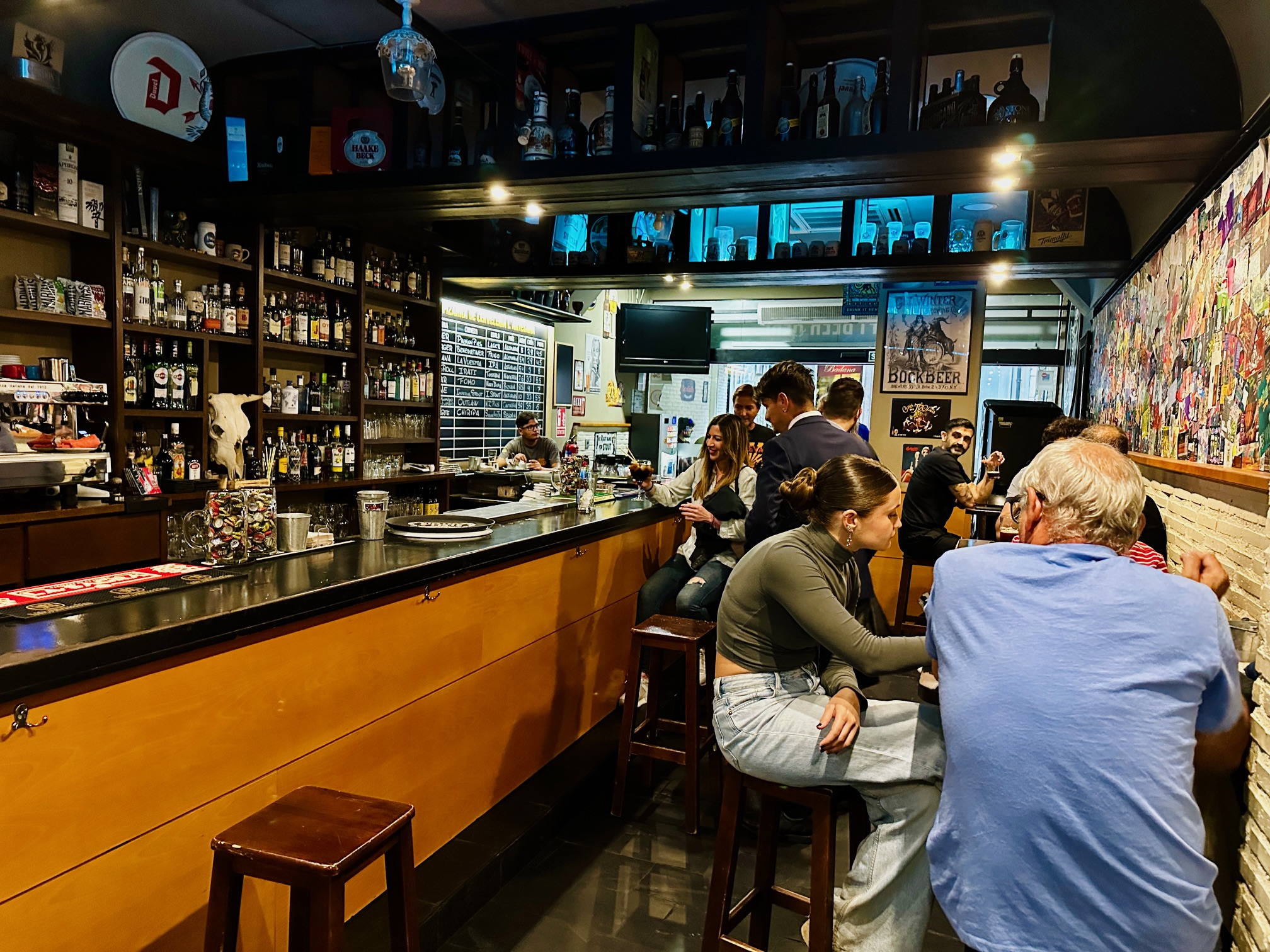
If Oviedo is cider first, wine second, where does that leave beer? Well, from my homework and exploration, in a limited number of very safe hands.

Cerveceria l’Artesana, on a street parallel to Calle Gascona, was a really fun and rather popular craft beer bar which very much lived up to the usual aesthetic of those places – a long thin corridor of a room with high tables against the wall, and a bigger room up the stairs at the back which had more room but less personality. I was heartened by how many people were in there on a Wednesday night, and I liked many of the beers I had.

Some of those, like piney pale ale La Vuestra, were brewed by the venue, and others, like a very drinkable DIPA called FOMO, are by other Spanish breweries – Bilbao’s Luagar in that case. An excellent can fridge gave me the chance to reacquaint myself with the Girona brewery Soma, whose beers I’d so enjoyed the previous year in Granada.

Having got there, we were having such a good time that we stayed for food. L’Artesana’s Instagram makes much of the fact that they make all their food on the premises, and I very much got that – everything was robust, substantial and frighteningly good value. Empañadas were Venezuelan rather than Argentinian, so made with corn dough rather than pastry, more like an arepa, and were colossal and stuffed with chicken. We got two for a price you’d gladly pay for one, and both were impressively sturdy.

Fingers de pollo (for some reason they preferred fingers to goujons when lifting a word from a foreign language) were actually really good chicken tenders, again absolutely whopping and brilliant dunked in a pot of moreish honey mustard dip. The only thing that defeated me was their burger. It cost something like twelve Euros and was a behemoth, and it was the first but not the last time I didn’t clear my plate in an Oviedo venue.

You couldn’t dispute the quality, and l’Artesana even makes its own buns and burger sauce, but it was a little too thick for me, and a little too pink in the middle: close to tartare, really, underneath the crust. Never mind. I would go back, I would pick dishes that looked more like snacks and beer food and I would still leave full and happy, wallet far from dented. It was another illustration that when it comes to what you should eat with craft beer, the U.K. still has plenty to learn.

Cerveceria l’Artesana
Calle Santa Clara, 8
https://www.instagram.com/lartesana_oviedo/?hl=en

10. Cerveceria Cimmeria

My homework had identified Cerveceria Cimmeria as a place to try for beer, and early in my time in the city I clocked that it was on the same hill as La Gente – number 13 on this list – a few doors down. It was closed during the day, so it was impossible to tell what it would be like. There was a Löwenbräu sign outside, and the name of the pub was in that sort of Celtic, sort of Advanced Dungeons & Dragons font I remember well from my misspent teenage years. I couldn’t possibly have known, at that point, that I was gazing upon one of the best pubs I’ve ever had the luck to drink in.

Returning on a week night, minutes after they opened, it was a revelation. A beautiful spot with some low tables in the window and along one side, a bar and stools taking up the other half of the room. Lovely wood panels, walls covered with beer swag and everything scrupulously clean. Twelve beers on offer – including one cask handpull – and a dizzying array of styles and breweries, from Spain and beyond. The lager was Löwenbräu, the cask beer was Shepherd Neame’s very own Bishop’s Finger, but beyond that it got really interesting.

That meant excellent IPAs from Spanish giant Garage, Asturian brewery Caleya and Malandar, from Cadiz. There was an imperial stout by renowned Basqueland Brewing and, from far further east, a delectable sour by Latvia’s Arpus and another corking pale from Berlin’s Fuerst Wiacek. Not only that, but Belgium was well represented with a Lindemans and the Straffe Hendrik Tripel on the board.

I don’t think I have ever seen such a canny but compact selection of beers, such a well balanced lineup of countries and styles where I wanted to try nearly all of it. I resolved to try nearly all of it.

I didn’t realise at the time, but now I do – Cimmeria is the kingdom featured in the Conan The Barbarian stories, which might have explained the font on the outside. The place was filling up with the kind of diverse craft beer drinking crowd you never see at these places in the U.K., and Def Leppard was playing on the stereo. It was how my corner of our sixth form common room would have been back in 1991 if (a) we had been cool; (b) we’d lost our virginity; and (c) we’d been allowed to drink on the premises.

I looked at Zoë, and I could tell she was in love with the place. Maybe it was the beer, maybe it was the Leppard. It was probably, in truth, a bit of both. But I was in love with it too.
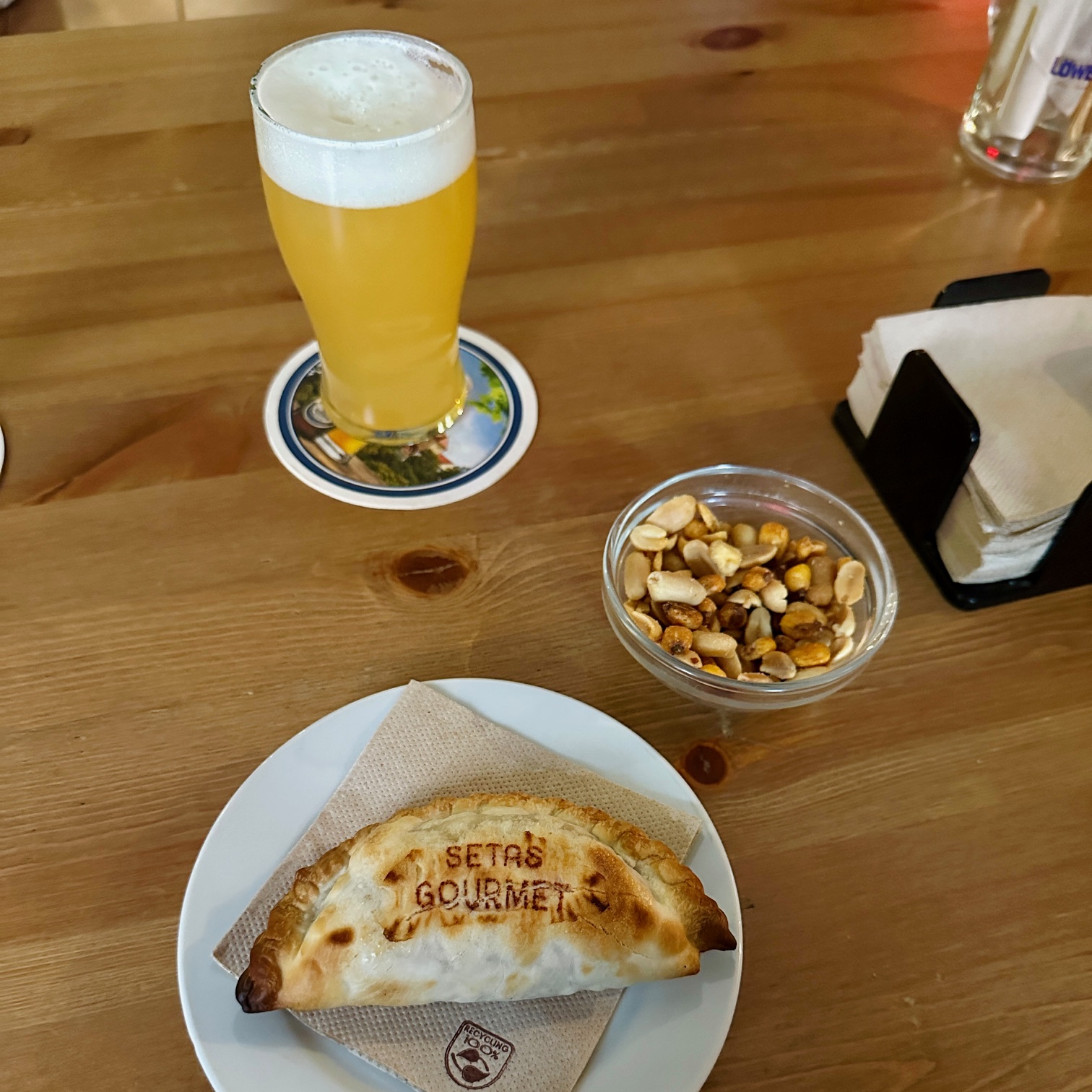
All that and snacks – a bowl of crisps, popcorn or nuts with each round, and a simple but effective menu of cheeses or empañadas. We ordered a mushroom and cheese empañada each and were told they wouldn’t come out for a while because they needed to be baked properly, which is exactly the answer you want to hear, and when they arrived they were gorgeous.

We liked Cimmeria so much that it was a huge wrench to leave for our dinner reservation, and we resolved there and then to move a few things around so we could do it all over again the following night. So the next evening we were stood outside at 7, when it opened, we grabbed the same table and it was, if anything, even better than before.

Cimmeria was following both Zoë and me on Instagram by then and one of the owners, who was charm personified, told us that we had been spending our time wisely from what she could see of our travels. That was lovely of her, but none of it was spent quite as wisely as those happy hours in Cimmeria.

We left for our final restaurant of the trip happy to have found possibly the only pub I’ve been to that comes close to rivalling Bruges’ magisterial ‘t Brugs Beertje and devastated that we’d only had two short evenings there.

Cimmeria celebrated its thirteenth birthday the month before we arrived in Oviedo. I wish it many, many more very happy returns – and, speaking of returns, I can’t wait to go there again.

Cerveceria Cimmeria
Calle Martínez Vigil, 8
https://www.instagram.com/cimmeria_oviedo/?hl=en

11. El Lúpulo Feroz

El Lúpulo Feroz is on the outskirts of the city, out past Calle Gascona and the El Vasco mall, in the only bit of Oviedo I visited that felt decidedly residential. I wanted to try it as the third in my trilogy of craft beer places and I found that, aesthetically at least, it had much in common with l’Artesana. Their back room was a very attractive spot – blood red walls, beer memorabilia everywhere, from Belgium, Czechia and even dear old Blighty. It was oddly pleasing to see an illuminated Bass sign on the wall, the beer free from its usual connotations of little Englander pubman gammonistas.

Speaking of beer, the venue had a tap takeover by Danish brewery Amager Bryghus the night I visited, and I liked what I had. Oviedo has no verified Untappd venues for beer – not that kind of city, not yet – but I later discovered, once I’d got home, all the places I hadn’t made it to: Bär Berlin, Vivalabirra and the courageously named Cerveceria Lord Vader (let’s hope Disney never find out about that one). Plenty kept in reserve for, hopefully one day, an updated version of this guide.

El Lúpulo Feroz
Calle Indefonso Sánchez del Rio, 8
https://www.instagram.com/ellupuloferoz/?hl=en

12. Pionero Coffee Roasters

I suspect that the coffee scene in Oviedo isn’t quite as advanced as in other Spanish cities I’ve visited. The Best Coffee app, a regular staple for me on my travels in the U.K. and overseas, drew a complete blank on the city, and even further research only threw up a handful of places. One, Pionero, was in the northwest of the city, the other side of the Campo de San Francisco from the old town and so very close to my hotel, which meant a couple of very happy contemplative coffees there in the mornings before heading off to explore.

It was a very nice spot with extremely friendly, helpful staff and although the inside was quite serviceable they had a couple of tables outside with a view out onto the street, and thus people-watching, so I tended to plonk myself there. No sunshine, really, so al fresco potential was strictly limited but all the same I found it a brilliant spot to start the day. Coffee was decent – definitely a step above the generic cafe con leche – if not top tier, but Pionero also roasts and sells beans to take home. I’m very looking forward to that first V60 with them.

Pionero Coffee Roasters
Calle Marqués de Pidal
https://www.pionerocoffee.com

13. La Gente Café
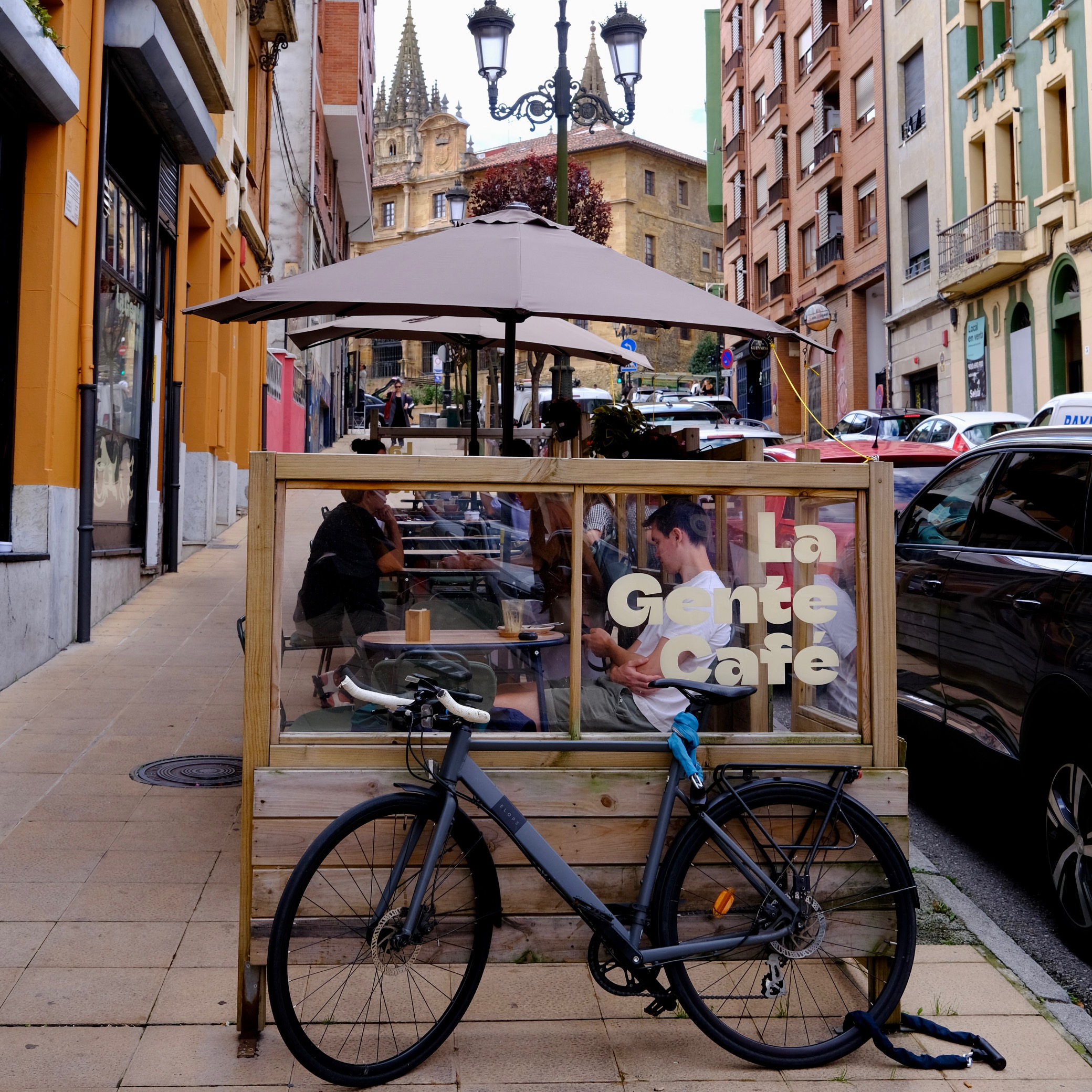
La Gente is on Calle Martinez Vigil, the steep street by the monastery that is also home to Cerveceria Cimmeria. For both those reasons, it probably became my favourite street in the whole of Oviedo over the course of the week. La Gente has a lovely little terrace, overcoming the gradient of quite a challenging hill, and was far and away my favourite spot to sit, drink coffee and take in the surroundings.

I think I liked La Gente’s coffee slightly more than Pionero’s, possibly influenced slightly by the fact that their lattes are tall and generous, so more my personal thing than a cortado or a flat white. I found out from the owners of Cimmeria that La Gente had only opened at the start of the year, and what impressed me was just how part of the community it already felt, full of brunchers, chatters and even dog walkers (owners Kate and Andrew own a miniature schnauzer, Lando, who features in much of their branding).

They are brunch specialists, which means that if you go there around lunchtime you’ll struggle to get a seat and, if you’re not eating, you might well feel guilty about depriving them of a table with a higher spend. But the rest of the time it was just a brilliant space to sip latte and make a plan of attack for the day’s wandering, sightseeing and eating. The interior was absolutely lovely too, although it was a tad too warm to spend time in there.

I also liked the sense that as a business it was still evolving. On one visit I heard one of the owners and a member of staff discussing the menu for the season ahead, and I got the impression from the blurb and postings on social media that La Gente either offered, or was looking to offer, natural wine on selected evenings. Other than that, it’s worth pointing out that, like Pionero, La Gente closes pretty early during the week – so if. you do want an afternoon flat white make sure you get there before the shutters go down at 4pm.

La Gente Café
Calle Martínez Vigil, 6
https://www.instagram.com/la_gente_cafe/?hl=en

14. Diego Verdù

One thing you can rely on from a city guide of mine is that if I go somewhere in summer, I’ll find somewhere for you to eat ice cream. To be honest, even in the less clement months I can usually snaffle one but on a sunny day in Oviedo my thoughts turned to tracking down a tarrina – that is to say a tub – of something cold and captivating.

Enter Diego Verdù, an Oviedo institution which has been trading for nearly 150 years; as we’ll see in the remainder of this list, the people who make sweet treats in the city have had a very long time to become excellent at it. Diego Verdù started out making turron, but by the 1930s it had also decided to turn its hand to ice cream. And thank goodness it did, because both of its branches – the very pretty almost-original premises on Calle de Cimadevilla and the second more modern one just down from the Woody Allen statue – sorted me right out on this trip.
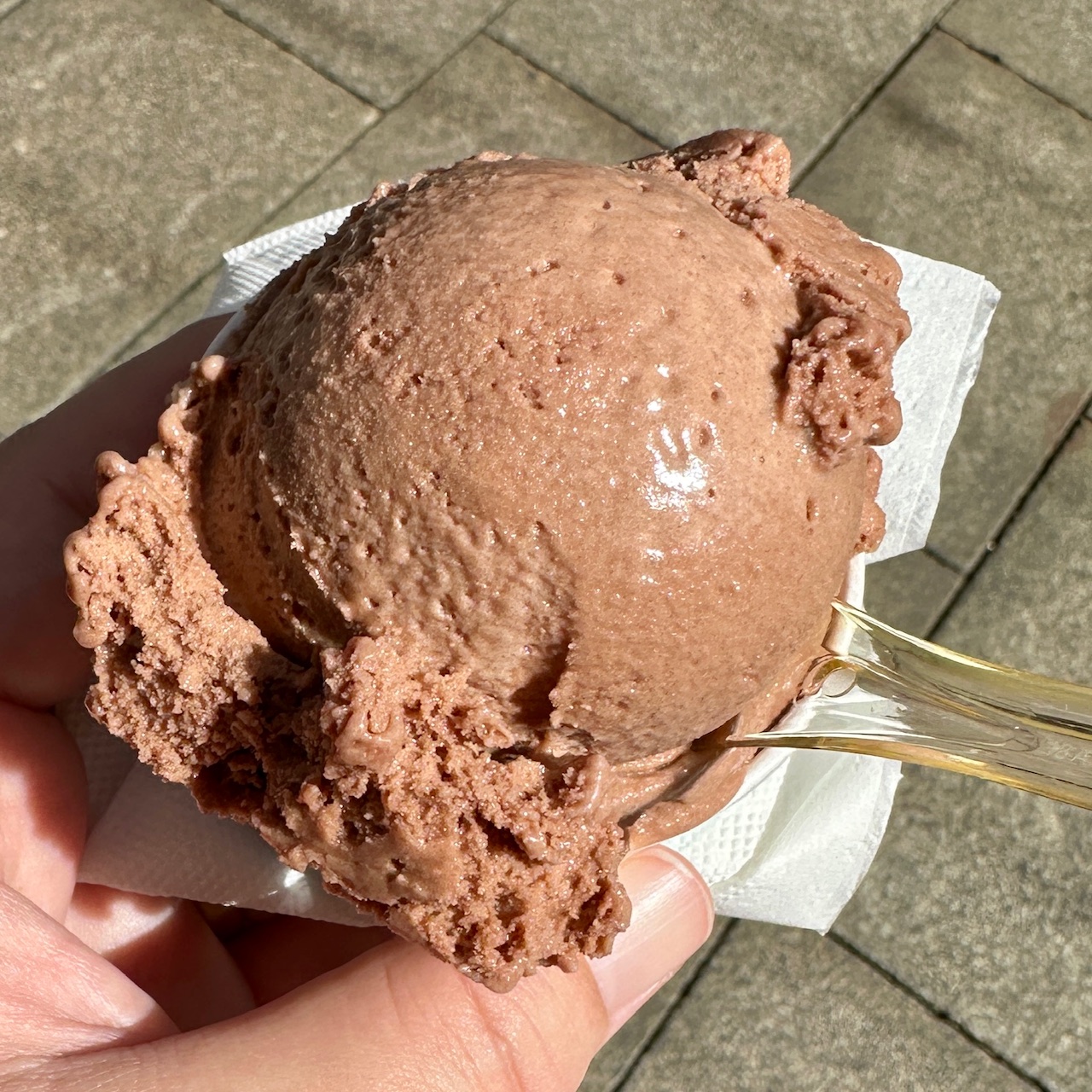
All the flavours that I tried were magnificent although, as befits their vintage, most of them kept it fairly establishment. I loved their chocolate, and their pistachio, but the most leftfield I tried on this visit was chocolate with pimento which I thought downright bloody great. For all I know they may occasionally experiment with yuzu, cinnamon or even cabrales – just imagine – but I didn’t see any of that on my travels.

Sitting on a bench – both branches are takeaway only – and attacking a massive tub filled with two generous scoops for less than four quid, I was quite unbothered by that. Oviedo just isn’t the kind of city for off the wall stuff, and is none the poorer for it. Unlike with coffee, Oviedo is positively enlightened when it comes to helado, and both shops are open until 8.30pm. There’s also a little kiosk on the edge of the Campo de San Francisco, which boasts many benches perfect for sitting, eating and sighing.

Diego Verdù
Calle Milicias Nacionales, 5/Calle Cimadevilla, 7
https://www.diegoverdu.com

15. Camilo de Blas

Diego Verdù is not the only Oviedo institution that’s been brilliant for longer than any of us have been on the planet. Confiteria Camilo de Blas has been in the city since 1914, although they were trading in Leon for another forty years or so before that. The thing they are most famous for, and possibly the emblematic goodie most associated with Oviedo, is the carbayon.

Now, carbayon originally referred to a huge oak tree, beloved by and symbolic of the city, to the point that natives of Oviedo called themselves carbayones. It was felled in 1879 to make way for Calle Uria, the ‘modern’ street connecting the old town to the train station which is now home to department store El Corte Ingles. That’s progress for you. That tree, I suppose was the Metal Box Building of Oviedo (one for my Reading readers there) but in 1924, the mayor of Oviedo commissioned the confiteria to create a sweet treat and this new incarnation of the carbayon, an incredible sweet pastry named after the tree, was born. That is also progress for you.

And what a treat it is. A lozenge of puff pastry filled with almond cream and then topped with a glossy layer of an exceptionally sweet coating which, depending on who you Google, either involves egg yolk or egg whites or both. Either way it also includes a lot of sugar, and makes for a very satisfying shell. This is one for those of you with a sweet tooth, like me. Zoë and I picked a couple up from their second branch on Calle Jovellanos and inhaled them on a bench in the Plaza de la Constituciòn and they were, to my mind at least, unimprovable.

“It’s like a cross between a yum yum, a frangipane and an éclair” was Zoë’s verdict, and I made a mental note of her saying that because she summed it up better than I could. All that for about £2.80 each, so cheaper than a Picnic brownie and even more indulgent. My boss likes to quote Philip Pullman, repeating the definition of an éclair as a cake that is “long in shape but short in duration”: I brought him back a carbayon and he loved it, although he was even more delighted that it was far less short in duration.

Camilo de Blas
Calle Jovellanos, 7/Calle Santa Susana, 8
https://camilodeblas.es

16. Confiteria Rialto
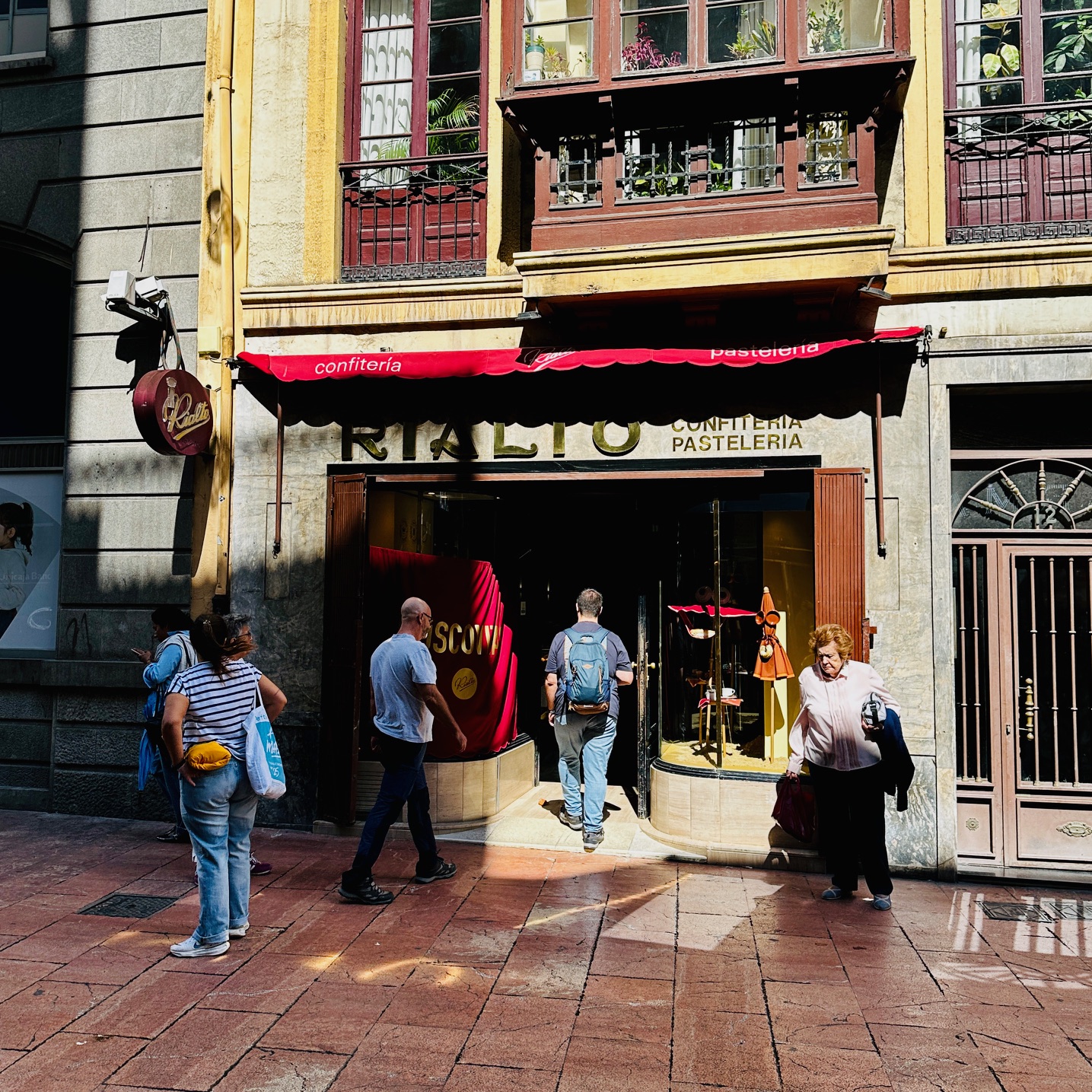
The third of Oviedo’s amazing venerable confectioners is Confiteria Rialto, which celebrates its hundredth birthday next year. It also has two branches in the city centre and it also sells carbayones. But the thing it’s synonymous with is Moscovitas, thin almond biscuits half coated in chocolate, to the extent that even its domain name references Moscovitas, not Rialto.

When I put some pictures on Facebook regular reader Rodrigo – the chap who told me I’d eaten at Oviedo’s best restaurant on my first night – asked if I’d tried Rialto’s Moscovitas, and fortunately I was able to post a photo of me holding one of Rialto’s distinctive red and gold bags, containing two luxurious-looking boxes of the things. But actually, I didn’t try them until I got home, when I was glum about being back in Reading and wanted a taste of elsewhere.

And once I did, I was crestfallen that I’d limited myself to just the two boxes, because they were extraordinary. Every single one irregular, every single one made by hand, each one thin and light, with just enough crunch and just enough substance, each one making you want another. Imagine the most rarefied chocolate Hob Nobs you could imagine, square it and you still wouldn’t be close. Rodrigo also told me that he has a recipe for Moscovitas which approximates to the Rialto classic, and I churlishly pooh-poohed him. Now I’ve tried them, I may have to ask him nicely.

One last tip, which is both about Rialto and Oviedo more generally, is this: Asturias Airport does a better job than nearly any airport I’ve been to of celebrating the region it serves. So you can buy – and not at exorbitant prices either – some of the city’s greatest hits, whether that’s more carbayones from Camilo de Blas, beautiful ice cider, compangas and chorizo from Calle Gascona stalwarts Tierra Astur or, last but not least, more of those Moscovitas. So if you don’t get to Rialto, you can still pick some up for your journey home. If you do, can I trouble you to get an extra box for me?

Confiteria Rialto
Calle San Francisco, 12/Calle Bermúdez de Castro, 2
https://www.moscovitas.com/en/home-2/

(Click here to read more city guides.)

Since January 2025, Edible Reading is partly supported by subscribers – click here if you want to read more about that, or click below to subscribe. By doing so you enable me to carry on doing what I do, and you also get access to subscriber only content. Whether you’re a subscriber or not, thanks for reading.

City guide: Lisbon

I first visited Lisbon in something like 2007, and loved it immediately. It was a scruffy, hilly, lively maelstrom of a city, zigzagged by bright yellow old-school trams, where the coffee was industrial, the pasteis de nata were ambrosial and street art was everywhere, as were beautifully grand, tiled houses. Octopus and salt cod were also everywhere, with either or both featuring on the menu of seemingly every restaurant I visited. I returned with a couple of bottles of vintage port – one of which is still in the garage and almost worth too much to drink now – and a fierce desire to go back. My then wife, put off by the scuzziness, was less keen to return.

I visited a couple more times, each time liking the place even more, and then, for over a decade, it never quite made the top of my list of places to visit. In that time, I saw more and more people discovering it for the first time and felt increasingly jealous and left out. I liked it before it was cool! I would silently protest at the screen of my phone, every time wondering why it had been so long since I travelled there.

People would ask me for recommendations for places to go in Lisbon, and eventually I reached the point where I only had one recommendation left that I had any confidence in, because the place had been going since 1950: more on that later. So I knew I was long overdue a return trip, and that finally happened last week.

Returning I was reminded of what a special place it is. Almost absurdly beautiful, with stunning views, gorgeous streets, a city on the river and right by the Atlantic. It was still sunny and warm in early December, although the Portuguese didn’t seem to think so: they were dressed for an autumn day and must have been mystified by the sight of me in shirtsleeves, shorts and sandals. I was too happy topping up my vitamin D to care.

Lisbon, I must say, wasn’t quite as I remembered it. It’s far more affluent and gentrified nowadays. When I first went it was a very poor city, and your money went a long way. Blame its increasing popularity, blame the much-discussed golden visa scheme, blame the Time Out Market if you like, but for whatever reason its character has definitely changed. That’s not a bad thing, it just makes it a slightly different experience to the one I recall. But some of that is also just the passing of time, so Lisbon having a craft beer scene and third wave coffee now is just about it being the year 2024 in Europe, not some red pill Lisbon has uniquely swallowed.

The other thing I didn’t quite remember was how hilly Lisbon is. Fuck me, but it’s so hilly. Google Maps ought to have an option where you say you want to walk from point A to point B and, even though Google Maps also tells you it will only take you 15 minutes, it then looks up your BMI and tells you to think again. Every day I felt like I’d walked 20000 steps when in reality I’d done a fraction of that, it’s just that so very many of them were up rather than along. Every now and again, on a walk, I would turn a corner, look up and think Seriously?

But not only that: the topography of Lisbon, somehow, is hill upon hill upon hill. The whole place undulates in a manner which makes you wonder how it was ever built at all. There were occasions where I honestly felt like I could travel from A to B to C and back to A without ever not going uphill: it was like living in an M.C. Escher drawing.

So there is beauty, and a castle, and countless miradouros, but that beauty comes at a price. When I last went to Lisbon I was eleven years younger and more supple, less weighed down by life and all the lovely meals I’ve had in the course of writing this blog. It might be a young person’s city, and I hate even being the kind of person who says that.

The best piece of advice I received from my friend Mike, who runs European tours in Lisbon often, was to make use of Bolt, which is like Uber but much cheaper. I rarely did a trip across the city that cost more than five Euros, and I tried not to think too hard about the underlying economy of a place where sitting in your car in traffic for half an hour, going relatively short distances around town earned you less than five Euros. Maybe the gentrification hasn’t trickled down to everybody: in my experience it rarely does.

It’s there none the less: Lisbon has the Time Out Market, which I didn’t eat at on this trip even though everyone says you absolutely should, and the LX Factory, which I did visit and is a bit like Bicester Village for hipsters. It’s very Instagrammable, but I imagine Lisbon is a very Instagrammable city all round. I didn’t get to the Alfama, the old slum district below the castle which I so loved eleven years ago, on this visit. Instead I wandered round Principe Real which is full of concept stores and wonderful boutiques and cafés and, crucially, is on the flat throughout: next time, I’m definitely staying there.

The way that Lisbon was exactly as I remembered was that the food and drink scene could match any city I’ve been to. I’ve often said, to anybody who will listen, that Portuguese food and wine is easily the equal of Spain’s but never gets the credit for it. Also, more even than Spain, Portugal’s food has never really taken off in the U.K.: with the exception of the restaurants of Nuno Mendes in the capital, it’s hard to think of other notable proponents. Here in Reading, multiple Portuguese restaurants – O Beirão and O Portugués – have tried and failed to gain a foothold.

Well, that’s a shame, because even on a relatively brief visit to Lisbon I ate so well (and had so many places on my shortlist that I couldn’t get to) that I could completely see how it remains one of Europe’s great gastronomic cities. And that also reflects in the fact that – and this is a huge compliment – I was asked by several people to write a city guide to Lisbon before I’d even got home. I was already planning to do one, because I packed an awful lot of good places into four days in the city, but I was also aware of all the places I hadn’t got to and really wished I could visit.

But I was surprised by just how many of my readers were off to Lisbon in the not too distant future: several of you told me you are going next year, and one reader told me that she is heading to Lisbon literally the day after this piece is published (I offered her a sneak preview of the list, in case she wanted to book anywhere in advance). Best of all, two of my readers actually touched down in Lisbon halfway through my holiday and, taking their lead from my posts on social media, ate at one of my favourite places. They were not disappointed, because it was the place that’s been going for nearly seventy-five years, that I first tried on my first visit seventeen years ago and have gone back to every time since.

The rest of the places in this guide showcase much more variety – traditional and modern, some authentically Portuguese and others more reflective of the melting pot the city is now. I had an absolute blast eating and drinking at each and every spot on this list, and if my guide helps some of you with your own trips, whether that’s next week, next summer or next winter, then I will be delighted. And if it persuades any of you to add this gorgeous, vital, hilly – very hilly, I can’t stress this enough – city to your list of places to visit, all the better.

1. Bonjardim

This is the place I recommend to everybody, the place I’ve been eating at on every trip to Lisbon since I first went, back in 2007. Once, on a holiday with my old friend Dave I ate there twice – on my first and last day in the city – and on this visit it was my lunch stop less than an hour after we checked in and dropped off our bags.

Bonjardim is tucked away on a little alley just off Praça dos Restauradores, not far from the train station and close to the top of the Baixa, the grid of streets that runs down to the river and constitutes Lisbon’s flattest district. It celebrates its seventy-fifth birthday next year and although the menu has a good range of fish, seafood and grilled meats, the only thing to have here, really, is the spit roasted chicken. Over the last seventy-four years they’ve got it down to a fine art.

That doesn’t mean you shouldn’t have a plate of smoked ham and a couple of glorious salt cod pasteis while you wait for the chicken to arrive, or that you shouldn’t drink a caneca of ice cold Sagres into the bargain. That all forms part of the anticipation, that and watching chicken turn up at neighbouring tables, knowing that it will soon be your turn. But when it does finally reach you? Well, it is glorious.

It never disappoints. Rubbed with salt and lemon, the skin is a papery, crispy, savoury miracle. But the meat underneath, which comes off the bone ridiculously easily, is sublime. And you’ll pick and pick and pick until the whole carcass is white and clean, because none of this can be wasted. They even do good french fries too, equally salty and utterly delicious.

But the chicken is the thing. It ruins all other chicken, that’s the only problem. It will be some time before you can enjoy a Nando’s again, and my attempts to chase this particular dragon, at the likes of Casa do Frango and Bébé Bob, has been an exercise in futility. I think deep down I always knew they would be, but I did it because even if there was a one per cent chance those places could match Bonjardim, it would be worth the gamble.

A whole roast chicken at Bonjardim costs a ludicrous seventeen Euros, and it pained me that I only got to eat there the once. Both subsequent days, when I took my chances at no reservation places, in the back of my mind I was thinking to myself it’s okay, because if they’re full I can just go to Bonjardim again. So of course none of them turned out to be full.

The mystical power of Bonjardim has not waned in the nearly twenty years that I’ve been going, and one of my favourite moments of the trip, even more so than eating there, was seeing Zoë eat that chicken for the very first time. We messaged our friend James, who himself made his Bonjardim debut earlier in the year on my recommendation. “It’s a biblical experience” came the reply almost instantly. “God tier chicken at excellent prices.”

My two readers who were in Lisbon at the same time as me went there for lunch on the Saturday, and put a picture up on my Facebook page. “God damn, that chicken is something else” said one of them; there is something about that chicken, it seems, that makes you take the Lord’s name in vain. But honestly if there is a creator, and I’m still unconvinced on that score, they should be honoured to be mentioned in the same breath as Bonjardim’s finest.

Bonjardim
Travessa de Santo Antão 11, Lisbon

2. Lupita

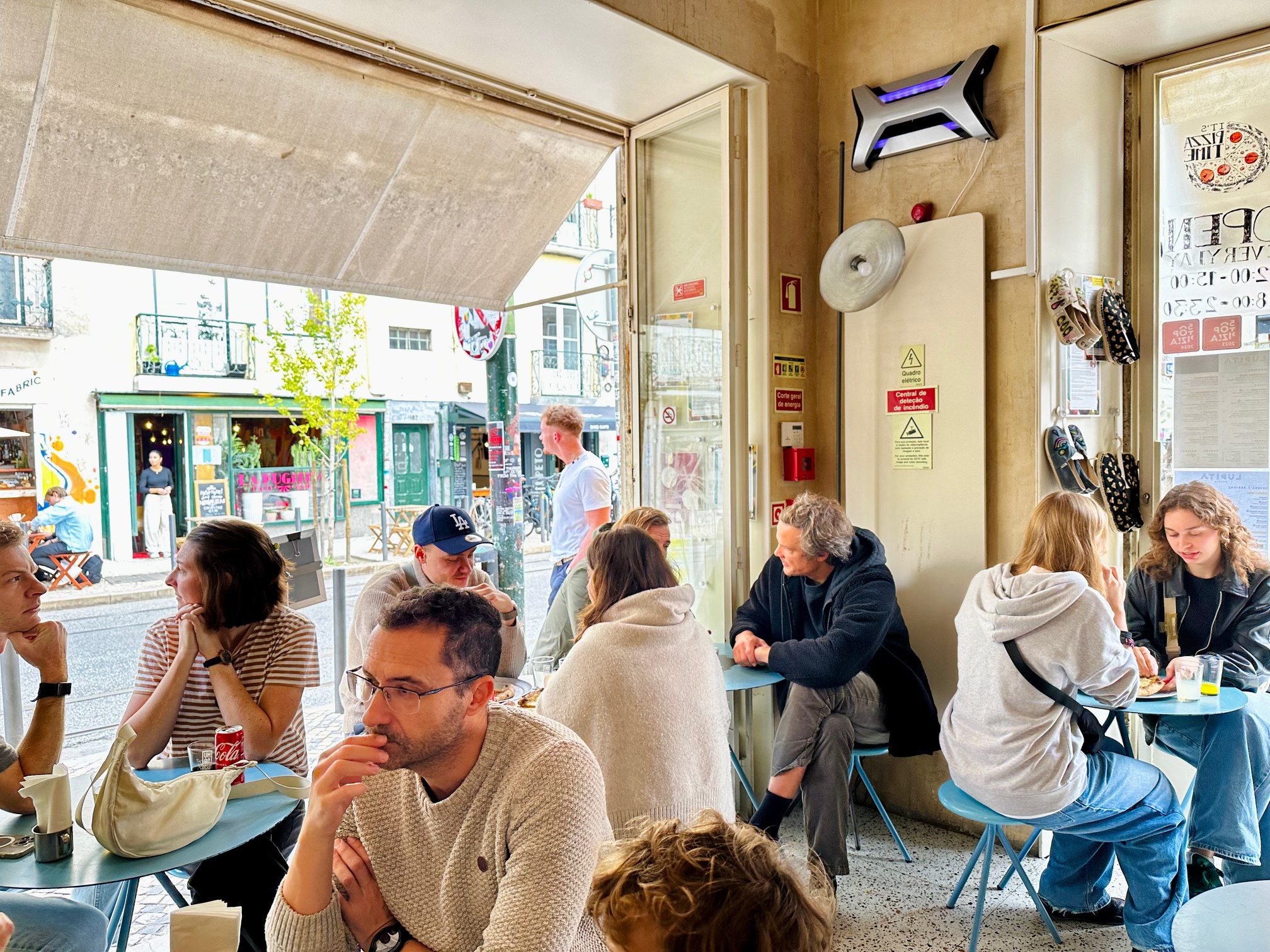
The pizza restaurant Lupita is one of the no-reservations spots I mentioned just now, and I am absolutely convinced that if it wasn’t for the fact that it’s literally just round the corner from the Time Out Market it would be impossible to get a lunchtime table there. As it was we still got lucky, turning up just before half one and managing to snag the only vacant table at the exact moment that it came free. When we left, about an hour later, there was quite a queue forming.

Normally I wouldn’t do any of that – turning up on spec, queuing and what have you – but I made an exception for Lupita because everything I had read suggested it was very special (and, of course, I had Bonjardim as my Plan B). And special it was, belying its no frills appearance, plain metal folding tables and stools.

The pizza was exquisite. I’m loath to use hyperbole, because I love pizza and have enjoyed great pizza all over the shop, from Bristol to Newbury, from Bologna to Paris, from Bruges to Northumberland Avenue. But if I’ve had a pizza better than Lupita’s I can’t remember it right now. The base was a marvel, light, puffy and chewy, with the look of a Neapolitan pie but with the droop-free structure of its transatlantic cousins. The toppings – guanciale, jalapeños, a feisty chimichurri sauce and a dusting of Parmesan – were out of this world. And that feeling, of being in the middle of something so outstanding, gladdened my heart.

If I stopped there Lupita would be worth a visit. But on the day I went they had a special starter which happened to bear my Italian porn star name, Puttanesca Pockets. Just imagine: something like a mini calzone cut into two bite-sized halves, each stuffed with olives, capers, tomato and anchovy, the best Breville you never had. I would try to recreate it at home, but I know it would never approach that level of genius. “That dish will be on my mind all day” said somebody on Facebook when I put a picture up: that makes two of us.

Oh, and they only do one dessert, a Basque cheesecake. Guess what? It, too, is superlative.

Lupita
Rua de Sao Paulo 79, Lisbon
https://www.instagram.com/lupita.pizzaria/

3. Jesus é Goês

My final lunch of the trip was at Jesus é Goês, just off the very swanky Avenida de Liberdade. Normally eating Indian food on a European city break is the last thing I would ever do, but Jesus é Goês is all about the food of Goa, a Portuguese colony for over four hundred years, so it piqued my interest. I spotted it on an episode of Somebody Feed Phil on Netflix; for the uninitiated, somebody always does, rather a lot, and yet Phil never shuts up. It’s strangely endearing and annoying at the same time,

The restaurant is the brainchild of the eponymous Jesus, who opened the place ten years ago, and I didn’t discover until halfway through my meal there, doing a little research between courses, that he sadly died last year. The place is now run by his partner, a lovely, kind and smiling hostess who took excellent care of us during lunch. You can book this place, I later discovered, but only via WhatsApp: we were the only customers in the whole place on a Saturday lunchtime, which slightly saddened and concerned me.

Having eaten the restaurant’s food, I can add mystified to that list of adjectives, because it really is wonderful stuff and, with the exception of Clay’s, probably the best Indian food I’ve had outside India itself. I started with the restaurant’s iconic “holy burger”, an intensely spiced, deeply complex morsel served on a spoon topped with a poached egg yolk and more spices. I was under strict instructions to eat the whole thing as a single mouthful so of course I did, and it’s as good a single mouthful of food as I’ve tasted all year.

Zoë was eating an equally terrific samosa packed to the rafters with spiced meat, and I insisted that we ordered another burger and samosa so she could know the same joy as me. It would have felt wrong not to be able to talk about the experience of tasting that holy burger with her again, later in the holiday, later in the year or just later in our lives.

The mains kept up that standard – I did recognise a couple of dishes like pork sorpotel from Clay’s regional menus in the past, but I had to try Jesus é Goês’ goat curry, almost as much a signature dish as the holy burger. The meat benefited from a long, slow cook but what really made this was the dark, glossy, phenomenally spiced sauce, poured onto rice or loaded onto a chapati. Zoë’s chicken cafreal, served on the bone – although it didn’t stay on it for long – was completely different and equally enchanting, the sauce with more fragrance and citrus, less smoke.

This felt like food for the soul, and not necessarily something I’d ever have expected to eat in Lisbon, let alone to love so much. It felt strangely moving to eat in Jesus’ restaurant, knowing that he was gone but that his food would be enjoyed by hundreds of people who never got to meet him. I’m glad I was one of them. A sign on the wall said “ASK JESUS FOR A RECOMMENDATION”: this might be the only time I’ve ever put my faith in Him.

Jesus é Goês
Rua São José 23, Lisbon
https://www.instagram.com/jesusegoesoficial/

4. Prado

Prado was my Fancy Meal of the trip. I invariably do one on most holidays, where there’s an à la carte menu but I allow myself to be persuaded by the tasting menu. From there it’s only a momentary lapse before you’re signed up for the wine pairings, too, the whole nine yards. It’s a slippery slope, and at the bottom of it is an evening where you’re cosseted and indulged and don’t have to make a single decision again. And to do that in this tasteful space with its inventive menu, beautifully chosen Portuguese wines and well-judged service – well, it was no hardship at all.

The tasting menu, I will say, was made an easier choice by the fact that Prado’s à la carte wasn’t really an à la carte in the true sense, instead being a list of small plates with a recommendation that you order something like four per person for sharing. So you’re going to end up with something like a tasting menu whether you like it or not, and although I found that a tad irksome I did manage to get over it. The tasting menu is 75 Euros here, to give you an idea, but I suspect that curating your own small plates playlist would probably cost there or thereabouts.

It’s a minor quibble anyway, because the food was brilliant. Prado is Portuguese for meadow, it turns out, and Prado prides itself on taking a farm to table approach, although that didn’t quite square with a menu which leant very heavily on fish. But no matter, because so much of what I ate was imaginative, original and just plain fun. Beef tartare came sandwiched between leaves of grilled cabbage, octopus was served on a skewer, zhuzhed with the addition of a chorizo emulsion. Even the bread was lifted by a pot of spreadable pork fat, shot through with garlic.

Every dish was fascinating, a real beauty pageant of cracking creations. Hard to single out anything, but marinated mackerel served in a chilled, fresh soup of green apple and green olive was a combination I could never have conceived of in a million years yet loved eating. I adored Prado’s John Dory, spiked with pil pil and served under a dehydrated kale leaf. Oyster mushrooms, served in a goat’s butter sauce, lardo draped on top were a proper delight, as tasty as they were beautiful: it was just a shame that the garlic-laced pork fat earlier on meant we hadn’t saved any bread for mopping.

I thought the Alentejano acorn fed pork, served ruddy pink with potato purée was probably the weakest course of the meal, but Prado saved the day with an outrageously good dessert – a brioche with a sweet, burnished, caramelised crust, served with exemplary coffee ice cream and a sauce which went perfectly with the glass of Madeira we were given to polish off proceedings. Two hours and a couple of hundred Euros very well spent, even if the rest of the meals of the trip were, by comparison, far less rarefied.

Prado
Travessa das Pedras Negras 2, Lisbon
https://pradorestaurante.com/index2.php

5. Trinca

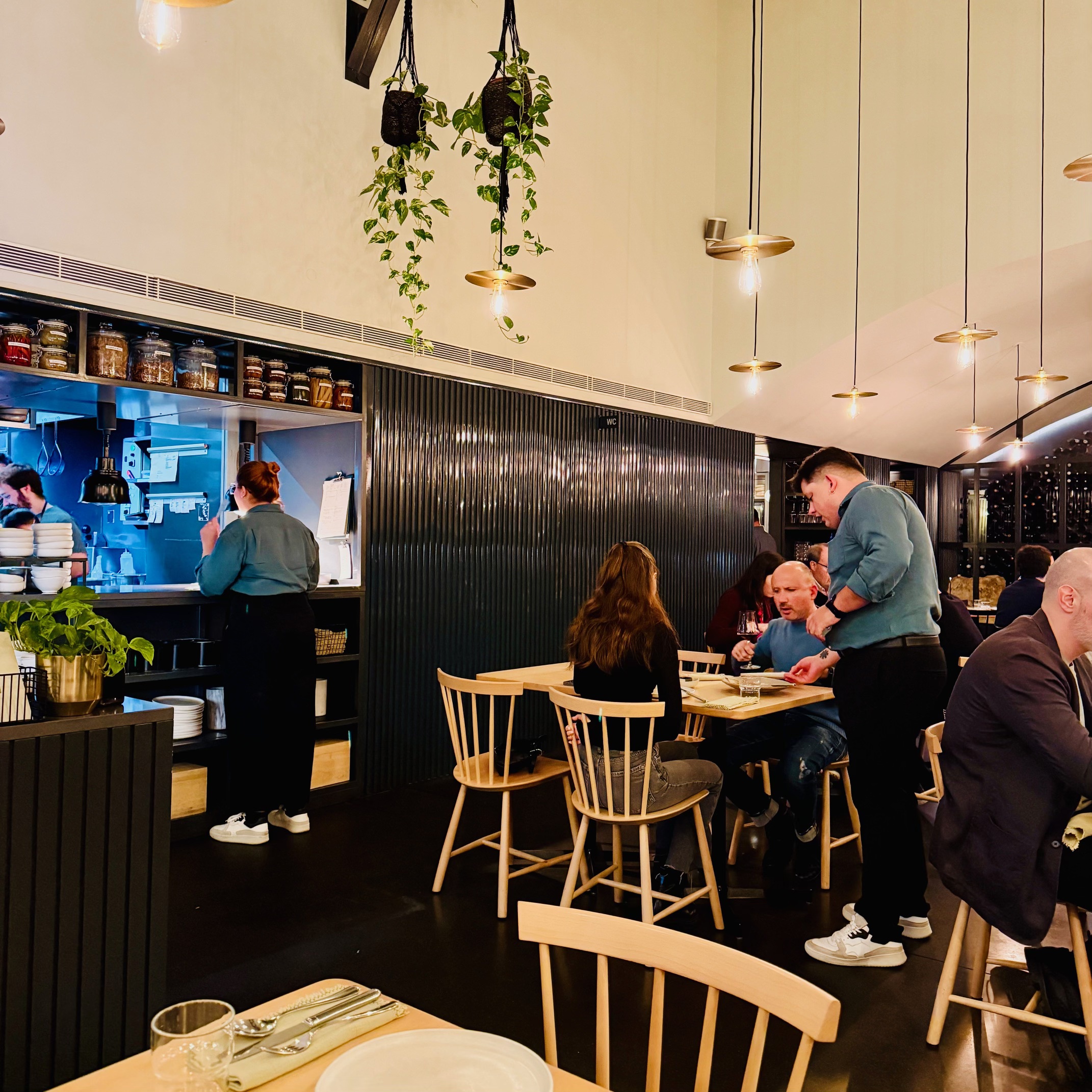
Trinca is nothing to look at from the outside – I almost walked past it without realising it was my Friday night dinner reservation – and inside it’s a plain and unprepossessing room. But it was an absolute riot – a small, intimate place that felt more like a neighbourhood restaurant than anywhere else I ate in Lisbon.

The menu is on a chalkboard and changes all the time, and to say it jumps around is to put it lightly. The cheese was traditionally Portuguese, the textbook focaccia we had with it less so. And then there were grilled leeks, almost more like Spanish calçots, served with a ginger hollandaise and Jerusalem artichoke crisps, a dish that was truly a citizen of the world. Not international enough for you? How about fregola topped with shiitake mushrooms cooked in ponzu and glazed with gochujang?

That’s before I get onto our main courses. Octopus – so far, so Portuguese – but in tacos. Or tacos with confit Iberian pork topped with a zingy salsa verde and (a masterstroke, this) pork crackling. But just to throw one last cuisine in, we also tried Nepalese pork belly, simply spiced and grilled, accompanied by a cucumber salad singing with sesame. A menu like this shouldn’t work, and paradoxically that’s exactly why it did.

No dish cost more than fifteen euros, many of them cost a lot less. The most expensive red on the wine list, which was biodynamic and very pleasant indeed, cost a shade over thirty euros. A more different experience to Prado is hard to imagine, but it was an equally valid one. I left this neighbourhood restaurant full, happy and deeply envious for all the locals there, who clearly lived in its neighbourhood.

Trinca
Rua dos Anjos 59C, Lisbon
https://www.instagram.com/restaurantetrinca/

6. Tapisco

Arguably Lisbon’s two most famous chefs are José Avillez and Henrique Sá Pessoa. The former has two Michelin starred Belcanto and a raft of other restaurants across the city – Cantinho do Avillez, Bairro do Avillez and so on. In case that wasn’t ornate enough, Bairro do Avillez contains three different restaurants, or eating areas. What’s the Portuguese equivalent of a Russian doll? Anyway, he has something like sixteen restaurants in total, and I found the whole experience of trying to pick one exhausting, so I gave up.

Sá Pessoa, on the other hand, has a much narrower portfolio. There’s Alma, which is double starred, and Tapisco, which is his more affordable, casual restaurant on the edge of Principe Real. I went to Tapisco on my last evening in the city and had a really enjoyable meal full of well executed versions of Portuguese classics. My cuttlefish, simply battered and fried with a coriander mayonnaise was simple, unshowy and a proper pleasure, and Zoë’s tuna tartare with avocado and little wasabi pearls was equally gorgeous.

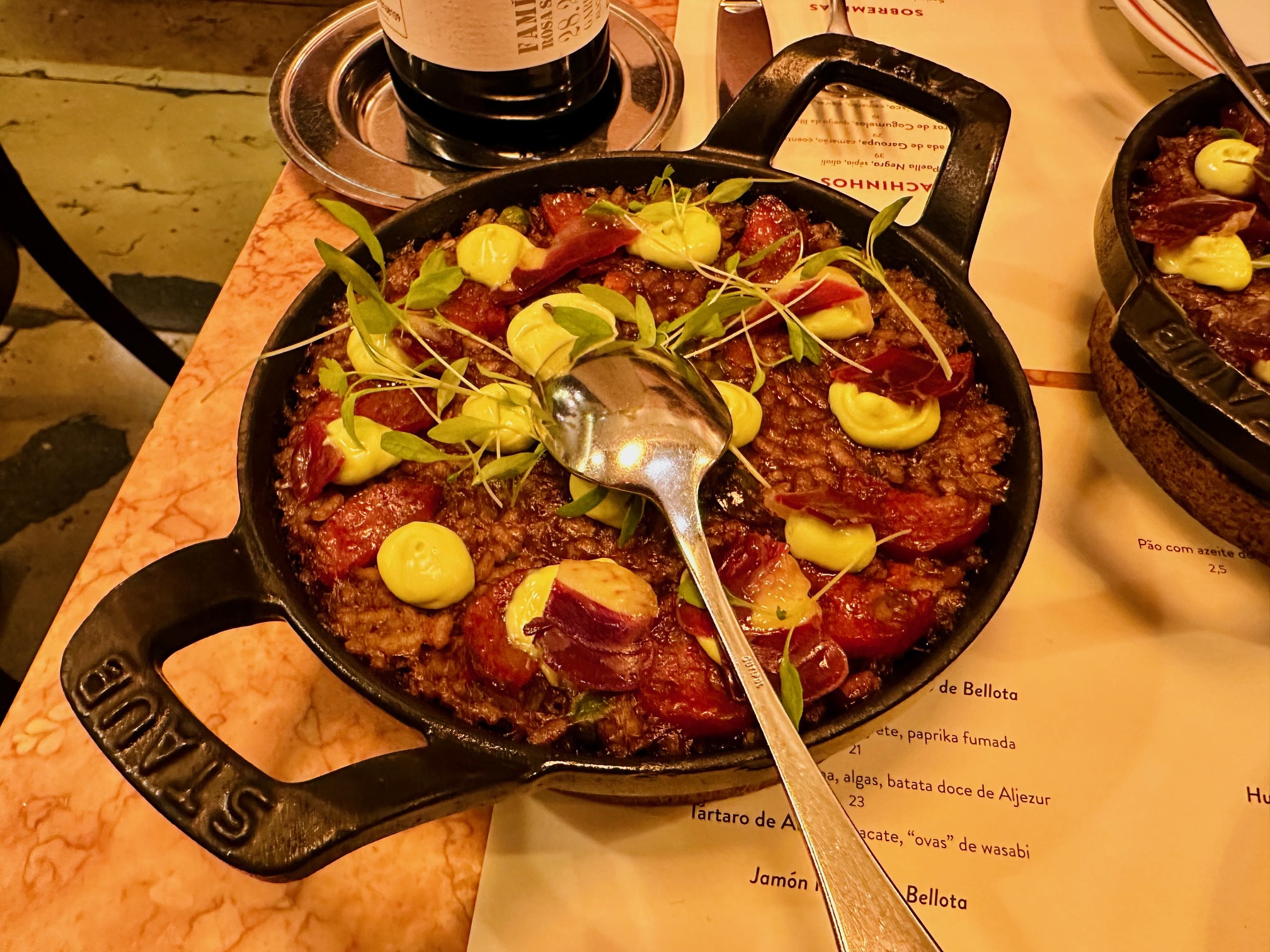
For our main, we both gravitated to the same thing, arroz de pato, a deeply savoury daydream of a dish, rice studded with shredded duck, topped with dried duck and smoky sausage, dotted with aioli. This was not a dish to share, it was a dish where you jealously guarded your own personal skillet, spooning and enjoying and worrying about the point in the future when you could spoon no more.

I had arroz de pato once at O Portugués once, back when I was reviewing takeaways. Now I know what this dish can be, I would be reluctant to order it again – although, that said, De Nata have it on their menu. Surely it’s worth a try?

Tapisco also, by the way, does a chocolate mousse with olive oil and salt which even managed to supplant Thames Lido’s in my affections. Who needs two Michelin stars anyway?

Tapisco
Rua Dom Pedro V 81, Lisbon
https://www.tapisco.pt/lisboa_en.html

7. Senhor Uva

I did my homework wrong on Senhor Uva: I thought it was a natural wine bar where you could snack if you wanted to, the perfect spot for a pre-dinner drink on our final night. It’s out in Estrela, at the end of the iconic 28 tram route, so if you timed it right you could potentially combine them.

But actually, Senhor Uva is part wine bar, part restaurant. And the restaurant part is a selection of almost entirely plant-based small plates. Having booked a table, we then hastily sent an email saying that actually we just wanted wine and a few pre-dinner snacks. Would that be okay? we asked. And if it wasn’t, we said we’d completely understand them cancelling our reservation.

Well, we didn’t get a reply but on arrival they knew exactly who we were and what we were after, and they looked after us superbly. Nothing was too much trouble, and they selected and recommended glass after glass of striking, elegant wine while letting us pick whatever small plates we wanted.

And all the small plates were excellent – one was a couple of local cheeses with handmade crackers and a sweet fruit chutney, another was potato, leek and broccoli skewers with a deep delicious sauce. A third, maybe the best, was grilled courgettes with poppadom shards and a moat of stunning ponzu sauce. When every dish was set down in front of us we were told its ingredients, and told it was made with love.

By the end of the third glass I wanted to live in a parallel universe where we’d never booked a restaurant that night, where we just stayed there in that stylish space, seemingly hewn out of the hillside, drinking more wines, eating everything on the menu, enjoying the chatter from the neighbouring tables (much of which, I have to say, was in English).

Senhor Uva has clearly done well enough to expand into a larger space on the other side of the road, and that’s where the kitchen was. As the light dimmed and we saw the room opposite glow, the regular to and fro of staff from there to here carrying food, I thought that this was what the best of life was about – travelling, finding spaces like this, being transported and getting lost in a reverie that this was somehow your place.

How I wish home had anywhere even remotely like Senhor Uva. How I wish I’d had longer there. You will never, I suspect, hear me say this again about somewhere with an exclusively vegetarian menu, so make the most of it.

Senhor Uva
Rua de Santo Amaro 66A, Lisbon
https://senhoruva.com

8. Manteigaria

Everyone will tell you that the place to go for pasteis de nata is Pasteis de Belem, a tram ride away. People queue to get in, and you eventually grab a table in one of its tiled dining rooms, and you scoff egg custard tarts fresh out of the oven, slipped onto your plate and dusted with cinnamon. After that you do the Tower of Belem, look round the Jéronimos monastery, take your pictures of the Monument to the Discoveries and take a tram back in to the centre. You’ve eaten well, you’ve seen sights, it’s a day of tourism well done.

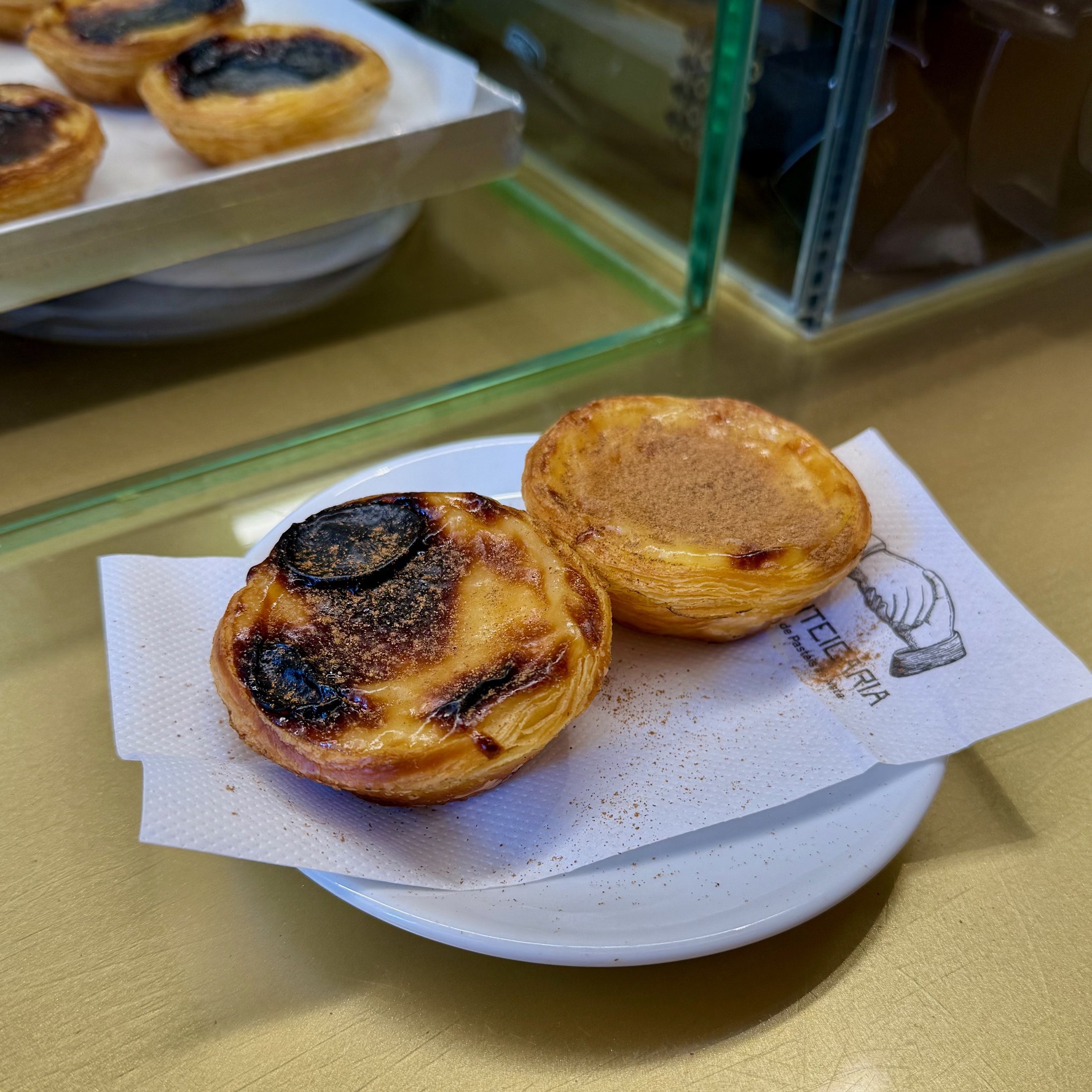
And all that’s true. I’ve been to Pasteis de Belem, several times, and their pasteis are a revelation if you’ve never had them before. But for my money Manteigaria’s, from their gorgeous site on the edge of Bairro Alto, more than matches them. So go there instead if you’re tight for time, or want to stay central, or just trust my judgment, and you won’t be disappointed. They are warm and perfect, the pastry with just the right amount of flake and the custard with absolutely the right amount of wobble.

I have a feeling pasteis de nata anywhere in Lisbon are good – I even had a decent one at the airport before my flight home – but you may as well start at the top so you set the standard. Also, once you’ve done that I have good news for you: De Nata’s pasteis are really not that far off, and a much shorter trip away.

Manteigaria
Rua do Loreto 2, Lisbon (and in the Time Out Market)
https://manteigaria.com/en/

9. Nannarella

I always seek out ice cream on my holidays, because I associate ice cream with holidays. And normally I would recommend you Santini, a Portuguese chain, because I had their ice cream in Porto many years ago, and liked it a lot.

But Nannarella, another discovery from Somebody Feed Phil, is a level above that and up there with anything I’ve had in Bologna, Granada or Malaga. It’s a little bit in the middle of nowhere – sort of between Estrela and Principe Real – but it’s worth seeking out if you even remotely love ice cream like I do; as it happens, I took a Bolt there specifically to try it out.

Zoë thought that was a bit nuts, but once we were installed on a park bench and she was eating a ball of gianduja ice cream bigger than a baby’s fist she soon changed her tune and told me I was right all along. Since that almost never happens, it’s one for the memory banks.

I loved Nannarella’s chocolate ice cream which was on the darker side and a real work of art, but I especially loved the fior di latte, an ice cream I’ve never seen outside Italy. The confidence to do that – to make an ice cream that just tastes of itself, no vanilla, no nothing – speaks volumes about the place. And it’s completely justified.

Nannarella
Rua Nova da Piedade 64A, Lisbon
https://www.nannarella.pt/en

10. Fabrica

Fabrica was my go to coffee place in Lisbon, a choice made easier by the fact that they have branches all over the city – all of which look slightly different, all of which are very stylish and all of which serve excellent coffee.

So I enjoyed their spot just behind Praça do Comércio in the heart of the Baixa, and I also really enjoyed the massive pain au chocolat I ate there. I loved their branch on the bustling street of Rua das Portas de Santo Antão, and I adored their little coffee van in Principe Real, just around the corner from EmbaiXada, a beautiful mall of concept stores housed in a nineteenth century Arabesque palace (this is a food and drink guide but honestly: go shopping there, it’s amazing).

My favourite spot, though, was the one in Chiado, on Rua das Flores, on a steep hill a short stroll from Manteigaria. I know the done thing is to have your pastel de nata with a coffee, but Fabrica is a great advert for just eating the egg custard tarts up at the bar and then working off a fraction of the calories heading down the sloping street for exceptional coffee.

Fabrica
Rua das Flores 63, Lisbon (and other locations across the city)
https://fabricacoffeeroasters.com

11. Dramatico

Dramatico is such a beautiful spot that it’s almost tempting to recommend it for that alone. It’s a little space – again, almost hewn out of the side of a steep hill – picture perfect with white Mondrianesque windows, a lovely showcase for coffee and brewing on one side, and a handful of tables the other. The picture above doesn’t do it justice: it’s absurdly fetching.

It’s a little out of the way, just off from Principe Real and across from the botanical gardens, and our Bolt struggled to find it, leaving us gladly with a downhill stroll rather than an uphill one. But the one frustration about it is that because it’s good, it’s popular, and because it’s popular and small, it’s very difficult to grab a table.

Normally I wouldn’t mind that so much, but the room was full of Americans – it’s always Americans – with vocal fry so bad that they belonged in a burns unit: I’m afraid it brought out my inner Sam Loudermilk.

Add in the fact that the café only seems to open until 2pm, and sometimes not even that, and the owner is capricious at best and sometimes just shuts for a two week holiday because he can, and… well, I realise this might not be the best sales pitch in the world. But in warmer months I think they have a bench outside, so there’s that.

And it was the single best coffee I had on the trip, and one of the best lattes I’ve had in quite a while. So maybe the owner can do what he likes and, if the worst comes to the worst, you can sip Dramatico’s magnificent latte on a bench in the botanical gardens. If you did, I suspect you’d forgive the place almost anything.

Dramatico
Rua da Alegria 41E, Lisbon
https://www.instagram.com/dramatico.lisboa/

12. Cerveja Canil

I don’t know how mature the craft beer scene is in Lisbon, but on aesthetics alone I’d say Cerveja Canil is similar to other craft beer places I’ve been to in Europe – black walls, basic furniture, people having a terrific time. This branch is in the heart of the Baixa (they have a second off Avenida da Liberdade) and was humming when we turned up for a pre-dinner drink. A big loud group of Brits had discovered it too, but once they – and the U.K.’s seemingly unique brand of toxic masculinity – cleared out, it became an extremely agreeable place.

Canil is a brewpub, and offers about a dozen of its own beers in a real variety of styles, so not just different iterations of hazy pales but also porters, brown ales and ESBs. Their pale ale was far better than its middling Untappd ratings would have you believe, but I also really enjoyed their guest beers, by Letra and local microbrewery Mean Sardine.

In marked contrast to so many beer places in the U.K. (and definitely in Reading), Canil also has the beer snacks down pat. I particularly enjoyed a goats cheese croqueta with honey, resting on a completely unnecessary carpet of rocket. Beer and croquetas are such a perfect match: I wish Phantom or Double Barrelled would get on the phone to Caversham’s Miss Croquetas and make some kind of arrangement.

Cerveja Canil
Rua dos Douradores 133, Lisbon (also at Rua da Santa Marta 35)
https://www.cervejacanil.com

13. Sputnik Craft Beer

Sputnik was the other beer place I tried on this trip, out of the centre somewhat but just round the corner from Trinca. Another proponent of Tollix stools and walls somehow darker than black – a look that always reminds me of seeing Darwin Deez live at the Boilerroom in Guildford back in 2015 – it was nonetheless a really lovely craft beer spot with great service, an excellent range of beers and a well-stocked, interesting fridge.

Unlike Canil, Sputnik does not brew beer itself but its twelve taps had an excellent range including local breweries Dois Corvos, Fermentage and Mean Sardine (disappointingly it also had a single beer by Brewdog, for people who haven’t yet got the memo about Brewdog).

But the fridge also had some real wonders, including more cans from local breweries and a few other Iberian classics like Barcelona’s Garage. I squeezed more drinking in than was probably wise, and left with a couple of bottles of barrel aged imperial stout to take home and pop in the garage.

All that aside, the thing I really loved about Sputnik was how inclusive and unhipster it was – pretty much every table there was a different demographic, including shabby, middle-aged me, and I was reminded that the way to be cool is to not give a shit whether you’re cool or not. In that sense, I would say that Sputnik is pretty cool, not that I’m any judge of that.

Sputnik Craft Beer
Rua Andrade 41, Lisbon
https://www.instagram.com/sputnik.lisboa/

(Click here to read more city guides.)

Since January 2025, Edible Reading is partly supported by subscribers – click here if you want to read more about that, or click below to subscribe. By doing so you enable me to carry on doing what I do, and you also get access to subscriber only content. Whether you’re a subscriber or not, thanks for reading.

City guide: Bruges and Ghent

Although this guide was written in July 2022 and updated numerous times up to and including January 2024, a new and completely revised version is now available dated April 2024. It can be found here.

Last week’s feature on al fresco dining got a fantastic response from you all, and is already, at the time of writing, the most popular piece I’ve published on the blog this year: thank you so much to everybody who read it, commented, recommended it and passed it on. And after the week we’ve had I have high hopes that it will come in handy for a while yet – in fact the weekend it came out I had dinner outside the Lyndhurst one night, Buon Appetito the next. So if reading it made you feel hungry I can assure you that writing it had much the same effect.

Anyway, by contrast this week it’s one of those pieces that’s a bit more niche, that will only interest a handful of you, so apologies in advance for that. But I had such an enjoyable week in Bruges and Ghent last month that I thought it was ripe for a piece, especially because my last guide to Ghent – the first city guide I ever wrote on the blog – is a creaking three and a half years old. Both cities are well worth visiting, both are gorgeous and ridiculously easy to reach by Eurostar and both offer a holiday unmarred by the flight chaos we might well see for the rest of the year.

Of the two I would say Bruges is smaller, quainter and (even) more beautiful, although it’s very touristy and decidedly sleepy of an evening once the coachloads of day trippers have moved on. Ghent is larger and more sprawling, with much more of a big city feel. Its historic parts are reminiscent of Bruges but it also has street art, a modern art gallery, a design museum and more of a craft beer scene outside the traditional Belgian pubs.

As a tourist, you could easily do Bruges in a long weekend, as a beer devotee you could explore it for a lifetime and never tire of the place. Having now made three trips in just over six months, I completely get its magic and understand why it’s captured the hearts of many people I know. If you aren’t nuts about beer, Ghent might keep you occupied longer. But they’re half an hour apart on the train, so you could easily (as I have) make a two centre holiday of both.

Oh, one other thing before I get started – this is only based on places I went to on this year’s visit. So my piece about Ghent from 2018/2019 is potentially still worth a read, it’s just that I can’t vouch for places like Brasserie Du Progres, Oak, Otomat and Barista (I bet they’re great, though). I can however guarantee that the pastries from Himschoot are as gorgeous as they ever were: they’ve even opened a few additional branches since I was there last.

Bruges

1. Bruut

Bruut is in a handsome building next to an absurdly beautiful bridge overlooking the canal, and inside it’s all rather convivial – leather chairs, fetching tiled floors and exposed light fittings. But there are a few al fresco tables by the side of the bridge with a gorgeous view, and that’s where I sat when I had lunch there, one of my meals of the year. Chef Bruno Timperman offers a no-choice, no-substitutions set menu for lunch or dinner and comes out to introduce and talk through many of the dishes himself. And put simply, the man is a wizard: I don’t normally talk about chefs in my blog but this is all very much in his image and it’s very much his show.

Nothing I ate was short of dazzling, and there were almost too many highlights to mention, but a steak tartare made simply with high-grade beef, salt and milk to draw out all the flavour was a tender, mineral miracle. A pre-lunch nibble of prawns, cooked whole and dusted with a vivid raspberry powder was like nothing I’ve ever eaten. And our dessert, cherries halved, hollowed and filled wih rose-coloured chocolate, topped with discs of elderflower jelly and sitting in a cherry gazpacho dotted with cherry balsamic, will live in my memory for a long time. My only regret is not taking up the wine pairing – although in my defence it was only lunchtime, and the beer list has some superb lambics on it which made for an excellent alternative.

I made a repeat visit in January 2023 for dinner and experienced the full whistles and bells experience, although with no booze because I was a little subpar. Not everything worked – a beautiful piece of cod wrapped in crispy nori and topped with caviar was submerged under an icky spooge of what Bruno called “plankton sauce” wasn’t quite my bag – but he served the most tender pigeon I’ve ever eaten, with a pigeon confit ragu wrapped up in a leaf on the side, an astonishing scallop with a Belgian take on XO sauce and a poached pear with yoghurt parfait which made some tried and tested staples seem fresh and new. If you eat one meal in Bruges, go here.

Bruut
Meestraat 9, Brugge
https://bistrobruut.be/en/

2. Assiette Blanche

More classic and formal and a little less cutting edge, Assiette Blanche has an attractive wood-panelled dining room and the meal I had there was top notch. They have a set menu or an a la carte (although you can sort of switch between the two) and the set, for dinner, starts at a reasonable forty-four Euros for three courses.

The dishes here are generous – robust but not clumsy, but certainly not a fiddly-plated exercise in nouvelle nonsense. I enjoyed the whole lot but my particular favourite was a monkfish saltimbocca, the flesh firm and pearlescent, the guanciale it was wrapped in providing salt and smoke. The whole thing was on a bed of prawns and fregola, cut through with a dressing sporting just the right amount of vinegar. A white chocolate and rhubarb dessert, complete with a sweet, sticky syrup that spoke of time well spent, wrapped things up with a perfect bow.

On a subsequent visit in October 2022 I tried the set lunch menu, which was both superb and excellent value. And then for good measure I went back in January 2024 to find it still very much firing on all cylinders: a carpaccio of scallops with cauliflower couscous, two hulking wedges of black pudding with apple, pickled beetroot and little dabs of foie creme, a beautiful sabayon with blood orange were all simply knockout. For consistent excellence, Assiette Blanche is probably the first place I would book on a return visit.

Assiette Blanche
Philipstockstraat 23, Brugge
https://www.assietteblanche.be/nl

3. Más

Más is only open evenings Wednesday to Saturday, and is walk-ins only, although they very nicely take your number and ring you when they have some space, leaving you free to enjoy a beer somewhere (I had mine at De Garre, where the house triple is 11%: with hindsight not the most sensible choice). It’s worth jumping through those hoops, because Más’ Mexican food is as delicious as it is incongruous, from beautiful cheesy quesadillas to pork belly skewers with salsa, from tacos to their excellent fried chicken.

On our first visit in 2023 we ate up at the bar, and it was reminiscent of some of my happiest meals in more Mediterranean parts of Europe. Returning in 2024 I found that, if anything, the food had got even better. The fried chicken now came with a tomato sauce with a deep touch of mole about it, the quesadillas were even more decadent and all three types of taco we tried were simply brilliant although my favourites remained the shrimp, elevated with little crunchy nuggets of chorizo.

They have cocktails on tap too, apparently, although I’ve never given them a try. They have a good range of beers from Brussels Beer Project, though, which went nicely, and the excellent Lupulus NEIPA which has, to my palate, notes of mango. It pairs perfectly with one of the two desserts on the menu, the “Solero Solero” which tastes exactly as you would expect from the name, only more so.

Màs
Academiestraat 10, Brugge
https://www.instagram.com/mas.brugge/?hl=en

4. Amuni

You might think it’s a little meh to have pizza in Bruges, and you might be right. But I’m yet to find a very traditional restaurant in Bruges that really hit the spot: Gran Kaffee de Passage was a bit hit and miss, the interior better than the food (I’m reliably informed that I should try Brasserie Raymond next time). And you may want somewhere for a good lightish lunch that isn’t a moule frites place: if so, Amuni is for you. Just next to the Burg it’s a stylish space which does excellent pizza – although my favourite thing there was the vitello tonnato which we foolishly ordered to share. It’s far too good to share: make sure you order your own.

Amuni
Burg 9, Brugge
https://www.amuni.be

5. Onslow

Onslow was the discovery of my trip in January 2024, and I absolutely loved it there. Slightly off the beaten track in Bruges’ Sint-Anna district it’s the kind of achingly-cool-without-trying restaurant you wish was just around the corner from you, and I detected some similarities with some of my favourite places in the U.K., like Bristol’s Marmo, along with Ghent’s sadly-closed and much missed de Superette. It’s all plain unshowy tables and bare white walls, but the place had a real verve when I visited.

The menu is made up of a handful of snacks and a bunch of sharing plates, and the bright and affable staff tell you to aim for about four sharing plates between two. We over-ordered with reckless abandon – and zero regrets, because everything was outstanding.

One of my favourite things was yoghurt, positively singing with citrus, smothered in gochujang, crispy chilli and toasted seeds, with toasted naan for dipping. Onslow’s fried chicken is easily the equal of Más’ – big craggy pieces of the stuff executed perfectly with a spiced dip speckled with black and white sesame. A tartiflette pizza was so thin and light it reminded me more of pissaladière, which is emphatically not a bad thing, and beef was served blushing, thinly sliced and served with a sauce of impressive complexity with a hint of help from some Szechuan pepper. A classic old-school dame blanche – just ice cream and chocolate sauce, no cream – was the perfect note to end on.

If I have a more enjoyable meal in 2024 I’ll have done very well for myself, and I will definitely be back. I have to say though that when I do, I will specifically ask for any table other than the tiny cramped corner table they originally put us at: with the table top pressing into my ample middle and the window ledge poking into my back it was like eating in an S shape with a makeshift gastric band fitted. We asked to move the moment a better table came free and I spend some of my time firing sympathetic glances at the poor couple who eventually took our place.

Onslow
Jeruzalemstraat 53, Brugge
https://www.onslowbrugge.be

6. Goesepitte 43

Another 2024 discovery, Goesepitte 43 is a very accomplished restaurant in a handsome townhouse in the south-west of the city. I went there for my final lunch of the holiday, partly because chef Jan Supply offers a no choice 34 Euro set lunch even on Saturdays and I wanted to see if it was any good. It really is, and you eat it in a really beautiful dining room with top-class service: one man covers all front of house, is perfectly bilingual and charm personified.

It’s so nicely judged and a great place to go if you want an excellent lunch where you leave thoroughly satisfied but not stuffed. An amuse bouche something like a mushroom duxelles set the scene nicely, but far better was to come: a risotto with fine herbs, edged with olive oil, was topped with a beautiful slice of parsnip, cooked on their Mibrasa oven (whatever that is), carrying a precious cargo of toasted pine nuts and dill. Pork was served pink on a slab of charred cauliflower, its fractal edges blackened and savoury.

And if I was a little underwhelmed by my chocolate and coffee ganache, it might mostly have been envy from staring at the dame blanche opposite me. Even so, my meal was easily enough of a treat to make me want to explore the a la carte next time. Not only is the wine list great, and the aperitif cocktail equally so, but the drinks list also contains some excellent beer if your tastes skew that way.

Goesepitte 43
Goezeputstraat 43, Brugge
https://www.goesepitte43.be/en

7. Cuvee

Bruges is a beer city, no doubt about it. So you really have to admire the pluck and persistance of Cuvee, a wine bar right in the centre which has been going for something like 20 years. Not only that, but for over 15 of those it has exclusively stocked natural wine, which makes it a true trailblazer in more ways than one. The owner told me all about this as I settled our bill at the end of a hugely enjoyable lunch in January 2024. She said it was especially tough when they switched to natural wine, and that this made them a bit of a figure of fun in Bruges’ food and drink fraternity.

Well, to quote the great Alan Partridge: needless to say, Cuvee has had the last laugh. Because what they’ve built is quite something: a deceptively huge, incredibly tasteful space absolutely packed with cool furniture and gorgeous bottles of wine. There’s space out front for groups, a little snug at the back which would be perfect for drinking with friends and some tables for dining, looking up at the counter.

There is also, I am happy to say, a really terrific menu of the kind of food that goes well with wine. I adored my duck rillette with piccalilli and thin melba toasts, and was blown away by a couple of enormous cheese croquettes, so glossy under their crisp shell, completely different from their distant Iberian cousins. Zoë was hugely taken with a pumpkin and sour cream dip (which also came with naan for dipping: perhaps this is A Thing in Bruges).

But even better was a plate of marinated salmon with thinly sliced spring onion and phenomenal olive oil by natural wine makers Le Coste – quite a paradigm shift for anybody used to pairing smoked salmon with cream cheese or thickly spread salted butter. We left with two bottles of white wine expertly chosen for us by the owner, and a business card. After all, we have a joint stag and hen do to organise and I know just the place for afternoon drinks.

Cuvee
Philipstockstraat 41, Brugge
https://cuvee.be/en/

8. Kottee Kaffee

For an actual light lunch, instead of a pizza, I highly recommend the muted but chic Kottee Kaffee. It’s on Ezelstraat, a street with a scattering of tasteful boutiques, and it offers a menu which is sort of Le Pain Quotidien but independent. So there’s lots of lovely bread and salted farmhouse butter, cheeses and charcuterie but the menu offers lots of more brunchy stuff if that’s your bag. Very fetchingly put together, decent value and there’s good coffee too. But perhaps just as winning were the staff and the constant playlist of 90s music, most of which they enjoyed singing along to.

On my first visit at the start of 2023 we asked how long they’d been there and apparently they’ve been open less than a year. You’d never have known. Returning in January 2024 I was delighted to see it thriving, and as stylish and buzzy as ever. This time I tackled something more substantial, their tartiflette which was a glorious, slowly solidifying wodge of potatoes, cream, cheese and little nubbins of sausage. They serve fantastic coffee too – and if you feel even remotely sub-par, their ginger shots will sort you right out.

Kottee Kaffee
Ezelstraat 68, Brugge
https://kotteekaffee.com/en/

9. Vero Caffè

Bruges has lots of pretty patisseries where the priorities are the cakes and pastries and the coffee, though perfectly pleasant, plays second fiddle. I went to one on my final morning in the city and we waited ages to get served and even longer to get the bill: the pain au chocolat was good, but not that good. Far better, in a little square with some outside space, was Vero Caffè. It also sells excellent squidgy brownies, exactly as you would like them, so it gets my vote. They were absolutely rammed when I returned in January 2024 but still doing superlative coffee – along with a decent carrot cake and sublime dark, fudgy chocolate cake.

Vero Caffè
Sint-Jansplein 9, Brugge
https://www.facebook.com/VeroCaffeBrugge/

10. Cherry Picker

Come for the music, stay for the atmosphere! is the slogan of this record shop in the east of the city. Come for the music stay for the coffee, more like, because it served one of my favourite coffees in Bruges. I love places like this – it reminded me of Truck Records, out on Oxford’s Cowley Road – and I’d have happily whiled away longer sitting outside or inside with a good book. They do cocktails and beer too, although precisely how much they expect you to put away before they close at 6pm is anybody’s guess.

A return visit in January 2024 confirmed that it’s simply one of the nicest places to sit nursing a coffee, and I simply love the fact that the coffee is so much better than it needs to be. Make sure you have Shazam installed on your phone before you go to Cherry Picker, because you will end up using it.

Cherry Picker
Langestraat 74, Brugge
https://www.cherrypicker.be

11. Coffeebar Adriaan

On my visit in October 2022 I became a regular visitor to Adriaan for the first coffee of the day and I became thoroughly attached to the place – it’s a tasteful, classy spot, all muted mint green and comfy furniture, the antithesis of craft coffee places in the U.K. and abroad with their reliance on chipboard. The coffee is pretty good, the pastries are spot on and the service is friendly and speedy. Every city break needs a reliable coffee place like this, although you may find yourself channelling Rocky Balboa whenever you mention the place (or that might be just me).

Coffeebar Adrian
Adriaan Willaertstraat 7
https://coffeebaradriaan.be

12. Cafune

Cafune probably does the best coffee I had in Bruges, and is in a small and likeable spot two doors down from Màs, in a street which also boasts the fantastic and fascinating beer shop Bacchus Cornelius (top tip: head to the back room for the white whales of the Belgian beer world). They roast their own coffee – and very good it is too – and they have a small but comfy space inside, although I got quite attached, figuratively speaking, to their little bench outside.

Just as well, as they were semi-closed for a makeover when I returned in January 2024, only serving takeaway coffee. You could still perch on the bench outside though, so it remains a real happy place in Bruges. One word of warning which applies equally to Cafune and at least one other café in this list – opening days can be a tad random and quixotic, so make sure you have a plan B in case you traipse here only to find them closed.

Cafune
Academiestraat 8, Brugge
https://www.instagram.com/cafunecoffee/

13. Café Rose Red

From hearing Zoë talk about Café Rose Red I was expecting to like it a lot, and I wasn’t disappointed. A rather attractive room, all red walls and roses hanging from the ceiling, it had a decent if not incredible beer list and an interesting range of options on tap. I’d heard good things about the food and so we ordered a few bits and pieces to graze on. The assorted cheese and charcuterie was surprisingly disappointing, but I think the trick is to go for dishes that the kitchen has cooked rather than simply dished up: the kibbeling – battered chunks of fish with a mild, soothing tartare sauce – was the equal of any similar dish I’ve had in Andalusia.

Café Rose Red
Cordoeanierstraat 16, Brugge
https://www.rosered.be/nl/

14. ’t Brugs Beertje

I probably would have liked Café Rose Red a lot more if I’d liked ’t Brugs Beertje a little less, but that was never going to happen. The Little Bear is arguably the Belgian watering hole elevated to its ultimate form, a little conspiratorial place with a great selection on tap and an eye-wateringly brilliant list of bottled beers, including many Belgian breweries I’d never heard of and a “vintage” section which gave you the chance to try dark beers and lambics which had been properly cared for across the best part of a decade. I had a Cuvée Delphine from 2013 by De Struise which had the kind of depth and complexity that haunts your imagination long after you’ve taken your final sip.

But more than the impressive selection, it just felt like the perfect place to stop, drink, eavesdrop, people-watch and potentially get into random conversations. The middle room complete with plaque to original Belgian beer spod Michael Jackson (not that one, a different one) was nice, but the front room was where you wanted to be, at a table with your favourite person, making inroads into that excellent list, in no hurry to be anywhere else. It reminded me of the Retreat in its previous incarnation under Bernie and Jane, when it stocked shedloads of Belgian beers – and always the right glasses to go with them – and it made me miss the Retreat of ten years ago, too.

But either way, whether you were there in a pair or, as I’ve experienced a couple of times, in a big raucous group of beer obsessives, all diving into the depths of the gigantic beer list, congratulating one another on their choices and swapping anecdotes and in jokes, it is for me the epicentre of Bruges, and absolutely not to be missed. It doesn’t have lock-ins per se, but I have no idea when it really closes. On one particularly beautiful evening there we settled up, well past midnight, put our coats on, stepped through the front door, looked back at the golden glow of the windows and thought what the fuck are we doing? We went back in for one last nightcap.

’t Bruges Beertje
Kemelstraat 5, Brugge
https://www.brugsbeertje.be/en/home-2/

15. De Kelk

De Kelk, on the other side of the road from Cherry Picker, is quite unlike the other beer places on this list. Although it does have an excellent range of Belgian beer, the list skews more to the wider craft scene with fascinating beers from breweries I’d never come across before. I tried a couple of beautiful DIPAs from Madrid’s Cerveceria Peninsula and Latvia’s Ārpus, and if I’d stayed longer there was plenty more to explore.

The interior is cracking too – a far cry from Belgium’s more traditional pubs with a tiled floor, high leather stools and lighting that’s more speakeasy than boozer, with some random streetlights used to good effect. I also loved the bar snacks, which included some disgraceful keesballen and very creditable jamon serrano. I went back last month and if anything it cemented its place in my affections – it’s brave to be like De Kelk in a city full of brown pubs and Belgian beer, and I wish them every success. Their bottle list contained countless imperial stouts I would dearly have loved to try.

De Kelk
Langestraat 69, Brugge
http://www.dekelk.be

16. De Windmolen

De Windmolen, out past De Kelk at the edge of the city and a stone’s throw from the windmills from which it takes its name, isn’t a place for beer purists. It’s sort of part-pub, part day café and most days it closes at 8pm. The inside is pleasingly eccentric: when we went this month one table was taken up by a very competitive-looking card game. And the beer list skews to bottled triples, although they do have local Brugse Zot on tap and it never disappoints. But for me it’s a special place – especially when I visited in October 2022, and could sit outside, coatless, while the back of my neck was gently baked by the completely unseasonal autumn sunshine. Worth a stop, even if only for the one.

De Windmolen
Carmersstraat 135, Brugge

Ghent

1. De Superette

Tragically, Superette closed in late 2022.

Whenever I researched places to eat in Ghent, De Superette always came up but for some reason I’d never taken the plunge and booked a table there. And then on this visit I did and in the run up to going I looked on TripAdvisor (as you do) and had a bit of a wobble. Lots of people said it was overrated, or expensive, or small portions or suchlike.

Well, I overcame my fears and went and was rewarded with a superb meal which made me wonder what all the naysayers were carping about. It’s a bakery by day and pizza place by night, offering a really compact selection of pizzas and a little tasting menu of small plates to start you off. It was the kind of place you wanted to click your fingers and teleport back home, just round the corner from where you lived, and the clientele – a huge range of ages and types of groups – were all clearly having a marvellous time.

And the food was excellent. The small plates were clever, inventive and cracking value – glorious, just-cooked peas with guanciale, a moutabal brimming with smokiness, a clever gazpacho studded with pine nuts. And then the pizzas turned out to be some of the best I’ve had anywhere, all fluffy crust and supercharged clusters of ‘nduja. I left full, happy and determined to return. The table next to us, on the other hand, ordered two pizzas between five. Maybe it’s people like that who complain about small portions: if so, I have a really simple life hack they’re welcome to borrow.

De Superette
Guldenspoorstraat 29, Gent
http://www.de-superette.be

2. De Lieve

De Lieve closed in late 2022.

De Lieve featured in my previous guide to Ghent and I’ve eaten there on every single visit. Between my last visit and my latest, though, something happened: De Lieve was recognised by Michelin and awarded a Bib Gourmand, their badge of affordable high quality food. And the De Lieve I went to in 2019 was absolutely the kind of restaurant that gets a Bib Gourmand, but the De Lieve I went to last month feels like the kind of restaurant that’s aiming for a star, and that comes with pluses and minuses.

So it felt like the tables were that little bit closer together, the prices were that little bit sharper and the portions were that little bit smaller. The quality was still top notch, don’t get me wrong – my carpaccio of hamachi was a delicate, pretty, subtle dish, but by the time I finished it (a few seconds later) I was thinking about the bag of paprika Walkers Max back at the apartment and wondering if I’d be breaking into them in the not too distant future.

Fortunately balance was restored with a delicious Basque t-bone with rosemary gratin and a deeply pleasing jus, and a cracking tarte tatin completed an enjoyable, if pricey meal. It felt to me like bumping into a friend after a few years to find they’ve had very good, very expensive plastic surgery done. You know they look great, but in the back of your mind you think was that really necessary? Still, if you’ve never been it’s definitely worth considering on a visit to Ghent: I just miss the days when they had a puck of divine black pudding on the starters menu.

De Lieve
Sint-Margrietstraat 1, Gent
https://www.eetkaffee-delieve.be/nl

3. De Rechters

Still my favourite place for traditional Belgian food, De Rechters is a contemporary-looking restaurant which is far better than it needs to be given its plum spot next to St Bavo’s Cathedral. On this occasion, for the first time, I got to sit outside in the sunshine and it made a good meal, if anything, even better. We drank Orval, and Zoë pointed out to me that her beer and mine were bottled on different days, which explained why mine was fizzier than hers: I love it when she goes full Raymond Babbitt about beer like that.

Never having had moules in Belgium – I know, such an oversight – I had some as a starter, cooked simply with thyme and they were plump and fragrant. But next time I’ll go the whole hog and have them as a main with garlic and cream, which for me is the only way really to eat moules, dipping your bread and frites into the sauce until you are truly replete.

The frites, incidentally, were a bit wan on this visit – which is a shame, because frites are something Belgium does better than practically anybody. But the stoverij, beer slow-cooked in beer until the whole thing is a symphony of dark brown, almost-sweet ambrosia, is worth the price of admission alone. You can get frites anywhere but beef like that requires patience and skill, both of which De Rechters has in abundance.

De Rechters
Sint-Baafsplein 23, Gent
https://derechters.be/nl/

4. STEK

On my holiday in Belgium I tried to learn from previous trips away and put a strict rule in place: one big meal a day. Maybe all of you already do this when you go on holiday, but sadly I’ve never been great at restraint and although it means I’ve eaten some amazing food it does make the post-holiday Monday comedown a downer of epic proportions. What do you mean I can’t have sherry at lunchtime and go to a restaurant? I’ll rail to nobody in particular. Make my own meals? Who does that?

On the plus side, it meant I could discover Ghent’s brunch scene, and that in turn meant a thoroughly worthwhile visit to STEK, an achingly cool cafe halfway between the centre and the modern art gallery. Inside it’s all plants – a lot of monsteras and plenty of other flora I wouldn’t recognise – and outside there’s a serene terrace, a proper secret garden with plenty of space where you feel nowhere near a big city. It reminded me a bit of the surprise you get when you walk through the Boston Tea Party on Bristol’s Park Street to find that massive garden out back or, closer to home, the bang-up job the Collective has done with its outside space.

Since I was embracing lunch and brunch I decided to go the whole hog and order the avo toast. Mine came with superbly crispy, curled, caramelised bacon, a fried egg with the yolk still runny, shoots and leaves and a little side salad and it was as pretty as its surroundings. It tasted phenomenal too, and the coffee wasn’t bad either. Maybe there are pluses to having a lighter lunch after all.

STEK
Nederkouter 129, Gent
https://www.stekgent.be

5. Take Five Espresso

My absolute favourite coffee place of the holiday was Take Five Espresso in the centre of Ghent. I never completely decided whether I preferred being inside, sat up at the big windows watching city life bustling by or outside in the sun (their seating is dead clever, making full use of the public benches on the street). What I did work out though was that their lattes were magnificent and that by the end of my trip it was hard to imagine being caffeinated anywhere else. It was the epitome of café chic and I enjoyed it a great deal. I never tried any of their food, but you can blame Kultur, the excellent bakery next door (and their pain au chocolat) for that.

Take Five Espresso
Voldersstraat 10, Gent
http://www.take-five-espressobar.be

6. Clouds In My Coffee

Clouds In My Coffee is one of the most stylish cafés I’ve seen in roughly a decade of going to Europe and seeking these places out. Quite aside from the Carly Simon reference, which manages not to be naff, the inside is truly gorgeous, like something out of Living Etc. From the street it looks small (and is surprisingly hard to find) but through the back is a wonderfully light, airy extension and beyond that another of those idyllic secret gardens that Ghent cafés seem to all have up their sleeves.

Did I want a coffee? Absolutely. Was my latte delicious? Of course it was. Did I look at the menu and wonder if it was too early for an Aperol Spritz? You bet I did. And did I feel like I was soaking up design tips for the duration of my visit? Yes, along with thinking Why doesn’t Reading have anywhere like this? The only drawback is that Clouds In My Coffee is the epitome of the best house on a bad street: Dampoort, where it lives, is an up and coming part of Ghent that, from my visit, has more upping and coming to do (the cafe’s website calls it a “multicolour fuse”, which I think is nicely poetic). The walk there from the tram stop involved walking through an Aldi car park and, for an awful moment, I thought I’d wandered through a wormhole in space and found myself on the outskirts of Basingstoke. Still worth a visit though, if only to go somewhere that fitted in about as much as I did.

Clouds In My Coffee
Dendermondsesteenweg 104, Gent
https://www.clouds9000.com/en/cafe-gallery

7. Het Waterhuis aan de Beerkant

On my first visit to Ghent, at the tail end of autumn 2018, I rather liked Het Waterhuis aan de Beerkant, a tall building by the canal (aren’t they all?) with rooms across several floors: the room right at the top reminded me of mid-90s boho drinking culture in a way which somehow summoned up memories of Bar Iguana. But it wasn’t until I went back on a hot July afternoon that I really got what the fuss was about – sitting at a sunny table, overlooking the canal, surrounded by other afternoon revellers of all shapes and sizes it was an extremely agreeable place to while away a few hours and sink a tall, cold Brugse Zot on draft. We don’t have a word, really, for what time spent like that is like but I believe the Dutch describe it as gezellig.

Het Waterhuis aan de Beerkant
Groentenmarkt 9, Gent
https://www.facebook.com/Waterhuis-aan-de-Bierkant-171209319595287/

8. Gitane

I waxed lyrical about Gitane after previous visits to Ghent, and it’s still one of my favourite watering holes. But, like Het Waterhuis aan de Beerkant, it was a decidedly different experience on a hot and sunny day: everybody was chattering away at tables which fill the street outside and if you’re forced to sit in, as we were, it made for a slightly Marie Celeste moment.

No matter: it’s still a great place for a cosy drink, all wood panels and tiled floor, and if the list is less compendious than those at Ghent’s more feted bars and pubs it makes up for that with some really interesting choices from some of Belgium’s less established breweries. I had a cracking New England IPA from Brouwcompagnie Rolling Hills which married East Flanders and the Eastern Seaboard very harmoniously indeed.

Gitane
Meerseniersstraat 9, Gent
https://facebook.com/100054309860476/

9. Dulle Griet

The two other “proper” Belgian pubs in Ghent, both with compendious beer lists, are Trollkelder and Dulle Griet. Both are idiosyncratic to put it lightly – I had a drink sitting outside Trollkelder only slightly put off by the weird models of trolls eyeballing you through the window. I liked Dulle Griet better, although both are an experience and you should at least try a drink in one of them. It’s named after Mad Meg, a figure in Flemish folklore who led an army of women to storm the gates of hell. Whether that explains the decor and all the weird figurines hanging from the ceiling I have no idea (I wouldn’t want to do their dusting, put it that way) but it made for an interesting and characterful place to stop for an afternoon beer, especially as they had Westmalle Dubbel, a Trappist favourite of mine, on draft. Given that they boast over five hundred different beers on their list, you’d probably find something to enjoy here.

Dulle Griet
Vrijdagmarkt 50, Gent
http://www.dullegriet.be/en/

10. HAL 16

HAL 16 is a food hall and brewery out towards the docks, and is a perfect place to visit whether you like beer, food or ideally both. I think it used to just be the tap room for local brewery Dok Brewing, but there have been some changes and it now shares the space with three different food vendors: think Blue Collar, but even more cool. There’s also a branch of the excellent bakery Himschoot just round the corner, terrific coffee from the nearby OR Espresso Bar and a beer shop – De Hopduvel – which sells all the beer (and matching glasses) you could possibly want for your trip home.

I had already bought a Dok Brewing glass from a shop in Bruges by then, because I was already a fan. Dok does some truly lovely beer and there are something like thirty taps at HAL 16, with a mixture of beers brewed on the premises and fascinating stuff from breweries I’d never even heard of: the highlight of this visit was a stunningly dank DIPA from Virginia’s Aslin Beer Company. But the other reason to come here is for the food from RØK (they like their block capitals in this part of town) which smokes and grills meat, hispi cabbage and anything else they think might be good.

On a previous visit in 2019 I had a huge, smoked, blackened pork chop, fresh off the grill, which ducked under the velvet rope and went straight into my gastronomic hall of fame without passing GO or collecting £200. This time round it was all about the lamb neck, tender and moreish, scattered with salt and served with a puddle of aioli and a properly zingy salsa verde. We made the mistake of ordering pizza from another vendor first and then picked up the lamb dish from RØK just before their kitchen closed, but when I return – and I will return – I’m ordering everything on their menu, even if it leads to a Mr Creosote situation.

HAL16
Dok-Noord 4b, Gent
https://www.hal16.be

(Click here to read more city guides.)