What were you doing when you were 21? If you’re a regular reader of this blog I imagine that, like me, you’ll have to cast your mind back to answer that question. In this sense I envy the generations after me, everything digitised, lives captured in hundreds of smartphone photos, people who can probably tell you exactly what they were doing on nearly every day of their twenty-second year.
Personally I was in my last year at university, frantically cramming for final exams I would dream about for years afterwards, navigating fraught relationships and sticking my head firmly in the sand about What Came Next and What I Would Do With My Life (thirty years of that now and counting, thank you very much).
My life was about to lose what little comfort and structure it had and, for me at least, most of the rest of that decade made up my wilderness years. I’m not sure I’d go back to being 21 if you paid me, despite all the people my age who will say “if only I knew then what I know now”. All they really mean is that they regret not getting laid more often, but we nearly all regret that.
I’ll tell you what I wasn’t doing when I was 21: I wasn’t starting my very first hospitality business, taking a massive gamble in a post-pandemic climate where the cards are stacked against restaurants, cafés and bars. But, nearly 30 years after I turned 21, that’s exactly what a chap called Mac Dsouza did.
That business was Filter Coffee House, on Castle Street, and it’s fair to say that it was an immediate success. I stopped by a couple of weeks after it opened, sampled its banana bun and was instantly smitten. So much so that about a week later, when I wrote a piece about Reading’s 50 best dishes to make 10 years of the blog, I managed to sneak that banana bun in there. I might have been relatively early on the bandwagon, but people were already talking about Dsouza’s café. By the time I reviewed it early in the New Year, its place in Reading’s affections was secured.
Dsouza, though, was not the sort to rest on his laurels. So even as the café kept trading, evolving, taking away its seating and moving to takeaway only he was working like a Trojan elsewhere. So he cropped up at Caversham’s Sunday markets to sell more coffee and treats, converting the RG4 crowd to his astonishing masala hot chocolate.
By then Filter Coffee House’s menu had expanded to include a range of affordable sandwiches, although I was more drawn to the specials they did at weekends. However you looked at it, what Dsouza achieved in a couple of years was quite something.
And what were you doing when you were 23, do you remember? I was back at my family home in a suburban terraced house in Woodley, temping in the cashier’s department of the insurance company where my brother worked. It was boring, and this was an office before smartphones, email and the internet so it’s hard to adequately convey quite how boring it was. But Labour had just put an end to eighteen years of Tory rule, and the joy was so extreme that it was almost tangible.
Despite earning fuck all, I always seemed to have enough money, possibly because my main aim at that point was to get drunk at the Bull & Chequers – midweek or weekends, back then nothing ever resulted in a hangover – and go clubbing. I was still impersonating an ostrich with reckless abandon, while my contemporaries became management consultants, solicitors and barristers. I was writing cheques for other people, putting files in alphabetical order and pretending to care what had happened in EastEnders when talking to Maureen or Eileen; everybody in my department was in their sixties, about to retire on the cusp of the information age.
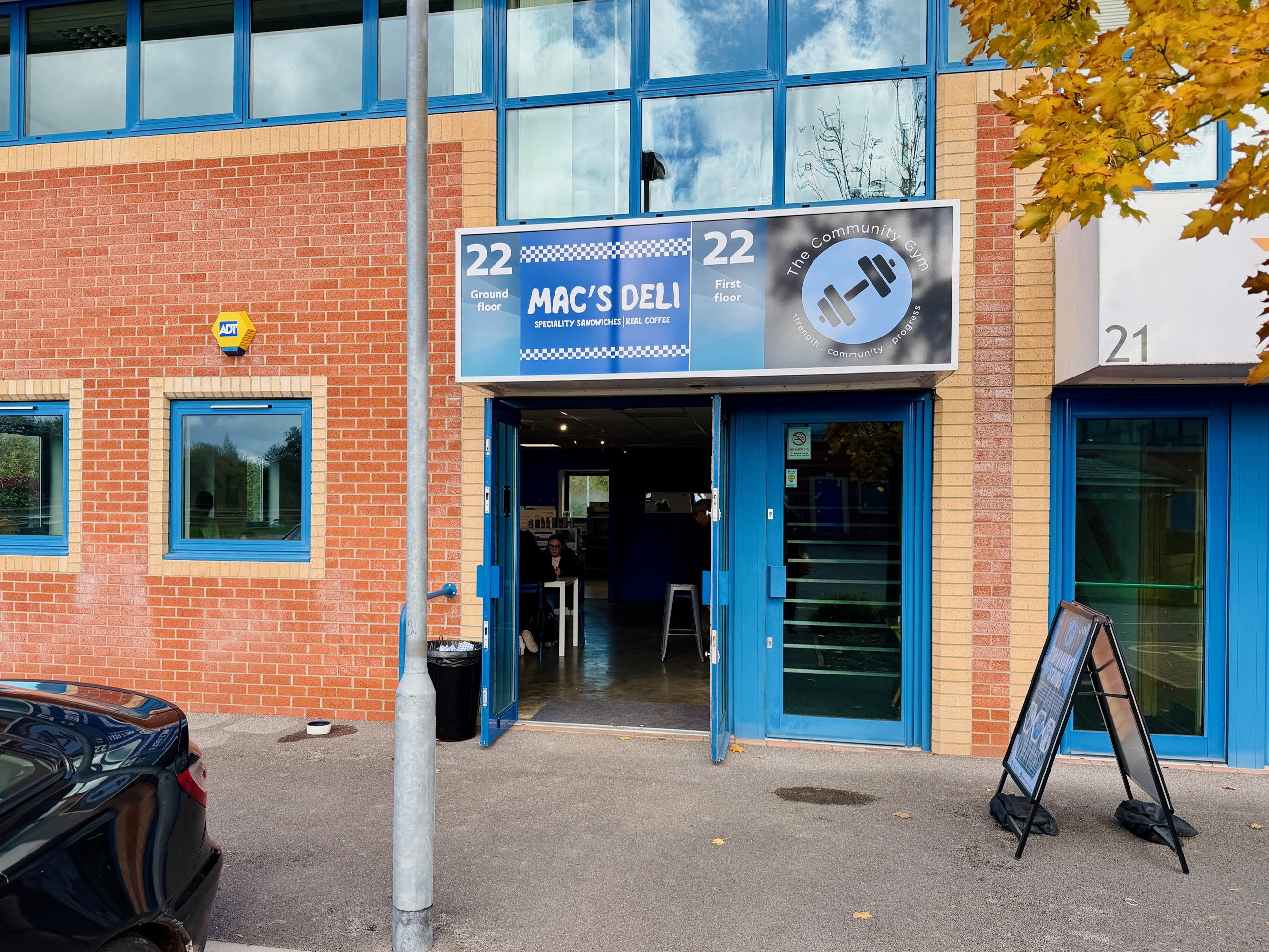
When Mac Dsouza was 23 he opened his second business, Mac’s Deli. It’s not a deli at all, but a café squirrelled away on an industrial estate about a twenty minute walk from Theale station. It opened just over two months ago, and seemed to be a continuation of what he was offering at Filter Coffee House: coffee and a variety of sandwiches, this time mostly involving his own shokupan – Japanese milk bread – baked on the premises.
Subscribe to continue reading
Become a paid subscriber to get access to the rest of this post and other exclusive content.
This week’s review partly came about because of a gentleman called Andy Hayler. Now, you might not know who Hayler is, but in terms of food he’s something of a phenomenon.
The shadowy world of Michelin exists behind an impenetrable curtain, with nobody sure how they work or what dictates who gets listed, is awarded Bib Gourmands and stars – or, sometimes, has them taken away. Andy Hayler is the closest thing we have to a Michelin inspector working in plain sight. He has a blog, which has been around since the 90s, in which he has documented hundreds of meals in restaurants, giving each restaurant – and every dish – a mark out of 20.
I’ve rarely seen anything get lower than a 10, and very little approaches the top of his scale, but that’s because a fair amount of what Hayler has reviewed is at the highest end of dining. There was a time when he had eaten at every three starred restaurant in the entire world, although he stopped keeping up with Michelin when, as he puts it, they devalued what three stars should signify by giving them out in some territories to restaurants that were nowhere near the standards he had experienced elsewhere.
Hayler has a sort of cult, niche status in food. I’ve read a couple of pieces about him in recent years, both verging on hagiographies. He’s been described as “the best living food writer”, and I’ve read interviews that gush about his effortless recall and the esteem in which he is held by chefs and restaurateurs. He is the cognoscenti’s critic of choice and no mistake.
I think he attracts some of those plaudits because of what his reviews both are and aren’t. They don’t, in some senses, read like reviews at all, more like audits from someone scrupulous and meticulous who has forgotten more good meals than most of us will ever have. Although it doesn’t sound like he forgets many of them: why would you, when you document them all in such extensive detail?
I think the respect also comes from his refreshing lack of ego; Hayler would be the first to draw a distinction between himself and many restaurant reviewers. “I wouldn’t ever pretend I was any sort of fantastic prose master. I’m not trying to throw in a load of stuff about my journey to the restaurant and the trendy people on the table to the left” he has said, subtly throwing shade on half the piffle I come out with every week.
Don’t worry, there’s no way he meant me personally: in fact, he once described one of my pieces, about Maida Vale’s Paulette, as a “lovely review” which I found surprisingly touching. “Most of the newspaper critics want to be writers first, I want to focus on the food” he said more recently. I suspect the people who read him admire that purity of approach, and it does mean that when he thinks somewhere is dismal or overrated, which happens occasionally, it’s really very amusing.
What’s also admirable is that Hayler goes where he likes, reviews wherever he wants: money seems to be no object, and he doesn’t follow the fads. You won’t find him, for instance, reviewing Brasserie Constance, a restaurant operating out of Fulham FC’s Craven Cottage, unlike nearly every broadsheet critic over the last few weeks. Instead, his two or three reviews each week involve him going wherever he pleases, in London and abroad.
His two main weaknesses seem to be eating at the Ritz in particular and eating Indian food in general. Hayler is a regular visitor to Epsom’s Dastaan, and the little group of restaurants it has spawned in Surbiton, Richmond and Leeds. He’s also a frequent diner in Southall, and when he gave a warm review to Hounslow’s review of Crispy Dosa last November it caused a Mexican wave of regional bloggers checking out their nearest branch to touch the hem of his virtual garment (been there, done that – four years ago).
“If Mr Hayler thinks it is OK, it is a fair bet I will probably like it” one said. “You can be assured that if Andy says a restaurant is worth visiting then it really will be” said another. That’s proper soft power, and all from the opinion of a chap you mightn’t have heard of.
Hayler even came all the way west to Caversham last year to review Clay’s, something I’ve been waiting for him to do for a very long time. He gave it 14/20, which may not sound like a big deal but actually is. “Clays is a very impressive family-run restaurant, the food shows a lot of care, and the chefs are clearly putting some real effort into reproducing an authentic taste of India” he concluded, after paying particular tribute to Clay’s cabbage pakora, lamb chops and, of course, bhuna venison (Hayler also tried methi chicken, a dish he seems particularly to favour).
Seeing Clay’s reviewed by Hayler was like watching somebody you know being interviewed in the national news, and it made me proud. It didn’t make the local paper the way Grace Dent’s write-up had, but in its way it was every bit as significant. Hayler, as he said, is all about the food.
Now, by this point even my most supportive readers are probably thinking ‘this is an even more circuitous intro than usual, what has this got to do with anything?’ Well, I’ll tell you: every week Andy Hayler does a roundup on his blog, and every week the byline gives a couple of destinations. From South Kensington to Mayfair one might read, or From Piccadilly to Rome. Fancy restaurants and/or jetsetting are invariably involved. And then, at the start of the month, one made me do a double take. From Winnersh to West London, it said.
Winnersh? Our Winnersh?
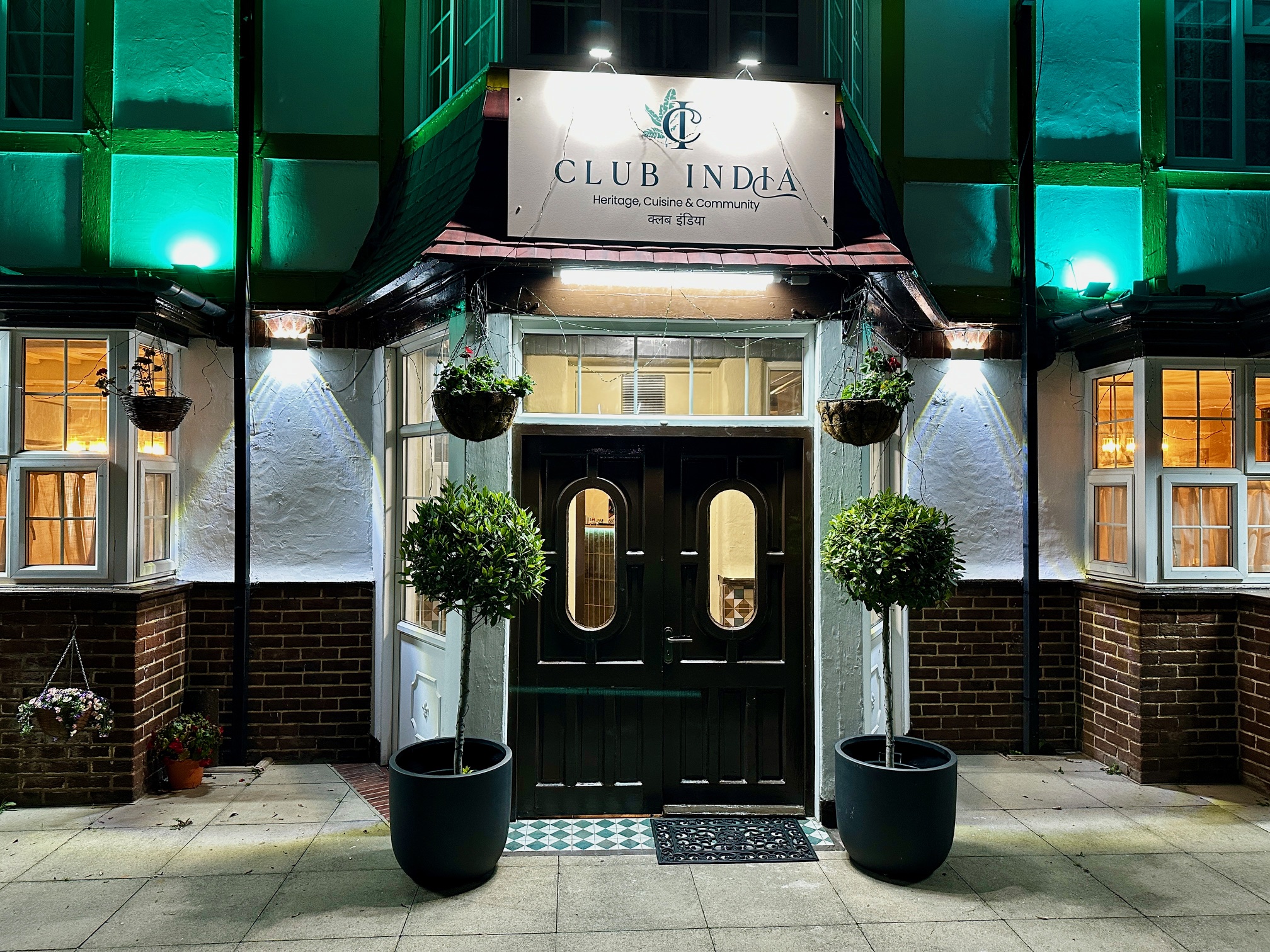
It was not a misprint. Andy Hayler had come all the way to Winnersh to try out Club India, an Indian restaurant that opened back in July where the old Pheasant pub used to be. I mentioned that development when I reviewed Dolphin’s Caribbean, back in June, What I said, looking back, feels a little graceless, especially as they sent me a lovely email inviting me to a pre-launch event. I read the blurb and thought it sounded potentially interesting, but then again: Winnersh?
Andy Hayler had no such compunctions. Club India’s consultant chef had held two Michelin stars at his restaurant in San Francisco, although Hayler’s verdict on that place was that if a chef had gone there trying to pick up tips “he or she would either burst out laughing maniacally or seek to throttle any passing Michelin inspectors; possibly both”. But the head chef had headed up the kitchens at a couple of London restaurants Hayler really rated. So he went, he enjoyed it, he dished out scores out of 20 for all the dishes and, of course, he ordered methi chicken.
Overall he gave it the same rating, 14 out of 20, as Clay’s. “Club India was a thoroughly enjoyable experience, the food and service excellent, and at an affordable price. I wish I could say that more often these days” was his conclusion. That was good enough for me, so on a Friday night after a couple of pre-prandial beers in town Zoë and I hopped on the number 4 bus to go and see if Reading really did have a rival to Clay’s Kitchen, tucked away in – this may not be the last time I say this word slightly incredulously – Winnersh.
Subscribe to continue reading
Become a paid subscriber to get access to the rest of this post and other exclusive content.
The biggest trend in Reading’s food scene this year has been the proliferation of pizza places – Paesinos, Zí Tore, Amò and Peppito, all opening in the space of five months. In the space of a five minute walk, you could pass them all: you could do a pizza crawl of all four, if that’s your kind of thing. Everyone will have their favourite, or their own view of which is the best, and perhaps I will too once I’ve got round to the last couple on my to do list: one way or the other I’m sure my annual round-up and awards at the end of December will have something to say about all of that.
But if that competition is the most high-profile this year, there are a couple of smaller-scale rivalries, more under the radar, that have captured my attention every bit as much. Like the one between Vietnamese newcomers Pho 86, on St Mary’s Butts where County Deli used to be, and Thai restaurant Nua which opened just around the corner, in Bluegrass BBQ’s old home. They are competing not only with the established order – Pho and Thai Corner – but with each other, and they opened on the same day in July.
So that promises to be interesting, and I’ll do my damnedest to check them both out before the end of 2025. But even that’s not my favourite, because my favourite is the tightly-fought battle between two brand new restaurants, which opened a week apart, for Most Batshit Menu In Reading.
In the red corner you have Take Your Time, which opened in August at the top of Sykes’ Sweatshop (you probably know it better as Kings Walk) in the former Dolce Vita site, which sat vacant for over seven years. Take Your Time’s website says that it blends “Asian flavours with Western cuisine”, and Take Your Time’s menu interprets that as serving baked pork chop with an egg fried rice featuring tomato, pineapple and mozzarella, like someone put a Hawaiian pizza into Google Translate.
It also gives you the option of a chicken risotto (“chicken is slightly pink”), or “Hong Kong-style source [sic] stir fried spaghetti with pan fried ribeye steak”. Fusion? Confusion? Who knows. It would, any other time, be far and away the strangest menu I’ve read all year.
But then, a week later, Stop & Taste opened in Emmer Green in a ‘hold my beer’ scenario. Stop & Taste looked on the face of it like a standard eat in fast food place – visually difficult to distinguish from the likes of Basingstoke Road’s Kyaneez – mainly famous for having the most idiosyncratic Instagram account of all time – or Salt & Smash on Christchurch Green. But then I saw the menu and thought, and this is pretty much a verbatim transcript of my exact reaction, what the fuck is going on here?
Because Stop & Taste’s menu rivalled Take Your Time’s for eccentricity, for lack of an overarching theme. So yes, there were loads of burgers – obviously – but one of them involving tempura soft shell crab? And three different types of biryani, and oxtail tacos and fried shark bites? And a £25 lobster roll with “lobster tail poached in secret butter” and hand-minced beef patties and thick shakes and Sunday roasts made with fillet steak?
Take Your Time and Stop & Taste had two things in common – menus that invited an ADHD diagnosis and, paradoxically, names that seemed to extol the virtues of mindful eating. So I just had to visit one of them this week, and in the end I found myself taking a bus north of the river on a weekday evening. That menu at Stop & Taste was either madness or genius, and I just had to know which it was, shark bites and all.
Subscribe to continue reading
Become a paid subscriber to get access to the rest of this post and other exclusive content.
Can you believe it’s the best part of a decade since I reviewed anywhere in Henley? I didn’t realise that until I sat down to write this review, and I was so surprised that I thought it was a mistake. But no, there it was: June 2016, a visit to the Little Angel, just over Henley Bridge from the not-so-little Angel On The Bridge with its popular riverside terrace. I quite liked the place, and ate there again a couple of years later at a friend’s wedding reception, but even so I’ve not written up a Henley restaurant or café for nearly ten years.
Was it a lack of options, general neglect or just one of those things? I’m not entirely sure, but I do remember keeping a vague eye on Henley and although a couple of new places have sprung up since my last trip on duty none of them had tempted me quite enough: the Hart Street Tavern is meant to be decent, but I seem to recall that it’s run by the same team as the Bottle & Glass, so I wasn’t in a mad rush to scarper to Henley to check it out. And there’s Shellfish Cow, I suppose, a sister restaurant to Wallingford’s surf and turf specialists, but again I just wasn’t sufficiently curious. A dodgy pun doesn’t necessarily make for a great restaurant.
I remember taking a solo trip to Henley almost exactly a year ago. I must have been influenced by my public transport-loving wife, because I did it mostly to try out the brand new Aqua, Reading Buses’ number 28 which now runs frequently from Friar Street to Bell Street, winding through Playhatch and Shiplake, picking you up from Berkshire and dropping you off in Oxfordshire, a world away.
Once there, I’d found myself completely at a loss as to where to lunch.
My finger was nowhere near the pulse, so all I really knew was that I didn’t fancy going back to anywhere I’d reviewed in the past. I could have gone to Geo Café, of course, on the off-chance that my friend Keti, the owner, was there but I felt like I should show some sense of adventure. A wander round Henley, which was still as pretty as ever, suggested that most of the options were starters-mains-desserts places rather than spots for a light lunch.
I was almost stumped, and I ended up in a café slash deli just down from the Town Hall, opposite where Henley used to have an utterly preposterous Harrods café, a place which simultaneously managed to seem posh and lower the tone, the way new money can.
Although the Harrods café closed some time ago, my lunch venue was clearly its spiritual successor. I had a solitary crumpet, the diameter of a coffee cup, topped with some smoked salmon and a poached egg. For fun, I put the picture on social media and asked people to play The Price Is Right: it cost me an eye-watering £12, and at least half of the guesses I got thought it would come to even more than that. It was middling, the coffee was worse. Afterwards I strolled to Geo Café and, over far better coffee, resolved that a sense of adventure was overrated.
But Henley’s scene isn’t as stagnant as you might think. Echoes, an outpost of Phantom Brewing, has opened there and does very good beer, served by an enthusiastic team. Flyte, a bar offering a combination of tacos and cocktails, opens next month. Last March Dominic Chapman, the Michelin starred chef formerly of the Royal Oak at Paley Street and the Beehive at White Waltham opened his eponymous restaurant in the Relais hotel at the bottom of Hart Street. Little by little, things are starting to change in Henley.
And then there’s the Duke, a curious beast, a pub which opened in January where Mexican restaurant Pachangas used to be. It started trading at the beginning of the year, and an article in the Henley Standard made all the right noises about everything being cooked over fire, an emphasis on small plates and all that other stuff everybody says.
At first all went well, and they paid for a London blogger to come up and review what looked like a surprisingly stingy selection of dishes from the menu. He enthused, giving it an 8/10 which probably would have been a 6 or a 7 if the food hadn’t been free, but since then the menu seemed to have drifted closer and closer to the mainstream, and then last week the pub abruptly announced on social media that it was shutting until further notice “to rebuild our team”, which suggests that all is not going swimmingly.
Neither the Duke nor Restaurant Dominic Chapman has troubled the guide books or restaurant inspectors, which made it even more of a curveball when last month Michelin added sixteen venues to its guide and one of them was in Henley. Out of nowhere, seemingly, they had listed the Three Tuns, the pub on the market place next to superlative Henley butcher Gabriel Machin. Part-owned by the butcher, too, as it was a joint venture between Machin’s owner Barry Wagner and Nigel Sutcliffe, who runs the also-listed Oarsman in Marlow.
The intent was to take advantage of that fantastic produce, to be a sort of chophouse in the Oxfordshire town. As for the Three Tuns’ success this year, meteoric only just does it justice: it reopened in May, and in September it was listed by Michelin. Nobody knows exactly what brings restaurants to the attention of the inspectors – who still seem to have a blind spot where Clay’s is concerned – but however it happened, being noticed after four months is exceptional going.
When I learned that, I resolved that I needed to get there as soon as possible. But it also gladdened me enormously, because the pub used to be a favourite of mine ten years ago, when it was run by Mark and Sandra Duggan, and I ate there frequently in another life, reviewing it in 2014. The last time I went, just before the Duggans left the pub, was with Zoë, just after we got together. I remember having an exquisite Caesar salad, so good it was bittersweet.
Because I was glad Zoë got to try it before it changed hands, but sad about all the meals we wouldn’t have there. And that listing in Michelin raised my hopes that, much like my blog, it too could have a second era that surpassed its first. So Zoë and I alighted from the Aqua last Saturday and went to investigate, stopping at Echoes on the way for a few pre-prandial pales and a very happy chance encounter with readers Steve and Tracy.
I should add that Zoë insisted, by the way – both on joining me for this one and on taking the bus to get to Henley. Neither of these facts will surprise regular readers.
Subscribe to continue reading
Become a paid subscriber to get access to the rest of this post and other exclusive content.
Family-run trattoria Ciao Bella is at the top of Lamb’s Conduit Street, not far from the British Museum. These days that street is about as affluent as they come, home to the original branch of restaurant Noble Rot and its offshoot wine shop Shrine To The Vine and to the likes of Honey & Co, La Fromagerie, Aesop, Sunspel and fancy umbrella sellers London Undercover.
It’s brimming with possibility. You can have a latte outside Knockbox Coffee in the sunshine, or sip a pint at the Perseverance, where acclaimed Nunhead pizza traders Dinner For One Hundred operate out of the kitchen. It truly is as likeable as street as you’ll find in the capital.
I’m guessing it wasn’t, though, back in 1983 when Ciao Bella first opened. Yet over forty years later it sits at the head of, but somehow separate from, all that gentrification. Because Ciao Bella is that rare thing, a restaurant beloved by those in the know but rarely talked about by everyone else. Ten years ago, back when Marina O’Loughlin was restaurant critic for the Guardian, she listed it as one of her 50 favourite U.K. restaurants.
“This 30 year old trouper packs ’em in night after night” she said and although – as so often with O’Loughlin – this approval had a touch of the performative about it, you couldn’t say she wasn’t consistent. Last year, writing in the FT about life post-retirement as a restaurant critic, under the headline At last, I can eat in places I actually like she said that she was still dining at Ciao Bella, and had recently lunched there three Fridays running. “Every visit is an event, a celebration” she is on record as saying.
It wasn’t just O’Loughlin, though. When Oisin Rogers, celebrity publican and Topjaw fanboy, published his list of his 55 favourite restaurants last year, surfing the wave of his post-Devonshire popularity, he also found room for Ciao Bella. He described it as the “quintessential family-run trattoria… full of jollity and chaos”.
The impression I got of Ciao Bella, doing my research, is that it will never trouble Michelin or the Good Food Guide but remains on many hospitality insiders’ shortlists. “If you don’t like it, you’re a snob” said one regular, interviewed by the now defunct London edition of Eater a few years ago. There was a similar comment in Harden’s: “anyone who doesn’t love Ciao Bella is mad”. Talk about a sure thing.
That’s not to say that all those rave reviews say that the food is brilliant – or, indeed, that any of them do. But they all suggest that it’s good enough, and that the overall experience of eating there is hugely more than the sum of its parts. They talk about the buzzy dining room, the legendary terrace with its blue canopies and its people-watching possibilities, the live pianist every night, the huge unpretentious portions, the seafood pasta decanted from a bag into your bowl tableside.
I’ve always understood that great restaurants are about so much more than the food – something Reading-based readers might recognise as the Dolce Vita effect – and, with that in mind, I would challenge you to read almost anything in the public domain about Ciao Bella and not at least slightly want to eat there. It all definitely had that effect on me. It had been on my to do list for a really long time, and on the last Saturday in September I zig-zagged up Lamb’s Conduit Street, window-shopping in the sunshine, on my way to a lunch reservation with my old friend Aileen.
The terrace always comes up in reviews of Ciao Bella and on a slightly warmer day I might have fancied eating outside, but I really liked the look of the dining room on the ground floor. It’s an unfussy space, its walls groaning with framed black and white pictures with a heavy reliance on the films of Fellini. There’s Marcello Mastroianni and Anita Ekberg, almost connecting in the Trevi Fountain in La Dolce Vita. Just along from that is a picture of the director’s wife, Giulietta Massina, in La Strada. It felt like the room in which all those stories I’d read – of long boozy lunches or chaotic evenings with accompaniment on the piano – took place.
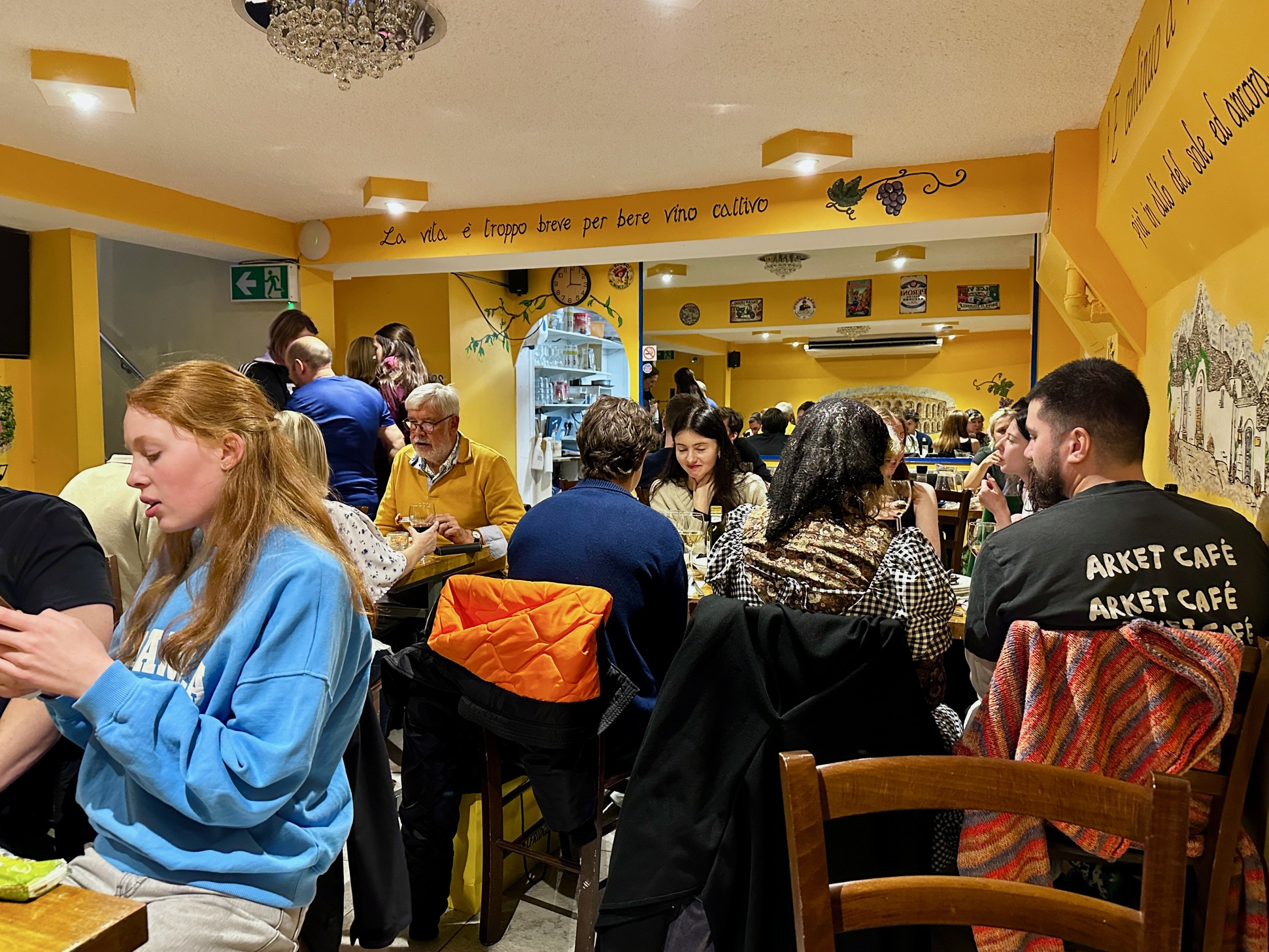
So I was disappointed to be led to the sunshine-yellow basement, which was empty when I arrived, and plonked in the corner, at a table where my right elbow felt like it would be knocking against the wall for the entire meal. On my left I had a great view of the men’s toilets. The waiter conspiratorially told me it was a good seat because I could “see all the pretty girls coming in”, which I’m sure he meant in a vaguely twinkly way but which came across as on the borderline between cheesy and due for cancellation. Maybe I looked like an ornithologist, but I don’t think so.
Rooms benefit from people, it has to be said, and it was a better space by the end of our meal when every table was occupied. But it was still a slightly unlovely one, and I felt like I was in some kind of gastronomic overflow car park, in the room put aside for tourists. I’m used to having that experience in, say, Paris, but it was strange to have it happen in London.
In Ciao Bella’s defence, I think I’ve read somewhere that the basement is usually used for private parties but it seemed on that Saturday that the converse might have applied: when we left there was a wedding Routemaster parked outside on the pavement and I suspect a wedding was being celebrated on the ground floor. I can’t blame them for that: if they had the numbers to escape from the canary-coloured cellar they should have seized that opportunity with both hands. But away from daylight and ambience, I couldn’t help wondering what might have been.
By this point Aileen had arrived and we attacked a very serviceable, almost medicinal, negroni apiece. It was, after all, negroni week – or, to give it its full name, ‘Instagram bores going on about negroni week’. Ciao Bella’s was bang on, no whistles or bells, no flourishes, just a route one approach to dropping that soft, orange filter over the rest of the day. I liked it a great deal.
As we tried without success to get round to the menu, Aileen filled me in on what she’d been up to, which included commencing a grand project with a friend to do twenty-six city breaks over the next ten years or so, proceeding in reverse alphabetical order. Never let it be said that Aileen hadn’t found ways to fill her retirement, not that she sounded very retired from all the side hustles she had taken on since leaving her main job. I learned that Zagreb – where else would it have started? – was very nice, although the cathedral isn’t quite finished yet following the earthquake.
I also discovered that Aileen planned to go back there when it was completed, so I tried pointing out that repeat visits would just make her project almost impossible to finish. Apparently it’s Ypres next, but do pop any suggestions for other destinations in the comments. I’m sure Aileen will read them. X will be particularly challenging, I’m guessing: my suggestion was that she could just about stretch it to Aix en Provence on a technicality. Do you think that’s cheating?
Ciao Bella’s menu, on a single outsized sheet of card, was as pleasingly retro as its website. Its contents were, too: this felt like the menu at every neighbourhood Italian since time immemorial, a proper, old-school selection of dishes. It took me back to places from my past – Pepe Sale circa 2009, or my dad’s erstwhile favourite Sasso in Kingsclere. It reminded me, too, that this kind of spot isn’t seen as frequently as it once was: a quote in that Eater article, tellingly, said “what’s nice about Ciao Bella is that it’s still there. One by one, other restaurants like it have been shut down”.
What that meant in practice was that starters were between £6 and £16, pizzas about £15 if you wanted one and pasta priced all over the place, although you could have a smaller portion of pasta for about £12. It meant that mains were between £20 and £30, a price point that used to mean fancy and now just means ‘get used to it’. It meant mozzarella in breadcrumbs, and Parma ham with melon, aubergine parmigiana, veal with lemon sauce or fried scampi. It meant that the modern affectations of Italian food were largely unnoticed by Ciao Bella: burrata appeared on one pizza, ‘nduja on one starter, neither anywhere else.
There was also a small specials menu, and even that made me feel nostalgic for those evenings at Pepe Sale, a lifetime ago, when Marco would materialise at your table and talk you through the options that evening. By this point, however underwhelming that yellow room was, I was disposed to like Ciao Bella a lot. It seemed to be transmitting from a time when life was very much more straightforward, and disappointment less abundant. I guess this must be the dragon Reform voters spend their whole lives unsuccessfully chasing.
But we were in 2025, where disappointment is rarely far away, and it came quickly in the shape of Aileen’s starter. Breadcrumbed mushrooms stuffed with spinach and ricotta weren’t the kind of thing I’d order, mainly because they always felt like a dish you could pick up in the chiller cabinet at M&S, or Iceland for that matter. They came sauceless and strangely burnt in places, plonked on a plate with a lemon wedge in the middle and pointless distraction from the dregs of a bag of Florette, in a presentation that screamed from the rooftops will this do?
“Taste this” said Aileen, in a manner that was a long way from oh my goodness, you have to try this. “It’s sort of wet: it makes me think it’s been frozen.”
I wasn’t sure about that, but it was middling in the extreme, if such a thing is possible. The filling was watery and bland, the layer of mushroom itself very thin.
“And it’s dry, it needs something else – a sauce, or a dip, or something. How does it manage to be wet and dry at the same time?” Aileen wondered out loud. “And what’s the point of those bits of undressed salad?”
So many questions, and so few answers. The late Shirley Conran famously once said that life was too short to stuff a mushroom: I suspect she might have thought it was too short to eat these, too. This cost £11. I was about to say something pithy about that, but putting the price there on the page, unembellished, makes the point.
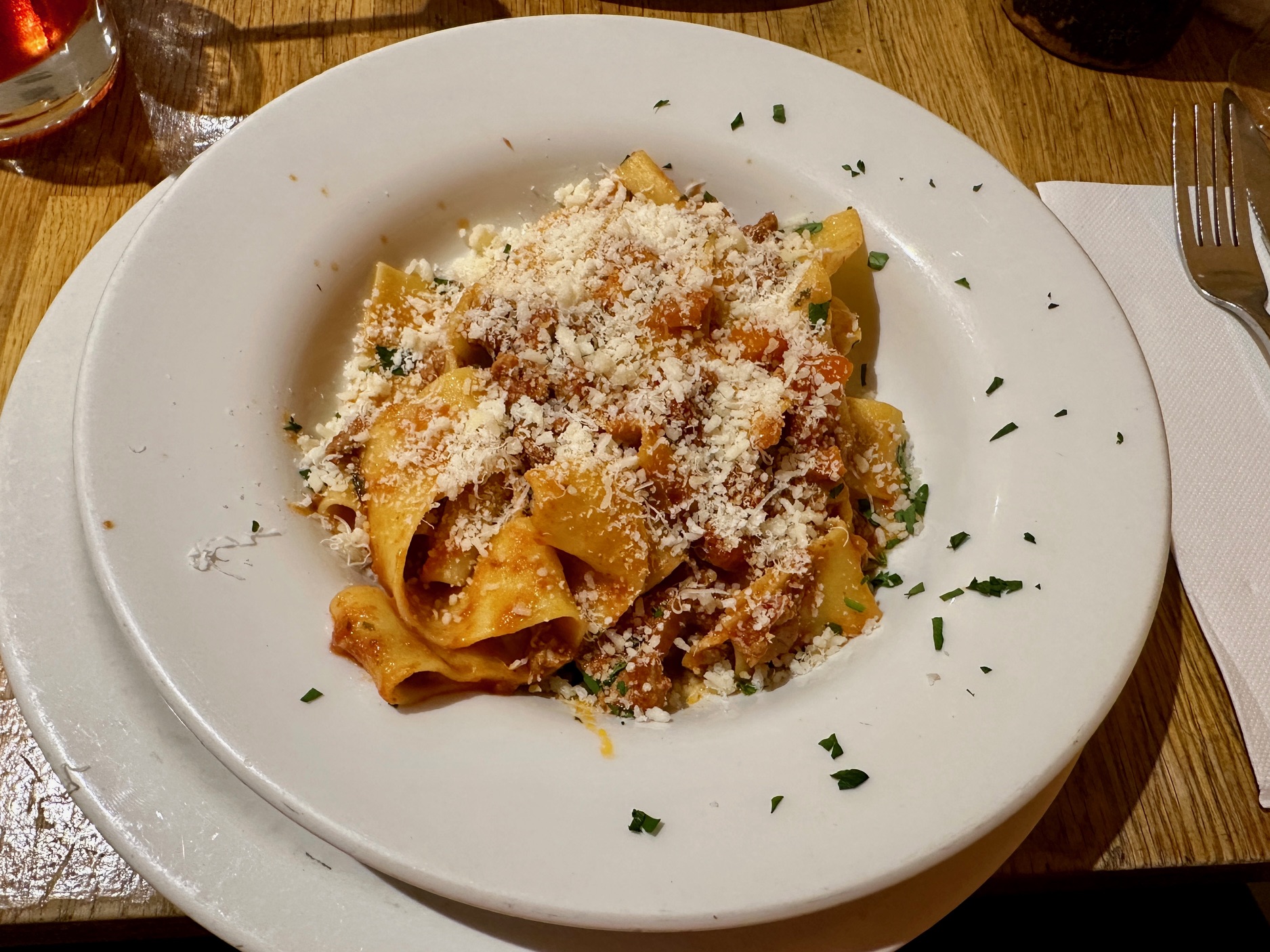
I fared better, but better’s a relative term. Pappardelle with lamb ragu was on the specials menu and it was good but far from special. The thick ribbons of pasta were decent enough, but cooked past al dente until they were more slump than spring, and the lamb in the ragu battled against an overly sharp note of tomato, as if everything hadn’t had enough time to form a lasting relationship. The diced carrots were too substantial, too, standing out where they should have blended in, a long way from sofrito.
Better really is a relative term, and I couldn’t help looking at this dish in other relative terms, too. If I’d been served this at, say, Tilehurst’s Vesuvio I might have been pleasantly surprised. Something this good at Cozze would have been a miracle. But on Lamb’s Conduit Street, in a restaurant older than my wife that’s lauded by food insiders far and wide? It just felt ordinary.
Everything was a little rushed, too – I know I complain about this fairly often, sometimes at length, but the pacing here felt like the restaurant was trying to get ahead of a rush they knew was coming; perhaps it was another impact of having a wedding celebration upstairs. But it meant that our starters must have come out ten minutes or so after we picked them, when we were barely into our negronis, and that meant that a leisurely lunch, the kind so mythologised at Ciao Bella, was out of the window.
So we downgraded our expectations and picked a half bottle of Aglianico from the wine list. To be fair to Ciao Bella it was perfectly pleasant and far from poor value at £15, and I was delighted to see a few half bottles on the menu. Maybe they are to cater for the kind of lunch we turned out to be having. Our mains turned up about fifteen minutes after the starter plates were taken away, if that. Aileen expressed audible surprise that they were so quick, too taken aback to be completely English about it.
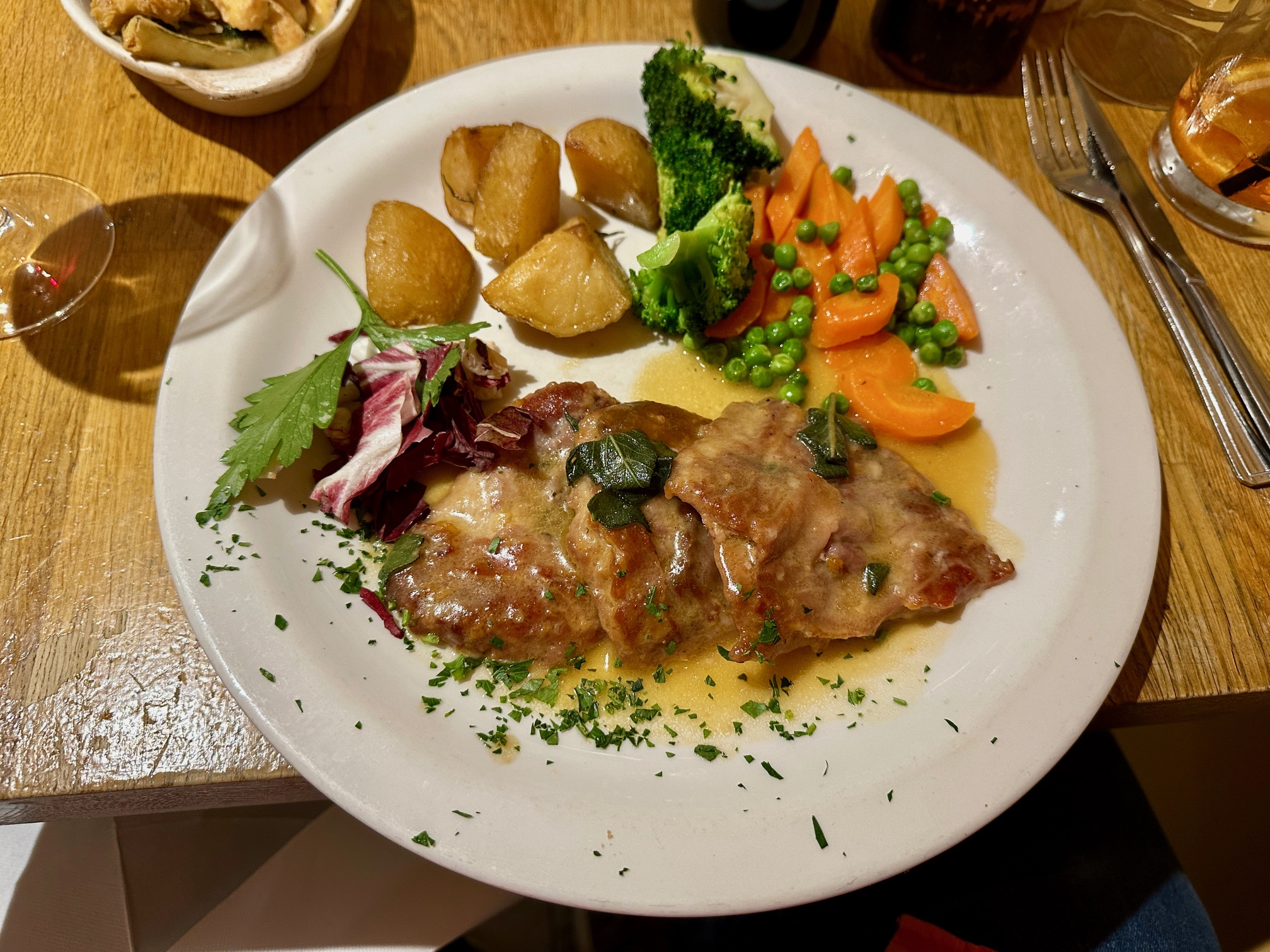
I had chosen an old favourite, and something I rarely see on menus, veal saltimbocca. In keeping with the whole nostalgic theme, I suppose, because back when Dolce Vita was at the height of its powers, something like ten years ago, I could have eaten this dish every Friday night for the rest of my life. Some months, to be honest, it felt like I did.
This did just enough to transport me, if only momentarily. That veal, slight and tender, wrapped in Parma ham and served with that sauce singing with white wine triggered plenty of happy memories. And if there wasn’t quite enough sage perhaps it didn’t matter, just like perhaps it didn’t matter that the accompaniment was five little cubes of potato, some veg which probably didn’t come out of a tin but somehow felt like it had and yet more of that bloody bag of Florette. For a moment, I felt like maybe Ciao Bella had worked its magic at last, and none of that mattered.
But sadly, there was one thing that did matter, and Aileen summed it up when describing her main.
“It’s such a shame this isn’t hot.”
She was absolutely right. It felt like the worst of both worlds, really: if your dish is going to emerge from the kitchen in record time you might complain about being turned but at least your meal should be piping hot. But for it to turn up so quickly and be lukewarm? It just felt like adding insult to injury, as if they’d cooked it at the same time as the starters and then just left it lying around on the pass until the earliest possible moment when it could be carted to the table.
Otherwise Aileen would have been absolutely delighted with her gamberoni, I imagine: plump prawns swimming in a sauce which looked almost identical to the one that came with my saltimbocca but which was clearly chock-a-block with garlic. But what was identical were those five cubes of spud, that mixed veg by numbers, that pointless, perfunctory scattering of salad from a bag. What was identical was that feeling of expecting more.
My dish cost £19.50, Aileen’s was £22.50. Neither was so expensive as to leave you feeling like you’d been mugged, but even so that word, ordinary, hovered in the air again.
Also distinctly ordinary were the courgette fritti, which were very thick batons which left your fingers shining with oil. I’ve had some gorgeous versions of this dish over the years – at Town, or at Battersea’s downright terrific Antica Osteria Bologna. The more I think about it, the more I think that everything I’ve heard about Ciao Bella and how magnificent it is emphatically applies to Antica Osteria Bologna. That is the restaurant people say Ciao Bella is. Ciao Bella, I’m afraid, is not.
We’d partly ordered a half bottle of red because we didn’t see ourselves staying the course at Ciao Bella but the dessert menu came along, and our wine was nearly finished, so we thought that we may as well give the restaurant one last chance to turn things around. It was, ironically, the area where I found Ciao Bella strongest, although the dessert menu does essentially say that only three of the desserts are homemade: possibly their most famous dessert, lemon sorbet served inside an actual lemon, is apparently not.
We ordered two of the three homemade desserts and I would say they were the – best? least disappointing? most acceptable? – things that we ate. My tiramisu wasn’t going to win any awards but it was a classic example of this dish – a thick wodge buried in cocoa, deeply boozy savoiardi biscuits and mascarpone in distinctly agreeable harmony. If everything else had been at the standard of this, I’d have liked the place far more. Still, better to finish on a high I suppose than begin brightly and plummet from there.
Similarly Aileen’s panna cotta, served in the shape of an old-school jelly mould, had a satisfying wobble and was crowned with a nicely done fruit couli. The dessert menu blurb is far too literal where the panna cotta is concerned – not sure “popular creamy white dessert made with sugar, gelatine and vanilla” is really selling it to anybody – but thankfully Ciao Bella is better at making panna cotta than it is at describing it.
The whole dessert experience rather summed Ciao Bella up. At £8.50 and £7.50 apiece these dishes weren’t expensive. But they arrived about five minutes after we ordered them, which is plain silly. I was catching up with a very good friend I hadn’t seen in a year, we’d been chatting so much that it took ages for us to place our order. Absolutely nothing about us, as a table, said “we’re in a hurry”.
It was nice of our waiter – who I do have to say was charming, in that very well-practiced way you might expect of an old stager – to ask if we wanted coffee, but by then we were ready to cough up and seek out somewhere else for the rest of our afternoon. Our bill came to just under £140, including an 11% optional service charge (this very specific uplift, deliberately picked to fall between the traditional 10% and the more common 12.5%, seemed strange). It was hard to feel happy with it or angry with it. It was what it was, as the meal was what it was.
Sitting outside Noble Rot, across the way, afterwards with a very nice bottle of red, making the most of the fact that it was still warm enough to do so, we agreed that the meal at Ciao Bella had been a tricky one. Even though both of us felt our meal could have been far better we didn’t feel aggrieved in the way that we might have done.
I’ve thought and thought about it since, and I’m still not sure entirely why. Of course, I had a lovely lunch with a very precious friend, and we both agreed that it could have happened anywhere and we would have had an excellent time. So there is that, but I can’t give a good rating every time I have lunch with Aileen just because I’m having lunch with Aileen: my credibility can do without that kind of dent.
So what was it? Did some of Ciao Bella’s magic transfer to us, by osmosis from the better, buzzier room upstairs, or slip through the cracks in the ceiling? I really don’t know. Objectively Ciao Bella was deeply average. If you had an Italian restaurant like it in your neighbourhood you might go, and you might go often enough to become a regular. You might form the kind of relationship with it where you overlook off days and look forward to seeing your favourite waiters or ordering your favourite dish.
But it is, as others have said, the kind of restaurant that is slowly dying out in the U.K., replaced by pizza places that only do pizza, pasta places that only do pasta and the abomination that is mid-price casual dining trying to devalue Italian food with all its horrendous Zizzis, Prezzos and Bella Italias. Maybe I just felt a little warm echo of some of the restaurants I’ve loved over the years that are no longer with us, and maybe some of that goodwill reflected on Ciao Bella, although it might not have deserved it.
Yet although it wasn’t my cup of tea, I can imagine it might hold that place in the affections of others, and I do envy them, both what they have and what I’ve lost. It’s funny, sometimes I can read reviews of restaurants in places I will never go, enjoy the writing, know I’ll never go there and feel that reading the review was enough, that it was as close to dining in that restaurant as I need to get. I sort of hope, on some level, that this review serves that purpose for you, even if the meal wasn’t entirely for me.
So if you’re the sentimental sort, you’re in London a lot, and you want to do your bit to prop up an institution, one of the last of its kind, if you’re prepared to overlook some bad tables, some middling dishes and some lukewarm food you might find, after you’ve invested enough time and money, that Ciao Bella is a restaurant you can truly fall in love with. For the rest of us, it might be better just to know that this place exists for its people, that there are places like that out there for everybody, and that in time we will all find ours.
Since January 2025, Edible Reading is partly supported by subscribers – click here if you want to read more about that, or click below to subscribe. By doing so you enable me to carry on doing what I do, and you also get access to subscriber only content. Whether you’re a subscriber or not, thanks for reading.