City guide: Oviedo

If you find yourself deciding to spend a city break in Oviedo, as I did, in the run-up to your holiday you will invariably be asked the same question by everybody you tell. Where? they will all say.

And you might well struggle, as I did, and wind up explaining that it’s sort of west of the Basque Country, but near the coast, in a region of Spain called Asturias that is still largely untroubled by tourists. You’ll probably, as I did, say that it’s famous for cider and blue cheese, and for fabada, a bean stew packed with pork which has a revered status in the city.

You might also mention that Oviedo features in the Woody Allen film Vicky Cristina Barcelona, and that Woody Allen loves the city and that there’s even a statue of him which, this being continental Europe, nobody has defaced or pulled up and lobbed into the nearest body of water. Actually, you might not mention that, because you might not know it. I knew it and I never mentioned it, because advertising that you’re a Woody Allen fan just isn’t done these days.

But in the run up to your trip, if you’re asked, you’ll probably just say that it’s west of Bilbao and mention the cider. And people will generally say “okay” or “I’ve never heard of it” and all of you will get on with your respective lives.

Having returned from Oviedo, if asked, I would instead say, firstly, that it’s one of the best cities I’ve visited for food and drink. At the end of a holiday Zoë and I always play a game where we both list the five best things we’ve eaten on the trip. Sitting having a beer on our final day in Oviedo we had to conclude that it was rarely this difficult to narrow it down, and then we went and had one last dinner which, if anything, made it even more complicated.

Asturian cuisine – and yes, it does at least slightly revolve around fabada and cachopo, an enormous slab made of two pieces of veal, cheese in the middle, breaded and fried – is very hearty indeed. Forget going to Malaga or Granada and picking over lots of small dishes: in Oviedo even a main course might be big enough that two people can quite easily share it. I am rarely defeated by meals, but even I had to wave the white flag a couple of times in Oviedo.

That might make it sound like it’s wall to wall gut-busters, but that doesn’t do the food justice. I had plenty of interesting, intelligent food across the city, and I also discovered – beyond the cider – great beer and coffee and a scene that had something for everyone. It was named Spain’s city of gastronomy last year, but even so it still feels like a relatively well-kept secret.

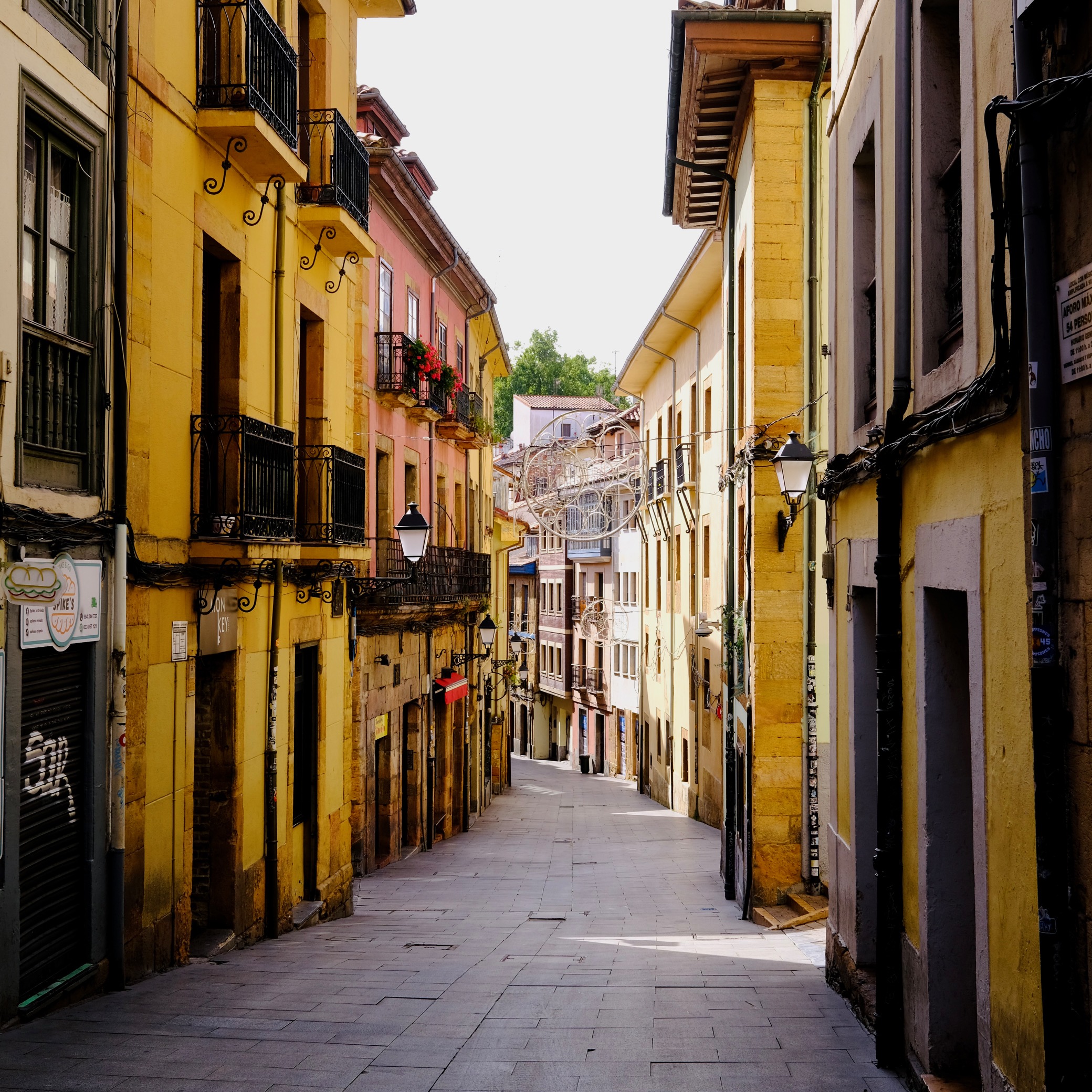
Not only that, but Oviedo is a handsome place. The old town is exceedingly pretty, steep streets meandering from one square to another, and there’s a beautiful cathedral, an imposing monastery and a picture perfect pastel-shaded food market. But there are also wide boulevards and, right in the centre, the Campo de San Francisco, the lungs of the city, a gorgeous and spacious park which lends itself gladly to a happy meander. On one side of its perimeter there are beautiful, brightly coloured houses on a sloping hill and you get a sense, almost, of another San Francisco.

Oviedo is not buzzy or boastful the way Malaga or even Barcelona is: it is a much more stately, sedate place and over the best part of a week I came to like it very much. It’s a grower not a shower, with nothing to prove, and it had a certain ease with itself that I very much admired. So different from many of the places I tend to visit on holiday – less scruffy, somehow more grown-up. On most of my holidays I come home with dozens of pictures of street art, snapped with my proper camera like the wannabe hipster I am. In Oviedo, there was comparatively little that I saw.

I must admit, though, that my first impressions of the city were distinctly mixed. The first day of my holiday, nothing went right. The shitty train to cruddy Gatwick decided to stop at Redhill and spit us all out with, it seems, no suggestions about how we should reach our final destination. Our plane sat on the runway for almost an hour because, and this appeared to be news to people, it needed a full tank to get to Spain and didn’t have one. The bus from Asturias airport felt like it took an eternity: the airport is far closer to Aviles than Oviedo, it turns out.

And then we decided to grab a late lunch on Calle Gascona, Oviedo’s famous cider boulevard, the one that features in every newspaper article about the place. Somehow it felt a little tired and unlovely, and grabbing a table outside at one of the places recommended by one of the broadsheets, a little too late for lunch, we felt like an inconvenience.

I won’t mention the place, although maybe I should, to encourage you not to go there, but it was not an experience for the ages. The croquetas were decent enough, the big slabs of cheese fridge-cold, the bread rock hard. A twenty Euro plate of calamari were thick bouncy straps of the stuff, no lightness or delicacy. And the American at the next table talked volubly and relentlessly at her tablemates, who appeared to be a captive audience. I think she might have been doing part of the Camino de Santiago, and I could picture her husband, back home, having a very pleasant fortnight in relative peace and tranquillity.

It turned out that she was a vet. I know this, because she mentioned it roughly half a dozen times in the space of thirty minutes, and as I dipped a piece of particularly rubbery squid through the crust on top of a purgatorial dish of alioli she started talking about prolapses and fistulas in more detail than I would personally have liked, i.e. in any detail at all. The squid bordered on inedible, the grey clouds overhead threatened rain. This doesn’t bode well, I thought to myself.

Anyway that was the last time I had a bad meal for a whole week, although it did put me off returning to Calle Gascona, and from that point onwards it was sunshine and strolls, coffee and cakes, beer and cider and terrific meal after terrific meal, and I was relieved to find that first experience a passing aberration, the exception that proved the rule, the rule being that Oviedo rules.

When I returned from holiday, thoroughly passionate about telling people why this grand yet modest city deserved more credit, I realised that because I’d been unable to find a decent guide to Oviedo in the run-up to my trip I’d just have to write one. So here it is, and I hope that if you’re considering an expedition to this most classy of cities – or have already decided on one, and have come here through the vagaries of Google looking for advice – it helps you to make the most of what I found to be a downright wonderful place.

And when you fly home, tell people that it’s not all about cider and blue cheese, because there’s miles more going on than that. Oviedo deserves a legion of ambassadors, and I for one am proud to be one. Fingers crossed this piece helps to create a few more.

1. La Corte de Pelayo
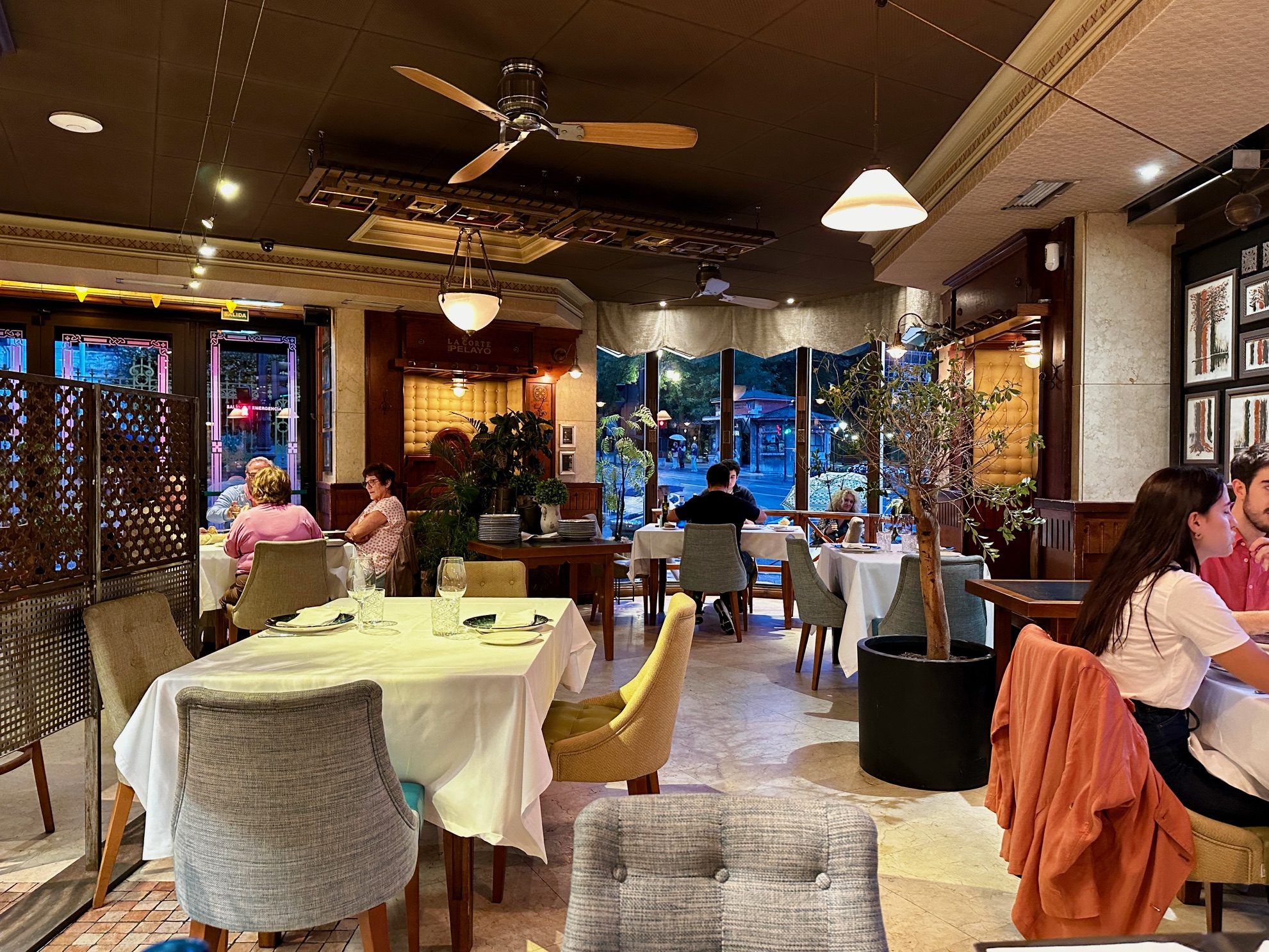
The evening after that awful lunch on Calle Gascona we had dinner at La Corte de Pelayo, on one corner of the Campo de San Francisco, and my holiday experienced the great reset.

It’s one of those places where from the moment you walk through the front door, you know that everything will be absolutely fine until the moment you leave: smooth, attentive service, a cosy, classic dining room and pockets of delighted diners everywhere you look. It’s been going for over 20 years, although that makes it a positive newborn compared to some of the businesses that feature in this city guide, and it had that air that it was probably exactly the same when it first opened and would be exactly the same in 2045. I loved that about it.

I was determined to immerse myself in Asturian food, so I ordered their fabada – which, I should add, is on the menu as a starter. I haven’t experienced anything quite like it: the pot of beans was brought to the table and ladled, with great ceremony, into the bowl in front of me before being set down on the table, in case I wanted a top up. The compango, a long plate with pork, pork sausage and morcilla, was placed nearby, looking for all the world like a carnivore’s idea of the best petit fours ever, for you to cut and add however you liked.

It was truly heavenly: the beans firm and creamy, the pork lending smoke and salt, the whole thing giving me complete clarity on why this dish, in this region at least, has attained a mythical status. I understood why every year they give out awards for the best fabada Asturiana (they also do this for cachopo, as we will see, and for Pote Asturiano for that matter), and why La Corte de Pelayo had been a finalist in those awards several times.

Don’t get me wrong, the meal had other dishes in it too. Zoë ate gorgeous jamon ibérico, sliced by hand as it should always be, and we shared some pixin, pieces of fried monkfish. She had secreto ibérico as a main, and I had an extraordinary shoulder of lamb, presented on the plate like one of those flying birds that adorned the walls of so many Seventies living rooms. There was an apple tart that made me very happy indeed, and a glass of ice cider – a drink I came to love far more than cider itself during my time in Oviedo.

But it was the fabada I have thought about countless times since. I put pictures of the meal on my Facebook page and a reader who knows Oviedo well told me to enjoy the city. I asked him if he had any recommendations and he said “I’m afraid you’ve been to the best place already!” I don’t know about that, because it turned out that there were many other superb meals to be had. But I didn’t order fabada again.

La Corte de Pelayo
Calle San Francisco, 21
https://lacortedepelayo.com

2. Cocina Cabal

Cocina Cabal, where I had lunch on my second day in Oviedo, was a thoroughly sophisticated spot. From the very start, when we waited by the gorgeous bar out front and had cold beer straight from the tank, to the bit where we were led into a tasteful, muted dining room and given a menu awash with temptations I liked it very much. It’s named after chef Vicente Cabal and most of the tables have a view of the open kitchen, although I had an even better view of my wife.

Everything was clever, pretty and carb-free – qualities I have aspired to for many years but seem fated never to attain – and although I found the plating somewhere between “fussy”, “geometric” and “designed by a serial killer” I thoroughly enjoyed all of what I ate. Octopus and stellar pork, edged with exceptionally light crackling, was a new take on surf and turf for me, and although I wasn’t entirely sure any of it went with celeriac purée or mango chutney I was happy to spend a few minutes eating (and completely failing to make sense of) it.

My veal with sweetbreads and salsify showed similarly worrying presentation, all parallel lines and artful smears, but I rather liked it, even if it could have done with more sweetbreads. But then, what dish couldn’t? Dessert was a white chocolate sphere full of passionfruit mousse that melted away when dark chocolate sauce was poured on it, an idea which I think was cutting edge quite some time ago, but I appreciated the execution all the same.

But perhaps the trick was in how you ordered. Zoë enjoyed two colossal ingots of foie gras with apple and Pedro Ximenez, and outrageously good suckling pig with a bright and moreish kumquat purée, so arguably the menu just had cheffier and less cheffy stuff, and I, ever the ponce, had skewed towards the former. Nevertheless it was a very good meal, and even pushing the boat out with wine and (more) ice cider it still cost us something like £160. When I consider some of the meals I’ve spent that on in the U.K. of late, I start to have dark thoughts.

Looking at Cocina Cabal’s menu again now, I see that their fabada was the best in the world back in 2022. Next time, I’m having that.

Cocina Cabal
Calle Suárez de la Riva, 5
https://cocinacabal.com

3. La Puerta de Cimadevilla

Although that fistula-ridden experience on my first day put me off Calle Gascona, it didn’t put me off sidrerias in general. It did, however, make me a bit more discerning about which ones to try, which is how we ended up at the more modern, more interesting La Puerta de Cimadevilla on Thursday lunchtime. On the edge of a pretty square in the old town, it was much less frowsty than some of its Gascona-based peers and was thoroughly fizzing with custom throughout my lunch there: we turned up early, without a reservation, but later on saw people getting turned away.

The staff at La Puerta de Cimadevilla were lovely, and brought us much more into the whole cider-pouring experience, and it was a real joy to watch them pouring it from a great height into the corner of our wide-bottomed glasses in the traditional style, the practice of escanciar or ‘throwing’ the cider, in order to aerate it. Zoë was a little more sceptical – “they’ve all got one wet shoe” was her take on this venerable custom – but even she got into the swing of it, I think.

Incidentally, we saw next to no British tourists in our week in Oviedo and I wonder if the cider has something to do with it: imagine our nation of binge drinkers having to attract the attention of serving staff every time you wanted another sip of your drink. It would never catch on. The thing to pair cider with in these parts is blue cheese, and La Puerta de Cimadevilla’s cabrales croquetas, sweetened with honey and topped with a walnut, were a properly knockout combination.

But really, the reason we were there was to try the other pillar of Asturian gastronomy, the cachopo. La Puerta de Cimadevilla is proud of theirs, with no less than four different ones on their menu. Not only that, but they include two that have been decorated: the cachopo that was declared the best in Spain back in 2023 – there’s a poster proclaiming this on the outside of the restaurant, no less – and another that was a finalist as recently as this year.

We ordered the 2023 champion because you would, wouldn’t you? And I loved everything about it, from the slightly preposterous presentation to literally everything else. It comes on its own special bespoke board, loudly proclaiming that it is indeed the ‘El Capricho del Rey Ramiro I’ and, just as endearingly, the restaurant’s other celebrated cachopo has its own unique, subtly different board. I don’t know how you can’t slightly love a place that gets so proud of its achievements: it was certainly beyond me.

But more than that, it was simultaneously delicious and colossal. There is no question at all that you couldn’t take one of these down on your own, and even between two it almost proved beyond us. The restaurant has a whole separate page on its website talking about every painstaking element of this, from the meat that’s used to the paleta ibérica laid on top of it, from the mixture of cheeses in its gooey core to the blend of breadcrumbs, corn and cheese that make up its ultra-crunchy coating. There’s even chestnut purée in the mix somewhere, the kind of thing some dullards would describe as the hero ingredient, no doubt.

All that sounds great, but the proof is in that moment when you make your first inadequate incision into the gigantic slab of Asturian food history and understand the fuss. Before that, my only experience of this kind of dish was the Andalusian flamenquin, a cigar of pork loin, jamon and cheese that I used to think was the best breadcrumbed thing ever. The cachopo has forced me to revise my opinion somewhat, but I also suspect more research is necessary.

Equally brilliant and frustrating was the fact that the menu contained countless other things I would have loved to try that were rendered impossible by the sheer volume of cachopo you had to put away. Of all the restaurants in the guide I think this was the one Zoë most wanted to return to, to eat their tomatoes with bonito. The table next to me was so struck by a neighbouring table’s ensaladilla russa that they specifically asked what it was and I could see them making a mental note for next time. They even do a fabada – who doesn’t? – and you wouldn’t bet against it being marvellous.

La Puerta de Cimadevilla
Calle Cimadevilla, 21
https://lapuertadecimadevilla.es

4. Gloria

The night I ate at Gloria, the heavens opened and the stars aligned: it was the one time during our stay in Oviedo that it properly chucked it down, which just so happened to be the night we had a reservation at the restaurant two minutes’ walk and a few doors down from our hotel.

Not just any restaurant, though. Chef Nacho Manzano has Oviedo’s only Michelin starred restaurant, NM, situated in the El Vasco mall, a huge shopping centre I really struggled to like. But Gloria is the restaurant he shares with his sister Esther, less showy but properly lovely. Strangely I can’t tell you what the main dining room looked like because we were seated in the front room, by the bar, with just one other table, occupied by a pair of friends catching up. But actually that made it feel intimate, like private dining almost, and if I was in the zone allocated to tourists I soon found I didn’t mind one bit.

Gloria’s was another of those menus – Oviedo seemed to be full of these – where the starters and main courses cost pretty much the same, leaving you with little or no idea how to structure a meal, what was to share and what was to eat on your own; I sometimes suspected that most of the servers in Oviedo thought we should share everything and couldn’t understand why we wouldn’t. But we were helped by a brilliant server at Gloria who very firmly told us when something was too big for us to order one apiece, and everything was so delicious that we ended up sharing it all anyway.

That meant, unusually, tuna two ways – an exquisite tataki just-cooked, dressed in impeccable extra virgin olive oil and strewn with garlic, and a hefty piece of loin halved and served blushing with gorgeous tomatoes sharpened with citrus, nutty beans like edamame and crispy onion. The former was maybe too delicate to share, the latter quite the opposite, and one of the best things I ate in the entire trip.

Our server talked us into splitting arroz con pitu de caleya between us, which was probably wise but did leave me wanting more at the end. Pitu de caleya, or roadside chicken, is a noted Asturian free-range chicken, and serving it with rice in this way is something Manzano reintroduced first at his three-starred restaurant Casa Marcial. If this was the diffusion line, it felt very far from being short changed: the rice was rich beyond measure with the juices from the chicken and the chicken itself – darker, leaner and gamier than the usual fare – was glorious.

Having been restrained thus far we earned the right to spoil ourselves for the rest of the meal, so we did. A cheeseboard full of Asturias’ finest completely redeemed the dismal Calle Gascona selection from our first meal in the city, and then a chocolate cremoso topped with the smoothest hazelnut ice cream, ringed with olive oil – yes, a whole one each – brought matters to a resoundingly successful conclusion. I probably don’t need, by now, to say that the latter was accompanied with another glass of ice cider but there you go, I’ve said so anyway.

The rain had died off by the time we walked back to our hotel to do some serious digesting. How could it have persisted, after a meal so good it had the power to banish pathetic fallacy?

Gloria
Calle Cervantes, 24
https://www.estasengloria.com

5. El Fartuquin

Let’s get this bit out of the way first: no, I don’t know where the name comes from, yes, it sells the bean dish and no, I didn’t order it. So snigger if you must, but El Fartuquin was possibly the most traditional sidreria we ate at, and a very successful and popular one at that. The basement room looked like the picture above when we sat down at 9 on a Friday night, but within half an hour every table was packed. Everything about it had that assured air which seemed to permeate much of the city, and everybody was having a terrific time; I heard no English spoken anywhere.

If it was only solid by the standards of this holiday, that didn’t mean it wouldn’t have been an outstanding meal in any other context. I really liked the pixin, nuggets of fried monkfish with a little pot of alioli, and I quite admired the brave plating choice to serve the skeleton of the monkfish next to it, like something cooked up by H.R. Giger, to leave you under no illusions about where those delectable morsels had come from.

I also rather enjoyed yet more pitu de caleya – I’d got a taste for it by then, you see – this time in a dark and potent stew which contained maybe a tad too much mustard for my personal liking, although I found a way to see past that. Zoë decided, more out of hope than expectation, to have her own personal cachopo and was even more defeated by it than she had been the last one. This is as good a point as any to reiterate that Asturias doesn’t do small portions: Oviedo would not, for instance, be an Ozempic-friendly city break.

I felt a little like El Fartuquin only really suffered by comparison with the other meals we had in Oviedo, rather than anywhere else, so it’s still one to consider if you find yourself in the city for an appreciable length of time and you’re disinclined to eat at the same place twice. I’d also add that, despite being a sidreria, it had an excellent list of reds, including many I’ve sampled on previous visits to Malaga. The kind pricing of wine in the city is another reason why the bill never stings anywhere near as much as it would back home.

El Fartuquin
Calle Carpio, 19
https://elfartuquin.es

6. El Ovetense

We had lunch at El Ovetense on our final full day of the holiday and it was a place I discovered entirely by chance that very morning.

How it happened was this: we were still buzzing from a very happy evening spent drinking at Cerveceria Cimmeria (number 10 on this list, just down there) and, following them on Instagram, I saw that they’d shared a beautiful picture of the place on their Instagram stories. The person who took it was a very talented local food photographer – I forget her Instagram handle – and all the photos in her grid were of food she’d cooked herself with one exception, a couple of dishes from a place called El Ovetense. And they looked good. Drop-everything-change-your-plans good.

So I did some more research, fell well and truly down the rabbit hole and found an article from last year in El Pais which left me with no doubt in my mind that I needed to snag a table there. El Ovetense, in the old town, is technically a hotel restaurant, and has been trading since 1959. The founder’s daughters Natalia and Ana run the place now, and it has achieved legendary status for two dishes. So naturally, after turning up at noon to ask Ana nicely for a table on the terrace, only to be told that they didn’t open until 1pm, those dishes are exactly what we (eventually) ordered.

One was the pollo con ajillo – chicken with garlic – which doesn’t begin to explain how incredible this dish was. Tons of the crispiest jointed chicken, skin cooked until brittle, the whole thing issuing a siren song to be parted from the bone, came festooned with industrial quantities of crunchy fried garlic, the whole lot sitting on a layer of the finest chips, which slowly became permeated with all that garlic and all those juices as the meal went on. Seventeen Euros for this, and it could easily have served two on its own. Seventeen Euros! I could honestly weep.

But the other dish, which is even more the signature of the restaurant, is their jamon asado “Serafin style”, named after the restaurant’s founder Serafin Garcia. I never got to try jamon asado when I visited Granada last year, and I felt like I’d missed out at the time, but I know now fate was keeping me waiting for this, a rendition which I can’t imagine being surpassed.

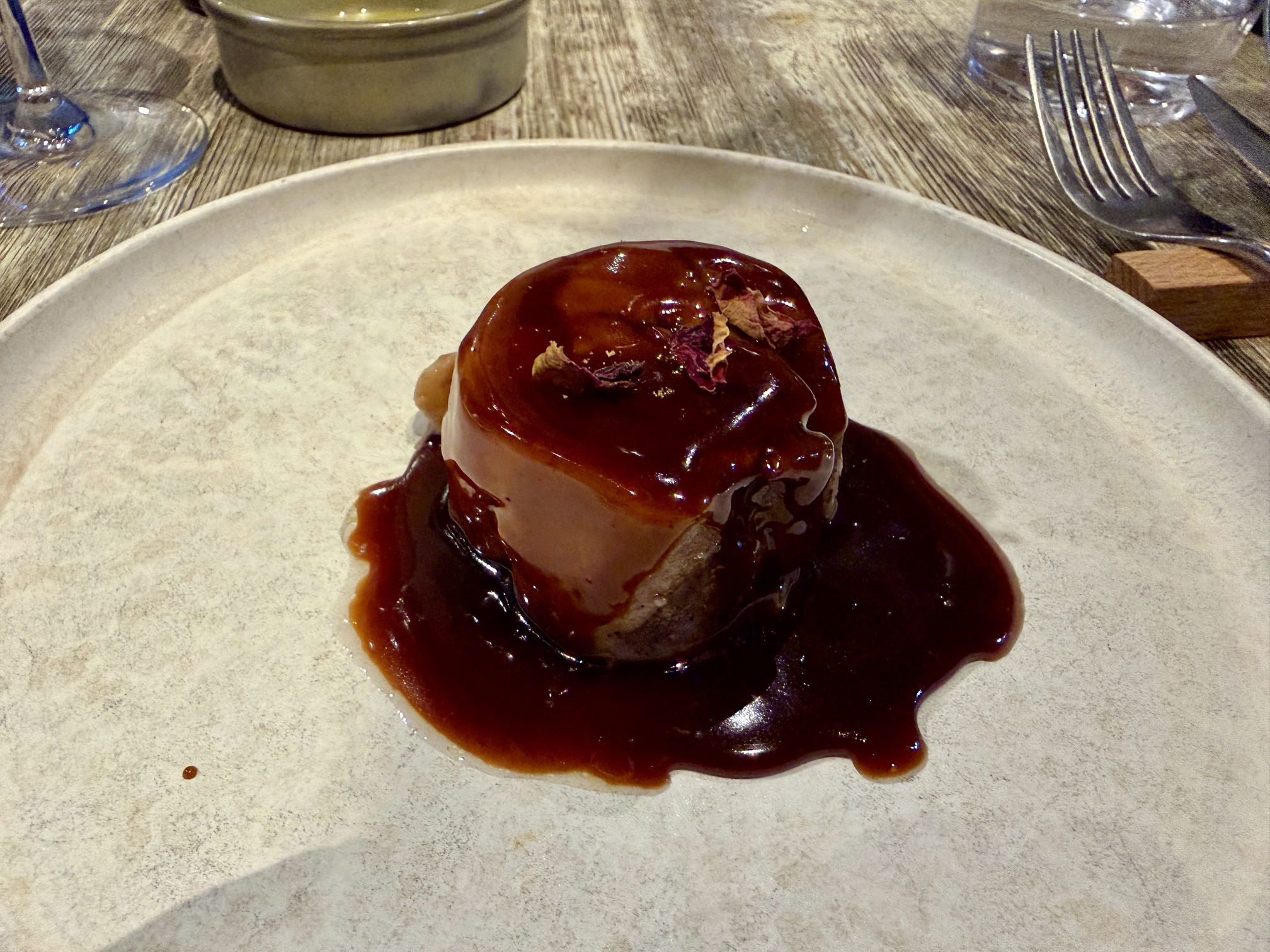
Picture a plate groaning with gorgeous sliced ham – apparently there are 16 slices per portion, carved with a special knife so fine and sharp that it’s like playing the violin. Picture that ham draped over a rubble of crunchy potatoes, and then picture a rich sauce, somewhere between a jus and a gravy, poured liberally over it all. Only Natalia and Ana handle the preparation of this dish, and they cook up to 20 kilos of ham a day for the purpose. It is the kind of dish that not only the restaurant, but also the city, deserves to be famous for.

The ham, the spuds, that gravy, the many phenomenal forkfuls made up of those elements… it was, as with many dishes in Oviedo, not for the faint hearted but one for the memory banks and the record books. We also had yet more spuds, this time in a salty and arresting cabrales sauce and we didn’t need them, with all that other food and all those permeated potatoes, but we ate them all the same because they were as fantastic as everything else.

It is probably for the best that I discovered El Ovetense on my final day, completely by chance, because if I’d been there on my first day I might not have gone anywhere else and then you wouldn’t have this guide to read. But if you decide you want to visit Oviedo, this is the place to make sure you visit and these are the dishes to make sure you have. And yet, I found myself wondering – if they are this good, what other unsung gems are hiding further down the menu, when they stick two absolute showstoppers right at the top?

El Ovetense
Calle de San Juan, 6

7. Casa Fermin

My final meal in Oviedo – unless you count something wolfed down at the airport the next day, which I’d rather not – was at Casa Fermin, just down from La Corte de Pelayo and so very near to the park. It was, I suppose, the Big Fancy Meal of the holiday, and after lunch at El Ovetense I was worried our trip would end with a whimper rather than a bang.

I worried needlessly, because although Casa Fermin was very different to El Ovetense it was, in its way, as good a meal as any we had on the trip. The dining room looks a smidgen sterile in pictures but was actually a very striking one to which photographs possibly don’t do justice. The enormous tablecloths that get caught under your feet seem to be a Spanish thing – Cocina Cabal had these too – and they’re a bit Total Eclipse Of The Heart, but the space was peaceful, hushed, luxe and poised.

And the food was very good indeed, in the same kind of bracket as Cocina Cabal but with, for my money, everything taken up a notch. We eschewed the tasting menu for the à la carte and were again rewarded with a slightly confusing range of options where some dishes were small and clearly to be consumed solo, others were big and clearly designed to share and, well, with the rest it was anybody’s guess.

This, though, is where the serving staff really came into their own. We ordered a few individual things, a few dishes to share which were brought to the table already divided and what that meant, all in all, was that we kind of designed our own tasting menu with the help of our server, very much the best of both worlds.

So we had a croissant each, deeply flaky and buttery, crammed with tuna tartare and we shared a feather-light rectangle of brioche topped with a translucent film of Iberian pancetta and piled with caviar. An arroz con pulpo, similarly, was divided into two bowls and was extremely generous for two: god knows how they expected one person to polish that off as a starter and have room for everything else.

I lucked out, though, with the suckling pig. Pressed into the most divine oblong, the meat all succulent and the crackling onomatopoeically doing exactly that, it was superlative stuff. I liked the hazelnut pesto they served it with perfectly fine, but I loved the smoked pineapple purée, something I would never have anticipated in a hundred years and which was an eye-opener and a half. It even made me think that possibly, just possibly, there might be a place for pineapple on pizza, provided you smoked it first.

All of that went beautifully with a white wine from the Canary Islands which was complex with almost oxidised notes, and even though everyone at the surrounding tables seemed more classy, more genteel and an awful lot more Spanish I had an absolute whale of a time throughout my meal.

Dessert was the best way I could imagine to finish a week of miraculous meals, a sort of ice cream cheesecake made with a local cheese called Gamonèu; I’d forgotten how the Spanish love to include savoury notes in cheesecake, and this had a little pungent punch which elevated it far above the workaday. It came with a tiny moat of ice cider: I took this as a cue to have one final golden glass to match.

Casa Fermin
Calle San Francisco, 8
https://www.casafermin.com

8. Casa González Suárez
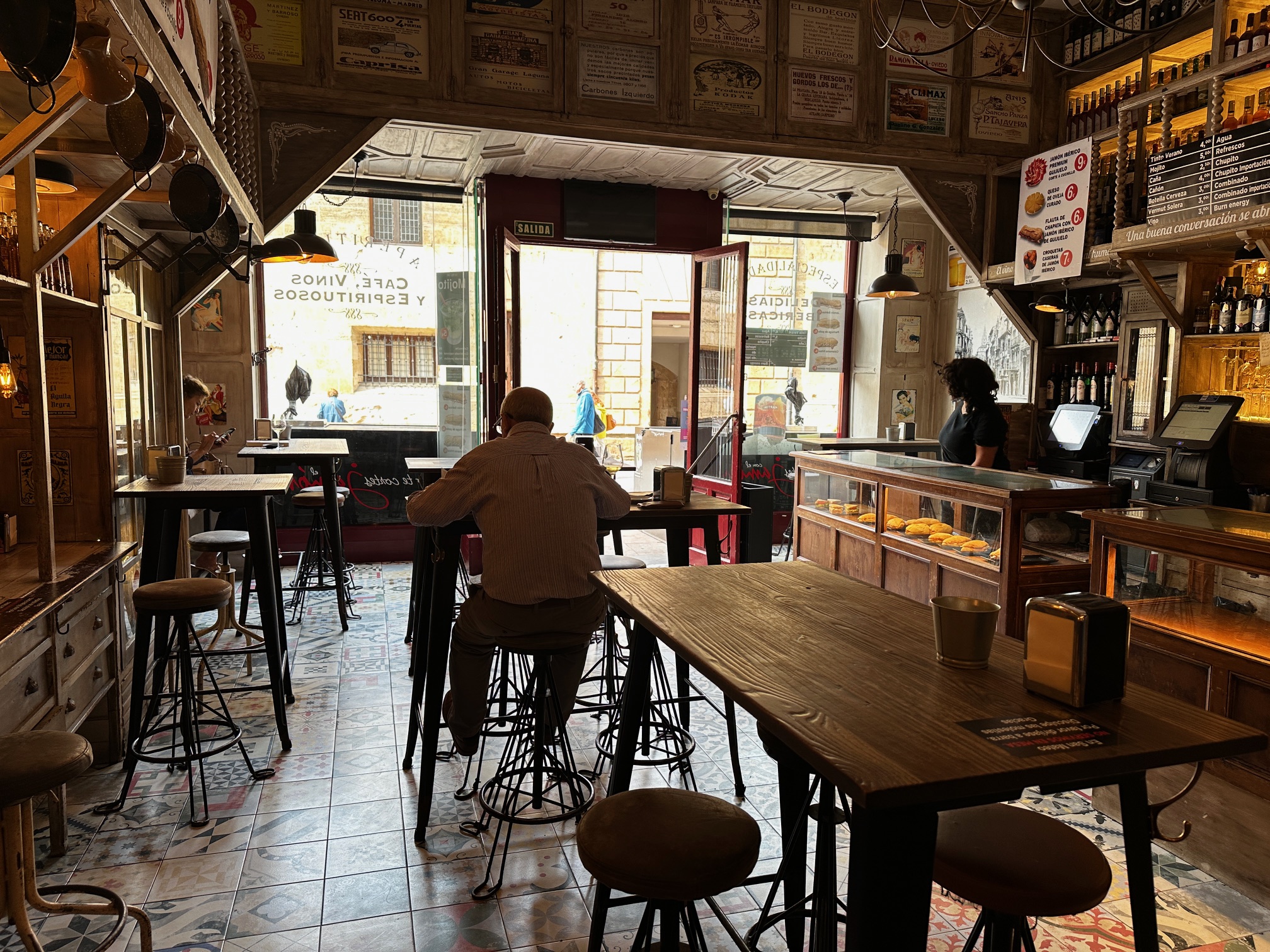
I had no real concept, before I went to Oviedo, of how different Asturias would be to Andalusia, where I’ve spent far more time. So I was expecting that, like Malaga or Granada, Oviedo would be awash with jamon shops with stacks of bocadillos in the window, ham shining under the spotlights, churrerias left right and centre and vermouth bars here and there.

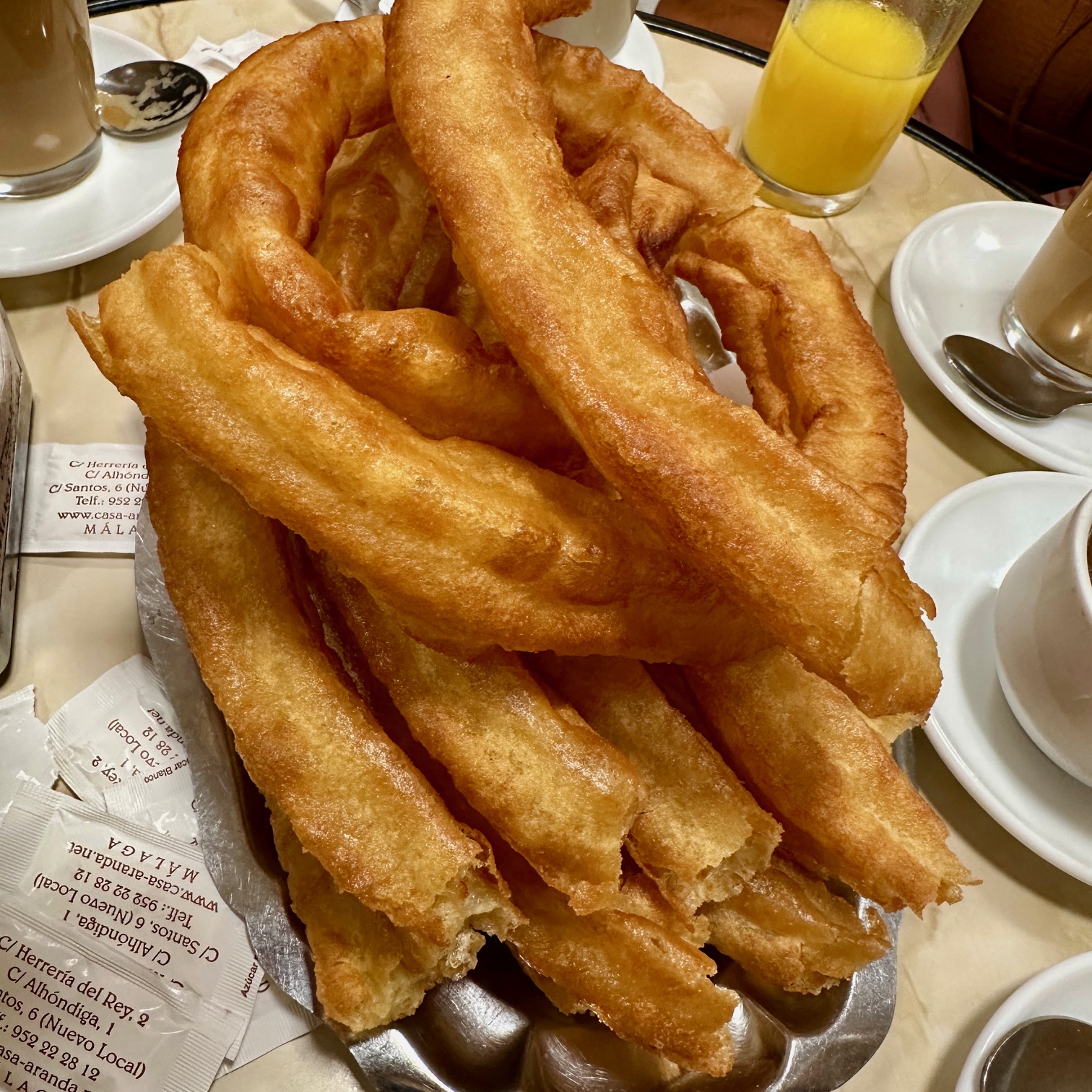
Well, in my experience Oviedo is not like that. There is jamon, and I eventually chanced upon a couple of shops, and I didn’t make it to either branch of the only churreria, Churreria Guty, that I came across online. Next time, perhaps. And Oviedo is a cider city first, a wine city second and although it has a little grid of streets – the Ruta de los Vinos – around Calle Manuel Pedregal, I didn’t make it there either. I know, I know, what kind of a guide is this?

So the closest I got was Casa González Suarez, a little spot celebrating its centenary this year. It served vermouth, and had a limited menu of ham, cheese and bocadillos, and it was the perfect place for a short, casual pit stop after the morning coffee and before the afternoon amble. The ham was cut by hand, and came on a paper plate – it wasn’t bad, but I’ve had better. The cheese, also on a paper plate, was more refrigerated than I’d have liked.

The vermouth, though, and the service were splendid, and I liked the room. Lunch for the two of us cost less than twenty quid. Asturias is almost different enough to Andalusia to be a different country – they worship different ways to eat a pig there – but I enjoyed my brief, affordable excursion to the south.

Casa González Suárez
Calle Ramón y Cajal
https://casagonzalezsuarez.com

9. Cerveceria l’Artesana
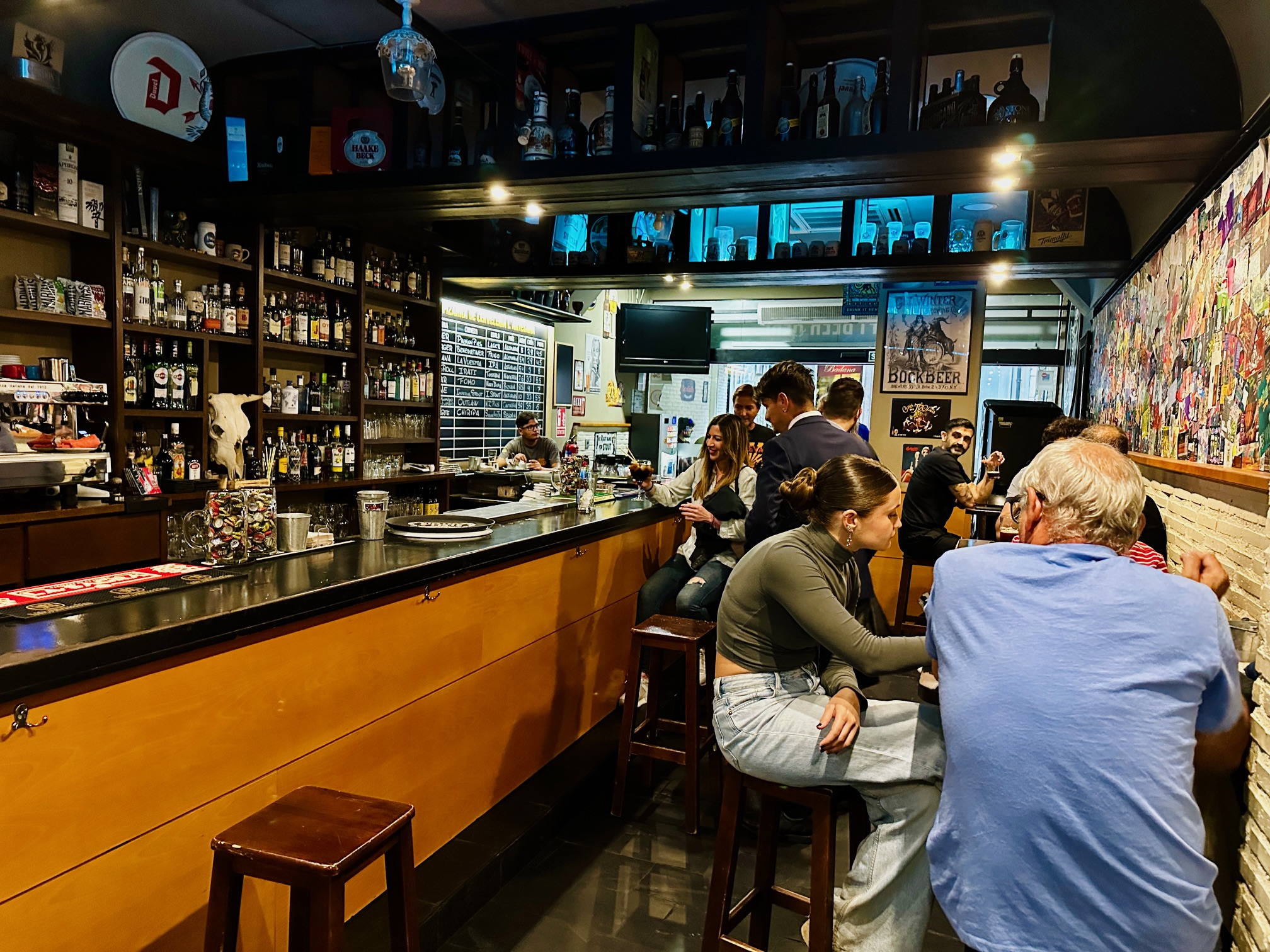
If Oviedo is cider first, wine second, where does that leave beer? Well, from my homework and exploration, in a limited number of very safe hands.

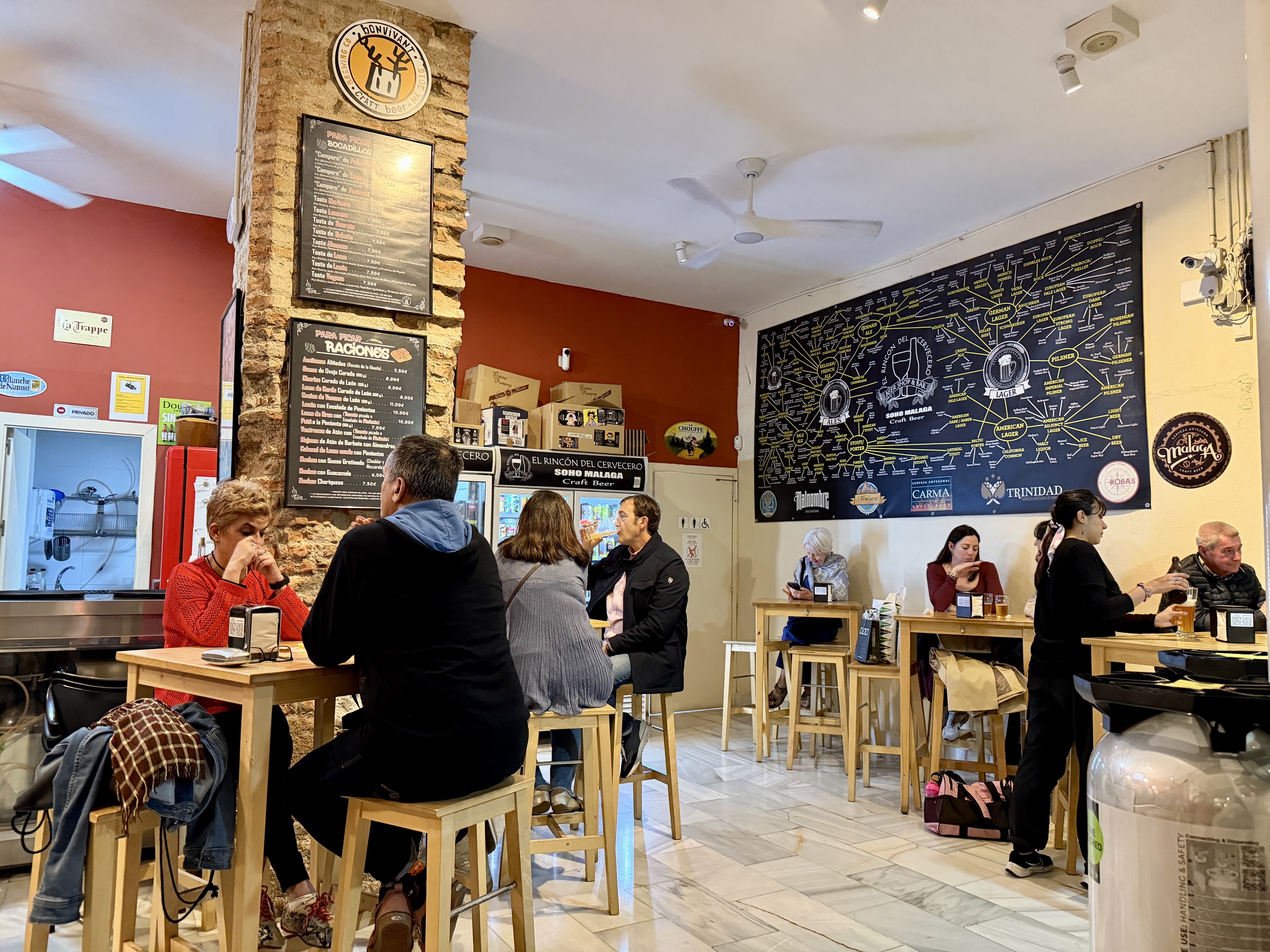
Cerveceria l’Artesana, on a street parallel to Calle Gascona, was a really fun and rather popular craft beer bar which very much lived up to the usual aesthetic of those places – a long thin corridor of a room with high tables against the wall, and a bigger room up the stairs at the back which had more room but less personality. I was heartened by how many people were in there on a Wednesday night, and I liked many of the beers I had.

Some of those, like piney pale ale La Vuestra, were brewed by the venue, and others, like a very drinkable DIPA called FOMO, are by other Spanish breweries – Bilbao’s Luagar in that case. An excellent can fridge gave me the chance to reacquaint myself with the Girona brewery Soma, whose beers I’d so enjoyed the previous year in Granada.

Having got there, we were having such a good time that we stayed for food. L’Artesana’s Instagram makes much of the fact that they make all their food on the premises, and I very much got that – everything was robust, substantial and frighteningly good value. Empañadas were Venezuelan rather than Argentinian, so made with corn dough rather than pastry, more like an arepa, and were colossal and stuffed with chicken. We got two for a price you’d gladly pay for one, and both were impressively sturdy.

Fingers de pollo (for some reason they preferred fingers to goujons when lifting a word from a foreign language) were actually really good chicken tenders, again absolutely whopping and brilliant dunked in a pot of moreish honey mustard dip. The only thing that defeated me was their burger. It cost something like twelve Euros and was a behemoth, and it was the first but not the last time I didn’t clear my plate in an Oviedo venue.

You couldn’t dispute the quality, and l’Artesana even makes its own buns and burger sauce, but it was a little too thick for me, and a little too pink in the middle: close to tartare, really, underneath the crust. Never mind. I would go back, I would pick dishes that looked more like snacks and beer food and I would still leave full and happy, wallet far from dented. It was another illustration that when it comes to what you should eat with craft beer, the U.K. still has plenty to learn.

Cerveceria l’Artesana
Calle Santa Clara, 8
https://www.instagram.com/lartesana_oviedo/?hl=en

10. Cerveceria Cimmeria

My homework had identified Cerveceria Cimmeria as a place to try for beer, and early in my time in the city I clocked that it was on the same hill as La Gente – number 13 on this list – a few doors down. It was closed during the day, so it was impossible to tell what it would be like. There was a Löwenbräu sign outside, and the name of the pub was in that sort of Celtic, sort of Advanced Dungeons & Dragons font I remember well from my misspent teenage years. I couldn’t possibly have known, at that point, that I was gazing upon one of the best pubs I’ve ever had the luck to drink in.

Returning on a week night, minutes after they opened, it was a revelation. A beautiful spot with some low tables in the window and along one side, a bar and stools taking up the other half of the room. Lovely wood panels, walls covered with beer swag and everything scrupulously clean. Twelve beers on offer – including one cask handpull – and a dizzying array of styles and breweries, from Spain and beyond. The lager was Löwenbräu, the cask beer was Shepherd Neame’s very own Bishop’s Finger, but beyond that it got really interesting.

That meant excellent IPAs from Spanish giant Garage, Asturian brewery Caleya and Malandar, from Cadiz. There was an imperial stout by renowned Basqueland Brewing and, from far further east, a delectable sour by Latvia’s Arpus and another corking pale from Berlin’s Fuerst Wiacek. Not only that, but Belgium was well represented with a Lindemans and the Straffe Hendrik Tripel on the board.

I don’t think I have ever seen such a canny but compact selection of beers, such a well balanced lineup of countries and styles where I wanted to try nearly all of it. I resolved to try nearly all of it.

I didn’t realise at the time, but now I do – Cimmeria is the kingdom featured in the Conan The Barbarian stories, which might have explained the font on the outside. The place was filling up with the kind of diverse craft beer drinking crowd you never see at these places in the U.K., and Def Leppard was playing on the stereo. It was how my corner of our sixth form common room would have been back in 1991 if (a) we had been cool; (b) we’d lost our virginity; and (c) we’d been allowed to drink on the premises.

I looked at Zoë, and I could tell she was in love with the place. Maybe it was the beer, maybe it was the Leppard. It was probably, in truth, a bit of both. But I was in love with it too.
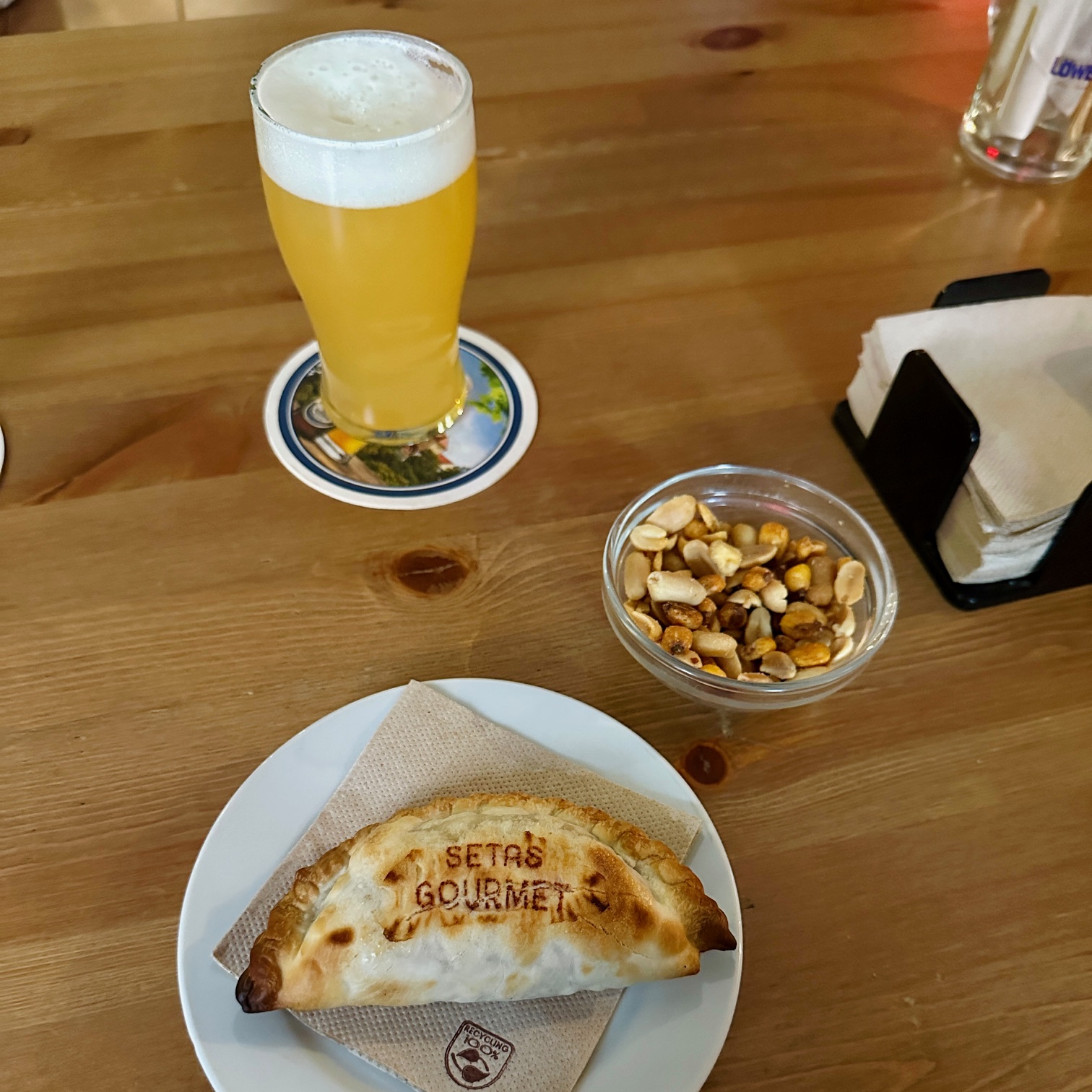
All that and snacks – a bowl of crisps, popcorn or nuts with each round, and a simple but effective menu of cheeses or empañadas. We ordered a mushroom and cheese empañada each and were told they wouldn’t come out for a while because they needed to be baked properly, which is exactly the answer you want to hear, and when they arrived they were gorgeous.

We liked Cimmeria so much that it was a huge wrench to leave for our dinner reservation, and we resolved there and then to move a few things around so we could do it all over again the following night. So the next evening we were stood outside at 7, when it opened, we grabbed the same table and it was, if anything, even better than before.

Cimmeria was following both Zoë and me on Instagram by then and one of the owners, who was charm personified, told us that we had been spending our time wisely from what she could see of our travels. That was lovely of her, but none of it was spent quite as wisely as those happy hours in Cimmeria.

We left for our final restaurant of the trip happy to have found possibly the only pub I’ve been to that comes close to rivalling Bruges’ magisterial ‘t Brugs Beertje and devastated that we’d only had two short evenings there.

Cimmeria celebrated its thirteenth birthday the month before we arrived in Oviedo. I wish it many, many more very happy returns – and, speaking of returns, I can’t wait to go there again.

Cerveceria Cimmeria
Calle Martínez Vigil, 8
https://www.instagram.com/cimmeria_oviedo/?hl=en

11. El Lúpulo Feroz

El Lúpulo Feroz is on the outskirts of the city, out past Calle Gascona and the El Vasco mall, in the only bit of Oviedo I visited that felt decidedly residential. I wanted to try it as the third in my trilogy of craft beer places and I found that, aesthetically at least, it had much in common with l’Artesana. Their back room was a very attractive spot – blood red walls, beer memorabilia everywhere, from Belgium, Czechia and even dear old Blighty. It was oddly pleasing to see an illuminated Bass sign on the wall, the beer free from its usual connotations of little Englander pubman gammonistas.

Speaking of beer, the venue had a tap takeover by Danish brewery Amager Bryghus the night I visited, and I liked what I had. Oviedo has no verified Untappd venues for beer – not that kind of city, not yet – but I later discovered, once I’d got home, all the places I hadn’t made it to: Bär Berlin, Vivalabirra and the courageously named Cerveceria Lord Vader (let’s hope Disney never find out about that one). Plenty kept in reserve for, hopefully one day, an updated version of this guide.

El Lúpulo Feroz
Calle Indefonso Sánchez del Rio, 8
https://www.instagram.com/ellupuloferoz/?hl=en

12. Pionero Coffee Roasters

I suspect that the coffee scene in Oviedo isn’t quite as advanced as in other Spanish cities I’ve visited. The Best Coffee app, a regular staple for me on my travels in the U.K. and overseas, drew a complete blank on the city, and even further research only threw up a handful of places. One, Pionero, was in the northwest of the city, the other side of the Campo de San Francisco from the old town and so very close to my hotel, which meant a couple of very happy contemplative coffees there in the mornings before heading off to explore.

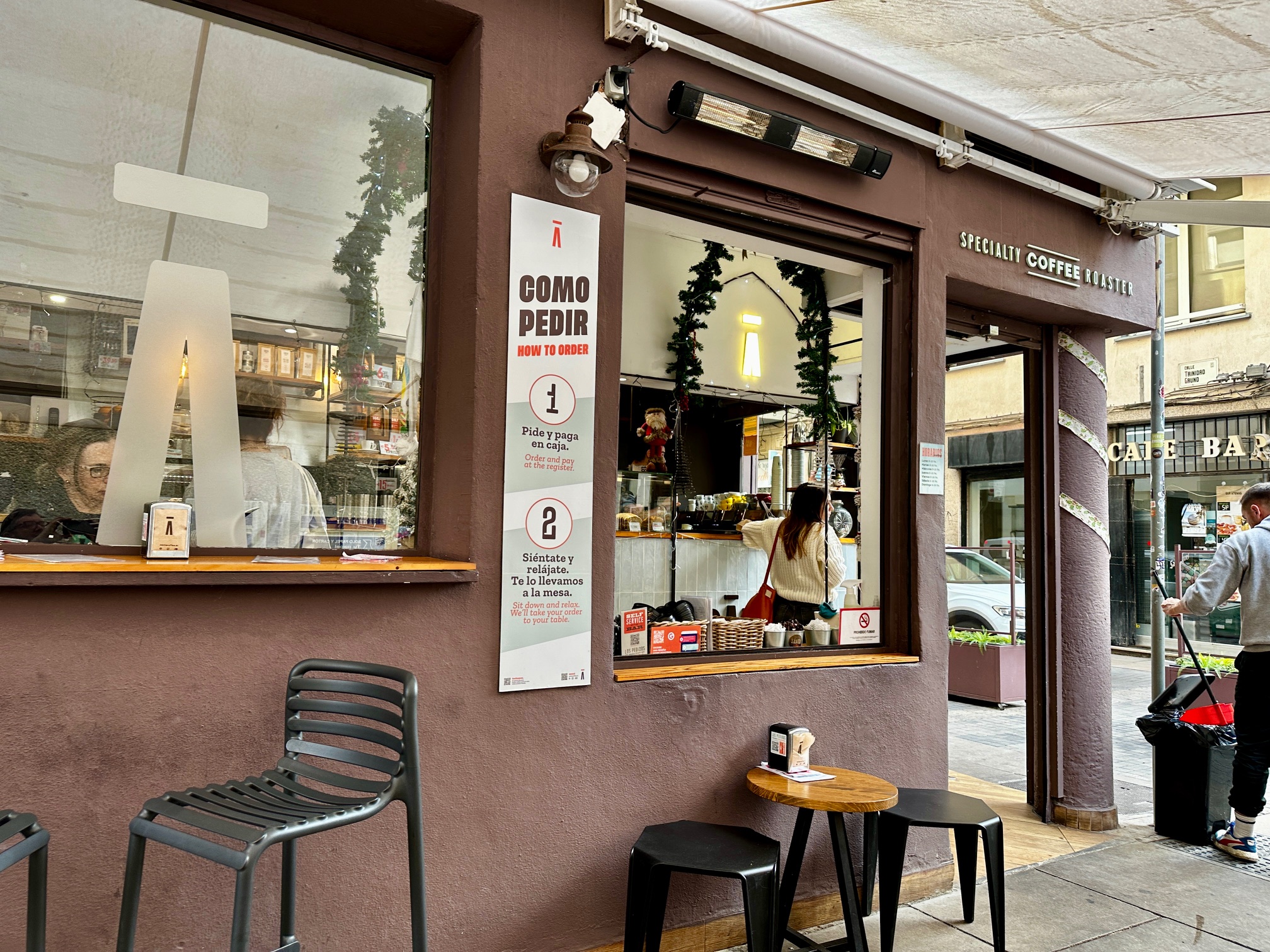
It was a very nice spot with extremely friendly, helpful staff and although the inside was quite serviceable they had a couple of tables outside with a view out onto the street, and thus people-watching, so I tended to plonk myself there. No sunshine, really, so al fresco potential was strictly limited but all the same I found it a brilliant spot to start the day. Coffee was decent – definitely a step above the generic cafe con leche – if not top tier, but Pionero also roasts and sells beans to take home. I’m very looking forward to that first V60 with them.

Pionero Coffee Roasters
Calle Marqués de Pidal
https://www.pionerocoffee.com

13. La Gente Café
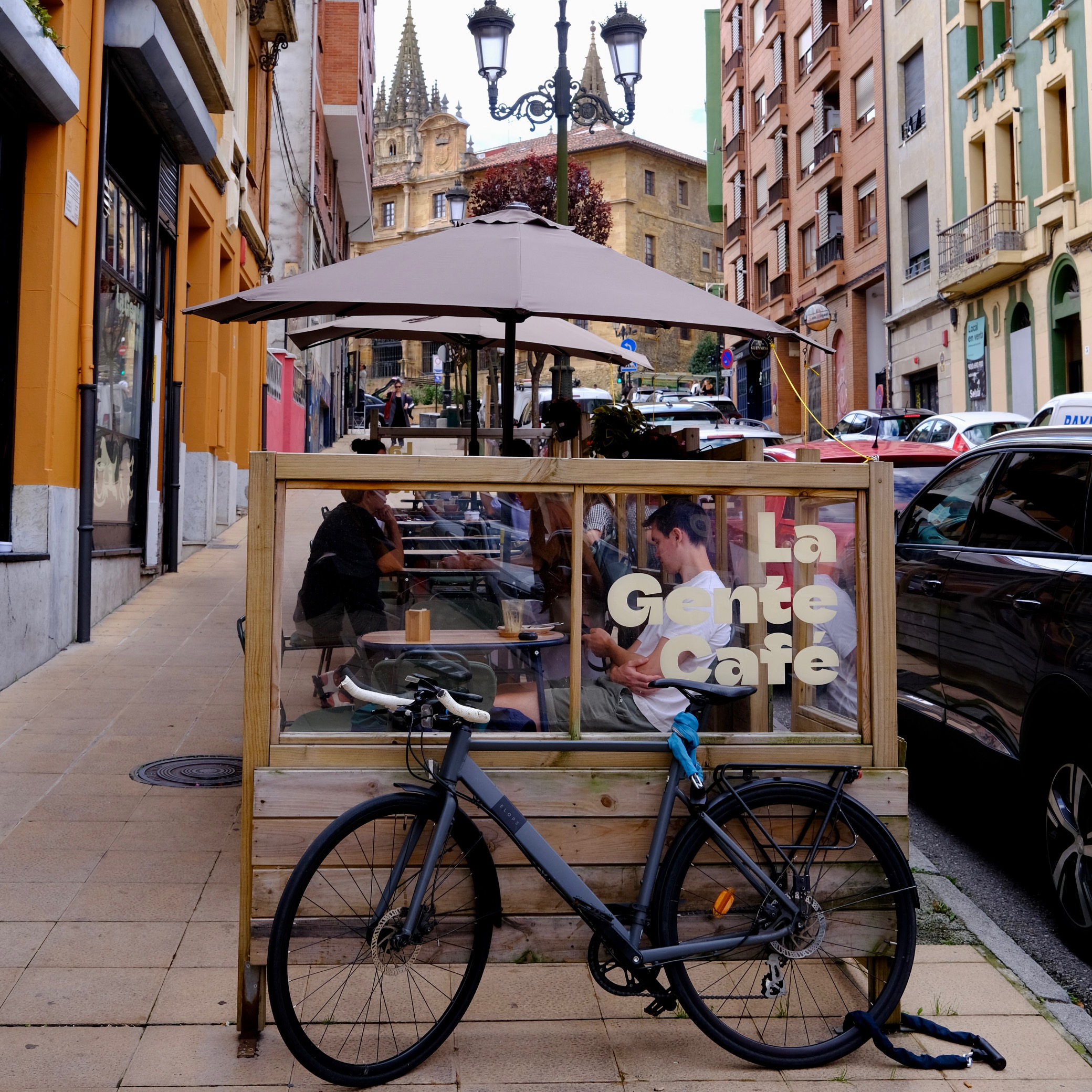
La Gente is on Calle Martinez Vigil, the steep street by the monastery that is also home to Cerveceria Cimmeria. For both those reasons, it probably became my favourite street in the whole of Oviedo over the course of the week. La Gente has a lovely little terrace, overcoming the gradient of quite a challenging hill, and was far and away my favourite spot to sit, drink coffee and take in the surroundings.

I think I liked La Gente’s coffee slightly more than Pionero’s, possibly influenced slightly by the fact that their lattes are tall and generous, so more my personal thing than a cortado or a flat white. I found out from the owners of Cimmeria that La Gente had only opened at the start of the year, and what impressed me was just how part of the community it already felt, full of brunchers, chatters and even dog walkers (owners Kate and Andrew own a miniature schnauzer, Lando, who features in much of their branding).

They are brunch specialists, which means that if you go there around lunchtime you’ll struggle to get a seat and, if you’re not eating, you might well feel guilty about depriving them of a table with a higher spend. But the rest of the time it was just a brilliant space to sip latte and make a plan of attack for the day’s wandering, sightseeing and eating. The interior was absolutely lovely too, although it was a tad too warm to spend time in there.

I also liked the sense that as a business it was still evolving. On one visit I heard one of the owners and a member of staff discussing the menu for the season ahead, and I got the impression from the blurb and postings on social media that La Gente either offered, or was looking to offer, natural wine on selected evenings. Other than that, it’s worth pointing out that, like Pionero, La Gente closes pretty early during the week – so if. you do want an afternoon flat white make sure you get there before the shutters go down at 4pm.

La Gente Café
Calle Martínez Vigil, 6
https://www.instagram.com/la_gente_cafe/?hl=en

14. Diego Verdù

One thing you can rely on from a city guide of mine is that if I go somewhere in summer, I’ll find somewhere for you to eat ice cream. To be honest, even in the less clement months I can usually snaffle one but on a sunny day in Oviedo my thoughts turned to tracking down a tarrina – that is to say a tub – of something cold and captivating.

Enter Diego Verdù, an Oviedo institution which has been trading for nearly 150 years; as we’ll see in the remainder of this list, the people who make sweet treats in the city have had a very long time to become excellent at it. Diego Verdù started out making turron, but by the 1930s it had also decided to turn its hand to ice cream. And thank goodness it did, because both of its branches – the very pretty almost-original premises on Calle de Cimadevilla and the second more modern one just down from the Woody Allen statue – sorted me right out on this trip.
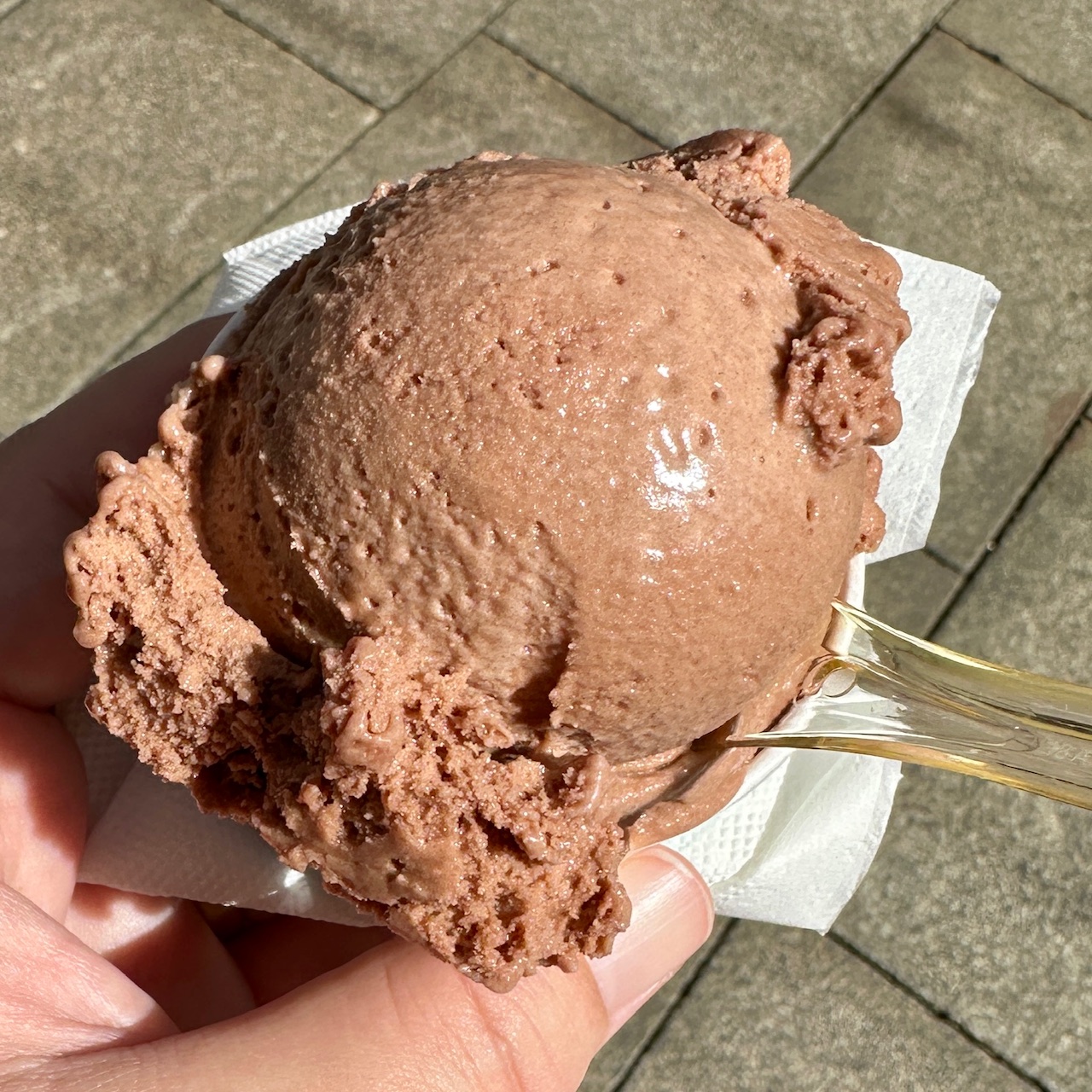
All the flavours that I tried were magnificent although, as befits their vintage, most of them kept it fairly establishment. I loved their chocolate, and their pistachio, but the most leftfield I tried on this visit was chocolate with pimento which I thought downright bloody great. For all I know they may occasionally experiment with yuzu, cinnamon or even cabrales – just imagine – but I didn’t see any of that on my travels.

Sitting on a bench – both branches are takeaway only – and attacking a massive tub filled with two generous scoops for less than four quid, I was quite unbothered by that. Oviedo just isn’t the kind of city for off the wall stuff, and is none the poorer for it. Unlike with coffee, Oviedo is positively enlightened when it comes to helado, and both shops are open until 8.30pm. There’s also a little kiosk on the edge of the Campo de San Francisco, which boasts many benches perfect for sitting, eating and sighing.

Diego Verdù
Calle Milicias Nacionales, 5/Calle Cimadevilla, 7
https://www.diegoverdu.com

15. Camilo de Blas

Diego Verdù is not the only Oviedo institution that’s been brilliant for longer than any of us have been on the planet. Confiteria Camilo de Blas has been in the city since 1914, although they were trading in Leon for another forty years or so before that. The thing they are most famous for, and possibly the emblematic goodie most associated with Oviedo, is the carbayon.

Now, carbayon originally referred to a huge oak tree, beloved by and symbolic of the city, to the point that natives of Oviedo called themselves carbayones. It was felled in 1879 to make way for Calle Uria, the ‘modern’ street connecting the old town to the train station which is now home to department store El Corte Ingles. That’s progress for you. That tree, I suppose was the Metal Box Building of Oviedo (one for my Reading readers there) but in 1924, the mayor of Oviedo commissioned the confiteria to create a sweet treat and this new incarnation of the carbayon, an incredible sweet pastry named after the tree, was born. That is also progress for you.

And what a treat it is. A lozenge of puff pastry filled with almond cream and then topped with a glossy layer of an exceptionally sweet coating which, depending on who you Google, either involves egg yolk or egg whites or both. Either way it also includes a lot of sugar, and makes for a very satisfying shell. This is one for those of you with a sweet tooth, like me. Zoë and I picked a couple up from their second branch on Calle Jovellanos and inhaled them on a bench in the Plaza de la Constituciòn and they were, to my mind at least, unimprovable.

“It’s like a cross between a yum yum, a frangipane and an éclair” was Zoë’s verdict, and I made a mental note of her saying that because she summed it up better than I could. All that for about £2.80 each, so cheaper than a Picnic brownie and even more indulgent. My boss likes to quote Philip Pullman, repeating the definition of an éclair as a cake that is “long in shape but short in duration”: I brought him back a carbayon and he loved it, although he was even more delighted that it was far less short in duration.

Camilo de Blas
Calle Jovellanos, 7/Calle Santa Susana, 8
https://camilodeblas.es

16. Confiteria Rialto
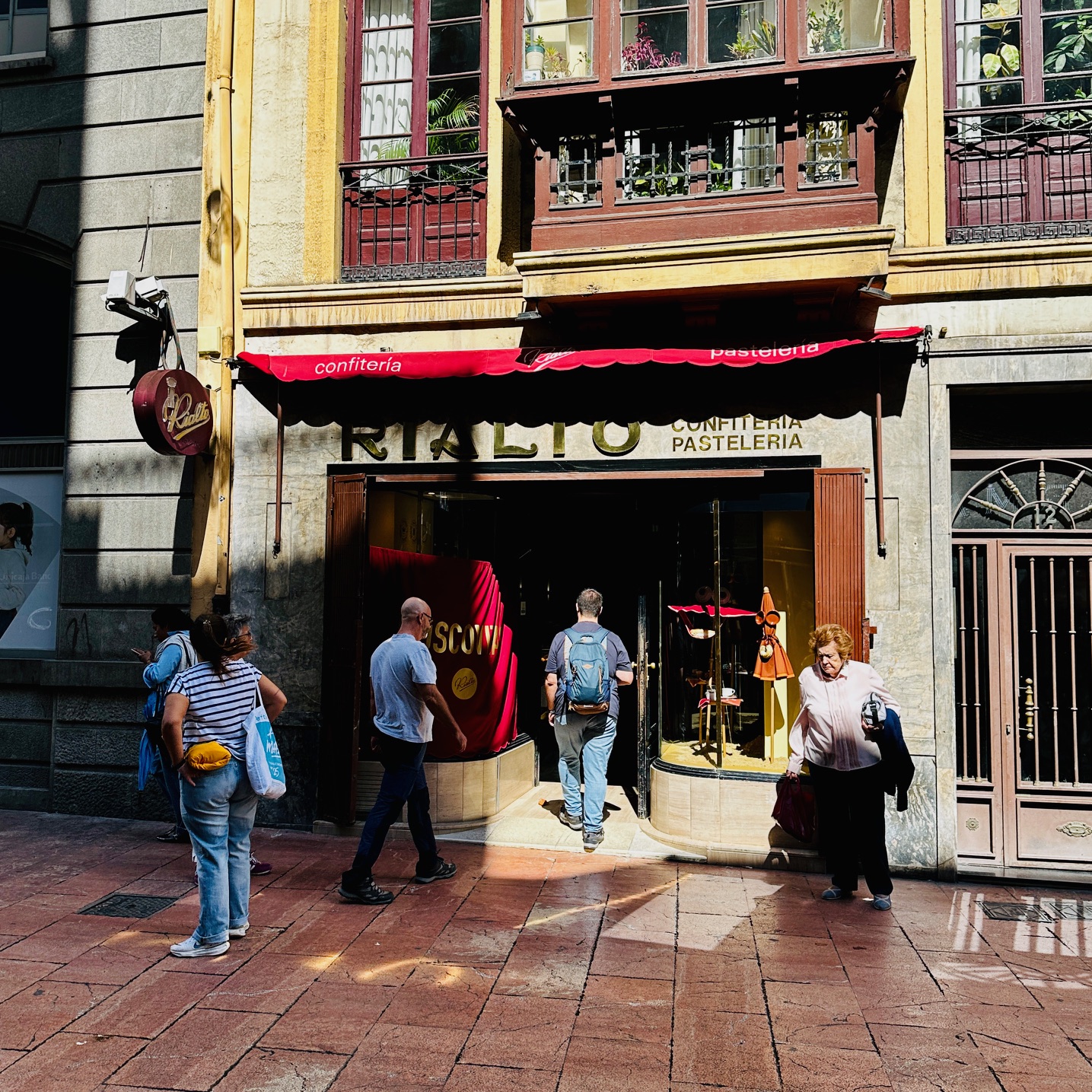
The third of Oviedo’s amazing venerable confectioners is Confiteria Rialto, which celebrates its hundredth birthday next year. It also has two branches in the city centre and it also sells carbayones. But the thing it’s synonymous with is Moscovitas, thin almond biscuits half coated in chocolate, to the extent that even its domain name references Moscovitas, not Rialto.

When I put some pictures on Facebook regular reader Rodrigo – the chap who told me I’d eaten at Oviedo’s best restaurant on my first night – asked if I’d tried Rialto’s Moscovitas, and fortunately I was able to post a photo of me holding one of Rialto’s distinctive red and gold bags, containing two luxurious-looking boxes of the things. But actually, I didn’t try them until I got home, when I was glum about being back in Reading and wanted a taste of elsewhere.

And once I did, I was crestfallen that I’d limited myself to just the two boxes, because they were extraordinary. Every single one irregular, every single one made by hand, each one thin and light, with just enough crunch and just enough substance, each one making you want another. Imagine the most rarefied chocolate Hob Nobs you could imagine, square it and you still wouldn’t be close. Rodrigo also told me that he has a recipe for Moscovitas which approximates to the Rialto classic, and I churlishly pooh-poohed him. Now I’ve tried them, I may have to ask him nicely.

One last tip, which is both about Rialto and Oviedo more generally, is this: Asturias Airport does a better job than nearly any airport I’ve been to of celebrating the region it serves. So you can buy – and not at exorbitant prices either – some of the city’s greatest hits, whether that’s more carbayones from Camilo de Blas, beautiful ice cider, compangas and chorizo from Calle Gascona stalwarts Tierra Astur or, last but not least, more of those Moscovitas. So if you don’t get to Rialto, you can still pick some up for your journey home. If you do, can I trouble you to get an extra box for me?

Confiteria Rialto
Calle San Francisco, 12/Calle Bermúdez de Castro, 2
https://www.moscovitas.com/en/home-2/

(Click here to read more city guides.)

Since January 2025, Edible Reading is partly supported by subscribers – click here if you want to read more about that, or click below to subscribe. By doing so you enable me to carry on doing what I do, and you also get access to subscriber only content. Whether you’re a subscriber or not, thanks for reading.
City guide: Málaga (updated 2026)

This guide has been extensively overhauled and updated as the result of another very happy and enjoyable visit to Málaga in March 2026, in which I revisited many of my old favourites but managed to find new candidates for you to eat and drink at. In most cases the text is either new or updated, but where it dates from my 2023 visit I have tried to make that clear. I hope you enjoy the guide.

Of all the city guides I’ve written since I put together a guide to Ghent back in 2018, the most popular have been the ones I’ve written on Málaga. The second edition of my Málaga guide, published in 2021, has had more page hits by far than any of my other city guides and is surprisingly evergreen, with more people reading it last year than the year before, or the year before that. I’ve had far more messages about it than I could ever have expected, often from readers on holiday literally working their way through it. It’s even been cited by other bloggers putting together their own highlights of the city.

By way of illustration, even on my trip to Málaga at the start of December 2023 one of my Instagram followers was in the city at the same time as me; I sent her some recommendations, and she had a fantastic dinner at Uvedoble. A couple of weeks before that, a regular reader sent me a picture of his first caña at Meson Iberico, having already told me that he’d checked out three more venues from my city guide. “The omnivore can’t go far wrong in a country where dried ham is used as a seasoning” read another message, accompanied by a picture of a plate of artichokes strewn with matchsticks of jamon. He has a point.

So why am I updating the guide now? A few reasons, really. One is that my latest visit managed to check in on most of my old favourites to establish that they are still standout options, but also gave me a chance to explore new discoveries which merit a mention. In addition, Málaga’s coffee scene seems to have expanded further in the last two years – with some venues expanding or relocating.

The other reason is a firmly-held belief that Málaga is, as a destination, growing and growing in popularity and feels, to me at least, like a city whose time has come. I have been visiting it for seven years and in that time I’ve perceived a real shift – the days when people would get off the plane and immediately catch a train west down the coast without ever troubling the city seem to be coming to an end. Increasingly I am aware of people selecting it as a destination and falling under its spell.

And it really isn’t hard to see why. It is Europe’s sunniest city, it’s temperate to visit even in the winter months, it has Moorish architecture, an incredible food market, art gallery after art gallery – what other city can boast the twin artistic patrons of Picasso and Antonio Banderas – a bustling port, a gorgeous and eccentric cathedral and, of course, a beach. And that’s before we get to the food: Málaga may not have the free tapas on offer in Granada, further north, but it makes up for that with many great and imaginative restaurants. Tapas is easy to find, and invariably good, but there’s more to Málaga than tapas. Hopefully this guide goes some way to showcasing that, but even so it still scratches the surface of one of my very favourite places.

Where to eat

1. Mesón Ibérico

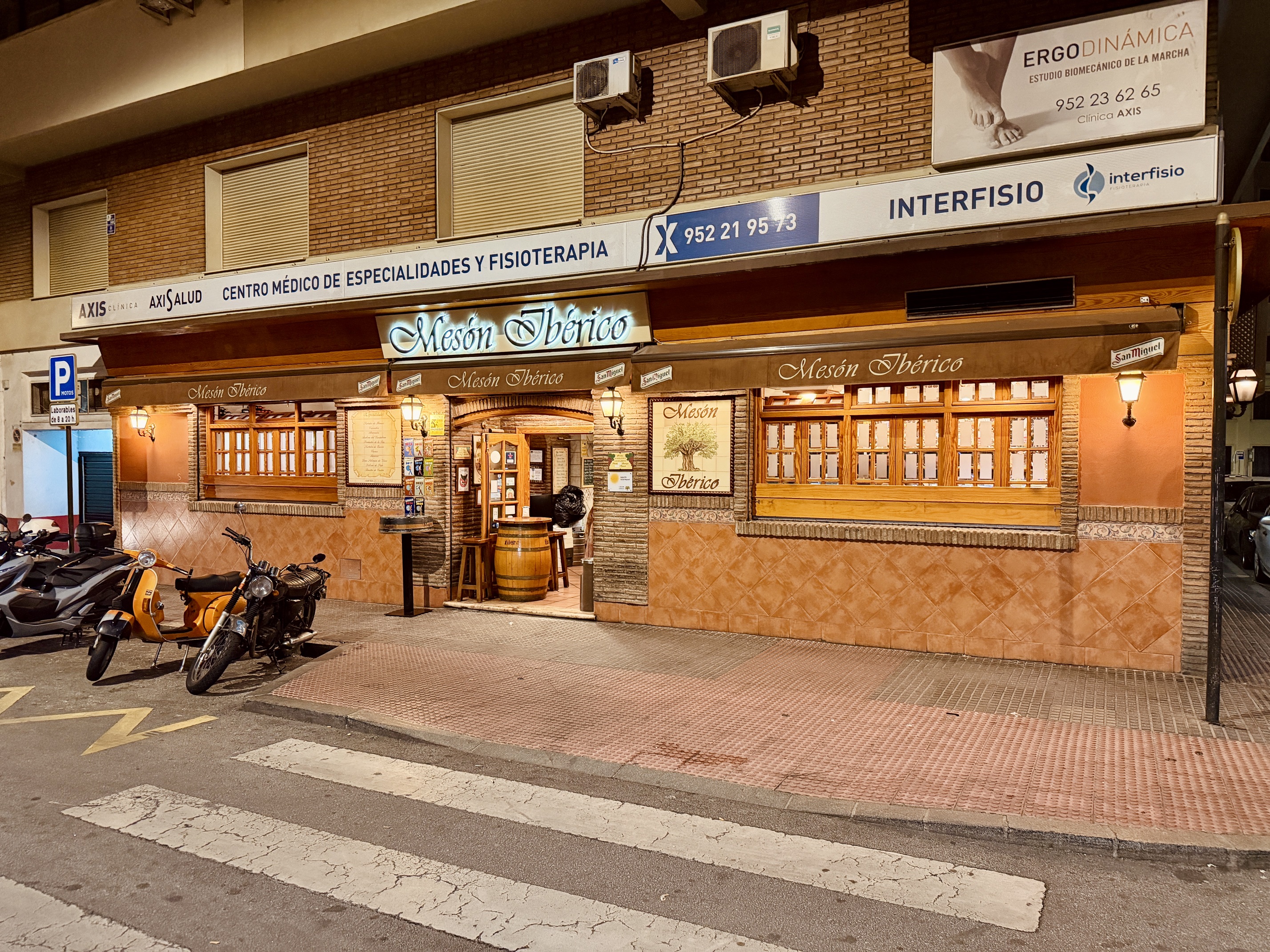
Mesón Ibérico is my single favourite spot in Málaga to eat and if you could teleport me to any restaurant in the world tonight for dinner, there’s a better than evens chance that I’d pick it. Not just any place though: you go through the front door and on the left are all the conventional tables, with table service, for bigger groups. But no – the place to be, the reason I queue outside ahead of its 8.30pm opening time (with many other people) is for prized seats at the bar. There, with crowds behind you and all the cheffing and action ahead, you have one of the best spots in the world.

It’s such an immersive, brilliant experience that it would be worth doing even if the food was just okay. But it’s a million times better than that. The very best ham, thinly sliced, the fat liquefying on the tongue. A bed of grilled mushrooms scattered with more ham – that ham as a seasoning again – and thick, pink prawns, the perfect dish to forage from. Skewers of tender, spiced lamb with unimprovable skinny chips. Rich, buttery tuna belly fresh off the plancha dressed with lemon and a salad studded with sweet slices of fried garlic. I’m not sure Mesón Ibérico knows how to serve a bad dish: if they do, it’s not one I’ve ever ordered.

Towards the end of one meal there, I saw one of the men behind the bar, with great solemnity and ceremony, preparing a dish I wish I’d ordered. First he expertly chopped an enormous, bulbous tomato into chunks. Then he opened a jar of high grade Ortiz tuna, easing out the pieces and resting them on the tomato. He anointed the whole lot with good quality extra virgin olive oil, for about a full minute after the point where I thought surely he’ll stop now. Then he sprinkled salt, again for longer than I expected. When the dish was served up to some lucky diners I was tempted to applaud. Naturally, the next time I went I ate it.

I have introduced a lot of people, I think, to the magnificent spectacle and experience of Mesón Ibérico, and nobody has ever been disappointed. On my 2026 visit to Málaga one of my readers, a lovely chap called Alun who loved it so much he went three times in two days, messaged me to warn me that the queues were starting earlier and getting longer, and he was worried that I might miss out as he had, once. I took my place outside at 8pm – Zoë and I were third and fourth in the queue, behind a devotee from Austria and his friend – and I sent Alun a picture to reassure him.

It was every bit as brilliant as I remembered and hurtling through the greatest hits, superb bottle of red on the go, chatting with our outstanding server, shaved of head and resplendent of beard like a Spanish reboot of Spirited Away’s Kamaji, I decided there was nowhere better to eat in the whole world. Or not that I’d been to, anyway. So Zoë and I resolved to sack off our plans for the following evening and go to Meson Iberico two nights running.

On the second day we were at the front of the queue, took the same seats as before and there was one rule: we couldn’t order any of the same dishes as the previous night. So our first meal there was meat-heavy, with migas, breadcrumbs rich with pork fat, thin and lacy tortillitas de camarones, fat slices of mushroom from the plancha, topped with a fried egg. And our second was more from the sea with salt cod and cuttlefish croquetas, gambas pil-pil, cubes of fried salt cod, fatty tuna belly, a belting bottle of albariño.

I rarely eat in the same place twice on a holiday, and never on two successive nights, but the magic of Mesón Ibérico is that I was tempted to make my way there on a third, and a fourth. Of course, if I’d done that this might not be much of a guide, but I would have had a wonderful time.

The week after my trip to Málaga, a reader of mine was in the city for work, with one evening free to eat wherever she liked. I recommended standing outside Mesón Ibérico around 8pm, and although she sailed close to the wind and turned up just after a crowd descended on the queue she secured a fabled spot. “It’s amazing here!” was her verdict.”I don’t think I’ve eaten anywhere that had the same buzz and atmosphere.” Reading her excited messages – and gawping at photos of her food – brought me almost as much enjoyment as eating there had.

Mesón Ibérico
Calle San Lorenzo, 27
https://www.mesoniberico.net

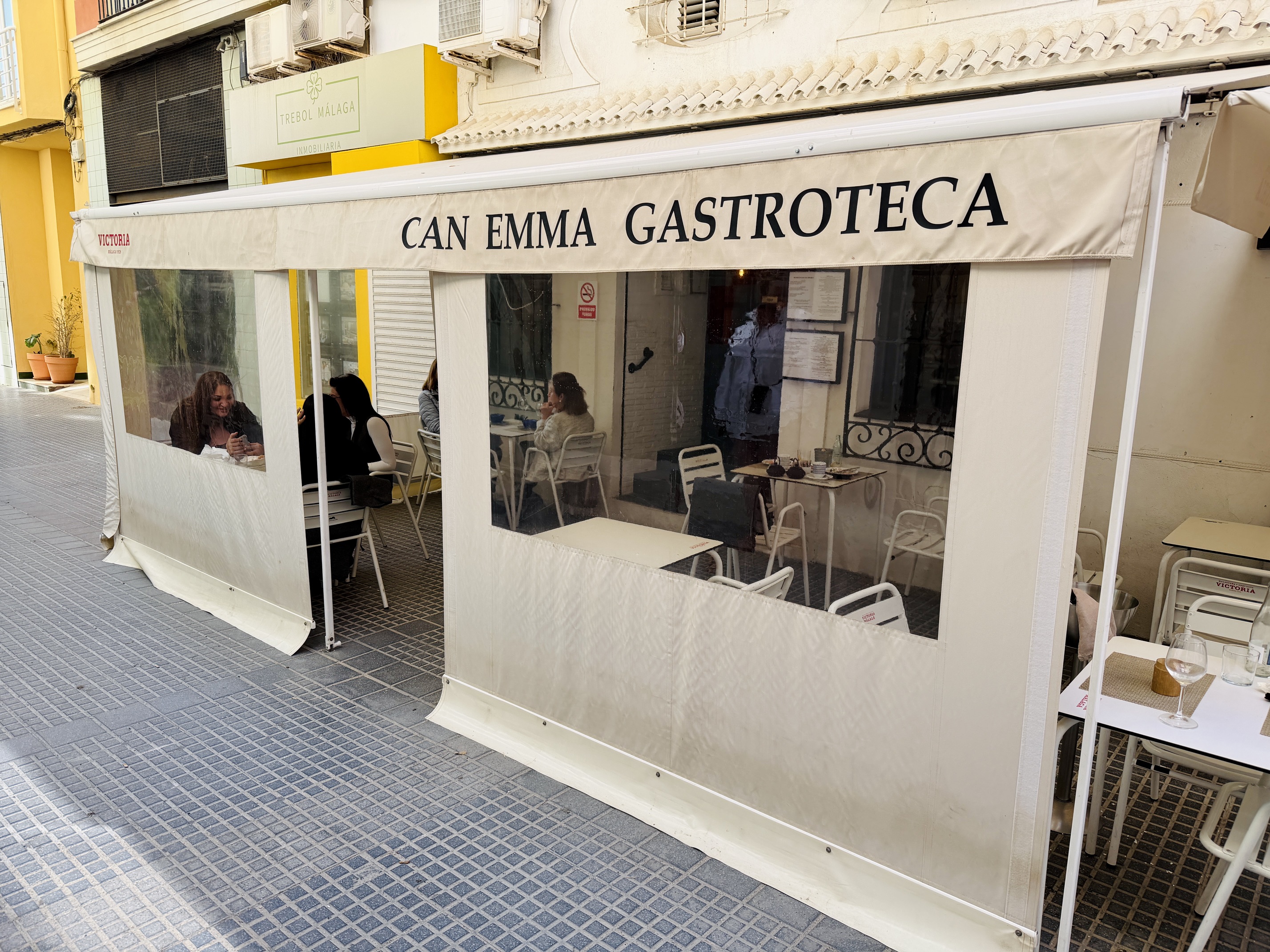
2. Gastroteca Can Emma

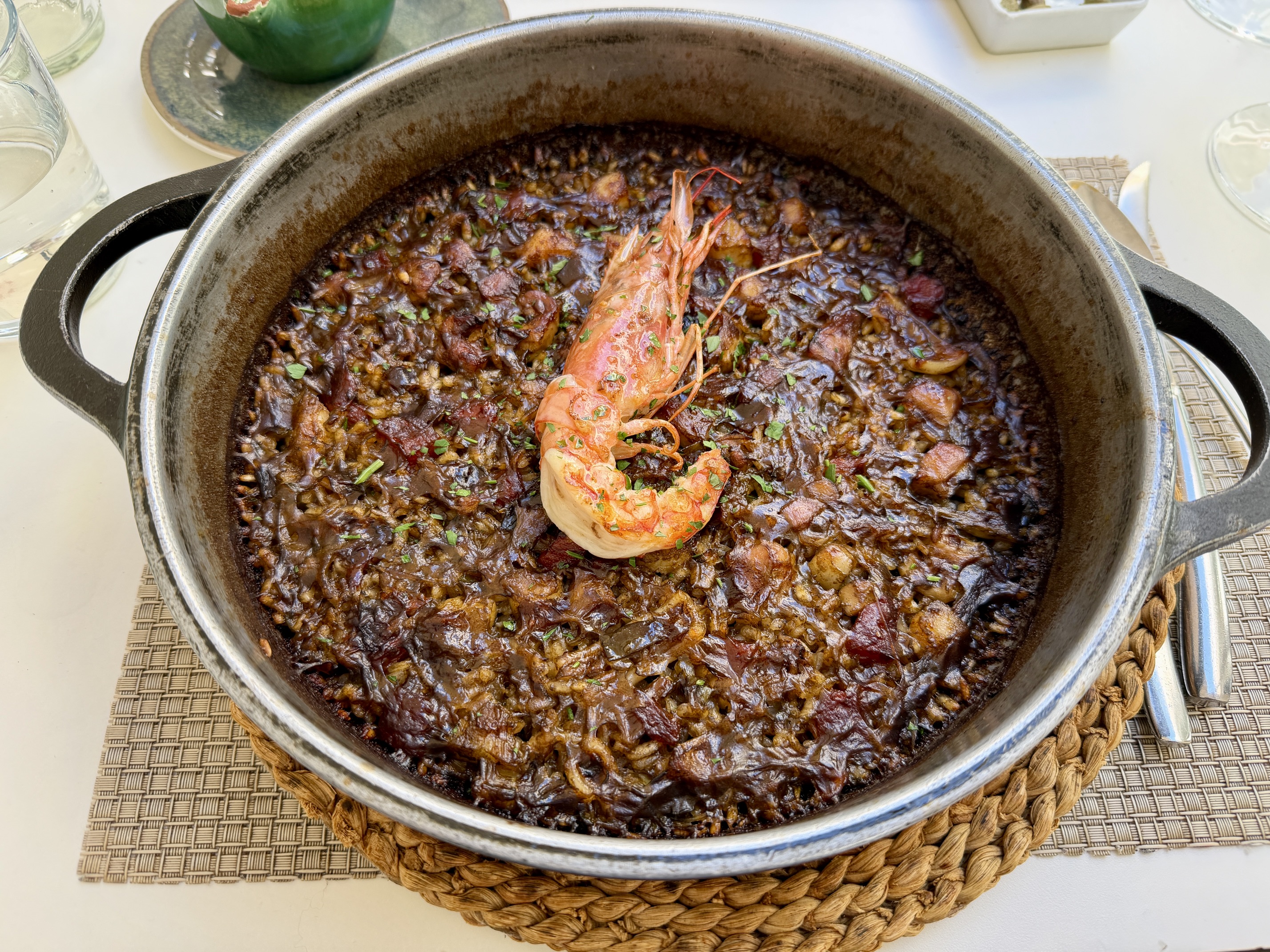
If Meson Iberico is my favourite place in Málaga, just about, I suspect that Gastroteca Can Emma, a little restaurant close to Malagueta beach, might be Zoë’s. It looks nondescript from outside, on a little side street off the main drag, but it happens to do properly unbeatable food. On previous visits I’ve been quite transfixed by their miniature croquetas, like the best Wotsits in the world, made out of real cheese. I have nearly always ordered one of the three – yes, three – mini hamburgers on the menu. And I always make a beeline for the arroz mare y monte – not quite a paella, per se, but a pan full of salty, savoury rice with prawns, squid, pork and a big pot of aioli on the side. I’ve almost never gone and not ordered it: it really is amazing.

However when I made a lunchtime visit there in 2023 I discovered that the kitchen’s talents extended far beyond that. Bao with cochinita pibil were a beautiful surprise and, better still, they served some of the best gyoza I’ve ever eaten – packed with prawns and glazed in a positively compelling, sticky sauce. I still had the arroz though, because if I hadn’t I would have regretted it. But, unusually for me, I went to Can Emma twice on my that visit to Málaga. The second trip, an evening visit, was with my dear friend Jerry and five of his closest friends to celebrate his seventieth birthday.

It was a happy accident – his first night in the city was our last night there and so I took it upon myself to find the perfect spot for the occasion. And Can Emma didn’t let me down, catering effortlessly for the vegetarian in our midst, keeping the wine flowing and even taking some photos of the group of us. On that visit I added sweetbreads to the list of things Gastroteca Can Emma did well and I opted for a different main course, secreta iberica with mango chutney. It was gorgeous, but I’m glad I’d already had the arroz that week. Jerry ordered the legendary arroz, though, and loved it. Happy birthday to him.

Although I loved having dinner there, there’s something about having a long lunch there with a crisp bottle of white which makes a random Wednesday into the best day of the week, so in 2026 I returned to do exactly that, sitting in their little gazebo out front and overjoyed to be reunited with one of my very favourite restaurants.

I’d like to say that we struck out into the undiscovered outer reaches of the menu, but we had the croquetas, we had the gyoza and, although I did branch out by trying crispy swirls of torreznos – the world’s best Frazzles made out of actual bacon – and a beautiful plate of confit leeks topped with tuna belly I did still finish on that arroz. Can you blame me? I only get to eat there every few years, after all.

Gastroteca Can Emma
Calle Ruiz Blaser, 2

3. Mi Niña Lola

Back in 2019 I took a solo trip to Málaga and had a wonderful lunch on a hillside, on the route up to the Gibralfaro, Malaga’s fourteenth century fortress. It was a gorgeous restaurant called El Ambigu de la Coracha, and I always planned to return, so I was very sad to discover that it had closed. I was far happier, planning my return in 2026, to discover that a new restaurant, Mi Niña Lola, had taken over the space, so I made a lunch reservation. And I was happier still when I had lunch there with Zoë and discovered that, if anything, it was an even better restaurant than its predecessor.

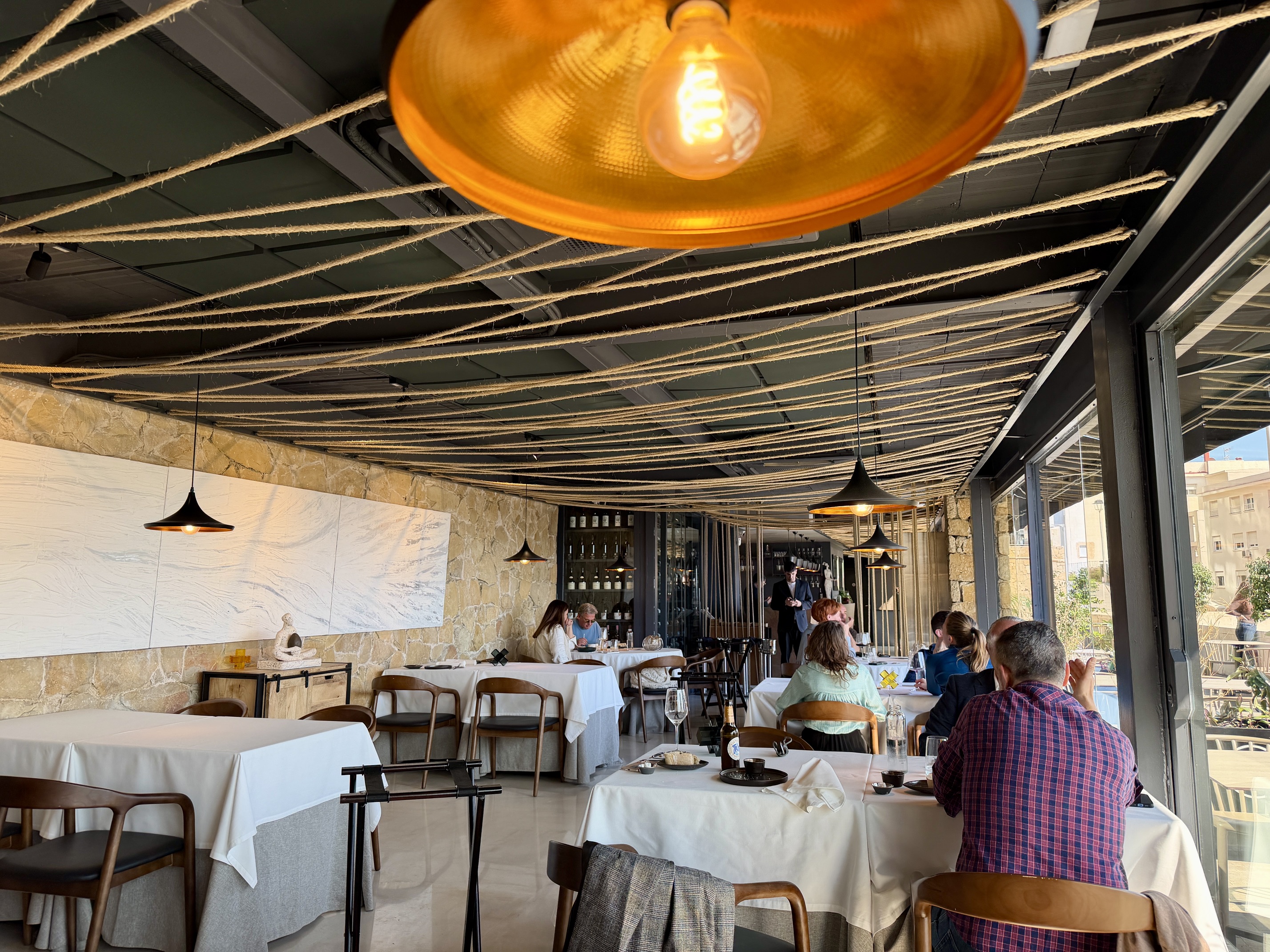
The room is stylish and airy, the views beautiful – especially if you eat al fresco – and the service charming, warm and perfectly bilingual. But the food is what really impressed me. The menu takes a sort of modular approach, inviting you to build your own tasting menu through a combination of snacks, smaller and bigger plates and desserts and I would say everything is on the neater, more pristine side but that doesn’t stop it putting together some gorgeous and surprising combinations.

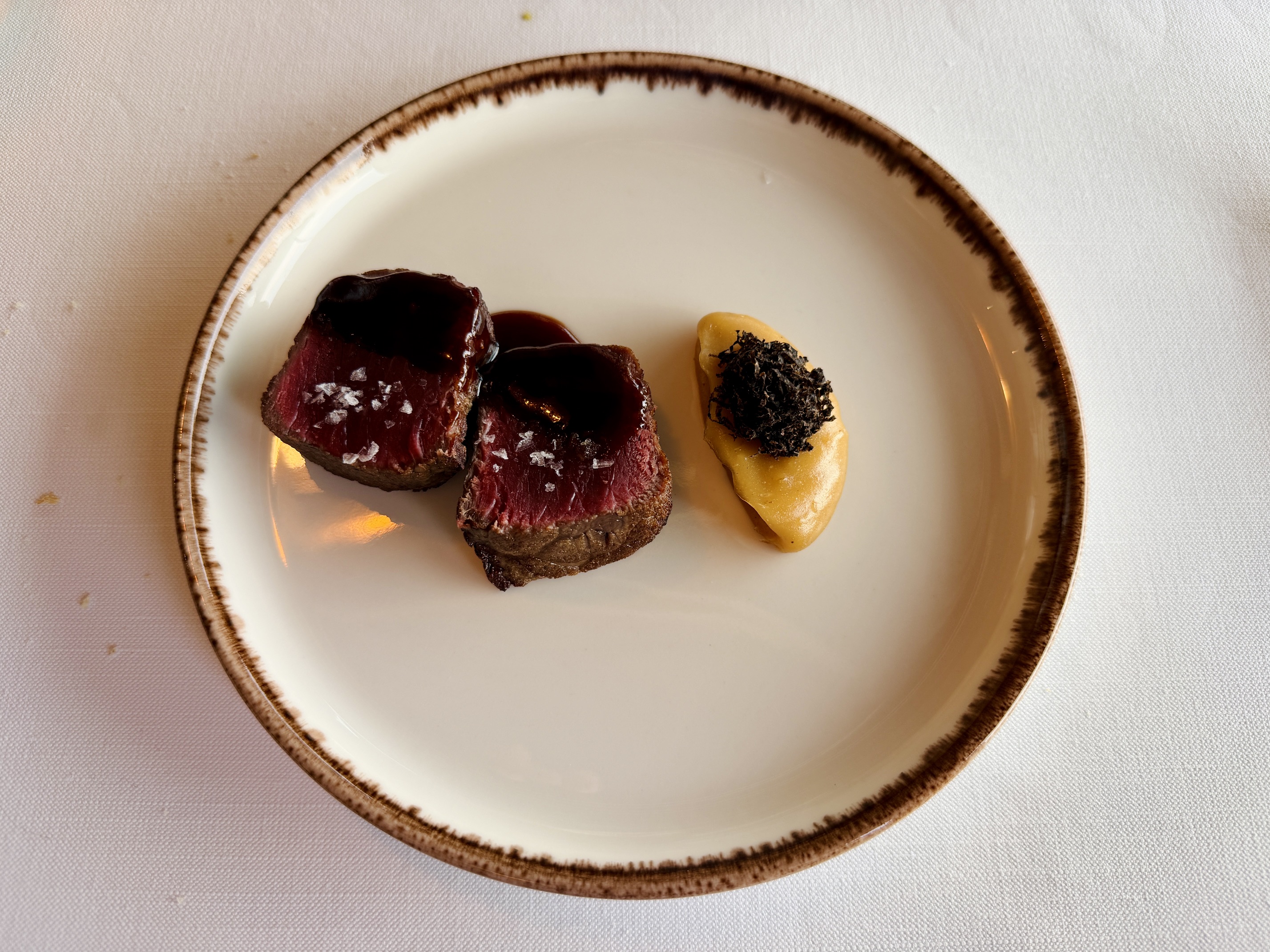
For me that meant a dogfish buñuelo – an ethereally light savoury doughnut – crowned with a miso mayo and bonito flakes which was deeply impressive, followed by cured bream served with an arresting green tomato gazpacho. It also meant some extraordinarily good beef with a sticky moscatel reduction, truffle and a complex purée of celery and plum. And it meant a gorgeous mango, mint and yuzu confection for dessert.

And what all that means is that I hope it’s still there next time I return to Málaga, so I can go there for dinner, watch the sunset and order even more courses.

Mi Niña Lola
Calle Campos Eliseos
https://www.restaurantemnl.com

4. Casa Lola

I first visited Casa Lola in 2016 on my first trip to Málaga and since then it has grown like Topsy with multiple branches, including two on opposite sides of Plaza de Uncibay, and another set of restaurants called Pez Lola. But my heart belongs to the original branch on Calle Granada, a brilliantly buzzy taberna which is often full at lunchtime very shortly after opening.

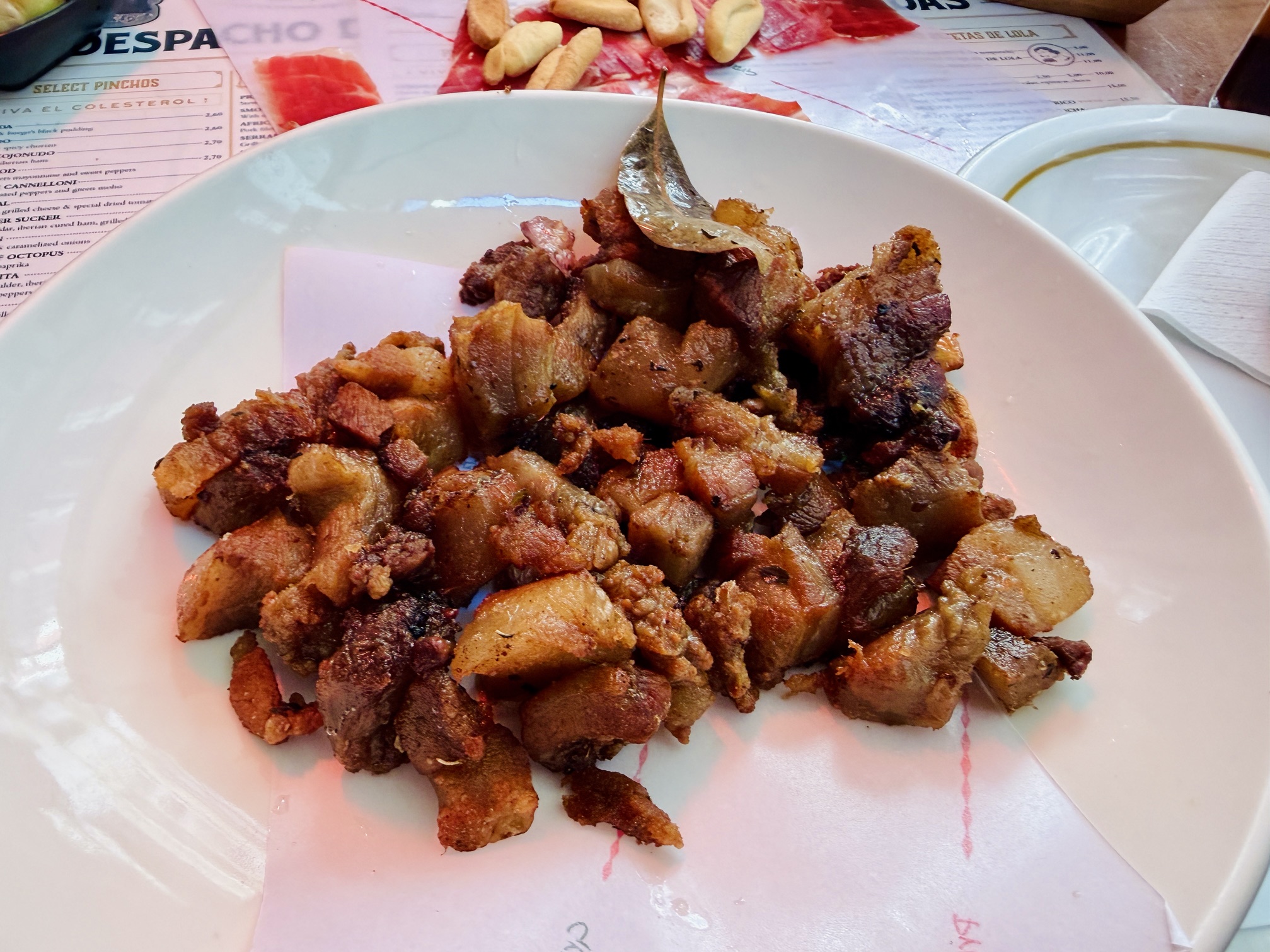
It has become a tradition for me to go there on every trip, usually at the start of my first day in the city, and invariably I order some beautiful ham and a cold vermouth (they do one, chispazo, with Coke which I like even though I probably shouldn’t) and a selection of pintxos topped with prawns, salt cod or morcilla. But I also make sure I order the chicharrones fritos, cubes of deep fried pork belly which are simply a plate of salty heaven. They also do, to my surprise, some of the best croquetas I’ve had on any trip.

On my 2026 visit, nearly 10 years after I first ate there, I finally did something I’ve never done before at Casa Lola – I ate outside. It was quite educational: when you eat inside you’re insulated from the sheer size and persistence of the queue to get a table. And yet I know that when I go back, probably on my first afternoon, I will be in that queue again, the anticipation of the chispazo and chicharrones so strong that I can already almost taste them.

Casa Lola
Calle Granada, 46
https://tabernacasalola.com

5. Vertical

I visited Vertical, a natural wine bar in the old city, back in 2023 and I really liked it. I drank some lovely wine by the glass, I ate beef croquetas, tomato tartare and a pinsa Romana with gorgonzola and guanciale and I bought a couple of bottles of sticky ambrosia to take home, which I packed in my suitcase with particular care.

In the run up to my 2026 visit I heard various things to the effect that Vertical had opened a second branch, or possibly moved, it wasn’t entirely clear which at first. It seems in fact that they’ve relocated to a site closer to the historic centre and the Plaza de la Constituciòn. But, having had a brilliant evening there on my most recent visit, it seems more has changed than just the location.

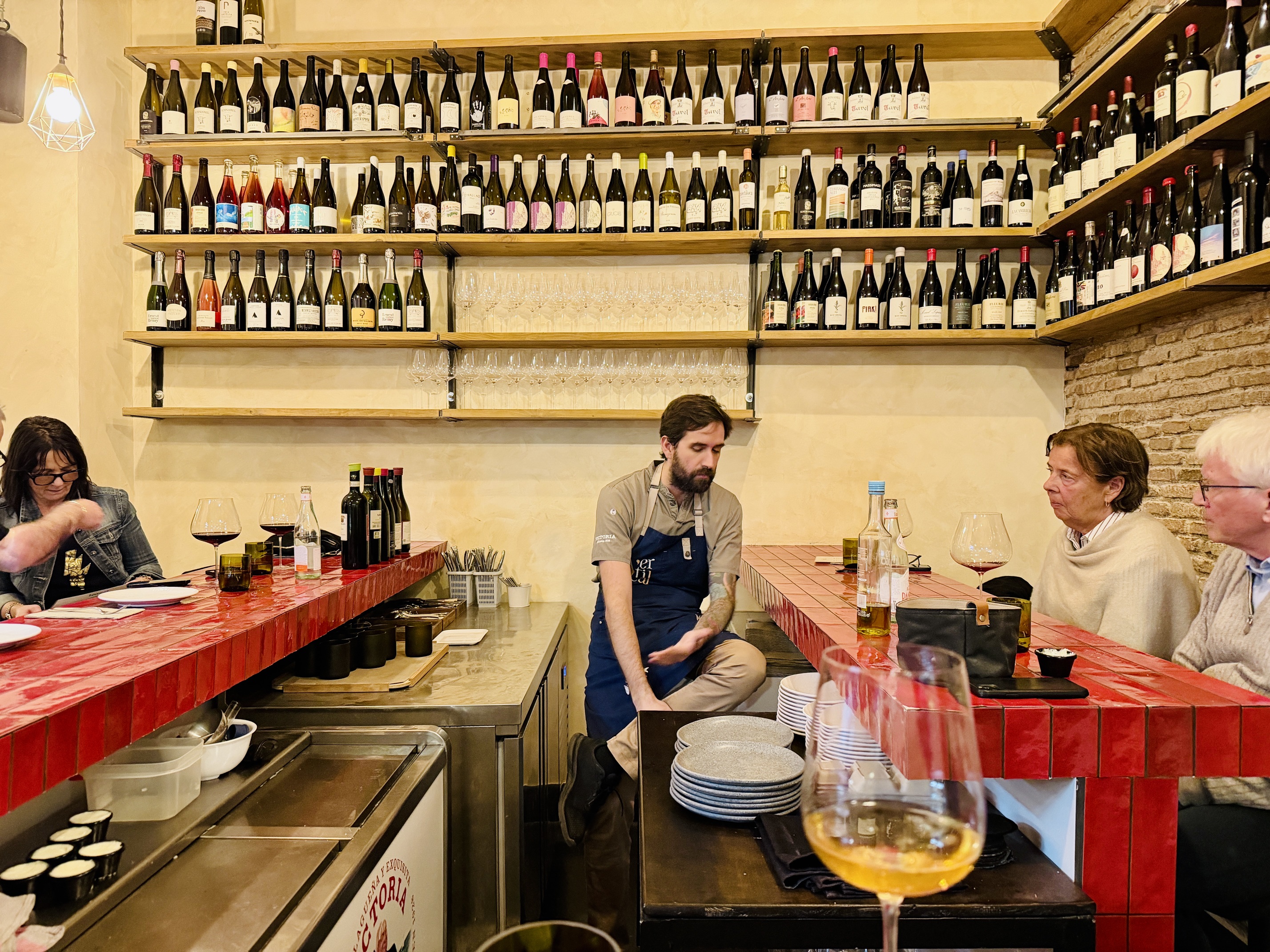
The previous site had more inside space and less outside space, the new one focuses more, it seemed to me, on a little dining room where everyone sits communally at an extremely striking red-tiled horseshoe-shaped bar. And the experience feels considerably more bespoke and high end than it did in their old home. There’s still a menu of smaller and larger plates, but everything is expertly curated by the man behind the bar – you tell him what kind of wine you’d like with each thing you eat and, glass by glass, he gives you brilliant options and takes you further and further down the rabbit hole.

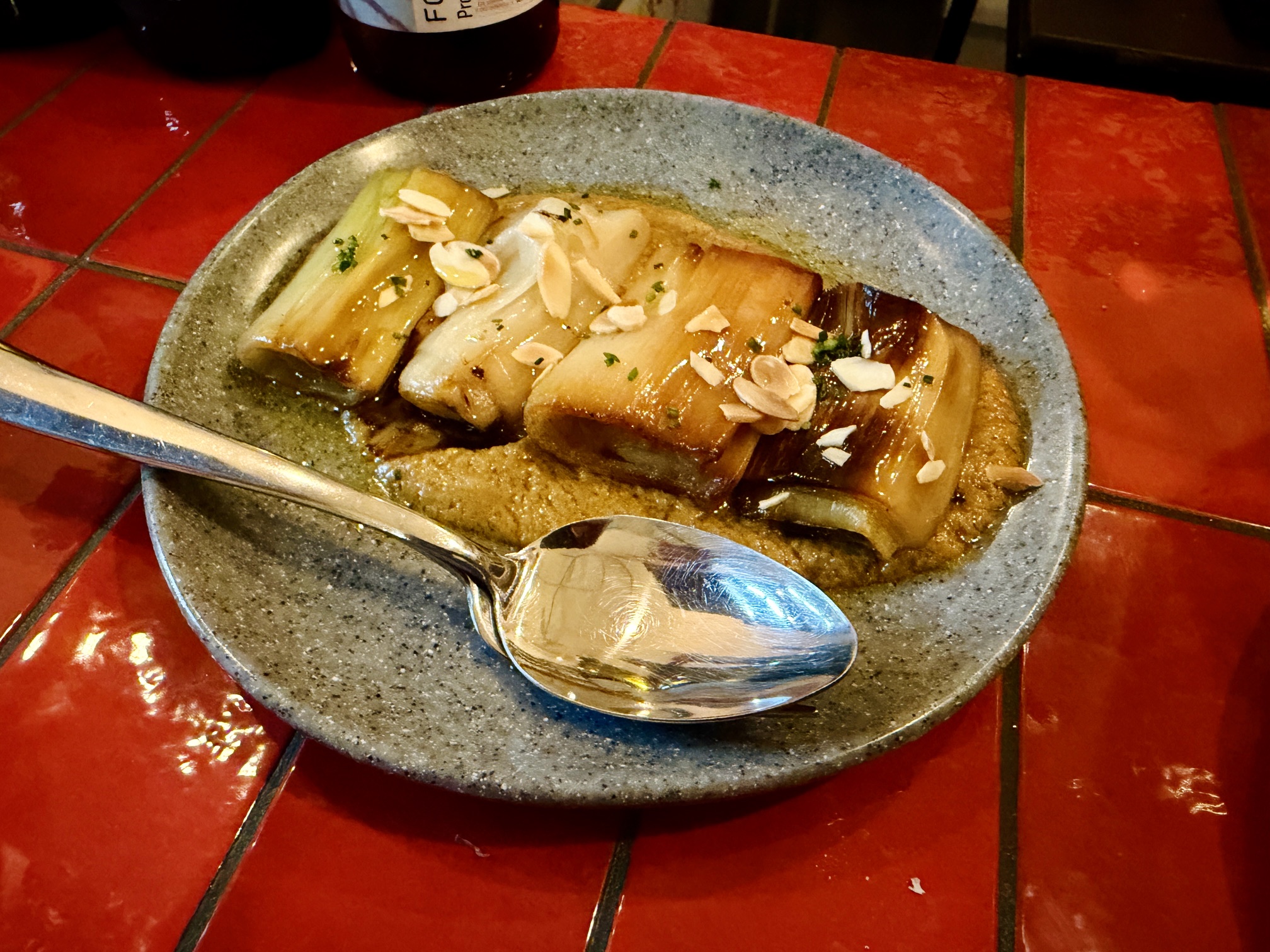
We ate superbly, feasting on knockout cured salmon and tuna tartare, shatter-crusted mollejas packed with cheese and sobrasada, the most delectable roasted leeks in a sweet but savoury almond sauce. It is, frustratingly, the Málaga restaurant where I seem to have the least photographs of my food, because I was so enamoured with the experience that, for an evening, I forgot that I would eventually be writing it up.

The problem with a meal like that, where you’re not picking from a wine list, is that you don’t really know how much your bill is going to wind up being. But the two of us were there for two and a half hours, eating and drinking, all that food and seven glasses of wine apiece, and it set us back about £170. When we went there in 2023 it cost about the same, and I’m sure we had less to drink. Would that everything in life was as inflation-proof as Vertical.

But the communal spirit at Vertical was just as lovely. Everybody around that bar felt like they were joined in some happy coincidence, ordering dishes because we saw them turn up somewhere on the horseshoe, enjoying superb wine recommendations that were never the same as our neighbours’, even when we were eating the same dishes. That was virtuoso service and no mistake. The Dutch couple along from us ordered croquetas, boasting that there was no way they could beat their beloved bitterballen. First they ate the croquetas. Then they ate their words.

Vertical
Calle Moreno Monroy, 3
https://www.instagram.com/verticalmalaga/

6. Palodu

Since this entry was written in 2023, Palodu has won a Michelin star – quite right, too.

Most of my meals, on my 2023 trip, were emphatically casual dining. That’s not to say that the flavours weren’t great or the presentation, in places, beautiful, but it does mark out Palodu, a recommendation from one of my Spanish followers on Instagram, as a very different proposition. Make no mistake, Palodu is aiming for a Michelin star and everything about it points to that. The room is hushed and stylish, the tables big and beautifully spaced. The service is attentive, the ratio of staff to diners close to one to one. From our table, Zoë could see the open kitchen and watch the ceremony of dishes being painstakingly prepared and plated: Palodu is a plates with tweezers kind of a restaurant.

That’s not normally my cup of tea – I like a meal like that a couple of times a year – but Palodu was brilliant at it and I’m so glad I picked it. Across fifteen courses, including snacks to start and petits fours to finish, we were treated to an array of techniques and combinations from a kitchen absolutely at the top of its game. I took photos but not notes, and for once I suspended my critical faculties and just immersed myself in the experience. It was a wonderful fever dream of food – of fish precisely and perfectly cooked, of tiny lamb meatballs in a terrific sauce, of squid cooked simply and presented with a rich slick of sauce and translucent slices of mushroom.

And the wine pairings (yes, it was a splurge) were phenomenal including, for one course, a 1981 Riesling extracted by Coravin which was one of those wines you only encounter a couple of times in your life. Almost as good as the local Moscatel that accompanied our two desserts – I loved it so much that I was delighted to find it on sale, a few days later, at Vertical, the previous entry on the list. We bought two bottles for the journey home, and packed them even more carefully than usual.

Palodu
Calle Sebastiàn Souviròn, 7-9
https://www.palodurestaurante.es

7. Uvedoble

I think you would struggle to find a guide to Málaga anywhere on line that doesn’t tell you to eat at Uvedoble.

Mine have historically been no exception, and prior to this edition it was always number 1 on the list, the first name on the team sheet. I’ve been going for 10 years during which time its popularity has grown, it’s moved round the corner to bigger premises and embraced online booking. In 2021 I said it was the single best place to eat I’ve found in Málaga, in 2023 I said it might be the city’s cleverest tapas joint.

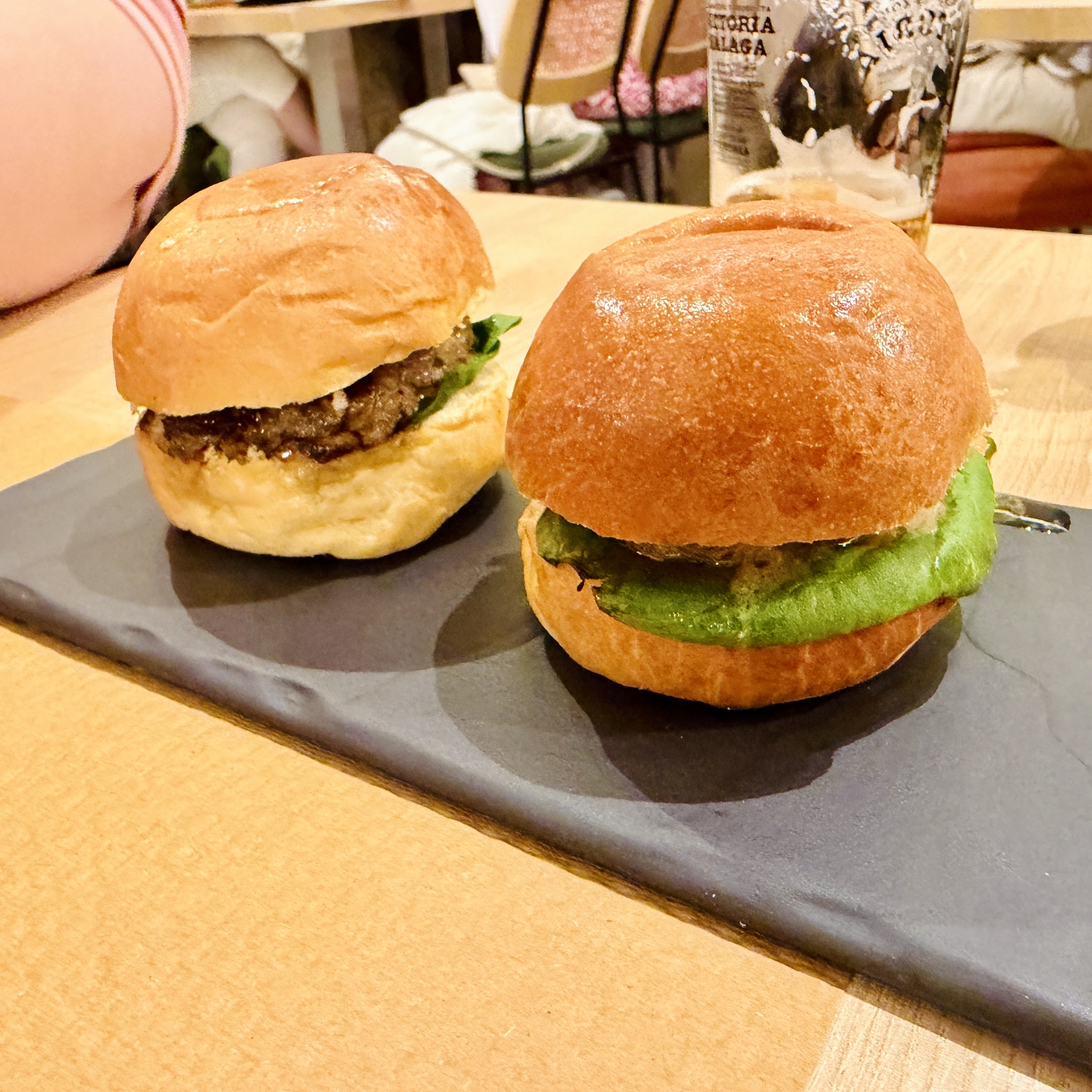
And yet on this visit I didn’t love it anywhere near so much, cementing some nagging doubts I had back in 2023. The experience was more brisk, a feeling of being processed rather than served. Some of the dishes are still stone cold crowd pleasers, like the little brioches packed with suckling pig with their caramelised brûlée top or the mini burgers laced with foie. You can’t go wrong ordering either of those, I maintain that.

But the rest of the meal didn’t live up to that. The octopus roll felt messy and perfunctory, the nest of squid ink fideua padded out, stingy on both the squid and the aioli. How had one of my favourite things to eat, ever, become a slog? And the boneless suckling lamb, always a beautiful cylinder of shredded heaven, was almost a flabby parody of itself, served on a drab gravel of couscous that could have come out of a packet.

Everyone has an off night, and god knows I’ve had enough in my time. If you’d never been to Uvedoble before, and you booked it while on a holiday to Málaga, you might come away as excited as I was in 2016. I hope that my response to it this year was just feeling jaded, but I fear not: I think a combination of stasis and believing its own hype might be at play now. I came away wishing I’d gone for the treble at Mesón Ibérico.

Taberna Uvedoble
Calle Alcazabilla, 1
https://www.uvedobletaberna.com/en

8. La Cosmo

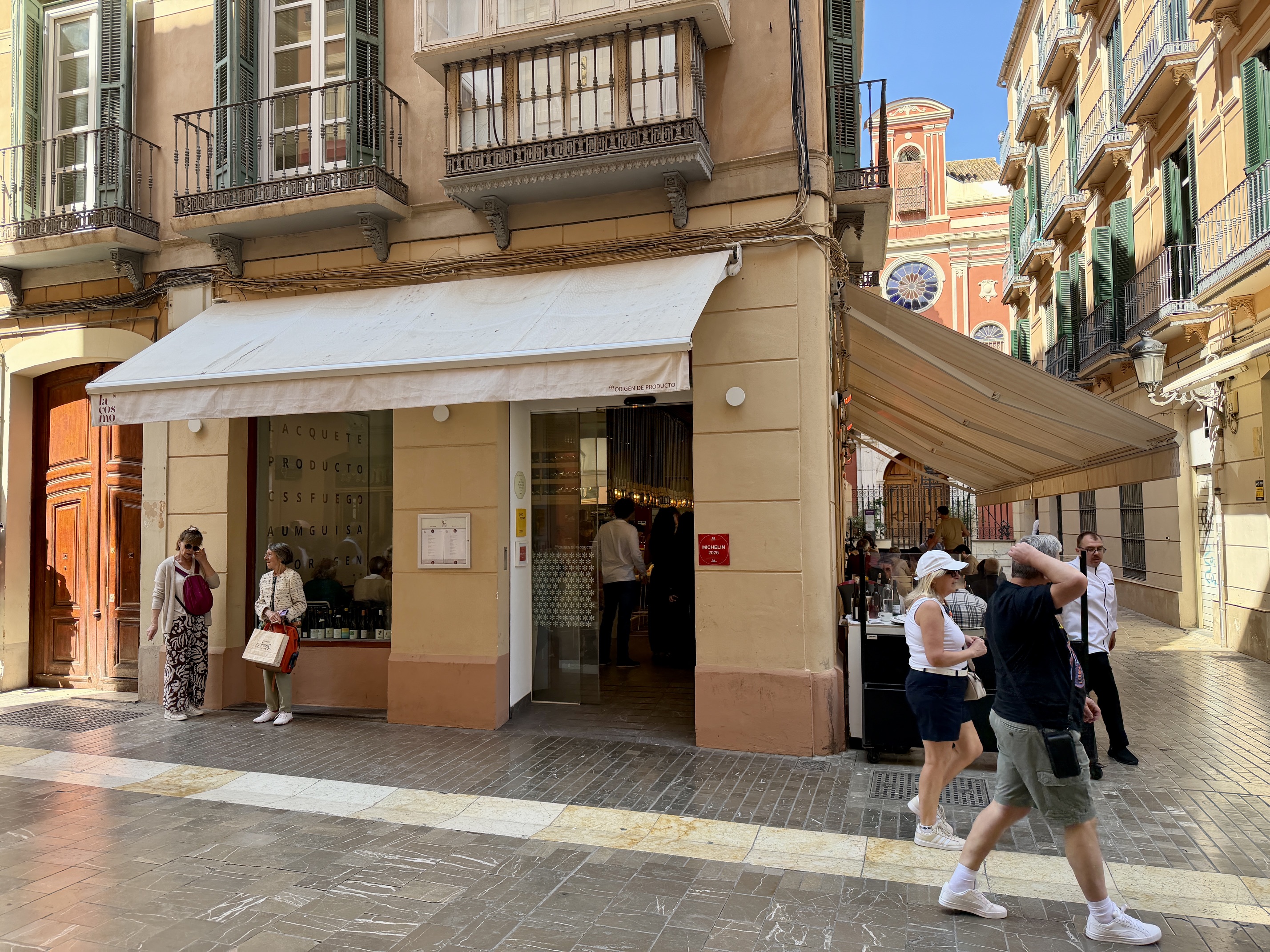
La Cosmo used to be the more accessible sibling restaurant to La Cosmopolita, which I loved but which closed in October 2025. I’m not sure why La Cosmopolita shut its doors after 15 years while La Cosmo remains as chef Dani Carnero’s non-starred outpost in the city (he also has Kaleja, which I am yet to visit). Perhaps its Bib Gourmand from Michelin holds the answer to that question.

It is smaller and more casual than La Cosmopolita was, the furniture more modern and more clinical. But all that said it is a really lovely place to eat, even if I maybe liked its departed relative slightly better. The menu is structured as starters/mains/desserts but it turns out that they expect you to share everything you order unless you tell them differently, which can make things tricky if one of you – hypothetically speaking, of course – is set on enjoying a dish all to themselves.

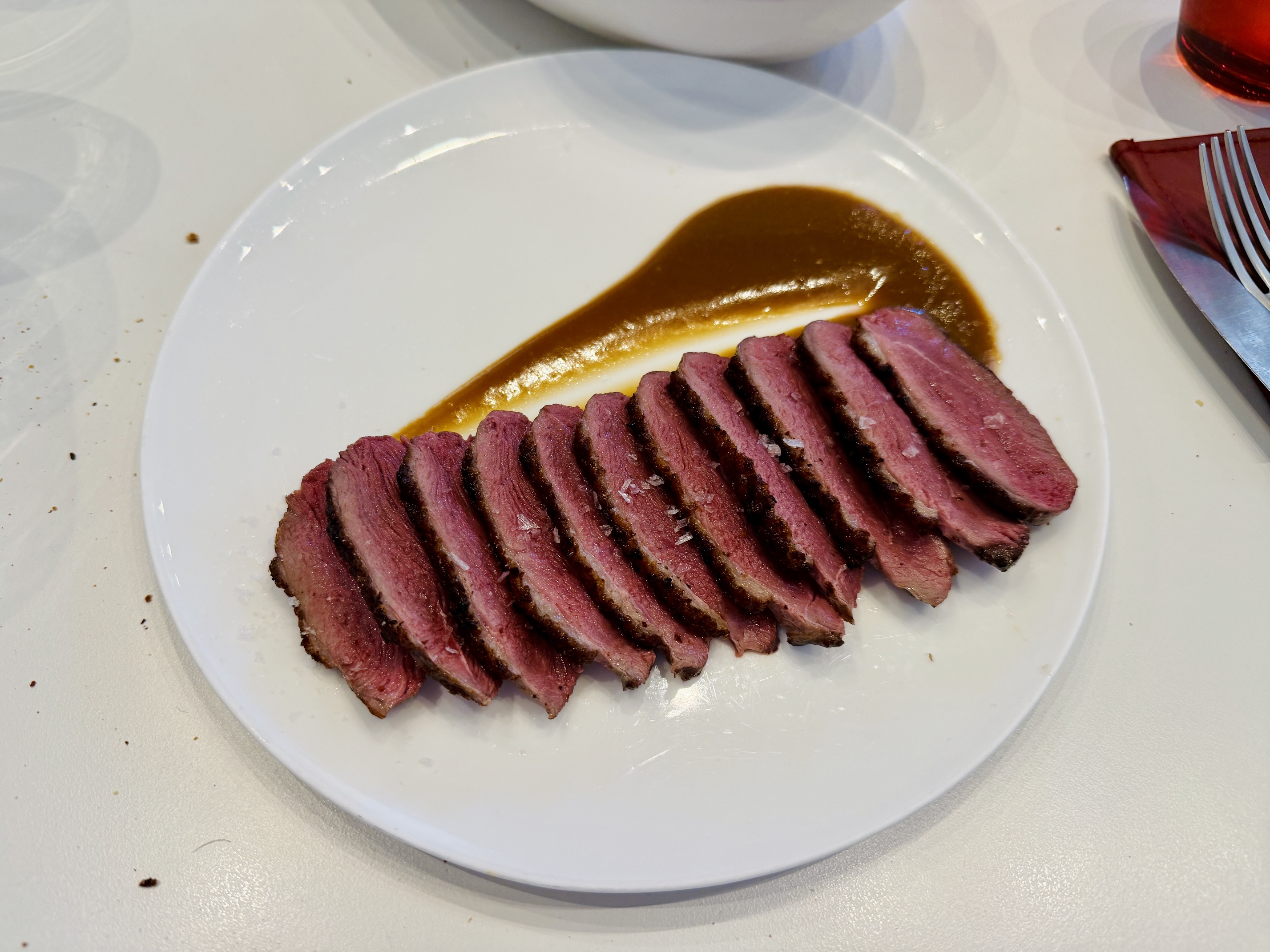
That’s especially challenging if you have a partner – hypothetically speaking still, of course – who has a tendency to order far better than you. Never mind. So I can tell you that Zoë’s leeks carbonara with cured egg yolk were a dizzyingly good piece of work, and so was her sirloin, super-tender cubes of beef dotted with baked potato in a surprisingly arty plate of food. I had to settle for an only slightly less excellent take on ensaladilla rusa with hake and stellar extra virgin olive oil and duck breast with a deep, if incongruous, barbecue sauce.

We both, however, ordered La Cosmo’s gilda, widely thought to be a must-order, which adds tuna belly and confit tomatoes to a tried and tested formula. It is indeed a standout – a 7 Euro standout, but a standout nonetheless.

La Cosmo
Calle Cister, 11
https://www.lacosmo.es/en

9. Base9

Base9 is in a more residential part of Málaga, not far from the train station or, more importantly, its enormous and very appealing branch of department store El Corte Inglés (the top floor is a huge deli and food hall – I picked up some terrific dessert wine there, along with some melatonin from the pharmacy in the basement). Base9 has been going about three years and already has a Bib Gourmand, and based on my visit that’s no surprise.

It’s actually quite a small restaurant with bare brick walls and a semi-exposed kitchen, and its menu is priced and designed to be shared. But perhaps more unusually, in many cases they make that easy for you: so, for instance, if you order albondigas in an almond sauce, as we did, they will charge you for one portion but bring you two bowls, each with your own personal helping. If you’re dining with someone, still hypothetically speaking, who is a stickler for fairness, that could be a positive boon.

The dishes we had were, by and large, really excellent. The albondigas were great, as was presa ibérica with a green peppercorn sauce and little cubes of fried potato. My favourite was the rolled shoulder of lamb, positively glazed in a sauce so shiny you could almost see your face in it, the whole thing looking more like a dessert than a savoury course, more sticky toffee than caulfilower houmous.

Only Base9’s signature tortilla was a misstep for me – designed to be their take on the Japanese omurice, where a paper-thin layer of cooked egg is draped over the contents beneath, I thought it slightly prioritised technical excellence over the eating experience. It was the outlier though, the one piece of evidence that Base9 might not consider the Bib Gourmand recognition enough. It wouldn’t stop me returning to check in on their continuing evolution.

Base9
Calle Salitre, 9
https://www.base9restaurante.com

10. Freskitto

When it comes to ice cream, traditionalists go for Casa Mira, still going strong on Calle Marqués de Larios after more than a century. I’ve heard good things about the chain Bico de Xaedo, which had a branch literally a minute from my apartment in 2023. But my loyalties are with Freskitto which has two spots on Calle Granada – one a kiosk, the other with a handful of seats inside.

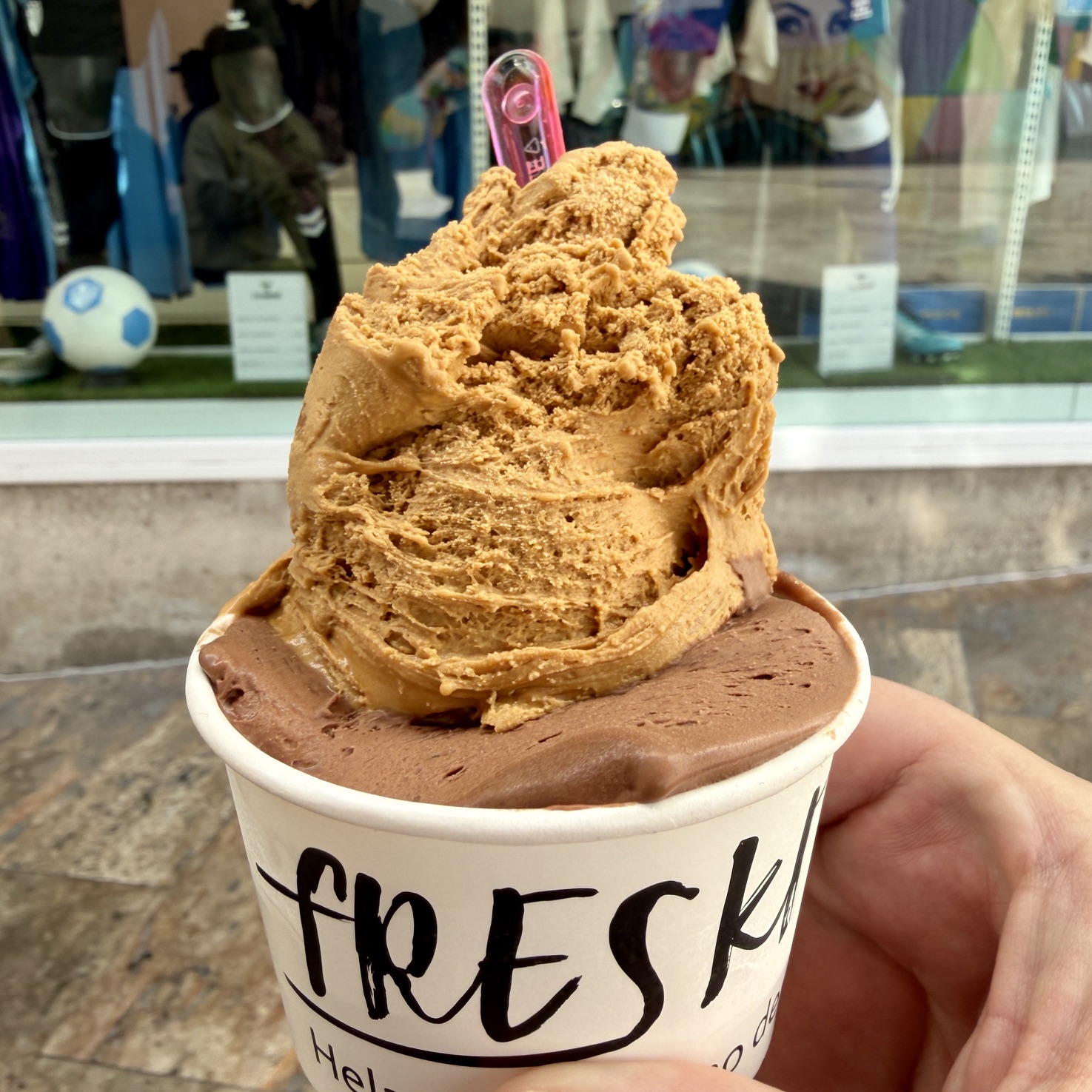
Service is superb, and Freskitto’s stuff really is top notch – closer in texture to gelato than ice cream and sheer joy to eat. I’ve pretty much narrowed my order down to a chocolate/dulce de leche combo, though I occasionally dabble with something else. Grabbing my paper cup and sitting just opposite, round the corner from El Pimpi, eating Freskitto’s beautiful ice cream and gazing up at the cloudless blue sky is one of my favourite Málaga memories.

On my 2026 visit I managed to go there nearly every day, but I did fit in one visit to Casa Mira to see if the above does it an injustice. Casa Mira, in any other city, would be the go-to spot for ice cream, but having tried it again I still say it can’t hold a candle to Freskitto.

Heladeria Freskitto
Calle Granada, 55

11. Mercado Atarazanas

Not content with being a mini Barcelona, Málaga also boasts a mini Boqueria in the shape of the handsome and hugely likeable Mercado Atarazanas. You can buy pretty much anything there – from just-landed fish to pig’s trotters, from freshly sliced jamon to salted almonds shining with oil. 

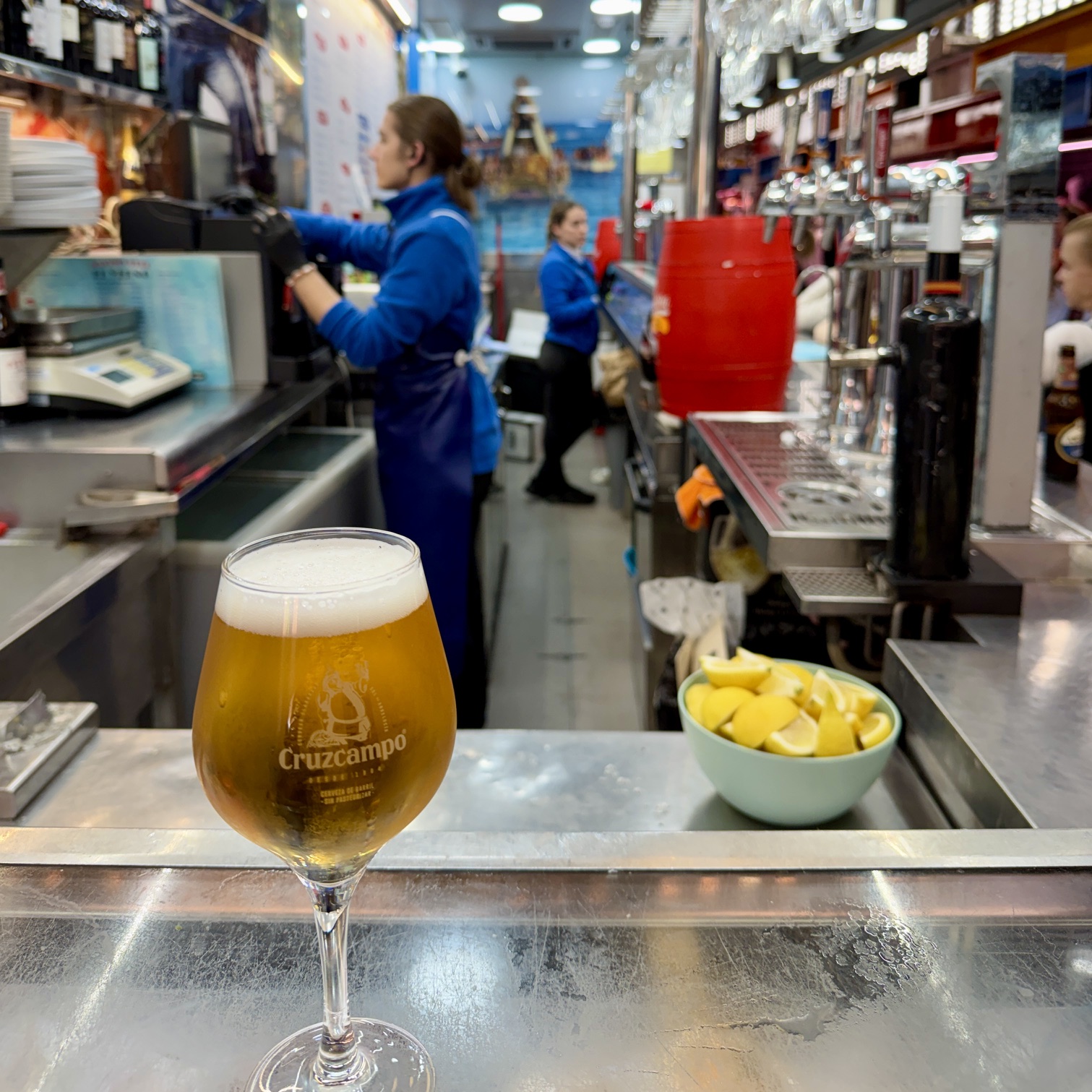
The real draw, for me, has always been Bar El Central in the corner of the market. You can stand up at the bar, drink your vermouth or your caña and get stuck into the incredible array of fresh fish and seafood under the counter, or have charcuterie, cheese and all the other main Spanish food groups. When I visited it last, four of us dined like kings for less than 100 Euros on tuna steaks, cooked simply, scattered with salt and served up with sensational tomatoes, on padron peppers and chicharrones de Cadiz, which were like a high definition porchetta.

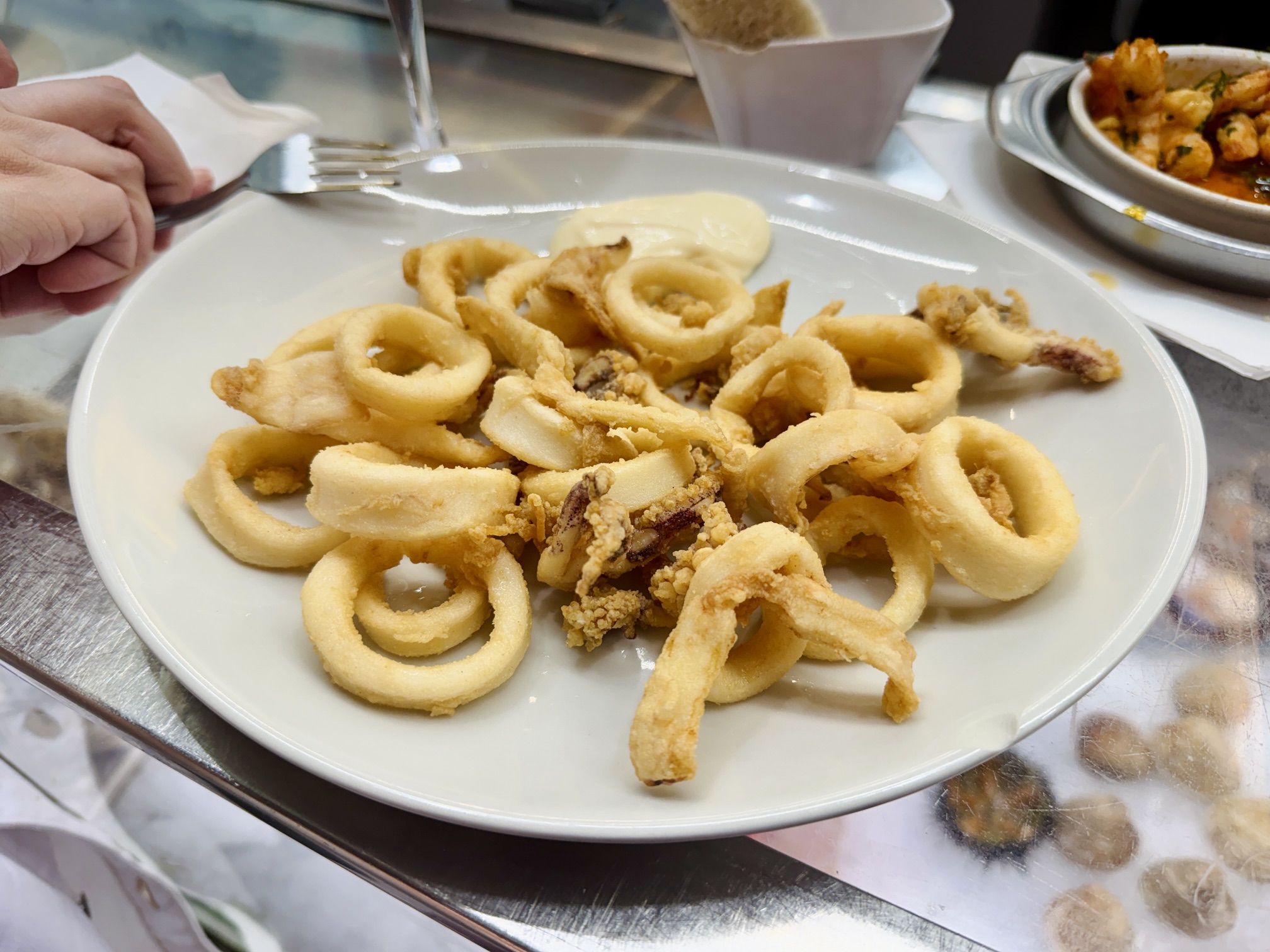
But in 2026, inexplicably, El Central’s shutters were down all week. So instead we stood at the counter of its neighbour, Marisqueria El Yerno, with a cold beer and a procession of beautiful dishes – calamari, gambas pil-pil, tomatoes bathed in verdant olive oil and finished with buttery avocado, tuna perfected on the plancha and served with an intense band of rare red through the centre of every slice.

On my final morning in Málaga I went back to the market to buy some supplies and gifts to take back home, and I was relieved to find El Central was trading again, the owners having either returned from their holiday or recovered from their illness. It was excellent news, but it set me up for the mother of all dilemmas next time I visited Málaga: which of the two spots in the market do I lunch at now?

Mercado Central de Atarazanas
Calle Atarazanas, 10

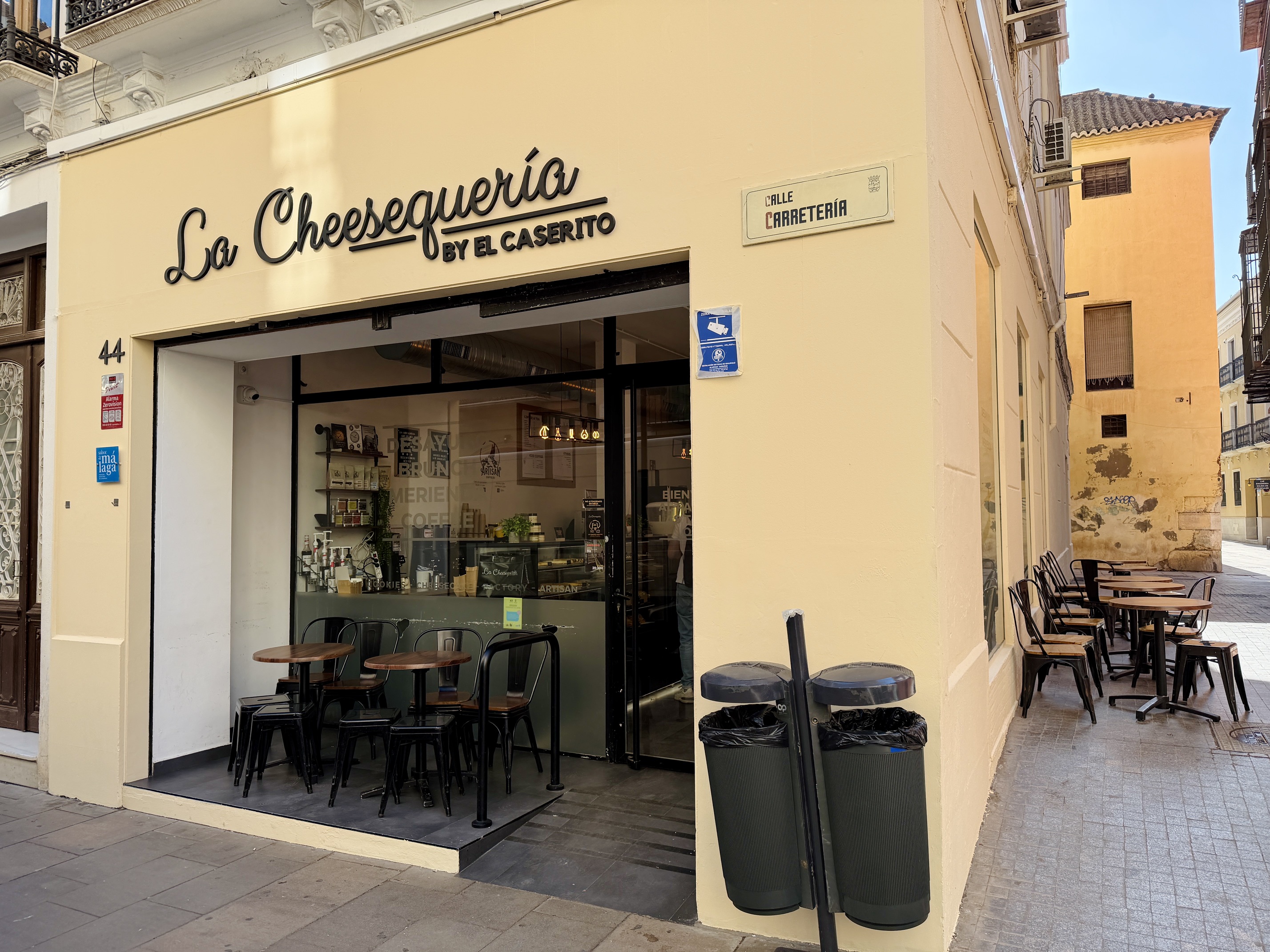
12. La Cheesequeria

La Cheesequeria, a cheesecake cafe on Calle Carreteria, was another recommendation from the Instagram follower that tipped me off about Palodu. And given how much I’d loved Palodu, I made a point of stopping off there in 2023 to pick up a slice of cheesecake to enjoy in the comfort of my apartment. It was a payoyo cheesecake and, at the time, I’d enjoyed one I had from now-closed Málaga restaurant La Cosmopolita slightly better: these days it might have no rival in the city.

La Cheesequeria does both sweet and savoury cheesecakes. I imagine the latter, some of them looking on the sweet side even for me, do very well locally but I was drawn to the savoury ones. Next time I’ll eschew the payoyo and go for a something with blue cheese – don’t knock it til you’ve tried it, blue cheesecake is out of this world – or the thing that nearly swayed me on this visit, a cheesecake made with 24 month aged Parmesan. That I can’t even imagine what that would taste like is, to me, reason enough to try it.

La Cheesequeria
Calle Carreteria, 44
https://www.lacheesequeria.com

Where to drink

1. La Tranca

La Tranca remains one of my favourite bars in the whole wide world, a scruffy and vibrant place which welcomes anyone who wants to drink vermouth or beer, eat good food and enjoy people-watching amid a crowd who all have the same laudable priorities. The music is Spanish, and the LPs behind the bar are a retro anorak’s dream. I can honestly say that this is a happy place at the epicentre of a happy place: I’ve never spent any time there that was less than sublime.

Sadly, its fame, and the growing popularity of Málaga in general, mean that it’s harder and harder to find a space there unless you’re an early bird or have very sharp elbows: I managed to fit in a pre-lunch drink on my most recent visit to the city, but the time before a drink at La Tranca eluded me. That’s probably why they’ve opened a second bar just round the corner, and why people drink at Colmado 93, the bar across the road in the site that La Tranca outgrew.

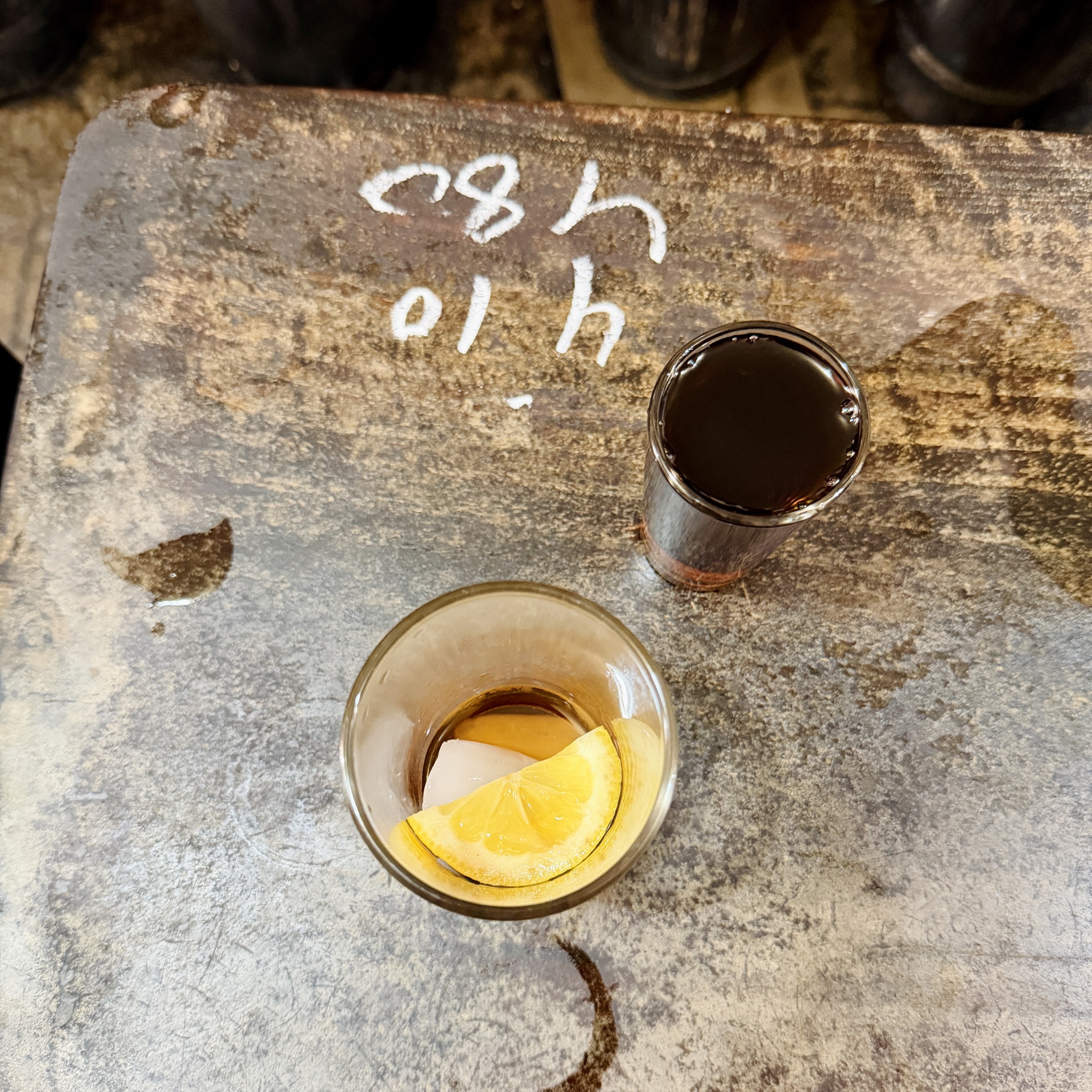
Although you can drink beer or vermouth here my preferred drink is the aliñao, a mixture of vermouth, gin and soda which slips down dangerously easily. After a couple of them, you find your life goals slowly shifting from whatever they were before to “how can I buy an apartment within stumbling distance of La Tranca?”

And that’s without talking about the food – wonderful four cheese empanadas with a tang of blue cheese or some of the best jamon I had on my holiday, sliced there and then and presented glistening on a board, waiting to be pinched between fingers and devoured. And fried olives – did you know fried olives were a thing? Me neither, and now I feel quite devoutly that they should be a thing everywhere.

On a previous visit, we’d bumped into an Italian singer-songwriter who had a long and fascinating story of jet setting from one European city to the next, la dolce vita in action. A tad randomly, we all follow one another on Instagram now, so one time, when we returned to La Tranca, Zoë took a goofy selfie of the four of us and sent it to him. “That’s really sweet of you!” came the reply from elsewhere on the continent in next to no time. “Enjoy the journey in beautiful Málaga. I miss it.” It has that effect on you. So does La Tranca.

La Tranca
Calle Carreteria, 92
http://www.latranca.es

2. Antigua Casa de Guardia

Antigua Casa de Guardia, like La Tranca, makes every single list of Málaga recommendations and has the crowd to match: when I visited the city in 2023 I tried several times to make it there for a drink to find the crowd just too huge, too impenetrable.

So again, the early bird pre-lunch snifter came to my aid and in 2026 I again found myself standing at that bar, next to Zoë, and I realised that you could hardly blame all those tourists for coming here. It remains, for me, the other place in Málaga to stop for a drink – a long thin room with a long thin bar where you pick from the sweet wines, sherries and vermouths in the barrels behind. They keep a running tab on your bar in chalk and as barely anything you can drink tops three Euros you do feel it’s rude not to stay for another, and another.

It’s standing room only, with only a few high tables, so settling in for a prolonged session is probably beyond most people, but to stand there sipping from your copa and watching the bar staff, all of whom seem like they’ve been doing this for years, is a quintessential Málaga experience. Every time someone tips – which happens with a frequency I found touching, given that cash is dying – one of the staff rings a ball and, presumably, an angel gets their wings. Worth visiting an ATM for, if you ask me.

Antigua Casa de Guardia
Alameda Principal, 18
https://antiguacasadeguardia.com

3. El Pimpi

El Pimpi is also a Málaga institution, to the extent where including it in this guide sets off the QI klaxons. A huge, sprawling bar with lots of little rooms and corridors, and a lot of outside space looking out on the Alcazaba, I surprised by how much I liked it. It was touristy, but not to its detriment, and it had all the things Antigua Casa de la Guardia was lacking, like seats, and toilets you could actually bring yourself to use.

My glass of Pedro Ximenez had that sticky, syrupy quality and the richness of thoroughly coddled sultanas and I would happily have stayed for more. There’s always next time, as I increasingly told myself as my holiday drew to a close. Antonio Banderas, a native of Málaga, is a big fan (he allegedly owns an apartment overlooking the bar), so there are a lot of pictures of him on display. A lot. Many of the barrels are signed by celebrities – including, after he stopped by on his recent Channel 5 series about Andalusia, Michael Portillo of all people.

El Pimpi
Calle Granada, 62
https://elpimpi.com/en/

4. Birras Deluxe

Every time I’ve come to Málaga I’ve visited Birras Deluxe, the craft beer spot on Plaza Merced, and each time I’ve liked it more and more. It came under new management before my 2021 visit and they’ve spent the intervening years making it better and better. It’s no longer the scruffy little spot it used to be, and its range of beers gets the balance bang on between Belgian classics, which used to dominate their list on keg, and up and coming Spanish breweries, both local ones like Attik Brewing and ones like Basqueland or Garage with a more international reputation.

In the past my choice of beer venue was an out and out choice between Birras Deluxe and La Madriguera, just around the corner. But La Madriguera didn’t impress me when I went there in 2023 and closed the following year, and one of the craft beer places they recommended in their farewell Instagram post, La Botica de la Cerveza, didn’t quite do it for me when I tried it in 2026.

Fortunately, the craft beer scene is pretty healthy and between Birras Deluxe and the next two spots on my list you’re pretty well served in Málaga if that’s what you’re into. My favourite thing about my most recent trip to Birras Deluxe, apart from quite uncharacteristically blowing something crazy like 40 Euros on an ultra-rare barrel-aged imperial stout, was the table of British boomers in the corner drinking spirits and insisting on splitting the bill using a calculator. Were they lost?

Birras Deluxe 
Plaza de la Merced, 5
https://www.birrasdeluxe.com 

5. El Rincón del Cervecero

My favourite part of Málaga is Soho, the triangular neighbourhood south of the Alameda Principal, the other side of it from the old city. It is full of street art, it has a very cool modern art gallery which is meant to reopen in 2026 and a much less fancy but far more endearing museum of optical illusions called the Museo de la Imaginación of which I am very fond. It is home to some of the venues in this guide, principally Mesón Ibérico and Santa Coffee. But until my visit in 2026 I’d never found anywhere decent to drink there.

It has a big and lavish-looking Cruzcampo taproom called La Fabrica, and I’ve tried it numerous times without ever having a decent beer there, including on my most recent visit to Málaga. But I won’t be back there again now, because I’ve finally discovered El Rincon del Cervecero. Where has it been all my life?

It’s a brilliant, unfussy, and very friendly craft beer spot which combines an excellent list of beers on keg – most by local brewery La Reina del Soho on my visit – with an outstanding beer fridge full of goodies from breweries across Spain including old favourites Caleya (who I discovered on my visit to Oviedo) and Madrid’s Oso Brew Co, who were new to me. In fact, and not just because of the presence of Caleya’s beers, it reminded me of Oviedo’s outstanding Cerveceria Cimmeria, with the same enthusiastic service and, perhaps more tangentially, retro heavy metal soundtrack.

All that and El Rincon del Cervecero also gets the food right – free nibbles, Granada-style, with each round of drinks and a small menu of bar snacks to stop you wandering elsewhere in search of sustenance. I loved my mojama, lavished in olive oil and carpet-bombed with almonds and I also really enjoyed a plate of sheep’s cheese. When I go back I can see some jamon or a bocadillo in my future.

It was absolutely my single favourite discovery of my 2026 visit to Málaga, and feels like it could be the beginning of a beautiful friendship. The good news is that I now have somewhere to drink while I’m waiting to queue outside Mesón Ibérico. The bad news is that it will be far, far harder to tear myself away in time.

El Rincón del Cervecero
Calle Casas de Campos, 5
https://elrincondelcervecero.com

6. Central Beers

I’d always overlooked Central Beers on visits to Málaga, thinking it was too big, too Belgian-focused, not quite authentic enough. That was my loss because I dropped in there twice in 2023 and both times it was excellent. It’s spacious, with plenty of big, sturdy tables. The table service is excellent and efficient. It’s a lovely place to while away an evening and the beer list is superb, featuring lots of breweries I’ve never heard of like Ireland’s Hopfully Brewing or the Basque country’s Laugar. If that isn’t enough, the fridge had a lot of strength in depth, including an imperial stout by French brewery Prizm, based not far from Montpellier, that might have been my beer of the holiday.

The other thing I loved about Central Beers was its surprisingly good and very broad menu featuring perfect beer food and bar snacks. Much of it is international in nature – more gyoza, again pretty impressive, or gnarled karaage chicken with a thick teriyaki-style sauce and slivers of apple. But the battered salt cod, served simply with aioli, brought it all back home. They also, and this is quite rare for Malaga, have a half-decent vegetarian offering which comes in handy if you’re out for dinner with someone who wants a little bit more than another portion of patatas bravas.

Central Beers
Calle Cárcer, 6
https://centralbeers.com

7. Casa Aranda

In the old days there were two places for churros in Málaga, Cafe Central and Casa Aranda. And then, tragically, at the start of 2022 Cafe Central closed because of a dispute with the landlord: how very Reading. It’s now a purgatorial looking “English-style pub” called “John Scott’s” owned by the Swedish company behind Kopparberg, which in my book makes it inauthentic in about half a dozen ways: if you’re tempted to visit it while you’re in Málaga, seek professional help.

Anyway, that just leaves Casa Aranda which fortunately is excellent. It’s grown and grown to the extent where it takes up a whole street and is beginning to spread round the corner: the waiters hang around at one end, managing an orderly queue to find you a table. Even though it looks rammed the process is impressively brisk, so you’re normally seated in no time. If you’re lucky, you’re outside with some sunshine, a view and some people watching opportunities. If you’re less fortunate you’re ushered into a slightly unlovely room.

Either way, the churros are champion. I go without fail on every visit to Málaga, usually multiple times.

Casa Aranda
Calle Herrería del Rey, 3
http://www.casa-aranda.net

8. Santa Coffee Soho

Coffee chain Santa has grown, to the extent that it now has three branches – a big one near Atarazanas, a smaller one near the cathedral and my favourite, in Soho. There are usually seats outside, the people watching potential is exceptional and their coffee is solidly, reliably excellent. They also sell beans to take home and, at the time of writing this in 2026, I have a bag in my kitchen cupboard waiting its turn.

Although I’ve never eaten a full meal at Santa – because of all the places in this guide – the brunches look decent. More to the point I have a soft spot for their alfajores, a hefty, delicious biscuit with a middle layer of dulce de leche enrobed, as marketeers are wont to say, in chocolate. It shows a Wagon Wheel up for the piece of shit it sadly is.

Santa Coffee Soho
Calle Tomás Heredia, 5
https://santacoffee.es

9. Next Level Coffee

Part of the continuing explosion in Málaga’s coffee scene, Next Level was new to me in 2023. Back then it had two branches, though it has since added a third on Calle Duende where El Ultimo Mono, one of my favourite coffee shops of previous visits, used to live.

The original branch on Calle Panaderos near the market, is more rough and ready whereas the second, which is a little more upmarket and has some excellent outside space, is on Calle San Juan and is all round a little nicer. Both, and this is the important bit, serve really impressive coffee: two top-drawer lattes cost a little over five pound back in 2023.

They also sell beans to take away, and the ones we bought, from Rotterdam’s Manhattan coffee roasters, might well have been the best coffee I had at home all year. Spain is very lucky that this thing called the Common Market allows them to buy the best coffee from anywhere in Europe without worrying about taxes and delays and paperwork. I can’t see it catching on here, more’s the pity.

Next Level Coffee
Calle Panaderos 14/Calle San Juan, 27/Calle Duende, 6
https://nextlevelspecialtycoffee.com/en

10. Kima Coffee

Kima, which is not far from La Cheesequeria, was the underdog coffee house that I really grew to love on my 2023 trip to Málaga. Back then it was small, little more than a kiosk, with stools for three people inside. In reality the clientele often stand up at the counter and chat away to their barista until the next lot of customers come in, which I found really likeable.

It reminded me a lot of Mia Café, the next entry on this list, which I loved in their first, tiny home but took a while to like when they outgrew it and moved somewhere bigger. On my 2026 visit I discovered that history had repeated itself and Kima had moved a few doors down Calle Carreteria to a much bigger site with dusky-coloured, Instagram-friendly chairs. That’s success for you, and although I would have stopped to check it out it was absolutely packed, which rather vindicates their decision. All power to them: I will be back.

Kima Coffee
Calle Carreteria, 67
https://kimacoffee.com

11. Mia Coffee

Mia used to be my favourite coffee spot in Málaga back in 2021, its pretty yellow awning bringing a flash of sunlight into the square it shared with the Church Of The Holy Martyrs Ciriaco and Paula. It had a little seating outside, and if you nabbed that you felt like you’d won the lottery: if not you just perched on the steps with one of Málaga’s finest lattes. When I went back in 2023 I was really sad to find that it had moved into a new spot in Soho, and when I went there I didn’t quite get it. Maybe without the magic of that location it wasn’t quite the total package, or maybe it was change resistant me not being able to get with the program: the latter is more than plausible.

Anyway, I returned in 2026 for a morning coffee and I think with the benefit of distance I could see Mia’s new home for what it was – a likeable, scruffy spot, filled with excellent coffee and friendly staff. Much like the old one, truth be told: come to think of it, whenever I drank indoors at Mia’s old place I had to concede that it was a little rough and ready. By those standards, taken out of its picturesque home and moved to Málaga’s finest barrio, it made a lot more sense. So it is restored to this guide, and well worth a visit if you don’t fancy al fresco people-watching at Santa.

Mia Coffee
Calle Vendeja, 9
https://www.instagram.com/miacoffeeshop/

12. Mala Leche

Mala Leche is just round the corner from one of Málaga’s three branches of Santa, but on a morning wander round the city its corner spot and outside space was so inviting that I decided to grab a latte there in the interests of research. They also sold alfajores, as Santa Coffee does, so I decided to try one – also, I should add, with investigative journalism as my sole motivation.

My latte was spot on, although I didn’t realise until my alfajor had turned up that they did two sizes, normal and extra large and I had inadvertently ordered the latter. So big you could only eat it with a fork I made a decent stab at it, aware the whole time that I must have looked like a right pig. At the end I was full of calories and the plate was full of crumbs, and I decided that on balance it had probably, just about, been worth the shame.

It turns out there are two branches, by the way: what is it with Málaga and these hugely successful micro-chains?

Mala Leche
Calle Castillo de Sohail, 1/Calle Zapateros, 3
https://malalechecoffee.com

13. Cafe Central Malagueta

Speaking of micro chains, remember I told you that Málaga used to have an amazing churros place called Cafe Central, right in the middle of the city, now sadly departed? Well, it is survived by a sibling out towards Malagueta Beach, just around the corner from Gastroteca Can Emma, and it makes a wonderful spot for a pre-lunch caña, café con leche or both.

Although it might not be a café con leche. Cafe Central, back in its more central days, had a wonderful sliding scale depicted in tiles on its wall showing nine different types of coffee, from solo with no milk to nube, hot milk with a splash of coffee (a traditional cafe con leche would be a mitad). It was invented in the Fifties by owner José Prado, and is still commemorated on the wall of Cafe Central’s remaining branch. You can even buy framed prints of it to take home: I now have one in the kitchen.

Central’s coffee is better than I remember, and they now sell their own blend for consumption off the premises, proof that they continue to reinvent themselves, over a century after they began trading.

Cafe Central Malagueta
Calle Cervantes, 13
https://cafecentral.es/en/pages/bienvenidos-al-central-malagueta

(Click here to read more city guides.)

Since January 2025, Edible Reading is partly supported by subscribers – click here if you want to read more about that, or click below to subscribe. By doing so you enable me to carry on doing what I do, and you also get access to subscriber only content. Whether you’re a subscriber or not, thanks for reading.
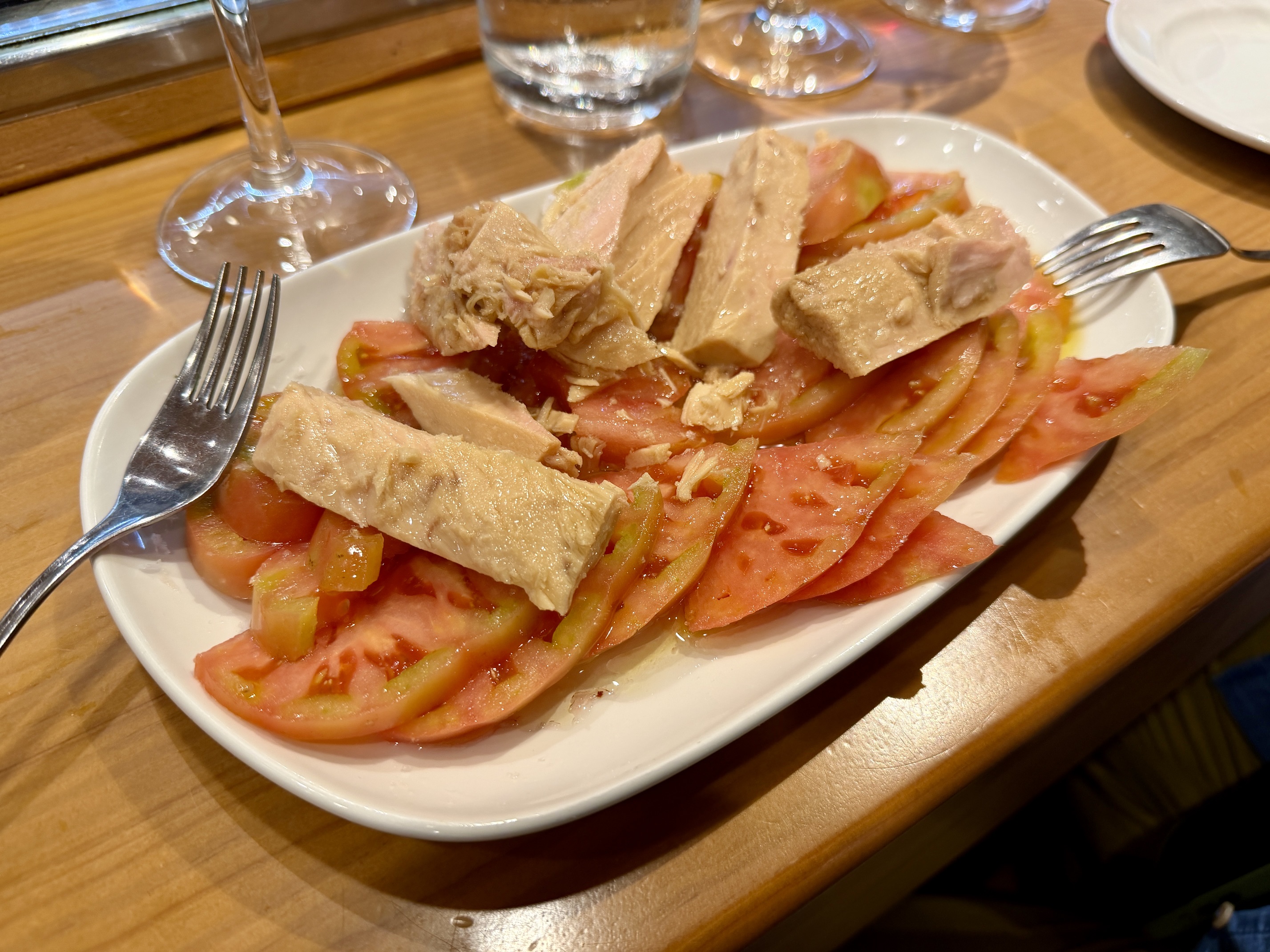
City guide: Granada (updated 2024)

Although this guide dates from September 2023, it has been updated as the result of another visit in September 2024. I have added a number of restaurants and cafés, and tried to make clear whether each entry dates from 2023, 2024 or a combination of both. I have removed two entries from this list, Bar Aliatar and the Mercado de San Agustin, because I didn’t visit them in 2023 or 2024. But they are still in the original 2019 guide if you want to read about them.

Of all the city guides on my blog, the guide to Granada is the oldest and creakiest: it was written over four years ago and I’m very conscious that a combination of Covid and life making other plans meant that I hadn’t been able to return to the city, one of my favourite places on earth. It was only this month, finally, that I got to renew my acquaintance with it: it was every bit as happy an occasion as any post-Covid reunion I can think of.

The previous guide talks about my own history with Granada and I won’t rehash all that here – by all means read it if you’re interested – but instead, after four years away, I wanted to set the scene by talking about just what a magical city Granada is, and why it’s worth considering if you’re trying to decide where your next city break should be. Because I think there’s nowhere quite like Granada, and I’m going to have a stab at explaining why.

First of all, there’s the obvious stuff. By which I mean the Alhambra, an eternally beautiful place full of placid gardens, burbling fountains and stunning Moorish architecture, tiles and carvings and woodworking which will stay in your mind (and on your phone) for the rest of your days. To this day it remains pretty much the only tourist attraction I’ve ever visited to which hype cannot do justice. But the people who bus in on a coach, see the Alhambra and then sod off miss out on one of the most beautiful, and certainly the most interesting, cities I have ever been to.

The other obvious thing is tapas, and Granada’s tapas culture. Tapas isn’t unique to Granada, or even necessarily to Andalucia any more, and the word has been culturally appropriated by everyone trying to sell you not much food for rather a lot of money. But if those people ever went to Granada, if they had any shame, they might just die of it. In Granada free food with every drink is a way of life – and not just shitty lip service food but good, interesting little dishes. You could hop from one bar to the next living on whatever accompanies your caña of cold, crisp beer but often – and this is the genius of the place – it sends you scurrying to the menu. If that’s what you get for free, just how good could the other dishes on offer be? Maybe it’s just me, but that gets me every time.

But there’s more to Granada than the Alhambra and tapas – although that, alone, would be enough to justify a visit. It’s many cities rolled into one. You have the gorgeous whitewashed side streets and traversas of the Albaicin, the ancient Arab quarter of the city. There are miradors looking out on the hills the other side of the river, at the majesty of the Alhambra and the mountains beyond.

Connecting the Albaicin to the centre are steep streets lined with teterias, houses serving beautiful tea, fragrant with mint or spices. And then there’s the faux market of the Alcaiceria, a little grid of lanes which serves as a pocket version of Istanbul’s Grand Bazaar, only without the haggling. Beyond that there is the serene beauty of its cathedral and monasteries, and gorgeous tree lined squares where the birdsong is deafening as the evening begins. 
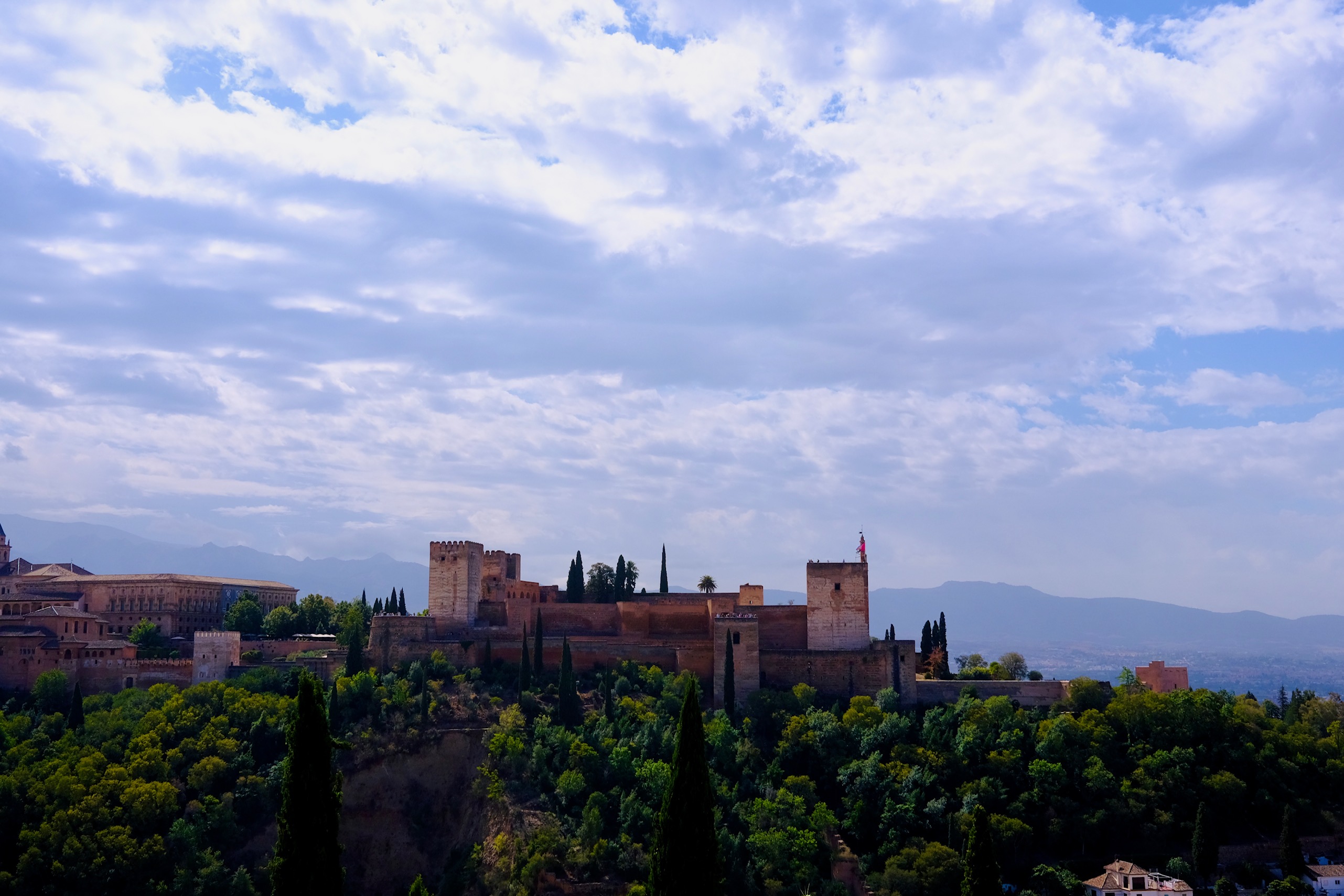
If that wasn’t enough, there’s also the Realejo, a district full of street art and scruff, busy bars, craft beer and third wave coffee. And of course there’s the Carrera del Darro, possibly Granada’s most beautiful street, hugging the banks of the river, crossed by little bridges, before it opens out into the Paseo de los Tristes, a beautiful square which affords you a gorgeous view up to the Alhambra.

I could go on. The shopping is surprisingly good, the coffee scene has come on in leaps and bounds since I visited in 2019 and the more modern parts of the city, away from the cathedral or the main drag are full of great restaurants and bars, many of which are largely untroubled by tourists. Truly I love everything about the place, from the bollards in the shape of pomegranates (the symbol of the city) to the tiny red buses that crisscross its narrow streets. Have I convinced you yet?

If I haven’t, a few final extra things might. It always used to be tricky to get to, but Vueling flies there direct from Gatwick once a week – out on a Tuesday morning and back on a Saturday evening, the perfect duration for a city break with a day to pack beforehand and a day to reacclimatise afterwards. And last of all, I struggle to think of a better value city break. Even our best meals there came nowhere near to breaking the bank and not only does the beer come with food but things like coffee are unbelievably reasonably priced. A top notch, third wave latte will set you back less than two Euros. The shops and markets are full of things you can’t get at home – you know, niche stuff like fresh fruit and vegetables. Really, for my liking, it’s pretty close to heaven on earth.

This guide is completely revamped from its 2019 precursor. I have added a number of venues and taken a couple out – in the vast majority of cases where I’m recommending somewhere I recommended in 2019 I went there again on this trip and the writing (and, where possible, the picture) is brand new. There are only two recommendations carried over from 2019 which I did not get to revisit, and where this is the case I’ve clearly said so. I hope you find it useful, or at least enjoy reading it: all I can say is that I very much enjoyed living it.

1. Atelier Casa de Comidas

Atelier Casa de Comidas, a short walk from El Corte Inglés in the newer part of the city, received a Bib Gourmand from Michelin. And as so often that accolade, far more so than the overhyped Michelin star, is a reliable indicator that you’re going to have a fantastic meal.

It’s a beautiful, tasteful dining room and a menu full of temptations. In the evenings you can get a full tasting menu but I went for lunch in 2023 and everything I had was beautiful. I loved an appetiser of patatas bravas spiked and given a new lease of life with a hefty kick of kimchee and was in raptures about a phenomenal dish of nutty green peas in a rich, savoury broth with prawn foam, pickled prawns and fried prawn heads (not the kind of thing I’d normally eat, but enough to convert any doubter).

Pluma iberica – glazed almost like char siu – was up there with the best I have ever had and a dessert of chocolate ganache with ginger and rosemary was a fantastic way to end a meal. So why, even having had one of my lunches of the year, did I find myself thinking about the savoury croissant, loaded with slow-cooked oxtail, that my companions had had the sense to order and I hadn’t? C’est la vie, I suppose.

I should also mention that the restaurant had some of the best service I’ve experienced in a long time. The staff were trilingual (some speaking English and others speaking French when our English and Spanish respectively weren’t up to the task) and the sommelier was magnificent, picking us some outstanding cava, wine and sherries for all of our dishes. The single most expensive meal of the entire holiday, it cost barely more than fifty pounds a head.

I said in 2023 that when I went back to Granada this would be the first reservation I make. And so it proved, because on my final night in the city in 2024 we returned for the tasting menu. On this occasion the staff were not as trilingual, or even as bilingual, as I might have liked so I missed the nuance of some of the dishes but there was no mistaking the quality of the execution. It was a real fireworks display, from watermelon treated almost to have the taste and texture of meat, to a fantastic sea bass tartare with kimchi and caviar, to rudely pink Iberian pork, cooked superbly.

Atelier Casa de Comidas appears to have lost its Bib Gourmand since I went there first. But on the most recent display, they seem to have loftier goals in their sights.

Atelier Casa de Comidas
Calle Sos del Rey Católico, 7, 18006 Granada
https://ateliercasadecomidas.com/en/home/

2. Betula Nana

I had another truly lovely lunch in 2023 at Betula Nana, a small chic restaurant just opposite Granada’s small and perfectly formed Botanical Gardens. It’s a great spot which reminded me a little of Bordeaux’s Echo, and its menu was also compact and bijou. But it was also brimming over with inventiveness and delicious flavours. I had huge envy for my companions’ squid ink tortilla, black as night, swimming in a garlic sauce and garlanded with clams, but had a starter, in the shape of a carpaccio of king oyster mushrooms with tiny nuggets of candied, caramelised beetroot which was unlike anything I could remember.

Main courses, if anything, induced more envy – my confit bacalao was a dish badly in need of some carbs, and I wished I’d gone for Zoë’s pork cheek curry, all retro Vesta flavours, the sauce seeping into a bed of potatoes crushed with olive oil, or Liz’s beautifully done tuna tataki. But that’s life. For dessert, because the four of us couldn’t decide, we ordered all three desserts – a wobbly tart, a gooey chocolate cake and a colossal tiramisu – and attacked them between us. Our lunch came to just over forty quid a head, helped by the fact that you can’t find a bottle on their wine list costing more than twenty Euros. I love this city.

Returning in 2024, I found that if anything Betula Nana had raised its game still further and everything I had was just terrific. I wouldn’t say the menu had changed drastically in the intervening year, but a cecina and fig salad was far more enjoyable than salad has any right to be, and squid in its own ink served on a pillow of basmati was a Stygian miracle. This time I chose more smartly, and the tuna tataki – an ever-present on menus on the continent – was one of the most memorable dishes of my trip. Betula Nana only has about 18 covers, seems to be busy every lunchtime and can only be booked by WhatsApp. But it’s well worth doing so.

Betula Nana
Calle Málaga, 9, 18002 Granada

3. Bodegas Castañeda

Bodegas Castañeda, on a random weekday night nearly twenty-five years ago, was the first place I ever went in Granada. It was love at first sight – a long bar, all the beer and vermouth you could drink and a tapa with every single one. A different tapa every time, too, because they keep track. Since then I have never visited Granada without going back to Bodegas Castañeda, usually multiple times, and it’s invariably the first place I visit. 

On my 2023 trip I went twice in one day – once mid-afternoon with Zoë to check that it was still heaven on earth, and then in the evening with Zoë, Liz and James because few better places exist to kick off an evening. It seems to be busier every time, and now they have a lot of tables in the alleyway outside, but I still prefer standing at the bar, bustling and jostling, and enjoying it for as long as I can. 

That said, I went back in 2024 and again, sat in the alleyway, and for the first time got the sense that Castañeda was perhaps trading on past glories. The food was a little scruffier, a little lazier, a little underseasoned and lacking in finesse. The furniture was tatty, and I wondered whether my favourite place for a quarter of a century was being superseded, not just by the whippersnappers but also by the old stagers like Los Diamantes and Los Manueles which had expanded to multiple locations across the city while Castañeda, in the same place as ever, stood still.

Even saying all that, I know that the next time I go to Granada I will still go there, just to check in on it. It’s what you do with very old friends.

Bodegas Castañeda
Calle Almireceros, 1-3, 18010 Granada

4. Taberna La Tana

Like Bodegas Castañeda, I have been going to Taberna La Tana for a very long time. It is a fantastic place to drink wine and eat tapas, and for many years it was a relatively well kept secret. But Anthony Bourdain visited it in 2013 for an episode of Parts Unknown, and now that secret is out. That means it is always busy, which is no bad thing, but also that it is full of Americans, which may or may not be your idea of a good time.

On my previous visit to La Tana in 2019 it was still a place to arrive early and hug the bar – preferably at lunchtime when you could guarantee a space – and if you were really lucky and got practically the only table in the entire place you felt like the king of the world. But that has changed. In 2023 La Tana had plenty of tables in the alley outside and you could book them for a two hour early or late evening sitting. Somehow this didn’t feel very Granada, but I suppose it meant fewer people being turned away because it was full. So not the old magic but a new, different and equally valid kind of magic.
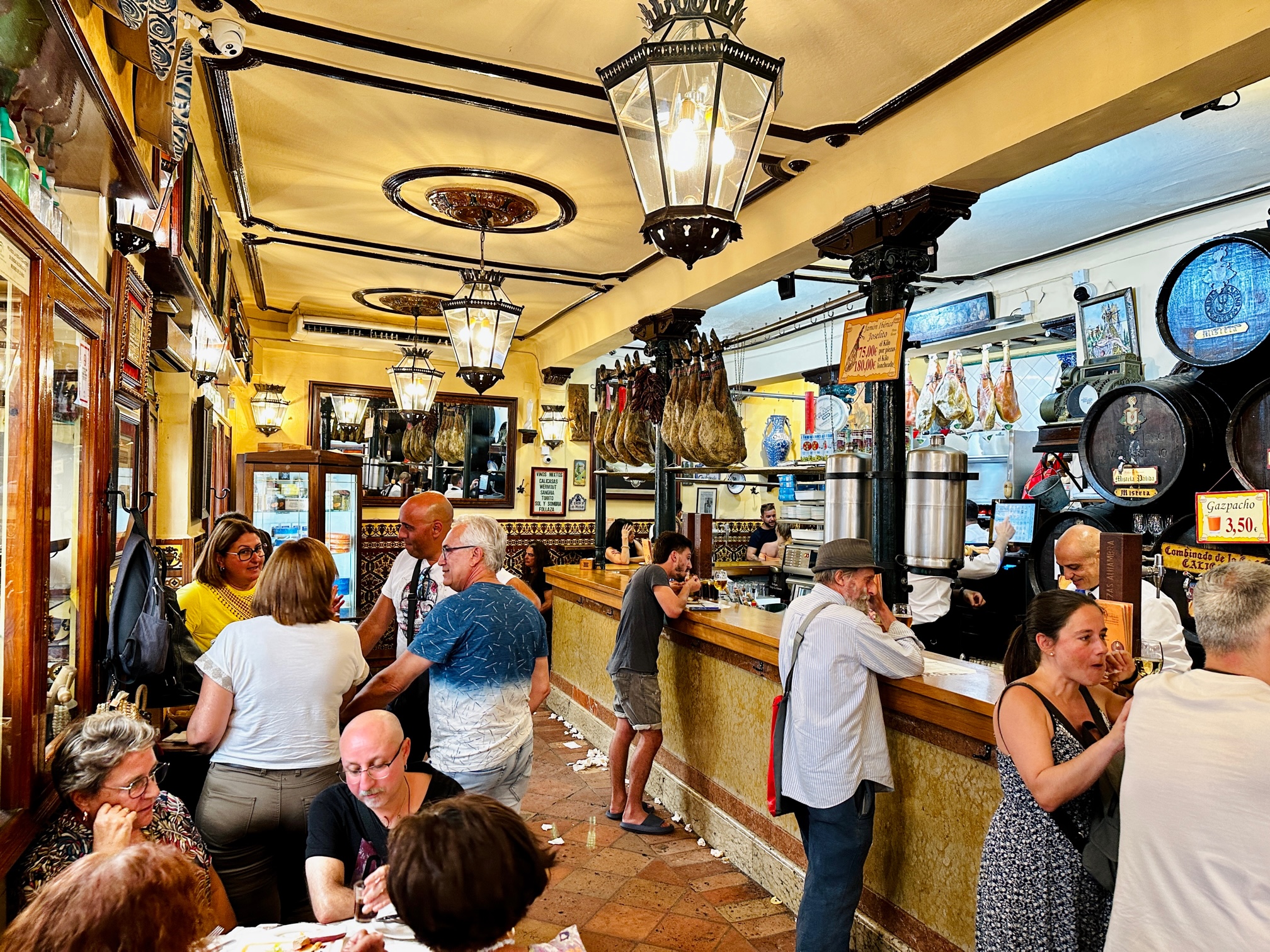
Returning the following year I found more change afoot. The front room now had tables in it too, and they had expanded further into the neighbouring room. Menus were on QR codes, and the whole thing felt brisker, slicker and more focused on maximising returns. And that’s all well and good – restaurants need to make money, and good restaurants deserve to survive, but I had a sense that the La Tana of 2024 felt a world away from the place I fell in love with over a decade ago.

Did it mean I didn’t have a brilliant evening? Absolutely not. The wine was exquisite (and having access to the whole list via a QR code was the right kind of progress), the guacamole was still the best I’ve ever had and La Tana’s tomates aliñado, tumbled in superb olive oil and studded with salt, were the best I had in the city. The anchovies and paletilla were outstanding, too.

If you’d never been to La Tana before and you visited it in this incarnation, you’d think it was the best thing since sliced ham, and you wouldn’t be a million miles off. But for those of us who have a longer acquaintance with La Tana, it’s a little more complex. It’s a wonderful place, but just not the same wonderful place I remember. I almost envy people discovering it for the first time, who never have to feel that tug of conflict between the old and the new.

Taberna La Tana
Placeta del Agua, 3, 18009 Granada
https://www.tabernalatana.com

5. Rincón de Rodri

We went to Rincón de Rodri on our last night in the city in 2023, a Friday night, and I had the best time there. It’s a seafood bar and restaurant – tall tables and the bar at the front, and more conventional tables at the back. We’d reserved a table for four, so we were at the back, and it was all a little faux nautical with blue and white striped walls. Only one other table was occupied, and I wondered if we’d made a bad choice.

But of course, it was because we turned up at half eight, when no sensible Spaniard would dine. And this restaurant is all Spaniards, to the point where they had to send over the only member of the serving staff who spoke any English. By half nine the place was rammed, and an absolute riot from start to finish.

And the food! The food was magnificent. From our opening tapa, slices of meltingly soft swordfish served with crisp white cabbage, to pert fried chipirones, golden and moreish sprinkled with freshly squeezed lemon and dipped in a thick, potent alioli, everything was fantastic. I particularly liked the hake, feather-light and impossible to resist, and a huge hunk of atun rojo, just-seared, still very pink in the middle, brought to a vacant neighbouring table and sliced thickly there and then, easily sashimi grade.

An outrageously good albarino was twenty-five Euros a bottle, and we ordered several. They brought us a shot of a liqueur the flavour of pionono, the cinnamon pastry particular to Granada, and it was like the best Baileys you’ve ever tasted. We rolled out having spent barely forty quid each, and I just wanted to do it again the following Friday night, and possibly every Friday night for the rest of my days. 

At the front, the celebrations were barely getting started. Sitting at a table for four is the civilised thing to do – and, when you’re in group that size in Granada, the only way you can guarantee that you’ll get enough space – but I think the thing to do is go there as a pair and stand outside when it opens, angling for two stools at that bar and all the albarino and tapas you can manage.

I tried to do exactly that on this visit, only to find it was closed and that they were having work done inside. It was my single biggest disappointment of the trip, and I will be back there as soon as possible to rectify that.

Rincón de Rodri
Calle Músico Vicente Zarzo, 3, 18002 Granada

6. Potemkin

When I first visited Potemkin, a little bar in the Realejo, it was a tapas bar that, possibly as a gimmick, served sushi – and sushi tapas – on Wednesdays. Well, they were obviously on to a good thing because when I made a point of returning five years ago I found they now serve sushi – and sushi tapas – all the time, along with some other Japanese dishes.

I don’t think I’ll ever get over the novelty of ordering a beer or a gin and tonic and just randomly being brought a delicate plate of avocado maki. Or ordering a subsequent drink and getting a plate of some other sushi. Going with friends in 2023 I remembered why I had loved the place so much in the first place, and so we ordered some of their other dishes and found their sushi selection remarkably good (and, yet again, cracking value). The gyoza were some of the best I’ve had anywhere.

But more than that, the staff were just marvellous. When we turned up all the tables looked to be booked. But they said we could have one, just for the two of us, until ten pm. And then as our friends joined they found more space, and brought more chairs, and nothing was too much trouble. One of the people looking after us had spent two years living in London and wanted to practice her English and talk about it, and of course we congratulated her on living in the best city in the world. 

At one point there was a spot of rain and with military precision the staff mobilised, grabbed umbrellas and put them up, and within two minutes everybody was back at their seats, ordering more drinks, getting more sushi. And, for the umpteenth time that week, I stopped and thought Can’t I just live here?

Returning in 2024, I decided I’d had enough of only using Potemkin for pre-dinner drinks, so we booked a table on the terrace and bedded in for the evening. Everything was as brilliant as I remembered and, unlike many places in Granada, the tapas doesn’t stop coming just because you’re also ordered from the main menu: maki after maki after maki.

Potemkin
Placeta del Hospicio Viejo, 3, 18009 Granada
https://potemkinbar.es

7. Saint Germain

Saint Germain, tucked away not far from the cathedral, is a cracking little bar, buzzy but conspiratorial. I’ve eaten inside, in a room with stools and a ledge, framed pictures all over the walls and not much else, and had a wonderful time. But on my most recent visit, as when I went in 2019, I was at one of the tables in the alleyway outside and I just had an enchanting time.

Previously I’d been there as a group of five, desperately trying to commandeer space, gradually nicking more stools, using one as a makeshift table. That might be your idea of fun – it was mine, many years ago – but for me a proper table in the dusk, reading menus by the light of our iPhones was much more like it.

Saint Germain has countless wines by the glass, and truly expert servers who will tell you you’ve absolutely picked the wrong one and you’d like something else better. They are, in my experience, correct without exception about that, because they know their wine list and their menu inside out, and have no qualms about ensuring that you make the most of both.

In the past I’ve adored Saint Germain’s chorizo cooked in honey, and I nearly ordered it on this visit, but the specials were calling to me: I don’t think Saint Germain has ever had specials on the menu before, and that fact alone was enough to make me sit up and take notice. And they were stunning: red tuna, surely sashimi grade and barely cooked, arranged in a ring around a gloriously verdant puck of avocado quite captivated me. Beef rib, cooked low and slow until it almost leapt from the bone, was even better, served with a sweet potato purée that rather changed my mind about sweet potato.

I thought we had enough room for the chorizo after that, but our server was just as authoritative about portions as he had been about our wine choices; he plonked down a piece of cheesecake for us to share, as if to say that’s your lot. So all that was left was to ask him for a couple of glasses of Pedro Ximénez to go with it. This time he didn’t suggest something else, so we at least got that right.

Saint Germain
Calle Postigo Veluti, 4, 18001 Granada

8. Bar Minotauro

I first visited Minotauro in 2015, would you believe, with my old friend Dave. It’s a scruffy, lively bar just off Plaza Nueva, in the less beautiful bit of town and I really loved it – full of life, full of beer, no tourists, napkin art on the wall. It was how a bar manages to be cool without trying, which is of course the only way to be cool.

It wasn’t in my plans to return in 2023 but we had time for a caña at that end of town before a late lunch reservation so we went in and I’m so glad we did. It was its usual noisy, authentic self, full of locals getting beers in at the start of their Saturday. One table at the end, raucous and joyful, was a dozen ladies of different ages drinking and laughing. Not because they were a hen party or anything purgatorial like that, just because they were out for drinks.

I didn’t stay long enough to venture past the tapa, a little bagel full of just-fried steak and mayo, but even that had me looking at the menu and asking my companions if we could cancel lunch and stay here. They told me we couldn’t, we kept our reservation and went on to have the worst meal of the entire trip. The memories of that bagel, and the exquisite pleasure of saying I told you so were all I had to show for it.

I made sure we went back in 2024, for just the one, and a tubo of cold beer and another of those bagels cost less than 3 Euros. Enough said: next time I’m having lunch there.

Bar Minotauro
Calle Imprenta, 6, 18010 Granada

9. Bar Lara

This place also falls into the category of “a quick drink before lunch” but it also happens to be in one of the prettiest squares in the city. Placeta de San Miguel Bajo is up in the Albaicin, just along from the Mirador de San Nicolas, the place to look out on the Alhambra. It is ringed by bars and restaurants on one side, with a beautiful, humble church at one end with a tall whitewashed tower. Take a seat on a terrace, drink your beer and watch those little red buses trundle past from time to time – it really is a fantastic spot.

In 2023 we did that at Bar Lara and, again, the tapas was so much better than it needed to be. The first, a beautiful plate of waxy sliced potatoes and green pepper, cooked in industrial quantities of olive oil with just enough salt, was one of the simplest, most effective things we ate all week. The second, little fried fish with diced tomatoes, was both gorgeous and generous. “This is going in the guide”, I said to Zoë. And it did.

Bar Lara
Placeta de San Miguel Bajo, 4, 18010 Granada

10. Poetas Andaluces II

Poetas Andaluces was without question my favourite discovery of my 2024 visit. It has a more conventional restaurant out back, but I loved standing outside when it opened, sitting in the bar and eating and drinking for a happy, blessed evening. In that respect my approach to it was like the one I always take at Málaga’s outstanding Meson Iberico and Poetas Andaluces reminded me more of that wonderful spot than anywhere I’ve been in Granada.

It’s an asador, but unfortunately a lot of their most tempting-looking dishes – suckling pig, roast leg of lamb and what have you – all need to be ordered in advance, which I didn’t know. But even forced to slum it with the stuff you can order on the day I had a meal for the ages. Home-made pheasant pate and foie gras mi cuit were silky and opulent, a revuelto with mushrooms, jamon and garlic shoots quite blew me away. But best of all was rabo de toro expertly stripped off the bone at the table, sticky strands of oxtail mixed in with beautifully made chips and plonked in front of you, a dish of rich, robust comfort. I ate, I sipped an exceptional Ribera del Duoro, I sighed with joy.

The only way to perfect such a meal would be to finish it with a portion of chocolate mousse seemingly the size of my head and a big glass of Pedro Ximénez. And would you believe it? That’s exactly what happened.

Poetas Andaluces II
Calle Pedro Antonia de Alarcón, 18002 Granada
https://www.poetasandaluces.es

11. Bodega Los Tintos

I picked Bodega Los Tintos, a little joint tucked away just behind El Corte Inglés, based on a tip-off on Threads having originally intended to go to Casa Mol, a more modish place on the corner. And I loved it for lunch – a solid, unshowy spot with a great list of wines by the glass and the tapa of your choice with every glass. They do Seis E Seis, one of my favourite Spanish reds, and to have a glass with a huge piece of fried morcilla, served on a piece of bread (as if that made it any less over the top) at no extra charge was one of my favourite moments of my 2024 trip.

The stuff you had to pay for was also good, if more of a mixed bag. Strands of roasted peppers, ever so slightly blackened, with plenty of ventresca on top, was a delight, and I quite enjoyed the torreznos, little cubes of pork belly, even if they made me miss the chicharrones I always had in Malaga. But Bodegas Los Tintos’ berenjanas con miel are meant to be their best thing, and I wasn’t convinced: aubergine fried in thin discs rather than matchsticks was okay, but the oil didn’t feel the freshest. I ordered another glass of wine and consoled myself with some solimillo topped with blue cheese, also technically free. That’s the joy of small plates – if you don’t like one, another is always on the way.

Bodega Los Tintos
Calle San Isidro, 24, 18005 Granada

12. Casa de Vinos La Brujidera

La Brujidera (it means something to do with witches, apparently) is a little spot round the back of Plaza Nueva and it has competition on its doorstep in the form of one of Granada’s many branches of Los Manueles. But I always favour the underdog, so on my 2024 visit I was waiting outside La Brujidera as it opened at half twelve, ready to grab one of its four tables that sit outside on that little sloping alleyway. I’d walked past it the night before, its lights glowing, I’d seen people eating, drinking and gesticulating and I’d felt that pang you sometimes get on holiday when you notice a spot and wish you’d spent your evening there. And I’m delighted to report that it was just as agreeable a place to stop for lunch in the sun.

The wine was beautiful – plenty available, again, by the glass – and if the menu leaned more towards buying well than cooking well the produce was good enough that I really didn’t care about that. Blue goat’s cheese provided a superbly intense hit of salt, the chorizo was very nice indeed and another goat’s cheese dish they brought out (which we didn’t order, though we weren’t complaining) teamed very agricultural goats cheese with the double whammy of sweet onion jam and crispy fried onion. A new one on me, but a decidedly good idea.

Casa de Vinos La Brujidera
Calle Monjas del Carmen, 2, 18009 Granada
https://casadevinosgranada.es

13. La Botillería

I’m pretty sure La Botillería used to be more a bar than a restaurant, tucked away in the border between the centre and the Realejo, but it seems to have pivoted more to sit down meals, and a very meat-heavy menu, since I went to Granada last, possibly because it has competition in the form of the extremely hip Rosario Varela next door.

I booked lunch at La Botillería on the very last day of my 2024 trip, hoping to sit outside and drink wine and eat racion after racion until I was full and happy. At that point I was going to go back to the hotel and snooze on the roof terrace until it was time for the taxi to the airport. And literally none of that happened: they stuck us inside, at possibly the room’s worst table, next to an unlovely pillar. At half-one, the place was empty. We ordered a handful of small plates to get started, thinking we’d order mains later, and when they were finished the server asked us if we wanted coffee or dessert. I felt so fat shamed that we shame-facedly asked for the bill and left: it was all distinctly anticlimactic.

So why is it in this guide at all, you might ask? Well, just for one reason: the salt cod tortilla pictured above is one of the best things I’ve ever eaten and easily my favourite tortilla of all time.

The tired tortilla you often get is cooked through, so all of it is either rubbery egg or waxy potato: nobody likes that. The next best thing, the kind you might get at somewhere like Oxford’s Arbequina is loose and liquid in the middle, a huge improvement on a solid brick but still not always what you want. But the talent to cook something like La Botillería’s, solid outside, gooey but not oozing in the middle, is quite something. Then pack it with phenomenal amounts of flaked bacalao, and you have one of the best things I ate on my holiday, or indeed all year.

So if you find yourself going to Granada, book a table inside of an evening at La Botillería, specifically ask not to be next to a pillar, make them take their time, and don’t let them fat shame you. And have the salt cod tortilla: as I know from personal experience, it’s reason enough to go to La Botillería all by itself.

La Botillería
Calle Varela, 10, 18009 Granada
https://www.labotilleriagranada.es

14. Puesto 43

I was so looking forward to Rincón de Rodri when I visited Granada in 2024, and when I turned up there at eight fifteen, ready to take my place at the front of the queue and grab a table by the bar I was quite nonplussed to find it closed for renovations. I had to find somewhere for dinner without reservations, and fast – but where? Then I remembered Puesto 43, a marisqueria just round the corner which had, until recently, been in the Michelin guide. Would it do as an alternative?

Well, it sort of did. It’s a nice, neutral space with white furniture and tiled walls – there are also tables in the square outside – and it has an extensive menu of fried and grilled fish, seafood and what have you. And I enjoyed a lot of what I had. Calamari maybe had a little too much bounce to be truly fresh, but the coating on it simply couldn’t be faulted. Huge steaks of hake, fried bone-in and served simply with aioli, were decent, though in both cases I would have liked a slice of lemon to zhuzh things up. And the red tuna, beautifully cooked and sprinkled with salt crystals, was as good as any I’ve had in Granada.

But there were still a few misfires. Tomatoes aliñado might have had the best tomatoes in the world but they needed more salt and a hefty glug of a really good olive oil to bring them to life. And our server – another of the genre Granada specialises in who tell you you’ve ordered the wrong thing – persuaded us to swap fried, battered bacalao for a different dish, salt cod on mash with garlic and chillies. It was a pleasant dish (although hard to photograph without making it look like someone had already thrown it up), but when the fried bacalao turned up at the next table I wanted to shake the guy. None the less, as a second choice Puesto 43 was first rate.

Puesto 43
Plaza de Gracia, 3, 18002 Granada

15. Capitán Amargo

Back in 2019 I went to Granada’s only craft beer bar, a place on Calle Molinos in the heart of the Realejo called Colagallo. I liked it very much – I had great beers, and the owner was very friendly – but I wondered how it would fare in a city where beer is cheap and always comes with free food. The place changed its name to Capitán Amargo and returning four years later I was really delighted to see it thriving. And in 2024 it became a regular pre-dinner spot: I got very attached to sitting outside, all the life and noise of Calle Molinos around me, as I drank beautiful beer in the epicentre of the Realejo.

Capitán Amargo has a selection which puts anywhere in Reading to shame – something like thirty lines, with an impressive range from across both Spain and Europe, along with a reasonably priced can fridge if you really can’t find anything you fancy on the wall (the likes of Thornbridge and our very own Siren Craft represent U.K. breweries)

I tried so much that I loved, especially on the most recent visit, from Spanish breweries I’d heard of – like Basqueland Brewing or Malaga’s Attik Brewing – along with a plethora of breweries I knew literally nothing about. So I enjoyed a magnificent dank DIPA from Valencia’s Sáez & Son and an immensely likeable hazy pale from SOMA, who are from Girona: the latter was probably my beer of the trip. But it didn’t stop there, with other beers by Castello Beer Factory (also near Valencia) and Pamplona’s Naparbier also represented.

Best of all, the owner was bright and personable and clearly delighted to see some beer enthusiasts in a city where Alhambra, much as I love it, is ever-present. Not to say that Capitán Amargo doesn’t serve Alhambra, because it does, but it’s a real treasure trove for beer lovers and a great advert for Spanish craft beer. When I visited in 2023 I was a little sniffy about the fact that the tapa on offer was a bowl of Bugles – proper dirty crisps – but, like everything else about the place, I got very attached to that.

Capitán Amargo
Calle Molinos, 28, 18009 Granada
https://capitanamargo.com/en/

16. Café Futbol

There are only really two places to enjoy churros in Granada. One is Cafe Futbol, the Granadino institution which celebrated its hundredth birthday last year. The other is, well, anywhere else that isn’t as good as Cafe Futbol. The inside is that wonderful mixture of dated and timeless that institutions always nail, but on a sunny day you need to be in the plaza outside, admittedly under cover, attacking a cafe con leche and waiting for your churros to arrive.

The latter are the reason to come here and are as good as any I can recall bronzed, piping hot and a true indulgence. Why they’ve never caught on in the UK I will truly never know, but it makes them a holiday treat: it’s only what’s left of my willpower that stopped me having them every day. Round it off with a freshly squeezed zumo de naranja to give you possibly your main vitamin C of the day and you’re ready to explore the city – caffeinated, caloried and fully prepared for whatever it might throw at you. It was round the corner from my hotel in 2024, so I was there often.

Café Futbol
Plaza de Mariana Pineda, 6, 18009 Granada
https://cafefutbol.com

17. Los Italianos

There are plenty of ice cream places dotted around Granada, all boasting decent credentials, but Los Italianos on Gran Via is the one they queue for. It’s only open during the summer months, it’s ludicrously cheap – a large ice cream will set you back less than three quid – and it’s truly brilliant at what it does. 

The queue is at the front off Gran Via, to pick up and go, but you can also get in round the back where they have a few tables for table service and often a shorter queue if you just want to take away. I love their two-stage method, beautifully old school, where you ask for a size from your cashier and get a token reflecting a small, medium or large. You then hand it to the person wielding the scoop, name your flavours and off you go. 

They are good at all the classics, but their off piste options are just as special. So you can have chocolate or gianduja and they will be glossy and rich, and will make you very happy indeed. But if you want something with a little more cut-through on a hot day, their frozen yoghurt is outstandingly tangy and they do a pineapple flavoured ice cream which was smooth, sweet and utterly enchanting. It’s the best ice cream I’ve had in Spain and, appropriately enough given the name, it’s up there with the best I’ve had in Italy.

Los Italianos
Calle Gran Via de Colón, 4, 18010 Granada
https://www.lositalianos.es

18. Odeimos Doughnut Shop

It can’t all be churros and ice cream, you know. Well, actually it can, and that would be just fine and dandy. But I chanced upon Odeimos on a walk back from the Albaicin in 2024 and its doughnuts looked so magnificent that I picked up a couple on a whim. It was absolutely worth it – mine had a sort of salted caramel cheesecake filling which was somehow fluffy and indecently good. My favourite doughnuts in Reading are from Pipp & Co (which used to be called Pippin Doughnuts), but the most recent ones I’ve had suggest they’ve rather lost their way: Odeimos’ knocked spots off them.

Odeimos Doughnut Shop
Calle San Jerónimo, 10, 18001 Granada

19. Despiertoo

Despiertoo – it means “I woke up”, it seems – was my coffee shop of choice on my 2023 trip. It’s a nondescript spot between Plaza de Bib-Rambla and Plaza de le Trinidad, and the inside is very tasteful. They serve an excellent flat white (and, I’m told, an equally good iced latte), and even in 2024 a latte will only set you back a mind-boggling two Euros. It was, I must say, far busier in 2024 than it was the previous year, so its fame must be beginning to spread.

I should also add that Despiertoo roast on site and that if you like coffee at all and make it at home, I highly recommend taking some back to Blighty with you. I had some earlier in the year from my friend Mike who lives out there and it was easily the best coffee, from anywhere, that I’ve drunk at home all year, equally special in an Aeropress or a V60. I have three bags in the cupboard at the time of writing, which will make my mornings working from home infinitely more bearable.

Despiertoo
Calle Jaúdenes, 4, 18001 Granada
https://www.despiertoo.com

20. La Finca

La Finca is the coffee place I remember from my previous visit, but I don’t remember it being this good. I don’t remember it being in this spot either, so I wonder if it has moved since 2019. Either way its spot now, just off from the cathedral, is a superb one and it gets very busy as a result, with the inside routinely rammed and the handful of seats outside at a premium. That’s because they offer some of the best people watching in Granada, in my opinion. We turned up on a Saturday morning in 2023 just as a couple vacated the bench outside, so we swooped, ordered some lattes and enjoyed all the comings and goings, the tourists and the wanderers. Why would anyone give up such a perfect spot, we thought, so of course we ordered another coffee.

And their coffee was cracking, easily up there with the best I’ve had in Granada and definitely the equal of Despiertoo. They too sell beans, and I wish with hindsight that I’d picked some up. But Finca also excels in baked goods – the cinnamon buns and chocolate buns were the most attractive I saw in the city, and I might have had one too if it wasn’t for a double chocolate cookie, crumbly where it should have been crumbly, soft where it should have been soft and shot through with thick plates of chocolate. It was a magnificent way to while away an hour in Granada, a city crammed to bursting with world-beating ways to do so.

La Finca
Calle Colegio Catalino, 3, 18001 Granada
https://lafincaroaster.com/en/home

21. Noat Coffee

Noat was in my 2019 guide, but in 2023 it had moved house and I didn’t get to it, so I reluctantly took it out. Returning in 2024 I was determined to go there, and once I had I ended up going there nearly every morning. It’s on Plaza de los Girones, which despite its name is a lovely tree-lined street heading up to the Realejo, and it has three shady tables outside which is where you want to sit, with a ridiculously affordable latte, a wonderful view for people watching and time to contemplate. I did that a lot in September 2024, and I loved every minute.

Service is a little on the grumpy side, and based on my visits the clientele includes a high percentage of Americans. I’m not saying those two things are necessarily connected, by the way. But it’s possible.

Noat Coffee
Plaza de los Girones, 4, Puerta 3, 18009 Granada

22. Perspectives

Perspectives is a little cafe right at the end of Calle Elvira, near the striking Puerta de Elvira on the edge of the Albaicin. I went a couple of times on my most recent trip, and both times my latte was beautifully made and excellent value. They sell beans on site too, and will tell you which ones your coffee has been made with.

On my first visit in 2024 I initially found the staff a tad sullen, the place was playing The Smiths – Granada maybe hasn’t got the memo about Morrissey, yet – and I wasn’t sure whether it was the café for me. But I think it must just have been my false (pardon the pun) perspective because when it came to settling up the staff were lovely and engaging and I resolved there and then to visit again.

And when I did they were playing cheerier music, there was a nice hubbub from the occupied tables and this seemed like a lovely little piece of sunshine in a part of the city I don’t always get to. They asked me to leave a Google review, but they’ll have to settle for this.

It’s also worth heading round the corner to Al Sur De Granada which sells local produce, gorgeous looking chocolate and natural wines. As I picked up some single variety extra virgin olive oil to take home, I noticed a very appealing menu on the wall. I’ll just have to come back to Granada. Again.

Perspectives
Calle Elvira, 115, 18010 Granada
https://www.perspectives.cafe

(Click here to read more city guides.)

Since January 2025, Edible Reading is partly supported by subscribers – click here if you want to read more about that, or click below to subscribe. By doing so you enable me to carry on doing what I do, and you also get access to subscriber only content. Whether you’re a subscriber or not, thanks for reading.