It’s weird, you know. I’ve been writing this blog for the best part of nine years, during which time I’ve reviewed restaurants, cafés and pubs in all manner of places. I’ve gone as far west as Bristol, as far east as London. I’ve covered Windsor and Henley, Bracknell and Wokingham, I’ve even written dispatches from further afield – from France, Spain and Belgium. So why is it, in nearly nine years, that I’ve never reviewed a single venue in Tilehurst?
Your guess is as good as mine, but I think lack of opportunity plays a big part. West Reading is a true crucible of culinary creativity, as evidenced by the likes of Chef Stevie’s Caribbean Kitchen, Momo2Go, Buon Appetito, Oishi, Kobeda Palace. And every time I trundle down the Oxford Road on the number 17 – usually for a few pints at Double-Barrelled – I see a new restaurant I’ve never heard of: I’m forever making notes of places that might feature on my to-do list.
But somewhere west of Kensington Park, or Grovelands Road, something odd happens and you enter some kind of black spot: not of mobile reception, but of restaurants. Where are they all? Because I think in all my time writing reviews only a handful of Tilehurst establishments have even appeared on my radar. Two are Indian restaurants: one is Zyka, which won an award, but I had takeaway from there and wasn’t enormously impressed. The second is Himalayan Hotspot, which I should check out at some point (I think it’s been there forever, which is possibly the reason why I haven’t).
Then you have Tilehurst’s two cafés of note. One, The Switch, is a place which opened last September on Tilehurst Triangle. It’s co-owned by the owner of Zyka, and it looks, on paper at least, like an attempt to recreate the success of Café Yolk across town with a relatively similar menu. It’s all herbed potatoes and smashed avo and no doubt I will make my way there at some point, hopefully in less than another nine years. Maybe smashed avo will be out of fashion by then, you never know.
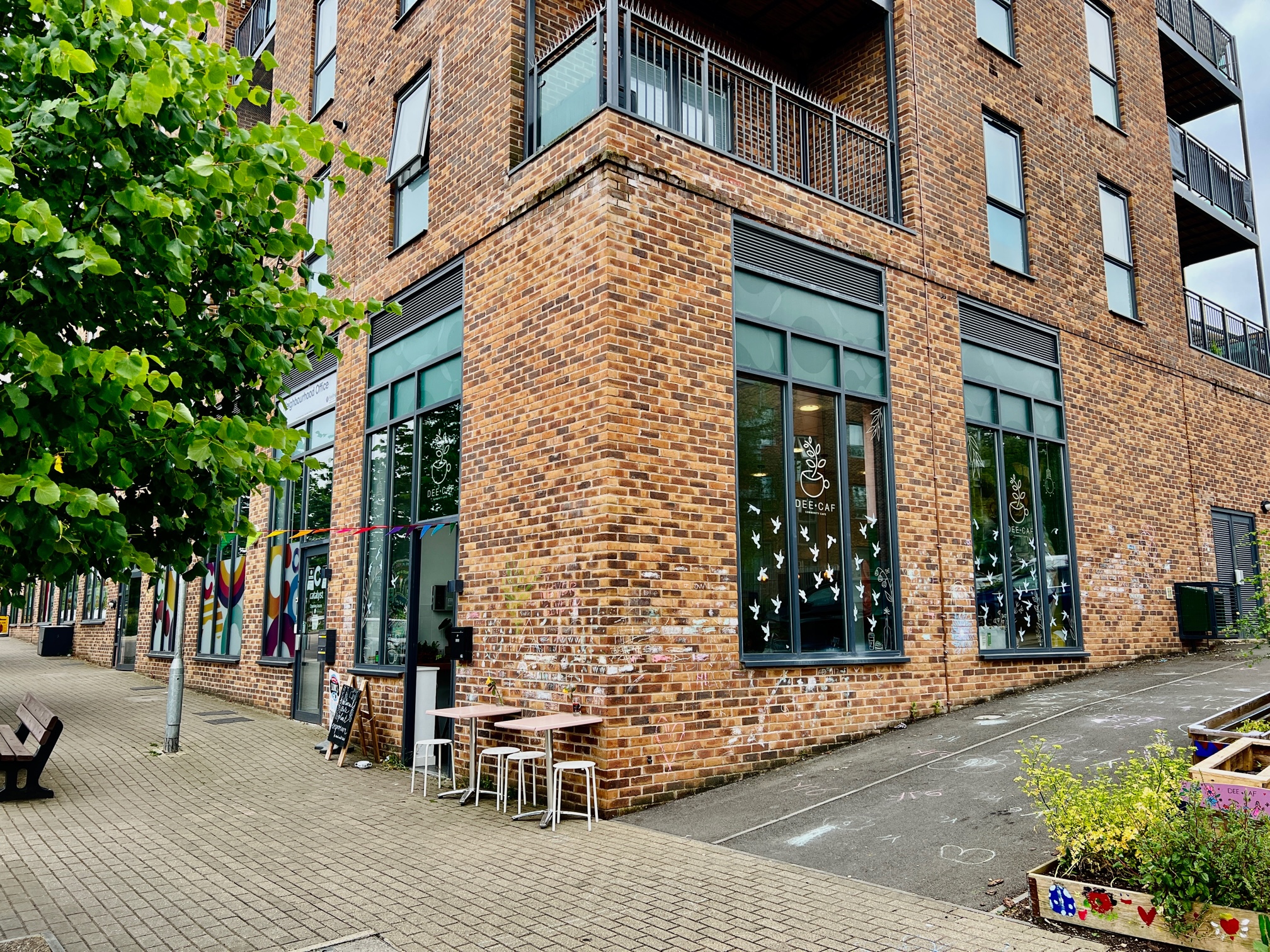
But my choice of venue this week is the superbly named Dee Caf, an altogether more curious beast with a very different story. It’s on Spey Road, in the heart of the Dee Park Estate, in a site which used to play host to Workhouse Coffee’s short-lived Tilehurst outpost. In September 2020, at about the worst possible time to open a hospitality business, Dee Caf opened in that space under the aegis of Tina Farrow. Farrow’s background is in education, both in the prison and food sectors, but she said she’s always loved food and wanted to create business of her own.
Dee Caf is run as a CIC, with clear links to the community it serves, and that’s obvious both from a visit to their website and to the café, in a myriad of ways. The café has a community fridge every week for people in need, runs a food bank and has equipment for litter picking (pickers are rewarded with a hot drink for their efforts). It also provides free sanitary products, runs community events for locals and has a refill station in the corner. There’s even an event for dads on Saturday mornings where they can turn up, meet other dads and enjoy a bacon sandwich and a coffee for a fiver.
On paper, at least, it looked more Fidget & Bob than Café Yolk. But all those laudable intentions didn’t necessarily mean the food was great, so on a Saturday lunchtime I headed over with Zoë – pre-Double Barrelled – to give the place a try. It was a short, slightly meandering walk from the 17 bus stop opposite the Pond House pub, and when you reach Dee Caf it does have the feel of an oasis about it, all tasteful big windows and cheery bunting. You could think you were in Copenhagen, or Rotterdam, on a sidestreet far from home; having never been to Tilehurst, I suppose technically I was.
Subscribe to continue reading
Become a paid subscriber to get access to the rest of this post and other exclusive content.
I was having a chat with my friend Reggie the other day, and I told him that my upcoming review was of Bánh Mì QB, the new Vietnamese restaurant on the ground floor of what used to be called Kings Walk. I’d been there earlier in the week, I told him, and I just needed to write it up.
“You know what the problem with that place is, don’t you?” he said.
“The landlord, I know.” The whole of that space, Atlantis Village or whatever it’s called this week, is owned by Sykes Capital, the company founded by noted philanthropist John Sykes. I should apologise at this point: if you had an Edible Reading bingo card, or were playing an Edible Reading drinking game – even at half eleven on a Friday morning – you’d fully expect me to name drop Sykes, Reading’s answer to It’s A Wonderful Life’s Henry F Potter, nice and early in the proceedings. I know I’ve probably lived down to your expectations: I’ll try not to mention him again.
Subscribe to continue reading
Become a paid subscriber to get access to the rest of this post and other exclusive content.
I know, I know, another Bristol review. I’m sorry. This is meant to be Edible Reading, you might say. Why doesn’t he stay in his lane? Or perhaps you’re one of the If you like Bristol so much why don’t you live there brigade. I do understand, and I know a fair few people take a week off reading the blog when they see the name of the new post and realise it has a place name in the title, the name of Somewhere Outside Reading. I get it.
But the problem is that, when you write about food – or even if you don’t – you want to try the very best stuff. And when eating out is a passion you plan your holidays around it, your weekends around it. I’m away in a couple of weeks and the process is always the same: book the flights, book the hotel and then book the restaurants. And then you have to go through the usual dance: how many meals out is too many? Is two in a day overkill? Maybe your holidays aren’t like that, in which case I simultaneously envy you and think that, on some level at least, you’re missing out. You probably go to more galleries and museums than I do on a city break, to be fair.
And the thing about the very best stuff is that you – by which I mean I – actively want to write about it. Take the violet aubergine caponata I had as part of my lunch at Cotto, a restaurant in Bristol’s old city, a stone’s throw from the food market. I’ve had caponata before, but nothing that matched this. Everything was in high definition – the aubergine sweet, sharp and comforting all at once, the basil perfumed, the olive oil grassy and the pine nuts a joyous surprise in every forkful. Each flavour was somehow separated out and distinct, the gastronomic equivalent of listening to a well produced record on very expensive headphones. You might not give a monkey’s, but how could I not review that?
I’m probably getting ahead of myself by starting there, but given that I’m not usually a Bristol reviewer and you’re most likely not a Bristol reader I can probably skip the preamble with all the namedropping. The bit that talks about Cotto being the latest in a group of Bristol restaurants, the Bianchis Group, and mentions all the others (spoiler alert: I’ve not yet been to any of them). And I could tell you the name of the chef – I know some reviewers really start dribbling at that point – but it didn’t mean anything to me and it probably wouldn’t to you either.
I mean, why should you care? I’d heard good things, so I thought I’d check it out for lunch while I was spending a few days in Bristol and I’m writing it up even though it probably won’t interest many of you. I’m selfless like that.
It was a lovely dining room. From the photos I’ve seen it looks lively in the evenings, with a certain convivial glow. But stopping there on a Friday lunchtime, the room less than half-full, it had a wonderful serenity – all muted terra cotta walls, framed cartoons and Robin Day polyprop chairs (they’ve come up in the world since my generation perched on them in double maths back in the Eighties, that’s for certain).
It bills itself as a wine bar and kitchen, and you could sit up at the bar looking out on St Stephen’s Street with a glass and a small plate, I suppose, although given how good the menu looked that would feel a bit like having half a wank. It was all tempting, to the extent where the difficult part wasn’t choosing what to eat but what to forego; on another day I’d have wound up telling you all about the coppa and pickles, the vitello tonnato, the fermented courgette with hot honey.
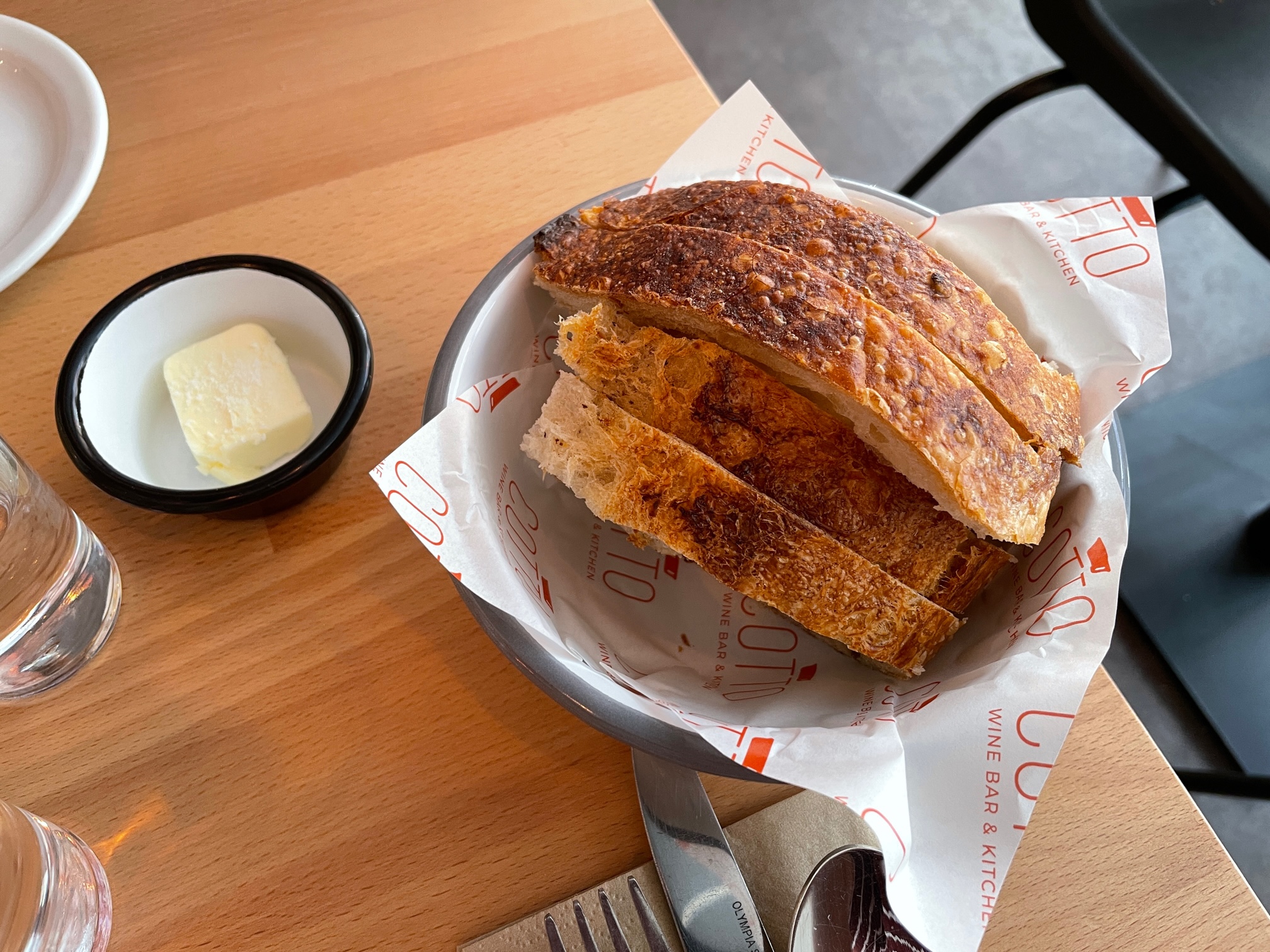
But in this parallel universe I tried that caponata, and I could hardly complain. It cost six pounds fifty, fifty pence of which went to one of the restaurant’s chosen charities. There were three dishes marked as including that contribution and one of the others was the bread and butter – four slices of decent, robust sourdough which maybe felt slightly steep at just over four pounds. It was however vital for sauce moppage (it’s a word now: I say so) so what can you do?
The bread also came in handy for our third starter, from the specials board. I read somewhere that Cotto cures its own charcuterie and makes its own sausages, and on this showing that involves some real talent. Salsiccia came in earthy, hefty pieces and although I didn’t get masses of the advertised soave and chilli, the gremolata that crowned each diabolically delicious diagonal slice made the whole thing positively sparkle. Again, eight pounds felt slightly steep for a solitary sausage – but that might be the curmudgeon in me so by all means just tune this sentence out.
Our starters finished, we sipped our drinks happy in the knowledge that we were in safe hands. Good starters will do that, building up a bank of credit most restaurants know better than to squander. And our drinks were gorgeous, too: Zoë continued her current negroni phase with a negroni sbagliato, a “broken” negroni made with Prosecco rather than gin, and I had a soft and uncomplicated Italian red about which I remember precious little. But the wine list was excellent – nearly all European, covering a good range of price points with a wide selection available by the glass.
Mains came a little quicker than I’d have chosen – about ten minutes after our empty starter plates were taken away – but were a welcome sight all the same. Gnocchi with rabbit is a combination of two of my favourite things, and what turned up in front of me more than lived up to the promise of those words on the menu. The gnocchi managed to steer clear of stodge and were the perfect vehicle for a sauce of tangled strands of rabbit and firm, almost nutty broad beans, the whole thing lifted with a spike of aniseed, from tarragon I expect. A halo of Parmesan was the icing on the cake, and eating it I got that high-definition thing again, that sense of a kitchen conducting things with aplomb so every flavour had its moment in the spotlight.
Zoë’s chicken involtini was even more a thing of wonder. I have a real soft spot for this kind of dish, but I’ve rarely had a version as good as Cotto’s – chicken wrapped in ham, everything cooked just right, in thick rounds with baby gem, the edges blackened and charred, the whole thing liberally dressed with a vibrant, racing green salsa verde. A spot of balsamic and instant sunshine from more of that olive oil completed a beautiful picture. It was unfussy but superb: as usual, Zoë had picked better than me.
Our waiter – who was absolutely brilliant throughout, incidentally, despite seemingly looking after the whole room on his own – had suggested that the chicken dish needed some carbs. And I’m thoroughly glad that he did, because the Jersey royals we’d ordered for backup were an utter delight. Burnished and bronzed, tossed in oil, garlic and oregano they would have been a knockout on their own, but when paired with a generous puddle of aioli I could have gladly eaten these all the live long day. Have a look at the picture below: if it doesn’t make you peckish you’re beyond my help.
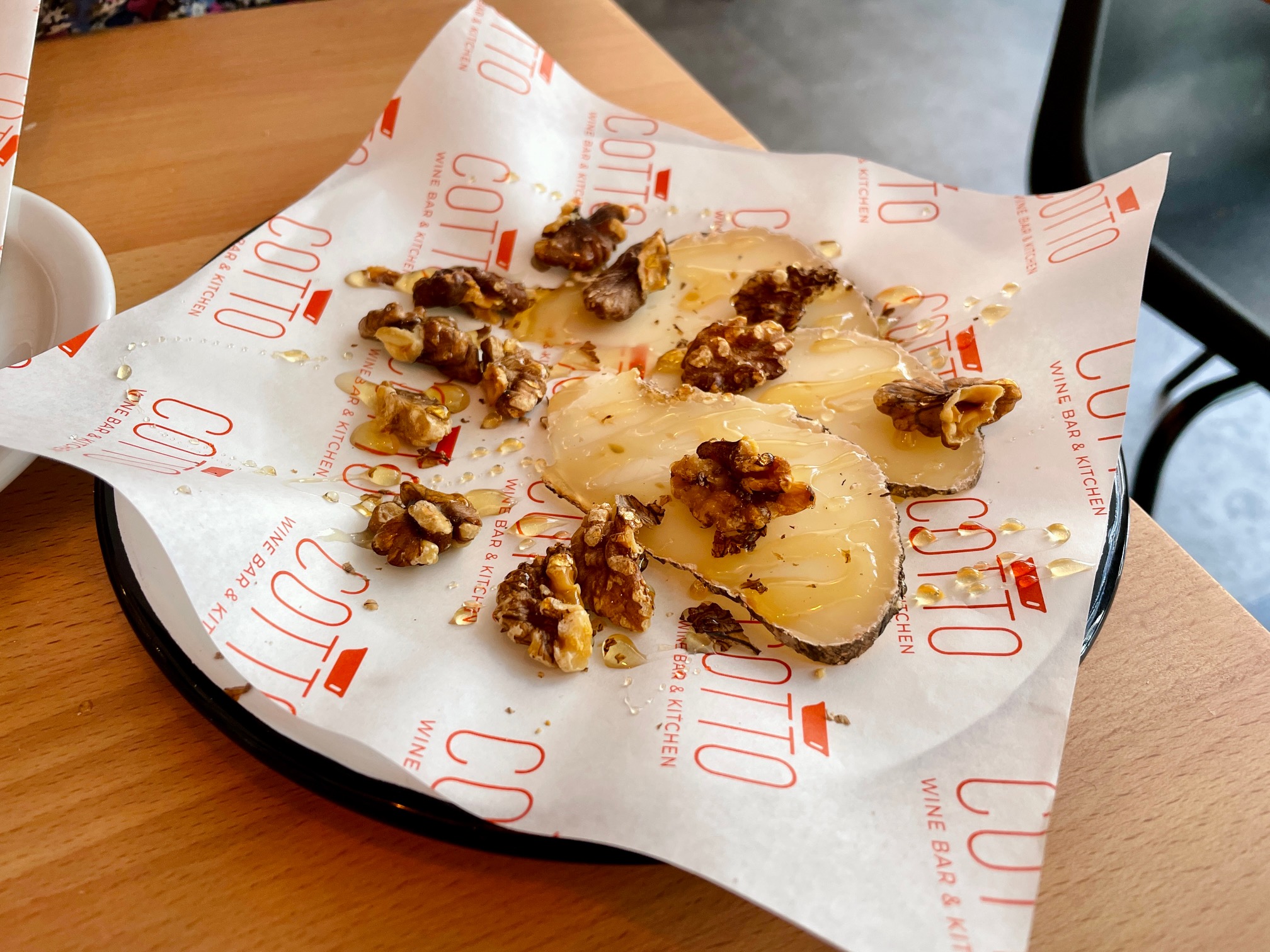
By this point in the meal I was polishing all of my superlatives, so to speak, but my ardour was slightly dampened by the desserts. I would say that they felt like an afterthought, but they were both on the specials board so you couldn’t even say that. We had some Montbrú cheese, which our waiter told us was a goat’s cheese with a texture closer to a Comté or a Gruyère. And that’s true, and a very nice cheese it was too, but three small slices for seven quid felt stingy. This could have done with some carbs: crackers or bread, some or indeed any vehicle for getting the stuff into your gob. That was especially the case because the whole shebang was drizzled with honey which made picking it up a tricky business. And who wants to eat cheese with a knife and fork? You just end up looking like a lemon.
The chocolate truffles were a different kettle of fish. They were excellent – deep and rich and perhaps ever so slightly larger than your average truffle. They were also five pounds fifty. For two. And again, I know this probably sounds a bit like a moan but even so: I know food is getting more expensive, and I didn’t begrudge the price of most of the things we ordered at Cotto. But every now and again the pricing of a dish felt out of whack, and the desserts were where that was more noticeable. Our bill, for three courses and two drinks apiece, came to just over a hundred pounds, which included an optional ten per cent service charge, and all told we were in and out in just over an hour.
Does that matter, in the scheme of things? Well, yes and no – I’ve thought about it a lot since the meal, weighing up the pros and cons. And this is something a lot of restaurant reviewers don’t do – they’ll gush about the dishes but not think about what it was like as a meal, or talk about how much it cost (often because, in their own weasel words, “I didn’t see a bill”). And that’s where Cotto falls down ever so slightly, because despite some truly gorgeous touches and some plates which were up there with anything I’ve eaten this year the whole thing was a little too sharply priced and too briskly paced, especially for lunchtime.
Would I go again? It’s a good question, and one that was thrown into perspective when I realised, walking down St Stephen’s Street, that Cotto was literally two doors down from Marmo, the Bristol restaurant I visited last year that received my highest ever rating. If you picked Cotto up and dropped it in Reading, it would do very well, and I expect from time to time you’d find me there. But as an infrequent visitor to Bristol, it would be difficult to choose it over Marmo: in fact I had dinner at Marmo the night of this visit, and Cotto didn’t quite match it.
That’s how fortunate Bristol is: on one street you can find neighbouring restaurants, either of which would grace a town like Reading with its presence. And it’s not just St Stephen’s Street, you could experience the same phenomenon at Wapping Wharf, on Cotham Hill, in no doubt countless other parts of the city. How do the residents of Bristol not get blasé or complacent, the jammy blighters? But then there’s always someone better off than you, as my friend who lives near Swindon never tires of telling me (usually over Gurt Wings at Blue Collar Corner). Never mind: normal service will be resumed next week with a review back in the ‘Ding, of a place that went a long way towards restoring my faith. Something to look forward to, I hope.
I found myself in Bristol, every restaurant blogger’s second favourite place, for a couple of days last week and, as with any other city break, in the run up to my trip I devoted myself to the serious business of deciding where to eat. As with city breaks in all my favourite places, it involved balancing difficult considerations: how many proper, sit-down meals and how many more casual, lighter lunches on the move did I want? How many old favourites and how many new prospects? Which areas did I want to amble through and explore, before or after?
Sonny Stores, although new to me, was an obvious candidate, having received a lot of attention in the couple of years since it opened. It’s been reviewed by a fair few of the national restaurant critics and a handful of bloggers – the good, the bad and the ugly – and so, along with the fantastic Marmo, is one of the Bristol restaurants most often given the status of destination restaurant. That’s even more impressive, when you consider the destination: unlike Marmo, on the edge of the old city, Sonny Stores is in up and coming Southville, the other side of the river.
Zoë used to rent round there, back when she worked in Bristol, and a wander through the area involved her saying “it was never this good when I lived here” at regular intervals as we passed another boutique shop, another amazing piece of street art, another good-looking café or natural wine bar. And it was crowded – thronged with people, probably the busiest place I’d visited in the last two and a bit years. Where had all these people come from? (I later discovered it was for Upfest, which explained the carnival feel).
Anyway, Sonny Stores is on a residential sidestreet, away from all that. It’s an attractively neutral, almost Scandi restaurant on the corner – double aspect, with big windows and plenty of natural light. The thing that really struck me about it, which is a very Reading thing to think, is that the building reminded me of Caversham’s sadly-departed Siblings Home: if only we could find an ex-River Café chef to swoop in and open a restaurant there. But, for now at least, people like that settle in Bristol and open their restaurants there, so if you want to try them you have to hop on a train.
Inside it was an equally pleasing dining room. It showed that you don’t have to go to town on the decor to create a really appealing space, although I did like the Blue Note-style framed prints on the wall advertising past and upcoming collaborations with other chefs. A few tables were already occupied when we turned up, but not long into our lunch the place was almost completely full: a glowing writeup in the Observer will do that for you. By then it had that atmosphere every restaurant aims for, a little private members’ club of people profoundly satisfied with their life choices.
The menu is on a blackboard on the wall, so I suspect it changes very frequently. It had a great range – a few snacks, half a dozen starters and a mixture of pizzas, pasta dishes and assorted mains. Narrowing it down proved difficult, and at times I wondered whether I’d be shirking my responsibilities if I steered clear of the fried sand eels or the “Cornish earlies” (new potatoes, apparently: I had to Google that). But first we had a drink – a negroni for Zoë, an Aperol spritz for me, both of which were on the agreeably medicinal side of strong. The drinks menu was a little haphazard: there was a printed wine list, and a blackboard behind the counter listed the cocktails. There were three taps for beer, but the menu omitted to mention what was on them.
“This table wobbles” said Zoë as we took our introductory sips.
“Is that going to be a problem?”
“No, we’ll just make the best of it. I don’t think they can do anything about it, and they’re going to be too full to move us anyway. Besides, this is a good spot up by the counter.”
The first signs that I was going to have to write this kind of review came with the starters. Zoë’s was a joy – a beautifully photogenic pizzette with pungent taleggio and crispy pancetta. I was allowed one mouthful, which was enough to explain why she wasn’t letting me have any more. I thought it was perhaps sharply priced at a tenner, but Zoë thought it was faultless. I saw the full-sized pizzas being carried to other tables later in the afternoon and they also looked terrific, but it’s a nice idea to be able to have one and still have room for your main.
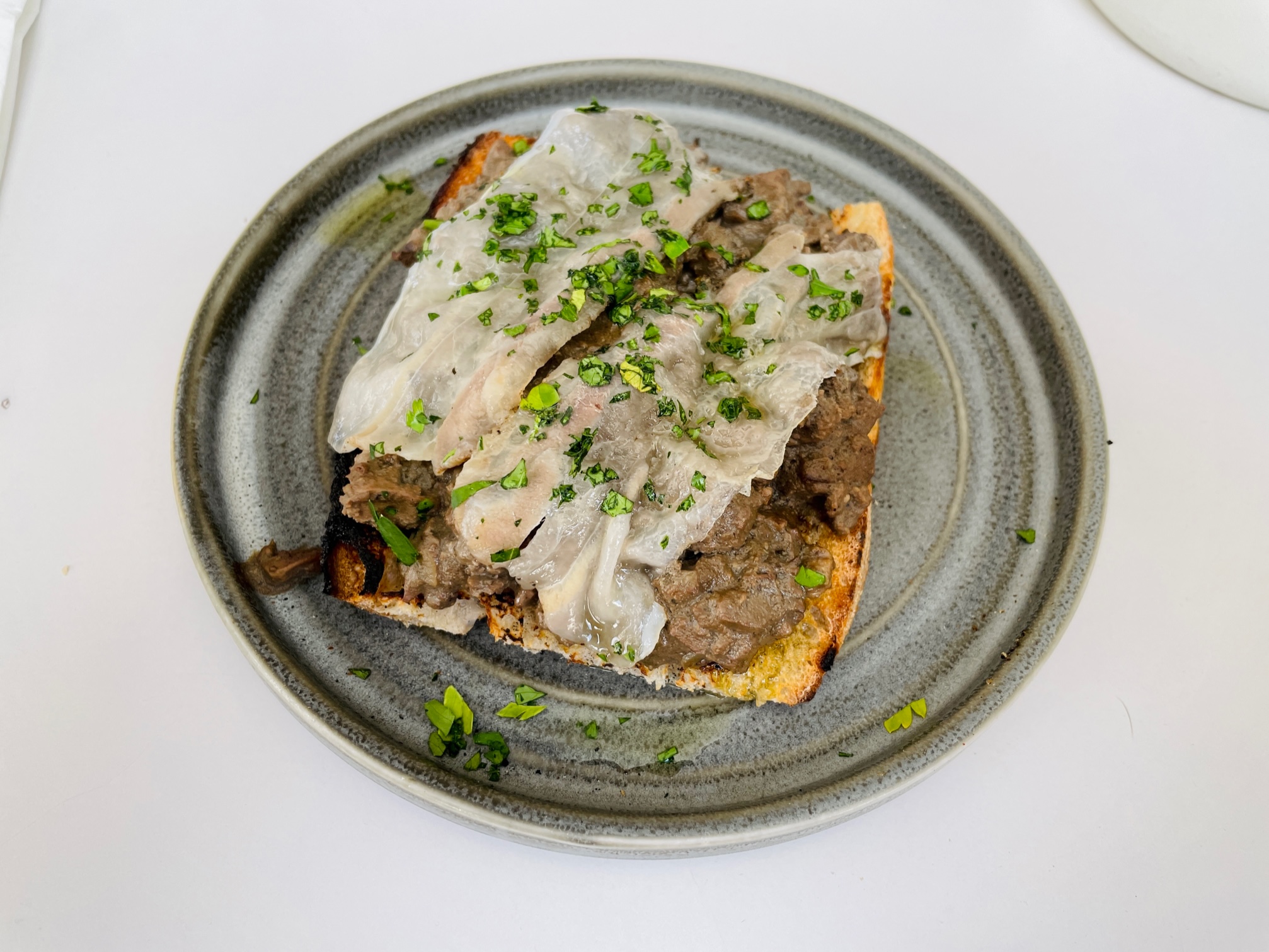
My starter, chicken livers on bruschetta, was more problematic. I know looks aren’t everything, but this dish really wasn’t a looker. It wasn’t even a jolie laide: I usually adore chicken livers, but these were a sludgy mulch and after a few forkfuls it felt like heavy going. What the dish needed was something to cut through, but instead it had a few strips of lardo draped on top, just to add to the general clagginess. On paper, I’d had a very similar dish at the Lyndhurst earlier in the year but they’d served the livers perfect and pristine, with a pesto to add contrast. You got a far better, cheaper dish at the Lyndhurst than at the nationally acclaimed Sonny Stores, where this cost twelve pounds. It was the first underwhelming thing I’d eaten during three days in Bristol, which tells you a lot about the city.
The wine list at Sonny Stores, by the way, was really good – it was especially welcome to see so many wines available in 125ml glasses, as that’s always my favourite way to try several. I had a zippy French rosé with my starter, which provided some badly-needed sharpness, and Zoë’s white was also great: she’d asked for the Argentinian riesling, but they’d run out so they suggested an alternative whose name escapes me. But flagging people down was difficult – the previous day I’d had lunch at a restaurant in the centre of Bristol where there was one waiter doing the work of five people. By contrast, Sonny Stores had five wait staff and they were lovely when you got their attention, but that was a challenge. The chap behind the bar, who made the cocktails, was equally lovely, but if you asked him for help he just directed you to the wait staff. It all felt disjointed, and a little odd.
Oh, and to carry on whinging, that wobbly table was really wobbly. Wobbly enough that I feared for our drinks. Wobbly enough that ideally, while one of you was sawing away at a pizzette the other of you would stop eating your starter and hold it steady. “I can’t believe nobody has pointed this out before”, said Zoë, and I could kind of see where she was coming from. To be fair to the wait staff, one of them clearly noticed and came over to try and fix it between courses – he did his best, but to paraphrase the great Roy Walker, it was good but still not right.
We ordered more wine to go with our mains. Mine sat up on the bar, and I watched it for the best part of five minutes waiting for them to pour the second. By this point I was wondering: is it just me? Was I just out of sorts because of the hot crowded bus ride over the river, or was I a little hung over from the night before? Everyone was having such a marvellous time: what right did I have to feel any different?
My main course did much to soothe my mood. This was the dish which gave me a glimpse of what others had seen in the place. Two huge, gorgeous lamb chops, cooked bang on, sat on a jumble of roasted peppers and coco beans. Again, this wasn’t the most photogenic plate of food I’d ever had but when it tasted this good, when there were so many combinations, so many forkfuls to curate it didn’t matter a jot. It came with dragoncello, which I’ve never heard of but is apparently a sort of salsa verde made with tarragon. I adore tarragon, and I know it goes perfectly with lamb – Geo Café does a wonderful lamb and tarragon dish, on its Georgian nights – but I must be some kind of heathen because this tasted very much like a conventional salsa verde to me.
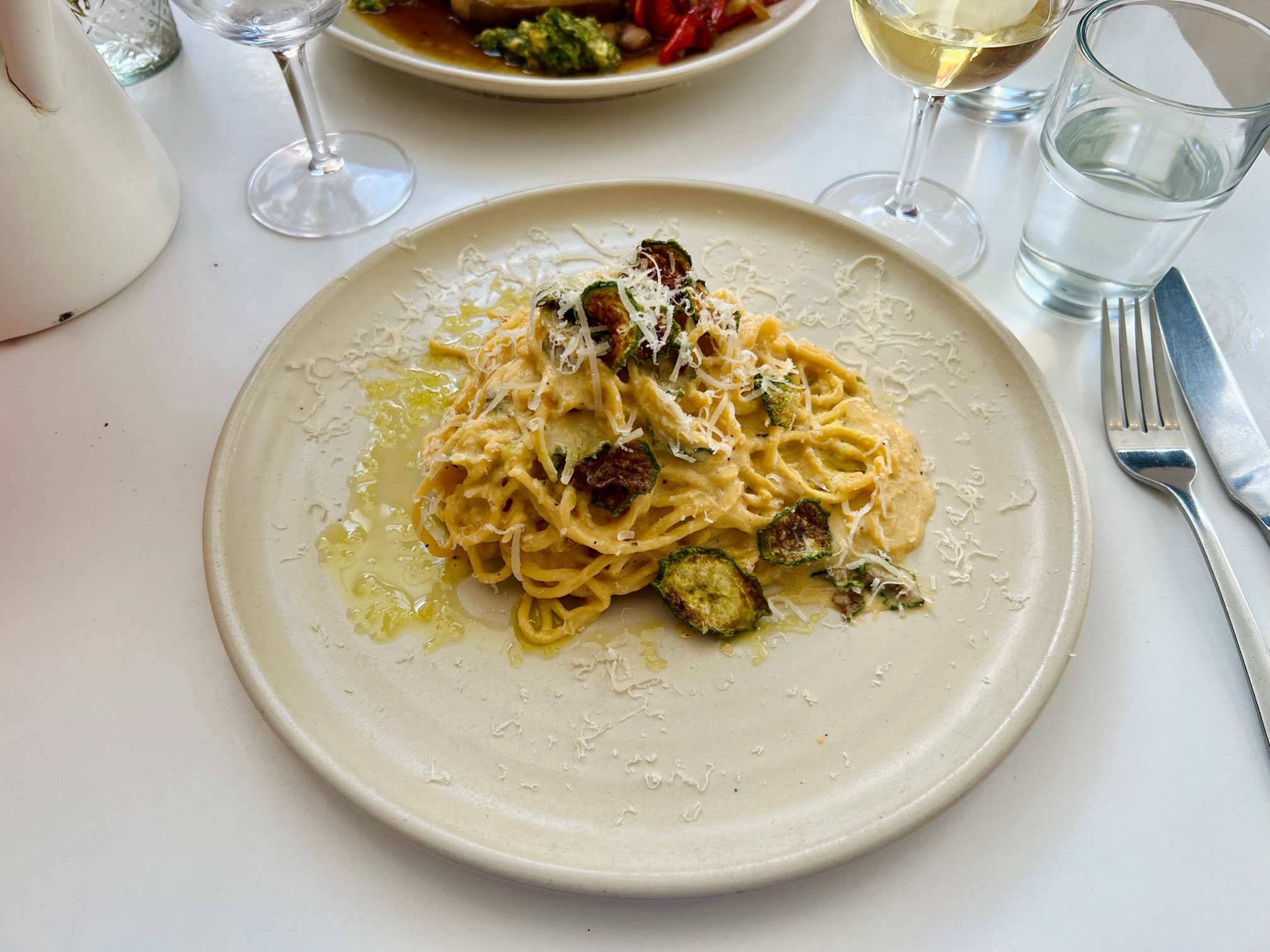
I saw less of my main than I’d have liked, though, because Zoë’s was so underwhelming that I had to keep giving her some of my lamb to prevent a diplomatic incident. It was a problem of expectation management, and we’d done our best to avoid it: the menu said “tagliarini, fried zucchini carbonara”. So before Zoë ordered it, we tried to decipher what that meant.
“So the tagliarini carbonara, how does that come?”
“Well, it’s a carbonara, but with some fried zucchini on top.”
I know there’s a debate about carbonara. I know people dispute whether you should add cream, or whether it should be egg yolks alone. But what I thought was beyond dispute was that it always contains dead animal. You know, pancetta or guanciale: a pig has to die for it to be carbonara. And the impression the wait staff had given was that this was a carbonara with added courgette, but when the dish turned up it was clear this wasn’t the case. At least when vegan restaurants call something “cheeze” or “chickn” they’re giving you a hint in mile high letters that it’s not the real deal, but here there was no such thing: maybe they should have called it a carb-no-nara or something.
“It doesn’t even have that many courgettes in it” said Zoë, who started her main course disillusioned and went downhill from there. First she conducted some kind of search with a fork, desperately looking for the slightest hint of caramelised corpse. Then with a sigh she settled down to making the best of it. I tried some, and immediately resigned myself to having to donate rather a lot of my own, infinitely superior dish.
“It’s just monotonous” said Zoë, for once not talking about me. “Every mouthful is the same. It’s so disappointing.”
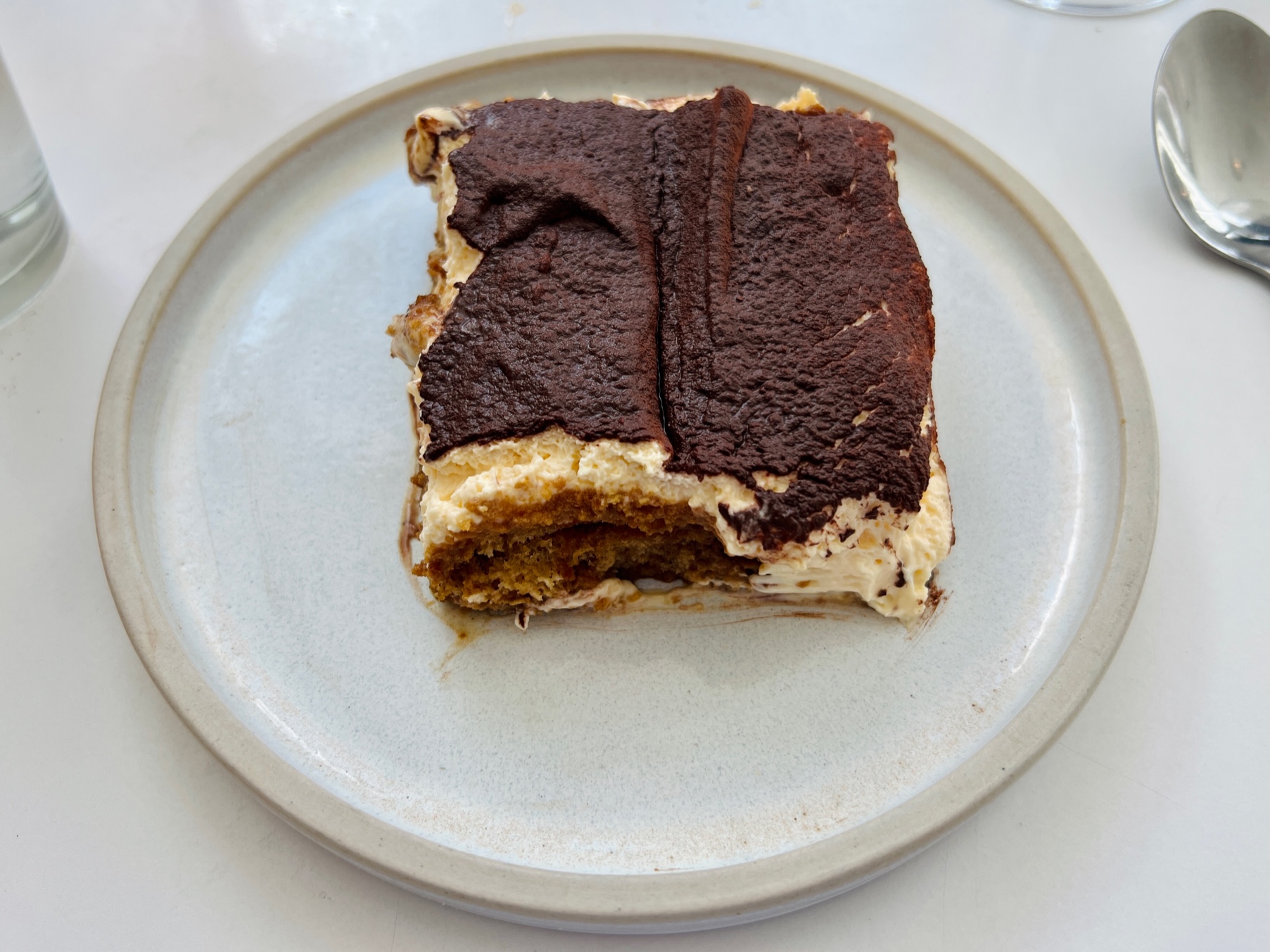
We had desserts, to try and rescue the situation, and again the hit rate was fifty per cent. This time, Zoë was the winner, with a cracking slab of tiramisu – although slab makes it sound like a heavy, weighty thing and this was far more ethereal than that. I had a spoonful for quality control but didn’t push it, well aware of how fortunate I’d been with my main course.
My dessert, on the other hand, kept up the middling work. A chocolate salted almond cake sounds like a beautiful prospect, and this was made with Pump Street chocolate which I adore. But what turned up felt like an unremarkable brownie passing as a cake – the shape was different, but the overall effect was the same. In fact it lacked that textural contrast that makes a great brownie so joyous, the juxtaposition of brittle and fudgy. This was, and I don’t enjoy saying it, another little slice of meh. I loved the crème fraîche that came with it, but when crème fraîche is doing that much heavy lifting it doesn’t say much about the dessert.
Our bill came to one hundred and ten pounds, not including tip. On the bill, Zoë’s main was just billed as Veggie Pasta (“the final insult”, she muttered darkly when I told her). We settled up and headed for the bustling chaos of Bedminster, to do a spot of shopping and pass by the peerless Zara’s Chocolates to buy some bits and pieces for later on. I took a look back at Sonny Stores as we left and thought again about Siblings Home. That site was crying out to be a beautiful neighbourhood restaurant, if only somebody would take a chance on it. And one thing some of my favourite restaurants, like Marmo, or even Oxford’s Arbequina, prove is that you don’t need a gigantic kitchen to offer a really interesting menu.
I know lots of people don’t read my Bristol reviews – they’re a tad niche, and not all of you want to go to Bristol to eat. So thank you, if you’ve made it this far. I also know that any of you reading this, if you do take a trip out west, are unlikely to go to Sonny Stores on the basis of this. So let’s draw things to a conclusion so you can get on with the rest of your day. There is a terrific meal to be had there, if you were to order the pizzette, the lamb and the tiramisu: that’s the Doctor Jekyll. But the equal and opposite Mr Hyde is those chicken livers, that non-carbonara and the chocolate cake. That batting average isn’t enough to elevate it from the other wonderful places to eat in Bristol, let alone options closer to home.
“It just wasn’t quite there” was Zoë’s verdict. “The service was a little off, and that wobbly table did my swede in.” And I think, sadly, that she’s right. It’s a decent – if slightly pricey – neighbourhood restaurant but not, in my book, a destination in itself. That’s hype for you; I liked it in parts but I’m afraid that, like some of the reviews I’ve read of Sonny Stores, it’s not quite as good as it thinks it is.









 Edible Reading