Last month, after a very successful ER readers’ lunch at Kungfu Kitchen – a total of fifty-six guests in attendance and what felt like about the same number of different dishes to try – the hardcore lunch-goers were sitting in the luxurious surrounds of Park House up on campus, shooting the breeze. It was early evening and even though it was right at the beginning of December it felt, to me at least, like the start of the festive season.
I always love that bit, when the event has gone well and everybody is full and happy and I get to have a few pints and chat to all the people I haven’t yet caught up with. The readers’ lunches have been going for six years now and although there are always newcomers, many of my regulars have been coming along for a fair old time, a few since the very beginning.
On this particular occasion I found myself in conversation with Jonathan, a newbie who very specifically wanted to talk to me about a bugbear of his: how come there weren’t any good neighbourhood restaurants where he lived in east Reading? I thought about it, and told him I had to agree. I said that since O Portugues had mysteriously closed in the spring there was nothing that even came close.
You could eat in the likes of Rizouq on the Wokingham Road, I supposed, as it had a few tables, and I’d heard suggestions that a burger joint, Pattie N’ Pulled, was operating out of the Roebuck (it looks like they’ve since moved on). But apart from that, and the artist formerly known as the Garden Of Gulab, restaurants were thin on the ground. I thought that would be the end of the conversation, but Jonathan wanted to talk about it in more detail, as if I had the power to change it.
I do get it though. As a proud East Reading resident myself, albeit one living far closer to the centre, it is an enduring mystery that it’s such a dead zone for restaurants. Caversham is well served, and Whitley and Katesgrove have a handful of places. Tilehurst, with the addition of spots like The Switch and Vesuvio, is seeing a bit of a resurgence and the Oxford Road has always been a crucible of culinary invention. Even dear old Woodley, where I grew up, has a handful of restaurants worth a visit.
By comparison, the Wokingham Road feels like slim pickings. It has takeaways, and two biryani places, and the likes of Earley Café and Chaiiwala, but nothing you could describe as a neighbourhood restaurant. It’s almost as if the people living near Palmer Park are expected to hop on the 17, walk to Kungfu Kitchen, settle for the Hope And Bear or, if all else fails, fall into Ye Babam Ye. If it wasn’t for the likes of Smash N Grab and Cake & Cream, you might struggle to see redeeming features at all. And Smash N Grab, sad to say, has its last ever service tomorrow.
I did remember, though, talking to Jonathan that there was one possible contender in the form of Hala Lebanese. It opened last June on the Wokingham Road, just past the stretch of shops, in a spot formerly occupied by another Lebanese restaurant, Alona. I still remembered Alona, partly for the astroturf but mainly for the wobbly shawarma that had slightly traumatised my dining companion John and me. I told Jonathan I would get to Hala as soon as I could and, what with Christmas and Covid, I think I’ve pretty much kept my promise: last Saturday Zoë and I trekked up the Wokingham Road to give it a whirl.
Subscribe to continue reading
Become a paid subscriber to get access to the rest of this post and other exclusive content.
As of October 2024 Filter Coffee House has changed its interior layout and so is now takeaway only.
Filter Coffee House, a tiny café on Castle Street offering authentic South Indian coffee, opened last August. It occupies a unit which as far as I can remember used to be home to a very small, rather unsuccessful produce store by the people behind Tamp Culture (remember them?). I found myself stopping in last year a couple of weeks after Filter Coffee House opened and, slightly bending my usual rule to wait a month, I talked about it on social media.
I couldn’t help it. I waxed lyrical on Instagram about their coffee and, in particular, their banana bun, a confection quite unlike anything I’d ever eaten before. Not quite sweet, not quite savoury but glazed, complex and moreish, it was not the kind of thing you eat and forget. Quite the contrary: you want to tell the world about it. I loved it so much that when I put together my list of Reading’s 50 best dishes last September, as part of the blog’s 10th birthday celebrations, I snuck it in at number 47. I called it a little miracle.
Maybe I was jumping the gun but I had a feeling it was going to be huge, and I wanted my admiration of that banana bun to be a matter of public record as soon as possible. Because there are few four word combinations in the English language quite as satisfying, if you ask me, as I told you so.
Anyway, the amount of praise that bun has garnered on social media since has borne out my hunch. But not only that, if you follow Filter Coffee House’s hugely winning Instagram feed you’ll see that they’ve really flourished in the last five months. The month after they opened they teamed up with nearby Rise to expand their range of baked goods. In October they introduced a menu of Saturday specials, and in November they brought in a sandwich menu.
In December, naturally, there was a Christmas menu – the “Mistle-Toast” is still available, if you’re tempted – and now Filter Coffee House also stocks goodies by Cocolico, Reading’s vegan pâtissière. The overall picture is one of constant forward movement and innovation, and it shows no signs of stopping: last Sunday, for the first time, they had a stall at Caversham’s Artisan Market.
And yet, shamefully, with one thing and another I had not been back since that first visit back in August. Of all the places I’d neglected in the latter half of 2023, sorting this one was right at the top of my list. So last Saturday, lured by that specials menu and fresh from the elation of having bought our wedding rings in town, Zoë and I sauntered over, keen to see how things had progressed.
Subscribe to continue reading
Become a paid subscriber to get access to the rest of this post and other exclusive content.
Of all the city guides I’ve written since I put together a guide to Ghent over 5 years ago, easily the most popular have been the ones I’ve written on Málaga. The second edition of my Málaga guide, published two years ago, has had more page hits by far than any of my other city guides and is surprisingly evergreen, with more people reading it last year than the year before, or the year before that. I’ve had far more messages about it than I could ever have expected, often from readers on holiday literally working their way through it. It’s even been cited by other bloggers putting together their own highlights of the city.
By way of illustration, even on my most recent trip to Málaga at the start of December one of my Instagram followers was in the city at the same time as me; I sent her some recommendations, and she had a fantastic dinner at Uvedoble. A couple of weeks before that, a regular reader sent me a picture of his first caña at Meson Iberico, having already told me that he’d checked out three more venues from my city guide. “The omnivore can’t go far wrong in a country where dried ham is used as a seasoning” read another message, accompanied by a picture of a plate of artichokes strewn with matchsticks of jamon. He has a point.
So why am I updating the guide now? A few reasons, really. One is that my latest visit managed to check in on most of my old favourites to establish that they are still standout options, but also gave me a chance to explore new discoveries which merit a mention. In addition, Málaga’s coffee scene seems to have expanded further in the last two years – with some venues expanding or relocating. I was especially sad about that with one of my favourites, Mia Coffee, which had a lovely little spot; I didn’t love their new home, I’m sorry to say, in the same way.
The other reason is a firmly-held belief that Málaga is, as a destination, growing and growing in popularity and feels, to me at least, like a city whose time has come. I have been visiting it for seven years and in that time I’ve perceived a real shift – the days when people would get off the plane and immediately catch a train west down the coast without ever troubling the city seem to be coming to an end. Increasingly I am aware of more people selecting it as a destination and falling under its spell.
And it really isn’t hard to see why. It is Europe’s sunniest city, it’s temperate to visit even in the winter months, it has Moorish architecture, an incredible food market, art gallery after art gallery – what other city can boast the twin artistic patrons of Picasso and Antonio Banderas – a bustling port, a gorgeous and eccentric cathedral and, of course, a beach. And that’s before we get to the food: Málaga may not have the free tapas on offer in Granada, further north, but it makes up for that with many great and imaginative restaurants. Tapas is easy to find, and invariably good, but there’s more to Málaga than tapas. Hopefully this guide goes some way to showcasing that, but even so it still scratches the surface of one of my very favourite places.
In the majority of cases where I’m recommending somewhere which has featured in previous guides the writing is brand new, as is the picture. Where it’s a recommendation from my 2021 guide I’ve tried to make this clear. Right, let’s get started.
Where to eat
1. Taberna Uvedoble
Uvedoble is possibly Málaga’s cleverest modern tapas joint. I first started visiting it in 2017 when it was round the corner and looked a tad functional – their new, bigger home is starting to feel a little more special, with quite a lot of outside space and a lovely spot up at the bar. One of my favourite things about their menu is how inclusive it is – every dish effectively comes in three different sizes so you can share if you like, keep something all to yourself if you’d rather.
Uvedoble’s growing popularity is reflected in two things – that you can now, finally, book online and that even with that luxury snagging a table is harder than it used to be. And having returned many times I’m increasingly struck that the core of its menu hasn’t changed massively between visits.
But perhaps that doesn’t matter because the core of the menu – mini burgers cut with foie, little brioches stuffed with suckling pig, stunning savoury eclairs, oxtail albondigas like rich, crumbly faggots – remain classics. And of course, the nest of deep black squid ink fideua, crowned with baby squid and bordering on a lake of aioli, remains as perfect a plate of food as it was when I first ordered it, over seven years ago.
Excellent though Uvedoble is, Meson Iberico is my single favourite spot in Málaga to eat and if you could teleport me to any restaurant in the world tonight for dinner, there’s a better than evens chance that I’d pick it. Not just any place though: you go through the front door and on the left are all the conventional tables, with table service, for bigger groups. But no: the place to be, the reason I queue outside ahead of its 8.30pm opening time – with many other people – is for prized seats at the bar. There, with crowds behind you and all the cheffing and action ahead, you have one of the best spots in the world.
It’s such an immerse, brilliant experience that it would be worth doing even if the food was just ho hum. But fortunately, it’s so much better than that. The very best ham, thinly sliced, the fat liquefying on the tongue. A bed of grilled mushrooms scattered with more ham – that ham as a seasoning again – and thick, pink prawns, the perfect dish to forage from. Skewers of tender, spiced lamb with unimprovable skinny chips. Rich, buttery tuna fresh off the plancha dressed with lemon and a salad studded with sweet slices of fried garlic. I’m not sure Meson Iberico knows how to serve a bad dish: if they do, it’s not one I’ve ever ordered.
Towards the end of my last meal there, I saw one of the men behind the bar, with great solemnity and ceremony, preparing a dish I wish I’d ordered. First he expertly chopped an enormous, bulbous tomato into chunks. Then he opened a jar of high grade Ortiz tuna, easing out the pieces and resting them on the tomato. He anointed the whole lot with good quality extra virgin olive oil, for about a full minute after the point where I thought surely he’ll stop now. Then he sprinkled salt, again for longer than I expected. When the dish was served up to some lucky diners I was tempted to applaud.
If Meson Iberico is my favourite place in Málaga, just about, I suspect that Gastroteca Can Emma, a little restaurant close to Malagueta beach, is Zoë’s. It looks nondescript from outside, on a little side street off the main drag, but it happens to do properly unbeatable food. On previous visits I’ve been quite transfixed by their miniature croquetas, like the best Wotsits in the world, made out of real cheese. I have always ordered one of the three – yes, three – mini hamburgers on the menu. And I always make a beeline for the arroz mare y monte – not quite a paella, per se, but a pan full of salty, savoury rice with prawns, squid, ham and a big pot of aioli on the side. I’ve almost never gone and not ordered it: it really is amazing.
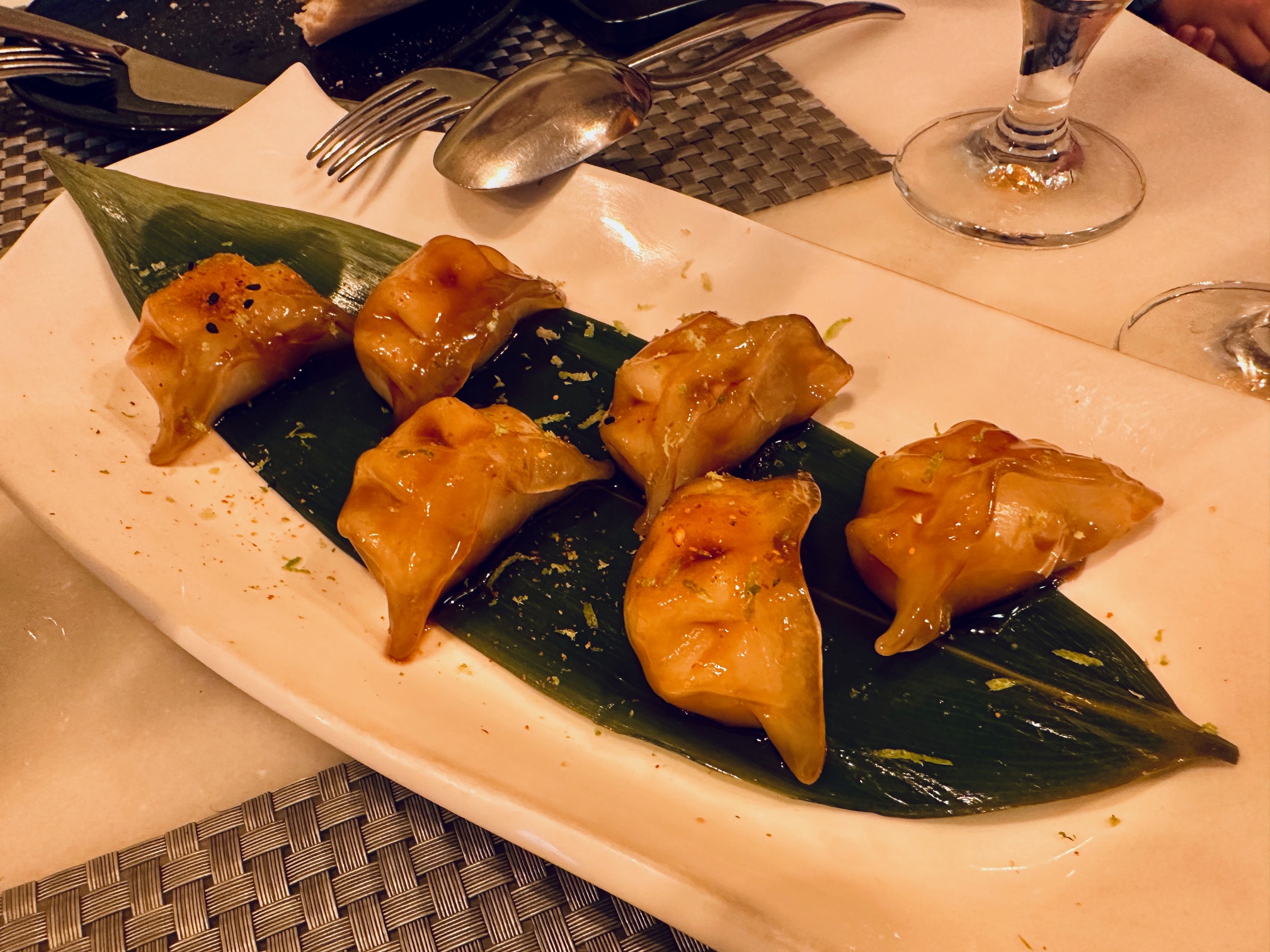
However this time around, on a lunchtime visit, we discovered that the kitchen’s talents extended far beyond that. Bao buns with cochinita pibil were a beautiful surprise and, better still, they served some of the best gyoza I’ve ever eaten – packed with prawns and glazed in a positively compelling, sticky sauce. I still had the arroz though, because if I hadn’t I would have regretted it. But, unusually for me, I went to Can Emma twice on my most recent visit to Málaga.
The second trip, an evening visit, was with my dear friend Jerry and five of his closest friends to celebrate his seventieth birthday. It was a happy accident – his first night in the city was our last night there and so I took it upon myself to find the perfect spot for the occasion. And Can Emma didn’t let me down, catering effortlessly for the vegetarian in our midst, keeping the wine flowing and even taking some photos of the group of us. On that visit I added sweetbreads to the list of things Gastroteca Can Emma did well and I opted for a different main course, secreta iberica with mango chutney. It was gorgeous, but I’m glad I’d already had the arroz that week. Jerry ordered the legendary arroz, though, and loved it. Happy birthday to him.
Gastroteca Can Emma Calle Ruiz Blaser, 2
4. Casa Lola
I first visited Casa Lola in 2017 on my first trip to Màlaga and since then it has grown like Topsy with multiple branches, including two on opposite sides of Plaza de Uncibay, and another set of restaurants called Pez Lola. But my heart belongs to the original branch on Calle Granada, a brilliantly buzzy taberna which is often full at lunchtime very shortly after opening.
It has become a tradition for me to go there on every trip, usually at the start of my first day in the city, and invariably I order some beautiful ham and a cold vermouth (they do one, chispazo, with Coke which I like even though I probably shouldn’t) and a selection of pintxos topped with prawns, salt cod or morcilla. But I also make sure I order the chicharrones fritos, cubes of deep fried pork belly which are simply a plate of salty heaven. They also do, to my surprise, the best croquetas I had on this trip.
If you tire of tapas, and small plates, and sharing everything, La Cosmopolita is the place for you. The most high end outpost of chef Dani Carnero’s mini empire, it’s serene, grown up and marvellously chic. The food happens to be exceptional.
I loved molletas, ethereal yet crusty rolls packed with tuna tartare and a warming mayo. Salmonete torched at the table, sashimi grade stuff, came with chopsticks and a dipping sauce of soy, orange juice and fish liver which cut through and fleshed out at the same time. And my main course, sweetbreads with brown butter and capers, might well have been the best sweetbreads I’ve eaten: soft and yielding where they should be, but caramelised and intense at the edges. The only place that’s come close to that quality is Parcelles in Paris, another hugely accomplished restaurant.
On my previous visit to La Cosmopolita I had been forced to sit there watching Zoë make short work of the best dessert I’ve never ordered, an ambrosial cheesecake made with payoyo, a local goat’s cheese. I’d never tasted a cheesecake like it, and I made myself a promise that if I ever went back and it was on the menu I would order it and enjoy every mouthful. On this trip I did exactly that, and next time the battle will be trying not to order two pieces.
I also have to mention the service, which was effortlessly charming and affable and came from Victor, a larger than life character who regaled us with stories of his time working in the U.K., in Tunbridge Wells. He had that authoritative air about him where he could say: no, you don’t want to order that, or definitely try this, or this is how many dishes you need and you almost obeyed without question. What Tunbridge Wells quite made of Victor, and vice versa, was something I found myself wondering. But their loss was Spain’s gain, and ours too for that matter. And, as he said to us during our meal at La Cosmopolita, there really is something magical about Málaga.
Since this guide was written, Palodu has won a Michelin star – quite right, too.
Most of my meals, on my most recent trip, were emphatically casual dining. That’s not to say that the flavours weren’t great or the presentation, in places, beautiful, but it does mark out Palodu, a recommendation from one of my Spanish followers on Instagram, as a very different proposition. Make no mistake, Palodu is aiming for a Michelin star and everything about it points to that. The room is hushed and stylish, the tables big and beautifully spaced. The service is attentive, the ratio of staff to diners close to one to one. From our table, Zoë could see the open kitchen and watch the ceremony of dishes being painstakingly prepared and plated: Palodu is a plates with tweezers kind of a restaurant.
That’s not normally my cup of tea – I like a meal like that a couple of times a year – but Palodu was brilliant at it and I’m so glad I picked it. Across fifteen courses, including snacks to start and petits fours to finish, we were treated to an array of techniques and combinations from a kitchen absolutely at the top of its game. I took photos but not notes, and for once I suspended my critical faculties and just immersed myself in the experience. It was a wonderful fever dream of food – of fish precisely and perfectly cooked, of tiny lamb meatballs in a terrific sauce, of squid cooked simply and presented with a rich slick of sauce and translucent slices of mushroom.
And the wine pairings (yes, it was a splurge) were phenomenal including, for one course, a 1981 Riesling extracted by Coravin which was one of those wines you only encounter a couple of times in your life. Almost as good as the local Moscatel that accompanied our two desserts – I loved it so much that I was delighted to find it on sale, a few days later, at Vertical, the next entry on the list. We bought two bottles for the journey home, and packed them even more carefully than usual.
Since this guide was written, Vertical has moved to a different address.
One of the restaurant bloggers who used my previous guides for tips on where to eat in Málaga was Cardiff-based Gourmet Gorro. But he returned the favour, because when he visited in 2022 he wrote positively about this natural wine bar in the old city. And I’m really glad he did, because I absolutely loved it – more, I suspect, than he did. It’s a lovely space with high tables and stools, tasteful and muted, and it does a gorgeous range of wines by the glass (it also sells them to take home: I gladly took advantage of that).
But more even than the wine, the food itself justifies a visit. Cecina croquetas were a compact delight, but even more phenomenal was a tomato tartare made with three different types of tomato on a fragrant base of crushed potatoes bright with extra virgin olive oil. A pinsa Romana with potato, gorgonzola and guanciale was surprisingly airy and dangerously easy to demolish, as was a dish of punchy sobrasada, cheese and honey on toast. Service was superb, and I loved it to the point that by the end of the meal I was indignant that the place wasn’t absolutely packed.
When it comes to ice cream, traditionalists go for Casa Mira, still going strong on Calle Marqués de Larios after more than a century. I’ve heard good things about the chain Bico de Xaedo, which had a branch literally a minute from my apartment. But my loyalties are with Freskitto which has two spots on Calle Granada – one a kiosk, the other with a handful of seats inside.
Service is superb, and Freskitto’s stuff really is top notch – closer in texture to gelato than ice cream and sheer joy to eat. I’ve pretty much narrowed my order down to a chocolate/dulce de leche combo, though I occasionally dabble with something else. Grabbing my paper cup and sitting just opposite, round the corner from El Pimpi, eating Freskitto’s beautiful ice cream and gazing up at the cloudless blue sky is one of my favourite Málaga memories.
Heladeria Freskitto Calle Granada, 55
9. Mercado Atanazaras
Not content with being a mini Barcelona, Málaga also boasts a mini Boqueria in the shape of the handsome and hugely likeable Mercado Atarazanas. You can buy pretty much anything there – from just-landed fish to pig’s trotters, from freshly sliced jamon to salted almonds shining with oil.
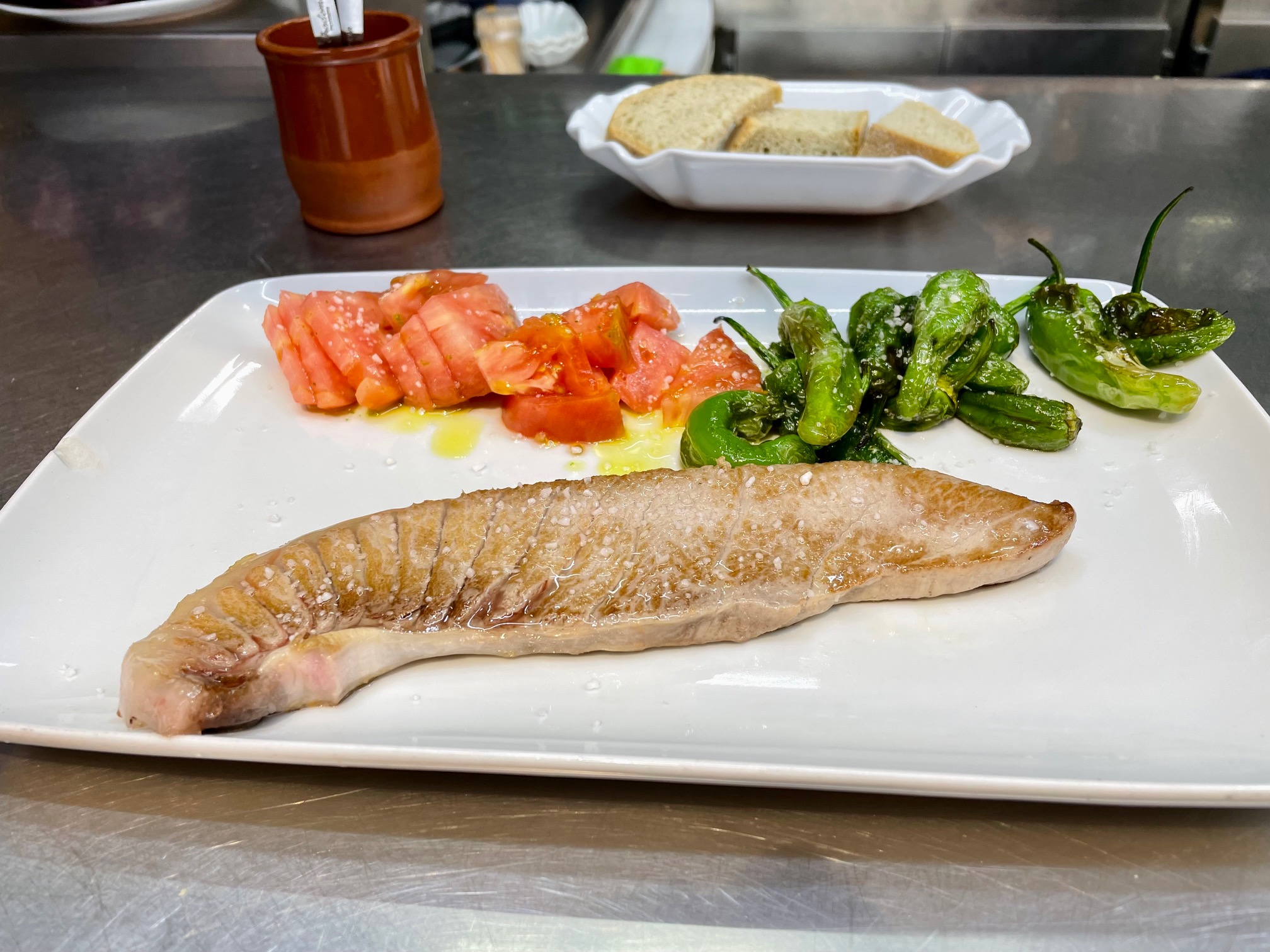
But the real draw, for me, is Central Bar in the corner of the market. There you can stand up at the bar, drink your vermouth or your caña and get stuck into the incredible array of fresh fish and seafood under the counter, or have charcuterie, cheese and all the other main Spanish food groups. On my 2021 visit we had tuna steaks, cooked simply, scattered with salt and served up with sensational tomatoes and padron peppers, another exemplary illustration that less is often more.
But it wasn’t just about the fish: chicharrones de Cadiz were utterly delicious but a completely different kettle of pork to their Casa Lola cousins – less scratchings, more a high definition porchetta. The four of us lunched like kings for just over a hundred Euros, and my only regret is that I didn’t find a way to go there every day. I visited the market again in 2023, but just to buy supplies, and although that corner bar was calling to me we had other lunch plans. They were good enough, fortunately, to dispense with any regret.
Mercado Central de Atarazanas Calle Atarazanas, 10
10. La Cheesequeria
La Cheesequeria, a cheesecake cafe on Calle Carreteria, was another recommendation from the Instagram follower that tipped me off about Palodu. And given how much I’d loved Palodu, and my cheesecake from La Cosmopolita, I made a point of stopping off there to pick up a slice of cheesecake to enjoy in the comfort of my apartment. It was also a payoyo cheesecake and if it hadn’t been for La Cosmopolita it would have been the best cheesecake I’d ever eaten. Instead it will have to settle for being the second best.
La Cheesequeria does both sweet and savoury cheesecakes. I imagine the latter, some of them looking on the sweet side even for me, do very well locally but I was drawn to the savoury ones. Next time I’ll eschew the payoyo and go for a something with blue cheese – don’t knock it til you’ve tried it, blue cheesecake is out of this world – or the thing that nearly swayed me on this visit, a cheesecake made with 24 month aged Parmesan. That I can’t even imagine what that would taste like is, to me, reason enough to try it.
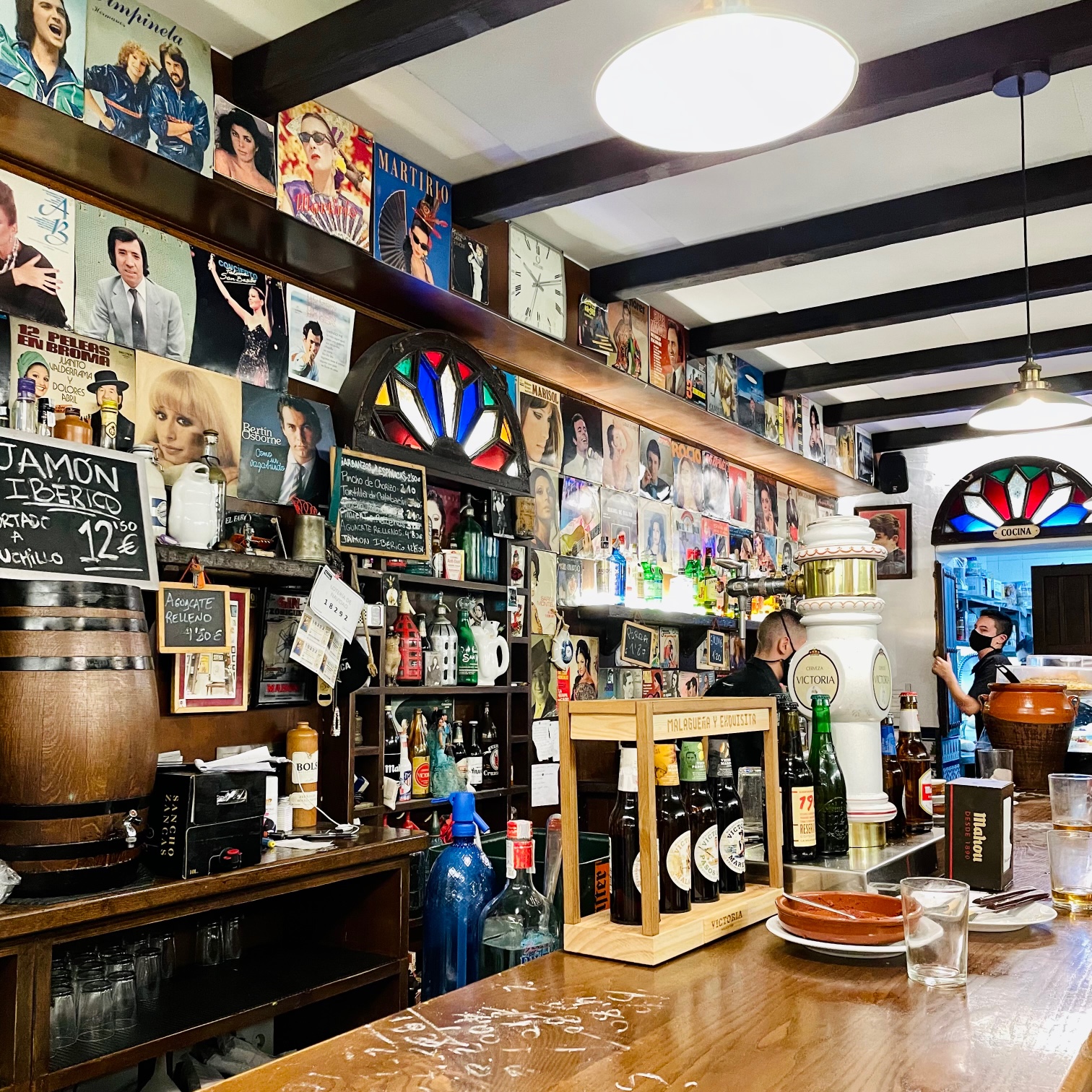
La Tranca remains one of my favourite bars in the whole wide world, a scruffy and vibrant place which welcomes anyone who wants to drink vermouth or beer, eat good food and enjoy people-watching amid a crowd who all have the same laudable priorities. The music is Spanish, and the LPs behind the bar are a retro anorak’s dream. I can honestly say that this is a happy place at the epicentre of a happy place, and all my visits in 2021 and 2022 were superb fun.
It is a tribute to its growing fame, and I think the growing popularity of Málaga in general, that every time we wandered past on our most recent visit, daytime or evening, it was too rammed for us to find a space there.
Although you can drink beer or vermouth here my preferred drink is the aliñao, a mixture of vermouth, gin and soda which slips down dangerously easily. After a couple of them, you find your life goals slowly shifting from whatever they were before to “how can I buy an apartment within stumbling distance of La Tranca?” And that’s without talking about the food – wonderful four cheese empanadas with a tang of blue cheese or some of the best jamon I had on my holiday, sliced there and then and presented glistening on a board, waiting to be pinched between fingers and devoured. And fried olives – did you know fried olives were a thing? Me neither, and now I feel quite devoutly that they should be a thing everywhere.
On a previous visit, we’d bumped into an Italian singer-songwriter who had a long and fascinating story of jet setting from one European city to the next, la dolce vita in action. A tad randomly, we all follow one another on Instagram now, so when we returned to La Tranca in 2021 Zoë took a goofy selfie of the four of us and sent it to him. “That’s really sweet of you!” came the reply from elsewhere on the continent in next to no time. “Enjoy the journey in beautiful Málaga. I miss it.” It has that effect on you.
Whether this too is a product of Málaga’s increasing popularity, or just that the week I visited in December had two public holidays in it, Antigua Casa de Guardia was also too packed for me to visit this time around. Nevertheless it has always been, for me, the other place in Málaga to stop for a drink – a long thin room with a long thin bar where you pick from the sweet wines, sherries and vermouths in the barrels behind. They keep a running tab on your bar in chalk and as barely anything you can drink tops two Euros you do feel it’s rude not to stay for another, and another.
It’s standing room only, with only a few high tables, so settling in for a prolonged session is probably beyond most people, but to stand there sipping from your copa and watching the bar staff, all of whom seem like they’ve been doing this for years, is a quintessential Málaga experience.
Every time I’ve come to Màlaga I’ve visited Birras Deluxe, the craft beer spot on Plaza Merced, and each time I’ve liked it more and more. It came under new management before my 2021 visit and they’ve spend the intervening years making it better and better. It’s still a little small and scruffy but the range of beers is outstanding and it now feels like they’ve got the balance right between classic Belgian beers, which used to dominate their list on keg, and beers from up and coming Spanish breweries, whether they’re local ones like Attik Brewing or ones like Basqueland and Garage with a more international reputation.
In the past my choice of beer venue has been an out and out choice between Birras Deluxe and La Madriguera, just around the corner. On this visit I found Madriguera had slightly lost its shine – their Instagram wrote a cheque that the experience in the bar couldn’t cash – so now it’s an out and out choice between Birras Deluxe and the next place on my list.
Another Gourmet Gorro tip, I’d always overlooked Central Beers on previous visits to Málaga, thinking it was too big, too Belgian-focused, not quite authentic enough. Well, that was my loss because I dropped in their twice on my most recent holiday and both times it was excellent. It’s spacious, with plenty of big, sturdy tables. The table service is excellent and efficient. It’s a lovely place to while away an evening and the beer list is superb, featuring lots of breweries I’ve never heard of like Ireland’s Hopfully Brewing or the Basque country’s Laugar. If that isn’t enough, the fridge had a lot of strength in depth, including an imperial stout by French brewery Prizm, based not far from Montpellier, that might have been my beer of the holiday.
The other thing I loved about Central Beers was its surprisingly good and very broad menu featuring perfect beer food and bar snacks. Much of it is international in nature – more gyoza, again pretty impressive, or gnarled karaage chicken with a thick teriyaki-style sauce and slivers of apple. But the battered salt cod, served simply with aioli, brought it all back home. They also, and this is quite rare for Malaga, have a half-decent vegetarian offering which comes in handy if you’re out for dinner with someone who wants a little bit more than another portion of patatas bravas.
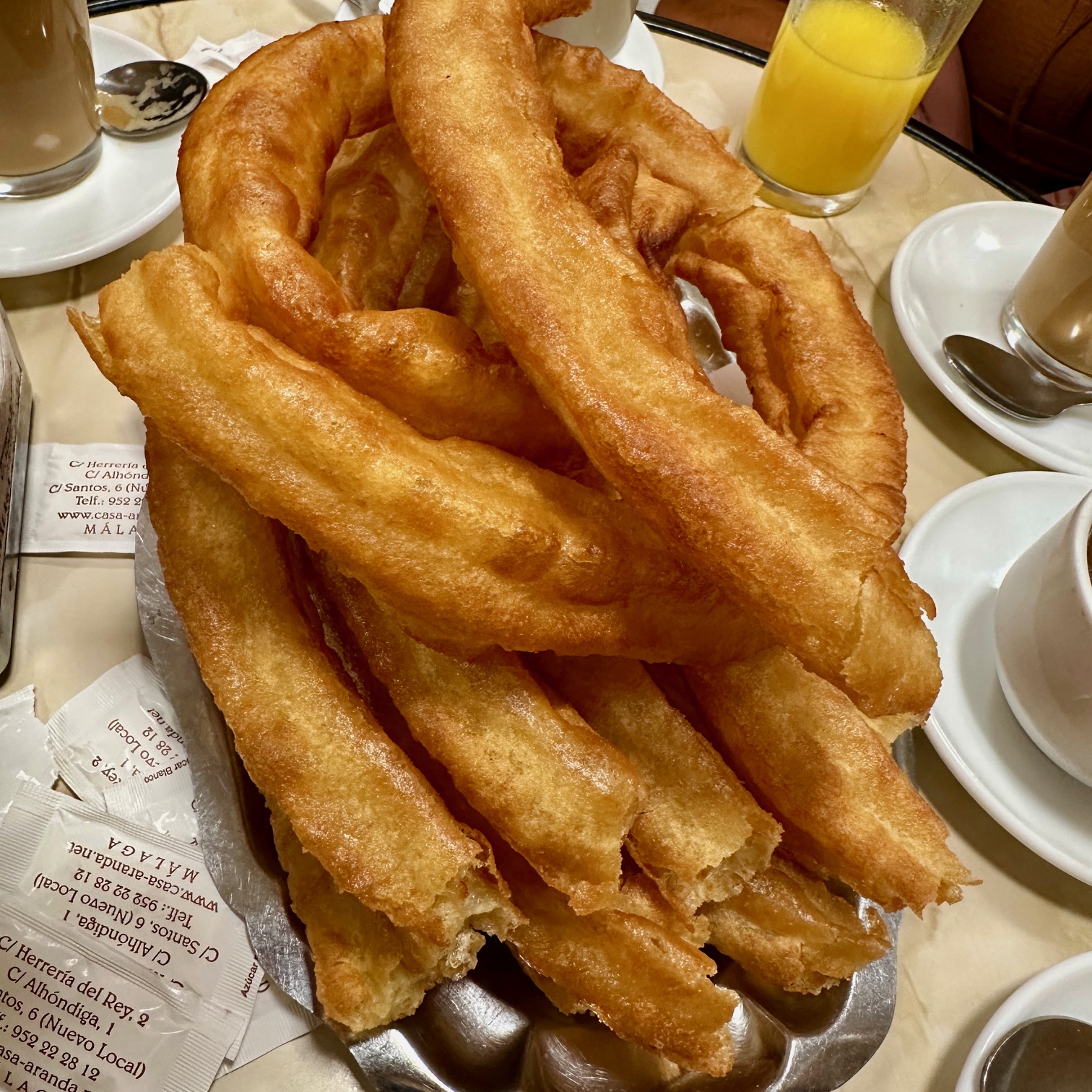
In the old days there were two places for churros in Málaga, Cafe Central and Casa Aranda. And then, tragically, at the start of 2022 Cafe Central closed because of a dispute with the landlord: how very Reading. It’s now a purgatorial looking “English-style pub” called “John Scott’s” owned by the Swedish company behind Kopparberg, which in my book makes it inauthentic in about half a dozen ways: if you’re tempted to visit it while you’re in Málaga, seek professional help.
Anyway, that just leaves Casa Aranda which fortunately is excellent. It’s grown and grown to the extent where it appears to take up a whole street and the waiters hang around at one end, managing an orderly queue to find you a table. Even though it looks rammed the process is impressively brisk, so you’re normally seated in no time. If you’re lucky, you’re outside with some sunshine, a view and some people watching opportunities. If you’re less fortunate you’re ushered into a slightly unlovely room. Either way, the churros are champion.
El Pimpi is a Málaga institution, to the extent where including it in this guide is a little obvious. A huge, sprawling bar with lots of little rooms and corridors, and a lot of outside space looking out on the Alcazaba, I surprised by how much I liked it. It was touristy, but not to its detriment, and it had all the things Antigua Casa de la Guardia was lacking, like seats, and toilets you could actually bring yourself to use.
My glass of Pedro Ximenez had that sticky, syrupy quality and the richness of thoroughly coddled sultanas and I would happily have stayed for more. There’s always next time, as I increasingly told myself as my holiday drew to a close. Antonio Banderas, a native of Málaga, is a big fan (he allegedly owns an apartment overlooking the bar), so there are a lot of pictures of him on display. A lot. Many of the barrels are signed by celebrities – including, after he stopped by on his recent Channel 5 series about Andalusia, Michael Portillo of all people.
Santa has grown, to the extent that it now has three branches – one big one near Atarazanas, a smaller one near the cathedral and my favourite, in Soho. There are usually seats outside, the people watching potential is exceptional and their coffee is solidly, reliably excellent. Although I’ve never eaten a full meal there the brunches look decent, and I do have a soft spot for their alfajores – a hefty, delicious biscuit enrobed, as marketeers are wont to say, in chocolate.
Part of the continuing explosion in Málaga’s coffee scene, Next Level was a new one on me and has two branches. The original one, on Calle Panaderos near the market, is more rough and ready. The second, which is a little more upmarket and has some excellent outside space, is on Calle San Juan and is all round a little nicer. Both, and this is the important bit, serve really impressive coffee: two top-drawer lattes cost a little over five pounds.
They also sell beans to take away, and the ones we bought, from Rotterdam’s Manhattan coffee roasters, might well have been the best coffee I had at home in 2023. Spain is very lucky that this thing called the Common Market allows them to buy the best coffee from anywhere in Europe without worrying about taxes and delays and paperwork. I can’t see it catching on here, more’s the pity.
Next Level Coffee Calle Panaderos 14/Calle San Juan, 27
9. Kima Coffee
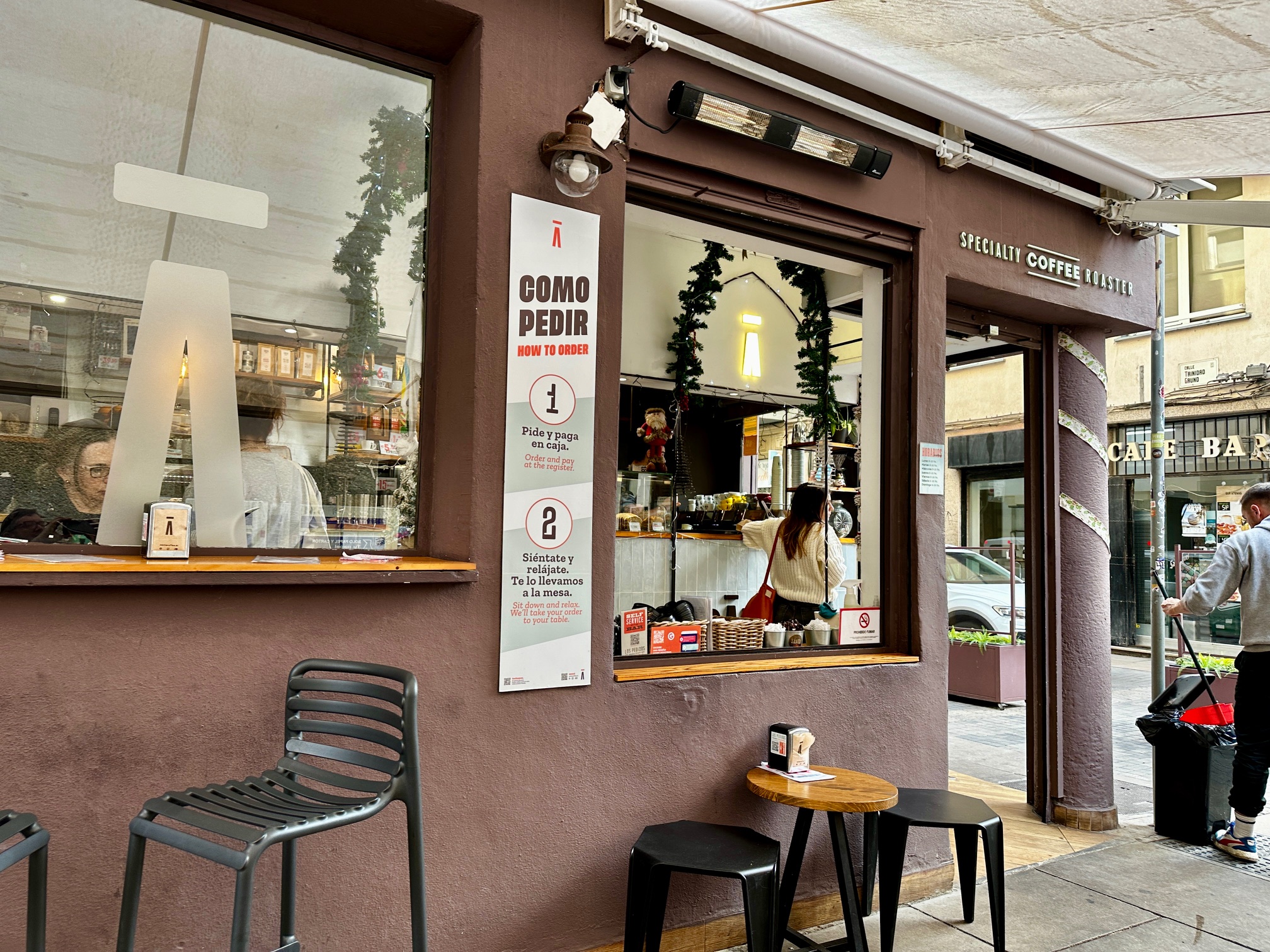
Kima, which is not far from La Cheesequeria, was the underdog coffee house that I really grew to love on my last trip to Málaga. It’s small – little more than a kiosk, although there are stools for three people inside. In reality the clientele often stand up at the counter and chat away to their barista until the next lot of customers come in, which I found really likeable. It reminded me a lot of Mia Café, which I loved in their old home, and I suppose like Mia if they are successful they will move to a bigger place which I might like less and make more money, which to be fair is kind of what they’re supposed to do. I hope they do, but I’m glad I got to enjoy their coffee before they hit the big time. Two lattes here – brace yourself – will set you back less than four quid.
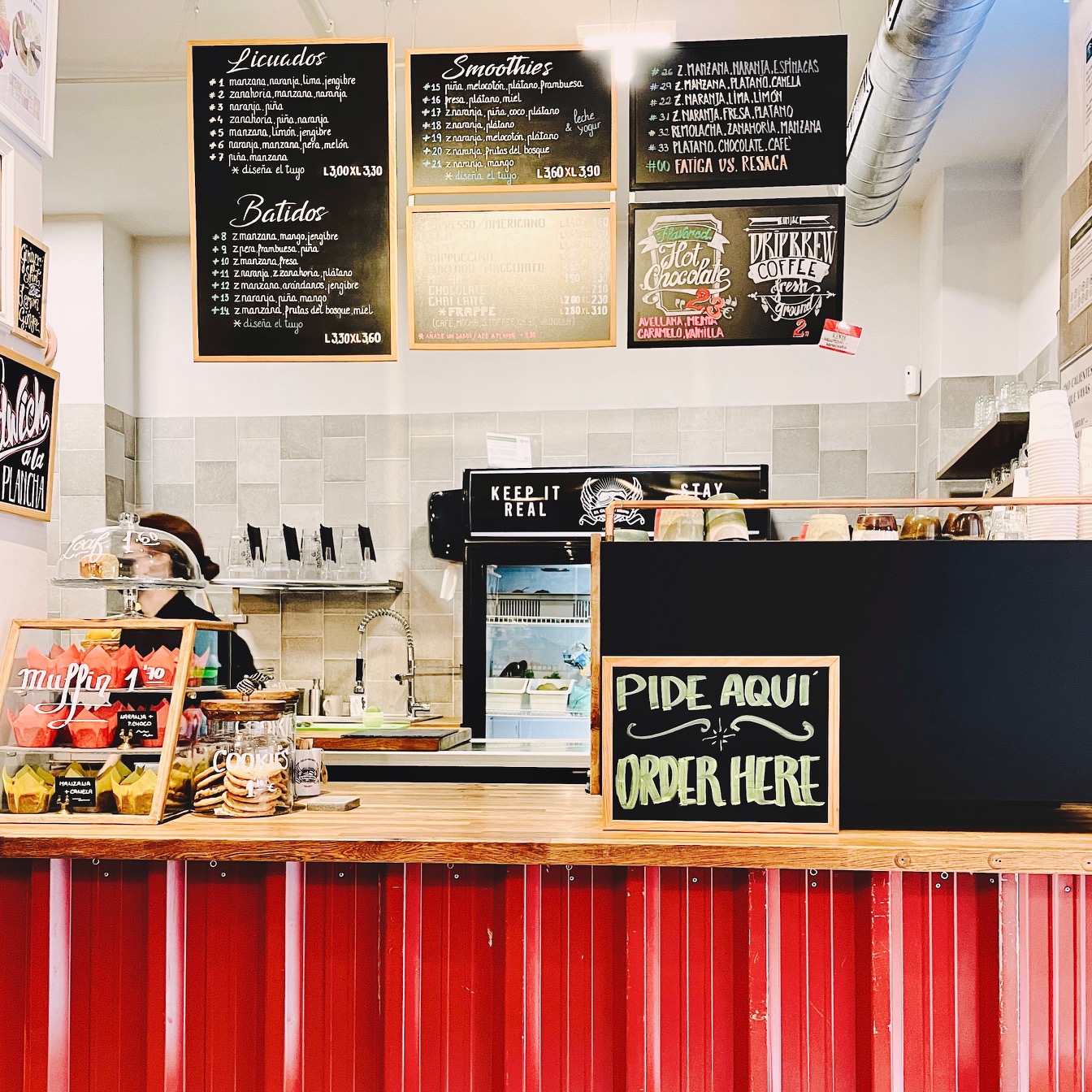
El Ultimo Mono translates as “the last monkey”, for reasons I still haven’t managed to figure out. This was my go to place for coffee on the move on previous visits to Málaga, but when I went in 2021 I found that it had moved location. Its new home, tucked off a main street, slightly lacks the charm of its old one, but it’s got a little outside space and has developed quite a nice cosy feel.
Anyway, the coffee is still rather nice and a sensible size for drinking on the go. And if you have it in, it comes in the most beautiful cups: I very nearly went up to the counter and asked where they’d got them from.
Since January 2025, Edible Reading is partly supported by subscribers – click here if you want to read more about that, or click below to subscribe. By doing so you enable me to carry on doing what I do, and you also get access to subscriber only content. Whether you’re a subscriber or not, thanks for reading.










 Edible Reading