The Baskerville, Shiplake

I take reader requests and recommendations really seriously. There are two big reasons for this.

First, I think it’s important that I review places you want to know about. If there’s somewhere you’ve always wanted to eat in but you don’t want to risk it then I’m your… err, lion. If somewhere new opens – or reopens – and you want the low-down then I’ll do my best to be your mane (oh yes, lion puns a-go-go) source of info. Secondly, I’m not omniscient. I know a fair bit about Reading’s restaurants but I can’t cover everything – especially outside the town centre – without your help. That’s where the recommendations come in: if you like the places I rate, and you tell me somewhere is good then I’m more than willing to give it a visit, because I trust you to be discerning.

It’s not always successful – I must find a way of thanking the person who said “I’ve always wanted to know if Picasso is any good” – but generally I reckon it works well. I’ve discovered lots of good places I wouldn’t otherwise have visited, and hopefully you might have too. Anyway, last week’s review was a good example of the first type – and it seems like lots of you wanted to know whether a London Street Brasserie chef can cook outside his natural habitat. This week’s review is the second type: last month reader Steve Smith recommended The Baskerville as an alternative to the highly-rated Plowden Arms. It was so good that he drove all the way from Aldermaston, he said. Does Shiplake really have two pubs doing excellent food?

The Baskerville certainly fits into the “handsome boozer” category (I’m a real sucker for these, as you might remember). In the centre of Lower Shiplake, it’s a few hundred feet from the train station in one of those villages the Thames Valley seems to specialise in (you can see the Eye-Spy book now: handsome boozer, cute cottage, smart Georgian house, wisteria…), the kind of place I daydream about moving to after a leisurely lunch and a bottle of wine.

The pub is a smart redbrick building with a small cosy bar room at the front and the larger restaurant area out the back, perhaps an indicator of where their priorities lie. Although it’s a big room it’s nicely broken up into sections and the beams are strung with fairy lights, a lovely touch. It was full for most of my time there, with the larger tables in the centre filled with families having Sunday lunch out and the smaller tables around the edge dotted with couples. There was a nice buzzy atmosphere (lots of awfully well-behaved children, too: Shiplake must be that kind of place). In summer I can see it would be even more popular with parents – the garden has one of the biggest wooden play areas I’ve ever seen (I wanted to go outside and play, and felt a little sad that I was too old for all that).

I’ve said many times that putting a menu together is a real art – finding the middle ground between too much choice (how do they cook it all well?) and too little (I don’t fancy any of these) is difficult. Goldilocks would have been very happy with the choices here: six starters, five mains, three Sunday roasts, four desserts and a cheeseboard felt just right. At each step there were two or three dishes I would be happy to order, an interesting mixture of the conventionally pubby and the more imaginative. Also – and this is unusual round here – the menu had some information about provenance, so you got an idea where some of the ingredients came from.

My smoked salmon starter was more on the pub classics side. A generous amount of thick, rich, smoky salmon (from Wren and Hines in Billingsgate Market, according to the menu) served in a ring around a lamb’s lettuce salad with capers and some slices of blood orange. The vinaigrette was, according to the menu, whisky and dill but against the strongly smoked salmon I struggled to discern it. At least it was inconspicuous rather than AWOL, unlike the beetroot listed on the menu which was nowhere to be seen. In fairness, I only realised this when sitting down to write this review, which suggests the dish didn’t miss it. The blood orange was a touch too sharp (I pulled a face when I ate it on its own) but nice against the salmon and salad; although leaving the pips in the orange was a little off-putting. If anything, the salad was generous without being interesting (although, like most people, I struggle to get excited about salad) especially as there was bread, too: a few slices of a gorgeous seeded granary. I couldn’t help wishing I’d just had the salmon, that bread and a really good butter: sometimes more fuss means less fun.

BaskSalad

The other starter – caramelised shallot tarte tatin with Cornish brie – was a glorious string of words on a menu that made me come over a tad unnecessary. The reality was less thrilling, partly because more of that salad had been unnecessarily dumped on top of it. But the biggest disappointment was eating it. Going from the first to the third mouthful was a case of going from oh, this is lovely to this is a tad sweet before ending up at I appear to have accidentally ordered dessert. The whole thing was totally out of kilter – the balsamic dressing was sweet, the roast figs were sweet, the onions were cloyingly sweet… the overall effect was like gargling neat Ribena while listening to that song by Daniel Bedingfield (you know, the one with the falsetto. Ick). What’s frustrating is that it needn’t have been that way: it needed a better chosen, saltier cheese to stand up against the torrent of sugar, but the brie – ripe though it was – was too bland for the job.

BaskTart

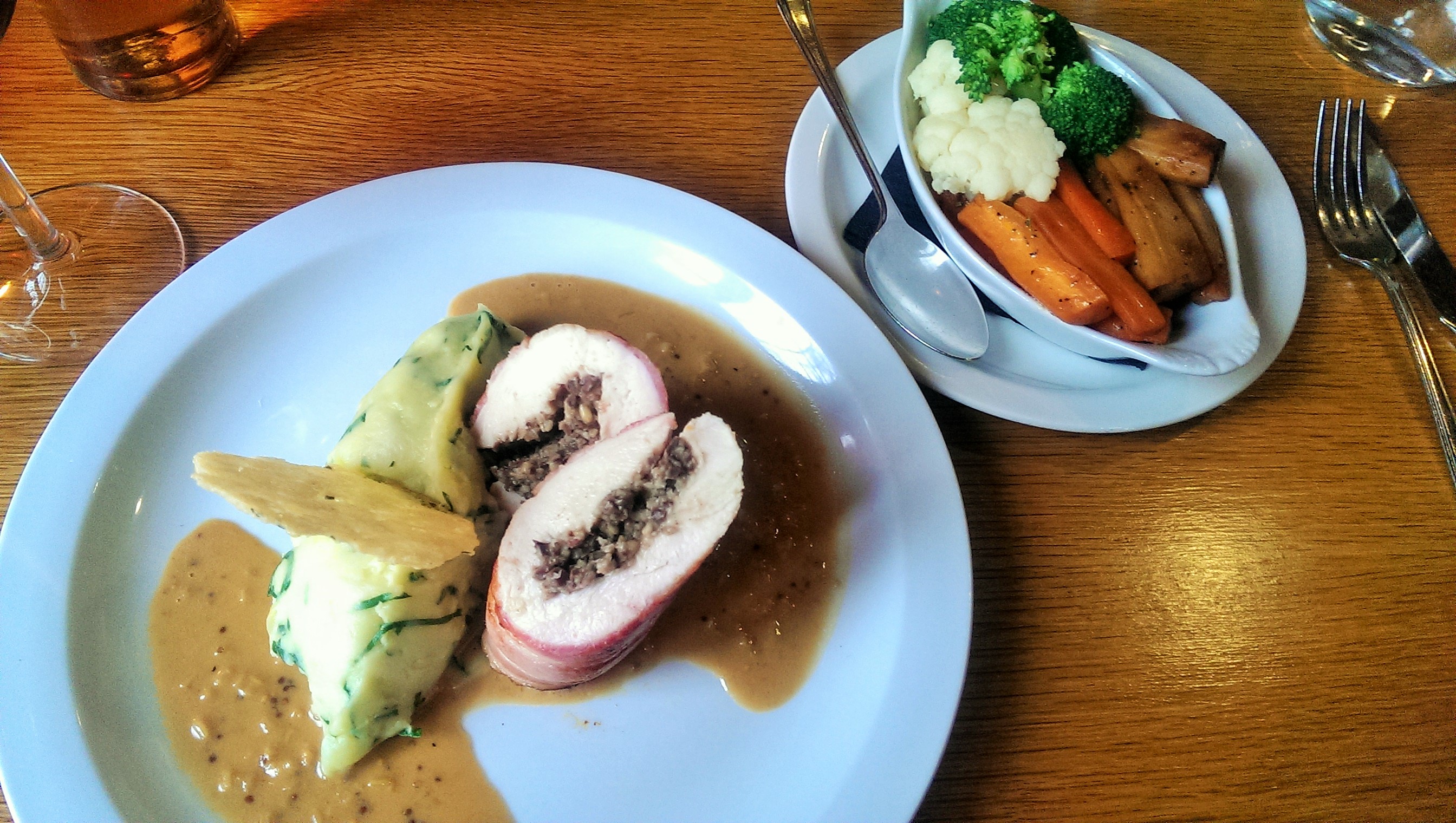
On to the mains, then. The standout here was chicken Balmoral: stuffed with haggis and wrapped in bacon, served with rumbledethumps (Scotland’s answer to colcannon) and a whisky and mustard sauce. The chicken was spot on – still moist but cooked through – and the haggis had that earthy, peppery taste I adore: I know it isn’t everyone’s cup of tea but I love the stuff, and you don’t see it on menus often. There was a side dish of vegetables that appeared to come with most of the mains – roasted carrots and parsnips, steamed broccoli and cauliflower. The parsnips in particular – all sweet and sticky-soft – were fabulous, but all of the vegetables were well cooked, not boiled into mushy oblivion. The sauce was more mustard than whisky, but worked beautifully with everything. The only disappointment was the bacon – it wasn’t cooked anywhere near enough and much of it ended up discarded on the side of the plate, pale pink and rubbery. Maybe that’s the price you pay for tender chicken.
BaskChick

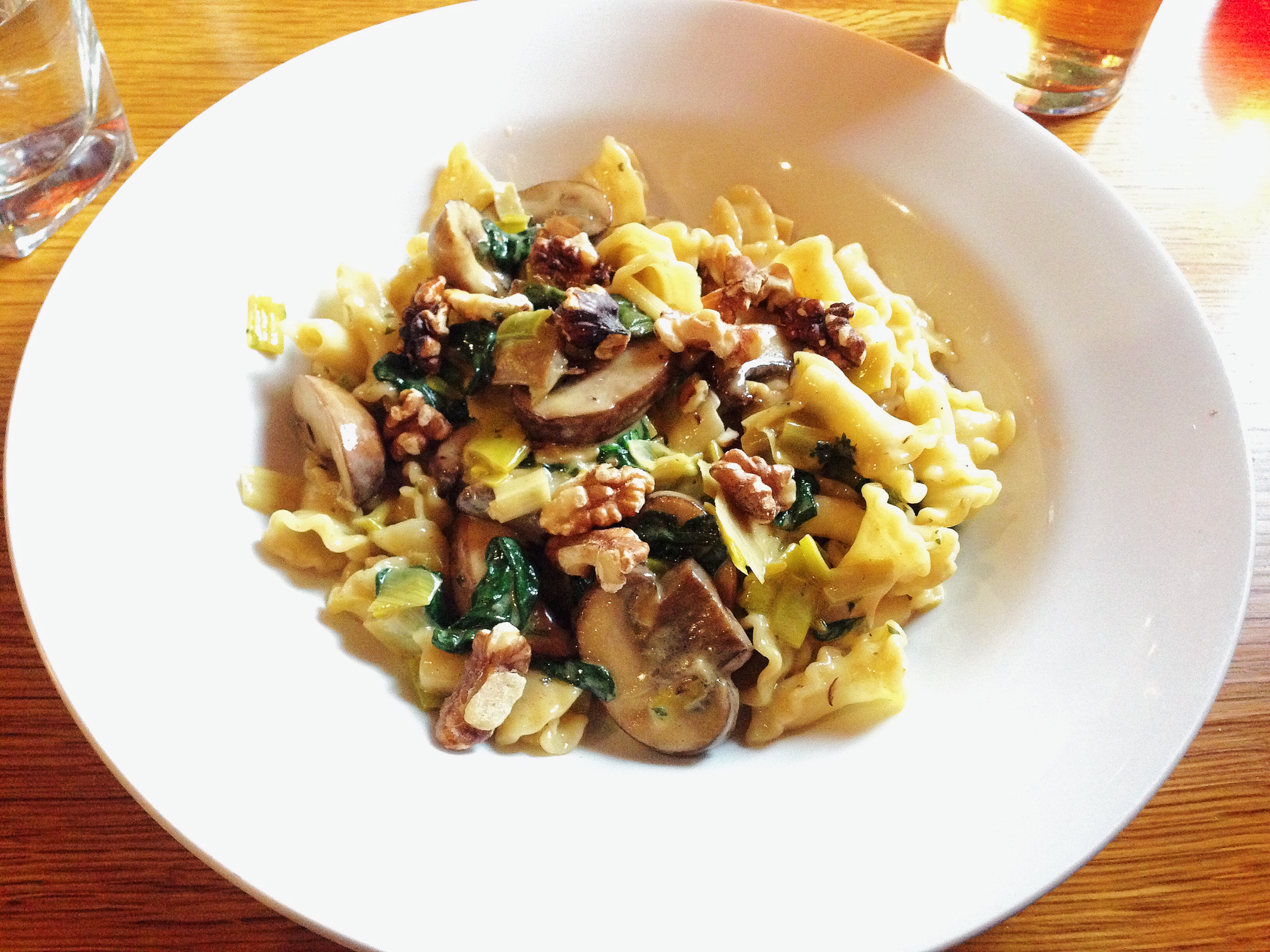
The other main was that unusual thing, a vegetarian dish I actively wanted to order: blue cheese and chestnut mushroom pasta with leeks, baby spinach and toasted walnuts. I could see literally nothing to dislike about this in theory, but again the execution was disappointing. The pasta – campanelle, I think – was good, the right shape to pick up the sauce and cooked only slightly further from al dente than I’d liked. The leeks were soft and sweet. The chestnut mushrooms were good, although they’d have worked better chopped finer. The toasted walnuts added crunch. So much potential from the supporting cast, but the star didn’t turn up: there wasn’t enough sauce, and what sauce there was clung to the bottom of the dish as if in hiding. I was expecting that rich tang of blue cheese, little bombs of salt scattered throughout, but it was so bland it was hardly there at all. It was inoffensive, a blue cheese dish for people who don’t really like blue cheese. But really, who’s the target market for that?
BaskPasta

After two large courses it was tempting to get the bill, but I know I’ve been letting you down lately, so I ordered dessert. I hope you appreciate the trouble I go to to give you a well-rounded review (especially as it has the knock-on effect of giving you an increasingly well-rounded reviewer).

The sticky toffee pudding is a pub staple and, even though it gets served on a fancy square glass plate, The Baskerville knows better than to the mess with a classic. The pudding itself was moist, gently spiced and all middle (I prefer middle to edges when it comes to cake). The perfectly spherical ice cream ball was balancing on the requisite pile of crumbs with a mint leaf on top (I think there must be some legal requirement for this style of presentation: it’s inescapable these days) and on the opposite corner was a small jug of toffee sauce. It was textbook, and I loved every spoonful: plenty of sauce, a big wodge of cake and a dollop of ice cream. Well rounded indeed.

I also loved the bitter chocolate tart, all class and cleverness. The ganache was rich, dark and smooth, but with a hint of orange shot through it, working beautifully with the pieces of blood orange on top. All of it went nicely with the cinnamon ice cream, which tasted so good that I happily overlooked its oddly elastic texture. The pastry, dense and buttery, was gorgeous and – just as importantly – not so thick that eating it with a fork involved a series of high risk manoeuvres to stop pieces from wanging across the table. If the rest of the meal showed some inconsistency, the desserts redeemed a lot.
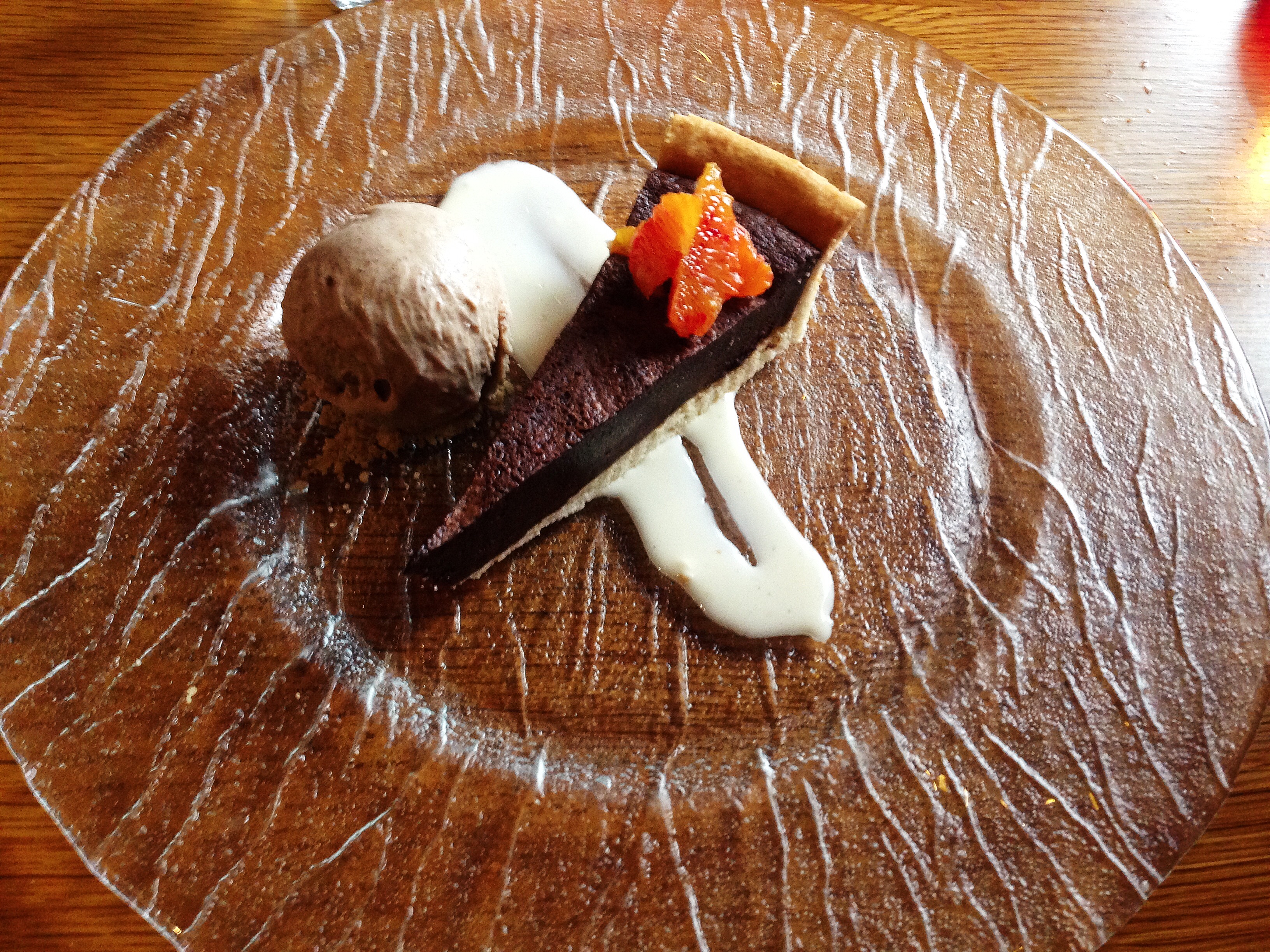
BaskChoctart

It’s a shame I was driving, because the wine list had plenty of bottles around the pocket-friendly twenty pound mark, a sure sign that it’s been well thought out. Fortunately, the selection by the glass was decent too and I liked both the reds we tried, although the French pinot noir was probably the pick of the bunch.

Service was excellent from the moment we entered to the moment we left, which is largely down to the restaurant manager, a friendly Scot who appeared to be everywhere at once. He worked hard without ever making it look like work at all, a rare talent: he made the right noises when we ordered food, had an opinion about the wines and was on hand to give pointers and just be generally charming whenever he was needed without ever hovering or outstaying his welcome (I’d also like to think that the Scottish influences on the menu came from him, for no reason other than because it would be nicely fitting). The other staff – mostly young ladies – were also helpful and friendly, just without the polish of years in the industry. The bill, for three courses for two, two glasses of wine and a pint of very refreshing shandy came to seventy five pounds. So not the cheapest, although we did come away full.

The big problem with The Baskerville isn’t in the pub, it’s a little over a mile down the road. When a village has a pub that does food as good as the Plowden Arms a neighbour has to pull something really special out of the bag to compete, and I think The Baskerville almost manages it but not quite. I think, sensibly, it’s aiming for bigger portions of slightly more conventional food in a bigger, slightly more conventional room, and it clearly has a regular clientele who appreciate that. But, for me at least, although I enjoyed much of my meal I found it hard to imagine driving past the Plowden, turning right and going here instead. I’ve tried really hard to avoid two things in this review. One was to make lame jokes about Sherlock Holmes, and the other was to compare this pub to the Plowden Arms. I’m afraid you’ll have to forgive me because, like The Baskerville, I’ve only partly succeeded.

The Baskerville Arms – 7.3
7 Station Road, Lower Shiplake, Henley-on-Thames, RG9 3NY.
0118 9403332

http://www.thebaskerville.com/

The Lyndhurst

N.B. The Lyndhurst closed under these owners in June 2016 and has reopened under new owners several times since. I’ve left this review up for posterity.

One of the most interesting pieces of food news of 2015 so far was announced by AltReading when they confirmed that the new chef at the Lyndhurst would be Tom Evans, who at the time was senior sous chef at LSB. Now generally, I’ve never been a big one for chef worship. I know to some people they’re like rock stars or footballers and when they step down from a restaurant (like Alan Murchison at l’Ortolan) their replacement is hotly anticipated with a friseé (geddit?) of excitement. But for me they’re a part of what makes a restaurant great – a big, important part, but still only a part.

The Tom Evans news was particularly interesting, though, because one thing Reading really needs is a pub which does good quality affordable food. Had my letter to Santa had the desired effect after all? At the risk of introducing a football analogy we may all come to regret, I couldn’t wait to visit the Lyndhurst and find out whether their new signing would score a hat trick or (stop sniggering) be pulled off at half time.

I’ve always felt quite emotionally attached to the place: I used to love it in its previous incarnation (their rolled, stuffed pork belly was one of the best Reading dishes you’ll never get to eat) and I was really sad when it closed. Then when it reopened just doing Pie Minister pies and curries cooked offsite by an unnamed Reading restaurant (rumoured to be House Of Flavours) I was cautiously pleased but there were still rumours that it was only a temporary respite from closure. So it’s nice to see it showing some ambition and investing in new ideas.

Inside it’s pretty much the same as it ever was – slightly spruced up but still a proper pub without pretensions: charming rustic wooden tables and cosy padded pews. On a quiet weekday evening I was starting to wonder if I’d made a mistake, with both the pub itself and the specials board looking rather empty (a real disappointment as on a previous visit the specials had looked like the most interesting bit: pulled pork and pearl barley risotto and haggis on toast were both tempting prospects).

The basic menu is short, almost spartan: three “small plates” (or starters, as most normal people still call them) and five mains. As always, I’d rather have a pared down menu that gives me confidence than an encyclopaedic one that saps it, but even by my standards it was on the minimalist side. The other thing that’s worth pointing out about the menu is that Tom Evans’ name appears all over it, with references to his secret recipe ketchup, home made burger sauce and tartare sauce and the sausages he makes daily by hand; the management is definitely setting a lot of store by their star player.

So, having said all that, how could I resist the “GIANT hand made sausage rolls”? The word “GIANT” was in a bigger font than everything else on the menu, to make the point I imagine. It was partly right – just the one sausage roll but it was indeed huge; served on a wooden board with a ramekin of the aforementioned ketchup it was quite a sight to behold. The taste was pretty good too – light, flaky pastry wrapped round substantial, coarse sausagemeat, peppery and lightly spicy. The sauce divided opinion: I couldn’t really tell it apart from Heinz, the person I had dinner with thought it was streets ahead (maybe if you go you can tell me which of us is right). So all in all not half bad, although I was struck by the contradiction of something that was neither small nor on a plate appearing in the “small plates” section (yes, I’m a pedant, I know). At seven quid it almost cost as much as the mains, so the price wasn’t that small either.

Lyndhurstroll

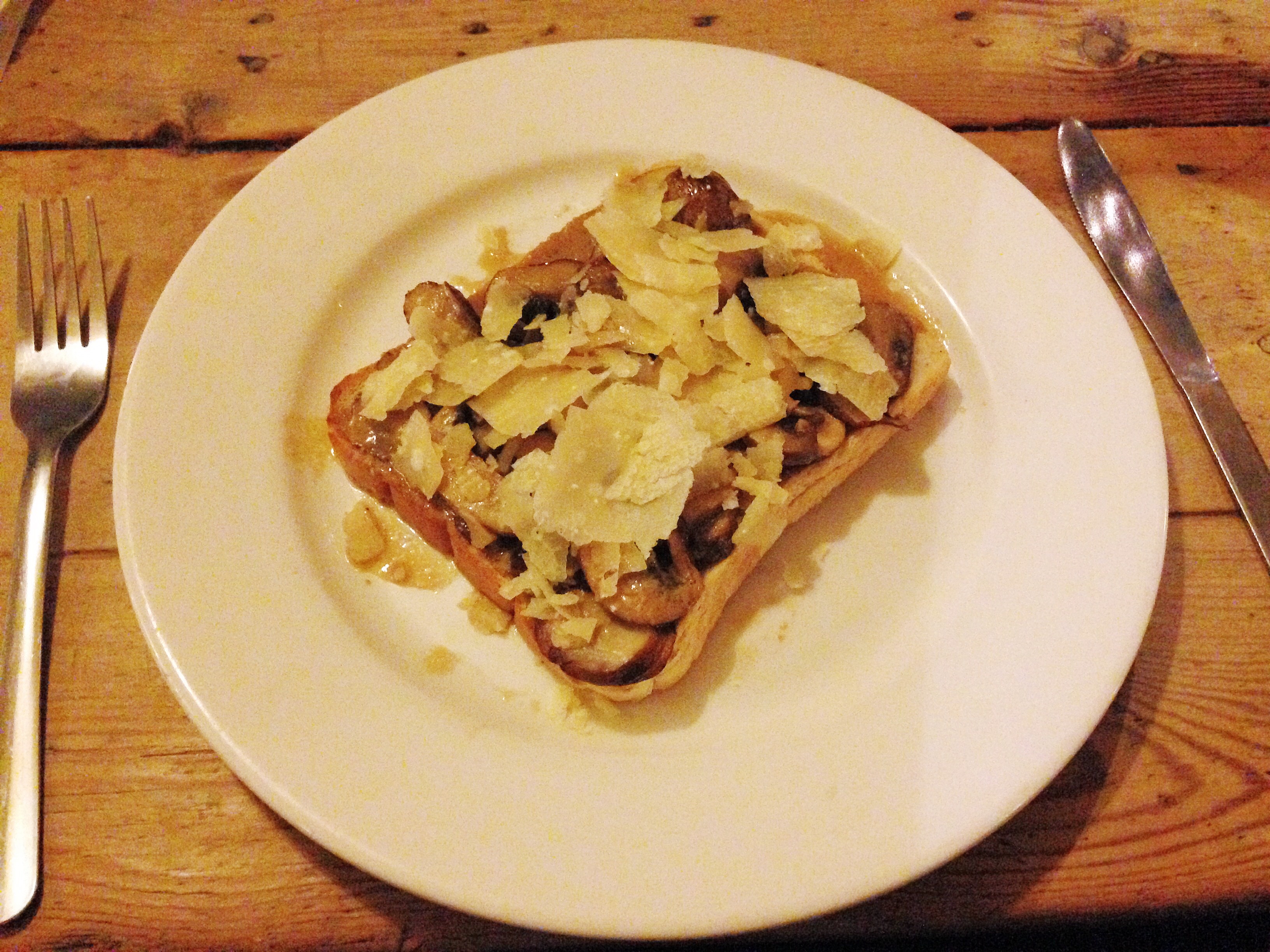
The other starter was “posh mushrooms on toast with Parmesan”, and there was a lot to like here too. I wouldn’t say the mushrooms were posh (ironically the posher mushrooms are, the more likely they are to be wild – I suppose it’s a bit like the Bullingdon Club) but they’d at least been well brought up: nicely savoury in a rich, slightly creamy sauce. The kitchen hadn’t been stingy with the parmesan either, so it was festooned with shavings. But the dish had feet of clay, because all of that was served on cheap white toast which couldn’t stand up to all those juices and just went soggy and claggy. It either needed to be better toasted or just literally made of sterner stuff: what a difference a slice of sourdough would have made (you know, posh bread). Still tasty though, and a good example of how to charge less than a fiver for pretty cheap ingredients without anyone feeling ripped off.

Lyndhurstmushrooms

The mains are almost a greatest hits of pub food: fish and chips; burger; sausage and mash; ham and chips; steak. In fairness, there were also two vegetarian mains on the blackboard, one of which – a walnut and blue cheese gnocchi – looked more imaginative than the usual, but I wanted to go for the classics to see what the kitchen’s spin on them would be.

The fish and chips were actually fishes and chips: two very lightly battered fish fillets which were a mile away from the Moby Dick style challenges served at other establishments. These were lighter and more delicate, though the fish itself wasn’t cod – it was a smaller fish with thinner flakes rather than the thick-flaked, white-fleshed fillets you get elsewhere. The menu was mute on what sort of fish it was but it did say that the chips were hand cut and the fish was “guest ale battered”. I couldn’t tell that the batter had any beer in it, but either way it was decent enough.

The chips were much tastier than they look in my (admittedly terrible) photos – I judged them on the colour and thought they were overcooked but in fact they were properly crisp on the outside, fluffy on the inside (that will teach me for being a chip racist). The mushy peas were the standout for me – they tasted bright, green and full of spring with a touch of mint, a million miles away from a tin of Batchelor’s (if the kitchen ever makes a pea soup I might just ring up and reserve a vat). Even my dining companion, who claims to hate mushy peas, loved them: that’s how good they were. The tartare sauce was also pretty good – although, again, I felt a bit guilty that I didn’t find it significantly better than shop bought. And that’s kind of how I felt about the whole dish, really – not significantly better than fish and chips at other Reading pubs. Not significantly better, truth be told, than the fish and chips the Lyndhurst used to do.

Lyndhurstfish

The other main was a burger (I know, I know – like I said, it’s a short menu). Actually, this was probably the surprise package for me: I liked it far more than I expected to. The burger itself – lovely and thick, almost pink (although not as pink as I’d have liked) – was clearly very good quality meat. It was also a sensible size which meant you could actually eat it with your hands, although once you’d started woe betide you if you tried to put it down. Also inside the brioche bun – a real one, rather than a sesame seed bun with delusions of grandeur – were several thick crunchy slices of gherkin (a personal favourite of mine) and the best bit, a terrific burger sauce which added a welcome hefty whack of tang. I was surprised by the big pile of naked salad it came with, though. I doubt anyone eats that, and it shouldn’t have been beyond the kitchen to dress it.

Lyndhurstburger

Service was friendly and efficient. Everything came quickly, I felt like they were proud of the food and they genuinely wanted to make sure I liked it. But, as often, eating in a pub it’s difficult to say much more than that. The tables are pre-laid with cutlery in vintage pots and there’s table numbers on wooden spoons, so it’s clearly very much still a pub rather than a restaurant, which felt as it should be.

I’m afraid, yet again, there was no dessert. After two substantial (if not GIANT) starters and mains I might have considered a dessert if there had been something suitably delicate, but the only dessert on the menu was a sticky toffee pudding. I was tempted: I think the STP at LSB is one of the finest school dinner desserts in all of Reading, but had I eaten it I think I’d have fallen into a lard coma. So I skipped it, and I’ll make up for it next time. Promise. As it was, the total bill for two starters, two mains and two pints of cider came to thirty-five pounds, not including tip.

Time for the post-match analysis. If I was giving marks for potential, the Lyndhurst would do brilliantly. It’s the right idea at the right time, and there are so many encouraging signs: a sensibly sized menu, a small range of specials, a cautious approach of not doing too much too soon. But I don’t think they’re quite there yet. The food doesn’t feel as accomplished as I expected: some of the little touches, like the sausagemeat and the mushy peas, are excellent, but some of the basics – the fish, that white toast – aren’t as good as they should be. I was concerned that I’d see all flair and no graft, but I went away feeling I’d experienced too much graft and not enough flair. All in all, this was a debut that was promising and frustrating in equal measure.

That sense of the place being a work in progress extends to the pub, too. There’s still some work to be done on the décor – some of the stools have their foam padding breaking free, and let’s just say the loos could do with a bit of care and attention – but the chalkboard art above the bar is very now. I hope the pub gets the time it needs to become the kind of place it’s aiming to be (I understand they plan to give the exterior a facelift, too) and the kitchen gets the time to produce the kind of food it’s capable of. A lot of that depends on them doing good trade, so – to mangle my footballing metaphor beyond all recognition – perhaps we all need to take one for the team and eat there to give them that chance.

The Lyndhurst – 6.9

88-90 Queen’s Road, RG1 4DG
0118 9617267

https://www.facebook.com/pages/The-Lyndhurst/519640051447288?fref=ts

Lincoln Coffee House

Reading’s changed a lot in the last few years, but in many ways the café scene has changed the most of all. Actually, I remember when it was all fields: no big chains, just old school frothy coffee and stewed tea merchants like Platters and Chelsea Coffee House (of that generation, only Rafina really remains). Then came the big players: Coffee Republic (remember them?); Costa; Starbucks and Caffe Nero. Not to forget the upstarts: Picnic and Workhouse. But still they keep coming – so now we have Shed and My Kitchen, Nibsy’s and Tamp Culture. And there are more recent arrivals, rare outposts of small chains, like Artigiano which opened just before Christmas and Yumchaa – almost alone in specialising in tea – in the Oracle. Oh, and Siblings Home in Caversham, opened less than two weeks ago and looking like an intriguing mixture between a Hoxton café and a branch of Labour And Wait. Back in the nineties, every time you looked there seemed to be a new pub in Reading. Twenty years on, it feels like we might soon be saying the same about cafés.

The one that always seems to get forgotten is Lincoln Coffee House, a way down the Kings Road, past the library and a little out of town. I admit I do enjoy making the less obvious choices, and I have a soft spot for the underdog, but actually I picked Lincoln for this week’s review for two very particular reasons. One is that they specialise in bagels, and I’ve always had a fondness for a sesame seeded bagel. The second, just as importantly, is that I’ve long felt that Lincoln probably does the best tea in Reading.

Subscribe to continue reading

Become a paid subscriber to get access to the rest of this post and other exclusive content.

Beijing Noodle House

Beijing Noodle House closed in the summer of 2019 and is due to reopen as a Nepalese restaurant called Gurkha Home. I’ve left the review up for posterity.

Because I have a policy of not reviewing restaurants the very minute they’ve opened, opportunities to be topical are few and far between. I’m not always good at seizing them – I’ve always regretted not visiting Pau Brasil last year while the World Cup was on, for example – so there’s no way I was going to miss out again this week.

I’m not talking about pancakes, by the way. I’m still convinced that pancakes, like cooked breakfasts and roast dinners, are best enjoyed at home; even when a restaurant does them well, it never quite recaptures how good they can be in the comfort of your own kitchen. Something’s always not quite right: the sausage isn’t good enough, the baked beans are claggy and don’t have Worcester sauce in them, the beef’s a tad leathery or (most unforgivably) there aren’t enough roast potatoes. At their best – especially with roast dinners – they can be a high-end reimagining, an enjoyable one even, but it’s just not the same.

That’s never truer than with pancakes. Just writing this I am remembering them – fresh from the pan, sprinkled with sugar and lemon juice, rolled up and scoffed greedily while someone is busy cooking the next one. No restaurant can match that. Plus when you have them in a restaurant you get a pancake, emphasis on the singular. Where’s the fun in that?

No, the other thing that happened this week was the Chinese New Year, only yesterday. It got me thinking again about the disappointing lack of good Chinese restaurants in Reading, and then I remembered one of the recommendations I’d received: Pete, the proprietor of Shed, had suggested I review Beijing Noodle House. He raved about some of the Indonesian specialities and the “mouth watering pork dumplings”. Pete strikes me as a man who knows his food – anyone who’s ever tried Saucy Friday can attest to that – so how could I go anywhere else on this of all weeks?

Actually, my first reaction to the recommendation was “is that place still open?” I used to go to Beijing Noodle House a lot, back in the day (I was especially partial to their duck fried noodles). Then, back in 2008, it was gutted by fire; I can’t remember how long it was closed for, but when it reopened I had moved on elsewhere and it never occurred to me to return. Heading up West Street on a weekday evening and going through the front door felt a little like bumping into an old friend and having to make excuses for not having been in touch.

The first thing that struck me about the room was the pictures on the wall. They are enormous (one pretty much covers an entire wall), an odd mishmash of Oriental and European art. You almost couldn’t take your eyes off them, so huge were they, and I’m no Brian Sewell but I don’t think the proprietors are going to take them to a filming of Antiques Roadshow any time soon. Apart from the mind-boggling art? Well, it’s a bit run-down. The dark wood tables are a little too low so you end up hunched over your food, everything is a little worn and has seen better days. An electronic neon sign in the window flashes “OPEN”. The place mats are thin, plastic and tacky – mine, for no reason I could think of, had a photograph of chips on it. It was just tatty enough that I looked up the health and safety rating from the council, and was hugely reassured to find that they’d given it five stars.

There’s no menu online but there are a lot of noodle options – as ramen, as fried noodle, as udon or vermicelli, in soup or not. More noodle combinations, in fact, than I knew existed. You could probably figure that out for yourself – the clue’s in the name after all – but there was a lot more to the menu than that. I also spotted plenty of rice dishes, a good vegetarian section and, on the back, a range of Thai and Malaysian dishes. I couldn’t see any main courses costing more than seven pounds. As always with a very big menu I felt spoiled for choice, and sadly as usual with a very big menu I also wondered how many choices contained spoilers.

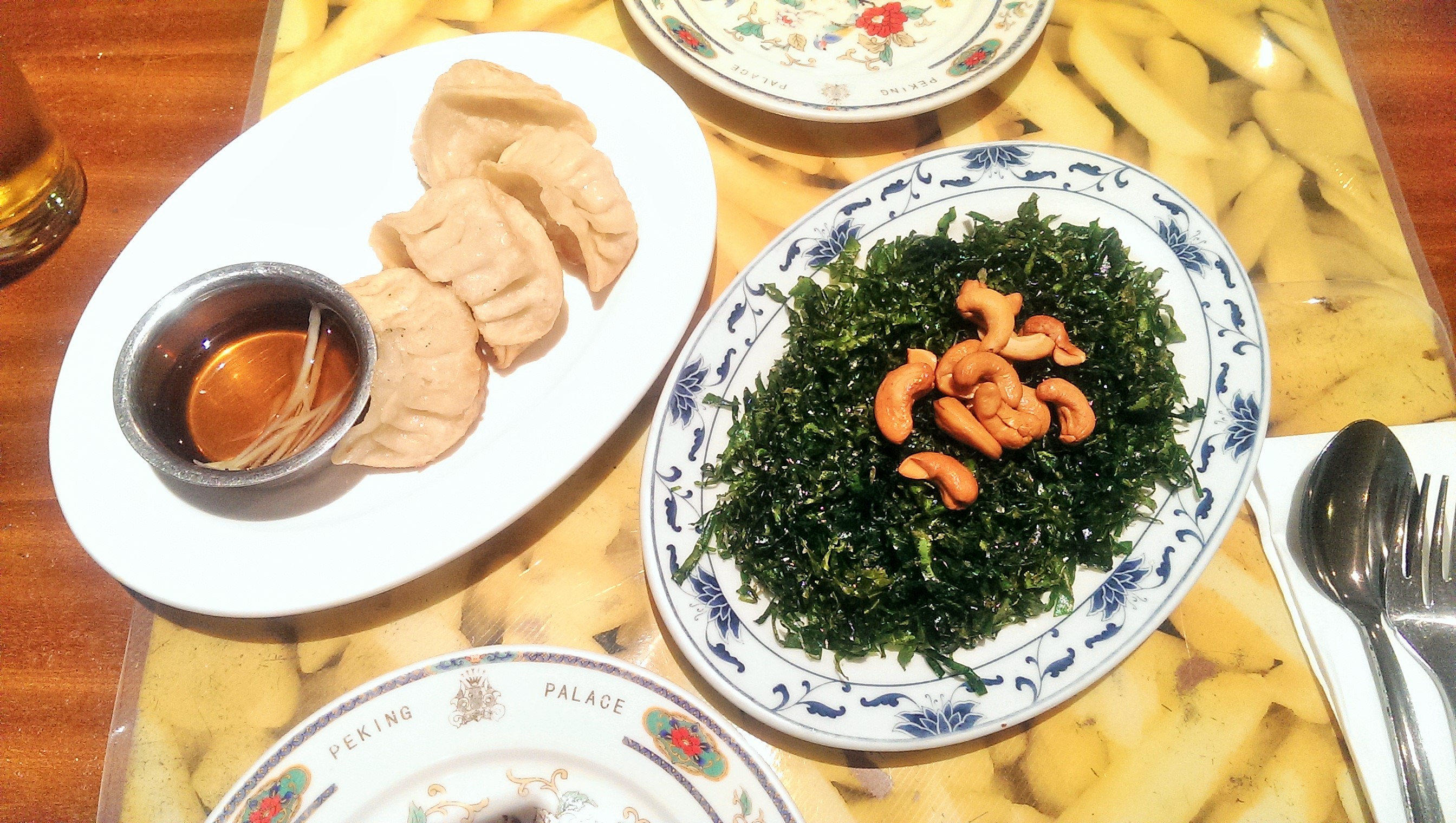
No way to find out except to dive in, so we ordered several of the starters. “Grilled Pork mouthwatering dumplings” (yes, that’s a direct quote from the menu) were every bit as good as Pete had suggested they would be. There’s often an air of the mystery meat about dim sum filling which puts me off, but these – more like gyoza than steamed dumplings or pork buns – were full of coarse, subtle pork. They were beautiful combined with the clean, delicate taste of the ginger vinegar dip. Four felt like a snip at just under four pounds.

Beijing starters

The chicken satay was also very good: you could say it’s hard to get satay wrong, and you’d probably be right, but I liked this a lot. The chicken – three decent sized skewers – was maybe slightly cooked into toughness but that just gave me an excuse to heap on lashings of the satay sauce, which was nothing to look at but deceptively impressive, with just enough slow-building chilli. Last of all, crispy seaweed came with cashews on it rather than the traditional grated scallop (did you know that the pink powder was grated scallop? I didn’t) and was also delicious. The nuts added a savoury toasted note which meant it wasn’t artificially sweet the way seaweed can be – not that that ever stops me polishing it off, mind.

I ordered the duck fried noodles partly for old time’s sake and partly because the menu goes out of its way to say that the duck is marinated and freshly cooked and you can have it boneless if you prefer. When it arrived I felt that mixture of nostalgia and anticipation. It looked just how it used to, back when I used to come here, but was it as tasty? After all, your tastes move on, change, develop: could it possibly have been as good as my memories of it?

In a word: yes. Possibly better, in fact. The duck – and you get loads of it – was glorious in big, tender slices. Not crispy, which might put some people off, but not with the thick layer of fat that might deter fussy eaters. The spring onions, peppers and beansprouts still had the right amount of crunch with the soft noodles and the duck, and everything was coated in a beautiful dark sauce which was more than soy but impossible to split out into its component parts. I was smiling from the first mouthful to the last, and wondering why on earth I’d left it so long. It was just over six pounds, and I’d pick it over a yaki soba from Wagamama nine times out of ten.

Beijing noodles

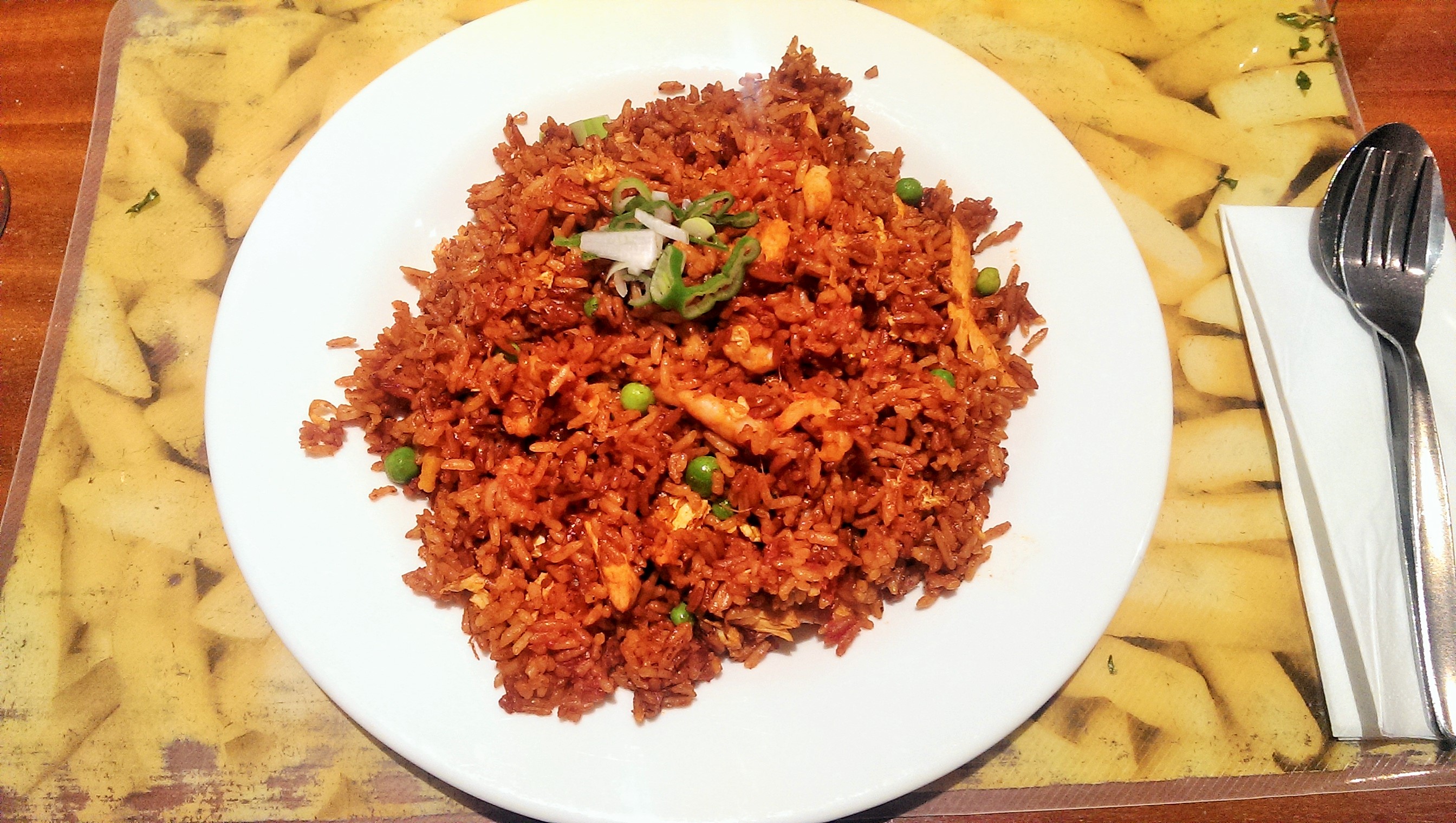
I also wanted to try something from the less conventional side of the menu, so I went for the nasi goreng. This turned up as a huge heap of rice (indeed, the translation from Indonesian is simply “fried rice”) liberally interspersed with prawns and pieces of chicken breast. The sticky, lightly spiced rice was dotted with peas and on top were a few thin slices of spring onions which felt like not quite enough variety to make every mouthful exciting. That said the meat was generous enough to have a prawn or piece of chicken in every forkful and the flavour was good, if a little bit repetitive (I rarely order risotto for the same reason). Still, five quid for a really tasty plate of rice is incredible value and it made me want to try more of the more unusual dishes (nasi lemak, the national dish of Malaysia, perhaps, or possibly beef rendang).

Beijing nasi

Someone pointed out my really poor track record of ordering desserts in 2015, and I’m afraid it’s true. I didn’t do any better here: I could have gone for some ice cream, or toffee banana with sesame seeds, but somehow I felt like I’d eaten two courses with no need of a third to complete them. The whole thing – three starters, two mains, a Tsing Tao and a large glass of anonymous, cheap and perfectly drinkable red – came to under thirty pounds. I haven’t mentioned service and that’s deliberate – not because it was bad but because it was almost unobtrusive. It’s just not that kind of restaurant: they ask you nicely what you want, they go away, a little later they bring it and they leave you to get on with enjoying it (actually when I put it that way, it sounds pretty good). Besides, how could they ever compete with the wall art?

I’m delighted that I enjoyed Beijing Noodle House. I can’t think of many places in town that are so cheap and so enjoyable, and when I looked at the menu I had real trouble narrowing it down to two main courses, so it probably won’t be long before I return to fill in the gaps. I really wanted to like it, because of all those happy memories, but as a realist I’m not sure I was expecting to like it as much as I did. It’s also a great example of how good food in an iffy room is always going to beat iffy food in a good room. Maybe one day Reading will have an equivalent of “Where Chefs Eat”: if so, Pete should definitely claim this one for his entry.

Only one thing troubled me: I was one of only two tables the night I went, although someone else did poke their head round the door for takeaway. West Street has felt increasingly like a ghost town recently, with Vicar’s closing just before Christmas and rumours that Primark is considering relocating to Broad Street. I can only hope my curse doesn’t strike and Beijing Noodle House doesn’t close shortly after receiving a glowing review from me. I know I say this a lot but use it or lose it, because otherwise one of these days the question will still be “is that place still open?” but the answer will be no.

Beijing Noodle House – 7.2
13-14 West Street, RG1 1TT
0118 9078979

http://www.hongbeijingreading.co.uk/

Alto Lounge

I like to bang on about service in restaurants, but this week it occurred to me that I might be part of the problem. After all, I talk about service, but if you look back at my other reviews it’s usually tucked away near the end. It’s the penultimate paragraph, stuck between the desserts and the summing up, sharing space like uneasy housemates with the bit about How Much It All Cost.

For some reason it’s difficult to write about service in detail unless it’s bad, and when it’s bad I feel guiltier about going into detail than I would about a disappointing dish. Funny how the human face of a restaurant, even though it’s what you see, attracts less comment than all the faceless people toiling away in the kitchen.

So, to redress the balance, even if only for one week: the service at Alto Lounge was some of the best I’ve had in a long time. The two women working the night I went were an absolute joy: friendly, likeable, helpful and interested. They stopped me going up to the bar to order more drinks when my food had just arrived, even though technically Alto Lounge doesn’t do table service. It properly felt like they wanted to make sure I had a good evening, and when I settled up and left the goodbyes were so genuine that it made me want to go back.

Subscribe to continue reading

Become a paid subscriber to get access to the rest of this post and other exclusive content.