Restaurant review: Pierre Victoire, Oxford

I had to check because I thought my mind might be playing tricks, but there used to be a French restaurant chain called Pierre Victoire, the Côte of its day, thirty years ago. I remember eating in the Nottingham branch when I lived there at the turn of the last century, and I’m pretty sure Reading had one too. Perhaps readers with even longer memories than mine can correct me if I’m wrong, but I seem to recall it was on St Mary’s Butts, where Favourite Chicken is now. Anyway, also around the turn of the century the chain went bust leaving just one outpost, on Little Clarendon Street in Oxford, as the only survivor.

And it’s still going strong.

It’s approaching its thirtieth birthday in a couple of years, and I can’t remember a time in my restaurant-going life, really, when it wasn’t there. It’s been an ever-present across the past two decades, constant as my life has shifted and changed, and I’ve had countless lunches and dinners there, with family and with friends. Back when I didn’t review places outside Reading, it was my venue of choice for eating in Oxford, especially pre-theatre before watching something at the wonderful Oxford Playhouse. But there were more than a few boozy evenings there too: I still remember the horror and confusion of an American friend I lost in the divorce, trying snails for the first time.

Just as my life has changed in that time, the topography of Oxford has too. Little Clarendon Street used to be the epicentre of Oxford, for me, where everything was going on. It had Pierre Victoire, a great little tapas place next door and ice cream café George & Davis opposite, a brilliant interiors shop called Central and another little shop across the way called Ottoman selling cool bits and bobs. At night it was criss-crossed with fairy lights, just a magnificent place to be.

And then the years intervened and other parts of Oxford got more interesting – Jericho just around the corner, Summertown further north, the explosion of interesting restaurants and coffee down the Cowley and Iffley roads. I found myself more likely to have lunch at Arbequina and coffee at Peloton, or to amble down North Parade before a reservation at Pompette. The Westgate, a shopping development that makes the Oracle look sad and tired, altered Oxford’s landscape too. Little Clarendon Street by contrast didn’t really change, both its biggest strength and weakness.

But in recent times the pendulum has swung back, and heading to Pierre Victoire last Saturday for a late solo lunch I was struck by the fact that Little Clarendon Street is having another moment. Central may have closed, but next door social enterprise and excellent café Common Ground was doing a roaring trade. Across the way, The Jericho Cheese Company was full of lactic treats to take home and newish bottle shop and restaurant Wilding, where the Café Rouge of my student days used to be, looked very tempting. And there, familiar and unchanged, was Pierre Victoire: I was surprised by how gladdened I was to see it.

Pierre Victoire only opens for lunch Friday to Sunday nowadays, and it’s a tribute to how popular the place is that when I rang in the week to make a lunch booking pretty much all they had left was a table at quarter to two. And the place was humming with life and conversation when I stepped through the front door. The ground floor dining room goes back a long way and I seem to remember they have another dining room upstairs, or they certainly used to. I’m pretty sure these bare brick walls predate any trend for exposed bricks: it’s that sort of place.

But the tables at the front, with daylight, are the plum ones. Mine, literally tucked behind the front door, had “table for one” written all over it but gave a great view of the room and the happy diners of North Oxford. A table for six was making a meal of settling their bill, and the staff were perfectly attentive and friendly, showing no frustration. A steady stream of diners came in even after me – some with bookings, others chancing their arm on spec. All of the latter were turned away: an establishment this busy at 2pm on a Saturday afternoon has cracked something which eludes many restaurants, including a lot of the ones I review.

Pierre Victoire offers a prix fixe menu for lunch and dinner, and they differ slightly in terms of how much choice you get and the type of dishes: for instance, duck confit is on the lunch menu, while it’s magret de canard for dinner. The price varies too – lunch is about twenty pounds for two courses and twenty-five for three, whereas dinner is closer to thirty and thirty-five. Back when Pierre Victoire was open for weekday lunches I think it was even more affordable, but back when Pierre Victoire was open for weekday lunches literally everything was more affordable: I’m not sure how helpful that comparison is, really.

In any event the menu was full of French classics, many of which I’ve tried over the years – onion soup, chicken liver parfait, moules, escargots, steak frites and so on. I was a little jaded after an evening on the wine with a friend the night before, so I swerved the wine list on this occasion and instead opted for a fortifying Orangina. It came in the classic, original bottle and I wondered, short of Perrier and Fanta Limon, whether any non-alcoholic drink had as great a capacity to transport you as Orangina does. My body needed the sugars, that was for certain. The staff also brought a jug of iced tap water without me having to ask. Either they do this as standard or I looked as off the pace as I felt: either way, it was appreciated.

The other thing they always bring without you having to ask at Pierre Victoire is bread. Not ubiquitous sourdough: sourdough has completely passed Pierre Victoire by, or rather it’s above such things. No, you get a little basket of cheap, plain baguette with some decent butter which came out of the fridge a little too recently. But it’s always ambrosial; like the Orangina, like the hubbub, there’s something of elsewhere about the whole thing. You’re simultaneously mentally very much in Oxford and across the Channel, both of which are pleasant experiences.

My normal order at Pierre Victoire would be the chicken liver parfait, which comes in a little sphere with brioche toast and sweet, sticky, jammy red onion. But I was trying to be less predictable for once, so I chose the one vegan dish on the menu, a fricasée of mushrooms. It came out mere minutes after I’d ordered – I’d forgotten how brisk, how well oiled a machine Pierre Victoire is at lunchtime – and was a lovely and delicate piece of work. The decision to put it in a little chalice of filo pastry was a clever one which added texture, as did resting the whole lot on what I assume was a splodge of butternut squash purée.

I wasn’t sure about the tangle of pea shoots – one or two restaurants I love tend to overuse these as punctuation and I wish they wouldn’t – but overall it worked nicely. The mushrooms themselves, a mixture of wild and button if the menu was to be believed, were in a sauce with cognac and a little sweetness, but I found it slightly thin. It needed the cosseting touch of cream, I reckoned. But then it wouldn’t have been vegan, and that was the box it was ticking on the menu. Even so it was polished off in minutes, and there was just enough bread to mop up the last of the sauce.

If I’d chosen a curveball as a starter, I played safe for the main. I don’t think I’ve ever been to Pierre Victoire for lunch and not seen duck confit on the menu, and it’s rare for me not to order it there. I don’t understand why more places, especially pubs, don’t serve duck confit: it’s so easy to get right and such a joy to eat. There’s always plenty of meat, it always falls off the bone to the point where picking it clean is a meticulous delight and, done well, you get that crispy skin and that subcutaneous, glossy fat. Confit duck, as it happens, is one of the options on the menu for my wedding later in the year, and it will take all my strength not to pick it.

I really love how Pierre Victoire serves duck confit, too, with just the two accompaniments. A brick of rosti, which in this case was maybe a tiny bit too soggy and not crispy enough, and a bitter orange sauce which brought everything together beautifully. Good luck finding duck à l’orange anywhere on a menu these days – it’s one of those relics of the past, at least in this country – but Pierre Victoire’s smart, affordable take on it is all you really need.

It was a perfect, simple pleasure and it made me very glad to be at that table, in that room, in that restaurant, in that city, exactly where I should be. My paperback (an Anne Tyler I’d never read) stayed untouched throughout my meal because when I wasn’t eating, or taking pictures, I was too busy enjoying where I was. Watching the staff, so on it and so harmonious, always in control without being mechanical. And looking at my fellow diners, imagining their stories and their lives outside this little parcel of Saturday afternoon where we all happened to be in the same place.

As I said, Pierre Victoire is nothing if not efficient – I’d be surprised if I was the first customer at that table that lunch service, and I saw other tables turned while I was there. But they never made me feel processed, and I gave the dessert menu serious consideration before deciding to settle up. It’s more compact than the choice for the other two courses, and a crêpe au citron called to me, but not loud enough. My bill for the two courses and that iconic Orangina set me back twenty-two pounds fifty, not including tip. Pierre Victoire maybe isn’t the bargain it once was, but I’m not sure I want restaurants I like to be bargains any more. I want them to survive.

Don’t be fooled by the rating below (I know you’ve probably already scrolled down and checked). Yes, I gave Pierre Victoire a 7.3, but what I would say is that there are 7.3s and then there are 7.3s. There are the expensive restaurants where dinner or lunch costs you the best part of three figures and you think “well, it was okay”, and there are cheap and cheerful places where you come away thinking that your hosts have surpassed, or possibly even transcended, your expectations. And yet Pierre Victoire, would you believe, is neither of those things.

No, what Pierre Victoire is is that rarest of beasts, a truly consistent restaurant. I can honestly say that the last time I went there was every bit as good as this time – and not just that, but every bit as good in exactly the same way. The time before was too, and I dare say the next time will be as well. And there will be a next time, the next instalment in a series of meals that started something like twenty years ago and, if I’m lucky, will go on for many more.

Your mileage may vary, but for my money that’s worth a dozen culinary comets or flashes in the pan. I’d say that every town should have a place like Pierre Victoire, although travelling to Oxford is really no hardship. And I’d almost go one step further and say that every town should have a Pierre Victoire, but that’s dangerous nonsense: it is, as we know, how chains get started. Pierre Victoire doesn’t need that. It’s already been there, done that, got the t-shirt – and then moved on, a long time ago, to far better things.

Pierre Victoire – 7.3
9 Little Clarendon St, Oxford, OX1 2HP
01865 316616

https://pierrevictoire.co.uk

Restaurant review: Masakali

I’ve been asked about Masakali, the Indian restaurant that replaced San Sicario at the bottom of the Caversham Road, ever since it opened last November. I had a fair few messages on social media saying that it looked interesting, and when I’ve put Twitter polls up asking which of Reading’s newest openings I should visit first it’s always picked up a lot of votes. Being an awkward sod I still reviewed Minas Café, Filter Coffee House and Hala Lebanese before getting round to Masakali, but better late than never: here, at last, is the review literally some of you wanted.

I can see why people noticed Masakali. Something about the polish of its website made people dispense with their usual cynicism about yet another restaurant opening at a site which sees a new occupant every few years. The branding felt completely realised, in a way we don’t often see with new independent restaurants here. Masakali means pigeon in Hindi, and the restaurant is apparently partly inspired by A.R. Rahman’s Bollywood song of the same name: some of that might just be marketing guff, but at least they were trying.

The other thing that stood out about Masakali was the menu. Generic Anglo-Indian curries were kept to a minimum, and instead everything looked – on paper at least – properly interesting. No mix and match proliferation of protein and sauce, instead a range of more singular dishes. A few interesting cultural cross-pollinations here and there, like kulcha stuffed with truffle ghee or a chaat apparently topped with Walker’s crisps, but otherwise a good range of regional Indian dishes.

Someone had done their homework. And you know the C word was going to come up eventually, so here it is: the whole thing felt like a land grab for customers of Clay’s Kitchen rather than, say, people who went to the Bina (assuming, of course, that people still go to the Bina).

Subscribe to continue reading

Become a paid subscriber to get access to the rest of this post and other exclusive content.

Restaurant review: Yo Momoz

Zoë was telling me about an article in the Guardian at the weekend, which said that trading standards was considering outlawing the word “cheeze” to refer to vegan alternatives to cheese. It wasn’t just cheeze in their sights but all the other words in that genre like chick’n, which I’d heard of, and m!lk, which I hadn’t. In case you weren’t sure whether the people who had proposed this were killjoys, the article included a sentence that read “the document says plant-based brands should not use homophones, asterisked characters or other wordplay.” Quite right too – I mean, how dare they? Down with wordplay!

But really, it all feels so needless. The whole point of calling a product, for example, I Can’t Believe It’s Not Butter is that it’s implicit in the name that it’s not butter. Nobody is being misled, and once you’ve tasted I Can’t Believe It’s Not Butter, I can’t believe you’d honestly think it was butter, either. It’s easy for contrarians to moan about products branded as “vegan mozzarella”, but surely nobody wants that rebranded as “vegan soft-white balls with a light cheese flavour”, do they? That’s just balls, in the worst sense.

The one thing I do have sympathy with trading standards about, though, is that particular word. Cheeze. Because if I ever sweep to power (and I’m coming to terms with the fact that it looks increasingly unlikely) one of the first things I’d do is outlaw the unnecessary use of fake Zs. This started out in mobile phone shops called things like Fone Bitz – would it kill them to spell either of the words correctly? – but it’s since infected all manner of brand names.

I’ve complained before about a gentleman’s hairdresser called Ladz Barbers, down the Oxford Road. I suppose we should be grateful that they’ve only swapped one of the Ss for a Z: it’s across the road from Biryani Boyzz, which has no such qualms and has swapped a single S for two Zs. That’s inflation for you. There’s also a Biryani Boyzz down the Wokingham Road, not far from Milano’Z Pizza on the other side of the road. I can forgive the apostrophe, but not the capitalisation.

And it turns out there’s also a Milano’Z Pizza down the Oxford Road, so perhaps this particular kind of epically bad spelling is catching. I had a quick Google to confirm all this and Google said Did you mean Milano’s Pizza? I wish I did. At the time of writing the Biryani Boyzz on the Wokingham Road has a hygiene rating of zero: it might not just be the bad spelling that’s contagious.

Anyway, I begin with this crabby, middle-aged rant because the subject of this week’s review is another culprit. I first spotted Yo Momoz, in the Wokingham Road’s Z contagion zone, on my walk back in January from Hala Lebanese, a restaurant which is presumably only weeks away from rebranding as Hala Lebaneze. It’s worth paying attention heading up the Wokingham Road or the Oxford Road because you invariably spot something new, something that wasn’t there last time you checked: it’s how I pass off those trips to Double Barrelled on the number 17 bus as vital research.

Subscribe to continue reading

Become a paid subscriber to get access to the rest of this post and other exclusive content.

Restaurant review: 1 York Place, Bristol

It was a brilliant plan, in theory: I was in Bristol in February visiting my friends James and Liz and I thought that the three of us could go to lunch at Bristol’s hottest new restaurant, 1 York Place. It opened in December and I booked a table at the start of the year, excited about being hot off the press and reviewing it before anybody except Bristol’s local papers. What could possibly go wrong?

I’d have got away with it too, if it wasn’t for those pesky national restaurant reviewers. About two weeks before my visit, William Sitwell wrote about the place in the Telegraph. It was a rave review, and to sum up his 600 words on the subject he said it “felt like being pummelled… by endless waves of gorgeous food”. I assume he thinks that being pummelled is a good thing: after all, he did go to a very different kind of school to me.

To compound that sense of being foiled, the Mail On Sunday‘s Tom Parker Bowles went too, less than a week before my visit. His 400-odd words were another panegyric, even if he managed to avoid being spanked by any of the dishes. “What a menu. What a restaurant” he enthused, splitting a £100 main course of hot roast shellfish with his buddy in the process. About £40 a head (without that shellfish platter) said the text at the end, in case you don’t fancy living it up like the King’s stepson.

It was frustrating that those two got there first but at least it meant I was in for an absolute treat. If a pair of rich, entitled, Eton-educated men were in raptures about the place, surely that boded well for my table for three? We wandered the short distance from Clifton Village hungry and with a healthy level of anticipation.

To give you the background, and explain why this restaurant has been so keenly awaited, it’s the latest venture from chef and restaurateur Freddy Bird. Bird trained in London before opening the Lido in Bristol in 2008, followed by its sibling Thames Lido in 2017. He then struck out on his own at a place called littlefrench in Bristol five years ago. Bird is well connected, and has had glowing reviews at every step of the way, along with TV appearances on the likes of Saturday Kitchen and Sunday Brunch.

His reputation even led to the Guardian reviewing Thames Lido back in 2017: in those days you had to be pretty special to lure the Guardian to Reading, of all places. In fact, the Guardian wrote three articles about Thames Lido in just under two months, which is the middle class equivalent of how excited Berkshire Live got about Wendy’s.

It’s an attractive corner plot which was an Italian restaurant in a former life, double aspect with a small dining room on the ground floor and a bigger one down some narrow spiral stairs. Sitwell sniffily dismissed the upper level as “more balcony than room” but actually, with plenty of natural light, I think I’d preferred to have eaten there than in the basement where we were seated. It wasn’t an unattractive room, but it was beige and a tad bland without managing to emulate Scandi chic. The bare tables were knotty pine, not a nineties trend I’d expected to see make a comeback (“what’s wrong with varnish?” was James’ more uncharitable take).

I tend to agree with Parker Bowles about the menu – it’s not often that I see so many dishes I could gladly order, and it made decisions hard. As with my trip to Quality Chop House the previous weekend, it was a menu with a snack section as well as the three traditional courses and actually it was very reminiscent of the London venue: a few dishes – cod’s roe, sweetbreads, schnitzel – had appeared on the last menu I read on duty. Snacks were mostly six to seven quid, starters between ten and fifteen, mains twenty to thirty.

But to give you an idea of how truly difficult it was, here’s a selection of the dishes we missed out on: salt cured foie gras with spiced quince; confit duck with lentils and salsa verde; grilled squid and squid ink bomba rice with aioli; beef, red wine and bone marrow pie. However Freddy Bird might cook, the man knows how to write a menu that makes life tricky.

Liz is an excellent person to review restaurants with because she picks the kind of lighter, sensible options I never would. James is an equally excellent person to review restaurants with because he will gladly pick something different just to give me plenty to write about. On this occasion he told me that he would gladly share the pie with me and I turned that offer down. Over the course of the meal I would slightly come to regret that decision.

But first, wine. It was a good list at 1 York Place, split into sections so you could pick a fresh white, or an aromatic white or what have you. We were torn between three, all from the “textured whites” section – if you know what a textured white wine is you’re streets ahead of me – and our server, uniformly excellent from start to finish, came straight off the fence and told us what to choose. It was a Provençal white, it cost forty-three pounds against a retail price of nineteen and we all liked it a great deal. It was pale in the glass, so I worried that we’d made the wrong choice, but it was beautiful on the palate and went with enough, if not all, of what we’d ordered.

I know people sometimes moan about the length of my reviews, but looking at the 600 and 400 words of my better paid brethren I think there’s something to be said for talking about food at greater length. A dish from the snacks section was described as Sicilian winter tomatoes, smoked pork belly. Parker Bowles described the tomatoes as “pert and firm”, and Sitwell made an awful joke about how Spaniards would feed the dish to vegetarians (he loves vegetarians), concluding with a “tee-hee-hee” which made me wonder if he was the Beano‘s Lord Snooty.

That’s all well and good, but what neither of them had the word count to convey was that this dish was small and, for my money, mislabelled. This was closer to lardo than pork belly, and I think there’s an implication that dishes billed as snacks should be sharable. This wasn’t, and dividing it in three was fiddly and barely worth the bother. Were the tomatoes pert and firm? Not especially. I mean, it was quite nice and all that but for six pounds fifty it was not much for not much.

Much more like it was the cod’s roe, served with fennel to use as a crudité. I’ve come to cod’s roe quite late in life, having been a taramasalata refusenik for many years, but I really loved this and, if anything, I preferred it to Quality Chop House’s version the previous week. I had never considered using fennel to dip in anything, to be honest, but 1 York Place has quite converted me to it as a concept – sweet and crunchy, the aniseed note rendering the roe less cloying.

William Sitwell loved this dish too, although he said that fennel was “the equivalent of a sensible nanny giving one a bollocking”. That’s Sitwell for you, the classic Everyman. There wasn’t quite enough fennel to scoop up all the roe, so I’m glad our server talked us into ordering some bread to account for the last of it. You got five thick slabs of it and a generous quantity of salted butter, at the right temperature, for just under a fiver. I’m not going to include a photo of that: you know what bread looks like.

For me the standout dish of the meal was what came next, fried lamb sweetbreads. They were heaped like profiteroles onto a puddle of bright, beautiful salsa verde, dressed with thin strips of anchovy and crispy sage leaves. This was pretty much all my favourite things on a plate, and all of it was done exceptionally well – the shell of batter light and delicate, the almost racing green salsa verde deep and delicious.

But it wasn’t just me – or James – that adored this dish, because the critics were wowed by it too. Parker Bowles said he didn’t think he’d taste a better dish this year: I eat far less well than he does, but I might not either. He did describe the salsa verde as “brusque” though, which looks great on paper but is about as meaningful as saying that it had a firm handshake. Sitwell said that it “swirled in the mouth like a whirlpool of discovery”, seemingly unaware of quite how gross that sounds. He obviously wasn’t bollocked by that nanny often enough.

As I said, Liz can be relied on to choose options on the menu which I tend to avoid, the sort I would probably order if I was a better person. A prawn and lobster blini fitted that bill admirably and definitely looked the part, topped with ribbons of fennel and fronds of dill. This wouldn’t have been for me – dill is the one herb I’ve never quite taught myself to like – but Liz, who said it was light and fresh, was a big fan.

I had genuinely been torn between a number of mains, particularly the confit duck or the squid, but my decision was made before we ordered when our excellent server walked past with a couple of plates and slowed down so I could rubberneck, a terrible habit I have in all restaurants. “That’s the schnitzel” he said about one particularly attractive-looking dish, and so I decided to forego the other options.

Was it the right decision? Almost. It looked the part, bronzed and crisp-edged, perched on a heap of celeriac remoulade, a fried egg reclining on top, the whole lot festooned with capers. On paper I should have absolutely loved this dish, and yet it wasn’t quite right. For me the veal was a little too thick, the coating a little too brittle, coming away and not adhering. And yet it was soggy at the bottom, which it really shouldn’t have been. The remoulade was beautiful, and most things are improved with an abundance of capers, but for me this missed the mark.

At £28 it was the most expensive main on the menu, and I couldn’t help remembering that the schnitzel at Quality Chop House the previous week had been almost a tenner cheaper. I wouldn’t have been surprised if it was better than 1 York Place’s version. Then I remembered the schnitzel that occasionally popped up on the Lyndhurst’s lunch menu that cost ten pounds, and that was certainly better.

The other two dishes showed that Bird likes to stick to the tried and tested. Ox cheek in Pedro Ximenez was on Thames Lido’s menu when the Guardian visited over six years ago and it was present here, the only substitution being cavolo nero for kale. Still, the classics are classics for a reason and James had no complaints. “The potatoes are puréed perfection”, he said. I thought this dish was slightly on the small side, but that might just have been me: “they’re generous portions, aren’t they?” said the server as he plonked this down. In case you care desperately by this stage what William Sitwell thought, he liked this too. It was, apparently, “the blackest, richest ox cheek you can imagine”.

Another dish from the textbook was Liz’s choice, hake with potatoes, celeriac and mussels in a saffron and dill broth. I did have a sense of déjà vu about this but didn’t realise until later why this was: it was very similar to a dish Thames Lido served up when I reviewed it six years ago.

Liz liked this version more than I’d liked the 2018 incarnation – the random chickpeas had been taken out and the dill had been dialled down (I’d forgotten how much Freddy Bird likes dill) and overall she was a fan. “Even though I had two fish dishes I didn’t feel there was any repetition” she said. I’m glad she picked this – my reviews don’t always have enough of interest for you pescatarians out there – but it wouldn’t have been my choice.

None of us fancied one of the sides, Castelfranco, which is the kind of thing Nigel Slater refers to airily as “bitter leaves”. So we ordered the other, roast pumpkin with chilli, butter, sage and walnuts. This wasn’t what I was expecting or hoping for: giant wedges of pumpkin with more crispy sage leaves, a heap of what I assume was Parmesan and a cluster of walnuts. It needed more butter, some chilli – the chilli had gone AWOL – more texture and contrast. It felt like a slog. We left some.

I can nearly always go for a dessert, and I imagine I could usually persuade James to have one too, but the dessert menu was where the magic touch had deserted 1 York Place. I’m sure that it would have much to appeal to many, but for me it was too heavily dependent on hot school dinner type affairs – a steamed golden syrup sponge and a rice pudding were both available – so despite being in the mood for something sweet we called it a day. When William Sitwell went earlier in the month he had a chocolate and dulce de leche tart: if that had still been on the menu I’d be telling you all about it now.

It felt strange to bring the meal to a close so sharply, like closing a book a few chapters from the end, but I’ve never been one for finishing novels I’m not enjoying and I don’t believe in forcing myself to have dessert for the sake of it either, not even on duty. Our meal for three, including ten per cent service, was almost bang on two hundred pounds. Just to compound how lovely the staff were, our server told us to have a lovely rest of the day and up on the ground floor, collecting our coats, we were told that again. The staff were fantastic from start to finish – they should up that ten per cent to twelve and a half.

On the walk back to Liz’s car we compared notes. Liz liked it more than James had, and was happy with her choices. I suspect I liked it about as much as James did, but he naturally scores things lower than I do. “Better than anything Wilson’s would produce and a third of the cost” was his analysis, although it might have been heavy on the hyperbole. But then he’s never forgiven Wilson’s, after heading there based on my review, for serving up an expensive, utterly carb free meal and leaving him ravenous; later that evening James admitted that “better than Wilson’s” was an epithet he’d apply to almost anywhere in Bristol, including Greggs.

And what about me, what did I think? Well, I was a little nonplussed by the whole affair. 1 York Place neatly fits into that category of restaurants – there are quite a few of them – where they are better than a lot of what Reading has to offer but, in the wider scheme of Bristol, nothing special. It is a lovely neighbourhood restaurant but I have a sneaking feeling a lot of that is around it being in a lovely neighbourhood. If I lived nearby I’d still probably end up doing the short walk to Bar 44 or trying out The Clifton, which won a Bib Gourmand recently.

But then I think of the exalted company I’m in, by reviewing the same place as Messrs Sitwell and Parker Bowles the same month they went there. They no doubt know their food better than I do, and of course they also know the chef better than I do. If this was somebody else’s restaurant would they have written the same paeans of praise? Would they have even gone there at all? I don’t know, but it makes me glad I didn’t have to sum up the place in a few hundred words. I’m not sure how anyone could capture a restaurant accurately with so little space to play with. I know I couldn’t. But I’m not sure they did, either.

1 York Place – 7.7
1 York Place, Bristol, BS8 1AH
0117 2447775

https://www.1yorkplace.co.uk

Restaurant review: Quality Chop House, Farringdon

As the proud partner of somebody who proudly works in retail, I accepted long ago that my weekends wouldn’t be like most people’s. For many years, we’d get a Saturday together if we were very lucky, a Sunday if we were a little less so. Whole weekends together were a chimera, generally speaking, and had to be booked and planned far in advance. And sometimes I’d get entire weekends to myself where I learned to like my own company better and make myself find things to do: I’m sure, on some level, they were character building. 

It hasn’t all been like that. When lockdown hit and the shops shut, we were in each other’s company all day; I was between jobs back then, and all that time together felt like a present from the universe. For all the fear of getting seriously ill, all the wondering where your next supermarket shop will come from, I’ll always be grateful for that. Walks every day round the deserted business park feeling like we were in a post-apocalyptic movie, hearing Zoë on conference calls on the front step in the sunshine, the buzz of the neighbourhood WhatsApp group as everyone prepared to step outside at 6pm and wave hello. In hindsight it was a lovely time, even if I never read Proust or wrote that novel. 

Then at the beginning of last year Zoë was on a secondment which meant that, for six months, she worked Monday to Friday, 9 to 5. And we got to experience together that life that we non-retailers take for granted – of shutting your laptop on a Friday afternoon, pouring that first drink and opening that glorious parcel of time that’s all yours. Living with someone in retail, I hope, makes me appreciate that privilege a lot more. It also makes me conscious of the sacrifice people in hospitality, as well as retail, make for the rest of us. 

The reason I start by saying all this is that for the past six months Zoë has been on a stretch where she works every Sunday and has every Saturday off, a halfway house between the conventional 9-5 and what she had before. When that happened, I became the equivalent of those people who say they don’t like wasting the day. I proclaimed that we mustn’t squander those twenty-four precious Saturdays, that we should Go Places, See People and Do Things.

Of course now that the six months is coming to an end I have to conclude that we didn’t, really. They got eaten up with illness or other commitments, or kiboshed by train strikes, or a dozen other things. I often think of the quote falsely attributed to John Lennon, that life is what happens when you’re busy making other plans. But it’s not a tragedy, when I think of what we did instead – Saturday morning lie-ins, or afternoons spent in the Nag’s or at Double-Barrelled people watching or planning the next holiday. We still went places, saw people and did things, just without the Capital Letters Of Expectation.

But I really did want to tick off some restaurants, the ones I’ve always wanted to visit but never got round to. In that sense we made woeful progress. But we earmarked last Saturday, one of our final Saturdays together for a while, and after some deliberation I picked Quality Chop House, because of all the restaurants on the to do list I’ve talked about before, it’s been on there possibly the longest, always close to the top.

It’s a curious beast, very much in the vanguard of modern British cooking and regularly topping everybody’s list of London’s 50 best restaurants, despite the waxing and waning of food trends. And you could be forgiven, from the “Opened in 1869” on the website, for thinking it’s that kind of place, a restaurant like Sweeting’s or Wilton’s that has been around for ever. But actually, Quality Chop House is more St John than Rules and although a restaurant has been on the site for over 150 years its current incarnation began in 2012, the last year when we were all proud of Britain.

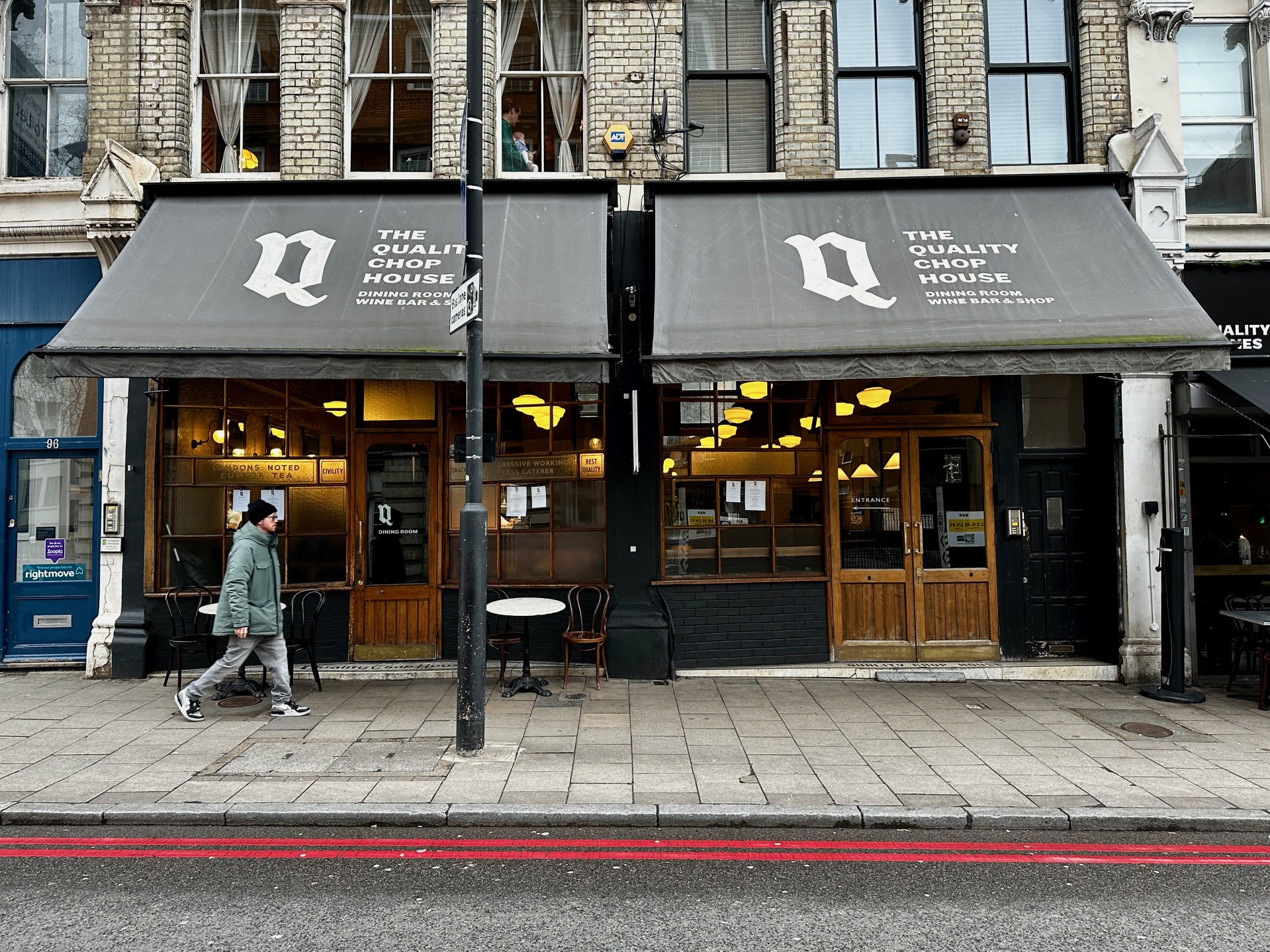
Since then it has firmly established itself under head chef Sean Searley, who was in the kitchen when they first reopened. It’s expanded, too, with a sister wine bar and small plates restaurant, Quality Wines, next door. Some say it’s even better than its big sibling, but I wanted to start with the original and best, so after a pre-lunch beer at Mikkeller on Exmouth Market Zoë and I took a short wander and passed through its handsome doors. PROGRESSIVE WORKING CLASS CATERERS was etched on a panel of the window: it’s like they saw me coming.

The interior achieves what the menu also aspires to, managing to be simultaneously Victorian and timeless. There are two rooms – the more famous one with benches like pews and the second one which is less photogenic. It’s still a convivial space though, all chessboard tiles and bentwood chairs, chalkboards on the walls listing special wines by the glass (they start at over £20, just so you know). I had a feeling that although the other room had a wow factor this one might have been comfier, and we had a decent sized table, although we had to sit diagonally across from each other so as not to butt shoulder blades with the table behind.

The menu changes daily, which meant that I’d looked at it daily in the run-up, wishing that some things would hang in there until my lunch booking, happy for others to drop out. It was compact and, to me, in the same vein as St John, with a handful of snacks, four starters, three mains and a selection of the eponymous chops.

It’s a menu you have to mentally recalibrate as you read, because a couple of the snacks nudge into starter pricing (and then some, in the case of the £24 chicken liver parfait) and the starters are between £14 and £18. As for mains, if you want a chop or a steak they start at just shy of £35 and climb from there. I was expecting that, so it didn’t bother me, but it’s worth mentioning that their weekday no-choice set lunch is a more modest £29 for three courses. From a look at their Instagram, it has some corkers on it.

But before that we had a cocktail, because it was one of our last Saturdays together for a while. Zoë’s negroni was made with Lemon Pekoe gin and a smidge of 25 year old Madeira and was a knockout. My rhubarb Collins was, for my money, too sweet, the cordial all syrup and no bite. That’s not to say, though, that I didn’t finish it.

The problem with a menu that has snacks and starters on it is that you have to have more restraint than me not to order both. We paced it so the snacks came with our aperitifs and they included some of my favourite things in the whole meal. Salami was by Molinari, a San Francisco-based salumeria almost as old as Quality Chop House, and was just exquisite – thick and coarse but with no bounce or resistance. I loved it, although I’d have liked some cornichons: it reminded me of similar dishes at Oxford’s Pompette where they just leave the jar at the table and let you serve yourself with tongs.

But far better was the dish I had to talk Zoë into letting me order. Smoked cod’s roe came topped with grated, cured egg yolk and a cluster of hot salt and vinegar doughnuts, all gloriously nubbled and irregular. This dish was close to faultless, and scooping a doughnut through the roe before popping it in your mouth was a hugely tactile joy. The smoke in the roe was subtle, the vinegar on the doughnuts beautifully in check. If I had one criticism you needed a couple more doughnuts to really clear up all the roe, but I could forgive Quality Chop House a lot for introducing me to the concept of salt and vinegar doughnuts in the first place.

“This is like – hear me out” said Zoë, giving me a warning about what was to come, “posh Primula.”

“Primula tastes of cheese, not fish. Or are you saying this is like a cross between Dairylea and Shippams?”

“Maybe. And I don’t even have a problem with the vinegar. Menus should make a point of this – it should say salt and vinegar doughnuts, with hidden vinegar.”

Some people. Every bit as good were the pork shoulder croquettes, little dense dice of saddleback packed into a breadcrumbed shell and placed in the middle of a coaster of lime green leek mayonnaise. These were top notch, and although they’re listed as snacks I wish I’d had a portion to myself. I’m so used to Spanish croquetas, all light with bechamel, that I’d forgotten how good something like this could be – nothing but moreish shreds of salty pork. I eked this dish out, knowing that however well I did so it would be gone too soon.

“I don’t know why they call them croquettes” was Zoë’s feedback. “They’re definitely nuggets.”

“I don’t think they’re going to rebrand as the Quality Nugget House, true though it might be. People will get the wrong idea.”

With our snacks out of the way it was time to take the meal seriously and place a proper order. By this stage what had begun as an almost-empty dining room was full, and it made me realise just how efficient the staff were. Efficient and hard working, finding the perfect happy medium between the two unpalatable extremes of matey and glacial. Always there when you needed them, too, in a manner I associate more with eating in Paris than London.

We also ordered a bottle of wine, going eventually for an interesting-looking number from Roussilon that promised peach, herbs and smoke. It lived up to that, and I thought was about its money for just shy of sixty pounds. Initially I thought that the wine pricing was a little sharp at Quality Chop House considering they had a wine shop next door – there was very little south of forty quid – but later on I saw the wine we’d chosen on sale at Bloomsbury’s Shrine To The Vine for thirty pounds, so if nothing else their markups could be a lot steeper.

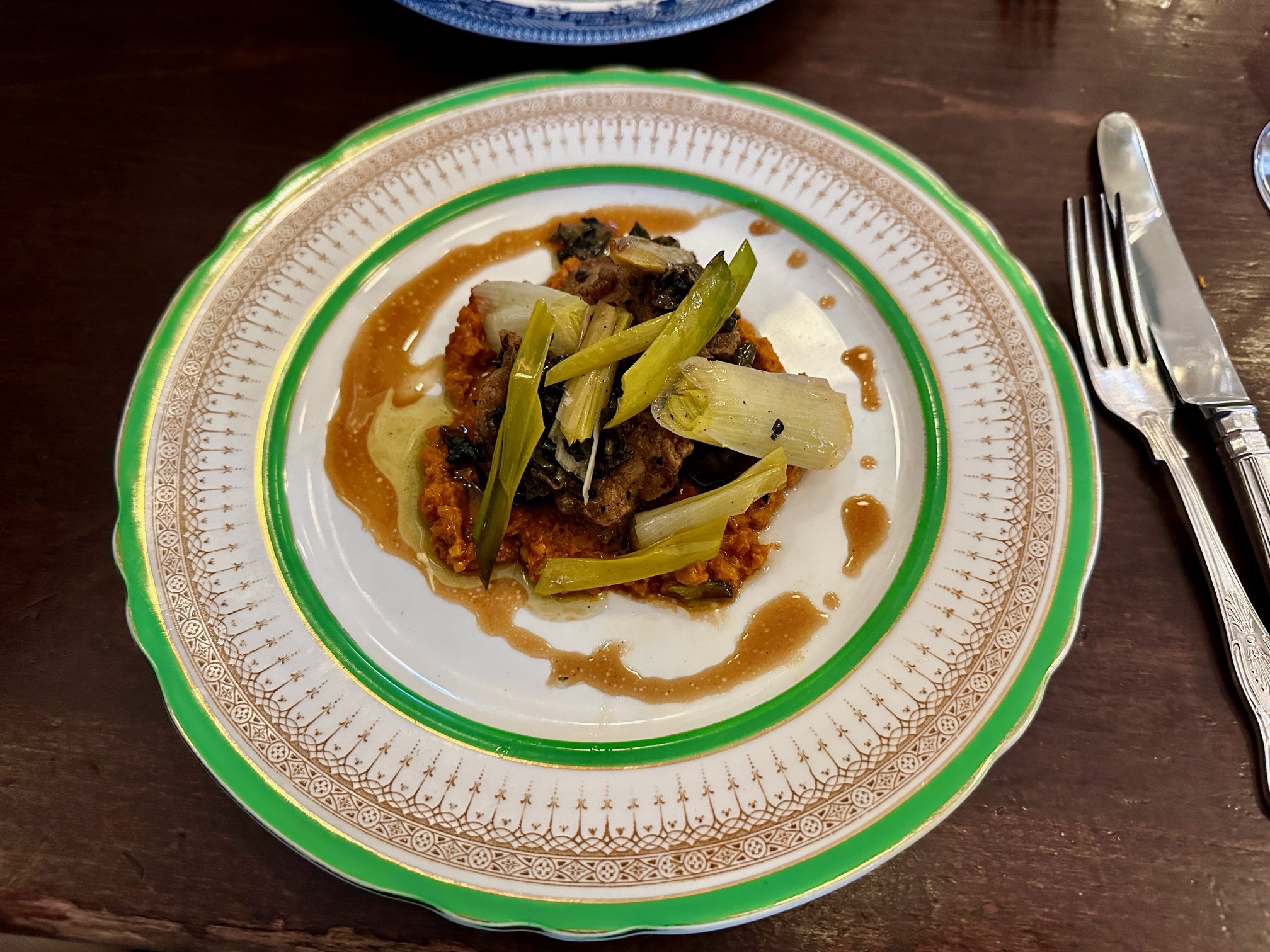
Starters built on the promise of what had gone before. I am a sucker for sweetbreads so I tend to order them whenever I see them and last year – at Paris’s Parcelles and Malaga’s La Cosmopolita – I had two sweetbread dishes which raised the bar. If anything, Quality Chop House’s rendition might have exceeded them. These were veal sweetbreads cooked in beef fat, and although the fat didn’t overpower them it did give them an almost crispy texture without sacrificing their softness.

But the supporting players were just as important. I’m used to calçots paired with romesco, and I’ve enjoyed that combination many times, but having the two of them as an accompaniment to sweetbreads was not something I’d ever considered. And it all went together so beautifully: heat, nuttiness and sweetness from the alliums. A beautiful dish.

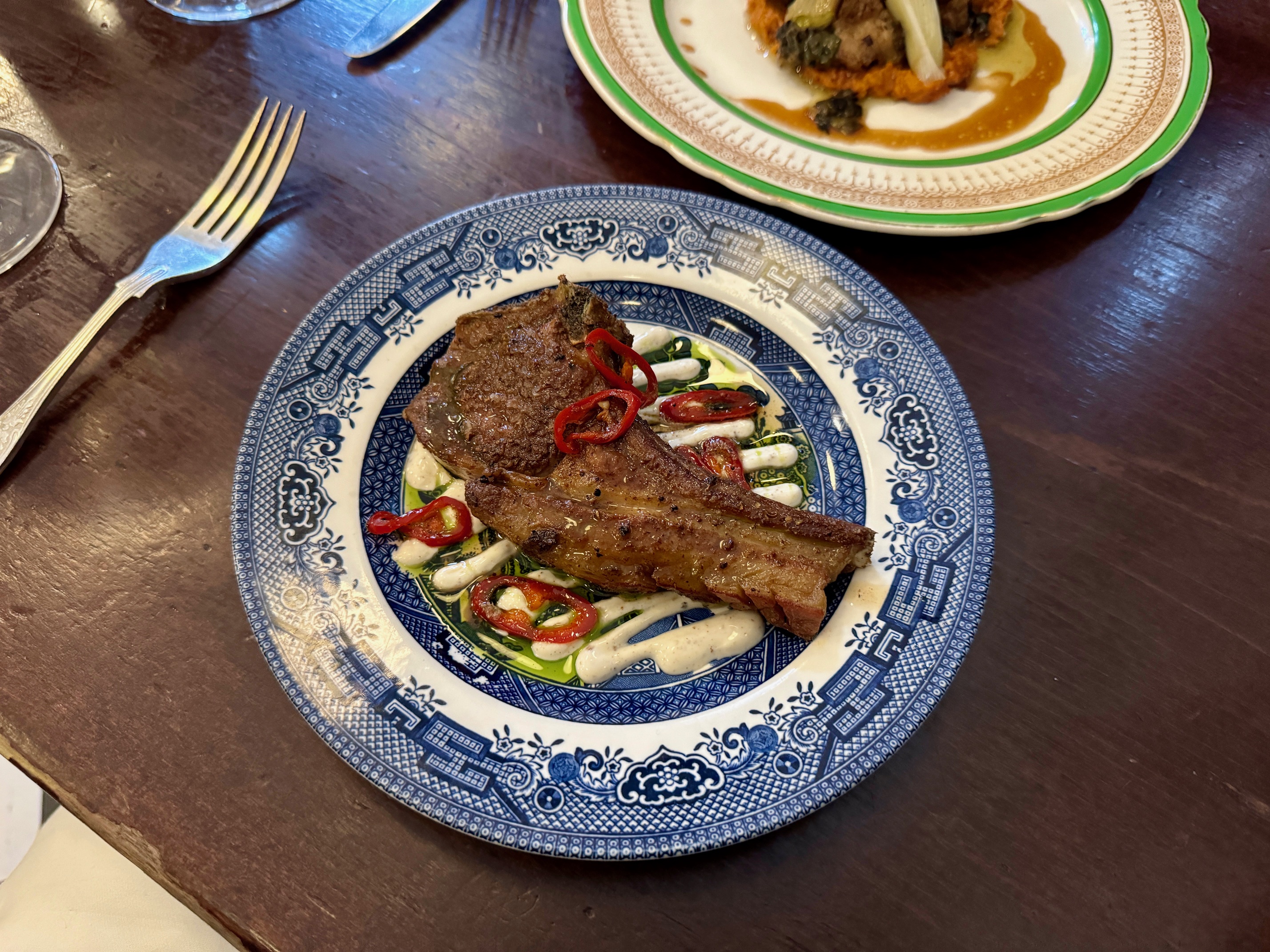
Zoë didn’t especially fancy any of the four starters on offer so decided to grab an eponymous chop from the snacks menu. As a fun-sized demonstration of the meat they bought and how they cooked it, is was difficult to fault and came on a squiggle of cumin yoghurt, strewn with pickled chillies.

A dish made with lamb chops is one of our regular midweek staples, especially when we’re trying to cut down on carbs (did I mention that I have to lose about five stone in three months for this wedding I’m having?). And I wish when I cooked lamb chops they tasted like this – the forkful I tried was impressive stuff.

At this point I was convinced that I was halfway through a record-breaking meal: the wine was slipping down nicely, everything I’d eaten was magnificent and the room was buzzing. This was what I had told myself we’d do on Zoë’s Saturdays, and even if we’d left it late we’d saved the best until last.

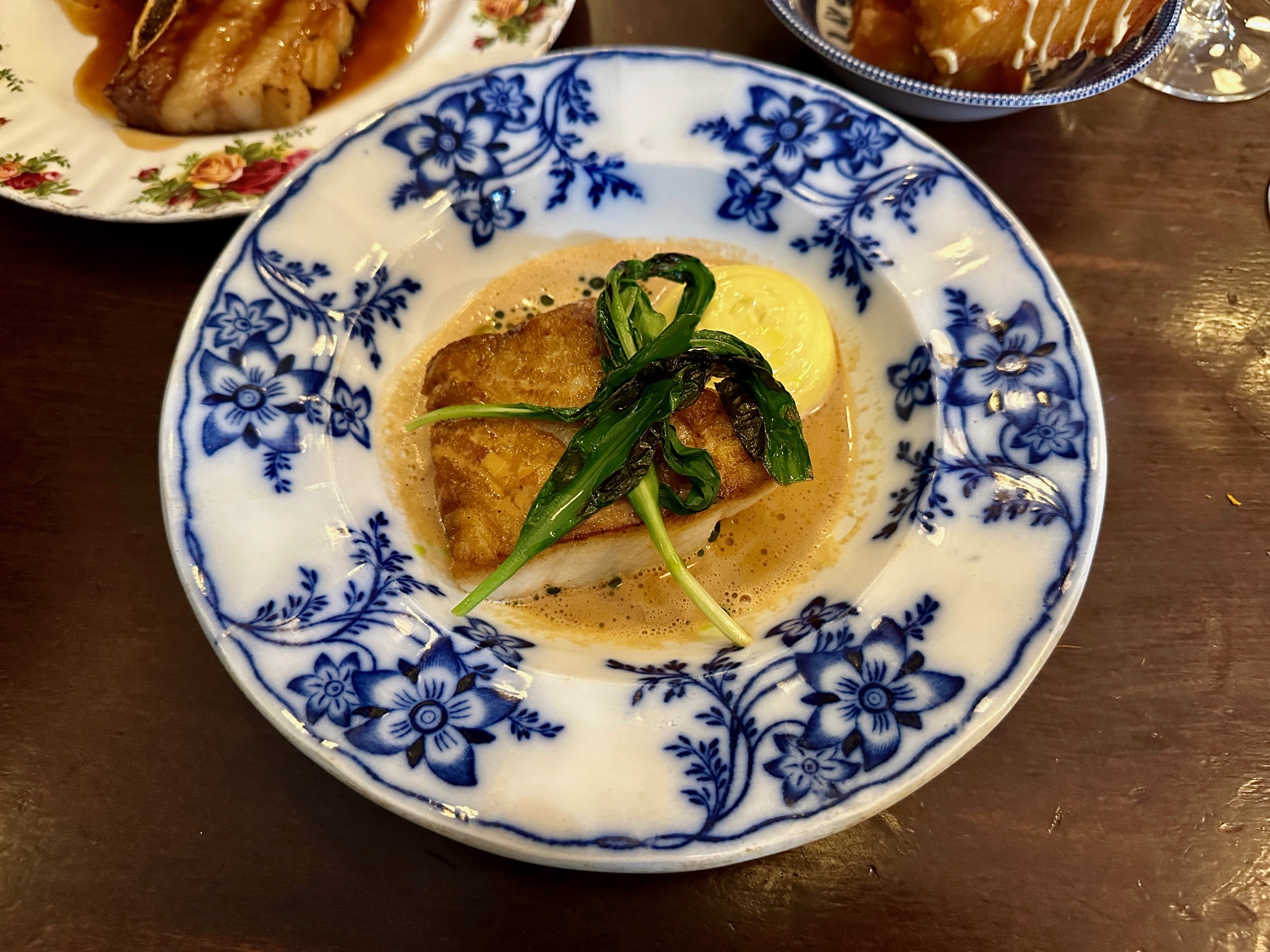
For me the mains didn’t reach the same heights, but it didn’t change the fact that if I’d had them in any other restaurant they would have easily made my top ten of the year. I decided to eschew, rather than chew, the chops so I’d chosen the fish course – a firm, bronzed slab of pollock sitting in a moat of crab bisque, a blob of aioli behind it and some wild garlic reclining, wilted and louche, on top.

That all sounds superb, and it wasn’t bad, but I wasn’t blown away the way I had been by the smaller courses. The fish was perhaps a few seconds too well-cooked, the bisque lacking in savoury depth. I wasn’t sure the aioli added much. Was I being ultra-critical because everything else had been so fantastic? Possibly.

Zoë on the other hand had opted for the double chop combo, following up her lamb starter with an immense pork loin chop. It was Saddleback, again, and it was undeniably a terrific, whopping piece of meat. It was so beautifully cooked, the meat tender and nowhere near dry, the fat softened to the point where it was the best thing on the plate. I was allowed a fair bit of this – 400g is a big old chop – and it made me suspect that picking the fish dish was tantamount to, as a friend once put it, going to Nando’s and having the prego steak roll.

Both dishes were lacking in carbs or veg, and you have to order those separately. Maybe it was those snacks at the start, but neither of us could work up much enthusiasm for a bitter leaf salad with grapefruit (which didn’t feel like it went with anything we’d chosen) or squash with rosemary. We did, however, gravitate towards Quality Chop House’s confit potatoes. It’s a dish they’ve become known for, perhaps more than any other, and it has inspired a lot of imitations. It was also the one dish I was determined not to leave Quality Chop House without trying.

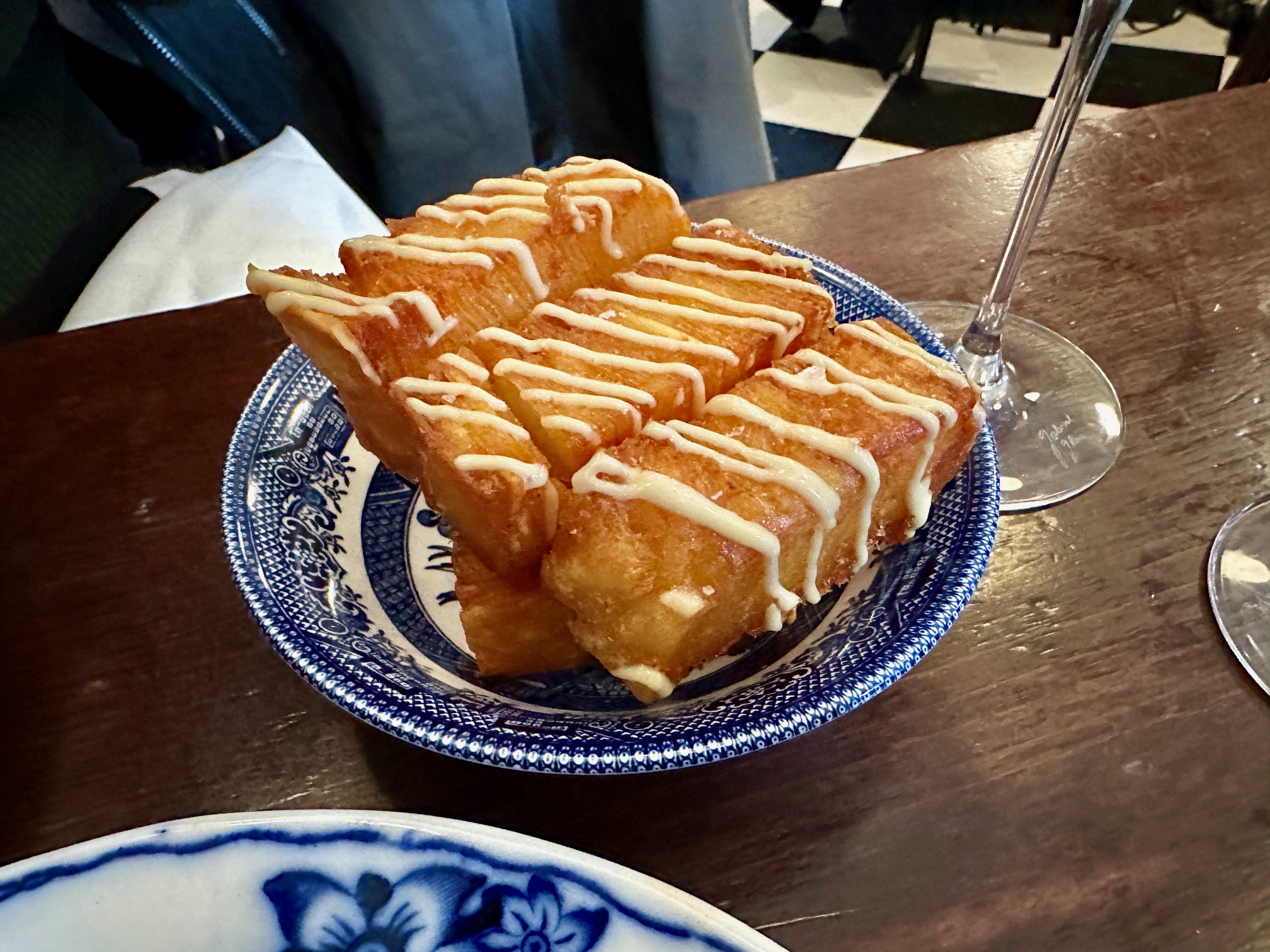
And yes, they were every bit as good as that picture down there makes them look. Hefty cuboids made up of many thin layers of spud, pressed and then fried until the outside is a salty, brittle treat. If you like starch in general, or potatoes in particular, I’m prepared to go out on a limb and say that this is a death row dish. I am struggling to thing of anything – the crispiest chip, the most buttery mash, the creamiest dauphinoise – that quite matches this as the apex of potato perfection. Personally I probably wouldn’t have piped mustard on them. But it’s their place, so they can do what the hell they like.

But the strange thing is this – I loved them, but I wasn’t sure they really went with either of our mains. That, and the lack of some kind of veg, made the meal feel a little lop-sided, a tad needlessly beige. Was I being ultra-critical because everything else was so good? There’s that question again.

Having dessert, under these circumstances, was a foregone conclusion. But first we finished our wine and had a look at the dessert wines on offer. Many of them were available by the glass, and the menu does recommend some pairings with desserts, but when I noticed a Riesling by excellent German producer Staffelter Hof my decision, and Zoë’s, were made. I’ve enjoyed their wines both at Clay’s and Marmo, but didn’t know they did a dessert wine. And it was outstanding – golden and sweet, sticky but not sickly.

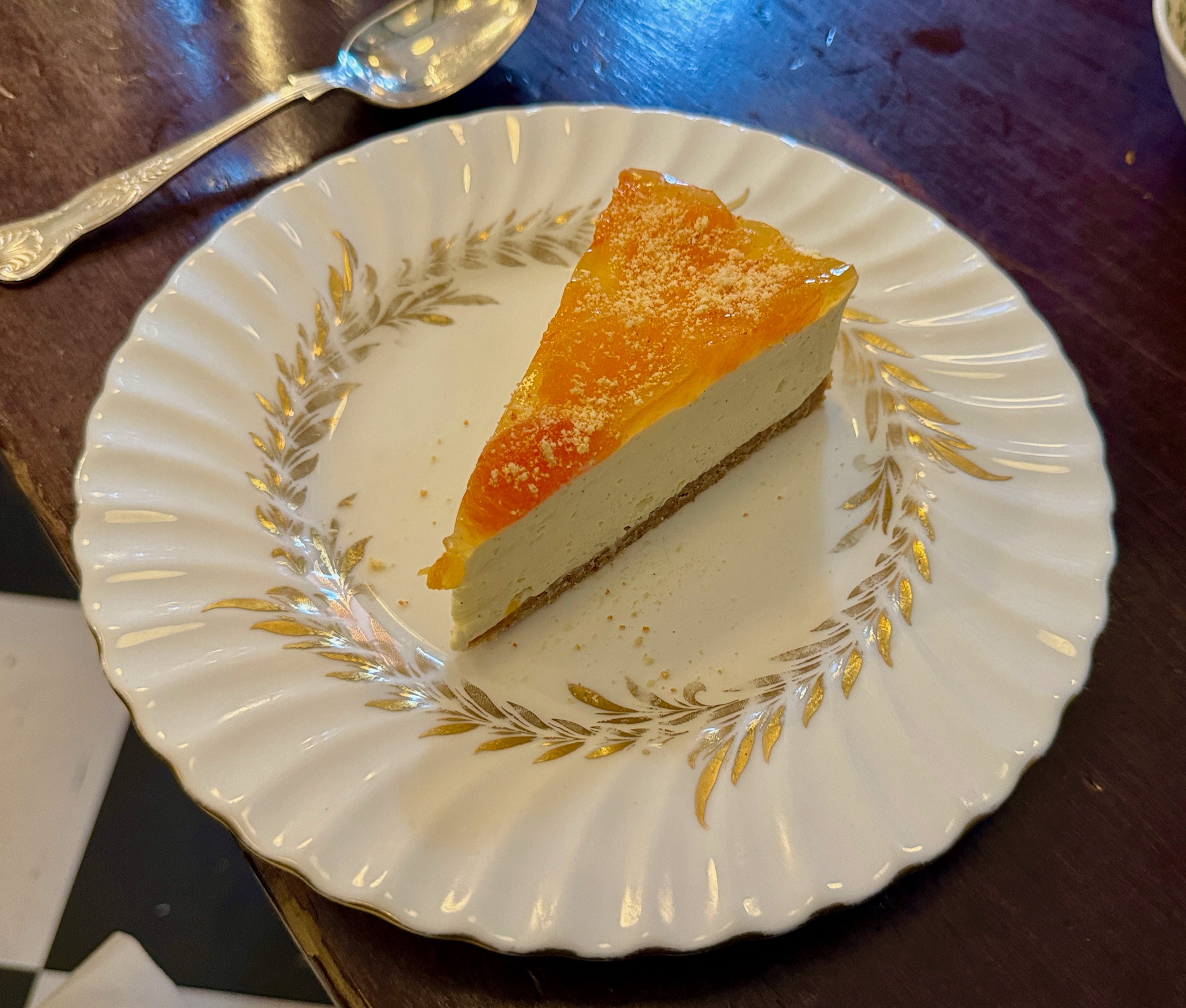
Zoe’s choice of dessert, under any other circumstances, would have been mine. And it was a lovely, classic piece of work, a cheesecake with a thin but exquisite biscuit base and a layer of mandarin orange and something called “blood orange sherbert” on top. It was as good an example of a cheesecake as you’ll find, but fundamentally it was just a cheesecake.

I think I picked better: I had the ice cream. And yes, fundamentally you could say it was “just” ice cream but that would fail to do it justice. It was an olive oil ice cream made from eye-poppingly expensive Capezzana olive oil, and it was the best ice cream I’ve had in this country. Easily up there with anything I’ve had abroad, too. I’ve not had olive oil ice cream in many years but here the oil permeated everything, giving the ice cream a perfumed, grassy note that took it up several levels.

The whole thing was drizzled with olive oil that collected brightly at the bottom of the bowl, waiting to be scooped up. And each spoonful had a little crunch of salt crystals. This dish wasn’t sweet or savoury – it was far too clever to pick a side in that way. It thumbed its nose at being either and was instead authentically, enchantingly itself. It cost ten pounds, one of the least expensive dishes of the meal, and was worth every penny: if I could teleport any one dish from the Quality Chop House to my sofa right now, as I write this, it would be this one.

We had outlasted a few tables that had arrived after us – such quitters – and as our bill came with a couple of pieces of white chocolate fudge we chatted with our server. We asked if we could buy the wine we’d had at the wine bar next door and she said no, because they’d made a conscious decision to stock completely different wines there. “It’s nice for us, because it means when we go there for a meal we get to try something new” she said, adding that the staff happily ate in the restaurant or the neighbouring bar on their own dollar because the food was so good.

“The thing is, people come for the chops but I think everything else on the menu is so good. Like the fish you ordered. And you really need to come back during the week, because the set menu is amazing.”

Our bill, with service included, came to about two hundred and eighty pounds. I know that might be the bit where many of you wince – don’t I know there’s a cost of living crisis on? – and I could say that we ordered a digestif and a dessert wine each, a decent bottle of white and four courses.

But it is difficult to deny that unless you’ve having that set lunch menu during the week, Quality Chop House is a pricey restaurant. When I compare it to Manteca, across town, where we ate easily as much food last year and spent three quarters of that amount, it drifts firmly into special occasion territory. But then Manteca was 2023, and this is 2024, and a lot of restaurants are going to the wall. Even having only been there the once, I’d like it if Quality Chop House wasn’t one of them.

After my meal I knew Quality Chop House was extremely good, but I also knew I needed to reflect to figure out just how good it was. And the answer, I think, is very, but not without a handful of bet-hedging caveats. It is classic and timeless and that is a big part of its strength. You won’t be buffeted by food trends or forced to eat anything that’s been freeze dried or agitated into a foam. You’ll have a gorgeous, comforting meal in a space that feels like it could have existed and looked like this at any time in the last hundred years. You’ll experience superlative service, and come away knowing that you’ve treated yourself.

And yet there is a slight niggle that stops me giving it one of the highest ratings I’ve ever awarded. Brilliant though it is, it is pricey. The menu is a tad unbalanced, as I said. And the most interesting things on it are at the beginning and at the end, which is why I understand the plaudits that have been heaped on Quality Wines next door.

Because as much as I liked seeing a hulking great chop set down in front of us, there was a bit of me that would have preferred a restaurant that stuck to the snacks and the small plates, and maybe offered wines at more approachable prices. This venue was great, I enjoyed it and I’m so glad I went there. But that venue, the venue I might have liked Quality Chop House to be, sounds like it’s literally next door.

But never mind. After many of the things I’ve eaten this year – for the blog or for fun, mindfully or mindlessly, out and dressed up or in my comfies on the sofa, in company or alone – are firmly in the past I will still remember that afternoon of chat, laughter and leisure. And I’ll remember that ice cream. Any restaurant that can make memories like that is okay in my book.

Quality Chop House – 8.8
92-94 Farringdon Road, London EC1R 3EA
020 72781452

https://thequalitychophouse.com