Restaurant review: San Sicario

San Sicario closed in August 2023. i’ve left the review up for posterity.

“What was this place before it was Cozze?” said Zoe as we flipped through the menus at San Sicario, the newish Italian restaurant at the bottom of the Caversham Road which has replaced Cozze’s central Reading branch.

“How long have you got? Before Cozze it was a Mexican restaurant called Maracas. And before that it was another Italian place called Casa Roma. Casa Roma and Maracas were owned by the same people…”

“…and they changed it to Maracas because they could use all the letters from their old sign? You’ve told me that story before.”

I smiled, although I did wonder if it was a good thing to have reached the you’ve told me that story before stage in our relationship.

“Yes, and before that it was a Lebanese restaurant called El Tarboush. That wasn’t bad actually – this would have been around 2009. Before that it was a place called La Fontana, but they moved out to Twyford.”

“Another Italian?”

“More generic Mediterranean, really. And before that it was a restaurant called Chi’s Oriental Brasserie. Now that was a restaurant! It was run by a chap called Wayne Wong from Cardiff, of all places. I still remember their XO chilli prawns. They ended up moving to the spot where Buon Appetito is now. I did karaoke there once, would you believe.”

Suddenly I had memories of nights in that restaurant over twenty years ago. At the time, I was going out with a woman who took great pride in stealing a six inch, brushed steel soap dispenser from Chi’s Oriental Brasserie’s ladies’ toilets: it was, with hindsight, one of many indicators that we wanted different things out of life.

“It keeps defaulting to Italian, I suppose.”

“Sort of. I guess Italian is a go-to option in this country – it tends to be mid-priced, it’s easy to do multiple pizzas and pasta dishes. Even now we still tend as a nation to have Italian out and Chinese or Indian food for a takeaway.” 

That doesn’t tell the whole story, though, because before this place was San Sicario it was San Carlo – same location, same owners, but a name they had to cease and desist from using barely a month after they opened last November because of a large national chain of Italian restaurants called San Carlo. 

I felt for San Sicario when I heard that – a far from auspicious start in a site where, if history was anything to go by, the owners would need every lucky break they could get. That’s when I made a mental note to pay San Sicario a visit sooner, rather than later.

“It’s got to be better than Cozze, anyway.”

Zoe was right about that – Cozze, San Sicario’s predecessor, had been terrible. I still remembered my meal there, eating carbonara paler than Cate Blanchett. It was a mystery how they’d ever expanded to three branches.

The interior of San Sicario was especially jarring: the glassware might have been different – and rather fancy – but the furniture, the banquettes, the exposed brick-effect wallpaper and the faux Kandinsky wall art had all been inherited from Cozze. Literally inherited: they’d lightened up some of the colour scheme, but it was fundamentally exactly the same. 
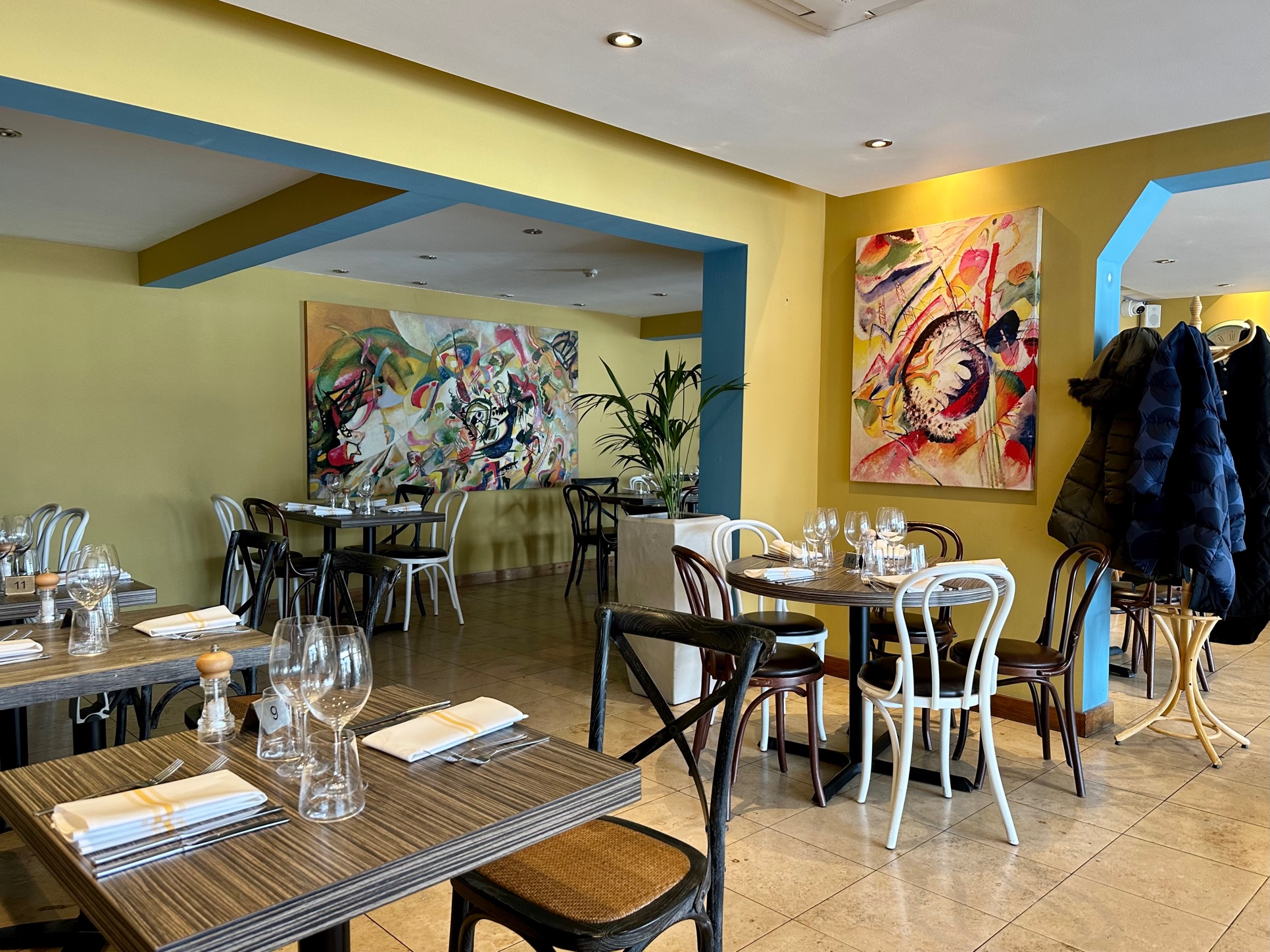
It was a big room, and the owners hadn’t really done anything to break it up into zones or to soften the noise – a room which really had to be full not to look a bit strange, although full it would have been deafening. On a Saturday lunchtime it was far from packed, with about three other tables occupied. Another three or so groups came for lunch after we sat down.

The first sign that this was a very different beast from Cozze came when I paid attention to the menu. I was never sure just how Italian a restaurant could be when it did chicken wings and burgers, but San Sicario’s menu left you in no doubt that it was a Proper Italian Restaurant. The menu was big – possibly too big – but it didn’t feel like it was chasing customers from Prezzo or Zizzi; the chef has cooked at Pepe Sale, and that felt far more the ballpark here. 

That doesn’t mean that San Sicario didn’t sell pasta and pizza – far from it, they did – but the pasta was an interesting range of sauces and shapes rather than a boilerplate way of flogging the two in an almost infinite number of combinations (just typing this reminds me, by the way, how little I miss Wolf Italian Street Food). But there was also a reasonably priced set lunch menu, which they even offered on Saturdays, a specials menu with five additional dishes on it and a Valentine’s Day menu, which I assume they hadn’t got round to removing yet.

The main thing I thought, looking at the menu, was that these were classic dishes and combinations, and that if the restaurant could pull them off it would be the kind of restaurant Reading hasn’t had for some time. I know many people miss Dolce Vita, and others miss what Pepe Sale used to be before the original owners sold up. Some, for that matter, still talk about Nino’s. But really, I’m not sure Reading has had a truly classic Italian restaurant since Topo Gigio closed.

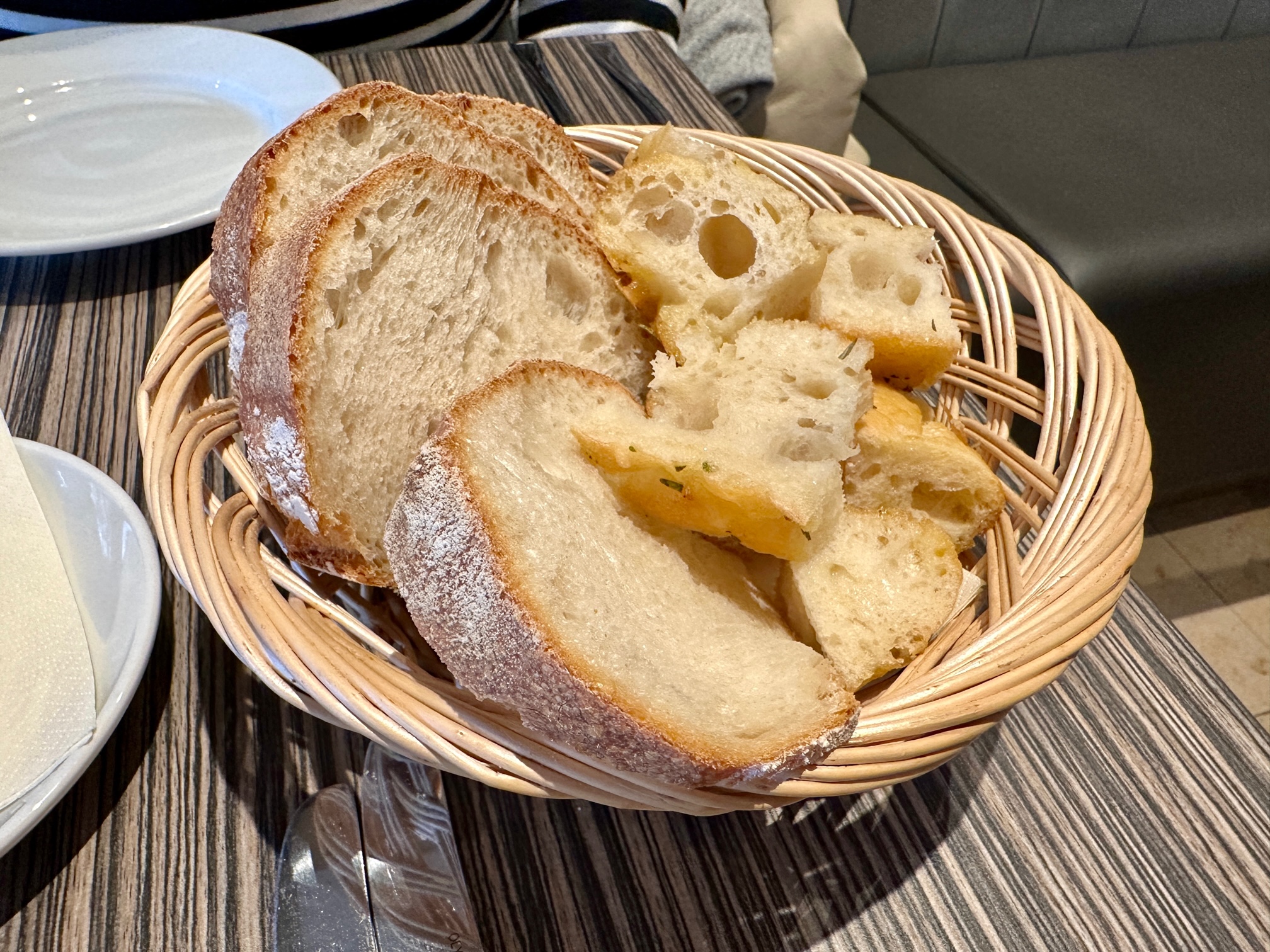
Our first dishes came as we were making inroads into a couple of very servicable drinks – a powerful negroni for her, a G&T made with fragrant Italian gin for me – and they made for an excellent start. According to the restaurant’s social media they make their own bread and focaccia every day, and they were both pretty decent, especially the focaccia which came sliced into little cubes, perfect for dipping in oil and balsamic vinegar, just enough salt scattered on the crust. We saved the bread for mopping, showing uncharacteristic foresight.
I picked the best of the starters, which is something I don’t get to say often enough. White crab meat came heaped onto what could have been crème fraîche or mascarpone, the whole thing sitting on a potato rosti. Simple, elegant, pristine flavours, and if the advertised watercress was nowhere to be seen I was hardly complaining, as it would have thrown the whole thing out of kilter. 

It wasn’t perfect – the rosti could have done with more lightness and crispness, and felt more like a latke, and I had a few bits of shell in the crab – but none of that detracted from just how delightful it was. And could I think of anywhere else in Reading where this dish would end up on the menu? Not really.

That was one of the specials, as was Zoë’s starter. Calamarata, a shape of pasta I’ve never had before, are short thick rings of pasta thought to resemble calamari (they were obviously named by somebody who’d never eaten a packet of Hula Hoops, that’s all I’m saying). They were paired up with a tantalising-sounding ragu made with beef, lamb, pork and veal. Four different animals on one plate: just imagine!

For what it’s worth, I enjoyed this dish more than Zoë did – just as well because, as a generous-sized starter, I got to finish it. The sauce hugged the pasta better than I was expecting and I quite liked the ragu which was studded with tender meat. But I agreed with Zoë that the ragu was a little unbalanced – it was underseasoned, which meant the sharpness of the tomato was more prominent than it should have been. A carpet of parmesan couldn’t save it, although maybe it would have done if it had been a lot thicker.

A final starter sounded so good, and looked so good online, that we were greedy and ordered it to share. A pile of wild mushrooms – accurately described for once – was sticky and reduced, topped with a crispy breadcrumbed egg. The egg was cooked just right, with only a little over-wobbly egg white, and when cut open the yolk worked its magic spreading across the mushrooms, an edible sunrise. 
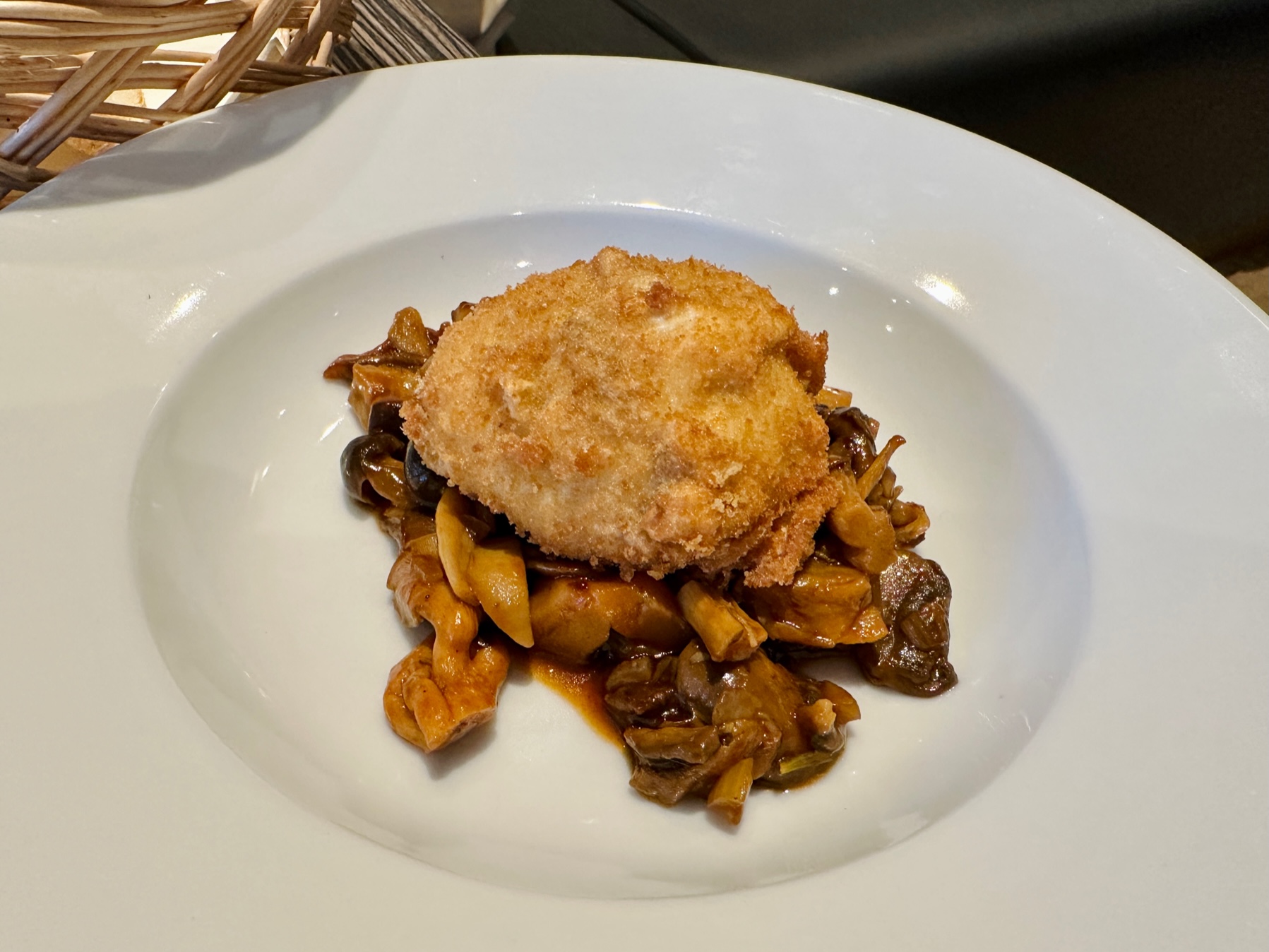
Again, it was a dish so close to superb but not quite there – I wanted more savoury depth in the mushrooms, and that was missing. I didn’t mind that it was on the small side, and I didn’t mind that it was a tiny bit pricey (it was just under a tenner), but I did mind that. If the flavour had been spot on, none of that would have mattered in the slightest.

All that said, main courses were pretty good. Zoë’s lamb rump was expertly cooked, far better than at, say, London Street Brasserie, and four really generous slices of it were fanned out on top of a very creditable caponata with plenty of black olives, the whole thing bathed in jus. The salsa verde was denser than Owen Jones, but considerably more appetising (and like Owen Jones, a little went a very long way). This dish wasn’t cheap at just over twenty-five quid, but I thought it was probably about its money. Again, Zoë found it a smidge underseasoned. She might have been right.

Saltimbocca has always been one of my favourite dishes, and since Dolce Vita closed nearly five years ago I’ve never found one that came close. San Sicario’s, I’m pleased to say, did – three pieces of veal, topped with prosciutto and luxuriating in butter and sage is one of the loveliest, simplest plates of food you can eat. Again, I feel a bit like I’m kicking a puppy saying this but it needed more – more butter, more sage, more seasoning, more oomph. The courgettes it was served with were pleasant enough, and certainly not cooked to mulch, but they felt like a bit of a plod without plenty of that butter to trawl them through. In my mind I was hoping for courgette fritti, but it wasn’t to be.

We did, however, make an excellent choice of side. Potatoes were wonderfully bronzed cylinders, all crinkled edges that spoke of a far healthier relationship with fat than I’ve ever managed. They were more fondant potato than roast potato, and all the better for it. Three pounds fifty, too, which is ludicrous value. “This is a lot better than that medley of veg you get at Pepe Sale” said Zoë. I couldn’t agree more.

By this point the restaurant was as full as it was going to get at lunchtime, and it was interesting how that exposed some problems with the service and the space. We eventually ordered some wine – a glass of barbera for Zoë and a sauvignon blanc for me – after we finished our starters. Both were lovely, but by the time they’d arrived our mains were in front of us. We hadn’t specified what size we wanted, he hadn’t asked and he brought us large glasses, which isn’t really what we wanted.

We didn’t make anything of it, it wasn’t a biggie, but there were a few niggles like that. The waiter was absolutely lovely, and quite up front about his limited English – still, of course, infinitely better than my Italian – but there was just the one of him and he did seem to struggle a little with half a dozen tables demanding his attention. And the room was so big, and the tables were so spaced out, that it could be difficult to grab him when you needed him.

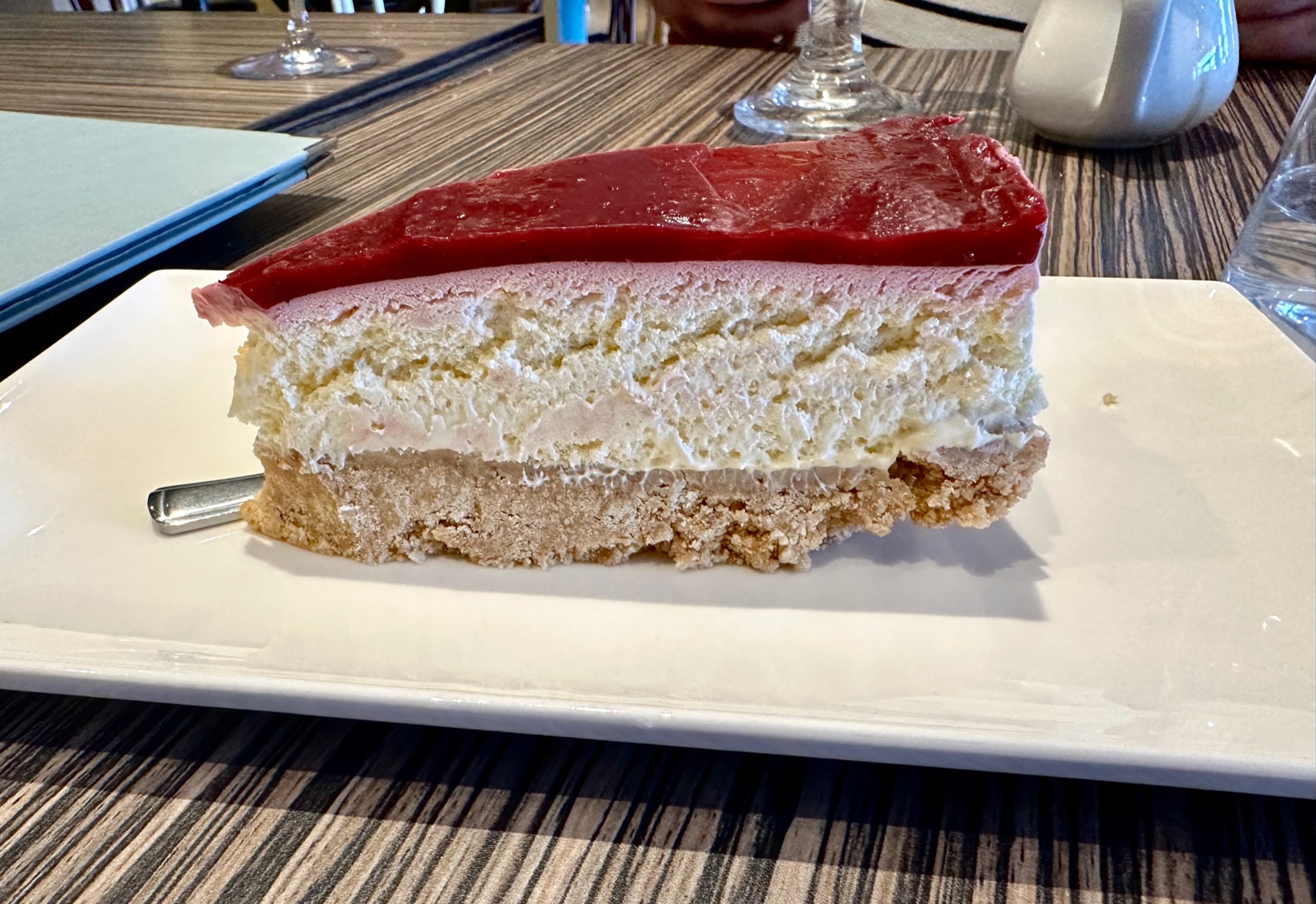
I would say desserts are San Sicario’s weak point. The menu sensibly only has half a dozen, but they don’t bowl you over. Having ordered tiramisu at practically every Italian restaurant I’ve reviewed since 2019 we gave it a miss this time, although it turned up at a neighbouring table and looked good. Zoë chose a cheesecake, and enjoyed it without ever going into raptures. It was billed as a vanilla lemon cheesecake with berry compote – talk about covering your bases – but actually it was a slab without compote and with a layer of fruit jelly on top. I didn’t try it, but tellingly I didn’t especially want to.
I’d picked an affogato, prompted by fond memories of the one Tamp Culture used to do back in the day. It was entry level – two scoops of vanilla ice cream that could have been Walls, a jug of burnt-tasting espresso and, allegedly, some amaretto. It looked like the ice cream might have had a few molecules of the stuff splashed over it, but not enough to taste of it. When a dessert is this simple, every aspect of it should be good. With this one, none of it really was.

Our bill for all that food, a couple of drinks each and a post-prandial espresso came to one hundred and thirty pounds, not including tip, and took a fair old while to conjure up. I actually think quite a lot of what we had was pretty decent value, and it’s also worth pointing out that for the time being the restaurant is offering 20% off food Tuesday to Thursday via their Facebook page. After we settled up we went to Phantom for a drink, and it was hosting some kind of punk pop festival which made me feel ancient – I’m old enough to remember Basket Case the first time round – so we hopped into a taxi, went to Double Barrelled and had a very pleasant couple of hours working our way through the pales on offer. A perfect Reading Saturday.

If it’s brave to open a restaurant in the winter of 2022, knowing everything we know, it’s especially brave to open the kind of restaurant San Sicario is. I think the lower end of the market, your Franco Mancas and Zizzis, are possibly better protected from the economic shocks of the moment than somewhere unapologetically upmarket like San Sicario. And that’s before you factor in that their site is enormous. That their site is in a location that’s not in town or in Caversham, with limited parking. That it’s a site that has proved to be a poisoned chalice for so many restaurants. Then consider all the faff and palaver of revealing your name in November and having to change it literally on the 3rd of January – talk about New Year, new you – and San Sicario starts to look positively heroic.

And yet I really hope they make a go of it. It’s truly encouraging to see somewhere trying to offer what Reading doesn’t have – a genuine, interesting, high-end Italian that doesn’t just pile up the pizza and pasta, lazy variations on a theme, and try to take easy money. Some of the dishes I had I simply wouldn’t have been able to get elsewhere in Reading, and the fundamentals of the restaurant are solid. They need to tighten up the service a little, and I’d like them to be a little more liberal with the seasoning, but in honesty there’s nothing wrong with San Sicario that a few more customers wouldn’t solve.

Restaurants run better busier, and if I’d been there on a Saturday night, all buzz and bustle, I suspect it could have been fun enough to quite make me forget the glory days of Chi’s Oriental Brasserie. I will be back, and I sincerely hope San Sicario breaks the duck of one of Reading’s unluckiest sites. After all across town, in an equally ill-starred space, their compatriots Madoo have proved that it can be done.

San Sicario – 7.6
93-97 Caversham Road, RG1 8AN
0118 9560200

https://www.sansicario.co.uk

Restaurant review: COR, Bristol

For once, I turned up for lunch in Bristol moderately ahead of the curve. COR, a cosy small plates restaurant in Bedminster, has only been open since October and, so far, has mostly been Bristol famous rather than nationally famous. Not completely, though: Tom Parker Bowles raved about it in the Mail On Sunday on a recent visit. And last month, when Square Meal listed its top 100 restaurants for 2023 COR made the list: not too shabby for a restaurant that’s been trading for about four months. Even so, stepping through the front door with my old friend Al for lunch during a weekend trip to my favourite city, I felt slightly closer to the zeitgeist than usual.

They’ve got a lovely site. It’s a corner plot, double aspect with big windows letting in plenty of light and despite being on the compact side all the space is used superbly. There are relatively few tables, but there are also excellent, comfy-looking stools up at the window letting you look out on the painfully cool passers-by, on their way to a café, the terrific looking natural wine bar or a smashing chocolate shop. The seats at the bar look like fun too, and some of them give you a view out back to the open-ish kitchen. The restaurant is passionate about always saving some room for walk-ins at the window or at the bar: like so much else about it, it’s admirable.

COR’s menu read extraordinarily well. I know small plates aren’t for everybody, but these were grouped and flowed effortlessly, from nibbles to charcuterie, on to seafood, to a selection of vegetarian and meat dishes and then a handful of larger, more conventional plates. Just the three, in fact. The nibbles and charcuterie were close to a fiver, the small plates generally hovered just under ten pounds and the bigger ones were around fifteen quid.

Now some people will look at that and think “ugh”, probably put off by bad experiences with the small plates concept in the past. I get that – I’ve had many of those too – but to me this just read like a dream, an edible Choose Your Own Adventure with no bad endings. Our waitress, who was positively brilliant throughout, told us roughly how many dishes people ordered per head, although I must say that she probably meant customers built like her, or Al, rather than built like me. We may have disregarded her sterling advice. She also told us they were down to their last portion of mojama, air-dried tuna, on the specials board, and nodded approvingly when we asked to bag it.

That turned out to be an outstanding decision, although in fairness so was practically everything we ordered. So was booking the place for lunch in the first place, come to think of it. I’m used to eating mojama up at the bar in Granada, thick slabs of coarse, salty tuna sprinked with almonds and drizzled with olive oil, as simple as they come. This, by contrast, was gossamer-light, with a judicious single almond, beautifully toasted, per slice and little segments of sweet, sharp orange to improve things still further. My mind may have been playing tricks on me, but I think the whole lot rested on a smudge of houmous. Every mouthful was delightful, and it never lost that sense of surprise: small plates, in fairness, find that easier.

As we rhapsodised Al sipped his white vermouth, I my Asturian cider – yes, we’re those kinds of wankers – and all my cares dissolved; Bedminster wasn’t Granada, not by a long chalk, but it had already earned twin city status, and we’d just gotten started.

Finocchiona, fennel salami, was more about buying well. But COR definitely bought well, and if their menu had listed where they’d got the stuff from I’d have ended up buying well too. It had a wonderful whack of aniseed and I liked it very much – it also wasn’t too ridiculously priced at a fiver. As you will discover, I had trouble finding fault with nearly anything that COR did so I might as well take my opportunity here: only two cornichons? Really? Have a word with yourselves.

That minor disappointment out of the way, the last of our first wave of dishes was also on the specials board and if I eat anything as small but perfectly formed again this year I’ll have done very well for myself. The last time I was in Bristol I was wowed by a canelé rich with honey, whisky and smoke. This time, I was even more dumbfounded by COR’s savoury canelé which came drizzled with a grassy olive oil, tarragon and thinly sliced mushroom. Cutting vertically through it prompted the reveal, that the whole thing had been filled with a creamy, savoury mushroom duxelles which made me beam. This was emphatically not for sharing: Al and I scoffed one each, and I had half a mind to order another after dessert.

Another thing I really loved about COR was that they took our orders and artfully sequenced them almost like a gastronomic mixtape. None of this “your dishes will come out when they’re ready” bollocks that treats you to feast or famine, instead we got things in a carefully structured order that showed every dish off to its best advantage. Take this for example, Jerusalem artichokes fried until golden and sticky-edged and served on an earthy pool of artichoke velouté. It was simply magnificent, and if I couldn’t really detect much truffle in the truffled pecorino I was having far too much fun to give a shit. I have to really fancy Jerusalem artichoke to order it in a restaurant because of its legendary side effects. Here I did it anyway, and the side effects never materialised. That’s what I call winning at life.

Equally delicious was the next dish, slow-cooked pork shoulder crammed into radicchio and topped with ribbons of pickled fennel (and some slightly pointless dill). The pork was splendid, with the texture ignorant people are prone to describe as unctuous. This vegetation-as-taco concept seems to be a Bristolian one: I had something very similar, albeit far smaller, at Wilson’s late last year. But this was the size you actually wanted it to be – and well portioned for sharing. Did I wish I was eating them both to myself? I like to think I’m a decent friend, but yes. Yes I did.

By this point, Al and I were suffused with a warm glow, catching up for the first time in months, enjoying glasses of surprisingly fruity and accessible Cataratto (“do you know, that’s the only wine I like?” said our waitress, charm personified without necessarily realising it). And we got to talking about superlatives: Al has the misfortune to spend some of his time surrounded by people from Gen Z who only ever use one superlative – “stunning” – and use it all the time. About everything. Everything, he told me, is their “new favourite dish”, whether it’s a special occasion or some spaghetti hoops out of a tin. Even hearing about this perpetual state of wide-eyed wonder, I’m afraid, made me want to kick something very hard.

But we were both rather running out of adjectives by the time our next dish arrived. Tropea onions, cooked to soft, caramelised wonder, drizzled with a hazelnut beurre noisette and crispy sage leaves was another knockout, even without the three dollops of goats cheese (Ragstone, apparently) providing a little agriculture to offset the sweetness. I gave Al the spare onion: I told you I was a good friend, although he did let me have the extra Jerusalem artichoke, and I thought that one of the nicest things about sharing dishes is that you can both have virtually the same superlative experience. If there’s a better thing to do with an old friend than go to an excellent restaurant, I’m not sure I know what it is: I know some people like watching the football, or playing squash, or bloody golf, but for me this is as good as it gets.

“Would you describe it as stunning?” I asked. Al grinned.

“Definitely. New favourite dish.”

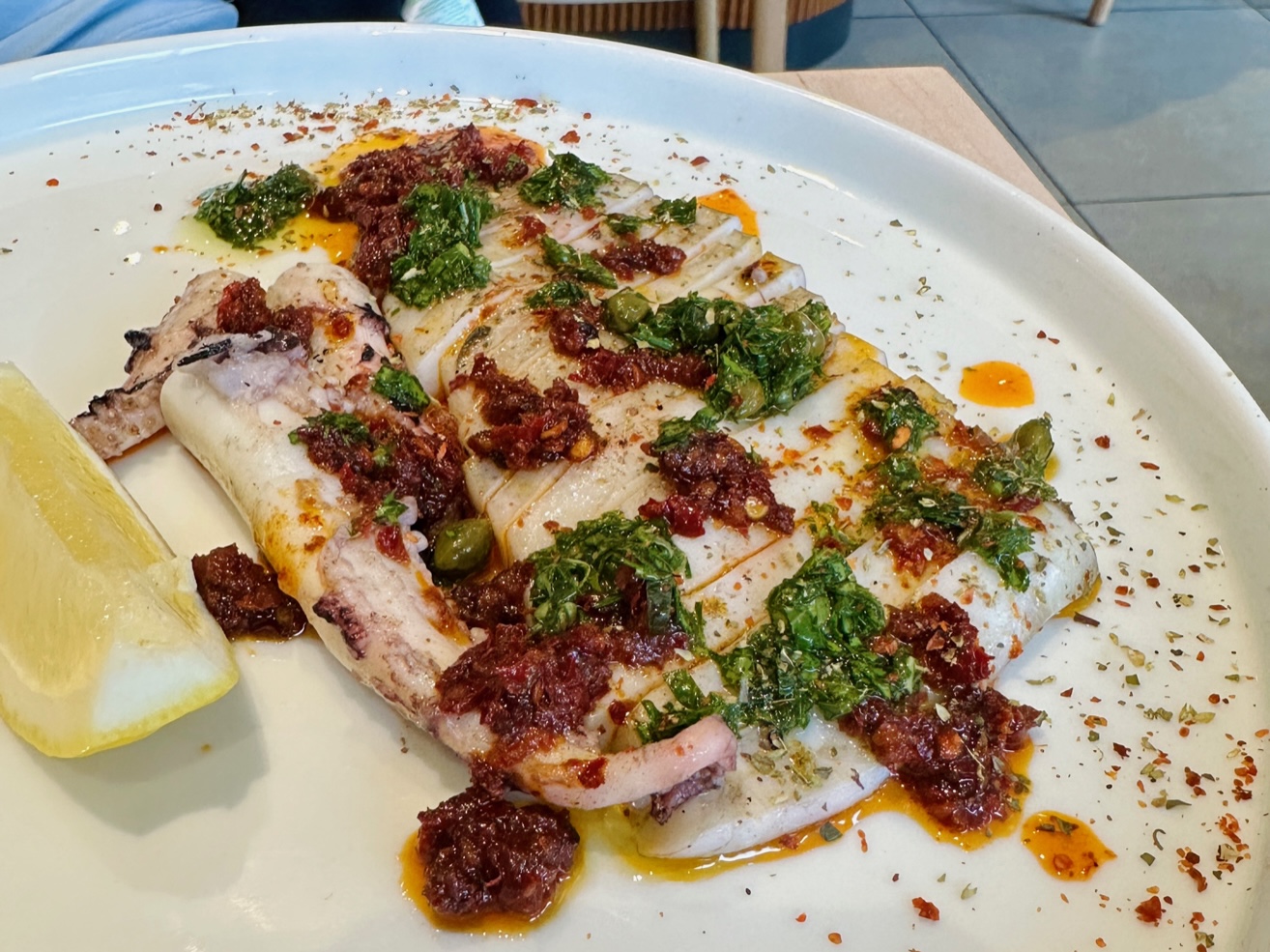
My new favourite dish – and in fact it stayed that way for the rest of the meal – was the next one. A really generous portion of cuttlefish, cooked sous vide and then finished on the grill I believe, was ludicrously tender and came already sliced into ribbons. I could imagine serving this with ‘nduja, or with salsa verde, but matching it with both, along with some capers, in a dazzling, dizzying tricolore was a stroke of genius. This dish would be at the apex of nearly any meal, and if I could find anywhere closer to home that served something like this I’d be there all the time, even if it was only half as good.

Our main courses involved the only misstep, and by “misstep” I mean “eight out of ten dish”. Al had decided to try the manicotti, a pasta dish, and he was encouraged in this by our waitress when he told her he was torn.

“It’s one of my favourite dishes, it’s like something your grandmother would make.”

“Your grandmother must be a better cook than mine was” I said, fighting back memories of wan fish, floured and fried, served on the kind of brown smoked glass plate every household had in the seventies. Still, she did at least cook proper chips in a chip pan, something nobody does now.

I think the dish was better than anything Al’s grandmothers could have conjured up either, but it wasn’t as much a tour de force as everything else had been. Manicotti are big sleeves of pasta, thicker and bigger than canelloni but the same kind of thing. Whereas this was a single giant tube, folded rather than rolled, and the overall look of it was somewhere between canelloni and some kind of pasta calzone, if I haven’t mixed my metaphors to death by saying that. It was stuffed with ricotta, topped with braised tomato, parmesan and rocket and it managed to look hearty, well-done and somehow unspecial.

“It’s okay” said Al. “It just doesn’t match everything that’s gone before. The braised tomatoes are fantastic, though. I just should have ordered the same thing as you.”

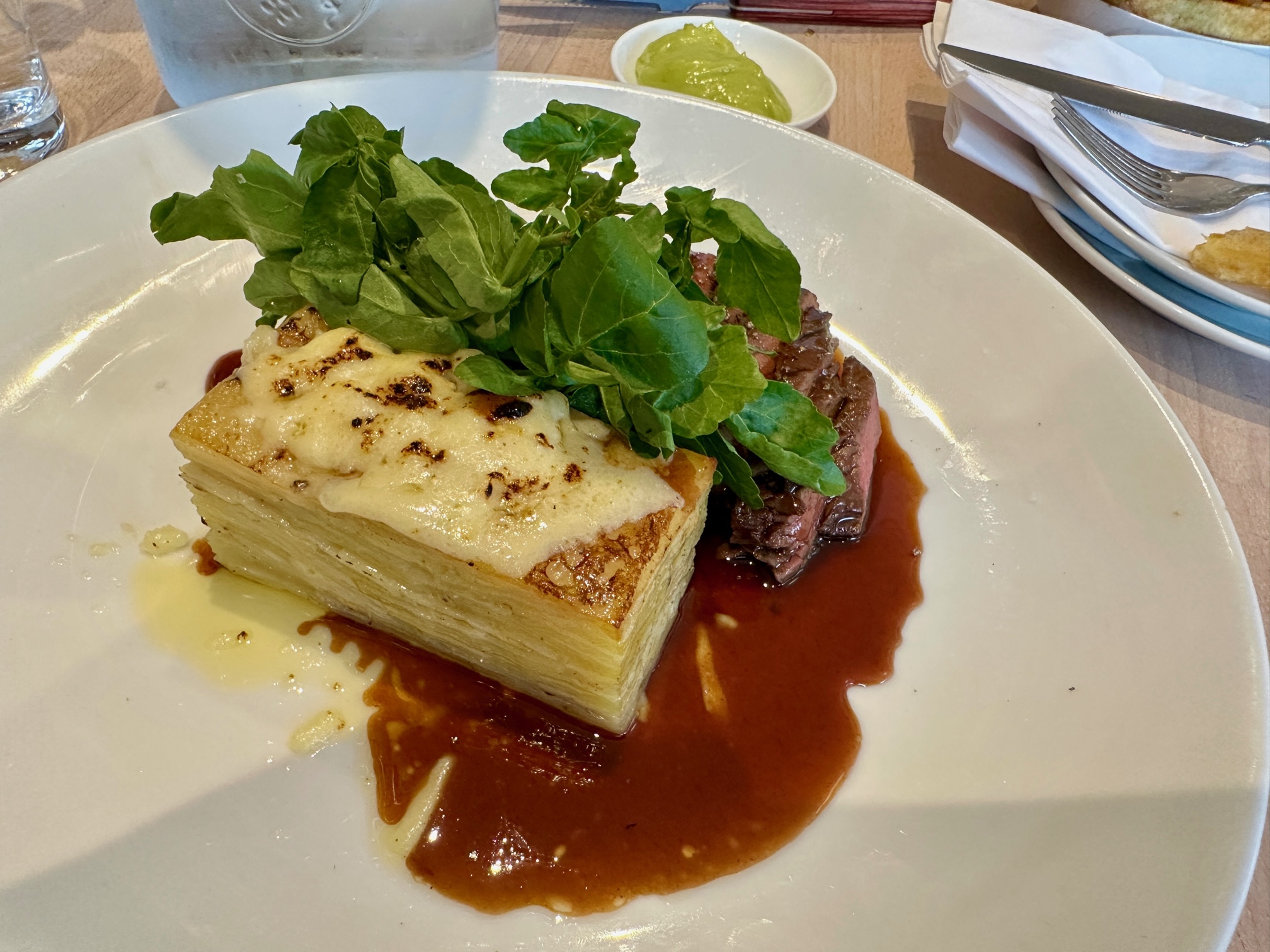
I mean, he should have. Because while I watched him eat a big sheet of pasta with some cheese in it pretending to be a Mobius strip, I was diving into a marvellous piece of onglet, as yielding as you like, with lashings of intense jus and – the icing on the cake – a dauphinoise of interlayered potato and celeriac, all topped with quite a lot of gruyere. It was just the most incredible thing, and when I saw on the menu that it clocked in at under sixteen pounds I thought there must have been a typo.

But there wasn’t. That whole plate of food for sixteen pounds was outrageously generous, charitable even. And speaking of charitable, even this dish had been served in a way that encouraged sharing, with the steak cut into substantial slices. I let Al have as many as he wanted to dull the food envy, because I’m not a monster: I suspect he would have had more, but it would have made the envy worse, not better. He consoled himself with some exceptional hand cut chips, dipped in a tarragon mayonnaise so herb-heavy it was the colour of guacamole. I had some too. Of course I did, it was world-beating.

We’d come all this way, so not having dessert would have been madness. The dessert menu is nicely compact – although they also have a selection of eight different cheeses – and Al had clearly learned from his mistake because, like me, he opted for the chocolate mousse. I think it’s an underrated dessert at the best of times, but this was at the very best of times – a hulking scoop of the stuff, dense yet airy, studded with plates of almond dentelle like the spines of a stegosaurus. That enough would have made it exquisite, but sprinkling it with flakes of sea salt and drizzling it with olive oil was the final touch.

“That chocolate mousse was so good” I told our waitress as she took our bowls away and we sipped our dessert wines (like I said, those kind of wankers), fighting the almost primal urge to order a savoury canelé for the road.

“Thank you so much! I actually made that yesterday, I spend some shifts in the kitchen as a pastry chef. I can’t actually eat it myself, it’s a bit too rich for me.”

I can’t imagine the level of self-restraint involved in being able to make something like that and not eat it, but then that’s why some people are slim and I’m not. Al, on the other hand, eats like a horse and is still as skinny as he was when I first met him about thirty years ago; this is why some people are jammy bastards and I’m not. But anyway, despite being thin, talented and impossibly young our waitress was a class act. All the people who served us throughout lunch were, actually: friendly, passionate about the food, with opinions on all of their favourite dishes, they were a real credit to the restaurant. How does anywhere get this good after just four months? It was quite miraculous.

Our waitress asked where we were from, and I mentioned Reading, and she proudly told us she’d been there. Once. Then of course the truth came out, that she’d passed through it recently on a train to London to watch a gig. It was the first time she’d ever been to London on her own, she said, at the tender age of twenty. And suddenly Al and I felt very old indeed, and seized with a sneaking suspicion that we should hightail it out of Bedminster and find an old man pub to hunker down in to carry on our gossiping session. The natural wine bar would just have to wait for another time. Our meal for two, with a very richly deserved service charge included, came to just under a hundred and ninety pounds. There was literally nothing to begrudge, except any of their punters who only paid ten per cent service.

As I was writing this review, I messaged Al, mainly to reminisce about what a phenomenal meal it was. What a stunning array of dishes I sent him, hoping to get a cheap laugh.

“One of my objections to the S word is the cognitive dissonance” he replied. “Stunning implies losing your senses, but with food that good your senses are very much alive. Sorry, you can tell I’ve thought about this too much.”

He’s right, though. What I loved about COR the most was having my senses awakened and reawakened time and again over the course of such a glorious lunch – old favourites, new combinations but always real integrity and imagination. Nothing was boring or humdrum, which I can say because I didn’t have that pasta dish, and in terms of the sheer number of hits I think it ranks as one of the best meals I can remember, at home or abroad.

I’m sure you know the drill by now with this kind of review. Bristol, Bristol, Bristol, hyperbole hyperbole hyperbole. But I like to think I’ve been here enough to sift the hypebeasts from the real contenders. The last time I was in Bedminster I ate at Sonny Stores, which was raved about by literally everybody but left me cold. And the last time I was in Bristol I went to Wilsons, which I raved about to literally anybody who’d listen.

And positioning COR relative to those two is pretty easy – it is miles better than Sonny Stores, a neighbourhood restaurant with a touch of the Peter Principle about it. But actually, although the number at the bottom is marginally lower than the one I gave to Wilsons, if you’re only having one meal in Bristol I would go here instead. Wilsons is a take it or leave it menu, a set seven courses, and when it’s on form it’s incredible. But I have friends who went there off the back of my review and although they loved the flavours, they found it a carb free zone and, I’m sorry to say, they left hungry. That will never happen to you at COR, and you will have an awful lot of fun deciding exactly how you want to become full. That’s what restaurants should all be about.

And how does COR compare to Reading restaurants? There’s nowhere in Reading even remotely like it. That is, and continues to be, the problem. You might get bored of hearing me say so, but it’s important to have goals. Reading’s should be to attract at least a couple of restaurants in approximately the same ballpark as this. I really hope it happens. It’s starting to get a tiny bit embarrassing.

COR – 9.5
81 North Street, Bedminster, BS3 1ES
0117 9112986

https://www.correstaurant.com

Bar review: The Grumpy Goat

The Grumpy Goat closed in October 2023. I’ve left the review up for posterity.

As I will probably say many times more before the year is out – apologies in advance for that – my blog celebrates its tenth birthday this year. August 2023 will mark a full decade since this website was registered and the first blog post went up, promising weekly independent reviews of Reading restaurants. I’m still trying to decide whether to do anything to mark the occasion, although I’m well aware that it’s far more meaningful to me than it probably is to any of you.

In most respects, 2013 was a year much like any other in Reading’s restaurant scene. Many of the establishments that opened that year have long since gone the way of the dodo – Kyklos, La Courbe and the Lobster Room, for instance, are now mere footnotes. And the landscape has changed significantly since those pre-Brexit days; some of the town’s institutions, like Mya Lacarte and the Reading Post, indelibly part of the fabric of the town back then, have since been consigned to the history books. 

But my blog is not the only survivor of that year. Lincoln Coffee continues to trade on Kings Road and will celebrate a decade in December. A few minutes closer into town, House Of Flavours also hits the ten year mark this year. As does Five Guys: remember how excited everybody was about Five Guys, back in the day? And last but very much not least we have the Grumpy Goat, the subject of this week’s review.

Not that I would describe the Grumpy Goat as a survivor, because that doesn’t remotely do it justice. It has thrived over the last ten years, taking a chance on its little site in Harris Arcade well ahead of the growing interest in craft beer. Back then, two of its best selling breweries were Bingham’s and West Berkshire: neither is still going today. You have to remember that Grumpy Goat opened pre-Double-Barrelled, pre-Phantom, pre-Elusive Brewing, the year after Wild Weather started; Reading’s beer scene was in its infancy, to put it lightly.

Many years later the Grumpy Goat is one of the main players in a craft beer renaissance in Reading, plugged into all our local breweries, stocking fascinating stuff from further afield and running the hugely successful Craft Theory festival at South Street showcasing beers from Berkshire and beyond. In April, in collaboration with Blue Collar, it is bringing Cheese Feast back to Forbury Gardens for the first time since the pandemic.

It’s not just that, though. The Grumpy Goat outgrew its initial premises and in a bold step, and a boldly timed one at that, it moved across town to Smelly Alley in November 2020. You remember the winter of 2020, right? When Christmas was cancelled with about a week’s notice and we didn’t know what tier we were in? A brave time to open a much bigger shop, and no mistake.

Yet the Grumpy Goat got through that, and the following summer they started serving toasted sandwiches. They were everywhere on social media, it seemed – I saw photo after photo of golden crusts and oozing middles, all of which made me peckish. But they only had seating at a couple of barrels at that point, and for one reason or another I never got round to reviewing them. 

And then the final piece of the jigsaw came last August, when the Grumpy Goat opened its long-promised upstairs bar, open daytimes and evenings, with plenty of seating and eight beers on draft. Shamefully I didn’t manage to visit it last year, but it was always high on my priority list for this one, so Zoë and I made a beeline there on Saturday to see how its toasties ranked in the pantheon of Great Reading Toasties, amid the likes of Shed and Madoo.

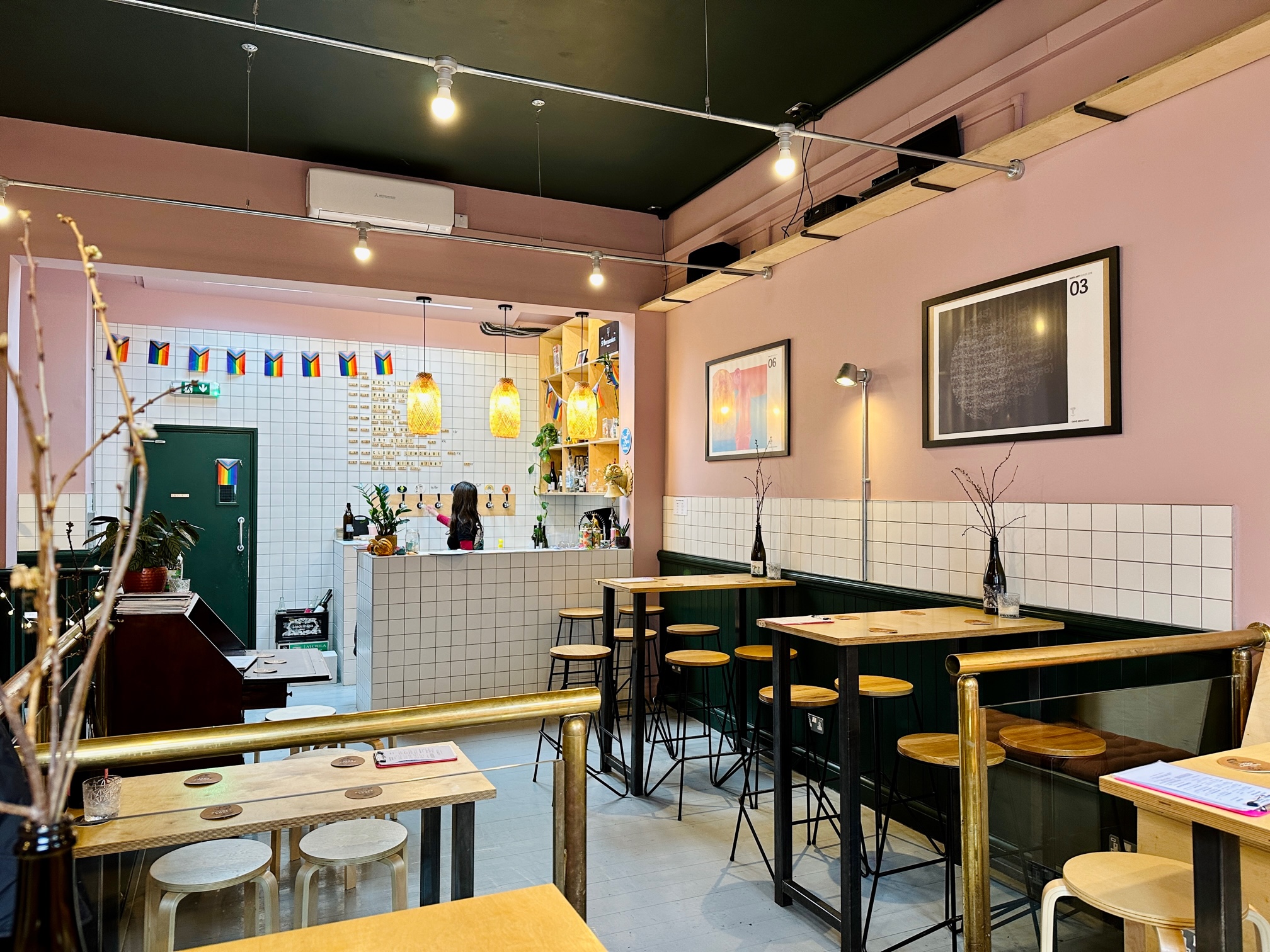
First things first, I love what they’ve done with the space. Whoever designed it has a terrific eye and it has a simple, sophisticated colour palette: gorgeous racing green panelling, crisp white tiles and dusky pink walls. It’s broken up into zones and split level – the big tables nearest the window have tasteful banquettes and the lower level, nearer the bar, is a mixture of high and low tables. When I saw pictures I wasn’t sure it would be a place to linger, but in the flesh it truly is. What’s more, it’s emphatically grown-up and really nicely done.

During the day, the menu mainly revolves around toasted sandwiches and a handful of cheese and charcuterie boards. They stop serving toasties at 4, and from 6 they add a handful of small plates to the options. All of this, again, seems well thought out and the choice is reassuringly compact. In the evening the items on the menu don’t feel like the main event – they’re something to have with beer – whereas at lunchtime it’s all about those toasties. It’s worth adding that for both the toasties and the cheeseboard, vegan options are available. 

Prices, for the town centre, are slightly higher than average so a toastie will cost you between eight pounds and eight fifty, the boards are between ten and twelve. Bread and pastries are from Rise, and coffee is by Anonymous so the Grumpy Goat has done a bang-up job of teaming up with local independents.

Let’s start with the coffee, because it was revelatory. Anonymous not only provided the coffee but also trained the staff, and the end result was a latte which was right up there with any you can get in central Reading – glossy, beautifully made and wonderfully balanced. I don’t know whether the Grumpy Goat would necessarily want people using its upstairs as a cafe, but the coffee is worth a trip in its own right. 

And credit to them for fully embracing Anonymous’ coffee – unlike, say, Café Yolk who started out using them before switching to the inferior Kingdom Coffee, no doubt for financial reasons. Speaking of financial reasons, the coffee was a little more expensive than at the likes of Workhouse but, for me, it was worth every penny.

On to the toasties, then. The menu lists five, one of them vegan, and there was a monthly special on too, although we didn’t try it. Zoë had earmarked The Blue, made with stilton, walnuts, apple and honey, before we even crossed the threshold and that probably tells you quite enough about it. I wasn’t offered a single bite, but the vocal enthusiasm it was greeted with was enough encouragement to order it next time, although I can take or leave walnuts. Similarly, if blue cheese isn’t for you I imagine you’ll give this a wide berth. All I can tell you is that it looked pretty good from where I was sitting.

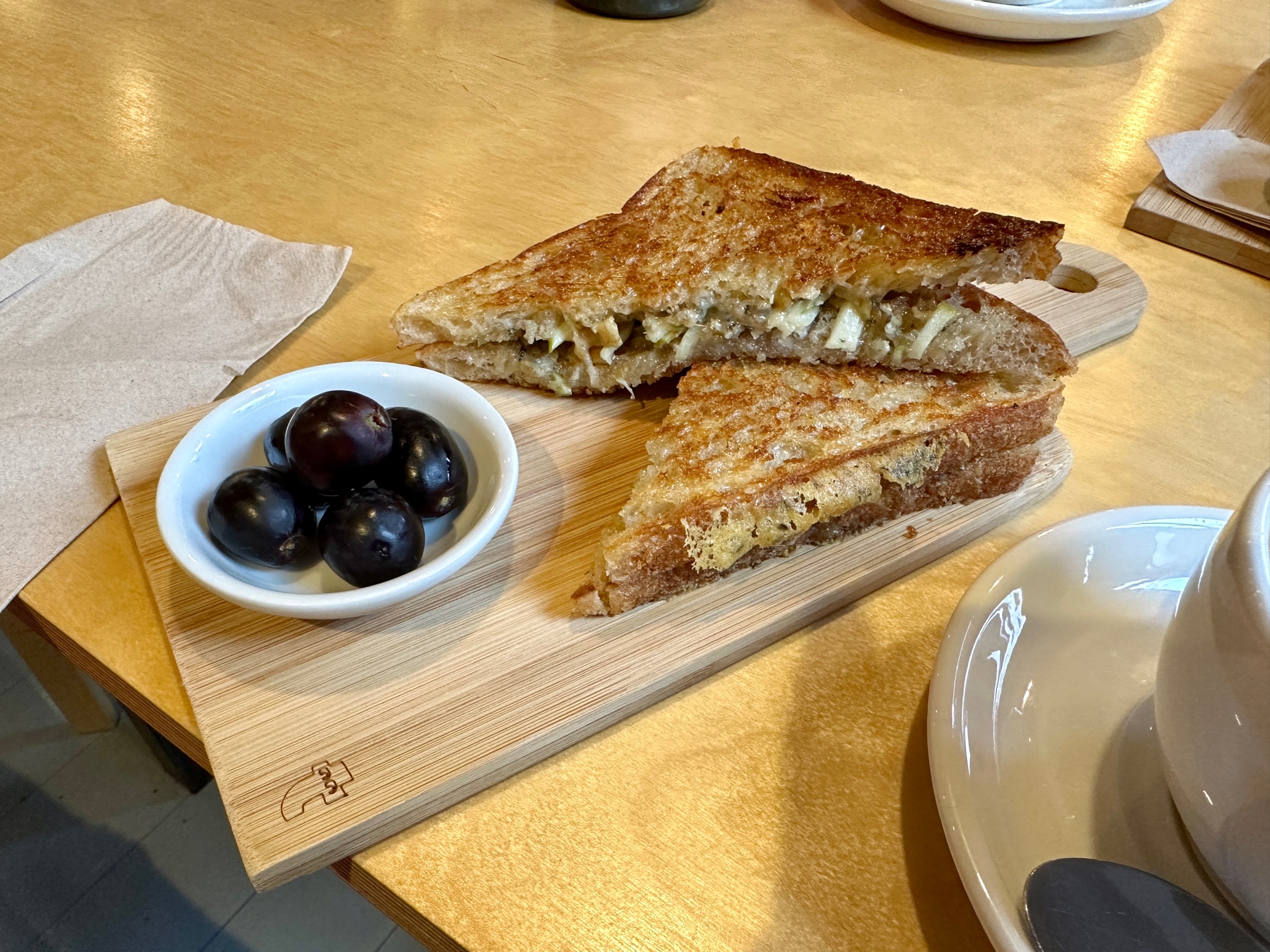
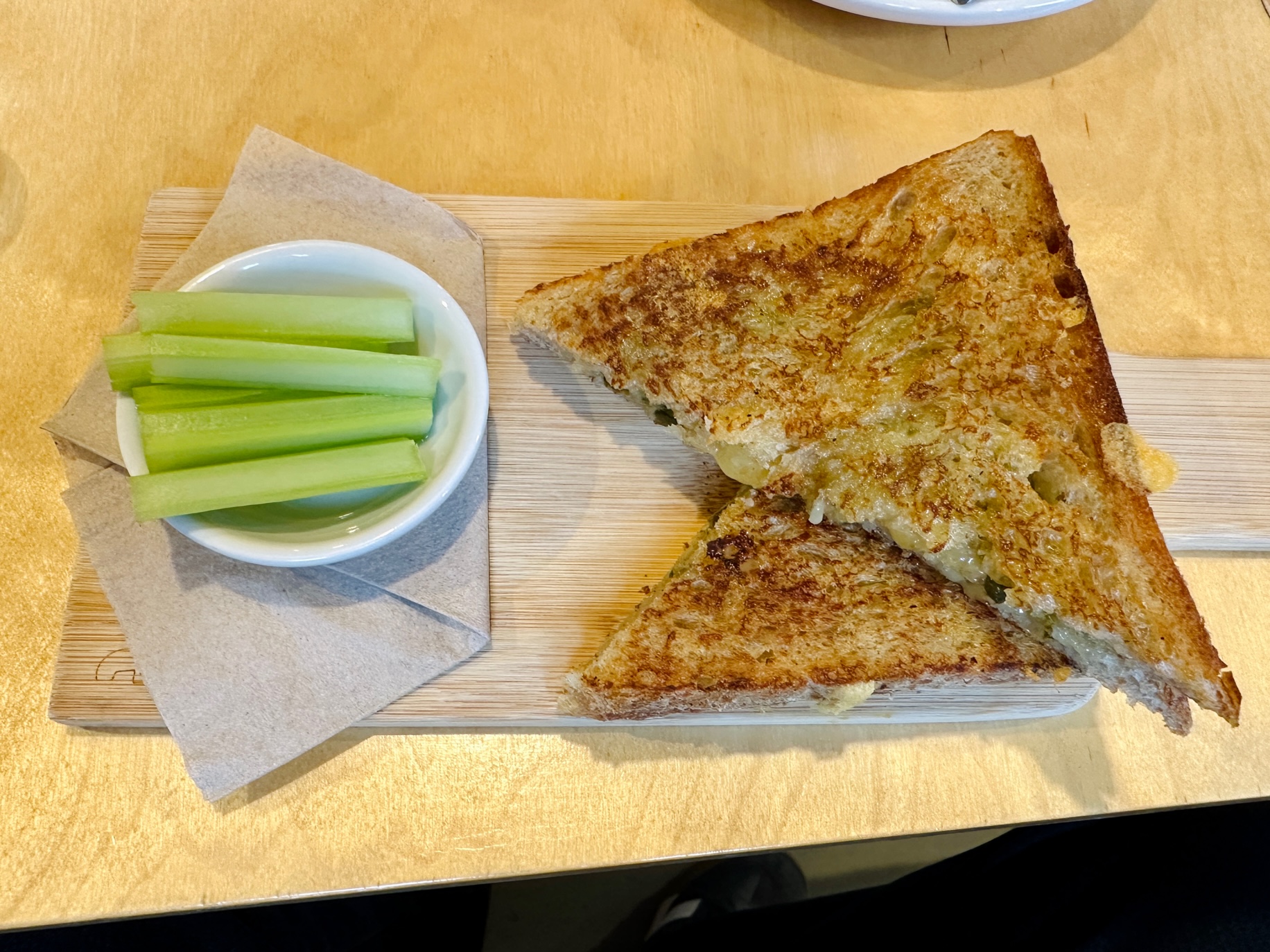
I’d chosen The Classic, because I thought it was as good a place to begin as any. This was all about simplicity, so there were just the two ingredients – toasted Winchester cheese (one of my favourite hard cheeses) and candied jalapeños from the Preservation Society. The Grumpy Goat sells the latter, incidentally, by the jar and I highly recommend taking some home as, in my experience, they pep up pretty much everything.

It has to be said that the Grumpy Goat believe in doing a limited number of things extremely well, and if more restaurants and cafés adopted this approach the world would be an infinitely better place. So it was impossible to fault the toastie – perfectly done, burnished on the outside and a molten mess in the middle. Not for them the lukewarm centre or the schoolboy error of sticking a napkin underneath it. 

In a way, it has to be perfect because it’s so visually unprepossessing – and although the bread is local sourdough it somehow looks a little unspecial, which is a pity. But the flavours were knockout; I might have liked more candied jalapeños, but I can eat the bastard things out of a jar, so my view on this is probably not to be trusted. Was it worth eight pounds? That’s a tricky one. Who knows what’s worth anything any more? Personally, I was more than happy to pay eight pounds for it. 

And in that Reading toastie hall of fame, it definitely earns a spot on the podium. The best cheese toasties I’ve ever had were from a pair of sisters who used to knock them up at Blue Collar’s events under the catchy name of Gourmet Cheese Toasties. This was pretty close – perhaps not quite as big, rugged and hefty but still a deeply, deeply enjoyable lunch. I wasn’t sure about the celery with it: it made me wish for some pickled celery, really, to add a little sharpness, but the toastie was fantastic none the less.

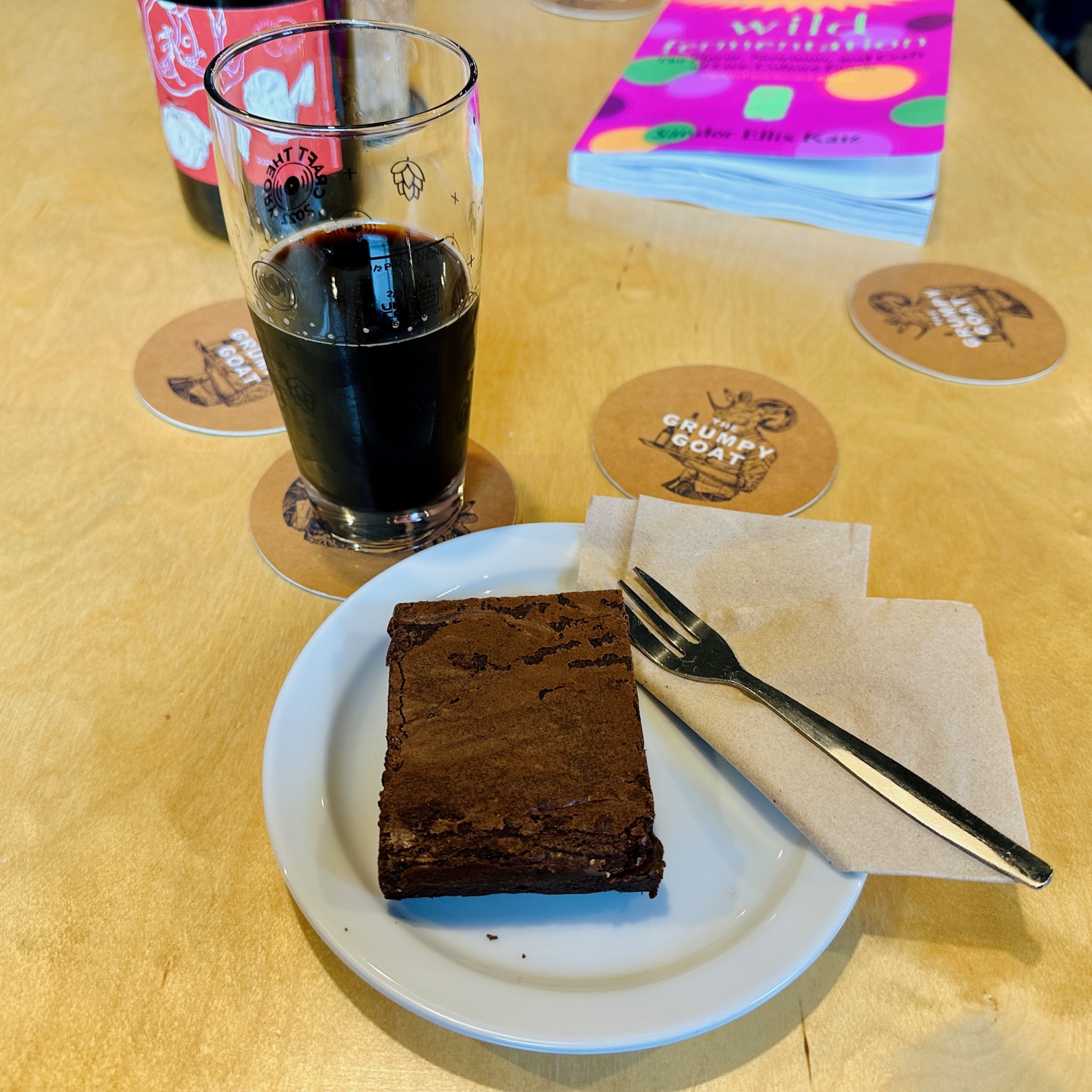
We’d saved room for dessert so we had a couple of chocolate brownies, also made by Rise with the genius addition of a little of Siren Craft’s award winning Broken Dream breakfast stout. If I’ve had a better brownie in Reading, I honestly can’t remember it – this was a generous, fudgy, indulgent slab of sublimity with just the faintest whisper of coffee from the beer. Yours for three pounds thirty, and a steal at that price.

All told, our coffee, toasties and brownies came to just over thirty quid. In terms of Reading’s indies, that price probably puts it in the same bracket as Shed and Picnic, with better coffee than both and better value than the latter. Service was extremely good, very likeable and largely from owners Anne-Marie, who was working behind the bar, and Charlie who was behind the counter downstairs.

I did also try some of the beers, so for completeness’ sake I should mention that too. I loved the fact that everything was available in thirds or two-thirds – no big bloating pints here – and that there’s always an alcohol free option on the wall. I tried Elusive’s Brave Noise, which was a little too harshly piney for my liking, and a beautiful sessionable pale from Herefordshire’s Odyssey, a microbrewery I’d never heard of, before finishing off with a third of Good King Henry, a stunning imperial stout which set off that brownie perfectly.

Imperial stouts in particular always amaze me – that you can get a third of a pint of something so carefully and superbly made for less than the cost of a glass of crappy wine in most pubs. That said, the Grumpy Goat looks to have an excellent selection of wine too (although most of it by the bottle only) and if you want a beer from downstairs there’s a modest surcharge to drink it in. We were pretty much the first customers at noon and by the time we reluctantly headed back out onto Smelly Alley, a couple of hours later, every table was occupied and buzzing. Nearly every one had taken delivery of multiple cheese toasties.

I suspect many of you have already been to the Grumpy Goat, and so your reaction to this review might be a combination of what took you so long? and didn’t I say it was great? If so, well done: you win. Even so I was delighted to love the place as much as I did. If this was the end goal – and given the Grumpy Goat’s ambitions so far you wouldn’t bet that it is – it’s the culmination of ten skilful, patient years.

They’ve spent that time building a customer base and a huge amount of loyalty, experimenting, branching out, finding producers and partners, innovating through lockdown, expanding despite the dismal headwinds and finally, not a moment too soon, creating a beautiful space slap bang in the centre of town that isn’t a pub, isn’t a bar, isn’t a shop and isn’t a café. Why limit yourself, when you can do all four things so well at the same time?

So hats off to the Grumpy Goat for what really is an impressive achievement: it’s hard not to argue that the Grumpy Goat is easily the most significant thing that happened to Reading’s food scene back in 2013. As a fellow survivor of that year, I have to hand it to them.

The Grumpy Goat – 8.3
7 Union Street, RG1 1EU
0118 9581765

https://www.thegrumpygoat.co.uk

Restaurant review: Lebanese Village

The reason behind this week’s review is simple: I got a tip-off. About chicken livers.

It came off the back of the World Cup Of Reading Restaurants I ran on Twitter just after Christmas – congratulations to Kungfu Kitchen for winning the title, by the way – when I received a message from a reader. She and her partner had been debating the merits of the various competitors, and they’d agreed that in their considered opinion the closest rival to surprise package Tasty Greek Souvlaki was not Bakery House but in fact Lebanese Village on Caversham Bridge. It served some of the best Lebanese food she’d ever eaten, she said, and their chicken livers were second to none.

It was appropriate, too, because I never liked chicken livers before I tried Lebanese food. Actually, it would be closer to the truth to say that I didn’t know I liked them until then. But the first time I had them, at Bakery House, experienced that contrast of caramelisation and silkiness unlike anything else, with sweet, sticky fried onions and a whisper of pomegranate molasses, I was hooked. And that was just the start of it – then I tried the chicken livers at Clay’s, dark and delicious, dusted with an intriguing spice mix including, of all things, dried mango and I became even more of a convert. 

Then there were the happy occasions when the Lyndhurst served them – simply, on sourdough toast with a bright pesto. By then chicken livers were well and truly one of my favourite things, so the idea that somewhere in Reading served a reference version I’d yet to try was an aberration I needed to remedy, as soon as possible. So on what felt like the coldest night of the year so far, Zoë and I schlepped off to Caversham Bridge, stopping only for a fortifying beer at the warm, welcoming, wintry Greyfriar.

I’ve written about Reading’s history with Lebanese restaurants before, so I risk rehashing all that here. But in the early days, back in 2015, we had two and they were about as different as could be. La Courbe was a grown-up restaurant with sharp furniture, square plates, fancy glasses and an extensive list of Lebanese wines (true story, on my second or third visit there the English waitress, when clearing our glasses away, said “it’s not bad is it, the Lesbianese wine?”: bless her). And then came Bakery House, closer to the kind of thing you’d see on the Edgware Road, more informal, more casual, with no alcohol licence. 

Bakery House won the war. It’s still going today, and has proved the more influential blueprint for Lebanese food in Reading: Palmyra and the not-too-sadly departed Alona are very much in that mould. La Courbe lasted a couple of years, though whether that’s because of their business acumen or the fact that they had John Sykes as a landlord we’ll never know. The owner moved on to run a Lebanese night at a café in Pangbourne for a little while, and then disappeared without trace. But I hope history is a kinder to La Courbe, because their food was absolutely terrific. Their skewers of lamb and chicken, their lamb koftas were, in truth, a level above anything that came off the grill at Bakery House, wonderful though Bakery House is. I still remember their taboulleh. 

Looking at the menu at Lebanese Village in the run-up to my visit I wondered which kind of restaurant it would turn out to be. It sold alcohol – two Lebanese beers and a decent selection of Lebanese wine, including a couple I’d tried at La Courbe. The menu was more limited than Bakery House’s and potentially less casual, with no shawarma, no boneless baby chicken, fewer mezze. And I’d heard good things about Lebanese Village from a few people, so was it going to be the spiritual successor to La Courbe?

Subscribe to continue reading

Become a paid subscriber to get access to the rest of this post and other exclusive content.

Restaurant review: Antica Osteria Bologna, Clapham Junction

For fuck’s sake, it’s Edible Reading, not Edible Clapham Junction.

I know, I know (Happy New Year to you too, by the way). But I found myself in the vicinity of arguably the United Kingdom’s most minging train station one January weekend – on an unsatisfactory excursion spectacle shopping, since you ask – and I always think it’s well worth structuring an expedition like that around lunch. That way if the shopping’s a bust, as it turned out to be, and the station is a hellscape, which it very much was, there’s still an outside chance of salvaging the day.

Not that I was in Clapham, by the way. I was shopping and mooching in an area that isn’t quite Clapham, isn’t quite Battersea, is a ten minute walk from Clapham Junction and is really rather lovely. Northcote Road is a long, prosperous street in the heart of what is apparently called Nappy Valley, and it’s a great place to amble and bimble. I hadn’t been in many years, although I was an occasional visitor in a former life.

I remember eating in this little place called Franco Manca there, once upon a time when there were only a handful of them, before they contracted the disease called private equity. There used to be a splendid tapas restaurant, too, called Lola Rojo, which did an olive oil ice cream I still think about sometimes: if I could have my time over again, I’d have ordered two portions (laugh all you like, but that might make my top 50 of Things I’d Do Differently). But anyway those were simpler times, over ten years ago, and remembering them it’s as if they happened to somebody else.

Returning in 2023, Northcote Road was still as fancy as I remembered. It’s still lined with swish looking cafés, delis and cheesemongers, bakeries, great shops, a branch of Aesop  – always a sign that you’re somewhere spenny – and tons of opticians. There’s even a branch of upmarket wine merchant Philglass and Swiggott (true story: I used to frequent their Richmond branch and I had to have it explained to me that those weren’t in fact their real surnames). 

Northcote Road also has restaurant after restaurant, and is full of those kinds of chains: Rosa’s Thai, Joe And The Juice, Patty & Bun, Ole & Steen, Meatliquor. The ones where simultaneously we’d rather like one in Reading but we know that if we got one, it would be because they’d jumped the shark. Not that you needed to eat in one if you were peckish – one food van sold beautiful-looking pizza, another was flogging porchetta sandwiches which looked so attractive that I almost cursed my foresight in having made a reservation.

But I had made a reservation, and I’d relied on Eater London for a recommendation. It had a list of the best restaurants in Battersea, although they were sparsely spread out and it would have taken you the best part of an hour to walk from one end of their map to the other (some of them, weirdly, also end up in their list of the best restaurants in Clapham, which tells you what a no man’s land it can be). 

There were small plates wine bars and gastropubs, little BYOB Thai joints and a restaurant offering French-Korean fusion, whatever that is. But I was drawn to Osteria Antica Bologna, slap bang on Northcote Road. It had been going for over thirty years, which meant I had probably walked past it countless times a decade ago. And the clincher was this: I love Bologna and I haven’t been there in far too long. So Zoë and I turned up at lunchtime, our tote bag already full of treats for later from the cheesemonger, to see if it could transport me back, in spirit at least, to one of my favourite cities.

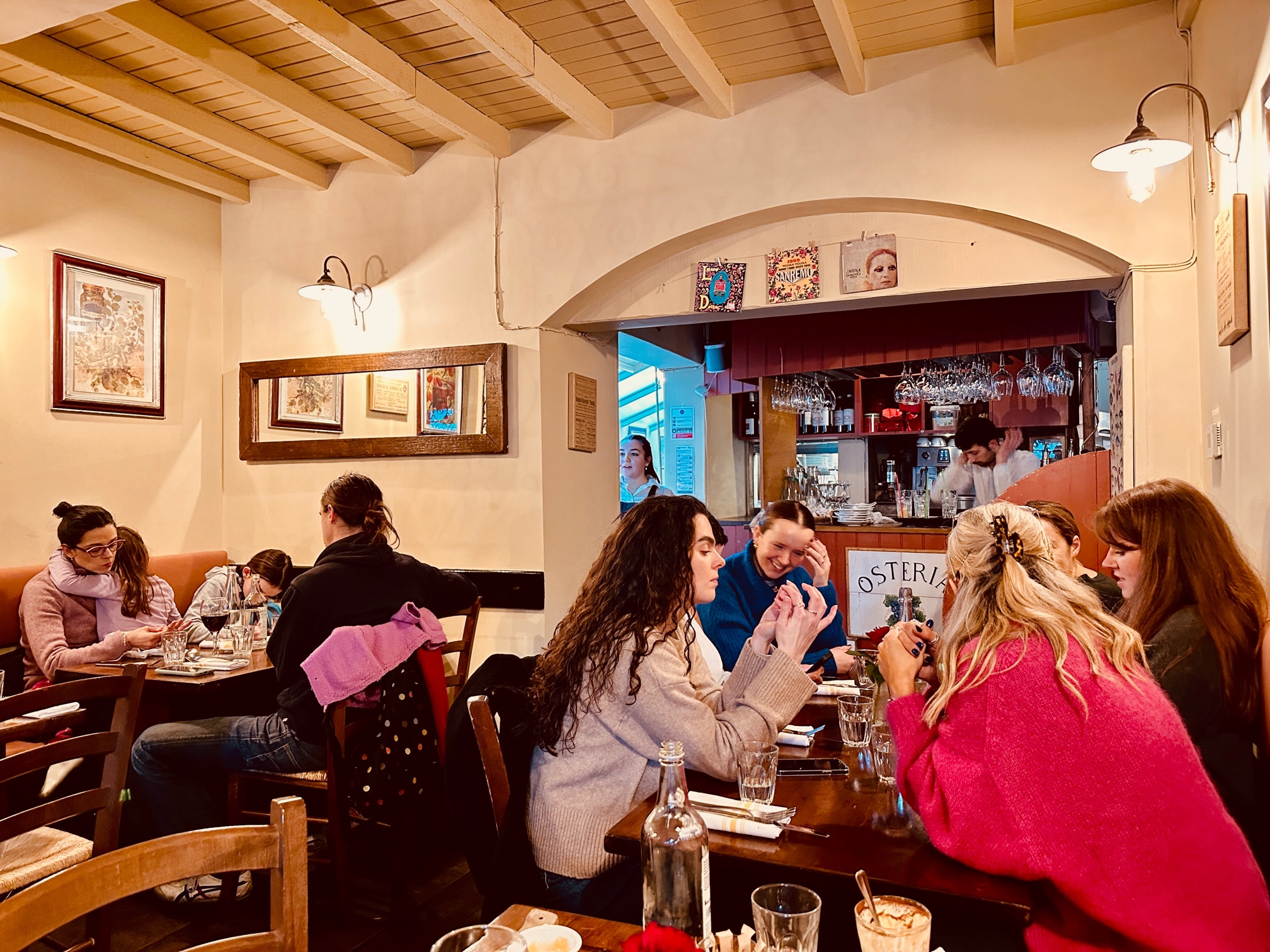
It was old school right from the beginning, with a burgundy and orange awning and a big sign at the front saying “DAL 1990”. And stepping inside I was reminded that it can be a fine line between dated and timeless, and sometimes you make it from the former to the latter merely by staying the course. For what it’s worth, I think Osteria Antica Bologna was the right side of the line, with a simple, rustic-looking dining room, a dusky pink banquette running along one side. On the other, tables were separated by a trellis-like partition that no doubt pre-dated the pandemic.

Beyond the archway in front of the bar, out back, was a more modern-looking dining room with a skylight, an extension I imagine, but I was glad they didn’t seat us there. Even the little things, like a circular table at the front with a big bowl of olives and a large bouquet of flowers, felt like something they had done for a very long time. It was a room with a lovely energy, a place harbouring the unspoken promise that you would eat well, and although only a handful of tables were occupied when we arrived at one o’clock, only a couple were empty when we left.

Another sign that the restaurant was resolutely old school came as I drank my – surprisingly bracing – Aperol Spritz and Zoë attacked her negroni. The menu was antipasti, pasta and main courses. If you wanted pizza, you should have headed to the food truck on the other side of the road, or to Franco Manca. But everything sounded marvellous, including the specials which were explained by our personable, enthusiastic waiter. 

I almost tried some of their pasta but, and this was the only real disappointment on the menu, the difference between a starter and main-sized portion of pasta was just two pounds, which said to me that I was effectively choosing between that and a main. But there’s always next time, when the pumpkin and ricotta ravioli with sage will be calling to me – although not necessarily loud enough to drown out the siren song of the wild boar ragu, or the risotto with salsiccia and Barbera. A truly great menu always comes with regret baked in: that’s the nature of these things.

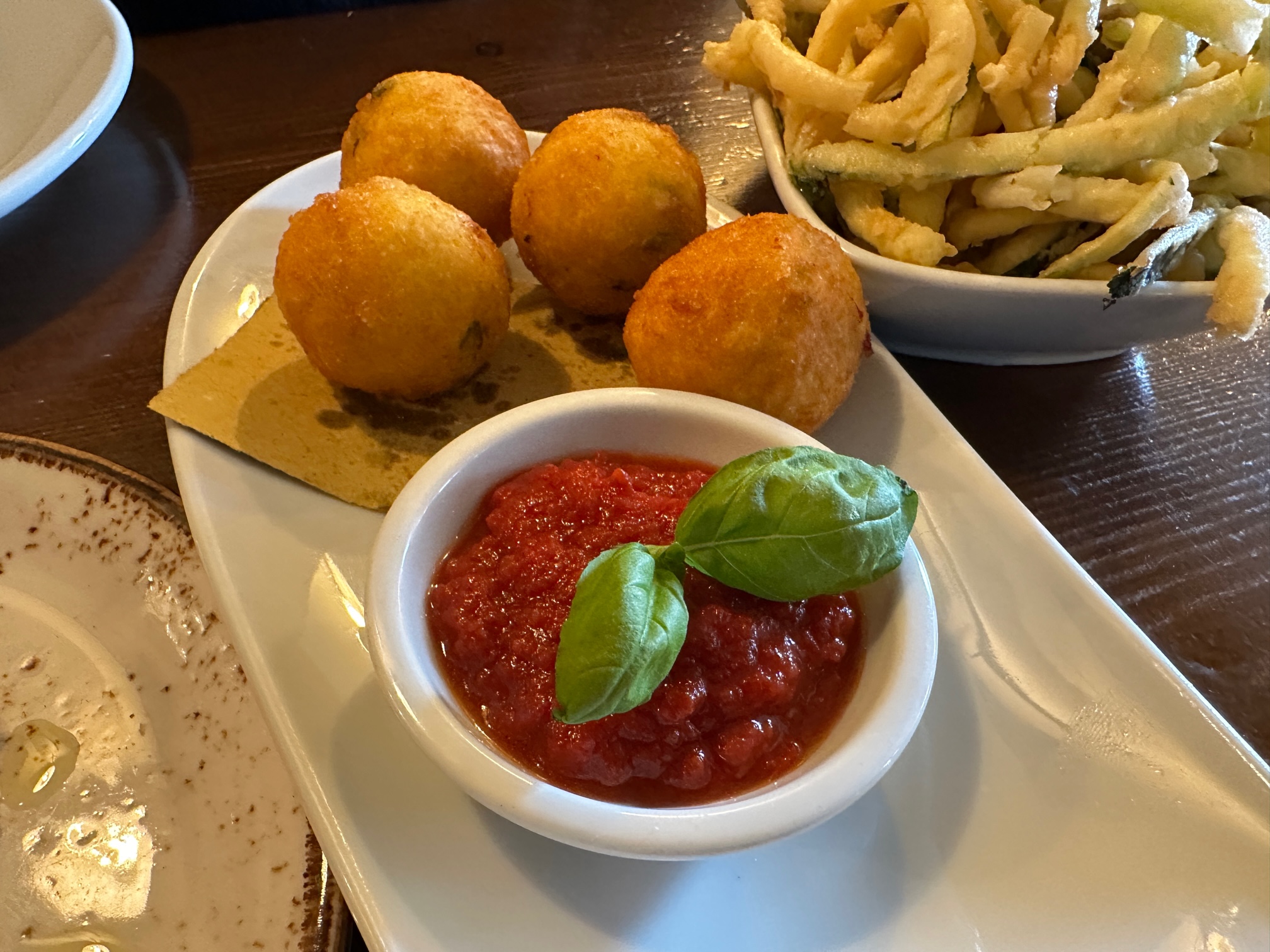
We’d ordered a trio of antipasti to start and if anything they intensified that regret: given just how good these were, what other treasures had we missed on the menu? Arancini were possibly the best I can remember, and simpler than many I’ve had. No thick crust of breadcrumbs here, just a feather-light seasoned shell. No stodge to wade through with a molten core, instead just a neat sphere of rice, cheese and peas retaining a little bite. And to go with it, an arrabiata sauce worthy of the name, just spiky enough. It reminded me of the difference between pretenders, as with my visit last year to Sauce & Flour, and the real deal – unshowy but superb.

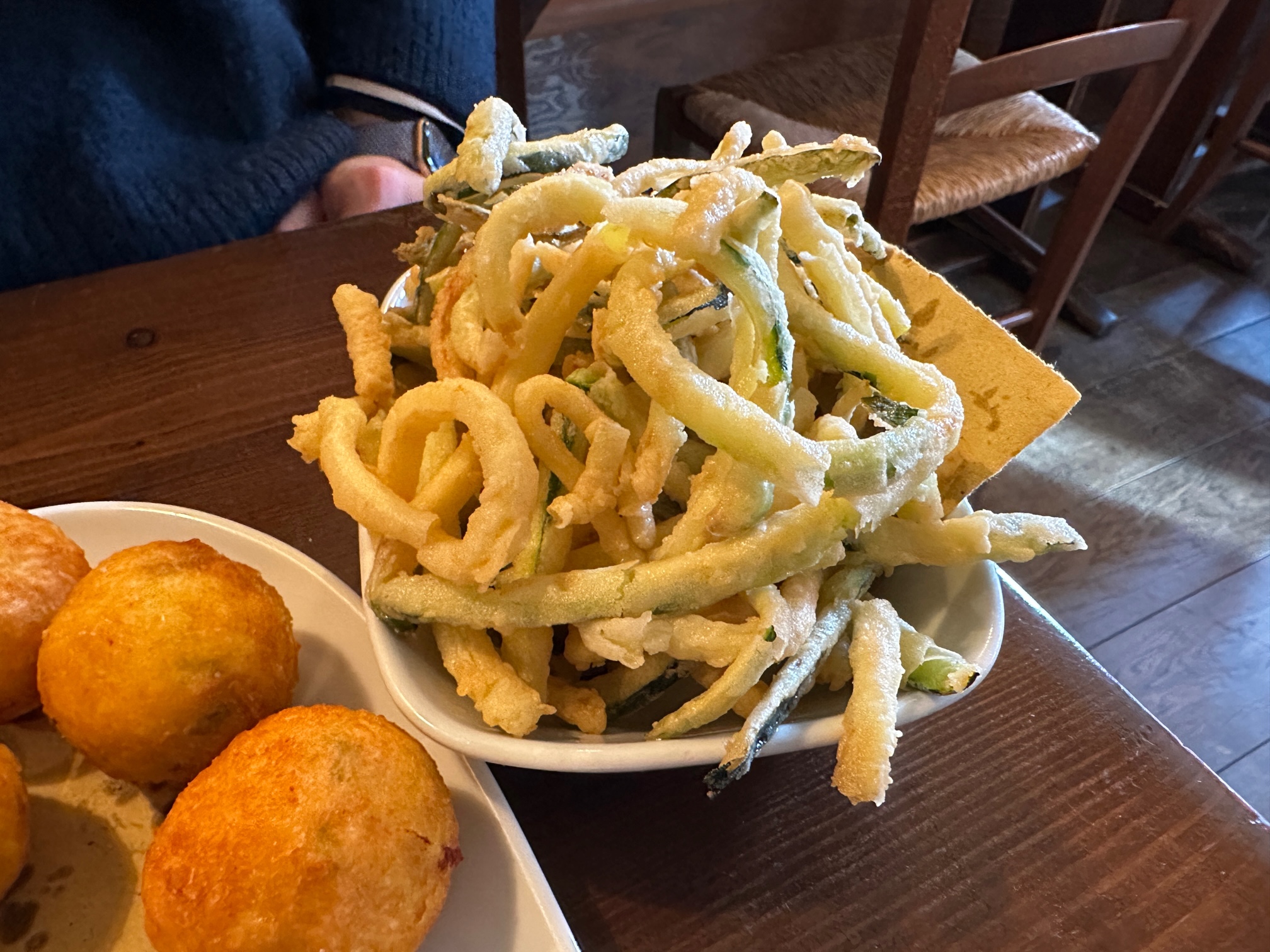
Also as good as I can remember were the zucchini fritti. No, scratch that: they were easily the best I’ve had anywhere. So often, including at a couple of Reading restaurants I actually really like, they can be soggy, limp things and you’re left to redeem them with some kind of dip. Here they were shoestring-thin, almost ethereal yet spot-on crispy, the way this dish always promises to be but somehow never is. And they didn’t need any kind of dip because they were so salty and zippy, so beautifully seasoned and cooked with a real lightness of touch. “The menu should tell you to order these with your drink while you make up your mind” said Zoë who was, as usual, entirely correct.

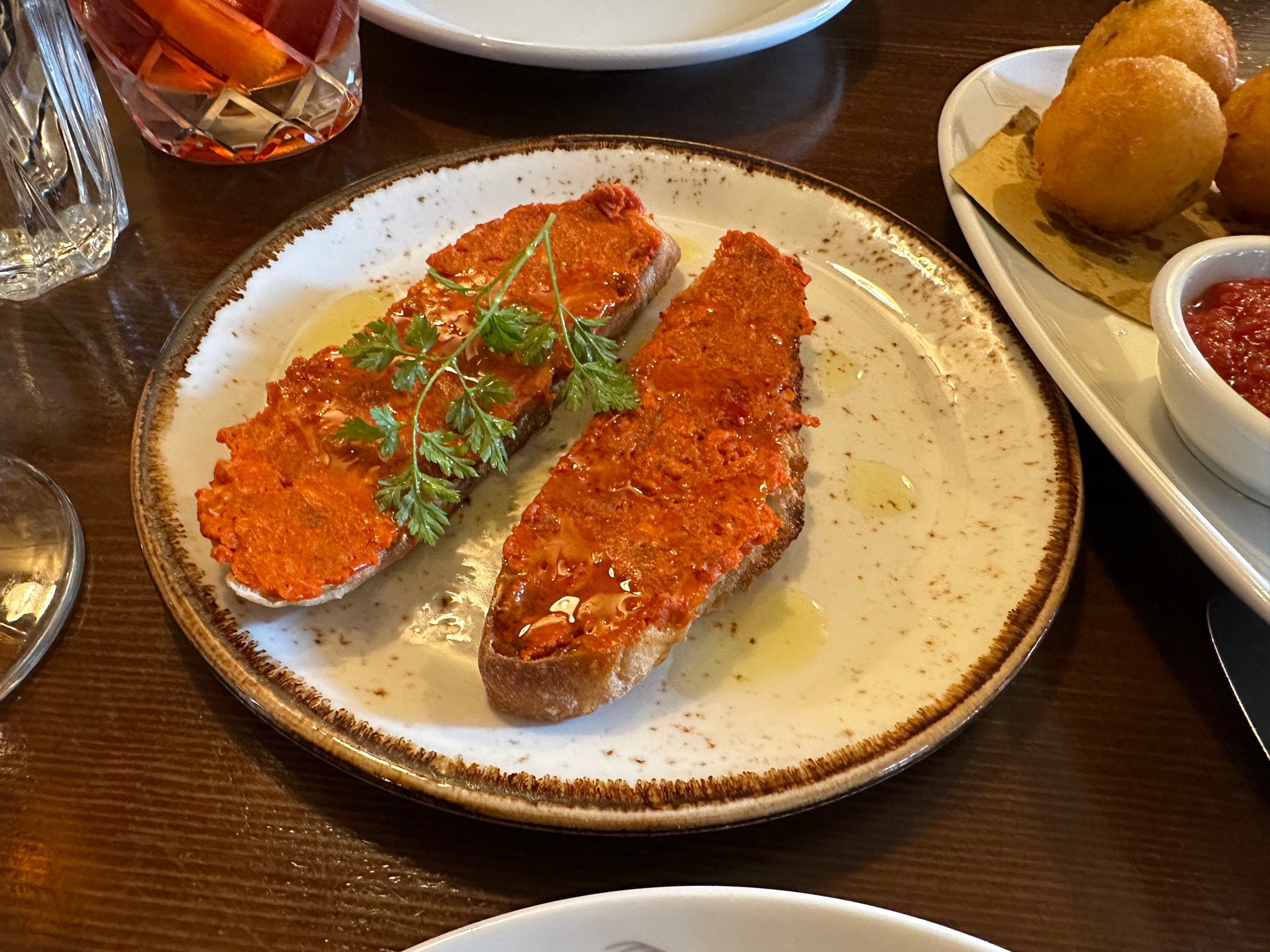
The other small dish we had, bruschetta with ‘nduja, was the least excellent but really, that just means it was still cracking. Two thin slices of toasted bread were loaded with a terrific ‘nduja – not stingily, either – with more depth and earthiness than I’m used to. So often ‘nduja dishes I’ve had are a one-note symphony relying on the acrid heat it can supply; I’ve lost track of the number of restaurants that make lazy use of the stuff. By contrast, this dish just said isn’t our ‘nduja amazing? and, having tasted it, it was impossible to argue. One thing you could potentially quibble, here, was the cost: eight pounds fifty for that. Sounds expensive, but is it 2023-in-London expensive? Your guess is as good as mine.

We grabbed a couple more drinks while we waited for our mains. My gavi, in an endearingly functional wine glass, had a pleasant zing to it and Zoë, sensibly, decided to move to gin and tonic. By this point the restaurant had a real buzz and all the temptations of elsewhere, the porchetta sandwiches and gelato places, had melted into air. All that mattered was the next course, and the course after that.

“This is very promising, isn’t it?” said Zoë. She was right about that too. 

If I had to pick a main course to start my reviewing this year with, it would be hard to choose better than the dish Osteria Antica Bologna served me. A piece of cod with salty, crispy skin and soft, sumptuous flesh, cooked by someone who really understood how to get both those things right at once, perched on a little heap of chickpeas, tomatoes and spinach.

A single forkful was enough for me to know that I was in a happy place. I even turned to Zoë and told the tired joke I reserve for these occasions, I love it when a chickpea’s in my mouth, and she had the decency not to grimace; imagine what sitting opposite me at dinner dozens of times a year must be like. Only the fact that the promised salsa verde, which would have completed the dish perfectly, had been replaced by a smear of something closer to purée slightly blotted the copy book.

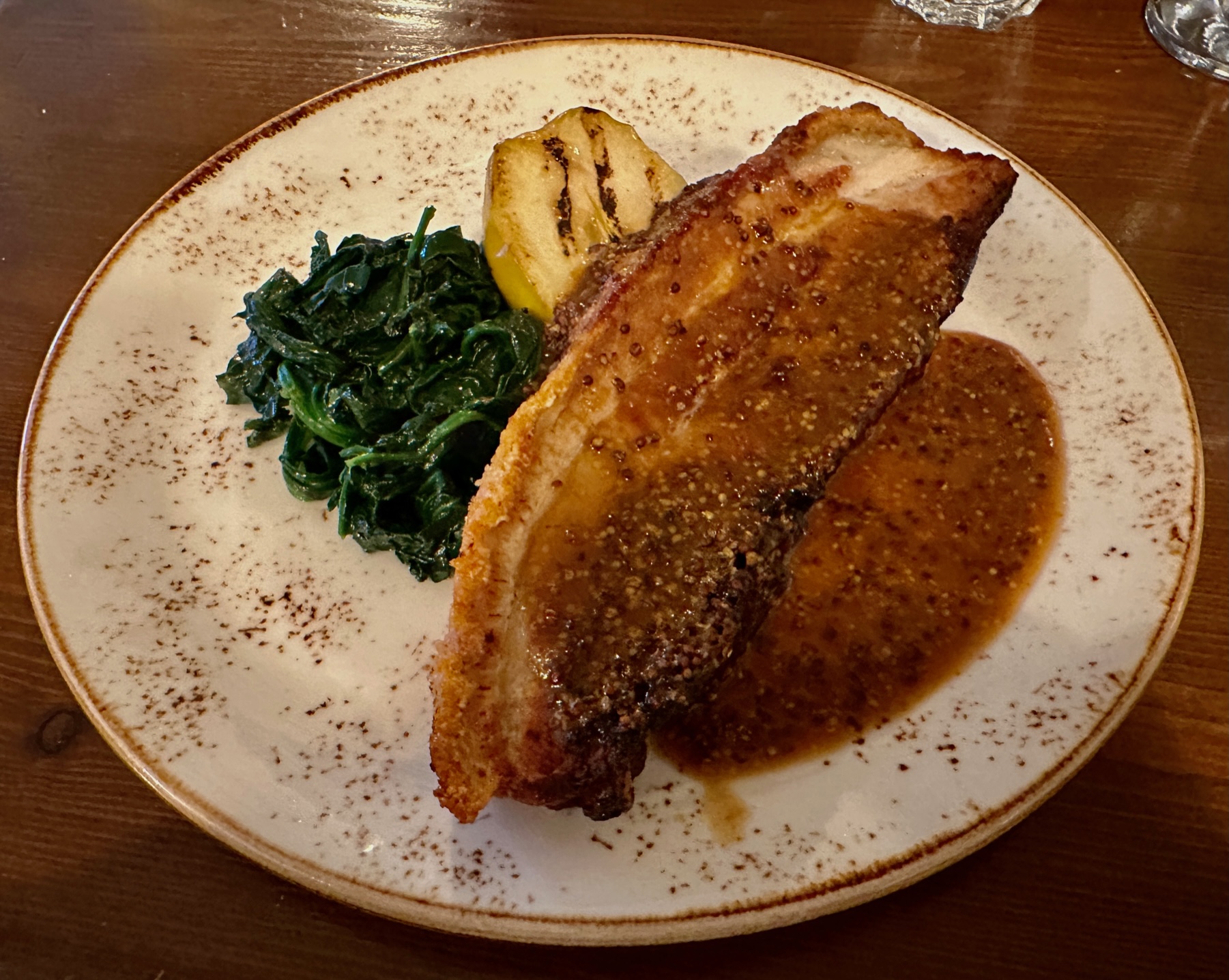
The problem is that if I had to pick a main course with which to start my reviewing year, it would be damn near impossible to choose better than the dish the restaurant served to Zoë. The menu called it pork belly with roasted apple, but that prosaic description comes nowhere near capturing what a marvel it was. A gargantuan slab of pork where, like the fish, everything was exactly how it was meant to be. The flesh was tender, the crackling brittle and intensely savoury. Between the two, arguably the best bit, that sticky, moreish layer of subcutaneous fat, rendered to the point where it was gorgeous but not beyond that to the point where it vanished. I was allowed a forkful, and then because of my expression I was allowed another, and another.

“Would you like to try some of my fish?”

“No, you’re all right.”

Just as sometimes you can only pick out one face in a crowd, it was hard to remember, eating that pork, that there were other things on the plate. But the gravy, shot through with mustard which never overpowered, was a terrific foil and I imagine the griddled apple was superb with it too. We’d ordered some chips with our dishes, which they really didn’t need, and those were predictably wonderful – light and salty and far too easy to pick at long after we’d cleared our mains. If they buy them in, they buy very well.

The dessert menu was also compact and leant heavily on the classics, and having seen the well-upholstered man and his Sloaney Alice-banded daughter at the next table make their choices simplified things nicely for me. My tiramisu was maybe the weakest link in the whole meal – not bad, per se, but a little too loose and liquid when I’d have liked it a tad more substantial. The slug of coffee and booze as you got to the bottom, though? That was still a wonderful moment in a meal full of them. And at the end of it I had an Amaro di Capo, as much medicine as booze, served without airs, graces, ice cubes or orange in a tall shot glass.

Zoë – here we go again – picked better. Her pear and chocolate tart was another home run, with a few pieces of baked pear, a pleasingly short pastry base and a very thick layer of chocolate; I thought it was a relatively airy ganache, Zoë thought it was a sponge, we had a heated debate about it and agreed to disagree. “That filling definitely has flour in it” were her last words on the subject, but I still say she’s dead wrong. I also managed to talk her out of ordering a Bailey’s and into trying a Frangelico instead. It was not a sponge: trust me on this. 

I haven’t talked about service but it was another of the things that was great rather perfect. The staff are clearly a well-oiled unit, bright and happy, friendly and brilliant. But one thing they also were, slightly, was too efficient. Our plates were cleared away mere moments after we’d cleared them, to the point where it became a little bit too much (“there’s something OCD about it” Zoë said, bemusedly, just after they’d also cleared her G&T away when she hadn’t quite finished it).

But really, that was a small quibble about a magnificent place to eat. I could easily see how Osteria Antica Bologna had held its ground amid all that gentrification, all those pop-ups and top tier chains. At one point I saw one of the waiters leave the restaurant with some plates of food and take them out into the street to the people manning a flower stall outside: that, I thought, said it all. Our meal for two – three courses, three drinks each and an optional 12.5% service charge – came to just over a hundred and fifty pounds, and I thought it was worth every penny.

I’ve complained in the past about Reach plc and its pisspoor habit of saying a restaurant is “just like eating” in a foreign country. My problem with that is twofold. First, the poor unfortunate journalist in question has probably never been to the country in question. But more importantly, 99 times out of 100 they haven’t been to the restaurant either – why bother, when there’s TripAdvisor? But for once I’m going to do it myself: I’ve been to Osteria Antica Bologna, and I’ve been to osterias in the city from which it takes its name. And if I’d stepped out the front door to find myself looking at an orange portico dappled with sunlight, rather than being a two minute walk from a Farrow & Ball and a branch of JoJo Maman Bebe, I wouldn’t have been entirely surprised.

As I paid up, our meal at an end and so many around us barely beginning theirs, I thought about what it means to have a restaurant for over thirty years. To outlast fads and phases, to have ‘nduja and burrata on your menu before everybody discovers them, to steer your course without embracing small plates or no reservations, to serve pasta simply because it’s what you do rather than because suddenly pasta restaurants are in vogue. I thought about the fact that Osteria Antica Bologna was here before Northcote Road was all fancy and well-to-do, that they had sent thousands of customers away replete and happy. That they’d started doing that before I even finished my A levels.

And I thought that even though this restaurant was nowhere near my home town (and, let’s be honest, most of you will probably never go there) it was still the perfect place to kick off my reviews this year. Because to celebrate this restaurant, on some level, is to celebrate all great restaurants. Some people have a nasty tendency to use “neighbourhood restaurant” as a way of patting a place on the head. It’s okay I suppose, if you live there they seem to say. But a great neighbourhood restaurant, especially one that makes you wish it was your neighbourhood, is a truly special thing. Osteria Antica Bologna is every bit that special. I’ll find an excuse to be back near Clapham Junction: when I do, I intend to order everything.

Osteria Antica Bologna – 8.6
23 Northcote Road, London, SW11 1NG
020 79784771

https://osteria.co.uk