Takeaway review: ThaiGrr!

One of the many things I’ve missed about reviewing restaurants over the past fourteen months is getting to try new places soon after they’ve opened. It’s fun to be one of the first people to check out a restaurant, and I know that at least a few readers wait to see whether I’ve enjoyed somewhere before deciding whether to pay it a visit – which is a huge compliment, and very much appreciated. But with one thing or another, I wasn’t able to do any of that last year. 

Maybe I should have started reviewing takeaways sooner, rather than waiting until 2021. As it was, I didn’t get to try the food at Tasty Greek Souvlaki or Banarasi Kitchen until many months after they opened their doors: it also meant I had to sit on the sidelines and watch while people told me how good it was. It was another thing to envy, along with all the people I knew who managed to fit in a foreign holiday last year, or a UK holiday (which, by the way, isn’t a staycation: that’s a hill I’m willing to die on), and even all the people who ate in restaurants and drank in pubs over the summer, free of the fear I couldn’t escape.

That makes this week’s review one I’ve particularly looked forward to. ThaiGrr! – yes, with an exclamation mark like Westward Ho!, although I’ll leave it out from this point onwards or this review might sound like I’m on amphetamines – opened last month at the Oxford Road end of Queens Walk. It’s the first of no doubt many new openings as part of the overall regeneration of the Broad Street Mall, although definitely not the last: I’ve heard interesting rumours, for instance, about a Greek restaurant opening there this summer. 

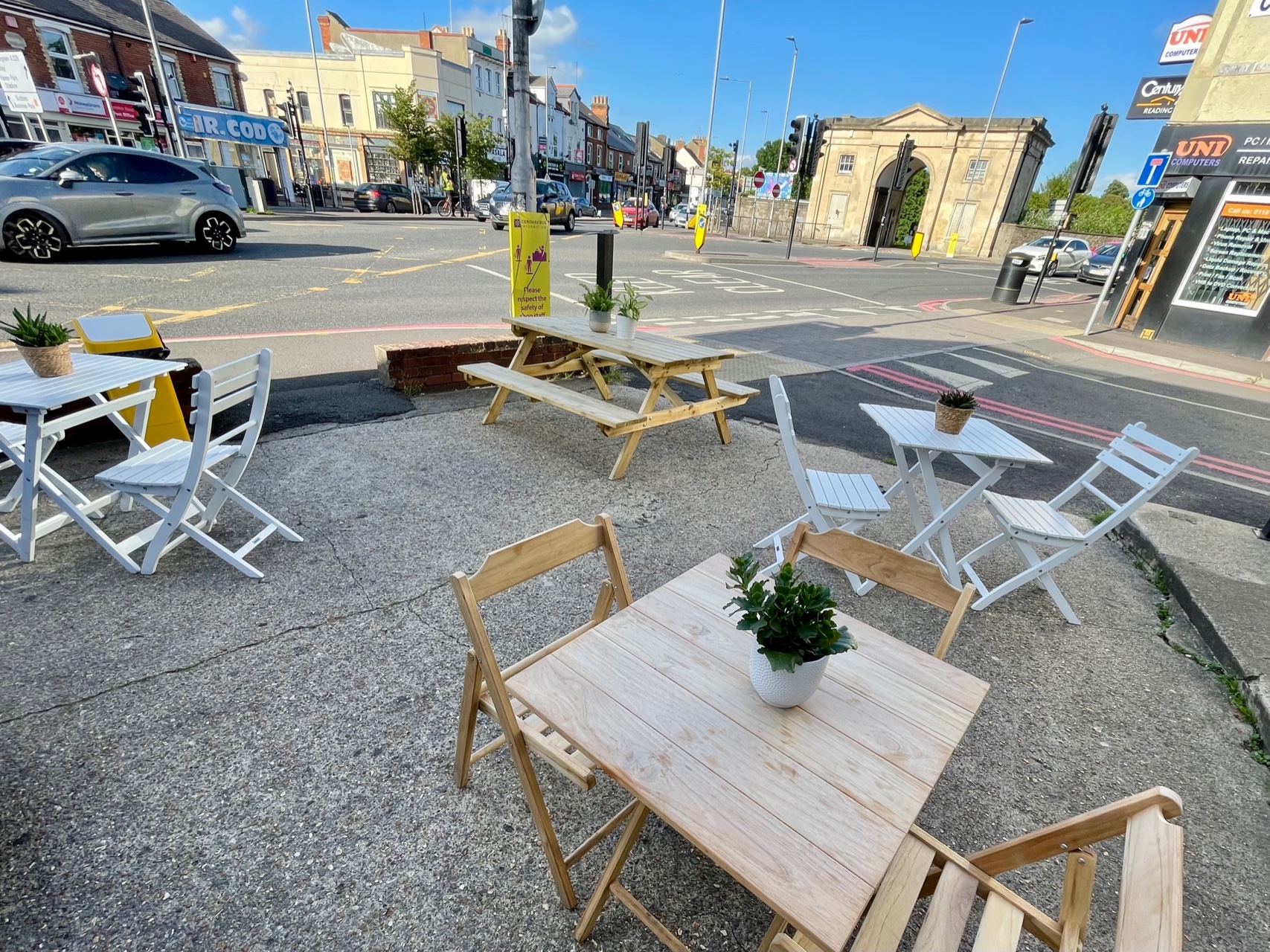
I was on a photographic mooch around West Reading a couple of weeks ago, checking out Rise Bakehouse and Cult Antiques and Coffee, the new café on Tilehurst Road. Because I was in that general area, I took a detour past ThaiGrr to have a look. It had gamely stuck a couple of tables outside, braving the wind tunnel that is Queens Walk. But the inside looked a little like a slightly bigger Kokoro, an unfussy place where you grab and go, or eat inside but with no whistles and bells. The menu felt geared towards that kind of eating, too – or takeaway – with a few starters and a reasonably compact list of mains all served with rice.

ThaiGrr has almost no footprint online, having seemingly sprung up from nowhere. Their website doesn’t tell you anything about their story, and all I could find from Googling was a company set up last year from an anonymous address in North London, and three directors with no previous positions. So it would appear, from a cursory glance at least, to be that rare thing – a completely independent restaurant appearing out of nowhere.

When I looked at the menu on ThaiGrr’s website I felt a little underwhelmed, mainly because I saw sweet and sour chicken and beef in oyster sauce very close to the top. That felt a lot like playing it safe. But when I had a closer look on Deliveroo I realised that wasn’t representative at all: the balance leant much more towards Thai dishes, with a specials section which could only be ordered after 2.30pm. Main courses, with rice included, ranged from just under ten pounds to twelve pounds, which made me think this would probably be a one-pot, Kokoro-style arrangement. 

There were also half a dozen sides or starters, clocking in between four and seven pounds. It was genuinely difficult to narrow it down so we ended up ordering two mains and three sides, hedging our bets, reasoning that something was bound to be relatively disappointing. That, as it turned out, was a mistake – albeit one with happy consequences. Our order came to just shy of forty pounds, not including rider tip.

As so often with meals from the centre of town, everything happened like clockwork. We placed our order around quarter past seven, the driver was en route twenty minutes or so later and he took less than ten minutes to get to my front door. He pulled up in his car and took the paper bag out of his insulated bag, which he hadn’t bothered to zip up. Fortunately everything was pretty much still hot, although I was glad I didn’t live further out because it mightn’t have stayed that way for long.

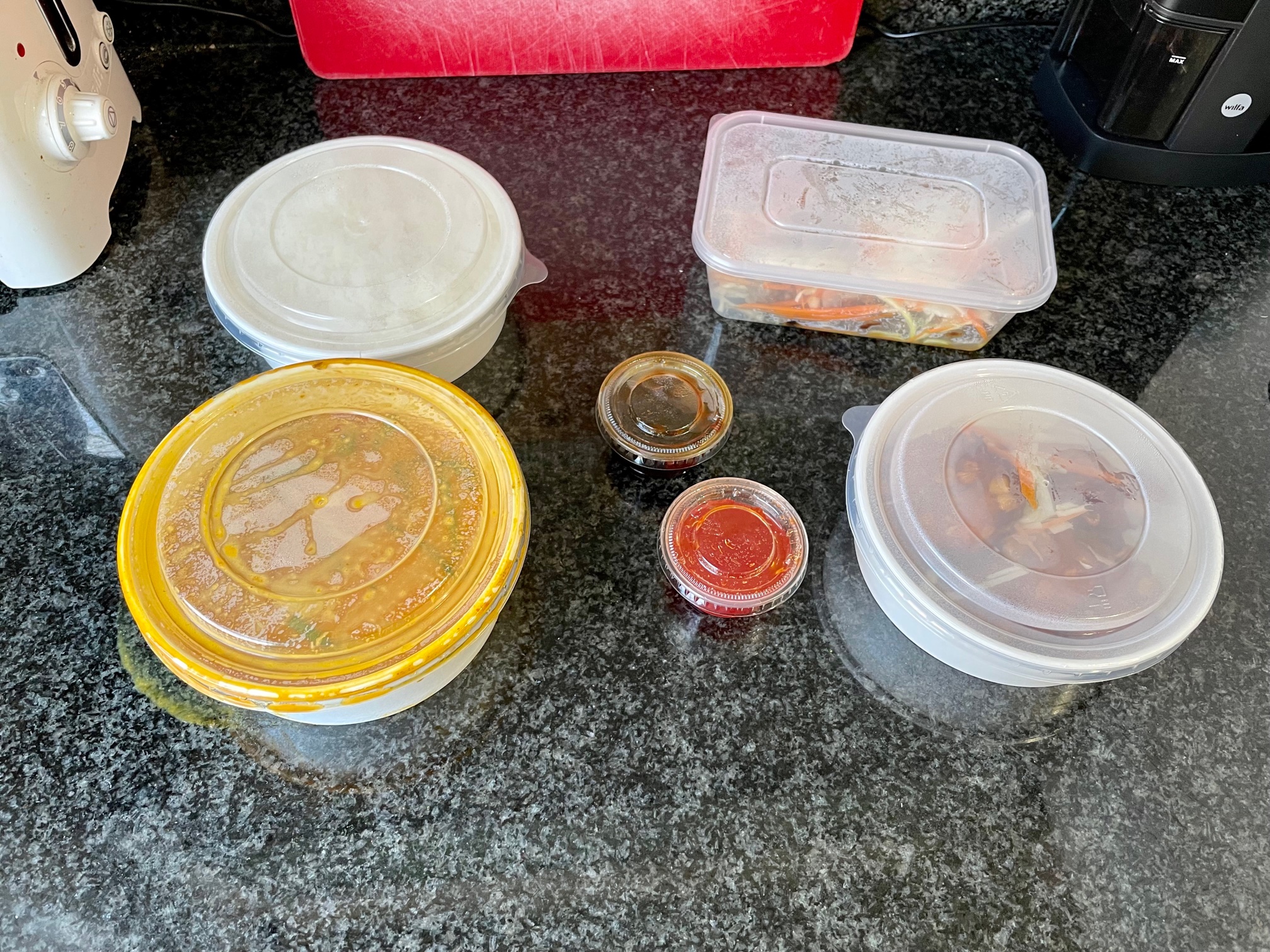
ThaiGrr’s packaging felt like they had really thought through what would survive delivery best. Everything came in cardboard tubs with plastic lids and the majority of the dishes had also been cling-wrapped for extra insulation. I was most impressed with the curries: the curry and jasmine rice were packaged separately within a single tub with the former in a cling-wrapped plastic container. So it wasn’t a Kokoro-type model after all: another mistake on my part. Dished up in a bowl it was a good portion size – generous but not gigantic. You wouldn’t leave any, but you didn’t have to spend fifteen pounds buying a curry and rice on the side either.

That’s quite enough talking about packaging for one week, because I’d much rather enthuse about how beautiful my dinner was. Nothing I ate was less than very good, and much of it was if anything better than that. My main, moo pad prik, was fantastic: plenty of pork belly, the perfect balance of flesh and fat, in a superb sauce that zinged with kaffir lime and with punchy heat and just enough sweetness. 

This was lip-tingling stuff, and it made me realise just how often Thai food in Reading restaurants has next to no chilli heat at all. The menu gave this dish a rating of one chilli, but if anything it felt closer to two to me (although that said, my tolerance for chilli has got a lot higher since I discovered Clay’s and Kungfu Kitchen). The sauce coated rather than drenched the jasmin rice, but if anything that slight stickiness made it even more addictive. When I order from ThaiGrr again – and on this showing it’s going to be pretty soon – I’ll struggle not to pick this again. Looking at the restaurant’s Instagram feed, I see that this dish started out as a special and was promoted to the main menu: it’s hard not to love a restaurant that does that sort of thing.

My other half Zoë had gone for the green chicken curry (“I have a lot of benchmarks for this dish”, she told me) and I got to try a little of it, although it was difficult to tear myself away from my dish to do so. I liked it, although I’m not sure green curry would ever be close to the top of my list to order. The chicken was tender and well done and the sauce had just enough heat and funk to it: “it’s quite heavy on the fish sauce”, Zoë said. This had a two chilli rating for heat on the menu, but for my money it was milder than my dish.

Many of the hotter dishes – spicy minced pork with basil leaves, or crispy chicken salad with rice – are in the specials section of the menu, and I fully expect to wind up posting pictures of these on my Instagram in the coming weeks. It’s dangerous to know that something so tasty and so affordable is a mere half an hour away on any given evening, especially when you just can’t face cooking.

We’d gone for three side dishes (the menu, very much with delivery in mind, doesn’t call them starters) and again, these ran the wonderful gamut between rather good and excellent. The weakest was the chicken satay, but even this was a very creditable dish (even if my attempts to dish out the sauce from its little plastic tub make the end product look like a dirty protest). I would have liked the chicken to look more like it had made contact with a grill, but the taste and texture were difficult to fault and the sauce itself had a very pleasing nutty depth. Four skewers for six pounds felt like good value, too.

I was more taken with the crispy squid. The texture was spot on – no bounce or rubberiness that would have given away a lack of freshness – it had retained that crispiness in transit, and it was joyous dipped in sweet chilli sauce. Again, I wasn’t sure that it was especially spicy but I was happy overlooking that because I was enjoying myself so much. For my money, this was some of the best salt and pepper squid I’ve had in Reading, and I’ve tried it pretty much anywhere that sells it, from Pho to Kungfu Kitchen. It felt like a reasonable portion for seven pounds, although you might, as I did, slightly wish you had it all to yourself.

Last but very much not least, we had also ordered ThaiGrr’s fried chicken, apparently their house speciality. This also cost seven pounds and was a ridiculously generous tub with six pieces of jointed chicken, bone in, with huge shards of crispy skin and tender meat underneath. The whole thing was liberally studded with fried garlic and I absolutely loved it, but really, they could just sell the skin in a tub and they’d make pretty decent money out of me. If none of that makes you feel peckish – assuming that fried chicken is your cup of tea, of course – then just have a look at the picture below. Maybe it will succeed where I’ve failed. 

The bones were literally the only thing from our entire order that ended up in the food recycling bin (thanks again, Reading Borough Council). I believe that classifies this particular meal as, to use Zoë’s immortal words, “a proper gut bash”. Honestly, you should hear the things she says that she won’t allow me to include in these reviews (they invariably involve some Anglo-Saxon and a wonderful, if expletive, turn of phrase).

I don’t know which is better about ThaiGrr, that they delighted me (which they very much did) or that they surprised me. The latter is possibly the rarer experience: I looked at ThaiGrr’s premises, and their menu, and I expected an experience a lot like Kokoro.  That’s no bad thing, I should add: I like Kokoro very much. But what I got instead is what ThaiGrr looked like it might be but which I also thought was too good to be true – a proper little independent restaurant that keeps changing its menu, adding specials and experimenting. 

ThaiGrr is also the first new restaurant I’ve seen in this pandemic era that has obviously thought hard about gearing its menu for delivery. The food is better than you’d expect from such a no-frills place, but it’s also better than it needs to be. It will be interesting to see what kind of restaurant they become, when eating in is allowed again from next week, just as it will be interesting to see what becomes of the Broad Street Mall.

The area around there will change, too, with the advent of Blue Collar Corner in the summer. Perhaps the centre of gravity in Reading will begin to change and finally shift away from the Oracle, with its sometimes slightly soulless chains. But all that is for the future: for now, ThaiGrr is pretty brave to have opened first, currently in the middle of nowhere, but it’s a gamble that pays off.

I think ThaiGrr’s is probably the best-executed Thai food I’ve had in Reading. Thai food is always a cuisine I’ve enjoyed, but often struggled to love. I think it shows, too: some of my reviews of Thai restaurants over the years are among the most pedestrian I’ve ever written. ThaiGrr could well change my feelings about Thai food – and I’ll definitely give them a chance to, because I was planning my second order before I’d even finished eating the first. I even found, by the end of proceedings, that I liked the name more than I thought I would. So hats off to ThaiGrr! for being one of my best discoveries of the year so far. I left the exclamation mark in this time. I reckon they’ve earned it. 

ThaiGrr!
1D Queens Walk, Broad Street Mall, Reading, RG1 7QF
07999 941665

http://www.thaigrr.co.uk/
Order via: Deliveroo only

Takeaway review: Tortilla

When it comes to deliveries, all dishes may be equal but some dishes are more equal than others. I got to thinking about this after last week’s disappointing meal at Dhaulagiri Kitchen, when somebody replied on Twitter and said “I guess moving to takeaway has been tough for them”. I thought that was a curious take, because all of the problems with that meal had been in the kitchen, not on the journey from the kitchen to my house: everything was packed just fine, and arrived hot enough, it just didn’t taste that special. 

It is true, though, that some dishes and cuisines lend themselves better to delivery than others. You’re on a hiding to nothing with pizza from the minute it leaves the oven, for example. And the more components you have to dish up separately, the more likely you’ll have a lukewarm plate at the end of it. With dishes where everything comes in one pot, you have a better chance that the whole thing will stay hot. This is why Kokoro is always such a good bet for delivery, and why restaurants like Zizzi and Pizza Express have set up separate brands on Deliveroo selling macaroni cheese or other pasta dishes in a tub. 

It also explains the relative popularity of sandwiches – burgers, wraps and burritos – on delivery apps, and that in turn explains why I decided to give Tortilla a try this week. Burrito restaurant Tortilla is one of those smaller chains where the blurb on the website makes it sound like a small indie business (“we’re not part of a multi-franchise nor some big soulless restaurant group”) but my cursory research suggested a slightly different picture. 

They had nearly forty branches, and had benefited from financial backing from the private equity group that controlled Yo! Sushi and from Santander – because if there’s one thing big business still seems to love, it’s the casual dining sector. Tortilla’s chairman used to run Pizza Express and had a proud track record of joining or founding hospitality businesses and then selling them off for pots of cash – more John Sykes than Jamie Oliver. So Tortilla maybe wasn’t a Taco Bell, but it certainly wasn’t a Mission Burrito either.

Tortilla was first announced as coming to Reading last February, although for obvious reasons it took a fair old while to open, not throwing its doors open until the end of October. It made the news last year, because it had to overcome objections from a neighbouring business, the dentist Reading Smiles, who were concerned about them having an alcohol licence, and about the risk of smells drifting into the dental practice. Tortilla’s response was that there was no risk of that, as almost no cooking actually took place on the premises – their beef and pork are “braised off-site”, which also enables them to open in smaller premises, like the Reading branch, without the need for extraction. 

It’s funny: this sort of thing, cooking dishes in a central kitchen, goes on throughout chain restaurants and I’m sure we’ve all eaten those kinds of meals without necessarily being aware of it. But I had to work hard not to let this prejudice me against Tortilla. After all, I had a fantastic meal when I ordered a kilo of pre-cooked rib meat from The Rib Man and heated it up on my hob at home: potentially, surely this was no different? 

And Tortilla seemed to be doing a tidy trade – every time I’d walked past the restaurant since lockdown relaxed in April the tables outside had people at them, taking part in our new national sport of gamely pretending the weather wasn’t shite. I couldn’t quite make up their mind about them on paper, so it was time to place an order with them and try to make up my mind about them in reality.

Tortilla is on all three delivery apps, although in typical fashion I only realised that once I had placed my order with Deliveroo. The menu is identical across all of them, and it largely revolves around burritos, naked burritos – that’s the contents of a burrito in a bowl, in case you have a thing against tortillas – and a few taco options. They don’t sell quesadillas or nachos for delivery, although they will sell you a DIY kit if you want to make them at home: I can’t imagine these are that popular, but life is full of surprises.

The process for ordering a burrito is remarkably like going down the line in Mission Burrito, so you have various tick boxes to pick which rice, beans, salsa and so on you want. We ordered on a Sunday evening, and they had run out of their coriander and lime rice and their guacamole, which slightly limited the options. Guacamole, incidentally, is one of the only things Tortilla makes on the premises, so it’s a particular shame they had run out. (Is it as bad as a pub running out of chips? Answers on a postcard.)

Tortilla offers the traditional fillings – carnitas, barbacoa beef and grilled chicken – along with grilled vegetables. The latter costs the same as a chicken burrito, which feels cheeky. They also serve a“vegan chilli no carne” – which has tempeh in it, although you have to go to Tortilla’s website to find that out. We ordered a couple of burritos and some tacos to share – I might have tried the tortilla chips too if they’d had any guacamole to go with them – and our meal came to just shy of thirty pounds, not including the rider tip. Tortilla’s burritos come in medium and large, with the large costing about the same as the one size offered by Mission Burrito.

Deliveries from the town centre always seem quicker and more reliable, and often come on a bike rather than in a car. This was no exception, and everything was pretty brisk: we ordered at twenty past seven, the rider was en route twenty minutes later and he took four minutes to reach our front door. When he did, he cheerfully told us that he was carrying two orders from Tortilla and so we’d have to give him our order number – that struck me as a little strange, but it hardly held things up. I wonder, if I’d been his second delivery, if I’d have been quite as happy.

Anyway, everything was hot and it was all present and correct. A number had been scrawled on one of the foil-packed burritos with a Sharpie, nothing on the other. It’s only after the meal, looking at the ticket in the bag, that I realised he had written numbers against each burrito so we could work out which was which. P for pork and B for beef might have been simpler.

This is where I also have to make a sad confession. Partly to work out which burrito was which and partly to make this review more photographically interesting, I cut my burrito in half, artfully arranged it on a plate so you could see the filling, placed it under a spotlight in the kitchen and took a picture of it. Or at least I thought I did, but looking at my camera roll it simply isn’t there. This puts a greater emphasis on my descriptive powers than any of us would like, and makes this review even less visually interesting than normal: I can only apologise. I asked for advice on Twitter, but it ranged from the impractical (courtroom style drawing please) to the sadistic (another thousand words, presumably?). I’ll spare you either option.

On to the burrito then. Mine was pulled beef with black beans, tomato rice and all the trimmings – cheese, sour cream, salsa verde, jalapeños and pickled red onions. Looking at all that, you’d have thought the biggest risk would be the flavours clashing, or being too much, but in reality the struggle was to get it to taste of anything. Really, it was almost symphonically bland. It was well packed – almost as if done by a machine, the meat firmly in the centre, so different to the haphazard arrangement of a Mission burrito – but nothing tasted of very much. 

The beef had the texture but couldn’t back it up with the taste. The red onions were still crunchy and felt like they’d had only a passing acquaintance with vinegar. If there were any jalapeños in it, they’d been picked for their inoffensiveness. The list goes on: the tomato rice had a real feeling of Bachelor’s about it, and if the salsa verde, cheese and sour cream were even in there (and having eaten it, I’m not sure they were) they added even less to proceedings than Dido Harding. Or Dido herself, for that matter. When the best case scenario is that your meal is boring because they got your order wrong, and the worst case scenario is that it’s plain boring, matters are problematic.

The carnitas burrito was a subtly different shade of meh, but meh nonetheless. I actually liked the pork more – it was saltier and just more interesting – but it had its work cut out shining in a sea of mediocrity. When I have a burrito from Mission it’s a glorious mess – it drips, it’s tricky to tackle, it’s always a challenge, but it tastes of something. You get the highs and the lows. This, by contrast, was tidy and dull, a burrito on Prozac, all the edges neatly knocked off until you barely felt anything. Maybe that was the intention, and maybe the aim is to take customers away from Taco Bell: Tortilla is better than Taco Bell, but so’s eating corrugated cardboard topped with spam.

Only the tacos showed a hint of something better. Tortilla’s chicken is grilled rather than pulled, in little pieces – I actually quite enjoyed this, although it wouldn’t be everybody’s cup of tea. But the real winner here was the salsa roja – hot and punchy and adding a dimension of flavour that had been lacking everywhere else. But even the tacos, though they were better than the burritos, weren’t better than their peers. 

The portion size was still a little underwhelming, especially when you compare it to the Lyndhurst’s outstanding chicken tinga tacos: there, you get four tacos for nine pounds, all so piled high with chicken that you can’t physically close them, and there is always plenty of guacamole. At Tortilla you get three barely-filled tacos for seven pounds fifty – I got the odd one, but mostly because Zoë had no interest in fighting me for it.

When I look at Tortilla’s footprint, I can see that it might do well in many of the locations where they’ve opened up. If it didn’t exist, it might be necessary to invent it. But this, I’m very proud to say, is Reading, and we do things differently here. We’re not like some of the identikit malls Tortilla has opened in, or the likes of Guildford; if they’d done their homework, they might have realised that Reading, of all places, doesn’t need a Tortilla. 

And although there were a couple of things at Tortilla I didn’t mind – the grilled chicken, the salsa roja, the fact that it isn’t Taco Bell – the fact remains that it will never be close to the best option for Reading residents. A few weeks ago I went to Blue Collar and tried pork and charred pineapple tacos from their new vendor El Contador, and they were miles better than anything I had from Tortilla. 

Likewise, if tacos are your thing, be they carnitas or jackfruit, you really do need to make a beeline for the Lyndhurst when they reopen. If you’re a burrito fan I think that Mission, in terms of quality, value and integrity, is streets ahead of Tortilla; writing this review has quite made me crave a Mission Burrito to remember how it’s done. And if you’re at home, and you want to order something delicious that will stay hot, cost around a tenner and make its way to your door in next to no time, a little bucket of Kokoro’s sweet chilli chicken hits the spot every time. 

I do feel a little sad for Tortilla: it’s not exactly as if they’ve done anything wrong, but they’re not quite good enough. It’s not them, you see. It’s us.

Tortilla
4-6 Broad Street, Reading, RG1 2BH
https://www.tortilla.co.uk/locations/reading/

Order via: JustEat, Deliveroo or Uber Eats

Takeaway review: Dhaulagiri Kitchen

Back in the pre-pandemic days, I sat in, ate at and reviewed a lot of restaurants. A lot. There was a time when I was reviewing a new place every week, and for that matter there was a time when there were enough restaurants I hadn’t reviewed to allow me to do that every week. Some I returned to time and again – which was itself tricky when I had to go somewhere new every week – and some I enjoyed but, for one reason or another, I never got round to revisiting. I know, I know: this is hardly cry-me-a-river territory. I’m lucky that I’ve managed to eat out so much. I might not have appreciated it at the time, but I sure as hell do now.

Some of the restaurants I kept meaning to go back to have closed in the years since I started this blog. For that matter, so have some of the restaurants I loved and went to all the time. If there’s one thing I’ve learned from doing this, it’s that reviews – or mine, at least – have no real effect on the fate of the restaurants I review. Some of my favourite places closed despite me evangelising about them, and some of the places that most mystified me are still going strong. As David Cameron once put it, Britain and Twitter are not the same thing; people will still go in their droves to TGI Friday or Cosmo, the gorgeous Vietnamese café on West Street selling banh mi closes after a few months, Dolce Vita will encounter the full force of John Sykes’ greed and think fuck this for a game of soldiers. If there’s a rhyme or reason to it, figuring it out is beyond me.

And sometimes I think restaurants are a good example of how only the good die young. Earlier this week I took a stroll down the Oxford Road and it felt, more than usual, that town was full of ghosts. That’s where Tuscany used to be. That place, over there, was once Bhoj. I Love Paella started there, just there, weekday evenings on that street corner. The Jolly Fryer plied its trade from that building, and you could sit on a handy wall somewhere with your cod, chips and free tartare sauce and have a fantastic dinner before sloping off to the Nag’s Head.

Just as much as seeing photos of people you used to know, or hearing songs that remind you of someone you’ve lost, these are always bittersweet moments. I have a feeling there will be more of those ahead – I’m back to talking about restaurants now, by the way – and so you have to appreciate what you have while you still have it. I’m not saying use it or lose it, for once: sometimes, you can use it and you still lose it. I’m just saying that it’s important to appreciate things while they’re there, if only to make you less sad when, one day, they no longer are.

It’s in that spirit that I decided to review Dhaulagiri Kitchen, the little Nepalese restaurant near the top of the Basingstoke Road, this week. I went there five years ago, reviewed it and had a very pleasant evening. I’d meant to go back ever since, but for some reason I never did. If I was in town, I’d go to Sapana Home instead. Then I discovered Namaste Kitchen, a short walk from my house, and I didn’t want to go to any other Nepalese restaurant (in fact, for a while I didn’t want to go to any other restaurant full stop). And then, more recently, Namaste Momo opened on the edge of Earley and if I wanted momo that was where I’d go.

Dhaulagiri Kitchen, warm and welcoming though it was, never got to the top of my list. And yet when I Tweeted about it recently, it was clear that it had a lot of fans, either delighted to live close by or with plenty of happy memories of eating in pre-lockdown. So when I walked past it last weekend on my way to the Madejski Stadium I thought: why not order from them this week? I’d always intended to eat their food again, and trying their takeaway gave me a perfect opportunity.

Dhaulagiri Kitchen is on JustEat and Deliveroo: I went for JustEat because the more I learn about Deliveroo, the less I like it (I later discovered – this is getting to be a habit – that you can order direct with them through their website). Like many Nepalese restaurants, including Namaste Momo, they hedge their bets somewhat so you can order pretty generic Indian food and tandoori dishes, and the specifically Nepalese dishes have their own section on the menu. My experience of Nepalese food – those many happy evenings at Namaste Kitchen, to be more specific – has led me to generally treat it as a small plates menu and order lots of dishes to try, so I took that approach to Dhaulagiri Kitchen. If you do feel like ordering a conventional curry here, they tend to come in around eight or nine pounds, and most of the starters are under five pounds.

We ordered six smaller dishes and our meal came to just under forty-two pounds, including service and delivery charge. The whole thing was very efficient, too: the order was placed at ten to seven, and we were told it would arrive in between thirty and fifty minutes. In reality, the order was en route half an hour later and in just under five minutes the rider was at our door fishing out the bag and handing it over. Nearly everything was in recyclable plastic containers, and everything was hot.

It was a mixed bag, to put it lightly. The first things we tried, delivered in a brown paper bag slick with oil, were the onion bhajis. They looked the part, they smelled good and the outside was absolutely as crunchy as you’d want it to be. But inside they weren’t properly cooked – doughy and heavy with the taste of uncooked gram flour. I cast my mind back to the beautiful bhajis you get, for example, at the Lyndhurst’s Thursday curry nights: these were a parody of bhajis like that. Neither of us could finish one.

Also inviting comparisons, and not in a good way, were the momo. We’d ordered pan fried chicken momo, and when these are done well there’s little that can match them, the dough almost-crispy and caramelised from time spent in the pan, giving way to the tender filling inside. In Dhaulagiri Kitchen’s defence I imagine these were hand-made, but that’s mainly because the dough was a little too thick and stubborn. But there was only limited evidence of caramelisation, or enough time spent in the pan, whereas they’d spent the five minutes en route sweating away in their plastic prison. I had a couple and left the rest – and I never leave momo.

Was the rest better? Well, yes, but not necessarily miles better. Fish pakora didn’t feel massively like pakora, but were tasty enough. The batter didn’t feel especially crispy, or light, although the spicing wasn’t bad. The portion was bulked out with a pointless salad and again, all this would have achieved during the journey would be to cool the pakora down and generally make the contents of the container perspire. This cost just shy of six pounds – ironically one of the most expensive starters Dhaulagiri Kitchen sells – but for one pound fifty more at Clay’s Hyderabadi Kitchen you can get hold of “Mom’s Fish Fry”, an impeccably spiced dish made with tilapia that puts Dhaulagiri Kitchen to shame, both in terms of quality and quantity.

Writing this is beginning to make me feel like an awful person, but the samosa chaat was poor too. This is a beautiful vegetarian dish, in the right hands, and Namaste Momo, Sapana Home and Bhel Puri House all do very good versions that sing with spices, tamarind and crispy sev. Based on this evidence, Dhaulagiri’s are not the right hands. The whole thing was heavy and unbalanced, with very little yoghurt and even less tamarind. Without those sharp and sweet notes, it was simply a symphony of stodge. The sev on top felt stale and worst of all, there didn’t appear to be samosas underneath it all. Instead there were just tough tectonic plates of pastry – almost impossible to cut through, even with a knife. Perhaps they were having an off day. Or maybe I was.

Chow mein is another dish I often order in Nepalese restaurants: the benchmark here is Namaste Momo, who do a terrific version either with lamb or chicken. Chicken wasn’t an option here so I ordered it with sukuti, or dried lamb. The chow meins I’ve had in other Nepalese restaurants usually come relatively plain and unspiced with hot sauce on the side, but Dhaulagiri Kitchen’s version felt like it had been dressed with some chilli oil, because it got hotter and hotter as you went along. I quite liked the sukuti, which had a strong, almost gamey flavour to it, but overall the dish just felt too greasy and a little unsettling: you ate it, but you worried about the consequences. In fact, that was something nearly all of those plastic tubs had in common – they were all a little oily, inside and out.

I’ve saved the best til last, although best is a relative term. Dhaulagiri Kitchen’s chilli chicken was pretty decent. This is a dish I always gravitate towards on a Nepalese menu and Dhaulagiri Kitchen’s version was generous and enjoyable, if different from ones I’ve had before. I’ve been told before that some kitchens sweeten this dish with ketchup, a sneaky secret ingredient, but Dhaulagiri Kitchen have dispensed with that and the result is sharper, more acrid and lip-tinglingly hot. I didn’t mind it at all, although the predominant emotion I experienced while eating it was probably relief. It was the one dish I would order again – if you made me order again, which gladly nobody has the power to do. I spent the rest of the evening with a funny taste in my mouth, of starch and grease and of something else. Eventually I recognised it as regret.

Normally when I write a review, we circle back round and return to where we came in. In the parallel universe where my meal had been brilliant, that would be so easy: I could hop on my soapbox and remind you of all the marvellous restaurants out there that you haven’t tried in ages, and point out that they’re all out there, scraping by in this crisis and waiting for your call. That was kind of the shtick when I reviewed Thai Table. A fair few of you read that review, thought Thai Table, I haven’t eaten there in ages, ordered from them and loved it – and I know that, because a fair few of you kindly got in touch and told me.

I would love Dhaulagiri Kitchen to be Katesgrove’s answer to Thai Table, and for this review to end on an uplifting note, like that one did, but sadly it’s not to be. It’s times like this that I envy all the restaurant bloggers who blag their freebies, because if they don’t like their food they can just decide not to write about it: a quick, carefully worded Instagram post that says Look, I ate this while conveniently omitted And it was awful, the world keeps spinning and life goes on. Lucky them. I would much rather not be saying that I ordered from a little independent restaurant that needs support and that my meal really wasn’t very good.

But I’d also rather be honest, because if I don’t write about the meals I don’t like who could blame you for being more sceptical about the meals I do enjoy? And look, here we are in cry-me-a-river territory again. Never mind. Fingers crossed they have enough customers who like what they do that my opinion won’t matter. But for what it’s worth, if you enjoy this kind of food I think you generally have better options. If you live in Katesgrove, you probably have better options too. For my part, I’ll try to make sure my lovely visit to Dhaulagiri Kitchen all those years ago isn’t soured by a disappointing takeaway last weekend. Sometimes gastronomic memories – just like other memories, however happy – belong firmly in the past.

Dhaulagiri Kitchen
63 Basingstoke Road, Reading, RG2 0ER
0118 9759898

https://www.dhaulagirikitchen.co.uk
Order via: Direct through the website, via JustEat or Deliveroo

Restaurant DIY kit review: Bocca di Lupo At Home

As of August 2022, Bocca di Lupo no longer seems to be offering restaurant kits.

I’ve been thinking for some time of widening the scope of my reviews and including some restaurant kits, the ones where you heat up and/or finish the food in the comfort of your own kitchen. Many restaurants have tried their hands at these, whether they’re high profile London venues, Michelin-starred chefs across the country or plucky local restaurants trying to attract customers further from home. Whether they will continue once restaurants reopen fully in June remains to be seen, but for the time being they promise a very different – and potentially higher end – alternative to a tried and tested takeaway. 

But when the time came to sit down and pick one to try out, I found myself gripped by analysis paralysis. It feels like I’ve read countless listicles on the subject, recommending everything from pizzas and burgers to ribs, laksa or full-on three or four course meals. Partly that’s because Reading’s very own Clay’s (filed under “plucky local”) has featured prominently in many of them. But when I tried to remember the ones that had tempted me over the past year, my mind went blank.

I follow some people on Twitter or Instagram who seem to sample a different one every week, and they always look like they are having a fantastic time. But then Instagram is the place where everyone always looks like they’re having a fantastic time. One of the people I follow there has nothing but envy-inducing meals, whether they’re restaurant kits or just him slumming it by knocking something up on one of his (several) barbecues, always impeccably sourced and beautifully cooked. 

Don’t you ever just have a cheese sandwich? I asked him. He claimed he did, but scrolling back through his Instagram feed the closest thing I could see was a Dishoom bacon naan or a crab sandwich (crab purchased from Wright Brothers, naturally). Not that it made a blind bit of difference: that man’s photography could make a Pot Noodle look attractive.

So I asked for help and feedback from readers of the blog, and I put together a decent enough list of candidates. Some you buy direct from the restaurant, others from websites like Dishpatch and Home-X which partner with several different named restaurants to give you a choice. 

Sometimes they make it clear just how far from rudimentary your kitchen skills will need to be by publishing instructions in advance, sometimes they keep you guessing; given the gaps in both my culinary technique and my kitchen cupboards I found myself gravitating to the former. With most of them you buy a set menu at a set price, some allow you to buy individual dishes. It was still very tricky: I find it hard enough to pick what to watch on Netflix, but this was a whole new level of indecision.

I eventually went for Bocca di Lupo for a couple of reasons. One was that in the last of those listicles I read Jay Rayner put them in his top five restaurant boxes alongside Clay’s. There he was, glowering down the lens in his photo byline, not so much making love to the camera, more feeling it up in a lift. “Chef Jacob Kenedy’s take on a rustic Italian repertoire is a joy”, he said. In another article he called the dishes “muscular”, one of those fantastic words that doesn’t really, in this context, mean anything. But if it was good enough for Jay it ought to be good enough for me.

The other reason was that Bocca di Lupo’s At Home kits, cleverly, come from a different region of Italy every month. So if you order in May all the dishes are from Liguria – rabbit with olive oil mash, trofie with pesto and so on. In April, the dishes are all from Emilia Romagna, a region I first visited three Aprils ago. It seemed too perfect, and so I was sold on the idea.

Bocca di Lupo does three different meal kits – one vegetarian, one with fish and seafood and one with meat, and they all offer different starters and mains, although they share a dessert. The three course meals in April all cost fifty-nine pounds, although the exact price varies from month to month. They also have some extra dishes you can add on, and a very attractive range of cocktails and Italian wines. They deliver Tuesday to Friday every week, although you only have a 48 hour window to eat the food from the date of delivery – this isn’t blast chilled and vacuum-packed the way, say, a Clay’s delivery would be. 

Delivery, I found out, was quite steep: £20 nationwide, although it’s free for orders over a hundred pounds. I saw this as a licence to order as many bottles of wine as I needed so as to qualify for free delivery, especially as they sold a Lambrusco, a sparkling red which had got me smudged on several happy lunches in Bologna.

Frustratingly, the initial window you get given for your delivery is any time between 8am and 8pm on the day you have chosen, but Parcelforce texts you that morning with a more specific, hour long delivery slot. As it happened I was very lucky and my driver turned up around half-nine in the morning, but I would have been less thrilled if he’d been there at half seven in the evening. My box was well-packed though, with compostable wool padding (in recyclable plastic linings) and a single ice block keeping everything cool. 

I got everything out and had a look at it. It was well packaged in clear plastic, with instructions and blurb stapled to each pack, all present and correct. Was it my imagination, or did it all look a bit, well, small?

We ate the three course meal the following night, and everything was carefully structured so you could prepare and eat your starter while your main was cooking, before moving on to your dessert later on. The starter was tigelle (little muffin-like rolls, made of dough fried in lard) with Parma ham and pesto modenese. All you had to do was roll the dough to just under a centimetre thick, cut it into eight centimetre circles and fry it for about six minutes in the lard provided. 

Nice and simple, in theory at least. I do most of the cooking at home, with Zoë as a very willing sous chef. But it’s fair to say that rolling and cutting the dough did bring Zoë to a state of near mutiny. It didn’t help that we didn’t have a rolling pin and had to improvise with a bottle. The claggy dough stuck fast to the inside of the packet. Then Zoë was frustrated that she wasn’t sure whether she’d rolled the dough out a centimetre thick.

“These instructions could be a lot clearer” she said.

“They tell you how thick the dough should be and how wide the shapes should be. That’s pretty specific.”

That helpful observation earned me a withering stare.

“I think what would help is if they told you how many rolls this mixture actually makes.” There was a pause. “Sixty pounds and they ask you to roll your own fucking dough.” 

Then Zoë started quoting Bill Murray in Lost In Translation (“what kind of restaurant makes you cook your own food?”) and I feared a full-scale insurrection in the kitchen. I offered to take over, but that was met with short shrift. Zoë has always given the cooking a wide berth in our house (although she scrambles a mean egg), so perhaps she was stressed that I’d wind up reviewing her cooking rather than Bocca di Lupo’s. 

Anyway, any anxiety was unfounded: we got three slightly irregular tigelles out of the dough, all of them were probably a little too thick and they took longer than the advertised six minutes to cook, but they were delicious. Tasty, but no oil painting: in other words, pretty consistent with all the food I’ve eaten in Emilia Romagna.

They were nicely doughy – certainly not fluffy, but not too stodgy or heavy either. And they were beautiful paired with the Parma ham, nicely dry and with real depth, probably the best I’ve had outside Italy (the instructions tell you to take everything out of the fridge half an hour before you start cooking: the ham, in particular, really needs that).

But the real winner was the pesto modenese. I’ve never had it before, but it’s a pesto made with lardo, parmesan, garlic and herbs. It was mouth-coating stuff, deeply savoury, pungent and salty, simultaneously divine and, in nutritional terms at least, truly evil. I’ve not tasted anything quite like it, and a little went a long way, melting onto the lard-crisped surface of the tigelle. I briefly daydreamed about eating something like that every day, and then I remembered that if I did, I wouldn’t have that many days left in which to do it.

Shortly after the starters had been polished off, I heard the beep from the kitchen telling me that our lasagne was nearly ready. And that’s when I remembered one of the main selling points of these meal kits: I might not have been in a restaurant, but it was so nice to eat a starter, to savour and enjoy it, and then to eat a main course in your own sweet time. Ordering takeaways is always about juggling, making sure nothing goes cold and upgrading your starters to side dishes so you can try everything at once. The relatively unhurried pace of this, by contrast, was properly lovely.

The lasagne couldn’t have been easier to cook and – unlike many shop-bought lasagnes I’ve struggled with over the years – was easy to dish up. It looked the part, with a bubbling top and crispy pasta at the edges (always the very best bit). But I did find myself a little underwhelmed by it. It smelled beautiful out of the oven, and all of the components were terrific – one of the best bechamels I’ve tasted, and a wonderful ragu with strands of beef, veal and pork. 

But the whole thing felt out of whack – often I would cut through the layers and couldn’t spot a single piece of meat, even the faintest hint of ragu between any of them. There’s sparing and there’s stingy, and this felt like it fell the wrong side of the line. Not for the first time, I wondered where the fifty-nine pounds had gone: I never enjoy those thoughts, because they make me feel like that kind of person.

The side salad, which I dressed while the lasagne was cooling slightly out of the oven, was also very pleasant – a bag of rocket with shaved fennel and a dressing which sang with citrus. But a fair few of the fennel shavings were from the woody part of the bulb, and less enjoyable to eat. I enjoyed the whole thing, but – a bit of a theme here – I wasn’t sure whether I was sixty pounds enjoying myself.

“I know what you mean” said Zoë. “It’s nice, but is it really that much nicer than a lasagne from COOK?” It seemed a fair challenge.

After a brief pause – it might have been longer if we’d been fuller – I fetched in our dessert, which had had plenty of time to come to room temperature. Torta Barozzi is an iconic cake from Vignola, a small town west of Bologna. A pasticceria there has been making it for the best part of one hundred and fifty years, and although they guard their recipe jealously, Bocca di Lupo loved it enough to have worked on their own rendition. This kind of detail was something Bocca di Lupo did really well – I loved all the blurb and backstories, the love of food that was plainly on display.

Anyway, the cake. It really was beautiful – a dense, rich slab of all the best things, almonds and coffee, rum and chocolate. Almost like a ganache, but with plenty of nutty texture and thoroughly infused with gorgeous, boozy, warming rum. It was one of the best cakes I’ve had, and like all the best cakes it felt like it ended half a dozen forkfuls too soon. For that moment, ekeing it out, I felt transported in the best sense. I’ll most likely never make it to Vignola – by this point I’d probably settle for an afternoon trip to Pangbourne – but somehow a little bit of me had made that journey, from my sofa, thanks to Bocca di Lupo.

The meal over, I found it harder than usual to work out whether it was an experience I’d recommend. On the one hand, delivery is expensive, and although I loved the quality of much of what I’d had I did keep wondering where all the money had gone. And then I thought about the things I’d got to try – that torta, or the pesto modenese – that I simply couldn’t have eaten anywhere else.

“What would have had to be different for you to have liked it more?” said Zoë as we conducted our post mortem before watching another episode of Call My Agent.

“It’s a good question. Everything was good, but I kept thinking there should have been… more, somehow. This region isn’t about fancy, pricey food, but you’re meant to eat really well.”

“True. The most expensive thing was probably the Parma ham.”

“I think the thing that clinched it was probably the lasagne. I was surprised by just how little ragu was in it.”  

I also kept thinking about how far that money would have stretched spent elsewhere. Very few takeaways I’ve had came to sixty pounds (not including the twenty pound delivery charge). And I have limited experience of heat at home kits, but I’ve eaten enough Clay’s at home to know that sixty pounds there would get you colossal amounts of food (and they charge less for delivery, use more ice packs and their food lives longer). In a way, eating Bocca di Lupo At Home managed to replicate many, many meals out I’ve had in London over the years: there were things I enjoyed, but I’m not sure I would do it again. 

That’s the problem with heat at home kits, too – there are so many out there to try. And when I thought about it some more, what I’d eaten made me more likely to check out Bocca di Lupo’s site in London one day than to order their restaurant kit again. Maybe, on some levels, that’s the point. But would I pick it over Mele e Pere on Brewer Street, with its colossal collection of vermouths, or the extravagant cheeriness of Bloomsbury’s Ciao Bella?  

As a postscript, the following night we had an add-on from Bocca di Lupo as our dinner – the tagliatelle Bolognese. This cost sixteen pounds, and couldn’t have been easier to prepare – the fresh pasta took a couple of minutes and the ragu (which came with a little puck of butter, because butter makes everything better) cooked through in no time. 

This meal I absolutely loved – the ragu came through more strongly, and it really was beautiful pasta, the whole thing topped with a snowdrift of Parmesan. It was so nice that I briefly considered making Pasta Evangelists my next heat at home review, until I remembered that they counted Giles Coren as an investor.

“This is so much better” said Zoë. “And it feels like you get much more of the ragu that you did with the lasagne. It’s decent value, too, compared to everything else.”

“That’s true, but it still isn’t masses of ragu.” I said. The blurb for this dish said This is a recipe for pasta with sauce – there should be little enough sauce that you can really taste the pasta. Sometimes, less is more. It made me think of all those sneaky inauthentic restaurants I’d eaten at in Bologna, where you get a sizeable cairn of ragu on top of your pasta and you never have to say “when” as they dust on the Parmesan: somebody really ought to tell them that they’re letting the side down. So it was good, but not quite enough: Bocca di Lupo, somehow, in a nutshell.

Bocca di Lupo At Home

https://boccadilupoathome.com

Takeaway review: Palmyra

One of the defining moments in the evolution of Reading’s restaurant scene happened in summer 2015 when a new place opened halfway up London Street, where a Nepalese restaurant used to be. I lived nearby at the time, and when I heard it was going to be called “Bakery House” I was excited: finally, Reading was going to get a decent bakery in the town centre! I was a bit nonplussed when it turned out instead to be a Lebanese restaurant, but then I saw that they baked all their own pitas and the name made more sense. And then I ate there, on duty for this blog, and I knew I was trying something special.  

It wasn’t Reading’s first Lebanese restaurant: the ill-fated La Courbe, in Kings Walk, had that honour. And La Courbe’s food was very good indeed, but the whole approach was different. La Courbe looked like a grown-up restaurant, albeit a dated one, with square plates and sharp-edged furniture, where you effectively ate in a glass box and tried to ignore the smoke coming from the open kitchen. It had an extensive list of terrific wines from the Lebanon, and was determined to showcase that every bit as much as the food. 

But Bakery House – although from the front it might have resembled a standard kebab joint – was a very different animal. It was more functional, and it had no alcohol licence, but it had infinitely more more heart and soul. It was often busy, with a hugely varied clientele, and remains one of my favourite places to go for a sit down lunch or have dinner with friends. Some of their dishes, like their boneless baby chicken, their lamb shawarma and their chicken livers, have pretty much attained iconic status. 

One of my most enjoyable pre-Corona rituals – one I very much look forward to resuming, one day – was to spend the day in Nirvana Spa and then take a taxi to Bakery House for dinner. It sounds so decadent, over a year down the line. And before I started reviewing takeaways, that restaurant was the only reason I had the Deliveroo app on my phone.

Anyway, poor La Courbe was Betamax to Bakery House’s VHS: it closed less than a year after its rival opened, whereas Bakery House is still going strong (my 2015 review of the place remains one of the most widely read reviews on the blog). And since then, various restaurants have sprung up to try and take advantage of the increasing popularity of Lebanese food, without significant success. We still have Comptoir Libanais on the Oracle Riverside (I ate there once: never again), but Alona down the Wokingham Road barely made it to a year before closing down. Having eaten their shawarma, I can see why.

More recently, two more Lebanese restaurants have opened further from the town centre. Late in 2019 Lebanese Village opened just over Caversham Bridge, in the site that was previously occupied by Spanish non-tapas restaurant Picasso. I never got round to reviewing them before lockdown, although that’s largely because for much of that time their hygiene rating left something to be desired (they’ve fixed that now). And then in February 2020, possibly the worst imaginable time to open a restaurant, Palmyra opened at the top of the Oxford Road, opposite the Broad Street Mall.

The stories I’ve heard about Palmyra since then definitely suggested that it was worth investigating. A reliable source told me when they opened that the chefs were ex-Bakery House employees, and later that year I heard suggestions that the owners of Kobeda Palace might have a financial interest in the restaurant. That alone was enough of a pedigree to pique my interest, and then a reader told me on Twitter that she’d been a regular takeaway customer of Palmyra. “Brilliant customer service, food really tasty, gives Bakery House a run for their money” she said. “I know that’s fighting words” she added. Fighting words indeed, and only one way to find out if they were justified: time to fire up the phone and place an order.

Palmyra is on all the delivery apps (or you can order through their website which goes through Foodhub) but, as so often, the experience is slightly different through each one. I got as far as building a basket on JustEat, which offered 20% off on the night I was ordering, only to find that it wasn’t that specific about some of the dishes. So for instance, you could order shawarma but it wouldn’t let you specify lamb, chicken or mixed. It also wasn’t clear about what everything came with, so when you check out and it asks you whether you need rice, chips et cetera the only honest answer is I really don’t know. So if you like surprises, or getting 20% off is more important to you than knowing what shawarma you’re eating, JustEat is the one for you.

I instead went for Deliveroo where I could specify what I wanted, although I did order some garlic and chilli sauce because I couldn’t tell whether they came as standard (it turns out they did, so I wound up with far more than I needed). That aside, the menu had plenty of old favourites that fans of Lebanese food would recognise: cold mezze, including houmous, moutabal and baba ghanoush; hot mezze such as chicken livers, falafel and kibbeh; dishes from the charcoal grill (shish and the like); shawarma and wraps. There were also a few burgers, which felt slightly incongruous.

Prices were very reasonable, with most starters stopping short of a fiver and main courses costing less than twelve pounds: on a par with Bakery House and slightly cheaper than Lebanese Village. I didn’t spot many dishes that I hadn’t seen before, but I decided to take a two-pronged approach, ordering starters I hadn’t heard of and main courses I knew and loved, trying to do a mixture of discovery and benchmarking against the tried and tested. Two starters and two mains, along with Deliveroo charges, came to thirty-six pounds, not including tip. And Palmyra look after the deliveries themselves, so you tip the restaurant rather than the rider (and you should always tip the rider, if you ask me).

Because Palmyra do the deliveries, Deliveroo tells you that the order has been received and when the rider is on their way, but beyond that you don’t get to track the delivery. I wasn’t even sure if they even confirmed that at first, because the food took a fair old while to leave the restaurant: I ordered at 7.15 and the app said it would be with me in forty minutes, but in reality the driver was on his way about an hour after I placed the order and it took him less than ten minutes to reach me.

He was lovely and friendly and apologised that it had taken a while. “We’ve been snowed under”, he said, and it wasn’t until later that I realised we’d ordered on the first day of Ramadan, about half an hour before the sun was due to set. No wonder they had their hands full. That made me prepared to overlook a lot – similarly our food wasn’t exactly piping hot, but I thought it was well worth making allowances. Everything came in recyclable foil and plastic, and portions looked like they’d be pretty generous.

Palmyra’s starters were probably the weakest part of the meal – not bad per se, but maybe not as exciting as they sounded on paper. Lamb sambusek were meant to be deep fried pastries filled with minced lamb, but they felt as if they had been baked rather than fried, pasties rather than pastries. Not that that’s a bad thing: I enjoyed the slightly doughy pastry, but the meat inside felt bland, especially considering the sheer amount of flavour Lebanese cuisine can usually get out of lamb. Maybe I have nobody to blame but myself; with hindsight, I look at some of the starters I order – these and samosas in particular – and I think I ought to be more versatile. Anyway, Zoë liked them more than I did, and so I didn’t fight her for the fifth one.

Similarly, I’d never seen shanklish on a menu, so I was intrigued. The menu described it as goats cheese topped with thyme and mixed with onion, pepper and tomato. I’m not sure what I was expecting, but it was pretty close to a Greek salad in practice, with cubes of cheese, onion, tomato and plenty of lettuce. If I’d known it was a salad, I mightn’t have ordered it. But more to the point,  the cheese – the headliner – didn’t knock my socks off. It didn’t have a strong taste of goat, and the herb coating was very fine and a bit too mouth-coatingly gritty. It felt a lot more like feta, but with the salt mysteriously removed. 

Having now done my research, I suspect that this was pretty authentic (with the exception of the iceberg lettuce), so just not my bag. But the salad itself was also carpet-bombed with herbs, to an extent where I found it offputting. You got salads with your main courses as well and these had the same problem, without the cheese to redeem matters: Bakery House’s salad accompaniment, always so well dressed, is far better.

The mains we ordered – boneless baby chicken and lamb shawarma – were definitely picked to compare with the market leader. Palymyra’s boneless chicken was close in standard, but fell ever so slightly short in a few respects: a little smaller, not quite as moist and without that wonderful smell of the chargrill when you took the lid off. But these are minor quibbles, and if it came second it certainly wasn’t second rate, with good flavour and plenty of evidence of marination. I’m also aware, too, that many people aren’t quite as greedy as I am and on the “enough is as good as a feast” principle Palmyra’s baby chicken is definitely a feast.

You didn’t get a choice of rice or chips with the meat, so comes served with some lovely buttery rice speckled with wild grains, which had a subtle hint of something sweet and comforting, almost like vanilla. The rice was particularly good with the lamb shawarma, which was my favourite dish of the meal. This was a really hefty portion of lamb, in beautiful slices with just the right blend of meat, of fat and of wonderful caramelisation. There was quite a bit of clove on the nose, which brought on unwelcome flashbacks of the wobbly version at Alona, but once you started eating it the flavours all came together harmoniously, and the whole thing was pretty damned wonderful. Even slightly more warm than hot, it was a winner. 

“It’s really good, but imagine eating a whole portion to yourself” said Zoë, unaware that I was imagining exactly that and making a mental note for next time. I also thought briefly that any leftovers would make for a fantastic sandwich filling before ruefully realising that I never have leftovers and that if I did, I might have a less depressing waist measurement. Leaving food, like going camping or overpaying your mortgage, just seemed to be something other people did: I knew from social media that there were people like that out there, in a better, more virtuous tribe than me. 

Never mind, I thought, looking down at my plate, empty except for a little smudge of the (very good) chilli sauce and a few stray grains of rice. I hadn’t eaten much of the salad, but that wasn’t to my credit: I knew that was the bit you were meant to polish off. In fairness, we didn’t finish the pita breads either. They were pleasant enough, although I wouldn’t necessarily have put money on them being made in house. I should probably face the fact that La’De Kitchen’s wonderful balloon bread has ruined me for other pitas. 

The thing I almost feel guilty about, in writing this review, is that I’ve mentioned Bakery House as many times as I’ve mentioned Palmyra. They were the spectre at this particular feast. But that’s what happens when a restaurant becomes the benchmark, the standard for others to reach. That’s the way of things, just as every Italian restaurant in Reading will be compared to Pepe Sale, or every street food venture will be weighed up against Blue Collar. The trailblazers are there to give the newcomers something to aim for, and to want to surpass. 

Success breeds imitators: it’s always been the sincerest form of flattery. It proves you are good, and it tells you to be better. Because that’s the other thing: Bakery House will be looking at this newcomer, the way Bette Davis looks at Anne Baxter in All About Eve, not wanting to be superseded. After all, La Courbe was the future once, and look what happened to them. The tension between the established and the new is what drives everybody forward, stops people from resting on their laurels. Restaurants need that, or they get stale: I like to say that a rising tide lifts all boats, and being shaken from your complacency is no bad thing.

And I think Palmyra has enough about it to generate that tension: if we were playing Top Trumps I’d say that Bakery House won on the starters and edged it on one of the main courses, but Palmyra’s shawarma is a thing of beauty and worth the price of admission alone. But anyway, that binary way of looking at things does nobody any favours. If I lived in West Reading I would be absolutely delighted that Palmyra were at the top of the Oxford Road, and I would take full advantage of them being so well located for my end of town. Besides, you’re bound to avoid my rookie mistake of ordering from them on one of the busiest nights of the year. Even though I fell into that trap I have no complaints, and I imagine they made a lot of households very happy that night. They definitely did mine.

Palmyra
40 Oxford Road, Reading, RG1 7LA
0118 3277546

https://palmyralebanese.co.uk/index.php
Order via: Direct through the website, via Deliveroo, JustEat or Uber Eats