

Family-run trattoria Ciao Bella is at the top of Lamb’s Conduit Street, not far from the British Museum. These days that street is about as affluent as they come, home to the original branch of restaurant Noble Rot and its offshoot wine shop Shrine To The Vine and to the likes of Honey & Co, La Fromagerie, Aesop, Sunspel and fancy umbrella sellers London Undercover.
It’s brimming with possibility. You can have a latte outside Knockbox Coffee in the sunshine, or sip a pint at the Perseverance, where acclaimed Nunhead pizza traders Dinner For One Hundred operate out of the kitchen. It truly is as likeable as street as you’ll find in the capital.
I’m guessing it wasn’t, though, back in 1983 when Ciao Bella first opened. Yet over forty years later it sits at the head of, but somehow separate from, all that gentrification. Because Ciao Bella is that rare thing, a restaurant beloved by those in the know but rarely talked about by everyone else. Ten years ago, back when Marina O’Loughlin was restaurant critic for the Guardian, she listed it as one of her 50 favourite U.K. restaurants.
“This 30 year old trouper packs ’em in night after night” she said and although – as so often with O’Loughlin – this approval had a touch of the performative about it, you couldn’t say she wasn’t consistent. Last year, writing in the FT about life post-retirement as a restaurant critic, under the headline At last, I can eat in places I actually like she said that she was still dining at Ciao Bella, and had recently lunched there three Fridays running. “Every visit is an event, a celebration” she is on record as saying.
It wasn’t just O’Loughlin, though. When Oisin Rogers, celebrity publican and Topjaw fanboy, published his list of his 55 favourite restaurants last year, surfing the wave of his post-Devonshire popularity, he also found room for Ciao Bella. He described it as the “quintessential family-run trattoria… full of jollity and chaos”.
The impression I got of Ciao Bella, doing my research, is that it will never trouble Michelin or the Good Food Guide but remains on many hospitality insiders’ shortlists. “If you don’t like it, you’re a snob” said one regular, interviewed by the now defunct London edition of Eater a few years ago. There was a similar comment in Harden’s: “anyone who doesn’t love Ciao Bella is mad”. Talk about a sure thing.
That’s not to say that all those rave reviews say that the food is brilliant – or, indeed, that any of them do. But they all suggest that it’s good enough, and that the overall experience of eating there is hugely more than the sum of its parts. They talk about the buzzy dining room, the legendary terrace with its blue canopies and its people-watching possibilities, the live pianist every night, the huge unpretentious portions, the seafood pasta decanted from a bag into your bowl tableside.
I’ve always understood that great restaurants are about so much more than the food – something Reading-based readers might recognise as the Dolce Vita effect – and, with that in mind, I would challenge you to read almost anything in the public domain about Ciao Bella and not at least slightly want to eat there. It all definitely had that effect on me. It had been on my to do list for a really long time, and on the last Saturday in September I zig-zagged up Lamb’s Conduit Street, window-shopping in the sunshine, on my way to a lunch reservation with my old friend Aileen.
The terrace always comes up in reviews of Ciao Bella and on a slightly warmer day I might have fancied eating outside, but I really liked the look of the dining room on the ground floor. It’s an unfussy space, its walls groaning with framed black and white pictures with a heavy reliance on the films of Fellini. There’s Marcello Mastroianni and Anita Ekberg, almost connecting in the Trevi Fountain in La Dolce Vita. Just along from that is a picture of the director’s wife, Giulietta Massina, in La Strada. It felt like the room in which all those stories I’d read – of long boozy lunches or chaotic evenings with accompaniment on the piano – took place.
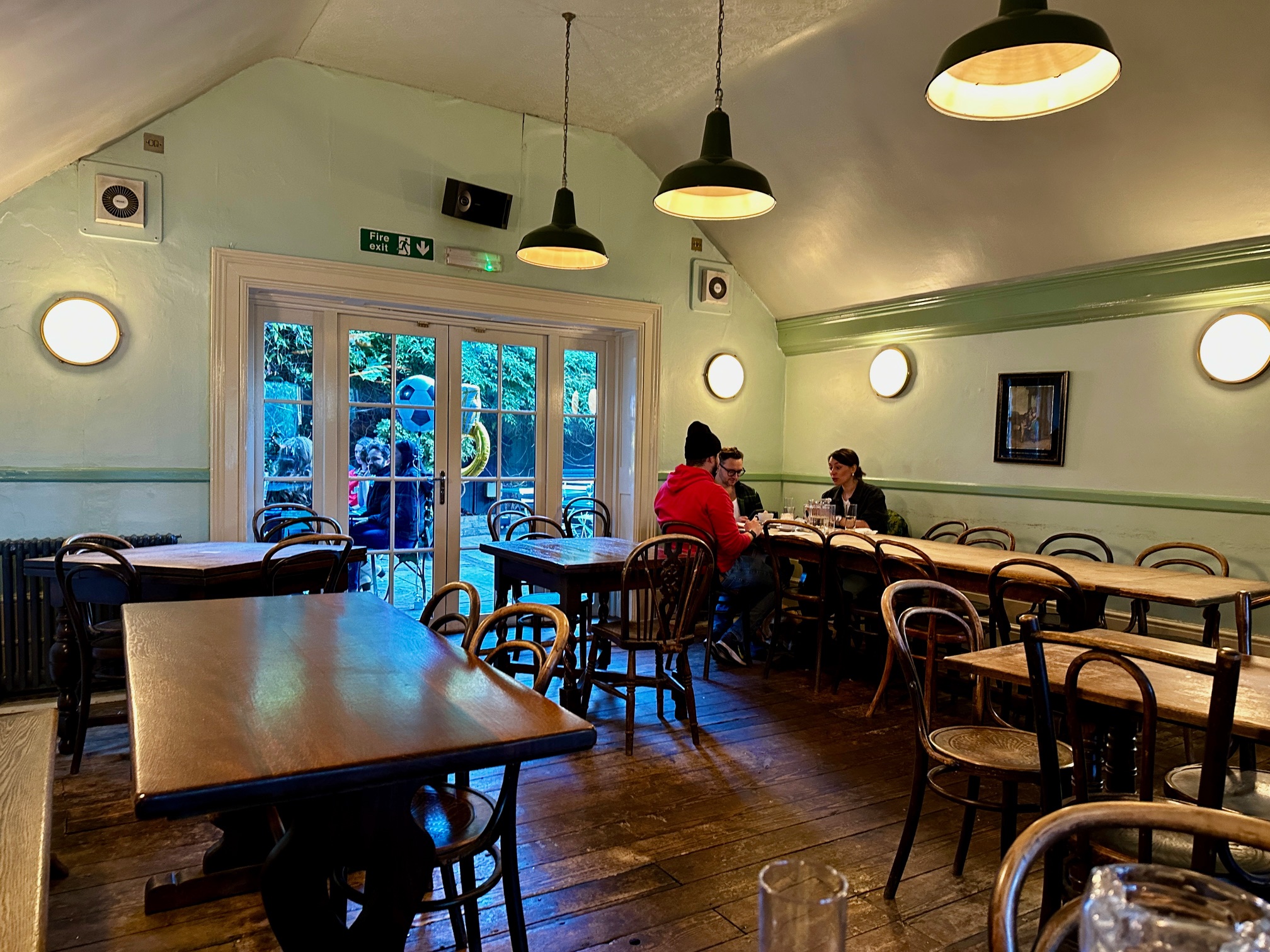
So I was disappointed to be led to the sunshine-yellow basement, which was empty when I arrived, and plonked in the corner, at a table where my right elbow felt like it would be knocking against the wall for the entire meal. On my left I had a great view of the men’s toilets. The waiter conspiratorially told me it was a good seat because I could “see all the pretty girls coming in”, which I’m sure he meant in a vaguely twinkly way but which came across as on the borderline between cheesy and due for cancellation. Maybe I looked like an ornithologist, but I don’t think so.
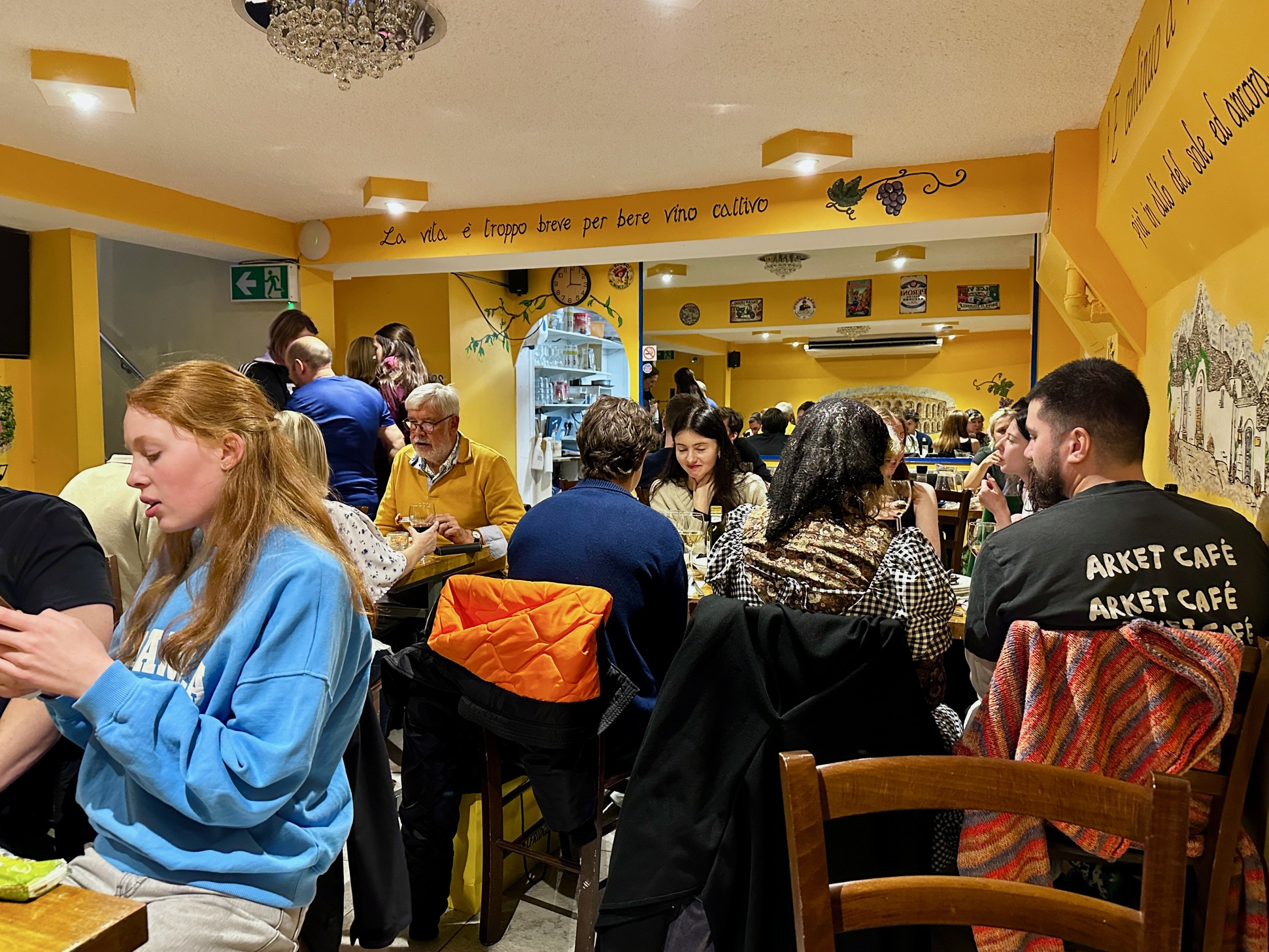
Rooms benefit from people, it has to be said, and it was a better space by the end of our meal when every table was occupied. But it was still a slightly unlovely one, and I felt like I was in some kind of gastronomic overflow car park, in the room put aside for tourists. I’m used to having that experience in, say, Paris, but it was strange to have it happen in London.
In Ciao Bella’s defence, I think I’ve read somewhere that the basement is usually used for private parties but it seemed on that Saturday that the converse might have applied: when we left there was a wedding Routemaster parked outside on the pavement and I suspect a wedding was being celebrated on the ground floor. I can’t blame them for that: if they had the numbers to escape from the canary-coloured cellar they should have seized that opportunity with both hands. But away from daylight and ambience, I couldn’t help wondering what might have been.
By this point Aileen had arrived and we attacked a very serviceable, almost medicinal, negroni apiece. It was, after all, negroni week – or, to give it its full name, ‘Instagram bores going on about negroni week’. Ciao Bella’s was bang on, no whistles or bells, no flourishes, just a route one approach to dropping that soft, orange filter over the rest of the day. I liked it a great deal.
As we tried without success to get round to the menu, Aileen filled me in on what she’d been up to, which included commencing a grand project with a friend to do twenty-six city breaks over the next ten years or so, proceeding in reverse alphabetical order. Never let it be said that Aileen hadn’t found ways to fill her retirement, not that she sounded very retired from all the side hustles she had taken on since leaving her main job. I learned that Zagreb – where else would it have started? – was very nice, although the cathedral isn’t quite finished yet following the earthquake.
I also discovered that Aileen planned to go back there when it was completed, so I tried pointing out that repeat visits would just make her project almost impossible to finish. Apparently it’s Ypres next, but do pop any suggestions for other destinations in the comments. I’m sure Aileen will read them. X will be particularly challenging, I’m guessing: my suggestion was that she could just about stretch it to Aix en Provence on a technicality. Do you think that’s cheating?
Ciao Bella’s menu, on a single outsized sheet of card, was as pleasingly retro as its website. Its contents were, too: this felt like the menu at every neighbourhood Italian since time immemorial, a proper, old-school selection of dishes. It took me back to places from my past – Pepe Sale circa 2009, or my dad’s erstwhile favourite Sasso in Kingsclere. It reminded me, too, that this kind of spot isn’t seen as frequently as it once was: a quote in that Eater article, tellingly, said “what’s nice about Ciao Bella is that it’s still there. One by one, other restaurants like it have been shut down”.
What that meant in practice was that starters were between £6 and £16, pizzas about £15 if you wanted one and pasta priced all over the place, although you could have a smaller portion of pasta for about £12. It meant that mains were between £20 and £30, a price point that used to mean fancy and now just means ‘get used to it’. It meant mozzarella in breadcrumbs, and Parma ham with melon, aubergine parmigiana, veal with lemon sauce or fried scampi. It meant that the modern affectations of Italian food were largely unnoticed by Ciao Bella: burrata appeared on one pizza, ‘nduja on one starter, neither anywhere else.
There was also a small specials menu, and even that made me feel nostalgic for those evenings at Pepe Sale, a lifetime ago, when Marco would materialise at your table and talk you through the options that evening. By this point, however underwhelming that yellow room was, I was disposed to like Ciao Bella a lot. It seemed to be transmitting from a time when life was very much more straightforward, and disappointment less abundant. I guess this must be the dragon Reform voters spend their whole lives unsuccessfully chasing.
But we were in 2025, where disappointment is rarely far away, and it came quickly in the shape of Aileen’s starter. Breadcrumbed mushrooms stuffed with spinach and ricotta weren’t the kind of thing I’d order, mainly because they always felt like a dish you could pick up in the chiller cabinet at M&S, or Iceland for that matter. They came sauceless and strangely burnt in places, plonked on a plate with a lemon wedge in the middle and pointless distraction from the dregs of a bag of Florette, in a presentation that screamed from the rooftops will this do?
“Taste this” said Aileen, in a manner that was a long way from oh my goodness, you have to try this. “It’s sort of wet: it makes me think it’s been frozen.”
I wasn’t sure about that, but it was middling in the extreme, if such a thing is possible. The filling was watery and bland, the layer of mushroom itself very thin.
“And it’s dry, it needs something else – a sauce, or a dip, or something. How does it manage to be wet and dry at the same time?” Aileen wondered out loud. “And what’s the point of those bits of undressed salad?”
So many questions, and so few answers. The late Shirley Conran famously once said that life was too short to stuff a mushroom: I suspect she might have thought it was too short to eat these, too. This cost £11. I was about to say something pithy about that, but putting the price there on the page, unembellished, makes the point.

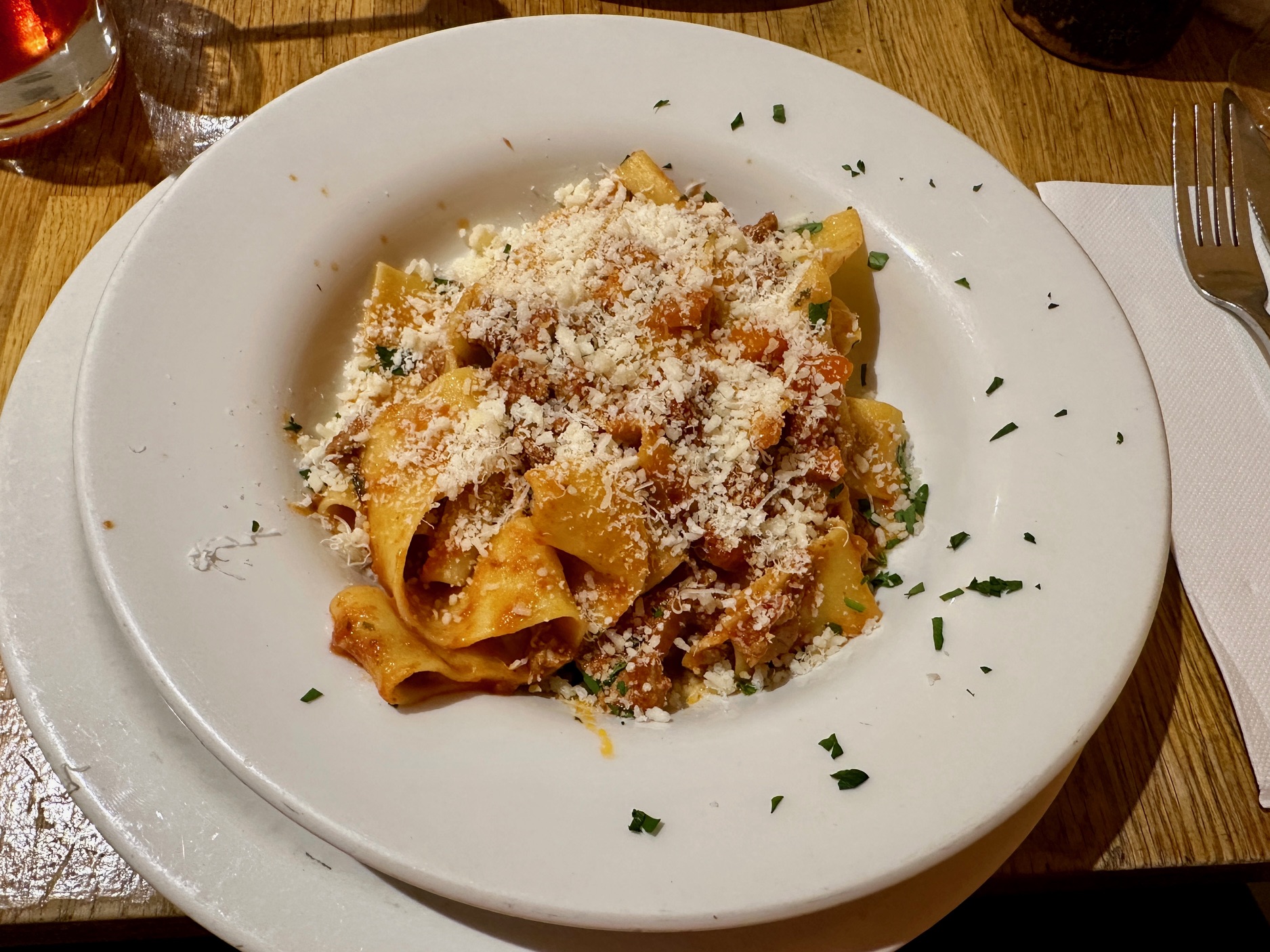
I fared better, but better’s a relative term. Pappardelle with lamb ragu was on the specials menu and it was good but far from special. The thick ribbons of pasta were decent enough, but cooked past al dente until they were more slump than spring, and the lamb in the ragu battled against an overly sharp note of tomato, as if everything hadn’t had enough time to form a lasting relationship. The diced carrots were too substantial, too, standing out where they should have blended in, a long way from sofrito.
Better really is a relative term, and I couldn’t help looking at this dish in other relative terms, too. If I’d been served this at, say, Tilehurst’s Vesuvio I might have been pleasantly surprised. Something this good at Cozze would have been a miracle. But on Lamb’s Conduit Street, in a restaurant older than my wife that’s lauded by food insiders far and wide? It just felt ordinary.
Everything was a little rushed, too – I know I complain about this fairly often, sometimes at length, but the pacing here felt like the restaurant was trying to get ahead of a rush they knew was coming; perhaps it was another impact of having a wedding celebration upstairs. But it meant that our starters must have come out ten minutes or so after we picked them, when we were barely into our negronis, and that meant that a leisurely lunch, the kind so mythologised at Ciao Bella, was out of the window.
So we downgraded our expectations and picked a half bottle of Aglianico from the wine list. To be fair to Ciao Bella it was perfectly pleasant and far from poor value at £15, and I was delighted to see a few half bottles on the menu. Maybe they are to cater for the kind of lunch we turned out to be having. Our mains turned up about fifteen minutes after the starter plates were taken away, if that. Aileen expressed audible surprise that they were so quick, too taken aback to be completely English about it.
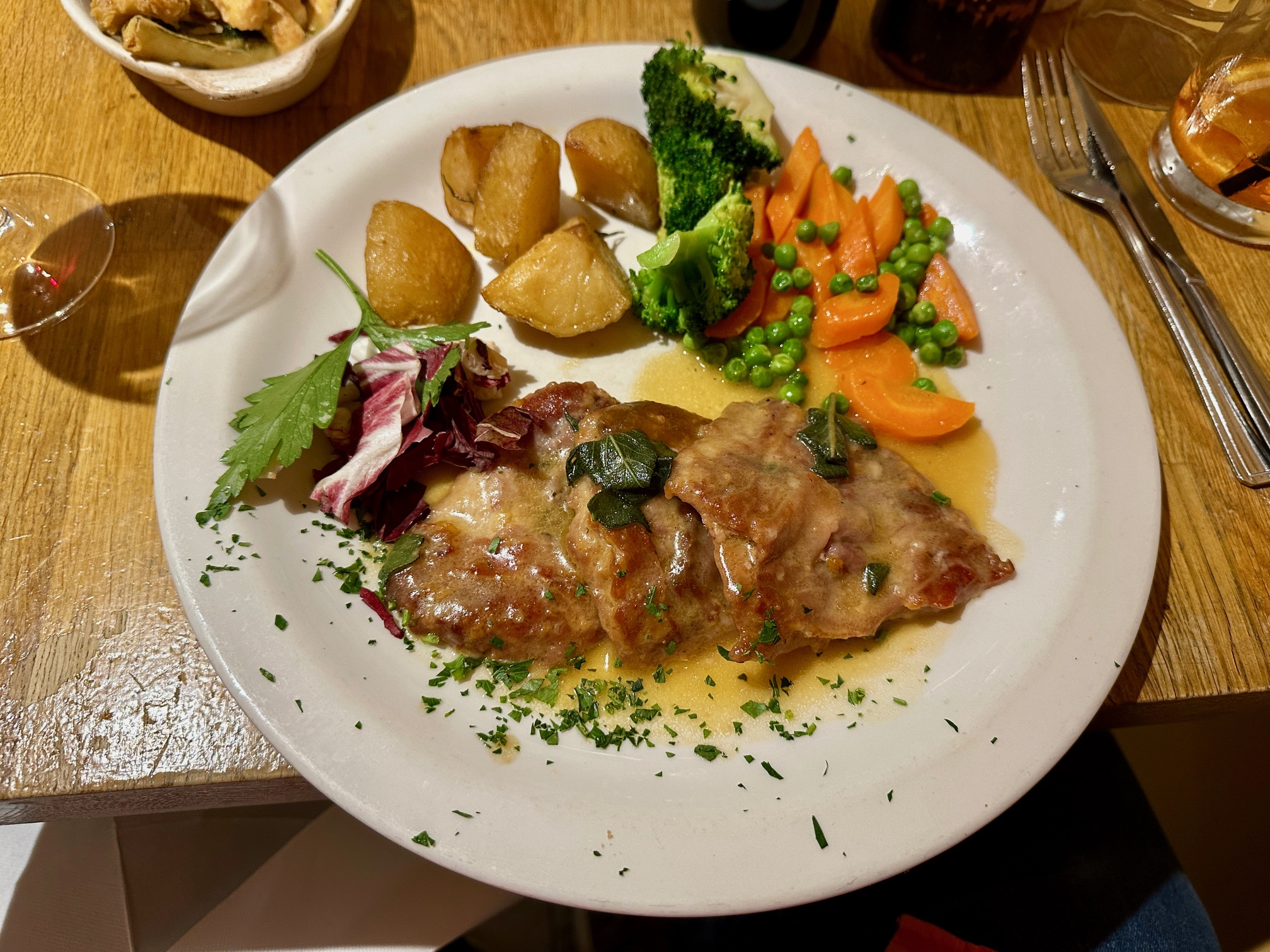
I had chosen an old favourite, and something I rarely see on menus, veal saltimbocca. In keeping with the whole nostalgic theme, I suppose, because back when Dolce Vita was at the height of its powers, something like ten years ago, I could have eaten this dish every Friday night for the rest of my life. Some months, to be honest, it felt like I did.
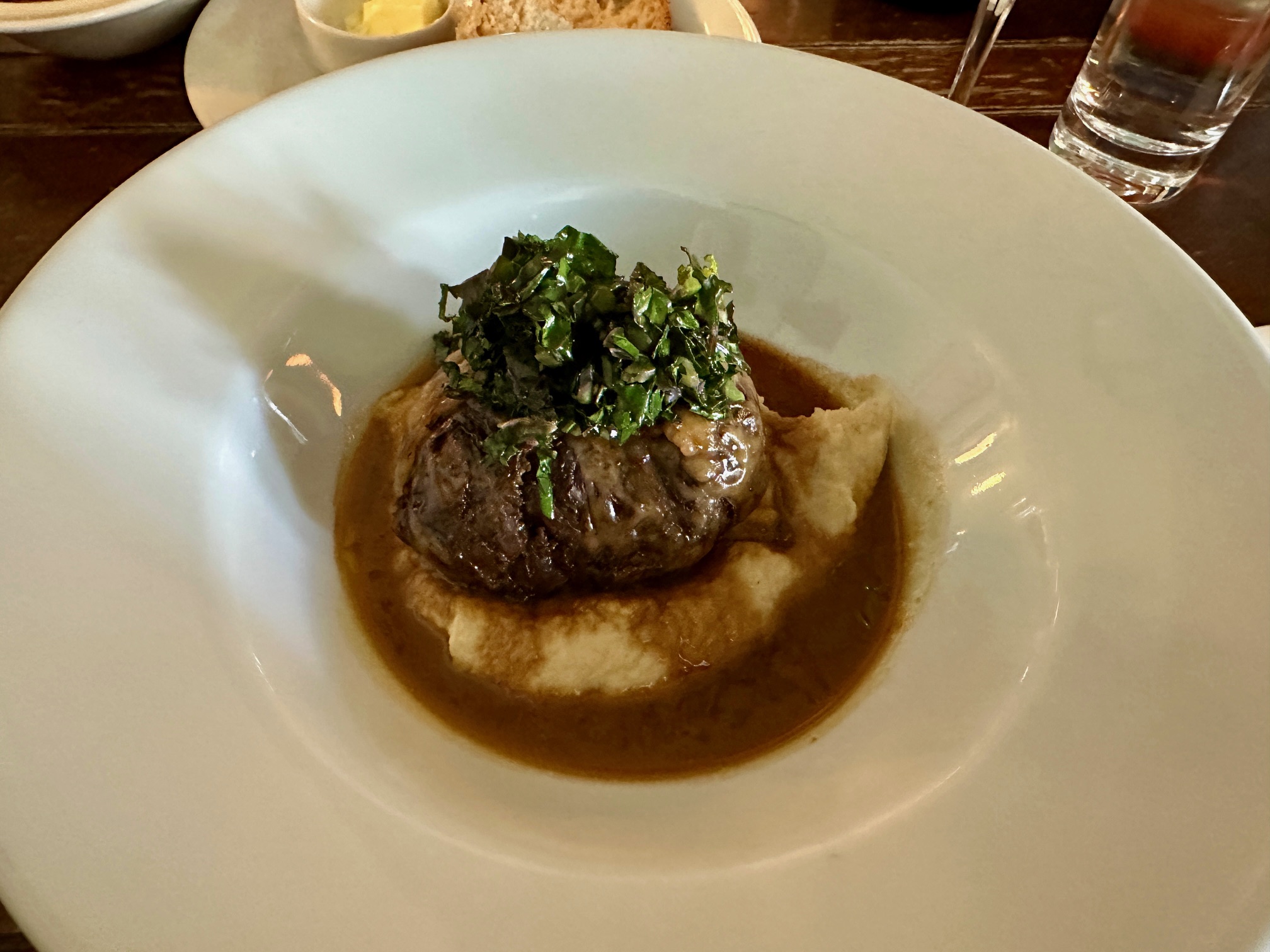
This did just enough to transport me, if only momentarily. That veal, slight and tender, wrapped in Parma ham and served with that sauce singing with white wine triggered plenty of happy memories. And if there wasn’t quite enough sage perhaps it didn’t matter, just like perhaps it didn’t matter that the accompaniment was five little cubes of potato, some veg which probably didn’t come out of a tin but somehow felt like it had and yet more of that bloody bag of Florette. For a moment, I felt like maybe Ciao Bella had worked its magic at last, and none of that mattered.
But sadly, there was one thing that did matter, and Aileen summed it up when describing her main.
“It’s such a shame this isn’t hot.”
She was absolutely right. It felt like the worst of both worlds, really: if your dish is going to emerge from the kitchen in record time you might complain about being turned but at least your meal should be piping hot. But for it to turn up so quickly and be lukewarm? It just felt like adding insult to injury, as if they’d cooked it at the same time as the starters and then just left it lying around on the pass until the earliest possible moment when it could be carted to the table.
Otherwise Aileen would have been absolutely delighted with her gamberoni, I imagine: plump prawns swimming in a sauce which looked almost identical to the one that came with my saltimbocca but which was clearly chock-a-block with garlic. But what was identical were those five cubes of spud, that mixed veg by numbers, that pointless, perfunctory scattering of salad from a bag. What was identical was that feeling of expecting more.

My dish cost £19.50, Aileen’s was £22.50. Neither was so expensive as to leave you feeling like you’d been mugged, but even so that word, ordinary, hovered in the air again.
Also distinctly ordinary were the courgette fritti, which were very thick batons which left your fingers shining with oil. I’ve had some gorgeous versions of this dish over the years – at Town, or at Battersea’s downright terrific Antica Osteria Bologna. The more I think about it, the more I think that everything I’ve heard about Ciao Bella and how magnificent it is emphatically applies to Antica Osteria Bologna. That is the restaurant people say Ciao Bella is. Ciao Bella, I’m afraid, is not.

We’d partly ordered a half bottle of red because we didn’t see ourselves staying the course at Ciao Bella but the dessert menu came along, and our wine was nearly finished, so we thought that we may as well give the restaurant one last chance to turn things around. It was, ironically, the area where I found Ciao Bella strongest, although the dessert menu does essentially say that only three of the desserts are homemade: possibly their most famous dessert, lemon sorbet served inside an actual lemon, is apparently not.
We ordered two of the three homemade desserts and I would say they were the – best? least disappointing? most acceptable? – things that we ate. My tiramisu wasn’t going to win any awards but it was a classic example of this dish – a thick wodge buried in cocoa, deeply boozy savoiardi biscuits and mascarpone in distinctly agreeable harmony. If everything else had been at the standard of this, I’d have liked the place far more. Still, better to finish on a high I suppose than begin brightly and plummet from there.

Similarly Aileen’s panna cotta, served in the shape of an old-school jelly mould, had a satisfying wobble and was crowned with a nicely done fruit couli. The dessert menu blurb is far too literal where the panna cotta is concerned – not sure “popular creamy white dessert made with sugar, gelatine and vanilla” is really selling it to anybody – but thankfully Ciao Bella is better at making panna cotta than it is at describing it.
The whole dessert experience rather summed Ciao Bella up. At £8.50 and £7.50 apiece these dishes weren’t expensive. But they arrived about five minutes after we ordered them, which is plain silly. I was catching up with a very good friend I hadn’t seen in a year, we’d been chatting so much that it took ages for us to place our order. Absolutely nothing about us, as a table, said “we’re in a hurry”.

It was nice of our waiter – who I do have to say was charming, in that very well-practiced way you might expect of an old stager – to ask if we wanted coffee, but by then we were ready to cough up and seek out somewhere else for the rest of our afternoon. Our bill came to just under £140, including an 11% optional service charge (this very specific uplift, deliberately picked to fall between the traditional 10% and the more common 12.5%, seemed strange). It was hard to feel happy with it or angry with it. It was what it was, as the meal was what it was.
Sitting outside Noble Rot, across the way, afterwards with a very nice bottle of red, making the most of the fact that it was still warm enough to do so, we agreed that the meal at Ciao Bella had been a tricky one. Even though both of us felt our meal could have been far better we didn’t feel aggrieved in the way that we might have done.
I’ve thought and thought about it since, and I’m still not sure entirely why. Of course, I had a lovely lunch with a very precious friend, and we both agreed that it could have happened anywhere and we would have had an excellent time. So there is that, but I can’t give a good rating every time I have lunch with Aileen just because I’m having lunch with Aileen: my credibility can do without that kind of dent.
So what was it? Did some of Ciao Bella’s magic transfer to us, by osmosis from the better, buzzier room upstairs, or slip through the cracks in the ceiling? I really don’t know. Objectively Ciao Bella was deeply average. If you had an Italian restaurant like it in your neighbourhood you might go, and you might go often enough to become a regular. You might form the kind of relationship with it where you overlook off days and look forward to seeing your favourite waiters or ordering your favourite dish.
But it is, as others have said, the kind of restaurant that is slowly dying out in the U.K., replaced by pizza places that only do pizza, pasta places that only do pasta and the abomination that is mid-price casual dining trying to devalue Italian food with all its horrendous Zizzis, Prezzos and Bella Italias. Maybe I just felt a little warm echo of some of the restaurants I’ve loved over the years that are no longer with us, and maybe some of that goodwill reflected on Ciao Bella, although it might not have deserved it.
Yet although it wasn’t my cup of tea, I can imagine it might hold that place in the affections of others, and I do envy them, both what they have and what I’ve lost. It’s funny, sometimes I can read reviews of restaurants in places I will never go, enjoy the writing, know I’ll never go there and feel that reading the review was enough, that it was as close to dining in that restaurant as I need to get. I sort of hope, on some level, that this review serves that purpose for you, even if the meal wasn’t entirely for me.
So if you’re the sentimental sort, you’re in London a lot, and you want to do your bit to prop up an institution, one of the last of its kind, if you’re prepared to overlook some bad tables, some middling dishes and some lukewarm food you might find, after you’ve invested enough time and money, that Ciao Bella is a restaurant you can truly fall in love with. For the rest of us, it might be better just to know that this place exists for its people, that there are places like that out there for everybody, and that in time we will all find ours.
Ciao Bella – 6.4
86-90 Lamb’s Conduit St, London, WC1N 3LZ
020 72422119
https://ciaobellarestaurant.co.uk
Since January 2025, Edible Reading is partly supported by subscribers – click here if you want to read more about that, or click below to subscribe. By doing so you enable me to carry on doing what I do, and you also get access to subscriber only content. Whether you’re a subscriber or not, thanks for reading.



 Edible Reading