
Here’s a tip for you: if you want to discover how many Italians live in Reading just drop innocuously into conversation online, on a local Facebook page or the Reading subreddit, the question of Reading’s best pizza. Because if you do, Reading’s Italian contingent will come out of the woodwork. This calls for opinions, and they have plenty. They don’t fuck about, either.
“Being Italian and of partly Neapolitan descent, I am picky when it comes to pizza. Or better, I eat anything, but I know a good pizza from a bad one, and from a non-pizza” began Luca, on the Edible Reading Facebook page. He went on.
“The only real pizzas in Reading have been Papa Gee’s, for years. Then Sarv came, and Zia Lucia (both ok). I have recently tried Zi Tore and above all Paesinos, the latter is possibly the best in Reading. The chef and manager is Sicilian and has previously worked at the Thirsty Bear. However, Thirsty Bear make American style pizza, while Paesinos make real pizza.”
Another of my Italian readers, Franz, was more generous about the Thirsty Bear. “It’s just a different style” he said. “Italian pizza purists perhaps will take a bit to adapt (I’m Italian, but open minded). A slice of their TriBeCa, curly fries and a pint is hard to beat. It just makes me happy and satisfied.” Franz also had opinions about Zia Lucia, and its “horrible, plasticky” mozzarella.
After that Luca and Franz ended up having a fascinating conversation about whether you could find good pizza outside Italy. Franz thought it was easy to do, these days. Luca disagreed, but said you could even end up getting what he called “non-pizza” in Italy, unless you were in Campania or Sicily. Just to chuck in a curveball, the best pizza Franz ever had was in the Swedish city of Norrköping. “It was Neapolitan style and was excellent, but then they had a corner in the pizzeria that was all dedicated to Totti so that confused me from an allegiance perspective.”
I could have listened to Luca and Franz discuss these niceties all day: it seemed that if you asked two Italians you were likely to come out of the conversation with at least three opinions. Over on Reddit, other Italians were weighing in. “Zi Tore in Smelly Alley has taken the crown as the best pizza in town (in my humble, Italian, opinion)” said one. “And the pizza al taglio from Amò is even better.”
This is particularly topical because last week Sarv’s Slice announced that they were leaving the Biscuit Factory, after falling out with the owners both there and in Ealing. The reaction across the internet was one of huge sadness, coupled with genuine fear for the future of the venue. But this happens against a backdrop of Reading’s pizza scene exploding, so Sarv’s Slice might have quit while they were ahead: the market has become saturated since they opened in 2023, and even more so in the last six months or so.
Let’s run through the timeline. Last year Dough Bros opened out on Northumberland Avenue, and in the summer Zia Lucia opened in town. From then, things have only accelerated: at the start of the year Paesinos opened opposite Jackson’s Corner. Then Zi’Tore opened in February, in the old Grumpy Goat site. At the end of April, two doors down from Paesinos, Reading got Amò, a joint venture between the owners of Madoo and Pulcinella Focaccia, a pizza trader who operated from their home address out in Earley.
And believe it or not, last Wednesday another pizza restaurant, Peppito, opened on the first floor of Kings Walk, John Sykes’ restaurant sweatshop. The time between pizza restaurants opening in Reading appears to have some sort of half-life, so by the time this goes to press I wouldn’t be surprised if two more places had started trading, making all this out of date.
So the vexed subject of Reading’s best pizza isn’t something anybody, Italian or not, is going to settle in a hurry. But that’s no reason not to begin this important project, so last week I strolled down the hill from Katesgrove into town to check out Paesinos, the first of this year’s intake to start trading, on the Kings Road. I had a secret weapon, my very own Italian: my friend Enza was joining me to check this one out and see how it compared against Zi’Tore and Amò, both of which she’d researched extensively.
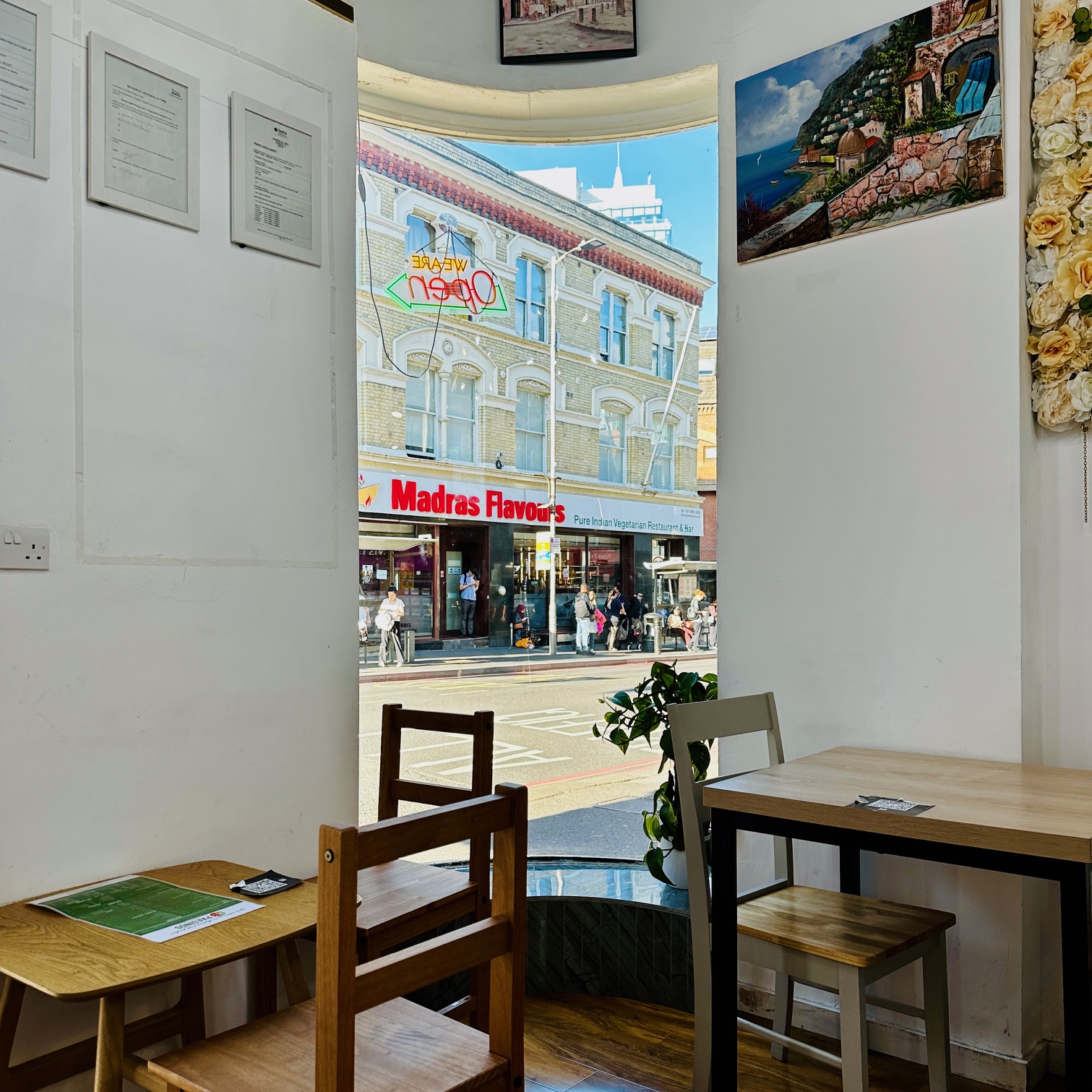
I was early, so I got to take in what must be one of Reading’s smallest dining rooms. Just three tables, each seating two people, although the table closest to the front door was so Lilliputian that it was hard to imagine adults sitting there, except to wait for a takeaway. A fridge hummed next to the counter, holding an interesting selection of soft drinks.
I spotted chinotto, one of my favourite things, and got one, with a plastic cup, while I waited. I’m used to the San Pellegrino version of this drink, that you can pick up in cans in Madoo. It’s dandelion and burdock’s older, more sophisticated cousin, wearing a rollneck and smoking a cigarette. But this bottled version, by Sicilian company Polara, was more nuanced, the rough edges smoothed off. I felt that all-too-familiar sensation, the gradual raising of expectations.
I looked through Paesinos’ menu. It was a single long laminated sheet with pizzas split into categories – classic, premium, signature, fusion – although the taxonomy they’d used was unclear to me. It certainly wasn’t pricing: most of the 13 inch, standard pizzas, were between thirteen and sixteen pounds whatever you ordered, many of them costing random amounts like £12.97, £13.96, £14.86. I liked the capriciousness of that.
They weren’t split into categories using any mindset I could understand. I could see something with “kebab chicken, jalapeños and buffalo sauce” being a fusion – or even a confusion – pizza, but a standard pizza bianca? Paesinos had attracted some commentary around its pizza Americana, topped with french fries and frankfurter: it might well be authentic, or authentically Sicilian, although I’d personally rather drink the bin juice from my food recycling after it’s been strained through Jay Rayner’s y-fronts. But whatever it was, surely it wasn’t “premium”?
All that said, there was something about the lack of polish in this menu that I liked. I could say it was trying to do too much, with its paneer and tandoori chicken, but nobody was making me order that stuff. In the core of it, ignoring the wackiness, there was a solid collection of options, many of them intriguing.
Then Enza arrived, and ordered a chinotto, and we got to catching up. Despite regularly exchanging messages, we realised we hadn’t seen one another in a very long time and there was plenty to discuss – her empty nest, my new house, all the life events and randomness that make you realise that you think you know what’s going on with someone via social media but that, really, you don’t.
The other thing I gathered, gradually, as we got to talking about Reading’s explosion of Italian restaurants, was that I was finally eating with someone even more determined to maintain their anonymity than me. Enza, it transpired, had been to Paesinos once before with her husband and very much enjoyed what they ate – the pizza “al portofoglio” or folded pizza for her (it translates as ‘wallet’), the tuna and red onion for him – but she was a far more frequent visitor to Amò a couple of doors down. So much so that she seemed to be furtively looking around, worried about being discovered, and lowered her voice when she mentioned Paesinos’ neighbours.
“I can’t help it!” she laughed. “I love it there. So much that I want to get involved. I keep telling them they should make the kind of pizzas you can only get in my part of Italy” – Enza’s from Potenza, in the ankle of Italy, halfway between Naples and Bari – “and if they do, I think I should get commission.” I offered to change her name for the purpose of this review, but she decided to let the chips fall where they may. At least they didn’t fall onto a pizza Americana, I suppose.
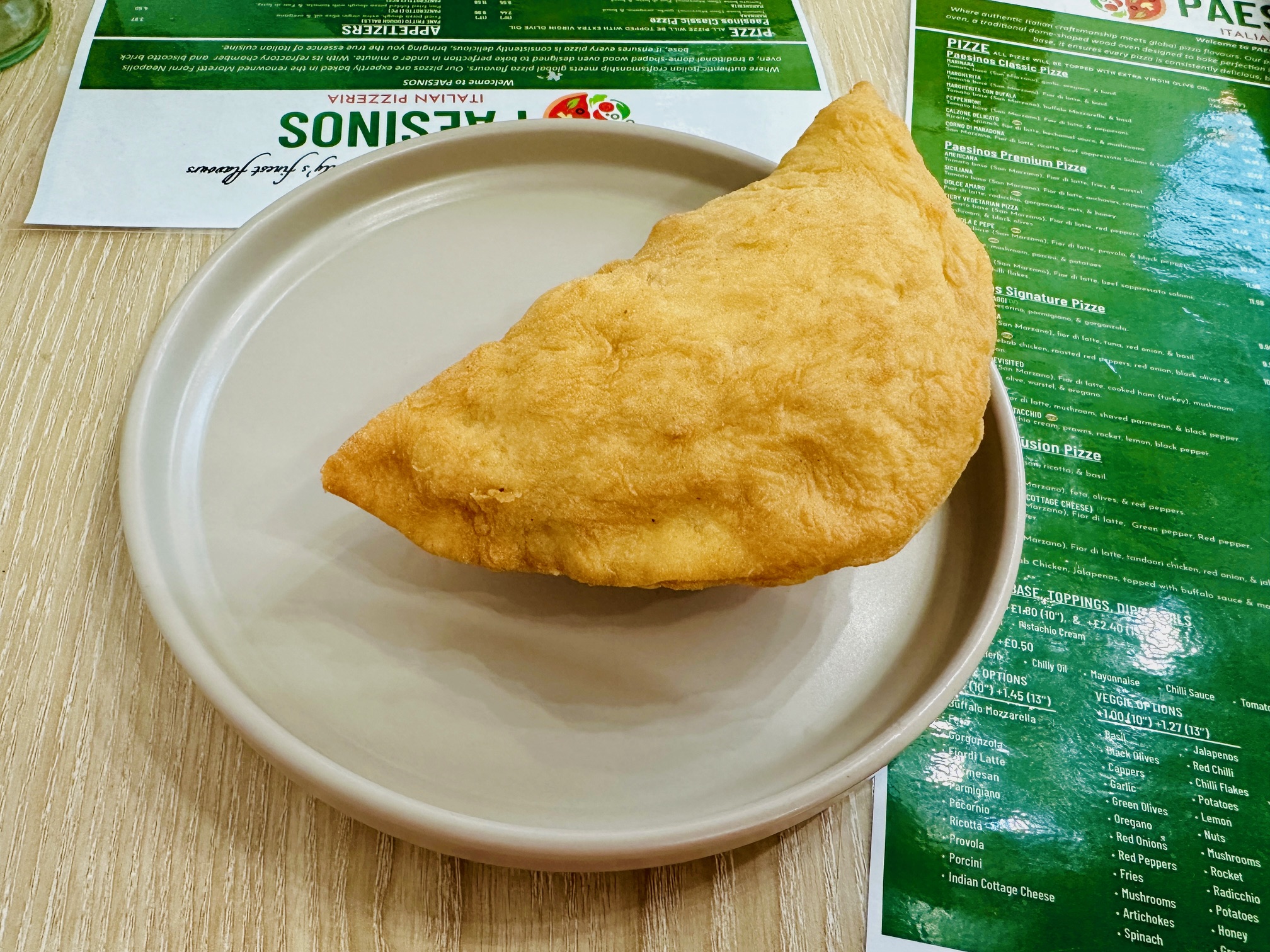
We started with appetisers, which meant a panzerotto each. Franz, on my Facebook page, had particularly recommended these, saying they were a speciality from Bari, where he came from. It was my first experience of Paesinos, and about as good a calling card as you could hope to encounter, a gorgeous crescent of fried dough filled with just enough mozzarella and tomato, too big to eat with your hands but not like a full-sized calzone. You got two for something silly like seven quid, and outstanding just about does them justice. As an introduction to the dough, too, it put down quite a marker. This huge, irregular pocket of joy made me very happy indeed.
“I tell you what, this is a lot bigger than the panzerotto I had in Montpellier” I said to Enza, between mouthfuls. She smiled.
“I wouldn’t say this is big by Italian standards. It is really good, though.”
In my mind I was thinking that I would come here and eat this again, but I was also remembering that the menu boasted pizza fritti, stuffed with ricotta and sopressata, and that I needed to try that. Enza also had a yen to sample the mozzarella in carrozza and maybe we should have tried that too, but I was put off by experiences of having it at Prezzo, many years ago, no doubt straight out of the freezer. I already had a reasonable idea that the only thing coming out of a freezer at Paesinos was the gelato.
“Would you say there’s never been a better time to be an Italian in Reading?”
“Absolutely!” said Enza, and then she told me a lovely story. I knew that she was a big fan of Zi Tore, on Smelly Alley, and especially their cakes, many of which were ones you just didn’t find in this country. But then Enza told me all about the graffe, a sort of fried doughnut made in a distinctive loop shape, sugared but made out of a mixture of flour and potatoes. They’re specific to Campania, where she was born, and growing up in Salerno they were a regular childhood treat.
And then, some years later, Enza wanders into a cafe hundreds of miles away that’s just opened in her adopted home town, the unlikeliest of places, and finds them there. Graffe. And when she told me about this: maybe it was her excitement, or how well she conveyed it, or perhaps I was just having a lovely time, but even I felt it. I was vicariously moved, and I remembered the power food has to transport and transform.
It’s one reason to envy Italians, because what would I feel nostalgic about? Ice Magic, the chocolate sauce that was no doubt filled with chemicals so it hardened into a shell when you poured it on ice cream? The way Nice N’ Spicy Nik Naks used to taste before they were fucked with? Different permutations of processed food, and the excitement of a Findus Crispy Pancake? No, Britain had nothing to compete with graffe. Little wonder that Enza sounded so full of joy, although it did make me ponder how many privations she’d suffered through years of living here.
If the panzerotto set up expectations, the pizza fulfilled them. I’d chosen the Siciliana, my reference pizza of olives, anchovies and capers. It’s sometimes called a Neopolitan, presumably because every part of Italy wants to claim the best ever pizza as theirs. Based on what I ate at Paesinos, I can hardly blame them. Everything was exactly as it should be – the right amounts, the right proportions, the right balance. The saltiest of anchovies, generously deployed without being overkill. Purple, perfumed olives. Little clusters of plump, sharp capers (Enza preferred them salted, but give me the vinegary hit any day).
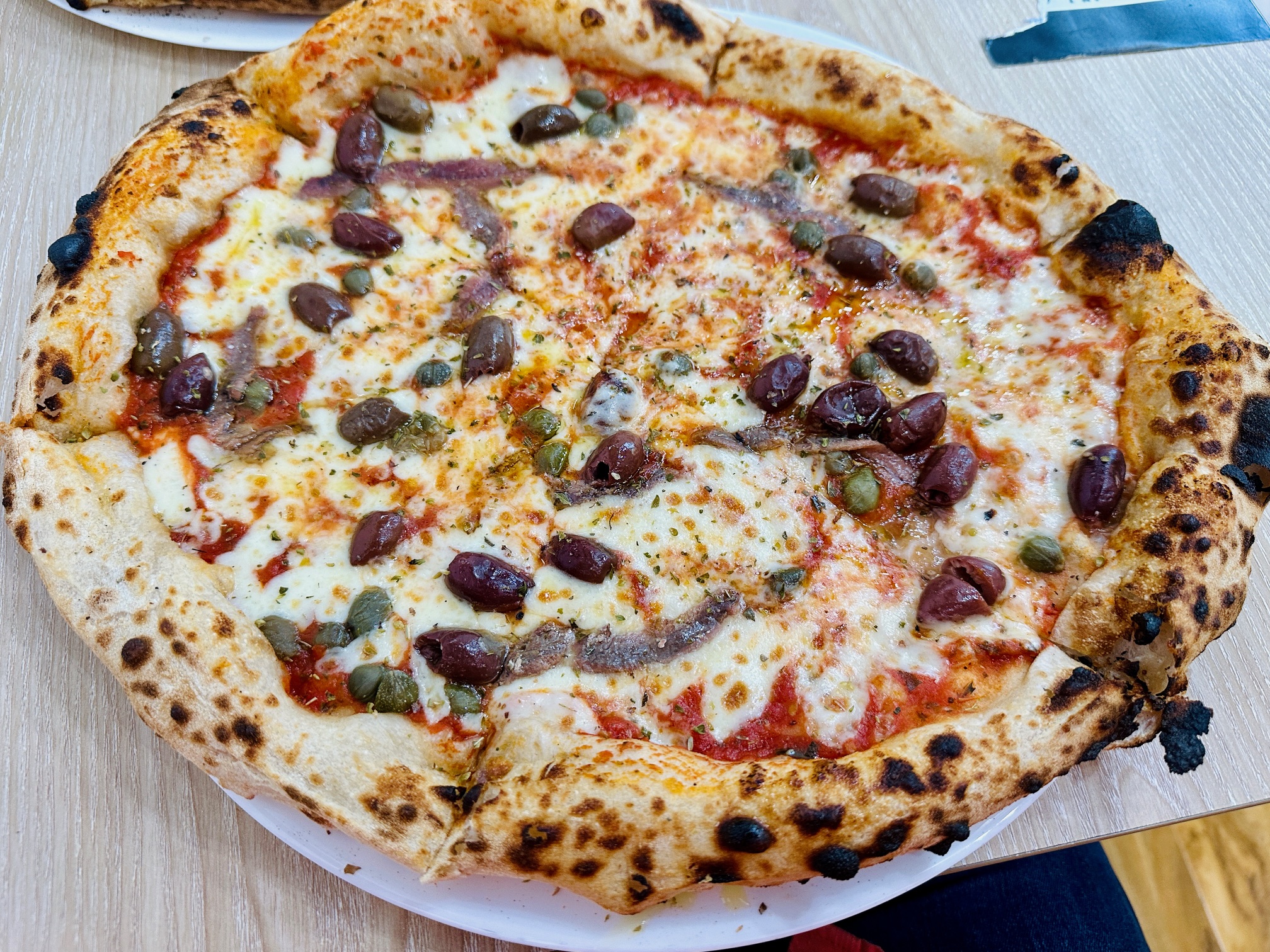
The base was heavenly. Puffed at the rim, beautifully irregular, a proper Neapolitan style pizza that drooped in the middle, although it firmed up as it cooled down. “The dough is completely different towards the end of eating the pizza” said Enza, and she was spot on. I loved the way that she tore a little bit of her crust off and tried it, on its own, before making inroads, a little ritual, almost like a benediction. I followed suit, and again that allowed me to admire Paesinos’ dough before all that other stuff happened to it. It was better after, but pretty much perfect before.
Later on I asked the pizzaiolo, who was indeed Sicilian, whether most of their trade was takeaway and delivery, given Paesinos’ size. He said it was, but that those people, however good his pizza was, missed out ever so slightly. “It’s 100% when it leaves the oven” he said, “but when it gets delivered it can only ever be 90%.” I think he’s right, and explains better than I can why, when you read the rating at the bottom, you need to come here rather than fire up Deliveroo.
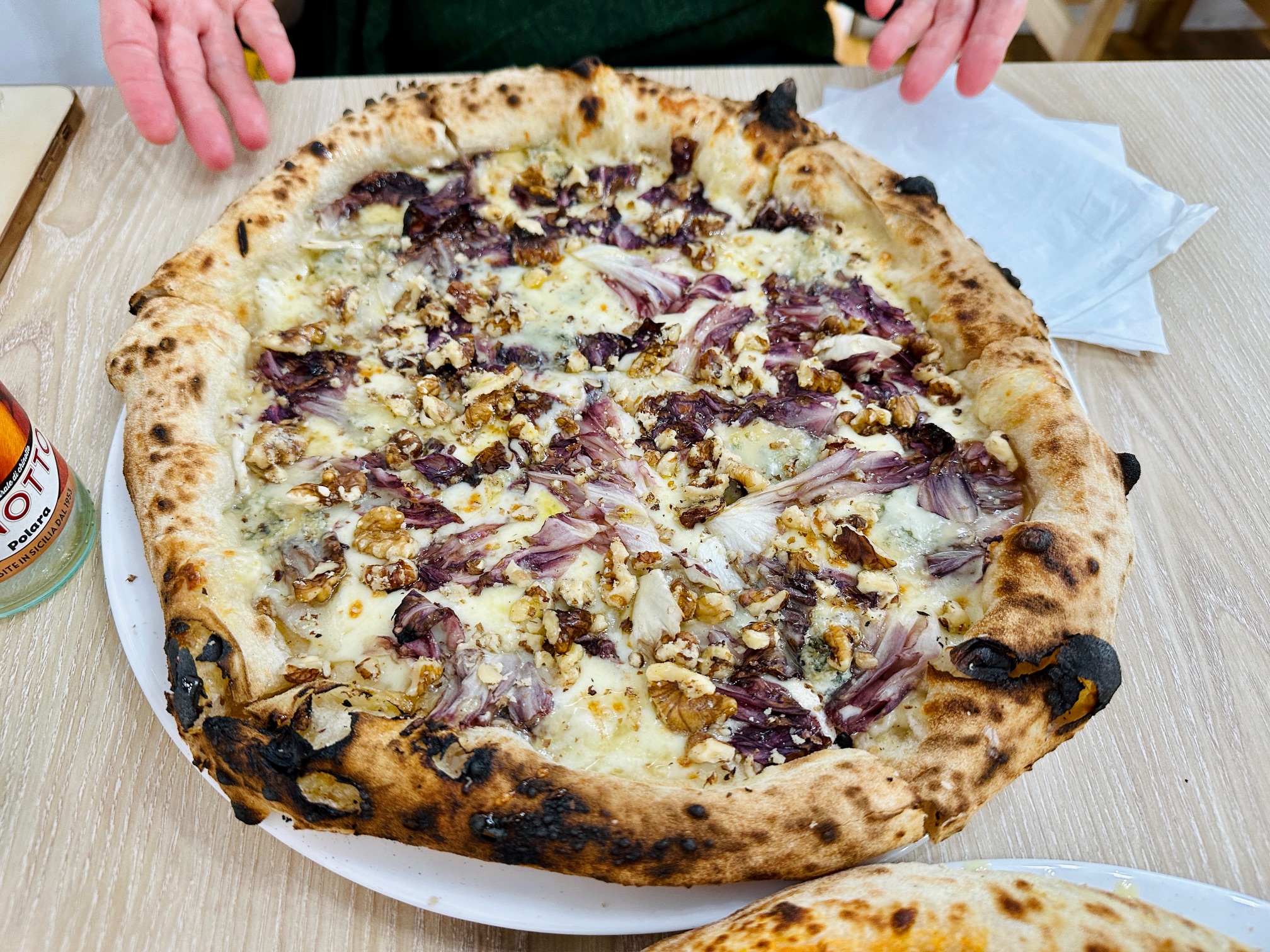
Enza also loved my pizza, and preferred it on balance to hers, which isn’t to say that she didn’t enjoy hers. She went for the “dolce amaro”, a white pizza (premium, not fusion) topped with walnuts, gorgonzola, honey and radicchio. “I know people back in Italy who would disown me for ordering this” she said. Maybe she was right but they ought to try it before they knock it.
This had everything: salty, sweet and bitter in gorgeous harmony. The gorgonzola was so punchy that you smelled it, got that agricultural tang as you lifted a slice up, before you ever took a bite. But the honey – how nice to have honey rather than hot honey on a pizza, for a change – softened its roar. The walnuts lent texture and the final piece of the jigsaw, radicchio with bite and bitterness, was the clinching evidence of intelligent design. All that and, as a white pizza, it was easier and less messy to eat than the Siciliana. I really enjoyed it: Enza thought it a little unbalanced and needing something else, possibly black pepper.
Later on, when we debriefed over a beer in Siren RG1, I asked Enza how authentic that pizza was and she very kindly said something I’d never thought of before that made me feel stupid, in a good way. “Of course it’s authentic” she said. “It’s authentic because somebody has made it.” All these combinations start out as curveballs at some point, but if nobody ever innovated you’d have a cuisine that’s set in aspic. It’s 2025: nobody willingly eats aspic any more.
Paesinos has a small section of desserts, plenty of them tempting, and we decided that in the interests of research we ought to try some. Enza’s no slouch, so she asked the pizzaiolo which ones were made by Paesinos. In a flash, without hesitating or deflecting, he told us: just the two, the tiramisu and the cannoli. In the case of the cannoli he bought the shells in, but the ricotta filling was all his own work. That was good enough for us, so Enza decided to road test the cannolo and I – such hardship – ordered the tiramisu.
We also ordered a couple more drinks. The chap who’d prepared our pizzas suggested we try a bottle of something called Spuma, so I did, and it was night and day with the chinotto but equally lovely in its way – sweet and fresh, sunshine in a bottle. I thought it had a taste of grape juice, but online research later suggested it was more complex than that, with rhubarb and elderflower, cloves and caramel. It beat a Fanta Limon, and I say that as a fan of Fanta Limon.
By this point we’d got chatting with our chef, and he told us a little more about the desserts. Normally he imported the cannoli shells from Palermo, he said, but on this occasion he’d had to get them from Catania instead. That meant they’d be more brittle, smoother, less bubbled. He apologised, as if this wasn’t optimal, when discussing the difference between going to the trouble to buy these things from two different Sicilian cities. I admired that focus, that he felt there was an important distinction to be drawn between the best and the merely excellent.
And goodness, but it was exquisite. If this was the second-tier shell, I’d like to try the very best out of sheer curiosity. Beautifully presented – I loved the outline in icing sugar of the wooden spoon, as if at a crime scene – it was an utter joy. Initially Enza tried to press me to have half, using the ultra sharp knife our chef had brought to our table, but I convinced her to just let me try a section from one end. It was so delectable that I almost wished I’d taken up Enza’s offer. The ricotta was so light, so smooth, the chocolate chips it was studded with were so very generous. It made the ones at Madoo, for instance, feel pedestrian.
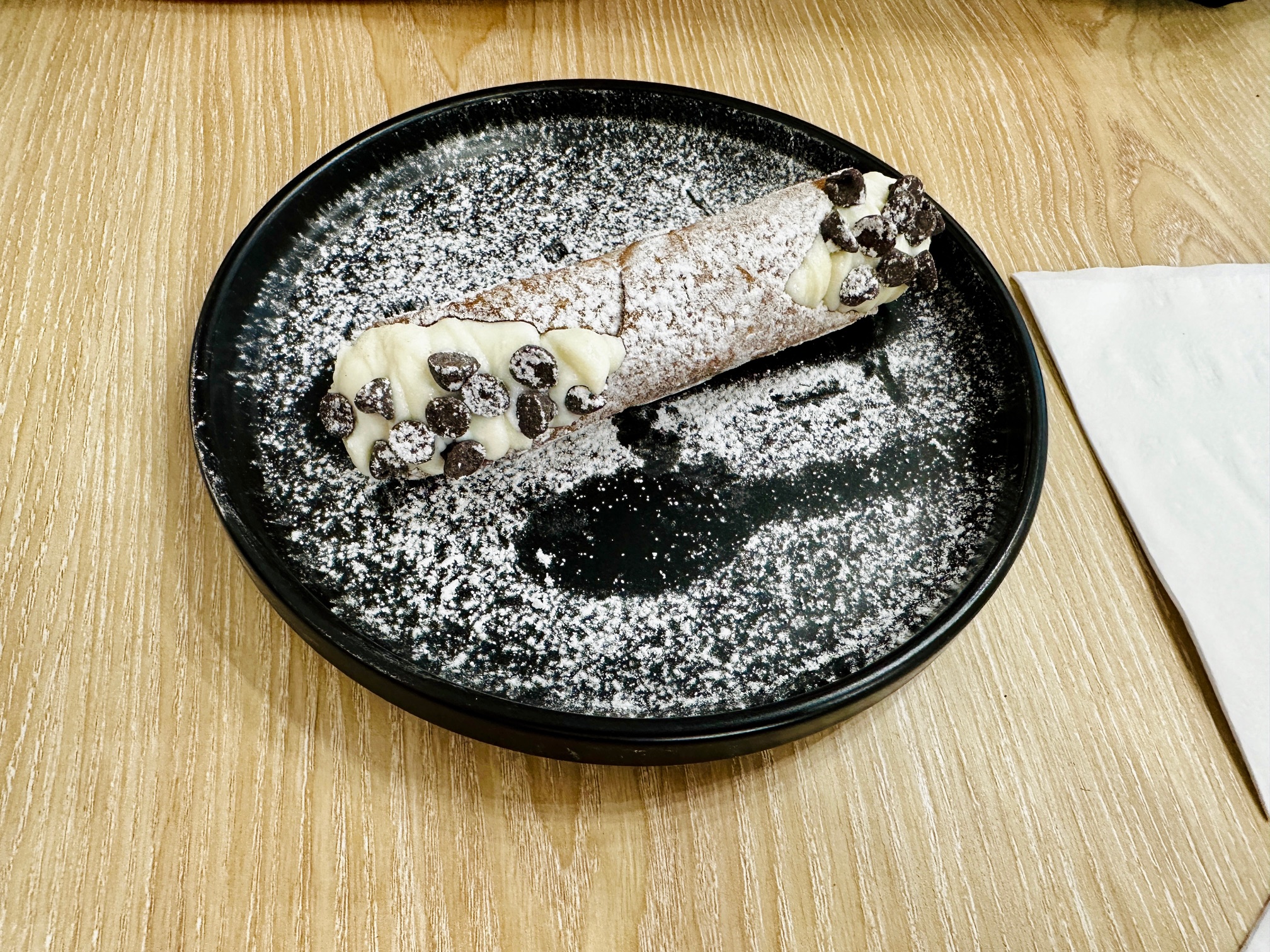
Everything was imported, we were told, either from Italy or specifically from Sicily. Enza loved it: I’m not making this up, but she honestly did exclaim Mamma mia (I nearly did too, and I was born in Bristol).
There was a story behind the tiramisu, and he told us that too. It was his fiancée’s recipe – she works at the Thirsty Bear – but she only finally let him have it once he opened Paesinos, despite them having been together for twelve years, despite the fact that they were getting married towards the end of the year. Many tiramisu recipes just used egg yolk, he said, but this one included egg white too, to give a lighter texture. The only other tweak was a little vanilla, to offset the flavour of the egg yolk.
It was another tour de force, and he also went to great trouble to tell me it was a bigger portion than you got elsewhere around town. He’d weighed the rival tiramisu you could get in other places, and weighed his, and his was more substantial. It was the best tiramisu I’ve had in Reading, and honestly I can’t remember eating a better one anywhere else. No wonder he was marrying his fiancée: if I had ready access to somebody who could knock one of these out, I’d be the size of a house.

The strangest thing happened after that: we had eaten, we’d drunk (no alcohol, Paesinos is unlicensed) and we ought to have headed straight off to compare notes over a beer. But I was in the company of two Italians, and they talked food, compared notes, discussed recipes, the best places to buy mascarpone, where he sourced his ingredients from. And like that conversation on my Facebook page at the start of this review, I could have listened all night. Being in the company of people whose passion for food verges on obsession – the real meaning of obsession, not that social media meaning that just means “I like this” – was infectious.
In the process I learned a few other things. Paesinos had been open nearly six months, and things were going well. Our chap knew the people at Mama’s Way, loved it there, didn’t see any of this explosion of Italian spots as competition. A rising tide truly did lift all boats, and the slow spread of Reading’s Little Italy round the corner to become a Not So Little Italy felt like a beautiful thing. Eventually we settled up. Our bill for everything came to just under sixty pounds; there was no option to tip – it’s almost as if they just didn’t expect anybody to – so I made a second card payment for that.
If I was giving advice to Paesinos – not that I’m qualified to – it would probably be to lose the things at the periphery of their menu, the pizzas with chicken kebab or paneer, the chicken nuggets, the peri peri fries. I think I saw somewhere online that they had burgers “coming soon”, and a look at their website suggests that they now indeed do a range of burgers. I don’t think they need any of that, but what do I know? Maybe their delivery customers will lap that up.
But actually, if I was giving advice to Paesinos it would be to carry on doing exactly what they’re doing. I cannot think of a pizza I’ve enjoyed so much in a long time, and I can’t think of a Neopolitan-style pizza I’ve liked as much in longer still. What a small, unassuming delight Paesinos is, and what a mind-boggling prospect it is that there’s a healthy debate, under way right now, about whether our town has places to eat pizza that are even better than it is.
I’m not qualified to weigh in on that: I’ve not visited its rivals yet, I’m not a fully paid up pizza obsessive and I’m about as far from Italian as it’s possible to be. So take this as my ill-informed, incomplete, English opinion: this might not be the best pizza in Reading, but if it isn’t, the place that can beat this is going to be one hell of a restaurant. Either way it’s the best pizza I’ve had in Reading, I think. I can’t wait to test out its competition. Even more so, I can’t wait to go back.
Paesinos – 8.6
Unit 4, 2 Kings Road, Reading, RG1 3AA
0118 2068806
Since January 2025, Edible Reading is partly supported by subscribers – click here if you want to read more about that, or click below to subscribe. By doing so you enable me to carry on doing what I do, and you also get access to subscriber only content. Whether you’re a subscriber or not, thanks for reading.
 Edible Reading