Can you believe it’s the best part of a decade since I reviewed anywhere in Henley? I didn’t realise that until I sat down to write this review, and I was so surprised that I thought it was a mistake. But no, there it was: June 2016, a visit to the Little Angel, just over Henley Bridge from the not-so-little Angel On The Bridge with its popular riverside terrace. I quite liked the place, and ate there again a couple of years later at a friend’s wedding reception, but even so I’ve not written up a Henley restaurant or café for nearly ten years.
Was it a lack of options, general neglect or just one of those things? I’m not entirely sure, but I do remember keeping a vague eye on Henley and although a couple of new places have sprung up since my last trip on duty none of them had tempted me quite enough: the Hart Street Tavern is meant to be decent, but I seem to recall that it’s run by the same team as the Bottle & Glass, so I wasn’t in a mad rush to scarper to Henley to check it out. And there’s Shellfish Cow, I suppose, a sister restaurant to Wallingford’s surf and turf specialists, but again I just wasn’t sufficiently curious. A dodgy pun doesn’t necessarily make for a great restaurant.
I remember taking a solo trip to Henley almost exactly a year ago. I must have been influenced by my public transport-loving wife, because I did it mostly to try out the brand new Aqua, Reading Buses’ number 28 which now runs frequently from Friar Street to Bell Street, winding through Playhatch and Shiplake, picking you up from Berkshire and dropping you off in Oxfordshire, a world away.
Once there, I’d found myself completely at a loss as to where to lunch.
My finger was nowhere near the pulse, so all I really knew was that I didn’t fancy going back to anywhere I’d reviewed in the past. I could have gone to Geo Café, of course, on the off-chance that my friend Keti, the owner, was there but I felt like I should show some sense of adventure. A wander round Henley, which was still as pretty as ever, suggested that most of the options were starters-mains-desserts places rather than spots for a light lunch.
I was almost stumped, and I ended up in a café slash deli just down from the Town Hall, opposite where Henley used to have an utterly preposterous Harrods café, a place which simultaneously managed to seem posh and lower the tone, the way new money can.
Although the Harrods café closed some time ago, my lunch venue was clearly its spiritual successor. I had a solitary crumpet, the diameter of a coffee cup, topped with some smoked salmon and a poached egg. For fun, I put the picture on social media and asked people to play The Price Is Right: it cost me an eye-watering £12, and at least half of the guesses I got thought it would come to even more than that. It was middling, the coffee was worse. Afterwards I strolled to Geo Café and, over far better coffee, resolved that a sense of adventure was overrated.
But Henley’s scene isn’t as stagnant as you might think. Echoes, an outpost of Phantom Brewing, has opened there and does very good beer, served by an enthusiastic team. Flyte, a bar offering a combination of tacos and cocktails, opens next month. Last March Dominic Chapman, the Michelin starred chef formerly of the Royal Oak at Paley Street and the Beehive at White Waltham opened his eponymous restaurant in the Relais hotel at the bottom of Hart Street. Little by little, things are starting to change in Henley.
And then there’s the Duke, a curious beast, a pub which opened in January where Mexican restaurant Pachangas used to be. It started trading at the beginning of the year, and an article in the Henley Standard made all the right noises about everything being cooked over fire, an emphasis on small plates and all that other stuff everybody says.
At first all went well, and they paid for a London blogger to come up and review what looked like a surprisingly stingy selection of dishes from the menu. He enthused, giving it an 8/10 which probably would have been a 6 or a 7 if the food hadn’t been free, but since then the menu seemed to have drifted closer and closer to the mainstream, and then last week the pub abruptly announced on social media that it was shutting until further notice “to rebuild our team”, which suggests that all is not going swimmingly.
Neither the Duke nor Restaurant Dominic Chapman has troubled the guide books or restaurant inspectors, which made it even more of a curveball when last month Michelin added sixteen venues to its guide and one of them was in Henley. Out of nowhere, seemingly, they had listed the Three Tuns, the pub on the market place next to superlative Henley butcher Gabriel Machin. Part-owned by the butcher, too, as it was a joint venture between Machin’s owner Barry Wagner and Nigel Sutcliffe, who runs the also-listed Oarsman in Marlow.
The intent was to take advantage of that fantastic produce, to be a sort of chophouse in the Oxfordshire town. As for the Three Tuns’ success this year, meteoric only just does it justice: it reopened in May, and in September it was listed by Michelin. Nobody knows exactly what brings restaurants to the attention of the inspectors – who still seem to have a blind spot where Clay’s is concerned – but however it happened, being noticed after four months is exceptional going.
When I learned that, I resolved that I needed to get there as soon as possible. But it also gladdened me enormously, because the pub used to be a favourite of mine ten years ago, when it was run by Mark and Sandra Duggan, and I ate there frequently in another life, reviewing it in 2014. The last time I went, just before the Duggans left the pub, was with Zoë, just after we got together. I remember having an exquisite Caesar salad, so good it was bittersweet.
Because I was glad Zoë got to try it before it changed hands, but sad about all the meals we wouldn’t have there. And that listing in Michelin raised my hopes that, much like my blog, it too could have a second era that surpassed its first. So Zoë and I alighted from the Aqua last Saturday and went to investigate, stopping at Echoes on the way for a few pre-prandial pales and a very happy chance encounter with readers Steve and Tracy.
I should add that Zoë insisted, by the way – both on joining me for this one and on taking the bus to get to Henley. Neither of these facts will surprise regular readers.
Subscribe to continue reading
Become a paid subscriber to get access to the rest of this post and other exclusive content.
The concept of choice in restaurants, I’ve always thought, brings out the inner Goldilocks. Too wide a menu and paralysis sets in, but if it’s too narrow you can’t help feeling straitjacketed. It’s why restaurants that only offer one or two dishes: Le Relais de Venise with its entrecôte, or Burger & Lobster with its – well, you know – have never really caught on here.
I’m reminded of the immortal words of Peter Butterworth in Carry On Abroad, an evergreen favourite of mine, when his Spanish waiter Pepe comes out with the immortal words “of course you are having choices! You can having sausage and chippings, sausage and beans or beans and chippings. That’s choices”. And believe me, I don’t think anybody would have enjoyed dining at the Palace Hotel in Elsbels.
The only time we omnivores really think it’s acceptable to restrict our choices is when we go to a restaurant that offers variations on a theme: burger restaurants, pizza parlours, Nando’s. And yes, Nando’s does technically serve stuff that isn’t chicken but that’s hardly the point, because nobody goes there for that. If somebody at a table at Nando’s is eating a halloumi burger, you can be very confident that they don’t eat chicken and have been dragged there by some inconsiderate sod who does.
Then, of course, there’s the other occasion when we feel as if we have no choice: because there’s something on the menu that we must have, or always order. But those things, as I discovered when I counted down Reading’s top 50 dishes a couple of years ago, are hugely subjective. My wife might be unable to visit Kungfu Kitchen without ordering their deep fried fish, and believe me she is, but other people would mount an equally passionate case for the sweet and sour aubergine, or the lamb with cumin.
Besides, the better the restaurant – like KFK, or Clay’s – the less likely it is, really, that there’s a single must-order dish. What are the chances that a kitchen so skilful would produce just the one thing everybody has to eat? Pretty slim, if you ask me.
No, generally the concept that a restaurant has something you must try, a legendary dish in the making, is another by-product of hype, and usually comes out of the mouths of critics when they visit somewhere, soon after it opens. I’ve tried Brutto’s coccoli, Town’s saffron risotto and Kolae’s fried prawn heads, all acclaimed as instant classics when those venues opened, and they varied from quite nice to very good. Were any of them dishes those restaurants should be exclusively associated with? Not really. Two of them weren’t even the best thing I had in those meals, but it shifts newspapers to rave.
So no, restaurants that become synonymous with a single dish are rare in general, and I don’t think Reading has any to speak of. But that makes the subject of this week’s review even more unusual, because it does occupy that very niche territory. The Chester Arms is an Oxford pub just off the Iffley Road, east from Magdalen Bridge but a smidge closer to it than the Magdalen Arms. It has been under its current management for over ten years. And it’s very much famous for one thing in particular, its steak platter.
Now, it feels wrong to me for most restaurants to describe their own dishes as famous. I still remember the overblown, unsubstantiated hype for The Botanist’s hanging kebabs, for instance, which were more hanging than famous. It’s a bit like restaurants keeping a certificate in their window from over ten years ago, or restaurant bloggers describing themselves as ‘multi award-winning’ when they have, in fact, won none. Famous is something other people are meant to say about you, not how you describe yourself.
And yet in the Chester Arms’ case, you might make an exception. The pub’s homepage describes them as “home of the famous steak platter” and the dish has its own page on their website. It’s the creation of head chef Hamzah Taynaz – although Companies House makes it seem like he might have parted company with the pub over the summer – and it looks like a doozie: onglet cooked rare or medium rare, chips, béarnaise, cabbage with bacon, dressed salad. £50 for two people, or £70 for three, which on paper at least is impressive value; it was £30 and £45 back in 2015, but it’s been a bruising decade.
The thing, though, is this: I have been told to visit the Chester Arms numerous times, by people I know and by people who’ve tipped me off online. It’s been the place at the top of my Oxford to do list for quite a while – I would have reviewed it last month were it not for a medical misadventure – and every single person who has told me to go there has mentioned the steak platter. Some of them had eaten it, and raved about it. Others hadn’t, but left me in no doubt that if they did go there it’s exactly what they would order.
In fact, when I went to Arbequina last month I happened to be on the same train as someone I follow on Instagram, and when I messaged her to ask where she’d eaten in the city I was unsurprised to find that she had gone to the Chester Arms. “We had a great meal there” was her verdict. “It lived up to the hype for us.” So finally, last weekend, I got my chance to try it for size.
My plus one for this meal was my old friend and Oxford compadre Dave, and as we had a pre-lunch latte in Peloton Espresso’s very agreeable back garden I told him that this meal made him, with the exception of Zoë, my most capped plus one. Not bad going for a man who valiantly resisted joining me on duty until a couple of years ago, I told him.
“I thought you’d expect me to have opinions about everything!” he laughed. “And I’m too easy-going for that, I just want to eat nice food. But then I realised that actually you aren’t fussed about all that, so now I don’t mind tagging along.”
Dave was, I had to concede, probably correct. He likes to make much of how low maintenance he is, by which he means that he’ll generally do whatever you like and doesn’t have strong preferences. In the past I may have found that a tad frustrating, but as a dining companion for a restaurant reviewer, it turns out, it’s pretty much a dream CV. Besides, Dave quite rightly pointed out that for our forthcoming holiday to Bruges I had insisted on the dates, insisted on a hotel, changed my mind and picked another hotel and so on and so on, so maybe I quite liked having a low maintenance friend after all.
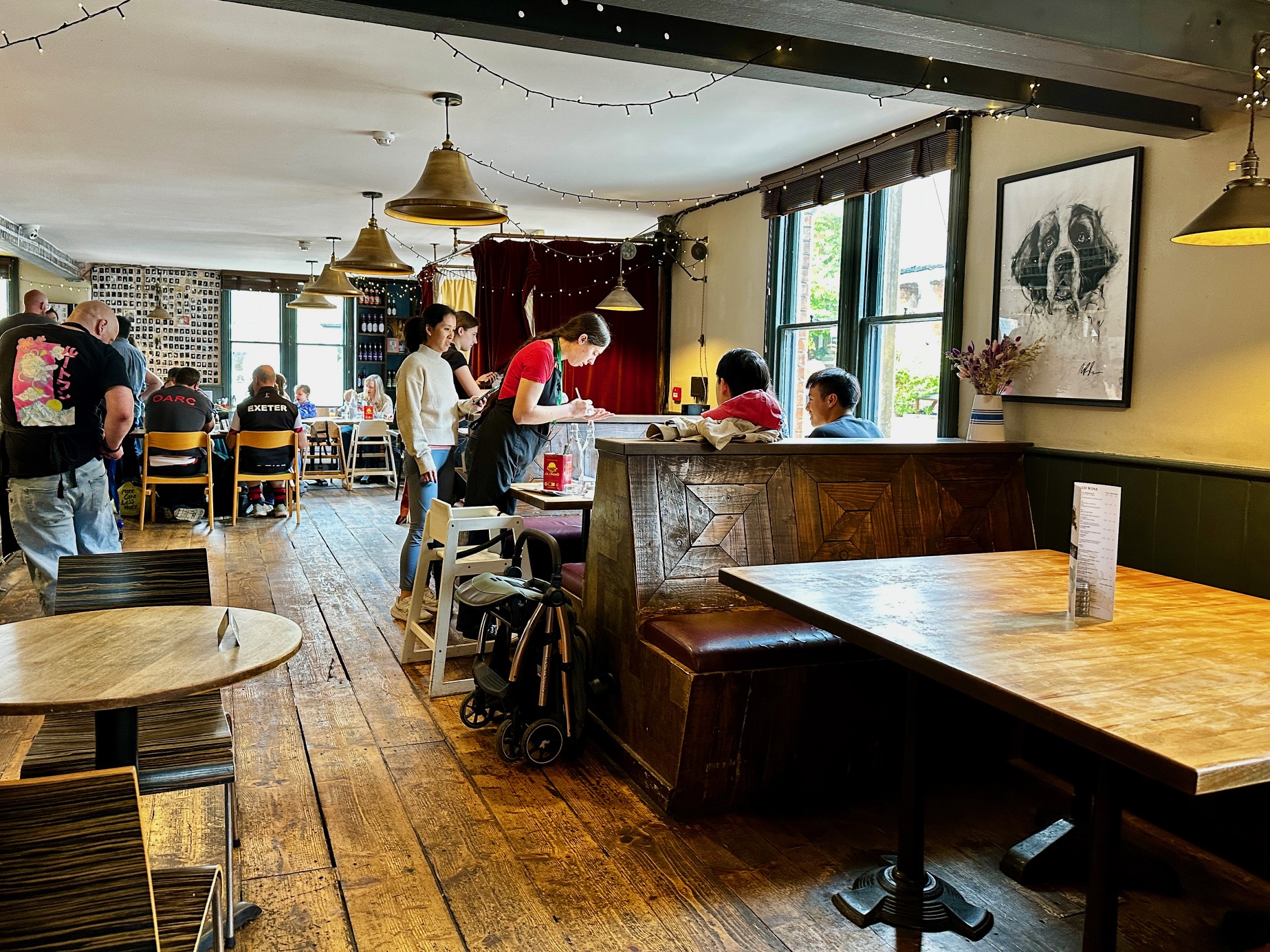
The Chester Arms is another of those lovely backstreet boozers I didn’t even know existed and like the Star off Cowley Road, it reminded me a little of Reading’s Nag’s Head and the Retreat, only built to a different scale. It was a big, handsome corner plot with a decent-sized garden and inside it was a very attractive room with wooden floorboards, large sturdy tables ringed by fetching booths and plenty of natural light. It was a properly gorgeous space which made me think, as so often, that I really missed the Lyndhurst.
Having said that, I do have to say that some of its tables were more equal than others. The place was absolutely packed – you have to book quite far in advance if you want a table – and without much in the way of soft furnishings, which made it a cacophonous place to be. The two tables nearest to us were the handsome ones for larger groups but our little table with unforgiving chairs, near the kitchen, next to a stack of high chairs, felt like one they put in the seating plan because they could, not because they should.
In fairness the table directly in front of me was possibly even worse. The large group settled in nearby was full of people who were young, exuberant and happy to be there. I love Dave dearly, but we could only manage one of those three. “They’re probably all catching up at the end of their summer holidays, ready for term to begin” he said equably, and I felt even older than usual.
The Chester Arms’ menu was compact in the way you’d expect when most people are there for the feature attraction: a handful of nibbles, only three starters to speak of and three main courses which were not the steak platter. One of them was a vegetarian mezze selection (“perfect as a starter to share, or to be enjoyed as a main for one”) which had, by the looks of it, strong Nando’s halloumi burger energy. The starters were under a tenner, all mains save the steak platter hovered around twenty pounds.
Now, to get this out of the way from the off, our service was brilliant from beginning to end. Our server was young, American, properly charming and looked after we two avuncular has-beens perfectly, and I can’t say enough good things about her. With one exception, which is that I saw a blackboard with specials being shown to other tables later in the afternoon but we were never told about it or given a chance to look at it. In an ideal world it just said, in big cursive script, Stop fooling yourself, we all know you’re having the steak platter but, as I didn’t see it, I can only guess.
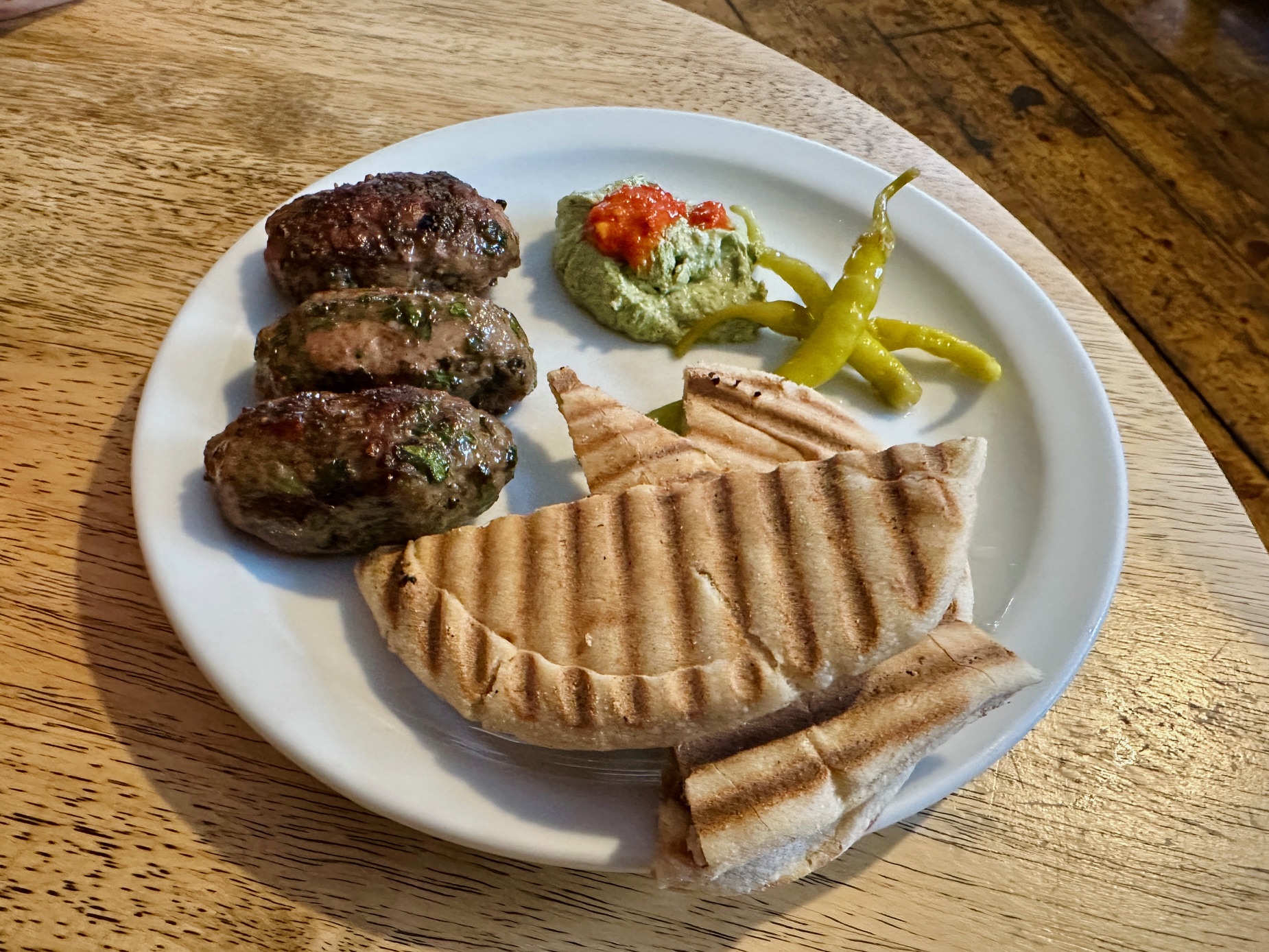
Dave was reluctant to have a starter in case the steak platter turned out to be too much, which did make me wonder if some kind of Invasion Of The Body Snatchers situation was going on, but I managed to persuade him to share the most appealing starter with me. Actually it might have been the absolute best thing I ate all afternoon, so I half wished I’d just pressed on without him. Lamb koftas were a trio of plump nubbins, beautifully coarse and with just the faintest whiff of offal to them, really gorgeous stuff.
They came with flatbreads which felt bought in, but which were good nonetheless, a small stack of guindilla and what was described as green tahini. I’m not really sure what that was, because tahini is a paste with a very distinctive taste and texture and this was none of those things, and it didn’t have a particularly strong note of sesame, but I quite liked it anyway. Dave was unconvinced by it, but won over by the koftas. He let me have the spare one, because he’s a good egg, and even though they were almost more faggot than kofta it did make me wonder what a Chester Arms mixed grill would be like. That had better not have been on the specials menu.
We had a while to catch up after that because each steak is cooked to order and takes, if the menu is to be believed, 45 minutes. So he sipped his pint of alcohol free Rothaus, and I had a pale from DEYA: we were both keeping our powder dry for a more substantial session post lunch. I didn’t know at the time – I learned this from Instagram after the fact – that landlady Becca Webb had just come back from a tasting tour in Bilbao with her wine suppliers, and if I had I might have paid closer attention to the wine list. Next time.
Anyway, Dave and I had a good old chinwag, if constantly drowned out by the relentless, unforgivable youngness of people at our neighbouring tables, as we struggled gamely with the heat from the nearby kitchen. The problem with a restaurant where everybody orders the same thing is that each time it comes out from the kitchen you perk up, think it’s yours and then realise it’s going to another table. But in a way it’s genius, because it raises your anticipation over and over again, and every passing platter looked amazing.
Besides, it distracted me from Dave giving me a litany of people he knew, roughly our age, who were either seriously or terminally ill. They don’t call your fifties ‘sniper’s valley’ for nothing, and after I’d heard about three of them my fight or flight health anxiety kicked in and I asked him, ever so nicely, to stop. Is this what we’ve got to look forward to? I wondered to myself.
I can’t imagine anybody’s life expectancy would be enhanced by what turned up at our table about half an hour after our starters, but just look at it. You’d shave a few days off the end of your life for one of these, wouldn’t you?
It’s difficult to give any kind of scale with a photograph like that but trust me, that serving plate was substantial. Our two serving plates were on the smaller side, but that just gave you an excuse to go back again and again: not for nothing did the pot of utensils on our table include forks, sharp knives and a little set of steak tongs.
Everything about this dish was bang on or thereabouts. The onglet was cooked beautifully medium rare and, in the main was buttery and absurdly easy to cut, any tension in the fibres expertly soothed away; I appreciated the irony of eating something that was better rested, most likely, than I will ever be. The béarnaise was ever so slightly thin with a slight hit of vinegar, but it hadn’t split and went very well with the steak; I might have liked a little more, between two, and a spoon to dish it up with but as quibbles go those were minor.
The other thing I loved, though, was how complete a dish this was and how every component brought something to the table. The heap of savoy cabbage shot through with lardons was truly joyous, the chips were thick, crunchy and surprisingly good. And even the salad, which I’d dismissed in the run-up as a makeweight, was not an afterthought. It was properly dressed, and it supplied the lightness and acidity that would otherwise have been missing from the platter.
Our server had asked us if we wanted to upgrade to the platter for three (“nice bit of upselling”, said Dave) but we’d decided not to, mostly because I thought if I was reviewing the place you’d want to know if a platter for two actually served two. And my verdict is that it does: we finished all our steak and most of everything else, and even in the time between finishing and our almost empty plates being taken away we were both picking with forks – dunking a chip in the béarnaise or trawling it through the juices from the onglet, or the good stuff that was left after you’d airlifted the cabbage away. If service had been less on it, I think our plate would have ended up clean as a whistle.
I tried to send a picture of the platter to Zoë – because she’d asked, even though I imagine it would have made her seethe with resentment – and failed, because the mobile signal in that part of Oxford is like taking a day trip to 1997. Perhaps it was for the best.
Our server asked if we fancied dessert, so I asked Dave if he fancied dessert – because I’d have looked like a right fat bastard scoffing one on my own – and I was hugely relieved when he decided to join me. Perhaps the bodysnatchers hadn’t troubled his house in Wootton Bassett after all. The dessert menu was also compact: three desserts, or ice cream with Pedro Ximenez, or a selection of ice creams, or an affogato.
Another thing to like very much about the Chester Arms was the very appealing selection of digestifs, and the options of red or white port, Sauternes or PX: I had another half of the pale instead, but on another day would have veered in the direction of something smaller and sweeter. The pale, by the way, was decent if piney: not DEYA’s iconic Steady Rolling Man but a reasonable stand-in. I’d have checked it in on Untappd, but I was in 1997 so it hadn’t been invented yet.
I was tempted by something ice cream based, but the server couldn’t tell me where the Chester Arms’ ice cream came from and I wasn’t invested or entitled enough to make her ask. So instead I went for my tried and tested choice, a tiramisu. It was about as different as possible from most of the ones I’ve had recently – not loose, airy and boozy like the tiramisu at, say, Paesinos or RAGÙ. It was more old school, by which I suppose I mean inauthentic: much firmer, much denser, crammed into that Duralex glass like they’d almost forgotten to say when.
And it was gorgeous. I’d forgotten that authentic is overrated, with all the honest-to-goodness Italian food cropping up in places like Reading and Bristol, but this was a delight from first spoon to last – far, far more cream than sponge but laced with Courvoisier and Frangelico. I loved it far more than I expected to, and it made me think again that the Chester Arms might be famous for its steak platter but it had made the canny choice of ensuring that none of the other items on the menu were an also-ran.
Dave had the crème brûlée, which is just one of those dishes I never personally order. I tried a spoonful of it and it, too, was right on the money: just enough warmth, the carapace just the right thickness, the cream vanilla-speckled and exemplary.
We didn’t tarry, because by that point it was incredibly warm and both of us fancied stretching our legs. Besides, I had promised to introduce Dave to the Star and his beloved Liverpool had finished playing, so the lack of mobile reception was no longer the positive nuisance it had been. My advice is that if you’re going to spend time somewhere with absolutely no phone signal, the best idea is to do it in the company of someone where you can talk for hours without feeling the need to check your phone. So that’s exactly what I did.
Our meal for two – two and a half courses each, one of them that steak platter, and a pint apiece came to just under £100, including a discretionary 12.5% service charge which was totally earned. When you think that half of that whole bill was down to a single dish that the pub endearingly describes as a “small steak”, you have to hand it to them.
I’m really glad I finally made it to the Chester Arms – partly because it’s been an ambition for such a long time and partly because it was fascinating to try a restaurant in this country which really is synonymous with the one dish, to see if that reputation is justified. And it absolutely is – if you like steak at all, you would have a ball hopping on a train to Oxford and making your way to the Chester Arms. And if you don’t, but you know someone who does, make sure the two of you take a friend with you: you can have the fish and chips and they can have the time of their lives.
I do find myself wondering though, still: what was on that specials board? But I know that it could have had skate wing on it, or fried chicken, or countless other things, and I still would have ordered the steak platter. So does the steak platter qualify as famous? Yes, I think it probably does.
But if I went back to the Chester Arms again, knowing what their kitchen is capable of, would I really still order the steak platter a second time? Also yes. I’d be even sadder, though, if they’d taken those lamb koftas off the menu, because it was the dish I’d want to order every time, if it was up to me. That’s choices.
Since January 2025, Edible Reading is partly supported by subscribers – click here if you want to read more about that, or click below to subscribe. By doing so you enable me to carry on doing what I do, and you also get access to subscriber only content. Whether you’re a subscriber or not, thanks for reading.
I was meeting Aileen, a very dear old friend, in London for lunch and she gave me carte blanche to pick wherever I wanted. “You’re the food expert”, her message said. “You choose.” And I have to say, that was more difficult than usual; I have a list of London places I want to get round to, but lots of them didn’t seem right for this. I didn’t want us to sit at a cramped table somewhere in Soho, elbows battling, or up at a bar watching an open kitchen. I might go to the edgy places with my cousin Luke, but lunch with Aileen required somewhere in the image of our friendship: comfortable, classy, unrushed with a long history. Somewhere worth celebrating.
Aileen and I, you see, have been friends for well over a decade. Long before I started writing this blog I used to write another – not about restaurants, about something else – and somehow Aileen chanced upon it. And somehow, I’m not even sure how, we went from writer and reader to firm friends. I don’t think I could possibly have appreciated at the time how fortunate I was about that. Because a few years later my marriage and my life imploded and things got almost impossibly hard and Aileen, arguably more than anyone, was the person who kept me together.
In the dark moments when nobody else was there, or (more likely) they had all gone to sleep, Aileen showed up for me time and time again. She always had the same mantra, which I railed against but over time discovered was true: this is a phase. It’s a phase, and it will pass. And it was, and it did, and she never once said I told you so, even though she could have done.
I like to tell people that she saved my life, and she likes to reply that I’m talking nonsense. She might be right, because she nearly always is, but if we hadn’t become friends I don’t know who or where I would be now: I almost certainly wouldn’t be here.
It was a huge honour for me that she was at my wedding earlier in the year, a wedding that might not have happened had I not met her. Late in the evening, when the guests were thinning out, we sat together outside the Lyndhurst and had a good old gas, as if the intervening months had never happened. And the next morning I managed to catch her in the hotel bar before she headed home to Milton Keynes, and that easy, joyous conversation was one of my highlights of the whole weekend. I told her we should do lunch in London soon. So we agreed to, and all I had to do was find somewhere suitable for the occasion.
I ended up choosing the Drapers Arms in Islington, because it just felt right. It’s been going for well over twenty years, one of the generation of London gastropubs that includes the celebrated Anchor & Hope near Waterloo, and in that time it has become an institution. It held a Bib Gourmand from Michelin for much of the last decade, losing it in 2018, but it still featured in this year’s list of the U.K.’s top 100 gastropubs. But the thing that most cements its status as an institution is that nobody talks about it online, because nobody needs to. You won’t find a recent review of it online, and the London restaurant bloggers stopped name checking it a long time ago.
All that meant that although I’ve always wanted to go, I didn’t have a very clear idea what to expect. Aileen and I wandered there, strolling up Camden Passage and looking at all the stalls and boutiques, before heading across to Upper Street and then ambling off the main drag, onto side streets filled with houses you wished you lived in. On the way I went past various restaurants I’d heard of – the likes of Bancone clone Noci, Alsatian brasserie Bellanger and regional specialists Hainan House – all of which have been reviewed by somebody a darned sight more recently than the Drapers Arms has.
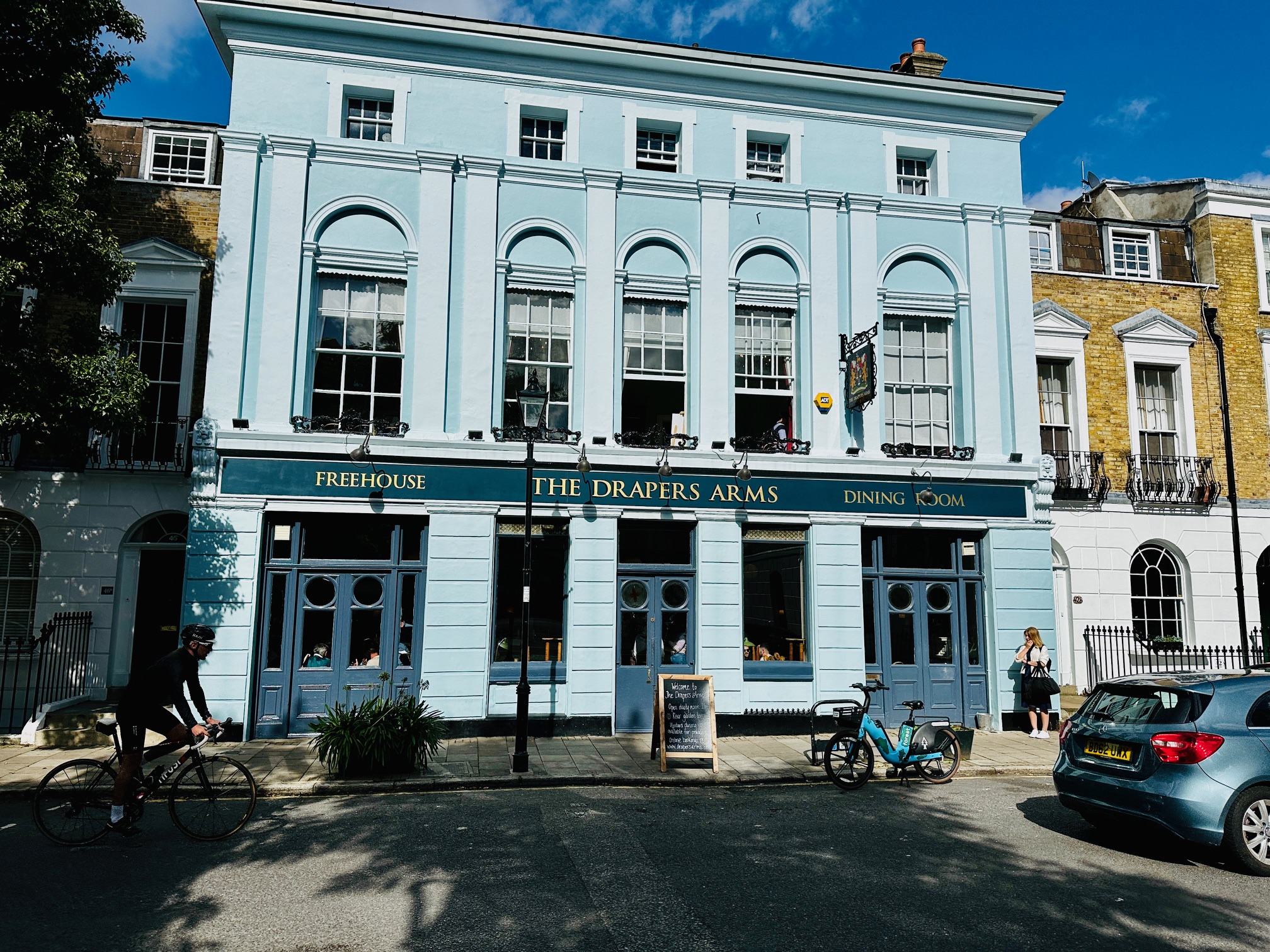
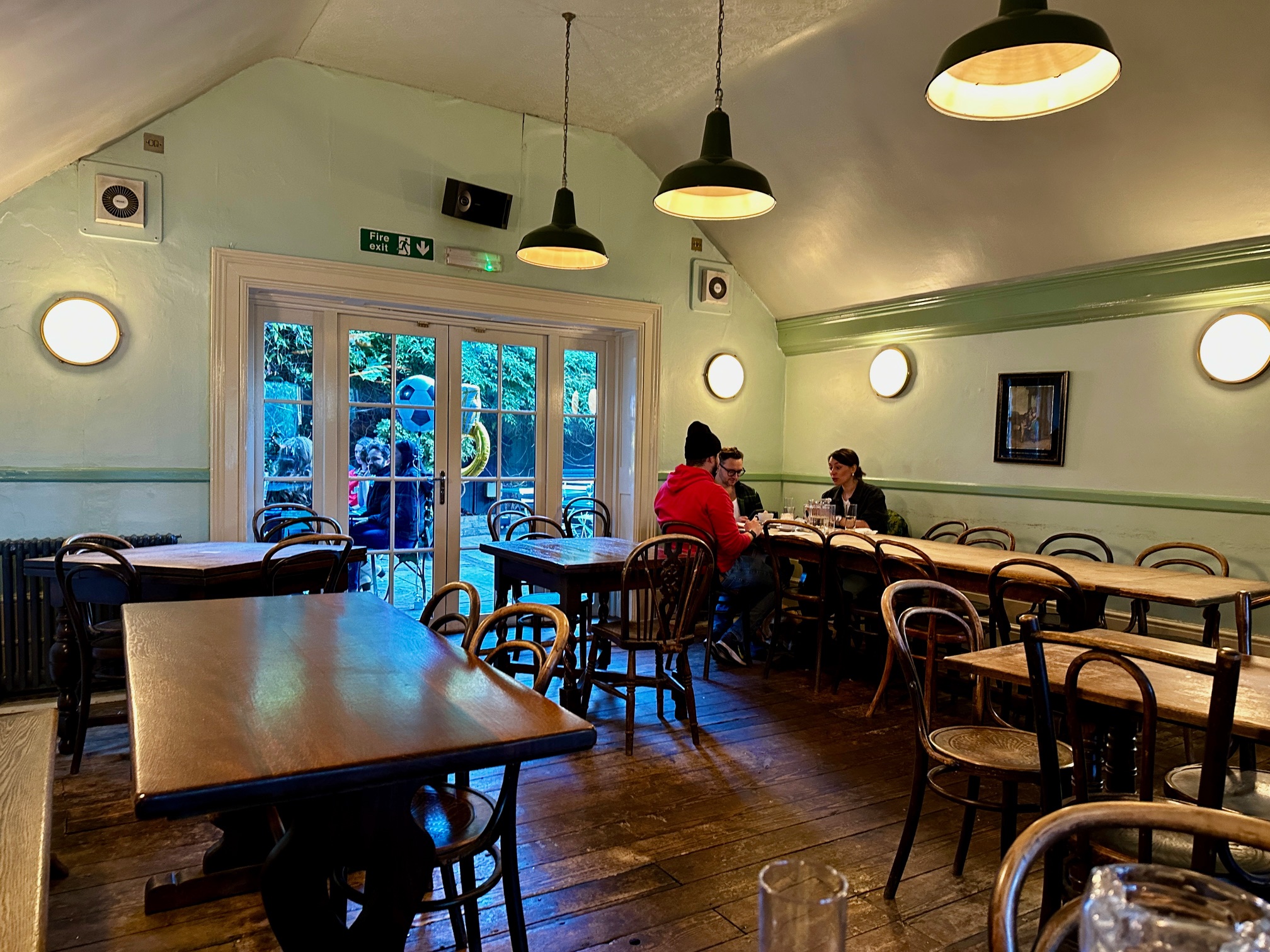
It’s a handsome, imposing building, a three-storey, powder blue beauty, and going in the front room was flooded with sunshine from the windows and glass-panelled doors. There were unoccupied tables at the front, and I was hoping our reservation was at one of them, but instead we were led to a room further back which was dingier and less agreeable. Almost every table was taken, and we were seated at possibly the worst one there – equidistant from the terrace at the back or those big windows out front, starved of sunshine.
I plonked myself on a Thonet-style bentwood chair that didn’t entirely feel as if it could deal with my weight at the start of the meal, let alone the end. Around us all the tables were packed with loud, lively, chattering groups, and there was nothing to soak up the sound. I took a picture of the room much later on, which makes it look nicer than it was.
But maybe all that is a tad grumpy. After all it was busy, which you want somewhere to be, and the fact remained that it was an extremely attractive pub, even if we had the restaurant equivalent of the worst house on a good street. I especially loved the emerald-coloured bar, and a print on the wall advertising HP Sauce in the proper bottles.
“Mark brought some home from the supermarket recently in a squeezy plastic bottle and I made him take it back” said Aileen, talking about her husband. “It doesn’t taste the same when it’s not in a glass bottle. I reckon it’s thinner, too.” This, I realised, was one of many reasons why I loved the woman.
The menu changes every day and they publish it on the website, so it was much as I’d expected. It’s curious how some menus present you with very difficult choices while some, despite making all the right noises, are devoid of dilemmas. I would say that, however well it read, the Drapers Arms menu was the latter. Nine starters, all of which seemed to be either gutsy and rustic or, for my money, a little too virtuous. It was all a tad binary for me. You had the same number of mains, although four of them – the fun ones – were to be shared between two.
That made the whole thing a little more restrictive than I’d have liked and if you didn’t like offal or bone marrow, both of which made an appearance, I think you might have found things trickier still. Starters generally clustered between eight and fifteen pounds, mains started just shy of twenty but climbed, for the sharing dishes, up to ninety quid.
While we weighed things up Aileen ordered a negroni and I asked for a Bloody Mary, we clinked glasses and celebrated the prospect of a long lunch with a great friend. They didn’t ask me how spicy I wanted the Bloody Mary, which gave me confidence that it would be good. It was both spicy and very, very good.
It had been far too long since I’d had lunch with Aileen, and I didn’t realise that she was excited about featuring in the blog. “I’ve wanted to do this for ages!” she said. “And I don’t want you using a pseudonym for me, either.” Chatting away, I realised that we both had many of the same criteria when it came to restaurants getting a gold star or nul points. When our bread turned up, it turned out we both had a bugbear about fridge cold butter (Aileen checked it and thought it was okay, for my money it was still a little on the cold side).
My starter was a bisque, and Aileen rested her hand briefly against the outside of the bowl. “I don’t like it when hot food comes in a cold dish” she said. I hadn’t ever considered it, but she had a point.
The problem with the bisque, though, wasn’t one of temperature per se. It was a tasty dish where almost everything worked, but it wasn’t quite the sum of its parts. I loved the depth of the bisque and the crab meat tumbled through it. Spiking the whole thing with dots of deep green oil and red flecks of espelette pepper gave the whole thing contrast and depth.
The problem, and I never thought I’d hear myself saying this, was the octopus: there were a few pieces in the bisque and I just wasn’t sure, in terms of flavour or texture, whether they added enough to be worth it. This dish was fifteen pounds, and I couldn’t help thinking it might have been better, and been better value, without the octopus.
“Another thing that annoys me, while we’re at it” I said to Aileen, “is dishes like soup appearing in shallow bowls like this. It just means it’s really hard to get to all of it, and it goes cold quicker.”
“I agree with that” said Aileen. I cleaned up the rest of my bisque with some of the bread, which was fulfilling one of its most noble purposes: the edible jay cloth for sauce removal. The bread was okay, by the way: two big slices of sourdough and two pieces of baguette is hardly highway robbery for three pounds, but it wasn’t the most exciting.
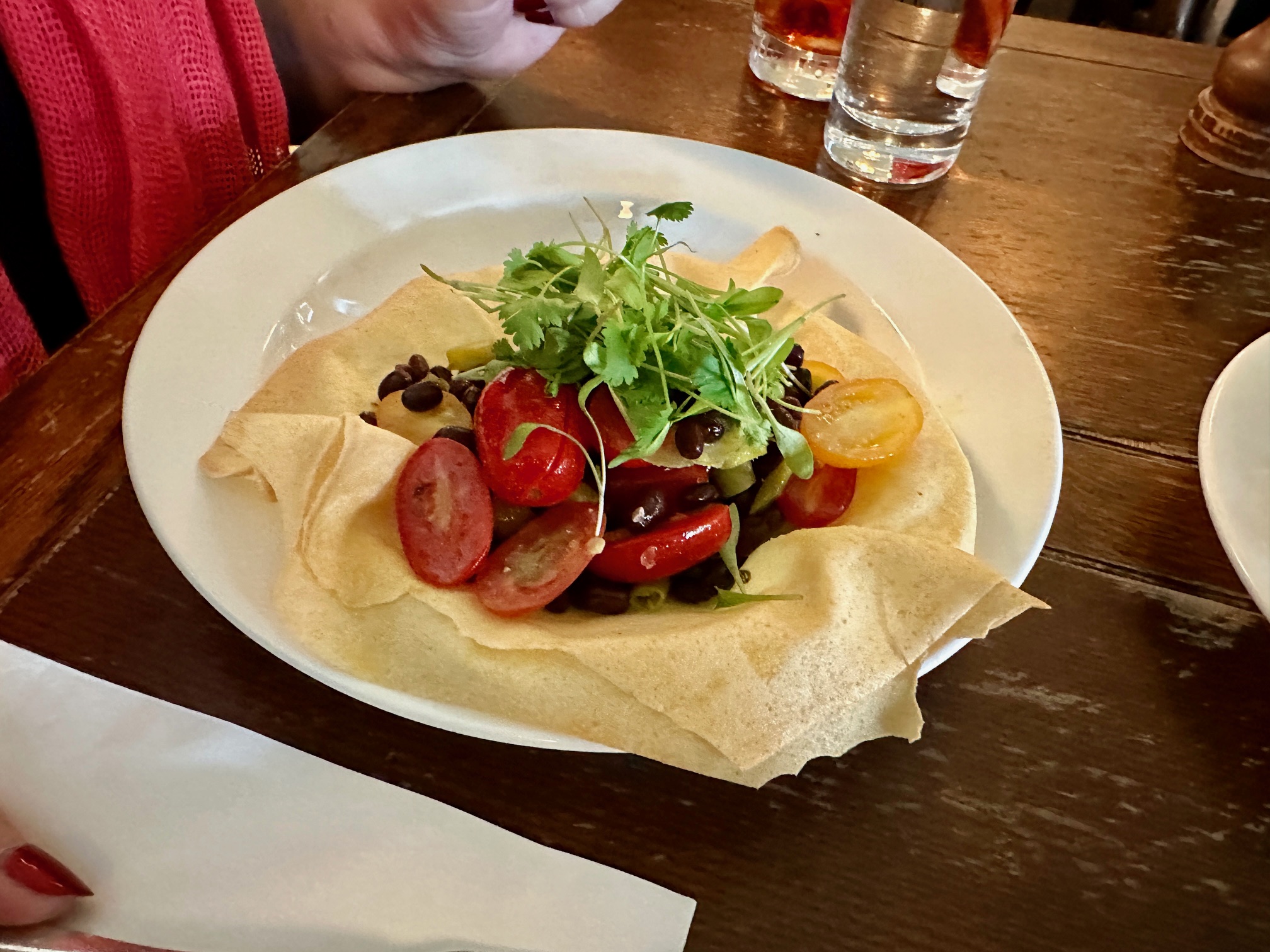
Aileen’s starter was the kind of dish I would never order in a million years, and a great advert for bringing people with you to review restaurants whose tastes are not the same as yours. It was a bean salad with coriander, chillies and datterini tomatoes, served in a sort of filo pastry basket. Aileen loved it – the flavours worked well and the beans had a nice amount of bite. I had a forkful, which confirmed that it was indeed the kind of dish I would never order in a million years. I didn’t feel like there was anything bringing a fun factor to the plate, but that probably tells you more about me. It also felt steep at eleven quid.
Aileen is planning to retire at the end of the year, and was telling me how she plans to take over more of the cooking from her husband. This dish struck me as having a hint of Ottolenghi about it, and Aileen said she’d tried making some of his recipes. I’ve never followed her example: in my experience, they always seem to involve lots of ingredients and hours of processes, so perhaps they’re best left to the retired.
“Have you ever been to an Ottolenghi?” she said.
“Yes, just the once. I was at this event to commemorate the eightieth anniversary of the Cable Street Riots, because my then girlfriend knew someone who was in a Yiddish marching band.” This sentence, by the way, sums up perfectly how very strange my life was in the latter half of 2016.
“There was a march, and a demonstration, and lots of placards and Jeremy Corbyn was one of the people making a speech. It was so boring that we sloped off to the Ottolenghi in Spitalfields and they managed to fit us in. It was all right, but it felt like a glorified salad bar.”
This starter, to me, felt like the kind of thing you’d have at a glorified salad bar.
But no matter. Both of us had chosen far more substantial mains and had ordered a bottle of Gamay to go with them: initially I thought Aileen might have insisted on just having wines by the glass, but that negroni had persuaded her to throw caution to the wind. It was thirty-one pounds, so very much at the shallow end of the wine list, but the list went deeper than at many restaurants.
“That one said 300, and for a moment I thought it was the price” said Aileen.
“No, that is the price.”
“But this is a pub!”
“Well, yes. And no.”
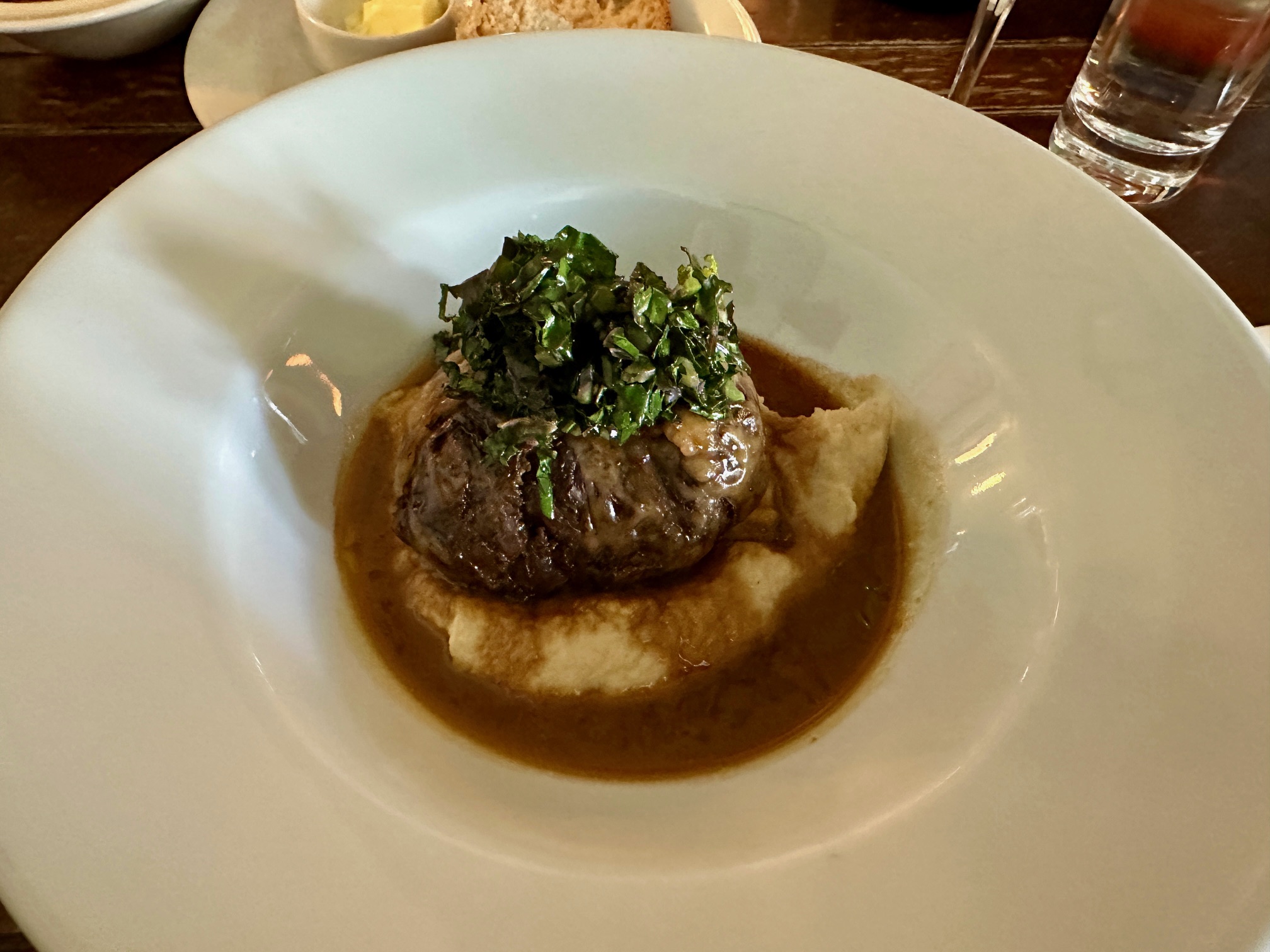
My main course was a sure sign that summer was long gone and that winter, as Leonard Cohen once put it, was tuning up. Lamb faggot and celeriac purée sounded like a glorious, fortifying treat and I was very glad Aileen hadn’t stuck a pin in it, because I always let my dining companions choose first. On paper it was beautiful, and at first sight it was every bit as appealing – a huge faggot, a splodge of mash, a moat of sticky gravy and one accent of not-beige, a crowning garnish of kalette tops. It was a dish to be enjoyed in a cosy pub, even one with three hundred pound bottles of wine on offer.
Things only went slightly awry when I ate the damned thing. The faggot had a terrific, coarse, crumbly texture and the celeriac purée was one of the nicest, silkiest ones I can remember. The kalette was a revelation – still firm, with a zip of mint that the dish badly needed. But the faggot was really heavy on the offal, to the point where it was a little too intense, a bit much even for me. I liked it at the time, and I finished it, but it sort of stayed with me for the rest of the day, in the way you don’t want.
Aileen had gone for my second choice from the menu, a beef and mushroom pie with a suet crust – or, for the purists among you, a stew with a lid. It came without accompaniments, so I was glad we’d also ordered chips and veg. It was placed on the table, and Aileen asked if it came with gravy (she is from Nottingham, after all). We were told, very nicely, that it did not.
At first, Aileen wasn’t sure about the whole affair but I think she warmed to it – the beef was all at the bottom but there was a fair amount of it, tender and breaking into strands. There was carrot and mushroom in there too, and she loved the green beans she’d ordered on the side, just-cooked and topped with crispy shallots. But even though this wasn’t a pie for sharing it was strange that it didn’t come with anything, including a plate to dish it up onto.
It reminded me very much of some of the great gastropub pies I’ve tried in the past, at Hackney’s The Marksman or The Magdalen Arms in Oxford, but it didn’t look quite as alluring as either of those. Still, it was eighteen pounds, one of which goes to Action Against Hunger, so you couldn’t really complain.
“That was lovely” said Aileen. “It needed gravy though.”
I’ve realised I didn’t get any pictures of the green beans or the chips. The chips were skin on (I thought that might be one Aileen’s list of restaurant no-nos, but apparently not) and clearly made in-house. And they were pleasant, but perhaps a little limp and unremarkable. I wanted that contrast of brittle crunch and fluff – and I didn’t care how many times they had to be cooked in order to achieve it – but these weren’t quite there. They were a decent vehicle for the last of my gravy, even so.
Our meal had been a little haphazardly timed – we didn’t get our bottle of wine almost until our mains turned up, so once they’d been eaten we had a lot of wine left. And service was brilliant at this point, leaving us in peace while we finished it and continued our epic conversation. I saw pictures of Aileen’s twins at their prom and wondered, as I’m sure she did, where the time had gone and how the little girls I’d first met all those years ago were suddenly sixteen.
Aileen in turn saw pictures of my wedding, and in between flicking through them and chatting about all sorts we caught up in the way that is such a tonic – a proper state of the nation natter encompassing work, family, friends, the past and the future. And I loved the Drapers Arms for this if for nothing else, for enabling this kind of afternoon.
Eventually, the wine was polished off and the dining room almost empty: I felt strangely proud of the fact that we’d outlasted all our fellow diners. So we got round to ordering dessert, along with a tea for Aileen and a bitter, middling latte for me. That section of the menu was very compact – a duo of cheeses and three desserts – and again, catered to people with different preferences to mine (I’ll eat most things, but I’ve never warmed to custard). So we both went for the lime posset and, like so much of what I’d eaten, it was nearly there.
As with my main course, almost everything was how you would want it to be. The strawberries on top were plump and sweet, the syrup they were in sticky and ambrosial. The shortbread was reassuringly irregular and crumbly: I saved mine to the very end. And the sharpness of lime in the posset worked so well, a welcome variation on a theme. But here’s the problem: the posset wasn’t properly set. Some of it was, but the rest was just liquid and hard to eat tidily, part dessert and part drink. So at the end of proceedings, you got a dish that was something like a synecdoche, a pretty good summary of the meal as a whole.
Our meal for two, including service charge, came to pretty much bang on one hundred and eighty pounds. And if that sounds like a lot, I’d say it could easily have been more. Our wine was distinctly entry level and we had, by accident rather than design, ordered the two cheapest mains on the menu. You could easily come away with a far more dented wallet than we did, although if you had an afternoon as terrific as the one I’d had you’d be fortunate indeed.
We wandered, full and happy, back to Angel tube station to go our separate ways. I could have talked for hours, but the idea of eating another mouthful or drinking another drop was more than either of us could contemplate (“I’m not sure I’ll even eat tomorrow” was Aileen’s verdict, although if she’s anything like me I’m sure she managed it). London looked beautiful in the autumn sun, and all around us Islington was gearing up for a busy Saturday night. We, on the other hand, were both dead set on being installed on our respective sofas by the time Strictly began.
When I think about the Drapers Arms, the thing I keep coming back to is that everything was good, and some of it was very good, but none of it was spot on. I imagine they have better days than they did the day I visited, I imagine there are nicer tables than the one we sat at, and iterations of that menu that would have suited me better. But I’ve had many far worse experiences, too, in countless places. So where does that leave you?
Yes, it was good but not perfect. And when it turns out like that you have to resort to your gut feel, try and weigh up all those almost intangible incidentals that define a meal. Because restaurant reviewers may not always tell you this – in fact many never talk about it at all – but there’s so much more to a meal than food, the room, or even service. I wish I’d liked everything a little more, and yet at the same time I know it will be hard to top as one of my favourite lunches of the year. So the Drapers Arms could have been better, but nonetheless I’m still really glad I went there. Happy that I ticked it off my list, and delighted that I chose it to host such a brilliant afternoon.







 Edible Reading