Restaurant review: Club India

This week’s review partly came about because of a gentleman called Andy Hayler. Now, you might not know who Hayler is, but in terms of food he’s something of a phenomenon.

The shadowy world of Michelin exists behind an impenetrable curtain, with nobody sure how they work or what dictates who gets listed, is awarded Bib Gourmands and stars – or, sometimes, has them taken away. Andy Hayler is the closest thing we have to a Michelin inspector working in plain sight. He has a blog, which has been around since the 90s, in which he has documented hundreds of meals in restaurants, giving each restaurant – and every dish – a mark out of 20.

I’ve rarely seen anything get lower than a 10, and very little approaches the top of his scale, but that’s because a fair amount of what Hayler has reviewed is at the highest end of dining. There was a time when he had eaten at every three starred restaurant in the entire world, although he stopped keeping up with Michelin when, as he puts it, they devalued what three stars should signify by giving them out in some territories to restaurants that were nowhere near the standards he had experienced elsewhere.

Hayler has a sort of cult, niche status in food. I’ve read a couple of pieces about him in recent years, both verging on hagiographies. He’s been described as “the best living food writer”, and I’ve read interviews that gush about his effortless recall and the esteem in which he is held by chefs and restaurateurs. He is the cognoscenti’s critic of choice and no mistake.

I think he attracts some of those plaudits because of what his reviews both are and aren’t. They don’t, in some senses, read like reviews at all, more like audits from someone scrupulous and meticulous who has forgotten more good meals than most of us will ever have. Although it doesn’t sound like he forgets many of them: why would you, when you document them all in such extensive detail?

I think the respect also comes from his refreshing lack of ego; Hayler would be the first to draw a distinction between himself and many restaurant reviewers. “I wouldn’t ever pretend I was any sort of fantastic prose master. I’m not trying to throw in a load of stuff about my journey to the restaurant and the trendy people on the table to the left” he has said, subtly throwing shade on half the piffle I come out with every week.

Don’t worry, there’s no way he meant me personally: in fact, he once described one of my pieces, about Maida Vale’s Paulette, as a “lovely review” which I found surprisingly touching. “Most of the newspaper critics want to be writers first, I want to focus on the food” he said more recently. I suspect the people who read him admire that purity of approach, and it does mean that when he thinks somewhere is dismal or overrated, which happens occasionally, it’s really very amusing.

What’s also admirable is that Hayler goes where he likes, reviews wherever he wants: money seems to be no object, and he doesn’t follow the fads. You won’t find him, for instance, reviewing Brasserie Constance, a restaurant operating out of Fulham FC’s Craven Cottage, unlike nearly every broadsheet critic over the last few weeks. Instead, his two or three reviews each week involve him going wherever he pleases, in London and abroad.

His two main weaknesses seem to be eating at the Ritz in particular and eating Indian food in general. Hayler is a regular visitor to Epsom’s Dastaan, and the little group of restaurants it has spawned in Surbiton, Richmond and Leeds. He’s also a frequent diner in Southall, and when he gave a warm review to Hounslow’s review of Crispy Dosa last November it caused a Mexican wave of regional bloggers checking out their nearest branch to touch the hem of his virtual garment (been there, done that – four years ago).

“If Mr Hayler thinks it is OK, it is a fair bet I will probably like it” one said. “You can be assured that if Andy says a restaurant is worth visiting then it really will be” said another. That’s proper soft power, and all from the opinion of a chap you mightn’t have heard of.

Hayler even came all the way west to Caversham last year to review Clay’s, something I’ve been waiting for him to do for a very long time. He gave it 14/20, which may not sound like a big deal but actually is. “Clays is a very impressive family-run restaurant, the food shows a lot of care, and the chefs are clearly putting some real effort into reproducing an authentic taste of India” he concluded, after paying particular tribute to Clay’s cabbage pakora, lamb chops and, of course, bhuna venison (Hayler also tried methi chicken, a dish he seems particularly to favour).

Seeing Clay’s reviewed by Hayler was like watching somebody you know being interviewed in the national news, and it made me proud. It didn’t make the local paper the way Grace Dent’s write-up had, but in its way it was every bit as significant. Hayler, as he said, is all about the food.

Now, by this point even my most supportive readers are probably thinking this is an even more circuitous intro than usual, what has this got to do with anything?’ Well, I’ll tell you: every week Andy Hayler does a roundup on his blog, and every week the byline gives a couple of destinations. From South Kensington to Mayfair one might read, or From Piccadilly to Rome. Fancy restaurants and/or jetsetting are invariably involved. And then, at the start of the month, one made me do a double take. From Winnersh to West London, it said.

Winnersh? Our Winnersh?

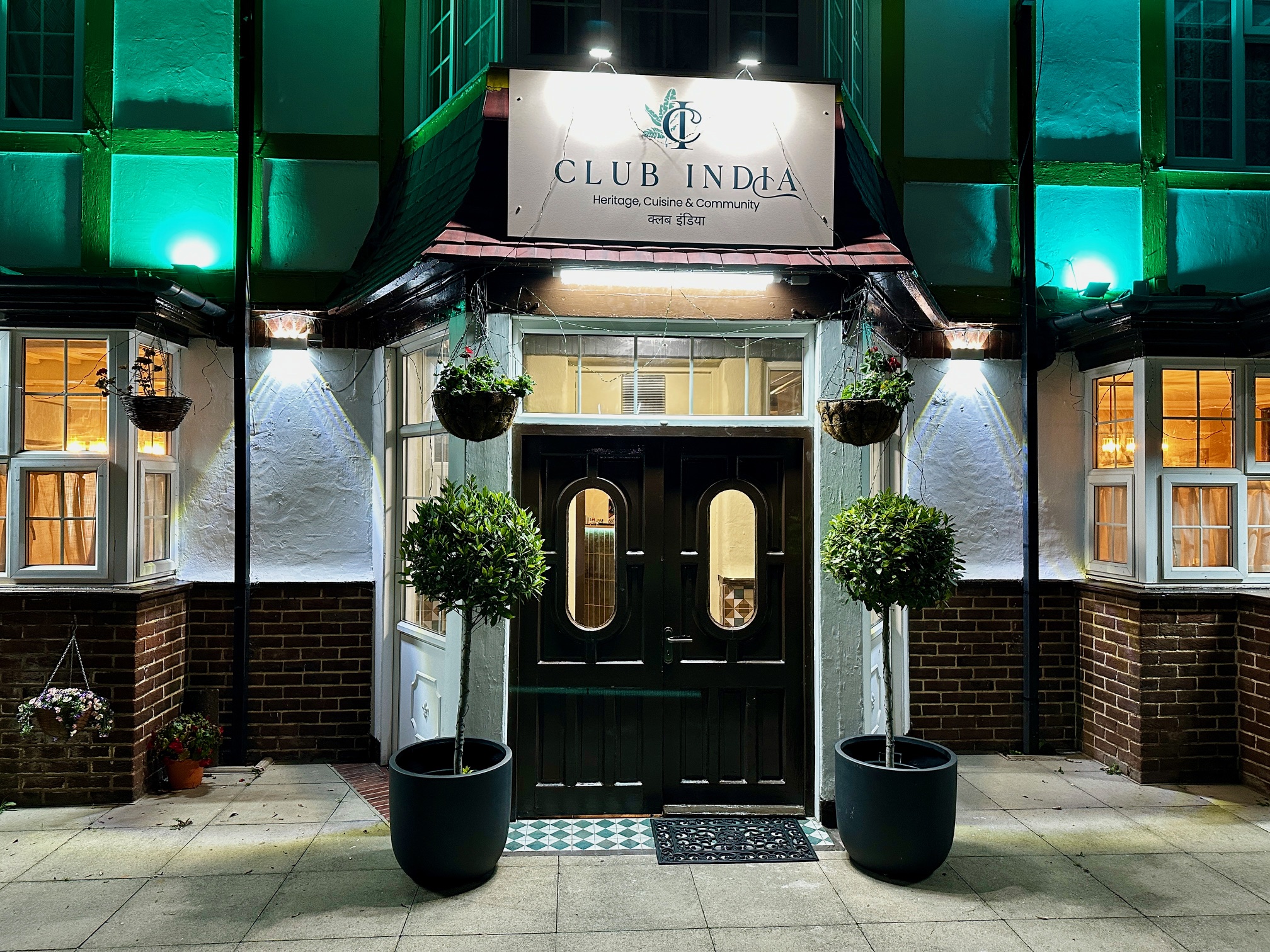
It was not a misprint. Andy Hayler had come all the way to Winnersh to try out Club India, an Indian restaurant that opened back in July where the old Pheasant pub used to be. I mentioned that development when I reviewed Dolphin’s Caribbean, back in June, What I said, looking back, feels a little graceless, especially as they sent me a lovely email inviting me to a pre-launch event. I read the blurb and thought it sounded potentially interesting, but then again: Winnersh?

Andy Hayler had no such compunctions. Club India’s consultant chef had held two Michelin stars at his restaurant in San Francisco, although Hayler’s verdict on that place was that if a chef had gone there trying to pick up tips “he or she would either burst out laughing maniacally or seek to throttle any passing Michelin inspectors; possibly both”. But the head chef had headed up the kitchens at a couple of London restaurants Hayler really rated. So he went, he enjoyed it, he dished out scores out of 20 for all the dishes and, of course, he ordered methi chicken.

Overall he gave it the same rating, 14 out of 20, as Clay’s. “Club India was a thoroughly enjoyable experience, the food and service excellent, and at an affordable price. I wish I could say that more often these days” was his conclusion. That was good enough for me, so on a Friday night after a couple of pre-prandial beers in town Zoë and I hopped on the number 4 bus to go and see if Reading really did have a rival to Clay’s Kitchen, tucked away in – this may not be the last time I say this word slightly incredulously – Winnersh.

You can tell it’s a former pub, but the glow up is nice and, on the inside, pretty subtle and tasteful. The room I was in, at the front, was muted wallpaper and leather banquettes, but every room was slightly different and the one the other side of the bar from mine, with its tiled floor, was my favourite. When we got there around 7.30 it was already very busy with big groups and couples on dates, in full swing with a busy service ahead. Hayler said it could seat 70, which sounded about right, with outside space too.

I guess it’s easier to have more space than you need in this part of Reading than it is in Caversham, but in any case it was bustling on a Friday evening. The tables were more Winnersh than desi when I arrived, although I would say that balance shifted as the evening went on. It certainly felt like a restaurant that wanted to attract both demographics, and anybody else besides.

Our table had a good view of the room and of the very strong service. The man who seemed to be running the show, sporting an impressive man bun, thick white stripe right down the middle of his dark luxuriant beard, was a class act, but in fairness everyone who looked after us all evening was lovely, polite and enthusiastic, even the ones who seemed a little nervous. It had the swagger of a restaurant that had been there a lot longer than three months.

We started, as you might, with apéritifs and poppadoms – and if that seems like an incongruous pairing, Club India does a good job of making them feel like they go together. Zoë liked her negroni, although she wasn’t sure it tasted quite like a negroni and couldn’t put her finger on why. I had something called an Amber Signal, which I suspect featured in the Johnny Depp defamation case a few years back. It was a blend of Aperol, whisky and Drambuie and felt surprisingly grown up by my standards, something to sip slowly and mindfully. Both cocktails came in glam, exceptionally heavy-bottomed glasses that could have doubled as a paperweight or a murder weapon.

The poppadoms were splendid, by the way – warm, thin, greaseless and very hard to stop at just the one each, which is probably why we didn’t. But the chutneys were the thing: you pay £3.50 or so for these but they were all made by hand and far more interesting than the usual fare. The mango chutney was thick and rich with nigella, the raita so robust that I thought Greek yoghurt must have been involved. There was a mixed berry number which surprised, possibly mostly through novely value, and best of all an inspired shrimp chutney which we managed, being our best selves, to equitably divide despite the unworthy temptation to hog the lot.

The menu at Club India takes a long time to go from first read to decision, because you want to order most of it. It is the only restaurant I can think of in Reading with a tasting menu, at a very reasonable £45 a head, or £70 if you throw in the wine pairings, and if it had contained the dishes I’d really fancied from the à la carte you’d be reading about it right now: nevertheless, it sounded like really solid value.

But the à la carte was just too tempting – about a dozen starters, the same number of curries, some biryani dishes and plenty of vegetarian dishes which you could downsize to try as a side dish. They also had a separate vegan menu, so they could definitely make many of the vegetarian dishes without ghee. Starters ran the gamut from £5.50 to £15.95 and the most expensive main would set you back £18. Pricing, put that way, looked pretty reasonable – and although the obvious reference point for this restaurant, given my preamble, is Clay’s I also had Masakali in the back of my mind. Club India’s menu is far more streamlined than Masakali’s, and to my mind less expensive.

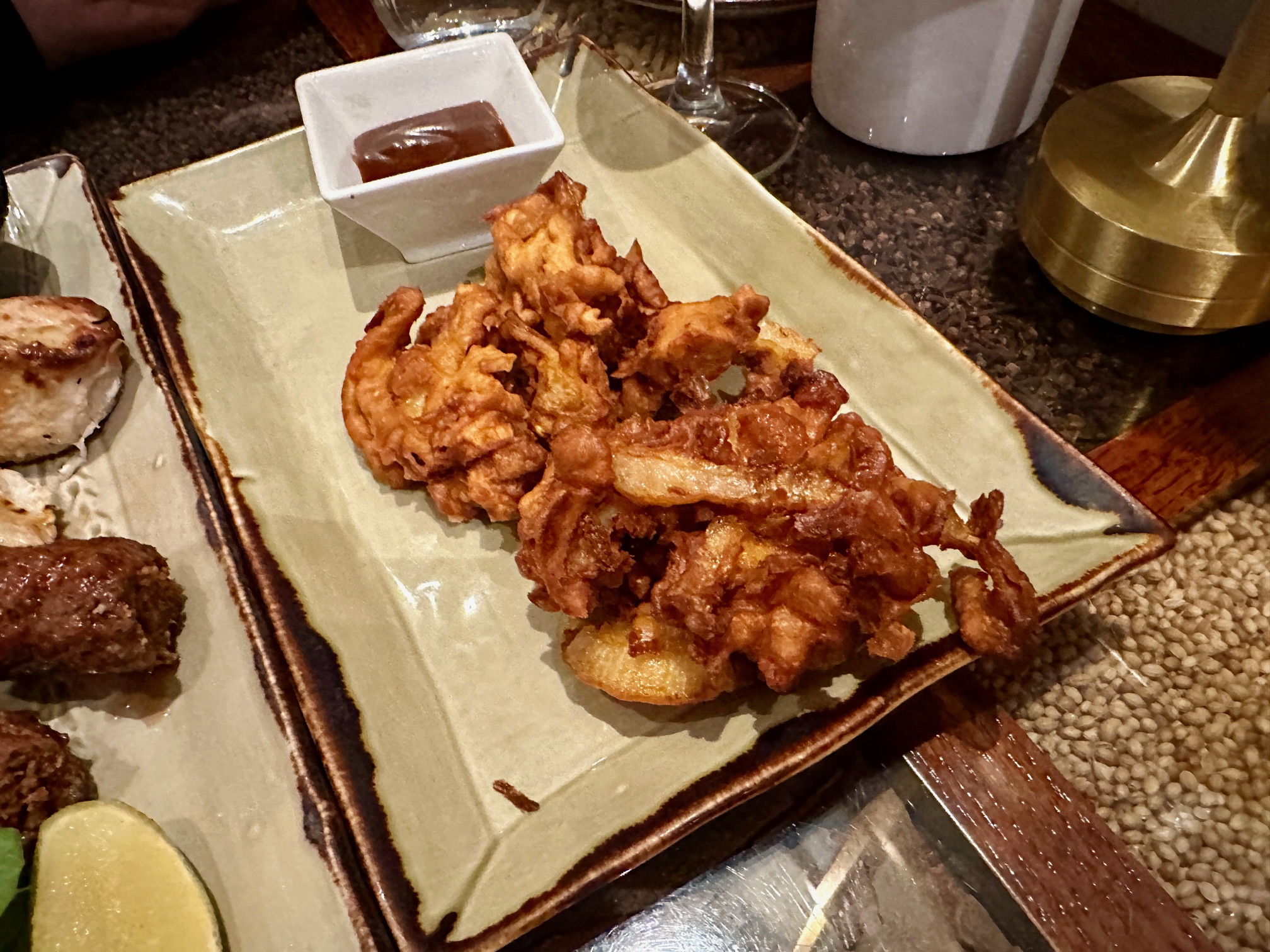
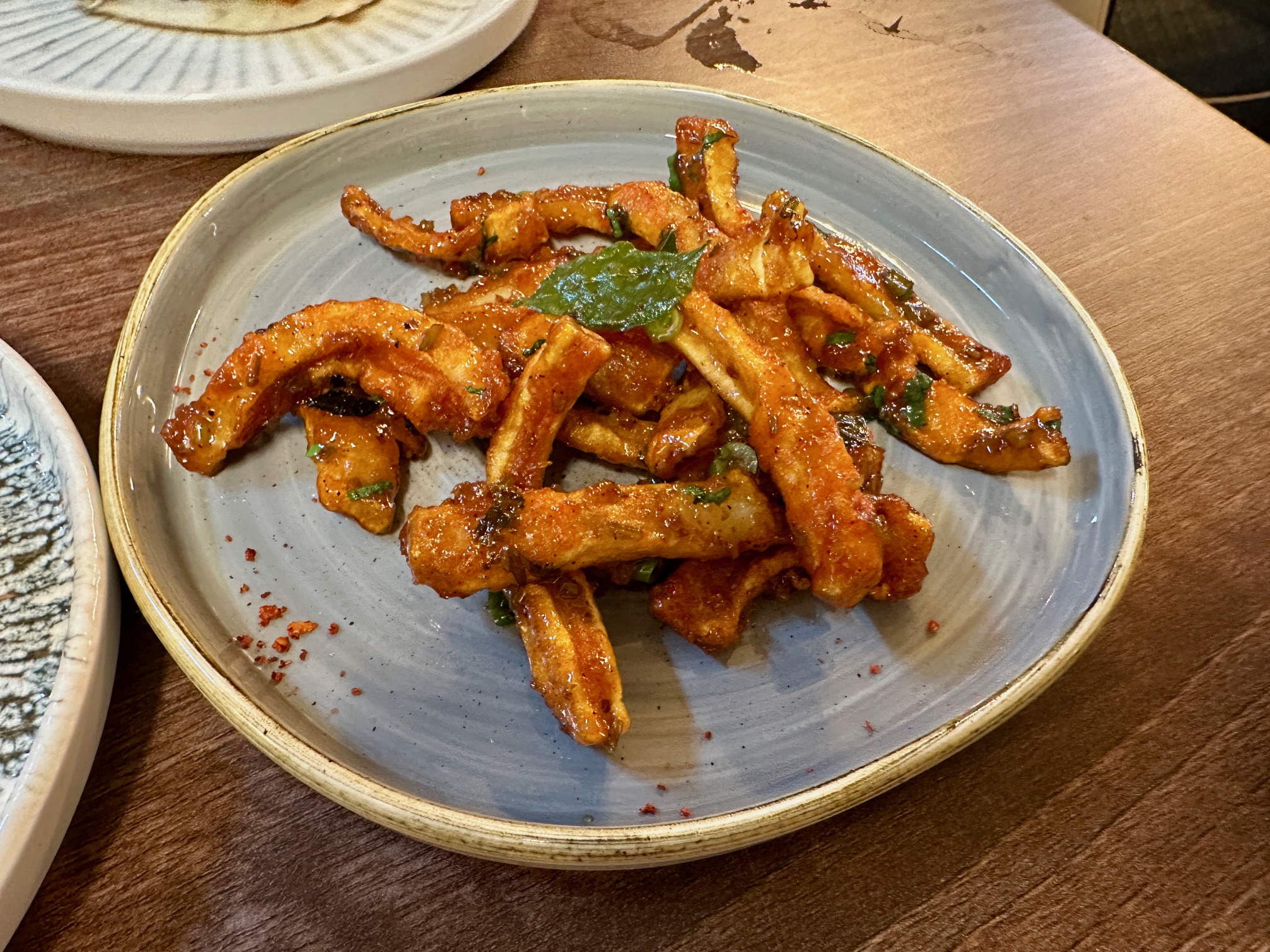
From this point on, you might find yourself wishing I adopted Andy Hayler’s much more concise method, because I’m afraid we very much went wild in the aisles picking a lot of dishes, ordering like the place might close down tomorrow. Andy Hayler might have said curry leaf calamari was good, the apricot glaze giving an extra dimension (13/20). I would say that I really loved this jumble of sticky ribbons of squid, somehow crispy and caramelised without succumbing to bounce or toughness. The menu says that it’s grandma’s recipe: I loved my grandmother very much, but I might have sacrificed her to the devil himself in return for one who could cook like this.
Just as terrific were the lamb chops, two glorious inverted commas of meat, best end blackened from the tandoor but still blushing on the inside. Up there with the best lamb chops I’ve had, and I’ve tried them at Clay’s, and at Didcot’s extraordinary Zigana’s Turkish Kitchen. At sixteen pounds you’d need them to be, but for me they delivered in spades and I was very glad we ordered them.

If you believed the menu, these came with coriander chutney and a smoked aubergine raita: it didn’t feel, from my recollection or looking at this photo, like that’s exactly what was going on. There was allegedly beetroot in the marinade, it felt like it had escaped into the smear on the plate. But to be honest whatever smudge of sauce you add, whatever spiralised veg and leaves you artfully zhuzh on top this stands or falls on the meat and the meat alone. Zoë, far more primal about these things than me, picked it up by the bone and gnawed until she could gnaw no more.

Completing our trio of starters was the only dish, apart from those poppadoms, that Andy Hayler and I both tried on our visits. 12 hour braised, spiced pulled pork rested, in a beautiful tangle, on an uttapam, a thicker, slightly spongy variant on dosa. I really wanted to try this dish for so many reasons – because it’s just absolutely up my alley, because Hayler raved about it, giving it a rare 15/20 and because I’d had something similar at a beer pairing lunch at Clay’s Kitchen last year, and that dish had been one of the best things I ate in 2024.

Did it come close? Yes. You would have struggled to put a poppadom between them, in terms of interest and quality. Clay’s version used minced pork rather than pulled pork, and there was something deeply texturally satisfying about Club India’s slow-perfected strands. Club India’s rendition had more whistles and bells, a coconut chutney, microshoots and fripperies. But if you stripped all that away, you just ended up with a small plate – from either restaurant – that would grace any starter menu, anywhere.
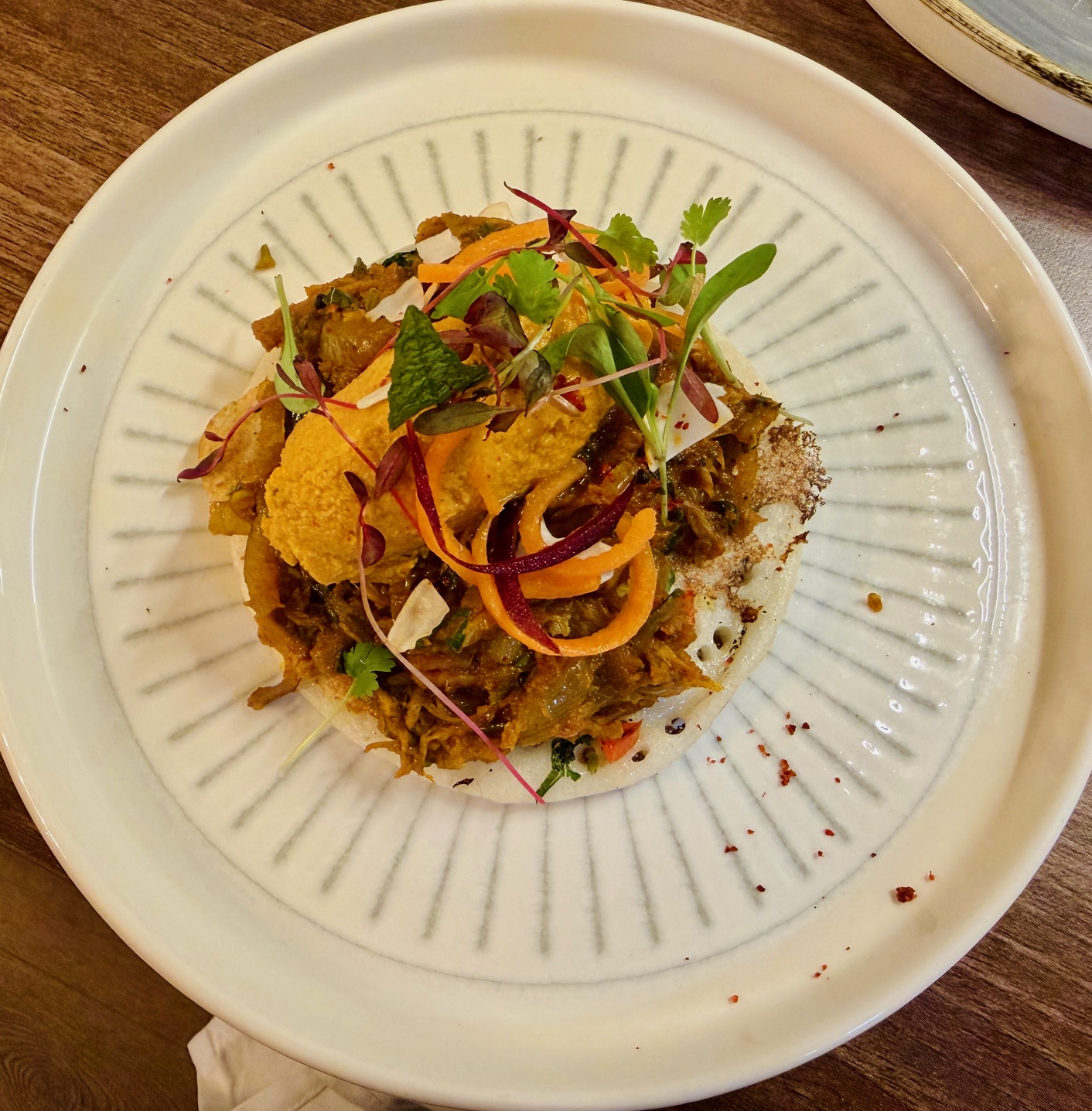
The spicing was a beaut, the coconut chutney went perfectly, I loved it from start to finish. We shared this, as we did the other two dishes, but I could gladly have polished one of these off solo. I could equally have said that about the other two dishes, too.

At this point the restaurant was at its liveliest, I had a gorgeous glass of New Zealand sauvignon blanc on the go and I had that warm feeling that comes from knowing I’m eating at a discovery – no, not a hidden gem, but a find. The starters we’d eaten, for my money, were up there with most Indian restaurants I’d dined at, and at or around the quality I’d come to love at Clay’s.

Could Reading finally have another contender for the crown? I found myself, mid-meal, daydreaming about the rave review I would scurry home and write. Zoë was thinking that this was a place, not a million miles from Woodley, that she could persuade her parents to visit. And that wasn’t all. “Are you thinking this would be a suitable venue for one of your readers’ lunches?” she asked me. I had been doing exactly that.

So it saddens me to piss on the proverbial chips and say that the rest of the meal was a gentle descent from that summit. It didn’t end up in the slough of despond, but it settled somewhere that felt more like settling. And although that’s a shame, in the wider scheme, it doesn’t mean that anything we ate from there on in was bad, it just wasn’t quite as extraordinary.

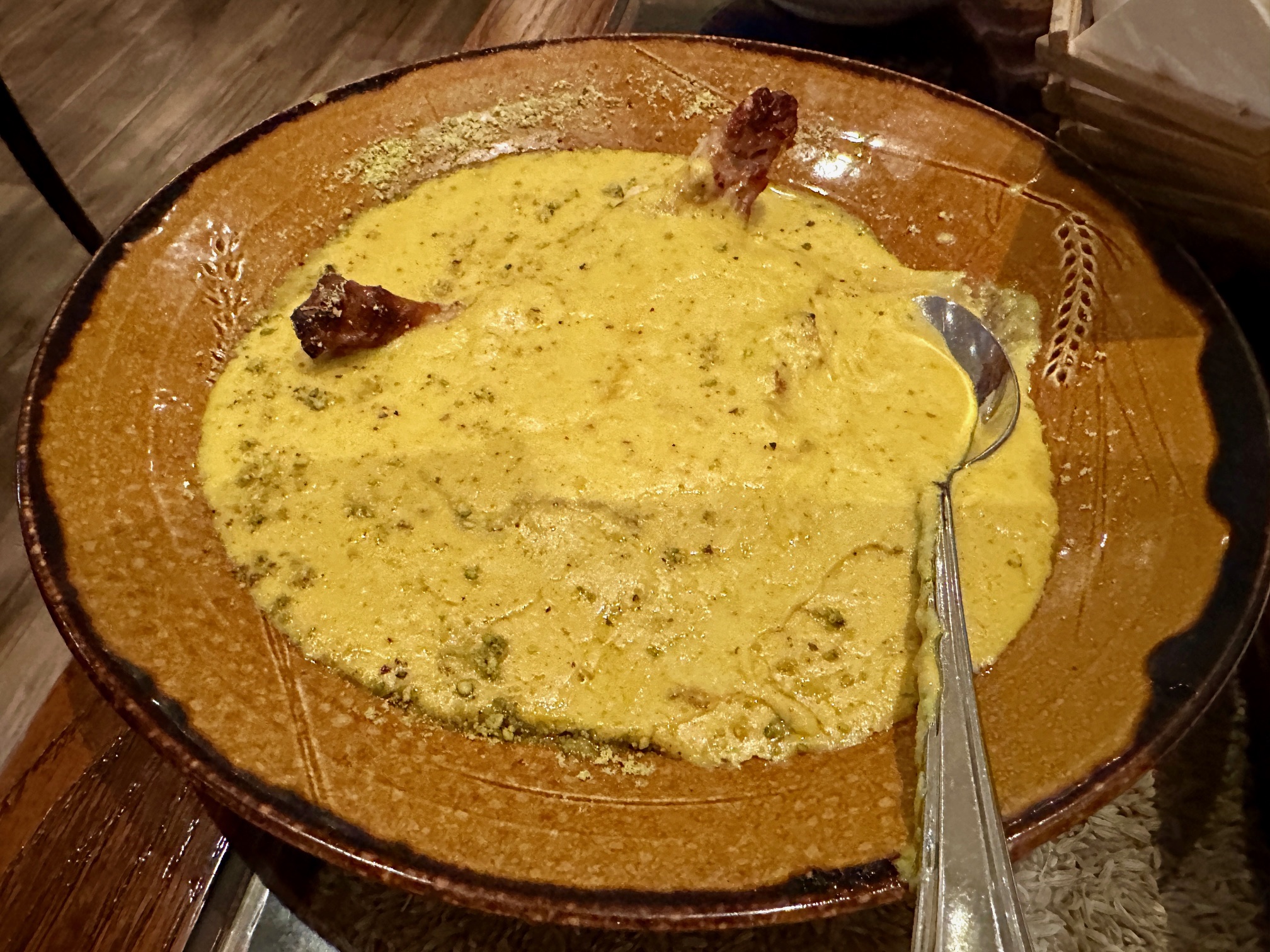
Take the kadaknath chicken curry we’d ordered. One of the things I really liked about Club India’s range of curries was that it mixed up stuff you’d heard of – butter chicken, rogan josh, methi chicken and so on – with dishes I wasn’t familiar with. Kadakhath is a particular breed of Indian chicken that the menu says is particularly known for its gamey flavour, and Club India uses black leg chicken to get as close to that as possible. From that, I was hoping this would be a bit like Northern Spain’s pitu caleya, but this was pretty unremarkable. Breast rather than thigh, too, which reminded me how Clay’s approach to chicken curries is so different from everywhere in Reading.
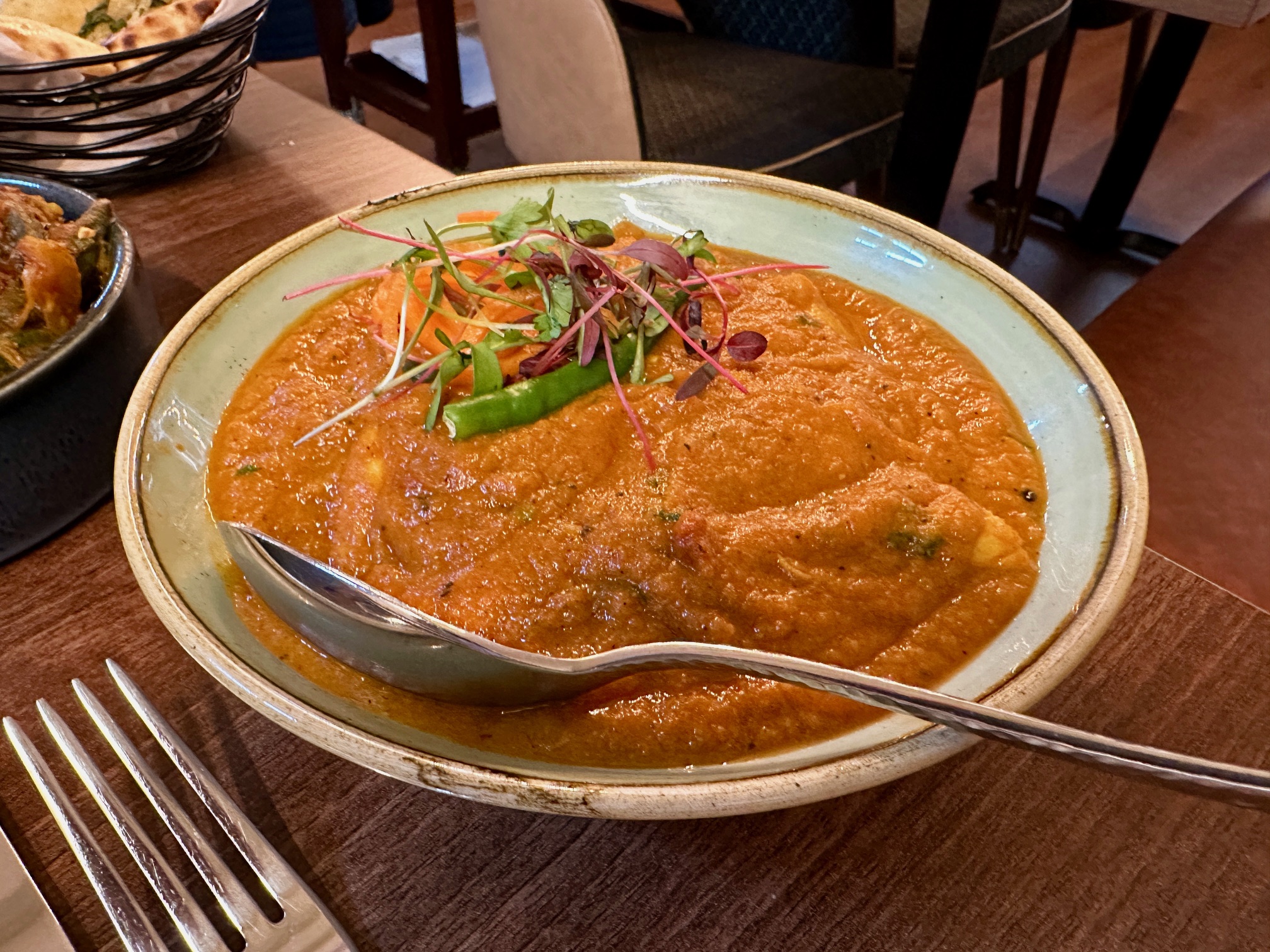
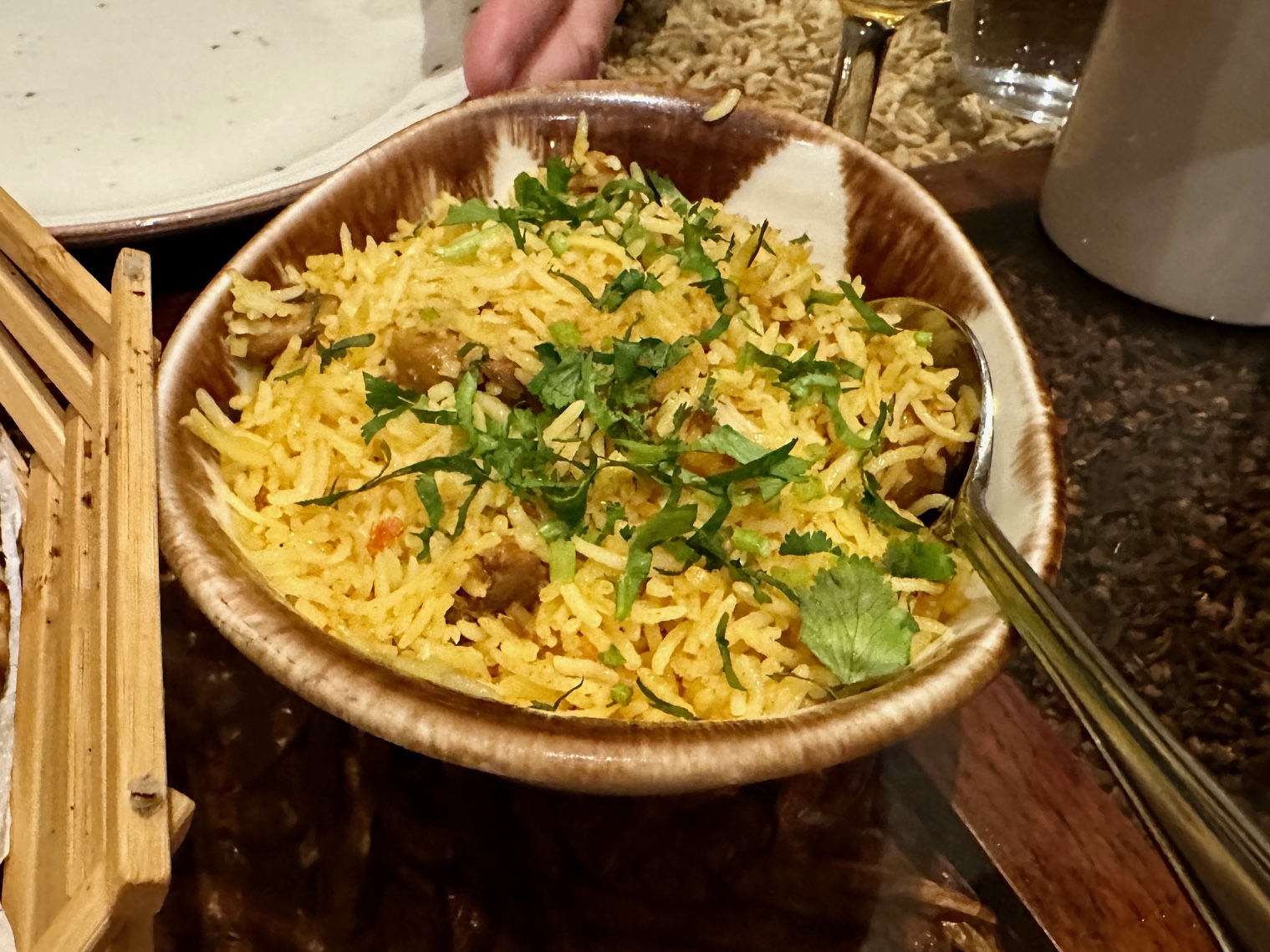
That’s not to say I didn’t like it, or that I didn’t like the gravy, made with fenugreek and crushed peppercorn. I actually very much enjoyed its savoury, almost perfumed depth, those slight wintry hints of leather about it. But everything felt out of kilter. The chicken was submerged in a lake of the gravy, slightly unbalanced, and the gravy wasn’t quite interesting enough to carry things on its own, even dolloped onto some perfectly nice saffron and cumin pulao.

I’m sorry to keep mentioning Clay’s, but it was inevitable that I would in trying to benchmark somewhere like Club India. The gravies at Clay’s, each of those distinct, exceptional sauces, is so captivating that the meat is merely, in many cases, a vehicle. You clean up every last molecule in the bowl with your rice, with some bread, with your spoon, with a finger if you must. Club India didn’t quite reach that standard, which meant that the curries were just a little too wet.

Better, although still not quite there, was a curry described simply as Champaran meat. This was my favourite thing from this section of the meal, and the sauce again had depth and complexity. But what elevated this was the really terrific lamb, marinated overnight and with an almost unbeatable texture, leg at a guess, slow-cooked until it could cleave like kleftiko; this dish is cooked over charcoal in a sealed pot, which probably contributed greatly to how wonderful it was.
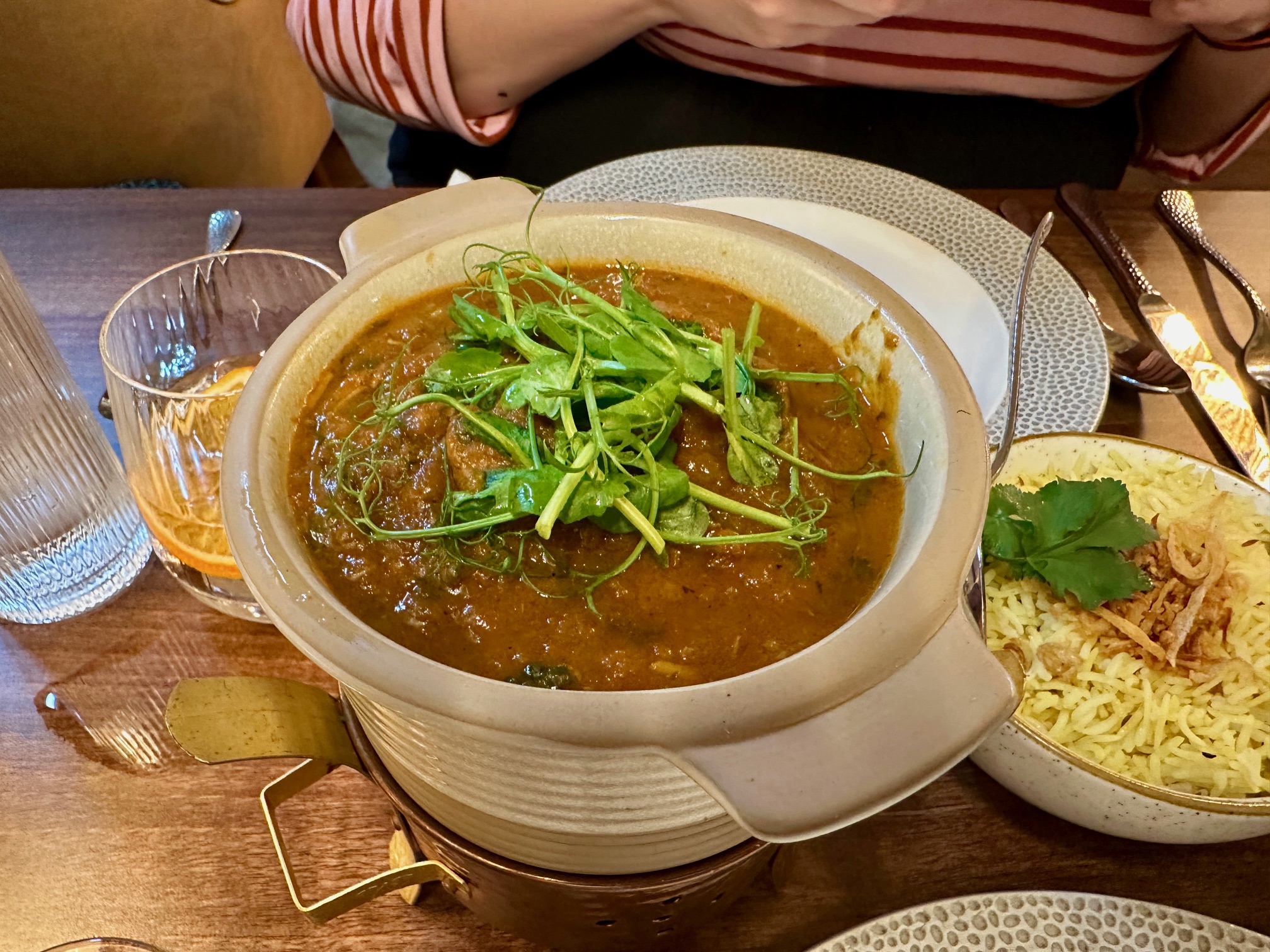
Again, I’d have liked it a little more sticky and a little less swimming, but that didn’t stop it being head and shoulders above most curries you’d get in Reading.

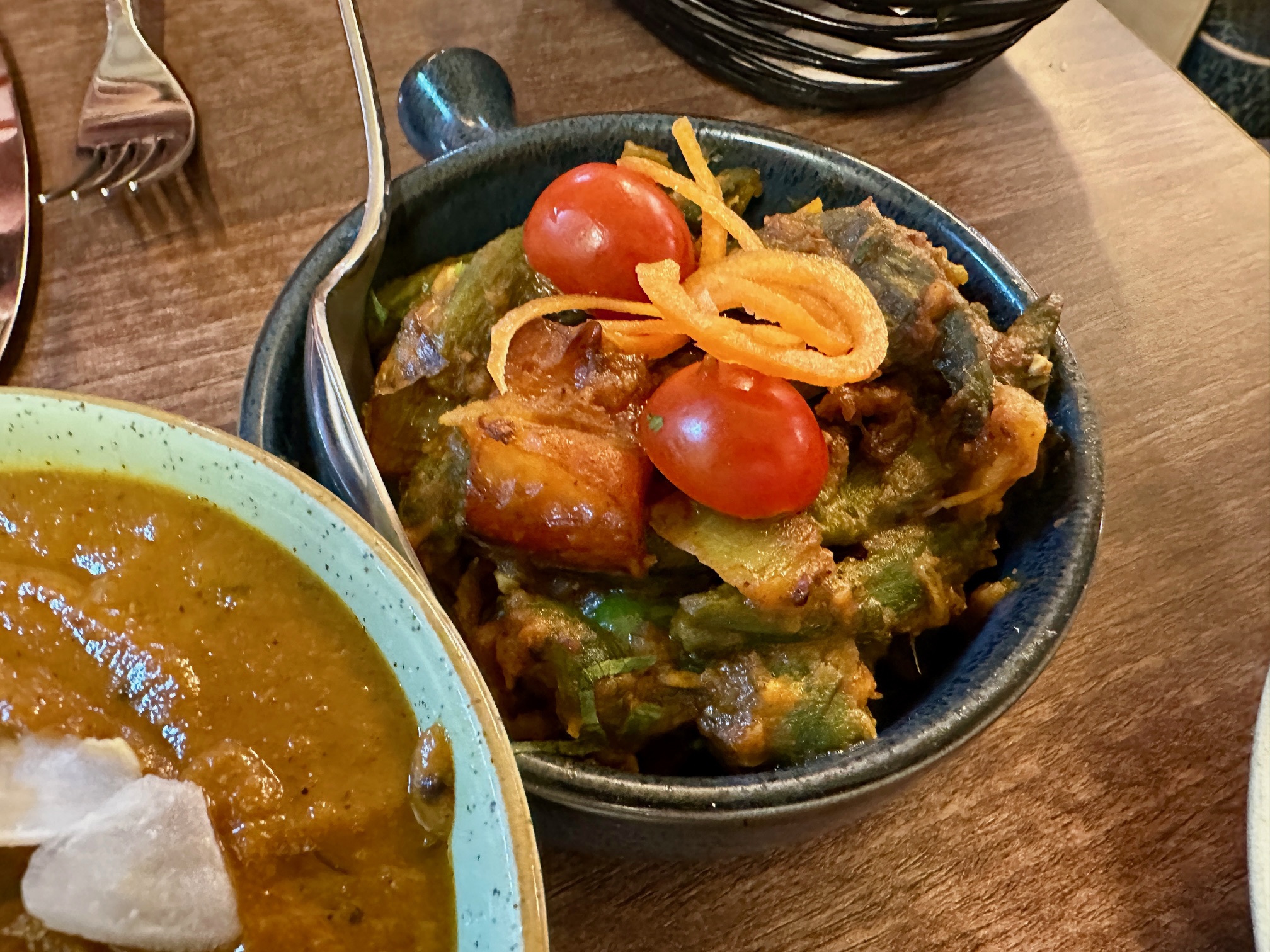
We ordered a couple of vegetable side dishes, one because I insisted and one because Zoë did. Mine was baby aubergine in a sauce with jaggery and tamarind, two of my very favourite things. And yes, a sauce that combined them was as sweet and tangy as you would expect, and I loved that. But I didn’t want a bowl of the stuff with two – just two – baby aubergines bobbing in it. And that, slightly unfortunately, is what I got.

Zoë on the other hand had put in a request for Club India’s okra stir fried with peppers and onions. If she was writing this review she would tell you that she really liked it, and for that matter that she really likes okra. But you are stuck with me, I’m afraid, and Clay’s thinly sliced, crispy take on okra is, I think, the only variant of this ingredient I have ever enjoyed. I feigned generosity telling Zoë she could finish this but she knew, deep down, that it was because I wasn’t a fan.
I will say this, though, Club India’s keema naan is the best I have ever had. This is another to file under ‘Zoë always orders it, and I nibble a bit without any great enthusiasm’. I’ve lost count of the number of times I’ve taken a bite and been confronted by weirdly scarlet, oddly bouncy mystery meat. That fate does not befall you at Club India: the meat lurking in the middle of a deliciously airy naan is properly belting stuff.

It made me want to try their sheekh kebab next time – and credit to Club India, not only do they list the provenance of some of their ingredients but the lamb for the Champaran meat comes from one place, namely North Wales, while the lamb for the sheekh kebab comes from Romney Marsh, completely the other end of the U.K. You do have to at least slightly admire that.

By this point we had checked the timetable for the bus back into town and realised that neither of the options – namely leaving in ten minutes or lingering at Club India for over an hour – were going to happen. So we embraced the concept of a taxi and rewarded ourselves with dessert. I was hoping the gajar halwa that Andy Hayler had rather enjoyed would be on the menu, but the compact selection of four had already moved on since then. It was the one area where Club India’s imagination felt like it had run out, because when one of the four options is a chocolate brownie with vanilla ice cream I think, as an upmarket Indian restaurant, that you’re playing it far too safe.

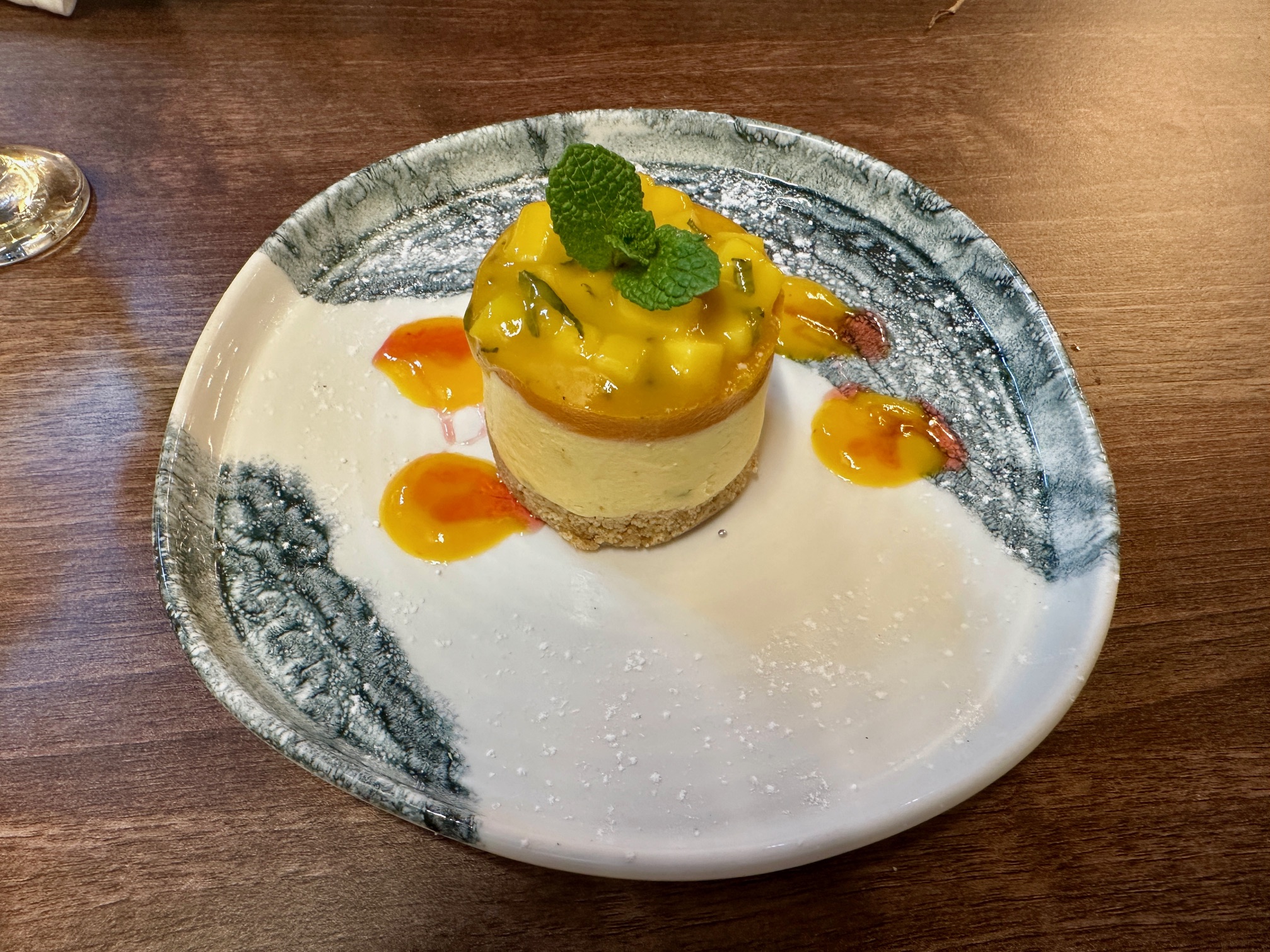
Playing it safe rather defined my dessert, too. A mango cheesecake, a small dainty cylinder, was genuinely quite charming and went nicely with the diddy glass of dessert wine I’d ordered with it (a 50ml pour is on the small side, but it was £5 so it didn’t matter so much). But again, the menu promised a hint of chilli and if it was a hint it was too subtle for me. I’d have preferred a clanger of chilli, if we were picking between extremes, and it rather appeared that we were.
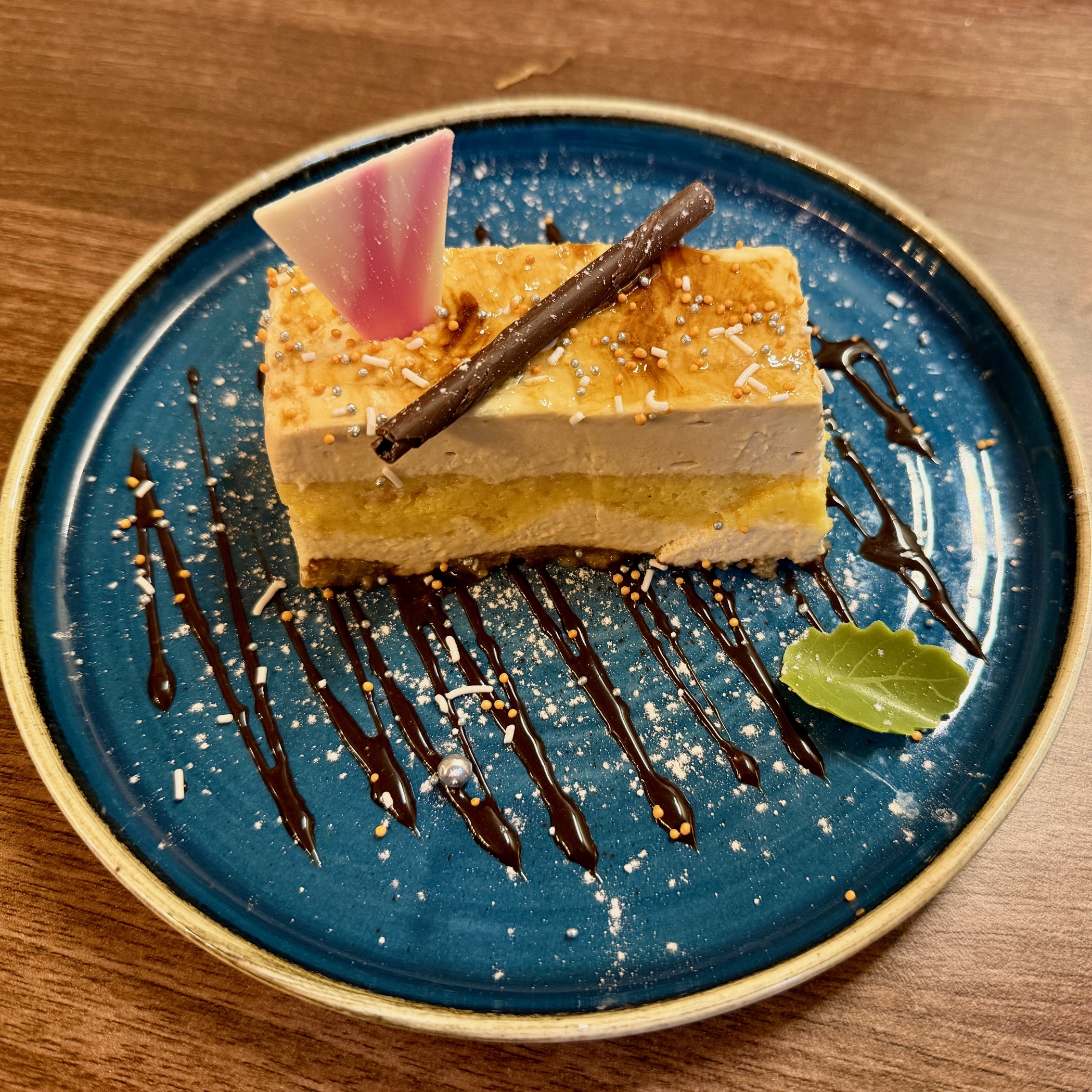
I think Zoë ordered better, although she mightn’t have agreed. Rasmalai tiramisu was, for me, far more imaginative and more in keeping with the rest of the menu. I’m not sure it was really reminiscent of either, more like the two had been put in separate machines and teleported into a blend, like something out of The Fly. But I liked it and envied Zoë, and the pleasingly squeaky sort-of-cheese in the base made it something you’d eat to experience, let alone to taste. For me that fusion, that experiment worked.

Zoë seemed to feel differently, but she does like okra and me, so there are already a couple of valid question marks against her judgment.
At the end of the night, Uber on the way, I settled the bill and found myself thinking it was generally decent value. We had a couple of aperitifs, a couple of dessert wines, I had a glass of white and then there was that onslaught – of poppadoms, of three starters, of curries and side dishes and rice and naan and dessert. We’re not going to play The Price Is Right, but when it came to £170, including a modest 10% service charge, I felt like I’d had a lot of evening for my cash. We were there nearly two and a half hours, enough time to watch multiple sittings come and go, and to watch the staff properly earning their money.

So where do you benchmark Club India, after a meal like that? Well, first of all: Winnersh and Woodley, that eastern edge of Reading, is very fortunate to have it on their doorstep. I think it will do very well, partly because it is indeed good and partly because nothing around there even comes close to it.

In terms of the kind of place it is, the most obvious comparison, for me, is Masakali; they are trying to be similar restaurants, but Club India far surpasses its predecessor on the Caversham Road.

Club India is the restaurant Masakali hopes to be when it grows up, and an illustration of the difference between having your menu dreamt up by a head chef, with some advice from a decorated chef in an advisory capacity on the one hand, and having your menu mechanically assembled by some kind of offshore committee slash agency on the other. Quality will out: Club India is way ahead of that competitor.

But as for the others? If everything else had managed to sustain the extraordinary quality of those starters, the arrival of Club India would be one of the big Reading food events of 2025. That it doesn’t is a pity, but it doesn’t change the fact that even Club India’s more ordinary dishes still feel like a cut above most places.

So if they don’t quite reach the level of Clay’s Kitchen, they should console themselves by knowing that they are in good company there, in a support group made up, pretty much, of every restaurant in Reading. But if you are comparing them to the next level down, the likes of Chilis, I think they can give a very good account of themselves.

So there you have it. I guess if I was Andy Hayler, I would have summed this up by saying, in his inimitable style, 12/20. But I’m not Andy Hayler, I’m me, and so I’ll conclude this review with that slightly enigmatic score below. It’s the only way I know.

Club India – 8.1
355 Reading Road, Winnersh, RG41 5LR
0118 3048701

https://www.clubindia.co.uk

Since January 2025, Edible Reading is partly supported by subscribers – click here if you want to read more about that, or click below to subscribe. By doing so you enable me to carry on doing what I do, and you also get access to subscriber only content. Whether you’re a subscriber or not, thanks for reading.

Restaurant review: Tanatan

Some restaurants wind up so indelibly linked with the buildings that become their homes that years later, long after they are gone, you still can’t imagine another menu outside, someone else trading behind those doors. Sometimes, no other restaurant even tries: ever since Dolce Vita left its spot on the top floor of Kings Walk nobody has taken its place, but even if they did, I don’t know how I’d feel eating somewhere that, to me, will always be Dolce Vita.

Sometimes the place stays the same but changes hands, with or without changing its name. At some point I should return to Namaste Kitchen, and people tell me it’s good, but without Kamal running the front of house and that magical menu of Nepalese small plates I’m not sure how I’d overcome the strangeness of dining there. I’ll do it, one day, and when I do the review will have to have a different preamble to this one, because this one’s taken.

Ditto Spitiko, where Kyrenia used to be. The site’s the same, the menu is similar, the furniture might be too, and Spitiko may well be a perfectly decent restaurant. But in my mind it will always be Kyrenia, the place where I celebrated my thirtieth birthday, where I’d always go for mezze and kleftiko, for a bottle of Naoussa Grand Reserva and Ihor’s twinkliest welcome. Its golden age was over fifteen years ago, yet I remember it like it was yesterday.

That’s before we get to the Lyndhurst, now under its third set of new management since they hosted guests for the very last time – my wedding guests, no less. This may sound silly, but I don’t feel ready to eat there again. Perhaps this sentimental streak should disqualify me as a restaurant reviewer. But on balance I don’t think so: these places get into our hearts, occupy a place in our affections, become part of our story. Not to feel that kind of thing is not to be alive.

But of course, nearly every restaurant was once somewhere else. Buon Appetito, that I still miss, may have become Traditional Romanesc, but before that it was Chi Oriental Brasserie. And again, when Chi closed I was devastated. You know where else Chi Oriental Brasserie used to live? The site that’s now Masakali. And I was sad when Chi left that spot on the TGI Friday roundabout, too, but I was equally forlorn when San Sicario, a wonderful restaurant, gave up the fight at that very location.

All these places come and go. They make your day one month and break your heart the next: that’s what getting attached to a restaurant can do to you. Worse still, throughout it all TGI Friday has been plugging away on the other side of that roundabout for as long as I can remember. I wonder if restaurants have their own version of that well-worn maxim that only the good die young.

All this might go some way towards explaining that although new-ish Indian restaurant Tanatan opened on London Street last December, it’s only on a week night in July, months later, that I went there with my oldest friend Mike for dinner. Because even though the site was an empty shell for over two years, before that it was Clay’s Hyderabadi Kitchen, and it’s still hard for me to think of it as anywhere else.

Clay’s, where I ate for the first time before it opened, where I celebrated birthdays – mine and theirs, as it happens – where I went on random evenings because it was just round the corner from my little house, where I ate with friends, family and visitors, where I held lunches for my readers. Few rooms contain as much of my personal history as that one, so I knew it would be odd to eat there again, to eat Indian food there at that, and to know that it was somewhere new.

Tanatan’s story is a curious one, by the way. In the run up to it opening, the Reading Chronicle trumpeted that it was a high end Indian restaurant which very much seemed like the natural successor to Clay’s. Not only that, but they claimed that it was the first U.K. branch of an upmarket Indian group of restaurants with its other branches in India and Dubai.

That all sounds magnificent, and Tanatan’s website contains a menu full of temptations. There’s only one hitch, which is that there’s no evidence at all that Reading’s Tanatan has any connection to that chain at all. It’s not mentioned on their website, and in fact Reading’s Tanatan, for a long time, didn’t have a website of its own. Now it does, but the menu bears about as much resemblance to the other Tanatan’s menu as I do to Jude Law.

It looks suspiciously as if the Chronicle had flagged the name, put two and two together and come up with five, which is a mistake not even the AI that writes most of its articles would make. So, what was this Tanatan, our RG-based restaurant, like? Was it a worthy successor to its precursor, or an attempt to hop on a bandwagon two years after the bandwagon rolled north, over the river? It was time to brave that all too familiar room and find out.

Subscribe to continue reading

Become a paid subscriber to get access to the rest of this post and other exclusive content.

Restaurant review: House Of Flavours

It’s incredibly frustrating, in this day and age, when a restaurant doesn’t have a website. How are you supposed to figure out what you’re going to have, when you can’t spend at least fifteen minutes poring over the menu in advance of your visit?

And how can you tell when it opens and closes? You can try Google for that, of course, but different restaurants report trading hours in different ways – does closing at 8pm mean it closes at 8 sharpish, or that the kitchen closes at 8? If only they had a website you could use.

This all occurred to me last week, when I was going to visit Zi Tore, the newish Italian place on Smelly Alley that has taken the place of the much lamented Grumpy Goat. It has no website, although you can track down the menu if you try hard enough; an Italian friend of mine has been a few times and really rated it, not only encouraging me to visit but telling me all the best things to pick on the menu.

Google says that it shuts at 8, but I had done my homework here, too. Another friend was looking for somewhere quick and easy to eat in Reading a few weeks ago, prior to attending the quiz at the Allied and I suggested Zi Tore. “I wish they’d publish their opening hours somewhere” she said, not unreasonably. “I’d like to be assured that there will be delicious things available at 7pm.” But then she went (“it was completely dead”) and enjoyed the food. So that settled it.

I arranged to go there with Jo – who made a cameo appearance in this blog five years ago – safe in the knowledge that it would all work out fine. We met at Siren RG1 for a couple of beers, which was enough to persuade me that they hadn’t fixed their pricing issues from last year, and mooched over to Smelly Alley ready for pizza and pasta. Jo’s family is Italian, too, and she has strong opinions about Italian food: I was looking forward to seeing what happened when those views came into contact with Zi Tore’s dishes.

Can you see where this is going? Of course you can. We arrived at 7pm to find Zi Tore dead and the guy behind the counter turned us away. “Sorry, we close at half seven”, he said. Exasperating, really: if you want to just be a lunch place, be a lunch place. If you want to be a lunch place that does coffee in the afternoon, fair enough. But why offer pizza and pasta and close at half-seven, a full half hour earlier than you claim you do? I took a menu, so now I know exactly what they serve. It didn’t have opening times on it, either.

So there Jo and I were, standing on Union Street a couple of beers to the good like a prize pair of limoncellos. Where to go? Fortunately, I keep my to do list online, so it only took a few minutes poring over it on Union Street before we were on our way.

Some places, like Dolphin’s Caribbean Cuisine, haven’t been open long enough yet. Others, although high on my list of priorities, were already scheduled in with other people. And some, the likes of Jollibee or Biryani Mama, may even close before an evening comes where I consider dinner there and think “oh, go on then”. But there was a place I’d been keeping in my back pocket to to do this year, and Zi Tore downing tools gave me the perfect opportunity: back to House Of Flavours it was.

“I’m really sorry we won’t get to try somewhere Italian” I said to Jo as we headed down Broad Street.

“It’s okay” said Jo with a wolfish grin. “I am rather partial to a curry.”

It might be hard to remember a time before House Of Flavours occupied that spot, and many of you might not have a history with Reading that stretches back that far. It opened nearly 12 years ago, a month before I started this blog, and in that time it has played an enormous role in reshaping how people in Reading see Indian food.

A couple of years ago I named it as one of the most influential restaurants of the previous decade and when I visited it on duty, before my blog was even six months old, it got the highest rating I’d handed out in the town centre. I say this all the time, but I don’t know if Reading would have had the appetite for Clay’s without House Of Flavours paving the way. It was very much John The Baptist (or Deep Thought) in that respect.

And actually this is how far back my memories go with Reading – I remember that before it was House Of Flavours it was the original home of the short-lived Turkish restaurant Mangal, and a pub, and a tapas place. Mangal made me want to go to Istanbul on holiday, which I did, and the tapas place made me want to go to Granada, and I did that too. But that was mostly because I knew eating in those cities would be better than eating in those two restaurants.

Before that it was the original branch of bar slash restaurant Ha Ha – we’re talking over twenty years ago, now – and the only place Ha Ha ever made me want to go was back to Ha Ha. I loved that place: House Of Flavours’ loos still bear the original Ha Ha signage, which makes a toilet visit surprisingly nostalgic.

Anyway, visually I’m not sure House Of Flavours has changed much in that dozen years. It still has that handsome front room looking out onto the Kings Road, with the luxe comfy chairs and glass-topped tables with inlays of spices underneath. Further back it got a little more cavernous, but I’ve never knowingly sat in that part of the restaurant.

There was also a hat-wearing chap standing in front of the bar, playing guitar and singing: I have to say that I clocked him and immediately thought we should be eating somewhere else, but as it turned out he wasn’t loud at all. Besides, he couldn’t compete with the hubbub: House Of Flavours was reasonably busy on a Tuesday night, especially in that front room.

House Of Flavours’ menu has changed subtly in the last twelve years. Much of what I ordered on my visit then you can’t order there now, but it doesn’t feel like a drastically different place. The main concession to changing tastes is an Indo-Chinese section which I’m pretty sure was not there back in the day, no doubt influenced by the growing interest in those dishes, itself caused by spots like Bhel Puri House doing them well. So House Of Flavours’ owners have done a canny job, tweaking here and there without overhauling anything.

A reasonable proportion of the dishes, in the section marked “Old Favourites”, are the kind of things you find all over the place, in Reading and beyond. But the section of signature dishes has a range of less generic options, and it’s also worth saying that House Of Flavours’ range of vegetarian dishes, on paper at least, is very interesting and not stuff from elsewhere on the menu with the star of the show swapped out for something less formerly sentient.

Irrespective of all that, nearly all the curries are thirteen or fourteen pounds, unless you want to go crazy and order the “lobster tak-a-tak” – in which case, and I mean this with kindness, you might have a tiny bit more money than sense.

Now, before I tell you about what we ate I just need to get something off my chest, something that has always made me feel a little like I’m not a complete, well-rounded person. Here goes: in Indian restaurants you always seem to have a choice between Cobra and Kingfisher, and it’s always presented as some kind of defining choice, like the Beatles or the Stones, BBC or ITV, Coke or Pepsi, VHS or Betamax. As if there’s some kind of correct and incorrect answer, as if your decision Says Something About You.

Am I missing something? Because to me they seem to taste almost exactly the same and yet, depending on who I’m with, I sometimes feel like I get the silent nod of approval or eye roll of judgment when I pick – always at random – the right or wrong one. You can all chip in, in the comments, and tell me that I’m wrong and one is clearly better than the other. On this occasion, I ordered Kingfisher and it tasted exactly like Cobra. Or was it the other way round?

(I just checked the receipt: it was Kingfisher.)

We started with poppadoms, because many people think that a conventional Indian meal has to begin that way. House Of Flavours is upmarket enough to charge you £1.99 per person and give you one each, neatly split in half, rather than asking you how many you want and letting you load up before the main event. They were perfectly nice, although they used to do seeded ones and those seem to have fallen by the wayside. They came with a very good mango chutney with a little out and out sweetness sacrificed for complexity, a decent raita, spiced onions and a deeply anonymous pale pink sauce neither of us warmed to.

“It looks a bit like Thousand Island dressing” I said. Jo spooned some on to a shard of poppadom.

“I think Thousand Island dressing would be better. At least it would taste of something.”

“I miss lime pickle, myself.”

By this point the soloist in front of the bar had moved on to a couple of songs we recognised. Sit Down by James was one, although in this context it sounded as if he was trying to talk people out of leaving. Shortly after he launched into Half The World Away, the classic Oasis B-side. I thought it was possibly his best performance of the evening. Jo, on the other hand, sings in a band, and I could tell she was judging his efforts the way I was going to judge the food: not unkindly, but critically all the same.

We’d picked a selection of things to share, and they were easily the best stuff we ate all evening. House Of Flavours offers three different sharing platters but Jo isn’t a massive fan of fish and neither of us wanted a vegetarian selection, however sumptuous, so the “Gourmet Sharer Platter” it was. The name might be a tad naff, but what was brought to our table absolutely was not.

It was a real treat: two different types of chicken, one chicken tikka and a more beige number which had clearly seen plenty of yoghurt, paneer and a couple of seekh kebabs, all cooked in the tandoor. This took me back to my first trip to House Of Flavours all that time ago, eating their lahsooni chicken tikka and being in raptures. That dish is no longer on the menu, although there’s a big tandoor section if you’re in a larger group and want to mix and match. But for two people, this was both excellent and plentiful, especially for twenty-two quid.

I can safely say that I struggled to pick a favourite. The paneer was better than it looked, with just enough caramelisation despite its slight paleness. But a lot of this subverted appearances: you’d expect the golden chicken tikka to be better than its albino sibling, but in terms of taste the latter won out.

Because I never shy from difficult decisions, I’d say on balance the lamb seekh kebab was the outright winner. Coarse, earthy, superbly cooked and, uniquely among these four, seething with heat. Perfect with the mint and coriander chutney, which for me won out over a slightly more muted dip with yoghurt. If more of the options had been fiery, that might have come into its own.

We had onion bhajis with that, rather than as a side with our mains. That was partly to introduce some variety and mostly because I think there’s little sadder than taking delivery of an onion bhaji when you’re too full to do it justice. I rather liked it – light and airy rather than dense, but managing not to fall apart. It’s a fine balance, and so often bhajis can either be stodge or a fast disintegrating fritter. House Of Flavours got this right. I also enjoyed the sauce that came with it, which I suspect had some date and tamarind in it. You know, the way HP Sauce does.

At this point, I felt like all was right with the world and the travails of Zi Tore’s optional opening hours were less an unpleasant memory, more a convenient way to begin a review of somewhere else. Jo and I were having a good natter about all sorts, and the evening was passing very easily. Jo used to work with my wife, so we always find plenty of different perspectives to share, and we’ve both lived in Reading for a very long time, so know enough of the same crowd to be able to gossip about literally dozens of people.

By this point the man on the guitar had reverted to some kind of consonant-free wailing, like Chris Martin with his knob stuck in a zipper. It was the kind of thing the late, great Robin Williams used to refer to as one giant vowel movement. But, in the immortal words of W.H. Auden, it was not an important failure: everyone was having a lovely time, and we were too. I was already thinking at the point, at some stage in the future, when I sat down at my MacBook and wrote a heart-warming piece about how House Of Flavours has still got it.

Then the mains turned up.

And they weren’t terrible, but they weren’t great either. I had chosen the pistachio chicken because it’s been a signature of the restaurant for a very long time and I think I’ve maybe only ever had it once. The menu says that although it was a mild curry it was full of “bold flavours and textures” and I, usually suspicious of a korma or a pasanda, thought this was something I’d like to experience.

In terms of bold textures it was a couple of pieces of chicken, a supreme at a guess, bone still on, that had been cooked in a tandoor, cut into chunks and then submerged almost totally in the sauce. It looked, I’m sorry to say, like a cat had hurled on it. I don’t know how you made a dish like this more visually appealing – that may be impossible but if it is, I think you at least need to find a way of making it less unappealing.

I could have forgiven that if the taste had lived up to the billing. Heat isn’t everything, and a mild curry is not a crime, but in the absence of heat I wanted some complexity, and that wasn’t here at all.

One of the ways in which House Of Flavours blazed a trail in Reading is that F word, Flavours. Everyone uses it now, so you have Madras Flavours, Bakery House rebranded as Lebanese Flavours, Palmyra rebranded as Afghan Flavours. More flavours than a Peter Andre megamix. But House Of Flavours did it first, a long time ago, so they of all people ought to know that if you have that word in your name your dishes have to taste of something.

The only thing worse than no flavour is the wrong flavour, and that was Jo’s lot when it came to main courses. Initially she had wanted her reference dish, lamb tikka masala, but the menu only had chicken tikka masala on it.

“That’s okay, I’ll just ask them to make it with lamb” said Jo, unwisely, and so I launched into the Gospel According To Clay’s. I told Jo that Indian restaurants that just swapped out interchangeable meats with the same base sauce were the way Indian restaurants used to be years ago, but that it was better for each dish to have a distinct start and end point, its own mix of spices and, crucially, the meat and the gravy getting to know each other properly.

You can probably imagine how dull that was for Jo to sit through, and you can probably also imagine how smug I was when our server told Jo that, no, she could only have the tikka masala with chicken. So she did, and it was not a great advert for the meat and the gravy getting to know each other better.

The chicken was, in fact, really lovely. But the sauce was that kind of brick red, orange concoction that didn’t feel a million miles from a base sauce: irony of ironies. And it was sweet – strangely sweet, without any heat to pep it up. What had gone wrong? Jo had talked, on the way to the restaurant, about how she always over-ordered at Indian restaurants, got something to take home for her (or even her beloved dog Diesel). This was a double whammy: she left some, but didn’t want a doggy bag.

The realisation I came to, in eating all this, was that House Of Flavours had lost its way a little, and it was instructive to look at what it was good at and compare it with its competitors. I always say about Clay’s – still the quintessential Indian restaurant in this or any town, even if I’m friends with the owners – that the gravy is king and the meat, really, is secondary.

You could fish every piece of tender, melting chicken thigh out of their ghee roast chicken and you would still eat the gravy with your fingers if necessary. I’ve had it at home before, as part of their delivery range, and licked the spoon I’ve used to dish it up.

But by contrast at House Of Flavours, protein is the master and the sauce is just something to have it bobbing in. That’s why the starters were so good, and why the meat in our mains could have been great, if it hadn’t come bathed in an afterthought. It’s such a pity, but they’d almost be better off calling themselves House Of Meats. It’s not a sexy name, but it might set expectations better.

This was also the problem with the sides. I rather liked the keema naan, although I’ve rarely met one I didn’t. And the rice, packed with mushrooms, was pleasant: it might have been more than that if the advertised cumin had come out to play.

But these accompaniments, however great they are, come to life in the presence of a great sauce. And where there isn’t a great sauce, they are just things you mix with or dip in an underwhelming sauce, aware that they are somehow diminished by the act. I so wanted to love my meal. I so wanted not to write paragraphs like this.

There wasn’t much more to say, and dessert was out of the question. So we finished our beers, still none the wiser about how they differed from Cobra, and got the bill from our excellent server. Dinner for two came to eighty-four pounds, not including tip: when I went there in 2013 we had one more course and a couple more drinks and paid twenty pounds less. So it goes. I still don’t think House Of Flavours is terrible value, if you pick the right things. But that’s assuming there are right things to pick.

There must be: our starters were great, and the place was packed. The thing is, though, that long-lived restaurants exist in a continuum, and ever since I published my first review of House Of Flavours in 2013 people have been popping up at regular intervals to tell me I was wrong.

“Will not be going back” said one comment, the April after I reviewed it, back in 2014. “Hard to believe it is the same place” said another detractor, the following April. “The worst kind of inauthentic ‘Indian'”, he went on. “I will not be returning.” Saying I was wrong about House Of Flavours seemed to be an occasional thing. Two years later another commenter weighed in. “I’ve been there twice and been very disappointed both times” he said. Even back in 2019 people were still stopping by to tell me House Of Flavours had gone downhill. “Disappointed by my recent visit” said a fourth person.

Maybe this writeup is just the latest in a line of perspectives that House Of Flavours isn’t quite as amazing as it was in the heyday of 2013. I suspect it will have the same effect on the restaurant as all of those comments, though: House Of Flavours will not be dented by this review, and that’s probably as it should be. You may well have your own opinions about it already, and they mightn’t be altered by this either.

But I hope mine was not a representative experience, because I would very much like House Of Flavours to still be there in another twelve years, even if I have stopped reviewing restaurants by then. I always thought it was much closer to Clay’s than it was the likes of Standard Tandoori or the Bina, but time stands still for nobody, and unless it’s careful it might converge with the likes of those restaurants. Even in the town centre it has competition: Chilis, always excellent, is snapping at its heels.

I don’t mind being wrong. It’s an occupational hazard of reviewing restaurants and putting your opinion out there every week. But I don’t often hope to be wrong quite as much as this. Besides, it has a website, it closes when it says it will and it doesn’t turn hungry people away at just gone 7pm. In that respect, if in no other, it can still teach some of our newcomers a thing or two.

House Of Flavours – 7.0
32-36 Kings Road, Reading, RG1 3AA
0118 9503500

https://house-of-flavours.co.uk

Since January 2025, Edible Reading is partly supported by subscribers – click here if you want to read more about that, or click below to subscribe. By doing so you enable me to carry on doing what I do, and you also get access to subscriber only content. Whether you’re a subscriber or not, thanks for reading.

Restaurant review: Calico

As I’ve said before, when I write a restaurant review I find it helps to have a hook. Why this place this week, out of all the restaurants out there? Why do I think you might want to read about this one? Sometimes it’s easy – with a new place, a change of management or an old place with a new chef, or somewhere that’s been mentioned in dispatches in the local or national press. Other times, it’s about the wider context: for instance the trend for biryani or sushi places in Reading.

But there always, ideally, needs to be something. I never assume I can just plonk a review up on the blog and expect people to read it no matter what: attention, like money, is a scant resource these days. Everybody’s got to earn it.

With Calico this week I was spoilt for choice, because I could think of three angles. The first is that Calico – technically “Calico Bar & Eatery”, but let’s not call it that because ‘Eatery’ is so naff – belongs to that niche club of Reading restaurants where everybody knows it exists, but nobody seems to know anyone who’s been. I’m sure some of you have, don’t get me wrong, but I’ve never heard anybody talking about it. This is possibly the easiest “in” for a restaurant review, because you might want to know whether Calico is any cop; don’t worry, I will eventually get round to telling you that.

I think it may be a hotels thing, because other members of that select group include The Reading Room and, these days, Malmaison; Calico, you see, is the restaurant in the 1843 Hotel, which for as long as I could remember used to be Great Expectations. And that brings us to the second possible angle, because Great Expectations played an enormous part in my adult Reading life and I’ve still not entirely come to terms with the fact that it’s gone. So, does the thing that replaced Great Expectations constitute an upgrade?

Ah, Great Expectations. I spent many a post-work Friday in that pub drinking crappy booze – Crabbie’s Ginger Beer, if memory serves – with friends and colleagues, enjoying the faux Dickensian shopfronts (Mr Crabcrotch The Fishmonger or suchlike) and shooting the breeze. It was almost a sign of the passing seasons in Reading, as reliable as putting your clocks forward and back or going to the beer festival. In the summer you went to the Allied, in the winter Great X.

The cast of characters was different each time, but the location was the same, week after week. Behind that grand façade was a slightly naff, tatty pub, and if it didn’t really do food – except for that period when it served something like a dozen different kinds of cheesy chips – it was still the naff, tatty pub of choice. I knew in theory that it was also a hotel, but I only knew one person who ever stayed there and he told me it wasn’t an experience to repeat. I loved the irony of a place being called Great Expectations, and so comprehensively failing to meet them.

But as a watering hole it holds a special place in my heart, part of a Reading that is now gone forever, along with its former neighbour the Global Café and, further up the hill, the After Dark. And for over ten years I lived on London Street, and so all of those places were my locals, along with the post AD delights of Bodrum Kebab, before it closed, reopened as Chicken Base – which it absolutely was, by the way – and eventually became the first home of Clay’s.

So walking down to Calico on a gloomy October evening, looking up at the glowing windows of my old flat and wondering who lives there now, it felt weird that the world had moved on so very much, even though that’s what the world invariably does, whether you’re paying attention or not.

The third possible angle, by the way, was that this week my dining companion was the published poet, compère of Reading institution Poet’s Café and Caversham resident Katie Meehan, a long-standing reader of the blog who kindly responded to my appeal earlier in the year for people to join me for reviews. A bit of culture at last: as somebody who churns out prose with questionable literary value, I was hoping against hope to become highbrow by association. And at the risk of sounding a bit like Michael Parkinson, Katie’s collection, the splendidly named Dame Julie Andrews’ Botched Vocal Chord Surgery, came out last year and is available from Two Rivers Press and all reputable bookshops.

Katie, it turned out, had been to Calico before, but just for cocktails and snacks before Poet’s Café, which takes place just round the corner at South Street. So there went angle one, because it turned out that I knew someone who had eaten there after all. She told me that they’d just ordered from the side dishes section of the menu, tenderstem broccoli in ginger and chilli, masala fries. The latter are described as “Must Try Masala Fries” on the menu, and there must have been something to that because Katie was keen to order them again.

But before we could get round to the menu, there was the matter of smalltalk and introductions. And before that? Well, I think it takes you at least five minutes to get used to the room. I spent some of those five minutes wondering if it would be as odd an experience if you’d never been to Great Expectations, and on balance I think it pretty much would be.

I’m not sure any word does it justice quite so much as “glitzy”. It was completely unrecognisable from what it used to be, and more than slightly preposterous in a way I partly loved, and which partly made my teeth itch. The zebra crossing-striped floor worked with the dark walls and earth-toned upholstered chairs, but did it all also go with the circular dark green velvet banquetted booths and the neon sign on the wall? And did all that go with the neon-lit archways running through the middle of the room?

You couldn’t say that money hadn’t been spent on the facelift, but you equally couldn’t be sure how much of it was misspent. Of course, we were there on a Tuesday night, one of only four occupied tables, and I’m always struck that the thing most restaurants and bars need is people. That’s what brings spaces to life – literally, I suppose – and lets you see them as they were intended to be, their best self.

And yet I struggled to imagine what a full Calico would have felt like. We were seated at one of those swanky banquettes, because it was available, but I’m not sure how plum some of the tables would have felt if Calico had been heaving. It looked more like a bar than a restaurant, and more like a restaurant where you’d plough through a bottomless brunch in a pack than one where you’d enjoy a meal with a friend. I couldn’t but admire what they’d achieved with the space, but even now I couldn’t tell you whether I like it.

“The menu is kind of nuts” said Katie as we looked at what to order, and she was on the money about that. When I first saw the menu at Calico, a couple of years ago, I wondered if it was trying to be Reading’s first ever successful take on the desi pub concept. The interior partly dispels any illusions about that, and the menu crushes any that are left. It was probably 75% Indian and Indo-Chinese food – tikkas, sheekh kebabs, biryani and butter chicken. But the other 25% was just dishes picked seemingly at random: nachos, arancini, mushroom croquettes, prawn and crab linguini and so on.

“I don’t understand why they have an equivalent of Nando’s on the menu” said Katie, pointing out the roasted half-chicken smothered in garlic and butter.

“And it would have to be pretty good at twenty pounds” I said. The pricing was wayward like that all over the place. The starters were mostly between nine and twelve quid, and the curries went up to about seventeen pounds, but the more Western dishes were generally more expensive. And on the other side of the menu were all the items you sensed that Calico felt it needed to have on a menu – five different burgers, half a dozen naan bread pizzas. The overall effect was confused, and suggested an identity crisis, as if Calico didn’t know what kind of venue it wanted to be or what kind of restaurant it wanted to be, all at once.

Anyway, it took us ages to order because we got a bottle of wine and started nattering about all sorts. Social media is funny, in that you can follow someone for ages and have a sense that you know them, but then when you meet them all the blanks get filled in. So I discovered that Katie was from North Carolina, and had lived in the U.K. for ten years – first in Katesgrove, then out in Oxfordshire and finally back in Caversham. Like many residents north of the river she felt like she’d found her place, so we exchanged stories about all things RG4: Katie was a customer of Geo Café’s veg box scheme during lockdown, like so many.

We talked too about writing, and what her genre and mine might or mightn’t have in common. We agreed that all writing, fundamentally, was about the self: Katie’s poems tell those stories obliquely, partly for fear of offending anyone or appropriating their stories, whereas I tend to put it all out there with reckless abandon. I mean, it’s fundamentally all about the restaurant, but if you’ve been reading an author’s stuff for a while (as Katie had) I guess you pick up snippets of what they’re like.

“Absolutely!” said Katie. “It’s like with Taylor Swift, there’s the Edible Reading lore. I remember years ago, having conversations that said oh my god, Edible Reading is getting divorced!

The idea of there being such a thing as Edible Reading lore was a bit like the interior of Calico: absolutely ridiculous, but that didn’t mean I was averse to it.

We’d agreed to share starters and Katie, who doesn’t eat huge amounts of meat, had zeroed in on the gobi Manchurian, being a fan of that dish in general. I am too, as it happens, so I was very interested to see how Calico fared on this first test. The answer was that they did very well: you got a sizeable portion of cauliflower, coated in sticky sauce, and unlike many renditions I’ve tried this had some crispiness to the coating, the cauliflower cooked but not overdone.

But the best thing was the sauce. It still had that sweetness that I associate with this dish, but also plenty of punch. You didn’t notice it at first, but by the time we’d polished off the lot I was surreptitiously dabbing my nose with my napkin. My benchmarks for this dish were Chilis in town and Clay’s across the river and again, this dish didn’t fall far short of either. “Can you believe I’ve never tried it at Clay’s?” said Katie, who lives just round the corner from it, so has very few excuses. This was a far cry from the cheesy chips of a decade ago, and it introduced another feeling of disconnection, to eat something so good in such an incongruous room.

Katie chose a lot better than I did. I had high hopes for paneer tikka, but what turned up was weirdly cheffy and ineffectual. Three bits of paneer, vaguely stacked à la Jenga, had the requisite colour and tone but the flavour from the marinade had not permeated, which made it feel like heavy going. Or at least it might have been heavy going had there been more of it, but those three pieces were awkward to share and, at twelve pounds, a bit too meagre.

So was the chutney – the menu promised coriander chutney but what you got was an insufficient artful squiggle, bisected with tamarind sauce. This felt like someone had put “Indian fine dining” into Midjourney and then decided to recreate whatever image it coughed out. And you can dump as many microherbs as you like on top of a dish like that, but it won’t save it. It led Katie and I to reminisce about the glory days of Bhoj, which must been not long after she moved to Reading. Their paneer was far from perfect, but it was a darned sight better than Calico’s. “It needs more sauce” was Katie’s pronouncement: I had to concur.

By this time I had seen dishes arrive at the table next to us, five women on one of those banquettes seemingly having a marvellous time and, as with the starters, I was struck that everything looked rather good. I rubbernecked to get a good look, because I can never stop myself doing that in restaurants, and even the naanza which wafted past me looked eminently worth ordering. And again I thought that what this restaurant needed was lighting that was more bright happy venue and less dive bar from Grand Theft Auto: Vice City. That feeling of disconnection, I could tell, was going to stay with me.

Mains took just long enough not to be too quick, something like twenty minutes. We’d decided to stay in the safety zone of the bulk of the menu rather than trying something in its outer reaches, and I think we were rewarded for that. Katie’s chana masala, another of her reference dishes, was a solid, decent choice – comforting, soothing stuff in another dry, reduced gravy. I didn’t think this had an enormous kick of heat, although it might have been hard to tell as our tastebuds might already have been tamed by the gobi Manchurian.

But either way, it was a very pleasing dish. I want to damn it with the faint praise of saying that it was better than it needed to be, or better than I expected, but that’s not it. It’s more that nothing about the Instagrammable glam of Calico really leads you to believe that there’s a creditable Indian restaurant ticking away under the bonnet. Perhaps that’s on me, or perhaps it’s true: it makes me wish I knew people who had been to Calico, apart from Katie, so I could decide if that’s wide of the mark.

Similarly, the lamb bhuna was a profoundly respectable choice. I had some misgivings because the menu gives you your choice of protein with this dish, which rather raises the suspicion that the meat and sauce have made one another’s acquaintance very late in the day. But be that as it may, there was nothing not to like here – the lamb was well cooked, presenting no resistance to the fork, and the sauce was the best kind, that hugs the meat rather than drowns it. In a way the high-sided black bowls Calico serves its curries in almost make it hard to see how much you get, but it was a more generous portion than it appeared at first. We saw all of it off.

Along with an unremarkable pilau rice we ordered Katie’s favourite, the masala fries. Were they really “must try”? I was unsure about that, but I’m glad I tried them. The fries were almost certainly bought in, and tossed in a red-orange sauce that had copious amounts of heat but also sweetness from what tasted, to me at least, like mango chutney.

All a bit baffling: the menu says that the sauce is Szechuan but I didn’t really get that. It felt more to me like a tangier version of the Manchurian sauce that had so lifted that cauliflower. It tasted great, but it borked the texture – somehow, despite being coated rather than drenched, the fries had lost the element of crispness they needed. That said, we still picked at them long after we’d finished the rest of the meal.

“See, this to me is the perfect snack to have with drinks” said Katie. “You order a beer or a cocktail and some of these.”

I could absolutely see where she was coming from, and again I found myself bemoaning – out loud – the fact that Reading has no pubs or bars with top notch beer snacks. Namaste Kitchen used to be that, years ago, and for that matter so was The Lyndhurst, but now the closest we have is Siren RG1, and in this context “closest” still means “nowhere near”. That’s a proper gap in the market, but not one Calico seemed interested in filling.

We ordered another glass of wine each and carried on chatting, and even though our evening was winding down it was still a little odd when the wait staff brought over our bill just before 10pm. I didn’t recall us asking for it, but I guess if nothing else it answered the question of whether Calico does desserts: they don’t. Our bill for two people came to just over one hundred and thirty-six pounds. I think Katie was a little taken aback by that, and so was I – one of those moments where everything adds up but you’re still surprised by just how much it adds up to.

Part of that is because the wine list doesn’t have anything much south of thirty pounds a bottle. It also felt like a list that had been put together without any thought given to what might actually go with the dishes on the menu. Picpoul de Pinet and Italian pinot grigio might be perfectly good wines, although neither’s really to my taste, but with curry? So we ended up on a New Zealand Sauvignon Blanc, which could just about stand up to our food, but was forty pounds a bottle. Maybe they’re more interested in selling cocktails: the drinks menu includes a lot of them

That included an optional 12.5% service charge and, more than usual, I wasn’t sure that the experience we’d had particularly justified that. It was especially surprising that they were so solicitous when it came to bringing the bill because before that, attracting attention sometimes felt something of a challenge on a very quiet night.

I’m writing this review the night after the meal and normally I might take a bit longer, mentally digest the experience and properly mull over what I made of it. But actually, I think even if I pondered the experience of eating at Calico for a couple of weeks I would still be as baffled as I am now. It reminds me of a couple of places in Reading, neither of them amazing. In terms of taking an old, neglected building and trying to give it a new Instagrammable spin, it’s a little like Market House, a spot that feels like it opened before it was ready and hasn’t felt ready ever since. I suppose it’s also, in that respect, similar to Honest Burgers, which shows how to do these things well.

But really, the place it reminded me of most was Masakali. Like the Caversham Road venue, it is trying to be an upmarket spot, almost an Indian brasserie. Like Masakali it has slightly focused, I suspect, on style over substance, and like Masakali it wants to be a place to see and be seen. The enormous cocktail list would tend to bear that out, as would Calico’s Saturday “Bottomluxx Lunch” (I must be too old for that kind of thing, because I read that wording on their website and wordlessly thought kill me now). I guess Coconut on St Mary’s Butts is a bit like that too, with its regular Instagram photo dump of the beautiful people having a phenomenally good weekend.

The problem with all that is that, against all appearances, the food at Calico is rather good. Better than at Masakali, I think, and despite all their attempts to hide the fact with smoke, mirrors, neon signs and curveball menu selections there is a pretty decent Indian restaurant hiding at the heart of the conundrum that is Calico. I’m not even sure they realise that though, because they’re still too busy haring around trying to be all sorts of things to all sorts of customers.

It must be working for them because they’ve been trading for two years now, but I find myself liking Calico despite all those things and partly in spite of them. As Katie said, the menu is nuts. As I’ve said, the room is nuts. I had three different angles to potentially write this review and it shows, because the ending is almost as muddled as that beginning. In the scheme of things, I can’t sum it up any better than this: I have no idea what Calico is all about, really, but it’s almost worth going just to see if you get the measure of it any better than I have.

You might eat surprisingly well in the process. I did.

Calico – 7.4
33 London Street, Reading, RG1 4PS
0118 9503925

https://www.1843reading.com/eat.html

Restaurant review: The Coriander Club

There’s a neat symmetry to proceedings this week. Last week I found myself in London, on a bus to parts unknown and this week, although I’m back in Reading, it was a very similar experience. Because I was on the trusty number 1 bus heading out west to Calcot. Yes, Calcot. Have you ever been there, apart from to visit IKEA, unless you happen to live there? Did you know Calcot has restaurants? 

Well, for a long time it didn’t. And then in the summer of 2020, The Avenue Deli opened in a little run of shops. The name was a bit confusing, because from what I could see it was definitely a café and brunch spot, not a deli. But despite that, and despite opening in the worst summer for hospitality since records began, it built up a decent reputation: I suspect that, like Tilehurst’s The Switch, it benefitted from serving a community that doesn’t have anything else remotely like it.

But then last November, The Avenue announced that an Indian restaurant, The Coriander Club, was opening next door. The implication was that the two businesses were connected, a shared owner presumably, and The Coriander Club talked about offering an authentic taste of Punjabi cuisine. And since then the word of mouth has been good, and the restaurant’s well-maintained Instagram feed paints an interesting picture of food very much on the western edge of Reading. 

The trend for sleek, upmarket Indian restaurants is still one with some momentum round these parts. It all started with House Of Flavours many years ago, of course, but more recently the likes of Tilehurst’s Zyka, Chilis in town and Masakali at the bottom of the Caversham Road have tried to slightly reboot the curry house – to make it more of an interesting destination and less of an autopilot ritual of a Friday or Saturday night. 

I don’t include Clay’s Kitchen in that, because Clay’s has rather gone beyond that, just as its reputation has spread far beyond Reading. But even if Clay’s is the undisputed champion, there are a lot of Reading restaurants following in its wake, happy to go after a piece of that action. But, and no offence if you live in Calcot, in Calcot? It merited investigation – and I don’t get on a bus to Calcot for nothing, you know (“you really went out to the boondocks this week” was my friend Ivor’s take when I mentioned it the following night over a beer).

My companion this week was Liz, who had kindly answered the call when I recently asked for volunteers to join me on duty. I’d met Liz at a couple of my readers’ lunches and had no doubt that she’d bring something to the whole reviewing experience: a polymath and campanologist who had spent a year living in Beijing and worked at the university, she was also a proud resident of the Oxford Road who had given me countless tip-offs about new spots opening there over the last year or so. You can thank her, for instance, for my knowing about DeNata.

I thought that picking somewhere in Calcot would be a fitting choice for my West Reading correspondent, but somehow as the bus trundled past the tower blocks of Southcote and the spot where Radio 210 used to live it felt a bit like Calcot, in West Reading terms, was even more remote than Woodley on the other side of town. On the way, I discovered all sorts of snippets about Liz – that she didn’t hold with online shopping, that she didn’t eat bananas or eggs. I love those little details: they’re so often some of the most interesting things about people, minor details that somehow sketched the bigger picture.

“Have you ever been to Calcot? Apart from for IKEA, obviously.”

“Actually yes I have! Some of my fellow bell-ringers live there, so I’ve occasionally picked them up.”

I knew, on paper, that people must live in Calcot and it was just that I’d never met any of them, but I was still a little surprised.

“And is there anything there? Apart from the big Sainsbury’s and this restaurant, I mean.”

“No, not really.”

The Coriander Club is on the ground floor of one of those little runs of shops you see everywhere in the suburbs – in Calcot, in Woodley, in Caversham Park Village or in Emmer Green – and it is indeed right next to the bigger Avenue Deli. I think it used to be a chip shop until the owners of Avenue Deli took it over, and they’d made the most of it with some fetching outside space which would have been terrific on a warmer evening.

But even more surprising, to me, was how nice it was inside. The Coriander Club’s dining room isn’t the biggest – maybe twenty-four covers – but I was struck by what a good job they had done with it. The tables were well proportioned, the seats comfy, a little luxe and completely untacky; whenever I go to a new restaurant and discover they haven’t just thrown money at a bunch of Tolix chairs I mutter a little prayer of thanks. The big windows let light in and although the room was on the loud side it was more hubbub than din. Some rooms you just have a good feeling about: this was one of them.

I couldn’t help but compare it with the dim and unsuccessful dining room at Bombay Brothers, when I visited it last month. And, in contrast with my recent trip to Vegivores, they put us at a larger table that seated four, rather than putting us on one of the tables for two.

And the other thing to say about the hubbub in The Coriander Club is that it just goes to show the transformative effect customers have on a restaurant – that little room was almost full when we got there and completely full not long after that. On a Tuesday night, that’s good going. It reminded me of the buzz at Tilehurst’s Vesuvio, another oasis in a gastronomic desert, and one its locals have taken to their hearts.

The Coriander Club’s menu is nicely sized, it seemed to me (Liz wasn’t so sure: “it’s still five pages”, she said) and although I don’t know anywhere near enough about Punjabi cuisine to know how authentic or typical it was, I know a non-generic menu when I see one. There were definitely Indo-Chinese dishes on there, and stuff from the tandoor, and more than one biryani, but there were flashes of interest dotted throughout. And they didn’t feel like they’d been dreamed up by an external consultancy, Masakali-style.

Our server, who turned out to be the owner, was charm personified. “Read the descriptions of the dishes on the menu” she said. “They really do bring it to life.” That made me feel like she had written them, and that was a good thing.

The drinks menu wasn’t bad either. They had a decent range of wines, a reasonable number available by the glass, and although I offered to split a bottle with Liz she told me that one glass was generally her limit on a school night, so I left her to her Pinot Grigio. The glass it came in, again, suggested that thought had been put into every aspect of the place. I had their IPA, Bombay Bicycle. Now, it’s not that Indian (“brewed in the UK, but inspired by India” it says on the website – of the same people who make Kingfisher) but even so I appreciated having a beer on the menu that wasn’t just a fizzy lager.

Liz doesn’t like beer – “it tastes of beer”, she said, summing up for many people beer’s greatest strength – but the owner said she should at least give it a sniff because it smelled so good. Liz had a sniff. It smelled of beer, unsurprisingly. But I liked it – it was very nice, and went well with everything I ordered, so maybe macro breweries aren’t all bad after all.

I am very conscious, especially when I review Indian restaurants, that I have a bad habit of ordering the same things – hello chilli chicken, hello gobi Manchurian – so I was determined to make sure Liz picked some of the small plates and took me out of my comfort zone. She’d had her eye on the yoghurt bombs from researching the menu, having had something very similar at Mowgli, so we made them our first port of call. And they really were quite gorgeous – crunchy spheres packed with such a well wrangled cornucopia of flavours – the cooling yoghurt, crispy sev, potatoes and chickpeas. If you were civilised, like Liz, you finished one in two bites. Because I was eating with somebody civilised, so did I.

“These are like the Mowgli ones, but slightly smaller. But that really works, because it makes them so much easier to eat. And they’re not messy at all.”

I agreed with that – I’ve had similar dishes at the likes of Bhel Puri House where the challenge, Mission Impossible style, is to eat them before they disintegrate.

“And even the presentation here is quite considered. You don’t see edible flowers on dishes at many Indian restaurants in Reading.”

My selection from the starters was the thing that intrigued me most. I wasn’t sure what to make of kaleji poppers, deep fried chicken livers in a crispy coating, but what turned up was a real delight. It was, I suppose, as close to something like chilli chicken as I got that night, but having little crispy nuggets of chicken liver in a sticky, fiery sauce was such a good idea that I’m surprised I’d never encountered it before.

There was a lot that could have gone wrong with this dish – make a mistake and the texture of the livers would be positively unpleasant – but for me it was a resounding success. “My first bit of chicken liver was just too crunchy” said Liz, “but that was the only one.”

Last of all, another dish I would never have chosen myself and a really gorgeous surprise. Bhindi fries came as a moreish take on the likes of zucchini fritti, beautiful little strips of okra coated in gram flour and fried to rustling. The only way to eat these was with your fingers, and the fact that they had a little lurking heat sealed the deal: I loved them.

I started out thinking it might have been nice if they’d come with some kind of chutney for dipping, but ended thinking they were just dandy as they were. But Liz had an even better idea.

“These would be perfect to share with a glass of wine while you make up your mind what to order. If I come back here with my Calcot friends, I’d definitely do that.”

“They should have them on a separate snacks or nibbles section, to encourage people to do that.”

Things boded well, and as we swapped anecdotes and had a good old gossip about Reading life, the pluses and minuses of leaving X and whether every town had its own equivalent of Reading Elvis, I found myself positively enthused about what was to come. Could the main courses keep up the momentum?

The answer was, mostly, that they could. Still dead set not to order what I always ordered, I went for the special that night which had been sold brilliantly by the owner. I’ve never had a scallop curry before, and this one came in a veritable sea of sauce, the comfort of coconut offset nicely with the sharp-sour quality of tamarind. It was interesting, which isn’t the double-edged compliment it might sound, and I enjoyed it a great deal: the scallops, cut into sweet slices, went better than I might have expected.

That it wasn’t perfect was no bad thing, but it just highlighted that The Coriander Club could be even better. I thought the scallops were ever so slightly overdone, but also serving the curry in such a wide, shallow dish felt unnecessarily faffy. It meant you didn’t get the full benefit of the sauce, and that spooning it onto the rice was more involved and less rewarding than it could have been. And by this point the edible flowers on everything was right on the line between accent and affectation. The Coriander Club understood a lot about flavour, but they didn’t totally grasp that less was sometimes more.

I felt like the same weaknesses came out in Liz’s main course, shahi paneer kofta. This was a couple of kofta made from paneer and potato and again, for me, the presentation was a little fiddly – two kofta, rising out of the sauce like a pair of sunburned knees, ringed with concentric squiggles of yoghurt. Again, I thought a more unpretentious plating would have emphasised the good things.

But maybe that’s just me being me, because Liz – like a normal person – was too busy concentrating on the good things. “This is great” she said, “and I can’t believe how light it is. You should try some.” I did, and Liz was spot on – when you think of everything that went into those koftas it screamed stodge, so there was a real deftness about the execution.

The owner had cannily suggested we might want another vegetarian dish as a side, and it’s to her credit that this felt like rounding out the meal rather than upselling: she had that kind of charisma. We picked the aloo baingaan sabji – a baby aubergine and potato curry – on her recommendation and it was very well chosen by her. A drier curry, to contrast with the other dishes we’d both ordered. Sticky cubes of aubergine and floury potato, in a masala that packed more heat than anything else we’d eaten.

I would never normally order aubergine – though I might make an exception for Clay’s baby aubergine masterpiece – and it takes some doing to get me to order a vegetarian main. And yet I really loved this dish, another great advert for stepping outside your comfort zone and accepting that, even if only sometimes, other people knew a lot better than you did.

I haven’t really mentioned our sides, and I didn’t photograph them, but they were fairly middle of the road. Liz was a little disappointed by the coriander naan – “I wanted that to be absolutely honking of coriander”, she told me later. And I could see where she was coming from: the clue’s in the name after all. If you didn’t like coriander, why would you eat there at all?

By this time, with all our eating and gassing the other punters had left, and we got talking to the owner. She’d done such a good job looking after us that Liz briefly wondered if she’d figured out the nature of our visit, but I like to think she would have been the same with any and every table. She told us they’d opened in December, and that things were going well. She did indeed run the Avenue Deli as well – she was wearing an Avenue Deli branded top that night – but was passionate about making The Coriander Club an outpost for authentic Punjabi cuisine.

“We don’t just want to be another curry house” she said, and I thought that, nine months in, she was making more than a decent fist of that. She said that they were already getting customers from the likes of Camberley, and even from as far afield as South Africa. And I thought that I could understand that, and admired her mission and how committed she was to it. By this point Liz and I had both checked the Reading Buses app, realised we were dangerously close to being stranded here on the edge of Reading and I had failed to rustle up a taxi. “I’d offer to give you a lift, but Langley Hill is closed” said the owner, and I believed her. Our bill, all told, came to eighty-seven pounds, not including tip.

“What really impressed me” said Liz as we sat in the bus shelter waiting for a 26 back into town, “was how every sauce was different. All the dishes were distinct, and I really liked that.”

I thought about it, and thought that she was spot on. I didn’t feel like components were reused between dishes – well, apart from those edible flowers – and that made their menu, all five pages of it, even more quietly convincing.

“So what happens now, in terms of writing the review. How do you do it?”

“Well, I’ll make notes on my phone pretty soon – having the pictures really helps. And normally I try to sit down and do it the next night when it’s fresh, but I can’t this week because I’m out for my friend’s birthday tomorrow. Sometimes I’ll write some of it in Notes on my phone on the way to and from work. But when I sit down and type it all out, it depends what the place was like. If I loved it, it’s easy. If it was awful it’s even easier, though you have to avoid punching down. But the worst ones are when they’re meh. Those are a slog to write, and you wonder whether they’re a slog to read.”

Anyway, I am writing this on a Thursday night, and I’m delighted to say that it’s been a breeze writing this one. I enjoyed so much of what I ate, I loved the room, the owner is quite brilliant and the incongruity of The Coriander Club, slap bang on the perimeter of Reading, runs the risk of making nowhere special into something special. There are things I think they can improve – mostly around presentation and unnecessary fiddliness – but it’s a place that gets so much right that you barely notice the things that are slightly awry.

I think they could have an interesting future ahead of them and, regardless of whether they get more customers from Camberley or South Africa, they deserve a lot more from Reading. Fingers crossed they get them, because it feels like they have that rare combination of spirit and veracity that the likes of Masakali and Bombay Brothers are still trying, unsuccessfully, to fake. And best of all, now that Calcot has a restaurant that’s genuinely worth visiting, it can finally join the club.

The Coriander Club – 7.9
98 Royal Avenue, Calcot, RG31 4UT
0118 3271211

https://www.thecorianderclub.co.uk