Restaurant review: Chick ‘N’ Sours, Covent Garden

Chick ‘N’ Sours closed in May 2025. I’ve left the review up for posterity.

This week’s review came about for a fairly simple reason. Two weeks ago I went to London with my friend James, with an uncomplicated plan: to visit Casa do Frango in Piccadilly to see if it did the best piri piri chicken outside Portugal (regular readers may have already read that review). A couple of days before the big day, I got a text from him.

“Do you think we could do the holy trinity? Two chicken places with craft beer in between?”

I immediately knew where he was referring to. Could we? Should we? Was this Bacchanalian excess even by my standards?

“Are you suggesting… Chick ‘N’ Sours?”

“Yes. Two in a day.”

And so I made a dinner reservation a suitable interval from lunch, had a light meal the night before, skipped breakfast and wore my loosest garments on the train to Paddington. Two of London’s best-known chicken restaurants in a single day was a serious endeavour. As I was heading for Gare du Ding my phone pinged with a text from James: It’s Chicken Day. Praise be the Lord.

Chick ‘N’ Sours might be the capital’s most fêted fried chicken restaurant. Their first permanent premises were in Haggerston, on the edge of Dalston, and when Grace Dent, then at the Evening Standard, went in 2015 she raved about the place. The following year they set up shop in Covent Garden, just off Seven Dials, and the acclaim has been constant ever since; Marina O’Loughlin, then at the Guardian, visited the second branch in late 2016 and enthused in her inimitable manner.

Since then they have been universally praised to the rafters: even the FT and the stuffy old Telegraph rated the food there, the latter in a so this is what the kids are eating these days kind of way. By now it feels like every half-decent blogger under the sun has paid it a visit, along with a number who only aspire to that standard. So after a very enjoyable time at the Mikkeller Brewpub on Exmouth Market, sampling terrific al fresco beers and finally feeling like spring had sprung, James and I pulled up in an Uber to try it out. Better late than never.

Chick ‘N’ Sours is a basement restaurant, and like all the best basement restaurants it has a slightly illicit feel to it. It sits somewhere between speakeasy and dive bar – neither of which, by the way, is a pejorative term – with faux zinc tables and chairs that are a mixture of Fifties American diner and Fifties British classroom. Our table was next to four office bros who had clearly fallen into the pub straight from work and then fallen into the restaurant straight from the pub. They were making inroads into what looked like most of the menu; turned out not everybody works from home on a Friday after all.

The menu is a vegetarian’s worst nightmare. Most of it involves chicken in a starring role, with the exception of one small plate and a vegan burger made of goodness knows what: it’s not a menu that even pretends to make concessions. It’s also compact – just the three starters, four burgers, chicken on the bone and tenders. You can have wings if you want, and there are a handful of sides, but that’s very much your lot; one other option, a whole deep fried chicken, is available if you give them forty-eight hours’ notice, which we sadly didn’t.

The tendency to pepper a menu like this with puns or edgy references has fortunately passed Chick ‘N’ Sours by, in the main, although describing a condiment as “seaweed crack” did strike me as unnecessary – showing my age, probably – and I was curious about the “strange flavour sauce” that came with the bang bang cucumber, although not enough to order it. For a restaurant with this reputation in this part of Covent Garden, prices are reasonable – starters are around seven quid, burgers thirteen, sides about four. It was a menu full of bold flavours and gastronomic primary colours, and it made me excited about what was to come.

That’s the “chick”, so to speak. The “sours” element comes from the restaurant’s stripped-back drinks list, made up of a narrow selection of wine (one of each, if you catch my drift), a couple of beers and the four sour cocktails that give the restaurant the second half of its name. James went for a “Chick ‘N’ Club” – typing all these unnecessary apostrophes is starting to irk me, just so you know – a fruity gin and crème de mure concoction which he seemed to thoroughly enjoy.

I on the other hand chose something called the “Habanero Jungle Bird” with rum, Campari, lime vinegar and habanero in it. This, perhaps, is where the problems started to come in: I expected this to do a truly chaotic conga in my gob, that combination of hot and sour, so when it was muted I wondered what that might mean for the food we were about to eat.

The thing is, every review I’ve read of Chick ‘N’ Sours talks about how you get walloped by massive flavours from start to finish and emerge at the end sweating buckets, palate ravaged, desperate for more and feeling alive for the first time in years: or maybe it’s the “seaweed crack”, you never know. One review I read, and I’m not even paraphrasing, said “I know they do good fried chicken because I have really good tastebuds” (see? there are bloggers out there even more unbearable than me).

The high point of the meal, ironically of the whole day, was the first thing they put in front of us. Chicken toast – think sesame prawn toast but with chicken instead – was a really, really outstanding plate of food: clever, delicious and beautifully executed. Three hefty pieces of chicken toast, lacquered with a sauce they called “chilli tamarind caramel”, surely the best what3words of all time, and served with a simple sesame studded slaw.

Honestly, they could just call the restaurant Toast ‘N’ Sours, sling these out all day and I’d have liked the place considerably more. I wish we’d ordered one each, with one on the side for good luck. But in the wider context of the meal it felt like a breakout star in search of a spinoff, a Saul Goodman or a Frasier Crane. Nothing else we ate would approach those heights.

Take the Mexinese nachos, for example. I read up on these after the fact and everything I saw made me pine for a dish that, in truth, I feel I never had. They come, apparently, loaded with Szechuan chicken and bacon ragu, kimchee, chilli and cheese sauce in a sort of multi-continental mashup of epic proportions. The review in the Guardian talks about fermented chilli paste and a touch of anchovy, the FT talks about gochujang. With all that thrown haphazardly into the mix, the risk is that it would be a bit much, that you’d be asking them to show a bit of restraint. In reality it was a slightly forlorn plate of food, of nachos draped in thin mince and tasting of not enough.

Wings, “disco wings” according to the menu, were better. James liked them – and he’s more a wing aficionado than I am – whereas I thought they were okay. You had a choice of naked, kung pao or hot and we’d picked the latter. It was still what James likes to refer to as “white people hot”, but was plenty hot enough for me. The wings, properly tossed rather than sauced, were decent enough – and if I wasn’t wowed that’s probably because I’m the sort of heathen who never feels this kind of thing balances reward and effort as I’d like. “They would have benefited from not being breaded” was James’ comment, as part of our post match analysis. “A naked fried wing tossed in that sauce would have been much better.”

Mains arrived before we’d finished our starters, which at least gave us an excuse to abandon the nachos. I’d heard from a few people that the House Fry – drumstick and thigh on the bone with pickled watermelon – was the thing to order, but when James tried to he was told they didn’t have any.

Instead he went for my regular order in places like this, the tenders, and they were positively underwhelming. You got three of them, big flattened pieces of chicken, and having gazed lovingly at a fair few pictures of Chick ‘N’ Sours’ food online I can honestly say they’ve always looked more golden, more crinkle-edged, more alluring than this. These looked like they could have been bought from the chiller section of Marks or Waitrose and finished off in the oven, beige-blond boring things.

James concurred. “The coating wasn’t great – it lacked crunch, too soft. It needed another two minutes in the fryer” he told me. “They could have been seasoned better coming out of the fryer, too.” He dipped them in his gochujang mayo, but didn’t finish them. And James, like me, is not a man to leave fried chicken.

My burger, the K-Pop, also failed to shine. This was chicken thigh with, again, a riot of flavour shoved on it – gochujang mayo, sriracha sour cream and chilli vinegar. Again, it just sounded so good: I’m used to the heavenly combination of gochujang and sriracha from Gurt Wings’ outstanding Lost In Translation fried chicken, so I had high hopes.

How did this manage to taste of so little? And how had they managed, while achieving that, to also put so much gunk in there that the bun underneath soaked through, making it almost impossible to eat? Normally a restaurant needs to outgrow its two small branches, fall into bed with some venture capitalists and roll out all the way to Reading to be this middling: how had Chick ‘N’ Sours pulled it off without doing all that?

I feel like I’ve already said enough, but let’s dot the Is and cross the Ts of disappointment by talking about the remainder of the food.

For some reason they brought us an additional portion of chips, by way of apology. Initially I wasn’t sure what for, then I thought it might be because they didn’t have the house fry, but with hindsight I think it might have just been for the food in general. It’s interesting that Chick ‘N’ Sours’ menu makes much of their chips being cooked in beef dripping and yet they turned out to be fairly indifferent, while earlier that day Casa do Frango had made no bold claims about their fries and they were infinitely superior.

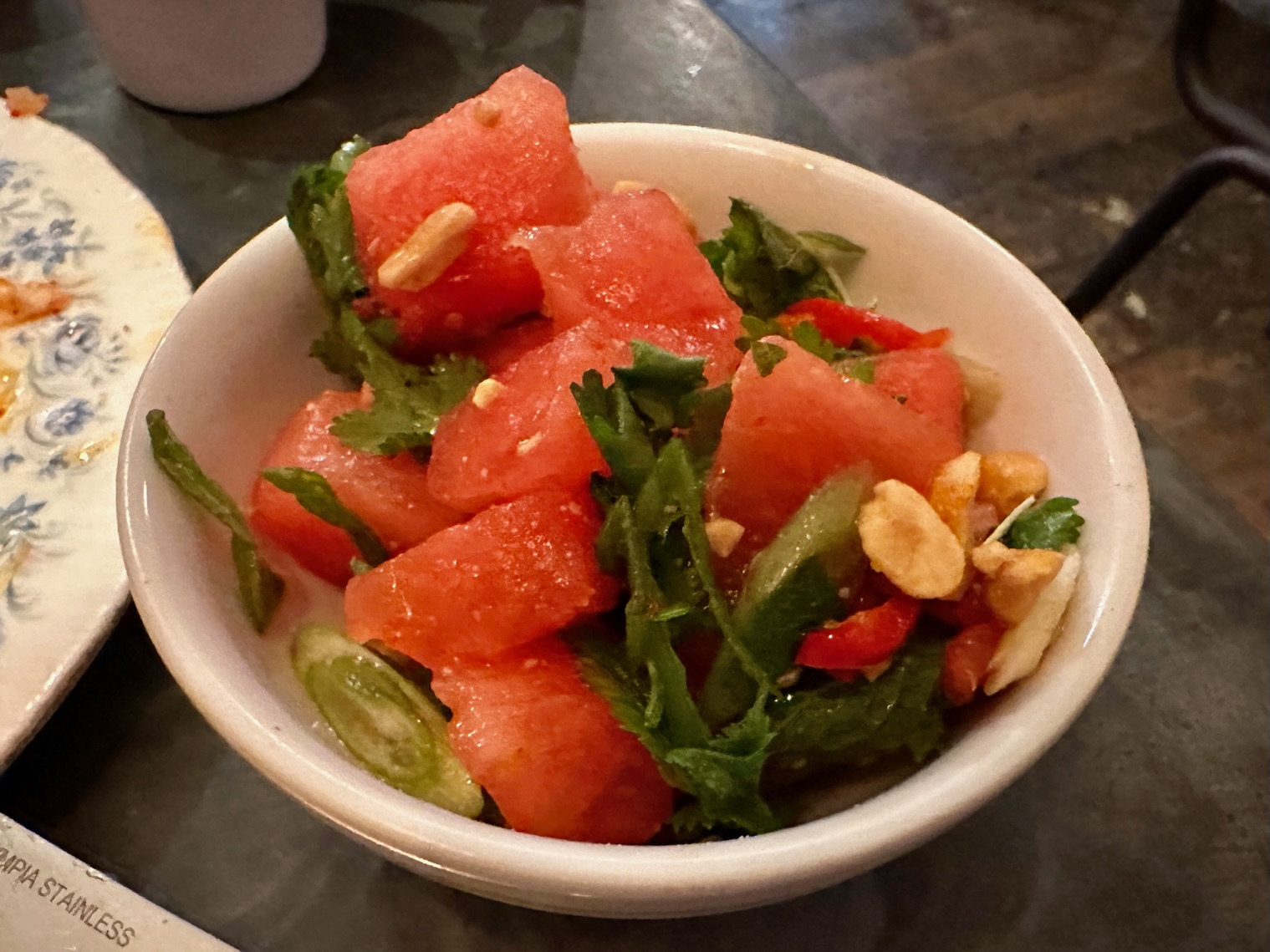
Oh, and we also had a pickled watermelon salad. Ever wondered what pickled watermelon tastes like? Me too, and I’m still wondering: this just tasted of watermelon.
You get the general jist by now. I spent a little time looking at the other tables – the place was doing a roaring trade – and wondering what I was missing; I’ve rarely felt so much of the emperor’s new clothes about a restaurant as I did that night in Covent Garden. And that’s not to say it was an awful meal, but it was an ordinary one. Service was pleasant, if brisk, and the one thing I can say is that, especially for that part of London, it was affordable: all those starters, sides and mains and a couple of cocktails each came to a hundred and six pounds, including service.

This has to be one of the weirdest summaries I’ve ever had to write, of a place I’ve wanted to visit for something like five years, of a place which in theory serves some of my favourite food and which everyone, and I mean everyone, loves. The only logical conclusion, really, is that I’m wrong and that if fried chicken is your thing and you find yourself in the centre of London this is the place to head for. Everybody else says so. It’s me: I’m wrong, and I don’t know why I’m so out of step.

It could be expectation – that I thought the place would be incredible and so, when it was merely quite good, I felt like the sky had fallen in. But I don’t know if it’s even that; I guess my expectations were that it would be even better than Eat The Bird, which I encountered and loved on a recent visit to Exeter. But in reality it didn’t come close to their food, and if you asked me which one I’d want to open a branch on my doorstep it would be Eat The Bird every time.

All that makes this review especially frustrating, of somewhere I hoped to love, wanted to love, expected to love but just didn’t. A so-so review of somewhere in London you were probably never going to visit anyway. That’s the thing about these reviews outside Reading – when they’re a belter they’re fun to write, hopefully fun to read, and everybody wins. But when they’re mediocre, the so what factor is sadly lacking. So I must apologise: hopefully better, and more local, restaurants lie in both our futures.

Or maybe I just have really shit tastebuds. It’s a distinct possibility.

Chick ‘N’ Sours – 6.8
1A Earlham Street, Covent Garden, London WC2H 9LL
020 31984814
https://www.chicknsours.co.uk

Restaurant review: Casa do Frango, Piccadilly

This week’s review came about for a simple reason: I went to Nando’s. Six weeks ago Zoë and I were in town on a slow Sunday lunchtime, neither of us could face cooking that evening and we longed for the comfort of a known quantity. Judge all you like, but when I feel that way Nando’s makes it on to my long list, which means that occasionally it makes the shortlist, and sometimes it winds up on the podium.

I mean the Friar Street branch – no offence if you prefer the one in the Oracle – and my usual order is butterflied chicken, medium, with macho peas, spicy rice, garlic piri-piri sauce on the side. It always delivers, and it did on this occasion: I left sated and happy, putting a picture on Instagram to show that I’m not all preaching and indies. Later that day I got a message from my friend James (last seen on this blog living it up in Marmo).

“I’ve recently cracked how Nando’s do their chicken” it said. This was a very James thing to say: naturally I was intrigued.

“Don’t they just cook it, keep it in a drawer and then finish it on the grill after you’ve ordered it?”

“They slowly cook the chicken at about 90 degrees over a couple of hours, almost poached in a basic marinade.Then they grill and layer on the piri piri multiple times to create a layer of flavour: baste, seal and grill, turn, baste etc.”

Doing this sort of painstaking research was also very James. But better was to come, because when Zoë and I went to stay with him and his partner Liz over Easter weekend, he went a step further. “I’m going to recreate it”, he said. He was true to his word, so one night we sat down to the most glorious slow-cooked, basted and grilled piri piri chicken. James cooked the chicken, Liz made the macho peas, the coleslaw and fries were from the supermarket. The whole affair was even more soothing than the real thing: Nandos-esque rather than just Nandos-ish, if that makes sense.

“The place I keep meaning to try is Casa do Frango.” I said, between mouthfuls. “They started out with one near London Bridge and now they have three across the city.”

“Let’s do it!” said James.“I’d love to accompany you.” So we did: some people might find this eccentric, but James and I booked a Friday off work and headed to London on the train, on a pilgrimage for the best piri piri chicken outside Portugal.

Casa do Frango (the house of chicken: in Portuguese it sounds far more exotic than, say, the hut of pizza) came to my attention five years ago when the original branch got a glowing review in the Observer. And I always intended to go at some point, to see if it could get anywhere near the best piri piri chicken I’ve ever had, in a little Lisbon alleyway. That was at a place called Bonjardim and it remains a real death row food memory, the skin brittle and intense, rubbed with lemon and salt, the meat underneath a yielding feast. Nando’s, much as I like it, has never displaced it in my memory, but perhaps Casa do Frango could.

For this review I decided to visit Casa do Frango’s newest, most central branch. It’s on Heddon Street, just off Regent Street and a stone’s throw from Liberty, and I picked it partly because it’s become their flagship, partly because it fitted better with our plans for the rest of the day but mainly, in truth, with you lot in mind. After all, a decent affordable place to eat not far from from Piccadilly Circus might potentially be of use to a lot of you (although not one of my readers who recently got in touch to tell me that, although he read the blog religiously every week, the recent ones hadn’t been hugely useful given that he was allergic to chicken – sorry Tom!).

On the way in I realised that it must be the best part of three years since I’d set foot in central London, over three years since I’d taken the Tube. That means I’m a tedious Johnny-come-lately when it comes to how game-changing the Elizabeth Line is to Bond Street (although I enjoyed my guided tour of the Elizabeth Line, thanks to James who is quite the public transport enthusiast). It also meant I wasn’t prepared for how quiet it was on a Friday – not Vanilla Sky Times Square levels, but I’d never seen Regent Street so sparsely populated. “Thursday is the new Friday” said James.“Everyone’s working from home today.”

Heddon Street is a little alley literally lined with restaurants – a ramen place, an outpost of Gordon Ramsay’s empire, a pub called The Starman (the cover of Ziggy Stardust was shot outside) and a café called Ziggy Green, because people are nothing if not unimaginative. We walked past Michelin-starred Sabor, which looked gorgeous inside (“I’ve been, it’s great” ventured James) and I wondered if I’d have restaurant regret. But Casa do Frango is a handsome-looking spot, and I loved the tiles outside reading RUA HEDDON. The muggy drizzle said we were in London, but it still had the potential to be transformative.

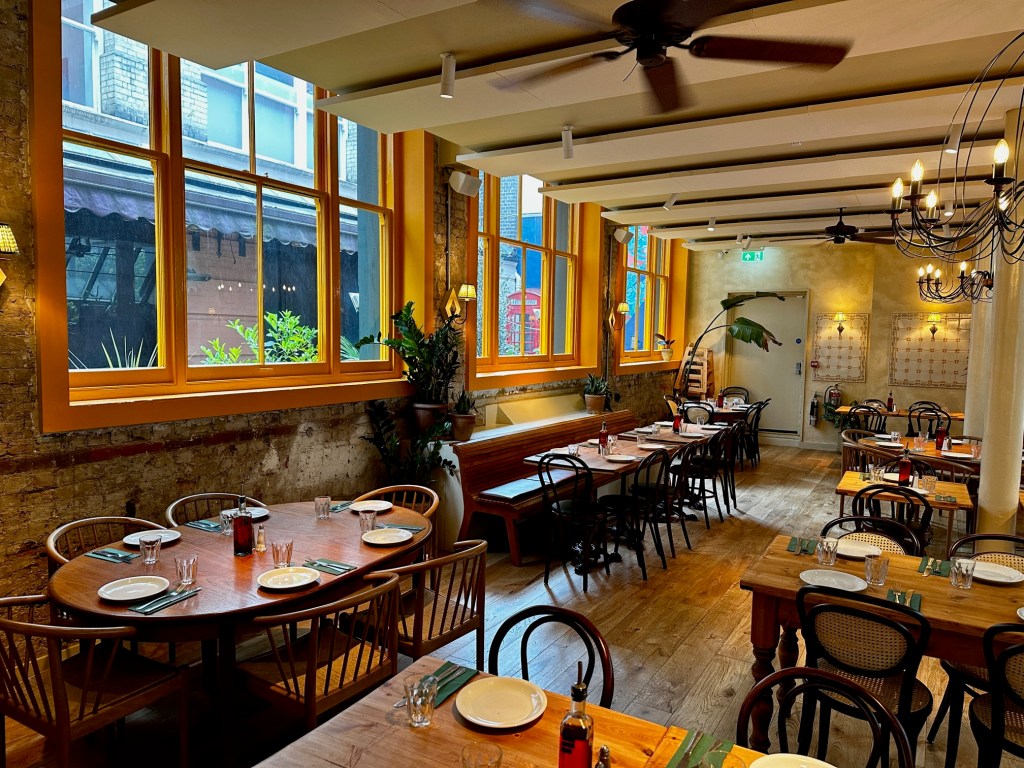
It’s a big site, with two large dining rooms upstairs, some private dining and a very swish-looking speakeasy bar downstairs. We were in the back dining room, their first customers, ultra keen at high noon. It was a great space, ceiling fans whirring, the whole thing surprisingly well lit, tasteful bentwood chairs, brick, tile and warm burnt orange tones. We got a good table up against the wall so we both got a view of the dining room, and it slowly filled up over time. They lunch later in London, the lucky blighters.

The menu only has one main course – that chicken – so it’s all about the starters and sides. The chicken is twelve fifty – back in 2018 when the Observer visited it was still less than a tenner – but most of the small plate starters (billed as “to share”) clocked in between eight and ten. Technically you could eat here as a vegetarian, if you were dragged here, but you’d find it all foreplay and no shagging, so to speak.

I was particularly impressed with the drinks list. The compact selection of cocktails is more than skin deep Portuguese, so licor Beirão and ginjinha both make an appearance: I have happy memories of both. The wine list is one hundred per cent Portuguese, even down to the dessert wines, with a separate section for vinho verde, much of which is available by the glass. Even the port is the lesser-spotted Offley rather than a bigger name. We started with a gorgeous, zesty white port and tonic – I picked up the habit for these in Porto five years ago, they can quite make you forget about G&T – and made our choices.

To begin, that meant trying to eat a representative sample of the small plates. Bacalhau fritters were the best of them – salt cod is one of my favourite things about Portuguese food and these were light-shelled with the perfect balance of carby potato lending bulk and the fish landing the perfect hit of flavour. The aioli, golden and sunny, rounded things off nicely, though I wasn’t sure they needed to glue the croquettes to the dish with more of the stuff.

The pork croquettes were also decent enough, although they lacked the same wow factor. These were served with a mustard bechamel I liked slightly less, and although the flavour of the croquettes was good, the texture suitably silky, I couldn’t help thinking we’d ordered two dishes too similar. The chorizo, grilled with black olive mayo and pickled chillies, might have been a better choice. The croquettes and the fritters, at eight pounds, felt a tiny bit sharp for what you got.

I did love the salgadinhos – little empanadas stuffed with kale, mushroom and onion – though. It’s interesting how the mind can be redirected by pricing: at two pounds each these were technically the same price as a single croquette or fritter, but they felt bigger, better and better value. The salt flakes liberally sprinkled on top gave each mouthful a pleasing little saline spike.

Our final starter promised much but didn’t entirely deliver. A whole head of cauliflower, marinated so effectively in piri piri that its centre had a pinkish tinge, had been charred and then drowned in a vivid green slick of yoghurt and pistachio. Eating this dish felt like reading a well-written novel and not enjoying it as much as I thought I should. Everything worked – the flesh of the cauli firm, the sharp tang of the yoghurt augmented with lime – but by the end it felt like a slog. If the other small plates were a little small, paradoxically this could have benefited from being smaller.

The eponymous chicken arrived as we’d polished off a cold glass of Super Bock. This is where I’d love to dust off my hyperbole but instead, I fear I’ll be delivering some faint praise. There was literally nothing not to like, but perhaps nothing to rhapsodise over either. You get half a chicken per person, and yes, it was juicy and swimming in brick-red juices (“the key is to use smaller chickens” said James, knowingly). But the flip side is that tender though it was, there wasn’t masses of meat and some of it took more persuading off the bone than I’d expected. I was hoping for that hit of crispy skin, too, but the whole thing felt a tiny bit underpowered.

It didn’t compare to my memories of Bonjardim – perhaps the power of nostalgia meant it never could – but I wasn’t sure it was better than the rendition at Casa do James, either. I should add that James liked it more than I did, and he has the added benefit of knowing what he is talking about. We both largely eschewed the little tub of piri piri sauce it came with – “that’s for tourists”, said James – instead trying to get every bit of the glossy, spicy oil coating the bottom of the steel plate.

I should also mention the surprise MVP of our meal, hidden at the back of the photo above. Casa do Frango’s chips are nothing to look at – verging on blond and, on appearances, unlikely to deliver much. In reality they were phenomenal – salty with huge amounts of crunch and staying hot, seemingly, for ages. They didn’t have to be this good, god knows the ones from Nando’s rarely are, and yet this was the dish James and I kept coming back to for the rest of the afternoon. Those fries, though.

Perhaps the reason the chicken was lacking in crispy skin is because Casa do Frango had the genius idea of stabbing huge shards of it into its African rice. This was a phenomenal side, the rice studded with chorizo and sticky plantain and, with the exception of a few clumps, virtually flawless. If they sold a side that was just a bowl of crispy chicken skin I’d have bought several. And taken a doggy bag.

Our final side of Hispi cabbage, though, was too similar to that cauliflower starter, being a brassica charred and festooned with yoghurt. This one was accented with red pepper and a parsley sauce a little like a chimichurri or salsa verde. But even more than the cauliflower, this felt more like a virtuous trudge than an indulgence. The way it was plated was frustrating, too: one wedge of cabbage was perched on top of the other, with the end result that only one of them, really, was properly dressed.

I was ambivalent about dessert, but James had his heart set on one – for research purposes, no doubt – and so we acquiesced. It helped that we accompanied them with a glorious glass each of Moscatel de Setubal: Portugal never gets the credit it deserves for its superb dessert wines and this one was a glowing schooner of sweet, sweet sunshine (I neglected to mention the vinho verde we had with our chicken: superb and ever so slightly effervescent). The service was excellent throughout and our server steered James in the direction of the almond cake which she said was her favourite – she couldn’t eat gluten, which was part of why she loved it so much, but James adored it too.

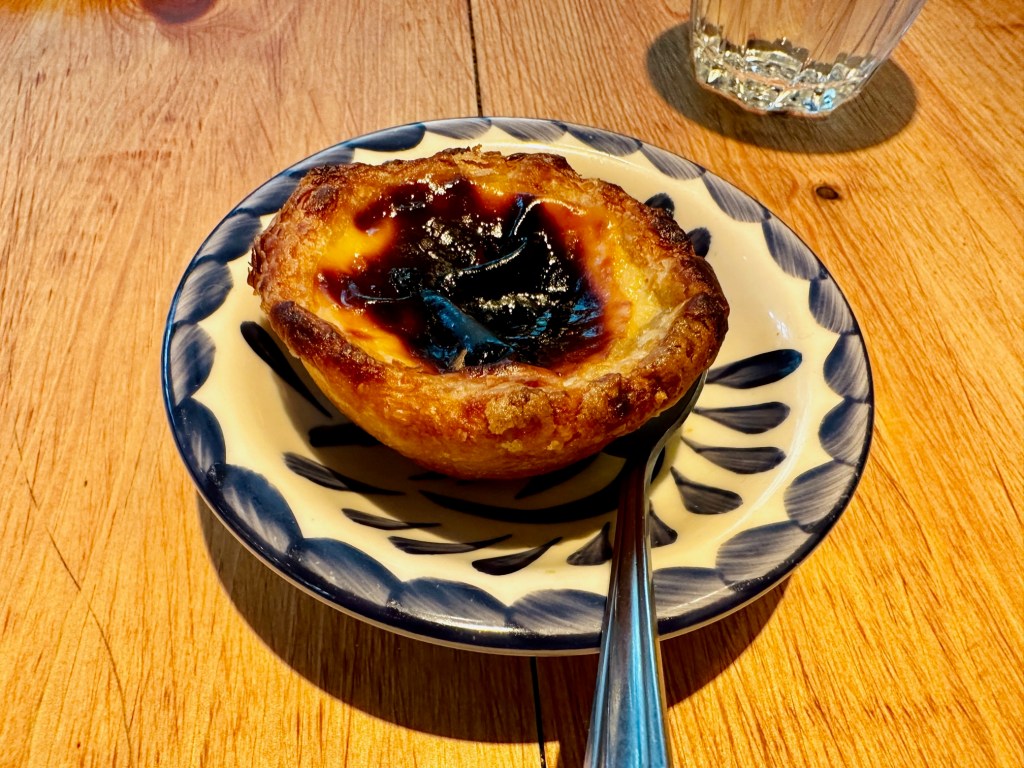
Settling into my role as designated party pooper, I had a pastel de nata. Well, you have to: any coffee without one in Portugal feels like a coffee missing its soulmate. And although Casa do Frango’s looked the part, it was a fascinating study in contrasts where everything was not quite as it should have been – the pastry, which should be ethereally light, was heavy going and the custard, which should be just-firm with a little wobble, was gloopy. I should have seen the warning signs when they brought it with a teaspoon. What kind of egg custard tart needs to be eaten with a teaspoon? This one, it turns out.

So a proper mixed bag, with plenty to celebrate. But, like Joni Mitchell in Both Sides Now, I worry that it’s Casa do Frango’s illusions I recall. So let’s try and focus on the positives – the wine list is fantastic, some of the small plates are delicious, that rice will live long in my memory and I’m still astonished that the fries were so much better than they looked at first blush. The service – attentive, endearingly laconic, properly Portuguese – was a joy and every bit worth the twelve and a half per cent. It’s a beautiful room and, as I discovered on a foray to the basement, the handwash in the gents smells heavenly.

But I do wonder if the things I really enjoyed about this meal were more about the context of the meal than the food itself. I was on a day off, on a Friday with a good friend, with nothing to do but drift from restaurant to shop to bar to restaurant again. I was in London properly for the first time in eons and it almost felt like we had the city to ourselves. In those circumstances, many meals would feel special. It’s important to try and push that slightly to one side and focus on what we ate.

The whole thing – all that food and four different alcoholic drinks apiece – came to a hundred and sixty pounds, including the service charge. And that’s where you have to stop and think. Is the place better than Nando’s? Objectively yes, of course it is. Is it easily three or four times better than the significantly cheaper Nando’s? I’m not so sure about that. Does it command grudging affection like Nando’s? No, I’m afraid it doesn’t.

And, on Heddon Street at least, Nando’s isn’t even its competition. If you’re in this part of town there are plenty of other ways to spend your money at superior reimaginings of nationwide chains – a short walk away off Carnaby Street, for instance, you could stop into Pizza Pilgrims. It may be a step up from the likes of Franco Manca and Pizza Express, but if you manage to spend a hundred and sixty pounds between two there I’d be very surprised.

The strangest thing about my visit is this: even though pedestrian old Nando’s is an identikit recreated across the country, without the beautiful decor and attention to detail of any of Casa do Frango’s sites, I found this visit made me appreciate the former more than the latter. In fact, shameful confession time: I went back to Friar Street in between visiting Casa do Frango and publishing this review, just to check that I wasn’t on mushrooms, and I stand by what I’ve said. Doubtless that will get me excommunicated from the Guild Of Food Snobs, and I know I’m disagreeing with Jay Rayner again. But would you expect any less from me by now?

Casa do Frango – 7.1
31-33 Heddon Street, London, W1B 4BL
020 35355900

https://casadofrango.co.uk

Restaurant review: Marmo, Bristol

What’s your favourite restaurant? Your absolute favourite, I mean. I ask because a couple of weeks ago I was sitting in my friends James and Liz’s back garden in Bristol, drinking white wine on a sunny afternoon and having exactly that conversation. The wedding we’d been to the day before – on a Wednesday, no less – was that miraculous thing, a wedding where you’re not hung over the morning after, and so the day stretched out in front of us, feeling partly like a Sunday, partly like something else.

James refused to take part: he didn’t believe in picking a single favourite. So we talked instead about possibly allowing everyone to choose three. But if anything, that made it more difficult, because then you had to pick at least one from your home town and then you were forced to choose just the two restaurants from everywhere else you have ever been. 

Liz said that you couldn’t pick somewhere you’d only been the once, but that didn’t help either. Zoë started waxing lyrical about Eetkaffee De Lieve, a little gem in the sidestreets of Ghent, and I daydreamed about sitting outside at Uvedoble in Malaga, demolishing a little brioche stuffed with suckling pig. But which restaurant in Bologna to pick? And how could you leave out Paris? It was just too much of a puzzler.

“I think my favourite restaurant right now is Marmo” said Liz – with a hint of trepidation, because we had a table booked there that evening. And I understood that nervousness better than most, because there’s little as nerve-wracking as telling people that somewhere is good, knowing they’ve gone there because of you and then sitting there waiting to find out whether they’ve lost all faith in your good opinion. I get that all the time.

We went to Marmo with Liz and James’ friends Ed and Ben, a very entertaining couple they’d been telling me about for some time. It was clear straight away, as we took our seats at a Belgian beer bar in the old city, that they liked the finer things in life, which always makes me feel like I’ve found my tribe but also brings out the imposter syndrome.

On our walk to the restaurant Ed and Ben asked me which restaurants I liked in Bristol, and I couldn’t help but feel that this was a test. I didn’t go to Bristol often enough to be on top of the latest developments, but then I mentioned my love of the sadly departed Wallfish, a little neighbourhood restaurant a stone’s throw from Clifton Suspension Bridge, and there was a tacit nod that indicated that I might have just about scraped a pass.

Marmo is a single, buzzy room – all handsome white wood panelling and framed prints on the walls that you daydream about nicking (I also would have loved one of the branded wineglasses, come to think of it). There’s a tiny kitchen at the back, clearly in view, where all the magic happens. Our table was in the heart of things, close to the bar, and I tried to remember what this place had looked like in its previous incarnation as Bar Buvette, a wine bar I’d loved that made you feel like you were somewhere in the eleventh arrondisement.

The menu made you want to order everything, and was compact enough that we nearly did. There were a few snacks and then a 3-4-2 formation of starters, mains and desserts respectively, with one fish dish and one vegetarian dish on offer for each course. The menu looked carb light, but the waiting staff explained that you could have an intermediate pasta course to fix that, as the Italians do, or just have some bread. Starters were around nine pounds, the most expensive main was eighteen pounds fifty. The wine list – of which Marmo seems particularly proud – had a superb selection of red, white and orange wines, with a few producers I’d heard of and many I fancied trying.

In short, it was a menu to get lost in, and we did that while drinking glasses of Muz vermouth, served properly with ice and a wedge of orange. I loved it, and said that the tangy, fruity note in it was strangely reminiscent of brown sauce. There was an awful moment while I waited for someone to tell me I was talking bollocks, and then to my huge relief there was agreement around the table (Zoë didn’t enjoy the rest of the vermouth from that point onwards: “I tried”, she told me later, “but all I could taste was the vinegars”).

Aperitivi deserve accompaniment, so we kicked off with Marmo’s textbook sourdough. It came with butter, which no doubt would have been fantastic, but we were all more keen to dip it in smoked cod roe, perfectly salty and pastel pink, with a pool of olive oil at its centre. Also pastel pink was the mortadella, draped over gnocco fritto, little fried parcels of joy. I’ve never liked mortadella, not even in Bologna, but I loved it here; Marmo, like the best restaurants, can make you enjoy ingredients you wouldn’t normally look at twice.

We’d been torn between a couple of white wines – one from Jura which would have had more funk, and a more conventional Riesling from Staffelter Hof, a producer I recognised because one of their wines crops up on Clay’s fancy new wine list. I tried to palm the casting vote off to Ed, who clearly knew his wine, and he eventually plumped for the Riesling (I’m sure the fact that it was called “Little Bastard” was an unintended bonus). 

But then the staff came over and said that they only had one bottle of Riesling left, so we went for one of each. Those of us who tried the Riesling were delighted by its cleanness, the slight effervescence on the tongue. Those who decided to drink the Jura were pleased to have picked something so unusual, with agricultural notes of scrumpy and sherry knocking about harmoniously in the same glass. We all changed ends at half time, tried the other white wine and in the end decided that they were both terrific.

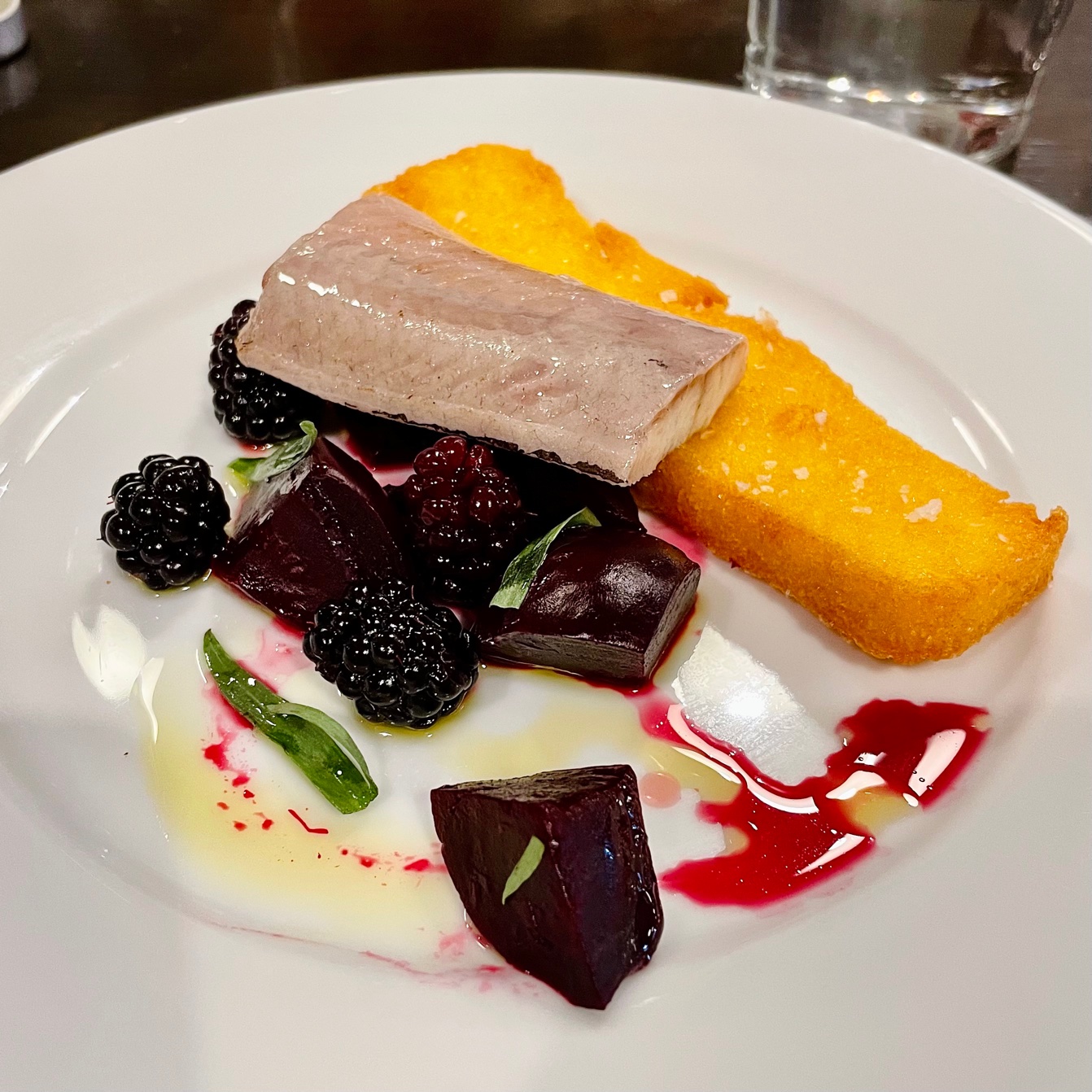
By this time the starters had turned up, and I got my first sign that I was in for an evening of sustained brilliance. I had gone for smoked eel, beautifully muscular and only lightly smoked, on an oblong of crunchy fried polenta. So far so delicious, but teaming it up with bright cubes of beetroot and blackberries with a balsamic sweetness was a killer blow. I could have eaten this all the live long day, and it left me wanting more – or, to be more specific, another portion. That’s what great starters do.

Although it was the most popular starter, a couple of us tried something else. Liz spoke highly of her marinated peppers, buried under an avalanche of Ticklemore, and I could see that I would have been equally happy with that. Ed had chosen the beef tartare, topped with chives and a slow-cooked egg yolk, flavour soaking into the bread below. How could you have food envy when you’d enjoyed your own starter so much? 

I was sitting between Ed and Ben – the kind of civilised couple who don’t have to sit next to one another all evening – and, being a civilised couple, they passed plates back and forth across me, or behind me, or through me so that neither of them felt left out. But I was having such a good evening that I was more than happy to be the proverbial dumb waiter. 

They were in the holiday mood – Ed’s mother was visiting their cottage in the Chew Valley over the weekend and then they were off to Cornwall for a well-earned break eating and drinking their way around that part of the world. They would spend much of the following week in their own favourite restaurants. I recognised kindred spirits, the kind of people – like me – who plan a holiday entirely around lunches and dinners, who enjoy going to places they know and love, experiencing the comfort, familiarity and total relaxation that comes with a pilgrimage like that. At the tail end of my own holiday, I couldn’t help but feel envious.

Given that Marmo was at least nominally Italian, I felt like we should have at least one Italian wine with our meal, so I chose a Tuscan red called Infraded, a deep, velvety Syrah. Ordering wine had been delegated to me by this point, but I was almost merry enough to be happy with that. Again, I felt like I’d committed a faux pas when the waiter told us this one was best served chilled, but Ed reacted with delight and I decided that on balance, I’d got away with it. It was, as you can probably guess by this point, predictably wonderful, and I made a mental note to see if there was anywhere you could buy some when I got home and Bristol was just a distant, happy memory.

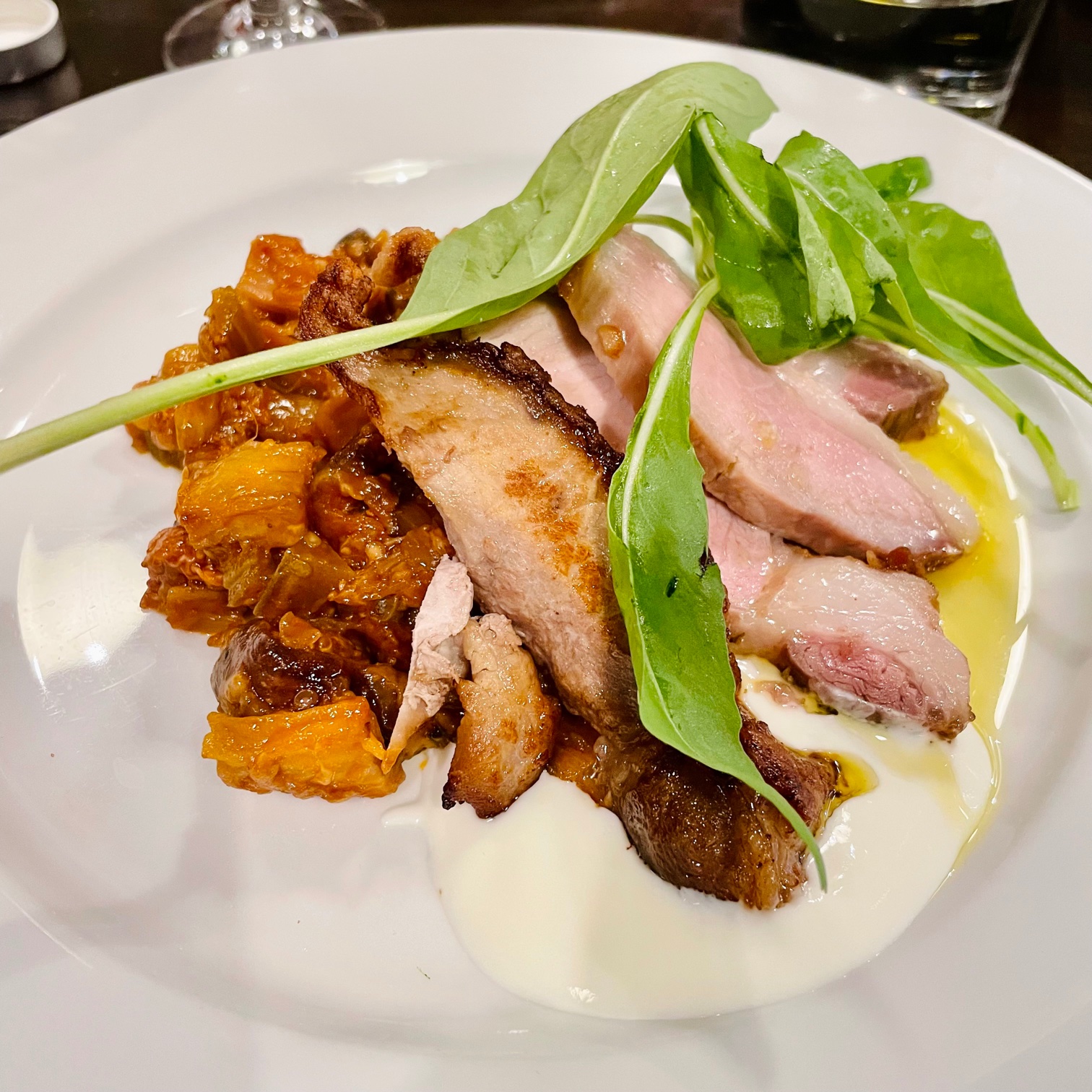
The main courses brought more fireworks. I’ve always heard Mangalitza pork spoken of in hushed tones as the Kobe beef of the pork world, but I’d never tried it before so I was keen to pick it off the menu. It came in glorious marbled slabs, just-pink and tender with the most beautiful melting fat: eating it I could understand why the Italians got so excited about lardo, and the idea of eating fat on its own. It was served simply with a handful of other elements, a wonderful caponata given a fresh edge with the judicious addition of fig, some good oil and a little slick of yoghurt. It was as good a single dish as I’ve eaten this year: I looked over at James, who had ordered the same thing, and saw him lost in a reverent silence.

That silence was eventually broken by Ed telling a story from the time when he used to manage a bookshop in Oxford.

“We had lots of celebrities in while I was there, but the best rider we ever had was from Roger Moore. And Roger Moore only asked for two things.”

“Really?” I tried to imagine exactly what vintage of Château Mouton Rothschild would feature in Sir Roger’s demands. “What were they?”

“A bottle of Jacob’s Creek and a Pret crayfish sandwich. That was all, every time. And by the end of a signing he was always absolutely fucked.”

This couldn’t help but make me warm to the great man. And of course, Ed had a picture on his phone of him with Jacob’s Bond, although it wasn’t clear how much wine had been taken by that point. Ed’s main course was a very attractive-looking pollock dish with mussels, and although he was taken with it, it it didn’t give me any buyer’s remorse about the Mangalitsa pork. Liz had chosen the vegetarian option, a very accomplished spinach and ricotta ravioli dish. Again, although it looked the part, missing out on it didn’t fill me with regret.

There were only two desserts on the menu and we all fancied the same one, the chocolate and hazelnut fritter, so five of us went for that while Ed nursed a grappa. It was an exemplary way to end the meal, a deep, smooth chocolate mousse, sharpened with cream and sandwiched between layers of the lightest of batters. Looking at the picture, it resembles nothing more than a witty dessert take on the ubiquitous burger: would that it was anywhere near as easy to get hold of, but it seems you have to travel to Bristol. We accompanied this with a sweet, fresh and generous glass of Coteaux de Layon (always a better bet than Sauternes, if you ever see it on a menu) – although Zoë had a negroni, because she’s developing a taste for them.

If I haven’t talked much about service it’s because they were so good. Completely unobtrusive but always there when you needed them, really friendly and enthusiastic and very good at what they did. We needed to pay at the same time as ordering our dessert so Ed and Ben could make their taxi on time, and all of that was no trouble and very efficiently sorted. 

Our meal for six, including a discretionary ten per cent service charge, came to just over four hundred and ninety pounds, or something like eighty-two pounds a head. That might sound like a lot, but we really went for it – aperitifs, snacks, a three course meal, plenty of wine and dessert wine. You could spend less and I have no doubt you’d still have a superb meal, and if you find yourself in Bristol at lunchtime they have a set menu which is even more impressive value. But either way I had no regrets – a couple of nights before I’d eaten at Paco Tapas, Bristol’s Michelin starred tapas restaurant, where I spent significantly more, eaten and drunk considerably less and not had quite as much fun. You pay for a meal, but you pay for memories too.

Even as I was eating at Marmo, I knew that the marker had been set down for the rest of this year and probably most of the next: as complete, satisfying and perfect three course meal as I could imagine. I would go to Bristol to eat here again, and I would plan trips to Bristol just so I could. It’s not my favourite restaurant – if only because you can’t give that accolade to somewhere you’ve only eaten at once – but it was my favourite meal for a long time. And if you ever wonder why I don’t give out higher ratings more often, this is why. I save the big guns for the great meals, and this is the kind of standard Reading restaurants need to aspire to, slowly but surely. I still hope we’ll get there. But in the meantime, we’ll just have to hop on a train.

Marmo – 9.4
31 Baldwin Street, Bristol, BS1 1RG
0117 3164987

https://www.marmo.restaurant

Restaurant review: Pepe Sale

Pepe Sale closed in June 2024. I’ve left the review up for posterity.

“I’m looking forward to the full Edible Reading experience” James said when I met him at the station. He made it sound as if joining me to review a meal was some kind of theme park. The Edible Reading Experience: you have to be this smug to ride.

“It’s nothing special. There are just two rules – don’t mention the blog when we’re in the restaurant and take photos of everything you eat. Zoë’s meeting us there. Do you want to know where we’re going?”

“Don’t tell me, I don’t want to spoil it.”

“I’ve saved a good one for you. And it’s the perfect one to review this week – it’s a revisit of the first place I ever reviewed, and it came under new management last year. And it’s an Italian restaurant, which is topical after last night. Let’s hope they don’t gloat too much.”

“Sounds perfect” said James, and we ambled through town, past the side of the Broad Street Mall. James is unflappable, but he almost did a double take. “Ah, you have a Taco Bell.”

“I’m afraid so. Its popularity is a continuing mystery to me.”

Later James told me that Taco Bell’s beef is only technically 88% beef because it contains so much other gubbins. He’s full of useful information like this – with hindsight I don’t know why I didn’t invite him to come with me on duty before. He likes the finer things in life: this is a man who flew to Korea for a weekend just to learn how to cook Korean barbecue, a man who has converted his garage into a micropub. Just the person to bring along to bolster my “man of the people” credentials. 

He was also the perfect person to take to Pepe Sale, the subject of this week’s review: he’d joined Zoë and me on holiday in Bologna two years ago and we’d rhapsodised together over ragu and porchetta, each meal as superb as the last. Our last holiday before lockdown was with James and his other half Liz in Copenhagen, eating magnificent food, attending a wild beer festival out in the docklands, stumbling out of brewpub after brewpub, enjoying the driverless subway trains and being too smudged to appreciate the Design Museum. We talked about coronavirus on that holiday, but with no real appreciation of what was coming, unaware of the gathering storm.

Although Pepe Sale changed hands last year the buyers kept that news quiet, presumably because they wanted a smooth transition and to retain as many regulars as possible (perhaps wisely: I remember the panic a couple of years ago when Pepe Sale showed up as for sale on a listings website). It became more apparent this year, as previous owner Toni Sale set up his “Pasta Academy”, running classes out of his gorgeous-looking kitchen, and the new owners made a small but significant change by opening on Sundays. Prior to that, Pepe Sale only opened on one Sunday every year, namely Mother’s Day. 

A few people told me last year, after visiting Pepe Sale, that it didn’t feel the same: not necessarily better or worse, but that something had changed. And that made sense, really. Toni was a big presence in the kitchen, his wife Samantha ran front of house superbly: with both of them gone, it was bound to be a different experience. When I looked at all the restaurants I’ve reviewed, trying to gauge which ones needed a repeat visit, Pepe Sale was high on the list. And so, nearly eight years after my previous review, Zoë, James and I went on a Monday lunchtime to see how different it was.

Visually, you’d barely notice the restaurant has changed hands. The decor is unaltered, all high-backed chairs and marble-topped tables. The restaurant is split-level, with the smaller space up top looking out on Queens Walk and the lower level a bigger room that I’ve always found harder to like. The only real difference was that the space by the front door where Toni used to roll fresh pasta every day has been replaced by another table. No specials menu either, that I could see, which was a shame – although it might have been because we were there on a Monday lunchtime.

I might find myself saying “it might just have been that we were there on a Monday lunchtime” many times during this review, so let’s take it as read from now on. The three of us were the only customers that afternoon, and there was a nicely sleepy pace to things with our waiter (the only staff member that I saw) giving us plenty of time to sip our water, read our menus, catch up and eventually get round to making our choices.

“Were you celebrating last night?” James asked him, ever the diplomat.

“I had four Peronis and a bottle of pinot grigio” he said, his eyes smiling, even if you couldn’t see a grin behind his mask. “But I wanted England to win. I’ve lived here for so long, and my kids were born here. My little boy was devastated this morning.”

The menu hasn’t been changed one iota under the new management, so it’s virtually identical to the one I ordered from back in 2013 and probably much the same as it was when they opened. The wine list, though, printed on the other side of the menu, was far smaller than the one I’m used to. Pepe Sale’s wine list was always a selling point – a huge range, across all price points, the majority of it coming from Sardinia. It’s now a one pager, although it’s all still Italian. Perhaps Pepe Sale has a separate, bigger wine list but if so, I wasn’t shown it and I didn’t think to ask; I can well believe, though, that the events of Brexit might have reduced the amount of wines the restaurant can economically import. 

In any event, we had a very nice red from Piedmont called Otto Bucce, which was peppery and smokey and felt like good value at around twenty-seven pounds. We took those first happy sips, we broke off pieces of rosemary-studded pane carasau and we began the serious business of chatting and gossiping. Italian music was playing in the background – another change, I think – and even though James, technically, was the only person who was on holiday, somehow we all felt like we were. I love it when restaurants do that to you.

Before our starters arrived, there was a spanner in the works: our waiter materialised to let us know that they were out of avocados. Would we like to order something different, or wait ten minutes while they nipped out to get some new ones? We opted for the latter, and all I can say is that I’d like to know where they bought them from. It certainly wasn’t a supermarket – I’ve lost count of the number of times a “perfectly ripe” avocado meant “perfectly ripe in a couple of weeks” – so I’m guessing they nipped round the corner and got some from the kerbside cornucopia of the Oxford Road’s magnificent Best Foods. 

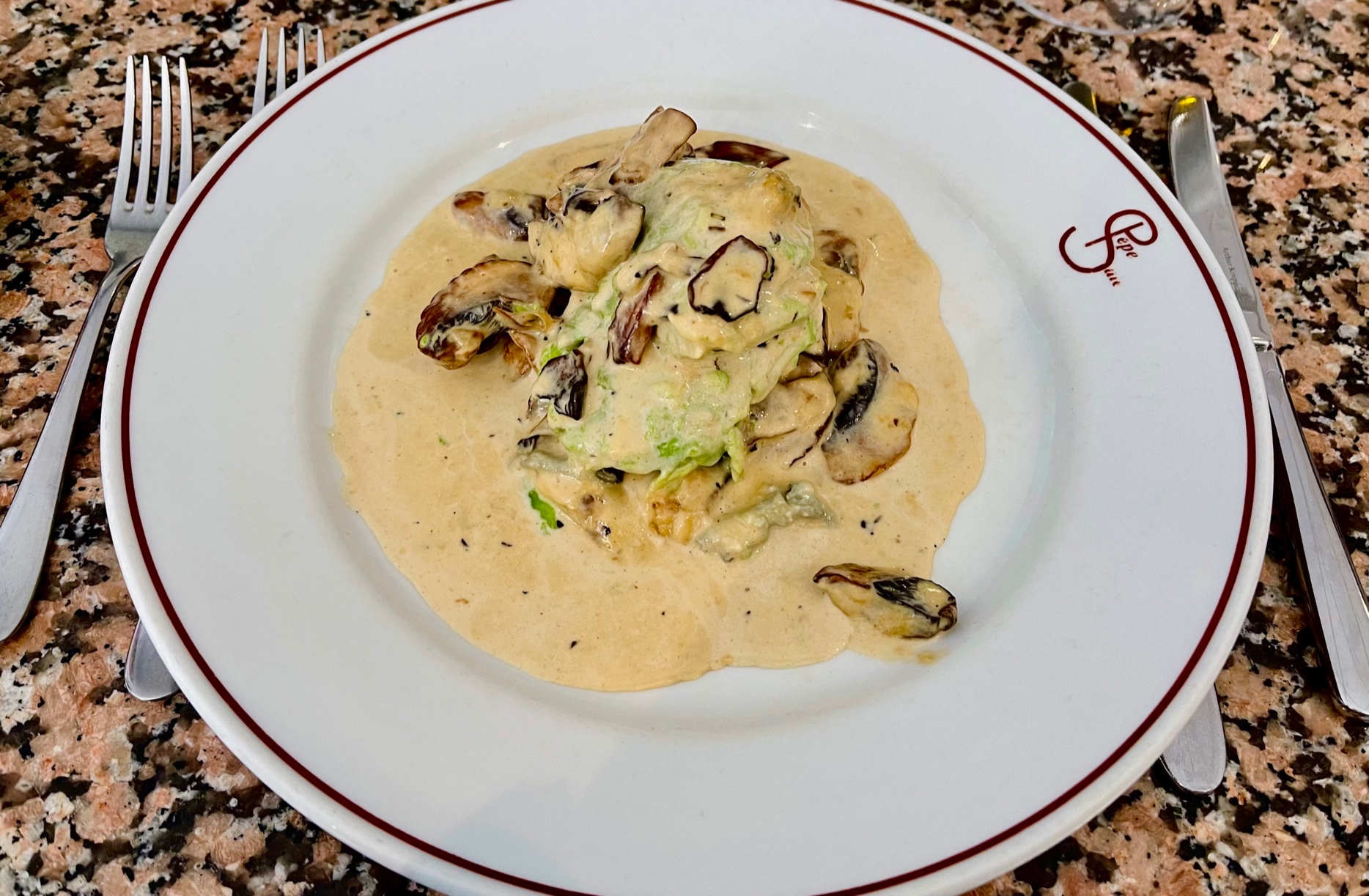
Anyway, Zoë’s starter of avocado and mushrooms in a dolcelatte sauce was a marvellous, indulgent thing and easily worth the additional wait. The avocado was ripe and buttery and the sauce, which added just enough salt and funk, was so good that Zoë looked ruefully over at the empty bread basket and wished she’d saved a couple of pieces to mop it up.

James ordered a starter I ate on my visit all those years ago, mozzarella baked in radicchio with anchovies, olives and cherry tomatoes (if you want a pointer that Pepe Sale resolutely resists trends, here it is: burrata is nowhere to be seen on the menu). James enthused about it and although I didn’t try any, it looked as good as I remembered. As a rule I think the worst thing you can do to mozzarella is heat it up, but there’s something about those precious parcels of molten cheese and bitter leaf that’s properly charming, especially teamed with the hit of anchovy and the sweetness of little tomatoes. 

If that description makes you think I was suffering from starter envy, you’re probably right. I had gone for malloreddus, a Sardinian pasta speciality, which are best described as halfway between gnocchi and conchiglie, tightly curled shells, in a spicy tomato sauce with chunks of sausage. Everything worked, on paper – the sauce had a good heat, it clung nicely to the pasta and the sausage tasted decent. But somehow, it started to feel like a chore by the end, a tiny bit one-note compared to the other starters at the table. Perhaps I’d have felt differently if the sausage meat had been crumbled, finer in texture, rather than big slices of the stuff.

There was a nicely civilised pause between courses, and our mains arrived just as we were ready for them – a relief, as kitchens without much to do often rattle off the next set of dishes quicker than you’d like. Zoë picked an absolute banker from the menu, chicken breast, stuffed with mozzarella and sage and wrapped in pancetta. Again I found myself gazing in envy at a pool of molten mozzarella and wishing I’d played it safer: I was allowed a forkful which reminded me what a solid, classic dish it was (it also made me miss the saltimbocca at sadly-departed Dolce Vita, halfway across town and many years ago).

James chose a dish I’ve never ordered, wild boar cutlet in a tomato sauce. It looked the part – a handsome slab of meat cut into three in a deep sauce with plenty of cherry tomatoes (“I’ve picked the two tomato-lovers’ dishes” said James). But he wasn’t wild about the texture – “it’s not a soft meat, put it that way” – and found it tougher and chewier than he’d have liked; a sharp steak knife would have helped matters along.

My dish, sea bream, was also close but not quite there. The fish was beautifully cooked, two lovely fillets with tender flesh and crisp skin, and it’s hard to go wrong with anchovies and olives (and beautifully chopped shallots). But the thing I always loved about Pepe Sale’s fish dishes was the sauce, a rich fish fumet fragrant with wine, and this felt a little thinner than I remembered. It wasn’t a bad dish by any means, but lacking a little oomph. Had it changed, or had I?

All of us went for a selection of vegetables and these were well-judged – nicely crunchy potatoes sauteed with rosemary and perfectly al dente carrots and broccoli; Pepe Sale, more than any place I can think of, taught me the virtues of not overcooking your veg.

The dessert menu is also unchanged, and is a mixture of Italian, generic and Sardinian dishes, all reasonably priced. I was tempted by the basil panna cotta, another old favourite, but James and I both went for the sweet ravioli. They were every bit as delicious as my happy memories of them, fried squares packed with gooey ricotta and orange zest, the whole thing drizzled with sweet syrup and topped with more strips of fried pastry and a little snowdrift of icing sugar. Looking back at my picture of this dish from 2013, and the mozzarella starter for that matter, I’d say this kitchen puts more effort into plating now: the camera loved it as much as I did.

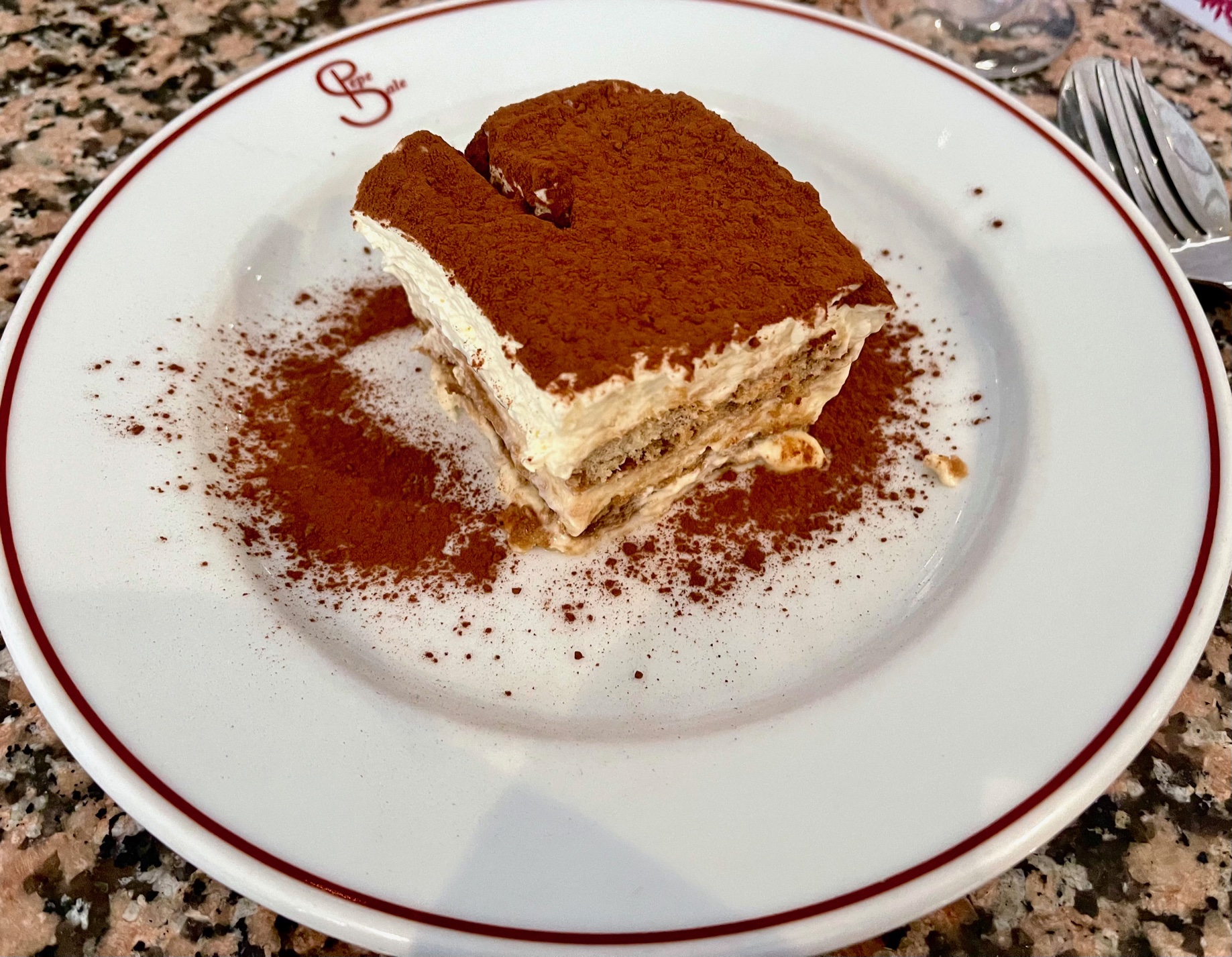
Zoë’s choice was the tiramisu, and again I was allowed just enough of it to wonder if she ever ordered a bad dish. I suppose there are no surprises with tiramisu –  you know it will be boozy and rich, all cream and coffee and chocolate, and this one was no exception. “I liked it a lot, but it did make me cough” she said later. “It’s the dust of the cocoa powder and my dodgy lungs. That’s why I was never allowed Dib Dabs as a kid”. 

Our meal – three courses each, some bread, a bottle of wine and a trio of amaros to help our desserts go down – came to just over a hundred and thirty pounds, not including tip. Pepe Sale is currently running a promotion where you get 20% off your food bill Mondays to Thursdays, and without that it would have been over a hundred and fifty pounds. Looking back at my 2013 visit a similar meal for two came to eighty pounds, so prices have definitely crept up – although that’s only to be expected and our meal still felt like good value.

As we settled up, I asked our waiter how business had been since they reopened in May. He told us that they were busy at weekends, solidly booked in fact, but things were still sluggish during the week – an experience I suspect is shared by many of Reading’s restaurants. He added that having Reading’s ill-advised quarantine hotel at the end of Queens Walk had hardly helped matters, although things were recovering now. 

It did make me think about whether people would feel comfortable eating inside on a busy evening – the tables are reasonably spaced but there are no screens, and although the front of the restaurant has big double doors which could be opened for ventilation they stayed resolutely closed during our visit. It’s a shame they’ve never put any tables outside, as their neighbours ThaiGrr! and Bierhaus have chosen to, but I guess that part of town can be a bit of a wind tunnel at times. 

We carried out a debrief over beers in the garden of the Nag’s Head, and there was less consensus than I expected. Zoë was the most positive about her food, but I think she ordered better than the rest of us (“that starter was great, but you know I love the ‘shrooms”). James was more equivocal, put off slightly by the toughness of that wild boar. I was somewhere in the middle, but in the back of my mind I was thinking that the food was almost exactly as it always was, and I couldn’t decide whether that was a good thing or not. We discussed it a little further, but then we were interrupted by a positively operatic fart from a shaven-headed gentleman at the table behind us which sounded like Brian Blessed molesting a tuba. We dissolved into fits of laughter, and that was that.

I feel a bit for Pepe Sale’s new owners. Talk about a no-win situation: if they make sweeping changes they’ve have messed with an institution, if they don’t they risk preserving it in aspic. And yet the restaurant barely changed in many years, so you can understand them not wanting to muck up a winning formula. I think it misses the specials and that wider wine list, and I sincerely hope they’re still making their pasta on the premises, but all in all it feels like the new owners are worthy custodians of the food: everything I had felt up to the standards of previous visits, and if anything the focus on presentation is stronger now.

And yet there’s so much more to a restaurant than the food. Aside from how Covid-cautious customers would feel eating in Pepe Sale, it’s safe to say that the real test of a restaurant is how it copes on busier evenings, whether the service and the kitchen can step up a gear to deal with the demands of a packed dining room. But not just that: it also depends whether that magical transmutation happens, where instead of just being a room full of people it becomes a wonderful buzzy place, a club where you’re lucky enough – if only for one evening – to be a member. At its best, Pepe Sale always did that. The new owners will face far sterner challenges in the months ahead than our chatty table of three on a Monday lunchtime. My fingers are crossed that they are up to them.

Pepe Sale – 7.8
3 Queens Walk, Reading, RG1 7QF
0118 9597700

http://pepesale.co.uk