Restaurant review: Good Old Days Hong Kong Ltd

If I asked most Reading residents to name Reading’s most famous restaurant, the chances are the majority of them would say either Kungfu Kitchen or Clay’s Kitchen. And that makes sense because those two, the Lennon and McCartney of Reading’s food scene, are the ones that have broken out into the national consciousness, as much as Reading ever does. If we had a round of Reading restaurants on Family Fortunes, asked 100 people to name a restaurant in Reading, those two would top the leaderboard. God knows what else would be on there – Sweeney Todd, probably, and a rogue vote for Munchees.

But that would only happen if you asked Reading residents, and is indicative of the bubble we live in. Because, last year at any rate, the most nationally known restaurant in Reading was Good Old Days Hong Kong Ltd, a nondescript Cantonese restaurant just the other side of Reading Bridge. And the reason for that is that last February it was reviewed in the Observer by journalist, jazz musician, TV show judge, relentless self-publicist and life president of the Jay Rayner Appreciation Society, Mr Jason Rayner.

He raved about the place, and explained that the chef used to cook at the Hong Kong Jockey Club, and Hong Kong’s Four Seasons Hotel. “It feels like finding a senior chef from the Ritz… doing their own thing in your local caff” he declaimed. The unspoken implication was that this was almost as extraordinary as finding the U.K.’s greatest restaurant reviewer doing his own thing in a Chinese restaurant most Reading folk had never heard of, slumming it for the greater good. Lucky us!

Now, don’t be fooled into thinking Rayner had come to Reading specifically to review Good Old Days. He was in Reading recording an episode of his Radio 4 series, and I suspect he decided to kill two birds with one stone before heading back to London: after all, if there’s one thing people like to moan about below the line on his reviews, it’s how many of them are of London restaurants.

That roving Radio 4 series must be a positive boon, as it gives Rayner an excuse to visit parts of the country he otherwise wouldn’t touch with a barge pole. And I think we can include Reading as one of those, given that he described Caversham as “Reading’s Latin Quarter, as nobody has ever called it”. Such a charmer. But anyway, it was close enough to the station and he had a friend who recommended it, so Good Old Days it was, rather than one of Reading’s more high profile restaurants.

And he did seem to enjoy it, sort of. He said that “if… you happen to live nearby, get the food to go. Because in truth Good Old Days is a takeaway that just happens to have a few tables.” And that’s the funny thing about Rayner’s review – it didn’t make me fall over myself to visit. And I don’t think it galvanised Reading either, because I still know relatively few people who have had a takeaway from Good Old Days and fewer still who have eaten in there. The ones who have, that I’ve spoken to, have told me that it was “nice”, or words to that effect. I’ve never had an oh my god, you really must go – can I come?

Especially that last bit. Despite it being on my to do list for almost a year, every time I mention it to someone in terms of joining me there on duty they ask if we can go somewhere else instead; people just didn’t seem to fancy the place. In that respect, Rayner’s review is a remarkable one – if you can praise food and still leave people lukewarm about going to a restaurant you definitely have some kind of skill, albeit not one most restaurant reviewers would want to develop.

Very few of the comments on the Observer review were from people in Reading, and what ones there were were evenly split between Don’t give the secret away and We went there on your recommendation and it was awful. So it looked like there was a gap in the market for a reliable review of Good Old Days, and I was happy to fill it.

Gladly, at the start of this year I finally found an accomplice for my review. It was Liz, Reading’s elite level bellringer – her words, not mine – last seen exploring The Cellar with me the night Trump won re-election and the world turned to (even more) shit. I’m beginning to think Liz might be a lucky charm as I’m yet to have a bad meal with her on duty, so I made my way to Good Old Days at the appointed time with high hopes.

I should add, because unlike broadsheet critics I like to offer some practical help, that you can book online through their website, although it’s a little convoluted and you’re never sure it’s actually worked. You then get an email and texts which tell you that if you want to change your booking you have to call their mobile number, because you can’t amend it online. On the Wednesday night when we went, there was one other table with diners, who left shortly after I arrived at seven, and one other table seated that evening. So you may be able to turn up on spec: for some reason the Observer review doesn’t seem to have precipitated a tidal wave of demand.

It is indeed a very basic space, if not necessarily an inhospitable one. With just over a dozen covers, and most of the tables seating four people, it’s compact and resolutely unfancy. The walls were a mixture of municipal white tiling and faux wood panelling with just a few flashes of identity – a handful of framed pictures of dishes on one wall, and a framed copy of Rayner’s review on the other. It meant that he glared balefully down at us during our meal. Like the new President, it’s hard to find a photograph of Rayner where he’s smiling. Maybe he never does, or perhaps he thinks it gives him gravitas. At least the eyes didn’t follow you round the room.

I’d checked in advance and there was no alcohol licence, so I’d brought a bottle of white from home. When I asked we got two very basic tumblers, which did just fine. I was however glad that I’d also brought a corkscrew, because I wasn’t sure we’d otherwise have laid our hands on one. The menu was big – just under a hundred dishes – but somehow managed to feel compact, perhaps because they’d crammed it onto two sides of A4.

By Reading 2025 standards the prices were so reasonable that I wondered if I’d fallen through a timewarp – the vast majority of the dishes cost less than ten pounds, which meant that without an alcohol licence you could eat a lot of food for not much money. Maybe it was predominantly priced for takeaway but, not for the last time that evening, it made me think that Rayner was wrong and that this was a positive argument for bums on seats and eating close to the kitchen.

The menu leaned more Cantonese than Szechuan, so no offal and more of the dishes that, for me, bring back memories of my childhood in Woodley, of weekend treats at Hong Kong Garden in the shopping precinct coupled with the latest release from Blockbuster Video. It evoked those feelings of familiarity and wonder, because when you’re twelve these things are exotic and different, and a pancake with crispy duck is a magical world away from a Findus Crispy Pancake.

“Can you believe I’d never had Chinese food until I lived in China for a year?” said Liz. I knew she’d grown up in Cheltenham but even so, this surprised me; imagine doing it in reverse, having all the authentic stuff and then coming home to the Anglicised version.

We had plenty to natter about, and the wine was very nice, so before we got to haggling over our order we ordered some crispy dumplings with pork and vegetables. These were a neat, compact treat and they made me happy with anticipation for what was to follow – deep-fried, brittle, remarkable easy to pick up with the stainless steel chopsticks and dip in a little pot of sweet chilli sauce. Well, that’s what Liz did anyway, with her far more evolved chopstick skills: I on the other hand tended to drop mine in the sauce and then mount a cack-handed rescue mission.

We spent so long chatting while we ate our dumplings – about our respective Christmases and New Years, about the vicissitudes of Reading Buses which had made getting to the restaurant harder than it needed to be – that it took quite a while before we got down to the serious business of choosing our order. And that’s when it became apparent that Liz and I had certain philosophical differences when it came to food.

Getting to know someone is always a gradual thing; you try to be your best self and promote the version of you that you’d like to be all the time. And then, over successive meetings, you slowly reveal your true nature, if only because it’s too hard not to. What I’ve discovered, going on duty with different dining companions, is that this also happens in restaurants.

On my first meal with Liz we went to The Coriander Club, where we shared a couple of starters but then had our own personal mains. For the follow up we went to The Cellar, very much a starters/mains/desserts model. So it was only on this third meal, at a place where we would order and share several dishes, that I realised I had unwittingly gone to dinner with someone who regarded a plate of broccoli as a feature attraction.

“I have to have the broccoli with garlic sauce” said Liz. And actually, that made sense – this was a woman who had snuck aubergine, somehow, into both of our previous visits to restaurants. I mentally ticked off at least one of the carnivorous delights I’d spotted on the menu.

“And… how do you feel about tofu?”

“Well, it’s not my favourite. I like Jo’s salt and pepper tofu at Kungfu Kitchen, but that’s probably as far as it goes.”

I looked on the menu, which had a very similar dish. Would Liz go for it?

“I’d really like the mapo tofu, if you don’t mind. I have such fond memories of it from China.”

The irony is that I know, rationally, that this is good for me. Because going for dinner with people who eat the same stuff as you is like recruiting in your image – it makes the world very homogeneous, and I’m occasionally conscious that I should introduce more variety into the things I order when I’m reviewing restaurants. I also know that probably, a proportion of you might be reading this and thinking at last, he’s actually going to talk about the kind of things I like. So I accepted my part vegetarian, part-tofu driven meal with good grace. Besides, it had been Liz’s birthday the day before, so I figured she was entitled to call the shots.

I did insist on sweet and sour chicken, though, which I suspect was to Liz what broccoli in garlic sauce would be to me. We placed our order, with a beef and black bean ho fun thrown in, and our server wandered off with the order, came back, and asked me to confirm it. Which I did, absolutely certain that they had captured everything we’d ordered.

The first dishes to arrive were the ones Liz had been craving. I don’t know whether it was the lighting, or the cooking, or the slightly recherché lino on the tables, but everything seemed to have an almost hypersaturated, Martin Parr feel about it. That definitely showed in the broccoli – enormous emerald-green florets, really only just cooked, glazed in a thickened, pungent sauce which coated every irregularity and lurked in a pool at the bottom of the bowl. Dragging a floret through the sauce and eating it I realised that, although I had to unhook my jaw, I was enjoying myself against my better judgement. Liz was beaming.

“This is exactly how I wanted it to be.”

The tofu, on the other hand – I’m not sure you’ll ever get a glowing writeup of a tofu dish from me, and this was not the occasion to change that habit of a lifetime. I’m yet to find anything with tofu in it that isn’t all wobble and no flavour, and although I know people talk about mapo tofu in glowing terms I still don’t understand why. You couldn’t fault the generosity, though. This dish was huge, in the way that things you have to wade through, like bad novels or to do lists at work, so often are.

“This isn’t quite as I expected” said Liz. “It should be much redder, and much hotter.”

And I got that – instead it was a sort of glossy ruddy-brown. And although there was minced pork in it, and little bits of mushroom, nothing really made its presence felt. And yet, as we worked through it I found it exerted a strange kind of hypnotic power. I liked it more and more, appreciated its subtleties more and more.

I remember when I reviewed The Imperial Kitchen there was a suggestion from some people that I just hadn’t “got” Cantonese food, that I had expected the crash-bang-wallop flavours of, say, Kungfu Kitchen and judged it harshly when they never turned up. Well, this may count as personal growth but maybe, just maybe, there’s something to that. I would never have ordered this dish in a million years, but I was perhaps quietly pleased that somebody had.

Now, having said all that I can wax lyrical about the dish I insisted on, because Good Old Days’ sweet and sour chicken made me very happy indeed. It’s hard to explain why it was so good, but I shall try nonetheless.

My memories of this dish, my good ones anyway, are all fuelled entirely by nostalgia. And nostalgia is wonderful, but these things only really taste amazing in the past, in your mind, inextricably linked to who you were back then. If you eat a Wagon Wheel now of course you’ll say they’ve shrunk, which they have, but you’ll also think they’re rubbish. Nice N’ Spicy NikNaks, these days, are neither nice nor spicy. Maybe they never were, but when I was sixteen I thought they were. I thought they were the shit.

Late last year I had a Chinese takeaway from a place near me and I chose sweet and sour chicken. And it was dreadful. All sweet, no sour, chicken smothered in jam and pineapple, a gloopy saccharine monstrosity. And Good Old Days’ rendition was completely unlike that. Beautifully coated chicken – thigh, not breast, in a sauce which looked the same as that but had subtlety and nuance, peppers with crunch, pineapple a welcome surprise.

But the thing is, if I had to guess, the sweet and sour chicken I had from that takeaway in December was probably exactly like the stuff I’d loved as a teenager at suburban Hong Kong Garden. Whereas that dish at Good Old Days tasted how I’d wanted to remember it tasting, even though it probably never had. I’d never eaten the real deal, and Good Old Days served the real deal. The difference wasn’t colossal, and yet it was everything.

I’m also delighted to confirm that this dish had the same effect on Liz that her sodding tofu and broccoli had on me. She liked it in the way she hadn’t expected to, and I was simultaneously delighted to have gained a convert and disappointed that I couldn’t scoff the lot myself. As we ate dishes the other had picked and talked about TV (she loved Taskmaster, I’ve never watched it, I am hooked on The Traitors, she hasn’t seen a minute) I wondered if we were a very middle-class take on the Guardian’s “Dining Across The Divide” feature.

I’d love to tell you about the beef and black bean ho fun, but despite ordering and checking, it wasn’t what we got. First we discovered that they’d brought us a dish that was all beef and no noodles, then we discovered that it wasn’t black bean but black pepper. sauce

I was so taken aback that I didn’t get a photo, and so English that I didn’t say anything about it. But that’s me in general – on a recent holiday we swapped accommodation partway through because we really didn’t like our B&B, but rather than have it out with the owner we waited until he was out, got our luggage, legged it to another hotel and then sent him a long WhatsApp message apologising. It was excruciating; I told people at work that I’d accidentally done an escape room.

Anyway, that’s a round the houses way of saying we ate our beef in black pepper sauce and bloody liked it, because I’m not the strident type. And, again, it had the same subtle potency as Good Old Days’ other dishes – the sauce had a slow and steady depth, where I started out thinking “I wish this was black bean sauce” and ended up thinking “isn’t it nice to try something different?” I wasn’t so convinced by the texture of the beef – more sponge than fibre – but it was still a worthwhile discovery.

It also meant that, because our meal would otherwise have been carb free, we ordered some egg fried rice. Our meal badly needed that to bring it together, and I adored Good Old Days’ egg fried rice – fresh as you like, packed with golden egg and spring onion, a simple restorative pleasure. As with everything else you might associate with takeaway food, this showed that an elevated version did exist.

Again, it made me think that Jay Rayner was wrong – why have something glorious like this and pack it in a foil container, walk home with it or get someone to bring it to your house on a moped? This was how it should be eaten, there and then.

From that point onwards our meal was a companionable delight, spooning the rice into our bowls, deciding which of our mains to top it with and repeating until nearly everything was gone. We gave a thoroughly decent account of ourselves and I thought that this was Good Old Days’ quiet power, that the meal was so much more than the sum of its parts. Taken alone, any dish was decent, combined they made for something special – all humility, no boastfulness.

By the time we’d stopped eating and were ready to leave, a couple of the staff were having their post service meal at the table behind me, and the place was serene. I headed to the Siberian loo out back – disused shower in the corner, banana-shaped wet floor sign blocking it off – and on my way back I saw a table behind the counter with kids at it. We’d kept this family business waiting long enough for the evening to end, so we settled up. All in all, it cost fifty pounds, including tip.

On the walk back across Reading Bridge, Liz and I compared notes. She loved the place, would have rated it in the 9s, wanted to go back with a bigger group. I was more circumspect, thinking that this was one I’d need to reflect on. And as I have, I’ve decided that I liked Good Old Days more than I expected, that something about it transcended the individual dishes, that even when they weren’t quite my thing they deserved respect. There was something intangible about it which I very much liked.

Does that mean it made sense that, just over a year ago, it surprised almost everybody in Reading by finding itself in a national Sunday newspaper? Honestly, no. And honestly, I’m sure Good Old Days was as surprised by that as anybody else. Is Good Old Days Reading’s best restaurant, or Reading’s best Chinese restaurant? Probably not, although that’s not the be-all and end-all. But is it a strangely lovely thing that because a man with a weekly national newspaper column happened to be in Reading recording a radio programme and he decided, maybe perversely, to try a complete curveball Good Old Days found itself known about by thousands of people? Yes, actually. It is.

My face will never glower from the wall of a restaurant, on the byline of a printed, framed review. That’s not my fate. But for what it’s worth, I liked Good Old Days too.

Good Old Days Hong Kong Ltd. – 8.2
66 George Street, Reading, RG4 8DH
07840 180080

https://goodolddayshongkongltd.com

As of January 2025, Edible Reading is partly supported by subscribers – click here if you want to read more about that, or click below to subscribe. Whether you’re a subscriber or not, thanks for reading.

Restaurant review: Five Little Pigs, Wallingford

No blethering preamble for you this week, talking about the history of Reading’s food scene and putting things In Context (because there always has to be a Context). Things are much simpler this time around, because by the time you read this I’ll be off on my holidays and I just wanted to eat somewhere really nice the weekend before I went.

There’s something magical about the weekend before you go away, right from the moment you close the work laptop on a Friday afternoon: the knowledge that the weekend you’re about to have won’t be bookended by opening the sodding thing again on Monday morning, knowing that instead you’ll be at the airport, putting your phone and house keys in the plastic tray at security, browsing the duty free fragrance, daydreaming about that first holiday beer or glass of wine.

That’s why I found myself in Wallingford on Saturday afternoon with a reservation for Five Little Pigs that evening. Five Little Pigs received national attention earlier in the year when it got a rave writeup in the Observer. And whatever you think of Jay Rayner, his review of the place talked about deep-fried olives, a burnished toastie with cheese from nearby Nettlebed Creamery and a deep, savoury venison ragu. Reading that was enough of an incentive.

And besides, it’s not as if I had to go there with Rayner. Like most people, I have an infinitely better option: in fact, Five Little Pigs was on the list of restaurants I wasn’t allowed to review with anybody but Zoë (or, as she puts it, “not without me you fucking aren’t”).

Wallingford is a sleepy place, although remarkably easy to reach on the evocatively named River Rapids bus. It’s a very agreeable forty-five minute amble through Oxfordshire, out past Cane End, Gallowstree Common, Stoke Row. I expected Wallingford to be a little like Henley, or Witney, but it’s smaller than either with a couple of main streets, a pretty pub by the green and a really lovely wine shop, the neatly named Grape Minds. There’s also one of those antiques centres which is a succession of rooms full of tat and treasure in indeterminate proportions, and a Scandi interiors shop which mostly sells Farrow & Ball. The craft beer scene there is one bar with a fridge full of Phantom and Arbor Ales. That’s not to say I didn’t like Wallingford, but by the time our table was ready I was very much ready for it.

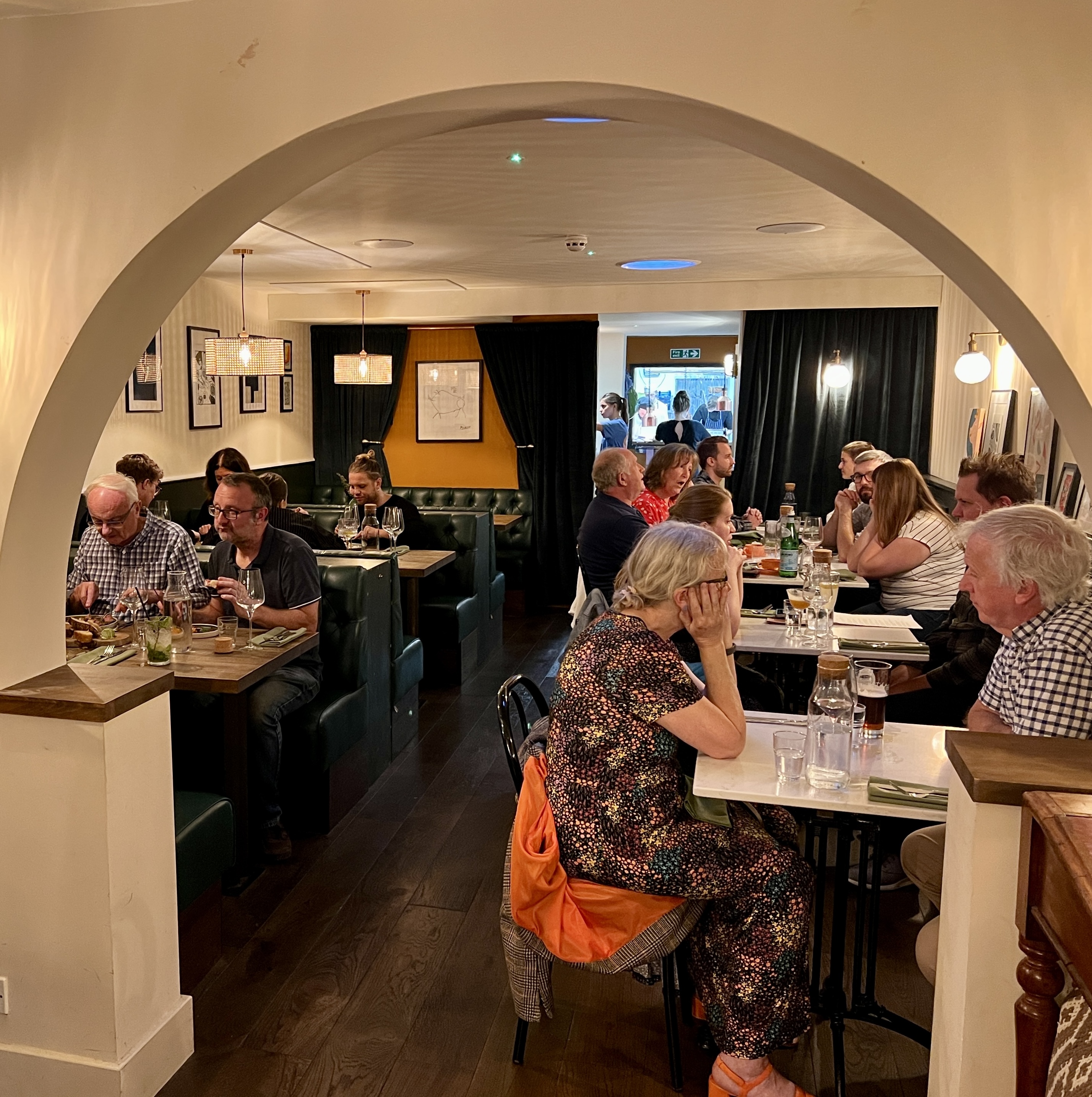
From the review I’d read I thought Five Little Pigs would be small but actually it was much larger than I expected. The front room, with the full length windows out onto St Mary’s Street, was a chic (if slightly chilly) space which was very tastefully done, an interesting mix of deep blues and golds and pastel shades from the art on the wall. It reminded me of places like Coppa Club, which isn’t necessarily a compliment. Further back was a longer, plainer room with banquetted booths. It’s a surprisingly hard space to photograph (as you can probably tell) but it was packed at seven o’clock on a Saturday night: a good review in the Observer will do that for you.

The menu read well and had plenty on it to appeal. Starters clustered around eight or nine pounds, and only a couple of mains were north of twenty. Plenty of it was local, too, with nearby cheesemakers, growers and butchers all namechecked. “We don’t have the pigs cheeks at the moment” said one of the wait staff, “but they may come in later.” I found that a bit confusing – were they being delivered by drone? – but decided it was best not to ask.

By that point a bottle of red had been opened, a really enjoyable organic Rioja, and I was about to reach that happy place where the food has been ordered and you know you’re safely in somebody else’s hands for the next few hours. Every table was full – with date nights, family gatherings and, in one case, an elderly couple who seemed to spend most of the evening glowering at each other. We were all going to have an enchanting evening. The Observer said so.

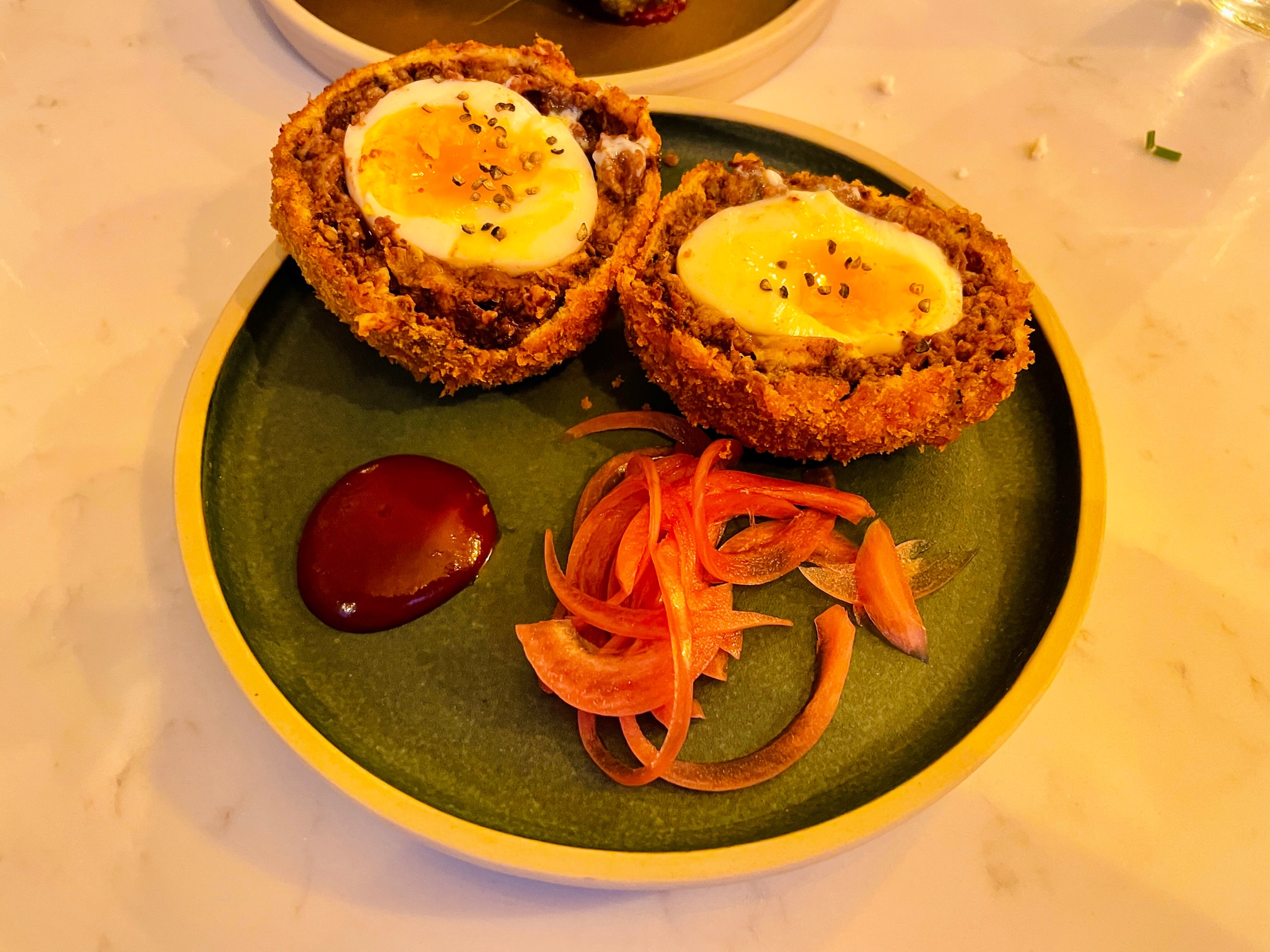
I felt a bit basic ordering the Scotch egg, but I can’t remember the last time I had one so it was calling to me from the menu right from the outset. It was one of the nicest things we ate all evening, so proved to be a happy choice : the sausagement was nicely coarse, with black pudding adding a little earthiness. And if I’d have liked the outside a little crisper, or the whole thing slightly less crumbly, the presence of a small pool of superbly tangy rhubarb ketchup mostly made up for that, as did the pickled pink onions.

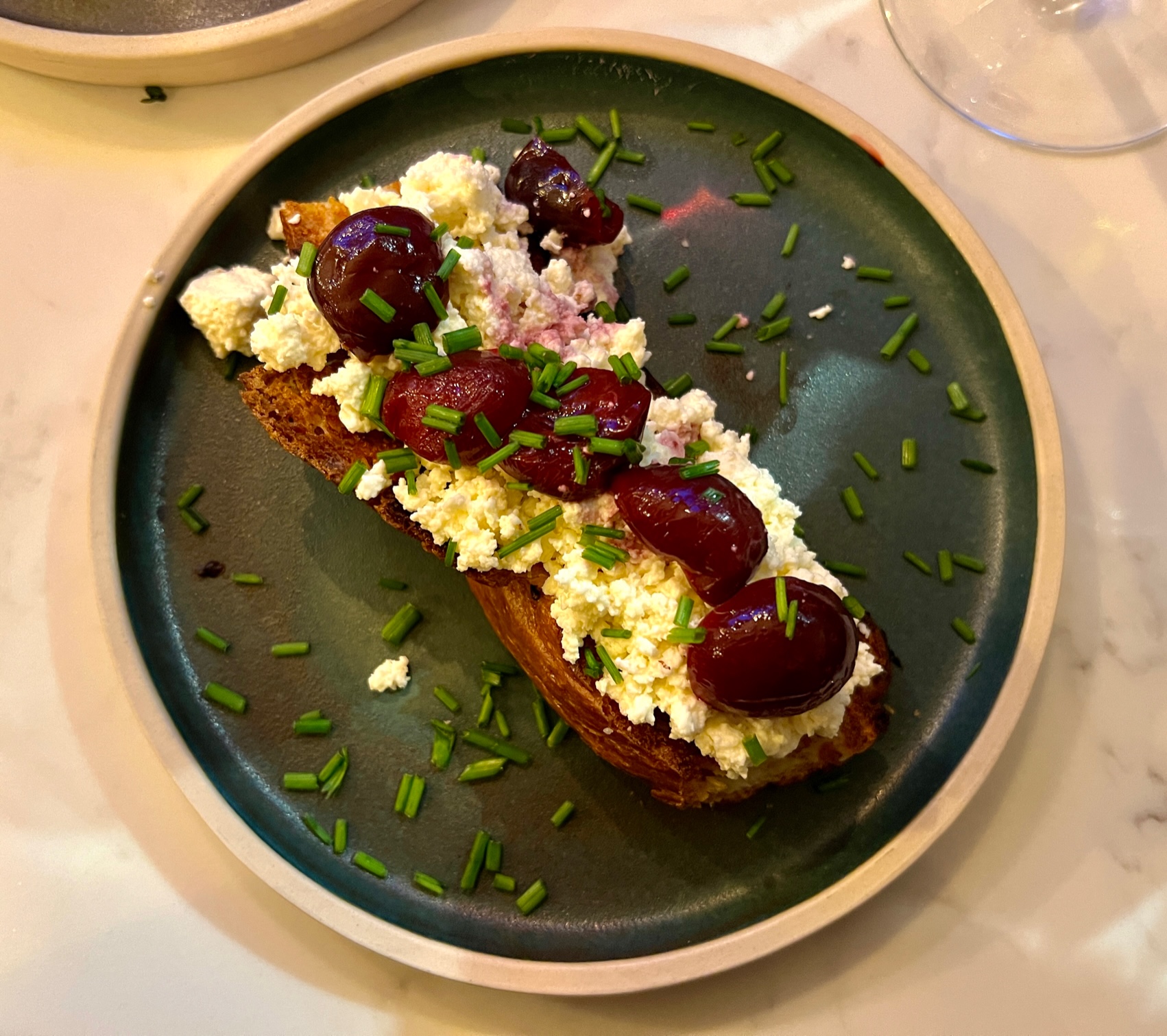
“You win” said Zoë, tackling her ricotta on toast, which sounded great on paper but in reality was disappointing. “It’s all a bit dry” she said, and this is a woman who’s listened to me talking about my favourite Bob Dylan records, so she knows what she’s talking about. For what it’s worth I agreed – the ricotta was dry and anaemic, the cottage cheese of the Chilterns, and although the roasted cherries were an interesting idea they didn’t add enough of the moisture this dish needed. Literal cherries on top, yes, but sadly not figurative ones. “This could have been really nice with honey” was Zoë’s take.

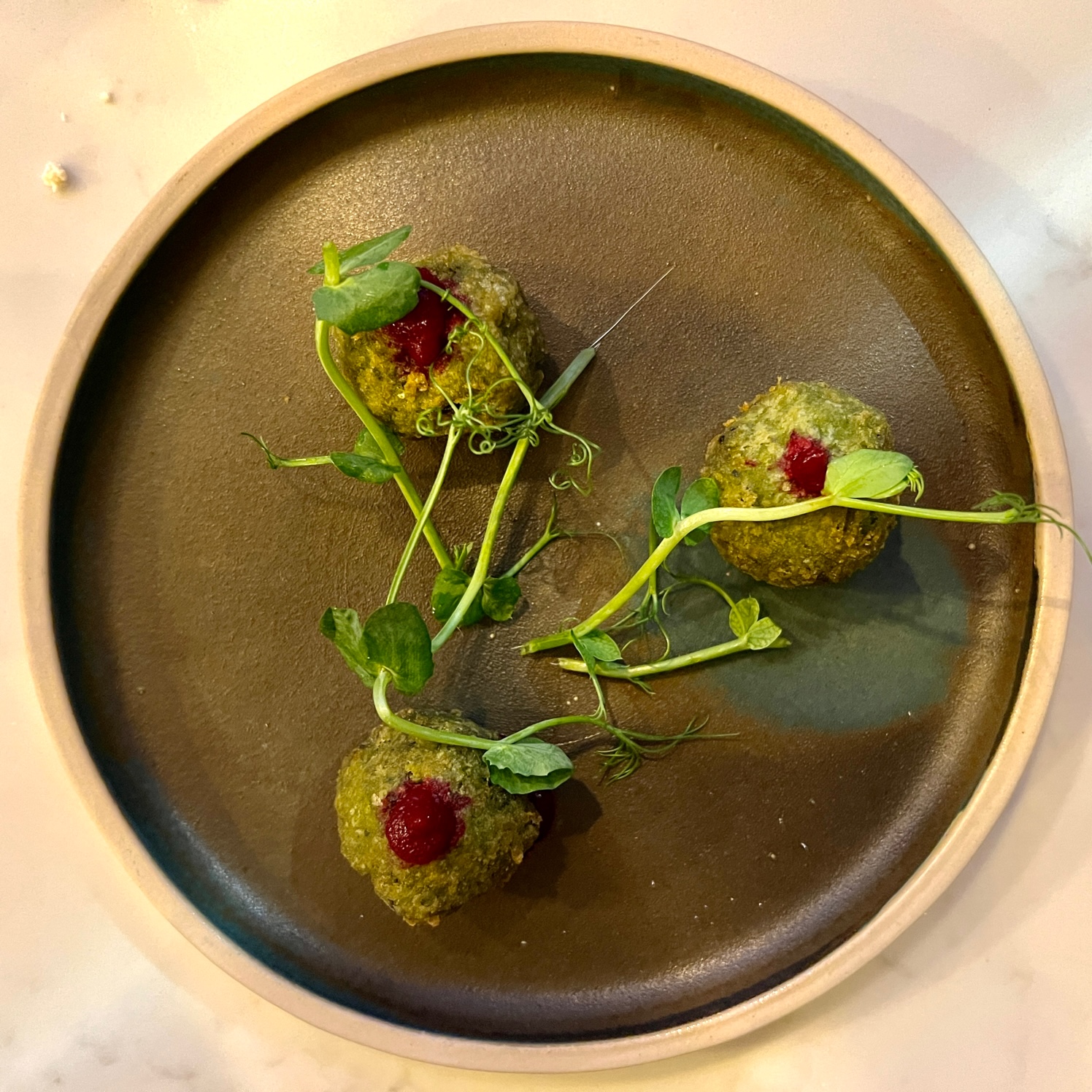
We’d also ordered a third starter, broad bean fritters, because they sounded so magnificent. And they tasted gorgeous, with huge amounts of freshness from the mint and a dab of deep whipped beetroot on top. But plating it up with pea shoots and plenty of negative space couldn’t really conceal the most obvious thing about this dish, which is that it was minuscule; it was one of those times when I wish I’d popped a twenty pence piece on the plate before I took the photo so you could see just how small they were. We had this as an extra dish, but if this had been my starter I’d have been looking at everybody else’s, feeling profoundly robbed.

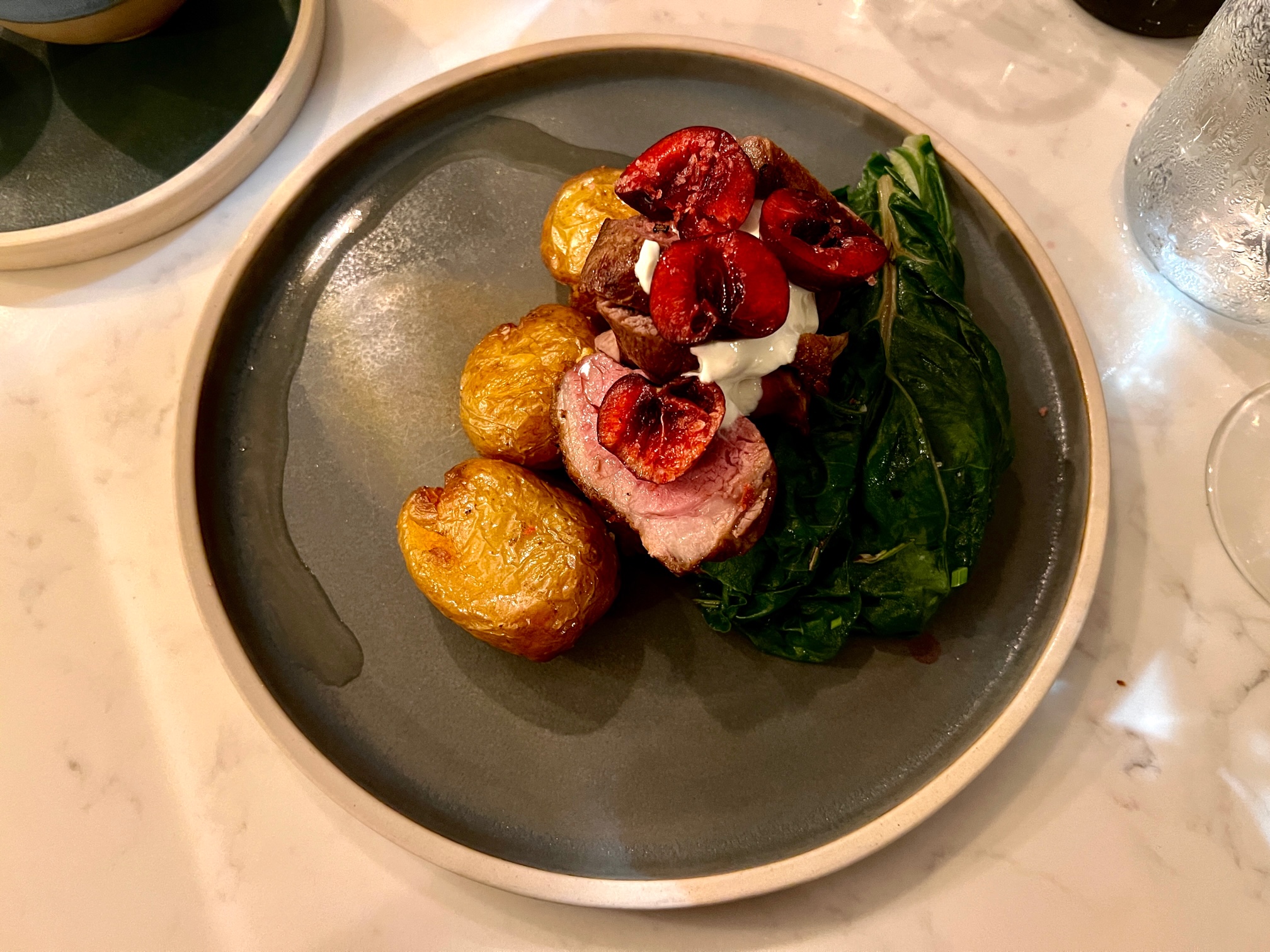
Things were well paced at Five Little Pigs, possibly because it was so busy, because our starter and our mains were about half an hour apart, for me close to the optimum interval between the two. I think Zoë chose better with the mains and her lamb rump with yoghurt, more of those roast cherries and what the menu calls “crispy potatoes” was the pick of the two. But even here, it wasn’t perfect. “Again, it’s dry” said Zoë. “The yoghurt is really good, but if anything it needs more of the cherries. They work better here than they did with the starters.” I agreed with that, although I thought the crispy potatoes were a standout, with a lot more texture than met the eye. But for me, the lamb rump was a little overdone. I found it odd, too, that they brought me a steak knife but not Zoë, when her dish needed it every bit as much as mine.

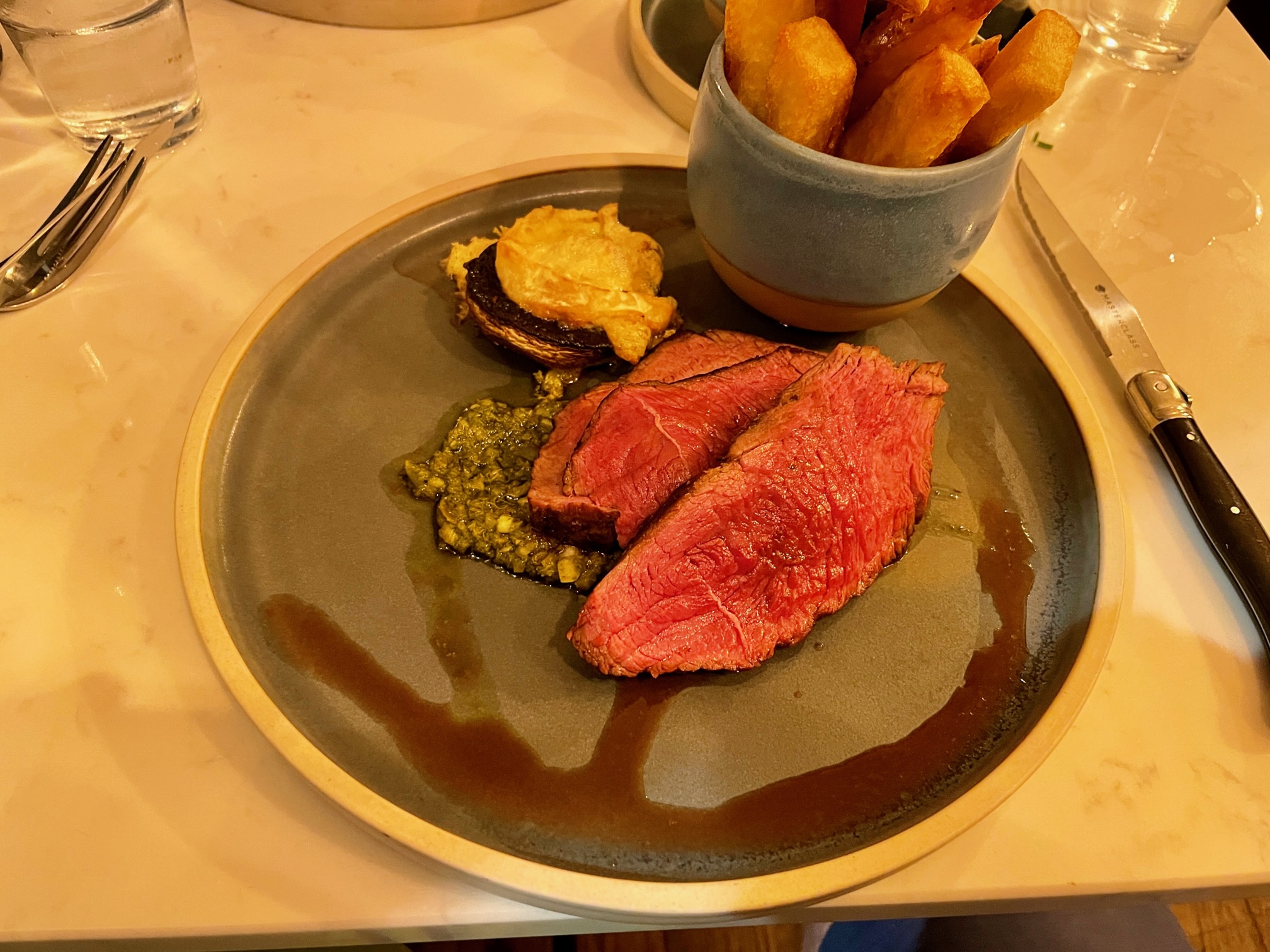
My rump steak was the most expensive dish on the menu, which always adds the potential for it to be the most underwhelming. It was a beautiful piece of beef and the cooking couldn’t be faulted – pretty much medium-rare throughout with beautiful caramelisation outside. But it was underseasoned, and surprisingly bland. The chimichurri underneath it had a pleasing zing, but ran out very quickly indeed. And after that the whole thing became a bit of a slog. There was some kind of puddle of juices at the edge of the plate, but it would be pushing it to call it a jus or a sauce. The best thing on the plate was a solitary mushroom cooked with cheese (again from Nettlebed) until it was salty and crispy, but when the star of the show plays such a brief cameo role, you’ve got problems.

Just to add to the onslaught of dryness, my triple cooked chips had decent texture – and were huge – but, again, they came without anything to add moisture. We’d ordered another portion separately, not knowing that we wouldn’t really need them, and I think in a restaurant with sharper service they might have talked us out of doing that. They came with a very good aioli but, as with the chimichurri or the beetroot ketchup, there was nowhere near enough of it. We asked for some more from a passing member of the wait staff. Five minutes passed and it didn’t materialise. We asked again and some time later, when the chips were nearly at an end, it finally arrived. 

We looked at the dessert menu because our bus wasn’t for another forty-five minutes, or at least that’s what I told myself. By this point the couple at the next table had both ordered the hake – which looked nicer than either of our mains – and there was a certain mesmeric quality to watching them push it round the plate in that way that people who don’t really enjoy food seem to do. 

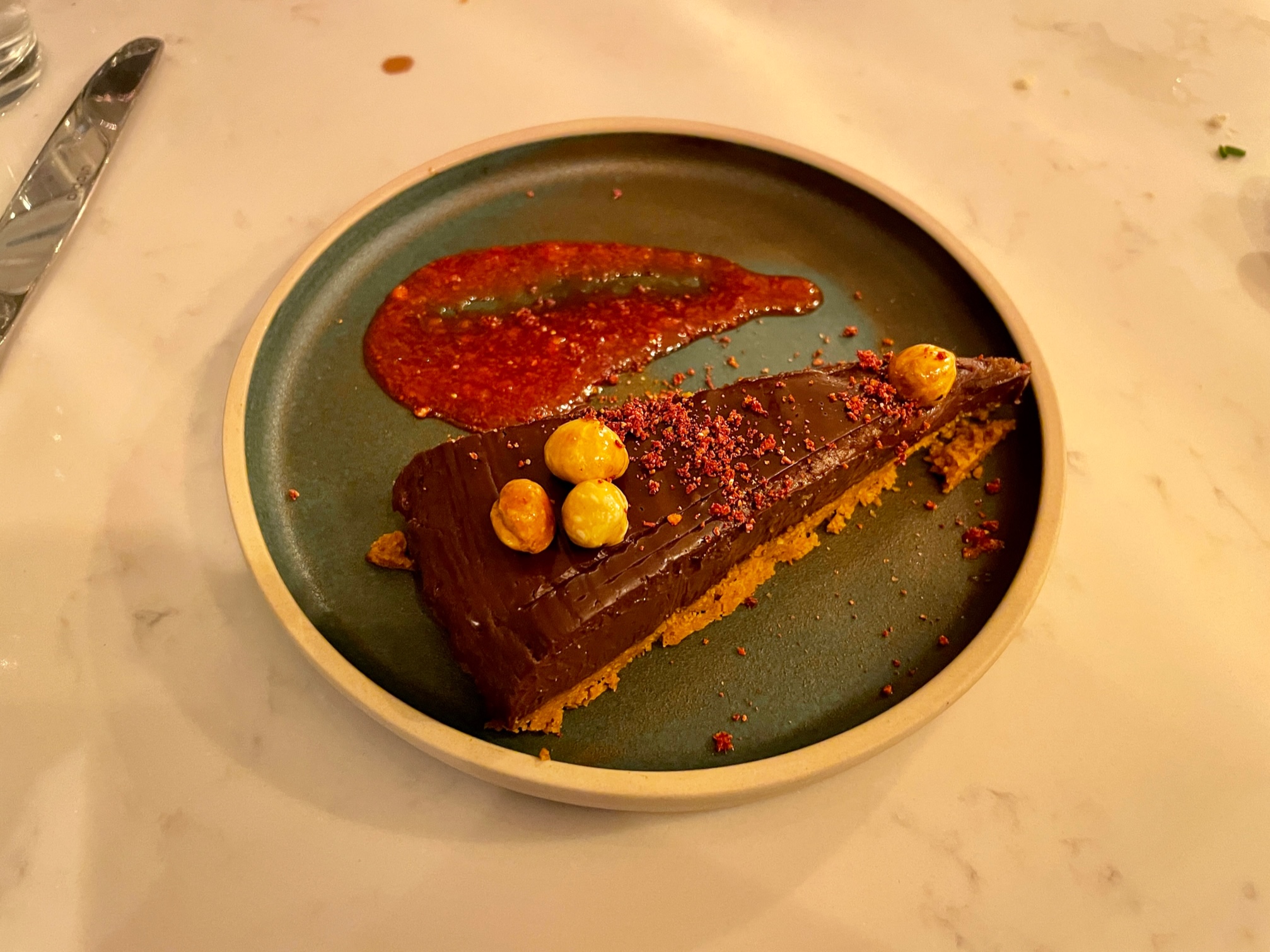
Anyway, desserts represented a slight recovery. My chocolate delice was a brilliant wodge of deep, gooey chocolate with a sweet, almost-sharp smear of bright strawberry purée to cut through. The biscuit base underneath was so crumbly that it barely stayed in one piece, but I didn’t mind that at all. Zoë’s key lime pie had a similarly short base and I thought it was pleasant, but I’d probably describe it as “subtle”, which really isn’t what you’re looking for in a dessert. 

Zoë had her dessert with a Cotswold cream liqueur (although it turned up on the bill as Bailey’s, so Christ knows which it really was) and I had a dessert wine – from Graves of all places – which went beautifully. And well done if you’ve made it this far, because the truth about Five Little Pigs is that, sadly, by this point I’m even slightly boring myself. Our bill came to a hundred and forty-six pounds, including service, and then we went outside, got the penultimate bus out of Dodge, got home, had a cup of tea and went to bed. The end.

Last week somebody commented on my Facebook page about the review I did of Sauce And Flour. “I wish you’d stop doing reviews of places outside Reading” he said. “I prefer the Reading reviews. And after all, this blog is called Edible Reading”. I always find it interesting when people pipe up to tell me that this entirely free blog is somehow not delivering value for money, and after I politely told him that I’d review wherever I bloody well liked he deleted his comment. But there’s an important point here, believe it or not. I think it’s good to review places outside Reading because it gives you that all-important context (like I said at the start, there’s usually a Context). Otherwise how do you know if a place is good, or just good for Reading? 

And it goes beyond Reading. If I hadn’t been to the likes of Marmo and Caper & Cure maybe I’d have thought about Five Little Pigs very differently. But at the same price point, making similar noises, and even with some similar dishes, the difference is stark. There are better ways to spend a hundred and fifty pounds eating out than to go to Five Little Pigs. One is to go to Marmo, or Caper & Cure. Another, to be honest, is to eat at Tasty Greek Souvlaki four times. Five Little Pigs is probably an absolute boon to Wallingford, and on another night I might well have had a meal there I’d have enjoyed better. But in truth, I can’t see myself going back. 

So there you go: it turns out that restaurant reviewers aren’t always right. But as a regular reader of this blog you knew that already, didn’t you?

Five Little Pigs – 7.1
26 St Mary’s Street, Wallingford, Oxfordshire, OX10 0ET
01491 833999

https://www.fivelittlepigs.co.uk