Restaurant review: Arbequina, Oxford

Late last Saturday morning I was sitting outside Missing Bean on Turl Street with my great friend Jerry, drinking a gorgeous latte in the summer sun, about to tuck into a pain au chocolat with impeccable lamination; I remember thinking that, on a day like that, there felt like no better place to be than Oxford in the sunshine. The train up from Reading had been packed, and we’d stood in the vestibule making conversation with our fellow captives, two young polite Swedes with perfect teeth and an Australian who had fought her way there to the loo and, realising how spacious it was, was tempted to lock herself in there for the rest of the trip.

And when we got to Oxford – well, it was a Saturday in August and the weather was fine, so naturally the city was packed. A curious blend, throngs of tourists swarming round Radcliffe Square, the Bodleian and the Covered Market but also packs of graduands, in their gowns, on their way to the Sheldonian Theatre for their final rite of passage. The Oxford year isn’t like the calendar year and this all happened on the very outskirts of it – one academic year ended, another not quite ready to begin, the city reclaimed by residents before the whole thing started again in October.

Nonetheless, from where we were sitting the view was gorgeous, the food and drink were excellent and the people watching was close to unparalleled. I’d asked Jerry if he was free on the off chance at very short notice and had been delighted that he was, and at this point we were barely an hour into what would turn out to be another effortless nine hour chinwag, punctuated by this walk or that, this spot of shopping or another, lunch, coffee, beer garden, train home. Even at the start of the day, I knew it would be a good one: with Jerry, it always was.

But would it be a good lunch? I’d thought carefully about this, because although I always have a wonderful time with Jerry when he joins me for a review I cannot say, hand on heart, that we usually have a good meal. I’m not saying that he’s a jinx, far from it, but I feel guilty that he’s joined me for some of the most middling meals I’ve had for the blog in the last few years. He was the person I took to Zia Lucia for pizza that was nothing more than pleasant, and then he also came with me to Maidenhead’s Storia for much the same experience.

Then to cap it all, the last time we lunched it was in Oxford – at Gee’s, where £200 got you a lot of disappointment. Because Jerry is so lovely, he never resents us marring our time together with mediocre food, which makes him a far better person than me. But I still feel bad about it, and I decided after that lunch in Gee’s that Jerry, more than anyone who comes out on duty with me, deserved a nice one. But where to take him?

The thing is, places I review for the blog probably fall into three categories. There are the ones I expect in advance will be good: these are more likely to happen in places like Oxford, London or Bristol that support a large and thriving restaurant scene. And then there are the places I merely hope will be good, and that hope can run the whole spectrum from reckless optimism to wishful thinking. Don’t get me wrong: I always hope for the best but sometimes, especially in Reading, that hope can border on the blinkered or forlorn.

Originally I was going to take Jerry to the Chester Arms, out off the Iffley Road, which falls into the first category. It’s famous for one thing and one thing only – its enormous steak platter, which comes groaning with handmade chips, cabbage and streaky bacon and béarnaise sauce, which they have been serving up for over fifteen years. I’ve heard about it so many times but never managed to make it there, but as we were deciding where to go Jerry dropped the bombshell: he’d just had a dental implant, so needed something a little less taxing on the molars. Would I mind if we went somewhere else?

So the subject of this week’s review falls into the rarer third category: places I have been, that I remember liking, where the mixture of hope and expectation is more of a balancing act. You don’t so much expect they’ll be good, you more hope that they’re as good as you remember. And Arbequina, the tapas restaurant down the Cowley Road, definitely falls into that category. It’s been there nine years, very much blazing the trail in that part of Oxford, and after getting a rave review in the Guardian the year after it opened it’s stayed out of the limelight, even though it’s one of only two Oxford restaurants to be mentioned in the Michelin guide.

It’s quietly done its thing. No cookbook, no appearance on Saturday Kitchen or Great British Menu, just keeping going and keeping afloat. Growth has been steady and incremental: first it expanded into the neighbouring unit four years ago and then, earlier this year, it announced that it was crowdfunding to open a second site in Oxford’s Covered Market, The council had approached them with an offer – not something that would ever happen here in Reading – and so far the crowdfunder is just over half the way there, with the restaurant still hoping to open the new site later this year.

So yes, Arbequina has history. And I have history with it too, because I’ve been eating there, on and off, for the last eight years or more. Plenty pre-COVID, when I always adored it, but only once, for some reason, since the pandemic ended. That was three and a half years ago, and it sowed seeds of doubt that maybe Arbequina wasn’t the restaurant it used to be. But I should have checked in on it long before now, and ambling across Magdalen Bridge with Jerry, in good time for our lunch reservation, I found myself getting excited about a reunion with somewhere that used to be one of my favourite places.

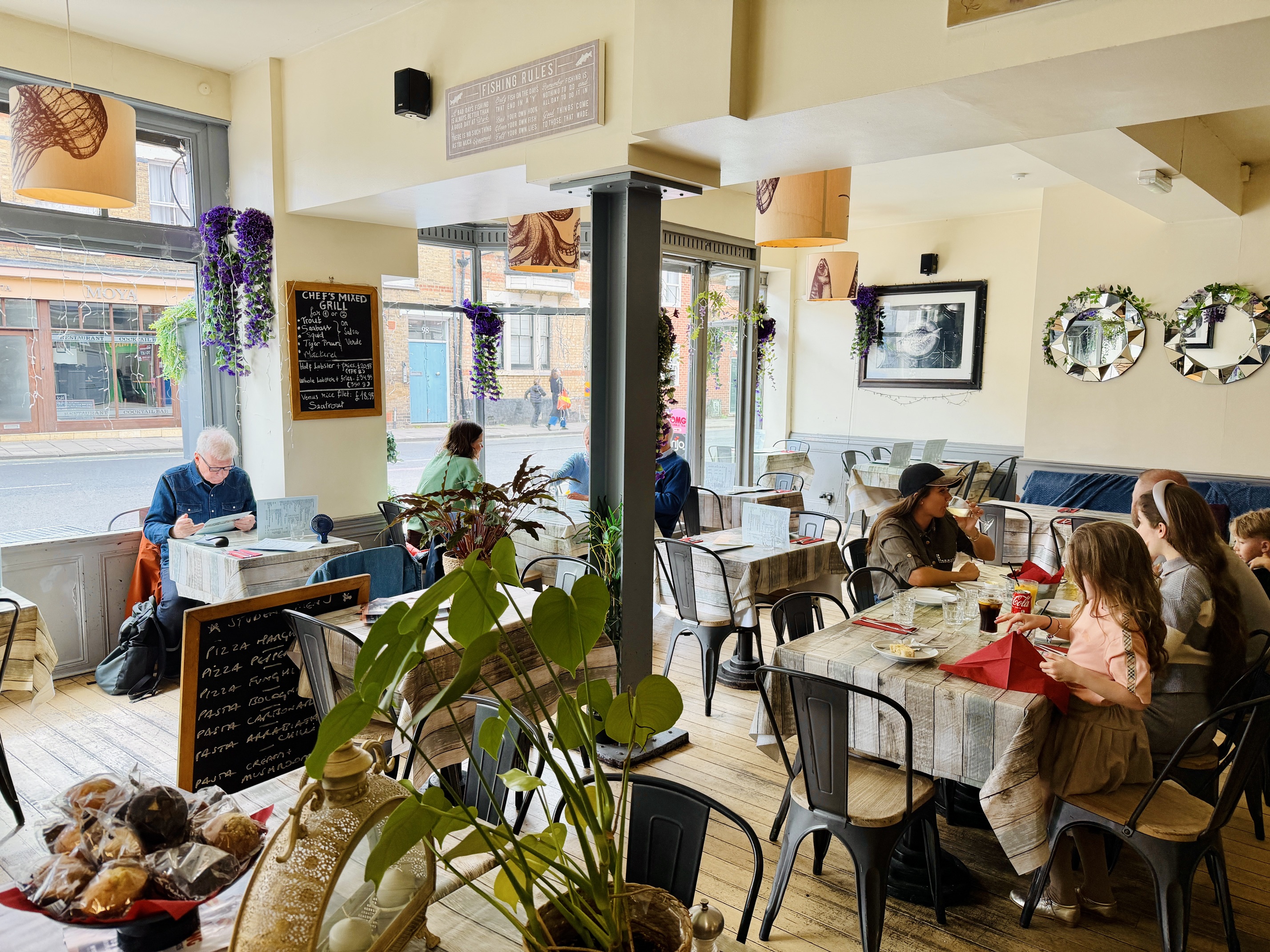
It’s in the fun part of the Cowley Road, past the restaurants Florence Pugh’s dad used to own, past Spiced Roots, but just before brilliant café Peloton Espresso, or Truck Records, or – far further up – the turning into the food enclave of Magdalen Road. It’s a lovely site that has kept the old shop fronts from the chemist and watchmaker who used to trade there, the tasteful writing in orange sans serif on the glass the only sign of Arbequina’s name. The room inside is lovely, with unpretentious decor, a handful of tables, both low and high, and a long zinc bar where you can sit and watch all the work in the very small open kitchen.

But it was a Saturday in August, and the awning was out, and neither of us could think of anything finer than sitting out on the pavement watching the Cowley Road live and breathe, so we did exactly that. I ordered a rebujito from their cocktail menu – a drink I grew to love in lockdown but which I had for the first time at Arbequina, rather than in Andulusia – and Jerry joined me. It was fresh and zippy, a harmonious blend of the lemon, mint and that savoury note of fino.

The other thing we had right from the off, while we made up our minds about the rest, was Arbequina’s tortilla. I remembered it well enough to know that you simply had to order it, and I also knew from repeated personal experience that sharing a slice felt like a good idea right up to the point where it turned up and you could only eat half of it. So I insisted that we got a couple, and Jerry agreed – partly because he’s just a very agreeable cove and partly because I sold it as about as kind on his teeth as it’s possible to get.

But ‘kind’ undersells it, because it’s a positively indulgent treat and, however good anything else you eat at Arbequina might be, it always sets the standard for other dishes to beat. I had forgotten, over the last three and a bit years, just how good it is, but it was magnificent: so soft, only just structured on the outside and a glorious mess within.

Egg, potato, onions, thyme – that’s all there is to it, but of course that’s a hopelessly reductive way to describe a masterpiece. Jerry did better, dubbing it sumptuous. Why do I never use that word in reviews? Maybe I was waiting for this dish.

Because you could have tortilla in dozens of places, in Spain and in this country, and not approach the brilliance of this. Every forkful but the last was wonderful, and the last was wonderful yet heartbreaking. But I knew that at least not sharing it meant that last forkful took longer to arrive. It was so sweet, so exquisite that I thought I tasted things in it – maybe nutmeg, maybe cinnamon – that weren’t there.

When Ben, the manager who looked after us that day, took our empty dishes away he explained that there really was nothing else in there. The sweetness came from the onions, which were cooked for a mind-blowing twelve hours. When Jerry heard that he said “I don’t envy your gas bill” and the manager smiled. Jerry had accidentally hit on one of the reasons hospitality is so thankless right now, and he meant no harm by it.

That tortilla under our belts, it was time to take a serious look at the menu and plan our assault on it. Many of the dishes I remembered from previous visits – chicken thighs with romesco, or toast thickly spread with ‘nduja and honey – were no longer there, but the menu still read nicely. Just shy of twenty dishes, most of them at or adjacent to a tenner: only one approaching twenty quid and a last, Iberico tenderloin to share, closer to forty.

It didn’t break into sections, or flow quite the way that the menu at, say, RAGÙ did, but it had plenty of potential and so Jerry and I did what I’d done countless times before – made a list of things we definitely wanted to eat, broke it up into waves and decided to order and graze, little and often. And along with that we had a gorgeous white, an Asturian albariño blend with a certain bracing saline quality: I’d chosen it for no other reason than that I’m on holiday in Asturia soon, and fancied getting a sneak preview.

My verdict? Roll on next month. At £45 it was the most expensive white on a very compact list – four reds and four whites, mostly from Spain, and a bigger selection of natural wines from all over. But the markup was far from harsh, because I reckon it would cost you about £20 retail.

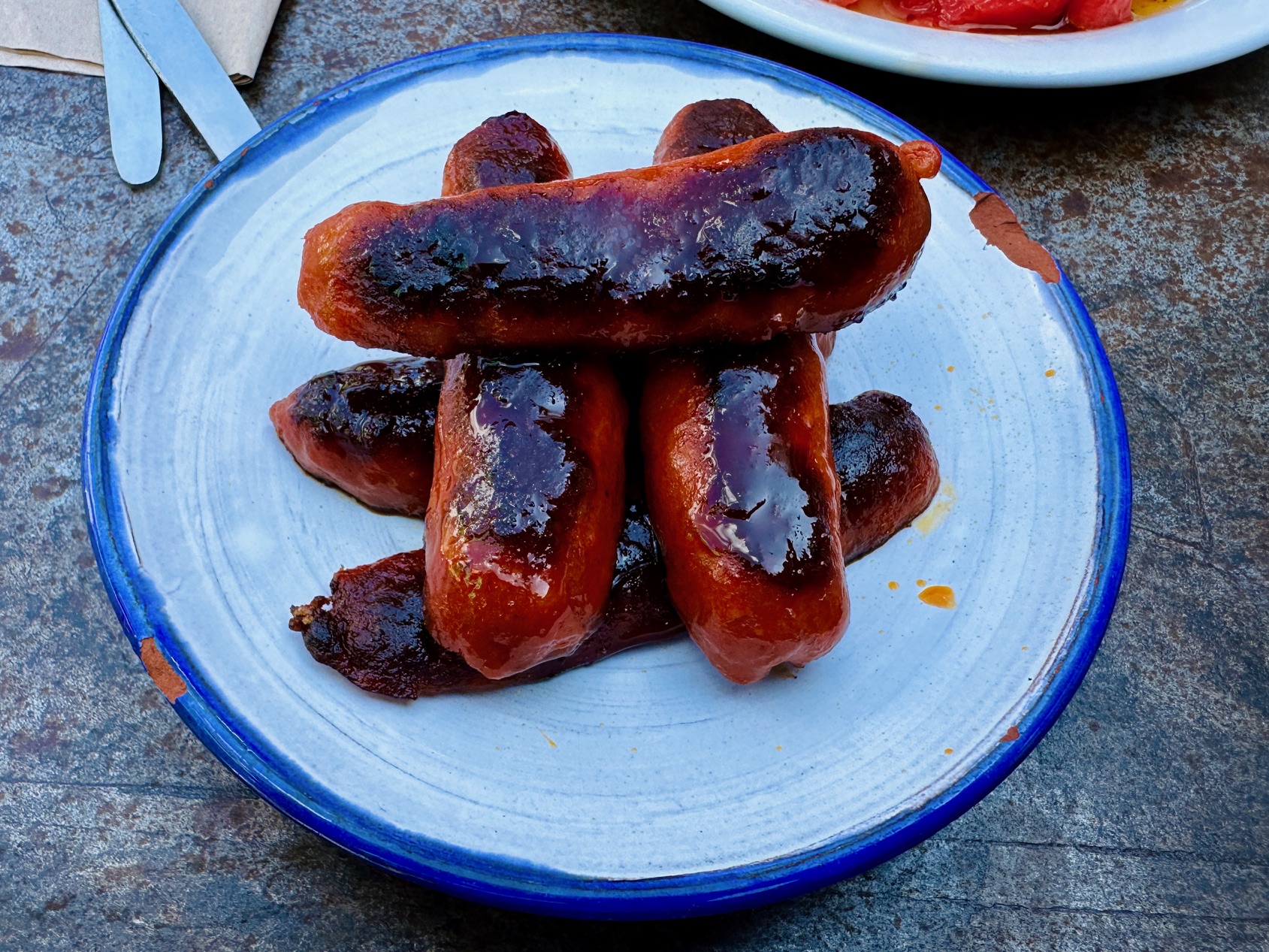
Sometimes things can be delicious because they’re simple, and Arbequina’s chorizo was a classic example. Sliced lengthways and cooked on the plancha until the outsides were caramelised and blackened, it was superlative stuff. Not cooked in wine or cider, not sliced and fancified, just cooked and served. I’d love to know where Arbequina buys it – it’s certainly not Brindisa, because theirs can be a bouncy horror compared to this.

It irked me that they gave you five of them, though, because that’s an especially tricky number to share. Well, with anybody but Jerry, anyway. “Go on, you have the last one” he said. He’s just lovely like that.

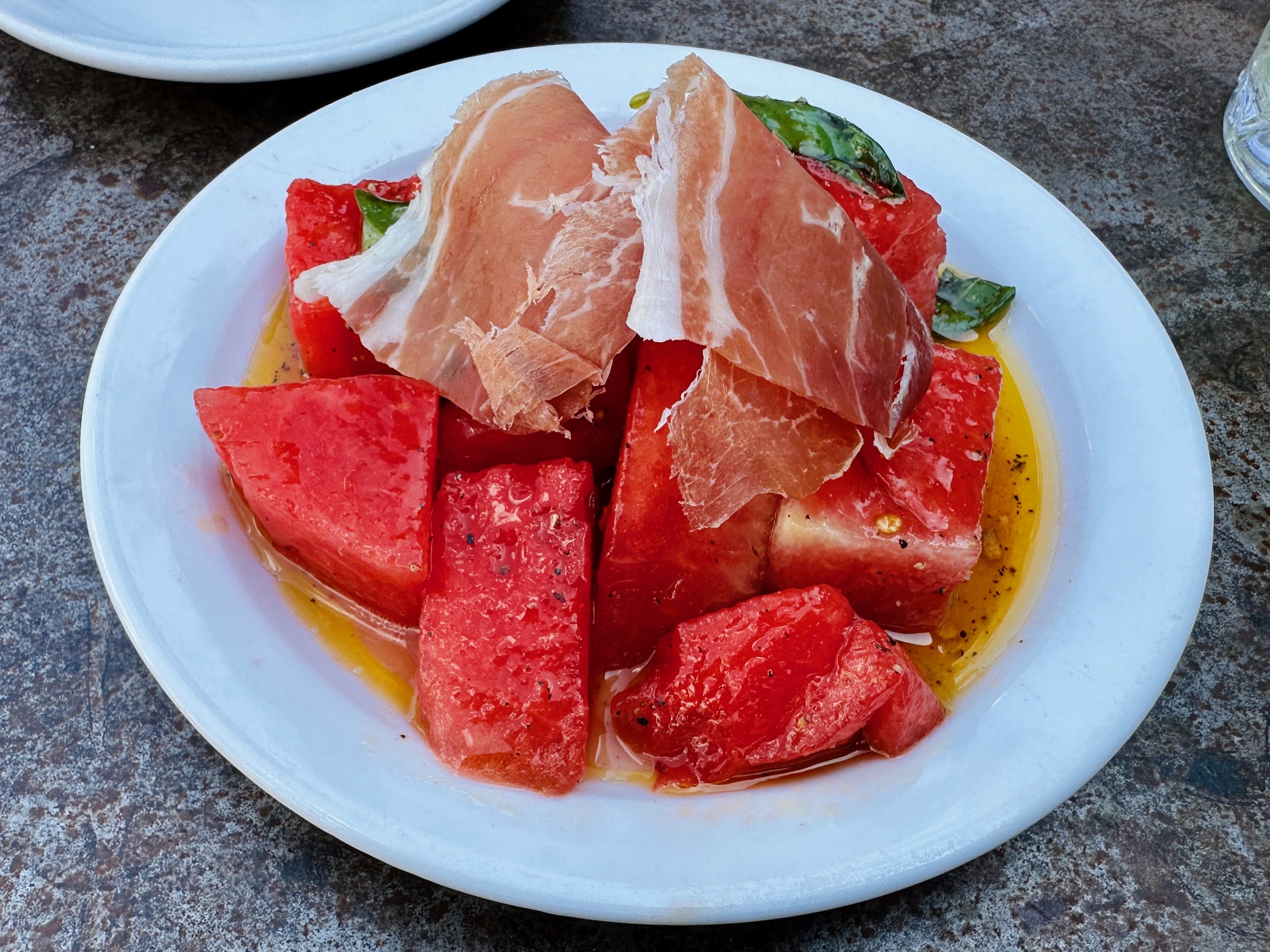
Almost as simple, even more beautiful to look at – and perfect for a sunny al fresco afternoon – Arbequina’s watermelon with jamon was a joyous dish. The melon was plump, sweet and vibrant, and very much the star of the show. But where it wasn’t quite as successful as, say, the similar dish I had at RAGÙ recently, was that the supporting players were perhaps hiding their lights under a bushel somewhat. The two bits of jamon folded on top felt slightly meagre, the honey and chilli rather lurked at the bottom of the plate, shunning the limelight.

But to be fair, if you’re comparing this with the dish at RAGÙ it’s only fair to also note that this was £8, and the Bristol restaurant’s version was over 50% more expensive.

Jerry was in no rush – I always forget that he’s not a trencherman like I am – so at this point we asked the manager if we could hold fire, sip our wine and come back to the menu. And he let us do exactly that, keeping us posted on when the kitchen would take last orders so we could have the leisurely lunch we had in mind. Jerry and I had plenty to catch up on, so we nattered about all sorts, only punctuated by Jerry having an almost Tourettes-like reaction to every single electric scooter going past. I love the multitudes people contain: Jerry is possibly the most affable person I know, but he really hates those electric scooters.

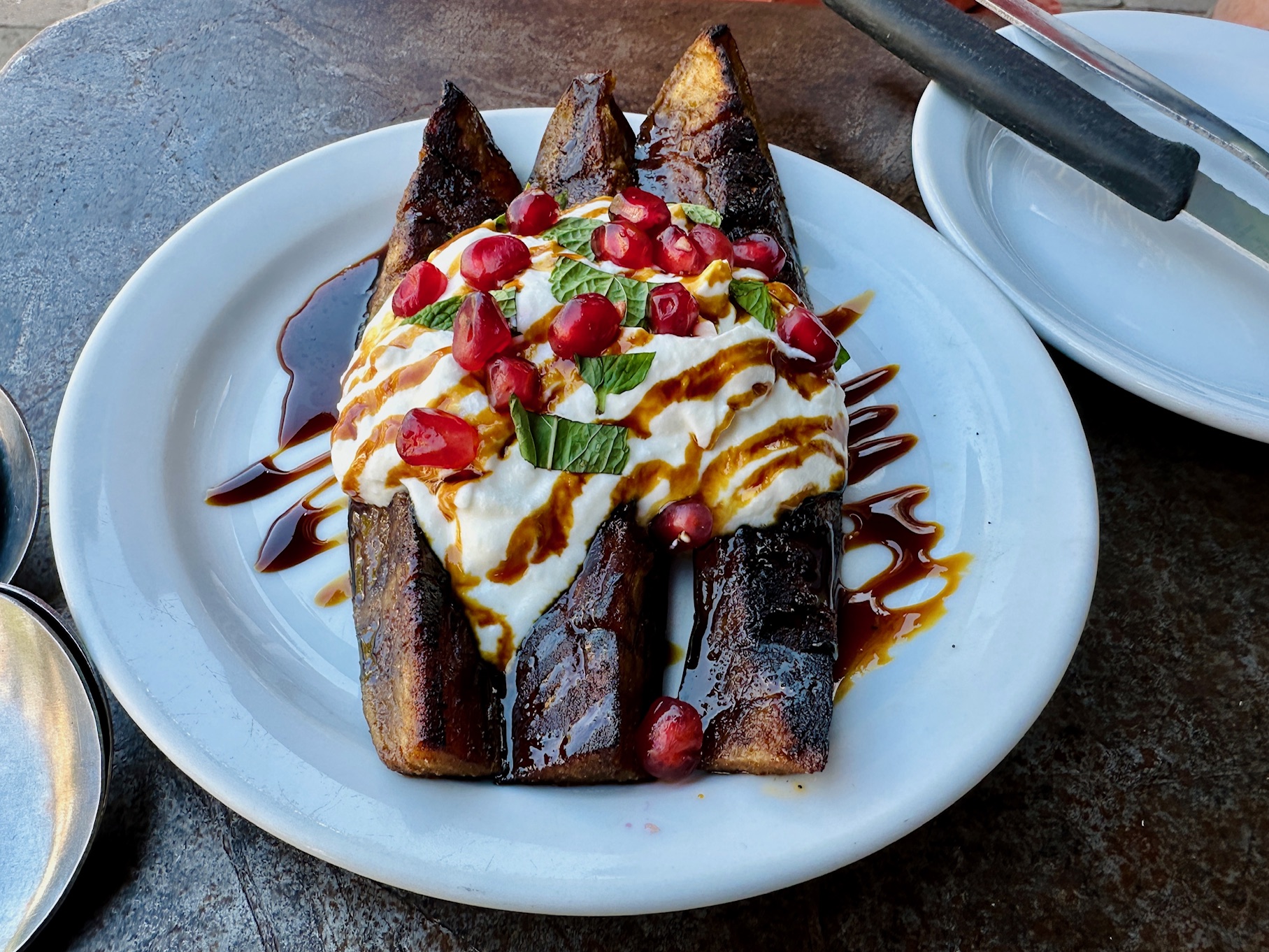
The one dish Jerry really wanted from the menu was Arbequina’s take on an Andalusian classic, berenjanas con miel, or fried aubergine with honey. Now, I wouldn’t have ordered this because I’ve never liked it in Spain – usually the aubergine is sliced thin and fried in a crispy batter, and drizzled in a dark sticky molasses that is a million miles from honey. It takes some doing, in my book, to make aubergine a good thing and this dish, whenever I’ve had it abroad, doesn’t pull it off.

But Arbequina’s version takes everything that could be good about that dish and junks the rest. So we got three soft, caramelised wedges of aubergine, drizzled with an ambrosial molasses without any sour, burnt note, the whole thing bathed in a mild whipped feta – almost more yoghurt than feta – and scattered with pomegranate and torn mint. Have I sold it to you? I hope so. Arbequina sold it to me, both literally and metaphorically. One to add to the vanishingly small list of aubergine dishes I actually like, most of which are on the menu at Kungfu Kitchen.

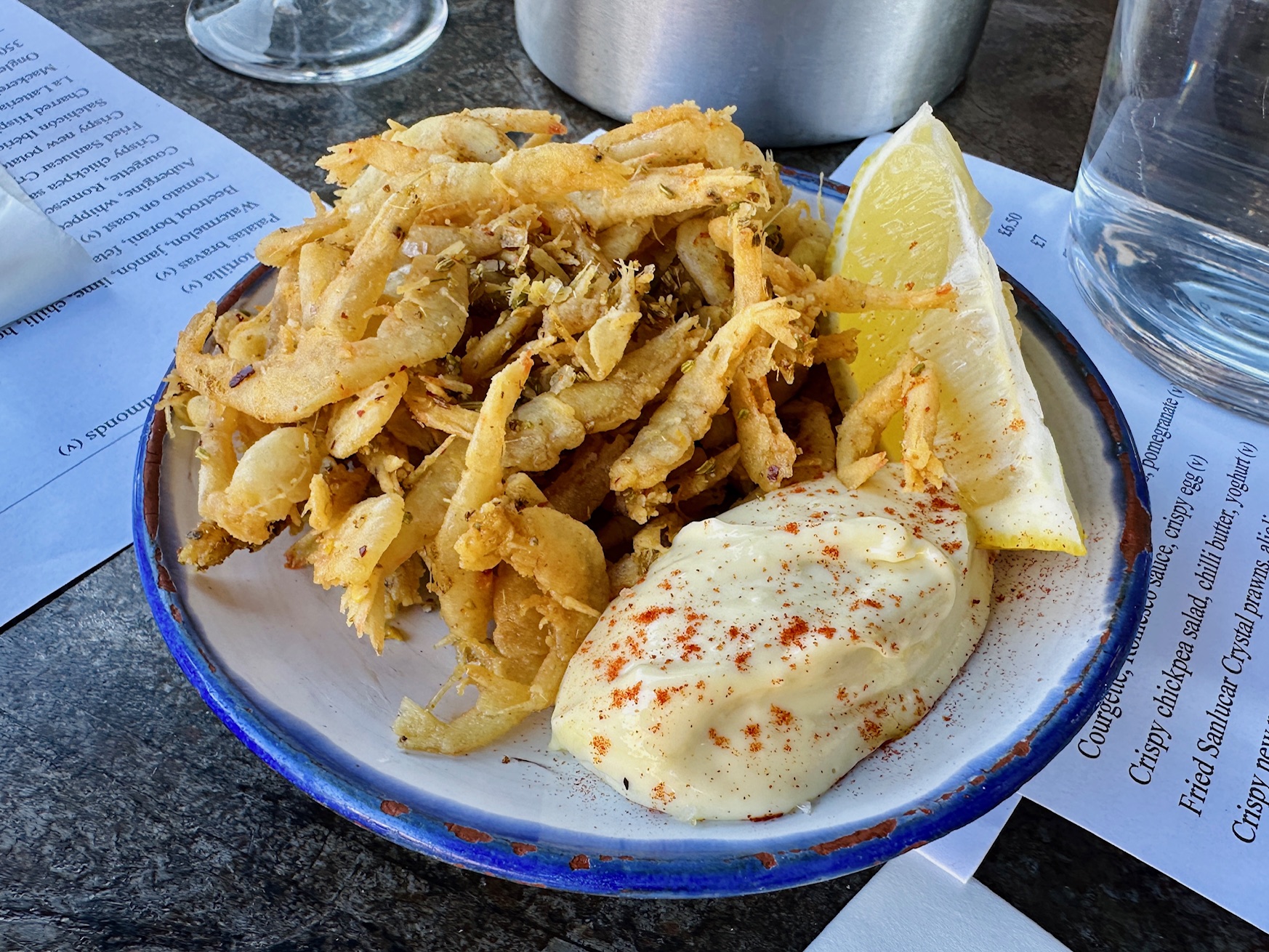
Our last two savoury dishes were, apart from the tortilla, the highlights of the whole thing for me. I am a terrible rubbernecker in restaurants and I kept seeing a dish go past to other tables which looked eminently snackable, a giant heap of fried, crispy, golden things. But I wasn’t sure what it was, and when I asked the manager I couldn’t explain it well enough – I blame the wine – to get him to tell me what the dish was. But then Jerry wanted the prawns, so it turns out we ordered it by accident.

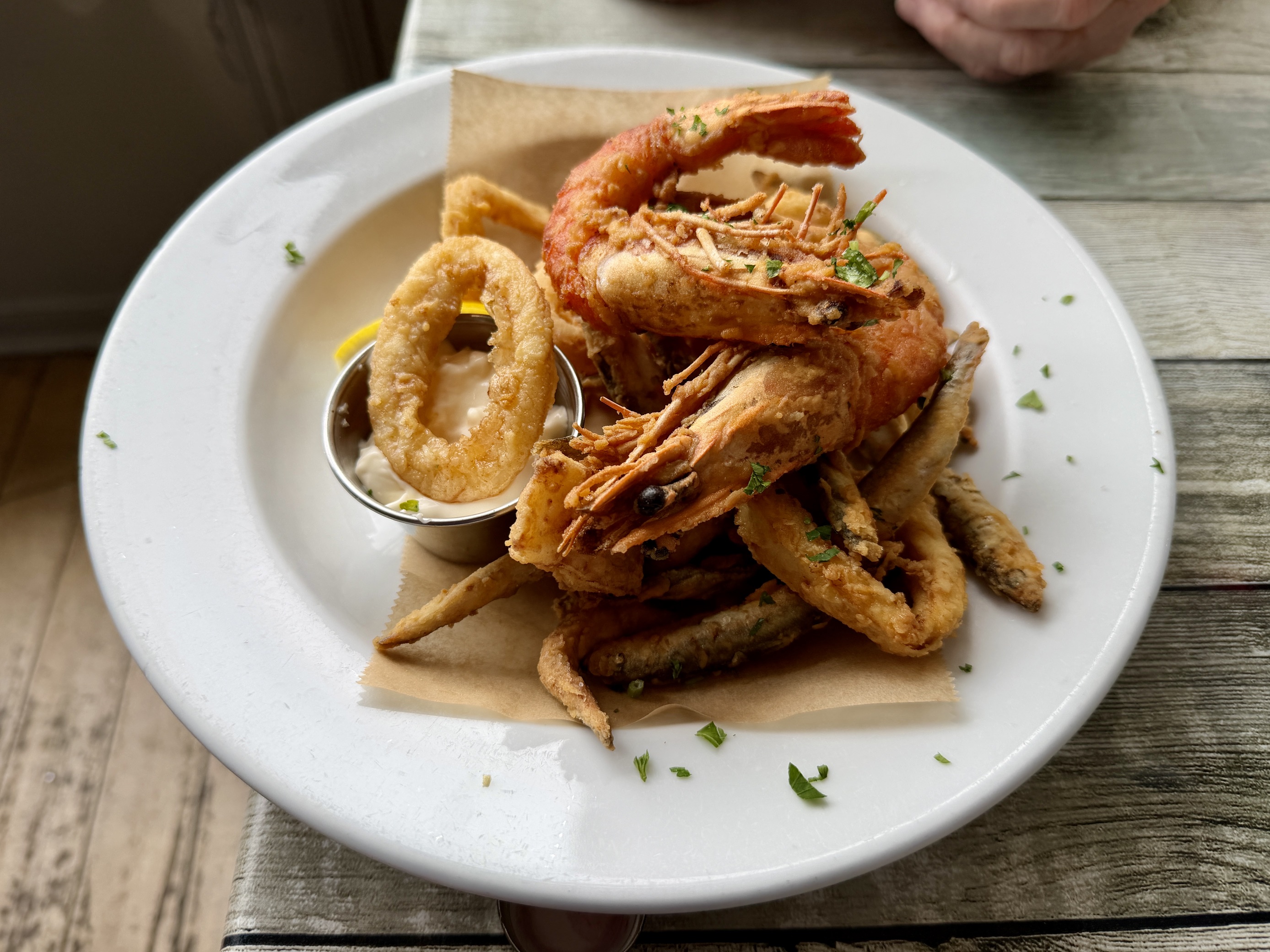
So these, it turns out, are Sanlucar Crystal prawns – little critters, soft shell, fried in a golden coating, dusted with chilli and served with a generous dollop of alioli. Never had them in my life, now fully wondering where they’ve been for the last fifty-one years.

And again the funny thing is that like the aubergine, this wouldn’t normally be in my wheelhouse at all. I don’t like whitebait, can be squeamish about eating things whole. I’m not one of those macho restaurant bloggers who likes to wank on about sucking the head of a prawn – they try to channel Bourdain, but really they’re Swiss Toni – and, with the exception of one meal in Kolae I’ve managed to convince myself that I really don’t want to munch on a prawn’s brains.

So why did I love these so much? I really don’t know, but I did. I keep using the word fresh in this review, or it feels like I do, but that’s what they were – so fresh, so light, so simple, with that spritz of citrus, that whisper-quiet crunch and the ozonic tang of the sea. On the Cowley Road. Now, I love the Cowley Road but I’m not going to pretend for a minute that eating these prawns there was in any way a congruous thing to do.

I hadn’t especially wanted Arbequina’s patatas bravas – I often think they’re a way to needlessly bulk up meals in tapas restaurants – but I was drawn to their more exotic sibling on the menu. And it was another really wise choice: billed as crispy new potatoes with tonnato and salsa verde, it was a real humdinger. The slices of potato, thicker than crisps but very much sharing that lineage, were stellar, a triumph of texture.

The thick slick of tonnato was perfect for dipping and dredging: I didn’t get an enormous amount of tuna from it but I did get plenty of savoury saltiness, so I’m guessing anchovies played a part. And I don’t think salsa verde showed up to this dish at all. In its place, I suppose they had deconstructed it by instead scattering everything with salt, parley and lemon zest. I probably would have preferred a salsa verde, because I love the stuff. But I’d forgotten about the salsa verde when this dish turned up so instead I just thought isn’t adding lemon zest to this clever? They knew better than I did.

By this point we’d been there the best part of an hour and a half, in which time tables had come and gone but the restaurant had kept a happy trickling momentum of customers in the sunshine. The Americans at the table next to us ordered some of that tortilla, and inexplicably left some of it: we decided, on balance, that we didn’t know them well enough to offer to take it off their hands.

We both fancied something from the dessert menu, and I talked Jerry into a red dessert wine which came in a wide, low tumbler and was like nectar. I didn’t catch the name, and my bill doesn’t give the detail, but red dessert wines are always worth a try if you find one, and I suspected it would go better with the chocolate mousse even than a Pedro Ximenez.

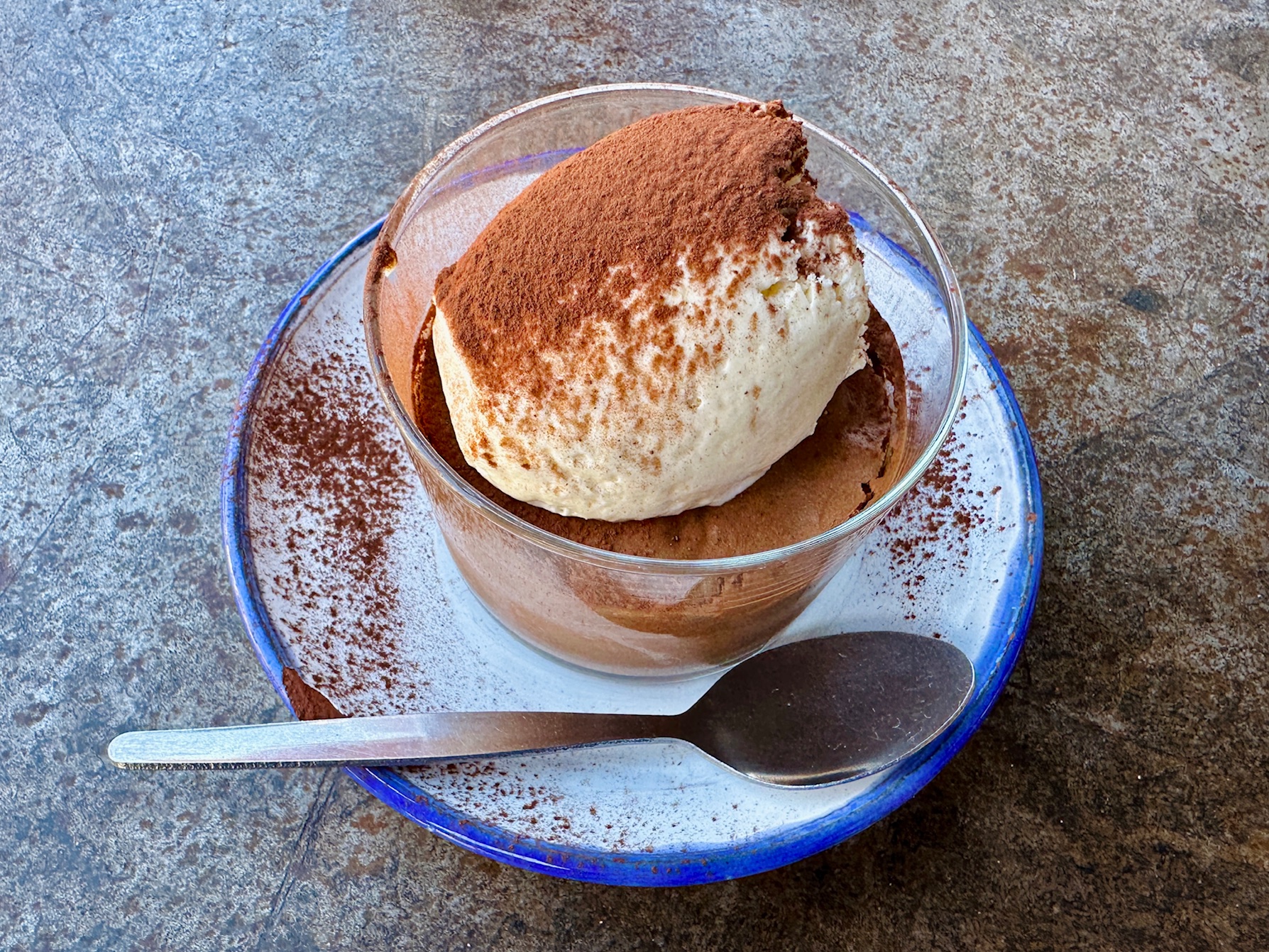
Other desserts are available, of course. Arbequina was offering a panna cotta, a Basque cheesecake or the almond-rich wonder that is a Tarta de Santiago. But I think chocolate mousse should be on far more menus than it is, so whenever I see one I order it – and Jerry, being kind to his vulnerable gob, followed suit. It was, as so often, the perfect way to finish a meal.

I’ve had Arbequina’s chocolate mousse plenty of times, often enough to track its evolution. It used to be a dense quenelle of the stuff – drizzled with olive oil, scattered with coarse salt, served with a torta de aciete for good measure. But over time, Arbequina’s version of this dish has changed, become less uncompromising, dropped the olive oil and become, on the outside at least, more conventional.

But don’t be fooled: it might come in a glass, the torta de aciete may have been replaced with a dome of crème fraîche but the mousse is still theirs, and still sublime. The salt now runs through the whole thing rather than just finishing it off, and it works beautifully.

It was the right way to end a lunch that had been unassailable in its rightness. Our bill came to just under £175, including tip, and nothing about it had felt out of kilter or anything short of marvellous. We settled up with glad hearts, and were on our way – the grand total of a couple of doors down to have a post-lunch coffee outside Peloton Espresso.

But then another delightful discovery lay in store – a short walk down the Cowley Road and we came to Rectory Road and the Star, the best Oxford pub I’d never been to and another long overdue discovery. It was like a cross between the best things about the Retreat and the Nag’s Head, with a huge handsome beer garden and Steady Rolling Man on tap.

So we grabbed a table, carried on chattering, beers passed, tables of people – and the people watching opportunities they presented – came and went. We had nowhere to be, and every reason to linger. Really it was the best afternoon, and one of the best things about it was knowing that at last, Jerry had got the excellent meal he deserved. Finally, I got him a nice one.

Much later on, we retraced our steps, walking east to west through Oxford, the sun setting in the distance. The pavement outside Arbequina was even busier, with people about to have one kind of outstanding dinner or another. The Cowley Road was alive, the antithesis to the stuffiness we’d encountered right in the centre. “It’s bit like the Oxford Road isn’t it?” said Jerry as we sloped back towards Magdalen Bridge. And I replied that it’s what the Oxford Road could be like, with better landlords and more imaginative restaurateurs. Still, it’s nice to dream.

Arbequina – 8.9
72-74 Cowley Road, Oxford, OX4 1JB
01865 792777

https://arbequina.co.uk

Since January 2025, Edible Reading is partly supported by subscribers – click here if you want to read more about that, or click below to subscribe. By doing so you enable me to carry on doing what I do, and you also get access to subscriber only content. Whether you’re a subscriber or not, thanks for reading.
Restaurant review: Gees, Oxford

For my money, there are a few finer things in life than a long, leisurely Saturday lunch with a very good friend. Especially when you’re in a fetching room, in a beautiful city, faced with a cocktail, an appealing menu and excellent people watching opportunities. In fact, one of the only things finer than that is to do exactly what I’ve described above, but on a Friday, with four whole days off stretching out in front of you. So I was very happy indeed to find myself sitting in Gees’ gorgeous conservatory on Good Friday with my dear friend Jerry, Easter weekend only just beginning.

By this point, the day had already got off to a magnificent start. The train to Oxford was quiet, deserted almost, and it was the first time in as long as I could remember that it only took a couple of minutes to exit the station, a station whose abysmal design doesn’t seem to have significantly changed in the thirty or more years that I’ve been making that journey. We had a bimble round the Covered Market, we bought bread and cheese for later on, we had a beautiful latte in the Missing Bean on Turl Street, chatting away non-stop. 

Jerry and I had never been to Oxford together before, so we compared our experiences of the city over coffee, looking at the connections between his mental map of the place and mine. I thought how nice it was to introduce him to some of my favourite spots, particularly as if it wasn’t for Jerry (it’s a long story) I might not know Oxford half as well as I do. The weather could’ve been nicer – the day was dry yet overcast, which never paints Oxford’s buildings in their best light – but the company was unimprovable.

I had chosen Gees for our lunch because it had been on my to-do list for quite some time. A glorious spot on the Banbury Road mainly famous for its conservatory slash greenhouse dining room, there’s been a restaurant on the site for nearly forty years, a mind-boggling record. It started out as Raymond Blanc’s restaurant, with John Burton Race in the kitchen, then five years later it became Gees and has stayed that way ever since. It’s now part of The Oxford Collection, a small and exclusive group including The Old Bank and Old Parsonage hotels, and their respective restaurants.

That length of tenure means that Gees was already trading when I turned up at Oxford in 1992, sporting terrible spectacles and even worse clothes, to study my degree alongside some of the brightest people I have ever met (and some of the thickest too, would you believe). Not, of course, that I would’ve eaten there then. As I’ve said before, my meals out were limited to regular trips to the fish and chip shop on Carfax, and the rest of the time I was either heating up an M&S chili con carne in the microwave of our communal kitchen, or enjoying – and I use that word as loosely as humanly possible – the food in my college halls.

Many Oxford colleges have an excellent reputation for food, as it happens. They also have shitloads of land and investments, and in one case their own deer park. My college had none of those things, which is probably why they accepted the likes of me: the food there was purgatorial. So Gees was for a long time a kind of mythical place, the sort of restaurant other people went to, people with wealthy parents and substantial allowances. It wasn’t until much later, probably twenty years or so later, that I went there, just once.

That too was in another life, with my then wife and a bunch of our friends who turned out, when push came to shove, to be her friends. I don’t remember much about that meal, except that it was deeply convivial, but I do remember following it up with a lot of drinks in one place or another and stopping on the way to the station for a shameful KFC. I always intended to return to Gees, but somehow I never did.

I was quickly reminded, as we stepped through the door, what an attractive place it is. Most of the seating is indeed in that big conservatory, with its banquettes, leather-backed chairs and handsome tiled floor, and it makes for a great place to eat. Even on a cloudy day the room fills with light, and something about that light, the room’s airiness, the bustle of its supremely efficient staff and the chatter from prosperous neighbouring diners created a truly brilliant atmosphere. If I gave out ratings for rooms alone, Gees would take some beating. 

Gees’ menu is sort of modern European, with something from everywhere. Oysters and in-season Wye Valley asparagus were on offer, as were Serrano ham croquetas and braised octopus with romesco. But Italian dishes and ingredients tend to dominate – pizzetta, pasta, burrata, aubergine parmigiana, the list goes on. It’s as tempting a menu as any I’ve seen on my travels for a while, and on another day I could have ordered almost anything on it.

I think I read somewhere that Gees was influenced by the River Cafe, and I could imagine that in both the menu and the surroundings. Not that I’ve ever been to the River Cafe: for all the rave reviews I’ve read, paying nearly forty pounds for an asparagus starter has always been beyond my means; that said, I’m sure some of my Oxford contemporaries have been more than once. Gees’ asparagus was perhaps more keenly priced at under twelve pounds. Starters more generally weighed in at between ten and twenty pounds, pasta dishes close to twenty and main courses between eighteen and thirty-five. Not River Cafe levels, but not cheap either.

Another thing to love about an unhurried lunch is the possibility of an aperitif. So Jerry had something which the bill described as a “Bergamont Spritz”. It’s not in the drinks menu online, so I’m assuming it contained gin, some kind of sparkling wine, bergamot and – surely – a typo. I had something called a Contessa Negroni which swapped out Campari for Aperol in the classic, simple, three ingredient cocktail. You might wonder why this has never been done before, and now I can tell you: because it doesn’t taste as nice as a proper negroni.

That was all forgivable, though, because the bar snack we ordered to go with them was a real cracker – little dabs of anchovy sandwiched between two sage leaves, battered and fried. These were outrageously good, salty little treats and a really excellent idea. A far better idea than putting Aperol in a negroni, anyway. I wasn’t to realise, at that point, that my bar snack would be far and away the best thing either of us ate all day, so instead I sipped my cocktail, enjoyed the surroundings and felt pleased with the course the day was taking. At all the tables around me, people were doing much the same.

The problem is that after that, despite the room being lovely and our bottle of txakoli being cold, fresh and zippy it felt to me like Gee’s menu delivered wobble after wobble. Take my starter, which was described as venison tonnato. Now, I thought that sounded like an interesting idea: a vitello tonnato swapping our the veal for venison could, after all, possibly work. And it might still be an interesting idea, but it wasn’t in a million years what this dish was.

Instead of thinly sliced venison, you got a piece of venison fillet, cooked through without pinkness, thickly sliced and drizzled with a pale sauce that contained absolutely no tuna. Not the slightest hint of it, not even a whisper of tuna. I don’t know what it tasted of – not a lot, really – but it meant that both the main ingredients of vitello tonnato were missing, replaced with things that were damage not homage. And then there was a big pile of salad, because this starter cost fifteen pounds and they had to find ways to distract a paying customer from realising that this wasn’t in any way what they had ordered.

Ordering a salad by mistake seemed to be quite an Oxford thing: I was reminded of a similar incident at Branca when I went there earlier in the year. I didn’t mind that then, because my stealth salad at Branca was still an excellent dish. This, not so much. If it had been called “venison salad with tonnato dressing”, while not 100% accurate, I’d have had fewer quibbles. Of course, if it had been called that I’d have ordered something else.

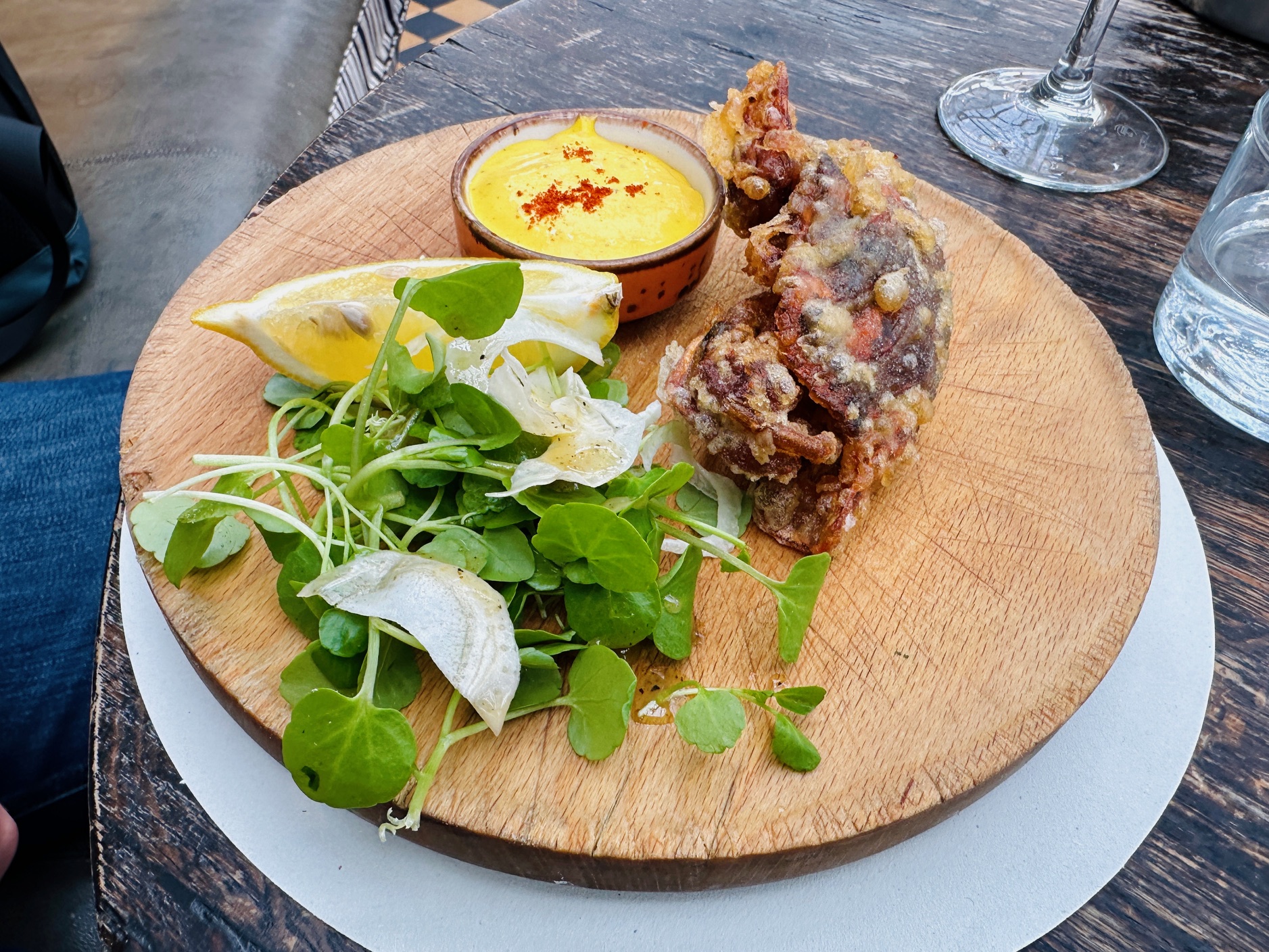
The problem is that not only is stealth salad seemingly an Oxford thing, it’s also – to paraphrase Dr Dre – a Gees thing. Jerry’s soft shell crab with saffron aioli was nice enough, but you get an idea even from the picture below of how diddy it was. Again, salad appeared mainly to be there to fill negative space, a kind of gastronomic find the lady deception. A different salad to that accompanying my starter, with shaved fennel and olive oil. Again, not mentioned on the menu but, in truth, a large part of proceedings. Jerry gave me a forkful of his crab. There was so little that I felt guilty taking it.

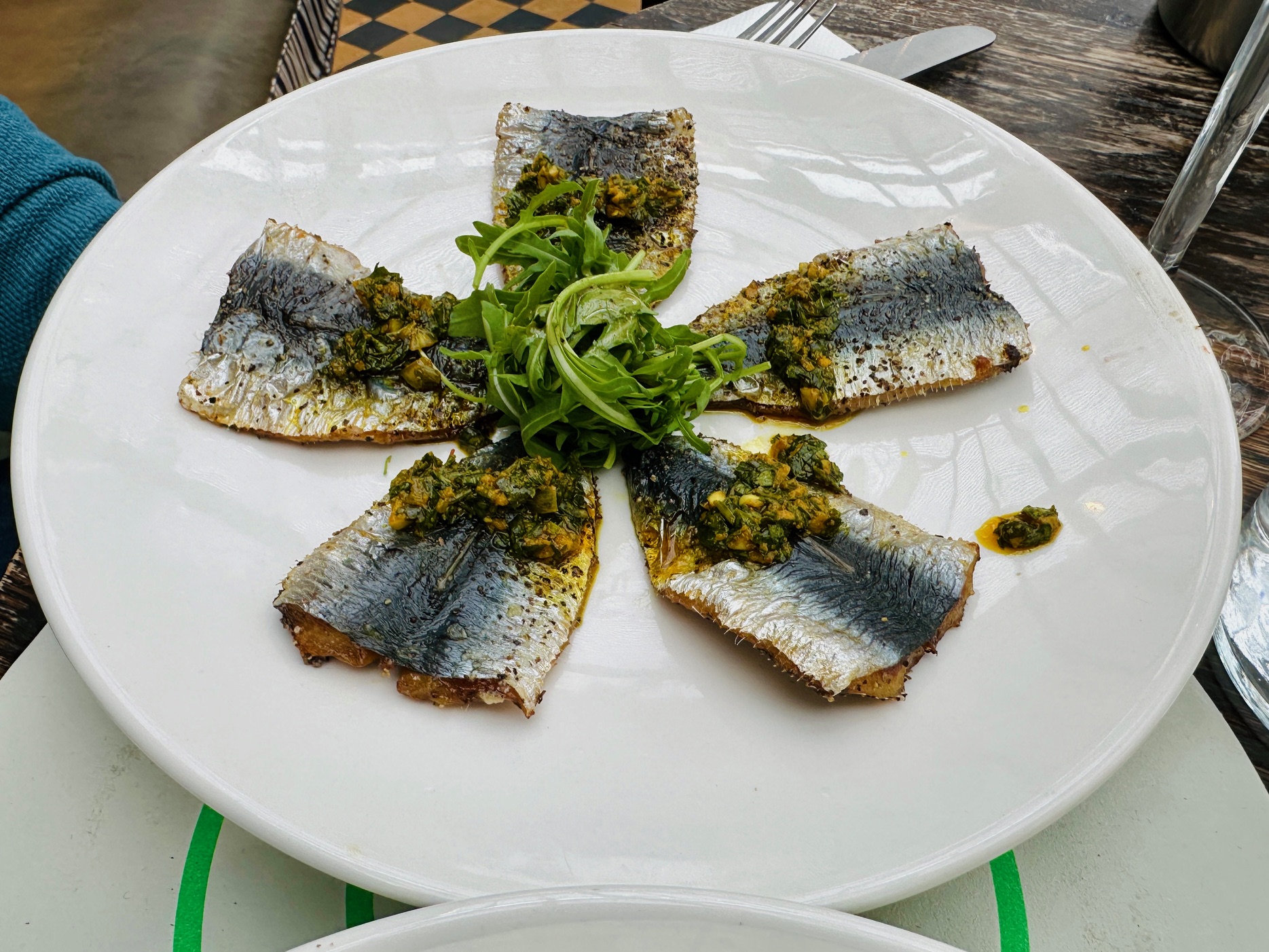
Jerry is on some kind of medication that reduces his appetite (although, gladly, not where booze is concerned). He quite enjoyed this, but I think you’d have to be on that medication to find it enough. And Jerry’s drug regime came in even handier with his main course: butterflied sardines, which apparently came with tomato, sumac pickled onions and chermoula.

I try not to talk about value much in restaurant reviews these days: things cost what they cost, and restaurants need to make money. So for me to mention it, pricing has to verge on the egregious and, at twenty-two pounds, that’s why I’m bringing it up here. Here they are in their glory, all five of them. This, to me, looks like a starter. Is that all there is? you might ask. Where’s the tomato?

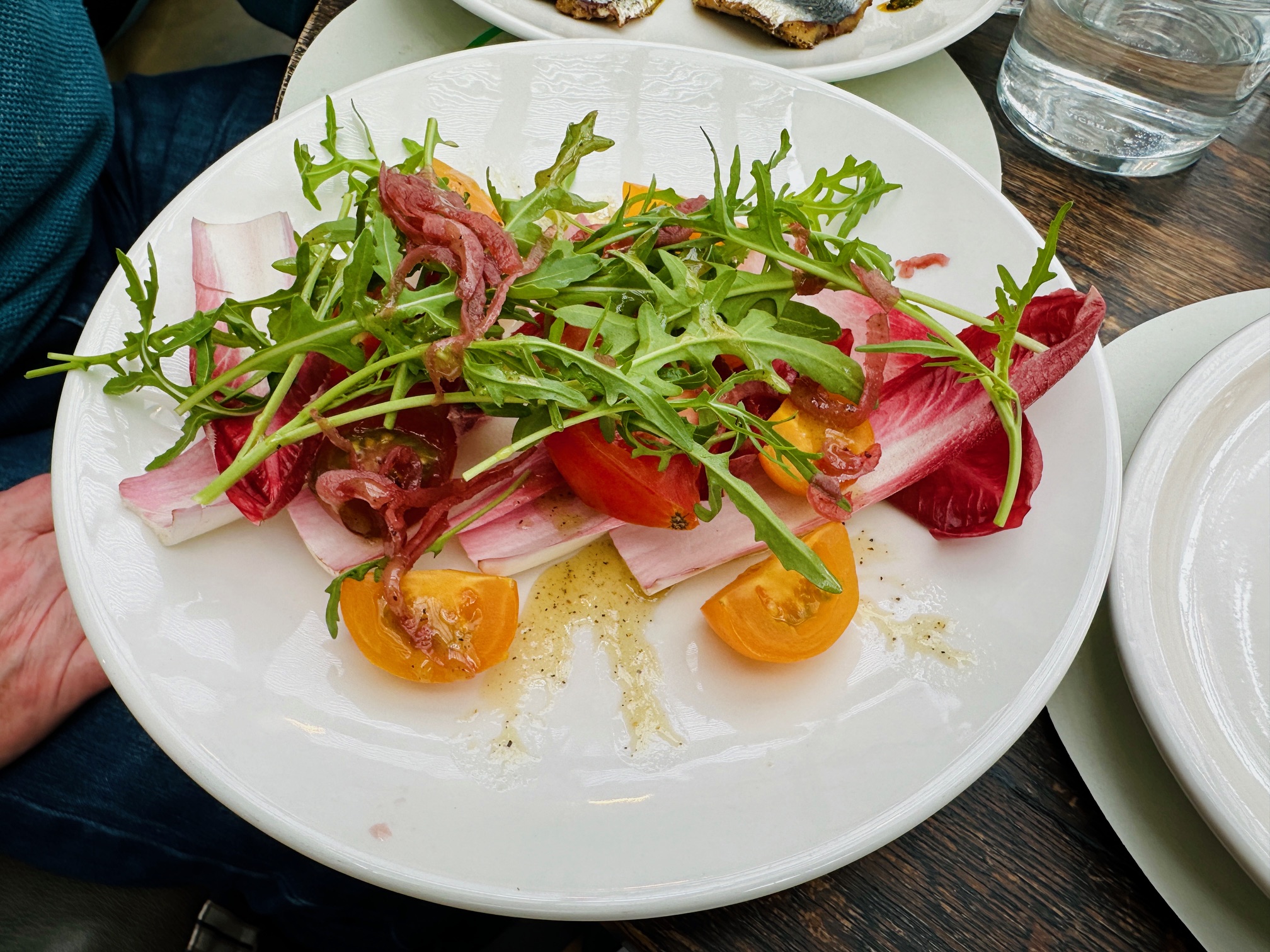
Well have no fear, because this dish – the generosity never starts – came with tomatoes and radicchio. Rocket, too, to match the rocket dumped in the centre of the Maltese Cross of disappointment that was those sardines. Double rocket, the treat nobody ever asked for: still, it beats pea shoots, I suppose. Why did the menu not mention that this was yet another salad? Was Gees just a glorified salad bar, and nobody had told us? Was it north Oxford’s upmarket tribute to Harvester, Gregg Wallace’s favourite restaurant? It was a puzzle and no mistake.

Yet I couldn’t help feeling that really we had just ordered exceptionally badly, because the dishes arriving at other tables looked more like actual food. A tall, substantial burger was brought to one of our neighbours, with a decent-looking portion of chips. Lamb cutlets piled high on a plate were put in front of the chap next to him, although in fairness they were on top of some little gem lettuce and peas. See? Another salad.

My main gave Gees one last chance to dish up something more convincing. And I’ll say this for my chicken cacciatore: it was not a salad. But it wasn’t great either. The pool of stretchy polenta was pleasant enough: I would probably always choose mash over polenta, but the menu clearly advertised it, so I couldn’t complain. And I did really love the sauce my chicken came in: rich with tomato, sharp with capers, studded with judiciously-cooked carrots and celery, a vegetable I always think is underrated in this context.

The chicken was the problem. I’m really partial to chicken thighs on the bone, but you have to achieve one of two things and ideally both. A crispy skin, if you can get that right, is a truly wondrous thing. But I would pass on that if the chicken is so well cooked that it flees the bone at speed, and breaks into strands. That’s when chicken thighs become properly magical. If Gees had achieved that the chicken, with that sauce and some of the polenta (if you must) would have made for splendid mouthful after splendid mouthful.

But to get both of those wrong, to have flaccid skin and firm, almost rubbery meat that needed to be prized away from the bone? That’s really not great. And to charge twenty-eight pounds for two undercooked chicken thighs that weren’t fit to grace the sauce they came in? Cheeky doesn’t even come close.

No side dish could rescue this sorry affair, though in Gees’ defence their braised leeks in feta and dill, served warm, were delightful. I’m no fan of dill, generally, yet I loved this dish and at six pounds it was better, and better value, than nearly anything else we ate. About the same size as those sardines too, come to think of it. It was a beautiful lipstick – applied to a pig, yes, but a beautiful lipstick nonetheless.

Would you have stayed for dessert? We nearly didn’t but felt like we had to see it through, like a disappointing box set. To Gees’ credit I asked who they bought their ice cream from and was told they made it in house. That probably swung it, and Jerry was delighted with his affogato, served with Pedro Ximenez.

I mean, again, if I’m being a stickler (which I am), if you swap the espresso for PX then what you have might be lovely but it’s no longer an affogato, just as the negroni wasn’t a negroni, the tonnato not a tonnato. Gees seemed to have taken Lewis Carroll, another Oxford type, very seriously when he wrote in Through The Looking Glass that “When I choose a word, it means just what I choose it to mean”. Words, salad, word salad: it was all the same to Gees. Let’s call the whole thing off.

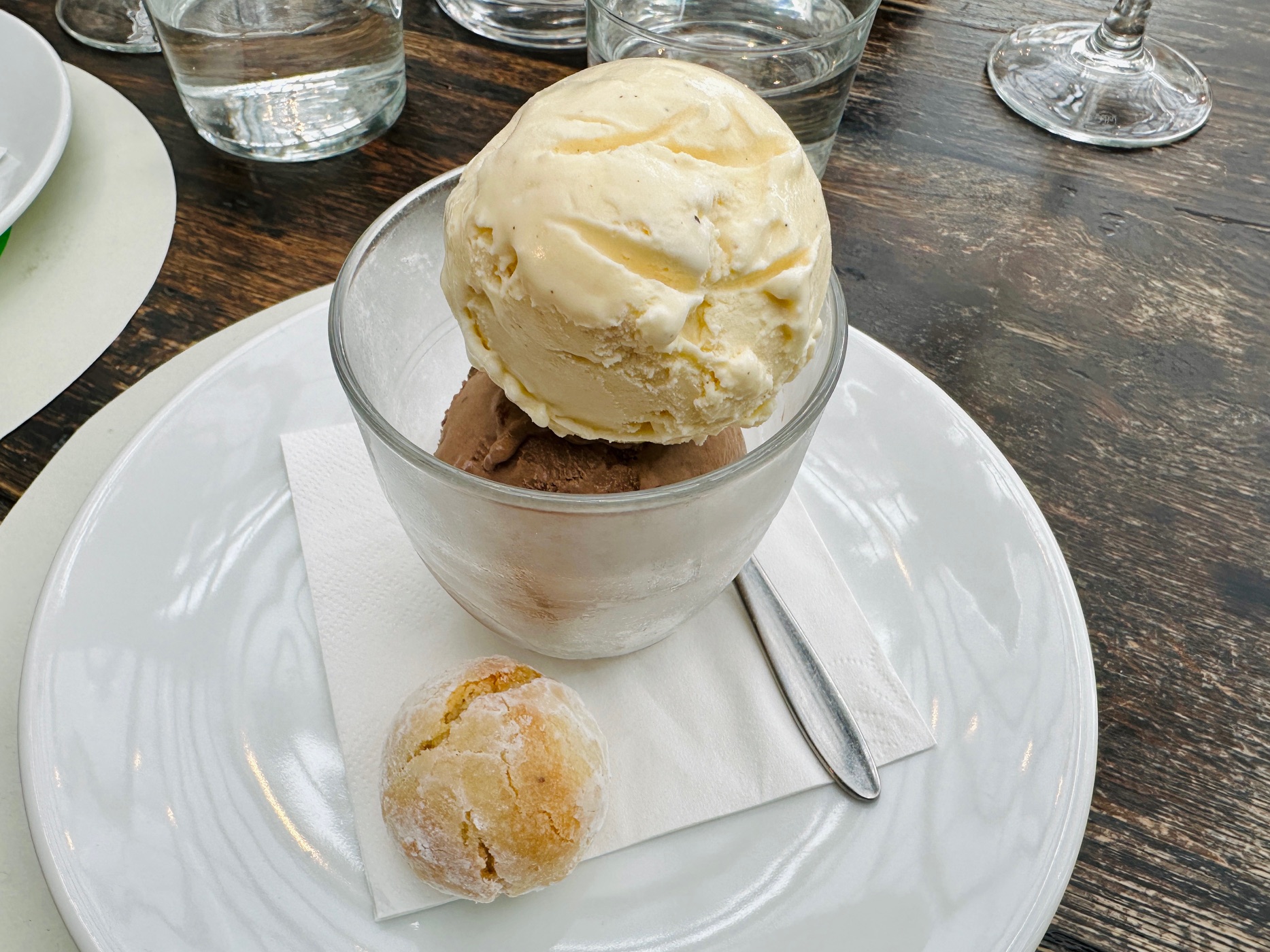
To close on a damp squib of faint praise, Gees’ ice cream is pleasant stuff. I tried vanilla and chocolate – don’t expect any leftfield flavours – and both were very good. Smooth, no ice crystals, plenty of specks in the vanilla and an excellent balanced depth in the chocolate. Two scoops for eight pounds didn’t feel like highway robbery, although it made the nine quid Gees charged for Jerry’s single scoop with a slug of Pedro Ximenez seem decidedly impudent.

What else is there to say? The whole meal, service included, came to two hundred pounds between the two of us, including an optional 13.5% service charge. The cognitive dissonance is strong in this one, because I had a lovely time and the best of company, the room is hard to fault and the service is excellent. You almost enter some kind of trance where despite the preponderance of foliage on the plate and the underwhelming nature of so much of what you eat, you still have a very nice time.

It was, food aside, as enjoyable a lunch as I’ve had this year. Just think how much of a riot we’d have had if the food was at the standard of somewhere like Upstairs At Landrace, a restaurant considerably more reasonably priced than Gees! And there’s the elephant in the conservatory, the question of cost and value. Because when the bill arrives the spell is broken, and you think about what a hundred pounds could buy you anywhere else.

I have to hand it to Gees because they are very popular and an awful lot of people have become very taken with the place. But unless we ordered very poorly, I do have to ask myself: how on earth did Gees manage that? I’m starting to feel bad for Jerry because whenever he comes out with me on duty, however nice a time we have, the food seems to be pricey and middling. Take Zia Lucia, or Storia in Maidenhead: the poor guy can’t catch a break. I will have to think much more carefully about our next meal out, because Jerry deserves some food as brilliant as he is.

To make amends, after we finished our lunch I took Jerry to the Rose & Crown on North Parade, my very favourite Oxford pub. We sat in the back room and polished off a couple of pints, and I told him how I used to drink there thirty years ago, and how it almost felt like it hadn’t changed a bit. A lovely international group – three French, one Slovenian – perched on the end of our table and we ended up in conversation about all sorts of things: the English; Brexit (always Brexit); where to eat in Montpellier; Oxford’s best restaurants, you name it. None of them mentioned Gees in that context, and I can’t say I blame them.

It was only later that I realised that the Rose & Crown, like Gees, has been under the same management since the Eighties, which means that those first drinks I had there, fresh out of university, were under the same landlords looking after me and my very good friend over thirty years later. That gave me a warm feeling in a way that nothing I ate that day managed, however lovely Gees seemed on paper. Forty years, whatever way you look at it, is one hell of an achievement, even in a city which has a track record of keeping establishments alive for many, many centuries. I am glad there are still institutions like Gees and the Rose & Crown in Oxford. But when I go back, only one of them is on my list for a return visit.

Gees – 6.5
61-63 Banbury Road, Oxford, OX2 6PE
01865 553540

https://www.geesrestaurant.co.uk

Since January 2025, Edible Reading is partly supported by subscribers – click here if you want to read more about that, or click below to subscribe. By doing so you enable me to carry on doing what I do, and you also get access to subscriber only content. Whether you’re a subscriber or not, thanks for reading.
Restaurant review: Storia, Maidenhead

Six years ago I wrote a piece on the blog, a listicle really, talking about the five things Reading still badly needed. Don’t worry, I won’t send you scurrying off to read it, but the tl:dr version is that, back in 2018, I thought Reading was still missing a proper cooked breakfast place, a tapas restaurant, a gelataria, a cafe that was simultaneously comfy, did good coffee and good food and, for want of a better expression, a “special occasion restaurant”.

Without going into detail, I personally would say that in the intervening six years we haven’t got a great deal closer to having any of those things. But that’s not why we’re talking about Storia in Maidenhead this week: we’re talking about Storia because when I posted about this on Facebook a couple of weeks ago somebody commented saying that, in addition, Reading was lacking a decent independent Italian restaurant. And that comment stopped me in my tracks because – you know what? – that person was right.

Granted, away from the town centre you have the likes of Vesuvio out west and Papa Gee north of the river. And in town you do have pizza options, in the shape of Sarv’s Slice and Zia Lucia. But the demise of Pepe Sale earlier in the year does mean that, for the first time in a very long time, all the Italian restaurants in the town centre are chains: the likes of Zizzi, Carluccio’s and Bella Italia have a stranglehold on central Reading. And the more recent trend of pasta specialists, starting in London with the likes of Padella and Bancone and now cropping up elsewhere, like Little Hollows in Bristol, has also passed Reading by completely: no, town’s short-lived dalliance with Coco Di Mama really doesn’t count.

The one exception, arguably, is Mama’s Way. But although I love it I’m not sure that a restaurant with a capacity of half a dozen (and I’m being generous) is really even in the same ballpark as what we lost when Pepe Sale closed. And the closest thing I can think of to Pepe Sale is miles away to the west – Newbury’s Mio Fiore is a downright lovely spot, but that can be a half hour train journey.

No, that person commenting on my Facebook post was spot on – it’s a big gap in the market in Reading, and it’s striking that nobody has rushed to fill it. Perhaps in the fullness of time Zi Tore, which is going to take over the Grumpy Goat’s site on Smelly Alley, will redress the balance. But it’s hard to get excited about a place boasting Italian street food when the last place to attempt that shtick was Wolf. So this week I decided to check out Maidenhead’s Storia, which had been recommended to me by more than one reader of the blog, in the company of my good friend Jerry (regular readers will be pleased to hear that his digestive issues are now a thing of the past).

The strange thing is that Maidenhead already has a perfectly acceptable if unexciting Italian restaurant in the shape of Sauce and Flour. And Storia is a stone’s throw from that, literally two minutes’ walk away. Not for the first time on a visit to Maidenhead I wondered it if was just rubbing it in that it had some of the things Reading still lacked. Tapas bar El Cerdo was testament to that, as were our very enjoyable pre-dinner drinks at A Hoppy Place. I even had to walk past a branch of Coppa Club on my way to Storia, although that’s maybe less enviable.

That said, Storia is independent but that doesn’t mean it isn’t a chain. It’s the only Berkshire outpost of a group of six restaurants, with others scattered across Surrey, Hertfordshire and, randomly, the edge of Essex. I think that showed in the polish of the place when we arrived – it’s a handsome building which was welcoming from the off and the service was very slick. It was a grown-up space, too, quite classy with good use of mirrors and lighting to make up for what I imagine, in daytime, is a relative lack of natural light.

The tables along the walls were the ones you really wanted, all plush banquettes, but actually I didn’t mind missing out on those because our generous-sized table gave us a great view of the big and buzzing dining room. The whole thing had a feel of affluent happiness about it. It was Friday night, the weekend had arrived and Storia was going to do its damnedest to make sure people thoroughly enjoyed it.

There was very little to dislike about the menu but, simultaneously, I was surprised by how unexciting it was. Storia plays it safe with a menu that very much replicates the likes of Coppa Club down the way with very little sign of quirk or anything especially regional: half a dozen starters, a “raw” section made of up carpaccio and a strangely conspicuous ceviche, some pasta dishes, half a dozen pizzas and as many secondi.

I found it disappointing that all the pasta dishes were priced, and presumably sized, as main courses only – which again, felt more like the stuff of the bigger chain restaurants. And pricing also felt very conventionally done: starters around ten pounds, everything else between fifteen and twenty.

It made me wonder, not for the last time that evening, whether I was just jaded. Because I saw loads of things I could eat but nothing I was dying to try, and that in turn made me think about San Sicario, which closed last year, and what a terrible pity that was. And it also made me think of the interesting, resolutely all-Italian wine lists at San Sicario and Pepe Sale: would they have been seen dead having, as Storia did, an Argentinian Malbec, a Chablis and a Rioja on there?

We ordered a bottle of Valpolicella at £42. They brought a posher bottle by mistake, one twenty pounds more expensive, and I just managed to stop them before they opened it. Our wine was quite nice, but throughout the meal I wondered what the costlier one would have been like.

Jerry loved his starter – a sardine bruschetta with two filleted sardines perched on a pile of roasted peppers and aubergine, punchy with harissa. It was a riot of colour, and ironically one of the best things about it was the bread – properly golden and grilled, the perfect vessel. I got to try a bit and I liked the sardines a lot – in fairness I always do – but the rest of the dish felt a little incongruous, like an attempt to do something North African rather than the more obvious caponata. I quite enjoyed it, but it made me crave caponata more than anything.

“I’m in Lisbon towards the end of the year. Would you like me to bring you back a couple of tins of sardines?”

“That would be marvellous!” beamed Jerry.

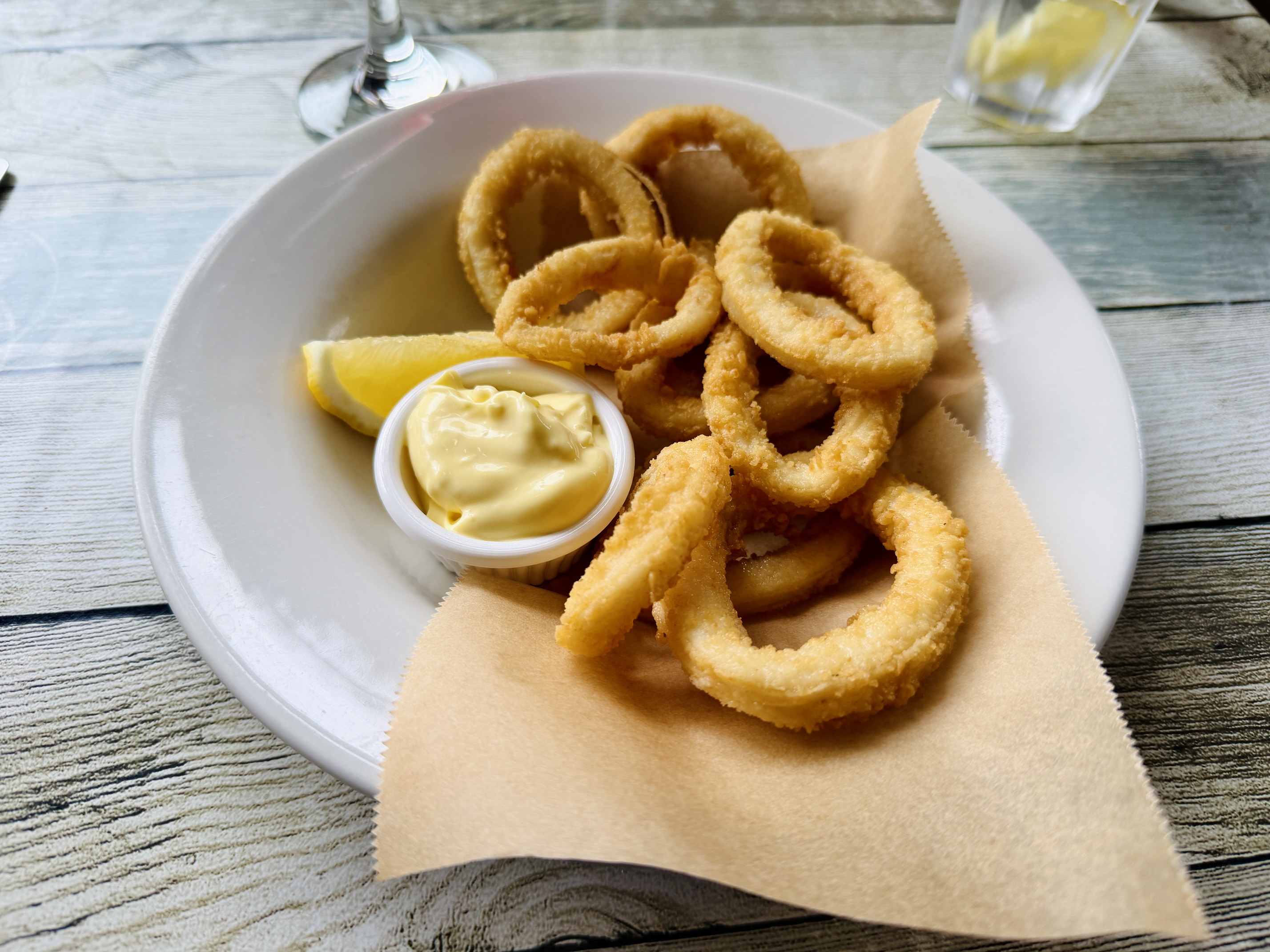
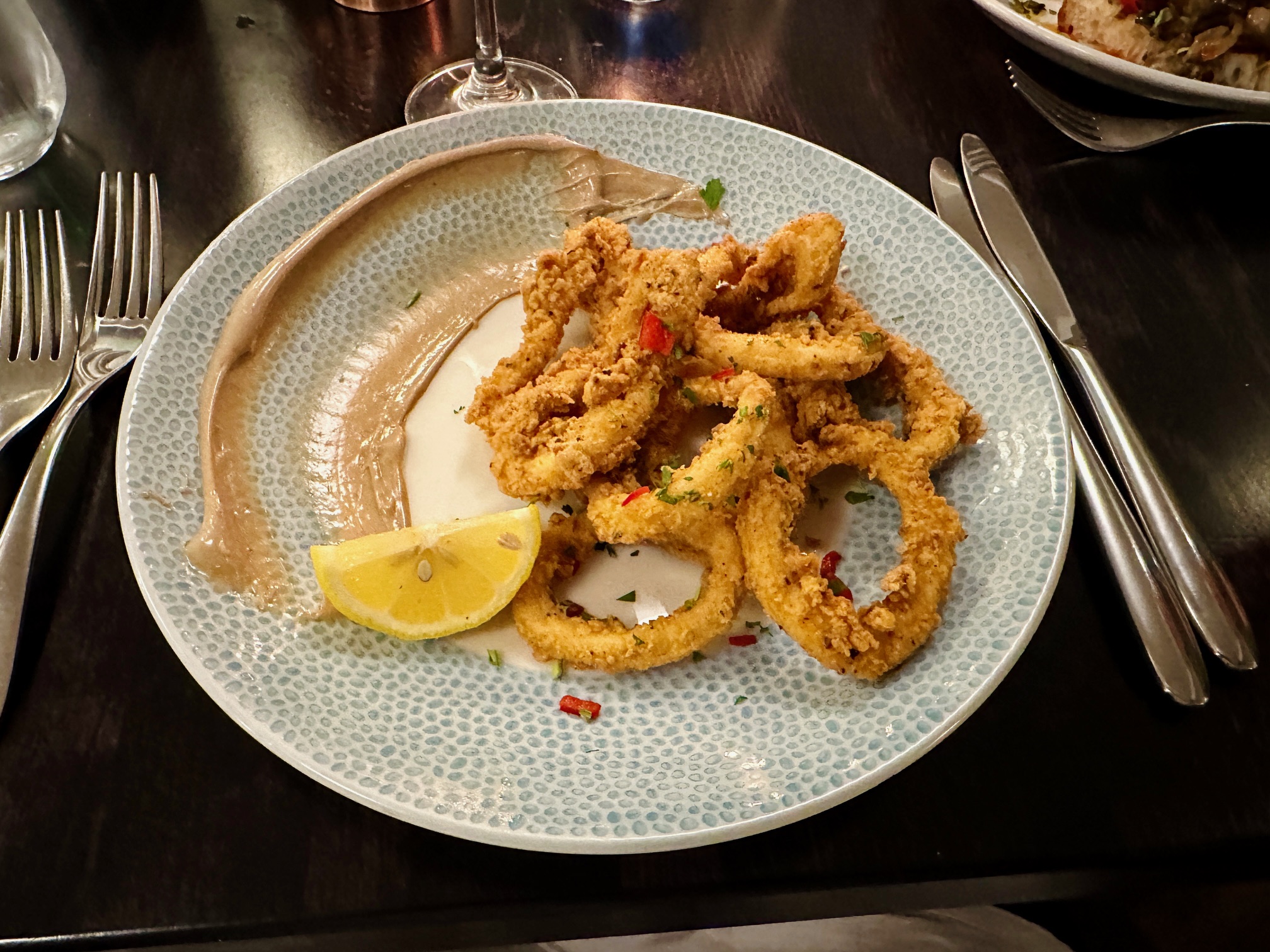
My starter was the best thing I ate all evening. Storia’s calamari was very, very good – fresh, not bouncy, with a crispy, craggy coating which felt like it had some polenta flour in the mix. The whole thing was lightly scattered with red chilli and the decision to serve it with black garlic aioli rather than its more prosaic sibling was an excellent one, even if the smear slightly detracted from the undeniable visual appeal. It made me wish that Storia did a fritto misto, or perhaps it made me wish that Storia was the kind of restaurant that had fritto misto on its menu.

The secondi on Storia’s menu, I’m sorry to say, are really stuff. Forget your lamb rump, your saltimbocca or your suckling pig, because you won’t find them here. Instead there’s a chicken Milanese, a grilled chicken breast dish with marsala, a couple of fish dishes, steak and a risotto. I suspect that, rather than a craving for carbs, is what sent Jerry and I scuttling for the pizza and pasta.

Jerry absolutely adored his pizza salsiccia, a very well-trodden combo of salami, ‘nduja, chilli and basil. Again, he was kind enough to let me try some and I had to agree that it was a very solid effort. Slightly better than Zia Lucia’s – and a darned sight less wet and floppy – and not quite as good as the finest examples from Sarv’s Slice. A bit wayward with the toppings and with a lot of crust, crust that wasn’t quite as puffy, airy or leopard-spotted as the very best examples.

It was a nice pizza, and if I ate in Storia again I might well order one. It was not, however, as good as the one you can get in Knead, a five minute walk away.

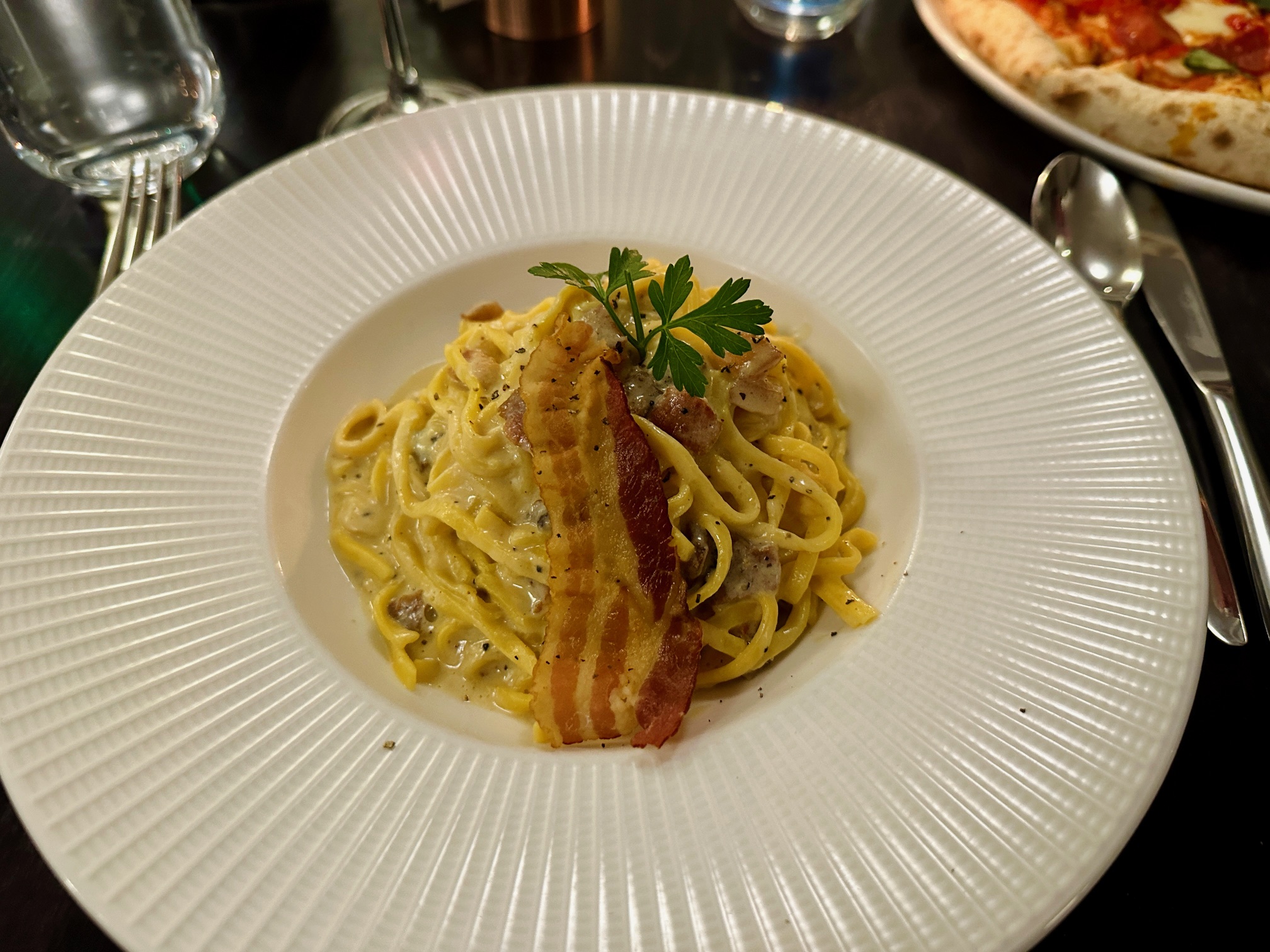
I’ve saved possibly the most disappointing until last. When it comes to pasta, I often find myself ordering a carbonara these days. There are probably two reasons for that. One is that it’s a very good benchmark and a sign of whether a kitchen knows its stuff: does it come out glorious and golden, or closer to the magnolia horror of Cozze? But an even better reason – durr! – is that when it’s good it’s one of the happiest, most comforting things you can eat. And now there was a nip in the air I found myself drawn to it, far more than some chicken and pesto concoction that had a whiff of Prezzo about it or a conchiglie dish with yet more of that harissa.

It could have lived up to that promise, and nearly did. The taglioni were beautifully al dente and toothsome, so easy to anchor with a spoon and swirl with a fork, capturing all the sauce you needed. The sauce was good stuff – no adulteration with cream or egg whites here – and topping it with a strip of crispy pancetta was a nice touch, if an obvious one.

But the other star of the show is guanciale, and it needed to be crispy nuggets of the stuff that disrupted all that unctuousness (I mean that in its true sense, by the way) with spikes of smokey salt. And this was underdone, a bit too bouncy, a bit too fatty, falling short. If this dish had been the platonic ideal of a carbonara the rating at the bottom would probably have been a whole point higher and I would be making plans to return before Christmas. But it wasn’t, so the search goes on.

We nearly ordered dessert, but we were that terrible combination of not hungry enough and not fussed enough. But we were having a lovely time, and we had wine left, so we did the next best thing and ordered coffee, just to keep the evening alive that little bit longer. Latte came in a walled glass and was really surprisingly good, so much better than I thought it would be.

Like my old friend, it was sweet without a hint of bitterness, and it made for the perfect end to a brilliant evening. The food had facilitated that, but never even threatened to upstage it; although in fairness I expect I could have a wonderful time with Jerry eating doner meat off a bin lid. Anyway, our meal came to just over a hundred pounds, not including tip: the service very much deserved a tip, so tip we did.

As I said earlier on, I wonder whether I am just jaded about the kind of thing Storia does, even though Storia does it very well indeed. If you want a mid-range, casual dining Italian meal which isn’t going to offend or disappoint anybody, some of which will be good and some of which will be quite nice, you can go to Storia and it will deliver exactly that.

On a good day, so will Coppa Club I imagine, or Zia Lucia. On a good day, Jamie’s Italian used to manage that too. Is that enough? I suppose for many people it will be, and if Storia does that, without fail, time and again, it will no doubt build up a happy and loyal customer base and do extremely well – as it has, I suspect, in Tring and Radlett, in Redhill and Shepperton. History has taught us that there’s definitely a place for that kind of thing.

I guess what Storia reminded me of, strangely, is Strada – remember Strada? – back when Strada only had two branches, before it was possessed by the dread spirit of private equity and went the way some promising small restaurants do. As I think I’ve said before, I used to go to the one in Richmond with an old friend of mine, long since lost in the mists of divorce, and I always loved it. I came away, every single time, wishing Reading had one.

But when it did, it was no longer the Strada I loved but just Zizzi with a different colour scheme. Storia isn’t that, yet it wouldn’t take a lot of imagination to see how it could get there. And maybe that’s what they’re aiming for – I hope not, but everybody needs to make money. Especially nowadays when the bastard stuff seems to be so very thin on the ground.

So it’s not Storia, it’s me. If you’re like me, you would probably enjoy your meal there. But if you’re anything like me, Storia might also leave you feeling that, even though there’s nothing technically wrong with it, you just want something more these days.

Storia – 6.9
11 Bridge Street, Maidenhead, SL6 8LR
01628 769350

https://www.storiarestaurants.co.uk/maidenhead

Restaurant review: Zia Lucia

It probably hasn’t escaped your notice that as a middle-aged man churning out two and a half thousand words a week about some restaurant or other, I’m about as far from the food and drink zeitgeist as it’s possible to be. Restaurant blogs have been dead for years, local papers too, and even the broadsheets are gradually fading away. Instagram influencers are passé too, even if Reading’s handful are still scrounging the occasional free meal (the latest from the Hilton in Kennet Island). Nope, apart from the occasional increasingly desperate Substack, food reviewing is all about TikTok and Instagram reels these days. 

The most prominent is an account called Topjaw. Topjaw, for the uninitiated, consists of a posh bloke with floppy hair (who used to be a model) in front of the camera and a less photogenic bloke, presumably also posh, behind it. The posh bloke with floppy hair interviews restaurateurs in London getting vox pops about where they think you can find the best pizza, burgers, coffee and so on in the capital. He’s trying to perfect that fake almost-estuary accent posh people do when they’re trying to sound less posh, like Tony Blair used to do. He’s not managed it yet. 

The usual suspects come up in those vox pops time and again – the Dalston bakery Dusty Knuckle, the Dexter burger at The Plimsoll in Finsbury Park, the Soho hype factory that is new pub The Devonshire (a place where nobody can snag a reservation but there are mysteriously always tables available for celebrities, critics and, well, Topjaw). We’re never paid by any restaurant we feature, says their bio, although they’re not averse to doing paid partnerships with the likes of Bicester Village, of all places. They may not be paid a fee, but God knows if they pay for their food.

Still, all power to them: their format is quick and entertaining, and you find yourself watching it whether you like them or not. It’s already spawning imitators – mainly in Bristol, where you see some people trying the vox pop format – and maybe one day it will translate into a TV show for them, or a paid gig or an appearance on Strictly or I’m A Celebrity.

You might wonder what any of this has to do with Reading, so I should explain. A couple of months ago, during a bumper week of tosspots on Topjaw, they interviewed not only Ed Sheeran (who turns out to be as basic as you would expect) but also hereditary columnist and bigoted human bin fire Giles Coren. Coren was clearly desperate to appeal to a new demographic so was doing his usual dreary, sweary trying too hard schtick, only even more manic than usual.

But in the course of dispensing his tiresome opinions he happened to say that he thought the best pizza in London was done by Zia Lucia. “They have this charcoal base which apparently doesn’t make you fart” he added, not as hilariously as he intended. Hang on, I thought, haven’t they just opened in Reading?

Well, yes, they have. Zia Lucia opened at the start of April on St Mary’s Butts, where ASK used to be, their first branch outside London. Their website talks about their origins in Islington over 15 years ago, and they also bandy around the slightly random stat that they are the world’s 38th best pizza chain (before you get too excited, Pizza Pilgrims finished 27 places above them and the Big Mamma Group, which Coren loathes, came third). Even so a first branch outside London, coming to a town that had lost Franco Manca and Buon Appetito, felt like it was worth investigating. 

The clincher was hearing another anecdote about the charcoal base: I was chatting to my friend Reggie over lunch a couple of weeks ago, and he asked where was on my to do list.

“I’d like to see you review Zia Lucia” he said. “I went there just after it opened and had the weirdest experience. My waiter was explaining to me that they have four different kinds of bases and he was telling me about the charcoal one. The great thing about it, he said, is that it goes right through you.” Reggie imitated the waiter doing a mime which was meant to illustrate it doing, well, that.

“He used those exact words?”

“Yeah, he did. I couldn’t believe it.”

I told that story to my friend Jerry as we strolled down Broad Street in the sunshine, just in time for our dinner reservation.

“Oh, I could do with that charcoal base!” he said, before telling me a long story about how he was on some kind of drug trial which had made his trips to the throne room fewer and further between than he was used to. “Honestly, it’s so stressful! I’m going about once every three days at the moment and it’s really not right. Sorry, I shouldn’t be telling you this just before dinner.”

“No, it’s absolutely fine” I said. I don’t know if it was hitting fifty, or just the continued deepening of my friendship with Jerry, but I felt oddly touched that we’d reached the ‘openly discussing bodily functions’ stage. “To be honest, if I don’t go at least once a day I start to worry.”

“Exactly! You can use all of this in your review by the way, I don’t mind you talking about it. Maybe you can get some laughs out of it.”

I decided that I would – an angle’s an angle, and that charcoal base was definitely an angle – and then I told Jerry a couple of stories on a similar theme, which hypocritically I’m not reproducing here.

I think I maybe ate in ASK, which used to be where Zia Lucia is now, just the once, before I wrote a restaurant blog (and possibly, had standards). It was a huge site that got split in two when ASK left, with Biryani Mama on one side and Zia Lucia on the other. It’s a perfectly pleasant room, all white tiles, yellow walls, a spot of terra cotta and marble tables, with a bigger room out back that I didn’t see. We were seated at the front, by the window, and I thought it was a nice spot, neutral and unexceptionable.

The menu focused almost exclusively on pizza – a handful of starters and sharing plates and then into the main event. Mostly traditional, with some notable omissions – no pepperoni, which might disappoint some of you, and no anchovies and capers, which disappointed me. They started at eleven quid and maxed out just over fifteen, although most of their expensive pizzas were boxed off in a section marked Le Leggenderie and given names like “Leonardo da Vin-Cheese”: it’s what the great man might have wanted. We grabbed a negroni sbagliato each and sipped away, menu deliberations on the back burner as we had a good old natter.

When our server came to take our order, we had The Conversation about the variety of bases on offer. He explained that they had four different doughs – traditional, gluten free, wholemeal and the legendary charcoal base.

“The thing about it is…” he said, as Jerry and I shifted forward in our seats. How was he going to describe this phenomenon? “…you eat it, and it doesn’t leave you feeling bloated the way some pizzas can.”

So delicately put, and he didn’t do the mime: I was disappointed.

“But although it looks black, if you had it in a blind taste you wouldn’t be able to tell the difference between it and the traditional base.” I did think, possibly churlishly, that given that it was two quid extra I’d have liked it to taste different, but I guess some people are really worried, like £2 worried, about breaking wind. Jerry was sold, anyway, on the basis that anything that helped sort his backlog, so to speak, was money well spent.

I felt guilty about ordering lots of food with a man who’d told me he was having digestive setbacks, but I managed to persuade him to share an appetiser with me. Bruschetta verde was a pleasant little thing, a piece of toast halved and topped with fresh, light ricotta with a hint of citrus, zigzagged with a pesto that, for me, was a little lacking in oomph. The bread was also a little nondescript, considering they were so proud of their pizza bases and their focaccia. But all that sounds sniffier than I mean to be: it was a pleasant thing to share. It cost seven pounds fifty.

Our pizzas came hot on the heels of us polishing that off, with a speed verging on too brisk. The restaurant wasn’t busy and they didn’t need to turn our table, so I don’t understand why they didn’t let us settle in for a little longer: I reckon they’d have got at least a couple of drinks out of us. The feeling of time being unnecessarily concertinaed was, if anything, exacerbated by their decision to drop by our table mid-pizza and offer us a shot glass of limoncello each. A lovely gesture, don’t get me wrong, and not one we were going to turn down, but shouldn’t it have come towards the end of the meal?

Anyway, on to the pizzas. With my first choice – anything with anchovies – not on the menu I defaulted to my second choice, the trusty ‘nduja. Zia Lucia serves theirs simply – just tomato, mozzarella and ‘nduja, no pepperoni, hot honey, basil or other distractions. And actually it had a lot to like about it: the mozzarella was plentiful and good quality and the ‘nduja was freely and indiscriminately applied. You got a lot of it, more than you might at Sarv’s Slice, although it wasn’t quite as winningly pokey as the stuff at Mama’s Way. The tomato sauce was deeper and fruitier than Donald Sinden’s voice (check me out, topical as ever).

And I couldn’t fault the base – enough structure, enough floppiness, a satisfying chew. It didn’t have performative blistering or leopard-spotting, but it was a very creditable effort. It was, in short, a very competently done pizza. Just a few ingredients, all really well put together, no gilding the lily at all. So why wasn’t I more excited about it, and why aren’t I more excited telling you about it? Is that pizza fatigue – mine, or the nation’s – or was it something else?

Jerry’s pizza told a similar story. He had chosen the Parma ham and burrata, on that methane-absorbing black base, and you again couldn’t argue with the quality. The Parma ham was really top-notch – coarse, dry and salty, without the sheen that comes when you exhume it from a plastic coffin. There was a slicer behind the counter, with mortadella on it, so I’m assuming they slice their ham on the premises, but either way it was very good. The burrata was decent, too – I wouldn’t personally have a big ball of cold cheese slap bang in the middle of a hot pizza, but it was Jerry’s order, not mine.

Otherwise it had all the same pluses as my pizza: a cracking tomato sauce, a good mozzarella – not fior di latte, I assume, because only one pizza on the menu specifically mentions that – and a base that was sturdy where you wanted it to be but with give in the middle. That brings us on to that much vaunted charcoal base. Jerry let me try some, and it tasted unremarkable; the server was right, I think, about the blind taste.

I also ordered a Gorgonzola dip for my crust. Jerry and I both tried it and couldn’t work out whether they’d brought us the garlic one by mistake, or if it was just criminally light on the blue cheese.

By the time our pizzas were done – I had to help Jerry out with his, but I’m good like that – we’d been in there just over half an hour. And again I thought what a shame it was that the restaurant didn’t have two gears, that it didn’t have the know-how or emotional intelligence to switch from swift to leisurely. We were offered dessert menus and told that the cannolo, the thing I fancied, was not on the menu that night.

They came back a little while later and we ordered desserts and digestivi, an Amaro Montenegro apiece. Like the two of us, they were mostly sweet, slightly bitter and rather complex. But, also like the two of us, they were arguably not at their best: I expected my amaro to come luxuriating in an oversized glass, chinking with ice and rounded out with orange. To have it room temperature, sticky and filled to the brim of a shot glass, felt like such a waste. I half expected people to form a ring around me and chant “DOWN IT!” until I’d polished it off, which is about as far from the experience of drinking amaro as you can possibly get.

My dessert had been recommended by my server – who I do have to say was excellent all evening, if far too efficient – and, surprise surprise, it was tiramisu. I know I order this a lot, but in my defence my first choice was off the menu. I’ve had tiramisu many times in the course of writing this blog, and like Goldilocks I’ve often had ones that are too boozy or not boozy enough, too creamy or not creamy enough. They rarely seem to be just right, and Zia Lucia’s was no exception. I loved how thoroughly it had been carpeted in cocoa, and the booze levels were just right, but it had a little too much sponge and slightly too little cream. I liked it, I finished it – I’m not a monster – but it could have been better.

Jerry’s choice was far superior. Gelato – although it was more like ice cream as far as I could tell – came in a handful of flavours and Jerry had chosen a solitary scoop of pistachio. I had an introductory spoonful and that was enough for me to be very impressed. The texture was smooth and glossy, no wayward ice crystals, and the flavour was spot on. I’d like to think Zia Lucia makes its own ice cream, but if they don’t I’d love to know where they get it from. It was the perfect way to end the meal, and infinitely preferable to the more expensive dish I had ordered.

Our meal came to ninety-four pounds, including the service charge, and all told we were out in just over an hour. That’s not a huge amount of time to spend that kind of money, and it sums up to me the real problem with Zia Lucia. It all felt more functional than I’m sure they intended it to be, a restaurant where you were too hurried to enjoy la dolce vita. They didn’t need our table, and I wish they’d seemed in slightly less of a hurry to part us from it.

I suspect it was carelessness more than calculation, but it’s still a blunder. A restaurant that brings out the limoncello before you’ve finished your main course – that brings your digestivo in a shot glass – has forgotten that meals aren’t just food. They are experiences too. They’ve been open for two months, and our server told us they’ve been steadily busy since they opened, but I hope they learn that lesson. It made me miss Buon Appetito, who never, ever, got that wrong.

But never mind. Jerry and I beetled off to the Nag’s for a post dinner drink, but it was rammed with people watching the football. So instead we wandered up Russell Street and ended up in the Castle Tap. There was a loud, entertaining band in the front room with a touch of surf guitar about them, the garden was packed with people who had wrapped up warmer than us.

But we found a little space in the back room where a couple of big, raucous groups were having a wonderful time, and had a proper chinwag – about Jerry’s holiday in Scarborough, about my honeymoon, about the weird set of circumstances that led to us becoming friends and what a glad happenstance that was. Jerry loved the Castle Tap – “it’s like having a drink in someone’s garage!” – and my night there reminded me what a special, eclectic and chaotic place it was. The evening started reasonably well, but it ended better. A couple of days later I messaged Jerry to ask if he had experienced any noteworthy after effects from that charcoal base. Thankfully no! was the response.

I’ve thought a lot about Zia Lucia in the course of writing this, trying to work out why I didn’t like it more. Their end product is unquestionably good, even if the experience left a little to be desired. But it didn’t feel like it had soul, in the way that Mama’s Way or Sarv’s Slice do, and I’m not sure it even replicated the buzz of Franco Manca when it first hit Reading. Zia Lucia felt more like the likes of ASK, or Strada, or even Pizza Express, and given its backstory and its small footprint I just expected a little more. I’m not saying this just to disagree with Giles Coren, although to be fair he is wrong about almost everything all of the time, but: best pizza in London? It’s not even the best pizza in Reading.

That’s not to say it’s bad, because it’s absolutely not. I might even go there again at some point, to try other things on the pizza menu, to have some antipasti, to try their focaccia or finally snaffle that cannolo. But I don’t know when that will be, because it didn’t make that kind of impression. I hate to paraphrase the waiter who so impressed Reggie when Zia Lucia first opened, but the experience of eating there, well, it sort of goes right through you.

Zia Lucia – 6.8
65 St Mary’s Butts, RG1 2LG
0118 2250011

https://zialucia.com/reading/

Restaurant review: The Coconut Tree

Of all of Reading’s new restaurants, The Coconut Tree might be the one most people have asked me to review as soon as possible. Which is in itself interesting, because The Coconut Tree has already had more write-ups online than most of Reading’s new places – but the thing is, they’re all on Instagram. Remember all that talk last year about how hospitality was on its knees and taking free shit was plain immoral? Nature is definitely healing, because The Coconut Tree’s plan for its launch was very much as they used to be in the before times – find some local Instagrammers with over five thousand followers, bung them some PR copy to include in the social media coverage, sit back and watch.

And I don’t know about you, but I learned a lot. Admittedly, nearly all of it I could have learned just from reading their menu, but it’s dead useful to discover that the food is “fresh, tasty and full of flavour” (it would be a brave restaurant that said “you know what? Lots of our stuff is stale and bland”). And to discover, from multiple Instagram posts, that one of the cocktails is set on fire in front of you: the drinks in general, allegedly, are “banging”. Did I mention the “proper good vibes”, or the fact that it’s “cool” and “trendy”? Perhaps the best summary was that “the cuisine is insane”. Sri Lankan food: utter madness! 

Of course, what none of those posts covered in much detail was that their food was all free. Their booze, too. “There wasn’t a cocktail I didn’t like” said another influencer. I bet. “Nothing too specific, we’re quite happy for you to construct the post!” said one writeup, showing that the influencer had copied and pasted all the text from the PR company without reading it first. That one was a “paid partnership”: not only did they get free food but, presumably, they were also paid to do the copying and pasting. I can’t compete with those levels of polish, sadly, so instead you get my impressions of the place after I turned up on a weekday with my friend Jerry, two Sancho Panzas in search of a Don Quixote. 

Subscribe to continue reading

Become a paid subscriber to get access to the rest of this post and other exclusive content.