Restaurant review: Gooi Nara

There’s no such thing as Spotify Wrapped or Apple Music Replay for restaurants, as far as I know. But if there was, the restaurant whose food I ate most last year is almost certainly Gooi Nara, the Korean restaurant on Whitley Street that has been there for something like ten years, if not more. And yet returning to it a couple of Saturdays ago for dinner with Zoë was the first time I’d set foot inside since I reviewed it in 2018.

The thing is, as regular readers will remember, I moved to Katesgrove a couple of years ago, which means that, along with Kungfu Kitchen, Gooi Nara is probably the closest restaurant to where I live. And what that means is that on the nights when neither of us can face cooking we know that a delivery driver won’t get lost, won’t drop other orders off en route to our house and can be trusted to turn up pronto with piping hot food from just round the corner. Over the last two years, between us, we’ve developed quite a Gooi Nara habit.

It’s no coincidence that they won my “takeaway of the year” award in 2024 – but my love of a Gooi Nara delivery has continued ever since. It is refined and perfected now to the point where Zoë and I order exactly the same thing almost every time: dakgangjeong, or Korean fried chicken, for her and tang su juk, chicken in sweet and sour sauce for me. The latter comes ready to assemble, one plastic container of gorgeous fried chicken and a tub of sweet, sharp sauce with orange and pineapple bobbing in it (I was skeptical too, but don’t knock it until you’ve tried it). It has made me happy many, many times.

Sometimes we push the boat out and get some mandu, fried chicken dumplings, as well but otherwise those two and a couple of portions of rice are everything we need for a contented chomp in front of the telly after a hard day. I especially grew to love Gooi Nara when I was discharged from hospital and could only eat with one hand: I remember the first time I had their sweet and sour chicken after my accident I could only eat half, the rest popped in a LockNLock in the fridge. It was even better cold the next day: it remains the only occasion when I’ve had any leftovers at all.

That’s all well and good but I love their food so much, and always hear so many positive comments about it online, that it felt like we were doing them a disservice by only ever ordering the same two takeaway dishes. And my review was over eight years old, after all, so it felt like high time to go back. Early one Saturday evening Zoé and I took a short amble there, tracing the path of so many delivery riders in reverse, to check it out.

First things first: it was absolutely packed at 6.30pm on a Saturday evening. So much so that they could only just find room for us, tucked away at the very back with a great view of what was clearly a very successful restaurant. The decor didn’t feel like it had changed much in the intervening eight years: it still had a welcoming, homely feel, all wooden beams and faux slate walls.
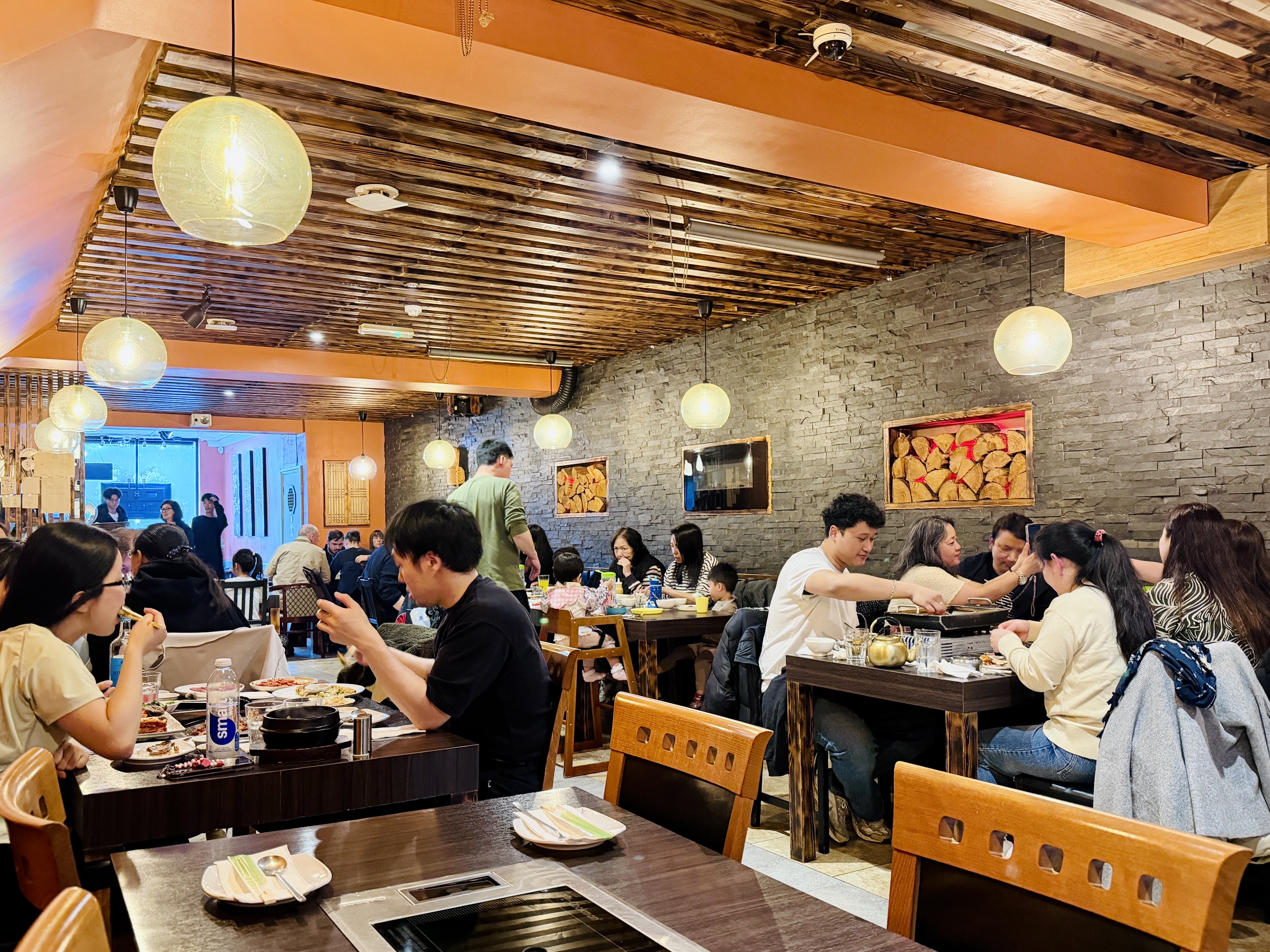
The main difference, I would say, is just how well Gooi Nara appeared to be doing. It also started out very warm, and on a punishing day as the hot plate in the middle of our table got switched on it became even more sweltering.

In terms of the mix of customers, I would say that with the exception of the table next to ours later in the evening we were the only one exclusively made up of pasty Anglo-Saxons: I did envy my fellow WASPs at the other table who no doubt were getting an excellent introduction to the full gamut of the menu from people who knew exactly what to order.

It did appear, too, that Gooi Nara had a good reputation: I overheard a conversation at one of the big tables nearby to the effect that its occupants had converged at the restaurant from many places, some miles away. Maybe Gooi Nara filled that role for Southerners who couldn’t easily make it to New Malden, the Little Korea of the UK.

Gooi Nara’s menu has changed, I think, from when I visited it last. Back then I’m pretty sure it hedged its bets, with both a Korean and Japanese section, but now it’s all kind of thrown in together: edamame; takoyaki; agedashi tofu and pumpkin korokke feature, along with yaki soba and udon.

But the Korean elements of the menu are far more extensive, and the menu can be quite overwhelming with sections seemingly for everything: soup; rice; bibimbap; jeongol (or hotpot); noodles and of course Korean barbecue. The sides, to add to the confusion, appear at the very beginning, before everything they could conceivably be on the side of.

It made me wish I had my own food sherpa – is that cultural appropriation? – to guide me through the highlights of the menu, a feeling that only intensified as I saw some gorgeous dishes waft past to other tables. Was the delicious-looking tofu (I’m not even joking) that went to the table opposite the agedashi tofu, or the Korean doo-bu jeon? I decided on reflection it was the latter. And how good did the platter of various types of kimchi look when it arrived at the table next to me, a couple having one of the most Guardian conversations I’ve eavesdropped on in a very long time?

I came away from it all feeling silly and parochial, realising that really I only knew a handful of dishes on the menu and the various bits and bobs I’d ordered the best part of a decade ago. I was well aware that on this visit I would stay in my comfort zone, even if I’d insisted to Zoë that we couldn’t order any of the things we would invariably put in our takeaway order. So we ordered a couple of starters, a couple of mains and two items for the barbecue, and even then I’d say we played it extremely safe. We might have been outside it, but our comfort zone was only a short walk away.

Everything came if not all at once then really in a very short space of time. One minute we were necking our cold bottles of Cass, a perfectly decent lager I would struggle to tell apart from Asahi, Ha Noi or Singha in a blind taste test, let alone its Korean alternative Hite, and the next our grill was switched on and pretty much everything we’d ordered was cramming in on our table.

And the table looked big, but since the centre of it was given over to said grill you ended up playing the equivalent of those sliding tile puzzles trying to work out what could go where. Try to combine that with the timings of actually cooking some of your food and the whole experience became a little like patting your head and rubbing your belly at the same time, impressive training in multi-tasking. Forget my doing those six pointless LinkedIn games every morning: this would be much better at keeping me mentally sharp.

Vegetable mandu were, if anything, even more enjoyable than the chicken ones which had been dropped off by a friendly rider so many times in the last two years. A bit more crinkly and expansive than their chicken equivalents, they had a pleasingly light, grease-free texture and a filling I could almost convince myself was virtuous. Gooi Nara’s dip of soy, sesame oil, sesame seeds and quite possibly something else beginning with S had a gladdening sharpness that complemented them very nicely indeed.
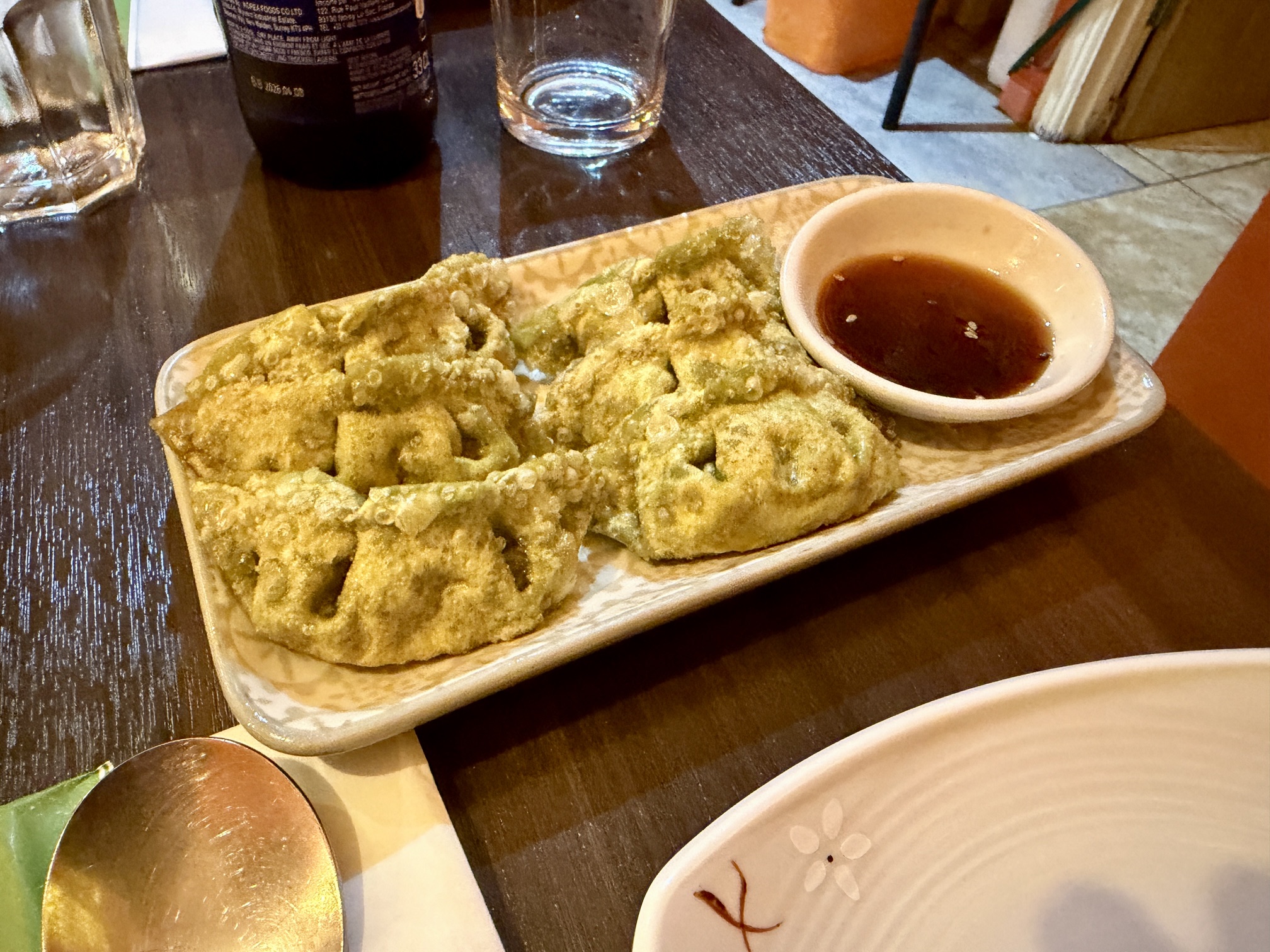
A quirk of Gooi Nara’s menu is that, if it is to be believed, you get 5 chicken dumplings or 5 prawn dumplings but a strangely non-committal “5-6” vegetable dumplings. Fortunately on this occasion we got a shareable, even number, but I’m pretty sure whenever I’ve ordered the chicken mandu I’ve been given 6 of those too. Go figure, pun not intended.

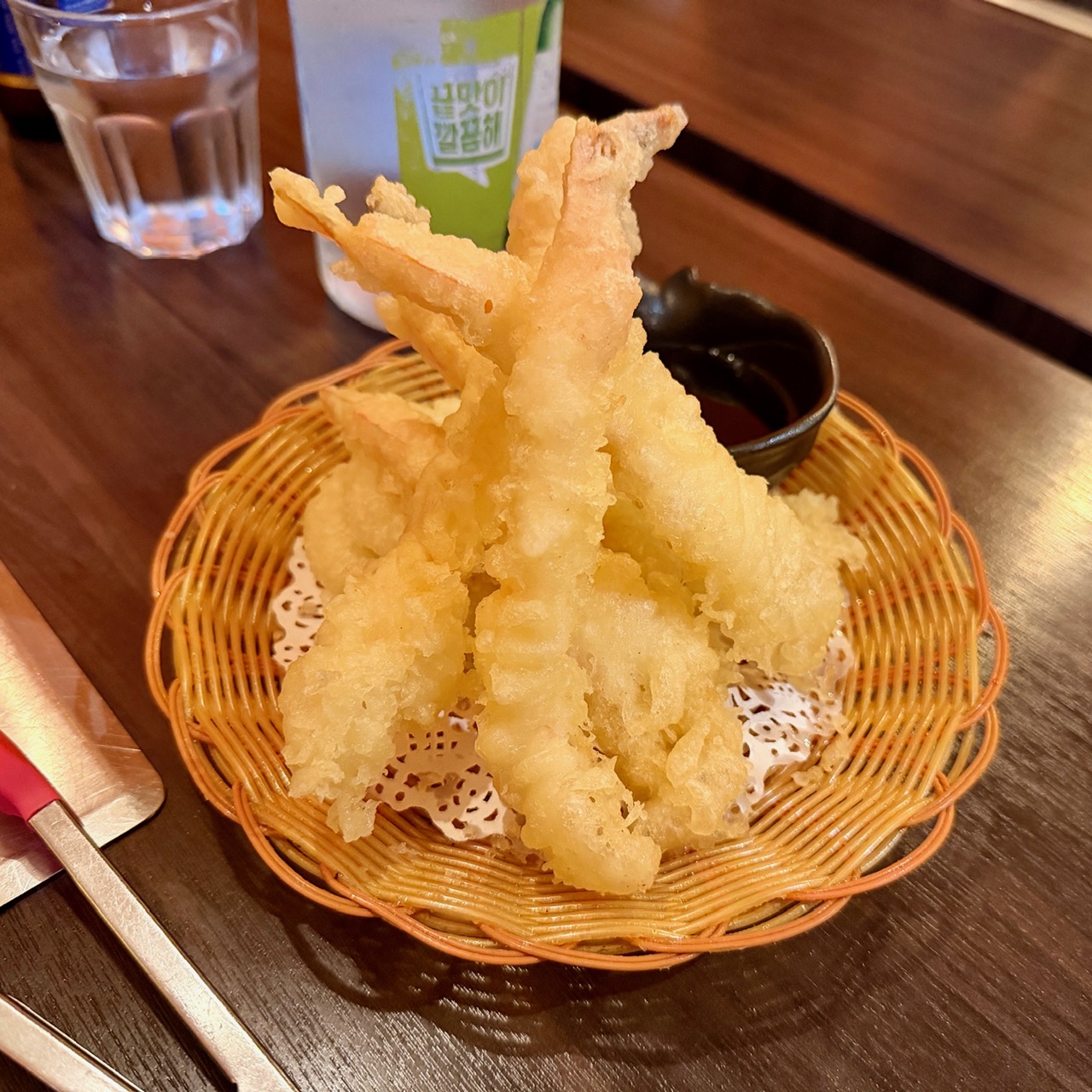
Also decent were the prawn tempura, which I would say were better than they looked. In the picture below they come across as a little wan, a tad too blond, but they had a real deft lightness and, again, next to no grease. The dip they came with, almost exactly the same as the one that accompanied the mandu, was still good but the dimensions of the vessel and the size and length of those prawns made it, practically speaking, a faff: it was a bit like trying to get a pool cue in a beer glass. £12.30 for these, so as much as both of the main courses we’d chosen.
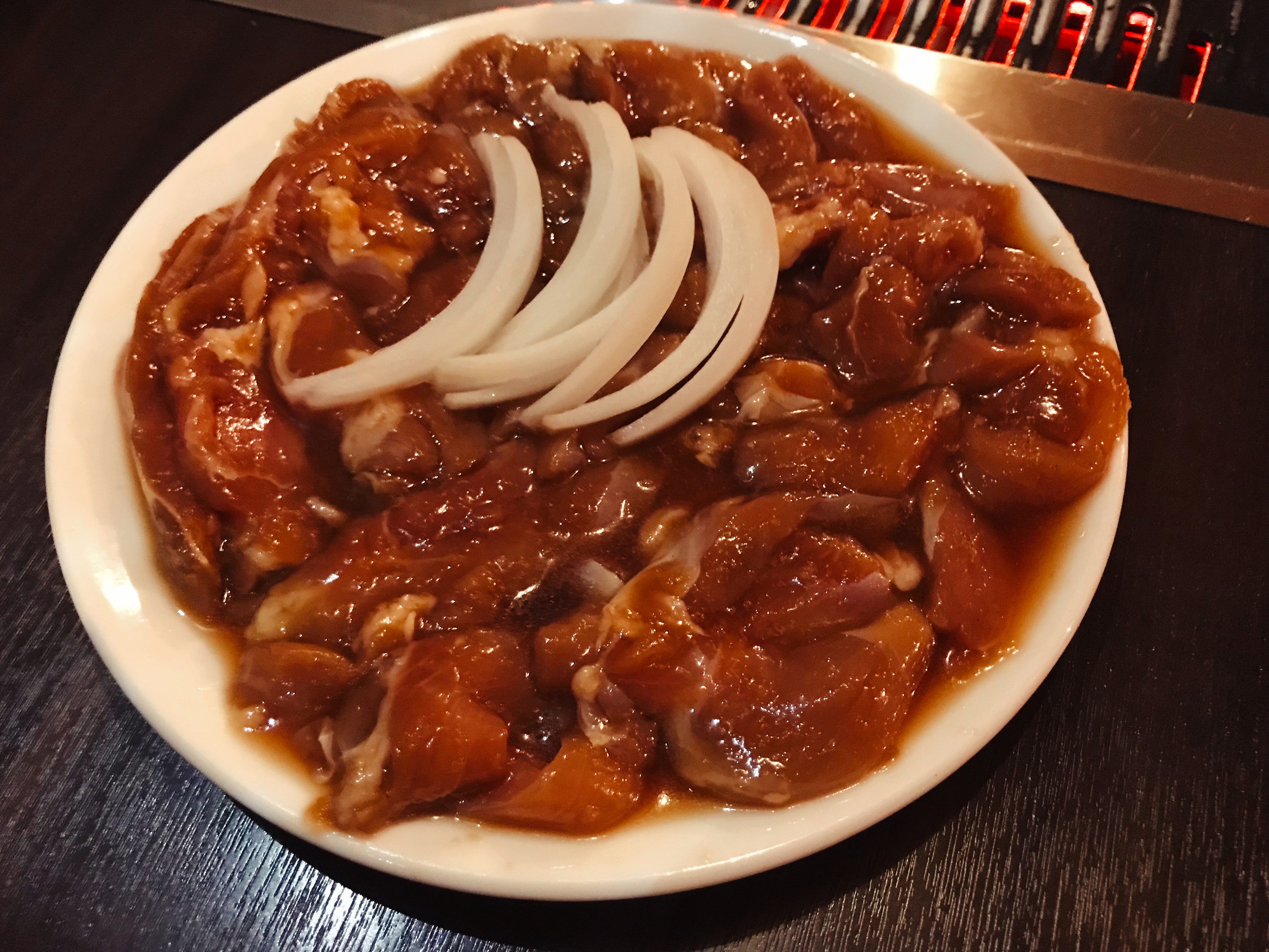
By this point we’d also started to avail ourselves of the barbecue. Sam gyap sal, unadorned sliced pork belly, turned up looking a bit like those cheap bacon-flavoured corn snacks you can get in supermarkets, and I did wonder whether we should have gone for the spicy version, but it crisped up beautifully on the barbecue, that fat rendering and permeating just enough.

We chose the pork to cook first precisely because it wasn’t marinated the way our other barbecued meat was, to try and avoid cross-contamination. We had a couple of dishes of condiments to dip them in, and I failed to make a note of either, but one was definitely soy and the other was definitely not: I think it might have been ssamjang, the traditional sauce used with Korean barbecue containing gochujang and soy beans.
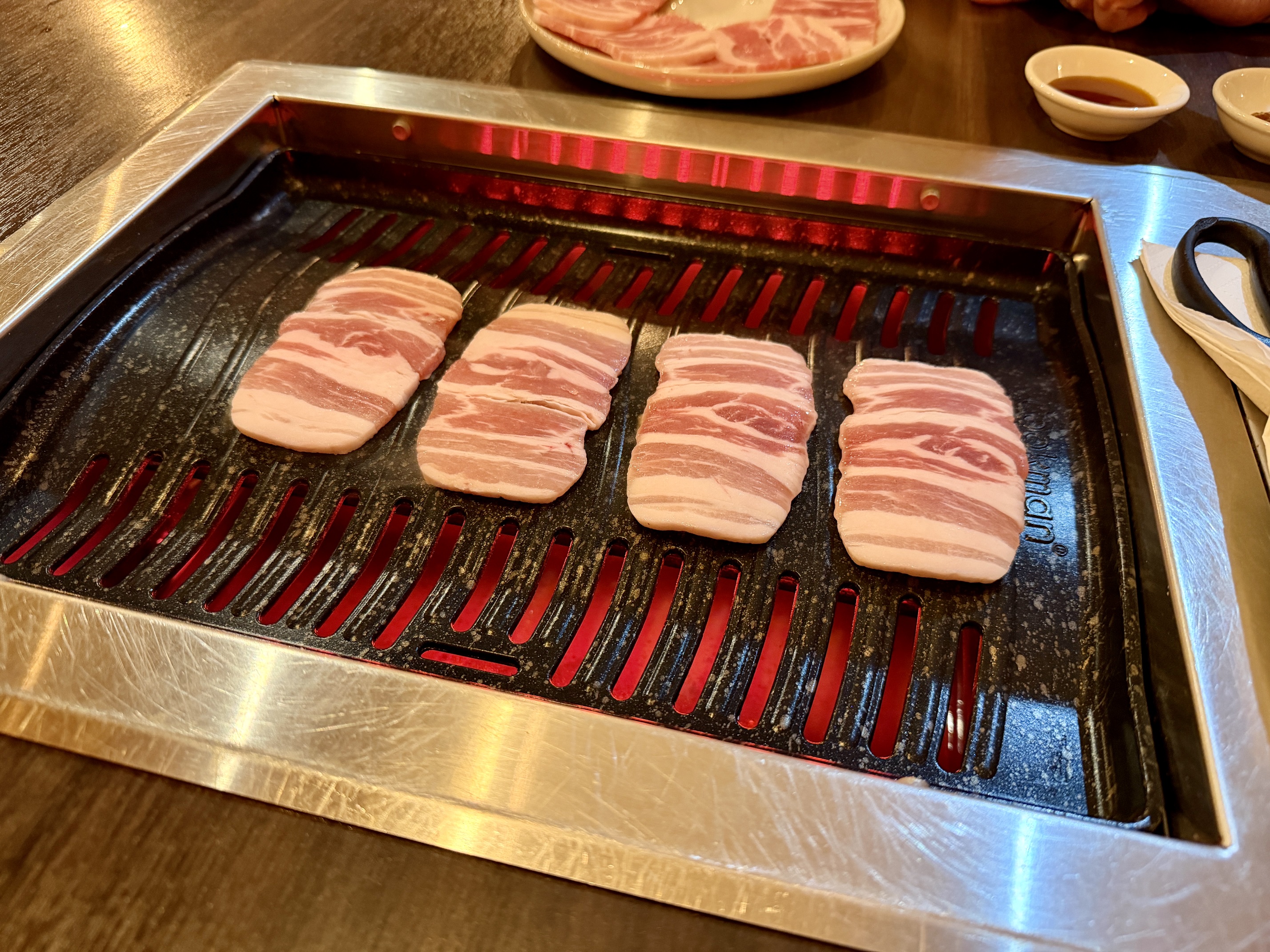
It was only later that I realised we should have ordered some lettuce to wrap the pork in: it’s hidden away, chronologically speaking, in the list of side dishes at the beginning of the menu.

My main – although the concept of a main slightly falls away when it all comes at once – was the chicken dolsot bibimbap, a dish I haven’t eaten in a long time. For the uninitiated, this is rice, chicken, veg and an egg yolk brought to the table in a hot stone bowl, so it keeps cooking and sizzling as you work your way through it. I broke up and dispersed the egg and made my way through it, and by the end some of the rice had reached the crispy state known in Korean as nurungji (I suppose the closest European equivalent is the delectable socarrat at the bottom of a paella).

I would have described this dish as a little nondescript, a tiny bit bland, if it weren’t for the squeezy plastic bottle of gochujang which came with it. The more of this I added, the more I enjoyed it, and the more I enjoyed it the more I added it: I do wonder how much you’re meant to use, and how much was left in that bottle when I was done, but it turned what could have been a trudge into a frolic.
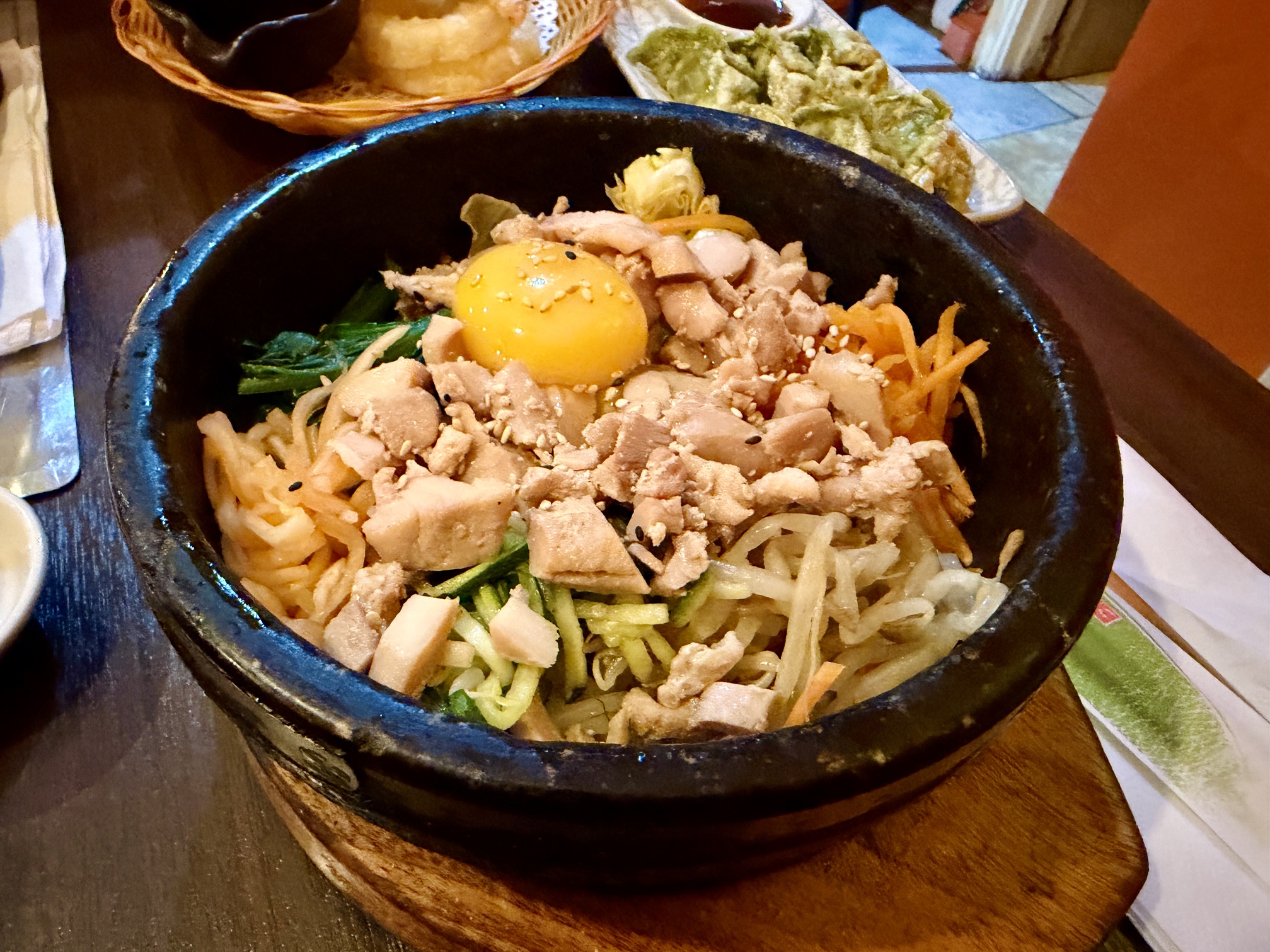
The other thing that whole experience taught me was patience. Ordinarily I would have a moan – god knows you’ve probably read enough of them – about everything arriving at the same time and forcing me to choose what to eat first.

Eating in Gooi Nara that evening, among all that good-natured, deceptively well controlled bedlam, I realised that it was probably a very English mindset: that your food is at its best the moment it arrives at your table and it’s downhill from there, that it’s a scramble to eat it before it goes cold and that too many dishes at once guarantees disappointment.

But it didn’t feel that way here. Those prawns and dumplings sat there, keeping their freshly fried heat. The pork sizzled on the barbecue, with more on the plate waiting to take their place. Our second barbecued meat hadn’t even made it to the front of the queue. And my bibimbap was still hot, gradually perfecting its texture. What was the rush? Everything would be eaten in its own good time, in the right order, with no need for conniptions.

Zoë loved her main, I don’t think I would have done. I managed to persuade her not to have her regular takeaway order, her chicken gam-poong gi, but she ordered it with prawns instead. I was expecting this to be prawns curled up, little inverted commas in a crisp coating, tossed in the gorgeous spicy sauce that makes this dish such a crowd pleaser in my house.
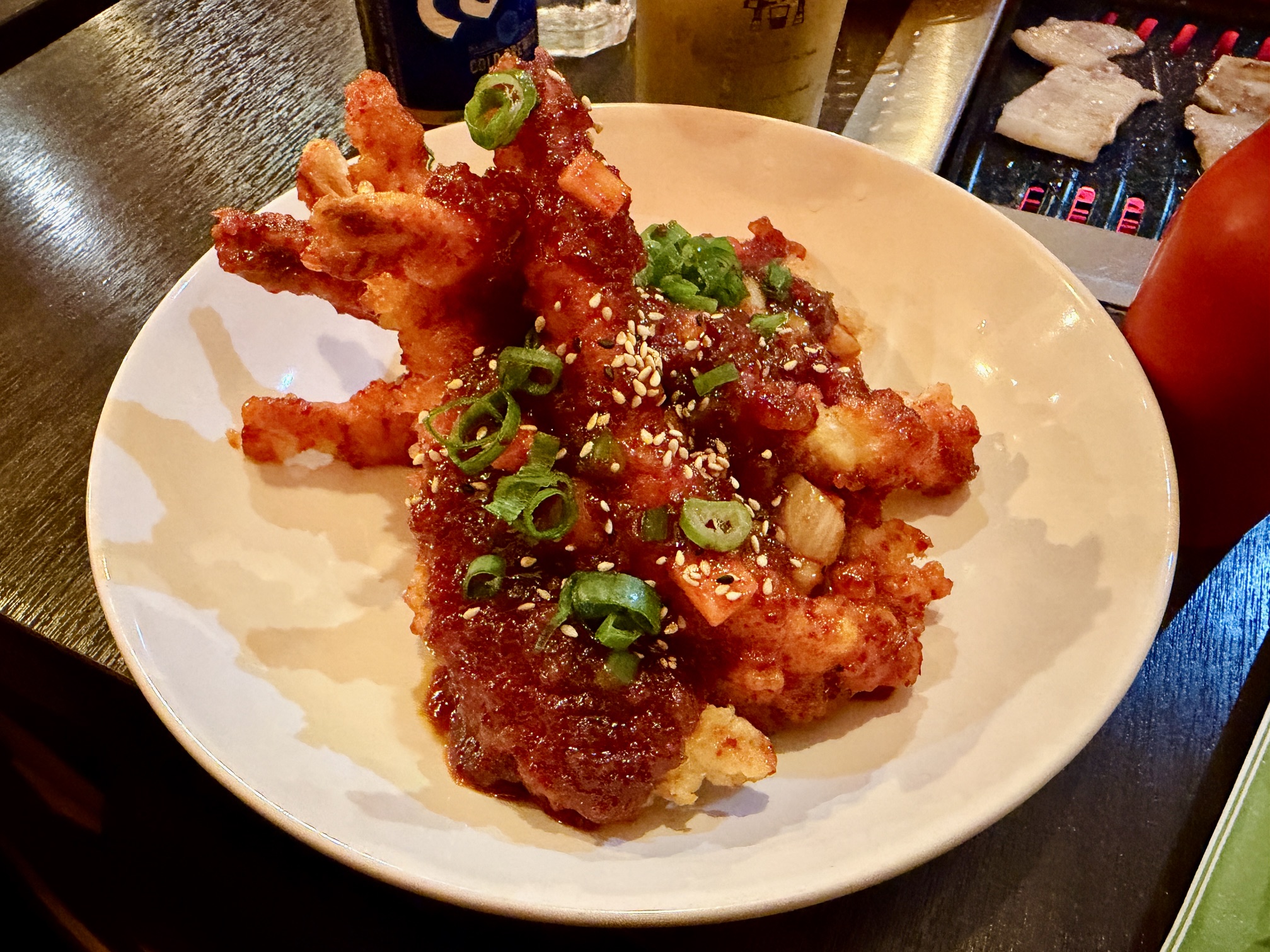
Instead they were fully extended like an accusatory index finger, the tempura prawns from earlier on making a reappearance with some sauce thrown in. So deeply impractical in many of the same ways as that starter, and downright impossible to eat with rice. I didn’t order them, and I certainly wasn’t allowed to try them, so it doesn’t really matter. Zoë really enjoyed it, and maybe in the free-for-all of our meal overall it didn’t really matter that they weren’t quite what I thought they would be.

The dish they didn’t go with, or at least I thought they didn’t, was Gooi Nara’s special egg fried rice with vegetables and shrimp. Zoë, again, seemed to enjoy it but I thought it was a bit steep at £11, especially considering that you could get a bibimbap for roughly 50p more. Plus I got a bit squeezy bottle of gochunjang, let’s not forget, and this looked like it badly needed that or something like it.
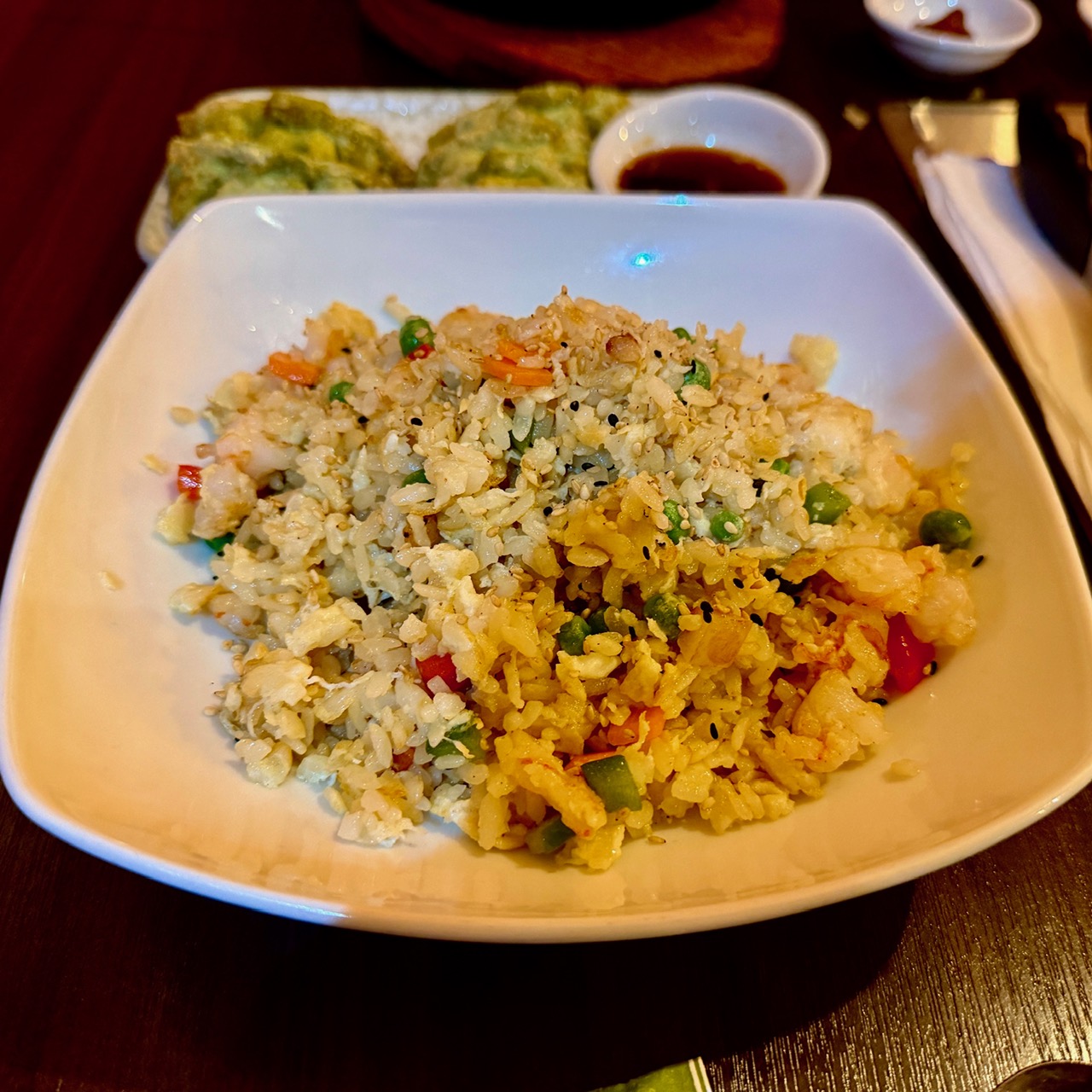
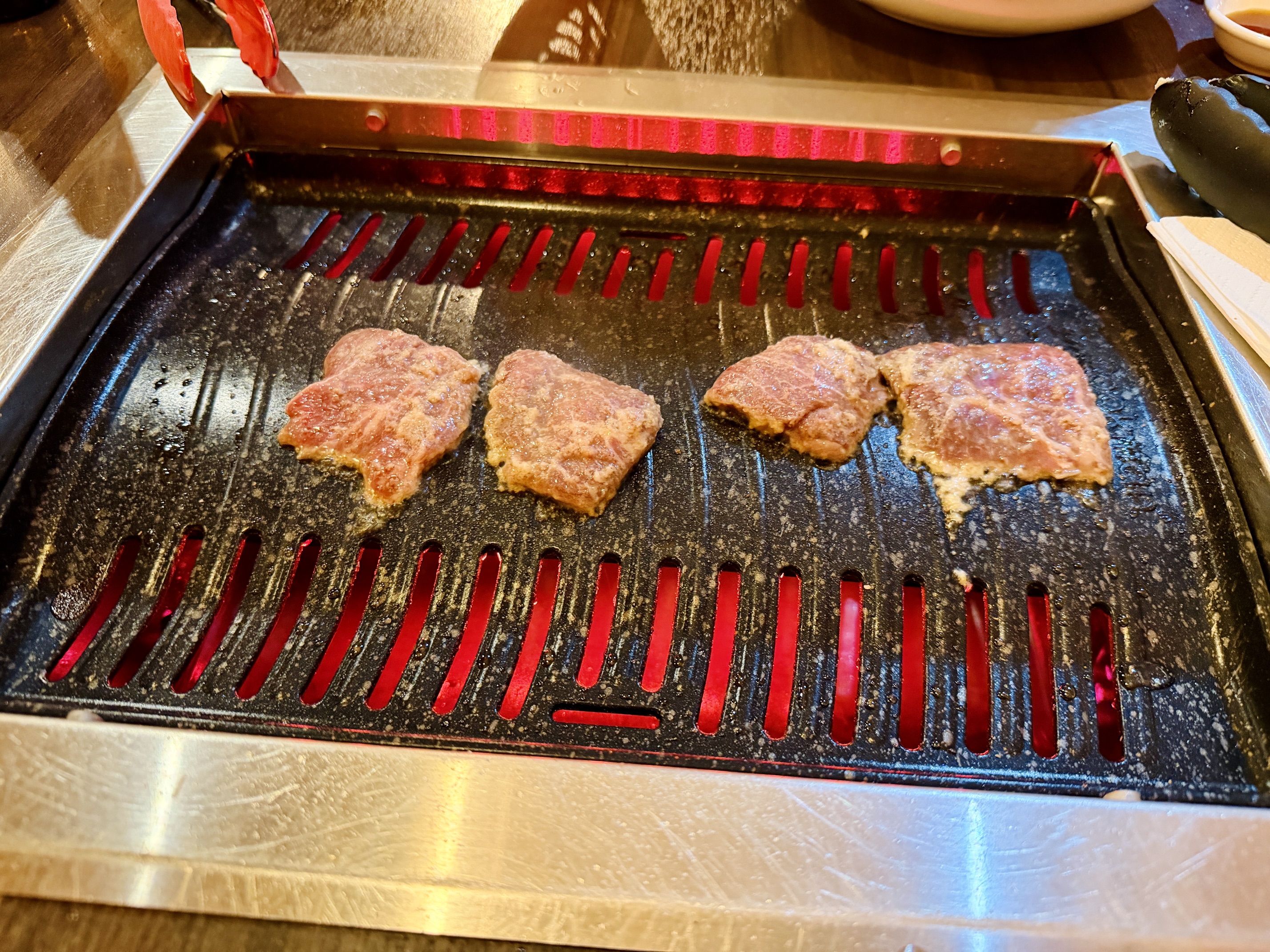
Finally, as we flagged in the heat, a little John Lewis portable fans valiantly whirring away to almost no avail, we barbecued the last dish in our order. By sheer coincidence I’d actually ended up ordering something from my 2018 visit to Gooi Nara – the ju-mul luk, beef with garlic and sesame oil. It was smothered in marinade there on the plate, slices much thinner and better cut than I remembered from my last encounter, and it smelled pretty amazing before it was ever even exposed to heat. As it cooked, the aroma got more and more gorgeous: perhaps we’d saved the best til last.

Tasting it at the end of the process, I rather thought we could have done. Every single piece was buttery-soft, that marination doing its work with no notes, and although it might have been nice to enclose each piece in a lettuce leaf and enjoy that contrast, I rather wonder if the lettuce might have wilted as badly as I did towards the end of an hour in that hot, noisy, oddly glorious room. By some tragedy, Zoë found herself full halfway through my final spell as the commis chef of our table. I buckled up and finished the rest: it had to be done.
Gooi Nara’s menu only has two desserts, both of which are Japanese, but we were too hot and too full to attempt either of them. Our bill for all that food and a couple of beers came to £95, not including service, and of course we were more than happy to tip: even just watching the constant parade of staff back and forward to tables, carrying a huge array of fascinating dishes without ever breaking rhythm, juggling orders for customers and brown bags out to delivery drivers, filled me with admiration.

It made me think of all the Saturday nights when we’d fired up a delivery app and our food – perfect, beautifully packed, prompt and piping hot – had arrived in what seemed like no time. Every evening that happened, the restaurant might well have been as busy as it was that evening. We emerged into the sunlight on Whitley Street feeling like we’d spent just over an hour somewhere totally not-Katesgrove, but also arguably in Katesgrove’s very best restaurant. We also resolved that, delicious and convenient though a Gooi Nara takeaway always was, we needed to visit again far, far sooner.

Rating Gooi Nara this time has been quite difficult. I definitely enjoyed it more than the previous time I went, but I have a feeling that the limitations on the rating it receives on this occasion have more to do with me than with them. So whatever mark Gooi Nara gets as a restaurant, I think this might be a review where I, as a reviewer, might struggle to scrape a 7. I have a feeling that if I’d been bolder, gone further to the perimeter of the menu, I could have enjoyed it even more and it would have done even better.

In that sense it would have been nice if Gooi Nara had, in the way that great communicators like Kungfu Kitchen, Clay’s, Kamal’s Kitchen and the Moderation do, tried more to tell the story of their food and bring newcomers in. But really, that’s not mandatory, especially when a restaurant has been going for about 10 years and is doing very nicely without having to do any of that. So much as I might have enjoyed having a bit more guidance on how to attack the menu, that was definitely a me problem, not a Gooi Nara problem.

I will be back, and when I do I will try some more esoteric dishes: if you have any recommendations drop them in the comments. In the meantime, I suspect another paper bag with my regular takeaway order lurks in my not too distant future. Eat-in, delivery: get yourself a restaurant that can do it all.

Gooi Nara – 8.1
39 Whitley Street, Reading, RG2 0EG
0118 9757889

https://gooinara.com/

Since January 2025, Edible Reading is partly supported by subscribers – click here if you want to read more about that, or click below to subscribe. By doing so you enable me to carry on doing what I do, and you also get access to subscriber only content. Whether you’re a subscriber or not, thanks for reading.

Café review: Pau Brasil

It was a muggy Saturday, the longest day of the year in fact, the mercury was nudging close to 30 degrees and, sipping my mocha outside C.U.P., I felt like the Only Living Boy In The Ding.

Scrolling Instagram all I could see was holiday snaps – people just back from Malaga and Cordoba, newlyweds honeymooning on a Greek island, someone I know on his annual holiday to Kalkan, spending three weeks in a little Turkish piece of paradise. The world had its out of office on, or at least it felt that way, and there I was, fresh from my haircut, halfway through a C.U.P. mocha, a little on the outside of things, looking in.

I wandered round town, but nothing lifted that feeling of dislocation. Station Hill was holding a mini festival to celebrate it opening – notwithstanding that it opened over four months ago – and the whole cut through from the station to Friar Street was lined with food stalls, drink stalls, music and crafts and hubbub. London coffee spot Notes, not yet open, had a stand selling coffee and another selling Aperol spritzes, and everywhere you looked there was someone else offering street food, largely vendors I’d not heard of.

The place was buzzing, although I put a picture up on Facebook and person after person said “if only they’d advertised it”. Still, it felt like everyone I know had somehow been spirited away out of town, and there I was, surrounded by people but alone. I thought of my wife, at the far end of the M4 busy at work, and all my friends dotted across this country and others, my brother on the other side of the world (this, by the way, is why I shouldn’t spend too much time on my own).

I could have grabbed lunch from one of the stalls, fetched a drink from Siren or the Purple Turtle’s pop-up bar, I could have participated. But something stopped me. It felt a little like a glossy celebration of house prices in Reading inching slightly further out of reach, it had a slight feeling of forced fun about it. But that’s just me: I’m not much of a joiner-in. Anyway, I had a lunch appointment to go to, one for which I was several years late. Time to get going.

Normally I ride the number 5 or 6 bus all the way up the hill, along Whitley Street and past the Whitley Pump roundabout, getting off at the nearest stop to my house and strolling home from there. But this time, in the sweltering, almost oppressive heat I alighted halfway up, where Silver Street becomes Mount Pleasant, and walked the rest of the way. And there it was, Pau Brasil, with its pretty cobalt blue door and its awning out. It had been a long, long time.

Back in 2004, over 20 years ago, long before Reading got Minas Café or De Nata, Brazilian café Pau Brasil opened on Mount Pleasant. It’s been trading there ever since, the culinary capital of Katesgrove before Katesgrove even got other restaurants. Back then the only nearby place I knew was a Chinese takeaway on Whitley Street called Tung Hing which I revered – it’s long since closed – and the closest I got to Pau Brasil was glorious scuzzy indie gigs at the Rising Sun Arts Centre, at the bottom of the hill.

I reviewed Pau Brasil in 2014, over ten years ago, and it’s safe to say that I didn’t completely get it, or love it the way I expected to. It’s one of my oldest reviews not to have been superseded, and I’ve wondered many times over the years whether I’d missed something about the place. I remember going with my ex-wife and leaving feeling like we just hadn’t grasped what made it special. She was indifferent about a banana and cheese toasted sandwich, I found the feijoada a tad wobbly.

We both wanted to like it, and came away still wanting to but not convinced that we’d managed it. “I’m not going to say that Pau Brasil is a bad restaurant” the conclusion said. “Sometimes I really regret choosing to give restaurants a rating, and this is one of those times.” This was back in 2014, when the end of one of my reviews arrived a lot sooner than it does nowadays.

Since I moved house last year, and Pau Brasil is a short downhill walk from my new abode, the place has been in my thoughts. I’ve caught myself musing, more than once, that a lunchtime visit was long overdue. Somehow this strangely stifling Saturday, with more than a hint of saudade about it, was the day to do it. If not then, when?

The welcome was warm and immediate, making me feel like I wasn’t a stranger. Pau Brasil has a deli, the counter and the kitchen downstairs and all its seating upstairs, and the first indication I had that the place has a devoted following was that I was asked if I had a reservation (there is no way to do so online, so I suspect regulars just do this when they stop in). Despite not having one, they managed to find room for me, so I headed up the stairs and was given the option of a couple of tables.

It’s a gorgeous room, far more homely and attractive than I remembered. It has a huge blue-shuttered window looking out on Mount Pleasant, letting in loads of light, and art all over the walls. One is painted a very fetching shade of red, one which made me think Why isn’t there an equivalent of Shazam for colours? only to find that firstly, there is, and secondly, I found it too fiddly to use. The furniture was simple and unpretentious, but nothing detracted from a certain serene energy.

A couple of tables were occupied when I got there, the big one with the plum view out of that window was already reserved. What I would say is that Pau Brasil has decided to prioritise space over packing diners in, which is to their credit, but it does make a couple of the tables on offer eccentric. I was given the option of a corner table where both seats faced the wall or a corner table where both seats faced the banister at the top of the stairs, and went for the latter because it had more natural light. Another option was to sit on a high stool up at a counter facing the wall – that fetching deep red wall, granted, but a wall nonetheless.

Back in 2014 I found Pau Brasil’s menu very tempting, and in 2025 that had not changed. It offered a range of salgadinhos, bite-sized snacks, for less than three pounds each, sandwiches for four pounds or a very compact selection of main courses for fourteen pounds (although you could have a smaller size for less). Just to spell out how remarkable that is, in ten years the mains have gone up from ten to fourteen pounds, I suspect the smaller dishes have barely budged in price: Pau Brasil seemed largely to be the land that inflation forgot.

I started out by asking my server – who I think, though I might be wrong, was half of a husband and wife team – whether they were in any danger of running out of pasteis de nata, having seen only a handful on display out front. He told me it was a risk and so I asked him to put one aside for me, for later. That potential pitfall swerved, I started out by ordering a couple of salgadinhos and a very cold beer.

And what a beer! On my bus out of town I’d texted Zoë saying I tell you what, if they have Super Bock I’m fucking having one. I arrived, I saw both it and Sagres in the fridge and my heart positively sang with joy. That iconic bottle came to my table, with a small, chilled glass, and those first malty sips made me feel less agitated, less irritated, somehow much happier to be solitary. Now I could settle down to people watching and relaxing, even if I had to crane my neck to do it.

Everything was unhurried, and my salgadinhos arrived about half an hour after I first took my seat. They looked so pretty on their plate, a symphony of blue, terra cotta, gold and red, and I found myself immediately wishing I had ordered more. I expected to like the salt cod fishcake, and it was no surprise that I did, but I was perhaps more surprised to find myself enjoying it every bit as much as I had its equivalent at De Nata.

Enjoy doesn’t even do it justice, I liked it an enormous amount. It had just enough comfort, just enough bite, it had a beautiful hit of salt from the bacalhau and it was golden, greaseless and a tactile pleasure to eat without cutlery. This kind of food is a proper gastronomic happy place for me and I could easily have inhaled two or three of them. Why had I spent the best part of a year with this on my doorstep without eating it?

My server had also brought some of Pau Brasil’s homemade chilli sauce and warned me, just as I had been warned in 2014, to use it extremely sparingly. My chilli tolerance has improved a lot in the last 11 years, so I was a little more cavalier than I would have been back then. It’s really very hot; my ability to take good, well-intentioned advice has probably not improved as much as it should have done over the same period.

The real star, though, was the chicken coxinha, a dome of airy dough stuffed with shredded chicken. I’d only ever had this dish at Minas Café, and I thought it was good. Eating it at Pau Brasil was to realise it could be superb. The rendition out in Whitley is a dense, solid affair, best tackled with cutlery. This by contrast was an ethereal gasp of a thing, the dough so light and the chicken at its core quite miraculous. Again, I could have easily eaten more and, again, I resolved to do so in the not too distant future.

From there, the pace slowed. Time seemed to pass slowly on Mount Pleasant, and in truth I was in no hurry. Tables came and went, and a group of three took the reserved table in the window. I watched as a giant plate of salgadinhos was brought over to them and they went to work, chatting and biting, dabbing chilli sauce and laughing. My portable fan whirred on the table, time became a trickle and I thought that all things considered, there were many worse places to be on a Saturday afternoon.

It proved a little tricky at that point to get attention to order more food, but eventually I did. The weekend special, which involved dried shrimp and sounded magnificent, had all but run out, and although it was tempting to order the feijoada I was determined for this meal not to be a carbon copy of my 2014 one. So I asked for the frango à Milanese and a Guaraná, Brazil’s national soft drink, having seen a can of it arrive at a neighbouring table.

This was where the gaps in the service felt a little bit more obvious, as we drifted past the lunch rush and into the afternoon. My beer was done and dusted, my glass of water had nearly run out too, but the soft drink showed no signs of arriving. Not only that, but my water had come with no ice, but then I saw the server bringing a load of ice to the bigger table. Half an hour in I was starting to feel a bit parched, so I got my server’s attention and asked if I could possibly have my drink before the food.

He apologised, clearly distracted rather than indifferent, and brought it over, and within five minutes my food had arrived too. The Guaraná, incidentally, was lovely: I would definitely drink it again on a hot day. I have a soft spot for slightly medicinal soft drinks, from chinotto to root beer, and this felt in the same family. It was also a splendid thirst quencher, and by then I was in need of one.

Did I like my main course as much? Well, yes and no. You couldn’t fault it for value, really: fourteen pounds for a complete, well-balanced plate of food felt like pretty good going. And it certainly had variety, too: a big, flattened, breaded chicken breast fillet had just enough crunch, and the coating adhered nicely.

There was plenty going on, from a well-dressed stripe of salad topped with tomatoes and very finely diced peppers to a little haystack of shoestring fries, from fortifying white rice to a heap of toasted cassava flour which added more interest and texture than I expected. Best of all were the beans, sticky and savoury with little nuggets of pork studded through them, I liked those a lot.

And yet I felt like something was missing, and I’m not sure what. It was wholesome, homely, hearty stuff but it perhaps didn’t wow me the way those salgadinhos had done. It was ever so slightly out of balance – there was a fair amount of rice left at the end, with nothing to pair it with – and the flavours were muted, subtle, well-mannered stuff. They brought more of the chilli sauce, but it ramped up the heat without necessarily lending another dimension.

I think overall, this is just how the Brazilian (and Portuguese) food I’ve had can sometimes be. It’s sturdy, and reliable, but it won’t knock your socks off – well, everything apart from the chilli sauce perhaps, although that’s too busy blowing your head off. The thing is, though, that I might never rave about a dish like Pau Brasil’s frango a Milanese, but in that moment, it was just what I was after. Also, I finished every scrap of my salad – which I never do – so that must count for something.

My main course done, there was one thing left to try. A coffee and a nata, just to test drive whether this was a coffee spot as much as a lunch spot or a snacks and beer spot. My coffee – I’d asked for a latte – arrived in one of those tall conical glasses I tend to associate with coffee before it got wanky, and it was pleasant, if slightly burnt-tasting. The table of regulars had theirs in smaller glasses, and at the end I asked my server what I should have asked for to get one of those. A media, he said, and I made a note. It wasn’t on the menu, so it paid to have the inside track for next time.

I’d asked my server whether they actually had a couple of nata handy and he did, so he brought me two. They weren’t flawless, but I did find myself wondering if this was the best day to judge them. The custard in them, although set, burst its banks somewhat when you tried to eat them, which I think was down to the heat of the day.

They were close enough, though, to remind me how much I love pasteis de nata, and dusted with cinnamon they made me feel very happy indeed, saudade banished for the time being. I’ll go back and try them in more clement weather. You may have noticed by now that I’ve mentioned going back a few times: I’m definitely going back.

All that remained was to go downstairs and pay at the counter, and at that point I saw another little example of brilliant service that endeared me to Pau Brasil. When I went to pay, my server told me that they’d put one extra nata aside for me, just in case I had two and decided it wasn’t enough. As it was I was replete and I passed on the offer, but I was oddly touched that they’d thought to do that.

My bill for all that food came to just under thirty-two pounds, not including tip. I’d been there pretty much two hours, unrushed and, by my standards, carefree. I couldn’t help but think of all of the places in the last eleven years that had chivvied me or made me feel like an inconvenience, taken far more of my money and given me far less of their time. I walked up the hill, in search of the relative coolness of my house, happy that I knew my neighbourhood just a little better.

It’s funny writing reviews and coming back to them many years later, some kind of weird Prisoner Of Azkaban wrinkle where you can see the past you, retrace your steps, watch yourself with fondness or embarrassment. You can both agree with and disagree with yourself all at once.

When I reviewed Pau Brasil in 2014 I said I could see myself going back there for a coffee and a nata, or a drink and some salt cod fishcakes. Although that wasn’t enough, apparently. “Too much of the food just wasn’t to my taste, and however nice a room is, however great the service is, the food is always going to be centre stage”, 2014 me said.

What on earth was his problem? I highly doubt Pau Brasil has changed that much in the last 11 years. A new lick of paint, perhaps, and art on the walls, but otherwise I expect it’s pretty close to the place I went in 2014. The prices are pretty close to 2014 prices, too. And yet I must have changed, because I look at past me and think that he missed the point in a big way.

A little oasis of otherness there halfway up Mount Pleasant, where you can have a coffee and a nata, or a cold Super Bock and the most terrific chicken cozinha. All that and it also does a hearty main, if you decide you want one. But you could never eat that, there, and still see it as a gem. What more did he want?

It is one of the marvellous things about being alive that you can change your mind, or realise you were wrong. I do each of those more often than you might think. It’s hard to tell, over a decade on, which has happened here, and I wouldn’t bet against it being a bit of both. Really, I have no idea.

But here’s something I do know. On a close, sticky Saturday afternoon, on the longest day of the year, when I felt like the only living boy in the ‘Ding, that little spot in the heart of Katesgrove gave me a happy, meditative couple of hours, with some enjoyable food and a delicious, badly-needed and much-anticipated cold beer. And for those two hours, as if by magic, I felt lucky, well looked after and reconnected: to the world in general and my home town in particular.

Money can’t buy that, as plenty of places in Reading prove. But choosing well where to spend it, it turns out, can.

Pau Brasil – 7.6
89 Mount Pleasant, Reading, RG1 2TF
0118 9752333

https://paubrasil.co.uk

Since January 2025, Edible Reading is partly supported by subscribers – click here if you want to read more about that, or click below to subscribe. By doing so you enable me to carry on doing what I do, and you also get access to subscriber only content. Whether you’re a subscriber or not, thanks for reading.

Vel

Vel suffered a fire in August 2024 and has not reopened. I’ve left this review up for posterity.

I was on holiday in Bologna, buying a gigantic wedge of Parmesan in a food market of all things, when I got a message telling me that Matt Farrall had died. For those of you who didn’t know him, Matt was a raconteur, rambler, writer for the Whitley Pump and possibly the proudest Reading resident you could hope to meet.

He was one of the very first people ever to persuade me to give up my anonymity. He interviewed me for the Pump last year – we went to the Turk’s Head (back when it was good), ate food by Georgian Feast and just chatted and chatted. I kept waiting for the interview to start, and it never did – Matt seemed far more interested in speculating on the relationship status of the couple at the table next to us. Were they just splitting up? Just getting together? Not even a couple at all? It occupied us for much of the evening, as did the meatballs, the khachapuri and Matt’s inexhaustible supply of anecdotes, none of them less than uproarious.

But of course, Matt’s sly genius was that he still managed to get me to talk, the way curious people and natural writers do, and I told him many things I wasn’t expecting to: about my past, my family, all manner of information. He was smart like that. I still have the recording of that interview, and it’s more a document of a lovely evening than an interview at all; we were nearly a podcast waiting to happen.

Our paths crossed several times after that. We were both at the Hop Leaf celebrating the landlord and landlady’s tenth anniversary; to his credit, he didn’t reveal my secret identity to his pub buddies that night, at least not in front of me. We were at the same table for the first ever Saperavi Party at the Island, where he charmed the socks off my mother while eating more of the Georgian food he had come to adore. Matt was nothing if not charming: to know him was to love him, and even if you never met him you got that feeling from his writing. Good writers do that. You feel like you know them; you wish you could beetle off to the pub with them.

I went to his funeral, on a gorgeous sunny May afternoon, and the crematorium was so packed that tons of us were just standing outside, taking in the speeches, listening to the impeccable selection of music and, in my case, fanning myself with the programme. It was almost like being at a rock concert, and – not for the first time since I got the news – I found myself wishing Matt had known just how much he was missed. Matt had packed many different lives into just shy of fifty years, and I wonder if anybody knew the whole person or whether we all just got one fascinating facet. It was definitely hard to imagine a more eclectic crowd – colleagues, family, friends from way back. Glen, who runs Blue Collar. Adam from the Whitley Pump. Claire from Explore Reading. Afterwards we all went to the Back Of Beyond and drank until chucking out time, old friends and new. I like to think Matt would have approved.

I planned to put together a tribute to Matt but, for reasons I won’t go into here, it never quite happened. Nevertheless I wanted to do something to mark his passing, and I couldn’t think of a better way than to visit the venue of one of his last ever reviews for the Whitley Pump, Vel, a South Indian restaurant in his beloved Katesgrove. I took my mum, who remembered him fondly, although I did have to point out to her in advance that no, a dosa wasn’t basically a posh Findus Crispy Pancake.

Vel is described on its website as a “South Indian Kitchen & Bar” and I think what that means is that it’s made up of two rooms, with a view of the kitchen from one and the bar from the other. It’s actually quite a handsome, neutral, uncluttered restaurant – bare wood floors, tasteful bare walls, attractive muted wood panelling, nice tables and sturdy chairs. The bar is a fetching tiled affair and the kitchen – open and visible through the glass – might make for an interesting spectacle if you had a view of it (I saw a couple of the chefs putting long skewers on the grill at one stage, but that was about all I managed to catch). We took a table in the first room with the bar, close to the window so I could make the most of the natural light.

“It makes such a difference” I told my mum, herself no photographic slouch. “My food photos in winter are no good to man nor beast.”

“It’s not a bad table” my mum responded. “Good view of the wheelie bins.” I sometimes forget that my mum is more leafy Bath Road than downtown Katesgrove.

The place was almost completely empty when we arrived, but we had plenty of time to review the menu before we were approached by the waitress. They’ve made some effort to walk diners through it by breaking it up into sections – interestingly named ones, actually, from “Get Tempted” (starters) to “Get Fired” (starters from the grill or tandoor) and onwards to “Keep Calm Curry On” (which rather screams “get help”) and “Rice Rice Baby” (which is verging on “delete your account” territory).

That’s all well and good, but the next level of detail about what the dishes actually are was missing in action. For instance, the section covering dosa (or “thosai” on this menu) – entitled “Get Girdled” for reasons which escape me – had a plethora of bases and toppings or special dosa without really explaining what they all meant. Never mind, I thought. We’ll ask the waitress, that’s the whole point. What could go wrong?

“What’s the difference between a plain dosa and a ‘paper roast’?”

“One paper roast. What else would you like?”

“Err, no, we’d like to know a bit more about the paper roast.”

This went on: every time I asked about a dish I had to then explain, sometimes in excruciating detail, that I wasn’t ordering the dish but simply asking for more information. I don’t know whether it was a cultural thing, or a language barrier, or Vel having a bad day but whichever way it was I didn’t like it. It made me feel difficult, patronising or ignorant and none of those are how you want your customer to feel. I was tempted to get my mother involved, but the benefits of her cut glass diction would have been easily offset by the gathering storm of waspishness, so I thought better of it.

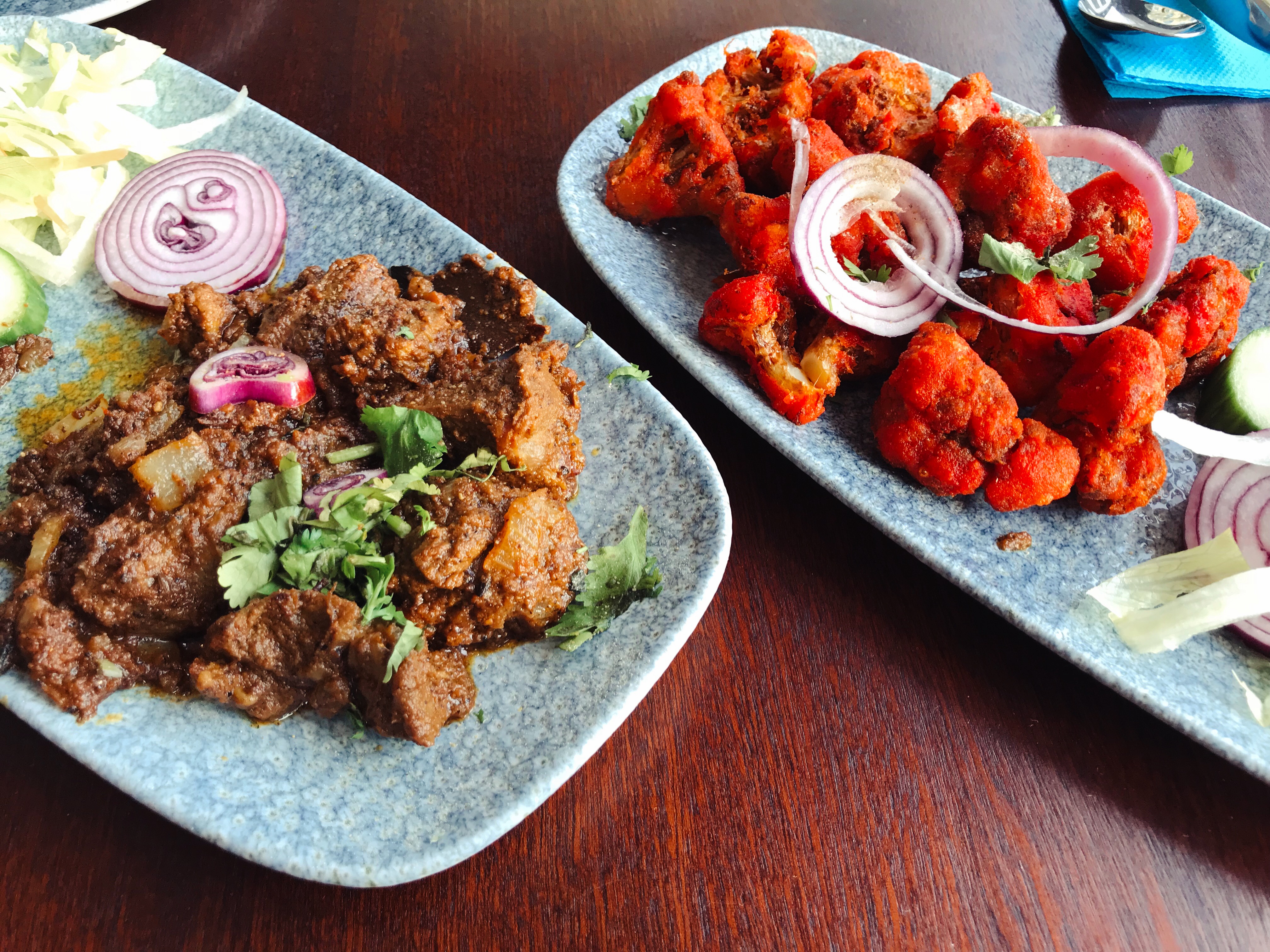
We got there in the end, drank our Kingfishers and, once the starters arrived things were positive. Gobi 65 is one of my go-to starters and Vel’s version was close to spot on. The bright red, almost scarlet colour was arresting and the coating was nicely spiced. The cauliflower underneath was lovely and firm and the florets were all a sensible size. But six pounds fifty felt ever so slightly on the steep side for a plate of veg and if you’re going to charge that they have to be crisp and absolutely piping hot and these weren’t quite that.

The mutton pepper fry was delicious – tender pieces of mutton in a lovely peppery sauce with just the right level of heat. But again, this was eight pounds and there wasn’t a lot of it and that did give me cause for thought. The crockery – and I don’t often talk about this in restaurant reviews – was attractive stuff with just a hint of sparkle in the glaze, but ultimately when they only put the mutton on half of a small plate and pad out the rest with iceberg lettuce I did find myself assessing the balance between style and substance.

I’ve always found dosa a bit confusing, and I’m never sure when they’re meant to make an appearance in a meal. Are they a starter? A main course? A light lunch? You might know better than me: we wanted to try one but neither of us fancied having it as the feature attraction, so we ordered one in between our starters and mains to give it a try. It looked gorgeous – a giant burnished cylinder of wafer thin pancake wrapped round some potato masala. It came with a little bowl of sambar (a sort of curried lentil stew, for the uninitiated) and three chutneys, one with coriander, one with tomato and nigella seeds and what I think was a coconut chutney.

Never having excelled at dosa I asked our waitress for some advice on how to eat it. She came out with some words and gestures and lots of smiles, but I was left none the wiser. So my mother and I just had at it, tearing off pieces and dipping as best we could. It was lovely, in truth – the masala was warming with green chilli and spring onion studded through it, the potato just the right side of firm. I loved all the chutneys, especially the tomato one, and the dosa itself was paper thin and beautifully buttery. Again, though, the pricing seemed steep – eight pounds was an awful lot more than I ever remembered paying at Chennai Dosa.

This was the point when things started to go wrong for Vel – not in terms of the food, but because of everything else. By now, two other tables were occupied and it seemed the kitchen couldn’t cope with having three sets of customers at the same time. So we waited and waited, saw food arriving at other tables, and waited some more. Our waitress brought poppadoms to our table by way of apology – a lovely thought but, really, yet more food was the last thing we needed.

It also gave us time to order more drinks, which also didn’t go smoothly.

“I’d like a half of Kingfisher please, and a prosecco.”

“A Kingfisher and a second?”

“No, a prosecco.”

A blank look. I was forced to resort to pointing at the menu and trying to speak as clearly as I could, which again was an uncomfortable experience. She wandered off and eventually returned with my half and an individual bottle of prosecco.

“I didn’t realise you wanted presco” she said. I decided to leave it there.

All told it was easily half an hour until our main course arrived, and few main courses are worth that wait. My mother had ordered the Chettinadu fish curry, having been talked out of the milder Kerala fish curry by the waitress. That almost redeemed the “presco incident”, because the sauce it came in was splendid – all the heat coming from black pepper rather than spice, but if anything even more interesting for that. The sauce, again, had lots of nigella seeds speckled in it and I also caught a note of roasted onion. The fish, which was apparently kingfish, was a cutlet with the bone in the middle and I liked that too: it broke into firm meaty flakes like a swordfish rather than being the soft mushy white fish you sometimes get in Indian curries. My mother started out a little underwhelmed by the dish but by the end I think she too was won over, if a tad full.

My chicken biryani was competent but not exciting. The pieces of chicken were well cooked and not dried out, and the rice had something about it but there were still a few bland clumps in there. There were plenty of cloves and cardamom and cinnamon, but they made the last bits of the biryani surprisingly difficult to eat as you were constantly sifting it for inedible bark and pods.

“It’s okay, but nowhere near as good as Royal Tandoori’s” said my mother. My mother is prone to compare all dishes with the best version she’s ever had, but I had to admit that she was right. The Royal Tandoori version has cashew nuts and just the right amount of mint and it did rather show this up. Even if it hadn’t, the following night I was lucky enough to get a sneak preview of the lamb biryani at Clay’s Hyderabadi and that – the rice fragrant with saffron and rosewater – blew this biryani squarely out of the water.

We didn’t investigate the dessert options (just as well, because looking at their menu I’m not sure there are any) so instead we settled up and moved on. Vel has been open for nearly four months, and I find it a bit dubious that it still only takes cash: for some that alone would be a deal breaker. Our meal came to sixty-two pounds, not including service. We could have spent less by ditching the dosa but, any way you cut it, this wasn’t a cheap meal for this kind of food in this kind of location. I’ve probably said enough about service already, but it would be unfair not to add that our waitress was lovely and friendly throughout, just a little wayward.

Is Vel worth a visit? You’ve probably formed your own view from reading this, and that will depend on how close you live to it, how important value for money is to you and whether you fancy paying cash and navigating some rather challenging service. Katesgrove and Whitley deserve good restaurants as much as anywhere else in Reading but, with the exception of Gooi Nara and the excellent Dhaulagiri Kitchen, I’m not sure there’s much to stop local residents making the trip into the town centre instead, despite all Vel’s interesting dishes (and, let’s not forget, attractive crockery).

Matt Farrall would tell you to give it another go if he was still with us, I’m sure, but that was Matt all over: a true local champion, a permanent optimist and a huge fan of the underdog. We saw eye to eye about a lot of things, but I never quite got his love of the likes of Sweeney Todd and Pau Brasil. The review over, my mother and I traipsed down Whitley Street behind a triptych of underdressed young ladies, their skin tone the kind of burnt orange that probably features on the Dulux colour chart as “Double Plus TOWIE”. I took her to the Hop Leaf for a pint and a debrief.

“It’s a nice pub, isn’t it?” said my mother, who – unsurprisingly – hadn’t been to the Hop Leaf before.

“Yes, I think so. It was one of Matt’s favourites.” I said.

My choice of venue had been deliberate. It’s what he would have wanted.

Vel – 7.0
73-75 Whitley Street, RG2 0EG
0118 9758551

https://eat-vel.co.uk/

Gooi Nara

Click here to see a more recent review, from June 2026.

I first went to Gooi Nara in late 2016; I was on what I suppose you could loosely have classed as a date, with somebody I suppose you could loosely have classed as a vegan. I sat there trying to sound enthusiastic about tofu (not a skill I’ve ever mastered, truth be told) and then I ate my disappointing bibimbap while all around me, the other diners were wolfing down Korean barbecue, grilling a plethora of delectable looking meats on the hot plate in the middle of their tables. They all seemed to be really enjoying themselves, and as the weeks passed I came to think of that evening more as a metaphor than as an actual meal.

Naturally I wanted to take a more suitable dining companion when I went back on duty and, on reflection, there was only one suitable candidate – my friend Claire. Not only had she actually been to Korea but she’d written a review of Korean restaurant Soju for Explore Reading which was responsible for teaching me pretty much everything I knew about Korean barbecue (admittedly not much).

Much has happened since Claire last accompanied me on a restaurant review, most significantly that Explore Reading had begun publishing restaurant reviews. A lot of people have asked me if I mind that, and of course I always say I don’t mind in the slightest, Reading benefits from a variety of restaurant reviews and that it’s not right for one site to have a monopoly. That said, it’s a running joke between Claire and I that she’s going to take me down; first she took on Alt Reading, which finally announced that it was quitting – for the time being, anyway – this week, and now she’s coming after me.

I’m mainly joking, of course. Mainly. In the run-up to our trip to Gooi Nara I make some gags about how it will be like the infamous dinner at Granita where Tony Blair and Gordon Brown agreed when the former would stand down in favour of the latter. After doing the joke I realise I’m not entirely comfortable being cast as everybody’s favourite grinning war criminal.

“I’ve always had a soft spot for Gordon Brown,” says Claire, “but then I like an underdog.” It made sense, on reflection: we each spend a lot of time championing Reading, so perhaps we both do. In any case, I strolled up the hill to the restaurant on a quiet Monday night with no plans to announce my retirement.

I’m always struck by how often I start a description of a restaurant by saying “it’s a long thin room”, like it’s the equivalent of “it was a dark and stormy night”. Well, brace yourself, but Gooi Nara is indeed a long thin room, but a surprisingly attractive one. One side was covered in slate-effect tiles, with a couple of wood stores in the wall that would no doubt come in completely useless in fuelling the fake fire showing on the wall-mounted widescreen television. The other side was a vibrant burnt orange, with oblong shelving units populated, in a slightly OCD manner, with little objets. There were dark wooden beams spanning the ceiling, such a pleasant change from the ten-a-penny industrial pipes and bare bulbs which always give a place a slightly unfinished look. I really liked the place.

“It’s funny, I wouldn’t necessarily say this is authentic Korean, but it has that feel about it” said Claire. “It’s sort of homely, but in a good way – even down to the windows.”

The first surprise came when I looked at the menu. Gooi Nara has a sister restaurant in Guildford called Sushi Nara, and as a result I was thrown to see that aside from a Korean menu there was also a whole menu of Japanese dishes – sushi, sashimi and the like. It was tempting to order some, because Reading still needs an excellent Japanese restaurant and Taberu, on the Oxford Road, is still doing delivery only at the time of writing. On reflection, though, I decided to remain steadfast: I had turned up to eat Korean barbecue, and eat Korean barbecue I bloody well would.

Not that you have to do that, of course: the Korean menu alone was massive. There were plenty of starters, although some, like takoyaki (octopus balls) and pumpkin korroke felt like they were on the run from the Japanese section of the menu. There were soup dishes and rice dishes, noodle dishes and hot pots and – as I remembered from my previous trip – plenty of tofu and bibimbap. But the trick with barbecue, Claire told me, was to order your meats of choice, cook them on the hot plate in front of you and dip them in vinegar and sesame oil before placing them on a lettuce leaf, adding kimchee and beansprouts and then wrapping the whole thing up and popping it in your mouth. I’m not the biggest fan of finger food, but put that way it’s hard to imagine a more enjoyable way to eat.

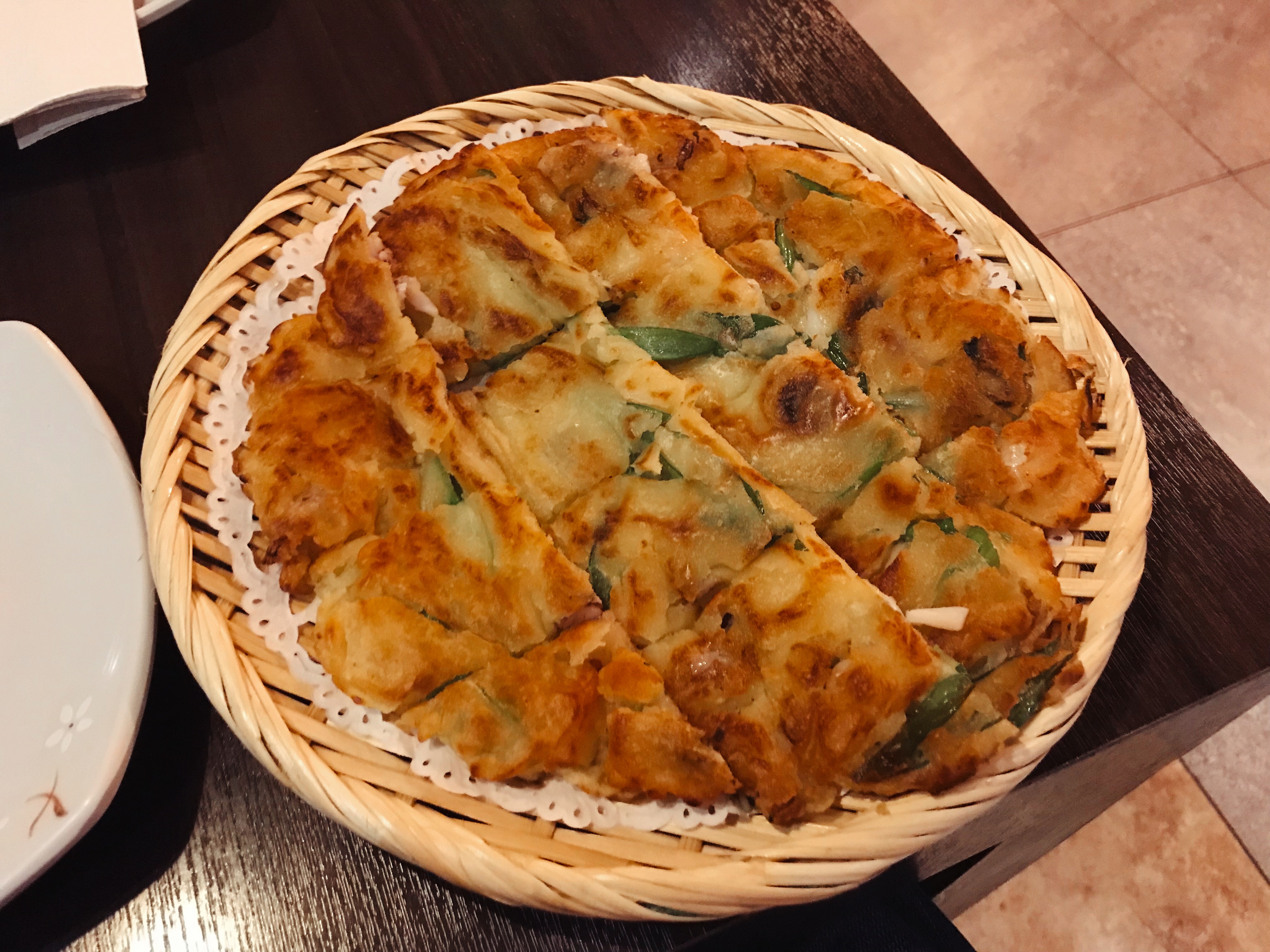
Before that though, we tried one of the starters I had my eye on – the seafood pancake. It turned up cut into squares, on a paper doily on a wicker serving dish, a bit too fiddly and faffy (“We Want Plates need to be told about this” said Claire, waspishly). It was a little fiddly too to pick up with chopsticks and dab into the dish of dipping sauce which, as so often, was too small to be useful. That all said, it really was lovely stuff. Claire told me these were made with wheat flour, but if anything the texture was so starchy that it reminded me of a potato cake – more like a latke than a pancake. Despite that, it wasn’t heavy at all, and the spring onion throughout gave it texture and freshness. I got squid in the pancake, and I may have missed the shrimp – we all make mistakes – but the menu also advertised octopus and I’m pretty sure I’d have noticed that. Still, the pancake was seven pounds fifty, so if it seemed too good to be true, perhaps that’s because it was.

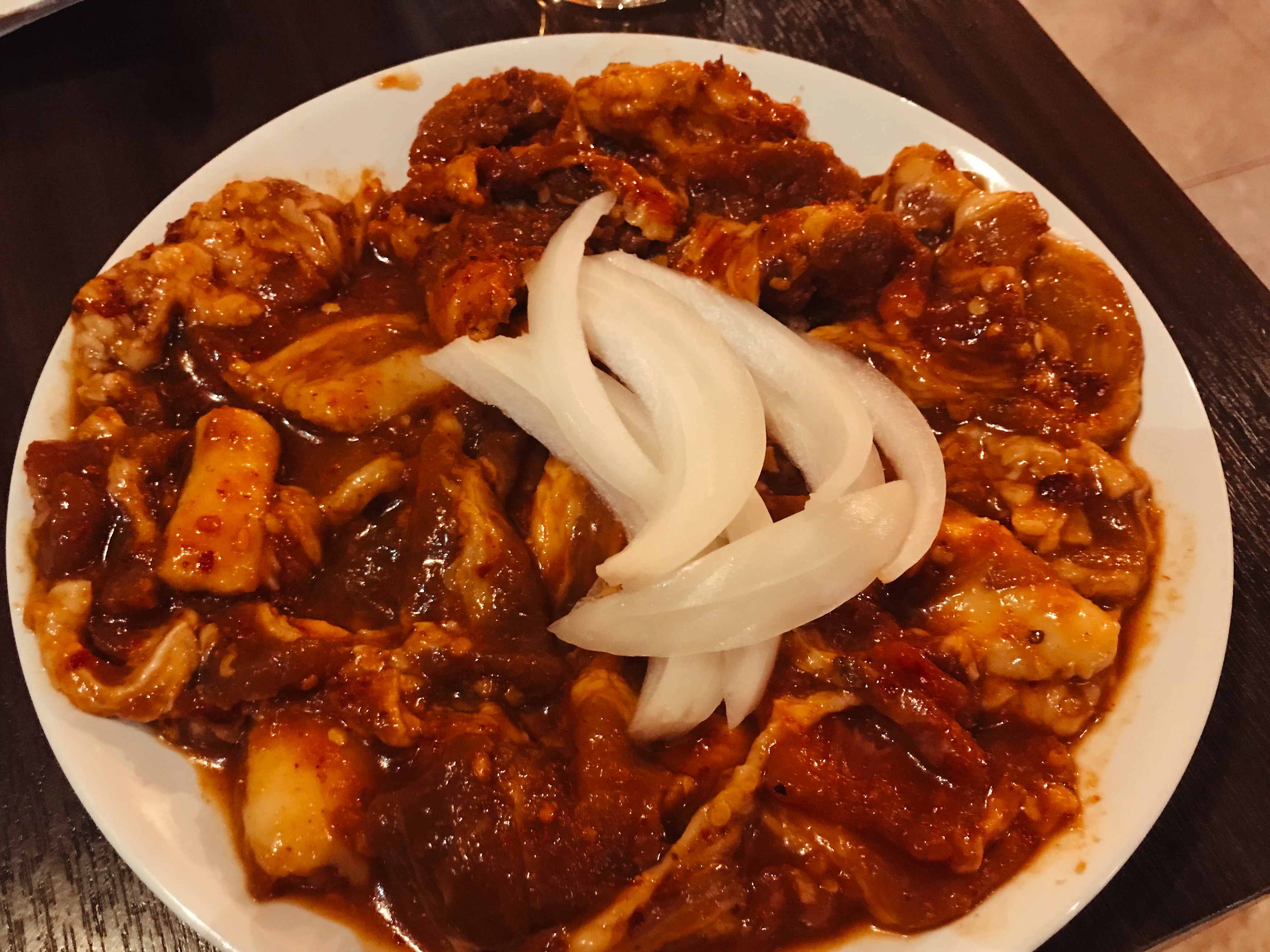
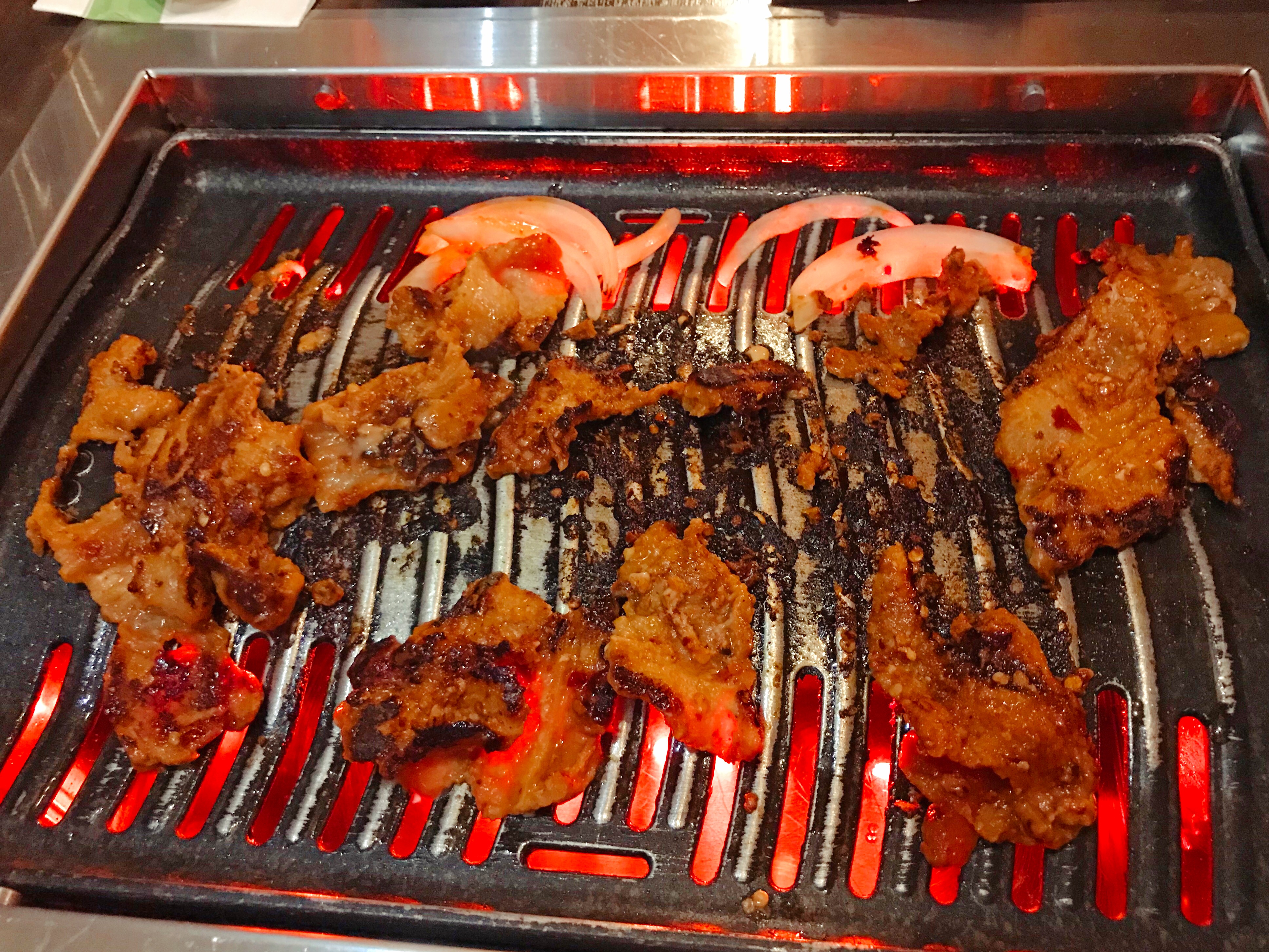
The support act out of the way, it was time for the feature attraction. The waiter came and switched on the hot plate at our table, the meat arrived and, not for the first time, I wondered how anybody ever managed to convince themselves that they enjoyed eating tofu. We’d decided to try all three of the main food groups – pig, cow and chicken, don’t you know – and the first to go on the barbecue was the spicy sam gyup sal, long thin slices of pork belly, deep-red with marinade, a veritable bar code of meat and fat. On the hot plate, the smell was terrific and the transformation beautiful, and Claire and I took it in turns to poke and turn with the tongs until it was impossible to hold back any more (I spent most of that time banging on about the Maillard reaction, and Claire spent most of it nodding and humouring me).

It tasted even better than it looked or smelled, and I loved the ritual of coating it in vinegar and sesame before tenderly resting it in the centre of a lettuce leaf, topping it with brick red kimchee and devouring the whole lot. The kimchee added sourness and crunch without being quite as fiery as some kimchee can be. The spice on the pork, again, built to a crescendo rather than went off like an explosion, and the whole thing was the kind of dish that you can’t help but grin while eating.

It would be a lazy piece of observational comedy to say that you’re basically paying money to cook your own food, but that would be to underrate the service; every time a hot plate got too crusted with meat and residue to use, the waiter would come along, deftly hook it out with a nifty device and pop in a new one. He also gave us advice on what to grill in which order, and regularly kept us topped up with bottles of Asahi (Claire offered to give me a crash course in Soju, but then said it was basically vodka, at which point I found myself really fancying a cold beer).

“Do you know how they clean these?” said Claire, probably well aware that my answer, inevitably, would be no.

“No.”

“They use a lemon. You just scrub the hot plate with a lemon and it all comes off.”

I found myself thinking of those colour supplement adverts that tell you vinegar has magical powers and can clean pretty much everything around the house.

“So, the pork is better than Soju, I think” said Claire, “although here they bring it already cut into strips and at Soju they sort of bring it in a big slab and you cut it up yourself with scissors.”

It would be an even more lazy piece of observational comedy to say you were expected to chop your food as well, so I decided not to mention it. In any case, more meat was on the way. I wasn’t sure how I felt about the ju-mul luk (the beef) when it arrived, because it was in thick cubes and I had been expecting thinner slices. But any doubts I had were caramelised into oblivion as the beef sizzled on the grill, the coating of garlic and sesame searing and producing the most glorious aroma. It was far more tender than its thickness might suggest, with a splendid whiff of garlic which lingered long in the memory (and possibly even longer on my breath).

Last of all, we went for the chicken bulgogi gooi, thighs marinated in soy and sesame. These were probably the most disappointing thing we had – it had been sliced too thinly and broke up into very small pieces on the barbecue. It also had less marinade, so it was the only thing to keep sticking to the hot plate and burning. Still pretty good, but just a bronze medallist in this setting.

“It’s a shame really, because bulgogi is the thing in Korean restaurants” said Claire.

“And it’s the one thing they could have brought out whole” I said. “Just imagine laying a marinated flattened thigh out on that hot plate.”

“The chicken is definitely better at Soju, but the rest is probably better here. And that pork is incredible.”

Claire was right about that. I was also struck by just how good value everything was. Each plate of barbecued meat was a hefty, generous portion and the chicken and pork only cost seven pounds fifty. Even the beef was still less than a tenner. We’d ordered three different plates, but two people could easily get by sharing two – well, two people where one of them wasn’t as greedy as me, anyway.

“You can tell this is good”, I said, “because I’m already trying to work out what I’ll have when I come back.” In my mind, I was already mentally choosing between the feather blade beef and the prawns with lemon and pepper and – predictably – deciding it really wouldn’t be a crime to order both. And possibly a bibimbap. But there were limits even to my hunger, so we stopped there. All that food and six bottles of Asahi came to sixty-eight pounds, including a pre-added ten per cent service charge which I had no problem at all paying.

On the walk down the hill to the Hop Leaf for a post-meal pint and debrief, I asked Claire how she would describe the clientele at Gooi Nara.

“Oh, it was mixed. The table behind us were clearly Chinese – I heard them talking – but the big table nearest the loos were definitely Korean. And this restaurant is near the university, so I expect they get a lot of university students.”

Claire had effortlessly clocked all the other diners, their nationalities and the likely market for Gooi Nara’s food, all while pretending to listen to me talk about the Maillard reaction. She’d had her back to the lot of them. It was like something out of The Bourne Identity, and not for the first time I found myself thinking that if she starts reviewing restaurants regularly it might be the end of my blog. It was a suspicion compounded when we compared notes in the pub about what ratings we’d give Gooi Nara: they were a cigarette paper apart.

I’ve thought a lot about the right word for my visit to Gooi Nara since the meal, and it boils down to a really simple one: it was fun. Fun is an underrated quality in eating out, I think. So much about restaurants is either po-faced or functional at the moment, and when it’s not it’s the type of enforced jollity and zany fun that always reminds me of mandatory corporate away days. But Gooi Nara was properly enjoyable from beginning to end, with an element of playfulness that set it apart from the formula of starters, mains and dessert. I can imagine going back with a big group of people and mucking in, although the one thing I would say is that the barbecue takes up a lot of space on the table, so things could get decidedly cramped in a bigger group. But that aside, Gooi Nara comes highly recommended and I’m really looking forward to going back. Having fun, eating great food and making new friends: I wouldn’t be at all disappointed if this visit, too, becomes as much a metaphor as a meal.

Gooi Nara – 7.9
39 Whitley Street, RG2 0EG
0118 9757889

https://www.facebook.com/GooiNara/