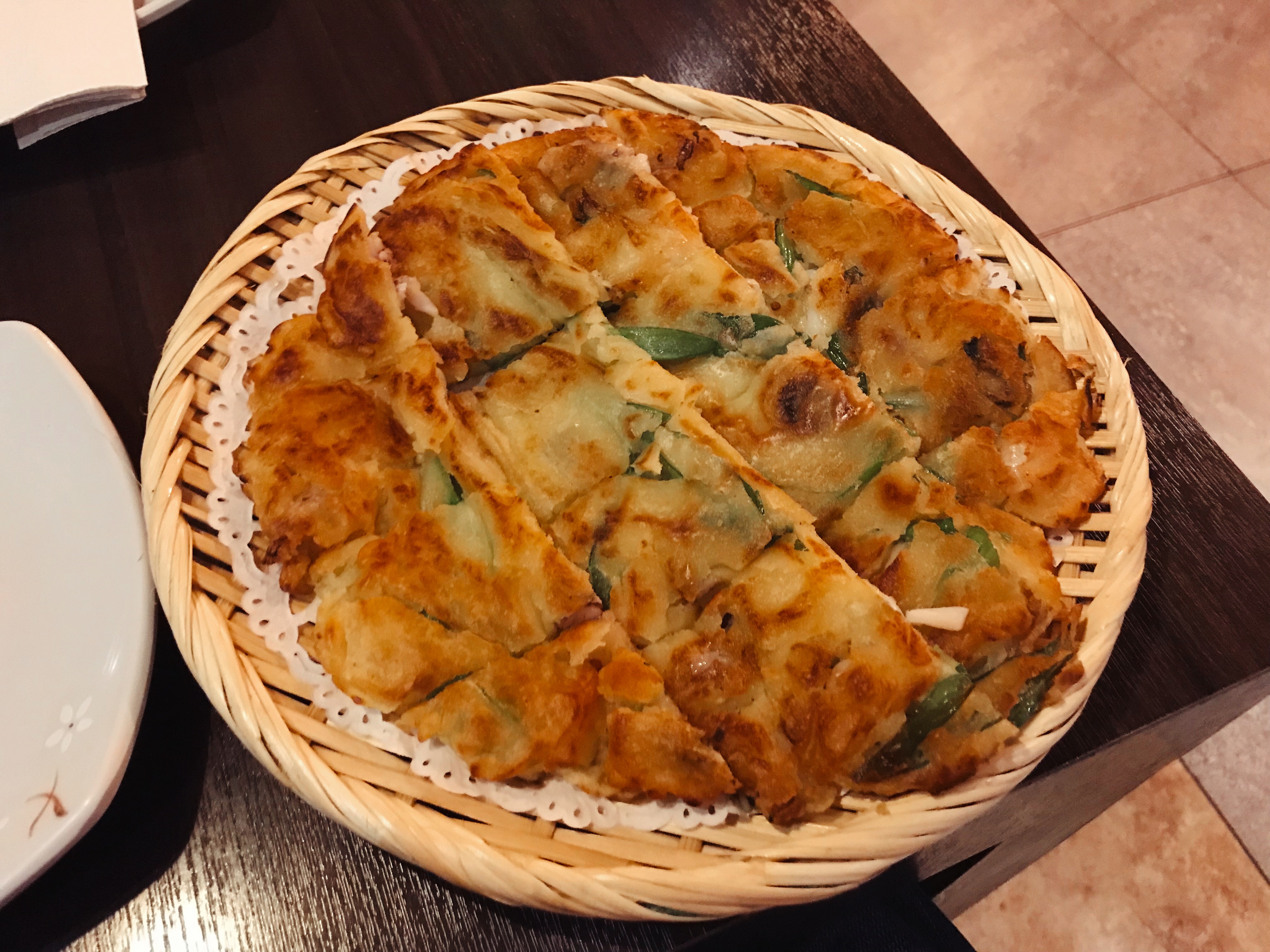
There’s no such thing as Spotify Wrapped or Apple Music Replay for restaurants, as far as I know. But if there was, the restaurant whose food I ate most last year is almost certainly Gooi Nara, the Korean restaurant on Whitley Street that has been there for something like ten years, if not more. And yet returning to it a couple of Saturdays ago for dinner with Zoë was the first time I’d set foot inside since I reviewed it in 2018.
The thing is, as regular readers will remember, I moved to Katesgrove a couple of years ago, which means that, along with Kungfu Kitchen, Gooi Nara is probably the closest restaurant to where I live. And what that means is that on the nights when neither of us can face cooking we know that a delivery driver won’t get lost, won’t drop other orders off en route to our house and can be trusted to turn up pronto with piping hot food from just round the corner. Over the last two years, between us, we’ve developed quite a Gooi Nara habit.
It’s no coincidence that they won my “takeaway of the year” award in 2024 – but my love of a Gooi Nara delivery has continued ever since. It is refined and perfected now to the point where Zoë and I order exactly the same thing almost every time: dakgangjeong, or Korean fried chicken, for her and tang su juk, chicken in sweet and sour sauce for me. The latter comes ready to assemble, one plastic container of gorgeous fried chicken and a tub of sweet, sharp sauce with orange and pineapple bobbing in it (I was skeptical too, but don’t knock it until you’ve tried it). It has made me happy many, many times.
Sometimes we push the boat out and get some mandu, fried chicken dumplings, as well but otherwise those two and a couple of portions of rice are everything we need for a contented chomp in front of the telly after a hard day. I especially grew to love Gooi Nara when I was discharged from hospital and could only eat with one hand: I remember the first time I had their sweet and sour chicken after my accident I could only eat half, the rest popped in a LockNLock in the fridge. It was even better cold the next day: it remains the only occasion when I’ve had any leftovers at all.
That’s all well and good but I love their food so much, and always hear so many positive comments about it online, that it felt like we were doing them a disservice by only ever ordering the same two takeaway dishes. And my review was over eight years old, after all, so it felt like high time to go back. Early one Saturday evening Zoé and I took a short amble there, tracing the path of so many delivery riders in reverse, to check it out.
First things first: it was absolutely packed at 6.30pm on a Saturday evening. So much so that they could only just find room for us, tucked away at the very back with a great view of what was clearly a very successful restaurant. The decor didn’t feel like it had changed much in the intervening eight years: it still had a welcoming, homely feel, all wooden beams and faux slate walls.
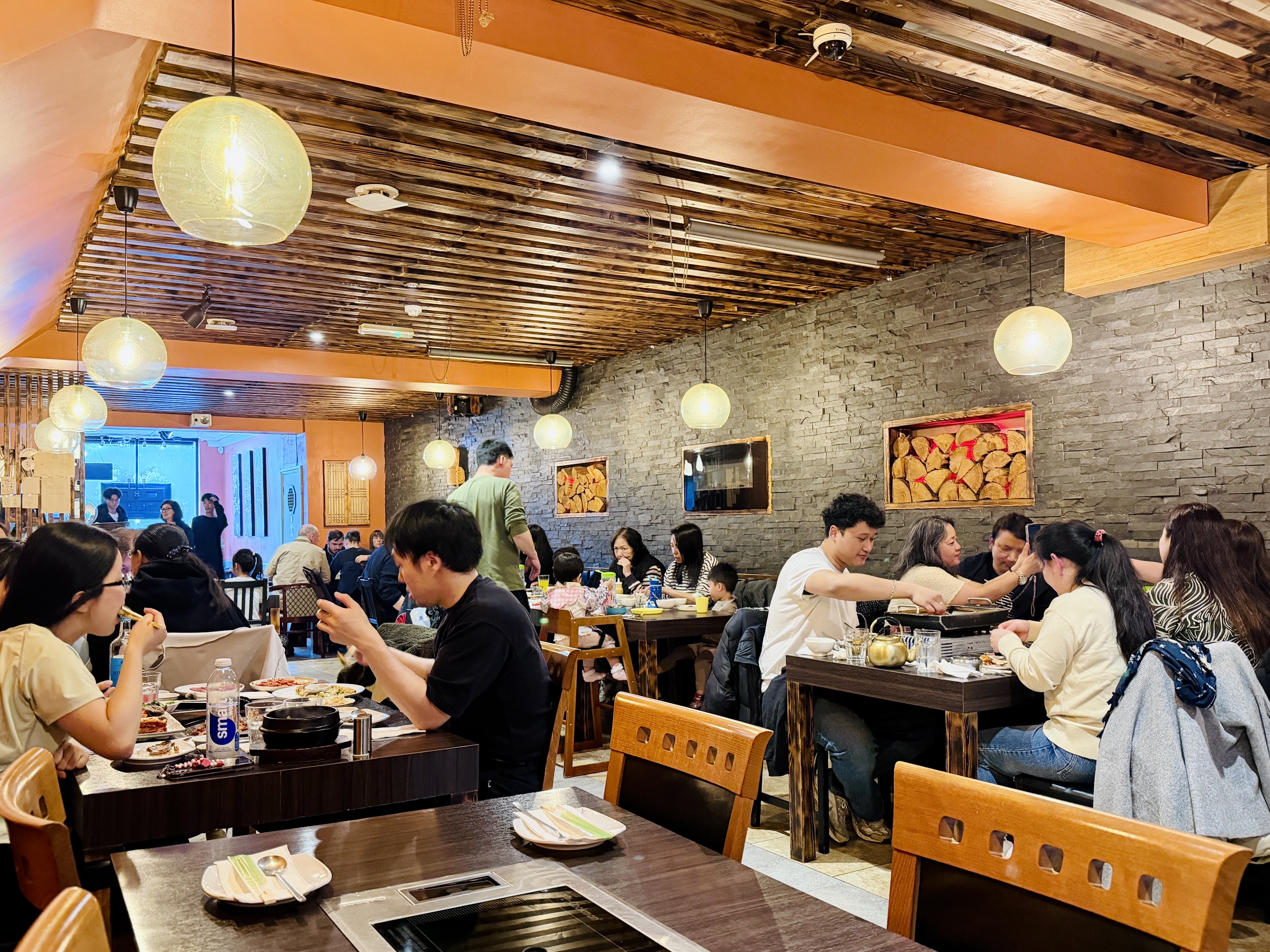
The main difference, I would say, is just how well Gooi Nara appeared to be doing. It also started out very warm, and on a punishing day as the hot plate in the middle of our table got switched on it became even more sweltering.
In terms of the mix of customers, I would say that with the exception of the table next to ours later in the evening we were the only one exclusively made up of pasty Anglo-Saxons: I did envy my fellow WASPs at the other table who no doubt were getting an excellent introduction to the full gamut of the menu from people who knew exactly what to order.
It did appear, too, that Gooi Nara had a good reputation: I overheard a conversation at one of the big tables nearby to the effect that its occupants had converged at the restaurant from many places, some miles away. Maybe Gooi Nara filled that role for Southerners who couldn’t easily make it to New Malden, the Little Korea of the UK.
Gooi Nara’s menu has changed, I think, from when I visited it last. Back then I’m pretty sure it hedged its bets, with both a Korean and Japanese section, but now it’s all kind of thrown in together: edamame; takoyaki; agedashi tofu and pumpkin korokke feature, along with yaki soba and udon.
But the Korean elements of the menu are far more extensive, and the menu can be quite overwhelming with sections seemingly for everything: soup; rice; bibimbap; jeongol (or hotpot); noodles and of course Korean barbecue. The sides, to add to the confusion, appear at the very beginning, before everything they could conceivably be on the side of.
It made me wish I had my own food sherpa – is that cultural appropriation? – to guide me through the highlights of the menu, a feeling that only intensified as I saw some gorgeous dishes waft past to other tables. Was the delicious-looking tofu (I’m not even joking) that went to the table opposite the agedashi tofu, or the Korean doo-bu jeon? I decided on reflection it was the latter. And how good did the platter of various types of kimchi look when it arrived at the table next to me, a couple having one of the most Guardian conversations I’ve eavesdropped on in a very long time?
I came away from it all feeling silly and parochial, realising that really I only knew a handful of dishes on the menu and the various bits and bobs I’d ordered the best part of a decade ago. I was well aware that on this visit I would stay in my comfort zone, even if I’d insisted to Zoë that we couldn’t order any of the things we would invariably put in our takeaway order. So we ordered a couple of starters, a couple of mains and two items for the barbecue, and even then I’d say we played it extremely safe. We might have been outside it, but our comfort zone was only a short walk away.
Everything came if not all at once then really in a very short space of time. One minute we were necking our cold bottles of Cass, a perfectly decent lager I would struggle to tell apart from Asahi, Ha Noi or Singha in a blind taste test, let alone its Korean alternative Hite, and the next our grill was switched on and pretty much everything we’d ordered was cramming in on our table.
And the table looked big, but since the centre of it was given over to said grill you ended up playing the equivalent of those sliding tile puzzles trying to work out what could go where. Try to combine that with the timings of actually cooking some of your food and the whole experience became a little like patting your head and rubbing your belly at the same time, impressive training in multi-tasking. Forget my doing those six pointless LinkedIn games every morning: this would be much better at keeping me mentally sharp.
Vegetable mandu were, if anything, even more enjoyable than the chicken ones which had been dropped off by a friendly rider so many times in the last two years. A bit more crinkly and expansive than their chicken equivalents, they had a pleasingly light, grease-free texture and a filling I could almost convince myself was virtuous. Gooi Nara’s dip of soy, sesame oil, sesame seeds and quite possibly something else beginning with S had a gladdening sharpness that complemented them very nicely indeed.
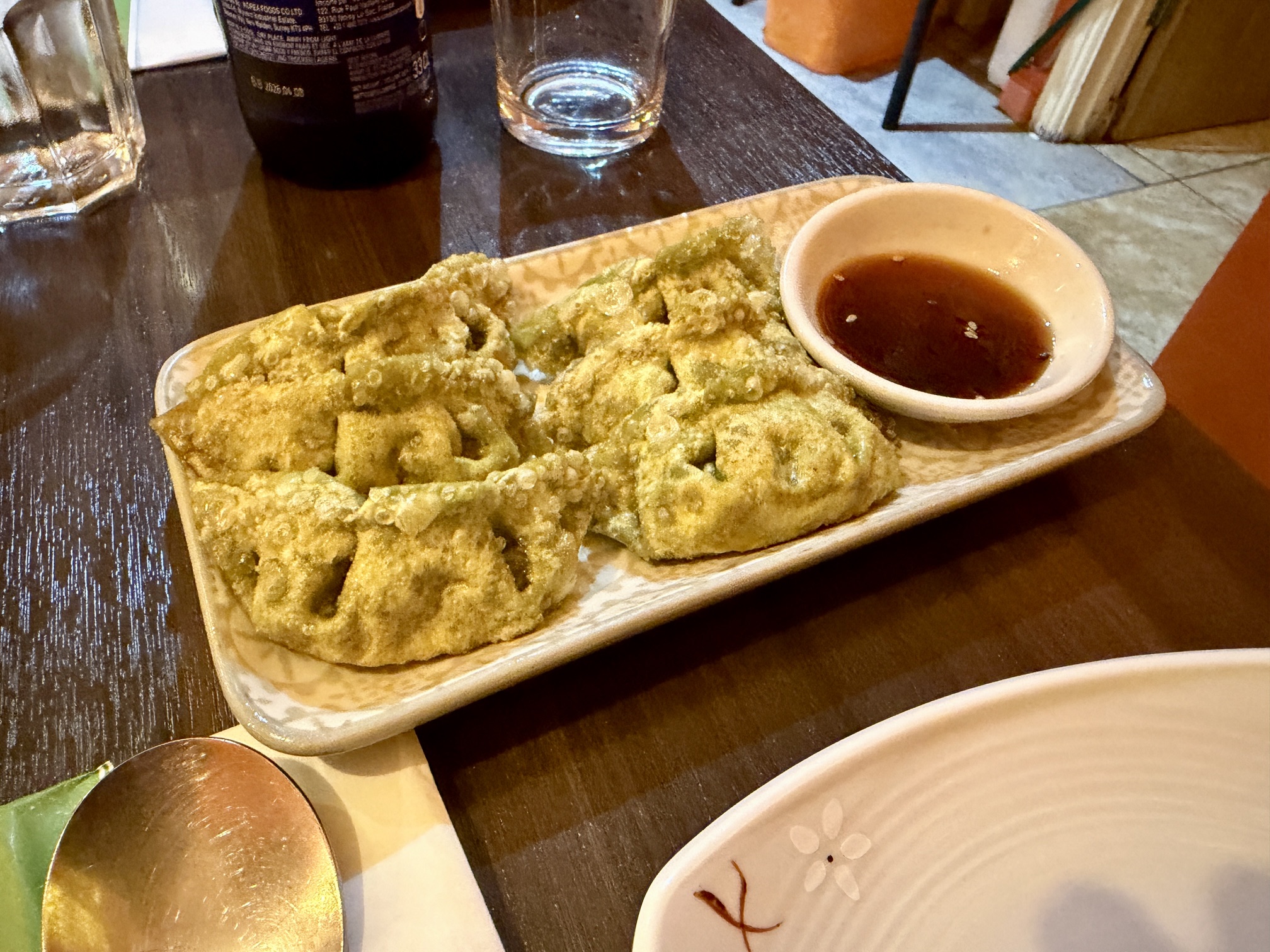
A quirk of Gooi Nara’s menu is that, if it is to be believed, you get 5 chicken dumplings or 5 prawn dumplings but a strangely non-committal “5-6” vegetable dumplings. Fortunately on this occasion we got a shareable, even number, but I’m pretty sure whenever I’ve ordered the chicken mandu I’ve been given 6 of those too. Go figure, pun not intended.
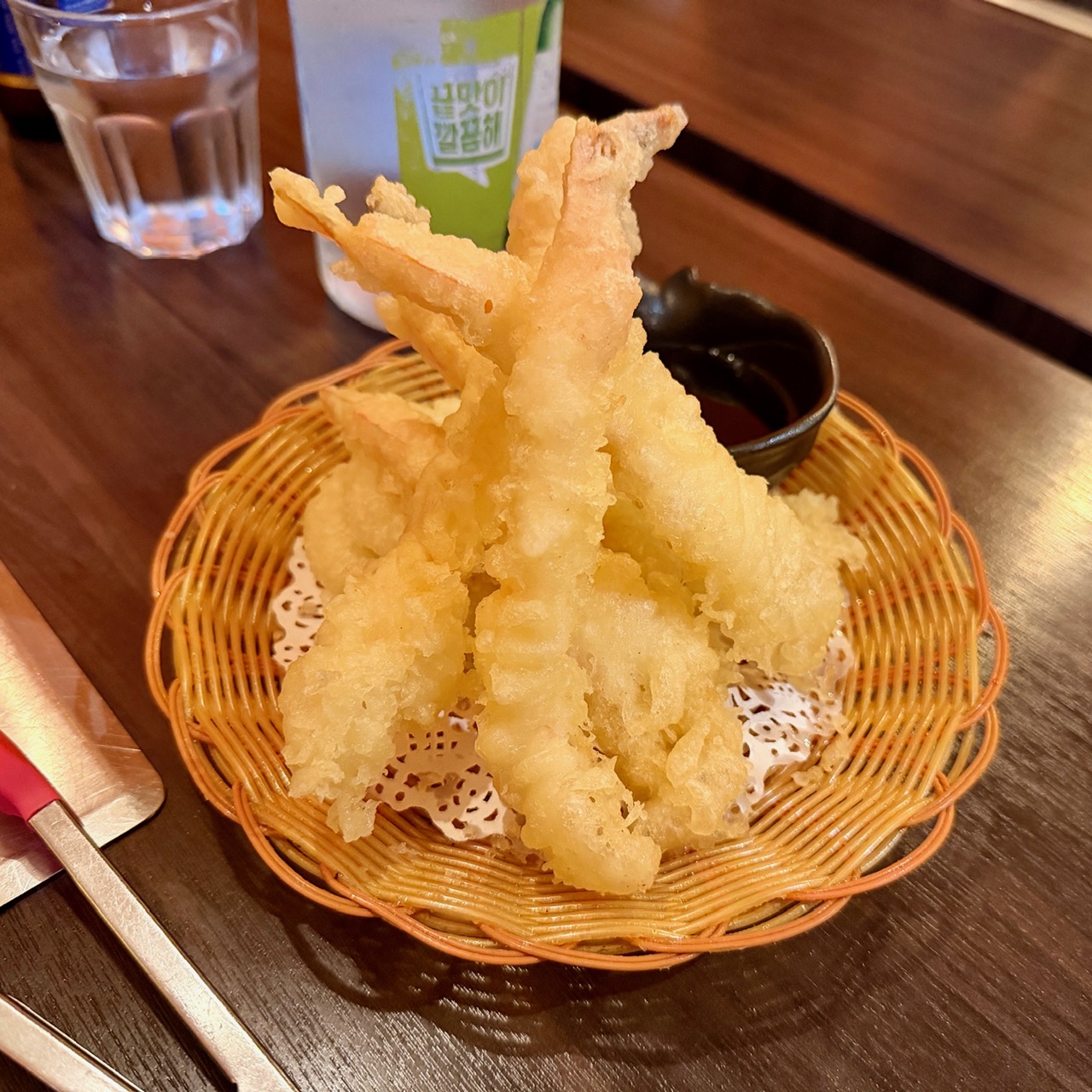
Also decent were the prawn tempura, which I would say were better than they looked. In the picture below they come across as a little wan, a tad too blond, but they had a real deft lightness and, again, next to no grease. The dip they came with, almost exactly the same as the one that accompanied the mandu, was still good but the dimensions of the vessel and the size and length of those prawns made it, practically speaking, a faff: it was a bit like trying to get a pool cue in a beer glass. £12.30 for these, so as much as both of the main courses we’d chosen.
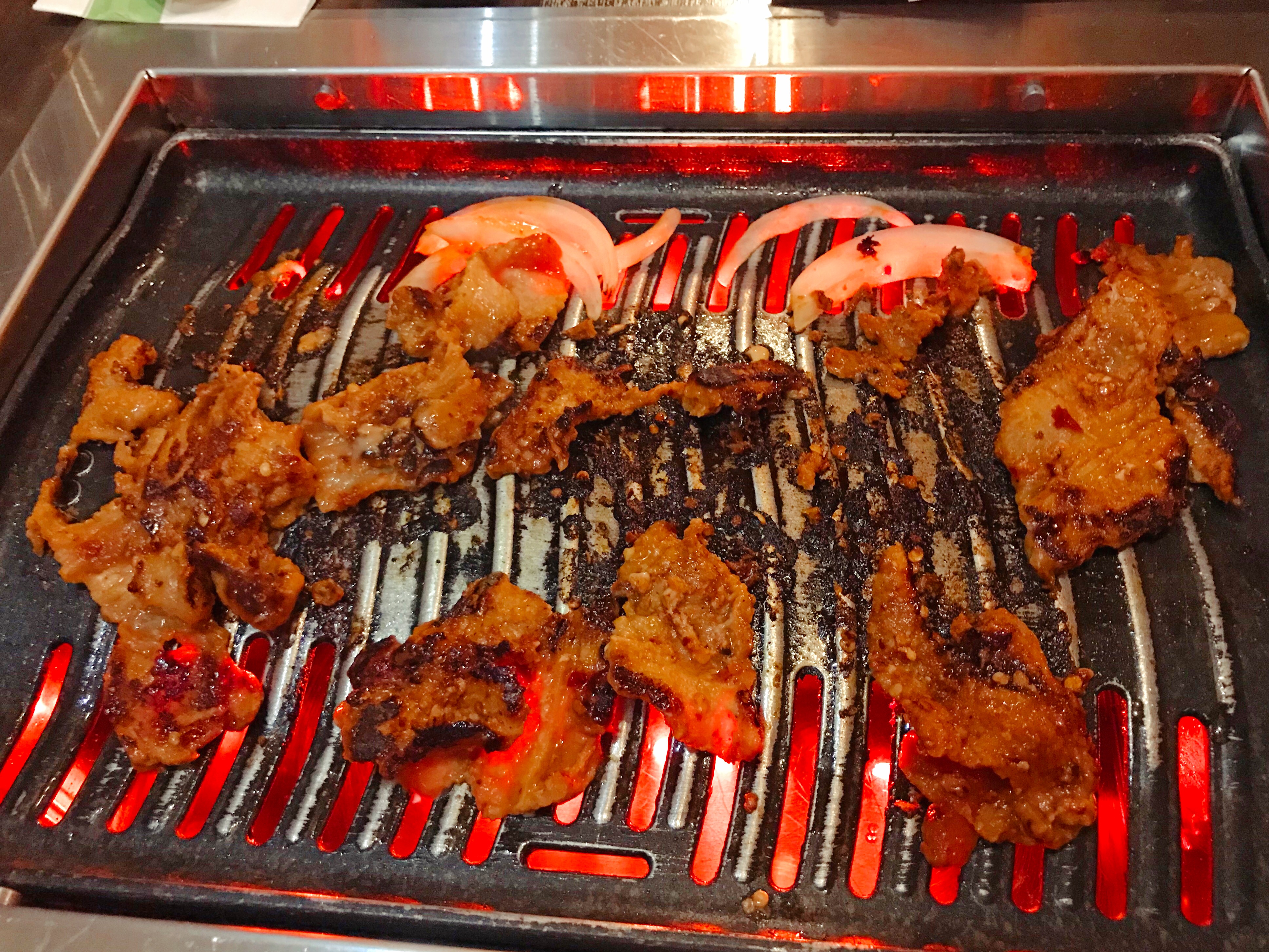
By this point we’d also started to avail ourselves of the barbecue. Sam gyap sal, unadorned sliced pork belly, turned up looking a bit like those cheap bacon-flavoured corn snacks you can get in supermarkets, and I did wonder whether we should have gone for the spicy version, but it crisped up beautifully on the barbecue, that fat rendering and permeating just enough.
We chose the pork to cook first precisely because it wasn’t marinated the way our other barbecued meat was, to try and avoid cross-contamination. We had a couple of dishes of condiments to dip them in, and I failed to make a note of either, but one was definitely soy and the other was definitely not: I think it might have been ssamjang, the traditional sauce used with Korean barbecue containing gochujang and soy beans.
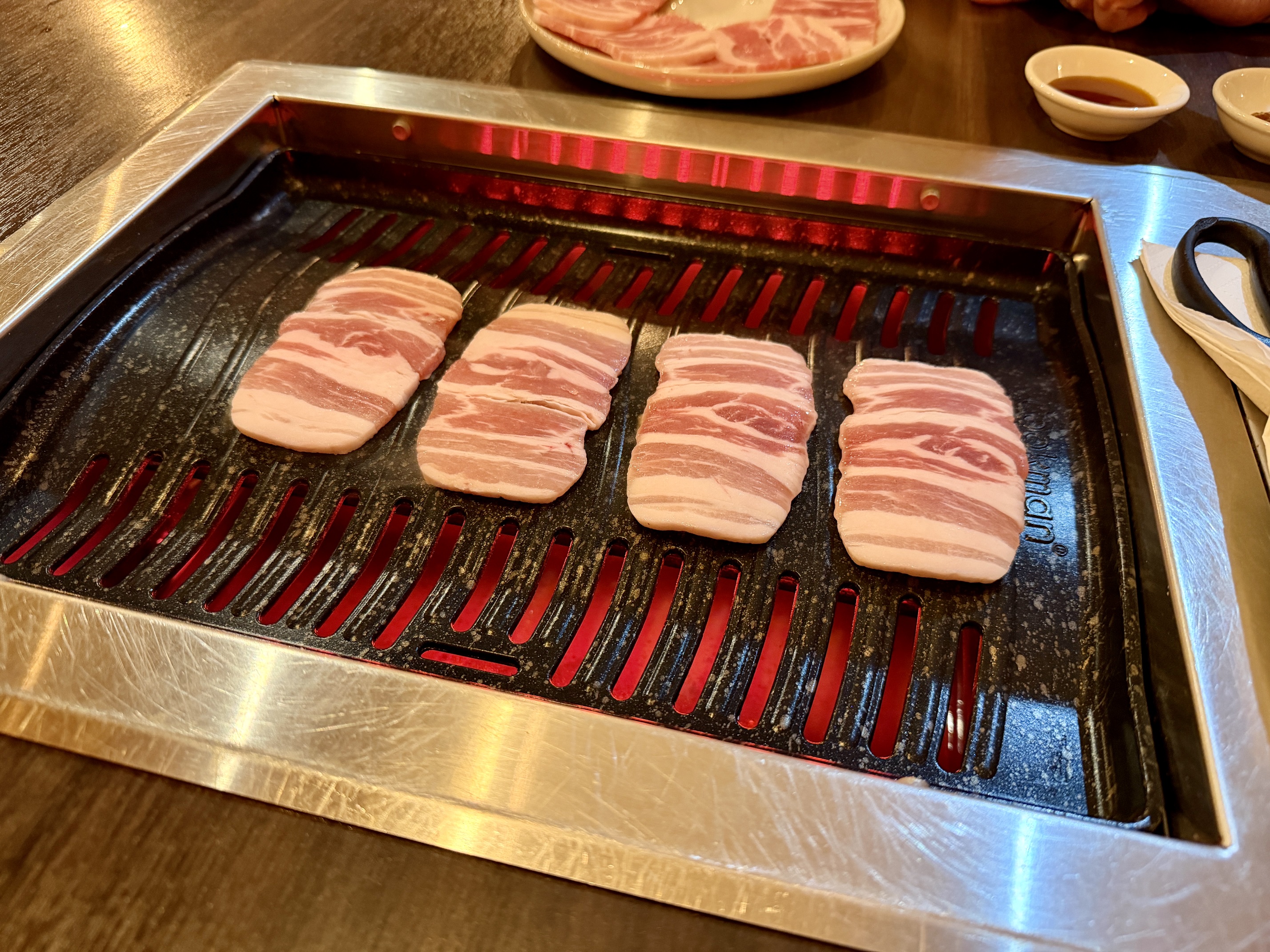
It was only later that I realised we should have ordered some lettuce to wrap the pork in: it’s hidden away, chronologically speaking, in the list of side dishes at the beginning of the menu.
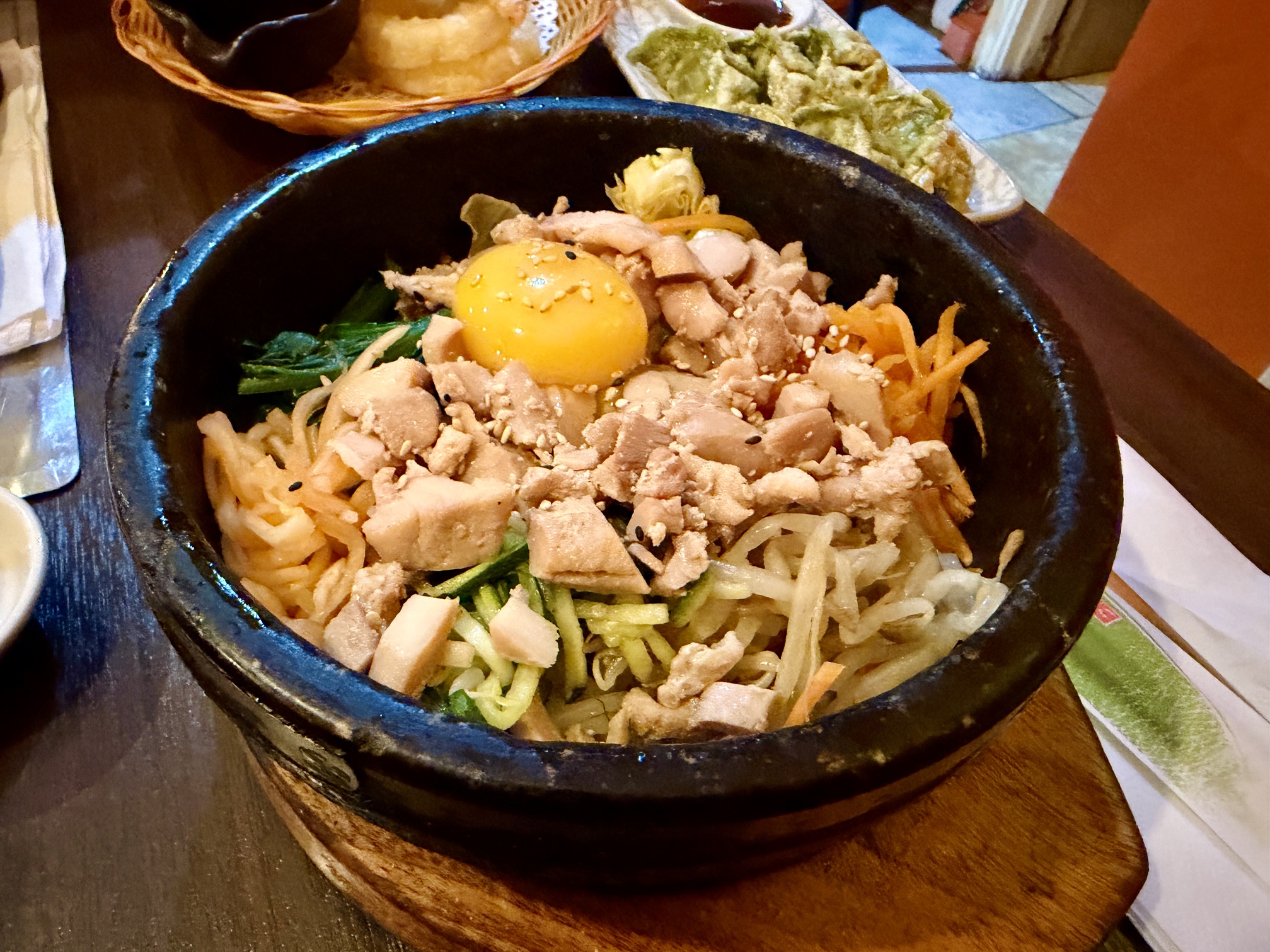
My main – although the concept of a main slightly falls away when it all comes at once – was the chicken dolsot bibimbap, a dish I haven’t eaten in a long time. For the uninitiated, this is rice, chicken, veg and an egg yolk brought to the table in a hot stone bowl, so it keeps cooking and sizzling as you work your way through it. I broke up and dispersed the egg and made my way through it, and by the end some of the rice had reached the crispy state known in Korean as nurungji (I suppose the closest European equivalent is the delectable socarrat at the bottom of a paella).
I would have described this dish as a little nondescript, a tiny bit bland, if it weren’t for the squeezy plastic bottle of gochujang which came with it. The more of this I added, the more I enjoyed it, and the more I enjoyed it the more I added it: I do wonder how much you’re meant to use, and how much was left in that bottle when I was done, but it turned what could have been a trudge into a frolic.
The other thing that whole experience taught me was patience. Ordinarily I would have a moan – god knows you’ve probably read enough of them – about everything arriving at the same time and forcing me to choose what to eat first.
Eating in Gooi Nara that evening, among all that good-natured, deceptively well controlled bedlam, I realised that it was probably a very English mindset: that your food is at its best the moment it arrives at your table and it’s downhill from there, that it’s a scramble to eat it before it goes cold and that too many dishes at once guarantees disappointment.
But it didn’t feel that way here. Those prawns and dumplings sat there, keeping their freshly fried heat. The pork sizzled on the barbecue, with more on the plate waiting to take their place. Our second barbecued meat hadn’t even made it to the front of the queue. And my bibimbap was still hot, gradually perfecting its texture. What was the rush? Everything would be eaten in its own good time, in the right order, with no need for conniptions.
Zoë loved her main, I don’t think I would have done. I managed to persuade her not to have her regular takeaway order, her chicken gam-poong gi, but she ordered it with prawns instead. I was expecting this to be prawns curled up, little inverted commas in a crisp coating, tossed in the gorgeous spicy sauce that makes this dish such a crowd pleaser in my house.
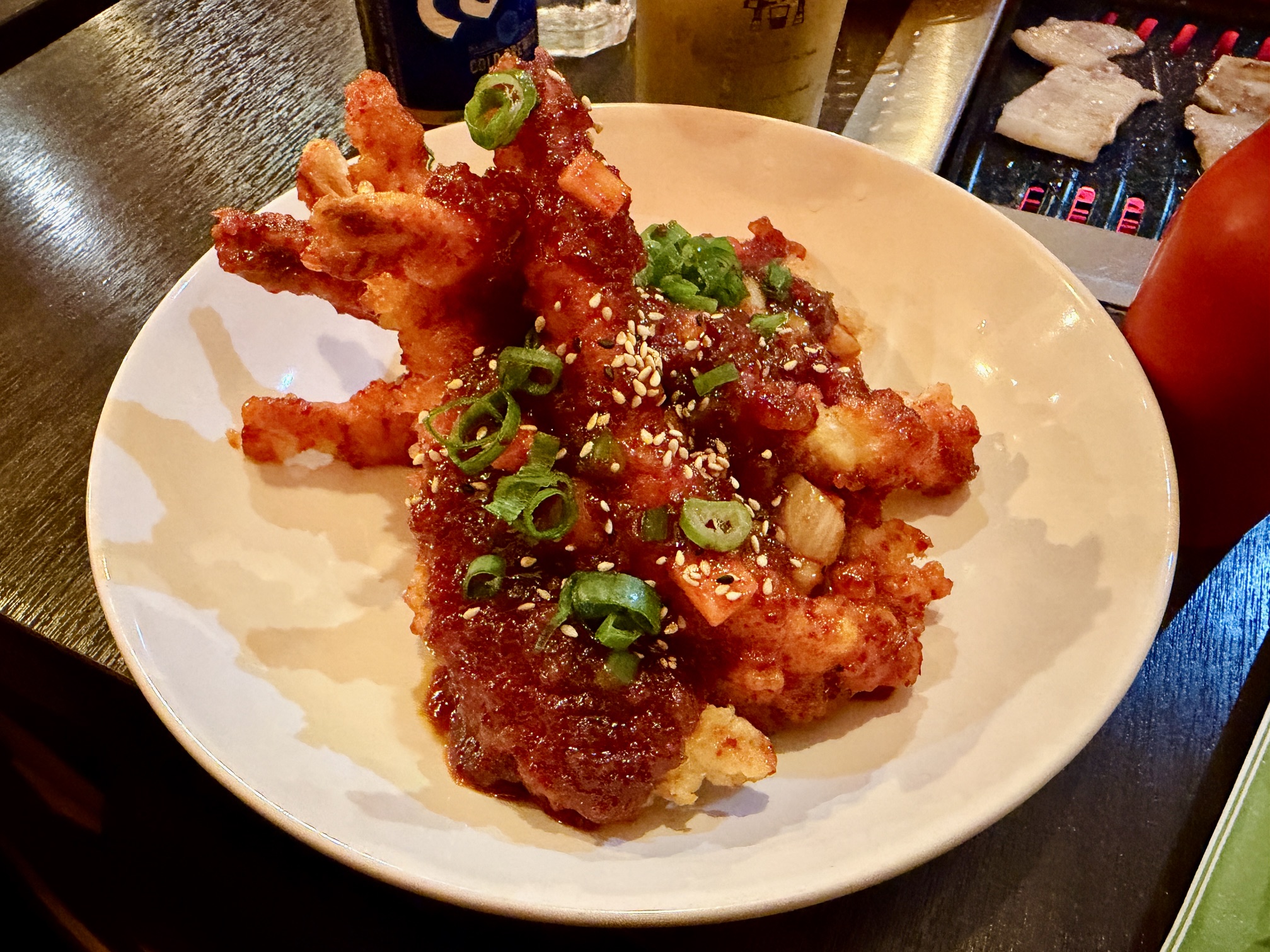
Instead they were fully extended like an accusatory index finger, the tempura prawns from earlier on making a reappearance with some sauce thrown in. So deeply impractical in many of the same ways as that starter, and downright impossible to eat with rice. I didn’t order them, and I certainly wasn’t allowed to try them, so it doesn’t really matter. Zoë really enjoyed it, and maybe in the free-for-all of our meal overall it didn’t really matter that they weren’t quite what I thought they would be.
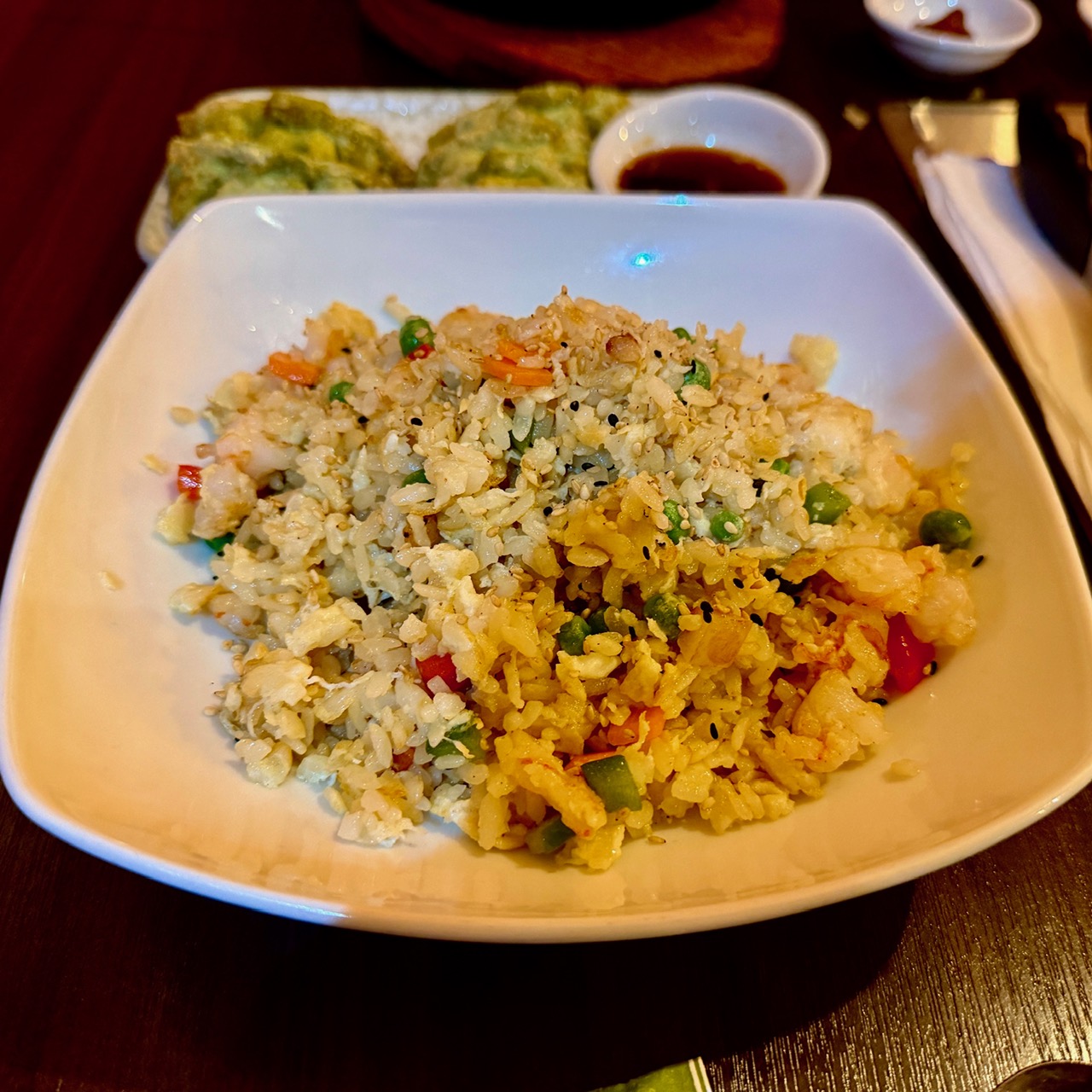
The dish they didn’t go with, or at least I thought they didn’t, was Gooi Nara’s special egg fried rice with vegetables and shrimp. Zoë, again, seemed to enjoy it but I thought it was a bit steep at £11, especially considering that you could get a bibimbap for roughly 50p more. Plus I got a bit squeezy bottle of gochunjang, let’s not forget, and this looked like it badly needed that or something like it.
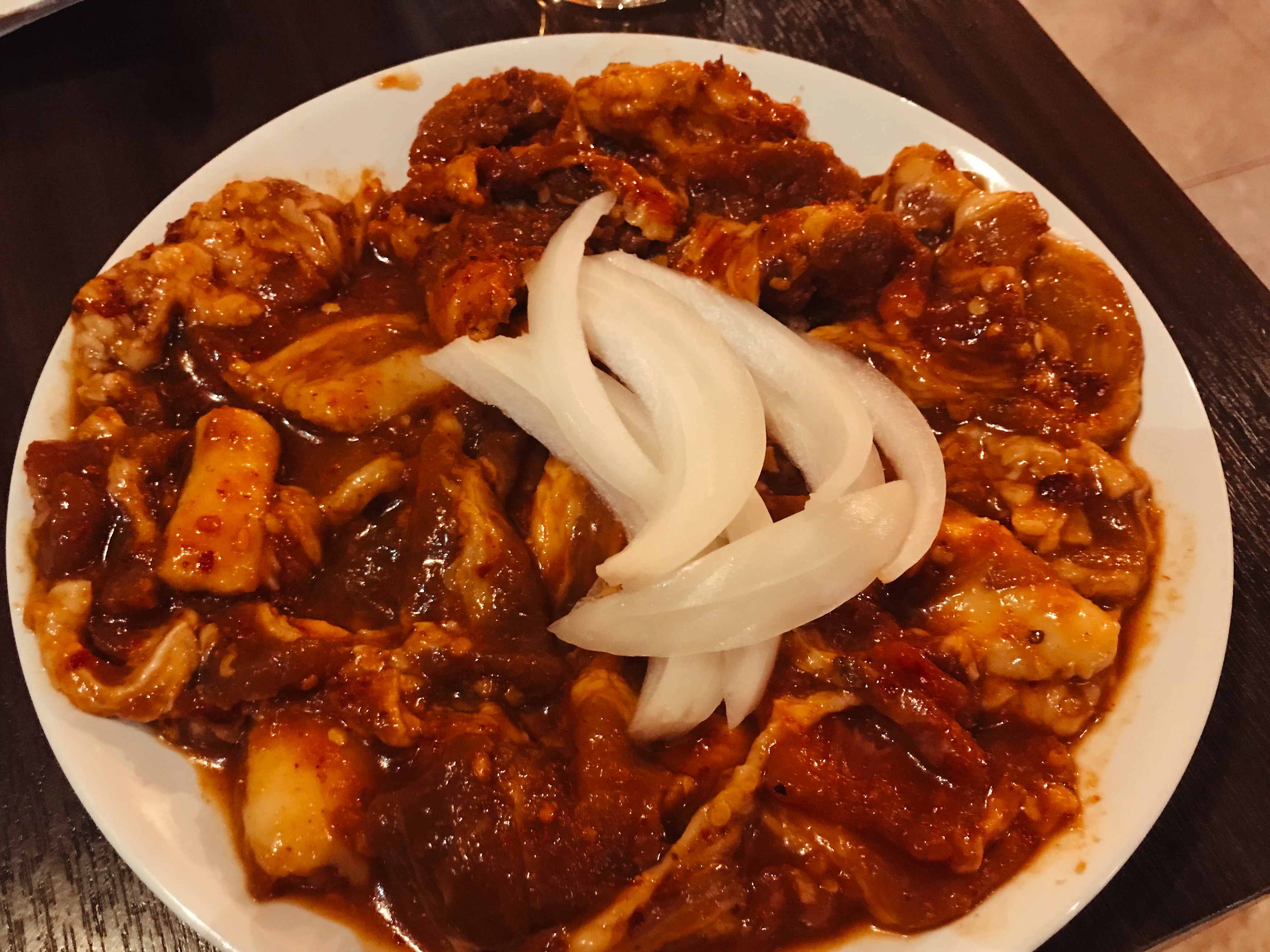
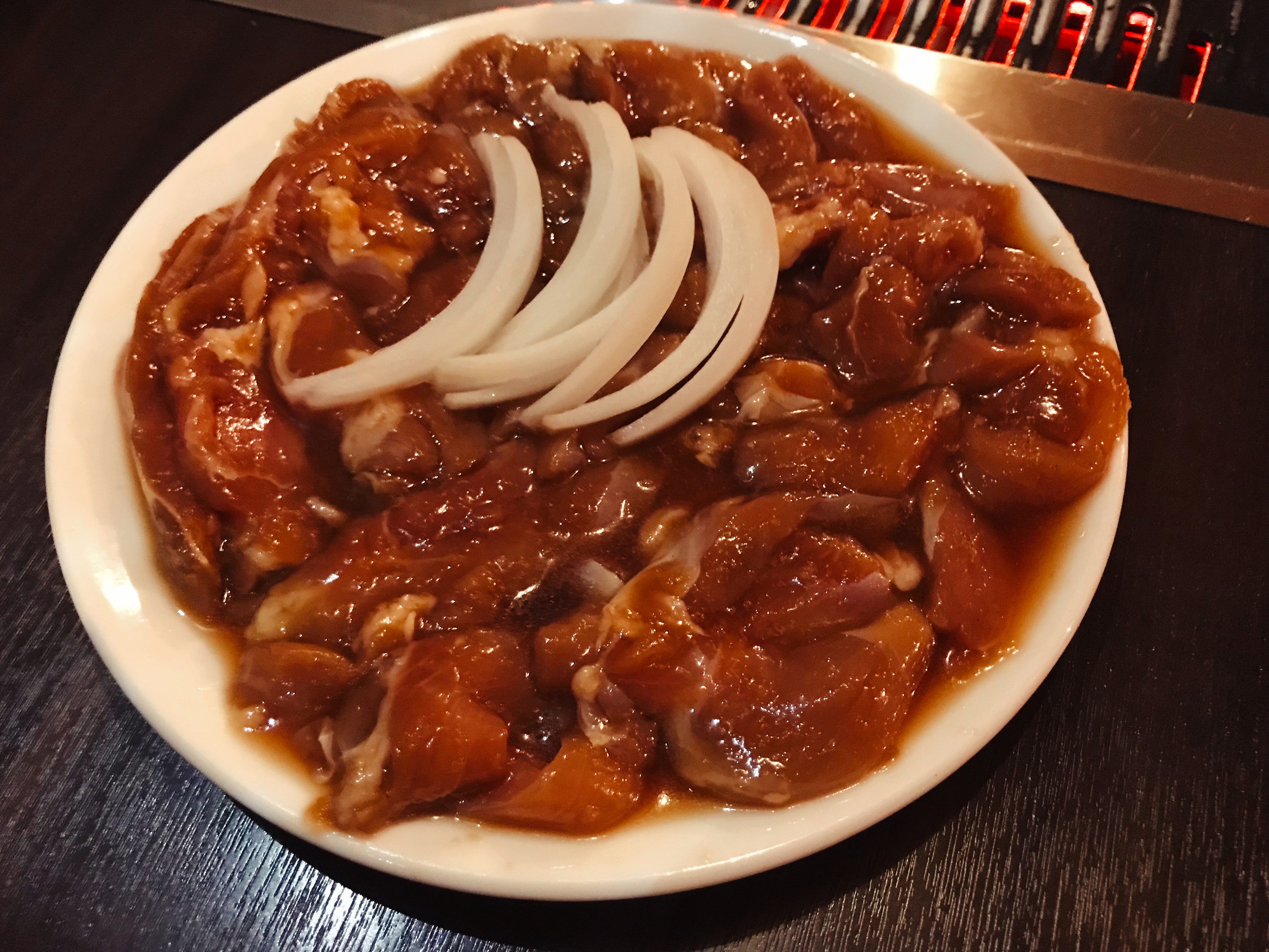
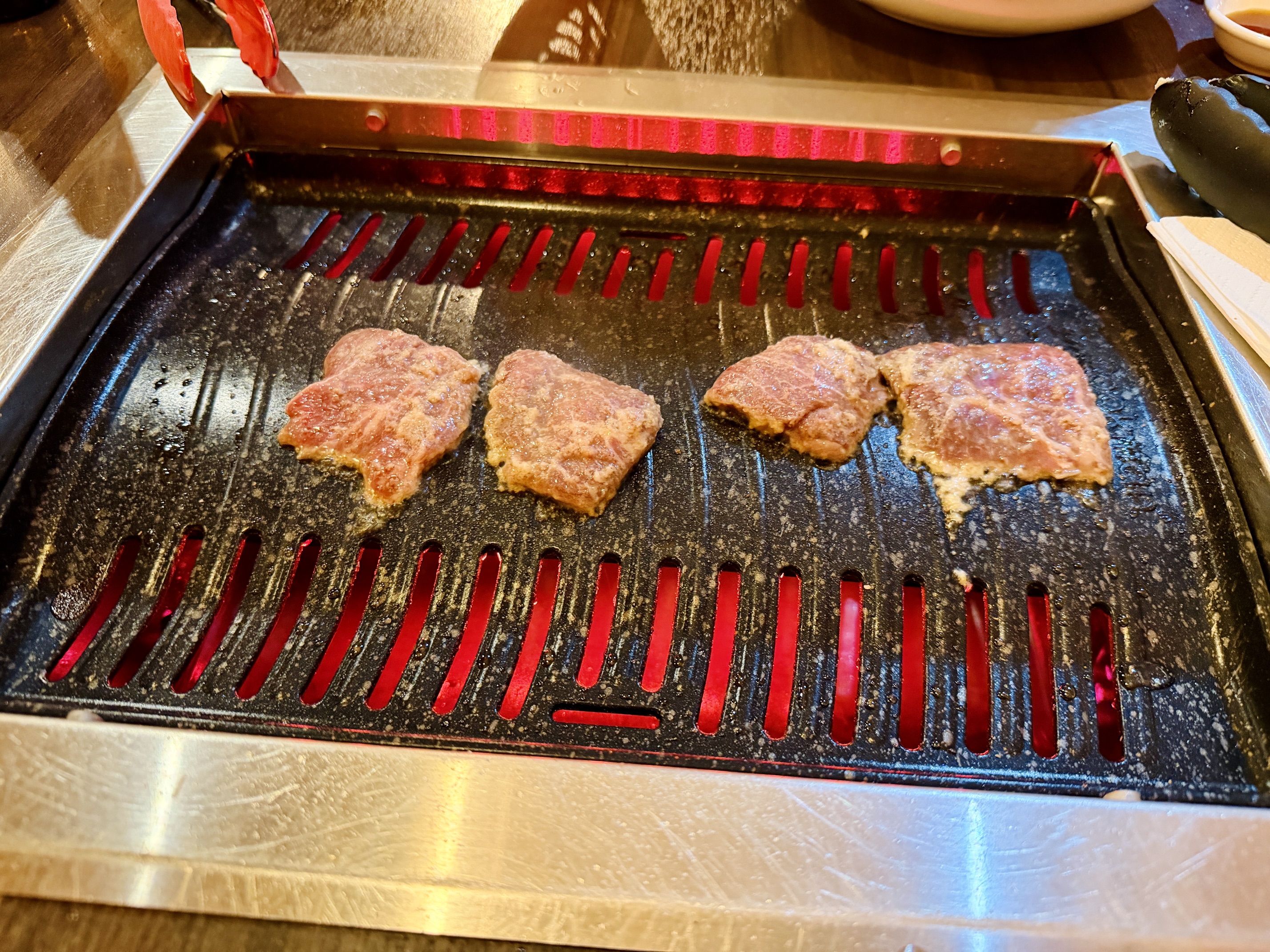
Finally, as we flagged in the heat, a little John Lewis portable fans valiantly whirring away to almost no avail, we barbecued the last dish in our order. By sheer coincidence I’d actually ended up ordering something from my 2018 visit to Gooi Nara – the ju-mul luk, beef with garlic and sesame oil. It was smothered in marinade there on the plate, slices much thinner and better cut than I remembered from my last encounter, and it smelled pretty amazing before it was ever even exposed to heat. As it cooked, the aroma got more and more gorgeous: perhaps we’d saved the best til last.
Tasting it at the end of the process, I rather thought we could have done. Every single piece was buttery-soft, that marination doing its work with no notes, and although it might have been nice to enclose each piece in a lettuce leaf and enjoy that contrast, I rather wonder if the lettuce might have wilted as badly as I did towards the end of an hour in that hot, noisy, oddly glorious room. By some tragedy, Zoë found herself full halfway through my final spell as the commis chef of our table. I buckled up and finished the rest: it had to be done.
Gooi Nara’s menu only has two desserts, both of which are Japanese, but we were too hot and too full to attempt either of them. Our bill for all that food and a couple of beers came to £95, not including service, and of course we were more than happy to tip: even just watching the constant parade of staff back and forward to tables, carrying a huge array of fascinating dishes without ever breaking rhythm, juggling orders for customers and brown bags out to delivery drivers, filled me with admiration.
It made me think of all the Saturday nights when we’d fired up a delivery app and our food – perfect, beautifully packed, prompt and piping hot – had arrived in what seemed like no time. Every evening that happened, the restaurant might well have been as busy as it was that evening. We emerged into the sunlight on Whitley Street feeling like we’d spent just over an hour somewhere totally not-Katesgrove, but also arguably in Katesgrove’s very best restaurant. We also resolved that, delicious and convenient though a Gooi Nara takeaway always was, we needed to visit again far, far sooner.
Rating Gooi Nara this time has been quite difficult. I definitely enjoyed it more than the previous time I went, but I have a feeling that the limitations on the rating it receives on this occasion have more to do with me than with them. So whatever mark Gooi Nara gets as a restaurant, I think this might be a review where I, as a reviewer, might struggle to scrape a 7. I have a feeling that if I’d been bolder, gone further to the perimeter of the menu, I could have enjoyed it even more and it would have done even better.
In that sense it would have been nice if Gooi Nara had, in the way that great communicators like Kungfu Kitchen, Clay’s, Kamal’s Kitchen and the Moderation do, tried more to tell the story of their food and bring newcomers in. But really, that’s not mandatory, especially when a restaurant has been going for about 10 years and is doing very nicely without having to do any of that. So much as I might have enjoyed having a bit more guidance on how to attack the menu, that was definitely a me problem, not a Gooi Nara problem.
I will be back, and when I do I will try some more esoteric dishes: if you have any recommendations drop them in the comments. In the meantime, I suspect another paper bag with my regular takeaway order lurks in my not too distant future. Eat-in, delivery: get yourself a restaurant that can do it all.
Gooi Nara – 8.1
39 Whitley Street, Reading, RG2 0EG
0118 9757889
Since January 2025, Edible Reading is partly supported by subscribers – click here if you want to read more about that, or click below to subscribe. By doing so you enable me to carry on doing what I do, and you also get access to subscriber only content. Whether you’re a subscriber or not, thanks for reading.