As of September 2025, Ruchetta is in the process of closing and reopening under the name Angelo’s, to tie in with a second branch of Angelo’s opening in Reading on Station Hill. As a result I’ve marked this as closed, though I’ve kept the review up for posterity.
There are two kinds of expensive meal. There are the ones where you know in advance that they’re going to be expensive, where you look at the menu beforehand, brace yourself, tell yourself it’s a special occasion. Then there are ones where you’re taken by surprise; maybe you order the really pricey main course you weren’t expecting to, or pick a really fancy bottle of wine, or throw caution to the wind and get a second bottle of the less fancy wine. However it happens, there are some meals where you get carried away, it all adds up and you get a little shock when you take that first look at the bill.
Why am I saying this? Because, to begin at the end for once, Ruchetta is the most expensive meal I’ve reviewed so far – and I knew it was going to be costly before I even stepped through the door. And why’s that important? Because when you know a meal’s going to be expensive, lots of things happen. The anticipation is completely different – I get excited about reading the menu, start looking forward to it (something that doesn’t always happen, believe me). But also, price inevitably becomes another dimension, and each dish is assessed not only on whether it’s good, but also on whether it’s worth the money. It’s only natural that the bar is set higher: after all, you can be pleasantly surprised by a ten pound lunch in the middle of nowhere, but it’s harder to be pleasantly surprised by an expensive meal in a beautiful little house in the prosperous market town of Wokingham.
It really is a beautiful house, too. I don’t know Wokingham well but Ruchetta looks very much like the kind of restaurant it ought to have, really standing out (if you think Reading has a lot of chains, you ought to walk round Wokingham some time). It’s slightly off the main drag in a tiny, nicely jumbled building with a mosaic of little rooms. I sat in the conservatory – partly to get better light for photos – and regretted that more and more as the evening went on, feeling rueful that I hadn’t chosen one of the more snug, atmospheric sections at the front of the house. That said it was a pleasant room with crisp white linen and smart white plates, although the tables do feel a little close together; I was glad the one next to us was empty, or else I would have felt very overlooked.
The menu’s one of the most difficult I’ve had to choose from. There is something magical about good Italian food at the best of times, but the menu at Ruchetta really is the kind where you’re aggrieved that you can’t have everything. We tucked into the bread basket (white and a brown which resembled sourdough, with good salted butter) and sipped our Prosecco in the early evening sunlight, haggling and agonising until the decision could be postponed no longer. If the waiter had arrived two minutes earlier, or two minutes later, you’d probably be reading a review of four completely different dishes.
I adore truffles, and I nearly always order them when I get the chance. The distinctive aroma was noticeable the moment I entered the restaurant and I reckon it subliminally influenced both choices of starter. The first was one of the simplest things you could have, truffle ravioli in butter and sage, and it was a delight. The pasta was al dente and richly flavoured with the earthy, dirty truffles. The dish was topped with thin slivers of parmesan and a handful of young sage leaves. But most importantly a whole pencil sharpener tub of those heavenly truffle shavings had been sprinkled on the top of the dish making the flavour even more intense. Eating it was close to an ecstatic experience, the forkfuls close to the end simultaneously magnificent and agonising.
 The other starter called to me because it was just so unusual that I had to try it: baked white onion in sea salt, filled with truffle fondue with pan-fried foie gras and caramel. The foie gras was just delicious – a generous piece, soft and yielding, perfect with or without the smidge of sweet caramel. The truffle fondue was less successful – it was salty and tasty and rich with truffle, but very liquid and I really had no idea how I was meant to eat it. They didn’t bring a spoon, but I ended up finding one from a neighbouring place setting and improvising. I thought the point of fondue was to dip something in it, and without that something it was more like a very cheesy soup (I briefly pondered whether I was meant to use the foie but surely not: far too expensive to use as a glorified soldier). The quail egg didn’t really add anything and the white onion had been baked just enough that it made an excellent bowl but not enough that it made a sweet and tasty way to mop up the rest of your fondue. I’m glad I can say I’d ordered it, but it felt like was two starters, neither of which quite worked, joined at the hip.

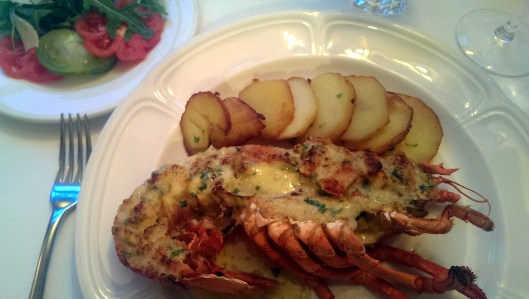
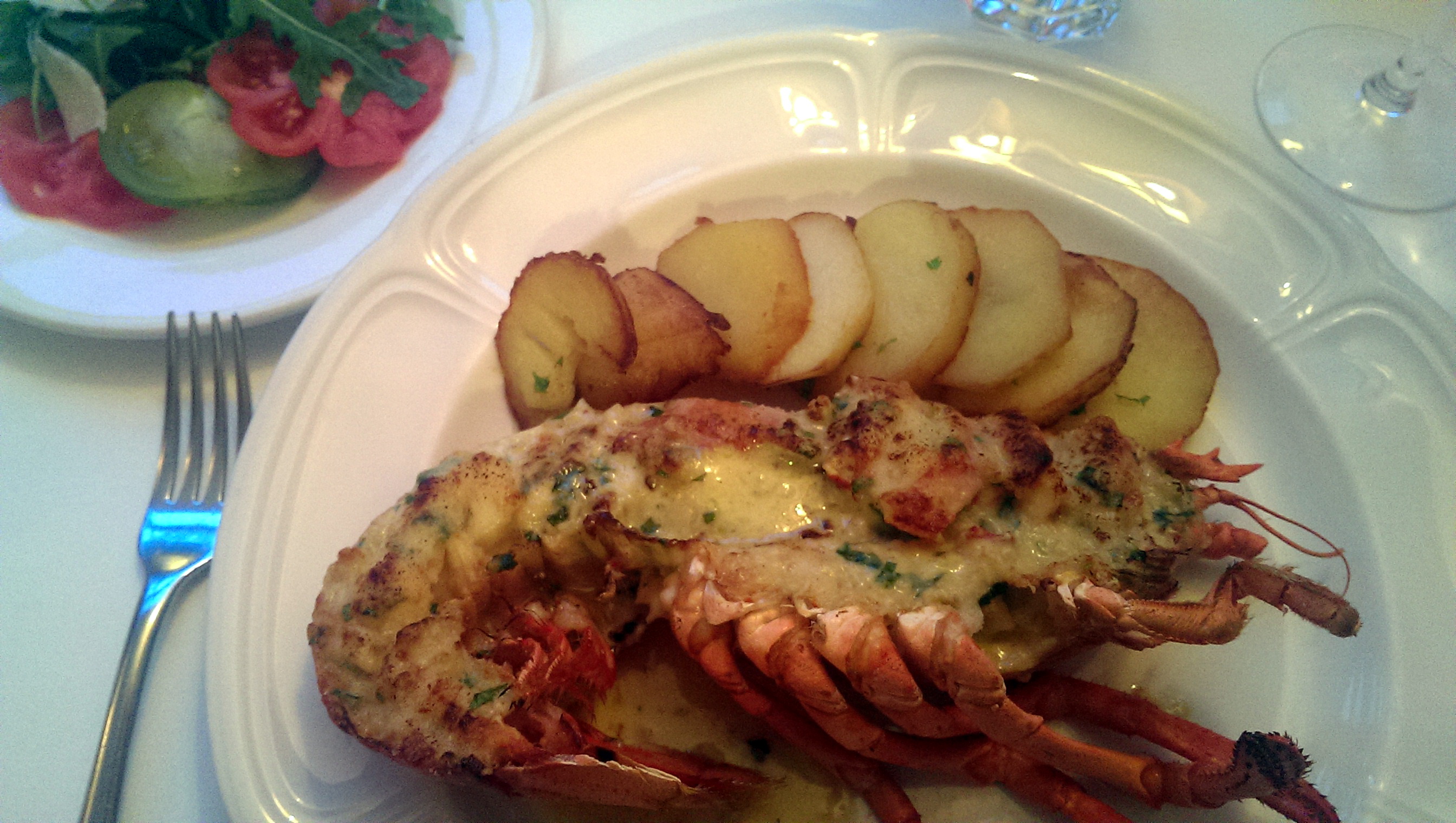
Nearly all the mains at Ruchetta are around the twenty-five pound mark, so it didn’t seem too much of a stretch to order the half lobster thermidor (twenty-eight pounds, and not even the most expensive dish on the menu). It was just lovely. The meat had been removed, cooked in the sauce, returned to the shell and topped with cheese. I loved the note of tarragon in it, which surprised me as I’m usually not a fan and didn’t realise it would be in there (like most people outside the Royal Family, I don’t eat lobster thermidor very often). It came with sauté potatoes, in thick slices rather than cubes, which were cooked well and left plain to keep the lobster as the main event. The side salad seemed lost in all of this: the tomatoes were a mixture of green and red but were pithy and lacking in flavour and was either undressed or underdressed, I’m not quite sure which.
The other main, roasted saddle of lamb stuffed with spinach and garlic with lamb sauce and vignole (peas, artichokes, broad beans in mint and pancetta – no, I didn’t know either) was the most disappointing dish of the night. This is going to sound like a stupid thing to say, but the lamb was, well, too lamby. The taste of it was almost overripe, verging on agricultural, and drowned out the lighter flavours of the rest of the dish. It appeared to be stuffed just with spinach, which made for a soggy slog, and if there was any garlic in there I didn’t get it. The peas, artichokes and broad beans, potentially a symphony of spring flavours, were pleasant but bland because there wasn’t enough mint to lift them. Most damningly, it wasn’t particularly hot: the lamb, in particular, felt a bit lukewarm. Also, I know this was a light dish but it felt like it needed carbs of some kind. Not everybody who orders it is going to be lucky enough to be able to pinch some sauté potatoes from another plate, as I was.
Ruchetta is one of very few restaurants that offers wine in carafes; a terrific idea for when it’s hard to decide what wine to pick or if you don’t fancy a whole bottle of something. There are a few affordable wines on the list but nothing under the twenty pound mark, so the carafes aren’t as tempting as they normally would be (they’re also 425ml rather than the regulation 500ml, which somehow seems a little stingy). Because of this we ordered a bottle of Italian viognier (much crisper with more citrus than the French ones I have experienced) and a carafe of Barbera d’Alba which was red, robust and unremarkable. I knew we’d struggle to drink both but a carafe of the Gavi I had my eye on was the same price as the bottle of viognier which made me object to buying it (just because you know the restaurant is going to be expensive doesn’t mean you lose all concept of value, after all).
In the end we finished the red and with only half the white drunk the staff offered to cork it so we could take it home – a nice gesture, I thought. That was fairly typical, as service was excellent throughout. All the waiting staff had that charm which just stays on the right side of over-familiarity, something I associate with good Italian restaurants (and I think all of them were actually Italian, though I may be wrong) and they made sure we never felt hurried. In that respect, it definitely felt like a special occasion – nobody wants to be turned when they’re spending this kind of money.
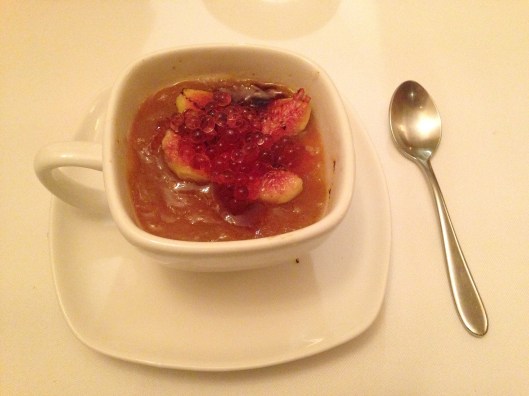
Desserts, like the mains, were at opposite ends of the spectrum. Lemon posset was a glorious thing, wobbly and zingy, topped with cooked rhubarb and dangerously easy to devour. Everything in it should have been tart and sharp and yet it wasn’t (the grilled figs and little pearls of what looked like fruit caviar on the top did their bit to balance it out). The moist orange cake with citrus mascarpone was more prosaic. It was tasty enough and I was happy to eat it all but compared to the complexity of the lemon posset it seemed a bit basic. All the desserts cost seven pounds – an amount I was happy to pay for the posset but much more grudging to part with for the cake. Funny the calculations you make in your head when you know a restaurant is expensive. We also had a couple of dessert wines with these – a Labrandi and a moscato – and both were beautiful choices.
 I said at the start that there were two types of expensive meal. Well, as it turns out Ruchetta is both: the total bill for two people – three courses each, two glasses of prosecco, one bottle of white, a carafe of red, two glasses of dessert wine – was £160. This is the bit where I usually say “but it’s possible to eat far more cheaply”, but I’m not sure it’s entirely true of Ruchetta. Their set lunch during the week is a cheaper, but it’s still £19 for two courses. Sunday lunch is £32.50 for two courses. You could spend less, but I still think it’s the kind of restaurant where the size of your bill is always going to take you somewhat by surprise.
I also said at the start that when a restaurant is expensive the bar is set higher, and that’s why I can’t wholeheartedly recommend Ruchetta. There’s a lot to like: the service is terrific, produce and seasonality is clearly important to them (when I went there were lot of asparagus specials on offer. A lot) and the menu is a tempting, readable mix of classic Italian cooking and more creative, inventive dishes. But I’m not sure which restaurant Ruchetta is meant to be: the unpretentious neighbourhood Italian or the high-end destination restaurant. The pricing suggests the latter, but the execution of some of the dishes (the fondue dish, the lamb) and the way the tables are squeezed together feel more like the former. I was left wondering if someone had got carried away with the calculator when pricing the menu. I went expecting something really special and whilst I really enjoyed it wasn’t quite special enough. If these dishes were priced at the twenty pound mark and there was good wine for, say, eighteen pounds a bottle, I would be making my way to Wokingham again and again. As it is, it will have to wait for the next special occasion and hope that, in the meantime, I don’t find somewhere a little more consistent.
Ruchetta – 7.5
6 Rose Street, Wokingham, RG40 1XU
0118 9788025
http://www.ruchetta.com/




 Edible Reading