

I first visited Lisbon in something like 2007, and loved it immediately. It was a scruffy, hilly, lively maelstrom of a city, zigzagged by bright yellow old-school trams, where the coffee was industrial, the pasteis de nata were ambrosial and street art was everywhere, as were beautifully grand, tiled houses. Octopus and salt cod were also everywhere, with either or both featuring on the menu of seemingly every restaurant I visited. I returned with a couple of bottles of vintage port – one of which is still in the garage and almost worth too much to drink now – and a fierce desire to go back. My then wife, put off by the scuzziness, was less keen to return.
I visited a couple more times, each time liking the place even more, and then, for over a decade, it never quite made the top of my list of places to visit. In that time, I saw more and more people discovering it for the first time and felt increasingly jealous and left out. I liked it before it was cool! I would silently protest at the screen of my phone, every time wondering why it had been so long since I travelled there.
People would ask me for recommendations for places to go in Lisbon, and eventually I reached the point where I only had one recommendation left that I had any confidence in, because the place had been going since 1950: more on that later. So I knew I was long overdue a return trip, and that finally happened last week.
Returning I was reminded of what a special place it is. Almost absurdly beautiful, with stunning views, gorgeous streets, a city on the river and right by the Atlantic. It was still sunny and warm in early December, although the Portuguese didn’t seem to think so: they were dressed for an autumn day and must have been mystified by the sight of me in shirtsleeves, shorts and sandals. I was too happy topping up my vitamin D to care.
Lisbon, I must say, wasn’t quite as I remembered it. It’s far more affluent and gentrified nowadays. When I first went it was a very poor city, and your money went a long way. Blame its increasing popularity, blame the much-discussed golden visa scheme, blame the Time Out Market if you like, but for whatever reason its character has definitely changed. That’s not a bad thing, it just makes it a slightly different experience to the one I recall. But some of that is also just the passing of time, so Lisbon having a craft beer scene and third wave coffee now is just about it being the year 2024 in Europe, not some red pill Lisbon has uniquely swallowed.
The other thing I didn’t quite remember was how hilly Lisbon is. Fuck me, but it’s so hilly. Google Maps ought to have an option where you say you want to walk from point A to point B and, even though Google Maps also tells you it will only take you 15 minutes, it then looks up your BMI and tells you to think again. Every day I felt like I’d walked 20000 steps when in reality I’d done a fraction of that, it’s just that so very many of them were up rather than along. Every now and again, on a walk, I would turn a corner, look up and think Seriously?
But not only that: the topography of Lisbon, somehow, is hill upon hill upon hill. The whole place undulates in a manner which makes you wonder how it was ever built at all. There were occasions where I honestly felt like I could travel from A to B to C and back to A without ever not going uphill: it was like living in an M.C. Escher drawing.
So there is beauty, and a castle, and countless miradouros, but that beauty comes at a price. When I last went to Lisbon I was eleven years younger and more supple, less weighed down by life and all the lovely meals I’ve had in the course of writing this blog. It might be a young person’s city, and I hate even being the kind of person who says that.
The best piece of advice I received from my friend Mike, who runs European tours in Lisbon often, was to make use of Bolt, which is like Uber but much cheaper. I rarely did a trip across the city that cost more than five Euros, and I tried not to think too hard about the underlying economy of a place where sitting in your car in traffic for half an hour, going relatively short distances around town earned you less than five Euros. Maybe the gentrification hasn’t trickled down to everybody: in my experience it rarely does.
It’s there none the less: Lisbon has the Time Out Market, which I didn’t eat at on this trip even though everyone says you absolutely should, and the LX Factory, which I did visit and is a bit like Bicester Village for hipsters. It’s very Instagrammable, but I imagine Lisbon is a very Instagrammable city all round. I didn’t get to the Alfama, the old slum district below the castle which I so loved eleven years ago, on this visit. Instead I wandered round Principe Real which is full of concept stores and wonderful boutiques and cafés and, crucially, is on the flat throughout: next time, I’m definitely staying there.
The way that Lisbon was exactly as I remembered was that the food and drink scene could match any city I’ve been to. I’ve often said, to anybody who will listen, that Portuguese food and wine is easily the equal of Spain’s but never gets the credit for it. Also, more even than Spain, Portugal’s food has never really taken off in the U.K.: with the exception of the restaurants of Nuno Mendes in the capital, it’s hard to think of other notable proponents. Here in Reading, multiple Portuguese restaurants – O Beirão and O Portugués – have tried and failed to gain a foothold.
Well, that’s a shame, because even on a relatively brief visit to Lisbon I ate so well (and had so many places on my shortlist that I couldn’t get to) that I could completely see how it remains one of Europe’s great gastronomic cities. And that also reflects in the fact that – and this is a huge compliment – I was asked by several people to write a city guide to Lisbon before I’d even got home. I was already planning to do one, because I packed an awful lot of good places into four days in the city, but I was also aware of all the places I hadn’t got to and really wished I could visit.
But I was surprised by just how many of my readers were off to Lisbon in the not too distant future: several of you told me you are going next year, and one reader told me that she is heading to Lisbon literally the day after this piece is published (I offered her a sneak preview of the list, in case she wanted to book anywhere in advance). Best of all, two of my readers actually touched down in Lisbon halfway through my holiday and, taking their lead from my posts on social media, ate at one of my favourite places. They were not disappointed, because it was the place that’s been going for nearly seventy-five years, that I first tried on my first visit seventeen years ago and have gone back to every time since.
The rest of the places in this guide showcase much more variety – traditional and modern, some authentically Portuguese and others more reflective of the melting pot the city is now. I had an absolute blast eating and drinking at each and every spot on this list, and if my guide helps some of you with your own trips, whether that’s next week, next summer or next winter, then I will be delighted. And if it persuades any of you to add this gorgeous, vital, hilly – very hilly, I can’t stress this enough – city to your list of places to visit, all the better.
1. Bonjardim

This is the place I recommend to everybody, the place I’ve been eating at on every trip to Lisbon since I first went, back in 2007. Once, on a holiday with my old friend Dave I ate there twice – on my first and last day in the city – and on this visit it was my lunch stop less than an hour after we checked in and dropped off our bags.
Bonjardim is tucked away on a little alley just off Praça dos Restauradores, not far from the train station and close to the top of the Baixa, the grid of streets that runs down to the river and constitutes Lisbon’s flattest district. It celebrates its seventy-fifth birthday next year and although the menu has a good range of fish, seafood and grilled meats, the only thing to have here, really, is the spit roasted chicken. Over the last seventy-four years they’ve got it down to a fine art.
That doesn’t mean you shouldn’t have a plate of smoked ham and a couple of glorious salt cod pasteis while you wait for the chicken to arrive, or that you shouldn’t drink a caneca of ice cold Sagres into the bargain. That all forms part of the anticipation, that and watching chicken turn up at neighbouring tables, knowing that it will soon be your turn. But when it does finally reach you? Well, it is glorious.

It never disappoints. Rubbed with salt and lemon, the skin is a papery, crispy, savoury miracle. But the meat underneath, which comes off the bone ridiculously easily, is sublime. And you’ll pick and pick and pick until the whole carcass is white and clean, because none of this can be wasted. They even do good french fries too, equally salty and utterly delicious.
But the chicken is the thing. It ruins all other chicken, that’s the only problem. It will be some time before you can enjoy a Nando’s again, and my attempts to chase this particular dragon, at the likes of Casa do Frango and Bébé Bob, has been an exercise in futility. I think deep down I always knew they would be, but I did it because even if there was a one per cent chance those places could match Bonjardim, it would be worth the gamble.
A whole roast chicken at Bonjardim costs a ludicrous seventeen Euros, and it pained me that I only got to eat there the once. Both subsequent days, when I took my chances at no reservation places, in the back of my mind I was thinking to myself it’s okay, because if they’re full I can just go to Bonjardim again. So of course none of them turned out to be full.
The mystical power of Bonjardim has not waned in the nearly twenty years that I’ve been going, and one of my favourite moments of the trip, even more so than eating there, was seeing Zoë eat that chicken for the very first time. We messaged our friend James, who himself made his Bonjardim debut earlier in the year on my recommendation. “It’s a biblical experience” came the reply almost instantly. “God tier chicken at excellent prices.”
My two readers who were in Lisbon at the same time as me went there for lunch on the Saturday, and put a picture up on my Facebook page. “God damn, that chicken is something else” said one of them; there is something about that chicken, it seems, that makes you take the Lord’s name in vain. But honestly if there is a creator, and I’m still unconvinced on that score, they should be honoured to be mentioned in the same breath as Bonjardim’s finest.
Bonjardim
Travessa de Santo Antão 11, Lisbon
2. Lupita
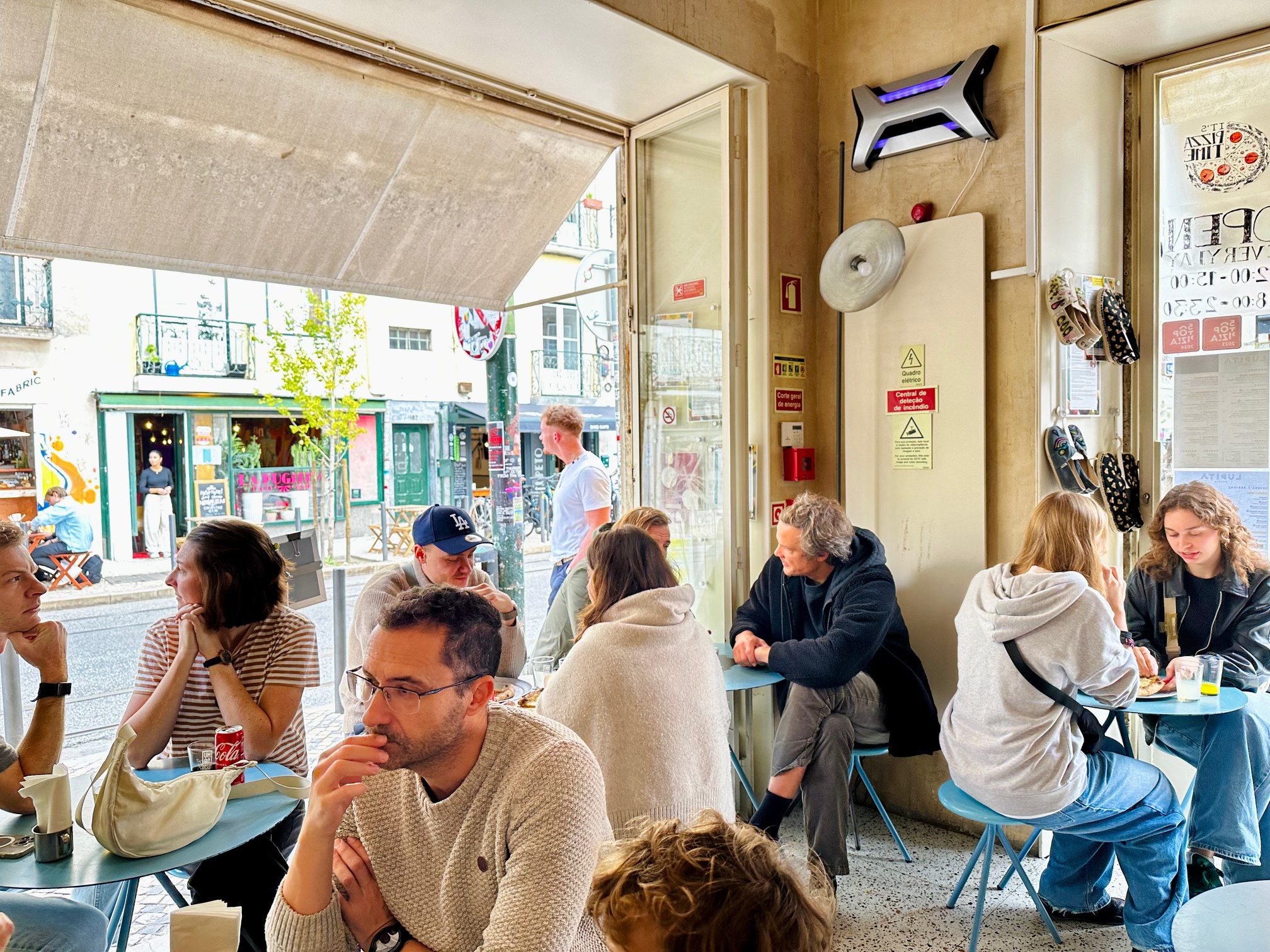
The pizza restaurant Lupita is one of the no-reservations spots I mentioned just now, and I am absolutely convinced that if it wasn’t for the fact that it’s literally just round the corner from the Time Out Market it would be impossible to get a lunchtime table there. As it was we still got lucky, turning up just before half one and managing to snag the only vacant table at the exact moment that it came free. When we left, about an hour later, there was quite a queue forming.
Normally I wouldn’t do any of that – turning up on spec, queuing and what have you – but I made an exception for Lupita because everything I had read suggested it was very special (and, of course, I had Bonjardim as my Plan B). And special it was, belying its no frills appearance, plain metal folding tables and stools.
The pizza was exquisite. I’m loath to use hyperbole, because I love pizza and have enjoyed great pizza all over the shop, from Bristol to Newbury, from Bologna to Paris, from Bruges to Northumberland Avenue. But if I’ve had a pizza better than Lupita’s I can’t remember it right now. The base was a marvel, light, puffy and chewy, with the look of a Neapolitan pie but with the droop-free structure of its transatlantic cousins. The toppings – guanciale, jalapeños, a feisty chimichurri sauce and a dusting of Parmesan – were out of this world. And that feeling, of being in the middle of something so outstanding, gladdened my heart.

If I stopped there Lupita would be worth a visit. But on the day I went they had a special starter which happened to bear my Italian porn star name, Puttanesca Pockets. Just imagine: something like a mini calzone cut into two bite-sized halves, each stuffed with olives, capers, tomato and anchovy, the best Breville you never had. I would try to recreate it at home, but I know it would never approach that level of genius. “That dish will be on my mind all day” said somebody on Facebook when I put a picture up: that makes two of us.
Oh, and they only do one dessert, a Basque cheesecake. Guess what? It, too, is superlative.
Lupita
Rua de Sao Paulo 79, Lisbon
https://www.instagram.com/lupita.pizzaria/
3. Jesus é Goês

My final lunch of the trip was at Jesus é Goês, just off the very swanky Avenida de Liberdade. Normally eating Indian food on a European city break is the last thing I would ever do, but Jesus é Goês is all about the food of Goa, a Portuguese colony for over four hundred years, so it piqued my interest. I spotted it on an episode of Somebody Feed Phil on Netflix; for the uninitiated, somebody always does, rather a lot, and yet Phil never shuts up. It’s strangely endearing and annoying at the same time,
The restaurant is the brainchild of the eponymous Jesus, who opened the place ten years ago, and I didn’t discover until halfway through my meal there, doing a little research between courses, that he sadly died last year. The place is now run by his partner, a lovely, kind and smiling hostess who took excellent care of us during lunch. You can book this place, I later discovered, but only via WhatsApp: we were the only customers in the whole place on a Saturday lunchtime, which slightly saddened and concerned me.
Having eaten the restaurant’s food, I can add mystified to that list of adjectives, because it really is wonderful stuff and, with the exception of Clay’s, probably the best Indian food I’ve had outside India itself. I started with the restaurant’s iconic “holy burger”, an intensely spiced, deeply complex morsel served on a spoon topped with a poached egg yolk and more spices. I was under strict instructions to eat the whole thing as a single mouthful so of course I did, and it’s as good a single mouthful of food as I’ve tasted all year.

Zoë was eating an equally terrific samosa packed to the rafters with spiced meat, and I insisted that we ordered another burger and samosa so she could know the same joy as me. It would have felt wrong not to be able to talk about the experience of tasting that holy burger with her again, later in the holiday, later in the year or just later in our lives.
The mains kept up that standard – I did recognise a couple of dishes like pork sorpotel from Clay’s regional menus in the past, but I had to try Jesus é Goês’ goat curry, almost as much a signature dish as the holy burger. The meat benefited from a long, slow cook but what really made this was the dark, glossy, phenomenally spiced sauce, poured onto rice or loaded onto a chapati. Zoë’s chicken cafreal, served on the bone – although it didn’t stay on it for long – was completely different and equally enchanting, the sauce with more fragrance and citrus, less smoke.
This felt like food for the soul, and not necessarily something I’d ever have expected to eat in Lisbon, let alone to love so much. It felt strangely moving to eat in Jesus’ restaurant, knowing that he was gone but that his food would be enjoyed by hundreds of people who never got to meet him. I’m glad I was one of them. A sign on the wall said “ASK JESUS FOR A RECOMMENDATION”: this might be the only time I’ve ever put my faith in Him.
Jesus é Goês
Rua São José 23, Lisbon
https://www.instagram.com/jesusegoesoficial/
4. Prado
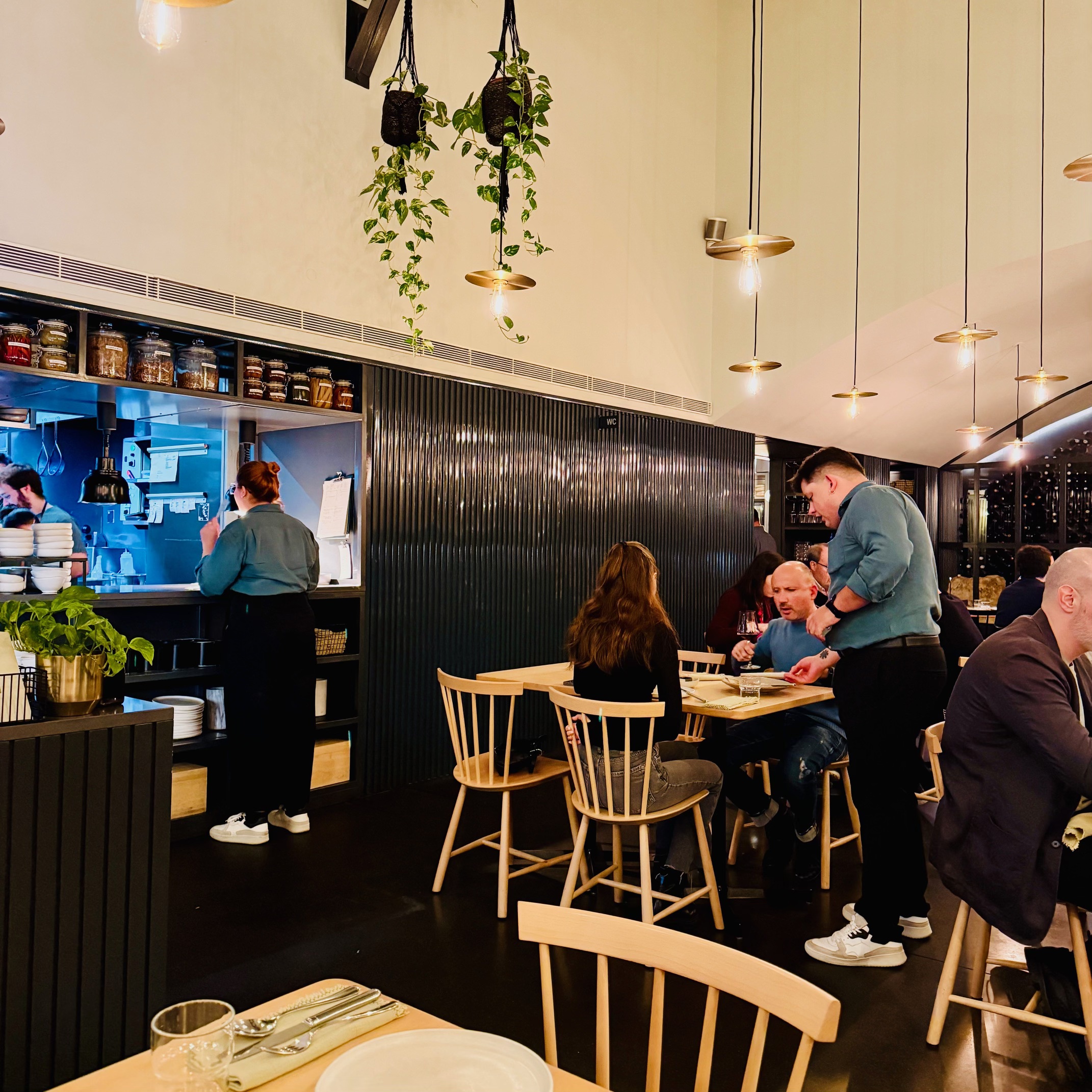
Prado was my Fancy Meal of the trip. I invariably do one on most holidays, where there’s an à la carte menu but I allow myself to be persuaded by the tasting menu. From there it’s only a momentary lapse before you’re signed up for the wine pairings, too, the whole nine yards. It’s a slippery slope, and at the bottom of it is an evening where you’re cosseted and indulged and don’t have to make a single decision again. And to do that in this tasteful space with its inventive menu, beautifully chosen Portuguese wines and well-judged service – well, it was no hardship at all.
The tasting menu, I will say, was made an easier choice by the fact that Prado’s à la carte wasn’t really an à la carte in the true sense, instead being a list of small plates with a recommendation that you order something like four per person for sharing. So you’re going to end up with something like a tasting menu whether you like it or not, and although I found that a tad irksome I did manage to get over it. The tasting menu is 75 Euros here, to give you an idea, but I suspect that curating your own small plates playlist would probably cost there or thereabouts.
It’s a minor quibble anyway, because the food was brilliant. Prado is Portuguese for meadow, it turns out, and Prado prides itself on taking a farm to table approach, although that didn’t quite square with a menu which leant very heavily on fish. But no matter, because so much of what I ate was imaginative, original and just plain fun. Beef tartare came sandwiched between leaves of grilled cabbage, octopus was served on a skewer, zhuzhed with the addition of a chorizo emulsion. Even the bread was lifted by a pot of spreadable pork fat, shot through with garlic.
Every dish was fascinating, a real beauty pageant of cracking creations. Hard to single out anything, but marinated mackerel served in a chilled, fresh soup of green apple and green olive was a combination I could never have conceived of in a million years yet loved eating. I adored Prado’s John Dory, spiked with pil pil and served under a dehydrated kale leaf. Oyster mushrooms, served in a goat’s butter sauce, lardo draped on top were a proper delight, as tasty as they were beautiful: it was just a shame that the garlic-laced pork fat earlier on meant we hadn’t saved any bread for mopping.

I thought the Alentejano acorn fed pork, served ruddy pink with potato purée was probably the weakest course of the meal, but Prado saved the day with an outrageously good dessert – a brioche with a sweet, burnished, caramelised crust, served with exemplary coffee ice cream and a sauce which went perfectly with the glass of Madeira we were given to polish off proceedings. Two hours and a couple of hundred Euros very well spent, even if the rest of the meals of the trip were, by comparison, far less rarefied.
Prado
Travessa das Pedras Negras 2, Lisbon
https://pradorestaurante.com/index2.php
5. Trinca

Trinca is nothing to look at from the outside – I almost walked past it without realising it was my Friday night dinner reservation – and inside it’s a plain and unprepossessing room. But it was an absolute riot – a small, intimate place that felt more like a neighbourhood restaurant than anywhere else I ate in Lisbon.
The menu is on a chalkboard and changes all the time, and to say it jumps around is to put it lightly. The cheese was traditionally Portuguese, the textbook focaccia we had with it less so. And then there were grilled leeks, almost more like Spanish calçots, served with a ginger hollandaise and Jerusalem artichoke crisps, a dish that was truly a citizen of the world. Not international enough for you? How about fregola topped with shiitake mushrooms cooked in ponzu and glazed with gochujang?

That’s before I get onto our main courses. Octopus – so far, so Portuguese – but in tacos. Or tacos with confit Iberian pork topped with a zingy salsa verde and (a masterstroke, this) pork crackling. But just to throw one last cuisine in, we also tried Nepalese pork belly, simply spiced and grilled, accompanied by a cucumber salad singing with sesame. A menu like this shouldn’t work, and paradoxically that’s exactly why it did.
No dish cost more than fifteen euros, many of them cost a lot less. The most expensive red on the wine list, which was biodynamic and very pleasant indeed, cost a shade over thirty euros. A more different experience to Prado is hard to imagine, but it was an equally valid one. I left this neighbourhood restaurant full, happy and deeply envious for all the locals there, who clearly lived in its neighbourhood.
Trinca
Rua dos Anjos 59C, Lisbon
https://www.instagram.com/restaurantetrinca/
6. Tapisco

Arguably Lisbon’s two most famous chefs are José Avillez and Henrique Sá Pessoa. The former has two Michelin starred Belcanto and a raft of other restaurants across the city – Cantinho do Avillez, Bairro do Avillez and so on. In case that wasn’t ornate enough, Bairro do Avillez contains three different restaurants, or eating areas. What’s the Portuguese equivalent of a Russian doll? Anyway, he has something like sixteen restaurants in total, and I found the whole experience of trying to pick one exhausting, so I gave up.
Sá Pessoa, on the other hand, has a much narrower portfolio. There’s Alma, which is double starred, and Tapisco, which is his more affordable, casual restaurant on the edge of Principe Real. I went to Tapisco on my last evening in the city and had a really enjoyable meal full of well executed versions of Portuguese classics. My cuttlefish, simply battered and fried with a coriander mayonnaise was simple, unshowy and a proper pleasure, and Zoë’s tuna tartare with avocado and little wasabi pearls was equally gorgeous.
For our main, we both gravitated to the same thing, arroz de pato, a deeply savoury daydream of a dish, rice studded with shredded duck, topped with dried duck and smoky sausage, dotted with aioli. This was not a dish to share, it was a dish where you jealously guarded your own personal skillet, spooning and enjoying and worrying about the point in the future when you could spoon no more.
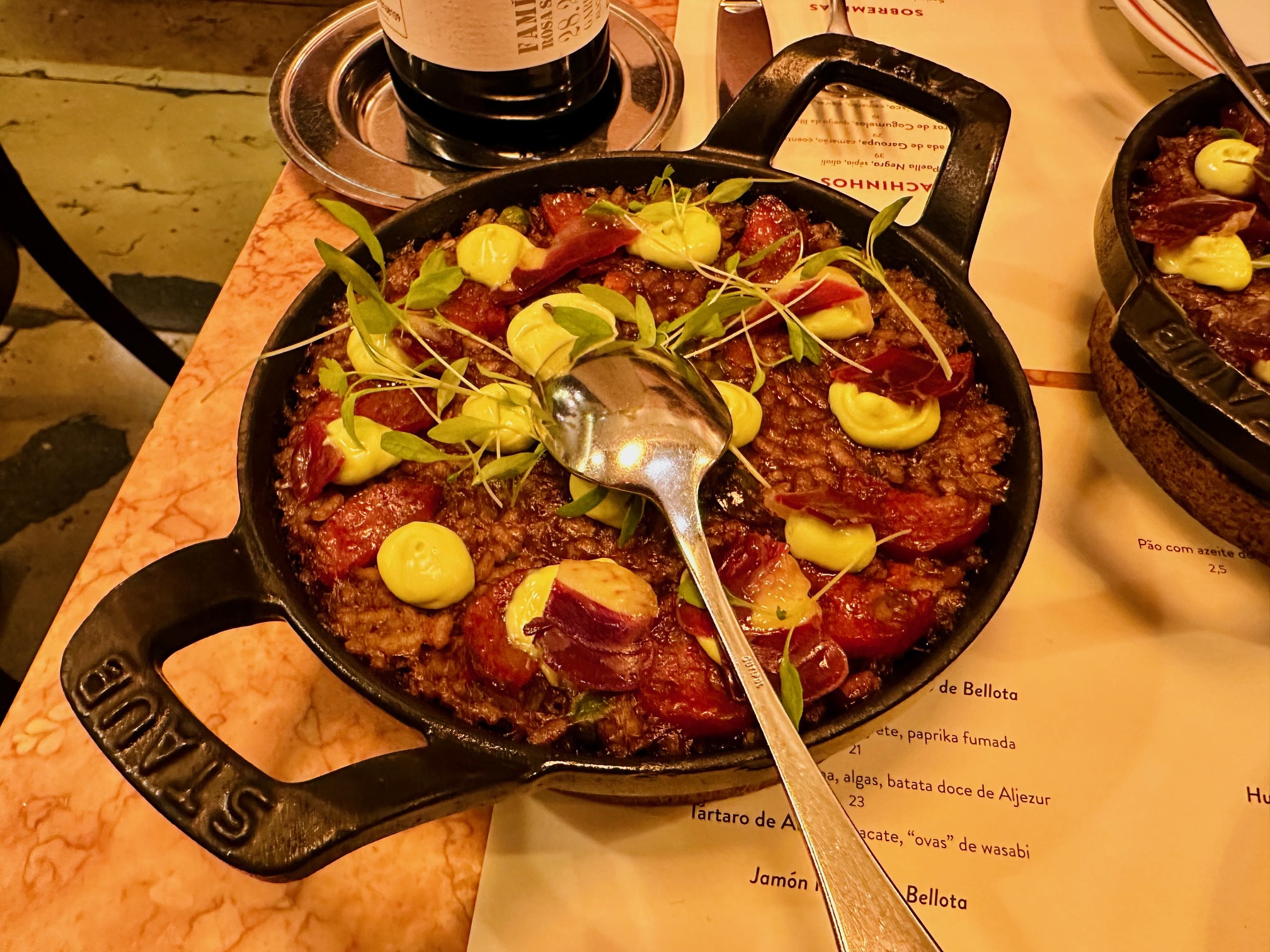
I had arroz de pato once at O Portugués once, back when I was reviewing takeaways. Now I know what this dish can be, I would be reluctant to order it again – although, that said, De Nata have it on their menu. Surely it’s worth a try?
Tapisco also, by the way, does a chocolate mousse with olive oil and salt which even managed to supplant Thames Lido’s in my affections. Who needs two Michelin stars anyway?
Tapisco
Rua Dom Pedro V 81, Lisbon
https://www.tapisco.pt/lisboa_en.html
7. Senhor Uva

I did my homework wrong on Senhor Uva: I thought it was a natural wine bar where you could snack if you wanted to, the perfect spot for a pre-dinner drink on our final night. It’s out in Estrela, at the end of the iconic 28 tram route, so if you timed it right you could potentially combine them.
But actually, Senhor Uva is part wine bar, part restaurant. And the restaurant part is a selection of almost entirely plant-based small plates. Having booked a table, we then hastily sent an email saying that actually we just wanted wine and a few pre-dinner snacks. Would that be okay? we asked. And if it wasn’t, we said we’d completely understand them cancelling our reservation.
Well, we didn’t get a reply but on arrival they knew exactly who we were and what we were after, and they looked after us superbly. Nothing was too much trouble, and they selected and recommended glass after glass of striking, elegant wine while letting us pick whatever small plates we wanted.
And all the small plates were excellent – one was a couple of local cheeses with handmade crackers and a sweet fruit chutney, another was potato, leek and broccoli skewers with a deep delicious sauce. A third, maybe the best, was grilled courgettes with poppadom shards and a moat of stunning ponzu sauce. When every dish was set down in front of us we were told its ingredients, and told it was made with love.

By the end of the third glass I wanted to live in a parallel universe where we’d never booked a restaurant that night, where we just stayed there in that stylish space, seemingly hewn out of the hillside, drinking more wines, eating everything on the menu, enjoying the chatter from the neighbouring tables (much of which, I have to say, was in English).
Senhor Uva has clearly done well enough to expand into a larger space on the other side of the road, and that’s where the kitchen was. As the light dimmed and we saw the room opposite glow, the regular to and fro of staff from there to here carrying food, I thought that this was what the best of life was about – travelling, finding spaces like this, being transported and getting lost in a reverie that this was somehow your place.
How I wish home had anywhere even remotely like Senhor Uva. How I wish I’d had longer there. You will never, I suspect, hear me say this again about somewhere with an exclusively vegetarian menu, so make the most of it.
Senhor Uva
Rua de Santo Amaro 66A, Lisbon
https://senhoruva.com
8. Manteigaria
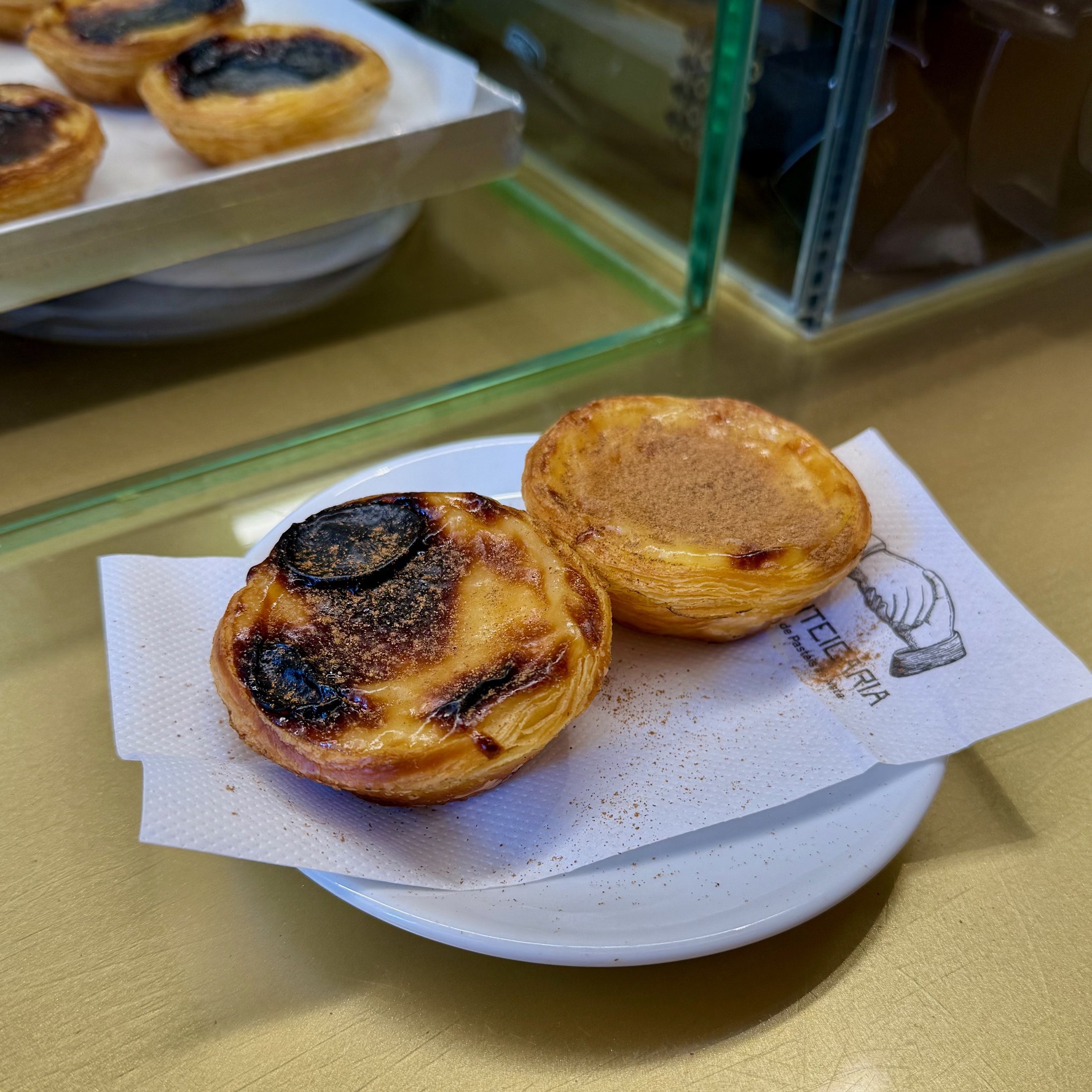
Everyone will tell you that the place to go for pasteis de nata is Pasteis de Belem, a tram ride away. People queue to get in, and you eventually grab a table in one of its tiled dining rooms, and you scoff egg custard tarts fresh out of the oven, slipped onto your plate and dusted with cinnamon. After that you do the Tower of Belem, look round the Jéronimos monastery, take your pictures of the Monument to the Discoveries and take a tram back in to the centre. You’ve eaten well, you’ve seen sights, it’s a day of tourism well done.
And all that’s true. I’ve been to Pasteis de Belem, several times, and their pasteis are a revelation if you’ve never had them before. But for my money Manteigaria’s, from their gorgeous site on the edge of Bairro Alto, more than matches them. So go there instead if you’re tight for time, or want to stay central, or just trust my judgment, and you won’t be disappointed. They are warm and perfect, the pastry with just the right amount of flake and the custard with absolutely the right amount of wobble.
I have a feeling pasteis de nata anywhere in Lisbon are good – I even had a decent one at the airport before my flight home – but you may as well start at the top so you set the standard. Also, once you’ve done that I have good news for you: De Nata’s pasteis are really not that far off, and a much shorter trip away.
Manteigaria
Rua do Loreto 2, Lisbon (and in the Time Out Market)
https://manteigaria.com/en/
9. Nannarella

I always seek out ice cream on my holidays, because I associate ice cream with holidays. And normally I would recommend you Santini, a Portuguese chain, because I had their ice cream in Porto many years ago, and liked it a lot.
But Nannarella, another discovery from Somebody Feed Phil, is a level above that and up there with anything I’ve had in Bologna, Granada or Malaga. It’s a little bit in the middle of nowhere – sort of between Estrela and Principe Real – but it’s worth seeking out if you even remotely love ice cream like I do; as it happens, I took a Bolt there specifically to try it out.
Zoë thought that was a bit nuts, but once we were installed on a park bench and she was eating a ball of gianduja ice cream bigger than a baby’s fist she soon changed her tune and told me I was right all along. Since that almost never happens, it’s one for the memory banks.
I loved Nannarella’s chocolate ice cream which was on the darker side and a real work of art, but I especially loved the fior di latte, an ice cream I’ve never seen outside Italy. The confidence to do that – to make an ice cream that just tastes of itself, no vanilla, no nothing – speaks volumes about the place. And it’s completely justified.
Nannarella
Rua Nova da Piedade 64A, Lisbon
https://www.nannarella.pt/en
10. Fabrica

Fabrica was my go to coffee place in Lisbon, a choice made easier by the fact that they have branches all over the city – all of which look slightly different, all of which are very stylish and all of which serve excellent coffee.
So I enjoyed their spot just behind Praça do Comércio in the heart of the Baixa, and I also really enjoyed the massive pain au chocolat I ate there. I loved their branch on the bustling street of Rua das Portas de Santo Antão, and I adored their little coffee van in Principe Real, just around the corner from EmbaiXada, a beautiful mall of concept stores housed in a nineteenth century Arabesque palace (this is a food and drink guide but honestly: go shopping there, it’s amazing).
My favourite spot, though, was the one in Chiado, on Rua das Flores, on a steep hill a short stroll from Manteigaria. I know the done thing is to have your pastel de nata with a coffee, but Fabrica is a great advert for just eating the egg custard tarts up at the bar and then working off a fraction of the calories heading down the sloping street for exceptional coffee.
Fabrica
Rua das Flores 63, Lisbon (and other locations across the city)
https://fabricacoffeeroasters.com
11. Dramatico

Dramatico is such a beautiful spot that it’s almost tempting to recommend it for that alone. It’s a little space – again, almost hewn out of the side of a steep hill – picture perfect with white Mondrianesque windows, a lovely showcase for coffee and brewing on one side, and a handful of tables the other. The picture above doesn’t do it justice: it’s absurdly fetching.
It’s a little out of the way, just off from Principe Real and across from the botanical gardens, and our Bolt struggled to find it, leaving us gladly with a downhill stroll rather than an uphill one. But the one frustration about it is that because it’s good, it’s popular, and because it’s popular and small, it’s very difficult to grab a table.
Normally I wouldn’t mind that so much, but the room was full of Americans – it’s always Americans – with vocal fry so bad that they belonged in a burns unit: I’m afraid it brought out my inner Sam Loudermilk.
Add in the fact that the café only seems to open until 2pm, and sometimes not even that, and the owner is capricious at best and sometimes just shuts for a two week holiday because he can, and… well, I realise this might not be the best sales pitch in the world. But in warmer months I think they have a bench outside, so there’s that.
And it was the single best coffee I had on the trip, and one of the best lattes I’ve had in quite a while. So maybe the owner can do what he likes and, if the worst comes to the worst, you can sip Dramatico’s magnificent latte on a bench in the botanical gardens. If you did, I suspect you’d forgive the place almost anything.
Dramatico
Rua da Alegria 41E, Lisbon
https://www.instagram.com/dramatico.lisboa/
12. Cerveja Canil
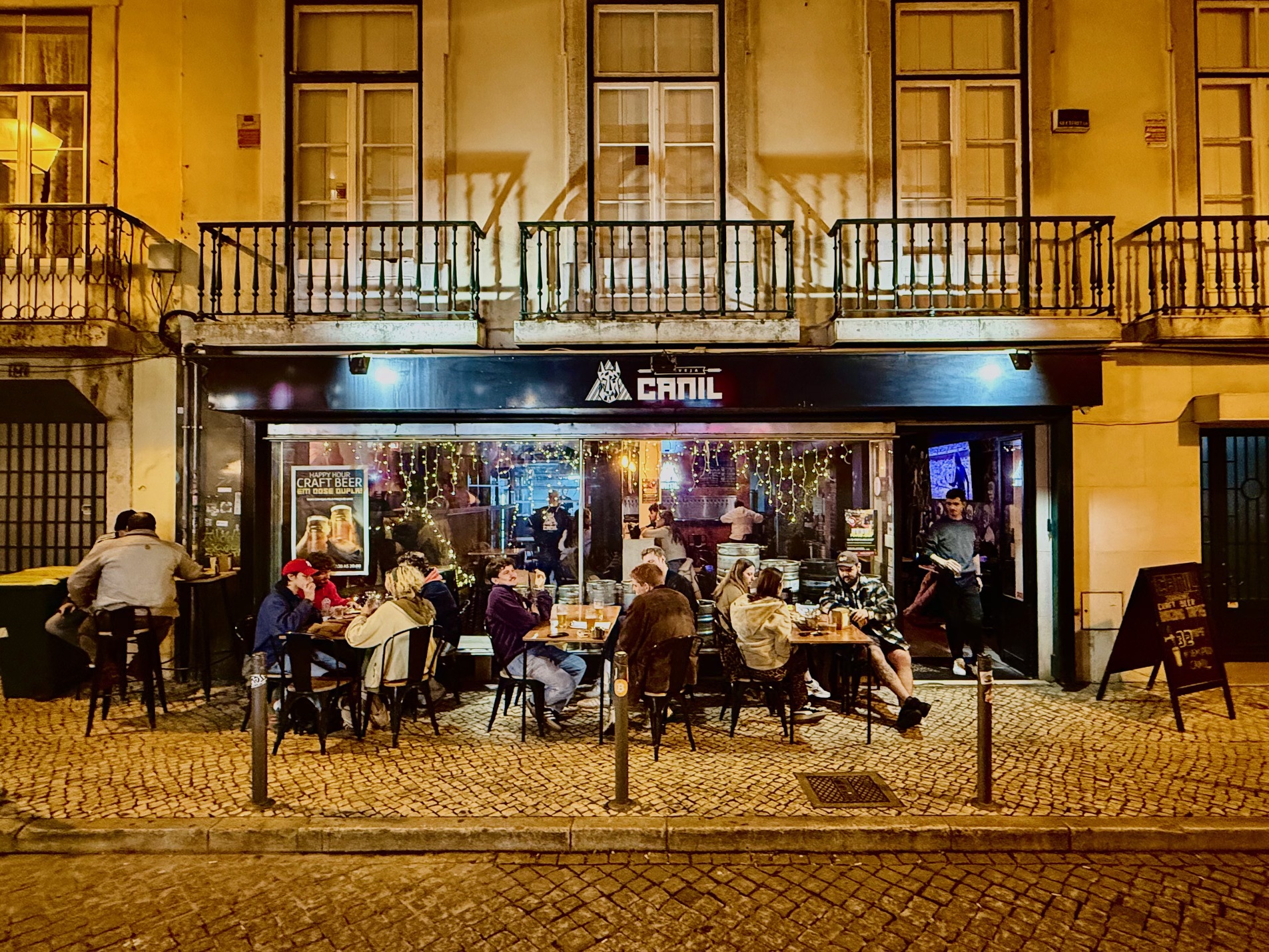
I don’t know how mature the craft beer scene is in Lisbon, but on aesthetics alone I’d say Cerveja Canil is similar to other craft beer places I’ve been to in Europe – black walls, basic furniture, people having a terrific time. This branch is in the heart of the Baixa (they have a second off Avenida da Liberdade) and was humming when we turned up for a pre-dinner drink. A big loud group of Brits had discovered it too, but once they – and the U.K.’s seemingly unique brand of toxic masculinity – cleared out, it became an extremely agreeable place.
Canil is a brewpub, and offers about a dozen of its own beers in a real variety of styles, so not just different iterations of hazy pales but also porters, brown ales and ESBs. Their pale ale was far better than its middling Untappd ratings would have you believe, but I also really enjoyed their guest beers, by Letra and local microbrewery Mean Sardine.
In marked contrast to so many beer places in the U.K. (and definitely in Reading), Canil also has the beer snacks down pat. I particularly enjoyed a goats cheese croqueta with honey, resting on a completely unnecessary carpet of rocket. Beer and croquetas are such a perfect match: I wish Phantom or Double Barrelled would get on the phone to Caversham’s Miss Croquetas and make some kind of arrangement.
Cerveja Canil
Rua dos Douradores 133, Lisbon (also at Rua da Santa Marta 35)
https://www.cervejacanil.com
13. Sputnik Craft Beer

Sputnik was the other beer place I tried on this trip, out of the centre somewhat but just round the corner from Trinca. Another proponent of Tollix stools and walls somehow darker than black – a look that always reminds me of seeing Darwin Deez live at the Boilerroom in Guildford back in 2015 – it was nonetheless a really lovely craft beer spot with great service, an excellent range of beers and a well-stocked, interesting fridge.
Unlike Canil, Sputnik does not brew beer itself but its twelve taps had an excellent range including local breweries Dois Corvos, Fermentage and Mean Sardine (disappointingly it also had a single beer by Brewdog, for people who haven’t yet got the memo about Brewdog).
But the fridge also had some real wonders, including more cans from local breweries and a few other Iberian classics like Barcelona’s Garage. I squeezed more drinking in than was probably wise, and left with a couple of bottles of barrel aged imperial stout to take home and pop in the garage.
All that aside, the thing I really loved about Sputnik was how inclusive and unhipster it was – pretty much every table there was a different demographic, including shabby, middle-aged me, and I was reminded that the way to be cool is to not give a shit whether you’re cool or not. In that sense, I would say that Sputnik is pretty cool, not that I’m any judge of that.
Sputnik Craft Beer
Rua Andrade 41, Lisbon
https://www.instagram.com/sputnik.lisboa/
(Click here to read more city guides.)
Since January 2025, Edible Reading is partly supported by subscribers – click here if you want to read more about that, or click below to subscribe. By doing so you enable me to carry on doing what I do, and you also get access to subscriber only content. Whether you’re a subscriber or not, thanks for reading.



 Edible Reading