Pub review: The Chester Arms, Oxford

The concept of choice in restaurants, I’ve always thought, brings out the inner Goldilocks. Too wide a menu and paralysis sets in, but if it’s too narrow you can’t help feeling straitjacketed. It’s why restaurants that only offer one or two dishes: Le Relais de Venise with its entrecôte, or Burger & Lobster with its – well, you know – have never really caught on here.

I’m reminded of the immortal words of Peter Butterworth in Carry On Abroad, an evergreen favourite of mine, when his Spanish waiter Pepe comes out with the immortal words “of course you are having choices! You can having sausage and chippings, sausage and beans or beans and chippings. That’s choices”. And believe me, I don’t think anybody would have enjoyed dining at the Palace Hotel in Elsbels.

The only time we omnivores really think it’s acceptable to restrict our choices is when we go to a restaurant that offers variations on a theme: burger restaurants, pizza parlours, Nando’s. And yes, Nando’s does technically serve stuff that isn’t chicken but that’s hardly the point, because nobody goes there for that. If somebody at a table at Nando’s is eating a halloumi burger, you can be very confident that they don’t eat chicken and have been dragged there by some inconsiderate sod who does.

Then, of course, there’s the other occasion when we feel as if we have no choice: because there’s something on the menu that we must have, or always order. But those things, as I discovered when I counted down Reading’s top 50 dishes a couple of years ago, are hugely subjective. My wife might be unable to visit Kungfu Kitchen without ordering their deep fried fish, and believe me she is, but other people would mount an equally passionate case for the sweet and sour aubergine, or the lamb with cumin.

Besides, the better the restaurant – like KFK, or Clay’s – the less likely it is, really, that there’s a single must-order dish. What are the chances that a kitchen so skilful would produce just the one thing everybody has to eat? Pretty slim, if you ask me.

No, generally the concept that a restaurant has something you must try, a legendary dish in the making, is another by-product of hype, and usually comes out of the mouths of critics when they visit somewhere, soon after it opens. I’ve tried Brutto’s coccoli, Town’s saffron risotto and Kolae’s fried prawn heads, all acclaimed as instant classics when those venues opened, and they varied from quite nice to very good. Were any of them dishes those restaurants should be exclusively associated with? Not really. Two of them weren’t even the best thing I had in those meals, but it shifts newspapers to rave.

So no, restaurants that become synonymous with a single dish are rare in general, and I don’t think Reading has any to speak of. But that makes the subject of this week’s review even more unusual, because it does occupy that very niche territory. The Chester Arms is an Oxford pub just off the Iffley Road, east from Magdalen Bridge but a smidge closer to it than the Magdalen Arms. It has been under its current management for over ten years. And it’s very much famous for one thing in particular, its steak platter.

Now, it feels wrong to me for most restaurants to describe their own dishes as famous. I still remember the overblown, unsubstantiated hype for The Botanist’s hanging kebabs, for instance, which were more hanging than famous. It’s a bit like restaurants keeping a certificate in their window from over ten years ago, or restaurant bloggers describing themselves as ‘multi award-winning’ when they have, in fact, won none. Famous is something other people are meant to say about you, not how you describe yourself.

And yet in the Chester Arms’ case, you might make an exception. The pub’s homepage describes them as “home of the famous steak platter” and the dish has its own page on their website. It’s the creation of head chef Hamzah Taynaz – although Companies House makes it seem like he might have parted company with the pub over the summer – and it looks like a doozie: onglet cooked rare or medium rare, chips, béarnaise, cabbage with bacon, dressed salad. £50 for two people, or £70 for three, which on paper at least is impressive value; it was £30 and £45 back in 2015, but it’s been a bruising decade.

The thing, though, is this: I have been told to visit the Chester Arms numerous times, by people I know and by people who’ve tipped me off online. It’s been the place at the top of my Oxford to do list for quite a while – I would have reviewed it last month were it not for a medical misadventure – and every single person who has told me to go there has mentioned the steak platter. Some of them had eaten it, and raved about it. Others hadn’t, but left me in no doubt that if they did go there it’s exactly what they would order.

In fact, when I went to Arbequina last month I happened to be on the same train as someone I follow on Instagram, and when I messaged her to ask where she’d eaten in the city I was unsurprised to find that she had gone to the Chester Arms. “We had a great meal there” was her verdict. “It lived up to the hype for us.” So finally, last weekend, I got my chance to try it for size.

My plus one for this meal was my old friend and Oxford compadre Dave, and as we had a pre-lunch latte in Peloton Espresso’s very agreeable back garden I told him that this meal made him, with the exception of Zoë, my most capped plus one. Not bad going for a man who valiantly resisted joining me on duty until a couple of years ago, I told him.

“I thought you’d expect me to have opinions about everything!” he laughed. “And I’m too easy-going for that, I just want to eat nice food. But then I realised that actually you aren’t fussed about all that, so now I don’t mind tagging along.”

Dave was, I had to concede, probably correct. He likes to make much of how low maintenance he is, by which he means that he’ll generally do whatever you like and doesn’t have strong preferences. In the past I may have found that a tad frustrating, but as a dining companion for a restaurant reviewer, it turns out, it’s pretty much a dream CV. Besides, Dave quite rightly pointed out that for our forthcoming holiday to Bruges I had insisted on the dates, insisted on a hotel, changed my mind and picked another hotel and so on and so on, so maybe I quite liked having a low maintenance friend after all.

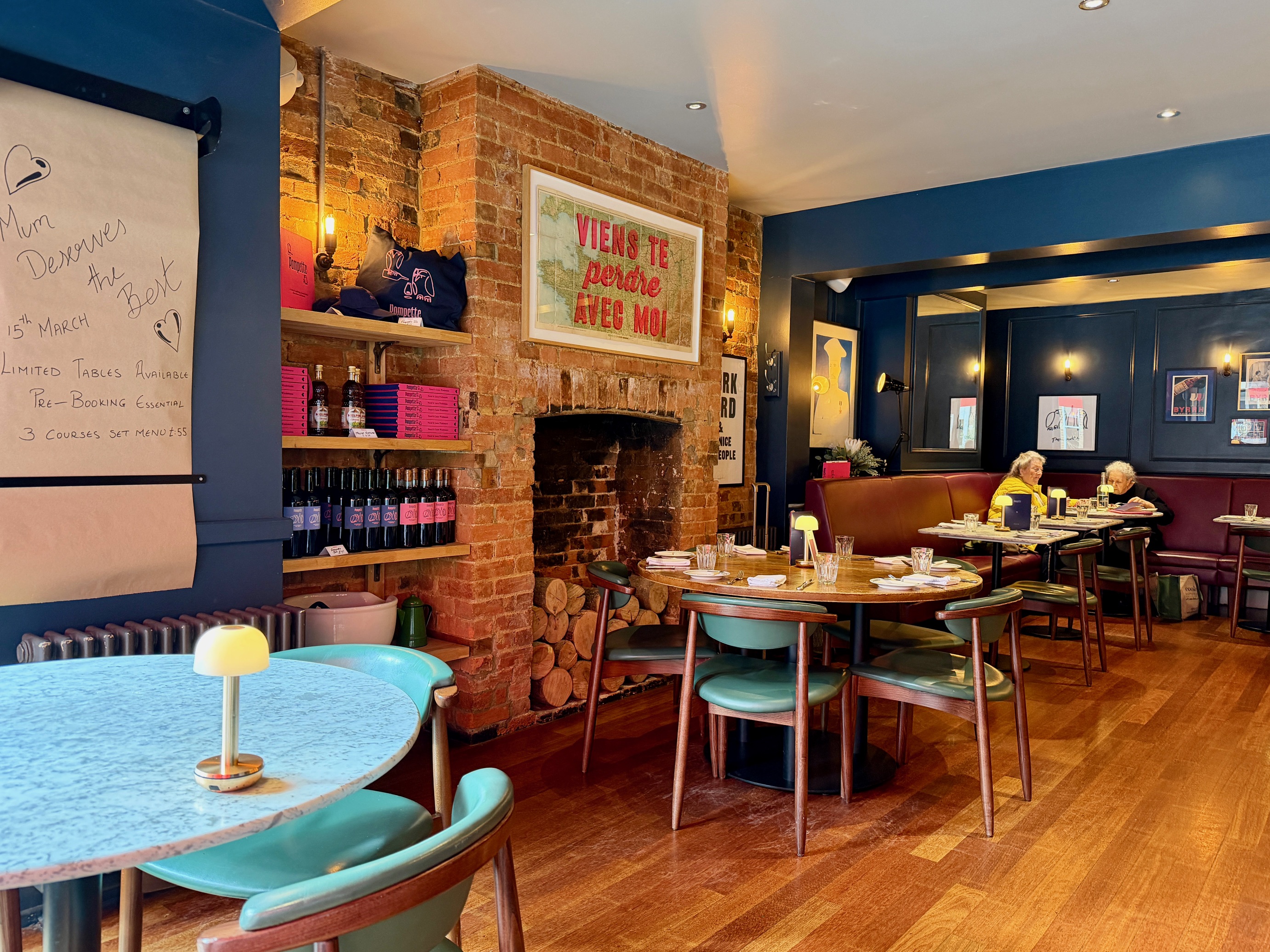
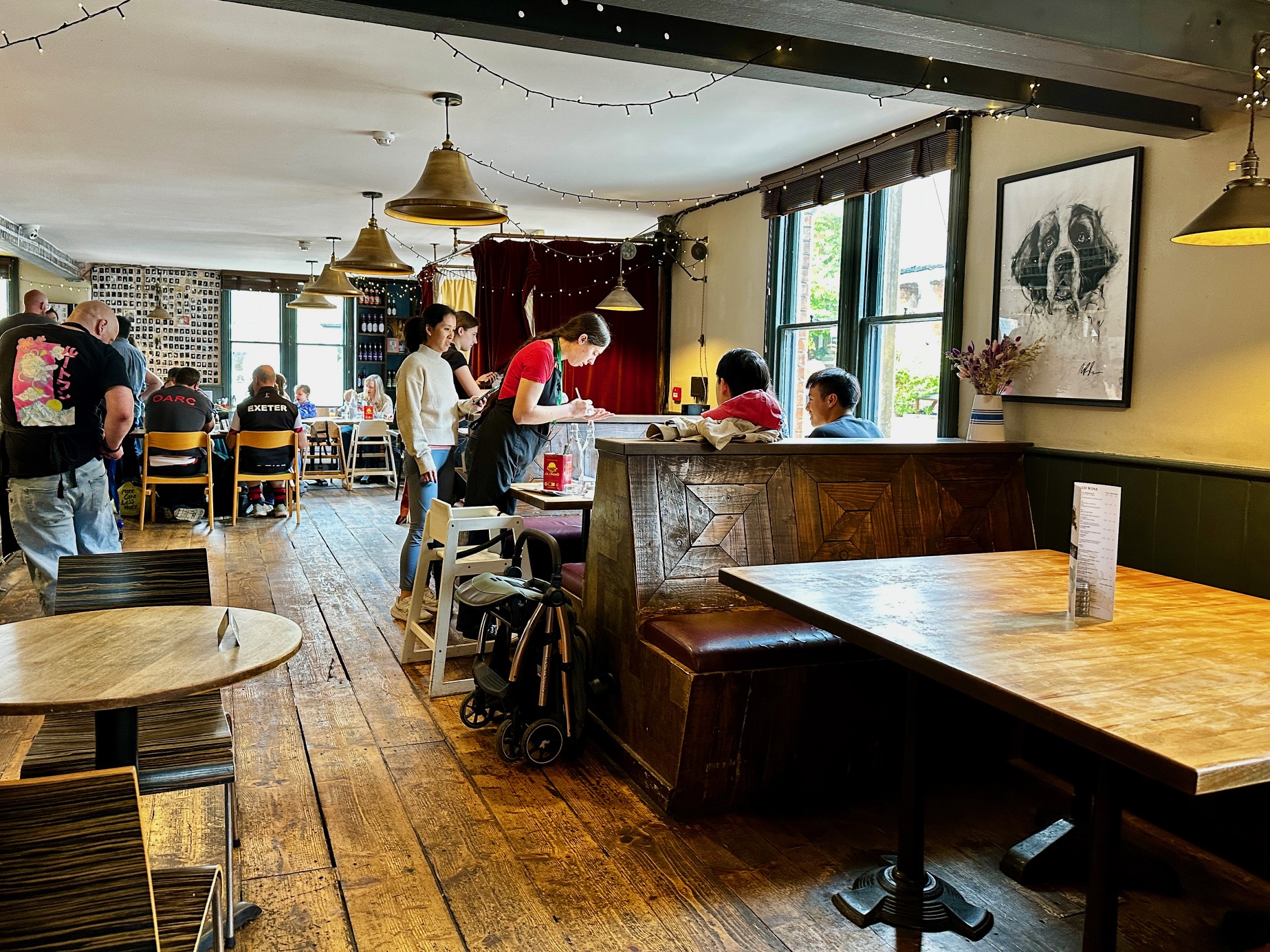
The Chester Arms is another of those lovely backstreet boozers I didn’t even know existed and like the Star off Cowley Road, it reminded me a little of Reading’s Nag’s Head and the Retreat, only built to a different scale. It was a big, handsome corner plot with a decent-sized garden and inside it was a very attractive room with wooden floorboards, large sturdy tables ringed by fetching booths and plenty of natural light. It was a properly gorgeous space which made me think, as so often, that I really missed the Lyndhurst.

Having said that, I do have to say that some of its tables were more equal than others. The place was absolutely packed – you have to book quite far in advance if you want a table – and without much in the way of soft furnishings, which made it a cacophonous place to be. The two tables nearest to us were the handsome ones for larger groups but our little table with unforgiving chairs, near the kitchen, next to a stack of high chairs, felt like one they put in the seating plan because they could, not because they should.

In fairness the table directly in front of me was possibly even worse. The large group settled in nearby was full of people who were young, exuberant and happy to be there. I love Dave dearly, but we could only manage one of those three. “They’re probably all catching up at the end of their summer holidays, ready for term to begin” he said equably, and I felt even older than usual.

The Chester Arms’ menu was compact in the way you’d expect when most people are there for the feature attraction: a handful of nibbles, only three starters to speak of and three main courses which were not the steak platter. One of them was a vegetarian mezze selection (“perfect as a starter to share, or to be enjoyed as a main for one”) which had, by the looks of it, strong Nando’s halloumi burger energy. The starters were under a tenner, all mains save the steak platter hovered around twenty pounds.

Now, to get this out of the way from the off, our service was brilliant from beginning to end. Our server was young, American, properly charming and looked after we two avuncular has-beens perfectly, and I can’t say enough good things about her. With one exception, which is that I saw a blackboard with specials being shown to other tables later in the afternoon but we were never told about it or given a chance to look at it. In an ideal world it just said, in big cursive script, Stop fooling yourself, we all know you’re having the steak platter but, as I didn’t see it, I can only guess.

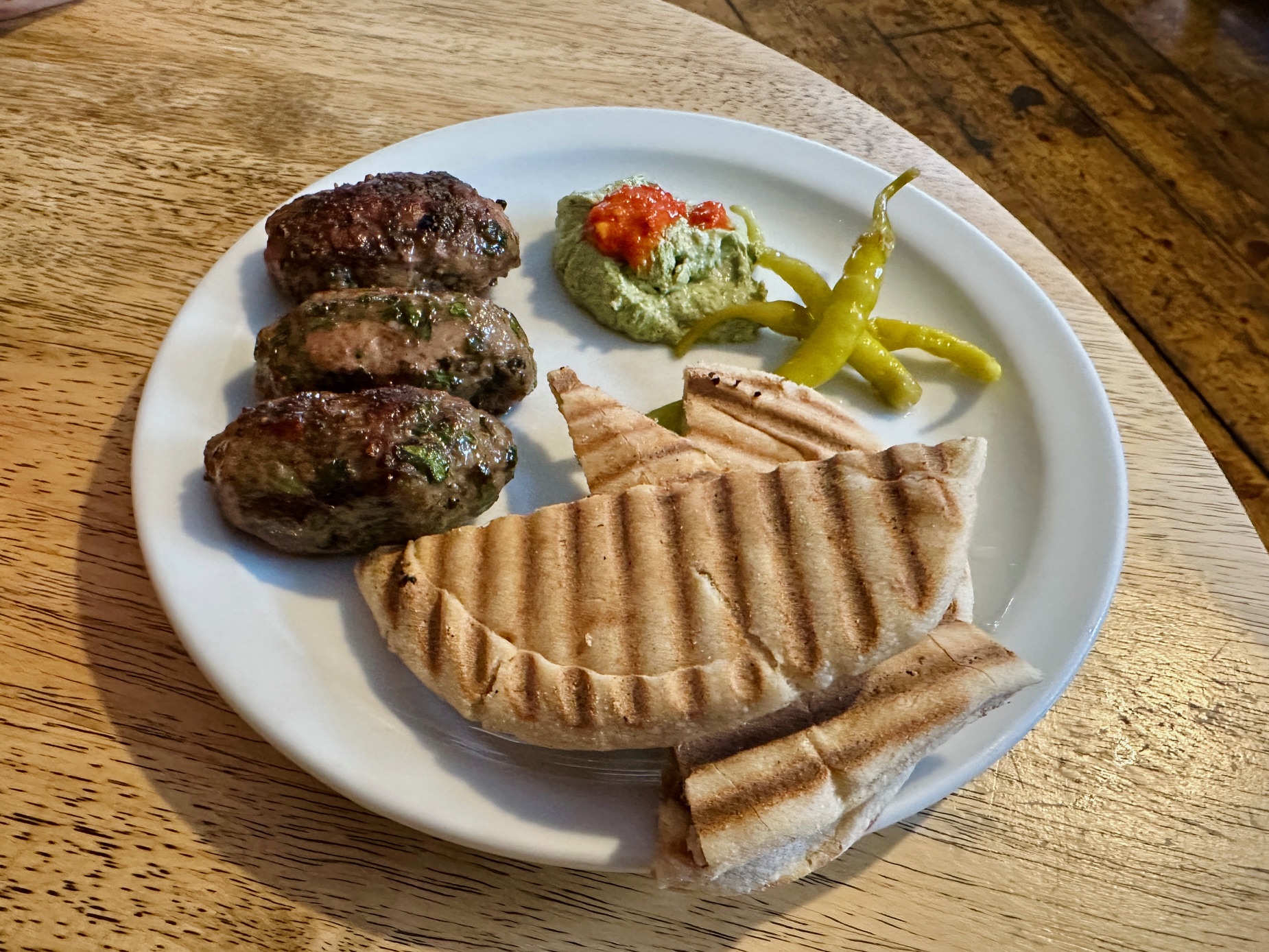
Dave was reluctant to have a starter in case the steak platter turned out to be too much, which did make me wonder if some kind of Invasion Of The Body Snatchers situation was going on, but I managed to persuade him to share the most appealing starter with me. Actually it might have been the absolute best thing I ate all afternoon, so I half wished I’d just pressed on without him. Lamb koftas were a trio of plump nubbins, beautifully coarse and with just the faintest whiff of offal to them, really gorgeous stuff.

They came with flatbreads which felt bought in, but which were good nonetheless, a small stack of guindilla and what was described as green tahini. I’m not really sure what that was, because tahini is a paste with a very distinctive taste and texture and this was none of those things, and it didn’t have a particularly strong note of sesame, but I quite liked it anyway. Dave was unconvinced by it, but won over by the koftas. He let me have the spare one, because he’s a good egg, and even though they were almost more faggot than kofta it did make me wonder what a Chester Arms mixed grill would be like. That had better not have been on the specials menu.

We had a while to catch up after that because each steak is cooked to order and takes, if the menu is to be believed, 45 minutes. So he sipped his pint of alcohol free Rothaus, and I had a pale from DEYA: we were both keeping our powder dry for a more substantial session post lunch. I didn’t know at the time – I learned this from Instagram after the fact – that landlady Becca Webb had just come back from a tasting tour in Bilbao with her wine suppliers, and if I had I might have paid closer attention to the wine list. Next time.

Anyway, Dave and I had a good old chinwag, if constantly drowned out by the relentless, unforgivable youngness of people at our neighbouring tables, as we struggled gamely with the heat from the nearby kitchen. The problem with a restaurant where everybody orders the same thing is that each time it comes out from the kitchen you perk up, think it’s yours and then realise it’s going to another table. But in a way it’s genius, because it raises your anticipation over and over again, and every passing platter looked amazing.

Besides, it distracted me from Dave giving me a litany of people he knew, roughly our age, who were either seriously or terminally ill. They don’t call your fifties ‘sniper’s valley’ for nothing, and after I’d heard about three of them my fight or flight health anxiety kicked in and I asked him, ever so nicely, to stop. Is this what we’ve got to look forward to? I wondered to myself.

I can’t imagine anybody’s life expectancy would be enhanced by what turned up at our table about half an hour after our starters, but just look at it. You’d shave a few days off the end of your life for one of these, wouldn’t you?

It’s difficult to give any kind of scale with a photograph like that but trust me, that serving plate was substantial. Our two serving plates were on the smaller side, but that just gave you an excuse to go back again and again: not for nothing did the pot of utensils on our table include forks, sharp knives and a little set of steak tongs.

Everything about this dish was bang on or thereabouts. The onglet was cooked beautifully medium rare and, in the main was buttery and absurdly easy to cut, any tension in the fibres expertly soothed away; I appreciated the irony of eating something that was better rested, most likely, than I will ever be. The béarnaise was ever so slightly thin with a slight hit of vinegar, but it hadn’t split and went very well with the steak; I might have liked a little more, between two, and a spoon to dish it up with but as quibbles go those were minor.

The other thing I loved, though, was how complete a dish this was and how every component brought something to the table. The heap of savoy cabbage shot through with lardons was truly joyous, the chips were thick, crunchy and surprisingly good. And even the salad, which I’d dismissed in the run-up as a makeweight, was not an afterthought. It was properly dressed, and it supplied the lightness and acidity that would otherwise have been missing from the platter.

Our server had asked us if we wanted to upgrade to the platter for three (“nice bit of upselling”, said Dave) but we’d decided not to, mostly because I thought if I was reviewing the place you’d want to know if a platter for two actually served two. And my verdict is that it does: we finished all our steak and most of everything else, and even in the time between finishing and our almost empty plates being taken away we were both picking with forks – dunking a chip in the béarnaise or trawling it through the juices from the onglet, or the good stuff that was left after you’d airlifted the cabbage away. If service had been less on it, I think our plate would have ended up clean as a whistle.

I tried to send a picture of the platter to Zoë – because she’d asked, even though I imagine it would have made her seethe with resentment – and failed, because the mobile signal in that part of Oxford is like taking a day trip to 1997. Perhaps it was for the best.

Our server asked if we fancied dessert, so I asked Dave if he fancied dessert – because I’d have looked like a right fat bastard scoffing one on my own – and I was hugely relieved when he decided to join me. Perhaps the bodysnatchers hadn’t troubled his house in Wootton Bassett after all. The dessert menu was also compact: three desserts, or ice cream with Pedro Ximenez, or a selection of ice creams, or an affogato.

Another thing to like very much about the Chester Arms was the very appealing selection of digestifs, and the options of red or white port, Sauternes or PX: I had another half of the pale instead, but on another day would have veered in the direction of something smaller and sweeter. The pale, by the way, was decent if piney: not DEYA’s iconic Steady Rolling Man but a reasonable stand-in. I’d have checked it in on Untappd, but I was in 1997 so it hadn’t been invented yet.

I was tempted by something ice cream based, but the server couldn’t tell me where the Chester Arms’ ice cream came from and I wasn’t invested or entitled enough to make her ask. So instead I went for my tried and tested choice, a tiramisu. It was about as different as possible from most of the ones I’ve had recently – not loose, airy and boozy like the tiramisu at, say, Paesinos or RAGÙ. It was more old school, by which I suppose I mean inauthentic: much firmer, much denser, crammed into that Duralex glass like they’d almost forgotten to say when.

And it was gorgeous. I’d forgotten that authentic is overrated, with all the honest-to-goodness Italian food cropping up in places like Reading and Bristol, but this was a delight from first spoon to last – far, far more cream than sponge but laced with Courvoisier and Frangelico. I loved it far more than I expected to, and it made me think again that the Chester Arms might be famous for its steak platter but it had made the canny choice of ensuring that none of the other items on the menu were an also-ran.

Dave had the crème brûlée, which is just one of those dishes I never personally order. I tried a spoonful of it and it, too, was right on the money: just enough warmth, the carapace just the right thickness, the cream vanilla-speckled and exemplary.

We didn’t tarry, because by that point it was incredibly warm and both of us fancied stretching our legs. Besides, I had promised to introduce Dave to the Star and his beloved Liverpool had finished playing, so the lack of mobile reception was no longer the positive nuisance it had been. My advice is that if you’re going to spend time somewhere with absolutely no phone signal, the best idea is to do it in the company of someone where you can talk for hours without feeling the need to check your phone. So that’s exactly what I did.

Our meal for two – two and a half courses each, one of them that steak platter, and a pint apiece came to just under £100, including a discretionary 12.5% service charge which was totally earned. When you think that half of that whole bill was down to a single dish that the pub endearingly describes as a “small steak”, you have to hand it to them.

I’m really glad I finally made it to the Chester Arms – partly because it’s been an ambition for such a long time and partly because it was fascinating to try a restaurant in this country which really is synonymous with the one dish, to see if that reputation is justified. And it absolutely is – if you like steak at all, you would have a ball hopping on a train to Oxford and making your way to the Chester Arms. And if you don’t, but you know someone who does, make sure the two of you take a friend with you: you can have the fish and chips and they can have the time of their lives.

I do find myself wondering though, still: what was on that specials board? But I know that it could have had skate wing on it, or fried chicken, or countless other things, and I still would have ordered the steak platter. So does the steak platter qualify as famous? Yes, I think it probably does.

But if I went back to the Chester Arms again, knowing what their kitchen is capable of, would I really still order the steak platter a second time? Also yes. I’d be even sadder, though, if they’d taken those lamb koftas off the menu, because it was the dish I’d want to order every time, if it was up to me. That’s choices.

The Chester Arms – 8.4
19 Chester St, Oxford, OX4 1SN
01865 790438

https://chesterarmsoxford.co.uk

Since January 2025, Edible Reading is partly supported by subscribers – click here if you want to read more about that, or click below to subscribe. By doing so you enable me to carry on doing what I do, and you also get access to subscriber only content. Whether you’re a subscriber or not, thanks for reading.
Restaurant review: Arbequina, Oxford

Late last Saturday morning I was sitting outside Missing Bean on Turl Street with my great friend Jerry, drinking a gorgeous latte in the summer sun, about to tuck into a pain au chocolat with impeccable lamination; I remember thinking that, on a day like that, there felt like no better place to be than Oxford in the sunshine. The train up from Reading had been packed, and we’d stood in the vestibule making conversation with our fellow captives, two young polite Swedes with perfect teeth and an Australian who had fought her way there to the loo and, realising how spacious it was, was tempted to lock herself in there for the rest of the trip.

And when we got to Oxford – well, it was a Saturday in August and the weather was fine, so naturally the city was packed. A curious blend, throngs of tourists swarming round Radcliffe Square, the Bodleian and the Covered Market but also packs of graduands, in their gowns, on their way to the Sheldonian Theatre for their final rite of passage. The Oxford year isn’t like the calendar year and this all happened on the very outskirts of it – one academic year ended, another not quite ready to begin, the city reclaimed by residents before the whole thing started again in October.

Nonetheless, from where we were sitting the view was gorgeous, the food and drink were excellent and the people watching was close to unparalleled. I’d asked Jerry if he was free on the off chance at very short notice and had been delighted that he was, and at this point we were barely an hour into what would turn out to be another effortless nine hour chinwag, punctuated by this walk or that, this spot of shopping or another, lunch, coffee, beer garden, train home. Even at the start of the day, I knew it would be a good one: with Jerry, it always was.

But would it be a good lunch? I’d thought carefully about this, because although I always have a wonderful time with Jerry when he joins me for a review I cannot say, hand on heart, that we usually have a good meal. I’m not saying that he’s a jinx, far from it, but I feel guilty that he’s joined me for some of the most middling meals I’ve had for the blog in the last few years. He was the person I took to Zia Lucia for pizza that was nothing more than pleasant, and then he also came with me to Maidenhead’s Storia for much the same experience.

Then to cap it all, the last time we lunched it was in Oxford – at Gee’s, where £200 got you a lot of disappointment. Because Jerry is so lovely, he never resents us marring our time together with mediocre food, which makes him a far better person than me. But I still feel bad about it, and I decided after that lunch in Gee’s that Jerry, more than anyone who comes out on duty with me, deserved a nice one. But where to take him?

The thing is, places I review for the blog probably fall into three categories. There are the ones I expect in advance will be good: these are more likely to happen in places like Oxford, London or Bristol that support a large and thriving restaurant scene. And then there are the places I merely hope will be good, and that hope can run the whole spectrum from reckless optimism to wishful thinking. Don’t get me wrong: I always hope for the best but sometimes, especially in Reading, that hope can border on the blinkered or forlorn.

Originally I was going to take Jerry to the Chester Arms, out off the Iffley Road, which falls into the first category. It’s famous for one thing and one thing only – its enormous steak platter, which comes groaning with handmade chips, cabbage and streaky bacon and béarnaise sauce, which they have been serving up for over fifteen years. I’ve heard about it so many times but never managed to make it there, but as we were deciding where to go Jerry dropped the bombshell: he’d just had a dental implant, so needed something a little less taxing on the molars. Would I mind if we went somewhere else?

So the subject of this week’s review falls into the rarer third category: places I have been, that I remember liking, where the mixture of hope and expectation is more of a balancing act. You don’t so much expect they’ll be good, you more hope that they’re as good as you remember. And Arbequina, the tapas restaurant down the Cowley Road, definitely falls into that category. It’s been there nine years, very much blazing the trail in that part of Oxford, and after getting a rave review in the Guardian the year after it opened it’s stayed out of the limelight, even though it’s one of only two Oxford restaurants to be mentioned in the Michelin guide.

It’s quietly done its thing. No cookbook, no appearance on Saturday Kitchen or Great British Menu, just keeping going and keeping afloat. Growth has been steady and incremental: first it expanded into the neighbouring unit four years ago and then, earlier this year, it announced that it was crowdfunding to open a second site in Oxford’s Covered Market, The council had approached them with an offer – not something that would ever happen here in Reading – and so far the crowdfunder is just over half the way there, with the restaurant still hoping to open the new site later this year.

So yes, Arbequina has history. And I have history with it too, because I’ve been eating there, on and off, for the last eight years or more. Plenty pre-COVID, when I always adored it, but only once, for some reason, since the pandemic ended. That was three and a half years ago, and it sowed seeds of doubt that maybe Arbequina wasn’t the restaurant it used to be. But I should have checked in on it long before now, and ambling across Magdalen Bridge with Jerry, in good time for our lunch reservation, I found myself getting excited about a reunion with somewhere that used to be one of my favourite places.

It’s in the fun part of the Cowley Road, past the restaurants Florence Pugh’s dad used to own, past Spiced Roots, but just before brilliant café Peloton Espresso, or Truck Records, or – far further up – the turning into the food enclave of Magdalen Road. It’s a lovely site that has kept the old shop fronts from the chemist and watchmaker who used to trade there, the tasteful writing in orange sans serif on the glass the only sign of Arbequina’s name. The room inside is lovely, with unpretentious decor, a handful of tables, both low and high, and a long zinc bar where you can sit and watch all the work in the very small open kitchen.

But it was a Saturday in August, and the awning was out, and neither of us could think of anything finer than sitting out on the pavement watching the Cowley Road live and breathe, so we did exactly that. I ordered a rebujito from their cocktail menu – a drink I grew to love in lockdown but which I had for the first time at Arbequina, rather than in Andulusia – and Jerry joined me. It was fresh and zippy, a harmonious blend of the lemon, mint and that savoury note of fino.

The other thing we had right from the off, while we made up our minds about the rest, was Arbequina’s tortilla. I remembered it well enough to know that you simply had to order it, and I also knew from repeated personal experience that sharing a slice felt like a good idea right up to the point where it turned up and you could only eat half of it. So I insisted that we got a couple, and Jerry agreed – partly because he’s just a very agreeable cove and partly because I sold it as about as kind on his teeth as it’s possible to get.

But ‘kind’ undersells it, because it’s a positively indulgent treat and, however good anything else you eat at Arbequina might be, it always sets the standard for other dishes to beat. I had forgotten, over the last three and a bit years, just how good it is, but it was magnificent: so soft, only just structured on the outside and a glorious mess within.

Egg, potato, onions, thyme – that’s all there is to it, but of course that’s a hopelessly reductive way to describe a masterpiece. Jerry did better, dubbing it sumptuous. Why do I never use that word in reviews? Maybe I was waiting for this dish.

Because you could have tortilla in dozens of places, in Spain and in this country, and not approach the brilliance of this. Every forkful but the last was wonderful, and the last was wonderful yet heartbreaking. But I knew that at least not sharing it meant that last forkful took longer to arrive. It was so sweet, so exquisite that I thought I tasted things in it – maybe nutmeg, maybe cinnamon – that weren’t there.

When Ben, the manager who looked after us that day, took our empty dishes away he explained that there really was nothing else in there. The sweetness came from the onions, which were cooked for a mind-blowing twelve hours. When Jerry heard that he said “I don’t envy your gas bill” and the manager smiled. Jerry had accidentally hit on one of the reasons hospitality is so thankless right now, and he meant no harm by it.

That tortilla under our belts, it was time to take a serious look at the menu and plan our assault on it. Many of the dishes I remembered from previous visits – chicken thighs with romesco, or toast thickly spread with ‘nduja and honey – were no longer there, but the menu still read nicely. Just shy of twenty dishes, most of them at or adjacent to a tenner: only one approaching twenty quid and a last, Iberico tenderloin to share, closer to forty.

It didn’t break into sections, or flow quite the way that the menu at, say, RAGÙ did, but it had plenty of potential and so Jerry and I did what I’d done countless times before – made a list of things we definitely wanted to eat, broke it up into waves and decided to order and graze, little and often. And along with that we had a gorgeous white, an Asturian albariño blend with a certain bracing saline quality: I’d chosen it for no other reason than that I’m on holiday in Asturia soon, and fancied getting a sneak preview.

My verdict? Roll on next month. At £45 it was the most expensive white on a very compact list – four reds and four whites, mostly from Spain, and a bigger selection of natural wines from all over. But the markup was far from harsh, because I reckon it would cost you about £20 retail.

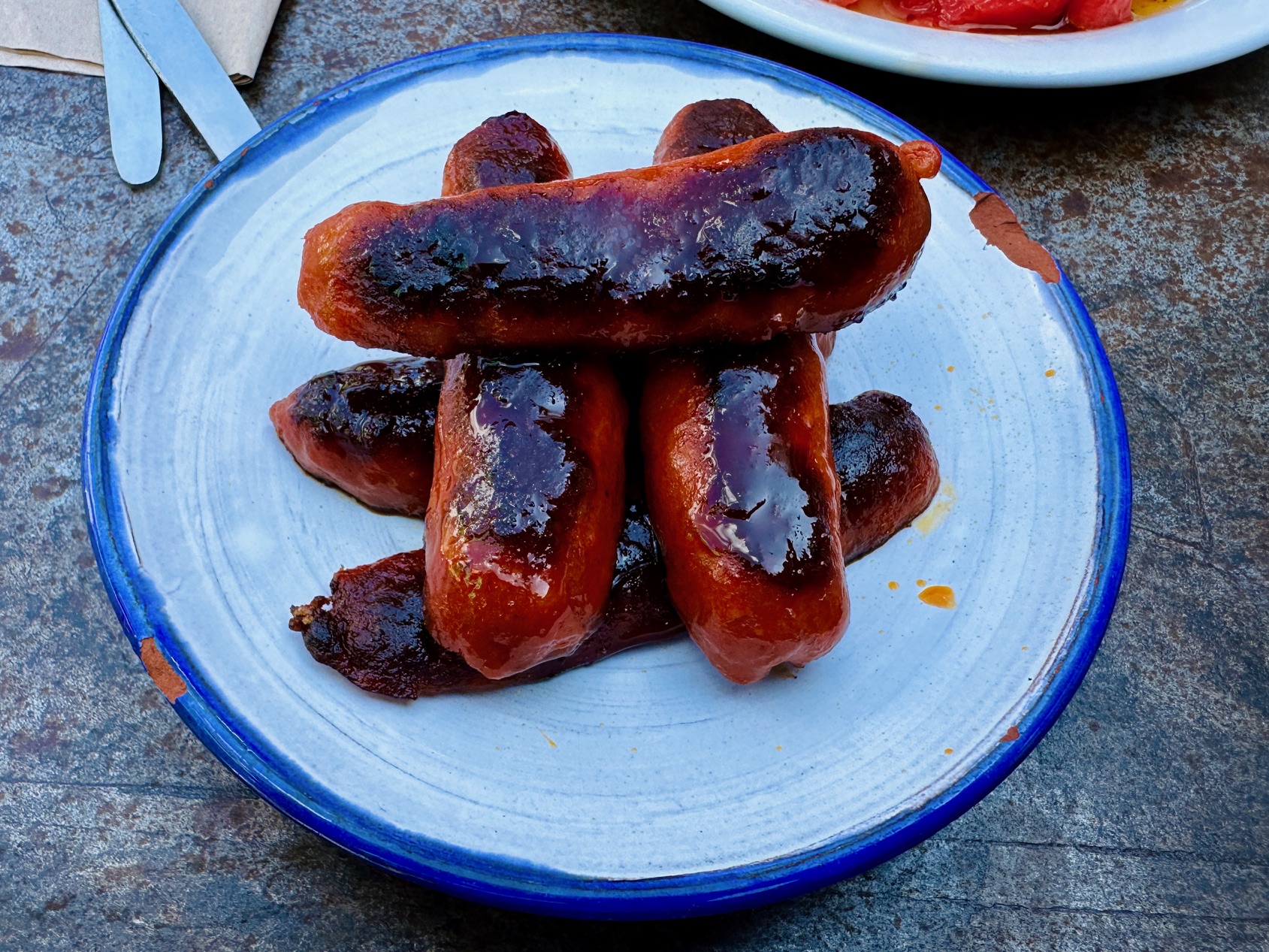
Sometimes things can be delicious because they’re simple, and Arbequina’s chorizo was a classic example. Sliced lengthways and cooked on the plancha until the outsides were caramelised and blackened, it was superlative stuff. Not cooked in wine or cider, not sliced and fancified, just cooked and served. I’d love to know where Arbequina buys it – it’s certainly not Brindisa, because theirs can be a bouncy horror compared to this.

It irked me that they gave you five of them, though, because that’s an especially tricky number to share. Well, with anybody but Jerry, anyway. “Go on, you have the last one” he said. He’s just lovely like that.

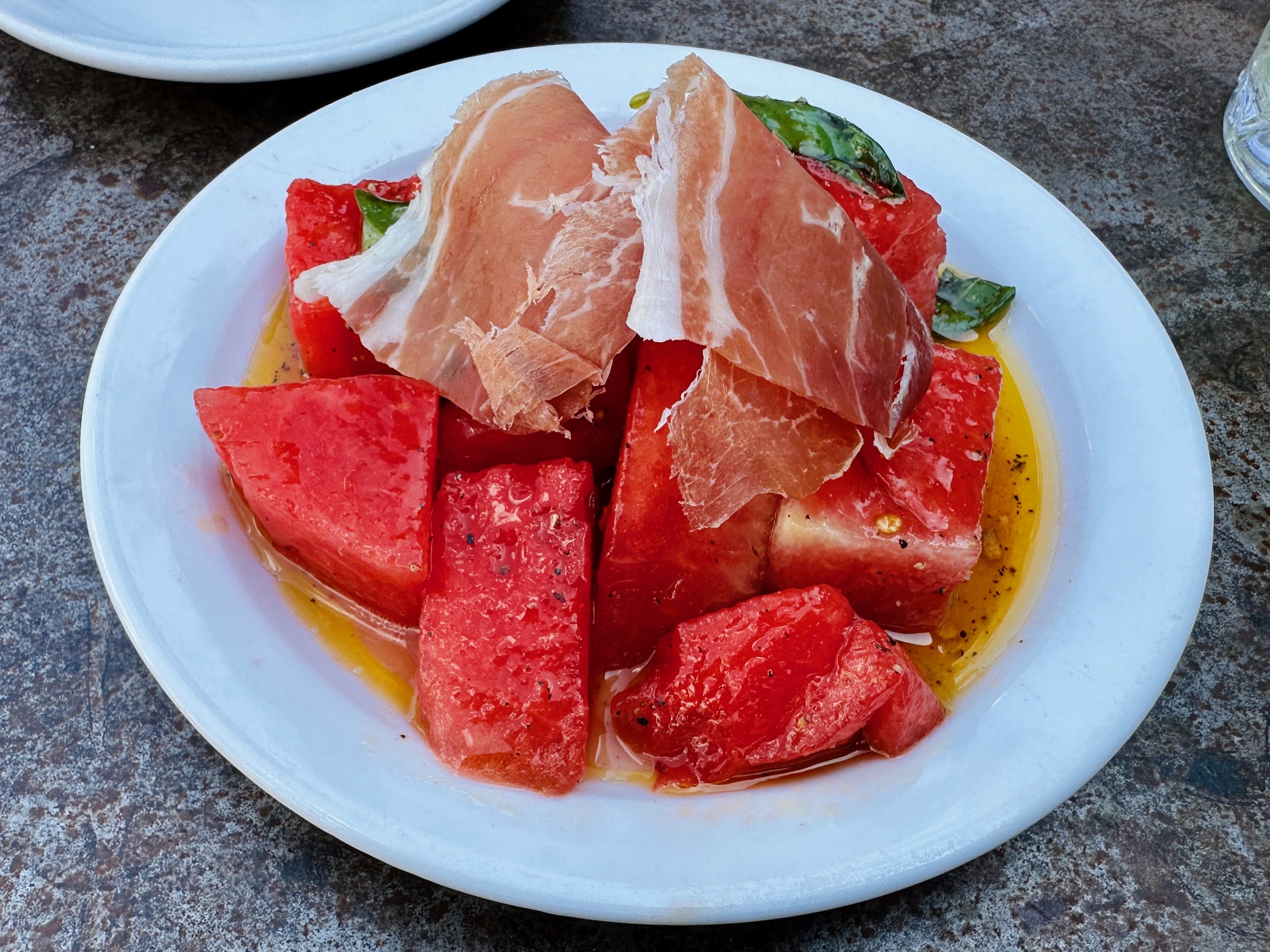
Almost as simple, even more beautiful to look at – and perfect for a sunny al fresco afternoon – Arbequina’s watermelon with jamon was a joyous dish. The melon was plump, sweet and vibrant, and very much the star of the show. But where it wasn’t quite as successful as, say, the similar dish I had at RAGÙ recently, was that the supporting players were perhaps hiding their lights under a bushel somewhat. The two bits of jamon folded on top felt slightly meagre, the honey and chilli rather lurked at the bottom of the plate, shunning the limelight.

But to be fair, if you’re comparing this with the dish at RAGÙ it’s only fair to also note that this was £8, and the Bristol restaurant’s version was over 50% more expensive.

Jerry was in no rush – I always forget that he’s not a trencherman like I am – so at this point we asked the manager if we could hold fire, sip our wine and come back to the menu. And he let us do exactly that, keeping us posted on when the kitchen would take last orders so we could have the leisurely lunch we had in mind. Jerry and I had plenty to catch up on, so we nattered about all sorts, only punctuated by Jerry having an almost Tourettes-like reaction to every single electric scooter going past. I love the multitudes people contain: Jerry is possibly the most affable person I know, but he really hates those electric scooters.

The one dish Jerry really wanted from the menu was Arbequina’s take on an Andalusian classic, berenjanas con miel, or fried aubergine with honey. Now, I wouldn’t have ordered this because I’ve never liked it in Spain – usually the aubergine is sliced thin and fried in a crispy batter, and drizzled in a dark sticky molasses that is a million miles from honey. It takes some doing, in my book, to make aubergine a good thing and this dish, whenever I’ve had it abroad, doesn’t pull it off.

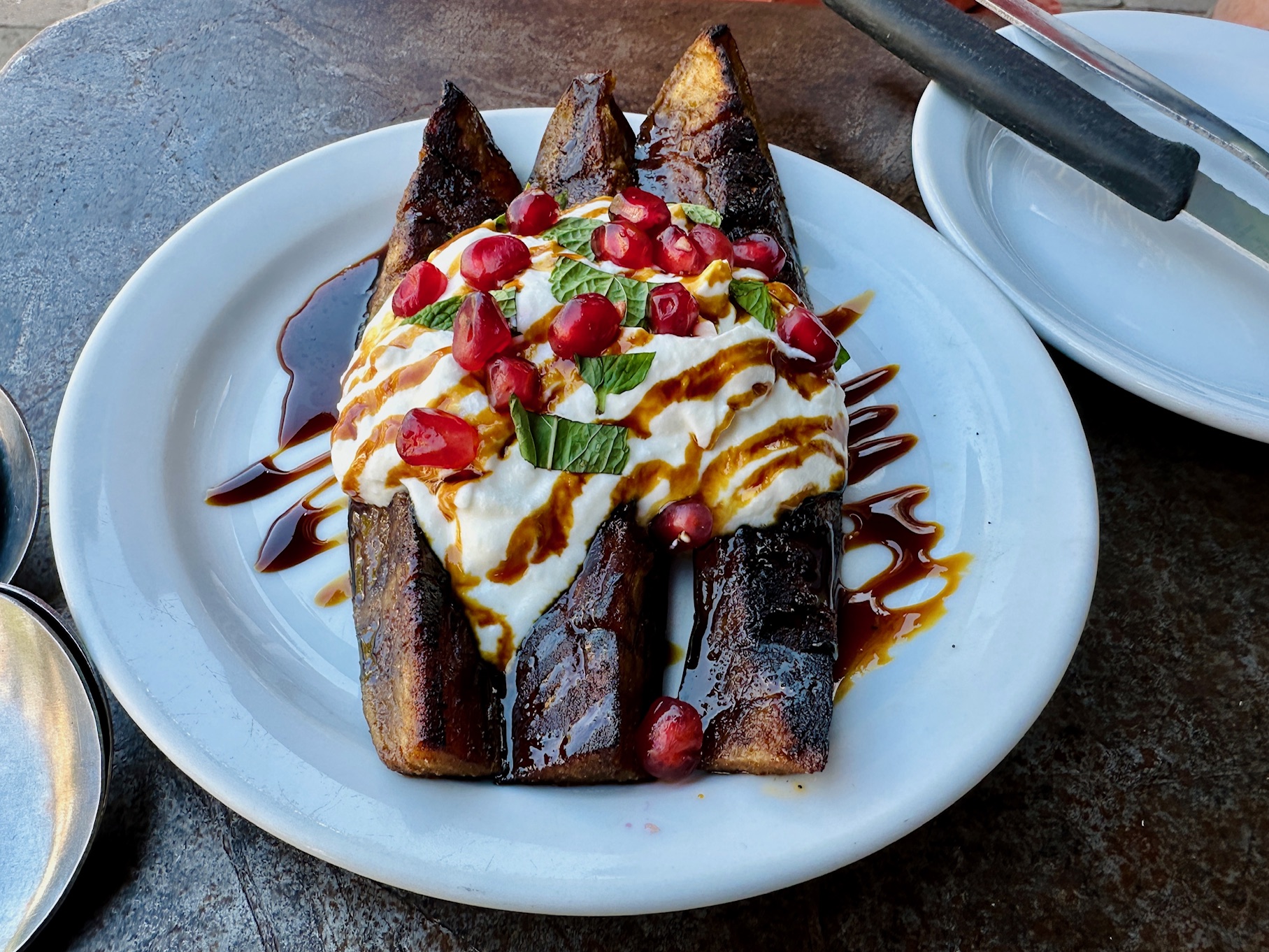
But Arbequina’s version takes everything that could be good about that dish and junks the rest. So we got three soft, caramelised wedges of aubergine, drizzled with an ambrosial molasses without any sour, burnt note, the whole thing bathed in a mild whipped feta – almost more yoghurt than feta – and scattered with pomegranate and torn mint. Have I sold it to you? I hope so. Arbequina sold it to me, both literally and metaphorically. One to add to the vanishingly small list of aubergine dishes I actually like, most of which are on the menu at Kungfu Kitchen.

Our last two savoury dishes were, apart from the tortilla, the highlights of the whole thing for me. I am a terrible rubbernecker in restaurants and I kept seeing a dish go past to other tables which looked eminently snackable, a giant heap of fried, crispy, golden things. But I wasn’t sure what it was, and when I asked the manager I couldn’t explain it well enough – I blame the wine – to get him to tell me what the dish was. But then Jerry wanted the prawns, so it turns out we ordered it by accident.

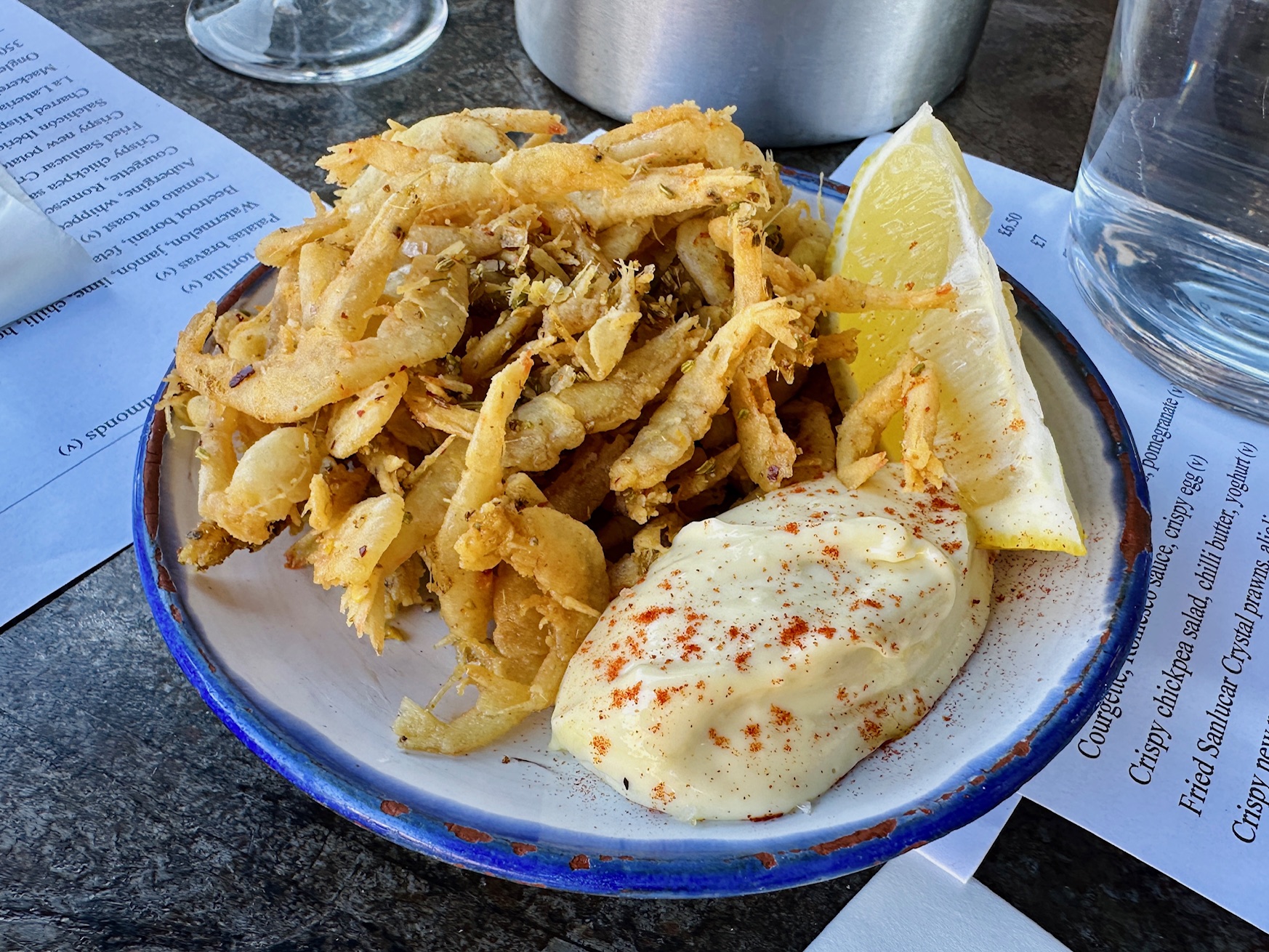
So these, it turns out, are Sanlucar Crystal prawns – little critters, soft shell, fried in a golden coating, dusted with chilli and served with a generous dollop of alioli. Never had them in my life, now fully wondering where they’ve been for the last fifty-one years.

And again the funny thing is that like the aubergine, this wouldn’t normally be in my wheelhouse at all. I don’t like whitebait, can be squeamish about eating things whole. I’m not one of those macho restaurant bloggers who likes to wank on about sucking the head of a prawn – they try to channel Bourdain, but really they’re Swiss Toni – and, with the exception of one meal in Kolae I’ve managed to convince myself that I really don’t want to munch on a prawn’s brains.

So why did I love these so much? I really don’t know, but I did. I keep using the word fresh in this review, or it feels like I do, but that’s what they were – so fresh, so light, so simple, with that spritz of citrus, that whisper-quiet crunch and the ozonic tang of the sea. On the Cowley Road. Now, I love the Cowley Road but I’m not going to pretend for a minute that eating these prawns there was in any way a congruous thing to do.

I hadn’t especially wanted Arbequina’s patatas bravas – I often think they’re a way to needlessly bulk up meals in tapas restaurants – but I was drawn to their more exotic sibling on the menu. And it was another really wise choice: billed as crispy new potatoes with tonnato and salsa verde, it was a real humdinger. The slices of potato, thicker than crisps but very much sharing that lineage, were stellar, a triumph of texture.

The thick slick of tonnato was perfect for dipping and dredging: I didn’t get an enormous amount of tuna from it but I did get plenty of savoury saltiness, so I’m guessing anchovies played a part. And I don’t think salsa verde showed up to this dish at all. In its place, I suppose they had deconstructed it by instead scattering everything with salt, parley and lemon zest. I probably would have preferred a salsa verde, because I love the stuff. But I’d forgotten about the salsa verde when this dish turned up so instead I just thought isn’t adding lemon zest to this clever? They knew better than I did.

By this point we’d been there the best part of an hour and a half, in which time tables had come and gone but the restaurant had kept a happy trickling momentum of customers in the sunshine. The Americans at the table next to us ordered some of that tortilla, and inexplicably left some of it: we decided, on balance, that we didn’t know them well enough to offer to take it off their hands.

We both fancied something from the dessert menu, and I talked Jerry into a red dessert wine which came in a wide, low tumbler and was like nectar. I didn’t catch the name, and my bill doesn’t give the detail, but red dessert wines are always worth a try if you find one, and I suspected it would go better with the chocolate mousse even than a Pedro Ximenez.

Other desserts are available, of course. Arbequina was offering a panna cotta, a Basque cheesecake or the almond-rich wonder that is a Tarta de Santiago. But I think chocolate mousse should be on far more menus than it is, so whenever I see one I order it – and Jerry, being kind to his vulnerable gob, followed suit. It was, as so often, the perfect way to finish a meal.

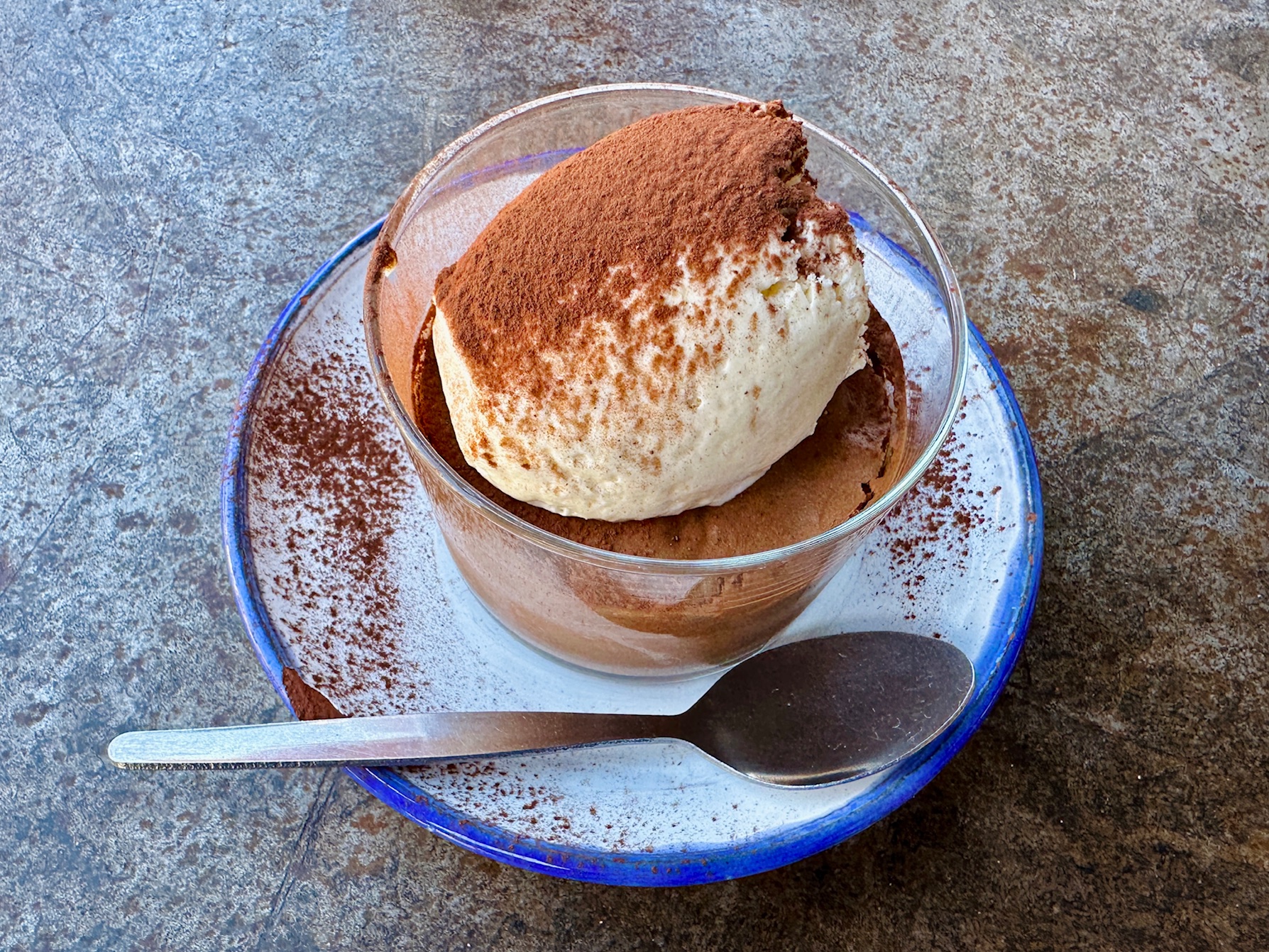
I’ve had Arbequina’s chocolate mousse plenty of times, often enough to track its evolution. It used to be a dense quenelle of the stuff – drizzled with olive oil, scattered with coarse salt, served with a torta de aciete for good measure. But over time, Arbequina’s version of this dish has changed, become less uncompromising, dropped the olive oil and become, on the outside at least, more conventional.

But don’t be fooled: it might come in a glass, the torta de aciete may have been replaced with a dome of crème fraîche but the mousse is still theirs, and still sublime. The salt now runs through the whole thing rather than just finishing it off, and it works beautifully.

It was the right way to end a lunch that had been unassailable in its rightness. Our bill came to just under £175, including tip, and nothing about it had felt out of kilter or anything short of marvellous. We settled up with glad hearts, and were on our way – the grand total of a couple of doors down to have a post-lunch coffee outside Peloton Espresso.

But then another delightful discovery lay in store – a short walk down the Cowley Road and we came to Rectory Road and the Star, the best Oxford pub I’d never been to and another long overdue discovery. It was like a cross between the best things about the Retreat and the Nag’s Head, with a huge handsome beer garden and Steady Rolling Man on tap.

So we grabbed a table, carried on chattering, beers passed, tables of people – and the people watching opportunities they presented – came and went. We had nowhere to be, and every reason to linger. Really it was the best afternoon, and one of the best things about it was knowing that at last, Jerry had got the excellent meal he deserved. Finally, I got him a nice one.

Much later on, we retraced our steps, walking east to west through Oxford, the sun setting in the distance. The pavement outside Arbequina was even busier, with people about to have one kind of outstanding dinner or another. The Cowley Road was alive, the antithesis to the stuffiness we’d encountered right in the centre. “It’s bit like the Oxford Road isn’t it?” said Jerry as we sloped back towards Magdalen Bridge. And I replied that it’s what the Oxford Road could be like, with better landlords and more imaginative restaurateurs. Still, it’s nice to dream.

Arbequina – 8.9
72-74 Cowley Road, Oxford, OX4 1JB
01865 792777

https://arbequina.co.uk

Since January 2025, Edible Reading is partly supported by subscribers – click here if you want to read more about that, or click below to subscribe. By doing so you enable me to carry on doing what I do, and you also get access to subscriber only content. Whether you’re a subscriber or not, thanks for reading.
Restaurant review: Gees, Oxford

For my money, there are a few finer things in life than a long, leisurely Saturday lunch with a very good friend. Especially when you’re in a fetching room, in a beautiful city, faced with a cocktail, an appealing menu and excellent people watching opportunities. In fact, one of the only things finer than that is to do exactly what I’ve described above, but on a Friday, with four whole days off stretching out in front of you. So I was very happy indeed to find myself sitting in Gees’ gorgeous conservatory on Good Friday with my dear friend Jerry, Easter weekend only just beginning.

By this point, the day had already got off to a magnificent start. The train to Oxford was quiet, deserted almost, and it was the first time in as long as I could remember that it only took a couple of minutes to exit the station, a station whose abysmal design doesn’t seem to have significantly changed in the thirty or more years that I’ve been making that journey. We had a bimble round the Covered Market, we bought bread and cheese for later on, we had a beautiful latte in the Missing Bean on Turl Street, chatting away non-stop. 

Jerry and I had never been to Oxford together before, so we compared our experiences of the city over coffee, looking at the connections between his mental map of the place and mine. I thought how nice it was to introduce him to some of my favourite spots, particularly as if it wasn’t for Jerry (it’s a long story) I might not know Oxford half as well as I do. The weather could’ve been nicer – the day was dry yet overcast, which never paints Oxford’s buildings in their best light – but the company was unimprovable.

I had chosen Gees for our lunch because it had been on my to-do list for quite some time. A glorious spot on the Banbury Road mainly famous for its conservatory slash greenhouse dining room, there’s been a restaurant on the site for nearly forty years, a mind-boggling record. It started out as Raymond Blanc’s restaurant, with John Burton Race in the kitchen, then five years later it became Gees and has stayed that way ever since. It’s now part of The Oxford Collection, a small and exclusive group including The Old Bank and Old Parsonage hotels, and their respective restaurants.

That length of tenure means that Gees was already trading when I turned up at Oxford in 1992, sporting terrible spectacles and even worse clothes, to study my degree alongside some of the brightest people I have ever met (and some of the thickest too, would you believe). Not, of course, that I would’ve eaten there then. As I’ve said before, my meals out were limited to regular trips to the fish and chip shop on Carfax, and the rest of the time I was either heating up an M&S chili con carne in the microwave of our communal kitchen, or enjoying – and I use that word as loosely as humanly possible – the food in my college halls.

Many Oxford colleges have an excellent reputation for food, as it happens. They also have shitloads of land and investments, and in one case their own deer park. My college had none of those things, which is probably why they accepted the likes of me: the food there was purgatorial. So Gees was for a long time a kind of mythical place, the sort of restaurant other people went to, people with wealthy parents and substantial allowances. It wasn’t until much later, probably twenty years or so later, that I went there, just once.

That too was in another life, with my then wife and a bunch of our friends who turned out, when push came to shove, to be her friends. I don’t remember much about that meal, except that it was deeply convivial, but I do remember following it up with a lot of drinks in one place or another and stopping on the way to the station for a shameful KFC. I always intended to return to Gees, but somehow I never did.

I was quickly reminded, as we stepped through the door, what an attractive place it is. Most of the seating is indeed in that big conservatory, with its banquettes, leather-backed chairs and handsome tiled floor, and it makes for a great place to eat. Even on a cloudy day the room fills with light, and something about that light, the room’s airiness, the bustle of its supremely efficient staff and the chatter from prosperous neighbouring diners created a truly brilliant atmosphere. If I gave out ratings for rooms alone, Gees would take some beating. 

Gees’ menu is sort of modern European, with something from everywhere. Oysters and in-season Wye Valley asparagus were on offer, as were Serrano ham croquetas and braised octopus with romesco. But Italian dishes and ingredients tend to dominate – pizzetta, pasta, burrata, aubergine parmigiana, the list goes on. It’s as tempting a menu as any I’ve seen on my travels for a while, and on another day I could have ordered almost anything on it.

I think I read somewhere that Gees was influenced by the River Cafe, and I could imagine that in both the menu and the surroundings. Not that I’ve ever been to the River Cafe: for all the rave reviews I’ve read, paying nearly forty pounds for an asparagus starter has always been beyond my means; that said, I’m sure some of my Oxford contemporaries have been more than once. Gees’ asparagus was perhaps more keenly priced at under twelve pounds. Starters more generally weighed in at between ten and twenty pounds, pasta dishes close to twenty and main courses between eighteen and thirty-five. Not River Cafe levels, but not cheap either.

Another thing to love about an unhurried lunch is the possibility of an aperitif. So Jerry had something which the bill described as a “Bergamont Spritz”. It’s not in the drinks menu online, so I’m assuming it contained gin, some kind of sparkling wine, bergamot and – surely – a typo. I had something called a Contessa Negroni which swapped out Campari for Aperol in the classic, simple, three ingredient cocktail. You might wonder why this has never been done before, and now I can tell you: because it doesn’t taste as nice as a proper negroni.

That was all forgivable, though, because the bar snack we ordered to go with them was a real cracker – little dabs of anchovy sandwiched between two sage leaves, battered and fried. These were outrageously good, salty little treats and a really excellent idea. A far better idea than putting Aperol in a negroni, anyway. I wasn’t to realise, at that point, that my bar snack would be far and away the best thing either of us ate all day, so instead I sipped my cocktail, enjoyed the surroundings and felt pleased with the course the day was taking. At all the tables around me, people were doing much the same.

The problem is that after that, despite the room being lovely and our bottle of txakoli being cold, fresh and zippy it felt to me like Gee’s menu delivered wobble after wobble. Take my starter, which was described as venison tonnato. Now, I thought that sounded like an interesting idea: a vitello tonnato swapping our the veal for venison could, after all, possibly work. And it might still be an interesting idea, but it wasn’t in a million years what this dish was.

Instead of thinly sliced venison, you got a piece of venison fillet, cooked through without pinkness, thickly sliced and drizzled with a pale sauce that contained absolutely no tuna. Not the slightest hint of it, not even a whisper of tuna. I don’t know what it tasted of – not a lot, really – but it meant that both the main ingredients of vitello tonnato were missing, replaced with things that were damage not homage. And then there was a big pile of salad, because this starter cost fifteen pounds and they had to find ways to distract a paying customer from realising that this wasn’t in any way what they had ordered.

Ordering a salad by mistake seemed to be quite an Oxford thing: I was reminded of a similar incident at Branca when I went there earlier in the year. I didn’t mind that then, because my stealth salad at Branca was still an excellent dish. This, not so much. If it had been called “venison salad with tonnato dressing”, while not 100% accurate, I’d have had fewer quibbles. Of course, if it had been called that I’d have ordered something else.

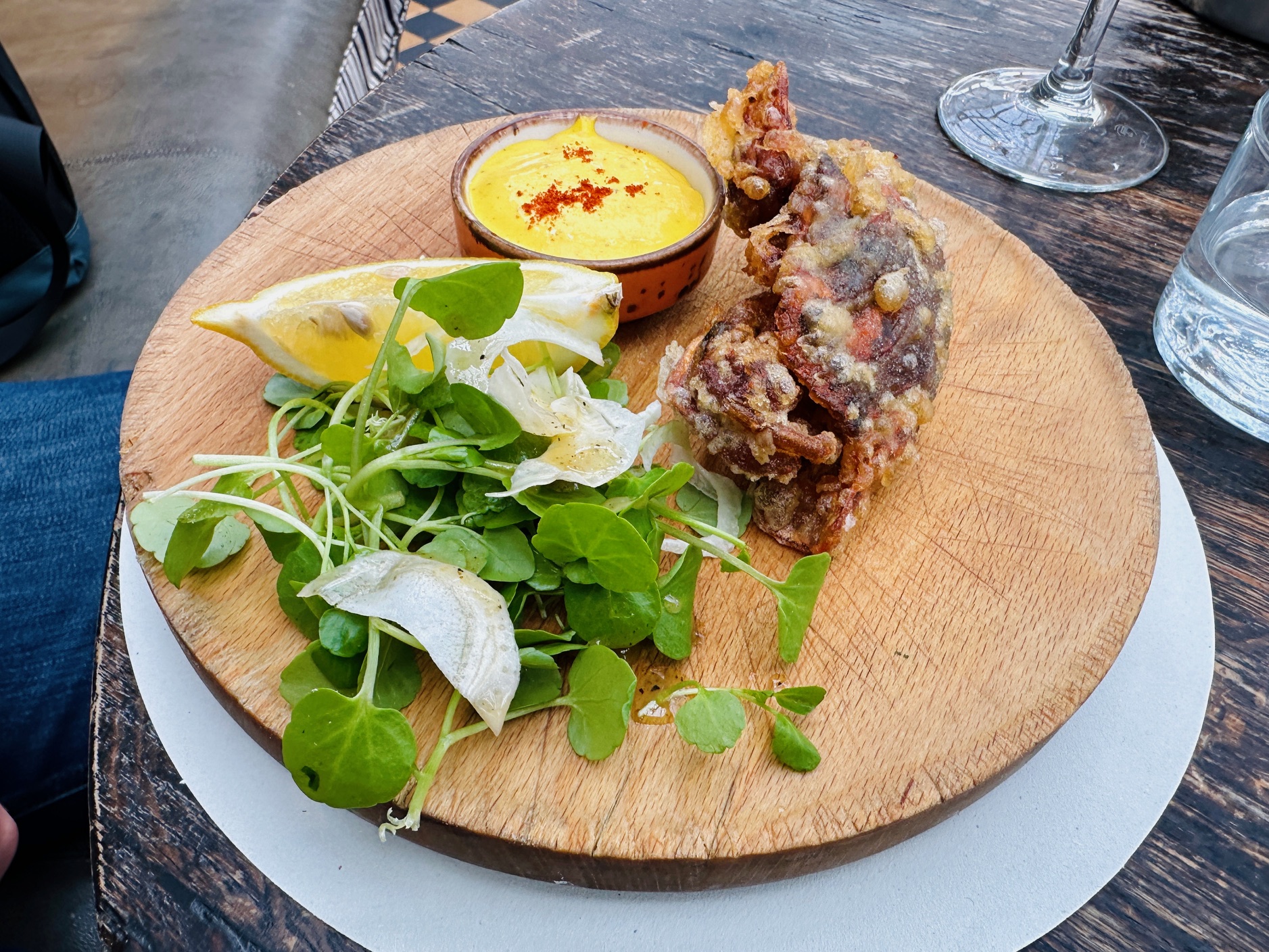
The problem is that not only is stealth salad seemingly an Oxford thing, it’s also – to paraphrase Dr Dre – a Gees thing. Jerry’s soft shell crab with saffron aioli was nice enough, but you get an idea even from the picture below of how diddy it was. Again, salad appeared mainly to be there to fill negative space, a kind of gastronomic find the lady deception. A different salad to that accompanying my starter, with shaved fennel and olive oil. Again, not mentioned on the menu but, in truth, a large part of proceedings. Jerry gave me a forkful of his crab. There was so little that I felt guilty taking it.

Jerry is on some kind of medication that reduces his appetite (although, gladly, not where booze is concerned). He quite enjoyed this, but I think you’d have to be on that medication to find it enough. And Jerry’s drug regime came in even handier with his main course: butterflied sardines, which apparently came with tomato, sumac pickled onions and chermoula.

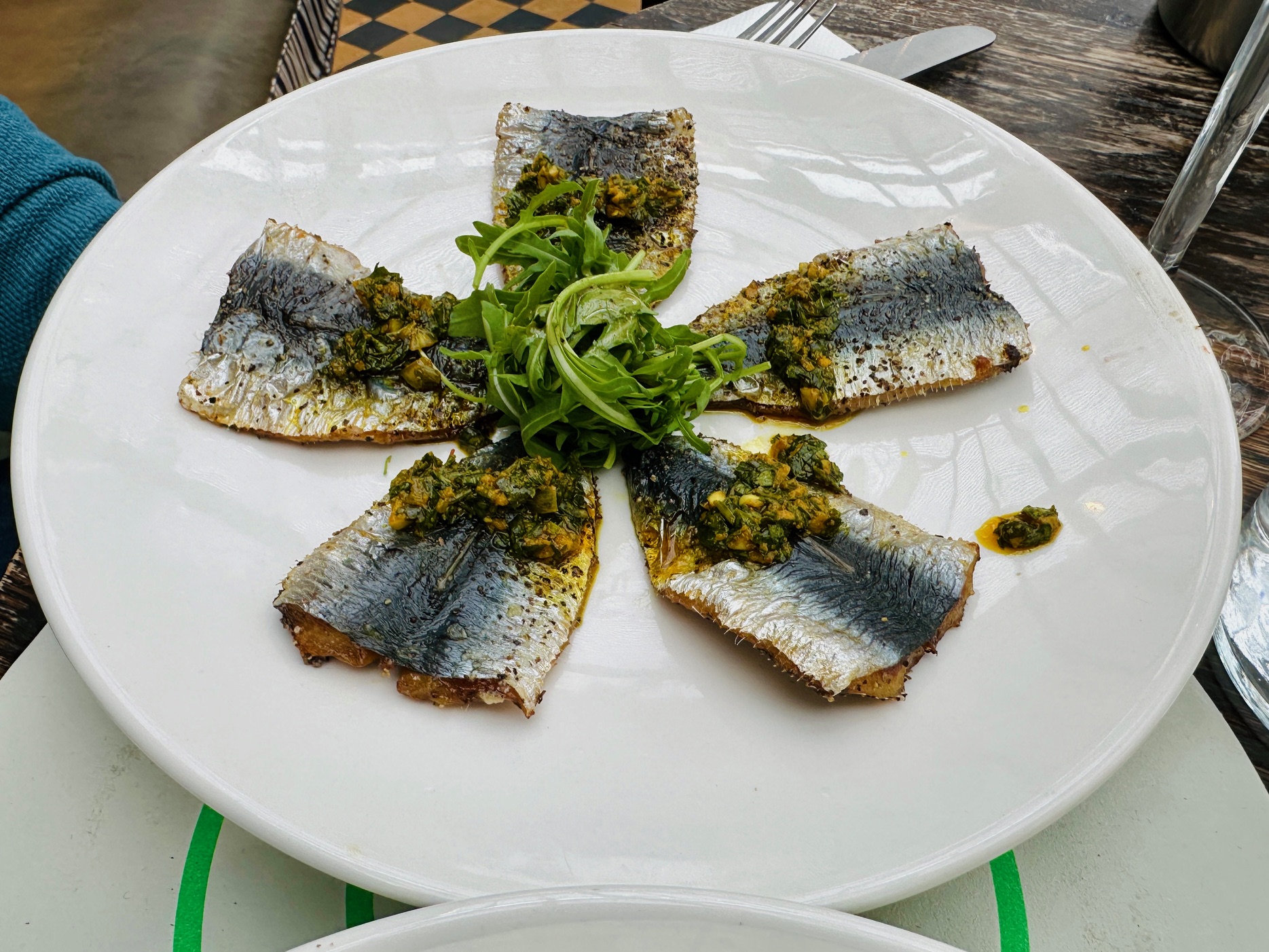
I try not to talk about value much in restaurant reviews these days: things cost what they cost, and restaurants need to make money. So for me to mention it, pricing has to verge on the egregious and, at twenty-two pounds, that’s why I’m bringing it up here. Here they are in their glory, all five of them. This, to me, looks like a starter. Is that all there is? you might ask. Where’s the tomato?

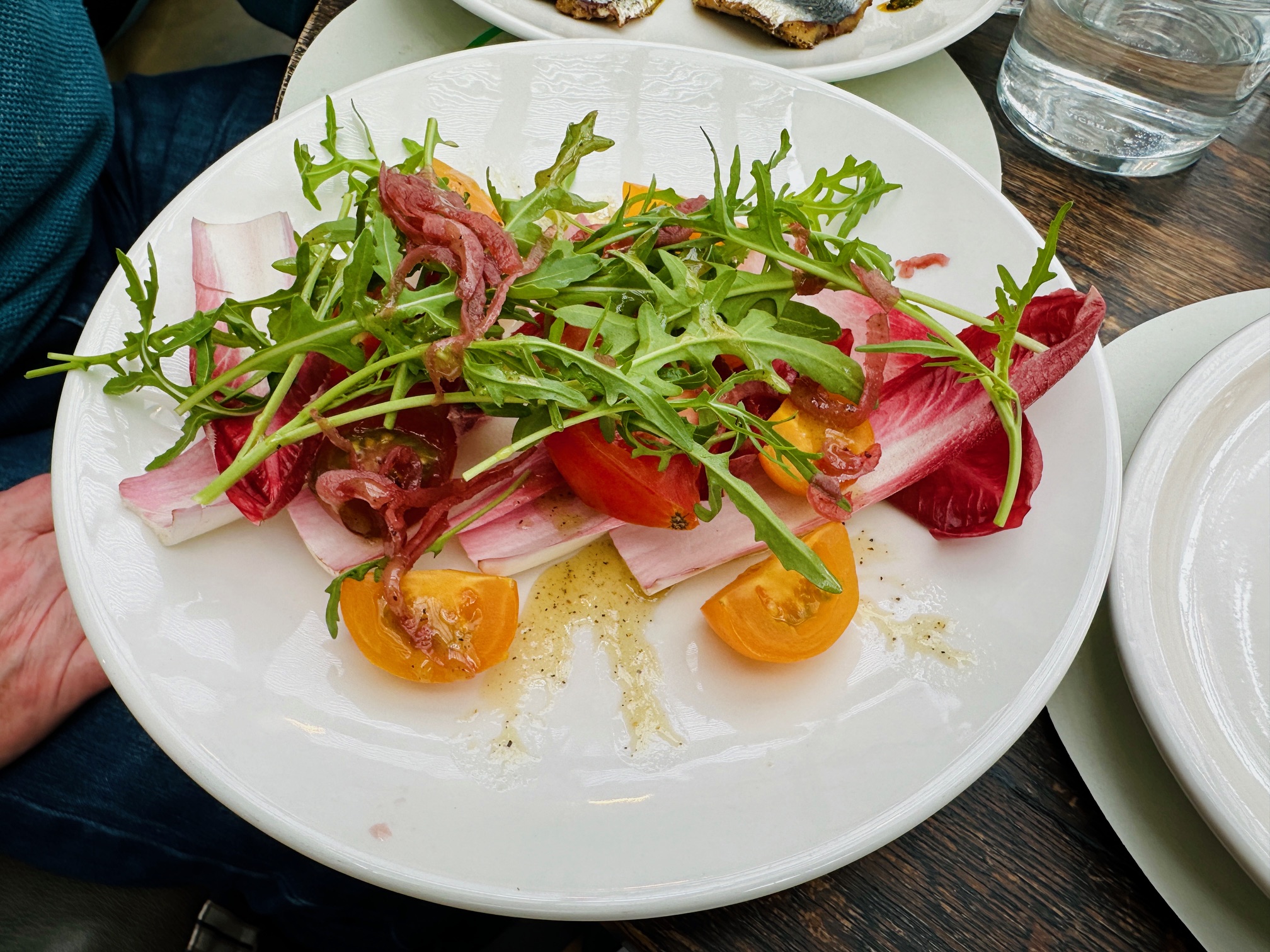
Well have no fear, because this dish – the generosity never starts – came with tomatoes and radicchio. Rocket, too, to match the rocket dumped in the centre of the Maltese Cross of disappointment that was those sardines. Double rocket, the treat nobody ever asked for: still, it beats pea shoots, I suppose. Why did the menu not mention that this was yet another salad? Was Gees just a glorified salad bar, and nobody had told us? Was it north Oxford’s upmarket tribute to Harvester, Gregg Wallace’s favourite restaurant? It was a puzzle and no mistake.

Yet I couldn’t help feeling that really we had just ordered exceptionally badly, because the dishes arriving at other tables looked more like actual food. A tall, substantial burger was brought to one of our neighbours, with a decent-looking portion of chips. Lamb cutlets piled high on a plate were put in front of the chap next to him, although in fairness they were on top of some little gem lettuce and peas. See? Another salad.

My main gave Gees one last chance to dish up something more convincing. And I’ll say this for my chicken cacciatore: it was not a salad. But it wasn’t great either. The pool of stretchy polenta was pleasant enough: I would probably always choose mash over polenta, but the menu clearly advertised it, so I couldn’t complain. And I did really love the sauce my chicken came in: rich with tomato, sharp with capers, studded with judiciously-cooked carrots and celery, a vegetable I always think is underrated in this context.

The chicken was the problem. I’m really partial to chicken thighs on the bone, but you have to achieve one of two things and ideally both. A crispy skin, if you can get that right, is a truly wondrous thing. But I would pass on that if the chicken is so well cooked that it flees the bone at speed, and breaks into strands. That’s when chicken thighs become properly magical. If Gees had achieved that the chicken, with that sauce and some of the polenta (if you must) would have made for splendid mouthful after splendid mouthful.

But to get both of those wrong, to have flaccid skin and firm, almost rubbery meat that needed to be prized away from the bone? That’s really not great. And to charge twenty-eight pounds for two undercooked chicken thighs that weren’t fit to grace the sauce they came in? Cheeky doesn’t even come close.

No side dish could rescue this sorry affair, though in Gees’ defence their braised leeks in feta and dill, served warm, were delightful. I’m no fan of dill, generally, yet I loved this dish and at six pounds it was better, and better value, than nearly anything else we ate. About the same size as those sardines too, come to think of it. It was a beautiful lipstick – applied to a pig, yes, but a beautiful lipstick nonetheless.

Would you have stayed for dessert? We nearly didn’t but felt like we had to see it through, like a disappointing box set. To Gees’ credit I asked who they bought their ice cream from and was told they made it in house. That probably swung it, and Jerry was delighted with his affogato, served with Pedro Ximenez.

I mean, again, if I’m being a stickler (which I am), if you swap the espresso for PX then what you have might be lovely but it’s no longer an affogato, just as the negroni wasn’t a negroni, the tonnato not a tonnato. Gees seemed to have taken Lewis Carroll, another Oxford type, very seriously when he wrote in Through The Looking Glass that “When I choose a word, it means just what I choose it to mean”. Words, salad, word salad: it was all the same to Gees. Let’s call the whole thing off.

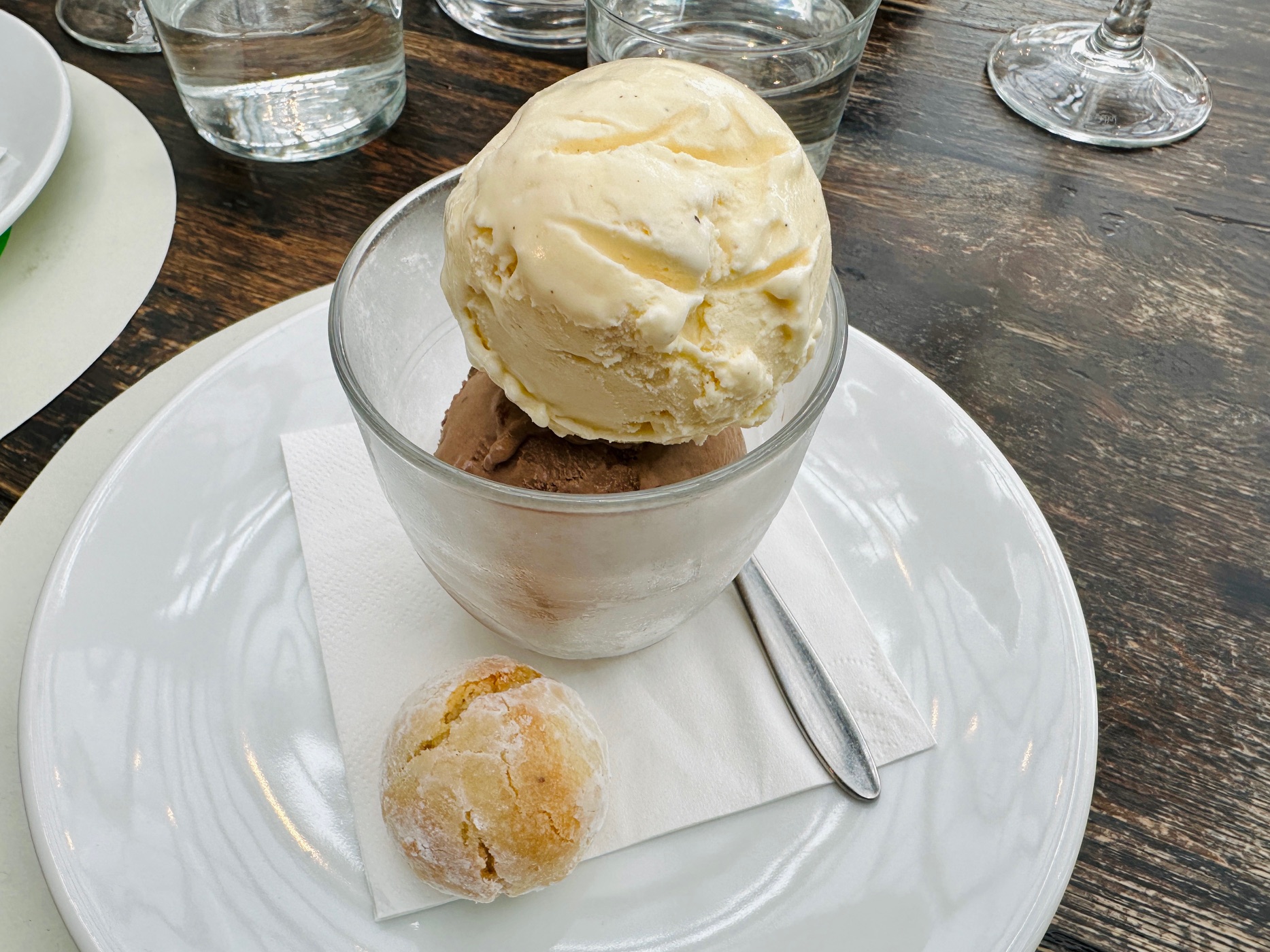
To close on a damp squib of faint praise, Gees’ ice cream is pleasant stuff. I tried vanilla and chocolate – don’t expect any leftfield flavours – and both were very good. Smooth, no ice crystals, plenty of specks in the vanilla and an excellent balanced depth in the chocolate. Two scoops for eight pounds didn’t feel like highway robbery, although it made the nine quid Gees charged for Jerry’s single scoop with a slug of Pedro Ximenez seem decidedly impudent.

What else is there to say? The whole meal, service included, came to two hundred pounds between the two of us, including an optional 13.5% service charge. The cognitive dissonance is strong in this one, because I had a lovely time and the best of company, the room is hard to fault and the service is excellent. You almost enter some kind of trance where despite the preponderance of foliage on the plate and the underwhelming nature of so much of what you eat, you still have a very nice time.

It was, food aside, as enjoyable a lunch as I’ve had this year. Just think how much of a riot we’d have had if the food was at the standard of somewhere like Upstairs At Landrace, a restaurant considerably more reasonably priced than Gees! And there’s the elephant in the conservatory, the question of cost and value. Because when the bill arrives the spell is broken, and you think about what a hundred pounds could buy you anywhere else.

I have to hand it to Gees because they are very popular and an awful lot of people have become very taken with the place. But unless we ordered very poorly, I do have to ask myself: how on earth did Gees manage that? I’m starting to feel bad for Jerry because whenever he comes out with me on duty, however nice a time we have, the food seems to be pricey and middling. Take Zia Lucia, or Storia in Maidenhead: the poor guy can’t catch a break. I will have to think much more carefully about our next meal out, because Jerry deserves some food as brilliant as he is.

To make amends, after we finished our lunch I took Jerry to the Rose & Crown on North Parade, my very favourite Oxford pub. We sat in the back room and polished off a couple of pints, and I told him how I used to drink there thirty years ago, and how it almost felt like it hadn’t changed a bit. A lovely international group – three French, one Slovenian – perched on the end of our table and we ended up in conversation about all sorts of things: the English; Brexit (always Brexit); where to eat in Montpellier; Oxford’s best restaurants, you name it. None of them mentioned Gees in that context, and I can’t say I blame them.

It was only later that I realised that the Rose & Crown, like Gees, has been under the same management since the Eighties, which means that those first drinks I had there, fresh out of university, were under the same landlords looking after me and my very good friend over thirty years later. That gave me a warm feeling in a way that nothing I ate that day managed, however lovely Gees seemed on paper. Forty years, whatever way you look at it, is one hell of an achievement, even in a city which has a track record of keeping establishments alive for many, many centuries. I am glad there are still institutions like Gees and the Rose & Crown in Oxford. But when I go back, only one of them is on my list for a return visit.

Gees – 6.5
61-63 Banbury Road, Oxford, OX2 6PE
01865 553540

https://www.geesrestaurant.co.uk

Since January 2025, Edible Reading is partly supported by subscribers – click here if you want to read more about that, or click below to subscribe. By doing so you enable me to carry on doing what I do, and you also get access to subscriber only content. Whether you’re a subscriber or not, thanks for reading.
Restaurant review: Taste Tibet, Oxford

Magdalen Road in Oxford is a 20 minute bus ride from the train station, out east, down the High and over Magdalen Bridge. It connects two of the three great thoroughfares of east Oxford, Cowley Road and Iffley Road, and you can walk from one end to the other in under 10 minutes. One side of it, at the Cowley Road end, is fairly unremarkable – a general store advertising Lycamobile, a letting agent, terraced houses of various vintages.

Only a huge shop called The Goldfish Bowl, advertising “EVERYTHING FOR THE FISHKEEPER” in big orange letters has even a hint of quirkiness. But then you reach the halfway mark, cross over to the Iffley Road side, and find yourself in Oxford’s most incongruous gastronomic microclimate.

Suddenly everything is very different, and both sides of Magdalen Road are full of independent outposts for food lovers. There’s Wild Honey, an “organic health store” advertising local produce, next to a little pink-awninged spot called The Magic Cafe. There’s a pub, The Rusty Bicycle, owned by the same group as Reading’s Last Crumb. Further down, there’s a little shop selling Scandinavian homewares – earthenware cups, sheepskin rugs, scented candles and room diffusers.

Just opposite that, plant-based café Green Routes stands next to Elle’s Deli, which used to be home to Oli’s Thai, for a long time Oxford’s most critically acclaimed restaurant (you had to book a table months in advance). The deli still serves Thai food, and people were sitting outside on a coldish Saturday morning eating it, but it also sells Superbon crisps, vermouth and jars of every kind of deliciousness from romesco to gochujang.

Travel a little further and you get to another cafe called the Larder, with attractive-looking loaves on sale in the window: again, on a day that wasn’t the warmest people were already sitting outside. And next to that, there’s the roastery for Oxford’s Missing Bean, who do some of my favourite coffee and supply to Reading’s Coffee Under Pressure. And then finally, at the southern end of Magdalen Road you reach the Magdalen Arms, which has long been one of my favourite places to eat in the city.

That little stretch of Magdalen Road seems to come out of nowhere, a strange and wonderful little oasis. Just imagine: in the space of five minutes, out in east Oxford, you can visit as many independent delis and cafes and bakeries as you can find inside Reading’s IDR. If anything, with its joggers and dog walkers, its air of bourgeois contentment, it was almost like a micro-Caversham.

At one point a mum cycled past me on some kind of cargo trike, a contraption with two wheels up front and a big box between them, her kid standing up in it and looking out on the world; the Cowley Road’s scruff and bustle was simultaneously a few minutes and a world away.

I found myself in this neck of the woods to check out Taste Tibet, a restaurant that’s been on my to do list for some time. It’s a no-reservations Tibetan restaurant, owned by married couple Yeshi Jampa and Julie Kleeman. They met in India, fell in love, and moved back to Oxford where Kleeman had a job with OUP. They started out running a street food stall over ten years ago, and during the pandemic they opened this spot on Magdalen Road. Since then success has followed, with a cookbook in 2022 and an honourable mention in that year’s Observer Food Monthly Awards as one of the best value eats in the South-East.

Not only that, but Taste Tibet also provides dozens of meals to vulnerable people in its community every week and its thoroughly charming website links with an excellent weekly blog, beautifully written by Kleeman, that is very frank about the challenges hospitality in general, and its little restaurant in particular, continue to face. I’d challenge you to read a couple of posts and not find yourself rooting for them: I certainly came away from it surprised by how invested I was in their project. As I got there at noon – because you can’t be too careful – Jampa was opening up and he cheerily told me to come on in.

The interior is a lovely, tasteful room but very much in a canteen style, which fits with the lack of reservations. Long tables and benches, which I imagine are communal at busy times, were like a posh reimagining of the furniture you find at every tap room in the land, but the overall effect was very pleasant. There were also seats up at the window, which tempted me, or facing the wall, which didn’t. Jampa told me to hang my coat up on the hooks, which I did at first, but given that the door was left open to attract passing trade I quickly changed my mind and put it back on.

The menu, which changes weekly, is up on a blackboard behind the counter, and many of the dishes are already cooked, in chafing dishes up at the counter. Taste Tibet cannily also offers frozen meals for its customers to enjoy at home, these are in a separate freezer near the front and are a clever way to make sure nothing is wasted. They also had a decent range of drinks, soft and alcoholic, including wines in cans. I was a little disappointed, as always, to see Brewdog as one of the options but I got myself a verbena-infused pale by Earth Ale, a little brewery just outside Abingdon, which I really enjoyed for its fresh citrus and slight bitterness.

On the day I visited, Taste Tibet was offering momo – four or eight, vegan or beef – and four curries, with a mix of sides. They also served a biryani, or a feast option where you got a couple of dishes, dal, rice and a solitary momo for about fifteen pounds. If that pricing sounds keen, it wasn’t unrepresentative -curries weren’t much over a tenner and rice only two pounds fifty. Sides clustered around the five pound mark and momo were four for eight pounds. I ordered some momo, a curry and rice: that, with a tip included, cost me thirty pounds. “I’m in no rush” I said, “so it’s okay to bring the momo out first and the curry after that.”

My momo came out five minutes later, and weren’t at all what I was expecting. Although momo apparently originate from Tibet rather than Nepal they’re so prevalent in Nepalese cuisine, and Nepalese cuisine is so prevalent in Reading, that I thought these would be a known quantity. And with that in mind, I thought four for eight pounds felt a bit steep. But Taste Tibet’s momo were a very different beast to the ones I’ve eaten at Sapana Home or Kamal’s Kitchen.

For a start, they were big: impossible to eat in one go, and challenging even in two. Crimped like jiaozi, they were steamed and made with dough that was thick verging on too thick, but that gave them structure and a pleasing, carby solidity. The beef inside – beef, not buffalo, although whether that’s the difference between East Oxford and Reading or Tibet and Nepal I couldn’t tell you – was properly lovely, coarse and delicious.

This came with a little handful of leaves whose main function was to serve as a bowl for a red sauce which was apparently a home-made chilli sauce: I found it a little meek. But what I did love was the bowl of a darker dipping sauce with a kick of soy. Again, I wonder if that’s the influence of Tibet, because I’ve never had Nepalese momo served with that, and it really did make me see the momo in a slightly different light. I can see the appeal of coming to Taste Tibet, as I used to with Sapana Home, and just going to town on the momo.

Later on, as I came to the end of my meal, couples and families were braving the outside tables and I saw big plates of momo going past on their way to the little terrace. Perhaps that was the way to do this place, or to come with a big group and try everything. One of the reasons I hadn’t ordered the “feast for one” was the presence of that single momo. It felt stingy, but looking at what had been put in front of me one would have been plenty, paired with an exploration of more of the menu.

My request that my curry come out after my momo had been taken a little too literally. Perhaps I should have said “after I’ve finished my momo”, although I didn’t think I’d needed to, but instead the rest of the meal arrived when I was halfway through what I thought was my starter. Really, though, that was me misjudging the place and its similarity to a canteen rather than a mistake on the restaurant’s part. Everything is there ready to dish up, and if you order something that’s exactly what they will do.

I had chosen Taste Tibet’s “famous chicken” because I took famous to mean signature, and I figured that if I was visiting a restaurant on my own I owed it to myself to check out the signature dish. And having eaten it I suspect it’s the restaurant, rather than the chicken, that is famous. It was a big portion with plenty of chicken, plenty of sauce. The chicken was all good and tender, and it was impossible to take exception to the dish.

But although not being offensive is a good thing, being inoffensive isn’t, and that’s what this was. Perhaps if my expectations had been lower I would have seen this as a comforting bowl of food, and celebrated what it was rather than noticing what it wasn’t. But this was like curry from a bygone age, before we got into regional food, started to discover the difference between Kerala and Hyderabad. It felt a bit like a Vesta curry, from forty years ago, and for something famous I expected more: I expected it to be famous for something.

How to make it more interesting, I wondered? I tried spooning in my perfectly cooked basmati rice – Taste Tibet serves both curry and rice in bowls that are just big enough for each, rather than giving you a plate to dish them up onto – but that bulked it without being transformative. I tried adding a spoonful of the dried chillis in a ramekin out on the table, but it lent an acrid pungency without elevating anything. The difference in heat levels was like the difference between sleeping on one pillow and two, going from not enough to too much.

I didn’t want to leave it like that, and I fancied dessert, so I went up to order the only thing on the blackboard that looked like afters. Chocolate tsampa truffles – as seen on TV! sounded absolutely like my sort of thing, and only cost three pounds. I was too full to have the chai that should have accompanied it, but never mind. 

By this point the restaurant was far fuller, with people taking tables outside and the long table opposite me occupied by a group of impossibly young, animated east Oxford types. I looked on them indulgently, remembering a time over thirty years ago when that could have been me: not that I would have had the money to eat in a place like this.

Positively 4th Street was playing over the speakers, and I remembered that thirty years ago I loved that song, and suddenly it was back in vogue. Time can play unkind tricks, and all the things that made me so deeply unfashionable as a student – being a geek, listening to Bob Dylan and Leonard Cohen, playing chess and Dungeons & fucking Dragons – are acceptable now, too late for me. Even some of the shit I wore back then might be in now, I thought.

I felt a little tug of envy and regret, and then I let it go. It was as close to Buddhism as I got in Taste Tibet.

The chocolate tsampa truffles, plural, turned out to be a truffle, singular. A big thing designed, like the momo, to be taken on in multiple bites. I enjoyed it and, again, it wasn’t what I thought it would be. Its texture wasn’t dense or glossy, being more gritty with a feel of granulated sugar to it. Again, that’s down to me for misunderstanding – tsampa was not something that flavoured the truffle, but instead is a kind of flour made from ground, roasted barley, so it was the thing lending that texture.

In any event, the truffle reminded me of the brigadeiros at Minas Café, and I liked it without entirely understanding it. That’s fine, by the way: now I’m in my fifties I realise that provided you like things you don’t always need to understand them.

The rest of my day in Oxford was positively joyous. I stopped at Missing Bean, which was absolutely packed, to buy beans for the weeks ahead; I’m drinking a cup of their coffee as I write this. I strolled down the Cowley Road, past its plethora of Turkish restaurants, past the now closed Gamekeeper that used to meet all my Dungeons & fucking Dragons-related needs as a teenager.

I stopped in Truck Records to get inspiration, I stopped in Peloton Espresso to get caffeination. I bought cheese in the Covered Market, had time for a beer in Tap Social before my train home. It really is a gorgeous city, and it says something about the place that Magdalen Road is one of its little oases but far from its only one.

As you may have gathered by now, although I liked Taste Tibet I wanted to like it an awful lot more than I did. And a bit of me wonders if I’m the one in the wrong. It is a gorgeous spot in a gorgeous neighbourhood in a gorgeous city. It has a great backstory, is clearly loved by the community it’s part of and does tireless and admirable work to support that community. It is run by a committed husband and wife, where he works in the kitchen and she advocates, powerfully and eloquently, online and in the media. They want to tell the stories of where he comes from, through food.

On paper, I should love it: it sounds like other restaurants I love, closer to home.

But perhaps that’s okay. Perhaps Taste Tibet makes perfect sense in its context, in that city, on that little stretch of food and drink heaven. Maybe it doesn’t need people like me travelling to and across Oxford to try it out. It’s a neighbourhood restaurant – its neighbourhood is lucky to have it, and it’s lucky to have found its place in things.

If I lived closer I’m sure I would go back, try other dishes, fill my freezer and become part of their story, as they would become part of mine. But other places have got there first, for me at least. My train home pulled in at Gare du Ding and I thought about Kamal’s Kitchen, my favourite Nepalese restaurant, a short walk from the northern entrance to the station.

Its dining room doesn’t have the stripped-back elegance of Taste Tibet, it doesn’t have a narrative the way Taste Tibet does. I think Kamal and his family do a magnificent job, but much as I’d love them to I can’t imagine them gracing the pages of Observer Food Monthly. They don’t write beautiful blog posts, they have no plans to produce a cookbook that I know of and they won’t be at Hay Literary Festival this year. They let their food do the talking, and for what it’s worth I think their momo beat Taste Tibet’s. A restaurant can succeed in so many ways, but food and service are always king.

Magdalen Road in Oxford is a really fantastic place, and I do dearly wish Reading was a little more like it. But I wouldn’t swap their restaurant with ours.

Taste Tibet – 7.0
109 Magdalen Road, Oxford, OX4 1RQ
01865 499318

https://tastetibet.com

As of January 2025, Edible Reading is partly supported by subscribers – click here if you want to read more about that, or click below to subscribe. Whether you’re a subscriber or not, thanks for reading.
Restaurant review: Branca, Oxford

This probably isn’t something I should admit but even now, after nearly twelve years doing this, I’m not always the best judge of which reviews will and won’t prove popular.

I mean, some obviously do well: you all tend to want to know about the new openings and the big names as soon as possible, something I’ve been trying to get to quicker over the last year. And I know from my trips to the likes of TGI Friday and Taco Bell that if it looks like I’m going to have a bad time, you tune in. I don’t take that personally – everyone likes a hatchet job and we can all derive vicarious pleasure from the suffering of others at times.

Beyond that? I have a vague idea at best. Sometimes I can write up a lovely independent place in the middle of town and – well, there aren’t crickets, but it doesn’t go gangbusters in the way that a Siren RG1 or a Rising Sun might. And other times the success of a review takes me completely by surprise.

Take Gordon Ramsay Street Burger, for instance: I didn’t think that many of you would especially care what it was like. On the run up to my visit, I wasn’t even sure I especially cared what it was like. And when I went I found that it was perfectly serviceable, the kind of place you might quite enjoy if you lived in a town without Honest Burgers. Little to write home about all round, you might think, and yet it was my most popular restaurant review of the year: me having a fair to middling time at a big chain in the Oracle. Go figure.

I actually think this might be for the best, that there’s no crystal ball. Because it would get tempting just to write the crowdpleasers, and that would skew the kind of places I go to and the kind of meals I seek out. And part of my – let’s call it a job, just for the sake of argument – job here is to highlight all kinds of establishments.

The ones you know about, but also the ones you don’t. The ones you would never consider going to in a million years, or walk past thinking “I wonder what that’s like?” And the ones you may well have already been to, probably in the first month after opening, before I get round to them. If you always have a pretty good idea what, or where, is coming next then something’s probably gone wrong.

One of the impressions I do get, though, is that collectively speaking you’d like to see more Oxford reviews. I can see why: it’s only half an hour away by train and is almost the anti-Reading. It has everything Reading lacks, yet lacks all the stuff Reading has got. No widespread craft beer, but lots of handsome old boozers, the kind Reading has gradually lost. No street food, but a covered market and cheesemongers and delicatessens galore.

A big shopping mall, yes, but a completely different kind that attracts the chains that Reading still just doesn’t get. More independent retail and two independent cinemas, but crap buses. Better bookshops, but nothing like the Nag’s Head. Did I mention that it also has the Oxford Playhouse, which for all its charm South Street can’t quite match? Anyway, add the two together and you would have the perfect large town slash small city; Oxford even has a couple of universities, would you believe.

All that makes Oxford the perfect place for a weekend lunch or dinner, especially coupled with mooching, shopping, drinking coffee and people watching. So every time I put an Oxford review up it does pretty well, and I get the impression – perhaps wrongly – that you might like to see more of them. My first visit to Oxford on duty was to one of my favourite Oxford spots, The Magdalen Arms on the Iffley Road. I had a lovely time, as I expected to, and resolved to cover the city more often. Two and a half years later, I’ve written the grand total of five reviews of Oxford restaurants: time to pull my socks up.

So last weekend Zoë and I were in Oxford, on her Saturday off, and I had booked a table for two at the Oxford restaurant I’ve possibly eaten at more than any other, Branca. It’s a sort of Italian brasserie – or would be if such a thing isn’t two different kinds of cultural appropriation – and had been trading on Walton Street in Jericho for over twenty years.

And that means that, like Pierre Victoire just round the corner on Little Clarendon Street, it’s part of an elite club of restaurants that have been an ever-present in my dining life. The only thing even comparable in Reading, now that Pepe Sale is gone, is London Street Brasserie, and that tells its own story, that Oxford can hang on to these places when Reading can’t.

It helps that Jericho is such a lovely part of Oxford, less than twenty minutes’ walk from the train station but a world away from both the town and gown of the city centre. It’s all nice cafés and bars, pubs tucked away on sidestreets, the Phoenix cinema where people, me included, queued round the block to see Four Weddings thirty years ago, watering holes like Raoul’s and Jude The Obscure that feel like they’ve been there forever.

I lived in Jericho, for a strange and surreal year halfway through the Nineties, and I didn’t appreciate how gorgeous it was at the time. And now it’s so gentrified that I could never afford to do so again in this life I am struck with brutal clarity by what a terrific part of the world it is. Isn’t it always the way? Never mind. Sitting in Branca, menu in front of me, soaking it all up I could kid myself, for a couple of hours at least, that this was my place and these were my people. Good restaurants, apart from providing you with great food and wonderful drink, have a knack of giving you that, too.

In the years since it opened Branca has expanded into next door, turning it into a cafe and deli more than capable of improving your cupboards and denting your wallet. But the dining room is as it always was, a tasteful if cavernous space.

The tables nearer the front, close to the bar, are nice enough but if you can get one at the back you’re treated to a beautiful room with marble-topped tables, exposed brickwork, what looks like a Bridget Riley on the wall. There’s a view out into their courtyard through full length-windows, and the light in general is quite magical, helped by a skylight and clever use of mirrors. Even on a dreich February day it felt like spring was in touching distance.

This isn’t the criticism it might sound, but Branca’s is simultaneously the biggest and smallest menu I’ve ever seen. Big as in physically big, a one-sided sheet of something like A3 that lists everything they serve. But when you delve into the detail, it’s compact: four starters, a couple of salads, three pasta dishes, four pizzas. Four mains, a burger and a steak and a couple of specials. I felt like I had just enough choice, although if I’d fancied either of the specials I wouldn’t have felt constrained at all.

As it was, this was just on the right side of the border between streamlined and narrow. Starters clustered around the ten pound mark – don’t they always, everywhere, these days – while mains were more scattergun. A pizza was about sixteen quid, with the exception of the sirloin steak the mains stopped at twenty-five. If I hadn’t eaten at Branca before I think the menu would still have inspired confidence, that it was aiming to do fewer things better, but they’d already proved that to me time and time again.

Before any of that, a negroni apiece and some of Branca’s focaccia, which they’ve been dishing out free of charge to diners for as long as I can recall. The focaccia was great stuff, airy and speckled with salt, oily enough to make your fingers shine even before you dipped hunks of it into oil and balsamic vinegar. It made me happy to start a meal in the same way as I always had, knowing that it pretty much always presaged good things. Branca played it straight down the middle with its negroni: no fancy curveballs, just Gordon’s, Campari and Martini Rosso. It was a good reminder that stripped of any whistles and bells, the cocktail just has good bones.

Another reason I’ve always liked Branca enormously is the wine list, and more specifically that they do something so few restaurants in the U.K. do: the majority of the wines on it, around three quarters in fact, can be ordered in a 500ml carafe. So we did that and had a New Zealand sauvignon blanc for thirty quid, which was downright lovely. I got kiwi fruit and gooseberry, Zoë got a hint of melon and, for an hour or so, we managed to kid ourselves that we got wine. We became a little bit more North Oxford with every passing minute.

Most of Branca’s starters are probably a nod to the excellent deli next door: with the exception of the soup they largely involve buying well rather than cooking well. Zoë is an expert at the third part of that triumvirate, ordering well, and she had the edge with her burrata on sourdough, served with olives and cherry tomatoes. Up to a point this is something you could rustle up in your own kitchen, and we often do come summertime, but the transformative element here was a cracking red pesto. Try doing that at home seemed to be the implication and no, I wouldn’t even attempt to.

My starter left me feeling a little deceived. It was described as bresaola with a fennel, rocket and radish salad, and that description made me think it would be a cornucopia of cured beef with a little bit of greenery on top. Just how hoodwinked I had been became apparent when our server – who, I should add, was superb from start to finish – came to our table.

“Who ordered the salad?”

Neither of us, I hope I wanted to say to him, but I realised as he set the plates down that this was exactly what I had unwittingly done. And, truth be told, I felt a little conned. Three pieces of bresaola – I would say “count them”, but that didn’t take long – buried under an ambuscade of foliage is, to be honest, a salad. You can’t roll that in glitter: it is what it is. And eleven pounds for a salad and three pieces of beef felt like it could slightly mar my long and happy relationship with Branca.

And maybe it would have done but damn them, it was lovely. I always regret using the adjective “clean” to describe dishes or flavours because, like “dirty”, it’s a dimension that really shouldn’t feature in stuff you stick in your gob. So instead I would say that this was subtle, unfussy and refined, that every flavour in it was distinct, well-realised and harmonious.

Rocket seems to get a lot of stick these days but I still like it, especially compared to the twin horrors of pea shoots and watercress, two of the most pointless green things in creation. The quantity of excellent Parmesan chucked on top felt like it was by way of apology for the whole salad thing. Everything was so well-dressed and well balanced that I decided I could forgive Branca, just about. The eleven quid still felt a bit cheeky, although mainly I just wished they’d chucked some of that red pesto into the mix.

Conscious of a few recent experiences where we’d been rushed, Zoë decided to have The Conversation with our server as he came to take our empty plates. We were having a lovely time, she told him, and were really in no hurry so could they wait a while before bringing our mains? And he was brilliant with that, feeding that back to the kitchen and then coming to check with us, something like twenty-five minutes later, if we were ready for what came next.

I can’t tell you how welcome that was, that a restaurant understood how to put the brakes on. And it really helped to make me appreciate Branca all over again – the room, that light, the chatter from neighbouring tables, that feeling that there was no rush to go anywhere or do anything that comes from a proper, leisurely lunch. Saturdays with Zoë have been at a premium recently, so I felt glad this one was far from squandered.

By the time my main came, I was ready for it, and it helped that it was a treat from start to finish. Rigatoni, giant corrugated tubes of comfort sagging under the weight of their own carbiness, came interlaced with sticky strand after strand of a long-cooked duck ragu. It may not have clung to the pasta, but it was hidden away under every single layer, a glorious, indulgent beast of a sauce.

That along would have made me almost delirious with joy on a winter’s day, but carpeting the whole lot with the crunch of herb and pecorino pangrattato and then leaving a bowl of grated parmesan at the table for you to use as unsparingly as your heart desired? I’d won at lunch. There was simply no question.

Of course, as anybody who’s married knows, you only really win at lunch if your dining companion wins too. So I was glad that Zoë, picking the other dish that jumped out from the menu, was as happy as I was. A colossal slab of pork belly, all fat rendered beautifully, would have been worth the price of admission alone. Add in a deeply savoury jus, an enormous quenelle of root vegetable mash, some firm but delicious tenderstem broccoli and a couple of crispy straws of crackling and you had a dish that could redeem the month of February single-handedly.

And the final element, the icing on the proverbial, was a salsa verde that supplied the zip and verve that stopped this all being a bit too much. Like the red pesto, a little went a long way. It also highlighted, again, that the kitchen had decided to do a few things to the very best of its ability rather than produce a bloated menu that lost its way.

“This is the first Lyndhurst-style dish I’ve had since the Lyndhurst closed” said Zoë, and I knew exactly what she meant. Very few people cooked pork belly as well as Sheldon and Dishon at the Lyndhurst, and this was the first time I’d eaten somewhere that reminded me of that. The room couldn’t have been more different, and the menu couldn’t have been much more different either, but there was that thread of brilliant hospitality that connected a restaurant I’ve loved for years and a restaurant I’ve mourned for nearly twelve months. It was nice to be reminded of it like this.

Branca’s dessert menu was also compact and really, when you stripped away the padding, it was four desserts and a range of ice cream; I’m happy to accept that a chocolate brownie classes as a dessert but things like affogato, chocolate truffles or – as was the case here – Pedro Ximenez poured over vanilla ice cream don’t really count. I found the dessert menu the least exciting bit, with most of it reminiscent of London Street Brasserie, so of course I gave Zoë carte blanche and she picked the dish I’d most likely have chosen, the chocolate nemesis.

She was very happy with it, and I daresay I would have been too. It was a tranche of deep, fudgy decadence, festooned with cocoa and squiggled with sauce, pistachio ice cream on the side. It was exactly the kind of dessert Zoë has been ordering since she first started ordering desserts many years ago, and it did not disappoint. It happens to be exactly the kind of dessert I too have been ordering, for ten years longer than her.

“It looks great” I said, which is usually my attempt to get a spoonful. “Is the texture more like a fondant, or a ganache?”

“It’s more like a brownie” said Zoë. There was to be no spoonful.

I’d asked where Branca got its ice cream from, half hoping they bought local from legendary ice cream parlour George & Davis, round the corner. They didn’t, and instead it was from Purbeck, a maker I don’t think I’ve tried.

My benchmark for these things is Jude’s – I’m still up in arms about Nirvana Spa swapping them out for the kind of stuff you get in the interval at the theatre – but I would say the ice cream at Branca came close. The chocolate was deep and smooth and studded with chocolate chips and the salted caramel was actually salted caramel with more than a hint of salt, rather than an attempt to rebadge something that’s either butterscotch or has tooth-shattering chunks of solid sugar in it. It was a fitting ending to my latest, but by no means my last, meal at Branca.

The best part of a couple of hours after we took our seats, it was time to settle up and sally forth into the streets of Jericho. Our bill for two came to just under one hundred and fifty-five pounds, including the 12.5% service charge, and paying it I thought that Branca was one of the safest bets I know of in the world of restaurants. I suppose after more than two decades it should be, but then I also remember the dwindling handful of Reading restaurants that have been here that long – places like Quattro and Sweeney and Todd – and realise that I’ve never had even a fraction of the affection for them that I do for Branca.

The rest of our afternoon, fortified by that lunch, was idyllic. We stopped at the Old Bookbinders, a ludicrously pretty backstreet boozer, for a quick half and thought that we needed to come back to try the small, perfectly formed French menu they happen to offer. We snuck into St Barnabas’ Church and gawped at the wonder of this little basilica, plonked in the middle of Jericho. We browsed paperbacks at the Last Bookshop, bought phenomenal cheeses in the Covered Market and stopped for a pre-train beer at Tap Social, wanting for nothing except a mobile signal strong enough to allow access to Untappd.

Oxford was at its finest that day, and I had that thought again: I need to come here more often. Yet the thing that really made all of that, you see, was Branca, and a reunion with an old friend of a restaurant. Lots to catch up on, but the news – getting married, moving house – was all mine. Because Branca was as it always is: classy, fetching, welcoming and utterly, utterly reliable. I’m glad I finally got round to reviewing it, and even gladder that I caught it on a day when it was very close to its best.

But if it hadn’t been, with nearly twenty years of history, I probably would have let it off. Because after all, how many restaurants can you say you’ve been going to for twenty years? I used to have more, but the ones in Reading have a habit of closing. Oxford can hold on to its institutions better, I think. But given the institutions that have been defining Oxford for nearly a thousand years, is that really a surprise?

Like I said at the beginning, I can never tell which of my reviews will do well. But I liked Branca so much that all of that feels immaterial: and that, to me, is the best reason there is to write a review.

Branca – 8.6
111 Walton Street, Oxford, OX2 6AJ
01865 807745

https://www.branca.co.uk

As of January 2025, Edible Reading is partly supported by subscribers – click here if you want to read more about that, or click below to subscribe. Whether you’re a subscriber or not, thanks for reading.