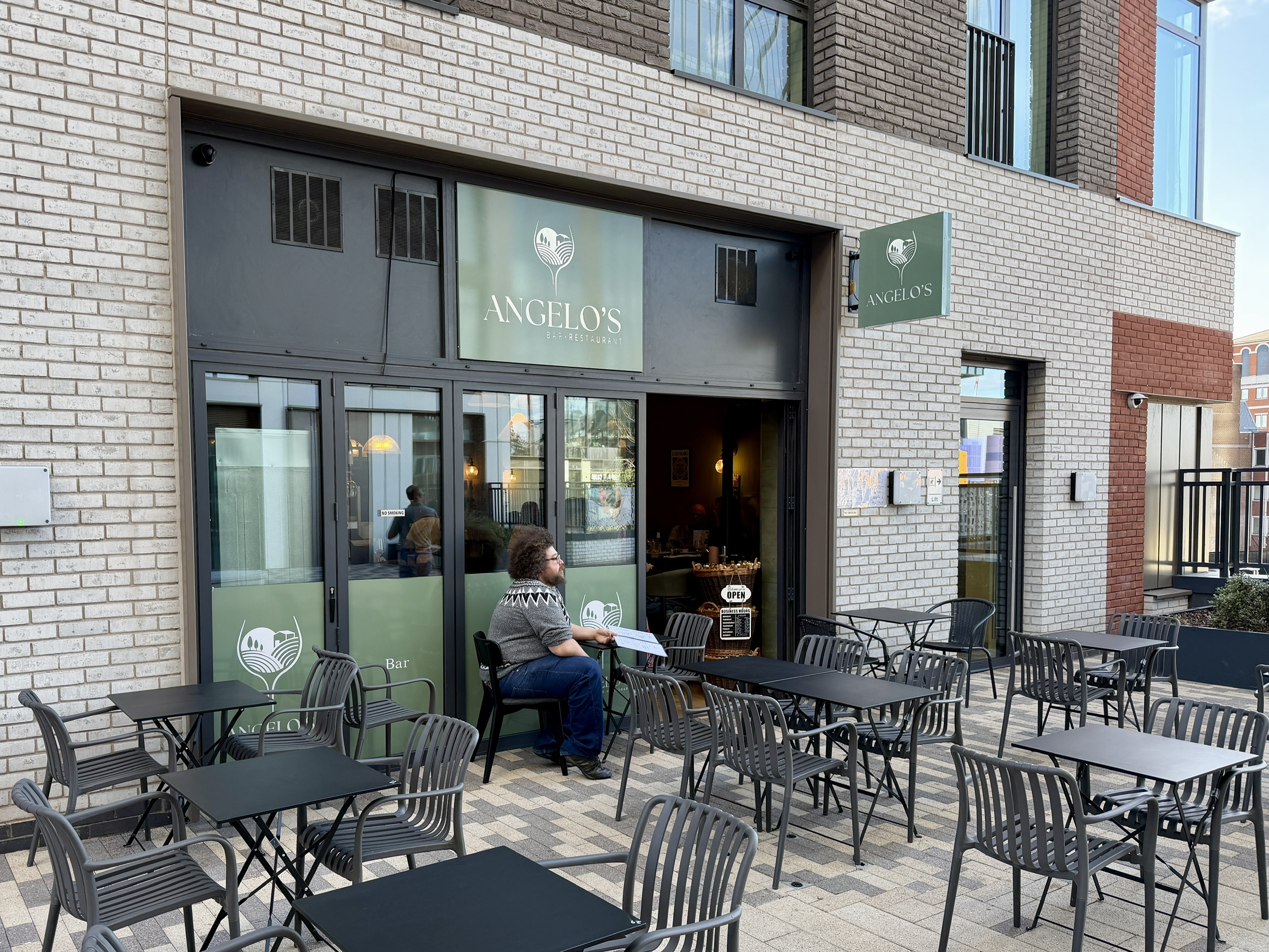
Restaurant review: Angelo’s

Have you been to Angelo’s, the new Italian restaurant in the town centre, yet?

And have you been asked whether you’ve been there yet?

The thing is, people keep asking me if I’ve eaten there, to the point where it seems like Angelo’s is the only Reading restaurant anybody is interested in. I had a readers’ lunch at the Moderation a couple of Saturdays ago and I was asked so many times I lost count – although it was a pretty boozy afternoon, so that just means “more than three times”.

Not only that, but many of the folks asking me already had an opinion: pretty ordinary, said one person that afternoon, unmoved by the wild boar ragu. Really rather good was another verdict, also delivered at the readers’ lunch. And don’t think you have to have been in order to pitch in: I saw some pictures earlier and thought ‘I can do better than that at home‘, one of my readers told me on Instagram. 

That felt like a bit of a slap across Angelo’s figurative face: I mean, I can do better than Cozze at home, but that says more about Cozze than my talents in the kitchen.

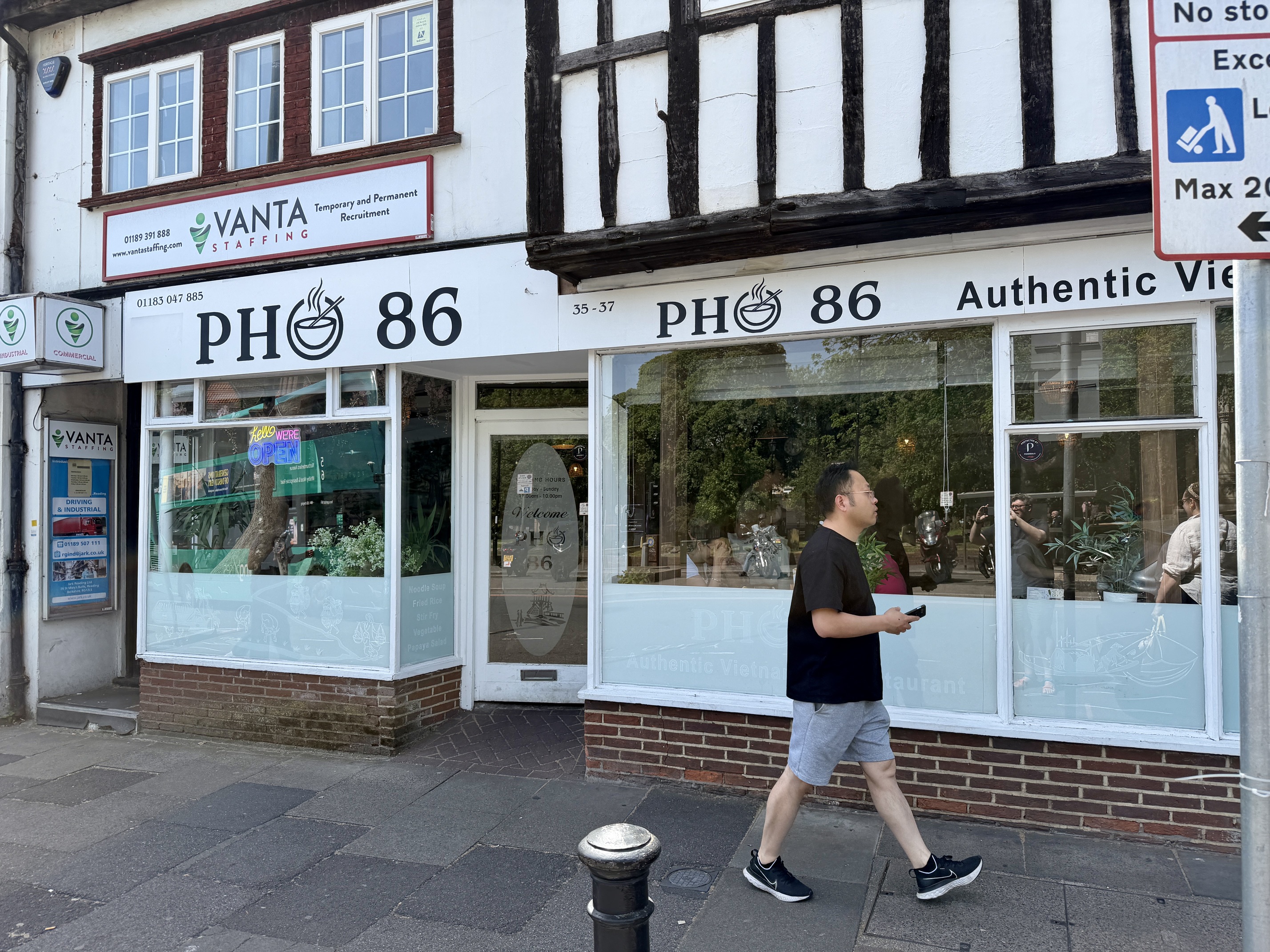
It’s easy to understand, though, why Angelo’s is such a big event. In 2024 the biggest openings of the year were the Rising Sun and Siren RG1, a chain trying to look like an independent and an independent with all the polish of a chain. Both were underwhelming at best. Last year, the headlines were grabbed by Rosa’s Thai and Cosy Club, desperately middling middle of the road fare for Reading’s middle classes, with Nua and Pho 86 quietly flying the flag for new indies in the town centre.

But this year? Unless you’re very excited about Shake Shack – in which case I’m afraid you’ve come to the wrong place – Angelo’s is not only the most interesting thing to open in the town centre but, in truth, the only interesting thing to open here. It’s shiny and new, it’s very central on the Station Hill development and it’s independent: the owner is also behind Ruchetta in Wokingham, which has also now been rebranded as Angelo’s. Although he’s doubtless sunk a lot of money into this high risk endeavour, there appears to be no venture capital involved.

That would be enough to make it worth checking out, but it’s also the kind of restaurant many people think Reading is sorely missing: an Italian restaurant. Not a specialist pizza restaurant like Zia Lucia, not a place that only does pasta like London’s trendsetters Padella and Bancone, or Maidenhead’s pale imitation Sauce and Flour. And not an entry level defroster like Prezzo, Zizzi or Bella Italia, either: a proper Italian restaurant. The kind we haven’t had since we lost San Sicario, the kind we were blessed with for decades when Pepe Sale was at the height of its powers.

It helps that Angelo’s kept us waiting. They signed a lease last April, and everybody expected them to open before the New Year. But due to unspecified delays an opening date never materialised; the infrequent updates on the restaurant’s Instagram page gave more of a sinking feeling than a growing sense of excitement. Finally, they opened at the end of June and the early signs were not encouraging. A very minimalist website was one thing, but a menu strewn with more typos than AI slop – who knew there were so many ways to misspell ‘mozzarella’? – was another altogether.

Fortunately both have now been amended, but Angelo’s still feels slightly like it’s fixing things as it goes along: at the time of writing it’s walk-ins only for tables of fewer than six people, and the phone number has only just been added to their Google listing. All of that, though, can add up to creating a feeling of demand – it’s good to make people work for it, sometimes – and when Zoë and I sauntered up just after six on a Thursday evening all but a couple of tables inside were already occupied.

The space is neat and compact. There’s a front section with high tables and a bar that maybe sits ten or so people, and then a dining room out back which can accommodate twenty. It was tasteful, if maybe a little lacking in character, although I liked the little booths and teal banquettes.
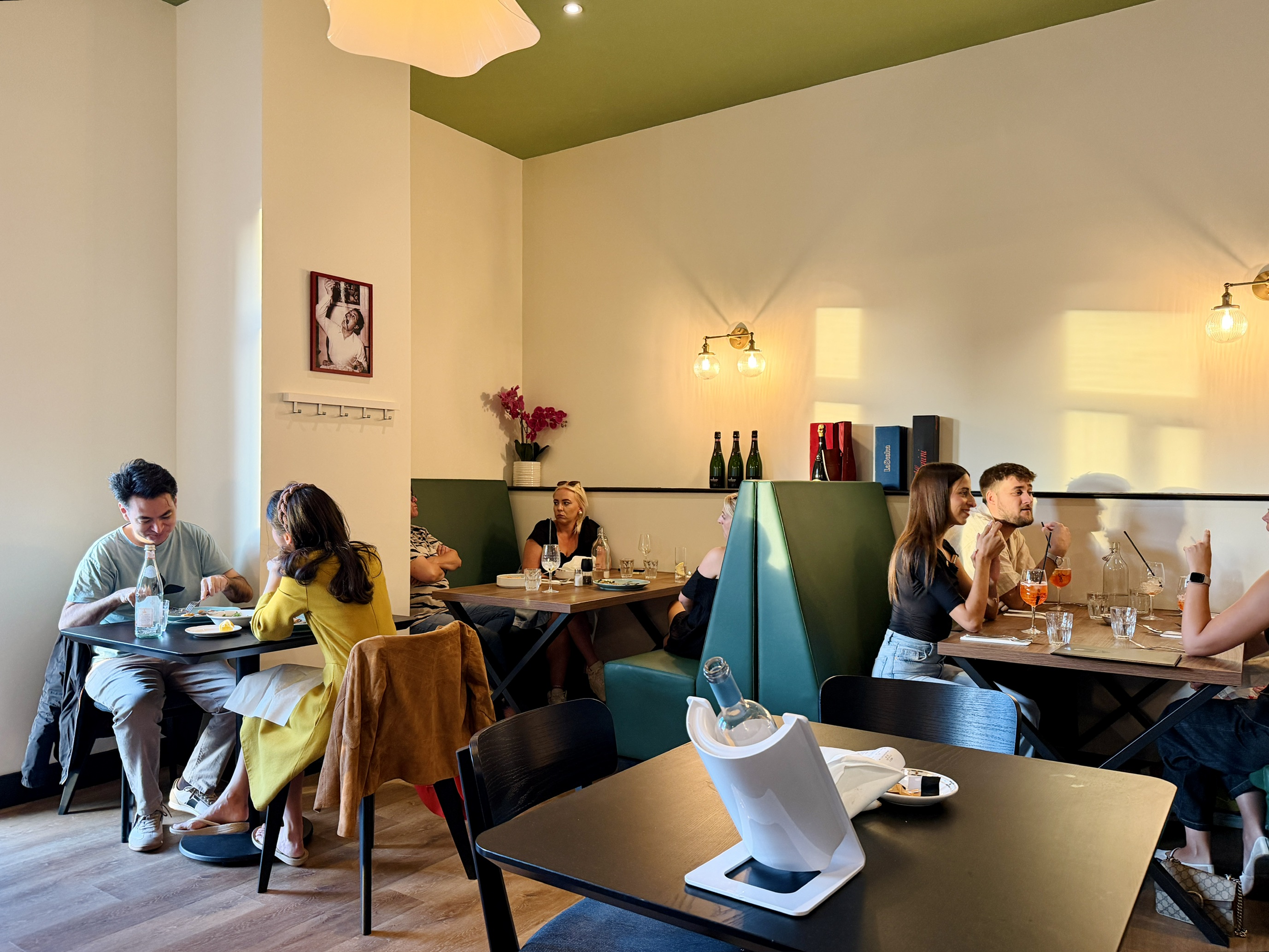
But the restaurant had the best accessory of all: customers. On one side of me a pair of happy friends were catching up, on the other a group of three was having an absolute ball, all loud and infectious laughter. From my seat I could see out the window across Garrard Street, to a part of town that used to look so very different. I liked this space, fashioned out of nowhere. It reminded me a little bit of Me Kong.

Angelo’s menu bore little resemblance to the typo-strewn mess that first appeared online, in more ways than one. First, it was cleaner, professional, read very well. Secondly, and this is a little strange, the points of difference were more than mere spelling errors – perhaps ten dishes have survived from that original menu, just over a month ago, and the remainder have been replaced. Was the initial menu a beta test that should never have seen the light of day, or had the restaurant already figured out that some of its dishes didn’t work? 

The other big alteration was the deletion of pizza: Angelo’s original menu offered eight, this one had removed them entirely. I think I read somewhere that this was the consequence of necessity, but I rather hope they have the courage of their convictions and stick to it: Reading has plenty of places to get pizza, but next to nowhere to get good pasta or antipasti. The menu I ordered from that night filled a yawning gap in the market – pizza, however well done, might dilute that.

Even truncated, it represented a good and interesting range, of both options and price points. The ten starters ranged from £7 to £15, and the dozen or so pasta dishes were almost uniformly between £16 and £18, unless you were itching for the black fettucine with seafood. A relatively modest six secondi were pricier, starting just below the £20 mark and marching north from there, but even so nothing seemed extortionate or unreasonable. I had loved Ruchetta when I went there on duty in 2014 but, even then, its dishes there were about as expensive as those on Angelo’s menu twelve years later.

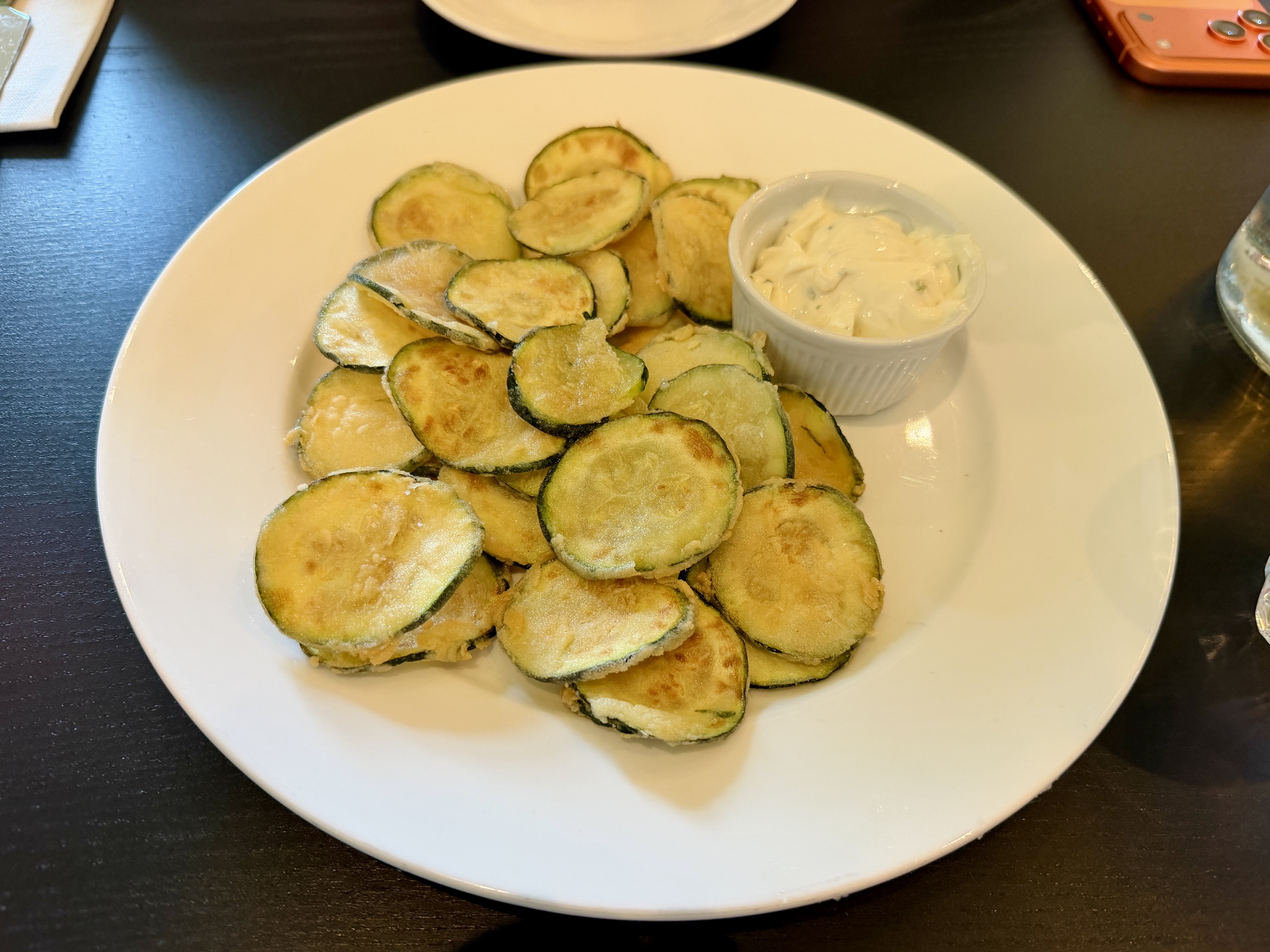
We started with a pair of cracking Aperol spritzes, because it was summer, and the one thing on the antipasti menu that felt like a great shareable start to the meal. Zucchini fritti had survived the great menu cull, and I’d seen from other writeups that Angelo’s served these as thin, round slices rather than batons, almost creating the sensation of exceptionally upmarket chips and dip.

Did that work? Well, it did, but it could have worked a lot better. The advantage of strips is all that surface area to crisp up: these, by contrast, were limp enough that they were droopy when you picked them up. They weren’t much cop when it came to dipping them into what really was an exemplary lemon aioli. 

So there is scope to perfect them, yes, but I was surprised by how enjoyable they were, even short of perfect. The seasoning on them was excellent, brilliantly judged, and if it meant you had to use a fork and load that aioli on with cutlery – far too evolved, for food of this kind – it didn’t stop them being a particular kind of wonderful.
We made short work of them, we made short work of our spritzes and slowly the sun went about the business of setting outside. “I really want this to be good” said Zoë, out of nowhere.

I totally understood what she meant. After a couple of years of disappointing big names opening in the town centre, Reading could badly do with a win. I looked round this fresh, new room and these fresh, new customers, took in the bright and chatty service happening all around me. No pressure, I thought to myself.

But all those were good signs, weren’t they? And the wine list was a good sign, too: sizeable, fascinating, covering price points from entry level – including 425ml carafes, if you wanted to be moderate and affordable – all the way up to eye-watering. Moreover, it was 100% Italian, covering so many different regions you just don’t see on wine lists in Reading: Umbria; Calabria; Piedmont; Sardinia.

Looking at it made me realise, again, how much I missed Pepe Sale – and how glad I was not to have to visit Vino Vita ever again. We ordered a bottle of pinot noir from Pesaro, a place of which I’d never heard, and I really loved it – silky, fruity and balanced enough to make a fist of going with everything we ate. It was £56, and what I could find online suggests you could buy it retail for just under half that: if every markup on Angelo’s wine list is in that ballpark, wine buffs are going to have some fantastic evenings there.

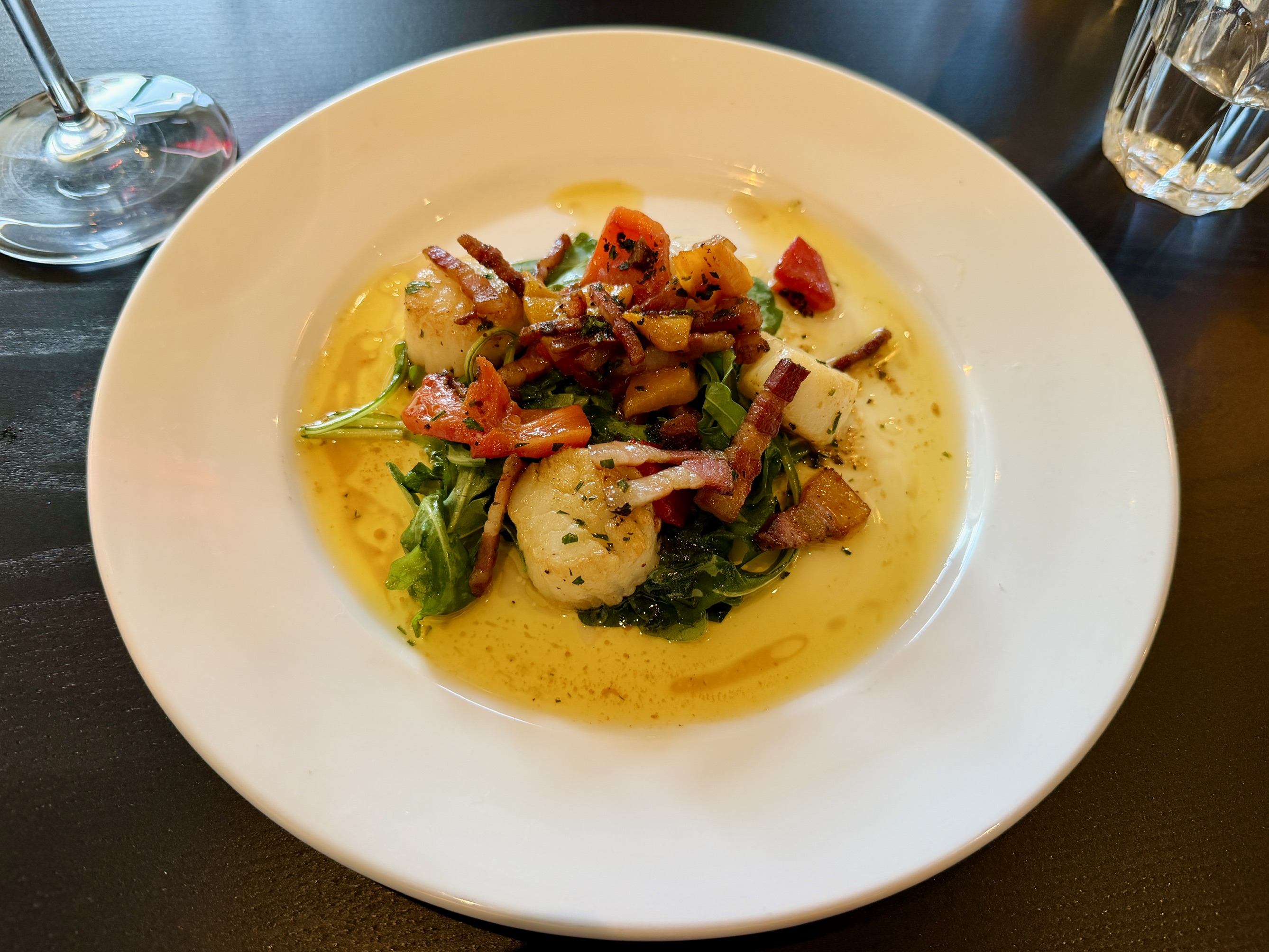
My starter was sheer joy. Four handsome scallops, cooked to just the right side of jellied, could have been enough of an attraction on their own. But tumbled with sweet roasted peppers and crispy matchsticks of pancetta, they were forkful after forkful of fun. I wasn’t prepared for how much I would enjoy this dish, or how simple, how superbly done it was.

The transformative element, though, was the salmoriglio, the bright Calabrian sauce of olive oil and lemon juice that perked up a dish which was plenty perky already. The whole thing was daytime TV presenter cheerful, without the artificiality that comes priced in with that. I could eat it again and again, although it also made me look forward to the day when Angelo’s has swordfish on its menu.

This starter was £15, and yet when I compared it to the masterpiece of eking out that was, say, No. 1 Ship Street’s more expensive scallop starter, I felt as if I was robbing Angelo’s blind, not the other way round.
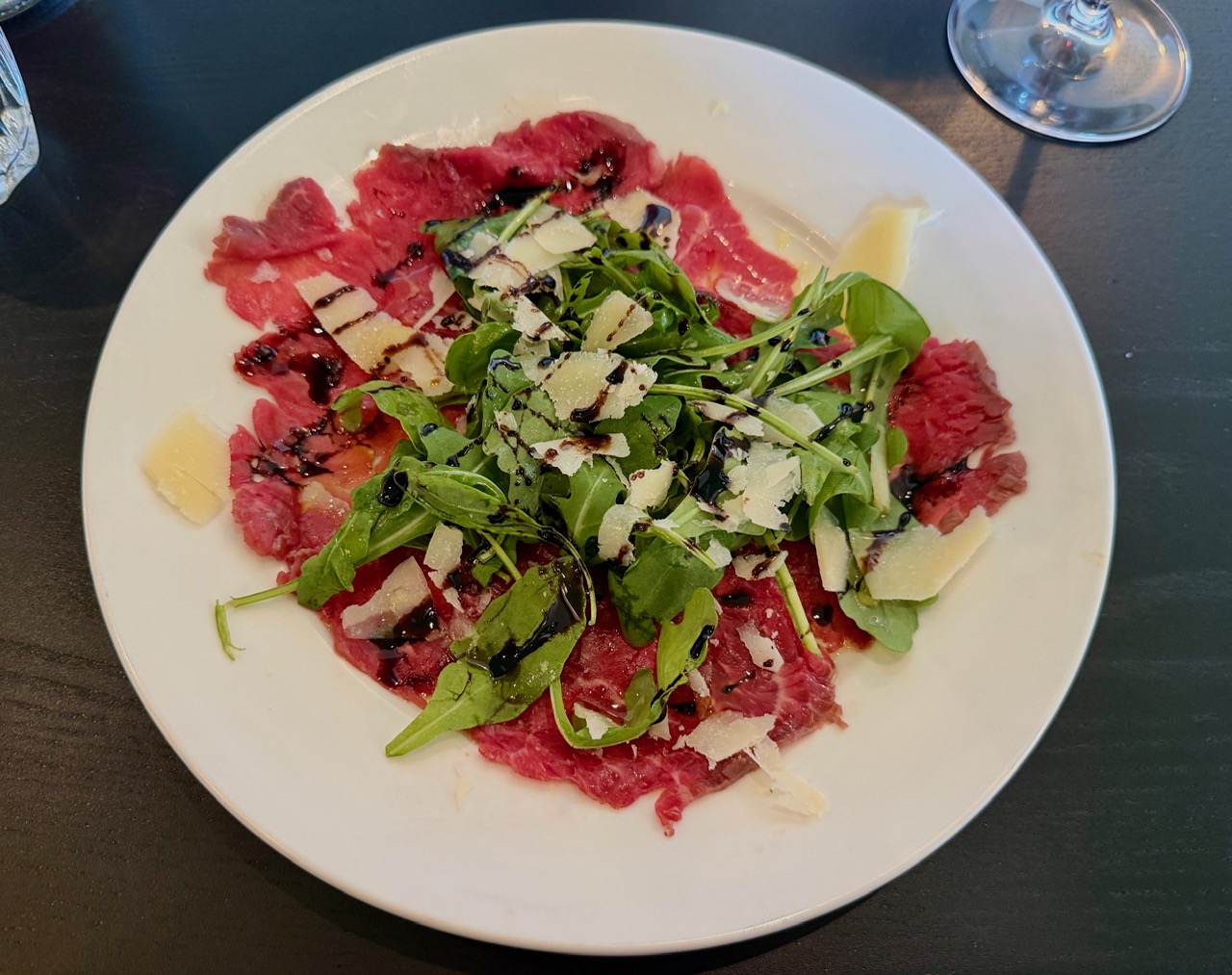
Zoë was equally happy with her choice, another salutary lesson in the virtues of buying good stuff and leaving it as unfucked with as possible. A generous mosaic of pink and marbled beef carpaccio, sliced almost to translucence, was laid out and scattered with rocket and Parmesan. So little to it, but so much to enjoy.

“I could have gobbled three plates of it”, she told me later. “You can quote me on that.”

Also, and I know this is an aside, but how nice it was to eat in a genuine Italian restaurant that uses balsamic vinegar, not some gloopy, sugary glaze, and only uses it sparingly when appropriate, rather than festooning everything with thick ribbons of it to make something that would otherwise taste of nothing taste of something worse. I had almost forgotten how much I liked eating in an Italian restaurant in Reading that treated its customers like adults.
Pacing was faultless – there’s a sentence you haven’t seen me write much this year – and something like twenty-five minutes later, when I was still basking in the afterglow of my starter and enjoying the warm fuzzy feeling that comes with a great bottle of red, our main courses came out. We’d ordered from the deep and the shallow ends of the menu here, more by accident than design, but I think it speaks volumes about what Angelo’s has to offer that both were equally superb in different ways.

I loved my main course so much I can’t even tell you, and I loved the fact that it was a mere pound more expensive than my starter. Carbonara is a good test of an Italian restaurant, but I doubt many pass it with flying colours the way Angelo’s did. The golden colour of a Brazil shirt, pasta impeccably al dente, the sauce clinging to every strand, full of depth and saline complexity. This was a textbook carbonara: egg yolk, pecorino, no cream, no adulteration of any kind. Purists might object that it was pancetta not guanciale, but those purists need to get out more. Besides, that thatch of bronzed strips was heaven.
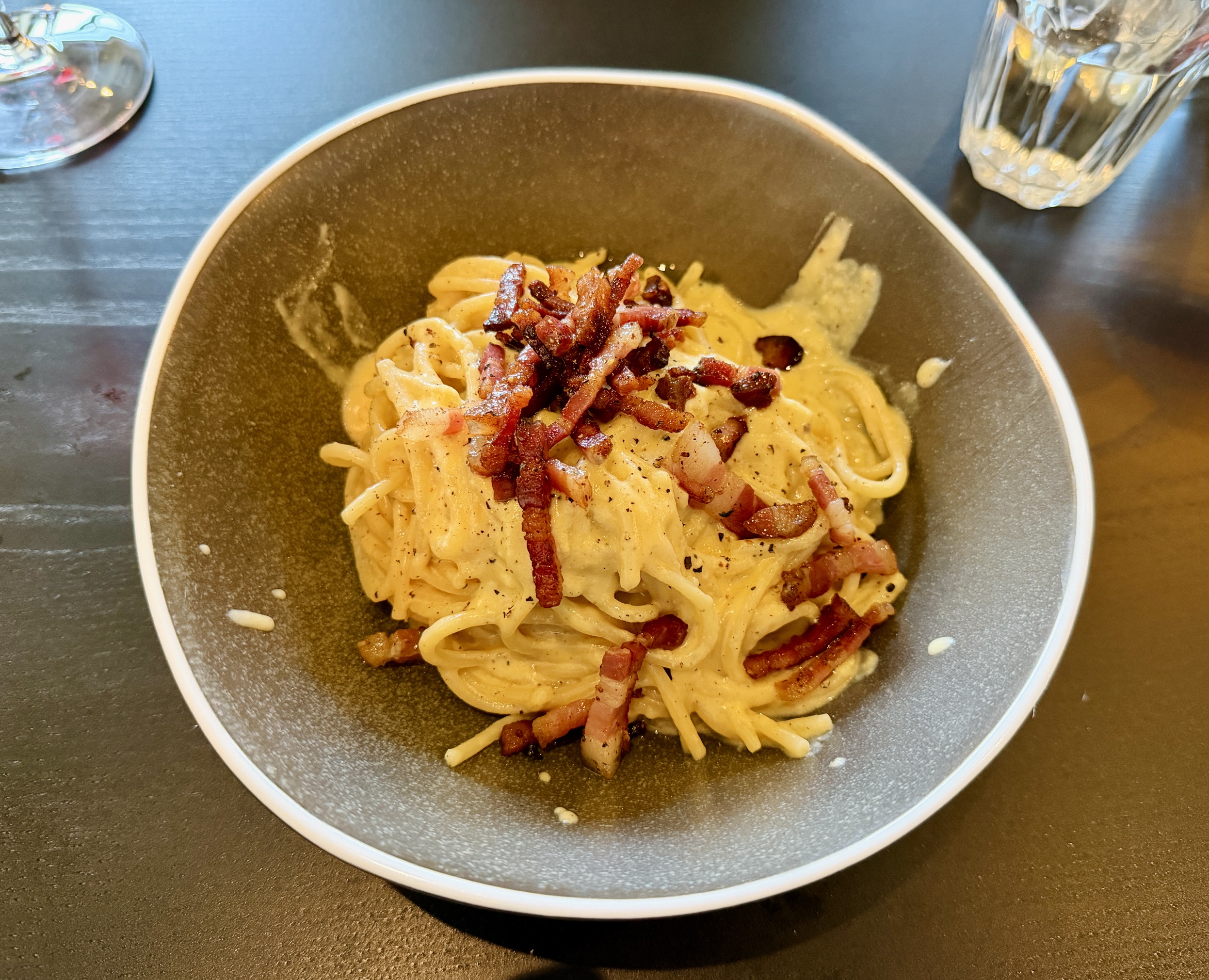
By the end of it I wasn’t only planning when I could go back to Angelo’s, I was planning when I could go back to specifically eat this again. Surely I had a free evening next week to slink off for a bowl of it? If I had my way, the people behind Cozze would be sentenced to come to Angelo’s, try this once and then have to eat their subpar albino version every evening for a month. That would teach them, or at least it would if they liked food better than margins.

Zoë, as regular readers will know, has an annoying habit of ordering better than me. But I thought she’d erred ordering the most expensive and pedestrian-looking dish on the menu. Ribeye, mushroom, cream and brandy sauce and chunky chips. Sounds a bit blah, I told myself, and at £33 it would have to be really, really good: everything in peak condition, everything in balance, everything coming together.

So of course, to my mixed delight and irritation, it was precisely that. Steak cooked perfectly medium as requested (I’d have had it pinker, but I don’t judge) a sauce of dreams – and more than enough of it, too – and some knockout, golden, crisp-edged and nicely irregular chips. I was happy for her, even if this dish felt about as Italian as I am, but I was just as happy, if not more so, for Angelo’s. Because this was high stakes, and they had not missed. Even her side dish, spot-on tenderstem broccoli positively infused with garlic and chilli, was a winner, not an afterthought.

I had to have dessert after two magical courses like that; I wanted to give Angelo’s the chance of the kind of clean sweep that propels that rating at the bottom into the upper echelons. It was a flab-free dessert menu with limited options but, again, they were the choices you would want to see: a tiramisu, a panna cotta, an affogato, a rum baba which turned up at the table next to me and looked positively immense, in every sense of the word.

But we both, in the end, went for the tartufo cioccolato and, yet again, Angelo’s pulled something out of the top drawer. I have had these before where they’ve felt a little anonymous, like a freezer ready fancy-schmancy choc ice, something to finish your meal with when you lack the imagination for a proper dessert. I’ve had them at Pepe Sale, and even as I’ve enjoyed them, I’ve known I was slightly short changing myself. But nobody ordering this at Angelo’s is doing anything other than treating themselves in a big way.

It was a huge, cocoa-powder dusted puck of a thing, crowned with ice crystals, and we waited for our dessert wine to turn up before we made inroads. But when we did, it was just glorious. Have you heard how Wall’s ruined the iconic Feast ice cream earlier this year by swapping its chocolate ice cream for vanilla while leaving that disconcertingly nostalgic core of plasticky chocolate intact? Angelo’s has performed that trick in reverse, so at the centre of its tartufo is a core of zabaglione. It is, and I don’t use these words lightly, life-alteringly good.
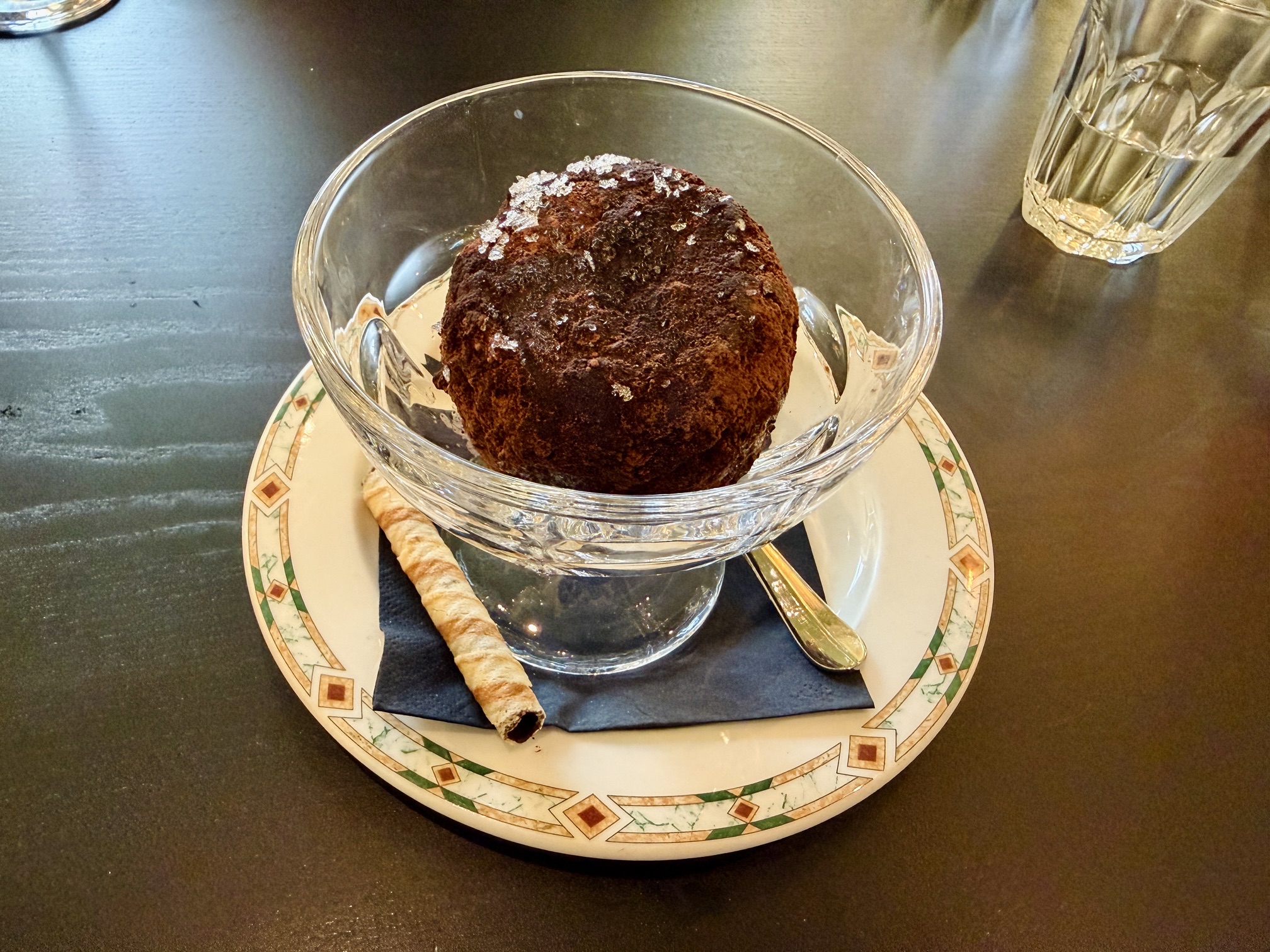
So, by the way, was the dessert wine. Angelo’s offers five by the 50ml glass, and none of them are cheap. But in for a penny in for a pounding, as my wife is wont to say, so we tried the priciest, the muffato from Umbria. It was the same gold I associate with all of the meal: the gold of the summer sunshine outside, the gold of the salmoriglio, the gold of my carbonara, of that zabaglione. Maybe everything Angelo’s touches turns to gold – in truth, it was beginning to feel that way.

It was, as I said, it was a costly way to end the meal – £13.50 a glass – but I quite liked Angelo’s pricing. It felt democratic rather than random, that you could have a main course that cost the same as your starter, or a glass of dessert wine that cost almost twice as much as the dessert accompanying it. I think you could come here and eat very well indeed, yet spend more or less than we did. I’m absolutely certain that the oenophiles among you could badly bruise your debit cards at Angelo’s. But it would all happen so nicely, and you’d come away so happy, that you wouldn’t mind one bit.

Our meal for two – and bear in mind we had nibbles, and aperitivi, and dessert wines and a metric fuckton of good times – came to £200 on the nail. Personally I don’t begrudge a penny of it, and it’s worth mentioning that they leave the question of service entirely up to you. I hope they get the tips they deserve, because service was delightful from beginning to end.

I don’t want to patronise Angelo’s by saying I was not only ecstatic but relieved that eating there was such a stellar experience. But it doesn’t pay to be dishonest, so I should admit that I was relieved. I didn’t want to put the boot into yet another big money signing for the town centre, especially an independent. Even if it is underneath Ebb & Flow, a collection of performative if well-appointed shoebox apartments whose main purpose seems to be to make wealthy buy-to-let landlords wealthier still.

I wanted something to buck the trend of unremitting meh that seems to afflict the RG1 postcode. I really, really did. But if I wanted Angelo’s to be decent, it was beyond my hopes that it would turn out to be quite this good. It is the best thing to happen to central Reading for ages, and the best thing to happen to a reviewer of central Reading restaurants, arguably, for even longer. So, has my enthusiasm been infectious? Does it make you want to go?

It’s worth it, believe me. I may be the latest person to ask you if you’ve eaten there yet, but I have a feeling I won’t be the last.

Angelo’s – 8.8
9 Friar’s Walk, Station Hill Square, Reading, RG1 1HP
0118 3042885

https://www.angelosdine.com

Since January 2025, Edible Reading is partly supported by subscribers – click here if you want to read more about that, or click below to subscribe. By doing so you enable me to carry on doing what I do, and you also get access to subscriber only content. Whether you’re a subscriber or not, thanks for reading.

Restaurant review: Spitiko

Having written about and celebrated Reading and its independent scene for nearly 13 years, one thing that has always irritated me is people who live to run the place down. You see them popping up on the comments section of the Reading Chronicle all the time, people who say that the town is all vape shops and money laundering, who hate the halal butchers and the global superstores and the mosque. 

We all know what’s behind that, and it’s not really about Reading: it’s about wanting to take the country back to some rose-tinted past that wasn’t even that crash hot first time around. One where women were paid sod all – if they had jobs at all – and where nobody could be gay, or trans, or brown. One with three TV channels and everything closed on Sundays. One where youngsters knew their place. 

It’s a land where those people still live in their heads, and if a country like that really existed I’d be all for them emigrating there. Reading – multicultural and vibrant – just happens to be in the crosshairs because it embodies so many things they’d change. But even though I despise that viewpoint, lately when I’ve gone into the centre of town I’ve felt weary, because the town I love is getting harder and harder to champion.

Rough sleepers are everywhere, begging feels more apparent than at any time I can remember. Friar Street is lined with vacant shop fronts and when new things open, they’re always chains and often the kind you wouldn’t choose. Shake Shack is on Broad Street now, next to Fat Face, and people who get excited about that kind of thing are beside themselves. 

Also new is Amorino, which I visited recently for a gelato. You had to order using a big touchscreen which tried to upsell you every step of the way: that irked me when the people sticking gelato in your paper tub were right there. My ice cream took ages because the member of staff doing it kept weighing it, adding a tiny amount more, weighing it again. Because, in case you’d forgotten, it’s 2026. 

But it tasted nice, even if eating it I realised that, for a long time, it had felt like Reading was always the bridesmaid, never the bride. We always got Amorino, never Swoon. We always got Wendy’s and Shake Shack, never Patty & Bun or Beefy Boys. Always the town, never the city. So for this week’s review I decided to visit the one part of Reading that seems fairly immune to the general worsening of things, and Friday night found Zoë and me in Spill, drinking pints of Parka ahead of a short amble along Prospect Street to Spitiko. 

Yes, that’s right: it was time for a date night in Caversham.

I got into all sorts of trouble a long time ago for asking the simple question Why isn’t Caversham nicer?, but whether you thought it was nice or not in 2017 is rather beside the point these days. Because since then – and especially since the pandemic, when people spent money closer to where they lived – Caversham has flourished in a way that the rest of Reading simply has not. 

It has acquired two excellent cafés, in the shape of Geo Café and The Collective. It boasts lifestyle stores and bakeries, bookshops and bars. It has a great pub with outside space in the shape of The Last Crumb, and one of Reading’s most distinctive restaurants in the form of Vegivores. And of course, to the detriment of the town centre it has arguably Reading’s best restaurant, Clay’s Kitchen.

Sitting in Spill with a beer, looking over at the outside tables filled with happy, prosperous people, Caversham had a certain affluent glow that you don’t generally see in the RG1 postcode. Friends were catching up, a couple were engaged in a fierce cribbage contest that reminded me of a former life. And seeing all that, drinking it in along with my cold pint of Parka, I got it: I understood why people in Caversham always seemed so happy with their lot in life. That was why Caversham residents, like wild swimmers or vegans, volunteered the information within five minutes of meeting you. Who can blame them?

Spitiko, technically, pre-dates Caversham’s renaissance. For many years 6 Prospect Street was home to Kyrenia, a Cypriot restaurant. Then at some point in 2016 it changed hands, and the new owner called it Ketty’s Taste Of Cyprus. Kyrenia’s legendary front of house Ihor left – the last time I saw him he was working at Papa Gee – and then, around the time of the pandemic, the restaurant rebranded again, this time to Spitiko – a Greek restaurant, rather than a Cypriot one.

I think one of the reasons I held fire on reviewing Spitiko for so long was that I loved Kyrenia so very much. I’ve written before about how it was one of the saddest closures in my time writing this blog, and talked at length about how often I went there. But it hasn’t been Kyrenia for a very long time, ten years or so, and it felt like time to try Spitiko afresh, as free of preconceptions as possible. 

That’s also why I will try, as best I can, not to use the K word again in this review. Because having started this review railing against them, I don’t want to be one of those awful people who thinks everything was infinitely better in the past.

Spitiko’s dining room was spacious and airy, with plain tables and chairs and a pale wooden floor. Huge paintings of the windmills of Mykonos and the blue-domed churches of Santorini took up one wall, a bouzouki was propped up on a window sill. The only other flash of colour was the distinctive Hellenic cyan edging the windows and doors. The ground floor dining room was doing reasonably well on a Friday night, with over half its tables occupied.

One thing we did realise right away, though, was that it was deafening. Whoever designed that dining room was either in their early twenties or had never tried to eat in it: the lack of soft furnishings or sound insulation made it an incredibly loud place to sit and eat. Every table had to keep talking louder because every table was struggling to be heard, an escalating state of affairs that made it a very difficult space in which to spend time. Zoë, who has a coping strategy in these circumstances, took out her hearing aids: I had no such luxury.

Spitiko’s menu covers a lot of ground, and blends both Greek and Cypriot specialities. Feta and halloumi both feature, and the restaurant serves sheftalia, which is distinctly Cypriot. But it calls its stuffed vine leaves dolmades, the Greek name, rather than koupepia, even though they contain mince which is more common in Cyprus. 

In any event, you have an enormous amount of choices – something like twenty-five appetisers and nearly as many mains. You also have the option of choosing a meat, seafood or vegetarian meze selection, for between £31 and £36 a person, but we decided against that because it’s the kind of order I might have placed in this building in the past. So we picked a selection of starters to share, and a main each, and tried to make ourselves heard above the hubbub.

But first we ordered wine, and this was where the first alarm bells rang. Greek wine, very underrated, offers a great range of excellent whites and reds. If you’re at a restaurant with a good wine list, it’s always worth looking out for a xinomavro or an assyrtiko because they often punch above their weight. 

Spitiko, I’m afraid, is not that restaurant. They do have half a dozen reds and whites from Greece and Cyprus, but many are from a single producer. Nothing will set you back more than £30, but that means that most of the wines cost £10 retail. I looked most of them up on Vivino, the wine app, and I didn’t realise you could buy wines with ratings that low. So we ordered the best of a bad bunch, a bottle of Kouros Patras – straw-coloured, chilled and forgettable, if not actively offensive.

This is as good a point as any, by the way, to make reference to Spitiko’s greatest asset, the chap who looked after us. He was wiry, high-energy and full of charm – he told us he was Irish, although I didn’t get that from his accent – and he was undoubtedly the single best thing about eating there. I hope one day I bump into him again, at a better restaurant.

One thing I always associate with eating in Greece itself, rather than in a Greek restaurant here, is the wonderful sense of leisureliness that always accompanies food in a taverna. The air still has the warmth of the day, the al fresco tables around you are full of happy people, and later on your walk back to your room will be accompanied by the music of crickets and the glimmer of fireflies. 

Not so in Caversham, where our four starters were banged down in front of us about ten minutes after we ordered them. They were each, in their way, the epitome of middling.

First up there was houmous, adorned with a single olive and a meagre drizzle of an olive oil so yellow and pale that it couldn’t add any joy to proceedings. The houmous itself, scooped onto scorched, bought-in pitta bread, wasn’t actively unpleasant but had nothing about it to elevate it from stuff you could buy in a tub for £2 from any supermarket in the land. 

Here it was £6.25, and I did think the main thing you were probably paying for was the act of decanting. The menu talks about garlic, lemon juice, tahini: all things this should have contained but somehow tasted as if it had never seen.

Equally underwhelming, if not more so, were the dolmades. £7.25 got you three small ones, all in varying stages of falling apart. I didn’t have to cast my mind back far to think of better ones – for all their faults, the stuffed vine leaves at Antep Kitchen were far better than this – but also, they were meant to contain mince and if they did, subtle isn’t even close to the right word. But also these were served hot, and the speed, the heat and the texture all made me wonder if a microwave was involved. If it wasn’t, there would have to be another excuse for these being so disappointing.

Lamb kofta also couldn’t live up to the promise of seeing those words on the menu. What was going on here? Two worryingly uniform cylinders of dense, compacted meat, each cut into worryingly uniform halves. No irregularity, no char, no coarseness. There was no sign that these had been threaded onto a skewer, no sign that they had been formed by hand. No sign, in honesty, that they hadn’t come out of a packet. 

Last of all, one of the dishes I always make a beeline for in Greece, feta saganaki. Deep fried cheese should be a genuine treat, whether it comes with honey and sesame seeds to offset the saltiness or is brought to the table flaming, doused in ouzo. This was neither, it was just a slab with a bit of a tougher exterior but no real evidence of crispiness or contrast. How could you take feta, deep fry it and produce something that was so far from fun? It felt like a betrayal – of Greek food, of our hopes, of all that and more besides. 

There was sad salad on the side, as there was underneath the kofta and the dolmades. Technically I guess it was sadder salad, because it was all sad.

Could our main courses rescue matters? You mightn’t be amazed to hear that we found out pretty damned quick: fifteen minutes after our starters turned up, out came the mains. You may, however, be surprised to hear that I wasn’t as outraged as I could be. By this time I regarded the rest of the meal a bit like the way I think of a blood test: I knew it had to happen, but I didn’t mind getting it out of the way as fast as possible.

That wasn’t entirely fair, though, because the mains showed that Spitiko could cook – just not a whole dish, and not consistently.

Take my sheftalia – which are meant to be coarse sausages wrapped in caul fat. I was so looking forward to these, at the start of the meal anyway, and by the time they arrived they managed to surpass my successively lowered expectations. Unlike everything else so far, they felt made by hand – irregular, nicely stocky things with a crinkled exterior. And they tasted good. I’d had enough of Spitiko’s humdrum tzatziki by then, and fortunately these didn’t need it.

But even here, with one of the best things they did, they couldn’t nail the landing. First of all, sheftalia can be made with pork, beef or lamb and Spitiko’s menu promises pork. So why was one of the four clearly completely different? It tasted of beef and red wine, and I didn’t mind it at all but it was bizarre how it didn’t match the other three. If I’d had two of each, or the menu had said they were a mixture, I probably would have been delighted: without that, it just added to the sense of chaos.

And the accompaniments were barely worth bothering with. A fairly dull Greek salad with four cubes of oregano-speckled feta, no olives and – would any plate be complete without it? – more limp iceberg lettuce added very little. Even worse was a big helping of faintly yellow rice studded with eerily uniform bits of veg: peas, green beans and so on. Its texture was surprisingly clumpy and, again, it felt as likely to have been made by Batchelors. I ate all of my sheftalia, I snaffled the feta, I left most of the rest.

Zoë’s kleftiko was a similar story. The lamb itself was good, tender, beautifully fatty and a cinch to ease away from the bone. I was allowed to try a bit, and it wasn’t half bad: ironically a far better deal than the very expensive equivalent I’d tried at Queen’s Park’s Carmel earlier in the year. I have had better kleftiko in Reading, although I’ve boxed myself into a corner whereby I can’t tell you where, but it was pretty decent.

But again, the stuff that came with the kleftiko was irrelevant rather than elevating. The roast potatoes looked like perfectly acceptable waxy specimens, with no real sign of roasting or glorious crisp shells. The vegetables – broccoli, carrots – were bland ballast. It’s perfectly fine to make the sheftalia or the kleftiko the centre of the dish, but the stuff on the perimeter should cheer, not heckle.

By this point some of the tables had left, the absolute racket had died down a little and I tried to find ways to look on the bright side. You should have tried this place back in the day, I said to Zoë, except of course back in the day it wasn’t this place. Just another one to file away in the long list of things I wish I’d discovered and experienced with my wife, thwarted by our chronology and the fact that we had to spend all those years living our lives and becoming the people we did so that we could meet and fall in love and, hopefully, live happily ever after. 

But as I keep saying in this review, you can’t live in the past – even if it was a past when I weighed five stone less, hadn’t lost loved ones, hadn’t broken my arm. The accumulation of damage, bad decisions and disappointment helps make you who you are: wish it away, and you wish you were somebody else. All far too deep to bring up at a date night in Caversham, I decided.

We would have had dessert, because the wine list included two Greek dessert wines, both of which I absolutely love. Our ever-charming server wandered off and came back effusive and apologetic: they’d run out of one, and they had about a glass of the other, but in a bottle which had been opened and not kept in the fridge. We waved it at us, we asked for the bill. £122 with a 12.5% service charge, which was the only element that felt like value. 

We called an Uber back to Katesgrove and ate ice cream in front of the telly, catching up on Top Of The Pops. It’s nice to go to Greece, it can even be nice to go to Caversham, but it’s nicer still to go home.

I really wanted to love Spitiko, and I really wanted to prove my hypothesis that bits of Reading are still getting better and better despite the naysayers. It’s tempting to feel deflated, and think that neither of those things happened. But I don’t know about that. I think it’s more the case that Caversham continues to flourish and buzz, and that places like Vegivores, Spill, Clay’s, even BKRY demonstrate that future. 

Put that way, Spitiko feels like part of the Caversham that predates all of that change. I hope they aren’t left behind, and that when their race is run one day there will be people who meet for dinner somewhere else, in that building or another one, and say “Remember Spitiko? That was a restaurant. God, the evenings we had there.” Sadly, though, I won’t be one of them.

Spitiko – 6.6
6 Prospect St, Reading, RG4 8JG
0118 9476444

https://spitiko.uk

Since January 2025, Edible Reading is partly supported by subscribers – click here if you want to read more about that, or click below to subscribe. By doing so you enable me to carry on doing what I do, and you also get access to subscriber only content. Whether you’re a subscriber or not, thanks for reading.

Restaurant review: Pho 86

The 21st of July last year might have seemed like a perfectly normal Monday to you, but in food and drink terms it was an eventful day for Reading. Lincoln Coffee finally opened its big new site on King Street, the one Workhouse had vacated the year before. A little way away, down Minster Street, Thai restaurant Nua opened in the spot given up by Bluegrass BBQ in January.

Both of those were expansions. Lincoln has retained its original site on the Kings Road (and indeed for a while it used to operate out of Reading Bridge House, back when having a coffee concession in an office building sounded like a capital idea). Nua has a site in High Wycombe and another in London, in an area its website describes as “Fitzorvia”. But the third hospitality business to throw its doors open on the 21st July? It was brand new, out of nowhere and a more interesting proposition.

That would be Pho 86, an independent Vietnamese restaurant that has sprung up in the site once occupied by The County Deli, most famously one of Kate Winslet’s first employers, that closed in 2010. After that it was Sonning Flowers for a while, and then a food shop called K&K Supermarket which sold Vietnamese ingredients, amongst others. It’s not clear whether the change of purpose coincided with a change of ownership.

Very little is clear, because it’s hard to find out much about Pho 86 online. I do know that they opened without an alcohol license, and with a hygiene score of 1 from the council, who inspected a week after they opened. Both those matters were covered in the local press, and things have moved on since then: alcohol is now available and the most recent hygiene rating, from last October, is a slightly less worrying 3. The Chronicle showed no curiosity about Pho 86’s backstory, however, so it’s hard to know whether this is the owners’ first rodeo.

And good luck figuring out from their website, because the blurb on it is so generic that it’s hard to believe that AI wasn’t involved. At Pho 86, we believe a great bowl of pho is more than just food — it’s comfort, culture, and connection it begins. It’s not X, it’s Y. It’s not been written by a human, it’s ChatGPT. Fair enough, I guess: times are tough for independent businesses, and hiring a copywriter is probably nowhere near the top of the to do list. It would have been nice to know more about them, but perhaps they’re letting their food do the talking.

So finally, after leaving it the best part of a year, I paid them a visit on a sunny Saturday lunchtime with Zoë. I might have made it earlier, if it wasn’t for the hygiene rating and the lack of booze, but another reason was Pho 86’s surprisingly old school approach to customers: no online booking, which is curiously retro in 2026. I should have phoned up, really, and made a booking, but it says something that I literally cannot remember the last time I did that, anywhere.

Subscribe to continue reading

Become a paid subscriber to get access to the rest of this post and other exclusive content.

Restaurant review: Gooi Nara

There’s no such thing as Spotify Wrapped or Apple Music Replay for restaurants, as far as I know. But if there was, the restaurant whose food I ate most last year is almost certainly Gooi Nara, the Korean restaurant on Whitley Street that has been there for something like ten years, if not more. And yet returning to it a couple of Saturdays ago for dinner with Zoë was the first time I’d set foot inside since I reviewed it in 2018.

The thing is, as regular readers will remember, I moved to Katesgrove a couple of years ago, which means that, along with Kungfu Kitchen, Gooi Nara is probably the closest restaurant to where I live. And what that means is that on the nights when neither of us can face cooking we know that a delivery driver won’t get lost, won’t drop other orders off en route to our house and can be trusted to turn up pronto with piping hot food from just round the corner. Over the last two years, between us, we’ve developed quite a Gooi Nara habit.

It’s no coincidence that they won my “takeaway of the year” award in 2024 – but my love of a Gooi Nara delivery has continued ever since. It is refined and perfected now to the point where Zoë and I order exactly the same thing almost every time: dakgangjeong, or Korean fried chicken, for her and tang su juk, chicken in sweet and sour sauce for me. The latter comes ready to assemble, one plastic container of gorgeous fried chicken and a tub of sweet, sharp sauce with orange and pineapple bobbing in it (I was skeptical too, but don’t knock it until you’ve tried it). It has made me happy many, many times.

Sometimes we push the boat out and get some mandu, fried chicken dumplings, as well but otherwise those two and a couple of portions of rice are everything we need for a contented chomp in front of the telly after a hard day. I especially grew to love Gooi Nara when I was discharged from hospital and could only eat with one hand: I remember the first time I had their sweet and sour chicken after my accident I could only eat half, the rest popped in a LockNLock in the fridge. It was even better cold the next day: it remains the only occasion when I’ve had any leftovers at all.

That’s all well and good but I love their food so much, and always hear so many positive comments about it online, that it felt like we were doing them a disservice by only ever ordering the same two takeaway dishes. And my review was over eight years old, after all, so it felt like high time to go back. Early one Saturday evening Zoé and I took a short amble there, tracing the path of so many delivery riders in reverse, to check it out.

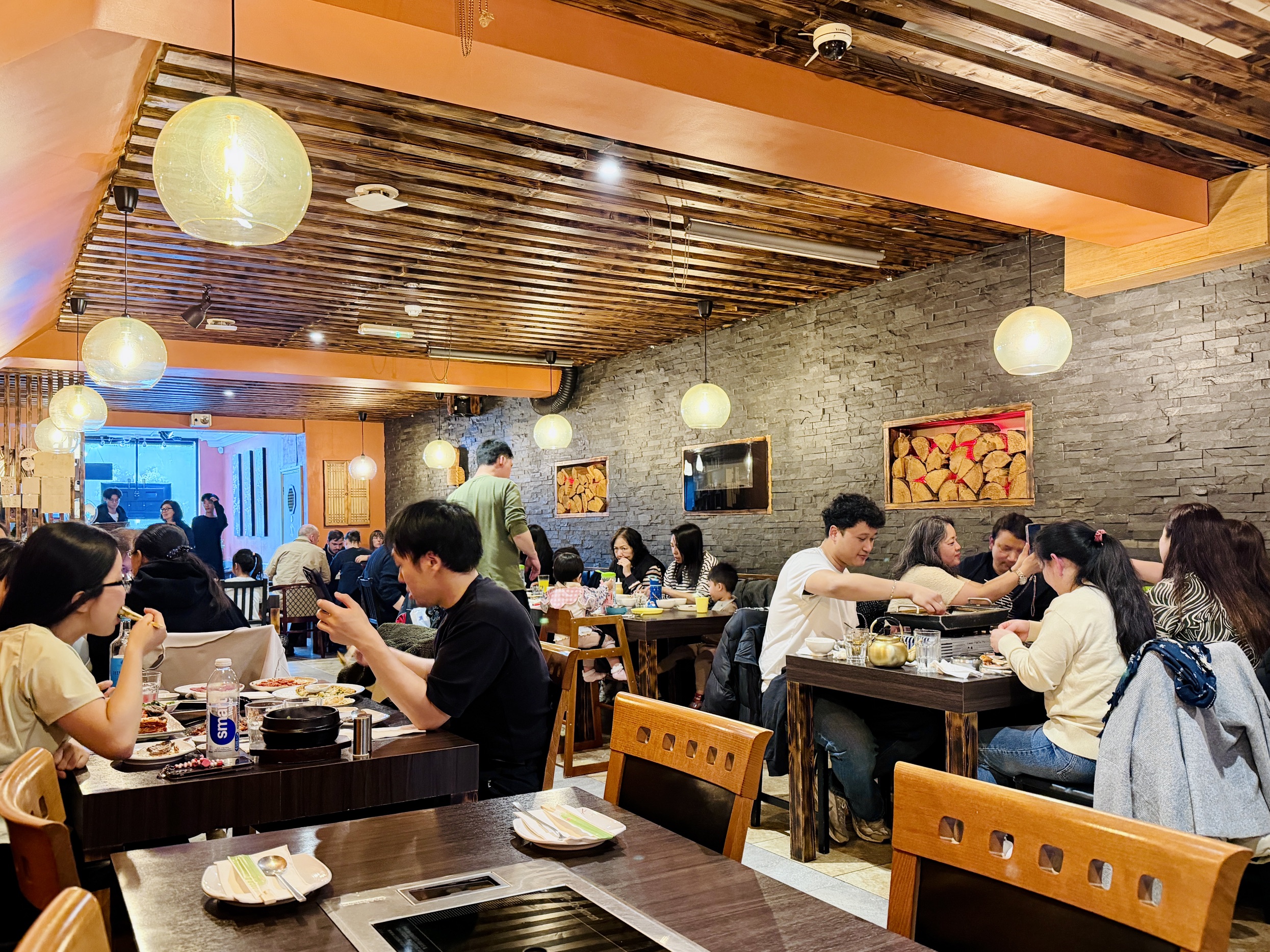
First things first: it was absolutely packed at 6.30pm on a Saturday evening. So much so that they could only just find room for us, tucked away at the very back with a great view of what was clearly a very successful restaurant. The decor didn’t feel like it had changed much in the intervening eight years: it still had a welcoming, homely feel, all wooden beams and faux slate walls.

The main difference, I would say, is just how well Gooi Nara appeared to be doing. It also started out very warm, and on a punishing day as the hot plate in the middle of our table got switched on it became even more sweltering.

In terms of the mix of customers, I would say that with the exception of the table next to ours later in the evening we were the only one exclusively made up of pasty Anglo-Saxons: I did envy my fellow WASPs at the other table who no doubt were getting an excellent introduction to the full gamut of the menu from people who knew exactly what to order.

It did appear, too, that Gooi Nara had a good reputation: I overheard a conversation at one of the big tables nearby to the effect that its occupants had converged at the restaurant from many places, some miles away. Maybe Gooi Nara filled that role for Southerners who couldn’t easily make it to New Malden, the Little Korea of the UK.

Gooi Nara’s menu has changed, I think, from when I visited it last. Back then I’m pretty sure it hedged its bets, with both a Korean and Japanese section, but now it’s all kind of thrown in together: edamame; takoyaki; agedashi tofu and pumpkin korokke feature, along with yaki soba and udon.

But the Korean elements of the menu are far more extensive, and the menu can be quite overwhelming with sections seemingly for everything: soup; rice; bibimbap; jeongol (or hotpot); noodles and of course Korean barbecue. The sides, to add to the confusion, appear at the very beginning, before everything they could conceivably be on the side of.

It made me wish I had my own food sherpa – is that cultural appropriation? – to guide me through the highlights of the menu, a feeling that only intensified as I saw some gorgeous dishes waft past to other tables. Was the delicious-looking tofu (I’m not even joking) that went to the table opposite the agedashi tofu, or the Korean doo-bu jeon? I decided on reflection it was the latter. And how good did the platter of various types of kimchi look when it arrived at the table next to me, a couple having one of the most Guardian conversations I’ve eavesdropped on in a very long time?

I came away from it all feeling silly and parochial, realising that really I only knew a handful of dishes on the menu and the various bits and bobs I’d ordered the best part of a decade ago. I was well aware that on this visit I would stay in my comfort zone, even if I’d insisted to Zoë that we couldn’t order any of the things we would invariably put in our takeaway order. So we ordered a couple of starters, a couple of mains and two items for the barbecue, and even then I’d say we played it extremely safe. We might have been outside it, but our comfort zone was only a short walk away.

Everything came if not all at once then really in a very short space of time. One minute we were necking our cold bottles of Cass, a perfectly decent lager I would struggle to tell apart from Asahi, Ha Noi or Singha in a blind taste test, let alone its Korean alternative Hite, and the next our grill was switched on and pretty much everything we’d ordered was cramming in on our table.

And the table looked big, but since the centre of it was given over to said grill you ended up playing the equivalent of those sliding tile puzzles trying to work out what could go where. Try to combine that with the timings of actually cooking some of your food and the whole experience became a little like patting your head and rubbing your belly at the same time, impressive training in multi-tasking. Forget my doing those six pointless LinkedIn games every morning: this would be much better at keeping me mentally sharp.

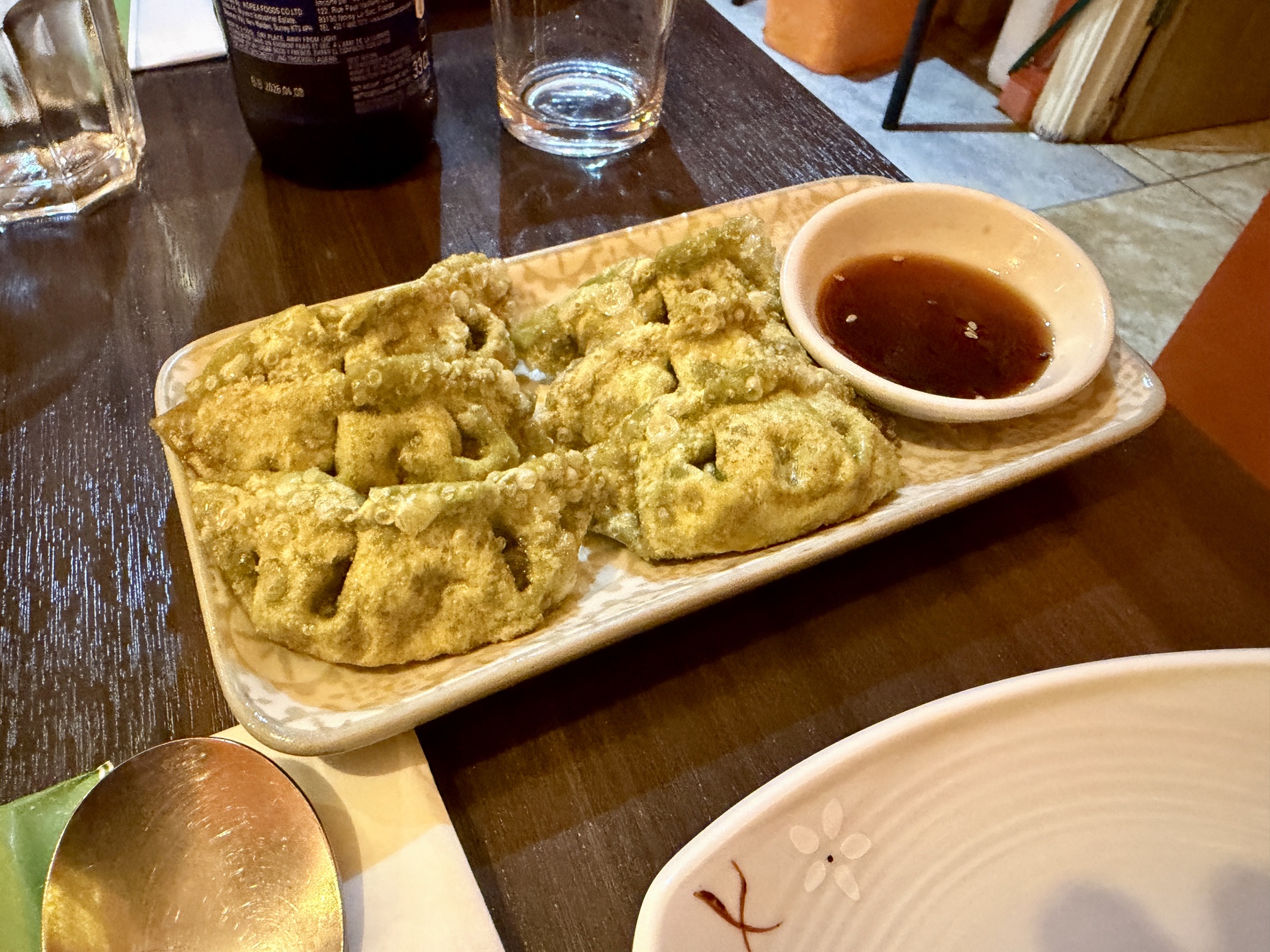
Vegetable mandu were, if anything, even more enjoyable than the chicken ones which had been dropped off by a friendly rider so many times in the last two years. A bit more crinkly and expansive than their chicken equivalents, they had a pleasingly light, grease-free texture and a filling I could almost convince myself was virtuous. Gooi Nara’s dip of soy, sesame oil, sesame seeds and quite possibly something else beginning with S had a gladdening sharpness that complemented them very nicely indeed.

A quirk of Gooi Nara’s menu is that, if it is to be believed, you get 5 chicken dumplings or 5 prawn dumplings but a strangely non-committal “5-6” vegetable dumplings. Fortunately on this occasion we got a shareable, even number, but I’m pretty sure whenever I’ve ordered the chicken mandu I’ve been given 6 of those too. Go figure, pun not intended.

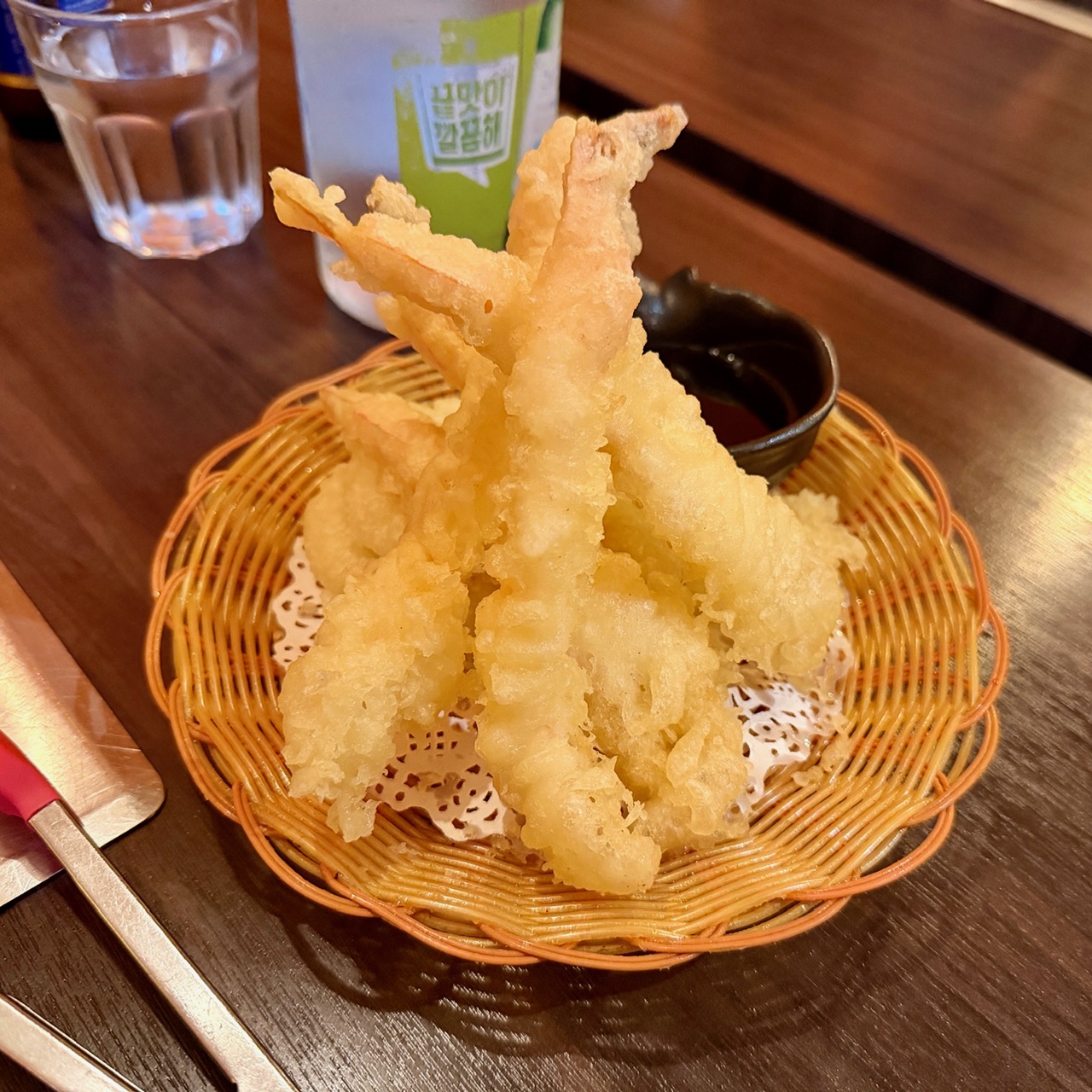
Also decent were the prawn tempura, which I would say were better than they looked. In the picture below they come across as a little wan, a tad too blond, but they had a real deft lightness and, again, next to no grease. The dip they came with, almost exactly the same as the one that accompanied the mandu, was still good but the dimensions of the vessel and the size and length of those prawns made it, practically speaking, a faff: it was a bit like trying to get a pool cue in a beer glass. £12.30 for these, so as much as both of the main courses we’d chosen.

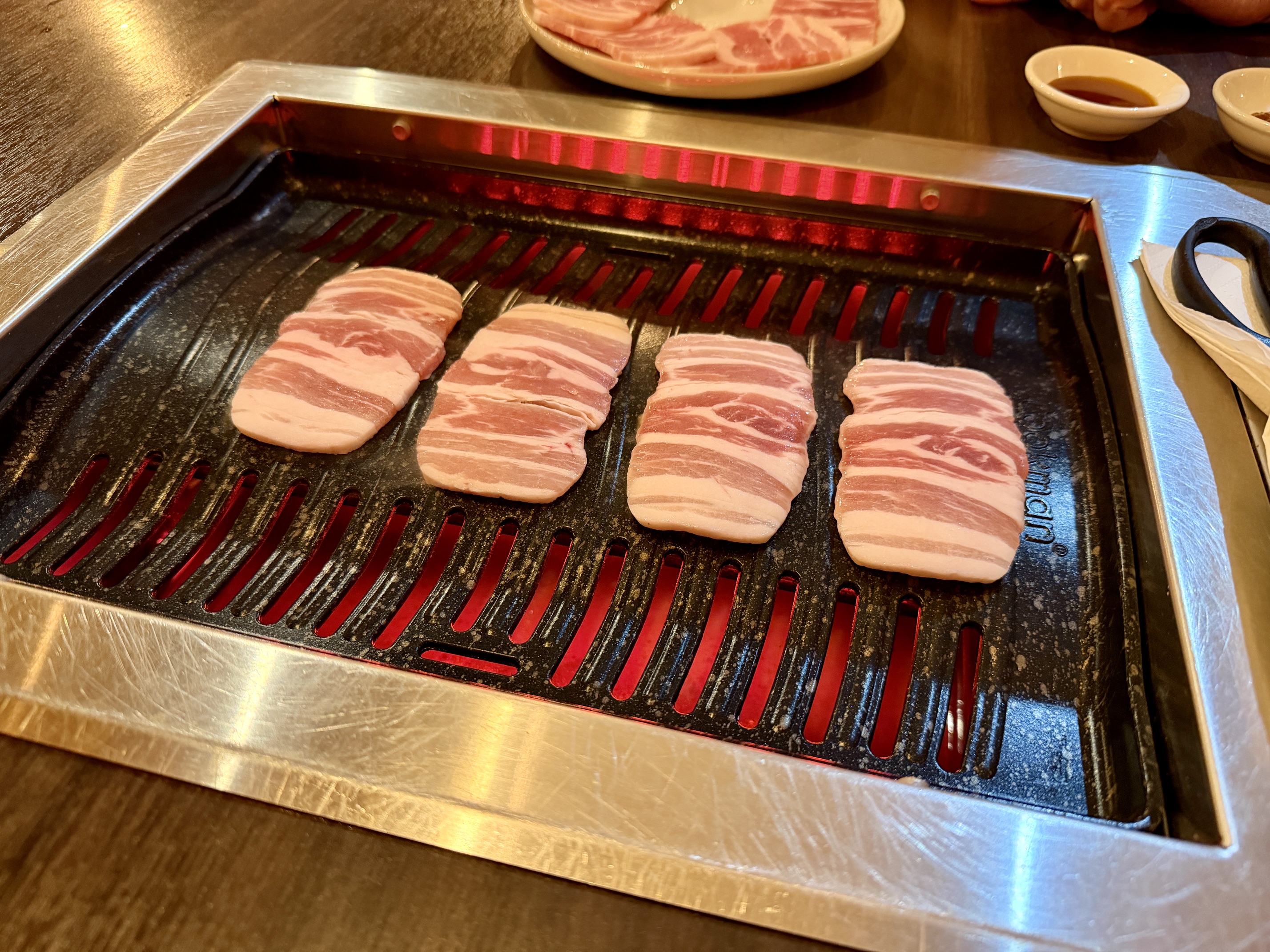
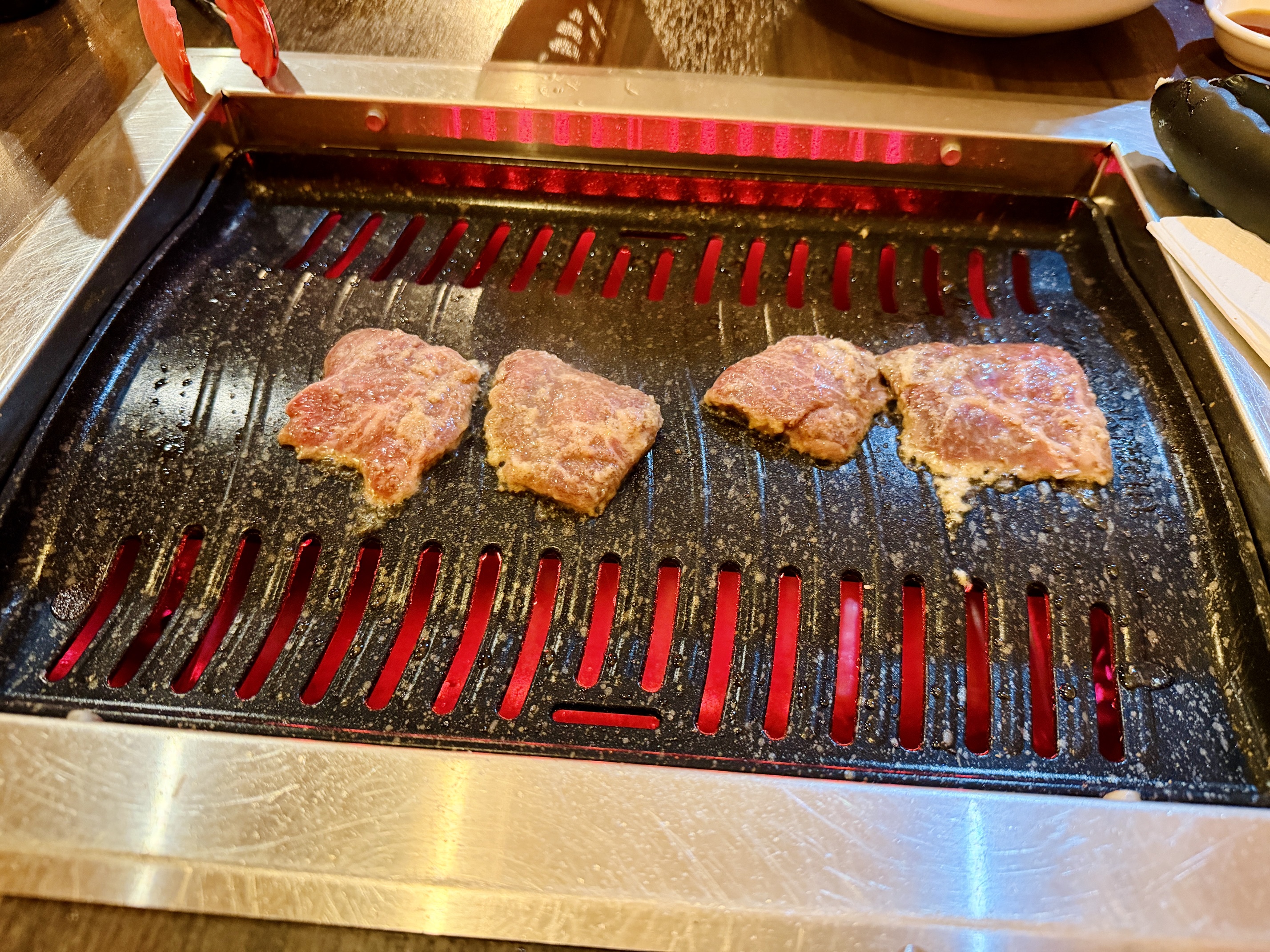
By this point we’d also started to avail ourselves of the barbecue. Sam gyap sal, unadorned sliced pork belly, turned up looking a bit like those cheap bacon-flavoured corn snacks you can get in supermarkets, and I did wonder whether we should have gone for the spicy version, but it crisped up beautifully on the barbecue, that fat rendering and permeating just enough.

We chose the pork to cook first precisely because it wasn’t marinated the way our other barbecued meat was, to try and avoid cross-contamination. We had a couple of dishes of condiments to dip them in, and I failed to make a note of either, but one was definitely soy and the other was definitely not: I think it might have been ssamjang, the traditional sauce used with Korean barbecue containing gochujang and soy beans.

It was only later that I realised we should have ordered some lettuce to wrap the pork in: it’s hidden away, chronologically speaking, in the list of side dishes at the beginning of the menu.

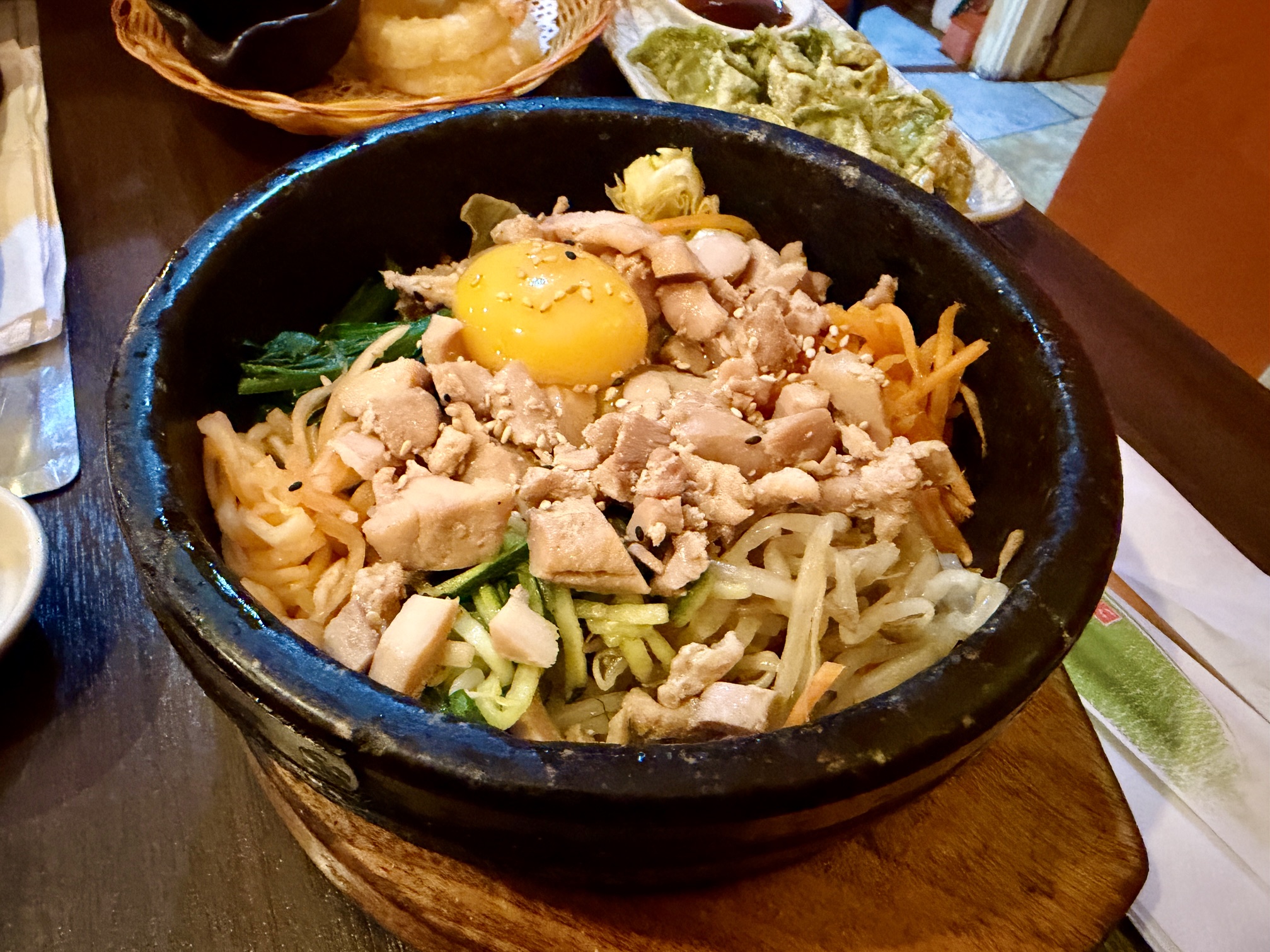
My main – although the concept of a main slightly falls away when it all comes at once – was the chicken dolsot bibimbap, a dish I haven’t eaten in a long time. For the uninitiated, this is rice, chicken, veg and an egg yolk brought to the table in a hot stone bowl, so it keeps cooking and sizzling as you work your way through it. I broke up and dispersed the egg and made my way through it, and by the end some of the rice had reached the crispy state known in Korean as nurungji (I suppose the closest European equivalent is the delectable socarrat at the bottom of a paella).

I would have described this dish as a little nondescript, a tiny bit bland, if it weren’t for the squeezy plastic bottle of gochujang which came with it. The more of this I added, the more I enjoyed it, and the more I enjoyed it the more I added it: I do wonder how much you’re meant to use, and how much was left in that bottle when I was done, but it turned what could have been a trudge into a frolic.

The other thing that whole experience taught me was patience. Ordinarily I would have a moan – god knows you’ve probably read enough of them – about everything arriving at the same time and forcing me to choose what to eat first.

Eating in Gooi Nara that evening, among all that good-natured, deceptively well controlled bedlam, I realised that it was probably a very English mindset: that your food is at its best the moment it arrives at your table and it’s downhill from there, that it’s a scramble to eat it before it goes cold and that too many dishes at once guarantees disappointment.

But it didn’t feel that way here. Those prawns and dumplings sat there, keeping their freshly fried heat. The pork sizzled on the barbecue, with more on the plate waiting to take their place. Our second barbecued meat hadn’t even made it to the front of the queue. And my bibimbap was still hot, gradually perfecting its texture. What was the rush? Everything would be eaten in its own good time, in the right order, with no need for conniptions.

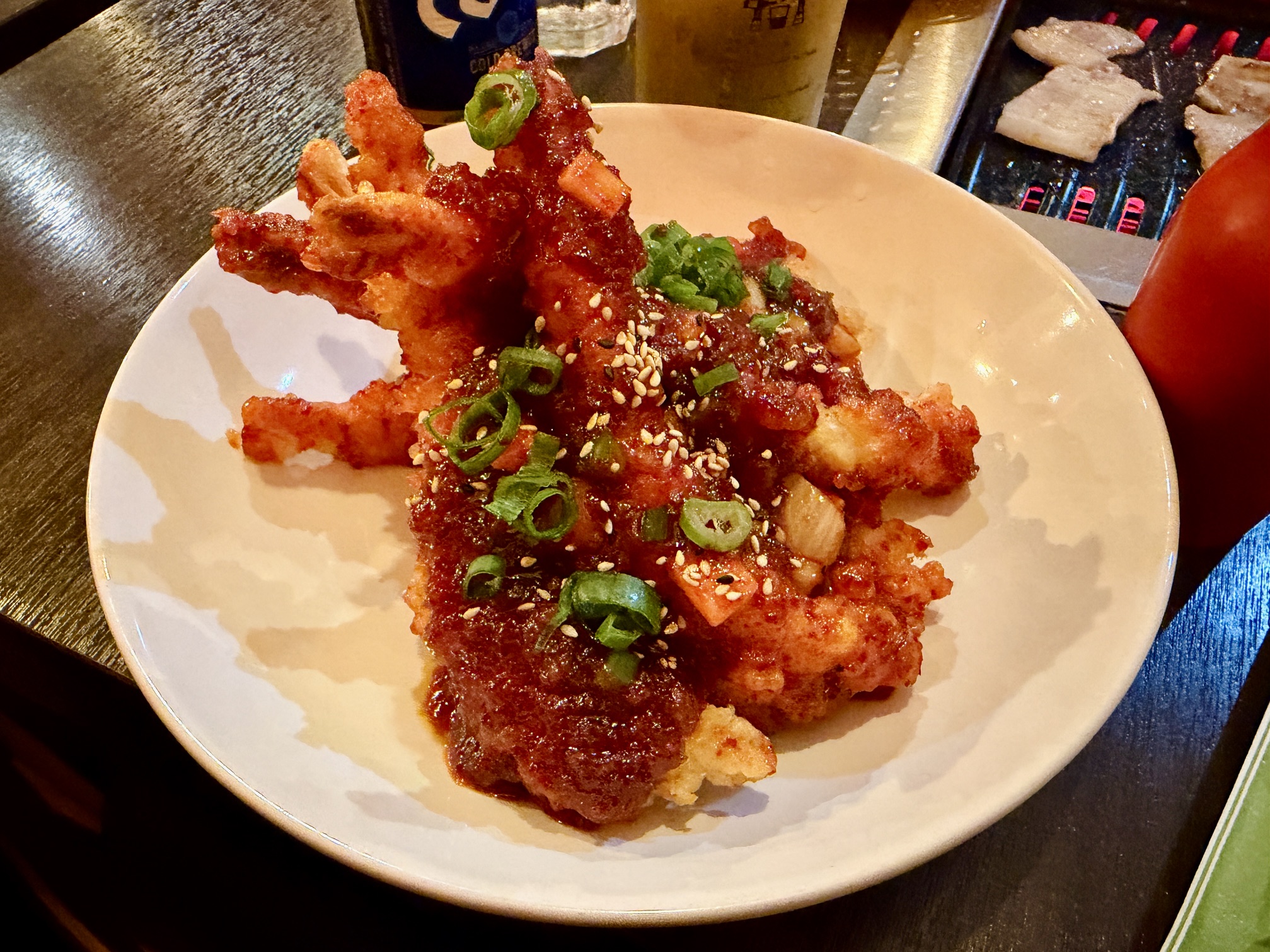
Zoë loved her main, I don’t think I would have done. I managed to persuade her not to have her regular takeaway order, her chicken gam-poong gi, but she ordered it with prawns instead. I was expecting this to be prawns curled up, little inverted commas in a crisp coating, tossed in the gorgeous spicy sauce that makes this dish such a crowd pleaser in my house.

Instead they were fully extended like an accusatory index finger, the tempura prawns from earlier on making a reappearance with some sauce thrown in. So deeply impractical in many of the same ways as that starter, and downright impossible to eat with rice. I didn’t order them, and I certainly wasn’t allowed to try them, so it doesn’t really matter. Zoë really enjoyed it, and maybe in the free-for-all of our meal overall it didn’t really matter that they weren’t quite what I thought they would be.

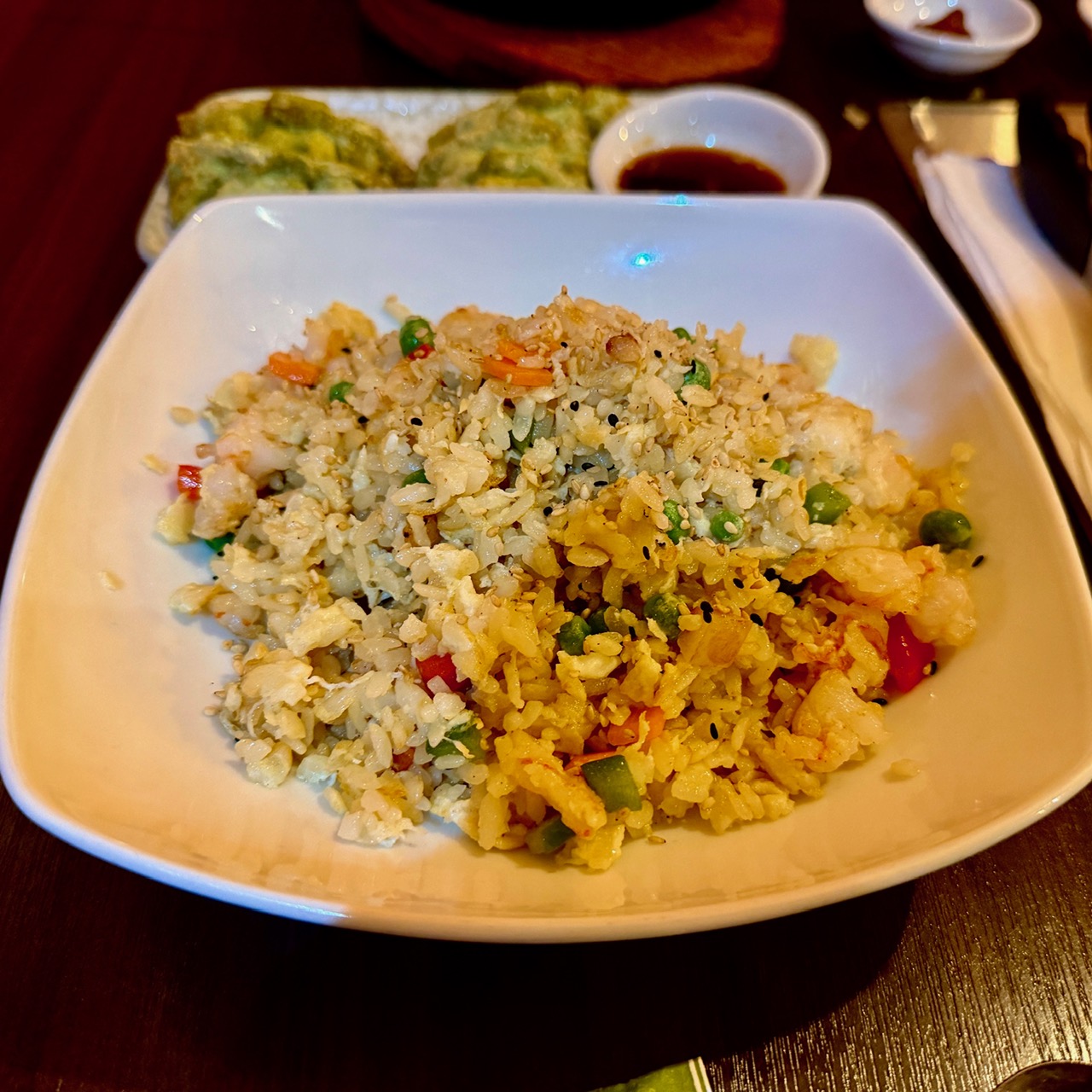
The dish they didn’t go with, or at least I thought they didn’t, was Gooi Nara’s special egg fried rice with vegetables and shrimp. Zoë, again, seemed to enjoy it but I thought it was a bit steep at £11, especially considering that you could get a bibimbap for roughly 50p more. Plus I got a bit squeezy bottle of gochunjang, let’s not forget, and this looked like it badly needed that or something like it.

Finally, as we flagged in the heat, a little John Lewis portable fans valiantly whirring away to almost no avail, we barbecued the last dish in our order. By sheer coincidence I’d actually ended up ordering something from my 2018 visit to Gooi Nara – the ju-mul luk, beef with garlic and sesame oil. It was smothered in marinade there on the plate, slices much thinner and better cut than I remembered from my last encounter, and it smelled pretty amazing before it was ever even exposed to heat. As it cooked, the aroma got more and more gorgeous: perhaps we’d saved the best til last.

Tasting it at the end of the process, I rather thought we could have done. Every single piece was buttery-soft, that marination doing its work with no notes, and although it might have been nice to enclose each piece in a lettuce leaf and enjoy that contrast, I rather wonder if the lettuce might have wilted as badly as I did towards the end of an hour in that hot, noisy, oddly glorious room. By some tragedy, Zoë found herself full halfway through my final spell as the commis chef of our table. I buckled up and finished the rest: it had to be done.

Gooi Nara’s menu only has two desserts, both of which are Japanese, but we were too hot and too full to attempt either of them. Our bill for all that food and a couple of beers came to £95, not including service, and of course we were more than happy to tip: even just watching the constant parade of staff back and forward to tables, carrying a huge array of fascinating dishes without ever breaking rhythm, juggling orders for customers and brown bags out to delivery drivers, filled me with admiration.

It made me think of all the Saturday nights when we’d fired up a delivery app and our food – perfect, beautifully packed, prompt and piping hot – had arrived in what seemed like no time. Every evening that happened, the restaurant might well have been as busy as it was that evening. We emerged into the sunlight on Whitley Street feeling like we’d spent just over an hour somewhere totally not-Katesgrove, but also arguably in Katesgrove’s very best restaurant. We also resolved that, delicious and convenient though a Gooi Nara takeaway always was, we needed to visit again far, far sooner.

Rating Gooi Nara this time has been quite difficult. I definitely enjoyed it more than the previous time I went, but I have a feeling that the limitations on the rating it receives on this occasion have more to do with me than with them. So whatever mark Gooi Nara gets as a restaurant, I think this might be a review where I, as a reviewer, might struggle to scrape a 7. I have a feeling that if I’d been bolder, gone further to the perimeter of the menu, I could have enjoyed it even more and it would have done even better.

In that sense it would have been nice if Gooi Nara had, in the way that great communicators like Kungfu Kitchen, Clay’s, Kamal’s Kitchen and the Moderation do, tried more to tell the story of their food and bring newcomers in. But really, that’s not mandatory, especially when a restaurant has been going for about 10 years and is doing very nicely without having to do any of that. So much as I might have enjoyed having a bit more guidance on how to attack the menu, that was definitely a me problem, not a Gooi Nara problem.

I will be back, and when I do I will try some more esoteric dishes: if you have any recommendations drop them in the comments. In the meantime, I suspect another paper bag with my regular takeaway order lurks in my not too distant future. Eat-in, delivery: get yourself a restaurant that can do it all.

Gooi Nara – 8.1
39 Whitley Street, Reading, RG2 0EG
0118 9757889

https://gooinara.com/

Since January 2025, Edible Reading is partly supported by subscribers – click here if you want to read more about that, or click below to subscribe. By doing so you enable me to carry on doing what I do, and you also get access to subscriber only content. Whether you’re a subscriber or not, thanks for reading.

Café review: Baby Yolk

Alexandra Langlais, the owner of Insta-friendly Erleigh Road institution Café Yolk has had a busy twelve months. In January she opened Donnington Deli opposite Yolk’s original branch in a spot formerly occupied by a car dealership, offering huge deli-style sandwiches with a free cold drink thrown in (or, if you’re cynical, a cold drink you might not want priced in). I went the morning they opened and, perhaps peevishly, was disappointed that they weren’t a deli and didn’t serve coffee; I wandered off to have an enjoyable brunch at Monty’s instead.

The deli thing was probably an overreaction – nobody criticises Calcot’s Avenue Deli, after all, for not being a deli – and I’m reliably informed that Donnington Deli has finally put coffee on the menu. But I ate there a couple of times in quick succession in its opening month and, despite being impressed with the handsome fit out, it wasn’t entirely my bag. Sometimes less is more, and Donnington Deli’s almost comically overstuffed and stodgy focaccias didn’t do it for me; the prevalence of turkey, surely everybody’s least favourite meat, on the menu was also a bit of a curveball.

I’ll be back at some point once it’s settled in to try Donnington Deli again but the place was doing a roaring trade and doesn’t need any help from me either way: Langlais clearly knows exactly what she’s doing, understands her market and is expanding her business in a careful, considered way, staying close to a community she knows well. It’s mind-blowing, really, to think that Café Yolk traded solidly for over 10 years before it even considered branching out.

The more interesting development, for me, was Yolk’s actual second branch, colloquially known as Baby Yolk, which opened on Cemetery Junction last July. It was a deliberately stripped-back sequel to its older sibling, with a far narrower menu and a greater emphasis on grab and go options. It particularly appealed to me because my favourite thing at Yolk was always the breakfast burger, and that’s what Baby Yolk has built its menu around.

But in that part of town, only open daytimes, Baby Yolk had proved challenging for me to get to for brunch or lunch, and it wasn’t clear how much capacity it had for eating in. Last week, with a rare Friday off, I found myself in that neck of the woods just in time for a late breakfast, so I decided it was a sign and made my way there to see how it measured up to the other establishments in the Yolk family.

I was reminded as I approached it that businesses don’t always prosper in this location. The spot where Smash N Grab used to be was now occupied by a South Indian business called Mallu Nest, but the little hut looked like it was being gutted and it wasn’t clear whether it would reopen as Mallu Nest or something else. And of course before that it spent something like a year being the preposterously named Cozzy Bites, a smash burger place whose menu was so similar to Smash N Grab’s that you wondered if the names of the burgers had formed part of the terms and conditions of sale.

Come to think of it, before Baby Yolk came out of its shell that site was Cemetery Junction hairdresser the Funky Barnet for over 20 years, which means that – lucky Yolk – their landlord is famous Reading philanthropist John Sykes. Let’s hope they get on better with Sykes than the Funky Barnet did, given that they notoriously went to the local paper during Covid to ensure his humane conduct reached a wider audience. All that and a busy charitable foundation too: let’s get Danyl Johnson to give that man a gold plated Pride Of Reading Lifetime Award!

Still, as long as Yolk keeps making money and avoiding any kind of global pandemic I’m sure they and their landlord will rub along nicely, until it comes time to renegotiate the rent at least. But can they do that in this little corner of the Junction? I got there just after 10am, and one customer was sitting in, although there was a steady trickle of both eat-in and takeaway customers during my time there.

I loved the interior and the way Baby Yolk was styled. From the sunshine-yellow awning and shopfront to the almost space-age white shelves, showcasing Yolk’s beans and reusable cups for sale, the colour scheme is clever and witty, is bright and pops. It’s rare that the interiors of Reading hospitality businesses look this coherent and thought through, and I really appreciated it. Baby Yolk was also far bigger than I expected inside, with a mixture of high and low tables, stools, chairs and bright yellow banquettes, probably seating about a dozen people. Outside a little terrace had room for half a dozen more, and could be lovely on a sunny day.

Baby Yolk’s menu keeps it simple: five “breakfast burgers”, although the pedants among us – okay, maybe just me – could argue about whether any of the ones that don’t involve a sausagemeat patty technically qualify as burgers at all. For meat eaters you can have either sausage and egg, bacon and egg or the holy trinity of all three, for vegetarians it means egg, cheese and avocado in a bun.

Vegans get the same thing, but with scrambled tofu subbed in for the egg: I had scrambled tofu once, in 2016, and have never sought to repeat the experience. Let’s just say it was a strange time in my life.

The entry level breakfast burgers are £7 each and costs rise from there to £8.90 for the vegan not-a-burger. There are various extras you can chuck in: some, like sauce and crispy onions, are free whereas others can add up to £3 to the end product. It felt a little unfair that the vegetarian and vegan options were the most expensive things on the menu, and it also doesn’t suggest Yolk is using the fanciest meat in their sandwiches.

The majority of the menu board was given over to a plethora of beverages: frappes, smoothies, iced drinks, teas, coffees, matcha and chai. There were also some baked goods up at the counter – muffins, cookies and the like – although their price wasn’t listed. A sausage and egg burger and a latte set me back £10.70, which felt pretty reasonable, and I nabbed a table in the bay window with a good view of the room. Five minutes later, my coffee and my foil-wrapped burger were in front of me.

The first thing to say about Baby Yolk’s breakfast burger is that despite what you might think it is not a McMuffin or even Fidget & Bob’s Kennet Island homage, the O’Muffin. Part of that is the obvious: it’s a bun, not a muffin. And part is because, instead of a fried egg, Baby Yolk tops its patty with a little omelette, as its elder sibling does. Less messy, and possibly a little less indulgent.

Unlike the breakfast burger at Café Yolk the egg here doesn’t make a break for it past the perimeter of the bun. But again, this is designed for convenience and eating on the go, not attacking at a table with cutlery to hand if you need it. I didn’t mind that, but the egg itself was underseasoned: it meant the rest of the burger had to do a disproportionate amount of heavy lifting.

Similarly the patty was pleasant, if ever so slightly anaemic. When you have this dish on Erleigh Road there’s more caramelisation, more crisping of the edges. Here everything was a single texture, a perfectly pleasant spongey puck of sausagemeat which, again, could have done with more salt. All that makes it sound like I didn’t enjoy this, which is unfair: I did, and it was pretty much what I needed. But was it an upmarket reimagining of a Sausage & Egg McMuffin, or just a more expensive version in a nicer room?

What saved it, I suspect, were the extras. I’d gone for HP sauce and crispy onions and the latter in particular lifted and rescued what might otherwise have been a tad workmanlike. The onions were those ones you bought in a tub, but in a thick carpet between the bun and the patty, playing off the brown sauce, they made each mouthful better. I munched away contentedly, enjoying my bay window seat and watching the comings and goings of this interesting little café. Something about its simplicity, its deliberate lack of range, appealed to me: after all, the one thing Gordon Ramsay and restaurant critics have in common these days is a strongly held conviction that menus should not try to do too much.

When I reviewed Cafe Yolk last, nearly 5 years ago, a big draw was that they had started buying coffee from Anonymous Coffee. Then they binned it off, presumably on cost grounds, and used Kingdom Coffee instead: I discovered this one sad afternoon when my takeaway latte tasted worse than one you could have picked up from Costa or Nero.

It’s unclear whether Yolk have stuck with Kingdom or even if they now get their own branded coffee roasted by someone else: although I saw their canary-coloured bags on those white shelves I didn’t go over to investigate, and it’s not clear whether they were for sale or for display only. Whoever Baby Yolk get its coffee from, I was delighted to find that it was a really serviceable, smooth latte without bitterness: a tall, generous one too for £3.70, which is pretty much the going rate for a latte nearly anywhere right now.

It is also, with the possible exception of Monty’s, the only place even vaguely in East Reading that does a latte worth ordering. The residents of New Town are quite lucky, I would say. The commuters of New Town, too, as Baby Yolk opens at 7am. The coffee was so nice, and the spot so welcoming, that I stayed longer than I intended to, nursing my coffee and cursing my bad luck that even I couldn’t justify a research-focused piece of cake at 10.30am.

It’s typical that perhaps Yolk’s most unsung move turns out to be my favourite. Baby Yolk opened last year to a comparative lack of fanfare, and significantly less comment and interest than Donnington Deli attracted less than six months later. But for what it’s worth, of all three of Yolk’s outposts Baby Yolk was the one I enjoyed most. It got everything right: I liked the concept, loved the design and enjoyed the execution.

It’s not a menu with much in the way of replay value, which might prove to be a limiting factor longer term, but it may have just enough. Also, like all of Alexandra Langlais’ businesses, it is not so concerned about getting Reading residents to cross town, as I did, to go there. It is very much targeted at its community and that community is lucky to have someone living in it who has the drive and the vision to make it a better place in which to eat and drink, whatever your preferences might be.

Yolk’s website states “Please note our Baby Yolk location is takeaway only” and they ought to change that, because it might deter people from doing what I did, wandering over on the off-chance and having a really pleasant, tranquil time watching the world go by, both inside and outside the café, the comings and goings of one of my favourite little pockets of the Ding.

Sadly Reading Old Cemetery is still closed, but my breakfast reminded me of all my happy lockdown wanderings there in the summer of 2020, a lifetime ago. If Baby Yolk had been open back then I have no doubt I would have perched outside afterwards with a coffee, or taken one with me and drunk it by the war memorial. I thought of my friend Graeme, who can practically walk past Baby Yolk on his commute to work, and simultaneously felt jealous and happy for him.

It also made me miss my old house in the Village, a short walk from Baby Yolk, and all the working from home lunches I wouldn’t get to enjoy. Truth be told, it made me slightly begrudge living in Katesgrove, which could badly do with a place like this: good luck finding a drinkable latte round there. Still, Reading as a whole is better for this kind of spot, and I just hope they spring up in some of its other unsung or underserved barrios.

Until then, it’s better that a café like this is somewhere, anywhere, rather than nowhere. A rising tide lifts all boats, and we have to hope that Cafe Yolk’s flurry of activity in the last year might serve as a blueprint for other imaginative entrepreneurs. Until then, East Reading is the lucky part. As this review goes to print we’re about to experience our first true heatwave of the year, but even without that Baby Yolk is doing a decent job of making Cemetery Junction the sunny side of town.

Baby Yolk – 7.3
14 Wokingham Road, Reading, RG6 1JG
0118 3131128

https://www.cafeyolk.com

Since January 2025, Edible Reading is partly supported by subscribers – click here if you want to read more about that, or click below to subscribe. By doing so you enable me to carry on doing what I do, and you also get access to subscriber only content. Whether you’re a subscriber or not, thanks for reading.