I go to Bath too rarely to know it well, but often enough to wish I knew it better. Winding through the sun-bathed stone on a gorgeous Saturday afternoon with my old friend Dave, very much following his lead, I realise how rare it is for me to walk round a city with virtually no idea where I’m going. But Dave has been coming here for years, going all the way back to the best part of thirty years ago when he first met his wife and she was living here, so I put myself in his hands for a change and just enjoy the views, all of which are sensational.
I only have a vague understanding of the city – I know where the Royal Crescent is, and the train station, and Pulteney Bridge, sort of, but beyond that my inner satnav of how all these places join together is fuzzy at best. I’ve probably been to Bath something like four times in ten years, so I follow along like a clueless tourist while Dave takes me to his favourite coffee spot, a little off the beaten track, and a very good beer shop. And then we have a bit of a wander in the growing warmth of the day, and Dave tells me about all the green space in the city, the bookshops we could visit later and, crucially, where we might drink after lunch.
Eventually we walk up Walcot Street, one of the few parts of Bath I know a little better. I would say it’s one of Bath’s most beautiful streets, but in my experience they all are. But I know it from the cheese shop, which feels like it’s been there forever, and Picnic, a café I drank at last time I visited the city. Beyond that, I mostly navigate it by memories of places that are no longer there – a Scandi interiors store I shopped at a lifetime and a marriage ago, a craft beer bar called Brewed Boy that I drank at with Zoë and her friends James and Liz, before they became my friends too.
As we stroll, Dave points out landmarks from his memories in the city, places that have survived better than the ones I recall. One, Schwartz Bros, is a burger place that looks to have been trading for the best part of fifty years – Dave remembers it from courting his wife, and that was so long ago you probably still would have called it courting. But our destination for lunch is a place neither of us has been before: Upstairs at Landrace, the restaurant that sits, as its name suggests, on top of the city’s highly esteemed Landrace Bakery.
I’d wanted to go for ages, and when Dave and I were deciding where to meet up he picked Bath over Oxford or Reading, so I saw my chance. I gave him a few options, half expecting him to go for the wine and small plates of Corkage, or the Basque tapas of Pintxo, but was very pleasantly surprised when he plumped for Upstairs at Landrace, a place I’d always liked the look of.
It received some attention in the national press three years or so ago – I get the feeling national critics pick Bath for a review every couple of years when they fancy expensing a genteel day out – but had since settled back down to just doing its business. All the reviews I’d read talked about a simple, compact, beautifully executed menu and really, what more could you ask for when lunching with a very old friend? The menu changed daily, in fact, and both Dave and I kept an eye on it in the run-up to our trip, identifying dishes we would like to eat and hoping they’d still be on offer when the weekend came.
The restaurant is a wonderfully haphazard place. You go up the stairs and although the two dining rooms are both technically on the first floor they aren’t quite on the same level. You sense that everything in the building is higgledy-piggledy, few straight lines or right angles. We were given a table in the cosier of the two rooms, near the open kitchen, all sloping ceilings and sunlight squeaking in through the windows.
It was doing nicely when we got there, on a bright spring afternoon, and it got busier during our time there. It felt like a very agreeable place for lunch, and the fact that my seat gave me a prime opportunity to snoop on plates being whizzed from the kitchen to other tables didn’t exactly do any harm.
The menu was compact and, although a continuous list of dishes, was clearly designed, by price point, to be broken up into smallest, smaller and bigger. Our excellent server, who did a brilliant job all afternoon, talked us through the whole “small plates for sharing and bigger plates for you to have to yourself” concept and we listened to it the way you listen to the safety demonstration on an airplane, being respectful although we’d both heard it dozens of times before. After all, I suppose this plane might have varied from others we’d flown on in the past. It didn’t, though. It never does.
What that meant, in practice, was the compact menu all the critics had talked about – a couple of snacks, six artists formerly known as starters, three big plates for you to have on your own and one even bigger one for sharing. Just the one side dish, “Fairy Hill mixed leaf salad”, from a place whose leaves are apparently so good the provenance deserved to be listed: we didn’t try it to find out. The small plates were between eight and fourteen pounds, the bigger ones between twenty-four and thirty, the biggest fifty-eight.
All the versions of this menu Dave and I had tantalised ourselves with in the run-up, I can safely say, had more options I fancied on them than this one did. One of the most appealing dishes – involving duck, I think – had been replaced with a “Pembrokeshire cockle vongole”, which I’m sure many people would have loved but appealed to me about as much as the mixed leaf salad. Dave, who treats eating out as a chance to indulge, wanted a bit more red meat on there, but pretty much the only dish that fitted that bill was the ribeye, and we didn’t fancy it enough.
We contemplated our relatively bad fortune while eating an excellent slice each of the bakery’s bread – a nice touch that this was complimentary – with very good, golden room temperature butter and a drink. Dave told me on the walk to the restaurant that he had pretty much given up on wine in favour of beer (and I had mentally scratched a couple of bars off my list of places we could drink later on) so he had a bottled IPA from Gilt & Flint, a Devon brewery I’d never heard of who also, apparently, supply to triple Michelin starred The Ledbury. I had a sip: it was nice enough.
I, a little jaded from a session the previous evening at the Nag’s, was tempted by a wine from Wiltshire of all places but instead had a glass of table perry from Wilding. I know next to nothing about perry except that it’s apparently the best booze we all aren’t drinking yet, and unworthily I’d picked it mostly because it was a small glass of something alcoholic that wasn’t too strong. I don’t think that’s a slogan perry makers are going to scramble to adopt, but on this showing it didn’t have enough about it to generally make me choose it over a crisp white wine. I must try harder.
The first of our sharing plates was a study in simplicity. Four very good anchovies – by Pujadó Solano apparently, seventeen quid per pack online – came glimmering in a pool of unbeatable olive oil, sprinkled with oregano, the whole affair beautified with lemon zest. “Why do I never think of having anchovies with lemon zest?” said Dave. “I’m definitely doing that at home from now on”. Otherwise this was just about buying the best of everything and putting it together, and in that sense you could say that although it was special – and at twelve pounds you’d want it to be – it somehow wasn’t out of the ordinary.
What was out of the ordinary, though, was our server coming back with a basket of little cubes of sourdough so we could personally mop up every last soupçon of that bright, herby olive oil: that I loved.
Anyway, the anchovies were the last – the only – thing we ate that was merely quite good rather than extremely good. I had seen mentions of Upstairs’ cheddar curd fritters in other reviews, I seem to recall, and I’d seen enough of them on their way to other diners before I even placed an order that I knew I had to try them.
I wasn’t quite sure, even after eating them, how they managed to make fried cheese so airy, so ethereal and yet somehow they did. They were stupendous clouds of joy – as if someone had decided to make Wotsits entirely out of cheese, serve them piping hot and cover them in yet more cheese. Eight pounds for these, and I think Upstairs At Landrace needs to rethink this whole “small plates for sharing” concept, or expressly make an exception for the fritters. I otherwise couldn’t fault our server, but she should have said “have you considered having one of those each?” Shame on her.
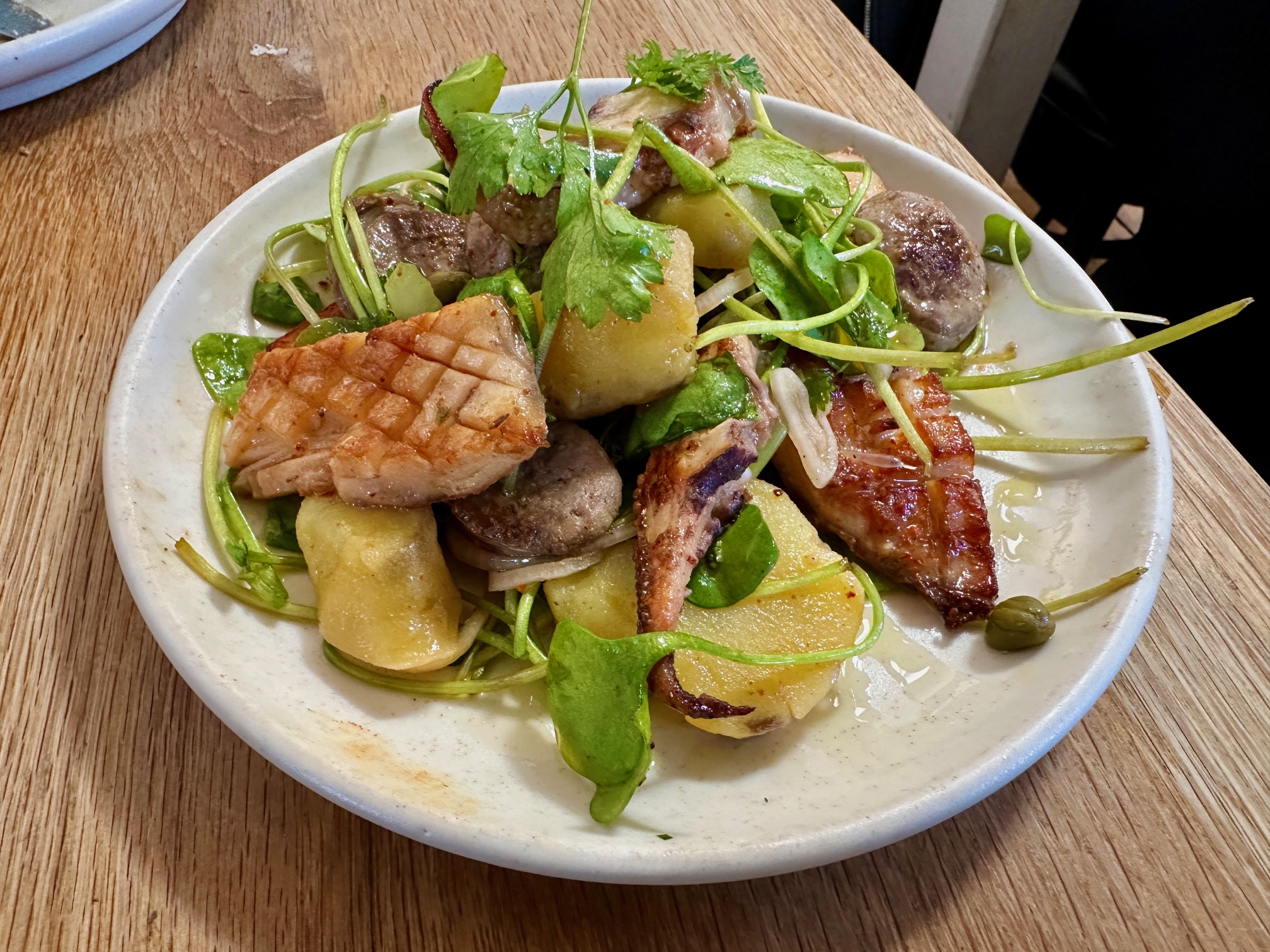
Although you could just as easily have said the same about the third dish we shared, the cuttlefish and sausage salad. Rarely have four words so comprehensively undersold a dish as they did on the menu. I mean, yes, it was a salad and yes, it contained cuttlefish and sausage. But that didn’t begin to do justice to what I’m already sure will be one of the most enjoyable dishes I eat all year.
I suppose there isn’t room on a menu to say “huge quantities of precisely scored, superbly cooked, tender cuttlefish”, and no room to say “the warm, slightly caramelised discs of sausage, with the tiniest hint of offal, bring a welcome hint or earthiness and, let’s face it, red meat, to proceedings”. The menu didn’t go on to add “by the way, you’ll also have warm bits of waxy potato, and while we’re at it the dressing will be impeccable, with the sharpness of capers thrown in, into the bargain”.
I know Upstairs At Landrace’s menu is in the still fashionable Ingredient A, Ingredient B, Ingredient C format that seems to annoy me more than most, but even at its most fulsome it wouldn’t capture that detail. I suppose that’s what restaurant reviewers are for.
But my goodness, how I loved this. If all salads were like this, or even half as good, I would eat salad all the time. I’ve always loved a warm potato salad, or any potato salad dressed with vinaigrette rather than drowned in mayonnaise, and I really adore cuttlefish, which you don’t see on menus anywhere near often enough. To find all of that coalescing in one glorious plate made me very happy indeed: forget JK Rowling’s recent lamentable cigar-based bigotry: this is what happens when a plan comes together. And the company was so good that I didn’t even resent sharing it.
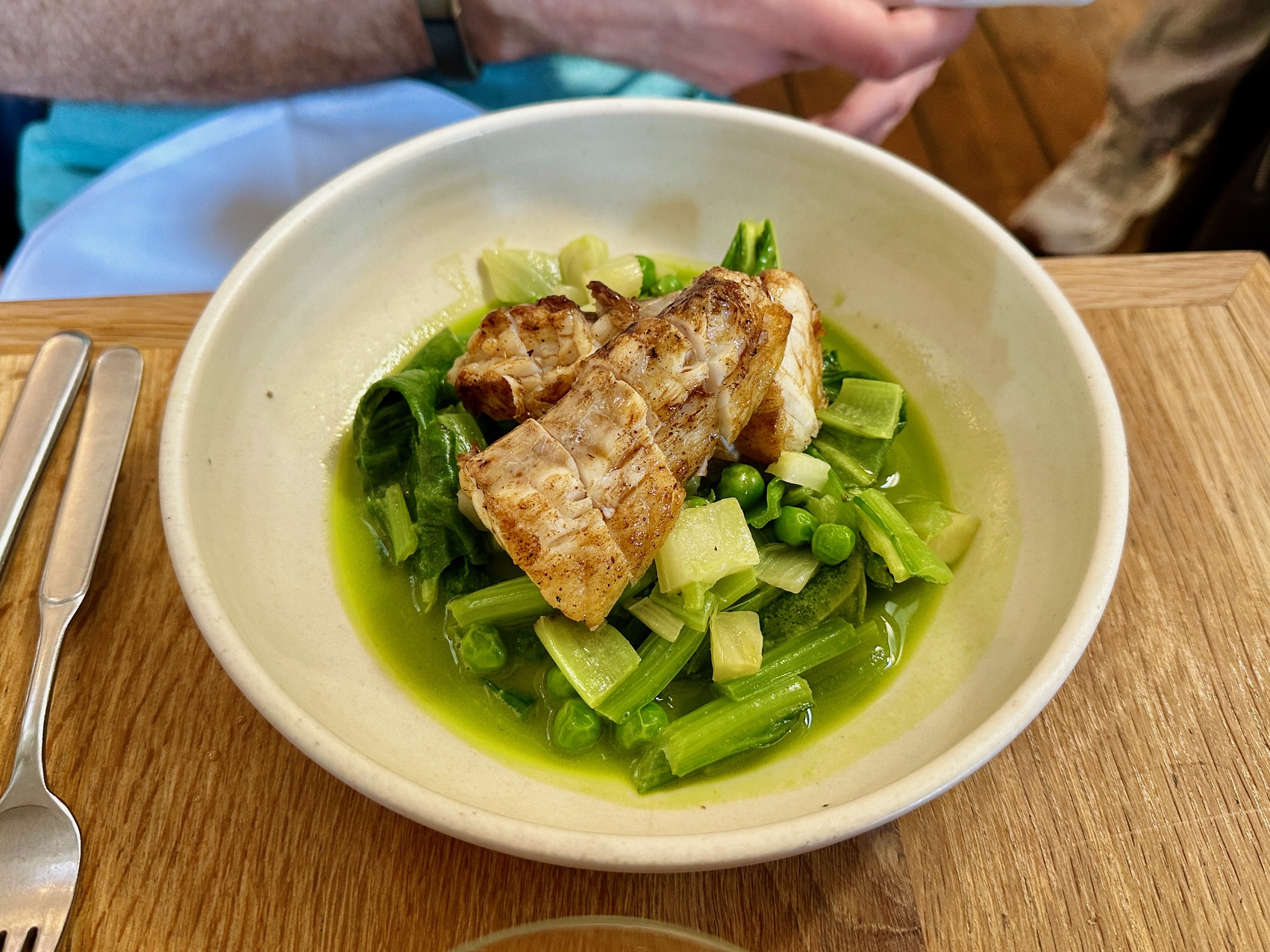
Although Dave was a little sad about the paucity of meat on the menu, those nubbins of sausage aside, he did console himself with monkfish, one of the meatiest denizens of the sea. And again, trust in Upstairs At Landrace was richly rewarded: this was a phenomenally cooked, very generous piece of monkfish with a beautiful colour, effectively cut into medallions. It came on top of a primavera riot – leeks, peas, celery, all the good stuff, bathed in what was apparently a pastis butter.
I can’t verify that: I did try a little of the monkfish, which I thought was exceptional, but left the shrubbery to Dave. He adored this dish though, and didn’t feel like he had missed out one bit. This was possibly a dish you wished you’d held back bread for, although I’m sure our server would have brought a little more if Dave had asked nicely.
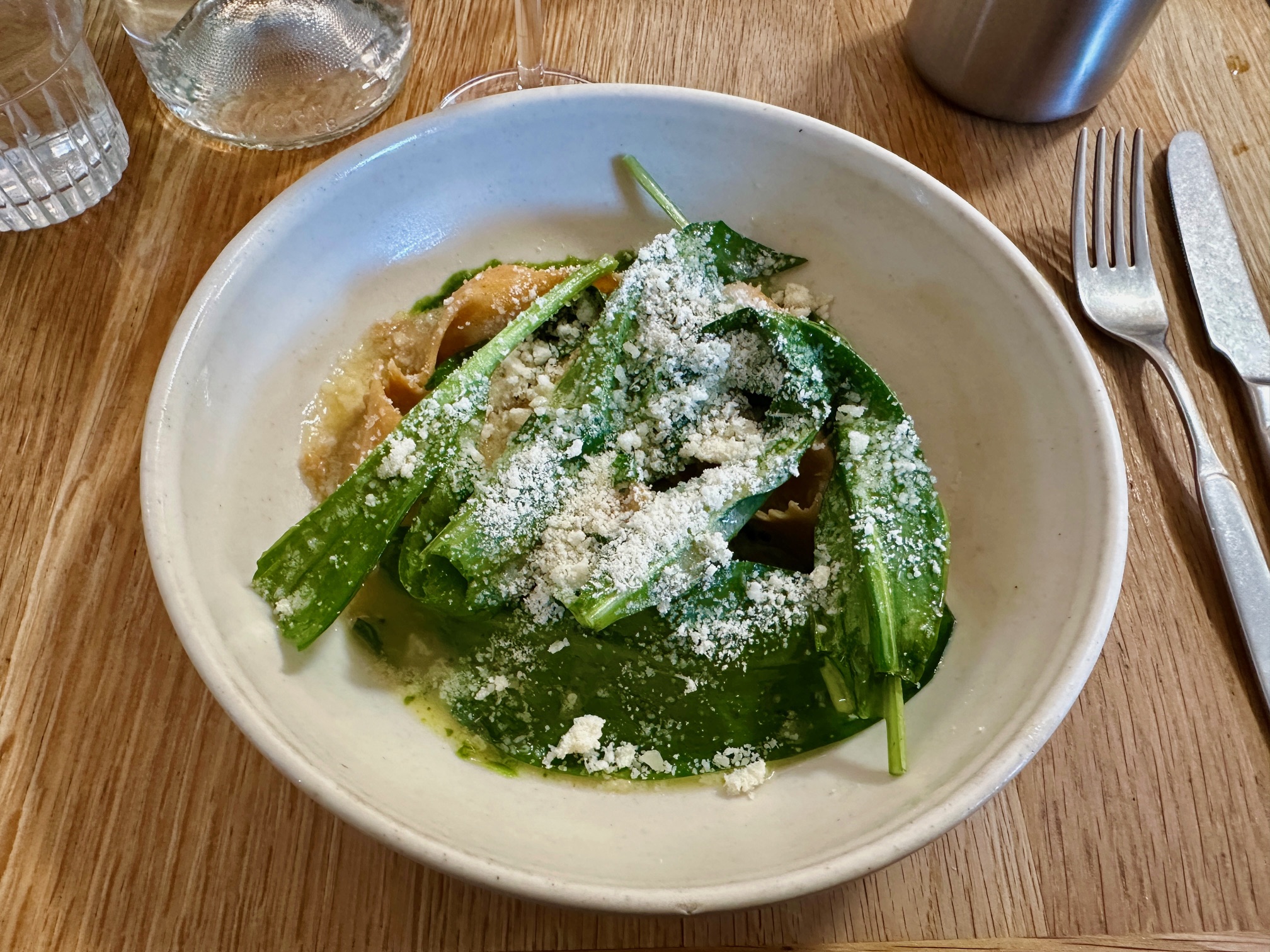
My main, on the other hand, was a symphony of a dish. Agnolotti filled with Jersey Royals could have been starch on starch overkill, but instead were little pockets of silky comfort, the pasta with just enough bite and the filling, pleasingly, with no bite at all. The whole shebang was positively awash with brown butter and wild garlic pesto, because of course it’s the season now, and if that wasn’t enough there was more wild garlic on top. And if that wasn’t enough there was a mountain of cheese, and if that wasn’t enough a dish with more of it was left at the table for you to sprinkle with abandon.
And it was, all in all, enough, and teetering on the brink of too much. But that brink, provided you stay on the right side of it, is where legendary dishes live, and this was one of my favourite things I’ve eaten in a long time. It was so well-judged, so well done, just the right size, everything in the right proportions, everything in exactly the right place. The pesto was so beautiful that I’d have bought a jar the size of my head if I could, the pasta so well done that it’s now, for me, the best thing you could possibly do with Jersey Royals.
I’ve had a few instances recently where the menu, on turning up at a restaurant, wasn’t quite the one I would personally have chosen and yet everything was amazing. I will make the most of those, because I know there’s some Newtonian law of dining whereby, when I review somewhere in the future, the menu will have loads of things I fancy on it, I’ll order them and they won’t be anywhere near as good as I wanted them to be. Buy now, pay later.
Dave and I were fuller but not stuffed, very happy indeed and I was on my second glass of perry, as my hangover became too distant a memory to stop me acquiring another one. The tables about us had ebbed and flowed, but the place had always seemed just comfortably less than rammed. Dave and I got to talking about the times he’s joined me on a review.
“What I find weird is when we go out and have a lovely meal and then weeks later I read your review and you weren’t blown away by the food. Because then I think: are you sitting there having lunch with me and not having that good a time?”
“It’s not that at all! I always enjoy having lunch with you but then when I look back on it, and weigh it all up, the food isn’t the best part of the experience.” I probably won’t be able to convince Dave, even after over thirty years of friendship, that however good the food is his company is usually the best bit.
“I suppose it’s better this way round, though” he replied. “I wouldn’t want you telling me during the meal that you don’t rate it that much.”
“Exactly! Nobody needs someone speaking their truth that way during dinner, it just ruins the whole event.”
“But so when you say this is a really good meal, do you mean that?” Dave wondered. “Or when you eventually write this one up am I going to find it’s got a middling mark?”
“Trust me, Dave. This is going to be a really good review.” There was a pause, and I knew that my old friend wouldn’t completely believe me until he saw it. Nonetheless, I said it again for emphasis. “It’s a really good meal.”
The other thing that happened before we made our assault on dessert was that Dave asked our server where the loos were and was directed towards a door on the same floor as us. He returned eager to share something.
“Mate, before we go you have to try that toilet.”
This was not something I heard every day.
“What’s so special about it?”
“You know how normally if a loo is up some stairs you go up the stairs and then open the door? In this place you open the door, and right in front of you is a staircase. A really steep one. And the loo is at the top and, well, you’re quite close to the edge of the stairs when you do your business.”
“Really?”
“You wouldn’t want to do that after a few drinks, trust me. I expected to see a boulder coming down the stairs at me like something out of Indiana Jones And The Temple Of Doom.”
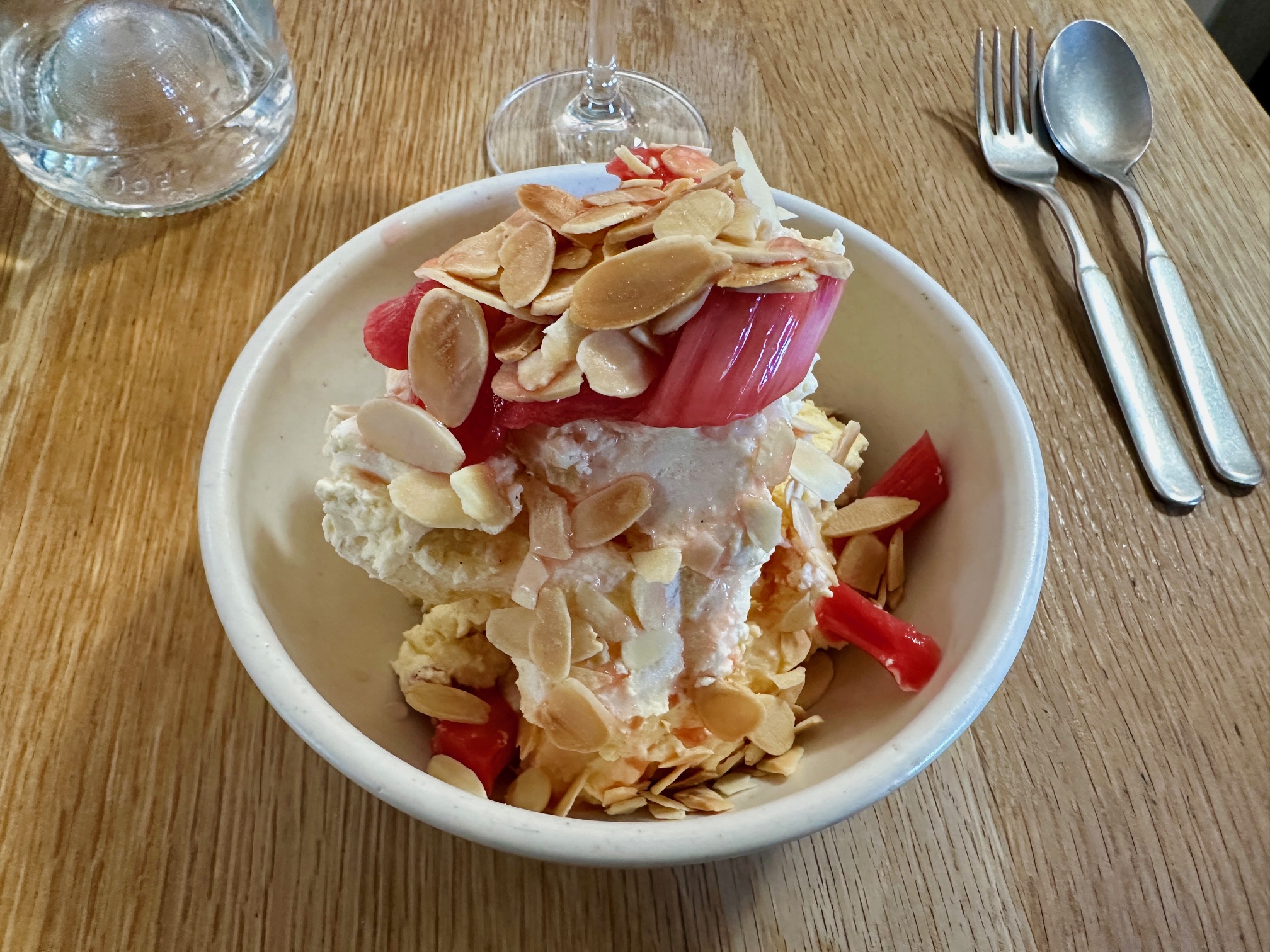
Upstairs At Landrace’s menu is at its most compact at the end: two desserts and a cheese course is your lot. We’d already had cheese to begin with and one of the desserts, the walnut tart, was a no-go – for me, because I’m generally not wild about walnuts and for Dave because, being allergic, he takes that one step further. That just left us with one option, rhubarb, meringue and cream. Maybe Upstairs At Landrace didn’t call it an Eton mess because they’d like to cancel Eton, in which case I sympathise entirely. Maybe it was a pavlova that had done a bad job of tackling those stairs.
Whatever the explanation was, though, it was a really terrific dessert which brought matters to a close in masterful fashion. The cream, from Ivy House Farm, near Bath, was thick and ambrosial, the rhubarb still had bite, and hadn’t been stewed into sticky submission. The meringue was just the right level of chewiness and the extra touch, toasted, flaked almonds, was the icing on the cake. Twelve pounds for this, so again not cheap but ultimately worth every penny. When I looked back on the meal, now that it was done, I didn’t think there had been a single misstep. That rarely happens.
After we’d finished, I took my life in my hands and ascended the staircase to the loo, which was every bit as vertiginous as Dave had warned me it would be: the very fancy hand soap was almost worth the climb in its own right. We thanked our server and chatted briefly to her about what a good meal it was, and she said that they had a lovely mixture of locals and regulars and out of towners like us who treated it as a destination restaurant.
We both did our best to be enthusiastic and grateful without coming across as creepy uncles, but ultimately as she went to fetch the card machine we knew, as always happens, that she was probably just wondering which of those pleasant middle-aged men was the top and which was the bottom. Our lunch for two came to one hundred and twenty-eight pounds, not including service: we didn’t have a lot to drink, but without alcohol it would have been fifty-five pounds a head.
Bath seemed even lovelier, if that were possible, after such a good lunch and so we did some more ambling, including a brief browse for books at Topping & Co, before having a couple of beers outside at Kingsmead Street Bottle, discovering in the course of drinking them, that it was nowhere near warm enough to sit outside. So we headed back across town and lucked out with a great table at The Raven, one of my favourite Bath pubs. I didn’t realise they had a beer brewed specifically for them by Bristol’s Arbor Ales, a really likeable pale, but once I discovered it I knew I was staying on that for the rest of the day. As my friendship with Dave taught me many moons ago, when you find something you really like, you stick with it.
So it turns out that, like the national restaurant critics I lightly ribbed at the start of this review, I have come to Bath twice in just under two years and both times I’ve had a very good, rather genteel time of it. But I think Upstairs At Landrace is worth going to Bath for all by itself – with or without the shopping, or the coffee, or the beers, or the old friend – because it’s supremely good at what it does.
I read an article about Upstairs At Landrace ages ago, in the Financial Times, that lumped it in with the Bristol restaurant Sonny Stores and breezily dismissed them both as part of a trend of a certain kind of restaurant that’s everywhere just now. Well, the main thing that writer was eating, it seems to me, is mushrooms. Because in reality, away from generic broadsheet sighing or sneering, restaurants as good and as clever as Upstairs At Landrace, places that manage to be sleek and refined without being sterile or soulless, are vanishingly rare. Maybe they’re ten a penny in somebody’s parallel universe, but they certainly aren’t in mine.
Oh, and for the benefit of Dave – who I know occasionally reads this – see that mark below? Told you. It was a really good meal.
As of January 2025, Edible Reading is partly supported by subscribers – click here if you want to read more about that, or click below to subscribe. Whether you’re a subscriber or not, thanks for reading.
It was my birthday about four weeks ago – 45 again, please don’t ask me for any documentary evidence – and I had everything mapped out. A couple of days off that week, and then the best part of the following week off into the bargain. We had an Airbnb booked in Bristol for the second week, just up the road from Wilsons and Little Hollows, and a packed itinerary of restaurants to visit, some of them for the blog and some of them just because.
I was all geared up for a week of waking up with nothing to do, of eating well and drinking well, a week of that feeling of being carefree and elsewhere, and I was so looking forward to it. I even had one day planned where we’d stay in our neighbourhood – a bacon sandwich at Wilsons Bread Shop for brunch, good coffee, a spot of mooching and lazing in the afternoon, dinner nearby and then drinks at the Good Measure, my favourite Bristol pub. It was going to be a glorious 24 hours where, just briefly, we could pretend we lived there.
It would have happened, too, but for one thing: my wife fractured a bone in her foot again, and was under strict medical advice to keep her steps to an absolute minimum. I had been running on fumes in the run-up to that mini break – we both had, really – and we were both devastated. We contemplated taking the train to Bristol, as originally planned, and taking taxis everywhere, seeing it as convalescing somewhere else, and my wishful thinking let me believe, for something like half an hour, that such a revised plan would work, would be a sensible use of time and money.
Deep down I knew we were just fooling ourselves. So the Airbnb booking was pushed out until later in the year, and I went in and individually cancelled every single restaurant booking, feeling my holiday dreams die a little more with every email confirmation. I knew it couldn’t be helped, and I knew it wasn’t Zoë’s fault, but I was in a funk. I should explain that this is a “having your birthday in March” thing: I lost two successive birthdays to Covid, the world locked down days before my birthday five years ago, so I felt like fate had already fucked with enough of my plans.
Anyway, after enough sulking Zoë and I hatched a plan: we would have a staycation instead. Not what people like to refer to as a staycation, where you go on holiday somewhere else in the country where you live, but a proper staycation where you sleep every night in your house but experience being on holiday in your home, for a change. We would do some of the things in and around Reading that we loved and others we never got round to, the week of my birthday and the week after, the only proviso being that they had to be places we could reach by bus or taxi.
So this week, instead of the usual review, you get a guide to my Reading staycation, a little What I Did On My Holidays piece. You get that for a couple of reasons. One is that so many people liked the idea that I just had to write it up. Plenty of you wanted to read this one, and someone commented on the Edible Reading Facebook page that she’d said something similar on a local group elsewhere. “I often think we should pretend we’re visiting, and spend the weekend enjoying fab coffee shops, the river and so on” she wrote, adding “We are lucky!”.
We are lucky, indeed. And the second reason why I’m writing this piece this week is that Reading, around the time that I had my staycation, had a bit of a moment where it featured in the national press more than once. First, the Sunday Times listed it as one of the Best Places To Live 2025. The writeup had a little bit of the obvious in it: the MERL got a mention, no doubt because of past glories, and the references to Paddington felt a tad clichéd. And I don’t know what Polaroids Thames Lido’s PR must be in possession of to ensure that they’re always mentioned in a piece of this kind, but mentioned they inevitably were.
Yet beyond that the Sunday Times actually managed to capture something of what makes our town special, even if they think the tap room in the town centre is run by a brewery called Silent Craft. I was especially pleased to see mentions of Blue Collar, the Harris Garden, Madoo and Mama’s Way. Someone had obviously done their research, and I speak as a source they might well have used for it. And I was thrilled to see Dough Bros, barely eight months after I reviewed them, being talked about in the national press. This felt like a writeup of Reading as it actually is, rather than the bland homogenised version Reading UK (or Reading CIC, or REDA, or whoever they are) is always droning on about.
A couple of weeks ago Reading appeared in the national papers again. The article in the The i Paper might have described it as an “average commuter town”, and spent a lot of time talking about Reading’s failed city centre bids and how easy it is to reach or leave, but even it managed to squeeze in mentions of Reading Museum, Phantom – which it said was “by the river”, for some reason – and Caversham Court Gardens. Okay, the QI klaxon still went off when the contractually obligated references to Thames Lido and the MERL popped up, as they always do, but as Reading’s most famous inmate once said, it’s still better to be talked about than not.
So, with all that said, here’s how I spent my staycation – spread across a couple of weeks – in Reading and its environs, only travelling by bus and taxi and still managing to fit in some of the very best things the town and the surrounding countryside have to offer. I hope it helps, and maybe it will tempt you to spend one of your next holidays in Reading, too. You could do an awful lot worse.
* * * * *
So where did we start, on my birthday? At the Nag’s Head, of course.
The first drink of a holiday, for me at least, is always a wondrous moment. I eschew the airport Wetherspoons, although I’ve been known to have a pre-flight Nando’s or Wagamama, and nowadays I pass on drinking on the plane, too, because British Airways is no longer what it was. But there’s something about that very first drink when you reach your destination that’s special, that first ultra-cold lager or fortifying glass of vermut, glass of Brugse Zot or industrial strength Spanish gin and tonic. By that point all your cares have dissipated, and all that remains is relaxation and indulgence.
I didn’t see any reason why it should be any different on a staycation, so our first taxi dropped us on Russell Street. And because the sun was out, albeit briefly, we started our first beer in the garden out back before coming to terms with reality and moving back inside. I’ve talked at great length before – nearly everyone has – about how brilliant the Nag’s is: how it covers all bases, how it’s a perfect summer and winter pub, great on Christmas Eve and New Year’s Eve, the best Reading Half Marathan and Bank Holiday Monday pub.
And that’s all true, but it wasn’t until I went there as part of my staycation that I realised another wonderful side of the pub I’d never experienced: boozing there with reckless abandon, on a school night, knowing you didn’t have to work the next day. You know, like people do when they’re on holiday.
It was at its very best that night – just busy enough, but not rammed with people watching the football, tables sufficiently occupied that it had a pleasing buzz but with no frustrating queue at the bar. Sometimes I forget, too, just how good the Nag’s Head’s beer list is, but lately it has had one of two brilliant session IPAs on keg most of the time – Sonoma by Manchester’s Track and Santiago by far more local Two Flints, from Windsor. Both are great, and both give you the nursery slopes to start on before it all goes downhill and you’re on the dank, stronger stuff you know you’ll regret the next day.
Perhaps best of all, we nabbed my favourite spot in the whole place – the little table for two, right up at the bar, next to the coat hooks. Perfect for sitting side by side and looking out on that room, seeing if you’ve spotted anybody you know – to greet or to blank, both are possible – and, of course, ideally suited for just standing up, getting someone’s attention and picking your next beer.
It was blissful, and on a night like that you can easily think that Reading could do without any other pubs, as long as it still had this one. And I could have stayed all night but, like the first few drinks of a holiday, the session was inevitably curtailed by dinner plans. We had a reservation for the first night of our holiday, my birthday, all the way across town.
* * * * *
I don’t get to eat at Clay’s anywhere near as often as I would like to, for a number of reasons. One is writing this blog – having to eat somewhere new most weeks means that, unlike many people, I can’t just go there because I feel like it (and no, I’m not asking for sympathy). Another is their location. I’m sure that the residents of Caversham are delighted to have them nearby, almost as delighted as they are merely to live in Caversham, but the truth is that when they were in the centre, and I was in the centre, they were a more frequent pit stop for me.
Even so, when it’s a special occasion they are the pre-eminent choice, for me and I suspect many others. When Zoë got a promotion last year, it was Clay’s we turned up at on the spur of the moment to celebrate, and for my birthday it was hard to imagine eating anywhere else in Reading. Going through those deep ochre doors to find it warm and bustling I felt excitement, as I always do, about the prospect of eating there. Because the menu at Clay’s, even excluding their regional specials, has so many good dishes on it that you could eat a different combination every time and never get bored, especially if you go there as infrequently as I do.
I’ve never reviewed Clay’s, for reasons I explained years ago when it opened, and to my surprise I still get people approaching me via social media occasionally, even now, explaining that they’re going there for the first time and asking what they should consider ordering. Very rarely has there been a restaurant where you could so easily get away with a non-committal “oh, it’s all good”, but even so I always feel like I have to respond, all the time painfully aware that you could ask a dozen people and get a dozen slightly different answers, none of which would be wrong.
So, for what it’s worth, here’s my answer: for starters I think it’s hard to look beyond five of their small plates. The bhooni kaleji, the chicken livers that have been on the menu since the very beginning, are outstanding – if you don’t like chicken livers they’ll convert you, and if you do like them they will ruin all others. The gobi Manchurian is the elevation of a dish which is quite good all across Reading, very good at Chilis but exquisite at Clay’s. They simply will not be outdone, you see, not by anyone.
Nandana and Sharat are fried chicken fans, as am I, and their Payyoli chicken fry is as good a rendition as you will get anywhere in Reading, including Gurt Wings. It comes dusted in a rich coconut crumb and served with tomato chutney, and although I always end up sharing it I also grumble silently that it’s too good to share: it helps that of all the small plates at Clay’s it must be the least small. I also resent sharing Clay’s pork belly, which is sweetened with jaggery, sharpened with ginger and cooked until it is sticky, rendered heaven, but I do it.
And finally, I would always tell you to try the cut mirchi chat. I have a real soft spot for this dish because I think I tried a prototype before it went on the menu, and it’s always for me been the most sharable, most snackable of all Clay’s starters: those slices of chilli and gram flour, crunchy and golden, moreish almost beyond belief. If you ask someone else, they’ll tell you to have the prawns, or the paneer majestic, or the lamb chops. And they’re right too, by the way, just differently right to me.
On this visit I decided to forego the pork belly – there were only two of us, after all – and although I regretted it I knew I was storing up a treat for next time. And if you asked me what I recommended from the main courses, I’d wax lyrical about Clay’s yakhni pulao, rice cooked in lamb bone broth, crowned with slow-cooked curried lamb. Or I’d tell you to go fancy and have the beef shin, cooked osso buco style and adorned with wild mushrooms.
If I was feeling old-school I’d recommend Nandana’s monkfish curry, sharper and more tart than her other dishes, made the way her mum does (although slightly less punchy than her mum’s version). And I would point out that the ghee roast chicken, the finest dish Clay’s ever made available to its home delivery customers, is on the menu in the restaurant, for now at least. I’d say that if you’ve never tried it you’re missing out.
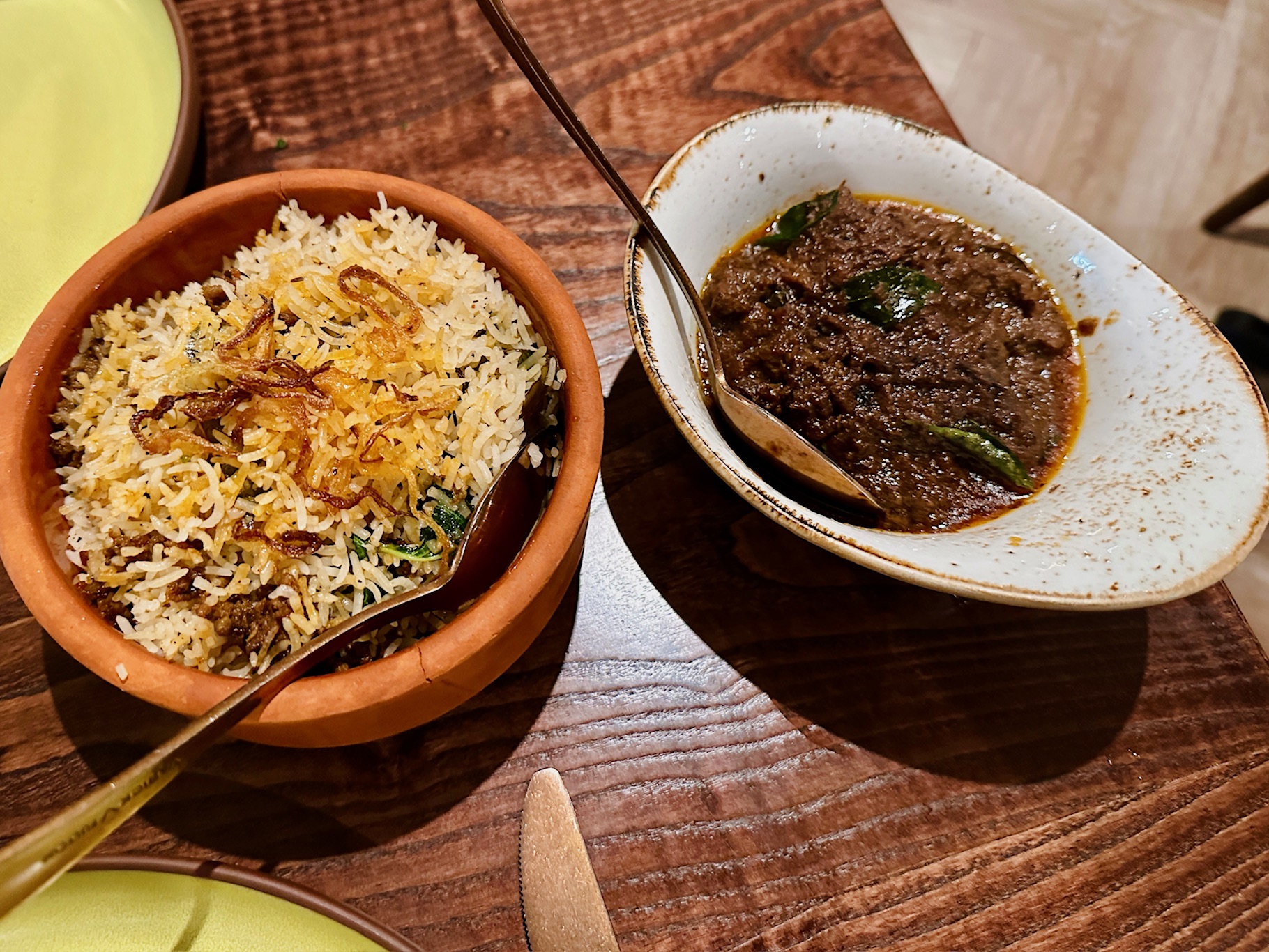
But it was my birthday, and I was reminded that I ate at Clay’s before it was even born, so I had the bhuna venison, a dish I have been eating and loving now for nearly seven years. A couple of years ago I declared it Reading’s best dish, and eighteen intervening months have not changed my mind. But, because you can teach an old dog new tricks, on this visit I used a life hack I’d picked up from my friend Graeme, when we visited Clay’s earlier in the year for no other reason than because it was Friday.
“Have the keema biryani on the side, instead of the usual baghara rice”, he said. “Life changing.”
I did, and it was, and now I can’t imagine ever doing otherwise.
I have never been one of those people who goes to restaurants and takes home leftovers. I’ve always envied those people their limited appetites, or their restraint, while also wondering if they’re maybe a tad parsimonious. But on this occasion we quit while we were ahead, making room for Clay’s amazing peanut butter ice cream and a glass of dessert wine. We rolled into a taxi clutching a little plastic tub full of leftovers – some ghee roast chicken, some bhuna venison, some keema biryani. The first meal of a holiday is always special, but even having a staycation this felt as special as any dinner I’ve had away.
The following lunchtime, nursing a moderate to severe hangover and fresh from the series finale of Severance, I reheated it all in a saucepan for the two of us for lunch. The kitchen went from smelling of reed diffusers to smelling amazing in the space of five minutes, and if that jumble of flavours didn’t go I can honestly say I would never have noticed. You don’t get this luxury when you holiday abroad, I thought to myself.
* * * * *
On the Friday night, hangover largely under control, I did something I don’t do nearly often enough: I went to the theatre. I’ve always loved Progress, the proudly independent theatre on the Mount, and despite moving into the neighbourhood last year I’ve not visited anywhere near as frequently as I ought. So months ago I booked tickets for Zoë and I to watch Lovesong, Abi Morgan’s bittersweet portrait of a 40 year marriage.
As an aside, I should say that although Progress is a five minute walk from my house it’s a surprisingly difficult distance to travel by taxi. You feel faintly embarrassed even asking, and Zoë had to explain the situation to her cab driver, waggling the moonboot lest she be judged as too posh to push. But once you’re there, Progress really is quite a charming place – a little bar, full of affluent, cultured patrons and an auditorium with seats that are surprisingly comfy and spacious.
Does it ruin the overall effect to say that I didn’t love Lovesong? Probably, although I thought a couple of the performances were excellent. Some of that, I think, was down to it being a bit of a bummer: a play which ends with the husband counting out the pills so his ill wife can take her own life – sorry about the spoilers – is never going to give you that Friday feeling. It reminds me of the time when I sat down with Zoë to watch Vertigo, having told her what an incredible film it was, to be met with blank rage when the credits rolled.
“You didn’t tell me it was going to end like that!”
“What did you expect? He wasn’t going to run through the streets to get to the airport just in time to deliver a big speech and stop her getting on the plane. It’s not that kind of film.”
Honestly, she was furious: I’ve never made that mistake again.
But Lovesong, well, it induced symptoms akin to Vertigo. We took the comically short taxi journey home dead set on eating chocolate in front of the television and watching something slightly more uplifting. Like the news. Even so, I recommend adding some culture to a Reading staycation, because mine wouldn’t have been the same without it. And I can’t recommend the whole Progress Theatre experience highly enough – in fact I’ve already booked a ticket for the comedy next month, to watch the splendidly named Scottish Falsetto Sock Puppet Theatre. I honestly can’t wait.
* * * * *
My final meal out of the first leg of my staycation was one of the biggest treats of all, Gurt Wings at Blue Collar Corner. I have been eating Gurt’s food since they first turned up at Blue Collar in Market Place, and I remember Glen telling me how good they were before he even landed them as a semi-regular trader. I recall trekking to Market Place regularly during lockdown, back when Glen wasn’t even allowed seating, and eating my chicken on the little concrete posts opposite Picnic.
I even remember eating their slightly obscene chicken burger special, served in an iced doughnut with a strip of candied bacon on top. They did it once a year, and I reckoned once a year was enough – until I had it two years in succession, and realised that once in a lifetime was probably enough. And of course, I remember going there after Zoë was discharged from the Royal Berks with Covid, in the winter of 2021, and them giving me a big portion of chicken for her, telling me to run like the wind and get it back to her.
That kind of thing makes you a fan. I have followed the hokey cokey of Gurt opening permanently at Blue Collar Corner, then pulling out, then coming back for special occasions. In that time I’ve eaten their chicken in Bristol, from time to time, and watched them open a permanent site in Bristol’s Wapping Wharf, team up with seemingly every influencer known to man, expand their fleet and start popping up at exotic locations like Royal Wootton Bassett and finally, in January, coming to Blue Collar Corner again, back for good, Gary Barlow style.
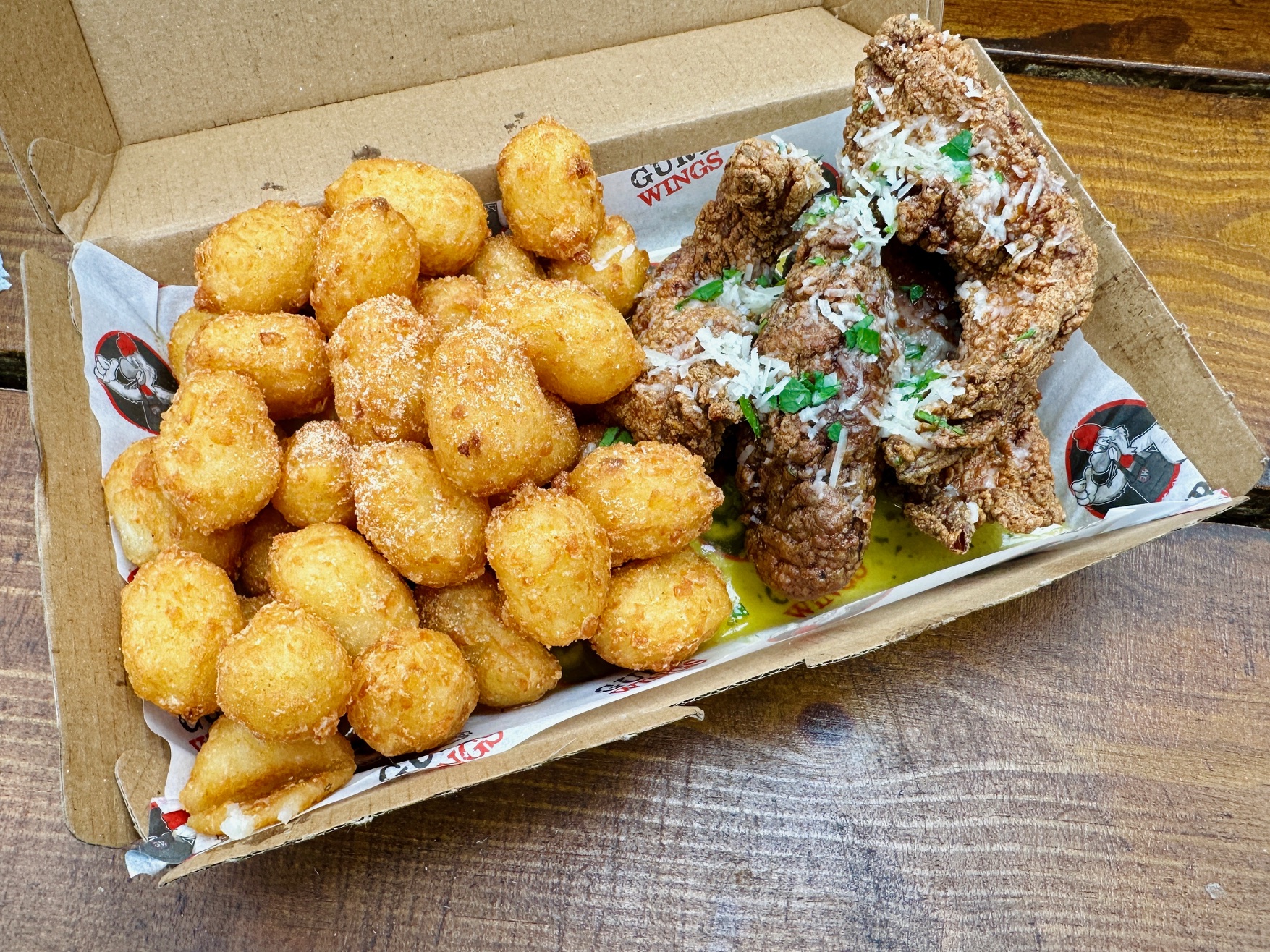
And even though I can now have them whenever I like it doesn’t, yet, make their food feel any less special. Besides, eating it when you’re on holiday – even if it’s a Saturday when everybody else is off work too – did feel a little different, sitting on the benches, people watching and waiting for the buzzer to go off. I decided to be clever and try one of Gurt’s two influencer-inspired specials – god knows why they’ve never asked to do a collab with me – strips loaded with garlic butter and festooned with Parmesan. It was a departure from my almost habitual order – popcorn chicken “Lost In Translation”, with gochujang and sriracha – and I enjoyed it, but not enough not to slightly regret not sticking to my guns.
It helped that we had the huge blocks of halloumi too, covered in habanero chilli syrup and crumbled honeycomb. That made everything better. Afterwards I put a picture of my food up and someone, online, said the chicken to tater tot ratio seemed all wrong. My instinct was to jump to Gurt’s defence, but looking back through my many photos of Gurt’s chicken strips I had to concede that the commenter had a point.
But that’s 2025 all over: you get less, for more, and if you decide to be outraged by it you’re not only hurting yourself but the businesses you love. There are times to be aggrieved by shrinkflation – I feel a bit stabby every time I buy a 90g bar of chocolate – but when you’re on holiday is not one of them.
Our commitment to using buses to spare Zoë’s foot was so total that we then did something ridiculous. We walked from Blue Collar to the very top of the Oxford Road, just so we could get the number 1 bus from Newbury. We did that because that bus terminates halfway up Blagrave Street, a stone’s throw from C.U.P. And we did that so we could sit in our time-honoured seats up at the window, on those fetching leather stools, drinking mocha and looking out on the town.
It was a Saturday, and opposite our seats we could see the Town Hall, and the entrance we’d emerged from ten months ago, into a swarm of confetti, newlywed, dazed and happy. I always love sitting there when married couples come out, mobbed by their friends and relatives, and I remember that glorious sunny day last year when that was me. I often holiday in the same places – Malaga, Bruges, Granada, Montpellier – and some of that is about going back to places that hold such happy memories for me. It turns out that a staycation in Reading is like that, too.
* * * * *
For the second leg of my staycation, the following week, there were some chores to do. Despite having moved last summer there were still boxes to unpack, order to impose on chaos, shit to get done. I am not someone who enjoys doing those things in my time off – I moan, grumble and gripe (“when else are you going to do it, then?” Zoë asks, and then I gripe some more because I don’t have an answer). But I agreed to it, just this once, on the basis that we interspersed it with treats. And the treat I had very firmly in mind – for the first morning of the staycation, no less – was a trip to Fidget & Bob.
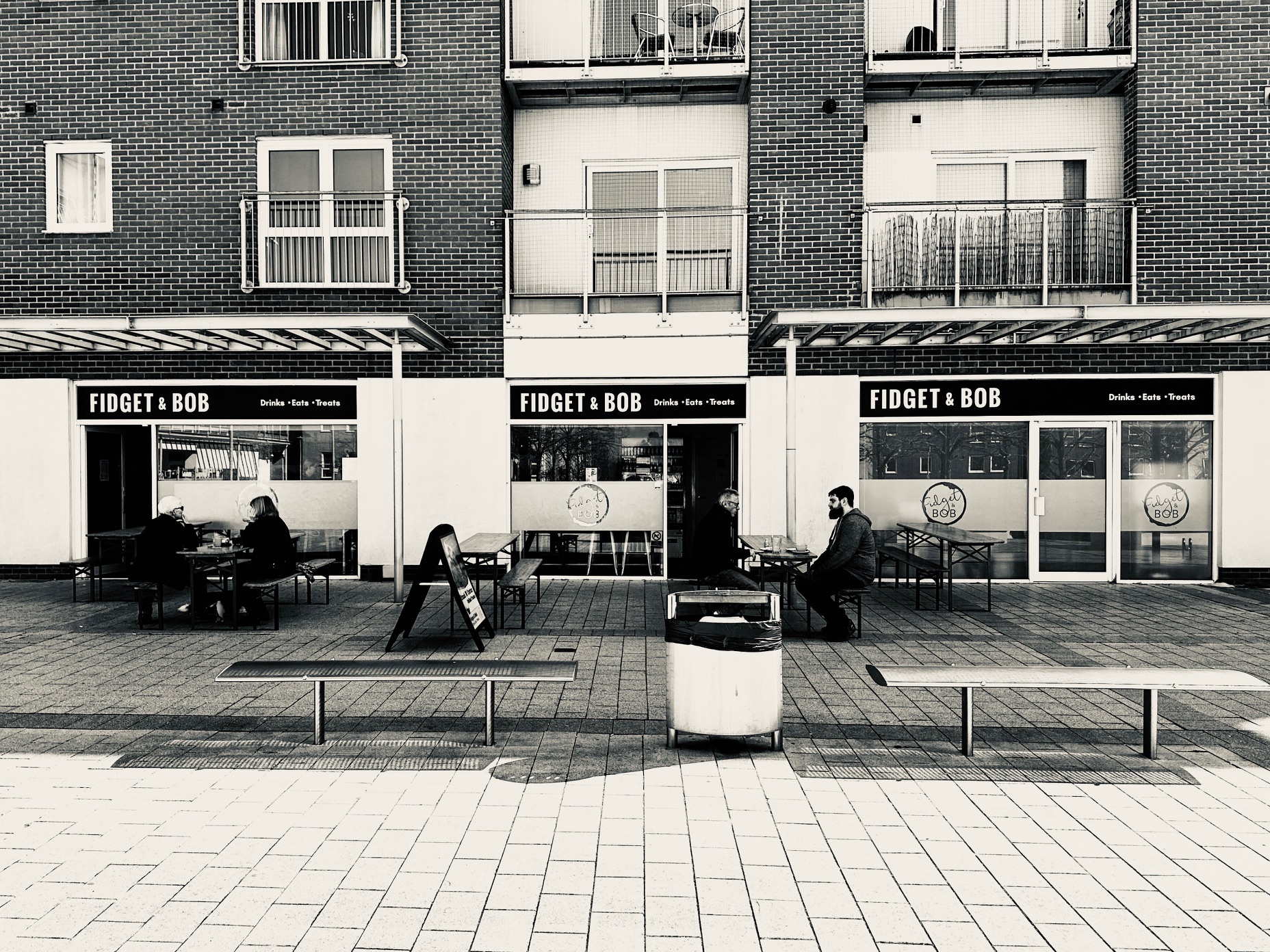
Fidget & Bob has changed quite a lot from the place I visited and reviewed seven years ago. Back then it stayed open til early evening, and its weekly char siu was the stuff of legend. Its scrambled eggs, too: I still think about those. But it took a cautious approach during Covid, and since then it has honed what it does to remain excellent at it, just within carefully constrained limits.
These days it’s closed Sundays and Mondays, and the rest of the week it shuts just after lunch. And Fidget & Bob’s social media is self-effacing almost to a fault: they easily spend as much time promoting their weekly delivery of excellent doughnuts from Pipp & Co as they do talking about their own gorgeous sandwiches. That is, to be fair, typical of them: they’ve always been really good, they just don’t necessarily shout about it.
In the old days I would have gone there for brunch on a Sunday, but my chances to visit it are far fewer than they once were, so my staycation presented an opportunity that I absolutely seized with both hands. And it was lovely to sit in that room again – not quite as diehard as the people outside in the plaza – and drink Fidget & Bob’s terrific coffee.
So many memories are attached to that place: it was there, for example, that I went for a celebratory lunch after having my first Covid vaccine, crammed into a room at the Madejski Stadium with people in my demographic. “I reckon it’s the first time I’ve been in a room with so many people my age in a very long time” said my friend Mike when he had the same experience. “And all I could think was, do I look that tired?“
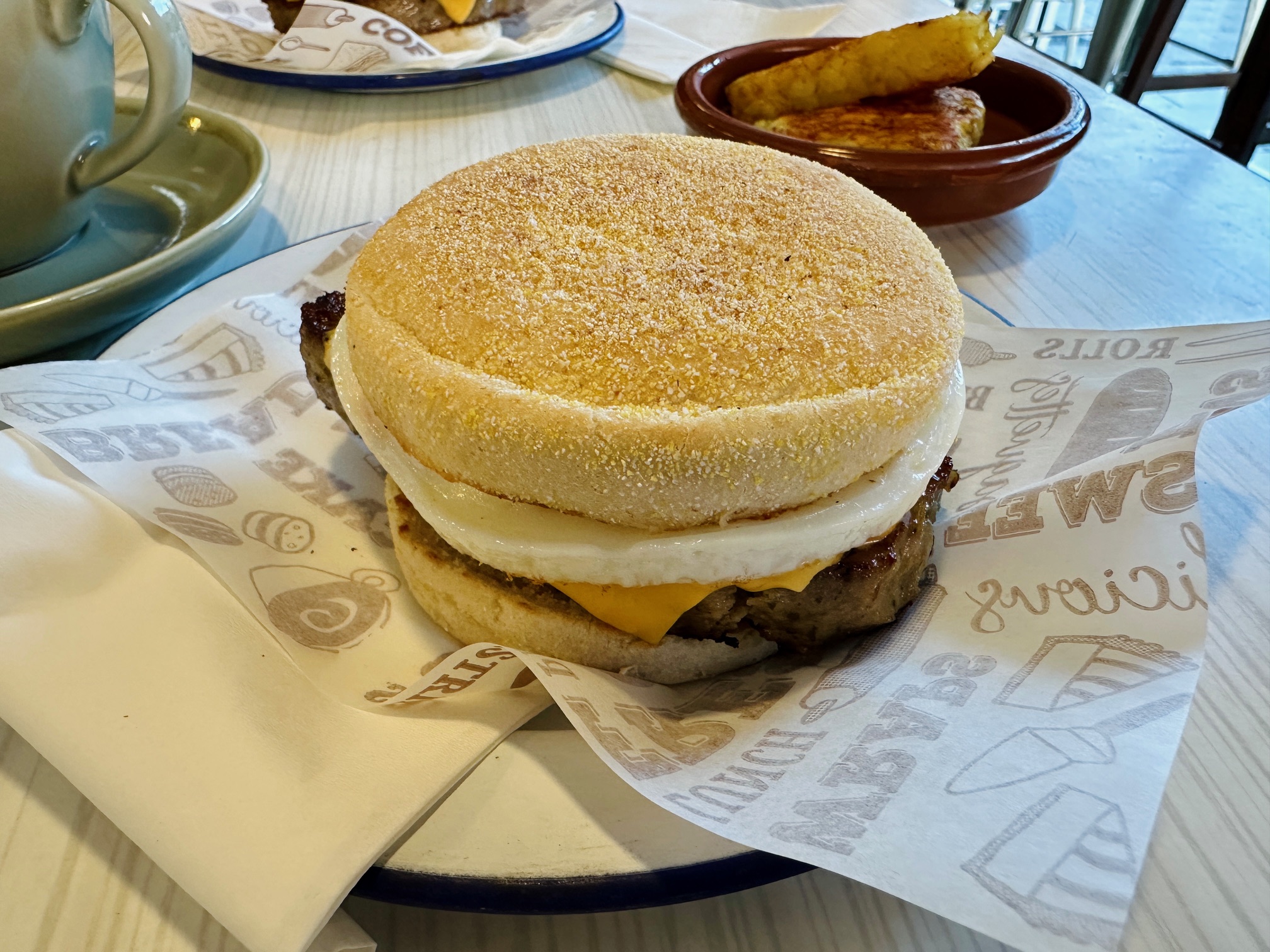
But the big draw at Fidget & Bob is, and possibly always was, the O’Muffin, their take on the sausage and egg McMuffin. I miss their square pucks of sausage meat, served as part of a brunch with their superlative scrambled eggs, but I understand why they stopped offering that. And the O’Muffin is far from a consolation prize. It remains one of Reading’s loveliest brunches, that floury muffin bursting at the seams with sausagemeat, fried egg, American cheese.
It is one of my favourite things to eat, just as going out for brunch is one of my favourite things to do on holiday. I personally like to dip mine in a little pool of HP, much to Zoë’s horror. I also like to have it with hash browns, a coffee, another coffee and, ideally, a brownie. And, precisely because I was on holiday, that was exactly how I had it.
* * * * *
I went to Orwell’s during my staycation. You might well already know that, because I’ve written about it.
I’m not going to repeat all that, but it did make me think about the benefits of a staycation. Because if I went on holiday, if I did a city break somewhere, I would plan loads of meals out. Some would be casual, some would be higher end. But often on holiday I might push the boat out for one of my meals and go somewhere fancy – Palodu in Malaga, for example, Parcelles in Paris, Bruut in Bruges or Michelin starred Reflet d’Obione in Montpellier. And yet, in this country, I wouldn’t necessarily do that: I seem to associate that kind of meal with going on holiday.
So here is another benefit of a staycation in Reading: giving yourself permission to do those things, the things that might otherwise be inextricably linked with going abroad. Maybe this is just me, and you’re all much better at allowing yourselves those luxuries. But, for me at least, it was lovely to be on holiday in Reading and to think right, what do I never get to do, and where have I always meant to go? As thought experiments go, it was an especially enjoyable one. Like my commenter said, all the way back at the start of this piece, it’s nice to pretend you’re visiting.
* * * * *
On the Friday, the post chores treat was a trip to Geo Café in Caversham. One chore, which was all Zoë and for which I take no credit, was to get our garage looking like this.
I don’t know when I got a garage that looks like a branch of Oddbins: it just kind of happened. I used to have a basement at the old house, and Zoë moved in and then next thing I knew she was buying racks off eBay and turning it into a beer repository. Then came the fridge, humming away and full of IPAs. I knew there were also boxes and crates of lambics under an old coffee table, ageing better than I have, but I’m not sure I realised the enormity of it.
And then we moved house, and moving the booze was an ordeal. So many boxes, so many bags and bags for life. Beers Zoë bought years ago, whole crates of Orval she was ageing “for an experiment”. Several bottles of gin we’d got as presents but not started drinking. And of course the wine – wine bought on trips away, wine bought on holiday, a couple of wines left over from our wedding, bottles of fizz given to us as gifts.
“Don’t worry, I’ll build you something” my father-in-law said to Zoë when he saw the space we had in the garage. And I believed him: my father-in-law is like a cross between the Wombles and MacGyver, he picks stuff up on his travels and is just very good at turning them into tangible things. One day he arrived with a bunch of wood, and the next thing you knew he had constructed this bespoke booze storage. Shortly after we moved in last year somebody tried to break into our garage – unsuccessfully, I might add. If someone managed it now I think we’d find them the next morning, comatose.
During the staycation we made a conscious attempt to make inroads into our stock levels, moving stuff into the fridge for drinking, picking some beers we’ve wanted to try for a while, opening one of the nicest white wines in our collection on a beautiful warm day. Didn’t even scratch the surface.
* * * * *
Another advantage staycations have over holidays – or not, depending on how you see these things – is the chance to catch up with friends. So I was delighted to make it over to Geo Café on a warm sunny afternoon, sit in the Orangery and have a good natter up with Keti, my friend who owns the place. Talking to Keti is one of my absolute favourite things to do, catching up on the comings and goings of Caversham and Henley life, hearing about her family and her kids.
It’s also a great way to keep yourself mentally sharp: Keti usually has three conversations with you simultaneously, and will effortlessly change lane from one to another seemingly at random, forcing you to keep up. It’s more effective, I suspect, than doing Sudoku. So Zoë and I stretched our legs out in the Orangery, drinking beautiful coffee and hearing all Keti’s news. I had an utterly marvellous plate of bacon and eggs – I may have been slightly hungover again, but what are holidays for? – and felt thoroughly fortified by the whole experience. It was, as people say, good for the soul. Seeing Keti’s new dog, who was absolutely adorable, was good for the soul too.
We had plans to be at Loddon Brewery that afternoon, but Keti refused to let us call a taxi. “Zezva will drive you” she said, in a way that suggested she wouldn’t hear anything to the contrary, from Zezva or from us. And so Zezva drove us out to Dunsden Green in the sunshine in his lipstick-red BMW, a recent acquisition of which he was very proud, and we settled into the leather seats and enjoyed south Oxfordshire whooshing past. A frequent part of holidays, for me, is finding my favourite café: but I did that in Reading, to be honest, long ago.
* * * * *
I had never been to Loddon before, so this is where you can all shout at the screen that you’ve known for a very long time that it’s extremely nice and question, with some justification, what took me so long.
It’s a beautiful spot, in the middle of nowhere, and I can see that for those of you who live nearby, or like yomping across the countryside from Emmer Green, dogwalking or otherwise, it must feel like a blessed place. It has a little farm shop – not extensively stocked, but nice all the same – and tables outside, and sitting there with a cold pint of Citra Quad, on a day just warm enough to allow for it, I got why the place is held in such reverence.
That weather didn’t last, but heading inside to their covered terrace if anything I liked it even better. “It reminds me of Buon Appetito” said Zoë, and I could see that, could see how the sun-dappled terrace and clear corrugated roof conjured up memories of the courtyard where I’d had so many memorable meals in the summer of 2022.
Loddon is kind of a craft beer tap room reimagined for affluent, rural, cask beer types. I don’t say that as a criticism, but at mid-afternoon on a Friday in March I was possibly the second youngest person there, and I was drinking with the youngest.
All that changed around five, and the demographic became fascinating: people finishing landscaping work nearby, coming in wearing their uniforms; young couples; mums with their kids, taking advantage of the boardgames stored inside. I loved how random it seemed, although I’m sure if I knew the place and the area better all those connections would make sense, and not be happenstance.
I’d also wanted to go to Loddon because I wanted to try the food. It used to be done by an outfit called Proper Takeout, but they now had a permanent site at the tap yard, and had rebranded themselves Proper Kitchen. They do different dishes on different days of the week – burgers on Thursdays, pizza on Saturdays, roasts on Sundays and so on. But on Fridays it was fish and chips, and I very much fancied checking it out.
The team behind Proper Kitchen are James Alcock, who used to work at Mya Lacarte and Thames Lido, and Nick Drew, who used to be head chef at Thames Lido. I rather offended him when he worked there, which I wrote about here, but fortunately for me he didn’t seem to recognise me when I went up and placed our order. If he did he was too professional to say, and if he gobbed in my tartar sauce it was too delicious for me to notice.
Almost everything we had from Proper Kitchen, would you believe, was knockout. Some of the best fish and chips I’ve had for a long time, combining pearlescent, flaky fish with light, lacy batter, the whole thing served on a pile of extremely good chips. The tartar sauce had that great combination of comfort and bite, and the battered halloumi, three thick squares of the stuff, was possibly my favourite thing of all. Only the frickles – big and watery, the batter just a tiny bit too sparse – slightly let the side down, but I was far too happy with everything else to care.
The taxi we booked to bring us home was late getting to Dunsden Green – I think they’d given the job to someone right in the middle of town, which forced us to spend an extra half hour there. It was about as far from a hardship as I could imagine: I went up to the bar, got us a final half each to finish on, and we sat there enjoying ourselves, aware that everybody else’s evening was several pints away from coming to an end.
* * * * *
Would you be put off eating somewhere if it only had four dishes on the menu? This issue reared its ugly head on our final dinner of the staycation, when a taxi whizzed us down the A4 to the Bell at Waltham St Lawrence, one of my favourite pubs. Zoë has been there without me, for something to do with Reading CAMRA, and I went there last year without her to review it. But we’d not eaten there together since before the pandemic, and a holiday afforded a chance to remedy that.
But everything went wrong. We’d initially booked for lunch, but ten minutes before our cab was due to arrive we discovered a leak under the kitchen sink. So we needed to do something about that, and the booking and the cab were rearranged for the evening. It is a beautiful pub, and although the sun had gone down by the time we got there it was still a gorgeous, cosy place with that whiff of woodsmoke.
And yes, there were only four main courses on the menu, but that didn’t matter because one of them was made of magic words: 12 hour slow cooked lamb shoulder and so really, it didn’t matter what any of the other choices were. Except that our waiter sauntered over and, by way of introduction, told us they had run out of the lamb shoulder. No matter, we thought: the Bell’s venison burger was magnificent, and always on the menu, so the fallback option would do nicely.
Then the waiter wandered back and advised us that actually, they had also sold out of the venison burger. So a cancelled and reorganised booking and a pricey taxi later, I was presented with a choice between the fish course and a vegetarian risotto. Normally I get hangry when I don’t know where I’m going to eat on holiday but this was a new one on me: getting hangry because I wasn’t wild about either of my two possible dishes. If it hadn’t been for the sixty minute round trip, I’d probably have gone elsewhere.
But that just shows how little I know, because despite that setback I had the most fantastic meal. It started with the Bell’s selection of beers – a gorgeous IPA on keg by Mad Squirrel Brewery, and an even better one on cask by Swindon’s Hop Kettle, a brewery I love but whose stuff I never seem to see anywhere. And then, ordering from the menu, even with those limitations, everything was beyond top notch.
That meant sourdough toast golden and shining with melted whipped lardo, great charcuterie with a cairn of cornichons, all mine, in the middle of the plate. It meant a pigeon Caesar salad – who knew there was such a thing – which was a riot of game bird, immaculately dressed lettuce, bronzed croutons and lashings of grated cheese. And it meant the risotto I had been so sniffy about, a stodgy, starchy puddle of the stuff which combined elasticity and comfort, shot through with the first of the season’s asparagus, perked up with lemon and blanketed with Spenwood. Who needs twelve-hour slow cooked lamb shoulder anyway?
And then, because it was right at the very beginning of spring and because the Bell is very good at it, a sticky toffee pudding. It turns out that it’s okay to go to a place that only has two choices on the menu, provided it’s as trustworthy as the Bell. I shall never doubt them again, if only because Zoë said I told you so more than once on the taxi ride home.
* * * * *
I never like the final day of a holiday. Zoë likes to have a bit of a last day in our destination, leaving your bags with the hotel and taking one last wander before a late afternoon flight. For me, I can never enjoy that – although I’ve tried – so I would rather get up and go, taxi to the airport after checkout and have some of the day at home.
But there is something to be said, at the end of a holiday, for revisiting your favourite places before you start the sad journey back. And a staycation made that so much easier, and gave me the chance to right the biggest wrong of the week into the bargain. So Sunday lunchtime, mini-jetlagged from the clocks going forward, found us back at Blue Collar Corner, and this time I placed the Gurt order I should have made the first time.
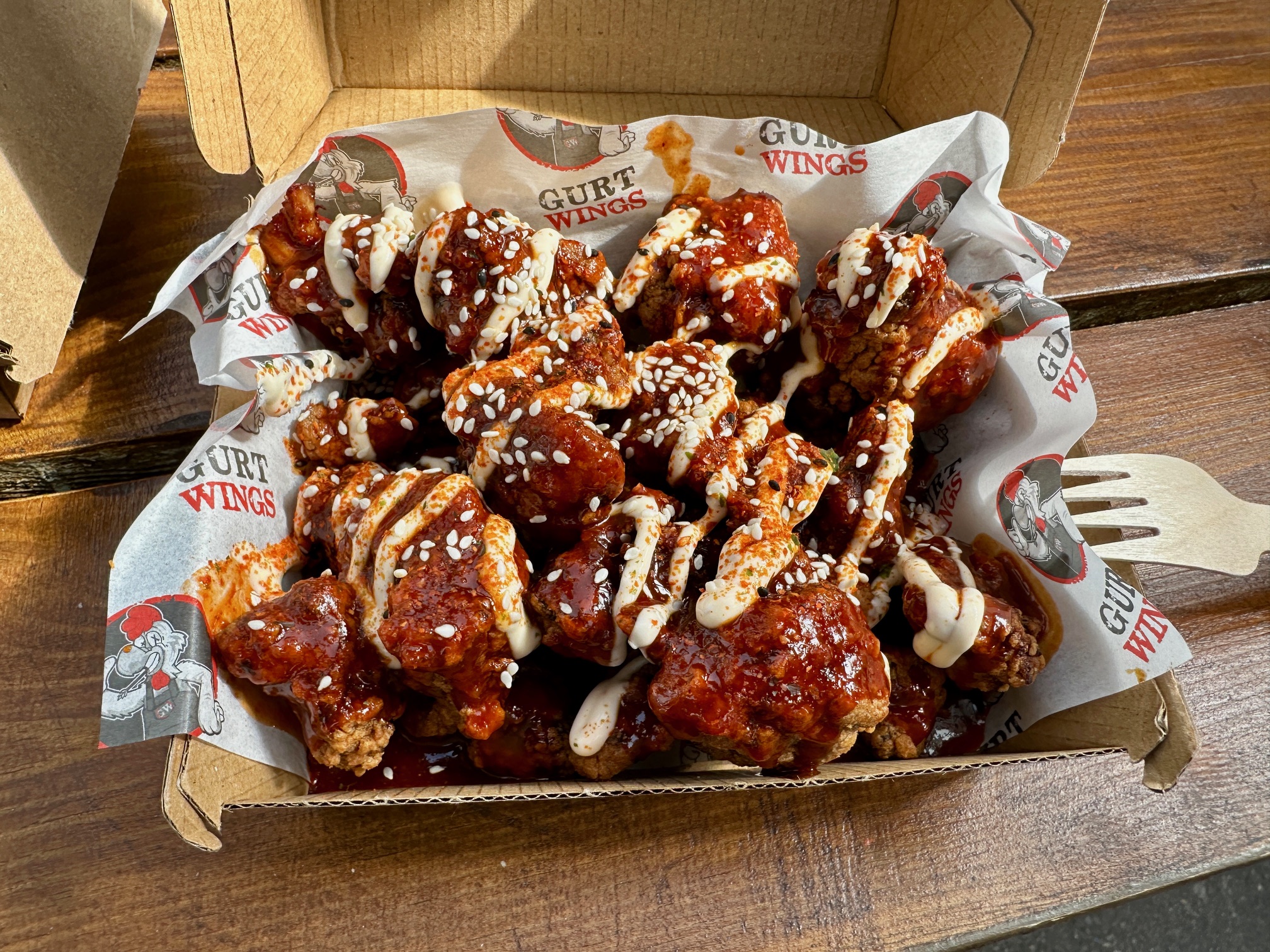
They might be called Gurt Wings, but for me it’s always been about their JFC, their popcorn chicken. It’s the most generous, the most delicious and the most photogenic thing they do – chicken thigh, marinated in soy, fried up and then bathed in gochujang, striped with sriracha mayo and speckled with sesame. I remember the dark days before Gurt did popcorn chicken, and I remember trying an early prototype and thinking: yes, this. This is what you should be doing.
I am delighted they’ve never taken it off the menu since, and it will be months before I go to Gurt, order something else and realise, again, that I shouldn’t have strayed from the true path. Some places you visit on holiday have a signature dish, and if you ignore that you might as well not eat there at all. Afterwards we took that bus across town again, and had one more mocha in the window at C.U.P. It’s odd: normally I am sad about returning from holiday but happy to be reunited with my creature comforts, my stuff, my bed. How strange, and strangely welcome, to have a holiday where you’re never parted from them.
* * * * *
One final postscript before I take my leave of you this week.
A couple of days ago I was tagged on Instagram by a couple, readers and subscribers to the blog, who were on holiday in Bruges. They had been using my guide to the city, and I saw a picture of De Kelk, one of my favourite Bruges bars. I sent one of them a message to see how they were getting on, and I got the loveliest messages back. They’d eaten at a Bruges restaurant I loved, Bij Koen en Marijke, on the previous night and I was sent a picture of the two of them posing with Marijke. Marijke was beaming: everybody looked like they were having a marvellous time.
But the loveliest part was the next bit. My reader told me that she’d been eating at the restaurant with her husband and they got talking to a couple at the next table, who were from Sydney. They asked the Australian couple how they’d chanced upon Bij Koen en Marijke and – and I promise I’m not making this up – they were told “we found it on a great blog called Edible Reading”. How nice is that? That somehow out there in the universe, halfway across Europe, two couples who read my blog, living continents apart, both ended up in the same cracking restaurant on an April evening in Bruges. It’s a small world, sometimes.
I am pretty sure that people – from all kinds of places, not just Reading – use my guides to Bruges, Malaga and Granada to help them have a delicious holiday in those cities. And that makes me very proud indeed. But I know that if I published a piece called “City guide: Reading” it wouldn’t get anywhere near the same footfall (it would also be dishonest, of course, because wishing Reading was a city doesn’t make it so). So nobody will ever chance upon this piece of writing and decide, from somewhere else in the U.K. or Europe, to plan their next holiday in Reading. And that’s fine: those articles in the Sunday Times or The i Paper aren’t going to have that effect, either. I know people are missing out, but I won’t be able to convince them.
So the only people I might be able to persuade to have a holiday in Reading are those among you – and I knew many of you reading this will fall into this category – who already live here. And for what it’s worth, having done it, I heartily recommend a staycation in Reading. Stay in your own bed, plan to really make the most of spending time here without having to go to work, make time to revisit your favourites or discover something new. I’m so glad I gave it a shot, and it won’t be the last time I do. See our town slightly through the eyes of an outsider and you might fall in love with it a little, all over again. I certainly did.
As of January 2025, Edible Reading is partly supported by subscribers – click here if you want to read more about that, or click below to subscribe. Whether you’re a subscriber or not, thanks for reading.
A couple of Mondays back I was on the train home from work and Zoë and I had the “can’t be arsed to cook” conversation where gradually, one or the other of you oh-so-casually floats the topic of scrapping whatever’s in the weekly meal plan and doing something more interesting instead. Do you ever do this, either with a partner or just with yourself?
In my case, I always have to at least try and make it look like it’s Zoë’s idea, every bit as much as she’s trying to make it appear to be mine. I would say I’m more successful when I know it’s Zoë’s turn to cook: she no doubt would dispute that. But I usually get an impression, in those exploratory messages, that there’s potential to chuck the plans and structure out of the window and live a little. You have to celebrate these small wins, especially as the world continues to go from bad to worse.
In the olden days, by which I mean this time last year, the options were plentiful on a Can’t Be Arsed To Cook Day. Town was on my doorstep, and Zoë worked in the centre, and even more crucially to get home both of us had to walk past the Lyndhurst, God rest its soul, and – and this was the difficult part – not go in. So a year ago, the “can’t be arsed to cook” conversation was more straightforward, and often ended on Watlington Street with a Korean chicken burger, or some monkfish tacos.
Nowadays, in that strange no-man’s land that isn’t Katesgrove, isn’t Whitley and isn’t quite the university area, life is trickier. And it’s especially compounded by the fact that my poor wife is stuck at home again with a fractured bone in her foot – different bone, same foot – and so leaving the house together is a vanishingly rare occurrence, even with her immensely fetching moon boot on. Some of the gastronomic opportunities presented by our new neighbourhood, like Curry Rasoi down the way or Meme’s Kitchen down the hill on the Basingstoke Road, remain unexplored.
That means we have to resort, in the most part, to takeaways. And living further out from the centre we have, after a process of trial and error, got this down to something approaching a fine art. I’ve been disappointed by enough orders from the wrong side of the town centre to abandon those as options, because even if Google Maps says something is a nine minute drive away it can be far longer, and more painful, when Deliveroo in its infinite wisdom chooses to lump your order in with someone else’s and deliver theirs, halfway across town, first.
No, with the exception of sushi, which does not go cold – Iro Sushi and You Me Sushi have both done pretty well out of me since I moved house – we tend to keep it relatively local. That means the piping hot wonders of Dough Bros, just round the corner, or Gooi Nara, whose takeaway is so good I gave them an award. It means Bakery House or Hala Lebanese when hot grilled meat or baby chicken are the subject of the hankering, or Kungfu Kitchen if we’re really treating ourselves.
And on the nights when we want something spicy, it means a delivery from Deccan House on the junction, whose chicken pakora and chicken biryani make me very happy indeed, badly in need of a glass of milk and, for a few minutes at least, unable to see clearly through my watering eyes. Sometimes I miss the myriad of opportunities presented by town centre life, but actually having fewer options is fine provided you like them and you have enough. Besides, it’s a first world problem.
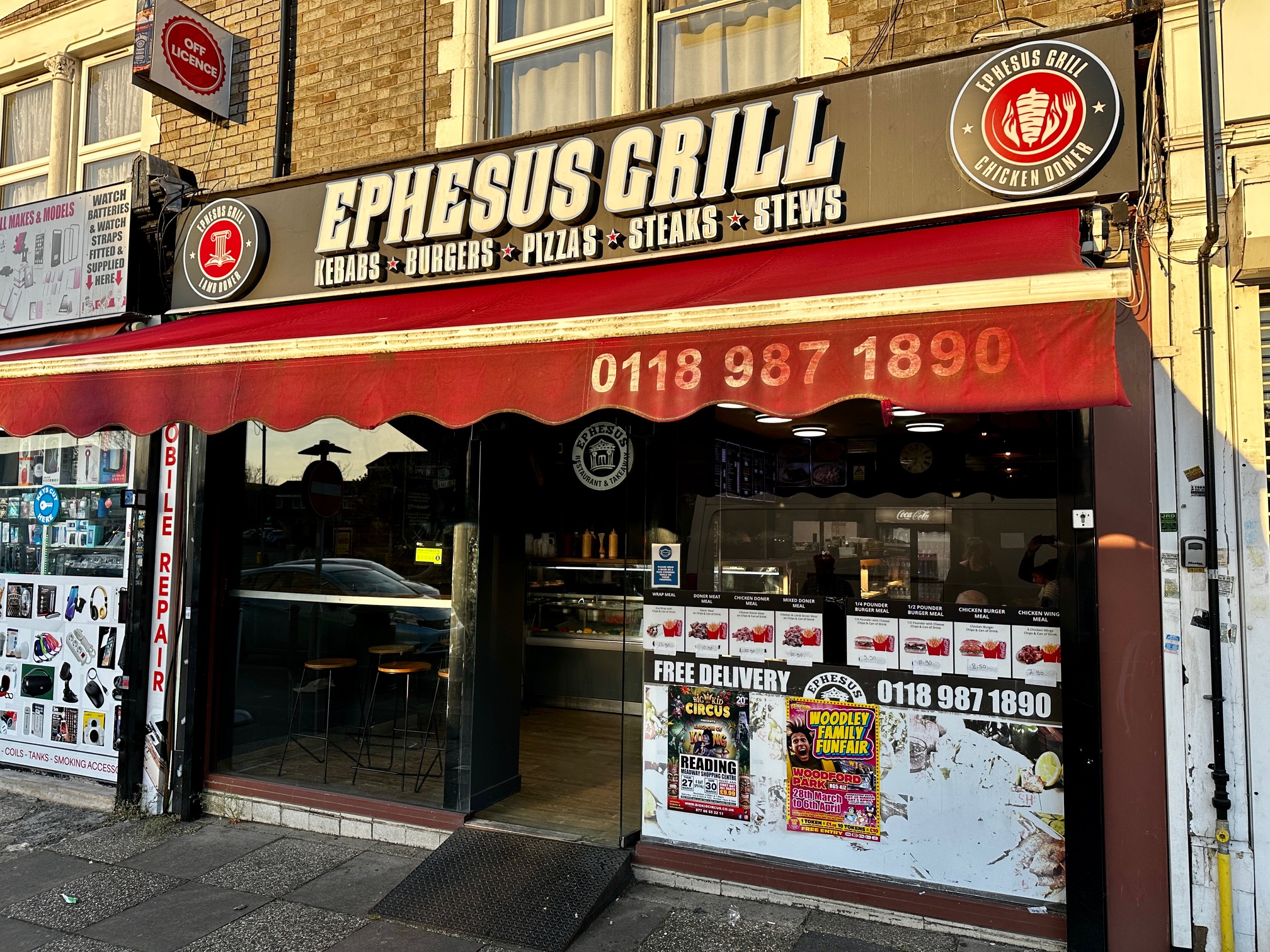
Anyway, that Monday could have been a Can’t Be Arsed To Cook Night like any other, but as I was standing on the platform waiting for my train home I had an idea and texted Zoë. How about you hop on the bus and meet me halfway at Ephesus Grill? I’d had good reports of the Turkish place on Whitley Street – I seem to remember somebody told me about it when I reviewed Shawarma earlier in the year – and it had been on my to do list for a while.
Subscribe to continue reading
Become a paid subscriber to get access to the rest of this post and other exclusive content.
Writing about food – or, more specifically, writing about restaurants – is an enormous privilege. It costs money, and you need money to do it. It is absolutely no coincidence that most of the national broadsheet restaurant critics, nearly all men of course, are either descended from the aristocracy or other journalists. To the point where there isn’t much difference, to be honest: I heard Giles Coren described once as a “hereditary columnist” and, like my vague feelings of revulsion towards Coren, it has always stayed with me.
So how do people afford it? The most frequent route, for Instagrammers at least, is to accept free food in return for content. I’ve talked about that recently, so I won’t do it to death, but what surprises me is how little people on Instagram follow the ASA guidelines and declare things as #ADs or #gifted. Sometimes it’s down to ignorance, others down to wilful ignorance. Often it’s hard to tell. “I thought that was just a courtesy thing” said a content creator I swapped messages with recently. Err, well, how about giving your audience the courtesy of knowing that you didn’t pay for the food you just raved about?
“What if I went intending to pay and they wouldn’t let me?” he followed up, an oblique take on the eternal if a tree falls in the forest and there’s nobody around to hear it question. It doesn’t matter what you intended, it matters whether you put your hand in your pocket. I’m afraid it really is that simple.
But restaurant bloggers do this too, usually while criticising influencers and content creators, seemingly for the crime of being less subtle. They take free stuff all the time, and often don’t declare it either. They certainly wouldn’t break out the hashtags of shame, because that would let the cat out of the bag, so instead they resort to weasel words like “I didn’t see a bill”. Some restaurant bloggers are positively myopic where bills are concerned, but they still have good enough eyesight to say the food looks phenomenal. What are the chances?
But this is the problem: writing about food is an expensive business, so unless you are fantastically independently wealthy you need to find a way to keep doing it – whether that’s wealthy friends, or a patron, or in-laws you can stiff, or some other route. It’s why many restaurant bloggers drift into doing PR for restaurants they like on the side, so the line between the writer and the subject gets hopelessly blurred.
Again, I do kind of understand: I have made a few friends in the business since I started writing this blog (although, and this probably says something about my winning personality, not many) but I don’t review their restaurants. Stay in this game long enough though, and of course you risk compromising yourself. But what I don’t understand, given all the privilege entailed in being able to do this, is how little restaurant bloggers seem prepared to check or acknowledge their privilege.
Instead, you just get tin-eared humblebragging from people who aren’t even pretending to be relatable. “I eat out more often than you, so I know what I’m talking about” says one restaurant blogger who routinely promotes businesses he has worked for. “My lunch is better than yours” repeatedly boasts a second, who rarely sees a bill and appears to be about six months from a cirrhosis diagnosis. Classic car crash.
“I’m especially interested in submissions from writers who identify as working class” says a third, a double barrelled type who is currently in the twelfth week of a jaunt round Asia. Nice work, gang: keep on keeping it real!
So at this point, I should acknowledge my own privilege: I am extremely lucky that I can afford to do this, and very glad that I’ve never gone down the route of accepting free food from restaurants and reviewing it. At the start of this year, I asked if readers wanted to support the costs of what I do, and I was very fortunate that the response was positive. I said at the time that it would hopefully enable me to cover some of the costs of running this blog, and that it might allow me to write more, or different content. It has definitely done the former, and enabled me to get rid of ads on the blog, but what about the latter?
The reason I’m talking about this, today of all days, is because this week’s review is of Orwells, the widely acclaimed Shiplake restaurant that features in the Michelin guide, has received multiple accolades from the Good Food Guide and has been pursuing excellence for something like fifteen years. Its chef owners, married couple Ryan and Liam Simpson-Trotman, are regulars on James Martin’s ITV show Saturday Morning. It is probably the best, nearest restaurant I have never reviewed in nearly twelve years of doing this, and in honesty I would probably not have reviewed it if it wasn’t for the support this blog receives from subscribers.
That’s not to say that I couldn’t have afforded to, but I publish a review every week and in the old days, I could have reviewed two or three places, easily, with the money it would cost me to eat at Orwells. I try to cover a variety of places, at a variety of price points, and eating at Orwells would have scuppered that. So it has never made it to the top of my list – because I’m not one of those reviewers who “didn’t see a bill” – and it’s only now that I felt, on a Thursday night during a well-earned week off, that Zoë and I could hop in a taxi and head out to Binfield Heath to see what the fuss was about.
Incidentally, that’s also why this review is behind a paywall. It was made possible by people who subscribe to the blog, so being able to read it is the least they should get in return for their generous support. But also, be honest: if you’re thinking of going to Orwells and you want an opinion you can trust on whether it’s any good, you can afford to subscribe to this blog, for a month at least. If you can afford to eat at Orwells, you can afford that.
Subscribe to continue reading
Become a paid subscriber to get access to the rest of this post and other exclusive content.
Magdalen Road in Oxford is a 20 minute bus ride from the train station, out east, down the High and over Magdalen Bridge. It connects two of the three great thoroughfares of east Oxford, Cowley Road and Iffley Road, and you can walk from one end to the other in under 10 minutes. One side of it, at the Cowley Road end, is fairly unremarkable – a general store advertising Lycamobile, a letting agent, terraced houses of various vintages.
Only a huge shop called The Goldfish Bowl, advertising “EVERYTHING FOR THE FISHKEEPER” in big orange letters has even a hint of quirkiness. But then you reach the halfway mark, cross over to the Iffley Road side, and find yourself in Oxford’s most incongruous gastronomic microclimate.
Suddenly everything is very different, and both sides of Magdalen Road are full of independent outposts for food lovers. There’s Wild Honey, an “organic health store” advertising local produce, next to a little pink-awninged spot called The Magic Cafe. There’s a pub, The Rusty Bicycle, owned by the same group as Reading’s Last Crumb. Further down, there’s a little shop selling Scandinavian homewares – earthenware cups, sheepskin rugs, scented candles and room diffusers.
Just opposite that, plant-based café Green Routes stands next to Elle’s Deli, which used to be home to Oli’s Thai, for a long time Oxford’s most critically acclaimed restaurant (you had to book a table months in advance). The deli still serves Thai food, and people were sitting outside on a coldish Saturday morning eating it, but it also sells Superbon crisps, vermouth and jars of every kind of deliciousness from romesco to gochujang.
Travel a little further and you get to another cafe called the Larder, with attractive-looking loaves on sale in the window: again, on a day that wasn’t the warmest people were already sitting outside. And next to that, there’s the roastery for Oxford’s Missing Bean, who do some of my favourite coffee and supply to Reading’s Coffee Under Pressure. And then finally, at the southern end of Magdalen Road you reach the Magdalen Arms, which has long been one of my favourite places to eat in the city.
That little stretch of Magdalen Road seems to come out of nowhere, a strange and wonderful little oasis. Just imagine: in the space of five minutes, out in east Oxford, you can visit as many independent delis and cafes and bakeries as you can find inside Reading’s IDR. If anything, with its joggers and dog walkers, its air of bourgeois contentment, it was almost like a micro-Caversham.
At one point a mum cycled past me on some kind of cargo trike, a contraption with two wheels up front and a big box between them, her kid standing up in it and looking out on the world; the Cowley Road’s scruff and bustle was simultaneously a few minutes and a world away.
I found myself in this neck of the woods to check out Taste Tibet, a restaurant that’s been on my to do list for some time. It’s a no-reservations Tibetan restaurant, owned by married couple Yeshi Jampa and Julie Kleeman. They met in India, fell in love, and moved back to Oxford where Kleeman had a job with OUP. They started out running a street food stall over ten years ago, and during the pandemic they opened this spot on Magdalen Road. Since then success has followed, with a cookbook in 2022 and an honourable mention in that year’s Observer Food Monthly Awards as one of the best value eats in the South-East.
Not only that, but Taste Tibet also provides dozens of meals to vulnerable people in its community every week and its thoroughly charming website links with an excellent weekly blog, beautifully written by Kleeman, that is very frank about the challenges hospitality in general, and its little restaurant in particular, continue to face. I’d challenge you to read a couple of posts and not find yourself rooting for them: I certainly came away from it surprised by how invested I was in their project. As I got there at noon – because you can’t be too careful – Jampa was opening up and he cheerily told me to come on in.
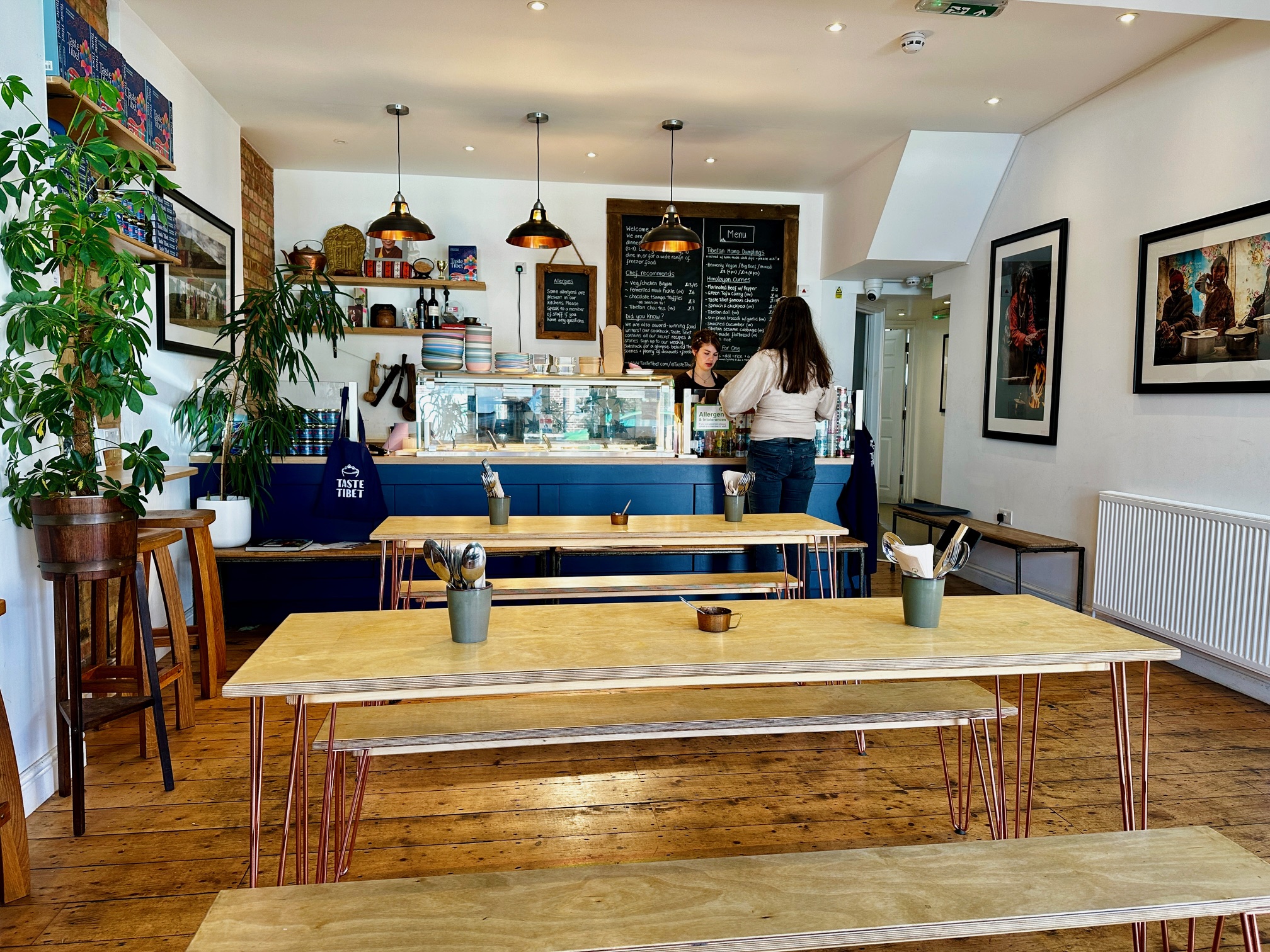
The interior is a lovely, tasteful room but very much in a canteen style, which fits with the lack of reservations. Long tables and benches, which I imagine are communal at busy times, were like a posh reimagining of the furniture you find at every tap room in the land, but the overall effect was very pleasant. There were also seats up at the window, which tempted me, or facing the wall, which didn’t. Jampa told me to hang my coat up on the hooks, which I did at first, but given that the door was left open to attract passing trade I quickly changed my mind and put it back on.
The menu, which changes weekly, is up on a blackboard behind the counter, and many of the dishes are already cooked, in chafing dishes up at the counter. Taste Tibet cannily also offers frozen meals for its customers to enjoy at home, these are in a separate freezer near the front and are a clever way to make sure nothing is wasted. They also had a decent range of drinks, soft and alcoholic, including wines in cans. I was a little disappointed, as always, to see Brewdog as one of the options but I got myself a verbena-infused pale by Earth Ale, a little brewery just outside Abingdon, which I really enjoyed for its fresh citrus and slight bitterness.
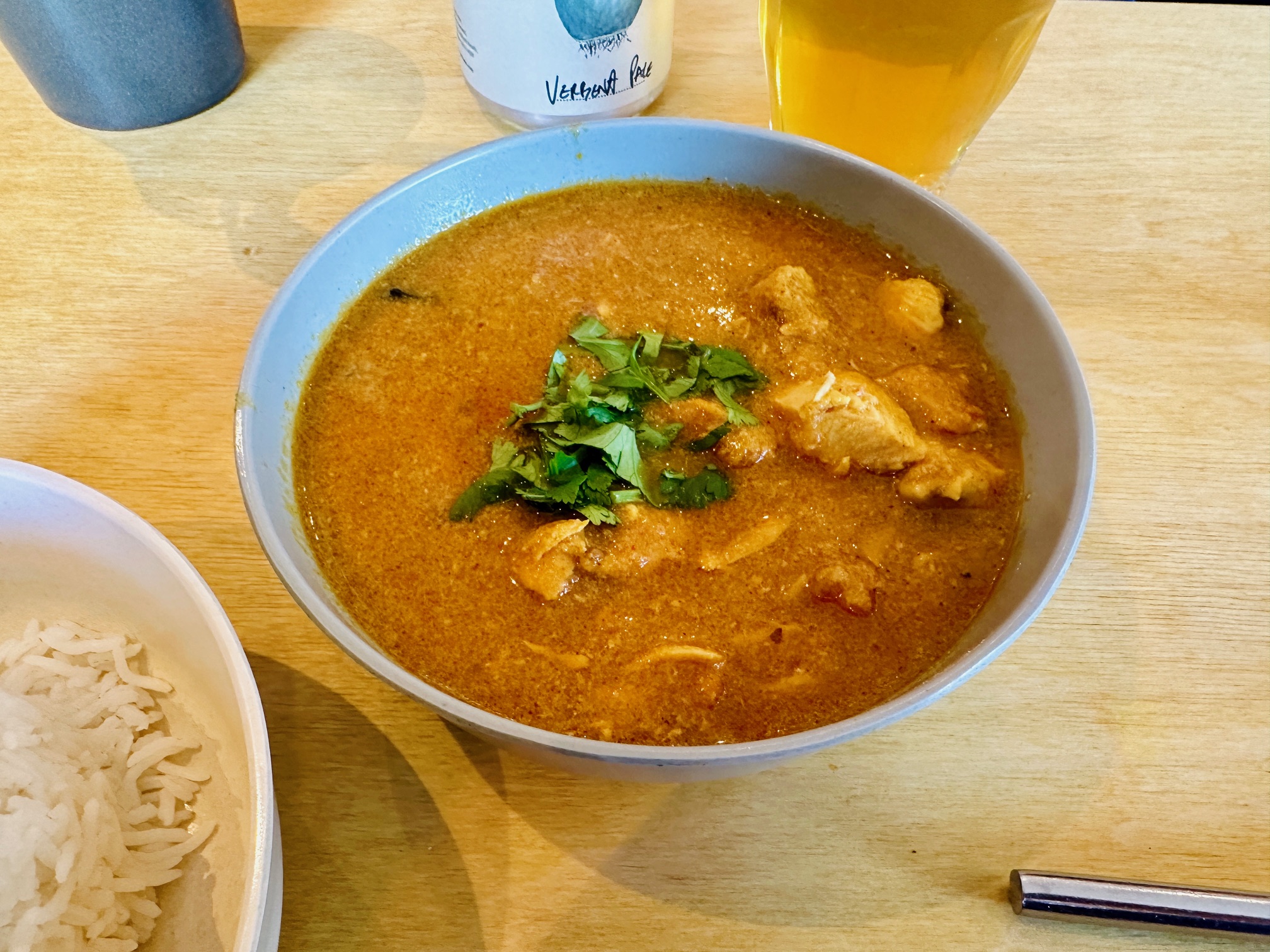
On the day I visited, Taste Tibet was offering momo – four or eight, vegan or beef – and four curries, with a mix of sides. They also served a biryani, or a feast option where you got a couple of dishes, dal, rice and a solitary momo for about fifteen pounds. If that pricing sounds keen, it wasn’t unrepresentative -curries weren’t much over a tenner and rice only two pounds fifty. Sides clustered around the five pound mark and momo were four for eight pounds. I ordered some momo, a curry and rice: that, with a tip included, cost me thirty pounds. “I’m in no rush” I said, “so it’s okay to bring the momo out first and the curry after that.”
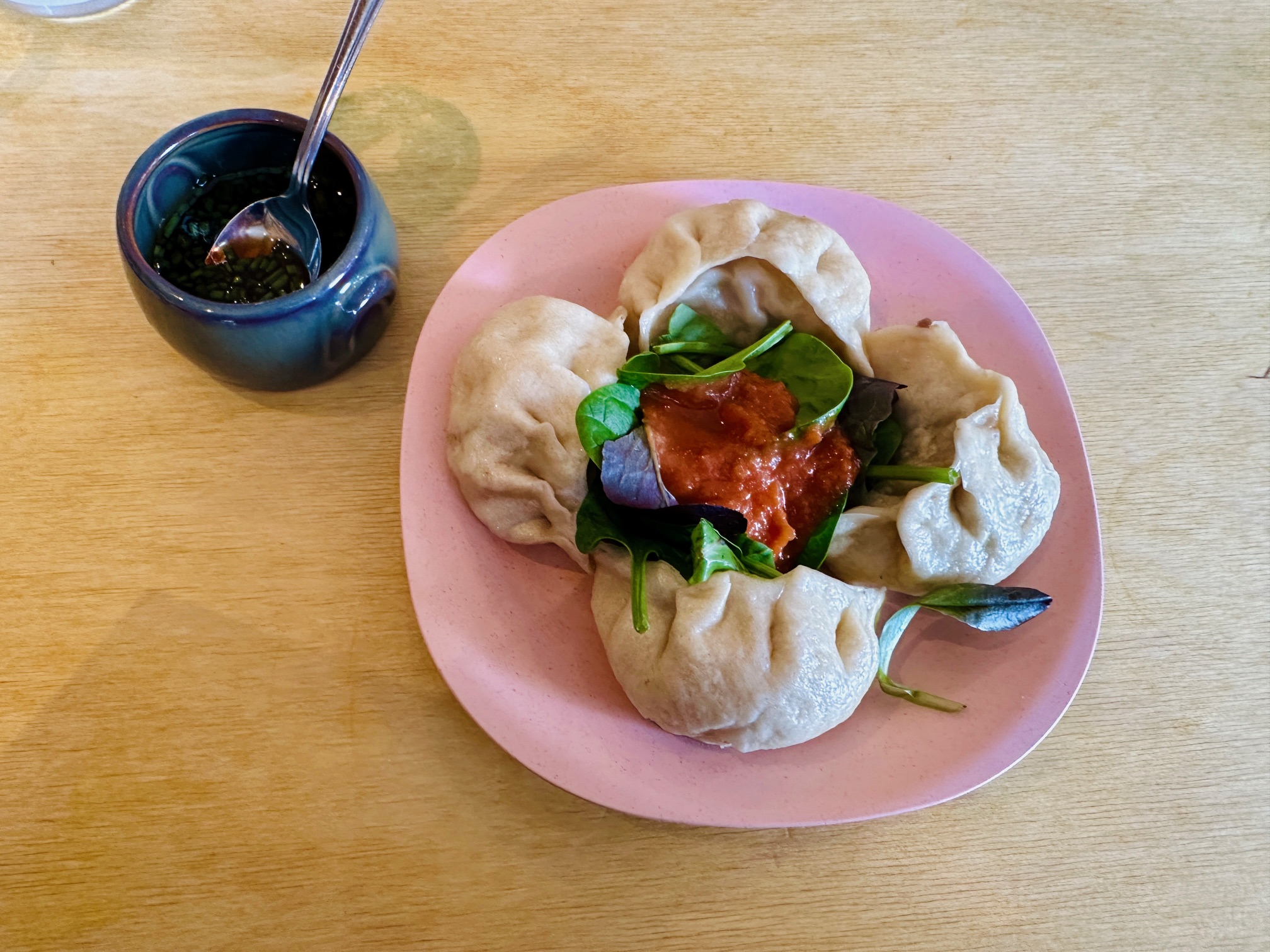
My momo came out five minutes later, and weren’t at all what I was expecting. Although momo apparently originate from Tibet rather than Nepal they’re so prevalent in Nepalese cuisine, and Nepalese cuisine is so prevalent in Reading, that I thought these would be a known quantity. And with that in mind, I thought four for eight pounds felt a bit steep. But Taste Tibet’s momo were a very different beast to the ones I’ve eaten at Sapana Home or Kamal’s Kitchen.
For a start, they were big: impossible to eat in one go, and challenging even in two. Crimped like jiaozi, they were steamed and made with dough that was thick verging on too thick, but that gave them structure and a pleasing, carby solidity. The beef inside – beef, not buffalo, although whether that’s the difference between East Oxford and Reading or Tibet and Nepal I couldn’t tell you – was properly lovely, coarse and delicious.
This came with a little handful of leaves whose main function was to serve as a bowl for a red sauce which was apparently a home-made chilli sauce: I found it a little meek. But what I did love was the bowl of a darker dipping sauce with a kick of soy. Again, I wonder if that’s the influence of Tibet, because I’ve never had Nepalese momo served with that, and it really did make me see the momo in a slightly different light. I can see the appeal of coming to Taste Tibet, as I used to with Sapana Home, and just going to town on the momo.
Later on, as I came to the end of my meal, couples and families were braving the outside tables and I saw big plates of momo going past on their way to the little terrace. Perhaps that was the way to do this place, or to come with a big group and try everything. One of the reasons I hadn’t ordered the “feast for one” was the presence of that single momo. It felt stingy, but looking at what had been put in front of me one would have been plenty, paired with an exploration of more of the menu.
My request that my curry come out after my momo had been taken a little too literally. Perhaps I should have said “after I’ve finished my momo”, although I didn’t think I’d needed to, but instead the rest of the meal arrived when I was halfway through what I thought was my starter. Really, though, that was me misjudging the place and its similarity to a canteen rather than a mistake on the restaurant’s part. Everything is there ready to dish up, and if you order something that’s exactly what they will do.
I had chosen Taste Tibet’s “famous chicken” because I took famous to mean signature, and I figured that if I was visiting a restaurant on my own I owed it to myself to check out the signature dish. And having eaten it I suspect it’s the restaurant, rather than the chicken, that is famous. It was a big portion with plenty of chicken, plenty of sauce. The chicken was all good and tender, and it was impossible to take exception to the dish.
But although not being offensive is a good thing, being inoffensive isn’t, and that’s what this was. Perhaps if my expectations had been lower I would have seen this as a comforting bowl of food, and celebrated what it was rather than noticing what it wasn’t. But this was like curry from a bygone age, before we got into regional food, started to discover the difference between Kerala and Hyderabad. It felt a bit like a Vesta curry, from forty years ago, and for something famous I expected more: I expected it to be famous for something.
How to make it more interesting, I wondered? I tried spooning in my perfectly cooked basmati rice – Taste Tibet serves both curry and rice in bowls that are just big enough for each, rather than giving you a plate to dish them up onto – but that bulked it without being transformative. I tried adding a spoonful of the dried chillis in a ramekin out on the table, but it lent an acrid pungency without elevating anything. The difference in heat levels was like the difference between sleeping on one pillow and two, going from not enough to too much.
I didn’t want to leave it like that, and I fancied dessert, so I went up to order the only thing on the blackboard that looked like afters. Chocolate tsampa truffles – as seen on TV! sounded absolutely like my sort of thing, and only cost three pounds. I was too full to have the chai that should have accompanied it, but never mind.
By this point the restaurant was far fuller, with people taking tables outside and the long table opposite me occupied by a group of impossibly young, animated east Oxford types. I looked on them indulgently, remembering a time over thirty years ago when that could have been me: not that I would have had the money to eat in a place like this.
Positively 4th Street was playing over the speakers, and I remembered that thirty years ago I loved that song, and suddenly it was back in vogue. Time can play unkind tricks, and all the things that made me so deeply unfashionable as a student – being a geek, listening to Bob Dylan and Leonard Cohen, playing chess and Dungeons & fucking Dragons – are acceptable now, too late for me. Even some of the shit I wore back then might be in now, I thought.
I felt a little tug of envy and regret, and then I let it go. It was as close to Buddhism as I got in Taste Tibet.
The chocolate tsampa truffles, plural, turned out to be a truffle, singular. A big thing designed, like the momo, to be taken on in multiple bites. I enjoyed it and, again, it wasn’t what I thought it would be. Its texture wasn’t dense or glossy, being more gritty with a feel of granulated sugar to it. Again, that’s down to me for misunderstanding – tsampa was not something that flavoured the truffle, but instead is a kind of flour made from ground, roasted barley, so it was the thing lending that texture.
In any event, the truffle reminded me of the brigadeiros at Minas Café, and I liked it without entirely understanding it. That’s fine, by the way: now I’m in my fifties I realise that provided you like things you don’t always need to understand them.
The rest of my day in Oxford was positively joyous. I stopped at Missing Bean, which was absolutely packed, to buy beans for the weeks ahead; I’m drinking a cup of their coffee as I write this. I strolled down the Cowley Road, past its plethora of Turkish restaurants, past the now closed Gamekeeper that used to meet all my Dungeons & fucking Dragons-related needs as a teenager.
I stopped in Truck Records to get inspiration, I stopped in Peloton Espresso to get caffeination. I bought cheese in the Covered Market, had time for a beer in Tap Social before my train home. It really is a gorgeous city, and it says something about the place that Magdalen Road is one of its little oases but far from its only one.
As you may have gathered by now, although I liked Taste Tibet I wanted to like it an awful lot more than I did. And a bit of me wonders if I’m the one in the wrong. It is a gorgeous spot in a gorgeous neighbourhood in a gorgeous city. It has a great backstory, is clearly loved by the community it’s part of and does tireless and admirable work to support that community. It is run by a committed husband and wife, where he works in the kitchen and she advocates, powerfully and eloquently, online and in the media. They want to tell the stories of where he comes from, through food.
On paper, I should love it: it sounds like other restaurants I love, closer to home.
But perhaps that’s okay. Perhaps Taste Tibet makes perfect sense in its context, in that city, on that little stretch of food and drink heaven. Maybe it doesn’t need people like me travelling to and across Oxford to try it out. It’s a neighbourhood restaurant – its neighbourhood is lucky to have it, and it’s lucky to have found its place in things.
If I lived closer I’m sure I would go back, try other dishes, fill my freezer and become part of their story, as they would become part of mine. But other places have got there first, for me at least. My train home pulled in at Gare du Ding and I thought about Kamal’s Kitchen, my favourite Nepalese restaurant, a short walk from the northern entrance to the station.
Its dining room doesn’t have the stripped-back elegance of Taste Tibet, it doesn’t have a narrative the way Taste Tibet does. I think Kamal and his family do a magnificent job, but much as I’d love them to I can’t imagine them gracing the pages of Observer Food Monthly. They don’t write beautiful blog posts, they have no plans to produce a cookbook that I know of and they won’t be at Hay Literary Festival this year. They let their food do the talking, and for what it’s worth I think their momo beat Taste Tibet’s. A restaurant can succeed in so many ways, but food and service are always king.
Magdalen Road in Oxford is a really fantastic place, and I do dearly wish Reading was a little more like it. But I wouldn’t swap their restaurant with ours.
As of January 2025, Edible Reading is partly supported by subscribers – click here if you want to read more about that, or click below to subscribe. Whether you’re a subscriber or not, thanks for reading.