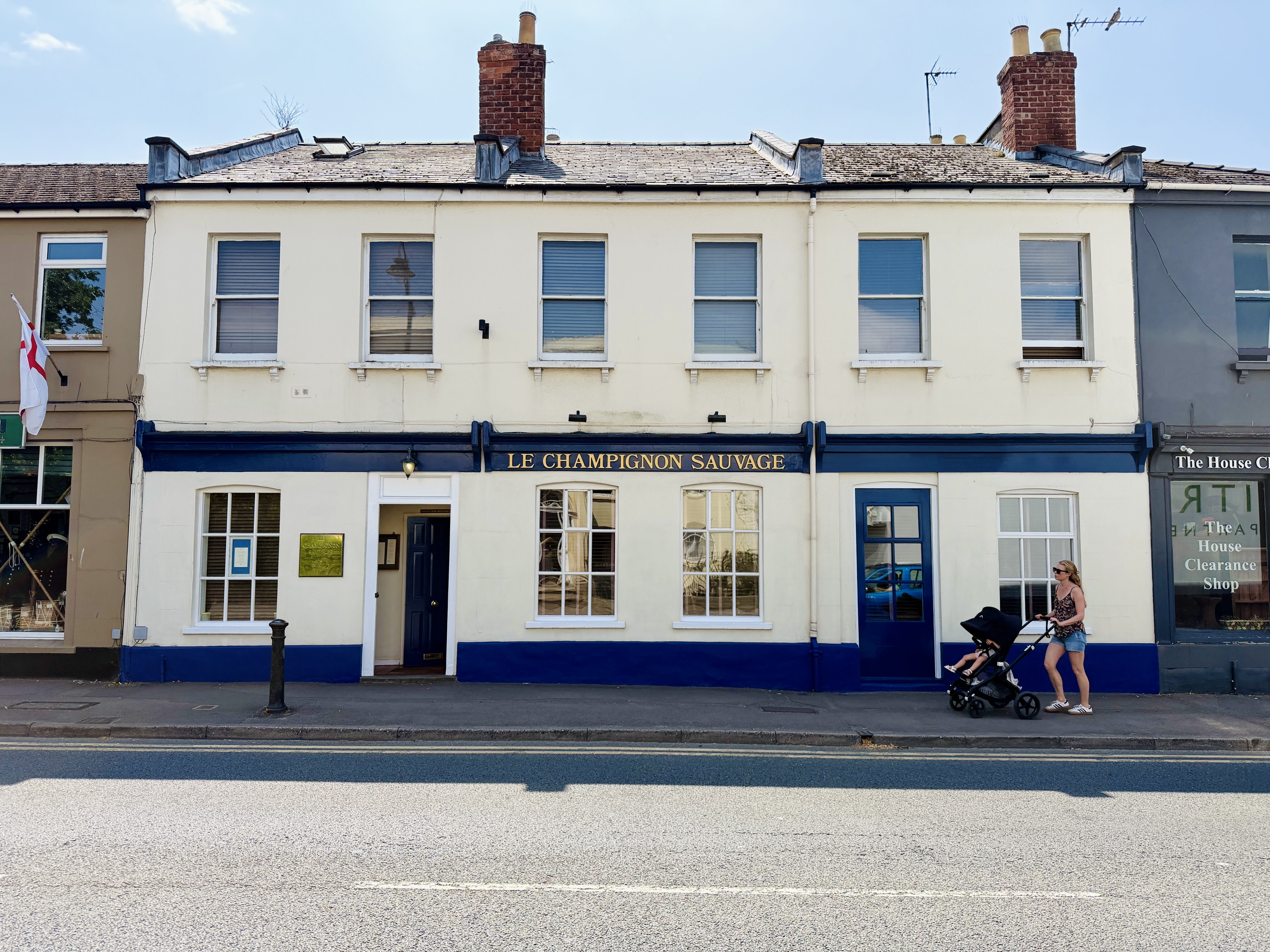
A few Fridays ago I was sitting in a café called Suffolk Coffee in Cheltenham, drinking a latte and feeling something I don’t generally experience before going somewhere on duty: genuine anticipation.
Because I don’t often review a Michelin starred restaurant for this blog – it’s only happened twice so far, and the last time was over 10 years ago. Reviewing somewhere like that is a test of the reviewer every bit as much as it is a test of the restaurant: is my palate up to the task of appreciating it? Is my writing up to the task of capturing it? Just as footballers want to play against the best opposition, reviewers want to review the good stuff. It’s why you’d never find one worth their salt on a hyperbolic quest to find, I don’t know, the best burger in the U.K. We bore too easily for that.
The anticipation was heightened by the fact that I was about to have lunch at one of the restaurants on my bucket list, Le Champignon Sauvage. Amid all the ebbs and flows of gastronomic fashion, Le Champignon Sauvage has held a Michelin star since 1995: only three U.K. restaurants have held one longer.
In those thirty-one years, Michelin has changed its mind about the kind of restaurants it wants to celebrate, accepted bungs from tourist associations to extend its guide to godforsaken places like Dubai, introduced its pointless Green Star and scrapped it. And for eighteen of those years Le Champignon Sauvage held two stars, until Michelin took the second one away in 2018. Nobody knows why.
Nobody ever does, by the way. I’ve eaten in some great restaurants, like 5 North Street in Winchcombe or Chelsea’s Medlar, which lost stars for reasons that pass all understanding. And I’ve eaten in restaurants that held a star with no idea how they managed to blag one in the first place. It is the great enigma, and for all the pontification online about restaurants that should have one, or should have two, for all the episodes of that Apple TV show with Gordon Ramsay and the posho from Topjaw I suspect it will remain an enigma for a long time.
But anyway, it’s food for thought: on a personal level, when Le Champignon Sauvage first won its star I was just about to leave university. Blogs didn’t exist. Nor did smartphones, and I wouldn’t have an email address for a few more years. Just to channel my own version of We Didn’t Start The Fire: New Labour; 9/11; the credit crunch; Covid; Will Young winning Pop Idol; President Obama; President Trump. All these seismic things would come to pass, they just hadn’t yet.
And in terms of food, St John had only just opened the year before: the food revolution in this country, such as it was, was in its crib. But this piece of history is even more striking: Le Champignon Sauvage has been run by a husband and wife team – Helen Everitt-Matthias running the front of house and her husband David in the kitchen – ever since it first opened in 1987.
Not for them chopping and changing, expanding to a group of restaurants and appointing new head chefs here and there. Instead, the two of them have put this restaurant on the map and kept it there for nearly forty years. In a country that changes its mind with the frequency of somebody whose attention span has been rotted by social media, a nation that swaps Prime Ministers like it’s bored and changing the channel, it feels like we won’t see Le Champignon Sauvage’s like again.
And the final evidence of that unique status is the thing Le Champignon Sauvage might be most famous for: David Everitt-Mathias is always in the kitchen. If he isn’t there, the restaurant is closed. He doesn’t do TV, and he has published three books in forty years. That’s it. If you eat in his restaurant, you know he has cooked your food. That’s unlike so many starred restaurants in the U.K. So I wanted to go there, while I still could, on a expedition to somewhere that embodied hospitality as a calling more than any other restaurant I could imagine.
Subscribe to continue reading
Become a paid subscriber to get access to the rest of this post and other exclusive content.
Having written about and celebrated Reading and its independent scene for nearly 13 years, one thing that has always irritated me is people who live to run the place down. You see them popping up on the comments section of the Reading Chronicle all the time, people who say that the town is all vape shops and money laundering, who hate the halal butchers and the global superstores and the mosque.
We all know what’s behind that, and it’s not really about Reading: it’s about wanting to take the country back to some rose-tinted past that wasn’t even that crash hot first time around. One where women were paid sod all – if they had jobs at all – and where nobody could be gay, or trans, or brown. One with three TV channels and everything closed on Sundays. One where youngsters knew their place.
It’s a land where those people still live in their heads, and if a country like that really existed I’d be all for them emigrating there. Reading – multicultural and vibrant – just happens to be in the crosshairs because it embodies so many things they’d change. But even though I despise that viewpoint, lately when I’ve gone into the centre of town I’ve felt weary, because the town I love is getting harder and harder to champion.
Rough sleepers are everywhere, begging feels more apparent than at any time I can remember. Friar Street is lined with vacant shop fronts and when new things open, they’re always chains and often the kind you wouldn’t choose. Shake Shack is on Broad Street now, next to Fat Face, and people who get excited about that kind of thing are beside themselves.
Also new is Amorino, which I visited recently for a gelato. You had to order using a big touchscreen which tried to upsell you every step of the way: that irked me when the people sticking gelato in your paper tub were right there. My ice cream took ages because the member of staff doing it kept weighing it, adding a tiny amount more, weighing it again. Because, in case you’d forgotten, it’s 2026.
But it tasted nice, even if eating it I realised that, for a long time, it had felt like Reading was always the bridesmaid, never the bride. We always got Amorino, never Swoon. We always got Wendy’s and Shake Shack, never Patty & Bun or Beefy Boys. Always the town, never the city. So for this week’s review I decided to visit the one part of Reading that seems fairly immune to the general worsening of things, and Friday night found Zoë and me in Spill, drinking pints of Parka ahead of a short amble along Prospect Street to Spitiko.
Yes, that’s right: it was time for a date night in Caversham.
I got into all sorts of trouble a long time ago for asking the simple question Why isn’t Caversham nicer?, but whether you thought it was nice or not in 2017 is rather beside the point these days. Because since then – and especially since the pandemic, when people spent money closer to where they lived – Caversham has flourished in a way that the rest of Reading simply has not.
It has acquired two excellent cafés, in the shape of Geo Café and The Collective. It boasts lifestyle stores and bakeries, bookshops and bars. It has a great pub with outside space in the shape of The Last Crumb, and one of Reading’s most distinctive restaurants in the form of Vegivores. And of course, to the detriment of the town centre it has arguably Reading’s best restaurant, Clay’s Kitchen.
Sitting in Spill with a beer, looking over at the outside tables filled with happy, prosperous people, Caversham had a certain affluent glow that you don’t generally see in the RG1 postcode. Friends were catching up, a couple were engaged in a fierce cribbage contest that reminded me of a former life. And seeing all that, drinking it in along with my cold pint of Parka, I got it: I understood why people in Caversham always seemed so happy with their lot in life. That was why Caversham residents, like wild swimmers or vegans, volunteered the information within five minutes of meeting you. Who can blame them?
Spitiko, technically, pre-dates Caversham’s renaissance. For many years 6 Prospect Street was home to Kyrenia, a Cypriot restaurant. Then at some point in 2016 it changed hands, and the new owner called it Ketty’s Taste Of Cyprus. Kyrenia’s legendary front of house Ihor left – the last time I saw him he was working at Papa Gee – and then, around the time of the pandemic, the restaurant rebranded again, this time to Spitiko – a Greek restaurant, rather than a Cypriot one.
I think one of the reasons I held fire on reviewing Spitiko for so long was that I loved Kyrenia so very much. I’ve written before about how it was one of the saddest closures in my time writing this blog, and talked at length about how often I went there. But it hasn’t been Kyrenia for a very long time, ten years or so, and it felt like time to try Spitiko afresh, as free of preconceptions as possible.
That’s also why I will try, as best I can, not to use the K word again in this review. Because having started this review railing against them, I don’t want to be one of those awful people who thinks everything was infinitely better in the past.
Spitiko’s dining room was spacious and airy, with plain tables and chairs and a pale wooden floor. Huge paintings of the windmills of Mykonos and the blue-domed churches of Santorini took up one wall, a bouzouki was propped up on a window sill. The only other flash of colour was the distinctive Hellenic cyan edging the windows and doors. The ground floor dining room was doing reasonably well on a Friday night, with over half its tables occupied.
One thing we did realise right away, though, was that it was deafening. Whoever designed that dining room was either in their early twenties or had never tried to eat in it: the lack of soft furnishings or sound insulation made it an incredibly loud place to sit and eat. Every table had to keep talking louder because every table was struggling to be heard, an escalating state of affairs that made it a very difficult space in which to spend time. Zoë, who has a coping strategy in these circumstances, took out her hearing aids: I had no such luxury.
Spitiko’s menu covers a lot of ground, and blends both Greek and Cypriot specialities. Feta and halloumi both feature, and the restaurant serves sheftalia, which is distinctly Cypriot. But it calls its stuffed vine leaves dolmades, the Greek name, rather than koupepia, even though they contain mince which is more common in Cyprus.
In any event, you have an enormous amount of choices – something like twenty-five appetisers and nearly as many mains. You also have the option of choosing a meat, seafood or vegetarian meze selection, for between £31 and £36 a person, but we decided against that because it’s the kind of order I might have placed in this building in the past. So we picked a selection of starters to share, and a main each, and tried to make ourselves heard above the hubbub.
But first we ordered wine, and this was where the first alarm bells rang. Greek wine, very underrated, offers a great range of excellent whites and reds. If you’re at a restaurant with a good wine list, it’s always worth looking out for a xinomavro or an assyrtiko because they often punch above their weight.
Spitiko, I’m afraid, is not that restaurant. They do have half a dozen reds and whites from Greece and Cyprus, but many are from a single producer. Nothing will set you back more than £30, but that means that most of the wines cost £10 retail. I looked most of them up on Vivino, the wine app, and I didn’t realise you could buy wines with ratings that low. So we ordered the best of a bad bunch, a bottle of Kouros Patras – straw-coloured, chilled and forgettable, if not actively offensive.
This is as good a point as any, by the way, to make reference to Spitiko’s greatest asset, the chap who looked after us. He was wiry, high-energy and full of charm – he told us he was Irish, although I didn’t get that from his accent – and he was undoubtedly the single best thing about eating there. I hope one day I bump into him again, at a better restaurant.
One thing I always associate with eating in Greece itself, rather than in a Greek restaurant here, is the wonderful sense of leisureliness that always accompanies food in a taverna. The air still has the warmth of the day, the al fresco tables around you are full of happy people, and later on your walk back to your room will be accompanied by the music of crickets and the glimmer of fireflies.
Not so in Caversham, where our four starters were banged down in front of us about ten minutes after we ordered them. They were each, in their way, the epitome of middling.
First up there was houmous, adorned with a single olive and a meagre drizzle of an olive oil so yellow and pale that it couldn’t add any joy to proceedings. The houmous itself, scooped onto scorched, bought-in pitta bread, wasn’t actively unpleasant but had nothing about it to elevate it from stuff you could buy in a tub for £2 from any supermarket in the land.
Here it was £6.25, and I did think the main thing you were probably paying for was the act of decanting. The menu talks about garlic, lemon juice, tahini: all things this should have contained but somehow tasted as if it had never seen.
Equally underwhelming, if not more so, were the dolmades. £7.25 got you three small ones, all in varying stages of falling apart. I didn’t have to cast my mind back far to think of better ones – for all their faults, the stuffed vine leaves at Antep Kitchen were far better than this – but also, they were meant to contain mince and if they did, subtle isn’t even close to the right word. But also these were served hot, and the speed, the heat and the texture all made me wonder if a microwave was involved. If it wasn’t, there would have to be another excuse for these being so disappointing.
Lamb kofta also couldn’t live up to the promise of seeing those words on the menu. What was going on here? Two worryingly uniform cylinders of dense, compacted meat, each cut into worryingly uniform halves. No irregularity, no char, no coarseness. There was no sign that these had been threaded onto a skewer, no sign that they had been formed by hand. No sign, in honesty, that they hadn’t come out of a packet.
Last of all, one of the dishes I always make a beeline for in Greece, feta saganaki. Deep fried cheese should be a genuine treat, whether it comes with honey and sesame seeds to offset the saltiness or is brought to the table flaming, doused in ouzo. This was neither, it was just a slab with a bit of a tougher exterior but no real evidence of crispiness or contrast. How could you take feta, deep fry it and produce something that was so far from fun? It felt like a betrayal – of Greek food, of our hopes, of all that and more besides.
There was sad salad on the side, as there was underneath the kofta and the dolmades. Technically I guess it was sadder salad, because it was all sad.
Could our main courses rescue matters? You mightn’t be amazed to hear that we found out pretty damned quick: fifteen minutes after our starters turned up, out came the mains. You may, however, be surprised to hear that I wasn’t as outraged as I could be. By this time I regarded the rest of the meal a bit like the way I think of a blood test: I knew it had to happen, but I didn’t mind getting it out of the way as fast as possible.
That wasn’t entirely fair, though, because the mains showed that Spitiko could cook – just not a whole dish, and not consistently.
Take my sheftalia – which are meant to be coarse sausages wrapped in caul fat. I was so looking forward to these, at the start of the meal anyway, and by the time they arrived they managed to surpass my successively lowered expectations. Unlike everything else so far, they felt made by hand – irregular, nicely stocky things with a crinkled exterior. And they tasted good. I’d had enough of Spitiko’s humdrum tzatziki by then, and fortunately these didn’t need it.
But even here, with one of the best things they did, they couldn’t nail the landing. First of all, sheftalia can be made with pork, beef or lamb and Spitiko’s menu promises pork. So why was one of the four clearly completely different? It tasted of beef and red wine, and I didn’t mind it at all but it was bizarre how it didn’t match the other three. If I’d had two of each, or the menu had said they were a mixture, I probably would have been delighted: without that, it just added to the sense of chaos.
And the accompaniments were barely worth bothering with. A fairly dull Greek salad with four cubes of oregano-speckled feta, no olives and – would any plate be complete without it? – more limp iceberg lettuce added very little. Even worse was a big helping of faintly yellow rice studded with eerily uniform bits of veg: peas, green beans and so on. Its texture was surprisingly clumpy and, again, it felt as likely to have been made by Batchelors. I ate all of my sheftalia, I snaffled the feta, I left most of the rest.
Zoë’s kleftiko was a similar story. The lamb itself was good, tender, beautifully fatty and a cinch to ease away from the bone. I was allowed to try a bit, and it wasn’t half bad: ironically a far better deal than the very expensive equivalent I’d tried at Queen’s Park’s Carmel earlier in the year. I have had better kleftiko in Reading, although I’ve boxed myself into a corner whereby I can’t tell you where, but it was pretty decent.
But again, the stuff that came with the kleftiko was irrelevant rather than elevating. The roast potatoes looked like perfectly acceptable waxy specimens, with no real sign of roasting or glorious crisp shells. The vegetables – broccoli, carrots – were bland ballast. It’s perfectly fine to make the sheftalia or the kleftiko the centre of the dish, but the stuff on the perimeter should cheer, not heckle.
By this point some of the tables had left, the absolute racket had died down a little and I tried to find ways to look on the bright side. You should have tried this place back in the day, I said to Zoë, except of course back in the day it wasn’t this place. Just another one to file away in the long list of things I wish I’d discovered and experienced with my wife, thwarted by our chronology and the fact that we had to spend all those years living our lives and becoming the people we did so that we could meet and fall in love and, hopefully, live happily ever after.
But as I keep saying in this review, you can’t live in the past – even if it was a past when I weighed five stone less, hadn’t lost loved ones, hadn’t broken my arm. The accumulation of damage, bad decisions and disappointment helps make you who you are: wish it away, and you wish you were somebody else. All far too deep to bring up at a date night in Caversham, I decided.
We would have had dessert, because the wine list included two Greek dessert wines, both of which I absolutely love. Our ever-charming server wandered off and came back effusive and apologetic: they’d run out of one, and they had about a glass of the other, but in a bottle which had been opened and not kept in the fridge. We waved it at us, we asked for the bill. £122 with a 12.5% service charge, which was the only element that felt like value.
We called an Uber back to Katesgrove and ate ice cream in front of the telly, catching up on Top Of The Pops. It’s nice to go to Greece, it can even be nice to go to Caversham, but it’s nicer still to go home.
I really wanted to love Spitiko, and I really wanted to prove my hypothesis that bits of Reading are still getting better and better despite the naysayers. It’s tempting to feel deflated, and think that neither of those things happened. But I don’t know about that. I think it’s more the case that Caversham continues to flourish and buzz, and that places like Vegivores, Spill, Clay’s, even BKRY demonstrate that future.
Put that way, Spitiko feels like part of the Caversham that predates all of that change. I hope they aren’t left behind, and that when their race is run one day there will be people who meet for dinner somewhere else, in that building or another one, and say “Remember Spitiko? That was a restaurant. God, the evenings we had there.” Sadly, though, I won’t be one of them.
Since January 2025, Edible Reading is partly supported by subscribers – click here if you want to read more about that, or click below to subscribe. By doing so you enable me to carry on doing what I do, and you also get access to subscriber only content. Whether you’re a subscriber or not, thanks for reading.
Oxford, probably my favourite city in which to review restaurants, ostensibly has little in common with Reading. One has pretty old buildings and winding lanes, a shopping mall that doesn’t bump off your will to live in the space of five minutes, a bustling market with food, drink, coffee and cheese and shedloads of independent retail. The other has Forbury Gardens and a very good bus network.
That sounds like I’m doing Reading down. Perhaps it’s more accurate to say that Oxford complements Reading nicely: if there’s something you wish Reading had, you may well find it thirty minutes down the train tracks. And to be fair to Reading, Oxford may beat it for wine bars – because it has some and no, Vino Vita doesn’t count – and it has some lovely old pubs, but Reading is streets ahead when it comes to craft beer. Oxford is brilliant, but it has no Nag’s Head.
One thing they do have in common, though, is that their best restaurants are rarely found in the centre. Reading has some solid restaurants inside the IDR – your Me Kongs, and Mama’s Ways – but they’re the exception rather than the rule: it’s mostly chains and I suspect it always has been. The independent restaurants chasing that status right in the centre are probably London Street Brasserie and The Reading Room, neither of which quite pulls it off, but beyond that you might find yourself heading north of the river, or west down the Oxford Road.
Oxford is similar. If you overlaid the Oxford restaurants I’ve reviewed over a map of the place, it would look like my metaphorical attempts to hit a bullseye down the pub: everything everywhere but in the middle. Out east you have the Cowley Road, Iffley Road and St Clements, all with great places to eat, and Headington beyond that. Head north and you reach Little Clarendon Street before the myriad of choices available in Jericho or Summertown. But what about the centre?
Oxford has a mall, the Westgate, and it’s nicer than the Oracle. But that means it still gets chains, just fancier ones. It has the kind Reading doesn’t attract: Mowgli; Shoryu Ramen; Six By Nico. Notably it has a branch of award-winning small chain Beefy Boys – it would have been a coup, if they had chosen Reading. But in the rest of the centre it’s largely a mix of chains we have, chains we used to have and chains we can probably live without. It has Cosy Club, for people who wish the Lounge group were fancier, and The Ivy, for people who wish Cosy Club was, I don’t know, more showy.
Oxford readers would probably be the first to tell me that’s a slight oversimplification. Oxford has a few long-standing central restaurants with a durable fan following, like Chiang Mai Kitchen or Edamame: it tells you something about their longevity that I’ve eaten at both, each case long before I started writing this blog. It has a branch of Permit Room, the Dishoom offshoot that is so far limited to a mere five locations nationwide.
Beyond that, if you’re talking more upmarket restaurants, it has Quod, a buzzy brasserie on the ground floor of the Old Bank Hotel owned by the same group as Gee’s. And the conversion of the old Boswell’s department store into a hotel has given the city Treadwell, a new all-day restaurant whose menu looks a bit like somebody took Quod’s, gave it to the kitchen and said “make it quirkier”: whether fish and chips needs kimchi tartar sauce is anybody’s guess.
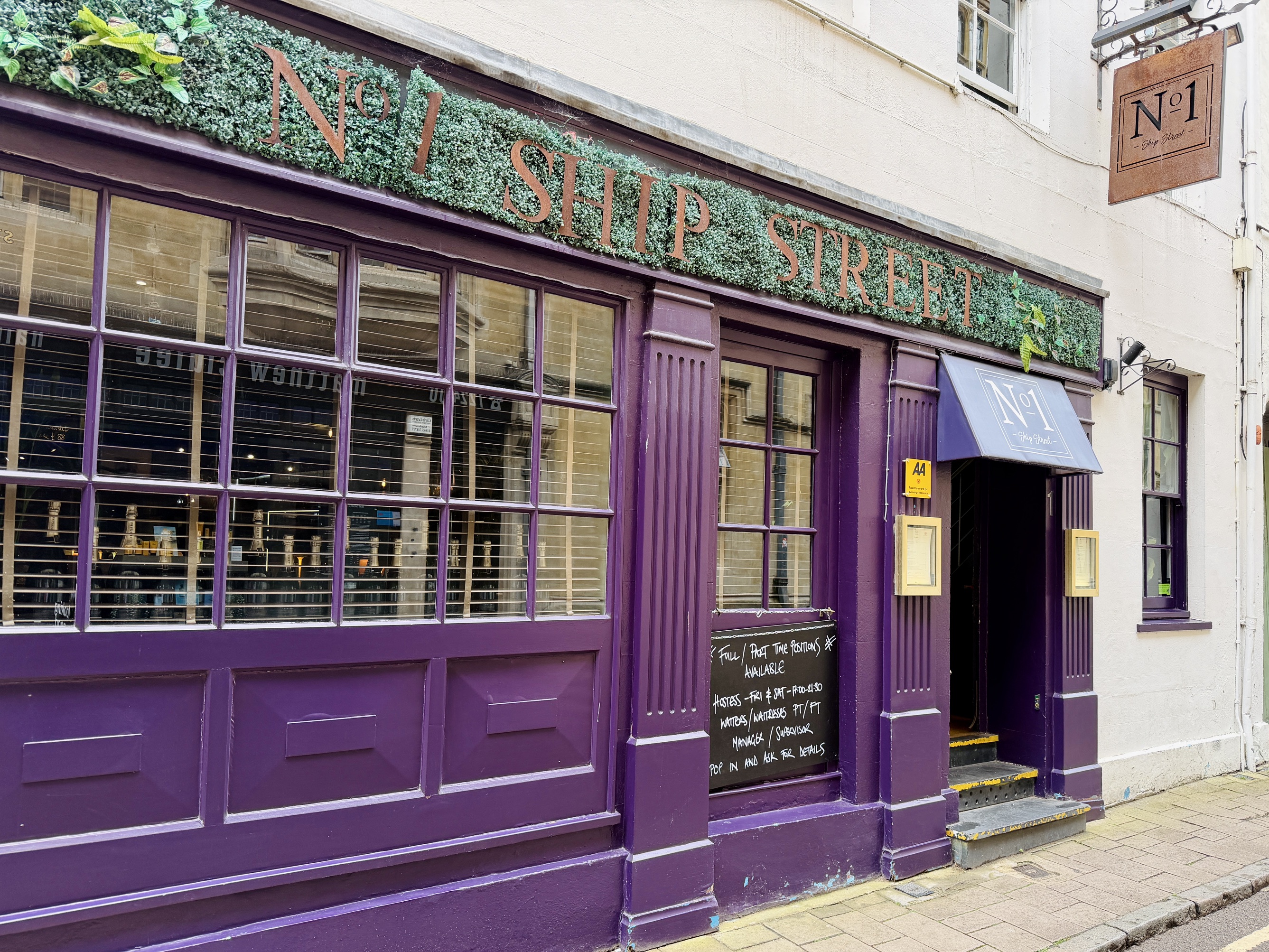
Having lost all my Reading readers with seven paragraphs about Oxford, and all my Oxford readers with seven paragraphs which aren’t about the restaurant I’m reviewing this week, let’s finally get to the point and talk about No. 1 Ship Street, the subject of this week’s review. It’s resolutely small and independent, it’s been open for nine years this summer and it’s very much in the city centre, just off the pedestrianised hellscape of Cornmarket Street, just around the corner from the Covered Market.
Chef Owen Little has been there from the very start, and No. 1 Ship Street shows no signs of slowing down as it reaches the end of its first decade, having been named last November as one of OpenTable’s Top 100 U.K. restaurants: to put this in perspective, nowhere in Reading featured on that list, and nowhere else in Oxford did either. I explained all this – fortunately for him in far less depth than I have here – to my dear friend Jerry as we had a pre-prandial beer in Teardrop, the tiny pub in the Covered Market.
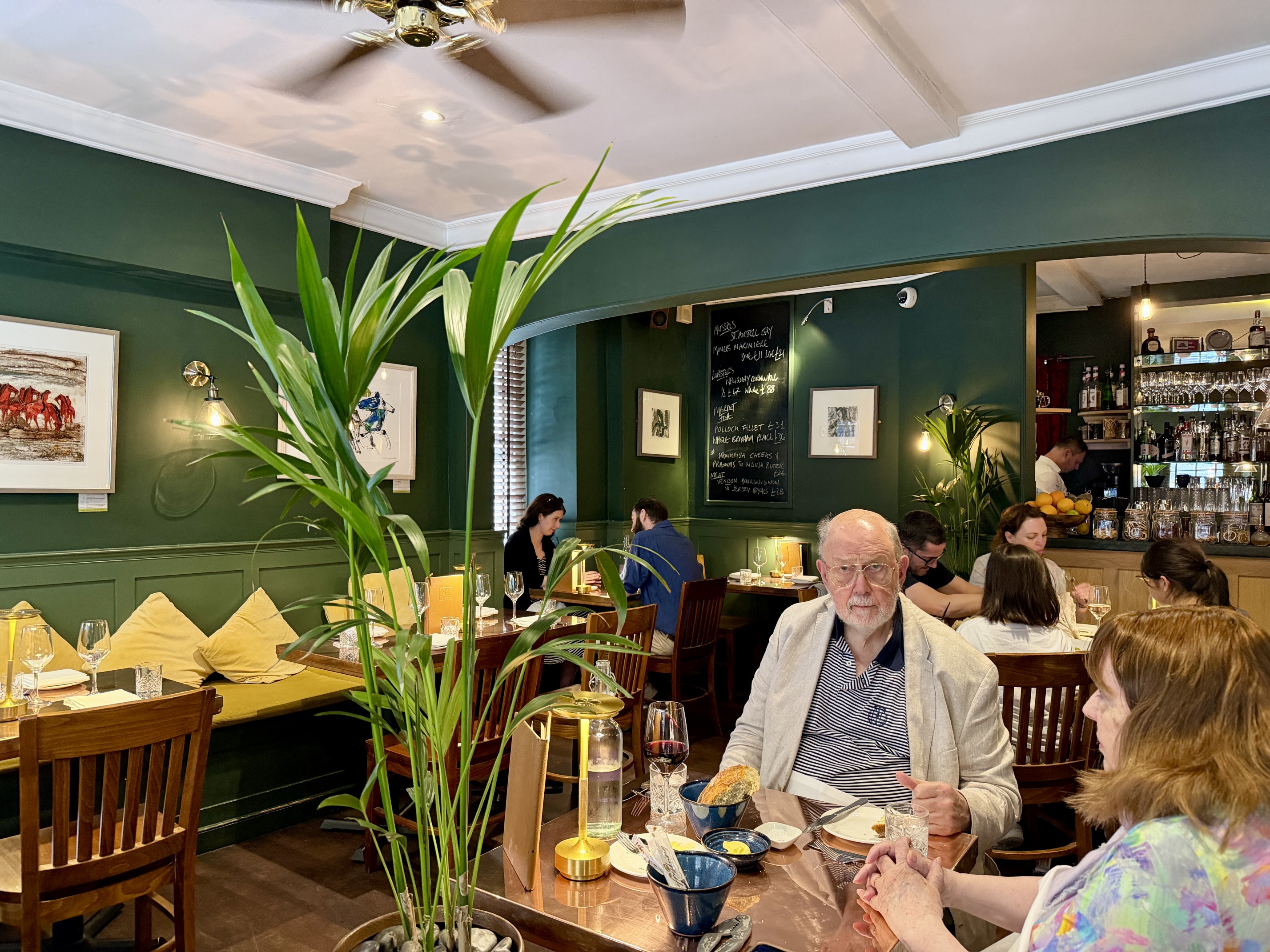
Owner Ross Drummond apparently celebrated winning that award from OpenTable by giving the place a refurb for the New Year. I think it was a subtle one, because the bones of the dining room were already there: beautiful racing green walls, well-spaced tables, the whole thing sleek, luxe and unfussy. They’ve removed the slightly tacky spider lights and the tables now are gorgeous and copper-topped: Jerry, mentally making notes for his flat, was taken with those.
It was difficult to believe that the horrors of Cornmarket Street were a stone’s throw away, but No. 1 Ship Street had created a beautiful, grown-up oasis dangerously close to its borders. I should say that we asked to be seated in the main dining room: I’m sure the one on the other side of the entrance is lovely of an evening, but I didn’t want to lunch in a windowless room on a June afternoon.
After a disappointing run of small-plates-for-sharing restaurants, some honestly described and some far less so, No. 1 Ship Street’s menu came as a blessed relief. Terms like appetisers, starters and mains might be increasingly recherché out there in the wild, but in this restaurant they were alive and well. There was no spiel about the concept, because the concept was “remember how restaurants used to be?” and the conversational gambit wasn’t “do you need me to explain the menu?” but instead my personal favourite, “are you ready to order?”
Not that we were, at first, because No. 1 Ship Street’s menu was just tricky enough. The starters seemed to be where the more experimental bent came out – burnt aubergine soup, foie gras crème brûlée, frog’s legs and the like – while the mains were more conventional. So yes, there was a burger, and a steak, and a risotto. I guess you don’t survive nearly a decade in the centre of Oxford by taking massive risks.
Starters clustered between £10 and £16, mains began at £20 and climbed up from there. If you wanted oysters, lobster, a tomahawk or the restaurant’s surf and turf (which combined the latter two and cost £160) you could spend an awful lot more, and a specials board introduced about half a dozen other options, nearly all of them fish and seafood.
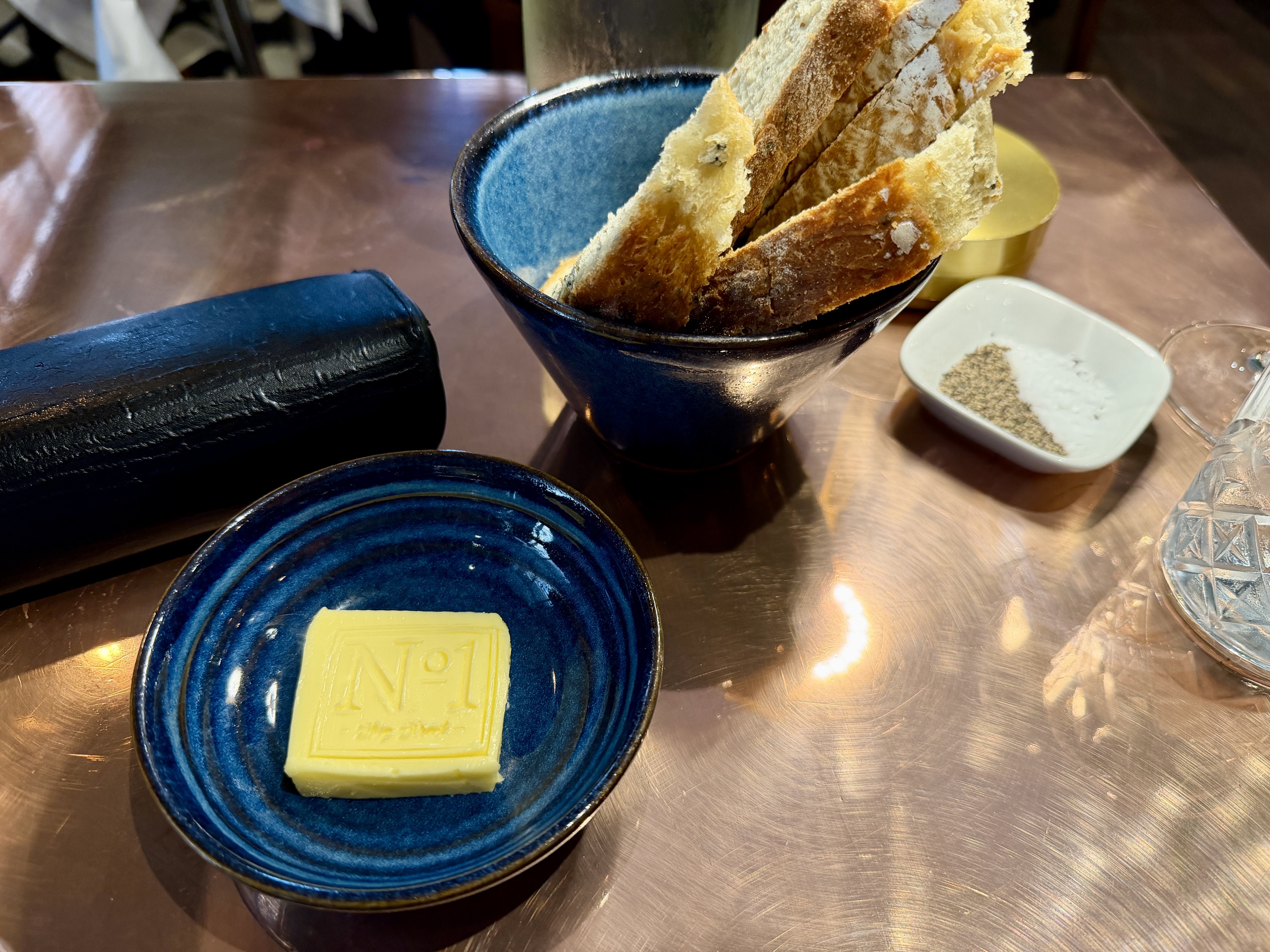
It was difficult enough that we ordered some appetisers and apéritifs while we decided – and No. 1 Ship Street is that happy kind of restaurant that brings them and gives you the time and space you need for that. Jerry’s bread was good and generous, speckled with nigella seeds and very enjoyable. Good salted butter at room temperature, embossed with the name of the restaurant, was a nice touch. For £6, the bread needed to be this good, and gladly it was.
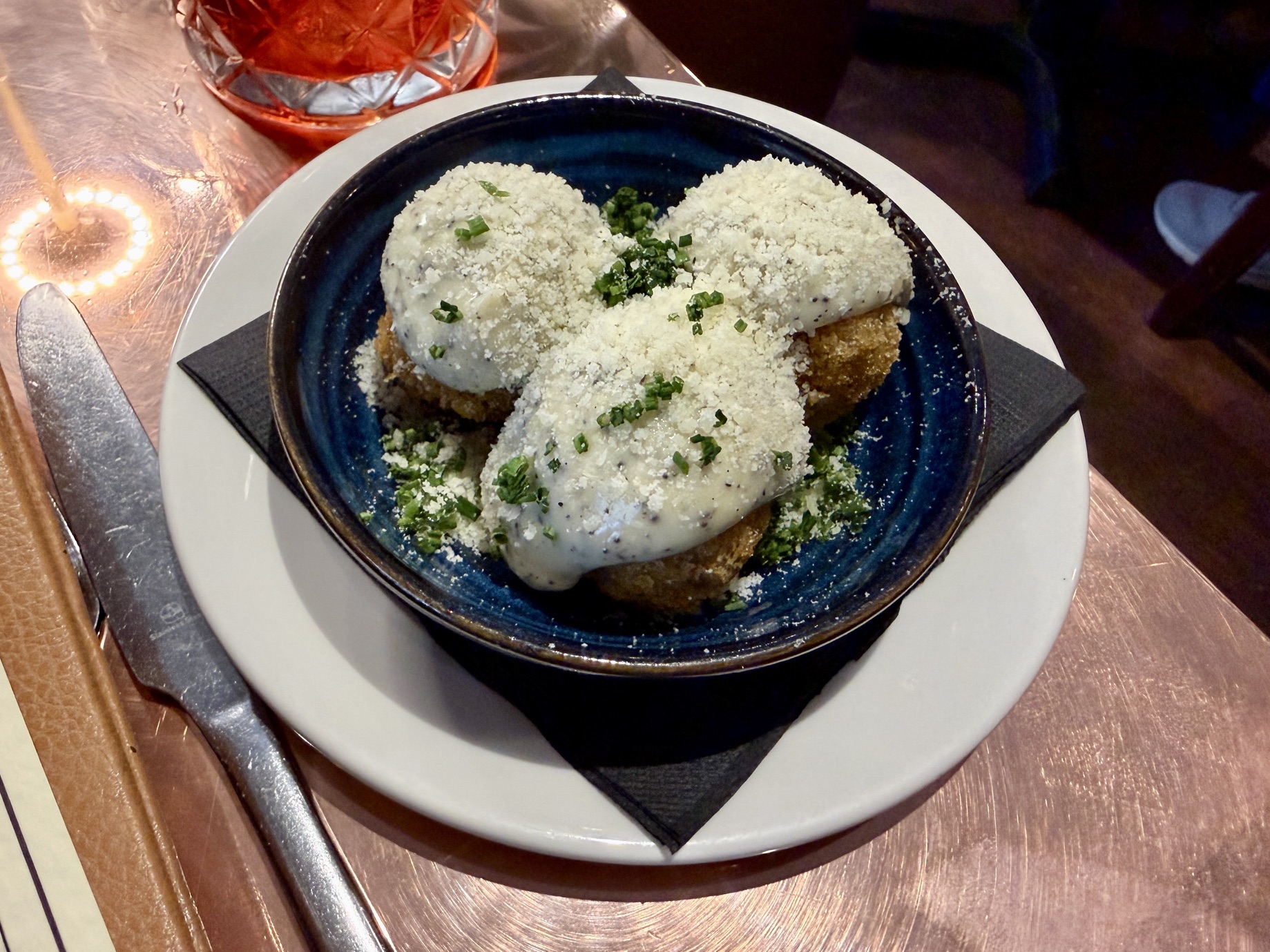
My truffle and porcini arancini were the first evidence that the kitchen might quite like being tricksy for the sake of it. They were very good, the texture acceptably crunchy and the inside studded with mushroom. Not indecent value at £6 for three either. Whether they needed to be submerged in some kind of hot truffle mayo and then carpeted in Parmesan was another matter. I thought less might have been more in this instance.
Jerry tried a bit but revealed to me that he really wasn’t a fan of truffle. And I was reminded of the recent meal where I discovered he had been humouring me all these years by drinking white wine when he only really liked red wine. It turned out that my happy memory in lockdown of sitting on a park bench with Jerry demolishing a bottle of red and inhaling a packet of Torres’ superlative truffle crisps was actually more evidence of Jerry being too nice to say he didn’t enjoy something. Let’s hope that somewhere out there he isn’t writing a blog telling the world what a terrible dining companion I am.
Never mind. The apéritifs, by the way, were knockout: mine a variant on a negroni sweetened and mollified with the substitution of amaro for vermouth and Jerry’s a champagne cocktail with a little cognac in the mix, sugar cube effortlessly effervescing at the bottom like buried treasure. We followed this up with an excellent South African Chardonnay – yes, a white – recommended by the very knowledgeable server, from the Elgin Valley. It had plenty of citrus and elegance, it was £48, and I liked it a lot. Jerry said he did too, and hopefully he meant it.
Starters were where things started to wobble. Jerry was torn between a number of options, one of which was the foie gras.
“I love it, but I know I shouldn’t, so I don’t order it these days” he told me. And I’m afraid I took that as an opportunity to deliver a tone deaf homily about not denying yourself things you like – I wish I could say it was the negroni talking, but such conduct is me all over – and so he chose it.
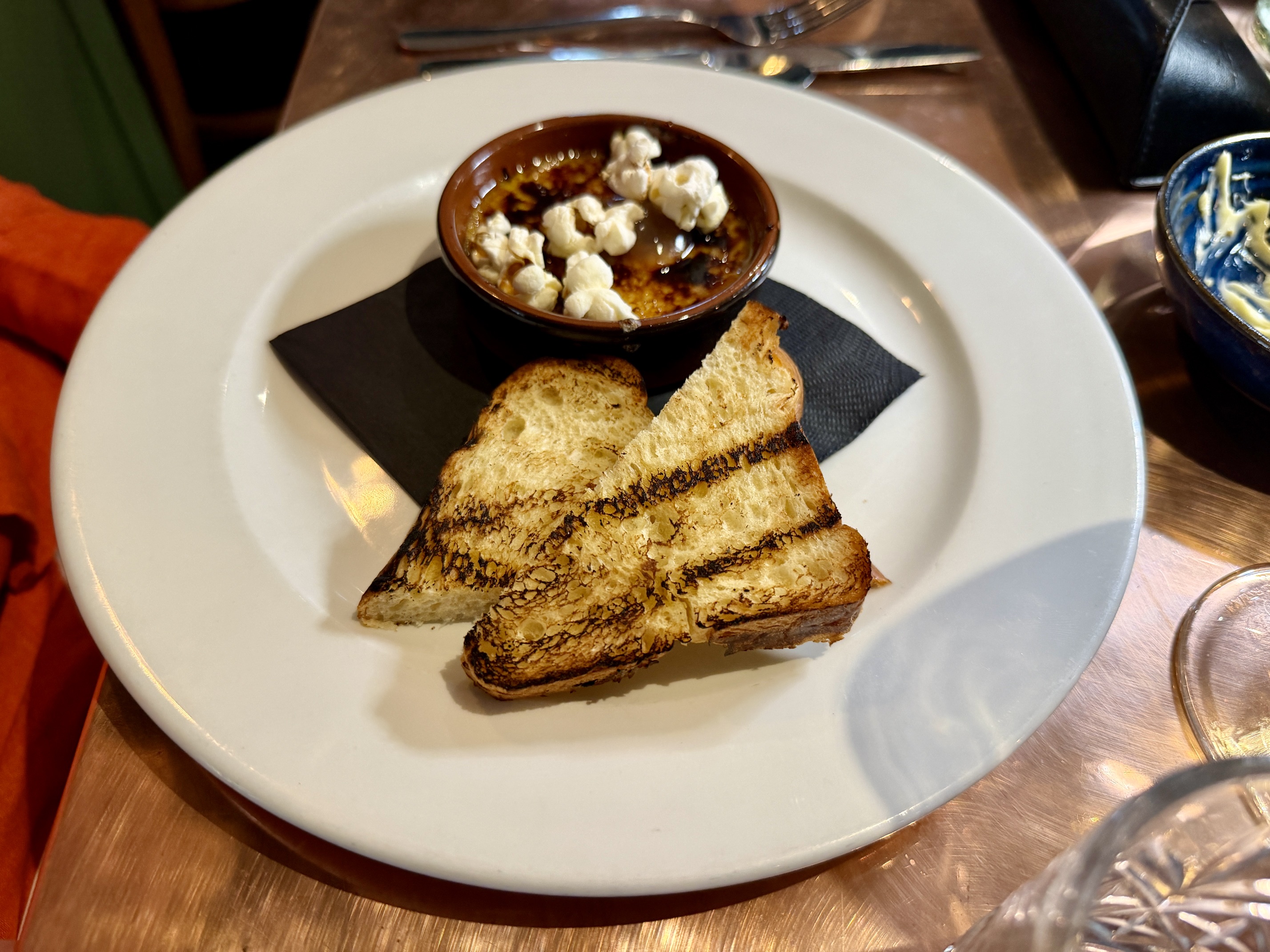
It was meant to be a foie gras crème brûlée with vin jaune gel and toasted brioche, and I’m sorry to say this, but the resemblance stops at the photograph, and possibly before that. A crème brûlée is meant to have a satisfying burnt top and be set underneath. It’s not meant to be a murky puddle of bumf. And it’s not meant to taste so little of foie gras that you wonder, as Jerry did, whether he’d accidentally been given something from the dessert section, a theory lent credence by the pointless popcorn on top.
Poor Jerry – all the guilt of having ordered foie gras without the corresponding enjoyment of getting to eat the bastard stuff. I felt personally responsible.
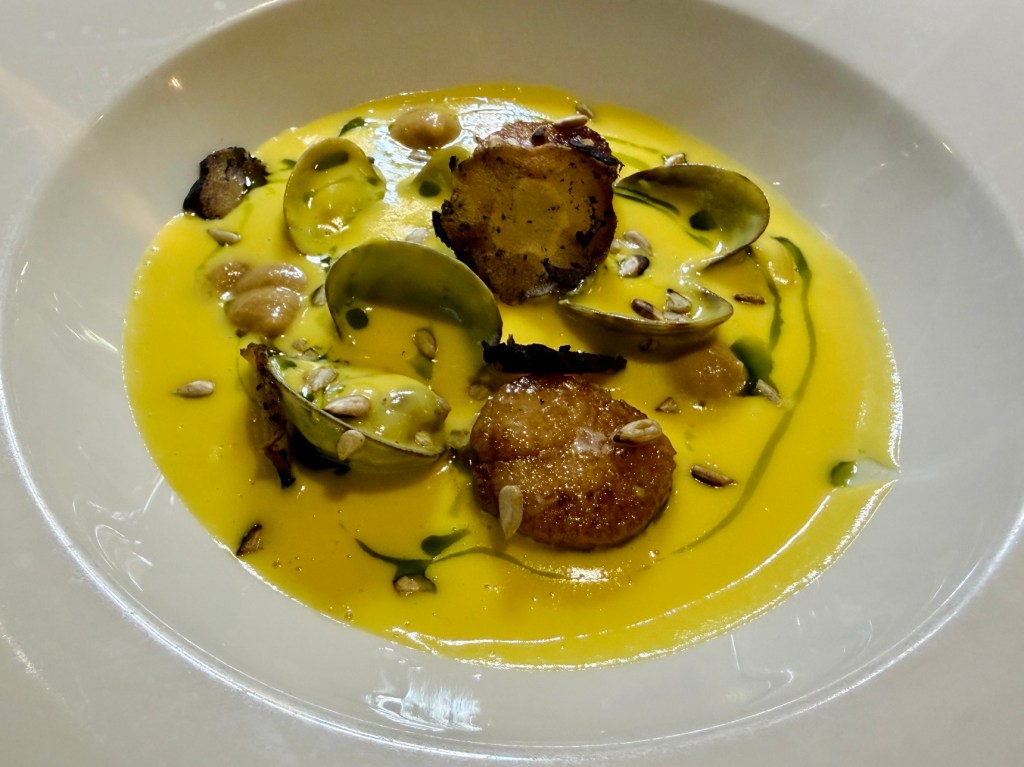
I felt less bad about it, though, because my starter was also disappointing. What was billed as seared scallops with clam velouté and parsnips was in fact a thin puddle of soup with a single scallop, cut in half, three clams and a crispy disc of perpendicular parsnip.
The overall effect, apart from masterful cost control in a £16 starter, was an oversweetened, unsubtle cacophony of a dish. Just like the foie gras crème brûlée, what turned up wasn’t in the slightest what the menu implied you would be tucking into. No wonder they brought you a spoon with this one. I once ate at Oxford restaurant Gees and wondered if I’d accidentally wandered into the U.K.’s most expensive salad bar. No. 1 Ship Street, by contrast, was beginning to feel like a spenny soup kitchen in disguise.
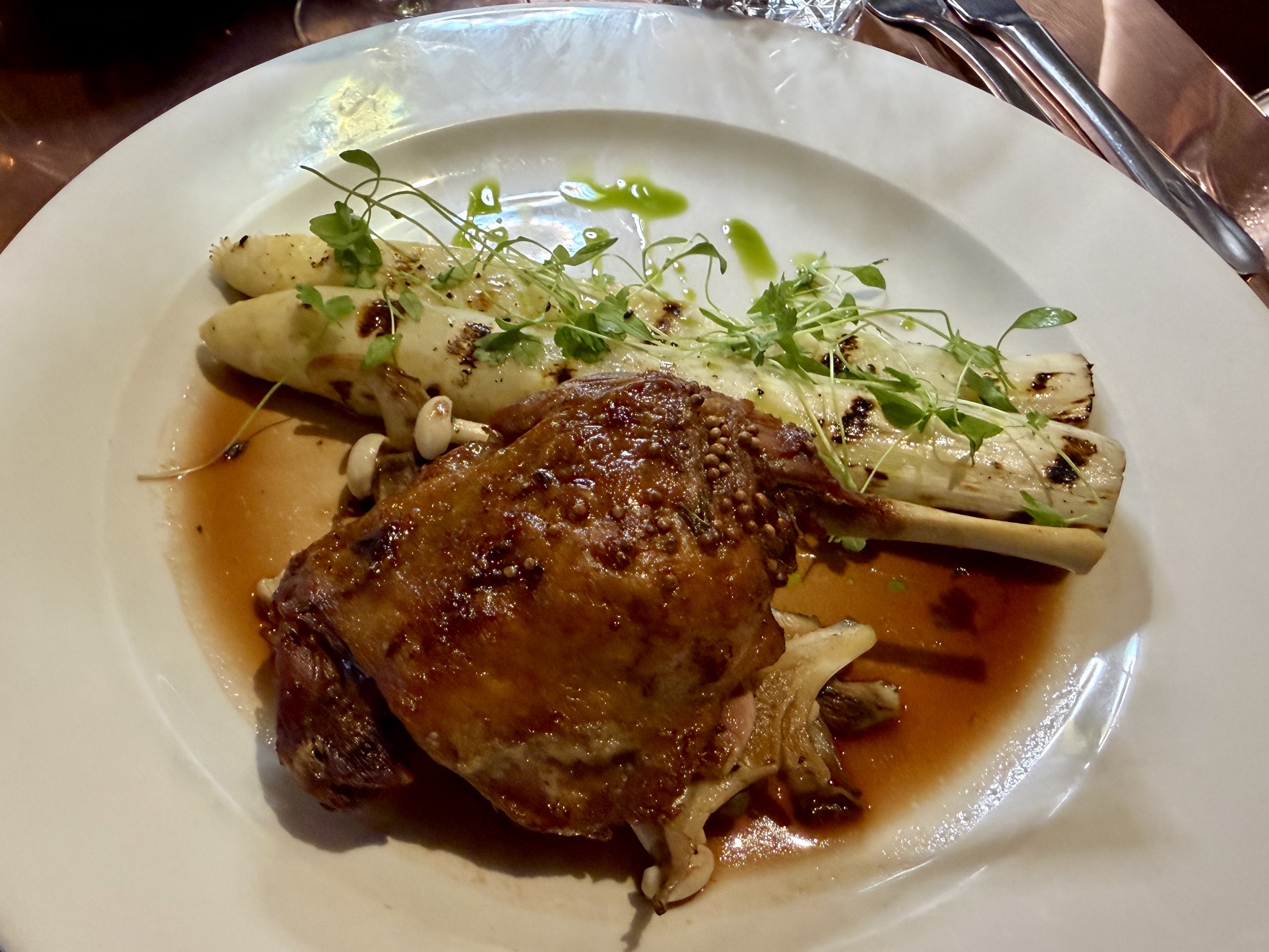
Were the mains, when the restaurant stayed closer to the mainstream, any better? Mostly, I would say. My confit duck almost worked: the skin was gloriously crisp, the fat rendered and the flesh underneath giving in all the right ways. Perching it on a pile of wild mushrooms, enjoyable ones at that, was a bit like giving the dish platform shoes: it made it look like you got far more duck than you did.
The white asparagus was thick and generous, with just enough bite, beautifully cooked to avoid the bitterness this variety can sometimes have. “It looks like a pair of dildos” was Jerry’s unvarnished take: I laughed like a drain and warned him that I planned to quote him verbatim. This is the bit in the description where I’d love to say and a plum jus brought it all together beautifully but instead I have to say that there was a thin drizzle of blandness that didn’t add enough moisture or flavour.
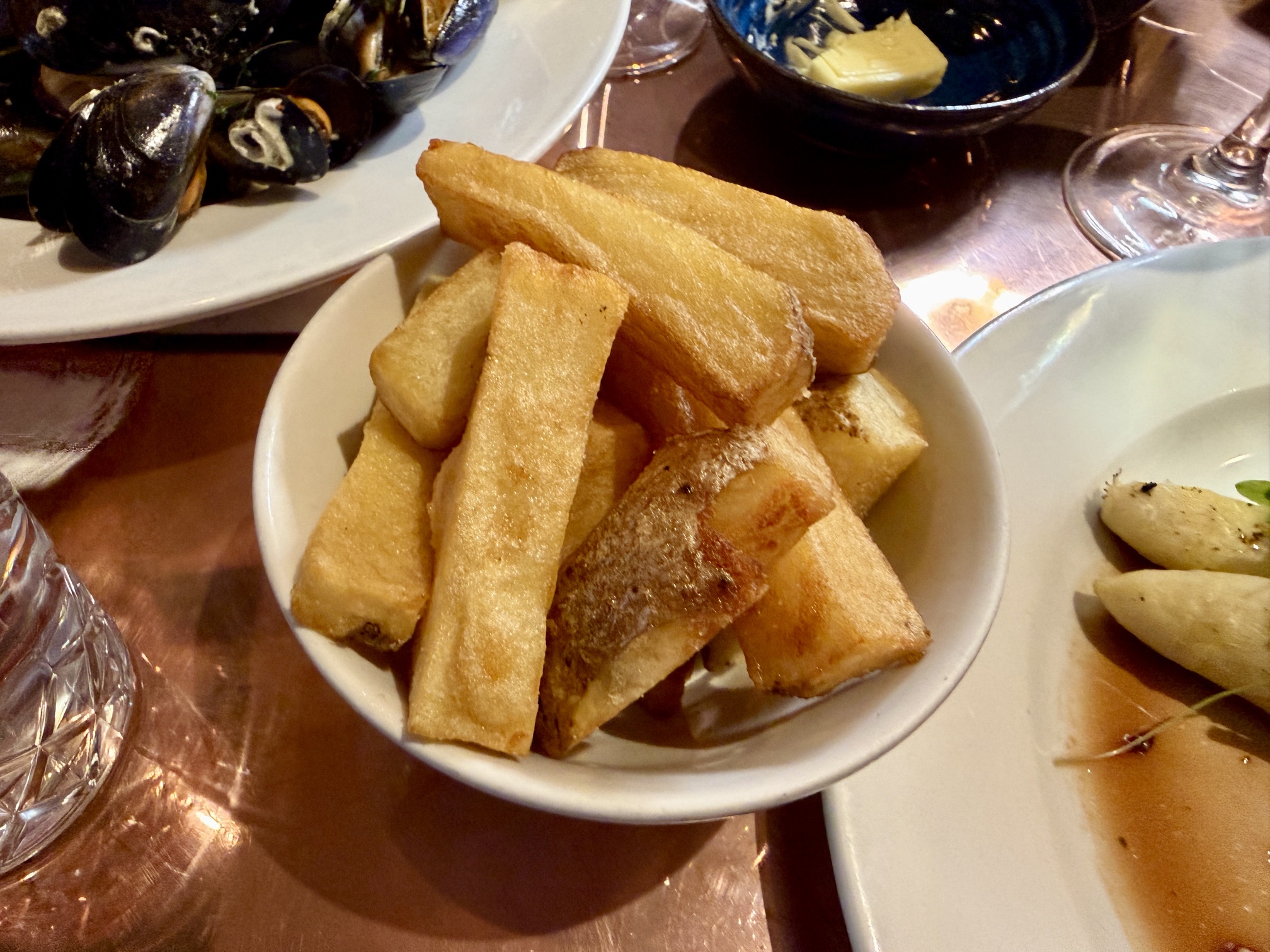
This dish needed carbs and didn’t have them, so I ordered some chunky chips. And these were well done, but with the main course so unrelentingly dry there was nothing for these to soak up, or act as a vehicle for. It also means that my duck dish, with chips on the side, cost £30. That’s a lot for not quite enough, there’s no way around that.
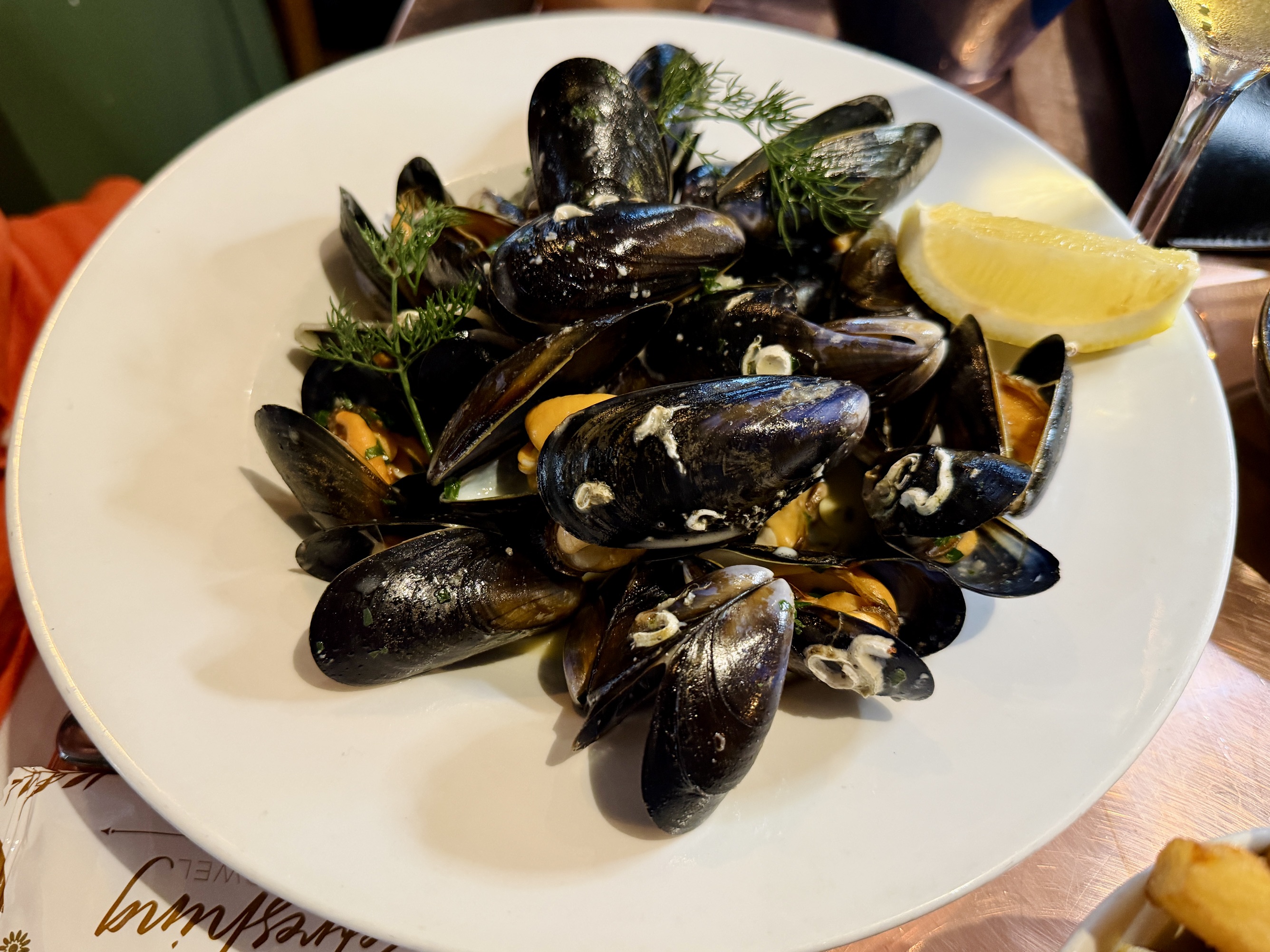
Jerry picked better I think, moules marinière from the specials. They were plump specimens, from St Austell Bay according to the blackboard, and Jerry thoroughly enjoyed them. They came with frites, and as with No. 1 Ship Street’s chips they were well executed.
But ironically, for me, this dish had the converse problem to both those starters. The mussels were high and dry, clustered in a wide-brimmed bowl. The joy of moules marinière is the bit at the end, when all the shells have been vanquished and you’re left with a bowl of that creamy liquor, to trawl with a spoon, picking up stray mussels, to drink like broth, to dab with bread or to tip your frites into. It makes it two meals in one.
But here, that last stage was a bit like some people I see prancing around on Instagram, too shallow to be worth persevering with. It seems that No. 1 Ship Street only dished up soup when you didn’t want it to. Jerry, mind you, loved it.
Despite all that, and perhaps paradoxically, we stopped for dessert. Because despite the food not being spectacular, and in some cases being downright weird, we were still having a lovely time. No. 1 Ship Street somehow, through its gorgeous, calming room, its very pleasing booze and unstintingly charming staff, created a space where you knew, on some level, that things could and should be better but didn’t mind as much as you should.
In that sense, it was almost the inverse of so many experiences I’ve had on duty lately, restaurants I ought to have liked more than I did. Here, instead, I found myself almost willing to suspend critical judgment. Only in the moment, really, and as I write this I remember all the things they got wrong. But weirdly, remembering them is almost like trying to recall a dream. I wonder how many people No. 1 Ship Street has pulled that trick on over nearly a decade. I’m not seeking to denigrate: it’s a neat trick.
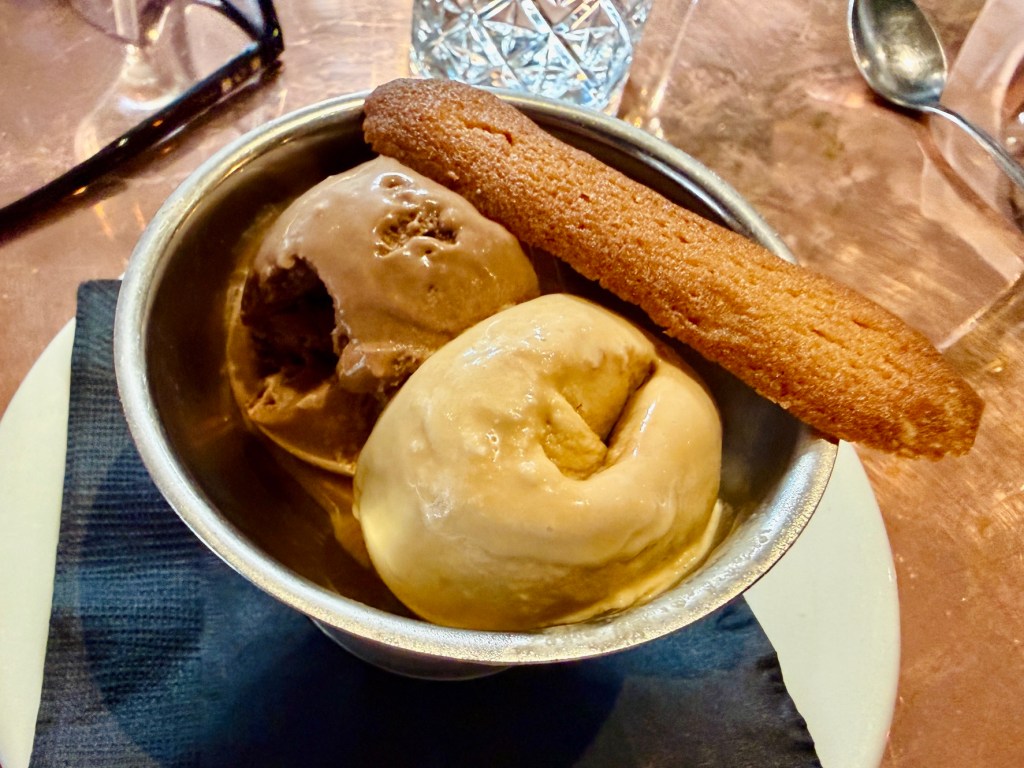
Anyway, they saved some of the best for last. They make their own ice cream, and both the chocolate and salted caramel were smooth, rich, crystal-free and as good as anything you could get in George & Davis, if not quite the standard of Swoon on the High. The range of flavours was quite pedestrian, which surprised me: they save the cheffy stuff, the rose and rhubarb ice cream or the basil sorbet, to accompany Actual Desserts. £6 for two scoops with a beautifully light langue de chat was probably the bargain of the day.
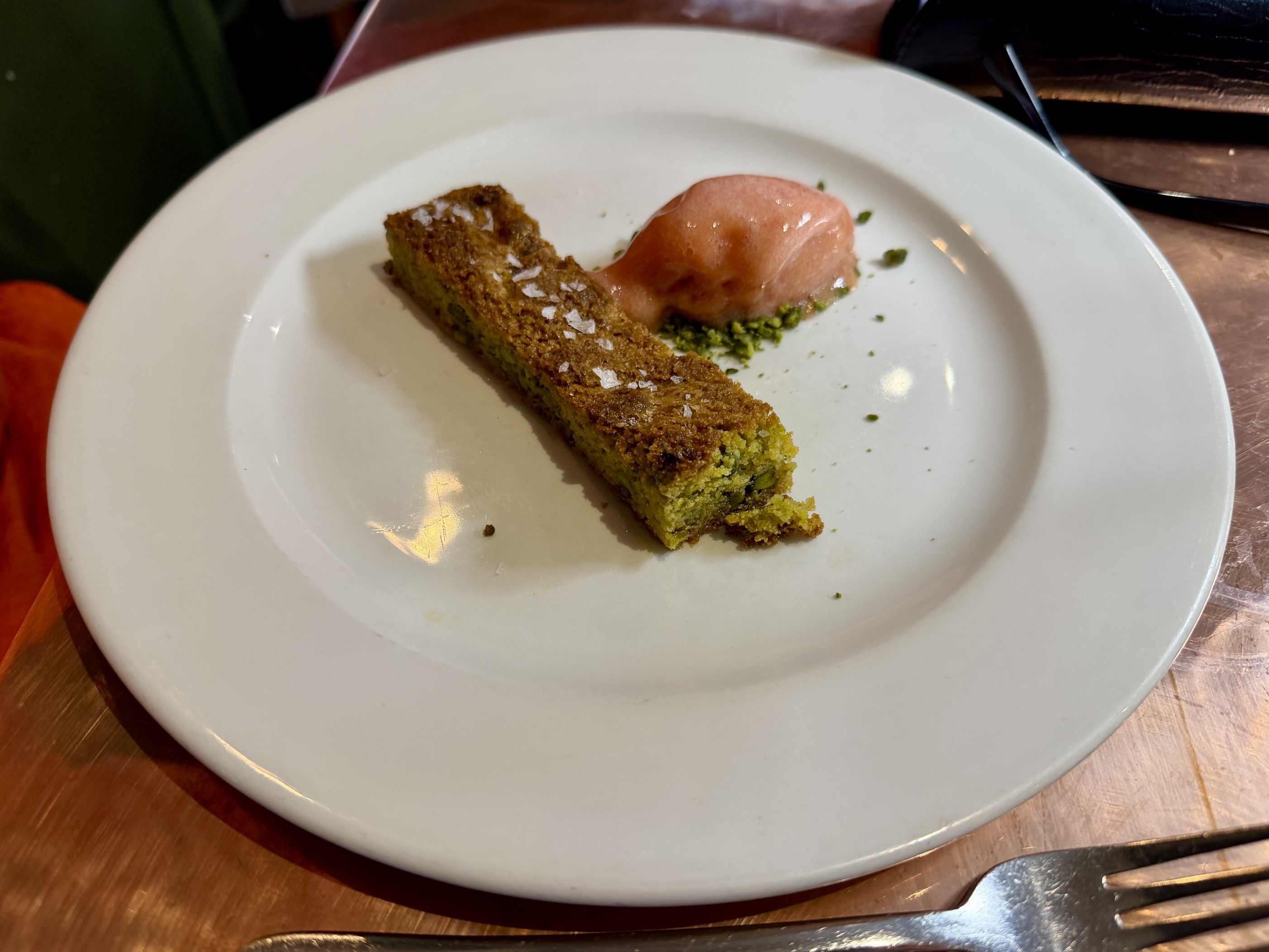
Jerry was happy with his pistachio cake. I don’t know if I would have been, it was a thin, uneven slab of the stuff with something that did not look like basil sorbet. Maybe it was grape and basil sorbet – the menu, as so often, made it difficult to work out what you were going to get.
And again, that’s not necessarily a problem. In a restaurant where the words on a menu are just a jumping-off point, in the hands of the right kitchen, a meal can be a life of surprises. Underpromising and overdelivering is one of the great talents of hospitality done well, and the thing that makes memories – as much as anything does, over and above the people you bring with you. The problem with No. 1 Ship Street, for all I keep saying that it’s not a bad restaurant, is that none of the surprises, on balance, were good ones.
All that set us back £214, including the standard 12.5% tip, and more than usual I couldn’t really work out whether I’d been stiffed or not. We were there for the best part of two and a half hours, we had a marvellous time – although for me, lunching with Jerry, that was a given – and we were very well looked after.
Perhaps in the centre of Oxford, given the alternatives, No. 1 Ship Street is as good as it needs to be. Or maybe it had a bad day when I went, or I was too finicky. But I was left again marvelling at their powers of misdirection: how could they have created the semblance of a fantastic meal from such inconsistent food? Appropriately, it had the feel of being through the looking glass about it.
But I didn’t feel that way at the time, I only feel it now. At the time, Jerry and I agreed that we’d had a lovely meal, and off we strolled to the Rose & Crown to enjoy the refurbished outside space and improved beer offering. It had been another classic visit to Oxford, and if something was niggling at me it would take a couple of weeks for my reservations to fully germinate.
Restaurant reviewers are pontificators by nature, and never miss an opportunity to tell you what a restaurant Means, what it is All About. I’ve read a couple of think pieces lately about how it’s okay for a restaurant to be just good enough, in defence of the unspectacular, the “fine” or “ordinary”. Well, I suppose it’s one way to try and jazz up a boring meal, or meet your latest deadline at the Financial Times. You’ve got to have an angle.
But for the rest of us, who spend our own money, that’s not the axis you plot things on. It’s not unremarkable versus showy, hyped versus anonymous. Most of us deal in good or bad, or perhaps good enough and not good enough. No. 1 Ship Street’s failing is to try and show off, when it could just get the basics very right and send a lot of people away very happy indeed. It has the room, it has the service, it has all the ingredients to do that.
But somehow, for some reason, it chooses not to and, to give it credit, it almost gets away with it. But what do I know? If you clock up a decade slap bang in the centre of Oxford, even with the dearth of competition, you must know a thing or two. Even so, I can’t help feeling their second decade might prove more difficult.
Since January 2025, Edible Reading is partly supported by subscribers – click here if you want to read more about that, or click below to subscribe. By doing so you enable me to carry on doing what I do, and you also get access to subscriber only content. Whether you’re a subscriber or not, thanks for reading.
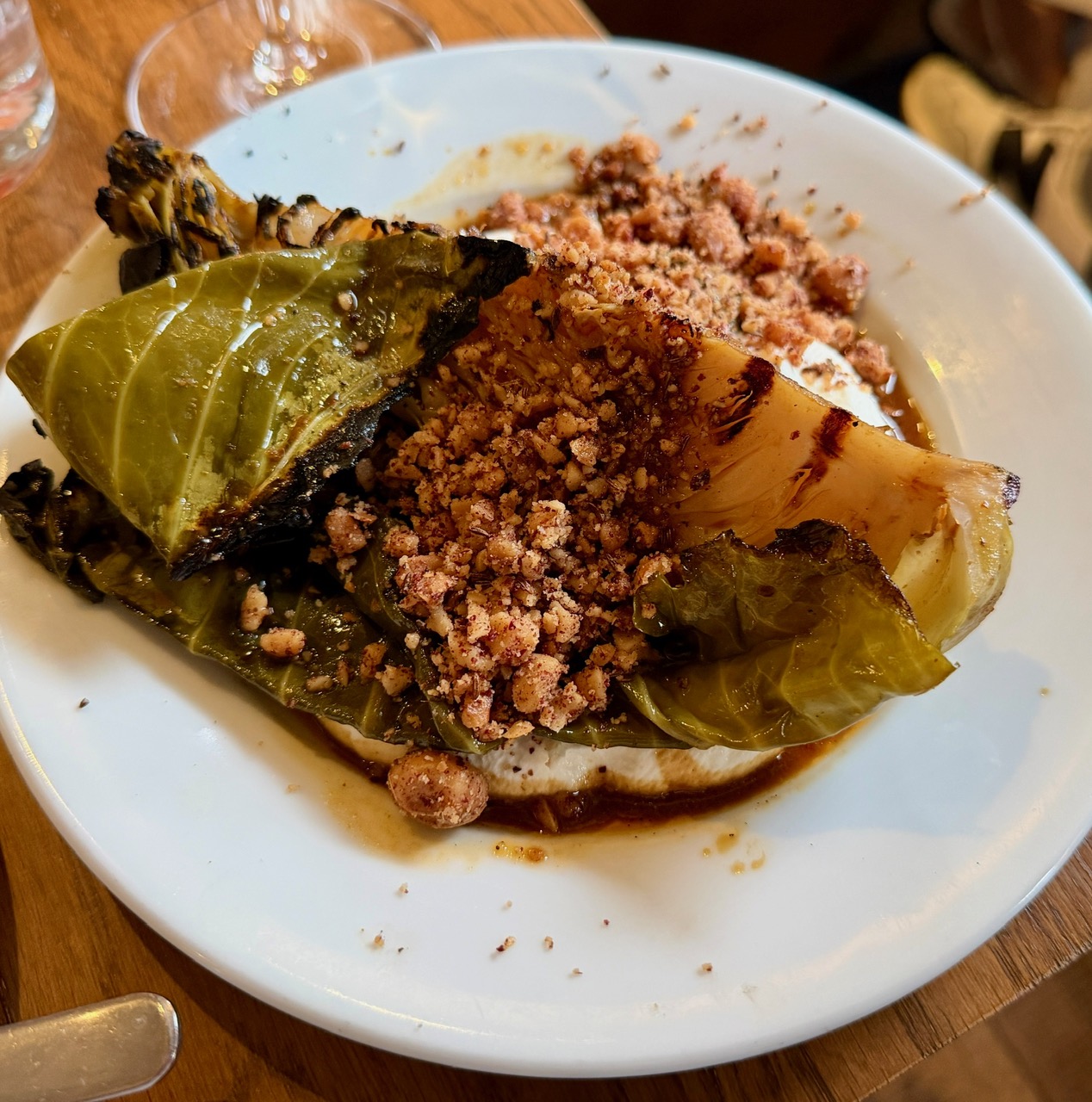
At Carmel in Queen’s Park, a restaurant usually described as some combination of Eastern Mediterranean and North African, a snack of anchovies comes with tahini and crostini. Crispy squid is served with aioli and lemon. Flatbread is topped with merguez and jalapeño relish, hispi cabbage with a macadamia dukkah. You can have slow-cooked lamb shoulder with salad and more flatbread, and something called “campfire potato” on the side.
Right, shall we wrap up there? I can give you the rating and, as people at work say when a conference call is shorter than expected, give you back fifteen minutes.
But I imagine you’re thinking No, not yet. You want to know why I picked the restaurant, what the room is like, whether I liked those dishes, what the service is like. How much it cost, and whether it was worth it. You might never have been to Queen’s Park, and want to know where it is and what kind of area it is. If I ended now – here’s the food and that’s it – you’d probably feel put out, and rushed.
Well, now you have a vague idea what it’s like to eat at Carmel, because I’m afraid it was one of those meals. Let’s get this out of the way early doors: our table was booked for quarter past eight on a Saturday night, the place was packed and I don’t think we ordered for at least 10 minutes, possibly more.
We ordered an aperitif, and a bottle of wine for later, and snacks and small plates, and then a big plate for sharing. We ordered what looked, to me at least, like a well-considered meal with a beginning, a middle and an end. Well, a pre-end anyway, because I’m sure we’d have stayed for dessert.
Having been stung in the past by meals where everything comes out too quickly, we asked our server for advice. Should we have our aperitifs and snacks first, then order the rest? No need, she said, because the kitchen would something something something and the food would come out something something. She was inaudible and, as it turned out, a little ineffectual, but we came away reassured.
Something like 10 minutes later, our first snack came out. Then, a couple of minutes later, our second. One of our small plates came with it and then, 3 minutes later, another. We hadn’t even got close to finishing our negronis – a shame, because they were great, the gin infused with sage – and our table was already packed with food.
Every time a server walked past, towards the buzzing terrace, with more plates I got the fear that they were going to be for our table. Surely they couldn’t be? The place was rammed, we’d only just got there and they’d taken 10 minutes to even ask us what we wanted. Yet they nearly always were.
Another 3 minutes later – thank heavens for time stamps on photos – our side dish came out, ahead of the thing it was a side dish for. And then, with grim inevitability, 5 minutes after that, out came the lamb. Absolutely ridiculous. It took 18 hours to cook and about 18 minutes to come to our table. All in all, about £115 of food arrived in the space of 15 minutes. And I have to wonder whether, at some point over the last couple of years, I started Doing Restaurants Wrong.
Because experiences like this seem to be more normal now, to the point where I wonder if it’s what some or many diners actually want. One recent review of Carmel on Google said “The service was the fastest I’ve ever seen, food was served around 10min after we ordered and it wasn’t some easy dishes”. He gave the place five stars, while describing an experience I might expect from KFC or Honest Burgers.
It wasn’t what we wanted, though. Zoë had finished a relatively early shift that night and I met her in London on an evening when we both had the next day off, so as close to a date night as we seem to get these days. We were in no rush, and I don’t think we seemed like we were. So how did it go so wrong?
With an experience like that there’s only so good a restaurant can be, but since my whistle stop summary at the start missed out so many important details let’s fill in the blanks. Queen’s Park is lovely, and one of those bits of London that belies its proximity to the centre: in Zone 2 but a mere seven minutes from Paddington, feeling like it’s not really London at all.
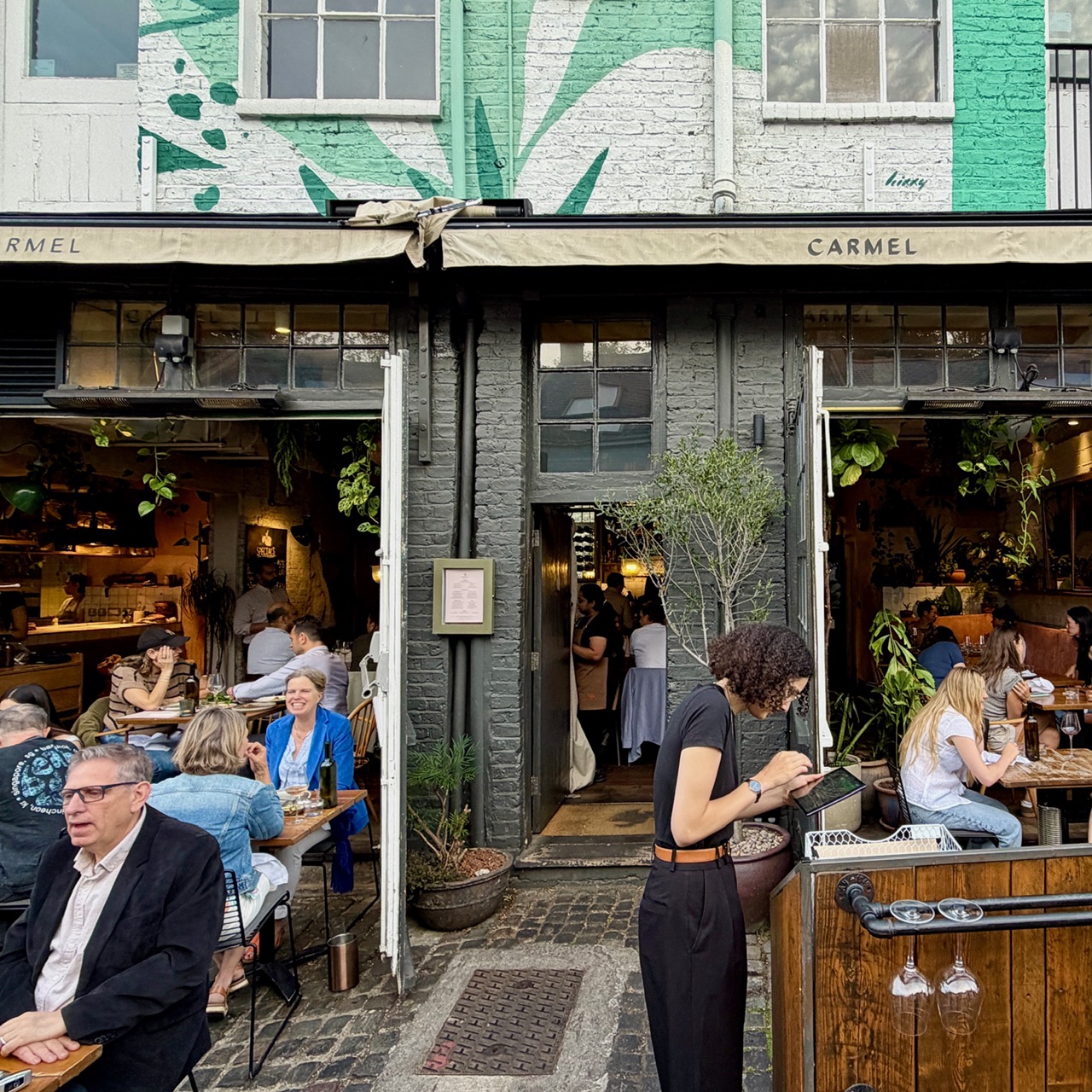
And Carmel is down Lonsdale Road, a pretty cobbled lane which was absolutely humming on a warm Saturday night. Londoners were thronged outside eating and drinking – some at restaurants like Carmel or Pizza Pilgrims but many just standing outside a pub called Wolfpack, or sitting on seats which may or may not have belonged to that establishment. It felt like a drinking flashmob, to the point where I wondered if people had brought their own furniture.
Carmel is an offshoot from Haggerston grill house Berber & Q, its more grown-up sibling, and it opened in late 2021. It was joined by critically acclaimed bakery and restaurant Don’t Tell Dad at the start of 2025, the overall effect being to create another of London’s many gastronomic microclimates.
I was tempted by Don’t Tell Dad, but the menu at Carmel read like an absolute dream. Something jumped out from nearly every item on it saying “pick me, I’m different”, little invisible exclamation marks drawing the eye here and there. Smoked taramasalata, hummus with zhug. Sumac and tahini, harissa butter and pomegranata molasses. Labneh and dukkah, fermented chilli, smoked salt, parsley pesto.
Restaurant reviewers, or anybody with an Instagram account, are used to saying that the camera eats first, but when you read a menu like this the eyes eat first: everything flows from there.
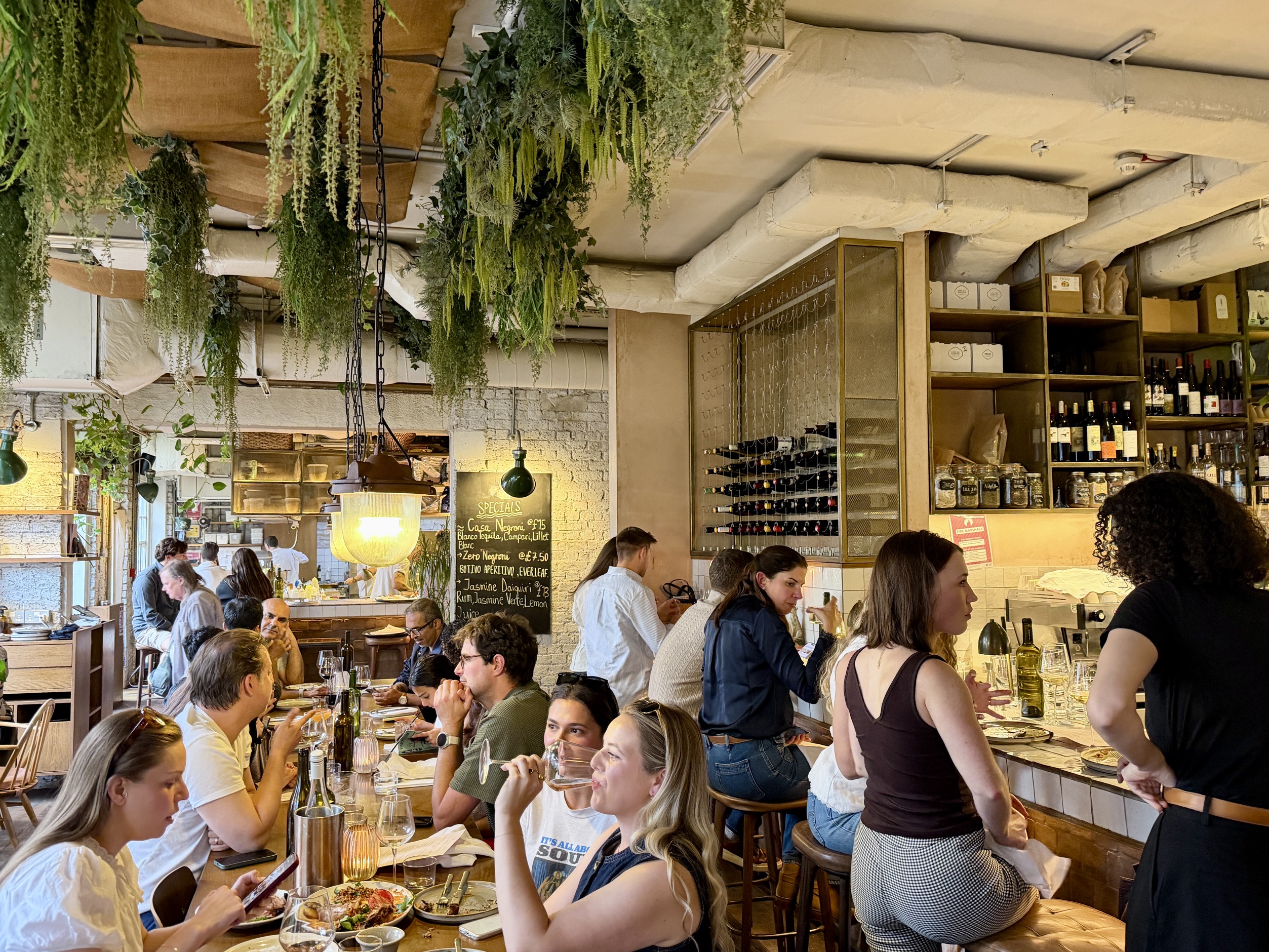
And the room was beautiful – I was glad we were inside rather than on that clamouring terrace because it’s such a gorgeous space, with exposed brick painted white, a white tiled bar, a long communal table and handsome Ercol chairs. It didn’t feel of its place at all, but reminded me more of places in Ghent, or Copenhagen – effortlessly cool Europe, rather than London.
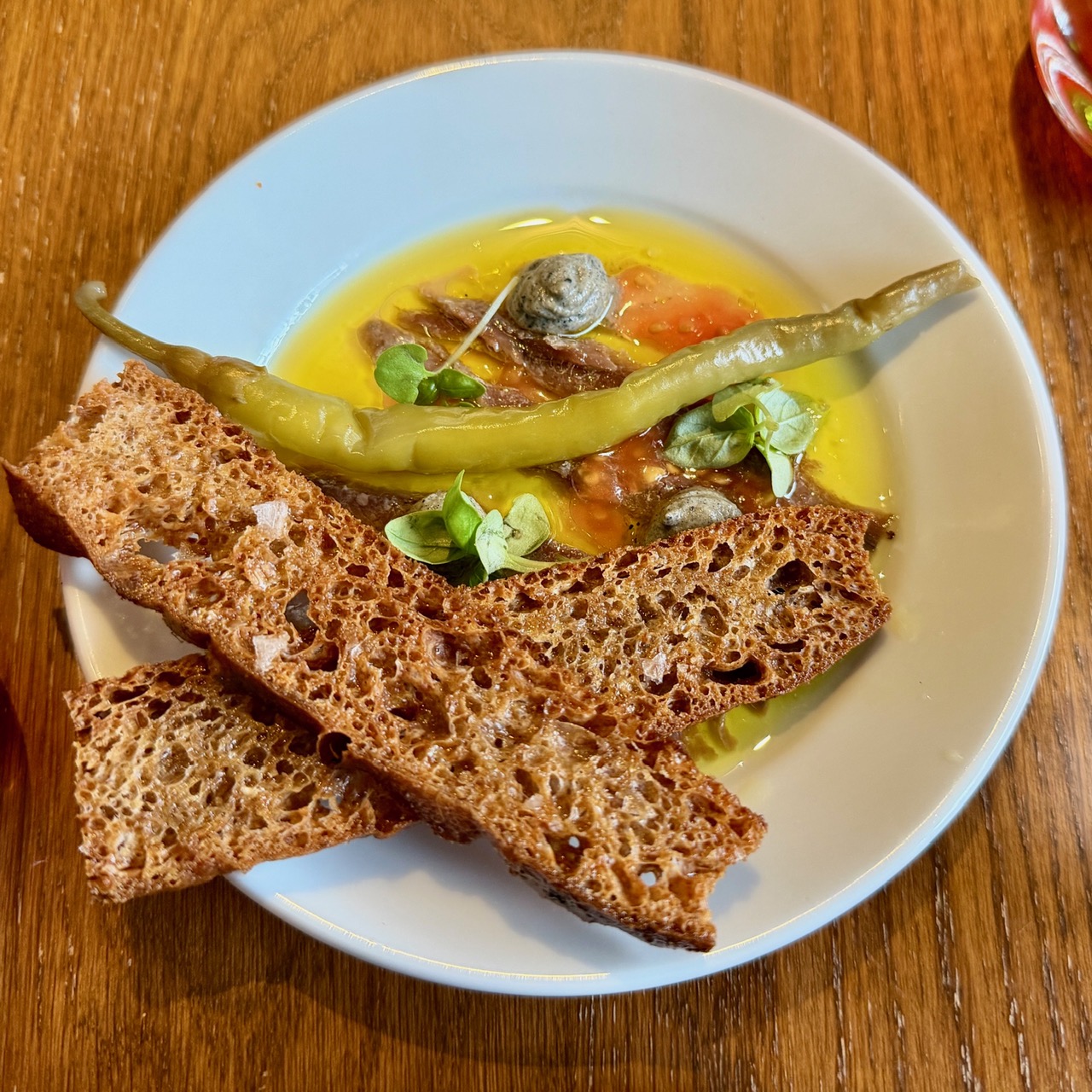
Leaving the woeful timing issues to one side, most of what we ate was good or better. Those anchovies, for instance, were a not ungenerous four, served swimming in oil with a pickled chilli, a little tomato, swirls of black tahini and two long strips of the restaurant’s wholewheat focaccia, turned into fancy Melba toasts. It was very nice, and in the parallel universe where Zoë and I ate this, finished our negronis, decompressed and talked about our day it would have played a beautiful part of a harmonious whole.
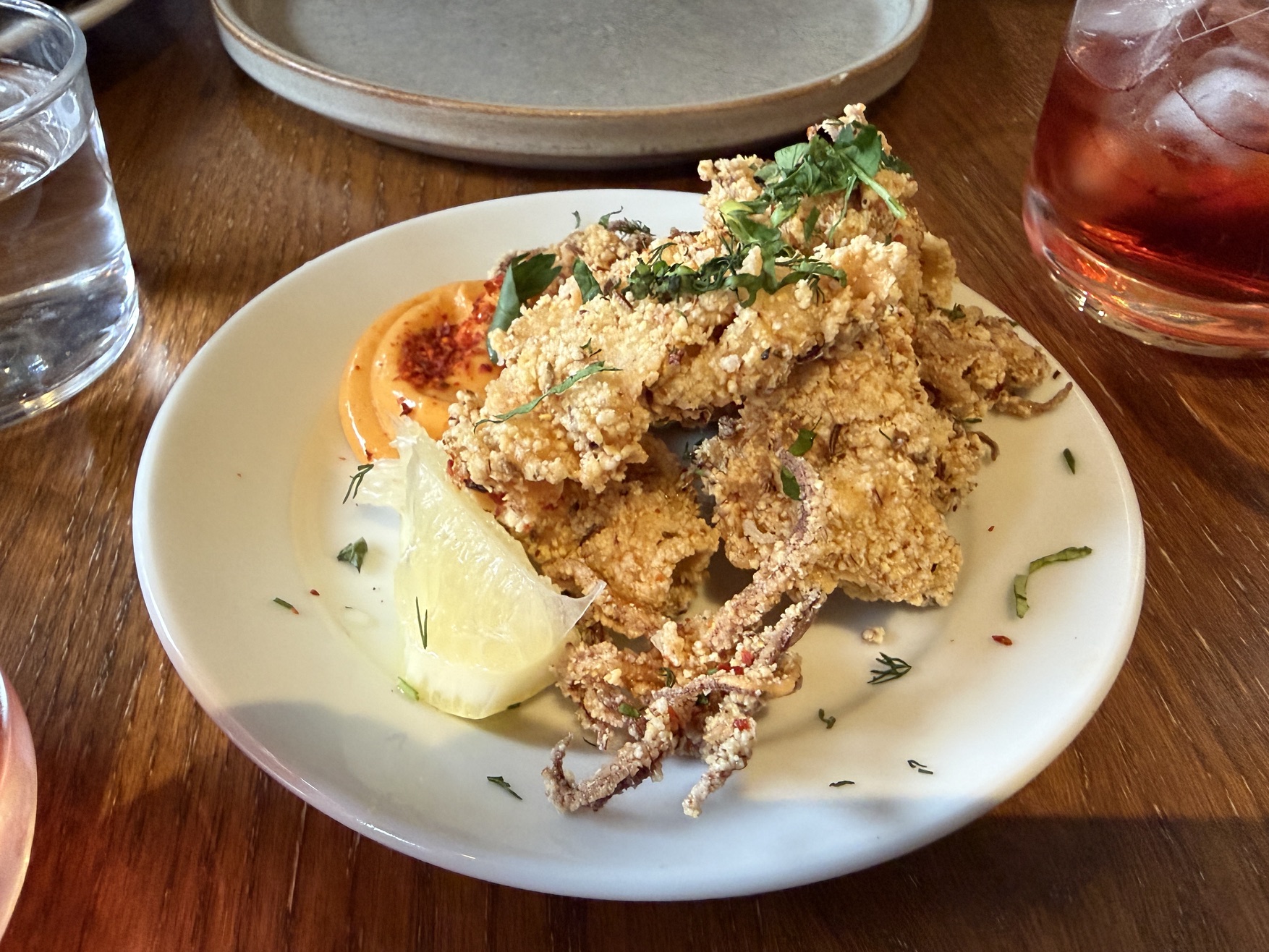
For that matter I loved the crispy squid, which managed to get everything right – the texture inside and out, just enough give but with a roughed-up, brittle exterior that hinted at something like polenta flour in the mix. This cost £10.50, as did the anchovies: if you gave me that £21 again I’d just order the squid twice.
We tried not to be distracted from our task of finishing it by the arrival of other dishes.
And Carmel’s Hispi cabbage deserved not to share the limelight with anything else. I know as an ingredient it’s almost as done to death as broadsheet critics complaining about its omnipresence on menus, but I still love it and my forkful of Zoë’s confirmed her good sense in ordering it.
It had the right amount of blackening, the tender leaves spot on underneath, and everything it was paired with brought out its best self wonderfully – a bracing labneh, fragrant ras el hanout and a really enjoyable dukkah which positively transformed the humdrum macadamia into something worth hoovering up. £16.50 for this, and worth every penny.
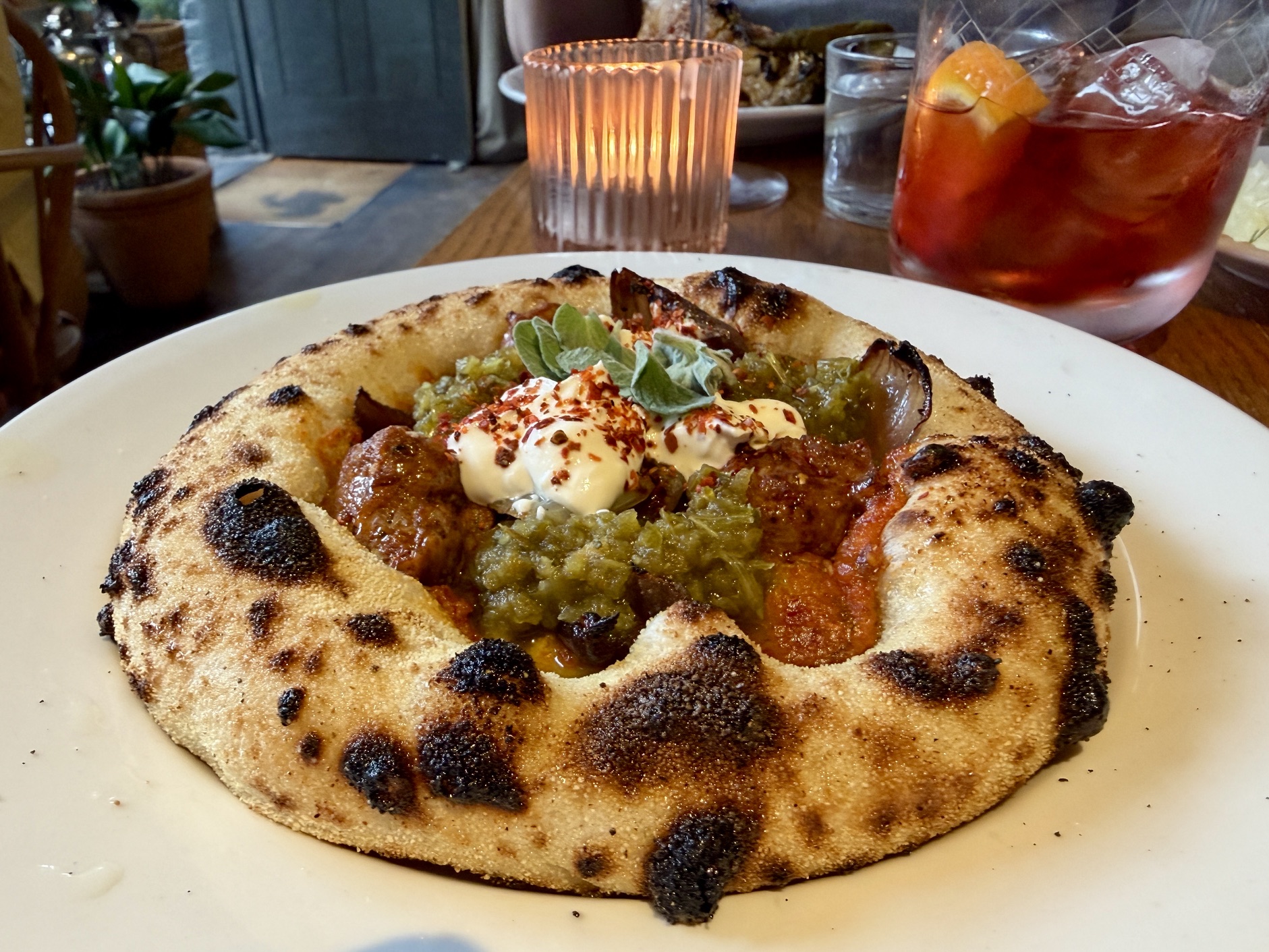
I’ve read somewhere about Carmel’s flatbreads being described as some of London’s best pizza. In fairness that was four years ago, before the capital lost its mind for pizza, and perhaps it was true then. I think it would be harder to make that case in 2026, but I did rather like it: the crust faultlessly puffy and spotted, the crater in the middle loaded with paydirt.
But the base was easily the best thing, and the stuff in the middle felt like it was fighting among itself. What was billed as merguez didn’t have the taut texture of a really good sausage, so was more pappy, like a meatball. The enormous dollop of jalapeño had a blistering heat that overpowered everything else, and the yoghurt plonked in there felt like it had one job only, to calm the jalapeño down.
There were a few bits of onion – “petals” apparently – and allegedly some confit garlic that I didn’t get at all, but the whole thing felt shouty. This too was £16.50, and by this point I was wondering what that money would get you at Pizza Pilgrims a few doors down. More, better, slower, probably.
We just about managed to open our £40 bottle of rosé – by Judith Beck, a producer I’ve always liked – as our lamb came to the table. By that point much of the meal was behind us and 750ml of wine was in front of us, but we rolled up our sleeves and gave it our best shot. There is nothing like a cold, crisp rosé on a hot day, and this was nothing like a cold crisp rosé. We flagged a server down and asked if the wine cooler could have some actual ice in it. It was brought back with ice in it, and by the end of the meal our wine was almost cold enough.
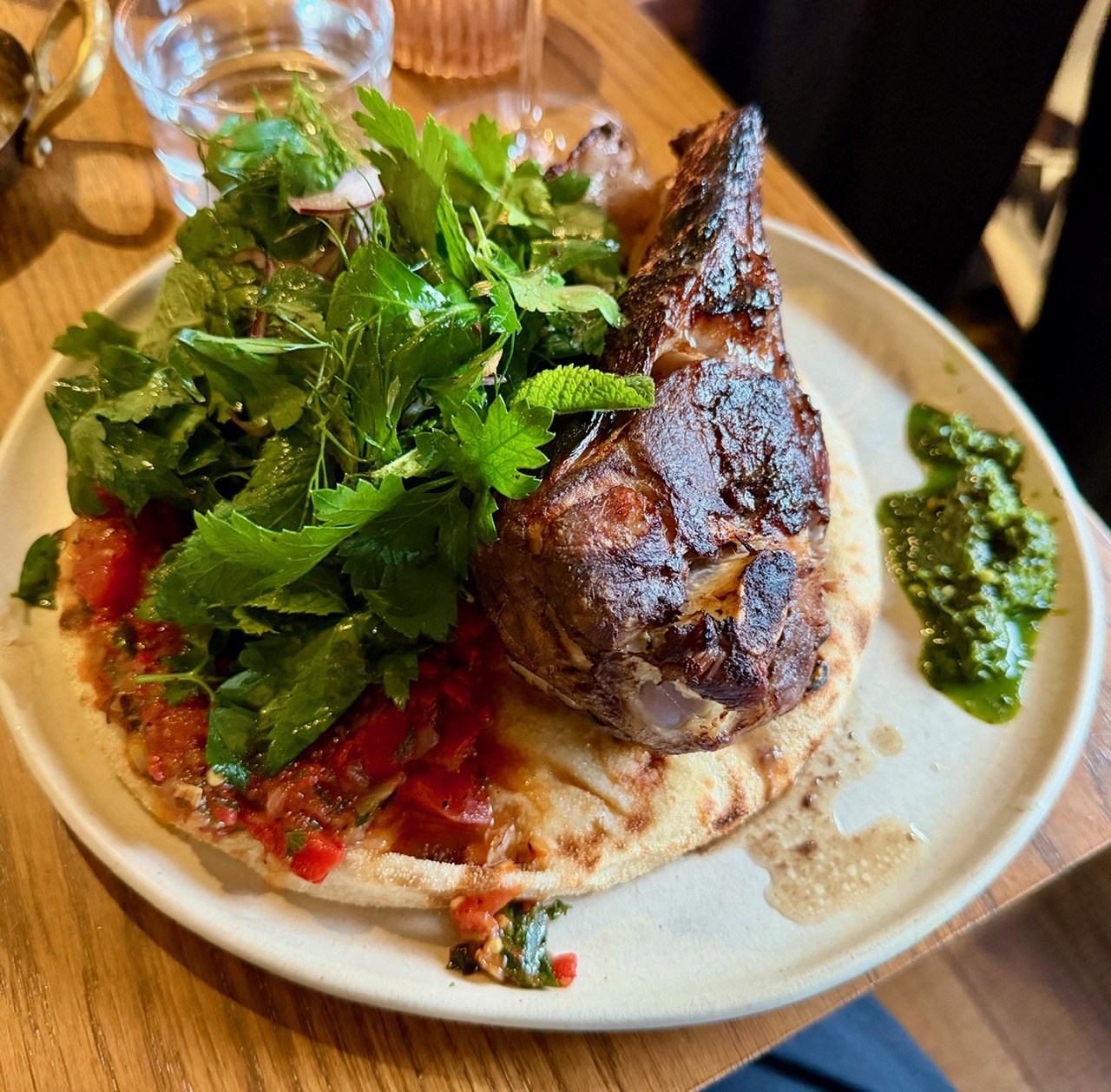
So, the lamb. Pants, I’m afraid. It looked so good, like the platonic ideal of every kleftiko you’ve ever laid eyes on. Everything it came with was terrific, a salata mashwiya that was a sort of hot, roasted vegetable dish and a herb salad that zipped and zinged with the best of them.
We had the campfire potato with this and it, too, was good: scorched, and smashed and smothered in salsa verde and sour cream. The lamb was perched on another of Carmel’s excellent flatbreads, which meant that all the fat slowly permeated it, which is exactly what you want.
The fat, though. The fat was the problem. Because I know lamb is a fatty meat, and I like a bit of lamb fat, but this piece of lamb was 90% fat. A gelatinous hunk with a few scraps of well lubricated meat hitching a ride on it. That wasn’t apparent at first, but the more incisions we made the more we realised that the good stuff was vanishingly rare. The last time I saw anything wobble this much it was me, running for a bus.
I’ve read lots of comments and thinkpieces from restaurateurs saying that customers should be less English. If you don’t like something but you politely say it was nice, or fine, you’re depriving the restaurant of the chance to fix it. I was still happy to keep schtum, but when our server returned Zoë pointed out that the lamb was largely inedible blubber. So our server promised to feed that back to the kitchen and the management.
And when she returned, she explained that it she’d spoken to them but it wasn’t possible to tell how fatty a shoulder of lamb was until you cut into it something something something and this was a very fatty cut of meat and you know, something something something. So we gave up. We considered dessert, but also considered the timings of the last pre-purgatory train home from Paddington. We left the last of our wine and cut our losses.
The bill came in the shape of a piece of perspex with a QR code, and scanning it showed that the damage came to £210, including an optional 12.5% service charge. And I was sorely tempted not to pay the latter, which is something I never, ever do, but you had to flag down a server and specifically ask for it to be removed and at that point I just thought Okay, you win. You win with your breakneck pacing and wobbly lamb and incoherent service.
Nothing, it goes without saying, had been taken off our bill in relation to that £56 main course.
On the way back to the Tube station Pizza Pilgrims glowed with distinct look-what-you-could-have-won energy. We made our train, it only slighly whiffed of Burger King and I resolved that this was the very last review this year where I eat somewhere that offers small and large plates, has a concept or wants you to share everything. Not without being unremittingly high direction when I place an order. If you see me doing anything to the contrary, please stage an intervention. In your own time, mind you. No rush.
Since January 2025, Edible Reading is partly supported by subscribers – click here if you want to read more about that, or click below to subscribe. By doing so you enable me to carry on doing what I do, and you also get access to subscriber only content. Whether you’re a subscriber or not, thanks for reading.
The 21st of July last year might have seemed like a perfectly normal Monday to you, but in food and drink terms it was an eventful day for Reading. Lincoln Coffee finally opened its big new site on King Street, the one Workhouse had vacated the year before. A little way away, down Minster Street, Thai restaurant Nua opened in the spot given up by Bluegrass BBQ in January.
Both of those were expansions. Lincoln has retained its original site on the Kings Road (and indeed for a while it used to operate out of Reading Bridge House, back when having a coffee concession in an office building sounded like a capital idea). Nua has a site in High Wycombe and another in London, in an area its website describes as “Fitzorvia”. But the third hospitality business to throw its doors open on the 21st July? It was brand new, out of nowhere and a more interesting proposition.
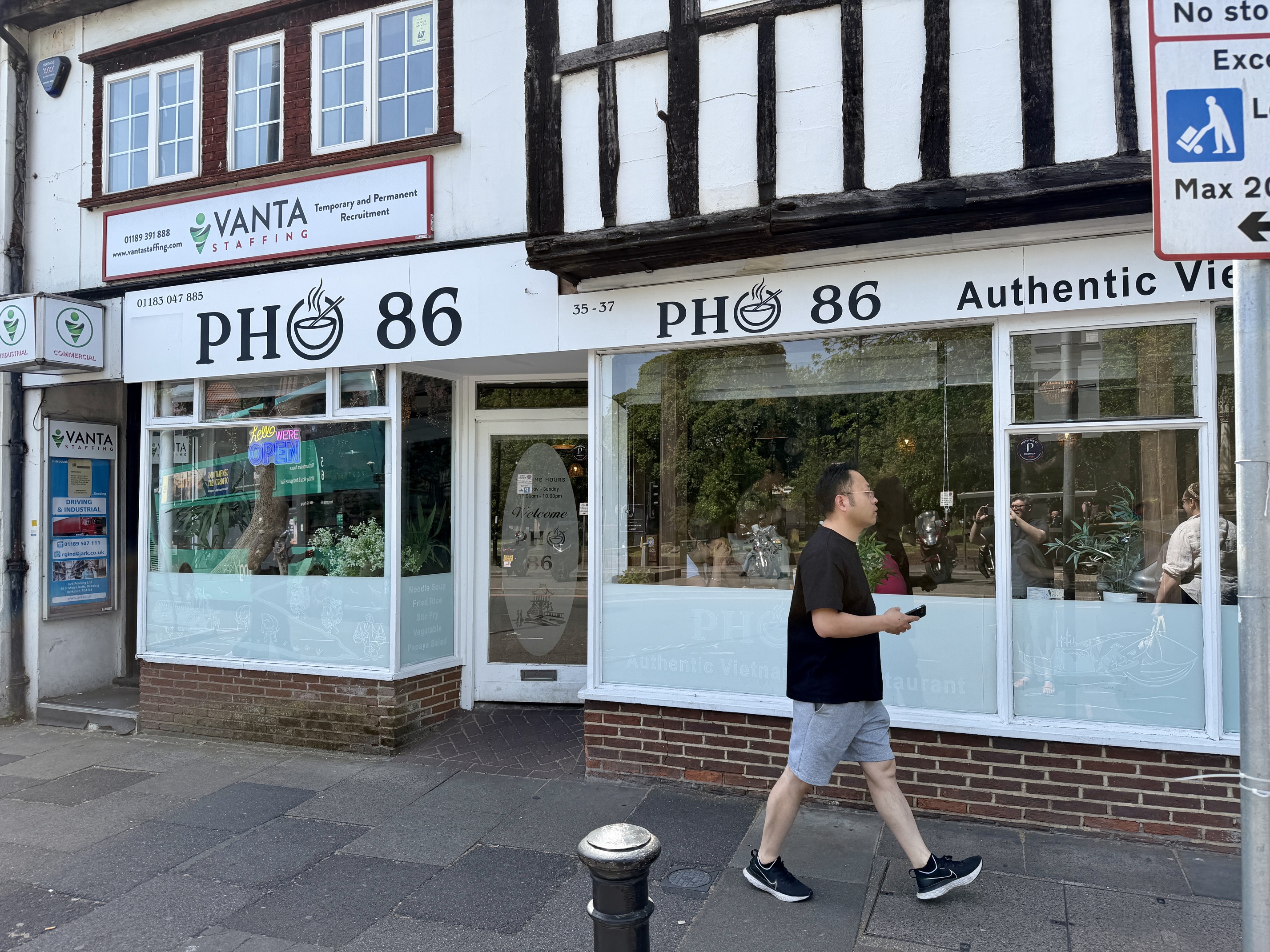
That would be Pho 86, an independent Vietnamese restaurant that has sprung up in the site once occupied by The County Deli, most famously one of Kate Winslet’s first employers, that closed in 2010. After that it was Sonning Flowers for a while, and then a food shop called K&K Supermarket which sold Vietnamese ingredients, amongst others. It’s not clear whether the change of purpose coincided with a change of ownership.
Very little is clear, because it’s hard to find out much about Pho 86 online. I do know that they opened without an alcohol license, and with a hygiene score of 1 from the council, who inspected a week after they opened. Both those matters were covered in the local press, and things have moved on since then: alcohol is now available and the most recent hygiene rating, from last October, is a slightly less worrying 3. The Chronicle showed no curiosity about Pho 86’s backstory, however, so it’s hard to know whether this is the owners’ first rodeo.
And good luck figuring out from their website, because the blurb on it is so generic that it’s hard to believe that AI wasn’t involved. At Pho 86, we believe a great bowl of pho is more than just food — it’s comfort, culture, and connection it begins. It’s not X, it’s Y. It’s not been written by a human, it’s ChatGPT. Fair enough, I guess: times are tough for independent businesses, and hiring a copywriter is probably nowhere near the top of the to do list. It would have been nice to know more about them, but perhaps they’re letting their food do the talking.
So finally, after leaving it the best part of a year, I paid them a visit on a sunny Saturday lunchtime with Zoë. I might have made it earlier, if it wasn’t for the hygiene rating and the lack of booze, but another reason was Pho 86’s surprisingly old school approach to customers: no online booking, which is curiously retro in 2026. I should have phoned up, really, and made a booking, but it says something that I literally cannot remember the last time I did that, anywhere.
Subscribe to continue reading
Become a paid subscriber to get access to the rest of this post and other exclusive content.