Papa Gee

Click here to read a more recent review of Papa Gee, at its current location on Prospect Street, from September 2022.

I’m not sure many people know that Papa Gee even exists. I was out this week with a friend who lives just round the corner from it and I casually dropped into conversation that I was due to go to a restaurant in his manor. First he asked if it was the Mod. Then he guessed at Standard Tandoori. When I shook my head again and said no, it wasn’t Casa Roma either he was stumped. “But there isn’t anywhere else round by me.” he said.

Well, there is: there’s Papa Gee, a small Italian place which has somehow been plugging away at the restaurant game for ten years. I used to walk past it on my way back from Kyrenia or Mya Lacarte and think is that even a real restaurant? The lights always seemed to be off, and I’ve never met anybody who’s eaten there. Even my friend, a local, had never heard of it. Surely a restaurant can’t survive for ten years if no one has ever been?

It’s not the loveliest place, and (apologies to my friend if he’s reading this) not in the loveliest part of town. The Caversham Road is a busy street for traffic but it’s far from the footfall of the town centre and only really comes alive during Reading Festival week. Papa Gee has no real view, no garden to speak of and is pretty anonymous-looking. So why am I reviewing it? Well, you can blame Tripadvisor for that: the reviews are very positive, with repeated claims that it serves the best pizza in Reading. Could the pizzeria I’ve been waiting for all this time really be attached to the not hugely appealing Rainbows Lodge Hotel? Probably not, I thought, but I was too curious to stay away (and hopefully by now you’re curious too).

Passing the bigger, more polished places on a Tuesday night made it very clear that not many people eat out in this part of town during the week; Casa Roma and Standard Tandoori both had three of four tables of guests but were far from busy. Papa Gee’s, on the other hand, had people at seven of its dozen or so tables. At the risk of sounding creepy, I did watch most of the diners leave and only one table was occupied by hotel guests. The rest seemed to be locals. A good sign, right? The interior of the restaurant was very basic with small tables laid with cutlery and paper napkins, signs painted on the window and food themed pictures on the wall. It reminded me of something Marco from Pepe Sale said to me once, that Italians are much more interested in the food than the room. Another good sign, I hoped.

The menu at Papa Gee’s is huge, one of the biggest of any restaurant I have reviewed. It’s a bit bonkers, too: if you want to get an idea of it, look on the website. It has a mixture of fonts, some rather eccentric spelling, some comments in inverted commas after some of the dishes (Buonissimo it says about one of them, Simply Delicious is the commentary on another) and a few – very – random photographs dotted through it. Reading through it I couldn’t decide which to do first, frown or sigh. Fortunately, the waitress was superb: I said I couldn’t decide what to order and she asked me “are you in a pizza, pasta or meat mood tonight?” I asked her to recommend one of each and she did so right away – strong opinions, firm preferences, no nonsense. Suddenly my urge to either frown or sigh had vanished.

The first starter, funghi ripieni, however, jumped off the page – a dish so appealing that it kicked off a bout of plea bargaining (you can pick mains first as long as I get the funghi etc.) It was worth the battle: what arrived was a single field mushroom, stuffed (or, rather, topped) with gorgonzola and mozzarella on a bed of rocket, the whole thing drizzled with balsamic glaze. The mushroom had the balance just right – cooked enough to be soft but not watery. The cheeses were also perfectly balanced – creamy but with enough of a salty tang of blue. The balsamic glaze added just a touch of sweetness. This was divine: simple, unfussy and heavenly.

PapaShroom

Picking a second starter wasn’t so easy – who wants to be understudy to a dish like that? – but I thought that the prosciutto and mozzarella would be an interesting choice just to see what their basic ingredients were like, even if it hardly tested the kitchen’s skills. This wasn’t quite as successful. In fairness, the headline acts were both good: the ball of mozzarella was cold, fresh, firm and clean-tasting and the ham – two slices – was nicely salty. I didn’t for a second think it had been freshly sliced but it didn’t quite have that chilly plastic-wrapped texture you get in many restaurants. The green and black pitted olives on top were decent if not wildly exciting. The salad, though, really put me off: more undressed frisée (why places dish up bitter leaves with the texture of wire wool I’ll never know). It was also a bit brown round the edges, which was the final nail in the salad coffin for me. I’d rather have had more of the rocket and balsamic than this rather sad pile of space-filler leaves. This was seven pounds fifty and felt – to me at least – like too much margin and not enough fun.

PapaMozza

I went to Papa Gee fully intending to have a conventional pizza, but I was undone by the waitress’ recommendation, namely the calzone Napoli. I rarely have a calzone but she made such a good case that I found myself swept along with her enthusiasm. I’m delighted I did, because it was magnificent: a big folded pizza absolutely stuffed with meat and cheese, like the best Breville ever. As with the mushroom starter, this was a dish all about balance. It was filled with ricotta – not usually my favourite cheese, and not one I’d have on its own, but its fluffy mildness made perfect sense with the intense, thin slices of strong, salty salami. It was all bound together with that glorious molten mozzarella and – just to finish things off – the occasional surprise of a hidden basil leaf. (“Gaetano likes to put basil in everything” said the waitress when I mentioned how much I liked it, “He’s trying to convert everyone”). But the topping – or filling in this case – is only half the battle because, to quote the great Meghan Trainor, it’s all about that base. Papa Gee’s truly is splendid: crispy and bubbled at the edges but thin in the middle, with just a little note of sourdough saltiness. I could have eaten it on its own, and I did notice diners at other table rolling up their pizzas, as you should be able to do but so rarely can.

PapaCalzone

The waitress didn’t recommend my other main course, but the menu did: after the description of scialatiello (fresh, thick spaghetti, king prawns, olives, “cappers” (sic), anchovies, chilli and cherry tomato sauce) it says “Delicious”. This felt to me a bit like when you order food and the waiter tells you that you’ve made a good choice: funny how, even if you eat out a lot, a little of that sort of validation goes a long way. When it arrived I wished that I had ordered the pizza because it looked a little underwhelming but I tucked in nonetheless – in for a penny in for a pound. Reader, I loved it: the spaghetti, thicker than any I’ve ever seen, was nicely al dente and tasted freshly made (to my amateur taste buds, anyway) and the tomatoes were crushed rather than pulped, so it had more texture than your average bowl of pasta. The mixture of flavours in the sauce was fabulous and gave the opportunity for all kinds of combinations. There were only two king prawns but in the sauce there was a respectable amount of smaller prawns and the hit of chilli at the end of each mouthful was enough to give it a bit of bite without ever becoming overwhelming. It’s another great example of how you shouldn’t judge on looks – the pictures on Papa Gee’s website look unspecial, and my photos do too, but good food is not a beauty contest. I’d eat this again in a heartbeat (if I managed to avoid the lure of that pizza base, that is).

PapaPasta

The dessert menu is short and sweet (indeed) with five dishes plus ice cream – not gelato, which struck me as a missed opportunity. I picked just one dessert – the baba – a rum soaked sponge, filled with Nutella. This was so much more delicious than I expected, and by this stage I expected it to be pretty good. It was a light vanilla sponge, airy and open a bit like a buttery brioche, soaked in rum that I think had been sweetened, served split down the middle with hot Nutella spread on the insides. On top of this was a squirt of, err, squirty cream, a fan wafer and a preserved cherry. The cream, wafer and cherry were completely pointless – put there by the chef because he wanted to dress the dish, I think. It really didn’t need them (like I said, not a beauty contest) and this was worth eating whatever it looked like: the sponge was rich and boozy and the Nutella filling was effectively a choc and nut sauce. Simply gorgeous. My dining companion didn’t fancy a dessert so had an Amaro (one of those Italian digestifs that tastes simultaneously medicinal and faintly dangerous) and raved about that instead.

There’s not much to say about the wine list – it’s small but perfectly formed, with only one wine over twenty pounds (and that’s a barolo, so fair enough). We picked a nero d’avola which wasn’t half bad: nicely juicy, full bodied and very affordable at eighteen pounds. Service was very relaxed, with the one waitress happy to recommend food and chat. She was casually dressed – I’m in two minds about whether that bothered me, I feel like it shouldn’t but on some level it did – but she knew the menu inside out and showed genuine interest and concern to make sure we were enjoying everything. The total bill, for two and a half courses each with a bottle of wine and a liqueur, was sixty pounds. Yes. Sixty quid. Both mains were cooked fresh to order, and each one cost less than a tenner.

I think Papa Gee is a real find. It’s a gem of a restaurant: unpretentious and unfussy, serving really good food, friendly and relaxed and an absolute steal. Why don’t more people know about it? Or is it that people do know about it and they’re determined to make sure the secret doesn’t get out? Not sure. Either way, I’m already planning my return visit – no, I’m not telling you when, don’t be daft – so I can try more of those pizzas with that amazing base (I’m particularly drawn to the “Nonna Amalia” with Neapolitan pork sausage and wild broccoli tips). Yes, the location isn’t brilliant but that’s what taxis were invented for – and besides, there’s always the prospect of a post-dinner snifter in the Mod or the Greyfriar. So is it the pizza place I was dreaming of? You know what, I think it might be.

Papa Gee – 7.8
138 Caversham Road, RG1 8AY
0118 9556906

http://www.papagee.co.uk/

The Baskerville, Shiplake

I take reader requests and recommendations really seriously. There are two big reasons for this.

First, I think it’s important that I review places you want to know about. If there’s somewhere you’ve always wanted to eat in but you don’t want to risk it then I’m your… err, lion. If somewhere new opens – or reopens – and you want the low-down then I’ll do my best to be your mane (oh yes, lion puns a-go-go) source of info. Secondly, I’m not omniscient. I know a fair bit about Reading’s restaurants but I can’t cover everything – especially outside the town centre – without your help. That’s where the recommendations come in: if you like the places I rate, and you tell me somewhere is good then I’m more than willing to give it a visit, because I trust you to be discerning.

It’s not always successful – I must find a way of thanking the person who said “I’ve always wanted to know if Picasso is any good” – but generally I reckon it works well. I’ve discovered lots of good places I wouldn’t otherwise have visited, and hopefully you might have too. Anyway, last week’s review was a good example of the first type – and it seems like lots of you wanted to know whether a London Street Brasserie chef can cook outside his natural habitat. This week’s review is the second type: last month reader Steve Smith recommended The Baskerville as an alternative to the highly-rated Plowden Arms. It was so good that he drove all the way from Aldermaston, he said. Does Shiplake really have two pubs doing excellent food?

The Baskerville certainly fits into the “handsome boozer” category (I’m a real sucker for these, as you might remember). In the centre of Lower Shiplake, it’s a few hundred feet from the train station in one of those villages the Thames Valley seems to specialise in (you can see the Eye-Spy book now: handsome boozer, cute cottage, smart Georgian house, wisteria…), the kind of place I daydream about moving to after a leisurely lunch and a bottle of wine.

The pub is a smart redbrick building with a small cosy bar room at the front and the larger restaurant area out the back, perhaps an indicator of where their priorities lie. Although it’s a big room it’s nicely broken up into sections and the beams are strung with fairy lights, a lovely touch. It was full for most of my time there, with the larger tables in the centre filled with families having Sunday lunch out and the smaller tables around the edge dotted with couples. There was a nice buzzy atmosphere (lots of awfully well-behaved children, too: Shiplake must be that kind of place). In summer I can see it would be even more popular with parents – the garden has one of the biggest wooden play areas I’ve ever seen (I wanted to go outside and play, and felt a little sad that I was too old for all that).

I’ve said many times that putting a menu together is a real art – finding the middle ground between too much choice (how do they cook it all well?) and too little (I don’t fancy any of these) is difficult. Goldilocks would have been very happy with the choices here: six starters, five mains, three Sunday roasts, four desserts and a cheeseboard felt just right. At each step there were two or three dishes I would be happy to order, an interesting mixture of the conventionally pubby and the more imaginative. Also – and this is unusual round here – the menu had some information about provenance, so you got an idea where some of the ingredients came from.

My smoked salmon starter was more on the pub classics side. A generous amount of thick, rich, smoky salmon (from Wren and Hines in Billingsgate Market, according to the menu) served in a ring around a lamb’s lettuce salad with capers and some slices of blood orange. The vinaigrette was, according to the menu, whisky and dill but against the strongly smoked salmon I struggled to discern it. At least it was inconspicuous rather than AWOL, unlike the beetroot listed on the menu which was nowhere to be seen. In fairness, I only realised this when sitting down to write this review, which suggests the dish didn’t miss it. The blood orange was a touch too sharp (I pulled a face when I ate it on its own) but nice against the salmon and salad; although leaving the pips in the orange was a little off-putting. If anything, the salad was generous without being interesting (although, like most people, I struggle to get excited about salad) especially as there was bread, too: a few slices of a gorgeous seeded granary. I couldn’t help wishing I’d just had the salmon, that bread and a really good butter: sometimes more fuss means less fun.

BaskSalad

The other starter – caramelised shallot tarte tatin with Cornish brie – was a glorious string of words on a menu that made me come over a tad unnecessary. The reality was less thrilling, partly because more of that salad had been unnecessarily dumped on top of it. But the biggest disappointment was eating it. Going from the first to the third mouthful was a case of going from oh, this is lovely to this is a tad sweet before ending up at I appear to have accidentally ordered dessert. The whole thing was totally out of kilter – the balsamic dressing was sweet, the roast figs were sweet, the onions were cloyingly sweet… the overall effect was like gargling neat Ribena while listening to that song by Daniel Bedingfield (you know, the one with the falsetto. Ick). What’s frustrating is that it needn’t have been that way: it needed a better chosen, saltier cheese to stand up against the torrent of sugar, but the brie – ripe though it was – was too bland for the job.

BaskTart

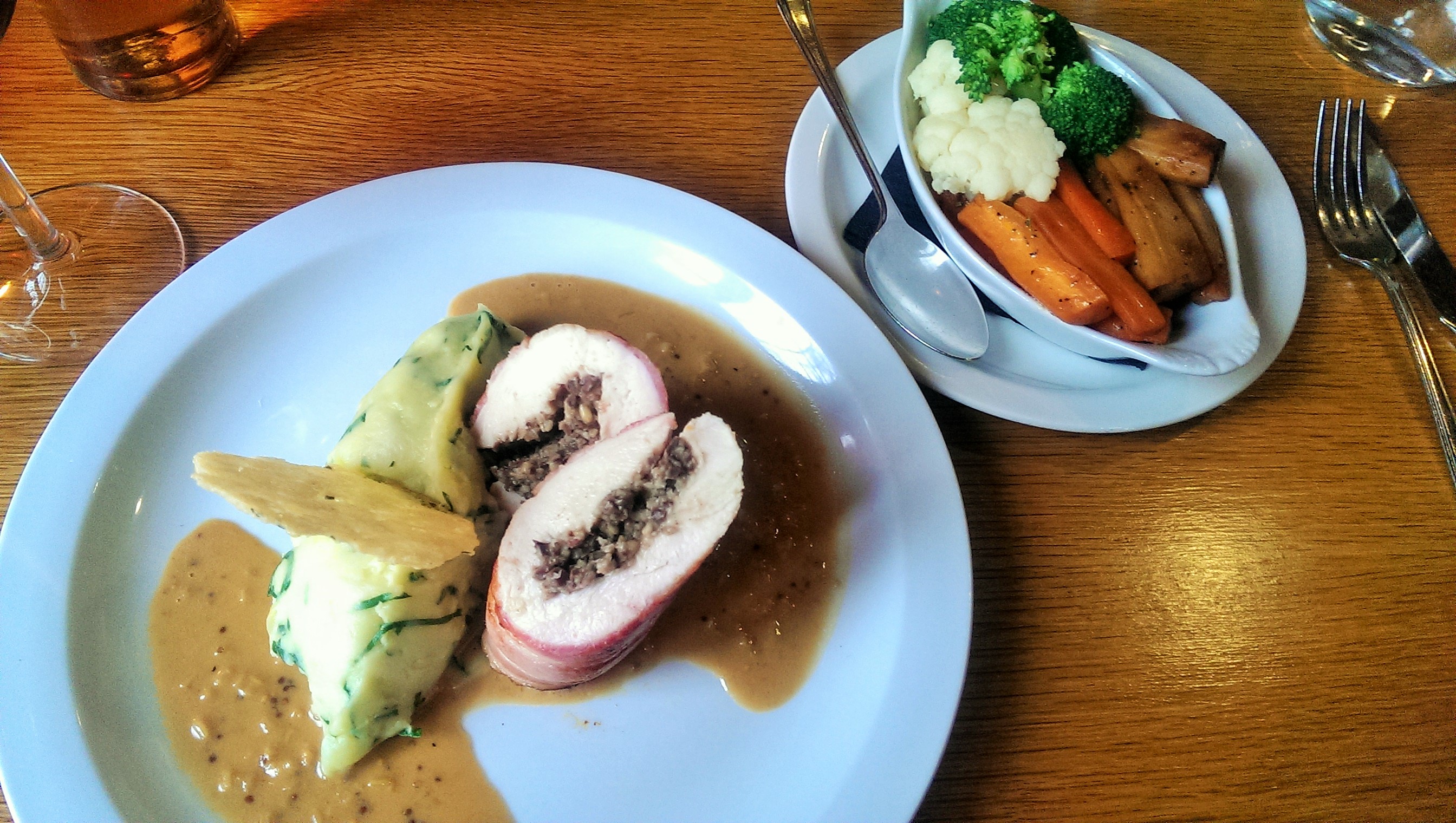
On to the mains, then. The standout here was chicken Balmoral: stuffed with haggis and wrapped in bacon, served with rumbledethumps (Scotland’s answer to colcannon) and a whisky and mustard sauce. The chicken was spot on – still moist but cooked through – and the haggis had that earthy, peppery taste I adore: I know it isn’t everyone’s cup of tea but I love the stuff, and you don’t see it on menus often. There was a side dish of vegetables that appeared to come with most of the mains – roasted carrots and parsnips, steamed broccoli and cauliflower. The parsnips in particular – all sweet and sticky-soft – were fabulous, but all of the vegetables were well cooked, not boiled into mushy oblivion. The sauce was more mustard than whisky, but worked beautifully with everything. The only disappointment was the bacon – it wasn’t cooked anywhere near enough and much of it ended up discarded on the side of the plate, pale pink and rubbery. Maybe that’s the price you pay for tender chicken.

BaskChick

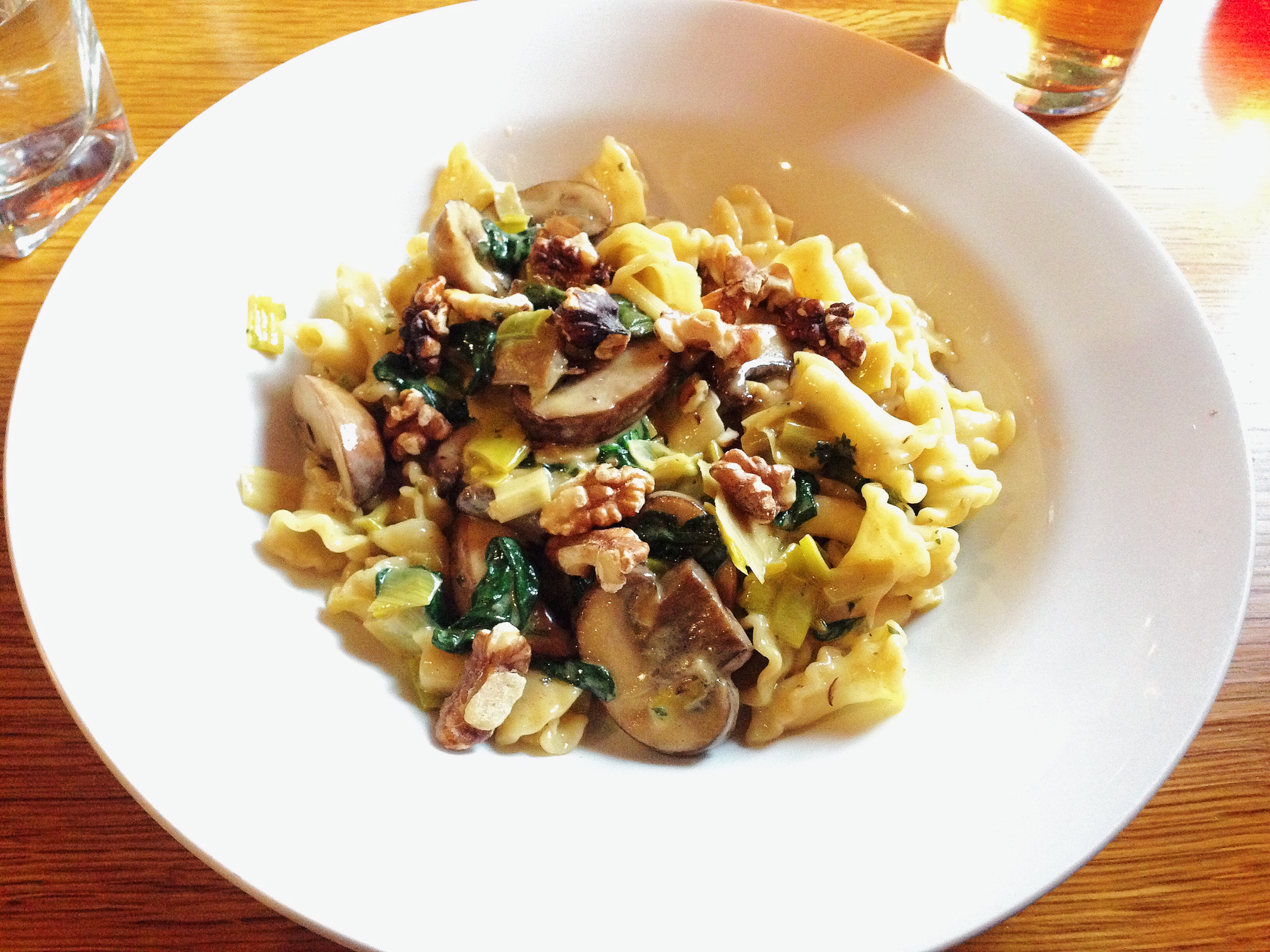
The other main was that unusual thing, a vegetarian dish I actively wanted to order: blue cheese and chestnut mushroom pasta with leeks, baby spinach and toasted walnuts. I could see literally nothing to dislike about this in theory, but again the execution was disappointing. The pasta – campanelle, I think – was good, the right shape to pick up the sauce and cooked only slightly further from al dente than I’d liked. The leeks were soft and sweet. The chestnut mushrooms were good, although they’d have worked better chopped finer. The toasted walnuts added crunch. So much potential from the supporting cast, but the star didn’t turn up: there wasn’t enough sauce, and what sauce there was clung to the bottom of the dish as if in hiding. I was expecting that rich tang of blue cheese, little bombs of salt scattered throughout, but it was so bland it was hardly there at all. It was inoffensive, a blue cheese dish for people who don’t really like blue cheese. But really, who’s the target market for that?

BaskPasta

After two large courses it was tempting to get the bill, but I know I’ve been letting you down lately, so I ordered dessert. I hope you appreciate the trouble I go to to give you a well-rounded review (especially as it has the knock-on effect of giving you an increasingly well-rounded reviewer).

The sticky toffee pudding is a pub staple and, even though it gets served on a fancy square glass plate, The Baskerville knows better than to the mess with a classic. The pudding itself was moist, gently spiced and all middle (I prefer middle to edges when it comes to cake). The perfectly spherical ice cream ball was balancing on the requisite pile of crumbs with a mint leaf on top (I think there must be some legal requirement for this style of presentation: it’s inescapable these days) and on the opposite corner was a small jug of toffee sauce. It was textbook, and I loved every spoonful: plenty of sauce, a big wodge of cake and a dollop of ice cream. Well rounded indeed.

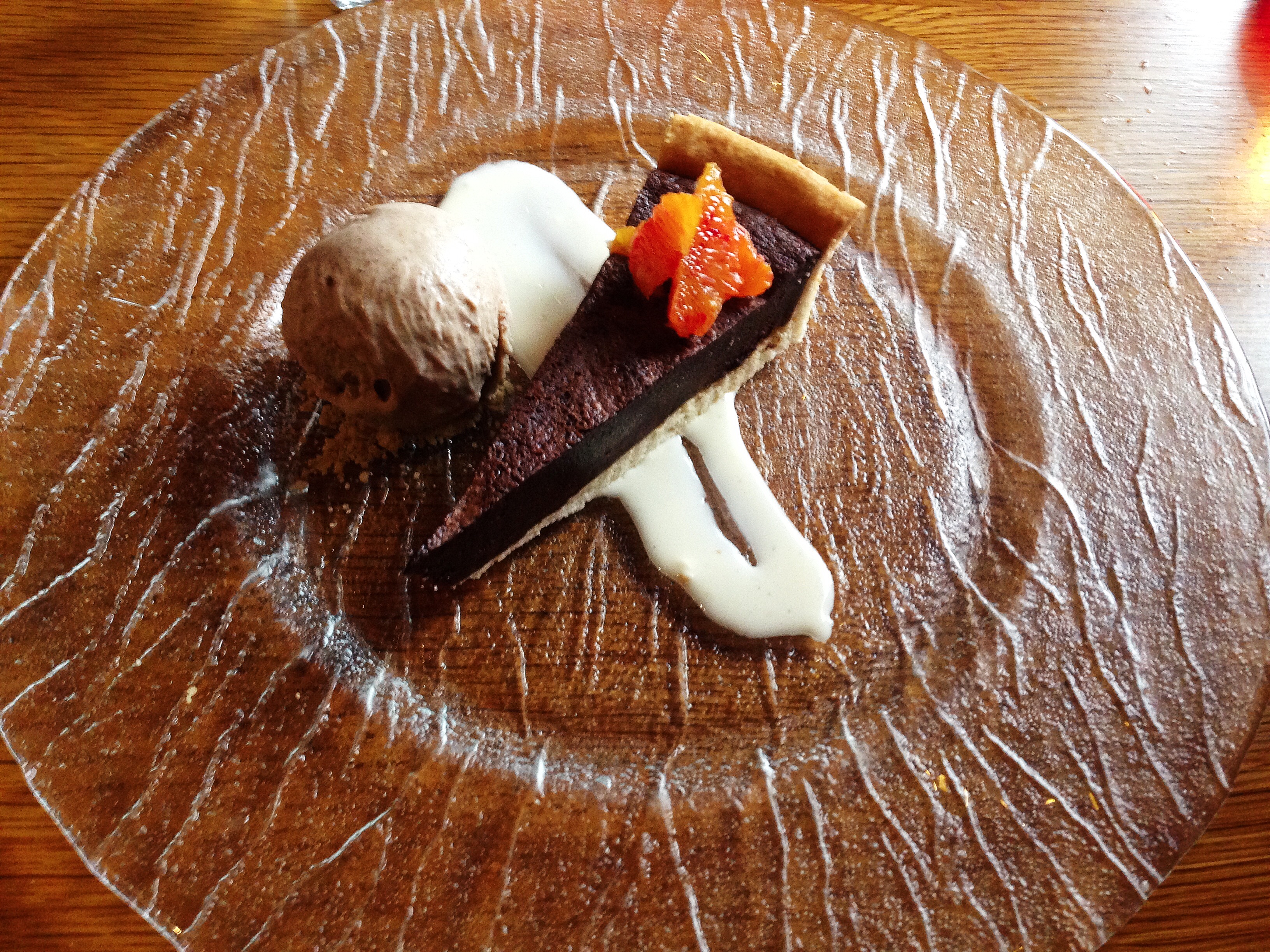
I also loved the bitter chocolate tart, all class and cleverness. The ganache was rich, dark and smooth, but with a hint of orange shot through it, working beautifully with the pieces of blood orange on top. All of it went nicely with the cinnamon ice cream, which tasted so good that I happily overlooked its oddly elastic texture. The pastry, dense and buttery, was gorgeous and – just as importantly – not so thick that eating it with a fork involved a series of high risk manoeuvres to stop pieces from wanging across the table. If the rest of the meal showed some inconsistency, the desserts redeemed a lot.

BaskChoctart

It’s a shame I was driving, because the wine list had plenty of bottles around the pocket-friendly twenty pound mark, a sure sign that it’s been well thought out. Fortunately, the selection by the glass was decent too and I liked both the reds we tried, although the French pinot noir was probably the pick of the bunch.

Service was excellent from the moment we entered to the moment we left, which is largely down to the restaurant manager, a friendly Scot who appeared to be everywhere at once. He worked hard without ever making it look like work at all, a rare talent: he made the right noises when we ordered food, had an opinion about the wines and was on hand to give pointers and just be generally charming whenever he was needed without ever hovering or outstaying his welcome (I’d also like to think that the Scottish influences on the menu came from him, for no reason other than because it would be nicely fitting). The other staff – mostly young ladies – were also helpful and friendly, just without the polish of years in the industry. The bill, for three courses for two, two glasses of wine and a pint of very refreshing shandy came to seventy five pounds. So not the cheapest, although we did come away full.

The big problem with The Baskerville isn’t in the pub, it’s a little over a mile down the road. When a village has a pub that does food as good as the Plowden Arms a neighbour has to pull something really special out of the bag to compete, and I think The Baskerville almost manages it but not quite. I think, sensibly, it’s aiming for bigger portions of slightly more conventional food in a bigger, slightly more conventional room, and it clearly has a regular clientele who appreciate that. But, for me at least, although I enjoyed much of my meal I found it hard to imagine driving past the Plowden, turning right and going here instead. I’ve tried really hard to avoid two things in this review. One was to make lame jokes about Sherlock Holmes, and the other was to compare this pub to the Plowden Arms. I’m afraid you’ll have to forgive me because, like The Baskerville, I’ve only partly succeeded.

The Baskerville Arms – 7.3
7 Station Road, Lower Shiplake, Henley-on-Thames, RG9 3NY.
0118 9403332

http://www.thebaskerville.com/

Lincoln Coffee House

Reading’s changed a lot in the last few years, but in many ways the café scene has changed the most of all. Actually, I remember when it was all fields: no big chains, just old school frothy coffee and stewed tea merchants like Platters and Chelsea Coffee House (of that generation, only Rafina really remains). Then came the big players: Coffee Republic (remember them?); Costa; Starbucks and Caffe Nero. Not to forget the upstarts: Picnic and Workhouse. But still they keep coming – so now we have Shed and My Kitchen, Nibsy’s and Tamp Culture. And there are more recent arrivals, rare outposts of small chains, like Artigiano which opened just before Christmas and Yumchaa – almost alone in specialising in tea – in the Oracle. Oh, and Siblings Home in Caversham, opened less than two weeks ago and looking like an intriguing mixture between a Hoxton café and a branch of Labour And Wait. Back in the nineties, every time you looked there seemed to be a new pub in Reading. Twenty years on, it feels like we might soon be saying the same about cafés.

The one that always seems to get forgotten is Lincoln Coffee House, a way down the Kings Road, past the library and a little out of town. I admit I do enjoy making the less obvious choices, and I have a soft spot for the underdog, but actually I picked Lincoln for this week’s review for two very particular reasons. One is that they specialise in bagels, and I’ve always had a fondness for a sesame seeded bagel. The second, just as importantly, is that I’ve long felt that Lincoln probably does the best tea in Reading.

Subscribe to continue reading

Become a paid subscriber to get access to the rest of this post and other exclusive content.

Beijing Noodle House

Beijing Noodle House closed in the summer of 2019 and is due to reopen as a Nepalese restaurant called Gurkha Home. I’ve left the review up for posterity.

Because I have a policy of not reviewing restaurants the very minute they’ve opened, opportunities to be topical are few and far between. I’m not always good at seizing them – I’ve always regretted not visiting Pau Brasil last year while the World Cup was on, for example – so there’s no way I was going to miss out again this week.

I’m not talking about pancakes, by the way. I’m still convinced that pancakes, like cooked breakfasts and roast dinners, are best enjoyed at home; even when a restaurant does them well, it never quite recaptures how good they can be in the comfort of your own kitchen. Something’s always not quite right: the sausage isn’t good enough, the baked beans are claggy and don’t have Worcester sauce in them, the beef’s a tad leathery or (most unforgivably) there aren’t enough roast potatoes. At their best – especially with roast dinners – they can be a high-end reimagining, an enjoyable one even, but it’s just not the same.

That’s never truer than with pancakes. Just writing this I am remembering them – fresh from the pan, sprinkled with sugar and lemon juice, rolled up and scoffed greedily while someone is busy cooking the next one. No restaurant can match that. Plus when you have them in a restaurant you get a pancake, emphasis on the singular. Where’s the fun in that?

No, the other thing that happened this week was the Chinese New Year, only yesterday. It got me thinking again about the disappointing lack of good Chinese restaurants in Reading, and then I remembered one of the recommendations I’d received: Pete, the proprietor of Shed, had suggested I review Beijing Noodle House. He raved about some of the Indonesian specialities and the “mouth watering pork dumplings”. Pete strikes me as a man who knows his food – anyone who’s ever tried Saucy Friday can attest to that – so how could I go anywhere else on this of all weeks?

Actually, my first reaction to the recommendation was “is that place still open?” I used to go to Beijing Noodle House a lot, back in the day (I was especially partial to their duck fried noodles). Then, back in 2008, it was gutted by fire; I can’t remember how long it was closed for, but when it reopened I had moved on elsewhere and it never occurred to me to return. Heading up West Street on a weekday evening and going through the front door felt a little like bumping into an old friend and having to make excuses for not having been in touch.

The first thing that struck me about the room was the pictures on the wall. They are enormous (one pretty much covers an entire wall), an odd mishmash of Oriental and European art. You almost couldn’t take your eyes off them, so huge were they, and I’m no Brian Sewell but I don’t think the proprietors are going to take them to a filming of Antiques Roadshow any time soon. Apart from the mind-boggling art? Well, it’s a bit run-down. The dark wood tables are a little too low so you end up hunched over your food, everything is a little worn and has seen better days. An electronic neon sign in the window flashes “OPEN”. The place mats are thin, plastic and tacky – mine, for no reason I could think of, had a photograph of chips on it. It was just tatty enough that I looked up the health and safety rating from the council, and was hugely reassured to find that they’d given it five stars.

There’s no menu online but there are a lot of noodle options – as ramen, as fried noodle, as udon or vermicelli, in soup or not. More noodle combinations, in fact, than I knew existed. You could probably figure that out for yourself – the clue’s in the name after all – but there was a lot more to the menu than that. I also spotted plenty of rice dishes, a good vegetarian section and, on the back, a range of Thai and Malaysian dishes. I couldn’t see any main courses costing more than seven pounds. As always with a very big menu I felt spoiled for choice, and sadly as usual with a very big menu I also wondered how many choices contained spoilers.

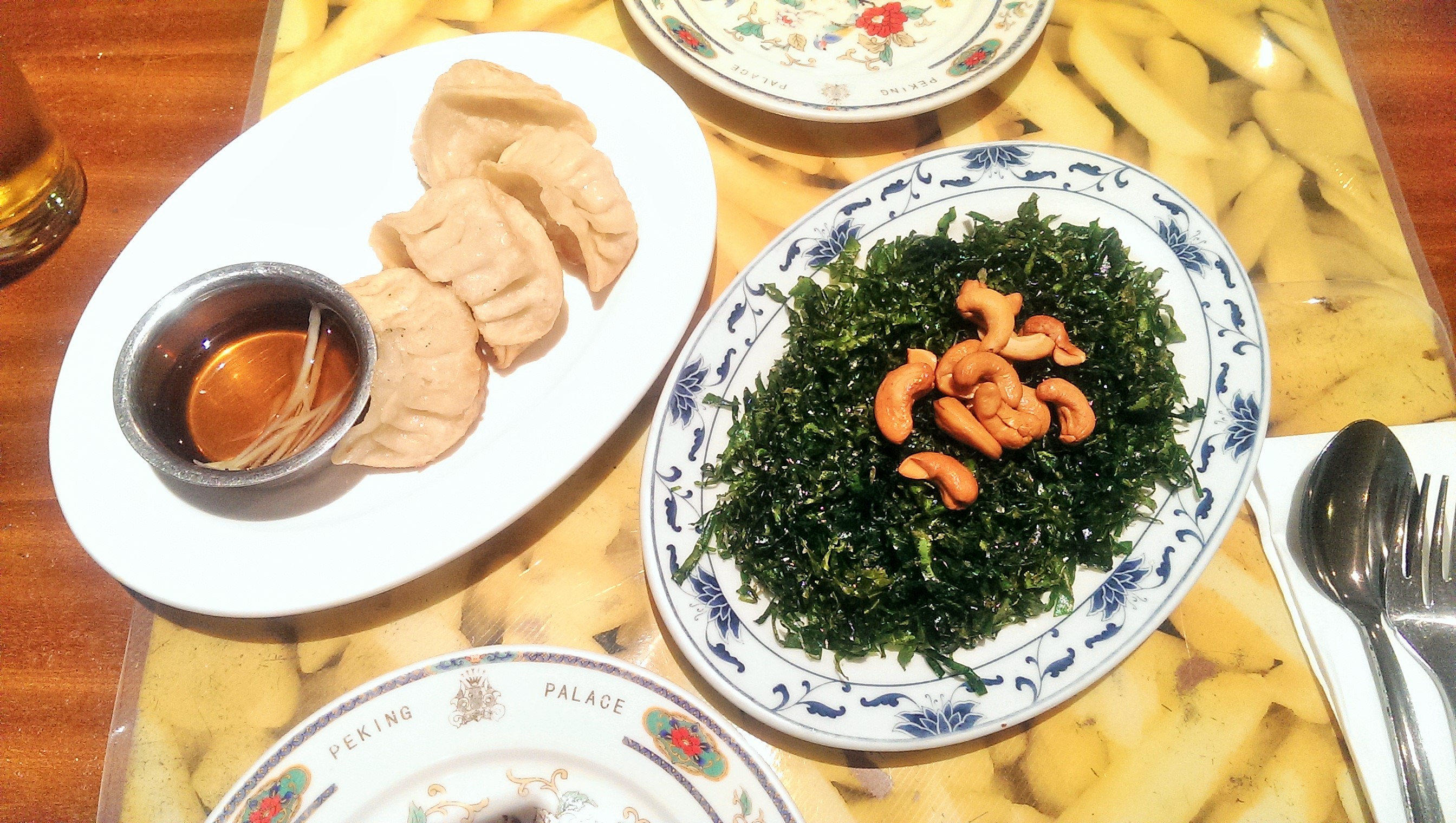
No way to find out except to dive in, so we ordered several of the starters. “Grilled Pork mouthwatering dumplings” (yes, that’s a direct quote from the menu) were every bit as good as Pete had suggested they would be. There’s often an air of the mystery meat about dim sum filling which puts me off, but these – more like gyoza than steamed dumplings or pork buns – were full of coarse, subtle pork. They were beautiful combined with the clean, delicate taste of the ginger vinegar dip. Four felt like a snip at just under four pounds.

Beijing starters

The chicken satay was also very good: you could say it’s hard to get satay wrong, and you’d probably be right, but I liked this a lot. The chicken – three decent sized skewers – was maybe slightly cooked into toughness but that just gave me an excuse to heap on lashings of the satay sauce, which was nothing to look at but deceptively impressive, with just enough slow-building chilli. Last of all, crispy seaweed came with cashews on it rather than the traditional grated scallop (did you know that the pink powder was grated scallop? I didn’t) and was also delicious. The nuts added a savoury toasted note which meant it wasn’t artificially sweet the way seaweed can be – not that that ever stops me polishing it off, mind.

I ordered the duck fried noodles partly for old time’s sake and partly because the menu goes out of its way to say that the duck is marinated and freshly cooked and you can have it boneless if you prefer. When it arrived I felt that mixture of nostalgia and anticipation. It looked just how it used to, back when I used to come here, but was it as tasty? After all, your tastes move on, change, develop: could it possibly have been as good as my memories of it?

In a word: yes. Possibly better, in fact. The duck – and you get loads of it – was glorious in big, tender slices. Not crispy, which might put some people off, but not with the thick layer of fat that might deter fussy eaters. The spring onions, peppers and beansprouts still had the right amount of crunch with the soft noodles and the duck, and everything was coated in a beautiful dark sauce which was more than soy but impossible to split out into its component parts. I was smiling from the first mouthful to the last, and wondering why on earth I’d left it so long. It was just over six pounds, and I’d pick it over a yaki soba from Wagamama nine times out of ten.

Beijing noodles

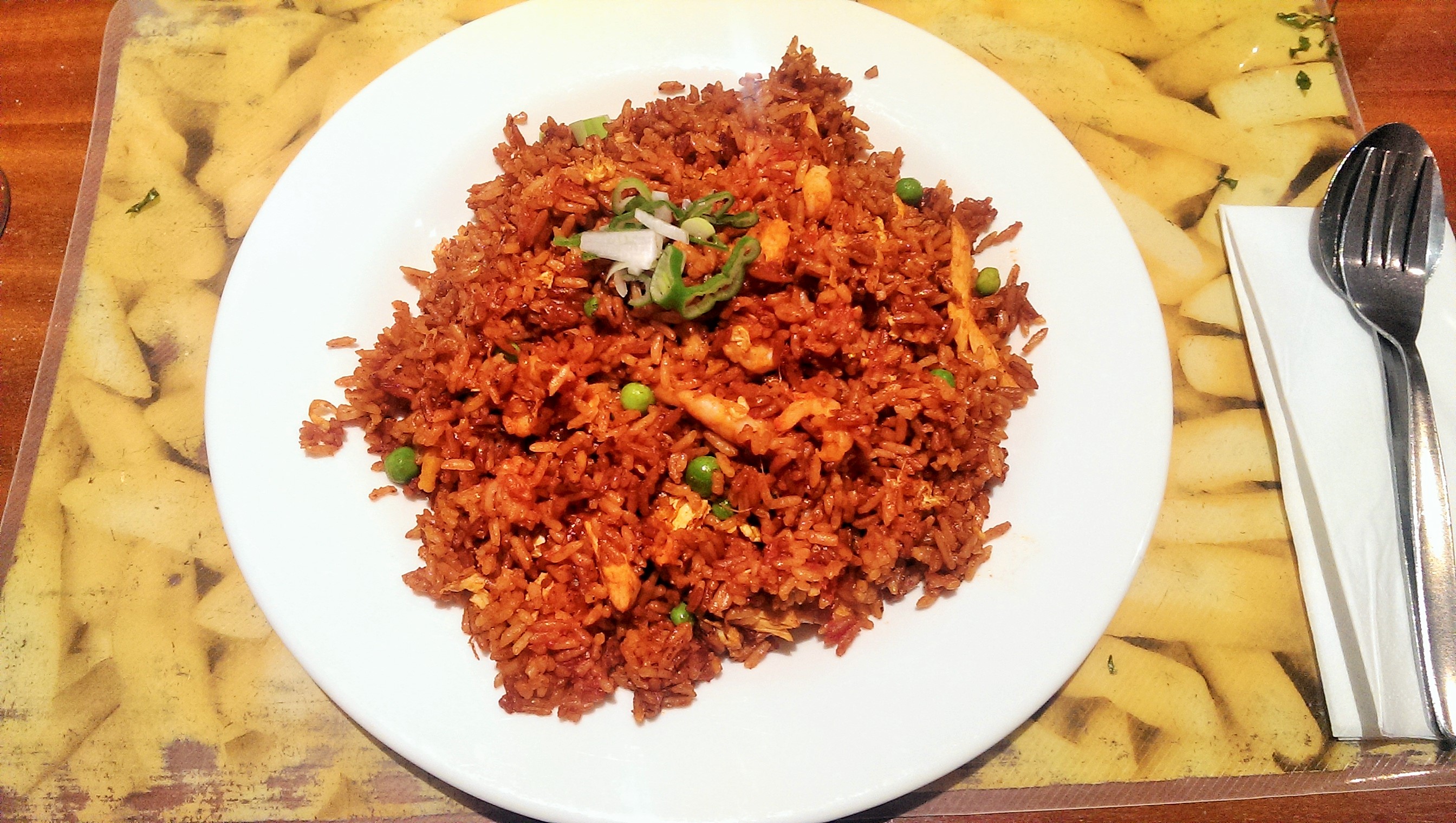
I also wanted to try something from the less conventional side of the menu, so I went for the nasi goreng. This turned up as a huge heap of rice (indeed, the translation from Indonesian is simply “fried rice”) liberally interspersed with prawns and pieces of chicken breast. The sticky, lightly spiced rice was dotted with peas and on top were a few thin slices of spring onions which felt like not quite enough variety to make every mouthful exciting. That said the meat was generous enough to have a prawn or piece of chicken in every forkful and the flavour was good, if a little bit repetitive (I rarely order risotto for the same reason). Still, five quid for a really tasty plate of rice is incredible value and it made me want to try more of the more unusual dishes (nasi lemak, the national dish of Malaysia, perhaps, or possibly beef rendang).

Beijing nasi

Someone pointed out my really poor track record of ordering desserts in 2015, and I’m afraid it’s true. I didn’t do any better here: I could have gone for some ice cream, or toffee banana with sesame seeds, but somehow I felt like I’d eaten two courses with no need of a third to complete them. The whole thing – three starters, two mains, a Tsing Tao and a large glass of anonymous, cheap and perfectly drinkable red – came to under thirty pounds. I haven’t mentioned service and that’s deliberate – not because it was bad but because it was almost unobtrusive. It’s just not that kind of restaurant: they ask you nicely what you want, they go away, a little later they bring it and they leave you to get on with enjoying it (actually when I put it that way, it sounds pretty good). Besides, how could they ever compete with the wall art?

I’m delighted that I enjoyed Beijing Noodle House. I can’t think of many places in town that are so cheap and so enjoyable, and when I looked at the menu I had real trouble narrowing it down to two main courses, so it probably won’t be long before I return to fill in the gaps. I really wanted to like it, because of all those happy memories, but as a realist I’m not sure I was expecting to like it as much as I did. It’s also a great example of how good food in an iffy room is always going to beat iffy food in a good room. Maybe one day Reading will have an equivalent of “Where Chefs Eat”: if so, Pete should definitely claim this one for his entry.

Only one thing troubled me: I was one of only two tables the night I went, although someone else did poke their head round the door for takeaway. West Street has felt increasingly like a ghost town recently, with Vicar’s closing just before Christmas and rumours that Primark is considering relocating to Broad Street. I can only hope my curse doesn’t strike and Beijing Noodle House doesn’t close shortly after receiving a glowing review from me. I know I say this a lot but use it or lose it, because otherwise one of these days the question will still be “is that place still open?” but the answer will be no.

Beijing Noodle House – 7.2
13-14 West Street, RG1 1TT
0118 9078979

http://www.hongbeijingreading.co.uk/

Alto Lounge

I like to bang on about service in restaurants, but this week it occurred to me that I might be part of the problem. After all, I talk about service, but if you look back at my other reviews it’s usually tucked away near the end. It’s the penultimate paragraph, stuck between the desserts and the summing up, sharing space like uneasy housemates with the bit about How Much It All Cost.

For some reason it’s difficult to write about service in detail unless it’s bad, and when it’s bad I feel guiltier about going into detail than I would about a disappointing dish. Funny how the human face of a restaurant, even though it’s what you see, attracts less comment than all the faceless people toiling away in the kitchen.

So, to redress the balance, even if only for one week: the service at Alto Lounge was some of the best I’ve had in a long time. The two women working the night I went were an absolute joy: friendly, likeable, helpful and interested. They stopped me going up to the bar to order more drinks when my food had just arrived, even though technically Alto Lounge doesn’t do table service. It properly felt like they wanted to make sure I had a good evening, and when I settled up and left the goodbyes were so genuine that it made me want to go back.

Subscribe to continue reading

Become a paid subscriber to get access to the rest of this post and other exclusive content.