Can you believe it’s the best part of a decade since I reviewed anywhere in Henley? I didn’t realise that until I sat down to write this review, and I was so surprised that I thought it was a mistake. But no, there it was: June 2016, a visit to the Little Angel, just over Henley Bridge from the not-so-little Angel On The Bridge with its popular riverside terrace. I quite liked the place, and ate there again a couple of years later at a friend’s wedding reception, but even so I’ve not written up a Henley restaurant or café for nearly ten years.
Was it a lack of options, general neglect or just one of those things? I’m not entirely sure, but I do remember keeping a vague eye on Henley and although a couple of new places have sprung up since my last trip on duty none of them had tempted me quite enough: the Hart Street Tavern is meant to be decent, but I seem to recall that it’s run by the same team as the Bottle & Glass, so I wasn’t in a mad rush to scarper to Henley to check it out. And there’s Shellfish Cow, I suppose, a sister restaurant to Wallingford’s surf and turf specialists, but again I just wasn’t sufficiently curious. A dodgy pun doesn’t necessarily make for a great restaurant.
I remember taking a solo trip to Henley almost exactly a year ago. I must have been influenced by my public transport-loving wife, because I did it mostly to try out the brand new Aqua, Reading Buses’ number 28 which now runs frequently from Friar Street to Bell Street, winding through Playhatch and Shiplake, picking you up from Berkshire and dropping you off in Oxfordshire, a world away.
Once there, I’d found myself completely at a loss as to where to lunch.
My finger was nowhere near the pulse, so all I really knew was that I didn’t fancy going back to anywhere I’d reviewed in the past. I could have gone to Geo Café, of course, on the off-chance that my friend Keti, the owner, was there but I felt like I should show some sense of adventure. A wander round Henley, which was still as pretty as ever, suggested that most of the options were starters-mains-desserts places rather than spots for a light lunch.
I was almost stumped, and I ended up in a café slash deli just down from the Town Hall, opposite where Henley used to have an utterly preposterous Harrods café, a place which simultaneously managed to seem posh and lower the tone, the way new money can.
Although the Harrods café closed some time ago, my lunch venue was clearly its spiritual successor. I had a solitary crumpet, the diameter of a coffee cup, topped with some smoked salmon and a poached egg. For fun, I put the picture on social media and asked people to play The Price Is Right: it cost me an eye-watering £12, and at least half of the guesses I got thought it would come to even more than that. It was middling, the coffee was worse. Afterwards I strolled to Geo Café and, over far better coffee, resolved that a sense of adventure was overrated.
But Henley’s scene isn’t as stagnant as you might think. Echoes, an outpost of Phantom Brewing, has opened there and does very good beer, served by an enthusiastic team. Flyte, a bar offering a combination of tacos and cocktails, opens next month. Last March Dominic Chapman, the Michelin starred chef formerly of the Royal Oak at Paley Street and the Beehive at White Waltham opened his eponymous restaurant in the Relais hotel at the bottom of Hart Street. Little by little, things are starting to change in Henley.
And then there’s the Duke, a curious beast, a pub which opened in January where Mexican restaurant Pachangas used to be. It started trading at the beginning of the year, and an article in the Henley Standard made all the right noises about everything being cooked over fire, an emphasis on small plates and all that other stuff everybody says.
At first all went well, and they paid for a London blogger to come up and review what looked like a surprisingly stingy selection of dishes from the menu. He enthused, giving it an 8/10 which probably would have been a 6 or a 7 if the food hadn’t been free, but since then the menu seemed to have drifted closer and closer to the mainstream, and then last week the pub abruptly announced on social media that it was shutting until further notice “to rebuild our team”, which suggests that all is not going swimmingly.
Neither the Duke nor Restaurant Dominic Chapman has troubled the guide books or restaurant inspectors, which made it even more of a curveball when last month Michelin added sixteen venues to its guide and one of them was in Henley. Out of nowhere, seemingly, they had listed the Three Tuns, the pub on the market place next to superlative Henley butcher Gabriel Machin. Part-owned by the butcher, too, as it was a joint venture between Machin’s owner Barry Wagner and Nigel Sutcliffe, who runs the also-listed Oarsman in Marlow.
The intent was to take advantage of that fantastic produce, to be a sort of chophouse in the Oxfordshire town. As for the Three Tuns’ success this year, meteoric only just does it justice: it reopened in May, and in September it was listed by Michelin. Nobody knows exactly what brings restaurants to the attention of the inspectors – who still seem to have a blind spot where Clay’s is concerned – but however it happened, being noticed after four months is exceptional going.
When I learned that, I resolved that I needed to get there as soon as possible. But it also gladdened me enormously, because the pub used to be a favourite of mine ten years ago, when it was run by Mark and Sandra Duggan, and I ate there frequently in another life, reviewing it in 2014. The last time I went, just before the Duggans left the pub, was with Zoë, just after we got together. I remember having an exquisite Caesar salad, so good it was bittersweet.
Because I was glad Zoë got to try it before it changed hands, but sad about all the meals we wouldn’t have there. And that listing in Michelin raised my hopes that, much like my blog, it too could have a second era that surpassed its first. So Zoë and I alighted from the Aqua last Saturday and went to investigate, stopping at Echoes on the way for a few pre-prandial pales and a very happy chance encounter with readers Steve and Tracy.
I should add that Zoë insisted, by the way – both on joining me for this one and on taking the bus to get to Henley. Neither of these facts will surprise regular readers.
Subscribe to continue reading
Become a paid subscriber to get access to the rest of this post and other exclusive content.
The closure of Pepe Sale last week – temporarily or permanently, nobody knows for sure – rounds off the most brutal six months I’ve ever experienced in covering Reading’s hospitality scene for over ten years. At every price point, with every kind of venue, whether your tastes are more Cici Noodle Bar or Coco Di Mama, the Lyndhurst or TGI Fridays we’ve seen unprecedented levels of closures in town. There will be bright spots ahead – I anticipate quite a lot of people celebrating on the fifth of July, for instance – but you wouldn’t bet against the second half of 2024 being as gruelling as the first.
Normally closures are a part of life in hospitality, and for nearly every one there’s an equal and opposite newcomer. But that‘s slowed to a trickle this year, with only three significant new venues opening in Reading so far. The first is Zia Lucia, on St Mary’s Butts, which I recently reviewed here. And the most recent, which opened literally this week, is the Rising Sun on Castle Street, a fancy-looking gastropub by Heartwood Inns, a group which also owns Brasserie Blanc. Given that we’ve lost the The Corn Stores and Bel and The Narrowboat already in 2024, it’s a bold move.
But the single biggest opening of the year – which would have been the biggest opening of nearly any year – is Siren RG1, Siren Craft’s keenly awaited town centre taproom on Friar Street which opened in May. It’s been in the pipeline for some time and its arrival has generated the kind of excitement you only occasionally see in Reading without being associated with some American chain or other. For a town still grieving the loss of the Grumpy Goat, this felt like a reason to be cheerful.
Subscribe to continue reading
Become a paid subscriber to get access to the rest of this post and other exclusive content.
For once, I turned up for lunch in Bristol moderately ahead of the curve. COR, a cosy small plates restaurant in Bedminster, has only been open since October and, so far, has mostly been Bristol famous rather than nationally famous. Not completely, though: Tom Parker Bowles raved about it in the Mail On Sunday on a recent visit. And last month, when Square Meal listed its top 100 restaurants for 2023 COR made the list: not too shabby for a restaurant that’s been trading for about four months. Even so, stepping through the front door with my old friend Al for lunch during a weekend trip to my favourite city, I felt slightly closer to the zeitgeist than usual.
They’ve got a lovely site. It’s a corner plot, double aspect with big windows letting in plenty of light and despite being on the compact side all the space is used superbly. There are relatively few tables, but there are also excellent, comfy-looking stools up at the window letting you look out on the painfully cool passers-by, on their way to a café, the terrific looking natural wine bar or a smashing chocolate shop. The seats at the bar look like fun too, and some of them give you a view out back to the open-ish kitchen. The restaurant is passionate about always saving some room for walk-ins at the window or at the bar: like so much else about it, it’s admirable.
COR’s menu read extraordinarily well. I know small plates aren’t for everybody, but these were grouped and flowed effortlessly, from nibbles to charcuterie, on to seafood, to a selection of vegetarian and meat dishes and then a handful of larger, more conventional plates. Just the three, in fact. The nibbles and charcuterie were close to a fiver, the small plates generally hovered just under ten pounds and the bigger ones were around fifteen quid.
Now some people will look at that and think “ugh”, probably put off by bad experiences with the small plates concept in the past. I get that – I’ve had many of those too – but to me this just read like a dream, an edible Choose Your Own Adventure with no bad endings. Our waitress, who was positively brilliant throughout, told us roughly how many dishes people ordered per head, although I must say that she probably meant customers built like her, or Al, rather than built like me. We may have disregarded her sterling advice. She also told us they were down to their last portion of mojama, air-dried tuna, on the specials board, and nodded approvingly when we asked to bag it.
That turned out to be an outstanding decision, although in fairness so was practically everything we ordered. So was booking the place for lunch in the first place, come to think of it. I’m used to eating mojama up at the bar in Granada, thick slabs of coarse, salty tuna sprinked with almonds and drizzled with olive oil, as simple as they come. This, by contrast, was gossamer-light, with a judicious single almond, beautifully toasted, per slice and little segments of sweet, sharp orange to improve things still further. My mind may have been playing tricks on me, but I think the whole lot rested on a smudge of houmous. Every mouthful was delightful, and it never lost that sense of surprise: small plates, in fairness, find that easier.
As we rhapsodised Al sipped his white vermouth, I my Asturian cider – yes, we’re those kinds of wankers – and all my cares dissolved; Bedminster wasn’t Granada, not by a long chalk, but it had already earned twin city status, and we’d just gotten started.
Finocchiona, fennel salami, was more about buying well. But COR definitely bought well, and if their menu had listed where they’d got the stuff from I’d have ended up buying well too. It had a wonderful whack of aniseed and I liked it very much – it also wasn’t too ridiculously priced at a fiver. As you will discover, I had trouble finding fault with nearly anything that COR did so I might as well take my opportunity here: only two cornichons? Really? Have a word with yourselves.
That minor disappointment out of the way, the last of our first wave of dishes was also on the specials board and if I eat anything as small but perfectly formed again this year I’ll have done very well for myself. The last time I was in Bristol I was wowed by a canelé rich with honey, whisky and smoke. This time, I was even more dumbfounded by COR’s savoury canelé which came drizzled with a grassy olive oil, tarragon and thinly sliced mushroom. Cutting vertically through it prompted the reveal, that the whole thing had been filled with a creamy, savoury mushroom duxelles which made me beam. This was emphatically not for sharing: Al and I scoffed one each, and I had half a mind to order another after dessert.
Another thing I really loved about COR was that they took our orders and artfully sequenced them almost like a gastronomic mixtape. None of this “your dishes will come out when they’re ready” bollocks that treats you to feast or famine, instead we got things in a carefully structured order that showed every dish off to its best advantage. Take this for example, Jerusalem artichokes fried until golden and sticky-edged and served on an earthy pool of artichoke velouté. It was simply magnificent, and if I couldn’t really detect much truffle in the truffled pecorino I was having far too much fun to give a shit. I have to really fancy Jerusalem artichoke to order it in a restaurant because of its legendary side effects. Here I did it anyway, and the side effects never materialised. That’s what I call winning at life.
Equally delicious was the next dish, slow-cooked pork shoulder crammed into radicchio and topped with ribbons of pickled fennel (and some slightly pointless dill). The pork was splendid, with the texture ignorant people are prone to describe as unctuous. This vegetation-as-taco concept seems to be a Bristolian one: I had something very similar, albeit far smaller, at Wilson’s late last year. But this was the size you actually wanted it to be – and well portioned for sharing. Did I wish I was eating them both to myself? I like to think I’m a decent friend, but yes. Yes I did.
By this point, Al and I were suffused with a warm glow, catching up for the first time in months, enjoying glasses of surprisingly fruity and accessible Cataratto (“do you know, that’s the only wine I like?” said our waitress, charm personified without necessarily realising it). And we got to talking about superlatives: Al has the misfortune to spend some of his time surrounded by people from Gen Z who only ever use one superlative – “stunning” – and use it all the time. About everything. Everything, he told me, is their “new favourite dish”, whether it’s a special occasion or some spaghetti hoops out of a tin. Even hearing about this perpetual state of wide-eyed wonder, I’m afraid, made me want to kick something very hard.
But we were both rather running out of adjectives by the time our next dish arrived. Tropea onions, cooked to soft, caramelised wonder, drizzled with a hazelnut beurre noisette and crispy sage leaves was another knockout, even without the three dollops of goats cheese (Ragstone, apparently) providing a little agriculture to offset the sweetness. I gave Al the spare onion: I told you I was a good friend, although he did let me have the extra Jerusalem artichoke, and I thought that one of the nicest things about sharing dishes is that you can both have virtually the same superlative experience. If there’s a better thing to do with an old friend than go to an excellent restaurant, I’m not sure I know what it is: I know some people like watching the football, or playing squash, or bloody golf, but for me this is as good as it gets.
“Would you describe it as stunning?” I asked. Al grinned.
“Definitely. New favourite dish.”
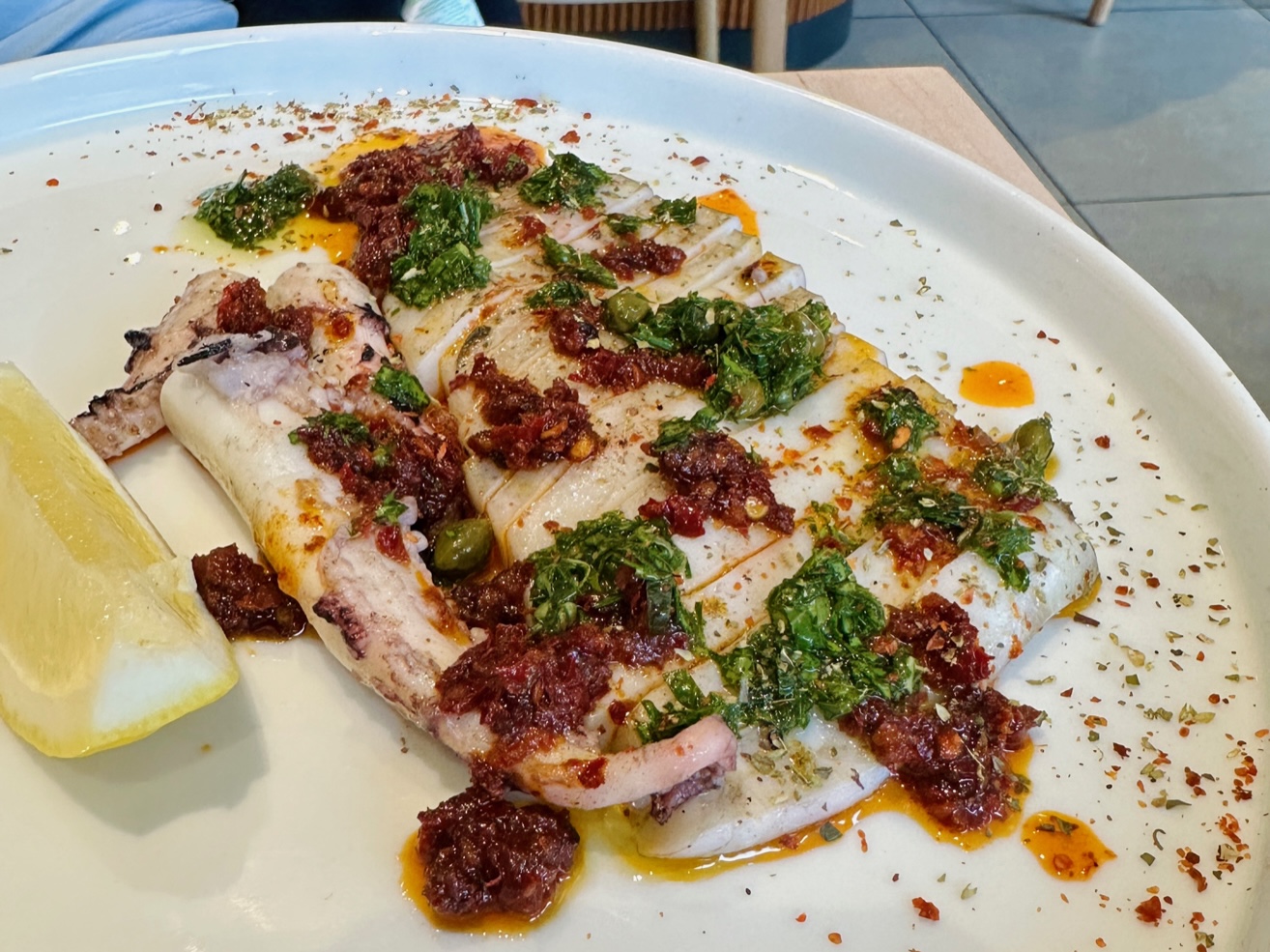
My new favourite dish – and in fact it stayed that way for the rest of the meal – was the next one. A really generous portion of cuttlefish, cooked sous vide and then finished on the grill I believe, was ludicrously tender and came already sliced into ribbons. I could imagine serving this with ‘nduja, or with salsa verde, but matching it with both, along with some capers, in a dazzling, dizzying tricolore was a stroke of genius. This dish would be at the apex of nearly any meal, and if I could find anywhere closer to home that served something like this I’d be there all the time, even if it was only half as good.
Our main courses involved the only misstep, and by “misstep” I mean “eight out of ten dish”. Al had decided to try the manicotti, a pasta dish, and he was encouraged in this by our waitress when he told her he was torn.
“It’s one of my favourite dishes, it’s like something your grandmother would make.”
“Your grandmother must be a better cook than mine was” I said, fighting back memories of wan fish, floured and fried, served on the kind of brown smoked glass plate every household had in the seventies. Still, she did at least cook proper chips in a chip pan, something nobody does now.
I think the dish was better than anything Al’s grandmothers could have conjured up either, but it wasn’t as much a tour de force as everything else had been. Manicotti are big sleeves of pasta, thicker and bigger than canelloni but the same kind of thing. Whereas this was a single giant tube, folded rather than rolled, and the overall look of it was somewhere between canelloni and some kind of pasta calzone, if I haven’t mixed my metaphors to death by saying that. It was stuffed with ricotta, topped with braised tomato, parmesan and rocket and it managed to look hearty, well-done and somehow unspecial.
“It’s okay” said Al. “It just doesn’t match everything that’s gone before. The braised tomatoes are fantastic, though. I just should have ordered the same thing as you.”
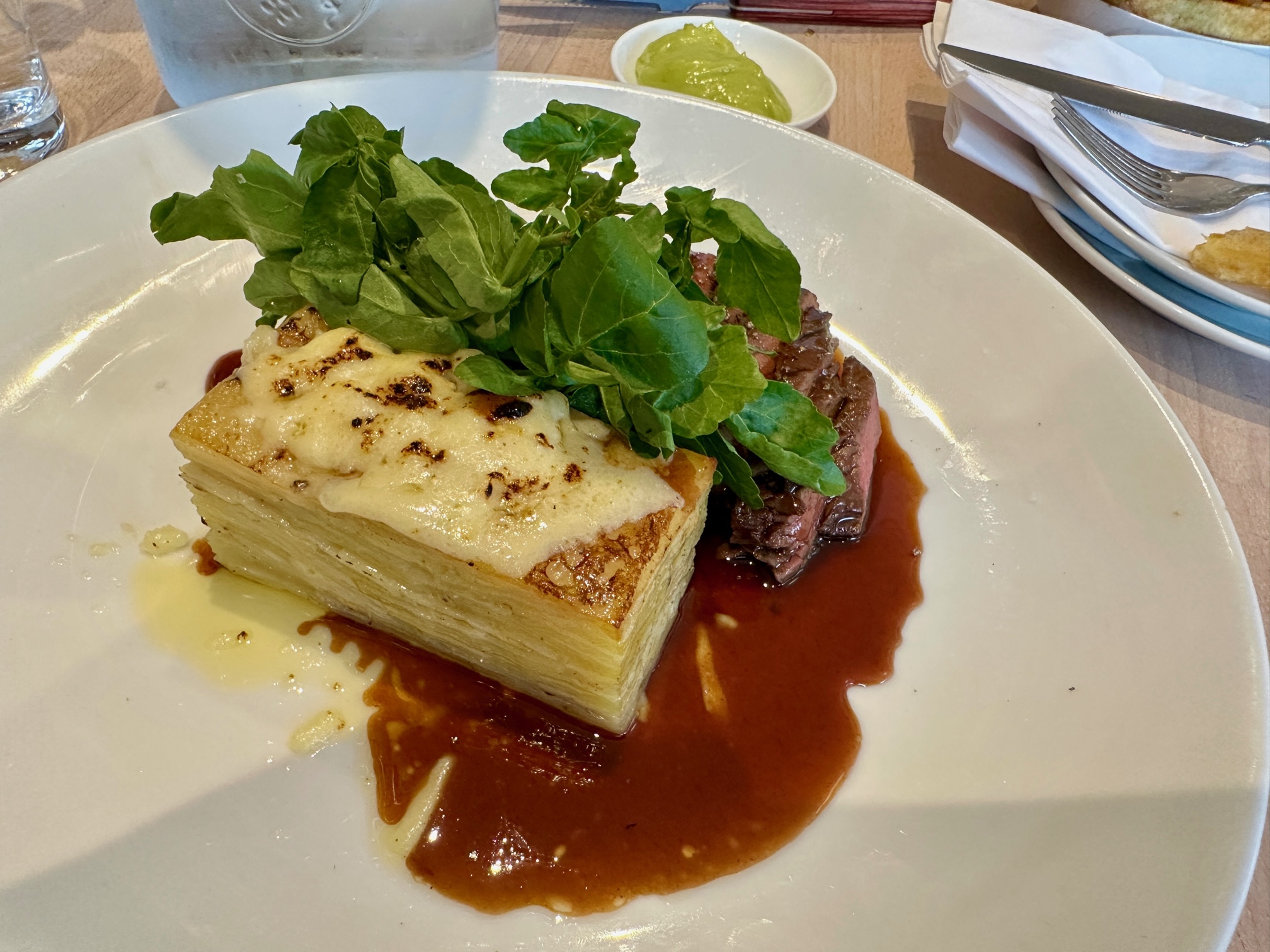
I mean, he should have. Because while I watched him eat a big sheet of pasta with some cheese in it pretending to be a Mobius strip, I was diving into a marvellous piece of onglet, as yielding as you like, with lashings of intense jus and – the icing on the cake – a dauphinoise of interlayered potato and celeriac, all topped with quite a lot of gruyere. It was just the most incredible thing, and when I saw on the menu that it clocked in at under sixteen pounds I thought there must have been a typo.
But there wasn’t. That whole plate of food for sixteen pounds was outrageously generous, charitable even. And speaking of charitable, even this dish had been served in a way that encouraged sharing, with the steak cut into substantial slices. I let Al have as many as he wanted to dull the food envy, because I’m not a monster: I suspect he would have had more, but it would have made the envy worse, not better. He consoled himself with some exceptional hand cut chips, dipped in a tarragon mayonnaise so herb-heavy it was the colour of guacamole. I had some too. Of course I did, it was world-beating.
We’d come all this way, so not having dessert would have been madness. The dessert menu is nicely compact – although they also have a selection of eight different cheeses – and Al had clearly learned from his mistake because, like me, he opted for the chocolate mousse. I think it’s an underrated dessert at the best of times, but this was at the very best of times – a hulking scoop of the stuff, dense yet airy, studded with plates of almond dentelle like the spines of a stegosaurus. That enough would have made it exquisite, but sprinkling it with flakes of sea salt and drizzling it with olive oil was the final touch.
“That chocolate mousse was so good” I told our waitress as she took our bowls away and we sipped our dessert wines (like I said, those kind of wankers), fighting the almost primal urge to order a savoury canelé for the road.
“Thank you so much! I actually made that yesterday, I spend some shifts in the kitchen as a pastry chef. I can’t actually eat it myself, it’s a bit too rich for me.”
I can’t imagine the level of self-restraint involved in being able to make something like that and not eat it, but then that’s why some people are slim and I’m not. Al, on the other hand, eats like a horse and is still as skinny as he was when I first met him about thirty years ago; this is why some people are jammy bastards and I’m not. But anyway, despite being thin, talented and impossibly young our waitress was a class act. All the people who served us throughout lunch were, actually: friendly, passionate about the food, with opinions on all of their favourite dishes, they were a real credit to the restaurant. How does anywhere get this good after just four months? It was quite miraculous.
Our waitress asked where we were from, and I mentioned Reading, and she proudly told us she’d been there. Once. Then of course the truth came out, that she’d passed through it recently on a train to London to watch a gig. It was the first time she’d ever been to London on her own, she said, at the tender age of twenty. And suddenly Al and I felt very old indeed, and seized with a sneaking suspicion that we should hightail it out of Bedminster and find an old man pub to hunker down in to carry on our gossiping session. The natural wine bar would just have to wait for another time. Our meal for two, with a very richly deserved service charge included, came to just under a hundred and ninety pounds. There was literally nothing to begrudge, except any of their punters who only paid ten per cent service.
As I was writing this review, I messaged Al, mainly to reminisce about what a phenomenal meal it was. What a stunning array of dishes I sent him, hoping to get a cheap laugh.
“One of my objections to the S word is the cognitive dissonance” he replied. “Stunning implies losing your senses, but with food that good your senses are very much alive. Sorry, you can tell I’ve thought about this too much.”
He’s right, though. What I loved about COR the most was having my senses awakened and reawakened time and again over the course of such a glorious lunch – old favourites, new combinations but always real integrity and imagination. Nothing was boring or humdrum, which I can say because I didn’t have that pasta dish, and in terms of the sheer number of hits I think it ranks as one of the best meals I can remember, at home or abroad.
I’m sure you know the drill by now with this kind of review. Bristol, Bristol, Bristol, hyperbole hyperbole hyperbole. But I like to think I’ve been here enough to sift the hypebeasts from the real contenders. The last time I was in Bedminster I ate at Sonny Stores, which was raved about by literally everybody but left me cold. And the last time I was in Bristol I went to Wilsons, which I raved about to literally anybody who’d listen.
And positioning COR relative to those two is pretty easy – it is miles better than Sonny Stores, a neighbourhood restaurant with a touch of the Peter Principle about it. But actually, although the number at the bottom is marginally lower than the one I gave to Wilsons, if you’re only having one meal in Bristol I would go here instead. Wilsons is a take it or leave it menu, a set seven courses, and when it’s on form it’s incredible. But I have friends who went there off the back of my review and although they loved the flavours, they found it a carb free zone and, I’m sorry to say, they left hungry. That will never happen to you at COR, and you will have an awful lot of fun deciding exactly how you want to become full. That’s what restaurants should all be about.
And how does COR compare to Reading restaurants? There’s nowhere in Reading even remotely like it. That is, and continues to be, the problem. You might get bored of hearing me say so, but it’s important to have goals. Reading’s should be to attract at least a couple of restaurants in approximately the same ballpark as this. I really hope it happens. It’s starting to get a tiny bit embarrassing.
Over the last eighteen months, the story of Reading’s restaurants has been more about trying to protect what we have than celebrating the arrival of bright, shiny new things. With a few notable exceptions, the significant restaurants to open recently in town have been chains: Wendy’s, The Coconut Tree, Gordon Ramsay’s Profanity Burger. Further afield, however, it’s a different story.
Henley, for instance, now has a big posh-looking place called Crocker’s which contains no less than three different restaurants. The front page of their website carries a photograph of people assembling identical small plates with long stainless steel tweezers, which tells you more than enough about the kind of food you can expect. Henley also has a new steak and seafood place called Shellfish Cow (I know), the second link in a little chain which started in Wallingford. Both these venues are fancy, both look like they’ve had dough chucked at them, both are independent.
But there’s even more of a marked transformation in Wokingham, driven by the ongoing regeneration of the town and the completion of Peach Place. The earliest sign of gentrification was back at the end of 2018 when Gail’s opened there, followed by craft beer bar Sit N’ Sip the following spring. And now Wokingham is starting to attract some noteworthy restaurants, so much so that when I looked at everywhere that had opened since I last visited, I wasn’t sure where to go first.
Should I try Indian restaurant Bombay Story, which inexplicably changed its name from Dabbawalla Indian Kitchen at some point over the last year? Or RYND, which used to be a hipster-milking burger joint on Castle Street and is reborn in Wokingham Town Hall offering “Californian inspired tapas-style dining”? Or Chalk, an independent restaurant that opened at the end of last year in the old Prezzo building on Broad Street?
Well, you know I didn’t pick any of those because here you are, reading a review of Hamlet. I decided on Hamlet, which opened back in May, partly because the menu seemed to have a little more about it. But I also chose it because of the pedigree of the owners: Nick Galer, from the Miller Of Mansfield, told me that they were two old colleagues of his from his days working for the Fat Duck Group. “The early reports are good”, he said, “although I’m never sure about all day dining.”
Hamlet is also on Peach Place with a fair amount of outside space, some of it under cover, and a few heaters which I imagine will need to be switched on around a week from now for approximately the next five months. The outside was doing a roaring trade, although it felt a tad soulless. The inside, though, is quite stunning in its way, all Hans Wegner Wishbone Chair lookalikes and bleached wood tables. There are baked goods on display at the counter and a little deli area where you can buy wine, cheese and charcuterie. It’s all very Scandi, very stylish, but again, ever so slightly sterile.
Anyway, we sat outside because it was a warm Saturday afternoon and I’m a risk-averse wuss. It wasn’t initially clear whether it was table service or if you were meant to order at the counter, but that was partly because when we got there the serving staff were a bit all over the place: they settled down as the first wave of the lunchtime rush subsided.
Casting my eye over the menu, I began to see Nick Galer’s point. Hamlet is open daytimes all week and evenings Thursday to Saturday, and its menu tries to cover every single base. The overall effect is something like a cross between Gail’s and an upmarket version of Wokingham’s Sedero Lounge: so there are brunches until 1pm, sandwiches available until 4pm and small and large plates available from midday until 4pm. So if you’re there between noon and one in the afternoon you can choose between four different sections, you lucky so-and-so. Brunches run from six to ten pounds, sandwiches from seven fifty to a tenner, small plates range widely in price between five and twelve pounds and most of the large plates are between ten and fifteen pounds.
So yes, the menu was even busier than the staff and felt a little confused. I should add that if you go in the evening the small and large plates on offer look a lot more like a conventional restaurant, so it would be easier to treat it as a starters and mains kind of place. Anyway, we ordered a couple of sandwiches to start with a view to moving on to some other dishes afterwards, aiming to cover as many of the sections as we could. I would have loved to try the sausage, egg and Comte muffin, but because we placed our order at quarter past one the brunch section was out of bounds. Rules are rules.
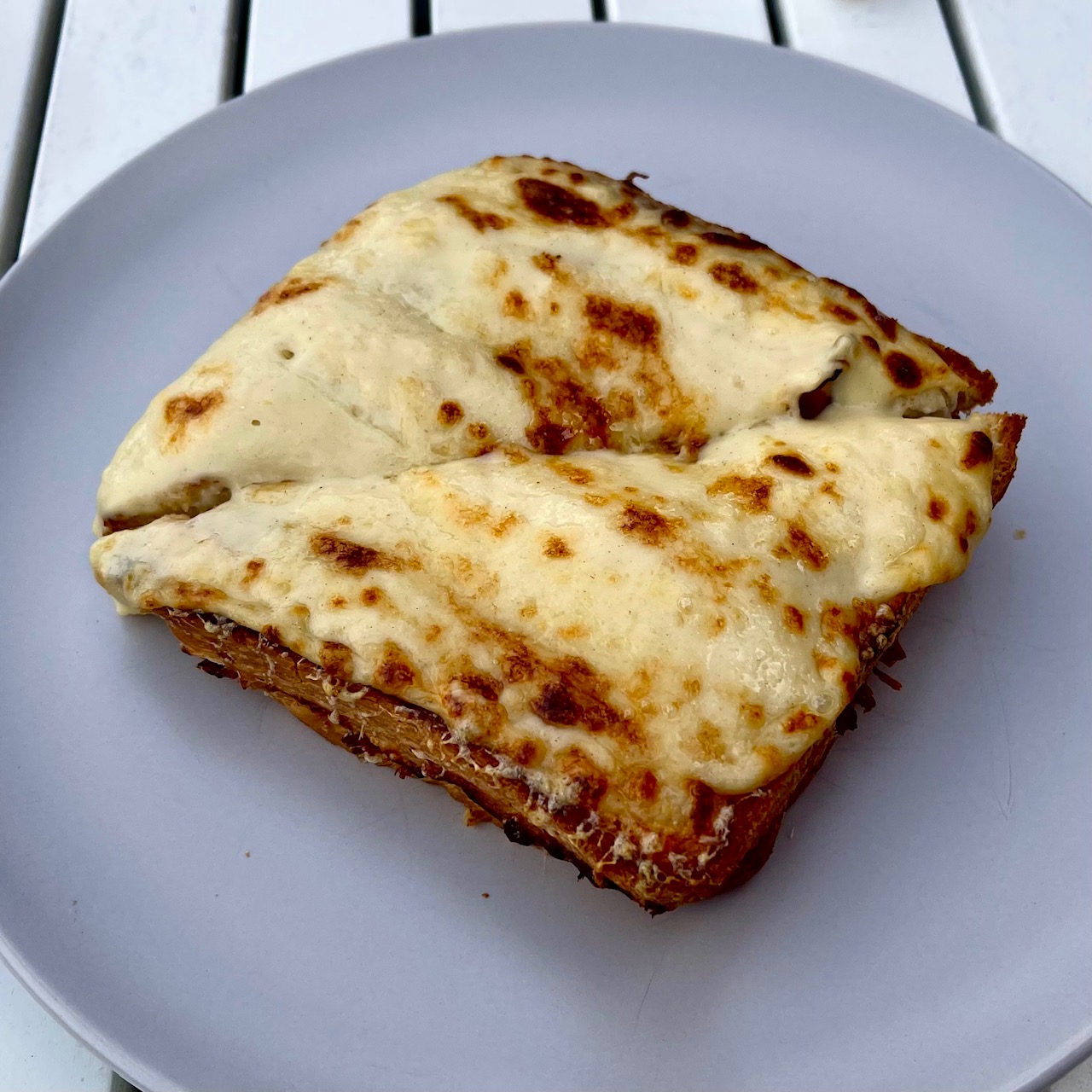
Zoë had chosen Hamlet’s croque monsieur – an excellent choice, and possibly what I would have ordered if I’d had first dibs. It was attractively burnished, covered in that molten, slightly-caramelised topping and with beautiful ham – shredded hock, rather than slices of the stuff – in the middle. The mouthful I got was pretty good, although (and this might be a bit of a trend for the rest of the review) I wasn’t sure it was nine pounds fifty’s worth of pretty good.
“I liked it, but I think it needed mustard” was Zoë’s verdict.
“Didn’t it have mustard in it?”
“If it did, it needed more.”
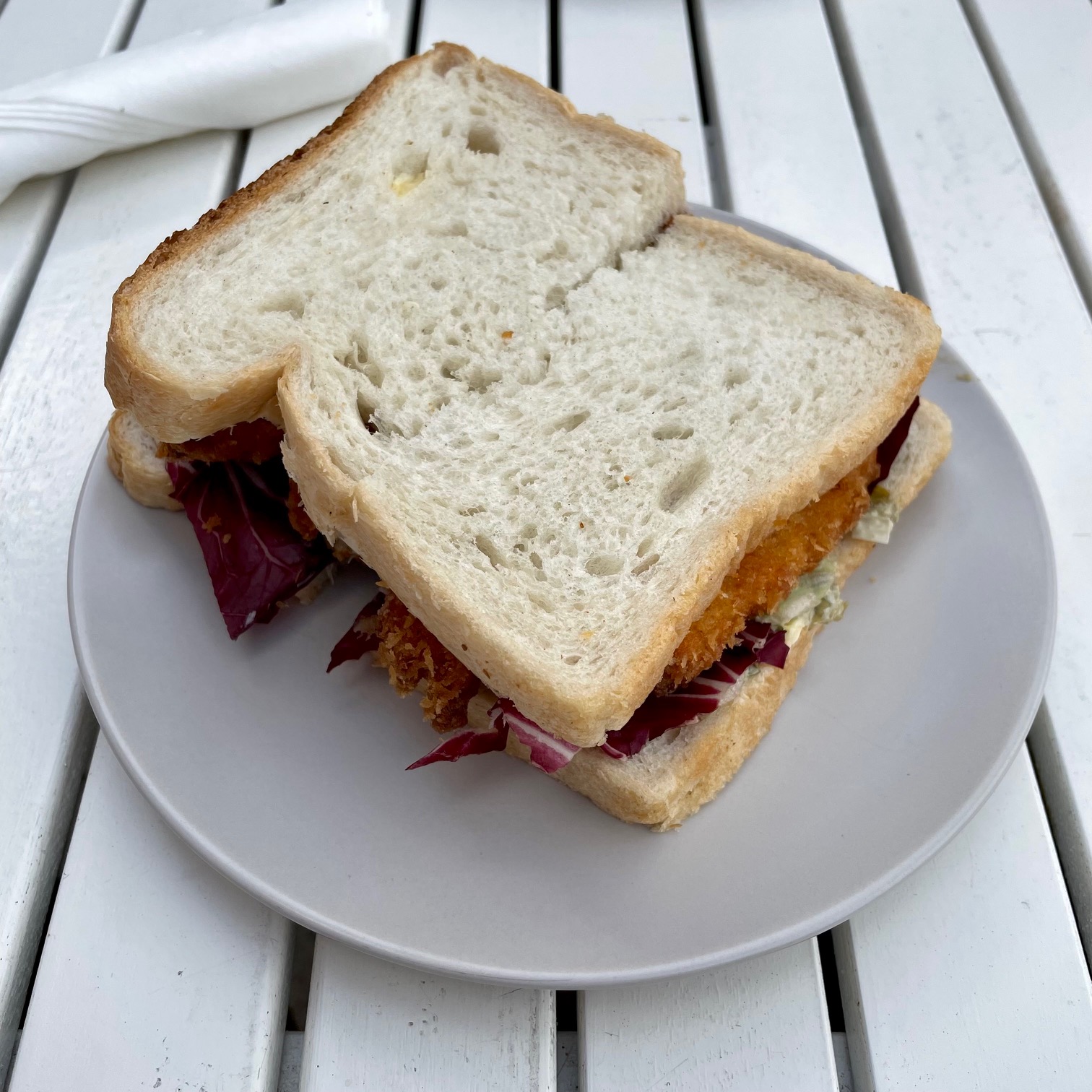
Zoë picked better than me, and my fish finger sandwich was close but not quite there. You could see all the things they’d got right: the goujons were well done, handsome things with deeply pleasing breadcrumbs. And the tartare sauce, made by Hamlet at a guess, was fantastic with plenty of crunch and acidity from the gherkins. But as a sandwich, it didn’t work – the unremarkable white bread just got soggy from all the tartare and fell apart. Putting it in a bun, or at least toasting the slices of bread, would have helped it hold together a lot better. And the decision to put bitter, chewy radicchio in there felt cheffy for cheffy’s sake – iceberg on its own would have been fine.
Was this worth nine pounds fifty? The long answer involves telling you all about Hook & Cook, who are at Blue Collar most weeks. The short answer is no.
If we’d stopped there you’d have got a lukewarm review which might have suggested you’d be better off going elsewhere in Wokingham – and even without the choices I mentioned earlier in this review you could have stopped at the busy food market outside the Town Hall and tried something by Krua Koson, another Blue Collar regular. But fortunately we went on to order some dishes from the other sections of the menu and, to some extent, it was like eating in a different restaurant.
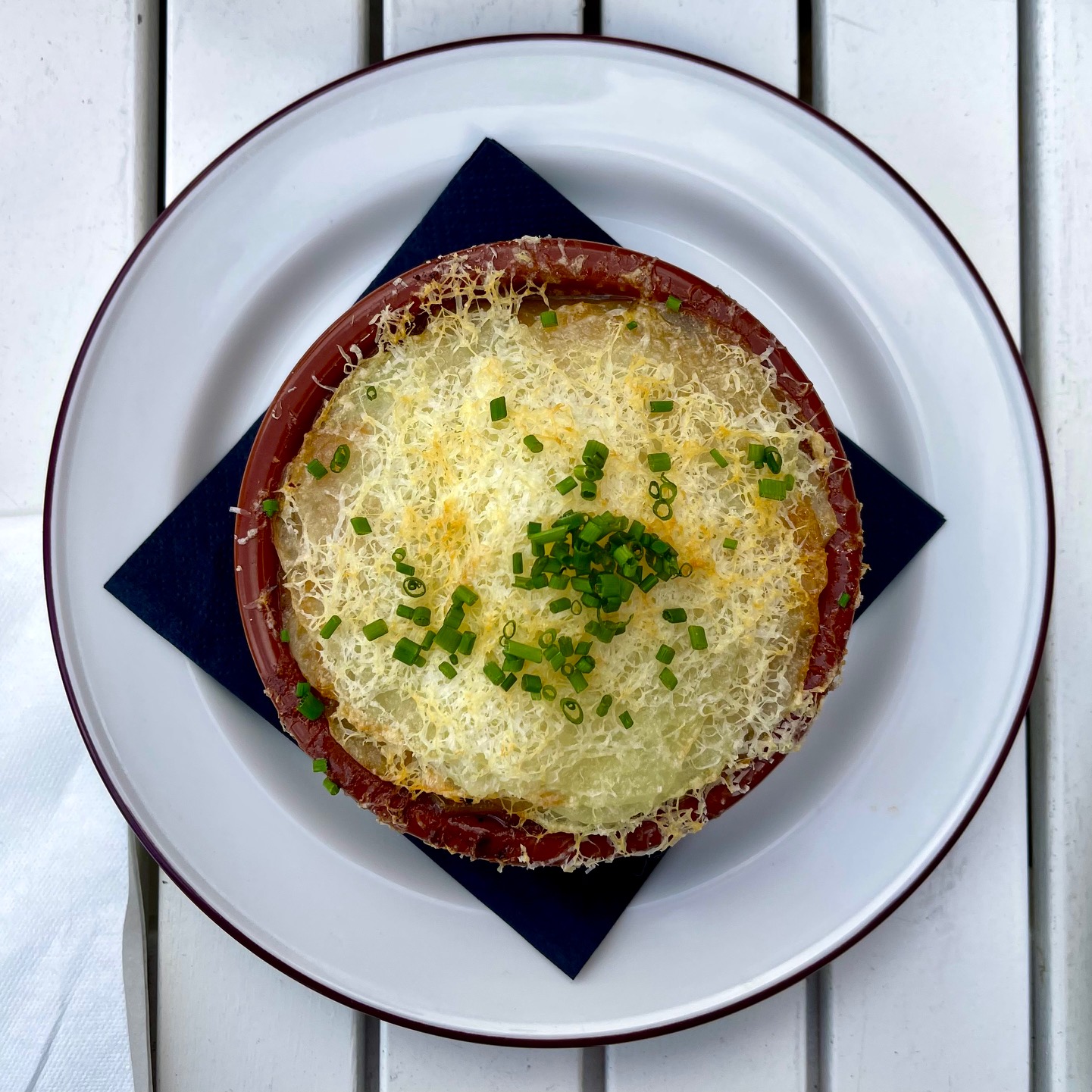
Take the beef boulangère we had, from the small plates menu. A nice-looking dish, with strands of slowly-braised beef in a nearly-sweet tomato sauce, reminiscent of a stifado, and topped with layer upon layer of thinly sliced potato, the whole thing dusted with cheese and chives. A terrific dish – and, although technically a small plate, not too difficult to divide up between two people. Yours for five pounds. Five pounds! You could get two of these for the price of either of those sandwiches, and I think it would be the better choice.
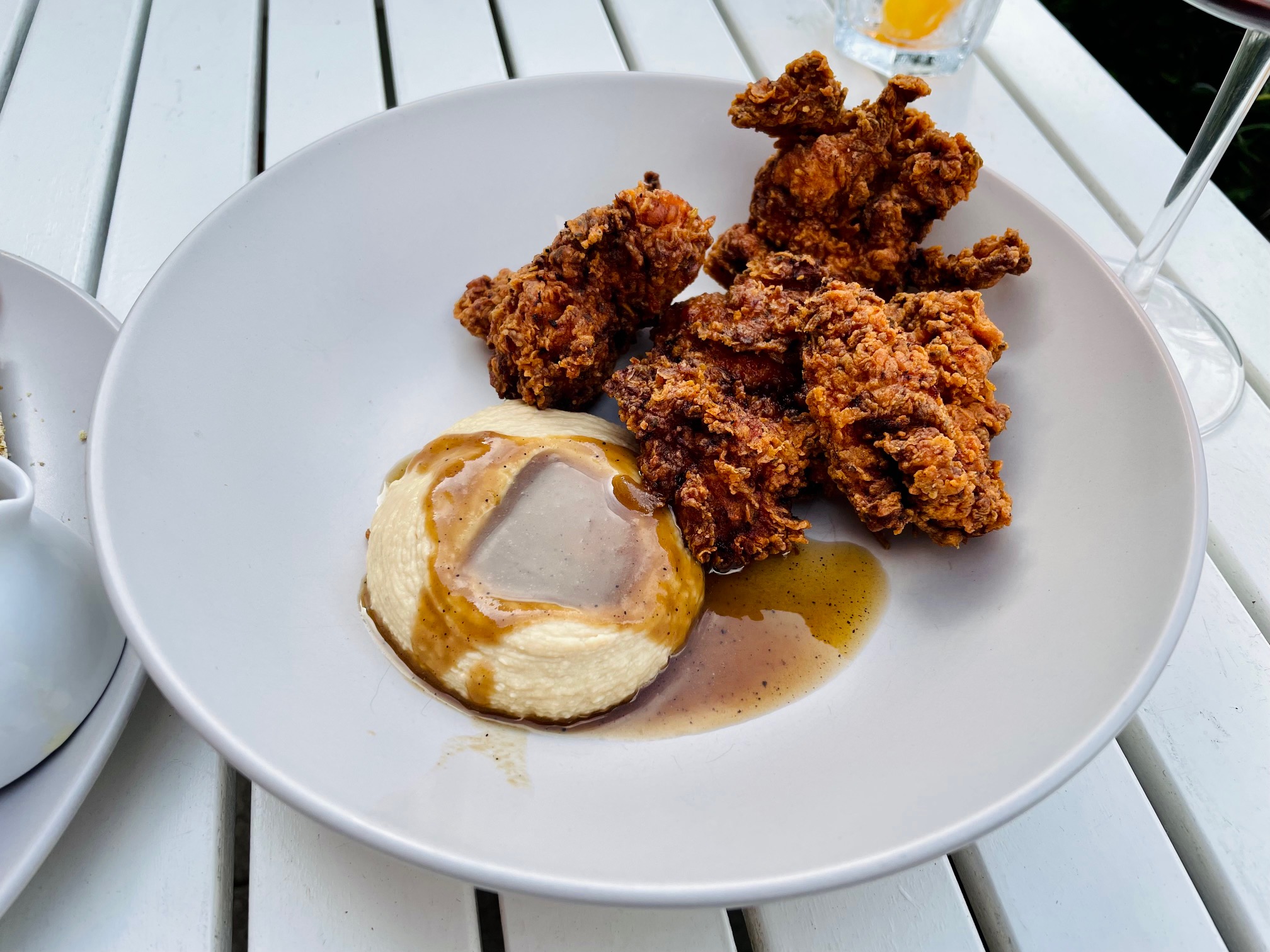
But then, also from the small plates menu, we also ordered fried chicken with beurre noisette houmous. Again, this was a fetching dish – four pieces of gorgeous chicken, all gnarly and crunchy, tender under that coating. Pairing them with houmous isn’t something that would have occurred to me, and pairing the houmous with the almost-caramel silkiness of brown butter certainly wouldn’t have: I’m so used to seeing a bright green well of extra virgin olive oil in the middle of a mound of houmous that I’d never have thought of using anything else.
All those ideas could have come a cropper when combined, but in practice the dish was a revelation. But pricing rears its ugly head again: this lovely dish was twelve pounds. Were you paying for the produce, the idea, the skills involved or the location of the restaurant? And did it matter? I’m not averse to dropping twelve pounds on a small portion of fried chicken from time to time, but will enough people feel likewise?
Last but not least, we’d also nabbed a charcuterie board to share. This is largely about buying rather than cooking, but Hamlet buys its charcuterie from Trealy Farm so they’d bought wisely. Chorizo, a couple of different types of salami (the nicest, for my money, with fennel), some cracking air dried ham and, usually my favourite, a superb coppa. The menu suggested there would also be some lamb carpaccio, but that seemed to have gone missing somewhere.
Personally I like something acidic with charcuterie – gherkins or caperberries – but Hamlet instead added some wonderfully sweet cherry tomatoes, little slices of soda bread and olive oil infused with rosemary. I’d have liked the bread to be a little more substantial, but it was still a great selection. Fifty pence more expensive than the fried chicken, which did make me think – not for the first time – that Hamlet’s pricing was all over the shop.
I haven’t talked about our drinks, but there was a good, compact wine list covering all sensible price points along with around half a dozen cocktails and a handful of beers and ciders, all bottled. Zoë had a negroni, because that negroni habit is coming along nicely, and I had a small glass of a red burgundy which was the costliest wine on the menu. I liked it a lot, but I liked the fancy glasses even more.
Our meal – two sandwiches, two small plates, a large plate, a couple of drinks and a bottle of mineral water – came to just under seventy pounds, not including service. You’re probably thinking “ouch” at this point, and ordinarily this is where I would say “but you could spend a lot less”. But unless you’re just coming to Hamlet for a sandwich and a coffee – and possibly even then – I think you’re going to feel a little stung when the bill arrives.
As I said earlier, table service did feel a little haphazard at the beginning of our meal, but as it went on service got stronger and far more personable. And Hamlet was pretty busy – even later on as we wandered back through Peach Place the restaurant was still doing a pretty consistent trade.
Afterwards we went for a drink at Sit N’ Sip, the craft beer place where, oddly, nobody sitting out front was drinking beer. It wasn’t really my glass of IPA, despite some excellent people watching opportunities. So instead we found our way to the brilliant Outhouse Brewery, which has only been open for three months, and sat outside drinking their very own excellent oatmeal stout. I couldn’t resist trying one of their sausage rolls – made by Blue Orchid Bakery, another Peach Place business – and it was phenomenal, with great pastry and a coarse, dense sausagemeat filling (the fact that I had room for it perhaps isn’t the most glowing endorsement of Hamlet).
I think Nick Galer was right about the challenges of all day dining. Hiding in Hamlet’s menu, a maze of breakfasts, brunches, sandwiches and plates of varying size, there’s a very good restaurant, making itself frustratingly hard to find. I’m sure they’re doing what works for them, and certainly looking on Instagram their lunch menu has been a work in progress since they opened, but for me it felt muddled. Maybe they feel they need to compete with Gail’s during the day and places like Chalk at night. But although the execution might have been uneven, you couldn’t deny that the ideas were there, and along the right lines.
I’m far more tempted to go back in the evening and treat Hamlet more as a traditional restaurant, and when I do I can easily imagine that I’ll have an excellent meal. But even so, they deserve credit for lots of things – for some of the imagination involved, for the stylish space they have created and, perhaps more than anything, for giving it a go during such an awful, challenging time. So there you have it: a polished-looking, high spec, unashamedly high quality restaurant selling interesting, creative food. And a great town centre taproom just around the corner for when you’re finished, into the bargain. In Wokingham. It’s interesting that, for all our chains and burger places, restaurants like Hamlet don’t choose to open in Reading.
I learned in early 2023 that Pan had closed. I’ve left the review up for posterity.
I was beginning to think I was cursed and that you’d never get a new review. My first attempt involved a Reading restaurant which, it turns out, is closed on Mondays. That fact came to my attention on the Monday night I was due to review it, seconds after I arrived at the pub across the road and met my dining companion for the evening. I’ve been doing this for nearly six years, and you’d think I’d know better.
Attempt number two was no better: I picked a restaurant out of town to visit with my old friend Al, mainly because every time we’d ever been there it had one amazing dish on the menu which was worth the price of admission alone. A destination dish and a destination restaurant all in one, truly the holy grail of restaurant reviewing. But, of course, on the Friday that we went there for lunch that dish – a glorious, massive pie for two, glossy, deep rich sticky beef lying in wait under a golden bubbling suet crust – was nowhere to be seen. I chalked it up to experience and had the fish, but where on earth was I going to review now?
Salvation came in the unlikely form of my friend Richard. We were due to meet up for a midweek dinner in Reading, and a couple of days before he sent me an apologetic WhatsApp. He could only get a babysitter for part of the evening, it said, and would I mind meeting in Wokingham, halfway between Reading and his place in Sunningdale? I sensed the faint knock of opportunity, and that’s why you’re reading a review of Pan today.
I’ve known Richard for many years, and wanted to bring him along on a review for ages. He’s the campest straight man I’ve ever met, a gleeful drinker, outrageously bitchy and downright good fun. He looks ever so slightly like David Gest might have done if he had (a) avoided all that shocking plastic surgery and, more importantly, (b) not died. He was a huge support to me when I joined Team Divorce a few years back, and I’ve always loved my evenings with him when he can swing a babysitter (his high-powered ex-wife is always away on business, pressing the flesh in Milan).
As for Pan, it looked like the most interesting thing to happen to Wokingham in some time – a pan-Asian restaurant opening in the space vacated by the Teak House (a Thai restaurant) offering a constantly changing monthly menu of small plates from different countries. The pictures on Instagram looked tempting, the word of mouth was promising and the menu online – all octopus, monkfish yakitori, slow braised pork and ramen – made me truly impatient to visit. Richard said it looked perfect, although I wondered if that might be because he has a much smaller appetite than me.
The website, and the pictures I’d seen made me think Pan would be a sleek, black, minimalist space, but going in it looked very much like it was still the Teak House, visually at least. There was a small bar and counter, and a small dining room up a little set of stairs with, surreally, a handrail like a banister separating it off (Richard leaned against it for much of our meal: it looked wobbly). The front room must have accommodated about a dozen diners, although there was a bigger room further into the restaurant: on our visit this had been laid out for a very large group which arrived partway through our meal.
“Have you been here before?” asked the front of house (which, on our visit, was very much a one man show) as he handed over our menus.
“No, this is our first time.”
“We’ve been open for six months, what took you so long?” he said with a smile. I liked that cockiness: it felt quite unlike Wokingham, if nothing else. “Our menu is small plates, like tapas, and two dishes per person should be enough.” I must confess I was sceptical about this, but maybe that’s because I’d been planning to try as many things as I could get away with.
“Do you have a wine list?” said Richard, somewhat betraying his priorities. The chap smiled again.
“I am the wine list.”
Again, a little confident but not jarringly so. In any case, we started with a couple of bottles of Kirin while we looked through the menu. It being March, the menu had changed completely from the one on the website (“this month we’re doing south Indian dishes”, our waiter told us). All the dishes were priced between four and eight pounds, and most of them looked tempting, with the possible exception of “chicory salad” which felt like a fig leaf for killjoys. The really noticeable thing on the menu, though, was the general absence of carbs: I had a feeling four dishes wouldn’t be anywhere near enough.
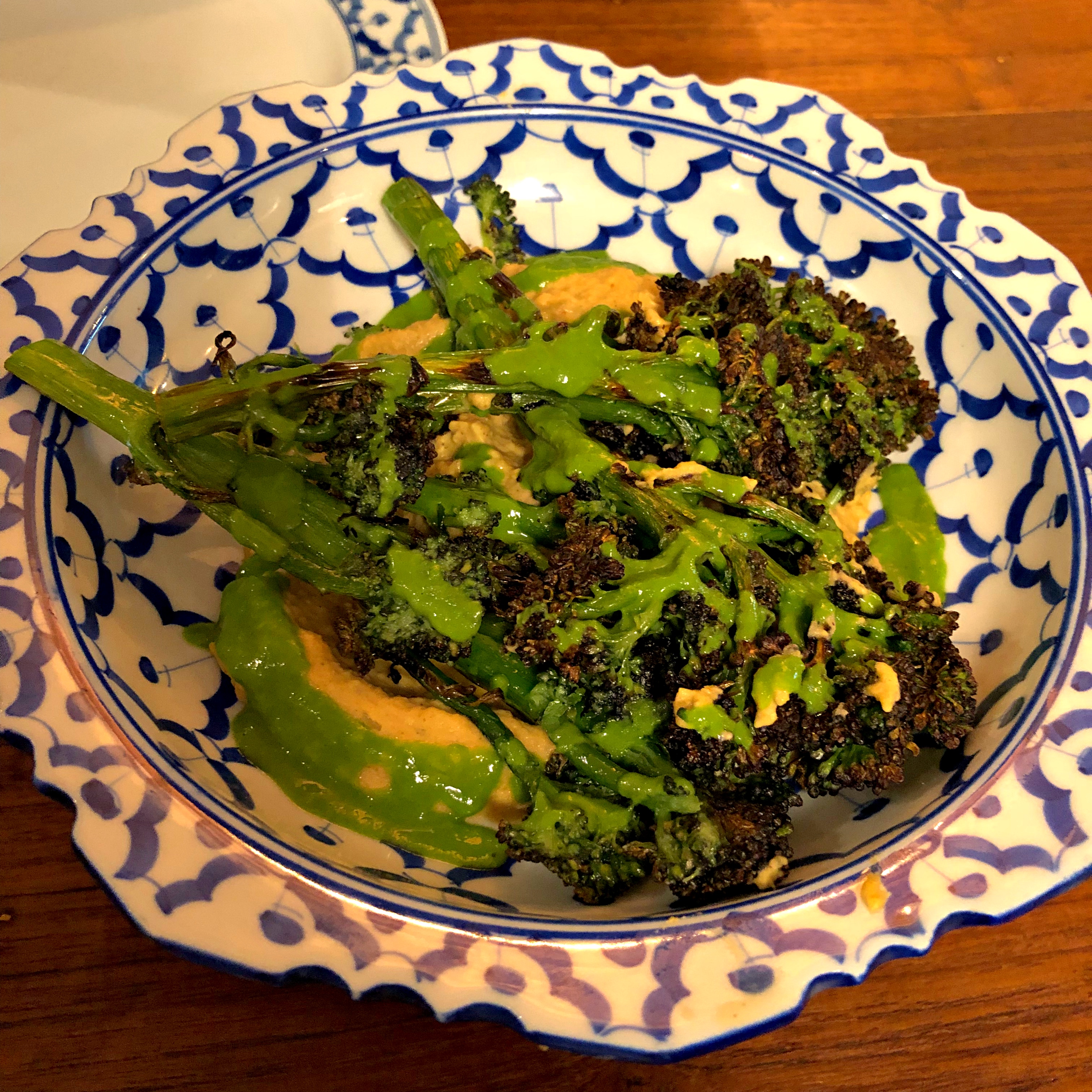
The first dish was a beautiful start – broccoli with chana dahl houmous, a clever fusion. I’m used to dipping stuff in houmous (after I’ve poured a lake of extra virgin olive oil on top of it, naturally) but having it here as the base for a heap of well-cooked purple sprouting broccoli was a very nice touch. The houmous had brilliant spice and flavour, and as a statement of intent this was hard to beat. But even this dish, with hindsight, was a taste of things to come: I expected the bowl to be slightly deeper and when my fork clanked against the bottom I did have an “is that all there is?” moment. It wasn’t to be the last time.
Shortly afterwards the kitchen sent out our next dish, crab wontons. “Too sweet” was Richard’s verdict, and I was pretty sure he wasn’t talking about me. He was right, though: they weren’t unpleasant but they were hotter than the sun and the crabmeat inside did feel too sweet with nothing to balance it out. Possibly the advertised curry butter might have offset this, but it lurked uselessly at the bottom of the plate and it was too difficult to dredge the wontons through it. Worth six pounds fifty? Probably not, and the glass plate felt like it might also have been inherited from the Teak House rather than bought for Pan, because the presentation felt a little fussy and old-fashioned.
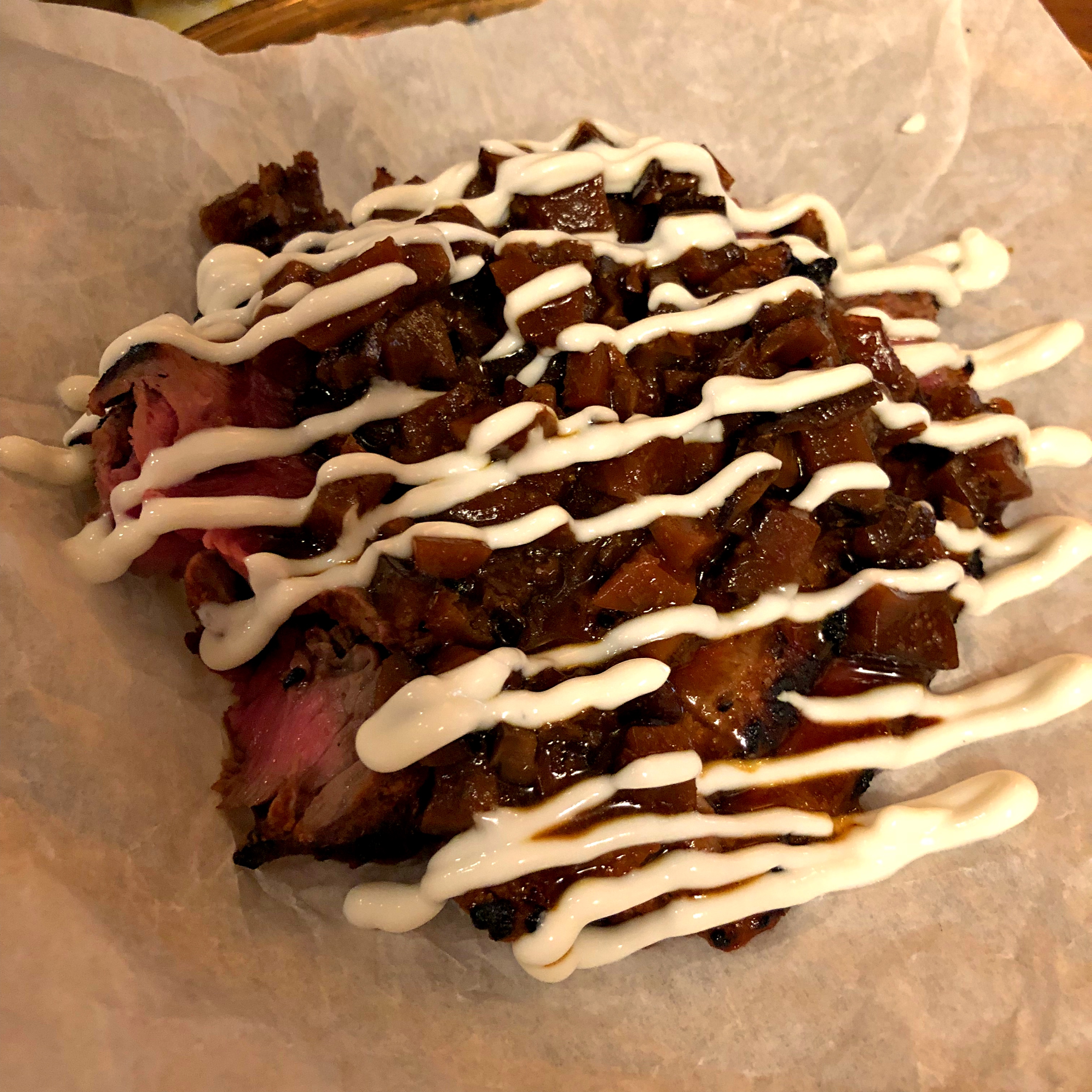
I very much liked what came after that, flatiron steak with “kukurmutta ragu” (I Googled it: it’s mushrooms). The mushrooms lent a beautifully savoury note to the whole thing and any reservations I had about the steak were banished by the pink middle and the perfect texture. I wasn’t convinced it needed all that yoghurt, and serving it with paper underneath was a little odd, but even so it was one of my favourite dishes of the evening. Richard wasn’t so impressed, but by then I’d told him I was going to refer to us in the review as “Pan’s people” and he’d given me the first of many withering stares (“Bitch” was his response).
I found it odd that the dishes had been designed for sharing, but none of them came with spoons for us to dish up onto our plates. I asked and the waiter brought some over, but in a way which suggested that they’d never been asked before. “That was very nice, thank you” I said as he came to take our empty plates away. “You sound surprised” he replied, and again I couldn’t quite decide whether that confidence was charming or grating.
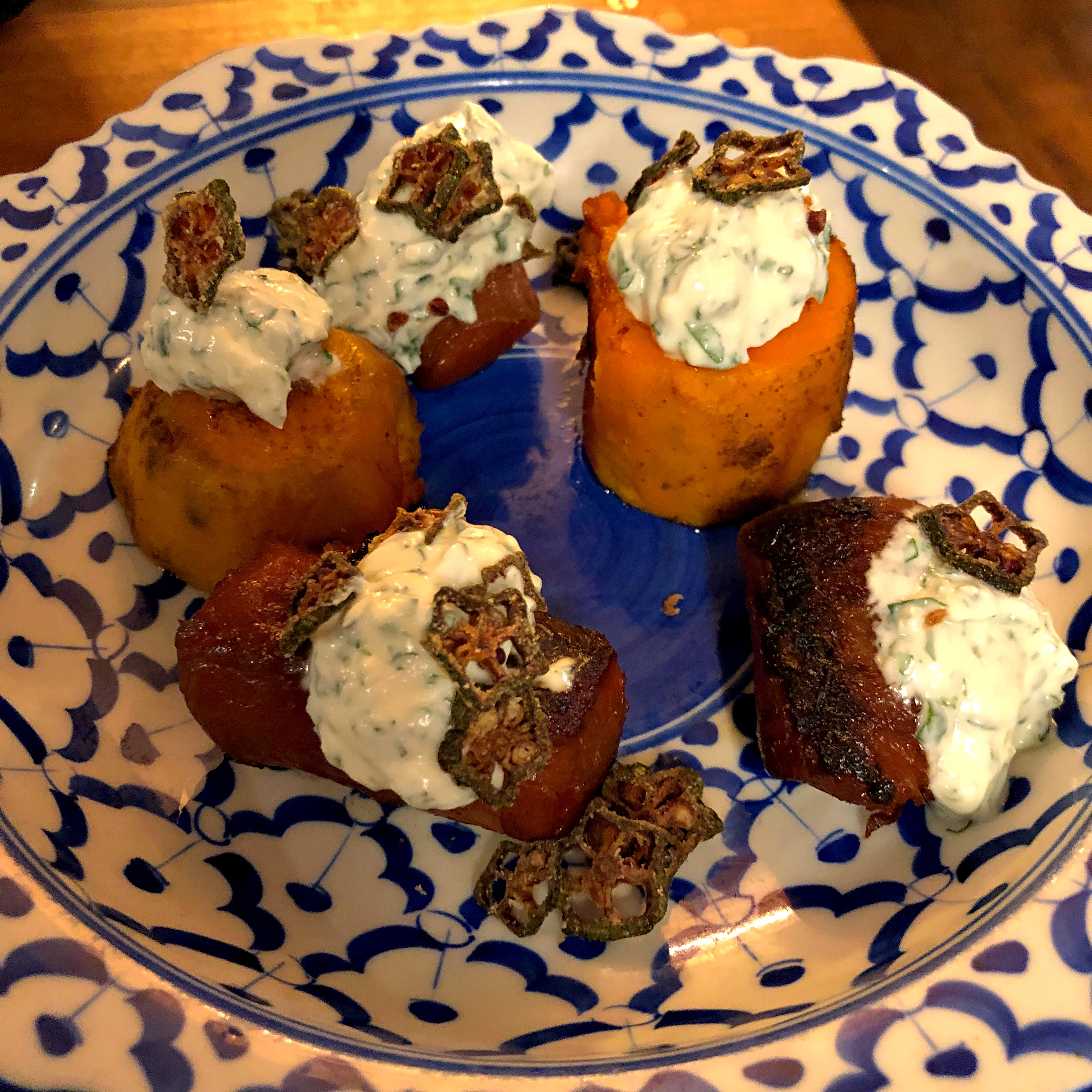
I’d been particularly looking forward to the charred carrot dish, mainly because Pan’s Instagram feed had a stunning image of what I imagined was something similar – a huge vibrant jumble of carrots, blackened on the outside, sesame seeds and coriander. I don’t think I was expecting five pieces of carrot, or for three of them to turn out to be unadvertised sweet potato (one of my least favourite things). Despite that I did enjoy them – the menu said they’d come with pearl barley and parsley, but instead they were accompanied by some kind of thickened yoghurt and tiny slivers of crispy fried chilli. It was an interesting dish, and the textures in particular were lovely, but I couldn’t quite shed the feeling that at five pounds, each piece of carrot or sweet potato had cost a quid all by itself.
Finally our last dish turned up, tandoori chicken legs with bhurani raita. I enjoyed this: the flavours were spot on and the chicken was nicely done, although I didn’t necessarily get much garlic in the pleasingly mint-green raita. Richard was less convinced – “this feels more like a dish you could get in lots of other places” – and either way it was a little difficult to justify two hardly colossal chicken legs at just shy of seven pounds.
“That was lovely” I said as the waiter collected more empty plates.
“I know”, he said. Hmm.
Despite having had more than our regulation two dishes per person, we ordered more. If there had been more carbs on the menu – some noodles or rice or anything that might fill you up – maybe I wouldn’t have needed to but as it was I was still distinctly peckish. We also ordered a couple of glasses of orvieto which was pleasingly crisp but far from bone dry. The waiter wasn’t kidding when he said he was the wine list, so he ran us through the choices – all by the glass, three or four whites if I recall. No prices were given, but I checked at the end and these were six pounds each, which didn’t feel unreasonable. Not having a list and picking after a chat with your waiter felt like the sort of thing I ought to enjoy and endorse in theory, but having done it I found it made me feel somewhat uncomfortable: too English by half, perhaps.
Throughout our meal I saw our waiter coming out of the kitchen with multiple plates of the same dishes, dropping one at our table, one at a neighbouring table and so on, and I realised that even if I was still on the hungry side I could see how this model might work beautifully for Pan. And every table in the front room was full of enthusiastic customers, so maybe it was just me who was beginning to find it a parade of not enough food for a little too much money.
I’d really fancied “cod shashlick with satay crumb” on the menu, but the waiter told us it had run out so we ordered the replacement dish, smoked trout with ginger and lime. For me, this just didn’t work – the tastes that accompanied the fish were sharp, fresh and interesting but pairing it with smoked trout felt like a strange choice. I’m far from convinced that smoked trout features heavily in South Indian cuisine: it clashed with everything else going on and the whole thing felt like a dish made with ingredients that were lying around (all very Ready Steady Cook) rather than something carefully put together. I guess, of course, that the thing with smoked trout is that you don’t have to cook it, so again convenient for the kitchen but not necessarily great for diners.
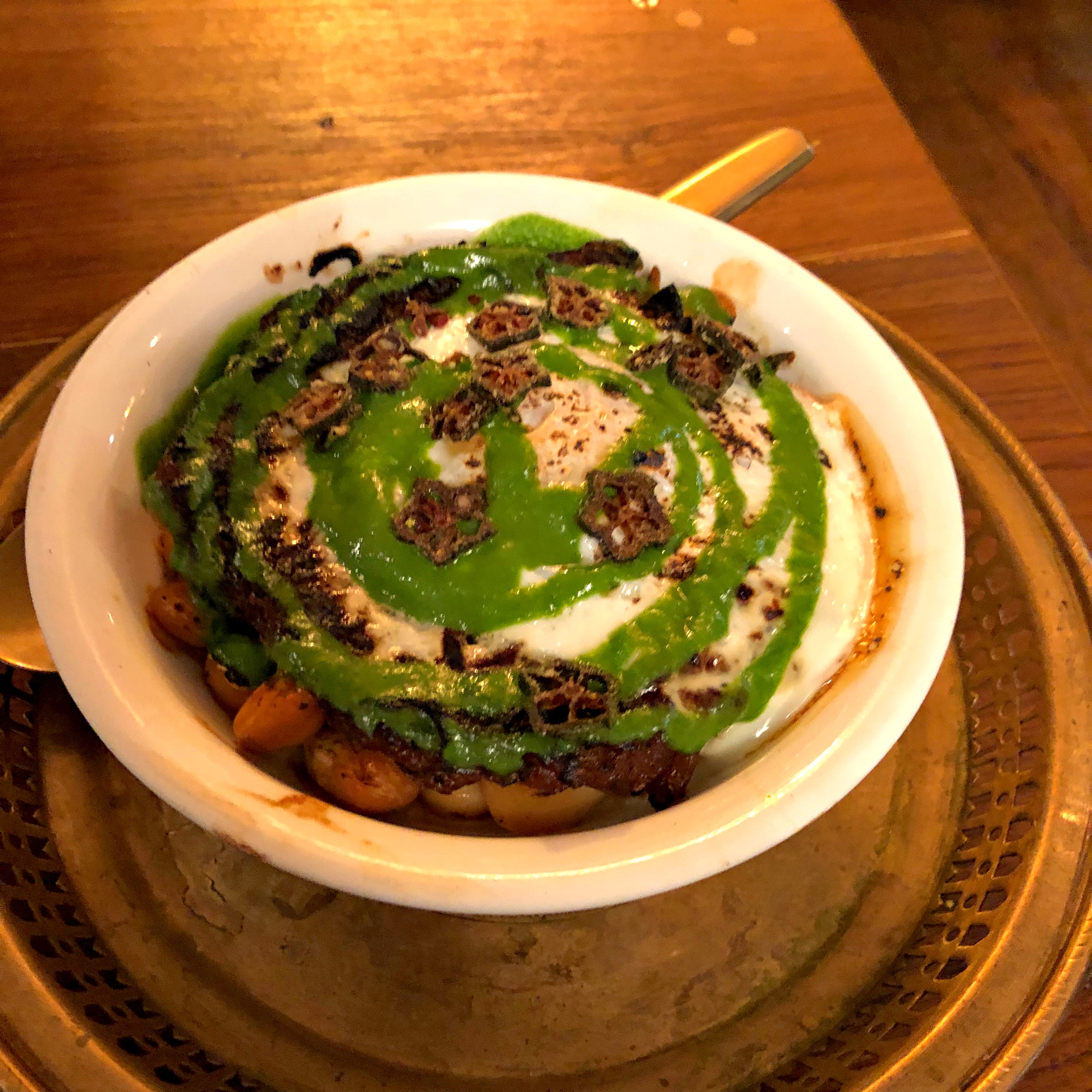
I did enjoy our final dish, a mixture of butter beans and chickpeas topped with a baked egg. Finally, a hint of the carbs I’d been craving! But even here I could see how all the dishes felt like riffs on a theme – the green squiggles matching those on the broccoli, probably the same yoghurt as we’d had on the steak, definitely the same little slices of fried chilli as had come with the carrots. Although I quite enjoyed it, and I’d have loved it if it had been the first dish I tried, by this stage I did feel like I could see the joins, as if I’d spotted the Wizard Of Oz behind the curtain. Pan passed itself off as being imaginative and varied, but a lot of work had been put into managing the experience.
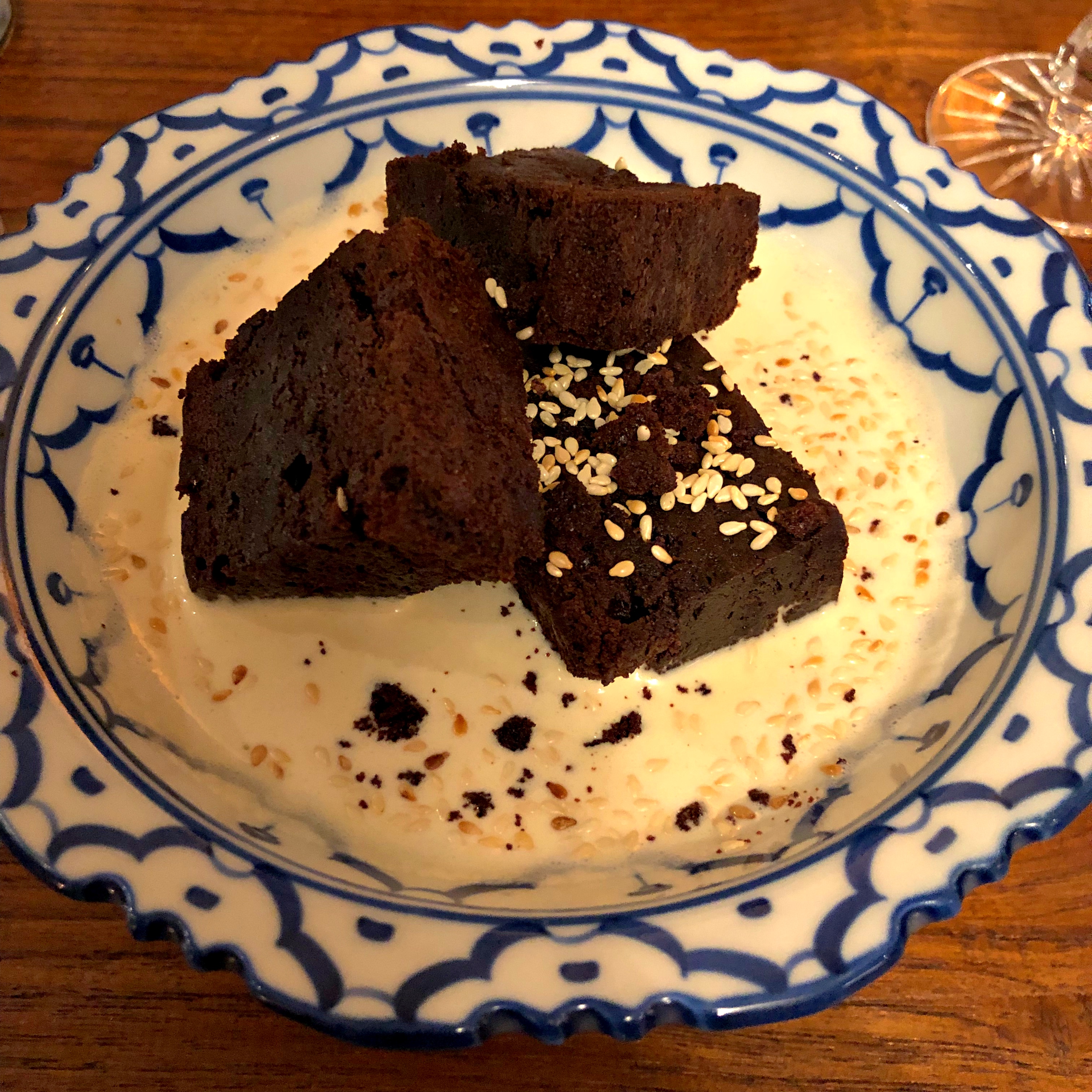
I insisted on a dessert – partly because I was still hungry, and partly because the waiter told me that the chocolate brownie came with a sesame seed creme Anglaise. Normally, I don’t hold with brownies being dessert – and again, what I got differed from what was described on the menu – but this really was lovely: three dense, warm cubes of brownie with a beautifully light custard and plenty of sesame (although I thought it could have stood more).
We’d asked what we could drink with dessert and the waiter said “I’ve got some really good Filipino rum: let me bring it over”. He returned with a bottle and two little glasses full of ice and left us to it, an experience which felt faintly continental. Richard practically inhaled a glass and topped himself up.
“Hurry up and try some! This is fantastic.”
It was: ever so slightly honeyed and with a beautiful note of oak. Richard took a photo of the label, shortly before surreptitiously refreshing his glass. (“There’s no line on the side or anything” he said, with the expertise of a man who used to raid his mother’s drinks cabinet.) I loved it, although I did feel guilty about having more. How much did it cost anyway? There was simply no way of knowing, not until the bill arrived.
When it did, our whole meal – seven small plates, four beers, two glasses of wine and that rum – cost eighty-seven pounds, not including tip, and the rum was just under eight pounds in total. I made sure we tipped generously, mainly because I suspect Richard was literally drinking their profits. We then sallied forth into the Wokingham night in search of a place that could serve Richard more wine, although when we got to the pub Richard also ordered a packet of peanuts and a bag of pork scratchings: that probably tells its own story.
It’s interesting, as small plates restaurants start to jump the shark in London, that we get a swathe of them round these parts like Pan and Bench Rest, which I reviewed last year. Pan shares some of the problems that Bench Rest has: however nice the service is, the interior feels like it’s designed for a very different type of establishment and however nice the food is, the dishes are either too small or too pricey or both. But with Pan those problems were amplified – everything felt like not a lot of food for quite a lot of cash, and the interior and the plating lacked the sophistication the menu aspired to. But on the other hand I love the concept, I ate some really interesting food and combinations and I can see what they’re aiming for. It felt like a work in progress, but I do wonder if Wokingham is forgiving enough to give Pan the time it needs to become the restaurant it wants to be. I hope so: definitely if Pan was in Reading I would be following its evolution and going back to see how things progress.
And Richard? According to his Instagram he was in the gym the next morning at seven am, living the dream. His verdict was less nuanced than mine: will go back for free rum though, he told me on WhatsApp. The language of Shakespeare: I must find out when his babysitter fancies doing some more overtime.









 Edible Reading