The Pack Saddle, Mapledurham

As of summer 2021 the Pack Saddle is under a new chef with a very different direction in the kitchen, to the extent that this review is no longer representative of any meal you might have there. I’ve left the review up for posterity, and I suppose I should revisit at some point.

Ah, the New Year. What a magical time it is! We know what day of the week it is again, chocolate ceases to be a food group and everybody has to go back to work. It’s ages until the council come to empty your bins and the glass recycling looks positively terrifying (it was the guests! The guests drank it all). What better way for me to commemorate this bleak state of affairs than to revisit the scene of 2014’s biggest culinary disappointment?

Well, almost. Amid all those awards at the end of last year I deliberately kept schtum on all the candidates for the wooden spoon, but the numbers don’t lie: my worst meal of 2014 was at the Pack Horse in Mapledurham, an outwardly pretty pub dressing up desperately ordinary food with faffy presentation and making me – and I can’t quite believe I’m typing this – nostalgic for the days when it used to be a Blubecker’s. After reviewing it, many people told me I had gone to the wrong Mapledurham pub: the Pack Saddle – similarly named but slightly closer to town – was the one to visit, they said. I wanted to believe them, but I still got nasty flashbacks as my car pootled down the A4074. Was it rising bile, or the memory of that wobbly shoulder of lamb?

Maybe the reason I didn’t go to the Pack Saddle last year is that I couldn’t find the car park. It was oddly difficult, involving an almost handbrake turn when we nearly missed the massive sign for the entrance (maybe it’s for the best that I’m having a dry January). Getting inside though, the pub was warm and welcoming despite not being all that packed: there was a heavenly smell of wood smoke and a handful of people were sat up in the beautiful panelled bar room. The dining room was down a couple of steps and I can imagine it would feel lovely and buzzy had it been occupied; sadly, the other two tables left shortly after we sat down so we sat alone in the dining room with just a portrait of Her Majesty Queen Elizabeth II, from shortly after the Coronation, gazing down on us. She looked a little disappointed. Perhaps I should have worn my tiara.

I really liked the look of the menu for two reasons. First, it was the right size: long enough that you felt there was plenty of choice but short enough that you could reasonably expect everything to be done well. But secondly, everything was just a little more interesting than it needed to be. Everywhere on the menu there were little flashes that suggested the kitchen knew what it was doing; chicken terrine came with pickled vegetables and Parmesan crispbread, beetroot was paired with goat’s cheese panna cotta, not plain old goat’s cheese. The fish main course was accompanied by a crab cake. The smallest hints of skill – nothing boastful, but enough that you could see them if you were paying attention.

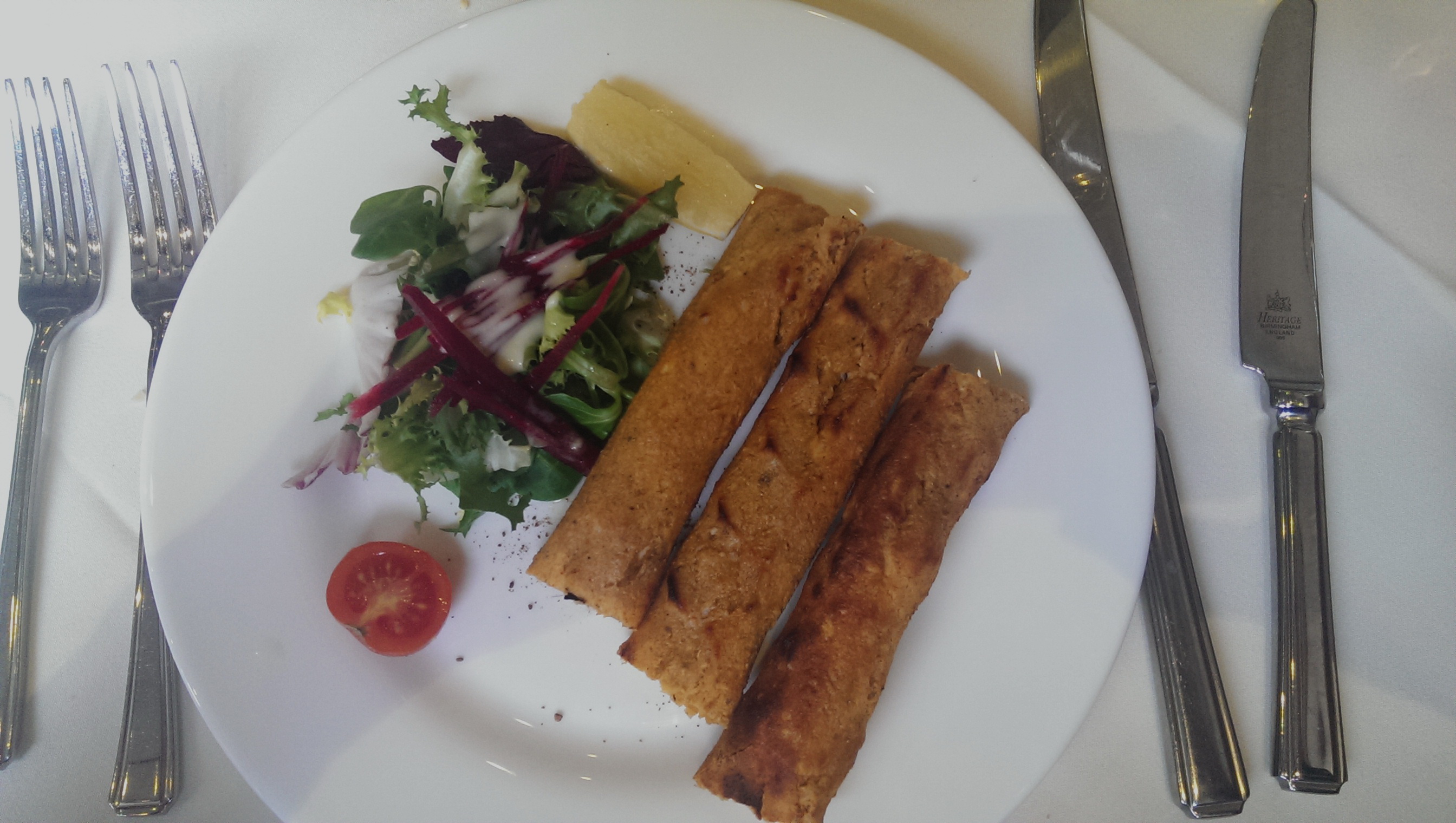
My New Year’s resolution is to order one vegetarian main course every month and I nearly did it at the Pack Saddle. Crispy Parmesan polenta and filo roll stuffed with roasted vegetables sounded delicious and a cut above a lot of the unimaginative mains on menus I’ve seen (and since I made that resolution I’ve looked at a lot), but I was foiled: it was sold out. The alternative was mushroom risotto, but I have a feeling there will be a lot of chances to try that over the months ahead.

Won over by some of those flashes of skill on the menu, I did order a vegetarian starter. Balsamic glazed beetroot salad with goat’s cheese panna cotta was very much a sign of what was to come: beautifully presented in a way that at first sight looked haphazard but was in fact very orderly. What I got was a generous amount of sweet red and earthy golden beetroot, cut into eighths, interspersed with a few creamy dollops of goat’s cheese panna cotta and drizzled with narrow stripes of balsamic glaze. The panna cotta was salty, creamy and, again, earthy. I was expecting to get much more panna cotta and much less beetroot but the balance was perfect and felt like a much more reasonable portion for a starter. A few shards of parmesan crispbread were dotted about the plate which added some welcome crunch. It felt like so much more than the clichéd pairing of goat’s cheese and beetroot – lots of different things to combine, contrast and enjoy.
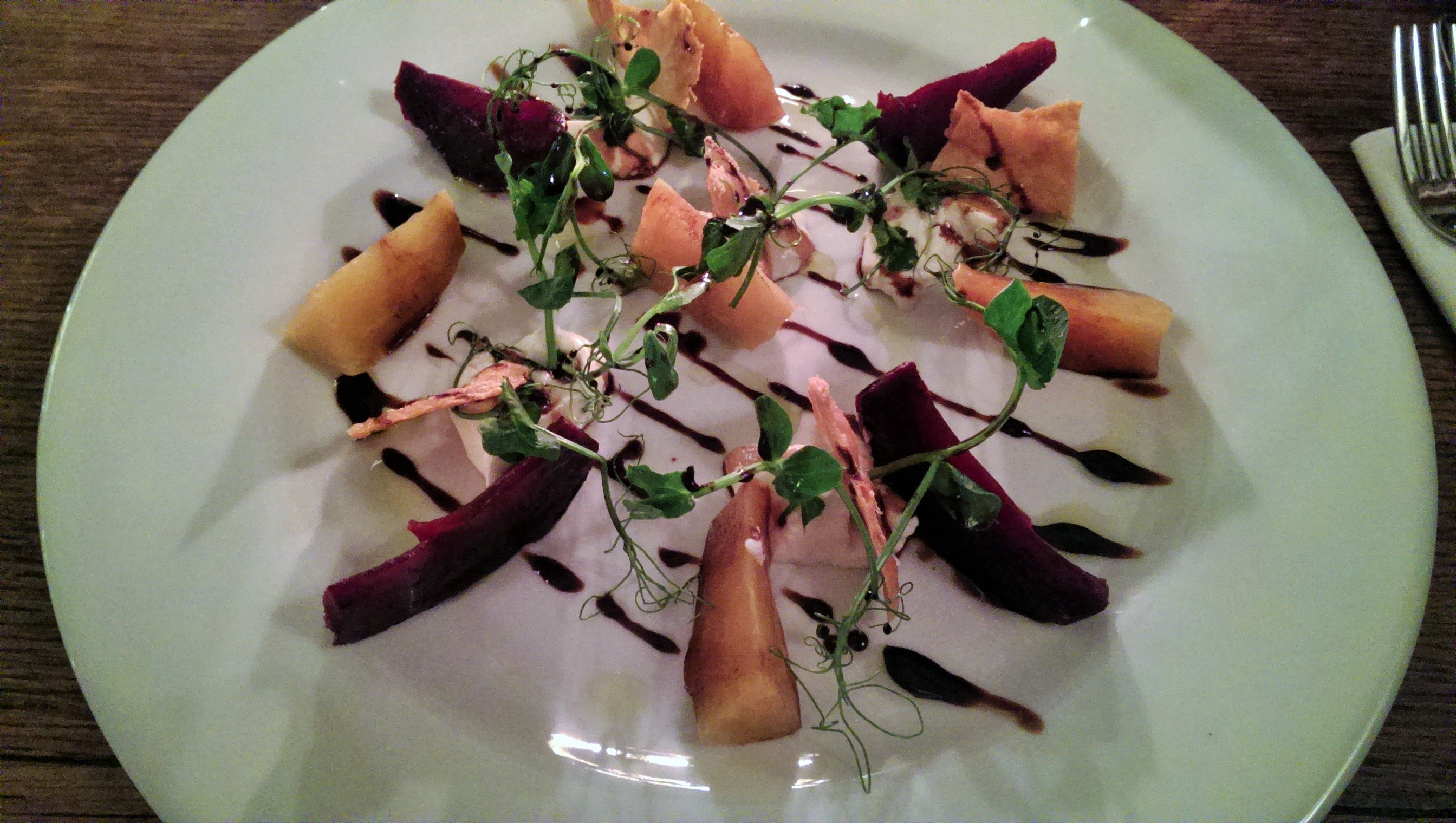
Beetroot

The chicken terrine was if anything even more pretty and precise: a bit of a theme at the Pack Saddle where the plating has a rather OCD air about it. A cylinder of chicken terrine had been sliced diagonally into two sections and stood on its end (perpendicularity, it turned out, was another quirk of the presentation). With it came little blobs of celeriac purée, more of that Parmesan crispbread and little spirals of pickled carrot, wrapped round a sprig of herb and leaves. This dish was a good illustration of why restaurant blogs can’t rely on photographs alone: from the picture it looks lifeless and prim, but in practice it was bloody delicious. The chicken terrine, beautifully compressed, tender, delicate meat was clean and fresh with a slight note of smoke from the bigger pieces of smoked chicken running through the middle. The pickled carrot, with a hint of lime, had wonderful crunch and the celeriac puree added just enough sweetness. Only the Parmesan crispbread fell a little flat – something lighter like music bread might have done the same job better – but it was a starter I wanted to begin again the moment I finished it.
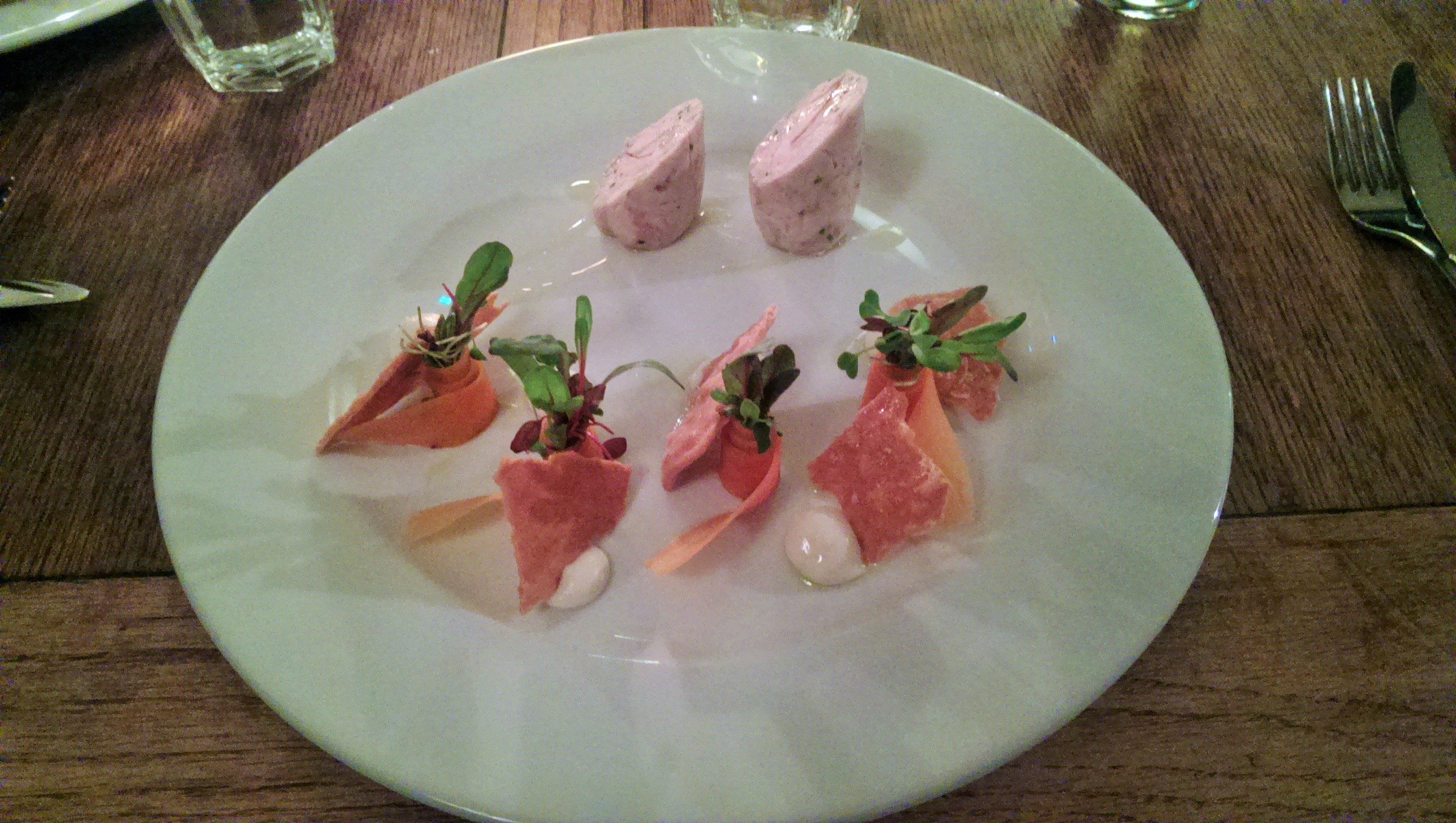
Terrine

Of course if I’d done that I might have been too full for the main courses and – as it turned out – that would have been a shame. Fillet of sea bream was very good with the perfect balance of soft yielding flesh and super crispy salted skin. It was served, as is traditional these days, on bed of mash but, less traditionally, this was surrounded by a moat of horseradish veloute. I’m not sure I’ve had this combination before but I liked it a lot – the horseradish was mild and mustardy rather than full on hot and the mash was indecently creamy and generous to a fault. Nestled into the side of the mash, like a vertical limpet, was a mini crabcake (that perpendicularity again). This was less successful for me – it was a little plain and lacking the crispy texture promised by those breadcrumbs – but I admired the ambition, even if I wasn’t completely on board with the execution. All in all, the dish was lovely: although with all those potatoes and cream it wasn’t quite the slimline option offered by most fish courses. It also felt, at a smidge under thirteen pounds, like impressive value.
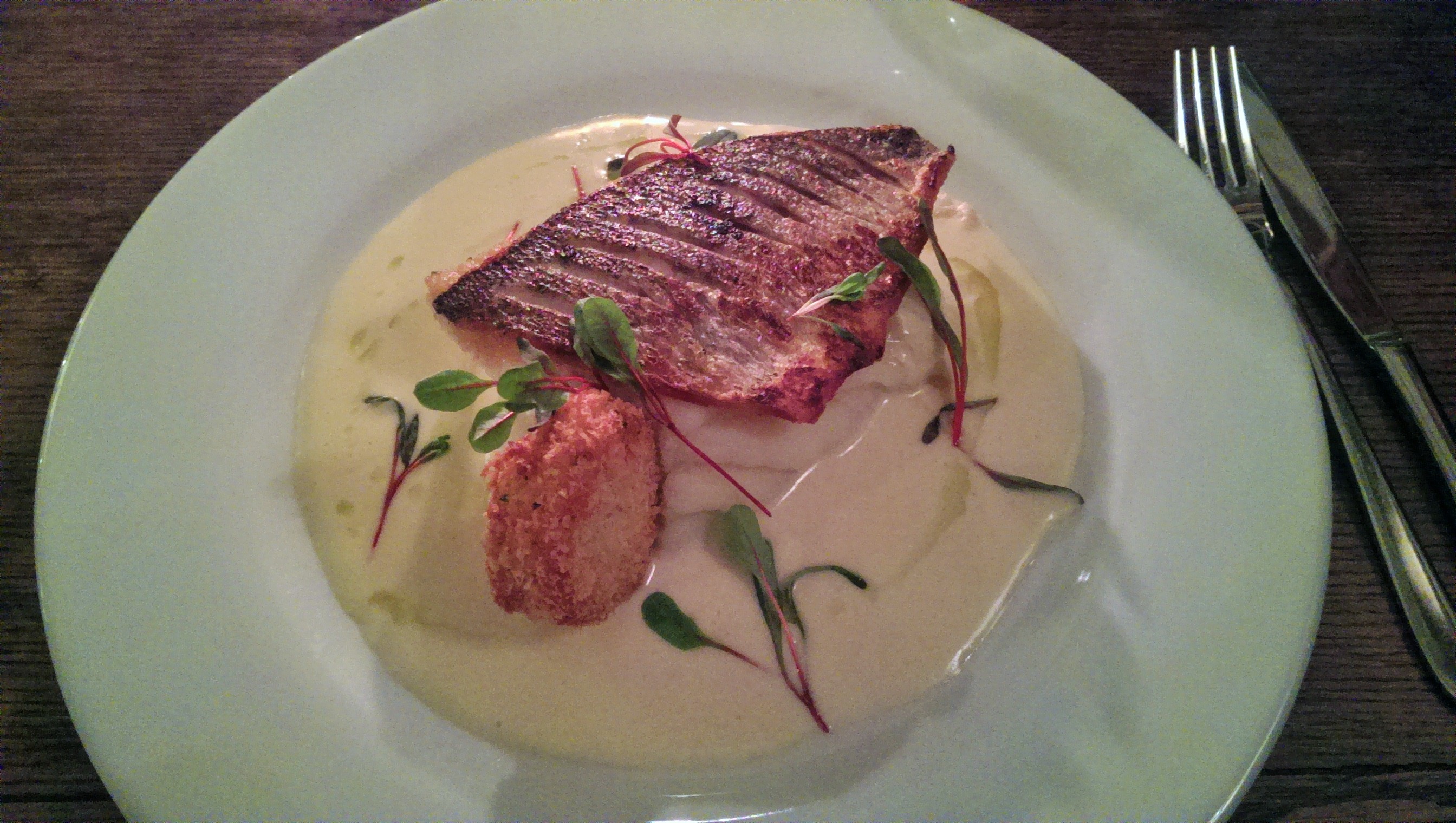
Bream

The other main course, saddle of venison, was wrapped in serrano ham and served – can you guess? – standing on its end. This was the case where the presentation seemed most surreal because it was leaning against a big block of boulangère potatoes as if it was a supporting feature rather than the headline attraction. The rest of the plating, again, was rather OCD with little circles of butternut squash puree alternating with wild mushrooms at worryingly precise intervals (a puddle of jus was confined to the right hand side of the plate). But anyway, that’s a pointless quibble because it was delicious and everything worked, separately and together, from the sweet puree to the pink, tender venison to the slab of potato, salty and softened with stock. The wild mushrooms were particularly welcome (I partly ordered this because so often, the mushrooms aren’t wild but the exaggerations on the menu are).

Venison

Normally at this point I tell you, in scant detail because it’s not really my area, about the wine. Because I’m on the wagon this month I will instead give you the far less thrilling news that the Pack Saddle offers a decent range of soft drinks including Belvoir and Appletiser, plus the overpriced orange squash that is J2O (just me?). The wine list – with its constant reproach of “look what you could have won” – looked interesting, with lots of new world wines, Chapel Down (an excellent English sparkling) and plenty of decent bottles for under twenty quid. I could see things which would have gone perfectly with the bream, and the venison, but then I started to feel a bit sad so I put the list down and enjoyed my elderflower pressé instead, with no gritted teeth whatsoever.

The dessert menu here is fairly traditional but after two interesting and clever courses it felt like the desserts would be more sophisticated than advertised. After all, that seemed to be what they do here: promise low and deliver high. I was tempted by the cheeseboard (the holy trinity of local cheeses – Barkham Blue, Spenwood and Waterloo – all world-beaters, all made in Berkshire) but I wanted to see what they’d do with the more obvious choices, so we went for chocolate brownie and carrot cake.

In most pubs, having chocolate brownie for dessert means getting a microwaved slice of Brakes’ brownie, a squiggle of chocolate sauce and a scoop of bland vanilla ice cream. In truth this wasn’t a million miles away from the brownie here, the one let down of the dishes. The brownie itself was sticky and rich (and home made) and had been cut into three slices and arranged in a zig zag. There was chocolate sauce and vanilla ice cream although this time the ice cream was sat in a puddle of crumbs and the brownie had some dollops of cream with blueberries and raspberries nestling in them. Don’t get me wrong: it was tasty enough, and I ate every last scrap. But it didn’t match up to the earlier courses for creativity and excitement.
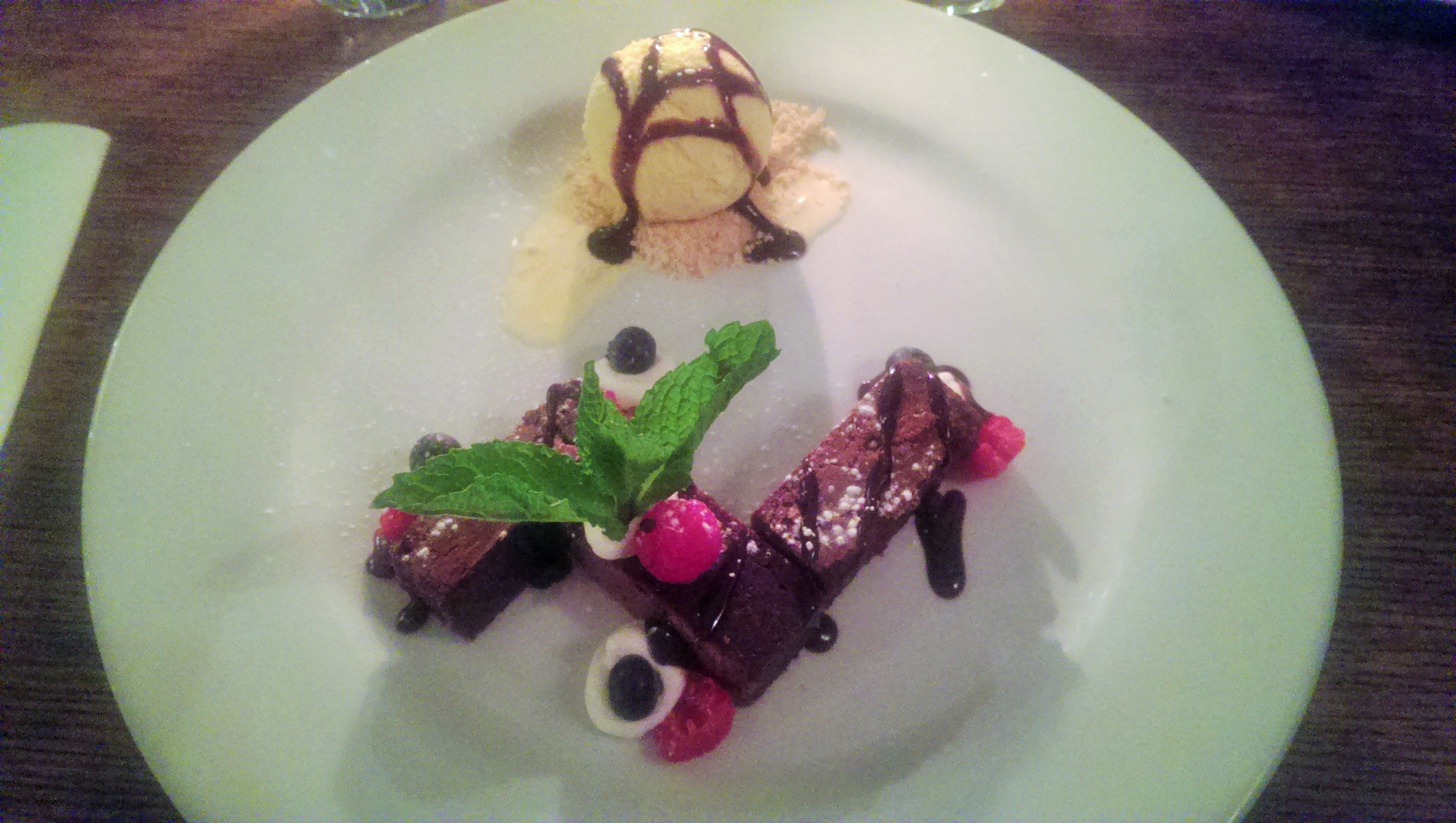
Brownie

The carrot cake was better, although the plating repeated the motif of little orange circles set out with frightening regularity. This time it was sweet carrot pureé, although I’d have been hard pressed to tell it from the earlier butternut squash purée in a lineup. The vanilla ice cream was pretty anonymous and the icing didn’t stand out, but what saved the dish was the cake itself – moist but not too moist, nicely spiced and with a slightly nutty texture to it. A perfectly nice carrot cake, but I was expecting more after the promise of the first two courses (my family make a better one, put it that way).

Carrot

Service throughout was excellent – something I particularly appreciate on a day like the first Saturday in January, when surely nobody really wants to be at work. The two staff that looked after us were both unerringly friendly and helpful – and also seemed to be genuinely delighted when they got positive feedback on the food. With the bar being busy and the restaurant being almost empty I worried that we’d either get pestered or ignored, but they did a brilliant job of making us feel looked after without being hovered over. The bill, for three courses and two rounds of soft drinks, was a touch under sixty-three pounds excluding service. All of the courses felt like excellent value: the venison, for example, was under sixteen pounds and easily as good as far more expensive venison dishes I’ve had in restaurants with higher opinions of themselves.

So, here’s to 2015. I’m sure it will be a lot like 2014 in lots of respects – good meals, bad meals, pleasant surprises, even wobbly shoulders of lamb – but at least there will be one important difference: driving down the A4074 won’t bring me out in hives any more. I think I might make another trip that way soon, just to be certain.

The Pack Saddle – 8.0
Mapledurham, Reading, RG4 7UD
0118 946 3000

http://www.thepacksaddle.com/

The Bull Inn, Sonning

As regular readers will know, the overwhelming majority of restaurants I review are requested by people who read the blog week in, week out. If there’s one thing that comes out of those requests, it’s that you really want to see reviews of pubs that do food. And that, generally speaking, means leaving Reading and heading out into the countryside. There’s only one problem with that, which is that a lot of pub menus look really uninspired. In fact, once you read enough of them they all start to blur into one. They all do a burger, they all do fish and chips, they all do sausages and mash, they nearly all do confit duck these days. They’re all so similar, in fact, that you start to wonder if they’re all being supplied by the same person, perhaps in a big lorry of some description (surely not).

So I’m afraid I’ve cut a lot of the pubs from my to do list. They might be well worth a visit if they’re your local and you can stagger home afterwards, but I think they have a limited appeal for people those of us who would need to drive out into the sticks to go there. If I’m going to forego the delights of more than a solitary glass of wine I do want to feel like the food is worth it. So what stayed on the list? Pubs that had menus with a little bit more about them. Menus with interesting combinations of ingredients. Menus that weren’t going through the motions and dead behind the eyes. The Bull at Sonning was one of those pubs, so I turned up there on a midweek night to see if my menu spotting skills had let me down.

It really is a beautiful pub, inside and out. It’s your typical ancient timbered pub with enough low beams to require a special stooped walk, lest visitors wake up to find themselves on a trolley at the Royal Berks. It has a warm, inviting fireplace in the front bar, mismatched furniture all over the shop (I don’t think I saw two tables the same) and loads of nooks and crannies, just as an authentic pub should. Eating there a deux, in a little table tucked away, felt beautifully conspiratorial. What is also has, on a cold it-feels-like-winter-even-though-it-was-sunny-only-last-week school night is an absolutely packed bar and dining area (it was impossible to tell how many people were locals and how many had been drawn there by the recent not very extensively reported news about properties in the area – really, the Sonning residents should have worn badges, or red trousers, or both).

I got a sinking feeling when I looked at the Bull’s menu again and started to think I might have made a mistake. It’s a big old menu, broken into two parts: a section of pub classics on the one hand and what they term “chef’s creations” on the other. This felt like an awfully brave, rather clumsy (and slightly silly) way to describe half of your menu. I was also, and this is probably a bit unworthy, put off by the typos: the menu extolls the virtues of eating “seasonably” and includes “noddles”, which made me chuckle (I thought you were meant to use these but not necessarily cook with them). As if those fourteen main course options weren’t quite enough, there was also a handwritten sheet with half a dozen more specials on it. Things were starting to look distinctly iffy.

Well, to deflate the mounting sense of dread nice and quickly, I was worrying unduly: everything I had was fantastic. They may not be able to do a decent job of every single thing on that menu, but they barely made a mistake with anything I ordered (this is why I write restaurant reviews and not mystery novels).

I never order soup, because it inevitably leaves me too full for my main course. But when I saw that The Bull had honey roasted parsnip (probably my second favourite vegetable) soup with chestnut dumplings I was powerless to resist it. I was so glad I had it, too. It came in a miniature casserole filled to the brim with smooth puréed parsnip and nestled on top were two walnut-sized dumplings. On the side was a warm, crusty miniature loaf, in a miniature bread tin, and a small pot of room temperature butter (a detail many places get wrong, and such a bugbear of mine).

This dish was a good example, I think, of why I’d picked The Bull to review. The soup was very good – maybe a little underseasoned (a touch of spice would have gone well here) but beautifully sweet and smooth. But what elevated it were the extra touches – the bread and in particular the dumplings: rich and soft with their own hint of sweetness from the chestnuts. The loaf was slightly chewy (I wondered if it was quite as freshly baked as it appeared) but was more than up to its two main jobs: having butter melted onto it and being dunked into the soup to make sure no mouthful of parsnip got away.

Soup

The other starter was equally appropriate on a cold, miserable day and was every bit as delicious: mulled pear and Barkham Blue tart. Some people will read that and turn their noses up, which is fair enough, so perhaps I’m just speaking to the rest of you now, but my goodness it was gorgeous. Soft, spiced, slightly gritty pear covered in molten creamy blue cheese, the rind the only solidity left, all served on a disc of crispy pastry. Again, there were more cheffy flourishes than the dish needed – pickled walnuts around the outside, sweet caramelised red onions (maybe a few too many) on top and a mulled wine syrup traced around the edge. I could have happily eaten a tart like this the size of a paddling pool. It just had everything: sweetness, saltiness, crispiness, gooeyness.

Tart

Did the mains live up to that standard? Well, to my increasing surprise and delight, yes. Chicken pie, again, is exactly the sort of thing I’d seen and discounted on many pub menus. But here the filling was a slow cooked stew of tender thigh, soft leek and a rich, glossy gravy which was made to be soaked into pastry and devoured with gusto (the pastry, a flaky buttery lid, was perfect for the job). I know some people feel that a dish like this, with a top crust, isn’t technically a pie and I have some sympathy with that view. But it was too delicious for me to care. On the side, a decent but not overwhelming pile of dark, crinkly savoy cabbage simply steamed, buttered and salted: a great ingredient left to speak for itself. The only disappointment was the goose fat roasted potatoes. I’m sure there’s a rule somewhere which says that there’s no such thing as too many roast potatoes but I don’t think it applies when the potatoes are like this: they looked the part but lacked that almost glass-like exterior of a truly great roastie. Instead, they felt chewy and unremarkable, almost as if they’d been reheated. Still, by then I was full and at least, if nothing else, I wasn’t devastated not to be able to finish them.

ChickenPie

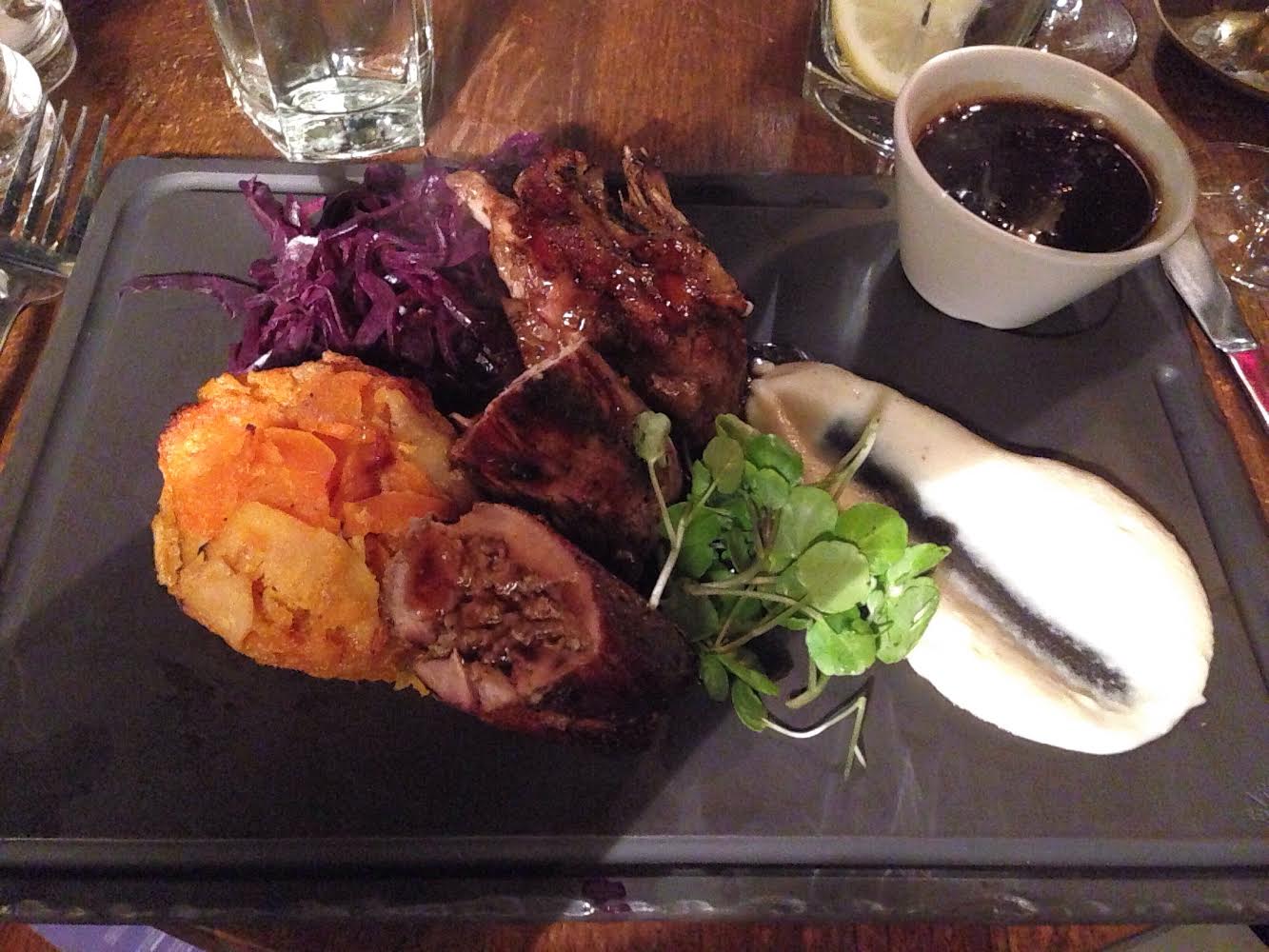
The other main was, despite being on their autumn menu, a wintry and comforting delight. There was so much going on on the plate (or slate in this case, as it happens) that it’s difficult to know where to begin describing it. So there was a confit leg of pheasant – delicious and gamey, if a bit difficult to detach from the spiky, spindly bones. There was a breast, filled with stuffing and rolled almost into a ballotine, rich, salty and herby. There was a big pile of red cabbage, full of the flavours of winter, a giant heap of spiced comfort. There was a root vegetable dauphinoise, so imaginative compared to a bog standard potato gratin, with a whack of garlic offsetting the sweetness of carrot and parsnip. And there was celeriac puree. It was described on the menu as “flavour bursting celeriac puree”, which again I found more than a little silly, but the last laugh was on me because it was exactly that – sweet but punchy, a little went a very long way. Bringing it all together was a little jug of something which was described as “mulled wine sauce” on the menu but just tasted like amazing gravy to me. I smiled from beginning to end while eating this dish: if plates of food were people, I’d have married it.

Pheasant

That main, as it happens, was recommended by our waiter – although, having read the description on the menu, I probably still would have ordered it if he’d said “my one tip is to avoid the pheasant, I’m pretty sure it has bits of asbestos in it”. But the service overall was pretty decent considering how full the place was. There were no empty tables when I got there, no empty tables when I left and the bar got buzzier as the evening went on. What were all these people doing in Sonning, a village which never troubles the national press? Your guess is as good as mine.

I’m sorry to confess that I’ve let you down, because I didn’t order dessert; I just didn’t have space (I blame all that soup) and there was nothing light enough that I could have managed it even after a breather. In any case, the dessert menu is probably the most conventional thing about the pub – brownies, sticky toffee puddings and the like – so I’m not sure I missed much, though I imagine they’d have done it well. Maybe with winter coming I’ll have to get into training to make sure I can manage all three courses. So instead, we settled up and left. The bill, excluding tip, came to sixty-two pounds. Apart from the two courses each we had a couple of pleasant, if unremarkable, glasses of red and a couple of drinks in the bar beforehand (the wine is much better value than the cider: a pint of cider is eye-wateringly close to a fiver). The main courses were definitely more at the restaurant than pub end of the price scale – the pie was fifteen pounds and the pheasant was seventeen pounds – but more than worth it, I think.

I can’t help but feel that the Bull has justified my new approach to picking pubs to eat in. It was a bit of a rollercoaster – I was excited before I turned up, distinctly unconvinced when I got there and then thoroughly wowed once the food arrived. The food was far better than I expected and got the balance just right – close enough to standard pub food not to alienate people who want that sort of thing but with just enough personality to interest people who are looking for a little bit more. What can I say? It won me over. If I lived in Sonning I would come here all the time, and as it is I’m wondering how quickly I can get away with going back. Maybe the village’s newest and most famous resident will drop by at some point; if she manages to get the Elgin Marbles returned to Greece I can’t think of anywhere more appropriate to celebrate.

The Bull Inn – 8.1
High Street, Sonning, RG4 6UP
0118 9693901

http://bullinnsonning.co.uk/

King’s Grill

Let’s start with the chicken. It’s glorious; straight off the grill, lightly charred on the outside yet tender inside from the marinade. It’s frustrating having to eat it with nothing but a plastic fork (even a plastic knife would have been something) but it’s so perfectly cooked that even a plastic fork can break it into smaller pieces. The lamb, if anything, is even better – juicy, savoury, no fat, no suspicious bounciness. The lamb kofte is just as good, minced but pleasingly coarse rather than turkey twizzler smooth, the herbs and seasoning bringing out every bit of the lamby goodness.

Subscribe to continue reading

Become a paid subscriber to get access to the rest of this post and other exclusive content.

House Of Flavours

Click here to find a more recent review of House Of Flavours, from May 2025.

I’d always told myself that I wouldn’t review curry houses, for lots of reasons. Reading has a lot of them, all over the place, for one. For another thing, the local papers cover them extensively and frequently. I’m not sure how they do it, after all it must be difficult to review an Indian restaurant every month. I mean, it’s all just different meats in different orange sauces most of the time, isn’t it? And who really cares which place does the best korma/bhuna/biryani anyway, especially when people tend to have a curry house that they go to out of habit and comfort.

So why is this week’s review of House Of Flavours? Well, people kept recommending it. It got mentioned on Twitter a lot. A few people asked me to go review it, and more than one said “you really should go”. So the contrarian in me thought “why not?” and that same contrarian quite liked the idea of going in December, when most people’s thoughts are turning to slightly more traditional warming food.

House Of Flavours is a little bit out of the centre, not far from the library, in a spot that has seen mixed fortunes over the years. It used to be Ha! Ha! (which I still miss, believe it or not), and then it was some tapas restaurant whose name escapes me, then an ill-fated pub that closed on Sunday afternoons, and then Mangal, the Turkish place which has gone up in the world and relocated to St Mary’s Butts.

Despite that, when I visited on a Saturday lunchtime (the December diary being what it is) I was impressed to see that the front room of this admittedly sizeable restaurant was pretty much full, almost exclusively with Indian families. I nearly left again when I thought this might be due to the all you can eat buffet they were offering (and nobody needs a review of one of those, in my opinion), but to my relief they were also offering their full menu so the very polished waiters talked me into staying. I’m glad they did.

The House Of Flavours’ menu is an intimidating tome. If you look at it on their website you get some idea of this; twenty-four pages long, and you don’t get to the a la carte menu until page fourteen. Before that it’s all drinks – a lot of drinks – and the set menus (at the moment a “Christmas menu”, though god knows how different that is to their usual set menu – I didn’t see any stuffing bhajis or turkey jalfrezi, thank goodness). The set menu featured a lot of the familiar dishes you could get anywhere else, but wading through to the a la carte things started to get a lot more interesting – a wide range of regional specialities, very well described, along with a range of vegetarian dishes so impressive I even considered ordering some of them.

We got the clichéd poppadoms while waiting for our starters and even these made me begin to feel like I was in a restaurant that happened to serve Indian food rather than an Indian restaurant. Two of the poppadoms were plain and delicate but the third was studded with nigella seeds and the taste and texture were something else. The raita was thick and fresh, not the insipid liquid you usually get. The mango chutney was also speckled with cumin and nigella, probably the best I can remember eating, and the onions (offered instead of the usual lime pickle) were finely diced and spiced, as tasty as they were antisocial. So often this is just a way to eat something, anything, while you’re waiting for your starters to arrive but these felt like they had a purpose all their own. It was a promising beginning.

The starters, by and large, lived up to that. The lahsooni chicken tikka was just gorgeous – three sensibly sized pieces of chicken, marinated in yoghurt and spices and cooked beautifully. Everything about the flavour and texture of these worked perfectly – the spicing came through with the right intensity at the right speed and the meat was so tender. I was simultaneously sorry they were over so quickly and delighted that they were perfect – always the way with a truly great starter.

Lahsooni Chicken Tikka

The other starter was maave ki seekh, which is described on the menu as “root vegetables and cottage cheese flavoured with ginger and cooked in a clay oven”, and it was delicious if not entirely what I was expecting. The texture was rather like partially cooked gingerbread, cooked on a skewer; the outside was slightly firm and the inside was a delicious warming paste. If it had any vegetables in it I couldn’t truly tell but it was still very tasty, especially with a squirt of lemon juice and a few sprigs of – properly dressed – salad on the side. I keep thinking about what I can compare it to and falling short. Was it like falafel? Not really. Like a bhaji? No, that’s not right either. Maybe this is another reason why I shy away from reviewing Indian restaurants, because I don’t have the vocabulary to do them justice.

Maave Ki Seekh

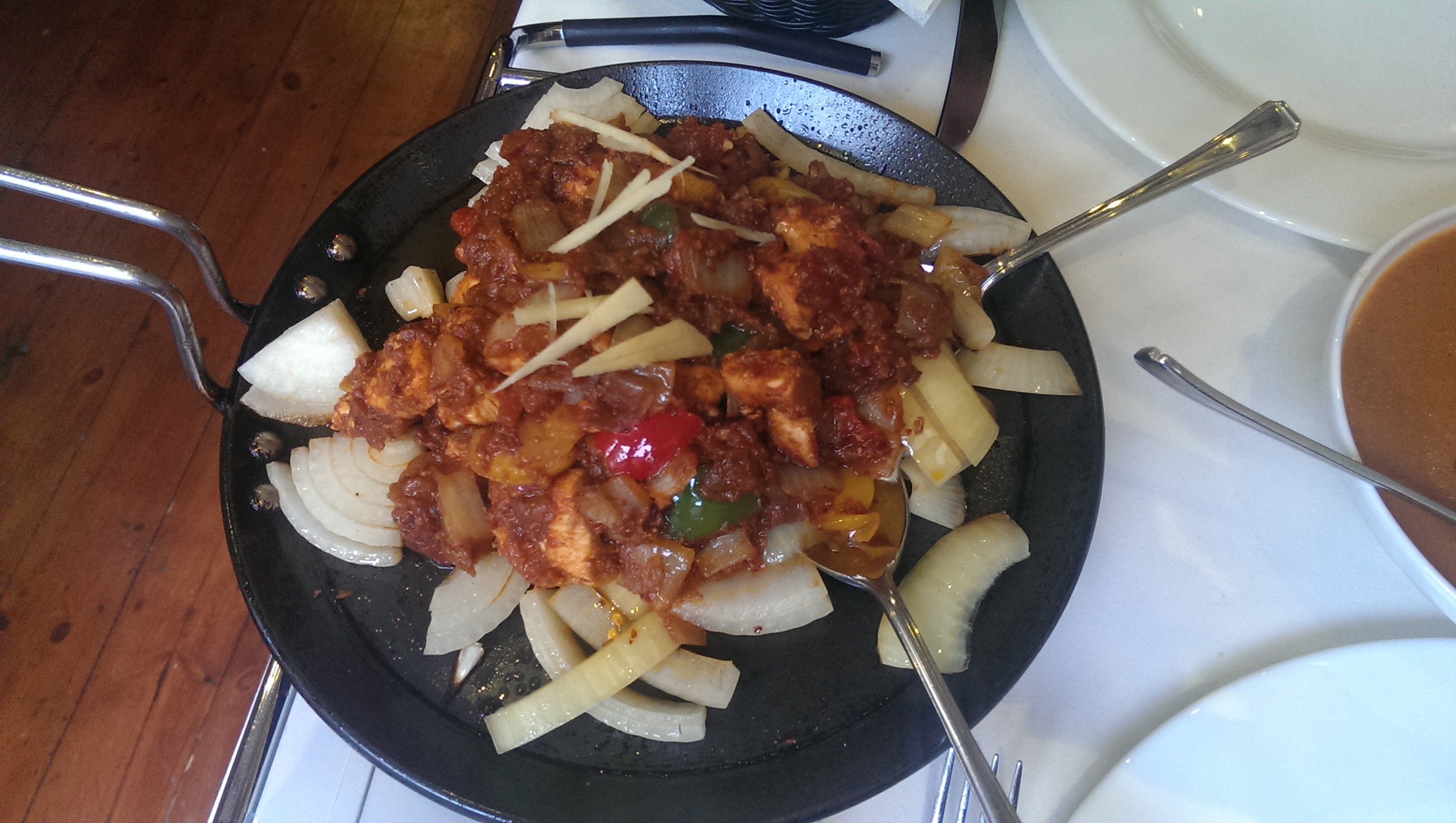
By this stage I thought I was probably onto a winner, although I’ve been disappointed at that stage many times (how many restaurants have you been to where you’ve thought I wish I’d stopped at the starters? For me it’s hundreds). But the mains didn’t let the standard drop. Shahi chicken tak-a-tak (named, according to the very informative menu, after the noise it makes popping away on the skillet) is one of those sizzling griddled dishes you always get jealous of when someone else at your table orders it. This one was no exception: so much more than just a pile of meat and onions, it came with a rich hot sauce with plenty of tomato. How hot? Well, I didn’t lose all feeling in my mouth but tissues had to come out at the table – I hope that’s not too much information, but until someone comes up with a Richter Scale of food heat it’s the best I can do. I loved it.

Shahi Chicken Tak-a-TakAgain the heat was really clever; it built up slowly, in layers, rather than pulverising you from the start. I’m not going to say “oh, it was genuine Indian food” because I’m not Indian and I wouldn’t know, but I’ve been to India once and it reminded me of the food I had when I went – that intelligent, calculated use of spice. Again, the chicken was soft and tender, not firm and unyielding, although after the starters I wouldn’t have expected anything less.

Having said all of that, the other dish was indeed chunks of meat in an orange sauce. Well, almost anyway – the mahi dum anari was sizeable chunks of fish, soft to the point of falling apart, in a silky sauce. This sauce was much more delicate, almost sweet but again the spice worked brilliantly. I wish I could do it justice by describing it better, but I might try and improve my skills in this area by going back to House Of Flavours. The other delight in this dish was the pomegranate on top – I was sceptical about this but its sweet pop under the teeth went superbly with the dish. According to the menu, this dish was served to Barack Obama on his last state visit to India; I wasn’t moved to take a selfie, but I did take a picture of the dish (it doesn’t do it justice any better than this paragraph does).

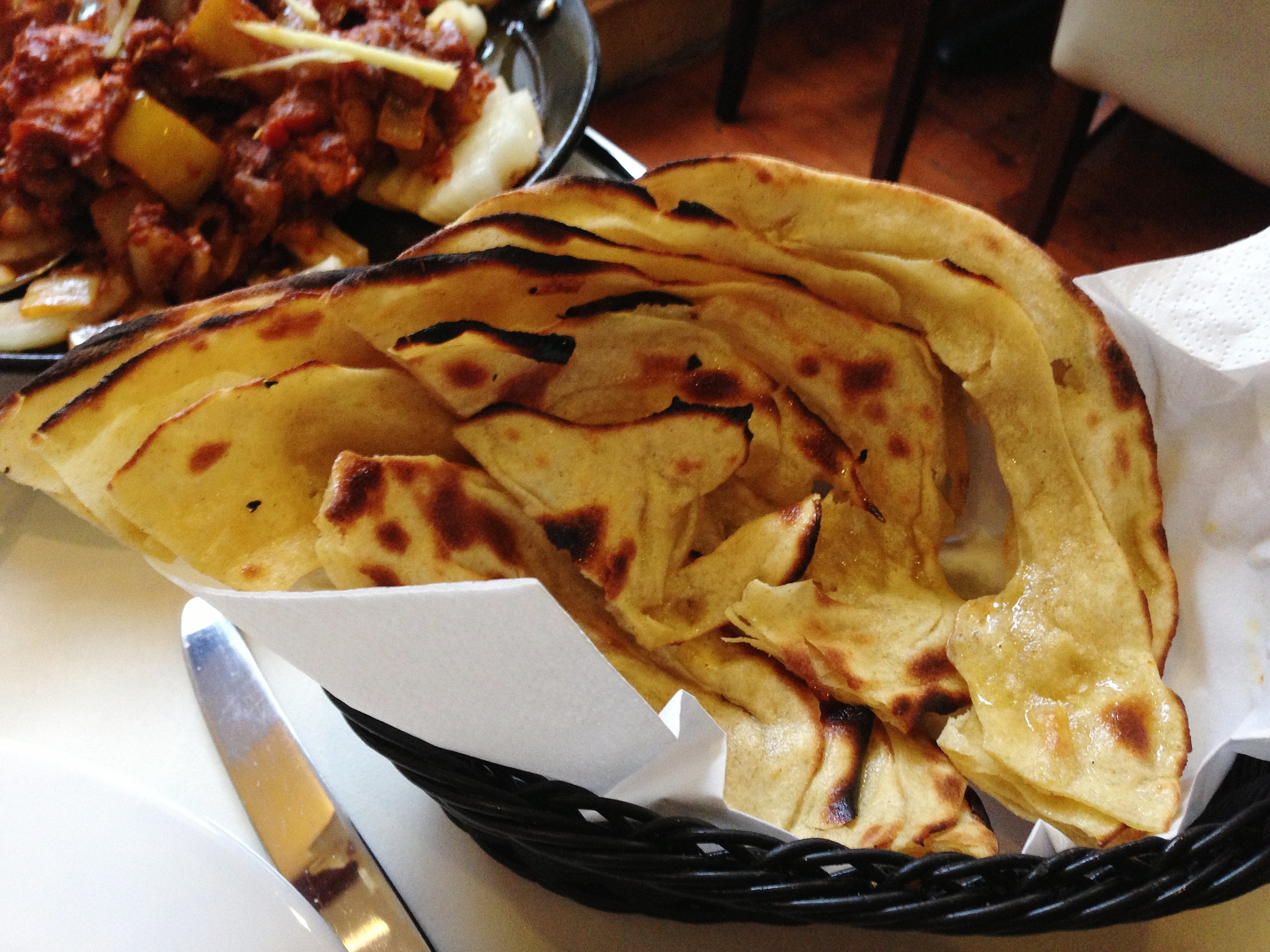
Mahi Dum AnariNormally in a curry house this would be accompanied with some pilau rice and a big fluffy naan but again, I was moved to try different things. The mutter pulao was rice rich with peas and with just the right amount of cumin, another revelation in a meal packed with revelations. The paratha was even better, buttery, chewy and soft at the same time and layered in a way which somehow reminded me – I don’t know why – of the pastry on the bottom of a tarte tatin.

ParathaNobody goes to an Indian restaurant for the drink, but I feel I should mention it because the wine list has three Indian wines on it. I tried two: the sauvignon blanc was decent if slightly thin on flavour but the cabernet sauvignon was spot on – properly hearty and feisty enough to stand up to the spices in my meal (I might have had a bottle, but it was all Kingfisher on the opposite side of the table to me, which is fair enough I guess). They also have two pretty creditable dessert wines – a Sauternes and a Californian red muscat – at very reasonable prices, albeit not for a full glass.

The reason I know about the dessert wines is that I couldn’t stay away from the desserts. I have a real penchant for gulab jamun so I was thrilled to see them on the menu. If you have a sweet tooth and you’ve never tried them, you’re missing out; they’re doughy balls – made from curdled milk, but don’t let that put you off – deep fried and then served soaked in a sugar syrup tinged with cardamom and rose water. The portion here is only small (two balls – no jokes, please) but that turned out to be plenty, especially if you don’t share them with anyone, as I didn’t.

The total bill for two people, for three-ish courses with a couple of drinks each came to £65. You could eat more cheaply than that if you stuck to one of their set menus but even so I felt this was very good value. I mentioned the service in passing at the beginning of the review but it is worth another mention too – very polished, very smooth and only there when you needed it. The whole experience felt very different to most Indian restaurants I’ve visited in Reading.

How to sum this place up? Well, how about doing it like this: I remember when I first found out that this place was opening, and I remember walking past the sign and reading the name. House Of Flavours? I thought. That’s a ridiculous name. It’s just going to be an Indian restaurant, and Reading needs another one of those like it needs another Italian. Now I’ve been, I know how wrong I was; it’s the perfect name for the restaurant and it sums up exactly what they offer – more than anything, the flavours are what I remember. I can’t think of many higher compliments for a restaurant than this, but even before I’d left I was already planning my return. Thinking about what flavours I’d like to sample next.

House of Flavours – 8.3
32 – 36 Kings Road, RG1 3AA
0118 950 3500

www.house-of-flavours.co.uk