Restaurant review: Amò Italian Street Food

In the good old days, where you stood on certain binary debates was simply a way of positioning you in the world. Cream first or jam first? Plain or milk chocolate Bounty? Cheese and onion or salt and vinegar? Were you a fan of the Beatles or the Stones? Blur or Oasis? All these things used just to be a form of triangulation, little points on a chart that, taken together, might give someone an idea of you (and, since you’re asking: cream first; milk chocolate; salt and vinegar; the Beatles; neither).

When did that all change? 2016, I suppose, when we all became Leave or Remain, indelibly stamped, and at every stage from that point forwards. We’re always asked what side we’re on, and now it’s not a useful piece of trivia but a necessary step to place yourself on one side or another of a yawning chasm. Are you pro- or anti-Israel? Do you think J.K. Rowling is a hero or a villain? How about Farage, or Trump? Did you believe in lockdowns, masks, vaccines? Did you leave Twitter or stay? If you left, did you go to Bluesky or Threads?

Like the Tower Of Babel, we’re now all scattered to the four winds, trying to find our tribe and arguing, endlessly, with the others. It’s not a bit of fun, any more. And this is all rich coming from me, because I’m painfully aware that I’m as polarising as most. Happily, Reading faces another tricky choice now that’s potentially just as difficult, but hopefully less divisive: Paesinos or Amò?

The two pizza places opened on Kings Road, two doors and three months apart, the latest in a weird series of rivals in very close proximity, following the example of Pho and Bánh Mì QB in Kings Walk or Iro Sushi and You Me Sushi on Friar Street. What is it with that? You must be very confident in your product to open so near to a direct competitor, like Bánh Mì QB did, but with Paesinos and Amò, Iro and You Me so little time separated both arrivals that it must be an unhappy coincidence. Imagine pouring your heart and soul into a new business only to find that another one a lot like yours is doing exactly the same, a stone’s throw away.

Anyway, regular readers will know that I reviewed Paesinos a month ago with my Italian friend Enza (who is, just to confuse matters, an Amò superfan) and it received a glowing write up from me. But I knew, even as I was eating there, that I needed to prioritise visiting its neighbour, if only because Enza told me that it was as good as, if not better than, the restaurant I had so enjoyed. I couldn’t go with Enza, because she was so far from impartial, and this time I took my friend Jo, also of Italian descent, last seen checking out House Of Flavours with me.

Amò is, as I’ve said before, something of a joint venture between Madoo, the founding father of Reading’s Italian quarter which opened four and a half years ago, and Pulcinella Focaccia, a business that sold pizza and focaccia for delivery from premises out in Earley and has been trading for a couple of years; I’d never had food from the latter, but I’d heard plenty of good things. And arriving at Amò on a weekday evening I was struck that, in terms of branding and decor at least, it felt fully formed in a way that Paesinos didn’t so much, or Madoo for that matter.

Everything was tasteful and unfussy without being Spartan, with a bare wood floor and tables, seats and benches. It seated somewhere between fifteen and twenty people, so significantly more spacious than the likes of Mama’s Way or Paesinos, and it had a nicely calm feel to it. Amò’s logo was in the middle of a deep red swatch of paint on the wall behind the counter, and resting on that counter was possibly one of the most tempting displays in Reading.

Amò very cleverly changes up its offering around the time people start finishing work, so until 5pm you can try pizza al taglio or something from a changing array of Italian street food. They also, I think, offer focaccia sandwiches during the day, although most of them had gone when Jo and I turned up around half seven. After 5pm the sandwiches drop away but instead, alongside the slices of pizza and street food, you can order a whole pizza from a more varied menu.

The street food was all very tempting, all things that I would challenge anybody not to fancy eating. Arancini, croquettes, mozzarella bites and frittatini – fried pasta – were all tributes to the time-honoured method of coating something in breadcrumbs and frying it until it was golden, crispy and alluring. The lighter side of Amò’s offering is keenly priced, too. Most of the street food dishes are around a fiver, pizza by the slice is less than that and they do multibuys if you want two stuffed focacce or two slices of pizza. Whole pizzas top out at about fifteen pounds, unless you add sausage or Parma ham to one of the options.

And Amò’s pizza menu struck me as very clever, because – either by accident or design – it kept the overlap with its neighbour’s pizzas to a minimum. Amò has a list of the classics, of course, so you can have a margherita, or prosciutto cotto and mushroom, or sausage and friarielli. But on the other side of the small, laminated menu, you find loads of less conventional options, far more interesting than the kind of things you could find at Zia Lucia or even, dare I say it, Amò’s neighbours.

That meant pizza with a purple sweet potato base, topped with cacio e pepe cream, guanciale and sweet potato crisps, or pizza with a pistachio cream base and mortadella. Others had a truffle cream base, or pumpkin cream, or even a cavolo nero base (“it’s the gourmet version of the salsiccia e friarielli”, Enza had told me, when I was looking for recommendations).

You may find all of that a bit leftfield, or it might whet your appetite for wandering off Reading’s beaten pizza track. I think for me, though, it was neither: I chalked those up as things to try once I had road tested the classics.

But first, Jo and I had a chinotto each and ordered some of those smaller dishes to kick things off. And as we waited for them, she told me about her childhood holidays by the coast, near Salerno, buying balls of mozzarella as big as your head from some beachside hut and eating them with bread, nothing else required. It was brilliant, Jo said, but it did slightly ruin the mozzarella you can easily get in this country; like me, Jo considers it a seriously underrated cheese.

As so often I felt a little pang for a childhood I didn’t have, listening to Jo. But then there was something to be said for sitting in a caravan in Devon, rain drilling on the roof, eating hog’s pudding cooked in a frying pan – always with tinned tomatoes on the side – watching Roland Rat on TV-am, knowing that the evening would be spent playing cards and watching reruns of Shogun (the original, not the superb remake). Maybe those memories would sound exotic to an Italian: on balance, though, I guessed not.

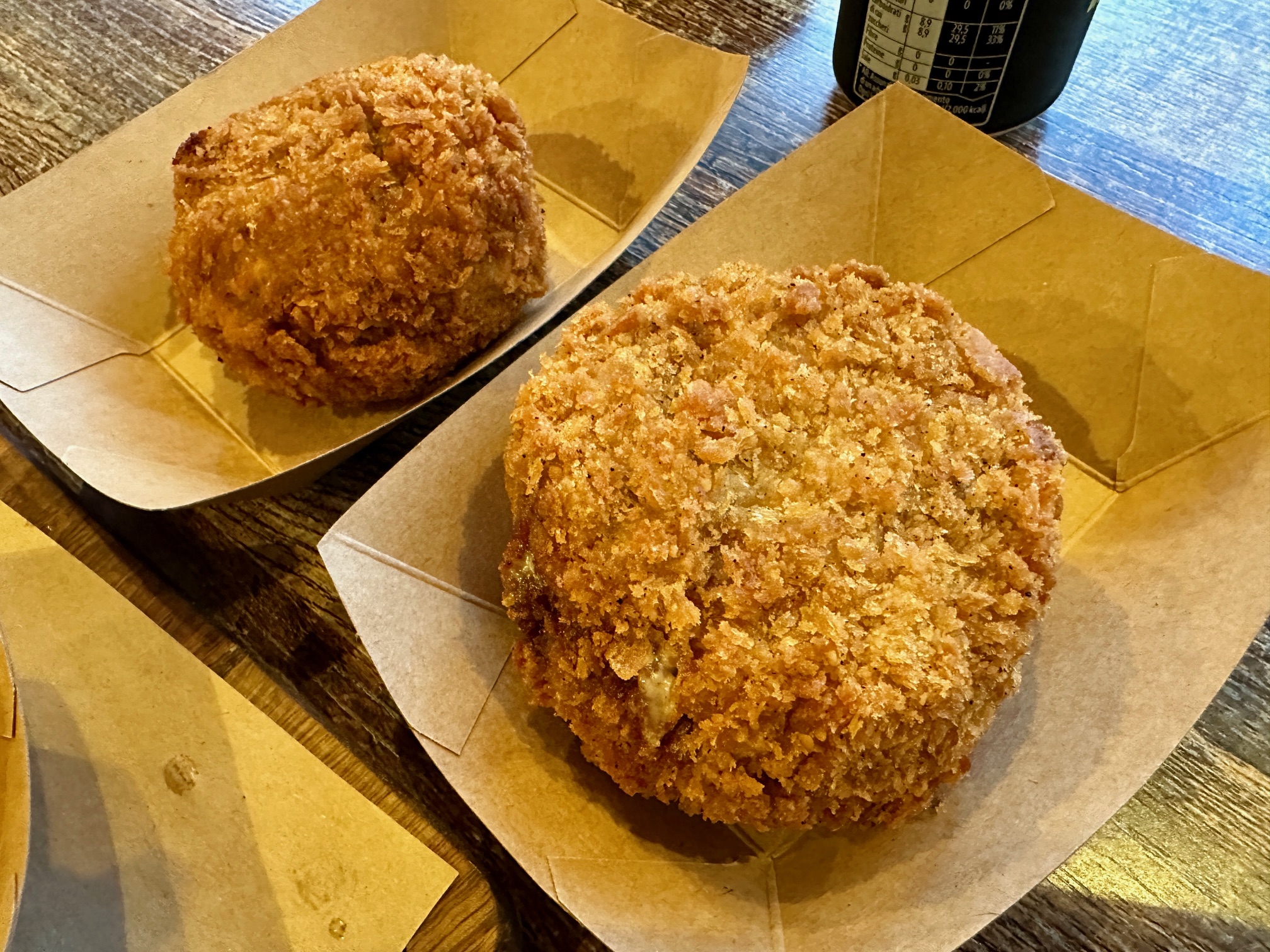
Amò’s mozzarella bites may not have been the size of my head, but they were gorgeous nonetheless. Crisp-crumbed spheres, golden but not overdone, the shell holding just-molten-enough mozzarella, they were a proper delight. I might have had them with something to dip them into, but it was a minor quibble with something so delightful. So was the fact that however carefully I ate them, with my hands at least, a little liquid sprayed out, leaving incriminating marks on my shirt. I was too happy to care, and the attentive staff quickly brought extra napkins.

At five pounds fifty for four, they could have been the bargain of the meal, if not the month, but for the fact that we also ordered two of the frittatini. These are yours for three pounds fifty, or six quid for two, and come in two flavours. If you go to Amò, my advice is to make sure you have one to yourself or, as Jo and I did, order one of each and share. They’re a bit fiddly to break up – that crisp carapace presents resistance when you’re relying on a wooden fork – but they reward the effort, with dividends.

They were beautiful things, and when I sit down in six months or so to write my annual awards it’s hard to imagine they won’t feature in some shape or form. And their form – big, irregular golden pucks – belied just how wonderful they were on the inside.

Picture an arancino, but instead of risotto rice visualise a cluster of little tubes of pasta, and rather than a molten core, imagine the whole thing bound together with sauce. In terms of taste, contrast, texture and sheer tactility I’m not sure I can think of anything finer, and writing this paragraph I am deeply aggrieved that I cannot eat one right this minute, or indeed by the end of the day.

This is where Amò are an especially smart bunch, because during the day you could pitch up, have a chinotto, a slice of pizza or a sandwich crammed with porchetta and provolone, and add one of these for a mere three pounds fifty. That’s almost the price of subscribing to this blog for a month and, although it pains me to say it, it’s even better value.

Jo and I both loved the meaty version but would you believe that the vegetarian option, with fried aubergine and tomato, was even better? Jo described it as like being “slapped in the face with flavour” and believe me, apart from that fried pasta, nothing or nobody would get away with slapping Jo in the face with anything. One of the best things I’ve eaten this year, no notes at all.

Jo was very keen to try one of the pizzas by the slice, with meatballs on it, so that turned up next, thoughtfully cut up to share, a meatball perched precisely in the centre of each quadrant. This too was cracking, although I suspect the base on the pizza al taglio is slightly different to that on the whole pizza. The meatballs, in particular, were excellent – coarse and lacking in suspicious, smooth bounciness. It also, by the looks of it, was only available by the slice so, again, well worth adding to a lunch order.

By this point, as our full-sized pizzas arrived, the carbs were taking their toll, and we were already prepared to ask if some of our leftovers could be boxed up – something that rarely happens to me, because it’s rare that my capacity is defeated by a restaurant.

Jo made it a few slices into hers, the piccantina, which was topped with salami, mushrooms and Gorgonzola. I didn’t try it, and from a cursory glance I thought the porcini were common or garden mushrooms, but Jo had no complaints. She’d told me earlier in the evening that she hadn’t had pizza for a while: Jo is on a monthly treatment regime where anything she eats the next day tastes vile and puts you off whatever you ate for the foreseeable future. One of those next days had involved pizza, and Amò’s piccantina resuscitated her love for the stuff. That in itself is no mean feat.

I on the other hand had deferred to Enza’s judgement and ordered the sausage and friarielli. As so often with white pizza, it had a bit more structural integrity, so less of the Neapolitan droop you might get with other pizzas. And the base was admirable, nicely puffy with plenty going for it. You couldn’t fault the generosity either, with nuggets of crumbled sausage very, very liberally deployed.

There was very little not to like about the pizza, and if I was clutching at straws I might say that I’d have liked the sausage to have more of a whack of fennel, but that’s a minor thing. It was so well orchestrated with the friarielli that it was impossible to argue: this was a pizza without complexity or variety that kept it focused and hit the target.

I managed about half of mine, and the staff were nice as pie about bringing a couple of boxes so we could take our leftovers home. Everything we had ordered – all that food, four cans of soft drink – came to fifty-five pounds, which is a steal, and then we went to the Allied for a debrief. Two pints of forgettable macro fizzy booze at the Allied set us back nearly sixteen pounds, which is very much not a steal.

For once, I can also report back on the leftovers. Jo had hers cold the next day – no slice for her beloved dog Diesel, this time – and sent me an iMessage: tastes even better this morning, cold from the box, outstanding! I on the other hand revived mine in the oven on my lunch break, working from home, and it was the best lunch I’d had in ages. I wasn’t sure if my slight lull that afternoon was down to the carbs or a Teams call that felt especially like a trudge. Let’s put it down to the latter.

Having talked about Amò for all these paragraphs, I know I should return to my opening theme and compare it to its neighbour Paesinos. But it’s not easy to do.

If they were top trumps cards, Amò would win in a number of categories. It’s more versatile, on account of having a focused lunch offering as well as pizzas in the evening. It has arguably a wider range of sides and small plates. It’s bigger, too, with far more potential to eat there in larger groups; if you go to Paesinos as a four, you either won’t get in or you’ll take up two-thirds of the restaurant. Its pizzas are more imaginative and unconventional, so more of a challenge to the Neapolitan hegemony elsewhere in town.

On that basis, you’d have it down as a resounding victory for Amò and, for some of you, that might well be the case. On the other hand, Paesinos sticks to the classics, both for pizza and for its smaller dishes. I think its soft drink selection – and neither is licensed – is better and more interesting. The cannoli and tiramisu are worth the price of admission alone. And, speaking completely as a novice in these things, I think Paesinos’ dough and base may have the edge.

But the main reason why taking a Top Trumps approach doesn’t work is that Paesinos, for me, has a little something extra. There’s no Italian equivalent of je ne sais quoi, as far as I know, but there’s a small dash of magic in the smaller restaurant that means that rationally, although I know Amò has a huge amount going for it, it’s impossible to pick a winner.

So yes, I’ve reflected and reflected and it’s impossible to put a cigarette paper between these two places. The only thing you can put between them, it turns out, is another restaurant – called Just Momo, which helpfully doesn’t just do momo. So the rating down there reflects that: call it a cop out, if you will, but I stand by it.

Let’s not divide ourselves by being Team Amò or Team Paesinos, because as a town we can be better than that. Hopefully enough of you will pick each side that both places will continue to trade for years to come. Because the truth is that there’s one real winner in this contest, and that’s Reading.

Amò Italian Street Food – 8.6
2-4 Kings Road, Reading, RG1 3AA
07500 619775

https://amoitalianstreetfood.co.uk

Since January 2025, Edible Reading is partly supported by subscribers – click here if you want to read more about that, or click below to subscribe. By doing so you enable me to carry on doing what I do, and you also get access to subscriber only content. Whether you’re a subscriber or not, thanks for reading.

Restaurant review: Paesinos

Here’s a tip for you: if you want to discover how many Italians live in Reading just drop innocuously into conversation online, on a local Facebook page or the Reading subreddit, the question of Reading’s best pizza. Because if you do, Reading’s Italian contingent will come out of the woodwork. This calls for opinions, and they have plenty. They don’t fuck about, either.

“Being Italian and of partly Neapolitan descent, I am picky when it comes to pizza. Or better, I eat anything, but I know a good pizza from a bad one, and from a non-pizza” began Luca, on the Edible Reading Facebook page. He went on.

“The only real pizzas in Reading have been Papa Gee’s, for years. Then Sarv came, and Zia Lucia (both ok). I have recently tried Zi’Tore and above all Paesinos, the latter is possibly the best in Reading. The chef and manager is Sicilian and has previously worked at the Thirsty Bear. However, Thirsty Bear make American style pizza, while Paesinos make real pizza.”

Another of my Italian readers, Franz, was more generous about the Thirsty Bear. “It’s just a different style” he said. “Italian pizza purists perhaps will take a bit to adapt (I’m Italian, but open minded). A slice of their TriBeCa, curly fries and a pint is hard to beat. It just makes me happy and satisfied.” Franz also had opinions about Zia Lucia, and its “horrible, plasticky” mozzarella.

After that Luca and Franz ended up having a fascinating conversation about whether you could find good pizza outside Italy. Franz thought it was easy to do, these days. Luca disagreed, but said you could even end up getting what he called “non-pizza” in Italy, unless you were in Campania or Sicily. Just to chuck in a curveball, the best pizza Franz ever had was in the Swedish city of Norrköping. “It was Neapolitan style and was excellent, but then they had a corner in the pizzeria that was all dedicated to Totti so that confused me from an allegiance perspective.”

I could have listened to Luca and Franz discuss these niceties all day: it seemed that if you asked two Italians you were likely to come out of the conversation with at least three opinions. Over on Reddit, other Italians were weighing in. “Zi’Tore in Smelly Alley has taken the crown as the best pizza in town (in my humble, Italian, opinion)” said one. “And the pizza al taglio from Amò is even better.”

This is particularly topical because last week Sarv’s Slice announced that they were leaving the Biscuit Factory, after falling out with the owners both there and in Ealing. The reaction across the internet was one of huge sadness, coupled with genuine fear for the future of the venue. But this happens against a backdrop of Reading’s pizza scene exploding, so Sarv’s Slice might have quit while they were ahead: the market has become saturated since they opened in 2023, and even more so in the last six months or so.

Let’s run through the timeline. Last year Dough Bros opened out on Northumberland Avenue, and in the summer Zia Lucia opened in town. From then, things have only accelerated: at the start of the year Paesinos opened opposite Jackson’s Corner. Then Zi’Tore opened in February, in the old Grumpy Goat site. At the end of April, two doors down from Paesinos, Reading got Amò, a joint venture between the owners of Madoo and Pulcinella Focaccia, a pizza trader who operated from their home address out in Earley.

And believe it or not, last Wednesday another pizza restaurant, Peppito, opened on the first floor of Kings Walk, John Sykes’ restaurant sweatshop. The time between pizza restaurants opening in Reading appears to have some sort of half-life, so by the time this goes to press I wouldn’t be surprised if two more places had started trading, making all this out of date.

So the vexed subject of Reading’s best pizza isn’t something anybody, Italian or not, is going to settle in a hurry. But that’s no reason not to begin this important project, so last week I strolled down the hill from Katesgrove into town to check out Paesinos, the first of this year’s intake to start trading, on the Kings Road. I had a secret weapon, my very own Italian: my friend Enza was joining me to check this one out and see how it compared against Zi’Tore and Amò, both of which she’d researched extensively.

I was early, so I got to take in what must be one of Reading’s smallest dining rooms. Just three tables, each seating two people, although the table closest to the front door was so Lilliputian that it was hard to imagine adults sitting there, except to wait for a takeaway. A fridge hummed next to the counter, holding an interesting selection of soft drinks.

I spotted chinotto, one of my favourite things, and got one, with a plastic cup, while I waited. I’m used to the San Pellegrino version of this drink, that you can pick up in cans in Madoo. It’s dandelion and burdock’s older, more sophisticated cousin, wearing a rollneck and smoking a cigarette. But this bottled version, by Sicilian company Polara, was more nuanced, the rough edges smoothed off. I felt that all-too-familiar sensation, the gradual raising of expectations.

I looked through Paesinos’ menu. It was a single long laminated sheet with pizzas split into categories – classic, premium, signature, fusion – although the taxonomy they’d used was unclear to me. It certainly wasn’t pricing: most of the 13 inch, standard pizzas, were between thirteen and sixteen pounds whatever you ordered, many of them costing random amounts like £12.97, £13.96, £14.86. I liked the capriciousness of that.

They weren’t split into categories using any mindset I could understand. I could see something with “kebab chicken, jalapeños and buffalo sauce” being a fusion – or even a confusion – pizza, but a standard pizza bianca? Paesinos had attracted some commentary around its pizza Americana, topped with french fries and frankfurter: it might well be authentic, or authentically Sicilian, although I’d personally rather drink the bin juice from my food recycling after it’s been strained through Jay Rayner’s y-fronts. But whatever it was, surely it wasn’t “premium”?

All that said, there was something about the lack of polish in this menu that I liked. I could say it was trying to do too much, with its paneer and tandoori chicken, but nobody was making me order that stuff. In the core of it, ignoring the wackiness, there was a solid collection of options, many of them intriguing.

Then Enza arrived, and ordered a chinotto, and we got to catching up. Despite regularly exchanging messages, we realised we hadn’t seen one another in a very long time and there was plenty to discuss – her empty nest, my new house, all the life events and randomness that make you realise that you think you know what’s going on with someone via social media but that, really, you don’t.

The other thing I gathered, gradually, as we got to talking about Reading’s explosion of Italian restaurants, was that I was finally eating with someone even more determined to maintain their anonymity than me. Enza, it transpired, had been to Paesinos once before with her husband and very much enjoyed what they ate – the pizza “al portofoglio” or folded pizza for her (it translates as ‘wallet’), the tuna and red onion for him – but she was a far more frequent visitor to Amò a couple of doors down. So much so that she seemed to be furtively looking around, worried about being discovered, and lowered her voice when she mentioned Paesinos’ neighbours.

“I can’t help it!” she laughed. “I love it there. So much that I want to get involved. I keep telling them they should make the kind of pizzas you can only get in my part of Italy” – Enza’s from Potenza, in the ankle of Italy, halfway between Naples and Bari – “and if they do, I think I should get commission.” I offered to change her name for the purpose of this review, but she decided to let the chips fall where they may. At least they didn’t fall onto a pizza Americana, I suppose.

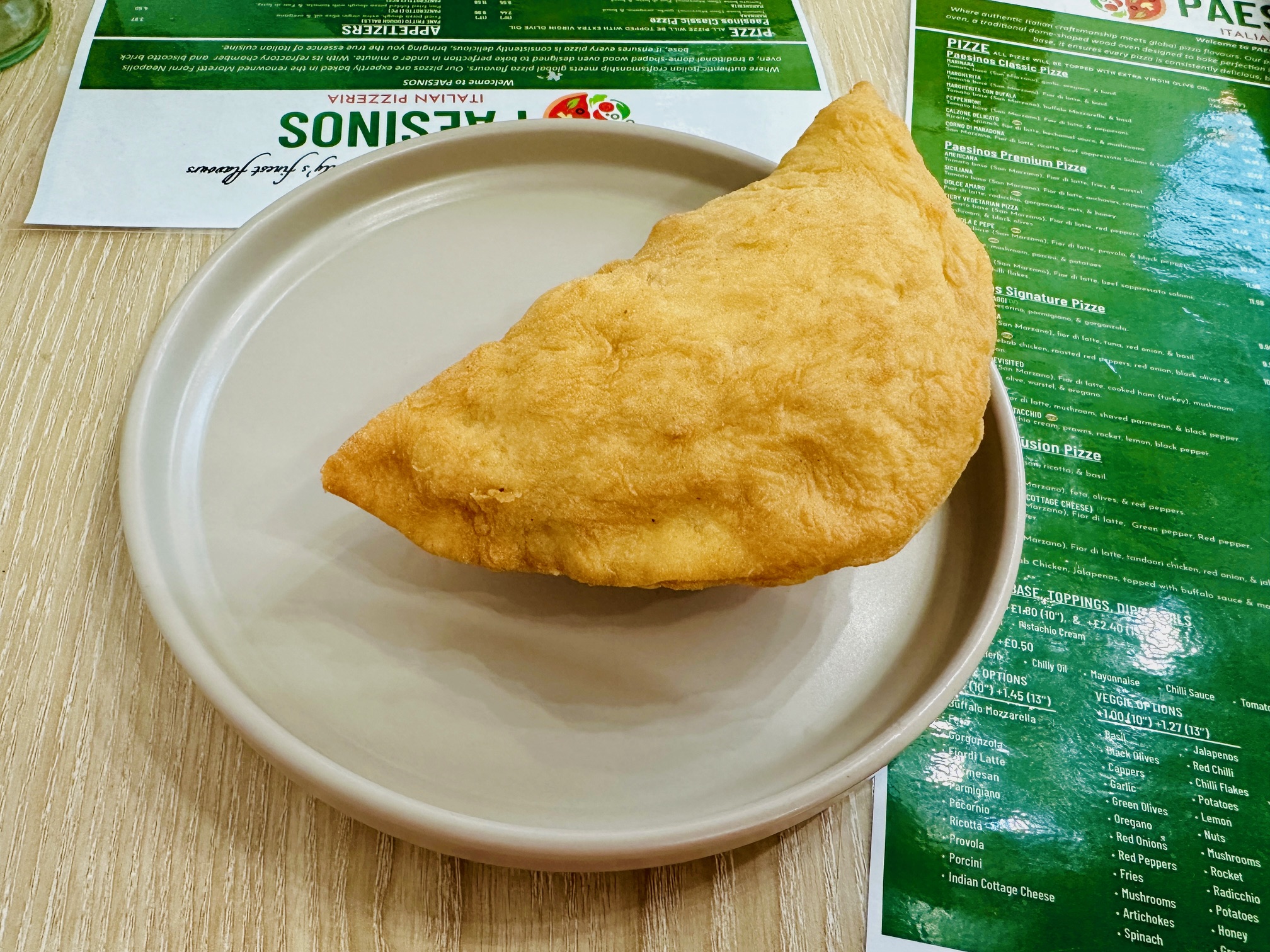
We started with appetisers, which meant a panzerotto each. Franz, on my Facebook page, had particularly recommended these, saying they were a speciality from Bari, where he came from. It was my first experience of Paesinos, and about as good a calling card as you could hope to encounter, a gorgeous crescent of fried dough filled with just enough mozzarella and tomato, too big to eat with your hands but not like a full-sized calzone. You got two for something silly like seven quid, and outstanding just about does them justice. As an introduction to the dough, too, it put down quite a marker. This huge, irregular pocket of joy made me very happy indeed.

“I tell you what, this is a lot bigger than the panzerotto I had in Montpellier” I said to Enza, between mouthfuls. She smiled.

“I wouldn’t say this is big by Italian standards. It is really good, though.”

In my mind I was thinking that I would come here and eat this again, but I was also remembering that the menu boasted pizza fritti, stuffed with ricotta and sopressata, and that I needed to try that. Enza also had a yen to sample the mozzarella in carrozza and maybe we should have tried that too, but I was put off by experiences of having it at Prezzo, many years ago, no doubt straight out of the freezer. I already had a reasonable idea that the only thing coming out of a freezer at Paesinos was the gelato.

“Would you say there’s never been a better time to be an Italian in Reading?”

“Absolutely!” said Enza, and then she told me a lovely story. I knew that she was a big fan of Zi’Tore, on Smelly Alley, and especially their cakes, many of which were ones you just didn’t find in this country. But then Enza told me all about the graffe, a sort of fried doughnut made in a distinctive loop shape, sugared but made out of a mixture of flour and potatoes. They’re specific to Campania, where she was born, and growing up in Salerno they were a regular childhood treat.

And then, some years later, Enza wanders into a cafe hundreds of miles away that’s just opened in her adopted home town, the unlikeliest of places, and finds them there. Graffe. And when she told me about this: maybe it was her excitement, or how well she conveyed it, or perhaps I was just having a lovely time, but even I felt it. I was vicariously moved, and I remembered the power food has to transport and transform.

It’s one reason to envy Italians, because what would I feel nostalgic about? Ice Magic, the chocolate sauce that was no doubt filled with chemicals so it hardened into a shell when you poured it on ice cream? The way Nice N’ Spicy Nik Naks used to taste before they were fucked with? Different permutations of processed food, and the excitement of a Findus Crispy Pancake? No, Britain had nothing to compete with graffe. Little wonder that Enza sounded so full of joy, although it did make me ponder how many privations she’d suffered through years of living here.

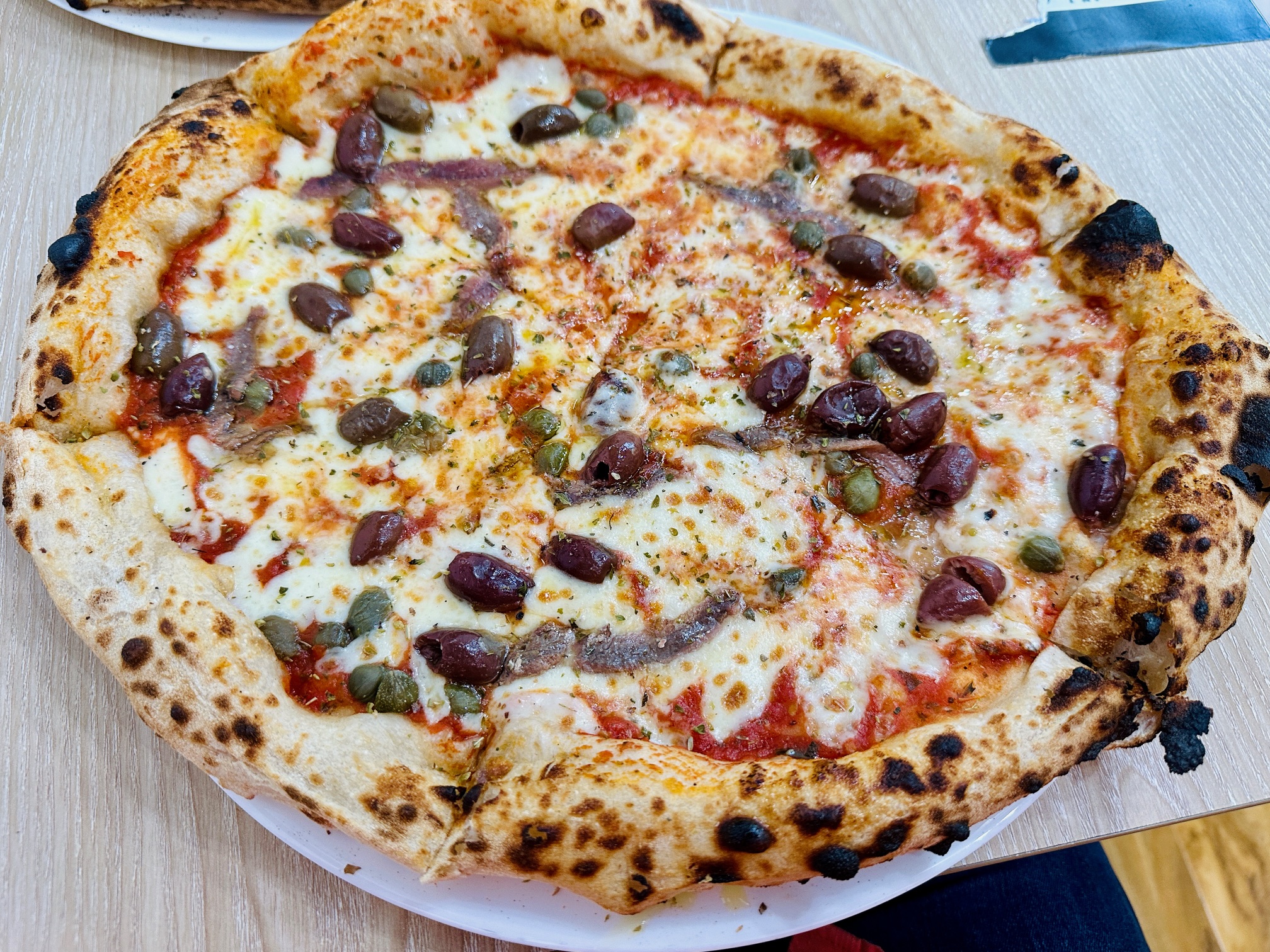
If the panzerotto set up expectations, the pizza fulfilled them. I’d chosen the Siciliana, my reference pizza of olives, anchovies and capers. It’s sometimes called a Neopolitan, presumably because every part of Italy wants to claim the best ever pizza as theirs. Based on what I ate at Paesinos, I can hardly blame them. Everything was exactly as it should be – the right amounts, the right proportions, the right balance. The saltiest of anchovies, generously deployed without being overkill. Purple, perfumed olives. Little clusters of plump, sharp capers (Enza preferred them salted, but give me the vinegary hit any day).

The base was heavenly. Puffed at the rim, beautifully irregular, a proper Neapolitan style pizza that drooped in the middle, although it firmed up as it cooled down. “The dough is completely different towards the end of eating the pizza” said Enza, and she was spot on. I loved the way that she tore a little bit of her crust off and tried it, on its own, before making inroads, a little ritual, almost like a benediction. I followed suit, and again that allowed me to admire Paesinos’ dough before all that other stuff happened to it. It was better after, but pretty much perfect before.

Later on I asked the pizzaiolo, who was indeed Sicilian, whether most of their trade was takeaway and delivery, given Paesinos’ size. He said it was, but that those people, however good his pizza was, missed out ever so slightly. “It’s 100% when it leaves the oven” he said, “but when it gets delivered it can only ever be 90%.” I think he’s right, and explains better than I can why, when you read the rating at the bottom, you need to come here rather than fire up Deliveroo.

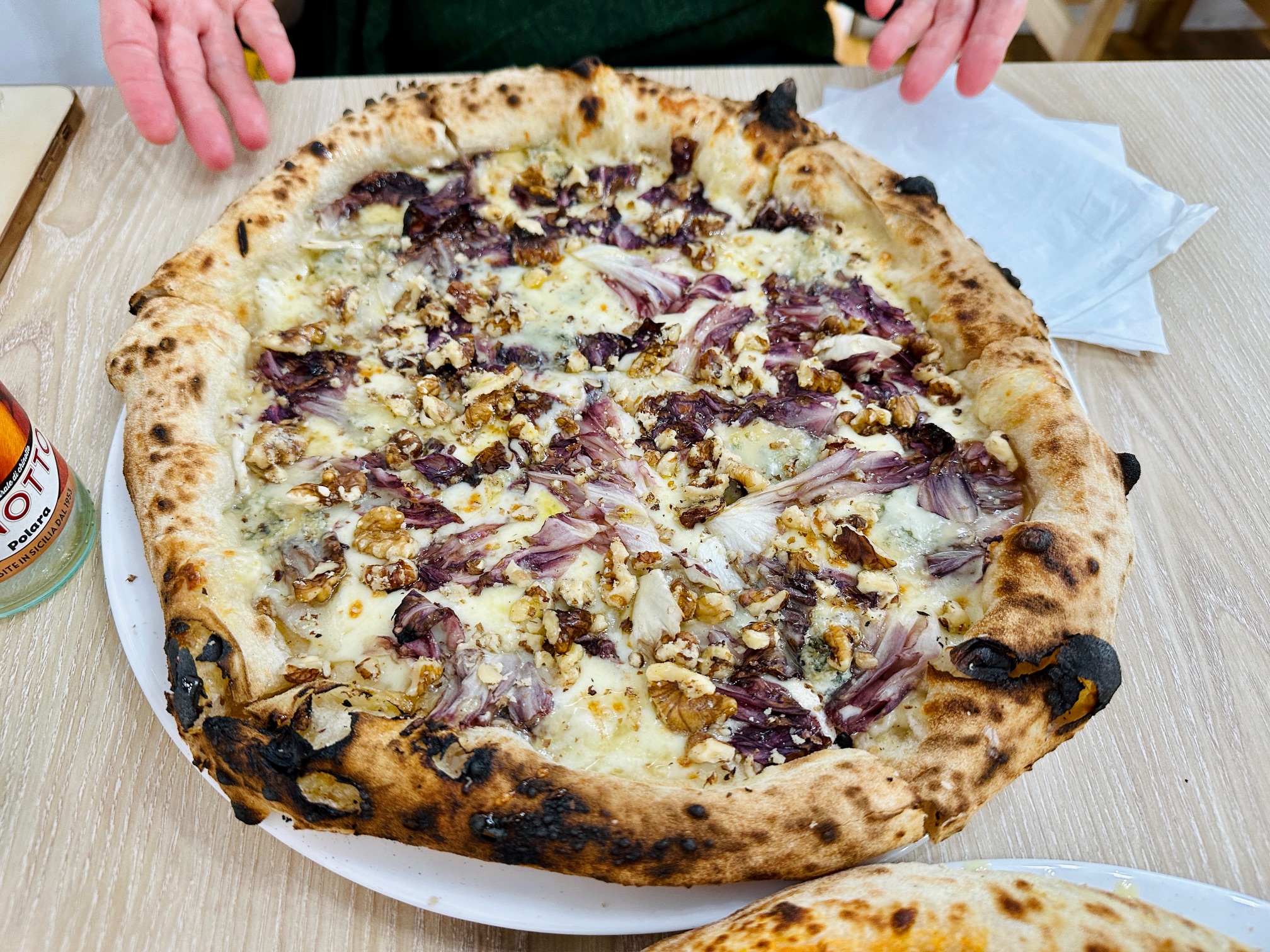
Enza also loved my pizza, and preferred it on balance to hers, which isn’t to say that she didn’t enjoy hers. She went for the “dolce amaro”, a white pizza (premium, not fusion) topped with walnuts, gorgonzola, honey and radicchio. “I know people back in Italy who would disown me for ordering this” she said. Maybe she was right but they ought to try it before they knock it.

This had everything: salty, sweet and bitter in gorgeous harmony. The gorgonzola was so punchy that you smelled it, got that agricultural tang as you lifted a slice up, before you ever took a bite. But the honey – how nice to have honey rather than hot honey on a pizza, for a change – softened its roar. The walnuts lent texture and the final piece of the jigsaw, radicchio with bite and bitterness, was the clinching evidence of intelligent design. All that and, as a white pizza, it was easier and less messy to eat than the Siciliana. I really enjoyed it: Enza thought it a little unbalanced and needing something else, possibly black pepper.

Later on, when we debriefed over a beer in Siren RG1, I asked Enza how authentic that pizza was and she very kindly said something I’d never thought of before that made me feel stupid, in a good way. “Of course it’s authentic” she said. “It’s authentic because somebody has made it.” All these combinations start out as curveballs at some point, but if nobody ever innovated you’d have a cuisine that’s set in aspic. It’s 2025: nobody willingly eats aspic any more.

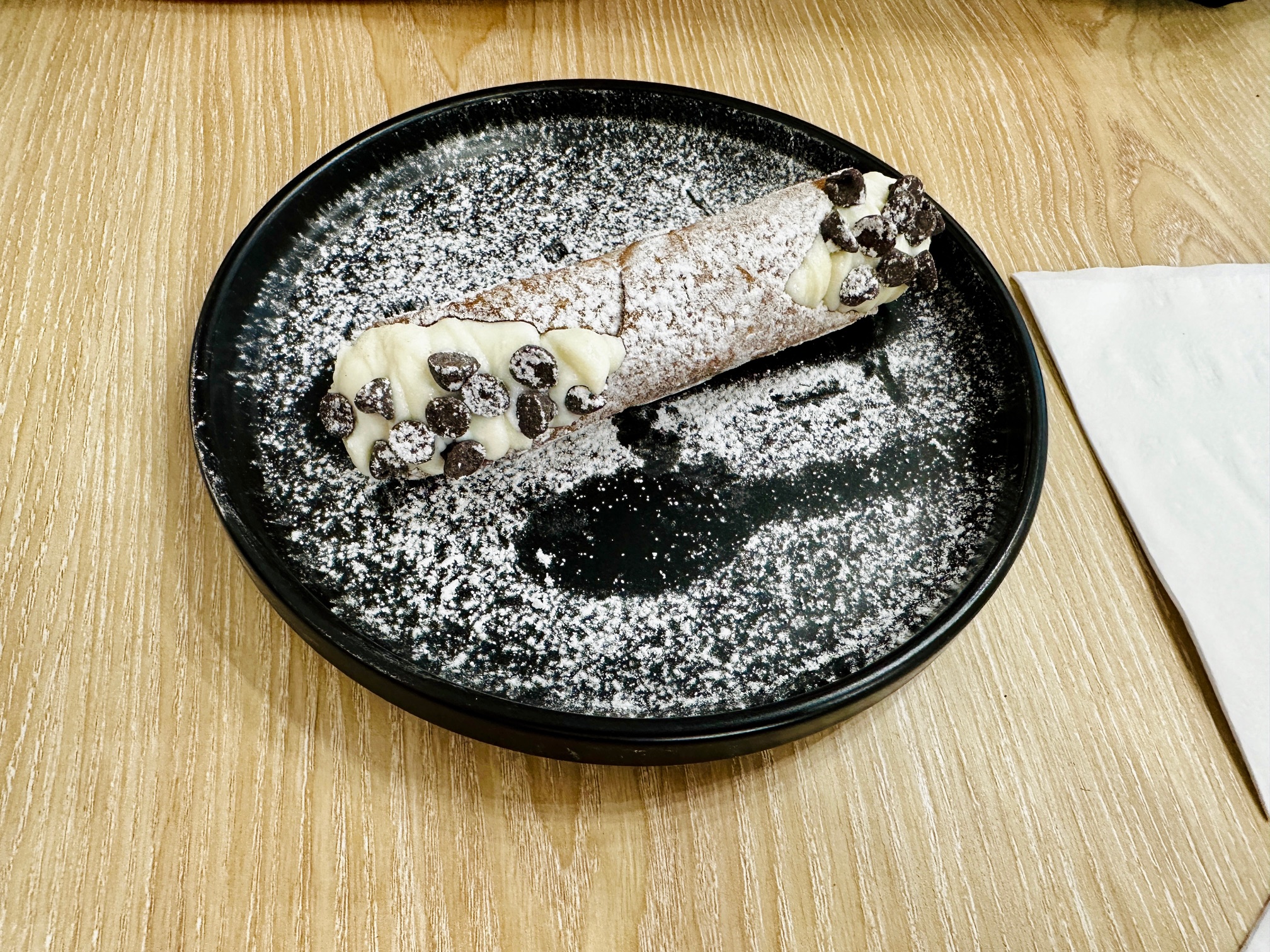
Paesinos has a small section of desserts, plenty of them tempting, and we decided that in the interests of research we ought to try some. Enza’s no slouch, so she asked the pizzaiolo which ones were made by Paesinos. In a flash, without hesitating or deflecting, he told us: just the two, the tiramisu and the cannoli. In the case of the cannoli he bought the shells in, but the ricotta filling was all his own work. That was good enough for us, so Enza decided to road test the cannolo and I – such hardship – ordered the tiramisu.

We also ordered a couple more drinks. The chap who’d prepared our pizzas suggested we try a bottle of something called Spuma, so I did, and it was night and day with the chinotto but equally lovely in its way – sweet and fresh, sunshine in a bottle. I thought it had a taste of grape juice, but online research later suggested it was more complex than that, with rhubarb and elderflower, cloves and caramel. It beat a Fanta Limon, and I say that as a fan of Fanta Limon.

By this point we’d got chatting with our chef, and he told us a little more about the desserts. Normally he imported the cannoli shells from Palermo, he said, but on this occasion he’d had to get them from Catania instead. That meant they’d be more brittle, smoother, less bubbled. He apologised, as if this wasn’t optimal, when discussing the difference between going to the trouble to buy these things from two different Sicilian cities. I admired that focus, that he felt there was an important distinction to be drawn between the best and the merely excellent.

And goodness, but it was exquisite. If this was the second-tier shell, I’d like to try the very best out of sheer curiosity. Beautifully presented – I loved the outline in icing sugar of the wooden spoon, as if at a crime scene – it was an utter joy. Initially Enza tried to press me to have half, using the ultra sharp knife our chef had brought to our table, but I convinced her to just let me try a section from one end. It was so delectable that I almost wished I’d taken up Enza’s offer. The ricotta was so light, so smooth, the chocolate chips it was studded with were so very generous. It made the ones at Madoo, for instance, feel pedestrian.

Everything was imported, we were told, either from Italy or specifically from Sicily. Enza loved it: I’m not making this up, but she honestly did exclaim Mamma mia (I nearly did too, and I was born in Bristol).

There was a story behind the tiramisu, and he told us that too. It was his fiancée’s recipe – she works at the Thirsty Bear – but she only finally let him have it once he opened Paesinos, despite them having been together for twelve years, despite the fact that they were getting married towards the end of the year. Many tiramisu recipes just used egg yolk, he said, but this one included egg white too, to give a lighter texture. The only other tweak was a little vanilla, to offset the flavour of the egg yolk.

It was another tour de force, and he also went to great trouble to tell me it was a bigger portion than you got elsewhere around town. He’d weighed the rival tiramisu you could get in other places, and weighed his, and his was more substantial. It was the best tiramisu I’ve had in Reading, and honestly I can’t remember eating a better one anywhere else. No wonder he was marrying his fiancée: if I had ready access to somebody who could knock one of these out, I’d be the size of a house.

The strangest thing happened after that: we had eaten, we’d drunk (no alcohol, Paesinos is unlicensed) and we ought to have headed straight off to compare notes over a beer. But I was in the company of two Italians, and they talked food, compared notes, discussed recipes, the best places to buy mascarpone, where he sourced his ingredients from. And like that conversation on my Facebook page at the start of this review, I could have listened all night. Being in the company of people whose passion for food verges on obsession – the real meaning of obsession, not that social media meaning that just means “I like this” – was infectious.

In the process I learned a few other things. Paesinos had been open nearly six months, and things were going well. Our chap knew the people at Mama’s Way, loved it there, didn’t see any of this explosion of Italian spots as competition. A rising tide truly did lift all boats, and the slow spread of Reading’s Little Italy round the corner to become a Not So Little Italy felt like a beautiful thing. Eventually we settled up. Our bill for everything came to just under sixty pounds; there was no option to tip – it’s almost as if they just didn’t expect anybody to – so I made a second card payment for that.

If I was giving advice to Paesinos – not that I’m qualified to – it would probably be to lose the things at the periphery of their menu, the pizzas with chicken kebab or paneer, the chicken nuggets, the peri peri fries. I think I saw somewhere online that they had burgers “coming soon”, and a look at their website suggests that they now indeed do a range of burgers. I don’t think they need any of that, but what do I know? Maybe their delivery customers will lap that up.

But actually, if I was giving advice to Paesinos it would be to carry on doing exactly what they’re doing. I cannot think of a pizza I’ve enjoyed so much in a long time, and I can’t think of a Neopolitan-style pizza I’ve liked as much in longer still. What a small, unassuming delight Paesinos is, and what a mind-boggling prospect it is that there’s a healthy debate, under way right now, about whether our town has places to eat pizza that are even better than it is.

I’m not qualified to weigh in on that: I’ve not visited its rivals yet, I’m not a fully paid up pizza obsessive and I’m about as far from Italian as it’s possible to be. So take this as my ill-informed, incomplete, English opinion: this might not be the best pizza in Reading, but if it isn’t, the place that can beat this is going to be one hell of a restaurant. Either way it’s the best pizza I’ve had in Reading, I think. I can’t wait to test out its competition. Even more so, I can’t wait to go back.

Paesinos – 8.6
Unit 4, 2 Kings Road, Reading, RG1 3AA
0118 2068806

https://paesinos.com

Since January 2025, Edible Reading is partly supported by subscribers – click here if you want to read more about that, or click below to subscribe. By doing so you enable me to carry on doing what I do, and you also get access to subscriber only content. Whether you’re a subscriber or not, thanks for reading.
Restaurant review: Lapin, Bristol

This might come as a surprise to you – probably not – but for the best part of the last fifteen years my friends and I have regularly taken part in something called Poncefest. Nope, not a misprint. The idea was to take a day off, invariably a Friday, and go into London together for a bit of shopping, always for fragrance, followed by a fancy lunch somewhere, then falling into a pub before getting the train home. Something like the Finer Things Club from the American version of The Office, only even finer.

Having sacrificed whatever credibility I might have had with that opening paragraph, I may as well explain. So yes, these trips usually involved shopping at one of London’s great fragrance shops – Bloom or Les Senteurs – and then a gorgeous, drawn out lunch. We’ve done Medlar in Chelsea, Soho’s famous Andrew Edmunds, Portland in Fitzrovia, Calum Franklin’s renowned pies at Holborn Dining Room and doubtless other places I’ve forgotten. We’ve even been to Oxford, enjoying a very pleasant lunch at Pompette one Friday towards the end of the year, exchanging Christmas presents and cards and eating brilliantly.

The members of the Guild Of Ponces – because I’m afraid that’s what we call ourselves – have fluctuated over time. It started as Al, Dave, Jimmy and I, but then Jimmy fell by the wayside and my stepfather Ian decided to join our number. He chose to drop out after a while, but by then we had also recruited my friend James, a man who didn’t need to seek out the ponce life, because the ponce life found him.

Like the Spice Girls, we each have our own unique identity. Al is Sartorial Ponce, because he’s always immaculately dressed: the man’s had his colours done, for goodness’ sake. Dave is Reluctant Ponce, to denote the fact that he always complains about the whole affair but secretly loves it.

Jimmy, back in the day, was Pub Ponce, and in charge for picking the post-lunch boozer. Ian, who knows more about Apple products than many people who actually work there, was Tech Ponce, and James is Preppy Ponce – or Neophyte Ponce, a title our newest member always gets, like the Baby Of The House, or New Guy in Loudermilk.

I, of course, am Grand Master Ponce. Would you expect anything else by now? Mock all you like – I’m immune these days, thanks to my childhood years in chess club and Dungeons & Dragons club (both hobbies, too late for me, are cool now). I unapologetically love Poncefests. They’ve always been a lovely miniature escape in the year, when my friends and I can catch up, more than slightly aware of how ridiculous the premise is.

Anyway, that was all well and good, but then Covid happened, and it all went quiet for Poncefest. A risk averse eighteen months meant that I saw my fellow ponces sporadically, and never all at the same time. Even after things unlocked, for some reason we were never all in the same place at once. We were like the Beatles, or the Pythons, without the acrimony. I lunched with Dave and Al a few times – once even for this blog – but a Poncefest proved elusive.

Of course, all the ponces were there for my and Zoë’s joint stag and hen do last year in Bruges, and at the wedding too, but both were part of a bigger gathering rather than a reunion per se. And then James went and put a spanner in the works by being seconded to India for nine months, and those gatherings, now five years dormant, felt more of a distant prospect than ever. So I was absolutely delighted when he returned to Blighty in the spring and talk on our WhatsApp group (the logo is a picture of Niles and Frasier Crane holding up a sign saying WILL WORK FOR LATTES) turned to getting the band back together. Would it happen?

It may not surprise you to hear that it did, and one sunny Saturday morning at the start of May I found myself bimbling round sunny Clifton, really looking forward to a long overdue luncheon. I’d bumped into people I knew outside Hart’s Bakery, straight off the train, before taking a bus to Bristol’s prettiest, if most unreal district. I stopped for a latte in the sunshine outside a little kiosk called Can’t Dance Coffee, before walking in wonder through Birdcage Walk, too taken with the glimmer of the sun through the foliage to realise I was, in fact, going in the wrong direction.

After an amble through Clifton, past the spot where I was born – it’s now been turned into flats – I found myself ruminating on all the different paths my life might have taken, and how many of them involved me never having left Bristol, or leaving but coming back to live here. Too much time alone always has this effect on me, so I grabbed a bench in the Mall Gardens, put something relaxing on my headphones and got lost in my library book. Not long after Al joined me and, because old habits died hard, we stopped in Shy Mimosa, Bristol’s excellent perfume shop, before grabbing a coffee and a taxi to our lunch venue.

Lapin was back in the centre of the city, in Wapping Wharf, a part of Bristol I knew and knew of but had almost never eaten in, unless you count a slightly underwhelming pizza at Bristol institution Bertha’s. Most of it is shipping containers, stacked two storeys high, and it boasts some of Bristol’s biggest names. Bravas‘ sibling Gambas is there, as are the likes of Root and Box-E. This year it’s been bolstered with three big names: Gurt Wings, who opened at the start of the year, to an apparently shaky start; COR‘s younger sibling RAGÙ and Lapin, which is the second site behind the owners of Totterdown’s BANK.

I should stress, by the way, that all those irksome block capitals are their choice, not mine: I guess in a city with as many good restaurants fighting for punters’ cash maybe they feel the need to shout. In any event, I’d chosen Lapin for a couple of reasons – partly because as a French restaurant it seemed especially appropriate for such a gathering and partly because it was shiny and new. On the day we visited it had been open exactly a month, by which time it had already received not one but two reviews from Mark Taylor, Bristol’s resident Reach plc hack. I on the other hand gave it a month to settle in, because that’s what I do.

It was a very warm day and Wapping Wharf was full of people younger, thinner and less fearful of hangovers than me, many of them sitting outside either at Lapin or its neighbours Gambas and Cargo Cantina. The place had the glow of youth, of sunlight diffused through an Aperol Spritz, but because I partly wanted to get a sense for the room we sat inside. Dave was already there – slightly early, because he is Dave – and James joined us shortly after, slightly later than us, because he is James. The natural order was very much in place.

The dining room, by the way, is rather nice. I think the nicest thing I can say about it is that you could easily forget that you were eating in a few shipping containers joined together. I tend to associate them with street food or Boxpark, with places you don’t linger, so I was glad that they’d turned these into a very convivial space, and one where there was quite enough daylight coming in from the big floor to ceiling windows. It was pretty no-frills, but just tasteful enough: sage walls, framed retro prints, tasteful overhead lights, sturdy, timeless furniture. No Tolix chairs to jam my arse into, I’m delighted to say.

Lapin’s menu was that especially challenging kind that felt like it contained no poor choices. Half a dozen starters, or a whole baked cheese to share, and another seven mains, again with three sharing options. On another day you would be reading about asparagus with sauce gribiche, confit duck with a spring cassoulet – whatever that is – Provençal fish stew or deep fried rabbit leg: the latter turned up at a neighbouring table towards the end of our meal and made me wish I could go back and start again.

Starters stopped just short of fifteen pounds, mains ranged more widely from just under twenty to just over thirty. The sharers were more expensive – côte de boeuf, for instance, clocking in at ninety-five pounds – sides were about a fiver, desserts just shy of a tenner. Little of that, in 2025, is especially shocking. The menu, under a section marked Accoutrements, gave you an option to add a spoon of caviar or a shaving of truffle to any of your dishes, and I was surprised by that: in a place defined by taste and tastefulness it felt – dare I say it? I guess I do – ever so slightly tacky.

But before the main event, drinks and nibbles. Lapin’s selection of apéritifs was tempting and extensive, and I think the four of us chose roughly in line with our ponciness. Al, easily the most refined, kept it classic with a Lillet Blanc. James and I, the next level down, had a cidre – Galipette – which was awfully nice, although now I’ve discovered you can buy it from Waitrose and Ocado I almost want to salute Lapin for their exorbitant markup. Dave, though, chose best with something called a demi peche, a keller pils with peach syrup. Don’t knock it til you’ve tried it: Dave recreated it the following weekend at home, which was an exceptionally good idea.

We had a quartet of Comte gougères with that, and I thought they were decent but perhaps not too inspiring. The filling was good, the carpeting of finely grated cheese always welcome but the pastry itself lacked the lightness of touch it needed. At twelve pounds for these, I couldn’t help but compare them with the gorgeous cheddar curd fritters I’d had at Upstairs At Landrace a few weeks before, which had cost significantly less.

Now, when I review in a pair I always feel like I have to have something different to my dining companion, to present a range of dishes. That’s less of an issue in a bigger group, so as it turned out Dave and James ordered the same starters and mains, as did Al and I. Even at the time, I have to admit that I was thinking This is the life, I’m in a lovely restaurant with three of my favourite people, the wine is flowing… and I have less to write up than I might have done. Unworthy I know, but there it is.

Dave and James were pleased with their starter, I think. A puck of deep fried pig’s head was the good part, and the forkful I had was great. Plonking a forest floor of chicory and dandelion on top of it, though, was less successful. I don’t think either is really anybody’s favourite salad ingredient – not as pointless as frisée, but not far off – and the nicest croutons in the world aren’t going to redeem that.

Al’s and my starter was similarly along the right lines but not at its destination. I adore rillette, I adore rabbit, the prospect of rabbit rillette was a nailed-down choice for me. And it was pretty pleasant – clean and ascetic rather than punchy and rustic. I loved the carrot jam, and thought the dish could have stood a bit more of it. The bread, I’m sorry to say, was unremarkable. And somehow the whole thing combined to less than the sum of its parts, even with a few rogue cornichons secreted away.

This dish troubled me, if that isn’t a silly way to put it, because I should have loved it and I’m not sure why I didn’t. It felt too nice, too well-behaved, like an attempt to create a platonic ideal of a dish rather than the dish itself. As it happened, I was of course in France the week after I ate at Lapin, but it wasn’t the meals I had in Montpellier that came to mind when I weighed up this rabbit rillette. It was the unforced, unshowy kind of dishes I had earlier in the year, at Paulette.

We also, out of pure greed, ordered another starter to attack between the four of us. Duck liver parfait was, again, a pleasant, glossy little number, hiding in its ramekin under a layer of cherry. The menu called it “pickled stone fruit” but really, it wasn’t clear that any pickling had taken place. Again, this was nice rather than knockout – and, again, it highlighted that Lapin’s bread wasn’t the best. And that you could have done with more of it.

By this point, whatever misgivings I might have had about the starters, our meal was in full swing. There’s something lovely about that interplay with good friends – that mixture of catching up and reminiscing, of mild ribbing and in-jokes. All that was helped by an extremely good bottle of wine – a Languedoc white by Domaine Montplezy, not bone dry with notes of peach and citrus.

As it happens, I found that wine the following weekend in Montpellier at the wine shop round the corner from our B&B. We bought a bottle and again that means I got a good idea of Lapin’s markups, which are considerable. But perhaps that misses the point, and perhaps ordering a whole bottle of something does too: one of the things that is genuinely impressive about Lapin is that its whole wine list is available by the glass. Someone has spent a fair amount of money with Coravin, and it gives you an enviable range of choices compared to most restaurants I can think of.

If the starters were a little wobbly, the mains are where Lapin became far more sure-footed. My and Al’s skate wing was a really joyous plate of food, served in a vadouvin butter rather than the conventional beurre noisette that so often accompanies this fish. And that in itself was interesting – vadouvin is a mild curried sauce that originates from the French colonial period and you could almost taste in it the intersection between traditional and colonial French.

It wasn’t a conventional brown butter sauce dotted with capers, and instead came topped with monk’s beard, but in it you could sense some of the DNA it shared with the classic dish. It was little like those pavement cafés in Marrakesh’s Ville Nouvelle that, despite being stuck on the edge of northern Africa, feel like they carry some echo of Paris. I wouldn’t pick this over a more traditional rendition, but that doesn’t mean I didn’t like it.

James and Dave went for perhaps a more mainstream option from the menu, a whole truffle roasted poussin with a Madeira jus. This, to me, was probably a stronger choice – the truffle present but not dominating, the meat beautifully cooked and that jus setting off the whole shooting match. James very generously let me try some, and although I enjoyed it it didn’t make me wish I had ordered it.

That tells its own story, I guess, that I still wondered whether the real gem was elsewhere on the menu, undiscovered. But again, that might tell you more about me than Lapin: I can already picture Dave, at some point over the weekend, reading this review and thinking What is he going on about? That poussin was amazing.

The sides were a weird inversion of the natural order and a good example of how expectations can be completely confounded. The menu offers duck fat frites, and all four of us could think of nothing finer. But when we went to order four portions our server – who was excellent, as all the staff at Lapin were – suggested ever so nicely that this might be a bit monotonous and that we might want to mix it up a bit with some pomme purée.

So we did that, and were rewarded with an experience that is pretty much solely worth visiting Lapin to enjoy. The duck fat frites were decent rather than exceptional, but compared to the pomme purée they became more like “fuck that” frites. Because the pomme purée – no hint of hyperbole here I promise – was one of the best things I’ve eaten in years. Loaded with butter until it could take no more, than bathed in more brown butter, it took on a taste and texture that transcended savoury or sweet, almost with a note of toffee, or fudge.

Al told our server, when the empty dishes were taken away, that you could have served it as a dessert. He wasn’t far off: it was truly magnificent stuff.

Before dessert, three of us had an intermediate course, the Trou Normand. This is a Normandy tradition, a palate cleanser consisting of apple sorbet anointed with apple brandy. It was very good indeed, the sorbet smooth and hyper-real with the taste of apple.

The apple brandy, from Somerset, was excellent too. The menu said that you could add a glass of Calvados for an extra four pounds, although it wasn’t clear whether you would get Calvados on the side or whether the apple brandy would be swapped out for Calvados.

Whichever it was, the pricing of this felt a little awry: eight pounds felt like a lot, twelve in total for Calvados would have been like, well, like paying an extra thirteen pounds to dump a spoonful of caviar, randomly, on your main course.

Before dessert proper we’d also decided to push the boat out and order a bottle of dessert wine. Dave doesn’t do wine these days – he stayed on his demi peche during dinner – but he makes an exception for dessert wine. Again many of the dessert wines are available by the glass, and the menu pairs one with each of the desserts, but we couldn’t resist. Lapin also offered two really tempting bottles – a Rivesaltes Ambré 1978 for a slightly ridiculous amount or a 1992 vintage of the same wine for eighty pounds. Don’t judge, but we had the latter, and it was ambrosial.

Our server explained, in a “look what you could have won” kind of a way, that by most standards 1992 was still quite young for this wine but we were very happy with our choice nevertheless.

“1992, the year we met” said Dave to me, as we took our first heavenly sips. Suddenly I felt like however old the wine was, I was older still. But in any case there was much to celebrate, so I thoroughly enjoyed a wine as old as one of my oldest friendships. The wine has aged well, the friendship even better.

We tried a decent range of the desserts. I think on this occasion Al and I chose best with the St. Emilion au chocolat. I’ve never heard it called that before but it was an extremely nicely done ganache, a not ungenerous portion of it, topped, I think, with crumbled amaretti biscuit and served simply with terrific crème fraiche. I was always going to gravitate towards this dessert and, however good the others were, I would struggle not to order it again.

I think the other candidates were more workmanlike. Dave enjoyed the pain perdu with apple and vanilla ice cream, again crumbled with the good stuff to lend texture, with a shiny, sticky sauce. I expect if I ordered it I would have liked it too, and I imagine it went better with the dessert wine, in terms of colour coordination if for no other reason, than my overdose of chocolate did.

James ordered the Basque cheesecake, but neglected to take a picture. In fairness, you probably know what a Basque cheesecake looks like. Imagine one of those, with some rhubarb on the side. That’s what James had. He liked it, and Dave reminded me that it’s ridiculously easy to make which is why he never orders it in restaurants. I still have the WhatsApp message he sent me, with the recipe, favourited on my phone. One of these days.

Al is legendary for ordering two desserts, very much following in the footsteps of the great Nora Ephron who always held that this was one of the most important life lessons she ever learned. Technically if you count the Trou Normand and about a quarter of the Éclair Suzette we ordered to share between us, this meal constituted a personal best.

We’d ordered the éclair on the advice of our server and again, it had some nice touches – the candied orange on top, the Grand Marnier infused crème diplomat inside. But again, Lapin’s touch with the choux let it down. It was leaden rather than ethereal, and took some sawing through. As a finishing touch to the meal it summed up some of the inconsistencies, and gave me something to think about.

Our meal for four, including a 12.5% service charge, came to just shy of five hundred and twenty pounds. Now, after you’ve had your sharp intake of breath, I have to say that doesn’t feel like poor value, at all, for what we had. We had something like five courses each, and even then we threw in a couple of extra things to try. We had apéritifs and two bottles of wine, one of which was from the deeper end of the list.

All things considered, I think about one hundred and thirty pounds each isn’t at all bad, for the afternoon we had. If you’re going to spend that kind of money, you should feel like you get this much living for it. It made me feel sad for my poor friend Jerry, parting with a hundred pounds for an infinitely less enjoyable meal at Gee’s not too long ago. Besides, expense be damned: this was Poncefest, it’s not like we were going to settle for a Happy Meal.

You might ask, given all that, why the rating down there is what it is. You might feel that this reads higher than that, or lower, and I would have some sympathy. When I think of meals I’ve had in Bristol, Lapin is really pretty good. But something stops it, for me, being in that upper echelon, with the likes of Caper and Cure, or Marmo. Or, if you’re comparing French meals with French meals, something prevents it reaching the standard of Paulette.

I keep coming back to that rabbit rillette, pretty close to being an eponymous dish for this restaurant. I keep remembering that it was nice and clean and pure and rarefied. And it’s not because Lapin is in a shipping container, because as I said the place managed to make me completely forget that. But Lapin, for all its excellent qualities, ever so slightly felt, to me, like a brilliant piece of cosplay, more than a French restaurant.

You could say that there’s nothing wrong with that, and I might agree. But that’s what stopped it, as far as I was concerned, attaining true greatness. I wouldn’t rule it out that at some point they will get there, and I imagine enough people in Bristol will rave about it to sustain it on that journey. In the meantime, it has a single dish that almost merits a pilgrimage, even if it’s a mere side, and it played host to a marvellous, long overdue reunion. When the ponces assemble next – in a suitably effete way, I can assure you – Lapin has set a standard we’ll be very lucky to exceed.

Lapin – 8.6
Unit 14, Cargo 2, Museum St, Bristol, BS1 6ZA
0117 4084997

https://www.lapinbristol.co.uk

Since January 2025, Edible Reading is partly supported by subscribers – click here if you want to read more about that, or click below to subscribe. By doing so you enable me to carry on doing what I do, and you also get access to subscriber only content. Whether you’re a subscriber or not, thanks for reading.
Restaurant review: Upstairs At Landrace, Bath

I go to Bath too rarely to know it well, but often enough to wish I knew it better. Winding through the sun-bathed stone on a gorgeous Saturday afternoon with my old friend Dave, very much following his lead, I realise how rare it is for me to walk round a city with virtually no idea where I’m going. But Dave has been coming here for years, going all the way back to the best part of thirty years ago when he first met his wife and she was living here, so I put myself in his hands for a change and just enjoy the views, all of which are sensational.

I only have a vague understanding of the city – I know where the Royal Crescent is, and the train station, and Pulteney Bridge, sort of, but beyond that my inner satnav of how all these places join together is fuzzy at best. I’ve probably been to Bath something like four times in ten years, so I follow along like a clueless tourist while Dave takes me to his favourite coffee spot, a little off the beaten track, and a very good beer shop. And then we have a bit of a wander in the growing warmth of the day, and Dave tells me about all the green space in the city, the bookshops we could visit later and, crucially, where we might drink after lunch.

Eventually we walk up Walcot Street, one of the few parts of Bath I know a little better. I would say it’s one of Bath’s most beautiful streets, but in my experience they all are. But I know it from the cheese shop, which feels like it’s been there forever, and Picnic, a café I drank at last time I visited the city. Beyond that, I mostly navigate it by memories of places that are no longer there – a Scandi interiors store I shopped at a lifetime and a marriage ago, a craft beer bar called Brewed Boy that I drank at with Zoë and her friends James and Liz, before they became my friends too.

As we stroll, Dave points out landmarks from his memories in the city, places that have survived better than the ones I recall. One, Schwartz Bros, is a burger place that looks to have been trading for the best part of fifty years – Dave remembers it from courting his wife, and that was so long ago you probably still would have called it courting. But our destination for lunch is a place neither of us has been before: Upstairs at Landrace, the restaurant that sits, as its name suggests, on top of the city’s highly esteemed Landrace Bakery.

I’d wanted to go for ages, and when Dave and I were deciding where to meet up he picked Bath over Oxford or Reading, so I saw my chance. I gave him a few options, half expecting him to go for the wine and small plates of Corkage, or the Basque tapas of Pintxo, but was very pleasantly surprised when he plumped for Upstairs at Landrace, a place I’d always liked the look of.

It received some attention in the national press three years or so ago – I get the feeling national critics pick Bath for a review every couple of years when they fancy expensing a genteel day out – but had since settled back down to just doing its business. All the reviews I’d read talked about a simple, compact, beautifully executed menu and really, what more could you ask for when lunching with a very old friend? The menu changed daily, in fact, and both Dave and I kept an eye on it in the run-up to our trip, identifying dishes we would like to eat and hoping they’d still be on offer when the weekend came.

The restaurant is a wonderfully haphazard place. You go up the stairs and although the two dining rooms are both technically on the first floor they aren’t quite on the same level. You sense that everything in the building is higgledy-piggledy, few straight lines or right angles. We were given a table in the cosier of the two rooms, near the open kitchen, all sloping ceilings and sunlight squeaking in through the windows.

It was doing nicely when we got there, on a bright spring afternoon, and it got busier during our time there. It felt like a very agreeable place for lunch, and the fact that my seat gave me a prime opportunity to snoop on plates being whizzed from the kitchen to other tables didn’t exactly do any harm.

The menu was compact and, although a continuous list of dishes, was clearly designed, by price point, to be broken up into smallest, smaller and bigger. Our excellent server, who did a brilliant job all afternoon, talked us through the whole “small plates for sharing and bigger plates for you to have to yourself” concept and we listened to it the way you listen to the safety demonstration on an airplane, being respectful although we’d both heard it dozens of times before. After all, I suppose this plane might have varied from others we’d flown on in the past. It didn’t, though. It never does.

What that meant, in practice, was the compact menu all the critics had talked about – a couple of snacks, six artists formerly known as starters, three big plates for you to have on your own and one even bigger one for sharing. Just the one side dish, “Fairy Hill mixed leaf salad”, from a place whose leaves are apparently so good the provenance deserved to be listed: we didn’t try it to find out. The small plates were between eight and fourteen pounds, the bigger ones between twenty-four and thirty, the biggest fifty-eight.

All the versions of this menu Dave and I had tantalised ourselves with in the run-up, I can safely say, had more options I fancied on them than this one did. One of the most appealing dishes – involving duck, I think – had been replaced with a “Pembrokeshire cockle vongole”, which I’m sure many people would have loved but appealed to me about as much as the mixed leaf salad. Dave, who treats eating out as a chance to indulge, wanted a bit more red meat on there, but pretty much the only dish that fitted that bill was the ribeye, and we didn’t fancy it enough.

We contemplated our relatively bad fortune while eating an excellent slice each of the bakery’s bread – a nice touch that this was complimentary – with very good, golden room temperature butter and a drink. Dave told me on the walk to the restaurant that he had pretty much given up on wine in favour of beer (and I had mentally scratched a couple of bars off my list of places we could drink later on) so he had a bottled IPA from Gilt & Flint, a Devon brewery I’d never heard of who also, apparently, supply to triple Michelin starred The Ledbury. I had a sip: it was nice enough.

I, a little jaded from a session the previous evening at the Nag’s, was tempted by a wine from Wiltshire of all places but instead had a glass of table perry from Wilding. I know next to nothing about perry except that it’s apparently the best booze we all aren’t drinking yet, and unworthily I’d picked it mostly because it was a small glass of something alcoholic that wasn’t too strong. I don’t think that’s a slogan perry makers are going to scramble to adopt, but on this showing it didn’t have enough about it to generally make me choose it over a crisp white wine. I must try harder.

The first of our sharing plates was a study in simplicity. Four very good anchovies – by Pujadó Solano apparently, seventeen quid per pack online – came glimmering in a pool of unbeatable olive oil, sprinkled with oregano, the whole affair beautified with lemon zest. “Why do I never think of having anchovies with lemon zest?” said Dave. “I’m definitely doing that at home from now on”. Otherwise this was just about buying the best of everything and putting it together, and in that sense you could say that although it was special – and at twelve pounds you’d want it to be – it somehow wasn’t out of the ordinary.

What was out of the ordinary, though, was our server coming back with a basket of little cubes of sourdough so we could personally mop up every last soupçon of that bright, herby olive oil: that I loved.

Anyway, the anchovies were the last – the only – thing we ate that was merely quite good rather than extremely good. I had seen mentions of Upstairs’ cheddar curd fritters in other reviews, I seem to recall, and I’d seen enough of them on their way to other diners before I even placed an order that I knew I had to try them.

I wasn’t quite sure, even after eating them, how they managed to make fried cheese so airy, so ethereal and yet somehow they did. They were stupendous clouds of joy – as if someone had decided to make Wotsits entirely out of cheese, serve them piping hot and cover them in yet more cheese. Eight pounds for these, and I think Upstairs At Landrace needs to rethink this whole “small plates for sharing” concept, or expressly make an exception for the fritters. I otherwise couldn’t fault our server, but she should have said “have you considered having one of those each?” Shame on her.

Although you could just as easily have said the same about the third dish we shared, the cuttlefish and sausage salad. Rarely have four words so comprehensively undersold a dish as they did on the menu. I mean, yes, it was a salad and yes, it contained cuttlefish and sausage. But that didn’t begin to do justice to what I’m already sure will be one of the most enjoyable dishes I eat all year.

I suppose there isn’t room on a menu to say “huge quantities of precisely scored, superbly cooked, tender cuttlefish”, and no room to say “the warm, slightly caramelised discs of sausage, with the tiniest hint of offal, bring a welcome hint or earthiness and, let’s face it, red meat, to proceedings”. The menu didn’t go on to add “by the way, you’ll also have warm bits of waxy potato, and while we’re at it the dressing will be impeccable, with the sharpness of capers thrown in, into the bargain”.

I know Upstairs At Landrace’s menu is in the still fashionable Ingredient A, Ingredient B, Ingredient C format that seems to annoy me more than most, but even at its most fulsome it wouldn’t capture that detail. I suppose that’s what restaurant reviewers are for.

But my goodness, how I loved this. If all salads were like this, or even half as good, I would eat salad all the time. I’ve always loved a warm potato salad, or any potato salad dressed with vinaigrette rather than drowned in mayonnaise, and I really adore cuttlefish, which you don’t see on menus anywhere near often enough. To find all of that coalescing in one glorious plate made me very happy indeed: forget JK Rowling’s recent lamentable cigar-based bigotry: this is what happens when a plan comes together. And the company was so good that I didn’t even resent sharing it.

Although Dave was a little sad about the paucity of meat on the menu, those nubbins of sausage aside, he did console himself with monkfish, one of the meatiest denizens of the sea. And again, trust in Upstairs At Landrace was richly rewarded: this was a phenomenally cooked, very generous piece of monkfish with a beautiful colour, effectively cut into medallions. It came on top of a primavera riot – leeks, peas, celery, all the good stuff, bathed in what was apparently a pastis butter.

I can’t verify that: I did try a little of the monkfish, which I thought was exceptional, but left the shrubbery to Dave. He adored this dish though, and didn’t feel like he had missed out one bit. This was possibly a dish you wished you’d held back bread for, although I’m sure our server would have brought a little more if Dave had asked nicely.

My main, on the other hand, was a symphony of a dish. Agnolotti filled with Jersey Royals could have been starch on starch overkill, but instead were little pockets of silky comfort, the pasta with just enough bite and the filling, pleasingly, with no bite at all. The whole shebang was positively awash with brown butter and wild garlic pesto, because of course it’s the season now, and if that wasn’t enough there was more wild garlic on top. And if that wasn’t enough there was a mountain of cheese, and if that wasn’t enough a dish with more of it was left at the table for you to sprinkle with abandon.

And it was, all in all, enough, and teetering on the brink of too much. But that brink, provided you stay on the right side of it, is where legendary dishes live, and this was one of my favourite things I’ve eaten in a long time. It was so well-judged, so well done, just the right size, everything in the right proportions, everything in exactly the right place. The pesto was so beautiful that I’d have bought a jar the size of my head if I could, the pasta so well done that it’s now, for me, the best thing you could possibly do with Jersey Royals.

I’ve had a few instances recently where the menu, on turning up at a restaurant, wasn’t quite the one I would personally have chosen and yet everything was amazing. I will make the most of those, because I know there’s some Newtonian law of dining whereby, when I review somewhere in the future, the menu will have loads of things I fancy on it, I’ll order them and they won’t be anywhere near as good as I wanted them to be. Buy now, pay later.

Dave and I were fuller but not stuffed, very happy indeed and I was on my second glass of perry, as my hangover became too distant a memory to stop me acquiring another one. The tables about us had ebbed and flowed, but the place had always seemed just comfortably less than rammed. Dave and I got to talking about the times he’s joined me on a review.

“What I find weird is when we go out and have a lovely meal and then weeks later I read your review and you weren’t blown away by the food. Because then I think: are you sitting there having lunch with me and not having that good a time?”

“It’s not that at all! I always enjoy having lunch with you but then when I look back on it, and weigh it all up, the food isn’t the best part of the experience.” I probably won’t be able to convince Dave, even after over thirty years of friendship, that however good the food is his company is usually the best bit.

“I suppose it’s better this way round, though” he replied. “I wouldn’t want you telling me during the meal that you don’t rate it that much.”

“Exactly! Nobody needs someone speaking their truth that way during dinner, it just ruins the whole event.”

“But so when you say this is a really good meal, do you mean that?” Dave wondered. “Or when you eventually write this one up am I going to find it’s got a middling mark?”

“Trust me, Dave. This is going to be a really good review.” There was a pause, and I knew that my old friend wouldn’t completely believe me until he saw it. Nonetheless, I said it again for emphasis. “It’s a really good meal.”

The other thing that happened before we made our assault on dessert was that Dave asked our server where the loos were and was directed towards a door on the same floor as us. He returned eager to share something.

“Mate, before we go you have to try that toilet.”

This was not something I heard every day.

“What’s so special about it?”

“You know how normally if a loo is up some stairs you go up the stairs and then open the door? In this place you open the door, and right in front of you is a staircase. A really steep one. And the loo is at the top and, well, you’re quite close to the edge of the stairs when you do your business.”

“Really?”

“You wouldn’t want to do that after a few drinks, trust me. I expected to see a boulder coming down the stairs at me like something out of Indiana Jones And The Temple Of Doom.”

Upstairs At Landrace’s menu is at its most compact at the end: two desserts and a cheese course is your lot. We’d already had cheese to begin with and one of the desserts, the walnut tart, was a no-go – for me, because I’m generally not wild about walnuts and for Dave because, being allergic, he takes that one step further. That just left us with one option, rhubarb, meringue and cream. Maybe Upstairs At Landrace didn’t call it an Eton mess because they’d like to cancel Eton, in which case I sympathise entirely. Maybe it was a pavlova that had done a bad job of tackling those stairs.

Whatever the explanation was, though, it was a really terrific dessert which brought matters to a close in masterful fashion. The cream, from Ivy House Farm, near Bath, was thick and ambrosial, the rhubarb still had bite, and hadn’t been stewed into sticky submission. The meringue was just the right level of chewiness and the extra touch, toasted, flaked almonds, was the icing on the cake. Twelve pounds for this, so again not cheap but ultimately worth every penny. When I looked back on the meal, now that it was done, I didn’t think there had been a single misstep. That rarely happens.

After we’d finished, I took my life in my hands and ascended the staircase to the loo, which was every bit as vertiginous as Dave had warned me it would be: the very fancy hand soap was almost worth the climb in its own right. We thanked our server and chatted briefly to her about what a good meal it was, and she said that they had a lovely mixture of locals and regulars and out of towners like us who treated it as a destination restaurant.

We both did our best to be enthusiastic and grateful without coming across as creepy uncles, but ultimately as she went to fetch the card machine we knew, as always happens, that she was probably just wondering which of those pleasant middle-aged men was the top and which was the bottom. Our lunch for two came to one hundred and twenty-eight pounds, not including service: we didn’t have a lot to drink, but without alcohol it would have been fifty-five pounds a head.

Bath seemed even lovelier, if that were possible, after such a good lunch and so we did some more ambling, including a brief browse for books at Topping & Co, before having a couple of beers outside at Kingsmead Street Bottle, discovering in the course of drinking them, that it was nowhere near warm enough to sit outside. So we headed back across town and lucked out with a great table at The Raven, one of my favourite Bath pubs. I didn’t realise they had a beer brewed specifically for them by Bristol’s Arbor Ales, a really likeable pale, but once I discovered it I knew I was staying on that for the rest of the day. As my friendship with Dave taught me many moons ago, when you find something you really like, you stick with it.

So it turns out that, like the national restaurant critics I lightly ribbed at the start of this review, I have come to Bath twice in just under two years and both times I’ve had a very good, rather genteel time of it. But I think Upstairs At Landrace is worth going to Bath for all by itself – with or without the shopping, or the coffee, or the beers, or the old friend – because it’s supremely good at what it does.

I read an article about Upstairs At Landrace ages ago, in the Financial Times, that lumped it in with the Bristol restaurant Sonny Stores and breezily dismissed them both as part of a trend of a certain kind of restaurant that’s everywhere just now. Well, the main thing that writer was eating, it seems to me, is mushrooms. Because in reality, away from generic broadsheet sighing or sneering, restaurants as good and as clever as Upstairs At Landrace, places that manage to be sleek and refined without being sterile or soulless, are vanishingly rare. Maybe they’re ten a penny in somebody’s parallel universe, but they certainly aren’t in mine.

Oh, and for the benefit of Dave – who I know occasionally reads this – see that mark below? Told you. It was a really good meal.

Upstairs At Landrace – 8.8
59 Walcot Street, Bath, BA1 5BN
01225 424722

https://landrace.co.uk

As of January 2025, Edible Reading is partly supported by subscribers – click here if you want to read more about that, or click below to subscribe. Whether you’re a subscriber or not, thanks for reading.

Restaurant review: Branca, Oxford

This probably isn’t something I should admit but even now, after nearly twelve years doing this, I’m not always the best judge of which reviews will and won’t prove popular.

I mean, some obviously do well: you all tend to want to know about the new openings and the big names as soon as possible, something I’ve been trying to get to quicker over the last year. And I know from my trips to the likes of TGI Friday and Taco Bell that if it looks like I’m going to have a bad time, you tune in. I don’t take that personally – everyone likes a hatchet job and we can all derive vicarious pleasure from the suffering of others at times.

Beyond that? I have a vague idea at best. Sometimes I can write up a lovely independent place in the middle of town and – well, there aren’t crickets, but it doesn’t go gangbusters in the way that a Siren RG1 or a Rising Sun might. And other times the success of a review takes me completely by surprise.

Take Gordon Ramsay Street Burger, for instance: I didn’t think that many of you would especially care what it was like. On the run up to my visit, I wasn’t even sure I especially cared what it was like. And when I went I found that it was perfectly serviceable, the kind of place you might quite enjoy if you lived in a town without Honest Burgers. Little to write home about all round, you might think, and yet it was my most popular restaurant review of the year: me having a fair to middling time at a big chain in the Oracle. Go figure.

I actually think this might be for the best, that there’s no crystal ball. Because it would get tempting just to write the crowdpleasers, and that would skew the kind of places I go to and the kind of meals I seek out. And part of my – let’s call it a job, just for the sake of argument – job here is to highlight all kinds of establishments.

The ones you know about, but also the ones you don’t. The ones you would never consider going to in a million years, or walk past thinking “I wonder what that’s like?” And the ones you may well have already been to, probably in the first month after opening, before I get round to them. If you always have a pretty good idea what, or where, is coming next then something’s probably gone wrong.

One of the impressions I do get, though, is that collectively speaking you’d like to see more Oxford reviews. I can see why: it’s only half an hour away by train and is almost the anti-Reading. It has everything Reading lacks, yet lacks all the stuff Reading has got. No widespread craft beer, but lots of handsome old boozers, the kind Reading has gradually lost. No street food, but a covered market and cheesemongers and delicatessens galore.

A big shopping mall, yes, but a completely different kind that attracts the chains that Reading still just doesn’t get. More independent retail and two independent cinemas, but crap buses. Better bookshops, but nothing like the Nag’s Head. Did I mention that it also has the Oxford Playhouse, which for all its charm South Street can’t quite match? Anyway, add the two together and you would have the perfect large town slash small city; Oxford even has a couple of universities, would you believe.

All that makes Oxford the perfect place for a weekend lunch or dinner, especially coupled with mooching, shopping, drinking coffee and people watching. So every time I put an Oxford review up it does pretty well, and I get the impression – perhaps wrongly – that you might like to see more of them. My first visit to Oxford on duty was to one of my favourite Oxford spots, The Magdalen Arms on the Iffley Road. I had a lovely time, as I expected to, and resolved to cover the city more often. Two and a half years later, I’ve written the grand total of five reviews of Oxford restaurants: time to pull my socks up.

So last weekend Zoë and I were in Oxford, on her Saturday off, and I had booked a table for two at the Oxford restaurant I’ve possibly eaten at more than any other, Branca. It’s a sort of Italian brasserie – or would be if such a thing isn’t two different kinds of cultural appropriation – and had been trading on Walton Street in Jericho for over twenty years.

And that means that, like Pierre Victoire just round the corner on Little Clarendon Street, it’s part of an elite club of restaurants that have been an ever-present in my dining life. The only thing even comparable in Reading, now that Pepe Sale is gone, is London Street Brasserie, and that tells its own story, that Oxford can hang on to these places when Reading can’t.

It helps that Jericho is such a lovely part of Oxford, less than twenty minutes’ walk from the train station but a world away from both the town and gown of the city centre. It’s all nice cafés and bars, pubs tucked away on sidestreets, the Phoenix cinema where people, me included, queued round the block to see Four Weddings thirty years ago, watering holes like Raoul’s and Jude The Obscure that feel like they’ve been there forever.

I lived in Jericho, for a strange and surreal year halfway through the Nineties, and I didn’t appreciate how gorgeous it was at the time. And now it’s so gentrified that I could never afford to do so again in this life I am struck with brutal clarity by what a terrific part of the world it is. Isn’t it always the way? Never mind. Sitting in Branca, menu in front of me, soaking it all up I could kid myself, for a couple of hours at least, that this was my place and these were my people. Good restaurants, apart from providing you with great food and wonderful drink, have a knack of giving you that, too.

In the years since it opened Branca has expanded into next door, turning it into a cafe and deli more than capable of improving your cupboards and denting your wallet. But the dining room is as it always was, a tasteful if cavernous space.

The tables nearer the front, close to the bar, are nice enough but if you can get one at the back you’re treated to a beautiful room with marble-topped tables, exposed brickwork, what looks like a Bridget Riley on the wall. There’s a view out into their courtyard through full length-windows, and the light in general is quite magical, helped by a skylight and clever use of mirrors. Even on a dreich February day it felt like spring was in touching distance.

This isn’t the criticism it might sound, but Branca’s is simultaneously the biggest and smallest menu I’ve ever seen. Big as in physically big, a one-sided sheet of something like A3 that lists everything they serve. But when you delve into the detail, it’s compact: four starters, a couple of salads, three pasta dishes, four pizzas. Four mains, a burger and a steak and a couple of specials. I felt like I had just enough choice, although if I’d fancied either of the specials I wouldn’t have felt constrained at all.

As it was, this was just on the right side of the border between streamlined and narrow. Starters clustered around the ten pound mark – don’t they always, everywhere, these days – while mains were more scattergun. A pizza was about sixteen quid, with the exception of the sirloin steak the mains stopped at twenty-five. If I hadn’t eaten at Branca before I think the menu would still have inspired confidence, that it was aiming to do fewer things better, but they’d already proved that to me time and time again.

Before any of that, a negroni apiece and some of Branca’s focaccia, which they’ve been dishing out free of charge to diners for as long as I can recall. The focaccia was great stuff, airy and speckled with salt, oily enough to make your fingers shine even before you dipped hunks of it into oil and balsamic vinegar. It made me happy to start a meal in the same way as I always had, knowing that it pretty much always presaged good things. Branca played it straight down the middle with its negroni: no fancy curveballs, just Gordon’s, Campari and Martini Rosso. It was a good reminder that stripped of any whistles and bells, the cocktail just has good bones.

Another reason I’ve always liked Branca enormously is the wine list, and more specifically that they do something so few restaurants in the U.K. do: the majority of the wines on it, around three quarters in fact, can be ordered in a 500ml carafe. So we did that and had a New Zealand sauvignon blanc for thirty quid, which was downright lovely. I got kiwi fruit and gooseberry, Zoë got a hint of melon and, for an hour or so, we managed to kid ourselves that we got wine. We became a little bit more North Oxford with every passing minute.

Most of Branca’s starters are probably a nod to the excellent deli next door: with the exception of the soup they largely involve buying well rather than cooking well. Zoë is an expert at the third part of that triumvirate, ordering well, and she had the edge with her burrata on sourdough, served with olives and cherry tomatoes. Up to a point this is something you could rustle up in your own kitchen, and we often do come summertime, but the transformative element here was a cracking red pesto. Try doing that at home seemed to be the implication and no, I wouldn’t even attempt to.

My starter left me feeling a little deceived. It was described as bresaola with a fennel, rocket and radish salad, and that description made me think it would be a cornucopia of cured beef with a little bit of greenery on top. Just how hoodwinked I had been became apparent when our server – who, I should add, was superb from start to finish – came to our table.

“Who ordered the salad?”

Neither of us, I hope I wanted to say to him, but I realised as he set the plates down that this was exactly what I had unwittingly done. And, truth be told, I felt a little conned. Three pieces of bresaola – I would say “count them”, but that didn’t take long – buried under an ambuscade of foliage is, to be honest, a salad. You can’t roll that in glitter: it is what it is. And eleven pounds for a salad and three pieces of beef felt like it could slightly mar my long and happy relationship with Branca.

And maybe it would have done but damn them, it was lovely. I always regret using the adjective “clean” to describe dishes or flavours because, like “dirty”, it’s a dimension that really shouldn’t feature in stuff you stick in your gob. So instead I would say that this was subtle, unfussy and refined, that every flavour in it was distinct, well-realised and harmonious.

Rocket seems to get a lot of stick these days but I still like it, especially compared to the twin horrors of pea shoots and watercress, two of the most pointless green things in creation. The quantity of excellent Parmesan chucked on top felt like it was by way of apology for the whole salad thing. Everything was so well-dressed and well balanced that I decided I could forgive Branca, just about. The eleven quid still felt a bit cheeky, although mainly I just wished they’d chucked some of that red pesto into the mix.

Conscious of a few recent experiences where we’d been rushed, Zoë decided to have The Conversation with our server as he came to take our empty plates. We were having a lovely time, she told him, and were really in no hurry so could they wait a while before bringing our mains? And he was brilliant with that, feeding that back to the kitchen and then coming to check with us, something like twenty-five minutes later, if we were ready for what came next.

I can’t tell you how welcome that was, that a restaurant understood how to put the brakes on. And it really helped to make me appreciate Branca all over again – the room, that light, the chatter from neighbouring tables, that feeling that there was no rush to go anywhere or do anything that comes from a proper, leisurely lunch. Saturdays with Zoë have been at a premium recently, so I felt glad this one was far from squandered.

By the time my main came, I was ready for it, and it helped that it was a treat from start to finish. Rigatoni, giant corrugated tubes of comfort sagging under the weight of their own carbiness, came interlaced with sticky strand after strand of a long-cooked duck ragu. It may not have clung to the pasta, but it was hidden away under every single layer, a glorious, indulgent beast of a sauce.

That along would have made me almost delirious with joy on a winter’s day, but carpeting the whole lot with the crunch of herb and pecorino pangrattato and then leaving a bowl of grated parmesan at the table for you to use as unsparingly as your heart desired? I’d won at lunch. There was simply no question.

Of course, as anybody who’s married knows, you only really win at lunch if your dining companion wins too. So I was glad that Zoë, picking the other dish that jumped out from the menu, was as happy as I was. A colossal slab of pork belly, all fat rendered beautifully, would have been worth the price of admission alone. Add in a deeply savoury jus, an enormous quenelle of root vegetable mash, some firm but delicious tenderstem broccoli and a couple of crispy straws of crackling and you had a dish that could redeem the month of February single-handedly.

And the final element, the icing on the proverbial, was a salsa verde that supplied the zip and verve that stopped this all being a bit too much. Like the red pesto, a little went a long way. It also highlighted, again, that the kitchen had decided to do a few things to the very best of its ability rather than produce a bloated menu that lost its way.

“This is the first Lyndhurst-style dish I’ve had since the Lyndhurst closed” said Zoë, and I knew exactly what she meant. Very few people cooked pork belly as well as Sheldon and Dishon at the Lyndhurst, and this was the first time I’d eaten somewhere that reminded me of that. The room couldn’t have been more different, and the menu couldn’t have been much more different either, but there was that thread of brilliant hospitality that connected a restaurant I’ve loved for years and a restaurant I’ve mourned for nearly twelve months. It was nice to be reminded of it like this.

Branca’s dessert menu was also compact and really, when you stripped away the padding, it was four desserts and a range of ice cream; I’m happy to accept that a chocolate brownie classes as a dessert but things like affogato, chocolate truffles or – as was the case here – Pedro Ximenez poured over vanilla ice cream don’t really count. I found the dessert menu the least exciting bit, with most of it reminiscent of London Street Brasserie, so of course I gave Zoë carte blanche and she picked the dish I’d most likely have chosen, the chocolate nemesis.

She was very happy with it, and I daresay I would have been too. It was a tranche of deep, fudgy decadence, festooned with cocoa and squiggled with sauce, pistachio ice cream on the side. It was exactly the kind of dessert Zoë has been ordering since she first started ordering desserts many years ago, and it did not disappoint. It happens to be exactly the kind of dessert I too have been ordering, for ten years longer than her.

“It looks great” I said, which is usually my attempt to get a spoonful. “Is the texture more like a fondant, or a ganache?”

“It’s more like a brownie” said Zoë. There was to be no spoonful.

I’d asked where Branca got its ice cream from, half hoping they bought local from legendary ice cream parlour George & Davis, round the corner. They didn’t, and instead it was from Purbeck, a maker I don’t think I’ve tried.

My benchmark for these things is Jude’s – I’m still up in arms about Nirvana Spa swapping them out for the kind of stuff you get in the interval at the theatre – but I would say the ice cream at Branca came close. The chocolate was deep and smooth and studded with chocolate chips and the salted caramel was actually salted caramel with more than a hint of salt, rather than an attempt to rebadge something that’s either butterscotch or has tooth-shattering chunks of solid sugar in it. It was a fitting ending to my latest, but by no means my last, meal at Branca.

The best part of a couple of hours after we took our seats, it was time to settle up and sally forth into the streets of Jericho. Our bill for two came to just under one hundred and fifty-five pounds, including the 12.5% service charge, and paying it I thought that Branca was one of the safest bets I know of in the world of restaurants. I suppose after more than two decades it should be, but then I also remember the dwindling handful of Reading restaurants that have been here that long – places like Quattro and Sweeney and Todd – and realise that I’ve never had even a fraction of the affection for them that I do for Branca.

The rest of our afternoon, fortified by that lunch, was idyllic. We stopped at the Old Bookbinders, a ludicrously pretty backstreet boozer, for a quick half and thought that we needed to come back to try the small, perfectly formed French menu they happen to offer. We snuck into St Barnabas’ Church and gawped at the wonder of this little basilica, plonked in the middle of Jericho. We browsed paperbacks at the Last Bookshop, bought phenomenal cheeses in the Covered Market and stopped for a pre-train beer at Tap Social, wanting for nothing except a mobile signal strong enough to allow access to Untappd.

Oxford was at its finest that day, and I had that thought again: I need to come here more often. Yet the thing that really made all of that, you see, was Branca, and a reunion with an old friend of a restaurant. Lots to catch up on, but the news – getting married, moving house – was all mine. Because Branca was as it always is: classy, fetching, welcoming and utterly, utterly reliable. I’m glad I finally got round to reviewing it, and even gladder that I caught it on a day when it was very close to its best.

But if it hadn’t been, with nearly twenty years of history, I probably would have let it off. Because after all, how many restaurants can you say you’ve been going to for twenty years? I used to have more, but the ones in Reading have a habit of closing. Oxford can hold on to its institutions better, I think. But given the institutions that have been defining Oxford for nearly a thousand years, is that really a surprise?

Like I said at the beginning, I can never tell which of my reviews will do well. But I liked Branca so much that all of that feels immaterial: and that, to me, is the best reason there is to write a review.

Branca – 8.6
111 Walton Street, Oxford, OX2 6AJ
01865 807745

https://www.branca.co.uk

As of January 2025, Edible Reading is partly supported by subscribers – click here if you want to read more about that, or click below to subscribe. Whether you’re a subscriber or not, thanks for reading.