
Last year, in one of the more baffling developments in Reading’s food and drink scene, wine bar Veeno changed its name to Vino Vita. It wasn’t initially clear whether this was because the people running it had bought the business from Veeno or if something else was going on. If you read the details on Vino Vita’s website you’d be none the wiser. “We’ve rebranded, but our commitment to excellence remains unchanged” it said. “Join us as we start an exciting new chapter that expands our offerings and vision.”
More details emerged when the owners spoke to the Chronicle last month. “A big reason why we became independent was so we could have more say over the produce” said the restaurant’s Head Of Sales. “We developed our whole menu, and everything is done on site.” I remember reading the article and thinking that this potentially merited a revisit, but the main thing I took away was They have a head of sales? It felt like a role Veeno, a chain with 5 restaurants across England and Scotland, might need but that Vino Vita, a single spot opposite Forbury Gardens, probably didn’t.
So what were the differences, and had Vino Vita improved on the Veeno formula since taking their destiny into their own hands? The only way to be sure was to eat there – which clearly I did, because you’re reading this – but before that I carried out some research. Because I visited Veeno on duty nearly 8 years ago, not long after they opened, and at the time I would have said that there was plenty of room for improvement.
Vino Vita’s menu does indeed offer a slightly wider selection of dishes than Veeno’s, with more nibbles, bruschette, small plates and so on. It has about as many pasta dishes, although I’d say Vino Vita’s sound less interesting. The big difference, and again this is baffling, is the sheer volume of pizza: between conventional pizzas and Pinsa Romana, Vino Vita offers almost twice as many options as its estranged siblings.
Did Vino Vita move in this direction to compete directly with the likes of Mama’s Way, who clearly have superb access to produce? And if so, wouldn’t you maybe change course given that Reading has seen pizza place after pizza place open this year, at least two of them – Paesinos and Amò – being truly first class? I did wonder.
A couple of other strange things that came out of my homework. One was wine. Veeno’s selling point was that the wine was from their own vineyard: their selection was excellent, the vast majority of it was available by the glass and much of it was affordable. To give you an example, 7 of their 21 reds will set you back £30 or less. By contrast, Vino Vita’s 21 reds were more expensive – the cheapest was £29.95, the remainder all cost more than that.
It wasn’t clear where any of them came from either, because unlike Veeno, Vino Vita didn’t quote producers or vintages. It felt odd to split away from the parent company to offer greater choice, only for that choice to be more expensive and less informative. Like the name change, it had a hint of shadiness about it.
The other odd thing was something I discovered when making a reservation, because booking online with Vino Vita also raised some questions. The thing is, you don’t just book a table. You also have to tell them, and I’ve never seen this before, when you plan to give it back. Not only that, but you also have to say what you’re booking it for – is it for a meal or an Experience?
Yes, an Experience with a capital E, and the booking system asks you which one you want: Quattro Rossi, for example, Trip To Italy or Italian Afternoon Tea, without telling you what they are (they’re on a separate menu, but it’s odd that they don’t tell you as part of the booking Experience – sorry, I mean experience). And all those Experiences? Copied straight from Veeno. The grape didn’t fall very far from the vine, it seemed.
After all that research, I was in two minds about going to Vino Vita. Was it different enough? Was it promising enough? But one thing clinched it. Sometimes people specifically ask if they can join me for particular reviews: so for instance, when I get round to visiting Lebanese Flavours to discover whether the artist formally known as Bakery House has simply changed its name or changed for the worse, my friend Liz has called shotgun on that one.
Similarly, I can’t review Wendy’s unless it’s in the company of Kevin, a long-standing reader, because I promised him, and as he’s moved to the Cotswolds it won’t happen any time soon. In this case it was Zoë, my wife and number one dining companion, who put in a request specifically to go to Vino Vita, so I met her outside at the start of the weekend, to discover whether their commitment to excellence really did remain unchanged.
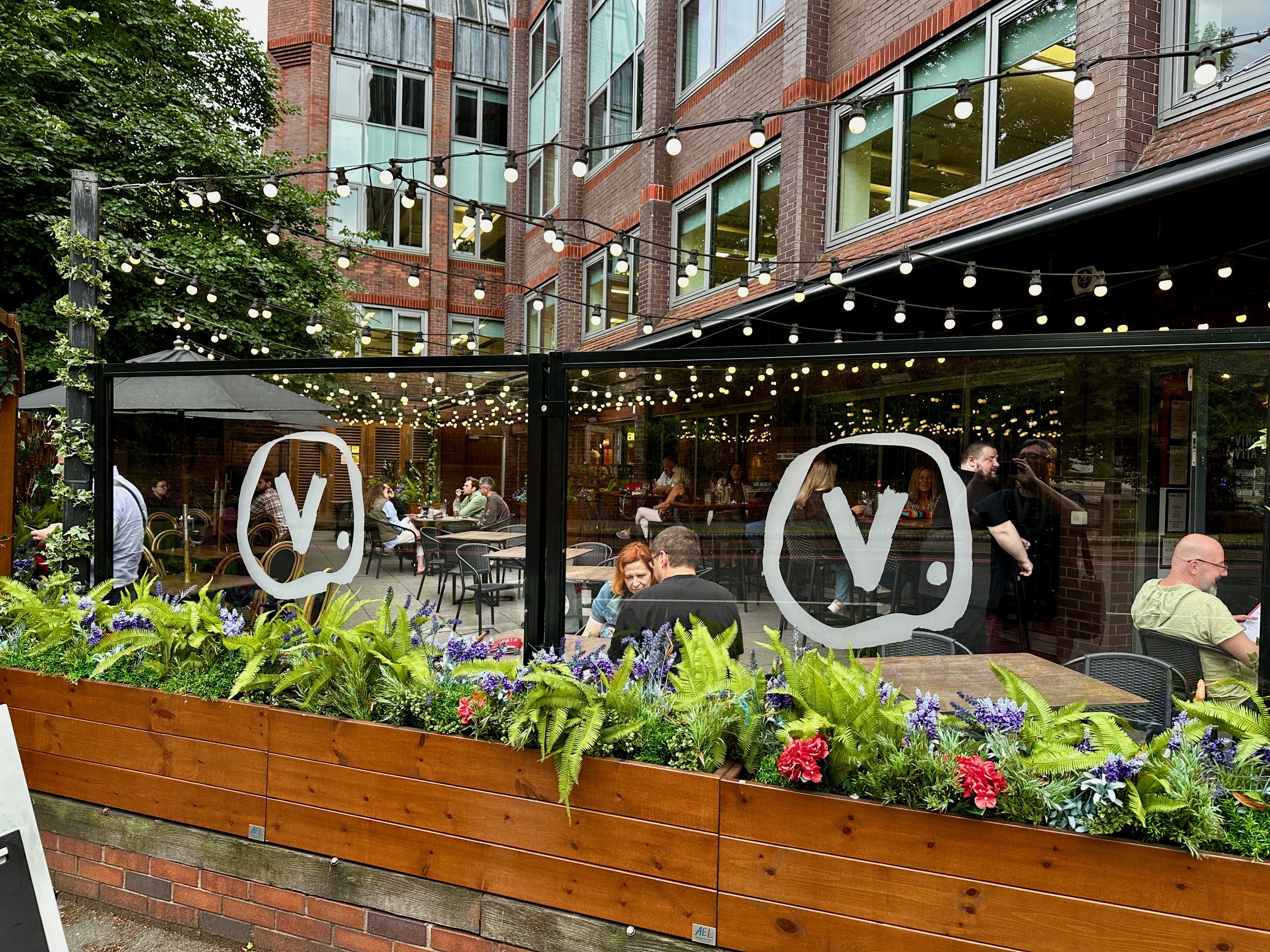
Our table wasn’t ready when we arrived, so we went out to the terrace to have a drink before our meal. It really is one of Reading’s most appealing al fresco spaces, a very pleasant spot opposite the park, strung with lights and convivial on a warm day. It was nice to spend time there before dinner, quitting as the evening became a little nippy, but it does help if you don’t mind passive smoking because there was a fair bit of that. Very Italian, I suppose.
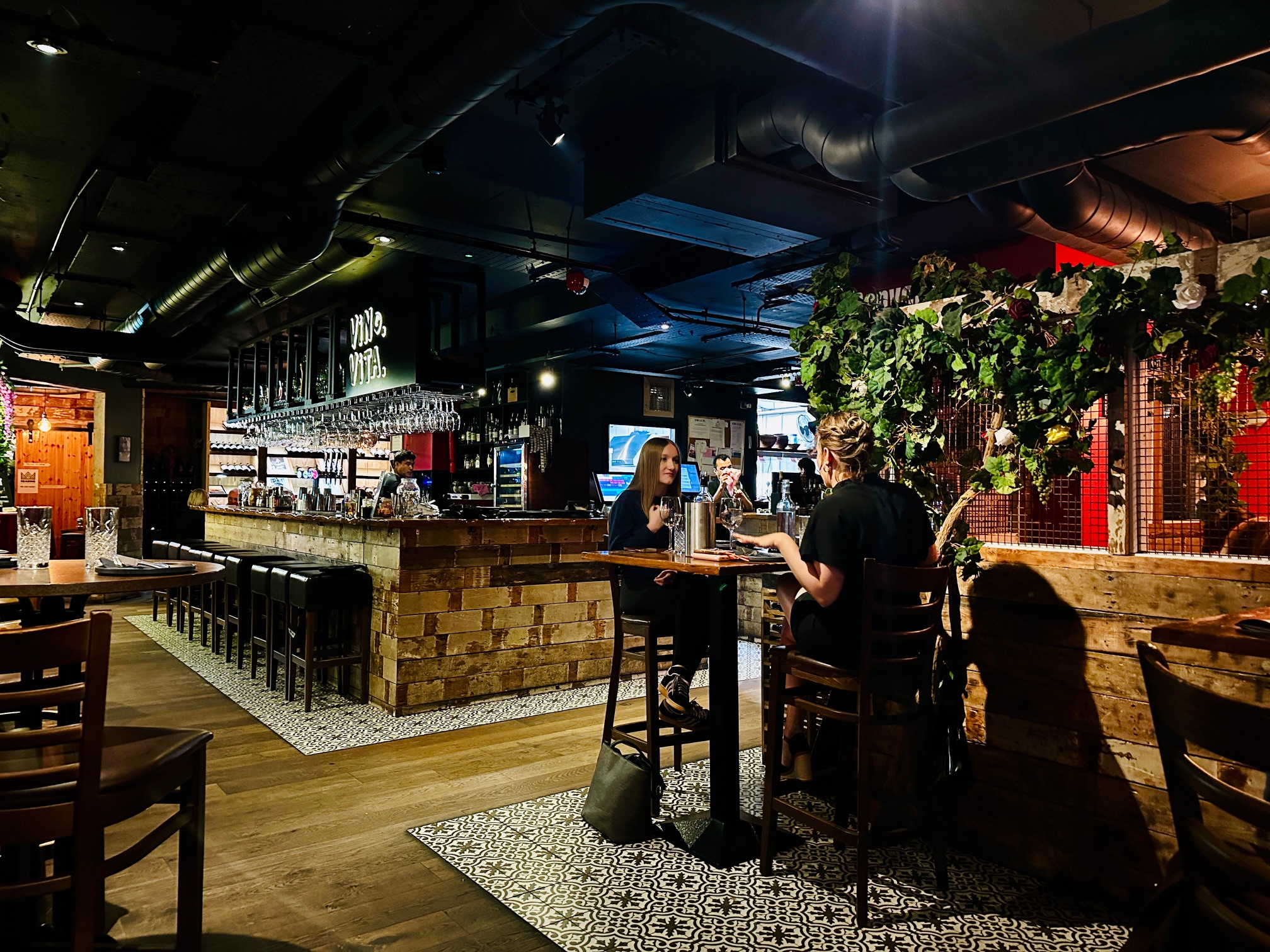
It was, however, difficult to get attention. So by the time we did, and managed to place an order, and the nibbles came out, it was chilly enough that it felt like time to move inside. Vino Vita’s interior didn’t feel any different to when it was Veeno, and I’ve always found it a slightly disjointed set of spaces – some high tables, some low tables, a series of disconnected rooms that don’t entirely feel like they’re all part of the same establishment.
We were taken to a more conventional table to the right of the bar, in the room I’m pretty sure I ate in back in 2017. On a Friday night the place wasn’t rammed, although I suppose many of the customers were outside. Perhaps they seated all the people that had booked a table for an actual meal in the same room, and everyone else was off having their Experiences.
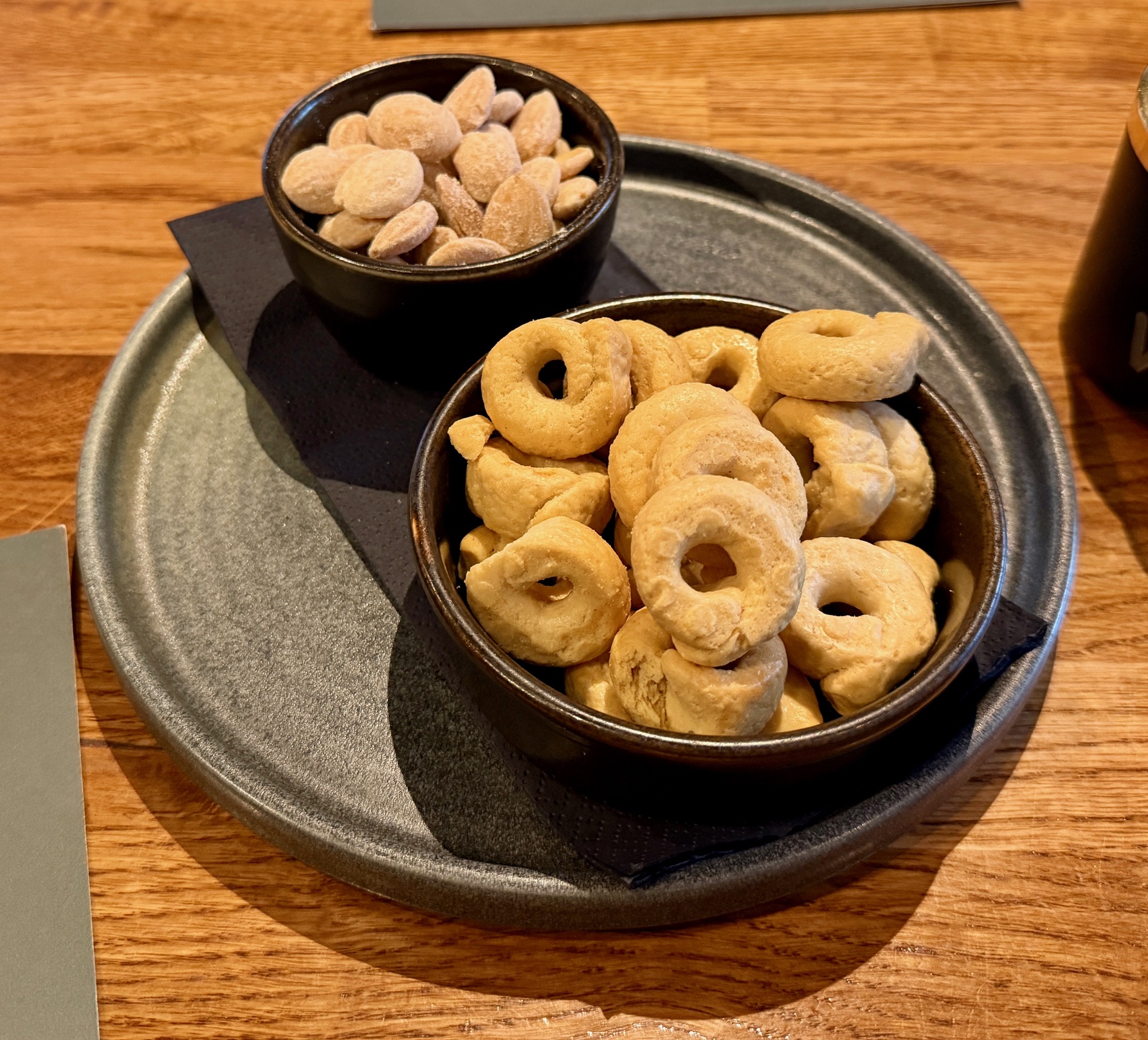
Our nibbles were disappointing, sub-pub stuff. I was hoping that salted almonds would be the kind of treats you get in Andalusia, burnished with oil and speckled with salt. These were out of a packet or a tub, dusty with salt and completely unremarkable. Even more nothingy were the taralli, dense little knots with the texture of sawdust. Really good taralli come spiked with fennel seeds and, with a crisp white wine, can be a delight. These weren’t really good taralli. Eight pounds for two ramekins of blandness.
We had a wine flight with these, the “VINO.VITA.BIO” which was three 70ml glasses of Vino Vita’s organic wines. The first, a verdicchio, was genuinely very enjoyable – and it was just as well that it was, because getting someone to bring some water to accompany those very dry snacks proved difficult. When we finally did manage it one of the staff brought a small bottle of water, a single glass and another glass full to the brim with ice. We had two perfectly good water glasses sitting on the table, which made it all a bit weird. “It’s funny” said Zoe. “They do have enough staff, it just feels like they don’t.”
The other two wines in that flight, by the way, were also quite nice. One, a Nero d’Avola, was decent, perfumed and very enjoyable: it didn’t go with anything we ordered, but that might be because it was tasty and none of the food turned out to be. The third wine was a Frappato, which is a new one on me, and was also perfectly drinkable.
This is sure to be a firm favourite amongst those who enjoy wines on the medium end of the spectrum said the blurb on the piece of paper which accompanied the wine flight: that quote is sure to be a firm favourite amongst those who like their sentences to be completely devoid of meaning. As with the wine list, the piece of paper didn’t give useful details like producers or vintages, and you didn’t get to see the bottles or labels. Did that make for a premium experience, or Experience, when you were paying £17 for 210ml of wine?
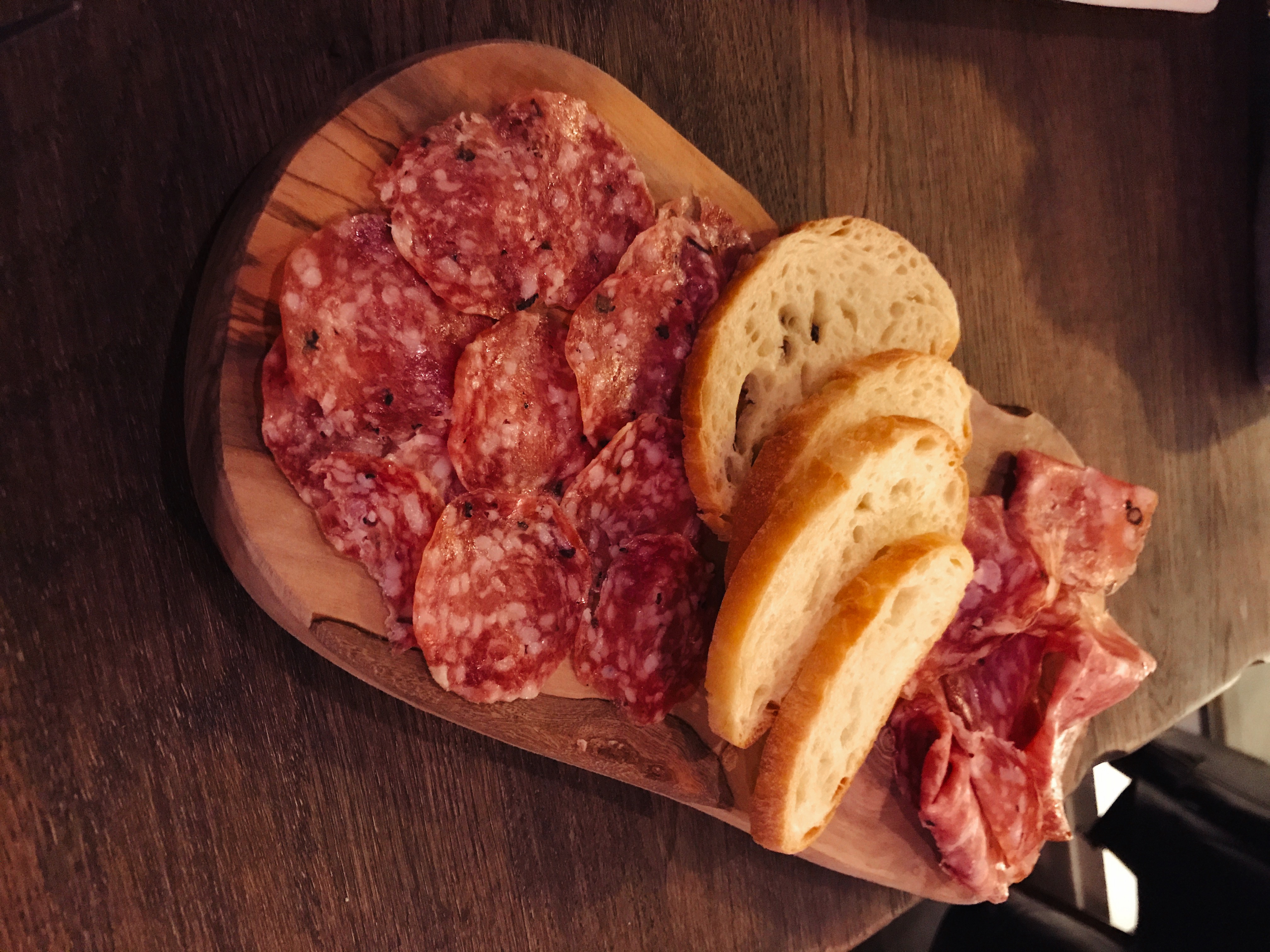
We’d also ordered some garlic ciabatta, but our server accidentally brought over the bread selection instead. He was very apologetic, and ran off and made amends, but it was a useful exercise because the bread was a dreary-looking generic selection, none of which looked like it had been baked onsite or indeed anywhere exciting; I made a mental note not to order any of the numerous bruschetta options.
Instead we got what we’d originally ordered, four slightly sad triangles of ciabatta which had been sort of toasted, a little, inconsistently brushed with olive oil and scattered with parsley. There was some garlic there, but nowhere near the industrial quantities Italian food called for. Zoë thought this was okay, but she was being charitable. I thought that for six pounds I was having the kind of thing you could easily pick up at a supermarket.

The real crimes against Italian food, though, were to follow, in a meal where the longer it went on the worse it seemed to get. I can’t think of a better way to demonstrate that than the first of the small plates we’d ordered. The menu promised stuffed courgette flowers, and I thought this would be a real test of whether they truly held all those lofty aspirations. Because a courgette flower, its head stuffed with ricotta and lemon zest, the whole thing fried in an almost translucent, lacy batter is one of the very best things you can eat.
It is serious cooking, and a menu offering it is making a claim to be serious about cooking. I still remember it being served by the Lyndhurst, when I held a readers’ lunch many years ago: Amy, the vegetarian on our table, had it all to herself and every omnivore envied her. It’s taking all my strength not to include a picture of it in this review, so you can see what it’s meant to look like. Instead, just look at that: three beige cylinders bearing no resemblance to courgette flowers at all. No light coating, instead a thick layer of stodge.

Inside, something that definitely wasn’t a courgette flower: I’m prepared to take their word for it that it was courgette, but only just. And inside that, some blend of cheeses that tasted of nothing. This was like some kind of continental reinterpretation of stuffed jalapeños you might pick up at Iceland, an affront to the promise of this dish. Providing some honey, the only thing that actually tasted of anything, didn’t rescue it. The price – £8.50 – rubbed salt in the wound.
The arancini were in the same vein. Veeno only did one kind, filled with ragu, whereas at Vino Vita you can choose between ragu, mushroom and truffle or ham and cheese. The mushroom and truffle ones didn’t taste of truffle in any way, being just claggy stodge with no crunch or crispness to the exterior. Plonking them on a shallow pool of tomato sauce, grating some cheese and unceremoniously dumping some basil in the middle neither elevated them nor disguised their inadequacy.
I’ve used that word, stodge, twice now, because nothing else encapsulates those dishes. Italian food at its best can embrace the wonder and comfort of carbs, but this seemed to prioritise filling the stomach and emptying the wallet with brutal efficiency. In fairness, these were billed as bite-sized and only cost £6, but they still weren’t worth it. When I went to Veeno, 8 years ago, I said that it felt like the kitchen was more interested in margins than food. Hold my beer, said Vino Vita.

Neither Zoë nor I managed to take a picture of one of our small plates, so you’ll have to both imagine it and take my word for it. If you read the title carpaccio of salmon and the description smoked salmon drizzled with a lemon and caper dressing and fresh rocket and think that, based on what you’ve heard so far, this is likely to be a small piece of smoked salmon draped over a hill of the kind of salad you get in a bag at the supermarket, domed to make it look like you’re getting more salmon than you are, meanly scattered with capers, you would be absolutely spot on. Give yourself a pat on the back.
This is me trying to find positives, believe it or not. But I don’t think even Pollyanna could find a positive in the final small plate, the caponata. Caponata is a wonderful thing, a cold, sweet and sour aubergine stew with olives, capers and pine nuts. It has a distinctive taste which I adore. It is not, as it was at Vino Vita, a bland mulch of aubergine and far too many tinned black olives, with no sweetness, sharpness or sourness. It didn’t even look like caponata, didn’t have that depth of colour, although you’d have to whip off all the pointless foliage that had been dumped on it to be absolutely sure.

You know who used to do a very enjoyable caponata, back in the day? Carluccio’s, of all places. You know who does the worst caponata I’ve ever tasted? That would be Vino Vita.
Now, you might just think I’m being curmudgeonly, so I have to say this in my defence: Zoë thought all of this was awful. Zoë, the woman who is able to tolerate me. Even she – especially she – found all these dishes unforgivably bad.
“There’s somebody in that kitchen who really hates Italy” was her conclusion.
“It definitely doesn’t feel like anybody in the kitchen’s ever been there.”
“What we’ve just had,” she added, “was a crap-paccio. A crap-paccio and a craponata.”
Irony of ironies, the bottle of white wine we were on by now was really very nice, with fruit and structure and, to my mind, even a little hint of licorice. And by this point we had a server who was really good and very personable, checking in on us and taking away our empties. At just over fifty pounds you’d want that bottle to be good – Vivino suggested its mark up was something like three times retail price – but however pleasant it was, I wasn’t sure how much of it you’d need to drink to make the food seem like a good idea. I was sure, though, that I wasn’t capable of putting that much wine away.
The food up to that point had been so poor that it became partly about cutting our losses. The couple at the next table had paid up and gone leaving behind the best part of a bowl of anaemic-looking pasta – the mushroom tagliatelle, at a guess – and a blond, bland pizza. So we decided to try a Pinsa Romana, the airier Roman variant as popularised in Reading by Mama’s Way. In a way, I was trying to give Vino Vita one last chance, aware that if I had a conventional pizza and was comparing it to Amò or Paesinos it would be the final nail in the coffin.
But the final nail in the coffin was the Pinsa Romana. The Piccante promised, if the menu were to be believed, ‘nduja and oil, roasted peppers, burrata, rocket and basil. Like all the other promises, it was an empty one. The base was crunchy, dry as a bone with no airiness or give: Mama’s Way may buy their pinsa bases in, but they were miles better than this.
The pinsa had been pre-cut into eight miserly squares, and good luck finding ‘nduja on every one, because you wouldn’t. “Nigel Farage turns up to vote more often than ‘nduja turns up to this pizza” was Zoë’s verdict. Bland unlovely bits of burrata had been placed here and there – no oil, no discernible basil and no rocket.
In the rocket’s place, obscuring just how atrocious this pinsa was – which surely must have been the prime objective – somebody had thrown random salad on top of the whole affair. This was the last straw for Zoë. “It’s meant to have rocket on it, not the contents of a fucking bag of Florette”. The whole thing was so subpar that we followed our neighbours’ example.

It’s not even that this pinsa didn’t compare well to what you could get a short walk away at Paesinos or Amò, although it didn’t. It’s that it didn’t compare well to what you could get at Zia Lucia, or Zizzi, or Pizza Express. Or Marks, or Tesco, or Aldi, or the Co-Op. And if you bought one from a supermarket and took it home, you could dot it with ‘nduja yourself and even if it was from the chiller cabinet, heated up in your oven, it would be dozens of times better than this effort. It wouldn’t cost you £15.50, either, and for that money you can enjoy the best pizza Reading currently has to offer, minutes away on Kings Road.
Our server came over to check how our food was. We said “it was fine” almost in unison, the universal English euphemism for It was bad, but I can’t face a conversation about that. Our bill came to £166, including a 12.5% service charge. A bit of me wants to say that in Vino Vita’s defence, nearly ninety of that was on wine. But even if I do say that in their defence, the rest was indefensible.
Can you tell I wasn’t a fan? I don’t think I’ve written a review like this in ages, and certainly not of somewhere independent, and I don’t take pleasure in doing it. I’m reassured that Zoë, who is positivity personified, disliked it even more than I did – because yes, it turns out that’s possible. And I don’t know what offends me most about the place. The mediocrity is bad enough, the mediocrity coupled with the laziness is worse. To combine both those things with really iffy value, at a time when Reading’s Italian scene is having something of a renaissance, is woeful.
Worse still, it made me feel like that rebrand from Veeno to Vino Vita had something else behind it. A desire to make more from less, to cut corners and conceal charging a premium. Even some of the dishes that have been tweaked from Veeno’s menu to Vino Vita’s display this – Veeno does a bruschetta with capers and Sicilian dark tuna, Vino Vita’s boasts a tuna paté. What’s the Italian for Shippams?
But just as sad is this: with the Cellar gone and Vino Vita, well, like this, Reading still doesn’t have the wine bar with excellent food that has been missing ever since the Tasting House closed after lockdown. That gap in the market remains, and on this evidence Vino Vita isn’t even trying to fill it. Maybe Notes, just opened on Station Hill, will do better: it’s not as if it could do much worse. It is bad luck for Vino Vita that I review them the week after I had one of my meals of the year – also Italian, but miles better – at RAGÙ, but Vino Vita would be bad whoever you were comparing them to.
It might have been a little different if the service had been better – Apo, formerly of Dolce Vita and Pho, and one of Reading’s great front of house operators – works at Vino Vita, although he wasn’t on duty the night I went there. But the problems are squarely on the menu and in the kitchen, not elsewhere: you could forgive the slightly disjointed interior or the relatively expensive wine if everything else was firing on all cylinders, but it didn’t even get started.
If Paesinos or Amò had more space and an alcohol license, I’m not sure what the point of Vino Vita would be. In fact, if either of them did I think it would spell curtains for Vino Vita. I might be wrong, of course, because it seemed to be doing reasonably well the night I was there and that puff piece in the Chronicle made it sound like they were going from strength to strength. Be that as it may Vino Vita achieved something I would never have thought possible, despite nearly twelve years in the reviewing game. It made me miss Veeno, and that’s not a good thing.
Vino Vita – 4.6
Minerva House, 20 Valpy Street, Reading, RG1 1AR
0118 9505493
Since January 2025, Edible Reading is partly supported by subscribers – click here if you want to read more about that, or click below to subscribe. By doing so you enable me to carry on doing what I do, and you also get access to subscriber only content. Whether you’re a subscriber or not, thanks for reading.


 Edible Reading