Restaurant review: Sonny Stores, Bristol

I found myself in Bristol, every restaurant blogger’s second favourite place, for a couple of days last week and, as with any other city break, in the run up to my trip I devoted myself to the serious business of deciding where to eat. As with city breaks in all my favourite places, it involved balancing difficult considerations: how many proper, sit-down meals and how many more casual, lighter lunches on the move did I want? How many old favourites and how many new prospects? Which areas did I want to amble through and explore, before or after?

Sonny Stores, although new to me, was an obvious candidate, having received a lot of attention in the couple of years since it opened. It’s been reviewed by a fair few of the national restaurant critics and a handful of bloggers – the good, the bad and the ugly – and so, along with the fantastic Marmo, is one of the Bristol restaurants most often given the status of destination restaurant. That’s even more impressive, when you consider the destination: unlike Marmo, on the edge of the old city, Sonny Stores is in up and coming Southville, the other side of the river. 

Zoë used to rent round there, back when she worked in Bristol, and a wander through the area involved her saying “it was never this good when I lived here” at regular intervals as we passed another boutique shop, another amazing piece of street art, another good-looking café or natural wine bar. And it was crowded – thronged with people, probably the busiest place I’d visited in the last two and a bit years. Where had all these people come from? (I later discovered it was for Upfest, which explained the carnival feel).

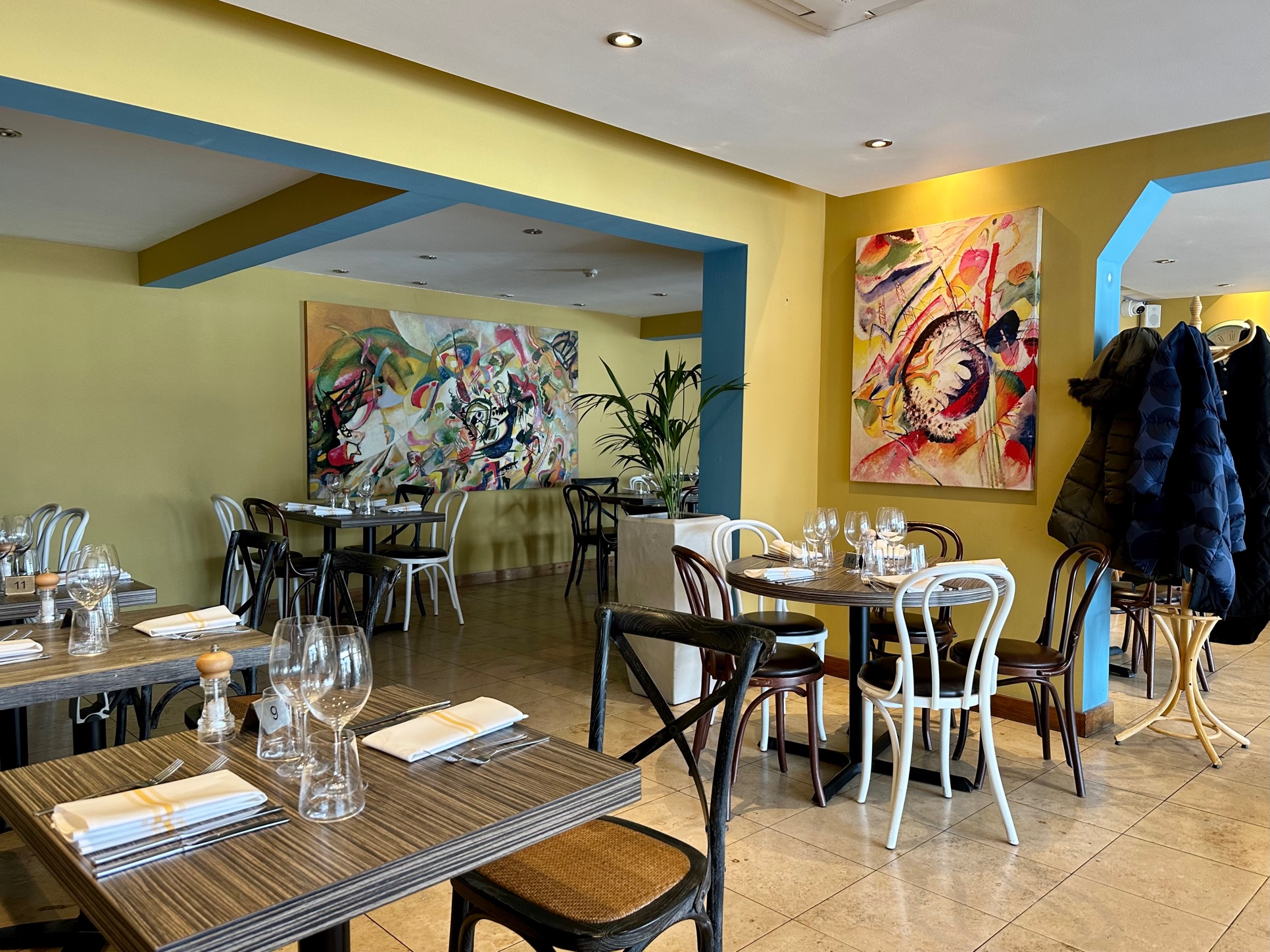
Anyway, Sonny Stores is on a residential sidestreet, away from all that. It’s an attractively neutral, almost Scandi restaurant on the corner – double aspect, with big windows and plenty of natural light. The thing that really struck me about it, which is a very Reading thing to think, is that the building reminded me of Caversham’s sadly-departed Siblings Home: if only we could find an ex-River Café chef to swoop in and open a restaurant there. But, for now at least, people like that settle in Bristol and open their restaurants there, so if you want to try them you have to hop on a train.

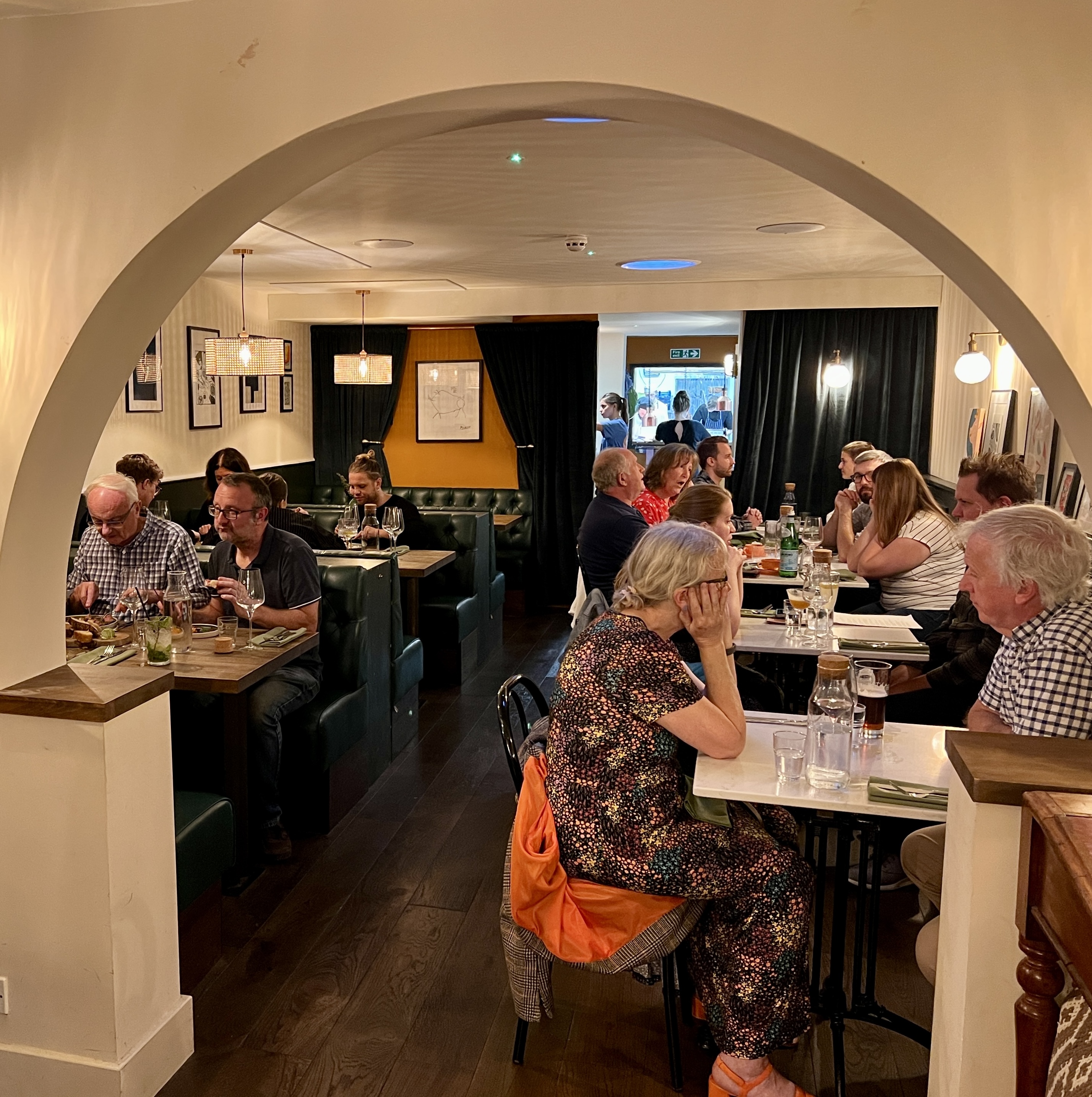
Inside it was an equally pleasing dining room. It showed that you don’t have to go to town on the decor to create a really appealing space, although I did like the Blue Note-style framed prints on the wall advertising past and upcoming collaborations with other chefs. A few tables were already occupied when we turned up, but not long into our lunch the place was almost completely full: a glowing writeup in the Observer will do that for you. By then it had that atmosphere every restaurant aims for, a little private members’ club of people profoundly satisfied with their life choices.

The menu is on a blackboard on the wall, so I suspect it changes very frequently. It had a great range – a few snacks, half a dozen starters and a mixture of pizzas, pasta dishes and assorted mains. Narrowing it down proved difficult, and at times I wondered whether I’d be shirking my responsibilities if I steered clear of the fried sand eels or the “Cornish earlies” (new potatoes, apparently: I had to Google that). But first we had a drink – a negroni for Zoë, an Aperol spritz for me, both of which were on the agreeably medicinal side of strong. The drinks menu was a little haphazard: there was a printed wine list, and a blackboard behind the counter listed the cocktails. There were three taps for beer, but the menu omitted to mention what was on them.

“This table wobbles” said Zoë as we took our introductory sips.

“Is that going to be a problem?”

“No, we’ll just make the best of it. I don’t think they can do anything about it, and they’re going to be too full to move us anyway. Besides, this is a good spot up by the counter.”

The first signs that I was going to have to write this kind of review came with the starters. Zoë’s was a joy – a beautifully photogenic pizzette with pungent taleggio and crispy pancetta. I was allowed one mouthful, which was enough to explain why she wasn’t letting me have any more. I thought it was perhaps sharply priced at a tenner, but Zoë thought it was faultless. I saw the full-sized pizzas being carried to other tables later in the afternoon and they also looked terrific, but it’s a nice idea to be able to have one and still have room for your main.

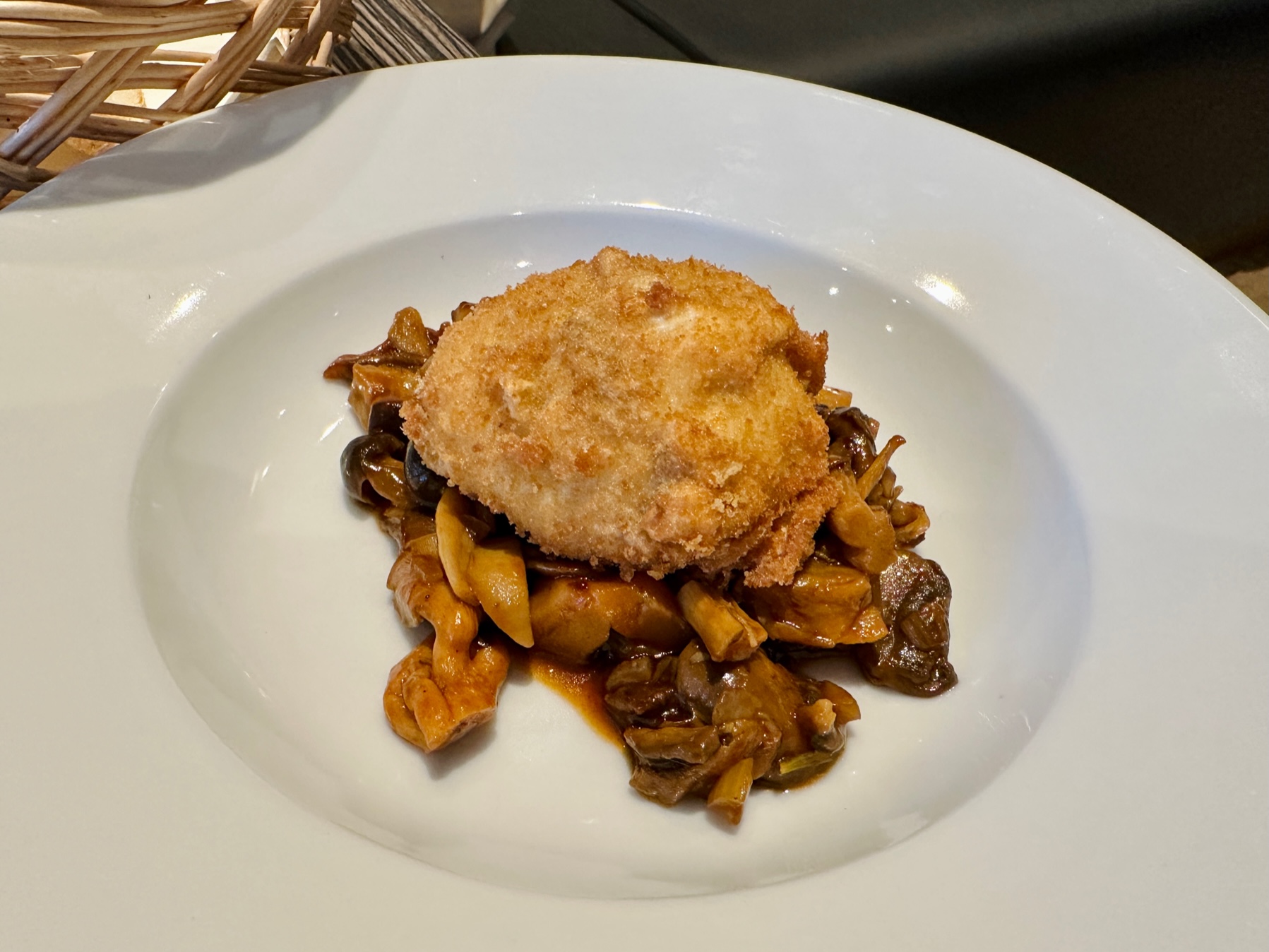
My starter, chicken livers on bruschetta, was more problematic. I know looks aren’t everything, but this dish really wasn’t a looker. It wasn’t even a jolie laide: I usually adore chicken livers, but these were a sludgy mulch and after a few forkfuls it felt like heavy going. What the dish needed was something to cut through, but instead it had a few strips of lardo draped on top, just to add to the general clagginess. On paper, I’d had a very similar dish at the Lyndhurst earlier in the year but they’d served the livers perfect and pristine, with a pesto to add contrast. You got a far better, cheaper dish at the Lyndhurst than at the nationally acclaimed Sonny Stores, where this cost twelve pounds. It was the first underwhelming thing I’d eaten during three days in Bristol, which tells you a lot about the city.

The wine list at Sonny Stores, by the way, was really good – it was especially welcome to see so many wines available in 125ml glasses, as that’s always my favourite way to try several. I had a zippy French rosé with my starter, which provided some badly-needed sharpness, and Zoë’s white was also great: she’d asked for the Argentinian riesling, but they’d run out so they suggested an alternative whose name escapes me. But flagging people down was difficult – the previous day I’d had lunch at a restaurant in the centre of Bristol where there was one waiter doing the work of five people. By contrast, Sonny Stores had five wait staff and they were lovely when you got their attention, but that was a challenge. The chap behind the bar, who made the cocktails, was equally lovely, but if you asked him for help he just directed you to the wait staff. It all felt disjointed, and a little odd.

Oh, and to carry on whinging, that wobbly table was really wobbly. Wobbly enough that I feared for our drinks. Wobbly enough that ideally, while one of you was sawing away at a pizzette the other of you would stop eating your starter and hold it steady. “I can’t believe nobody has pointed this out before”, said Zoë, and I could kind of see where she was coming from. To be fair to the wait staff, one of them clearly noticed and came over to try and fix it between courses – he did his best, but to paraphrase the great Roy Walker, it was good but still not right.

We ordered more wine to go with our mains. Mine sat up on the bar, and I watched it for the best part of five minutes waiting for them to pour the second. By this point I was wondering: is it just me? Was I just out of sorts because of the hot crowded bus ride over the river, or was I a little hung over from the night before? Everyone was having such a marvellous time: what right did I have to feel any different?

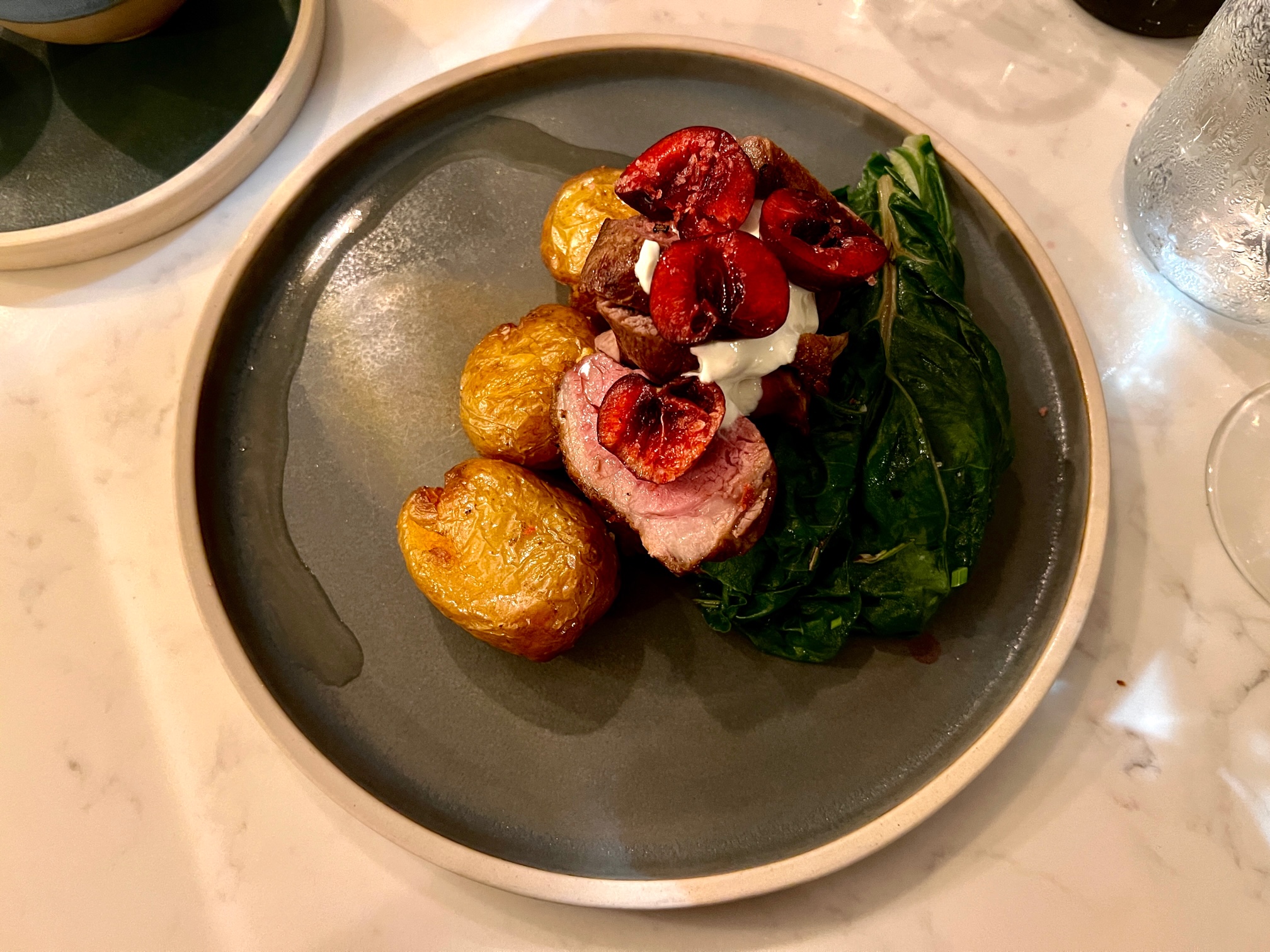
My main course did much to soothe my mood. This was the dish which gave me a glimpse of what others had seen in the place. Two huge, gorgeous lamb chops, cooked bang on, sat on a jumble of roasted peppers and coco beans. Again, this wasn’t the most photogenic plate of food I’d ever had but when it tasted this good, when there were so many combinations, so many forkfuls to curate it didn’t matter a jot. It came with dragoncello, which I’ve never heard of but is apparently a sort of salsa verde made with tarragon. I adore tarragon, and I know it goes perfectly with lamb – Geo Café does a wonderful lamb and tarragon dish, on its Georgian nights – but I must be some kind of heathen because this tasted very much like a conventional salsa verde to me.

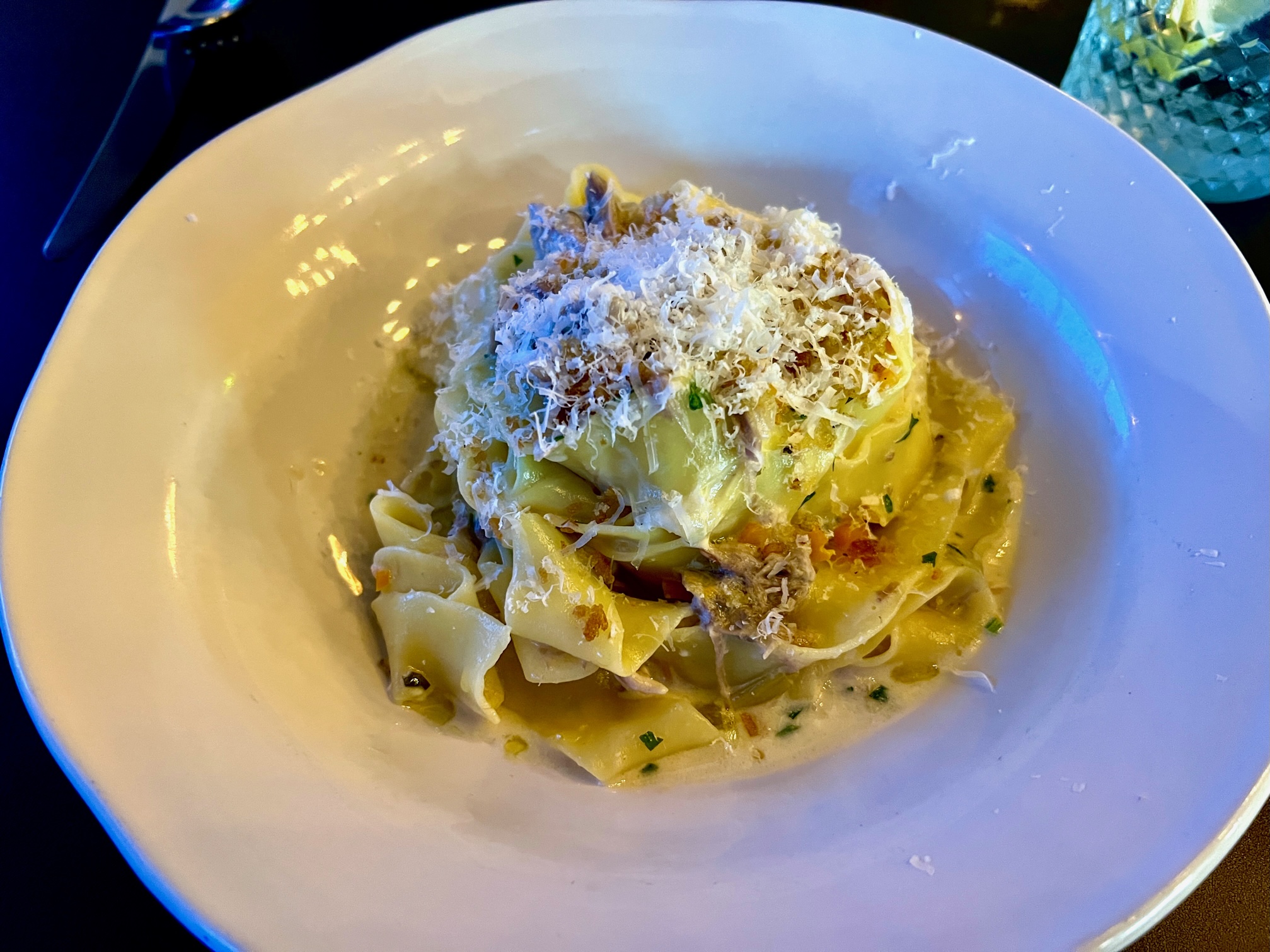
I saw less of my main than I’d have liked, though, because Zoë’s was so underwhelming that I had to keep giving her some of my lamb to prevent a diplomatic incident. It was a problem of expectation management, and we’d done our best to avoid it: the menu said “tagliarini, fried zucchini carbonara”. So before Zoë ordered it, we tried to decipher what that meant.

“So the tagliarini carbonara, how does that come?”

“Well, it’s a carbonara, but with some fried zucchini on top.”

I know there’s a debate about carbonara. I know people dispute whether you should add cream, or whether it should be egg yolks alone. But what I thought was beyond dispute was that it always contains dead animal. You know, pancetta or guanciale: a pig has to die for it to be carbonara. And the impression the wait staff had given was that this was a carbonara with added courgette, but when the dish turned up it was clear this wasn’t the case. At least when vegan restaurants call something “cheeze” or “chickn” they’re giving you a hint in mile high letters that it’s not the real deal, but here there was no such thing: maybe they should have called it a carb-no-nara or something.

“It doesn’t even have that many courgettes in it” said Zoë, who started her main course disillusioned and went downhill from there. First she conducted some kind of search with a fork, desperately looking for the slightest hint of caramelised corpse. Then with a sigh she settled down to making the best of it. I tried some, and immediately resigned myself to having to donate rather a lot of my own, infinitely superior dish.

“It’s just monotonous” said Zoë, for once not talking about me. “Every mouthful is the same. It’s so disappointing.”

We had desserts, to try and rescue the situation, and again the hit rate was fifty per cent. This time, Zoë was the winner, with a cracking slab of tiramisu – although slab makes it sound like a heavy, weighty thing and this was far more ethereal than that. I had a spoonful for quality control but didn’t push it, well aware of how fortunate I’d been with my main course.

My dessert, on the other hand, kept up the middling work. A chocolate salted almond cake sounds like a beautiful prospect, and this was made with Pump Street chocolate which I adore. But what turned up felt like an unremarkable brownie passing as a cake – the shape was different, but the overall effect was the same. In fact it lacked that textural contrast that makes a great brownie so joyous, the juxtaposition of brittle and fudgy. This was, and I don’t enjoy saying it, another little slice of meh. I loved the crème fraîche that came with it, but when crème fraîche is doing that much heavy lifting it doesn’t say much about the dessert.

Our bill came to one hundred and ten pounds, not including tip. On the bill, Zoë’s main was just billed as Veggie Pasta (“the final insult”, she muttered darkly when I told her). We settled up and headed for the bustling chaos of Bedminster, to do a spot of shopping and pass by the peerless Zara’s Chocolates to buy some bits and pieces for later on. I took a look back at Sonny Stores as we left and thought again about Siblings Home. That site was crying out to be a beautiful neighbourhood restaurant, if only somebody would take a chance on it. And one thing some of my favourite restaurants, like Marmo, or even Oxford’s Arbequina, prove is that you don’t need a gigantic kitchen to offer a really interesting menu.

I know lots of people don’t read my Bristol reviews – they’re a tad niche, and not all of you want to go to Bristol to eat. So thank you, if you’ve made it this far. I also know that any of you reading this, if you do take a trip out west, are unlikely to go to Sonny Stores on the basis of this. So let’s draw things to a conclusion so you can get on with the rest of your day. There is a terrific meal to be had there, if you were to order the pizzette, the lamb and the tiramisu: that’s the Doctor Jekyll. But the equal and opposite Mr Hyde is those chicken livers, that non-carbonara and the chocolate cake. That batting average isn’t enough to elevate it from the other wonderful places to eat in Bristol, let alone options closer to home.

“It just wasn’t quite there” was Zoë’s verdict. “The service was a little off, and that wobbly table did my swede in.” And I think, sadly, that she’s right. It’s a decent – if slightly pricey – neighbourhood restaurant but not, in my book, a destination in itself. That’s hype for you; I liked it in parts but I’m afraid that, like some of the reviews I’ve read of Sonny Stores, it’s not quite as good as it thinks it is.

Sonny Stores – 7.4
47 Raleigh Road, Southville, Bristol, BS3 1QS
0117 9660821

https://www.sonnystores.com

Restaurant review: Hamlet, Wokingham

Over the last eighteen months, the story of Reading’s restaurants has been more about trying to protect what we have than celebrating the arrival of bright, shiny new things. With a few notable exceptions, the significant restaurants to open recently in town have been chains: Wendy’s, The Coconut Tree, Gordon Ramsay’s Profanity Burger. Further afield, however, it’s a different story. 

Henley, for instance, now has a big posh-looking place called Crocker’s which contains no less than three different restaurants. The front page of their website carries a photograph of people assembling identical small plates with long stainless steel tweezers, which tells you more than enough about the kind of food you can expect. Henley also has a new steak and seafood place called Shellfish Cow (I know), the second link in a little chain which started in Wallingford. Both these venues are fancy, both look like they’ve had dough chucked at them, both are independent.

But there’s even more of a marked transformation in Wokingham, driven by the ongoing regeneration of the town and the completion of Peach Place. The earliest sign of gentrification was back at the end of 2018 when Gail’s opened there, followed by craft beer bar Sit N’ Sip the following spring. And now Wokingham is starting to attract some noteworthy restaurants, so much so that when I looked at everywhere that had opened since I last visited, I wasn’t sure where to go first.

Should I try Indian restaurant Bombay Story, which inexplicably changed its name from Dabbawalla Indian Kitchen at some point over the last year? Or RYND, which used to be a hipster-milking burger joint on Castle Street and is reborn in Wokingham Town Hall offering “Californian inspired tapas-style dining”? Or Chalk, an independent restaurant that opened at the end of last year in the old Prezzo building on Broad Street?

Well, you know I didn’t pick any of those because here you are, reading a review of Hamlet. I decided on Hamlet, which opened back in May, partly because the menu seemed to have a little more about it. But I also chose it because of the pedigree of the owners: Nick Galer, from the Miller Of Mansfield, told me that they were two old colleagues of his from his days working for the Fat Duck Group. “The early reports are good”, he said, “although I’m never sure about all day dining.”

Hamlet is also on Peach Place with a fair amount of outside space, some of it under cover, and a few heaters which I imagine will need to be switched on around a week from now for approximately the next five months. The outside was doing a roaring trade, although it felt a tad soulless. The inside, though, is quite stunning in its way, all Hans Wegner Wishbone Chair lookalikes and bleached wood tables. There are baked goods on display at the counter and a little deli area where you can buy wine, cheese and charcuterie. It’s all very Scandi, very stylish, but again, ever so slightly sterile.

Anyway, we sat outside because it was a warm Saturday afternoon and I’m a risk-averse wuss. It wasn’t initially clear whether it was table service or if you were meant to order at the counter, but that was partly because when we got there the serving staff were a bit all over the place: they settled down as the first wave of the lunchtime rush subsided.

Casting my eye over the menu, I began to see Nick Galer’s point. Hamlet is open daytimes all week and evenings Thursday to Saturday, and its menu tries to cover every single base. The overall effect is something like a cross between Gail’s and an upmarket version of Wokingham’s Sedero Lounge: so there are brunches until 1pm, sandwiches available until 4pm and small and large plates available from midday until 4pm. So if you’re there between noon and one in the afternoon you can choose between four different sections, you lucky so-and-so. Brunches run from six to ten pounds, sandwiches from seven fifty to a tenner, small plates range widely in price between five and twelve pounds and most of the large plates are between ten and fifteen pounds. 

So yes, the menu was even busier than the staff and felt a little confused. I should add that if you go in the evening the small and large plates on offer look a lot more like a conventional restaurant, so it would be easier to treat it as a starters and mains kind of place. Anyway, we ordered a couple of sandwiches to start with a view to moving on to some other dishes afterwards, aiming to cover as many of the sections as we could. I would have loved to try the sausage, egg and Comte muffin, but because we placed our order at quarter past one the brunch section was out of bounds. Rules are rules.

Zoë had chosen Hamlet’s croque monsieur – an excellent choice, and possibly what I would have ordered if I’d had first dibs. It was attractively burnished, covered in that molten, slightly-caramelised topping and with beautiful ham – shredded hock, rather than slices of the stuff – in the middle. The mouthful I got was pretty good, although (and this might be a bit of a trend for the rest of the review) I wasn’t sure it was nine pounds fifty’s worth of pretty good.

“I liked it, but I think it needed mustard” was Zoë’s verdict.

“Didn’t it have mustard in it?”

“If it did, it needed more.”

Zoë picked better than me, and my fish finger sandwich was close but not quite there. You could see all the things they’d got right: the goujons were well done, handsome things with deeply pleasing breadcrumbs. And the tartare sauce, made by Hamlet at a guess, was fantastic with plenty of crunch and acidity from the gherkins. But as a sandwich, it didn’t work – the unremarkable white bread just got soggy from all the tartare and fell apart. Putting it in a bun, or at least toasting the slices of bread, would have helped it hold together a lot better. And the decision to put bitter, chewy radicchio in there felt cheffy for cheffy’s sake – iceberg on its own would have been fine. 

Was this worth nine pounds fifty? The long answer involves telling you all about Hook & Cook, who are at Blue Collar most weeks. The short answer is no.

If we’d stopped there you’d have got a lukewarm review which might have suggested you’d be better off going elsewhere in Wokingham – and even without the choices I mentioned earlier in this review you could have stopped at the busy food market outside the Town Hall and tried something by Krua Koson, another Blue Collar regular. But fortunately we went on to order some dishes from the other sections of the menu and, to some extent, it was like eating in a different restaurant.

Take the beef boulangère we had, from the small plates menu. A nice-looking dish, with strands of slowly-braised beef in a nearly-sweet tomato sauce, reminiscent of a stifado, and topped with layer upon layer of thinly sliced potato, the whole thing dusted with cheese and chives. A terrific dish – and, although technically a small plate, not too difficult to divide up between two people. Yours for five pounds. Five pounds! You could get two of these for the price of either of those sandwiches, and I think it would be the better choice.

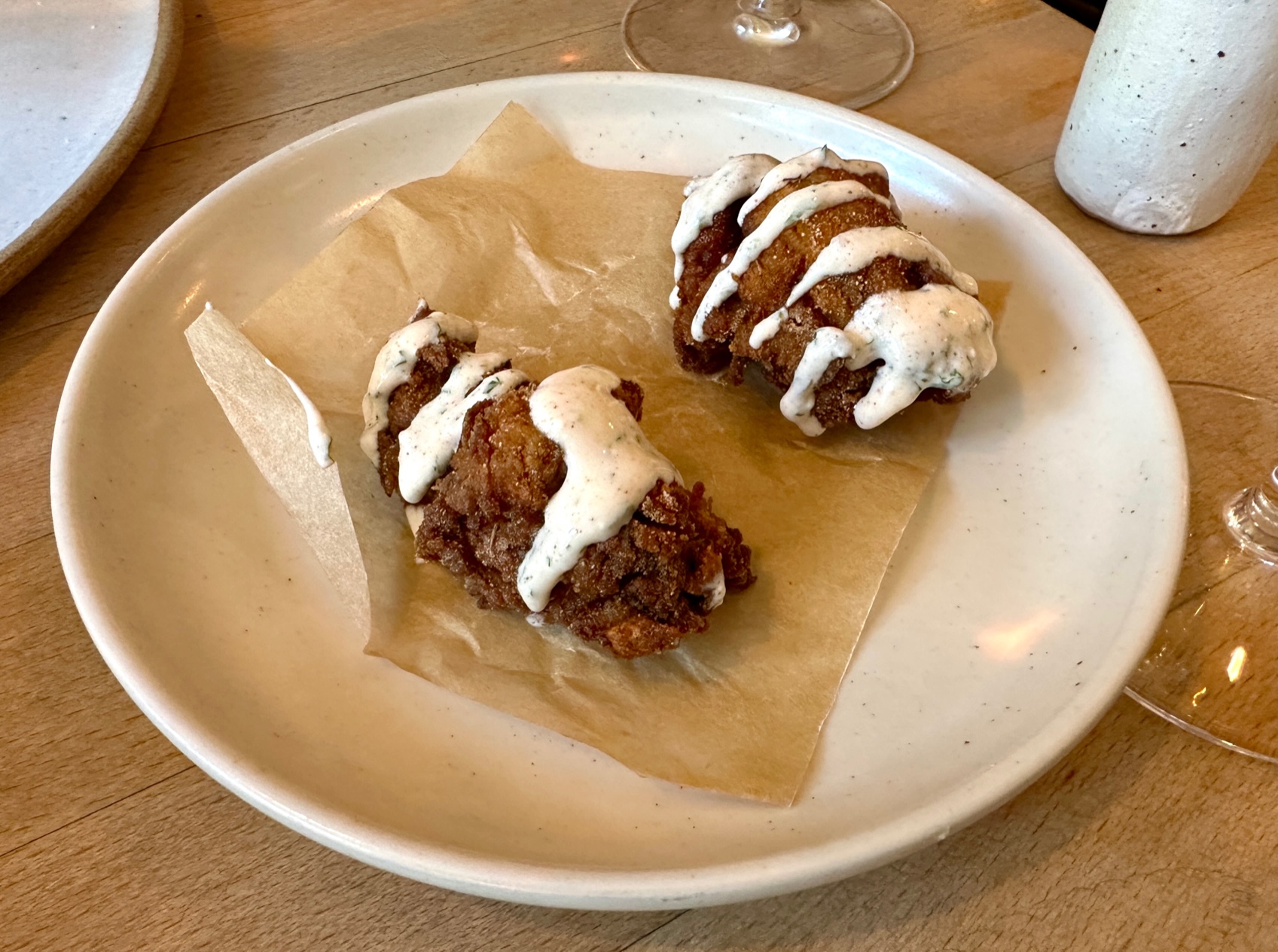
But then, also from the small plates menu, we also ordered fried chicken with beurre noisette houmous. Again, this was a fetching dish – four pieces of gorgeous chicken, all gnarly and crunchy, tender under that coating. Pairing them with houmous isn’t something that would have occurred to me, and pairing the houmous with the almost-caramel silkiness of brown butter certainly wouldn’t have: I’m so used to seeing a bright green well of extra virgin olive oil in the middle of a mound of houmous that I’d never have thought of using anything else. 

All those ideas could have come a cropper when combined, but in practice the dish was a revelation. But pricing rears its ugly head again: this lovely dish was twelve pounds. Were you paying for the produce, the idea, the skills involved or the location of the restaurant? And did it matter? I’m not averse to dropping twelve pounds on a small portion of fried chicken from time to time, but will enough people feel likewise?

Last but not least, we’d also nabbed a charcuterie board to share. This is largely about buying rather than cooking, but Hamlet buys its charcuterie from Trealy Farm so they’d bought wisely. Chorizo, a couple of different types of salami (the nicest, for my money, with fennel), some cracking air dried ham and, usually my favourite, a superb coppa. The menu suggested there would also be some lamb carpaccio, but that seemed to have gone missing somewhere. 

Personally I like something acidic with charcuterie – gherkins or caperberries – but Hamlet instead added some wonderfully sweet cherry tomatoes, little slices of soda bread and olive oil infused with rosemary. I’d have liked the bread to be a little more substantial, but it was still a great selection. Fifty pence more expensive than the fried chicken, which did make me think – not for the first time – that Hamlet’s pricing was all over the shop.

I haven’t talked about our drinks, but there was a good, compact wine list covering all sensible price points along with around half a dozen cocktails and a handful of beers and ciders, all bottled. Zoë had a negroni, because that negroni habit is coming along nicely, and I had a small glass of a red burgundy which was the costliest wine on the menu. I liked it a lot, but I liked the fancy glasses even more. 

Our meal – two sandwiches, two small plates, a large plate, a couple of drinks and a bottle of mineral water – came to just under seventy pounds, not including service. You’re probably thinking “ouch” at this point, and ordinarily this is where I would say “but you could spend a lot less”. But unless you’re just coming to Hamlet for a sandwich and a coffee – and possibly even then – I think you’re going to feel a little stung when the bill arrives.

As I said earlier, table service did feel a little haphazard at the beginning of our meal, but as it went on service got stronger and far more personable. And Hamlet was pretty busy – even later on as we wandered back through Peach Place the restaurant was still doing a pretty consistent trade. 

Afterwards we went for a drink at Sit N’ Sip, the craft beer place where, oddly, nobody sitting out front was drinking beer. It wasn’t really my glass of IPA, despite some excellent people watching opportunities. So instead we found our way to the brilliant Outhouse Brewery, which has only been open for three months, and sat outside drinking their very own excellent oatmeal stout. I couldn’t resist trying one of their sausage rolls – made by Blue Orchid Bakery, another Peach Place business – and it was phenomenal, with great pastry and a coarse, dense sausagemeat filling (the fact that I had room for it perhaps isn’t the most glowing endorsement of Hamlet).

I think Nick Galer was right about the challenges of all day dining. Hiding in Hamlet’s menu, a maze of breakfasts, brunches, sandwiches and plates of varying size, there’s a very good restaurant, making itself frustratingly hard to find. I’m sure they’re doing what works for them, and certainly looking on Instagram their lunch menu has been a work in progress since they opened, but for me it felt muddled. Maybe they feel they need to compete with Gail’s during the day and places like Chalk at night. But although the execution might have been uneven, you couldn’t deny that the ideas were there, and along the right lines. 

I’m far more tempted to go back in the evening and treat Hamlet more as a traditional restaurant, and when I do I can easily imagine that I’ll have an excellent meal. But even so, they deserve credit for lots of things – for some of the imagination involved, for the stylish space they have created and, perhaps more than anything, for giving it a go during such an awful, challenging time. So there you have it: a polished-looking, high spec, unashamedly high quality restaurant selling interesting, creative food. And a great town centre taproom just around the corner for when you’re finished, into the bargain. In Wokingham. It’s interesting that, for all our chains and burger places, restaurants like Hamlet don’t choose to open in Reading.

Hamlet – 7.6
10 Peach Place, Wokingham, RG40 1LY
0118 3048433

https://hamletwokingham.co.uk

Restaurant review: Medlar, Chelsea

All restaurants have distinct personalities, just like people. And, just like people, we encounter them in different ways: you might meet them by chance, or be introduced to them by friends. You decide you’d like to see them again, and over time the relationships you have with some restaurants become friendships themselves. You introduce your other friends to these places and you’re delighted when they hit it off, sad when they don’t quite gel.

Restaurants can be many different kinds of friends. There are the ones you see all the time, because they’re your neighbours, or the ones that live further away that you have to make an effort to visit. Ones you go to when you want to be cheered up by a night of dumb fun, and the ones you’re drawn to for a deep and meaningful evening. Ones where you can be yourself and come as you are, and ones where you must dress up and be on your best behaviour, become a marginally improved version of yourself.

Sometimes you don’t go to a restaurant for a long time, and when you return you’re reminded of exactly why you liked them. I saw one of my oldest friends a few weeks ago, the first time since last March, and although we had much to discuss, in all important respects we picked up where we’d left off. Some restaurants are like that. Restaurants see us at our best and our worst and they welcome us all the same, and conversely we forgive their off days, as we overlook them with people we care about. 

And, of course, those friendships sometimes end. We drift apart, our tastes change, we move towns, we lose them in divorces. Sometimes the restaurant simply ceases to be, and we mourn it. But there are always new restaurants to go to, new friends to make. Of course restaurants are like friends: we celebrate with them, we commiserate with them. We spend time with some of them to forget momentarily about our own lives, with others because they have become part of our lives.

That’s the genius of restaurants and the friendships they create. The best restaurants connect us to something bigger than us, they build a community. If you didn’t know that before, surely the last year and a half has written it in big. Look at the outpouring on social media when Clay’s Hyderabadi Kitchen reopened after sixteen months. It was like a friend coming home after far too long away. Some people felt surprisingly emotional when they went through those doors again, me included.

One of my oldest friendships, as restaurants go, is with Medlar in Chelsea. It’s been open for ten years, in which time it’s been written up by most restaurant critics, gained a Michelin star, lost it for reasons nobody could really fathom and dealt with it by shrugging and carrying on regardless. I must have been going to Medlar for eight years or so, with friends and family, pre and post divorce. I’ve introduced all manner of people to the joy of Medlar. The prices on the prix fixe have gained a few pounds over the years, but so have I. On my last visit, pre-pandemic, I took Zoë there to pop her Medlar cherry. We’d not been together long at that point, and I wondered what she’d make of it, but I needn’t have worried. She was an instant convert. She ordered better than me: I didn’t realise, at the time, that this was the shape of things to come.

When a restaurant has traded for ten years it becomes largely immune to trends, but, far from the hype machine, it risks getting forgotten. I went through a phase of eating at much-hyped London restaurants, the latest big thing each time, and I usually came away thinking “that was okay I guess, but I wouldn’t go back”. But Medlar wasn’t like that: I never had a bad meal, and even the least magnificent was on the money. So when I decided to go to London a few weeks back I asked on Twitter if anybody had any recommendations for al fresco dining. I’m sure the places mentioned in my replies would all have been worthy choices, but in the back of my mind I was always thinking or I could go back to Medlar: I was delighted when none of the suggestions caused me to hesitate, even for a second.

Medlar is in Chelsea, but not the nice part. If you go down the Kings Road it’s all very chi-chi until the Bluebird building (which Zoë tells me features frequently in Made In Chelsea: fucked if I know, I’ve never watched it) and then it starts to get scruffy. The Brutalist World’s End Estate – could a name conjure less hope? – is across the way and although Medlar itself looks genteel from the outside, it looks out on a branch of Mail Boxes Etc, over the road. 

Inside though, all is peaceful and calm. It’s a long thin room broken up into sections – a beautiful one at the back with sunshine flooding through a skylight, a middle one full of booths, all smart mint-green button-backed banquettes, and a plainer room at the front. We initially had booked one of the tables outside but the sun was scorching, so we moved to a table next to the open French doors, mini John Lewis fans on the table, whirring away. There were perspex screens between the tables, and everything felt safe and well spaced. 

Medlar runs a prix fixe menu for lunch and dinner, and lunch has always been a steal: I remember when it was thirty pounds for a three course lunch, outrageous value, but even now at forty pounds it still feels reasonable. There are seven options for each course, and some – crab raviolo with bisque sauce, duck egg tart with duck hearts and lardons – have been on the menu so long I imagine they have protected status. Perhaps that’s why they lost their Michelin star, for not being seasonal enough, but I’ve had both those classics more than once and I’d rather they kept the dishes than kept the star.

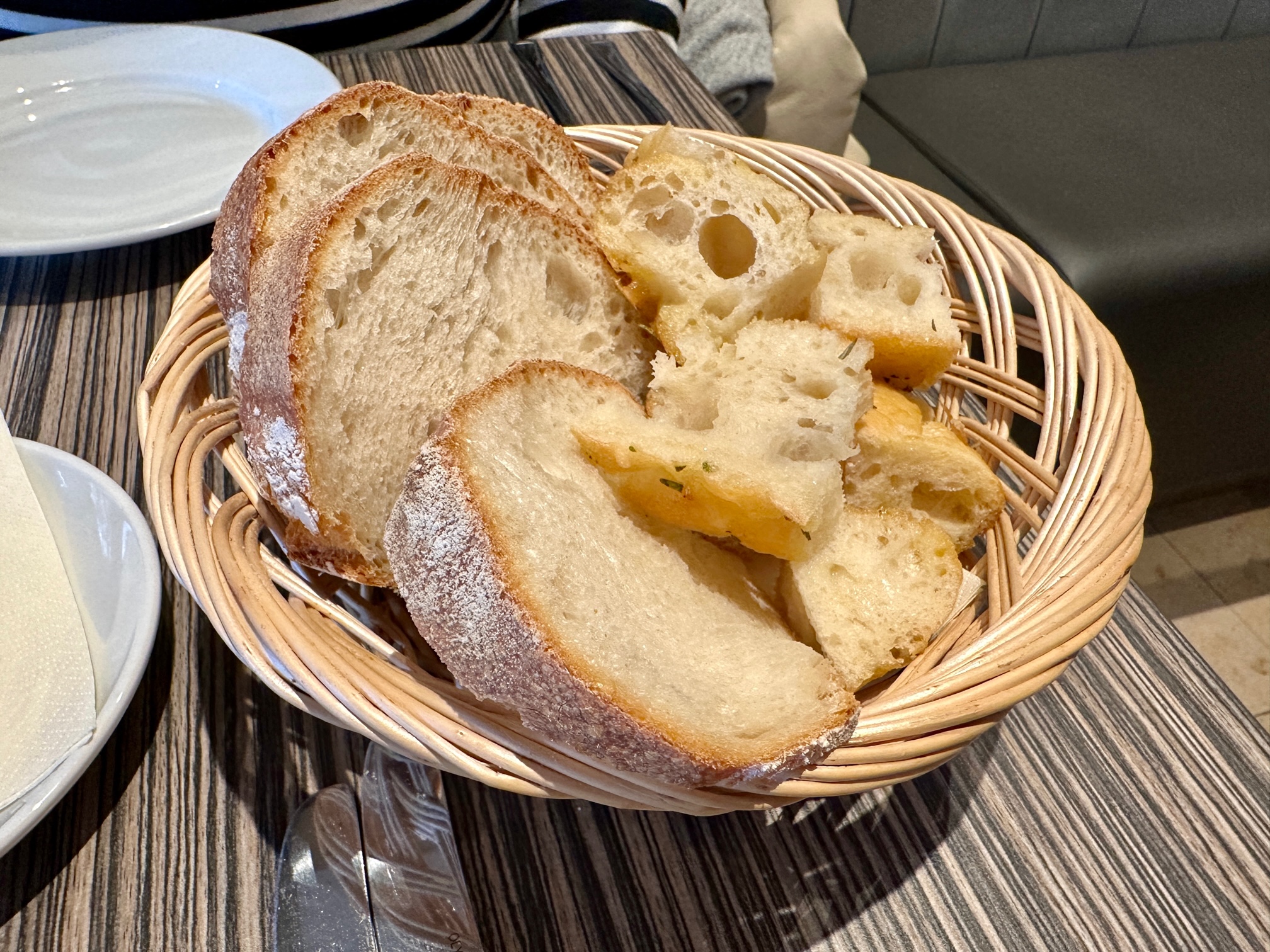
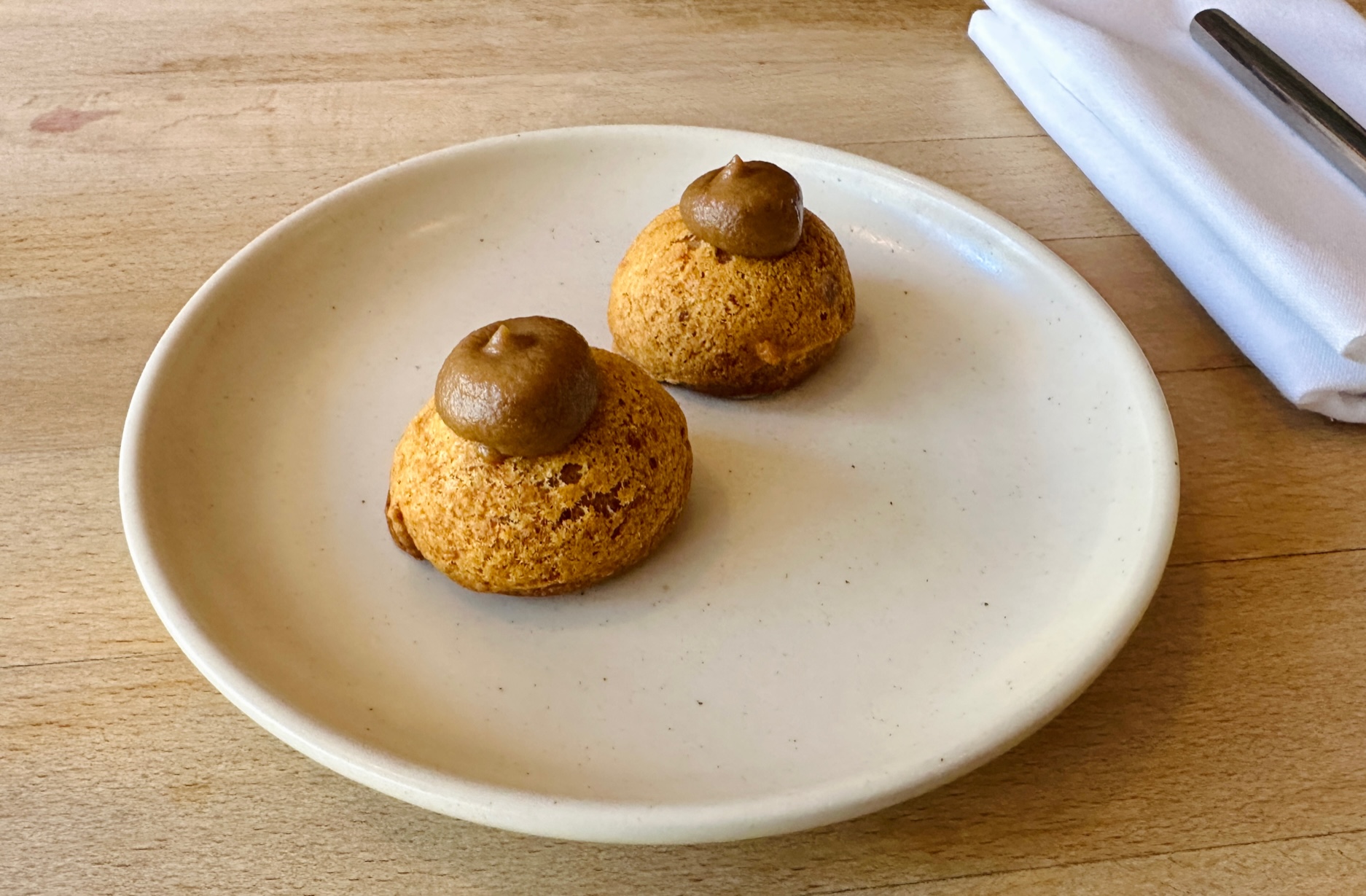
We started with a pair of stunning aged Comte gougeres. It was odd to taste Comte without that familiar crystalline grit, but odd in a good way, and the pastry was dense yet airy. By this point we’d been served a choice of bread from a wooden tray (Medlar’s focaccia is another thing of wonder) and we’d been brought water and a glass full of ice cubes, which was regularly taken away and replenished throughout our meal. We’d chosen our wine, and everything was right in my little world. A proper lunch, a leisurely one where you get through a bottle of wine and have nowhere you need to be afterwards, is a holiday in its own right, if you choose the right place.

Speaking of wine, that was the first misstep. We’d ordered a bottle of Riesling by Pegasus Bay, a stellar producer from New Zealand. They brought it, opened it and then explained that it wasn’t cold enough. So they poured a little into our glasses and took it away to try and get it colder quickly. But they didn’t succeed, because it was only reached the right temperature at the end of the meal, by which time we’d drunk most of it. It was still a fantastic wine, but we had it far from its best: given that it cost around sixty pounds I’d have expected them to give us the option to choose another, rather than opening it when it was barely chilled.

But the food was as good as I remembered. As on our previous visit, Zoë picked the best of the starters – thin slices of pork loin served in a sauce almost like a consommé, topped with thin, crisp onion rings, salty splinters of pecorino, girolles, cubes of fondant potato and a grassy, intense salsa verde. It was a dish where you could construct an almost infinite number of different forkfuls, each of them magical, and I looked at it with a level of envy that only intensified when I tried it.

“Pork, onion, potato and cheese – no wonder I love this dish” said Zoë. “It’s the Irish in me” (I look forward to the day when she has the passport to prove it).

I could have, should have gone for one of my favourite starters from the menu, for old time’s sake. But it was a hot day and I wanted to avoid the tried and tested, so I chose the gazpacho. If I wasn’t absolutely bowled over by it, that’s probably because it’s a soft-spoken dish even when done as skilfully and fastidiously as this. The cubes of scallop were super-fresh, pristine and elegant, but if I’d known it was padded out with cucumber – I’ve never been a fan – I would have chosen something else. Superb olive oil had been used but didn’t break through, hesitantly clearing its throat when it should have sung. Cobnuts added texture and a second dimension, but overall it was too mild-mannered for me. I consoled myself with another piece of focaccia.

By this time the restaurant was filling up. They charge reasonable corkage at lunchtime, which explained one chap lugging what appeared to be a jeroboam of claret. Medlar clearly has a reputation and a regular clientele, because many of the diners were well-upholstered: a florid, blazered buffer at the next table was humblebragging away to his friends (“I’m still seven hundred pounds in credit with the Royal Opera House” being one gem). I’ve missed people watching, and watching these people was another level completely from sitting in the Workhouse courtyard, seeing who wanders past.

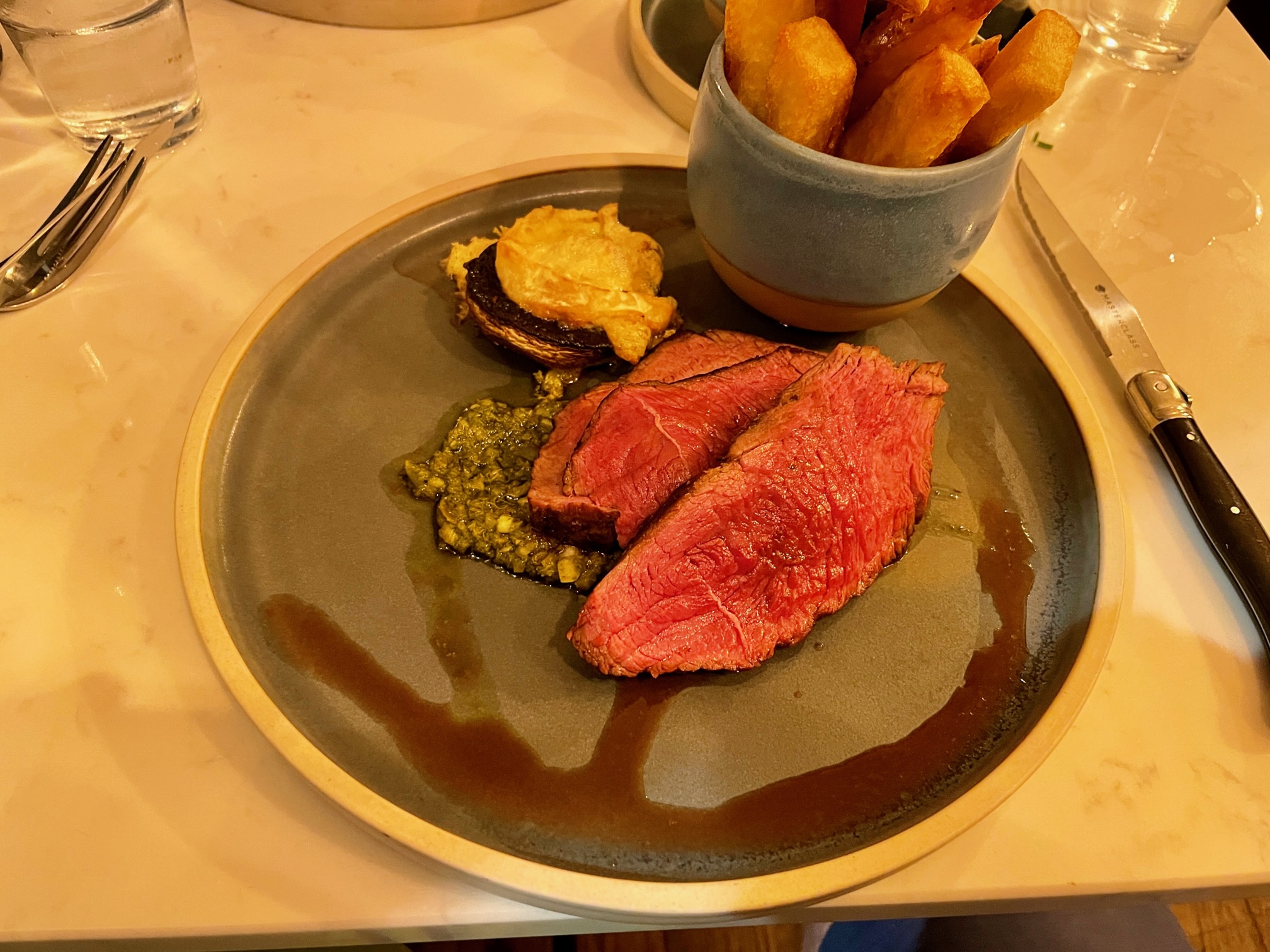
Zoë’s main is a mainstay of the Medlar menu and if she hadn’t ordered it I would have – glorious, soft rump of beef, served pink and fanned out with blobs of shallot purée, along with a portobello mushroom stuffed with snails in Café De Paris butter. You also got a side salad and a hefty helping of a beautifully made Béarnaise, with an almost medicinal hum of tarragon. Zoë was sceptical about the snails in particular but I talked her into ordering it, reasoning that if she didn’t like them I could swap with her – so of course, when it came to it, she loved the whole lot. Again, no two forkfuls need be the same, but every forkful was marvellous.

My dish – bit of a theme here – was good but not at the same level. Barbary duck came pink, also fanned out (they love a bit of fanning around at Medlar) on mange tout, with a jug of a fantastically sticky jus. But the second half of the dish, the confit duck tart, was problematic. It felt like it had wandered in from a completely different meal, one where you wouldn’t have a sticky jus. But also, it wasn’t a tart: plonking ingredients on a thin disc of pastry as a means of displaying them doesn’t constitute a tart, however much you might want it to. So the stuff on the edible coaster – the confit duck, roasted courgette and tomato, the ribbons of fennel, even the almost-rubbery ricotta gnocchi – were very nice, but they had nothing to do with the rest. I know the weather lately has made us all uncertain whether it’s summer or winter: this dish had a similar identity crisis.

We ordered chips to go with both distinctly carb-free dishes. They come with more of that marvellous Béarnaise, but usually they’re better than they were that day: they didn’t have that brittle crunch they needed, although as a vehicle for tarragon-infused indulgence they did just fine.

The dessert course comes with suggested pairings, and this was the first time the restaurant felt truly pricey: the cheapest dessert wine came in at a tenner but the rest were in the region of fifteen pounds for a glass. I liked my Beerenauslese, which had a note of sharpness alongside the sweetness, and Zoë loved her Australian Riesling. But neither was worth quite that much money.

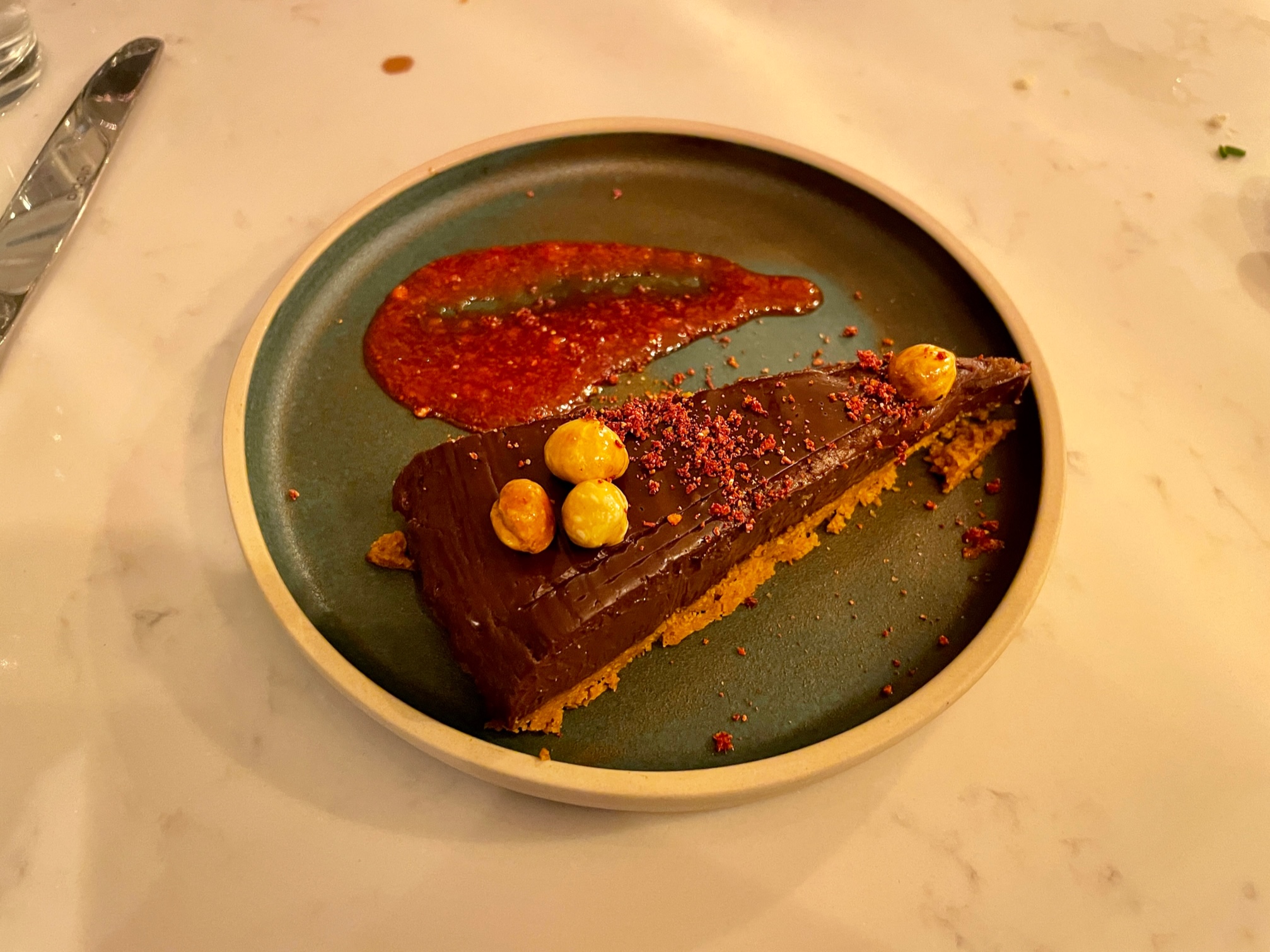
Never mind: gladly the dessert we’d both chosen properly saved the day. It was a festival of chocolate and cherry, a deep dark delice surrounded by dots of cherry and griottine cherries, crowned with an orb of almond ice cream and a brittle tuille made from cocoa nibs. The almond ice cream – extraordinarily smooth, with hints of marzipan – and the cherry lent the dish a touch of Bakewell, and the whole thing amounted to a proper desert island dessert. We ate it in silence, interrupted only by the duffer at the next table holding forth to his unfortunate friends.

As we waited for our bill, the staff brought over one last treat, velvety chocolate truffles and pieces of marshmallow which tasted of sweet, concentrated passion fruit, a little miracle. Aside from our slightly lukewarm wine, service was perfect – attentive but nicely distant, very efficient indeed, far better than service I’ve had at places which have retained their Michelin star (l’Ortolan springs to mind). Our three course meal, with a bottle of wine and a couple of glasses of dessert wine – and those gougeres right at the start – came to two hundred pounds, which included an optional 12.5% service charge. 

We left nicely full, edges a tad blurred, and strolled down the Kings Road, pausing now and again to stumble into a(nother) ridiculously expensive boutique. Exactly how many branches of Joe & The Juice does one road need? I thought to myself (the answer, as far as the Kings Road is concerned, is two). I tried on crazy glasses in Moscot – it turns out that Woody Allen-style glasses are best left to Allen – we ambled round Peter Jones, we walked to Belgravia and made a pilgrimage to Les Senteurs, one of my favourite shops on the planet. In the sunshine, you could nearly convince yourself that the city was almost normal.

So yes, it wasn’t a perfect meal. And Medlar might not have been completely at the top of its game when I visited them, but even on a relative off day they could teach pretty much any restaurant in Reading a thing or two – about food, about service, and about doing the same thing day in, day out for years, without getting bored, rebranding or chasing fads. It’s an underestimated quality in restaurateurs: the patience to build something up, to stay focused, to not lose interest. And if I picked Medlar up and dropped it, say, in the space Bill’s is currently wasting they would easily be one of the best restaurants the town has ever had. For my part, it was an absolute pleasure to go to London and catch up with an old friend. All things considered, I’d say they’re doing pretty well. I won’t leave it so long next time.

Medlar – 7.9
438 King’s Road, Chelsea, London SW10 0LJ
020 73491900

https://www.medlarrestaurant.co.uk

Restaurant review: Marmo, Bristol

What’s your favourite restaurant? Your absolute favourite, I mean. I ask because a couple of weeks ago I was sitting in my friends James and Liz’s back garden in Bristol, drinking white wine on a sunny afternoon and having exactly that conversation. The wedding we’d been to the day before – on a Wednesday, no less – was that miraculous thing, a wedding where you’re not hung over the morning after, and so the day stretched out in front of us, feeling partly like a Sunday, partly like something else.

James refused to take part: he didn’t believe in picking a single favourite. So we talked instead about possibly allowing everyone to choose three. But if anything, that made it more difficult, because then you had to pick at least one from your home town and then you were forced to choose just the two restaurants from everywhere else you have ever been. 

Liz said that you couldn’t pick somewhere you’d only been the once, but that didn’t help either. Zoë started waxing lyrical about Eetkaffee De Lieve, a little gem in the sidestreets of Ghent, and I daydreamed about sitting outside at Uvedoble in Malaga, demolishing a little brioche stuffed with suckling pig. But which restaurant in Bologna to pick? And how could you leave out Paris? It was just too much of a puzzler.

“I think my favourite restaurant right now is Marmo” said Liz – with a hint of trepidation, because we had a table booked there that evening. And I understood that nervousness better than most, because there’s little as nerve-wracking as telling people that somewhere is good, knowing they’ve gone there because of you and then sitting there waiting to find out whether they’ve lost all faith in your good opinion. I get that all the time.

We went to Marmo with Liz and James’ friends Ed and Ben, a very entertaining couple they’d been telling me about for some time. It was clear straight away, as we took our seats at a Belgian beer bar in the old city, that they liked the finer things in life, which always makes me feel like I’ve found my tribe but also brings out the imposter syndrome.

On our walk to the restaurant Ed and Ben asked me which restaurants I liked in Bristol, and I couldn’t help but feel that this was a test. I didn’t go to Bristol often enough to be on top of the latest developments, but then I mentioned my love of the sadly departed Wallfish, a little neighbourhood restaurant a stone’s throw from Clifton Suspension Bridge, and there was a tacit nod that indicated that I might have just about scraped a pass.

Marmo is a single, buzzy room – all handsome white wood panelling and framed prints on the walls that you daydream about nicking (I also would have loved one of the branded wineglasses, come to think of it). There’s a tiny kitchen at the back, clearly in view, where all the magic happens. Our table was in the heart of things, close to the bar, and I tried to remember what this place had looked like in its previous incarnation as Bar Buvette, a wine bar I’d loved that made you feel like you were somewhere in the eleventh arrondisement.

The menu made you want to order everything, and was compact enough that we nearly did. There were a few snacks and then a 3-4-2 formation of starters, mains and desserts respectively, with one fish dish and one vegetarian dish on offer for each course. The menu looked carb light, but the waiting staff explained that you could have an intermediate pasta course to fix that, as the Italians do, or just have some bread. Starters were around nine pounds, the most expensive main was eighteen pounds fifty. The wine list – of which Marmo seems particularly proud – had a superb selection of red, white and orange wines, with a few producers I’d heard of and many I fancied trying.

In short, it was a menu to get lost in, and we did that while drinking glasses of Muz vermouth, served properly with ice and a wedge of orange. I loved it, and said that the tangy, fruity note in it was strangely reminiscent of brown sauce. There was an awful moment while I waited for someone to tell me I was talking bollocks, and then to my huge relief there was agreement around the table (Zoë didn’t enjoy the rest of the vermouth from that point onwards: “I tried”, she told me later, “but all I could taste was the vinegars”).

Aperitivi deserve accompaniment, so we kicked off with Marmo’s textbook sourdough. It came with butter, which no doubt would have been fantastic, but we were all more keen to dip it in smoked cod roe, perfectly salty and pastel pink, with a pool of olive oil at its centre. Also pastel pink was the mortadella, draped over gnocco fritto, little fried parcels of joy. I’ve never liked mortadella, not even in Bologna, but I loved it here; Marmo, like the best restaurants, can make you enjoy ingredients you wouldn’t normally look at twice.

We’d been torn between a couple of white wines – one from Jura which would have had more funk, and a more conventional Riesling from Staffelter Hof, a producer I recognised because one of their wines crops up on Clay’s fancy new wine list. I tried to palm the casting vote off to Ed, who clearly knew his wine, and he eventually plumped for the Riesling (I’m sure the fact that it was called “Little Bastard” was an unintended bonus). 

But then the staff came over and said that they only had one bottle of Riesling left, so we went for one of each. Those of us who tried the Riesling were delighted by its cleanness, the slight effervescence on the tongue. Those who decided to drink the Jura were pleased to have picked something so unusual, with agricultural notes of scrumpy and sherry knocking about harmoniously in the same glass. We all changed ends at half time, tried the other white wine and in the end decided that they were both terrific.

By this time the starters had turned up, and I got my first sign that I was in for an evening of sustained brilliance. I had gone for smoked eel, beautifully muscular and only lightly smoked, on an oblong of crunchy fried polenta. So far so delicious, but teaming it up with bright cubes of beetroot and blackberries with a balsamic sweetness was a killer blow. I could have eaten this all the live long day, and it left me wanting more – or, to be more specific, another portion. That’s what great starters do.

Although it was the most popular starter, a couple of us tried something else. Liz spoke highly of her marinated peppers, buried under an avalanche of Ticklemore, and I could see that I would have been equally happy with that. Ed had chosen the beef tartare, topped with chives and a slow-cooked egg yolk, flavour soaking into the bread below. How could you have food envy when you’d enjoyed your own starter so much? 

I was sitting between Ed and Ben – the kind of civilised couple who don’t have to sit next to one another all evening – and, being a civilised couple, they passed plates back and forth across me, or behind me, or through me so that neither of them felt left out. But I was having such a good evening that I was more than happy to be the proverbial dumb waiter. 

They were in the holiday mood – Ed’s mother was visiting their cottage in the Chew Valley over the weekend and then they were off to Cornwall for a well-earned break eating and drinking their way around that part of the world. They would spend much of the following week in their own favourite restaurants. I recognised kindred spirits, the kind of people – like me – who plan a holiday entirely around lunches and dinners, who enjoy going to places they know and love, experiencing the comfort, familiarity and total relaxation that comes with a pilgrimage like that. At the tail end of my own holiday, I couldn’t help but feel envious.

Given that Marmo was at least nominally Italian, I felt like we should have at least one Italian wine with our meal, so I chose a Tuscan red called Infraded, a deep, velvety Syrah. Ordering wine had been delegated to me by this point, but I was almost merry enough to be happy with that. Again, I felt like I’d committed a faux pas when the waiter told us this one was best served chilled, but Ed reacted with delight and I decided that on balance, I’d got away with it. It was, as you can probably guess by this point, predictably wonderful, and I made a mental note to see if there was anywhere you could buy some when I got home and Bristol was just a distant, happy memory.

The main courses brought more fireworks. I’ve always heard Mangalitza pork spoken of in hushed tones as the Kobe beef of the pork world, but I’d never tried it before so I was keen to pick it off the menu. It came in glorious marbled slabs, just-pink and tender with the most beautiful melting fat: eating it I could understand why the Italians got so excited about lardo, and the idea of eating fat on its own. It was served simply with a handful of other elements, a wonderful caponata given a fresh edge with the judicious addition of fig, some good oil and a little slick of yoghurt. It was as good a single dish as I’ve eaten this year: I looked over at James, who had ordered the same thing, and saw him lost in a reverent silence.

That silence was eventually broken by Ed telling a story from the time when he used to manage a bookshop in Oxford.

“We had lots of celebrities in while I was there, but the best rider we ever had was from Roger Moore. And Roger Moore only asked for two things.”

“Really?” I tried to imagine exactly what vintage of Château Mouton Rothschild would feature in Sir Roger’s demands. “What were they?”

“A bottle of Jacob’s Creek and a Pret crayfish sandwich. That was all, every time. And by the end of a signing he was always absolutely fucked.”

This couldn’t help but make me warm to the great man. And of course, Ed had a picture on his phone of him with Jacob’s Bond, although it wasn’t clear how much wine had been taken by that point. Ed’s main course was a very attractive-looking pollock dish with mussels, and although he was taken with it, it it didn’t give me any buyer’s remorse about the Mangalitsa pork. Liz had chosen the vegetarian option, a very accomplished spinach and ricotta ravioli dish. Again, although it looked the part, missing out on it didn’t fill me with regret.

There were only two desserts on the menu and we all fancied the same one, the chocolate and hazelnut fritter, so five of us went for that while Ed nursed a grappa. It was an exemplary way to end the meal, a deep, smooth chocolate mousse, sharpened with cream and sandwiched between layers of the lightest of batters. Looking at the picture, it resembles nothing more than a witty dessert take on the ubiquitous burger: would that it was anywhere near as easy to get hold of, but it seems you have to travel to Bristol. We accompanied this with a sweet, fresh and generous glass of Coteaux de Layon (always a better bet than Sauternes, if you ever see it on a menu) – although Zoë had a negroni, because she’s developing a taste for them.

If I haven’t talked much about service it’s because they were so good. Completely unobtrusive but always there when you needed them, really friendly and enthusiastic and very good at what they did. We needed to pay at the same time as ordering our dessert so Ed and Ben could make their taxi on time, and all of that was no trouble and very efficiently sorted. 

Our meal for six, including a discretionary ten per cent service charge, came to just over four hundred and ninety pounds, or something like eighty-two pounds a head. That might sound like a lot, but we really went for it – aperitifs, snacks, a three course meal, plenty of wine and dessert wine. You could spend less and I have no doubt you’d still have a superb meal, and if you find yourself in Bristol at lunchtime they have a set menu which is even more impressive value. But either way I had no regrets – a couple of nights before I’d eaten at Paco Tapas, Bristol’s Michelin starred tapas restaurant, where I spent significantly more, eaten and drunk considerably less and not had quite as much fun. You pay for a meal, but you pay for memories too.

Even as I was eating at Marmo, I knew that the marker had been set down for the rest of this year and probably most of the next: as complete, satisfying and perfect three course meal as I could imagine. I would go to Bristol to eat here again, and I would plan trips to Bristol just so I could. It’s not my favourite restaurant – if only because you can’t give that accolade to somewhere you’ve only eaten at once – but it was my favourite meal for a long time. And if you ever wonder why I don’t give out higher ratings more often, this is why. I save the big guns for the great meals, and this is the kind of standard Reading restaurants need to aspire to, slowly but surely. I still hope we’ll get there. But in the meantime, we’ll just have to hop on a train.

Marmo – 9.4
31 Baldwin Street, Bristol, BS1 1RG
0117 3164987

https://www.marmo.restaurant

Restaurant review: Bravas, Bristol

Last week I had my first holiday in eighteen months. Zoë hired a car and we headed to Bristol for a week of eating, drinking and relaxing, with a wedding conveniently plonked in the middle of our break. The feeling of being somewhere else, one I’ve previously had to conjure up by reading a novel, watching Call My Agent or eating in a restaurant, was even better experienced, in long last, in real life: I wish you could bottle it. Perching outside Small Street Espresso with a latte, watching a bunch of people who don’t live in my hometown going about their daily business was a little pleasure to savour, as was sitting in Left Handed Giant’s wonderful brewpub drinking glorious beer after glorious beer. 

This wasn’t a staycation, it was a holiday – but what it really was was heavenly. So it was enormous fun to amble round St Nick’s before settling down to a cracking lunch of American barbecue. Schlepping up Park Street, passing Bristol’s outpost of C.U.P. made me feel oddly proud of Reading. Walking down Park Street later, having saved just enough room for a Swoon gelato, was even better. Everywhere we went you could find excellent food, great coffee and brilliant indie shops in abundance. We spent an idyllic afternoon wandering round Bedminster, Zoë’s old hood, buying artisan chocolates and scented candles and looking at all the amazing street art. How I’ve missed buying poncey shit like artisan chocolate and scented candles. 

“It wasn’t like this when I lived here” said Zoë, and the thought crossed my mind that Bristol was far from Shangri-La when I lived there in the Eighties, back in the mists of time. Oxford is a lot better now than it was when I lived there in the early Nineties, come to think of it. Perhaps if I really wanted Reading to become a fantastic place to eat, drink and shop I shouldn’t bother filling out Reading UK’s latest pointless Surveymonkey questionnaire. Maybe I should just move somewhere else: that would fix it.  

Culturally, Bristol felt different too. Mask-wearing was commonplace, with many shops mandating it rather than using carefully chosen words like “expected” or “encouraged”.  As someone with a partner who proudly works in retail, I get especially cross that the great British public seems to think nothing of exposing those people to risk. One independent shop I saw had a sign up in the window: WE LOVE YOUR FACES BUT PLEASE WEAR A MASK, it said. Quite right too. 

But it wasn’t just the shops. The buses going past had signs saying that you had to mask up, a far cry from the fudge of Reading Buses. If Bristol did have mask deniers or anti-lockdown protesters they were where they belonged, namely out of sight.

Finding somewhere to eat on a Monday in Bristol can be quite a challenge, but we had a table booked at Bravas, a tapas restaurant just off the Whiteladies Road, which has always been one of my favourite places to eat in the city. I partly wanted to go back because I wanted to support the places I’ve always loved, to try and do my bit to help them survive. And clearly many of Bravas’ customers felt likewise: there was a chalkboard leaned against the front of the restaurant paying an emotional tribute to all the punters who had kept them afloat in the past eighteen months. I found it surprisingly moving, and I don’t even live there.

The council – more progressive, predictably, than their counterparts in Reading – had pedestrianised the whole of Cotham Hill, which meant that enterprising restaurants like Bravas had put up al fresco seating. This isn’t unique to Bristol, of course: Soho has been pedestrianised too, and I remember seeing pictures of Arbequina, a restaurant on Oxford’s Cowley Road, the pavement outside packed with extra tables. Is it that Reading just didn’t have any restaurants that could have benefited from a similar approach, or was it the usual failure of imagination by the powers that be?

In normal times I would have loved to sit inside at Bravas – the interior is conspiratorial, buzzy and surprisingly like being back in Spain – but all the things that make that room wonderful in normal times made me reluctant to eat there right now. Fortunately, after a short wait they managed to fix us up with a table outside, in a makeshift decked area (it was very pleasant, although you did feel slightly seasick every time climbed aboard, or disembarked).

Bravas’ menu was relatively small and perfectly formed, with a section of nibbles, cheese and charcuterie and then vegetable, seafood and meat tapas dishes – and some specials up on a board (I’m still sad I never managed to find room for the goat stew they were serving the day I visited). The way to approach a menu like this, I’ve always thought, is to work out all the dishes you absolutely to ensure you eat, divide them into groups and order each group one at a time, only ordering more when you’ve finished what’s in front of you.

So we did exactly that, and I made inroads into a fantastic G&T – made with local Psychopomp gin, olive and rosemary, a Bristolian take on Gin Mare – while we waited for our first dishes to turn up. Zoë was on a Negroni, which Bravas sweetens slightly with a dash of Pedro ximènez, because Zoë is more hardcore than I could ever hope to be.

The first thing we had fell slightly flat. Bristol is packed with excellent bakeries, and I expected Bravas’ bread to be more exciting, less dense and pedestrian. But the alioli it came with was pleasant enough, even if the golden colour slightly oversold it. Better were the jamon croquettes – others I’ve had have leaned heavily on the béchamel but these were sturdier and all the better for it. They were two pounds fifty each, or six for twelve pounds. Immediately after eating one I wished we’d ordered half a dozen, but that’s me all over. Manchego with rosemary was excellent too, especially with lozenges of membrillo to perk them up sweetly.

Things really got into gear with the selection of cured meats. I know all this is more about sourcing than cooking, but buying the right stuff is every bit as much a skill all good restaurants need. And this very much was the right stuff. The best of the bunch was a beautiful lomo, marbled with fat, more like coppa than the very lean lomo I’m used to in Andalusia. But the cecina was the equal of any bresaola I’ve tasted, and the salchichón was coarse and gorgeous. Best of all, it came with plump, sharp caperberries and sweet, tangy guindilla chillies to wrap in charcuterie and pop in your mouth. Better still, because of Zoë’s aversion to pickles I got to eat them all.

We’d ordered a tortilla and a dish with chickpeas and tuna belly, but there was obviously some kind of mix up, because instead we were brought two portions of the tortilla. They must have known something we didn’t, because having to share a single portion would only have caused trouble. It was one of the best I’ve had, soft but not gooey, sweet with potatoes and onions: few dishes can transfigure the everyday so completely.

The other vegetable dishes were disappointing by comparison. The eponymous bravas looked the part, and are a dish I’ve loved in the past – rather than cubes of fried potato, Bravas slices a whole potato lengthways and it looks very striking when brought to the table. But the texture was missing in action, the slices a little bit flabby and limp, lacking in the crispness that makes this dish so addictive. The bravas sauce with them was spot on, but the lack of fighting over the final slices of spud told its own sad story.

Worse still was the special, Isle of Wight tomatoes with rocket, capers and anchovies. Now, some of that is my mistake because I guess, in the cold light of day, when you look at that list of ingredients it sounds an awful lot like a salad. And a salad it was – heavy on the rocket, light on the tomatoes, the capers completely AWOL. And it wasn’t so much dressed as mulchy, sitting in a bowl with a little pool of what tasted like vinegar at the bottom. Given that we were in a tapas restaurant, and the tomatoes got top billing, I foolishly thought they would be the star of the show, as they would have been in Spain. More fool me, I suppose.

Things needed to improve, and fortunately they did with our last three dishes. Presa iberico turned up looking like a still life, served blushing in the middle, artfully dressed with charred rosemary and scattered with hefty salt crystals. And it was very good indeed, but it felt a little too little for too much at eight pounds fifty (although, to be fair, the following night we’d have a similar dish at Michelin-starred Paco Tapas that set you back twenty pounds). 

Cod a la plancha was more successful, a terrific piece of fish which flaked easily with a single artichoke on top, served with a gazpacho verde which felt a lot like a salsa verde to me. But half the fun of a piece of fish like this is a nicely crispy skin: our piece was missing half its skin, and what there was wasn’t crispy. Even so it was an enjoyable dish, although I couldn’t help wondering whether I should have ordered that goat stew after all. Finally, possibly the nicest dish of the meal: chicken chicharrones turned out to be nothing of the kind but just a superb plate of rugged, crunchy fried chicken, with a chilli alioli on top. I wish they’d brought us two of these by mistake instead, but that’s life.

Service was really stretched thin, and a little frazzled all afternoon. I felt for them, because it looked like they’d been badly hit by track and trace pings, to the extent where the chefs had to bring quite a few of the dishes to our table, and others. It was a real shame, and clearly not their fault – when you did get someone’s attention they were unfailingly lovely, but it could be difficult to flag someone down. I suspect we’d have drunk more if we’d been able to do that, but as it was we only managed another glass of wine each. The wine list, incidentally, was great, and both the wines we tried by the glass – a beautifully fresh chardonnay and gewurztraminer blend for Zoë, a robust, aromatic Rioja for me – were knockout.

The waiting staff were also particularly good towards the end of our meal when an elderly gentleman, dapper in overcoat and hat, wandered in from the Lebanese restaurant next door, took a seat at the table next to us, opened his polystyrene takeaway container and starting having at his kebab with a plastic fork. One of them came over and explained ever so nicely to him that the seating was reserved for customers of Bravas, and after they had some trouble getting this point across, patiently and politely, the intruder shambled off to munch on his lunch elsewhere: they earned every bit of our tip for that interaction alone. Our meal – all that tapas, a couple of cocktails and a couple of glasses of wine – came to ninety-two pounds fifty, not including service.

It’s tricky when you go to a restaurant you love and, by their high standards, they have an off day. I’ve enjoyed all my other meals at Bravas, objectively speaking, far more than this one. And yet this isn’t a normal time to weigh up restaurants, and Bravas seemed to be struggling with the pingdemic we are in, like so many hospitality businesses at the moment. 

Initially I was inclined to be more critical of the restaurant, but looking back I can’t help but remember the hotel we stayed in on our first night in Bristol. They’d given us a room up in the eaves where the bed was too big for the room it was in, so you could only really get into bed on one side. The other side, right next to the wall, had no bedside table and no lamp. The tiny TV was on a tiny chest of drawers in the corner which looked like it had been ransacked from an office closure. The 2019 version of me would have called reception and asked to see another room. It’s a life hack I learned from my ex-wife, who did it all the time.

But then I thought: I am away from home, on holiday, for the first time in a year and a half. I have a beautiful king-sized bed to spend the night in and a fantastic partner to share it with. There’s a huge claw-footed bath next door – I adore baths, more than I can say – and the sort of wet room and rainfall shower you could easily spend a long time in. I am fit and well, I’m double-jabbed and all things considered life could be an awful lot worse. And I never watch the TV in hotel rooms anyway. Really, who does?

So 2021 me stopped mithering about my hotel room, and in the same spirit 2021 me had a lovely afternoon at Bravas. It could have been even better, but I’ve spent eighteen months a long way from my best, and they had the decency to take me as they found me. The least I could do, under the circumstances, was return the favour. I dare say I’ll pay them a visit again next time I go to Bristol, and that day can’t come soon enough. In the meantime, I’ll work on being more grateful. It might make me a worse restaurant reviewer, but hopefully a marginally better person.

Bravas – 7.5
7 Cotham Hill, Redland, Bristol, BS6 6LD
0117 3296887

https://bravas.co.uk