
Jessy’s closed in August 2016. I’ve left the review up for posterity.
Do you remember back in the day, when Bill’s opened in Reading? Everyone was dead excited, me not least; I remember visiting the one in Brighton back when there were only two of them and I loved it, the laid back style, the old-school chairs, the great food. I said a little prayer that Reading would see something like that one day. Well, you should be careful what you wish for: what we got instead was the version that has now been rolled out to just about every major town and city, a beautiful building with a vague sense of being like the original Bill’s only less authentic, less meaningful, like the copy paper wasn’t pressed quite hard enough.
Jessy’s has popped up in my feed a few times lately – glowing reviews of the brunches, pictures of some of the dishes – and something about it made me remember how much I’d loved that first visit to Bill’s. Not just the name, but the use of a lovely old space, the independence, the locally sourced food and the relaxed friendliness. I planned a visit, hoping to find the kind of restaurant I’d always hoped would open in Reading. But then, a couple of days beforehand, I found myself talking about Jessy’s with a food-loving colleague of mine. She enthused about the room, the real fires and the comfy, cosy space. But she also said that, across a couple visits, the food had never been quite right. Either there were little mistakes, or the portions were too small, or her friend had ordered better. I went hoping to prove her wrong, but slightly worried that I wouldn’t.
Wokingham isn’t somewhere I go very often, truth be told, but getting off the train on a dark and rainy night and walking up the hill into the town centre made me feel like maybe it should be somewhere to visit properly. Some really pretty houses and the smell of woodsmoke made me wonder if this was one of those little places which would trigger fantasies of buying a cottage and opening a little café doing charcuterie, good bread and cheeses by day, pizza and carafes of wine by night, chansons playing on the speakers (it’s a pipe dream, I know) or one of those frou-frou shops that sells lots of distressed furniture painted white and really expensive candles. I was buoyed up by this (well, that and the glass of half decent shiraz I had in a pub while waiting for my companion to arrive) and ready for some good food.
Jessy’s is down one of the slightly quieter streets, a beautiful double cottage with wonky windows and beams. The front room as you go in looks like it’s mainly for daytime coffee, tea and a slice of cake, with a couple of leather sofas and an open fireplace. Beyond that is a big room split into two by an original wall where the window had been taken out to allow the space to feel sort of, but sort of not, joined together. The back section, nearer to the bar and the kitchen, feels bright but somehow less hospitable, but the front section where we sat, with the wood burner glowing in the hearth, is much cosier. The tables – most of which were occupied when I went – almost all seemed to seat four people, although some were laid for two, and the white tablecloths and napkins weren’t ironed (which gave everything a slightly rustic air I hope was intentional).
The dinner menu, which is offered on Thursdays, Fridays and Saturdays, read very well; just enough courses, plenty of variety and the kind of little touches that raise your hopes. For instance, practically every dish on the menu can be done gluten free – a lovely feature, but possibly lovelier still was that the menu didn’t shout about it. And a lot of menus give you the blah about sustainability and sourcing locally, but it was nice to see Jessy’s tell you which butcher they bought from and which farm supplies the butcher. Many restaurants print all this guff without meaning it, some are anal enough to list every supplier at the end of the menu; this felt like a nice compromise.
First up was a starter of goats cheese bonbons, surely three of the loveliest words you can find on a menu. This might sound finicky (it probably does) but I sort of expect a bonbon to be spherical and these weren’t – instead I got half a dozen small triangular wedges of goats cheese, lightly breaded and fried, on a bed of salad with the occasional walnut. There were also some tiny circles of crispy onion that added a nice extra crunch and the chef’s zig zag of beetroot syrup which gave some much-needed sweetness. If I’m listing the ingredients in a plodding, prosaic way I’m afraid it’s because eating it was a bit like that too – it was nice but it wasn’t wow or out of the ordinary, even with the ubiquitous heap of micro-herbs (why are they there? What are they for?) on top. It was a bit on the small side for eight pounds, and I finished it quickly. Looking at the empty plate, I didn’t even find myself wishing it had lasted longer.

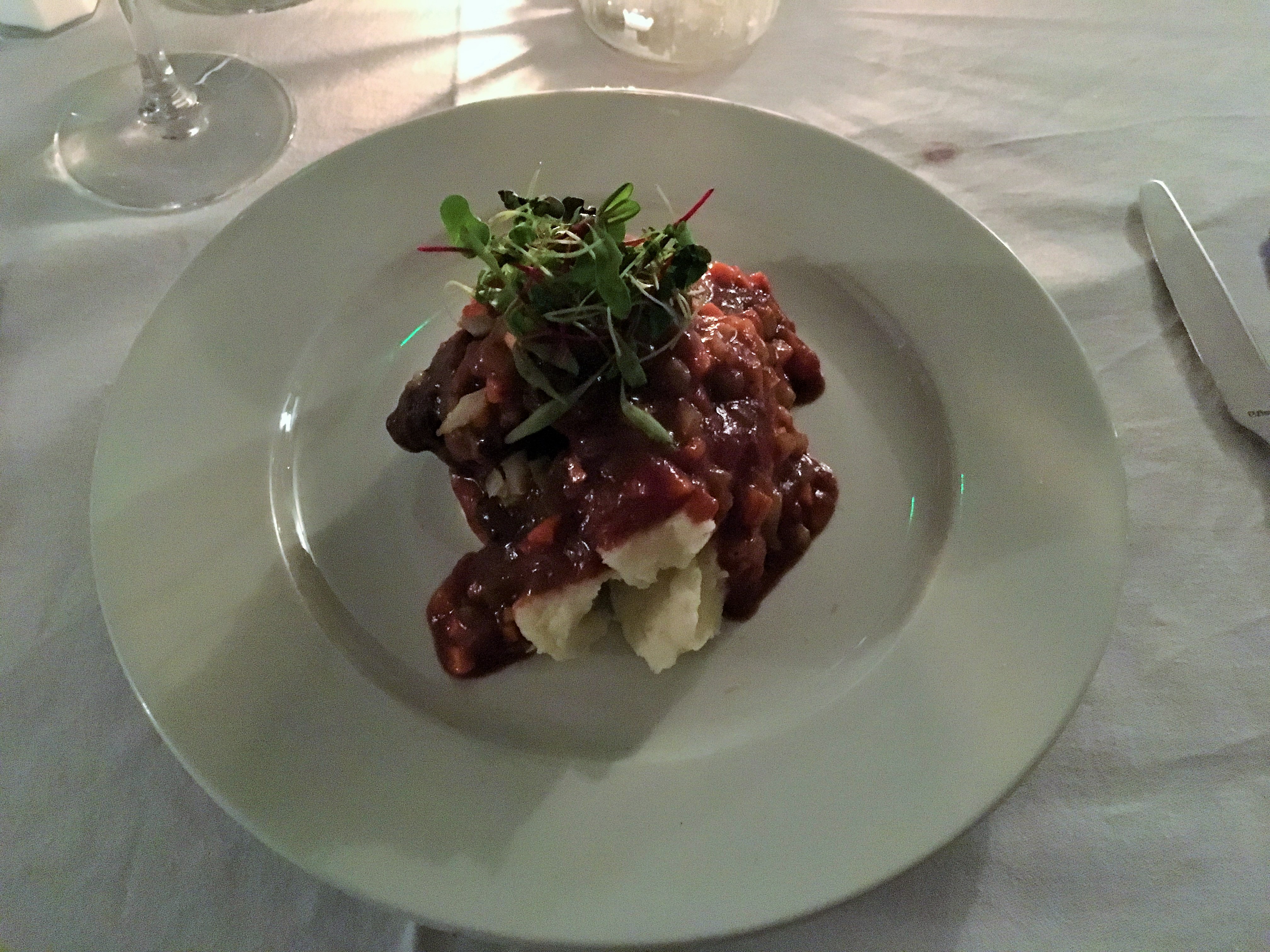
The other starter, braised oxtail with garlic mash, sounded magnificent on paper, but maybe that’s where it should have stayed. For a start, the mash was overwhelmingly the main ingredient: a big pile of it, not very garlicky and in some places more crushed than mashed. Oxtail is a cheap cut and I was expecting it to have been taken off the bone. That might have been unreasonable of me, but if not I’d have expected it to fall off said bone. Oh, and I’d have expected there to be a fair amount of it. Alas, none of this was to be, so I ended up tugging little chunks of beef off a huge cartilaginous throwing star and trying to eke them out among the massive heap of mash. The lighting conditions, which prioritised atmosphere over, you know, being able to see anything, didn’t help. It wasn’t all bad – what little meat I had was tasty, as was the glossy sauce studded with finely diced celery and carrot, but it felt out of whack. The best starters are little marvels that work entirely on their own terms, this felt like a disappointing main course that had been miniaturised.
If the theme of the starters was that the menu slightly missold the dishes, it came to fruition when the mains turned up. The first of them, “pan fried whole Cornish plaice” had either been over-mongered (is monger a verb? Here’s hoping) when the head was removed or simply wasn’t a whole fish. I’m used to plaice which fills a plate, but this was such a small specimen that I wondered if I’d just got the tail. I know fish is often a healthy option but there’s something magical about getting a whole plaice smothered in beurre noisette, speckled with capers, all white flesh and zing. Having got that complaint out of the way the meat was easy to separate from the bone and the browned butter, capers and shrimps on top were delicious – savoury, generously buttery, well worth chasing round the plate with the cut side of a roasted new potato. The tenderstem broccoli (not steamed greens, as promised by the menu) underneath was just cooked, so nice and firm with a lovely green sweetness to it. A good main makes you think “I wish I could make this”, or “I’d like to try this at home”. This one made me think “I can do this just as well myself”, not really how it should be.

Slow braised lamb shoulder was recommended by the waitress when I asked her to steer me between that and the halibut (“we’ve had lots of good feedback on the lamb” she said “but I don’t really like lamb or fish”). It was a frustrating near miss; I was expecting a single piece of slow-cooked meat that pulled into strands, so I was surprised to find instead chunks of lamb in among the cassoulet. That made me worry, but actually the lamb was good – no wobbly fat, no suspicious pieces (just as well because the slightly Stygian lighting made it impossible to avoid pitfalls). The cassoulet was pleasant, so were the onions. As before, the whole thing had been festooned with microherbs, possibly to conceal how brown the dish would otherwise have been. But the whole thing was too dry and sticky – the tiniest splash of something which may or may not have been the advertised “lamb sauce”, whatever that was – and just a little too bland. The cassoulet was meant to be spiced, but if it was I didn’t detect anything. Again, it was closer to decent home cooking than restaurant food.

Better than the mains themselves were the Brixham crab fries we had on the side – I’d heard much about them during my research, so I wanted to try them myself. I’d say from the shape that they were hand cut, and they came shaken in parsley butter and aioli along with more white crab meat than most places put in their risotto. Even these weren’t flawless – overcooked, more David Dickinson than Gisele – but even so they were gorgeous: nutty, decadent, beautifully dressed. They weren’t strictly needed, and they couldn’t save the mains, but they did distract us from them nicely. Worth seven pounds? Probably, oddly enough.
The plaice wasn’t exactly Moby Dick, so I decided I had room for dessert. As with the rest of the menu, the dessert section is nicely small and everything on it sounds like it has been creatively tweaked (the crème bruleé has brandy poached raspberries, the poached pear is with saffron). I gravitated towards the chocolate fondant, as I so often do, with its fancy promises of Cointreau, yoghurt sorbet and figs, but like everything else it was all mouth and no culinary trousers. If there was any orange in that dish I couldn’t taste it. The inside of the fondant wasn’t particularly runny. The fig – which I foolishly hoped would be roasted – was simply halved into decorative wedges and the sorbet was strawberry, not yoghurt. It wasn’t even strawberry yoghurt. I think I’d rather have just had a bloody strawberry yoghurt by that point. There were more cheffy zig zags of chocolate on top but was it “chocolate syrup” or just caterer’s chocolate sauce? Your guess is as good as mine, and I ate it.

The wine list wasn’t bad, and I enjoyed the Bordeaux I had which managed a good balance between fruit and complexity – completely wrong for the plaice, of course, but I’ve never let that stand in my way in the past and I don’t intend to start now. Only later did I notice that they also do Kung Fu Girl Riesling, one of my favourite whites, at thirty quid a bottle (if I’d known I’d have had Nando’s first and then camped out on the sofa with a couple of bottles of that). There were no dessert wines per se, but we also had a couple of glasses of Moscato from the sparkling section of the list. They were nice and sweet, but about as sparkling as me at 8am on a Monday morning. The very sweet waiter accidentally managed to throw the best part of a glass of the stuff over my companion, which I found a lot funnier than he did.
Apart from that service throughout was charming and friendly, if rather haphazard. There was one waiter who appeared to do nothing at all and when asked for the bill he had to ask someone else – it turned out it was his first day, but it seemed like he didn’t have a clue what waiting entailed (perhaps he was taking the job description a little too literally). When we left, for a moment I honestly thought he was going to stand there and watch us get our own coats. I wanted to like them, heaven knows I wanted to like Jessy’s in general, but charm only gets you so far when the bill comes to just a touch under a hundred pounds, for two and a half courses and a bottle of wine.
It’s funny how people can have double standards about restaurants. We want to be spoiled, and treated like customers, but we also want to feel like friends. We want the experience to feel genuine and casual, but we don’t like overfamiliarity. We want it to feel special, but we don’t want it to be stuffy. The dream restaurant walks that tightrope perfectly – you feel like you are round a friend’s house (because what is cooking, if not an act of love?) but eating something you couldn’t or wouldn’t possibly make at home. The thing about Jessy’s that makes me saddest is that its heart is so obviously in the right place; it’s a lovely, cosy room and more than once I found myself gazing over at the glowing logs in the wood burner and thinking “how I wish this was perfect”. Close but no cigar, I’m afraid, and on the walk back to the station the only consolation I could find was that I’d dodged doing the washing up. I’ll tell my colleague when I’m back in the office: let’s hope she’s not the sort to say I told you so.
Jessy’s – 6.4
37 Denmark Street, Wokingham, RG40 2AY
0118 3484379



 Edible Reading