The 21st of July last year might have seemed like a perfectly normal Monday to you, but in food and drink terms it was an eventful day for Reading. Lincoln Coffee finally opened its big new site on King Street, the one Workhouse had vacated the year before. A little way away, down Minster Street, Thai restaurant Nua opened in the spot given up by Bluegrass BBQ in January.
Both of those were expansions. Lincoln has retained its original site on the Kings Road (and indeed for a while it used to operate out of Reading Bridge House, back when having a coffee concession in an office building sounded like a capital idea). Nua has a site in High Wycombe and another in London, in an area its website describes as “Fitzorvia”. But the third hospitality business to throw its doors open on the 21st July? It was brand new, out of nowhere and a more interesting proposition.
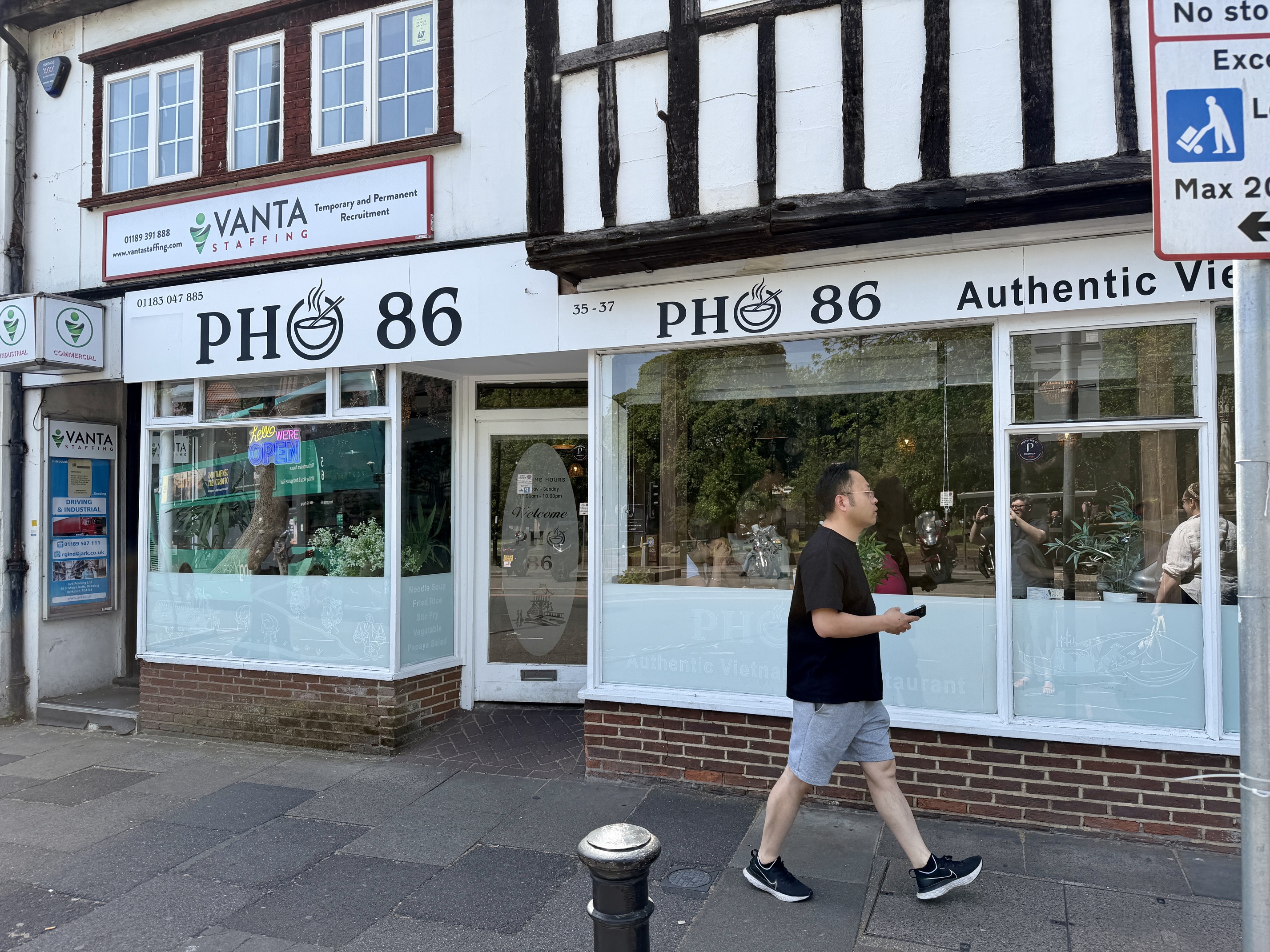
That would be Pho 86, an independent Vietnamese restaurant that has sprung up in the site once occupied by The County Deli, most famously one of Kate Winslet’s first employers, that closed in 2010. After that it was Sonning Flowers for a while, and then a food shop called K&K Supermarket which sold Vietnamese ingredients, amongst others. It’s not clear whether the change of purpose coincided with a change of ownership.
Very little is clear, because it’s hard to find out much about Pho 86 online. I do know that they opened without an alcohol license, and with a hygiene score of 1 from the council, who inspected a week after they opened. Both those matters were covered in the local press, and things have moved on since then: alcohol is now available and the most recent hygiene rating, from last October, is a slightly less worrying 3. The Chronicle showed no curiosity about Pho 86’s backstory, however, so it’s hard to know whether this is the owners’ first rodeo.
And good luck figuring out from their website, because the blurb on it is so generic that it’s hard to believe that AI wasn’t involved. At Pho 86, we believe a great bowl of pho is more than just food — it’s comfort, culture, and connection it begins. It’s not X, it’s Y. It’s not been written by a human, it’s ChatGPT. Fair enough, I guess: times are tough for independent businesses, and hiring a copywriter is probably nowhere near the top of the to do list. It would have been nice to know more about them, but perhaps they’re letting their food do the talking.
So finally, after leaving it the best part of a year, I paid them a visit on a sunny Saturday lunchtime with Zoë. I might have made it earlier, if it wasn’t for the hygiene rating and the lack of booze, but another reason was Pho 86’s surprisingly old school approach to customers: no online booking, which is curiously retro in 2026. I should have phoned up, really, and made a booking, but it says something that I literally cannot remember the last time I did that, anywhere.
Subscribe to continue reading
Become a paid subscriber to get access to the rest of this post and other exclusive content.
There’s no such thing as Spotify Wrapped or Apple Music Replay for restaurants, as far as I know. But if there was, the restaurant whose food I ate most last year is almost certainly Gooi Nara, the Korean restaurant on Whitley Street that has been there for something like ten years, if not more. And yet returning to it a couple of Saturdays ago for dinner with Zoë was the first time I’d set foot inside since I reviewed it in 2018.
The thing is, as regular readers will remember, I moved to Katesgrove a couple of years ago, which means that, along with Kungfu Kitchen, Gooi Nara is probably the closest restaurant to where I live. And what that means is that on the nights when neither of us can face cooking we know that a delivery driver won’t get lost, won’t drop other orders off en route to our house and can be trusted to turn up pronto with piping hot food from just round the corner. Over the last two years, between us, we’ve developed quite a Gooi Nara habit.
It’s no coincidence that they won my “takeaway of the year” award in 2024 – but my love of a Gooi Nara delivery has continued ever since. It is refined and perfected now to the point where Zoë and I order exactly the same thing almost every time: dakgangjeong, or Korean fried chicken, for her and tang su juk, chicken in sweet and sour sauce for me. The latter comes ready to assemble, one plastic container of gorgeous fried chicken and a tub of sweet, sharp sauce with orange and pineapple bobbing in it (I was skeptical too, but don’t knock it until you’ve tried it). It has made me happy many, many times.
Sometimes we push the boat out and get some mandu, fried chicken dumplings, as well but otherwise those two and a couple of portions of rice are everything we need for a contented chomp in front of the telly after a hard day. I especially grew to love Gooi Nara when I was discharged from hospital and could only eat with one hand: I remember the first time I had their sweet and sour chicken after my accident I could only eat half, the rest popped in a LockNLock in the fridge. It was even better cold the next day: it remains the only occasion when I’ve had any leftovers at all.
That’s all well and good but I love their food so much, and always hear so many positive comments about it online, that it felt like we were doing them a disservice by only ever ordering the same two takeaway dishes. And my review was over eight years old, after all, so it felt like high time to go back. Early one Saturday evening Zoé and I took a short amble there, tracing the path of so many delivery riders in reverse, to check it out.
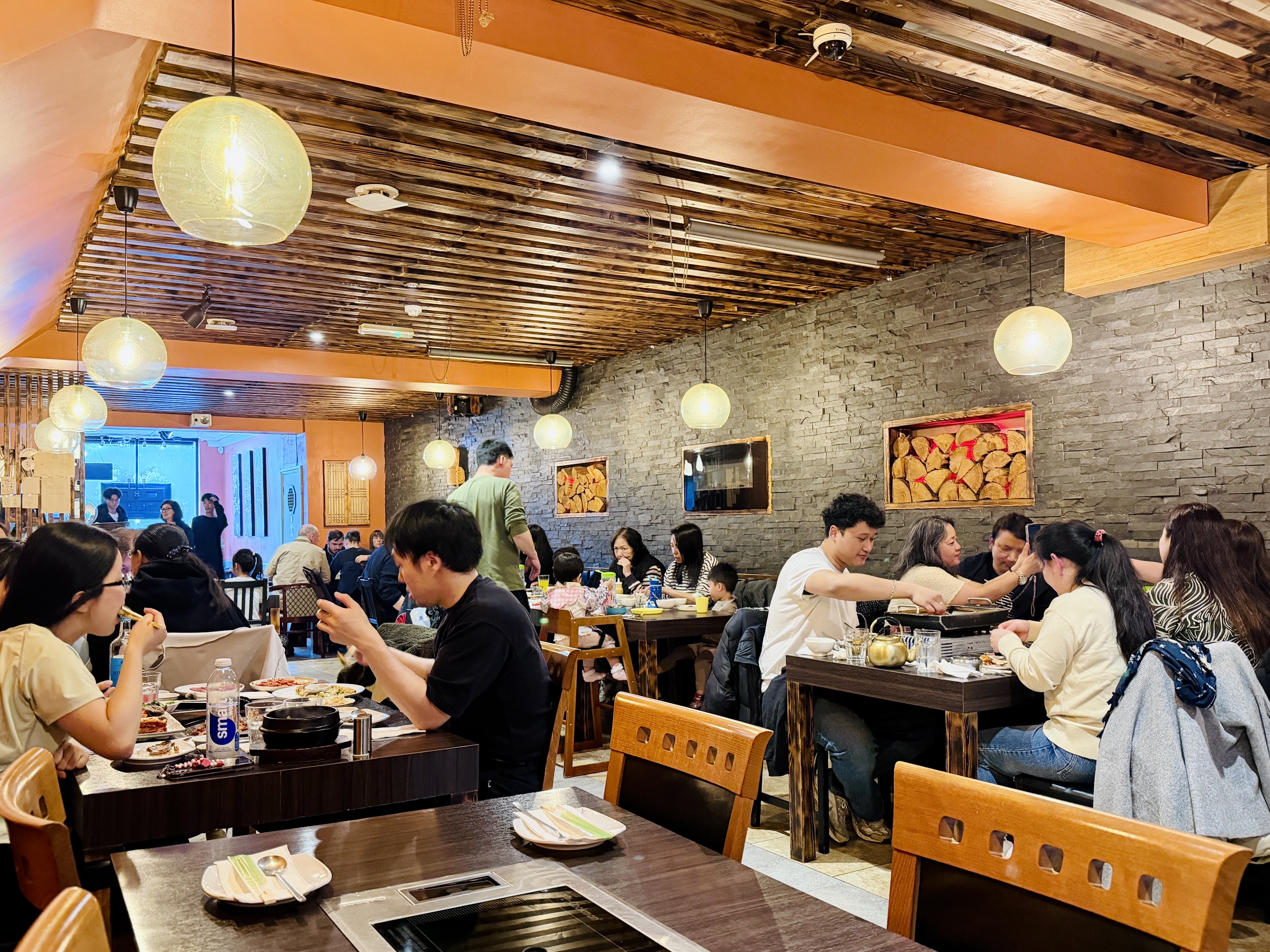
First things first: it was absolutely packed at 6.30pm on a Saturday evening. So much so that they could only just find room for us, tucked away at the very back with a great view of what was clearly a very successful restaurant. The decor didn’t feel like it had changed much in the intervening eight years: it still had a welcoming, homely feel, all wooden beams and faux slate walls.
The main difference, I would say, is just how well Gooi Nara appeared to be doing. It also started out very warm, and on a punishing day as the hot plate in the middle of our table got switched on it became even more sweltering.
In terms of the mix of customers, I would say that with the exception of the table next to ours later in the evening we were the only one exclusively made up of pasty Anglo-Saxons: I did envy my fellow WASPs at the other table who no doubt were getting an excellent introduction to the full gamut of the menu from people who knew exactly what to order.
It did appear, too, that Gooi Nara had a good reputation: I overheard a conversation at one of the big tables nearby to the effect that its occupants had converged at the restaurant from many places, some miles away. Maybe Gooi Nara filled that role for Southerners who couldn’t easily make it to New Malden, the Little Korea of the UK.
Gooi Nara’s menu has changed, I think, from when I visited it last. Back then I’m pretty sure it hedged its bets, with both a Korean and Japanese section, but now it’s all kind of thrown in together: edamame; takoyaki; agedashi tofu and pumpkin korokke feature, along with yaki soba and udon.
But the Korean elements of the menu are far more extensive, and the menu can be quite overwhelming with sections seemingly for everything: soup; rice; bibimbap; jeongol (or hotpot); noodles and of course Korean barbecue. The sides, to add to the confusion, appear at the very beginning, before everything they could conceivably be on the side of.
It made me wish I had my own food sherpa – is that cultural appropriation? – to guide me through the highlights of the menu, a feeling that only intensified as I saw some gorgeous dishes waft past to other tables. Was the delicious-looking tofu (I’m not even joking) that went to the table opposite the agedashi tofu, or the Korean doo-bu jeon? I decided on reflection it was the latter. And how good did the platter of various types of kimchi look when it arrived at the table next to me, a couple having one of the most Guardian conversations I’ve eavesdropped on in a very long time?
I came away from it all feeling silly and parochial, realising that really I only knew a handful of dishes on the menu and the various bits and bobs I’d ordered the best part of a decade ago. I was well aware that on this visit I would stay in my comfort zone, even if I’d insisted to Zoë that we couldn’t order any of the things we would invariably put in our takeaway order. So we ordered a couple of starters, a couple of mains and two items for the barbecue, and even then I’d say we played it extremely safe. We might have been outside it, but our comfort zone was only a short walk away.
Everything came if not all at once then really in a very short space of time. One minute we were necking our cold bottles of Cass, a perfectly decent lager I would struggle to tell apart from Asahi, Ha Noi or Singha in a blind taste test, let alone its Korean alternative Hite, and the next our grill was switched on and pretty much everything we’d ordered was cramming in on our table.
And the table looked big, but since the centre of it was given over to said grill you ended up playing the equivalent of those sliding tile puzzles trying to work out what could go where. Try to combine that with the timings of actually cooking some of your food and the whole experience became a little like patting your head and rubbing your belly at the same time, impressive training in multi-tasking. Forget my doing those six pointless LinkedIn games every morning: this would be much better at keeping me mentally sharp.
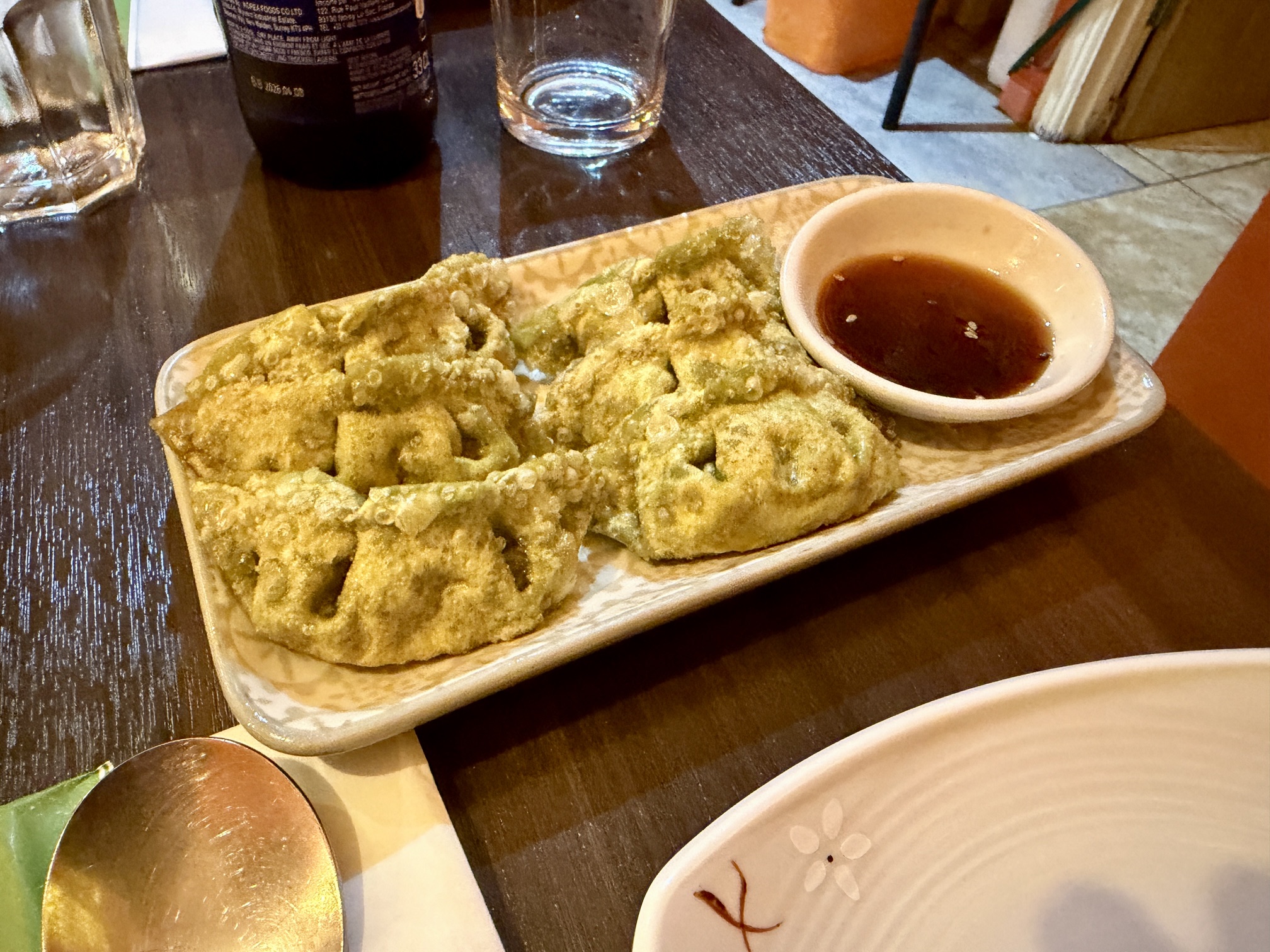
Vegetable mandu were, if anything, even more enjoyable than the chicken ones which had been dropped off by a friendly rider so many times in the last two years. A bit more crinkly and expansive than their chicken equivalents, they had a pleasingly light, grease-free texture and a filling I could almost convince myself was virtuous. Gooi Nara’s dip of soy, sesame oil, sesame seeds and quite possibly something else beginning with S had a gladdening sharpness that complemented them very nicely indeed.
A quirk of Gooi Nara’s menu is that, if it is to be believed, you get 5 chicken dumplings or 5 prawn dumplings but a strangely non-committal “5-6” vegetable dumplings. Fortunately on this occasion we got a shareable, even number, but I’m pretty sure whenever I’ve ordered the chicken mandu I’ve been given 6 of those too. Go figure, pun not intended.
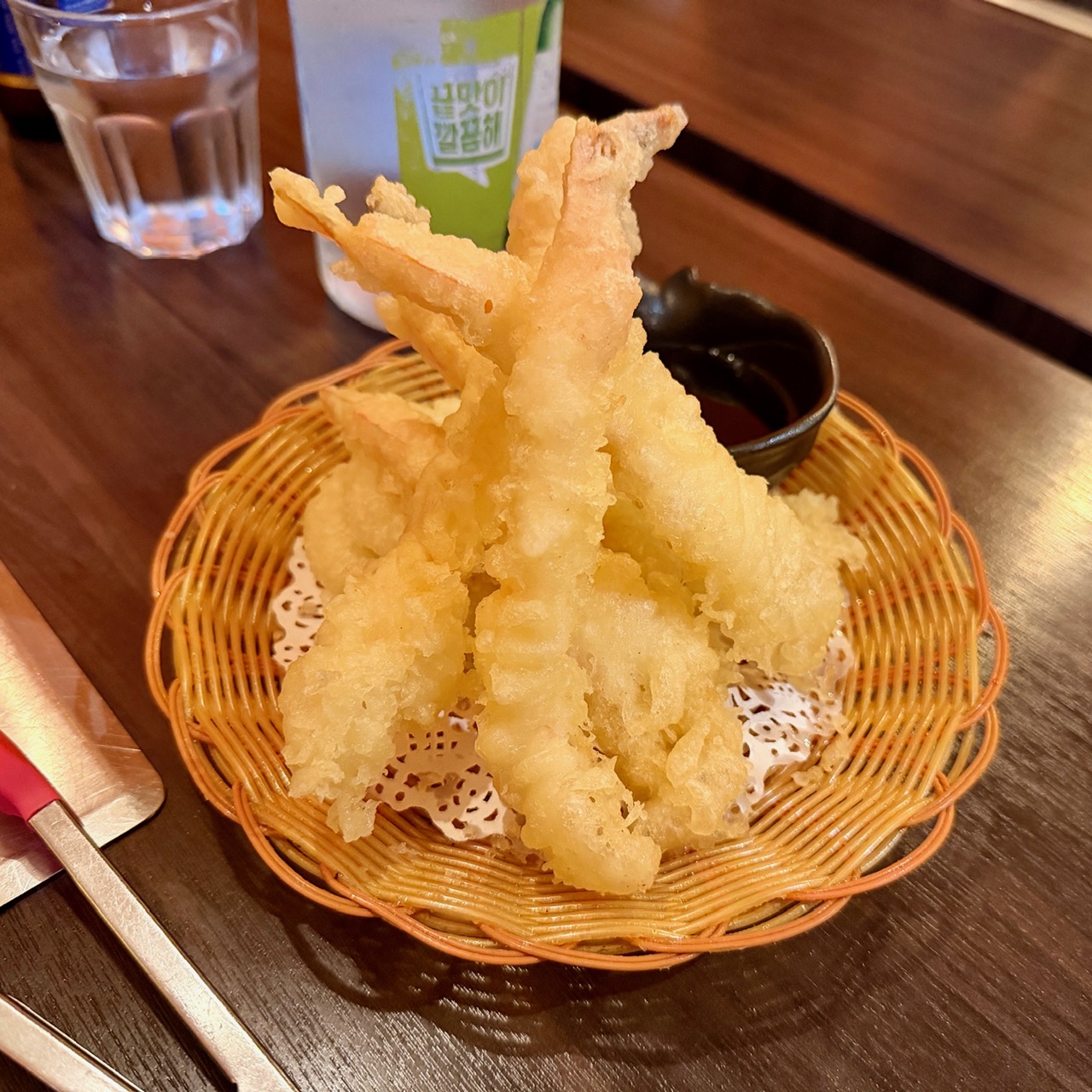
Also decent were the prawn tempura, which I would say were better than they looked. In the picture below they come across as a little wan, a tad too blond, but they had a real deft lightness and, again, next to no grease. The dip they came with, almost exactly the same as the one that accompanied the mandu, was still good but the dimensions of the vessel and the size and length of those prawns made it, practically speaking, a faff: it was a bit like trying to get a pool cue in a beer glass. £12.30 for these, so as much as both of the main courses we’d chosen.
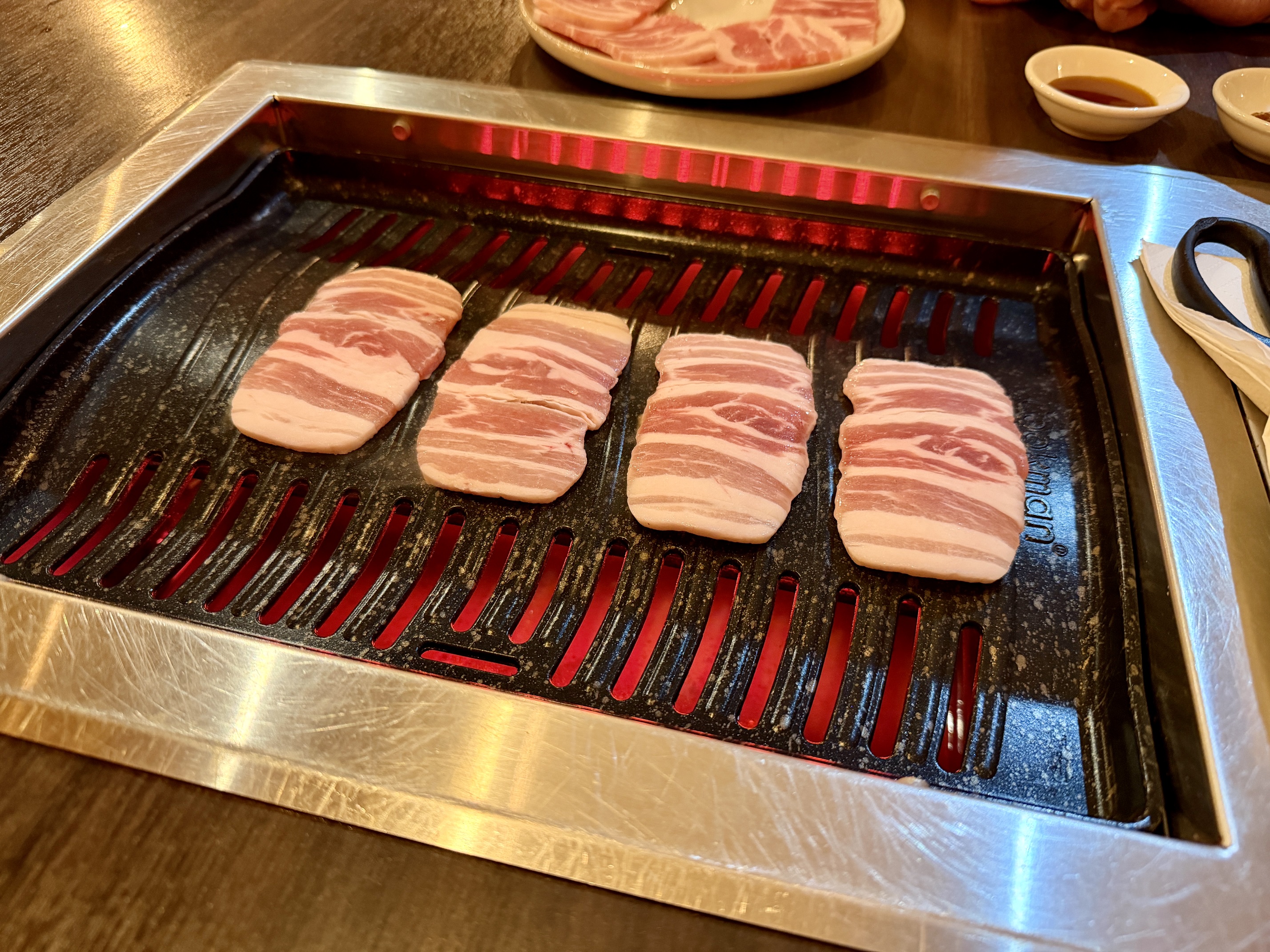
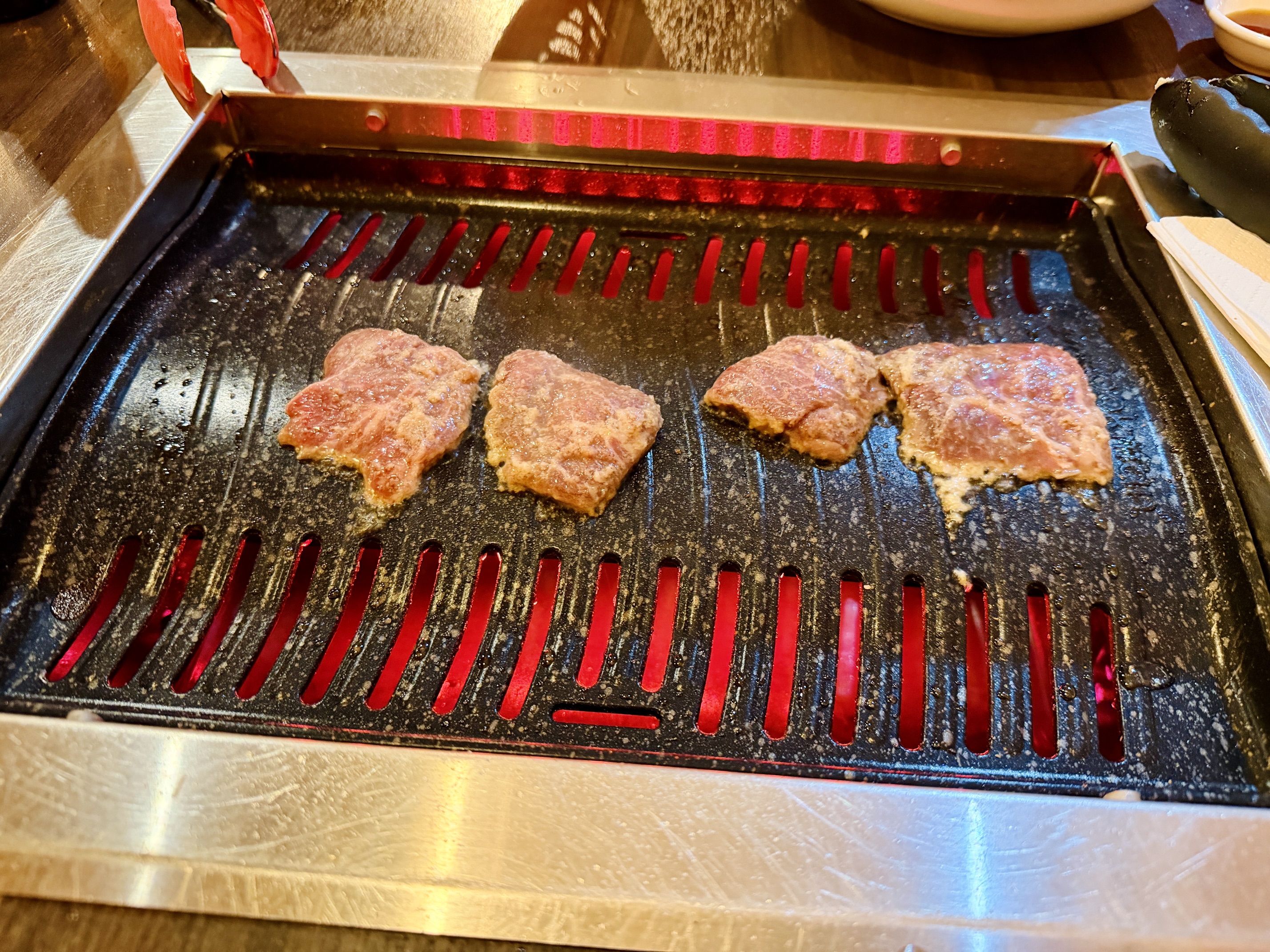
By this point we’d also started to avail ourselves of the barbecue. Sam gyap sal, unadorned sliced pork belly, turned up looking a bit like those cheap bacon-flavoured corn snacks you can get in supermarkets, and I did wonder whether we should have gone for the spicy version, but it crisped up beautifully on the barbecue, that fat rendering and permeating just enough.
We chose the pork to cook first precisely because it wasn’t marinated the way our other barbecued meat was, to try and avoid cross-contamination. We had a couple of dishes of condiments to dip them in, and I failed to make a note of either, but one was definitely soy and the other was definitely not: I think it might have been ssamjang, the traditional sauce used with Korean barbecue containing gochujang and soy beans.
It was only later that I realised we should have ordered some lettuce to wrap the pork in: it’s hidden away, chronologically speaking, in the list of side dishes at the beginning of the menu.
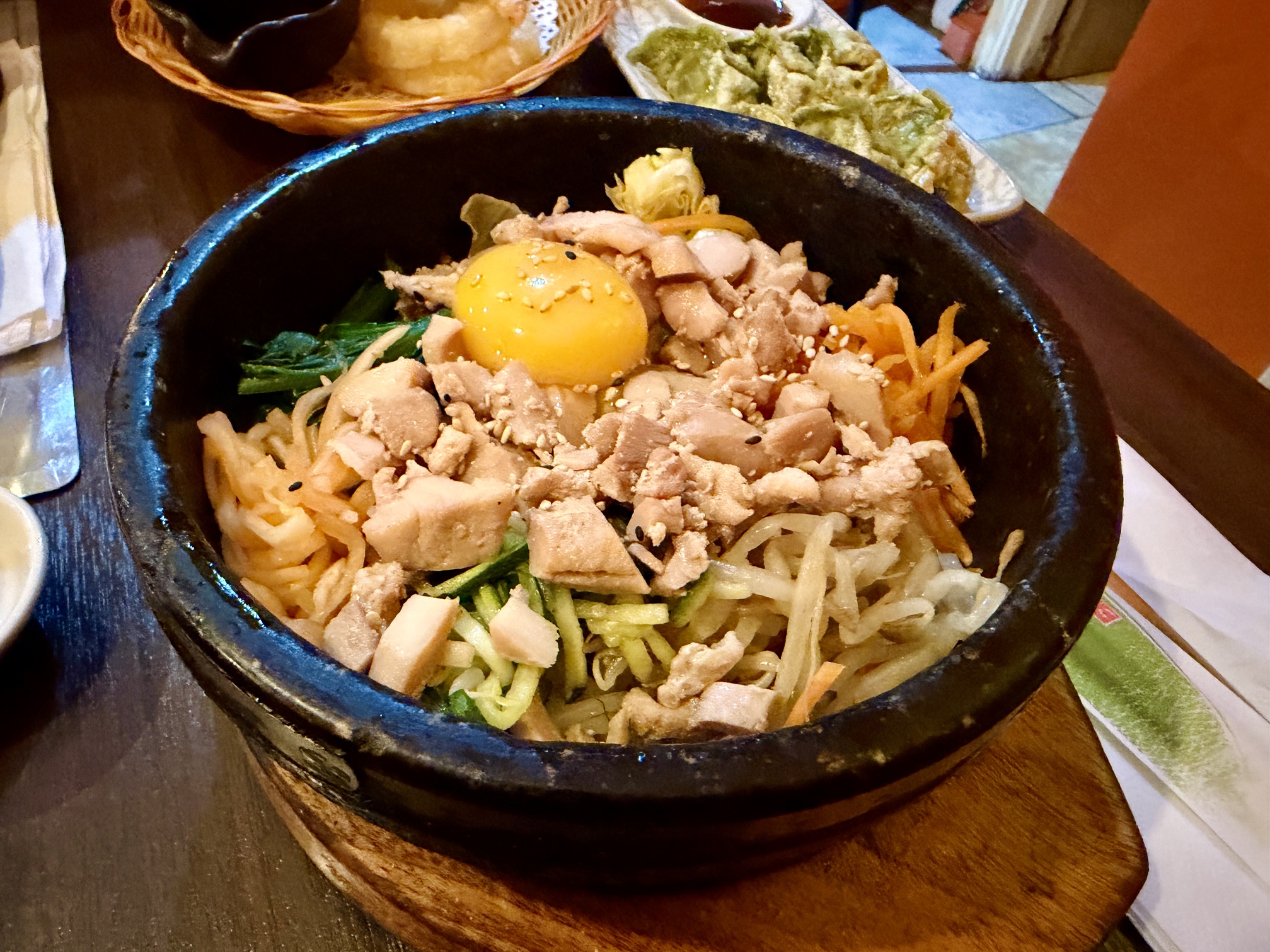
My main – although the concept of a main slightly falls away when it all comes at once – was the chicken dolsot bibimbap, a dish I haven’t eaten in a long time. For the uninitiated, this is rice, chicken, veg and an egg yolk brought to the table in a hot stone bowl, so it keeps cooking and sizzling as you work your way through it. I broke up and dispersed the egg and made my way through it, and by the end some of the rice had reached the crispy state known in Korean as nurungji (I suppose the closest European equivalent is the delectable socarrat at the bottom of a paella).
I would have described this dish as a little nondescript, a tiny bit bland, if it weren’t for the squeezy plastic bottle of gochujang which came with it. The more of this I added, the more I enjoyed it, and the more I enjoyed it the more I added it: I do wonder how much you’re meant to use, and how much was left in that bottle when I was done, but it turned what could have been a trudge into a frolic.
The other thing that whole experience taught me was patience. Ordinarily I would have a moan – god knows you’ve probably readenough of them – about everything arriving at the same time and forcing me to choose what to eat first.
Eating in Gooi Nara that evening, among all that good-natured, deceptively well controlled bedlam, I realised that it was probably a very English mindset: that your food is at its best the moment it arrives at your table and it’s downhill from there, that it’s a scramble to eat it before it goes cold and that too many dishes at once guarantees disappointment.
But it didn’t feel that way here. Those prawns and dumplings sat there, keeping their freshly fried heat. The pork sizzled on the barbecue, with more on the plate waiting to take their place. Our second barbecued meat hadn’t even made it to the front of the queue. And my bibimbap was still hot, gradually perfecting its texture. What was the rush? Everything would be eaten in its own good time, in the right order, with no need for conniptions.
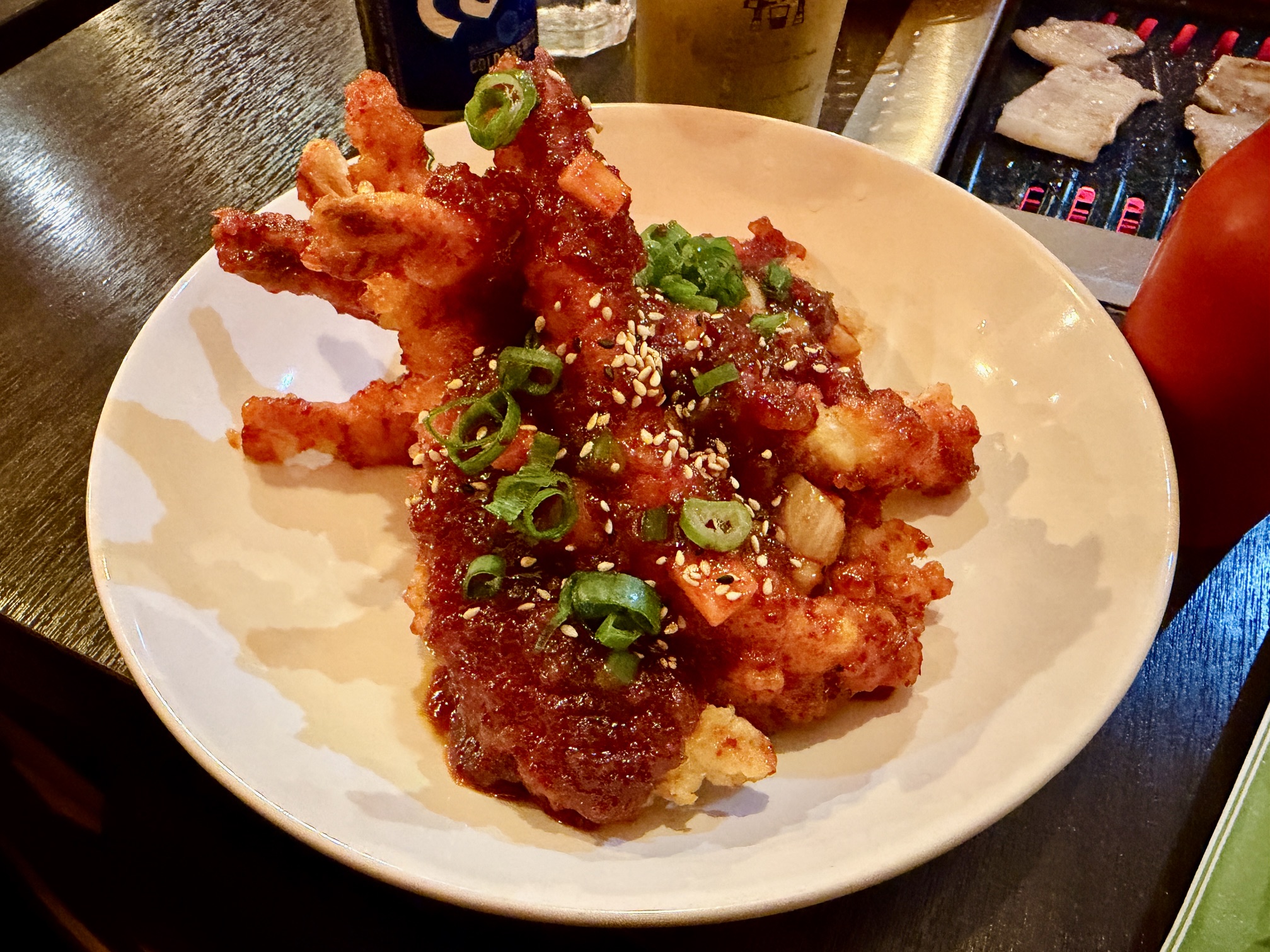
Zoë loved her main, I don’t think I would have done. I managed to persuade her not to have her regular takeaway order, her chicken gam-poong gi, but she ordered it with prawns instead. I was expecting this to be prawns curled up, little inverted commas in a crisp coating, tossed in the gorgeous spicy sauce that makes this dish such a crowd pleaser in my house.
Instead they were fully extended like an accusatory index finger, the tempura prawns from earlier on making a reappearance with some sauce thrown in. So deeply impractical in many of the same ways as that starter, and downright impossible to eat with rice. I didn’t order them, and I certainly wasn’t allowed to try them, so it doesn’t really matter. Zoë really enjoyed it, and maybe in the free-for-all of our meal overall it didn’t really matter that they weren’t quite what I thought they would be.
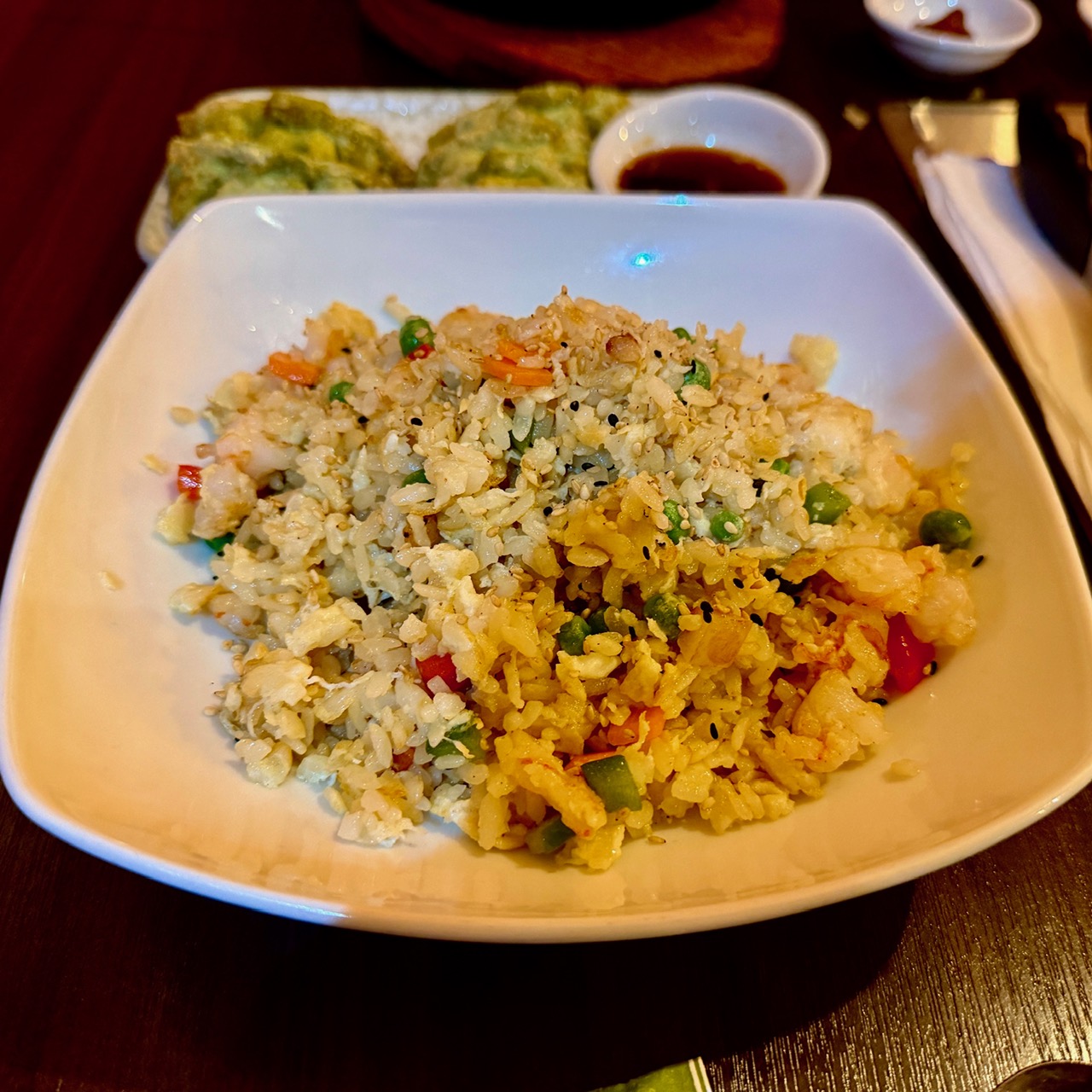
The dish they didn’t go with, or at least I thought they didn’t, was Gooi Nara’s special egg fried rice with vegetables and shrimp. Zoë, again, seemed to enjoy it but I thought it was a bit steep at £11, especially considering that you could get a bibimbap for roughly 50p more. Plus I got a bit squeezy bottle of gochunjang, let’s not forget, and this looked like it badly needed that or something like it.
Finally, as we flagged in the heat, a little John Lewis portable fans valiantly whirring away to almost no avail, we barbecued the last dish in our order. By sheer coincidence I’d actually ended up ordering something from my 2018 visit to Gooi Nara – the ju-mul luk, beef with garlic and sesame oil. It was smothered in marinade there on the plate, slices much thinner and better cut than I remembered from my last encounter, and it smelled pretty amazing before it was ever even exposed to heat. As it cooked, the aroma got more and more gorgeous: perhaps we’d saved the best til last.
Tasting it at the end of the process, I rather thought we could have done. Every single piece was buttery-soft, that marination doing its work with no notes, and although it might have been nice to enclose each piece in a lettuce leaf and enjoy that contrast, I rather wonder if the lettuce might have wilted as badly as I did towards the end of an hour in that hot, noisy, oddly glorious room. By some tragedy, Zoë found herself full halfway through my final spell as the commis chef of our table. I buckled up and finished the rest: it had to be done.
Gooi Nara’s menu only has two desserts, both of which are Japanese, but we were too hot and too full to attempt either of them. Our bill for all that food and a couple of beers came to £95, not including service, and of course we were more than happy to tip: even just watching the constant parade of staff back and forward to tables, carrying a huge array of fascinating dishes without ever breaking rhythm, juggling orders for customers and brown bags out to delivery drivers, filled me with admiration.
It made me think of all the Saturday nights when we’d fired up a delivery app and our food – perfect, beautifully packed, prompt and piping hot – had arrived in what seemed like no time. Every evening that happened, the restaurant might well have been as busy as it was that evening. We emerged into the sunlight on Whitley Street feeling like we’d spent just over an hour somewhere totally not-Katesgrove, but also arguably in Katesgrove’s very best restaurant. We also resolved that, delicious and convenient though a Gooi Nara takeaway always was, we needed to visit again far, far sooner.
Rating Gooi Nara this time has been quite difficult. I definitely enjoyed it more than the previous time I went, but I have a feeling that the limitations on the rating it receives on this occasion have more to do with me than with them. So whatever mark Gooi Nara gets as a restaurant, I think this might be a review where I, as a reviewer, might struggle to scrape a 7. I have a feeling that if I’d been bolder, gone further to the perimeter of the menu, I could have enjoyed it even more and it would have done even better.
In that sense it would have been nice if Gooi Nara had, in the way that great communicators like Kungfu Kitchen, Clay’s, Kamal’s Kitchen and the Moderation do, tried more to tell the story of their food and bring newcomers in. But really, that’s not mandatory, especially when a restaurant has been going for about 10 years and is doing very nicely without having to do any of that. So much as I might have enjoyed having a bit more guidance on how to attack the menu, that was definitely a me problem, not a Gooi Nara problem.
I will be back, and when I do I will try some more esoteric dishes: if you have any recommendations drop them in the comments. In the meantime, I suspect another paper bag with my regular takeaway order lurks in my not too distant future. Eat-in, delivery: get yourself a restaurant that can do it all.
Since January 2025, Edible Reading is partly supported by subscribers – click here if you want to read more about that, or click below to subscribe. By doing so you enable me to carry on doing what I do, and you also get access to subscriber only content. Whether you’re a subscriber or not, thanks for reading.
Here are just some of the many reasons why I should not be reviewing the Wokingham branch of Nando’s this week.
1. It’s Nando’s.
Everybody knows what eating at Nando’s is like: everyone will have an opinion about it already. This review won’t change anybody’s mind, because those minds were made up ages ago. In the opening paragraphs of a review I usually give the context, explain a restaurant’s history and all that. How long it has been around, what it does, what makes it special, all that jazz. It’s one of the things that makes the preambles to these reviews so fucking long, which I know so many of you love.
But what’s the point?
It’s Nando’s for Christ’s sake, it has its own Wikipedia page. You can look at that if you’re interested, and read about its 40 year history, its 450 branches in the U.K., yadda yadda. You can repeat the niche pedantic point I sometimes reach for, if you like, that Nando’s is technically South African rather than Portuguese. But you won’t do any of that, I’m guessing. Because it’s Nando’s, and everybody knows what eating at Nando’s is like, don’t they?
2. Nobody, and I mean nobody, is reviewing Nando’s in this day and age.
Why would you review somewhere that feels like it’s been part of the rich tapestry of British life forever? When it first opened here, John Major was Prime Minister, and what feels like an eternity later its only role in the national conversation is to be like Debenhams or Woolworths, there and taken for granted until one day it’s gone and missed, presumably by people who never spent money there.
The last time Nando’s got significant attention in the national media was 15 years ago. Miranda Sawyer wrote an article for the Observer in 2010 trying to claim that Nando’s was cool, and a burgeoning phenomenon. If that fact alone doesn’t make you feel ancient, and it certainly does me, the cultural figures she name-dropped were Tinchy Stryder and Tulisa from N-Dubz. And they weren’t even the Debenhams and Woolworths of popular music, then or ever.
Oh, and it got reviewed in the Guardian the following year by John Lanchester, the novelist who had a brief stint as the paper’s restaurant critic. He got stick at the time, but I quite enjoyed his stuff, partly because it read like C-3PO with an expense account. “I’ve been to Nando’s literally a billion times” he said, pre-dating the trend of using the word literally to mean something other than literally by literally a few years; just a guess, but I don’t think he had.
Since then Nando’s has barely troubled the broadsheets, except for Jay Rayner popping up occasionally to say that he doesn’t mind it, presumably to try hoodwink readers into thinking he’s a man of the people. The Observer published something to celebrate the chain’s thirtieth birthday, but that’s probably it until 2032. Meanwhile the chain ploughs on, without publicity, as one of the few restaurant groups in the United Kingdom that doesn’t need publicity at all.
3. Everybody has a Nando’s order.
If we do have to have identity cards – and the notion does seem to be making a comeback – I think they should contain two other pieces of info apart from your name, date of birth etc. There should be a square with a colour on it, the Farrow & Ball shade that corresponds to exactly how you like your cup of tea: just think how much time and embarrassment that would save when you visit friends and family. And there should be a little box that lists your Nando’s order.
Because everyone seems to have one, and I don’t think they deviate from it often. Every now and again we’ll try something wacky, have the pitta or the rainbow slaw or (god forbid) lemon and herb but we invariably revert to our core order. I don’t know how many combinations you can put together from the main components of the Nando’s menu, but it must be a lot: John Lanchester would probably say it’s literally billions.
So for instance the box on my ID card would say Four chicken thighs, medium, spicy rice, macho peas, halloumi on the side. Because 99% of the time, in a Nando’s, that’s what I’ll order. I didn’t, this week, just to mix things up and at least pretend to explore the menu, but the rest of the time you could put money on me eating this.
Other people, like my wife, will extol the virtues of the broccoli, and I have friends who think chicken doesn’t count if it’s not on the bone. Some far out types would even have the wing roulette on their regular order. But my point remains: the restaurant lacks any element of surprise, and what you eat there lacks it too. So why review the place?
I know some people don’t drink tea, or don’t like Nando’s. I was on a conference call last week and, to break the ice, I asked people what their Nando’s order is. “I can’t stand the place” said one of the otherwise perfectly agreeable chaps, safe in the comfort of his home office. I guess we can put those types in the same category as conscientious objectors.
By the way, the other advantage of my ID card proposal is that, finally, we could work out who’s ordering the chicken livers. That would be the equivalent of having AB- blood, only rarer.
4. It isn’t even a Reading branch.
I know, I know: Wokingham. I can just hear the cries of “it’s called Edible Reading, for god’s sake” – haven’t heard those for a while, come to think of it. And despite having eaten Nando’s all over the place, from London to Gatwick to Bath, it’s true that I have a soft spot for one of Reading’s branches. The one on Friar Street, not the cacophonous enormous space of the Oracle Riverside, even though the latter is the first Nando’s I ever visited, converted by my ex-wife.
I rather like the Friar Street branch’s small and gallant attempt at some outside space, its homeliness and lack of polish compared to its larger counterpart. But it also faces an uncertain future because I suspect that, like Cosmo, it will be swept away by redevelopment. So although it was tempting, were I to review a Nando’s, to visit that one, it felt like a surefire way not to future-proof a review.
(Sorry. You get a long overdue Reading review next time.)
5. It wasn’t even my first Nando’s that week.
I’m not joking. Two days before my visit to the Wokingham branch of Nando’s, I found myself at a work offsite event on a business park at the far end of the Basingstoke Road, and for lunch our big cheese took us to Nando’s. By this time my visit to Wokingham was already in the diary, but what could I do? Say “I’m sorry but I can’t, I’m keeping my powder dry”? For Nando’s?
So the eight of us crossed the road to the Reading Gate branch of Nando’s, which is a huge, featureless glass box on the outside and strikingly spacious inside, with a second floor and everything. It felt like one of the biggest Nando’s I’ve ever visited, and the website Rate Your Nando’s – it’s honestly a thing – gives it an average rating of 4.42 out of 5 (I felt gratified to see that my favourite branch on Friar Street, with a rating of 4.73, is currently considered the fourth best in the country).
Everybody conformed to type, almost, and everybody ordered their usual. Tom, our youngest team member and not even thirty yet, ordered the fino pitta, hot, and I made a hackneyed joke about him getting home and popping his moist toilet tissue in the fridge. My boss, not a regular visitor and slightly thrown by the menu, had something called a “garlic churrasco burger” which they might have introduced since I ate at Nando’s last a couple of years ago.
There were a few curveballs, because I work with interesting folk. Our big cheese insisted on having a bottle of Heinz tomato ketchup at the table – I guess it takes all sorts – and we had to stage an intervention to stop my colleague Natasha ordering the halloumi burger. Their ID cards would be on the quirky side, I think.
Afterwards we all concluded that it had been an enjoyable lunch, which had entirely lived up to expectations without ever threatening to exceed them. We went back to our meeting room to carry on achieving those pesky deliverables.
Even though it was a Thursday in a business park on the edge of Reading, the sun shining, this unspectacular, boxy branch of Nando’s was packed. We queued for ten minutes or so before they found us a table. If Nando’s has jumped the shark, nobody had told the people eating in there.
6. They treat chickens very badly indeed.
This should probably be top of the list, and for many of you I suspect it would be. In February Nando’s, along with a number of other restaurant chains including KFC, Popeyes and Wingstop, pulled out of something called the Better Chicken Commitment. And as animal welfare standards go, this was a minimal one: you could treat your chickens appallingly and still meet the requirements of the BCC.
It didn’t specify what you could feed your chickens, or that you had to let them roam outdoors, or that you wouldn’t pump them full of growth hormones. It was a very low bar, and the likes of Nando’s decided they still wanted to limbo under it.
The sticking point was that the BCC also required all those restaurants to swear off using what have been described in the media as ‘Frankenchickens’, a strain of chickens like the Ross 308 engineered to reach maturity sooner in order that they can be killed and eaten quicker. If you thought kids grew up too fast these days, spare a thought for the Frankenchickens: ready to be eaten in a mere 35 days. And they aren’t a fun 35 days, either – these breeds have higher rates of organ failure, muscle disease, premature death.
Here’s the most shameful thing of all: I know about this because hereditary columnist Giles Coren, of all people, wrote a column about it in the Times a couple of months ago. Nando’s might be a national institution but when you’re on the same side of the argument as Taco Bell and Frankie & Benny’s and you’re enabling Giles Coren to comfortably take the moral high ground, a period of reflection might be in order.
Here is the reason why you get a review of Nando’s this week.
1. My friend Jerry had never been to one before.
It’s true, I found the one person who had never been to Nando’s, my dear friend Jerry. I don’t even know how it came up but we were chatting over a pint after a very successful review in Oxford and he let slip that he had got all the way to a happy and fruitful retirement without once troubling a branch of Nando’s. That was that: I resolved there and then that he would pop his peri peri cherry, I’d be there when it happened and I’d write it up for the blog.
It would be an adventure! Besides, I was fascinated by the concept that any adult could make it to 2026 without ever setting foot in one. Forget what I thought of the place, what would Jerry make of it?
Picking Wokingham, though, was serendipity. Jerry is currently the artistic director of the Wokingham Theatre, and they were putting on one of my favourite plays, Who’s Afraid Of Virginia Woolf? So Zoë and I booked tickets – I talked her into it by claiming that it was a romantic comedy – Jerry agreed to join us and we decided on an early dinner at Nando’s before strolling to the theatre.
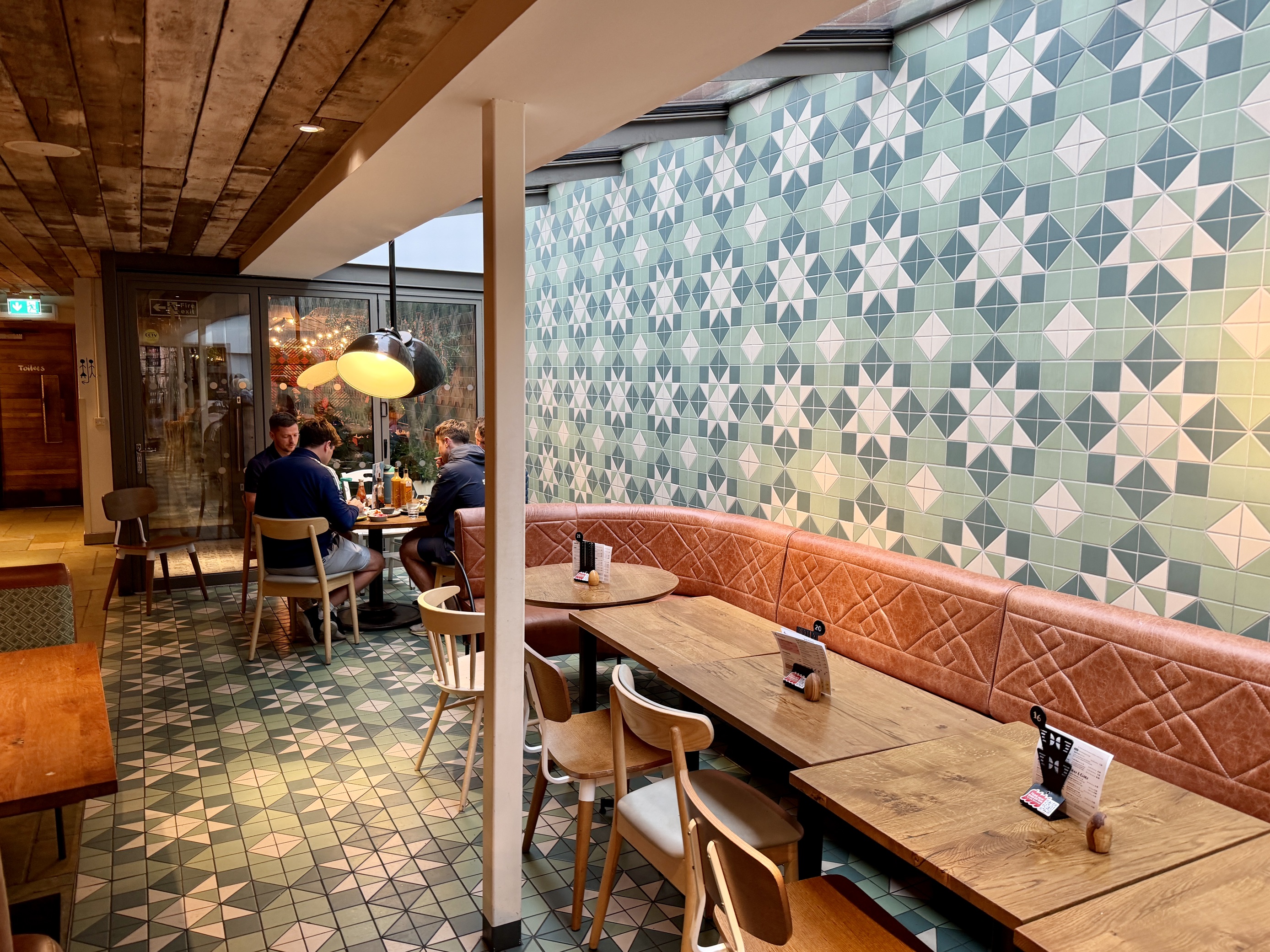
I’ve always liked the interior of the Wokingham branch. The front room is more bog standard but I have happy memories of the space at the back with its skylight and bold tiled wall, so I was glad we were seated there. We were there at 6, and the place was still quietish: by the time we left the tables along that tiled wall were all occupied by big groups. Nobody there thought Nando’s had jumped the shark either.
Normally in my reviews there’s a bit where I talk generally about the menu, how much everything costs and so forth. Is it all right if I skip that bit this week, and we take it on trust that you know all that? Excellent. I had downloaded the Nando’s app specially for this visit – like another British institution, Wetherspoons, they try to minimise the amount of time you spend on your feet – so after a bit of plea bargaining and talking Jerry through what was good and what wasn’t, I placed our order. The whole lot came to just shy of £120.
We ordered the majority of what Nando’s classes as starters, even though I expect many regulars don’t bother. Peri peri nuts were surprisingly bland and lacking in crunch, and padded out with macadamias, which I’ve always struggled to like. They didn’t feel like incredible value at £5.25 but, perhaps more significantly, because Nando’s lists this for everything it serves, you know that a portion contains nearly 800 calories. They felt unnecessary on multiple levels.
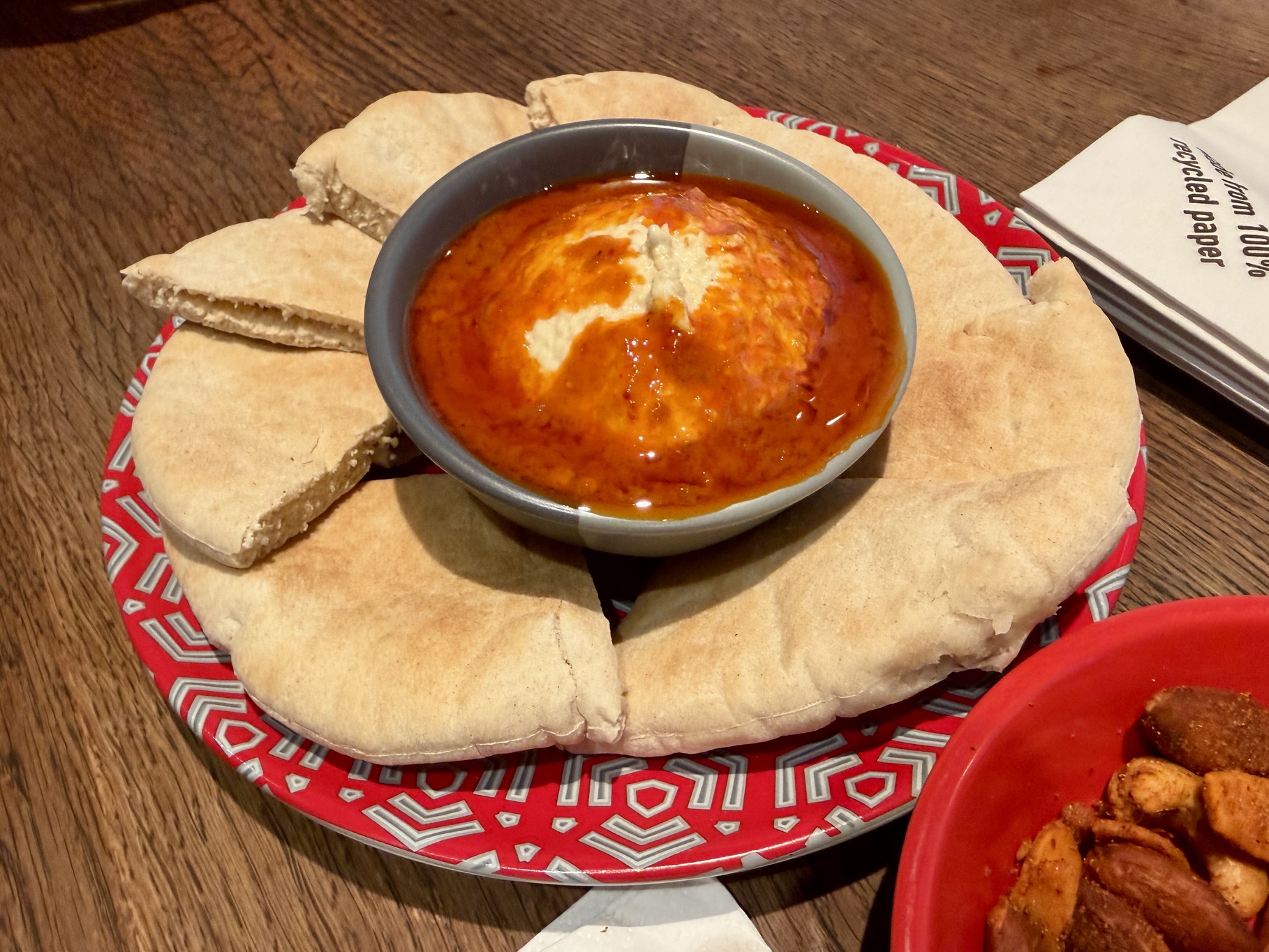
More reliable was that ever-present, Nando’s houmous with peri-peri drizzle. Nando’s houmous was about as good as the stuff you’d get in Marks, and the drizzle added a nice piquancy, even if the contents of the bowl started to look like a clumsily popped zit. The pitta wasn’t a great advert for ordering anything that’s served in one, being doughy, stodgy and manifestly ill-suited to dipping. Loading houmous on to a pitta with a fork felt against God and against nature, but we had no real choice.
This too was nearly 800 calories, more calorific than eating half a chicken. I don’t know if that’s a good advert for putting calorie counts on menus, but it’s not a good advert for Nando’s starters. The menu actually includes an item called “Dare To Share” where you can order three starters for just over £12: I’ve never considered ordering starters, or sharing them, an especially daring act so I’m not sure what they’re driving at there. What risk are you running exactly, besides obesity?
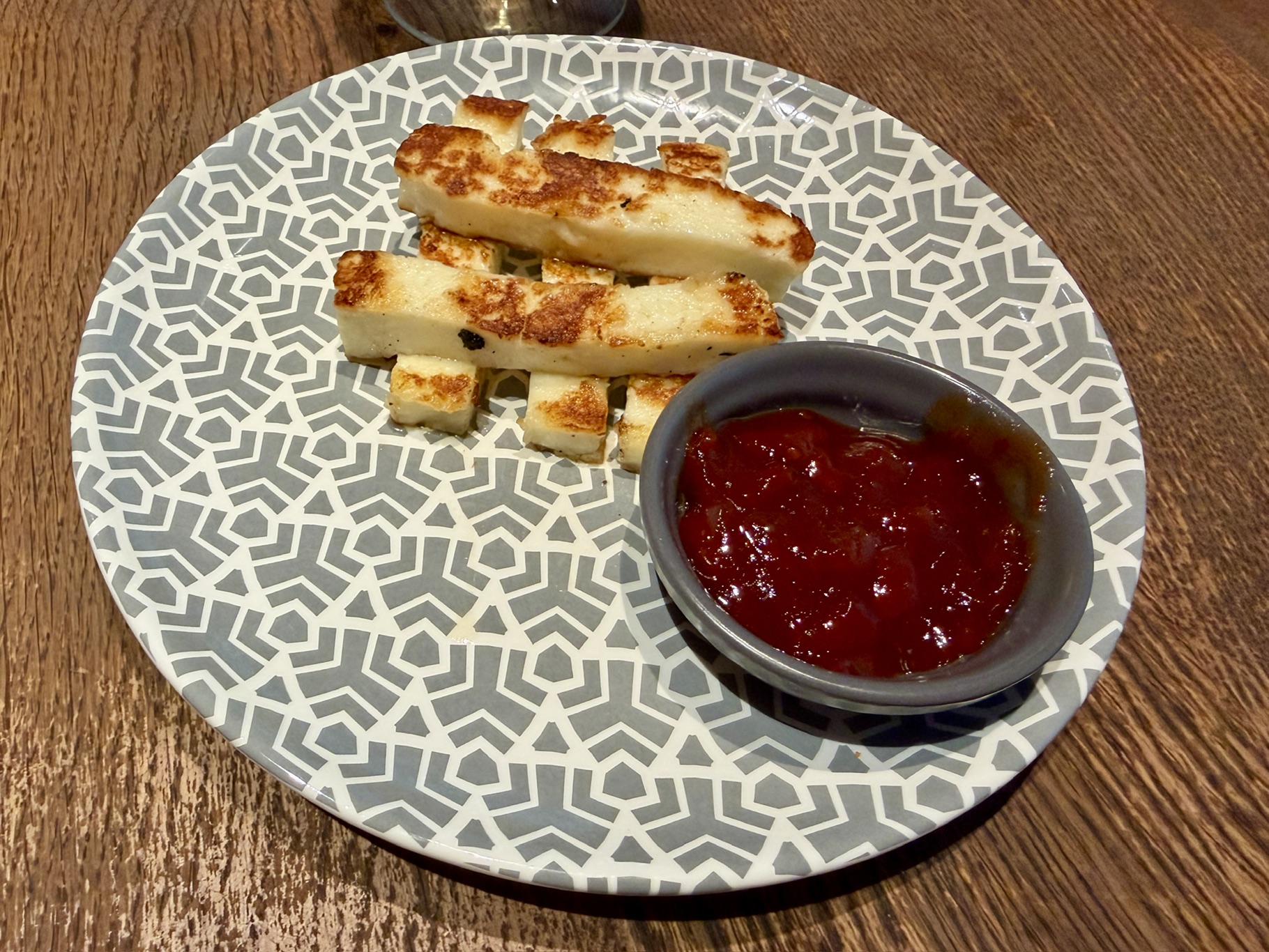
Nando’s halloumi fries came as a moderately tanned miniature jenga stack of five pieces of halloumi. You had to hand it to Nando’s for giving you a prime number of these, almost intended to make things difficult.
If you’ve never had halloumi before, or only had Nando’s halloumi, I imagine you’d be quite pleased with these. But I couldn’t help but compare them to the far superior ones at Honest Burgers where four larger, better halloumi fries cost you less. They’re also organic, served with a cracking chipotle jam rather than a hypersweet chilli jam, and somehow, magically, contain fewer calories. I promise this is the last time I’ll mention calories: I’m not that kind of writer and I’m hoping you’re not that kind of reader.
By this point Jerry and I were well into a glass of South African sauvignon blanc each (and I thought he didn’t like white wine) which was perfectly unobjectionable and a snip at just over £7 for a 250ml can. Zoë was on an AF beer – Nando’s stocks Beavertown’s Lazer Crush – and we also had some water and a bottomless Diet Coke on the go.
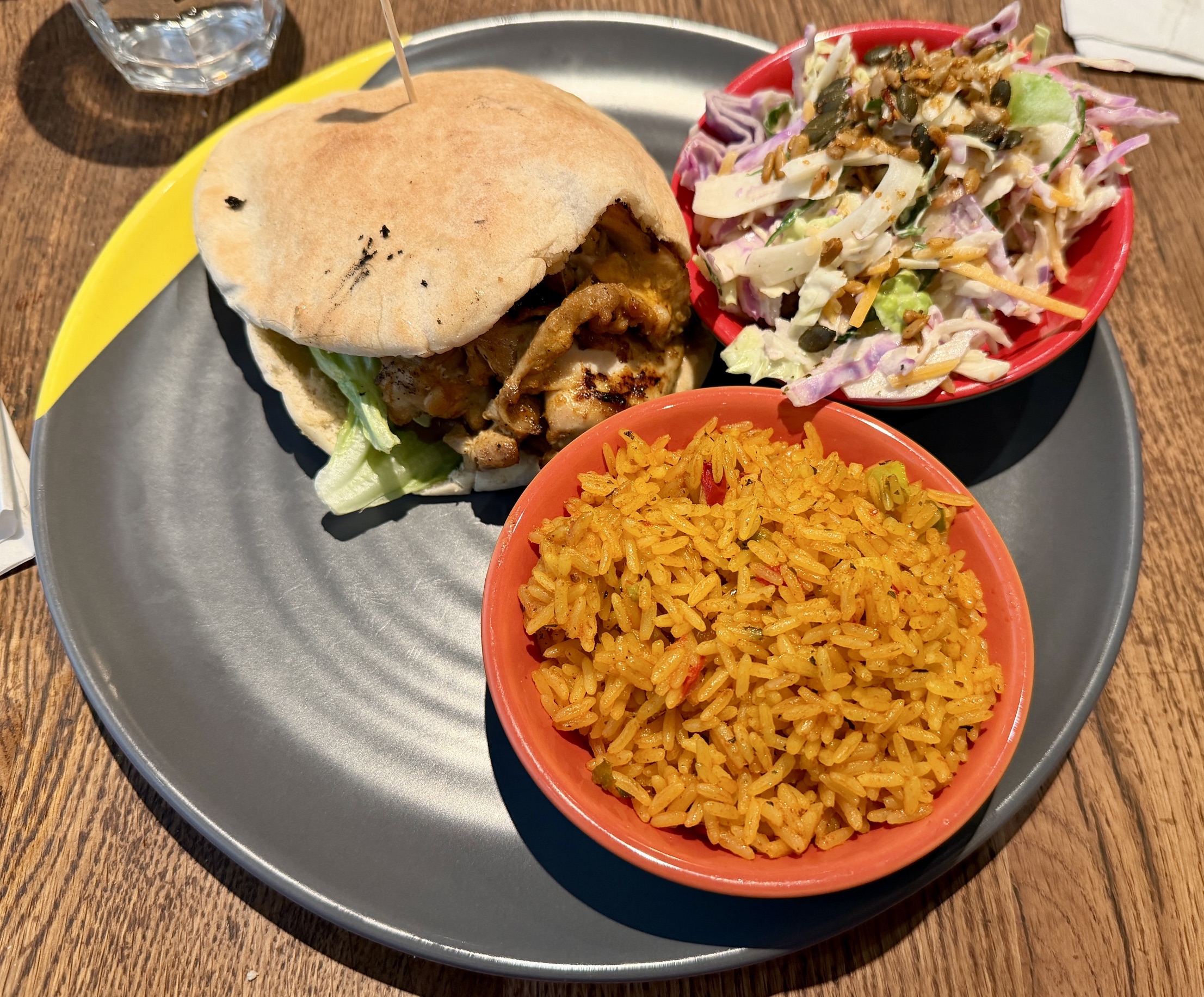
About 15 minutes after our starters all our variations on a theme came to the table with brutal efficiency. Zoë ordered a fino pitta with medium fries, spicy rice and some rainbow slaw: the latter was my mistake, as she’d wanted the macho peas. It was, I’m told, absolutely like every other fino pitta Zoë has had in the past, because that is what Nando’s do. If I went to Nando’s for dinner tonight and ordered this dish, this is what it would look and taste like.
Because Jerry and Zoë had both ordered chicken thighs, I went for the butterflied chicken breast. Back in the old days Nando’s didn’t do chicken thighs, and the butterflied chicken breast was my go to order. It was perfectly pleasant, maybe slightly dry and lacking the textural contrast and char you get from the thighs.
To try and order things I didn’t usually order, I’d asked for this as “Sweet Heat” rather than my usual Medium. The menu boasts that this is “BBQ for the bold” and is only available for a limited time. Hobble don’t walk to a Nando’s to try it would be my advice: what did I say about how people stray from their regular order and then go back to what they know? That evening, that was me.
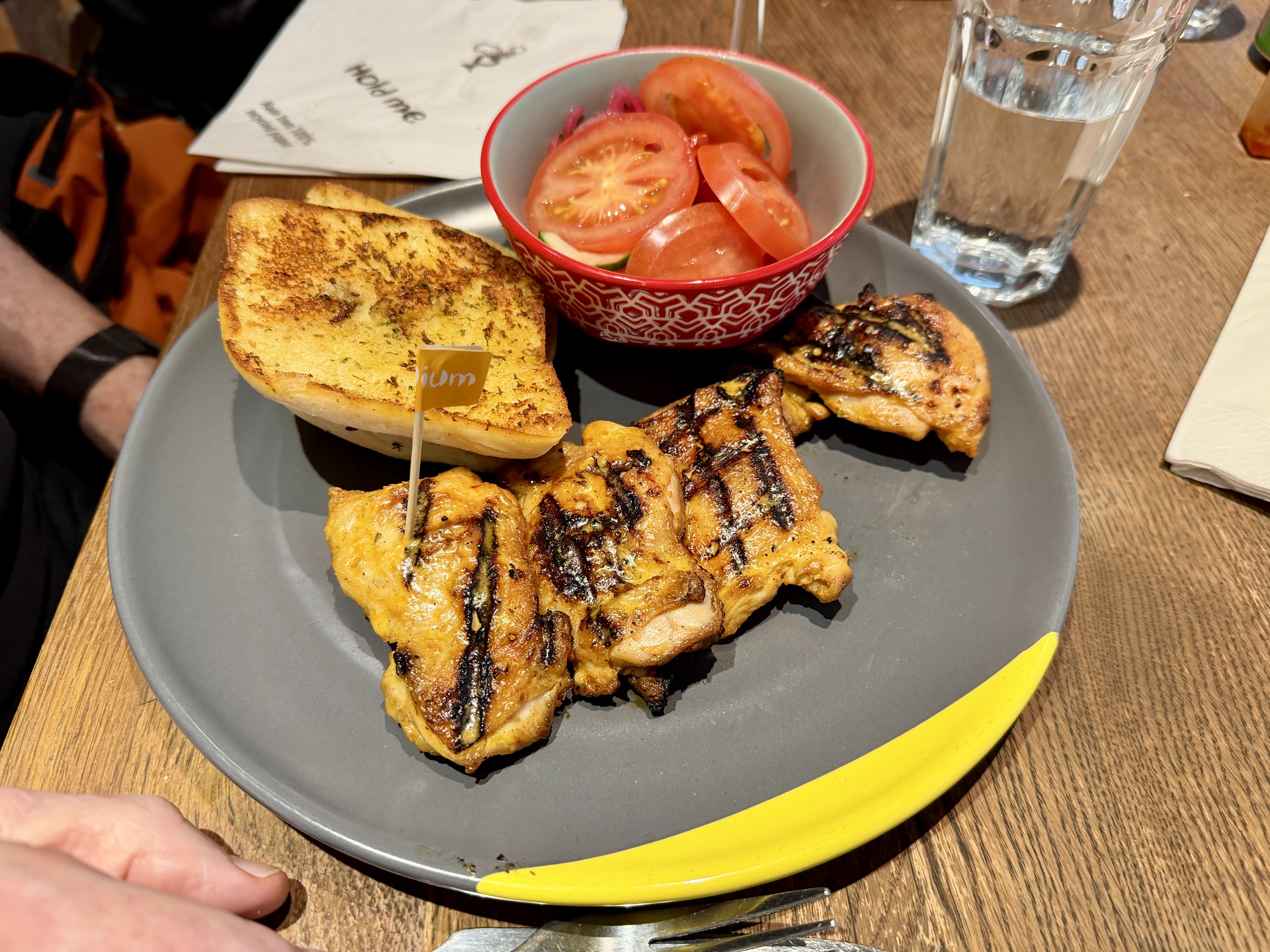
I also had the spicy rice, which I always order: it was slightly clumpy in a manner that raised questions but otherwise tasted exactly like every spicy rice I have ever had in the past and every one I will have in the future. The same could be said of the garlic bread, a diamond-shaped ciabatta roll halved and toasted. It had magic powers: it didn’t taste much of garlic in the moment but gave unsubtle reminders for the rest of the evening. Just as it always does: you’re getting the idea by now, I imagine.
Jerry chose the boneless thighs, my usual selection, and ploughed through them with a gusto I found oddly touching. It reminded me that I’ve wished, many times, that I could forget I’d ever read one of my favourite books or listened to one of my favourite bands so I could experience the joy of discovering them all over again, a sort of benevolent Eternal Sunshine Of The Spotless Mind where you forget not to forget but so you can be reminded.
Would I use that power to wipe the memory of my first ever Nando’s? Of course not, but watching Jerry love his chicken and wonder where it had been all his life was the next best thing, I suppose. He was our very own Miranda: o brave new world, that has such restaurants in it. Jerry chose to pair this with more of that garlic bread and another relatively new innovation from Nando’s, the “Portuguese tomato salad”. Those tomatoes could be Portuguese, but I’d be amazed if they were.
We ordered two sides, one of which was negligible and the other of which was significant. First, Nando’s macaroni cheese, which allegedly comes “with a crunchy, garlicky peri-peri crumb topping”. It does not, really. It’s a ramekin of claggy blandness with some flavourless pale rubble on top: order it if you like macaroni cheese enough to eat average macaroni cheese, otherwise don’t bother. Who am I trying to fool? It’s already either part of your regular Nando’s order or it isn’t.
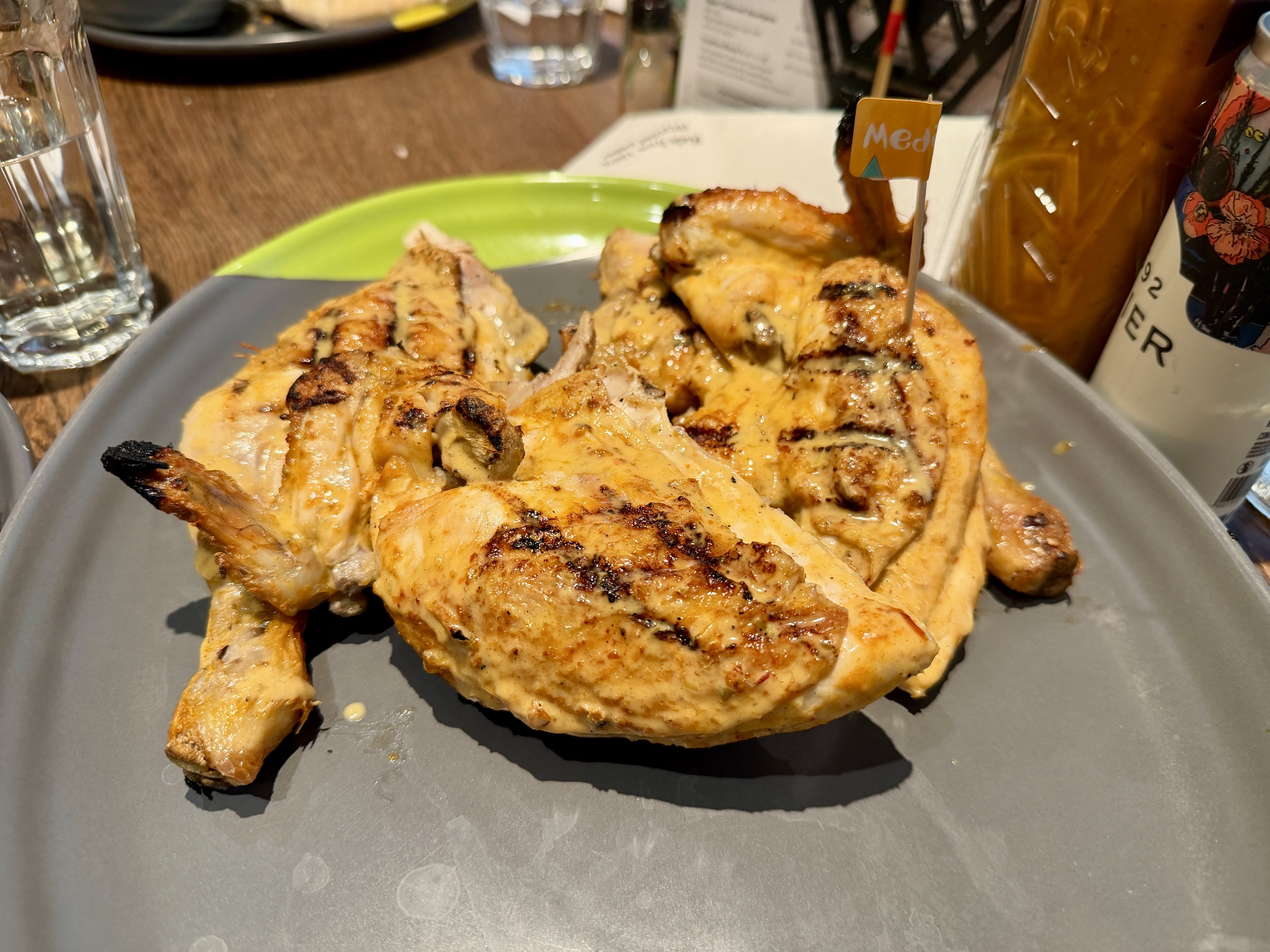
Our second side was a whole chicken.
I know, it sounds a bit Henry VIII and we didn’t really need it, but I insisted because I wanted Jerry – who am I kidding, all of us, especially me – to try the product without whistles, bells, pitta, butterflying, filleting or general fucking around. Actually, for me this was probably the best thing in the whole meal and something I don’t usually think to order. Fairly plump and generous, the meat rich and not dried out, the skin scored and scorched.
Maybe this is where it all started out and Nando’s lost its way with all the variations on a theme it had to introduce over the following thirty-four years to hold people’s interest. But eating this I almost remembered what eating there the first time could be like.
Poor Jerry couldn’t tackle much of this, because he’d experienced Nando’s overload, but I made inroads into it on his behalf. It felt rude not to. A whole chicken on its own will set you back just over £17 and paradoxically, I thought it was the best value of anything we ate all evening. And yes, I’m aware that calling it a side order is an understatement and a half.
So what did we all come away making of Nando’s? Zoë said during our meal that it had aspired to a status a little like the NHS: people in the U.K. had come to expect that it would always be there, be accessible at the point of demand and be available fairly close to where they lived.
I wondered if she’d oversold it, but I looked up the most godforsaken places I’ve ever visited in this country – Runcorn and Great Yarmouth – and the former has a Nando’s a couple of miles away in Widnes. If you live in Great Yarmouth you have to go all the way to Norwich, but if I lived in Great Yarmouth I’d be looking to buy a one way ticket to Norwich at my earliest convenience.
Jerry loved it. “I’ll be going there again, or at least the Reading one” he told me later. I can well believe it, although there’s always a risk he was just being nice.
And me? Well, it remains in a particular niche – I imagine I might fancy one of my own volition every couple of years, if I can get past my misgivings about their particular brand of animal cruelty. But if a friend proposed eating there I would rarely say no, and if a work offsite happened to include a lunch there I’d feel like that was a pleasant surprise.
I imagine that, like the NHS or like Woolworths or Debenhams, I will appreciate knowing it’s there until one day the grim realities of the public finances and market forces mean it no longer is. On this evidence, though, I think that day may still be decades away, unless people start caring about chicken welfare a lot more than they do today.
So there you have it, the review of Nando’s that literally nobody needed – except maybe Jerry, but he was there anyway. I realised afterwards that I can easily count the number of bad Nando’s I’ve had on the fingers of one hand. I can count the number of amazing Nando’s I’ve had on the fingers of one hand, too: bad and amazing just aren’t what they do. Or perhaps it’s truer to say that I’ve had bad or amazing times at Nando’s, but the food had nothing to do with it in either case. Whatever. On that basis this time, with two of my very favourite people, had to be one of the best.
Since January 2025, Edible Reading is partly supported by subscribers – click here if you want to read more about that, or click below to subscribe. By doing so you enable me to carry on doing what I do, and you also get access to subscriber only content. Whether you’re a subscriber or not, thanks for reading.
For all the people in Reading and beyond on Ozempic or Mounjaro, despite all the weeks in the last few years when I’ve joined my ever-optimistic wife on the Fast 800 diet, there remain some times when there’s a big hole in your life and only carbs can fill it.
I’m not saying carbs merit their own tier in Maslow’s hierarchy of needs the way, say, wi-fi does, but carbs are the unconditional love of food, the thing that softens the edges: no wonder we talk about lapsing into a coma after eating them. They are the thing that nearly always makes the world feel better, cosier and less harsh. Well, that and ice cream – but even I, an inveterate ice cream lover, would concede that ice cream is chiefly for the brighter months, while carbs are a friend for all seasons.
That said, carbs come into their own during our winters, which seem to take up most of the year once summer ends, with their chilly, dreich, gathering gloom that makes the soul sink. My brother was over from Australia at the start of last month on a short notice family visit and he loved the greyness, the lack of blue skies. But he felt that way because it was summer back home, and hot as balls there.
By contrast, he found shivering on the terraces watching Maidenhead United in his specially bought winter coat and gloves, his newly-purchased polyester scarf costing less than the ticket for the match, somehow magical. Even so, as he drove me home after the match he admitted that he wasn’t sure whether he could hack four months of it. I sometimes wonder how any of us do.
When it comes to epitomising carbs I know people put Italian food on a pedestal, with its twin exemplars of pizza and pasta. But I always think Nepalese food is a bit of a dark horse in this regard; I know it has other jewels, its sukuti and sekuwa, its phenomenal pressed potatoes, but when I think of Nepalese food the thing that comes to mind first is momo. And then, if I can think beyond momo, I also consider Nepalese chow mein, with the hot sauce that separates it from its Chinese sibling.
Reading is extremely lucky to have a significant Nepali community, and it means that we are well represented when it comes to Nepalese food. And that, in turn, means that Nepalese food has been bringing Reading in general, and me in particular, comfort and joy for well over a decade.
For a long time, for me, that meant momo at Sapana Home. Nearly a decade ago, in the depths of my divorce, when my flat was no longer a home I would stop at Sapana Home on my way back from the station and order ten pan-fried parcels of succour, with a mango lassi chaser. There was a specific wistfulness I felt when I finished the sixth momo and knew that the plate, and my respite, were nearly over: the Germans probably have a word for it.
In happier times there was the glorious autumn of 2017 when I discovered Namaste Kitchen, and the hospitality of Kamal, at the foot of Katesgrove. I would walk there from my little house in the Village with the slightest of provocation, any excuse at all really, and self-medicate with cider, momo and chow mein: the rest of that year, gastronomically speaking, was made up of four magnificent months.
And in the depths of the pandemic, when Kamal had moved to his eponymous kitchen on the Caversham Road, it meant delivery bikes scuttling from there to our little house in the Village when only Kamal’s carbs could shut out an attack of the glums. I must have lost count of the number of deliveries from Kamal since he opened, both at the old house and this one, and whatever those orders contain they always feature chow mein and momo: to omit them would be unthinkable. Zoë would mutiny if the former was missing, I couldn’t do without the latter.
Three weeks ago, Zoë and I got off the train at Reading and we knew it was one of those nights. We’d been to see my dad in the hospice, and it was in relative terms a good visit. He had a sheet of exercises and told us he planned to start doing them, that he had been using a walking frame to reach the bathroom in readiness for when he was discharged home. He was so set on getting back to his house and his bed: he asked me what films he should watch when he made it there, talked about the things he was looking forward to doing when his life returned to normal. And we played along, because we didn’t know how else to handle it.
His speech seemed stronger than it had been, and it was a shame to leave. But we knew he was ready for us to go because he asked what we were doing that evening, his coded signal that he wanted to get some rest. I told him we were going on a mini pub crawl with Zoë’s CAMRA compadres, an event I always enjoy, and he appeared to like that answer.
It was an evening when we could believe we’d all had a false alarm, even though the hospice staff tell you, with the wisdom of years of experience, that patients often rally soon after they reach the hospice. It was the last time Zoë would see my dad alive, but none of us knew that then.
Even though my dad was on good form, relatively speaking, those visits take something out of you, make you think, make your mind go to places you’d rather it didn’t. So when we got back into town we only had a little time to decompress before having to go to the Greyfriar, be social, talk beer and pubs and buses with Reading CAMRA’s brilliant bunch. That hole was yawning and carbs could fill it, so I thought of Just Momo.
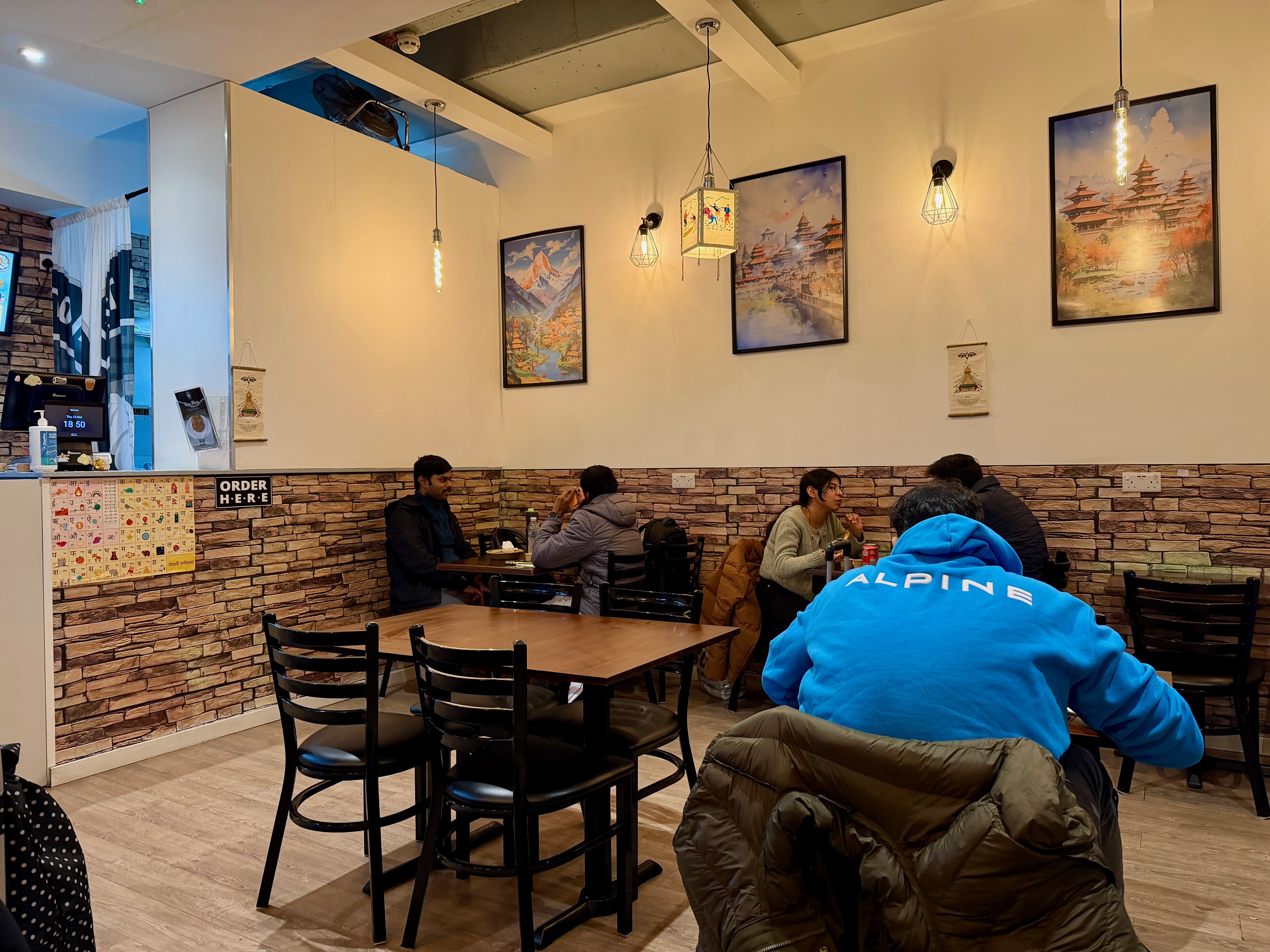
It’s on the same run of restaurants as pizza rivals Paesinos and seemingly permanently closed Amò, but of a slightly older vintage: it opened in winter 2024, the first of those sites to start trading. And the inside is pleasant, generic and featureless: a biggish box of a room with framed pictures on the wall and a real mélange of light fittings, from traditional to modern to bare, illuminating its basic tables and chairs. Only the exposed brickwork effect around the walls was bizarre: made of 3-D vinyl rather than flat wallpaper, and oddly spongy to the touch.
The restaurant was doing well when we arrived just before seven, with a fair few tables occupied. I was going to say that most of the customers were desi, but having had a preemptive Google it seems that Nepali people don’t identify with that term, so I won’t.
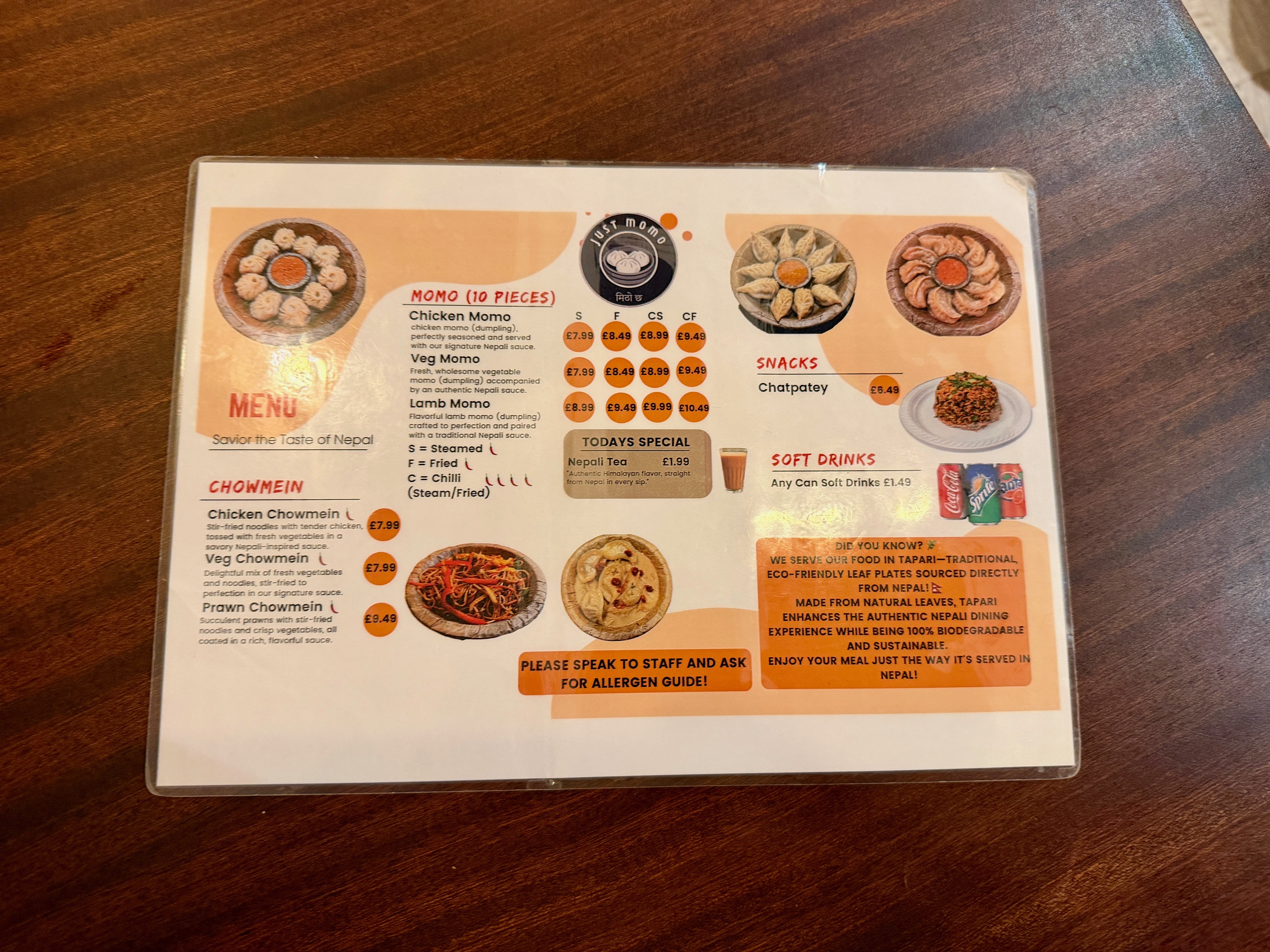
Just Momo is a bit misleading calling itself that, because it also does chow mein and one other dish, chatpate. But that’s hardly grounds to complain and their menu is a visually appealing, stripped down model of simplicity. It takes possibly the two most accessible dishes in Nepalese cuisine and sticks them front and centre: you can have chow mein with the protein of your choice, you can have momo any which way, but you’re going to be eating chow mein or momo or, if you have a hole in your life that only carbs can fill, both.
I say that you can have momo any which way, but that’s not strictly true. They come steamed or fried, in chilli sauce or plain, and they are chicken, vegetable or lamb. So no kothey, or pan-fried, momo, no jhol momo in broth and no buffalo (or buff, as Nepalese menu always term it) momo of any kind. Some momo purists might find that limiting but I didn’t, even though kothey momo are usually my first choice.
I went up and ordered a couple of types of momo, because Zoë shares momo, two portions of chow mein because Zoë likes, as she puts it, personal chow mein, a soft drink for her and a sweet Nepali tea for me. All that set me back just under £40.
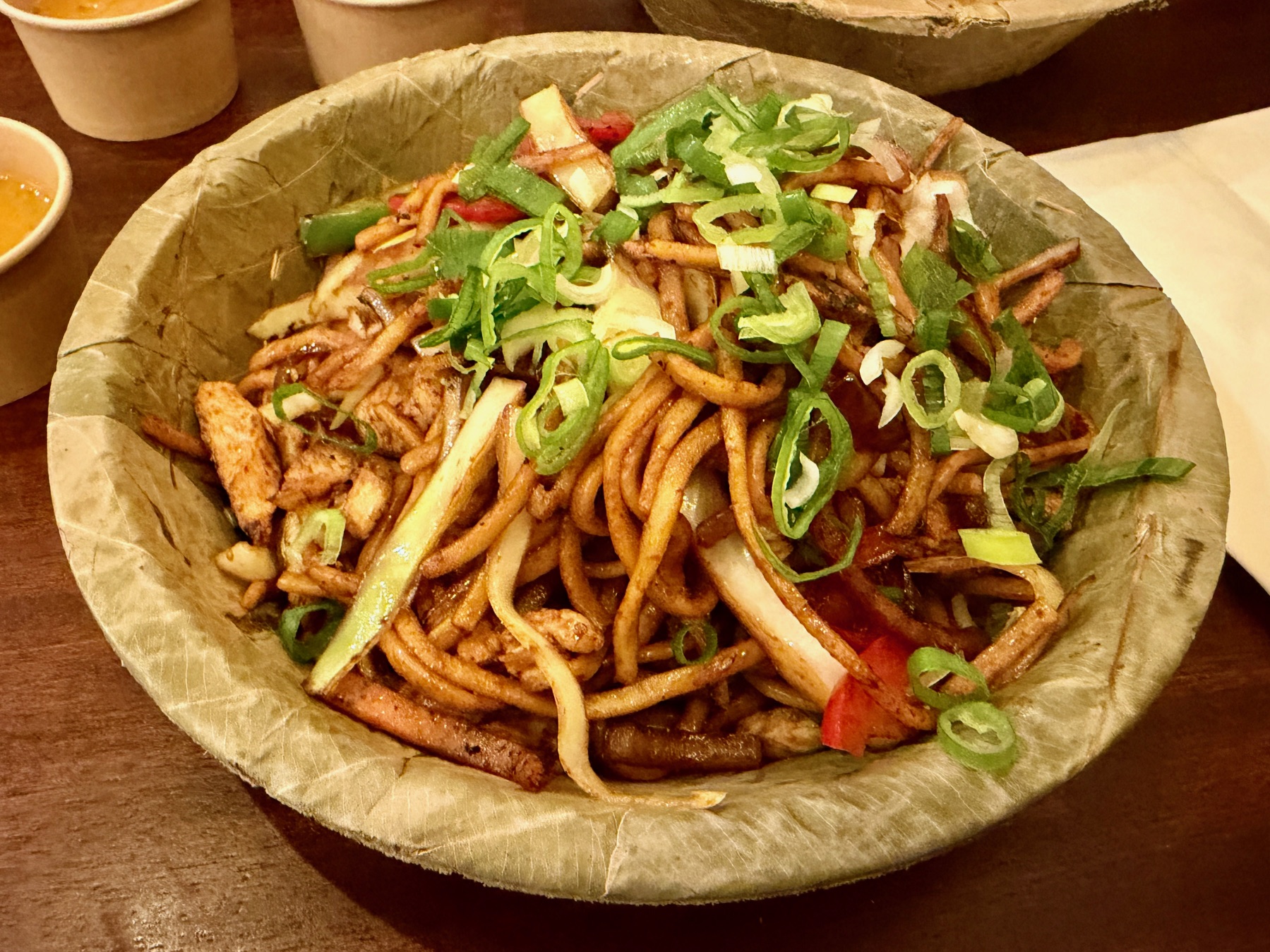
Fifteen minutes later, out it all came and it was extremely gratefully received. The chow mein was more than acceptable, full of veg, topped with herbs and spring onions, tumbled with thick strips of chicken, noodles with plenty of bite. It only took a forkful to remember why this dish can be such a tonic, and if it didn’t quite hit the heights of Kamal’s Kitchen’s rendition it wasn’t far off, and besides Just Momo’s location is a lot more central.
It needed the sauce it came with, but it made me think of how welcome dishes like this can be and set my mind off in a reverie of all the great noodle dishes out there, from Me Kong’s Singapore noodles with their dusting of curry powder to the soy-laced wonders of Oishi’s yaki soba. Three cuisines, one giant gastronomic group hug. The fug dispersed slightly, the spirits began to lift. Everything was working as it should.
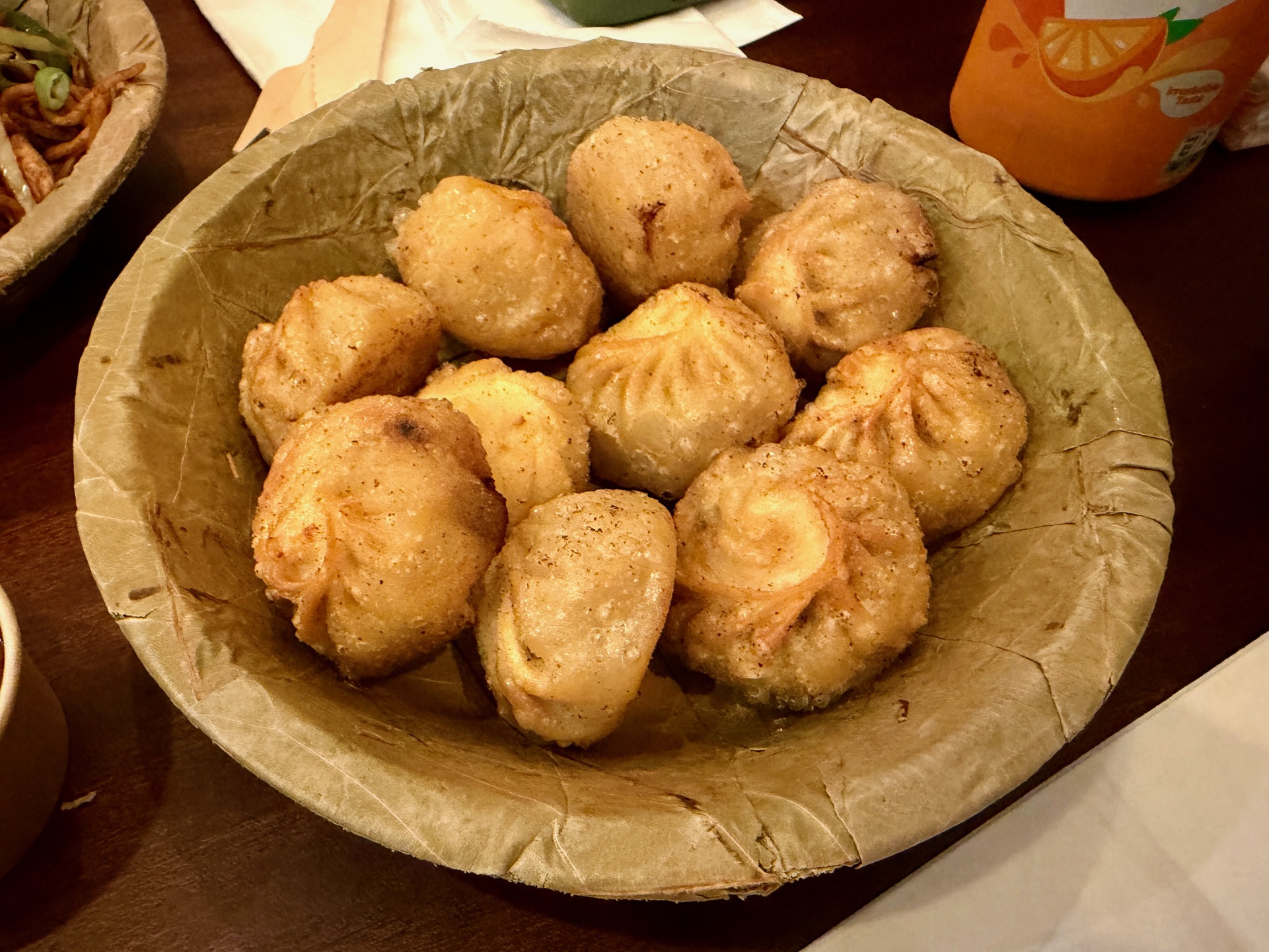
If the chow mein was good, the momo were even better. Just Momo’s Instagram page shows them painstakingly making them by hand and these certainly didn’t feel bulk made and previously frozen. Fried lamb momo were piping hot, beautifully crispy bubbles kept from floating away by a gorgeous ballast of generously filled ground lamb. Having had these at Kamal’s Kitchen and at West Reading’s impressive Momo 2 Go I have to say that Just Momo could give either a run for their money.
Ten for just shy of a tenner still constitutes impressive value inside the IDR, where costs were prohibitive before everything got more expensive on April 1st and are only going to get worse. When I update my guide to solo dining in Reading, this place – and this dish – are going to be in serious contention. I also loved the fact that this, and all of Just Momo’s dishes, come in eco-friendly leaf plates “just the way it’s served in Nepal”, even if the green credentials you get from that are wiped out by flying them over from the motherland. I was less keen on the wooden knife and fork, but never mind.
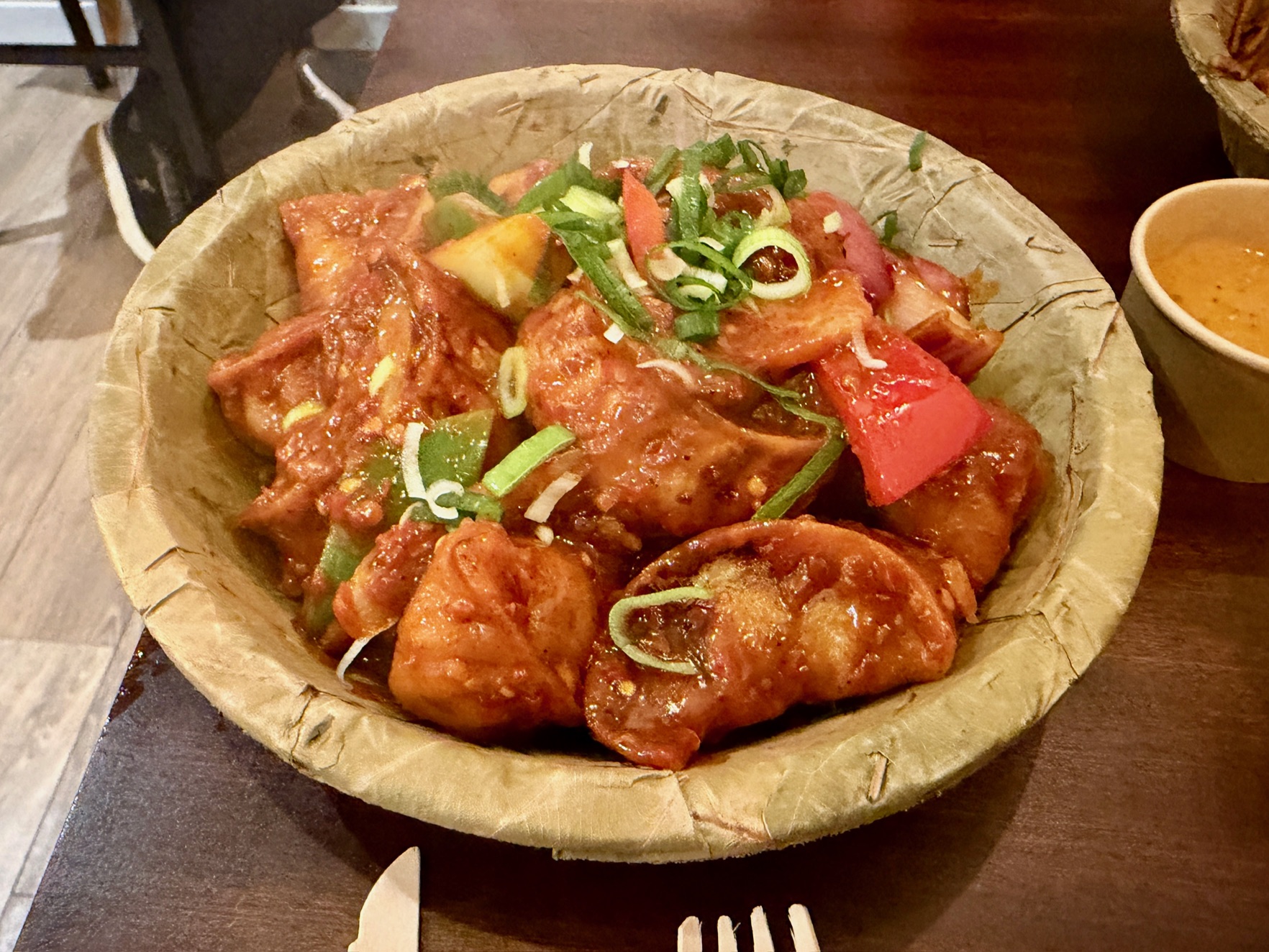
Chilli fried chicken momo were a different permutation of brilliant but no less enjoyable. I loved the chicken filling, although I should really have had the chicken momo unadorned to make a fair comparison with the lamb: that’s next time sorted. But if I couldn’t judge them in isolation from crunchy peppers and a thick, punchy chilli sauce which clung to every crinkle of every dumpling, that was hardly a tragedy.
The overall effect was a plate which rounded out our order rather than just offering more of the same. And again, hats off to Just Momo for not bloating their menu with chilli this and Manchurian that, not trying to offer something for everyone the way restaurants on Reading’s newly dubbed Curry Mile – people are trying to make it A Thing – sometimes do. No Indo-Chinese or South Indian interlopers, just a tightly honed menu that offers a few Nepalese crowd pleasers. If you don’t like them, go elsewhere. But really: if you don’t like them, check yourself before you wreck yourself.
Service was lovely and friendly, as warm and sweet as my very enjoyable Nepali tea. I found myself thinking about the randomness of life as we finished our meal at Just Momo. Presumably they had their pick of the units on that run as the first tenants, and perhaps if they had chosen Amò’s spot and Amó had been forced to take their site Amò would be the ones still trading and Just Momo would have the sign outside their door for three months saying “closed for refurbishment”.
If I hadn’t liked Just Momo, I might have shaken my fist at the skies about that, but much as I miss Amò I loved Just Momo, so I was glad they dodged that bullet.
The rest of the evening was just what I needed after the day I’d had. Zoë and I joined the Reading CAMRA brigade in the pub, drank nice beers, chatted merrily about all sorts and I could almost forget, for a few hours at least, where I had been earlier in the day and what lay ahead. Drinks in a pub might have achieved that on their own, but I don’t know. I think it was the welcome of Just Momo, misnomer and all, and their array of wonderful carbs that proved the turning point. I am grateful to them for that, and I’ll be back to enjoy more of their food, on the flimsy pretext of repaying their kindness.
One little postscript, because I somehow feel I want to say it: I have had the strangest fortnight. Two weeks ago, on the date of my last review, I went to London with Zoë to celebrate my birthday. I had a wonderful lunch at The French House, wandered off to buy fragrance I wanted but did not need, photographed some Brutalism, drank Belgian beers at one of my favourite London pubs. The following morning, unexpectedly, Zoë and I were at the hospice for the last time, my dad’s room silent and cold, him finally at peace and free from pain.
And the day after that, because it had been booked for months and was badly needed, Zoë and I flew to Màlaga for our first holiday in six months. I spent a week in the warmth, happy and sad and guilty, drinking vermouth in my dad’s honour – every single time – my mending arm gently baked by the incessant sunshine. Shorts on, legs out, sandals on, living the best life I could manage, under the circumstances.
It is an incongruous experience to grieve on holiday, to feel like crying in your favourite restaurants and a beautiful hotel room with the nicest view, with your best friend. I can’t say I recommend it. I have no prior experience of this, really, and it’s weird and unsettling that it’s never constant, always intermittent. Right now it feels like it might be constantly intermittent for ever. Having a lovely time, wish you were here: I didn’t send a postcard but I thought it, often.
When we got back last Friday, we turned the heating on and unpacked and sat on the sofa, home at last. The holiday was over and impending reality was looming, nowhere near the horizon. Discussions and decisions awaited, as did conversations and condolences. I felt that hole again, the kind that carbs can pretend to fill, and because I couldn’t think what else to do, Zoë and I ordered takeaway – chow mein and momos, of course. I will say this, though: they were delicious. They almost worked.
Since January 2025, Edible Reading is partly supported by subscribers – click here if you want to read more about that, or click below to subscribe. By doing so you enable me to carry on doing what I do, and you also get access to subscriber only content. Whether you’re a subscriber or not, thanks for reading.
Unlike any restaurant reviewer I know of, I publish the list of restaurants I intend to visit. It’s regularly added to as places open and people tip me off about their favourite venues, in Reading or slightly further afield, and every time I review somewhere it drops off that list – until, maybe, many years later, the time is ripe for reappraisal. From the outside, it probably just looks like a bunch of restaurants, in alphabetical order.
But the reality, for me at least, is that it’s a nuanced to do list. It’s almost more of an in-tray, never more so than at the beginning of the year, and the order in which I tackle it depends on a number of factors. Because not all of those spots have anywhere approaching equal priority in my mind, and that dictates how quickly I get round to them. I’m aware, for instance, that it’s a fair old while since I visited Newbury or Wokingham on duty: over three years for the former, nearly three years for the latter. I ought to rectify that.
Then there are the new places that I really need to review, if only because they look interesting. If not for my accident I would have reviewed Pho 86 and Nua by now, and spots like Blip and Matteo Greek Grill & Bakery also merit investigation sooner rather than later, to see if smashed burgers can take off in Tilehurst or whether at last somebody can make a go of the old Colley’s Supper Rooms site. I’m curious myself about the answers to those questions, so I need to go exploring at some point.
And of course the accident currently factors into these things. So places near the top of the in-tray, for the time being, need to be fairly close to home and at least slightly lend themselves to eating with one hand; my motor skills are gradually improving with physio, but writing one of these reviews still involves wrangling with the delights of Apple Dictation, which understands what I’m saying about as often as my wife does when her hearing aids aren’t in.
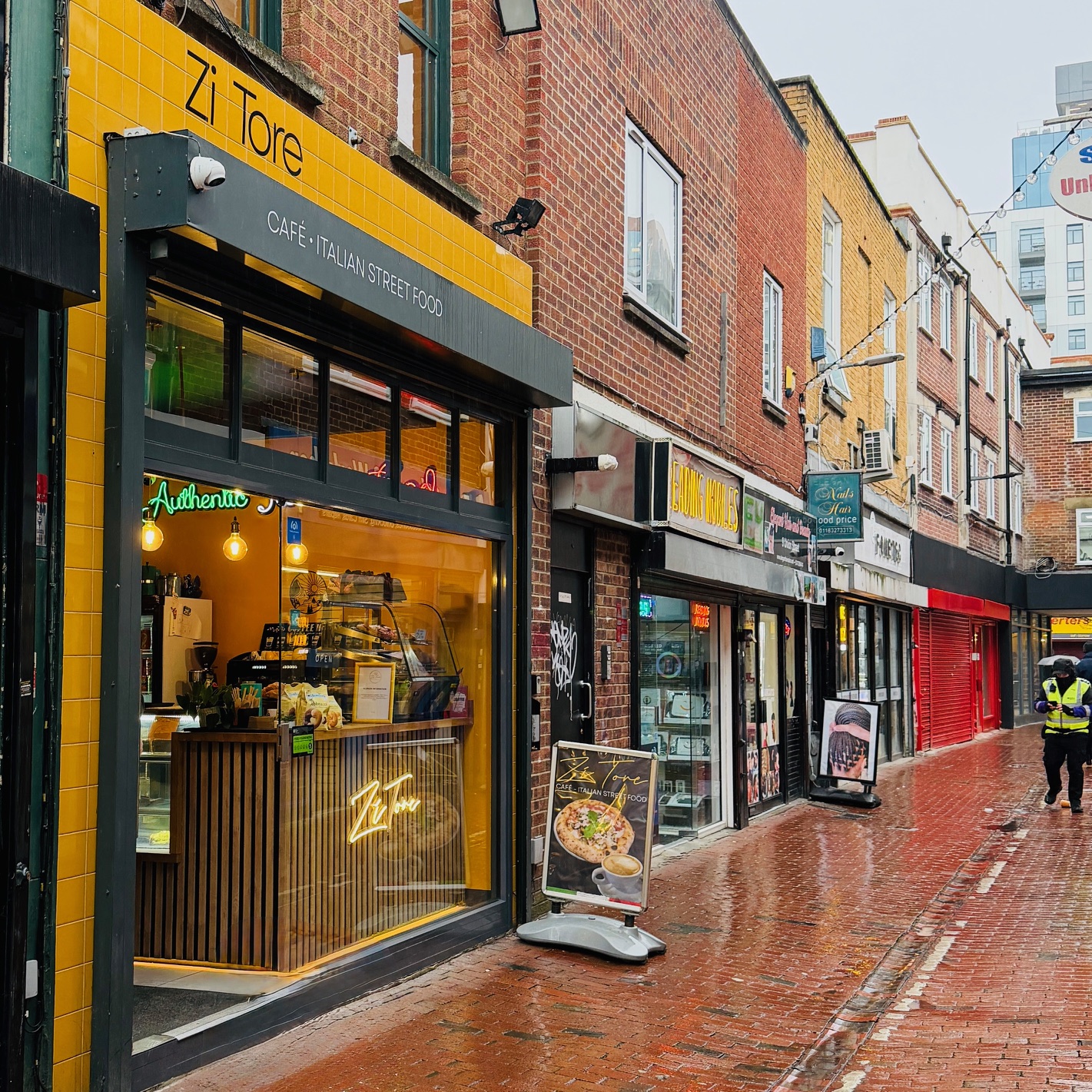
Every to do list has that one thing on it that you should have done a very long time ago, the item that sticks out like a sore thumb and makes you feel guilty. And in my case that item, the subject of this week’s review, is Italian restaurant and cafe Zi Tore, the one which took the spot on Smelly Alley vacated by the Grumpy Goat back in October 2023: yes, it really has been that long since the Grumpy Goat shut. Hicks Baker weren’t quick off the mark getting someone to jump into this particular grave, but Zi Tore opened nearly a year ago with co-owner Paolo Lanzetta, a proud Neapolitan, in the kitchen.
The Reading Chronicle covered the story as only they could, getting the name of the restaurant wrong – it’s not ‘Zia Torre’ – and accidentally giving Lanzetta dual nationality. “It has always been my dream to open a restaurant like this so people can try authentic Italian and Nepalese cuisine” they misquoted him as saying: you can’t get the staff, can you? That’s our local paper for you though, they just don’t know their calzone from their momo.
All that means that I am very long overdue checking out one of the trailblazers of the Italian invasion that hit Reading in the first half of 2025. I’ve reviewed Paesinos, reviewed Amò – not without controversy – and failed to get to Peppito’s before it closed five months after opening. But Zi Tore remained the blind spot: I tried to get there early one evening in May, only to get turned away because they seemed to be closing early, but I’ve not been back since.
And everything I’ve heard since then has been good. I’ve had comments to the effect that they’re staying open later these days, feedback borne out by their later opening hours on Google. Long-standing reader Mansoor, a man I trust on many things, said that of all of Reading’s new restaurants last year Zi Tore was the one he ended up visiting most frequently. And my friend Enza, my authority on all matters Italian, has loved Zi Tore for a long time, especially their graffe.
I’ve also heard rumours that one of Amò’s pizza chefs, short of work now that the restaurant has been closed for over a month without explanation, had crossed town to start working at Zi Tore. So that was it: slap bang at the top of the 2026 in-tray. On a drizzly weekday, during a week that was originally meant to be time off but was now filled with medical appointments, Zoë and I wandered up Smelly Alley to finally give it a whirl.
Zi Tore has done a lovely job of the exterior and the frontage and the window, with arancini and pizza slices tantalisingly on display, draws you in nicely. But beyond the counter, I found the interior a little inhospitable. It’s difficult to describe it without harking back to the site’s Grumpy Goat days, but the back room on the ground floor, where all the beer used to live, was a slightly unlovely space with a handful of tables, starved of daylight or much ambience.
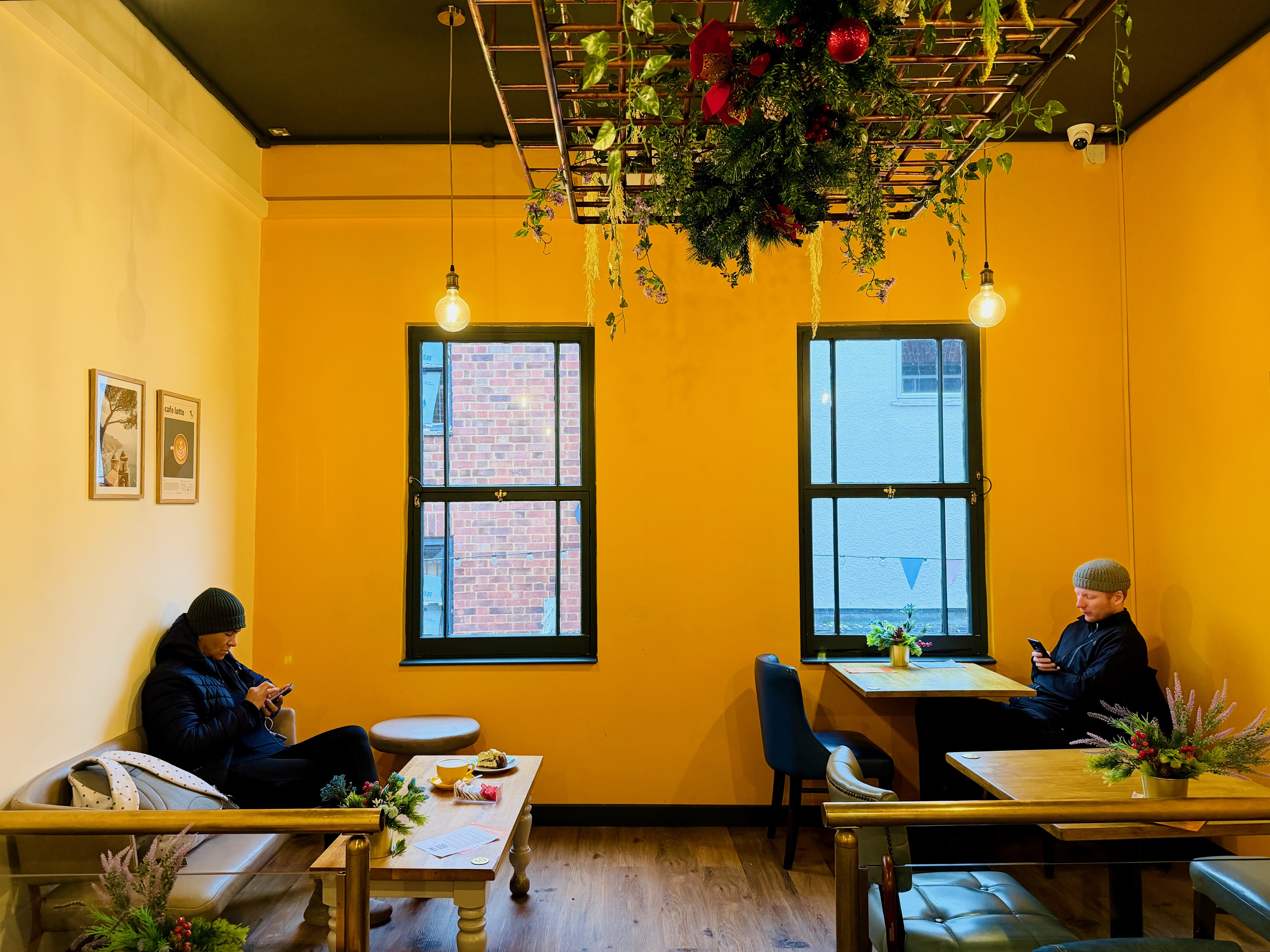
Upstairs was much better, although that also brought back memories of the site’s previous life. It’s a nice space with a fetching mini mezzanine looking out over Smelly Alley, and taking the bar out had definitely created more room. But even here the furniture felt functional and a little sterile, as if they’d bought it piecemeal.
One table with makeshift bench seating could accommodate six people, one of the plum spots up by the window had an actual bench and low table – great for coffee and cake, perhaps less so for lunch. It was also, not to put too fine a point on it, Arctic: an aircon unit in the ceiling was switched off, its remote on a nearby low table set to a random 30 degrees. It all felt a little spartan, not quite finished, even though the place was on the verge of celebrating its first birthday.
Zi Tore’s menu had the kind of concision that pleases restaurant reviewers: seven different Neapolitan pizzas, two types of pasta – ravioli or gnocchi – with one of three sauces, a lasagne and three smaller dishes under the heading “Street Food”. That was slightly marred by a separate paper pizza menu, a recent addition perhaps, with another half a dozen pizza options. Some felt like the kind of combinations you’d get at Amò, making me wonder if the departing chef had taken a few ideas with him.
Pricing was standard issue, with pizzas ranging from £10 for a margherita all the way up to £17 if you wanted porcini, roasted potatoes and sausage (typing this, that ensemble sounds rather good to me). Pasta dishes were between £12 and £15 depending on your shape and sauce of choice, and the smaller plates were less than a fiver. The other tempting dish, the pizza fritta, was a tenner and looked like a fish out of water in the street food section of the menu.
Cakes are not on the menu, so you have to go up to the display and ask at the counter: I didn’t indulge my sweet tooth on this occasion, but the cake I saw turning up at a neighbouring table looked thoroughly decent. I didn’t see any graffe – the loop-shaped potato doughnut beloved by my friend Enza – but perhaps they’re a weekend thing.
Zi Tore also doesn’t do table service, so you go up with your order and your table number and let them have it. I ordered a couple of coffees, a couple of small dishes, a pizza and a pasta dish: all that set me back just over £44, which felt like decent value. It was certainly comparable with its peers at Amò and Paesinos, although Zi Tore’s offering is slightly different from theirs.
It’s a shame to start the year with a regular complaint about timing, but I would have liked the coffees quickly – it was cold outside and almost as cold inside – and then the small dishes, then the main events. Zi Tore wasn’t hugely busy, with about four other tables on the go when we arrived, but in reality we waited what felt like quite a while and then everything turned up a matter of minutes apart.
No matter: the coffee, the starting point, wasn’t half bad. It arrived in those tall, almost-conical glasses I slightly associate with the last century, but my latte was very enjoyable and Zoë liked her mocha. In Reading’s coffee hierarchy this wasn’t competing with the likes of C.U.P. or Lincoln – or even trying to – but it was significantly better than Madoo‘s coffee, which has always been its Achilles heel.
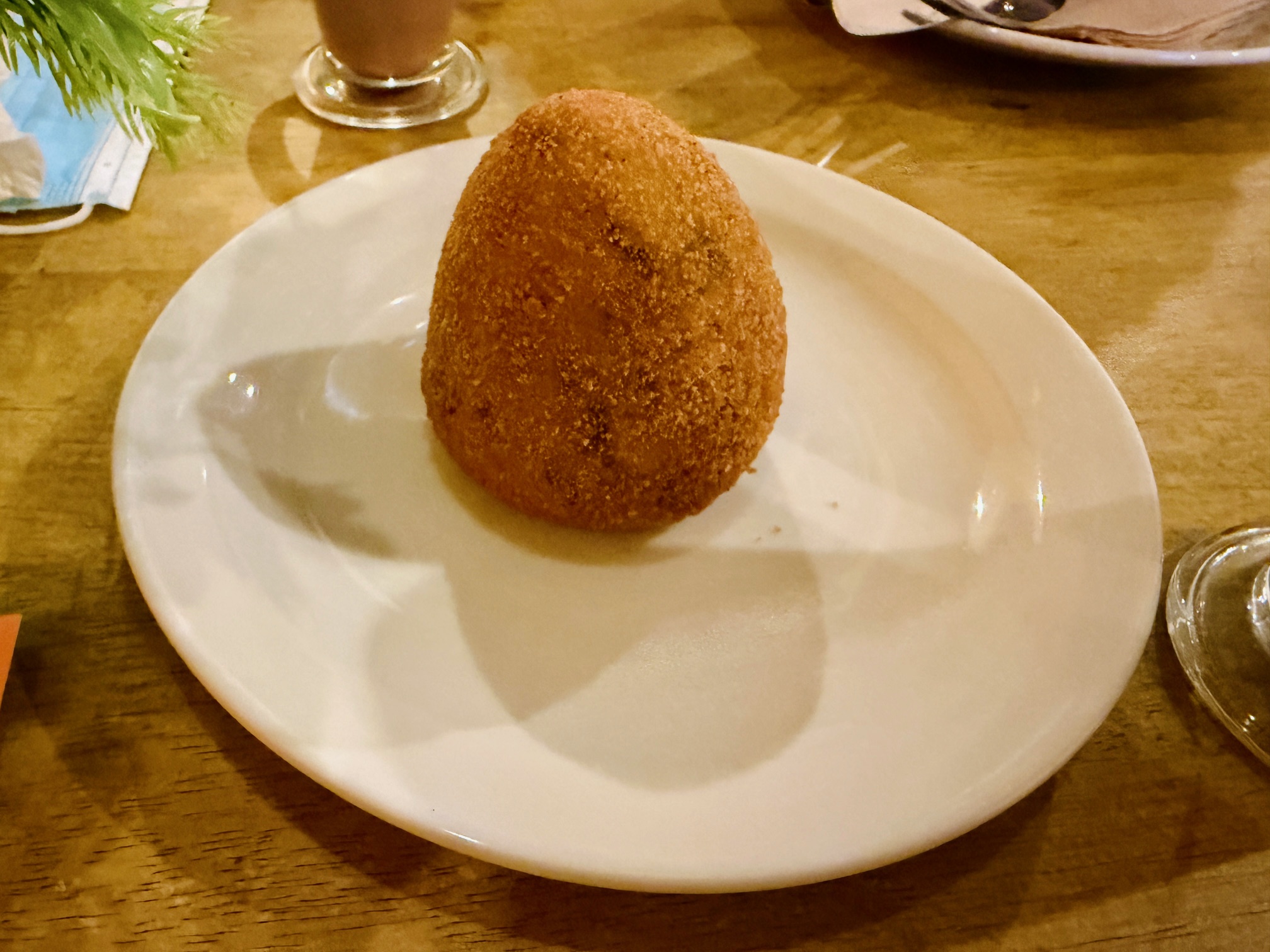
Small plates, turning up twenty minutes after we ordered, were a mixed bag of realised and unrealised potential. I didn’t mind the sausage and friarelli arancino, just the one for £5, but it lacked a little pep. It was lukewarm, the shell had no real rigidity to it and inside the filling wasn’t brilliantly distributed: a big knot of dense sausage meat at the bottom, almost as if it had been placed there to stop the whole thing toppling over, like a Weeble.
It’s not that I didn’t enjoy it, more that I knew better were out there: it didn’t match Amò’s but, on the other hand, it was far better than the ones at Vino Vita.
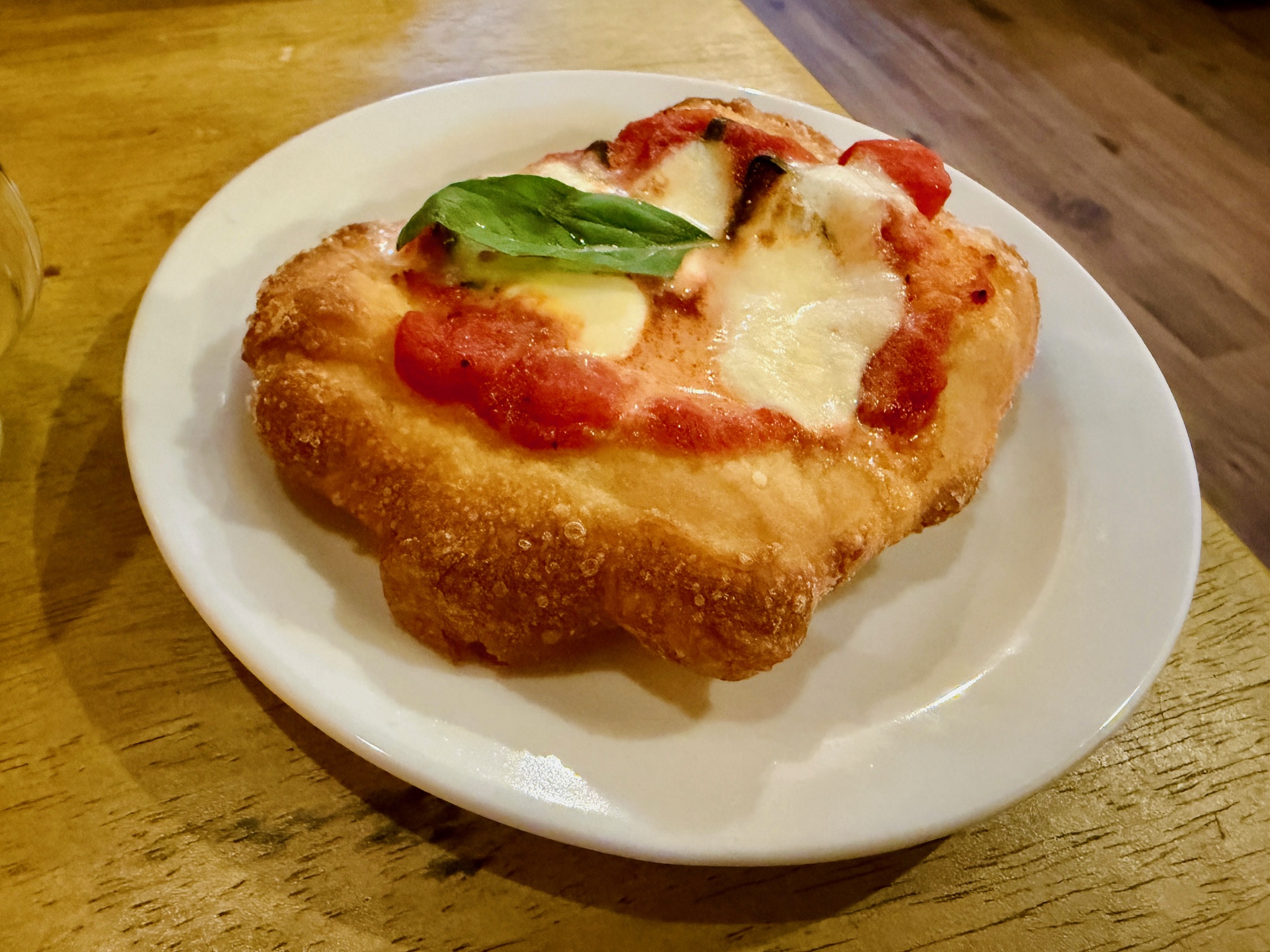
Far, far better was the montanara, a simple but exquisite treat, a pleasingly irregular, puffy oval of fried pizza dough topped simply with tomato, mozzarella and a solitary basil leaf. This was so enjoyable, and justified a visit to Zi Tore in its own right: there’s nowhere to hide when something has so few components, and it’s a great way to showcase how good your raw materials are. At £3.50, this is one of the Reading lunch scene’s bargains, and although we shared it between two – and it was big enough for you to do that – the wise move would be to come here and order one to yourself.
But the other wise move might be to order just that, because as I was eating it I did find myself thinking if only this was hot. It was fried pizza dough, I’m sure it was as hot as balls to begin with, and I wondered what had cooled it so: was it adding the toppings, or was it the fact that it sat around until everything else was ready or almost ready? Or could it have been that the upstairs was so Siberian that you couldn’t affort to wait until after your arancino to tuck into it? I think some benefit of the doubt is probably due here: I would go again and give this another try. Even on the upper reaches of what you could describe as ‘piping warm’ it was a very good choice.
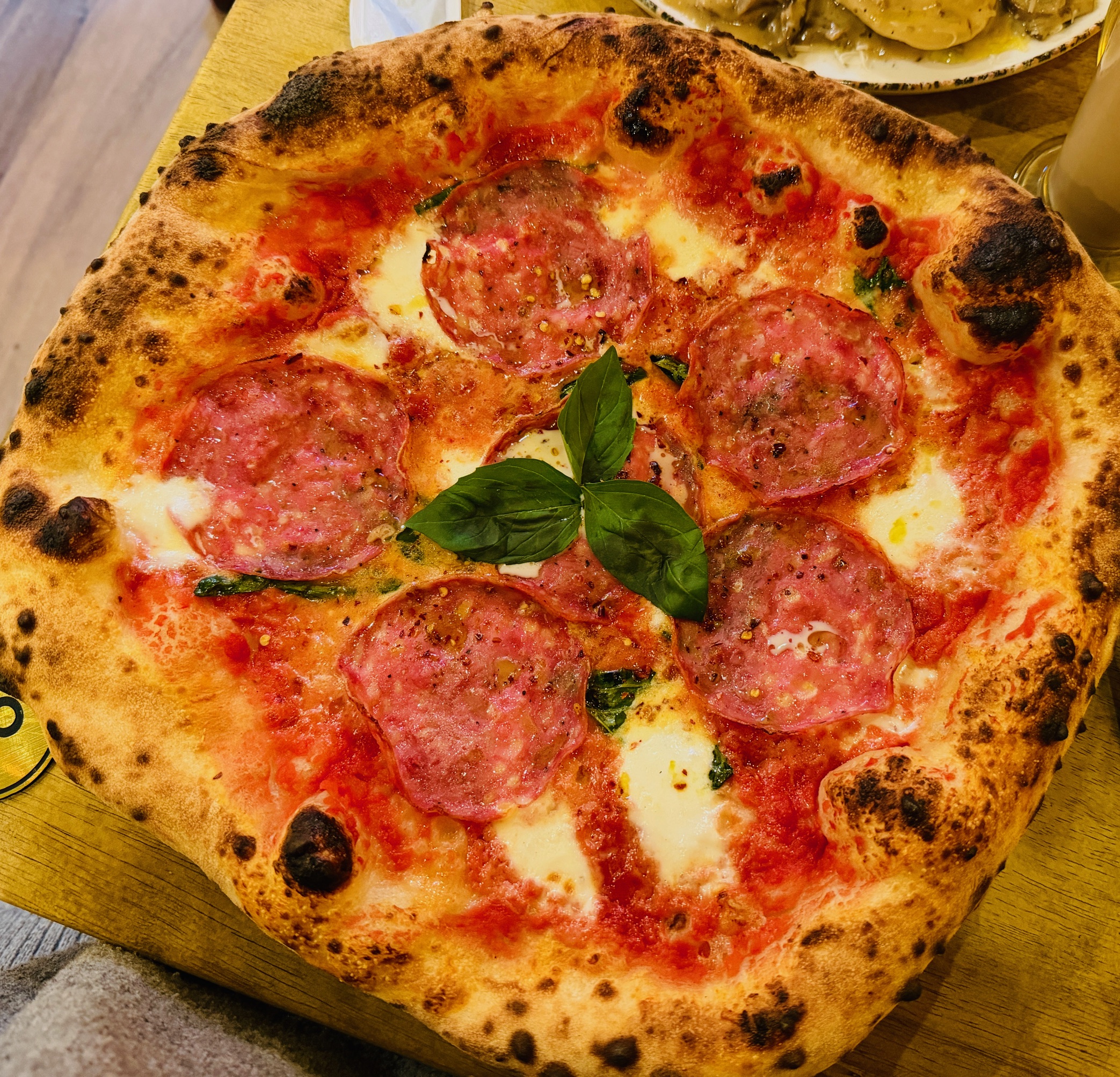
The timestamps on my and Zoë’s photos tell me that our bigger dishes arrived less than five minutes later, and it’s good that we’d finished our smaller ones or there wouldn’t have been room on the table for everything. Zoë called shotgun on the pizza, and had ordered simply, the Diavola, a relatively classic pepperoni pizza with chilli.
First things first: it looked the part, and the rim was nicely speckled, blistered and spotted. This is, for better or worse, a very classic Neapolitan pizza, with all the pluses and minuses of that genre, still enjoying its moment in the sun in Reading as it is replaced with American interlopers and hybrids (and whatever ‘London-style pizza’ is) in the capital. That’s the extent to which I keep up with pizza trends, but in theory I’m still happy with the original forebear of all these mutations.
And yet, from the bit of this pizza I tried, this wasn’t my favourite rendition of it in Reading. Everything was very loose and sloppy, more so than at Zi Tore’s rivals on the Kings Road, which meant the centre was like what I imagine sex with Rupert Murdoch must be like, a droopy challenge. I heard someone online say “if it ain’t messy it ain’t fun” at some point last year, and personally when it comes to food I’m not sure I’ve ever disagreed more.
But there was other problems here. The dough would have been best in class in Reading back in the days when Franco Manca got us all excited, but with the competition from the class of ’25 it was mid table – and that’s before we get to Zia Lucia’s charcoal base and its almost mythical effects on punters’ innards.
And the pepperoni didn’t do it for me either – now, it might well have been pepperoni rather than salami, but for me the benefit of pepperoni is its narrower gauge, the amount you can fit on a pizza, all those little chalices of fat dotted across the surface. Six big discs arranged with geometric precision didn’t have quite the same curb appeal. Zoë told me she also expected more pizza and more bite – from actual chillies, rather than a dusting of chilli flakes.
Does this sound miserable? I’m so sorry if it does, because I was so hoping to like this. Especially as Zoë left about a third of it – which would not have happened at Amò or Paesinos – and, just as damningly, I didn’t take it off her hands. But I do feel more unsure in my judgment than usual, because people I like rate Zi Tore and I, too, really wanted to.
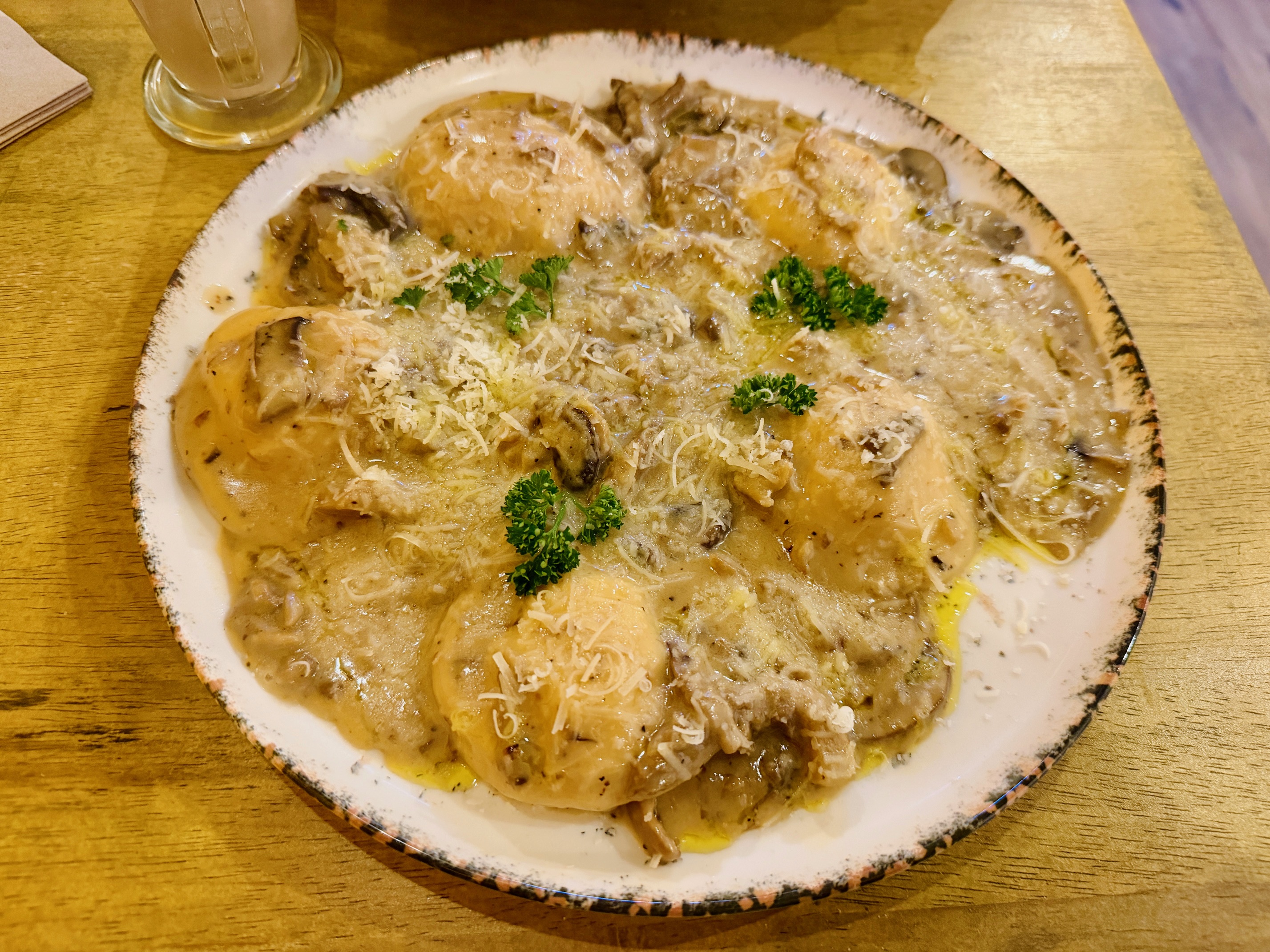
I’m afraid to say, though, that the pizza beat the pasta hands down. I’d chosen ravioli – made fresh every day onsite – rather than gnocchi, and the porcini mushroom sauce over the ragu on the recommendation of others. And again I wonder if my antennae were just out of kilter that day, because I did not like it at all.
Didn’t like any bit of it, actually. The ravioli, six very large specimens, had bottoms more thick and dense than Robert Jenrick, when I was hoping for lightness and delicacy. I also think they could have stood to be smaller, or for you to have fewer of them, although if I’d liked them you can bet I wouldn’t have said that. The filling was meant to be ricotta and parmesan, but all I got was ricotta and an aggressive blast of citrus. Not a light zing of the stuff, but the sort of brutal clubbing you associate with bathroom products.
I tried eating them without the sauce to check that my tastebuds weren’t playing up. But yes, again, an overdose of lemon. Perhaps if there had been less, and more balancing saltiness from the parmesan, which was completely missing in action, it might have worked. But as it was it didn’t, and it slugged it out with the mushroom sauce for dominance. Those two components simply couldn’t get along at all: perhaps I should have known that and not combined them but, if they didn’t go, why was it an option on the menu?
Might I have enjoyed this better if the sauce took centre stage, paired with gnocchi? I tried that on its own, too, and decided the answer was probably no. It felt somehow less than the sum of its parts, without any savoury depth from the mushrooms, which might have been porcini but I was not convinced. And again, the presentation of this was about taking a plate and trying to fill it to the perimeter with stuff, just because. I would have liked less: lighter, more delicate presentation but with punchier, better balanced flavours.
Again, the ultimate heckle. There were six ravioli. I wanted to stop after three, but thought that would seem rude: isn’t it strange how as a paying customer you can still feel like that? I contemplated leaving two on the plate but felt that even that would somehow be discourteous or ungrateful. So I ate another, and then decided I’d done my duty. I was undeniably full, make no mistake, but it had felt like a friend cooking for you in all the wrong ways.
I so wanted not to begin the year with a review like this, especially after all the hoo-ha last year every time I stepped into any Reading restaurant which was even vaguely Italian. I’m surprised, given the smear campaign I found out about, that I was even allowed on the premises at Zi Tore.
But the cosmos has well and truly taught me a lesson. I made the mistake of saying in my round up of 2025 that I might be better off giving every Italian restaurant a rating of 6.6 and saying it was ‘quite nice’ from now on, and fate rewarded me with this experience. Look at the rating below: you couldn’t make it up, but if I moved it a notch up or down I’d only be doing it so as not to look as if I was fulfilling a prophecy.
So I need to at least be more nuanced when I sum up Zi Tore than to say that it’s quite nice. That doesn’t reflect the complexity of the reality, anyway, and visiting the restaurant nearly a year after it opened you can’t put the things you aren’t wild about down to growing pains or opening before they’re ready. The experience I had there is the experience I was supposed to have.
It is fantastic that a hospitality business took the space vacated by the Grumpy Goat, and that there is still one oasis of food and drink on a run which used to be synonymous with food and is now full of mobile phone repair shops nobody seems to visit (and, to be fair, Reading’s finest branch of Timpson). It’s also fantastic that it’s independent, and laudable that Zi Tore makes everything onsite and offers options you can’t get elsewhere in town that have made at least one Italian I know ecstatic and a little less homesick.
And I can see that I would return to Zi Tore, believe it or not. I’m really sorry that I didn’t love the pizza or pasta, but one of those window seats on the mezzanine with a cup of coffee, a montanara and the chance to explore some of their cake after that would very much appeal to me. Especially as the service was so good, and happy and helpful. But I don’t know if Zi Tore will survive and make enough money if all its customers order like me, or whether it really wants just to be a café given the expansion of its pizza menu and its opening hours.
Fortunately for Zi Tore I suspect not all of its customers order like me, or think like me, and Reading is a big enough place that it might well carve out a large enough share of the market keeping at what it does. But the market may well contract further in 2026, and so I wish them the best of luck. At the time of writing it’s still unclear whether Amò, closed for over a month on Kings Road, will reopen. Ironically, it might be good news for Zi Tore if it doesn’t.
Zi Tore – 6.6 7 Union Street, Reading, RG1 1EU 0118 9561531
Since January 2025, Edible Reading is partly supported by subscribers – click here if you want to read more about that, or click below to subscribe. By doing so you enable me to carry on doing what I do, and you also get access to subscriber only content. Whether you’re a subscriber or not, thanks for reading.