As of June 2024, Kungfu Kitchen has moved to a new site on 62 Christchurch Green, a minute’s walk away from its old site.
I love lists, to an extent which probably verges on unhealthy. At any given time I have several on my phone: things to do; shopping to get; household chores to finish; people to see. I enjoy the feeling you get – and if you’re wired like me, you’ll understand what I’m talking about – when you add something to a list for the sole reason of immediately ticking it off. Really, I ought to have a list of all my lists where I rank them in order of preference, but even I know that might be taking things too far.
Anybody with a to do list will also know that there’s always at least one thing on any to do list that you keep shunting to the bottom. You look at it, you’d like to be the kind of person who tackles it right away, but in the end you know you’re really the sort to leave it to another day. Some days, every item on your to do list looks like that: those are the days when personally, I’d rather just stay in bed.
Kungfu Kitchen, the Chinese restaurant on Christchurch Green, has been on my reviewing to do list all year without ever getting to the top. There’s a website, which is stunningly uninformative, and a Facebook page which has a couple of decent-looking photos but nothing more. They’re on Twitter, but they haven’t Tweeted this year. (N.B. Following this review Kungfu Kitchen has updated its website with a full menu – the link is at the end of this review – and has become much more active on Twitter.) The menu looked on the authentic side, as far as I could tell, but the Tripadvisor reviews were mixed to put it lightly. So my regular accomplice Zoë and I walked up the hill towards the university area with a certain degree of trepidation, not at all sure what to expect.
Subscribe to continue reading
Become a paid subscriber to get access to the rest of this post and other exclusive content.
Revolución de Cuba closed in January 2026. I’ve left the review up for posterity.
Let’s get this out of the way straight away: it’s not a typo, you don’t need to adjust your set and you definitely don’t have to pay Specsavers a visit. This really is a review of Revolución de Cuba, Reading’s Latin American bar slash (chain) restaurant.
You might wonder what possessed me. Here’s what – I’ve been complaining for some time about Reading lacking a good tapas restaurant, a feeling which was compounded by a holiday in Granada at the start of the month. I returned even more bereft that I couldn’t find somewhere good to eat jamon, manchego, croquetas or chorizo in cider (let’s not dwell on the fact that in Granada you get something free with every beer: one step at a time).
On my first day back in Reading I sat in the courtyard outside Workhouse Coffee and ate paneer from Bhel Puri House while enjoying a crisp Estrella from the hotel bar next door, and it made a decent substitute but I still found myself wishing Reading had somewhere more suitable. That’s when the idea of trying the tapas menu at Revolución de Cuba entered my head.
After all, it might have been a chain but it was hardly a big one: less than twenty branches across the UK. And although it was part of the same group as Revolution, I’d been pleasantly surprised when I went to Revolution on duty back in 2015 (that said, I’d never been back, probably assuming that lightning never strikes twice in the same place). So on a Monday night I mooched over to Friar Street with my regular dining companion Zoë, wondering if my expectations would be surpassed.
My first impression was that it’s a striking – and gigantic – space. It used to be the old HMV building (I have plenty of happy memories of those days) and Revolución de Cuba waited a long time to open here, initially applying to take over the site in late 2014 and wrangling with the council before eventually opening two years later. The fit out had been nicely done – the long bar down the left looked especially inviting – and the room went back a very long way indeed, gradually getting darker and more conspiratorial.
Actually, that was probably my second impression. My first impression was that I wasn’t sure if I was in a bar or a restaurant, whether I could just plonk myself at a table or wait to be seated and whether it was bar or table service. We stood waiting near the front like lemons for some time before a solitary waitress told us to sit anywhere, before going on to explain that the two areas nearest to the front were probably more suitable for dining.
That might have been a more useful distinction at weekends when the place was busier, but when I went the place was pretty dead; there was a couple sitting at the tables nearest to the window, but the only thing they seemed to be eating was each other (in broad daylight on a Monday evening: I didn’t know whether to be appalled or impressed). Gladly they put their coats on and left seconds later – headed for the nearest Travelodge, I imagine – so we took the table next to where they’d been sitting. Was it my imagination, or did the banquette reek of sex?
The menu looked nice enough, although I don’t think it was the thing that had got them so frisky. It was divided into tapas and main plates, and was a mixture of Spanish, Tex-Mex and general 2019 box-ticking (halloumi, pulled jackfruit and so on). The tapas tended to come in around the six pound mark with three for fourteen pounds, so we decided to go for that, along with a couple of sides. While we waited for our food to turn up I had a pint of Angry Orchard which was just what I needed and not too dry (albeit oddly named: why so cross? Had it been reading the BBC website?) and Zoë had a bottle of Pacifico Clara, a serviceable crisp lager not that distinguishable from Modelo.
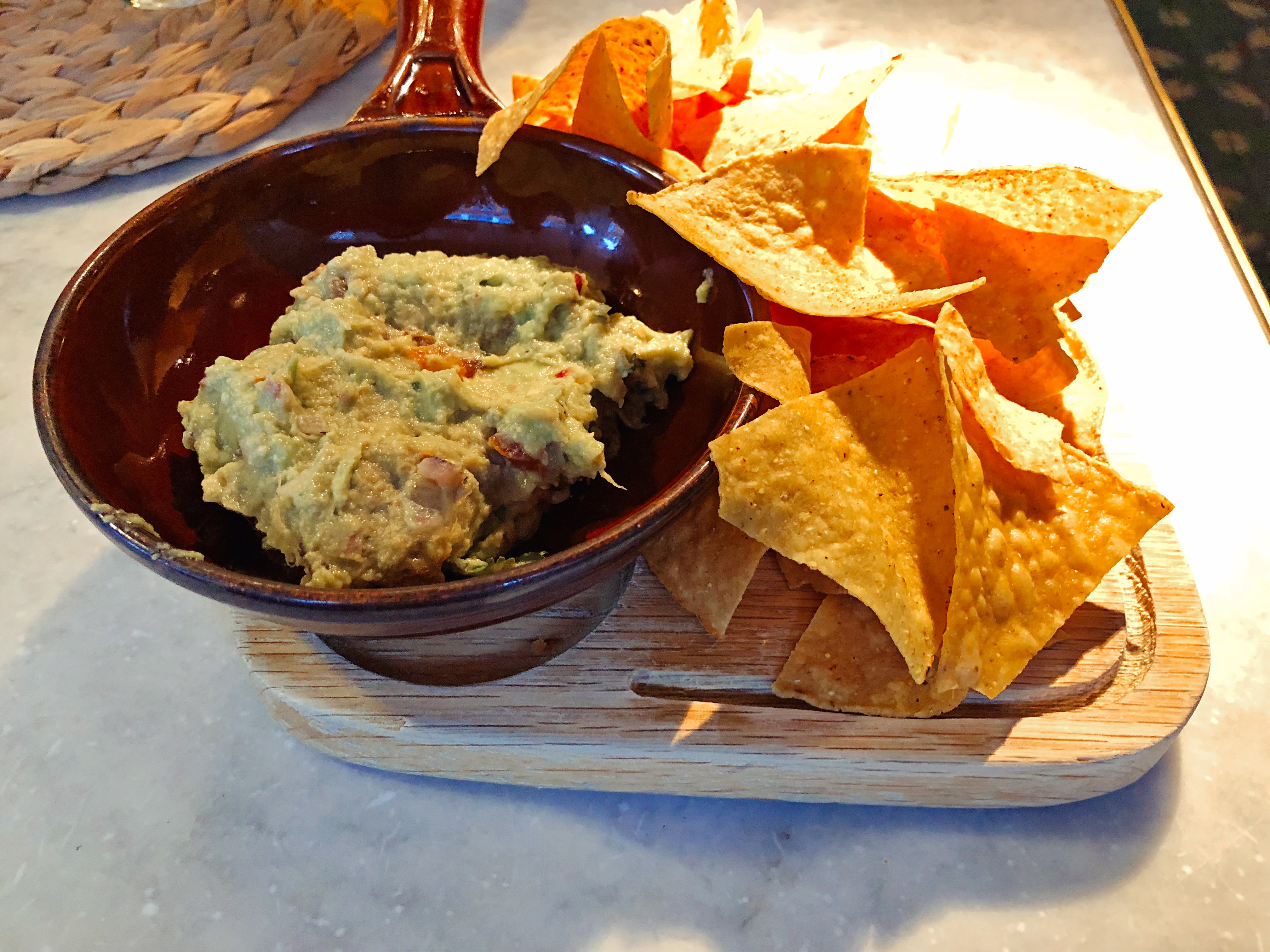
We’d asked for some guacamole and tortilla chips while we made up our mind, so this was the first thing to come out. A sign on the wall said it was freshly made, and although I wasn’t entirely sure it had been made to order it was decent, with just a little heat lurking in there. The previous week I’d been to Wahaca on the South Bank and their guacamole was better (as I had expected it to be) but not by a country mile. The tortilla chips were a little wan and not quite up to the job of dipping but again, for three pounds I was hardly devastated.
The tricky bit is what happened next: all the rest of our food was brought out at once. This wasn’t a problem in itself: god knows I’ve been known to bitch about the likes of Wagamama bringing out dishes as and when they’re ready, but for tapas this style of serving seems much more appropriate. But the real problem was that although the dishes were all brought out at the same time, some of them had clearly been sitting around a while. So much of what should have been piping hot was verging on tepid, and in many cases that made a world of difference.
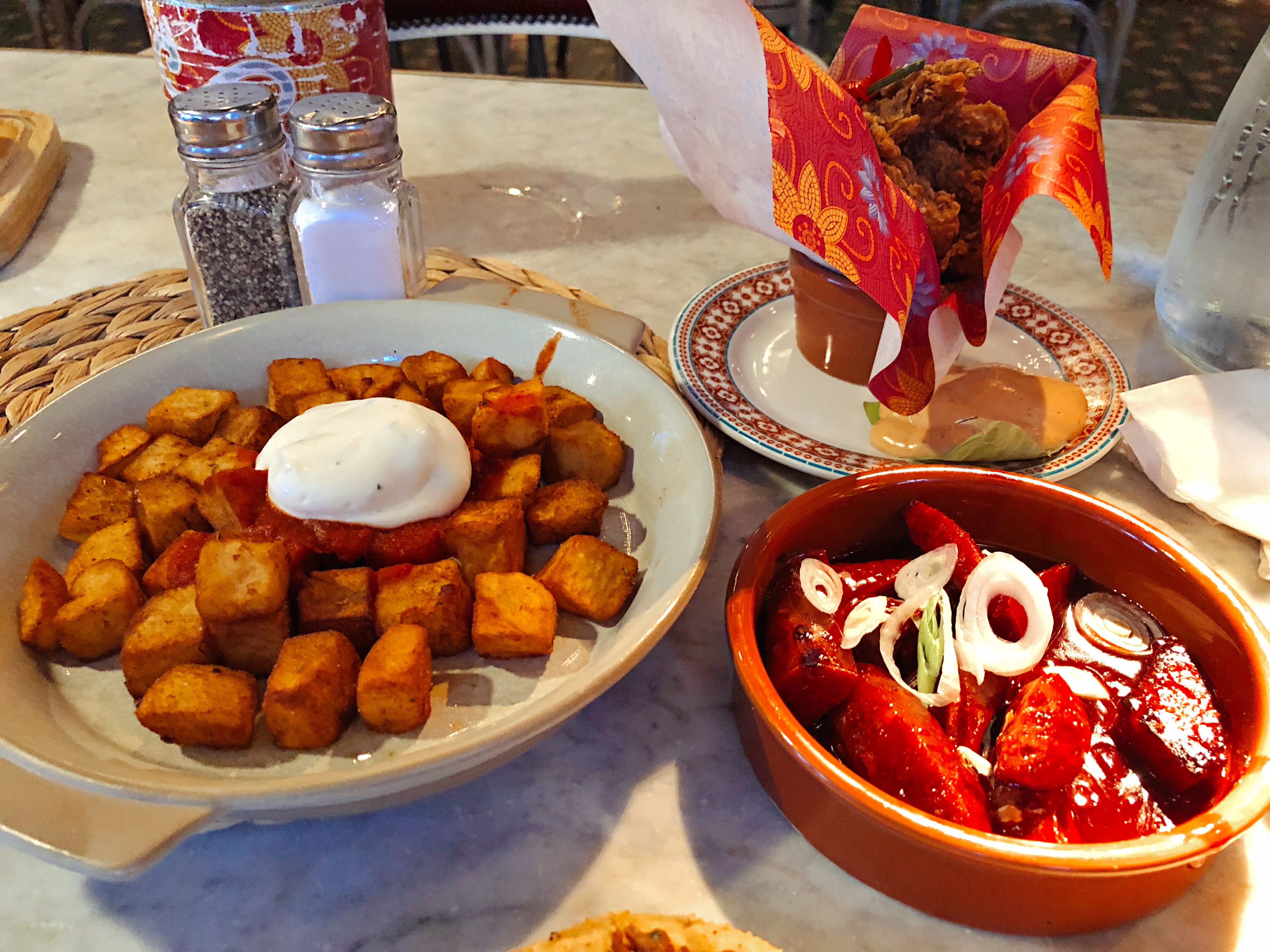
Take the chorizo in red wine and honey, for instance. Done well, this is a superb dish – I had something very similar in Granada – but Revolución de Cuba’s version was cold. Not fridge-cold, but cooked-some-time-ago-cold. It came in a terra cotta pot without any steam or sizzle, and the pot was cold to the touch. So, pretty much, was the chorizo which made me wonder if it had spent any time in the sauce or just been introduced to it right at the end like some kind of super-awkward culinary blind date. It had been cut into weirdly-shaped segments by somebody who appeared never to have seen or eaten chorizo before.
The patatas bravas – a staple of any tapas menu – were also distinctly underwhelming. They had been placed on the mat in the middle of the table as if they’d be scorching hot, but again they weren’t. There just wasn’t the crispiness I was hoping for, and the helping of spicy sauce and aioli was both disappointing and miserly: there should have been more of it, but I wasn’t especially sad that there wasn’t.
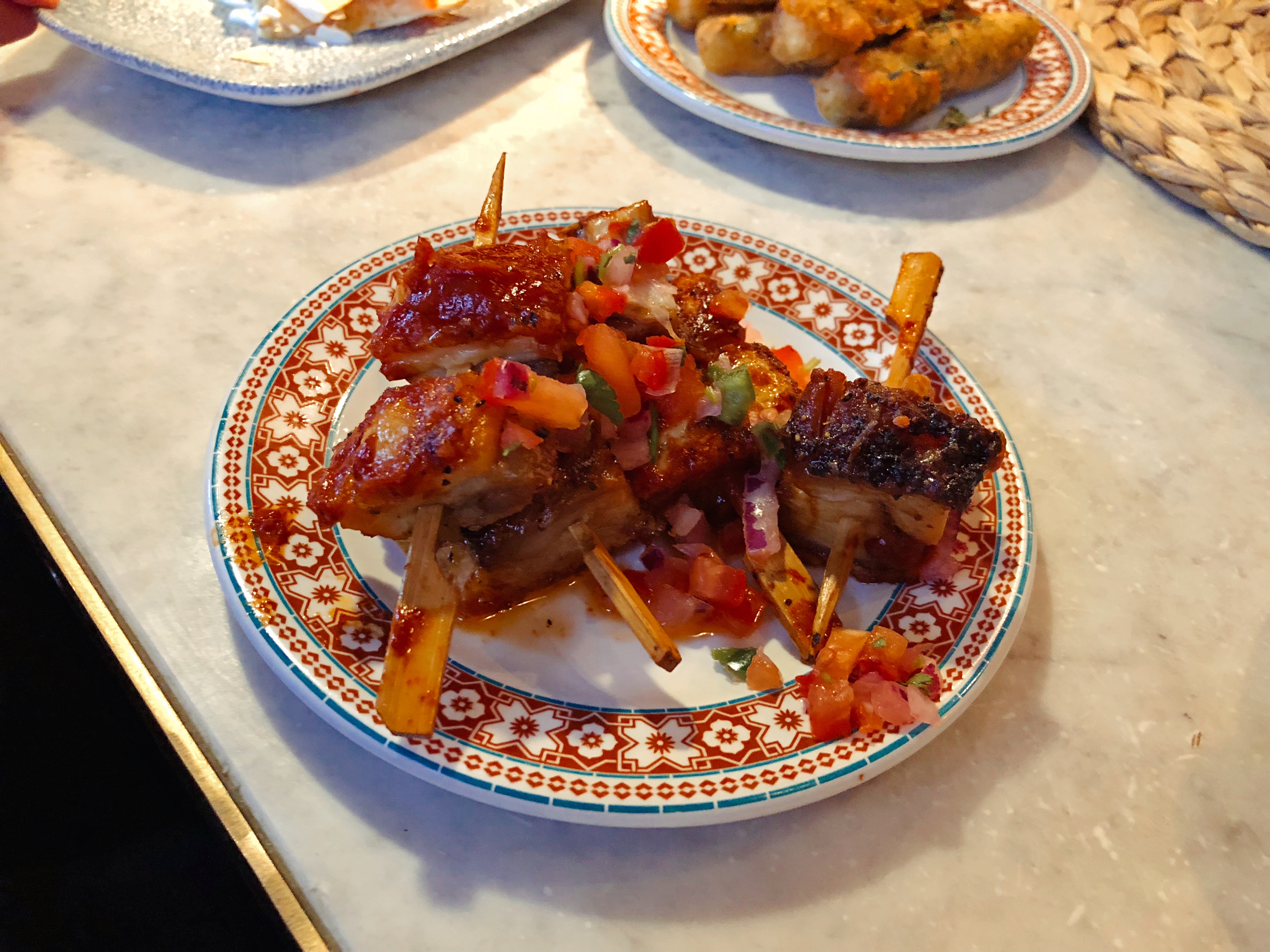
Better were the pork belly skewers, which were well cooked, all fat melted away and a crispy-crackling layer on top. I’m not sure I got the “signature spicy rum sauce” which had apparently been used, but I wasn’t complaining. These reminded me of the pork belly at The Real Greek, which is higher praise than it might sound.
I also enjoyed the jerk fried chicken, although that says more about my love of fried chicken than of Revolución de Cuba’s version. It was nicely seasoned, if a little too crunchy, and it didn’t need the rum mayo I didn’t dip it in. But even here it could have stood with being hotter, and although the texture was a long way from mechanically recovered meat, they didn’t feel like single pieces of coated chicken. Make of that what you will.
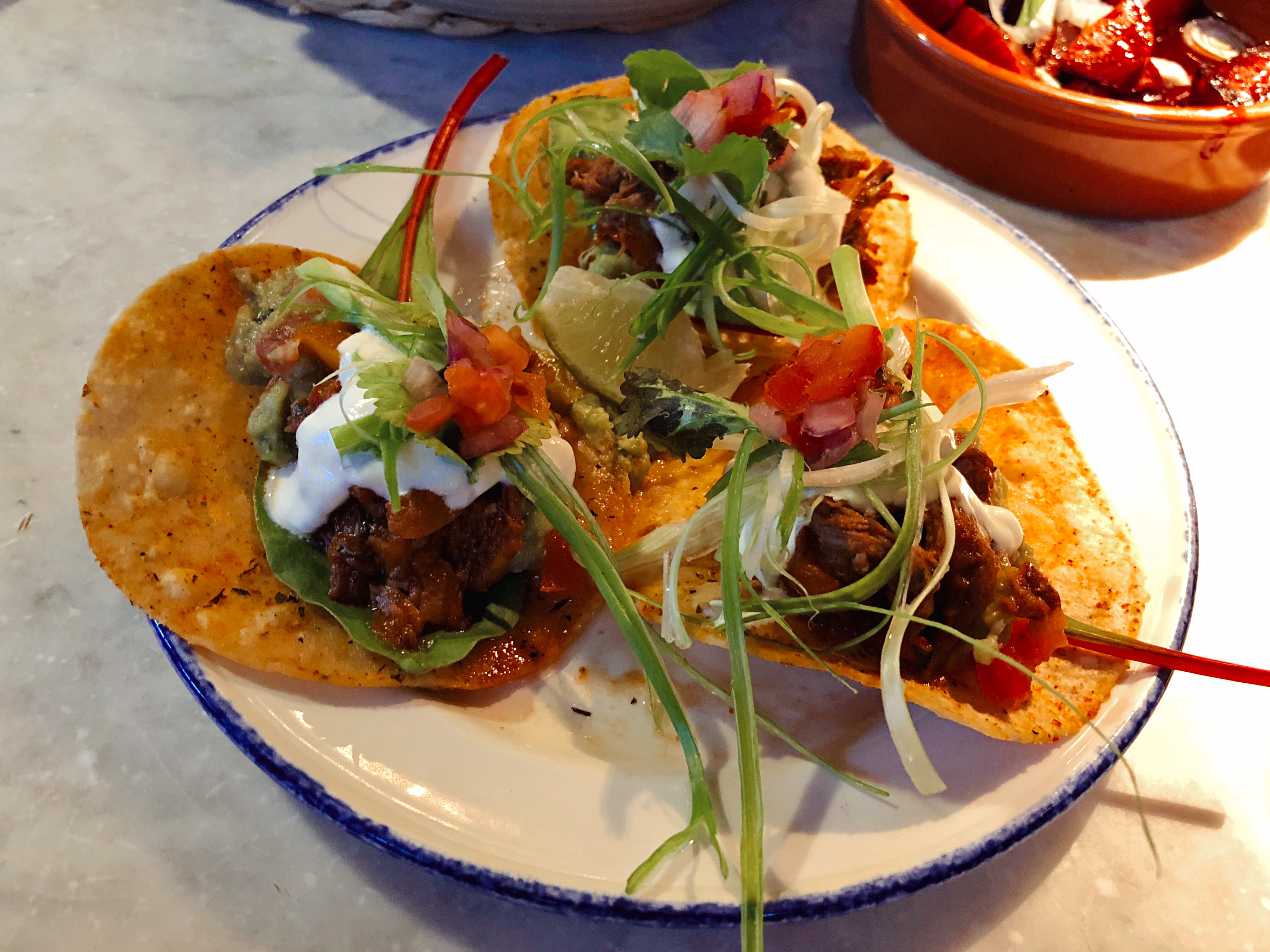
The more Latin American dishes we’d ordered were the ones that really fell flat. Chicken quesadillas might have been average if they’d been served hot but they arrived much closer to room temperature, wan anaemic things it was difficult to get excited about. We’d also ordered pulled beef tostadas, but the beef itself was claggy, bland and lukewarm. You didn’t get much of it before the dish gave way to the (cheaper) guacamole underneath and the tortilla shell, which pretty much made it the dish we’d started the meal with. The Cuban term for this beef is ropa vieja, which it turns out doesn’t translate as old rope: a shame, as it would have been apt.
Finally, we also had some crispy fried courgette. Well, two out of three anyway: it was indeed courgette but cut thick enough that getting it crispy was always going to be a challenge. I didn’t mind this, but even as I ate it I was aware of how many places do it better (especially Papa Gee). It was apparently served with Cuban gremolata, although barely enough to be noticeable, and if it had been fried in “Mojito batter” you really wouldn’t have known that either.
“This is a menu that reads much better than the food looks or tastes, isn’t it?” I said to Zoë as we surveyed the plates (mostly empty, although neither of us had shown much interest in the insipid chorizo).
“I’m afraid so. I’d come back for the guacamole, the chicken and the pork belly but that’s it.” I thought about it and tended to agree: three out of eight wasn’t exactly a stellar hit rate. I reflected on the other reviews I’d seen of Revolución de Cuba, so breathless, so enthusiastic, so positive. So comped, come to think of it. We decided to skip the churros (no doubt described somewhere on the internet as “yummy”) and asked for the bill. The whole lot – six tapas dishes, two sides, a pint and two beers – came to just under fifty pounds, not including tip. That’s not an expensive meal by most standards, but even at that price point your money would go much further in a many other places.
So far so meh, but I do have to say a word about the service. Georgina, who looked after us (and, seemingly, everyone else in Revolución de Cuba that night) was lovely – personable, polite and likeable. She came over halfway through – mid-mouthful, as wait staff always do – to check if our food was okay and we both muttered the usual pleasantries. But when she came with the bill she asked more than once, as if she actually wanted to know. So we told her. The food all came out at the same time because that’s how the kitchen did it, she said. We explained that it might be better not to and that some of the food had been cold as a result. She promised to feed that back, and I believe she did (every bit as much as I expect that feedback fell on deaf ears).
In conversation with Zoë, who tends to ask lots of questions, Georgina told us that she was studying for a Masters in criminology (a part-time job which involves looking out on Friar Street on a Friday and Saturday night probably forms part of her dissertation, come to think of it). It can be rare in chain restaurants to feel looked after rather than processed, and Revolución de Cuba would have got a lower mark if it wasn’t for the service. I wanted to tip her extra, just for enduring the canoodling couple from earlier on (“it was definitely heavy petting”, said Zoë later, “you’d get kicked out of a swimming pool for that”).
I never saw Revolución de Cuba as the kind of place I might eat on a Friday or Saturday night – I’m far too old and unfashionable for that – but I did hope it might be a serviceable small plates restaurant for a school night, or a spot of lunch on the weekend. Sadly, I think it doesn’t quite hit that level either. Some of the dishes are decent enough, but you can get them better elsewhere – Mission is better for tacos or burritos, The Real Greek better for small plates and Bhel Puri House better still. Whenever I ask what chain restaurant people would most like to see in Reading the response is overwhelming: people would love a Wahaca to open here. Based on my visit to Revolución de Cuba that gap in the market is still there. My own personal gap in the market also remains empty: if I want to feel like I’m in Andalusia, I’m going to have to get on a plane.
The Corn Stores closed in January 2024. I’ve left the review up for posterity.
Writing the only restaurant blog in Reading can feel like a lonely pursuit at times, but if you really want a lonely pursuit it’s this: writing a review where you say that the Corn Stores is a distinctly mediocre restaurant. The only reviews of the Corn Stores I could find online were comped, so they were all breathlessly enthusiastic and gushing. But, that aside, I know quite a few people who have been to the Corn Stores, and they’ve all raved about it. Some of them, and I know they read this blog, have been back more than once since it opened in December. So I was really hoping not to be the lone voice, the sore thumb, but I went there this week and I really didn’t get it at all.
All the blogs and Instagrammers will tell you what an amazing job the Rarebreed Dining Group did of refitting the Corn Stores when they took over the derelict building and turned it into a bar, restaurant and private members’ club. They used local company Quadrant Design, and I agree that they’ve breathed life beautifully into a lovely but unloved space (one I largely remember from lunch breaks with my brother in 1996, when we used to sneak across from our McJobs in Apex Plaza opposite for a rushed pint or two). He wouldn’t recognise it now: the restaurant, on the first floor, is superbly done out, with bare brick walls, leather-banquetted booths and tables with dusky-pink, scallop-backed chairs. I was there with my other half Zoë rather than my brother (mainly because I have also gone up in the world somewhat since 1996).
As we were shown to our table – past the display cabinet full of aged beef – our waitress explained the concept, that they butcher and age their own meat. There was a certain pride about it which I respected, and it made me look forward to dinner: I knew from researching the menu beforehand that the Corn Stores was an expensive restaurant, but I was hoping for a showstopper, the special occasion restaurant Reading has been missing for many years.
Our table was one of the booths, and I was impressed by how spacious it felt for two people: CAU, back in the day, would have tried to seat four people at a booth that size (the other tables for two felt a little more poky: I’m not sure how much I’d have liked one of those). The restaurant was nicely buzzing and pretty full on a weekday night, and it exuded that glow of satisfaction you get when surrounded by people who are happy they’ve made a right – and exclusive – choice (the Nirvana Spa effect, you might say). “My mum would like it here” said Zoë, adding the Corn Stores to her mental list of places to take her mum to.
We ordered a couple of pints of Meantime lager while we decided what to order: it’s kept in tanks onsite so you get it fresh, unfiltered and unpasteurised. I thought it was cold, crisp and clean and I loved it – Zoe less so, because she detected a bitter finish. I’ve already said that the Corn Stores is an expensive restaurant, and I fear this is a point we may return to often throughout the rest of this review: starters are just shy of a tenner and some of the mains are just the right side of twenty pounds, although if you order a steak you’re highly likely to pay far more than that. Oh, and there was a “whole baked sourdough” for six pounds fifty, which has to be the most expensive bread I’ve ever seen on any menu anywhere (you get “your choice of butter”: really, for six pounds fifty you should get to try them all, I reckon).
There was also a specials menu with other options including a Barnsley chop, a pork tomahawk, smoked sirloin on the bone – and a chateaubriand with lobster and some other gubbins which cost the grand total of ninety-five pounds (I know people who have ordered this, and they raved about it, but really: you could eat Michelin-starred food for that money). None of that especially appealed, but also I wanted to judge the place on their standard fare – the meat and potatoes, you could say – so we stuck to the normal menu. At the table next to us, three well-to-do ladies chatted away as their main courses, completely untouched, went cold in front of them: Zoë and I exchanged looks.
We started with the “Rarebreed Board”, a sharing selection of interesting options. It was the most expensive starter on the menu (twenty six pounds, in fact) but I figured it gave us an opportunity to try out lots of different things. It came on a sort of folding trestle table which left us limited room for our side-plates, but you couldn’t deny it looked appealing: five different beef dishes, designed to be shared between two.
Much of the sharing board was sort of a symphony of mince, so you got steak meatballs, miniature burgers and “beef and pepper sausage” – which was more like sausagemeat, on account of there being no casing. They were all quite nice, but much of a muchness – the main variations being in coarseness, but the overall texture was very similar.
We both liked the sausage best, with there not being a huge amount to choose between the burgers and the meatballs. Even at this stage though, the execution was lacking. The burgers came with lettuce and tomato in naked brioche, no cheese, no sauce (the pepper or tomato sauce in a little metal dish made a useful dip). The meatballs were apparently served with red wine gravy, but the thin lake of liquid at the bottom of the dish was largely ineffectual. Perhaps you were meant to dip the accompanying toast in it, but it was pretty hard when it arrived and, by the time we got round to it, it was even worse.
There were three burgers and three meatballs, which was odd and just made sharing trickier – I’d rather those two dishes had been better and smaller, and the price had been nudged down a little. I liked the other two dishes on the board better – the steak tartare (served, somewhat randomly, in a jar) had some real tang and pungency from the Worcester sauce, but Zoë found it too vinegary and couldn’t finish it. Similarly, the salt beef on flatbread worked beautifully for me, but amid the mustard there was also a vinegary tang that put Zoë right off it. Even in this dish there was the oddity of little segments of potato – double carbs, and extra bulk, but totally unnecessary.
By the time we finished our starters the table next to us had eaten half of their main courses, if that. One lady had cut her cod burger very precisely in two and looked like she was considering, possibly before the evening was out, embarking on eating the second half (it never occurs to me that some people go to restaurants for the company, or to see and be seen, but that might be just me). I got a second pint of Meantime and Zoë tried the Curiouser & Curiouser, a beer by Kentish wine producers Chapel Down – it tasted of grapefruit and citrus and I really liked it, although Zoë seemed less convinced.
We’d decided to tackle different ends of the menu, so we went for one of the pricier and one of the more affordable main courses. Zoë’s burger – wagyu beef, with Ogleshield cheddar and bacon – looked lovely, and the bite I had wasn’t half bad. But it cost nineteen pounds, and it didn’t feel, to me, like a nineteen pound burger (I’m not sure what a nineteen pound burger tastes like, but not this).
“It’s really nice” said Zoë.
“Better than Honest?”
“No, not really.”
I agreed with that – even when unadorned, Honest burgers have a lovely crust to them from the grill, and there’s a bit of salt in there. This was almost as good, but it cost nearly twice as much as its equivalent over on King Street.
I had gone for a two hundred gram fillet steak, served rare, with béarnaise sauce. The Corn Stores website boasts about how they baste their meat with aged beef fat and cook it on a Robata grill, getting loads of flavour into even lean cuts like fillet.
This was, it’s safe to say, not my experience: they’d managed the impressive combination of serving a steak where there was almost no char at all while simultaneously overcooking it. It was meant to be rare, but it was probably medium at best: just about pink in the middle, but with no juices oozing out as you made your way through it. I couldn’t face sending it back, because I really wanted to eat dinner at the same time as Zoë and I knew that sending it back guaranteed that wouldn’t happen. Besides, by then the damage was done – if you’re a steak restaurant, and one charging that kind of money, cooking the steak right first time was the entry level requirement.
That wasn’t all, though, because really the steak didn’t taste of very much. I didn’t get any seasoning, I certainly didn’t feel like it had been anointed with glorious, salty beef fat, nothing of the kind. The béarnaise didn’t help matters, being a little on the thin side, heavy on the vinegar (bit of a theme emerging there) and light on the tarragon. It was also a pretty mingy helping of béarnaise, because the Corn Stores seems to have missed the memo that béarnaise sauce should be as much for your chips as your steak. The salad it came with was pleasant enough, but it rankled with me that you got a big pile of salad for free but had to pay for your chips – by contrast, chips came free with the burger.
This brings us on to the chips – beef fat chips, no less. I had high hopes for these, but they were also deeply ordinary. They didn’t have the crunch-fluff ratio of a perfect chip, they were exceptionally salty and some of mine had grey patches which should have failed the most elementary quality checking. Dipped in the béarnaise they were okay, but no more, and they weren’t much better with the mayonnaise we’d asked for (which came in two minuscule pots which looked as if they had housed lip balm in a previous life). I looked round and everybody seemed to be having such a lovely time. What was I missing?
We’d asked our waitress for recommendations for a side dish and she had recommended the baked flat mushrooms, so we went for those. Four pounds got you three rather small flat mushrooms which had a meaty texture but again, didn’t feel like they’d been exposed to much in the way of butter. If I’d had them in a Beefeater I’d probably have been pleased, but here in the Corn Stores it just felt like another way of extracting funds. There was the ghost of a sprig of thyme on top, as if to say Look, we did do something with them.
By this point we were on to our third drink – a serviceable glass of Pinot Noir for me and Chapel Down’s cider (which I really liked) for Zoë, and positively planning our escape. The waitress took our dishes away and half-heartedly asked if it had been good, and we half-heartedly replied that it had been fine. The fact that both of us had half-heartedly half-left our chips didn’t seem to register. That was service in general at the Corn Stores – smiling, efficient, a little robotic. I didn’t get any real warmth or personality.
Dinner for two – a sharing starter, two mains, some chips, a side and three drinks apiece – came to one hundred and thirty pounds, including a not-that-optional 12.5% service charge. I’m almost tempted to leave that sentence to do the work on its own, but really: one hundred and thirty pounds! When I think of all the amazing meals you could buy in Reading for a fraction of that price – or all the exquisite meals you could buy in London for that money – I felt like I’d cheated rather than treated myself.
“I don’t think I would take my mum here, you know” said Zoë, unsurprisingly.
“I know. Normally with places like this I say I’d only go if someone else was paying, but in this case even if someone else was paying I wouldn’t let them take me here.”
That might sum it up, for me. I couldn’t shake the feeling, throughout my meal, that I was paying for the refurbishment, or helping Rarebreed pay off their investor (the interestingly-named Havisham Group), but I didn’t feel like I was paying for a truly luxurious experience in a terrific special occasion Reading restaurant.
The talk about the Corn Stores’ pride in their meat and butchery is all well and good, but the main thing my meal did was make me miss CAU. I think, actually, I had no better or worse a meal at Miller & Carter, where I paid a lot less money. Worst of all, I went to the Southcote (a Beefeater) last year and although it wasn’t as good as the Corn Stores it was a lot closer than the huge disparity in price would have you believe (and their béarnaise, damningly, was probably slightly better).
Anyway, it doesn’t matter what I say: I have no doubt that the Corn Stores will do really well, but I felt like if it had been half as good as it thinks it is it would be twice as good as it actually is. But what do I know? I read some lifestyle bloggers recently, and they tell me the emperor looks fantastic in that outfit.
The Corn Stores – 6.7 10 Forbury Road, RG1 1SB
0118 3246768
Wau closed in September 2019. I’ve left the review up for posterity.
One thing I’ve often pondered, writing this blog, is the holy trinity you always have to bear in mind when eating in – and assessing – a restaurant: the food, the service and the room. They all have the power to transform your experience. Take Dolce Vita, for example, which closed last year: some of the food was great, some of it (the pizzas and pasta, in particular) could be distinctly middling. But the service was so brilliant that I found I never really minded – a night there could feel like having friends cook for you, in a home from home, in the same way that some pubs (The Retreat, in my case) feel like having a second living room.
I’ve also thought for a long time that if the food is good enough, you can overlook blips in service. I’ve made no secret of my love of the food at Clay’s Hyderabadi Kitchen, but it can’t be denied that the service has never attained the same heights, with some churn in staff and some elementary mistakes here and there (no, I haven’t quite finished that mango beer, for example, so please stop trying to take it away). When they first opened, it was easy to pass it off as teething troubles or growing pains, but once a restaurant has been trading longer you expect a little more.
The room I’m not so fussed about – I agree with Marco Marchetti, the dapper and wise waiter at Pepe Sale (who’s now hung up his Larry Grayson-style spectacles and moved to Kent, I’m sorry to say) who once told me “we Italians don’t care about the room”. It’s nice to eat in a beautiful room. It’s nice to look at, say, Coppa Club and think “haven’t they done a great job fitting this out?” but when the service is comically bad and the food is indifferent (as it is at, say, Coppa Club) it really doesn’t redeem things. That might be my age, or the fact that I’m not in London: I’m sure some people are dazzled enough by eating somewhere Instagrammable like Sketch or Bob Bob Ricard, but it’s not for me.
But first and foremost, I’ve always believed that food is what matters. If the food is good enough, everything else is secondary. It stands to reason, doesn’t it? Except that this week the review is of Wau, the Malaysian street food restaurant a stone’s throw from Newbury station, and following my visit there I’m no longer so sure.
I found myself in Newbury one weekday evening with my regular dining companion (and close personal friend) Zoë, and after a couple of drinks in the Catherine Wheel I reckoned Wau was the obvious candidate for an evening meal. I’d been once last year and had a terrific meal, and when I put pictures on Instagram loads of people came out of the woodwork to tell me how great Wau was. You don’t see Malaysian food in many places round Reading (although the Moderation often does a few dishes, including nasi goreng), and it was less than five minutes from the station, and I happened to be in Newbury after all, so I decided to go back on duty and try it out again.
Speaking of the room, Wau’s is pretty unprepossessing. At the front are high tables with high stools, and further back are lower tables with still-ubiquitous Tollix chairs. The bar runs along one side of the room, with the kitchen at the back: not an open kitchen per se, but from some tables you get a pretty good view of what’s going on through the glass door. I think there are more tables round the corner, past the bar, although I wasn’t seated there.
The first problem happened when we arrived and the waiter tried to seat us at one of the precarious-looking high tables nearest the door, for two people. They didn’t feel at all like a relaxing place to eat. Could we sit at one of the bigger, lower tables further back, I asked? He looked at me like I’d asked for his date of birth and his mother’s maiden name, or enquired about whether he’d ever considered letting the love of Jesus into his life. It was a Tuesday evening at 8pm, and only one other table was occupied: they burnt a fair bit of goodwill umming and aahing before reluctantly letting us sit at a table for four.
The menu at Wau looks good, and has been recently updated. It’s divided into “Steamed and Grilled”, small plates costing between four and eight pounds, “Rice and Noodles” and “Curry”, which are larger plates costing between ten and thirteen pounds. I took this to be the dividing line between starters and mains – and the menu definitely encourages you to think that way but, as I was to find out, the reality is a bit more haphazard. But all that was yet to come at the point when we ordered three starters (a combination of greed and hunger), two mains and a couple of side dishes.
“The dishes will all come out when they come out, is that okay?” said the waiter.
It wasn’t, really, and I should have made more of this because it’s a real bugbear of mine and I’ve disliked it ever since Wagamama decided to make it a selling point. That approach feels like it’s geared entirely towards the convenience of the kitchen rather than the experience of customers. How presumptuous, I’ve always thought: we’ll make your food in the order we feel like it, and you’ll take what you’re given. Who’s paying who in this scenario? I often wonder.
“What does that mean exactly?”
“Oh. In this case you’ll probably get the squid first, then the pork belly, then the satay, then the beef rendang and nasi goreng and the other bits” he said. This didn’t really inspire confidence, because it was exactly the sequence in which we’d ordered everything, but never mind. What’s the worst that can happen? I reckoned.
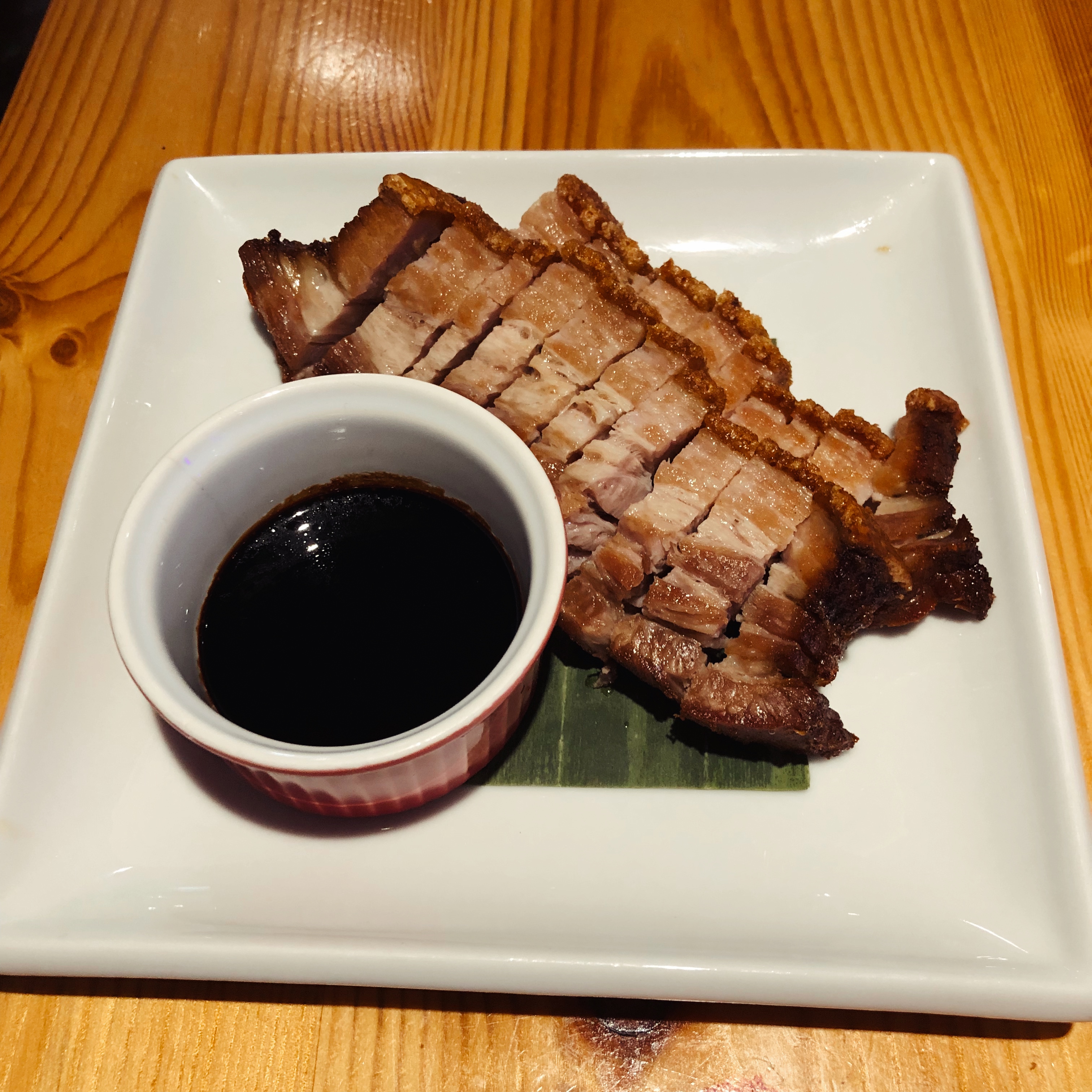
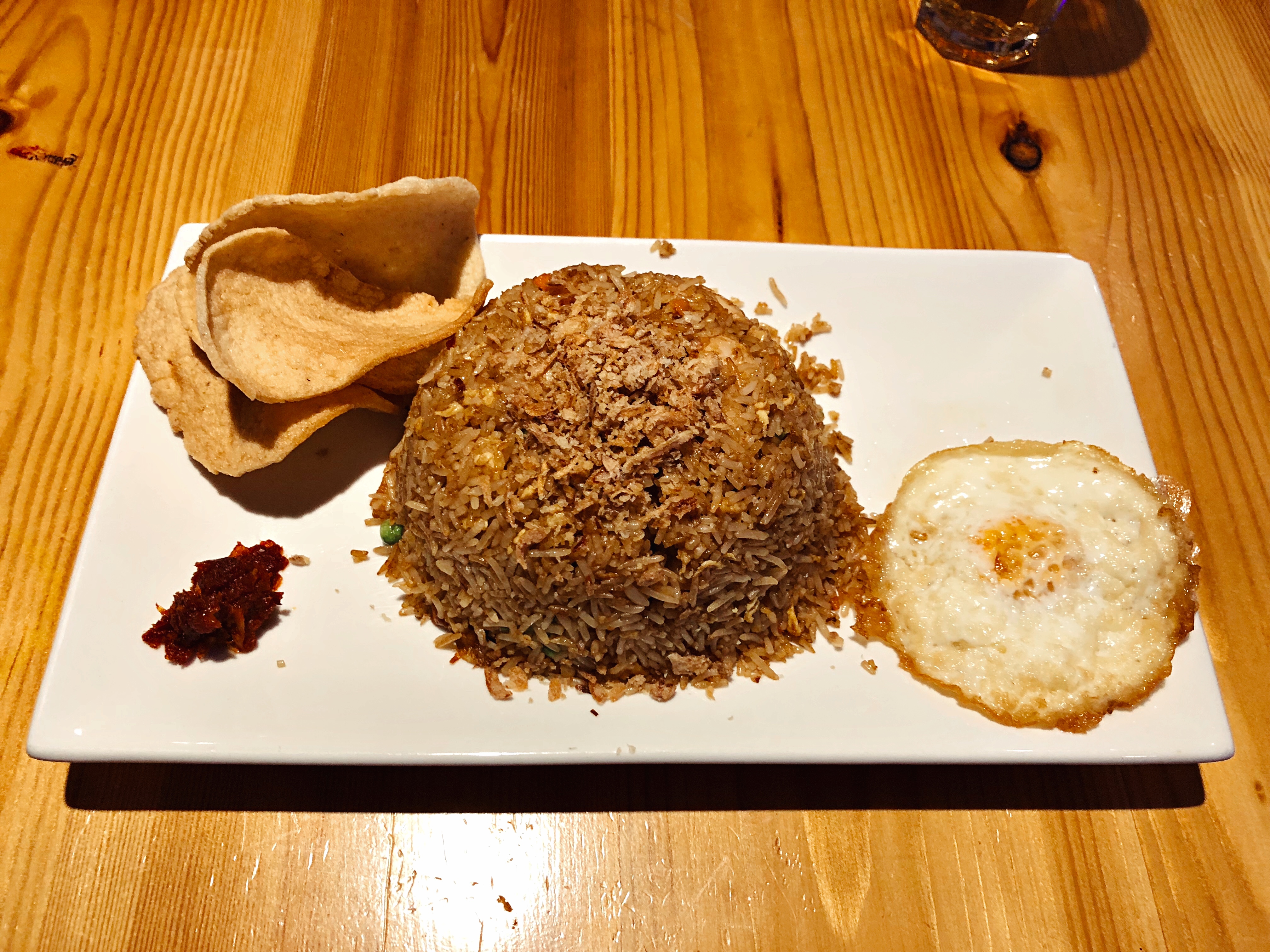
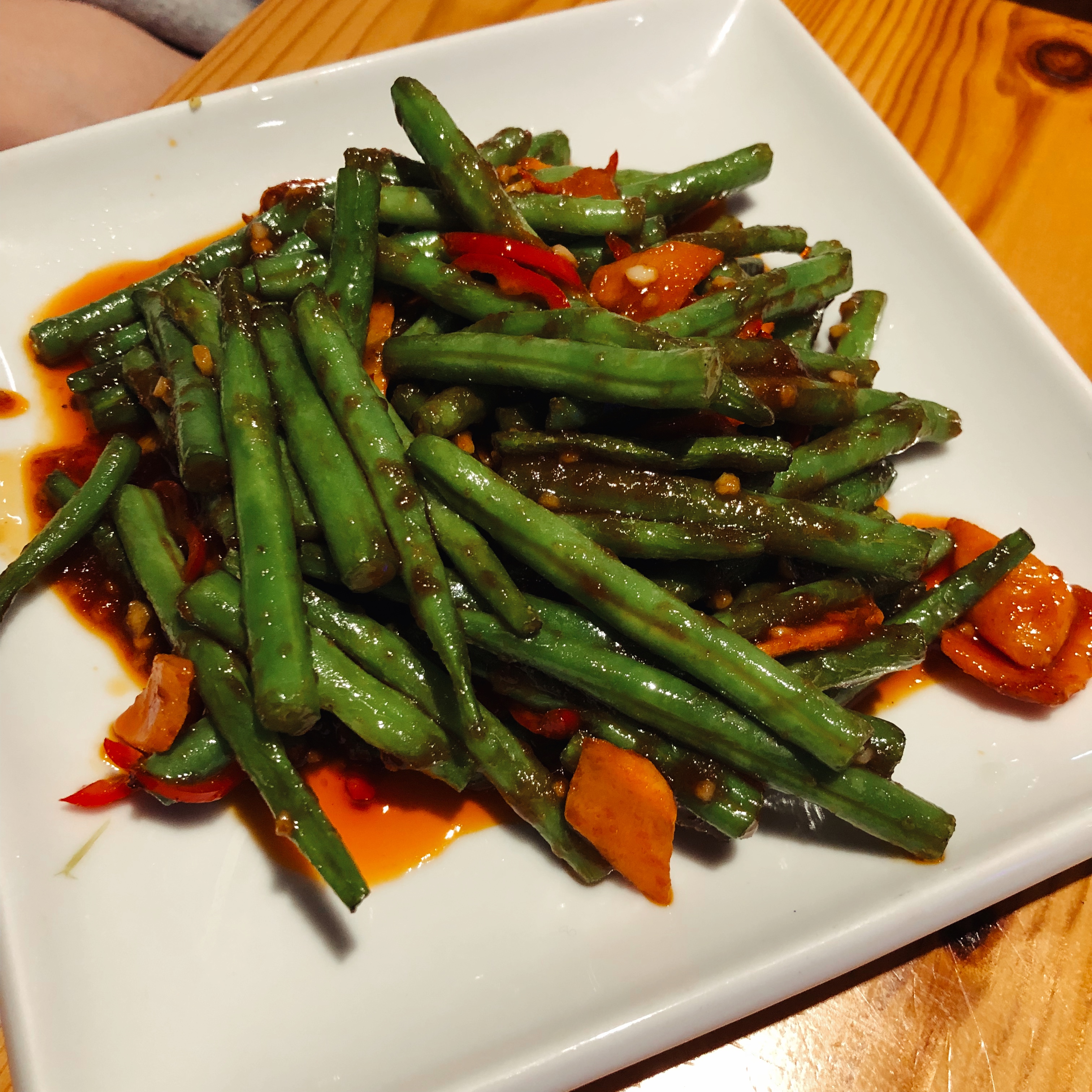
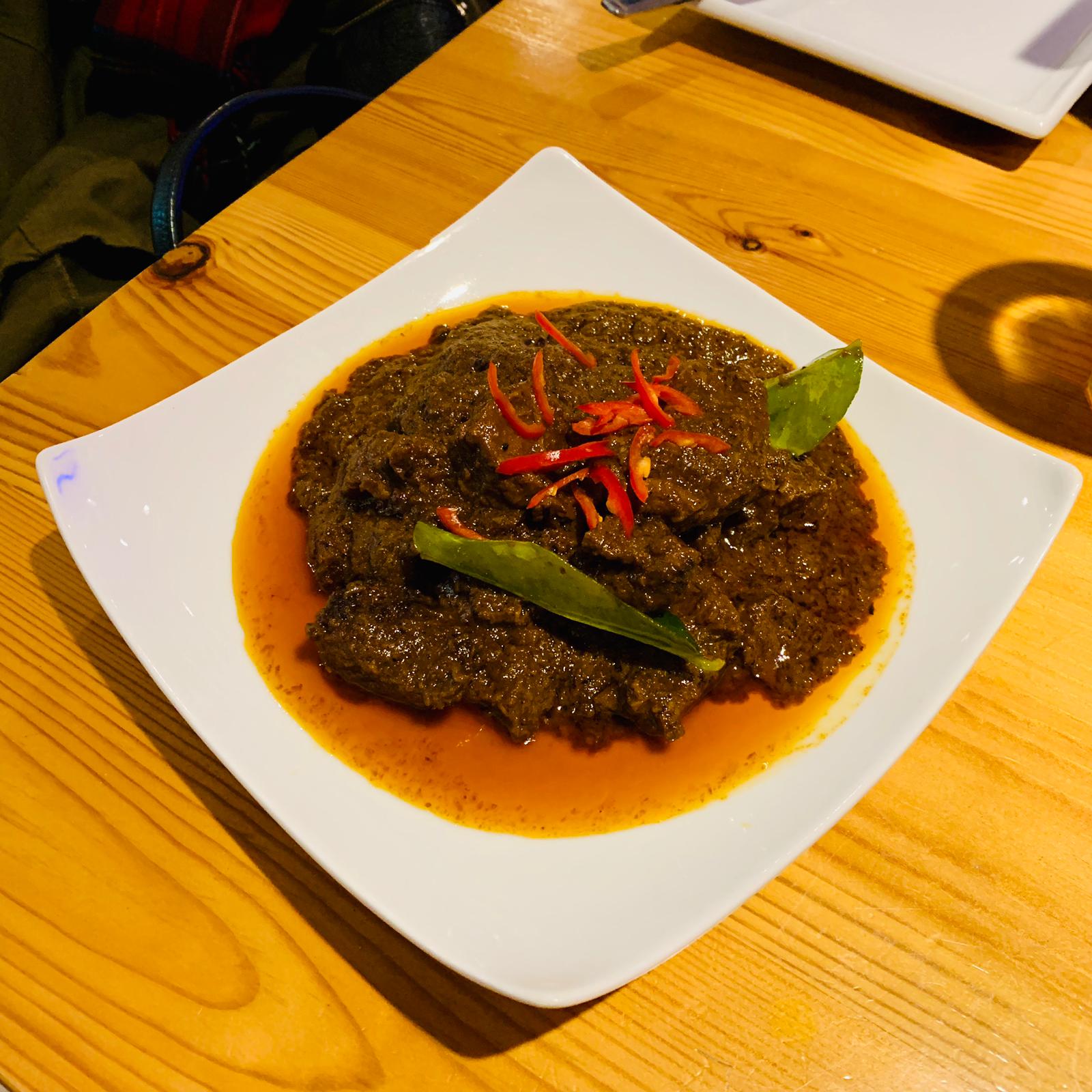
Well, here’s what happened – and I’m sorry if this makes for a dull paragraph, but it’s taken from the time stamps of actual photos taken on my and Zoë’s phones: we sat down just after 8 o’clock. At 8.10 we poured our bottles of Tiger beer and placed our order. At 8.19 the salt and pepper squid (a starter) arrived, followed at 8.20 by my nasi goreng (a main). At 8.21 the pork belly starter and the sambal beans (a side dish) were brought to the table. At 8.24 Zoë’s beef rendang turned up, and at 8.25 our final starter, the satay lamb skewers, materialised. So within fifteen minutes of ordering they had brought almost everything we had ordered, all in the space of five minutes. Quite how it would have all fitted on the table for two they originally tried to fob us off with I have no idea, but it turns out that “the dishes will come out when they come out” actually means “they will all come out at once”.
I got that it was a slow night, but that didn’t seem like much of an excuse for the kitchen staff throwing the kitchen sink at trying to get us out quickly. And that’s when I realised – you can say it’s all about the food, but eating out isn’t about eating food, it’s about having a meal. A nicely paced meal, where you can take your time over what you eat and look forward to what you’ve ordered next without worrying about everything going cold before you get to enjoy it. It was utterly ridiculous, and all I could think was: why aren’t the serving staff a little embarrassed by all this?
I say that we had nearly everything we’d ordered. Zoe ordered roti canai to use to scoop up the rendang. That never arrived, so we asked for it again. It still didn’t arrive, so we asked for it again, again. It reached us ten minutes after the rest, too quick for your main courses to follow your starter but not quick enough for your side dish to follow literally everything else you had ordered. I’ve never known, and I’m choosing my words carefully, a clusterfuck like it.
The saddest thing of all is that the food was, almost without exception, gorgeous. The salt and pepper squid had so much freshness and texture, and was dusted with tons of good stuff. The pork belly – a really generous portion, precisely balanced between the crispy crunch of roasting and the tenderness of the meat under the skin – was a beautiful dish, perfected by dipping it in the sticky, savoury soy sauce. The satay lamb was my least favourite of the three, but even that was cooked beautifully and the satay sauce was as deep and rich as any I could remember. Would that I had got to enjoy those three dishes as a trio, without worrying about my nasi goreng going cold, but it was not to be.
Actually, the nasi goreng was my least favourite dish of the evening and, sorry to say, I don’t think it was anywhere near as good as the one served at the Moderation and the Queen’s Head. At those places you get chicken and prawn, but at Wau you have to choose and my choice, the chicken, was oddly bouncy in texture. Weird plating, too – the sunny side up egg should be on top so it can ooze its yolk into the rice but this – probably a little overcooked – was stuck on the side like an afterthought. I left some of this dish, although that was probably more because it didn’t stay hot enough for long enough, not with so many other things to try. I left the prawn crackers, although I’m told they were a reasonable substitute for the roti which nearly never came.
One of the nicest things we ate was the side dish I’d ordered to come with the nasi goreng (although, in reality, everything came with the nasi goreng). Sambal green beans had a beautiful amount of crunch, having been no more than blanched, and coated in Malaysian shrimp paste, perfectly brick-red and savoury, with just enough heat and lots of complexity: I could easily have eaten more than one plate of these.
I was familiar with the beef rendang, Zoë’s choice, from a previous visit but really it was every bit as delicious as I remembered – so much so that I regretted my nasi goreng from the first forkful to the last. The sauce was glossy and sweet with coconut, but with more than enough edge to save it from being even remotely saccharine, but more importantly the beef had been properly slow-cooked so every piece surrendered into strands. It would almost be worth going to Wau and just ordering this dish, which come to think of it might also be the only way to ensure that you get to eat it at a time of your choosing.
I also really liked the roti, when it eventually came out – lovely and buttery, and just right to wrap around that beef, even if it made for a slightly messy experience. It came with a little dish of dipping sauce which was pleasant enough, but not really needed under the circumstances.
I’ve already talked about the service, but of course the real test of service is how they handle it when matters are less than perfect. So when we were asked how our food had been, we said that it was very nice but that really, we hadn’t wanted it to all come out at once and that if we’d known we would have insisted that it didn’t, or perhaps ordered our starters first and then our mains. It’s fair to say that this rather fell on stony ground. That’s just how people eat in Malaysia, the chap told us – all the food comes at once and everyone pitches in, sharing everything.
It’s fair to say that I wasn’t entirely convinced by this argument, and I said so: I could possibly understand it with a big group of people, but there were two of us. Why did they divide their menu into starters and mains, I asked? He pointed out, again in a manner best described as unapologetic, that they weren’t called starters and mains (which, having looked at the menu, is true: but if you have the small dishes at the start and the bigger items partway through you definitely give that impression). Then, finally, came the non-apology so popular in the post-truth times we live in.
“I’m sorry if you feel that way”, he said. Well, that makes everything better then.
After that a lady came over who I think was the owner or manager, and we had exactly the same conversation, only more pleasantly. She promised that they weren’t trying to rush us or move us along or turn the table. That’s all very well, we said, but if so why bring all the food in the space of five minutes? We were then told again about how people all share food in Malaysia, which was doubtless true but, in Newbury, wouldn’t it make sense to put something on the menu explaining the concept or at least get the waiting staff to clearly explain how it worked? Normally they did, she said, which didn’t explain why the chap who took our order – the same man who had served me on a previous visit – had failed to do so either time (on a previous visit we got our starters, then we had our mains, and everything went as you might expect).
The thing we were at pains to point out, again and again, was that the food had been so good, but the way it had been brought out robbed us of the opportunity to properly enjoy it, and ourselves for that matter. But by this point I was beginning to feel like one of those TripAdvisor reviews in human form, and found myself eagerly wanting the conversation, and the experience, to end. The manageress was also sorry we felt that way, and agreed to take something off the bill. That turned out to be ten per cent, which to me didn’t quite feel like enough, and our meal – with that discount – came to fifty-four pounds, not including tip. That was for three small dishes, two big dishes, two sides and two beers – and we still tipped ten per cent, though with hindsight I don’t really know why.
You could indisputably eat well at Wau – if you happened to be in Newbury, close to the station, and preferably in a hurry. Even then, I would advise you to be unambiguous about what you want to eat and the order in which you want to eat it. But those are a lot of caveats, a lot of hoops to jump through, and I could hardly blame you if you read all this and thought thanks but no thanks.
The real shame of it is that so much of the food was terrific, but the overall experience left a nasty taste that no amount of skill in the kitchen can cancel out; food might be the most important element of any visit to a restaurant, but it turns out that it’s service that transforms it from mere food into a meal. All that makes this almost impossible to rate but, to give you an idea, I reckon the experience at Wau must have easily cost it a mark. I hope they iron those problems out, but I doubt I’ll be back to find out. If you decide it sounds like your sort of thing, you’ll have to let me know.
Click here for a more recent review of The Dairy from July 2022.
It was love at first sight when I first laid eyes on The Dairy. I’d been paying a visit to the MERL on Redlands Road earlier in the day and I’d dimly remembered that The Dairy, one of the bars which was part of the University, was just down the road. I’d never been, so in the spirit of adventure I did a bit of research, checking out the sadly departed Matt Farrall’s excellent article on the subject for the Whitley Pump. Later that week, I dropped in for a drink.
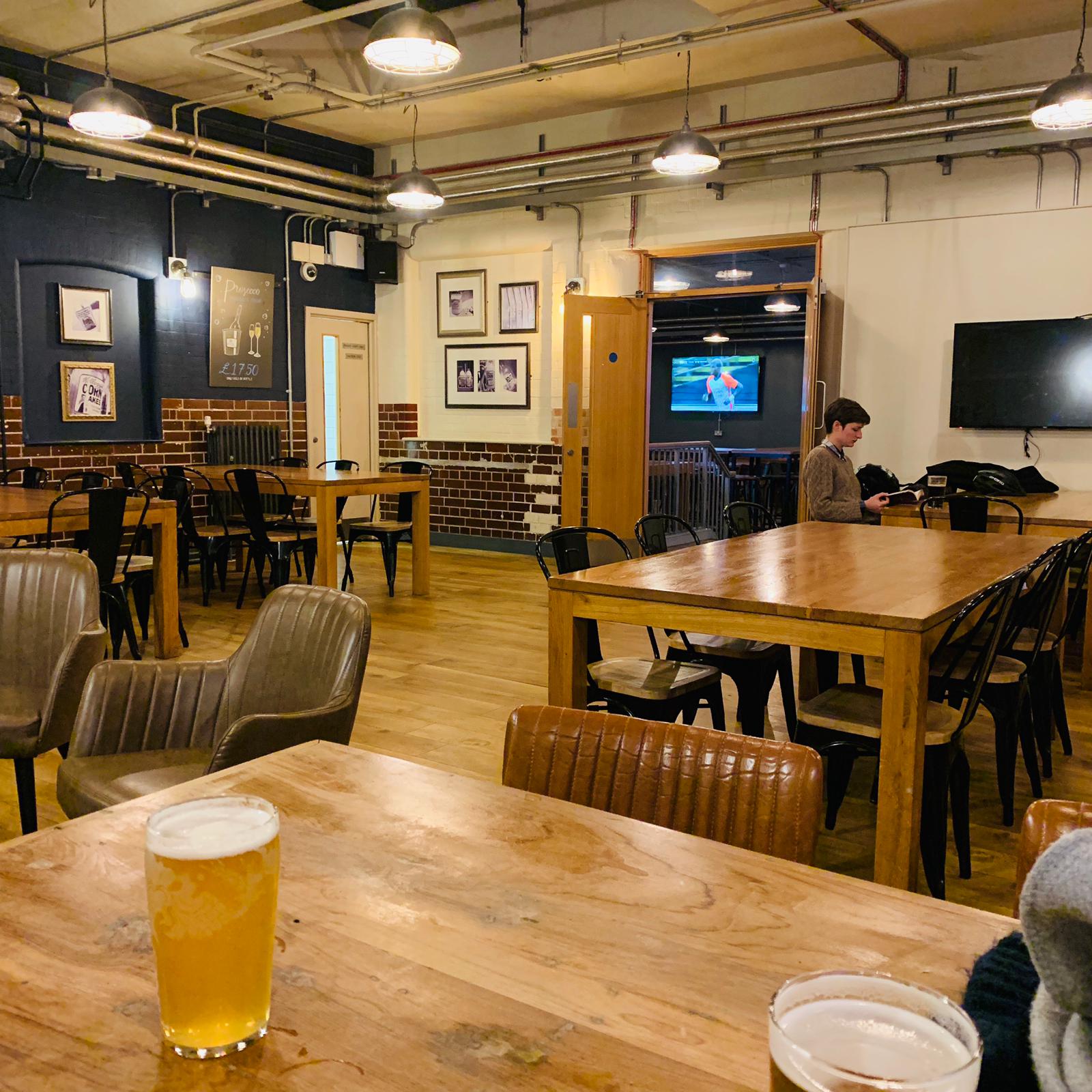
When I got there, I was thoroughly charmed. It took a bit of finding – it’s pretty much completely unsignposted, and you access it by going up a ramp only to find an unadorned door with a simple plaque next to it saying “The Dairy” in a plain, municipal-looking font. Once I got there, though, I liked the look of the place: it’s made up of two big rooms with clean, white walls, sizeable tables (high ones in the main room, lower ones in the back room), comfy furniture and a wide array of decent beers on keg, including four different craft lagers and representatives from many of our local breweries: Siren Craft, Wild Weather and Elusive, not to mention other breweries like New Wharf and XT.
It’s a university bar, but it was open to the public and seemed to have a pretty varied clientele. Not only that, but even without a student discount you could get a pint of good, well-kept craft beer for around three pounds fifty. I found myself making a mental note that this could make a great place for board games nights with friends, or for a quiet pint on the evenings when I fancied a change of scenery from my usual haunts (it was sleepy on a week night at the start of term).
Then I spotted the menu. Now, normally I would never have considered The Dairy as a venue for a food review, but there were lots of interesting touches on the menu which made me wonder. Jerk chicken, curry mutton and Jamaican vegetable stew all looked different from the usual fare and even the burgers, complete with a very now charcoal brioche, seemed slightly out of the ordinary. I took a picture of the menu and resolved to come back to see if this could be the kind of hidden find which always lifts my spirits.
Returning on a Saturday evening with my partner in crime Zoë, The Dairy was much more obviously a student bar and was far busier. I felt a tad decrepit grabbing a stool at one of the high tables, and then swapping it for one better equipped to support my child-bearing hips. That feeling wasn’t helped by looking around to see hordes of young people watching the big screens, playing pool, eating all-day breakfasts (not something on the menu I had ever considered ordering, in all honesty, and especially not at eight o’clock at night) and generally not appreciating that they were slap bang in the middle of the best years of their lives.
I wandered into the back room to see if any tables were available there, but was greeted by such a wall of noise that I thought better of it. I did spot one gentleman at another table who was even older than me, and that reassured me enough to grab a menu. Broadly speaking it divided into two sections (unless you count a very small selection of starters and salads and – of course – that all day breakfast): world food and burgers. We quickly decided to try one of each and I went up to the bar to place the order. None of the dishes costs more than a tenner and once you hand over your card (the whole place is cashless) they give you a little gadget which buzzes when your food is ready, signalling for you to go and pick it up from the hatch. Easy peasy.
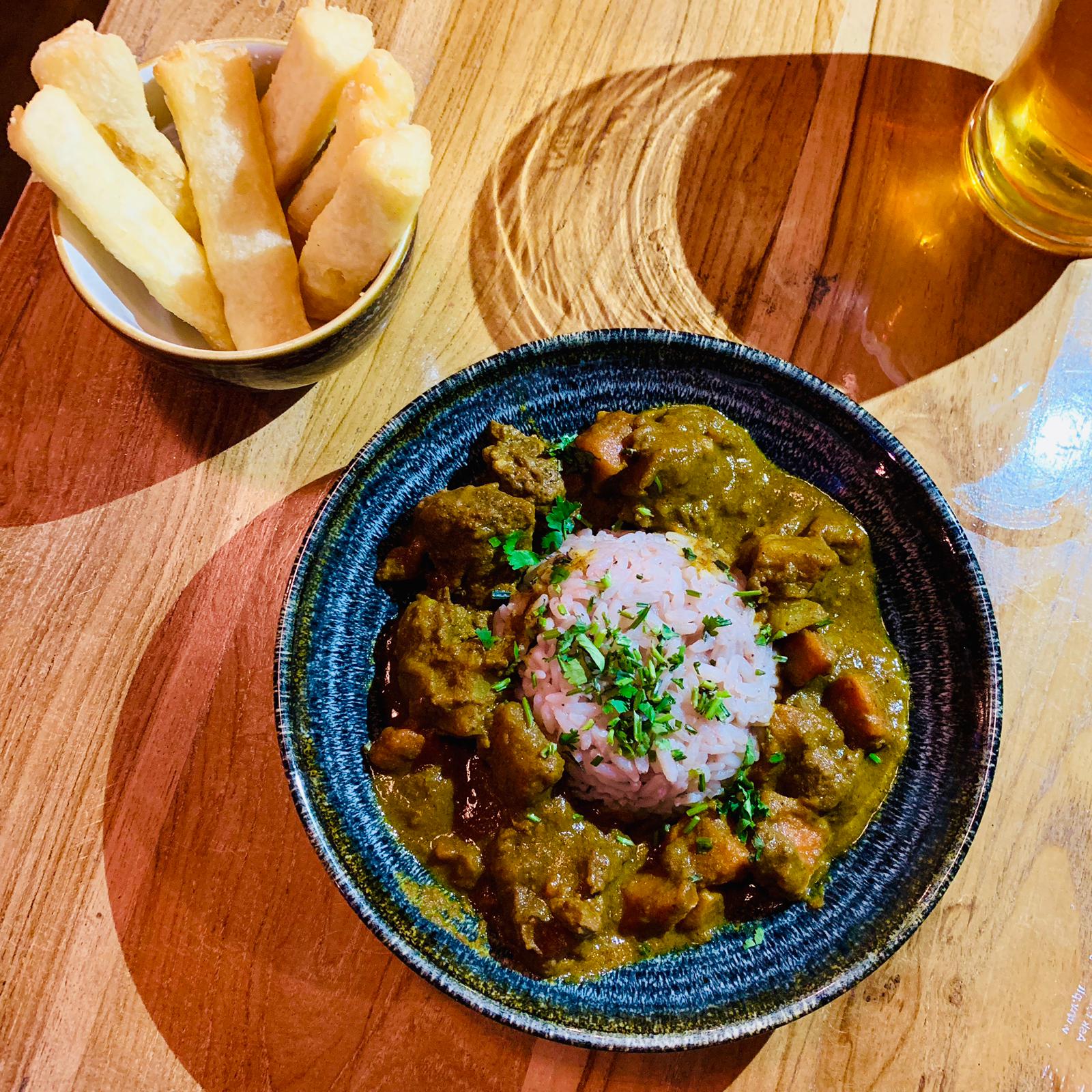
The first warning bell rang when the gadget buzzed, no more than ten minutes after placing my order; that felt quick enough that I wondered whether a microwave had been involved. I approached the hatch to find the food had been set down in front of me, but with nobody on the other side to greet me. The shelves behind were full of stuff from Brakes, another disconcerting sign. I would have just taken the dishes and gone back to the table but one of them, the mutton curry, was missing the advertised naan bread and mango chutney. Instead there was a small bowl of what appeared to be giant, wan-looking chips, stood upright. I waited, but nobody appeared, so I said “excuse me” as loudly as I dared and a lady wandered in from what I assume was the kitchen.
“I’m sorry, but I’m waiting for a naan bread” I said, doing the English thing of apologising for expecting to receive what I had ordered.
“It’s a mistake with the menu” I was told tersely. “It’s wrong. You don’t get naan bread, because it’s a Caribbean curry. These are yuca fries.”
Never mind, I thought, carrying everything back to the table and picking up some cutlery from the bar. The mutton curry was Zoë’s, but I managed to try enough of it to dispel the rumour that it had been microwaved: surely it would have been hotter if that was the case. The meat was a tad chewy – not undercooked per se, but not enjoyable to eat and the spicing in it was probably best described as subtle. It was definitely luke-warm, though, and for nine pounds the portion felt a little on the mean side. I didn’t try the yuca fries (although I did google them to find out that they were made of cassava) but Zoe ate a few without any real enthusiasm. They looked like the kind of thing you might use to insulate a loft.
“What do you reckon?” I asked.
“It’s just not hot. To be honest, I’d rather go to Clay’s.” She had a point – I would far rather have spent a little more and had an infinitely better curry elsewhere. I had a feeling the list of places doing a better curry than The Dairy – and this in itself was pretty alarming – probably included Wetherspoon’s. Still, I’ll say this for the mutton curry: it wasn’t the chicken burger, which is an early front runner for the single worst thing I’ll eat in 2019 (let’s hope it bags that prize, because I don’t really want to think about what, if anything, could beat it into second place).
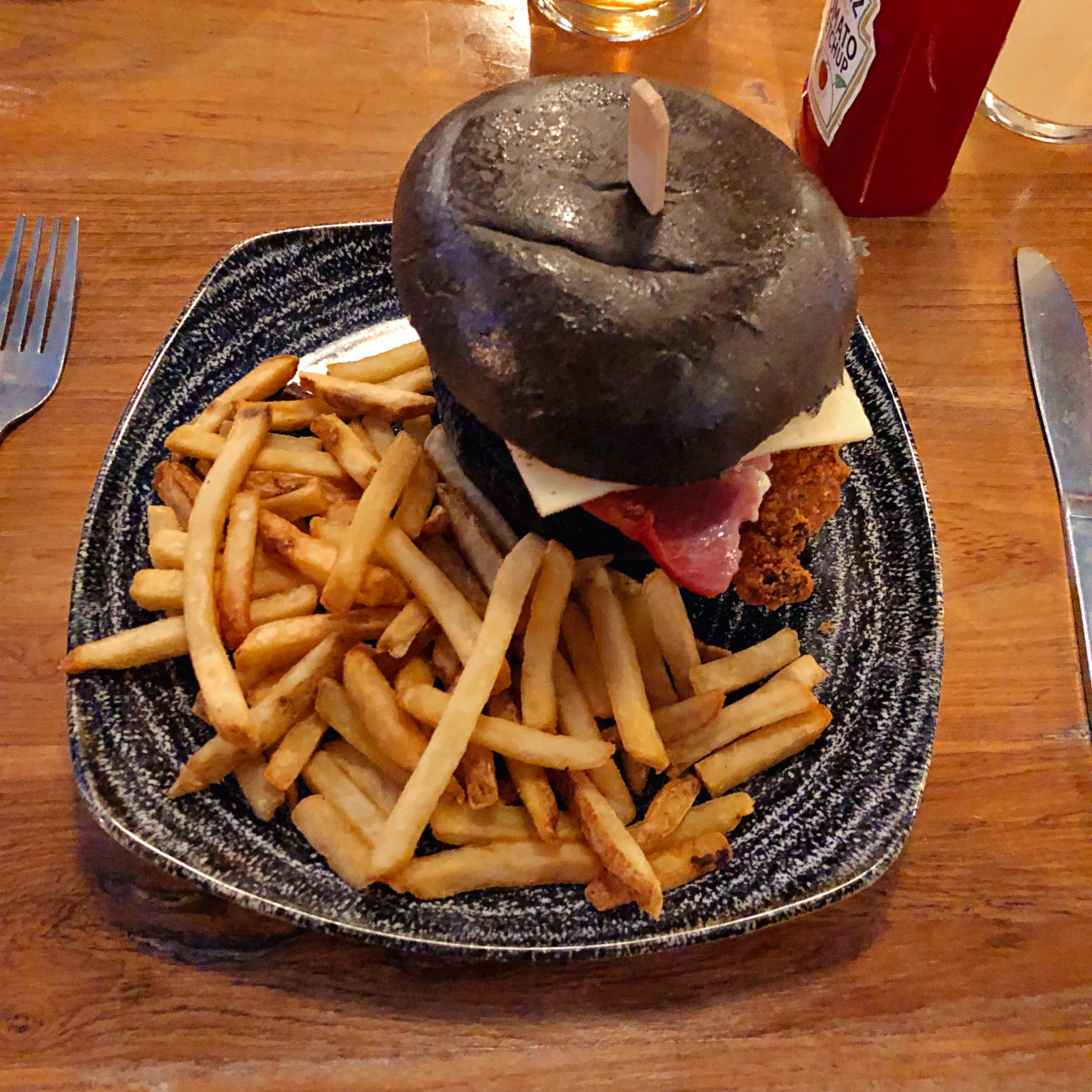
The charcoal brioche was weirdly, cloyingly sweet. The bacon – back, cooked to miserable limpness – was indifferent and salty. The burger itself was breaded and I’m not sure whether it was baked or fried but the coating had the texture of an asteroid with no discernible seasoning: the chicken, once you got to it, at least recognisably had started life as a fillet but after that it had been not so much cooked as mistreated. The thin slice of American cheese on top had been completely unmelted by the lukewarm contents of the brioche. I wasn’t sure how the kitchen had managed to overcook something, yet it still wasn’t hot: I wasn’t sure I wanted to know.
The “barbecue glaze” underneath it had the sort of gloopy sweetness which gave me bad flashbacks. There was something odd about the taste of the fries: it could have been that they were tepid, it might have been that they were stale, it might have been something else altogether. Running through the possibilities in my mind started to bring on reflux. I left a fair amount of this dish, and most of the fries, and things have to be pretty bad before I do that.
If the food had been good, there would have been more drinks. We would have checked out the dessert section of the menu and ordered the churros (“plain and caramel filled… served with butterscotch sauce”). But the food wasn’t good, and I needed to leave before I was completely put off The Dairy as a watering hole, and for that matter put off churros for life. The meal, along with a ginger beer and a very pleasant pint of Eisbar, a “Vienna style lager” by XT, came to just shy of twenty-two pounds. Service at the hatch had been pretty perfunctory, but the bar staff had been lovely and friendly (and one of them was very apologetic about it being her first shift). The whole thing seemed to reinforce my overall view, namely that The Dairy was a great place for a quiet drink but that nobody should consider eating there.
As we left, I was torn between feeling a little queasy and really wanting to eat some chocolate, or at least something that didn’t taste of the chicken burger. In the end I thought better of it, but that burger sat uneasily with me for the rest of the evening.
“I suppose the obvious comparison is the Oakford” Zoë had said while we were waiting for our food, before anticipation transmuted into disappointment, and I think in many ways she is right. For cheap, cheerful burgers, at least – although having done some research since the burgers at the Oakford are a little more expensive, mainly because fries are extra (though I don’t think anybody in their right mind would pay extra for The Dairy’s fries). But really, I couldn’t think of a good comparison: where else would the food have been quite so underwhelming?
I don’t know whether The Dairy’s dishes do come from a Brakes lorry (from the section of the website marked “for students”, perhaps), and you could say that I should have known better than to expect great food from one of the university bars. All I can say is that I was taken in by the menu, but more to the point I wrongly thought that the pride The Dairy had put into its drinks offering would be matched by the food. So I do have a new favourite watering hole, along with a salutary lesson that even after over five years of doing this I remain more than capable of making the wrong call and picking a duffer. I still recommend going to The Dairy for a nice pint if you’re in the area (and the benches out the front might be lovely on a summer’s day). Just make sure you’ve eaten beforehand.
The Dairy – 4.6 Building L14, London Road Campus, Redlands Road, RG1 5AQ
0118 3782477





 Edible Reading