Pub review: The Plough, Shiplake

I still remember the first time I gave out a really good rating on this blog. It was towards the end of 2013, when we were all a lot younger and more carefree, and my blog had been running for just over three months. I wasn’t drunk on the power (next to nobody read the blog in those days) but even so giving out a rating in the high 8s felt like a proper stake in the ground. This is my kind of thing, that rating was saying. Go here on my recommendation and I promise you won’t regret it.

Ten years on, unlike a lot of restaurant reviewers who think their pronouncements should be on tablets of stone – why do so many of them write like they’re on coke? – it still feels like a big thing to say. And a presumptuous one, too: for me, that trepidation about writing a rave review has never quite gone away. Nor has the euphoric relief when anybody visits a restaurant on the back of one of my reviews and tells me they didn’t hate it, let alone loved it. I know the blog’s free, so nobody can ask for a refund, but I can’t give anybody back the money they’ve wasted on a bad meal.

The recipient of that first rave rating, a rating that wasn’t beaten for two whole years, was a gorgeous pub called the Plowden Arms in Shiplake. Run by married couple Matt and Ruth Woodley, it was the most beautiful spot – snug in the winter, with a fantastic garden in a little corner of South Oxfordshire for the summer. The crockery was vintage before everyone jumped on the chintz and retro bandwagon, the menu revived classics from the pages of Mrs Beeton and there was 20s jazz playing all the time. I adored it, and I went there often – with friends, with my partner, with my family, with anybody I could persuade to head to Shiplake.

Just over three years later, the Woodleys left the pub. It reopened under new management, but it wasn’t the same. You looked at the menu and thought that food was just something the management thought it should offer, all function and no passion. It was the first in a long string of disappointments, of places that had the temerity to close despite my loving them. Since then there’s been Dolce Vita and Buon Appetito, and soon there will be the Lyndhurst, but that first one stung. I wish I’d gone more often. As Andy Bernard says in The Office – the funnier version – I wish there was a way to know you’re in the good old days before you’ve actually left them.

When it closed two years later, I wasn’t surprised. It sat vacant by the side of the road, and for a while it looked like it would just be the latest pub to turn into accommodation, the latest community to lose a hub and gain a handful of extra residents with nowhere to drink. It was empty throughout Covid, but then in summer 2021 there was an interesting development: the owners of nearby Orwells announced that they had saved it from near-certain demolition and were going to open it as The Plough in early 2022.

That news was welcomed beyond the narrow confines of Shiplake: Orwells has a lot of fans, and I’m sure they liked the idea of a more affordable, more casual venture from the same people. But then something strange happened in 2022. The Plough didn’t open early that year and at some point – I suspect we’ll never know exactly why – Orwells dropped out of the picture. But the Plough did open, just before Christmas 2022, owned instead by Canadian-born Jill Sikkert, her first hospitality business after a career in interior design. Last month she appointed a new chef, Charlotte Vincent, who has been on Great British Menu and got one of her previous venues into the prestigious Top 50 Gastropubs list four years ago.

All very impressive: who needs Orwells anyway? But I would be the first to admit that the revitalised Plough isn’t the kind of venue I would normally review. A lot of that’s down to accessibility: I know that the countryside around Reading has plenty of food pubs which ordinarily would interest people, like the Dew Drop Inn at Hurley, the Crown at Burchett’s Green or even the Wellington Arms at Baughurst. But as a non-driver who relies on public transport they don’t generally fit my catchment area, so you’re more likely to hear about restaurants near a train station, like Seasonality.

Besides, you don’t need me for those kind of places because they’re the province of the website Muddy Stilettos, which you may know. They love rural gastropubs, and they gush about them in their weirdly infantilised language where things are “yummy” or “scrumptious” and go in their “tummies”, where food and drink are summed up as “scoff and quaff”. Apparently if you like this kind of restaurant you also like twee: I even read one review which referred to something called a “Michelin twinkler”, presumably this is awarded when your scoff and quaff are particularly yummy and scrumptious. Goody gumdrops!

If I say more about Muddy Stilettos – especially that their annual awards are an exercise in epic grift where they get small businesses slogging away to promote their website while giving back nothing in return – I’ll probably get in trouble, so let’s move on. I found myself reviewing the Plough because a very good friend got me one of their vouchers for my birthday last year, so Zoë and I finally found an opportunity to get there on Good Friday, at the end of our holiday, literally days before it expired. So I suppose, technically, I only paid for part of my bill: I wonder if that gives me something in common with Muddy Stilettos?

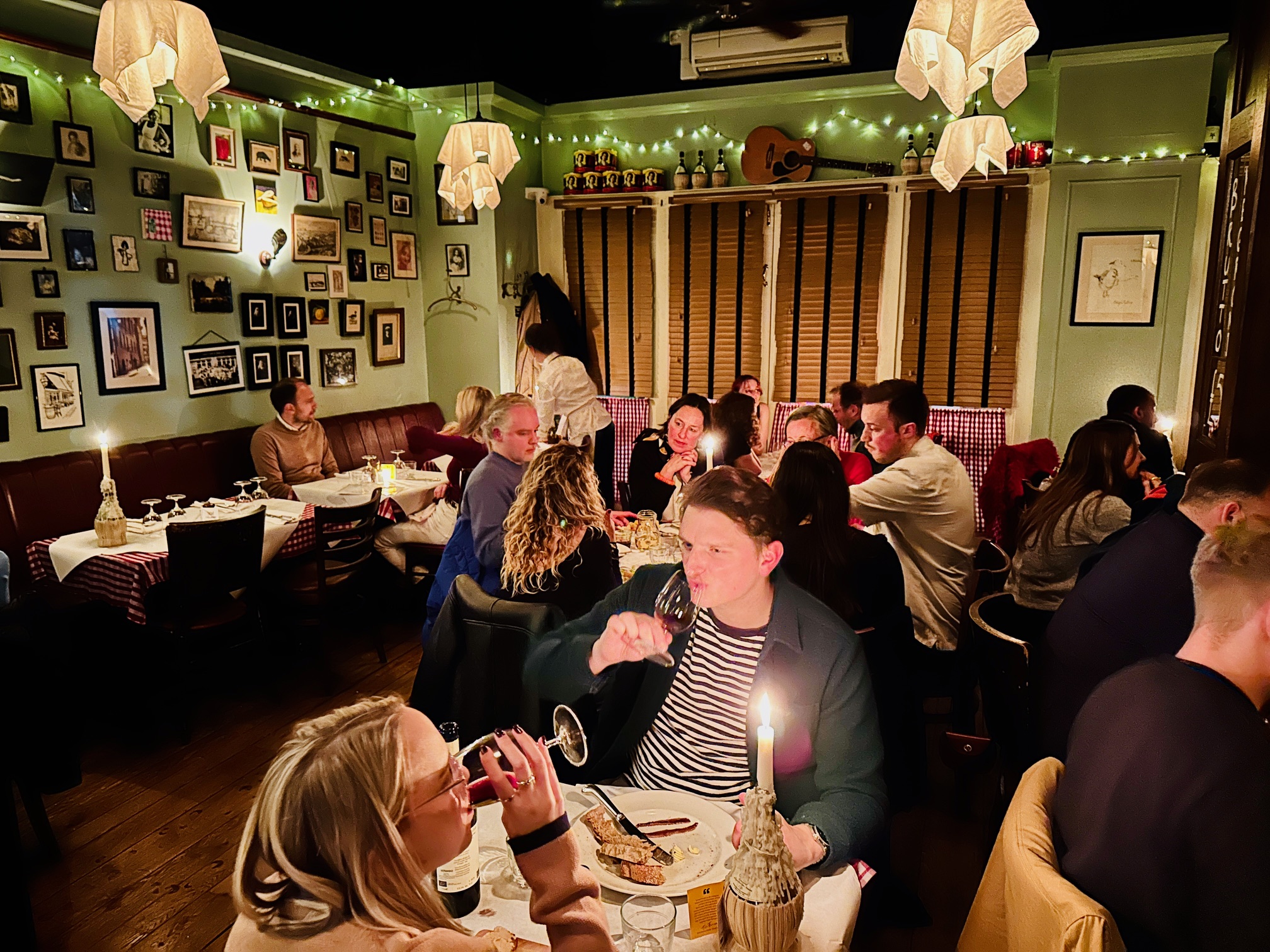
The makeover the Plough has received is quite something. In its previous incarnation it looked like a pub, like a beloved local that also happened to serve food. Now it is a really gorgeous series of rooms – you can tell Sikkert has a background in interiors – that take advantage of the pub’s good bones, its bricks and beams and parquet floors, but create something much more luxe. That said, the chairs looked better suited to lounging than dining, but that’s probably just me being a bit old-fashioned.

We were seated in a room I remembered well, having eaten in it many times when it was the Plowden Arms, and yet it felt completely familiar and totally different all at once. Even though it was the end of March there was still a nip in the air and the fire was burning, and it felt properly comforting: I can’t wait for summer to come, but I’ll miss the smell of woodsmoke.

The menu is written in that way that was modish a few years back, listing ingredients but nothing else: sea trout pastrami, mussel, apple gremolata, that kind of thing. I know this annoys some people but it didn’t bother me – it was more detailed than other examples I’ve seen and, besides, a little element of surprise when you order dishes can add to the experience. Perhaps I’m just getting soft.

As is the fashion there were snacks, starters, mains and desserts – most of the snacks just over a fiver, the starters just over a tenner, the mains between twenty and twenty six pounds, desserts a tenner. You’ll have your own views about whether that’s steep, but I compared it to what things cost at London Street Brasserie these days and decided to judge it at the end, not the outset.

There’s also a no-choice set lunch menu, twenty-seven fifty for three courses, which didn’t overlap with the main menu. But in honesty I think if you’re going to only offer one option on a menu it has to be more interesting than the likes of swede and carrot soup, so I gave it a miss. The Plough could learn from the likes of Quality Chop House, whose set lunch costs about the same and seriously makes you consider swerving the à la carte. Besides, that voucher was burning a hole in my satchel – in for a penny, in for a pounding, as my fiancée likes to delicately put it.

We got some snacks while we made up our mind about everything else, and they were the first indicator that it wouldn’t all be plain sailing. Homemade focaccia/blue cheese butter was the first thing we tried. Now, I don’t object to minimalist wording provided there isn’t anything significant in the dish it neglects to mention, and so long as what you’re told will be there is actually present and correct.

So the menu really should have said homemade bread/garlic butter, because that, weirdly, is what I got. The picture below is one of the dullest ever to grace my blog, but I put it there for a reason, to demonstrate that this bread wasn’t springy or spongy or aerated. It wasn’t open-crumbed at all. It wasn’t permeated with olive oil, it didn’t have salt or rosemary or anything else to zhuzh it up. The reason it was none of those things is that it wasn’t focaccia.

It was, instead, perfectly serviceable bread. And as for the butter – well, we went from the blue cheese in this must be very subtle to there’s no blue cheese at all in this, is there? before ending up at isn’t this garlic butter? The menu wasn’t just economical with words, it was a little economical with the truth too.

The second snack was a lot more enjoyable. I’ll do away with the stripped down wording from here on in, but this was a clump of battered, fried enoki mushrooms, strewn with shoots, more mushrooms (pickled, I think, but my mind might be playing tricks) and a little Walnut Whip of mushroom ketchup. This was far more like it – wild mushrooms cropped up in a few places on the Plough’s menu, and the mushroom ketchup, lending gorgeous depth, was the star of the show.

But at the risk of nit picking again, the ratio of the enoki to batter was so out of kilter that I felt like I was eating a savoury churro that just happened to have a tiny bit of mushroom in the middle. That said, if it had been described as that on the menu I might still have ordered it. Anyway, it was only a fiver.

The starters proper were more successful, and started to give me an idea of what the kitchen could do. My pork terrine wasn’t bad – a slab of pork, bound up with jamon iberico and strewn with gubbins – cups of onion with thyme crumb nestling in them, and more of those little shoots. I would have preferred some acidity in the mix – a piccalilli, or some caperberries – and without them it was nice but a little well behaved for my liking. A tad too fridge-cold, clean and pristine where it needed to be gutsy.

This came with what was billed as sourdough bread – I wasn’t sure it was sourdough but if anything, it was more open-textured than the focaccia had been. This dish felt sanitised, but it would probably have been a hit with the Muddy Stilettos crowd – every time I read a review by them, the reviewer practically apologises for having three courses and makes a tired joke about undoing the top button of her trousers. I never feel like I have to apologise to you lot for ordering too much food: it’s one of the reasons I’m so fond of you all.

Zoë had chosen scallops, a couple of plump specimens in a puddle of dashi beurre blanc, topped with some kind of sea vegetable whose name I’m sure I used to know but have since forgotten. I wouldn’t have ordered this – I’m not sure beurre blanc is improved by cross-pollinating it with dashi – but Zoë really enjoyed it. Unfortunately I wasn’t allowed to try any, and when I asked her for a more detailed critique she said “I fucking loved it, I’d order it again, what more do you want from me?”.

This will please fans of her expletives, and I know there are a few of you out there, but probably isn’t of practical help. She did eventually tell me under cross-examination that the scallops were beautifully cooked, the contrasting textures managed just right, but that’s all I have for you.

At this point I was feeling slightly underwhelmed, but the Plough rescued things with two exemplary and very different main courses. Fish and chips – just described as “day boat fish”, so I have no idea what it was – was outstanding. A thick cylinder of pearlescent, just-cooked fish was hugged by brilliant, almost ethereal batter. I was allowed to try a bit and it was miles better than I’d been expecting, and weirdly it made me think of my dad. He has a bit of a habit of ordering fish and chips in fancy restaurants, so I’ve seen him try it at Rick Stein’s place in Padstow, at the Beehive in White Waltham and in my opinion, the Plough’s rendition was better than either of those.

The accompaniments were bang on too – excellent peas which were crushed rather than mushy, and a tartare sauce Zoë could tolerate, which meant that it wasn’t quite vinegary enough for me. Having it with fries, although that was clearly communicated on the menu, felt a little strange to me. They were very good fries but, in an inversion of how I feel every time I look in the mirror these days, I’d sooner they had been chunky rather than skinny.

If that covers the pub classics end of the menu, my choice was cheffier and one of the best plates of food I’ve eaten this year. Lamb rump was just stellar – thick and tender, accurately seasoned, the perfect shade of pink with just the most beautiful stripe of fat, the kind of thing I could eat all day. It came with a little of everything wonderful – more onion, this time smoked, chewy and delectable nubbins of Jerusalem artichoke, a sweet and glossy puree, a little jus and, by the looks of this picture, some extra virgin olive oil thrown in for good measure.

Oh, and I neglected to mention my other favourite part of this dish – described as hash browns, they were a couple of golden pyramids of pressed and fried potato that were worth the price of admission by themselves. I truly loved this dish, and it single-handedly justified the trip to Shiplake. A few forkfuls in and that dense non-focaccia and the slightly timid terrine were completely forgotten. All was forgiven: this dish was twenty-six pounds and, I reckon, worth every penny. Even looking down at the picture I can remember how happy it made me.

As it was a little light on the veg I’d ordered some green beans on the side with pickled chilli and soy sauce. They were well enough executed, the beans with a little bite, but I didn’t think they quite worked: the sauce didn’t adhere, so you ended up with a pool of the stuff at the bottom. I’ll go for the ubiquitous hispi cabbage next time.

We both wanted dessert, which is a good sign, and we both wanted the same dessert. So we had it, unrepentantly and without loosening any garments. Again, it was good but not perfect and again, it wasn’t quite as billed. It was allegedly a dark chocolate cheesecake but, for my money, it wasn’t in any way dark. And texturally I didn’t think it entirely worked – that huge layer of chocolate was a tad gelatinous, the base so heavy and thick that you couldn’t get a spoon through it without risking injury to passers-by.

And again, it was a pity because the minor details were all excellent, from the chocolate soil on top to the blobs of yuzu gel and – especially – the warming, boozy cherries. I finished it, because it’s rude not to, but I would have liked something slimmer and more refined. That is something I often say when I look in the mirror, come to think of it.

Replete and satisfied, we asked for our bill and prepared for the trip home. And it would be remiss of me not to mention at this point that – more than once on my visit to the Plough – Zoë had raved about the bathrooms. “Seriously, you have to go to the loo before we leave” she said. “I think they’re some of the best restaurant toilets I’ve ever seen.” So I did, and they were indeed very chic and the handwash smelled magnificent. But, just as with Zoë and those effing scallops, that’s all I can remember. I wish I’d taken a picture.

Our bill for all that food, a non-alcoholic cocktail called a tropical something or other which Zoë found too sweet (and at nine pounds, a little too rich) and a couple of bottles of sparkling mineral water – because I was on antibiotics – came to a hundred and thirty-eight pounds, including a 12.5% service charge. And it feels like an insult to shoehorn the service in here, between the loos and the conclusion, because it was faultless from start to finish. We had just the right level of attention, enthusiasm and smiles from the moment we were greeted to the point where we said goodbye and went out the front door. It made me think what a boon this place must be to genuine locals, although if you live in Shiplake I imagine you had enough to be smug about even before the Plough came along.

I’ve ummed and aahed since about what I made of the Plough, on balance. In the debit column, some of the dishes were underpowered or didn’t work, and the feng shui menu didn’t always reflect what turned up on the plate. I suppose I compare it in some ways to the robust, magical cooking of somewhere like the Bell at Waltham St Lawrence, and it doesn’t quite match that standard. But on the other hand, some of the dishes were exceptional, especially the mains, and the little touches with much of the food show an imagination which quite won me over. And then there’s the room, the welcome, that open fire and – yes, let’s mention them again – those bathrooms.

But the main thing I took from my trip to the Plough was a feeling of being in really capable hands, of a menu that could please almost anybody and managed to walk that very fine line where it was accessible and clever. That’s not an easy balance to strike, and many chefs or restaurants, despite their best intentions, end up falling clumsily on one side or the other. That the Plough has avoided that pitfall, and that the team have created somewhere so universal but sophisticated is a more skilful trick than you might think.

“This is the kind of place we could take your dad and stepmum” said Zoë in the car on the way back to Reading, and that’s as good a summary of its appeal as I can think of: it might mean more if you’d met them, but hopefully you get the drift. I think you could take anybody here for a meal – either for a special occasion or for no reason – and have a properly charming time.

This might not read like an out and out rave, I may not have talked about tummies or the fact that they might be awarded a Michelin twinkler at some point, but regular readers will know that this is me saying I was quietly impressed. This is my kind of thing. Hopefully, if you go here on my recommendation, you won’t regret it.

Nope, still feels presumptuous.

The Plough – 8.0
Plough Lane, Shiplake, RG9 4BX
0118 9403999

https://www.theploughshiplake.co.uk

Restaurant review: Masakali

I’ve been asked about Masakali, the Indian restaurant that replaced San Sicario at the bottom of the Caversham Road, ever since it opened last November. I had a fair few messages on social media saying that it looked interesting, and when I’ve put Twitter polls up asking which of Reading’s newest openings I should visit first it’s always picked up a lot of votes. Being an awkward sod I still reviewed Minas Café, Filter Coffee House and Hala Lebanese before getting round to Masakali, but better late than never: here, at last, is the review literally some of you wanted.

I can see why people noticed Masakali. Something about the polish of its website made people dispense with their usual cynicism about yet another restaurant opening at a site which sees a new occupant every few years. The branding felt completely realised, in a way we don’t often see with new independent restaurants here. Masakali means pigeon in Hindi, and the restaurant is apparently partly inspired by A.R. Rahman’s Bollywood song of the same name: some of that might just be marketing guff, but at least they were trying.

The other thing that stood out about Masakali was the menu. Generic Anglo-Indian curries were kept to a minimum, and instead everything looked – on paper at least – properly interesting. No mix and match proliferation of protein and sauce, instead a range of more singular dishes. A few interesting cultural cross-pollinations here and there, like kulcha stuffed with truffle ghee or a chaat apparently topped with Walker’s crisps, but otherwise a good range of regional Indian dishes.

Someone had done their homework. And you know the C word was going to come up eventually, so here it is: the whole thing felt like a land grab for customers of Clay’s Kitchen rather than, say, people who went to the Bina (assuming, of course, that people still go to the Bina).

Subscribe to continue reading

Become a paid subscriber to get access to the rest of this post and other exclusive content.

Restaurant review: Quality Chop House, Farringdon

As the proud partner of somebody who proudly works in retail, I accepted long ago that my weekends wouldn’t be like most people’s. For many years, we’d get a Saturday together if we were very lucky, a Sunday if we were a little less so. Whole weekends together were a chimera, generally speaking, and had to be booked and planned far in advance. And sometimes I’d get entire weekends to myself where I learned to like my own company better and make myself find things to do: I’m sure, on some level, they were character building. 

It hasn’t all been like that. When lockdown hit and the shops shut, we were in each other’s company all day; I was between jobs back then, and all that time together felt like a present from the universe. For all the fear of getting seriously ill, all the wondering where your next supermarket shop will come from, I’ll always be grateful for that. Walks every day round the deserted business park feeling like we were in a post-apocalyptic movie, hearing Zoë on conference calls on the front step in the sunshine, the buzz of the neighbourhood WhatsApp group as everyone prepared to step outside at 6pm and wave hello. In hindsight it was a lovely time, even if I never read Proust or wrote that novel. 

Then at the beginning of last year Zoë was on a secondment which meant that, for six months, she worked Monday to Friday, 9 to 5. And we got to experience together that life that we non-retailers take for granted – of shutting your laptop on a Friday afternoon, pouring that first drink and opening that glorious parcel of time that’s all yours. Living with someone in retail, I hope, makes me appreciate that privilege a lot more. It also makes me conscious of the sacrifice people in hospitality, as well as retail, make for the rest of us. 

The reason I start by saying all this is that for the past six months Zoë has been on a stretch where she works every Sunday and has every Saturday off, a halfway house between the conventional 9-5 and what she had before. When that happened, I became the equivalent of those people who say they don’t like wasting the day. I proclaimed that we mustn’t squander those twenty-four precious Saturdays, that we should Go Places, See People and Do Things.

Of course now that the six months is coming to an end I have to conclude that we didn’t, really. They got eaten up with illness or other commitments, or kiboshed by train strikes, or a dozen other things. I often think of the quote falsely attributed to John Lennon, that life is what happens when you’re busy making other plans. But it’s not a tragedy, when I think of what we did instead – Saturday morning lie-ins, or afternoons spent in the Nag’s or at Double-Barrelled people watching or planning the next holiday. We still went places, saw people and did things, just without the Capital Letters Of Expectation.

But I really did want to tick off some restaurants, the ones I’ve always wanted to visit but never got round to. In that sense we made woeful progress. But we earmarked last Saturday, one of our final Saturdays together for a while, and after some deliberation I picked Quality Chop House, because of all the restaurants on the to do list I’ve talked about before, it’s been on there possibly the longest, always close to the top.

It’s a curious beast, very much in the vanguard of modern British cooking and regularly topping everybody’s list of London’s 50 best restaurants, despite the waxing and waning of food trends. And you could be forgiven, from the “Opened in 1869” on the website, for thinking it’s that kind of place, a restaurant like Sweeting’s or Wilton’s that has been around for ever. But actually, Quality Chop House is more St John than Rules and although a restaurant has been on the site for over 150 years its current incarnation began in 2012, the last year when we were all proud of Britain.

Since then it has firmly established itself under head chef Sean Searley, who was in the kitchen when they first reopened. It’s expanded, too, with a sister wine bar and small plates restaurant, Quality Wines, next door. Some say it’s even better than its big sibling, but I wanted to start with the original and best, so after a pre-lunch beer at Mikkeller on Exmouth Market Zoë and I took a short wander and passed through its handsome doors. PROGRESSIVE WORKING CLASS CATERERS was etched on a panel of the window: it’s like they saw me coming.

The interior achieves what the menu also aspires to, managing to be simultaneously Victorian and timeless. There are two rooms – the more famous one with benches like pews and the second one which is less photogenic. It’s still a convivial space though, all chessboard tiles and bentwood chairs, chalkboards on the walls listing special wines by the glass (they start at over £20, just so you know). I had a feeling that although the other room had a wow factor this one might have been comfier, and we had a decent sized table, although we had to sit diagonally across from each other so as not to butt shoulder blades with the table behind.

The menu changes daily, which meant that I’d looked at it daily in the run-up, wishing that some things would hang in there until my lunch booking, happy for others to drop out. It was compact and, to me, in the same vein as St John, with a handful of snacks, four starters, three mains and a selection of the eponymous chops.

It’s a menu you have to mentally recalibrate as you read, because a couple of the snacks nudge into starter pricing (and then some, in the case of the £24 chicken liver parfait) and the starters are between £14 and £18. As for mains, if you want a chop or a steak they start at just shy of £35 and climb from there. I was expecting that, so it didn’t bother me, but it’s worth mentioning that their weekday no-choice set lunch is a more modest £29 for three courses. From a look at their Instagram, it has some corkers on it.

But before that we had a cocktail, because it was one of our last Saturdays together for a while. Zoë’s negroni was made with Lemon Pekoe gin and a smidge of 25 year old Madeira and was a knockout. My rhubarb Collins was, for my money, too sweet, the cordial all syrup and no bite. That’s not to say, though, that I didn’t finish it.

The problem with a menu that has snacks and starters on it is that you have to have more restraint than me not to order both. We paced it so the snacks came with our aperitifs and they included some of my favourite things in the whole meal. Salami was by Molinari, a San Francisco-based salumeria almost as old as Quality Chop House, and was just exquisite – thick and coarse but with no bounce or resistance. I loved it, although I’d have liked some cornichons: it reminded me of similar dishes at Oxford’s Pompette where they just leave the jar at the table and let you serve yourself with tongs.

But far better was the dish I had to talk Zoë into letting me order. Smoked cod’s roe came topped with grated, cured egg yolk and a cluster of hot salt and vinegar doughnuts, all gloriously nubbled and irregular. This dish was close to faultless, and scooping a doughnut through the roe before popping it in your mouth was a hugely tactile joy. The smoke in the roe was subtle, the vinegar on the doughnuts beautifully in check. If I had one criticism you needed a couple more doughnuts to really clear up all the roe, but I could forgive Quality Chop House a lot for introducing me to the concept of salt and vinegar doughnuts in the first place.

“This is like – hear me out” said Zoë, giving me a warning about what was to come, “posh Primula.”

“Primula tastes of cheese, not fish. Or are you saying this is like a cross between Dairylea and Shippams?”

“Maybe. And I don’t even have a problem with the vinegar. Menus should make a point of this – it should say salt and vinegar doughnuts, with hidden vinegar.”

Some people. Every bit as good were the pork shoulder croquettes, little dense dice of saddleback packed into a breadcrumbed shell and placed in the middle of a coaster of lime green leek mayonnaise. These were top notch, and although they’re listed as snacks I wish I’d had a portion to myself. I’m so used to Spanish croquetas, all light with bechamel, that I’d forgotten how good something like this could be – nothing but moreish shreds of salty pork. I eked this dish out, knowing that however well I did so it would be gone too soon.

“I don’t know why they call them croquettes” was Zoë’s feedback. “They’re definitely nuggets.”

“I don’t think they’re going to rebrand as the Quality Nugget House, true though it might be. People will get the wrong idea.”

With our snacks out of the way it was time to take the meal seriously and place a proper order. By this stage what had begun as an almost-empty dining room was full, and it made me realise just how efficient the staff were. Efficient and hard working, finding the perfect happy medium between the two unpalatable extremes of matey and glacial. Always there when you needed them, too, in a manner I associate more with eating in Paris than London.

We also ordered a bottle of wine, going eventually for an interesting-looking number from Roussilon that promised peach, herbs and smoke. It lived up to that, and I thought was about its money for just shy of sixty pounds. Initially I thought that the wine pricing was a little sharp at Quality Chop House considering they had a wine shop next door – there was very little south of forty quid – but later on I saw the wine we’d chosen on sale at Bloomsbury’s Shrine To The Vine for thirty pounds, so if nothing else their markups could be a lot steeper.

Starters built on the promise of what had gone before. I am a sucker for sweetbreads so I tend to order them whenever I see them and last year – at Paris’s Parcelles and Malaga’s La Cosmopolita – I had two sweetbread dishes which raised the bar. If anything, Quality Chop House’s rendition might have exceeded them. These were veal sweetbreads cooked in beef fat, and although the fat didn’t overpower them it did give them an almost crispy texture without sacrificing their softness.

But the supporting players were just as important. I’m used to calçots paired with romesco, and I’ve enjoyed that combination many times, but having the two of them as an accompaniment to sweetbreads was not something I’d ever considered. And it all went together so beautifully: heat, nuttiness and sweetness from the alliums. A beautiful dish.

Zoë didn’t especially fancy any of the four starters on offer so decided to grab an eponymous chop from the snacks menu. As a fun-sized demonstration of the meat they bought and how they cooked it, is was difficult to fault and came on a squiggle of cumin yoghurt, strewn with pickled chillies.

A dish made with lamb chops is one of our regular midweek staples, especially when we’re trying to cut down on carbs (did I mention that I have to lose about five stone in three months for this wedding I’m having?). And I wish when I cooked lamb chops they tasted like this – the forkful I tried was impressive stuff.

At this point I was convinced that I was halfway through a record-breaking meal: the wine was slipping down nicely, everything I’d eaten was magnificent and the room was buzzing. This was what I had told myself we’d do on Zoë’s Saturdays, and even if we’d left it late we’d saved the best until last.

For me the mains didn’t reach the same heights, but it didn’t change the fact that if I’d had them in any other restaurant they would have easily made my top ten of the year. I decided to eschew, rather than chew, the chops so I’d chosen the fish course – a firm, bronzed slab of pollock sitting in a moat of crab bisque, a blob of aioli behind it and some wild garlic reclining, wilted and louche, on top.

That all sounds superb, and it wasn’t bad, but I wasn’t blown away the way I had been by the smaller courses. The fish was perhaps a few seconds too well-cooked, the bisque lacking in savoury depth. I wasn’t sure the aioli added much. Was I being ultra-critical because everything else had been so fantastic? Possibly.

Zoë on the other hand had opted for the double chop combo, following up her lamb starter with an immense pork loin chop. It was Saddleback, again, and it was undeniably a terrific, whopping piece of meat. It was so beautifully cooked, the meat tender and nowhere near dry, the fat softened to the point where it was the best thing on the plate. I was allowed a fair bit of this – 400g is a big old chop – and it made me suspect that picking the fish dish was tantamount to, as a friend once put it, going to Nando’s and having the prego steak roll.

Both dishes were lacking in carbs or veg, and you have to order those separately. Maybe it was those snacks at the start, but neither of us could work up much enthusiasm for a bitter leaf salad with grapefruit (which didn’t feel like it went with anything we’d chosen) or squash with rosemary. We did, however, gravitate towards Quality Chop House’s confit potatoes. It’s a dish they’ve become known for, perhaps more than any other, and it has inspired a lot of imitations. It was also the one dish I was determined not to leave Quality Chop House without trying.

And yes, they were every bit as good as that picture down there makes them look. Hefty cuboids made up of many thin layers of spud, pressed and then fried until the outside is a salty, brittle treat. If you like starch in general, or potatoes in particular, I’m prepared to go out on a limb and say that this is a death row dish. I am struggling to thing of anything – the crispiest chip, the most buttery mash, the creamiest dauphinoise – that quite matches this as the apex of potato perfection. Personally I probably wouldn’t have piped mustard on them. But it’s their place, so they can do what the hell they like.

But the strange thing is this – I loved them, but I wasn’t sure they really went with either of our mains. That, and the lack of some kind of veg, made the meal feel a little lop-sided, a tad needlessly beige. Was I being ultra-critical because everything else was so good? There’s that question again.

Having dessert, under these circumstances, was a foregone conclusion. But first we finished our wine and had a look at the dessert wines on offer. Many of them were available by the glass, and the menu does recommend some pairings with desserts, but when I noticed a Riesling by excellent German producer Staffelter Hof my decision, and Zoë’s, were made. I’ve enjoyed their wines both at Clay’s and Marmo, but didn’t know they did a dessert wine. And it was outstanding – golden and sweet, sticky but not sickly.

Zoe’s choice of dessert, under any other circumstances, would have been mine. And it was a lovely, classic piece of work, a cheesecake with a thin but exquisite biscuit base and a layer of mandarin orange and something called “blood orange sherbert” on top. It was as good an example of a cheesecake as you’ll find, but fundamentally it was just a cheesecake.

I think I picked better: I had the ice cream. And yes, fundamentally you could say it was “just” ice cream but that would fail to do it justice. It was an olive oil ice cream made from eye-poppingly expensive Capezzana olive oil, and it was the best ice cream I’ve had in this country. Easily up there with anything I’ve had abroad, too. I’ve not had olive oil ice cream in many years but here the oil permeated everything, giving the ice cream a perfumed, grassy note that took it up several levels.

The whole thing was drizzled with olive oil that collected brightly at the bottom of the bowl, waiting to be scooped up. And each spoonful had a little crunch of salt crystals. This dish wasn’t sweet or savoury – it was far too clever to pick a side in that way. It thumbed its nose at being either and was instead authentically, enchantingly itself. It cost ten pounds, one of the least expensive dishes of the meal, and was worth every penny: if I could teleport any one dish from the Quality Chop House to my sofa right now, as I write this, it would be this one.

We had outlasted a few tables that had arrived after us – such quitters – and as our bill came with a couple of pieces of white chocolate fudge we chatted with our server. We asked if we could buy the wine we’d had at the wine bar next door and she said no, because they’d made a conscious decision to stock completely different wines there. “It’s nice for us, because it means when we go there for a meal we get to try something new” she said, adding that the staff happily ate in the restaurant or the neighbouring bar on their own dollar because the food was so good.

“The thing is, people come for the chops but I think everything else on the menu is so good. Like the fish you ordered. And you really need to come back during the week, because the set menu is amazing.”

Our bill, with service included, came to about two hundred and eighty pounds. I know that might be the bit where many of you wince – don’t I know there’s a cost of living crisis on? – and I could say that we ordered a digestif and a dessert wine each, a decent bottle of white and four courses.

But it is difficult to deny that unless you’ve having that set lunch menu during the week, Quality Chop House is a pricey restaurant. When I compare it to Manteca, across town, where we ate easily as much food last year and spent three quarters of that amount, it drifts firmly into special occasion territory. But then Manteca was 2023, and this is 2024, and a lot of restaurants are going to the wall. Even having only been there the once, I’d like it if Quality Chop House wasn’t one of them.

After my meal I knew Quality Chop House was extremely good, but I also knew I needed to reflect to figure out just how good it was. And the answer, I think, is very, but not without a handful of bet-hedging caveats. It is classic and timeless and that is a big part of its strength. You won’t be buffeted by food trends or forced to eat anything that’s been freeze dried or agitated into a foam. You’ll have a gorgeous, comforting meal in a space that feels like it could have existed and looked like this at any time in the last hundred years. You’ll experience superlative service, and come away knowing that you’ve treated yourself.

And yet there is a slight niggle that stops me giving it one of the highest ratings I’ve ever awarded. Brilliant though it is, it is pricey. The menu is a tad unbalanced, as I said. And the most interesting things on it are at the beginning and at the end, which is why I understand the plaudits that have been heaped on Quality Wines next door.

Because as much as I liked seeing a hulking great chop set down in front of us, there was a bit of me that would have preferred a restaurant that stuck to the snacks and the small plates, and maybe offered wines at more approachable prices. This venue was great, I enjoyed it and I’m so glad I went there. But that venue, the venue I might have liked Quality Chop House to be, sounds like it’s literally next door.

But never mind. After many of the things I’ve eaten this year – for the blog or for fun, mindfully or mindlessly, out and dressed up or in my comfies on the sofa, in company or alone – are firmly in the past I will still remember that afternoon of chat, laughter and leisure. And I’ll remember that ice cream. Any restaurant that can make memories like that is okay in my book.

Quality Chop House – 8.8
92-94 Farringdon Road, London EC1R 3EA
020 72781452

https://thequalitychophouse.com

Restaurant review: Hala Lebanese

Last month, after a very successful ER readers’ lunch at Kungfu Kitchen – a total of fifty-six guests in attendance and what felt like about the same number of different dishes to try – the hardcore lunch-goers were sitting in the luxurious surrounds of Park House up on campus, shooting the breeze. It was early evening and even though it was right at the beginning of December it felt, to me at least, like the start of the festive season.

I always love that bit, when the event has gone well and everybody is full and happy and I get to have a few pints and chat to all the people I haven’t yet caught up with. The readers’ lunches have been going for six years now and although there are always newcomers, many of my regulars have been coming along for a fair old time, a few since the very beginning. 

On this particular occasion I found myself in conversation with Jonathan, a newbie who very specifically wanted to talk to me about a bugbear of his: how come there weren’t any good neighbourhood restaurants where he lived in east Reading? I thought about it, and told him I had to agree. I said that since O Portugues had mysteriously closed in the spring there was nothing that even came close.

You could eat in the likes of Rizouq on the Wokingham Road, I supposed, as it had a few tables, and I’d heard suggestions that a burger joint, Pattie N’ Pulled, was operating out of the Roebuck (it looks like they’ve since moved on). But apart from that, and the artist formerly known as the Garden Of Gulab, restaurants were thin on the ground. I thought that would be the end of the conversation, but Jonathan wanted to talk about it in more detail, as if I had the power to change it.

I do get it though. As a proud East Reading resident myself, albeit one living far closer to the centre, it is an enduring mystery that it’s such a dead zone for restaurants. Caversham is well served, and Whitley and Katesgrove have a handful of places. Tilehurst, with the addition of spots like The Switch and Vesuvio, is seeing a bit of a resurgence and the Oxford Road has always been a crucible of culinary invention. Even dear old Woodley, where I grew up, has a handful of restaurants worth a visit.

By comparison, the Wokingham Road feels like slim pickings. It has takeaways, and two biryani places, and the likes of Earley Café and Chaiiwala, but nothing you could describe as a neighbourhood restaurant. It’s almost as if the people living near Palmer Park are expected to hop on the 17, walk to Kungfu Kitchen, settle for the Hope And Bear or, if all else fails, fall into Ye Babam Ye. If it wasn’t for the likes of Smash N Grab and Cake & Cream, you might struggle to see redeeming features at all. And Smash N Grab, sad to say, has its last ever service tomorrow.

I did remember, though, talking to Jonathan that there was one possible contender in the form of Hala Lebanese. It opened last June on the Wokingham Road, just past the stretch of shops, in a spot formerly occupied by another Lebanese restaurant, Alona. I still remembered Alona, partly for the astroturf but mainly for the wobbly shawarma that had slightly traumatised my dining companion John and me. I told Jonathan I would get to Hala as soon as I could and, what with Christmas and Covid, I think I’ve pretty much kept my promise: last Saturday Zoë and I trekked up the Wokingham Road to give it a whirl.

Subscribe to continue reading

Become a paid subscriber to get access to the rest of this post and other exclusive content.

Café review: Filter Coffee House

As of October 2024 Filter Coffee House has changed its interior layout and so is now takeaway only.

Filter Coffee House, a tiny café on Castle Street offering authentic South Indian coffee, opened last August. It occupies a unit which as far as I can remember used to be home to a very small, rather unsuccessful produce store by the people behind Tamp Culture (remember them?). I found myself stopping in last year a couple of weeks after Filter Coffee House opened and, slightly bending my usual rule to wait a month, I talked about it on social media.

I couldn’t help it. I waxed lyrical on Instagram about their coffee and, in particular, their banana bun, a confection quite unlike anything I’d ever eaten before. Not quite sweet, not quite savoury but glazed, complex and moreish, it was not the kind of thing you eat and forget. Quite the contrary: you want to tell the world about it. I loved it so much that when I put together my list of Reading’s 50 best dishes last September, as part of the blog’s 10th birthday celebrations, I snuck it in at number 47. I called it a little miracle. 

Maybe I was jumping the gun but I had a feeling it was going to be huge, and I wanted my admiration of that banana bun to be a matter of public record as soon as possible. Because there are few four word combinations in the English language quite as satisfying, if you ask me, as I told you so.

Anyway, the amount of praise that bun has garnered on social media since has borne out my hunch. But not only that, if you follow Filter Coffee House’s hugely winning Instagram feed you’ll see that they’ve really flourished in the last five months. The month after they opened they teamed up with nearby Rise to expand their range of baked goods. In October they introduced a menu of Saturday specials, and in November they brought in a sandwich menu.

In December, naturally, there was a Christmas menu – the “Mistle-Toast” is still available, if you’re tempted – and now Filter Coffee House also stocks goodies by Cocolico, Reading’s vegan pâtissière. The overall picture is one of constant forward movement and innovation, and it shows no signs of stopping: last Sunday, for the first time, they had a stall at Caversham’s Artisan Market. 

And yet, shamefully, with one thing and another I had not been back since that first visit back in August. Of all the places I’d neglected in the latter half of 2023, sorting this one was right at the top of my list. So last Saturday, lured by that specials menu and fresh from the elation of having bought our wedding rings in town, Zoë and I sauntered over, keen to see how things had progressed.

Subscribe to continue reading

Become a paid subscriber to get access to the rest of this post and other exclusive content.