As a restaurant reviewer, however assiduously you do your research, however good you think you are at reading the runes of a menu to try and figure out whether a Brakes lorry regularly pulls up outside the crime scene, however much you trawl through Tripadvisor or other blogs – good luck finding those, by the way – restaurants always retain the capacity to surprise.
You can expect somewhere to be good, all the signs can say it will be, but there’s always a possibility that you’ll wind up with an underwhelming meal if you’re lucky, an out-and out-duffer if you’re not. This is especially the case when hype is involved. Or plain gratitude that a place has opened at all, either because a big name is gracing a town with its presence or because the town in question is a wasteland for decent places to eat.
The more refreshing phenomenon is when it happens the other way round, when you go to an unspecial-looking restaurant with no particular expectations only to discover that you have a proper find on your hands. That realisation that dawns gradually throughout the meal, that sense of hold on, this is really good, is one of my favourite things about restaurants, and about reviewing them. It’s happened to me a fair few times, but one that’s always stayed with me was the March evening over seven years ago when I crossed the threshold of Papa Gee.
Papa Gee, back in 2015, was an Italian restaurant on the Caversham Road, on the ground floor of the Rainbows Lodge Hotel. I’d never heard of anyone who had been to Papa Gee, and at the time I knew people who lived in Little Wales, the maze of streets on the other side of the Caversham Road named after Cardiff, Swansea, Newport. Every time I walked past Papa Gee, probably en route to a booking at Mya Lacarte, the place seemed closed.
Inauspicious was putting it lightly. So nobody was more surprised than me when I found Papa Gee wasn’t some kind of white elephant but was instead a hugely creditable little restaurant doing belting pizzas, rather nice pasta and antipasti, a family business with owner and Neapolitan Gaetano Abete, the eponymous Papa Gee, in the kitchen. I had a splendid evening, although arguably the cherry on the cake was not having to stay in the hotel upstairs afterwards.
I walked away with my faith in the world somewhat restored, and it turned out to be one of the most delightful curveballs of the very early days of this blog. And the weird thing is, people definitely went to Papa Gee before I reviewed it. It’s not as if I discovered the place: it had decent writeups on TripAdvisor and had been trading for over ten years. It’s just that I’d never met a Papa Gee customer, back then. Maybe they didn’t want the rest of us finding out.
I was worried about Papa Gee after that, because the owners of Rainbows Lodge sold the building to the Easy Hotel chain a couple of years later and the restaurant was out on its ear. But then they announced what, with the benefit of hindsight, was a perfect move – and in October 2017 they took over the old Mya Lacarte site on Prospect Street, closer to the action in Caversham.
It was a brave move to open slap bang opposite Quattro, Caversham’s long-serving Italian restaurant, and the conditions got even tougher a couple of years later when the Last Crumb, also offering pizza, opened at the top of the road where the Prince Of Wales used to be. And yet here we are in 2022 and, post-pandemic, Papa Gee is still going.
And that’s partly why they’re the subject of this week’s review. The thing is, I’d never visited them in their new home and I was starting to feel bad about that; I didn’t want them to be continually on my to do list only to find, one day, that they’d closed before I’d got round to visiting. So I made my way there with Zoë on a Friday evening, post work, the weekend stretching out ahead waiting to be filled with units and calories. Like the very first time I visited Papa Gee, a lifetime ago, I wasn’t entirely sure what to expect.
Subscribe to continue reading
Become a paid subscriber to get access to the rest of this post and other exclusive content.
Click here to find a more recent Montpellier city guide, from 2025.
“Montpellier? Not again. Didn’t you write about it back in March?”
Come on, you’re probably thinking it even if you’re not saying it out loud. And yes, you’re right. I wrote about the city in the Spring off the back of an impromptu visit prompted by a random conversation at an ER readers’ lunch with Phil and Kath, longstanding readers of the blog. And you can read that guide, if you want, and a lot of it still stands. It is an incredible city, a mixture of the old and the new, of biscuit coloured, sun-bathed houses and quaint little squares but also of craft beer and hipster joints.
It has beautiful green spaces, a very grand art gallery full of paintings of Jesus, pastoral scenes and tableaux from mythology, and a photographic gallery which, on my visit, was full of grainy black and white portraits of supermodels. But it also has street art everywhere, and street food to go with it. I read a stat somewhere that something like fifty per cent of the population of Montpellier is under thirty, and it feels like that: a city with more energy than almost any I’ve visited. It’s France’s eighth largest city, and yet nobody seems to know much about it. Well, I do now, and if you make it through this piece you will too.
Why an updated list so soon? Well, for no reason other than this: I went back. I spent a very happy week there on holiday earlier this month. And normally I would just make a few tweaks to my old article and leave it at that. But I ate so well, and drank so well, in so many places that never featured in my first guide (many of which surpassed the – already extremely good – meals I had back in March) that, rather than tinker around the edges, I decided to put together a mostly all new guide to the city. It is one of the best places I’ve ever been for loafing, for good food, for culture and to get a real feeling of a city as a living, breathing thing.
So if that even remotely sounds like your idea of a good time, have a read and maybe this will nudge its way on to your city break to do list for 2023. I know at least one reader of the blog found herself near Montpellier earlier this year and made a detour to the city, because she messaged me on Instagram to tell me she’d had a very enjoyable time working her way through my recommendations. Even if that happens just the once as a result of this piece, to me it will have been worth writing it. I can’t help it: I’m evangelical about the place now, you see, and it’s all Phil and Kath’s fault.
Where to eat
1. La Cigale
This was the first place I ate on my 2024 visit to Montpellier for lunch on a blazing Monday afternoon, fresh off the plane, exhausted from a 4am taxi to the airport and, if anything, slightly giddy with excitement. It was recommended by Pierre, the endlessly charming and patient host of our beautiful B&B in Les Arceaux, a gorgeous part of the city with a village feel west of the centre.
Also in Les Arceaux, Pierre told us La Cigale was a relatively recent arrival. It had a fantastic terrace which caught the sun, along with a beautiful interior. It was exceptionally busy even at noon on a Monday, and in fact it seemed to be open from early til late every day: we often walked past it late at night on an amble home to see people still chatting and gesticulating under the streetlights. If I’d ever got out of bed early enough, I’d have had a café au lait there first thing.
I suspect part of why it’s so busy is the food, which was superb, a mixture of classics and leftfield stuff. My ceviche of sea bass came in a basket of fried rice paper with the genius addition of peanuts, while Zoë’s beef tataki was seared and served with ginger and pak choi. The mains were more traditional, and I adored a steak tartare with parmesan and pesto. But I have to single out the frites – not only were they outrageously crispy and moreish but they were tossed in, and glistening with, garlic butter. Why has nobody thought of that before? And if they have, why have I never tried it?
Bistro Urbain in the Écusson, the old city, was my other favourite discovery of my 2024 visit and was the perfect lunch spot on a happy, sunny day. Their three course lunch menu was forty-five Euros and probably represented the best value of anywhere I ate in Montpellier this year. It’s just two choices per course, but it’s a tribute to how well they wrote a menu that I still found it an almost impossible decision.
But I don’t think it was possible to order badly, in any event. I had a glorious tartlet of asparagus – which was everywhere on menus in Montpellier in May – with ricotta and jambon de Bigorre, although if anything Zoë’s tuna tataki draped over a sphere of perfectly executed sushi rice was even better. Magret du canard, pink in the middle, the skin seared, served with a terrine of courgette, black garlic and rhubarb was a proper smile-making tour de force. My dessert, strawberries with white chocolate, yuzu and a basil sorbet, was show-stopping.
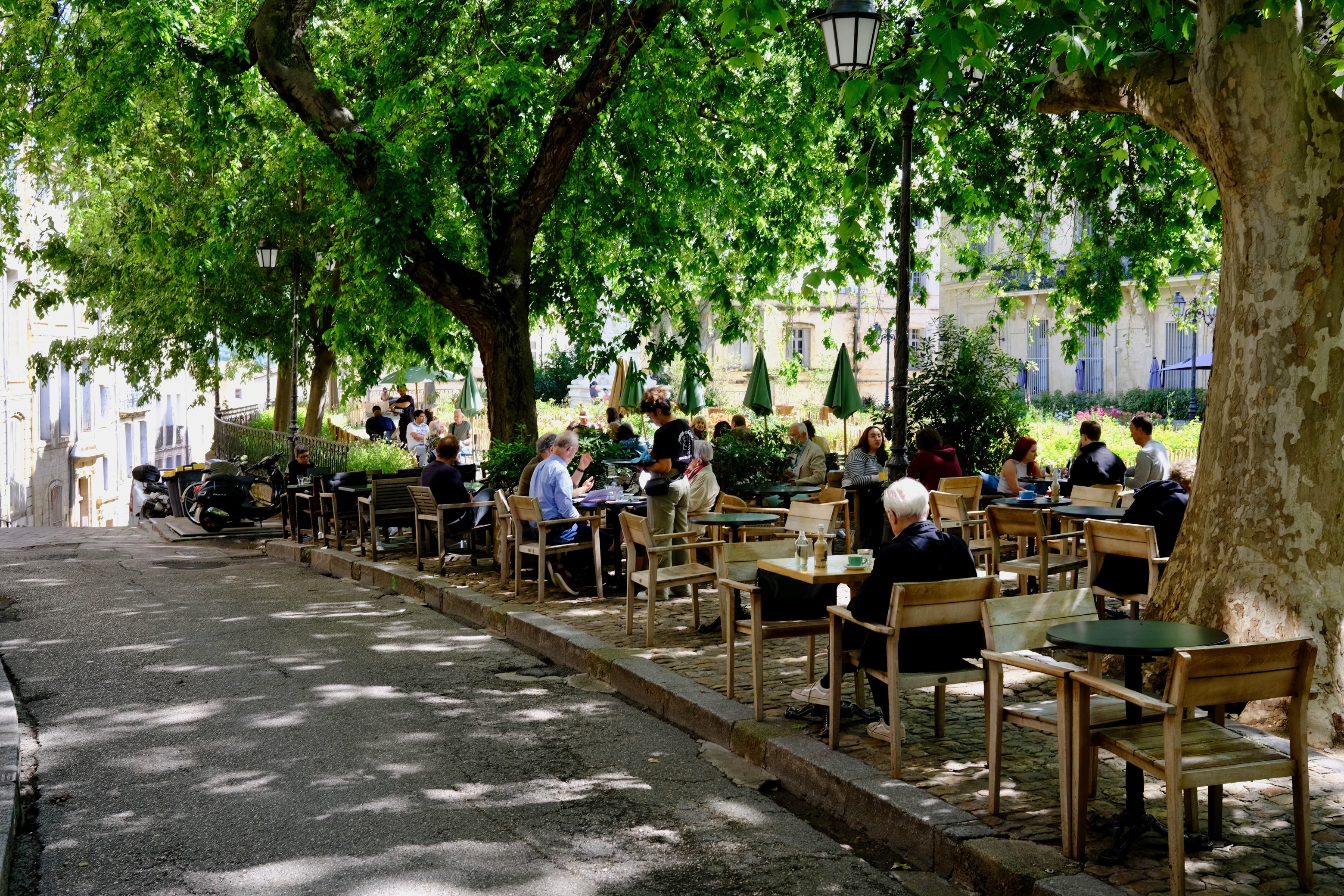
Rosemarie occupies possibly the prettiest square in the old city, and is always packed, and it took me three trips to Montpellier before I got to eat there. And when I did, the thing that struck me was that it was perfect – a perfect spot, serving the perfect kind of food, not fancy or fiddly, and given how idyllic the setting was, the food was many times better than, strictly speaking, it needed to be.
It helps that the staff are lovely and charming and work their socks off keeping everyone on that terrace happy. But the food was brilliant, and I loved it. My serrano ham – dry, coarse, sliced to just the right thickness – came scattered with almonds and was exactly what I was in the mood for. Zoë’s toast, thick with sobrasada and drizzled with honey, was if anything even nicer. But my favourite thing was my main, a ragout of tender squid served with nutty red rice from the Camargue, dotted with salty, wrinkled black olives. Would you judge me if I said that I was on the Perrier, dreaming that I lived there?
I liked L’Artichaut, and saved it for my final meal of the 2024 trip to Montpellier. But I’d expected to love it, so in that sense it maybe fell slightly short. Part of that was the disconnect between what I’d seen online – a hugely tempting dinner menu with four choices for each course – and what we were actually given, a barely legible blackboard which only gave you a set menu, with only two choices for your starter and main.
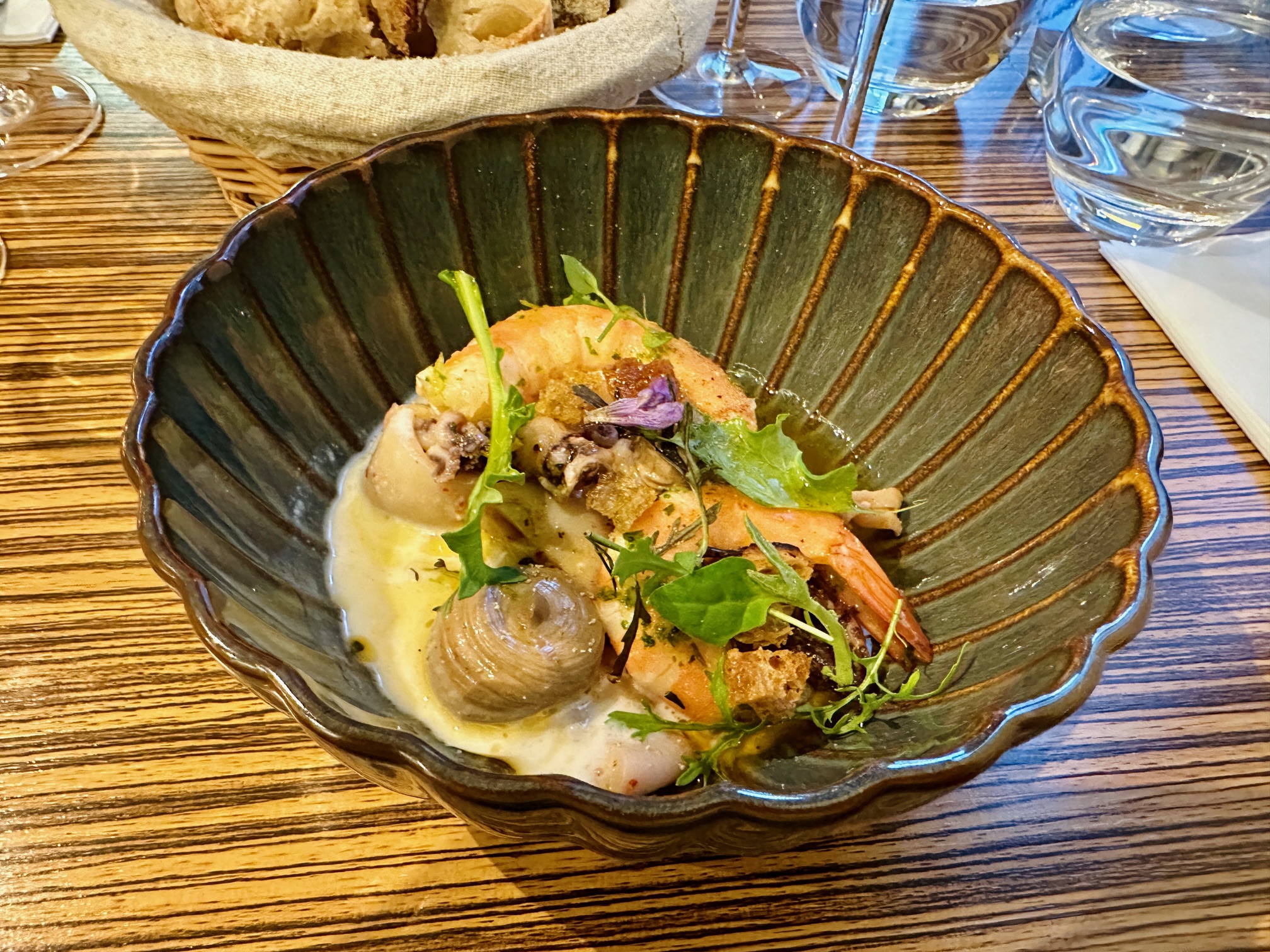
When the choice is limited, as it was at Bistro Urbain, it’s even more important that there are no duff choices. And I loved most of what I had. A dish of squid and prawns with ajo blanco was joyous, and a sort of deconstructed cheesecake at the end – seed cake, roasted pear, salted caramel ice cream and a puddle of fromage blanc – was a hundred times better than it sounded or looked. But the main course, of fish with chickpeas, leant heavily on an industrial quantity of dill, and didn’t work for me.
On balance, though, I’d probably go back – the room, the service and the outstanding wine list saw to that. I felt for the American friends at the next table, who didn’t understand why they couldn’t have a main course and then leave.
Ébullition was probably my pick of the restaurants I discovered on my summer 2022 visit to Montpellier, a peaceful space where everything – the room, the welcome, the food, the wine and the service – were close to unimprovable. The food felt a whisper away from Michelin star status, a real mixture of skill and imagination and a level above most of what I ate in the city.
My starter, a symphony of tomatoes from confit to sorbet, all sweetness and summer, was one of the finest things I’ve eaten in a long time. Veal, breaded and rolled like flamenquin but with the genius addition of citrus, was an absolutely beautiful dish, served with a rich jus with the tiniest savoury hit of liquorice. They leave the jug of jus at the table so you can add more (which you do – repeatedly, unless there’s something wrong with you), something not enough restaurants do.
So it was the first place on my list when I returned in 2024, and this time we pushed the boat out and went for the full tasting menu with wine pairings – 7 courses, whistles and bells, the cheese plate, you name it. It was three and a half hours beautifully spent – a wonderful, comfortable, perfectly paced evening with, again, impeccable service. Monkfish, barbecued and served with red cabbage, red cabbage purée and red wine sauce was as good a plate as I could recall but if anything it was topped by the most astounding local lamb, cooked in salt and served with artichoke purée and a sticky, savoury lamb jus.
You might think it’s a bit naff to have a burger in Montpellier, and you might have a point. But in summer 2022 I was there for a week, which meant seeking out a variety of lunch options, and after walking past Hop Smash Burger a few times and looking enviously at their Instagram feed I decided to go for it. I was rewarded by possibly the best smashed burger I’ve ever had.
My burger had two beautiful smashed patties with savoury, slightly crispy, crinkled edges, excellent bacon and whole grain mustard (which I’ve never had with a burger, but worked brilliantly). Oh, and cheddar, because we’re in France and so they don’t bother with plastic American cheese. Paired with some fries dusted in Cajun spice and topped with crumbled feta – another inspired combo which was new to me – and a NEIPA made specially for the restaurant by Brewing Bears, a local brewery, it was about as perfect a lunch in the sunshine as there is.
Fast forward to 2024 and we went back, this time taking shelter from fantastic, sultry, muggy rain. The burger was still amazing, although the default seemed to have shrunk from two patties to one, something I didn’t realise until it was too late. But the caramelisation and the crispiness were still there, in spades, and the local beer was as good as I remembered.
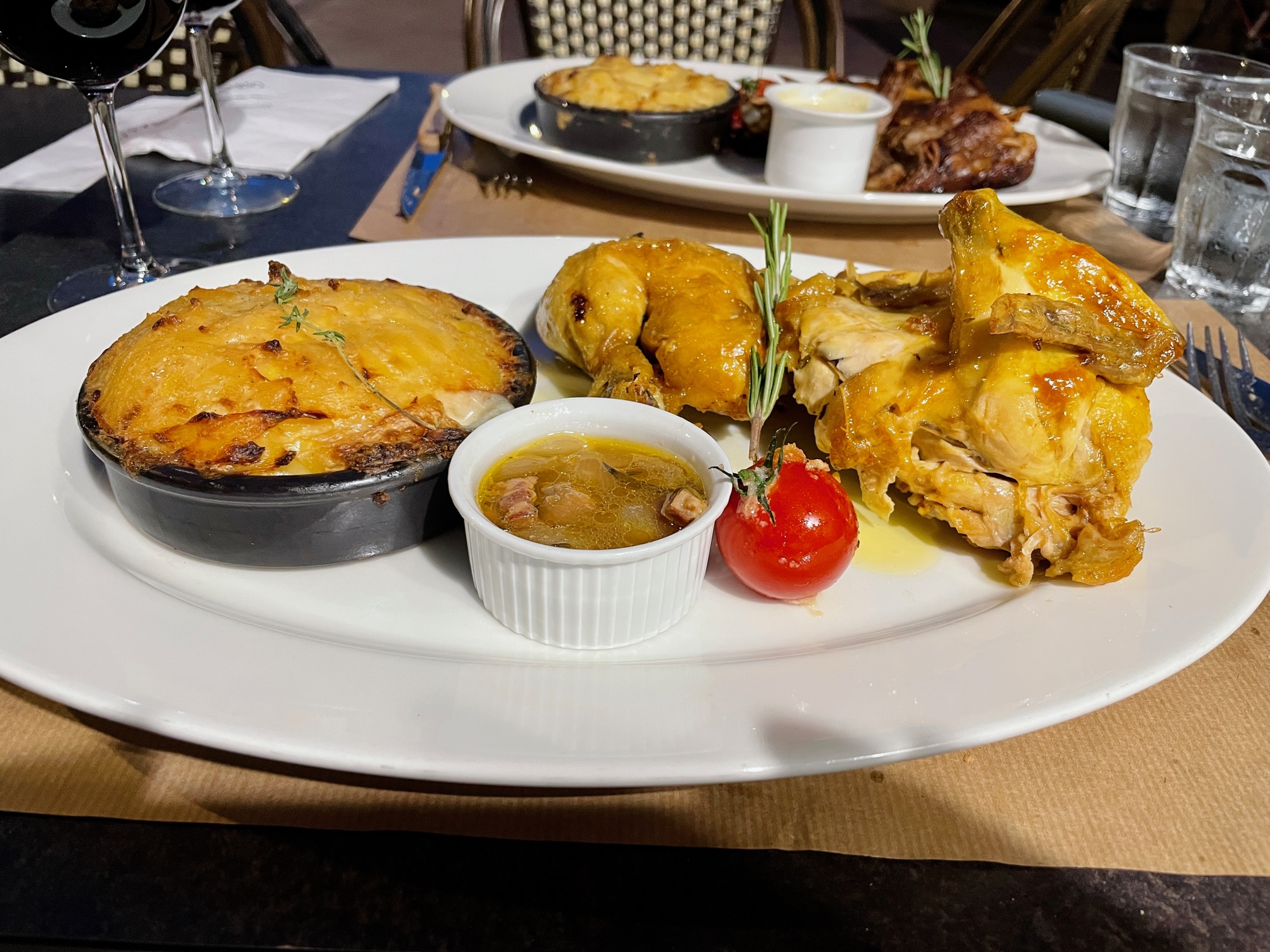
On my first visit to Montpellier in 2022, while drinking at the splendid Discopathe (more on that below) I spotted a rotisserie chicken restaurant opposite called Les Freres Poulards. If I ever come back here, I thought to myself, I’m having dinner there. Well, I did, in the summer, and I did, and it was fantastic. A starter of coarse salami, sharp cornichons and agricultural terrine set me up nicely but the chicken was the feature attraction – a superb red label chicken cooked perfectly with tons of tender meat and crispy, gleaming skin. Add a little pot of sauce, juices and lardons and a hefty helping of potato dauphinois and all that’s left is to eat and luxuriate.
A British couple slightly older than us had taken the table next to us, and at the end of our meal we briefly got talking. They were here for a couple of nights passing through on their way back to their home in Spain. “What do you think of the city?” they asked and they were taken aback when we started waxing lyrical. It’s not very nice, one of them said, gesticulating at one of my favourite Montpellier streets. They were staying in what she described as the “Arab quarter” and they were wondering where the nice parts of Montpellier were. We directed them to the picturesque bits of the old city but, replete with beautiful chicken, looking at the beer festival taking place in the bar opposite, I couldn’t help feeling the whole place was wasted on them.
I went back in 2024 for my final meal of that holiday, a lunchtime excursion on this occasion, and sat inside in a surprisingly tasteful room. The food was better than I remembered – a beautiful starter of herring and fried potato (their menu is more compact at lunchtime) followed by that chicken again. So well done, easing off the bone, the skin utterly magnificent. The fries too, were as good as any I’ve had in France and better than any I’d eaten back home. And I discovered, for the first time, the thirst quenching powers of a panaché, beer with 7-Up: why does that sound so much more sophisticated than the word ‘shandy’?
I sent a picture to my friend James with a message: this shits on Bébé Bob.
Les Freres Poulards 27 rue du Faubourg du Courreau
8. Les Glaces MPL
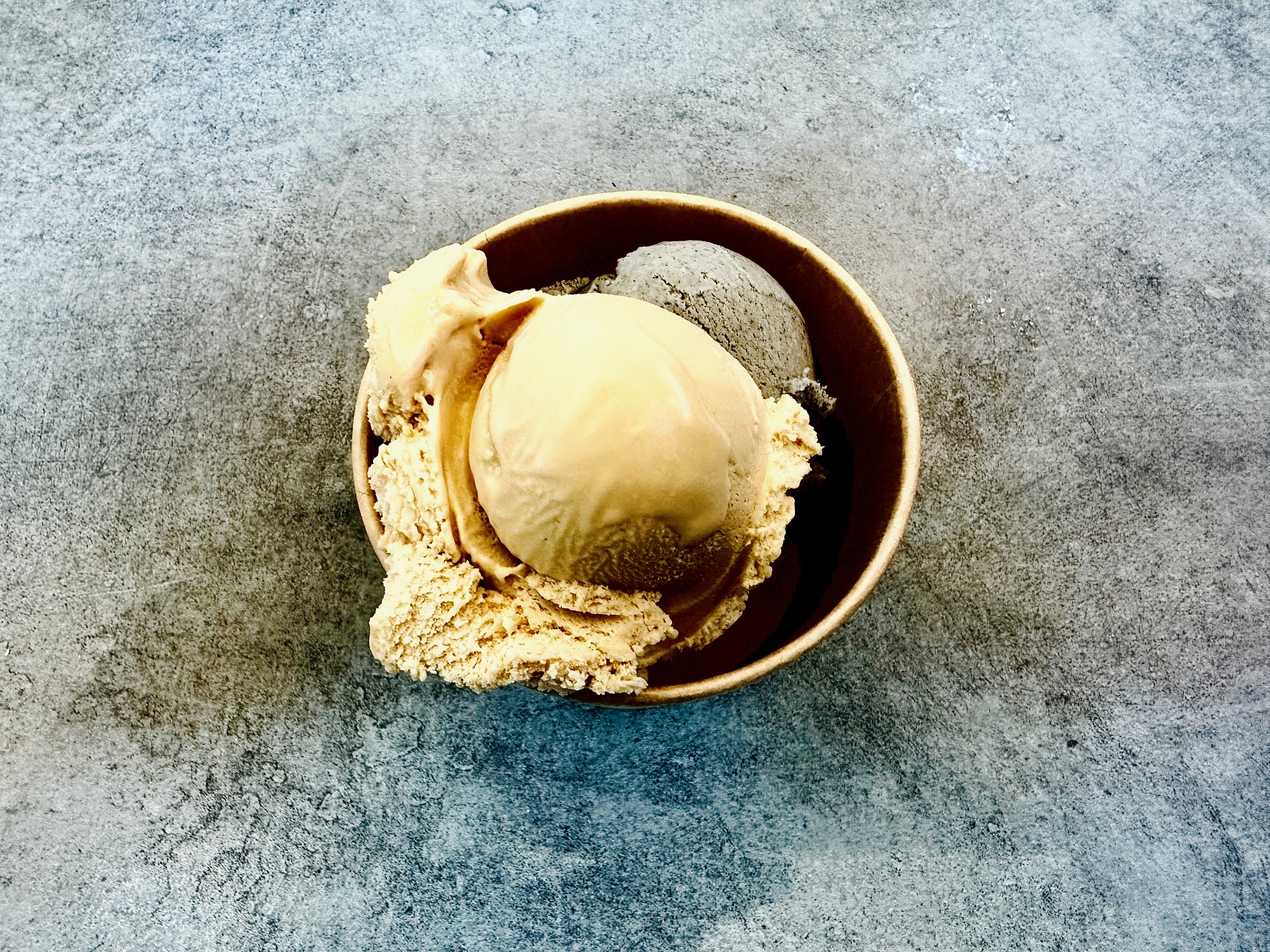
Les Halles Laissac is one of Montpellier’s two covered markets, and although it has a plethora of food stands selling wine, charcuterie, cheese and all that jazz I was drawn to Les Glaces MPL which sells profoundly good ice cream. A massive array of flavours is on offer, and I can personally vouch for the salted caramel and my personal favourite, a stunning black sesame ice cream. Zoë went for chocolate and Nutella, although I think she slightly envied my more leftfield choices.
On my second visit to the city in summer 2022 I visited Les Glaces MPL most days and my favourite thing there was a strawberry confection shot through with mint and basil, summer in a cardboard cup. My only regret was that their tomato sorbet wasn’t on sale that day. The big names also have a foothold in Montpellier – I saw a branch of Amorino on my travels in the city – but I’d pick this place any day of the week. I made a couple of very enjoyable trips again when I returned in 2024, and reacquainted myself with the classics, but it was one of the unusual choices – chocolate ice cream spiked with piment d’espelette – that really bowled me over.
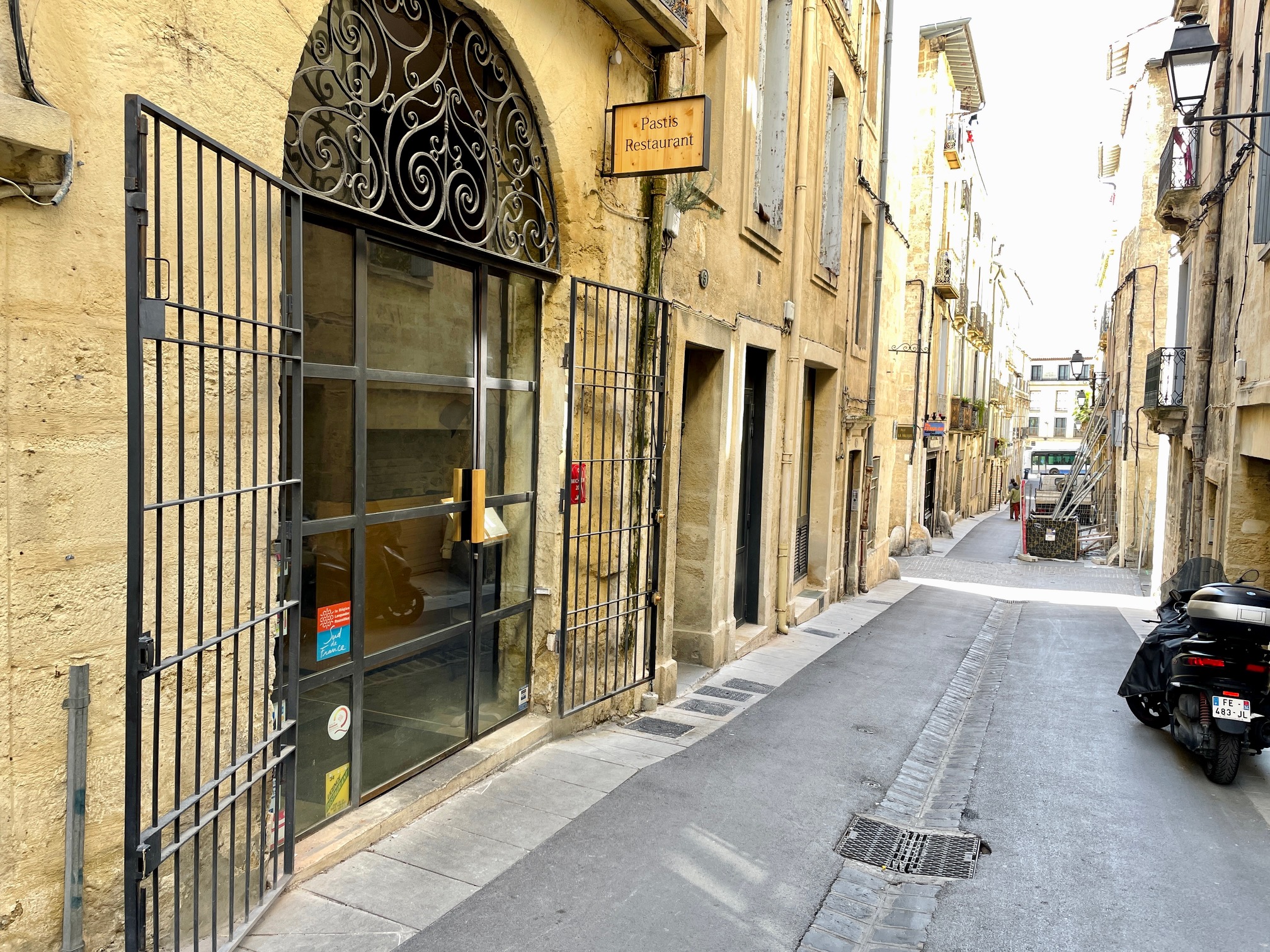
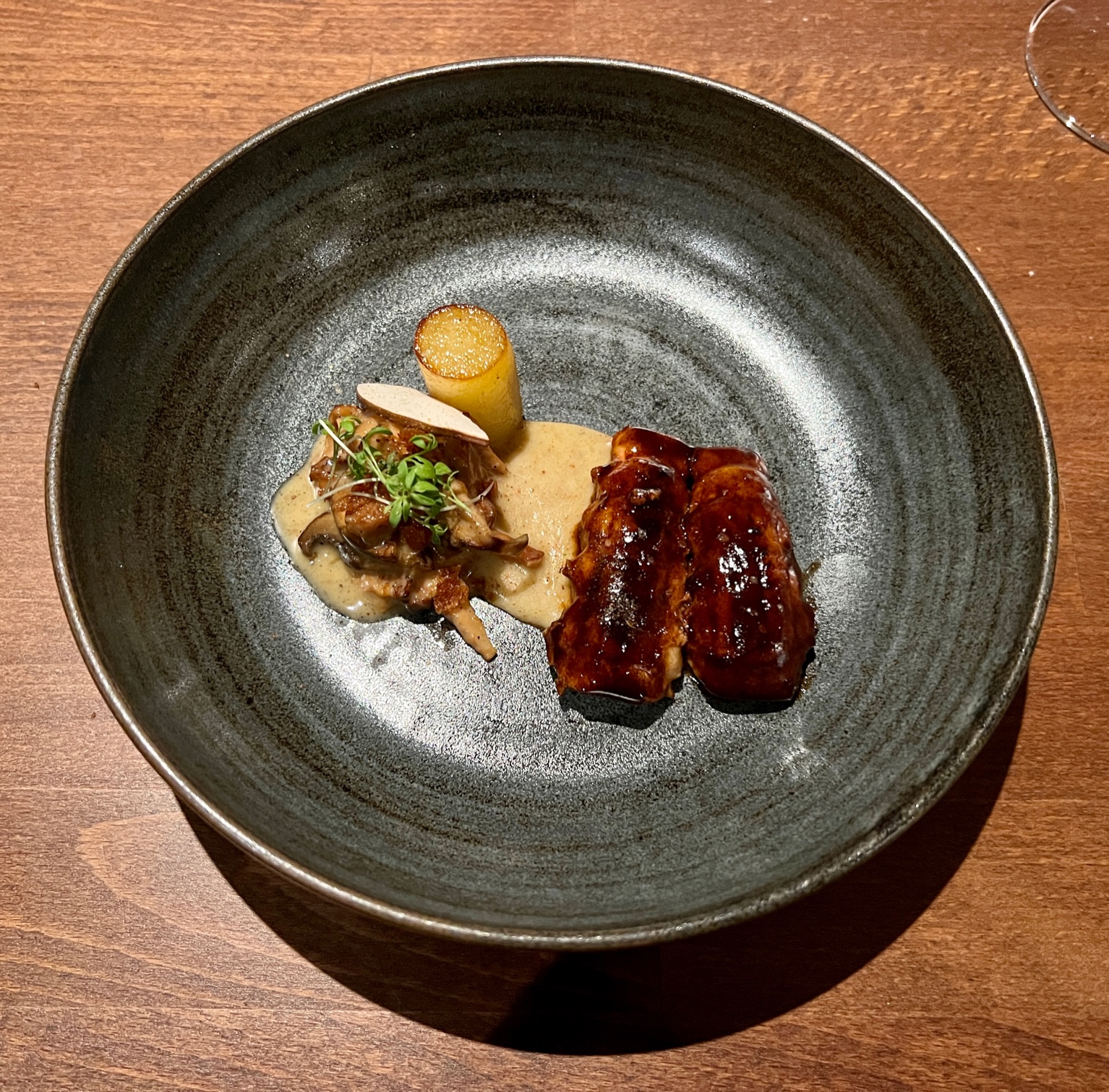
Michelin-starred Pastis is a simple but superb restaurant in the old city. I had lunch there on my first visit to Montpellier, in a very tasteful dining room that I would say is possibly the most beautiful beige space I’ve ever seen, the acceptable face of taupe. The menu here’s a surprise one (no swaps, unless you have allergies) but every one of the surprises was very pleasant indeed. My highlight on that visit was a dish made with local duck, served simply but accompanied with a bread roll hollowed out, stuffed with coarse, herby confit duck and then liberally soaked with rich, sticky jus. I left full and happy (and slightly smudged, after also putting paid to a knockout bottle of white Corbieres).
I returned in 2024 for lunch again and although I still really enjoyed my meal it maybe didn’t quite reach the heights of the likes of Bistro Urbain and Ébullition. Service was a little sluggish and made some interesting choices: the wine list had nothing by the glass but the staff said they could sort us out, yet they decided to bring a glass of dessert wine with our mains for reasons that escaped me. But some of the dishes were still exceptional, including fish perched on crispy fried lozenges of rice and a beautifully blushing piece of lamb with artichoke.
Michelin-starred Reflet d’Obione is the one restaurant I visited on both of my 2022 visits to Montpellier and each time the tasting menu with wine pairings, by no means the kind of thing I normally go for, blew me away. It’s a small, comfortable, hushed restaurant with the kind of attention to detail (and attention to customers) that not only gets you a star – it’s held one for a few years now – but one of those Michelin green stars that most people seem to think are bullshit.
Chef Laurent Cherchi – young, intense and moustachioed – comes over to every table and the rest of the time bosses a young, extremely talented brigade. On my second visit we had a table in the front room, overlooking the kitchen, which gave you a fascinating insight into just how much work goes into delivering perfection. But the front of house is every bit as accomplished and polished, talking through the dishes and the wines with charm and enthusiasm with perfect English (although every thank you is greeted with a whispered je vous en prie).
Every dish I had, across two visits, was stunning and provenance was given reverence, with all the ingredients and all the wines being completely from and of the area. Highlights included the most stunningly executed fish with a gratin of pumpkin and a Day-Glo orange sauce, a langoustine brushed with a deep, umami civet sauce and served with a tangle of wild mushrooms and a magnificent dessert of figs served something like five different ways with a divine cream spiked with green anis. Rarely do I love a dessert this much which doesn’t involve chocolate; it came paired with a local vermouth which had notes of pine and rosemary (if you ask me) or canard de toilette (if you asked Zoë).
Just at the edge of the old city, near Montpellier’s copy of the Arc du Triomphe, this bakery was my go-to for a morning pain au chocolat. A little place which only admits two customers at a time, the queue stretched up the street, particularly on Saturday morning when it felt like the whole city was there stocking up on bread for the weekend.
But it was always worth joining. Even compared to the pastries elsewhere in Montpellier this was next level, with world-beating buttery lamination. Everything in there was beautiful – madeleines, danishes, focaccia and a glorious slab of pissaladiere topped with sweet, reduced onion, dotted with black olives and strands of anchovy. Montpellier, like the rest of France, has the same density of good bakeries as Reading has Costa Coffees. Where did it all go wrong for us?
I didn’t make it there in 2024 but I did get a list of other patisseries in Montpellier to try from Pierre. So next time I update this guide, expect to see references to Maison Bonnaire and Maison L’Oeuf – along with Scholler, an old-school institution to the west of the city: if you get to them before I do, report back.
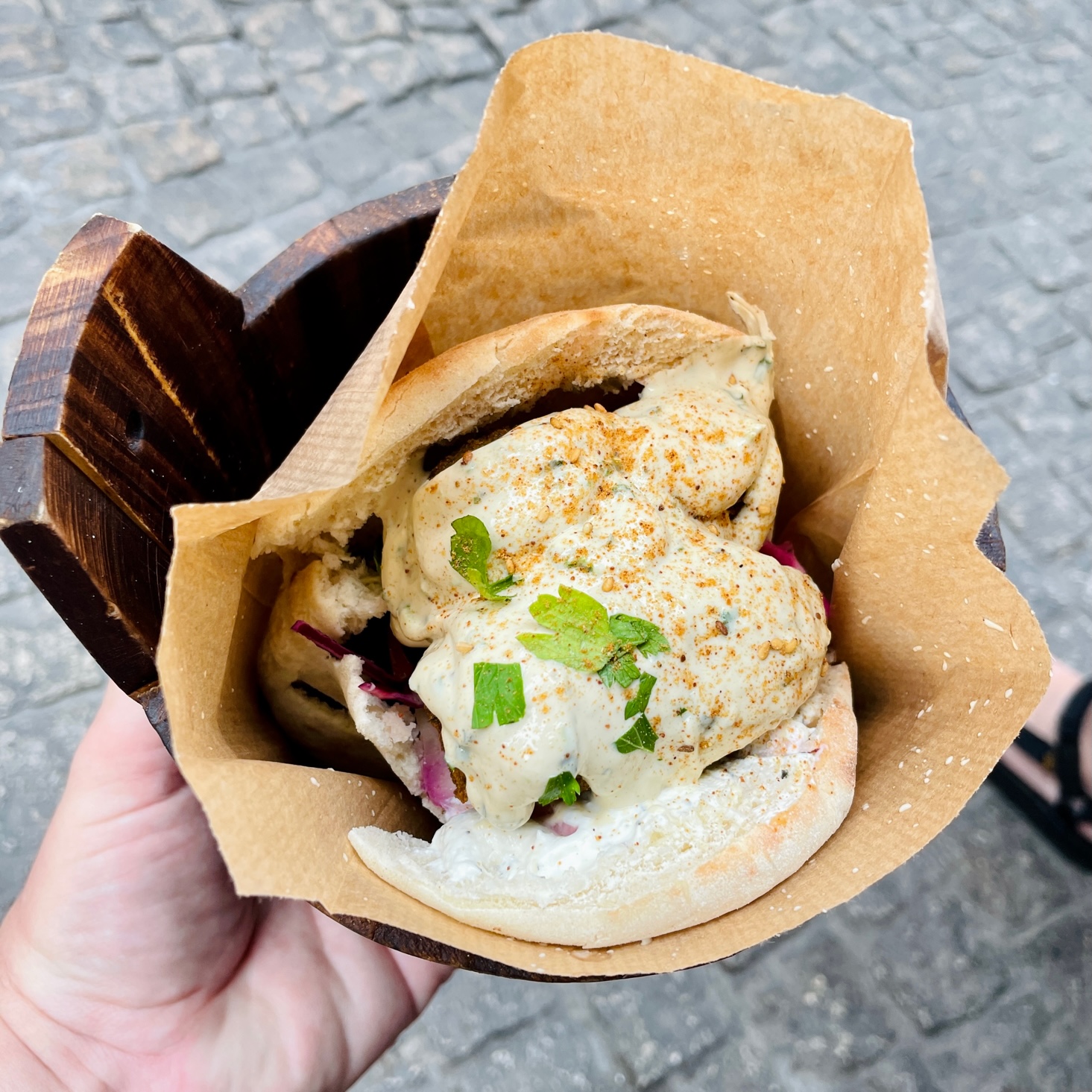
Green Lab is a falafel joint with two branches, one just off Place de la Comédie and my preferred one on rue de la Université. I associate top notch falafel with France after many happy meals at Paris’ legendary L’As Du Fallafel and Green Lab didn’t let me down when I visited in summer 2022. It offers a relatively compact menu of falafel pitas and platters with variations on a theme; my choice, the Silvergreen, was a beautiful Meditteranean take on falafel, with a pesto tahini and a goats cheese tzatziki.
And if you think that sounds like cultural appropriation or vandalism, I’d say don’t knock it til you’ve tried it. It was a beautiful, multi-layered, ridiculous bargain of a thing bursting with enjoyable mouthfuls. A particular thumbs up goes to the sticky caramelised aubergine dotted throughout: is any vegetable more delicious in the right hands or more awful in the wrong ones?
On the first night of my summer 2022 trip to Montpellier, we’d planned to eat in Rosemarie, further up this list. But back then you couldn’t book online and they never responded to any of our attempts to book a table, so we cut our losses and ended up at Le Couperet, a French take on an American smokehouse. Rosemarie turned out to be a great restaurant, but even so I’m so glad we gave Le Couperet a chance.
They do two sittings every evening (including Monday, a night when many restaurants close) and they offer a menu which is delicious but limited. But you only need to find a handful of dishes you want to order, and that was no problem at Le Couperet. A selection of houmous and smoked artichoke dips started us off nicely and then they brought out a board groaning with the good stuff. Pulled lamb was terrific, especially with their homemade tomato relish, but the star of the show was a blackened pork rib, the bone dispensed with and the whole thing meltingly soft and tender. Le Couperet even smoked the potatoes used in their potato salad – how can you not love a place like that?
Abacus is a tasteful, almost ascetic-looking restaurant on the edge of the Écusson. The dining room is gorgeous, but on our visit in summer 2022 we sat outside on rue Terral enjoying the last of the evening sun and hearing the hum of the passing trams – and the following morning we had the insect bites to prove it.
The menu has a stripped-back simplicity to it too, with a choice of two, three or four courses and only a couple of options per course. I loved my tuna, barely even seared and full of clean mineral flavour (and the novelty value of hearing a Frenchwoman using the words Granny Smith – it was topped with crisp batons of apple – isn’t going to fade any time soon). Even better was a crisp pastry cigarillo crammed with rich roasted lamb, reminiscent of briwats I had many years ago in Marrakech, in another life.
We chanced upon Plein Sud, walking through the city one night, and liked it so much that we went back the following evening. It’s a natural wine bar, and a more perfect place to sit, shoot the breeze, drink and eat small plates is difficult to imagine. Like many of these places in Montpellier it’s almost absurdly pretty, with a gorgeous vaulted ceiling and honey-coloured stone walls.
But although the interior might be ancient, the sensibilities were modern: all the wine was outstanding and the food, top notch bread, an enviable range of cheeses and a gutsy, rustic rillette, were the perfect things to go with it. I don’t know whether natural wine is a tough sell in Montpellier. But if it is, if anybody can do it, Plein Sud can.
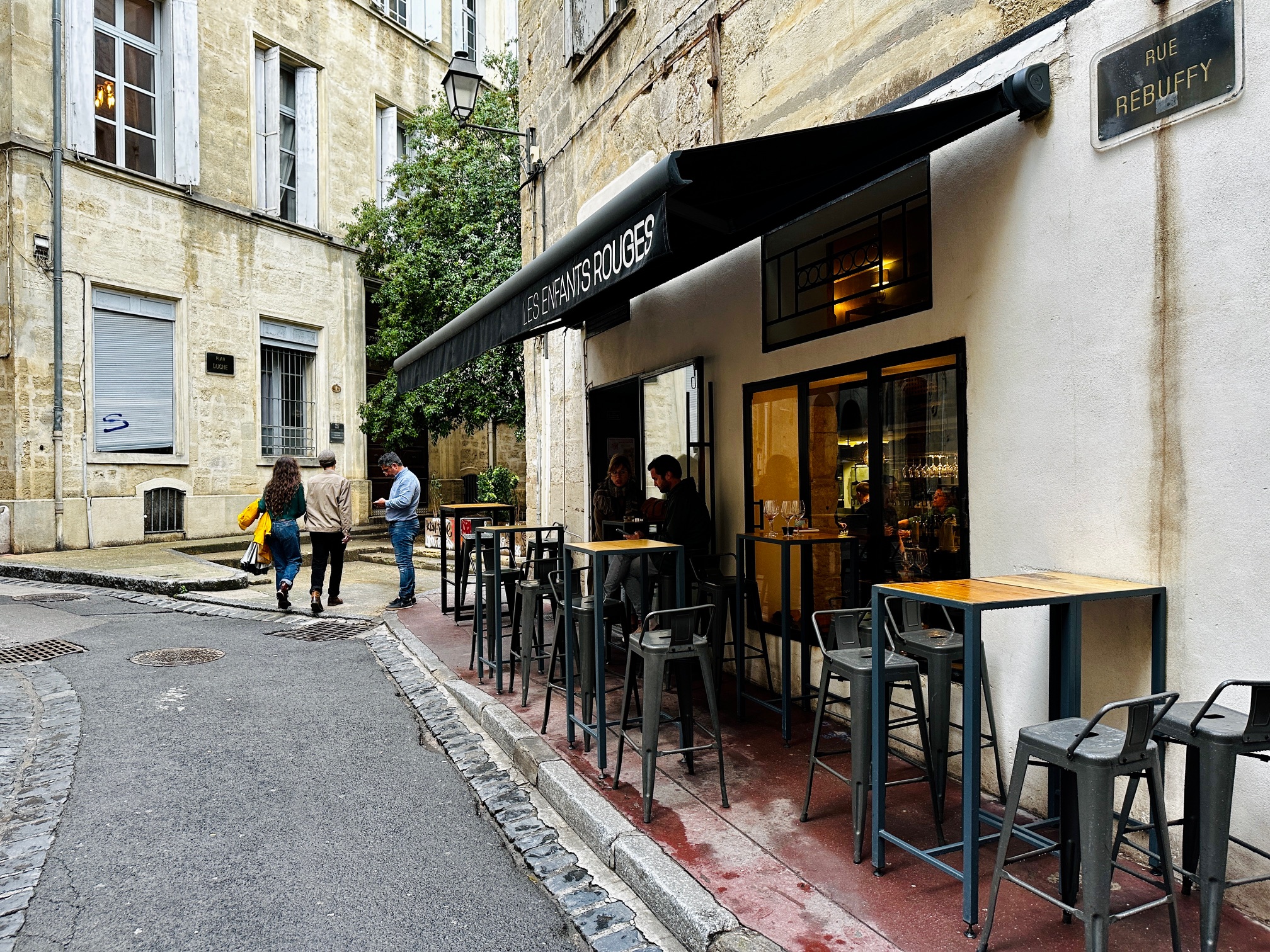
Another recommendation by Pierre, wine bar Les Enfant Rouges spans both sides of a busy street in the old city. We were there for a little while before dinner elsewhere, but the selection of wines by the glass was so good, the staff so accommodating and welcoming and the small plates menu so tempting that I plan to spend longer there on my next visit to the city.
On our most recent visit, we were sitting in La Barbote (further down) having a beer when Zoë got a comment on Untappd from a guy she vaguely knew called Rob. “What are you doing in my bar?” it said. So we told him to come over, had a beer with him and he offered to take us on a little beer tour of the city the following night.
Rob is British, but has had the excellent good sense to marry a Frenchwoman, and they have had the even better sense to move to France. He lives near the Alps but travels to Montpellier for work every week – it’s all right for some – and he has been following the craft beer scene in the city for something like a decade. “It’s absolutely the centre of craft beer in France” he told us, over beers in Popular Brewing, a fantastic little spot just down the road from Ébullition that we would otherwise never have spotted.
Another spot like Plein Sud with those beautiful, honey-stone walls, it felt a little like drinking in someone’s front room, but in the best way, and just like Montpellier’s other craft beer places it’s full of young, beautiful people to an extent which almost made me feel like I should be in the nearest Irish pub instead.
But again, the selection of craft beer from little breweries in this part of France and beyond was absolutely impeccable. I enjoyed a couple of IPAs, from nearby Brasserie VNDL and Brasserie Malpolon before going for an absolute cracker from further afield, by The Piggy Brewing Company, who are based near Nantes and make really exquisite beers.
Every time I checked something in on Untapped and looked at where the brewery was based, I felt like I was putting pins in a map of Montpellier and getting a better picture of the innovative, burgeoning local beer scene. No wonder Rob seemed so content with his lot in life.
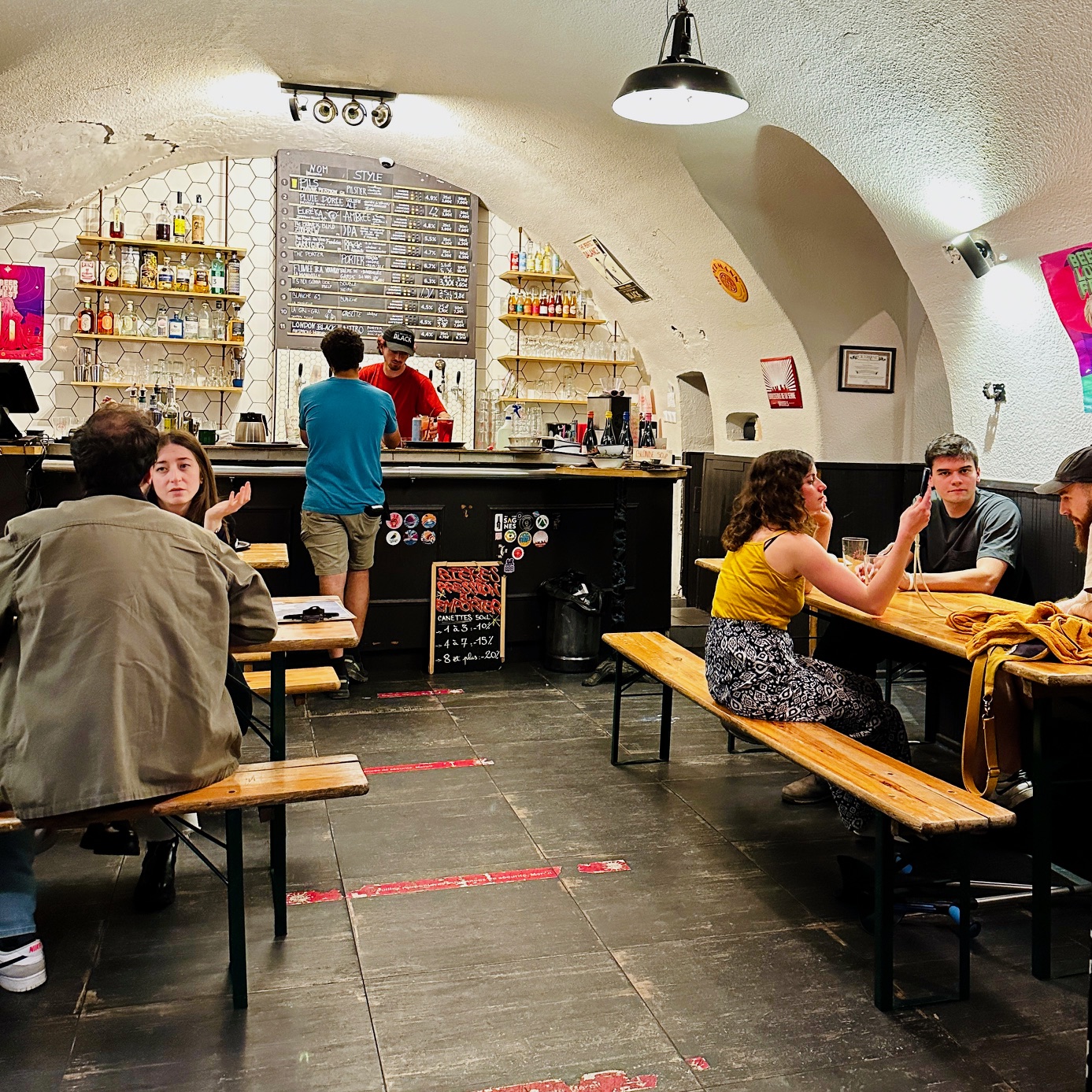
I’d seen Drapeau Rouge on my summer 2022 visit to Montpellier, but it wasn’t until 2024 that I managed to pay it a visit. It’s a gorgeous brewpub in Boutonnet, a district a short walk from the old city, with eleven taps, including beers from many of Montpellier’s breweries and a couple brewed by the venue itself. It’s not the comfiest venue in the world, with many of those trestle benches beloved by anyone who’s been to a tap room or a street food market, but I loved sitting outside with a sour and feeling like I was in a part of Montpellier the tourists would never see.
When I go back – which I keep saying about many of the venues on this list, and the city in general – I fully intend to give their food a go, if only because their website charmingly states that they aim to provide what they call “pub food” de qualité. I bet they do a better job of it than a bloody Wetherspoons microwave and by the looks of the menu, I’ll be on the frites loaded with smoked, spiced pulled pork, or topped with Belgian beef stew.
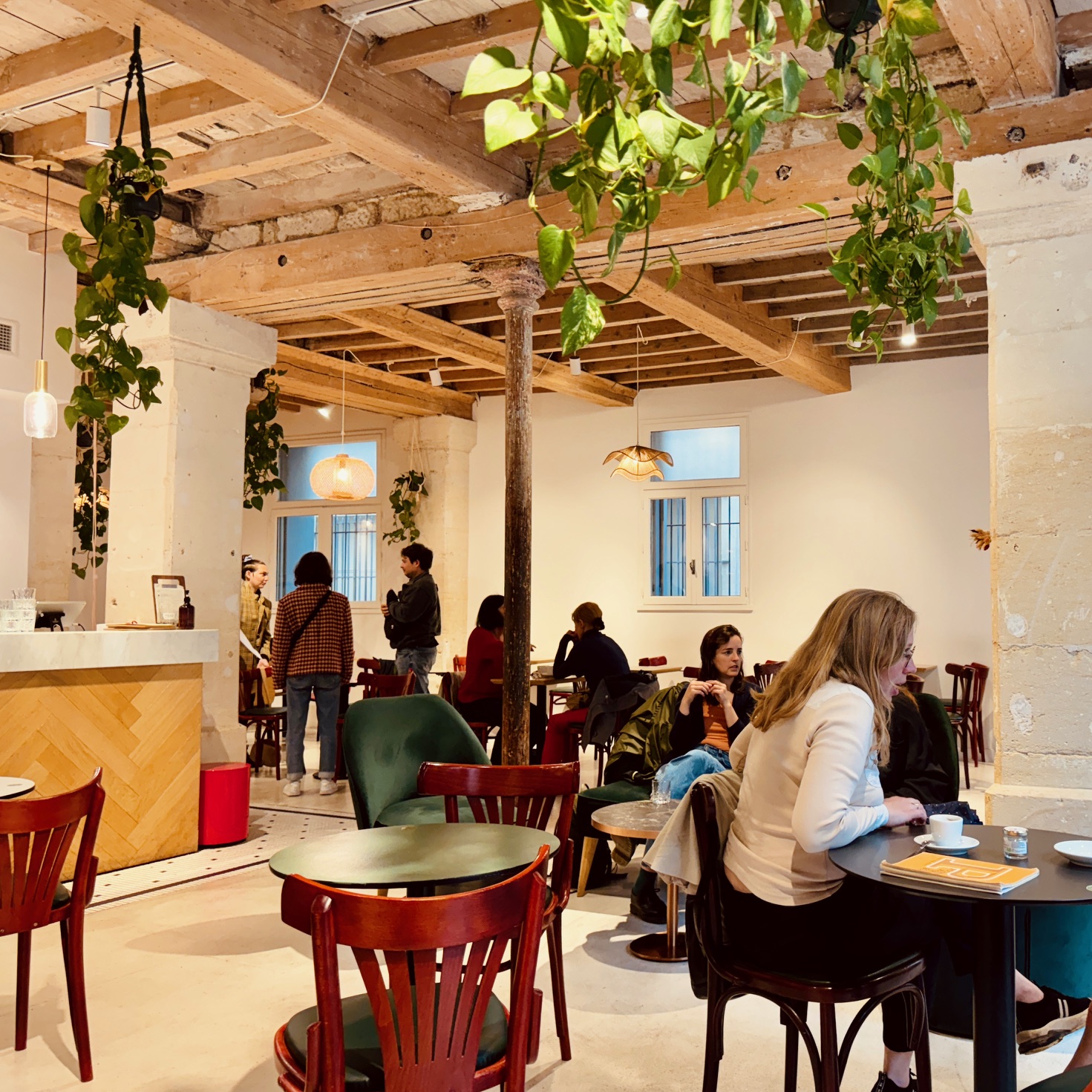
Cafe BUN was my favourite coffee place in Montpellier with a great spot just off Place de la Comédie and plenty of outside space for watching the world go by. It was the trailblazer (Montpellier’s answer to Workhouse, I suppose) opening in 2013 as the city’s first speciality coffee house and I grew very fond of it during my first trip to Montpellier.
A morning visit there to plan the day ahead over a grand crème became a very happy fixture of my second trip to Montpellier. They roast their own coffee – I brought some home with me – and their latte was easily the nicest I had on my holiday. In the time between my second and third visit they opened a second, much bigger site on the other side of the old city which Zoë preferred. For me though, there was nothing quite like sitting outside the original and best.
Café BUN 5 rue des Étuves/32 Boulevard du Jeu de Paume https://cafebun.fr
6. Le Discopathe
Le Discopathe was one of the happiest discoveries of my first visit to Montpellier. The walk from the old city back to our B&B went down Rue de Faubourg du Courreau, a scruffy, lively street reminding me of Waterloo’s Lower Marsh, and it quickly became one of my favourite parts of the city. Much of that was down to Le Discopathe, a vinyl and craft beer shop that sold records by day and served more of Montpellier’s excellent local beer by night.
You grab a spot at one of the trestle tables outside, get yourself a pint of something hazy, a bière d’ici, and just enjoy that feeling of being part of a buzz and bustle bigger than you. Sacrilege and Brewing Bears are well represented – more on them below – but I also had a beautiful IPA from Brasserie le Détour. We became regular visitors during our holiday, and it was one of the happiest places in a city full of happy places.
On our second visit we got to explore some of the nearby restaurants (Les Freres Poulard, above, and Lipopette) although I promised I would fit in a nearby pizza joint called Pousse on a third visit and never quite did. that I firmly have my eye on. But I’ve never gone to Montpellier without fitting in at least one visit to Le Discopathe, one of my favourite places: it’s also worth noting that it’s one of Montpellier’s only craft beer bars that opens before about 5pm.
Often, and I don’t mean this unkindly, craft beer places (like craft coffee places) can feel a bit thrown together on a budget. The stools are uncomfortable, the interior is death by chipboard and we all convince ourselves that that’s absolutely fine because we’re purists. Going to Hopulus in summer 2022 I was reminded that it doesn’t have to be that way.
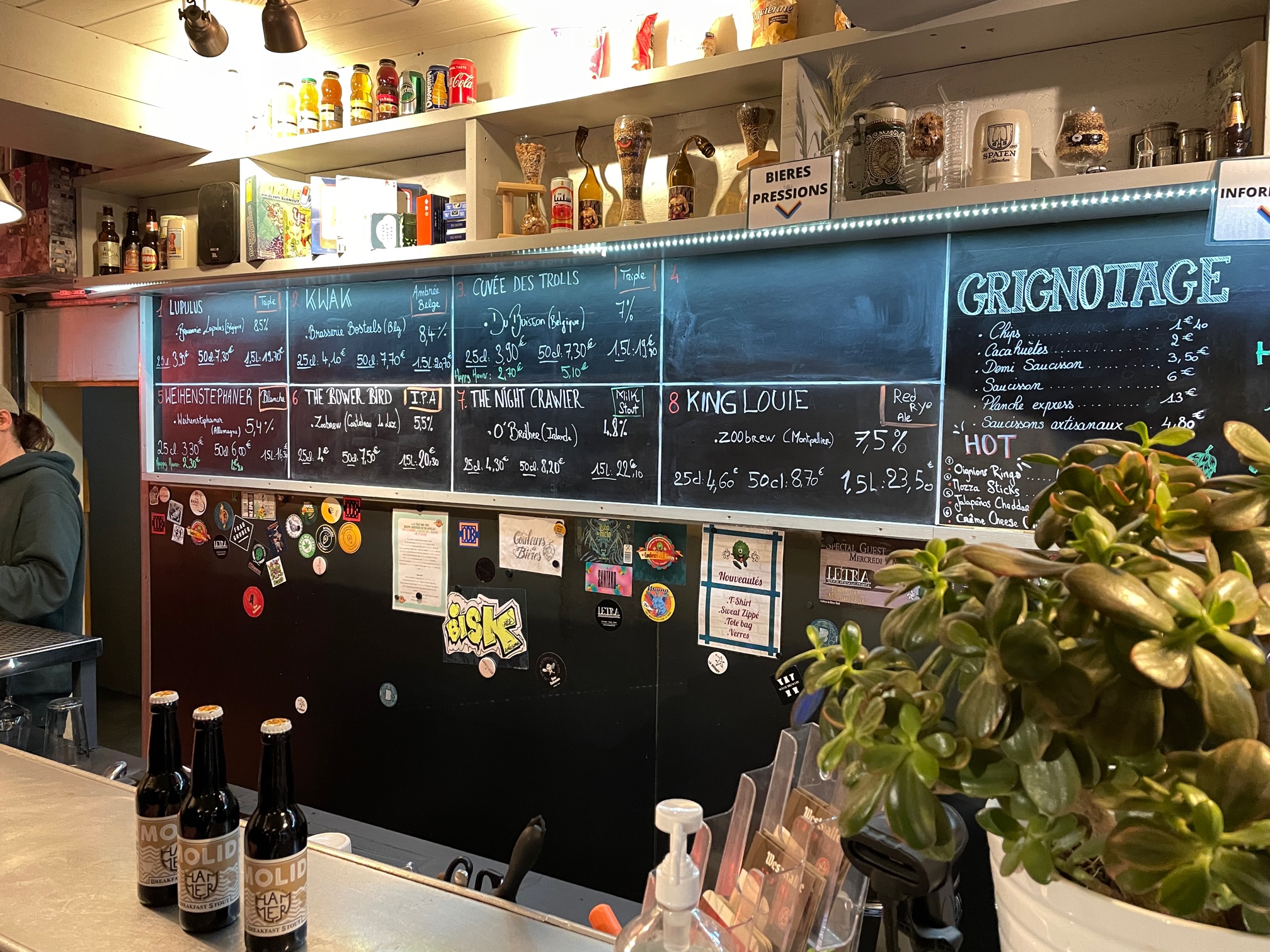
It’s a stunning space in the old city, all vaulted stone ceilings, like a cellar bar that happens to be on the ground floor. Like the next entry, La Barbote, they brew their own beers on the premises in a variety of styles and, also like La Barbote, they have a happy hour which will make you very happy indeed. I tried a Belgian-style quadrupel here and a blond lager and both sent me on my way with a spring in my step. They also do cheese, charcuterie and all the other wonderful things that just make beer that tiny bit better, and – crucially on a muggy September day – they have outstanding aircon.
Going back for a slightly longer session in 2024 I managed to make a dent in the food menu, and loved everything I ate. Getting a whole Brillat Savarin, in beautiful condition, to eat with bread was one thing but even better was caillette, a smoked meatball with a slightly gamey taste and the subtlest hint of offal which was how the faggots of my childhood would have tasted – if they were as good as my nostalgic recollection of them, that is.
La Barbote, the grand-père of Montpellier’s buzzing craft beer scene, was round the corner from my hotel on my second trip to the city. It’s not far from the train station either, it was the first place we stopped for a drink and I think we ended up there most nights for a snifter before venturing forth to our restaurant of choice. And actually, although it was perfect for that my biggest regret is that we didn’t stay there longer.
It’s a microbrewery and they brew on the premises, offering a dazzling dozen or so beers at any one time. Everything I tried from them knocked it out of the park, from Tête Gourmande, their sweet but sharp pastry sour, to their NEIPA Set The Controls, from a DIPA called Cortez to a thick impy called De Profundis with a nicely caffeinated bite.
It’s deceptively big and it filled up pretty much the moment people quit work every day, possibly because of an insanely good happy hour where a pint of anything costs you five Euros max until seven o’clock. Looking round it was a better advert for craft beer than so many equivalent places in the U.K. with a young and diverse crowd: if they have some bore in a fleece in the corner ranting about the Good Beer Guide or whether the beer was “in good nick” I never saw them.
They also do food and I got to try their karaage chicken – which was magical, by the way – and some equally good (if messy) fish tacos. If you want a casual meal and a really good drink on the trip to Montpellier you’re surely planning by now, make a pit stop here: we made a point of returning during our 2024 visit and found the beer as beautiful as ever, the karaage if anything even better. And again, the place was buzzing with the kind of people craft beer in the U.K. would love to attract i.e. it was by no means a sausagefest.
Zoë’s verdict? “It’s how Zero Degrees would be if it wasn’t shit”.
Couleurs de Bières Nord is a cracking little bar in, as the name suggests, the north of the city. It’s opposite the exotically named Stade Philippidès, and there’s something about watching people running round the track that really puts you in the mood for a cold, crisp beer. The list here on my 2022 visit skewed little more Belgian, with a couple of beers on tap by ZooBrew, a local brewery, and it made for an eminently suitable pre-prandial spot.
We made a point of returning in 2024 – it pairs nicely with Drapeau Rouge, if you’re planning a crawl – and if anything I liked it even more, and the list of 8 beers on keg was much more French with beers from nearby Nimes, Mauguio and Sommières. Nothing by my favourite local brewery, the exceptional Prizm Brewing, but you can’t win them all.
Broc Café is a beautiful cafe on a street opposite the botanical gardens, and on my first trip to Montpellier it was very hard to walk past it without stopping for a drink. On my second visit I didn’t even attempt to do so, and we had a thoroughly agreeable couple of hours sitting on the terrace watching Saturday night come to life in the city. Unusually for this kind of venue they have an excellent selection of craft beer from local breweries along with wine and aperitivi, and a special mention has to go to the staff who are exceptionally helpful and friendly, very proficient at suggesting drinks you might not have considered and work like absolute Trojans.
Coldrip, on the northern side of the old city, is in another absurdly pretty little square and also gets plaudits online for its coffee. Having perched at a table outside I can completely understand why – my latte was wonderful, and Zoë reckoned her mocha (complete with a little ramekin of Chantilly cream) was up there with C.U.P.’s, something I didn’t previously think was possible.
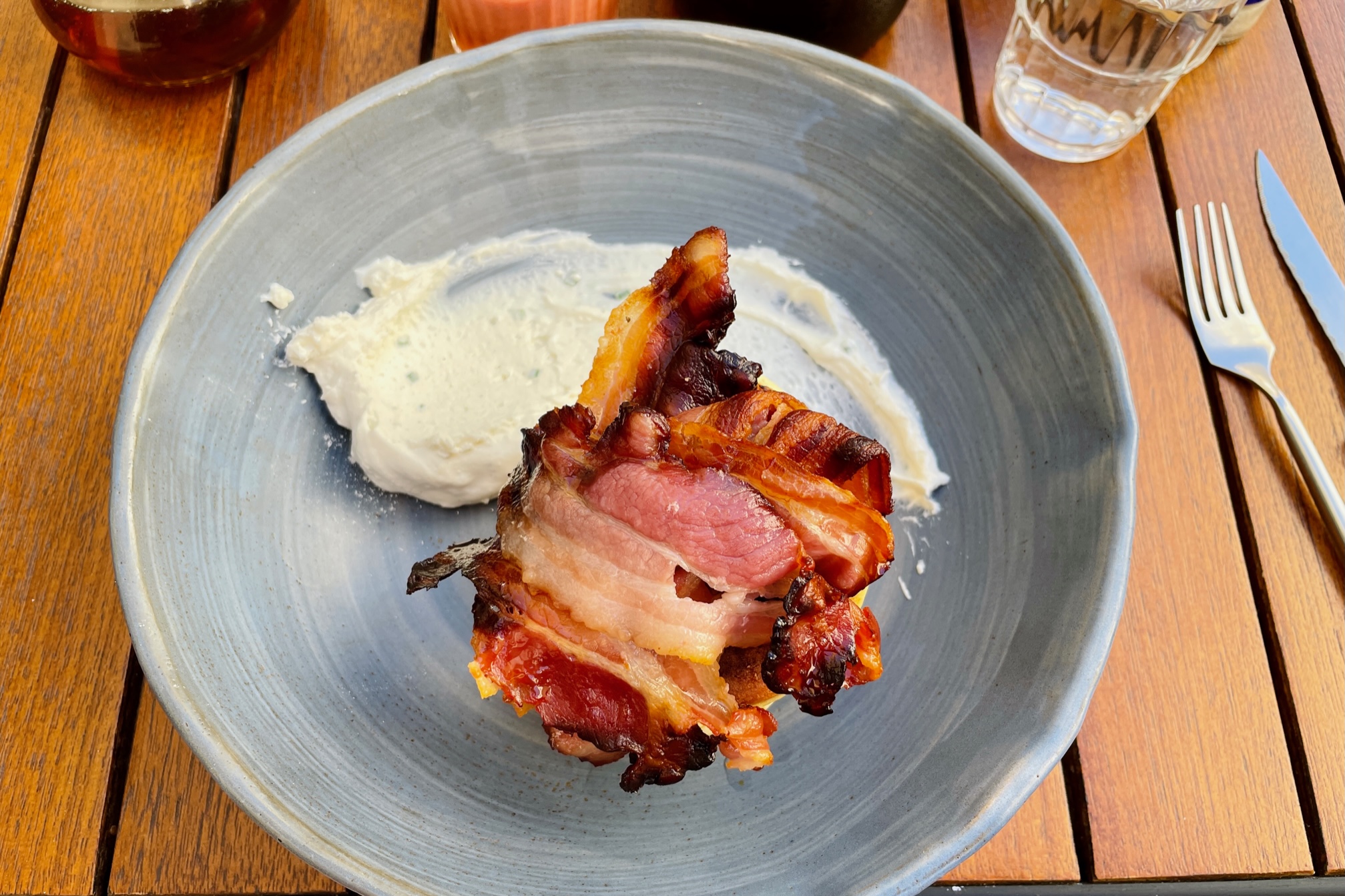
The brunch menu owes more to Australia than France – lots of smashed avocado, halloumi and the like – and watching it turn up at other tables tested my resolve. But they had a crispy chicken burger on their specials menu the first time I visited in spring 2022 and it turned out to be a perfect final day lunch, really nicely done with a deceptively tasty coleslaw full of brightness and crunch and a delightful seeded brioche bun. We made a beeline there for lunch on my return to the city that summer and I had the most incredible pancakes topped with salty, crispy bacon. They bring a jug of maple syrup and leave it at the table, which strikes me as both very civilised and very decadent.
Many cities have some kind of craft beer scene, and the template is a well-trodden one: some big warehouse either in an industrial estate or near the docks, on the edge of town, usually requiring a taxi to get to (our own Double-Barrelled follows in that proud tradition). Le Réservoir is not quite like that. It’s on the outskirts of the city, and our Uber driver, who turned up in an impressively over the top lipstick-red Tesla, had never heard of the place. But it feels properly in the middle of nowhere, with the distinct whiff of agriculture from its neighbours.
It had only just opened when I visited in spring 2022, and had the feel of a place built in anticipation of demand, rather than because of it. But inside it was positively splendid, with twenty taps nearly all of which are devoted to local beer. The space is shared by two breweries – Brewing Bears, which does more conventional IPAs, and Sacrilege who specialise in mixed fermentation beers and saisons with all sorts of interesting fruit and weirdness going on. We tried a bit of both, and had a really fantastic afternoon doing it.
I’m sorry I didn’t get to go back on subsequent visits for an afternoon of craft beer and pétanque – apparently you can play it on the premises – but I have it inked in for next time, red Tesla or no.
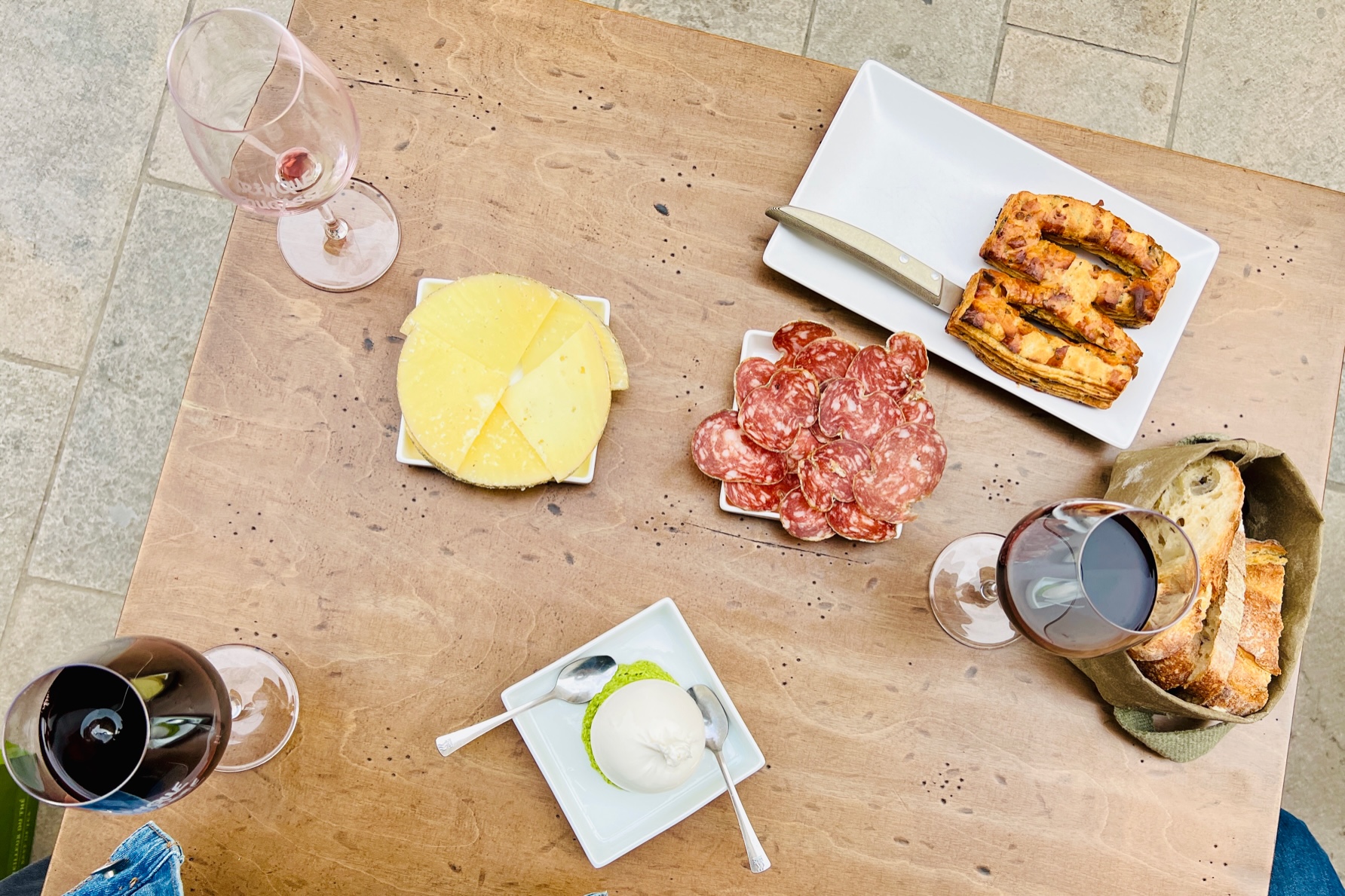
A discovery on my very first visit to Montpellier, this was a very agreeable spot for a few glasses of wine, some cheese and charcuterie and a spot of people watching, along with a welcome opportunity to rest our feet after an afternoon of retail therapy. There are something like four reds and four whites available by the glass, ranging from thoroughly decent to bloody marvellous, and the small plates include sliced saucisson with a mild hum of offal, a gorgeous burrata with pesto, all manner of local cheeses and of course the eponymous fougasse studded with olive, which is flaky, indulgent and worth the price of admission alone.
The staff are absolutely lovely there, too. And for beer lovers there’s a really well curated shop a few doors down called Deli Malt which offers an extensive introduction to Montpellier’s burgeoning craft beer scene and has plenty for you to squirrel away in your suitcase for the rueful journey home.
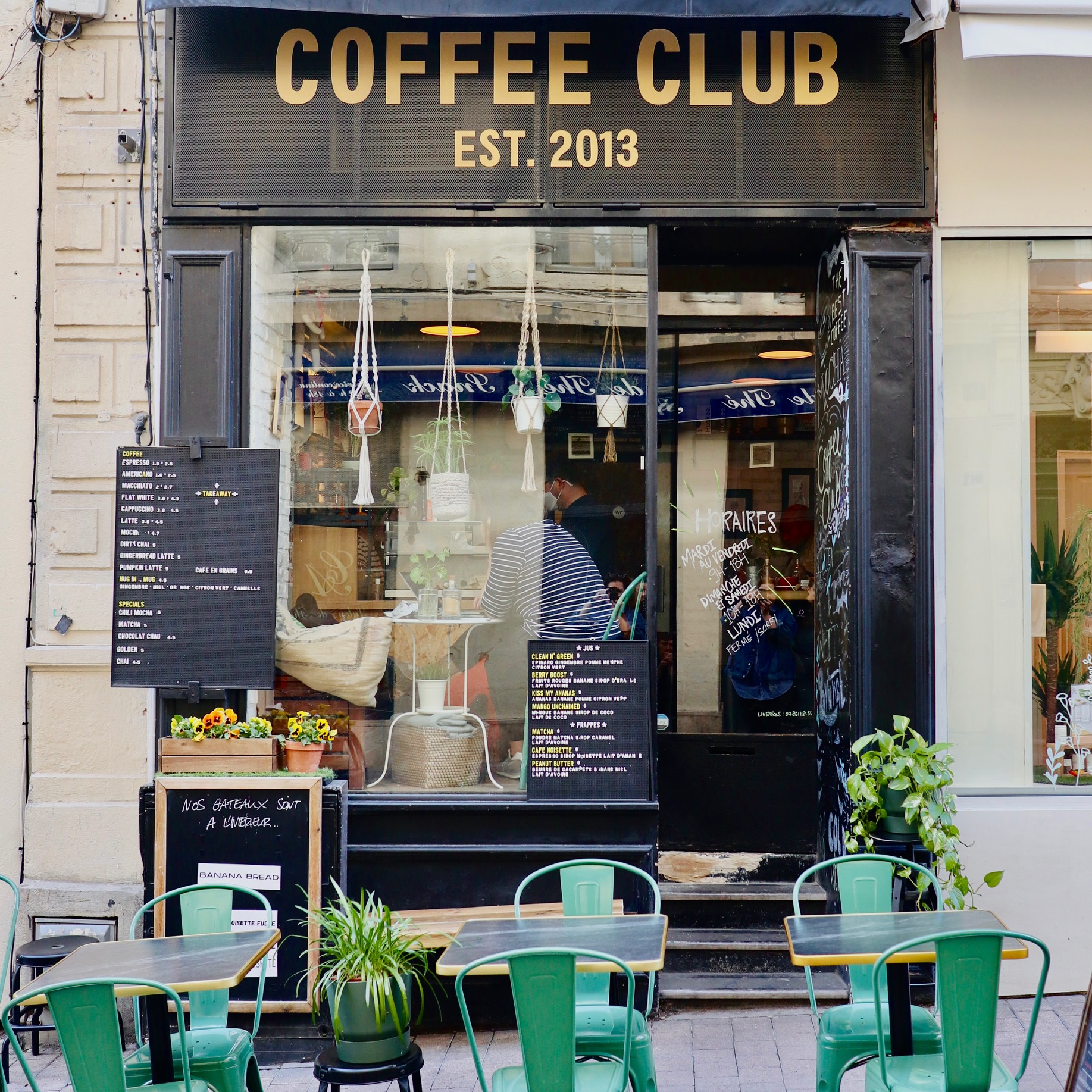
I also enjoyed Coffee Club, a tiny place on rue Saint-Guilhem with a little space inside and a nice spot at the top of the hill. This felt a little more expat than Café Bun – it’s owned by a Brit, which may explain that – but it was still a really good choice if you wanted a morning off café au lait and to try something similar to coffee closer to home.
Having said that, on my two subsequent visits to Montpellier I did find myself going to Bun, which does slightly better coffee and has more space, rather than Coffee Club. Also worth mentioning, further down the hill, is the splendidly named Maisons Régionale des Vins et des Produits du Terroir, which has a faultless selection of local wine, beer and other delicacies so you can take a little bit of the Languedoc home with you when you leave.
No blethering preamble for you this week, talking about the history of Reading’s food scene and putting things In Context (because there always has to be a Context). Things are much simpler this time around, because by the time you read this I’ll be off on my holidays and I just wanted to eat somewhere really nice the weekend before I went.
There’s something magical about the weekend before you go away, right from the moment you close the work laptop on a Friday afternoon: the knowledge that the weekend you’re about to have won’t be bookended by opening the sodding thing again on Monday morning, knowing that instead you’ll be at the airport, putting your phone and house keys in the plastic tray at security, browsing the duty free fragrance, daydreaming about that first holiday beer or glass of wine.
That’s why I found myself in Wallingford on Saturday afternoon with a reservation for Five Little Pigs that evening. Five Little Pigs received national attention earlier in the year when it got a rave writeup in the Observer. And whatever you think of Jay Rayner, his review of the place talked about deep-fried olives, a burnished toastie with cheese from nearby Nettlebed Creamery and a deep, savoury venison ragu. Reading that was enough of an incentive.
And besides, it’s not as if I had to go there with Rayner. Like most people, I have an infinitely better option: in fact, Five Little Pigs was on the list of restaurants I wasn’t allowed to review with anybody but Zoë (or, as she puts it, “not without me you fucking aren’t”).
Wallingford is a sleepy place, although remarkably easy to reach on the evocatively named River Rapids bus. It’s a very agreeable forty-five minute amble through Oxfordshire, out past Cane End, Gallowstree Common, Stoke Row. I expected Wallingford to be a little like Henley, or Witney, but it’s smaller than either with a couple of main streets, a pretty pub by the green and a really lovely wine shop, the neatly named Grape Minds. There’s also one of those antiques centres which is a succession of rooms full of tat and treasure in indeterminate proportions, and a Scandi interiors shop which mostly sells Farrow & Ball. The craft beer scene there is one bar with a fridge full of Phantom and Arbor Ales. That’s not to say I didn’t like Wallingford, but by the time our table was ready I was very much ready for it.
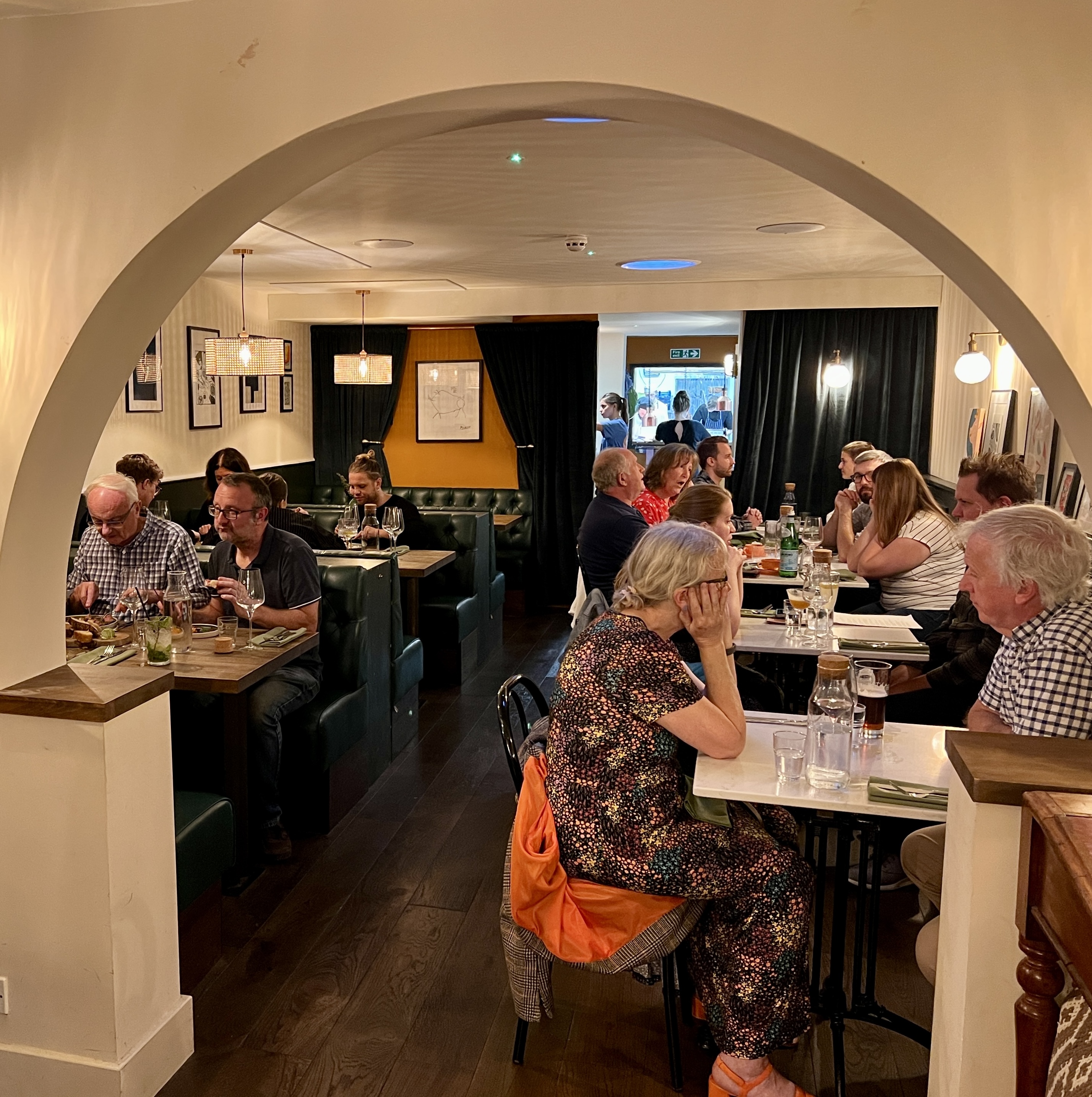
From the review I’d read I thought Five Little Pigs would be small but actually it was much larger than I expected. The front room, with the full length windows out onto St Mary’s Street, was a chic (if slightly chilly) space which was very tastefully done, an interesting mix of deep blues and golds and pastel shades from the art on the wall. It reminded me of places like Coppa Club, which isn’t necessarily a compliment. Further back was a longer, plainer room with banquetted booths. It’s a surprisingly hard space to photograph (as you can probably tell) but it was packed at seven o’clock on a Saturday night: a good review in the Observer will do that for you.
The menu read well and had plenty on it to appeal. Starters clustered around eight or nine pounds, and only a couple of mains were north of twenty. Plenty of it was local, too, with nearby cheesemakers, growers and butchers all namechecked. “We don’t have the pigs cheeks at the moment” said one of the wait staff, “but they may come in later.” I found that a bit confusing – were they being delivered by drone? – but decided it was best not to ask.
By that point a bottle of red had been opened, a really enjoyable organic Rioja, and I was about to reach that happy place where the food has been ordered and you know you’re safely in somebody else’s hands for the next few hours. Every table was full – with date nights, family gatherings and, in one case, an elderly couple who seemed to spend most of the evening glowering at each other. We were all going to have an enchanting evening. The Observer said so.
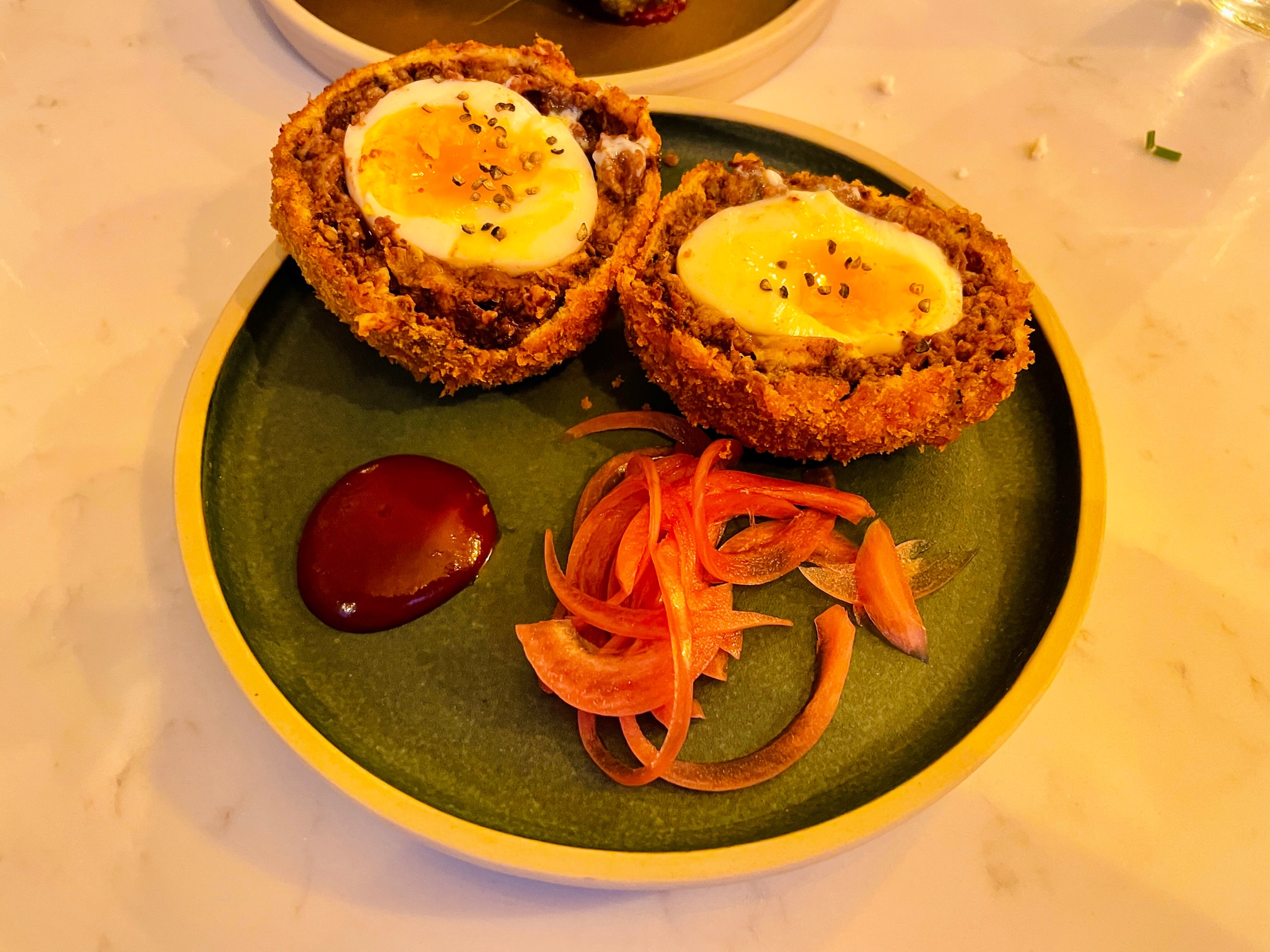
I felt a bit basic ordering the Scotch egg, but I can’t remember the last time I had one so it was calling to me from the menu right from the outset. It was one of the nicest things we ate all evening, so proved to be a happy choice : the sausagement was nicely coarse, with black pudding adding a little earthiness. And if I’d have liked the outside a little crisper, or the whole thing slightly less crumbly, the presence of a small pool of superbly tangy rhubarb ketchup mostly made up for that, as did the pickled pink onions.
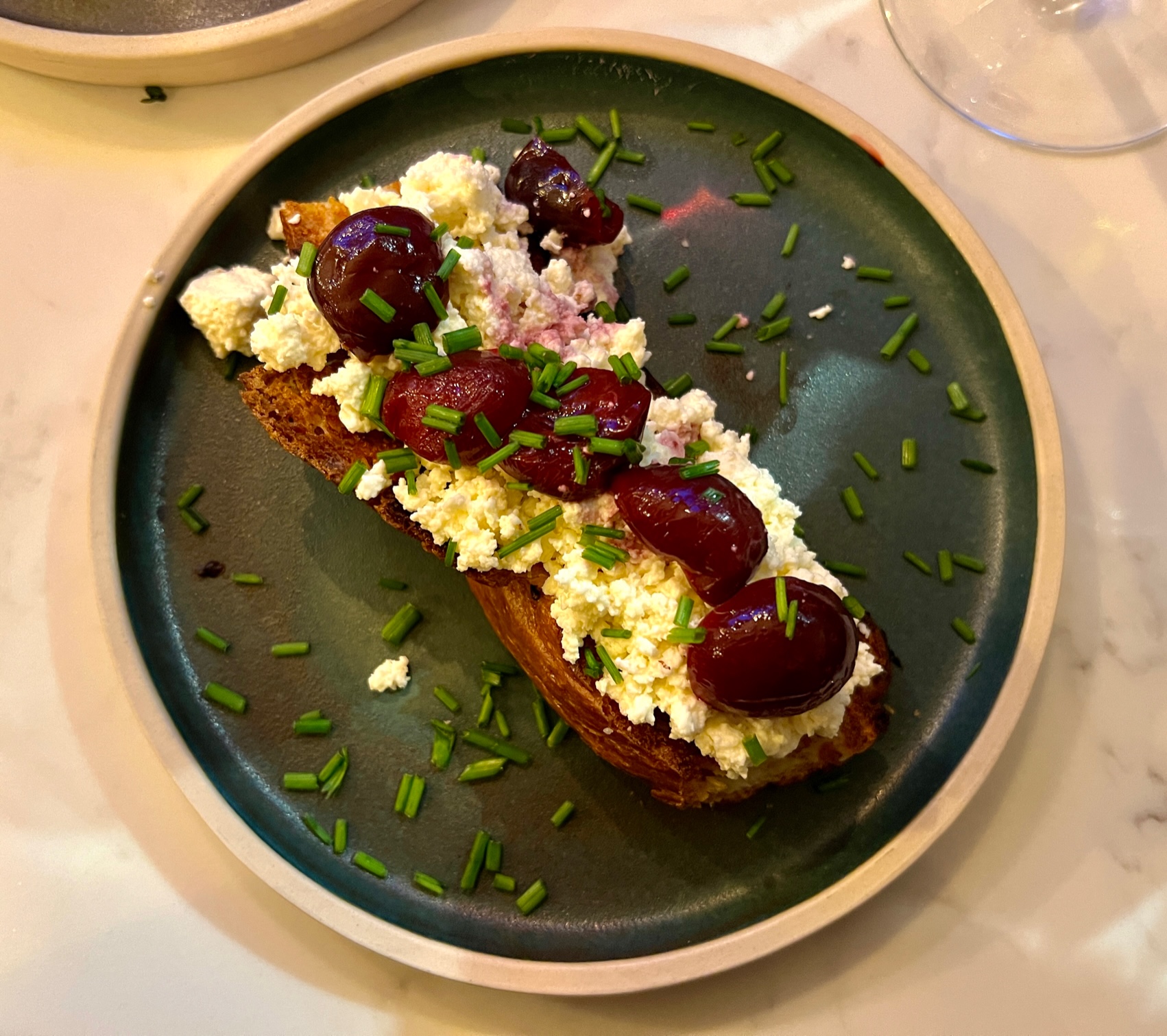
“You win” said Zoë, tackling her ricotta on toast, which sounded great on paper but in reality was disappointing. “It’s all a bit dry” she said, and this is a woman who’s listened to me talking about my favourite Bob Dylan records, so she knows what she’s talking about. For what it’s worth I agreed – the ricotta was dry and anaemic, the cottage cheese of the Chilterns, and although the roasted cherries were an interesting idea they didn’t add enough of the moisture this dish needed. Literal cherries on top, yes, but sadly not figurative ones. “This could have been really nice with honey” was Zoë’s take.
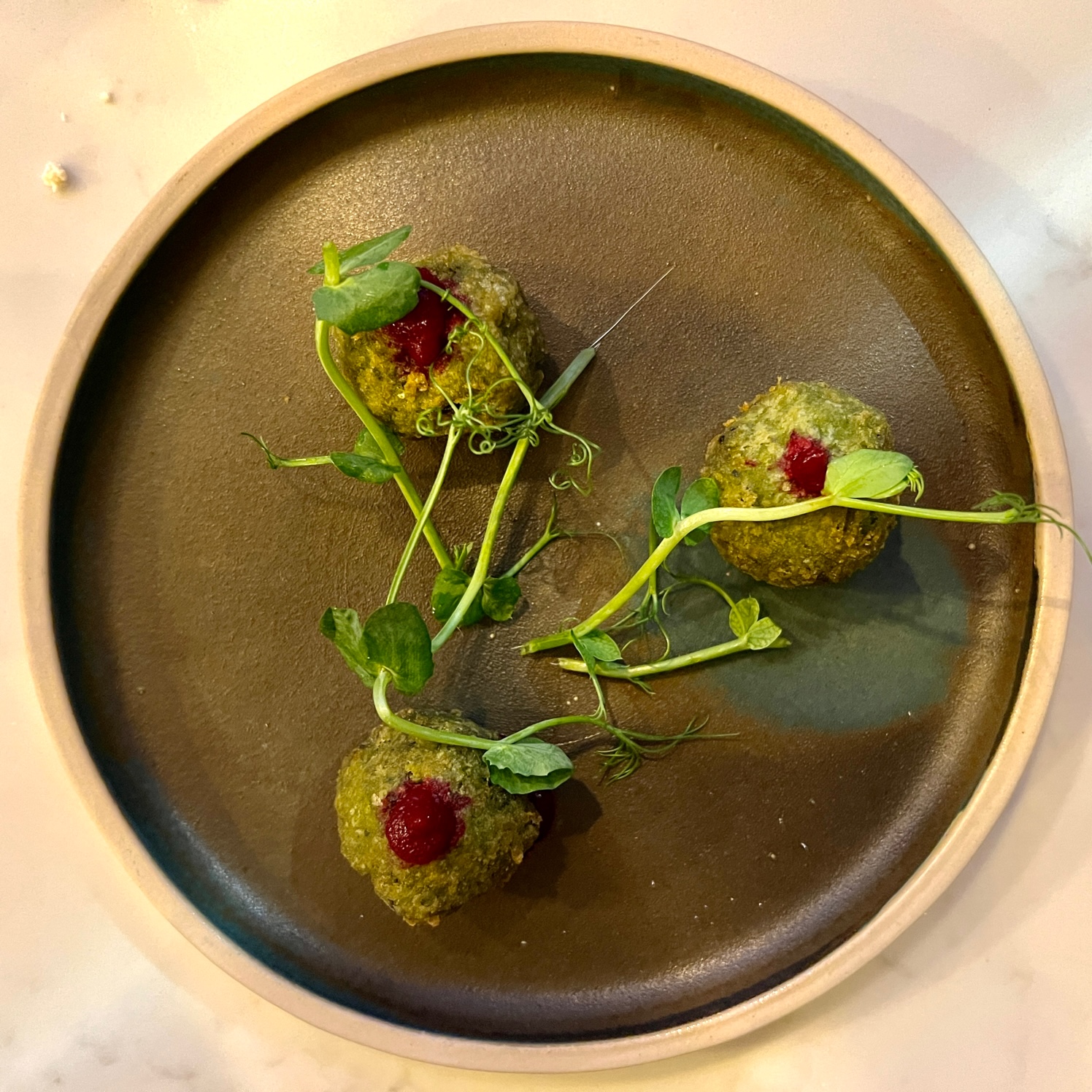
We’d also ordered a third starter, broad bean fritters, because they sounded so magnificent. And they tasted gorgeous, with huge amounts of freshness from the mint and a dab of deep whipped beetroot on top. But plating it up with pea shoots and plenty of negative space couldn’t really conceal the most obvious thing about this dish, which is that it was minuscule; it was one of those times when I wish I’d popped a twenty pence piece on the plate before I took the photo so you could see just how small they were. We had this as an extra dish, but if this had been my starter I’d have been looking at everybody else’s, feeling profoundly robbed.
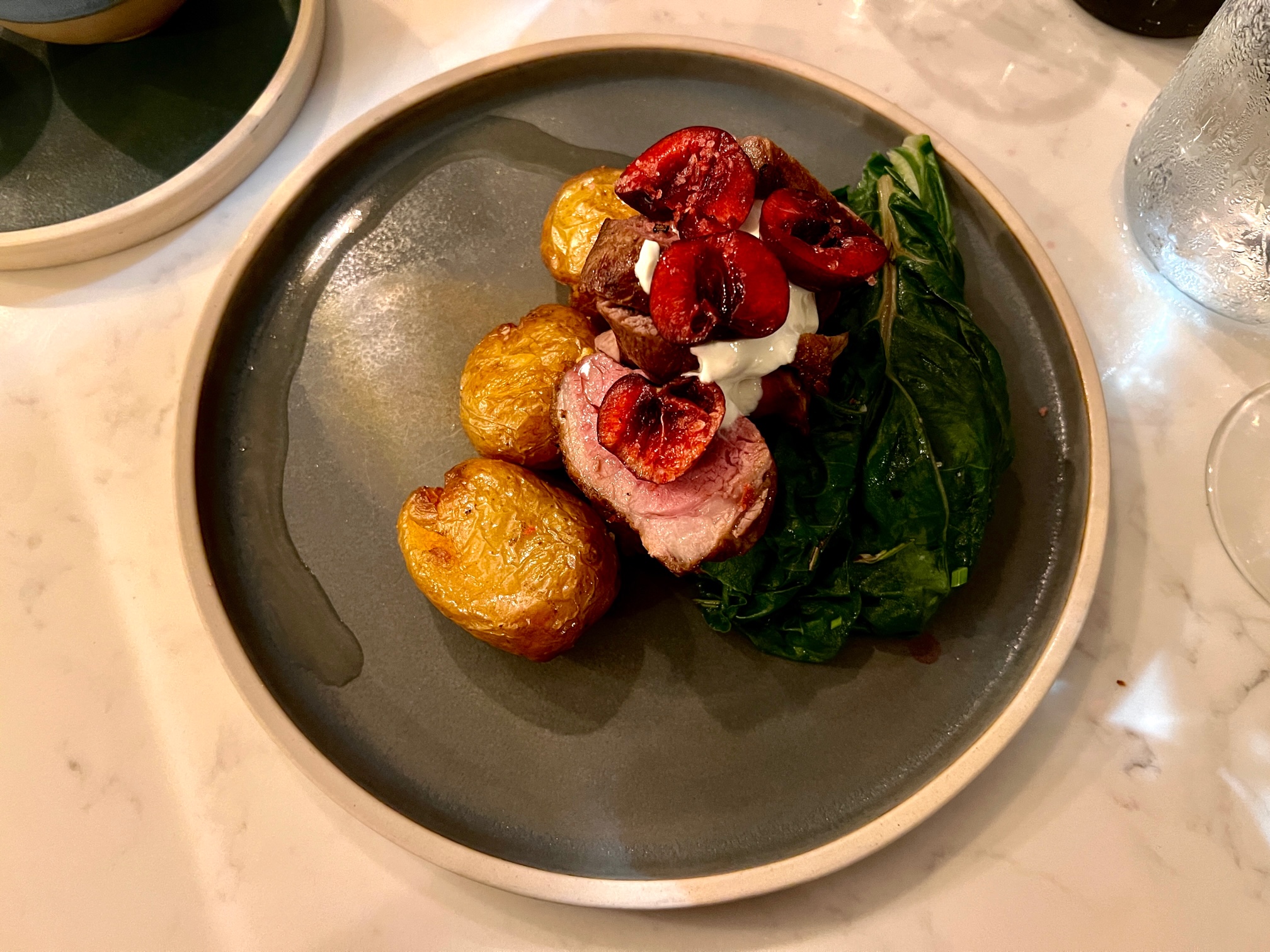
Things were well paced at Five Little Pigs, possibly because it was so busy, because our starter and our mains were about half an hour apart, for me close to the optimum interval between the two. I think Zoë chose better with the mains and her lamb rump with yoghurt, more of those roast cherries and what the menu calls “crispy potatoes” was the pick of the two. But even here, it wasn’t perfect. “Again, it’s dry” said Zoë. “The yoghurt is really good, but if anything it needs more of the cherries. They work better here than they did with the starters.” I agreed with that, although I thought the crispy potatoes were a standout, with a lot more texture than met the eye. But for me, the lamb rump was a little overdone. I found it odd, too, that they brought me a steak knife but not Zoë, when her dish needed it every bit as much as mine.
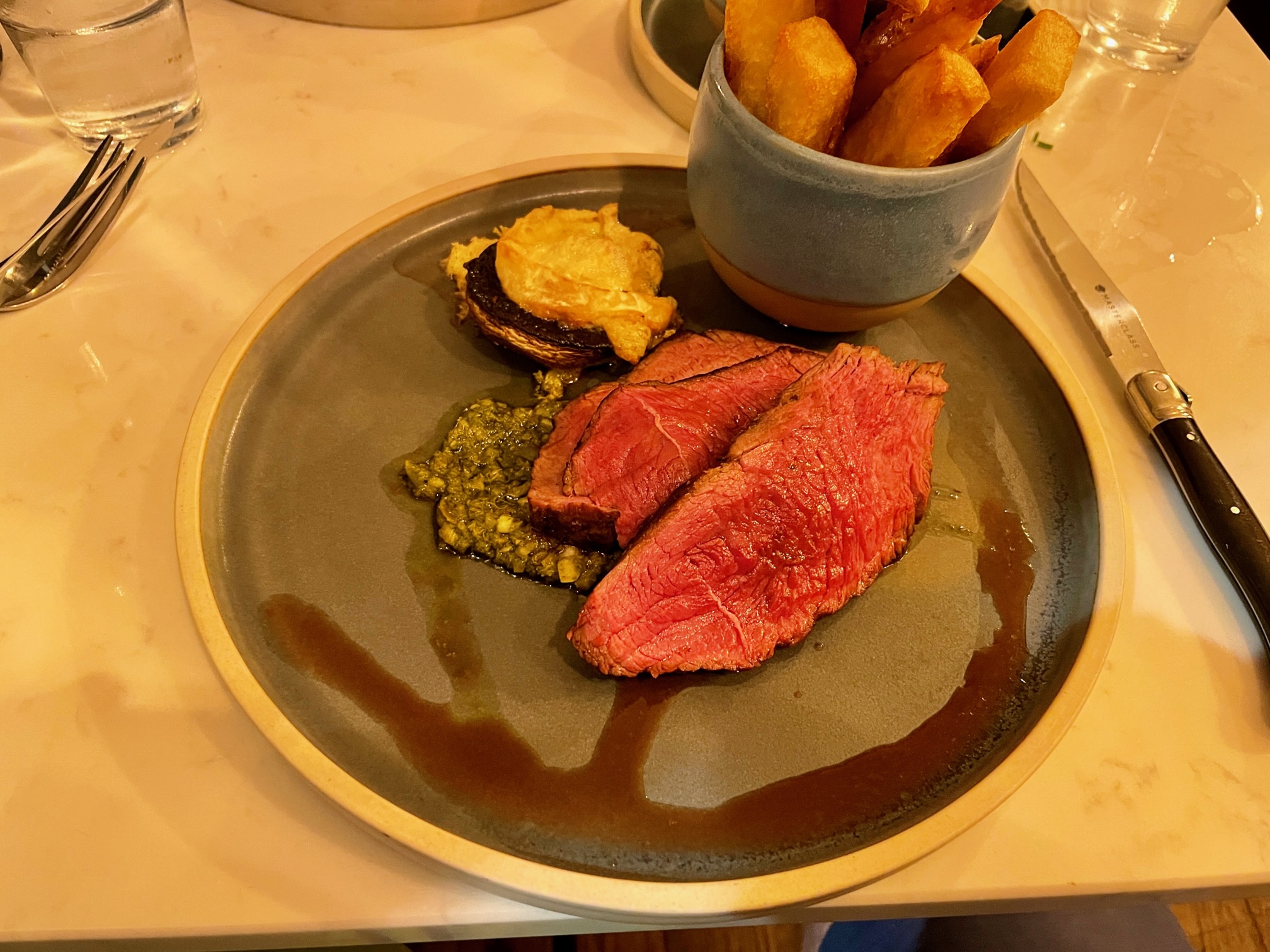
My rump steak was the most expensive dish on the menu, which always adds the potential for it to be the most underwhelming. It was a beautiful piece of beef and the cooking couldn’t be faulted – pretty much medium-rare throughout with beautiful caramelisation outside. But it was underseasoned, and surprisingly bland. The chimichurri underneath it had a pleasing zing, but ran out very quickly indeed. And after that the whole thing became a bit of a slog. There was some kind of puddle of juices at the edge of the plate, but it would be pushing it to call it a jus or a sauce. The best thing on the plate was a solitary mushroom cooked with cheese (again from Nettlebed) until it was salty and crispy, but when the star of the show plays such a brief cameo role, you’ve got problems.
Just to add to the onslaught of dryness, my triple cooked chips had decent texture – and were huge – but, again, they came without anything to add moisture. We’d ordered another portion separately, not knowing that we wouldn’t really need them, and I think in a restaurant with sharper service they might have talked us out of doing that. They came with a very good aioli but, as with the chimichurri or the beetroot ketchup, there was nowhere near enough of it. We asked for some more from a passing member of the wait staff. Five minutes passed and it didn’t materialise. We asked again and some time later, when the chips were nearly at an end, it finally arrived.
We looked at the dessert menu because our bus wasn’t for another forty-five minutes, or at least that’s what I told myself. By this point the couple at the next table had both ordered the hake – which looked nicer than either of our mains – and there was a certain mesmeric quality to watching them push it round the plate in that way that people who don’t really enjoy food seem to do.
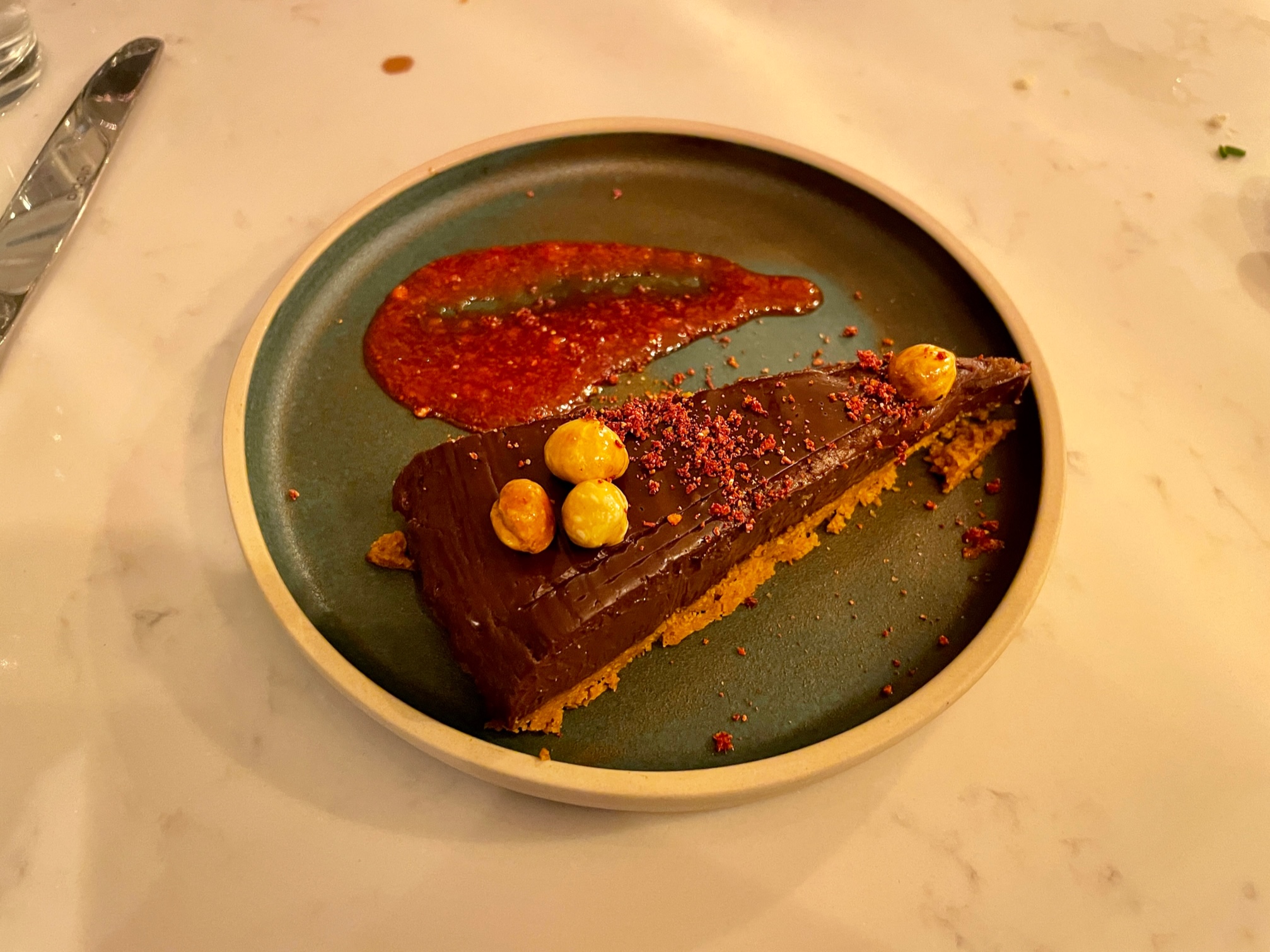
Anyway, desserts represented a slight recovery. My chocolate delice was a brilliant wodge of deep, gooey chocolate with a sweet, almost-sharp smear of bright strawberry purée to cut through. The biscuit base underneath was so crumbly that it barely stayed in one piece, but I didn’t mind that at all. Zoë’s key lime pie had a similarly short base and I thought it was pleasant, but I’d probably describe it as “subtle”, which really isn’t what you’re looking for in a dessert.
Zoë had her dessert with a Cotswold cream liqueur (although it turned up on the bill as Bailey’s, so Christ knows which it really was) and I had a dessert wine – from Graves of all places – which went beautifully. And well done if you’ve made it this far, because the truth about Five Little Pigs is that, sadly, by this point I’m even slightly boring myself. Our bill came to a hundred and forty-six pounds, including service, and then we went outside, got the penultimate bus out of Dodge, got home, had a cup of tea and went to bed. The end.
Last week somebody commented on my Facebook page about the review I did of Sauce And Flour. “I wish you’d stop doing reviews of places outside Reading” he said. “I prefer the Reading reviews. And after all, this blog is called Edible Reading”. I always find it interesting when people pipe up to tell me that this entirely free blog is somehow not delivering value for money, and after I politely told him that I’d review wherever I bloody well liked he deleted his comment. But there’s an important point here, believe it or not. I think it’s good to review places outside Reading because it gives you that all-important context (like I said at the start, there’s usually a Context). Otherwise how do you know if a place is good, or just good for Reading?
And it goes beyond Reading. If I hadn’t been to the likes of Marmo and Caper & Cure maybe I’d have thought about Five Little Pigs very differently. But at the same price point, making similar noises, and even with some similar dishes, the difference is stark. There are better ways to spend a hundred and fifty pounds eating out than to go to Five Little Pigs. One is to go to Marmo, or Caper & Cure. Another, to be honest, is to eat at Tasty Greek Souvlaki four times. Five Little Pigs is probably an absolute boon to Wallingford, and on another night I might well have had a meal there I’d have enjoyed better. But in truth, I can’t see myself going back.
So there you go: it turns out that restaurant reviewers aren’t always right. But as a regular reader of this blog you knew that already, didn’t you?
Five Little Pigs – 7.1 26 St Mary’s Street, Wallingford, Oxfordshire, OX10 0ET 01491 833999
One of my oldest friends lives in Swindon. Someone has to. Whenever he comes to Reading he enjoys our street food, our craft beer and our shopportunities and he complains to me – at length – that it didn’t have to turn out like this. He reckons that there was a time, back in the Nineties when all that money hadn’t decided where to coalesce, when it Could Have Been Swindon. They had a House Of Fraser, well before the Oracle opened, and that designer outlet everyone used to get so excited about. And Reading – Heelas aside, of course – was a bit of a wasteland in the mid-Nineties. Things could have been very different.
But the retail and hospitality gods smiled on Reading and, like many of us, they sneered at Swindon. We got the big names and the investment and Swindon, over the few decades, withered and died. It’s not all terrible: Darkroom Espresso is a great place to grab a coffee, Los Gatos in the old town is a tapas restaurant Reading would be lucky to have and a few doors down Rays does thoroughly likeable ice cream. But there’s a reason people who live in Swindon go to Bath, Oxford or Cirencester at the weekend, just as people from those places don’t pop over to Swindon of a Saturday.
The reason I’m starting a review of a place in Maidenhead talking about Swindon is that lately I’ve been looking at what’s going on in Maidenhead and starting to wonder if we might find ourselves in the Swindon role at some point in the coming years. Because although it’s early days, the businesses beginning to come to prominence in Maidenhead are the kind that you’d want to see in Reading instead of – hooray – a branch of Popeyes or our twentieth Costa Coffee.
Take A Hoppy Place, a credible, nicely fitted out craft beer bar a five minute walk from the train station with close to twenty beers and ciders on cask and keg. Last time I went it was doing a roaring trade and making the most of its outside space, and it was a wonderful place to while away a few hours. And although Reading has a brilliant craft beer scene – bolstered by the new addition of the Grumpy Goat’s upstairs bar – there’s nothing on that scale in the town centre.
And then there’s Seasonality, which recently got a rave review in The Guardian. It started in lockdown as a deli also selling heat at home meals, and has since morphed into a restaurant offering an interesting and inventive menu. It’s tasteful, gorgeous looking and independent: you could count the number of restaurants like that which have opened in Reading in the last couple of years on the fingers of one stump. With the winter we have looming, and the town’s famously charmless landlords, can you imagine one trying their luck here in the next twelve months?
Finally, the subject of this week’s review which might be the most interesting of the lot. Flour and Sauce opened in March as part of Maidenhead’s Waterside Quarter and seems, on paper at least, to be an example of a London trend that hasn’t so far made it this far west, the pasta restaurant. And by that I mean that, from a look at the menu, it seems to be modelled on Borough Market’s famous Padella and the hugely influential Bancone along with more recent imitators.
Those places – offering starters, a selection of pasta and not much else – have been one of my favourite trends of the last few years. They’ve given dishes like silk handkerchiefs with confit egg yolk or bucatini cacio e pepe iconic status and at their best they make for fantastic mid-priced casual restaurants. Throw in a negroni to start and a decent dessert at the end and you have the blueprint for a marvellous lunch or dinner: I’ve eaten at the original Bancone in Covent Garden a few times and never had a meal there that was less than splendid. So was Maidenhead boasting an example of this very London trend by virtue of its place on the Elizabeth Line? I wanted to find out.
It looked gorgeous from the outside, all white columns and full length windows. And it had the feeling of a fully realised concept, with clear branding, although something was niggling and bringing out my inner Mary Portas. Was it the name? Somehow it felt like it should be Flour And Sauce, both in chronological and alphabetical order. And the slogan – Wine Meats Dine – might have worked as a pun, but it didn’t seem to descibe what they actually did.
Going inside and taking my table brought out my inner Michelle Ogundehin. It was a big deep room but everything was somehow disconnected. The furniture didn’t match, but not in a charming way or even a calculated one, more as if they’d run out of stuff. I saw three different types of chair, one of which was the ubiquitous Tollix I associate with far cheaper food and greater discomfort.
Likewise the lampshades didn’t match, but not in a way that made sense – including the ones over the window seats which looked like grass skirts humping a lightbulb. There were some cheap shelving units from Ikea along one wall and a completely incongruous pine Welsh dresser at the back. It all felt thrown together, as if they’d opened in a hurry – and of course it might well have been. The faux marble wallpaper along one wall, already slightly peeling at the joins, might have gone on in a hurry too.
“It’s funny” said Zoë. “You walk in and think ‘this is nice’ but then the longer you look at it the more jarring it gets.”
I don’t think it helps that we got arguably the worst table in the place. The restaurant wasn’t really broken into zones, and we had the last free table – right at the front, near the open door. It was a bit chilly, and with people traipsing past in either direction it felt like eating in a corridor – especially when at one point a large group decided to stand right next to our table and chat to a couple eating up at the window for the best part of ten minutes. The window seats, by the way, are probably the best place to sit if you’re in a pair: the counter is lovely and deep, and you get a great view (and, therefore, superb people watching opportunities).
The menu was a little like the room – superficially attractive, but the closer you looked the more you wondered. At places like Bancone, the array of pasta dishes all involve different types of pasta which gives you a much wider range of choices. By contrast nearly all the pasta dishes at Sauce And Flour revolved around relatively similar shapes, and not too many of them, so you had multiple permutations of pappardelle, tagliatelle, linguine and bucatini which made up all but one of the pasta dishes on offer (the exception was a penne dish: what kind of a monster orders penne from choice?). I was hoping to see some ravioli, something like trofie or orechiette, a little more variety.
And while I’m whinging, the drinks list was irksome too. A reasonable selection of wine, but only one of each colour available by the glass. Come in a group or don’t bother, that seemed to say. And the pricing of the solitary red, white and rosé were absolutely nuts: the menu sold wine in 125ml and 250ml glasses with no option in between. And if you did decide you wanted a small glass of wine they stung you, with most of them costing only two pounds less than the large glass (I mean, you could say the large glasses were a relative bargain, but I suppose I’m a bit more large-glass-half-empty).
The irony wasn’t lost on me: I’ve moaned for years that not enough restaurants sell wine in 125ml glasses, and here I was in a place where it was one of the only options. But it felt badly thought out. There were two beers on offer, those ubiquitous macro lagers Peroni and Moretti. I took another look, thought fuck this and ordered a large bottle of San Pellegrino.
Would the food redeem matters? Some of it came close. We started with some thoroughly decent dishes from the starters menu and for a while I thought my tetchiness would be held in check. The pick of the bunch – of the whole meal, in fact – were the short rib beef croquettes: three beautiful specimens crisp of shell and packed with soft, yielding, slow-cooked beef. They were perched in a little moat of spiced mayonnaise which might have had a kiss of ‘nduja, and each had a slice of pickle draped on top which was more sweet than tart and tied things together nicely.
There were three of these and I let Zoë have the spare because she was so underwhelmed by the next starter, although I didn’t like it much better. Squid – “body and tentacles” according to the menu, which I think is TMI – was meant to come fried with ‘nduja but was actually in a thin, vinegary sauce with capers and no heat or seasoning. All the squid was bouncier than you’d like, and just made me think wistfully of better squid I’ve had in the not too distant past. It came with a long transverse slice of focaccia toast which was so rock hard that trying to cut it with a knife and fork left me worrying that half of it would ping off and hit the next table. A pointless blob of squid ink mayo perched on it, looking like a dirty protest.
Finally, I wasn’t sure what “warm buttermilk garlic bun & parmesan” would turn out to be, and the answer is essentially this: four giant dough balls. They were about as nice as giant dough balls can be, strewn with Parmesan and rosemary, and I squidged a piece into the sauce that came with the squid to verify that yes, it really was that dull.
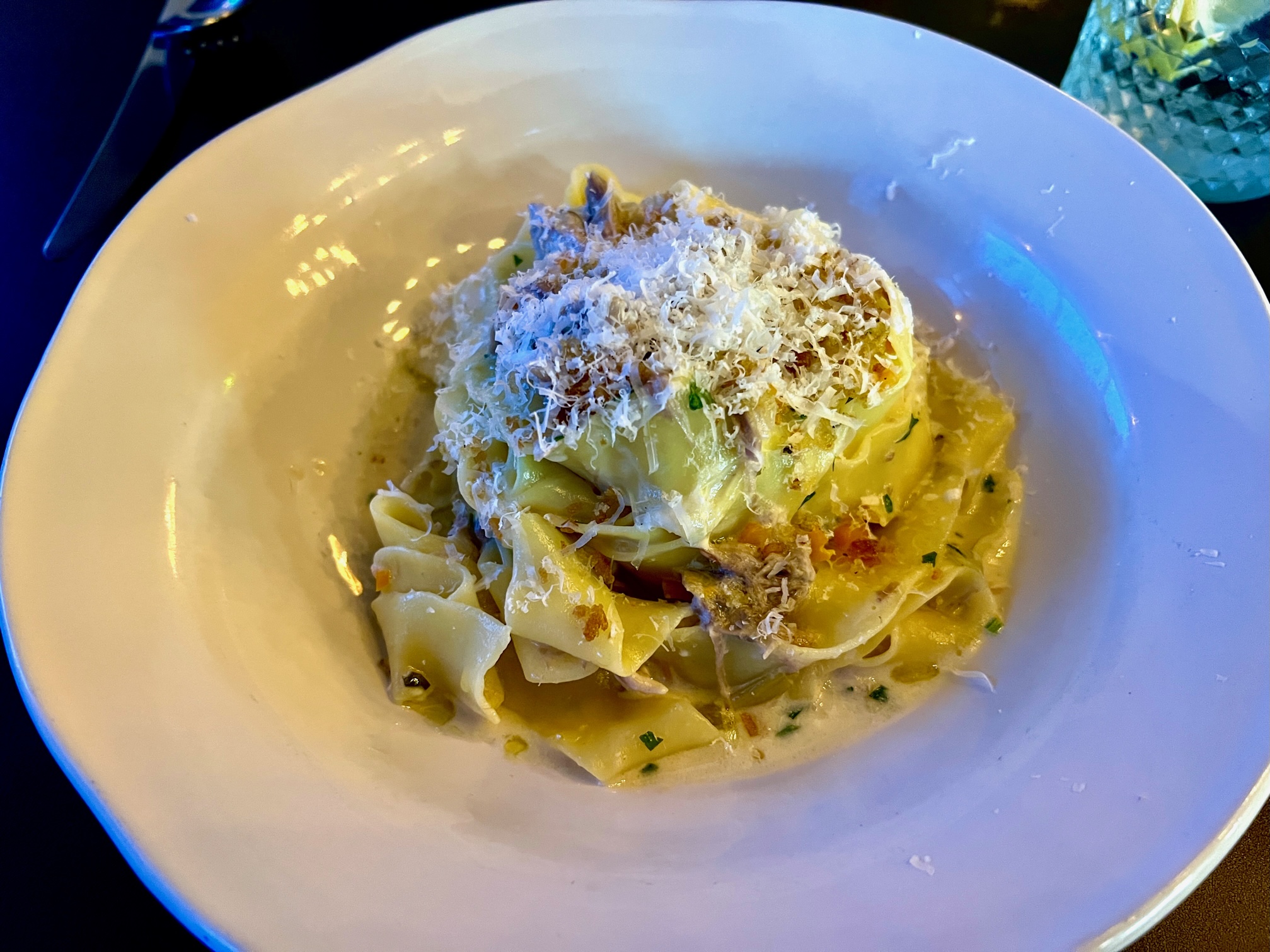
Mains were better but, and this is rather a theme, not exactly as billed. My linguine puttanesca was solid, I think. The ribbons had just enough pleasing bite and the sauce, a combination of all my favourite things, worked well. It had the note of acidity from the capers, a pleasant hum of chilli in the background and beautiful, plump olives. I felt like it needed more anchovy, but then I feel that way about the world in general so this dish was hardly an isolated incident. I’d paid extra to have some yellowfin tuna in the mix and I think I spotted a couple of forkfuls, but that was it. Not bad at all, and not bad value at fourteen pounds, but in the wider context of the whole meal it was doing a lot of heavy lifting.
Zoë’s dish, slow-cooked duck ragu with tagliatelle, had sounded good on paper and she enjoyed it, but from what I tasted it didn’t quite work. Again, the menu was misleading: this didn’t feel like a ragu at all, and the pieces of duck leg I ate didn’t have that tenderness I associate with slow cooked sauces. This hadn’t been reduced for a long time in red wine and tomatoes, it was a white ragu if anything, but it felt like the duck had been added to the white wine and mascarpone right at the end.
And it tasted pleasant enough, but if I’d ordered it I’d have been disappointed: perhaps the kitchen’s other ragus – one made with beef shin, the other with pork and ‘nduja – showed off their skills better. Zoë couldn’t finish it – you can’t fault the portion size – but by the end the sauce had pretty much solidified which made it a challenge. I will say this for Sauce And Flour, though: both pasta dishes had the welcome crunch of judiciously added pangrattato, and it’s hard to completely take against a restaurant that does that.
We decided to try dessert, to give the place a fair crack of the whip. They too were pretty representative of the whole Sauce And Flour experience. Zoë’s tiramisu was decent, and she loved the mascarpone and the leftfield inclusion of Kahlua, but it was a lot more cream than sponge. It didn’t dampen her ardour for Buon Appetito’s magical pistachio tiramisu, put it that way.
I went for the cheese selection and for one person, for seven pounds, I thought it was generous. They have a big deli counter just along from the open kitchen so you can see the staff cutting and preparing the cheese plate, and maybe if I’d had better eyesight I could have worked out what they were. But with the exception of a gorgeous, crumbly Parmesan with decent age which I left until last, I have no idea what they were because the wait staff just plonked them down and sodded off (the menu doesn’t say, either).
The others were a mix of a soft cheese that might have been Brie but possibly wasn’t, a hard cheese that could have been pecorino but probably wasn’t and a couple of other cheeses which honestly could have been anything. Maybe it was the adrenalin, or maybe I was just high on life and drunk on San Pellegrino but I have absolutely no idea. I do know that they came with crackers which tasted a lot like water biscuits and a little dish of something the menu just calls “jam” which tasted of surprisingly little.
Not telling us what the cheeses were was pretty consistent with service in general: it wasn’t unpleasant or rude, just distinctly brisk and disinterested. Maybe it’s because they were busy, but it lacked warmth – and I’m not just saying that because I was sitting by the open door. For me, that was arguably the biggest drawback about Sauce And Flour because it’s the thing – over and above the quirks of the menu or that sore thumb Welsh dresser – that badly needs to be fixed. Our meal came to just over sixty-seven pounds, and included a ten per cent service charge I’m not entirely sure was warranted.
On the train home, Zoë and I mused about exactly what had been missing from our evening.
“The room wasn’t that bad, and some of the food was very good, but great service would absolutely transform that place” she said. And she’s right. Sauce And Flour is a curious beast. It looks, on paper, like an attempt to recreate those specialist pasta restaurants in the capital, but scratch the surface and I have a horrible feeling that it’s actually just a reasonable Italian restaurant with a more limited menu. Like the faux marble wallpaper, it might look the part from a distance but underneath, it’s already peeling. So we can relax: Reading isn’t missing out, not this time anyway. If you want to leave town to eat superb Italian food, take a train to Mio Fiore.
What it really made me think about was the glory days of Dolce Vita, at the height of its powers. I loved Dolce Vita, but let’s be honest: the room wasn’t the best in Reading, and a fair amount of the food didn’t quite live up to its reputation (mainly, ironically, the pasta and pizza dishes). But because of the service, you never cared about that. You’d go back time and again, and it always felt like having friends cooking for you. And if I’d gone to Dolce Vita and there had only been one wine by the glass, I wouldn’t have given a shit; I don’t think I ever went there without ordering a bottle anyway. Trends or no trends, Reading doesn’t need a Sauce And Flour. But there will always be room for another Dolce Vita.
Sauce And Flour – 7.0 4A High Street, Maidenhead, SL6 1QJ 07516 948421
You’ll find many people who live in Reading that love the river. The waterways that run through and bisect Reading define it in so many ways, whether it’s the feeling of elsewhere you get when you cross the water and head north into Caversham, the brilliant, slightly wild seclusion of View Island, the experience of enjoying an al fresco pint outside the Fisherman’s Cottage seeing the world go past or even just watching the infamous Caversham Princess wending its merry, noisy way past the Bohemian Bowls Club, itself situated on Fry’s Island, slap bang in the middle of the Thames.
In lockdown I became a bit of an aficionado, strolling down the river past Caversham Bridge and looking enviously at the houses on the opposite bank, wandering round Caversham Court Gardens and watching the river flow or even just having a quick amble across the Horseshoe Bridge before the sun went down. On a particularly clement day I did the thing I always told myself I should and schlepped all the way along the riverbank to beautiful, traffic-clogged Sonning. Walking through the church yard, the pub just round the corner, it felt nothing like Reading at all. It’s true: we are very lucky indeed that our town is situated at the confluence of the Kennet and the Thames.
But all that said, for me the greatest tributary in this town has always been the number 17 bus route, the grand thoroughfare that cuts through Reading from east to west. I’ve always thought that there’s an almost infinite variety to that bus route, the distinctive purple double decker starting at the Three Tuns in the east, gliding past the prosperous houses off the Wokingham Road, running alongside Palmer Park and darting across the iconic snarl of Cemetery Junction, snaking through town, past the library and the Broad Street Mall.
Then it makes its way down the Oxford Road, through all that bustle and life, the skleps and the biryani joints, the barbers and the Indian sweet shops, the stalls on the pavement groaning with fruit and veg. And at the roundabout just past the KFC, it veers left and meanders through Tilehurst, finishing up at the water tower, another of Reading’s most distinctive structures. In east Reading the gas tower has played host to its last birds, and there’s an eerie emptiness about the space where it once stood, but in west Reading they still have their landmark, beautiful and graceful as ever.
People used to talk about how you could do a pub crawl along the 17 bus route. And of course you can, if you have a burning desire to drink at The Roebuck, The Palmer Tavern, The Outlook, The Wishing Well and the Pond House. Good luck with that, if it’s your bag. But for me, the 17 bus route more represents an incredibly rich seam of excellent places to eat and drink, all of them dead easy to reach on a bus which runs pretty much every seven minutes.
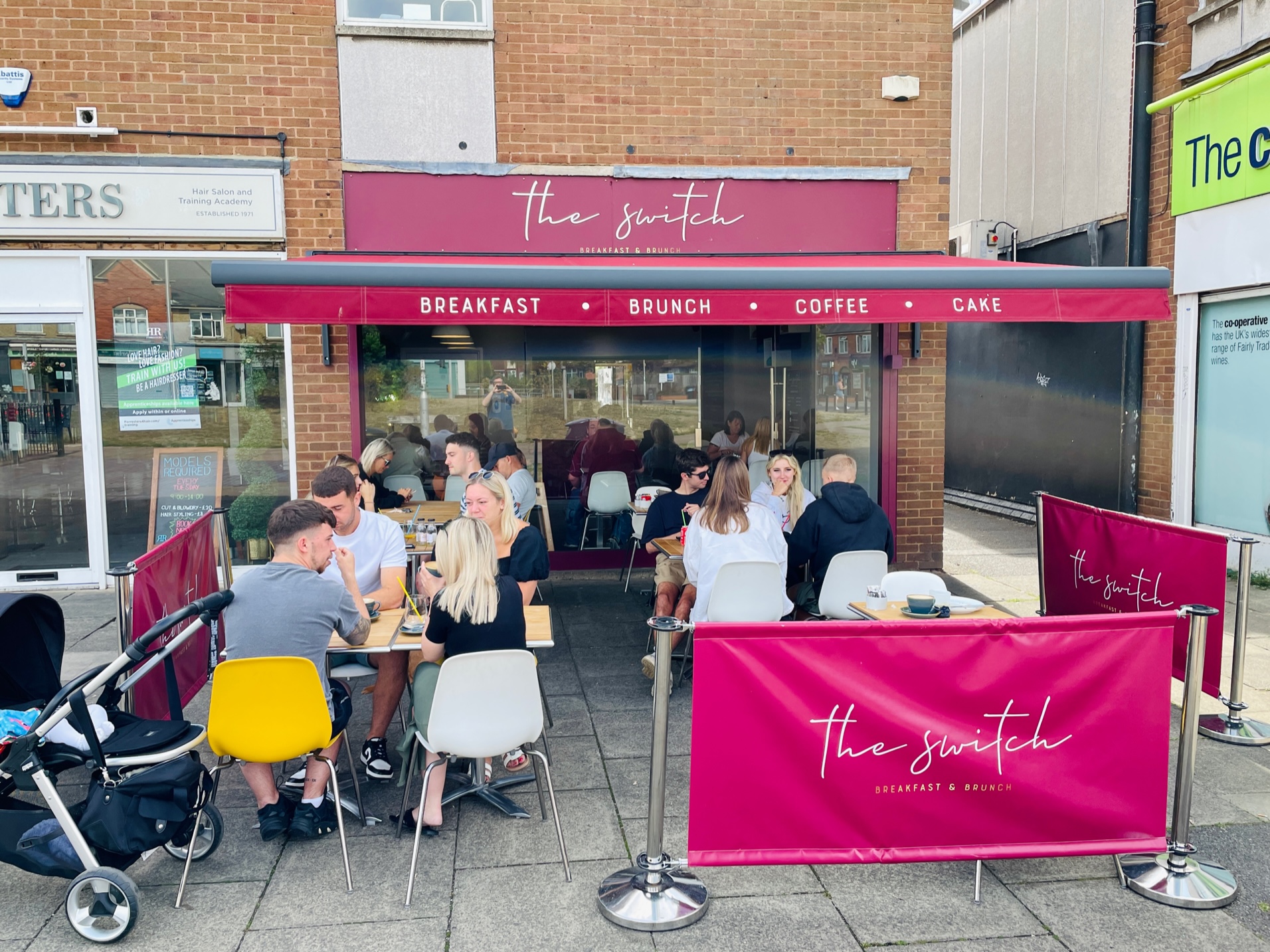
The subject of this week’s review is almost right at the western end of the 17 route: The Switch is the Tilehurst café on The Triangle, in the heart of Tilehurst Village. And alighting from the bus on a Sunday morning the first thing that struck me was that the place was packed. There was no danger of me breaking the news of The Switch to the waiting Reading world: that ship had sailed, and it didn’t look remotely like a café in desperate need of another positive review.
Subscribe to continue reading
Become a paid subscriber to get access to the rest of this post and other exclusive content.


















 Edible Reading