You can have a great network of informants, but sometimes there’s no substitute for getting out and about, keeping your eyes peeled. It’s a fact that our local journalists – what’s left of them, anyway – have forgotten, working from home. So last Saturday, after a very enjoyable lunch at Blue Collar and a coffee at Compound, my friend Dave and I took a wander down the Oxford Road to be virtuous and get some steps in ahead of a few afternoon beers at the Nag’s Head.
Much of what I saw was as expected. Traditional Romanesc are still there, in the spot where I had so many brilliant meals when it used to be Buon Appetito. Vampire’s Den, too (“is that really the only reference to Romania they thought people would get?” was Dave’s take). Oishi had definitely gone from “temporarily closed” to “never coming back in a million years” and Workhouse had been given a very attractive makeover, although the new store front didn’t seem to contain the name anywhere.
But there were, as there always seem to be, places that were news to me. Near the top of the Oxford Road, a place called AfrikInn was selling fufu, fried yam and jollof rice. SORRY WE’RE CLOSED TODAY SEE YOU TOMORROW said handwritten signs on the door and window. Further down, not far from Momo 2 Go, a place called Agnes’ Coffee Shop was open, selling coffee and Polish street food: the word Zapiekanki ran vertically down the brickwork, in a bigger font than the name of the café. I made a mental note of both.
But the place Dave and I were vaguely ambling to check out was Portuguese café DeNata, which opened in March this year, replacing – and this is where it gets confusing – Portuguese café Time 4 Coffee, which opened last August. It had been on my list for ages and although Dave and I were both full from lunch we figured an expedition to research pasteis de nata was a worthy pre-pint pursuit. Dave’s son has just come back from Lisbon on holiday, and hearing all about it made me very glad I had my own trip booked there later in the year.
We ordered a couple of pasteis, and the proprietor – instantly bright and personable – took great pride in showing me the menu; I chatted away with her for so long that poor Dave had to pay for the egg custard tarts. The owner asked me to follow DeNata on Facebook, and I dutifully promised I would. The place was bustling on a Saturday afternoon, and warm, but I didn’t pay it too much attention. Dave and I had a pub table to bag, after all, and a pastel de nata to inhale.
Anyway, the next day I left the house mid-morning, took a couple of buses and turned up at DeNata just before midday for lunch, to eat the meal you’re about to read about. So why did I do that?
Subscribe to continue reading
Become a paid subscriber to get access to the rest of this post and other exclusive content.
Even though Reading is my patch and always has been, I get asked for recommendations elsewhere fairly often. And my blog is more useful in that respect, I hope, than it used to be, with a number of reviews from beyond Berkshire and a series of European city guides you can consult to help with lunch, dinner or even coffee choices. I’m always encouraged when people tell me the city guides have come in handy: a friend told me a few weeks ago that she and her boyfriend were trying to pick somewhere for a holiday later in the year and she actually said “can’t we just go somewhere Edible Reading has been?” Few higher compliments exist.
Somewhat closer to home, I do like to have a few choice spots in my back pocket for the occasions when people ask for my help. If you want somewhere in London or Bristol, I can sort you out. Ditto Bath, Oxford, Exeter, even Swindon. But beyond that it gets sketchy. My last trips to Cardiff, Edinburgh and Glasgow were so long ago that I’d struggle to know what’s hot and what’s not these days; I could suggest somewhere, but it would be based on research rather than personal experience. And as for the likes of Manchester, Newcastle, Birmingham or Liverpool, forget it.
I’ve felt for a while, though, that Winchester was a gap in my repertoire that I ought to fix.
After all, it’s a lovely city, it’s a half hour train hop from Reading and it has plenty to do – excellent shopping, great coffee, good mooching opportunities, historic streets, pretty pubs and a gorgeous cathedral. For a long time my dining option of choice there was Michelin-starred pub the Black Rat, but the last time I went it really wasn’t great and when it subsequently lost its star I wasn’t hugely surprised. A couple of years ago it closed down, the owner citing spiralling energy bills.
And the last time I ate in Winchester it was at Rick Stein’s restaurant there, where I had a pleasant, well-mannered, expensive meal that felt a little like Hotel du Vin but ever so slightly better; Winchester has a Hotel du Vin of its own, which gives you some idea of the kind of place it is. But that was in January 2020, just before everything changed, and catching a whiffy, clapped-out Voyager train to Winchester last weekend I was struck that it had gone from being a city I knew moderately well to a passing acquaintance with whom I’d lost touch but was keen to reconnect.
I had a solo lunch reservation at Lucky Lychee, a restaurant which operated out of a Greene King pub called the Green Man, a fifteen minute walk from the train station and not far from the aforementioned Hotel du Vin. The brainchild of couple James Harris and Nicole Yeoh, it started out in street food and home delivery before getting a residency at another Winchester pub and then moving to the Green Man two years ago. Harris and Yeoh met in Malaysia, and their menu spans Malaysian, Thai and Chinese dishes.
I had discovered it through an Instagram post I stumbled on which was singing the praises of Lucky Lychee’s brunch roti wraps, a fusion of Malaysian and British food, and although the post was written by a person who used the word “sossidge”, there was something about the food that looked unmissable. Sometimes you can just look at a menu and suspect two things: first, that you’ll eat well, and secondly that you’ll find it impossible to decide exactly how you will eat well. Lucky Lychee’s menu was one of those, and I reached the front door of the pub with a heady blend of excitement and anticipation.
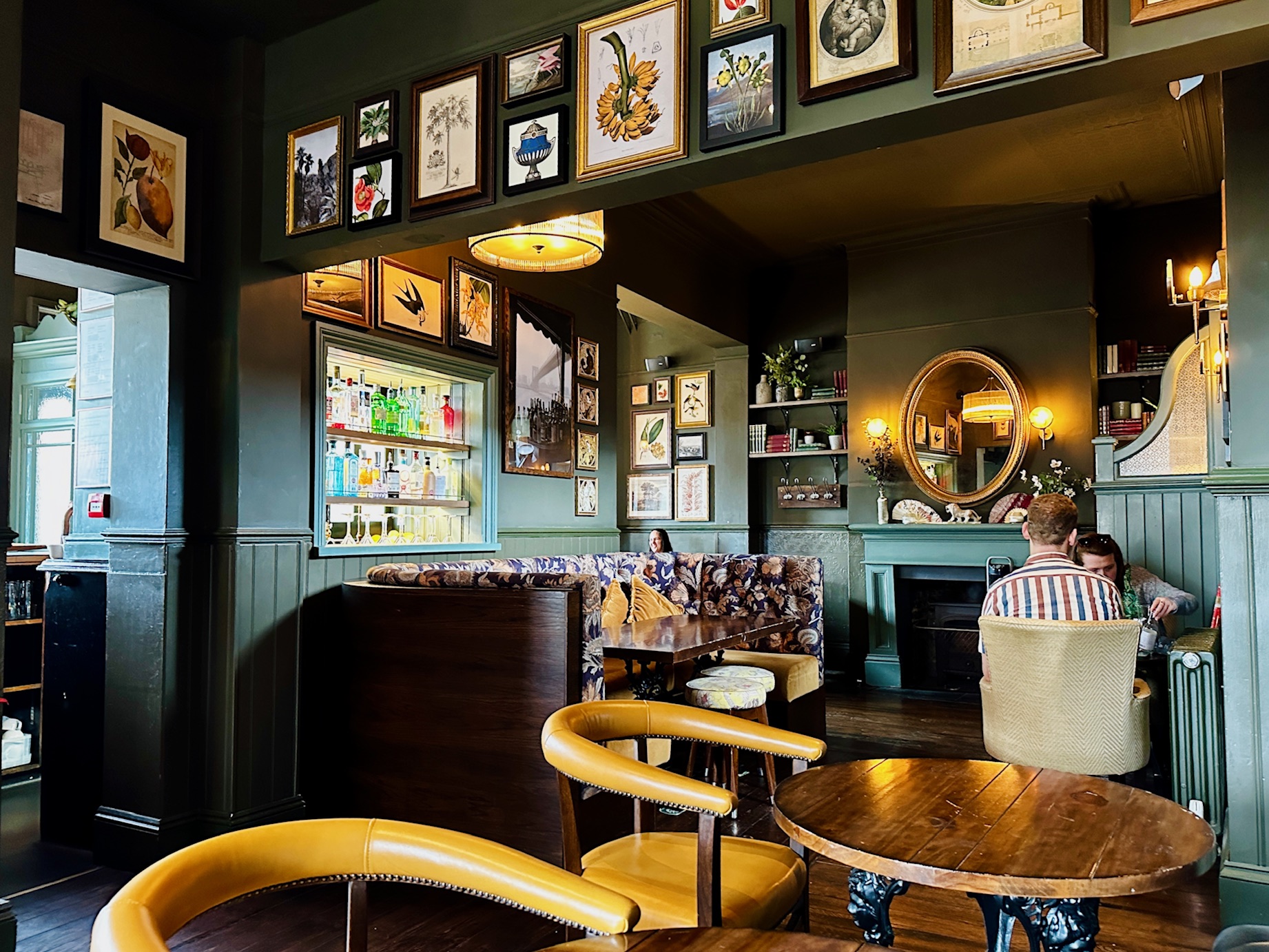
It helps that it’s such a handsome pub, all dark muted tones and wood panelling. The front room looked like a proper boozer, if a classy one, with high tables and sturdy leather-topped benches. Further through, near the fireplace, there were comfy booths and tastefully-upholstered sofas. But I was sat in what I imagine was the dining room, on a banquette, looking out on the whole thing, sunlight sneaking in through the windows. The table opposite me was occupied, with a couple making inroads into a tempting-looking lunch order, but otherwise it was pretty quiet. It was one o’clock on a Saturday not that far from payday. Had I made a mistake?
Not based on the looks of the menu, anyway. I actually think a weekend lunchtime might be the trickiest time to visit Lucky Lychee, because you have a selection of what are dubbed snacks but looked like starters and small plates, their lunch menu – a slimmed down version of their evening offering – and the brunch menu.
And that’s where it got really difficult. Because the lunch dishes – 8 hour rendang, tom yum king prawn fried rice and the like – looked extremely tempting. But it was the brunches that first drew me in and that selection was calling to me every bit as much. The idea of curry sausages and fennel cured smoked collar bacon, bound up in a flaky roti wrap with lime mayo and sweet chilli sauce sounded too good to miss. A great hangover cure too, and after a couple of bottles of red with my friend Jerry the night before it sounded just the ticket. What to do?
In the end I decided to postpone the decision by ordering snacks and seeing how I felt after that. But first I ordered a drink. Lucky Lychee boasts a fascinating range of low intervention wines, but postponing the hair of the dog for the time being I decided to try an iced Milo, allegedly a popular chocolate malt drink in Malaysia. It was nice enough, though the ice took some time to get the overall experience below lukewarm. Perhaps the glass was straight out of the dishwasher: either way, it may well have been thoroughly authentic but I couldn’t shake the feeling that I’d just spent four pounds fifty on a Nesquik.
That was the last – the only – misfire of the entire meal, and everything after that was so terrific as to render it insignificant. Chicken karaage was a decent portion for eight pounds fifty, and if it ever so slightly lacked crunch, the flavour that had permeated the chicken thighs, from soy, oyster sauce and rice wine, more than made up for it.
Mayo is a frequent accompaniment for karaage but rarely is it anywhere near as good as Lucky Lychee’s, which was positively awash with citrus. I kept going back and forward between this and my second small plate, trying to figure out which I liked the best.
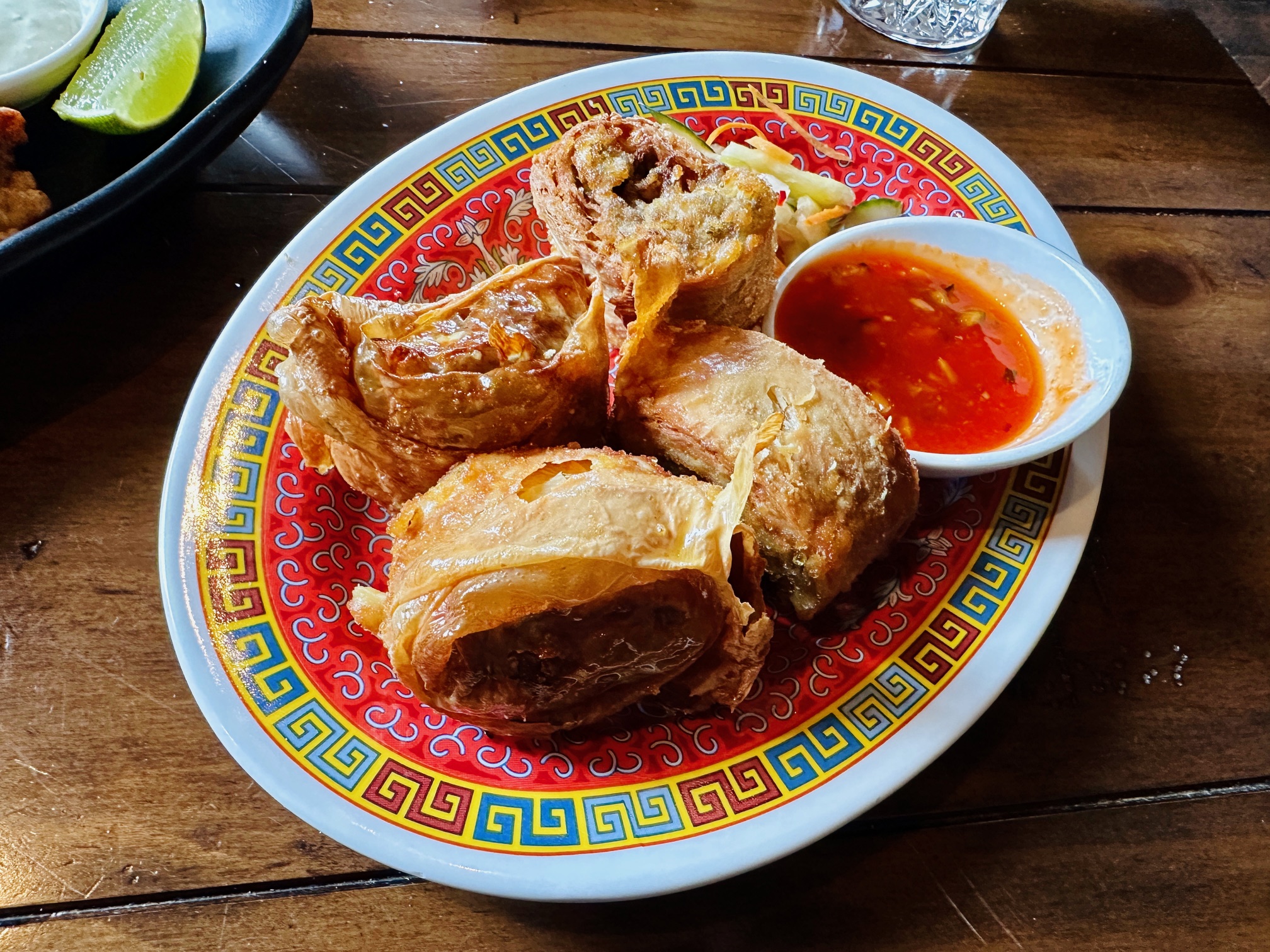
I think though, on balance, the second small plate was ever better. Billed as Penang pork spring rolls it was really nothing of the kind. I mean, technically it was, but the ratio of dense, delicious meat to wafer-thin, greaseless pastry made it something closer to a sausage roll (or, if you’re three, “sossidge roll”) that was all sausage and no roll.
But that’s not all, because the meat was beautiful – shot through with tiny dice of carrot and, I think, spring onion. The menu said that it was marinated in a 10 spice powder and I could well believe it, because I’m not sure I’ve ever had anything like it.
I’m conscious that this is my third solo review in a row – and yes, I might be auditioning for some additional dining companions. It meant I ordered slightly more food than I strictly needed, to try and give the menu a fair run out. But I was as pleased as Punch not to have to share these spring rolls with any other fucker. They were mine and mine alone, and it was a beautiful moment.
My server, who was downright lovely throughout, gave me a little time after my starters were cleared to make my decision. As I mulled it over, I ordered a glass of white wine, a German riesling which turned out to have plenty of zip and pith, and a little honey. And the more I thought about it, the more I couldn’t decide: brunch or lunch? Buttery roti or something with rice?
It wasn’t easy but in the end, believe it or not, I was thinking of you lot. I decided you’d find an idea of Lucky Lychee’s dinner and lunch options more useful than a brunch, however good. So I forwent that roti stuffed with good things, and decided that if I walked away disappointed it was all your fault.
Gladly, nothing was your fault and my main course was one of the most enjoyable things I’ve eaten all year. Billed as honey Marmite chicken, it wasn’t a combination I’d ever considered or even heard of, although a Google suggests that it is indeed a dish eaten in China and Malaysia. But honestly, it was such a phenomenal combination. The chicken, thigh again, was in a crispy, craggy coating, studded with sesame seeds, and it had all the textural interest that the karaage had only just failed to bring to the table. But what made this dish, and made it one I’ve thought about many times since, was the sauce.
What a sauce! You might not like Marmite, you might not like honey – for what it’s worth I love both of them – but this sauce from Lucky Lychee managed to completely transcend either Marmite or honey, being infinitely more than the sum of those things. So you had the huge, salty savoury depth that came from the Marmite (and, apparently, a bit of oyster sauce) and the almost smoky sweetness from the honey, dovetailing and transforming in a way that was nothing less than magical.
Add in some just-cooked peppers and a sprinkling of peanuts and you had one of the most intensely moreish dishes I’ve eaten in well over a year. Put it this way – last month I ate at Kolae, one of the most hyped restaurants in London right now, and I had some of the most fascinating dishes I’ve sampled in a long old time. But nothing there matched the joyousness of this honey Marmite chicken.
I spooned, and then scraped, every last bit of sauce onto my fluffy jasmine rice, I cleaned my plate as best I could without abandoning decorum, and I wondered when I could eat this dish again. I love fried chicken, which ultimately this dish was, but I couldn’t remember trying anything quite like it.
By this point I was gratified to see that a few more people had taken tables in the pub. A young couple came in, him with a London Review Of Books canvas tote, her with one bearing the logo of Shakespeare & Co, the legendary bohemian Paris bookshop, and took the table near the window that had been occupied by others when I came in. I smiled at them – I’m not sure when I reached the age where I’m twinkly and avuncular, but sadly that point has come – and then I peeked nosily as they ordered from the brunch menu.
One of them had ordered a roti that was served absolutely stuffed with beef rendang, and as I saw it come to the table I realised there was nothing for it: I was just going to have to return, sooner rather than later. I realised my mistake hadn’t been to order lunch instead of brunch, it had been not to order brunch, find some excuse to loiter around Winchester for five hours and then go back for dinner. Never mind – I was already planning multiple return visits, with a pretty good idea of at least one person, miffed to have missed out on this trip, who would insist on trying it out.
Lucky Lychee does have a dessert menu, but on this occasion it didn’t have enough to tempt me. It’s mostly ice cream and affogato, with just two more interesting options – a banana spring roll and a piña colada crème brûlée. I had it mind to possibly grab an ice cream from Chococo, across town, so I decided to settle up and amble to Coffee Lab for a latte. My bill came to just under forty-eight pounds, not including tip. The most expensive thing I had was the honey Marmite chicken, which was under fifteen pounds. It would be hard, I think, to spend fifty pounds on lunch better than this.
As you’ve probably gathered, I truly adored Lucky Lychee. And weirdly, just as with Bombay Brothers last week, I came away feeling that I hadn’t seen the restaurant at its absolute best. With Bombay Brothers that was driven by a faint hope that surely it could be better than that, but with Lucky Lychee it was more an awareness that, phenomenal though my meal was, I suspected they were capable of even more.
I need to go back – to try the brunch menu, to work my way through the other snacks, the curry puffs and sesame prawn toasts, and to try the full gamut of their main courses at dinner time. Char siu with honey rhubarb glaze has my name on it, as does the Guinness chicken with lychees. And that rendang.
Who am I kidding? I want to try all of it – and rarely have I come away from a restaurant so simultaneously delighted with everything I had and frustrated that I wasn’t able to polish off more. The other thing I kept thinking was that this is a restaurant operating out of a Greene King pub. So I cast my mind over all of Reading’s Greene King pubs – the Roebuck, the Palmer Tavern, the Outlook and so on – and thought how sad it was that none of them had done anything this bold. Another one to chalk up under I wish Reading had something like this.
Don’t get me wrong, its closest equivalent is the Moderation, a fine pub. But Lucky Lychee was properly next level stuff. As so often, going away from Reading reminds you of the things Reading is still missing. Maybe we’ll get a top notch Malaysian restaurant at some point, but I’m not holding my breath. On the plus side, I now have somewhere to recommend whenever anybody asks me where’s good in Winchester. But this is the drawback: how am I ever going to review anywhere else in the city, if it means missing out on eating at Lucky Lychee?
Lucky Lychee – 9.0 The Green Man, 53 Southgate St, Winchester, SO23 9EH
I’m grateful for every single one of my readers, but there’s a special place in my affections for people who tip me off about places. Whether it’s my West Reading mole who keeps me posted on the comings and goings of the Oxford Road, my town centre informant who sends me pictures of shuttered restaurants and “coming soon” advertisements, or my other half who is always telling me about new businesses I’ve never even heard of springing up on Instagram, they form an invaluable network helping me keep track of where I ought to try next. I’d compare them to the Baker Street Irregulars, except they’re all very much adults and their catchment area extends far beyond Baker Street.
In particular I very much appreciate people who get in touch to tell me to try somewhere out, whether it’s already on my list or not. When I review somewhere new, there are always a few people who come out of the woodwork to tell me they’ve been going there for ages and it’s great, but only a fraction of those people ever pop up in my DMs raving about the place before I’ve been.
Maybe they like to keep the good places to themselves, maybe they assume I’ll get to them before too long. Or perhaps it doesn’t even cross their minds to contact me, which is fair enough. But it means that when people do recommend somewhere, I’m always especially grateful.
This week’s review came from a message like that, from a reader of the blog who told me to try Bombay Brothers, the Indian restaurant on the ground floor of Kings Walk which opened around the beginning of last year. She specifically raved about Bombay Brothers’ railway lamb, saying it reminded her of the one her grandma used to make. I couldn’t turn my nose up at a recommendation like that, so on a dreary July evening I hopped on the bus into town to give it a whirl.
Subscribe to continue reading
Become a paid subscriber to get access to the rest of this post and other exclusive content.
I moved house last week, and suddenly everything changed. My little slice of Reading, my walks, maps, routes and routines were no more. No more waking up in the Village and mooching into town for lunch, no more strolls round Reading Old Cemetery or Palmer Park, no more number 17s and Little Oranges buses, no more Retreat just round the corner. After seven years of East Reading life, it was time for something different.
So on moving day Zoë and I found ourselves standing, sleep-deprived, outside a large house that wasn’t quite ours yet, rented van parked up in the drive, waiting for the agent to arrive and check us in. Meanwhile, across town, movers were loading boxes into a far bigger van from a far smaller house that was no longer ours. The sun was blazing, and I strolled across Cintra Park to Greggs, of all places, to pick up coffee and pastries. This is my neighbourhood now, I thought to myself.
I’m writing this over a week later, after seven days of unpacking and tip slots and IKEA trips (I’d forgotten how depressing that place is) and everything is starting to take shape. A lot of the boxes are unpacked, the kitchen is in some kind of order and, best of all, we finally got a new bed – high off the ground, with a big firm mattress, like climbing on to a cloud at night. The walls are fresh-painted white, the blinds are new and Venetian and the rooms flood with summer sunlight.
And every morning I wake up and can’t quite believe I live here, in this new place.
There’s a clothes line in the garden, and I get to experience the meditative joys of hanging out the washing, taking it in when it’s been dried by the sun and smells of heaven. Let’s not talk about the huge rent hike, or the council tax band of this place, or the fact that I can’t afford to eat out quite so often: let’s just think about the smell of that washing from the line.
On our very first night, exhausted but with the rest of the week off to unpack and settle in, we wandered to pretty much our nearest restaurant, Kungfu Kitchen. Like me they moved recently, although a few doors down Christchurch Green maybe isn’t quite as big a shift as mine. And their new site is lovely and snazzy – especially the light feature projecting fish onto the floor – but it was also reassuring just how like their old place it was. The food was still outstanding, and the welcome was the same, because Jo and Steve do not change: I particularly enjoyed Jo frogmarching customers to the loo, proudly boasting that Kungfu Kitchen has the best toilets in the world. Her words, not mine.
But Kungfu Kitchen is only one of our nearest restaurants, and I popped into one of the others to take something home the following night, just before an England match, fresh from a purgatorial trip to the tip. Dough Bros opened in March at the top of Northumberland Avenue and has built up quite a following in three short months. It’s run by a couple of friends, one of whom also runs the neighbouring barber Short, Back & Vibes.
Subscribe to continue reading
Become a paid subscriber to get access to the rest of this post and other exclusive content.





 Edible Reading