Some restaurants wind up so indelibly linked with the buildings that become their homes that years later, long after they are gone, you still can’t imagine another menu outside, someone else trading behind those doors. Sometimes, no other restaurant even tries: ever since Dolce Vita left its spot on the top floor of Kings Walk nobody has taken its place, but even if they did, I don’t know how I’d feel eating somewhere that, to me, will always be Dolce Vita.
Sometimes the place stays the same but changes hands, with or without changing its name. At some point I should return to Namaste Kitchen, and people tell me it’s good, but without Kamal running the front of house and that magical menu of Nepalese small plates I’m not sure how I’d overcome the strangeness of dining there. I’ll do it, one day, and when I do the review will have to have a different preamble to this one, because this one’s taken.
Ditto Spitiko, where Kyrenia used to be. The site’s the same, the menu is similar, the furniture might be too, and Spitiko may well be a perfectly decent restaurant. But in my mind it will always be Kyrenia, the place where I celebrated my thirtieth birthday, where I’d always go for mezze and kleftiko, for a bottle of Naoussa Grand Reserva and Ihor’s twinkliest welcome. Its golden age was over fifteen years ago, yet I remember it like it was yesterday.
That’s before we get to the Lyndhurst, now under its third set of new management since they hosted guests for the very last time – my wedding guests, no less. This may sound silly, but I don’t feel ready to eat there again. Perhaps this sentimental streak should disqualify me as a restaurant reviewer. But on balance I don’t think so: these places get into our hearts, occupy a place in our affections, become part of our story. Not to feel that kind of thing is not to be alive.
But of course, nearly every restaurant was once somewhere else. Buon Appetito, that I still miss, may have become Traditional Romanesc, but before that it was Chi Oriental Brasserie. And again, when Chi closed I was devastated. You know where else Chi Oriental Brasserie used to live? The site that’s now Masakali. And I was sad when Chi left that spot on the TGI Friday roundabout, too, but I was equally forlorn when San Sicario, a wonderful restaurant, gave up the fight at that very location.
All these places come and go. They make your day one month and break your heart the next: that’s what getting attached to a restaurant can do to you. Worse still, throughout it all TGI Friday has been plugging away on the other side of that roundabout for as long as I can remember. I wonder if restaurants have their own version of that well-worn maxim that only the good die young.
All this might go some way towards explaining that although new-ish Indian restaurant Tanatan opened on London Street last December, it’s only on a week night in July, months later, that I went there with my oldest friend Mike for dinner. Because even though the site was an empty shell for over two years, before that it was Clay’s Hyderabadi Kitchen, and it’s still hard for me to think of it as anywhere else.
Clay’s, where I ate for the first time before it opened, where I celebrated birthdays – mine and theirs, as it happens – where I went on random evenings because it was just round the corner from my little house, where I ate with friends, family and visitors, where I held lunches for my readers. Few rooms contain as much of my personal history as that one, so I knew it would be odd to eat there again, to eat Indian food there at that, and to know that it was somewhere new.
Tanatan’s story is a curious one, by the way. In the run up to it opening, the Reading Chronicle trumpeted that it was a high end Indian restaurant which very much seemed like the natural successor to Clay’s. Not only that, but they claimed that it was the first U.K. branch of an upmarket Indian group of restaurants with its other branches in India and Dubai.
That all sounds magnificent, and Tanatan’s website contains a menu full of temptations. There’s only one hitch, which is that there’s no evidence at all that Reading’s Tanatan has any connection to that chain at all. It’s not mentioned on their website, and in fact Reading’s Tanatan, for a long time, didn’t have a website of its own. Now it does, but the menu bears about as much resemblance to the other Tanatan’s menu as I do to Jude Law.
It looks suspiciously as if the Chronicle had flagged the name, put two and two together and come up with five, which is a mistake not even the AI that writes most of its articles would make. So, what was this Tanatan, our RG-based restaurant, like? Was it a worthy successor to its precursor, or an attempt to hop on a bandwagon two years after the bandwagon rolled north, over the river? It was time to brave that all too familiar room and find out.
Subscribe to continue reading
Become a paid subscriber to get access to the rest of this post and other exclusive content.
Town – or, as it’s sometimes written, TOWN – is the hot new restaurant on Drury Lane, with celebrated chef Stevie Parle in the kitchen. It’s been open a couple of months, and has already had rave reviews from every quarter. Admittedly, some of those came with caveats. Giles Coren declared at the outset that he was friends with Jonathan Downey, one of the backers – a rare piece of transparency about vested interests in this sphere – and in the process revealed that Tom Parker Bowles is too (which means it’s quite possible that Parker Bowles is also friends with Coren: and to think we’re meant to trust these people’s tastes).
So yes, in the space of just over 6 weeks, almost every national restaurant critic we have – not William Sitwell, he was probably too busy campaigning for Nigel Farage – went to Town, literally and figuratively, to almost universal acclaim. Even that chap with the bouffant who writes for the Standard whose name escapes me went there (only kidding, he’s called David Ellis and I read somewhere that his earliest restaurant memories involve Quattro: he still goes with his family and gets limoncello on the house).
I’ve written about this phenomenon before, talking about Kolae or, more recently, Brutto: that even though London has many thousands of restaurants, and the rest of the U.K. many thousands more, you will find a handful of London restaurants every year that get written up by every single reviewer. Either because they offer something interesting and different or because the chef has a backstory or, more likely, is well-connected in the world of food.
All those channels and nothing new on: it’s all repeats. But it’s more important that they have their say on a significant new opening than it is to give readers a range of options, so they all race to file their copy and put their stamp on it first. Plus it’s much easier for them to get to than some godforsaken place out in the regions or, heaven forbid, the North. I suppose it’s handy if you really do want to go to that restaurant, because, like Metacritic, you can cobble together a composite view from those half a dozen pronouncements.
All this makes it look like I’m late hopping on a speeding bandwagon – which is both annoying and untrue, because I booked my table at Town a week before the first review of Town came out. And that’s not because I’m some kind of incredible trendwatcher with my ear to the ground: it’s because Zoë’s birthday was coming up and I asked her to choose a venue for the big day.
Initially she wanted a table at Lasdun, the Brutalist-inspired restaurant based in the National Theatre and run by the people behind superb Hackney pub the Marksman. But then, for reasons that were never explained, they contacted us to say that they weren’t offering lunch that Friday and would we like to move it to an evening booking? We didn’t, so we didn’t, and then a few weeks later Zoë said “I’ve decided: there’s this place opening called Town”.
And this is the difference, I suppose, between a punter and a would-be pundit. In the run up to our visit, every new review was great news for Zoë – someone else liked it! our meal is going to be excellent! – whereas I quietly facepalmed and channelled Brenda from Bristol. But never mind: everyone said it was excellent, so we spent the morning bimbling round Covent Garden before heading to Drury Lane, stopping for a couple of Belgian beers at Lowlander Grand Café, a place that feels like it’s been there for my entire restaurant-going life, before making our lunch reservation.
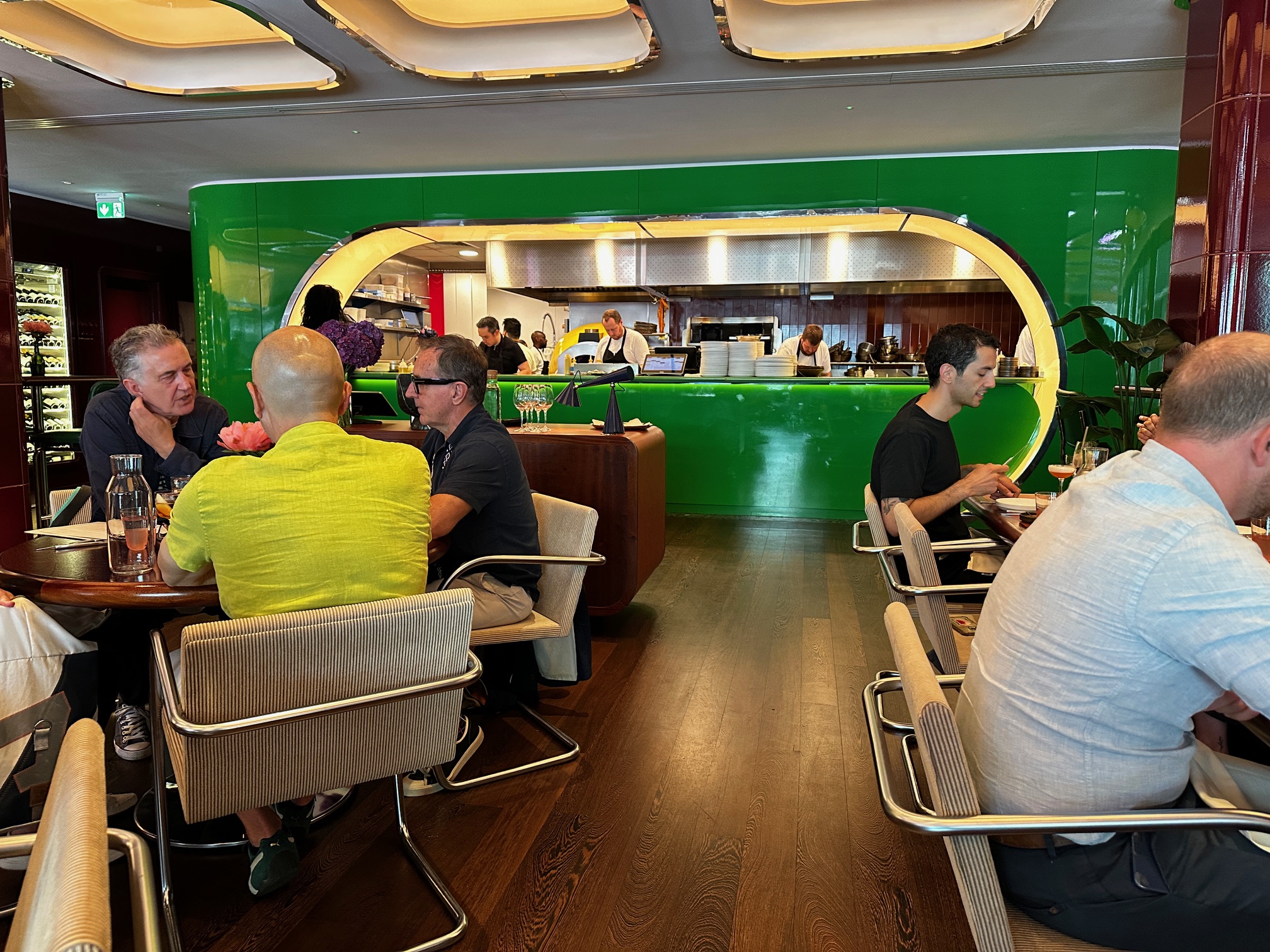
The interior of Town is gorgeous, and all the reviews have made much of that. Everything is very luxe, very glamorous, very Sixties – Tom Parker Bowles referenced Ken Adam, David Ellis suggested Mad Men – and the attention to detail is impressive. There are curved edges everywhere, from the rounded, tiled burgundy pillars to the beautiful chrome-edged ceiling lights. The photos I’d seen in advance also focussed on the feature in the centre of the dining room, a striking kelly green window into the open kitchen.
It really is stunning, but the single press photo – used in no less than three of the reviews – made it look like this is a huge centrepiece of the entire restaurant. And that’s not entirely true. We were sat in the middle section, and I had no complaints, but if your table was nearer the outside of the restaurant I think the place would have felt far less special. And I did wonder if, like the episode of Curb Your Enthusiasm where Larry David keeps being seated in the “ugly section”, there was a kind of centrifugal force going on here: the outer section had more boomers in it than a British Airways flight to Malaga.
The broadsheet reviewers won’t tell you that, of course, because they never get shit tables.
Town’s menu was a funny one: despite having plenty of dishes on it, little of it jumped out at me. Starters ranged from fifteen to twenty-five pounds, mains all the way from just over twenty all the way up to ninety, although the priciest ones were to share. But I was surprised by how untempted I was by it all on paper: some of that will be my preferences, not being wild about clams – which pop up twice – and feeling generally like having steak in a restaurant like this is a bit of a waste, even if it is Wildfarmed beef (Town goes to, well, town on its provenance, with butter and cheese coming from Parle’s brother’s dairy).
Vegetarians might have found things tricky too, with just one starter and two mains to choose from, one of them being the ubiquitous hispi cabbage. The reviews I’ve read waxed lyrical about the menu, but it was rare for me to find the choice difficult for all the wrong reasons, in some cases ordering the only thing that appealed rather than the thing that appealed most. The irony isn’t lost on me that vegetarians and vegans probably feel that way a lot of the time.
But before all that we had a negroni and a couple of things from the snack section of the menu. Town’s negroni goes firmly off piste with Somerset brandy and eau de vie instead of gin in the mix: I quite liked it but, as I had at Oxford’s Gees, found myself wondering why people tampered with the classics.
The introductory dishes on a menu are like the opening tracks on an album: every review mentions them, although it might not cover everything else. So I’d heard all about Town’s fried sage leaves with honey and chilli, and enjoyed them every bit as much as I expected to.
The trick here was to manage to make them truly snackable, moreish and sticky without making you reach for the hand sanitiser afterwards, and in that respect they worked very well. Sorry to mention Gees again but ironically their version, with anchovy in the middle, was even better (mind you, it was also the only good thing I ate at Gees).
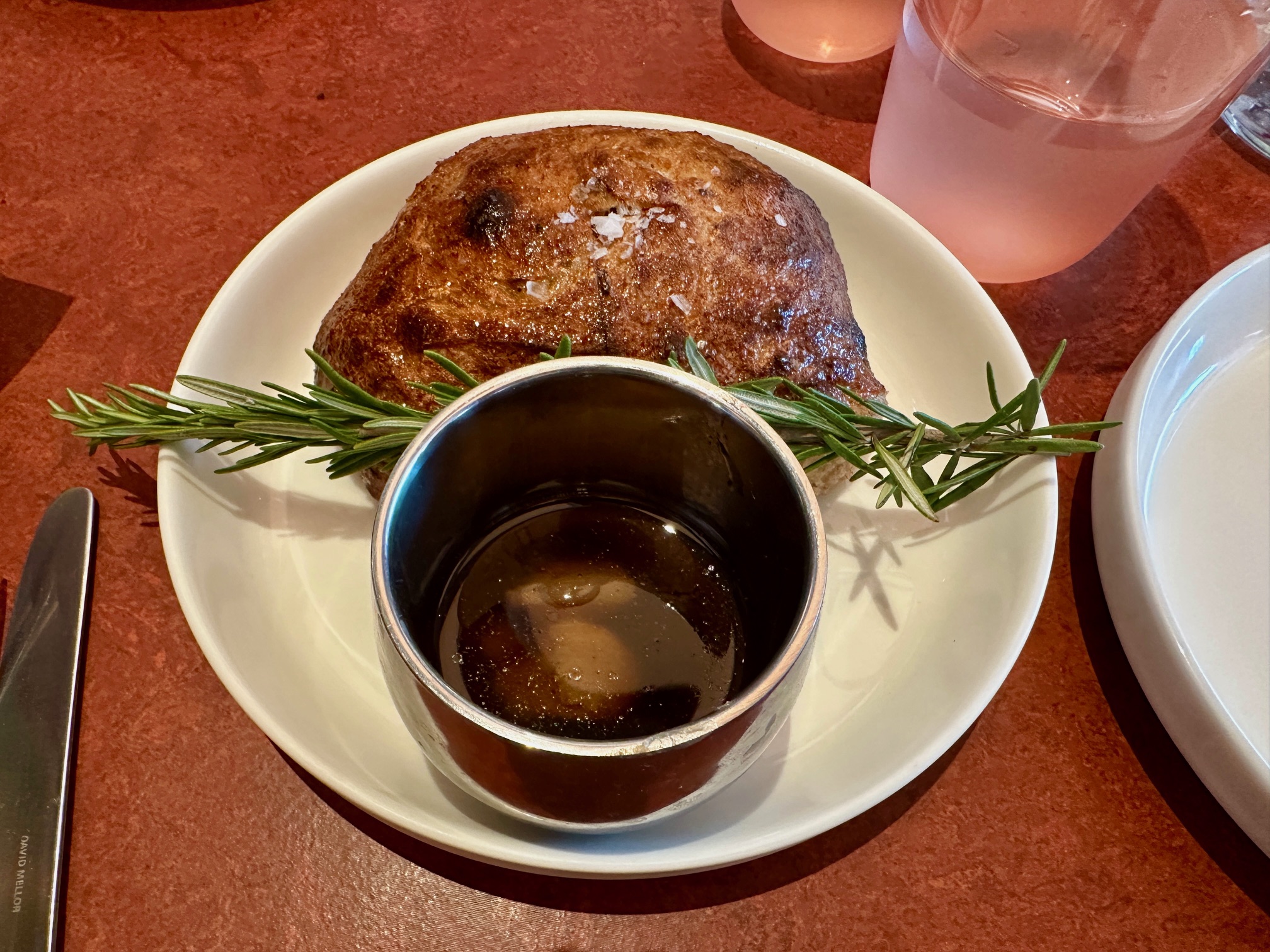
But the dish everybody lost their shit about was the bread: potato sourdough which came not with butter but with a little bowl of dipping gravy. I’d read so much hyperbole about this dish that I almost had an invented memory of having eaten it myself: reading a plethora of reviews will do that to you.
It brought out the purple streak in reviewers: “we all need dipping gravy in our lives” was Jay Rayner’s take on it, while Giles Coren called it “show stopping”. Tom Parker Bowles said that it “coats the lips with a lustre of sweet fat” – just no, thanks – and Grace Dent didn’t try it. But that’s Dent all over: read her reviews carefully and she talks about far more dishes than she actually eats. I know people like that.
So did it live up to all that hype? Well, no. The gravy is indeed terrific: thin, glossy, beaded with beef fat with some soft, steeped garlic in it. But I tend to think if you’re going to dip some kind of food in a liquid, that something shouldn’t be wet too. And the sourdough was a soft, slightly underbaked ball of stodge that wasn’t really up to the job of acting as a vehicle. Sometimes the line between USP and gimmick is a thin one: you didn’t need VAR to work this one out.
I had a slight sense by this point that, as with the beautiful dining room, things had been designed more for form than for function and my starter backed this up. Again, many of the reviews have lavished praise on Town’s saffron risotto with roasted bone marrow and I was very excited to try it. And it’s clearly visually imposing, to have this kind of roundel of a dish with a bridge of bone crossing a pool of risotto.
Very Instagrammable, I’m sure, and a huge hit with the critics. Grace Dent said it was “sublime”, Jay Rayner “stupidly rich” and Giles Coren went on about a “huge canoe of fat, salty marrow” (fun fact: Coren is also a canoe, although a different kind). But this dish felt like it was for looking at, not eating. My bone was decidedly short on marrow, and once you’d worked it free and into the risotto, there was nowhere to put the bone, which rather got in the way of eating the bloody thing. You ended up playing some kind of weird gastronomic Poohsticks, pushing your risotto under the bone so you could get to it.
With all those reservations, was it worth it? Well, yes and no. I liked the risotto, which was saved from anonymity by a judicious hit of citrus, and what little marrow there was was indeed outrageously good. But as a dish, it felt performative rather than knockout. Seventeen quid for that: Giles Coren said that it would have done him for lunch or dinner on its own, but maybe he’s on some kind of appetite suppressant.
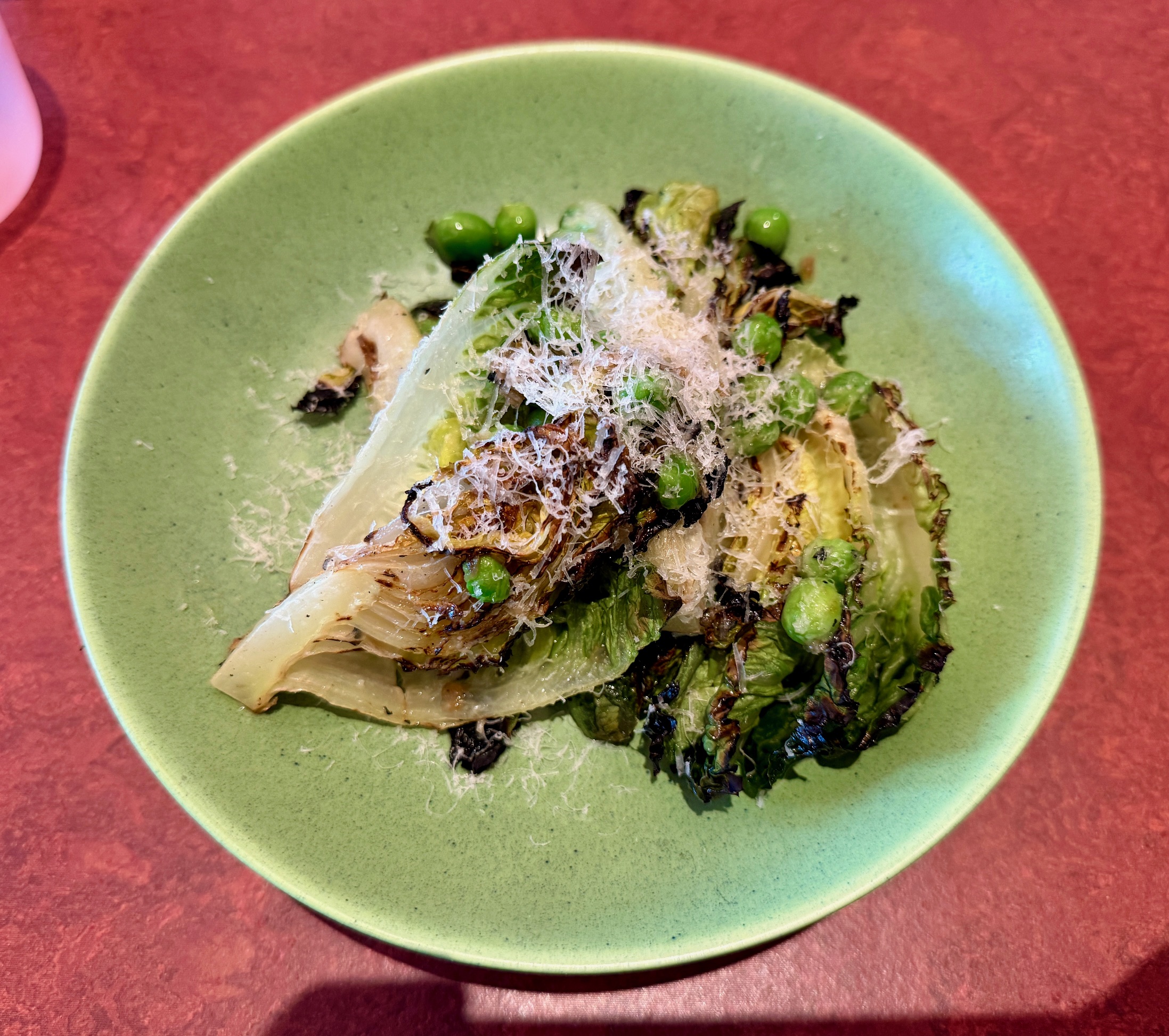
Far more successful was Zoë’s choice, charred baby gem lettuce with peas and Spenwood. Town appears to have dedicated itself to the worthy pursuit of making salad both warm and interesting, and this was a great leap forward in that field. I had a forkful, loved it, and didn’t resent the fact that Zoë had ordered it and I hadn’t. Mostly, in truth, because it was her birthday. Perhaps Town’s gift was that dishes which looked unassuming on paper turned out to be worldbeating in the flesh. Which was great and all that, but how would most people ever find that out?
The reviews I’ve read of Town talk about the service in glowing terms, and again that wasn’t entirely my experience. Perhaps I was there on a bad day for them, but it felt solicitous to a fault, as if they had over-resourced and wanted to look useful. So while we were still finishing our starters, they came over and plonked down the cutlery for our main courses, which just seemed odd. I didn’t think much of it at the time, but then they made a similar, more annoying mistake later on: we’ll get to that.
But anyway, we were having a lovely time, in a lovely room, we were off work for the next week and a bit and there’s something about lunch in London on Friday, when most people are at work, that always feels like a little victory. And our table was decent, the company was superb – well, for me anyway – and the bottle of Albariño we were on was going down nicely. I knew at some point, when I wrote the place up, I would need to distil how much of the excellence was down to Town and how much was down to everything else, but that was a quandary for later.
The birthday girl also chose the best main. It wasn’t even close. Pork came beautifully done, a charred crust masking perfect pinkness, a really deft piece of cooking. The menu said it came with “early season onions and burnt apple sauce”: in honesty I think the onions were close to burnt, but that’s never really a bad thing. The apple sauce, its Stygian tones matching the best bits of the pork and the onions, was quite glorious: I didn’t mind the mustard, but like most condiments it wasn’t Zoë’s bag. At thirty-two pounds, this was a relative bargain on Town’s menu and – and this is high praise – it reminded me of the sort of thing you can get at Quality Chop House.
Town was no slouch with its sides, either. Pink fir potatoes came coated and roasted in beef fat – they do like making the most of their cows at Town – and was bang on for flavour, although I’d have liked these to have a little more texture. Not at all a bad side dish, though.
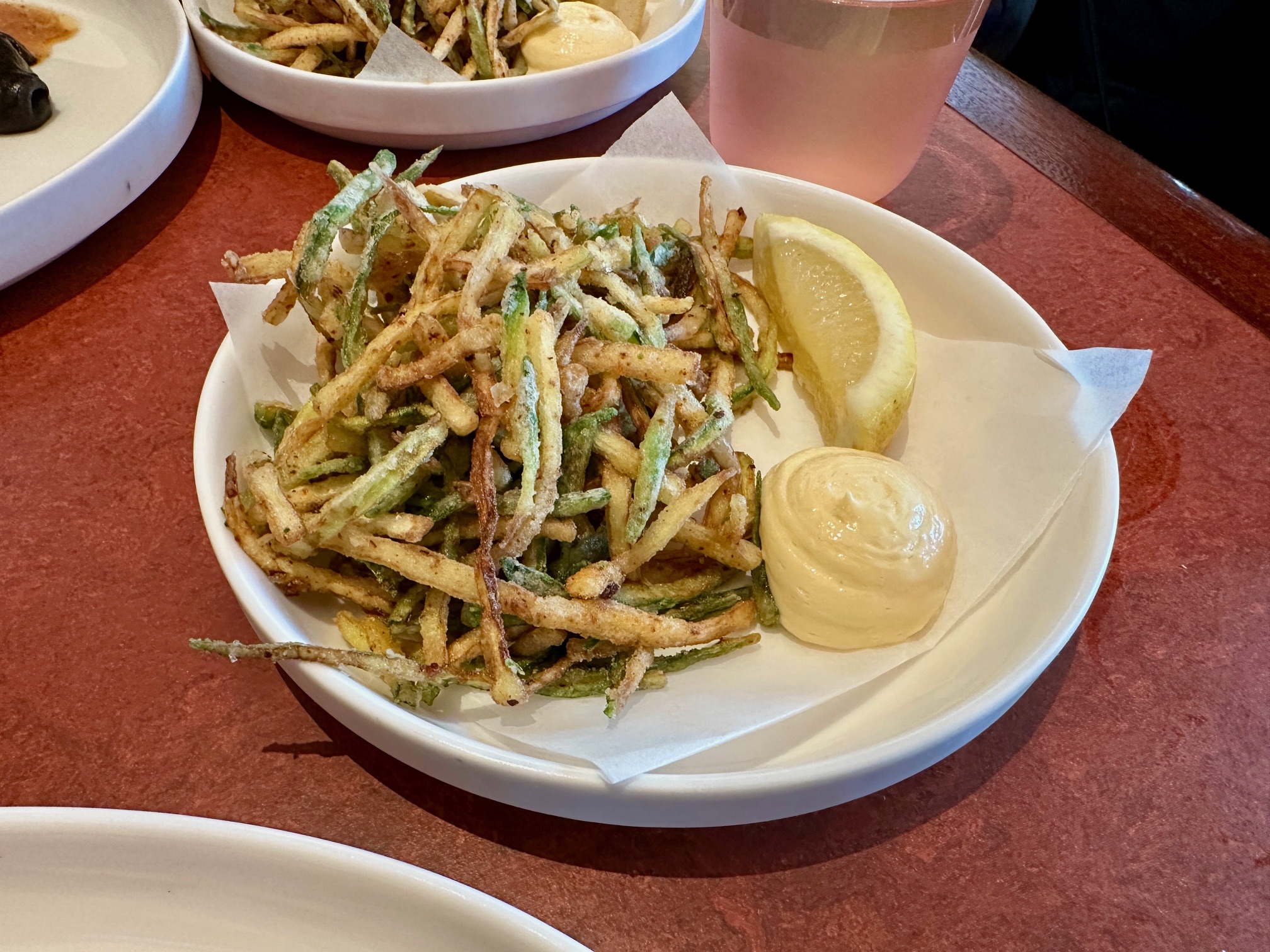
Even better – by my reckoning, anyway – were the courgette fritti, a glorious mess of these served simply with a squeeze of lemon and a little of what I seem to recall was aioli. I loved these, but I do have to say they wouldn’t be for everyone: their saltiness was right at the upper limit of what I enjoy, and it’s eminently possible that I like salt more than you do. I wasn’t sure they went with anything, but they were so much fun that I also wasn’t sure they needed to.
Here’s how ridiculous the contortions I had to go through were: Zoë had picked the pork, which otherwise would have been my choice, and my two remaining options – that hispi cabbage, inexplicably, didn’t appeal – were the duck pappardelle or the Cornish lobster. I would order the pasta dish probably 99 times out of 100, but I’m very aware that this makes me a rather samey reviewer (fried chicken, anybody? Gobi Manchurian?) so, just this once, I strode confidently into the unknown.
Now, you might absolutely love lobster and so that picture below might look like heaven on a plate to you. I’ve often thought, sacrilegiously I’m sure, that it’s just a big prawn – scarred by The Lobster Room, perhaps – but I’ve also always wanted someone or something to change my mind. Town’s lobster is not, sadly, going to be the dish to do it.
It wasn’t dreadful. Some of the meat was a tad tough, took a little prizing away from the shell, but the XO sauce Town makes to go with it is absolutely stellar: savoury, intense, take-my-money-for-a-jar-of-the-stuff stuff. But where was the lardo? It’s not those white sheets you can see in the picture above: those were thin ribbons of some vegetable, celeriac at a guess. And artfully draping some foliage over proceedings, to make it look more like a still life than a £45 plate of food, didn’t fool me.
I was gratified to find it wasn’t just me, though. David Ellis ordered this dish just after they opened. “The kitchen is settling in” was his verdict on it: on this evidence, they haven’t got there yet.
After this we still had a little wine to drink, so we had a look at the dessert menu and enjoyed the room a little more, now it was less packed. And again, it wasn’t Town’s fault necessarily but the dessert menu didn’t really scratch me where I itched. I’m sure it would be a great menu for loads of you, that you’d make a beeline for the buttermilk pudding or the pandan milk cake, go crazy for the “coconut tapioca” that put me off ordering the mango with yoghurt sorbet. But by this point I’d given up on ordering something else just for the sake of it, so chocolate tart it was.
But before that I have to explain the other service mishap, which I’m afraid involves a little too much detail. I’m going to do it, though, because it illustrates how exactly Town was trying just a little too hard, and because I know if there’s one thing my readers love it’s me either coming a cropper or talking about a perceived bad experience.
So, because it was Zoë’s birthday they brought her out a little treat-sized portion of the chocolate tart, which she ate and loved. That was really kind of them. And because we loved it, we ordered a portion each, and so the staff brought out our cutlery. And then, before our dessert turned up, even though we were sitting there having a perfectly nice time, one of the over-attentive staff swooped on our table, totally unsolicited, and tried to clear the cutlery, which we actually needed, away, knocking the rest of my glass of wine over in the process.
So that was annoying, and they were perfectly nice and apologetic – although I did end up mopping it up myself – and then to say sorry they brought me a glass of the dessert wine Zoë had ordered over for me. Which, again, was kind, but I didn’t actually want it. So I topped up Zoë’s glass, at which point it transpired, as far as I could tell, that actually they hadn’t brought me the Coteaux du Layon Zoë had ordered but something cheaper. So I ended up soaked and irked, with a drink I didn’t want, having accidentally adulterated Zoë’s very nice drink, and feeling ungrateful into the bargain. Hey ho.
But yes, the chocolate tart was lovely, an oblong lozenge of indulgent ganache that tested your resolve, made you wield a fork with almost surgical precision, trying to make the experience last as long as possible. The black barley ice cream was pleasant, if surprisingly generic given that description, and even the raisins, soaked in Pedro Ximenez, were a lot of fun.
Would I have come away thinking that the base was so molecule-thin that it was hard to describe it as a tart if I wasn’t still pondering my spilled wine? Would I have noted that the hazelnut mentioned on the menu, like the lardo from earlier on, were nowhere to be seen on the plate? We’ll never know.
All that said and done I settled up, although not before taking advantage of Town’s facilities, which are exceptionally plush and luxurious and boast a gorgeous hand soap (I wish I’d remembered to take a picture). Our meal, including an optional ten per cent service charge, came to just under two hundred and ninety pounds.
I think, for what we had, that’s slightly on the steep side – but bear in mind I’m saying that from a perspective unlike that of most broadsheet reviewers who get to expense everything. But it was Zone 1, it was Covent Garden, so maybe that’s only to be expected. “Nobody gets out for under £80/head in central London any more for food you’d tell your friends about. Unless your friends like talking about pizza” was Giles Coren’s contribution on this subject, and who’s more relatable than Coren? Exactly.
If you found it easy to guess the rating on this one, having read all this, then have a gold star, because I’ve found it very difficult to assess. The room is great, though not as great as everyone said it would be. The menu I personally found more limited than I expected. The food was quite nice, but not as amazing as the reams of breathless prose devoted to it in the papers.
It’s very strange, this. I’m not an expert, but I imagine there are countless restaurants in London better than Town. Some of them may even have opened the same month as Town did. And yet nearly everybody who reviews restaurants for a living dropped in on this place within six weeks to say how great it was.
Does it do good things for the food scene in this country that our vanishingly small number of restaurant critics all go to the same restaurants? No. Am I part of the problem by reviewing the place as well? Not sure we’re comparing apples with apples really, but possibly, yes.
Never mind. Town is quite nice, and I suppose I’m glad I went there and tried it. Nothing I ate will feature in any list I make at the end of the year, but not everybody gets on the podium. You can be a decent restaurant without managing that. Would I go again, though? Well, between the places in London that I’ve loved and would dearly like to revisit and the restaurants in the capital burning a hole in my to do list, I think the answer to that is no.
But that’s just me. Giles Coren said he’d happily go there “every day, if that’s all right with them”. But his mate owns the place, so I’m guessing he gets some kind of discount. Oh, and in the interests of full disclosure: I do not know Jonathan Downey. Not only that, but I honestly have no idea who he is.
Since January 2025, Edible Reading is partly supported by subscribers – click here if you want to read more about that, or click below to subscribe. By doing so you enable me to carry on doing what I do, and you also get access to subscriber only content. Whether you’re a subscriber or not, thanks for reading.
Snobby’s, a wine bar and Italian small plates spot in Redland, has everything going for it, on paper. It is on one of Bristol’s most decorated gastronomic streets, opposite the critically acclaimed Dongnae and a few doors down from freshly Michelin starred Wilsons and Little Hollows, itself the holder of a Bib Gourmand. It’s received an approving write-up in the Financial Times and floppy-haired grifters Topjaw have featured the place.
It is, you would think, a safe bet. And yet it was at Snobby’s last week that I had arguably the worst – and definitely one of the strangest – experiences at any restaurant in nearly 12 years of eating out and writing about it. So, to channel my inner John Oliver, this week, let’s have a look at that. Because in the process I suspect we’ll find out a lot about what restaurants are supposed to be for, and what happens when they start to forget that.
So what went wrong? Well, it wasn’t the room, which is a really lovely space, all pale wood tables, Hans Wegner wishbone chairs and deep green wood panelling. You enter the dining room through a buzzy terrace, and it feels like a lovely spot to while away a couple of hours.
Zoë pointed out that the banquette sat a little too high, like it had been put in by a contestant on Interior Design Masters who never ate in restaurants, but it was a minor quibble. We arrived just after 8 and although many diners were al fresco there were still plenty in the dining room.
The problem wasn’t with the menu, either. It was a compact affair with a handful of nibbles and then seven dishes, priced between nine and twenty quid. The menu recommended two plates per person, adding Don’t forget to share!
As we were trying to decide our server kindly pointed out that they were running low on focaccia, so we decided to nab a portion before any more diners took their tables and snagged the last of it. It was delicious, salty stuff cut into cuboids, brilliant dipped in olive oil and balsamic. The salted almonds, glossy with oil, were equally good. This was a promising start, we thought, five minutes in. It was, with hindsight, the last point at which any of this felt normal.
So, by then it was time to order proper food; it must have been something like twenty past eight by then. Feeling like trying as much of the menu as we could, and being in no rush, we asked our server if we could order a few dishes to be going on with, and more after that.
“I’m afraid not” he said. “It’s just that the kitchen is closing soon.”
The exact time it shut was not specified, and we were too taken aback to ask for details. Was there no wiggle room on that, we asked? Apparently not – the thing was, he said, we were their last customers of the night. At twenty past eight. What happened to we might run out of focaccia?
Never mind, we thought. We could order everything we wanted to try and at least control the order that our dishes came out in, so we could still experience something like the evening we had in mind. Would that be possible, we asked? Ah, that would happen naturally, the server said. The lamb dish we’d ordered was the thing that took most time to cook, about twelve minutes, whereas a couple of the small plates, served cold, would come out faster.
Now, you could take this to mean one of two things. One might be that the kitchen, being in the business of hospitality, understanding how to pace and sequence dishes to give diners an enjoyable meal, would space things out to maximise the enjoyment of their customers. Or it could mean that the first couple of small plates would come out almost immediately and the lamb dish twelve minutes after that. Can you guess which one happened here?
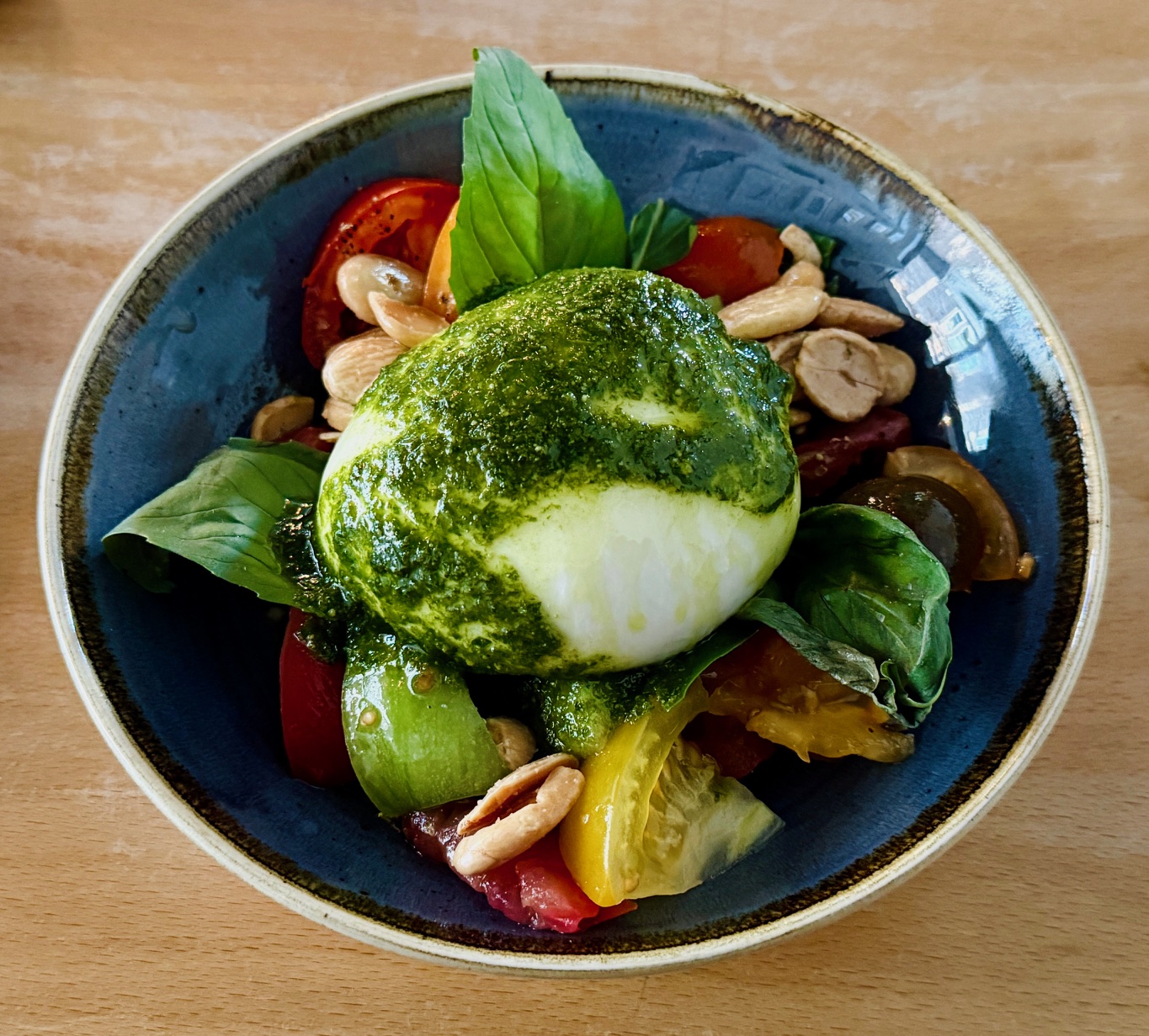
So yes, Zoë enjoyed her burrata dish, which arrived something like five minutes after we’d placed our order. It was more about buying than cooking, as this kind of dish often is, but everything was present, correct, nicely bought and displayed to its best advantage. The tomatoes, a bright array of red, yellow and green, were lovely and scattering the dish with more of those fried almonds was a nice touch, as was the slick of lush pesto anointing the whole shebang.
At exactly the same time, out came the monkfish crudo, which was less successful. It looked like a limpid pond of the stuff, micro coriander and thinly sliced radish floating on its surface, and I quite liked the orange and soya dressing and little spikes of some kind of seeds or peppercorns. But the monkfish felt too thick, coarse and meaty for the crudo treatment, and this, to me, just didn’t work.
I think it needed something more slight, translucent and refined, like the sea bass crudo I saw on the menu of another Bristol restaurant the following evening. But then maybe monkfish justified the price tag, at nearly seventeen pounds. At the price of a main in many restaurants you got a small plate here, whisked out mere minutes after we ordered it. Still, these two dishes had arrived close together, and the menu’s instructions said that we should remember to share, so perhaps it was okay.
Or it would have been if the next plate, a hot dish, hadn’t arrived literally two minutes later. Ricotta and parmesan gnudi – dumplings – came as a trio in an asparagus cream with more asparagus, petits pois and, allegedly, a miso butter.
I am not entirely sure that three dumplings encourages sharing, and I’m not sure it’s worth the best part of seventeen quid. But I’m equally sure that bringing it out at the same time that there are two other dishes already on the table hardly encourages sharing either. By the time Zoë got to trying any of this, it was lukewarm at best, as was her enthusiasm for the whole thing.
I nearly didn’t mention this, because it all happened so fast, but with all this going on and dishes turning up faster than we could make inroads into the dishes that preceded them, we also tried ordering some wine. The initial choice we’d gone for, we were told, was not cold enough, and so – amid the flurry of plates – we were also brought a possible alternative, which we didn’t massively like.
So we asked for an albariño, and the server who eventually brought it over was absolutely brilliant – enthusiastic about the wine, positive about the producer with loads of detail that brought it to life. It was the only example of great service we had all evening: Snobby’s should hang on to that person, and clone them if they can.
Meanwhile, with three dishes on our table and us struggling to eat them, along came the lamb dish we’d been told took twelve minutes to cook, approximately ten minutes after our first dishes turned up. You couldn’t fault the kitchen for efficiency, just for other things like understanding how meals are meant to work and the difference between a lovely meal out and Man v. Food.
And it’s such a pity, because the lamb dish showed, too, that you couldn’t fault the kitchen for talent. It was the nicest dish I had that night and one of the best things I ate all week – a slow-cooked, sticky, sumptuous cylinder of shoulder and leg, crying out to be pulled apart with a fork, resting on a moat of puréed cannelini beans and swimming in a decadent, reduced jus. Such a lovely dish, ruined by bringing it out as part of some kind of deranged conveyor belt.
Restaurant bloggers like to come out with a particularly wanky cliché where they say that restaurants take quality ingredients and “treat them with respect”. It’s empty nonsense, as if the alternative is to take them out, buy them a few drinks and then ghost them until the end of time.
But quite aside from that, treating ingredients with respect isn’t only about making a good dish out of them. It’s also about treating that dish with respect, serving it in a way that enables it to have its moment in the sun. That wasn’t happening here. And when you don’t treat your dishes with respect, guess what? You’re not really treating your customers with respect, either.
At the same time as the lamb, the arancino – that ideally we would have eaten closer to the start of the meal – had also materialised. Half an hour after we sat down, about fifteen minutes after we’d ordered, our five not that small dishes had all been brought to the table, leaving us scrambling to eat them before they went cold and moving our empties to the neighbouring unoccupied table for four (a minor gripe, but if they were going to bring it all out at once they could at least have put us on a table that could accommodate all that crockery: they had no other customers after all).
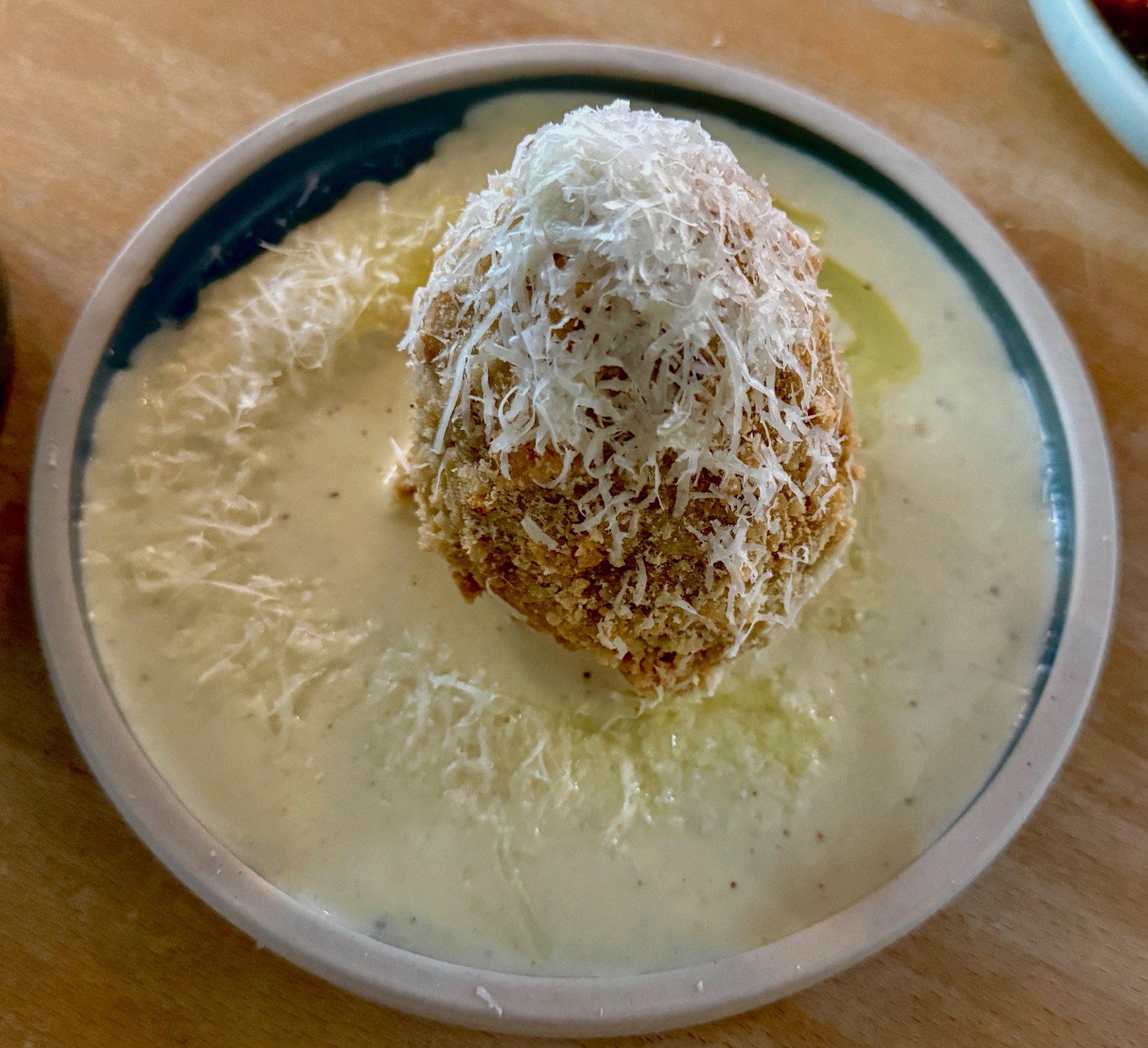
As for the arancino, Zoë had some and thought it was pleasant if unexceptional. It had scamorza in the middle, and a honk of truffle oil, but it was slightly big, stodgy and lacking in texture. She could only tackle a little of it and I decided that I’d rather eat the lamb, which I loved, than make inroads into the arancino.
Here’s the other thing: when a restaurant brings out five dishes – seventy-five pounds’ worth of food – in the space of ten minutes, not making any real effort to sequence them, you get too full to eat it all very quickly.
To emphasise how farcical this was, it was only around the point that the lamb and the arancino arrived that we finally got our bottle of wine. I thought it was rather nice, Zoë thought it too wasn’t quite cold enough. But we made up for that, because any residual warmth we had towards Snobby’s had well and truly vanished by then.
We struggled through some of the food, left half of the gnudi and half of the arancino, on account of it being too cold and our being too full. The plates were taken away without any questions in a strangely incurious fashion.
Normally this stage, when your empty dishes are taken away, is one for quiet and happy reflection. But instead, we both just gently fumed. You might expect that from me, but Zoë is as good-natured as they come, and this meal left her feeling positively aggrieved. It takes some going to piss her off, as her seven years and counting shacked up with me proves beyond reasonable doubt.
Chatting away about it, we couldn’t quite believe that we had been rushed through all those dishes at breakneck speed so that the kitchen could close – at twenty to nine, no less. And if the kitchen really did close early, perhaps Snobby’s should mention that to people making bookings at 8.15? Because they seemed quite happy to tell people making earlier bookings online that they only had the table for an hour and three quarters: it wasn’t as if this kind of communication was beyond them.
It got more ridiculous after that. Our food gone, and with a feeling that the wait staff were studiously avoiding asking us how it had been, we were left with the best part of a bottle of wine, with notes of stone fruit, citrus and… bleach? Yes, bleach: because at this point a strong waft of the stuff was emanating from the kitchen, obliterating any subtlety or enjoyment in the rest of our Albariño. Did the staff have a bus to catch?
Enough was enough, so we flagged down our server – the same chap who had told us the kitchen was closing and the food would come out as and when – to pay the bill and he asked us, in a perfunctory way, how it was. And that loosened the lid for both Zoë and I to say that no, actually, it hadn’t been all right. So we explained that we’d felt rushed, and not listened to, and that we couldn’t really understand how either the serving staff or the kitchen could have thought our evening was an experience anyone would willingly choose.
Zoë asked him, given that he’d previously told us the kitchen was closing, when exactly the kitchen shut. He said that it closed when the last customers had ordered. But, Zoë said, we were the last customers and we’d asked not to order all our food at once, so why were we railroaded into doing so? He had no answer to that.
Fair play to him: he listened, a little like a rabbit in the headlights, and at the end of it agreed to knock off our service charge. Which felt slightly like missing the point to me, because some of the service – especially the person who brought our wine – was excellent and really the problems were more fundamental than that. When two dishes had gone back to the kitchen half-finished, because the timing had been so completely out of kilter, a better step might have been to knock those off the bill.
And bless him, I’m sure he meant well when he said that he appreciated the feedback and that actually, it would help him in an ongoing debate he had been having with the kitchen. But what I took from that was that this had been an issue for a while, that it hadn’t been fixed, and that our crummy meal was collateral damage in the process of eventually resolving those problems.
I was delighted for their future customers who might benefit from that piece of learning, but it didn’t help us at all with our wasted evening. Our bill, with service knocked off, came to just short of one hundred and thirty-five pounds, for a meal that was over in something like thirty-five minutes. I know there is a risk, when you complain about an experience like this,that you might sound entitled. But really: would you have been happy with that?
The following day, I got an email from the owner of Snobby’s. I’d booked online and, having been tipped off by the staff, he contacted me via my email address. I explained to him what had gone wrong and, to his credit, he said that he needed to pick these points up with his staff. He said that he’d not been as close to the business in recent weeks, and that this was a timely reminder that he needed to do something about it. He didn’t refund anything, but did send me a voucher for the cost of the two dishes which we didn’t finish.
And that’s very decent, but I’m not sure I’d use that voucher, potentially throwing good money after bad. He said that he was sure I understood the pressure hospitality was under right now, and that the feedback would help them to survive in a competitive industry. I know that’s right, but the converse is also true: customers have less disposable income than ever before, and they simply won’t want to spend it on an experience like that. Eating out is more costly, so people do it less often, and when they do they don’t want to spend that kind of money and have an experience that feels sub-Wagamama.
The Bristol restaurateur Dan O’Regan (the owner of Lapin) writes a blog about running restaurants. In a recent piece he talked about kindness, saying that it’s “the only thing that’s ever made restaurants work”. He said that customers deserve warmth, and a feeling that they’re welcome, however much they are spending or whatever kind of meal they want to have.
I don’t say any of this out of unkindness myself. I could have not written this review, which is after all telling you not to go somewhere you might well not have gone anyway. But I did, not to vent my spleen – fun though that might be – but because this experience encapsulates something of what restaurants are supposed to do and how jarring it can feel when they drift from their purpose.
And it felt to me like Snobby’s had completely forgotten what the purpose of restaurants was, namely to look after customers, to make them feel welcome and cared for, and to prioritise their convenience over the convenience of the kitchen. Because if a restaurant’s aim is to minimise inconvenience to its staff, or even if it comes across that way, I can’t help but feel that somebody, somewhere, has put the cart before the horse.
A restaurant that does that, I think, has forgotten what restaurants are for and what makes them such wonderful places. They betray the promise that great restaurants make, the covenant they have with the customers that love them. And a meal is never just the food. It’s the food, the room, the service, the timing. In restaurants, as in comedy, timing is everything. Get that wrong and it’s closer to tragedy.
Anyway, fingers crossed that future customers benefit from the disappointing evening I had. I would really like to see Snobby’s turn things around, because it’s a lovely spot and it’s capable of cooking some excellent food. They might be redeemed, and I really hope that they are. But my voucher, I suspect, won’t be any time soon.
Since January 2025, Edible Reading is partly supported by subscribers – click here if you want to read more about that, or click below to subscribe. By doing so you enable me to carry on doing what I do, and you also get access to subscriber only content. Whether you’re a subscriber or not, thanks for reading.
Amò closed in mid-December, apparently for maintenance, with no indication of when, or whether, it will reopen. I have left the review up for posterity.
In the good old days, where you stood on certain binary debates was simply a way of positioning you in the world. Cream first or jam first? Plain or milk chocolate Bounty? Cheese and onion or salt and vinegar? Were you a fan of the Beatles or the Stones? Blur or Oasis? All these things used just to be a form of triangulation, little points on a chart that, taken together, might give someone an idea of you (and, since you’re asking: cream first; milk chocolate; salt and vinegar; the Beatles; neither).
When did that all change? 2016, I suppose, when we all became Leave or Remain, indelibly stamped, and at every stage from that point forwards. We’re always asked what side we’re on, and now it’s not a useful piece of trivia but a necessary step to place yourself on one side or another of a yawning chasm. Are you pro- or anti-Israel? Do you think J.K. Rowling is a hero or a villain? How about Farage, or Trump? Did you believe in lockdowns, masks, vaccines? Did you leave Twitter or stay? If you left, did you go to Bluesky or Threads?
Like the Tower Of Babel, we’re now all scattered to the four winds, trying to find our tribe and arguing, endlessly, with the others. It’s not a bit of fun, any more. And this is all rich coming from me, because I’m painfully aware that I’m as polarising as most. Happily, Reading faces another tricky choice now that’s potentially just as difficult, but hopefully less divisive: Paesinos or Amò?
The two pizza places opened on Kings Road, two doors and three months apart, the latest in a weird series of rivals in very close proximity, following the example of Pho and Bánh Mì QB in Kings Walk or Iro Sushi and You Me Sushi on Friar Street. What is it with that? You must be very confident in your product to open so near to a direct competitor, like Bánh Mì QB did, but with Paesinos and Amò, Iro and You Me so little time separated both arrivals that it must be an unhappy coincidence. Imagine pouring your heart and soul into a new business only to find that another one a lot like yours is doing exactly the same, a stone’s throw away.
Anyway, regular readers will know that I reviewed Paesinos a month ago with my Italian friend Enza (who is, just to confuse matters, an Amò superfan) and it received a glowing write up from me. But I knew, even as I was eating there, that I needed to prioritise visiting its neighbour, if only because Enza told me that it was as good as, if not better than, the restaurant I had so enjoyed. I couldn’t go with Enza, because she was so far from impartial, and this time I took my friend Jo, also of Italian descent, last seen checking out House Of Flavours with me.
Amò is, as I’ve said before, something of a joint venture between Madoo, the founding father of Reading’s Italian quarter which opened four and a half years ago, and Pulcinella Focaccia, a business that sold pizza and focaccia for delivery from premises out in Earley and has been trading for a couple of years; I’d never had food from the latter, but I’d heard plenty of good things. And arriving at Amò on a weekday evening I was struck that, in terms of branding and decor at least, it felt fully formed in a way that Paesinos didn’t so much, or Madoo for that matter.
Everything was tasteful and unfussy without being Spartan, with a bare wood floor and tables, seats and benches. It seated somewhere between fifteen and twenty people, so significantly more spacious than the likes of Mama’s Way or Paesinos, and it had a nicely calm feel to it. Amò’s logo was in the middle of a deep red swatch of paint on the wall behind the counter, and resting on that counter was possibly one of the most tempting displays in Reading.
Amò very cleverly changes up its offering around the time people start finishing work, so until 5pm you can try pizza al taglio or something from a changing array of Italian street food. They also, I think, offer focaccia sandwiches during the day, although most of them had gone when Jo and I turned up around half seven. After 5pm the sandwiches drop away but instead, alongside the slices of pizza and street food, you can order a whole pizza from a more varied menu.
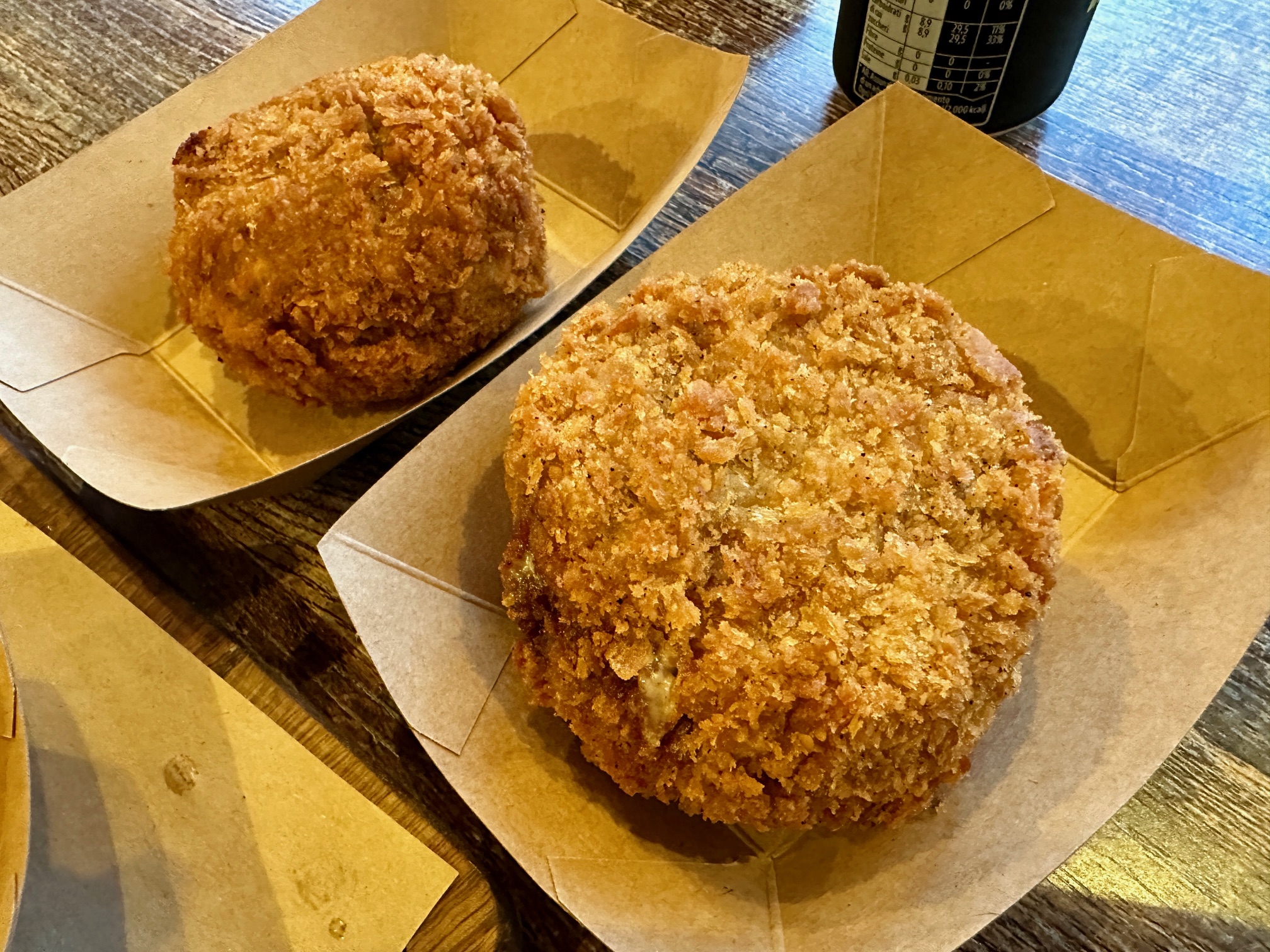
The street food was all very tempting, all things that I would challenge anybody not to fancy eating. Arancini, croquettes, mozzarella bites and frittatini – fried pasta – were all tributes to the time-honoured method of coating something in breadcrumbs and frying it until it was golden, crispy and alluring. The lighter side of Amò’s offering is keenly priced, too. Most of the street food dishes are around a fiver, pizza by the slice is less than that and they do multibuys if you want two stuffed focacce or two slices of pizza. Whole pizzas top out at about fifteen pounds, unless you add sausage or Parma ham to one of the options.
And Amò’s pizza menu struck me as very clever, because – either by accident or design – it kept the overlap with its neighbour’s pizzas to a minimum. Amò has a list of the classics, of course, so you can have a margherita, or prosciutto cotto and mushroom, or sausage and friarielli. But on the other side of the small, laminated menu, you find loads of less conventional options, far more interesting than the kind of things you could find at Zia Lucia or even, dare I say it, Amò’s neighbours.
That meant pizza with a purple sweet potato base, topped with cacio e pepe cream, guanciale and sweet potato crisps, or pizza with a pistachio cream base and mortadella. Others had a truffle cream base, or pumpkin cream, or even a cavolo nero base (“it’s the gourmet version of the salsiccia e friarielli”, Enza had told me, when I was looking for recommendations).
You may find all of that a bit leftfield, or it might whet your appetite for wandering off Reading’s beaten pizza track. I think for me, though, it was neither: I chalked those up as things to try once I had road tested the classics.
But first, Jo and I had a chinotto each and ordered some of those smaller dishes to kick things off. And as we waited for them, she told me about her childhood holidays by the coast, near Salerno, buying balls of mozzarella as big as your head from some beachside hut and eating them with bread, nothing else required. It was brilliant, Jo said, but it did slightly ruin the mozzarella you can easily get in this country; like me, Jo considers it a seriously underrated cheese.
As so often I felt a little pang for a childhood I didn’t have, listening to Jo. But then there was something to be said for sitting in a caravan in Devon, rain drilling on the roof, eating hog’s pudding cooked in a frying pan – always with tinned tomatoes on the side – watching Roland Rat on TV-am, knowing that the evening would be spent playing cards and watching reruns of Shogun (the original, not the superb remake). Maybe those memories would sound exotic to an Italian: on balance, though, I guessed not.
Amò’s mozzarella bites may not have been the size of my head, but they were gorgeous nonetheless. Crisp-crumbed spheres, golden but not overdone, the shell holding just-molten-enough mozzarella, they were a proper delight. I might have had them with something to dip them into, but it was a minor quibble with something so delightful. So was the fact that however carefully I ate them, with my hands at least, a little liquid sprayed out, leaving incriminating marks on my shirt. I was too happy to care, and the attentive staff quickly brought extra napkins.
At five pounds fifty for four, they could have been the bargain of the meal, if not the month, but for the fact that we also ordered two of the frittatini. These are yours for three pounds fifty, or six quid for two, and come in two flavours. If you go to Amò, my advice is to make sure you have one to yourself or, as Jo and I did, order one of each and share. They’re a bit fiddly to break up – that crisp carapace presents resistance when you’re relying on a wooden fork – but they reward the effort, with dividends.
They were beautiful things, and when I sit down in six months or so to write my annual awards it’s hard to imagine they won’t feature in some shape or form. And their form – big, irregular golden pucks – belied just how wonderful they were on the inside.
Picture an arancino, but instead of risotto rice visualise a cluster of little tubes of pasta, and rather than a molten core, imagine the whole thing bound together with sauce. In terms of taste, contrast, texture and sheer tactility I’m not sure I can think of anything finer, and writing this paragraph I am deeply aggrieved that I cannot eat one right this minute, or indeed by the end of the day.
This is where Amò are an especially smart bunch, because during the day you could pitch up, have a chinotto, a slice of pizza or a sandwich crammed with porchetta and provolone, and add one of these for a mere three pounds fifty. That’s almost the price of subscribing to this blog for a month and, although it pains me to say it, it’s even better value.
Jo and I both loved the meaty version but would you believe that the vegetarian option, with fried aubergine and tomato, was even better? Jo described it as like being “slapped in the face with flavour” and believe me, apart from that fried pasta, nothing or nobody would get away with slapping Jo in the face with anything. One of the best things I’ve eaten this year, no notes at all.
Jo was very keen to try one of the pizzas by the slice, with meatballs on it, so that turned up next, thoughtfully cut up to share, a meatball perched precisely in the centre of each quadrant. This too was cracking, although I suspect the base on the pizza al taglio is slightly different to that on the whole pizza. The meatballs, in particular, were excellent – coarse and lacking in suspicious, smooth bounciness. It also, by the looks of it, was only available by the slice so, again, well worth adding to a lunch order.
By this point, as our full-sized pizzas arrived, the carbs were taking their toll, and we were already prepared to ask if some of our leftovers could be boxed up – something that rarely happens to me, because it’s rare that my capacity is defeated by a restaurant.
Jo made it a few slices into hers, the piccantina, which was topped with salami, mushrooms and Gorgonzola. I didn’t try it, and from a cursory glance I thought the porcini were common or garden mushrooms, but Jo had no complaints. She’d told me earlier in the evening that she hadn’t had pizza for a while: Jo is on a monthly treatment regime where anything she eats the next day tastes vile and puts you off whatever you ate for the foreseeable future. One of those next days had involved pizza, and Amò’s piccantina resuscitated her love for the stuff. That in itself is no mean feat.
I on the other hand had deferred to Enza’s judgement and ordered the sausage and friarielli. As so often with white pizza, it had a bit more structural integrity, so less of the Neapolitan droop you might get with other pizzas. And the base was admirable, nicely puffy with plenty going for it. You couldn’t fault the generosity either, with nuggets of crumbled sausage very, very liberally deployed.
There was very little not to like about the pizza, and if I was clutching at straws I might say that I’d have liked the sausage to have more of a whack of fennel, but that’s a minor thing. It was so well orchestrated with the friarielli that it was impossible to argue: this was a pizza without complexity or variety that kept it focused and hit the target.
I managed about half of mine, and the staff were nice as pie about bringing a couple of boxes so we could take our leftovers home. Everything we had ordered – all that food, four cans of soft drink – came to fifty-five pounds, which is a steal, and then we went to the Allied for a debrief. Two pints of forgettable macro fizzy booze at the Allied set us back nearly sixteen pounds, which is very much not a steal.
For once, I can also report back on the leftovers. Jo had hers cold the next day – no slice for her beloved dog Diesel, this time – and sent me an iMessage: tastes even better this morning, cold from the box, outstanding! I on the other hand revived mine in the oven on my lunch break, working from home, and it was the best lunch I’d had in ages. I wasn’t sure if my slight lull that afternoon was down to the carbs or a Teams call that felt especially like a trudge. Let’s put it down to the latter.
Having talked about Amò for all these paragraphs, I know I should return to my opening theme and compare it to its neighbour Paesinos. But it’s not easy to do.
If they were top trumps cards, Amò would win in a number of categories. It’s more versatile, on account of having a focused lunch offering as well as pizzas in the evening. It has arguably a wider range of sides and small plates. It’s bigger, too, with far more potential to eat there in larger groups; if you go to Paesinos as a four, you either won’t get in or you’ll take up two-thirds of the restaurant. Its pizzas are more imaginative and unconventional, so more of a challenge to the Neapolitan hegemony elsewhere in town.
On that basis, you’d have it down as a resounding victory for Amò and, for some of you, that might well be the case. On the other hand, Paesinos sticks to the classics, both for pizza and for its smaller dishes. I think its soft drink selection – and neither is licensed – is better and more interesting. The cannoli and tiramisu are worth the price of admission alone. And, speaking completely as a novice in these things, I think Paesinos’ dough and base may have the edge.
But the main reason why taking a Top Trumps approach doesn’t work is that Paesinos, for me, has a little something extra. There’s no Italian equivalent of je ne sais quoi, as far as I know, but there’s a small dash of magic in the smaller restaurant that means that rationally, although I know Amò has a huge amount going for it, it’s impossible to pick a winner.
So yes, I’ve reflected and reflected and it’s impossible to put a cigarette paper between these two places. The only thing you can put between them, it turns out, is another restaurant – called Just Momo, which helpfully doesn’t just do momo. So the rating down there reflects that: call it a cop out, if you will, but I stand by it.
Let’s not divide ourselves by being Team Amò or Team Paesinos, because as a town we can be better than that. Hopefully enough of you will pick each side that both places will continue to trade for years to come. Because the truth is that there’s one real winner in this contest, and that’s Reading.
Amò Italian Street Food – 8.6 2-4 Kings Road, Reading, RG1 3AA 07500 619775
Since January 2025, Edible Reading is partly supported by subscribers – click here if you want to read more about that, or click below to subscribe. By doing so you enable me to carry on doing what I do, and you also get access to subscriber only content. Whether you’re a subscriber or not, thanks for reading.














 Edible Reading