Restaurant review: Club India

This week’s review partly came about because of a gentleman called Andy Hayler. Now, you might not know who Hayler is, but in terms of food he’s something of a phenomenon.

The shadowy world of Michelin exists behind an impenetrable curtain, with nobody sure how they work or what dictates who gets listed, is awarded Bib Gourmands and stars – or, sometimes, has them taken away. Andy Hayler is the closest thing we have to a Michelin inspector working in plain sight. He has a blog, which has been around since the 90s, in which he has documented hundreds of meals in restaurants, giving each restaurant – and every dish – a mark out of 20.

I’ve rarely seen anything get lower than a 10, and very little approaches the top of his scale, but that’s because a fair amount of what Hayler has reviewed is at the highest end of dining. There was a time when he had eaten at every three starred restaurant in the entire world, although he stopped keeping up with Michelin when, as he puts it, they devalued what three stars should signify by giving them out in some territories to restaurants that were nowhere near the standards he had experienced elsewhere.

Hayler has a sort of cult, niche status in food. I’ve read a couple of pieces about him in recent years, both verging on hagiographies. He’s been described as “the best living food writer”, and I’ve read interviews that gush about his effortless recall and the esteem in which he is held by chefs and restaurateurs. He is the cognoscenti’s critic of choice and no mistake.

I think he attracts some of those plaudits because of what his reviews both are and aren’t. They don’t, in some senses, read like reviews at all, more like audits from someone scrupulous and meticulous who has forgotten more good meals than most of us will ever have. Although it doesn’t sound like he forgets many of them: why would you, when you document them all in such extensive detail?

I think the respect also comes from his refreshing lack of ego; Hayler would be the first to draw a distinction between himself and many restaurant reviewers. “I wouldn’t ever pretend I was any sort of fantastic prose master. I’m not trying to throw in a load of stuff about my journey to the restaurant and the trendy people on the table to the left” he has said, subtly throwing shade on half the piffle I come out with every week.

Don’t worry, there’s no way he meant me personally: in fact, he once described one of my pieces, about Maida Vale’s Paulette, as a “lovely review” which I found surprisingly touching. “Most of the newspaper critics want to be writers first, I want to focus on the food” he said more recently. I suspect the people who read him admire that purity of approach, and it does mean that when he thinks somewhere is dismal or overrated, which happens occasionally, it’s really very amusing.

What’s also admirable is that Hayler goes where he likes, reviews wherever he wants: money seems to be no object, and he doesn’t follow the fads. You won’t find him, for instance, reviewing Brasserie Constance, a restaurant operating out of Fulham FC’s Craven Cottage, unlike nearly every broadsheet critic over the last few weeks. Instead, his two or three reviews each week involve him going wherever he pleases, in London and abroad.

His two main weaknesses seem to be eating at the Ritz in particular and eating Indian food in general. Hayler is a regular visitor to Epsom’s Dastaan, and the little group of restaurants it has spawned in Surbiton, Richmond and Leeds. He’s also a frequent diner in Southall, and when he gave a warm review to Hounslow’s review of Crispy Dosa last November it caused a Mexican wave of regional bloggers checking out their nearest branch to touch the hem of his virtual garment (been there, done that – four years ago).

“If Mr Hayler thinks it is OK, it is a fair bet I will probably like it” one said. “You can be assured that if Andy says a restaurant is worth visiting then it really will be” said another. That’s proper soft power, and all from the opinion of a chap you mightn’t have heard of.

Hayler even came all the way west to Caversham last year to review Clay’s, something I’ve been waiting for him to do for a very long time. He gave it 14/20, which may not sound like a big deal but actually is. “Clays is a very impressive family-run restaurant, the food shows a lot of care, and the chefs are clearly putting some real effort into reproducing an authentic taste of India” he concluded, after paying particular tribute to Clay’s cabbage pakora, lamb chops and, of course, bhuna venison (Hayler also tried methi chicken, a dish he seems particularly to favour).

Seeing Clay’s reviewed by Hayler was like watching somebody you know being interviewed in the national news, and it made me proud. It didn’t make the local paper the way Grace Dent’s write-up had, but in its way it was every bit as significant. Hayler, as he said, is all about the food.

Now, by this point even my most supportive readers are probably thinking this is an even more circuitous intro than usual, what has this got to do with anything?’ Well, I’ll tell you: every week Andy Hayler does a roundup on his blog, and every week the byline gives a couple of destinations. From South Kensington to Mayfair one might read, or From Piccadilly to Rome. Fancy restaurants and/or jetsetting are invariably involved. And then, at the start of the month, one made me do a double take. From Winnersh to West London, it said.

Winnersh? Our Winnersh?

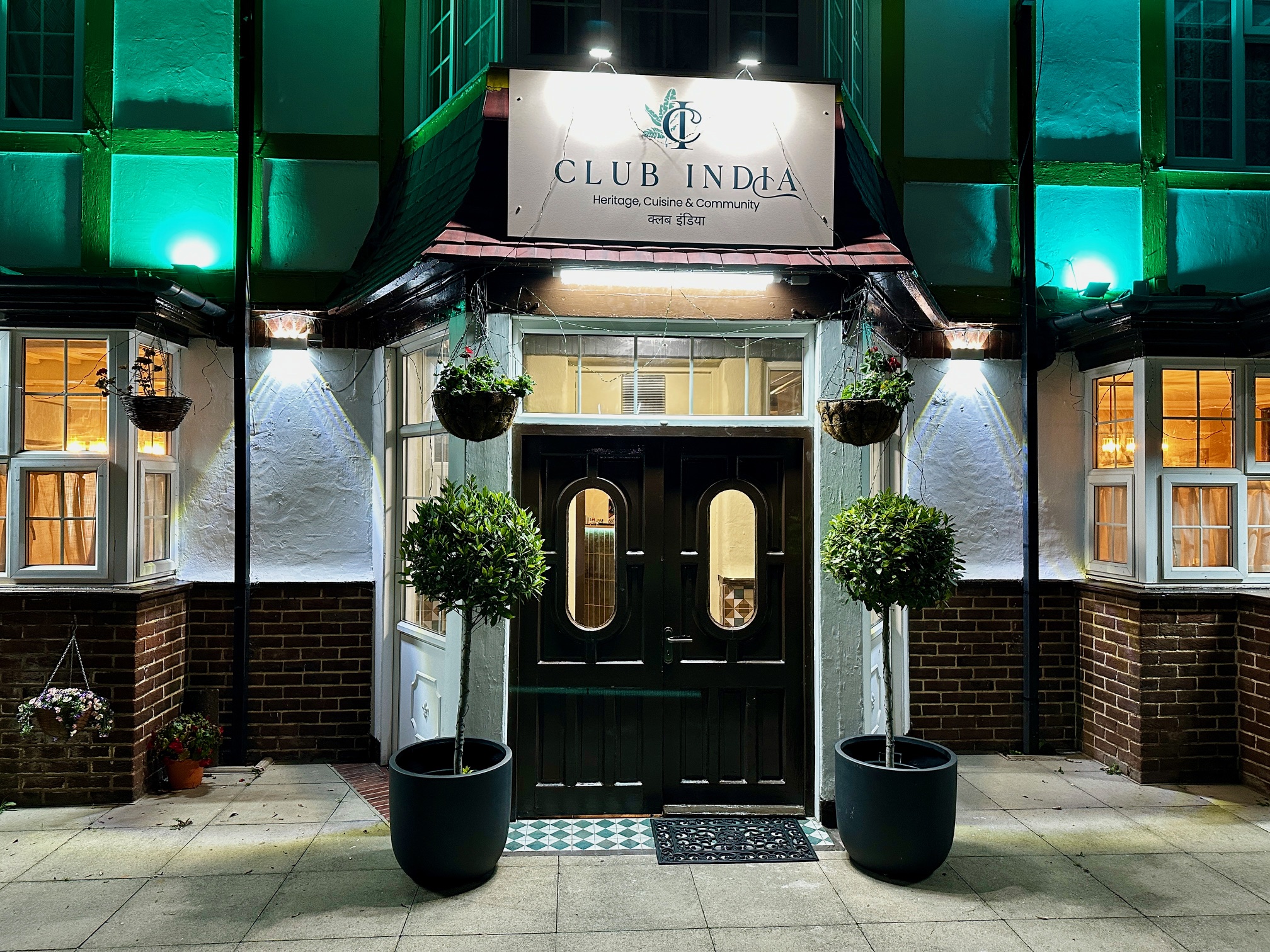
It was not a misprint. Andy Hayler had come all the way to Winnersh to try out Club India, an Indian restaurant that opened back in July where the old Pheasant pub used to be. I mentioned that development when I reviewed Dolphin’s Caribbean, back in June, What I said, looking back, feels a little graceless, especially as they sent me a lovely email inviting me to a pre-launch event. I read the blurb and thought it sounded potentially interesting, but then again: Winnersh?

Andy Hayler had no such compunctions. Club India’s consultant chef had held two Michelin stars at his restaurant in San Francisco, although Hayler’s verdict on that place was that if a chef had gone there trying to pick up tips “he or she would either burst out laughing maniacally or seek to throttle any passing Michelin inspectors; possibly both”. But the head chef had headed up the kitchens at a couple of London restaurants Hayler really rated. So he went, he enjoyed it, he dished out scores out of 20 for all the dishes and, of course, he ordered methi chicken.

Overall he gave it the same rating, 14 out of 20, as Clay’s. “Club India was a thoroughly enjoyable experience, the food and service excellent, and at an affordable price. I wish I could say that more often these days” was his conclusion. That was good enough for me, so on a Friday night after a couple of pre-prandial beers in town Zoë and I hopped on the number 4 bus to go and see if Reading really did have a rival to Clay’s Kitchen, tucked away in – this may not be the last time I say this word slightly incredulously – Winnersh.

You can tell it’s a former pub, but the glow up is nice and, on the inside, pretty subtle and tasteful. The room I was in, at the front, was muted wallpaper and leather banquettes, but every room was slightly different and the one the other side of the bar from mine, with its tiled floor, was my favourite. When we got there around 7.30 it was already very busy with big groups and couples on dates, in full swing with a busy service ahead. Hayler said it could seat 70, which sounded about right, with outside space too.

I guess it’s easier to have more space than you need in this part of Reading than it is in Caversham, but in any case it was bustling on a Friday evening. The tables were more Winnersh than desi when I arrived, although I would say that balance shifted as the evening went on. It certainly felt like a restaurant that wanted to attract both demographics, and anybody else besides.

Our table had a good view of the room and of the very strong service. The man who seemed to be running the show, sporting an impressive man bun, thick white stripe right down the middle of his dark luxuriant beard, was a class act, but in fairness everyone who looked after us all evening was lovely, polite and enthusiastic, even the ones who seemed a little nervous. It had the swagger of a restaurant that had been there a lot longer than three months.

We started, as you might, with apéritifs and poppadoms – and if that seems like an incongruous pairing, Club India does a good job of making them feel like they go together. Zoë liked her negroni, although she wasn’t sure it tasted quite like a negroni and couldn’t put her finger on why. I had something called an Amber Signal, which I suspect featured in the Johnny Depp defamation case a few years back. It was a blend of Aperol, whisky and Drambuie and felt surprisingly grown up by my standards, something to sip slowly and mindfully. Both cocktails came in glam, exceptionally heavy-bottomed glasses that could have doubled as a paperweight or a murder weapon.

The poppadoms were splendid, by the way – warm, thin, greaseless and very hard to stop at just the one each, which is probably why we didn’t. But the chutneys were the thing: you pay £3.50 or so for these but they were all made by hand and far more interesting than the usual fare. The mango chutney was thick and rich with nigella, the raita so robust that I thought Greek yoghurt must have been involved. There was a mixed berry number which surprised, possibly mostly through novely value, and best of all an inspired shrimp chutney which we managed, being our best selves, to equitably divide despite the unworthy temptation to hog the lot.

The menu at Club India takes a long time to go from first read to decision, because you want to order most of it. It is the only restaurant I can think of in Reading with a tasting menu, at a very reasonable £45 a head, or £70 if you throw in the wine pairings, and if it had contained the dishes I’d really fancied from the à la carte you’d be reading about it right now: nevertheless, it sounded like really solid value.

But the à la carte was just too tempting – about a dozen starters, the same number of curries, some biryani dishes and plenty of vegetarian dishes which you could downsize to try as a side dish. They also had a separate vegan menu, so they could definitely make many of the vegetarian dishes without ghee. Starters ran the gamut from £5.50 to £15.95 and the most expensive main would set you back £18. Pricing, put that way, looked pretty reasonable – and although the obvious reference point for this restaurant, given my preamble, is Clay’s I also had Masakali in the back of my mind. Club India’s menu is far more streamlined than Masakali’s, and to my mind less expensive.

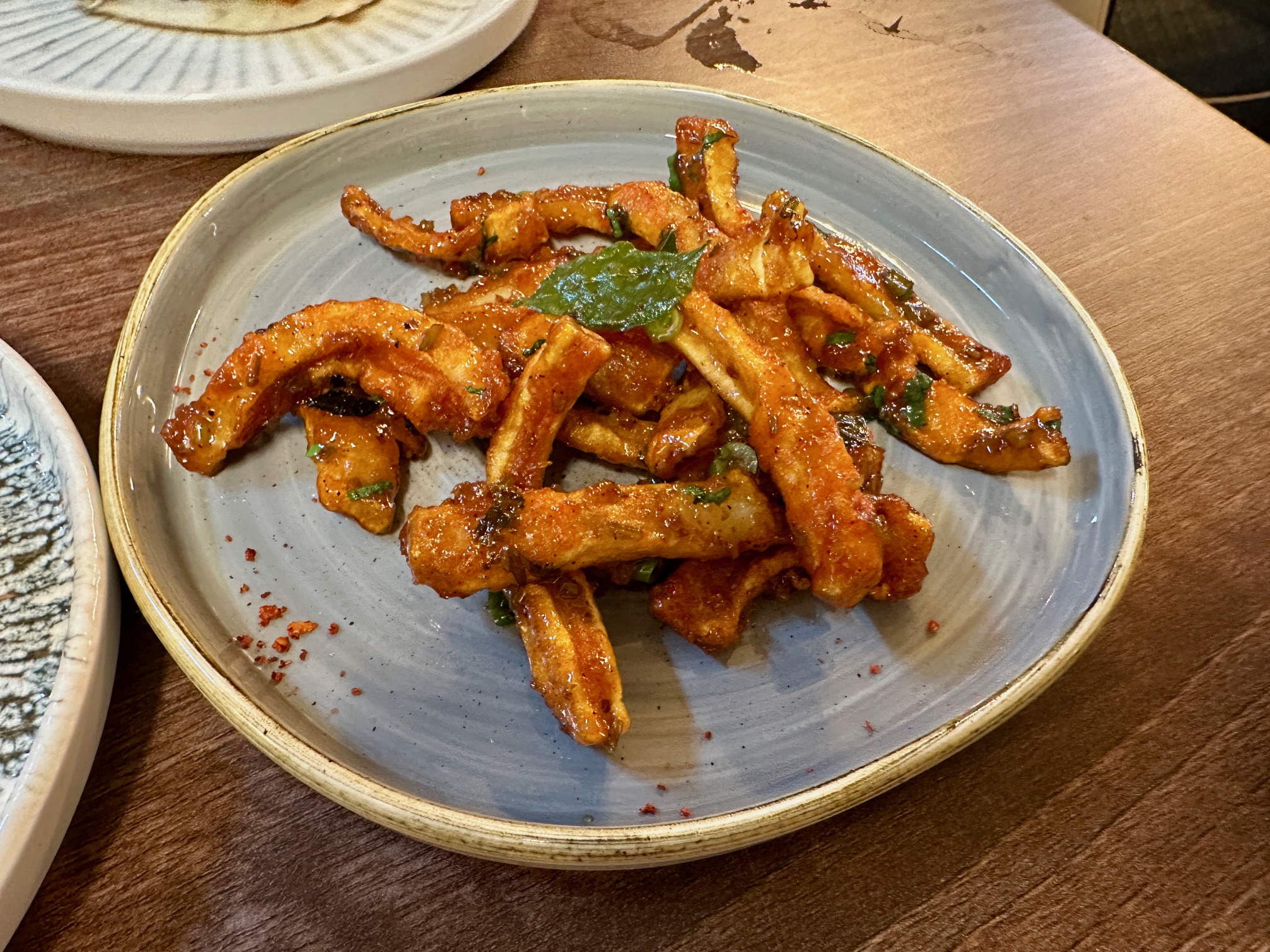
From this point on, you might find yourself wishing I adopted Andy Hayler’s much more concise method, because I’m afraid we very much went wild in the aisles picking a lot of dishes, ordering like the place might close down tomorrow. Andy Hayler might have said curry leaf calamari was good, the apricot glaze giving an extra dimension (13/20). I would say that I really loved this jumble of sticky ribbons of squid, somehow crispy and caramelised without succumbing to bounce or toughness. The menu says that it’s grandma’s recipe: I loved my grandmother very much, but I might have sacrificed her to the devil himself in return for one who could cook like this.

Just as terrific were the lamb chops, two glorious inverted commas of meat, best end blackened from the tandoor but still blushing on the inside. Up there with the best lamb chops I’ve had, and I’ve tried them at Clay’s, and at Didcot’s extraordinary Zigana’s Turkish Kitchen. At sixteen pounds you’d need them to be, but for me they delivered in spades and I was very glad we ordered them.

If you believed the menu, these came with coriander chutney and a smoked aubergine raita: it didn’t feel, from my recollection or looking at this photo, like that’s exactly what was going on. There was allegedly beetroot in the marinade, it felt like it had escaped into the smear on the plate. But to be honest whatever smudge of sauce you add, whatever spiralised veg and leaves you artfully zhuzh on top this stands or falls on the meat and the meat alone. Zoë, far more primal about these things than me, picked it up by the bone and gnawed until she could gnaw no more.

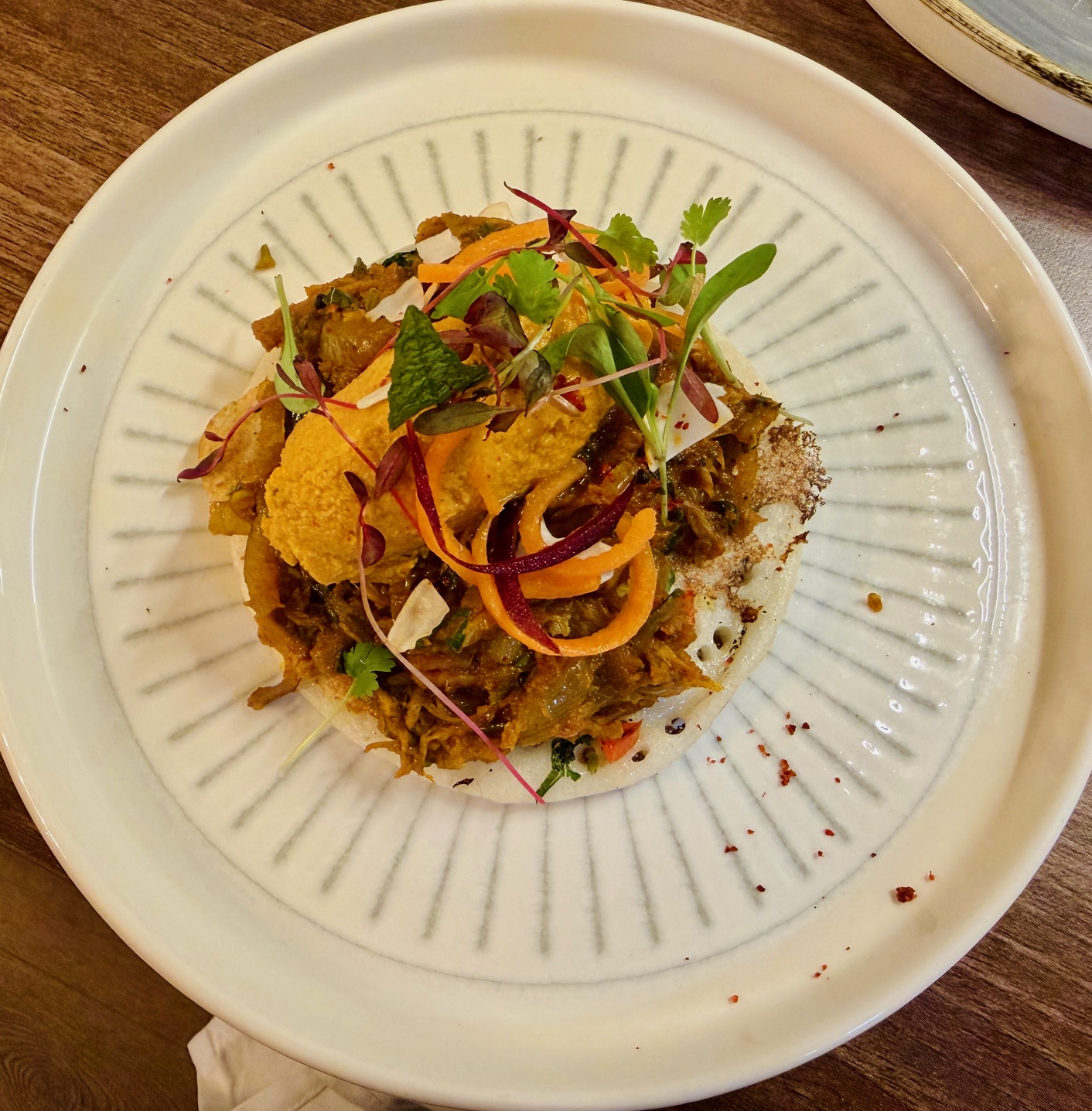
Completing our trio of starters was the only dish, apart from those poppadoms, that Andy Hayler and I both tried on our visits. 12 hour braised, spiced pulled pork rested, in a beautiful tangle, on an uttapam, a thicker, slightly spongy variant on dosa. I really wanted to try this dish for so many reasons – because it’s just absolutely up my alley, because Hayler raved about it, giving it a rare 15/20 and because I’d had something similar at a beer pairing lunch at Clay’s Kitchen last year, and that dish had been one of the best things I ate in 2024.

Did it come close? Yes. You would have struggled to put a poppadom between them, in terms of interest and quality. Clay’s version used minced pork rather than pulled pork, and there was something deeply texturally satisfying about Club India’s slow-perfected strands. Club India’s rendition had more whistles and bells, a coconut chutney, microshoots and fripperies. But if you stripped all that away, you just ended up with a small plate – from either restaurant – that would grace any starter menu, anywhere.

The spicing was a beaut, the coconut chutney went perfectly, I loved it from start to finish. We shared this, as we did the other two dishes, but I could gladly have polished one of these off solo. I could equally have said that about the other two dishes, too.

At this point the restaurant was at its liveliest, I had a gorgeous glass of New Zealand sauvignon blanc on the go and I had that warm feeling that comes from knowing I’m eating at a discovery – no, not a hidden gem, but a find. The starters we’d eaten, for my money, were up there with most Indian restaurants I’d dined at, and at or around the quality I’d come to love at Clay’s.

Could Reading finally have another contender for the crown? I found myself, mid-meal, daydreaming about the rave review I would scurry home and write. Zoë was thinking that this was a place, not a million miles from Woodley, that she could persuade her parents to visit. And that wasn’t all. “Are you thinking this would be a suitable venue for one of your readers’ lunches?” she asked me. I had been doing exactly that.

So it saddens me to piss on the proverbial chips and say that the rest of the meal was a gentle descent from that summit. It didn’t end up in the slough of despond, but it settled somewhere that felt more like settling. And although that’s a shame, in the wider scheme, it doesn’t mean that anything we ate from there on in was bad, it just wasn’t quite as extraordinary.

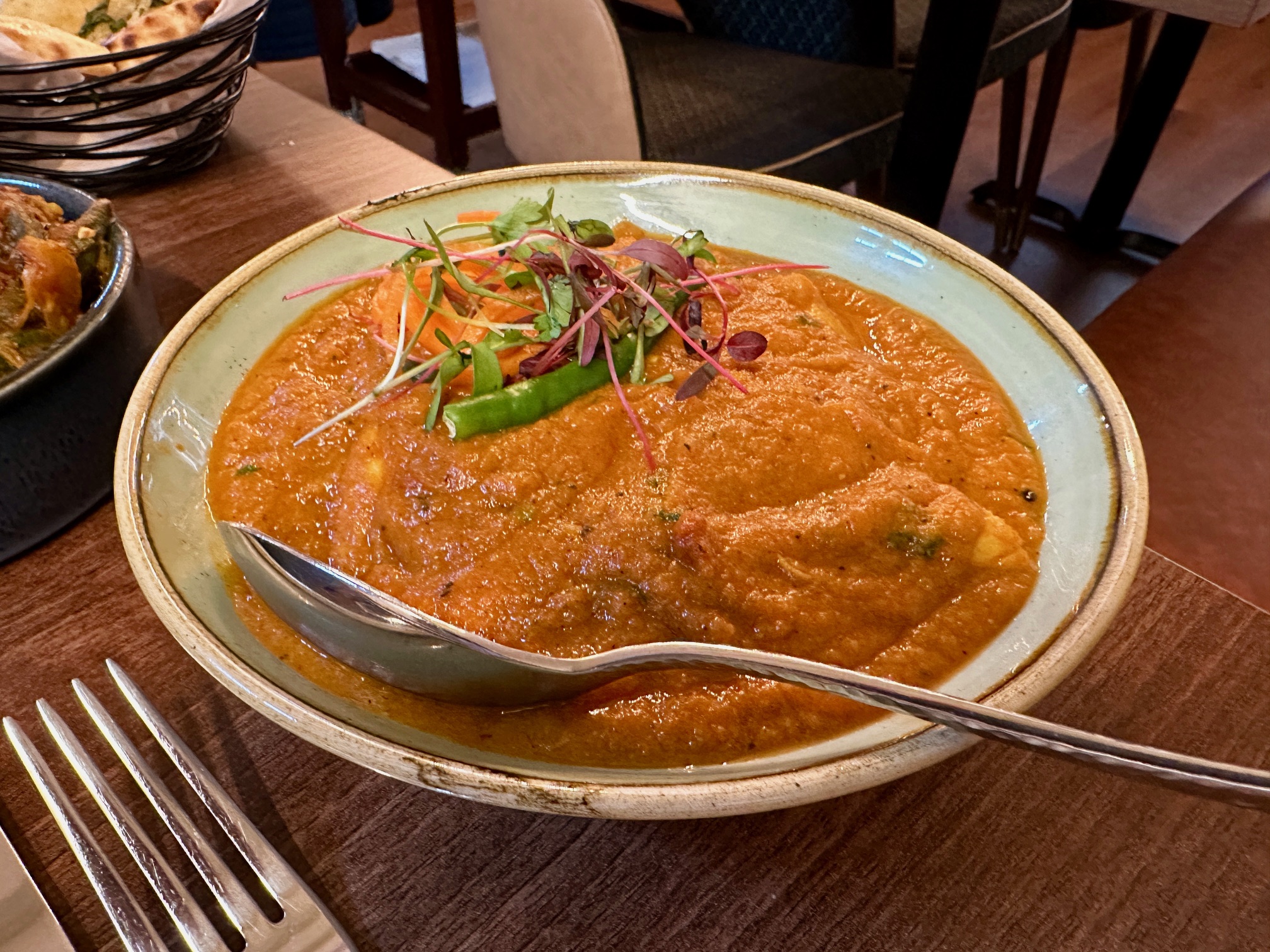
Take the kadaknath chicken curry we’d ordered. One of the things I really liked about Club India’s range of curries was that it mixed up stuff you’d heard of – butter chicken, rogan josh, methi chicken and so on – with dishes I wasn’t familiar with. Kadakhath is a particular breed of Indian chicken that the menu says is particularly known for its gamey flavour, and Club India uses black leg chicken to get as close to that as possible. From that, I was hoping this would be a bit like Northern Spain’s pitu caleya, but this was pretty unremarkable. Breast rather than thigh, too, which reminded me how Clay’s approach to chicken curries is so different from everywhere in Reading.

That’s not to say I didn’t like it, or that I didn’t like the gravy, made with fenugreek and crushed peppercorn. I actually very much enjoyed its savoury, almost perfumed depth, those slight wintry hints of leather about it. But everything felt out of kilter. The chicken was submerged in a lake of the gravy, slightly unbalanced, and the gravy wasn’t quite interesting enough to carry things on its own, even dolloped onto some perfectly nice saffron and cumin pulao.

I’m sorry to keep mentioning Clay’s, but it was inevitable that I would in trying to benchmark somewhere like Club India. The gravies at Clay’s, each of those distinct, exceptional sauces, is so captivating that the meat is merely, in many cases, a vehicle. You clean up every last molecule in the bowl with your rice, with some bread, with your spoon, with a finger if you must. Club India didn’t quite reach that standard, which meant that the curries were just a little too wet.

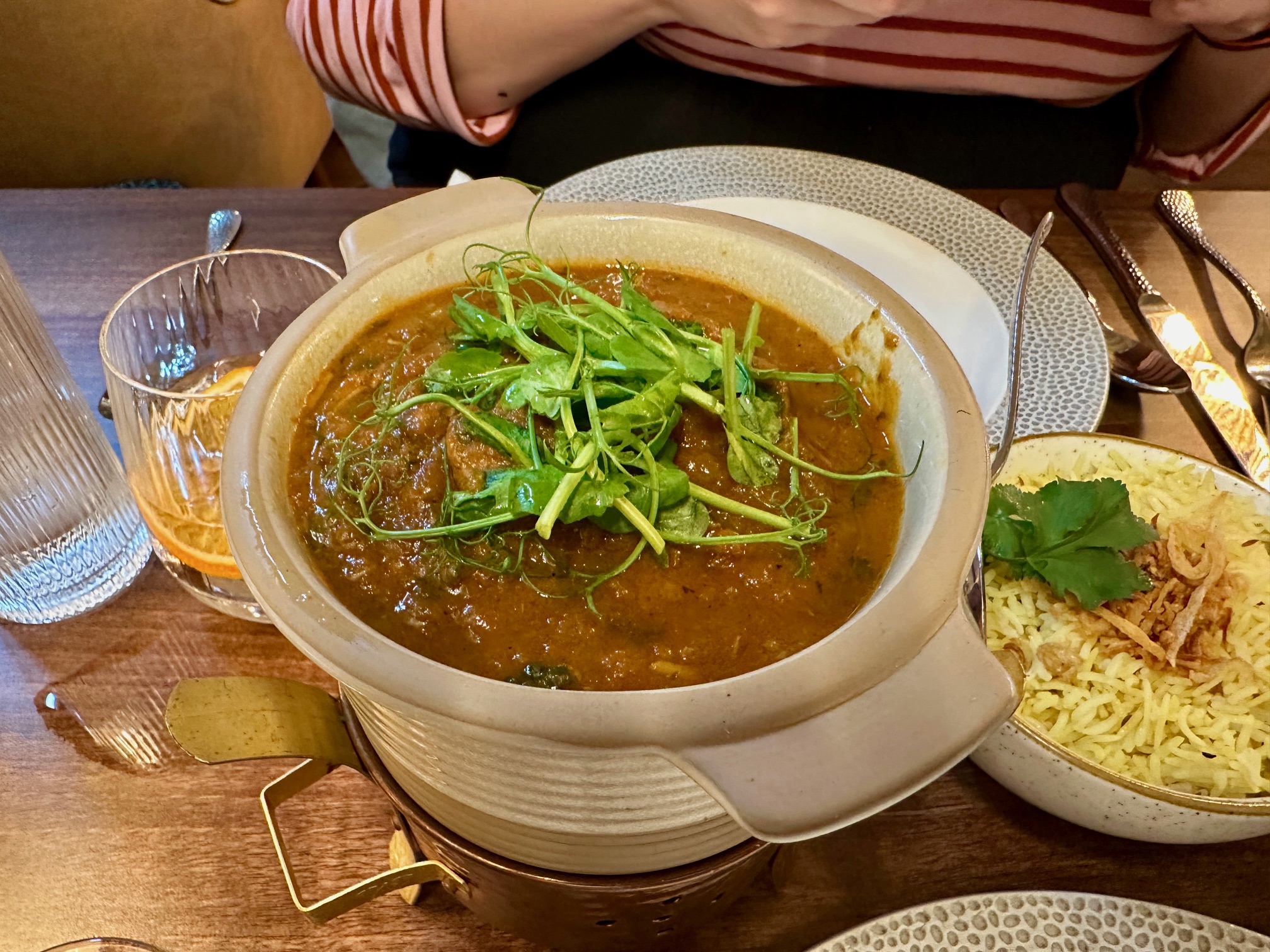
Better, although still not quite there, was a curry described simply as Champaran meat. This was my favourite thing from this section of the meal, and the sauce again had depth and complexity. But what elevated this was the really terrific lamb, marinated overnight and with an almost unbeatable texture, leg at a guess, slow-cooked until it could cleave like kleftiko; this dish is cooked over charcoal in a sealed pot, which probably contributed greatly to how wonderful it was.

Again, I’d have liked it a little more sticky and a little less swimming, but that didn’t stop it being head and shoulders above most curries you’d get in Reading.

We ordered a couple of vegetable side dishes, one because I insisted and one because Zoë did. Mine was baby aubergine in a sauce with jaggery and tamarind, two of my very favourite things. And yes, a sauce that combined them was as sweet and tangy as you would expect, and I loved that. But I didn’t want a bowl of the stuff with two – just two – baby aubergines bobbing in it. And that, slightly unfortunately, is what I got.

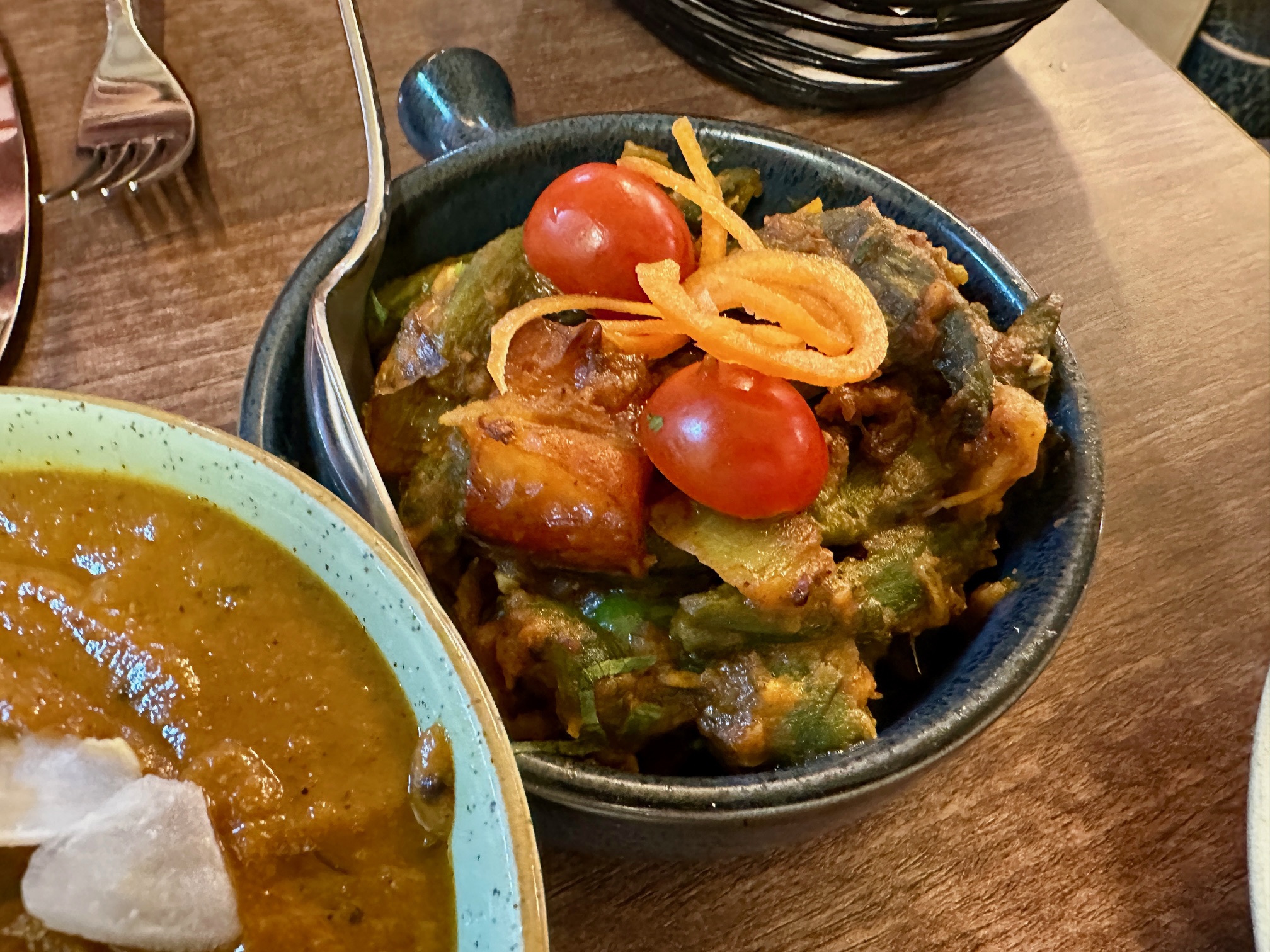
Zoë on the other hand had put in a request for Club India’s okra stir fried with peppers and onions. If she was writing this review she would tell you that she really liked it, and for that matter that she really likes okra. But you are stuck with me, I’m afraid, and Clay’s thinly sliced, crispy take on okra is, I think, the only variant of this ingredient I have ever enjoyed. I feigned generosity telling Zoë she could finish this but she knew, deep down, that it was because I wasn’t a fan.

I will say this, though, Club India’s keema naan is the best I have ever had. This is another to file under ‘Zoë always orders it, and I nibble a bit without any great enthusiasm’. I’ve lost count of the number of times I’ve taken a bite and been confronted by weirdly scarlet, oddly bouncy mystery meat. That fate does not befall you at Club India: the meat lurking in the middle of a deliciously airy naan is properly belting stuff.

It made me want to try their sheekh kebab next time – and credit to Club India, not only do they list the provenance of some of their ingredients but the lamb for the Champaran meat comes from one place, namely North Wales, while the lamb for the sheekh kebab comes from Romney Marsh, completely the other end of the U.K. You do have to at least slightly admire that.

By this point we had checked the timetable for the bus back into town and realised that neither of the options – namely leaving in ten minutes or lingering at Club India for over an hour – were going to happen. So we embraced the concept of a taxi and rewarded ourselves with dessert. I was hoping the gajar halwa that Andy Hayler had rather enjoyed would be on the menu, but the compact selection of four had already moved on since then. It was the one area where Club India’s imagination felt like it had run out, because when one of the four options is a chocolate brownie with vanilla ice cream I think, as an upmarket Indian restaurant, that you’re playing it far too safe.

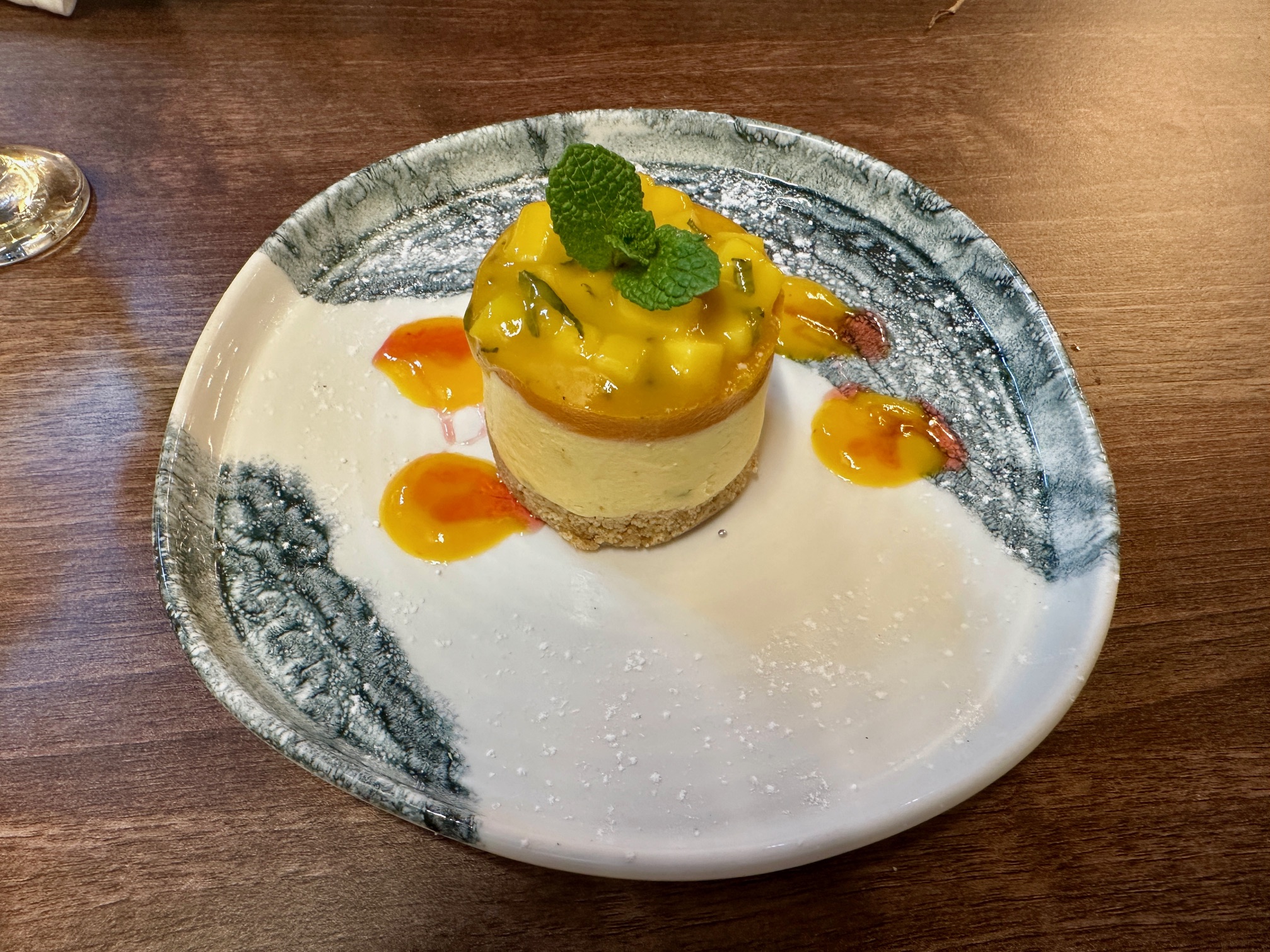
Playing it safe rather defined my dessert, too. A mango cheesecake, a small dainty cylinder, was genuinely quite charming and went nicely with the diddy glass of dessert wine I’d ordered with it (a 50ml pour is on the small side, but it was £5 so it didn’t matter so much). But again, the menu promised a hint of chilli and if it was a hint it was too subtle for me. I’d have preferred a clanger of chilli, if we were picking between extremes, and it rather appeared that we were.

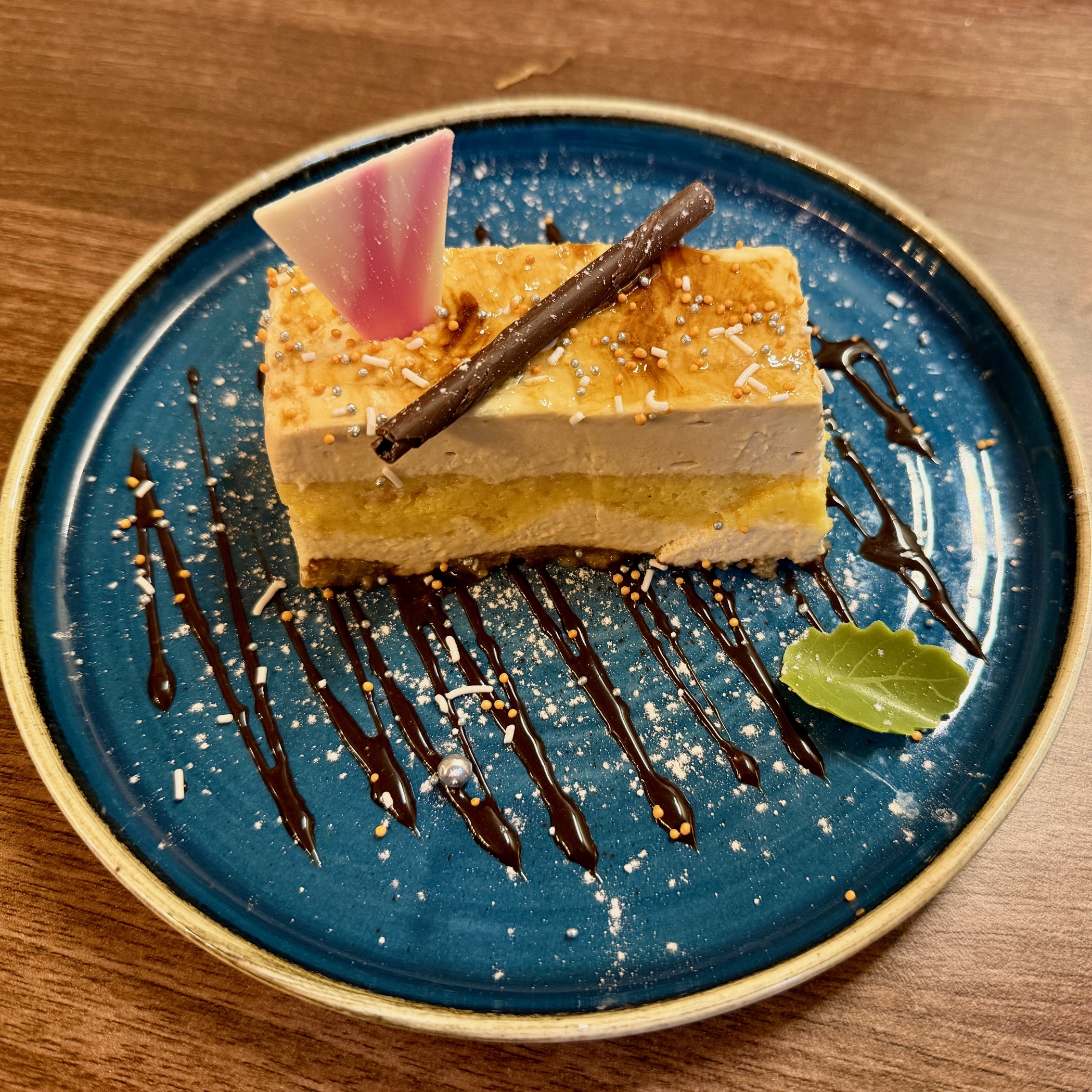
I think Zoë ordered better, although she mightn’t have agreed. Rasmalai tiramisu was, for me, far more imaginative and more in keeping with the rest of the menu. I’m not sure it was really reminiscent of either, more like the two had been put in separate machines and teleported into a blend, like something out of The Fly. But I liked it and envied Zoë, and the pleasingly squeaky sort-of-cheese in the base made it something you’d eat to experience, let alone to taste. For me that fusion, that experiment worked.

Zoë seemed to feel differently, but she does like okra and me, so there are already a couple of valid question marks against her judgment.

At the end of the night, Uber on the way, I settled the bill and found myself thinking it was generally decent value. We had a couple of aperitifs, a couple of dessert wines, I had a glass of white and then there was that onslaught – of poppadoms, of three starters, of curries and side dishes and rice and naan and dessert. We’re not going to play The Price Is Right, but when it came to £170, including a modest 10% service charge, I felt like I’d had a lot of evening for my cash. We were there nearly two and a half hours, enough time to watch multiple sittings come and go, and to watch the staff properly earning their money.

So where do you benchmark Club India, after a meal like that? Well, first of all: Winnersh and Woodley, that eastern edge of Reading, is very fortunate to have it on their doorstep. I think it will do very well, partly because it is indeed good and partly because nothing around there even comes close to it.

In terms of the kind of place it is, the most obvious comparison, for me, is Masakali; they are trying to be similar restaurants, but Club India far surpasses its predecessor on the Caversham Road.

Club India is the restaurant Masakali hopes to be when it grows up, and an illustration of the difference between having your menu dreamt up by a head chef, with some advice from a decorated chef in an advisory capacity on the one hand, and having your menu mechanically assembled by some kind of offshore committee slash agency on the other. Quality will out: Club India is way ahead of that competitor.

But as for the others? If everything else had managed to sustain the extraordinary quality of those starters, the arrival of Club India would be one of the big Reading food events of 2025. That it doesn’t is a pity, but it doesn’t change the fact that even Club India’s more ordinary dishes still feel like a cut above most places.

So if they don’t quite reach the level of Clay’s Kitchen, they should console themselves by knowing that they are in good company there, in a support group made up, pretty much, of every restaurant in Reading. But if you are comparing them to the next level down, the likes of Chilis, I think they can give a very good account of themselves.

So there you have it. I guess if I was Andy Hayler, I would have summed this up by saying, in his inimitable style, 12/20. But I’m not Andy Hayler, I’m me, and so I’ll conclude this review with that slightly enigmatic score below. It’s the only way I know.

Club India – 8.1
355 Reading Road, Winnersh, RG41 5LR
0118 3048701

https://www.clubindia.co.uk

Since January 2025, Edible Reading is partly supported by subscribers – click here if you want to read more about that, or click below to subscribe. By doing so you enable me to carry on doing what I do, and you also get access to subscriber only content. Whether you’re a subscriber or not, thanks for reading.

Restaurant review: Stop & Taste

The biggest trend in Reading’s food scene this year has been the proliferation of pizza places – Paesinos, Zí Tore, Amò and Peppito, all opening in the space of five months. In the space of a five minute walk, you could pass them all: you could do a pizza crawl of all four, if that’s your kind of thing. Everyone will have their favourite, or their own view of which is the best, and perhaps I will too once I’ve got round to the last couple on my to do list: one way or the other I’m sure my annual round-up and awards at the end of December will have something to say about all of that.

But if that competition is the most high-profile this year, there are a couple of smaller-scale rivalries, more under the radar, that have captured my attention every bit as much. Like the one between Vietnamese newcomers Pho 86, on St Mary’s Butts where County Deli used to be, and Thai restaurant Nua which opened just around the corner, in Bluegrass BBQ’s old home. They are competing not only with the established order – Pho and Thai Corner – but with each other, and they opened on the same day in July.

So that promises to be interesting, and I’ll do my damnedest to check them both out before the end of 2025. But even that’s not my favourite, because my favourite is the tightly-fought battle between two brand new restaurants, which opened a week apart, for Most Batshit Menu In Reading.

In the red corner you have Take Your Time, which opened in August at the top of Sykes’ Sweatshop (you probably know it better as Kings Walk) in the former Dolce Vita site, which sat vacant for over seven years. Take Your Time’s website says that it blends “Asian flavours with Western cuisine”, and Take Your Time’s menu interprets that as serving baked pork chop with an egg fried rice featuring tomato, pineapple and mozzarella, like someone put a Hawaiian pizza into Google Translate.

It also gives you the option of a chicken risotto (“chicken is slightly pink”), or “Hong Kong-style source [sic] stir fried spaghetti with pan fried ribeye steak”. Fusion? Confusion? Who knows. It would, any other time, be far and away the strangest menu I’ve read all year.

But then, a week later, Stop & Taste opened in Emmer Green in a ‘hold my beer’ scenario. Stop & Taste looked on the face of it like a standard eat in fast food place – visually difficult to distinguish from the likes of Basingstoke Road’s Kyaneez – mainly famous for having the most idiosyncratic Instagram account of all time – or Salt & Smash on Christchurch Green. But then I saw the menu and thought, and this is pretty much a verbatim transcript of my exact reaction, what the fuck is going on here?

Because Stop & Taste’s menu rivalled Take Your Time’s for eccentricity, for lack of an overarching theme. So yes, there were loads of burgers – obviously – but one of them involving tempura soft shell crab? And three different types of biryani, and oxtail tacos and fried shark bites? And a £25 lobster roll with “lobster tail poached in secret butter” and hand-minced beef patties and thick shakes and Sunday roasts made with fillet steak?

Take Your Time and Stop & Taste had two things in common – menus that invited an ADHD diagnosis and, paradoxically, names that seemed to extol the virtues of mindful eating. So I just had to visit one of them this week, and in the end I found myself taking a bus north of the river on a weekday evening. That menu at Stop & Taste was either madness or genius, and I just had to know which it was, shark bites and all.

Alighting from the bus I found Stop & Taste at the near end of a little parade of suburban shops, sandwiched between a Budgens and an off licence; if you want an idea of the passage of time the picture I found on Google Maps, from back in 2012, has branches of Blockbuster and Thresher further along. It reminded me of other suburban spots, like Coriander Club or, not too far away, Caversham Park Village’s Momo House.

But it also reminded me of my childhood in Woodley, of living round the corner from Hudson Road and of the independent supermarket where it felt like you could pick up anything, of buying sweets for a penny.

Back then, forty years ago, the best you could hope for in terms of food was fish and chips with curry sauce or a chow mein, and the idea that in the future we wouldn’t have jetpacks but would have ready access to birria tacos and soft shell crab would never have occurred to me. I do have to be honest, though, and say that if I’d appeared in a vision to 11 year old me, the ghost of dinners yet to come, and offered him the choice, he’d have picked the fancy food over the jetpack: I don’t know whether to be proud of him or ashamed.

Inside, the place was empty apart from a big table of kids who seemed to be having a lovely time but weren’t discernably eating any food: I think in all the time I was there one of them went up to the counter and ordered a giant milkshake, but that was it. I’m too old to even guess how old they were, so let’s just say they were Grange Hill age and leave it at that.

Sorry, that ages me even more, doesn’t it? I mean Waterloo Road age. If they knew how lucky they were to live within easy access of shark bites as opposed to chips with curry sauce, they were far too cool to betray it.

Otherwise the interior looked pleasant if generic, not necessarily a place to linger. I quite liked the faux marble tiles on the wall, the ceiling panel covered in artificial flowers, bare bulbs hanging down. The chairs looked remarkably similar to ones I’ve seen in many other places, although I couldn’t pinpoint exactly where. I wonder if there’s a starter kit new restaurants buy? The fire safety tags still hung from under the seat pads, and everything was still shiny and new.

At least I didn’t have to wedge my arse into a ubiquitous Tolix chair, so there was that. A brightly lit sign on the wall proclaimed MORE THAN A GUILTY PLEASURE and a sign up at the counter read DON’T TAKE LIFE TOO SERIOUSLY. NOBODY GETS OUT ALIVE ANYWAY. Thought provoking stuff all round.

I wasn’t sure whether this boded well at all, any of it, but the menu, illuminated over the counter, made me think again. Something about it, in the flesh, inspired confidence in a way the version I’d seen online didn’t. Part of it was the surprisingly pleasing design: all red and white, clear fonts, oddly endearing icons of burger buns and taco shells with googly eyes. And part of it again, was that array of dishes. The randomness was there, but also I had a faint inkling that you don’t get the stuff to cater this menu from Brakes. They don’t sell shark, as far as I know.

Stop & Taste’s pricing, too, was pretty keen. Most of the starters maxed out at £8, unless you wanted lamb chops or tiger prawns, and the only main coming in over £14 was that lobster roll at £25: it would be interesting to know how many of those they sell. The biryani and Indo-Chinese dishes (because yes, they had them too), the fried chicken tenders and the chargrilled peri peri chicken were all less than a tenner. I was on my own, so I had to decide how best to try as much of the menu as I could.

Going up and ordering a couple of things to start me off, I got chatting to the chap who I think was the owner. He warned me that the menu was brand new so a couple of the dishes, birria tacos and chargrilled tiger prawns, weren’t available yet. He said they’d been open for two months and that so far business was good, although it was mainly limited to Emmer Green residents. They hadn’t leafleted yet, because they wanted to prioritise the local community before looking for customers further afield. He told me, again, about their Sunday roasts: a separate menu advertised rump of beef, fillet, roast chicken, the works.

Technically they were on delivery apps, he added, but he also said something that other business owners have said to me recently, that they were reluctant to do delivery because they knew that from the moment the food was popped in a bag and loaded on the back of a bike something was lost, and what you ate was a fifteen minute drive from what they intended. So it wouldn’t surprise me if, for now, many of their deliveries don’t go far beyond Emmer Green. That said, they took a order to deliver all the way out to Spey Road while I was there: based on what was to come I imagine it was a repeat customer.

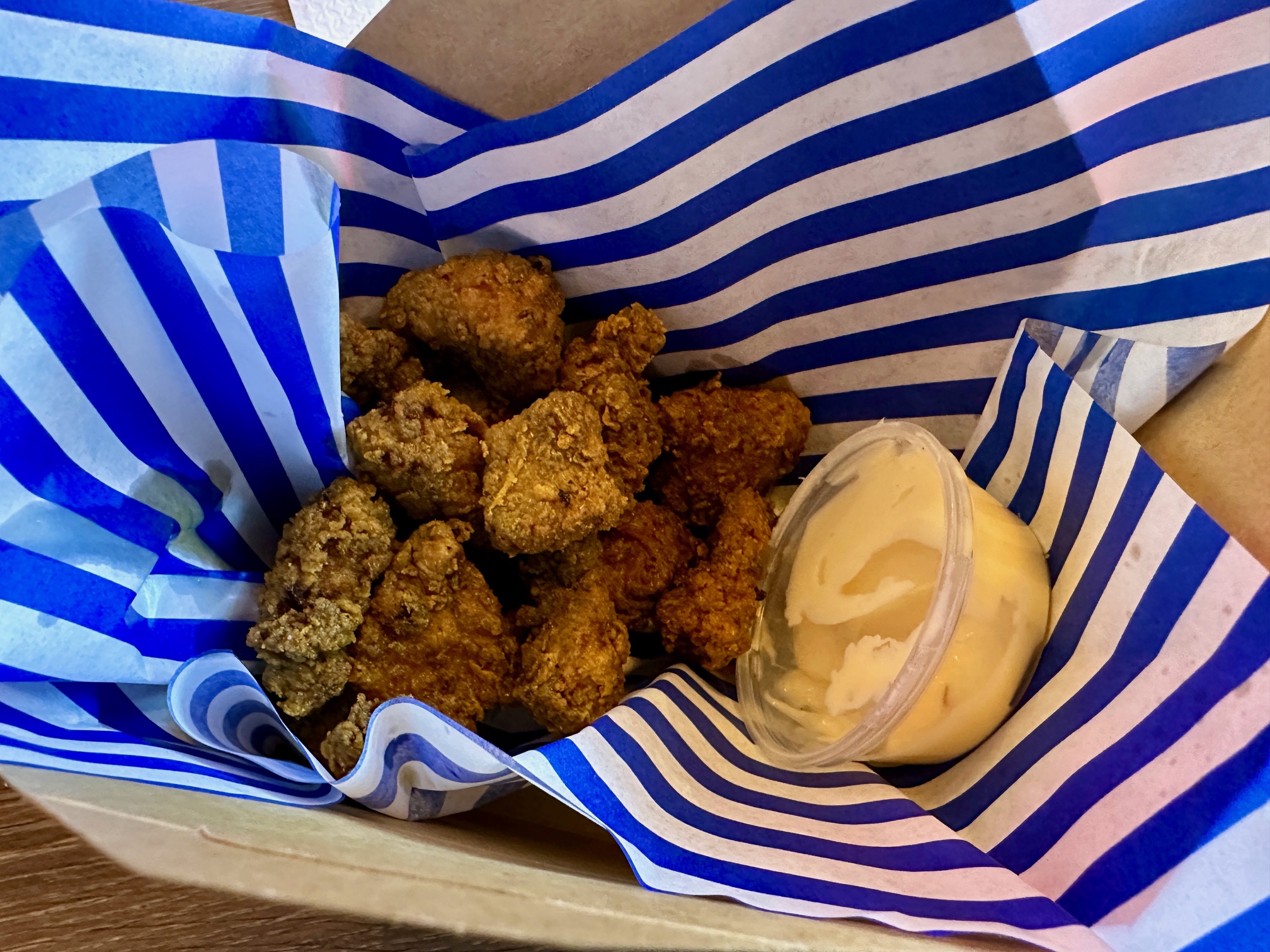
Naturally I ordered the shark bites. How could I not? Zoë and I have this game we play when I review without her where I send her pictures of the dishes and ask her to guess whether or not they’re any cop. She saw the picture down there and replied. The bites look good.

But they didn’t just look good. They were an utter delight from beginning to end, a very generous lined cardboard box stuffed with crispy, gnarled nuggets of fried fish. The lightness of touch was betrayed by this: the coating was so light, so nicely crunchy, but if you tried to eat the nuggets with the wooden fork supplied they just fell apart. I’ve never had shark before – I know they used to sell it on Smelly Alley but I never picked any up – so I didn’t know what to expect, but actually the texture was perfect for this purpose: more woolly than flaky, but very pleasantly so.

Doing away with the niceties of cutlery I simply picked them up, dipped them in the mayo and smiled an awful lot. £5.99 for these, and one of the nicest things about reviewing Stop & Taste solo was not having to share them with another living soul. I don’t know how you could come here and not order these, unless you don’t like fish, but if you do visit Stop & Taste I highly recommend trying them – unless, of course, they have replaced them on the menu with something even better. It feels eminently possible that at some point they would.

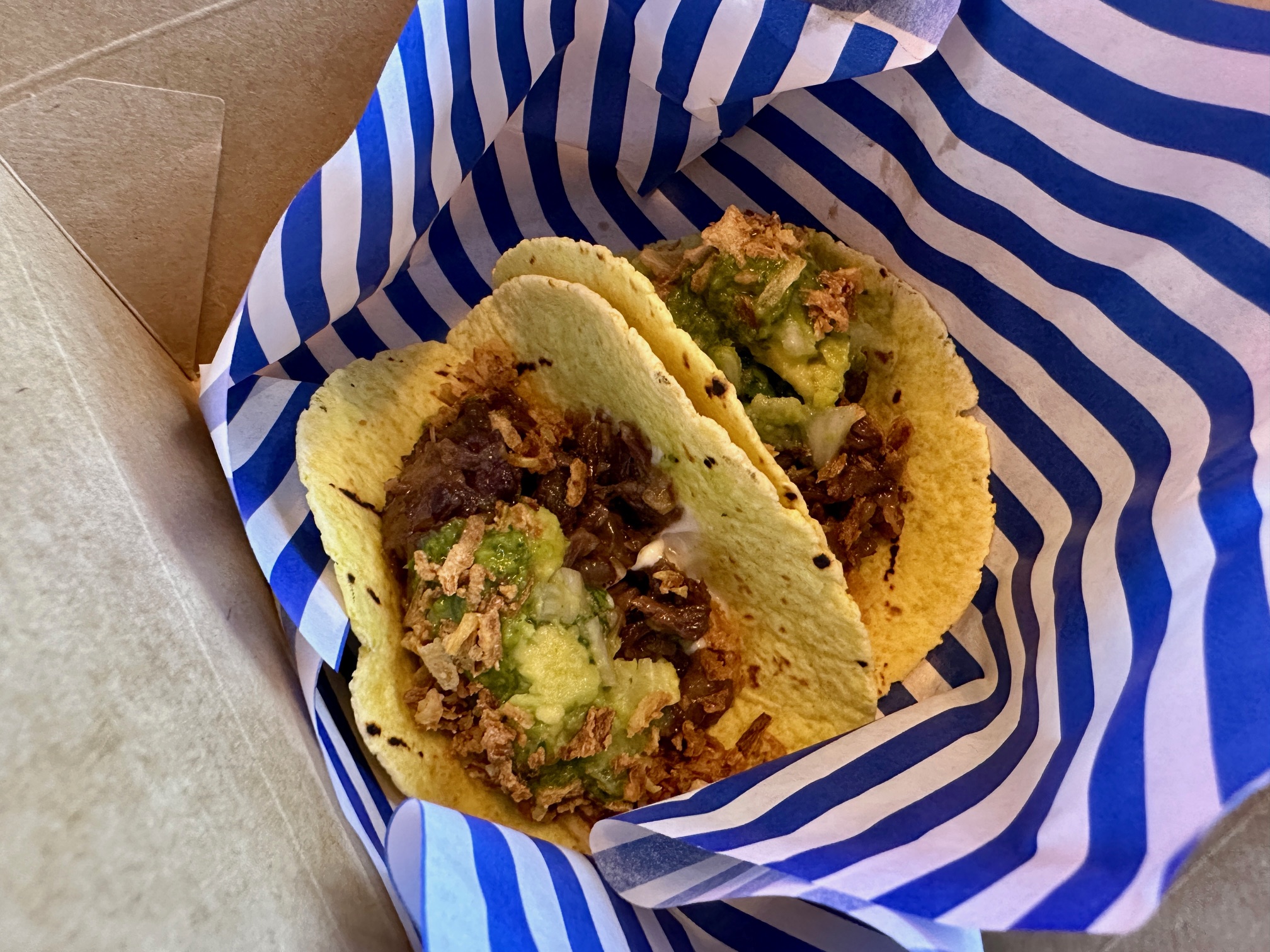
Denied the opportunity to try the birria tacos – next time, I told myself – I instead sampled the oxtail tacos, which have been on their menu since they opened. Again, I was somewhere equidistant between surprise and joy. Everything worked, and everything felt considered, from the strands of oxtail at the bottom to the excellent guacamole, full of lime and, I suspect, coriander. Putting crispy onions on top was a genius touch, adding the contrast that otherwise would have been the only thing missing.

But also, and this sounds like a minor thing but it isn’t, this was really enjoyable to eat. At the risk of sounding Goldilocks and the three bears, it was just right – feasible to eat without unhooking your jaw, carrying out some very precarious biting or winding up with half of it down your shirt. I sometimes think the reason influencers always rave about burgers, pizzas and doughnuts is that they haven’t evolved to cutlery yet. Influencers would like Stop & Taste very much, but don’t hold that against the place.

While I was eating all this and mentally recalibrating many of my preconceptions, I paid attention to what was going on around me. A number of customers came in, and the owner remembered all of them by name – remembered what they had ordered last, asked what they thought of it, remembered that, for example, one chap liked his burger without cheese (he sat at the table next to me, headphones on, thoroughly enjoying it). The owner asked me if I liked my food, too, and whether I needed anything else.

I also saw orders for deliveries come in, and the owner telling the chef that they already had an order for ten biryanis on Saturday. I listened to the chef on the phone to a supplier and heard him talking to the owner about what they needed to buy in – beef cheek for the birria tacos, and more besides.

This will sound like a silly comparison, but because it’s autumn and I need cheering up I’ve been watching Gilmore Girls, and overhearing the conversation between the owner and the chef felt a bit like hearing Lorelai and Sookie St. James discussing ingredients. Stop & Taste wasn’t the Independence Inn, and Emmer Green isn’t Stars Hollow, not by a long chalk, but for a moment I got the same kind of warm feeling I get from that fictional small Connecticut town.

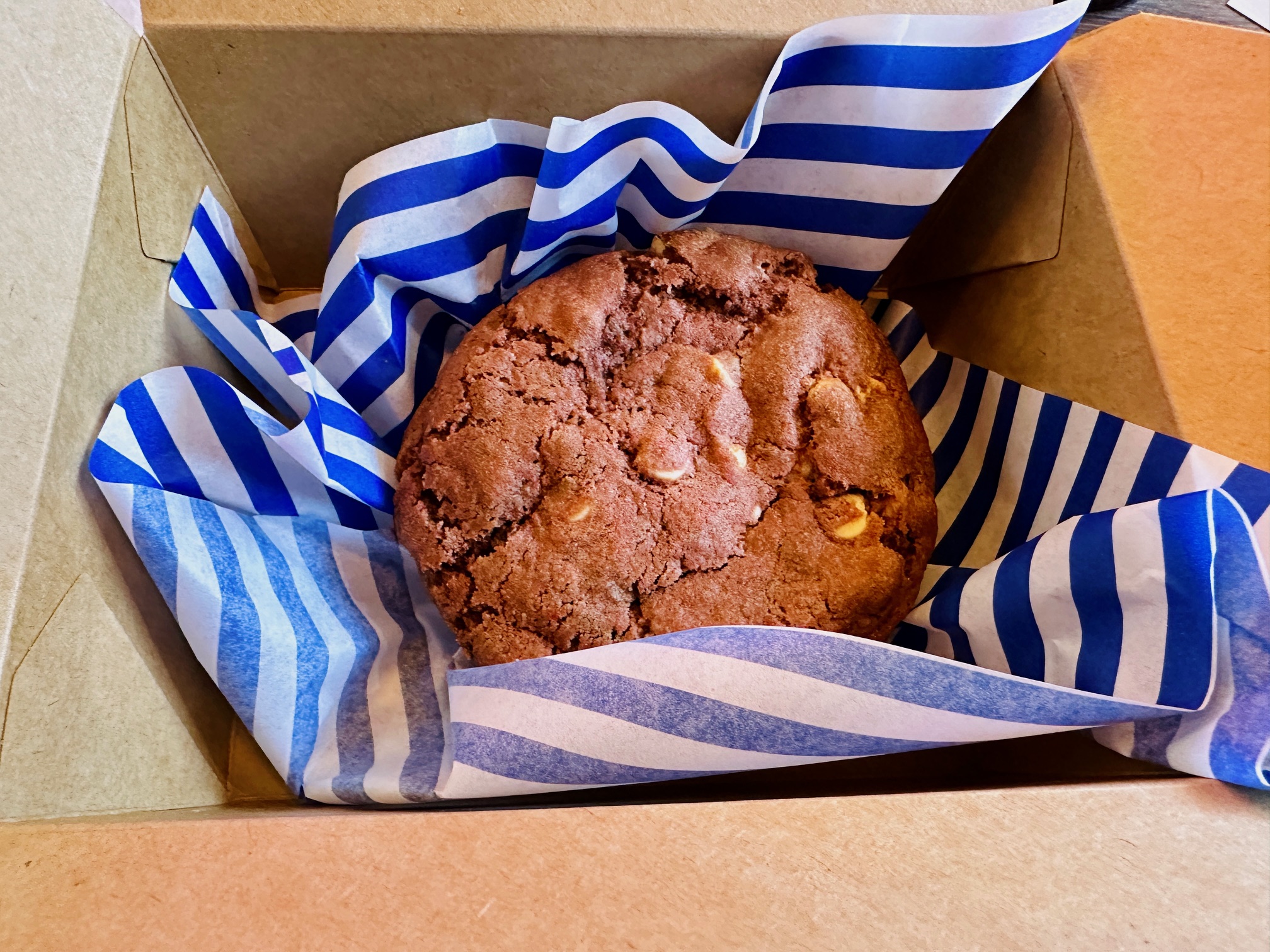
As I was deciding what to order next, a woman came in jonesing for a cookie fix and chatted to the chef. He said they didn’t have any Biscoff cookies left, but they did have red velvet. “It will change your life” he said, adding that they’re made for the restaurant by a friend. The customer said she’d had one before and that it was indeed life changing – “it’s when you get to the middle” she said – but she ended up leaving with two boxed cookies to take away and a large portion of fries. I made a mental note that dessert was on the cards.

But first, I had an appointment with that soft shell crab burger. I placed my order and the owner said “it will be about ten minutes” and I wished that, like that place at the top of Kings Walk, they would take their time. Nevertheless it turned up about ten minutes later as I was sipping my Diet Coke – no alcohol licence here – and I was very glad to see it.

Because it cost the same as all the other burgers I was worried that it would be relatively cheap, potentially clumsily priced for what ought to be a premium thing, but I needn’t have worried. The soft shell crab was beautifully fried, in golden but light batter, and fitted perfectly in a sesame seed bun; I was very glad to see this rather than the standard issue brioche. A single unshredded lettuce leaf was on top, adding yet more crunch, along with a square not of American plastic cheese but cheddar.

This was easy to eat with your hands, not an open-wide-push-everything-out-of-the-side number, perfectly proportioned for simple, enjoyable eating. Not cheap for what you got, but it was soft shell crab: it shouldn’t be. The one slight blot on the copybook was Stop & Taste’s lime and scotch bonnet mayo, which turns up in several places in the menu, including that spenny lobster roll. For me, and this might be personal taste, I found it a little too sour and tart. An aioli might have been nicer, and I think it would slightly brutalise the lobster.

These were minor quibbles in a dish I never expected to find in Emmer Green and had long given up on finding in Reading full stop. I should add that the fries, which I’m guessing were bought in, were excellent. Beautifully light, no stale oil, like everything else cooked there and then and thoroughly spot on. I left a fair amount of them, but that’s because I’d gorged myself on two starters and had plans for dessert. You get the dip of your choice with the fries but they made that choice for me, I think, and gave me garlic mayo: next time I want to try their chimichurri.

When I went up to order the inevitable cookie, on the basis that I’d heard rumours it was life-changing, I got talking to the chef, whose name is Anton. He told me that he’d been a private chef for ten years before taking on this job.

“I can speak Spanish, I can speak Mandarin, you name it” he told me.

“And now you speak fluent Emmer Green!”

“Something like that” he smiled.

Then he told me that everything they made was fresh, and it all fell into place: the menu wasn’t the way it was because it was nuts and all over the shop. It was the way it was because the man in the kitchen just cooked what he loved cooking and the owner gave him the freedom to do that.

At this point I slightly regretted coming to this review on my own: partly because I’d have liked an excuse to try the tenders, have a nibble of somebody else’s pulled short rib sandwich. But also because it was starting to take on a dreamlike quality. Did Stop & Taste really exist, or was it a mirage? If I came back would I find it was just the shell of a derelict branch of Blockbuster Video?

There was time for one last crack at the menu, that red velvet cookie. And my god, after that I understood why a lady had come in to grab biscuits to take home. It looked like a conventional cookie, albeit a colossal one, and it had a pleasing crumble at the perimeter, studded with chocolate chips. But as I worked my way to the core I discovered what the fuss was about because in the middle, completely enveloped in biscuit, was a thick disc of frosting. Frosting inside a biscuit! What a time to be alive!

This biscuit cost £4.99: it is not a cheap biscuit. If you go to Stop & Taste, have the biscuit.

Finally I went up one last time.

“I’m sorry, but I need to have another of those biscuits to take home, because if my wife doesn’t get to try one it’s more than my life’s worth.”

He grinned, in a way which suggested he’d been told that or something similar more than once . There was a pause, my card payment went through and I thought that I should ask him what I ought to order next time. Before I could say it out loud, he told me anyway.

“So next time you come, you have to try our burger. I know everyone does a burger, but we buy the steak and mince it ourselves, here onsite. All our ketchup is home made, too. And you should order the lamb chops. We make our own mint sauce as well.”

So I started thinking about how easy it was to get to Emmer Green from the town centre. The challenge was finding a bus, but once you did it only took about twenty minutes. And then I pondered whether the people of Emmer Green knew yet how lucky they were, and decided that if I lived in Emmer Green I would very much enjoy lording it over Caversham about this.

My bill overall, for those two starters, that burger, a Diet Coke and my heavenly cookie came to just under £34. I ate quite a lot of food, entirely for research purposes I might add, but I would challenge anybody with a healthy appetite and/or healthy curiosity to go to Stop & Taste and not want to order a fair amount of the menu. I went on my way thanking them effusively, still not entirely sure how to do justice to the experience I’d had, and when Anton asked me to pop a review on Google I promised, not entirely dishonestly, that I would.

I don’t think I’ve encountered a surprise package quite like Stop & Taste this year, and I’d be amazed if I experience anything comparable next year. It still has a slight feeling of being a hallucination, although I will have to go back just to confirm that the whole thing wasn’t a figment of my imagination. On paper, a fast food(ish) restaurant offering burgers, tacos, lobster rolls and biryani shouldn’t make sense, but going there and experiencing it in person, I was astonished to find that somehow it did.

The easy thing would be to say, as restaurant reviewers like to do, that Stop & Taste is just what Emmer Green needs or, more grandly, that it’s just what Reading needs. I won’t do that, for a couple of reasons. First of all, what do I know? I don’t live in Emmer Green, for all I know its residents might be very happy with their current takeaway arrangements. Secondly, I’m long past pronouncing what Reading needs, because when I do that none of it happens anyway. I’m no kind of pundit, not really.

So instead I’ll say this: on that slightly cold, murky night in October, Stop & Taste was exactly what I needed. Not only because it fed me well and because I felt looked after. Not only because I got the rosy glow of watching a place looking to find its own spot in a community. Not only because of that cookie, either.

But also because it’s good to retain that capacity for curveballs, to occasionally still be surprised and to be reminded that even if you think you understand how everything works, now and again something will come along and teach you that even after 12 years you can’t judge a book by its cover. The jolt that prevents you becoming jaded is always necessary, and never comes a moment too soon. I’ll try and learn from that, but because it’s me I wouldn’t bet on it.

My bus dropped me at Reading Station just as Zoë hopped off the train from work. I was catching another bus home, she was heading to a CAMRA meeting, our clocks not quite synchronised yet. So I met her outside the station, all pleased with myself, and handed over the cardboard box with the red velvet cookie in it. I didn’t get the rapturous reception I was hoping for – where were my brownie points? – but I figured that it was because she hadn’t tasted it yet. Forty-five minutes later I was relaxing on the sofa when my phone pinged with a message from her. Just two words.

That cookie, it said.

Stop & Taste – 8.2
3 Milestone Way, Emmer Green, RG4 8XW
0118 3044981

https://www.instagram.com/stop._and_.taste/

Since January 2025, Edible Reading is partly supported by subscribers – click here if you want to read more about that, or click below to subscribe. By doing so you enable me to carry on doing what I do, and you also get access to subscriber only content. Whether you’re a subscriber or not, thanks for reading.
Pub review: The Three Tuns, Henley

Can you believe it’s the best part of a decade since I reviewed anywhere in Henley? I didn’t realise that until I sat down to write this review, and I was so surprised that I thought it was a mistake. But no, there it was: June 2016, a visit to the Little Angel, just over Henley Bridge from the not-so-little Angel On The Bridge with its popular riverside terrace. I quite liked the place, and ate there again a couple of years later at a friend’s wedding reception, but even so I’ve not written up a Henley restaurant or café for nearly ten years.

Was it a lack of options, general neglect or just one of those things? I’m not entirely sure, but I do remember keeping a vague eye on Henley and although a couple of new places have sprung up since my last trip on duty none of them had tempted me quite enough: the Hart Street Tavern is meant to be decent, but I seem to recall that it’s run by the same team as the Bottle & Glass, so I wasn’t in a mad rush to scarper to Henley to check it out. And there’s Shellfish Cow, I suppose, a sister restaurant to Wallingford’s surf and turf specialists, but again I just wasn’t sufficiently curious. A dodgy pun doesn’t necessarily make for a great restaurant.

I remember taking a solo trip to Henley almost exactly a year ago. I must have been influenced by my public transport-loving wife, because I did it mostly to try out the brand new Aqua, Reading Buses’ number 28 which now runs frequently from Friar Street to Bell Street, winding through Playhatch and Shiplake, picking you up from Berkshire and dropping you off in Oxfordshire, a world away.

Once there, I’d found myself completely at a loss as to where to lunch. 

My finger was nowhere near the pulse, so all I really knew was that I didn’t fancy going back to anywhere I’d reviewed in the past. I could have gone to Geo Café, of course, on the off-chance that my friend Keti, the owner, was there but I felt like I should show some sense of adventure. A wander round Henley, which was still as pretty as ever, suggested that most of the options were starters-mains-desserts places rather than spots for a light lunch.

I was almost stumped, and I ended up in a café slash deli just down from the Town Hall, opposite where Henley used to have an utterly preposterous Harrods café, a place which simultaneously managed to seem posh and lower the tone, the way new money can.

Although the Harrods café closed some time ago, my lunch venue was clearly its spiritual successor. I had a solitary crumpet, the diameter of a coffee cup, topped with some smoked salmon and a poached egg. For fun, I put the picture on social media and asked people to play The Price Is Right: it cost me an eye-watering £12, and at least half of the guesses I got thought it would come to even more than that. It was middling, the coffee was worse. Afterwards I strolled to Geo Café and, over far better coffee, resolved that a sense of adventure was overrated.

But Henley’s scene isn’t as stagnant as you might think. Echoes, an outpost of Phantom Brewing, has opened there and does very good beer, served by an enthusiastic team. Flyte, a bar offering a combination of tacos and cocktails, opens next month. Last March Dominic Chapman, the Michelin starred chef formerly of the Royal Oak at Paley Street and the Beehive at White Waltham opened his eponymous restaurant in the Relais hotel at the bottom of Hart Street. Little by little, things are starting to change in Henley.

And then there’s the Duke, a curious beast, a pub which opened in January where Mexican restaurant Pachangas used to be. It started trading at the beginning of the year, and an article in the Henley Standard made all the right noises about everything being cooked over fire, an emphasis on small plates and all that other stuff everybody says.

At first all went well, and they paid for a London blogger to come up and review what looked like a surprisingly stingy selection of dishes from the menu. He enthused, giving it an 8/10 which probably would have been a 6 or a 7 if the food hadn’t been free, but since then the menu seemed to have drifted closer and closer to the mainstream, and then last week the pub abruptly announced on social media that it was shutting until further notice “to rebuild our team”, which suggests that all is not going swimmingly.

Neither the Duke nor Restaurant Dominic Chapman has troubled the guide books or restaurant inspectors, which made it even more of a curveball when last month Michelin added sixteen venues to its guide and one of them was in Henley. Out of nowhere, seemingly, they had listed the Three Tuns, the pub on the market place next to superlative Henley butcher Gabriel Machin. Part-owned by the butcher, too, as it was a joint venture between Machin’s owner Barry Wagner and Nigel Sutcliffe, who runs the also-listed Oarsman in Marlow.

The intent was to take advantage of that fantastic produce, to be a sort of chophouse in the Oxfordshire town. As for the Three Tuns’ success this year, meteoric only just does it justice: it reopened in May, and in September it was listed by Michelin. Nobody knows exactly what brings restaurants to the attention of the inspectors – who still seem to have a blind spot where Clay’s is concerned – but however it happened, being noticed after four months is exceptional going.

When I learned that, I resolved that I needed to get there as soon as possible. But it also gladdened me enormously, because the pub used to be a favourite of mine ten years ago, when it was run by Mark and Sandra Duggan, and I ate there frequently in another life, reviewing it in 2014. The last time I went, just before the Duggans left the pub, was with Zoë, just after we got together. I remember having an exquisite Caesar salad, so good it was bittersweet.

Because I was glad Zoë got to try it before it changed hands, but sad about all the meals we wouldn’t have there. And that listing in Michelin raised my hopes that, much like my blog, it too could have a second era that surpassed its first. So Zoë and I alighted from the Aqua last Saturday and went to investigate, stopping at Echoes on the way for a few pre-prandial pales and a very happy chance encounter with readers Steve and Tracy.

I should add that Zoë insisted, by the way – both on joining me for this one and on taking the bus to get to Henley. Neither of these facts will surprise regular readers.

Subscribe to continue reading

Become a paid subscriber to get access to the rest of this post and other exclusive content.

Restaurant review: Ciao Bella, Bloomsbury

Family-run trattoria Ciao Bella is at the top of Lamb’s Conduit Street, not far from the British Museum. These days that street is about as affluent as they come, home to the original branch of restaurant Noble Rot and its offshoot wine shop Shrine To The Vine and to the likes of Honey & Co, La Fromagerie, Aesop, Sunspel and fancy umbrella sellers London Undercover.

It’s brimming with possibility. You can have a latte outside Knockbox Coffee in the sunshine, or sip a pint at the Perseverance, where acclaimed Nunhead pizza traders Dinner For One Hundred operate out of the kitchen. It truly is as likeable as street as you’ll find in the capital.

I’m guessing it wasn’t, though, back in 1983 when Ciao Bella first opened. Yet over forty years later it sits at the head of, but somehow separate from, all that gentrification. Because Ciao Bella is that rare thing, a restaurant beloved by those in the know but rarely talked about by everyone else. Ten years ago, back when Marina O’Loughlin was restaurant critic for the Guardian, she listed it as one of her 50 favourite U.K. restaurants.

“This 30 year old trouper packs ’em in night after night” she said and although – as so often with O’Loughlin – this approval had a touch of the performative about it, you couldn’t say she wasn’t consistent. Last year, writing in the FT about life post-retirement as a restaurant critic, under the headline At last, I can eat in places I actually like she said that she was still dining at Ciao Bella, and had recently lunched there three Fridays running. “Every visit is an event, a celebration” she is on record as saying.

It wasn’t just O’Loughlin, though. When Oisin Rogers, celebrity publican and Topjaw fanboy, published his list of his 55 favourite restaurants last year, surfing the wave of his post-Devonshire popularity, he also found room for Ciao Bella. He described it as the “quintessential family-run trattoria… full of jollity and chaos”.

The impression I got of Ciao Bella, doing my research, is that it will never trouble Michelin or the Good Food Guide but remains on many hospitality insiders’ shortlists. “If you don’t like it, you’re a snob” said one regular, interviewed by the now defunct London edition of Eater a few years ago. There was a similar comment in Harden’s: “anyone who doesn’t love Ciao Bella is mad”. Talk about a sure thing.

That’s not to say that all those rave reviews say that the food is brilliant – or, indeed, that any of them do. But they all suggest that it’s good enough, and that the overall experience of eating there is hugely more than the sum of its parts. They talk about the buzzy dining room, the legendary terrace with its blue canopies and its people-watching possibilities, the live pianist every night, the huge unpretentious portions, the seafood pasta decanted from a bag into your bowl tableside.

I’ve always understood that great restaurants are about so much more than the food – something Reading-based readers might recognise as the Dolce Vita effect – and, with that in mind, I would challenge you to read almost anything in the public domain about Ciao Bella and not at least slightly want to eat there. It all definitely had that effect on me. It had been on my to do list for a really long time, and on the last Saturday in September I zig-zagged up Lamb’s Conduit Street, window-shopping in the sunshine, on my way to a lunch reservation with my old friend Aileen.

The terrace always comes up in reviews of Ciao Bella and on a slightly warmer day I might have fancied eating outside, but I really liked the look of the dining room on the ground floor. It’s an unfussy space, its walls groaning with framed black and white pictures with a heavy reliance on the films of Fellini. There’s Marcello Mastroianni and Anita Ekberg, almost connecting in the Trevi Fountain in La Dolce Vita. Just along from that is a picture of the director’s wife, Giulietta Massina, in La Strada. It felt like the room in which all those stories I’d read – of long boozy lunches or chaotic evenings with accompaniment on the piano – took place.

So I was disappointed to be led to the sunshine-yellow basement, which was empty when I arrived, and plonked in the corner, at a table where my right elbow felt like it would be knocking against the wall for the entire meal. On my left I had a great view of the men’s toilets. The waiter conspiratorially told me it was a good seat because I could “see all the pretty girls coming in”, which I’m sure he meant in a vaguely twinkly way but which came across as on the borderline between cheesy and due for cancellation. Maybe I looked like an ornithologist, but I don’t think so.

Rooms benefit from people, it has to be said, and it was a better space by the end of our meal when every table was occupied. But it was still a slightly unlovely one, and I felt like I was in some kind of gastronomic overflow car park, in the room put aside for tourists. I’m used to having that experience in, say, Paris, but it was strange to have it happen in London.

In Ciao Bella’s defence, I think I’ve read somewhere that the basement is usually used for private parties but it seemed on that Saturday that the converse might have applied: when we left there was a wedding Routemaster parked outside on the pavement and I suspect a wedding was being celebrated on the ground floor. I can’t blame them for that: if they had the numbers to escape from the canary-coloured cellar they should have seized that opportunity with both hands. But away from daylight and ambience, I couldn’t help wondering what might have been.

By this point Aileen had arrived and we attacked a very serviceable, almost medicinal, negroni apiece. It was, after all, negroni week – or, to give it its full name, ‘Instagram bores going on about negroni week’. Ciao Bella’s was bang on, no whistles or bells, no flourishes, just a route one approach to dropping that soft, orange filter over the rest of the day. I liked it a great deal.

As we tried without success to get round to the menu, Aileen filled me in on what she’d been up to, which included commencing a grand project with a friend to do twenty-six city breaks over the next ten years or so, proceeding in reverse alphabetical order. Never let it be said that Aileen hadn’t found ways to fill her retirement, not that she sounded very retired from all the side hustles she had taken on since leaving her main job. I learned that Zagreb – where else would it have started? – was very nice, although the cathedral isn’t quite finished yet following the earthquake.

I also discovered that Aileen planned to go back there when it was completed, so I tried pointing out that repeat visits would just make her project almost impossible to finish. Apparently it’s Ypres next, but do pop any suggestions for other destinations in the comments. I’m sure Aileen will read them. X will be particularly challenging, I’m guessing: my suggestion was that she could just about stretch it to Aix en Provence on a technicality. Do you think that’s cheating?

Ciao Bella’s menu, on a single outsized sheet of card, was as pleasingly retro as its website. Its contents were, too: this felt like the menu at every neighbourhood Italian since time immemorial, a proper, old-school selection of dishes. It took me back to places from my past – Pepe Sale circa 2009, or my dad’s erstwhile favourite Sasso in Kingsclere. It reminded me, too, that this kind of spot isn’t seen as frequently as it once was: a quote in that Eater article, tellingly, said “what’s nice about Ciao Bella is that it’s still there. One by one, other restaurants like it have been shut down”.

What that meant in practice was that starters were between £6 and £16, pizzas about £15 if you wanted one and pasta priced all over the place, although you could have a smaller portion of pasta for about £12. It meant that mains were between £20 and £30, a price point that used to mean fancy and now just means ‘get used to it’. It meant mozzarella in breadcrumbs, and Parma ham with melon, aubergine parmigiana, veal with lemon sauce or fried scampi. It meant that the modern affectations of Italian food were largely unnoticed by Ciao Bella: burrata appeared on one pizza, ‘nduja on one starter, neither anywhere else.

There was also a small specials menu, and even that made me feel nostalgic for those evenings at Pepe Sale, a lifetime ago, when Marco would materialise at your table and talk you through the options that evening. By this point, however underwhelming that yellow room was, I was disposed to like Ciao Bella a lot. It seemed to be transmitting from a time when life was very much more straightforward, and disappointment less abundant. I guess this must be the dragon Reform voters spend their whole lives unsuccessfully chasing.

But we were in 2025, where disappointment is rarely far away, and it came quickly in the shape of Aileen’s starter. Breadcrumbed mushrooms stuffed with spinach and ricotta weren’t the kind of thing I’d order, mainly because they always felt like a dish you could pick up in the chiller cabinet at M&S, or Iceland for that matter. They came sauceless and strangely burnt in places, plonked on a plate with a lemon wedge in the middle and pointless distraction from the dregs of a bag of Florette, in a presentation that screamed from the rooftops will this do?

“Taste this” said Aileen, in a manner that was a long way from oh my goodness, you have to try this. “It’s sort of wet: it makes me think it’s been frozen.”

I wasn’t sure about that, but it was middling in the extreme, if such a thing is possible. The filling was watery and bland, the layer of mushroom itself very thin.

“And it’s dry, it needs something else – a sauce, or a dip, or something. How does it manage to be wet and dry at the same time?” Aileen wondered out loud. “And what’s the point of those bits of undressed salad?”

So many questions, and so few answers. The late Shirley Conran famously once said that life was too short to stuff a mushroom: I suspect she might have thought it was too short to eat these, too. This cost £11. I was about to say something pithy about that, but putting the price there on the page, unembellished, makes the point.

I fared better, but better’s a relative term. Pappardelle with lamb ragu was on the specials menu and it was good but far from special. The thick ribbons of pasta were decent enough, but cooked past al dente until they were more slump than spring, and the lamb in the ragu battled against an overly sharp note of tomato, as if everything hadn’t had enough time to form a lasting relationship. The diced carrots were too substantial, too, standing out where they should have blended in, a long way from sofrito.

Better really is a relative term, and I couldn’t help looking at this dish in other relative terms, too. If I’d been served this at, say, Tilehurst’s Vesuvio I might have been pleasantly surprised. Something this good at Cozze would have been a miracle. But on Lamb’s Conduit Street, in a restaurant older than my wife that’s lauded by food insiders far and wide? It just felt ordinary.

Everything was a little rushed, too – I know I complain about this fairly often, sometimes at length, but the pacing here felt like the restaurant was trying to get ahead of a rush they knew was coming; perhaps it was another impact of having a wedding celebration upstairs. But it meant that our starters must have come out ten minutes or so after we picked them, when we were barely into our negronis, and that meant that a leisurely lunch, the kind so mythologised at Ciao Bella, was out of the window.

So we downgraded our expectations and picked a half bottle of Aglianico from the wine list. To be fair to Ciao Bella it was perfectly pleasant and far from poor value at £15, and I was delighted to see a few half bottles on the menu. Maybe they are to cater for the kind of lunch we turned out to be having. Our mains turned up about fifteen minutes after the starter plates were taken away, if that. Aileen expressed audible surprise that they were so quick, too taken aback to be completely English about it.

I had chosen an old favourite, and something I rarely see on menus, veal saltimbocca. In keeping with the whole nostalgic theme, I suppose, because back when Dolce Vita was at the height of its powers, something like ten years ago, I could have eaten this dish every Friday night for the rest of my life. Some months, to be honest, it felt like I did.

This did just enough to transport me, if only momentarily. That veal, slight and tender, wrapped in Parma ham and served with that sauce singing with white wine triggered plenty of happy memories. And if there wasn’t quite enough sage perhaps it didn’t matter, just like perhaps it didn’t matter that the accompaniment was five little cubes of potato, some veg which probably didn’t come out of a tin but somehow felt like it had and yet more of that bloody bag of Florette. For a moment, I felt like maybe Ciao Bella had worked its magic at last, and none of that mattered.

But sadly, there was one thing that did matter, and Aileen summed it up when describing her main.

“It’s such a shame this isn’t hot.”

She was absolutely right. It felt like the worst of both worlds, really: if your dish is going to emerge from the kitchen in record time you might complain about being turned but at least your meal should be piping hot. But for it to turn up so quickly and be lukewarm? It just felt like adding insult to injury, as if they’d cooked it at the same time as the starters and then just left it lying around on the pass until the earliest possible moment when it could be carted to the table.

Otherwise Aileen would have been absolutely delighted with her gamberoni, I imagine: plump prawns swimming in a sauce which looked almost identical to the one that came with my saltimbocca but which was clearly chock-a-block with garlic. But what was identical were those five cubes of spud, that mixed veg by numbers, that pointless, perfunctory scattering of salad from a bag. What was identical was that feeling of expecting more.

My dish cost £19.50, Aileen’s was £22.50. Neither was so expensive as to leave you feeling like you’d been mugged, but even so that word, ordinary, hovered in the air again.

Also distinctly ordinary were the courgette fritti, which were very thick batons which left your fingers shining with oil. I’ve had some gorgeous versions of this dish over the years – at Town, or at Battersea’s downright terrific Antica Osteria Bologna. The more I think about it, the more I think that everything I’ve heard about Ciao Bella and how magnificent it is emphatically applies to Antica Osteria Bologna. That is the restaurant people say Ciao Bella is. Ciao Bella, I’m afraid, is not.

We’d partly ordered a half bottle of red because we didn’t see ourselves staying the course at Ciao Bella but the dessert menu came along, and our wine was nearly finished, so we thought that we may as well give the restaurant one last chance to turn things around. It was, ironically, the area where I found Ciao Bella strongest, although the dessert menu does essentially say that only three of the desserts are homemade: possibly their most famous dessert, lemon sorbet served inside an actual lemon, is apparently not.

We ordered two of the three homemade desserts and I would say they were the – best? least disappointing? most acceptable? – things that we ate. My tiramisu wasn’t going to win any awards but it was a classic example of this dish – a thick wodge buried in cocoa, deeply boozy savoiardi biscuits and mascarpone in distinctly agreeable harmony. If everything else had been at the standard of this, I’d have liked the place far more. Still, better to finish on a high I suppose than begin brightly and plummet from there.

Similarly Aileen’s panna cotta, served in the shape of an old-school jelly mould, had a satisfying wobble and was crowned with a nicely done fruit couli. The dessert menu blurb is far too literal where the panna cotta is concerned – not sure “popular creamy white dessert made with sugar, gelatine and vanilla” is really selling it to anybody – but thankfully Ciao Bella is better at making panna cotta than it is at describing it.

The whole dessert experience rather summed Ciao Bella up. At £8.50 and £7.50 apiece these dishes weren’t expensive. But they arrived about five minutes after we ordered them, which is plain silly. I was catching up with a very good friend I hadn’t seen in a year, we’d been chatting so much that it took ages for us to place our order. Absolutely nothing about us, as a table, said “we’re in a hurry”.

It was nice of our waiter – who I do have to say was charming, in that very well-practiced way you might expect of an old stager – to ask if we wanted coffee, but by then we were ready to cough up and seek out somewhere else for the rest of our afternoon. Our bill came to just under £140, including an 11% optional service charge (this very specific uplift, deliberately picked to fall between the traditional 10% and the more common 12.5%, seemed strange). It was hard to feel happy with it or angry with it. It was what it was, as the meal was what it was.

Sitting outside Noble Rot, across the way, afterwards with a very nice bottle of red, making the most of the fact that it was still warm enough to do so, we agreed that the meal at Ciao Bella had been a tricky one. Even though both of us felt our meal could have been far better we didn’t feel aggrieved in the way that we might have done.

I’ve thought and thought about it since, and I’m still not sure entirely why. Of course, I had a lovely lunch with a very precious friend, and we both agreed that it could have happened anywhere and we would have had an excellent time. So there is that, but I can’t give a good rating every time I have lunch with Aileen just because I’m having lunch with Aileen: my credibility can do without that kind of dent.

So what was it? Did some of Ciao Bella’s magic transfer to us, by osmosis from the better, buzzier room upstairs, or slip through the cracks in the ceiling? I really don’t know. Objectively Ciao Bella was deeply average. If you had an Italian restaurant like it in your neighbourhood you might go, and you might go often enough to become a regular. You might form the kind of relationship with it where you overlook off days and look forward to seeing your favourite waiters or ordering your favourite dish.

But it is, as others have said, the kind of restaurant that is slowly dying out in the U.K., replaced by pizza places that only do pizza, pasta places that only do pasta and the abomination that is mid-price casual dining trying to devalue Italian food with all its horrendous Zizzis, Prezzos and Bella Italias. Maybe I just felt a little warm echo of some of the restaurants I’ve loved over the years that are no longer with us, and maybe some of that goodwill reflected on Ciao Bella, although it might not have deserved it.

Yet although it wasn’t my cup of tea, I can imagine it might hold that place in the affections of others, and I do envy them, both what they have and what I’ve lost. It’s funny, sometimes I can read reviews of restaurants in places I will never go, enjoy the writing, know I’ll never go there and feel that reading the review was enough, that it was as close to dining in that restaurant as I need to get. I sort of hope, on some level, that this review serves that purpose for you, even if the meal wasn’t entirely for me.

So if you’re the sentimental sort, you’re in London a lot, and you want to do your bit to prop up an institution, one of the last of its kind, if you’re prepared to overlook some bad tables, some middling dishes and some lukewarm food you might find, after you’ve invested enough time and money, that Ciao Bella is a restaurant you can truly fall in love with. For the rest of us, it might be better just to know that this place exists for its people, that there are places like that out there for everybody, and that in time we will all find ours.

Ciao Bella – 6.4
86-90 Lamb’s Conduit St, London, WC1N 3LZ
020 72422119

https://ciaobellarestaurant.co.uk

Since January 2025, Edible Reading is partly supported by subscribers – click here if you want to read more about that, or click below to subscribe. By doing so you enable me to carry on doing what I do, and you also get access to subscriber only content. Whether you’re a subscriber or not, thanks for reading.
Pub review: The Chester Arms, Oxford

The concept of choice in restaurants, I’ve always thought, brings out the inner Goldilocks. Too wide a menu and paralysis sets in, but if it’s too narrow you can’t help feeling straitjacketed. It’s why restaurants that only offer one or two dishes: Le Relais de Venise with its entrecôte, or Burger & Lobster with its – well, you know – have never really caught on here.

I’m reminded of the immortal words of Peter Butterworth in Carry On Abroad, an evergreen favourite of mine, when his Spanish waiter Pepe comes out with the immortal words “of course you are having choices! You can having sausage and chippings, sausage and beans or beans and chippings. That’s choices”. And believe me, I don’t think anybody would have enjoyed dining at the Palace Hotel in Elsbels.

The only time we omnivores really think it’s acceptable to restrict our choices is when we go to a restaurant that offers variations on a theme: burger restaurants, pizza parlours, Nando’s. And yes, Nando’s does technically serve stuff that isn’t chicken but that’s hardly the point, because nobody goes there for that. If somebody at a table at Nando’s is eating a halloumi burger, you can be very confident that they don’t eat chicken and have been dragged there by some inconsiderate sod who does.

Then, of course, there’s the other occasion when we feel as if we have no choice: because there’s something on the menu that we must have, or always order. But those things, as I discovered when I counted down Reading’s top 50 dishes a couple of years ago, are hugely subjective. My wife might be unable to visit Kungfu Kitchen without ordering their deep fried fish, and believe me she is, but other people would mount an equally passionate case for the sweet and sour aubergine, or the lamb with cumin.

Besides, the better the restaurant – like KFK, or Clay’s – the less likely it is, really, that there’s a single must-order dish. What are the chances that a kitchen so skilful would produce just the one thing everybody has to eat? Pretty slim, if you ask me.

No, generally the concept that a restaurant has something you must try, a legendary dish in the making, is another by-product of hype, and usually comes out of the mouths of critics when they visit somewhere, soon after it opens. I’ve tried Brutto’s coccoli, Town’s saffron risotto and Kolae’s fried prawn heads, all acclaimed as instant classics when those venues opened, and they varied from quite nice to very good. Were any of them dishes those restaurants should be exclusively associated with? Not really. Two of them weren’t even the best thing I had in those meals, but it shifts newspapers to rave.

So no, restaurants that become synonymous with a single dish are rare in general, and I don’t think Reading has any to speak of. But that makes the subject of this week’s review even more unusual, because it does occupy that very niche territory. The Chester Arms is an Oxford pub just off the Iffley Road, east from Magdalen Bridge but a smidge closer to it than the Magdalen Arms. It has been under its current management for over ten years. And it’s very much famous for one thing in particular, its steak platter.

Now, it feels wrong to me for most restaurants to describe their own dishes as famous. I still remember the overblown, unsubstantiated hype for The Botanist’s hanging kebabs, for instance, which were more hanging than famous. It’s a bit like restaurants keeping a certificate in their window from over ten years ago, or restaurant bloggers describing themselves as ‘multi award-winning’ when they have, in fact, won none. Famous is something other people are meant to say about you, not how you describe yourself.

And yet in the Chester Arms’ case, you might make an exception. The pub’s homepage describes them as “home of the famous steak platter” and the dish has its own page on their website. It’s the creation of head chef Hamzah Taynaz – although Companies House makes it seem like he might have parted company with the pub over the summer – and it looks like a doozie: onglet cooked rare or medium rare, chips, béarnaise, cabbage with bacon, dressed salad. £50 for two people, or £70 for three, which on paper at least is impressive value; it was £30 and £45 back in 2015, but it’s been a bruising decade.

The thing, though, is this: I have been told to visit the Chester Arms numerous times, by people I know and by people who’ve tipped me off online. It’s been the place at the top of my Oxford to do list for quite a while – I would have reviewed it last month were it not for a medical misadventure – and every single person who has told me to go there has mentioned the steak platter. Some of them had eaten it, and raved about it. Others hadn’t, but left me in no doubt that if they did go there it’s exactly what they would order.

In fact, when I went to Arbequina last month I happened to be on the same train as someone I follow on Instagram, and when I messaged her to ask where she’d eaten in the city I was unsurprised to find that she had gone to the Chester Arms. “We had a great meal there” was her verdict. “It lived up to the hype for us.” So finally, last weekend, I got my chance to try it for size.

My plus one for this meal was my old friend and Oxford compadre Dave, and as we had a pre-lunch latte in Peloton Espresso’s very agreeable back garden I told him that this meal made him, with the exception of Zoë, my most capped plus one. Not bad going for a man who valiantly resisted joining me on duty until a couple of years ago, I told him.

“I thought you’d expect me to have opinions about everything!” he laughed. “And I’m too easy-going for that, I just want to eat nice food. But then I realised that actually you aren’t fussed about all that, so now I don’t mind tagging along.”

Dave was, I had to concede, probably correct. He likes to make much of how low maintenance he is, by which he means that he’ll generally do whatever you like and doesn’t have strong preferences. In the past I may have found that a tad frustrating, but as a dining companion for a restaurant reviewer, it turns out, it’s pretty much a dream CV. Besides, Dave quite rightly pointed out that for our forthcoming holiday to Bruges I had insisted on the dates, insisted on a hotel, changed my mind and picked another hotel and so on and so on, so maybe I quite liked having a low maintenance friend after all.

The Chester Arms is another of those lovely backstreet boozers I didn’t even know existed and like the Star off Cowley Road, it reminded me a little of Reading’s Nag’s Head and the Retreat, only built to a different scale. It was a big, handsome corner plot with a decent-sized garden and inside it was a very attractive room with wooden floorboards, large sturdy tables ringed by fetching booths and plenty of natural light. It was a properly gorgeous space which made me think, as so often, that I really missed the Lyndhurst.

Having said that, I do have to say that some of its tables were more equal than others. The place was absolutely packed – you have to book quite far in advance if you want a table – and without much in the way of soft furnishings, which made it a cacophonous place to be. The two tables nearest to us were the handsome ones for larger groups but our little table with unforgiving chairs, near the kitchen, next to a stack of high chairs, felt like one they put in the seating plan because they could, not because they should.

In fairness the table directly in front of me was possibly even worse. The large group settled in nearby was full of people who were young, exuberant and happy to be there. I love Dave dearly, but we could only manage one of those three. “They’re probably all catching up at the end of their summer holidays, ready for term to begin” he said equably, and I felt even older than usual.

The Chester Arms’ menu was compact in the way you’d expect when most people are there for the feature attraction: a handful of nibbles, only three starters to speak of and three main courses which were not the steak platter. One of them was a vegetarian mezze selection (“perfect as a starter to share, or to be enjoyed as a main for one”) which had, by the looks of it, strong Nando’s halloumi burger energy. The starters were under a tenner, all mains save the steak platter hovered around twenty pounds.

Now, to get this out of the way from the off, our service was brilliant from beginning to end. Our server was young, American, properly charming and looked after we two avuncular has-beens perfectly, and I can’t say enough good things about her. With one exception, which is that I saw a blackboard with specials being shown to other tables later in the afternoon but we were never told about it or given a chance to look at it. In an ideal world it just said, in big cursive script, Stop fooling yourself, we all know you’re having the steak platter but, as I didn’t see it, I can only guess.

Dave was reluctant to have a starter in case the steak platter turned out to be too much, which did make me wonder if some kind of Invasion Of The Body Snatchers situation was going on, but I managed to persuade him to share the most appealing starter with me. Actually it might have been the absolute best thing I ate all afternoon, so I half wished I’d just pressed on without him. Lamb koftas were a trio of plump nubbins, beautifully coarse and with just the faintest whiff of offal to them, really gorgeous stuff.

They came with flatbreads which felt bought in, but which were good nonetheless, a small stack of guindilla and what was described as green tahini. I’m not really sure what that was, because tahini is a paste with a very distinctive taste and texture and this was none of those things, and it didn’t have a particularly strong note of sesame, but I quite liked it anyway. Dave was unconvinced by it, but won over by the koftas. He let me have the spare one, because he’s a good egg, and even though they were almost more faggot than kofta it did make me wonder what a Chester Arms mixed grill would be like. That had better not have been on the specials menu.

We had a while to catch up after that because each steak is cooked to order and takes, if the menu is to be believed, 45 minutes. So he sipped his pint of alcohol free Rothaus, and I had a pale from DEYA: we were both keeping our powder dry for a more substantial session post lunch. I didn’t know at the time – I learned this from Instagram after the fact – that landlady Becca Webb had just come back from a tasting tour in Bilbao with her wine suppliers, and if I had I might have paid closer attention to the wine list. Next time.

Anyway, Dave and I had a good old chinwag, if constantly drowned out by the relentless, unforgivable youngness of people at our neighbouring tables, as we struggled gamely with the heat from the nearby kitchen. The problem with a restaurant where everybody orders the same thing is that each time it comes out from the kitchen you perk up, think it’s yours and then realise it’s going to another table. But in a way it’s genius, because it raises your anticipation over and over again, and every passing platter looked amazing.

Besides, it distracted me from Dave giving me a litany of people he knew, roughly our age, who were either seriously or terminally ill. They don’t call your fifties ‘sniper’s valley’ for nothing, and after I’d heard about three of them my fight or flight health anxiety kicked in and I asked him, ever so nicely, to stop. Is this what we’ve got to look forward to? I wondered to myself.

I can’t imagine anybody’s life expectancy would be enhanced by what turned up at our table about half an hour after our starters, but just look at it. You’d shave a few days off the end of your life for one of these, wouldn’t you?

It’s difficult to give any kind of scale with a photograph like that but trust me, that serving plate was substantial. Our two serving plates were on the smaller side, but that just gave you an excuse to go back again and again: not for nothing did the pot of utensils on our table include forks, sharp knives and a little set of steak tongs.

Everything about this dish was bang on or thereabouts. The onglet was cooked beautifully medium rare and, in the main was buttery and absurdly easy to cut, any tension in the fibres expertly soothed away; I appreciated the irony of eating something that was better rested, most likely, than I will ever be. The béarnaise was ever so slightly thin with a slight hit of vinegar, but it hadn’t split and went very well with the steak; I might have liked a little more, between two, and a spoon to dish it up with but as quibbles go those were minor.

The other thing I loved, though, was how complete a dish this was and how every component brought something to the table. The heap of savoy cabbage shot through with lardons was truly joyous, the chips were thick, crunchy and surprisingly good. And even the salad, which I’d dismissed in the run-up as a makeweight, was not an afterthought. It was properly dressed, and it supplied the lightness and acidity that would otherwise have been missing from the platter.

Our server had asked us if we wanted to upgrade to the platter for three (“nice bit of upselling”, said Dave) but we’d decided not to, mostly because I thought if I was reviewing the place you’d want to know if a platter for two actually served two. And my verdict is that it does: we finished all our steak and most of everything else, and even in the time between finishing and our almost empty plates being taken away we were both picking with forks – dunking a chip in the béarnaise or trawling it through the juices from the onglet, or the good stuff that was left after you’d airlifted the cabbage away. If service had been less on it, I think our plate would have ended up clean as a whistle.

I tried to send a picture of the platter to Zoë – because she’d asked, even though I imagine it would have made her seethe with resentment – and failed, because the mobile signal in that part of Oxford is like taking a day trip to 1997. Perhaps it was for the best.

Our server asked if we fancied dessert, so I asked Dave if he fancied dessert – because I’d have looked like a right fat bastard scoffing one on my own – and I was hugely relieved when he decided to join me. Perhaps the bodysnatchers hadn’t troubled his house in Wootton Bassett after all. The dessert menu was also compact: three desserts, or ice cream with Pedro Ximenez, or a selection of ice creams, or an affogato.

Another thing to like very much about the Chester Arms was the very appealing selection of digestifs, and the options of red or white port, Sauternes or PX: I had another half of the pale instead, but on another day would have veered in the direction of something smaller and sweeter. The pale, by the way, was decent if piney: not DEYA’s iconic Steady Rolling Man but a reasonable stand-in. I’d have checked it in on Untappd, but I was in 1997 so it hadn’t been invented yet.

I was tempted by something ice cream based, but the server couldn’t tell me where the Chester Arms’ ice cream came from and I wasn’t invested or entitled enough to make her ask. So instead I went for my tried and tested choice, a tiramisu. It was about as different as possible from most of the ones I’ve had recently – not loose, airy and boozy like the tiramisu at, say, Paesinos or RAGÙ. It was more old school, by which I suppose I mean inauthentic: much firmer, much denser, crammed into that Duralex glass like they’d almost forgotten to say when.

And it was gorgeous. I’d forgotten that authentic is overrated, with all the honest-to-goodness Italian food cropping up in places like Reading and Bristol, but this was a delight from first spoon to last – far, far more cream than sponge but laced with Courvoisier and Frangelico. I loved it far more than I expected to, and it made me think again that the Chester Arms might be famous for its steak platter but it had made the canny choice of ensuring that none of the other items on the menu were an also-ran.

Dave had the crème brûlée, which is just one of those dishes I never personally order. I tried a spoonful of it and it, too, was right on the money: just enough warmth, the carapace just the right thickness, the cream vanilla-speckled and exemplary.

We didn’t tarry, because by that point it was incredibly warm and both of us fancied stretching our legs. Besides, I had promised to introduce Dave to the Star and his beloved Liverpool had finished playing, so the lack of mobile reception was no longer the positive nuisance it had been. My advice is that if you’re going to spend time somewhere with absolutely no phone signal, the best idea is to do it in the company of someone where you can talk for hours without feeling the need to check your phone. So that’s exactly what I did.

Our meal for two – two and a half courses each, one of them that steak platter, and a pint apiece came to just under £100, including a discretionary 12.5% service charge which was totally earned. When you think that half of that whole bill was down to a single dish that the pub endearingly describes as a “small steak”, you have to hand it to them.

I’m really glad I finally made it to the Chester Arms – partly because it’s been an ambition for such a long time and partly because it was fascinating to try a restaurant in this country which really is synonymous with the one dish, to see if that reputation is justified. And it absolutely is – if you like steak at all, you would have a ball hopping on a train to Oxford and making your way to the Chester Arms. And if you don’t, but you know someone who does, make sure the two of you take a friend with you: you can have the fish and chips and they can have the time of their lives.

I do find myself wondering though, still: what was on that specials board? But I know that it could have had skate wing on it, or fried chicken, or countless other things, and I still would have ordered the steak platter. So does the steak platter qualify as famous? Yes, I think it probably does.

But if I went back to the Chester Arms again, knowing what their kitchen is capable of, would I really still order the steak platter a second time? Also yes. I’d be even sadder, though, if they’d taken those lamb koftas off the menu, because it was the dish I’d want to order every time, if it was up to me. That’s choices.

The Chester Arms – 8.4
19 Chester St, Oxford, OX4 1SN
01865 790438

https://chesterarmsoxford.co.uk

Since January 2025, Edible Reading is partly supported by subscribers – click here if you want to read more about that, or click below to subscribe. By doing so you enable me to carry on doing what I do, and you also get access to subscriber only content. Whether you’re a subscriber or not, thanks for reading.