City guide: Ghent

A newer guide to Ghent (and Bruges) can be found here.

Ghent and I, in truth, didn’t get off to the best of starts. On my first full day there, it rained: not light, manageable drizzle but nasty, hard rain, the sort that pelts and punishes you, angled to ghost in under any brolly, however well you positioned it (not that any brolly lasted long before being turned inside out by the wind). And it was cold: properly cold, four degrees cold. I had packed for the temperatures my phone had predicted, and it turned out that my phone had made a mistake. By mid afternoon I’d decided that I’d also made a mistake coming to this godforsaken place, a point I made repeatedly to my other half as we shivered back in our apartment. I always went on holiday somewhere warm this time of year, I told her – Granada last year, Malaga the year before – so what on earth was I thinking? She did her best to humour me, but mainly I think she was trying to decide whether to wring out her trainers.

Fortunately for all concerned, the rain wore itself out. That evening was clear and crisp, the following morning was bright and sunny and dry and I got to spend the rest of my holiday realising just how wrong I’d been about Ghent (and apologising for my undignified strop the day before). I’d never been to Belgium before, so I had no idea what to expect beyond my dim memories of In Bruges, so I was anticipating chocolate-boxy medieval architecture, cosy snug bars selling eye-wateringly strong beer, chocolate and waffles and frites and church towers.

Ghent had all of those things, but what I really liked was that it also had a proper buzz about it, a real meeting point between the old and the new. So yes, there was all that history and grandeur but also there was verve and vitality, interesting food, design, loads of street art, the whole shebang. I quite fell in love with the city during my time there, and not long after I came home I took full advantage of Eurostar’s festive sale and bought tickets to return nice and early in 2019.

I don’t normally write pieces about my travels, because it’s nice to visit somewhere new and eat uncritically (or as uncritically as I can, anyway) for a change. But I’ve had a few requests over the years and as it happens I quite regretted not writing my gastronomic guide to Granada last year, or Bologna and Porto this year. So, for the first time ever on the blog, this is my pick of the places to eat and drink in Ghent. I hope it makes you slightly want to go to Ghent, or at least want to go on a city break, or at the very least I hope it makes you slightly peckish.

I should also acknowledge in advance that I too benefited from recommendations – from regular reader Steve, who has been to Ghent many times and gave me plenty of tips of where to go for dinner, and from Katie who happened to be visiting Ghent with work not long before I did and road-tested some of Steve’s recommendations. Some of the credit for this piece is rightfully theirs – although of course if it’s rubbish the blame is mine alone.

Where to eat

I only ever really have breakfast on holiday, and even then that usually consists of a full English if I’m away in this country and the closest thing I can find to pain au chocolat if I’m abroad (even the miniature ones they do in hotel breakfast buffets: I’m really not fussy). One of my happiest discoveries of Ghent was Himschoot, the impossibly pretty bakery a stone’s throw from the river. They sell a huge assortment of tempting delights, and I spent several mornings joining the queue and listening to the patter of the man running a cart just outside selling cuberdons, a conical sweet which happens to be a Belgian speciality.

The pain au chocolat at Himschoot, which were so good that they were all I ever bought there, came not only with beautiful dark chocolate inside but with rich chocolate icing on top, like a cronut before cronuts were ever A Thing. Standing outside, greedily scoffing one right out of the bag while planning where to go exploring next was a real daily highlight.

On the one occasion I did actually fancy brunch we wandered slightly further away from the centre, out in the direction of the university (although Ghent is compact enough that nowhere is exactly a schlep – and flat, which makes a pleasant change after many holidays in places like Porto and Granada which could be euphemistically described as a tad steep). We ended up in Pain Perdu, one of those effortlessly cool cafes mainland Europe seems to specialise in, all big windows and tasteful long communal tables where you can sit, chat, gesticulate and pretend you belong. I rather enjoyed the bacon and eggs – served in a bowl, which I found quite novel – although the big draw might well have been the basket of terrific bread. If only Reading had a place like this, I said, as usual.

My best lunch of the trip was, well, dinner at lunchtime. We went to Du Progres, a beautiful old-school brasserie on Korenmarkt, pretty much the tourist epicentre of Ghent and fortunately not named after Britain’s most irritating restaurant critic. Given the location, it ought to have been a way to part fools and their money (and in, say, London it probably would have been) but actually it was a cracking, rather grand place where I had chateaubriand so good I could have wept – all for something ridiculous like fifty Euros for two.

It was a a huge piece of superb beef, cooked as little as they could get away with and carved at the table into thick, luscious slices. The frites were everything I could have dreamed they would be, the mayonnaise game-changing. You got a choice of two different sauces, which basically meant that we had two lots of Bearnaise. There’s no other sauce for me really where steak is concerned: there is something about the combination of frites, Bearnaise and blood which always makes me feel like I could be in heaven. My other half had a big, complex, outrageously strong dark beer and I had a glass of red wine and we ate and grinned and relaxed: in a perfect world, every lunch might be like that. Even the salad was so beautifully dressed that I ate some of it, for crying out loud.

Dinners in Ghent were more of an eclectic bunch, but there still wasn’t a duff meal among them. On our first night we went to Otomat, probably the least typically Belgian venue of the trip. It was very much a hipster-pizza-by-numbers place, all exposed brick and faux school chairs (Franco-Belge Manca, you could say), but even so the food was quite lovely. The pizza dough is made with Belgian beer, a nice touch which I couldn’t remotely taste, and the toppings were interesting, if eccentric.

The menu is divided into “Otomat” – an anagram of tomato, something I didn’t notice straight away – and “Notomat”, or white pizzas. My favourite was a pizza with merguez sausage (called “Rock The Kasbah”, but let’s not hold it against them) which completely exceeded my expectations. When it arrived the big, ruddy cylinders of sausage made me worry that I’d accidentally ordered spam, but it turned out to be perfect: coarse, pungent and genuinely delicious.

That said, the real hit at Otomat was the “Butcher’s Dish”, an embarrassment of riches featuring ham, fennel salami, very mature cheese, houmous (which may have had a hint of cumin in it) and, best of all, stracciatella, the gooey, almost liquid cheese you tend to find at the heart of burrata. This dish was the very first thing I ate in Ghent, along with – just as importantly, if not more so – the first Belgian beer of the trip and it was hard to top as a way of knowing that you really were on holiday.

On our second night we went to Bodo, which felt much more like a restaurant for locals than for tourists (and was none the worse for it). It was another intimate, friendly place with beautiful service where you felt like you were in on the same secret as your fellow diners, but it also had a slightly more international bent and more of an emphasis on small plates. Of course, I may just be describing it that way because the two of us shared three starters. One of them, slow-cooked sweet, tender fennel with little blobs of goat’s curd, scattered with toasted seeds, was one of the most extraordinary things I ate on the entire trip.

Many of the other dishes were almost as good: a huge portion of panko-coated chicken with a rich curried sauce underneath, a deconstructed katsu, or a big slab of pink pork belly served with mustard and piccalilli (again, when it turned up I feared it was spam, but from the first mouthful all those worries evaporated). And then, to finish, a glass of white chocolate mascarpone topped with passion fruit couli, a dessert seemingly made of sunshine. I didn’t realise until much later that Michelin had given the place a Bib Gourmand, but based on the dinner I had I wasn’t at all surprised. (N.B. Bodo sadly closed in October 2021, although the owners also run a natural wine bar called The Wan & Only).

I promised myself I would eat proper Belgian food, because it can’t all be small plates and pizza, and the venue I chose for that was De Rechters, a very handsome restaurant looking out on Saint Bavo’s Cathedral. I never saw the Van Eyck altarpiece inside the Cathedral, but I spent a fair amount of time in the square outside either eating dinner or buying chocolate at the splendidly-named Chocolaterie Luc Van Hoorebeke, which probably tells you all you need to know about my priorities. I expected from the menu that De Rechters would be stuffy and old-school but actually the inside was more contemporary than classic, with slate-grey walls and bentwood chairs (the service was exemplary, too: friendly and properly welcoming).

But the food! I’d already been tipped off to try the appetiser of Comte cheese with local Tierenteyn mustard, and although I’ve never been a huge fan of mustard I can safely say that this completely converted me; a couple of days later I was in the very picturesque Tierenteyn shop picking up a jar to take home (the shop is easily found: it’s right next to Himschoot). Next time, I plan to get a considerably bigger jar of mustard. Or three.

The real lure, though, was the chance to try stoverij, the iconic Belgian stew of beef slow-cooked in dark beer. When it arrived it was yet another heavenly gastronomic experience in a long line of heavenly gastronomic experiences. The table bore all the burn marks of every little cast-iron casserole they’d ever set down in front of a hungry, grateful diner but even so there was something magical about my first time, as if the restaurant had never cooked it for anybody else before.

The sauce was rich and deep, simultaneously savoury and sweet but with the tiniest kick of mustard. The beef was yielding, every bit as perfect as the chateaubriand had been but completely different in terms of texture and give. And, of course, there was a bottomless supply of frites to either dip in more mayo or soak in that sauce. It might have been the hefty kick of the Westmalle Dubbel I was drinking, but this felt like a bucket list dish and a half.

Picking somewhere for my final meal in Ghent was especially tricky – how do you top all of that? – but fortunately, help was at hand. Steve, my man in the know, had told me about a place called Eetkaffee De Lieve in Patershol, the medieval heart of Ghent. He went there every time he was in the city, he said, and checking out the place’s Instagram feed I could see why – bread baked every day, a constantly changing menu and really beautiful (and beautifully photographed) dishes. I went with high expectations, and it surpassed every single one.

All the food I had was simply magnificent: first, a wonderful disc of earthy, sweet black pudding, soft inside and caramelised outside, accompanied by a sweet apple compote. I’ve always loved black pudding, but this was up there with the best I’ve ever had anywhere. Then there was confit chicken with shallots, wild mushrooms and the kind of sticky jus which perfects any plate. And finally, I had a tarte tatin with wondrous, glossy ice cream, dark speckles of vanilla in every spoonful. The service, as in so many restaurants in Ghent, was welcoming, proud and infectiously joyful and – as in so many restaurants in Ghent – I felt like I had found my happy place. I sat on the banquette, looking out on another dark, clean, contemporary dining room full of hip urban types, and I raised a glass to Steve and his excellent advice.

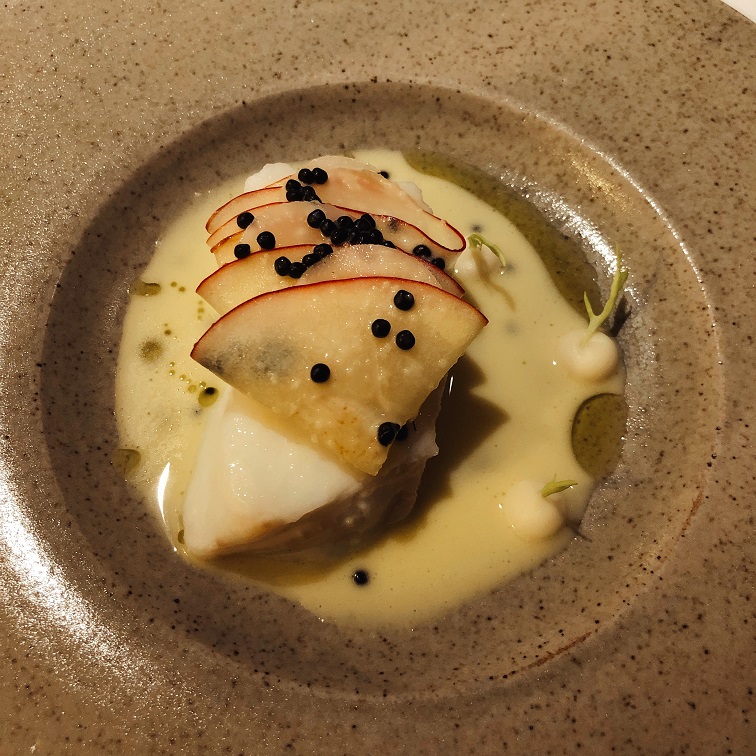
I returned to Ghent in January 2019, and had a stupendous meal at a restaurant which really needs to be added to this piece. It was Michelin-starred Oak, and my food there ranked up with the best meals I’ve had anywhere. The welcome was perfect, service was silky-smooth, the room was comfortable and cosy without any sterility or stuffiness and the tasting menu was a series of wonders. From the beautiful amuse bouches to begin with (including a stunning charred leek dish) to barbecued pigeon with a deep beetroot cracker and red fruits, right through to a terrific granita strewn with punchy microherbs, it didn’t put a foot wrong. Truth be told, it made all the Michelin-starred meals I’ve had in the UK feel like a poor imitation.
Where to drink

I love a Belgian beer, although my tastes run more to lighter stuff like a kriek or a framboise. So I may not be the best guide for these things: no doubt there are all kinds of dreary beer spods who can steer you much better in Ghent than I could. They would probably direct you to places like Trollkelder and Rock Circus which pride themselves on doing a gazillion different obscure beers in a big laminated pamphlet, and they’d probably try to catch them all like Pokemon, but that really wasn’t for me. I did go to De Dulle Griet, a big old pub with rather eccentric decor which apparently has the biggest selection in all of Ghent, and I thought it was okay but I didn’t find myself drawn to going back. Maybe if they’d done more food than just pate and plastic-wrapped crispbreads I might have found it easier to get on board.

I did absolutely love Het Waterhuis aan de Bierkant, right next to the river, with its cosy upstairs room and its decor which slightly made me think “90s student party”: it wasn’t a million miles from the old Bar Iguana, to be honest. I very much enjoyed the extensive list of beers (bottled and on draft) and, of course lots of different fruit beers for me to try with almost no shame at all – although they always set them down in front of my other half instead of me, which is both sweet and very misguided. I was sorry only to go there the once during my trip, and almost as disappointed not to visit ‘t Dreupelkot, the jenever bar next door. There’s always next time.

Another regret was waiting until my final night to discover ‘T Einde Der Beschaving (which apparently translates as “The End Of Civilisation”: at last, a Brexit-themed pub!) on a square next to Gravensteen castle. It was a slightly dreich evening – a shame, because the courtyard outside would have been a lovely place to drink in more clement circumstances – but it was a lovely, snug place and the barman was friendly and welcoming and seemed genuinely delighted to have customers. A very nice older lady at the bar sauntered over, asked us many questions about the motherland and, at the end of the evening, offered us her email address for tips if or when (when, as it turns out) we came back to Ghent. It was that kind of place, and it might not have been the fanciest pub in the world but I liked it a great deal.

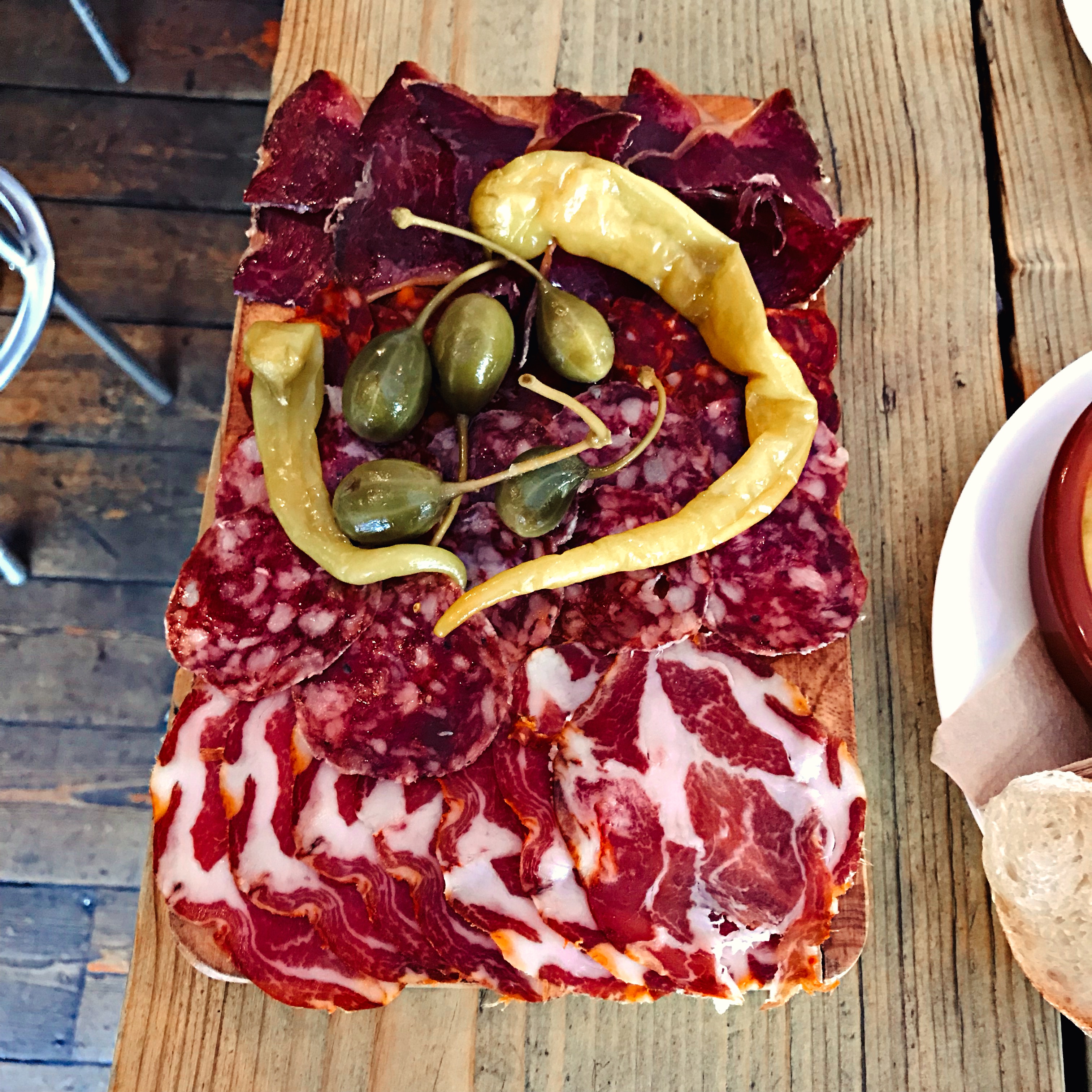
The main reason so few of those places got the time they might have deserved, though, was Café Gitane. Oh, how I adored that place: in the space of my time in Ghent it easily made it onto my list of my favourite bars in all the world, rubbing shoulders with exalted company like Paris’ Le Barav, Liverpool’s Petit Café Du Coin and Granada’s Taberna La Tana. It was as French as it was Belgian, actually, with cosy, dimly lit tables, blood-red banquettes and a black and white tiled floor. The beer list was big enough to satisfy my other half and had the sweet and drinkable Ter Dolen Kriek on it for me. The music was jazz just modern enough to still be enjoyable and some of the clientele, especially the lady at the bar one night who decided to start singing completely out of nowhere, were brilliantly bonkers. It was a charcuterie plate away from perfection, but every time I went there I was already so well-fed that none of that mattered a jot.

“I wish there was a bar like this in Reading”, said my other half. “A good beer list, table service, good music and no wankers.”

I nodded sagely, deciding that our home town could really do with an excellent Belgian beer café, or more specifically just Gitane. It might well be one of my first stops when I return.
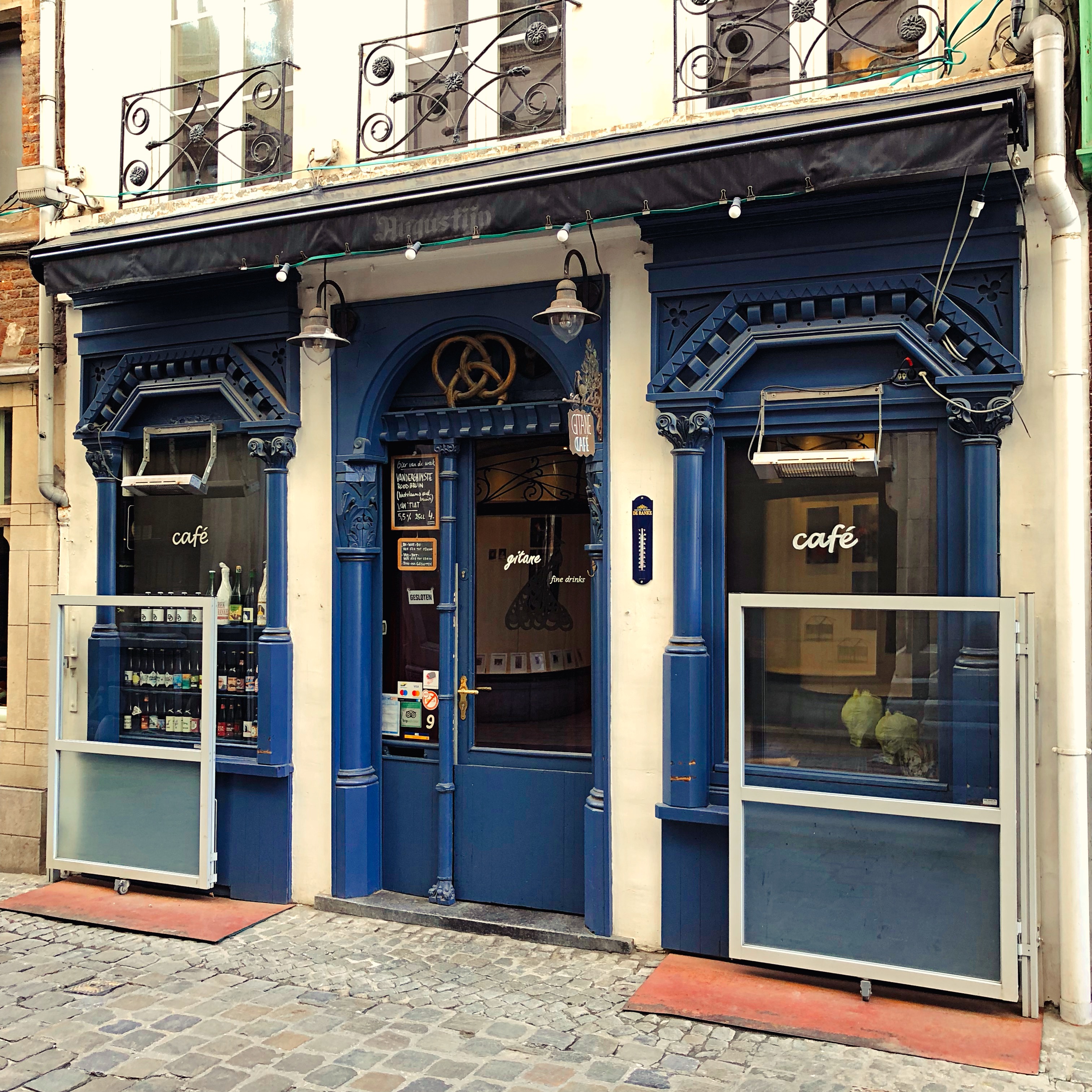
No section on drinks would be complete without also briefly mentioning coffee. I tried a few places in the city but my absolute standout favourite, a stone’s throw from Gitane, was Barista Zuivelbrug, one of two branches in Ghent. I’m normally a latte drinker, but the combination of Barista’s excellent coffee and Belgian chocolate made their mocha an absolute revelation and I enjoyed it so much I didn’t even care how much it would appal the purists. They also did nice-looking pastries and lunches, but of course I was usually a pain au chocolat to the good by then.

What to do

Well, if you’ve made it this far then you’ve probably figured out that my main idea of things to do on holiday fits into the previous two headings. But I will say that Ghent is a wonderful place just to wander and take in, especially if you enjoy architecture, photography, combining the two or just plain people-watching. I did visit the Design Museum – the blurb says that it “makes you aware of the great impact design has on your daily life”, but it mainly made me aware that, as an experience, the Design Museum in London is much better, err, designed (nice building, though). I didn’t go in the cathedral, but like I said I did buy some very appealing chocolate from the shop next door. I know, I know, I’m an appalling tourist. Next time I shall go to the Museum of Contemporary Art (the wonderfully-named S.M.A.K.) and generally try a little harder.

The thing I really, really enjoyed in Ghent, though, was the street art. There’s loads of it, seemingly everywhere. On one of our first days exploring the city we crossed the river and wandered up some side streets, turned a corner and just found this staring right back at us.
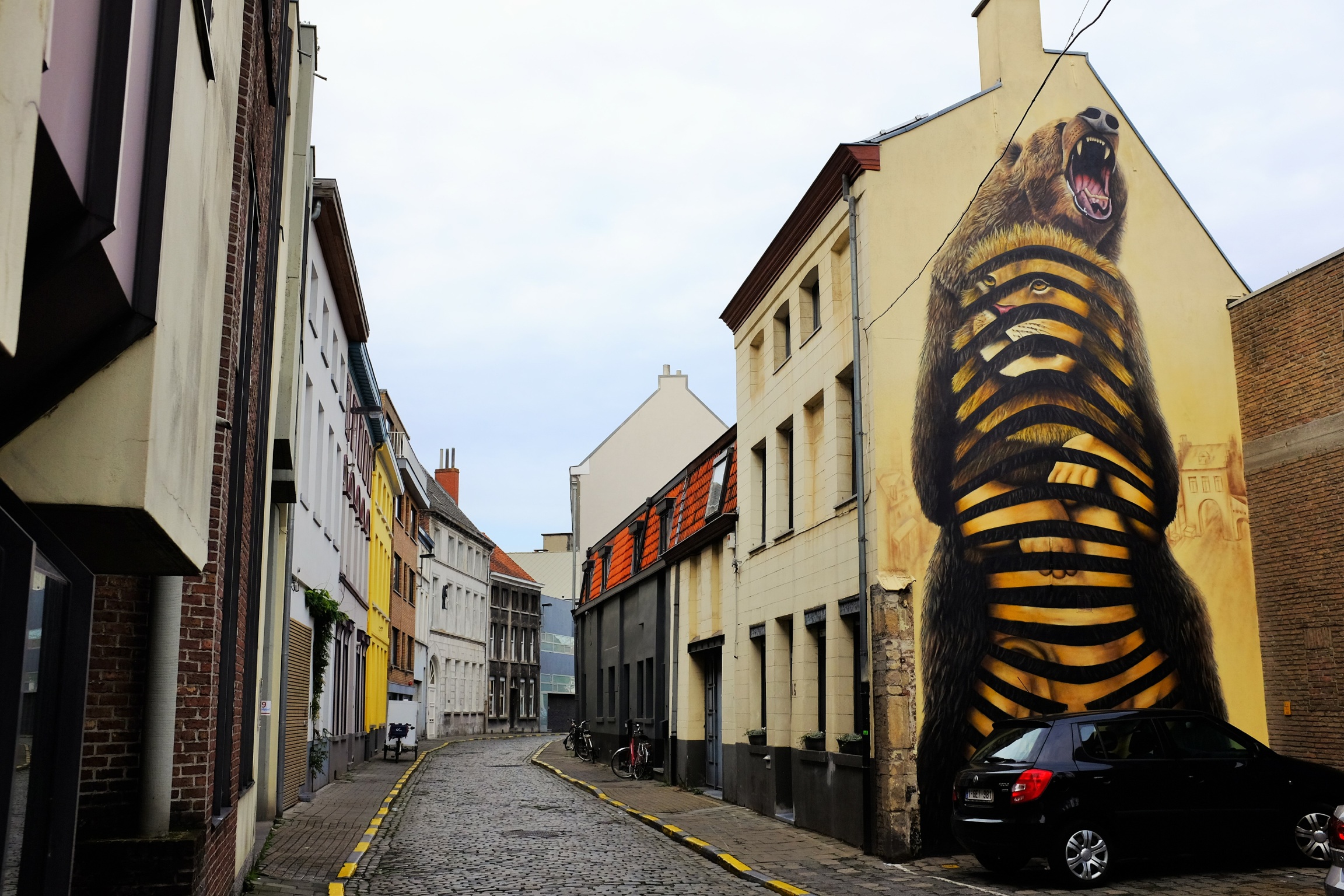
Further research revealed that Ghent is in fact famous for its street art, all over the city, and indeed some of its artists. So we downloaded the street art map from the Visit Ghent website and went on a truly enjoyable odyssey round the city, hopping from location to location. Some were small, subtle pieces, and some were jaw-dropping: the whole side of a building transformed into a massive, vivid canvas. The trip took us out into the docklands, another part of Ghent I’d like to see more of, and incredible industrial buildings, glass bricks and converted warehouses, hip-looking cafes on street corners. Every single dot on that map offered something new, many offered something stunning, and I could quite happy have whiled away another afternoon seeking out the whole lot. The picture below of rabbits by Ghent native ROA was probably my favourite find, and if I thought it looked familiar it was probably because I’ve also seen his work in London.

Where to stay

I really lucked out by booking Snooz Ap, an apartment very close to the centre and just round the corner from Graffiti Alley, another street art hotspot in Ghent. It was muted, tasteful, spacious and warm with a huge comfy bed like a cloud and a walk-in wet room to die for. It even had brilliant catering facilities, which I imagine would have come in very handy for a fundamentally very different kind of guest to me, and fridges and cupboards for room snacks (please tell me I’m not the only person who gets room snacks on holiday). I got my room through booking.com, although you can also book direct through their website.

Well, there you go, that’s Ghent in a nutshell. Normal service will be resumed next week with a review of a Reading restaurant, and I’ll try my best not to bore on about how everything is better on the continent (I still remember coming back from my holiday in Bologna earlier in the year and realising, to my horror, that I’d become one of Those People). But in summary I loved the place, far more than I ever expected to, and I can’t wait to go back. I left with a heavy heart and took a train to Rotterdam, a very different city with its amazing, hypermodern architecture, Brutalist buildings, colossal indoor street markets, cutting-edge craft breweries and stunning small plates restaurants. But that’s another story.
MumMum

MumMum closed in June 2019. I’ve left the review up for posterity.

One of my biggest regrets in Reading’s restaurant scene is a little place you probably never visited called Cappuccina Cafe. It was on West Street, looking out over an especially grotty 99p shop, it was a fusion of Vietnamese and Portuguese food, and it did the most wonderful bánh mì (the Vietnamese sandwich, served in a baguette, which bears the hallmarks of Vietnam’s French colonial past: an early example of fusion food, you could say). I reviewed it in May 2014 and – and this may be a record – it closed a month later. I never got to go back, but one of my friends loved the bánh mì so much she developed a several times a week habit before it turned into yet another nail bar.

It was part of a general saga of decline on West Street. First Fopp shut – I still miss that place – then Cappuccina Cafe, then Vicar’s closed after over 100 years of purveying meat to the people of Reading and finally Primark decamped to the old BHS store. It’s part of a general trend which leaves that end of Broad Street looking increasingly grotty, and possibly also explains why Artigiano decided to divest themselves of their branch, deep in the heart of no man’s land: it’s Broad Street Bar & Kitchen (for) now. That area desperately needs some love and imagination, two qualities our council seemingly lacks the ability to provide, foster or inspire.

Fast forward four and a half years, and finally another restaurant has appeared in Reading looking to fill that bánh mì shaped gap in the market. Literally in the market, as it turns out, because MumMum opened on Market Place in October, where the ill-fated Happy Pretzel used to be, just down from the post office. I was tipped off about it not long after it opened and I’d been watching with some interest, waiting for a month to pass so I could check it out on duty. It’s actually a surprisingly tricky place to visit for lunch, because it isn’t open at weekends, but I had a Monday off after coming back from holiday so I stopped in to check it out with Zoë, my partner in crime and regular dining companion.

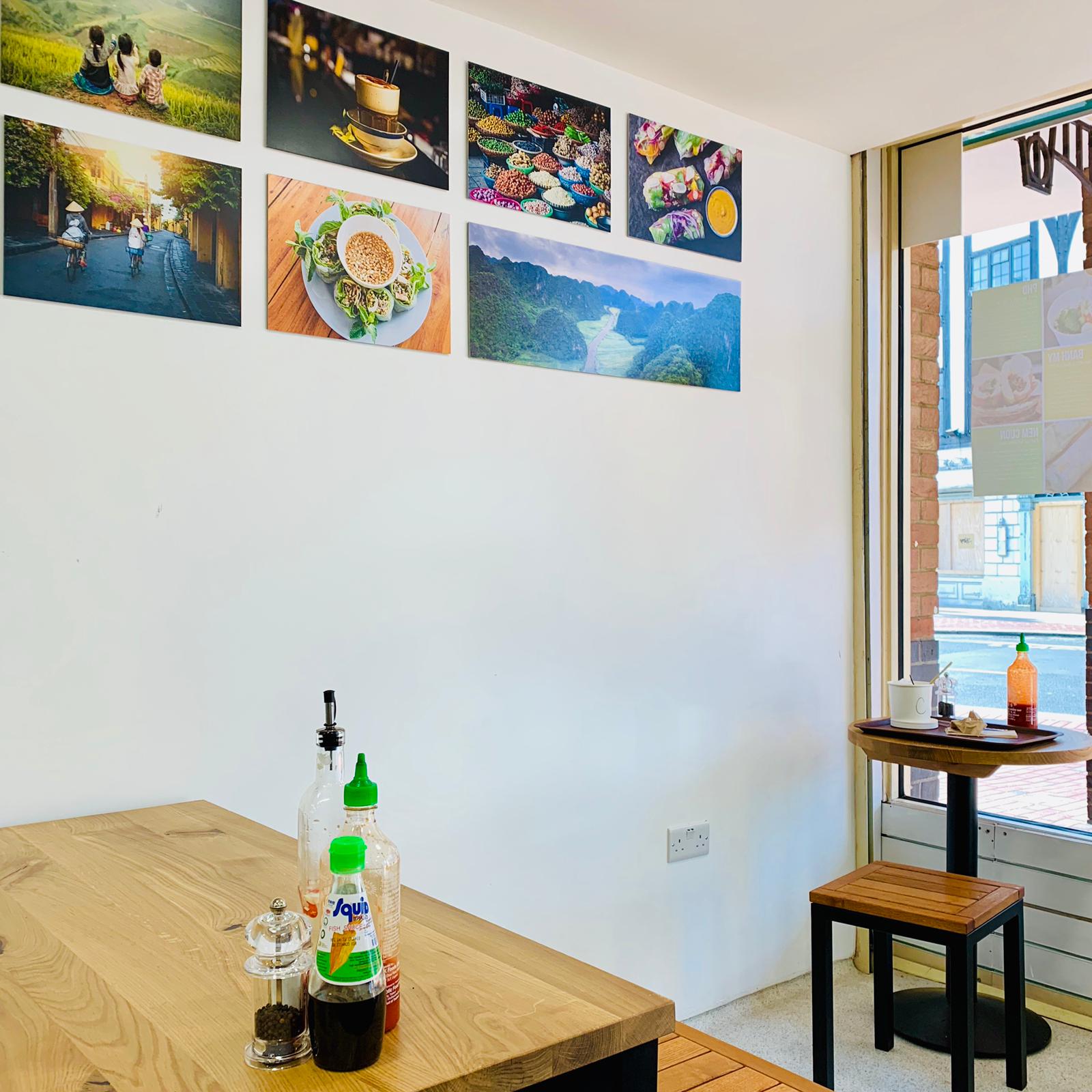
From the outside, MumMum was all windows (with a laminated menu – but no opening hours – blu-tacked to them) but going in I was surprised by what a nice space it was. It was clean and neutral without looking basic: pleasant, plain low tables and higher tables with stools where you could perch and look out of the window. Far more seating, in fact, than I expected and without ever feeling cramped. You could look through into the kitchen, although some of the preparation took place at the counter: while we were there I saw one of the staff carefully, skilfully assembling summer rolls with tofu.

MumMum only really does three things – bánh mì, pho (the Vietnamese equivalent of ramen – meat and noodles in a rich broth), and summer rolls, which are like spring rolls but served cold and wrapped in rice paper rather than pastry. You are carefully walked through the process of ordering. There’s a cabinet on the left where you pick up your tub of pho (small or large, chicken or beef) and/or your summer rolls (pork, prawn or tofu). You pay at the counter, which is also where your bánh mì are prepared and where they add the broth and herbs to your pho, sort of like an uptown Pot Noodle. The signs and barriers turn this into a neat little queuing system, although they then brought everything to our table which felt more like a traditional restaurant experience.

The pricing is a bit more confusing, mainly because there are a range of meal deals and, if I recall, the prices on the menu behind the counter didn’t quite match the ones on the menu in the window. With a meal deal you get either a bánh mì or a small pho with a drink (although not apple juice, apparently) and a single summer roll (they usually come as pair). This does save you a little money, although the bánh mì meal deal is more expensive than the pho meal deal. The former is six pounds, the latter six pounds fifty (or six pounds eighty, according to the menu outside).

In reality they charged me twelve pounds for two meals, and they then knocked a quid off because I agreed to take a loyalty card, which was slightly random because I didn’t need to give any personal details and how the card worked wasn’t at all clear. By the time you go, if you do, the prices may well be different again, so good luck working out how much everything is meant to cost. In the meantime, allow me to apologise for possibly two of the most tedious paragraphs ever to feature in an ER review, and let’s get on to talking about the food.

Zoë took one for the team and ordered the pho – I hadn’t been wowed by my previous encounter with this dish, so I was happy to leave her to it. It did look very clean and virtuous, and everything was done well, so little shreds of chicken, noodles, vegetables and plenty of coriander were all present and correct. In pho much is often made of the quality of the broth, just how long they’ve laboured over it and the depth of flavour they manage to get in to it. I tried enough of Zoë’s pho to think that either they’d fallen short or pho just wasn’t for me (most likely the latter).

“I love the coriander”, Zoë said at the end, “but it didn’t have quite enough flavour.”

I did point out the unused bottles of sriracha, fish sauce and indeed MumMum’s very own home-made garlic and chilli vinegar at this point, only to receive a nonchalant shrug. But I could hardly make much of it, because when I’d had a similar dish at Pho earlier in the year I had done exactly the same thing. Unlike Pho, MumMum didn’t give you extra mint and coriander and goodies to stick in there to taste. I understand why: MumMum is very much more no-frills, and the packaging is more geared to the takeaway crowd, but the overall effect was just a little too understated.

The bánh mì was more like it, although still not quite there. There was chicken, plenty of it in fact, and although it wasn’t fresh off the grill and straight into the baguette it was still piping hot and reasonably tasty. There was plenty of what I think was shredded pickled carrot and daikon, which lent cleanness, bite and crunch. The excessively thick discs of cucumber all down one side I could have done without, but that might be more to do with me and my feelings about cucumber. And there was a little coriander and mint, although really just enough to make me wish there was more. It needed more full stop, and I could see plenty of ways that could have been done, whether by adding more zing and lime, a lot more coriander and mint, some peanuts or – the traditional element of a bánh mì, this – some pâté. It was a few steps above an entry-level hot chicken sandwich, but that was all. I wasn’t sure whether this was marketed at normal lunchtime shoppers or fans of Vietnamese food, but whoever it was aimed it wasn’t quite on the money.

What it really needed, I decided, was the satay sauce which came with the summer rolls. These were quite remarkable and easily the highlight of the visit; I’ve had summer rolls before and never quite got it, but these were properly delicious. It’s very hard not to keep trotting out the same adjectives to describe Vietnamese food: fresh, clean, delicate, blah blah blah. Believe me, I know that. But they seem so appropriate in this case, and in any event I’d rather not embarrass us all by dashing off to the thesaurus.

In some ways, the summer rolls should have been no more successful than the bánh mì or the pho, but that combination of crunch and subtlety worked here when it didn’t quite elsewhere. The prawn summer roll, Zoë’s choice had three prawns along one edge, my pork summer roll had a slice of roast pork rolled along the outside. In both cases it was a weird experience to take off the clingfilm and then see an equally transparent layer you could actually eat in the form of the rice paper. But the real winner was the satay – properly deep and rich with a beautifully simmering heat. A small quibble is that the little plastic tub it came in was far too small to allow proper dipping. A bigger quibble is that I just would have liked more satay sauce in general. And of course, the main quibble was that my bánh mì hadn’t come slathered in the stuff. Oh well, maybe next time I’ll just ask for a couple of tubs on the side.

“That’s the hit of the whole fruit” said Zoë, devouring hers, and I couldn’t disagree. They’re four pounds for two, and I could well imagine foregoing the bánh mì next time and just having a couple of the summer rolls instead. But, on the other hand, there was a fried egg bánh mì which also sounded intriguing. And that, in a way, is rather a telling thing about my visit to MumMum – you could argue that it was only a partial success, you could say it was still more unrealised potential than actual accomplishment, but I had still already mapped out what I’d eat on my next two visits.

Service was good, prompt and kind although it had a strangely downcast quality to it. We were handed a slip with a code we could use to enter a TripAdvisor review (and details of their website which, the last time I tried it, didn’t work). The chap who brought our food over was lovely and friendly. But, as we were leaving, I asked the other lady serving how things had gone in their first month.

“It’s not that good” she said.

There was just enough of a pause for me to worry, and then she went on.

“But it’s not that bad either.”

My heart went out to her for being so honest, and I left the restaurant in crusading mode all fired up to write a glowing review which would get people flocking (who am I trying to kid? Trickling) to MumMum. But after a period of reflection, I think it’s right to strike a different tone. MumMum is a refreshing option for the town centre; they have a lovely, well laid-out space in a decent location and they offer something you can’t get elsewhere in town. They are starting to do a superb job of drawing attention to themselves on Instagram (I was recently mesmerised by an Instagram story showing exactly how they make a summer roll – well worth two for four quid, I reckon).

All that is to their credit, but the realities of their situation are still challenging. Good as a location on Market Square is, it also means that two days of every week diners have to walk right past a thriving food market to eat there. On most Wednesdays, unless the weather was truly dismal, I’d struggle to pass up the plethora of options at Blue Collar – especially the challoumi wrap from Leymoun – to eat at MumMum. Closing on Saturdays and Sundays makes it difficult to try their wares unless you work in town. Their prices are slightly confusing and not always as competitive as they could be. But most of all, I really think MumMum needs to be bolder and braver with flavour, or I worry that they’ll never get the audience they need to survive. Their food needs to sing rather than stammer, and I sense – to twist the metaphor out of shape – that they’re still clearing their throat. I really hope they make it: I’d rather not mourn the passing of a second Vietnamese cafe in Reading.

MumMum – 6.9
20 Market Place, RG1 2EG
0118 3274185

https://www.facebook.com/Simply.Vietnamese.Taste/

Bierhaus

Bierhaus closed in December 2025. I’ve left the review up for posterity.

I felt at a disadvantage going to Bierhaus, the German restaurant on Queens Walk, with Ian, my stepfather. I don’t know a huge amount about beer – as anyone who’s ever read my reviews already knows – whereas he knows his way round a pilsner and a pale ale and used to work for one of the world’s biggest brewers, travelling all over the world and sampling all sorts. More significantly, he had been to Germany and I hadn’t. My knowledge of German stops at being able to ask my way to the town hall, proudly proclaim that I own a guinea pig or explain that my pen is broken (kaput, such a beautiful word). Oh, and I know how to tell people that my favourite pop group is Johnny Hates Jazz – although it never actually was, not even back then.

I’ve had friends tell me how wonderful Germany is, how clean and beautiful, how everyone is handsome and polite and speaks beautiful English. It sounds like somewhere one could quite happily live, let alone visit, and yet Munich, Berlin and Cologne have never quite made it to the top of the city break shortlist (Berlin, in particular, crops up regularly with people I know, usually in the sentence Oh my god, you absolutely must go to Berlin: I don’t much like being told what to do, so I never have).

I’m not sure why I’ve never made it out there. It could be repressed horror from those three years studying “Deutsche Heute” which mainly consisted of my schoolfriends making Franzi the Pig do awful, awful things through the medium of graffiti. But really I think it’s the food, which has never hugely appealed. I’ve never fallen over myself to try it, even to the point where I’ve always steered clear of the bratwurst place that crops up on the Oracle riverside every bloody year. Mystery meat? Nein danke. And the same goes for pork knuckle: who willingly eats a knuckle?

Subscribe to continue reading

Become a paid subscriber to get access to the rest of this post and other exclusive content.

Oishi

Click here to read a more recent review of Oishi, from December 2025.

I’m not sure I’ve ever eaten somewhere quite as apologetic as Oishi, the new Japanese restaurant on the Oxford Road. I turned up on a Wednesday evening to find the place completely empty; I asked the waitress whether it was okay to have a table for two, and she mumbled something about how most people come in to get takeaway, or phone up for delivery. That didn’t feel like either a yes or no, but then she smiled, said “yes, sit anywhere” and gestured around her. It’s a Spartan room, but tasteful and nicely kitted out, and I took a table in the window, reasoning that if people walked past at least they’d know somebody was eating there and maybe they’d come in too.

There was further confusion when the menus were handed out. There’s no way of getting round this: they were takeaway menus, proudly advising that you could have free delivery within a three mile radius if you spent fifteen pounds (which, incidentally, is pretty reasonable). Not just takeaway menus, but takeaway menus for Oishi’s branch in Brentford: the telephone number had been scrubbed out and a Reading number written underneath it in scratchy blue biro. On the plus side, at least we weren’t in Brentford.

“Would you like a drink?” said the waitress.

“Do you have a drinks list?”

There was a pause, long enough for me to realise that there was no more a drinks list than there was a menu.

“We don’t serve alcohol.”

Well, I’ve had more promising starts to a meal out, I said to myself.

Anyway, that’s getting ahead of ourselves. First, the context: I’d wanted to visit Oishi ever since it opened in August. Reading has long needed a Japanese restaurant that could rival the likes of Misugo in Windsor or Kyoto Kitchen in Winchester, both of which are terrific. I’m also a fan of Oxford’s Taberu, and when they announced that they were opening a second branch down the Oxford Road I thought my prayers had been answered.

At first things went well: Taberu did the place up (previously the first home of sadly departed and much mourned Indian restaurant Bhoj – there was a lot of burnt orange to paint over) and began serving takeaway with the promise that they’d open as a proper eat-in restaurant later on. Then, somewhere along the line, it all went awry: opening as a full restaurant never happened, then Taberu closed completely and then, after much speculation, it reopened as Oishi. Oh well, at least they didn’t have to redecorate.

I especially wanted to try Oishi because I recently ordered food from Sen Sushi, Reading’s other Japanese restaurant at the opposite end of the 17 bus route, and I’d been so disappointed. Having sushi delivered on a Friday night felt like a massive treat, but what turned up was mediocre: oddly wan salmon sashimi, sinewy, badly-cut tuna sashimi, yakitori chicken skewers with a bonus knot of gristle. I wanted to support small independent businesses, but this wasn’t as good as Yo! Sushi.

My dining companion this week was my friend Jerry. Now, Jerry is a very dangerous man to go out with on a school night. He likes a drink, but he’s retired and consequently he never, ever has to get up for work the next day: many’s the time I’ve forgotten this fact and meandered home from Jerry’s flat of an evening, rather too much wine to the good, only to face a painful awakening the following morning (and a message from Jerry, fresh as a daisy, saying what a lovely evening it was). More significantly, and uniquely among people who have accompanied me on reviews, Jerry doesn’t actually read the blog, so I can say what I like about him without fear of reprisal: believe me, the temptation to claim that he sports a mohawk is considerable.

Not only that, but Jerry told me in the run up to our meal that he’d never had Japanese food before. Looking through the menu, I found myself wondering what the least intimidating dishes might be for a newcomer. The usual suspects are all present and correct – a small selection of sashimi, some sushi (maki, uramaki and hand rolls), some hot starters and a range of hot main courses – rice dishes, noodle dishes and ramen, mostly. In the end I decided to go for a sort of greatest hits: I could try and pretend this was to fully test the range of the menu, or to give Jerry the best possible introduction to Japanese food, but by now you’ve probably figured out that it was more to do with greed and hunger.

“Have you really never eaten Japanese food?”

“No, I haven’t! The closest I’ve ever got is Wagamama.”

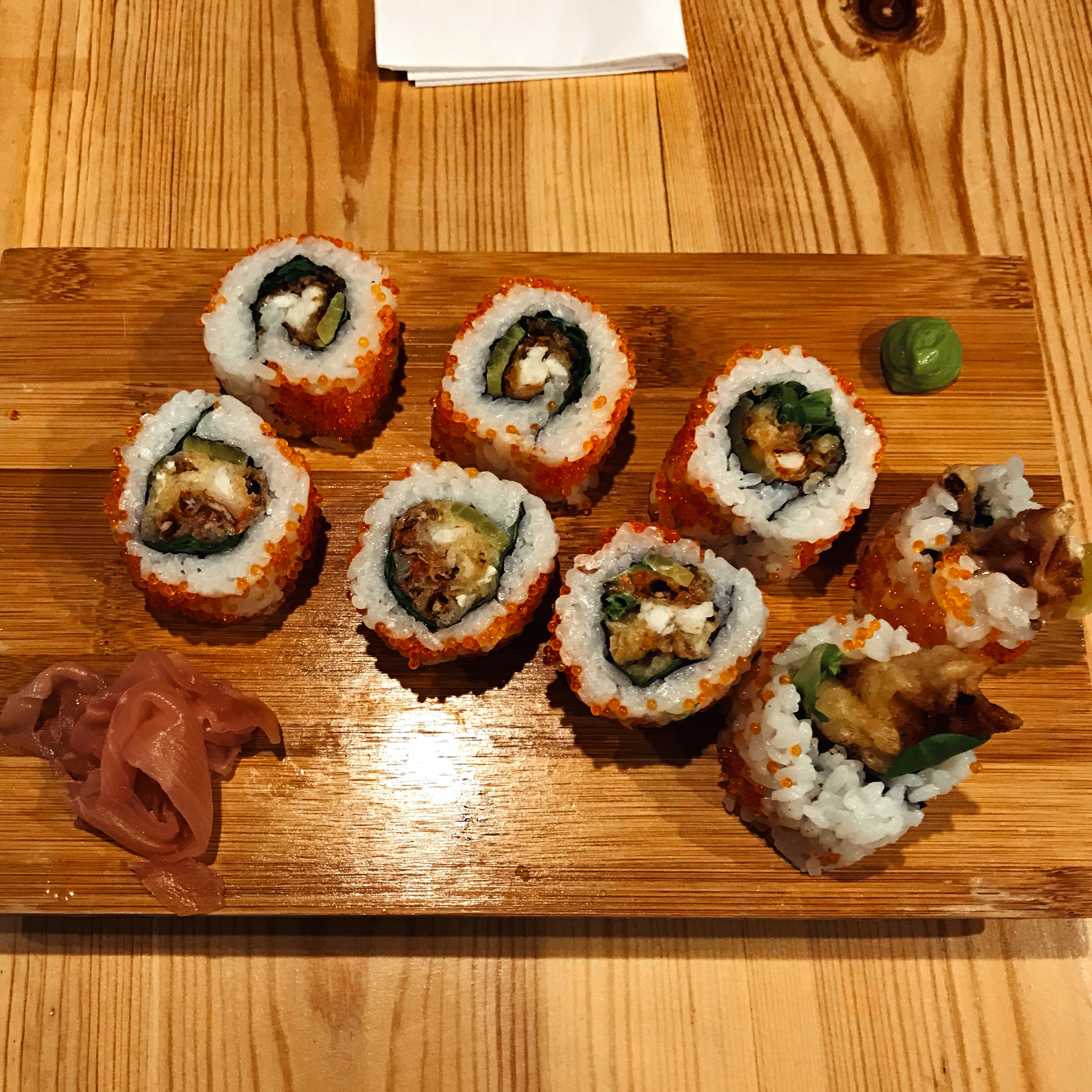
Jerry’s education began with the classics. I have a real weakness for soft shell crab, so I ordered some soft shell crab uramaki (“I was going to put in a request for those!” he said excitedly) and they were one of the first dishes to turn up. The presentation was endearingly amateurish – I’m used to slightly more precision and focus on clean lines – but they looked good, coated in bright orange tobiko (fish roe, the wonderful stuff that pops under your teeth), plonked on a board with a small pile of ginger in one corner and a dab of wasabi in the other. They were nicely rolled with no gaps or ragged edges, and the addition of a little cucumber added a nice textural crunch. If I had a criticism it was about size (don’t let anybody ever tell you it’s not important) – I’m used to having the same dish at Misugo where it feels like a sea monster is trying to escape from the rice, whereas these were somewhat diddy by comparison. At eight pounds it was the single most expensive dish we had, and probably not quite worth that.

I also ordered tempura prawns, mainly to ease the culture shock for Jerry: most people have eaten something like this at some point in their lives, after all. They never amaze and they rarely disappoint, but actually I was quietly impressed by Oishi’s rendition. Often menus claim that it’s tempura batter but what you get is stodgy, or greasy, or you take one bite and the rest of the batter falls off. These were very nicely done indeed – light, delicate and lacking in oil. They came with a pretty anonymous dipping sauce.

“It’s all very clean-tasting, isn’t it?” said Jerry. By Jove, I thought, he’s got it.

Sashimi came next: a big test for me, especially after such an iffy experience at Sen Sushi. Oishi has a limited sashimi selection – no sea bass or mackerel here – so again I opted for the reference dishes, in this case tuna and salmon. The slices were beautifully marbled, nicely sized and well-cut, with beautiful colour to them, but again the presentation was a tad haphazard. There was no daikon and the fish was fanned out on what looked like seaweed, which slightly affected the flavour of the pieces at the bottom.

That was a pity, because otherwise the sashimi was quite beautiful. I know some people are funny about raw fish, but for me there’s something magical about salmon sashimi in particular – the almost glossy texture, the way it manages to be both oily and pure all at once. The tuna was just as good – firm, meaty and expertly cut, everything as it should be. I dipped mine lightly in soy sauce and rhapsodised, while Jerry – showing a leaning toward the ascetic that was news to me – ate his au naturel. Oh, and there were two random and completely pointless slices of lemon: if you need these, you probably shouldn’t be eating sashimi, and I imagine they’d give purists conniptions.

By this point, I was starting to feel like things might turn out rather nicely, although I was also increasingly aware that this might have been the longest I’d ever been in Jerry’s company without imbibing alcohol of some description. Not that it seemed to deter him in the slightest as he launched into a long and very entertaining story about going to a wedding in North Devon only to meet the village character, a lady of advanced years who had booted out her husband because of his failure to perform, exhausted the limited pool of locals via Tinder and ended up working in a massage parlour because she’d said, he told me, “I might as well get paid for it”. Where did he find these people? I wondered.

Jerry concluded his tale just as our – presumably slightly aghast – waitress turned up with the next dish, duck gyoza with a little dish of hoi sin for dipping. Now, these are a stable at the likes of Yo! Sushi and Wagamama, and Oishi’s were fairly similar to the gyoza you can get at those places, but even then there were little differences – some finely chopped cucumber, or possibly spring onion, in the filling just adding another dimension. Nice work.

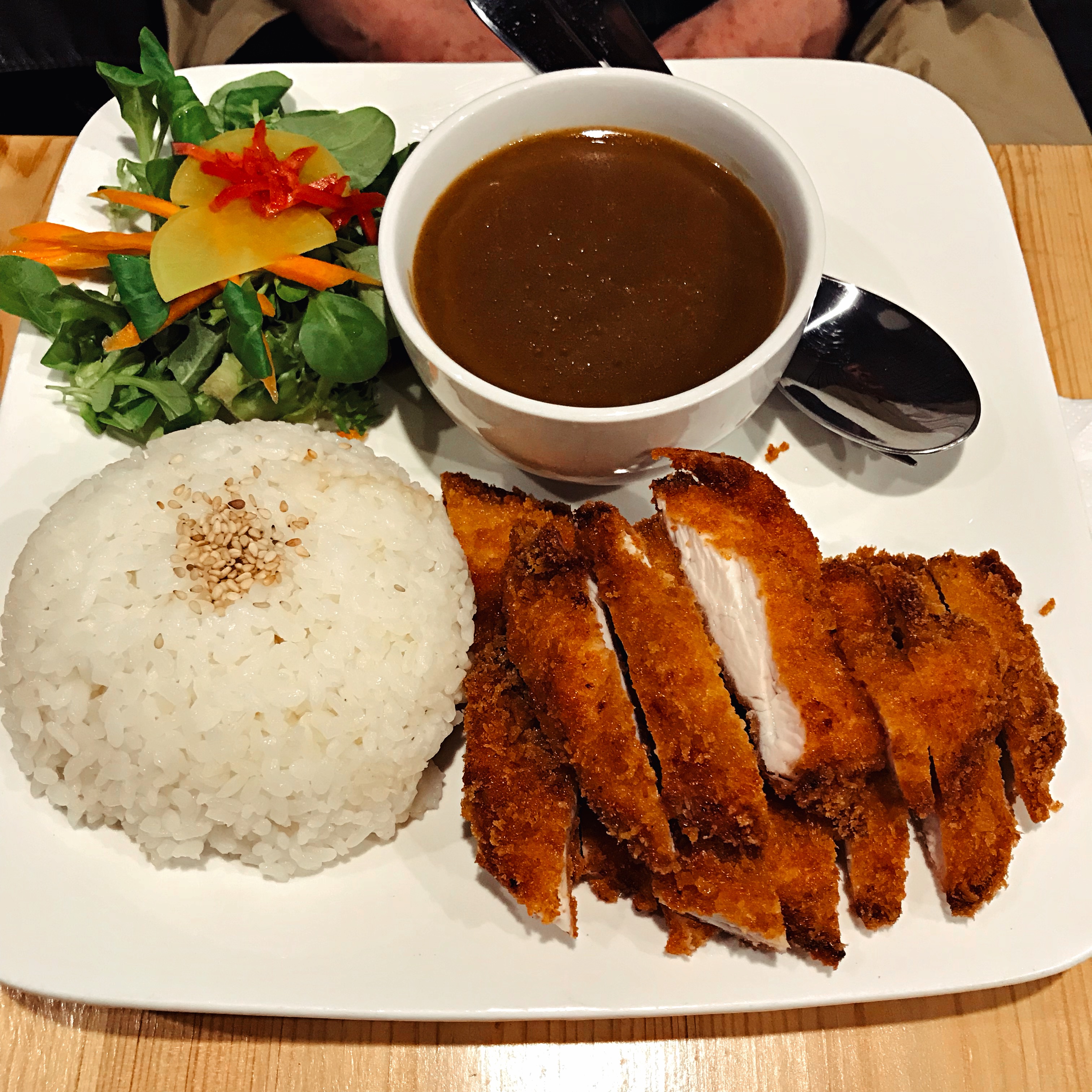
Finally, what I suppose you’d class as our main courses arrived. I’d given Jerry first choice, after talking him through the options, and he’d gone for chicken katsu curry. “It’s sort of breadcrumbed chicken breast and rice and a curry sauce, but it’s not a really hot spicy sauce.” I said. “It’s kind of mild and creamy, you know, like a chip shop curry sauce.” I think that latter reference is what sealed it, and when it was placed in front of Jerry I realised I had inadvertently described it perfectly. It was indeed some rice, some breaded chicken and some curry sauce, all separate, practically deconstructed you could say. I used to have a friend called Fiona who had to eat every component of her meal separately – first the potatoes, then the veg, then the meat, never crossing the gastronomic streams (well, it takes all sorts). All I can say is that Fiona would have loved Oishi’s chicken katsu curry, although I wasn’t so sure about the self-assembly aspect myself.

None the less, as before, Oishi may not have got the presentation right but the content was very good indeed. The chicken was just right – a brilliant juxtaposition of crispy and tender – and although the breadcrumbs mightn’t have been panko it was far too tasty for me to care. The sauce was sweetly mild but a very long way from inoffensive, and the rice was, well, rice. I personally would have poured the sauce over the rice and chicken and had at it, but Jerry ended up dipping the chicken and forkfuls of the rice into the sauce like some kind of exotic fondue; I found it far too endearing to correct him. Oh, there was also some salad but I don’t think Jerry touched it. I kind of found that endearing too.

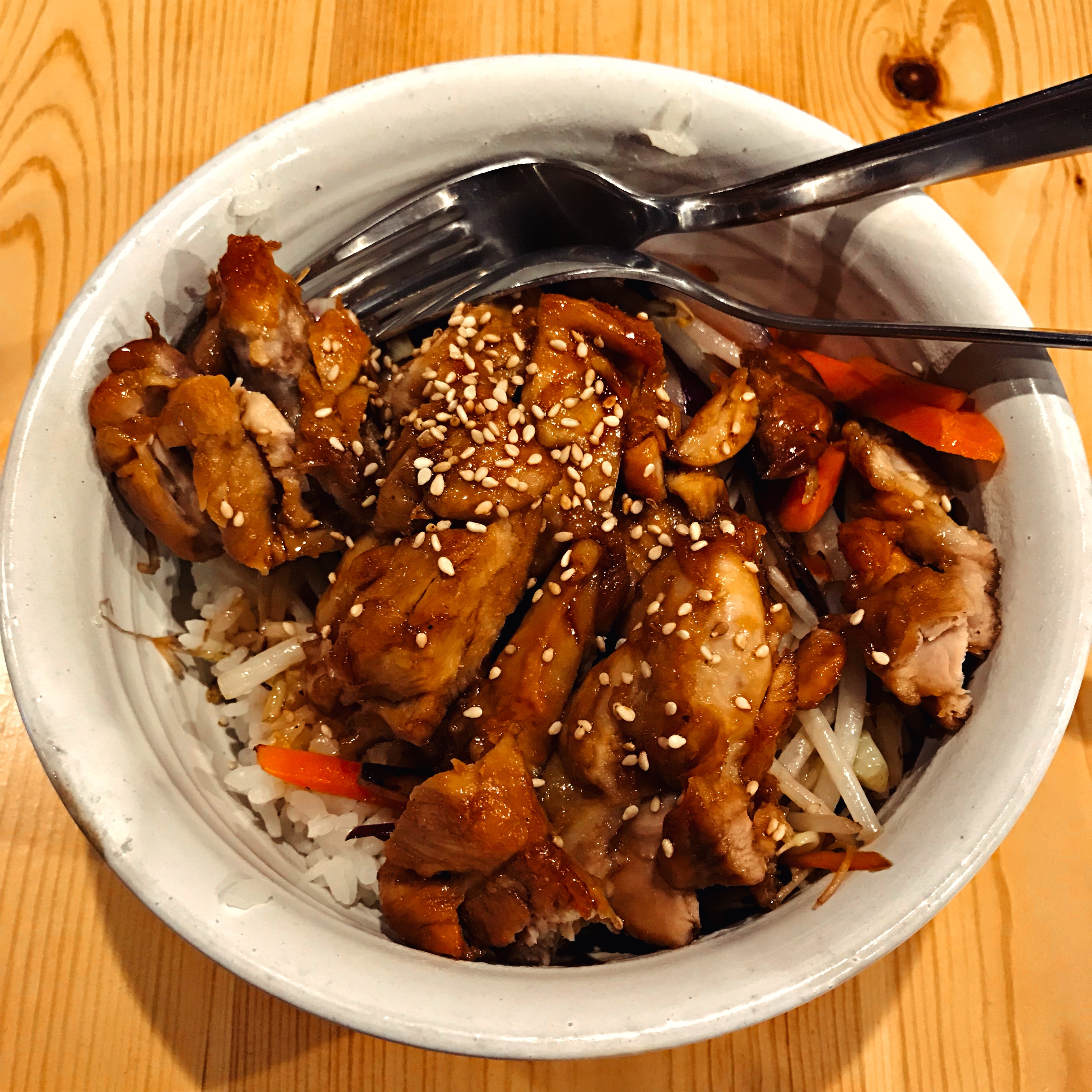
My main course was teriyaki chicken, and I so enjoyed it. It was a very generous portion of chicken thigh in a bowl, on top of a bed of plain rice and at first I had reservations because it looked perfectly sticky but I thought everything underneath would be dry. How wrong I was: all the teriyaki sauce had percolated through the grains of rice, leaving a glorious sweet reservoir at the bottom that simply made everything delicious. Not only that, but the dish had plenty of other stuff going on – the crunch of beansprouts, carrots and red onion, every mouthful perfect in contrasts of flavour and texture. And the chicken, although I might have liked it absolutely piping hot, was beautifully cooked. This dish was on the menu at six pounds fifty and I couldn’t believe what superb value it was – a feeling that was only marginally dented by being charged seven pounds fifty for it when the bill arrived.

Service was truly lovely thoughout – the lady who served us was so friendly and polite (after the baffled and diffident start) that it truly saddened me that there were no other customers eating in the night that we went. There was a regular stream of deliveries going out the door, and a couple turned up to pick some food up towards the end of our visit, but even so it felt forlorn to be the only people sitting there enjoying such good food. “We did have some tables in before you arrived”, the waitress told us and I fervently hoped that was the case.

Everything we ate that night, along with a Diet Coke (for Jerry: what do you take me for?) and a pomegranate green tea (for me: that’s what you should take me for) came to fifty pounds, not including tip. None of the dishes we had cost more than eight pounds and many – the katsu, the teriyaki chicken, both sets of sashimi – felt like impressive value. We left with warm – if sober – goodbyes and an steadfast conviction that we’d be back before long, which is exactly how you want to feel at the end of a trip to a restaurant.

“Wasn’t it lovely?” said Jerry, clearly a convert to Japanese food.

“It really was. Now shall we have a debrief at the Nag’s?”

“Absolutely!”

Independent restaurants, in my experience, rarely get everything right on day one, week one, or month one. Very few spring forth fully-formed and fully-realised in the way that, say, Bakery House or Clay’s Hyderabadi Kitchen did. They make mistakes, they learn, they correct. Early adopters are helping with the beta testing, and it’s a high wire for small restaurants: do you open before you’re totally prepared, or do you wait until everything is perfect? Taberu waited until it was ready for eat in customers which never came, and then it closed. Oishi has done it the other way round: it’s serving customers without necessarily being confident about how to do it.

And this is where we come in. Because when places like Oishi open, what they really need is customers. Not just any punters, but customers who are prepared to overlook the glitches, the lack of booze, the slightly scruffy presentation and the rather apologetic approach. But look at what you get in return: beautifully cut, delicious sashimi. Tender chicken thighs in sweet sticky sauce with the freshness of finely cut carrots. Spot on katsu curry. But more than that, you get the knowledge that you’re doing your bit, helping that restaurant to grow and evolve, to serve a community and improve a town. I think that’s a pretty good deal: but I would, because I like to think that I’m that kind of customer. I reckon some of you might be, too.


Oishi – 8.0

314 Oxford Road, RG30 1AD
0118 9599991

https://www.oishi-reading.co.uk/

Feature: The 5 things Reading needs

A couple of weeks ago, I spent the weekend in Bristol (my birthplace, as it happens). I had a brilliant time there, but for much it, in the back of my mind, I was thinking “why doesn’t Reading have anything like this?”

I drank beer at Wapping Wharf, looking out at all the shipping containers full of places to eat and drink, and I thought about Reading’s powers that be turning down a similar idea near St Mary’s Butts. I had terrific tapas at Bravas: blue cheese sticky with orange blossom honey, perfect charcuterie with caperberries and pickled chillies, bread with golden, punchy aioli. I went to the Bank Tavern, what looks like an old man pub in the middle of the old city, and I ate slow-cooked lamb ragu with sturdy gnocchi and a dusting of dukkah. I drank beer at the Small Bar with a group of new friends (including, surreally, a table of Belgians playing Uno).

I had a fantastic weekend but I found myself reflecting on the train home from Temple Meads, simultaneously elated and deflated. In three days I’d visited independent café after café and restaurant after restaurant, and I constantly wondered why this had all taken hold in Bristol when Reading still had so far to go. Was it greedy landlords, or our blinkered council? Reading was a prosperous place, so why didn’t it always feel that way?

That trip inspired this week’s feature, but before I start I do want to say that none of this detracts from how good Reading is and how far it’s come in five years of writing Edible Reading. But loving a place also involves being able to hold up a mirror and be honest about some of its shortcomings. So yes, we have good restaurants opening but far too many of the new openings inside the IDR remain chains – small, prosperous, “good” chains, but chains none the less. The farmer’s market, although it’s starting to show welcome signs of expanding its pool of stallholders, still has much to do. Our council lacks imagination and ideas, and Reading CIC pays lip service to independent businesses at best (coincidentally setting up a poorly-promoted blog and Twitter feed on the subject just around the time that the Business Improvement District comes up for renewal). Oh, and the Hexagon is still crap.

So here’s my list of the five things I still thing Reading desperately needs. Plenty of items almost made the list, and when I mentioned on Twitter that I was writing this piece I got plenty of comments which chimed with the near misses. So yes, I’d love a good independent bakery in the town centre – Warings just isn’t central enough – but the new repurposed Tamp Culture site on Castle Street has just opened selling produce and might fill that gap. I’d dearly love a Japanese restaurant on the same level as the brilliant Misugo in Windsor, and yet I feel like I should investigate relative newcomers Oishi and Sen Sushi because one of them might prove to be exactly that.

Reading is missing a good butcher that could compete with the likes of Machin in Henley or Green’s of Pangbourne, and a delicatessen. Personally I’d like a properly cosy and conspiratorial wine bar like Le Barav in Paris, Gordon’s in London or one of my favourites, John Gordons in Cheltenham. But then again, the Tasting House may not be perfect but it’s moved a long way towards being that kind of space over the last five years, and we’re lucky to have it (especially now it serves such lovely coffee during the day). 

Anyway, I could go on, but better to get to my actual choices: the five additions I’d most like to see to Reading’s food scene. You can tell me what I missed in the comments.

1. A proper cooked breakfast

What’s missing?

Good quality, coarse, herby bangers: none of your weirdly smooth mechanically recovered dross. Bacon, ideally smoked and streaky, cooked until it barely bends and could almost snap: no place for highlighter-pen-pink rubbery back bacon in the perfect breakfast. Slices of sourdough toasted just right and buttered up to the very edge. Crumbly black pudding, mushrooms cooked in butter by somebody who understands how to get them right, smooth rich scrambled egg that hasn’t been overheated into yellow pellets. All the rest – baked beans, tomatoes, fried potato, even hash browns – is just a bonus, provided you get that lot right. And yet nowhere in Reading does.

The lack of a really remarkable breakfast has long felt like one of the biggest gaps in the market in Reading. The chains don’t offer anything remarkable: Cote is by some distance the best of a bad bunch, but beyond that it’s hard to get excited by the likes of Bill’s. Reading has greasy spoons, but I think you can safely say they aren’t getting their stuff from the farmer’s market on Saturday. They have a devoted clientele, but I’ve always thought you can look into Munchees and almost smell the existential despair: maybe the windows of Rafina Coffee Lounge are smoked for a reason (I had an omelette at Rafina last year. Never again).

That leaves the indies, and it’s surprising how few of them even try to serve breakfast. Picnic makes much of its breakfast but last time I went their avocado on toast was almost literally that, cut up and plonked on a solitary slice of toast for a fiver. Shed has a breakfast selection, but it’s very limited. Richfields looks like a better bet, and Café Yolk has its fans (and it was better last time I went than the woeful occasion when I went on duty) but both are a little way out of town. As is the lovely Fidget & Bob, whose scrambled eggs have been recommended to me in the strongest possible terms by people I trust.

Somewhere like?

The Handle Bar Café in Oxford does a brilliant cooked breakfast as does Beany Green, an Australian café a five minute walk from Paddington Station tucked away by the canal. But really, there are so many blueprints for good cooked breakfasts and it beggars belief that Reading has nothing even in the same ballpark. In Belfast I had an amazing breakfast at Harlem Café which was not only delicious – black pudding, potato scones, sausage and bacon all present and correct – but so beautiful that it could have been a still life (you can see the photo further up the page).

One of my favourite breakfasts is served in Wraysbury, where my dad lives, at a place called Keating’s Delicatessen. It looks like you’re eating in somebody’s front room, and to all intents and purposes you are. The proprietor, Pat, is a snow-haired Irish gentleman who has been leading my father gastronomically astray for the best part of twenty years. There’s a limited menu, and he’ll pretty much cook anything you want, but on a standard day you get generous helpings of bacon, proper sausages from the butcher, black pudding sliced thin and done crispy, mushrooms with a whack of curry powder and home made chips that are almost like the scraps at the bottom of the bag. I went once and Pat was cooking sausages – on order – for a customer’s dog. That dog, in Wraysbury, had a better breakfast than you can currently get in the centre of Reading.

The closest thing?

Conceal your surprise, but I think it’s Bluegrass BBQ. I can take or leave much of their food (although the Southern fried chicken isn’t half bad) but the breakfast is quite lovely: properly smoked crispy bacon, good quality sausages, baked beans with strands of pulled pork and quite magnificent hash browns. The baked eggs aren’t everybody’s taste, but as an over easy fan they suit me just fine. Personally I recommend asking for extra bacon, but then I would.

2. A tapas restaurant

What’s missing?

One of the London trends that’s not yet made it to Reading is the small plates restaurant. Generally that’s never bothered me enormously, but I do wish our town had a good tapas restaurant. I Love Paella came closest, but was probably most like that in its first incarnation operating out of Workhouse Coffee; when it moved to the Horn and the Fisherman’s Cottage, it was probably more of a traditional starters and mains kind of a place.

I still think there’s space for a proper tapas restaurant in town – good cheeses, slices of jamon and and a small selection of dishes for sharing, whether that’s an ever so slightly gooey slab of tortilla shot through with soft slices of potato and topped with flakes of salt, an earthy dish of chickpeas and spinach or crimson chorizo, cooked in cider, the juices perfect with bread – if you have any left after you’ve dunked it in the sunflower-yellow aioli, that is. Oh, and there should be sherry – several kinds – and, in the best of all possible worlds, Alhambra on tap.

If you’ve been to anywhere even remotely like this you know what I’m talking about, and if you’ve ever been to Picasso in Caversham you know that it’s emphatically not there. And it’s not Thames Lido, either, where the tapas (like everything else) is just a little too little for much too much.

Somewhere like?

As a regular visitor to Granada, there’s nothing I’d like more than to clone one of its brilliant tapas bars – the likes of Bodegas Castaneda or Taberna La Tana – and drop it in Reading (ideally in the site of the old Nino’s, which is totally wasted on that estate agent). Standing at the bar at one of those two, drinking your fino or your vino tinto, ordering bits and bobs without abandon is truly to spend time in one of my happy places. A recent trip to the superb Bravas, off the Whiteladies Road in Bristol, had my body in the West Country but my mind thoroughly transported to Andalucia: mentally I was already planning my next trip to Spain.

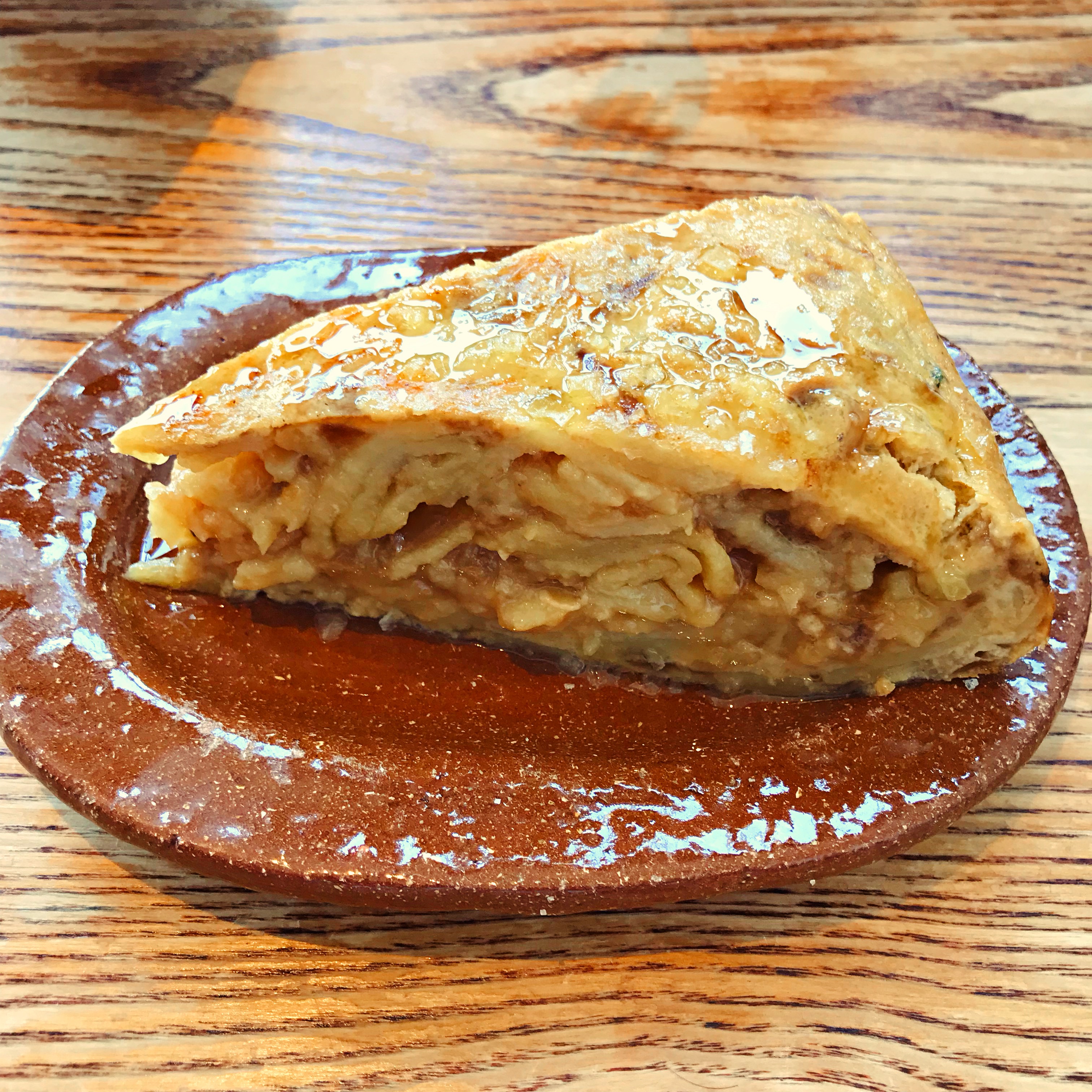
Closer to home, though, you can have an equally brilliant experience down Oxford’s Cowley Road, where Arbequina has been one of my favourite restaurants of the last two years. From pork belly smothered in mojo verde to slow cooked ox cheek in Pedro Ximenez, from sourdough toast topped with ‘nduja, honey and thyme – possibly not that Spanish, but never mind – to the stunning tortilla further up the page (I always mean to order a portion all to myself, and I never do) I haven’t had a bad dish in that restaurant.

On one of my visits, the waiter proudly told me that the kitchen was so simple and the menu so straightforward that they could teach most chefs to cook the whole lot in a week. Nothing to do with faff and fiddle, just about buying really good ingredients and treating them with the respect they deserve. How hard can it be?

The closest thing?

There really, really isn’t one. Much as it pains me to say this, the closest you can get – in spirit only – is The Real Greek. I had a very nice meal when I went there, and it’s the only place I can think of in Reading where eating and sharing small plates is not only actively encouraged but really it’s the only choice you have. So go there if you fancy small plates by all means, but if you want tapas take my advice and get on the train to Oxford one Saturday morning.

3. A gelateria

What’s missing?

Well, Tutti Frutti really: Reading’s never recovered from the closure of its top-notch ice cream parlour in the unfashionable part of Reading station late last year. We have a lovely open space in the shape of Forbury Gardens, we had the grand re-opening of the Abbey Ruins in June after ten years closed, it’s been baking hot for most of the summer and it’s been hugely saddening that I couldn’t get off the train and pick up a little tub of Paul and Jane’s perfect peach and amaretto ice cream to eat while loafing in the sunshine. Of all the closures since I began this blog it’s this one – more than Brebis, more than the Plowden Arms, more than Dolce Vita – that has most disappointed me. And yet many people in Reading probably didn’t even know it was there: we didn’t know what we had, and one day it was gone.

Oh, and don’t tell me that Dreamz or Creamz or Treatz or whatever they’re called fill that gap, and don’t try and convince me of the delights of Sprinkles Gelato (he’s always sounded like a camp mafia boss to me, locked in constant battle with rival don “Mr Cod”). I don’t want a dessert parlour that rips you off with waffles and cheap squirty cream. I want a proper ice cream café.

Somewhere like?

I first fell in love with ice cream on the Ile Saint Louis in Paris, queuing outside Berthillon with all those Japanese tourists for my own little piece of salted caramel heaven. But things went up a notch this year – in April I went on holiday to Bologna where I was a frequent visitor to Cremeria Funivia, an amazing gelateria there. The fior di panna ice cream – unflavoured, unsullied even by a hint of vanilla – was an absolute revelation, as was the idea that ice cream could taste simply of itself. Every time I went I had the fior di panna and a couple of other flavours and left wishing I’d had the courage of my convictions and left the other flavours out.

Closer to home George & Davis in Oxford’s Jericho (and its two siblings elsewhere in the city) prove that such places can flourish in Blighty. There are few pleasures that can top a couple of scoops of G&D on a hot day, and one of the main ones is a G&D milkshake. And without wishing to keep going on about Bristol, Swoon Gelateria at the bottom of the city’s Park Street served me pistachio and salted caramel gelato, both of which made me come over all unnecessary.

The closest thing?

Thames Lido does good ice cream, but at ridiculous prices, and you can hardly just turn up there for a scoop in a cup. I have a soft spot for the chocolate ice cream at Franco Manca, and it’s much more sensibly priced, but again you can’t take a seat and order only that. I used to laze in Forbury Gardens and buy a miniature tub of ice cream from Carluccio’s, and then they stopped selling them. This is a gaping hole, and the sooner someone enterprising starts exploiting global warming the happier we’ll all be. In the meantime, short of getting Doctor Who to tip up in the Tardis and whisk you off to Tutti Frutti, you’re properly on your own with this one: take me with you, if she does.

4. A triple threat café

What’s missing?

This sounds like a funny thing to say about a town with such a thriving coffee culture, but here goes: Reading is lacking a truly great café. I’ve long thought that the three must-haves for a café are great coffee (obviously), a great selection of food and chairs comfy enough that you feel like you can settle in for a proper chinwag. Nowhere in Reading quite manages more than two out of three.

I know that’s controversial, but but hear me out. Yes, some of the food in Picnic is lovely but the coffee is iffy and the chairs, crammed in to that tiny space, are the kind you long to leave. Shed does wonderful sandwiches but the furniture leaves something to be desired, and the coffee’s some way from perfect. So what about places that do really good coffee? Workhouse does some excellent food, but it’s not a comfortable place to linger (and the lattes are served so lukewarm I sometimes wonder if they’re trying to move you along as quickly as possible). C.U.P. isn’t the comfiest, and handsome though the fit-out of their second branch is, it’s still the sort of clinical look that doesn’t make you feel like taking your time. Not only that, but the food’s really hit and miss.

The only cafés that get the comfort factor right, sadly, are the ones you wouldn’t really choose to frequent. So yes, the Costas, Starbucks and Neros (as you’d expect with all that money to invest) do that much better. But really, don’t we want Reading to be better than a bucket of Starbucks coffee with your name on it or a lukewarm Costa panini? I hope so.

Somewhere like?

When I was in Bristol I made a couple of stops at Boston Tea Party, the miniature chain which started out in Bristol but now has branches across the West Country and beyond. There was lovely furniture, a wide-ranging menu covering breakfast lunch and beyond, vegan and vegetarian options at every step of the way, milkshakes, smoothies, local beers, the whole shebang. I sat in the lovely garden, a natural sun trap (Reading could do with more of those, too) both times, and both times I had a note perfect mocha. There are about 25 BTPs: I really wish one of them was in Reading.

The closest thing?

Although Reading doesn’t have anything quite like Boston Tea Party, the closest to that blueprint is probably Anonymous Coffee which has made a big impact since opening in the Tasting House earlier this year. It’s definitely a step up from the reclaimed plywood and punishment chairs so popular in purist coffee shops, the cakes are very good and the toasted sandwiches are creditable, although a tad pricey for what they are.

Oh, and Phil behind the counter is charm personified, but don’t tell him I said.

5. A special occasion restaurant

What’s missing?

One of the requests I get for recommendations more often than most is for somewhere to eat for a special occasion, whether that’s to celebrate a birthday, an anniversary, friends visiting from far away or anything else. Speaking as someone with no kids who loves eating out, I’ve always thought any evening can be a special occasion if you want it to be hard enough, but I do understand that urge to treat yourself, to have a proper blow-out somewhere that’s a cut above. And whenever I’m asked for advice I always struggle with recommending anywhere in town.

This isn’t about Michelin stars or the Good Food Guide, although both of them have traditionally given Reading a wide berth, preferring establishments out in the shires. It’s about having somewhere properly high end that you might only go to once or twice a year but which will always amaze you and never let you down. Reading doesn’t really have anywhere like that, and I’m not sure it has for a very long time.

So Forbury’s used to be quite decent, but it increasingly feels stuffy and dated and the even the market menu is inexplicably costly these days for what you get: I used to eat there relatively often back when I was married and money seemed to mean a lot less, but I wouldn’t go there now. Cerise does some pretty food (or did last time I went) but there’s never anybody in there, and sitting in what’s basically a corridor on your own makes for an eerie dining experience. Thames Lido has managed to build a destination restaurant without quite having the menu or service to match, and don’t even start me on Bel And The Dragon.

Somewhere like?

It would be easy to pick one of the many fancy pubs dotted round Reading – the Hind’s Head, or the Royal Oak at Paley Street, or the Bottle and Glass – but none of them truly hit the spot for me. They’re all a little bit too pleased with themselves, and not quite good enough. Similarly, I know Orwell’s out in Shiplake has a devoted following but my one trip there really didn’t wow me: I suppose I ought to try it again.

I love the Black Rat in Winchester, a lovely old pub on the outskirts of town which happens to be Michelin starred but which, unlike l’Ortolan, doesn’t seem to give two hoots about the fact. The compact, sensibly priced set lunch is a wonderful way to spend a Saturday lunchtime, especially after you’ve been slightly loosened up by the fascinating, extensive gin menu (truly Thames Lido could learn a lot from that place). And that’s before you get on to the black bread, a heady mix of squid ink and parmesan and almost impossibly moreish.

Equally gorgeous in its own way is Medlar on the Kings Road, which does a ludicrously impressive set lunch for not much money. Their crab ravioli with bisque is etched on my memory as one of the great starters of my life, as is the duck egg tart with duck hearts, and few mains come close to their feather blade with café de Paris snails and impeccable chips served with the glossiest, most beautiful Bearnaise sauce. On my last trip, let’s just say I found myself wishing it was a shorter walk home – and I have no plans to relocate to Chelsea.

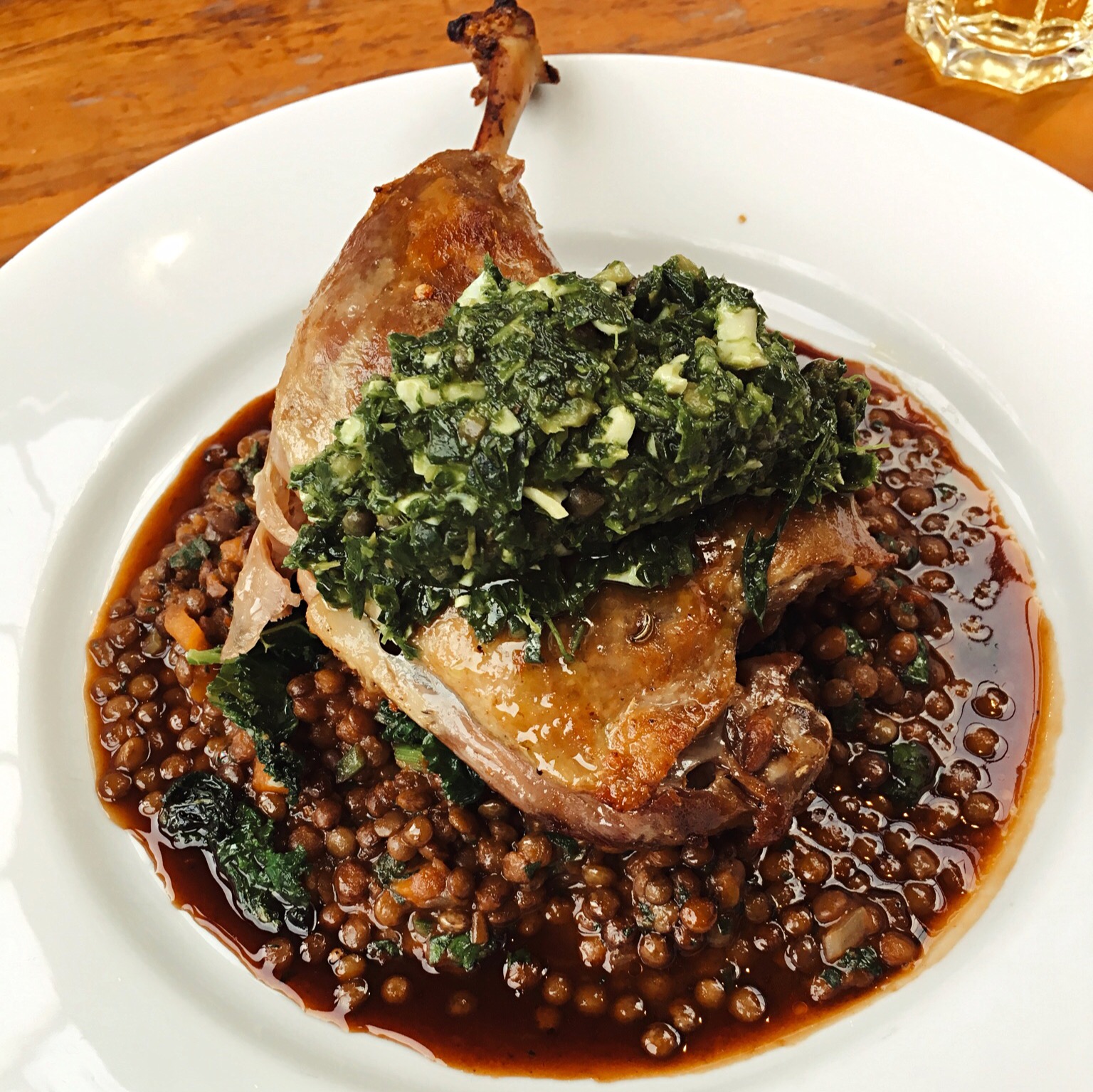
But this kind of restaurant doesn’t have to be fancy or Michelin-starred. A really lovely neighbourhood restaurant, of the kind Mya Lacarte was in its prime, can also tick those boxes perfectly. One of my happy places is Branca in North Oxford (admittedly a neighbourhood I could quite imagine living in) and some of my nicest evenings – and best places of food – have involved that restaurant. Look at this confit duck with lentils and salsa verde, if you don’t believe me.

The closest thing?

I thought long and hard about this. On many levels, London Street Brasserie remains the one to beat in Reading, which after such a long time trading is simultaneously reassuring and depressing. It still has one of the best spots in town, it still has one of the only natural sun traps for al fresco dining and the set menu is still good value and impressively diverse. But I’ve always had a feeling that it’s not quite as good as it should be and, perhaps crucially, it’s nowhere near as good as the Crooked Billet, its sibling out towards Henley (and, if you’re talking about special occasion restaurants, I’ve celebrated my last two birthdays at the Crooked Billet with my family).

The other restaurant which comes closest is Clay’s Hyderabadi Kitchen. Not because it aspires to be a special occasion or destination restaurant, because (and I mean this kindly) I’m not sure it knows yet what it wants to be when it grows up. The food is up there with anything you can get for miles around, but the room is unshowy and the prices are bafflingly low. But in terms of dishes with a proper wow factor and – if you’re interested in that kind of thing – a damned good wine list, I still think it’s hard to pick anywhere better in town. All that, and it’s almost inside the IDR. It’s become the place I take visiting friends, or family, and it hasn’t let me down.

It pleases me hugely that the two best places to take people for a celebratory meal in Reading happen to be one of its oldest and one of its very newest restaurants; some things change, some things stay the same, but Reading in general gets better and better. And that feels to me like a nice way to end this piece, because however much I might want new places to open in Reading we still remain very lucky to have so much. Not to mention how good Reading might still become in the years ahead: imagine if I Love Paella finds somewhere to open in town, the team from Namaste Kitchen move to new premises and Glen Dinning manages to open an indoor equivalent of Blue Collar. And new places continue to open all the time including the latest, a Vietnamese place on Market Place called Mum Mum. There’s plenty to be grateful for – not least that we’re not, and will never be, Swindon.