Regular readers will know that my reviews last year, like much of life in 2021, could best be described using that quintessentially post-pandemic word, “hybrid”. Unlike most years, when I’d traipse to a restaurant fortnightly and write about it, last year was a mixture of all sorts – takeaways, from new restaurants and old favourites, a first (unsuccessful) dabble with restaurant DIY kits and later, as the weather improved, “proper” restaurant reviews.
Even those were an eclectic bunch. I made a point of revisiting some of the earliest restaurants I’d reviewed, with varying results. Some, like Pepe Sale and London Street Brasserie, held up nicely despite eight intervening years. Others, like Buon Appetito, had been transformed. And then there was Zero Degrees: pants then, pants now. I also reviewed a couple of places outside Reading, making it as far as Bristol and London. By 2021 standards, that was exotic stuff.
Then there were the new places in Reading. I tried to tick off as many as I could but timing, the vicissitudes of life under Covid and my personal approach to risk meant that many were al fresco visits. That made for a lovely time in the sunshine at O Português, a sublime meal at Chef Stevie’s Caribbean Kitchen and, towards the end of the year, a game attempt at shivering away outside Gordon Ramsay Street Burger.
But it also meant that my first introduction to some of Reading’s most interesting new places was as takeaways – and however good a takeaway is, it can’t match eating in the restaurant. Part of that’s the atmosphere, the hubbub and people watching. But, more prosaically, there’s the basic fact that your food comes straight to your table from the kitchen, arranged on plates by someone who isn’t you, looking all nice.
So some of last year’s big names are still waiting for a “proper”review. I’m yet to eat at Tasty Greek Souvlaki, for instance, and I feel that’s long overdue. I managed to eat at La’De Kitchen once last year, back in early May when you could only sit outside and it wasn’t yet warm enough to comfortably do so, however many blankets they brought out. But I didn’t review it: I was happy just to be there at all. And, for that matter, too cold.
One of the most noteworthy of the Class of ’21 that I haven’t visited in the flesh is ThaiGrr!: I had their takeaway last May and was blown away by it all. They put so much thought into how they packaged for delivery that I wasn’t sure the gap between eating in and having takeaway would be as marked as it was for, say, Greek or Turkish food. But I was educated on this subject by a regular reader of mine who I bump into most weeks at Blue Collar.
“You need to eat in” he said. “However good you think the fried chicken is at home, it’s miles better in the restaurant.” Given how much I’d liked it from the comfort of my own sofa this was a powerful incentive to pay ThaiGrr a visit, so on a Saturday lunchtime Zoë and I swung by to try it out. It’s in the less fashionable part of town round the back of the Broad Street Mall, on the same strip as Pepe Sale and Bierhaus. I don’t know about you, but it feels to me like the Broad Street Mall has been up and coming for as long as I can recall without ever having upped and came, so to speak.
Subscribe to continue reading
Become a paid subscriber to get access to the rest of this post and other exclusive content.
Over the last nine months or so, every time I’ve posted my to do list on social media and asked where people would like me to prioritise for a review the answer invariably comes back: Flavour Of Mauritius, please. That’s understandable, I think. First of all, there’s the inevitable air of novelty: Reading is excited about new places at the best of times (it’s a town, after all, that managed to get aerated about Jollibee’s) but the prospect of a Mauritian restaurant is bound to arouse the curiosity of the town’s gastronomic adventurers. What’s Mauritian food like, anyway?
Subscribe to continue reading
Become a paid subscriber to get access to the rest of this post and other exclusive content.
I’ve always liked Côte’s food. And I’m a big fan of eating nice meals at home, especially when the wind is howling outside and the garden is relentlessly battered with rain. So this week, I thought I’d see whether it’s possible to appreciate both at the same time.
Côte’s always been arguably my favourite of Reading’s chains and if the last two years had been anything like the two before that, I’ve no doubt that I’d have eaten there a fair few times. Grabbing one of their outside tables on a sunny day for their prix fixe when I couldn’t be arsed to cook, for example, or having a weekend brunch there and enjoying their soft, crumbly boudin noir. And if they’d been on delivery apps, you can bet you’d have read a review of that last year.
But Côte chose a different path, an interesting one that differs from most other chains – and most other restaurants, come to that. Instead of doing takeaways, in the summer of 2020 Côte launched Côte At Home, offering a subsection of their menu that can be easily heated at home. It makes sense, when you think about it: Côte prepared some of their meals in a central kitchen and finished them in the restaurant as it was, and this model converted what you could see as a pre-pandemic weakness into a distinct advantage after Covid-19 struck.
My experiences of heat at home restaurant kits, especially this year, usually left me thinking that I’d eaten a glorified ready meal at inflated prices. Côte offers a simplified version at far closer to ready meal prices, so I wanted to see if they made a case for a better heat at home model. And pricing isn’t the only difference between Côte’s model and operators like Dishpatch. They clearly benefit from scale because they deliver every day, with free delivery if you spend over forty pounds. You have to order forty-eight hours in advance, although some items qualify for express delivery, which means they reach you quicker.
It isn’t difficult to spend forty quid. Everything is crazily affordable – think five pounds for starters, ten to fifteen for mains, and a fiver for dessert – but they also sell a good range of French cheeses, plenty of wine and beer, steak, sausages and confit duck. The latter comes in at an astonishing four pounds fifty a leg, making it miles better value than my meh-fest at Andrew Edmunds. I picked up a three course meal for two, and added a couple of bottles of Meteor to nudge it over the forty pound threshold (it’s a shame they don’t add their Breton cidre to the website: they’re missing a trick there).
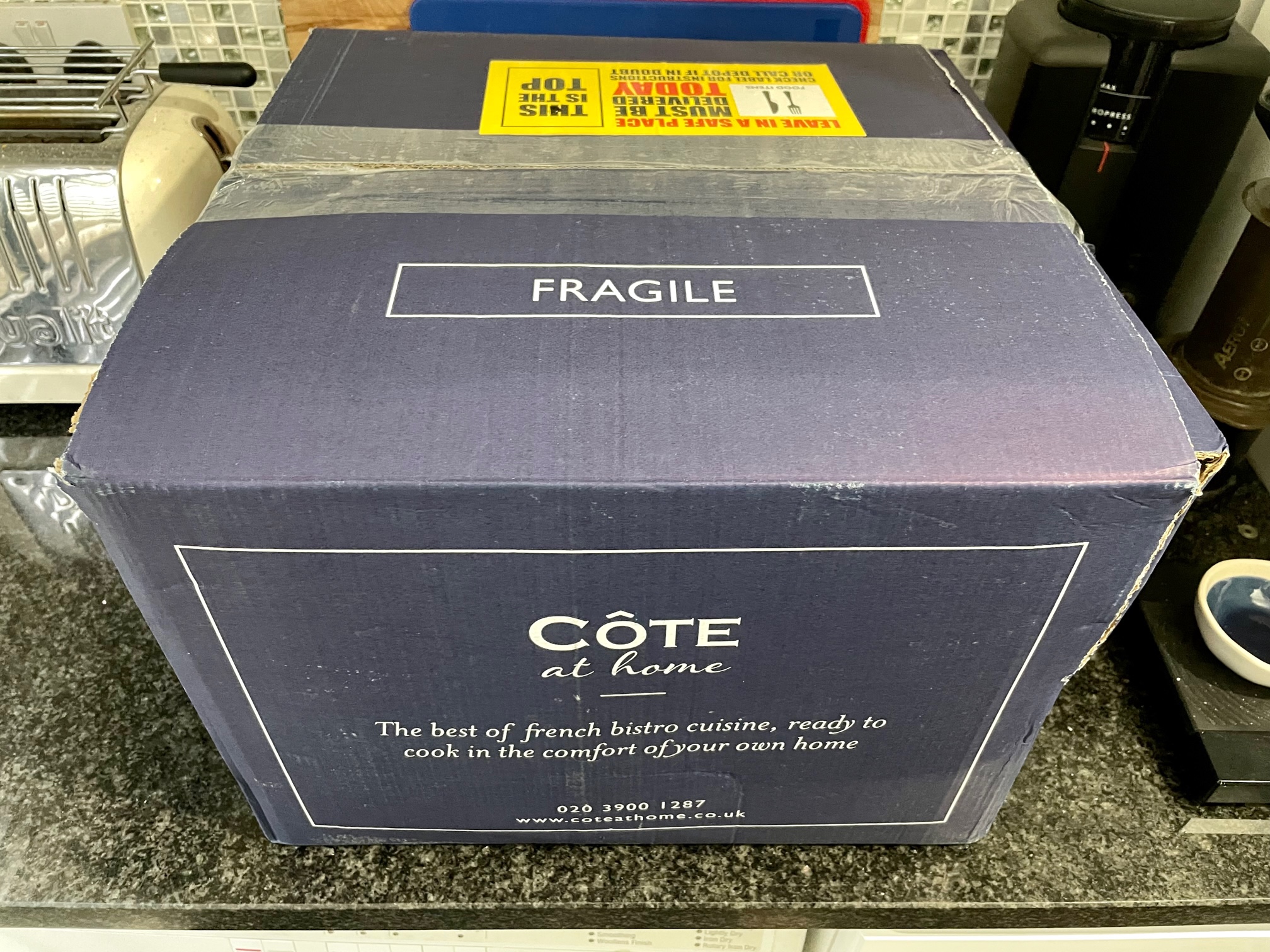
Another contrast between my previous restaurant DIY kit experiences and Côte At Home was how user-friendly delivery was. With the others, you pay over ten pounds for delivery and essentially, they reserve the right to turn up at any point during the day. With Côte At Home, if you pay five pounds they’ll make sure it reaches you before noon. So lo and behold, it was with me first thing in very natty packaging. Inside the box there were an impressive four ice packs, and everything was fetchingly branded. A slip inside explained that literally all of the packaging was recyclable, too. Stowing it all away in the fridge I felt properly curious and excited about the meal that lay ahead, even if it’s the hope that kills you.
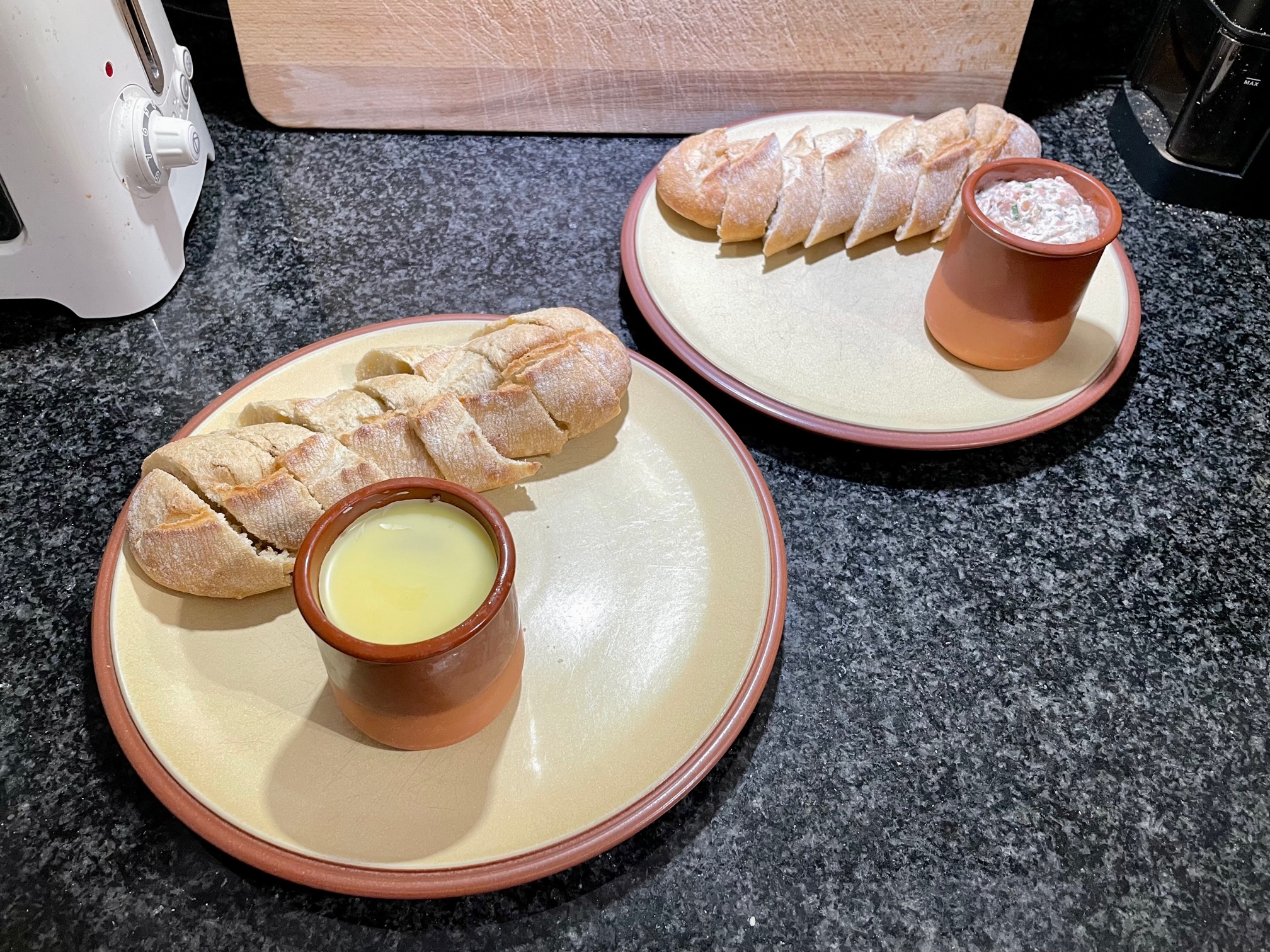
This meal gave me an excuse to try out Côte At Home’s bread, which you finish off in the oven. Back in the day – by which I mean 2014 – I thought that Côte’s bread was the best in Reading, and although many bakers, artisan and otherwise, have wafted through town in the last eight years I still think Côte’s beats most restaurants round here, so I wanted to see how the heat at home stuff compares. And the answer was reasonably well – not up there with, say, Geo Café’s sourdough baguette straight out of the oven that morning (not much hits that exalted standard) but far better than the pasty part-baked baguettes you pick up from a supermarket. They throw in some salted French butter: a nice touch, but really we’d bought the bread to pair with our two starters.
Of the two, as so often, Zoë’s was better. Smoked salmon rillette was properly lovely stuff, a very generous portion in a handsome ceramic pot (“that will be handy for olives”, she said later) with just enough smoked salmon in the mix to give it a wonderfully wintry taste without overpowering matters. It was a model of simplicity – fish, crème fraîche, capers, shallots and herbs – and extremely good value at four pounds fifty. Most of the Côte at home starters are chilled, with a couple you either heat up on the hob or in the oven, but this one struck me as the pick of the bunch.
It was certainly nicer than my chicken liver parfait, also served in one of those pots. And don’t get me wrong, it was earthy, smooth and reasonably indulgent. But it was hidden under a permacrust of clarified butter that was a little too thick and too much like hard work. And fundamentally it just wasn’t the smoked salmon rillette: food envy had set in at that point, and nothing would redeem it. It did make me wish I’d ordered some cornichons to accompany it – a snip at two pounds – or better still, had the foresight to have some in the cupboard.
But again, to put this in perspective, if I’d been served this dish in a restaurant I’d have been quite happy with it. And in a restaurant it wouldn’t have cost five pounds. With all the restaurant kits I’d ordered so far it felt like the price was inflated for what you got – I’m sure Côte At Home benefit greatly from economies of scale, and having that central kitchen, but it does give you an idea just how cheaply you can deliver this model.
I’d like to say that the main course lived up to that promise, but it didn’t quite. Again, it was impressive value: a beef bourguignon for two people, with potato purée thrown in, set you back fifteen pounds, less than you’d pay for a single portion in a restaurant. But there was some inconsistency, both in how you cooked it and how it tasted. Some of Côte At Home’s dishes, like the potato purée, only come with instructions for microwave cooking and for those of us without a microwave that can be frustrating: you’d think they’ve had figured out alternative instructions by now.
That said, the potato puree – which I had to improvise, decant and heat up in the oven – was really very good. It was rich, silky and buttery: in short, far better than anything I could rustle up at home and streets ahead of anything you can buy in supermarkets. More expensive than an M&S “ultimate mash” (though not by much) but easily worth the money.
The problem was the bourguignon. In fairness, when I looked at it there in its plastic tray, brown sludge at the bottom and highlighter-pen-pink nuggets of bacon on top, I thought Oh dear, this just looks like a ready meal. And I was partly wrong, because some lovely alchemy happened in the oven and it came out thoroughly looking the part. And the taste was decent – the onions had softened and sweetened beautifully and the sauce, if thinner than I’d have liked, had all the right notes in the right order.
But a dish like this stands or falls on the star ingredient, and the beef was variable at best. One bit was so tough and fibrous that I gave up trying to cut through it, another was so unpleasantly gristly that I had to abort mid-chew. A dish like this about the right cuts of meat slow-cooked into submission, and there’s no excuse for something this bouncy or unpleasant. “I don’t know what you’re talking about” said Zoë. “All of mine was fine”. So it’s not all bad: if you order this you might get lucky, but don’t be surprised if your other half pulls faces.
We’d gone for a vegetable side of minted peas with baby onions and baby gem lettuce – and again, it only came with instructions for microwave cooking. It reheated just fine on the hob, though, and I liked the dish a lot – the peas still slightly nutty, the mint and garlic butter playing nicely together – but it was a tad annoying that they’d not thought about non microwave users. And the website could do more, I think, to highlight dishes that are microwave only than have a little sentence squirrelled away that says cooking instructions, ready to microwave. But again, a minor irritation in a pleasant, perfectly serviceable meal.
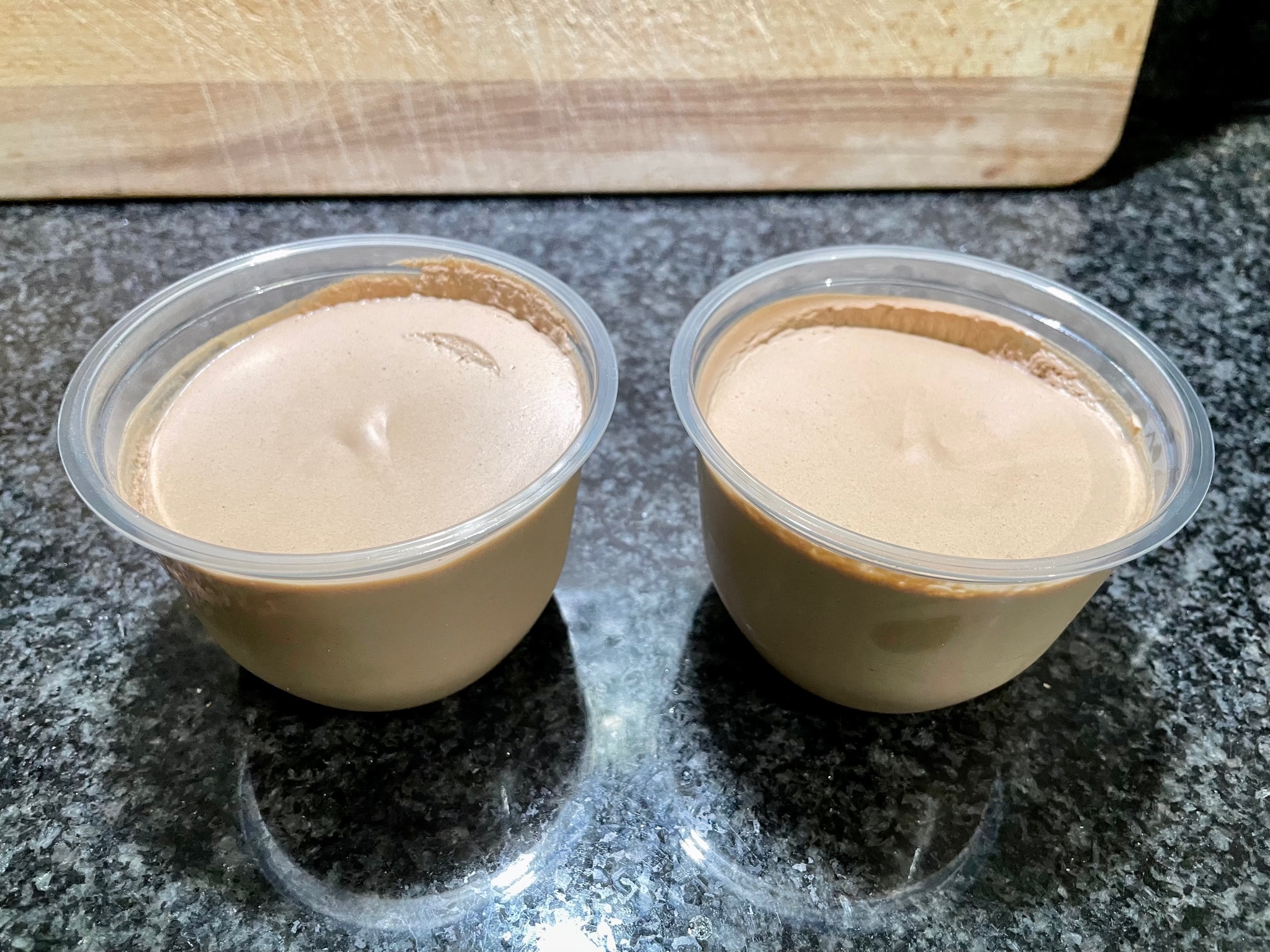
Although Côte At Home sells a tarte aux pommes – which you definitely don’t have to bung in a microwave – and a very tempting lemon posset, along with a cracking selection of cheese including Morbier, Roquefort and one of my very favourites, Saint Marcellin, Zoë and I both found it impossible to stay away from the chocolate mousse. And again, this was close to the restaurant experience at a far lower cost: for three pounds seventy-five you got a dish that would cost you one pound fifty more if you dined in.
And again, it was difficult to distinguish from the mousse I’ve eaten many times over the years at Côte. It was incredibly smooth and glossy, with either very fine bubbles or no bubbles at all, and if I had one criticism it would be that what’s described as a dark chocolate mousse feels about as dark as an episode of The Repair Shop. But looking back at my review of Côte eight years ago I ordered the chocolate mousse for dessert and said almost exactly the same thing. So you can hardly fault them for consistency.
So, with the exception of that unforgivably bouncy meat, Côte At Home was hard to fault. Incredibly generous portions, a routinely high level of quality, a supremely convenient delivery experience and great packaging. And of course you can add cheese, or wine, or confit duck to your order and suddenly it goes from a single meal in to a combination of a brilliant midweek supper and a trip to the deli. So why do I feel like there’s a slight underlying note of being underwhelmed in this week’s review? Do you feel that too?
I’ve been pondering that all week, and I think it comes down to the fact that a restaurant is so much more than its food. Part of they joy of eating in Côte, of what a treat it is, is how convivial it can be – the hubbub, the people watching – and that it can be done on the spur of the moment. It is, as eating out always should be, a bit of a special event. And takeaways can be like that too. I’m sure that at their best – although I’m yet to experience this myself – restaurant DIY kits also feel like a treat. And Côte At Home’s genius is also their biggest drawback: something about it feels unspecial. It really does sit in a new space between ready meals and takeaways, and it’s such a new space that I don’t really know how I feel about it.
And if you need any more evidence that this is an evolving area, you don’t have to look any further than Ocado. Because if you fire up your computer to place an order with Ocado (and if you do, I recommend the M&S “Our Best Ever Steak Pie”: it’s miles better than this week’s bourguignon) you’ll find some dishes from Côte At Home in there. You’ll also find options from Pasta Evangelists, another of the earliest ventures delivering restaurant quality food to your doorstep. And if they don’t appeal, you could just pick up a steak from Hawksmoor.
The lines are getting blurred, and with that come plusses and minuses; you can get fancier versions of the convenience you’re used to, but the experience of treating yourself might lose some of its magic. Convenience, I’m increasingly starting to think, often has that effect. So I would cautiously say that you should give Côte At Home a try. I’m sure I’ll use them again, if only to enjoy confit duck and potato gratin one midweek evening (with a selection of cheese for later on). But I do worry that we’ll reach a stage, to paraphrase George Orwell, where we’ll look from ready meal to DIY kit, and from DIY kit to ready meal, and from ready meal to DIY kit again, but already it will be impossible to say which is which.
A couple of things happened last weekend that got me thinking about the cost of food, and the concept of value for money.
The first was a visit to Nirvana Spa, where the menu had been ravaged by Storm Shrinkflation. “I’m sure last time I had the halloumi salad there was more halloumi on it” said Zoe, shortly before looking up her picture of the dish from a previous visit and finding that yes, you used to get three bits of chargrilled halloumi whereas now it’s just two. For nine pounds. I would have sympathised more, but I was too busy looking at a single, tiny tranche of pork and chicken terrine, also nine pounds, and thinking “where’s the rest?” My dish, which wasn’t billed as a salad, had more salad on it than Zoë’s, which was.
It’s one matter to reduce portion size and another to increase prices but it takes a rare kind of chutzpah to, as Nirvana has, do both at once. I’d ordered a pizza as a main course, which was nine inches at most and cost all of sixteen pounds: I couldn’t help but compare it to a lunch at Buon Appetito a couple of weeks before. Food is becoming more expensive, and it’s going to become more expensive still. That’s not necessarily a problem, but you at least want to feel that it’s great quality, even if it’s not good value. At Nirvana, it just felt like they were milking a captive audience.
The second experience, at the other end of the spectrum, was this week’s takeaway, from Biryani Boyzz (yes, not one but two Zs). It’s where Punjab Grill used to be, at the top of the Oxford Road before you reach Harput Kebab, and I think it was owned by the same people as Kobeda Palace, Palmyra and Da Village, although I’m not sure if it still is. Biryani seems to be one of Reading’s new trends, with Biryani Boyzz out west and Biryani Mama (which is owned by the same people as Crispy Dosa) just opened last week in the old Ask site on St Mary’s Butts.
Incidentally, because I’m going to be typing the word “Boyzz” numerous times during this review – with gritted teeth I might add – I want to say that I truly hope abusing the letter Z in this manner is a trend that doesn’t catch on. I know Biryani Boyzz is a stone’s throw from the equally woefully named Ladz Barbers, but I think they ought to learn lessons from history: restaurants with gimmicky Zs in their name rarely do well in Reading. When Chennai Dosa changed its name to Chennai Dosa Artisanz, it was the beginning of the end for them, and the coffee shop Artizan on St Mary’s Butts doesn’t seem to have ever opened. In my taxi back from Nirvana I spotted a place on the Wokingham Road called “Milano’z Pizza”: doesn’t the word pizza provide enough Zs already?
Rant over. I’d been tipped off to Biryani Boyzz by one of my readers, who said that it had excellent reviews on Google. So I went had a look, and although the reviews on Deliveroo were less glowing it piqued my interest enough to give it a try. Besides, their eponymous dish, the chicken biryani, was a startling four pounds ninety-nine. Could it really be any cop at that price?
Biryani Boyzz’s – I hated typing that combination of letters, just so you know – menu is a mixture of Indian, Pakistani and Afghan dishes. Chapli kebab is on there, as it would be at Kobeda Palace or Da Village, but you can also order Lahori chane, butter chicken if you want something more mainstream, or paya, a stew made with lamb trotters, if you’re the adventurous kind.
The main thing that brings the menu together is its affordability. Nothing costs more than a tenner, most of it is far less than that and, of course, that biryani stands out at just under a fiver. I had to try that, so we ordered it along with a selection of starters, a couple of curries and some rice. The whole lot came to forty-five pounds, not including rider tip: not much money for quite a lot of food.
Fancy a drama-free delivery paragraph? Of course you do. So here it is: I placed my order around twenty-five past seven, I was told it would be about an hour and in reality it was with me in forty-five minutes or so. And the driver took just over five minutes to reach me from the restaurant. There you go: drama-free delivery paragraph ends. It was all perfectly packed and piping hot, just to further reduce the element of drama: if only the situation in Ukraine could de-escalate as rapidly.
We’d chosen three things which broadly classed as starters, and they turned out to be a bit of a motley crew. Chapli kebab, which came in a brown paper bag shiny with grease, was a far cry from the very good ones I’ve had at Da Village or, back in the day, Afghan. It didn’t have that lean, meaty muscularity I’ve always enjoyed, and the texture was a little sodden and pappy, as if it had been padded out with something. There were bits of tomato speckled in it, but I wouldn’t be surprised if there was more. It cost three pounds: after placing the order I wish we’d added a second, but after finishing it I was glad we didn’t.
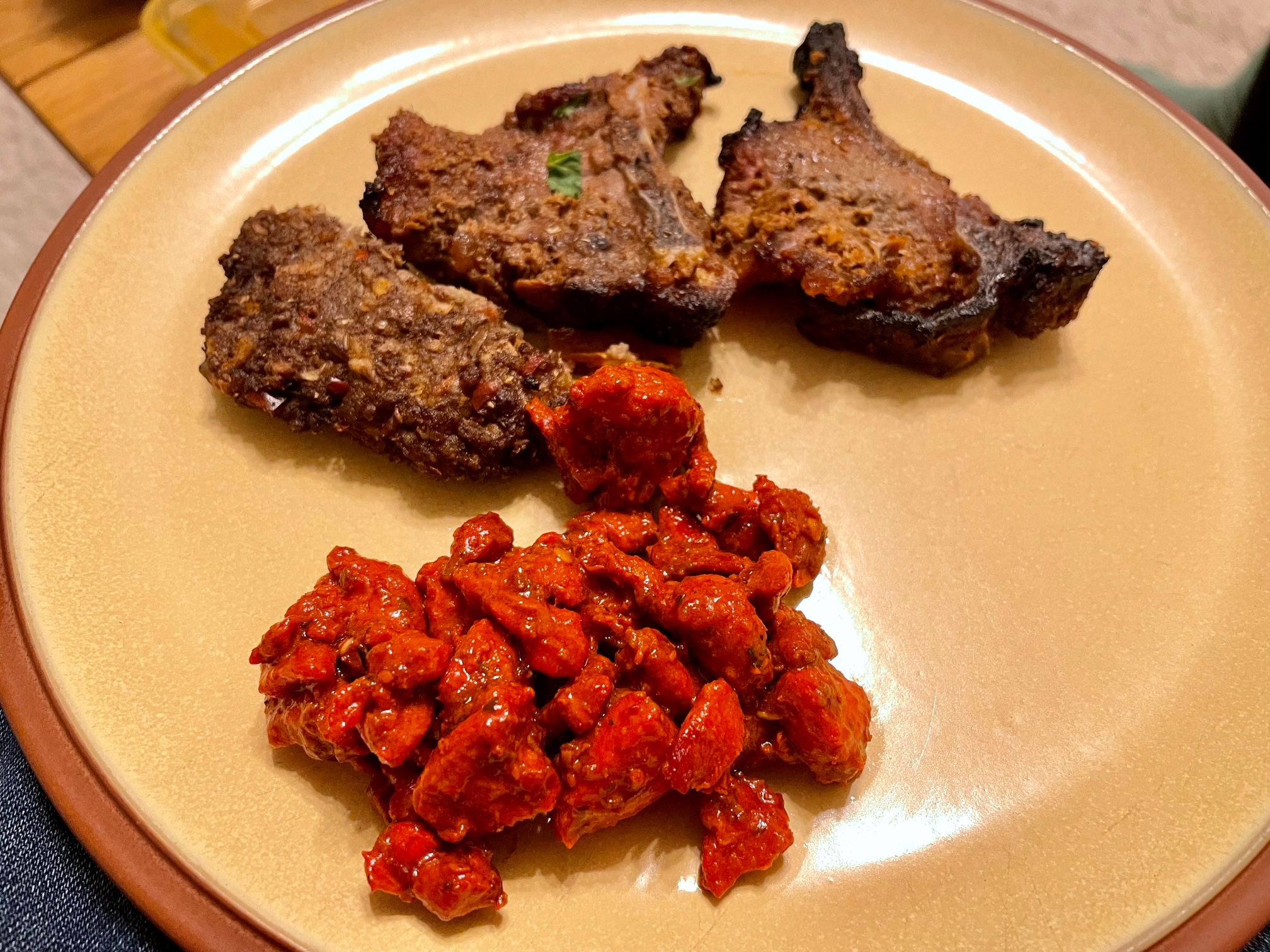
Chicken 65 was more like it, but I still came away from it liking but not loving the dish. My previous experience of the dish comes from its time on the menu at Clay’s, and I tried to put that rarefied version to the back of my mind while eating this. The flavour of it wasn’t bad, with a good whack of acrid heat but the chicken was in little pellets rather than bigger, more tender pieces and there was something slightly off-putting about that.
I’d have liked it to feel drier and less glossy – and I know this dish isn’t big on vegetation but I couldn’t help thinking that if, say, Momo 2 Go did a version of this it would have had a flash of green from some curry leaves or some coriander, whereas this was a relentless tidal wave of day-glo terra cotta. We left some of it. “I’m not even sure it was chicken” was Zoë’s verdict: feel the burn.
The last of our starters was Afghan lamb chops, which weren’t bad but weren’t exciting either. Cooked through with no blush, these were old-school chops where you got a postage-stamp sized piece of meat that was largely redeemed by bathing it in raita. To put this in perspective, you got four small chops for seven pounds, so if it wasn’t great it at least wasn’t expensive: presumably at Nirvana Spa they’d have charged you fifteen pounds for that lot. Deliveroo claims this dish is “Popular”. But then so is the Caversham branch of Costa Coffee.
Did things improve with the main courses? Well, yes and no. The yes came in the unlikely form of the butter chicken: it’s not a dish I ever really order but Zoë requested it and it was better than I was expecting. The sauce had a good, smooth sweetness which made the rice more interesting even if, again, there was only limited evidence it had ever seen any vegetables, or even just some herbs. And again, the chicken was in small, homogeneous pieces and lacked the generosity I would associate with the likes of Royal Tandoori or House Of Flavours.
But every rose has its thorn, and the thorn in this case was the chilli paneer. I think maybe I was expecting a dry chilli paneer, like the one you’d get at Bhel Puri House, whereas this was very much soft unfried cubes of paneer in a chilli sauce which took no prisoners and didn’t fuck around. My friend James has an expression for things that people like me think are hot but which wouldn’t make him bat an eyelid: he calls them “white people hot”. There’s no disgrace in that, per se: James classes Gurt Wings’ buffalo sauce as white people hot, although he’s never passed judgment on “The Gurt Locker”, their hottest sauce. I must take him to Kungfu Kitchen some time.
But it’s safe to say that Biryani Boyzz’s chilli paneer isn’t white people hot. It’s just hot. And not one of those clever, layered heats that builds momentum and pace as you work your way through a meal. No, it’s just really hot. Hot as in it makes your eyeballs leak with what might be tears, could be sweat or might just be a disgusting cocktail of both. Hot as in it clears out every sinus in your face while reaming your Eustachian tubes for good measure.
Zoë said she thought there must be something like lime pickle in it and initially I disagreed, because I rather like lime pickle, but on reflection I thought she might be on to something because lurking under the brooding heat was something that could have been sour citrus. What do I know? If I’d had another couple of forkfuls I might not have been able to taste anything until the following Tuesday. The odd thing is that, in a treat ‘em mean, keep ‘em keen sort of way I admired Biryani Boyzz for doing something so uncompromising. It wasn’t for me, but there might well be customers out there who would love it. Reading the last few paragraphs, you probably know whether or not you’re one of them.
I’ve saved that five pound biryani til last, just so that this review has a little twist in the tale. You know what? I quite liked it. The chicken was on the bone, which of course it’s meant to be – and although you didn’t get huge amounts of it and it needed a little persuasion to get off the bone it was perfectly nice and the rice had some flavour – more, and better balanced, than the other dishes I’d tried. Did I mention that it was five pounds? And here we return to what I was saying at the start: something either has to be good value or good quality. Nirvana was neither, and Biryani Boyzz was one of them, in places. If Nirvana’s pizza had been something like a tenner, I’d have been quietly pleased, but if Biryani Boyzz’s biryani had been a tenner I’d have been nonplussed.
But cheap food for cheap food’s sake isn’t the holy grail some people like to think it is. Even ignoring that witless Berkshire Live article about how you can’t buy lunch in town for a quid any more (as everybody should), there can be a prevailing view in publications like Vittles that each time you get a dirt cheap meal in a restaurant you’re somehow sticking it to the man and getting one over on capitalism. But food ought to cost money, staff ought to cost money and everything ought to go through the books and be above board. I always worry that when food is cheap what you’re actually doing is just enabling a slightly different, equally unpleasant, flavour of capitalism.
Anyway, rarely have I been gladder that my takeaway reviews don’t come with a rating. Biryani Boyzz’s food is okay, and interesting in places, but I really don’t know where I’d put it if I had to find a place for it on a scale. And I’m not sure I’d order from them again, because I’d either spend more somewhere like Banarasi Kitchen or pay roughly the same amount at Momo 2 Go for very different cuisine. But I may not be Biryani Boyzz’s target market, and there’s nothing wrong with that. They didn’t lose me at that first Z, they didn’t even necessarily lose me at the second, but they probably lost me somewhere after that.
As of August 2022 Andrew Edmunds is no longer partnering with Dishpatch.
I wasn’t expecting to try out Dishpatch, the company which partners with high profile restaurants to offer heat at home delivery kits, again so soon after my recent disappointing experience. That I am is partly a tribute to their excellent customer service, because after I filled out their feedback form and gave them a somewhat lukewarm review they got in touch and very kindly offered me a money off voucher to use on a subsequent order.
So I found myself flicking through the options online, wondering what would work well reheated at home. But what did I feel like? Was I in a paella or a rendang mood, was I drawn to osso bucco or sea trout en croûte? I eventually narrowed it down to two restaurants I’ve eaten at in real life. The first, Hoppers, did a kothu roti which sounded marvellous and struck me as hard to cock up at home on a hob. But I eventually went for the second, Andrew Edmunds, because of a lovely meal I had there about five years ago.
I was talking to a friend recently and I told her that I’d been doing fine in January, apart from not feeling able to eat in restaurants, or drink in pubs, or sit outside because it was too fucking cold, or to see friends in the flesh, or go on holidays. Apart from all that, I said, I was having a ball. But one of the things I miss most is taking a Friday off with friends and catching a train to London for a day of shopping (for fragrance: don’t judge), good coffee, great pubs and – always the centrepiece of one of these occasions – a truly leisurely lunch somewhere.
And one of those lunches took place in Andrew Edmunds, a beautifully ramshackle restaurant in Soho that has been doing its thing, largely unchanged, for the best part of forty years. Andrew Edmunds’ menu with Dishpatch – billed as “date night” to capitalise, I imagine, on our proximity to Valentine’s Day – was a very straightforward affair: a choice between two starters, two mains and two desserts, no add-ons or complications, for sixty-five pounds, although it cost me less than that.
It struck me as refreshingly straightforward, with all the dishes being uber-convenient to prepare and serve, so I placed my order and thought no more about it. One of the nice things about services like Dishpatch, because of the lead times involved, is that it’s a bit like buying yourself a present, treating future you, in a way that takeaways never quite do.
Anyway, it all arrived according to plan on the Friday, and this time the delivery driver actually left it behind our recycling bin as he was meant to, rather than depositing it in front of a random house round the corner. As before it was all well packed – just the three cardboard boxes, one for each course. The cooking instructions in the box were for another restaurant entirely, but with everything available online that too was hardly a biggie.
Our starter was probably my favourite thing we ate that evening. It had been a choice between prawn cocktail and soup – neither of which involved doing anything technically complex – and we’d gone for the former. It was largely dishing up rather than cooking, with just one element, a few slabs of focaccia, needing to be finished off in the oven. Apart from that you just decanted your prawn cocktail, your lettuce and some pickled cucumbers and you were good to go.
And I really did enjoy the dish. Rather than a handful of bigger prawns you got plenty of muscular little shrimp, and the Marie Rose sauce had good sharpness and kick (I wondered if it had something like vodka in it, so I wasn’t surprised, on checking the ingredients, to find a little brandy in there). Rather than serving it in the traditional fashion, they gave you a little gem lettuce and advised you to scoop up the prawn cocktail with the leaves: I wasn’t sure whether this was a modish nod to places like Pho or just old-fashioned weirdness, but it worked reasonably well. And I loved the pickled cucumbers – sweet but not sharp, and a great contrast to everything else on the plate.
Even the focaccia heated up better than I thought it would. It had some spelt flour in it, which might have gone some way to explaining why, and although it wasn’t sodden with olive oil as great focaccia often is, it went well with the dish and mopped up the rest of the sauce nicely. The problem here was the quantity, or lack thereof, of the dish. Looking at the pictures on Dishpatch’s website all I can say is that somebody has passed off two portions of this as one, because it felt on the miserly side. I guess this is another problem with heat at home meals: in a restaurant we have a clearer idea of what things should cost, and how big a portion should be. Here, I looked at what we’d been given and had no real idea whether it constituted value, or not, as part of a sixty-five pound meal.
Our main course couldn’t have been much easier to cook. Confit duck and dauphinoise potatoes went into the oven, with some cavolo nero joining them for the last five minutes. And also, during those final five minutes, you heated some red cabbage and a red wine jus on the hob. There was a big old bag of red cabbage, and a tiny vacuum packed pouch of jus. Never mind, I thought, it’s going to be one of those beautifully silky restaurant sauces where a little goes a long way.
The end result was every kind of disappointment. That’s especially a shame because the feature attraction, the confit duck, wasn’t half bad. I would have liked the skin crispier – or even just crisp, for that matter – so I think the cooking instructions were a tad out, but it was beautifully dense and meaty and there was no layer of fat lurking under the skin (although in fairness, if there had been I still would have made short work of it). The problem was everything else.
Dauphinoise potatoes are a wonderful thing, when done right. These weren’t. What you actually got was a slab of many-layered spud, some of it on the firm side of cooked, with none of the indulgence of cream or garlic that make this dish such an indulgence. I’m honestly not convinced this had ever seen a lick of cream or a clove of garlic: it was drier than an actuary. And that jus? It turned out to be one of those sauces where a little goes a very short distance. There was literally so little of it that I’m not sure why they bothered: here’s what you could have won, it seemed to say.
All this meant that the heavy lifting, in terms of moisture, came from the red cabbage. On the hob it had smelled beautifully wintry with all those mulled flavours of red wine, cloves and cinnamon going on. But with nothing else really happening on the plate it dominated to an extent that made it hard to enjoy anything. I left some of my dauphinoise, Zoë left a lot of her red cabbage. Sixty five pounds, I thought to myself. Was the meal going to feel like sixty five pounds’ worth, unless the dessert was either covered in gold leaf or the size of a basketball court? It felt like a long shot.
“That was so dry it was like something my dad could have cooked” said Zoë. I knew this was very far from a compliment: I’d learned early on in our relationship not to take nice sausages to a family barbecue unless you were comfortable with the idea that they’d wind up only identifiable from their dental records. Not just that, but if you ate one your dental records might themselves be changed forever. Zoë’s dad used to work in a Berni Inn when he was young: it’s not a great advert for the Berni Inn that they never figured out that he was colour blind.
Dessert returned to the trend of the starters – quite nice, but not big enough. We had a black forest gateau (“Is this a date night in the Seventies?” Zoë had said when she saw the menu) and it tasted terrific, laced with kirsch and chocolate nibs, cosseted with cream and topped with hugely moreish sour cherries. But where was the rest? We ate it, and then we had the chocolate truffles which came as an extra. I think they were meant to make you think “what a lovely touch!” but all they made me think was Sixty-five pounds. Oh, and they threw in a candle. Literally. There was a candle in there, because it was a date night. The picture on the website shows two candles, just to complete the false advertising. Sad to say, Zoë was genuinely excited about what she had convinced herself was a free candle. I on the other hand was wondering how long I could hold out before inhaling some chocolate from the kitchen cupboard.
Although I still fervently believe, in principle, that restaurant kits could play an important role in life and create an interesting new space equidistant between takeaways and eating in restaurants, I’m yet to have an experience that convinces me that that promise has been fulfilled. And restaurants have had coming up to two years to get this right, so it’s not encouraging that my two experiences this year have fallen flat. It’s quite possible that if I went to Andrew Edmunds and had dinner there my meal would cost far more than sixty-five pounds, even before you added a bottle of wine. But that’s only part of the point. The other thing to do is think about what sixty-five pounds could get you elsewhere, and that’s where the wheels really start to fall off.
This meal in particular brought that home because there was no complexity to it at all. Switch the oven on, put things in, take them out and serve them up, with a little extra mucking about on the hob. What I’ve described there, in essence, is a ready meal. And if a ready meal is going to cost sixty-five pounds it really has to feel like it’s worth every penny, which this really didn’t. To put this in perspective, you could buy stuff from COOK, squirrel it away in your freezer and have a meal which wasn’t far from this standard for a fraction of the price (their beef bourguignon is pretty decent, as is their lamb dupiaza). Or if you go to the next level above, Côte At Home will sell you two confit duck legs with accompanying gratin potato for seventeen pounds. I’ve not tried Côte At Home yet, I really ought to for the blog, but I imagine even if it isn’t as nice as what I ate from Andrew Edmunds it would be close enough when you consider the gulf in pricing.
And of course, the other thing to compare meals like this week’s with is food you can eat closer to home. The following night, thoroughly deflated after my Dishpatch disappointment, I ordered a delivery from the Lyndhurst. We had chicken wings, tangy with gochujang. We had a skate wing each, almost as big as our plates, with greens and baby new potatoes and a buttery sauce Grenobloise bursting with capers. And then we each had the most beautiful, boozy tiramisu. No doling it out in meagre carefully controlled portions between two plates: we had one each. It was just blissful, it was huge and it cost far, far less than sixty-five pounds. Staying in might well be the new going out, but staying in with Dishpatch just feels like the new going without.







 Edible Reading