“Are you sure you don’t want to sit inside?” said the waitress, smiling as she handed us the menu. Like all of the service at Crispy Dosa it was friendly, kind and welcoming: the restaurant was filling up with happy families, all Indian as far as I could see, and she probably didn’t understand why Zoë and I had chosen to sit at a table outside on plastic chairs, opposite the Penta Hotel or in the wind tunnel of Thorn Street.
In other circumstances, I might have acquiesced. The inside of Crispy Dosa, from my cursory glance, looked like a nice space. It had plenty of banquetted booths (I’m not sure whether they were leather or leatherette: leatheresque, perhaps?) each one with a little patch sewn into it saying “CRISPY DOSA ❤️ YOU”. And the restaurant was, for a week night, buzzing: I saw a regular flow of people in and out, customers leaving, some carrying bags to take home and, of course, a steady in and out of delivery drivers.
By contrast, Crispy Dosa’s outside space is slightly unfortunate. On one of the hottest days of the year so far none of the tables caught the sun, and they felt a little like a consequence of necessity: they are, after all, how Crispy Dosa managed to trade for the first few weeks they were open, while they waited for indoor hospitality to be allowed again.
But I am not yet at the stage where I’m ready to eat and drink indoors and, with the exception of a post-vaccination celebratory brunch at Fidget & Bob last month, this was the first time I’d had an al fresco meal this year. So to say those plastic tables and chairs were a welcome sight would be quite an understatement; the waitress probably didn’t understand why we were so excited. So we sat outside, at the very beginning of West Reading, where things begin to get a little bit more lively – I’ve forgotten how much I enjoy people-watching – and for the first time in a long time I held a physical menu in my hand and decided what to order.
Subscribe to continue reading
Become a paid subscriber to get access to the rest of this post and other exclusive content.
I was having coffee with a friend this week, and he said something that made me think. We were having that time-honoured conversation about independents and chains, probably both saying things that we’d said dozens of times before, and discussing the frustration I always get walking through Caversham, seeing the huge queues outside Costa when better coffee is available in three different cafes all a couple of minutes walk away.
“I nearly put something on social media complaining about that sort of thing” he said, “but then I decided not to. Because if that’s happening, it’s a sign that independents still need to improve their offering.”
We talked about it a little more, but afterwards I found myself wondering whether it was true. Is it that all the people in Reading who flock to our many Costas, Caffe Neros and Starbucks know all about Workhouse, C.U.P., Lincoln and Tamp? Have they tried them and just decided they don’t like them? Do they prefer bigger, more sugary drinks, or is it that they have no idea the alternatives even exist? It’s easy, in an echo chamber on social media, waving our metaphorical pom-poms for indie businesses, to consider failing to use them unthinkable. And yet people still queue for the Caversham Costa: is it that they’re wrong, or more that we’re missing something?
Of course, like everything, it’s more nuanced than that. Maybe those customers are drawn by things like comfy seats and plentiful wi-fi, neither of which has ever been a priority for most of Reading’s independent cafés. Or perhaps it comes down to the consistency of a chain experience: I’ve been to Workhouse, for example and had very good coffees. But occasionally I’ve had iffy ones too. If I went to Nero, I’m pretty sure my coffee would be much more uniform – middling, but uniformly middling. Some people like that. Some people are risk averse, and after all, risk aversion is back in fashion. And all this is even more true of chain restaurants, especially ones where that uniformity is guaranteed by all the food being uniformly prepared in a central kitchen.
All this, in turn, got me thinking about my own attitude to chains and that, inexorably, made me think of Pho. Because back in the days before the pandemic, on the relatively rare occasions where I ordered a Deliveroo, Pho was one of the main restaurants I would order from. I never had a bad meal from them, and I had my favourite dishes of theirs that never let me down.
That’s probably more representative of most people’s takeaway experiences. It’s all very well ordering from a new restaurant every week to try them out, for the purposes of writing a review, but for most people the act of ordering a takeaway is meant to be one of self-care, with no surprises. It’s a present to yourself to take a night off cooking, and you don’t want to squander it. Trying to remove the element of disappointment is, I imagine, part of why some of you read this blog before you try somewhere new. So this week I decided to order from Pho, a bit of an old favourite, to try and work out whether my friend was right that independents still need to raise their game.
Pho, like its neighbour Honest Burger, is only on Deliveroo – and crucially, Deliveroo has been a big part of their offering ever since they opened. The majority of Pho’s restaurant menu is available for delivery, with a good range of starters and a mixture of mains which are either salads, the eponymous pho, curries, rice and noodle dishes. Starters hover around the six to seven pound mark, and mains cost between ten and thirteen pounds (this is another thing chains often get right: pricing that doesn’t exclude anybody).
I don’t write about vegetarian and vegan options often enough, but it’s worth pointing out that Pho’s menu has pretty impressive range in this respect, with dishes using vegetables, tofu or a chicken alternative – called “THIS isn’t chicken”, the Ronseal Quick-Drying Woodstain of soy-based products. I also don’t talk about gluten-free options enough – by which I mean ever – but again, Pho are very strong on this and the vast majority of items are gluten-free. And just to go for the hat trick of Things I Never Talk About, Pho has a kids’ menu too. This stuff is important, because this is what the best chains do well, designing a menu that has wide appeal. From my carnivorous, childless point of view I probably don’t pay that due respect often enough.
We ordered the things we always order, because this was an evening all about comfort and familiarity, and three starters and two mains came to forty-five pounds, not including rider tip. And, as so often with orders from the town centre, there were no real hiccups: we ordered at half-six, the rider was en route fifteen minutes later and he got to us in just under ten minutes, making another stop en route to my house. Everything was hot and everything was well packaged, in well-branded boxes, all of which were recyclable. Again, what this brought home is that delivery has never been a pandemic-mandated side hustle for Pho: it’s always been part of their business model, and I think that shows.
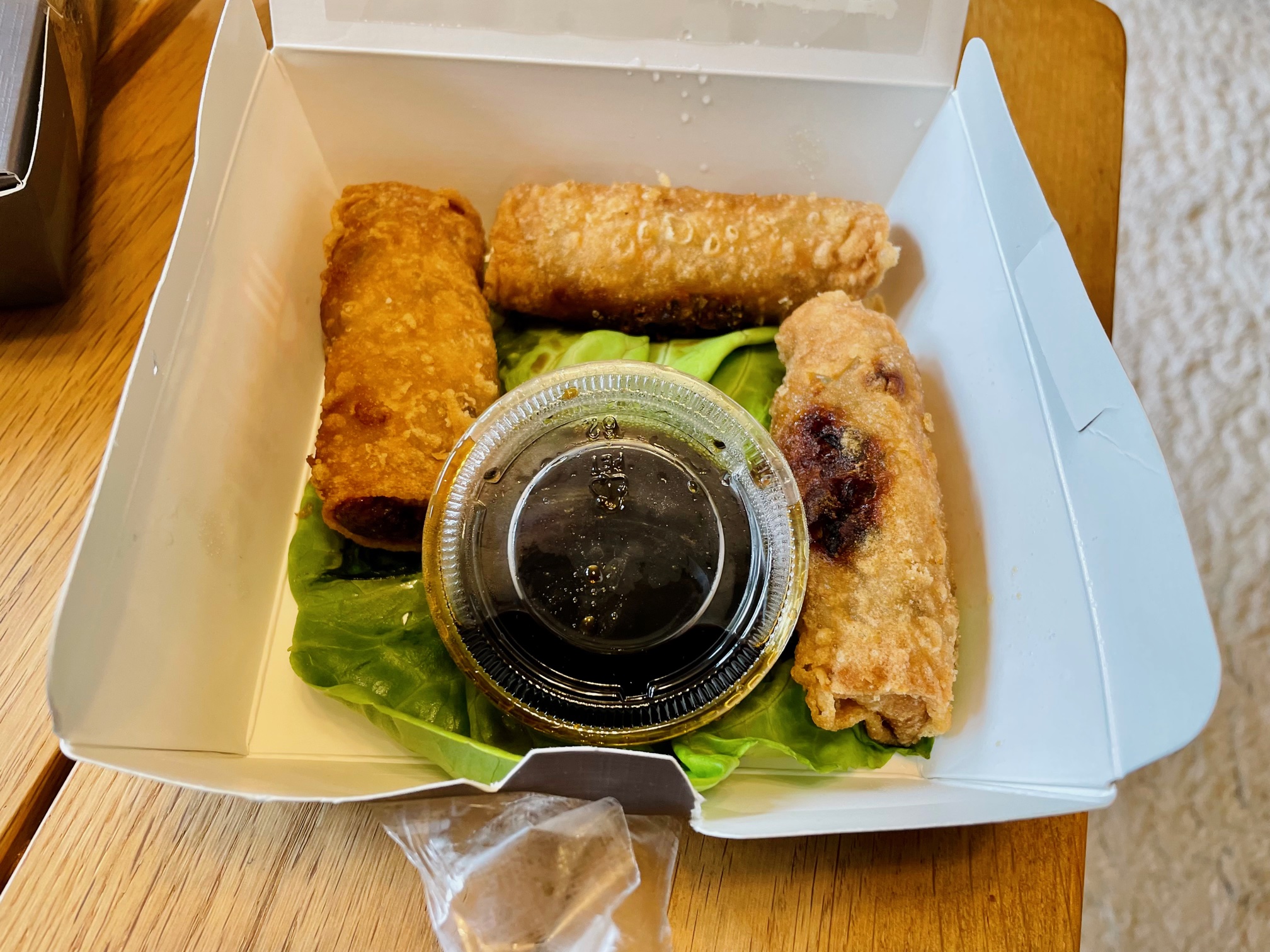
Our starters were variations on a theme (one of my favourite Pho starters, beef wrapped in betel leaf, isn’t available on the delivery menu) and all were really pretty good. Pho’s spring rolls, filled with pork and plenty of crunchy vegetables, are wonderful things, surprisingly light and without any greasiness and I always find it hard not to order them. I particularly liked them with the soy and ginger dip we tried, but they were also very good dabbed in the nuoc cham, a sweet and sharp clear dip (with fish sauce in it, apparently, although it didn’t come across strongly). Zoë had a particular weakness for the peanut sauce, which was thick and rich, a culinary Tim Nice-But-Dim.
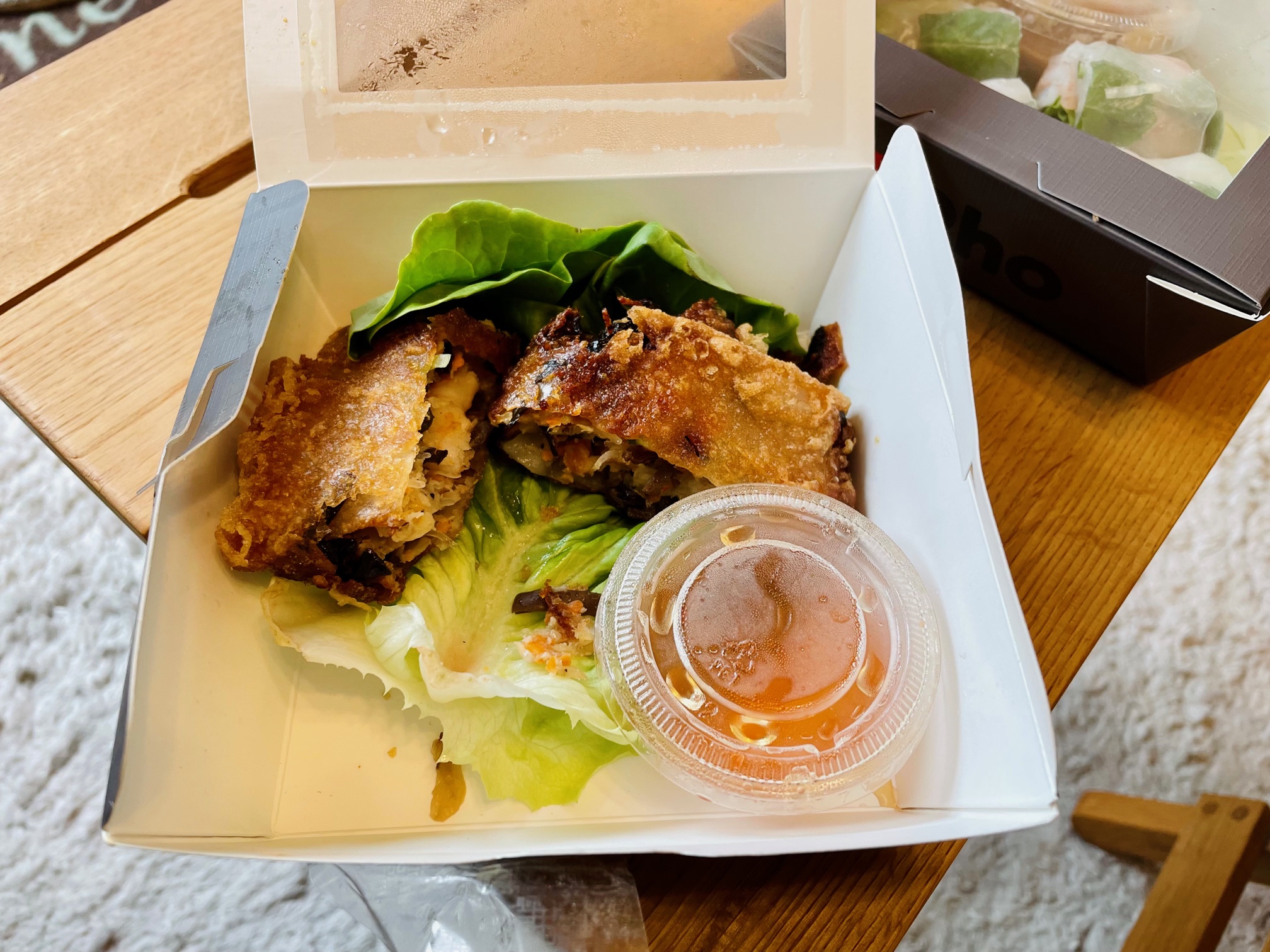
For my money, Pho’s giant crab, prawn and pork spring roll is even better. You just get one bigger one, cut into two for six pounds. It might sound like a lot to shell out, but it’s crammed with firm king prawns, white crabmeat and pork and is truly a king among spring rolls. This only comes with nuoc cham – interesting that they’re prescriptive with this starter, whereas with the others you can pick whatever sauce you like – but it’s honestly so good that the dips feel like a sideshow. And again, I felt that chain consistency at work: I’ve had this starter many times, it always tastes the same and it always tastes marvellous. That’s how it should be in all restaurants, in theory at least. But theory doesn’t always translate into practice.
Only the summer rolls slightly underwhelmed me. You got two of these, each cut in half, filled with those meaty prawns, shredded vegetables and vermicelli noodles. We ordered these mainly at Zoë’s request, and eating them felt a bit like reading literary fiction – you’re aware that it’s the correct thing to do, you know on some level that it’s the virtuous choice but none of that made it especially enjoyable. Two portions of fried spring rolls crammed with varying amounts of pork is a tough act to follow, and it may be that I’m just a Philistine, but these didn’t massively do it for me.
That comes down to personal preference, I suspect. Looking back I wasn’t wild about summer rolls when I reviewed Pho, back in 2018, although I did prefer the versions at now-defunct MumMum when I went there later the same year. But each time I used the same sort of words – delicate here, subtle there. If you like delicate and subtle you’d probably love them: I am, let’s face it, neither delicate nor subtle and that probably explains why they didn’t provoke much passion in me.
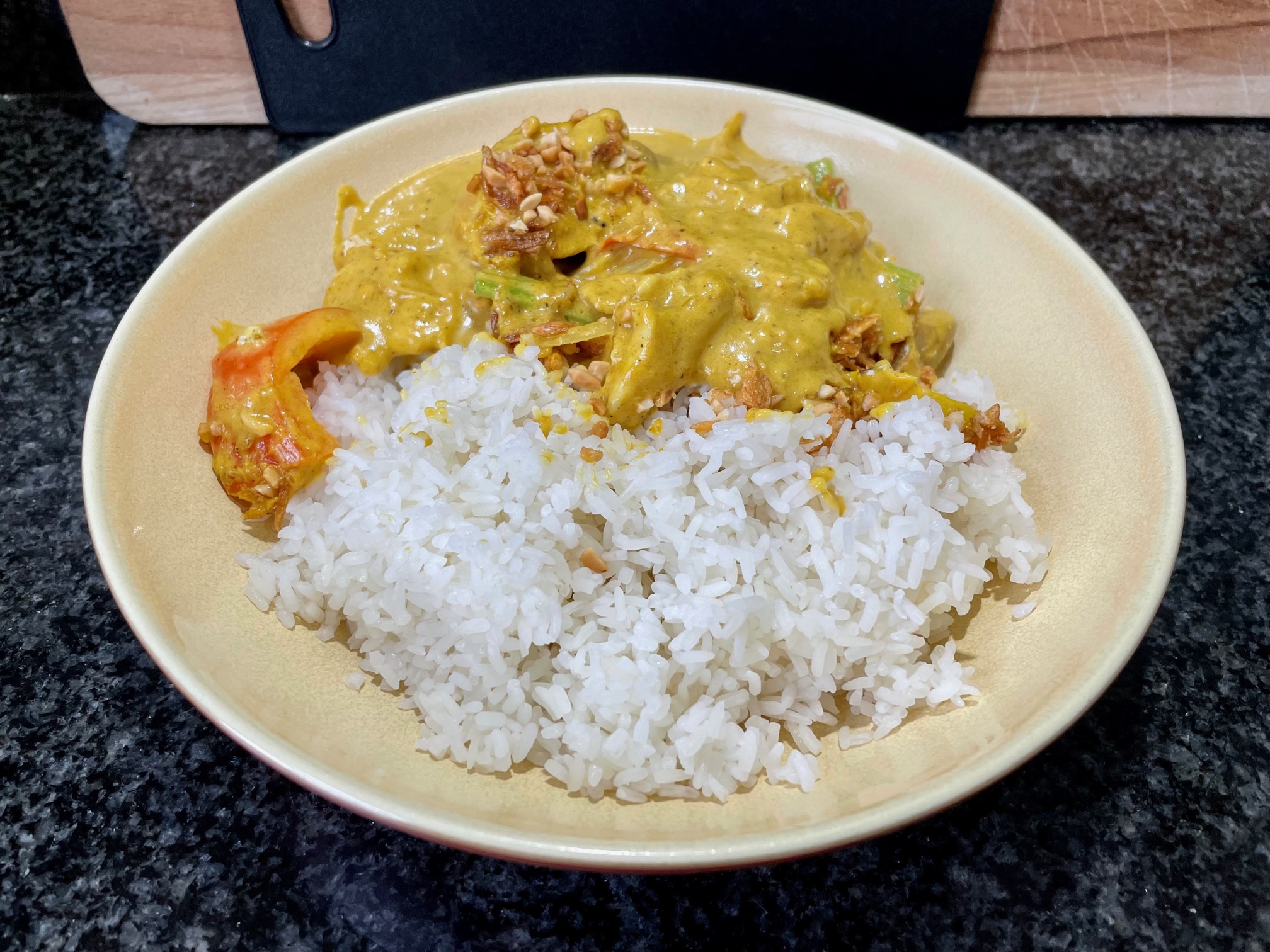
Zoë’s regular main course at Pho is their Vietnamese chicken curry, and even the discovery that they recently added a new, spicier version to their menu didn’t deter her from ordering what she always has. To be honest, it was hard enough to persuade her to let me try a forkful so I could write about it. It was a lovely dish, with plenty of peanut and coconut and a clever mix of sweetness, fragrance and just enough heat – pretty mild, really, but hugely soothing. It came with “broken rice”, which looked remarkably unbroken to me, and felt like good value at twelve pounds. If I ever do go completely crazy and order something that isn’t my usual, I’d be tempted to go for the same dish but with strands of beef brisket instead.
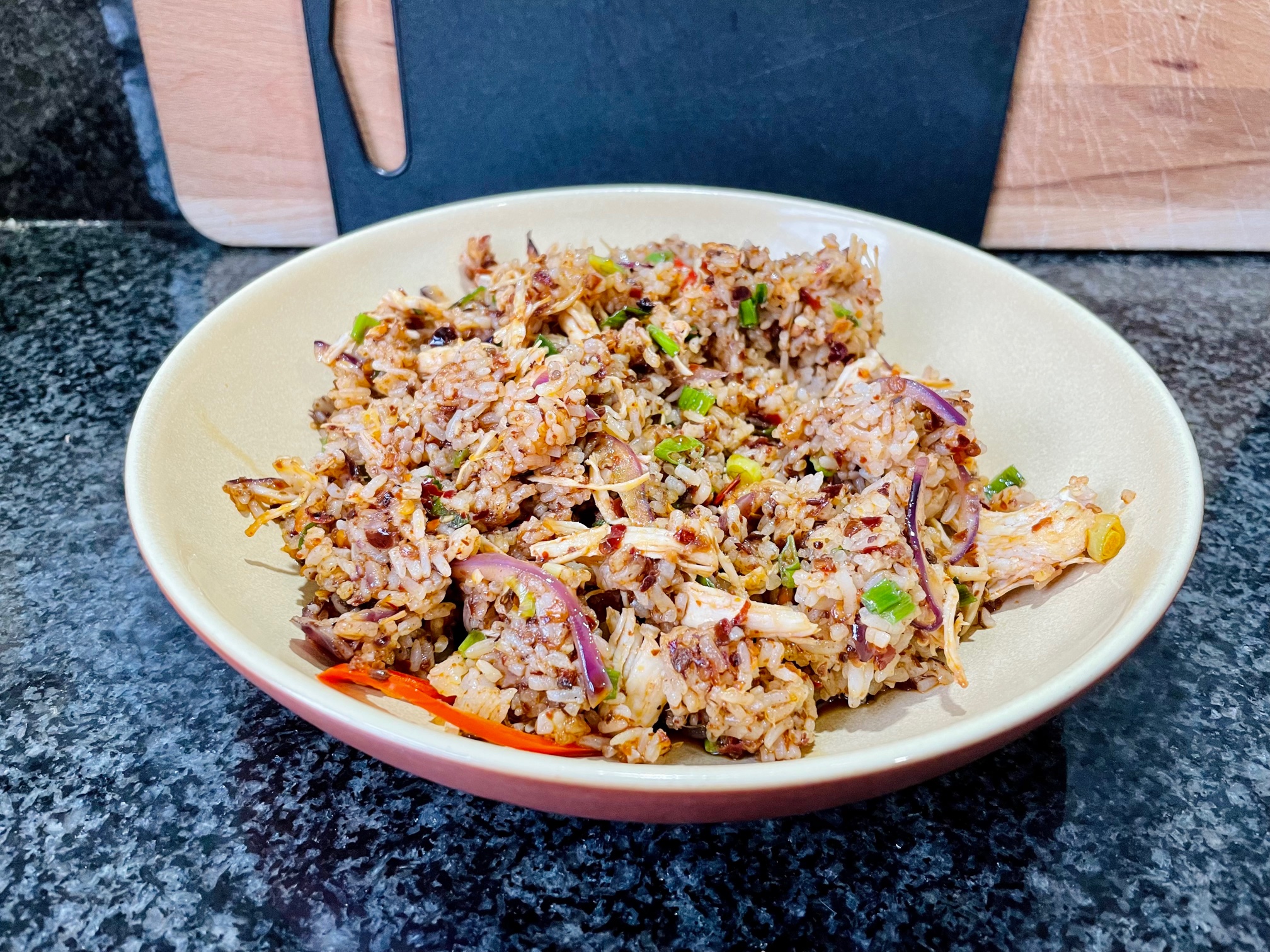
My usual, though, is Pho’s com chien, chicken fried rice, by happy coincidence one of the cheapest main courses on the menu. I’ve written before about how much I love this dish, but I had almost forgotten how enjoyable it was. It’s a glorious mixture of rice, slivers of red onion, spring onion and plenty of shreds of chicken, with two star ingredients that lift it far above the usual. One is many, many flecks of chilli and the other is a smattering of tiny, chewy shell-on dried shrimps, every single one a little landmine of savoury joy. And what stops it from being dry, stodgy or boring is a little dish of dark, sweet sauce that you tip over it just before eating, binding the whole thing together and giving it a beautiful, glossy sheen.
“It’s a good dish” said Zoë, trying a forkful. “But it’s hot as balls.” She was right about that – it’s not for the faint-hearted, and my chilli tolerance has improved considerably since the first time I ever ate it, but it was a grateful pain, and a fantastic dish. I could eat it every week of my life and I’m not sure I would ever get bored.
So, what does this all tell us? My meal lived up to that intrinsic promise all chains make, that your meal should be relatively free of surprises: I enjoyed Pho every bit as much as I always have, and I’m not really sure I expected anything different. In that respect this review, probably more than any takeaway review I’ve written this year, comes the closest to depicting a meal I would have eaten off duty. But I’m not sure whether you can make that many sweeping generalisations about chains from my experience of Pho, because I’m not entirely convinced that Pho is representative of chains in general.
On some levels, you can say it is: the focus on reasonable pricing, the ability to cover a wide range of dietary choices and age groups are absolutely what chains do superbly. But I also think that Pho are especially good at this: they feel to me a cut above most chains. They are lucky that Vietnamese food lends itself well to a vegan or a gluten-free diet, but they have worked hard to maximise their appeal.
They have also given a lot of thought to how they make delivery work, right from the outset, and they’re better at delivery than most restaurants I’ve reviewed this year (I didn’t order pho from them, mainly because it’s not really my cup of tea, but I imagine they’d find a way to get that right in transit as well). And they are meticulous in their approach to expanding: they try to understand the local market and make contact with people in the food scenes of towns and cities where they choose to open new restaurants. They do their homework. I can’t imagine Taco Bell gave any of that a moment’s thought.
I’ve always felt that there are good chains and bad chains, and good independents and bad independents. It’s never been more difficult for independents: without the financial reserves most chains have, they will have to fight harder to survive. And I can think of many independent restaurants over the years that were easily good enough to deserve to flourish, but failed. They needed exposure, they needed time and they needed people to give them a chance. It would help if our local media had written a fraction of the articles about any of those restaurants that they’ve rattled off in the last few months about our impending branch of Wendy’s (seven so far this year and counting), but them’s the breaks.
So yes, I know what my friend was driving at, that independents always have to try to improve their offering. But I also think that, in Reading at least, they feel more likely to try and do that than chains. Chains can rely on a steady stream of customers visiting them based on brand recognition alone, and they can much more easily become complacent as a result. The bottom line is that a good restaurant is a good restaurant, and a good restaurant should drive all restaurants to do better. And based on my meal this week I think that most restaurants – whoever owns them – could learn something from Pho.
One thing that always strikes me about Reading is that many of the people who proudly call it home weren’t born here. Whether you came here for university and never left, settled here for a job, ended up here because you found love or – like me – wound up in Reading because your parents moved here for one of those reasons back in the Eighties, Reading is full of countless stories about people who made a life here, on purpose or accidentally. Frequently it’s the latter – you always think that one day you’ll go somewhere else, but something about the place gets its hooks into you and somehow, magically, one day you realise that it’s your place. It’s where you belong.
Our independent restaurateurs and entrepreneurs are great examples of that. They all have a story to tell, whether it’s Blue Collar’s Glen Dinning coming here from nearby Didcot, just down the road, Nandana and Sharat of Clay’s settling here after living in India and London or Geo Café’s redoubtable Keti, who moved to the U.K. from Georgia and somehow found herself living, of all places, in Reading. Imagine a Reading in a parallel universe where all those people made different decisions and took their considerable talents elsewhere. Actually, don’t: it doesn’t bear thinking about.
I saw this too, back when I organised readers’ lunches, before the pandemic. ER readers are a fascinating bunch – and I’m not just saying this because they turn up to my lunches – and many of them have moved to Reading, sometimes fairly recently, and are finding their way, looking for their place in things. Reading has so much going on (it did, anyway, before the pandemic, and no doubt will again) and yet it’s not always obvious or easy to find. You have to put the work in. But it rewards the investment: a great and growing food scene, plenty of culture and theatre, history, architecture, wonderful pubs and plenty of breweries. We Reading folk are a lucky bunch.
For me, that mixture of our history and all those who positively choose to live here, roll their sleeves up and make it a better place is what makes Reading so special. It’s something that people who live to run the town down will never comprehend. They sneer about the mosque, or flytipping, or any of a hundred other petty niggles and they don’t see the town for what it really is: a well-educated, pro-Remain, anti-Tory, polyglot, highly skilled place full of possibility. Not perfect – nowhere is – but with plenty of character, and always wanting to be better.
There was a time, a while back, when Reading was especially attractive to a different kind of settler. We were first in the queue for all sorts of interesting businesses, drawn in by our proximity to London and our highly qualified workforce, even before Crossrail was a thing. I still remember Reading getting the first Bill’s outside West Sussex, and how exciting that was. Actually, my memory even goes back as far as our first Pret, and our first Carluccio’s: believe it or not, people were excited about those, too.
But then we were in line for all sorts of other exciting restaurants – Honest Burgers and Pho chose to have some of their first branches outside the capital in RG1. It looked for a while as if Byron and Busaba would open here, too, and even London’s high-end Peruvian restaurant Ceviche, surreally, was touted for an outpost in Reading. We never got the Wahaca many people so badly wanted (or the branch of Le Pain Quotidien I quite fancied), but we got a Malmaison as a consolation prize. There was a period where Reading went from “it’s all just chains” to “we get the best chains”. With rents pricing many independents out of the town centre, it seemed as much as we could hope for.
I don’t know when this changed – at some point since 2016, when things started their slow dive into the slough of despond – but somewhere along the way we became the first in line for a very different kind of restaurant. We’re no longer a logical extension of London, more the landing ground for American chain restaurants. Five Guys in the Oracle was the harbinger for all that, but in the last few years the rate of change has accelerated. We got a Taco Bell, we got a Chick-Fil-A, we are getting a Wendy’s later this year. And for the latter two, Reading’s is (or was) the very first branch to open in the country. Are we Reading folk really a lucky bunch? Is this going to Make Reading Great Again?
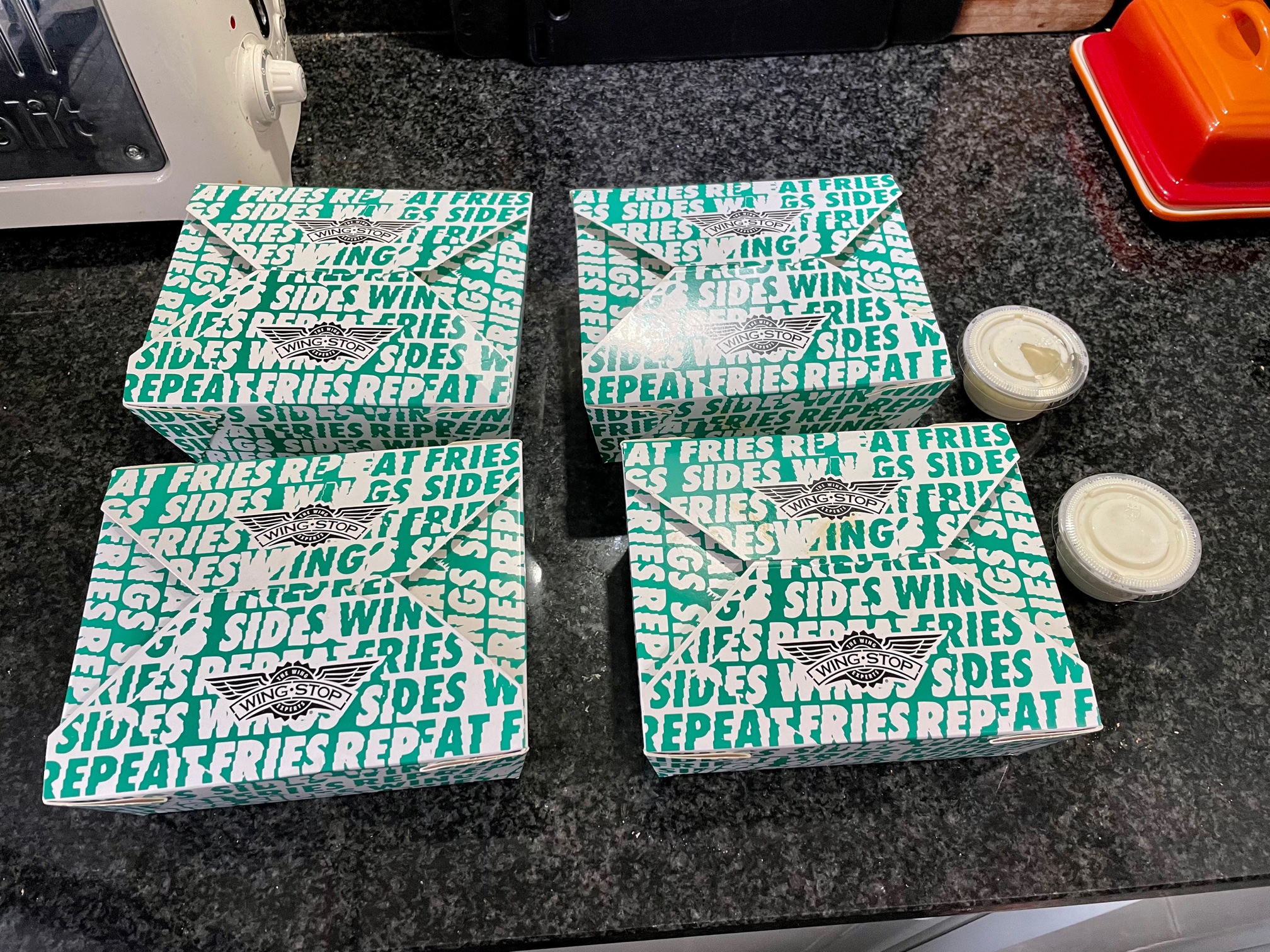
Anyway, Chick-Fil-A rightly closed in short order after boycotts and protests about their antediluvian approach to LGBT issues, and last month another chicken chain, Wingstop, opened in its place, that weird upstairs location at the front of the Oracle that also played host to vegan junk food restaurant Miami Burger. Wingstop is another huge American chain expanding into the U.K., and – guess what? – Reading’s is the first branch outside London. There have been queues outside since it opened (of customers, rather than protestors) and so I decided to order some on a miserable Monday night, partly out of morbid curiosity and partly because both Zoë and I have a long-standing love of fried chicken in pretty much all its forms.
Wingstop is only on Deliveroo, and their menu is pretty limited. Chicken comes three different ways – wings, “boneless” and tenders. The middle one is the most misleading – “boneless” implies boneless wings, and indeed the Wingstop website refers to them as boneless wings, and I was taken in by that. But the small print on Deliveroo, which I only read after the fact, points out that they are “100% all-white breast meat, 0% bones and 110% flavour”. So that’s nice.
Effectively they mean that they’re nuggets, which are inherently boneless. But rather than be honest about that, Wingstop has chosen to commit the grammatical crime of converting the word “boneless” from an adjective to a noun. If I hadn’t been fooled I’d have ordered wings, even though they aren’t especially my bag, but there you have it. The real choice, such as it is, is what particular flavour you want one hundred and ten per cent of: Wingstop’s chicken comes in ten different flavours, from their original coating and their signature lemon and pepper all the way through to Mango Habanero or Brazilian Citrus Pepper.
It wasn’t clear from Deliveroo whether these were a coating or that they were covered in sauce, although the Wingstop website suggests that six of them are “wet” and four of them are “dry”. I can see why they didn’t include this on Deliveroo: “wet and boneless” describes some people I’ve met over the years but hardly summons up images of anything I’d want to order from a restaurant. Anyway, you get two flavours with an order of nuggets or wings and one with chicken tenders, irrespective of how many you order.
We ordered some nuggets, some tenders and some fries and our order came to thirty-three pounds, not including rider tip. If that sounds like a lot, in fairness we did get a lot of nuggets and tenders, and two portions of loaded fries: on the other hand, if we’d given in to the temptation to get some churros for dessert we could have spent even more.
I suspect that many of you have an idea by now of the way this is going, even without a rating of the bottom of this for you to scroll down to. But you know far better than I did when I placed my order: I always try to go in with an open mind, and the prospect of a chain restaurant only doing a limited number of things did rather raise the hope that they might do them well. And, as I said before, I do have a real weakness for fried chicken – and that even includes KFC, or did until last year when I decided I’d rather try and support more independent businesses.
Everything was quick and unfussy, which always makes this paragraph a short one. We ordered at ten past seven, the rider was on his way twenty-five minutes later and within another five minutes he was at the front door. He had two orders for Wingstop in his insulated bag, so bear in mind that if you live further out of town your rider might well make another stop before getting to you. I don’t know who was getting the other order but whoever they were, as it turned out, they have my sympathy.
Everything was in cardboard packaging which I imagine was recyclable, apart from the dips which were in little plastic tubs, and everything was hot. And now, because I can put it off no longer, let’s talk about how it tasted, and how little it tasted of.
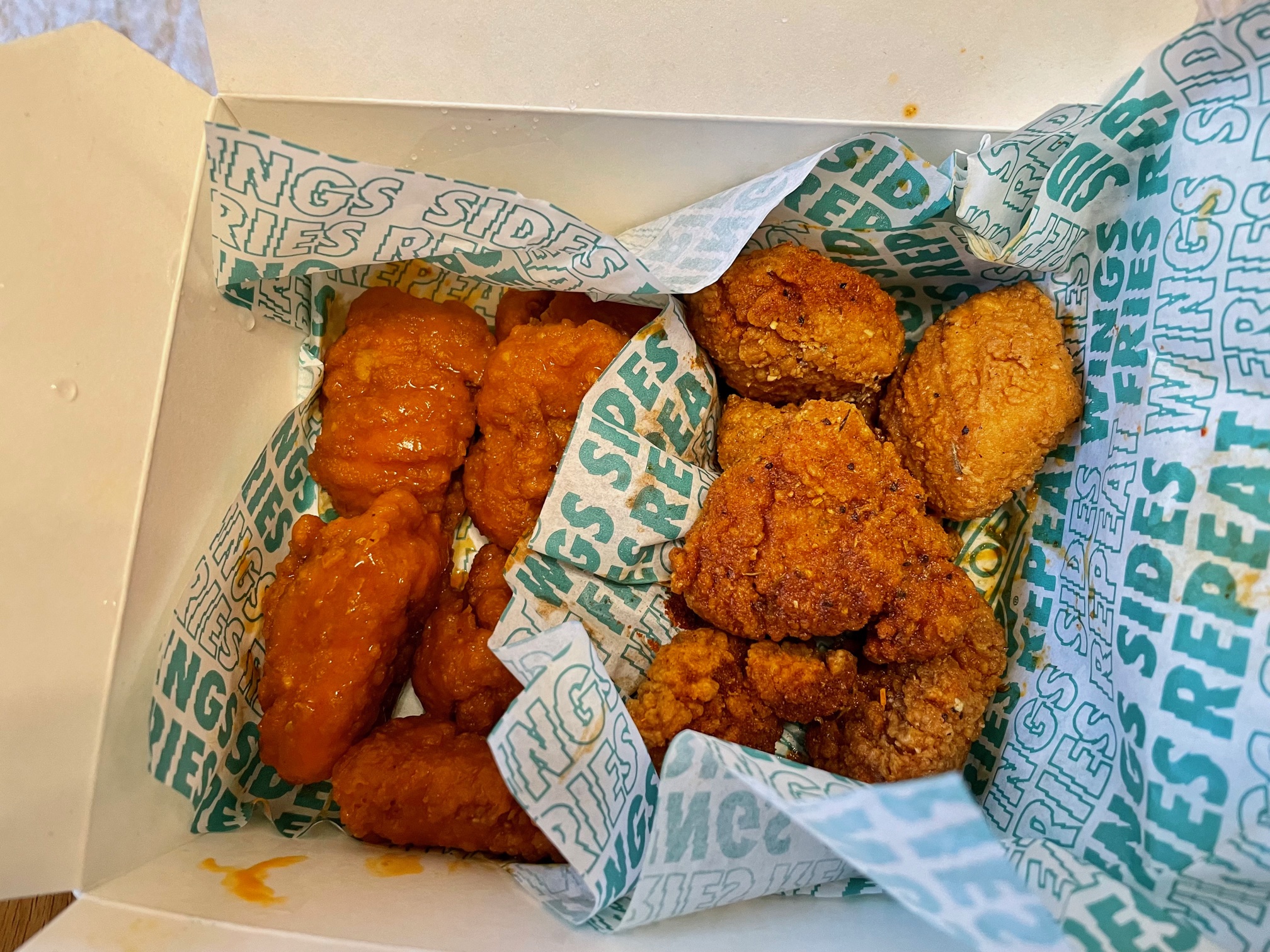
The bonelesses (let’s call them nuggets from now on, or things will just get silly) were dull, dry little pellets of chicken with nothing much going for them. We had a dozen, which very quickly felt like too many, half in their original seasoning and half in “Louisiana rub”, which sounds like a skin condition you might pick up in New Orleans. The latter was meant to be dry, but they were coated in some kind of random hot sauce, for no discernible reason. They tasted mainly of acrid, slightly vinegary heat which did its best to conceal the lack of flavour underneath.
The original seasoning was probably the best of the bunch, but even then it was surprisingly bland: it tasted much the way that Colonel Sanders’ unique blend of herbs and spices would taste after going through the wash half a dozen times. It brought to mind really good fried chicken, but only in the sense that you’d eat it and then think “this is nothing like really good fried chicken”. We dipped the nuggets in a blue cheese dip which had a faint, unwelcome whiff of acetone and a ranch dressing which answered the question “what would mayonnaise without a personality taste like?”
We’d ordered the tenders in lemon and pepper, which is supposedly Wing Stop’s trademark coating (not especially fun fact: the UK master franchise is called Lemon Pepper Holdings). They tasted, to me at least, like something you might buy from a supermarket and crisp up on a baking tray in the oven, on autopilot, daydreaming about eating something better. And that’s the worst thing, because I suspect they were nutritionally far worse for you than that. I really resent wasted empty calories at the best of times, but this just felt like a waste in every sense.
And this really was salty, so salty that you could almost feel your oesophagus starting to wrinkle like a slug under the onslaught of sodium chloride. Everything was so greasy, too. With both the nuggets and the tenders it didn’t feel like the restaurant had properly shaken them off before putting them in the box, to the extent where there was a grim slick of oil on the paper lining the bottom, and the pieces closest to it were actually soggy rather than crispy.
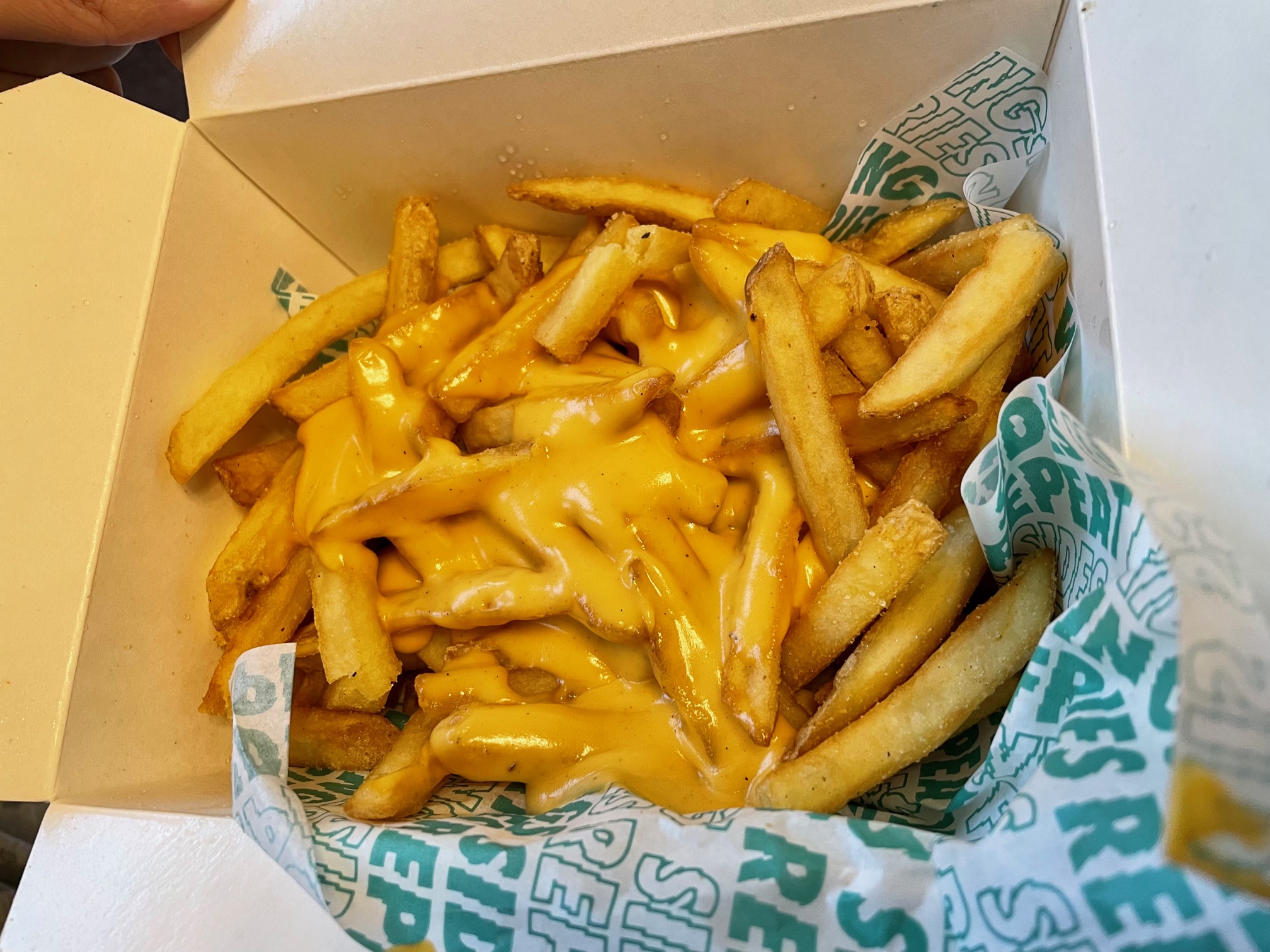
I haven’t mentioned the chips, so to give credit where it’s due: these were outstanding. Only kidding! They were cruddy as well. I’d chosen the “buffalo ranch” fries, which were dusted with a hot red powder which tasted as if it might be made from depleted uranium, more of that screechingly sharp hot sauce and, just for fun, the ranch dressing I’d felt so ambivalent about. Again, they were crudely salty, as if getting them to taste of salt constituted making them taste of something. The cheese fries were allegedly “smothered with aged cheddar cheese”. Looking at the picture, I would say “smothered” is poetic licence and that mature cheddar cheese doesn’t melt like that or take on that weirdly synthetic, plastic sheen.
I didn’t like Wingstop much. Can you tell? Aside from the ten gimmicky flavours, the crimes against grammar and the slightly disingenuous menu, I think the most damning thing about it is that whatever it was aiming to be, it failed. Truly it was neither one thing nor the other. If you decide, one night, that you have a real hankering after lemon and pepper chicken, you’d be better off with Nando’s. If you wanted salty, crinkly-edged pieces of fried chicken, Wingstop is nowhere near as good as even the most ordinary KFC. It almost made me wish I’d tried Chick-Fil-A: they might have been rampantly homophobic but I can’t imagine their food was duller than Wingstop’s.
And that’s just talking about the chains. The joy of Reading is that we don’t have to settle for chain restaurants. Bluegrass BBQ does reasonably good fried chicken, and on the occasions where the Lyndhurst has it on the menu theirs is superb. Even Kungfu Kitchen has dabbled with fried chicken in the past and yes, theirs was also miles better than Wingstop. But I’ve saved the best til last. If you get yourself to Blue Collar on a Friday lunchtime, shortly after this review comes out in fact, you can join the queue for Gurt Wings and get the best fried chicken in Reading.
They’re here every week and if wings are your thing they absolutely have you covered. They also do beautiful chicken tenders and, at the moment, cups full of soy marinated crispy Japanese popcorn chicken thigh. They make all their own sauces, and their buffalo and blue cheese will make you weep with gratitude (although my personal favourite is the habanero syrup). Four tenders and a shedload of deeply addictive tater tots will set you back nine pounds. For much the same price you can have three iffy tenders from Wingstop and a portion of underwhelming fries.
Gurt Wings are based in Swindon and most of their beat is markets and pubs in Wiltshire and Bristol. But best of all, and bringing us full circle, they always spend Fridays in Reading. And that’s because Glen Dinning, that chap from Didcot I mentioned at the start of this review, decided to set up the best street food market for miles around here in Reading – and that decision, years later, brought us Gurt Wings. See? All is not lost. You just have to remember that for every Wingstop, there’s an equal and opposite Gurt Wings, gravitating towards this town just like all of us. Maybe Reading’s still got it, after all.
Wingstop 24a The Oracle, Reading, RG1 2AH 0118 3212699
One of the many things I’ve missed about reviewing restaurants over the past fourteen months is getting to try new places soon after they’ve opened. It’s fun to be one of the first people to check out a restaurant, and I know that at least a few readers wait to see whether I’ve enjoyed somewhere before deciding whether to pay it a visit – which is a huge compliment, and very much appreciated. But with one thing or another, I wasn’t able to do any of that last year.
Maybe I should have started reviewing takeaways sooner, rather than waiting until 2021. As it was, I didn’t get to try the food at Tasty Greek Souvlaki or Banarasi Kitchen until many months after they opened their doors: it also meant I had to sit on the sidelines and watch while people told me how good it was. It was another thing to envy, along with all the people I knew who managed to fit in a foreign holiday last year, or a UK holiday (which, by the way, isn’t a staycation: that’s a hill I’m willing to die on), and even all the people who ate in restaurants and drank in pubs over the summer, free of the fear I couldn’t escape.
That makes this week’s review one I’ve particularly looked forward to. ThaiGrr! – yes, with an exclamation mark like Westward Ho!, although I’ll leave it out from this point onwards or this review might sound like I’m on amphetamines – opened last month at the Oxford Road end of Queens Walk. It’s the first of no doubt many new openings as part of the overall regeneration of the Broad Street Mall, although definitely not the last: I’ve heard interesting rumours, for instance, about a Greek restaurant opening there this summer.
I was on a photographic mooch around West Reading a couple of weeks ago, checking out Rise Bakehouse and Cult Antiques and Coffee, the new café on Tilehurst Road. Because I was in that general area, I took a detour past ThaiGrr to have a look. It had gamely stuck a couple of tables outside, braving the wind tunnel that is Queens Walk. But the inside looked a little like a slightly bigger Kokoro, an unfussy place where you grab and go, or eat inside but with no whistles and bells. The menu felt geared towards that kind of eating, too – or takeaway – with a few starters and a reasonably compact list of mains all served with rice.
ThaiGrr has almost no footprint online, having seemingly sprung up from nowhere. Their website doesn’t tell you anything about their story, and all I could find from Googling was a company set up last year from an anonymous address in North London, and three directors with no previous positions. So it would appear, from a cursory glance at least, to be that rare thing – a completely independent restaurant appearing out of nowhere.
When I looked at the menu on ThaiGrr’s website I felt a little underwhelmed, mainly because I saw sweet and sour chicken and beef in oyster sauce very close to the top. That felt a lot like playing it safe. But when I had a closer look on Deliveroo I realised that wasn’t representative at all: the balance leant much more towards Thai dishes, with a specials section which could only be ordered after 2.30pm. Main courses, with rice included, ranged from just under ten pounds to twelve pounds, which made me think this would probably be a one-pot, Kokoro-style arrangement.
There were also half a dozen sides or starters, clocking in between four and seven pounds. It was genuinely difficult to narrow it down so we ended up ordering two mains and three sides, hedging our bets, reasoning that something was bound to be relatively disappointing. That, as it turned out, was a mistake – albeit one with happy consequences. Our order came to just shy of forty pounds, not including rider tip.
As so often with meals from the centre of town, everything happened like clockwork. We placed our order around quarter past seven, the driver was en route twenty minutes or so later and he took less than ten minutes to get to my front door. He pulled up in his car and took the paper bag out of his insulated bag, which he hadn’t bothered to zip up. Fortunately everything was pretty much still hot, although I was glad I didn’t live further out because it mightn’t have stayed that way for long.
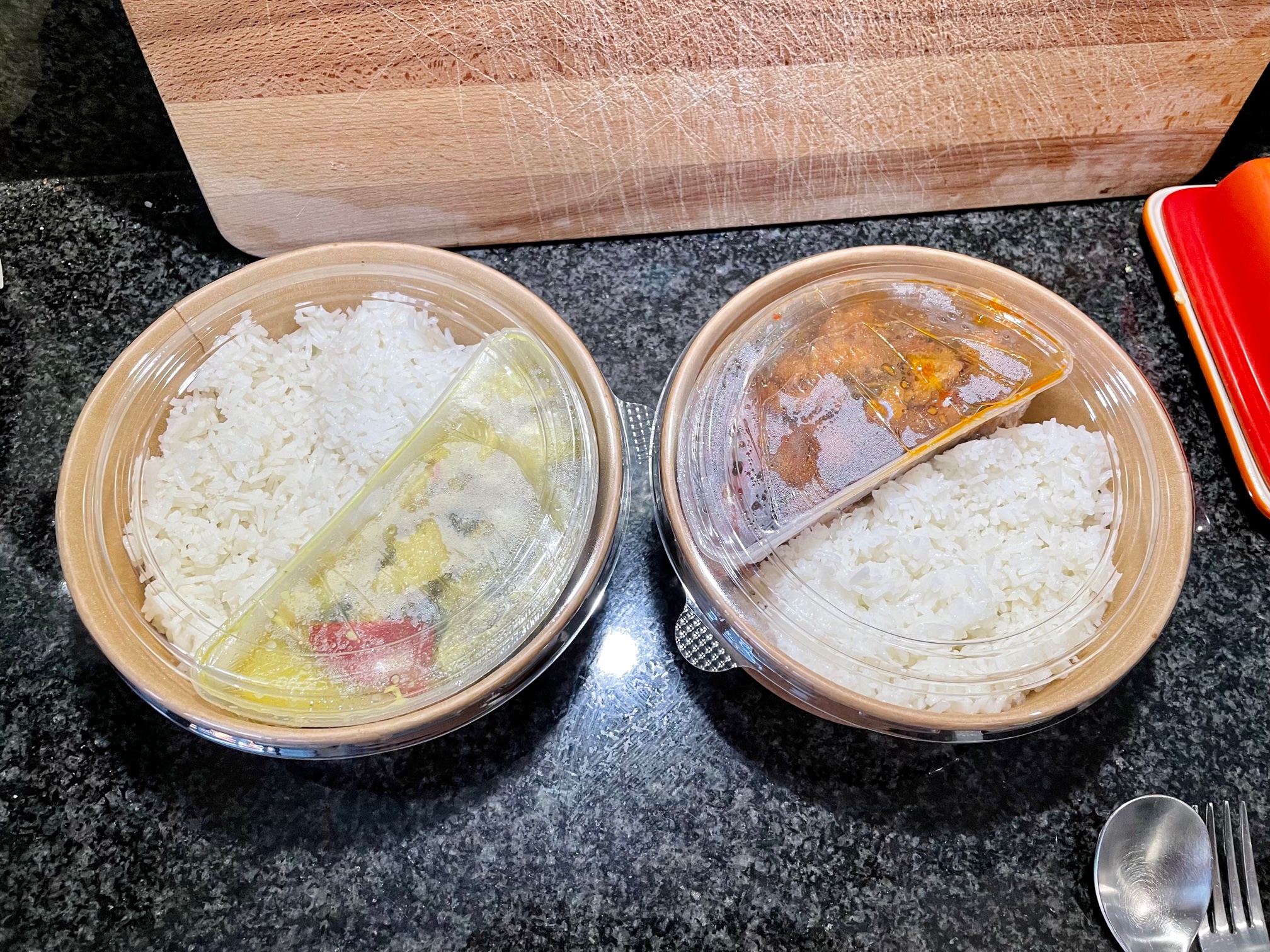
ThaiGrr’s packaging felt like they had really thought through what would survive delivery best. Everything came in cardboard tubs with plastic lids and the majority of the dishes had also been cling-wrapped for extra insulation. I was most impressed with the curries: the curry and jasmine rice were packaged separately within a single tub with the former in a cling-wrapped plastic container. So it wasn’t a Kokoro-type model after all: another mistake on my part. Dished up in a bowl it was a good portion size – generous but not gigantic. You wouldn’t leave any, but you didn’t have to spend fifteen pounds buying a curry and rice on the side either.
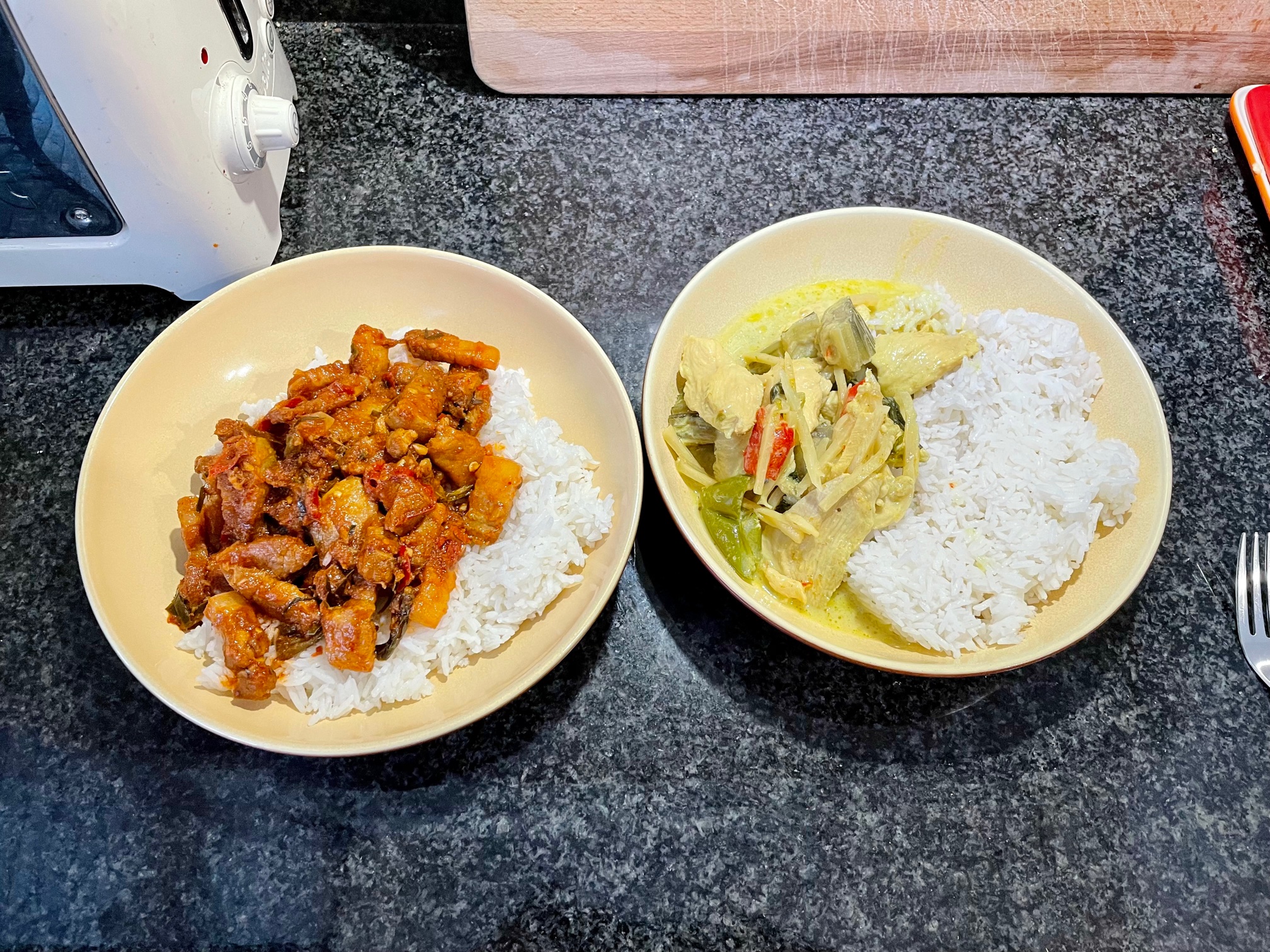
That’s quite enough talking about packaging for one week, because I’d much rather enthuse about how beautiful my dinner was. Nothing I ate was less than very good, and much of it was if anything better than that. My main, moo pad prik, was fantastic: plenty of pork belly, the perfect balance of flesh and fat, in a superb sauce that zinged with kaffir lime and with punchy heat and just enough sweetness.
This was lip-tingling stuff, and it made me realise just how often Thai food in Reading restaurants has next to no chilli heat at all. The menu gave this dish a rating of one chilli, but if anything it felt closer to two to me (although that said, my tolerance for chilli has got a lot higher since I discovered Clay’s and Kungfu Kitchen). The sauce coated rather than drenched the jasmin rice, but if anything that slight stickiness made it even more addictive. When I order from ThaiGrr again – and on this showing it’s going to be pretty soon – I’ll struggle not to pick this again. Looking at the restaurant’s Instagram feed, I see that this dish started out as a special and was promoted to the main menu: it’s hard not to love a restaurant that does that sort of thing.
My other half Zoë had gone for the green chicken curry (“I have a lot of benchmarks for this dish”, she told me) and I got to try a little of it, although it was difficult to tear myself away from my dish to do so. I liked it, although I’m not sure green curry would ever be close to the top of my list to order. The chicken was tender and well done and the sauce had just enough heat and funk to it: “it’s quite heavy on the fish sauce”, Zoë said. This had a two chilli rating for heat on the menu, but for my money it was milder than my dish.
Many of the hotter dishes – spicy minced pork with basil leaves, or crispy chicken salad with rice – are in the specials section of the menu, and I fully expect to wind up posting pictures of these on my Instagram in the coming weeks. It’s dangerous to know that something so tasty and so affordable is a mere half an hour away on any given evening, especially when you just can’t face cooking.
We’d gone for three side dishes (the menu, very much with delivery in mind, doesn’t call them starters) and again, these ran the wonderful gamut between rather good and excellent. The weakest was the chicken satay, but even this was a very creditable dish (even if my attempts to dish out the sauce from its little plastic tub make the end product look like a dirty protest). I would have liked the chicken to look more like it had made contact with a grill, but the taste and texture were difficult to fault and the sauce itself had a very pleasing nutty depth. Four skewers for six pounds felt like good value, too.
I was more taken with the crispy squid. The texture was spot on – no bounce or rubberiness that would have given away a lack of freshness – it had retained that crispiness in transit, and it was joyous dipped in sweet chilli sauce. Again, I wasn’t sure that it was especially spicy but I was happy overlooking that because I was enjoying myself so much. For my money, this was some of the best salt and pepper squid I’ve had in Reading, and I’ve tried it pretty much anywhere that sells it, from Pho to Kungfu Kitchen. It felt like a reasonable portion for seven pounds, although you might, as I did, slightly wish you had it all to yourself.
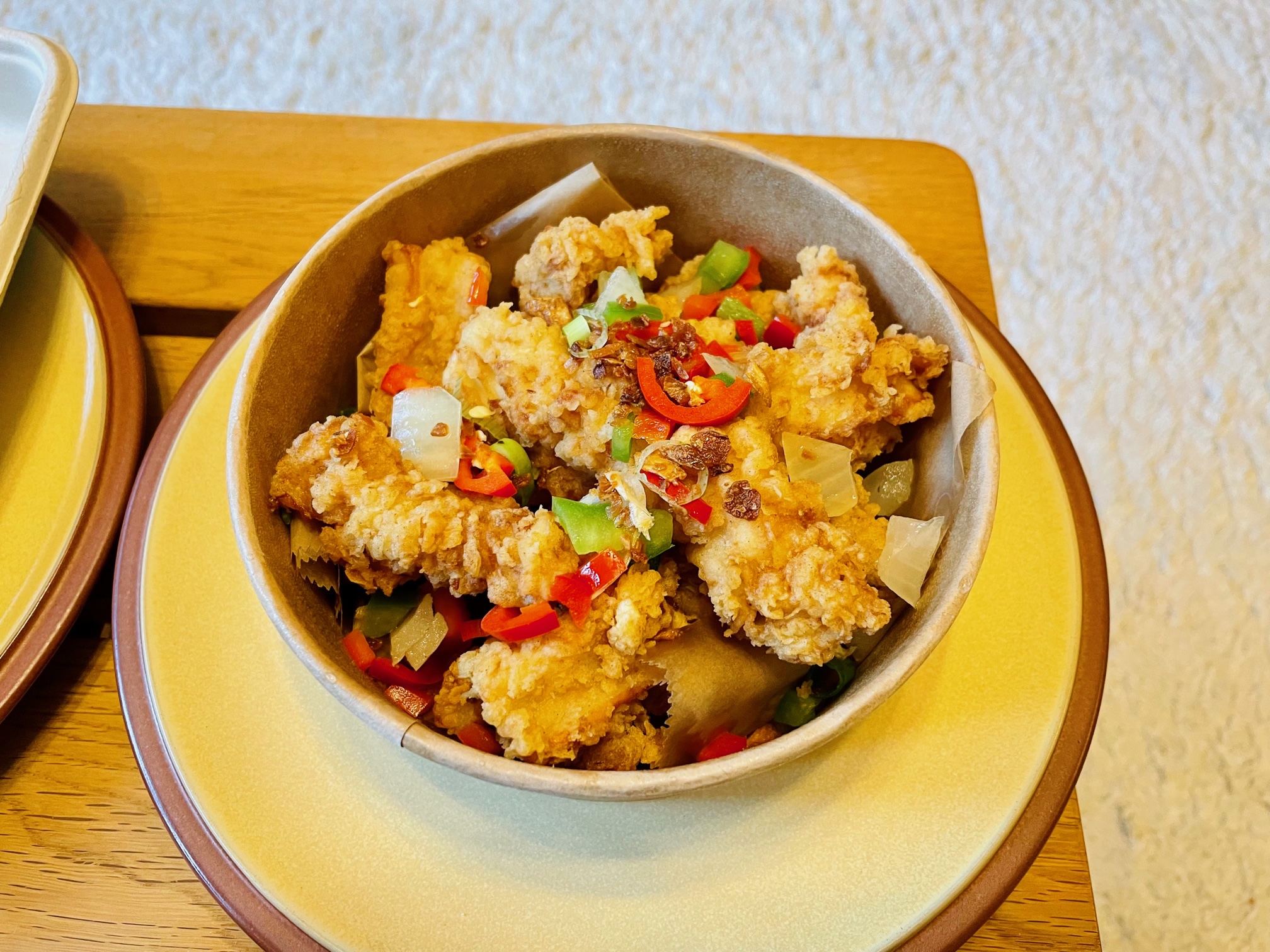
Last but very much not least, we had also ordered ThaiGrr’s fried chicken, apparently their house speciality. This also cost seven pounds and was a ridiculously generous tub with six pieces of jointed chicken, bone in, with huge shards of crispy skin and tender meat underneath. The whole thing was liberally studded with fried garlic and I absolutely loved it, but really, they could just sell the skin in a tub and they’d make pretty decent money out of me. If none of that makes you feel peckish – assuming that fried chicken is your cup of tea, of course – then just have a look at the picture below. Maybe it will succeed where I’ve failed.
The bones were literally the only thing from our entire order that ended up in the food recycling bin (thanks again, Reading Borough Council). I believe that classifies this particular meal as, to use Zoë’s immortal words, “a proper gut bash”. Honestly, you should hear the things she says that she won’t allow me to include in these reviews (they invariably involve some Anglo-Saxon and a wonderful, if expletive, turn of phrase).
I don’t know which is better about ThaiGrr, that they delighted me (which they very much did) or that they surprised me. The latter is possibly the rarer experience: I looked at ThaiGrr’s premises, and their menu, and I expected an experience a lot like Kokoro. That’s no bad thing, I should add: I like Kokoro very much. But what I got instead is what ThaiGrr looked like it might be but which I also thought was too good to be true – a proper little independent restaurant that keeps changing its menu, adding specials and experimenting.
ThaiGrr is also the first new restaurant I’ve seen in this pandemic era that has obviously thought hard about gearing its menu for delivery. The food is better than you’d expect from such a no-frills place, but it’s also better than it needs to be. It will be interesting to see what kind of restaurant they become, when eating in is allowed again from next week, just as it will be interesting to see what becomes of the Broad Street Mall.
The area around there will change, too, with the advent of Blue Collar Corner in the summer. Perhaps the centre of gravity in Reading will begin to change and finally shift away from the Oracle, with its sometimes slightly soulless chains. But all that is for the future: for now, ThaiGrr is pretty brave to have opened first, currently in the middle of nowhere, but it’s a gamble that pays off.
I think ThaiGrr’s is probably the best-executed Thai food I’ve had in Reading. Thai food is always a cuisine I’ve enjoyed, but often struggled to love. I think it shows, too: some of my reviews of Thai restaurants over the years are among the most pedestrian I’ve ever written. ThaiGrr could well change my feelings about Thai food – and I’ll definitely give them a chance to, because I was planning my second order before I’d even finished eating the first. I even found, by the end of proceedings, that I liked the name more than I thought I would. So hats off to ThaiGrr! for being one of my best discoveries of the year so far. I left the exclamation mark in this time. I reckon they’ve earned it.
When it comes to deliveries, all dishes may be equal but some dishes are more equal than others. I got to thinking about this after last week’s disappointing meal at Dhaulagiri Kitchen, when somebody replied on Twitter and said “I guess moving to takeaway has been tough for them”. I thought that was a curious take, because all of the problems with that meal had been in the kitchen, not on the journey from the kitchen to my house: everything was packed just fine, and arrived hot enough, it just didn’t taste that special.
It is true, though, that some dishes and cuisines lend themselves better to delivery than others. You’re on a hiding to nothing with pizza from the minute it leaves the oven, for example. And the more components you have to dish up separately, the more likely you’ll have a lukewarm plate at the end of it. With dishes where everything comes in one pot, you have a better chance that the whole thing will stay hot. This is why Kokoro is always such a good bet for delivery, and why restaurants like Zizzi and Pizza Express have set up separate brands on Deliveroo selling macaroni cheese or other pasta dishes in a tub.
It also explains the relative popularity of sandwiches – burgers, wraps and burritos – on delivery apps, and that in turn explains why I decided to give Tortilla a try this week. Burrito restaurant Tortilla is one of those smaller chains where the blurb on the website makes it sound like a small indie business (“we’re not part of a multi-franchise nor some big soulless restaurant group”) but my cursory research suggested a slightly different picture.
They had nearly forty branches, and had benefited from financial backing from the private equity group that controlled Yo! Sushi and from Santander – because if there’s one thing big business still seems to love, it’s the casual dining sector. Tortilla’s chairman used to run Pizza Express and had a proud track record of joining or founding hospitality businesses and then selling them off for pots of cash – more John Sykes than Jamie Oliver. So Tortilla maybe wasn’t a Taco Bell, but it certainly wasn’t a Mission Burrito either.
Tortilla was first announced as coming to Reading last February, although for obvious reasons it took a fair old while to open, not throwing its doors open until the end of October. It made the news last year, because it had to overcome objections from a neighbouring business, the dentist Reading Smiles, who were concerned about them having an alcohol licence, and about the risk of smells drifting into the dental practice. Tortilla’s response was that there was no risk of that, as almost no cooking actually took place on the premises – their beef and pork are “braised off-site”, which also enables them to open in smaller premises, like the Reading branch, without the need for extraction.
It’s funny: this sort of thing, cooking dishes in a central kitchen, goes on throughout chain restaurants and I’m sure we’ve all eaten those kinds of meals without necessarily being aware of it. But I had to work hard not to let this prejudice me against Tortilla. After all, I had a fantastic meal when I ordered a kilo of pre-cooked rib meat from The Rib Man and heated it up on my hob at home: potentially, surely this was no different?
And Tortilla seemed to be doing a tidy trade – every time I’d walked past the restaurant since lockdown relaxed in April the tables outside had people at them, taking part in our new national sport of gamely pretending the weather wasn’t shite. I couldn’t quite make up their mind about them on paper, so it was time to place an order with them and try to make up my mind about them in reality.
Tortilla is on all three delivery apps, although in typical fashion I only realised that once I had placed my order with Deliveroo. The menu is identical across all of them, and it largely revolves around burritos, naked burritos – that’s the contents of a burrito in a bowl, in case you have a thing against tortillas – and a few taco options. They don’t sell quesadillas or nachos for delivery, although they will sell you a DIY kit if you want to make them at home: I can’t imagine these are that popular, but life is full of surprises.
The process for ordering a burrito is remarkably like going down the line in Mission Burrito, so you have various tick boxes to pick which rice, beans, salsa and so on you want. We ordered on a Sunday evening, and they had run out of their coriander and lime rice and their guacamole, which slightly limited the options. Guacamole, incidentally, is one of the only things Tortilla makes on the premises, so it’s a particular shame they had run out. (Is it as bad as a pub running out of chips? Answers on a postcard.)
Tortilla offers the traditional fillings – carnitas, barbacoa beef and grilled chicken – along with grilled vegetables. The latter costs the same as a chicken burrito, which feels cheeky. They also serve a“vegan chilli no carne” – which has tempeh in it, although you have to go to Tortilla’s website to find that out. We ordered a couple of burritos and some tacos to share – I might have tried the tortilla chips too if they’d had any guacamole to go with them – and our meal came to just shy of thirty pounds, not including the rider tip. Tortilla’s burritos come in medium and large, with the large costing about the same as the one size offered by Mission Burrito.
Deliveries from the town centre always seem quicker and more reliable, and often come on a bike rather than in a car. This was no exception, and everything was pretty brisk: we ordered at twenty past seven, the rider was en route twenty minutes later and he took four minutes to reach our front door. When he did, he cheerfully told us that he was carrying two orders from Tortilla and so we’d have to give him our order number – that struck me as a little strange, but it hardly held things up. I wonder, if I’d been his second delivery, if I’d have been quite as happy.
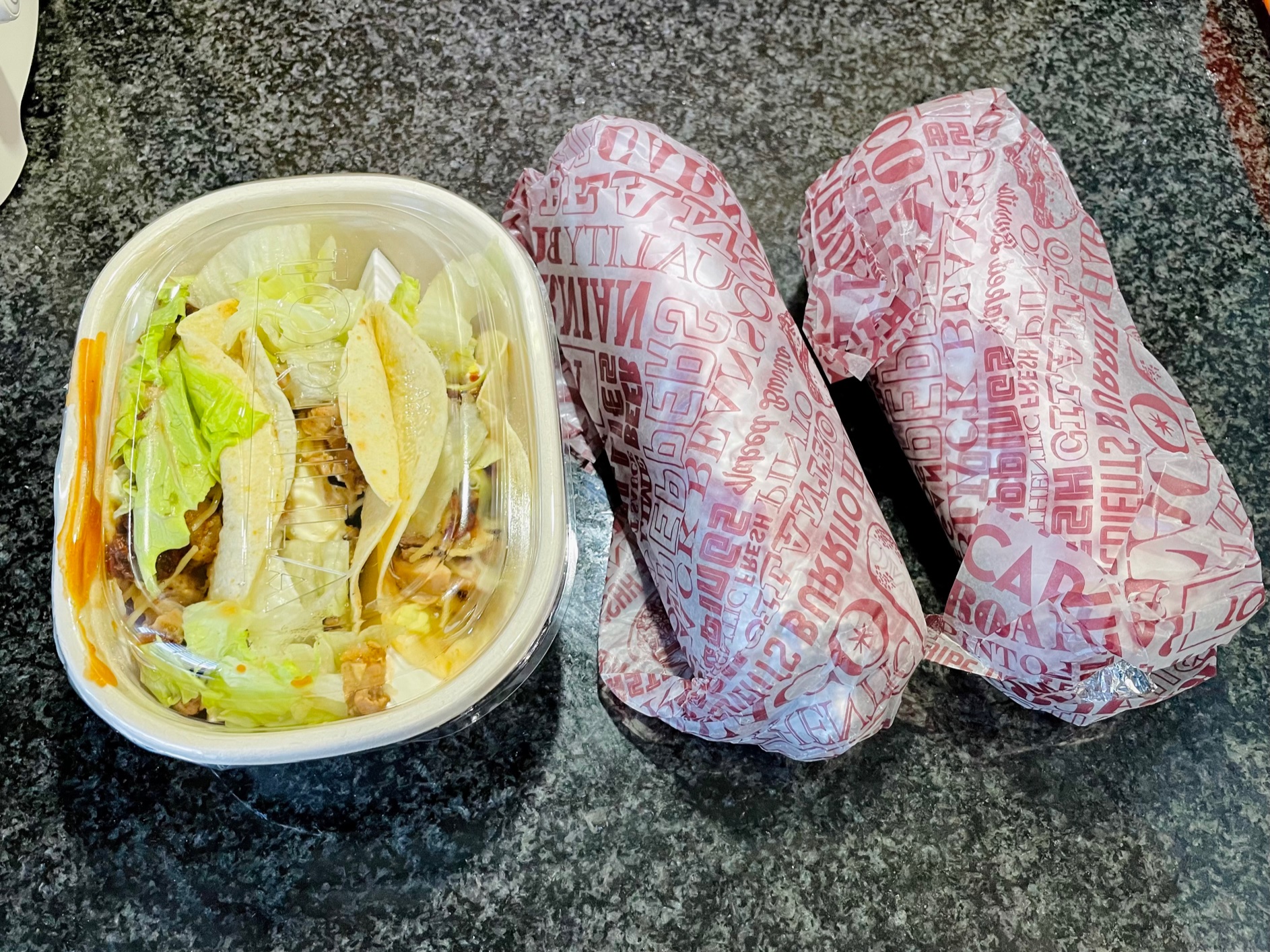
Anyway, everything was hot and it was all present and correct. A number had been scrawled on one of the foil-packed burritos with a Sharpie, nothing on the other. It’s only after the meal, looking at the ticket in the bag, that I realised he had written numbers against each burrito so we could work out which was which. P for pork and B for beef might have been simpler.
This is where I also have to make a sad confession. Partly to work out which burrito was which and partly to make this review more photographically interesting, I cut my burrito in half, artfully arranged it on a plate so you could see the filling, placed it under a spotlight in the kitchen and took a picture of it. Or at least I thought I did, but looking at my camera roll it simply isn’t there. This puts a greater emphasis on my descriptive powers than any of us would like, and makes this review even less visually interesting than normal: I can only apologise. I asked for advice on Twitter, but it ranged from the impractical (courtroom style drawing please) to the sadistic (another thousand words, presumably?). I’ll spare you either option.
On to the burrito then. Mine was pulled beef with black beans, tomato rice and all the trimmings – cheese, sour cream, salsa verde, jalapeños and pickled red onions. Looking at all that, you’d have thought the biggest risk would be the flavours clashing, or being too much, but in reality the struggle was to get it to taste of anything. Really, it was almost symphonically bland. It was well packed – almost as if done by a machine, the meat firmly in the centre, so different to the haphazard arrangement of a Mission burrito – but nothing tasted of very much.
The beef had the texture but couldn’t back it up with the taste. The red onions were still crunchy and felt like they’d had only a passing acquaintance with vinegar. If there were any jalapeños in it, they’d been picked for their inoffensiveness. The list goes on: the tomato rice had a real feeling of Bachelor’s about it, and if the salsa verde, cheese and sour cream were even in there (and having eaten it, I’m not sure they were) they added even less to proceedings than Dido Harding. Or Dido herself, for that matter. When the best case scenario is that your meal is boring because they got your order wrong, and the worst case scenario is that it’s plain boring, matters are problematic.
The carnitas burrito was a subtly different shade of meh, but meh nonetheless. I actually liked the pork more – it was saltier and just more interesting – but it had its work cut out shining in a sea of mediocrity. When I have a burrito from Mission it’s a glorious mess – it drips, it’s tricky to tackle, it’s always a challenge, but it tastes of something. You get the highs and the lows. This, by contrast, was tidy and dull, a burrito on Prozac, all the edges neatly knocked off until you barely felt anything. Maybe that was the intention, and maybe the aim is to take customers away from Taco Bell: Tortilla is better than Taco Bell, but so’s eating corrugated cardboard topped with spam.
Only the tacos showed a hint of something better. Tortilla’s chicken is grilled rather than pulled, in little pieces – I actually quite enjoyed this, although it wouldn’t be everybody’s cup of tea. But the real winner here was the salsa roja – hot and punchy and adding a dimension of flavour that had been lacking everywhere else. But even the tacos, though they were better than the burritos, weren’t better than their peers.
The portion size was still a little underwhelming, especially when you compare it to the Lyndhurst’s outstanding chicken tinga tacos: there, you get four tacos for nine pounds, all so piled high with chicken that you can’t physically close them, and there is always plenty of guacamole. At Tortilla you get three barely-filled tacos for seven pounds fifty – I got the odd one, but mostly because Zoë had no interest in fighting me for it.
When I look at Tortilla’s footprint, I can see that it might do well in many of the locations where they’ve opened up. If it didn’t exist, it might be necessary to invent it. But this, I’m very proud to say, is Reading, and we do things differently here. We’re not like some of the identikit malls Tortilla has opened in, or the likes of Guildford; if they’d done their homework, they might have realised that Reading, of all places, doesn’t need a Tortilla.
And although there were a couple of things at Tortilla I didn’t mind – the grilled chicken, the salsa roja, the fact that it isn’t Taco Bell – the fact remains that it will never be close to the best option for Reading residents. A few weeks ago I went to Blue Collar and tried pork and charred pineapple tacos from their new vendor El Contador, and they were miles better than anything I had from Tortilla.
Likewise, if tacos are your thing, be they carnitas or jackfruit, you really do need to make a beeline for the Lyndhurst when they reopen. If you’re a burrito fan I think that Mission, in terms of quality, value and integrity, is streets ahead of Tortilla; writing this review has quite made me crave a Mission Burrito to remember how it’s done. And if you’re at home, and you want to order something delicious that will stay hot, cost around a tenner and make its way to your door in next to no time, a little bucket of Kokoro’s sweet chilli chicken hits the spot every time.
I do feel a little sad for Tortilla: it’s not exactly as if they’ve done anything wrong, but they’re not quite good enough. It’s not them, you see. It’s us.







 Edible Reading