Restaurant review: RAGÙ, Bristol

I was on a run of bad luck when we turned up for dinner at RAGÙ, situated in a shipping container in Wapping Wharf, on the last night of our trip to Bristol. It’s not that I hadn’t eaten well, because I had in places, but I hadn’t eaten consistently well. My lamb kofte wrap from Matina, always a staple, felt a little under-sauced and under-seasoned, my vegetarian pizza sandwich at the Left Handed Giant brewpub was bland and stodgy.

There was a meal at a gastropub in Clifton so middling I didn’t end up writing it up, because even I can’t spend 3,500 words just saying meh, and of course there was my very brief, rather expensive dinner at Snobby’s. In that sense, it wasn’t a vintage trip.

That’s not to say that there hadn’t been some good things to eat. That rolled lamb dish at Snobby’s was magnificent, even if it stuck out like a sore thumb in the wider context of a hapless meal. The fried potatoes with truffle mayo at Left Handed Giant almost made up for that sandwich by Pizza Is Lovely, which wasn’t.

I sat outside Panunzio’s on Cotham Hill on a blazing afternoon and enjoyed a tub of the most incredible chocolate gelato (they make everything onsite), and possibly preferred it even to Swoon, the bigger name at the foot of Park Street. There were bright spots, but most of them were isolated dishes, or the highlight of a disappointing meal.

The one exception was brunch at OddShop on Whiteladies Road, eating outrageously good crumpets topped with fried chicken, chilli jam, bacon and coffee maple syrup, accompanied by the hash browns of the gods; I liked this so much I was prepared to overlook the fact that I discovered the place by virtue of Bristol’s most prominent influencer. Still, at least I paid for my meal: maybe if it had been free I also would have described it as “proper unhinged naughty scran”, but somehow I doubt it.

So the stakes were relatively high for our final dinner in the city, but I suspected RAGÙ could handle it. Back at the start of 2023, before everybody and anybody discovered it, I reviewed a little spot in Bedminster called COR, and adored it. I said at the time that I was ahead of the zeitgeist, for once, and it turned out that I was; Michelin gave it a Bib Gourmand, bloggers hopped on the bandwagon, and in the meantime COR carried on thriving, doing what they did well. I watched their progress with happiness and pride, just glad I knew them before they were famous.

Anyway, two years later they opened their second restaurant, RAGÙ, on Wapping Wharf. Where COR’s menu ranged across much of southern Europe, RAGÙ’s was very deliberately Italian, and prior to it opening COR’s head chef Vyck Colsell and some of her team went on a fact finding trip to Emilia Romagna: I remember seeing the photos on Instagram and feeling profound envy of her time in Bologna.

As it happens, Colsell has a Reading connection, having started out in Caversham’s very own, much-missed Mya Lacarte. When RAGÙ opened in March Colsell got a promotion, being confirmed as executive chef of both restaurants: to think that it all began on Prospect Street.

I was not ahead of the curve with RAGÙ, sadly. Despite booking my table back in May, by the time I got there earlier this month – as with Town – a national critic had beaten me to it. Grace Dent this time, making the most of a trip to Bristol to visit both RAGÙ and Lapin. She loved them both, although RAGÙ was the one she dubbed her new favourite restaurant of 2025. Still, only one review of consequence to measure mine against counted as pretty good going.

Whether it was the Dent factor or just a Thursday night in Bristol, the restaurant was buzzing when we turned up. RAGÙ felt much smaller than Lapin – it’s just the one shipping container, I think – and had something like half a dozen tables, the rest of the covers being up at the bar with a great view of a very open kitchen. It shares the terrace outside with its neighbour, and it was a warm enough day, but I loved being inside with all that life.

I recognised Colsell in the kitchen and one of the servers as the one who had looked after me so brilliantly on my first ever trip to COR, and taking it all in I started to get whatever the opposite of a sinking feeling is. Could one meal redeem an entire mini break? You wouldn’t have bet against it.

RAGÙ’s menu, like COR’s, is broadly structured in sections, from nibbles to smaller plates, to bigger plates you might share to the largest that you perhaps wouldn’t. This is something both restaurants are really good at, and it’s all about flow. It’s one thing to just stick dishes of varying size and cost on a menu and leave you to fend for yourself, and even some very good places are prone to doing that. But with RAGÙ’s menu you get a clear picture of how it all hangs together and how you might – wanky word alert – curate a meal.

And actually all the tables around me were doing that different ways, shuffling plates in different orders, sharing things I might not have, all finding different ways to configure a list of dishes where you would struggle to find good reasons not to order all of it. That said, I doubt there were many duos in the restaurant that night who tried quite as many of the dishes as we did. What can I say? We were greedy, hungry, delighted to be there and we had an underwhelming trend to buck. Time to roll our sleeves up and get into it.

Our first wave of dishes came, nicely spaced and paced, as it should be, to accompany aperitivi. Zoë’s negroni, which was leftfield but not heretical, was made with local Psychopomp gin and coffee-infused Campari, and received rave reviews. I had something called a Scialla which was made with Moscato d’Asti – which I’ll always unapologetically love, however unfashionable it might be – with mint and lime. A little like a rebujto, and a lot like something I could easily rustle up at home. A light whisper of a drink, gone too soon, but also, because Moscato d’Asti is something like 5%, gone without doing significant damage to the liver.

That feeling of being in safe hands began with the first thing we ate. An opening gambit of beautifully done focaccia, studded with salt and rosemary, would have been fine on its own or even better with bright extra virgin olive oil to dip. But whipped butter topped with bottarga? Utterly exquisite. My friend Al brought me some bottarga back from a recent trip to Italy: now I know exactly what to do with it.

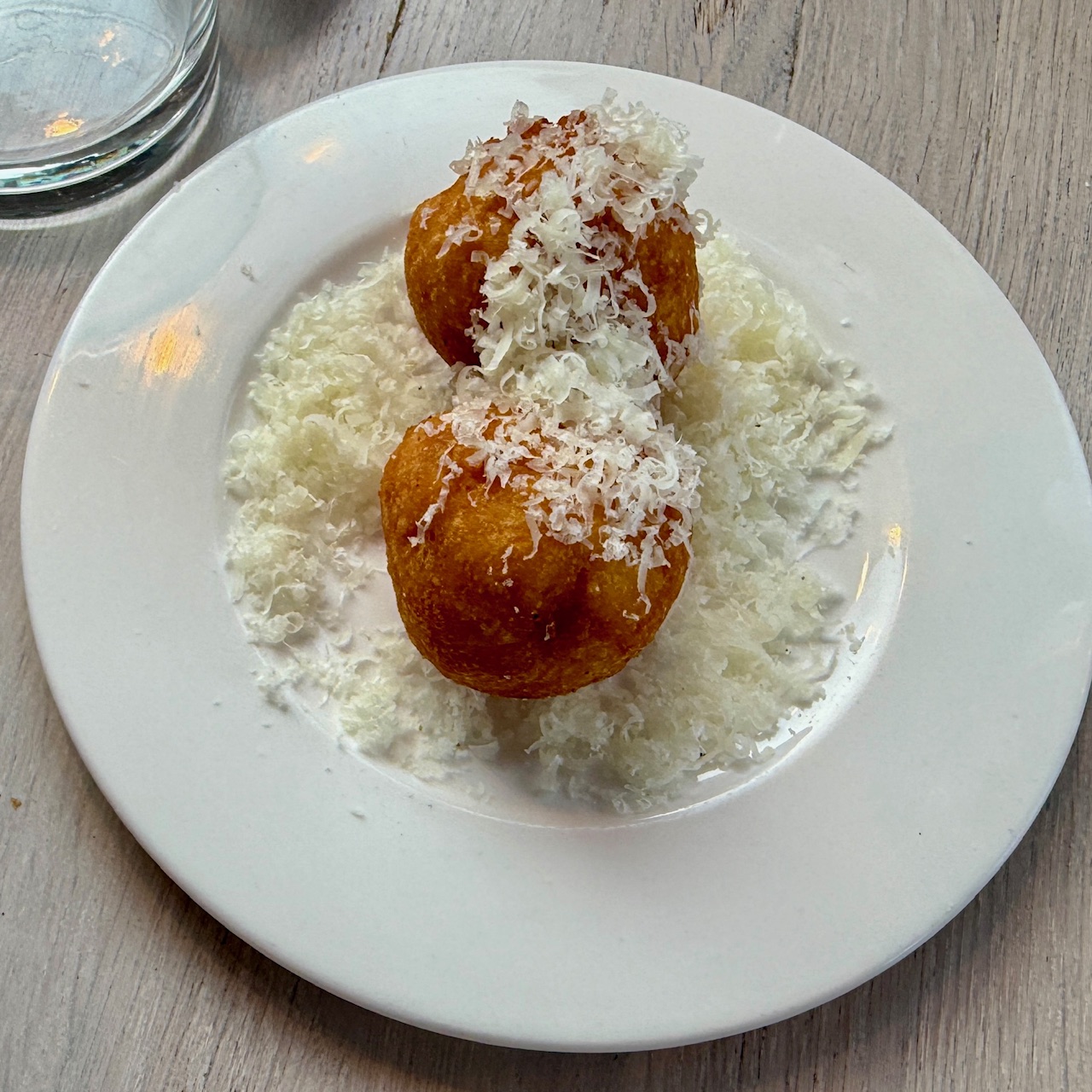
Slightly less successful, for me, was the one thing we had from the specials board. Crocche were little balls of fried, mashed potato, served carpeted with cheese. And as an exercise in texture they were a masterclass – such a light crunch, so ethereal inside. But texture isn’t everything, and for me these lacked the oomph I would have liked, especially at seven pounds fifty for a pair.

As it was when I ate at RAGÙ’s neighbours Lapin, I mentally compared this dish to the worldbeating cheese fritters at Upstairs At Landrace, and wasn’t convinced RAGÙ’s came out on top. I keep getting told off for comparing restaurants – some random said I spent too much of the last review talking about Clay’s – but how do you work out whether something is great or merely good without comparing it to other stuff you’ve had? Honestly, some people.
My absolute favourite of the small plates we shared was what came next. Prosciutto and melon could easily be seen as a throwback, the kind of thing we all thought we should be eating forty years ago. And I’m not sure when I saw it last on a menu, mainly because I suspect it’s the province of very trad Italian restaurants and, Reading not having any of those, I never visit that kind of place. But this dish, one of the best things I ate in the meal, was 100% comeback and 0% throwback.

First of all, the prosciutto was undeniably first rate – coarse and thick, the good stuff, free from the sheen that is the clearest tell that it had spent the last few weeks incarcerated in plastic. This stuff sang, and it wasn’t alone in doing so: the hunks of Charentais melon it was draped over were deeply sweet and fragrant, soft and unmissable. That alone might have made for a knockout dish, but RAGÙ knew when to add and, crucially, when to stop. So the Sorrento tomatoes in the mix added a different kind of sweetness, another dimension, and torn basil (and, I think, some more finely chopped mint) perfected matters.

It felt like a supercharged summer from the first mouthful to the last, the kind of thing you’d love to eat at home but, because you don’t have RAGÙ’s access to ingredients, you know you never will. That said, RAGÙ’s Instagram suggests they get produce from extra-fine greengrocer Hugo’s, a few doors down from COR in Bedminster. So if you live in Bristol, you at least have a fighting chance of recreating it.

The final dish in this phase of our assault on the menu was probably my least favourite, although I should say in fairness that Zoë loved it. I now realise I’ve not had friggitelli peppers before and I didn’t realise that they were dark, green, slightly bitter things, not a million miles away from padron peppers, which I’ve always been able to take or leave. They were served with confit tomato, which was actually a thin pool of liquid, and topped with grated, salted, aged ricotta.

So the fact that I didn’t like this might have been on me. Every component of it was well done – the peppers in particular were cooked nicely and slightly blackened – but I do think that its three elements didn’t cohere into a single dish. Something you sort of have to eat with a fork, sort of have to eat with a spoon, is sort of hot and sort of cold left me sort of both. But as the one outlier, it probably says more about my tastes than anything else.

That was all the sharing either Zoë or I felt like doing, so from that point onwards there was her dish and my dish all the way through to paying the bill. I don’t know whether everyone does that or not, but I remain unconvinced that some dishes – especially things like pasta – are really sharable anyway, unless you change ends at half-time, so to speak.

One thing we did share, though, was a beautiful bottle of Gavi which cost just shy of fifty pounds and felt worth it. It didn’t necessarily go with everything we ate, but having a lovely time did and it contributed its fair share to that.

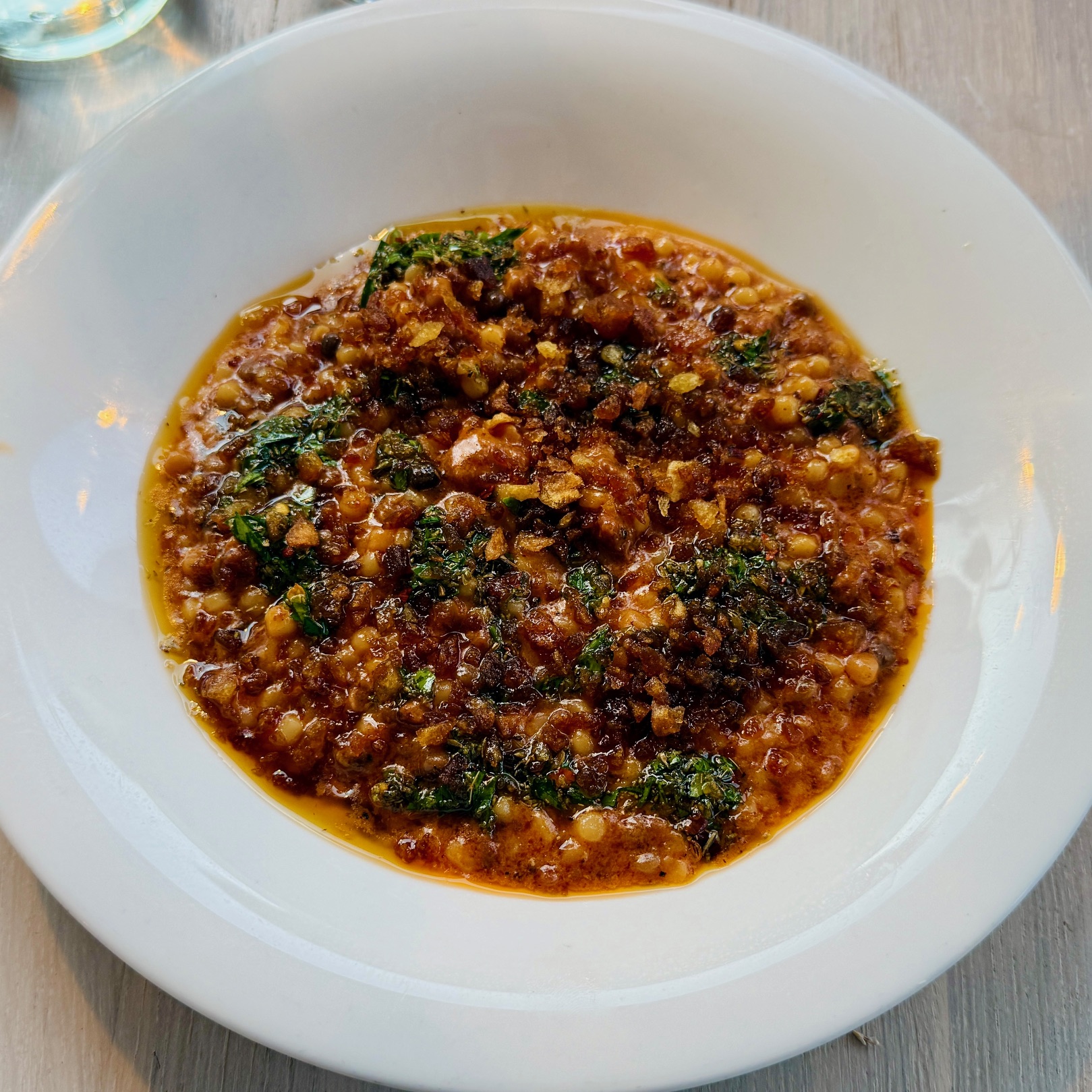
Zoë, for me, ordered the other dish of the meal. Billed as fennel sausage with fregola it was really so much more than that, a bowl of the most tremendous, intense, savoury joy. I’m not used to associating fregola with comfort rather than virtue, but here it was deployed as a supporting player with crumbled sausage, a painterly swathe of gremolata and a potato crumb.

And you could look at the picture down there and not really get all that, but this was entirely about surpassing the sum of the dish’s parts. Our friends James and Liz went to RAGÙ a couple of weeks ago, partly after hearing how much we’d enjoyed our meal, and I told James that this was the one dish he should make sure he ordered. He ordered it. He loved it.
Liz’s highlight, on their visit, was the dish I had next and which, to be fair, I knew she would also love. An exceedingly generous portion of tagliolini was possibly the platonic ideal of a comforting bowl of pasta, with not a strand out of place. The pasta was thin and fine, golden with egg and carrying just the right amount of bite, the crab delicious and cossetting.

But the whole thing was offset with lemon and a little spike of chilli, because RAGÙ understood that even cosiness is improved with a touch of something waspish. And the crowning glory was a beneficent scattering of pangritata, to add that textural cherry on top. As elsewhere in the meal, RAGÙ’s genius was an understanding of just how many components to load on a dish before saying “when”, and to make that hard work and judgment look free, easy and natural.

After this we had a lovely, leisurely pause before attacking our final two savoury picks of the evening. And this one was a score draw, with both of us admiring one another’s candidates but secretly thinking we had chosen better. Mine involved what I honestly think is one of the finest things you can eat, slow-cooked shoulder of lamb, pressed into a dense, cylindrical puck, where you know that every indulgent forkful will contain nothing but the epitome of this meat at its finest.

So far so Snobby’s, you could say, but RAGÙ, as at every point in proceedings, went one step further, finishing the lamb over fire to caramelise the outside. This dish gave me almost unseemly amounts of joy, and pulling apart those shreds, loading a fork with them, along with a ragu of peas and carrots and a delirium-inducing salsa verde was a voyage of blissful discovery that could never have lasted long enough.

A meal that contained this dish, or that crab tagliolini, or the sausage and fregola combo, would have been a meal to be reckoned with. To go to a restaurant with all three on the menu, where if you arrived hungry enough and paced things just right you could eat more than one of them, was close to nirvana. And all three of the dishes I’ve mentioned clocked in at less than twenty pounds: I’ve not found many dishes offering such impressive value this year.

Zoë would argue that her main – just shy of thirty pounds, this one – was even better. Enormous, butter-soft pieces of venison came strewn with splodges of sweet Gorgonzola, the whole thing bathed in bone marrow butter and aged balsamic vinegar. Almost like a tagliata, if every single ingredient in it had been amped up to be its absolute best. Venison, so often at risk of being dry, is very rarely like this. The cheese was perfectly judged – so yes, there was salt and funk in there but not just that.

And again, the artistry of how to finish the dish was right on the money – adding the depth of the bone narrow and all the complexity that aged balsamic can bring to a dish. A bit of a theme here: RAGÙ always knows when to stop, but they don’t stop until a dish is just right, unequivocally on the money.
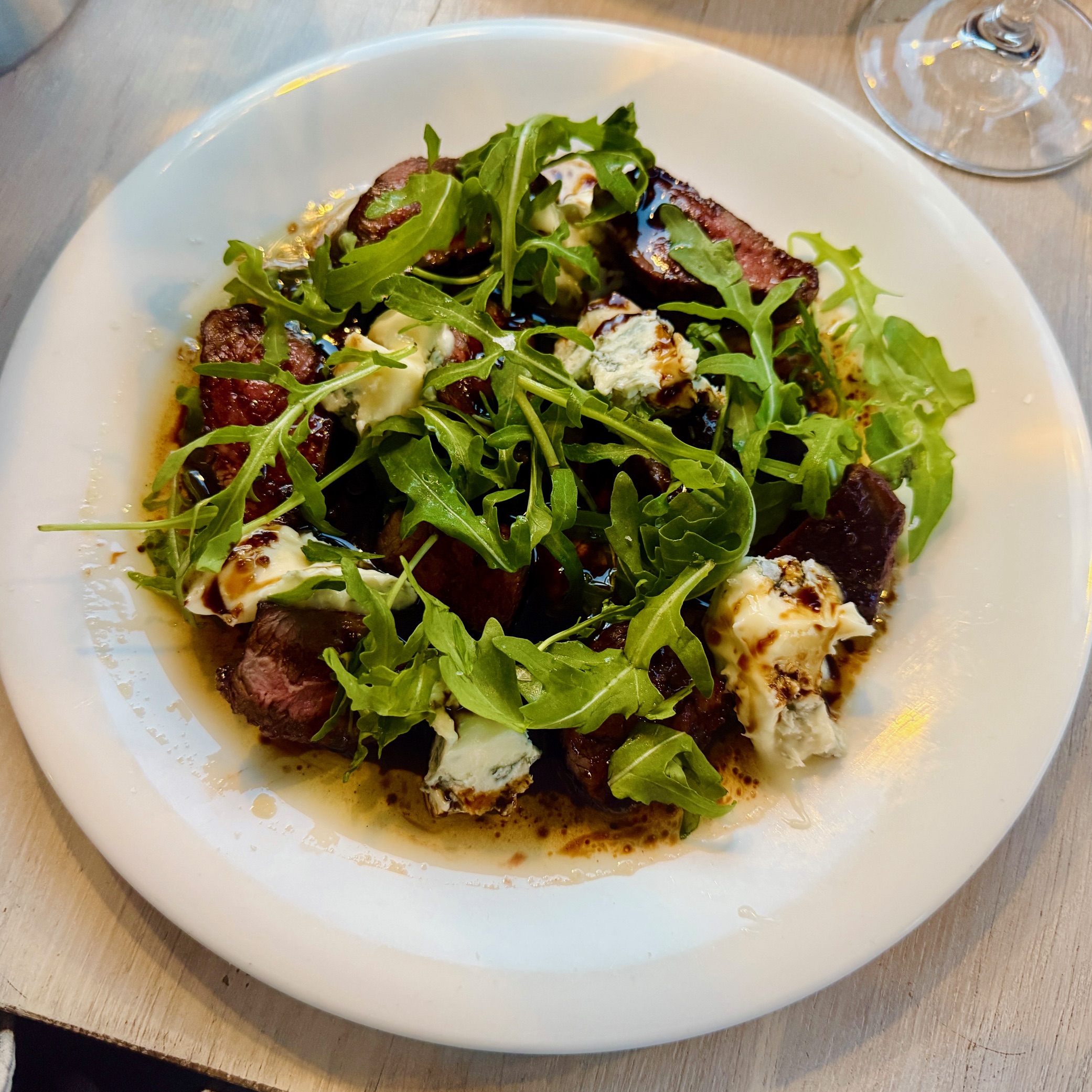
Now, you might look at that dish – brilliant though it is – and think this is another example of the phenomenon I observed earlier in the year at Gee’s, of being given salad in disguise. Because I’m a heathen, I might even agree with you on that, but we had a solution: more carbs (because heaven knows, the meal so far had been so lacking in them) in the form of patate schiaccate, boiled, crushed and fried potatoes which are a speciality of Calabria, or Trieste, depending on which Google result you believe.

I quite liked these, and that combination of boiling, bashing and frying made for sheer crunchy, crispy textural delight. I didn’t get masses of the rosemary or garlic, but when the potatoes have that many sharp, golden corners you overlook that completely, in my experience.

By this point, enjoying the last of our wine at our leisure, the restaurant was a calmer but equally lovely place to be. The best part of a couple of hours had passed since we took our seats, and the tables indoors had thinned out, although the terrace still hummed with a slightly more subdued energy. The sky was growing inky beyond the windows, and the staff were winding down slightly.

If anything I enjoyed watching the kitchen even more then than I had when they were busy and cooking: many writers better than me have tried to capture the camaraderie of a kitchen at many different periods in a restaurant’s day, using a variety of tools, but all I can say is that it seemed to me that I was looking at a brigade who genuinely liked one another, and that warmth and joie de vivre had permeated the whole evening. 

Service throughout my meal was brilliant, from all the people who looked after us, and it managed to nail the sweet spot where it was eager to please rather than oversolicitous, enthusiastic and informal rather than slapdash or chummy. After a series of meals that had disappointed me – both in Bristol and beyond, on duty and off – it was nice to be reminded: this is what it’s supposed to be like. A night like that can make you fall back in love with restaurants.

But there was time for one last thing to eat, accompanied by nectar of a glass of dark, sticky Recioto della Valpolicella in a very generous 100ml pour. Zoë, adhering to our unwritten law that if tiramisu is on a menu at least one of us needs to order it, lucked out with a delectable wodge of the stuff, carpet bombed with cocoa. It’s had a fair amount of attention online – the influencer I referred to earlier said it was “proper unruly” and “has got edges”, the latter of which is true of pretty much anything you eat, anywhere, ever. I’m sure he knew what he meant.

But yes, it was one of the best I’ve tried, and I’ve tried quite a lot. Influencer-speak described this tiramisu as “hit” with orange and nutmeg, which to the rest of us means it had orange and nutmeg in it. It didn’t bang, it didn’t slap – why are these half-wits always so drearily percussive about things? – but it was outstanding.

I, on the other hand, couldn’t resist the gelati. The two options were fior di latte gelato with aged balsamic or peach and basil sorbet, and I let you down by having two scoops of the former and none of the latter. But I couldn’t resist: I don’t think I’ve ever seen fior di latte gelato on a menu outside Italy, ice cream with the confidence to just taste of itself, no adjuncts or gimmicks, so I wanted to sample it.

I say that, but of course the adjunct was the balsamic vinegar, and it was transformational. Forget the humdrum pairing of having it with strawberries, forget tipping some Pedro Ximenez on your vanilla ice cream, this was the combination I’d been missing out on my whole life. You could try to recreate this at home, too, but everything you used would have to be unmistakably top notch, and I know that if I did it would fall short. Better to remember it here, this way, transcending sweet, salt, sour and savoury to create something that would persist in the memory.

I wish they’d brought it in a single bowl, mind you, rather than these two slightly bizarre individual portions. There, right at the end: something that looks like a criticism.

Our bill for two people – for all that food, a couple of aperitivi, an excellent bottle of wine and two glasses of dessert wine – came to just shy of two hundred and seventy pounds, including a 12.5% tip which was earned many times over. You may say that’s expensive. I say it’s exceptional value for what we had, and for an evening that I’ll remember as one of the best meals of this or any year. Only one dish – that venison – came in north of twenty pounds.

It’s funny seeing RAGÙ getting the attention that COR did not. For me, it feels like reading rave reviews of the sophomore album when you bought the debut (an experience, to be fair, I’ve also had more than once). But I’m delighted that Colsell and owners Karen and Mark Chapman are getting their moment in the sun, better late than never, because RAGÙ is as good a restaurant as you could hope to find. Despite being only a few months old, it already feels like a destination restaurant in the making.

Some people will prefer COR’s more spacious homeliness, many will make a beeline to RAGÙ for its more compact, more clamorous buzz. I can honestly say, though, that you wouldn’t go wrong with either, and you could read either’s menu and struggle mightily deciding what you could come to terms with leaving without eating. Such restaurants are rare, and any town is lucky to have one. A city with two, run by the same team, is fortunate indeed.

So it turns out a meal can redeem a holiday, after all.

RAGÙ – 9.5
Unit 25, Cargo 2, Museum Street, Bristol, BS1 6ZA
0117 9110218

https://www.ragurestaurant.com

Since January 2025, Edible Reading is partly supported by subscribers – click here if you want to read more about that, or click below to subscribe. By doing so you enable me to carry on doing what I do, and you also get access to subscriber only content. Whether you’re a subscriber or not, thanks for reading.

Restaurant review: Snobby’s, Bristol

Snobby’s, a wine bar and Italian small plates spot in Redland, has everything going for it, on paper. It is on one of Bristol’s most decorated gastronomic streets, opposite the critically acclaimed Dongnae and a few doors down from freshly Michelin starred Wilsons and Little Hollows, itself the holder of a Bib Gourmand. It’s received an approving write-up in the Financial Times and floppy-haired grifters Topjaw have featured the place.

It is, you would think, a safe bet. And yet it was at Snobby’s last week that I had arguably the worst – and definitely one of the strangest – experiences at any restaurant in nearly 12 years of eating out and writing about it. So, to channel my inner John Oliver, this week, let’s have a look at that. Because in the process I suspect we’ll find out a lot about what restaurants are supposed to be for, and what happens when they start to forget that.

So what went wrong? Well, it wasn’t the room, which is a really lovely space, all pale wood tables, Hans Wegner wishbone chairs and deep green wood panelling. You enter the dining room through a buzzy terrace, and it feels like a lovely spot to while away a couple of hours.

Zoë pointed out that the banquette sat a little too high, like it had been put in by a contestant on Interior Design Masters who never ate in restaurants, but it was a minor quibble. We arrived just after 8 and although many diners were al fresco there were still plenty in the dining room.

The problem wasn’t with the menu, either. It was a compact affair with a handful of nibbles and then seven dishes, priced between nine and twenty quid. The menu recommended two plates per person, adding Don’t forget to share!

As we were trying to decide our server kindly pointed out that they were running low on focaccia, so we decided to nab a portion before any more diners took their tables and snagged the last of it. It was delicious, salty stuff cut into cuboids, brilliant dipped in olive oil and balsamic. The salted almonds, glossy with oil, were equally good. This was a promising start, we thought, five minutes in. It was, with hindsight, the last point at which any of this felt normal.

So, by then it was time to order proper food; it must have been something like twenty past eight by then. Feeling like trying as much of the menu as we could, and being in no rush, we asked our server if we could order a few dishes to be going on with, and more after that.

“I’m afraid not” he said. “It’s just that the kitchen is closing soon.”

The exact time it shut was not specified, and we were too taken aback to ask for details. Was there no wiggle room on that, we asked? Apparently not – the thing was, he said, we were their last customers of the night. At twenty past eight. What happened to we might run out of focaccia?

Never mind, we thought. We could order everything we wanted to try and at least control the order that our dishes came out in, so we could still experience something like the evening we had in mind. Would that be possible, we asked? Ah, that would happen naturally, the server said. The lamb dish we’d ordered was the thing that took most time to cook, about twelve minutes, whereas a couple of the small plates, served cold, would come out faster.

Now, you could take this to mean one of two things. One might be that the kitchen, being in the business of hospitality, understanding how to pace and sequence dishes to give diners an enjoyable meal, would space things out to maximise the enjoyment of their customers. Or it could mean that the first couple of small plates would come out almost immediately and the lamb dish twelve minutes after that. Can you guess which one happened here?

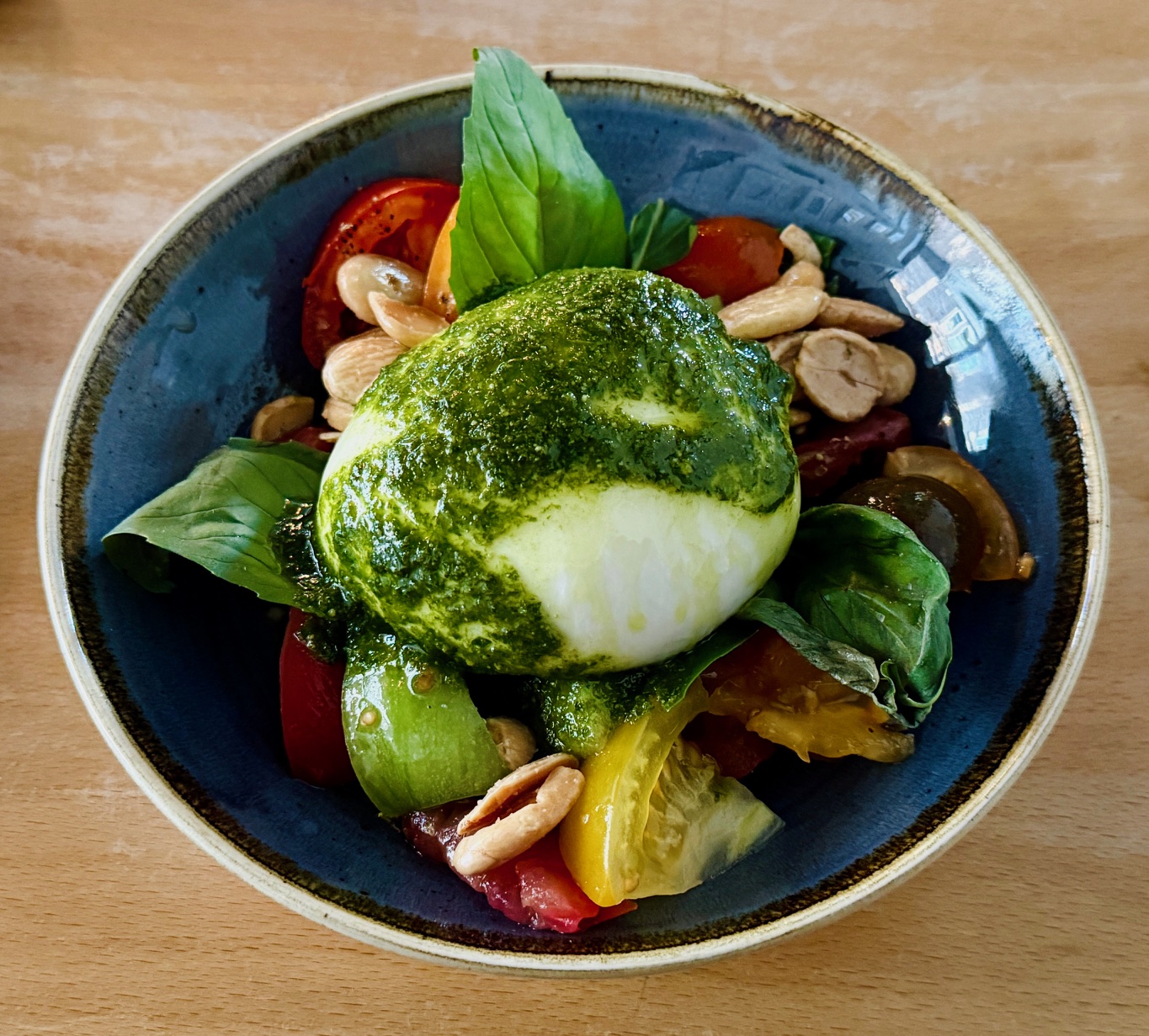
So yes, Zoë enjoyed her burrata dish, which arrived something like five minutes after we’d placed our order. It was more about buying than cooking, as this kind of dish often is, but everything was present, correct, nicely bought and displayed to its best advantage. The tomatoes, a bright array of red, yellow and green, were lovely and scattering the dish with more of those fried almonds was a nice touch, as was the slick of lush pesto anointing the whole shebang.

At exactly the same time, out came the monkfish crudo, which was less successful. It looked like a limpid pond of the stuff, micro coriander and thinly sliced radish floating on its surface, and I quite liked the orange and soya dressing and little spikes of some kind of seeds or peppercorns. But the monkfish felt too thick, coarse and meaty for the crudo treatment, and this, to me, just didn’t work.

I think it needed something more slight, translucent and refined, like the sea bass crudo I saw on the menu of another Bristol restaurant the following evening. But then maybe monkfish justified the price tag, at nearly seventeen pounds. At the price of a main in many restaurants you got a small plate here, whisked out mere minutes after we ordered it. Still, these two dishes had arrived close together, and the menu’s instructions said that we should remember to share, so perhaps it was okay.

Or it would have been if the next plate, a hot dish, hadn’t arrived literally two minutes later. Ricotta and parmesan gnudi – dumplings – came as a trio in an asparagus cream with more asparagus, petits pois and, allegedly, a miso butter.

I am not entirely sure that three dumplings encourages sharing, and I’m not sure it’s worth the best part of seventeen quid. But I’m equally sure that bringing it out at the same time that there are two other dishes already on the table hardly encourages sharing either. By the time Zoë got to trying any of this, it was lukewarm at best, as was her enthusiasm for the whole thing.

I nearly didn’t mention this, because it all happened so fast, but with all this going on and dishes turning up faster than we could make inroads into the dishes that preceded them, we also tried ordering some wine. The initial choice we’d gone for, we were told, was not cold enough, and so – amid the flurry of plates – we were also brought a possible alternative, which we didn’t massively like.

So we asked for an albariño, and the server who eventually brought it over was absolutely brilliant – enthusiastic about the wine, positive about the producer with loads of detail that brought it to life. It was the only example of great service we had all evening: Snobby’s should hang on to that person, and clone them if they can.

Meanwhile, with three dishes on our table and us struggling to eat them, along came the lamb dish we’d been told took twelve minutes to cook, approximately ten minutes after our first dishes turned up. You couldn’t fault the kitchen for efficiency, just for other things like understanding how meals are meant to work and the difference between a lovely meal out and Man v. Food.

And it’s such a pity, because the lamb dish showed, too, that you couldn’t fault the kitchen for talent. It was the nicest dish I had that night and one of the best things I ate all week – a slow-cooked, sticky, sumptuous cylinder of shoulder and leg, crying out to be pulled apart with a fork, resting on a moat of puréed cannelini beans and swimming in a decadent, reduced jus. Such a lovely dish, ruined by bringing it out as part of some kind of deranged conveyor belt.

Restaurant bloggers like to come out with a particularly wanky cliché where they say that restaurants take quality ingredients and “treat them with respect”. It’s empty nonsense, as if the alternative is to take them out, buy them a few drinks and then ghost them until the end of time.

But quite aside from that, treating ingredients with respect isn’t only about making a good dish out of them. It’s also about treating that dish with respect, serving it in a way that enables it to have its moment in the sun. That wasn’t happening here. And when you don’t treat your dishes with respect, guess what? You’re not really treating your customers with respect, either.

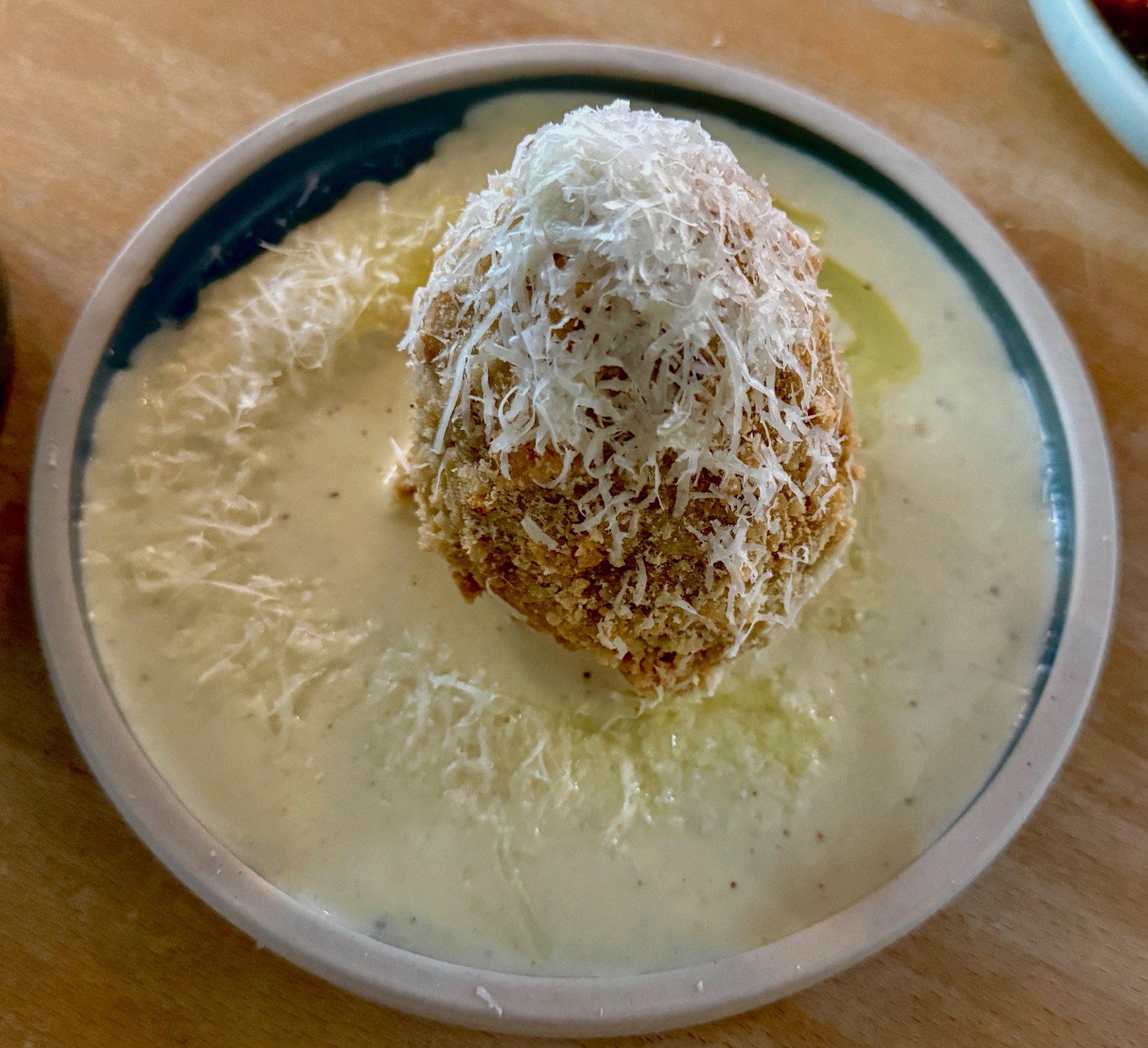
At the same time as the lamb, the arancino – that ideally we would have eaten closer to the start of the meal – had also materialised. Half an hour after we sat down, about fifteen minutes after we’d ordered, our five not that small dishes had all been brought to the table, leaving us scrambling to eat them before they went cold and moving our empties to the neighbouring unoccupied table for four (a minor gripe, but if they were going to bring it all out at once they could at least have put us on a table that could accommodate all that crockery: they had no other customers after all).

As for the arancino, Zoë had some and thought it was pleasant if unexceptional. It had scamorza in the middle, and a honk of truffle oil, but it was slightly big, stodgy and lacking in texture. She could only tackle a little of it and I decided that I’d rather eat the lamb, which I loved, than make inroads into the arancino.

Here’s the other thing: when a restaurant brings out five dishes – seventy-five pounds’ worth of food – in the space of ten minutes, not making any real effort to sequence them, you get too full to eat it all very quickly.

To emphasise how farcical this was, it was only around the point that the lamb and the arancino arrived that we finally got our bottle of wine. I thought it was rather nice, Zoë thought it too wasn’t quite cold enough. But we made up for that, because any residual warmth we had towards Snobby’s had well and truly vanished by then.

We struggled through some of the food, left half of the gnudi and half of the arancino, on account of it being too cold and our being too full. The plates were taken away without any questions in a strangely incurious fashion.

Normally this stage, when your empty dishes are taken away, is one for quiet and happy reflection. But instead, we both just gently fumed. You might expect that from me, but Zoë is as good-natured as they come, and this meal left her feeling positively aggrieved. It takes some going to piss her off, as her seven years and counting shacked up with me proves beyond reasonable doubt.

Chatting away about it, we couldn’t quite believe that we had been rushed through all those dishes at breakneck speed so that the kitchen could close – at twenty to nine, no less. And if the kitchen really did close early, perhaps Snobby’s should mention that to people making bookings at 8.15? Because they seemed quite happy to tell people making earlier bookings online that they only had the table for an hour and three quarters: it wasn’t as if this kind of communication was beyond them.

It got more ridiculous after that. Our food gone, and with a feeling that the wait staff were studiously avoiding asking us how it had been, we were left with the best part of a bottle of wine, with notes of stone fruit, citrus and… bleach? Yes, bleach: because at this point a strong waft of the stuff was emanating from the kitchen, obliterating any subtlety or enjoyment in the rest of our Albariño. Did the staff have a bus to catch?

Enough was enough, so we flagged down our server – the same chap who had told us the kitchen was closing and the food would come out as and when – to pay the bill and he asked us, in a perfunctory way, how it was. And that loosened the lid for both Zoë and I to say that no, actually, it hadn’t been all right. So we explained that we’d felt rushed, and not listened to, and that we couldn’t really understand how either the serving staff or the kitchen could have thought our evening was an experience anyone would willingly choose.

Zoë asked him, given that he’d previously told us the kitchen was closing, when exactly the kitchen shut. He said that it closed when the last customers had ordered. But, Zoë said, we were the last customers and we’d asked not to order all our food at once, so why were we railroaded into doing so? He had no answer to that.

Fair play to him: he listened, a little like a rabbit in the headlights, and at the end of it agreed to knock off our service charge. Which felt slightly like missing the point to me, because some of the service – especially the person who brought our wine – was excellent and really the problems were more fundamental than that. When two dishes had gone back to the kitchen half-finished, because the timing had been so completely out of kilter, a better step might have been to knock those off the bill.

And bless him, I’m sure he meant well when he said that he appreciated the feedback and that actually, it would help him in an ongoing debate he had been having with the kitchen. But what I took from that was that this had been an issue for a while, that it hadn’t been fixed, and that our crummy meal was collateral damage in the process of eventually resolving those problems.

I was delighted for their future customers who might benefit from that piece of learning, but it didn’t help us at all with our wasted evening. Our bill, with service knocked off, came to just short of one hundred and thirty-five pounds, for a meal that was over in something like thirty-five minutes. I know there is a risk, when you complain about an experience like this,that you might sound entitled. But really: would you have been happy with that?

The following day, I got an email from the owner of Snobby’s. I’d booked online and, having been tipped off by the staff, he contacted me via my email address. I explained to him what had gone wrong and, to his credit, he said that he needed to pick these points up with his staff. He said that he’d not been as close to the business in recent weeks, and that this was a timely reminder that he needed to do something about it. He didn’t refund anything, but did send me a voucher for the cost of the two dishes which we didn’t finish.

And that’s very decent, but I’m not sure I’d use that voucher, potentially throwing good money after bad. He said that he was sure I understood the pressure hospitality was under right now, and that the feedback would help them to survive in a competitive industry. I know that’s right, but the converse is also true: customers have less disposable income than ever before, and they simply won’t want to spend it on an experience like that. Eating out is more costly, so people do it less often, and when they do they don’t want to spend that kind of money and have an experience that feels sub-Wagamama.

The Bristol restaurateur Dan O’Regan (the owner of Lapin) writes a blog about running restaurants. In a recent piece he talked about kindness, saying that it’s “the only thing that’s ever made restaurants work”. He said that customers deserve warmth, and a feeling that they’re welcome, however much they are spending or whatever kind of meal they want to have.

I don’t say any of this out of unkindness myself. I could have not written this review, which is after all telling you not to go somewhere you might well not have gone anyway. But I did, not to vent my spleen – fun though that might be – but because this experience encapsulates something of what restaurants are supposed to do and how jarring it can feel when they drift from their purpose.

And it felt to me like Snobby’s had completely forgotten what the purpose of restaurants was, namely to look after customers, to make them feel welcome and cared for, and to prioritise their convenience over the convenience of the kitchen. Because if a restaurant’s aim is to minimise inconvenience to its staff, or even if it comes across that way, I can’t help but feel that somebody, somewhere, has put the cart before the horse.

A restaurant that does that, I think, has forgotten what restaurants are for and what makes them such wonderful places. They betray the promise that great restaurants make, the covenant they have with the customers that love them. And a meal is never just the food. It’s the food, the room, the service, the timing. In restaurants, as in comedy, timing is everything. Get that wrong and it’s closer to tragedy.

Anyway, fingers crossed that future customers benefit from the disappointing evening I had. I would really like to see Snobby’s turn things around, because it’s a lovely spot and it’s capable of cooking some excellent food. They might be redeemed, and I really hope that they are. But my voucher, I suspect, won’t be any time soon.

Snobby’s – 5.9
6 Chandos Road, Redland, Bristol, BS6 6PE
0117 9070934

https://www.snobbys.co.uk

Since January 2025, Edible Reading is partly supported by subscribers – click here if you want to read more about that, or click below to subscribe. By doing so you enable me to carry on doing what I do, and you also get access to subscriber only content. Whether you’re a subscriber or not, thanks for reading.

Restaurant review: Lapin, Bristol

This might come as a surprise to you – probably not – but for the best part of the last fifteen years my friends and I have regularly taken part in something called Poncefest. Nope, not a misprint. The idea was to take a day off, invariably a Friday, and go into London together for a bit of shopping, always for fragrance, followed by a fancy lunch somewhere, then falling into a pub before getting the train home. Something like the Finer Things Club from the American version of The Office, only even finer.

Having sacrificed whatever credibility I might have had with that opening paragraph, I may as well explain. So yes, these trips usually involved shopping at one of London’s great fragrance shops – Bloom or Les Senteurs – and then a gorgeous, drawn out lunch. We’ve done Medlar in Chelsea, Soho’s famous Andrew Edmunds, Portland in Fitzrovia, Calum Franklin’s renowned pies at Holborn Dining Room and doubtless other places I’ve forgotten. We’ve even been to Oxford, enjoying a very pleasant lunch at Pompette one Friday towards the end of the year, exchanging Christmas presents and cards and eating brilliantly.

The members of the Guild Of Ponces – because I’m afraid that’s what we call ourselves – have fluctuated over time. It started as Al, Dave, Jimmy and I, but then Jimmy fell by the wayside and my stepfather Ian decided to join our number. He chose to drop out after a while, but by then we had also recruited my friend James, a man who didn’t need to seek out the ponce life, because the ponce life found him.

Like the Spice Girls, we each have our own unique identity. Al is Sartorial Ponce, because he’s always immaculately dressed: the man’s had his colours done, for goodness’ sake. Dave is Reluctant Ponce, to denote the fact that he always complains about the whole affair but secretly loves it.

Jimmy, back in the day, was Pub Ponce, and in charge for picking the post-lunch boozer. Ian, who knows more about Apple products than many people who actually work there, was Tech Ponce, and James is Preppy Ponce – or Neophyte Ponce, a title our newest member always gets, like the Baby Of The House, or New Guy in Loudermilk.

I, of course, am Grand Master Ponce. Would you expect anything else by now? Mock all you like – I’m immune these days, thanks to my childhood years in chess club and Dungeons & Dragons club (both hobbies, too late for me, are cool now). I unapologetically love Poncefests. They’ve always been a lovely miniature escape in the year, when my friends and I can catch up, more than slightly aware of how ridiculous the premise is.

Anyway, that was all well and good, but then Covid happened, and it all went quiet for Poncefest. A risk averse eighteen months meant that I saw my fellow ponces sporadically, and never all at the same time. Even after things unlocked, for some reason we were never all in the same place at once. We were like the Beatles, or the Pythons, without the acrimony. I lunched with Dave and Al a few times – once even for this blog – but a Poncefest proved elusive.

Of course, all the ponces were there for my and Zoë’s joint stag and hen do last year in Bruges, and at the wedding too, but both were part of a bigger gathering rather than a reunion per se. And then James went and put a spanner in the works by being seconded to India for nine months, and those gatherings, now five years dormant, felt more of a distant prospect than ever. So I was absolutely delighted when he returned to Blighty in the spring and talk on our WhatsApp group (the logo is a picture of Niles and Frasier Crane holding up a sign saying WILL WORK FOR LATTES) turned to getting the band back together. Would it happen?

It may not surprise you to hear that it did, and one sunny Saturday morning at the start of May I found myself bimbling round sunny Clifton, really looking forward to a long overdue luncheon. I’d bumped into people I knew outside Hart’s Bakery, straight off the train, before taking a bus to Bristol’s prettiest, if most unreal district. I stopped for a latte in the sunshine outside a little kiosk called Can’t Dance Coffee, before walking in wonder through Birdcage Walk, too taken with the glimmer of the sun through the foliage to realise I was, in fact, going in the wrong direction.

After an amble through Clifton, past the spot where I was born – it’s now been turned into flats – I found myself ruminating on all the different paths my life might have taken, and how many of them involved me never having left Bristol, or leaving but coming back to live here. Too much time alone always has this effect on me, so I grabbed a bench in the Mall Gardens, put something relaxing on my headphones and got lost in my library book. Not long after Al joined me and, because old habits died hard, we stopped in Shy Mimosa, Bristol’s excellent perfume shop, before grabbing a coffee and a taxi to our lunch venue.

Lapin was back in the centre of the city, in Wapping Wharf, a part of Bristol I knew and knew of but had almost never eaten in, unless you count a slightly underwhelming pizza at Bristol institution Bertha’s. Most of it is shipping containers, stacked two storeys high, and it boasts some of Bristol’s biggest names. Bravas‘ sibling Gambas is there, as are the likes of Root and Box-E. This year it’s been bolstered with three big names: Gurt Wings, who opened at the start of the year, to an apparently shaky start; COR‘s younger sibling RAGÙ and Lapin, which is the second site behind the owners of Totterdown’s BANK.

I should stress, by the way, that all those irksome block capitals are their choice, not mine: I guess in a city with as many good restaurants fighting for punters’ cash maybe they feel the need to shout. In any event, I’d chosen Lapin for a couple of reasons – partly because as a French restaurant it seemed especially appropriate for such a gathering and partly because it was shiny and new. On the day we visited it had been open exactly a month, by which time it had already received not one but two reviews from Mark Taylor, Bristol’s resident Reach plc hack. I on the other hand gave it a month to settle in, because that’s what I do.

It was a very warm day and Wapping Wharf was full of people younger, thinner and less fearful of hangovers than me, many of them sitting outside either at Lapin or its neighbours Gambas and Cargo Cantina. The place had the glow of youth, of sunlight diffused through an Aperol Spritz, but because I partly wanted to get a sense for the room we sat inside. Dave was already there – slightly early, because he is Dave – and James joined us shortly after, slightly later than us, because he is James. The natural order was very much in place.

The dining room, by the way, is rather nice. I think the nicest thing I can say about it is that you could easily forget that you were eating in a few shipping containers joined together. I tend to associate them with street food or Boxpark, with places you don’t linger, so I was glad that they’d turned these into a very convivial space, and one where there was quite enough daylight coming in from the big floor to ceiling windows. It was pretty no-frills, but just tasteful enough: sage walls, framed retro prints, tasteful overhead lights, sturdy, timeless furniture. No Tolix chairs to jam my arse into, I’m delighted to say.

Lapin’s menu was that especially challenging kind that felt like it contained no poor choices. Half a dozen starters, or a whole baked cheese to share, and another seven mains, again with three sharing options. On another day you would be reading about asparagus with sauce gribiche, confit duck with a spring cassoulet – whatever that is – Provençal fish stew or deep fried rabbit leg: the latter turned up at a neighbouring table towards the end of our meal and made me wish I could go back and start again.

Starters stopped just short of fifteen pounds, mains ranged more widely from just under twenty to just over thirty. The sharers were more expensive – côte de boeuf, for instance, clocking in at ninety-five pounds – sides were about a fiver, desserts just shy of a tenner. Little of that, in 2025, is especially shocking. The menu, under a section marked Accoutrements, gave you an option to add a spoon of caviar or a shaving of truffle to any of your dishes, and I was surprised by that: in a place defined by taste and tastefulness it felt – dare I say it? I guess I do – ever so slightly tacky.

But before the main event, drinks and nibbles. Lapin’s selection of apéritifs was tempting and extensive, and I think the four of us chose roughly in line with our ponciness. Al, easily the most refined, kept it classic with a Lillet Blanc. James and I, the next level down, had a cidre – Galipette – which was awfully nice, although now I’ve discovered you can buy it from Waitrose and Ocado I almost want to salute Lapin for their exorbitant markup. Dave, though, chose best with something called a demi peche, a keller pils with peach syrup. Don’t knock it til you’ve tried it: Dave recreated it the following weekend at home, which was an exceptionally good idea.

We had a quartet of Comte gougères with that, and I thought they were decent but perhaps not too inspiring. The filling was good, the carpeting of finely grated cheese always welcome but the pastry itself lacked the lightness of touch it needed. At twelve pounds for these, I couldn’t help but compare them with the gorgeous cheddar curd fritters I’d had at Upstairs At Landrace a few weeks before, which had cost significantly less.

Now, when I review in a pair I always feel like I have to have something different to my dining companion, to present a range of dishes. That’s less of an issue in a bigger group, so as it turned out Dave and James ordered the same starters and mains, as did Al and I. Even at the time, I have to admit that I was thinking This is the life, I’m in a lovely restaurant with three of my favourite people, the wine is flowing… and I have less to write up than I might have done. Unworthy I know, but there it is.

Dave and James were pleased with their starter, I think. A puck of deep fried pig’s head was the good part, and the forkful I had was great. Plonking a forest floor of chicory and dandelion on top of it, though, was less successful. I don’t think either is really anybody’s favourite salad ingredient – not as pointless as frisée, but not far off – and the nicest croutons in the world aren’t going to redeem that.

Al’s and my starter was similarly along the right lines but not at its destination. I adore rillette, I adore rabbit, the prospect of rabbit rillette was a nailed-down choice for me. And it was pretty pleasant – clean and ascetic rather than punchy and rustic. I loved the carrot jam, and thought the dish could have stood a bit more of it. The bread, I’m sorry to say, was unremarkable. And somehow the whole thing combined to less than the sum of its parts, even with a few rogue cornichons secreted away.

This dish troubled me, if that isn’t a silly way to put it, because I should have loved it and I’m not sure why I didn’t. It felt too nice, too well-behaved, like an attempt to create a platonic ideal of a dish rather than the dish itself. As it happened, I was of course in France the week after I ate at Lapin, but it wasn’t the meals I had in Montpellier that came to mind when I weighed up this rabbit rillette. It was the unforced, unshowy kind of dishes I had earlier in the year, at Paulette.

We also, out of pure greed, ordered another starter to attack between the four of us. Duck liver parfait was, again, a pleasant, glossy little number, hiding in its ramekin under a layer of cherry. The menu called it “pickled stone fruit” but really, it wasn’t clear that any pickling had taken place. Again, this was nice rather than knockout – and, again, it highlighted that Lapin’s bread wasn’t the best. And that you could have done with more of it.

By this point, whatever misgivings I might have had about the starters, our meal was in full swing. There’s something lovely about that interplay with good friends – that mixture of catching up and reminiscing, of mild ribbing and in-jokes. All that was helped by an extremely good bottle of wine – a Languedoc white by Domaine Montplezy, not bone dry with notes of peach and citrus.

As it happens, I found that wine the following weekend in Montpellier at the wine shop round the corner from our B&B. We bought a bottle and again that means I got a good idea of Lapin’s markups, which are considerable. But perhaps that misses the point, and perhaps ordering a whole bottle of something does too: one of the things that is genuinely impressive about Lapin is that its whole wine list is available by the glass. Someone has spent a fair amount of money with Coravin, and it gives you an enviable range of choices compared to most restaurants I can think of.

If the starters were a little wobbly, the mains are where Lapin became far more sure-footed. My and Al’s skate wing was a really joyous plate of food, served in a vadouvin butter rather than the conventional beurre noisette that so often accompanies this fish. And that in itself was interesting – vadouvin is a mild curried sauce that originates from the French colonial period and you could almost taste in it the intersection between traditional and colonial French.

It wasn’t a conventional brown butter sauce dotted with capers, and instead came topped with monk’s beard, but in it you could sense some of the DNA it shared with the classic dish. It was little like those pavement cafés in Marrakesh’s Ville Nouvelle that, despite being stuck on the edge of northern Africa, feel like they carry some echo of Paris. I wouldn’t pick this over a more traditional rendition, but that doesn’t mean I didn’t like it.

James and Dave went for perhaps a more mainstream option from the menu, a whole truffle roasted poussin with a Madeira jus. This, to me, was probably a stronger choice – the truffle present but not dominating, the meat beautifully cooked and that jus setting off the whole shooting match. James very generously let me try some, and although I enjoyed it it didn’t make me wish I had ordered it.

That tells its own story, I guess, that I still wondered whether the real gem was elsewhere on the menu, undiscovered. But again, that might tell you more about me than Lapin: I can already picture Dave, at some point over the weekend, reading this review and thinking What is he going on about? That poussin was amazing.

The sides were a weird inversion of the natural order and a good example of how expectations can be completely confounded. The menu offers duck fat frites, and all four of us could think of nothing finer. But when we went to order four portions our server – who was excellent, as all the staff at Lapin were – suggested ever so nicely that this might be a bit monotonous and that we might want to mix it up a bit with some pomme purée.

So we did that, and were rewarded with an experience that is pretty much solely worth visiting Lapin to enjoy. The duck fat frites were decent rather than exceptional, but compared to the pomme purée they became more like “fuck that” frites. Because the pomme purée – no hint of hyperbole here I promise – was one of the best things I’ve eaten in years. Loaded with butter until it could take no more, than bathed in more brown butter, it took on a taste and texture that transcended savoury or sweet, almost with a note of toffee, or fudge.

Al told our server, when the empty dishes were taken away, that you could have served it as a dessert. He wasn’t far off: it was truly magnificent stuff.

Before dessert, three of us had an intermediate course, the Trou Normand. This is a Normandy tradition, a palate cleanser consisting of apple sorbet anointed with apple brandy. It was very good indeed, the sorbet smooth and hyper-real with the taste of apple.

The apple brandy, from Somerset, was excellent too. The menu said that you could add a glass of Calvados for an extra four pounds, although it wasn’t clear whether you would get Calvados on the side or whether the apple brandy would be swapped out for Calvados.

Whichever it was, the pricing of this felt a little awry: eight pounds felt like a lot, twelve in total for Calvados would have been like, well, like paying an extra thirteen pounds to dump a spoonful of caviar, randomly, on your main course.

Before dessert proper we’d also decided to push the boat out and order a bottle of dessert wine. Dave doesn’t do wine these days – he stayed on his demi peche during dinner – but he makes an exception for dessert wine. Again many of the dessert wines are available by the glass, and the menu pairs one with each of the desserts, but we couldn’t resist. Lapin also offered two really tempting bottles – a Rivesaltes Ambré 1978 for a slightly ridiculous amount or a 1992 vintage of the same wine for eighty pounds. Don’t judge, but we had the latter, and it was ambrosial.

Our server explained, in a “look what you could have won” kind of a way, that by most standards 1992 was still quite young for this wine but we were very happy with our choice nevertheless.

“1992, the year we met” said Dave to me, as we took our first heavenly sips. Suddenly I felt like however old the wine was, I was older still. But in any case there was much to celebrate, so I thoroughly enjoyed a wine as old as one of my oldest friendships. The wine has aged well, the friendship even better.

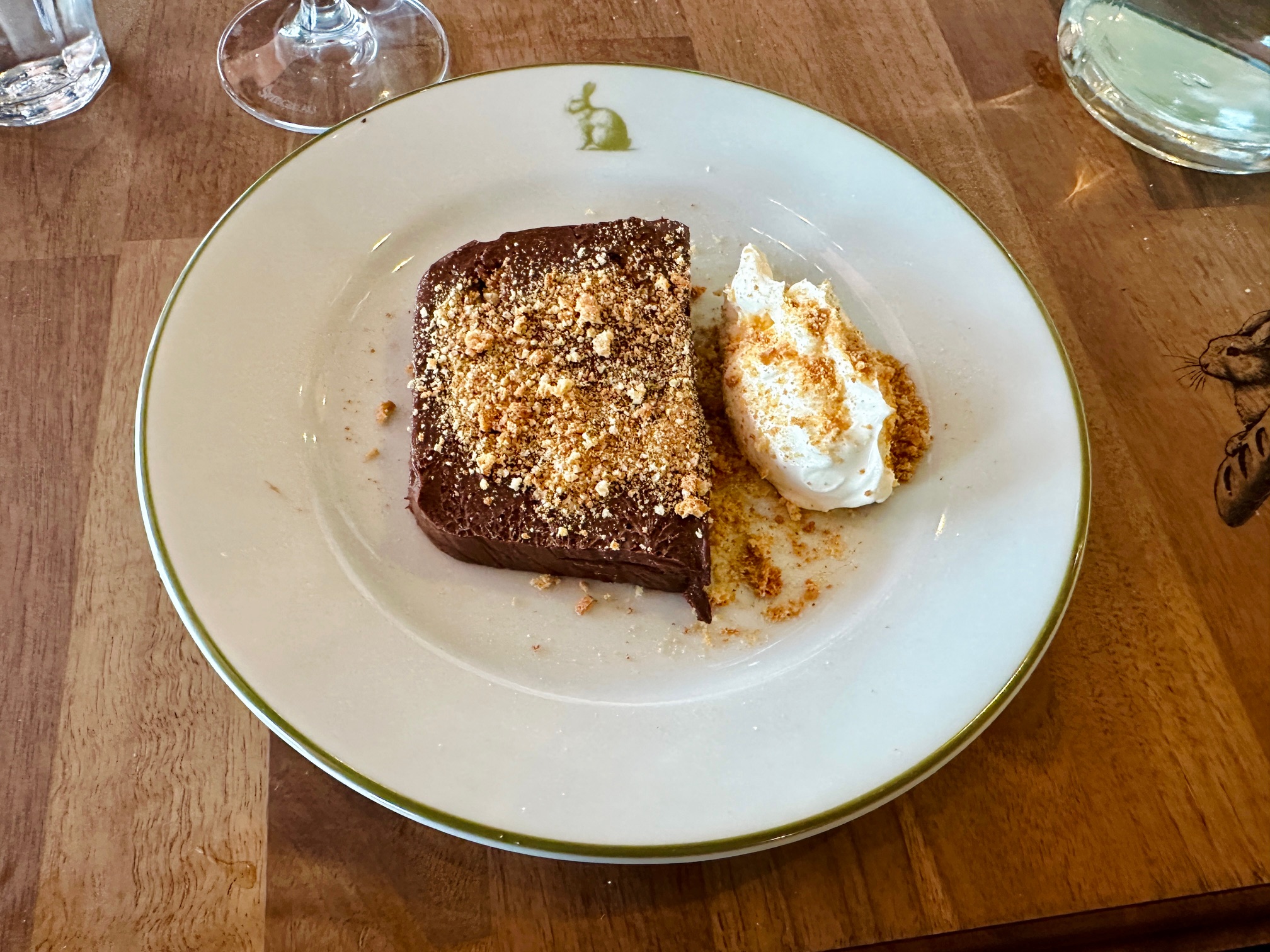
We tried a decent range of the desserts. I think on this occasion Al and I chose best with the St. Emilion au chocolat. I’ve never heard it called that before but it was an extremely nicely done ganache, a not ungenerous portion of it, topped, I think, with crumbled amaretti biscuit and served simply with terrific crème fraiche. I was always going to gravitate towards this dessert and, however good the others were, I would struggle not to order it again.

I think the other candidates were more workmanlike. Dave enjoyed the pain perdu with apple and vanilla ice cream, again crumbled with the good stuff to lend texture, with a shiny, sticky sauce. I expect if I ordered it I would have liked it too, and I imagine it went better with the dessert wine, in terms of colour coordination if for no other reason, than my overdose of chocolate did.

James ordered the Basque cheesecake, but neglected to take a picture. In fairness, you probably know what a Basque cheesecake looks like. Imagine one of those, with some rhubarb on the side. That’s what James had. He liked it, and Dave reminded me that it’s ridiculously easy to make which is why he never orders it in restaurants. I still have the WhatsApp message he sent me, with the recipe, favourited on my phone. One of these days.

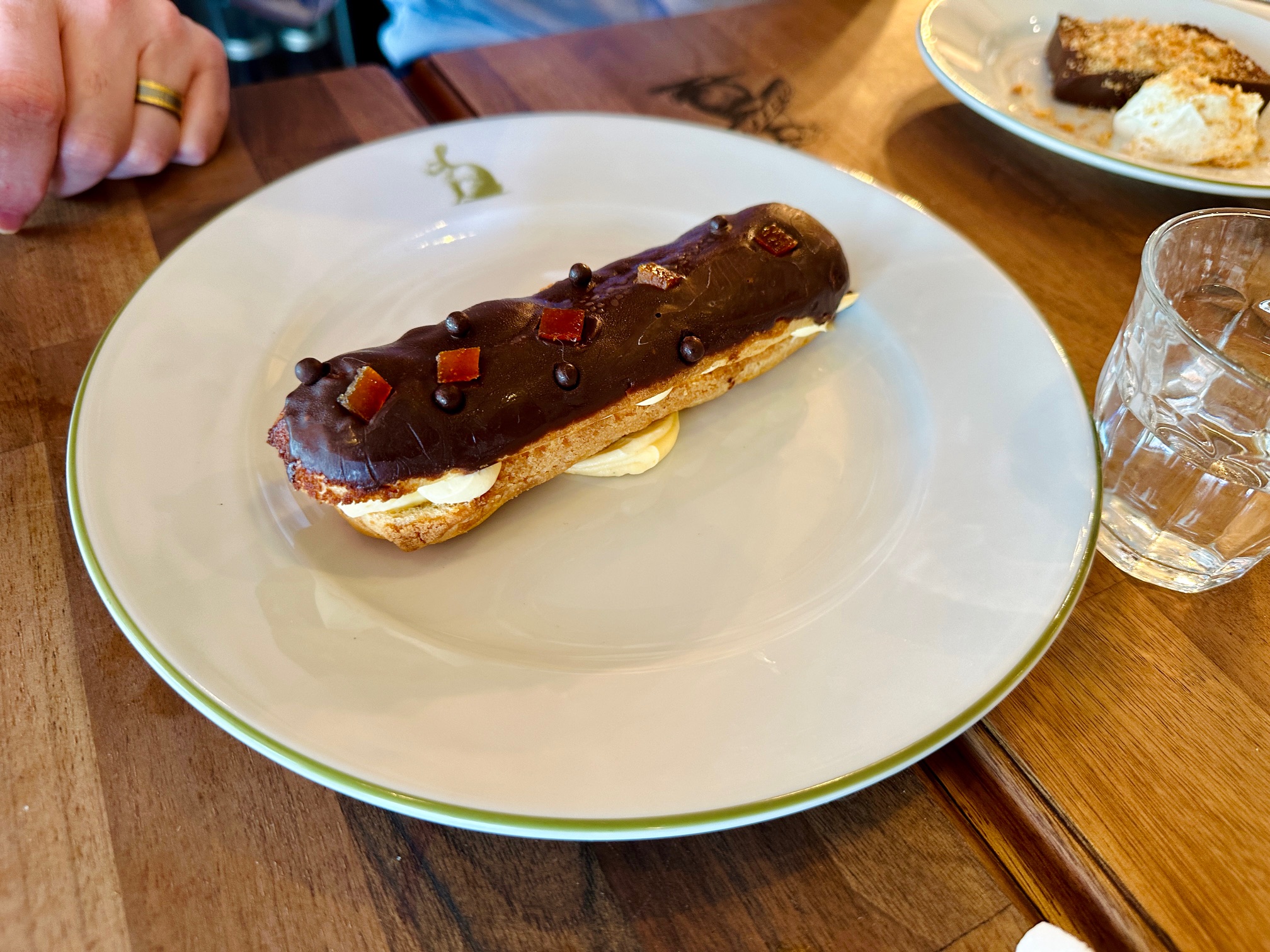
Al is legendary for ordering two desserts, very much following in the footsteps of the great Nora Ephron who always held that this was one of the most important life lessons she ever learned. Technically if you count the Trou Normand and about a quarter of the Éclair Suzette we ordered to share between us, this meal constituted a personal best.

We’d ordered the éclair on the advice of our server and again, it had some nice touches – the candied orange on top, the Grand Marnier infused crème diplomat inside. But again, Lapin’s touch with the choux let it down. It was leaden rather than ethereal, and took some sawing through. As a finishing touch to the meal it summed up some of the inconsistencies, and gave me something to think about.

Our meal for four, including a 12.5% service charge, came to just shy of five hundred and twenty pounds. Now, after you’ve had your sharp intake of breath, I have to say that doesn’t feel like poor value, at all, for what we had. We had something like five courses each, and even then we threw in a couple of extra things to try. We had apéritifs and two bottles of wine, one of which was from the deeper end of the list.

All things considered, I think about one hundred and thirty pounds each isn’t at all bad, for the afternoon we had. If you’re going to spend that kind of money, you should feel like you get this much living for it. It made me feel sad for my poor friend Jerry, parting with a hundred pounds for an infinitely less enjoyable meal at Gee’s not too long ago. Besides, expense be damned: this was Poncefest, it’s not like we were going to settle for a Happy Meal.

You might ask, given all that, why the rating down there is what it is. You might feel that this reads higher than that, or lower, and I would have some sympathy. When I think of meals I’ve had in Bristol, Lapin is really pretty good. But something stops it, for me, being in that upper echelon, with the likes of Caper and Cure, or Marmo. Or, if you’re comparing French meals with French meals, something prevents it reaching the standard of Paulette.

I keep coming back to that rabbit rillette, pretty close to being an eponymous dish for this restaurant. I keep remembering that it was nice and clean and pure and rarefied. And it’s not because Lapin is in a shipping container, because as I said the place managed to make me completely forget that. But Lapin, for all its excellent qualities, ever so slightly felt, to me, like a brilliant piece of cosplay, more than a French restaurant.

You could say that there’s nothing wrong with that, and I might agree. But that’s what stopped it, as far as I was concerned, attaining true greatness. I wouldn’t rule it out that at some point they will get there, and I imagine enough people in Bristol will rave about it to sustain it on that journey. In the meantime, it has a single dish that almost merits a pilgrimage, even if it’s a mere side, and it played host to a marvellous, long overdue reunion. When the ponces assemble next – in a suitably effete way, I can assure you – Lapin has set a standard we’ll be very lucky to exceed.

Lapin – 8.6
Unit 14, Cargo 2, Museum St, Bristol, BS1 6ZA
0117 4084997

https://www.lapinbristol.co.uk

Since January 2025, Edible Reading is partly supported by subscribers – click here if you want to read more about that, or click below to subscribe. By doing so you enable me to carry on doing what I do, and you also get access to subscriber only content. Whether you’re a subscriber or not, thanks for reading.

Restaurant review: Bosco Pizzeria, Bristol

Zoë and I wound up in Bristol on the Saturday before Christmas because my friend James was having a barbecue to mark the end of what he refers to as the “grilling season”. Its boundaries are somewhat amorphous, because James likes to barbecue at almost any opportunity, but as far as I can gather the grilling season starts around Easter and ends at some point before New Year’s Eve. I can’t say that with any confidence though, because I wouldn’t put it past James to grill meat in the dead of winter too: it would make more sense to you, if you’d met him.

But anyway it was an evening do, and that left me with one final lunch in Bristol before the year was out. And rather than try the hot new place – assuming I knew where the hot new place was, of course – or one of the Bristol restaurants on my radar like Bank, Native Vine or The Clifton, I decided to go for a safe bet. What can I say: it was the end of the year, my last opportunity to eat on duty in 2024 and, just this once, I wanted a guarantee of what the festive season always promises, comfort and joy. So I chose Bosco Pizzeria, situated near the top of Whiteladies Road, before it meets The Downs.

I first went to Bosco the best part of a decade ago, when it was very much Bristol’s pizza pioneer, and although I hadn’t been back for some time I always had it down as a reliable banker for somewhere good to eat in the city. Since it first opened its fortunes had ebbed and flowed, opening a second branch in Clifton, closing it and reopening it, closing the Whiteladies Road branch due to Covid and then taking a long old time to reopen due to a fire. Other branches in Cheltenham and Bath had followed, and a sister restaurant called Pizzucci offering a more American, less Italian experience down the Gloucester Road.

But I’d always seen it as a sure thing, and a standout even as other pizza restaurants came and went in Bristol. I reckoned it was as good as Flour and Ash – the original one on the Cheltenham Road that Jay Rayner got worked up about that is, not the sanitised relaunched one on Whiteladies Road which I haven’t visited. And for my money it was better than the much-hyped Bertha’s on Wapping Wharf, which wasn’t quite as good as I’d expected it to be. I couldn’t definitively say it was the best pizza in Bristol: after all I don’t live there, and I’m yet to try the likes of Pizzarova or CanCanPizza, but I could say that it took some beating.

And it was a lovely, busy spot the Saturday before Christmas. They’d slightly rejigged it since I was last there, the front section buzzy and full of smaller tables, the one out back made up of booths for larger groups. You could sit up at the bar, which some people were doing, and it had that lovely air of a place where people, like me, were putting their cares to one side for a couple of hours and treating themselves. Christmas decorations were tasteful and muted, wreaths in the window, baubles running along the tops of the banquettes. My wife took a photo of me, sitting there all happy: I liked it enough to use it as a Facebook profile picture.

Bosco’s menu was split into sections – about half a dozen if you count salads, which personally I rarely do. Apart from salads there were cicchetti, a selection of meats and cheeses, plenty of permutations of pizza, a small range of pasta dishes priced as mains and a few bigger dishes (or, as they put it, “large plates”) – ribollita, parmigiana and what have you. It was, I reflected as I tried to make choices, exactly the kind of menu you always hope to see in mainstream Italian chains but never do. It struck me as the sort of place Maidenhead’s Storia was aiming to be. Zoë sipped a very good negroni, I sipped arguably an even better negroni sbagliato and gradually we honed our selection, sequencing them like a mix tape.

The first slight stutter came when we ordered. I said we’d like a couple of cicchetti, then a mixture of meats and cheeses, then our pizzas.

“We’ll bring out all the smaller dishes at the same time, is that okay?” said our server.

Now, I very much wanted to say no, actually, we’re really happy to be here and we’re in no rush so can we have the cicchetti first, then the other bits and then the pizza, like we asked for? And I would have done, but my wife gave me a look which very clearly said could you not be a restaurant reviewer, just this once? so I kept my mouth shut. It hasn’t stopped me mentioning it here, obviously, but it did irk me – what was the rush? It had that feel that Wagamama always has, that the kitchen’s convenience is the primary concern, not your experience.

And it did literally all come out at once, in the space of a couple of minutes, causing not just a sequencing problem but a logistical one too, the table barely big enough to hold five small plates at once. We prioritised the calamari, as the only hot dish we’d asked for, and it was decent but flawed. The thing I’m always watching out for here is the bounce and twang of squid that needed to be fresher, and Bosco avoided that pitfall. But in its place were brittle sticks of squid, almost like Clifton Nik-Naks, which managed to be both pale and overcooked. We squeezed the lemon, dipped in the aioli but neither could totally redeem the raw materials.

The anchovies also misfired. These were billed as coming with salted butter – as they had at Brutto – and focaccia, and almost did but didn’t quite. Instead they came with very good focaccia but swimming in extra virgin, oilier than a Bluesky reply guy, shallot finely diced on top. Is it wrong that I took against them for still having the skin on? Maybe, but it fooled me for a second into thinking these were more like vinegary boquerones than taut, salty anchovies. That wasn’t right – they were intensely salty – but somehow the texture of them didn’t feel quite as I expected.

It was either cognitive dissonance or cognitive disappointment, but I couldn’t work out which. Three anchovies for seven pounds felt a little steep, but I guess you were paying for the focaccia as well. And I liked the focaccia, as I said, and I know it wouldn’t have gone as well with butter as with olive oil. But the whole thing felt a tad disjointed.

Bosco has always excelled for cheese and charcuterie, and the menu gives you an appealing range of both which you can mix and match in the most middle class multibuy of all time. My favourite of the cheeses was the one I neglected to photograph, a gorgeous Robiolo which was soft but not stinky, complex without being overpowering. It was great with the focaccia, which begged the question of how you’d eat it if you hadn’t ordered the anchovies. Almost as good was a Gorgonzola dolce which I liked and Zoë loved – simultaneously sweet and salty and very well balanced.

But again, without the focaccia it might have been messy to eat. I know that this kind of thing – getting in nice cheeses and cured meats, keeping the former well and slicing the latter thinly – is more about buying than cooking, but that doesn’t detract from the fact that many Italian restaurants don’t do this very well. Bosco’s years of experience showed in this respect, in cultivating excellent suppliers, buying the best stuff from them and not mucking it up. It can’t be that easy: if it was, it wouldn’t be so rare.

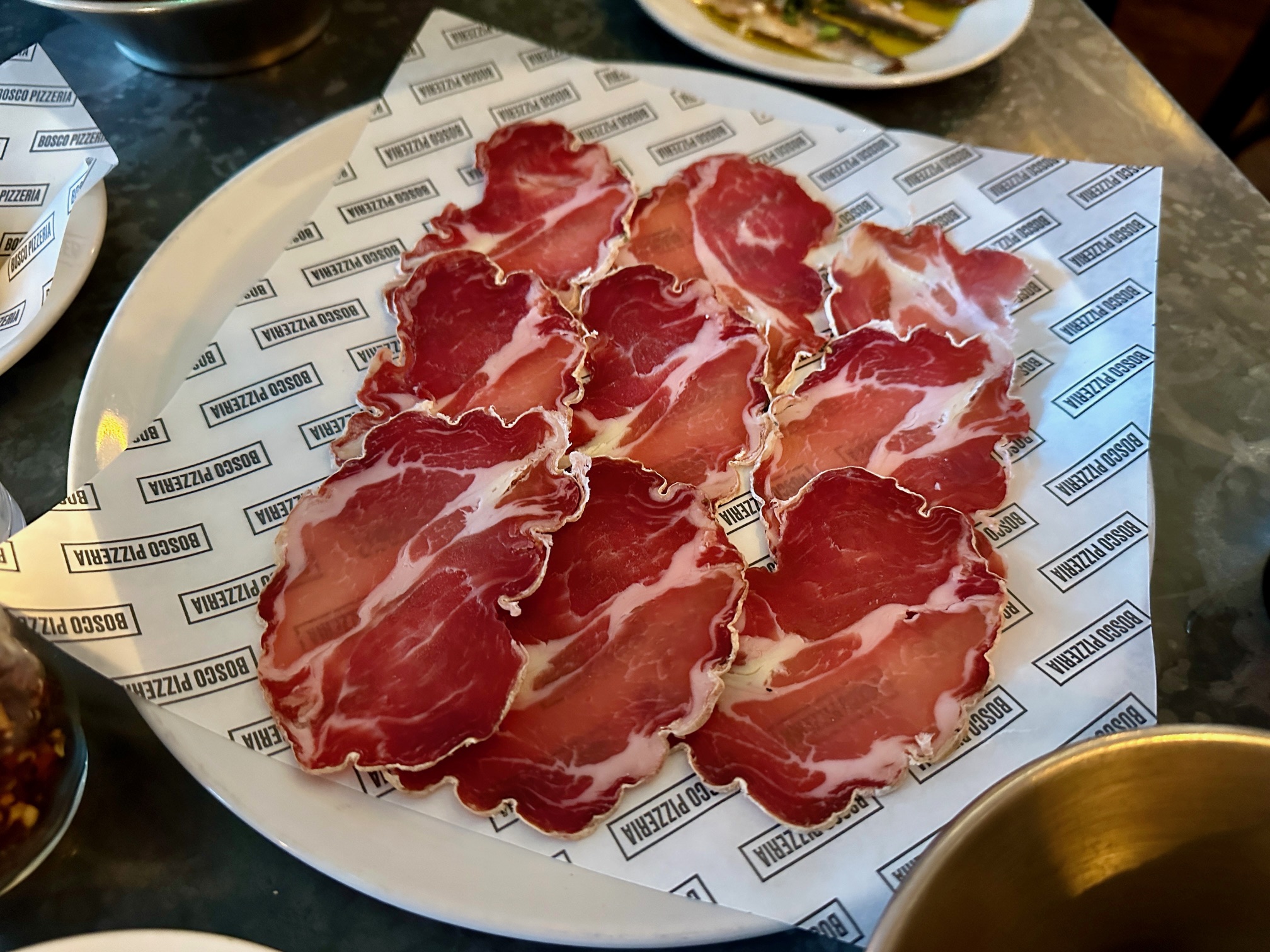
Oh, and the coppa was divine. Clearly sliced there and then, not exhumed from leaves of plastic, with that dryness and nuttiness that marks out the best specimens. This was the one thing that didn’t need bread at all, it just needed to be picked up and polished off, with or without a soupçon of cheese. The natural order had been restored, and I remembered just how good Bosco can be. We flagged someone down for another couple of sbagliatos: even though our reservation had been for a late lunch, the dining room showed no signs of thinning out.

Maybe the staff had got the message that we weren’t in a rush, or maybe they were just too busy to rush us, but there was a decent interval between our plethora of small plates and the main attraction.

Either way I was reminded, during that time, of lots of things: what a nice room it was, and how my many visits there had all been at different stages in my life, during a decade where almost everything about my life – what I did for a living, who I did it for, where I lived and who I lived there with – had changed, the only constant being this blog. I’d never been to Bosco with Zoë, and it made me happy to share this room with her at the end of a year itself full of changes.

I was also reminded, almost as much, just how nice a well made negroni sbagliato can be, but that’s probably beside the point.

Zoë and I reverted to type in ordering our mains, that comfort and joy thing again. Her pizza was the ventricina, a very Zoë choice with spicy salami, chilli oil and honey. She loved it, as I expected she would, and it showcased what Bosco did really well – an exemplary base, a chewy, bubbled crust with plenty of blistering, a deep tomato sauce, winningly fruity. This was as good an advert for Bosco as you could hope for, and at thirteen-fifty I thought it was solid value, especially benchmarked against restaurants closer to home like Zia Lucia.

That I didn’t enjoy my pizza as much just goes to show that you can get the fundamentals bang on and then fluff it with the whistles and bells. I too had asked for my archetypal pizza preference, sometimes called the Neopolitan and sometimes, as here, the Venetian. Either way, it’s the old anchovy, olive, caper trifecta and it’s always my go to when I visit a pizza place, providing it’s on.

The base was still exemplary, so was the sauce, so what went wrong here? A few things, really. The anchovies were unevenly distributed, Franco Manca style, leaving a reasonable amount of surface area salt-free. And the anchovies (skinless this time, to be fair) were too much fish and not enough salt, although that might have been a personal preference.

And what about the capers? Apparently they were fried in this case, which can work brilliantly – Buon Appetito used to do this – but they seemed anonymous. There weren’t enough of them, and what there were didn’t contribute the acetic sharpness I wanted. This pizza is meant to be all about salt and vinegar, but instead it was more fish and mild disappointment.

Hey ho. It wasn’t a bad pizza, it just wasn’t as good as I knew it could be. The slightly haphazard timing, coupled with our gluttony, meant we ate too much too quickly and were too full for dessert, so we settled up. Our meal, including two negronis apiece and an optional 12.5% service charge, came to just over one hundred and six pounds. I didn’t begrudge that: besides, they had Aesop handwash in their very fetching loos, and that stuff doesn’t pay for itself. We called up an Uber and prepared ourselves to have a few drinks with James and Liz ahead of the official end of the grilling season. Well, maybe after a nap to sleep off some of those carbs.

It was a lovely evening, incidentally. The beers flowed thick and fast – James is the man who has turned his garage into a micropub – and the conversation was enormous fun. We got to bed well after midnight, too tired for the traditional couples debrief. But during the gathering somebody who knows that I write this blog asked me if I’d gone anywhere on duty at lunchtime and I said yes, I’d been to Bosco.

“I hear it’s not as good as it used to be, would you agree with that?” I was asked.

And the binary answer, although the world’s always more complicated than binary answers, is yes, I do agree. On my previous visits, Bosco was the place you wish would open near you, the place that could teach every Italian chain a thing or two. On this visit, although it was still good, it was closer in quality to those chains at their very best. The gap had narrowed, and not because the chains have upped their game. This is the point, often combined with expansion, at which independent restaurants need to take care.

But anyway, on that night – and, writing this now – it didn’t seem to matter quite so much. It was a very agreeable lunch, if not a perfect one, tucked away at the end of the year. If you asked me where to go for a rock solid reliable pizza in Bristol, I would still probably pick Bosco; it’s earned that latitude, because we go way back. And if one opened in Reading, all the Sarv’s Slices and Dough Bros in the RG postcode wouldn’t stop me paying it a more than occasional visit. Next time you’re in Bristol, if you want an absolute banker, I think Bosco is still that.

Bosco Pizzeria – 7.6
96 Whiteladies Road, Bristol, BS8 2QX
0117 9737978

https://www.boscopizzeria.co.uk

As of January 2025, Edible Reading is partly supported by subscribers – click here if you want to read more about that, or click below to subscribe. Whether you’re a subscriber or not, thanks for reading.

Restaurant review: 1 York Place, Bristol

It was a brilliant plan, in theory: I was in Bristol in February visiting my friends James and Liz and I thought that the three of us could go to lunch at Bristol’s hottest new restaurant, 1 York Place. It opened in December and I booked a table at the start of the year, excited about being hot off the press and reviewing it before anybody except Bristol’s local papers. What could possibly go wrong?

I’d have got away with it too, if it wasn’t for those pesky national restaurant reviewers. About two weeks before my visit, William Sitwell wrote about the place in the Telegraph. It was a rave review, and to sum up his 600 words on the subject he said it “felt like being pummelled… by endless waves of gorgeous food”. I assume he thinks that being pummelled is a good thing: after all, he did go to a very different kind of school to me.

To compound that sense of being foiled, the Mail On Sunday‘s Tom Parker Bowles went too, less than a week before my visit. His 400-odd words were another panegyric, even if he managed to avoid being spanked by any of the dishes. “What a menu. What a restaurant” he enthused, splitting a £100 main course of hot roast shellfish with his buddy in the process. About £40 a head (without that shellfish platter) said the text at the end, in case you don’t fancy living it up like the King’s stepson.

It was frustrating that those two got there first but at least it meant I was in for an absolute treat. If a pair of rich, entitled, Eton-educated men were in raptures about the place, surely that boded well for my table for three? We wandered the short distance from Clifton Village hungry and with a healthy level of anticipation.

To give you the background, and explain why this restaurant has been so keenly awaited, it’s the latest venture from chef and restaurateur Freddy Bird. Bird trained in London before opening the Lido in Bristol in 2008, followed by its sibling Thames Lido in 2017. He then struck out on his own at a place called littlefrench in Bristol five years ago. Bird is well connected, and has had glowing reviews at every step of the way, along with TV appearances on the likes of Saturday Kitchen and Sunday Brunch.

His reputation even led to the Guardian reviewing Thames Lido back in 2017: in those days you had to be pretty special to lure the Guardian to Reading, of all places. In fact, the Guardian wrote three articles about Thames Lido in just under two months, which is the middle class equivalent of how excited Berkshire Live got about Wendy’s.

It’s an attractive corner plot which was an Italian restaurant in a former life, double aspect with a small dining room on the ground floor and a bigger one down some narrow spiral stairs. Sitwell sniffily dismissed the upper level as “more balcony than room” but actually, with plenty of natural light, I think I’d preferred to have eaten there than in the basement where we were seated. It wasn’t an unattractive room, but it was beige and a tad bland without managing to emulate Scandi chic. The bare tables were knotty pine, not a nineties trend I’d expected to see make a comeback (“what’s wrong with varnish?” was James’ more uncharitable take).

I tend to agree with Parker Bowles about the menu – it’s not often that I see so many dishes I could gladly order, and it made decisions hard. As with my trip to Quality Chop House the previous weekend, it was a menu with a snack section as well as the three traditional courses and actually it was very reminiscent of the London venue: a few dishes – cod’s roe, sweetbreads, schnitzel – had appeared on the last menu I read on duty. Snacks were mostly six to seven quid, starters between ten and fifteen, mains twenty to thirty.

But to give you an idea of how truly difficult it was, here’s a selection of the dishes we missed out on: salt cured foie gras with spiced quince; confit duck with lentils and salsa verde; grilled squid and squid ink bomba rice with aioli; beef, red wine and bone marrow pie. However Freddy Bird might cook, the man knows how to write a menu that makes life tricky.

Liz is an excellent person to review restaurants with because she picks the kind of lighter, sensible options I never would. James is an equally excellent person to review restaurants with because he will gladly pick something different just to give me plenty to write about. On this occasion he told me that he would gladly share the pie with me and I turned that offer down. Over the course of the meal I would slightly come to regret that decision.

But first, wine. It was a good list at 1 York Place, split into sections so you could pick a fresh white, or an aromatic white or what have you. We were torn between three, all from the “textured whites” section – if you know what a textured white wine is you’re streets ahead of me – and our server, uniformly excellent from start to finish, came straight off the fence and told us what to choose. It was a Provençal white, it cost forty-three pounds against a retail price of nineteen and we all liked it a great deal. It was pale in the glass, so I worried that we’d made the wrong choice, but it was beautiful on the palate and went with enough, if not all, of what we’d ordered.

I know people sometimes moan about the length of my reviews, but looking at the 600 and 400 words of my better paid brethren I think there’s something to be said for talking about food at greater length. A dish from the snacks section was described as Sicilian winter tomatoes, smoked pork belly. Parker Bowles described the tomatoes as “pert and firm”, and Sitwell made an awful joke about how Spaniards would feed the dish to vegetarians (he loves vegetarians), concluding with a “tee-hee-hee” which made me wonder if he was the Beano‘s Lord Snooty.

That’s all well and good, but what neither of them had the word count to convey was that this dish was small and, for my money, mislabelled. This was closer to lardo than pork belly, and I think there’s an implication that dishes billed as snacks should be sharable. This wasn’t, and dividing it in three was fiddly and barely worth the bother. Were the tomatoes pert and firm? Not especially. I mean, it was quite nice and all that but for six pounds fifty it was not much for not much.

Much more like it was the cod’s roe, served with fennel to use as a crudité. I’ve come to cod’s roe quite late in life, having been a taramasalata refusenik for many years, but I really loved this and, if anything, I preferred it to Quality Chop House’s version the previous week. I had never considered using fennel to dip in anything, to be honest, but 1 York Place has quite converted me to it as a concept – sweet and crunchy, the aniseed note rendering the roe less cloying.

William Sitwell loved this dish too, although he said that fennel was “the equivalent of a sensible nanny giving one a bollocking”. That’s Sitwell for you, the classic Everyman. There wasn’t quite enough fennel to scoop up all the roe, so I’m glad our server talked us into ordering some bread to account for the last of it. You got five thick slabs of it and a generous quantity of salted butter, at the right temperature, for just under a fiver. I’m not going to include a photo of that: you know what bread looks like.

For me the standout dish of the meal was what came next, fried lamb sweetbreads. They were heaped like profiteroles onto a puddle of bright, beautiful salsa verde, dressed with thin strips of anchovy and crispy sage leaves. This was pretty much all my favourite things on a plate, and all of it was done exceptionally well – the shell of batter light and delicate, the almost racing green salsa verde deep and delicious.

But it wasn’t just me – or James – that adored this dish, because the critics were wowed by it too. Parker Bowles said he didn’t think he’d taste a better dish this year: I eat far less well than he does, but I might not either. He did describe the salsa verde as “brusque” though, which looks great on paper but is about as meaningful as saying that it had a firm handshake. Sitwell said that it “swirled in the mouth like a whirlpool of discovery”, seemingly unaware of quite how gross that sounds. He obviously wasn’t bollocked by that nanny often enough.

As I said, Liz can be relied on to choose options on the menu which I tend to avoid, the sort I would probably order if I was a better person. A prawn and lobster blini fitted that bill admirably and definitely looked the part, topped with ribbons of fennel and fronds of dill. This wouldn’t have been for me – dill is the one herb I’ve never quite taught myself to like – but Liz, who said it was light and fresh, was a big fan.

I had genuinely been torn between a number of mains, particularly the confit duck or the squid, but my decision was made before we ordered when our excellent server walked past with a couple of plates and slowed down so I could rubberneck, a terrible habit I have in all restaurants. “That’s the schnitzel” he said about one particularly attractive-looking dish, and so I decided to forego the other options.

Was it the right decision? Almost. It looked the part, bronzed and crisp-edged, perched on a heap of celeriac remoulade, a fried egg reclining on top, the whole lot festooned with capers. On paper I should have absolutely loved this dish, and yet it wasn’t quite right. For me the veal was a little too thick, the coating a little too brittle, coming away and not adhering. And yet it was soggy at the bottom, which it really shouldn’t have been. The remoulade was beautiful, and most things are improved with an abundance of capers, but for me this missed the mark.

At £28 it was the most expensive main on the menu, and I couldn’t help remembering that the schnitzel at Quality Chop House the previous week had been almost a tenner cheaper. I wouldn’t have been surprised if it was better than 1 York Place’s version. Then I remembered the schnitzel that occasionally popped up on the Lyndhurst’s lunch menu that cost ten pounds, and that was certainly better.

The other two dishes showed that Bird likes to stick to the tried and tested. Ox cheek in Pedro Ximenez was on Thames Lido’s menu when the Guardian visited over six years ago and it was present here, the only substitution being cavolo nero for kale. Still, the classics are classics for a reason and James had no complaints. “The potatoes are puréed perfection”, he said. I thought this dish was slightly on the small side, but that might just have been me: “they’re generous portions, aren’t they?” said the server as he plonked this down. In case you care desperately by this stage what William Sitwell thought, he liked this too. It was, apparently, “the blackest, richest ox cheek you can imagine”.

Another dish from the textbook was Liz’s choice, hake with potatoes, celeriac and mussels in a saffron and dill broth. I did have a sense of déjà vu about this but didn’t realise until later why this was: it was very similar to a dish Thames Lido served up when I reviewed it six years ago.

Liz liked this version more than I’d liked the 2018 incarnation – the random chickpeas had been taken out and the dill had been dialled down (I’d forgotten how much Freddy Bird likes dill) and overall she was a fan. “Even though I had two fish dishes I didn’t feel there was any repetition” she said. I’m glad she picked this – my reviews don’t always have enough of interest for you pescatarians out there – but it wouldn’t have been my choice.

None of us fancied one of the sides, Castelfranco, which is the kind of thing Nigel Slater refers to airily as “bitter leaves”. So we ordered the other, roast pumpkin with chilli, butter, sage and walnuts. This wasn’t what I was expecting or hoping for: giant wedges of pumpkin with more crispy sage leaves, a heap of what I assume was Parmesan and a cluster of walnuts. It needed more butter, some chilli – the chilli had gone AWOL – more texture and contrast. It felt like a slog. We left some.

I can nearly always go for a dessert, and I imagine I could usually persuade James to have one too, but the dessert menu was where the magic touch had deserted 1 York Place. I’m sure that it would have much to appeal to many, but for me it was too heavily dependent on hot school dinner type affairs – a steamed golden syrup sponge and a rice pudding were both available – so despite being in the mood for something sweet we called it a day. When William Sitwell went earlier in the month he had a chocolate and dulce de leche tart: if that had still been on the menu I’d be telling you all about it now.

It felt strange to bring the meal to a close so sharply, like closing a book a few chapters from the end, but I’ve never been one for finishing novels I’m not enjoying and I don’t believe in forcing myself to have dessert for the sake of it either, not even on duty. Our meal for three, including ten per cent service, was almost bang on two hundred pounds. Just to compound how lovely the staff were, our server told us to have a lovely rest of the day and up on the ground floor, collecting our coats, we were told that again. The staff were fantastic from start to finish – they should up that ten per cent to twelve and a half.

On the walk back to Liz’s car we compared notes. Liz liked it more than James had, and was happy with her choices. I suspect I liked it about as much as James did, but he naturally scores things lower than I do. “Better than anything Wilson’s would produce and a third of the cost” was his analysis, although it might have been heavy on the hyperbole. But then he’s never forgiven Wilson’s, after heading there based on my review, for serving up an expensive, utterly carb free meal and leaving him ravenous; later that evening James admitted that “better than Wilson’s” was an epithet he’d apply to almost anywhere in Bristol, including Greggs.

And what about me, what did I think? Well, I was a little nonplussed by the whole affair. 1 York Place neatly fits into that category of restaurants – there are quite a few of them – where they are better than a lot of what Reading has to offer but, in the wider scheme of Bristol, nothing special. It is a lovely neighbourhood restaurant but I have a sneaking feeling a lot of that is around it being in a lovely neighbourhood. If I lived nearby I’d still probably end up doing the short walk to Bar 44 or trying out The Clifton, which won a Bib Gourmand recently.

But then I think of the exalted company I’m in, by reviewing the same place as Messrs Sitwell and Parker Bowles the same month they went there. They no doubt know their food better than I do, and of course they also know the chef better than I do. If this was somebody else’s restaurant would they have written the same paeans of praise? Would they have even gone there at all? I don’t know, but it makes me glad I didn’t have to sum up the place in a few hundred words. I’m not sure how anyone could capture a restaurant accurately with so little space to play with. I know I couldn’t. But I’m not sure they did, either.

1 York Place – 7.7
1 York Place, Bristol, BS8 1AH
0117 2447775

https://www.1yorkplace.co.uk