Restaurant review: Noah’s, Bristol

I knew a number of things about Noah’s, the newish fish and seafood restaurant that opened in Bristol at the start of May, from the research I did prior to visiting. I knew that it was run by a married couple, Daniel and Joie Rosser, and that their family ran the highly-regarded Scallop Shell just down the road in Bath. I knew that the place was named after their son, who turned one shortly after it opened. I knew that it occupied an iconic site in Bristol which used to double as Sid’s Café in Only Fools And Horses, although I had to admit I didn’t remember that at all. I knew the views out towards Clifton Suspension Bridge were meant to be quite something. And last of all, I knew that it was allegedly right under a flyover.

I didn’t really believe that last one could be true, but it was. It was a bracing half hour walk from our hotel, past M Shed and all the appealing restaurants of Wapping Wharf, and then down a long, unlovely road that ran the full length of Spike Island, until you felt like you were somewhat in the middle of nowhere. It was one of those walks that felt far longer than it was, drab and featureless, and I found myself wishing I’d taken a taxi (if you go to Noah’s, take a taxi). And then, at the end of the rainbow, there was indeed a flyover with Noah’s nestled underneath it, looking beautiful and incongruous.

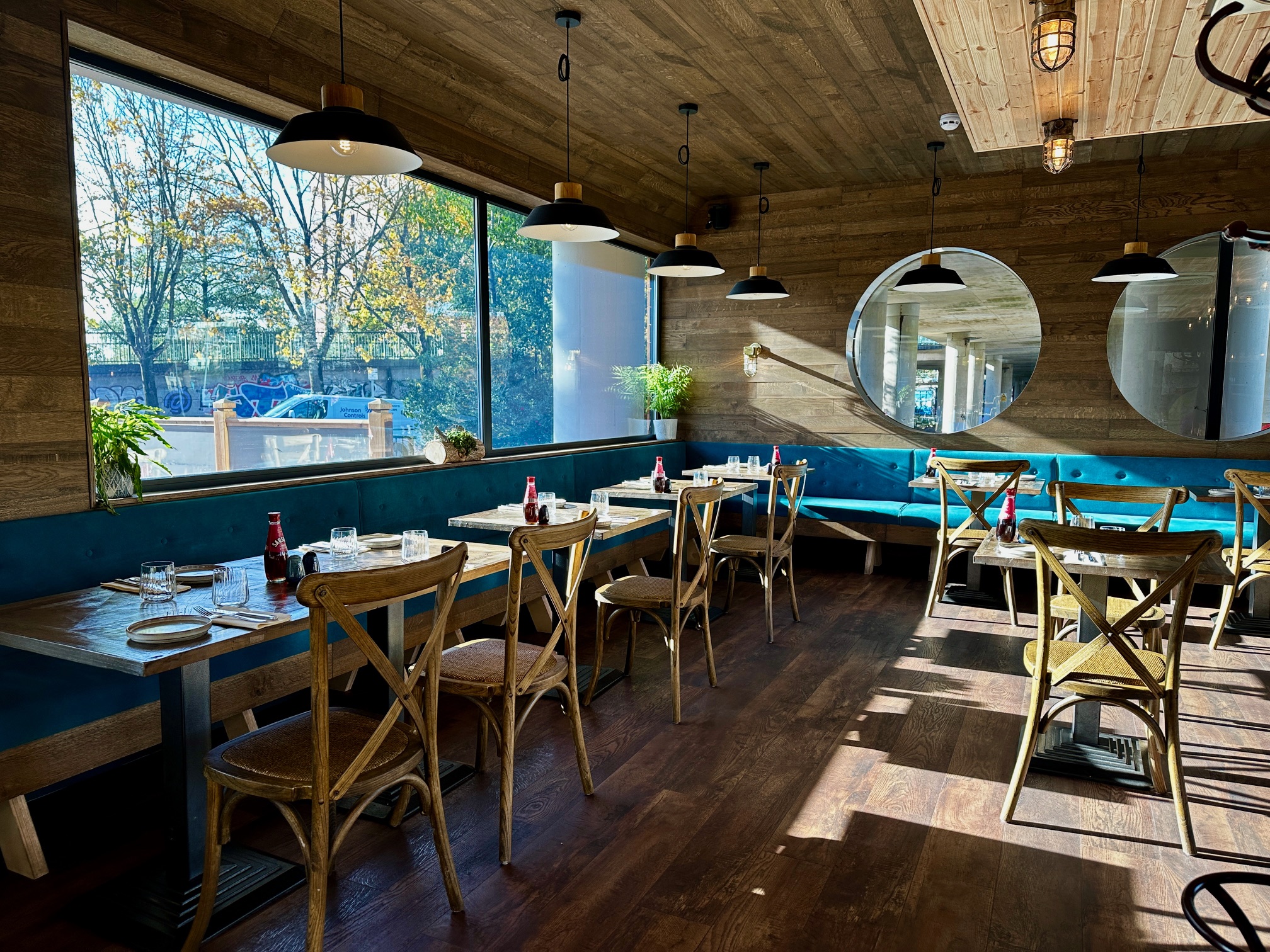
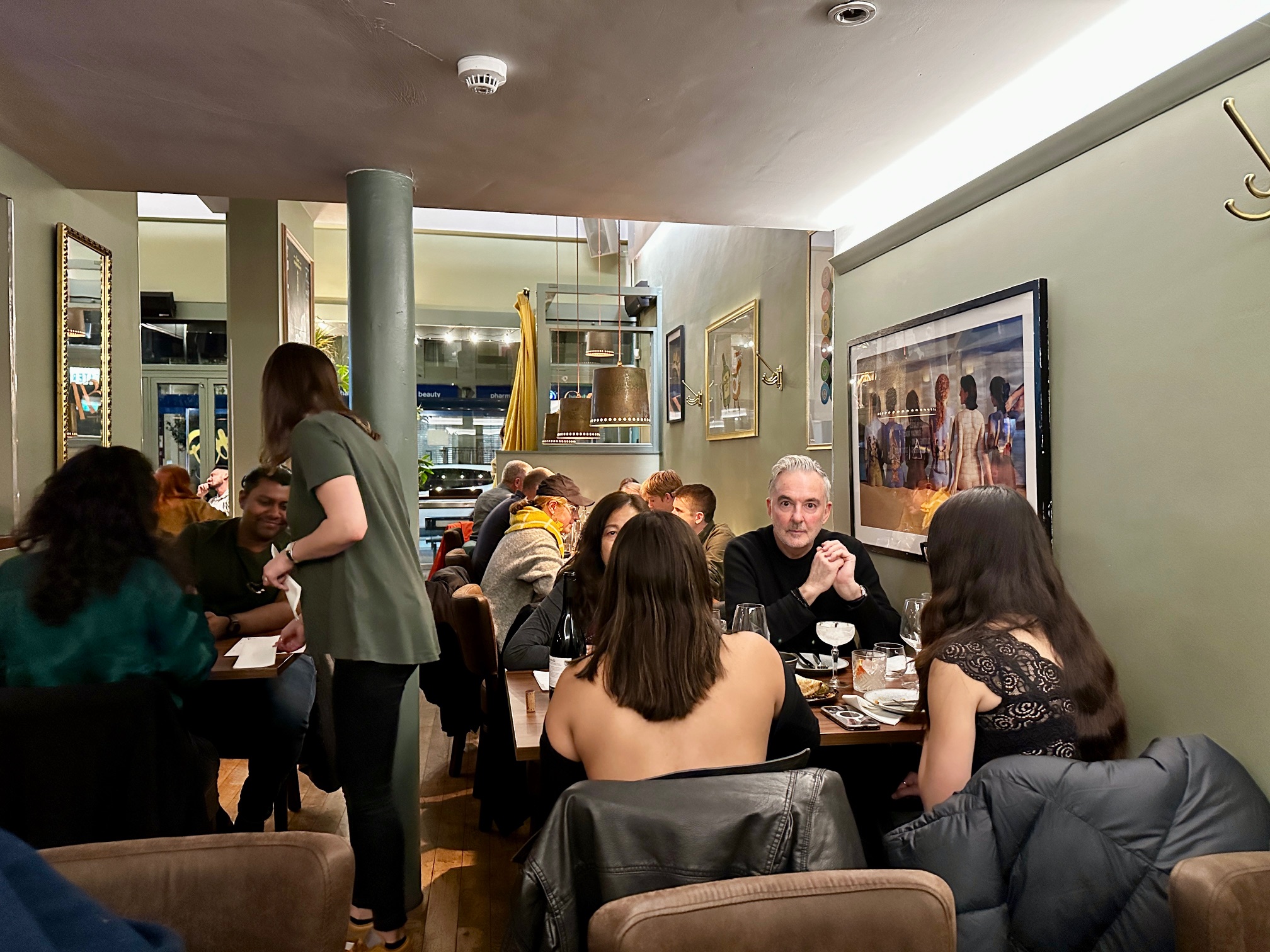
It was mainly incongruous by virtue of being so beautiful. The outside, all wooden boards, tastefully curving in at the base, looked like the hull of a boat. And that motif continued inside, with big picture windows and portholes, bare wood floors and blue banquettes. It was a gorgeous, serene dining room, wonderfully lit, and managed to be vaguely nautical without ever approaching naff, in itself a considerable achievement. 

We were some of the first customers there at half past twelve and our welcome, from co-owner Joie, was warm and genuine. We took a generously sized table in the middle of the restaurant – the late morning sun was intense through those huge windows – and recovered from the walk, enjoying the space and that feeling of calm. I was concerned for them but I needn’t have been, because over the next couple of hours the place filled up nicely. Although it was an unseasonably warm autumn day I could see from the decking area outside that this place would come into its own again next summer.
One of the many things to like about Noah’s menu is that it changes daily: I had been watching it on their Instagram stories so I knew that it shifted subtly from day to day depending on what the restaurant had in and how they’d decided to cook it. Fish tended to be from Brixham or Newlyn, mussels were from St Austell but the menu always specifies where everything was caught.

Small changes notwithstanding, the spine of the menu remained constant – mains in particular involving either fried fish and chips or grilled fish with either chips or new potatoes. Simple pleasures, especially when done exceptionally well. They also have a very reasonable set lunch (which they offer even at weekends), called the Lock Keeper’s Lunch, which comes with a cup of tea and a teatime set menu which does not. I found that admirable too.

There was just the one meat free starter, which was vegetarian but not vegan, and a couple of fish free mains, one involving chicken and the other with chickpea fritters. So really, you do have to like fish to go to Noah’s or your choice is more limited than Tess Daly’s presenting skills. Starters were either side of the ten pound divide, mains clustered around twenty. I identified my first and second choice of main course, reasoning that I’d be happy with either of them, and then Zoë picked my first choice and somehow I still had FOMO. This happens, I should add, almost without fail.

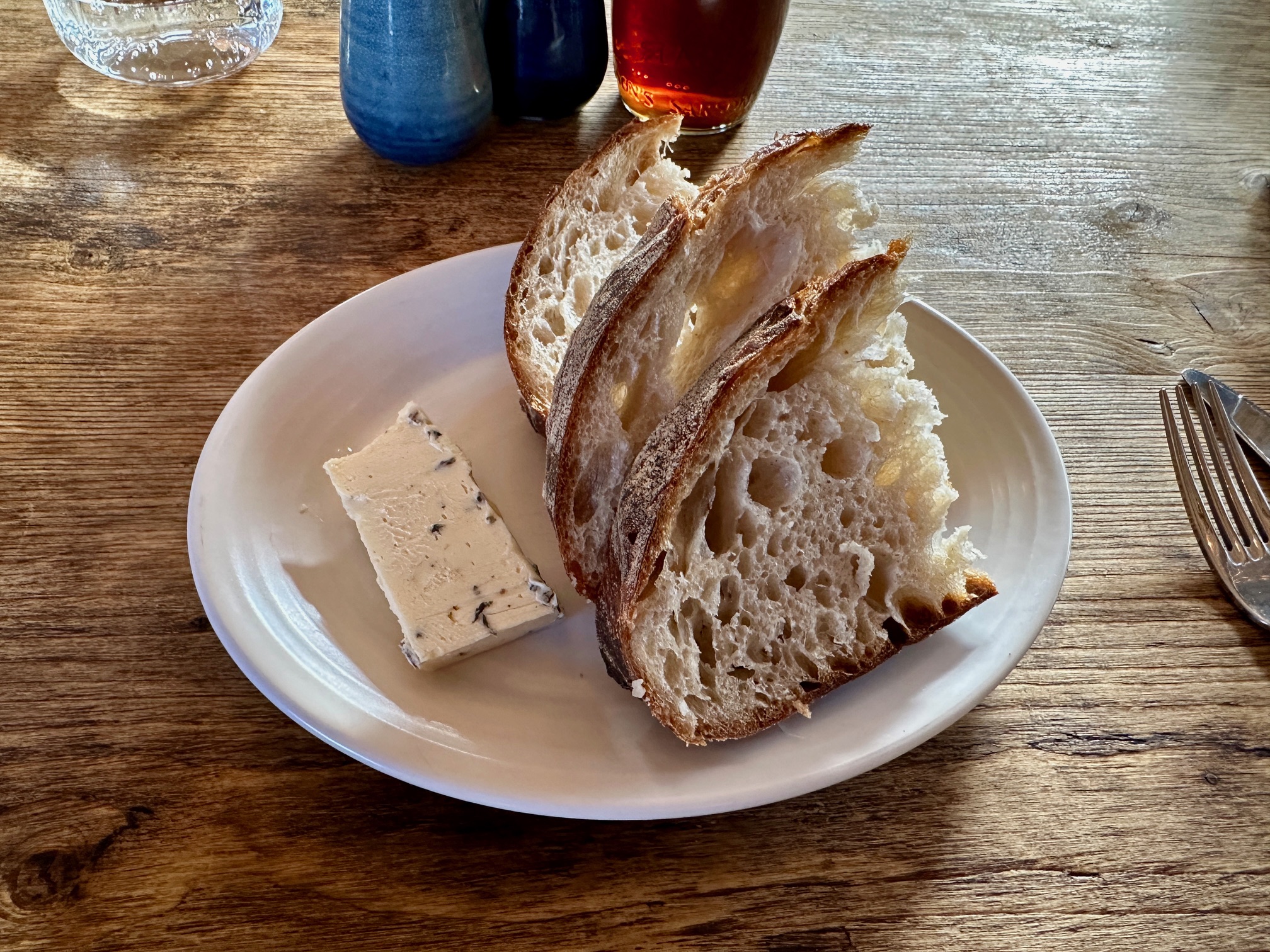
But first, we had some starters, accompanied by a rehydrating bottle of sparkling mineral water to try and undo the damage from the night before. Bread was from Somerset bakery Lievito, who supply a few Bristol restaurants, and I rather liked it – nicely open-crumbed, although maybe lacking in a satisfactory crust. Giving three slices to a table for two is asking for trouble, though, if you ask me. The anchovy and rosemary butter needed two things, more anchovy and more butter. What there was I liked, but what there wasn’t is what I noticed.
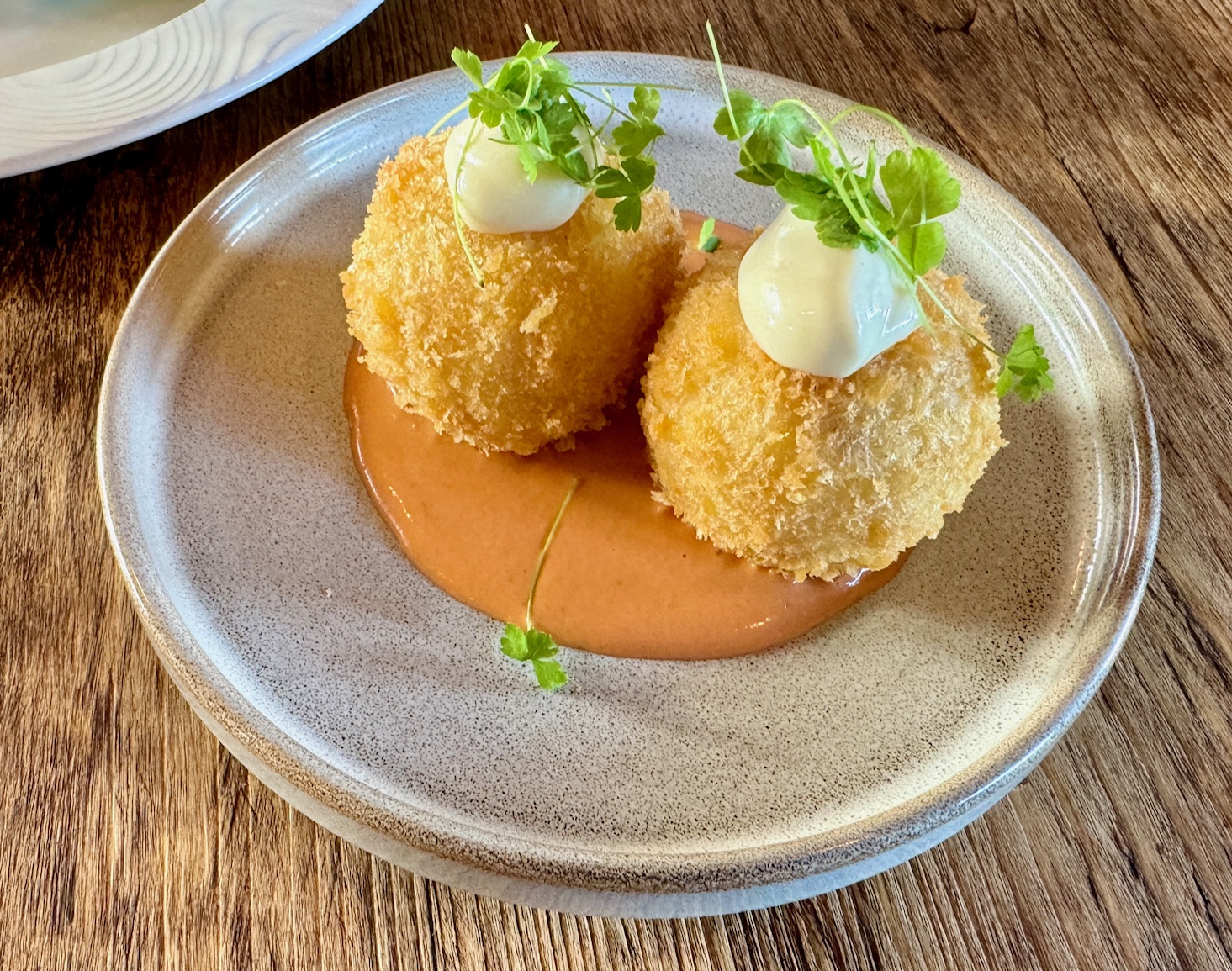
Cod fishcakes were sold by the unit at a reasonable three pounds fifty and Zoë nabbed a couple. I don’t think you can go wrong with salt cod, and these were delicious spheres: from a distance they looked more blond than bronzed but the texture was bang on. Sitting them on a little moat of tomato vinaigrette and topping them with a dab of aioli was a terrific touch, too. My forkful passed too quickly: there wasn’t to be another.
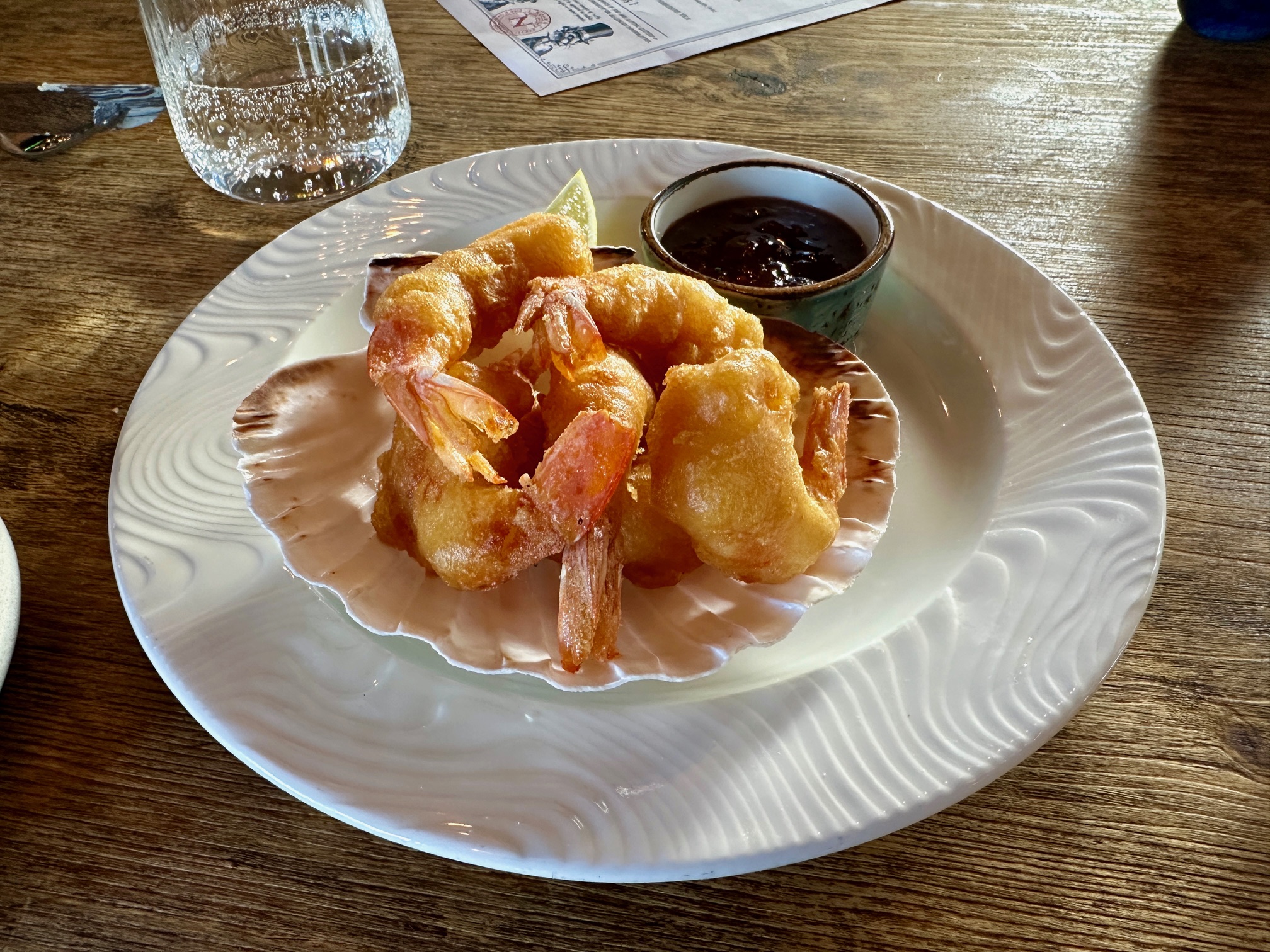
Even better, I thought, were the prawns, plump fleshy commas fried until crispy and positively moreish. This dish was made by the addition of a superb sweet chilli sauce with proper heat, so well balanced that it showed up the shop-bought stuff as sugary, one-dimensional syrup.
My favourite of the starters, though, was all mine: gorgeous smoked sardine fillets loaded on to an airy rectangle of sourdough along with a tomato concasse with capers, all sweetness, acid and bite. Such a superb combination, and a reminder that salt and vinegar is not only the best crisp flavour but also the pairing that perfects so many fish dishes.

As it happens, the day I wrote this I had sardines on toast for lunch, decanted from a tin. Pale imitation doesn’t even begin to do justice to how many miles separate that lunch and this impeccable dish: perhaps I need to check out the Tinned Fish Market.

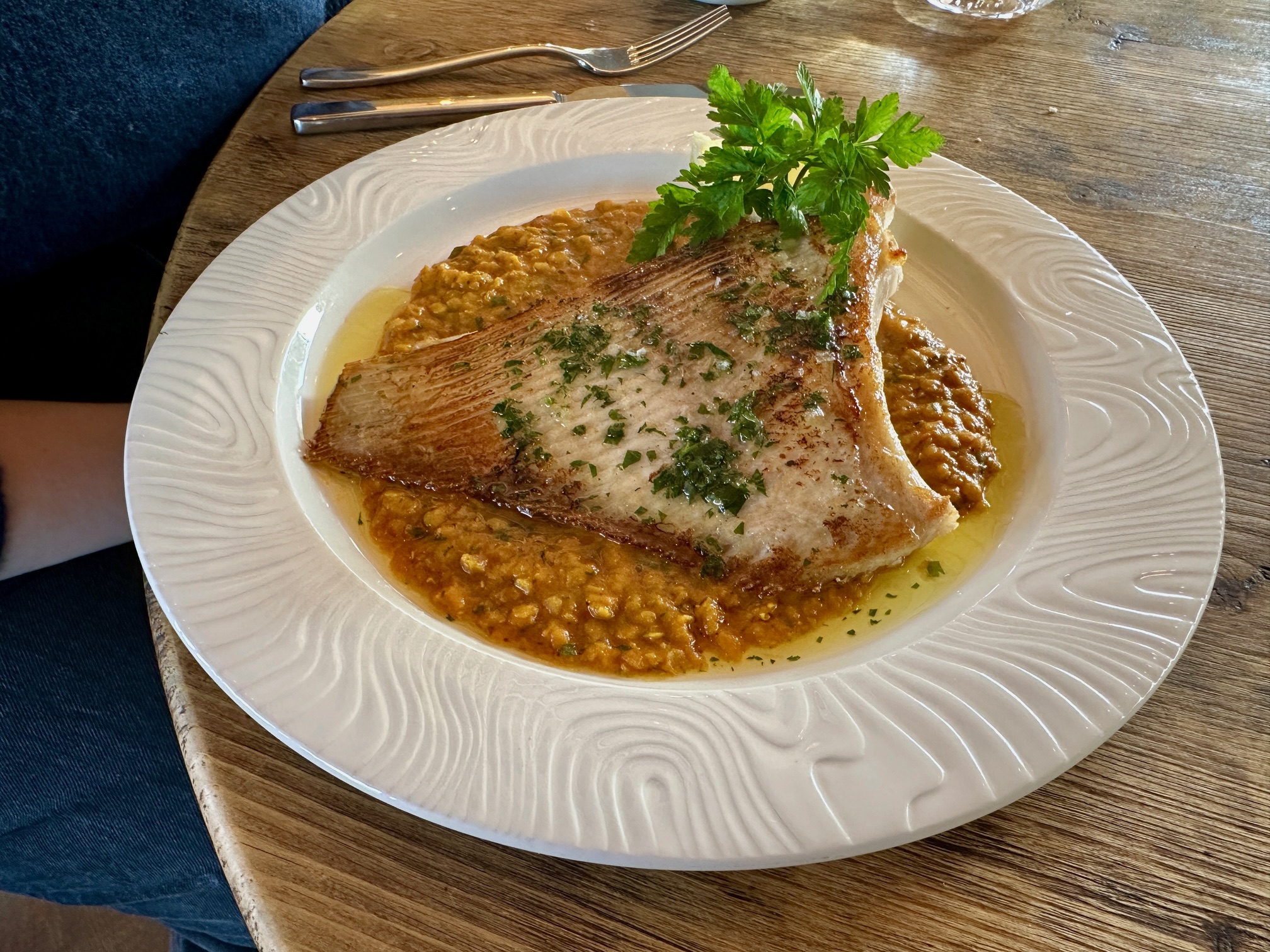
Mains were reasonably paced, turning up about twenty minutes after we’d dispatched our starters. Zoë had chosen ray wing, beating me to it – ordinarily I find it impossible not to order, when I see it on menus. It was a beautiful specimen, muscular and golden, and they’d presented it with the thinner side up: always the right way to do it, as there’s nothing worse than getting halfway through eating a ray wing, flipping it over and finding the metaphorical thin end of the wedge lying in wait.

From my look through Noah’s menus they tend to serve ray wing one of two ways – the classic, with brown butter and capers, or as a curveball with a curried lentil dal. On paper I prefer the former, but it was the latter on the day we visited and actually I thought it worked pretty well. Zoe let me try a little and using a knife to curl it away from the cartilage, dabbing it with the dal and eating it was a mindful, almost meditative experience. More of that please, as Anton Du Beke has taken to saying on Strictly.

And the dal really was good, although it seemed a bit bet-hedging to serve it with lentils and still give you the choice of chips or new potatoes, both of which made more sense if it had been served with brown butter and capers. Minor quibbles about an excellent dish, and one I very much wished I’d ordered.
I on the other hand had chosen another kind of classic dish: haddock and chips, with tartare sauce and mushy peas. Quintessentially British, many would say, and when done well almost unimprovable. By happy coincidence, yesterday Noah’s announced that it had made the top 5 in the 2024 National Fish & Chip Awards, which is impressive going for a restaurant that has barely been open for six months. So this would be game-changing fish and chips, wouldn’t it? Just look at the photo below: what’s not to like?

Sadly, it turned out there were things not to like. It was a good illustration of how social media isn’t real life, because the ubiquitous flat lay photograph hid a multitude of sins. Looking down from above it seemed as good a portion of fish and chips as you could hope for. And it started well – the batter on top light and frilly, crinkled and crenellated, giving way to firm flakes of fish. But underneath, it was still soggy and oily, that oil glazing the chips in a way that wasn’t enormously pleasant.

And soggy-bottomed fish aside, the chips were not great. You can’t see it in this picture, because they’re entirely obscured by the fillet of haddock, but many of them were strangely grey-edged and unappealing. Plonking the fish on top of the chips is a serving choice, not one I’d personally have taken, but it happened to conceal some slightly manky chips.

They were lacking in crunch and salt, just didn’t have enough of the good stuff and, as I said, had that disconcerting hue. I left just under half of them. That might not bother you, it might be a me thing – I’ve never eaten a crisp I haven’t thoroughly inspected first – but for me if you serve fish and chips and neither of them is spot on, that feels like an elementary mistake (in fairness, Zoë’s chips looked more appetising).

It’s a pity because the tartar sauce, served artfully in a scallop shell, was also well executed. If anything, it was a bit too posh for me – I love the properly vinegary kick of the stuff in a jar, the cheaper the better – but I could appreciate it without necessarily loving it. The mushy peas must have been pretty authentic, because I didn’t fancy them at all. That definitely is me rather than the restaurant: I can handle crushed peas at a push, or pea purée, but when it comes to smushed-up marrowfat I’m very much a disciple of the Church Of Mandelson.

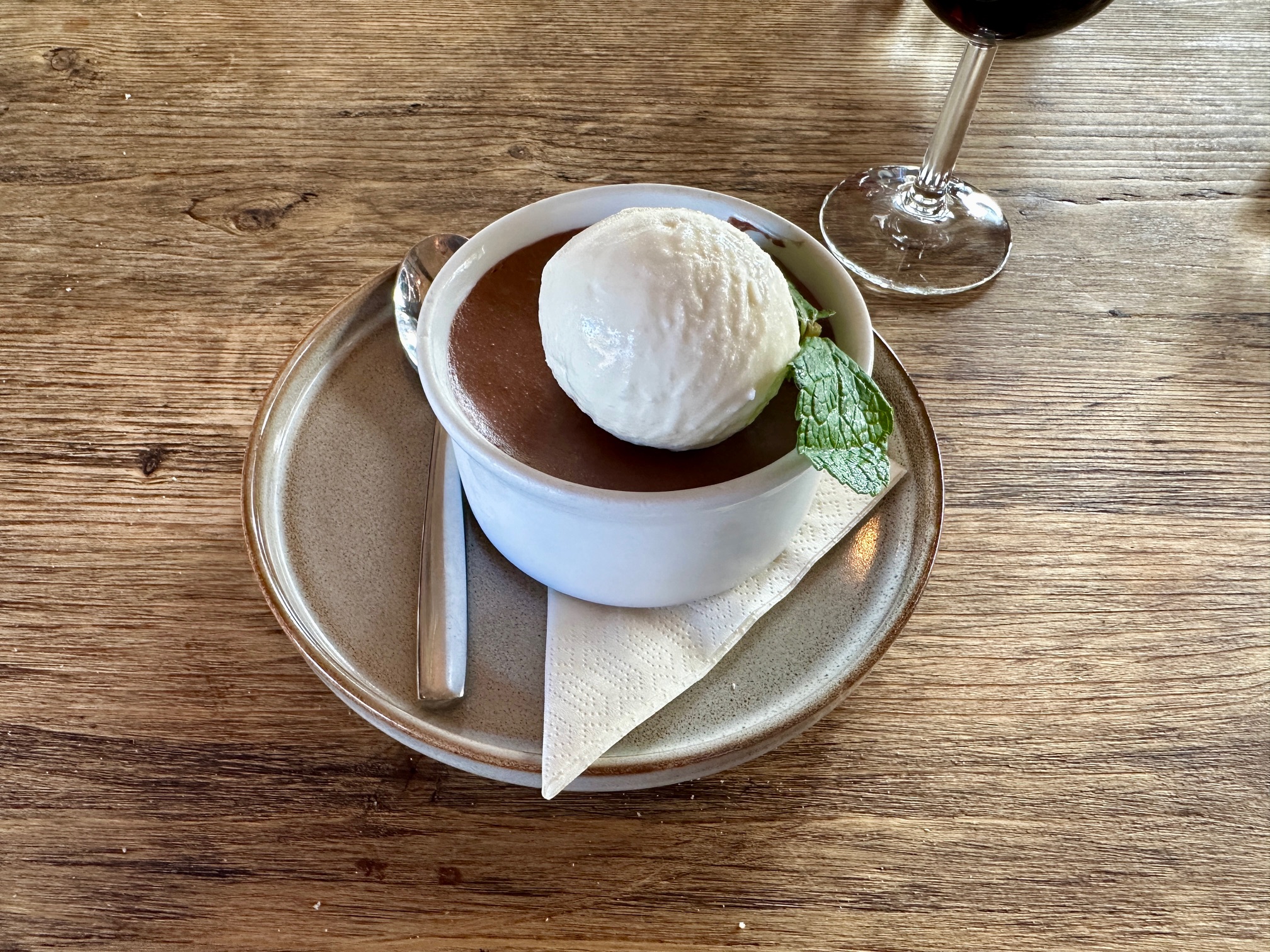
Anyway, in my book the best way to get over a disappointing main, unless you’ve positively taken against a place, is to dive headlong into a great dessert. Noah’s offers three to choose from, along with ice cream or affogato, but we both spotted the chocolate mousse and from that point everything else was an irrelevance. It was huge and outstanding – a dense, thick and indulgent thing with a globe of clotted cream ice cream on top. The ice cream was completely unnecessary, which is not to say I didn’t love it or finish every last morsel.
Although we’d been on the sparkling mineral water throughout, the list of sweet wines and digestifs was too good to swerve. I was very interested in an English amaretto, made by the modishly named E18hteen Gin, but I also spotted a red dessert wine, a tannat no less, that sounded too interesting to miss out on. Red dessert wines are one of my abiding loves in the world of booze – give me a Banyuls and I’m a happy man – but I’d never had one made with tannat before. I’m used to that brooding grape in Uruguayan reds, but what would it be like in a dessert wine?

The answer, it turned out, was stellar: one of the best dessert wines I’ve had in ages, all vanilla and cocoa, perfect with the mousse. “It’s one of my favourites” said our server, “and it really goes with that dessert.” I made a note of the wine, Googled it and wondered just how many bottles to get in for Christmas.

On another day we could have dallied longer and by then I had a full picture of the kind of restaurant Noah’s was – light, tasteful, full of locals and alive with chatter and company. You wouldn’t think this was a restaurant still in its first six months, or that it had such a challenging location. That’s a tribute, I think, to just how well they’ve hit the ground running and the work they’ve put into making sure they have something for everyone. Our bill for three courses, some sparkling water and those dessert wines came to just over a hundred and ten pounds, not including tip.

As so often with reviews of Bristol restaurants, I can’t help putting my Reading hat on and thinking Do we have anything like this? and, because the answer to that question is invariably no, Do I wish we did? The answer to that second question is a resounding yes – I don’t think Reading has ever had anything like Noah’s, and if you tell me we used to have Loch Fyne I would say yes we did, but it was no great shakes.

But other things make Noah’s feel special, too, I’ve seen few restaurants go to so much trouble to find their target market, to appeal to it and to try and hit so many bases without becoming some kind of bloated, all day dining behemoth that forgets what it’s all about. And yet, when I think about Noah’s some more, the one blot on the copybook is that fish and chips. It is such a shame that it wasn’t completely at the top of its game when I went – maybe I got unlucky with the fish, or picked the one day when their potatoes weren’t the best.

But even so I can’t bring myself to knock the rating down too much because literally everything else – the room, the welcome, the menu, those starters, that ray wing, that dessert – was very close to perfect. I ate at Rick Stein’s Seafood Restaurant in Padstow a couple of times earlier this year for my dad’s birthday and it was a lovely experience on each occasion, even if the whole of Padstow is like a Centre Parcs for affluent boomers. And yet, farther from the sea, many miles from the day boats, nestled in the concrete embrace of that incongruous flyover, I reckon Noah’s gives it, and certainly anywhere in Reading, a run for its money.

Noah’s – 8.5
1 Brunel Lock Road, Bristol, BS1 6XS
0117 4529240
https://www.noahsbristol.co.uk

Restaurant review: A.B.O.E., Bristol

A.B.O.E. closed in August 2024. I’ve left the review up for posterity.

Last Friday I found myself in Bristol enjoying a badly-needed long weekend away. Our train pulled into Temple Meads, half an hour late, and Zoë and I wheeled our suitcases into the centre, three days of eating, drinking and excellent company ahead of us. But before we checked into our hotel, before we did almost anything, I had lunch on my mind and only one candidate to provide it. We made a pilgrimage to the Apple Cider Barge and there, next door, in its distinctive black and red was Gurtrina, the van belonging to fried chicken supremos and Reading legends Gurt Wings. How could I kick off my minibreak anywhere else?

By my reckoning it’s over six months since Gurt Wings stopped coming to Blue Collar – something to do with the council being difficult, if I remember rightly – and the reunion with their magnificent food was all the sweeter for all that deprivation and delayed gratification. In my time away the buffalo sauce had become just a little more piquant, the blue cheese saltier and tangier. The sun came out, the bench we were perched on positively glowed and we polished off our food in wordless joy. Truly, it would have been worth a trip to Bristol just for that.

Afterwards James Mitchell – the man behind Gurt, also known to his many fans as Uncle Gurty – came over and the three of us caught up and shot the breeze. I told him where we were planning to eat in the city, he mentioned a few places he’d heard were good and then he did something I wasn’t expecting. He went out of his way to tell me somewhere especially good I should check out.

“You need to get yourself to Oboe” he said.

“What, like the musical instrument?”

“No, A.B.O.E. It stands for ‘A Bit Of Everything’. The chef is a guy called Seb Merry who was on Masterchef, and he’s so passionate about his food. The whole team are brilliant. They do the best Bloody Mary I’ve had – it’s not on the menu, but if you ask they’ll make it for you. And they have this fried chicken dish – well, it’s not like our fried chicken but it’s amazing, it’s more like a croquette but you’d have to try it. And they do this incredible dessert, have a look at this.”

He fired up his phone and showed me a picture of a dessert which was all chocolate and caramel, thick slabs of each. I’ve rarely seen a photograph I wanted to eat more.

After our chat we went on our way and stopped in the Small Bar for the first beer of the holiday but that glowing endorsement weighed on my mind. If the man who does the best fried chicken you’ve ever tasted tells you that a restaurant does amazing fried chicken, and more besides… could I really let a trip to Bristol pass without investigating? But anyway, there’s no way they would have a table free the following night, I thought. But then I checked, and they had. So I texted my friends James and Liz, sent them the website. 

I know the four of us are booked somewhere else tomorrow night, but Mr Gurt Wings says this place is incredible. What do you reckon, stick or twist?

James, a keen fan of Bristol’s restaurant scene, responded almost immediately. Let’s take a risk and twist, he said, and that was that. Bookings were made and cancelled, and the next night Zoë and I clambered off the bus halfway up the Whiteladies Road, ready to take our chances.

The interior was tasteful, all muted green paint, wall art and pillars. There was a mezzanine floor, although there didn’t seem to be anyone seated there on a Saturday night, and the whole place had a pleasing buzz. It sort of looked as if it could have been part of the Loungers Group in a previous life (I checked: it wasn’t) but none the less it was a pleasant dining room with tables companionably close without being crammed in.

It was also almost completely full and our server whisked us to a table right at the back, far too big for our party of four. He explained that a table for four near the front had slightly outstayed their welcome, and although they’d paid the bill they hadn’t yet left the premises. He told us, quite charmingly I thought, that he didn’t feel like acting the heavy with them given how much they had spent.

Then he asked if Zoë and I wanted a cocktail on the house while we waited. So Zoë had a negroni, made with rosemary vermouth, which she raved about and I asked for that off-menu Bloody Mary. I knew it would be good when the server didn’t ask me how spicy I wanted it: they just did their job and made it, and it was magnificent.

All in all, we were waiting ten minutes with our cocktails, hardly anything to complain about. By then James and Liz had arrived, more drinks had been ordered and we had taken our table nearer to the front of the restaurant, with a good view of other tables, dishes wafting past and the staff – just the two of them, that I could see – working non-stop.

The menu is the kind that makes jaded restaurant bloggers roll their eyes – no starters, no main courses, just snacks and small plates. The menu suggests two snacks and four small plates between two, which I suppose gives you an idea of whether they’re starters or mains. Now, I can be as critical of small plates venues as the next person and I’ve always found it counterintuitive that restaurants tell you to share small plates. I also thought that A.B.O.E.’s pricing was a little out of keeping with the small plates concept – snacks mostly cost just over five pounds, but the small plates ranged from fourteen to twenty-two pounds and that for me, at the risk of doing an accidental Partridge, is the kind of price I expect to pay for a big plate.

But anyway – perhaps it was the charm of the welcome, or the edge-softening effect of that Bloody Mary, but I found I was prepared to suspend my disbelief. So we bartered about the snacks we wanted to ourselves and the small plates we were reluctantly prepared to share, I popped it all down on a note on my phone and when our server came back we ordered with military precision.

“I just need to tell you,” he said, “that the steak tartare is a small portion, so it isn’t really suitable for sharing”.

“That’s okay, that’s for me” said James, in a manner that suggested he had never really considered sharing it with anyone.

That does James a huge disservice because when it arrived, although it was indeed too petite to share, he insisted that I try a forkful of the tartare. It was made with dry-aged bavette, and I have to say it was pretty impressive with plenty of savoury depth. Not the very best tartare I’ve ever had – that honour still goes to Paris’ superlative Double Dragon – but pretty close. Certainly it compared well with a similar dish across town at Marmo, although I wasn’t a hundred per cent sure about the stuff, allegedly taleggio, on top.

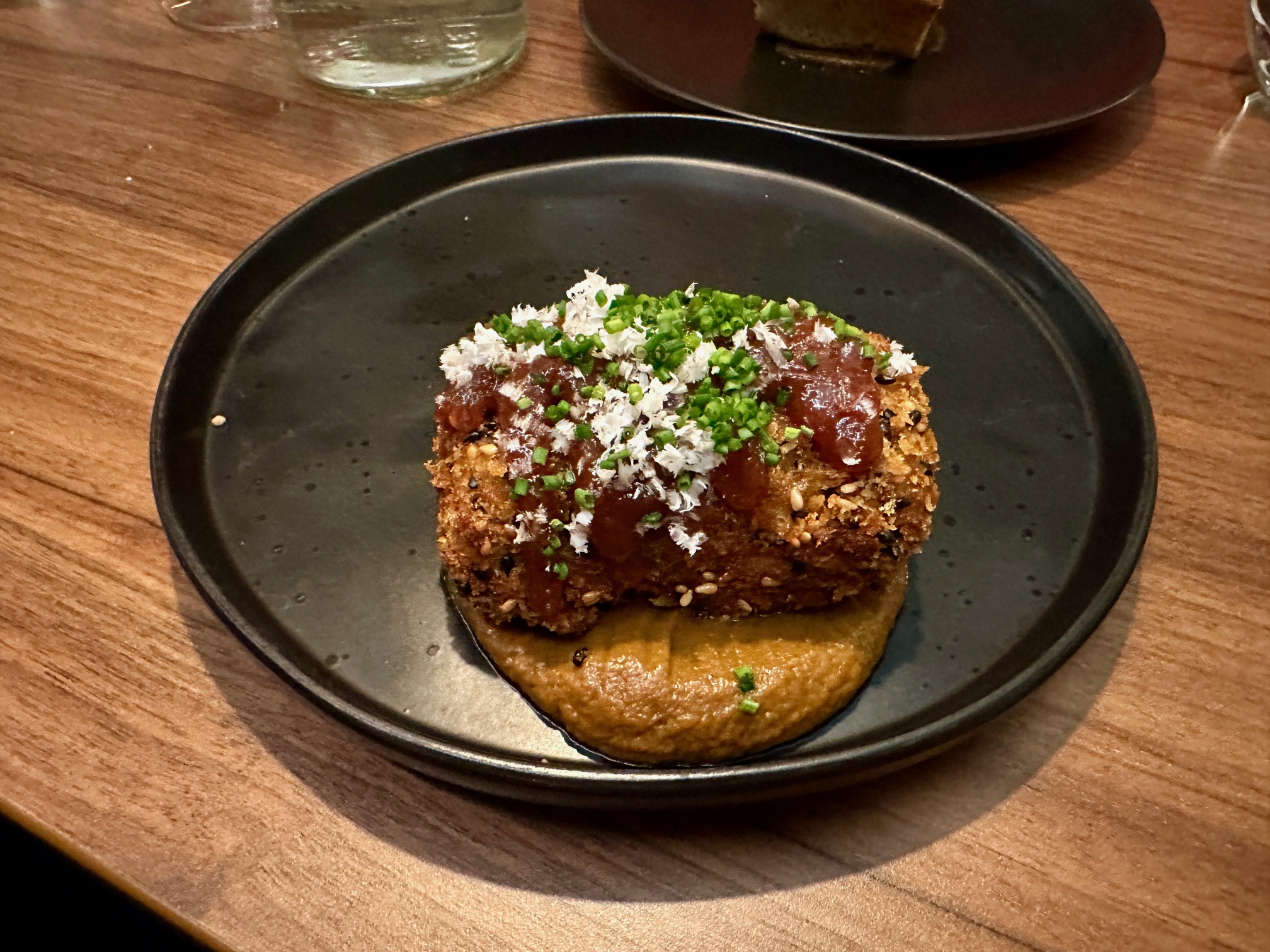
Zoë and Liz both went for the pumpkin croquette: A Bit Of Everything definitely applies geographically if in no other way, with this dish having hints of Japanese korroke. But unlike the croquettes at, say, Caper And Cure where you get four little spheres, A.B.O.E. goes for broke with a single enormo-croquette loaded with cheese and horseradish. Again, I was allowed a forkful and again it induced a reasonable amount of envy. Zoë in particular raved about this dish. I probably would have liked more, smaller croquettes to capitalise on the surface area but I couldn’t deny that the flavour of the thing was outstanding.

To continue the globetrotting, my snack was A.B.O.E.’s take on poutine. Rather than fries, it was cuboids of confit potato, à la Quality Chop House, buried in Parmesan with a jug of thick, intense, almost-sweet jus to trickle over the whole affair. Enormously enjoyable stuff: I imagine dreary types might complain that this wasn’t poutine, but it was a darned sight nicer than most poutine I’ve had. Besides, I knew exactly what it would be like because I’d checked out the restaurant’s Instagram in advance (it’s called research, you know).

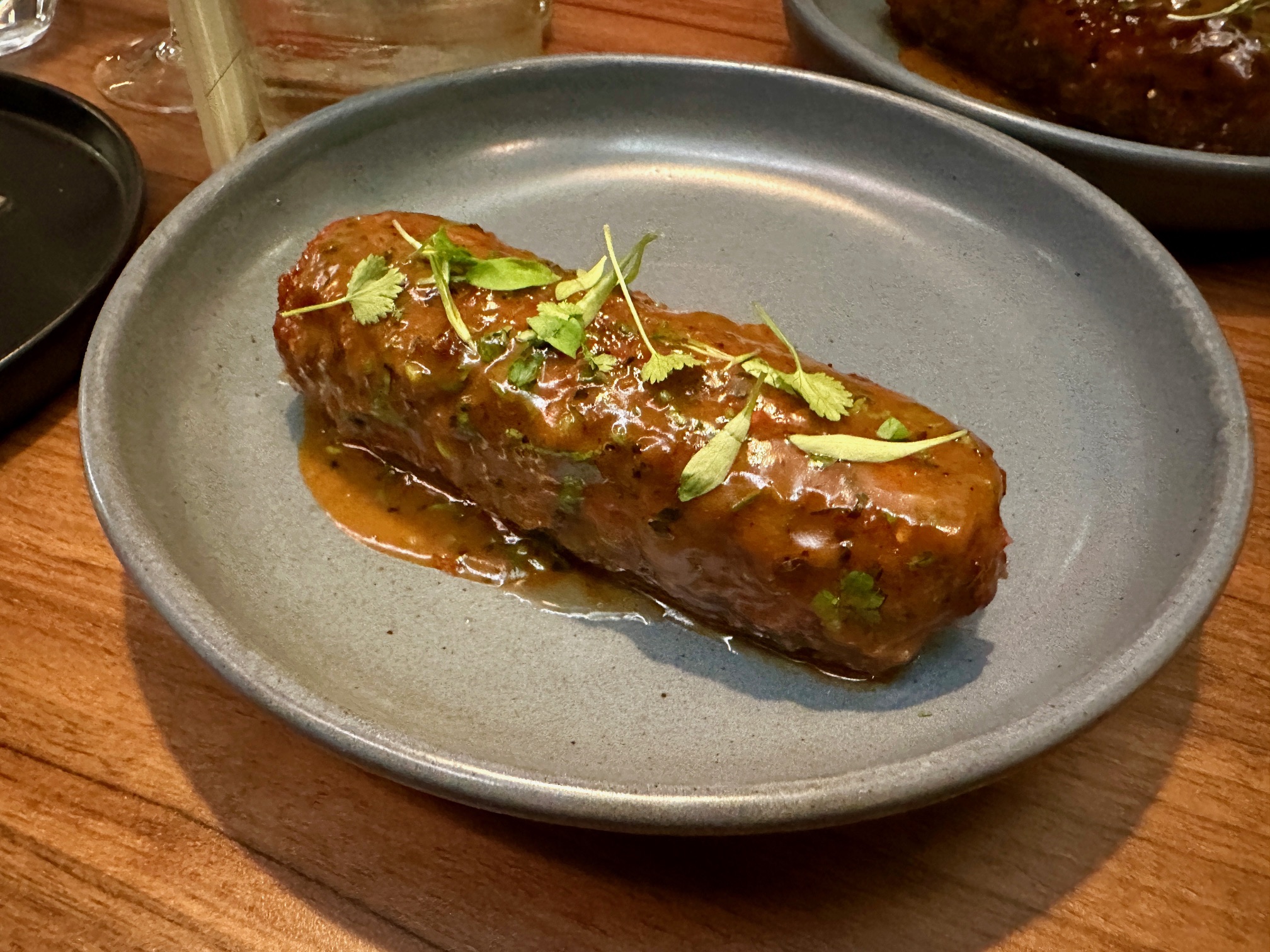
The first of the small plates to come out was that fried chicken dish so beloved by the man behind Gurt Wings – high praise indeed, from an expert in the field. Well, he was right to say that A.B.O.E.’s rendition was nothing like his. It was surprisingly hard to describe, but it’s important to try because otherwise all you have to go on is the photo below, which looks on the scatological side. It was somewhere between a boudin and a ballotine, a cylinder of tightly compressed chicken thigh bound in a crispy coating, the whole thing smothered in a sticky curried sauce.

Did it work? Well, yes, we all thought it did. As with the pumpkin croquette, I personally would rather have had more, smaller pieces to maximise the surface area. The coating didn’t have as much crunch as I’d have liked, and came away under a knife rather than adhering to the chicken beneath. But you couldn’t argue with the flavours, or the note of citrus that danced through it. Uncle Gurty had not steered me wrong – and no, it didn’t look like fried chicken, much in the way that the poutine didn’t look like poutine. That was sort of the whole point.

I’d had my eye on the barbecued squid with galangal, but it became a must-order when our server, the charming Italian chap who had sorted out our welcome cocktails, told me they’d run out of the clams it was meant to come with. Their solution, he told me, was just to give you more squid. That was good enough for me, and the dish was tender and fragrant with a nicely building heat. Another of those dishes you slightly resented sharing, which in hindsight is a decent description of literally everything we ate.

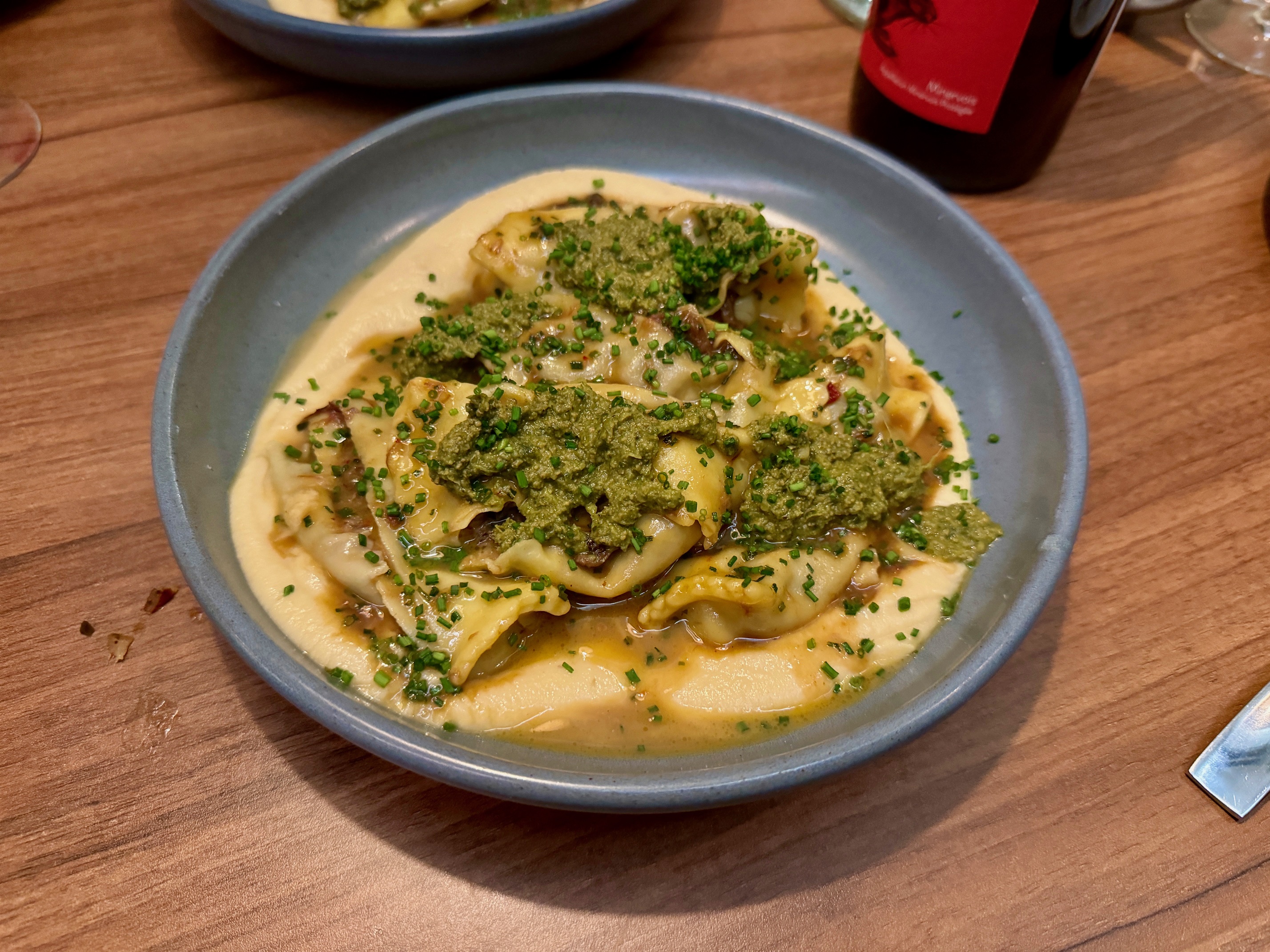
The most expensive dish on the menu – so naturally we ordered two of these – was the short rib beef agnolotti. Nearly twenty-two pounds a portion, and for me a fascinating misfire. My companions all loved it so I was the lone dissenter, but for me the agnolotti themselves were overcooked, which made the whole dish a bit limp and mulchy.

Everything on the plate was good: the celeriac, apparently with aged beef fat, the glorious beef in the filling and a powerful mole verde, although we didn’t get the advertised goats cheese. As with everything else we tried, the flavour was unimpeachable but for me, the texture let this one down. But I may well have been wrong: certainly everybody else thought so.

Red mullet is James’ favourite fish on earth so he had to order a portion of that, and I got enough of a taste to appreciate that it was, like everything else, very skilfully done. I’m a sucker for braised lettuce, a relatively conventional pairing, but putting mustard – a delicious mustard, at that – in the mix was the sort of clever and unexpected touch Merry seems to specialise in.

The last of our small plates was an outrageously delicious one: barbecued cod with leeks wrapped in nori and two sauces – one of which, studded with ultra-salty nuggets of chicken skin, was one of the most compelling things I’ve eaten in some time. Again, this was at the north end of the price list and I can see you could argue it wasn’t an enormous amount of food for twenty pounds. But it was exceptional, one of the best-cooked pieces of fish I can remember served alongside a sauce with a proper, clobbering heft. James and Liz left a bit of theirs, and I waited as long as I could bear it before saying “would you mind if I finish that?”

Although service was brilliant, there were only two people working front of house (and, just as gobsmacking, I understand there were only two people in the kitchen). If there had been more, or they’d been less busy, we might have got to a second bottle of wine but instead we took our time with the one we had, a beautiful Minervois which sort of went with some of the dishes. It’s a small wine list, six white and six red, about half of them available by the glass.

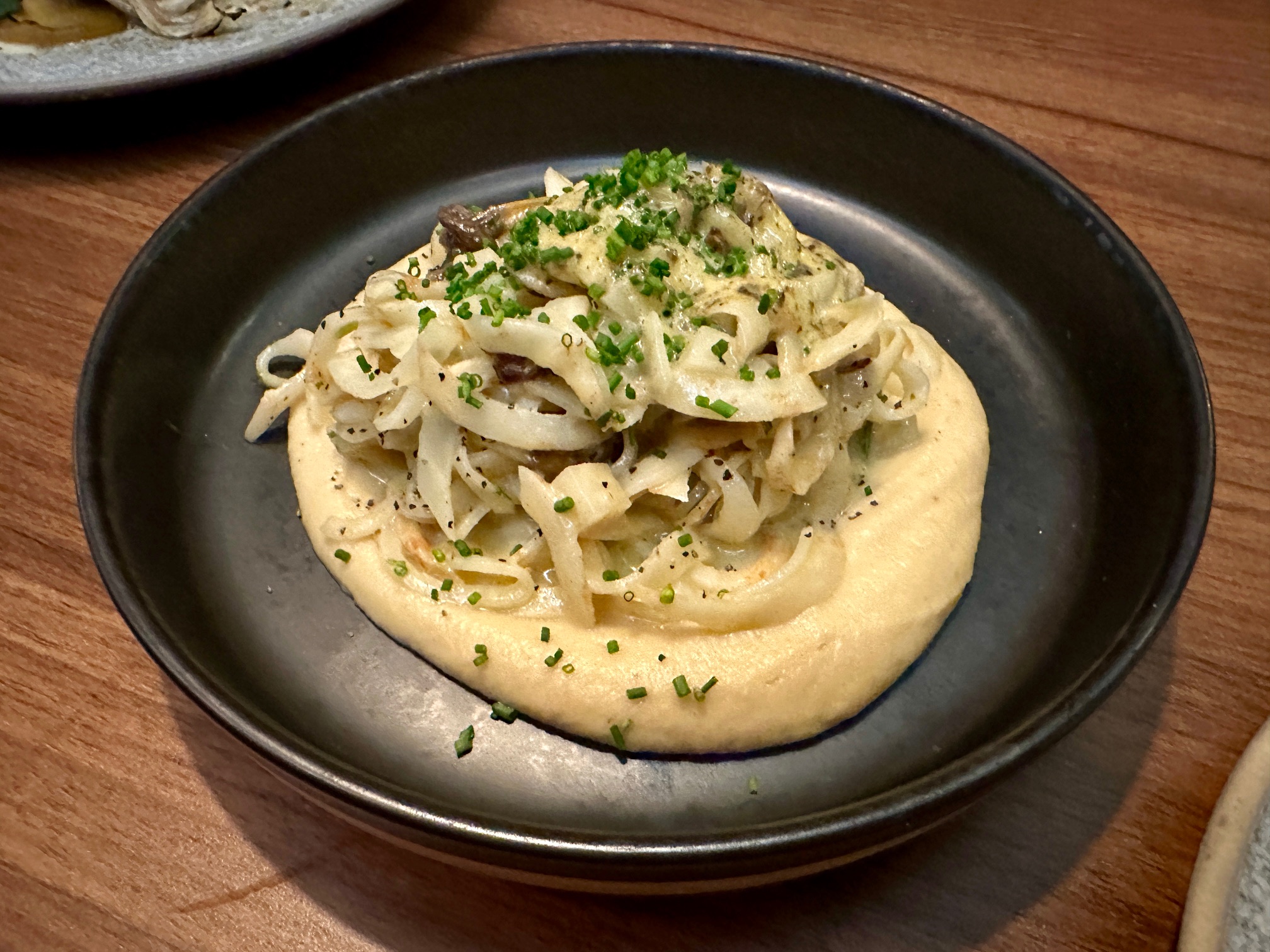
Our server asked what we made of the food and checked what we’d ordered. He said it was a shame we hadn’t gone for the celeriac cacio e pepe and we said that it hadn’t quite made the cut. So he decided to send a plate of it out to us anyway, which was very kind and completely unexpected. It really was a beautiful dish – ribbons of just-cooked celeriac taking the place of pasta, more sweet and comforting cubes of celeriac and little mushrooms dotted throughout. Clever and imaginative, like everything else, and in its way every bit as enjoyable as the cacio e pepe I’d raved about earlier in the year at Manteca.

“Isn’t it great?” said our server as he took the empty plate away. “I shouldn’t like it, because I’m Italian and making this without pasta is, well…” He shrugged at that point to indicate that he knew full well the dish was culinary heresy. “And I’m not just Italian, I’m from Rome. But the chef is right, and it’s just so good.”

The menu also recommends that you share one dessert between two people. I don’t know if it was our greed, or the small plates not being quite big enough, but we disregarded that and ordered one apiece. Mine and Zoë’s was the dish I’d seen in the photo on Uncle Gurty’s phone the previous day. Dubbed the Rolo Finesse, it was about the most high-end Rolo you can imagine – a thick wobbly layer of something partway between caramel and toffee, gloriously indulgent with just the slightest hint of miso. Beneath that, a thick stripe of a chocolate cremeux that was almost more like ganache, and beneath that a crunchy base.

That would have been enough, but malted milk ice cream on the side and more little nubbins of that crunchy chocolate holding it in place elevated this to god tier. If I’ve had a better dessert this year I can’t remember it, and if I have a better one next year I’ll be very surprised indeed. I can’t tell you how delighted I was that this one of the only plates I didn’t have to share.

James and Liz both opted for the tiramisu and again, were generous enough to let me try it. It was – no surprises by now – excellent: light yet moreish, a far more elegant way to finish a meal than the whopping slab I’d just eaten. I’ve tried a few Bristol tiramisu over the last couple of years – Sonny Stores and Little Hollows spring to mind – and for my money this was better than either.

As we sat there in the afterglow of a brilliant meal, ready to pay and slope off to the Good Measure for a post-prandial beer, we discussed A.B.O.E. in the wider context of a city full of phenomenal restaurants. We knew it was good, but just how good was it? James thought it was better than Wilsons, but he’s been burned by going there after my rave review, eating a meal which was almost completely devoid of carbs and leaving hungry: it’s made him an avid detractor. Zoë liked it even more than COR, which is pretty much the most exalted praise you can award in Bristol.

I loved it, but I wasn’t sure how to place it. The flavours had been exceptional, the service some of the best I’ve had this year. But those small plates were priced on the keen side. It required further reflection, I decided. Our bill, not including the two comped cocktails and that extra celeriac dish, came to just over three hundred pounds, including a 12.5% service charge which the staff more than earned. As we paid up, James told our server how much he’d enjoyed it.

“Way better than Wilsons” he said. He always takes pleasure in saying that.

“Thank you!” she replied. And then, before we put on our coats and made our exit, she came back.

“I know this is cheeky, but I passed your compliments on to the chef, and he asked if there was any way you could write a review saying you thought the food was better than Wilson’s? It’s really high praise.”

“Don’t worry” I said, “I’m sure one of us will.”

The funny thing is that since my meal, which I’ve thought about many times, I’ve discovered, while writing this review, that A.B.O.E. has a bit of a controversial reputation. I’ve read a review online, best characterised as a tad sneering, that criticised A.B.O.E., partly for some of the dishes but mainly, it seems, because they linked up heavily with influencers just after they opened around the start of the year. One influencer in particular, a chap the Rolo Finesse is named after as it happens, came in for particular criticism.

Well, I can sort of see both sides of that. I’ve always felt a bit icky about influencers myself, especially ones who don’t declare ads or invites, although that criticism in my experience comes better from people who don’t take free or heavily discounted food themselves.

And looking at the influencer in question’s output, I did feel about three thousand years old. Saying that it’s, and I quote, “non stop grub-a-dubdub” at A.B.O.E. is the kind of expression that makes me want to sigh all the remaining air out of my lungs, as is the observation that “every component on your plate will SLAP so hard you won’t even know what month you were born in”. Let’s not even get into the bit where he described A.B.O.E.’s roast beef as “more tender than your nan’s left arm” or their cauliflower cheese as “so peng I could have cried”.

But the point is, much as it might pain me to admit it, the guy is not wrong (well, except maybe about my nan’s left arm). I, rather, would say that the staff work their socks off and are brilliant at what they do, I would say that every element of every dish has been given serious thought and cooked with enormous skill and that, irrespective of how or whether it slaps, let alone how hard, A.B.O.E. has a very talented kitchen doing fascinating things. I guess if you put what I said into an English-to-influencer Google Translate it might end up as roughly what he said.

I can always tell when I’ve really, really enjoyed my meal because I actively look forward to writing it up, to trying to put into words what I’ve experienced. In that sense A.B.O.E. is a restaurant blogger’s dream, and I feel lucky to be a Bristol outsider because it means that, free of all that infighting and beef I can just judge the food and the experience, and say that both were terrific. The list of places I need to go back to in Bristol gets longer and longer, which makes reviewing restaurants there difficult. But as long as they keep that dessert on the menu – which I suspect they will, if only because it pisses off all the right people – I can very much see myself returning.

A.B.O.E. – 9.4
109 Whiteladies Road, Bristol, BS8 2PB
0117 9466144

https://www.aboebristol.com

Restaurant review: Little Hollows Pasta, Bristol

I don’t remember a time, any more, when I didn’t have a list of restaurants I really wanted to visit. Or, to be more accurate, multiple lists. And, if anything, the whole list thing is getting worse.

For instance, I have a London list. Two, actually, both on my phone. One of places in London I’ve always wanted to visit, like Quality Chop House or Chez Bruce, the proper bucket list. The second, more geared to what people reading a Reading restaurant blog might enjoy, is of places near Paddington where you could eat after a day in London while you wait for an off peak train. That list spans from Queen’s Park to the Edgware Road – although the Elizabeth Line might render it redundant, now you can easily reach so many places from Paddington.

Another list, a recent addition, covers restaurants in Oxford. And last but not least, which is where this week’s review comes in, I have a Bristol list. It remains a mystery to me that Bristol, home to England’s most interesting food scene, lacks the food coverage you might expect. There used to be a Reach journalist, whose reviews were much like all Reach restaurant reviews except about somewhere interesting: he left to go to another local website whose output is remarkably similar. There’s also a magazine which publishes restaurant reviews, pretty irregularly: think roughly once a month.

Beyond that? It’s somewhat tumbleweed central. Bristol used to have a fair few restaurant bloggers, but many seem to have quit or drifted into #ADs and #invites. Put it this way: since the start of last year I’ve reviewed six restaurants in the city, which makes me one of Bristol’s most prolific restaurant bloggers, and I don’t even live there. However you feel about my blog – and if you’re reading this I’m guessing either way you’re not a neutral – at least Reading has a regular restaurant blog. Many cities, often far bigger, can’t say the same.

This week’s review arose from a long-overdue return to Bristol, a flying visit at short notice which sent me scurrying to my list to find somewhere suitable. Little Hollows Pasta has been on that list for quite some time, and felt like the perfect choice. It’s in Redlands, just down the road from the lovely Wilsons and Good Chemistry’s The Good Measure, perhaps my favourite Bristol pub. It’s also a short walk from Whiteladies Road and Cotham Hill, one of the city’s nicest hubs of places to eat, drink and shop.

As the name suggests, it’s a pasta restaurant – a specialist like London’s Bancone or Padella – which started out in street food and supplying restaurants before opening its site a couple of years ago. This trend is edging closer to Reading – Maidenhead’s Sauce And Flour is probably the nearest comparable restaurant – but going through the front door, spying sheets of pasta hanging in the window, the attractive dining room reminded me just how badly Sauce & Flour had bungled the job of creating a convivial space.

By contrast, Little Hollows had this sorted – plain walls, simple, tasteful furniture and minimal decor, plenty of natural light. That said, the best tables were all for larger groups: those for customers dining in pairs, in a narrow strip right up against one wall, felt like the short straw. It’s a limitation of the space, I suppose, but we were probably at the worst table in the place; by the time we got there, the place was almost completely full.

The staff, friendly and on it from the get go, talked us through the menu. All the mains are pasta dishes and the small plates, we were told, were designed to be shared. We ordered a couple of negronis – one classic, one sbagliato – and some olives, and plea bargained the other dishes. I got my second choice of pasta, but was lucky to get my first choice of starter. We ordered three of those, prepared to be convinced that they were sharable but not entirely sure they would be.

The first fumble came when the olives we’d ordered to come with our aperitifs never materialised. We eventually flagged someone down, and they’d been forgotten, but they ended up coming at the same time as the small plates. They were good – glossy plump green specimens that slipped easily off the stone, marinated with a touch of lemon. We only ordered them because Zoë is on a new health kick where she has to consume thirty different vegetables a week: I’ve suggested she could get a lot of the way there by watching the Big Brother reboot, but apparently this isn’t a helpful contribution.

The small plate we opted to share, though, was excellent. Red mullet, filleted and simply cooked with a crispy skin and a warming sunset of piquillo pepper vinaigrette, this was a gorgeous little start to the meal, and the charred lemon was a nice touch. There were still a few bones in the mullet, but otherwise it was difficult to fault, a joyous thing. Would I rather have had it to myself? Probably. Do I wish we’d ordered some bread to mop up? Again, probably.

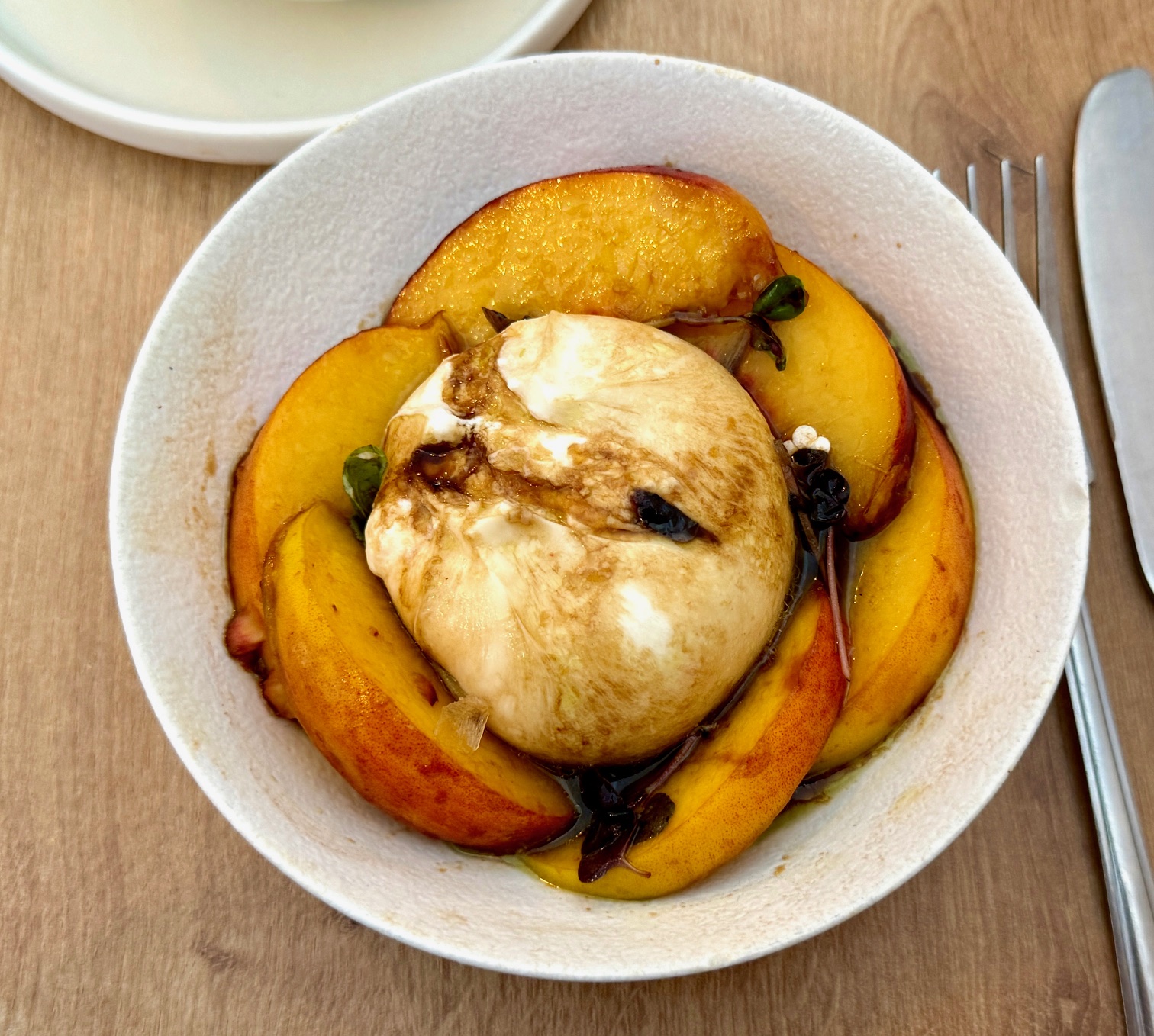
Although it was October when we visited, the weather was in the low twenties and the other two small plates had a feeling of warmer climes about them. Zoë had chosen burrata with peach and basil, the whole thing Ronsealed with a whack of balsamic dressing. The last time I tried a dish like this was in a market in Bordeaux, at the height of summer. This, I think, was better: the peaches just magnificent, the interplay of sweetness, sharpness and mollifying creaminess bang on. Burrata has reached the point now where newspapers have started sneering about it, which I’m sure makes them look dead clever, but done well it’s still a beauty. Again, I’m not sure I’d have wanted to try sharing this, but I was lucky to get a forkful.

My small plate was another variation on the whole salad with cheese motif. Ribbons of courgette, marinated apparently, undulated above a smudge of fresh whipped ricotta, spun with lemon. That would have been nice enough, but some leaves and a hard cheese – pecorino at a guess – had been plonked on top. I suppose when a dish isn’t a looker, as this wasn’t, it’s easier to share because you don’t mind messing it up. I really liked the flavours in this but on balance I’d rather have had the burrata and peaches – which, incidentally, is the name of the ridiculous pub I plan to open in the university area if I ever win the lottery.

By this point the negronis were done and dusted, the room was bustling and I could just about make out dishes arriving at other tables, wondering whether people had ordered better than me. I was on to a very enjoyable glass of a French white made from Gros Manseng, not a grape I know, although to get all Andy Hayler for a second £9 for a glass when a bottle will cost you £11 online is quite the markup. I was already getting the picture: that Little Hollows was a wonderful spot, a neighbourhood restaurant that caused its fair share of neighbourhood envy. But I also knew that to judge the place without trying the pasta would have been an act of gastronomic coitus interruptus.

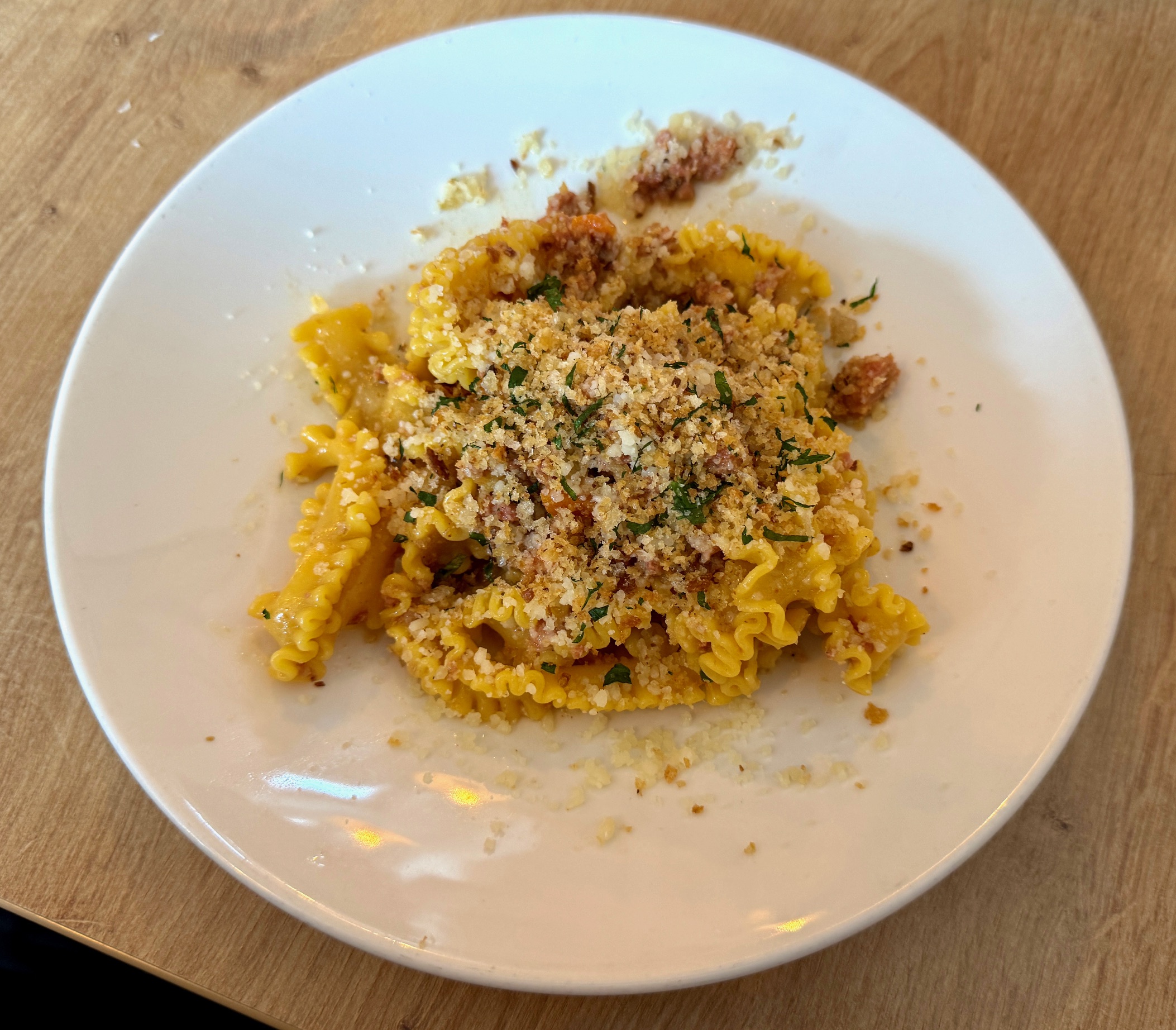
The dish that had jumped out of the menu for me, naturally, was the one Zoë chose. Mafalde are pasta ribbons with wavy, crinkly edges – “like an octopus tentacle” was Zoë’s description – and Little Hollows served them with a ragu of pork and fennel sausage, parmesan and pangrattato. This was right up my alley, and a mouthful just confirmed how good it was – the fennel seeds lent an aromatic crunch, as did the breadcrumbs, and the sausage and parmesan gave it an intense saltiness.

I would have ordered this and eaten it all the live long day, but I don’t think Zoë was as taken as I was. She prefers to have pasta as a starter or an intermediate course rather than as the main attraction, doesn’t like putting all her golden-yolked eggs in that starchy basket. With a restaurant like Little Hollows, that’s kind of by design, and I didn’t think the portion was that hefty, but even so I enjoyed it more than she did.

It didn’t help that my main course, on paper one of my favourite things, just didn’t work. Puttanesca is one of my favourite sauces: that intoxicating blend of sweet tomato, salty anchovies and olives and punchy little capers, when it comes together, is almost unimprovable. I don’t care that it could be made from a store cupboard, because it’s usually made in restaurants by someone with access to a better store cupboard than you.

So what went wrong? Well, a few things. The sauce was made with thick-gauged Datterini tomatoes, which meant that it never really cohered as a sauce. Nor did it really adhere to the pasta; I didn’t mind this being made with bucatini rather than spaghetti, but the bucatini was more al dente than I’d have chosen – about as flexible as me during a trip to the physio – and that didn’t help the dish coalesce either, lacking the option of twirling and trapping the good stuff in every forkful.

So in practice you ended up eating a lot of relatively plain pasta and then attacking the salty remnants at the bottom of the bowl. And they were nice enough, I suppose, but this dish is all about being more than the sum of its parts, and it wasn’t in this case. One to chalk up under missed opportunities: I ate it, not liking it as much as I could, while watching my other half eat a dish she also didn’t like as much as she could. And yet she still wouldn’t swap: rude.

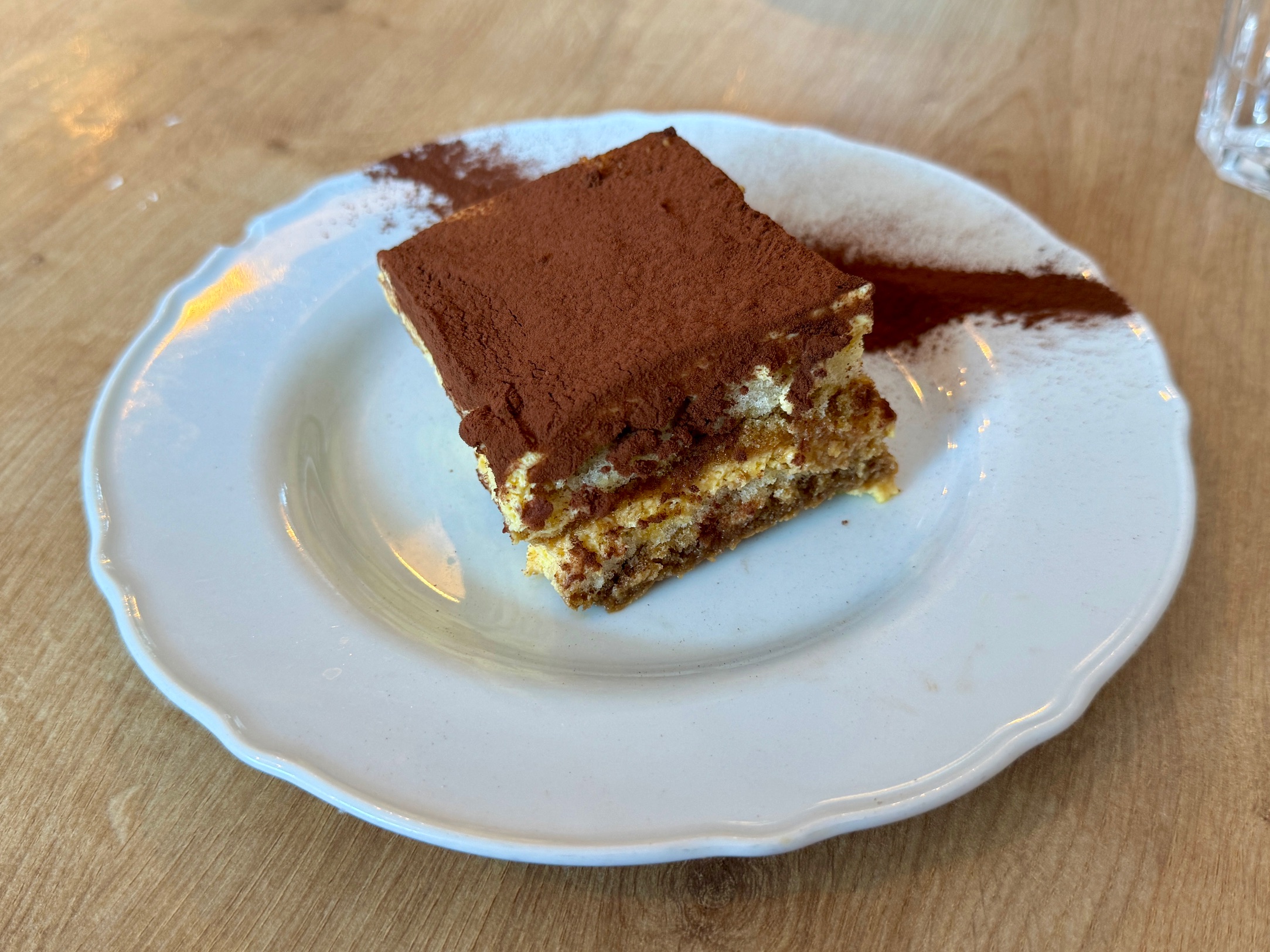
Hey ho. We both had a glass of primitivo on the go by this point. A really good one – you couldn’t fault the wine list, and it was good to see the vast majority of it available by the glass – so we used that to put the brakes on and make a decision about dessert. When tiramisu is on the menu inevitably either Zoë goes for it or I will, but Little Hollows complicates things by offering you a standard and enhanced version, the latter laced with Frangelico and praline, a hazelnut flanker.

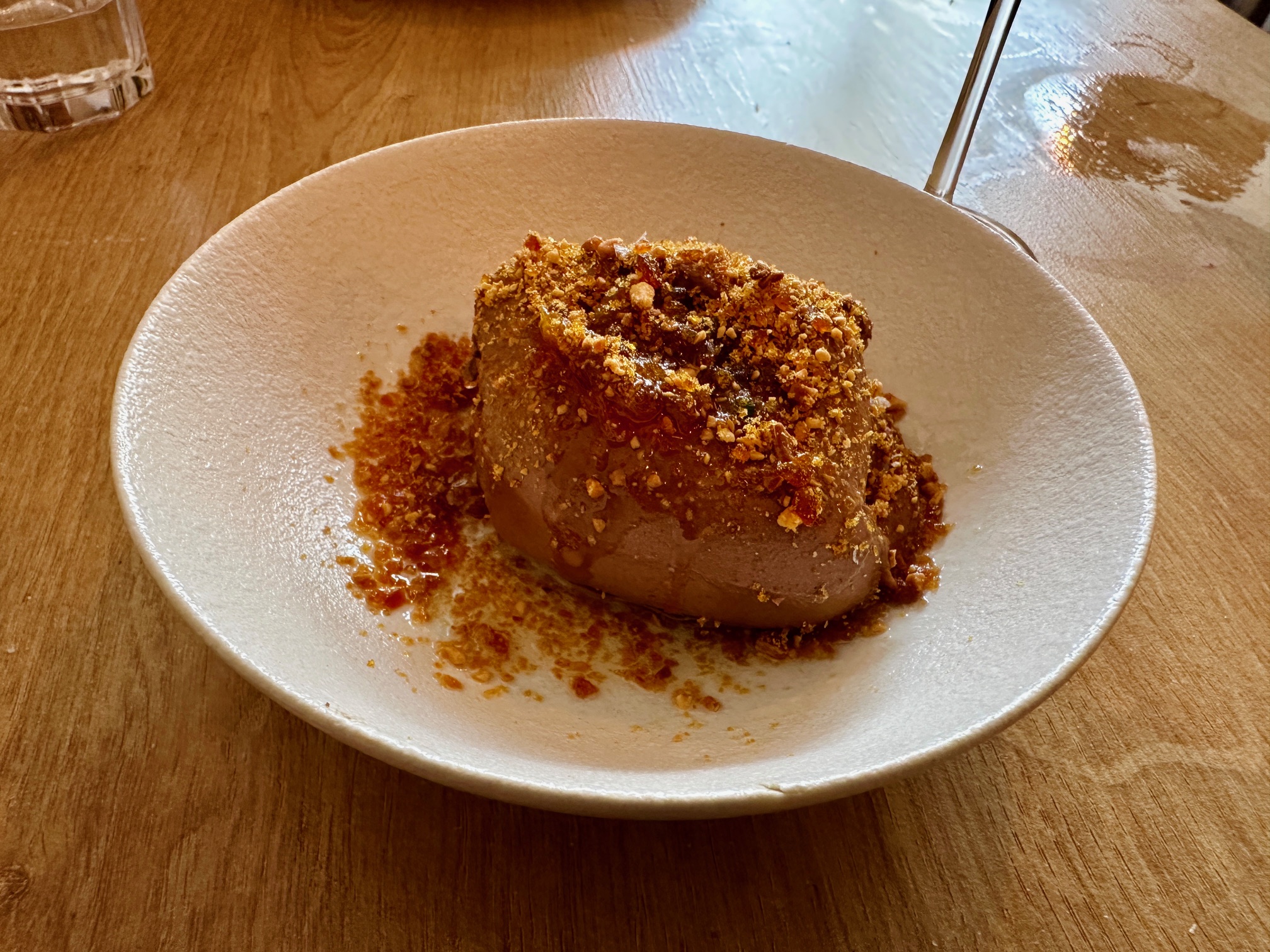
So Zoë ordered that and I went for the vegan chocolate mousse, and we had a couple of outstanding dessert wines into the bargain – a moscati d’Asti for her and a really cracking passito-style number from Crete for me. Would desserts cement our impression of the meal?

They sort of did but again, it was problematic. Zoë’s tiramisu looked the part but she had a spoonful and said “I think they’re brought us the standard one. Can you taste any hazelnut in this?”. So I tasted it and no, I couldn’t. I’m not a massive fan of hazelnut, or Frangelico, whereas Zoë adores the stuff, so between us you’d think one of us could pick them out. So we asked the wait staff, and they took it to the kitchen to check and came back and said yes, it definitely was the hazelnut version. Which I have to say made me feel pretty thick, but I tried more and I still thought, being charitable, that it was very light on the hazelnut.

My dessert wasn’t what I was expecting either. I knew a vegan chocolate mousse would be different, and I was expecting it to be darker, but what I wasn’t expecting was that it was completely lacking in aeration, the texture, bubble free, more like a cremeux than a mousse. I didn’t mind it, but the cognitive dissonance cancelled out some of the delight. The almond praline was more like a crunchy crumb and the marmalade on top had a lot of heavy lifting to do to offset that slick sweetness. Like a lot of what we’d eaten, it wasn’t quite there.

Never mind. It was lovely to be in Bristol, the sun was shining, the space felt like a celebration of everything that’s good about lunching on a Saturday and there was an excellent pub less than five minutes away. So we decided that, on balance, Little Hollows wasn’t half bad and we asked for the bill. There was one last twist in the tale when our server brought it.

“We’ve taken the tiramisu off the bill” he said. “It is the hazelnut tiramisu, but it turns out that it was missing the praline so it just had the Frangelico in it.” I didn’t really know what to make of that – I couldn’t see why they wouldn’t tell the truth but it was weird to dish something up which didn’t match the description on the menu and then, when we asked about the discrepancy, to say that it was our mistake. All very strange, but generous of them – it was after all a great tiramisu at full price, let alone gratis. Our bill, including gratuity, came to just shy of a hundred and fifty pounds.

There are always mixed feelings when I cross a restaurant off my list, especially when it’s a Bristol one. And I definitely have that with Little Hollows. I liked so much of what they did, and their basic concept is a brilliant one, so I’m disappointed not love my meal as much as I hoped. I’m sad, too, that I can’t bring my Reading readers another must-visit Bristol restaurant (so many of the highest ratings I’ve given out are to Bristolian establishments) or convince any Bristol readers out there that I am anywhere near the zeitgeist.

But in truth there’s also a degree of relief that the choice of where to eat in Bristol, for me at least, has got easier rather than more difficult. If I lived in Bristol I can imagine I would go back, but as an occasional visitor every restaurant like COR or Marmo that I leave itching to return makes it just that little bit harder to try somewhere new, to add to my stock of Bristol reviews. And again, it’s worth making the point that this shows the gulf between places like Bristol that attract the very best and my beloved Reading, that is still fighting the good fight to bring the right kind of restaurants to town.

In Reading, Little Hollows would be a must visit. In Bristol, it’s merely a rather good restaurant in a city awash with knockouts. I hope the people who live in Bristol, and the ones who eat at Little Hollows, know how very lucky they are. In the meantime, if you live in Reading, you want an amazing puttanesca and don’t mind a short train ride, I have two words for you: Mio Fiore. Or if you love pasta go to London and visit Bancone. It’s much imitated but few restaurants, including Little Hollows, have quite matched it yet.

Little Hollows Pasta – 7.6
26 Chandos Road, Redland, Bristol, BS6 6PF
0117 9731254

https://www.littlehollowspasta.co.uk

Restaurant review: COR, Bristol

For once, I turned up for lunch in Bristol moderately ahead of the curve. COR, a cosy small plates restaurant in Bedminster, has only been open since October and, so far, has mostly been Bristol famous rather than nationally famous. Not completely, though: Tom Parker Bowles raved about it in the Mail On Sunday on a recent visit. And last month, when Square Meal listed its top 100 restaurants for 2023 COR made the list: not too shabby for a restaurant that’s been trading for about four months. Even so, stepping through the front door with my old friend Al for lunch during a weekend trip to my favourite city, I felt slightly closer to the zeitgeist than usual.

They’ve got a lovely site. It’s a corner plot, double aspect with big windows letting in plenty of light and despite being on the compact side all the space is used superbly. There are relatively few tables, but there are also excellent, comfy-looking stools up at the window letting you look out on the painfully cool passers-by, on their way to a café, the terrific looking natural wine bar or a smashing chocolate shop. The seats at the bar look like fun too, and some of them give you a view out back to the open-ish kitchen. The restaurant is passionate about always saving some room for walk-ins at the window or at the bar: like so much else about it, it’s admirable.

COR’s menu read extraordinarily well. I know small plates aren’t for everybody, but these were grouped and flowed effortlessly, from nibbles to charcuterie, on to seafood, to a selection of vegetarian and meat dishes and then a handful of larger, more conventional plates. Just the three, in fact. The nibbles and charcuterie were close to a fiver, the small plates generally hovered just under ten pounds and the bigger ones were around fifteen quid.

Now some people will look at that and think “ugh”, probably put off by bad experiences with the small plates concept in the past. I get that – I’ve had many of those too – but to me this just read like a dream, an edible Choose Your Own Adventure with no bad endings. Our waitress, who was positively brilliant throughout, told us roughly how many dishes people ordered per head, although I must say that she probably meant customers built like her, or Al, rather than built like me. We may have disregarded her sterling advice. She also told us they were down to their last portion of mojama, air-dried tuna, on the specials board, and nodded approvingly when we asked to bag it.

That turned out to be an outstanding decision, although in fairness so was practically everything we ordered. So was booking the place for lunch in the first place, come to think of it. I’m used to eating mojama up at the bar in Granada, thick slabs of coarse, salty tuna sprinked with almonds and drizzled with olive oil, as simple as they come. This, by contrast, was gossamer-light, with a judicious single almond, beautifully toasted, per slice and little segments of sweet, sharp orange to improve things still further. My mind may have been playing tricks on me, but I think the whole lot rested on a smudge of houmous. Every mouthful was delightful, and it never lost that sense of surprise: small plates, in fairness, find that easier.

As we rhapsodised Al sipped his white vermouth, I my Asturian cider – yes, we’re those kinds of wankers – and all my cares dissolved; Bedminster wasn’t Granada, not by a long chalk, but it had already earned twin city status, and we’d just gotten started.

Finocchiona, fennel salami, was more about buying well. But COR definitely bought well, and if their menu had listed where they’d got the stuff from I’d have ended up buying well too. It had a wonderful whack of aniseed and I liked it very much – it also wasn’t too ridiculously priced at a fiver. As you will discover, I had trouble finding fault with nearly anything that COR did so I might as well take my opportunity here: only two cornichons? Really? Have a word with yourselves.

That minor disappointment out of the way, the last of our first wave of dishes was also on the specials board and if I eat anything as small but perfectly formed again this year I’ll have done very well for myself. The last time I was in Bristol I was wowed by a canelé rich with honey, whisky and smoke. This time, I was even more dumbfounded by COR’s savoury canelé which came drizzled with a grassy olive oil, tarragon and thinly sliced mushroom. Cutting vertically through it prompted the reveal, that the whole thing had been filled with a creamy, savoury mushroom duxelles which made me beam. This was emphatically not for sharing: Al and I scoffed one each, and I had half a mind to order another after dessert.

Another thing I really loved about COR was that they took our orders and artfully sequenced them almost like a gastronomic mixtape. None of this “your dishes will come out when they’re ready” bollocks that treats you to feast or famine, instead we got things in a carefully structured order that showed every dish off to its best advantage. Take this for example, Jerusalem artichokes fried until golden and sticky-edged and served on an earthy pool of artichoke velouté. It was simply magnificent, and if I couldn’t really detect much truffle in the truffled pecorino I was having far too much fun to give a shit. I have to really fancy Jerusalem artichoke to order it in a restaurant because of its legendary side effects. Here I did it anyway, and the side effects never materialised. That’s what I call winning at life.

Equally delicious was the next dish, slow-cooked pork shoulder crammed into radicchio and topped with ribbons of pickled fennel (and some slightly pointless dill). The pork was splendid, with the texture ignorant people are prone to describe as unctuous. This vegetation-as-taco concept seems to be a Bristolian one: I had something very similar, albeit far smaller, at Wilson’s late last year. But this was the size you actually wanted it to be – and well portioned for sharing. Did I wish I was eating them both to myself? I like to think I’m a decent friend, but yes. Yes I did.

By this point, Al and I were suffused with a warm glow, catching up for the first time in months, enjoying glasses of surprisingly fruity and accessible Cataratto (“do you know, that’s the only wine I like?” said our waitress, charm personified without necessarily realising it). And we got to talking about superlatives: Al has the misfortune to spend some of his time surrounded by people from Gen Z who only ever use one superlative – “stunning” – and use it all the time. About everything. Everything, he told me, is their “new favourite dish”, whether it’s a special occasion or some spaghetti hoops out of a tin. Even hearing about this perpetual state of wide-eyed wonder, I’m afraid, made me want to kick something very hard.

But we were both rather running out of adjectives by the time our next dish arrived. Tropea onions, cooked to soft, caramelised wonder, drizzled with a hazelnut beurre noisette and crispy sage leaves was another knockout, even without the three dollops of goats cheese (Ragstone, apparently) providing a little agriculture to offset the sweetness. I gave Al the spare onion: I told you I was a good friend, although he did let me have the extra Jerusalem artichoke, and I thought that one of the nicest things about sharing dishes is that you can both have virtually the same superlative experience. If there’s a better thing to do with an old friend than go to an excellent restaurant, I’m not sure I know what it is: I know some people like watching the football, or playing squash, or bloody golf, but for me this is as good as it gets.

“Would you describe it as stunning?” I asked. Al grinned.

“Definitely. New favourite dish.”

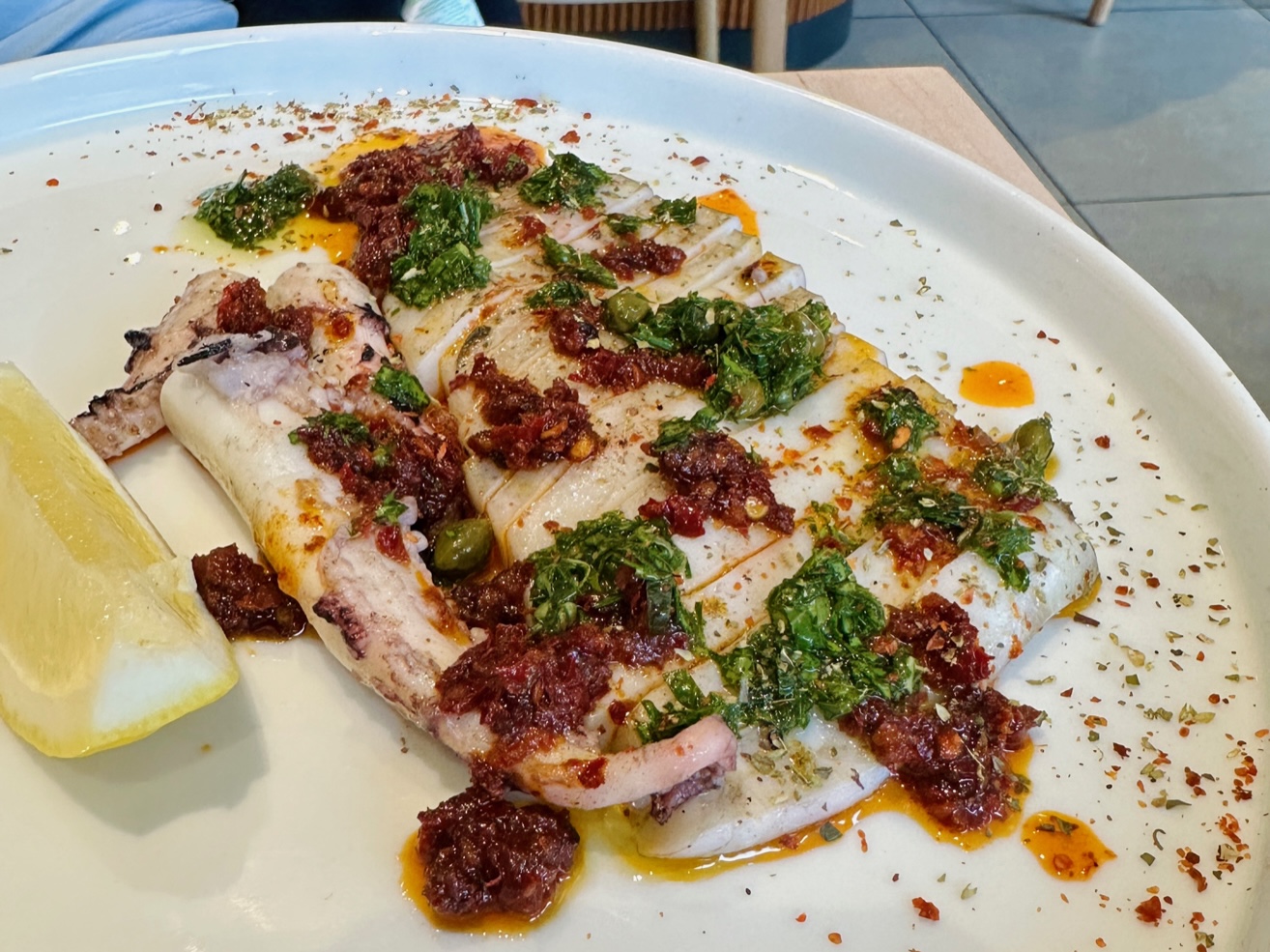
My new favourite dish – and in fact it stayed that way for the rest of the meal – was the next one. A really generous portion of cuttlefish, cooked sous vide and then finished on the grill I believe, was ludicrously tender and came already sliced into ribbons. I could imagine serving this with ‘nduja, or with salsa verde, but matching it with both, along with some capers, in a dazzling, dizzying tricolore was a stroke of genius. This dish would be at the apex of nearly any meal, and if I could find anywhere closer to home that served something like this I’d be there all the time, even if it was only half as good.

Our main courses involved the only misstep, and by “misstep” I mean “eight out of ten dish”. Al had decided to try the manicotti, a pasta dish, and he was encouraged in this by our waitress when he told her he was torn.

“It’s one of my favourite dishes, it’s like something your grandmother would make.”

“Your grandmother must be a better cook than mine was” I said, fighting back memories of wan fish, floured and fried, served on the kind of brown smoked glass plate every household had in the seventies. Still, she did at least cook proper chips in a chip pan, something nobody does now.

I think the dish was better than anything Al’s grandmothers could have conjured up either, but it wasn’t as much a tour de force as everything else had been. Manicotti are big sleeves of pasta, thicker and bigger than canelloni but the same kind of thing. Whereas this was a single giant tube, folded rather than rolled, and the overall look of it was somewhere between canelloni and some kind of pasta calzone, if I haven’t mixed my metaphors to death by saying that. It was stuffed with ricotta, topped with braised tomato, parmesan and rocket and it managed to look hearty, well-done and somehow unspecial.

“It’s okay” said Al. “It just doesn’t match everything that’s gone before. The braised tomatoes are fantastic, though. I just should have ordered the same thing as you.”

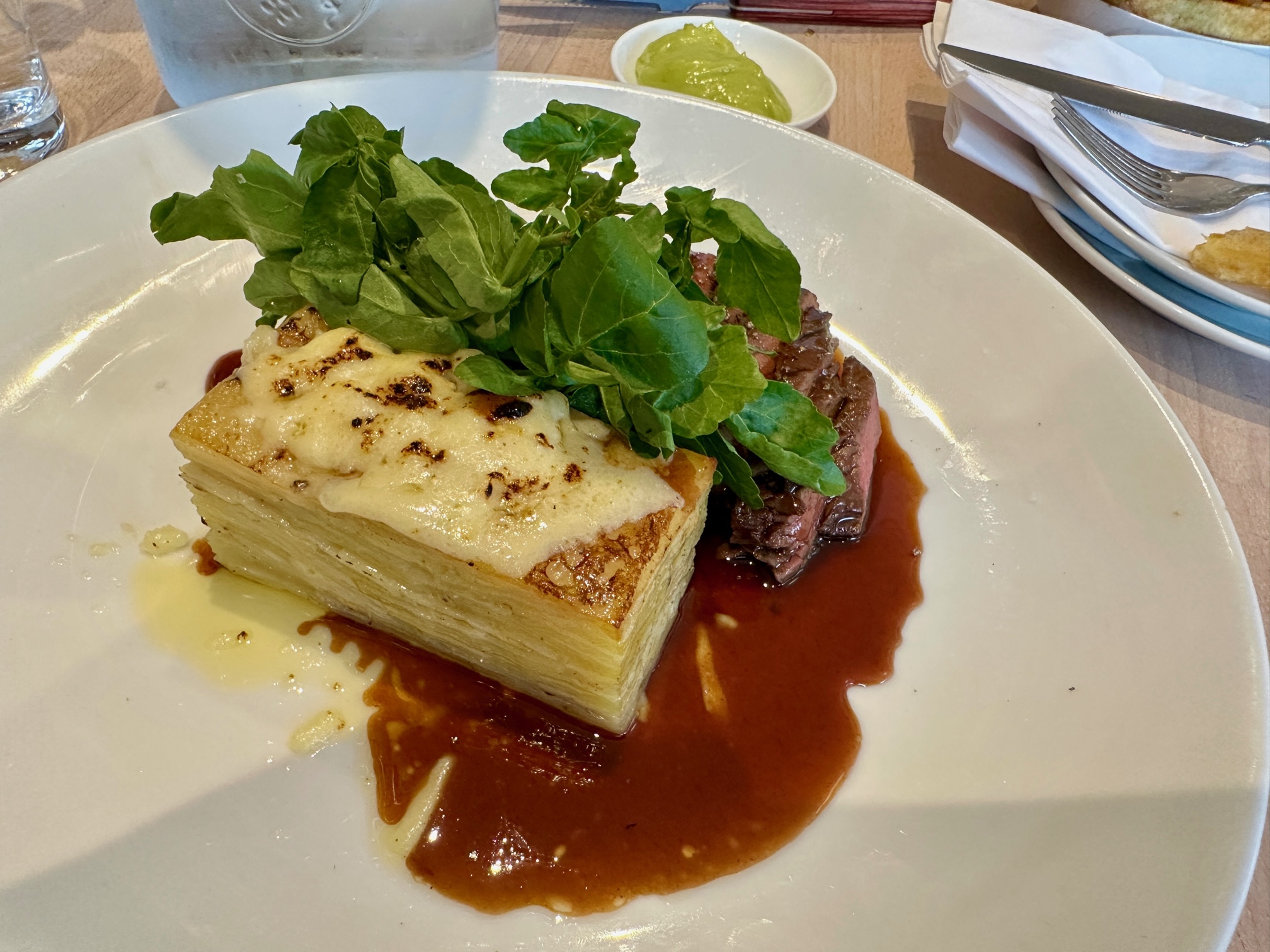
I mean, he should have. Because while I watched him eat a big sheet of pasta with some cheese in it pretending to be a Mobius strip, I was diving into a marvellous piece of onglet, as yielding as you like, with lashings of intense jus and – the icing on the cake – a dauphinoise of interlayered potato and celeriac, all topped with quite a lot of gruyere. It was just the most incredible thing, and when I saw on the menu that it clocked in at under sixteen pounds I thought there must have been a typo.

But there wasn’t. That whole plate of food for sixteen pounds was outrageously generous, charitable even. And speaking of charitable, even this dish had been served in a way that encouraged sharing, with the steak cut into substantial slices. I let Al have as many as he wanted to dull the food envy, because I’m not a monster: I suspect he would have had more, but it would have made the envy worse, not better. He consoled himself with some exceptional hand cut chips, dipped in a tarragon mayonnaise so herb-heavy it was the colour of guacamole. I had some too. Of course I did, it was world-beating.

We’d come all this way, so not having dessert would have been madness. The dessert menu is nicely compact – although they also have a selection of eight different cheeses – and Al had clearly learned from his mistake because, like me, he opted for the chocolate mousse. I think it’s an underrated dessert at the best of times, but this was at the very best of times – a hulking scoop of the stuff, dense yet airy, studded with plates of almond dentelle like the spines of a stegosaurus. That enough would have made it exquisite, but sprinkling it with flakes of sea salt and drizzling it with olive oil was the final touch.

“That chocolate mousse was so good” I told our waitress as she took our bowls away and we sipped our dessert wines (like I said, those kind of wankers), fighting the almost primal urge to order a savoury canelé for the road.

“Thank you so much! I actually made that yesterday, I spend some shifts in the kitchen as a pastry chef. I can’t actually eat it myself, it’s a bit too rich for me.”

I can’t imagine the level of self-restraint involved in being able to make something like that and not eat it, but then that’s why some people are slim and I’m not. Al, on the other hand, eats like a horse and is still as skinny as he was when I first met him about thirty years ago; this is why some people are jammy bastards and I’m not. But anyway, despite being thin, talented and impossibly young our waitress was a class act. All the people who served us throughout lunch were, actually: friendly, passionate about the food, with opinions on all of their favourite dishes, they were a real credit to the restaurant. How does anywhere get this good after just four months? It was quite miraculous.

Our waitress asked where we were from, and I mentioned Reading, and she proudly told us she’d been there. Once. Then of course the truth came out, that she’d passed through it recently on a train to London to watch a gig. It was the first time she’d ever been to London on her own, she said, at the tender age of twenty. And suddenly Al and I felt very old indeed, and seized with a sneaking suspicion that we should hightail it out of Bedminster and find an old man pub to hunker down in to carry on our gossiping session. The natural wine bar would just have to wait for another time. Our meal for two, with a very richly deserved service charge included, came to just under a hundred and ninety pounds. There was literally nothing to begrudge, except any of their punters who only paid ten per cent service.

As I was writing this review, I messaged Al, mainly to reminisce about what a phenomenal meal it was. What a stunning array of dishes I sent him, hoping to get a cheap laugh.

“One of my objections to the S word is the cognitive dissonance” he replied. “Stunning implies losing your senses, but with food that good your senses are very much alive. Sorry, you can tell I’ve thought about this too much.”

He’s right, though. What I loved about COR the most was having my senses awakened and reawakened time and again over the course of such a glorious lunch – old favourites, new combinations but always real integrity and imagination. Nothing was boring or humdrum, which I can say because I didn’t have that pasta dish, and in terms of the sheer number of hits I think it ranks as one of the best meals I can remember, at home or abroad.

I’m sure you know the drill by now with this kind of review. Bristol, Bristol, Bristol, hyperbole hyperbole hyperbole. But I like to think I’ve been here enough to sift the hypebeasts from the real contenders. The last time I was in Bedminster I ate at Sonny Stores, which was raved about by literally everybody but left me cold. And the last time I was in Bristol I went to Wilsons, which I raved about to literally anybody who’d listen.

And positioning COR relative to those two is pretty easy – it is miles better than Sonny Stores, a neighbourhood restaurant with a touch of the Peter Principle about it. But actually, although the number at the bottom is marginally lower than the one I gave to Wilsons, if you’re only having one meal in Bristol I would go here instead. Wilsons is a take it or leave it menu, a set seven courses, and when it’s on form it’s incredible. But I have friends who went there off the back of my review and although they loved the flavours, they found it a carb free zone and, I’m sorry to say, they left hungry. That will never happen to you at COR, and you will have an awful lot of fun deciding exactly how you want to become full. That’s what restaurants should all be about.

And how does COR compare to Reading restaurants? There’s nowhere in Reading even remotely like it. That is, and continues to be, the problem. You might get bored of hearing me say so, but it’s important to have goals. Reading’s should be to attract at least a couple of restaurants in approximately the same ballpark as this. I really hope it happens. It’s starting to get a tiny bit embarrassing.

COR – 9.5
81 North Street, Bedminster, BS3 1ES
0117 9112986

https://www.correstaurant.com

Restaurant review: Asado, Bristol

The venue for this week’s review was partly chosen as a result of circumstances: our train back from Bristol left mid-afternoon on Sunday, so we needed somewhere that would do a good lunch but not necessarily a leisurely one. For me this is where casual dining so often comes into its own, when you want something decent but not too expensive, briskly paced but not fast food. And this being Bristol, even that sector of the market is awash with attractive, interesting options so you never have to opt for the comfort zone of a chain restaurant. Could Asado, a burger restaurant at the top of the Christmas Steps, be the answer?

That arguably undersells Asado’s standing though, as if I’d merely looked at a map of the city and tried to find something affordable within walking distance. In fact, it has built a formidable reputation since it opened five years ago, with many people thinking it arguably does Bristol’s best burger (a title awarded to it last September – although only by the local Reach plc website, so perhaps not carrying that much cachet after all).

Its pedigree is decent too – the owner is an alumnus of Patty & Bun, who for my money served probably the best burger I’ve ever had. He moved to Bristol determined to offer something a little different, and Asado’s selling point when it opened was that the burgers were cooked over a wood-fired grill. The menu also had a mixture of traditional and South American influences, and the hype was considerable: this was back when Bristol had quite a few restaurant blogs, although the last review of Asado I can find from anywhere is nearly four years old.

Having survived the pandemic Asado made a properly leftfield move when it came to expansion – the owner decided to move to Barcelona, so they just opened a second branch there. As you do. There’s something quite admirable about that – I know we often look at restaurants outside Reading and wish they’d expand in our direction, but given a choice between, say, the Ding and Barcelona who can blame them for heading south?

Anyway Asado seemed to be thriving in its original branch, and although we were the first customers there when it opened at one by the time we left plenty of the tables were occupied with groups, big and small, working their way through the menu (and drinking cocktails in many cases, which made me feel about a hundred years old).

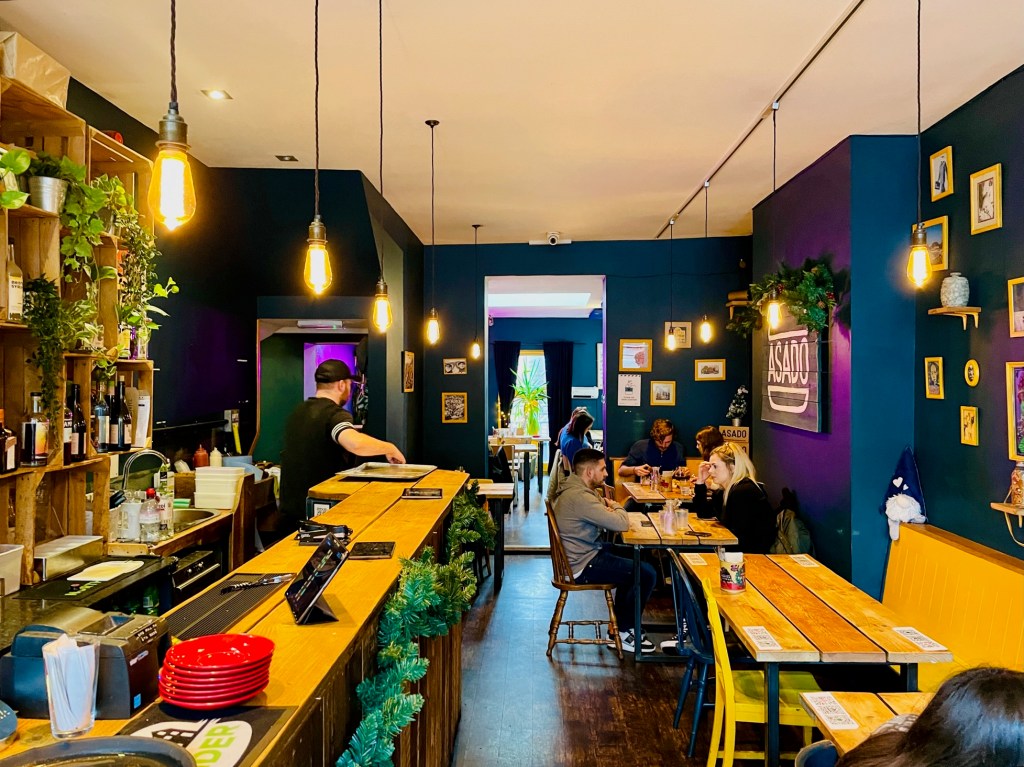
The restaurant is made up of two rooms – a narrow front room, also home to the bar, which has a snugger, more conspiratorial air and a back room which feels more open and spacious due to a lovely big skylight. Furniture was the kind of standard-issue mixture of distressed chairs and what looked like old school chairs, and the overall effect was a little like a classier version of Bluegrass BBQ. We sat in the back room, and what it gained in natural light it lost because of a certain lingering chilliness.

The menu was encouragingly concise, with a limited number of variations on a theme. So you can have the beef burger as it comes, or enhanced with pulled beef, pastrami or skirt steak. The chicken burger either comes with guacamole and chipotle mayo or with hot sauce (Warning! Hot is very hot, the menu said) and blue cheese dressing. There are two options for vegetarians, with the burgers made by Huera – from pea protein, as far as I could tell by Googling – with pulled jackfruit if you fancy it.

Both of those can be made vegan by request, although you miss out on the West Country cheddar: Asado makes much of using proper local cheese rather than plastic American slices. Burgers tend to range from fourteen to eighteen pounds and come with fries and slaw, and you can double up anything apart from the chicken burgers for three quid.

As is generally the case with this kind of restaurant the smaller dishes were labelled as sides rather than starters, although the woman serving us did give us the option of having them separately as starters if we wanted, a nice touch. Service, incidentally, was superb, bright and enthusiastic; she started out by complimenting Zoë’s make up, which is a great way of getting anybody on side. From what I could tell she was bilingual as well, because the Spanish names of our dishes were pronounced flawlessly and I’m pretty sure I heard her talking to a neighbouring table in Spanish.

She brought over a couple of beers for us – the draft beer here is by local New Bristol Brewery – and from that point onwards I felt in very capable hands. We tried the table beer, Three Falling (it’s three per cent ABV, you see) and I thought it did a great job of packing a lot of flavour into a pretty sessionable strength. By that point in the weekend I was simultaneously sworn off drinking for quite some time and thinking three per cent is hardly booze at all: it’s surprisingly easy to hold both those ideas in your head at the same time.

If I had a fiver for every time I’ve written Zoë ordered better than me on this over the last four years, I could probably review quite a few restaurants in 2023 without putting my hand in my pockets. And so it proved here, because the Pollo Libre, Asado’s (more) basic chicken burger, was fantastic. A lot of hefty chicken thigh, fried in a nicely seasoned, crunchy and craggy coating, would have been pretty unimprovable even on its own, but the extras took it just that little bit further. “This guacamole is great” said Zoë, “and it’s positively singing with lime”. I was allowed a bite, which was enough to confirm that she was right and to make me slightly regret my own choice.

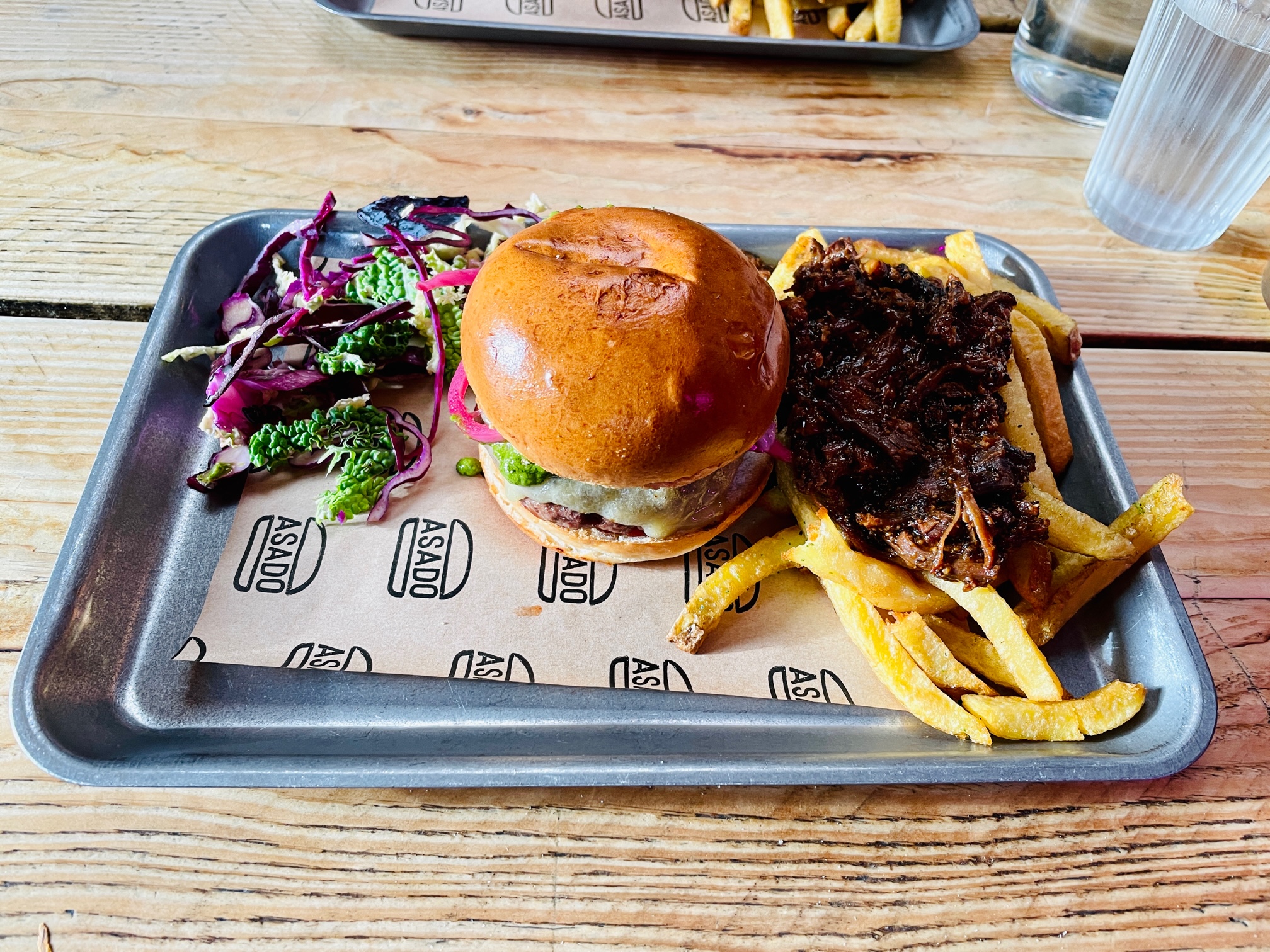
I’d decided to go for the entry level burger, the eponymous Asado. It’s the most stripped-down one they do but it still has plenty going on with the patty, that West Country cheddar and plenty of different sauces – chimichurri, confit garlic mayo and ketchup and some pickled red onions on top. And I liked it just fine, but it didn’t blow me away as I’d hoped. Part of that might just be expectation management: I thought that the burger itself would have a wow factor from having been grilled over fire but I didn’t get a huge amount of char or caramelisation, or the smokiness I was expecting. And it didn’t feel to me like all those sauces were working in harmony – less might have been more, in that respect. I liked it, but I didn’t love it.

Credit to them, though, for making a burger that you could just about eat without unhooking your jaw, in a not-too-sweet brioche that had the structural integrity to keep it together. Perhaps I should have had it with extras, but I wanted to think that the burger could stand on its own two feet without that. Instead I had some of the smoky pulled beef on top of my rosemary fries and it was positively transformative – a beautiful tangle of savoury, smoky and sweet strands of slow-cooked beef that quite made my afternoon. You can have these on your burger if you order the El Don, and next time I probably would. The slaw, which was dressed rather than with mayo, felt a little underdressed and felt like it was there mainly for appearances. It did look pretty, though.

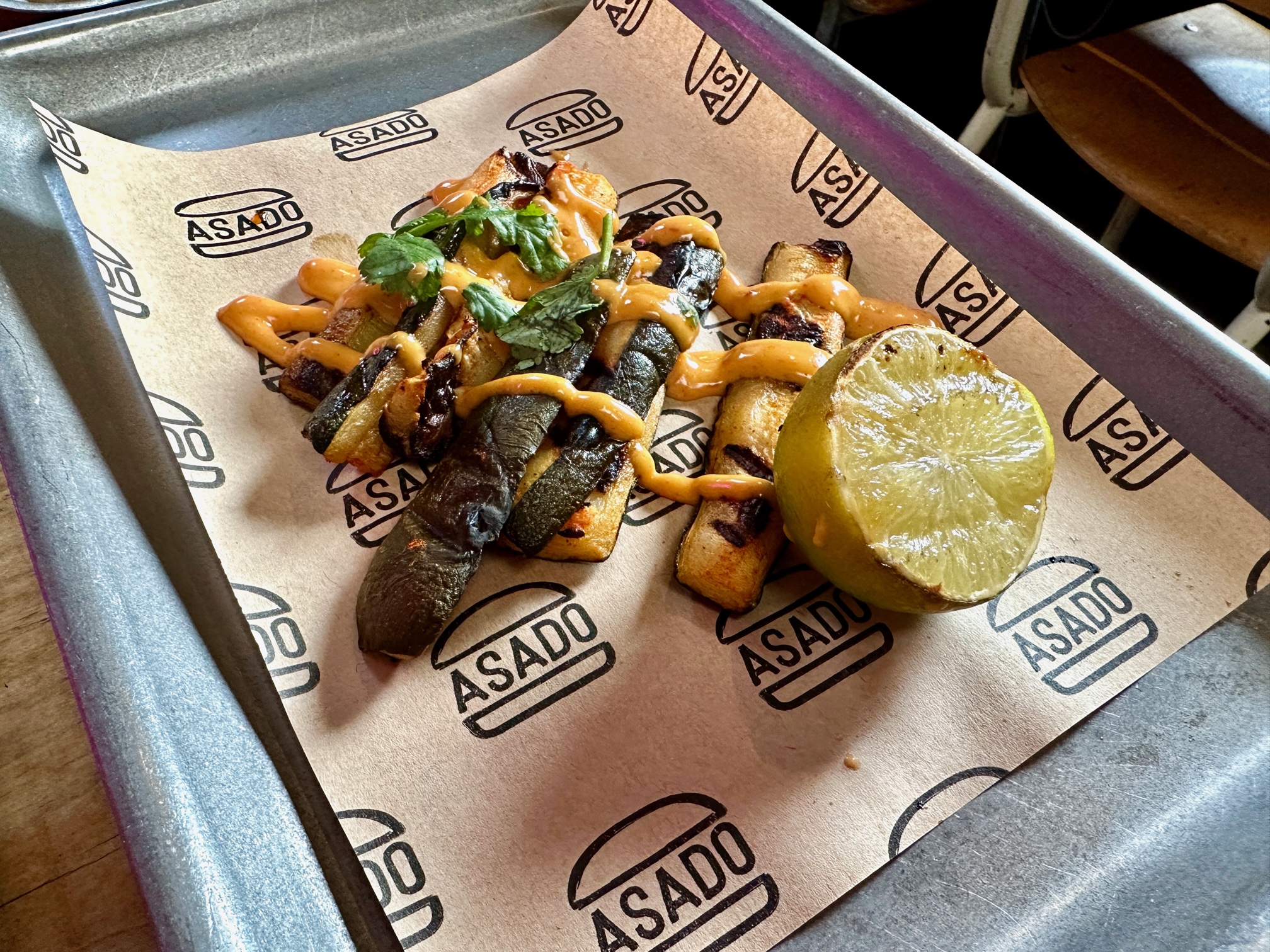
If that was the whole story, it might have been a little underwhelming but it was the sides and the extras that lifted Asado into more interesting territory. I’ve already raved about the pulled beef, but I also adored our grilled courgettes. Asado used to do courgette fritti but this was much more vibrant and interesting – batons of courgette just-cooked but blackened on the outside, striped with a well-balanced sriracha mayo. More virtuous than yet more fried stuff, but still indulgent. I could have eaten a bucketload more of this.

Speaking of fried stuff, the sides and bar snacks section of the menu featured croquetas with more of that pulled beef in them and morcilla nuggets – breadcrumbed spheres of black pudding fried until crispy and dished up with a chimichurri mayo. The latter are three pounds each or four for eight pounds fifty, and when we only asked for a couple the waitress asked if we were sure. And when we said we were she took our order, although I wish with hindsight that she’d said “Seriously, you should reconsider: they’re fucking amazing”. Because they were – the perfect snacking size, possibly two bites maximum of deep, delicious black pudding only slightly lightened by the mayo. If I’d known how manageable they were, I’d have ordered four. To myself.

And if I’d known how small they were, I would have made room for the four morcilla nuggets by passing on the chicken wings. They were decent enough, although again the smoke didn’t really come through on them at all, and I loved the sweetness of the pineapple and agave glaze, with a little heat. But they reminded me of everybody I’ve ever worked with who had short man syndrome: small and stubborn, to the point where however nice they might be you did find yourself thinking is this worth the effort? On balance, perhaps not. I could have had some of those pulled beef croquetas instead, or saved room for dessert. There’s only one on the menu, a passion fruit cheesecake, but I bet it’s marvellous.

With us done and dusted, all that remained was to settle up. Our meal for two with a couple of pints, probably more sides than we needed and including a needlessly low ten per cent optional tip, came to just over seventy six pounds. We were out the door more quickly than planned, so we wandered across to Bristol’s branch of C.U.P. on Park Street, a little slice of home from home, and sat outside with one of their peerless mochas, looking down the hill and imagining what it would be like to live in Bristol. Would it still be so amazing then, or is the grass always greener at the other end of the M4?

Summing up this review is difficult. My Bristolian readers (and it seems I have more than I thought) will probably already know about Asado and have firm opinions about it. Especially if they also read Bristol’s Reach plc website, which looks almost as trashy as ours. And for the rest of you, it’s a little more difficult. If you are absolutely mad about burgers I would say yes, you should definitely go. One of the best burger restaurants in Bristol is very likely, on paper, to be one of the best in the country. And if you happen to be in Bristol and you want a quick meal, not far from the train station, it’s very easy to give Asado an unqualified recommendation.

Is it enough to build a visit to Bristol around the way that, say, Wilsons, Marmo or Caper and Cure are? No, probably not. But that’s no bad thing. Not every restaurant can be Lionel Messi. Somebody has to be Luke Shaw, and there’s no shame in that. And it’s definitely a level above Honest, which is most people’s Reading benchmark.

“I saw you went to Wings Diner” said Gurt Wings’ James when I went to Blue Collar the following Friday for my regular dose of his Japanese fried chicken. That figured: Mr Gurt always has an eye out on Instagram and never misses a trick so he’d seen all my meals in Bristol, even the ones I didn’t write about.

“Yeah, it was really pretty good. Especially the Korean dip.”

“You know where you should go in Bristol? There’s a place called Seven Lucky Gods and their Korean fried chicken is out of this world.”

See? It never ends. Nonetheless, I made a note for next time.

Asado – 8.2
90 Colston Street, Bristol, BS1 5BB
0117 9279276