As a restaurant reviewer, however assiduously you do your research, however good you think you are at reading the runes of a menu to try and figure out whether a Brakes lorry regularly pulls up outside the crime scene, however much you trawl through Tripadvisor or other blogs – good luck finding those, by the way – restaurants always retain the capacity to surprise.
You can expect somewhere to be good, all the signs can say it will be, but there’s always a possibility that you’ll wind up with an underwhelming meal if you’re lucky, an out-and out-duffer if you’re not. This is especially the case when hype is involved. Or plain gratitude that a place has opened at all, either because a big name is gracing a town with its presence or because the town in question is a wasteland for decent places to eat.
The more refreshing phenomenon is when it happens the other way round, when you go to an unspecial-looking restaurant with no particular expectations only to discover that you have a proper find on your hands. That realisation that dawns gradually throughout the meal, that sense of hold on, this is really good, is one of my favourite things about restaurants, and about reviewing them. It’s happened to me a fair few times, but one that’s always stayed with me was the March evening over seven years ago when I crossed the threshold of Papa Gee.
Papa Gee, back in 2015, was an Italian restaurant on the Caversham Road, on the ground floor of the Rainbows Lodge Hotel. I’d never heard of anyone who had been to Papa Gee, and at the time I knew people who lived in Little Wales, the maze of streets on the other side of the Caversham Road named after Cardiff, Swansea, Newport. Every time I walked past Papa Gee, probably en route to a booking at Mya Lacarte, the place seemed closed.
Inauspicious was putting it lightly. So nobody was more surprised than me when I found Papa Gee wasn’t some kind of white elephant but was instead a hugely creditable little restaurant doing belting pizzas, rather nice pasta and antipasti, a family business with owner and Neapolitan Gaetano Abete, the eponymous Papa Gee, in the kitchen. I had a splendid evening, although arguably the cherry on the cake was not having to stay in the hotel upstairs afterwards.
I walked away with my faith in the world somewhat restored, and it turned out to be one of the most delightful curveballs of the very early days of this blog. And the weird thing is, people definitely went to Papa Gee before I reviewed it. It’s not as if I discovered the place: it had decent writeups on TripAdvisor and had been trading for over ten years. It’s just that I’d never met a Papa Gee customer, back then. Maybe they didn’t want the rest of us finding out.
I was worried about Papa Gee after that, because the owners of Rainbows Lodge sold the building to the Easy Hotel chain a couple of years later and the restaurant was out on its ear. But then they announced what, with the benefit of hindsight, was a perfect move – and in October 2017 they took over the old Mya Lacarte site on Prospect Street, closer to the action in Caversham.
It was a brave move to open slap bang opposite Quattro, Caversham’s long-serving Italian restaurant, and the conditions got even tougher a couple of years later when the Last Crumb, also offering pizza, opened at the top of the road where the Prince Of Wales used to be. And yet here we are in 2022 and, post-pandemic, Papa Gee is still going.
And that’s partly why they’re the subject of this week’s review. The thing is, I’d never visited them in their new home and I was starting to feel bad about that; I didn’t want them to be continually on my to do list only to find, one day, that they’d closed before I’d got round to visiting. So I made my way there with Zoë on a Friday evening, post work, the weekend stretching out ahead waiting to be filled with units and calories. Like the very first time I visited Papa Gee, a lifetime ago, I wasn’t entirely sure what to expect.
Subscribe to continue reading
Become a paid subscriber to get access to the rest of this post and other exclusive content.
Some of the most prevalent of Reading’s many cynics are people I like to call the Not Another Brigade. They crop up all the time: Not another burger place, they say. Not another coffee shop. If I had a fiver for every time I’ve heard someone say that, I could open a coffee shop of my own. Shortly after doing so, I’d hear enough not anothers to be able to open another, and another, and another.
Although when it comes to burgers, they might have a point. Aside from Gordon Ramsay’s new outpost where Giraffe used to be, there’s one opening on St Mary’s Butts in the old Pizza Express site, one on the Oxford Road opposite the Broad Street Mall, one more taking up the Sprinkles Gelato building next to Smash N’ Grab, itself another – that word again – burger restaurant. Oh, and Slam Burger on Christchurch Green, which will offer burgers called the Big Slam and – ridiculous name alert – the “Beef Wooper”. There was once a Black Country establishment called Kent’s Tuck Inn Fried Chicken. Slam Burger could learn a lot from them: if you’re going to be shameless, at least be funny with it.
Coffee shops are a different matter. People have been saying not another coffee shop ever since C.U.P. opened next to Reading Minster, but now C.U.P. has another branch on Blagrave Street and a third, a recent addition, in the Broad Street Mall. We get new coffee places all the time. Compound Coffee is now operating out of the ground floor of the Biscuit Factory, and something called “Artizan” (showing that swapping an S for a Z always makes a brand look classier) has opened in the building once occupied by Nineties throwback Smokin’ Billy’s.
It’s not a story of unchecked growth, though: the year hasn’t been without its closures in caféland. Earlier this year Anonymous Coffee pulled out of the Tasting House, shortly before the Tasting House pulled out of Chain Street. And only a few weeks ago punters heading for Tamp Culture outside the Oracle were surprised to find an empty space where the kiosk used to be. Tamp had upped sticks and left after over seven years trading at that pitch with no farewell: they’ve since put something on their website. Do these closures prove that Reading can’t sustain (not) another café, or is it just the circle of life?
One part of Reading that has traditionally felt poorly served for cafés is Caversham. There was a time when you had Costa and Alto Lounge, and that was pretty much it. Then in 2016 Tipsy Bean opened, serving something you could loosely describe as coffee, and so did Nomad Bakery. And for a while we also had Siblings Home, a little place on the Hemdean Road: I liked it a great deal, but its owners had a haphazard approach to some of the basics, such as being open when you’d expect them to be. Anyway, that flurry of activity didn’t last long – Nomad, Tipsy Bean and Siblings Home have all ceased trading.
But in more recent times, there’s been a new wave of cafés in Caversham trying to challenge the dominance of Costa. So now Geo Café, which is part cafe, part delicatessen slash general store, is where Nomad used to be, but you also have Gardens Of Caversham, a third branch of the Workhouse empire, in the old Lloyds Bank building. At the more traditional end of the spectrum, there’s the superbly named Nathan’s Nibbles. And up past the Griffin you’ll find The Collective, the subject of this week’s review.
Subscribe to continue reading
Become a paid subscriber to get access to the rest of this post and other exclusive content.
Can you believe it’s two months since I announced that I was going to start reviewing takeaways? January properly dragged – even more than most Januaries, and that’s saying a lot – but the weeks feel like they’ve whipped by since I settled into my regular routine of research, ordering, eating, digesting and writing. As we sit on the cusp of the next phase of whatever this year will turn out to be, I realise I’m running out of time to review takeaways before restaurants (or, at least, those restaurants lucky enough to have sufficient outside space to be vaguely profitable) open again. And after that, you might be off eating in those, or you might still want to read about takeaways. Who knows? The future has never felt harder to predict.
But I realise there’s one category of takeaway I’ve not managed to cover so far, and that’s places that have always done takeaway but that, for whatever reason, just never occur to people as an option. Under the radar restaurants.
This time last year, when the restaurants had just been told to close, because I really wanted to do something to help, I started a Twitter thread listing local businesses and how they were adapting. It took off, and I was constantly updating it: this business was doing free delivery, that business had moved to call and collect. Things changed on a daily basis as restaurants, cafés, pubs and breweries were forced to adapt and fight for survival. I bet they all look back, reflect on the fact that was a year ago, and feel incredibly tired.
When I did the thread, I got a reply from Thai Table, the Thai restaurant in Caversham just down from the Griffin. They delivered to a wide range of Reading postcodes, they said. Thai Table does takeaway, I thought. Who knew? So I added them to the thread and they very politely thanked me. They’ve only ever written four Tweets, and half of them were either asking me for help or thanking me for it.
They stuck out like a sore thumb in the thread – everybody else was pivoting here and there, setting up webshops, looking at new ways of doing business. By contrast, the mention of Thai Table wasn’t about innovation, it was just a quiet reminder. We’re still here, it said. Don’t forget about us. So Thai Table crossed my mind last weekend when I was deciding what to eat and review this week. I’d always enjoyed their food when I ate in the restaurant, and I remembered their awfully nice Tweet from a year ago.
The other thing that occurred to me is that, with takeaways, geography is key. When I reviewed restaurants where I’d eaten in, the chances are you could probably get to them, but with deliveries it all hinges on whether you’re in the catchment area. And so far I’ve covered central Reading, and south east and west, but I hadn’t reviewed anywhere north of the river. So it was high time I got a delivery from Caversham: it felt like the very least I could do for my many avid readers there.
Thai Table’s menu is a classic Thai menu with few surprises and lots of old favourites, and although a handful of dishes are marked as specialities I didn’t see anything on there I haven’t seen on menus elsewhere. There is a star rating for heat where one star means mild, three stars means hot and so on: a fair few have zero stars, and it wasn’t clear whether that meant extra mild or bland. I suspected it wouldn’t be the kind of scorchingly hot authentic Thai food you might get at Oli’s Thai in Oxford, Som Saa in Spitalfields or The Heron in Paddington, but that didn’t bother me – sometimes menus like this are about comfort and familiarity, rather than trailblazing and sinus razing. There’s also a gluten free and vegetarian menu, which I assume means they omit fish sauce for the latter.
Thai Table handles deliveries itself, covering a relatively wide range of RG postcodes, and isn’t on any delivery apps, so you can either order on their website or go fully old school and ring them up. I decided to phone, mainly because my browser told me that their website wasn’t secure, and because their website warned of potentially long waiting times on Friday and Saturday nights I put my call in just after six o’clock. It was clearly a well-oiled machine, and after I had placed my order I was told someone would call me back in a few minutes to take my payment – no doubt freeing up the hotline for the next takeaway order.
We ordered two mains, two portions of rice and three starters and the whole thing came to just over fifty pounds, which included a delivery charge. Our food would be about fifty minutes, they said, and everything about the process made me feel like I was in safe hands.
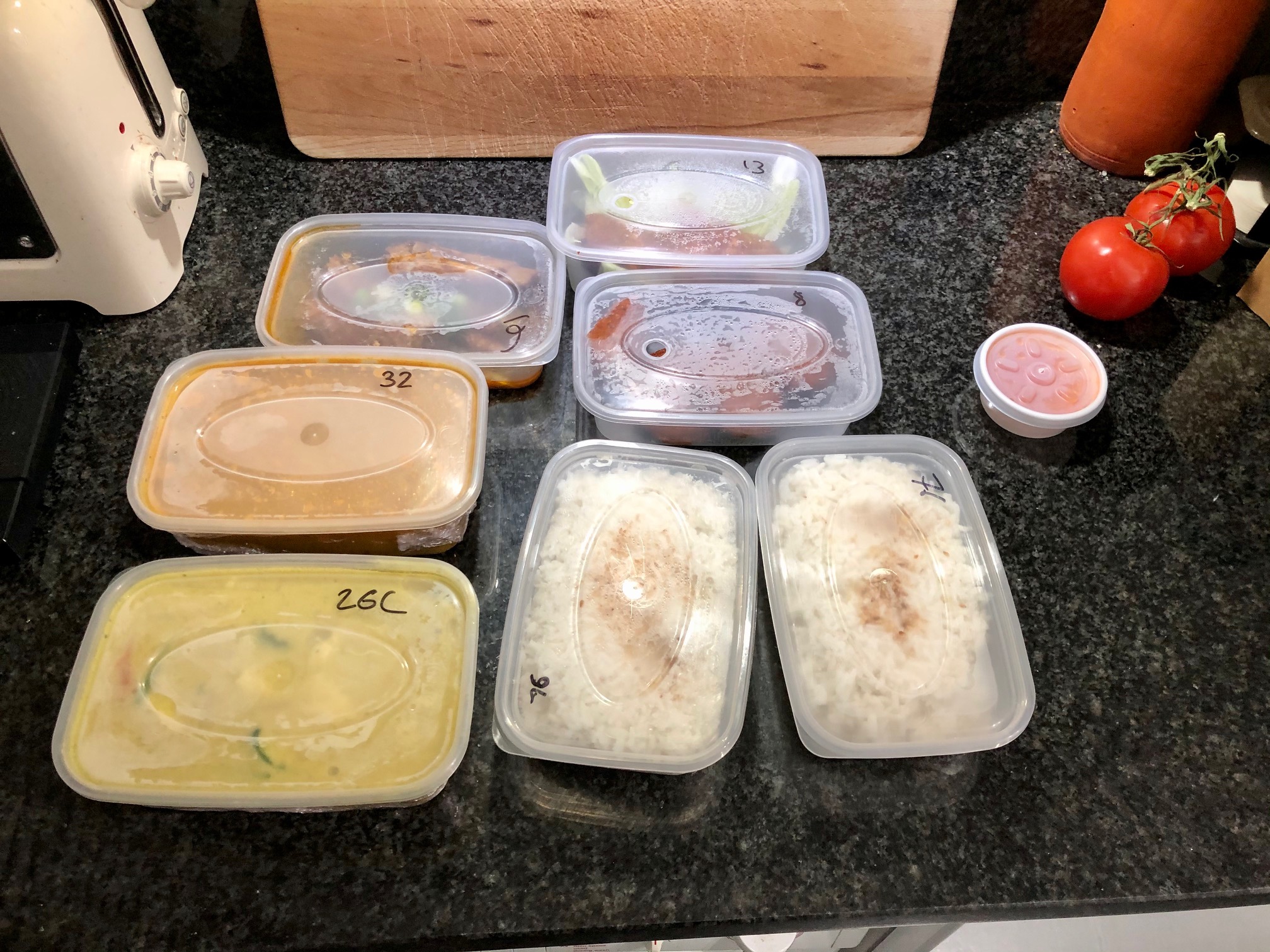
It’s no coincidence that every time I’ve ordered direct from the restaurant delivery has worked like a charm, and this was no exception. Around forty minutes after placing my order, there was a ring on the doorbell and a friendly driver handed over my branded carrier bag. Everything was perfectly hot, and everything came in recyclable plastic tubs. Another sign that Thai Table know what they’re doing with this stuff: they had put clingfilm over the tubs before snapping on the lids, just an extra precaution to prevent any disasters. It sounds like a small thing, but I appreciated the thoughtfulness, just as I loved the little slip in my bag detailing, with little infographics, all the extra steps the restaurant had taken to ensure the safety of its employees and its customers.
I reviewed Thai Table back in 2015, but one of its dishes, the massaman beef, made such an impression on me that three years later, when I published a list of Reading’s 10 must-try dishes, it made the cut. I felt it was incumbent on me to try it again, so I made a beeline for it when I placed my order. It was a ridiculously generous portion of beef, wavy-cut chunks of waxy potato and sweet onion in a glossy sauce, so much that it almost spilled over the high sides of my bowl.
It had stuck in my memory as an indulgent, cossetting dish but actually, if anything, it was more interesting than I remembered. So of course every forkful of fragrant coconut rice soaked in that silky sauce was gorgeous, but the whole thing was shot through with star anise, giving it an extra dimension that stopped it being cloying. I thought it could do with ever so slightly more chilli heat, but it was so luxurious (and faintly soporific) that I couldn’t complain. I’d been concerned that the colossal hunks of beef bobbing in the sauce might be too tough, but every single one passed the two forks test with flying colours. And I’d forgotten how much I love coconut rice, too, right up until the moment when I took the lid off the container and that wonderful aroma rapidly came into focus.
Zoë had stayed traditional with a green chicken curry, and I was allowed a forkful (“but that’s all, I’m not sharing”). It had considerably more punch from the chilli and crunch from the bamboo shoots, and the chicken was tender, but I didn’t feel like I was missing out by sticking with my choice. It was a decent effort, and probably healthier by virtue of containing more veg (the courgettes had the same crenellations as the potato in my curry), but I would have liked it to have a little more richness and oomph. I was graciously permitted to approach the bowl again with my fork to try some of the rice and sauce – for me, always the best bit of eating Thai food – and that was enjoyable enough to make me think I might have judged it harshly.
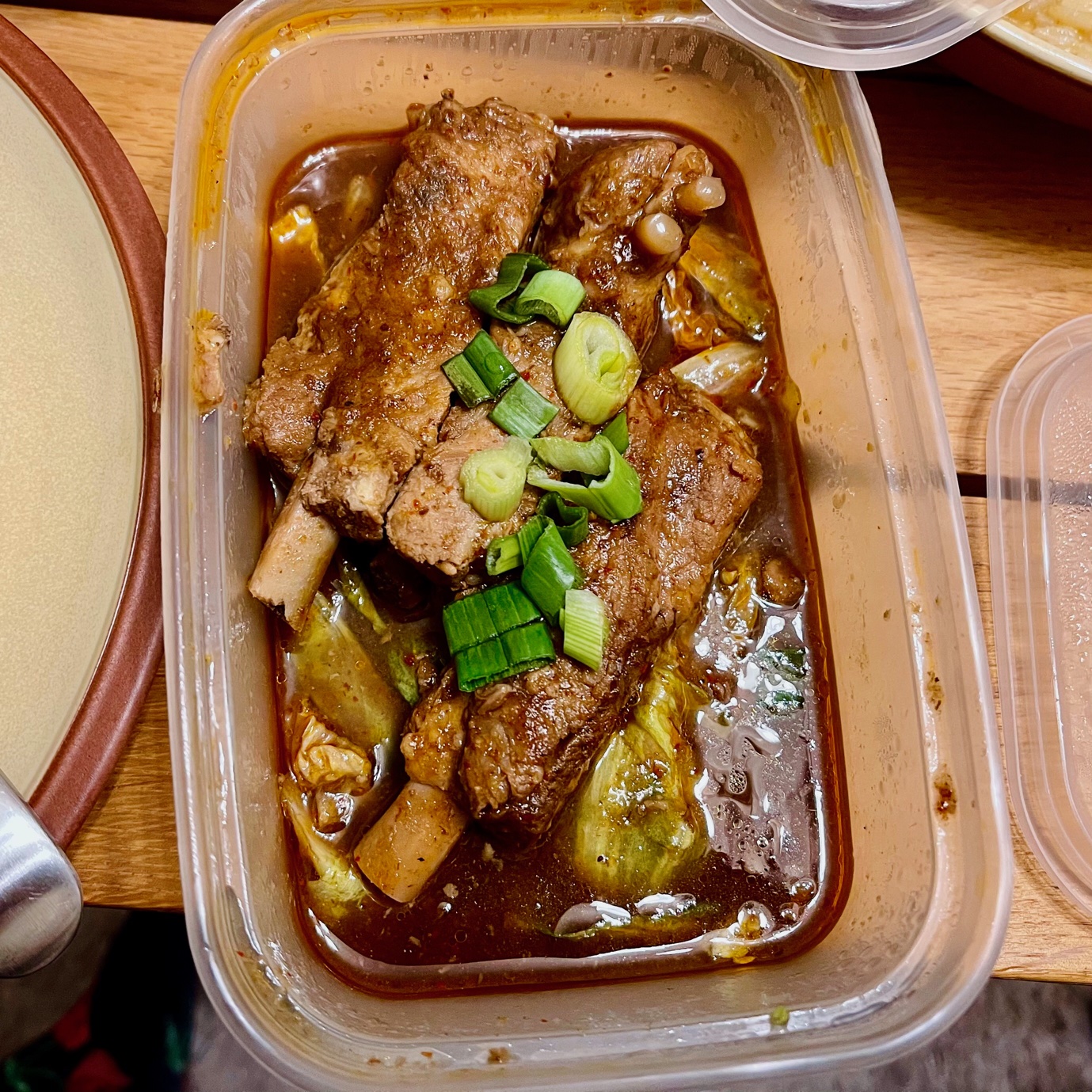
The problem with takeaways, as I’ve said before, is that it isn’t that practical to eat two separate courses – you’re bound to have one of them past its best, or kept warm when it should have been eaten there and then – so often starters find themselves promoted to side dishes, as happened here. The first of the starters was ribs, which came in a deep, dark sauce without much chilli heat but with a hint of peanut and what felt like braised lettuce swimming around at the bottom. The meat fell cleanly off the bone with three of the ribs, while the fourth was a distinctly more cartilaginous affair.
“The ribs definitely win the starters”, said Zoë: I, saddled with that slightly gristly fourth one, was less certain. The ribs were definitely better, though, than the fish cakes. I know their slightly squeaky, rubbery texture isn’t for everyone but they really do need to be eaten piping hot for it not to be disconcerting. I like fishcakes, or at least I seem to remember that I always have, but these didn’t really do it for me.
My pick of the starters was probably the Northern Thai sausage, which was a single sausage (homemade, apparently) cut into diagonal slices. It was more fragrant than hot, with a good whack of lemongrass. I enjoyed it, although three starters definitely turned out to be a starter too many, especially with such generous mains.
But I couldn’t help comparing it to the Thai sausage cooked up by street food traders Porco at the Blue Collar-hosted final of the UK Street Food Awards last year. That – so aromatic, coarse and perfectly spiced – was one of the most magnificent things I’d ever tasted, whereas this was slightly diminished even by its memory. But that’s Blue Collar for you: they excel at gradually making conventional restaurant food suffer by comparison, cuisine by cuisine and dish by dish. It would be easy to hold it against them, if they weren’t so good.
This week’s meal, as much as any takeaway I’ve had, has been truly educational when it comes to the difference between eating in and eating at home. Because if I had eaten this food on duty in a restaurant, in some parallel world where the pandemic never happened, I might have spent my time looking at what was missing. I might have said that the food wasn’t particularly inventive or revolutionary, or that it didn’t bowl me over. I might say, as I’ve said reviewing many Thai restaurants in and around Reading over the last seven years, that it all felt somewhat much of a muchness.
But here’s the thing: in this world, in March 2021, I found it all really quite lovely. It’s nice, sometimes, to play it safe. It’s fun to enjoy a meal without surprises, good or bad, and to know exactly what you’re getting. In a world where so much has changed, some of it beyond recognition, it can be hugely reassuring to be reminded that not everything has. And on that Saturday night, I felt grateful that Thai Table were there, still doing what they’d always done, working their socks off (and taking all those extra precautions) so I could sit there in my comfies and be transported by the alchemy of coconut, beef and star anise.
So there you have it – they’re not on Deliveroo or Uber Eats, they’re not gurning away on Instagram Stories, they’re not doing anything but cooking very pleasant food and driving it round to your house. If you live in their catchment area, and you fancy taking a night off juggling what’s in the fridge and the cupboards, checking your best before dates, you could do an awful lot worse than giving them a call. They probably won’t ever see this review, and they may never Tweet again, but I’m strangely delighted that they contacted me a year ago with that simple message: We’re still here. Please don’t forget about us. I’m glad, too, that I didn’t.
Thai Table 8 Church Road, Reading, RG4 7AD 0118 9471500
Reading’s pub scene has enjoyed a bit of a renaissance in the second half of 2019, despite pubs closing day in day out all over the country. The Lyndhurst reopened under new management and is now dishing up some really impressive food: last week I went there and had saddle of rabbit, stuffed with chicken liver and wrapped in Parma ham, up there with any rabbit dish I’ve had in Bologna. Then the Retreat was saved from an uncertain fate by a buy-out and is going from strength to strength with a new wine list, a far bigger presence online and, thankfully, the magnificent Brian still behind the bar.
That’s all well and good, but when the pub in question undergoes a more dramatic makeover people can be a little sniffier. The Eldon Arms closed and reopened in September as the Weather Station, with a few locals lamenting the loss of the name. I’ve been a few times since the reincarnation and it does some interesting beers, although sitting on a hard stool and using a barrel for a table is maybe designed for customers far younger and cooler than me: I soon found myself longing for a proper seat, which is around the point where I sloped off to the Retreat.
Finally, Caversham’s Prince Of Wales, at the top of Prospect Street, was acquired by Dodo Pubs who have spent a fair bit of time and money rebranding it as the Last Crumb. This provoked more complaints about losing the name, which I found harder to understand: surely there are quite enough pubs around the country called the Prince Of Wales? (I bet nobody would have objected it had been called the Duke Of York). Anyway, it’s not as if the people up in arms had frequented the pub back when it was the Prince Of Wales – everything I’d ever heard about the place suggested you wouldn’t go in unless you were up to date on your tetanus jabs.
I was delighted by the news that Dodo Pubs had taken on the Prince Of Wales, because I’ve always been a fan of the Rickety Press, their outpost in north Oxford’s Jericho – a lovely pub that does a good range of beers and ciders and very credible pizzas and burgers. When my Canadian family came to visit the U.K. earlier in the year and we went for a day trip to Oxford, I booked us in to the Rickety Press knowing it would suit everyone – craft enough for my twentysomething cousin and unpretentious enough for my 80 year old uncle. We had a lovely meal there, and I found myself wishing there was somewhere similar in Reading. And then my wish was granted, so my other half Zoë and I headed over on a weekday night to see whether the Last Crumb lived up to the promise of its sibling.
Subscribe to continue reading
Become a paid subscriber to get access to the rest of this post and other exclusive content.
By July 2020, Persia House had closed and been replaced by another Persian restaurant called Persian Palace. That too has now closed, and an Afghan restaurant called Pathaan’s now operates from this site. I’ve kept the review up for posterity.
This is my second attempt to review Persia House, the new Iranian restaurant tucked away on the other side of Caversham Bridge, and it differs from my first attempt in one important respect: I turned up when the restaurant was actually open (nearly six years writing this blog, and still so amateurish at times). I’d wanted to go for some time – Iranian food sounded fascinating and exotic, and from my research I hoped to have my head turned by a new favourite cuisine, the way it had been by Georgian or Hyderabadi food. Read an article like this and you’ll see what I mean: tell me it doesn’t make you hungry.
My dining companion for the first, unsuccessful, visit was Martin, author of pub blog Quaffable Reading, and he graciously agreed to overlook my ineptitude and accompany me again second time round (although he did still say “are you sure it’s open today?” as we were nursing a pre-dinner pint in the Crown: bloody cheek).
Going through the front door we were greeted by a very large and almost completely empty restaurant. I’m so used to saying “it’s a long thin room” about restaurants that it’s quite a relief to be able to say something different for a change: Persia House is huge. By the windows looking out on to the road there were some low tables where you sit cross-legged (possibly authentic, definitely for people who’ve done a lot more yoga than me) but the rest of the restaurant was more conventional and there really were an awful lot of tables. The bare wood floor was broken up with the occasional rug, there was art on the bare brick walls and some of the tables at the far end looked out over the river. I quite liked it, but it did feel cavernous.
We took a table by the window – close to the only other pair eating in the restaurant – and flipped through the menu. I’d researched it online, but the Persia House website is so user-unfriendly that trying to work out what I might order filled me with a sudden desire to throw my laptop at a wall with great force. We had no trouble picking a mixture of starters but we were undecided about our main courses: our waiter said that was absolutely fine and took that order, along with a bottle of red.
We’d also enquired about the rather bling oven you see as you enter the restaurant, so our waiter invited us over to see our naan breads being made. It was an incredible contraption, hotter than the sun (and not even running at full whack, as he proudly demonstrated by turning it up: it’s a miracle that Martin and I still have eyebrows). We watched as he stretched, rolled, and shaped the dough for the naan before effortlessly flipping it on to the roof of the oven for mere seconds before taking it out, cutting it up and putting it in a basket ready for our starters. All very impressive.
He said that he was from Afghanistan, although the owner was Iranian. The restaurant had been running for nearly six months and all was going well, he said, although he added that it was normally busier than tonight (only one other pair of diners arrived while we were there, not long after the other two customers had left).
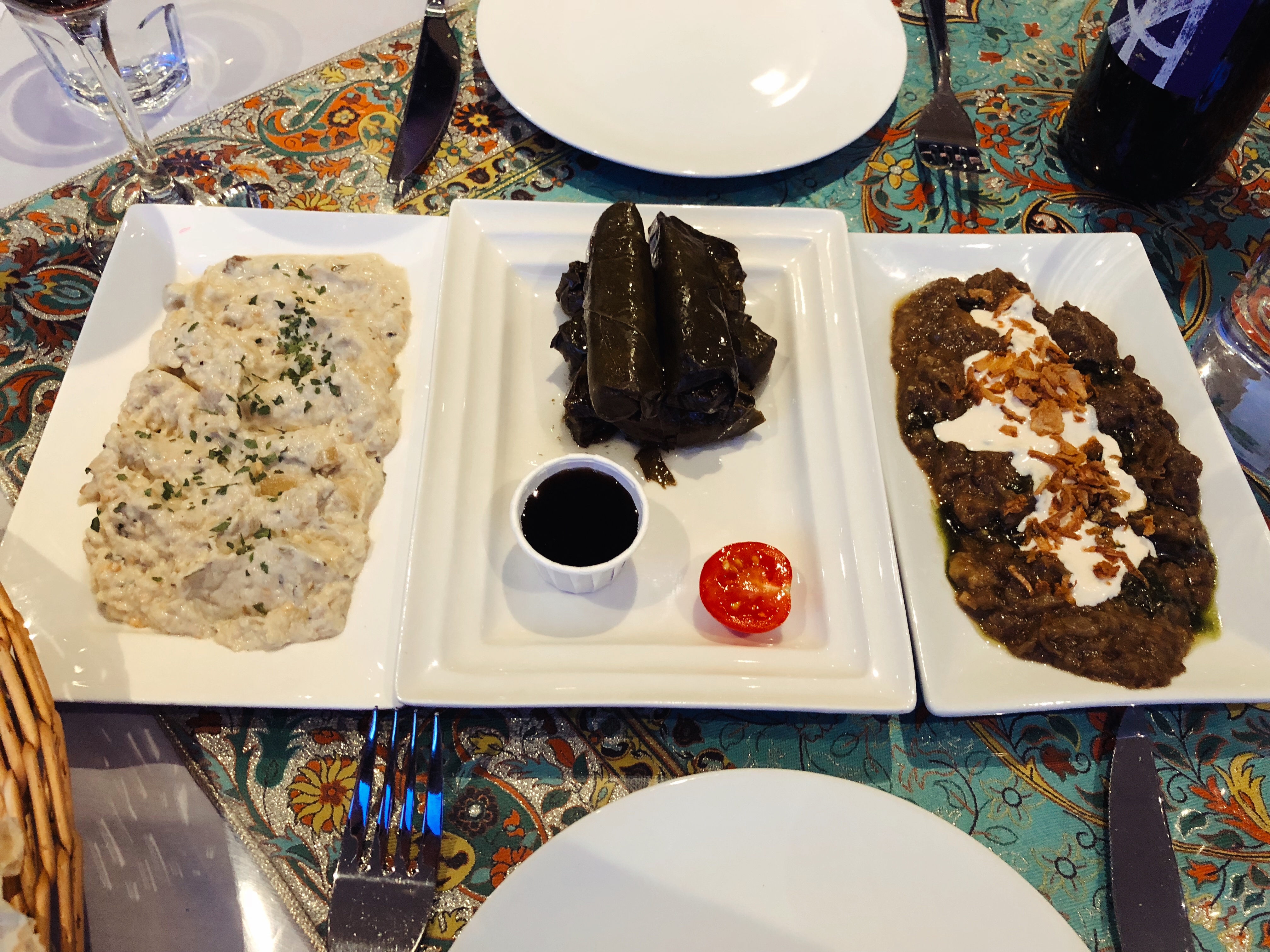
By the time we returned to our table from that little culinary detour, our starters had arrived. The menu divides the starters into cold and warm appetisers and we’d picked from both sections, although I didn’t discern any noticeable difference in temperature. The best of them was the baba ghanoush, which really did have a smoky taste (you could picture the charred skin being taken off the aubergine before the flesh was combined with everything else). But the dolmades were deeply unspecial – the rice in them was claggy and dense, and they didn’t taste of much. The decision to serve them with a little pot of what looked like balsamic glaze but which I assume was pomegranate molasses might have been to conceal the lack of flavour, but it seemed an odd choice. I would have thought these were shop bought but one of them was so saggy and lacking in filling that I think they probably were made by hand.
“You can have the last one” I said to Martin, which obviously translates as I don’t like these much.
“No, I insist” he replied, or in other words I don’t like them either.
The last of the dishes was called halim badenjan, a stew of aubergine, tomato and braised lamb. We both quite liked this – although again, not enough to fight over the last few mouthfuls – but it didn’t knock my socks off. The lamb was in soft strands, the aubergine was tasty enough but it didn’t really feel like anything I hadn’t had before (the yoghurt on top, though, added a nice contrast).
By now, you’re hopefully wondering if that naan I saw being baked in front of my very eyes was any good. Well, I’m afraid no, not really. It might just be me, but I found it a bit thin and nothingy – despite being bubbled it had no fluffiness and no real texture. It might as well have been crackers, and by the end the last few pieces were hard enough that they pretty much were.
A mixed bag, then, and as our waiters took the plates away Martin and I sipped our wine and decided on our next move. We’d ordered a Malbec for twenty-two pounds and although it got better as the evening went along (what booze doesn’t?) it felt a bit thin and weedy to me, with nowhere near the depth or complexity I’d expect from Malbec: with hindsight, it might have been emblematic of the whole meal.
The main courses were split into three sections – kebabs, stews and other Persian specialities. Martin had decided to test out the grill, and I was torn between a traditional stew or the Persian biryani, a dish called lubia polo. I asked another waiter, and he said the stew was a “good choice” but that he’d had the lubia polo earlier in the evening and that it was very good. He also said that you couldn’t get these dishes anywhere else in Reading (which, come to think of it, may or may not have been a good thing). Like all the people who looked after us that evening he was friendly, smiley and engaging, and so I was won over and took his advice.
The problem with taking advice from people you don’t know, like reading reviews from people you don’t know I suppose, is that you take them on trust. So it’s possible that the Persian biryani is the best meal that waiter has had in a while, but if it is I think he rather needs to eat out more often. It was one of the most disappointing dishes I’ve had in a restaurant for a while – not specifically bad, but so failing to live up to its potential that it might as well have been.
It was rice, tomatoes, lamb and green beans and it tasted of rice, tomatoes, lamb and green beans. No real discernible depths of flavour, no nuance, no wow factor, no heat and no spice (Martin thought he detected cinnamon in it: I think he’s being charitable). I expected so much more – I wanted it to open my eyes to something new but instead it made me want to roll them or, worse still, close them for some time. Even the texture didn’t work; the lamb was nicely soft but so were the green beans. The latter had the feel of beans which had either come from a tin or been cooked so long that they might as well have done.
Martin had opted for the mixed grill for one, pretty much, the kebab bakhteari (“it sounds like bacteria” he said to the waiter, a tad ominously). It was a skewer of kofta, a skewer of chicken shish and a skewer of lamb shish, served with some rice with a little yellow hat from the saffron, an underwhelming-looking salad and – completely randomly – an individual portion of butter from a catering pack (what for? we both wondered).
“What do you think?”
“With lamb, you want the lovely caramelised exterior and for it to be pink in the middle” said Martin. “This is just grey”.
He generously let me try some of each of the kebabs, although once I ate them I realised he wasn’t really being generous, it’s just that he wasn’t fussed. The chicken was the best of them I thought, but all of them were middling at best. This dish cost eighteen pounds, a full five pounds more than the equivalent dish at Bakery House. There you get beautiful yellow rice, a perfectly dressed salad and all the garlic and chilli sauce you want. Here you get cross.
“It’s not as good as Bakery House, is it?” I asked.
“It’s nowhere near as good as Bakery House.”
You probably have the general idea by now. I really didn’t rate Persia House, I think there are dozens of better ways to spend your money in Reading and several better ways to have similar food – at Bakery House, at Kobeeda Palace, even at Clay’s if you want a biryani. And if your response to that is to say “but they’re not Iranian food” then fine, I agree – but based on what I experienced at Persia House I wonder if that’s Iranian food either. It didn’t feel distinctive or authentic to me: apart from the lamb stew with aubergines, we didn’t have anything you couldn’t get elsewhere, and that dish didn’t make me desperate to try the rest of the menu. I hoped for fireworks, I got a sputtering tealight.
What’s a little sad about it, though, is a couple of things. One was the service, which was unfailingly nice and polite – although, to be fair, we made up fifty per cent of the clientele for the duration of the visit. The other was that when we asked for the bill they brought some little sweet pastries and a beautiful black tea, poured into tiny glasses which tasted quite lovely sweetened with a little sugar. Such a nice touch, but too little too late. Dinner for two – three starters, two mains and a bottle of red – came to seventy pounds on the nail, not including service.
I wondered about how to end this review. Originally I was going to say “I hope Persia House does well”, but that too feels inauthentic. No, I hope Persia House does better. God knows, they easily could, but I suspect this is the kind of food they want to serve and the restaurant will either succeed or it won’t. Caversham is not blessed with loads of good restaurants, so perhaps novelty value will keep them afloat for some time yet. But at those prices, for that quality, it’s not a place I could recommend. In any case, what do I know? A few doors down Picasso – one of the most uninspiring meals I’ve ever had writing this blog – continues to ply its inexorable trade, years after many places I’ve adored have closed their doors for the final time.