Giggling Squid, Henley

Although most ER reviews are of independent restaurants, I’m not against chains for the sake of it. Not all chains are the same: there are big and small ones, good and bad ones – just as there’s a difference between the silver chain you’d hang a pendant from and the lunking great thing you’d use to secure your bike to the railings.

I was struck by this wandering round Henley on a sunny Bank Holiday Monday, because they have chains just like Reading does, only different ones. So there are shops like Space NK and Joule’s – the next tier up, you could say, places in the same bracket as Jigsaw and LK Bennett. It’s the same with cafés and restaurants, so Henley has a Maison Blanc, a Hotel du Vin, and a CAU. I did briefly consider going to CAU to find out what we had to look forward to when the Reading branch opens this month, but nothing about the décor appealed: the nasty rigid white chairs and sterile banquettes screamed “downmarket Gaucho”.

Besides, I was on my way to a more intriguing phenomenon: Giggling Squid has grown from a single branch in Hove six years ago to a chain of thirteen restaurants (many of them opening in sites which used to belong to other chains – a handful used to be branches of Strada, Henley’s was previously an ill-fated Brasserie Gerard). And there are more on the way – the management wants to make this the first nationwide Thai chain, with plans for somewhere between fifty and eighty sites. It’s funny how, despite the popularity of Thai, Indian and Chinese food they still tend, by and large, to be chain-free zones (unless you count the delights of Ken Hom’s Yellow River Café, one of the Oracle’s first ever tenants way back when). I’ve never understood why that is – was Giggling Squid going to challenge that status quo?

It’s a lovely old building at the bottom of Hart Street and it’s been done up very nicely. On the way there I walked past Henley’s long-serving restaurant, Thai Orchid and it was the picture of an old-fashioned Thai restaurant, all dark wood, ornate panelling and intricate, inlaid, glass-topped dining tables. Giggling Squid couldn’t be more different, with its pale walls, exposed beams and almost Scandinavian bleached bentwood chairs. The front room, where I sat, was more traditional – the big room at the back was much better lit and I’d rather have sat there, but I didn’t have much choice in the matter. Which brings me to the second thing I noticed about it: it was absolutely rammed (I was lucky to get a table at all without a reservation, and quite a few couples who came in after me were turned away).

Giggling Squid bills itself as “Thai Tapas & Thai Restaurant”. The idea of anything other than Spanish food describing itself as tapas makes me feel a little exasperated, but what it essentially means is that at lunchtime, rather than having a traditional a la carte menu the main options are one of six “tapas sets”, each of them a mixture of three different dishes and jasmine rice. You can order lots of tapas separately instead, although I’m not sure why anyone would unless you really disliked the set combinations, or you can have what they describe as “one big dish with rice” or a “two dish meal combi”. This all felt overly complicated for me – did I want one big dish, two middling dishes or four small dishes? was there an option of having eight minuscule dishes? – so we went for a tapas selection each. And some prawn crackers. And some chicken satay (which by my reckoning makes a total of ten small dishes, sort of).

Despite the restaurant being extremely busy everything arrived very quickly indeed. Prawn crackers came in a metal pail and were good but unexceptional. It was a huge portion of crackers and an absurdly tiny ramekin of sweet chilli sauce – I couldn’t help feeling I would have liked less crackers and more dip, but they were pleasant enough and lasted just until the rest of the food turned up.

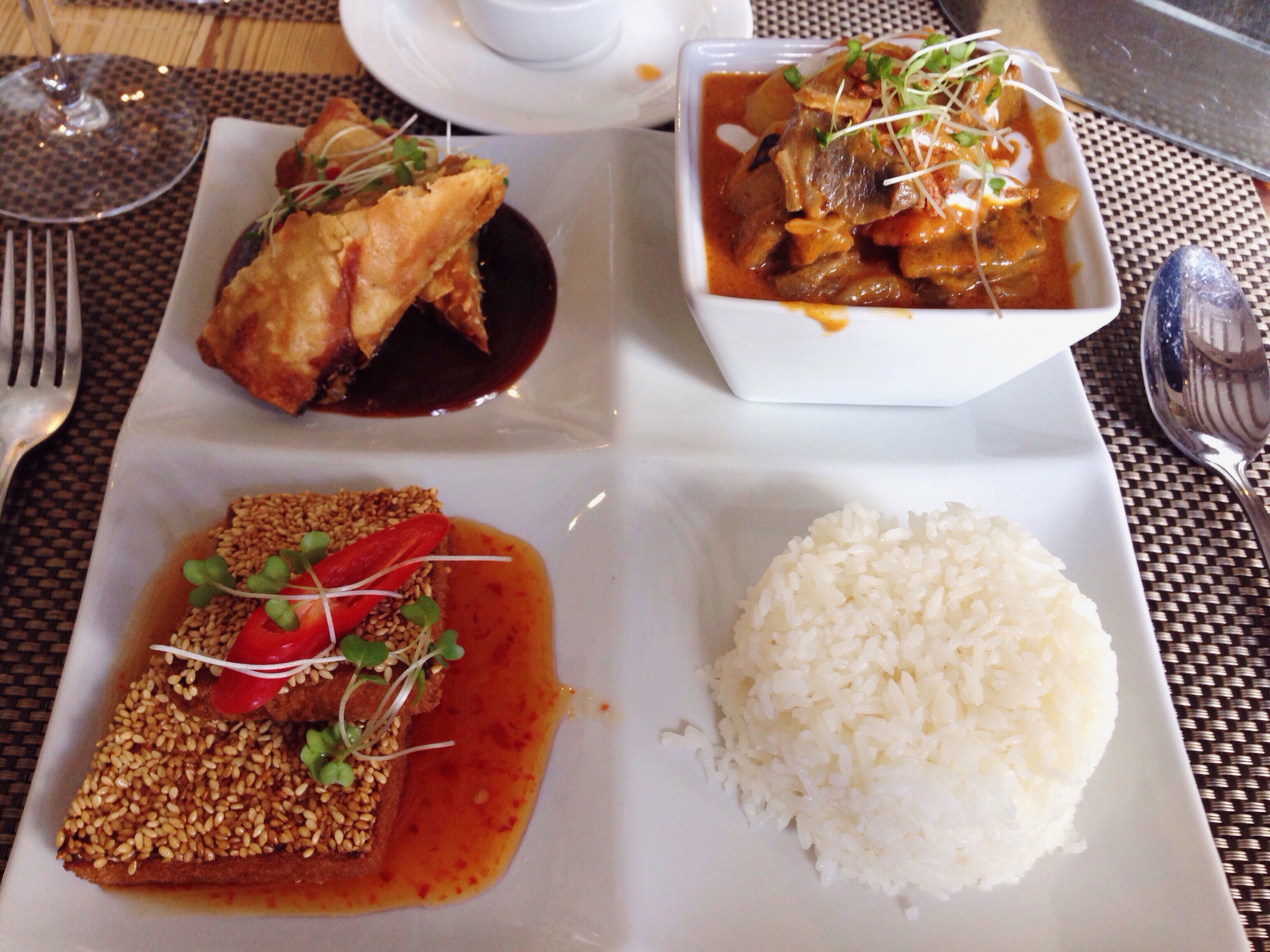
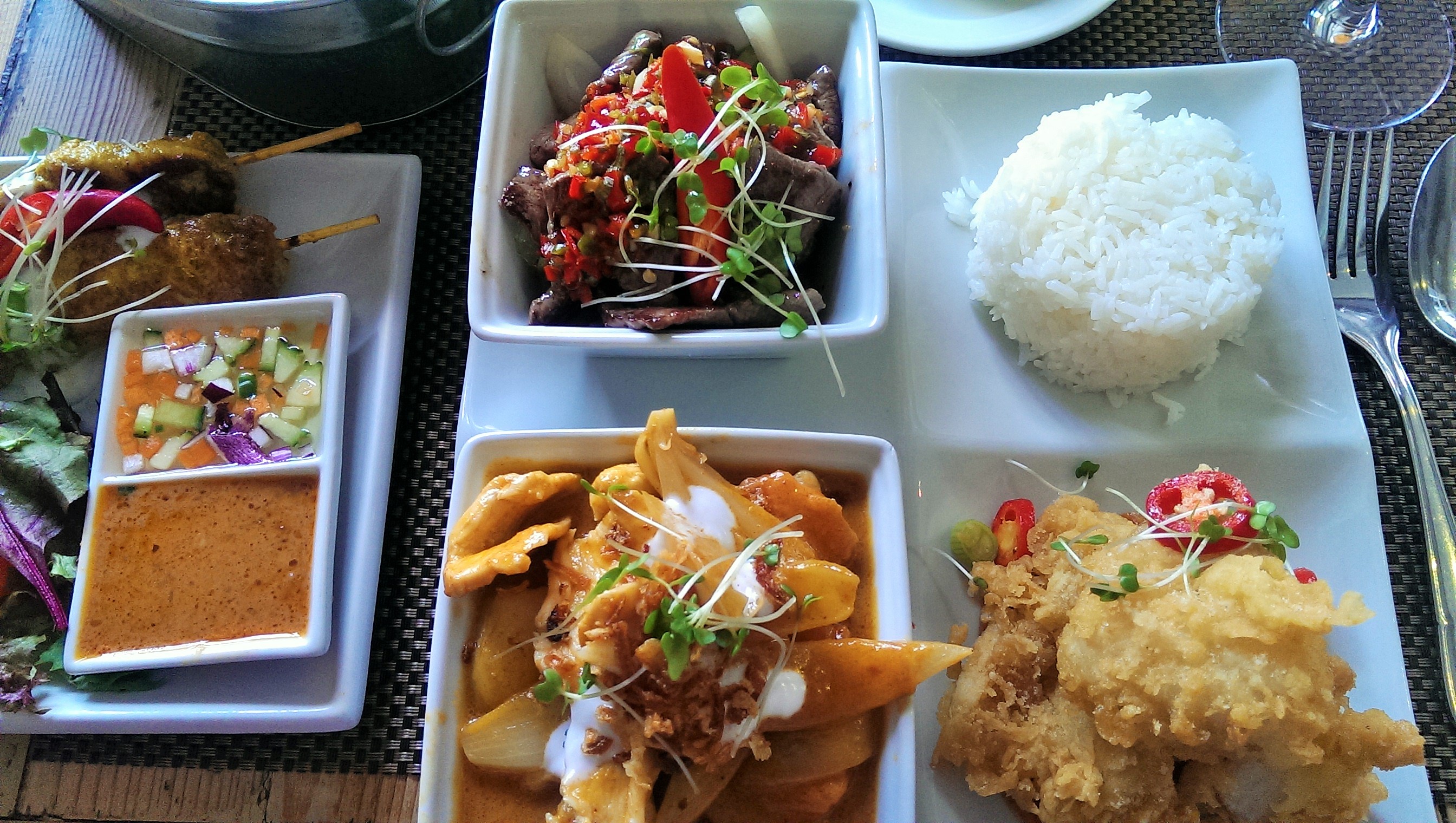
So, on to the tapas (if I really must call it that) itself: a square plate divided into four with something different on each section. Much as I might have wanted to turn my nose up at the concept I couldn’t fault the food. Shredded duck spring roll was a huge thing, full of dense strands of duck, served on a surprisingly subtle puddle of hoi sin that wasn’t just relentless sweetness. Prawn toasts were much better than I expected, crispy and light with a gorgeous layer of toasted sesame, served with more of the sweet chilli sauce. Salt and pepper squid was not at all chewy and the batter was beautifully light (maybe too light, as it did fall off the squid the moment it was challenged with a fork) served on another puddle of sauce – this time hot chilli with no sweetness. The beef salad was the cousin of the chicken salad I raved about from Art of Siam – soft, tender strips of beef on top of a bowl of salad filled to the brim with hot, sharp, sour sauce. It was agony and ecstasy to eat and would be perfect for anyone with a bit of congestion – the heat would soon clear that up.
WealthySquid

Because of the set combinations we’d gone for (“Two Giggling Squids” and “Wealthy Squid”, I have no idea why they’re called that, so don’t even ask) we had massaman curry two ways. The lamb was gorgeous, slow cooked and reassuringly free of wobble and the chicken was in tender, slender slices. There were nice firm chunks of potato, lots of onion and a healthy (or unhealthy, depending on how you look at it) sprinkling of crispy fried onion on top. The sauce was perhaps a little subtler than I’m used to but still went beautifully with the rest of the rice – and I’ve always thought, and said many times, that the rice and sauce at the end of a Thai main course is the best bit.
2Squids

The chicken satay, ordered as an extra out of curiosity, was probably more food than we needed but again, it was very good: tender, soft chicken, not dried-out fibrous breast meat, easy to slide off the skewers and dunk in a fresh clear dipping sauce or a spiced but fragrant satay sauce that was a lot more than hot Sun-Pat. We finished the lot, although it put paid to any plans I had for dessert – a pity, as I had my eye on the black sesame ice cream. Still, there’s always next time.

The menu, come to think of it, was full of little flashes of personality like that which made it feel a lot less like a chain. That really came across in the wine list in particular which managed that rare trick of getting a slightly irreverent tone without making you want to cringe. Written by the co-owner, it compared the Chardonnay – described as something like “rich and fruity” – to her husband before mentioning the extensive research he had done trying to find some reds that went with spicy food. That sort of thing might make your toes curl, but I found it oddly charming (oh, and we had a couple of glasses of the Chardonnay: if her husband is anything like that she could have done an awful lot worse).

Service was harried but friendly. It felt difficult to get attention right at the start, but given how popular the place was I was impressed by how efficient they were; at the end, when the lunchtime rush was fading out, the waiters were a lot more friendly and interested. We went from sitting down to being out of the door in just over an hour which I think is fair enough on a busy lunchtime, especially when you’re only really having one course. Lunch for two – two tapas sets, prawn crackers, chicken satay and two glasses of wine – came to £40 with a semi-optional 10% service charge on top. The tapas sets were just under £12 each, which I thought was pretty decent value.

The owners of Giggling Squid have talked about Côte as the chain they’d like to emulate and I can see why – it’s a great example of how a chain can get everything right and be consistent without being faceless. And I think Giggling Squid does that too; I liked almost everything I had, it’s a lovely spot, it’s very tastefully done and the service is good. I do wonder, though, whether the reason they haven’t chosen to target Reading is that it already has three well-established Thai restaurants with good reputations – the kind of day-in, day-out consistency that is the brand promise of most chains. I wonder too what Giggling Squid will be like if it hits its targets, has a hundred branches worldwide and takes over all the vacant Stradas, Bella Italias and Café Rouges out there. But that’s all years ahead: in the meantime, it’s worth going so you can say you were there in the early days (or back when it was good, depending on how it all turns out). I might see you there, because the whole experience made me want to go back – partly for that sesame ice cream, but mainly to try the evening menu, which is so packed with tempting-looking fish and seafood dishes that I literally wouldn’t know where to start.

Giggling Squid – 7.7
40 Hart Street, Henley-On-Thames, RG9 2AU
01491 411044

http://www.gigglingsquid.com/branches/henley.html

The Baskerville, Shiplake

I take reader requests and recommendations really seriously. There are two big reasons for this.

First, I think it’s important that I review places you want to know about. If there’s somewhere you’ve always wanted to eat in but you don’t want to risk it then I’m your… err, lion. If somewhere new opens – or reopens – and you want the low-down then I’ll do my best to be your mane (oh yes, lion puns a-go-go) source of info. Secondly, I’m not omniscient. I know a fair bit about Reading’s restaurants but I can’t cover everything – especially outside the town centre – without your help. That’s where the recommendations come in: if you like the places I rate, and you tell me somewhere is good then I’m more than willing to give it a visit, because I trust you to be discerning.

It’s not always successful – I must find a way of thanking the person who said “I’ve always wanted to know if Picasso is any good” – but generally I reckon it works well. I’ve discovered lots of good places I wouldn’t otherwise have visited, and hopefully you might have too. Anyway, last week’s review was a good example of the first type – and it seems like lots of you wanted to know whether a London Street Brasserie chef can cook outside his natural habitat. This week’s review is the second type: last month reader Steve Smith recommended The Baskerville as an alternative to the highly-rated Plowden Arms. It was so good that he drove all the way from Aldermaston, he said. Does Shiplake really have two pubs doing excellent food?

The Baskerville certainly fits into the “handsome boozer” category (I’m a real sucker for these, as you might remember). In the centre of Lower Shiplake, it’s a few hundred feet from the train station in one of those villages the Thames Valley seems to specialise in (you can see the Eye-Spy book now: handsome boozer, cute cottage, smart Georgian house, wisteria…), the kind of place I daydream about moving to after a leisurely lunch and a bottle of wine.

The pub is a smart redbrick building with a small cosy bar room at the front and the larger restaurant area out the back, perhaps an indicator of where their priorities lie. Although it’s a big room it’s nicely broken up into sections and the beams are strung with fairy lights, a lovely touch. It was full for most of my time there, with the larger tables in the centre filled with families having Sunday lunch out and the smaller tables around the edge dotted with couples. There was a nice buzzy atmosphere (lots of awfully well-behaved children, too: Shiplake must be that kind of place). In summer I can see it would be even more popular with parents – the garden has one of the biggest wooden play areas I’ve ever seen (I wanted to go outside and play, and felt a little sad that I was too old for all that).

I’ve said many times that putting a menu together is a real art – finding the middle ground between too much choice (how do they cook it all well?) and too little (I don’t fancy any of these) is difficult. Goldilocks would have been very happy with the choices here: six starters, five mains, three Sunday roasts, four desserts and a cheeseboard felt just right. At each step there were two or three dishes I would be happy to order, an interesting mixture of the conventionally pubby and the more imaginative. Also – and this is unusual round here – the menu had some information about provenance, so you got an idea where some of the ingredients came from.

My smoked salmon starter was more on the pub classics side. A generous amount of thick, rich, smoky salmon (from Wren and Hines in Billingsgate Market, according to the menu) served in a ring around a lamb’s lettuce salad with capers and some slices of blood orange. The vinaigrette was, according to the menu, whisky and dill but against the strongly smoked salmon I struggled to discern it. At least it was inconspicuous rather than AWOL, unlike the beetroot listed on the menu which was nowhere to be seen. In fairness, I only realised this when sitting down to write this review, which suggests the dish didn’t miss it. The blood orange was a touch too sharp (I pulled a face when I ate it on its own) but nice against the salmon and salad; although leaving the pips in the orange was a little off-putting. If anything, the salad was generous without being interesting (although, like most people, I struggle to get excited about salad) especially as there was bread, too: a few slices of a gorgeous seeded granary. I couldn’t help wishing I’d just had the salmon, that bread and a really good butter: sometimes more fuss means less fun.

BaskSalad

The other starter – caramelised shallot tarte tatin with Cornish brie – was a glorious string of words on a menu that made me come over a tad unnecessary. The reality was less thrilling, partly because more of that salad had been unnecessarily dumped on top of it. But the biggest disappointment was eating it. Going from the first to the third mouthful was a case of going from oh, this is lovely to this is a tad sweet before ending up at I appear to have accidentally ordered dessert. The whole thing was totally out of kilter – the balsamic dressing was sweet, the roast figs were sweet, the onions were cloyingly sweet… the overall effect was like gargling neat Ribena while listening to that song by Daniel Bedingfield (you know, the one with the falsetto. Ick). What’s frustrating is that it needn’t have been that way: it needed a better chosen, saltier cheese to stand up against the torrent of sugar, but the brie – ripe though it was – was too bland for the job.

BaskTart

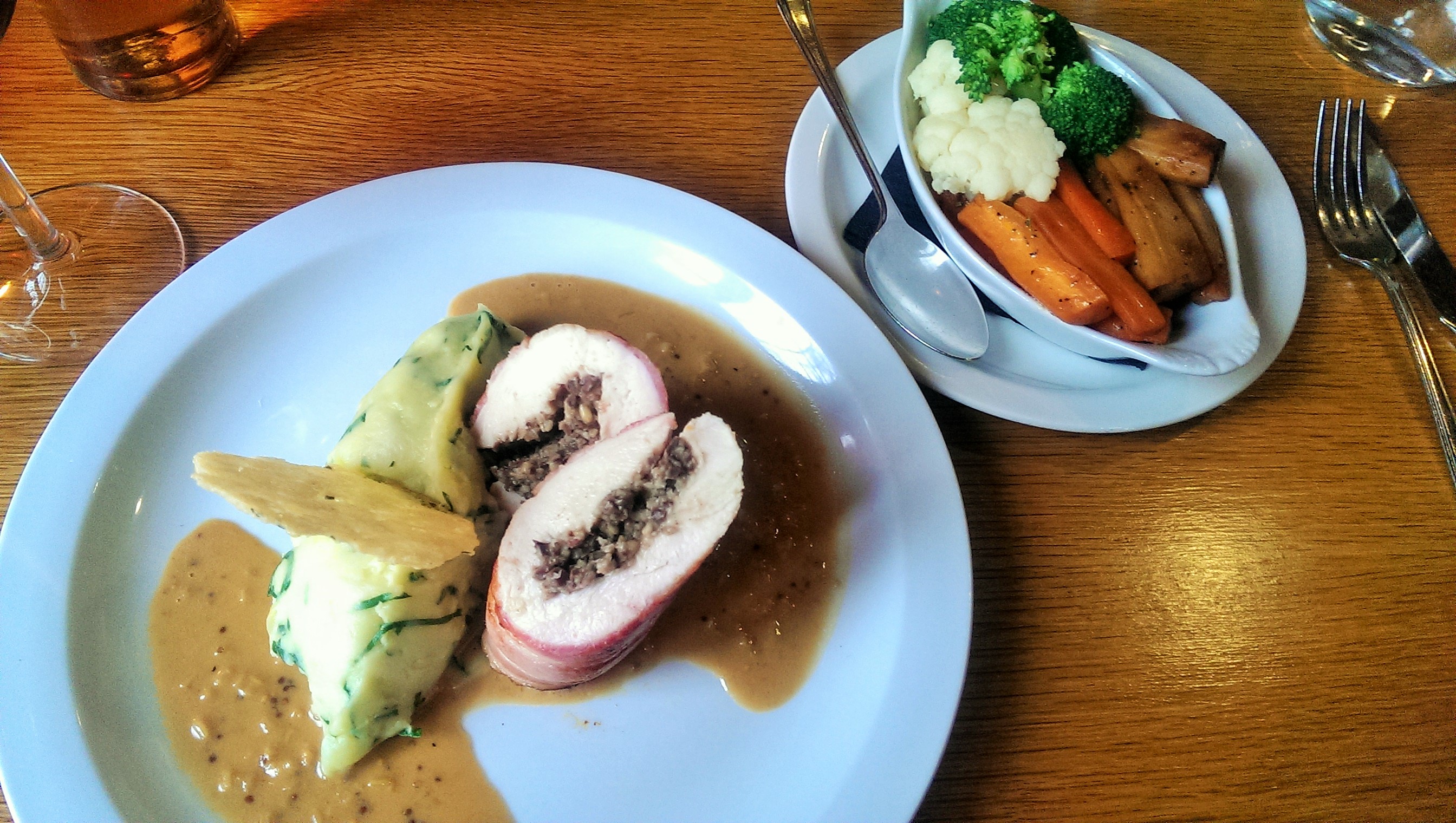
On to the mains, then. The standout here was chicken Balmoral: stuffed with haggis and wrapped in bacon, served with rumbledethumps (Scotland’s answer to colcannon) and a whisky and mustard sauce. The chicken was spot on – still moist but cooked through – and the haggis had that earthy, peppery taste I adore: I know it isn’t everyone’s cup of tea but I love the stuff, and you don’t see it on menus often. There was a side dish of vegetables that appeared to come with most of the mains – roasted carrots and parsnips, steamed broccoli and cauliflower. The parsnips in particular – all sweet and sticky-soft – were fabulous, but all of the vegetables were well cooked, not boiled into mushy oblivion. The sauce was more mustard than whisky, but worked beautifully with everything. The only disappointment was the bacon – it wasn’t cooked anywhere near enough and much of it ended up discarded on the side of the plate, pale pink and rubbery. Maybe that’s the price you pay for tender chicken.

BaskChick

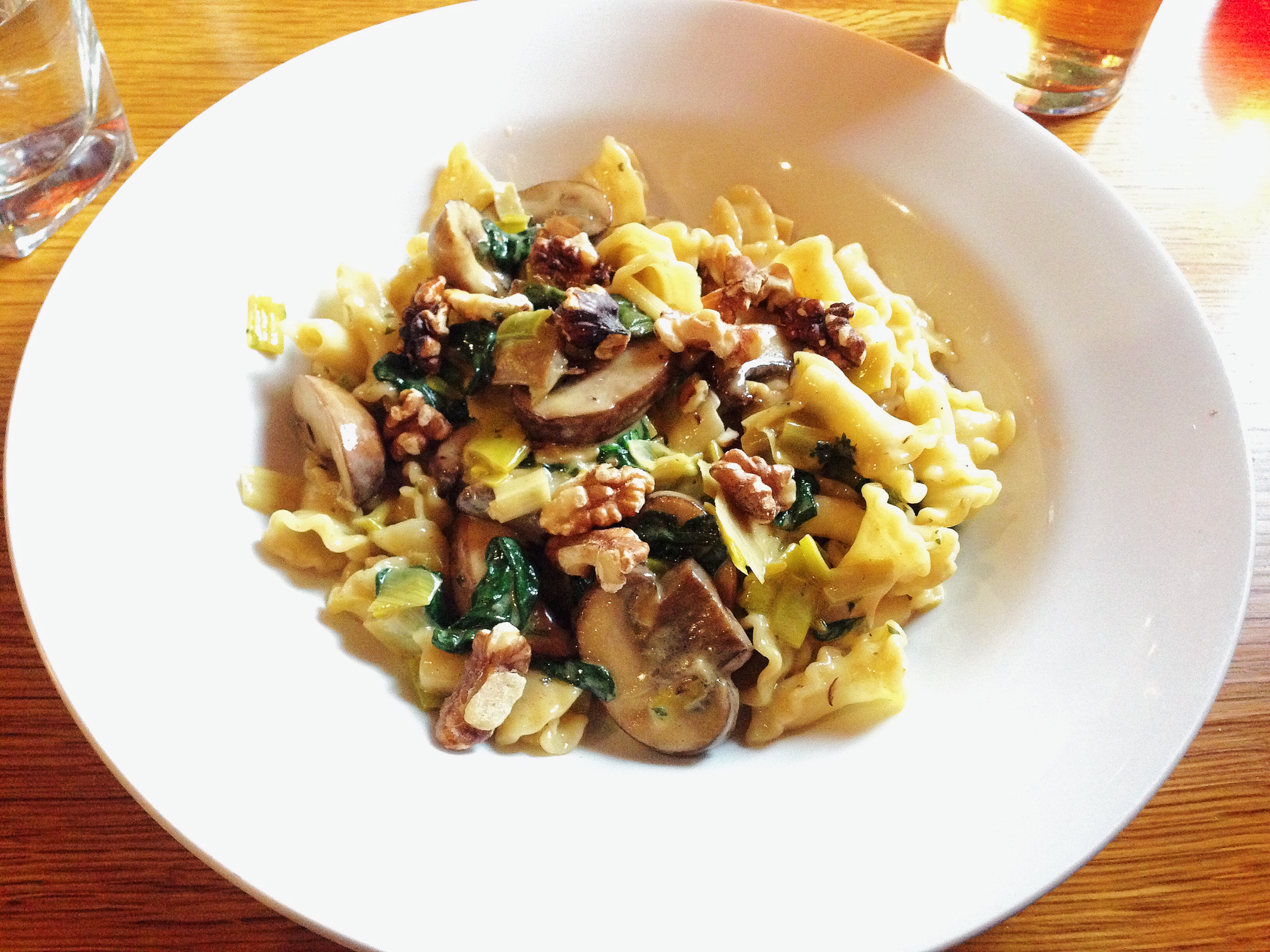
The other main was that unusual thing, a vegetarian dish I actively wanted to order: blue cheese and chestnut mushroom pasta with leeks, baby spinach and toasted walnuts. I could see literally nothing to dislike about this in theory, but again the execution was disappointing. The pasta – campanelle, I think – was good, the right shape to pick up the sauce and cooked only slightly further from al dente than I’d liked. The leeks were soft and sweet. The chestnut mushrooms were good, although they’d have worked better chopped finer. The toasted walnuts added crunch. So much potential from the supporting cast, but the star didn’t turn up: there wasn’t enough sauce, and what sauce there was clung to the bottom of the dish as if in hiding. I was expecting that rich tang of blue cheese, little bombs of salt scattered throughout, but it was so bland it was hardly there at all. It was inoffensive, a blue cheese dish for people who don’t really like blue cheese. But really, who’s the target market for that?

BaskPasta

After two large courses it was tempting to get the bill, but I know I’ve been letting you down lately, so I ordered dessert. I hope you appreciate the trouble I go to to give you a well-rounded review (especially as it has the knock-on effect of giving you an increasingly well-rounded reviewer).

The sticky toffee pudding is a pub staple and, even though it gets served on a fancy square glass plate, The Baskerville knows better than to the mess with a classic. The pudding itself was moist, gently spiced and all middle (I prefer middle to edges when it comes to cake). The perfectly spherical ice cream ball was balancing on the requisite pile of crumbs with a mint leaf on top (I think there must be some legal requirement for this style of presentation: it’s inescapable these days) and on the opposite corner was a small jug of toffee sauce. It was textbook, and I loved every spoonful: plenty of sauce, a big wodge of cake and a dollop of ice cream. Well rounded indeed.

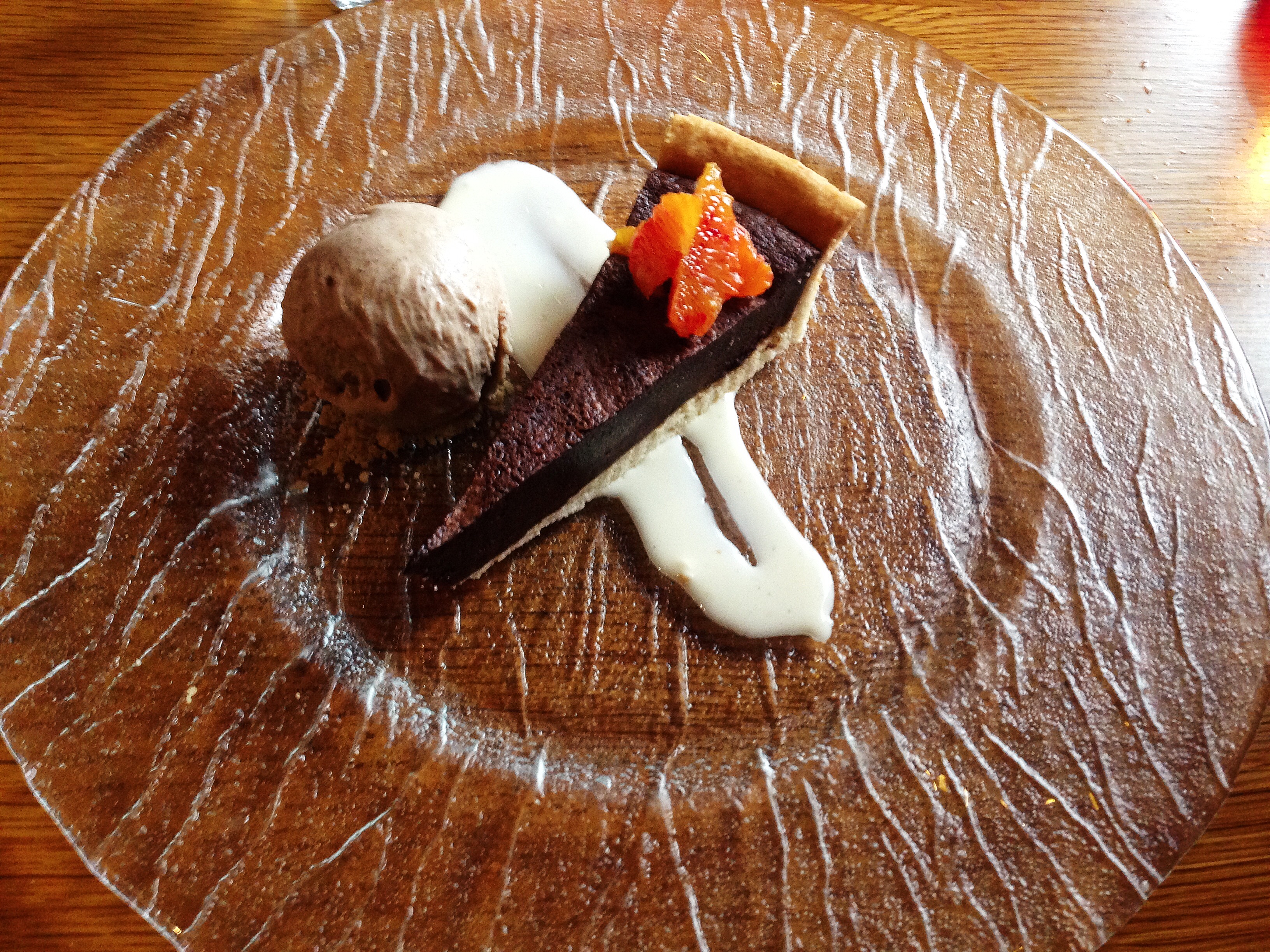
I also loved the bitter chocolate tart, all class and cleverness. The ganache was rich, dark and smooth, but with a hint of orange shot through it, working beautifully with the pieces of blood orange on top. All of it went nicely with the cinnamon ice cream, which tasted so good that I happily overlooked its oddly elastic texture. The pastry, dense and buttery, was gorgeous and – just as importantly – not so thick that eating it with a fork involved a series of high risk manoeuvres to stop pieces from wanging across the table. If the rest of the meal showed some inconsistency, the desserts redeemed a lot.

BaskChoctart

It’s a shame I was driving, because the wine list had plenty of bottles around the pocket-friendly twenty pound mark, a sure sign that it’s been well thought out. Fortunately, the selection by the glass was decent too and I liked both the reds we tried, although the French pinot noir was probably the pick of the bunch.

Service was excellent from the moment we entered to the moment we left, which is largely down to the restaurant manager, a friendly Scot who appeared to be everywhere at once. He worked hard without ever making it look like work at all, a rare talent: he made the right noises when we ordered food, had an opinion about the wines and was on hand to give pointers and just be generally charming whenever he was needed without ever hovering or outstaying his welcome (I’d also like to think that the Scottish influences on the menu came from him, for no reason other than because it would be nicely fitting). The other staff – mostly young ladies – were also helpful and friendly, just without the polish of years in the industry. The bill, for three courses for two, two glasses of wine and a pint of very refreshing shandy came to seventy five pounds. So not the cheapest, although we did come away full.

The big problem with The Baskerville isn’t in the pub, it’s a little over a mile down the road. When a village has a pub that does food as good as the Plowden Arms a neighbour has to pull something really special out of the bag to compete, and I think The Baskerville almost manages it but not quite. I think, sensibly, it’s aiming for bigger portions of slightly more conventional food in a bigger, slightly more conventional room, and it clearly has a regular clientele who appreciate that. But, for me at least, although I enjoyed much of my meal I found it hard to imagine driving past the Plowden, turning right and going here instead. I’ve tried really hard to avoid two things in this review. One was to make lame jokes about Sherlock Holmes, and the other was to compare this pub to the Plowden Arms. I’m afraid you’ll have to forgive me because, like The Baskerville, I’ve only partly succeeded.

The Baskerville Arms – 7.3
7 Station Road, Lower Shiplake, Henley-on-Thames, RG9 3NY.
0118 9403332

http://www.thebaskerville.com/

Arepas Caffe

N.B. Arepas Caffe closed in November 2014. I’ve left the review up for posterity.

There are some restaurants where, as a customer, I get the distinct feeling that the staff simply don’t care. They don’t want to be there and they would rather you weren’t too and a smile when showing you to your table or taking your order is just too much bother. In others, they at least make an effort at the façade: they’re all smiles and charm to get you to a table and then they ignore you once you’re settled in, however many times you sit up like a meerkat and pull the “I’m ready to be served” face (surely it’s not just me? Actually, don’t answer that).

Why do I mention this? Well, Arepas Caffe might have the warmest and most genuine welcome of any Reading restaurant I’ve visited. The staff behind the counter went out of their way to talk me through the menu in detail, with a level of knowledge and enthusiasm that put most places to shame. There were party balloons up on the day I visited and the effusive woman at the till (who turned out to be the owner) told me it was her birthday recently. They’d had a party in the restaurant, she said, with customers and friends. “Many of our customers become friends” she said, and I can well believe her. Throughout my short lunchtime visit there were customers coming and going, collecting food and chatting, and all the time I struggled to tell the difference between customer and friends – not just because many of them were speaking Spanish.

Arepas Caffe is a Venezuelan café and has been open in Reading for a pretty astonishing eighteen months, tucked away opposite Greyfriars church, invisible to most of the population. I would never have found it myself if it hadn’t been for Jo Romero’s blog and it’s taken me almost six months get round to going – a huge oversight, I now realise, especially since they do churros (more of that later, though). The cafe itself is a small, skinny room with a counter at one end and seating along one side, with homely prints and pictures along the other (I noticed one saying mi casa, su casa which was particularly appropriate).

The menu is pretty simple, although more customisable than it looks at first glance. The main thing here, in accordance with the Ronseal Principle, is the arepas – small, round, pitta-like pockets made from corn instead of wheat – that can be filled with an array of, erm, fillings. The main ones are carne mechado and pollo mechado (shredded beef and chicken respectively) but you can also team these with black beans and cheese. Or you can have La Reina, a particularly decadent sounding combination of chicken, avocado and garlic sauce. But if you don’t fancy arepas there are other options, all revolving around those fillings: burritos, empanadas or pabellón, which is basically the same thing served with rice and beans. The owner told me, with obvious pride, that everything is made by hand on the premises and, if you needed any further incentive, it’s also gluten free (and I thought Nibsy’s was the first to do this: you live and learn).

So far, all terrific, but was the food any good? Well, generally, yes it was. The arepa itself was crispy on the outside and slightly sticky and doughy in the middle, which made it feel a little heavy. But what was in it was tasty: chicken cooked until it was falling apart in a tomato and chilli sauce, topped with grated cheese. And the cheese! The owner said that the cheese was really good and she was right – it had the flavour of a decent tangy cheddar but the slightly plasticky (in a good way) texture of processed cheese, perfect for melting. So it was almost a big hit: I’m not sure if I would have the arepa again – that gluey texture left me a little underwhelmed – but the contents were really good, especially considering they were only a fiver. I think I missed the chance to pick a few more fillings, being a bit overloaded with choice, but that’s something definitely worth rectifying with a return visit.

Arepa

The beef empanada was a very similar story. There isn’t a sign on the wall at Arepas saying You don’t have to like corn to eat here, but it helps but there really should be: I’m used to Argentinian empanadas made with thin pastry, but the Venezuelan version is also made with corn and as a result was also a little bit thick and stodgy for my tastes. But the filling was magnificent – sticky shreds of slow-cooked, savoury beef. Beautiful on the inside, iffy on the outside, like seeing a hot person wearing an unflattering outfit. But it didn’t make me think Never again, it just made me think next time I’m cutting the crap and having the pabellón.

Empanada

Now, back to those churros I mentioned earlier: I know this was only lunch but I couldn’t resist trying them. I’ve had them in Spain and not heard of them elsewhere, but the owner told me that they’re absolutely churro crazy in South America so here they are. There is even a chain of cafes over there called Churromania, apparently: now that’s one chain I wouldn’t mind seeing expand to Reading. For two pounds forty-nine they serve up four stubby churros (about the size of a fat marker pen) with a small dish of chocolate sauce. If the arepa made me want to come back and order something different then the churros made me want to come back and order the churros. They were heaven: piping hot, crispy on the outside, fluffy in the middle, and lightly dusted with sugar and cinnamon. The chocolate sauce was like a thin Nutella: not to my personal taste, but it didn’t go to waste at my table and was perfect for dipping and taking out a little of that heat. All told, I can think few ways to spend under three quid in a Reading restaurant that would bring anywhere near as much joy as these did.

Churros

On the side we had an iced tea and a mango juice. The owner told me, again with pride, that the juice had been freshly made that day – I got that in that clean, green taste but I found it a little on the watery side (I think maybe that’s my fault, though – spoiled by all those mango lassis I’ve enjoyed this year). The total bill came to fifteen pounds: not half bad for a hot two course lunch in an enthusiastic independent café.

I can’t help wondering what might have been. Maybe if I had gone for a burrito or the pabellón instead of the more sticky arepas and empanadas I’d be giving this a higher rating (I also fancied trying the cachapa, a corn – what else? – pancake filled with something a bit like mozzarella). But, on the other hand, the sign of a good restaurant is that you’re planning what you’ll eat on your second visit before you’ve finished the first, and on that basis it’s impossible not to recommend Arepas Caffe. They’re open until eight in the evening, and I can well imagine I’ll drop by after work one day to have another crack at finding the best things on the menu. Besides, when the staff are this friendly it would be rude not to go back for another helping of the churros. Just for quality control purposes, si?

When I got home, I looked at Arepas’ Facebook page. The owner wasn’t kidding about the birthday party – they even have photos up, and everyone looks like they’re having a fantastic time. Go have a look and let me know if you can tell the difference between the customers and friends: I know I couldn’t.

Arepas Caffe – 6.8
89 Friar Street, RG1 1EL
0118 957 1551

Arepas Caffe

Art of Siam

N.B. Art Of Siam closed in December 2015. I’ve left the review up for posterity.

I love eating out, really I do, but sometimes even I get a little jaded. The constant search for new places occasionally takes its toll, and from time to time Reading can feel like Indian after Italian after chain after chain. So for this week’s review I looked at the lovingly prepared, generously suggested list of dining options and I’m sorry to say that I really struggled to pick. The rain was bucketing down on and off and the thought of toddling over to Caversham or venturing out into the Berkshire countryside just didn’t appeal. What to do?

So I chose Art of Siam probably for all the wrong reasons; because it was conveniently central and because I couldn’t remember the last time I’d paid it a visit. I did make myself a promise this time, though: no starter platter, no pad Thai, no dishes that I’ve reviewed before in other places. I’m not always the most imaginative diner in a Thai restaurant, something even I know. This time, I told myself, it’s all going to be different. Besides, I imagine that any Thai restaurant worth its fish sauce will be able to rustle up a those dishes with the chef’s hands Thai’d (I know, I’m sorry) so it probably isn’t the best way to judge the kitchen.

On entering the almost empty restaurant on a rainy mid-week night I had conflicting feelings of comfort and trepidation. The dining room is the same as I remember from my first visit what must be ten years ago – beautiful wood panelling lining the walls, a scattering of Buddhas and a gorgeous wooden lattice covering the ceiling. Even the shuttered windows looking down on King’s Walk are attractive. Only a few things – like the rickety rattan chairs, several of them taped or repaired – make the room look a little tired. Apart from that, the effect is like stepping into a movie set; at once splendid and a tiny bit contrived. The tables are all set with branded Art of Siam plates (and wineglasses), elaborately folded cloth napkins and forks and spoons. It really is a gorgeous place to eat dinner – marred only if you get one of the seats overlooking the somewhat municipal corridor leading to the kitchen.

Service was quick, enthusiastic and a little, well, amateurish. In my quest to order something different for once I wanted plenty of advice only to find that the waitress didn’t really know her way around the menu. When I asked what was in some of the dishes, to help me choose, she suggested that one chicken dish contained onions and peppers, whereas another contained peppers and onions. Further questioning gave the impression that all the dishes were pretty much the same, in levels of vagueness if nothing else. When pressed she confessed that she had been working there for less than a week and so went off to ask the kitchen more about the dishes but even then, the answers didn’t make anything clearer.

Later on, what purported to be our mains turned up – except they bore no relation to what we had actually ordered. We looked at them slightly baffled for a minute or so and the waitress then swooped and carried them off to another table (which was especially galling as they looked delicious). The whole experience was friendly and pleasant but utterly chaotic, which left me thinking that the whole meal was going to be something of a lottery.

My sinking feeling didn’t last long, anyway, because – probably through luck more than judgment – the starters were very good indeed. The more conventional of them, toong tong, were essentially big fat wontons filled with minced chicken and prawn. So far, so conventional, but the filling was absolutely top notch. None of that disturbingly bouncy, gelatinous pinkness I’ve had at many other restaurants – instead, the filling was beautiful, dense and firm. The plum sauce they came with felt like an anonymous sweet dipping sauce, but it still added something to the dish (I was expecting plum sauce as you’d get in Chinese restaurants, probably wrongly, so was a tad disappointed). No starter in a Thai restaurant would be complete without a bit of vegetable sculpture so of course this was also accompanied with a flower made out of carrot. (I’ve never been hungry enough to eat one of these. Not yet, anyway.)

Thai

The standout dish though – not just among the starters but in the whole meal – was yum gai yang, or chicken salad. I’ve never had Thai salad before because, well, it’s salad, but this was in a different league. It was salad in the sense that it wasn’t served with a thick hot sauce, not in the sense of lettuce and tomato and celery. Instead I got slices of warm, freshly grilled chicken dressed with lemongrass, galangal, chilli and lime juice. The bits and bobs of vegetables it came with were merely for texture because it was all about the amazing dressing which was the perfect balance of hot and sour – just the right side of bearable heat and just the right side of enjoyable sharpness.

Maybe it’s just my lack of imagination in Thai restaurants, in fact I’m sure it is, but I’ve not had anything like this before. It was absolutely stunning – a dish I keep thinking about, remembering and wanting to have again, even though it made my lips ever so slightly numb, made my tongue blaze and made me order a cooling glass of milk. It was a funfair ride of a dish – I was shaken at the end but a little bit of me, in the back of my mind, was shouting “Again! Again!”

Thai2

Mains could never live up to that, but to their credit they weren’t far off. Pla chu chi, lightly battered white fish in a red curry sauce, was one of the biggest dishes I’ve been served in a long time. The sauce was a good one, although a little less generous than I’d have liked – especially after such a fiery starter – so not much to tip onto the rice (I’ve long thought the best bit of most Thai meals is that mixture of sauce and rice you end up with towards the end of the meal). In amongst the fish were slices of chilli big enough to kill a small child plus a dollop of coconut milk on top – just in case you hadn’t realised this was a rich and unhealthy dish.

Thai3

Gai phad bai kraprao, despite the long name, was probably the simplest dish I had: chicken stir fried with fresh chilli and Thai basil (and onions and peppers, not that that marked it out from the other chicken dishes on the menu by the sounds of it). Even so it was lovely with everything done just right: thin, tender slivers of chicken, soft sweet onions and a sauce which was more interesting than I was expecting, savoury and salty with a note almost of something like aniseed. Again, it was light on the sauce – I admire them for not drowning their main courses with gloopy sauce but it did leave me feeling my coconut rice (pleasant but unremarkable) was a tad underdressed.

The only real misfire was the other side dish; fried noodles turned out to be wide, flat, almost completely undressed, clumpy noodles which transformed into rubber bands within minutes of being brought to the table. I’m still not convinced that they really were fried, because they felt more like they’d been steamed into a state of abject surrender, but the waitress assured me they were. I pretty much left them, although I had quite enough food so it wasn’t a tragedy (the waitress offered to take them back to the kitchen and get them to re-fry them so I could take them home, which is very sweet but does rather miss the point).

The wine served here is allegedly exactly the same as in Thai Corner which makes me wonder if Monsoon Valley has managed to secure the only shipping containers that make it safely across to the UK. I say allegedly as it wasn’t the smooth easy drinking red I am used to from Monsoon Valley but after a couple of chilli-soaked slices of chicken it hardly mattered. It was just enough to take the edge off without getting silly on a school night. The total bill for two starters, two mains, two side dishes, two glasses of wine (and one absolutely indispensable glass of milk) was forty-three pounds excluding service – a steal for the quality of food and the boundless flavours on offer.

If I didn’t review restaurants, and I’d been going out that rainy midweek night, I’d have gone somewhere tried and tested. I’d have had something I often order and I’m sure I’d have liked it well enough. And some nights that’s what you want, something comfortable and reliable. But I’m glad I didn’t. I’m glad that – for all its Italians and Indians and chains – Reading’s restaurants still have the capacity to surprise and that by going somewhere you’d taken for granted and forgotten all about, by taking a chance on something you wouldn’t normally order in a million years, you can still be ambushed by a wonderful meal. I hope you try it some time, if not in Art Of Siam then somewhere else. Either way, make the most of this because heaven knows, you won’t find me recommending the salad very often.

Art of Siam – 7.7
2A/3A The Walk, King Street, RG1 2HG
01189 512600

http://www.artofsiamuk.com/reading/aboutus.php

House Of Flavours

Click here to find a more recent review of House Of Flavours, from May 2025.

I’d always told myself that I wouldn’t review curry houses, for lots of reasons. Reading has a lot of them, all over the place, for one. For another thing, the local papers cover them extensively and frequently. I’m not sure how they do it, after all it must be difficult to review an Indian restaurant every month. I mean, it’s all just different meats in different orange sauces most of the time, isn’t it? And who really cares which place does the best korma/bhuna/biryani anyway, especially when people tend to have a curry house that they go to out of habit and comfort.

So why is this week’s review of House Of Flavours? Well, people kept recommending it. It got mentioned on Twitter a lot. A few people asked me to go review it, and more than one said “you really should go”. So the contrarian in me thought “why not?” and that same contrarian quite liked the idea of going in December, when most people’s thoughts are turning to slightly more traditional warming food.

House Of Flavours is a little bit out of the centre, not far from the library, in a spot that has seen mixed fortunes over the years. It used to be Ha! Ha! (which I still miss, believe it or not), and then it was some tapas restaurant whose name escapes me, then an ill-fated pub that closed on Sunday afternoons, and then Mangal, the Turkish place which has gone up in the world and relocated to St Mary’s Butts.

Despite that, when I visited on a Saturday lunchtime (the December diary being what it is) I was impressed to see that the front room of this admittedly sizeable restaurant was pretty much full, almost exclusively with Indian families. I nearly left again when I thought this might be due to the all you can eat buffet they were offering (and nobody needs a review of one of those, in my opinion), but to my relief they were also offering their full menu so the very polished waiters talked me into staying. I’m glad they did.

The House Of Flavours’ menu is an intimidating tome. If you look at it on their website you get some idea of this; twenty-four pages long, and you don’t get to the a la carte menu until page fourteen. Before that it’s all drinks – a lot of drinks – and the set menus (at the moment a “Christmas menu”, though god knows how different that is to their usual set menu – I didn’t see any stuffing bhajis or turkey jalfrezi, thank goodness). The set menu featured a lot of the familiar dishes you could get anywhere else, but wading through to the a la carte things started to get a lot more interesting – a wide range of regional specialities, very well described, along with a range of vegetarian dishes so impressive I even considered ordering some of them.

We got the clichéd poppadoms while waiting for our starters and even these made me begin to feel like I was in a restaurant that happened to serve Indian food rather than an Indian restaurant. Two of the poppadoms were plain and delicate but the third was studded with nigella seeds and the taste and texture were something else. The raita was thick and fresh, not the insipid liquid you usually get. The mango chutney was also speckled with cumin and nigella, probably the best I can remember eating, and the onions (offered instead of the usual lime pickle) were finely diced and spiced, as tasty as they were antisocial. So often this is just a way to eat something, anything, while you’re waiting for your starters to arrive but these felt like they had a purpose all their own. It was a promising beginning.

The starters, by and large, lived up to that. The lahsooni chicken tikka was just gorgeous – three sensibly sized pieces of chicken, marinated in yoghurt and spices and cooked beautifully. Everything about the flavour and texture of these worked perfectly – the spicing came through with the right intensity at the right speed and the meat was so tender. I was simultaneously sorry they were over so quickly and delighted that they were perfect – always the way with a truly great starter.

Lahsooni Chicken Tikka

The other starter was maave ki seekh, which is described on the menu as “root vegetables and cottage cheese flavoured with ginger and cooked in a clay oven”, and it was delicious if not entirely what I was expecting. The texture was rather like partially cooked gingerbread, cooked on a skewer; the outside was slightly firm and the inside was a delicious warming paste. If it had any vegetables in it I couldn’t truly tell but it was still very tasty, especially with a squirt of lemon juice and a few sprigs of – properly dressed – salad on the side. I keep thinking about what I can compare it to and falling short. Was it like falafel? Not really. Like a bhaji? No, that’s not right either. Maybe this is another reason why I shy away from reviewing Indian restaurants, because I don’t have the vocabulary to do them justice.

Maave Ki Seekh

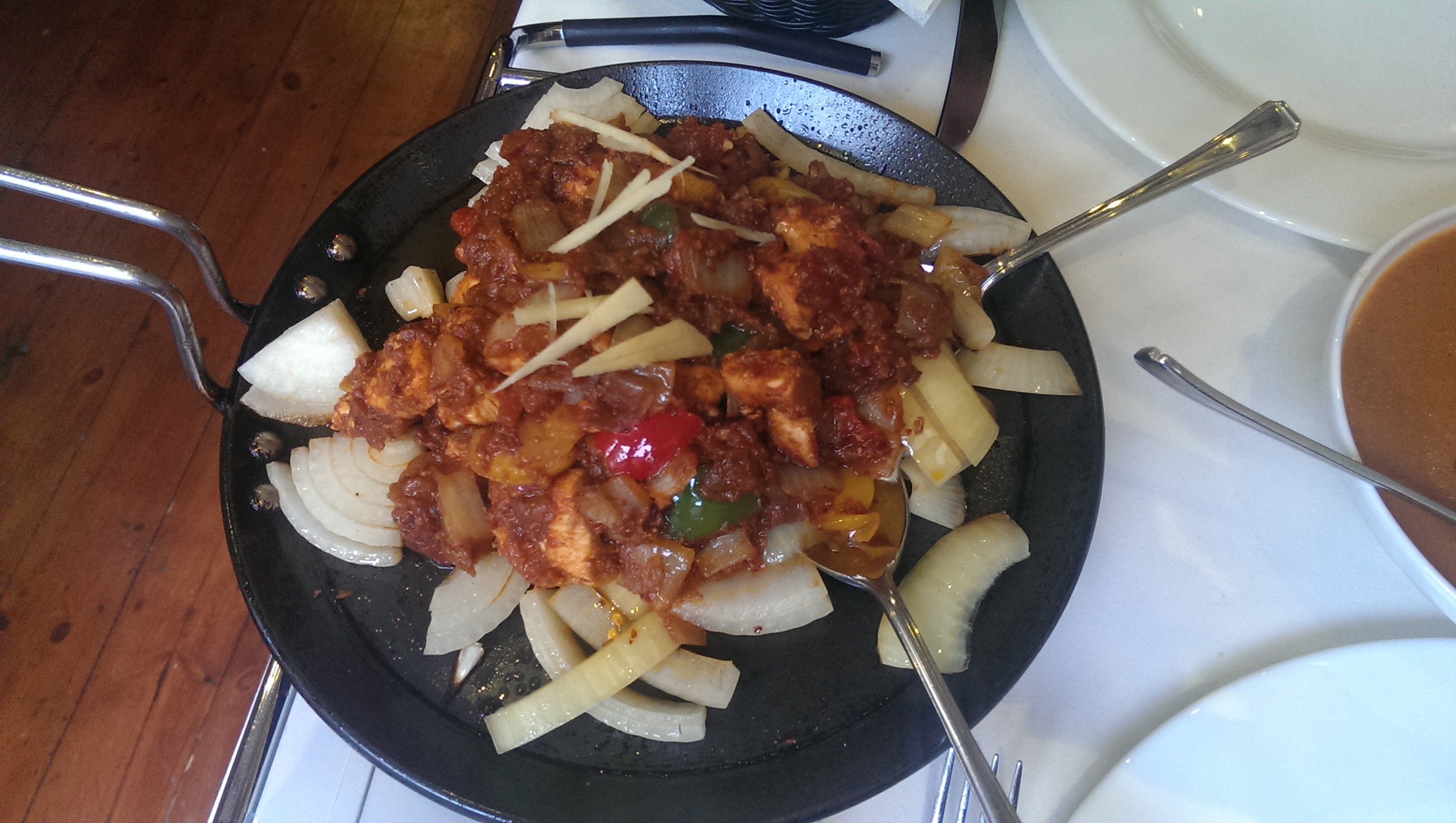
By this stage I thought I was probably onto a winner, although I’ve been disappointed at that stage many times (how many restaurants have you been to where you’ve thought I wish I’d stopped at the starters? For me it’s hundreds). But the mains didn’t let the standard drop. Shahi chicken tak-a-tak (named, according to the very informative menu, after the noise it makes popping away on the skillet) is one of those sizzling griddled dishes you always get jealous of when someone else at your table orders it. This one was no exception: so much more than just a pile of meat and onions, it came with a rich hot sauce with plenty of tomato. How hot? Well, I didn’t lose all feeling in my mouth but tissues had to come out at the table – I hope that’s not too much information, but until someone comes up with a Richter Scale of food heat it’s the best I can do. I loved it.

Shahi Chicken Tak-a-TakAgain the heat was really clever; it built up slowly, in layers, rather than pulverising you from the start. I’m not going to say “oh, it was genuine Indian food” because I’m not Indian and I wouldn’t know, but I’ve been to India once and it reminded me of the food I had when I went – that intelligent, calculated use of spice. Again, the chicken was soft and tender, not firm and unyielding, although after the starters I wouldn’t have expected anything less.

Having said all of that, the other dish was indeed chunks of meat in an orange sauce. Well, almost anyway – the mahi dum anari was sizeable chunks of fish, soft to the point of falling apart, in a silky sauce. This sauce was much more delicate, almost sweet but again the spice worked brilliantly. I wish I could do it justice by describing it better, but I might try and improve my skills in this area by going back to House Of Flavours. The other delight in this dish was the pomegranate on top – I was sceptical about this but its sweet pop under the teeth went superbly with the dish. According to the menu, this dish was served to Barack Obama on his last state visit to India; I wasn’t moved to take a selfie, but I did take a picture of the dish (it doesn’t do it justice any better than this paragraph does).

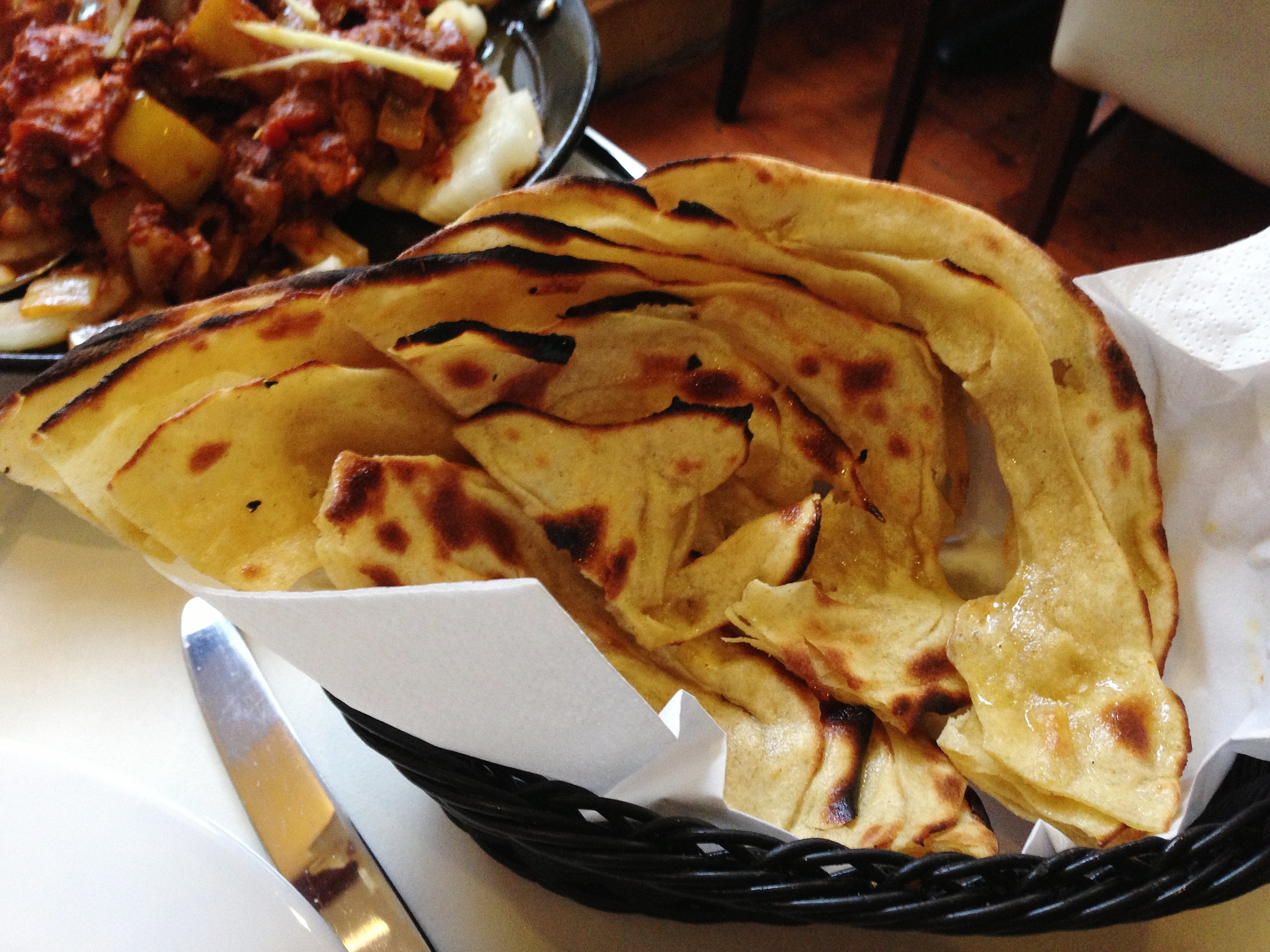
Mahi Dum AnariNormally in a curry house this would be accompanied with some pilau rice and a big fluffy naan but again, I was moved to try different things. The mutter pulao was rice rich with peas and with just the right amount of cumin, another revelation in a meal packed with revelations. The paratha was even better, buttery, chewy and soft at the same time and layered in a way which somehow reminded me – I don’t know why – of the pastry on the bottom of a tarte tatin.

ParathaNobody goes to an Indian restaurant for the drink, but I feel I should mention it because the wine list has three Indian wines on it. I tried two: the sauvignon blanc was decent if slightly thin on flavour but the cabernet sauvignon was spot on – properly hearty and feisty enough to stand up to the spices in my meal (I might have had a bottle, but it was all Kingfisher on the opposite side of the table to me, which is fair enough I guess). They also have two pretty creditable dessert wines – a Sauternes and a Californian red muscat – at very reasonable prices, albeit not for a full glass.

The reason I know about the dessert wines is that I couldn’t stay away from the desserts. I have a real penchant for gulab jamun so I was thrilled to see them on the menu. If you have a sweet tooth and you’ve never tried them, you’re missing out; they’re doughy balls – made from curdled milk, but don’t let that put you off – deep fried and then served soaked in a sugar syrup tinged with cardamom and rose water. The portion here is only small (two balls – no jokes, please) but that turned out to be plenty, especially if you don’t share them with anyone, as I didn’t.

The total bill for two people, for three-ish courses with a couple of drinks each came to £65. You could eat more cheaply than that if you stuck to one of their set menus but even so I felt this was very good value. I mentioned the service in passing at the beginning of the review but it is worth another mention too – very polished, very smooth and only there when you needed it. The whole experience felt very different to most Indian restaurants I’ve visited in Reading.

How to sum this place up? Well, how about doing it like this: I remember when I first found out that this place was opening, and I remember walking past the sign and reading the name. House Of Flavours? I thought. That’s a ridiculous name. It’s just going to be an Indian restaurant, and Reading needs another one of those like it needs another Italian. Now I’ve been, I know how wrong I was; it’s the perfect name for the restaurant and it sums up exactly what they offer – more than anything, the flavours are what I remember. I can’t think of many higher compliments for a restaurant than this, but even before I’d left I was already planning my return. Thinking about what flavours I’d like to sample next.

House of Flavours – 8.3
32 – 36 Kings Road, RG1 3AA
0118 950 3500

www.house-of-flavours.co.uk