
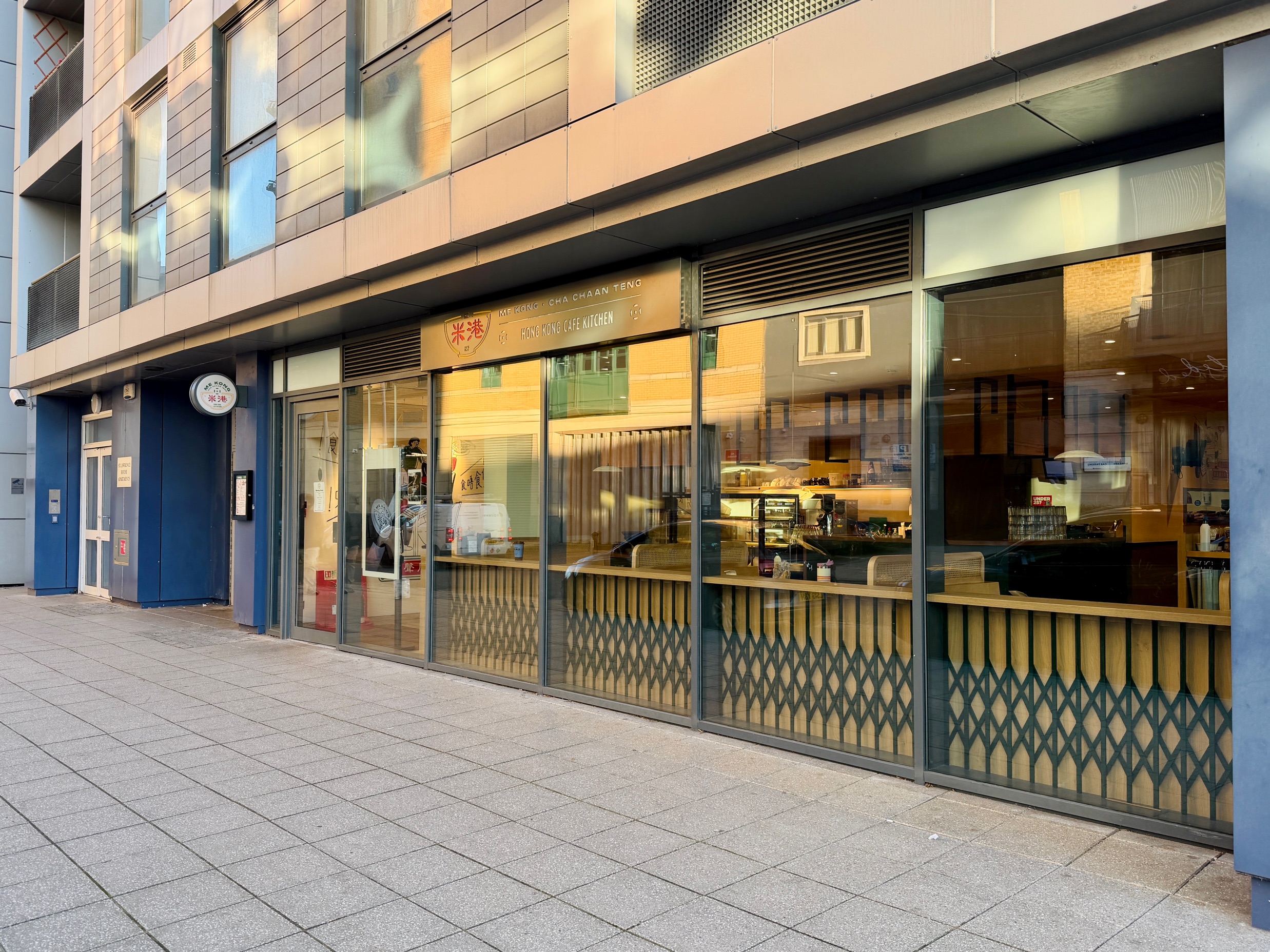
When I ran through the trends in Reading’s food scene last year, two stood out: the proliferation of new, casual pizza restaurants and a similar blossoming of restaurants to cater to Reading’s Hongkonger community. Last week I explored the former at Smelly Alley’s Zi Tore so it only seemed fair, this week, to dive into the latter at Me Kong, the newest of these restaurants to open.
I identified some of these spots opening in 2025 – Woodley Food Stasian out in Woodley, Take Your Time where Dolce Vita used to be and the subject of this week’s review, which is tucked away behind Reading Library just down from The Blade next to the retro classic that is the Abbey Baptist Church. It’s a spot which somehow didn’t feel like it existed before Me Kong sprang up there: I can’t remember what, if anything, was there before.
But even that undersells the increase in restaurants catering to this market. After all Good Old Days Hong Kong, which I reviewed around this time last year, has been around since late 2023. Worse still, I missed out a couple of developments last year – YL Restaurant for one, which opened in the back of the supermarket that used to be the Warwick Arms a long time ago. And then there’s Soul Chill, a cafe that opened right opposite where I used to live on the corner of London Street and South Street. Its Google listing initially made it look like a bubble tea spot, but it boasts breakfast and lunch options.
All this, of course, springs from the introduction in January 2021 of the BNO Visa for Hongkongers, giving them the right to settle in the U.K. with a path to citizenship. Reading – always a multicultural, well-educated, polyglot place – has as a result both developed and embraced a significant Hongkonger community. With that come all the advantages of vibrancy, including – selfishly, for me – new and interesting places to eat.
Me Kong is a particular type of establishment, a cha chaan teng. These are “tea restaurants” that originated in Hong Kong in the Fifties, following on from the bing sutt, or ice room. Cha chaan tengs are often likened in print to the British greasy spoon or the American diner, but I think that’s more to try and find a term of cultural reference readers might understand. In reality they are a creature all their own, and a very eclectic one at that.
Food at a cha chaan teng is often described almost as a fusion of Chinese and European – another term often used is ‘soy sauce western’ – with dishes including Chinese ones with which you’d be familiar and more esoteric options like baked pork chop with ketchup, or macaroni soup topped with char siu. In Hong Kong cha chaan tengs are a great gastronomic leveller – swift, efficient and frequented by blue and white collar workers alike.
Plenty of my research suggested that cha chaan tengs are on the wane in Hong Kong, as for that matter greasy spoons are here, but it’s somehow fitting that a wave of them is opening in the U.K. Because I’ve read that when they first sprung up in Hong Kong in the Fifties it was because Hong Kong, run by the British, welcomed Chinese refugees. There are echoes of that, I suppose, in the situation now, seventy years later.
A taste of home, or nostalgia, makes perfect sense if you settle somewhere so far away from your roots, and last month I saw a few photos of customers queuing round the block to try Me Kong for the first time. But did this food also have the potential to win over a wider customer base?
Someone thought so ten years ago, when a restaurant literally called Cha Chaan Teng opened in Holborn, but the reviews were not good. Marina O’Loughlin, then writing in the Guardian, said the food gave her “the kind of clammy shame I’d feel if I woke up post-bender to find myself the fifth Mrs Gregg Wallace”, adding that “cha chaan tengs aren’t renowned for their cuisine”: what’s the opposite of a white saviour?
There is a difference, though. That restaurant was geared at customers of European descent, while Me Kong promises to be the real thing. So on a Tuesday lunchtime I pootled over with my great friend Jerry, who was especially interested in Me Kong because it’s probably the closest restaurant to his gorgeous, incredibly tasteful flat. Forget whether I liked it or not: I also wanted to see if Jerry could find a brilliant new local.
We got there around twenty past twelve and the place was already packed with a queue for tables, albeit one that hadn’t moved out onto the street. I will say though that although we as a nation like to think we’ve invented queuing, Me Kong has perfected it – quickly assessing each table size needed and gradually corralling us into different spots in the waiting area.
At the front there were counters showing off all of Me Kong’s baked goods – buns, pastries and the like – and so some of the people joining the queue were simply buying that stuff to take away. Nothing fazed Me Kong’s front of house, and after no more than five minutes we were ushered to a table.
Me Kong’s interior is really rather impressive, I think. On one level it’s a front room with booths, a back room with tables and a corridor connecting them. But that doesn’t even begin to do it justice, on many levels. They’ve gone all the way through the building, so the front looks out on Abbey Square and the back onto the Holybrook, and that results in a really lovely space where everything feels airy and beautifully lit.
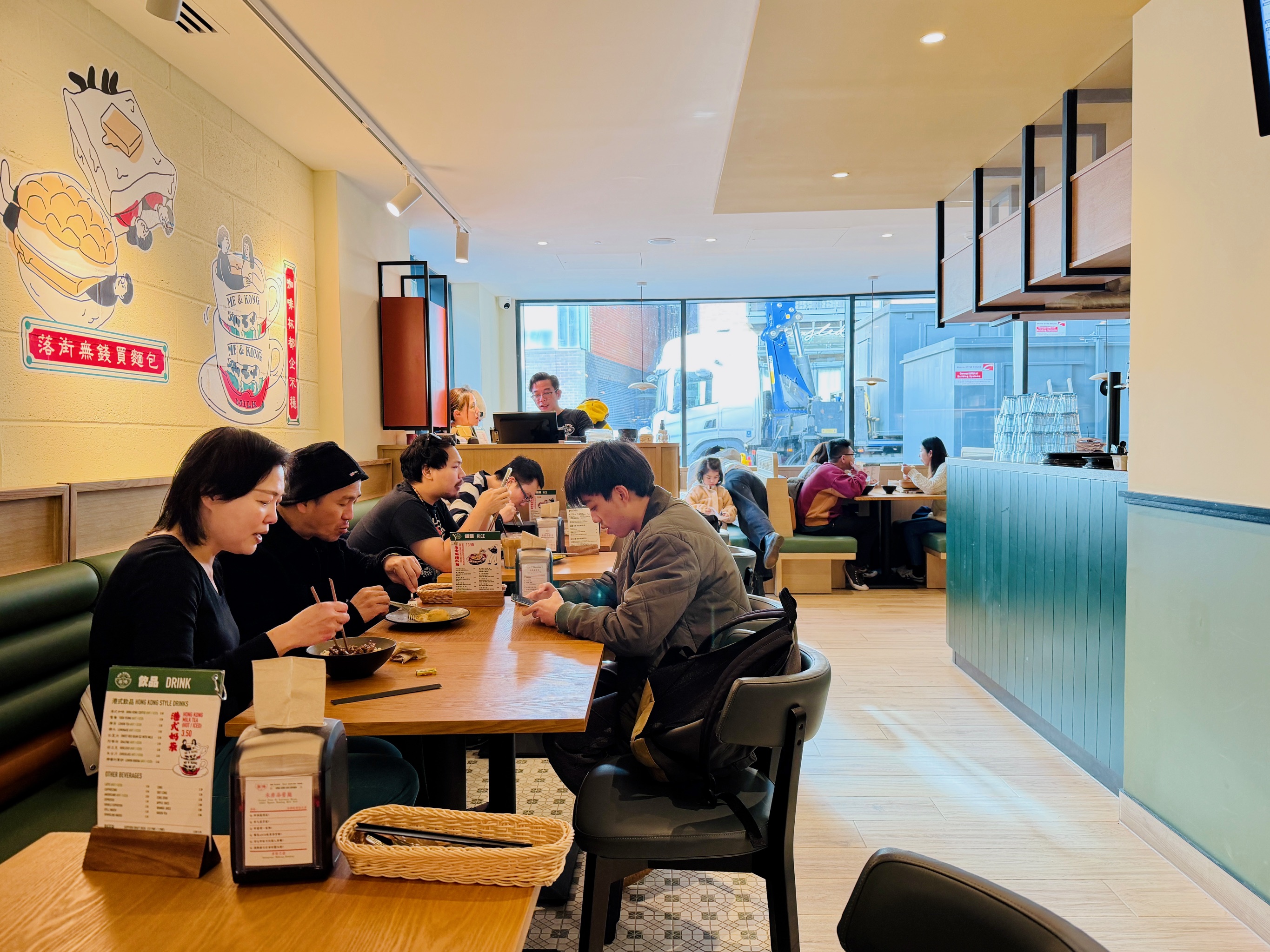
Not only that, but it felt polished and finished in a way new establishments so often don’t: the colour of the wood panelled counter; the tasteful banquettes; the bright line drawings on the wall, everything seemed really considered. And the branding, from the menus to the cups to the napkin dispensers, was extremely well thought out. I got the impression this wasn’t their first rodeo: I’d be surprised if it was their first restaurant, for that matter. It felt fully formed.
I should also mention that Jerry and I were, at the point when we sat down, the only customers of European descent in the place. But I never felt conspicuous, because the staff were just so terrific from start to finish. One server explained to us that they really wanted to promote this kind of food, and I got that impression throughout the meal.
In fact, I’m jumping the gun by saying this but I’ve never been to a restaurant where the staff were quite so keen to tell you what the gorgeous-looking dish that had turned up at another table was (“that’s the braised eggplant with garlic sauce” one of them told me, as I admired a delectable-looking pot on my left).
Me Kong’s menu, on a ring-bound set of cards with that impressive branding, was a proper box of delights with an awful lot going on. One section featured noodles, either dry or in soup, along with five set meals, another common feature in a cha chaan teng. These gave you the option of some Hong Kong classics – ham macaroni soup, say, or char siu macaroni soup – paired with a bun and either fried egg or omelette.
A large section of rice dishes again led with a staple of the cha chaan teng, baked pork chop with cheese and tomato sauce on rice. Many of these dishes were more on the fusion side, so were perhaps more for purists. Another page of the menu featured four clay pot dishes and five stir fries, and another page of snacks offered dishes like deep fried chicken leg with curly fries – again, an authentic cha chaan teng choice – along with a full range of options from the bakery.
I would say that with the exception of that aubergine dish, which looked like it might have had minced pork in it, there wasn’t much for vegetarians here. The page marked Vegetables featured various green veg with garlic or oyster sauce, but would feel limited if that was your lot. There was, however, plenty here for the cost-conscious. The most expensive dish on the menu was south of £15, those set meals were less than a tenner.
Plenty of decisions for Jerry and I to make – but first, tea. Me Kong does sell alcohol (Sapporo on draft, or Guinness) but I really wanted to try the Hong Kong milk tea, another speciality of this kind of restaurant. It’s hard to describe but imagine a very strong cup of PG Tips, souped-up builder’s tea, served with condensed milk, a very pleasing shade of deep amber, and you wouldn’t be far off. I put a sugar in it, but on reflection wished I’d added more.
I don’t normally put a picture of a cup up on the blog, especially one where you can see so little, but: see what I mean about the branding?
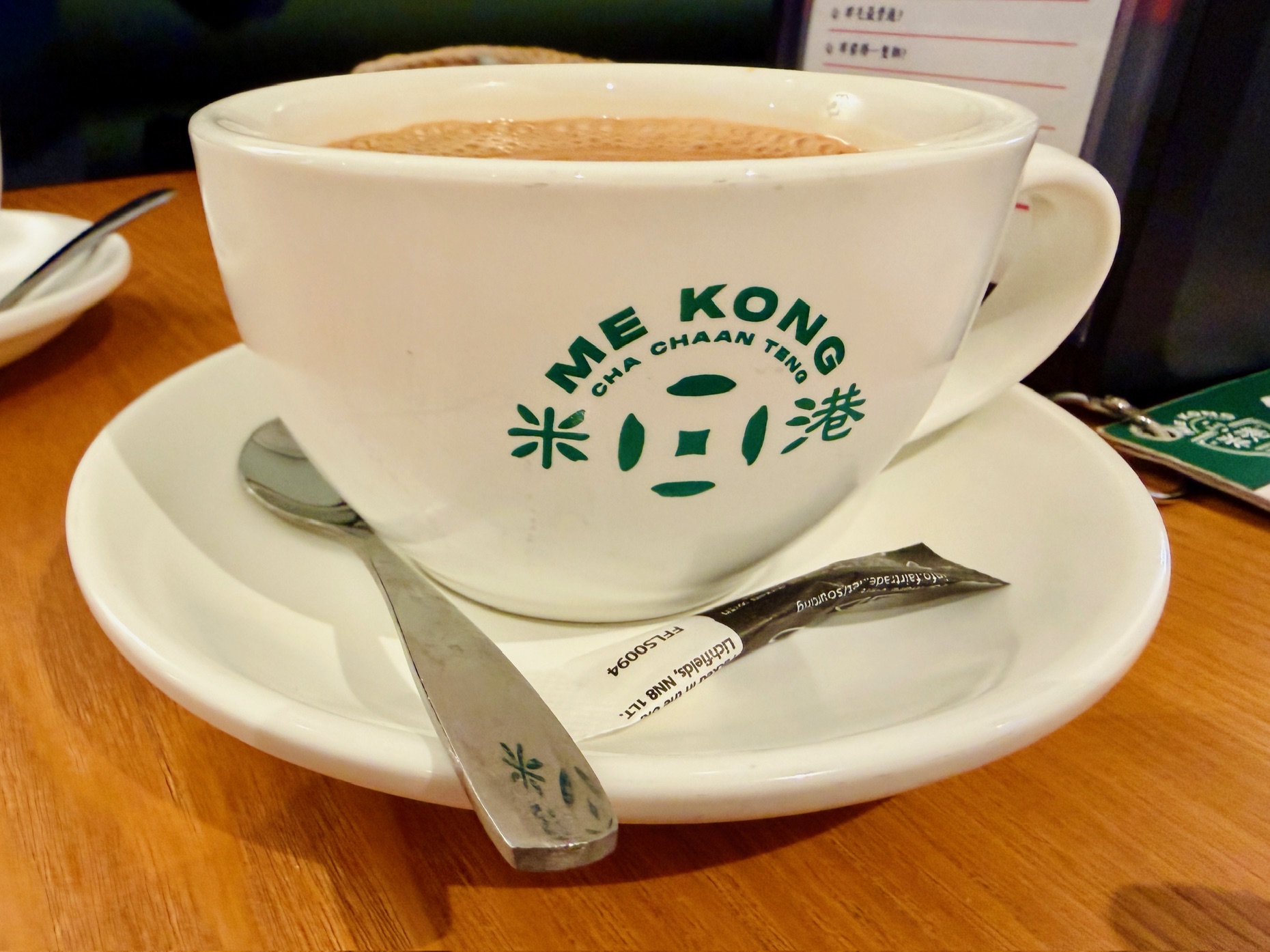
I’d read online that Hong Kong milk tea is strained through a sock, or something like it (hopefully one exclusively used for this purpose), often multiple times, to achieve a particular level of smoothness. I can’t say whether a hosiery department was involved, but it did have a certain pleasing consistency. Maybe it was the note of Carnation, or the power of imagination, but whatever it was I enjoyed it.
Jerry originally wanted to try a yuen yueng, a blend of coffee and tea also particular to cha chaan tengs, but they didn’t have any Hong Kong coffee so he joined me in a tea. He liked it, but less than me: when we had a follow up drink I opted for more of the same, and he had an iced lemon tea – specifically requested as slightly less sweet on the excellent advice of the table next to me.
Before I talk about the food, I did want to say something about that. I’ve already said that the staff were really keen to explain other dishes and illuminate us on the cuisine of Hong Kong. But I’ve never eaten in a restaurant where that evangelism so extended to the other customers, too. During our meal the tables on either side of us were occupied by multiple parties – restaurants like this tend to be brisk – and so we got to rubberneck all manner of delights. Not only that, but the people ordering them were more than happy to tell us what they were.
All that meant that although we played it relatively safe with our order we saw more than enough to work out what to have next time. That macaroni soup topped with satay beef looked like an interesting, comforting order, but I was even more intrigued by a dome of rice crowned with an omelette draped over it, the whole thing then decorated with vertical strips of char siu. The traditional pork chop baked with cheese came in an earthenware dish, the kind you might associate with a lasagne, and I got a sufficiently good look to decide I’d leave that one to the experts.
Nicest of all were the lovely pair of civil engineers on my left. They worked in Thames Tower and had found out about the place and one, whose family were from Hong Kong, had decided to bring her colleague along to see if it recaptured the food of her memories.
She ordered a clay pot dish that I considered but been put off ordering because of the mystery meat component of “Chinese sausage”, and she even kindly let me sample a bit. It was delicious, with a sort of air dried texture like salami and a complex, fragrant flavour. I made a note not to let it deter me next time.
So yes, I chose the conventional option, the black bean chicken pot. But I am so happy that I did, because it was simply outstanding. A hefty pot full to bursting with boneless chicken thigh, skin on, cooked absolutely bang on so it was firm but had just enough give, no evidence of the velveting that can sometimes make chicken off-putting. Huge bits of spring onion, caramelised until heavenly, coexisted with all that chicken and extra goodies: little cubes of potent ginger and plenty of equally burnished nubbins of garlic.
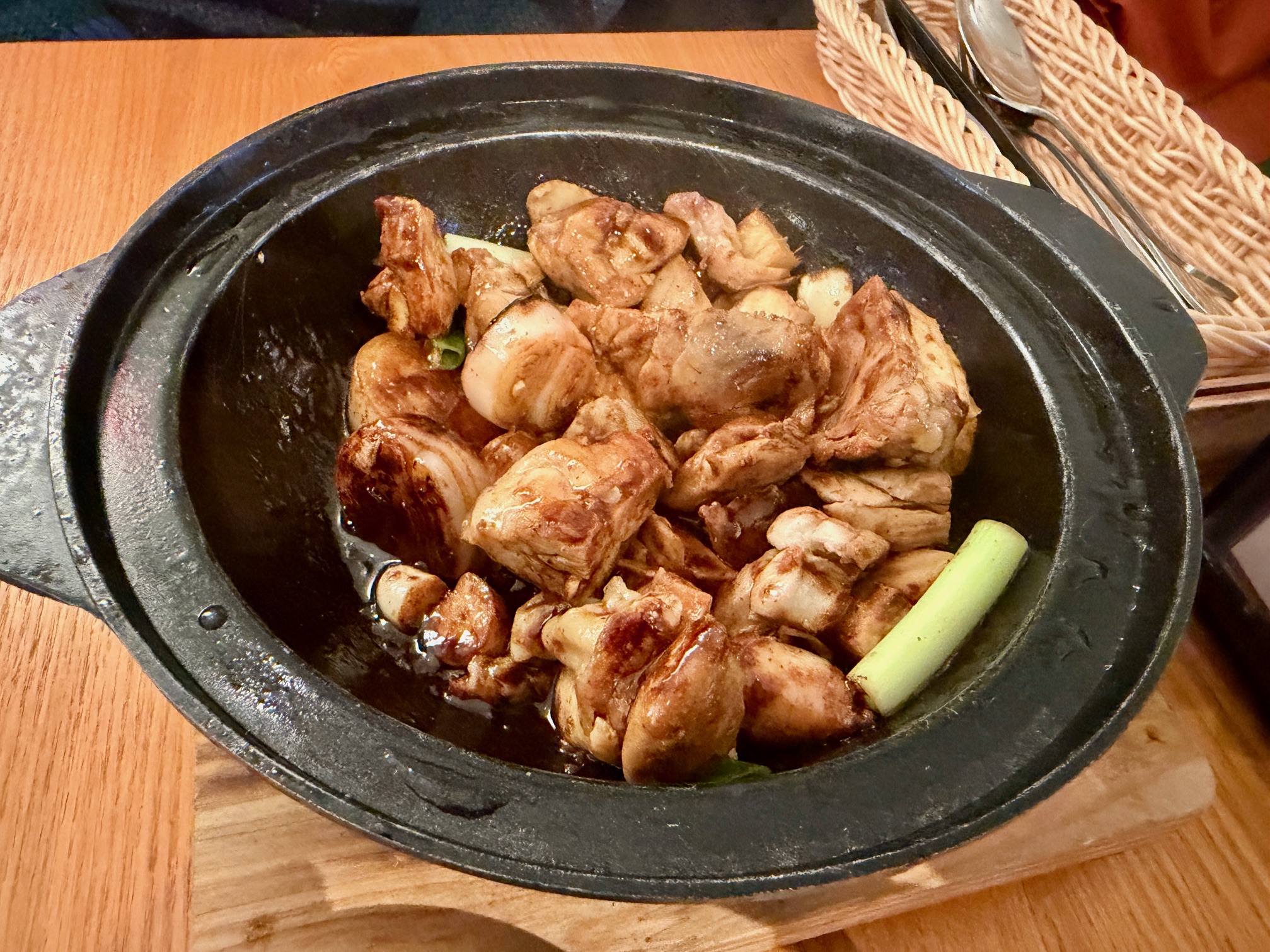
But all that would be nothing without the sauce, a black bean sauce of ridiculous savoury depth, a glossy number with notes of Marmite which clung to everything: to the pot, to every crevice of chicken, to each layer of onion, each piece of ginger and garlic, every grain of steamed rice. This was deliciously viscous stuff, and I made it a mission to ensure that I left as little of it gleaming at the bottom of that black pot as I possibly could.
There is a part of me that is very tempted, just after noon on Friday when this review goes up, to find myself in that place again eating exactly this dish: it was that good.
Jerry had chosen every bit as well as me, going for the Singapore vermicelli with char siu and prawn. This was a magnificent one-stop shop, a very generous tangle of rice noodles tumbled through with chilli, prawns, strips of pork, beansprouts and fried egg. The menu described it as spicy, our server said it wasn’t so hot. Having tried a few forkfuls, I’d probably split the difference and say it was nicely challenging.
What saved it from chilli overload was a certain nuttiness, although I’m not sure where it came from. Perhaps it was the curry powder, an essential component of this dish which gives it its ochre hue. Professor Wikipedia advises me, pleasingly, that Singapore noodles have nothing to do with Singapore but are also a post-war Hong Kong creation.
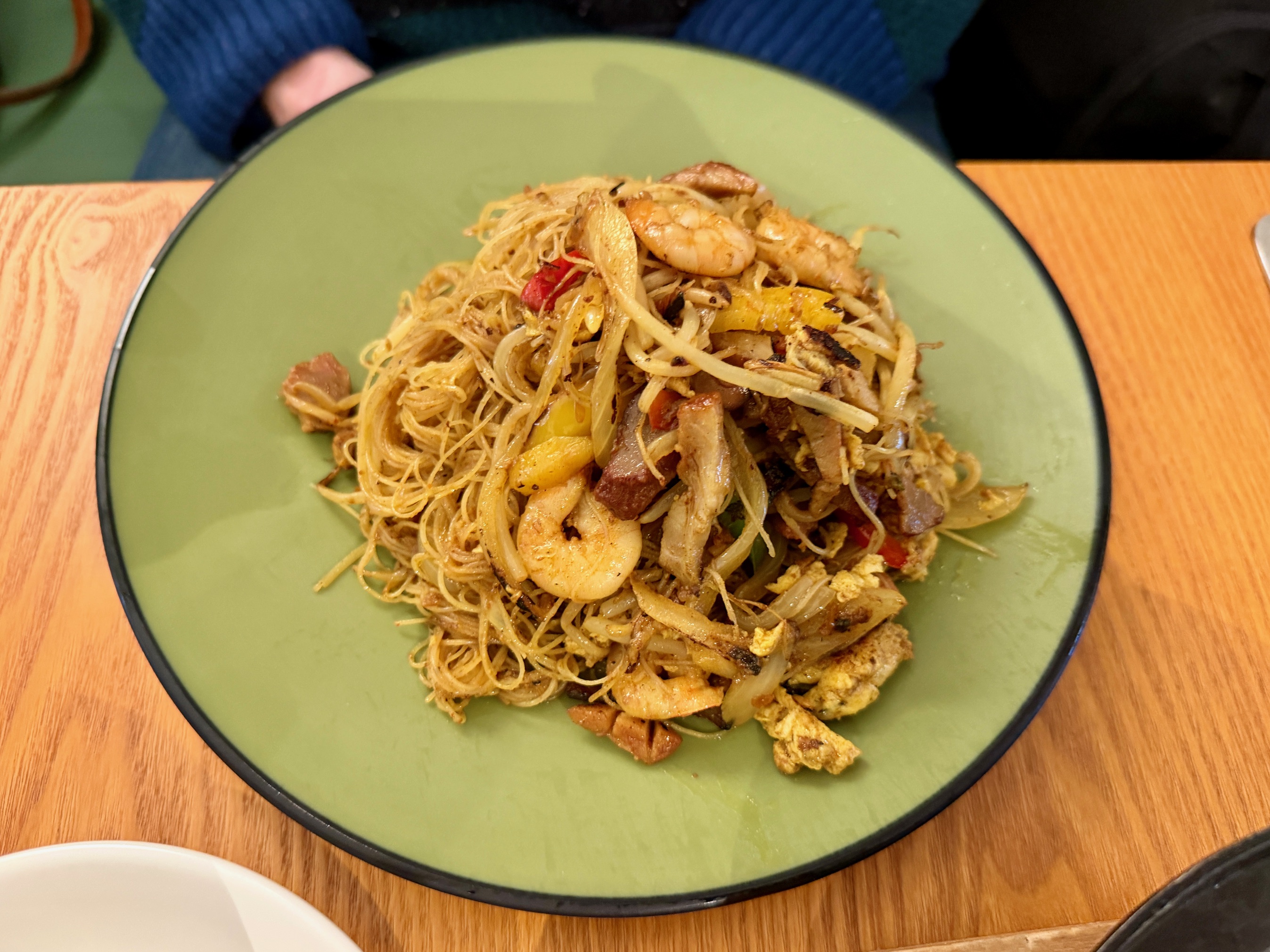
The thing that made me happiest about these noodles was how much Jerry loved them. He told me he could happily see himself coming here of an evening, ordering these and sitting there taking it all in: he added that previously his go to had been the pad thai at Rosa’s Thai but that this was easily a rival for it. Getting people to eat at Me Kong instead of Rosa’s Thai is, I suppose, as good a mission statement for this blog as any: I’m glad it had that effect on my friend if nothing else.
But I can also see exactly what he meant about it being a space where you’d want to spend time. It was so busy, so beautifully efficient and well run, and so popular – with friends, with couples, with families. Small children were everywhere, but for a moment you could forget you were in the U.K. because they were, without exception, impeccably behaved.
The word that jumps out at me – that restaurants don’t always aim for and in any case don’t hit often enough – is fun. Everything about Me Kong was a riot, from its cheerful, charming staff to its delighted, curious kind customers. How could anybody experience that and not want to be part of it again?
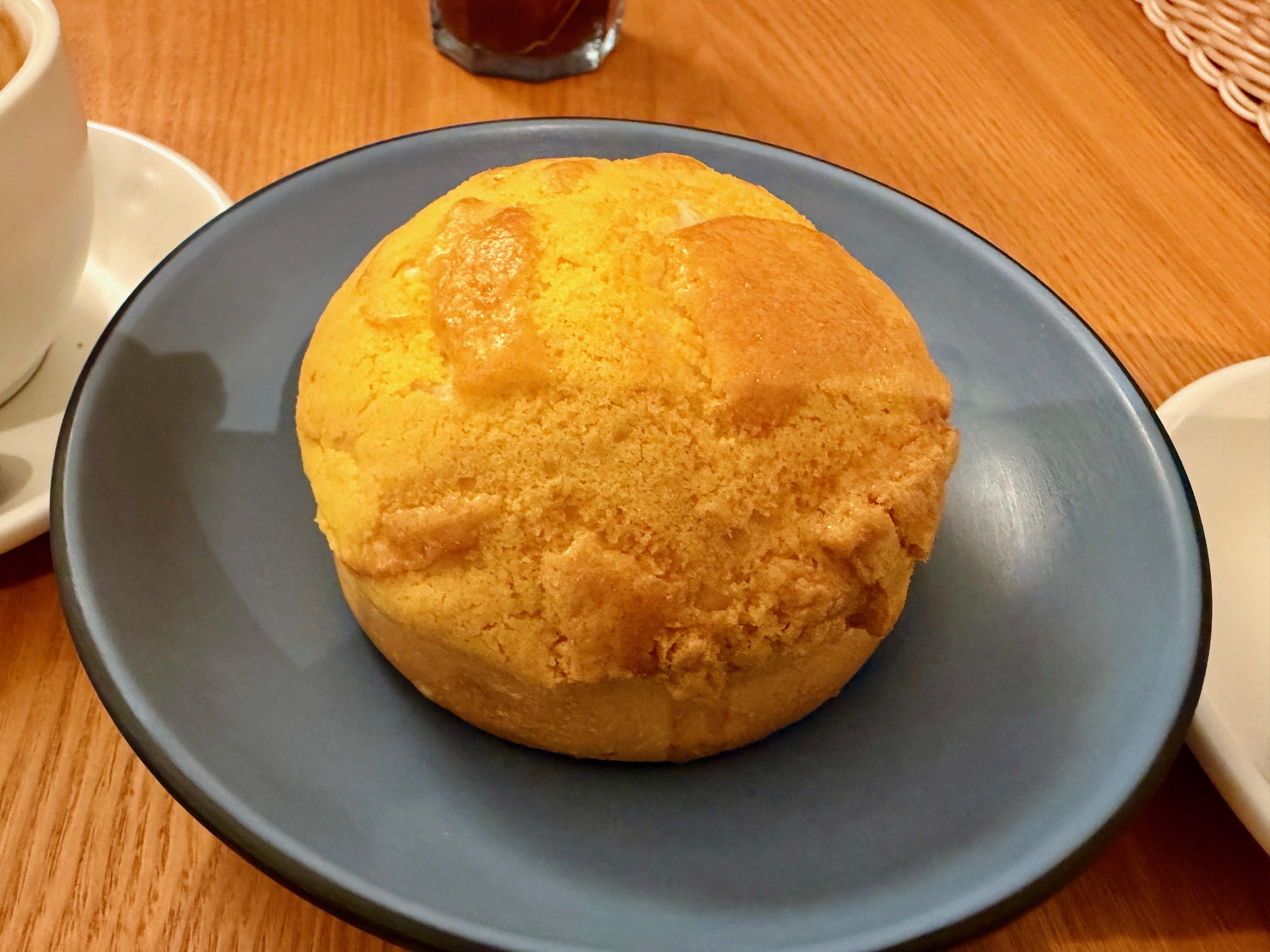
Determined to cover as much of the menu as possible we stayed for some sweet treats and this was when, maybe, Me Kong’s sure touch faltered ever so slightly. I wanted to try the real staples here, so we started with a pineapple bun: no pineapple is involved, but it got the name because the sugar crust on top can, apparently, vaguely resemble a pineapple. I rather liked this – it reminded me of an iced bun, but with a crust rather than icing on top. Worth trying so you can say you’ve tried it, absolutely, but I don’t know when I’d feel a hankering for one again.
I really expected to love the French toast, another Hong Kong signature, but it didn’t quite hit the spot. Two slices of white bread, joined together with a thin mortar of punchy peanut butter, came fried and brought to the table with a little pack of Anchor butter to melt on top. Jerry said that those cultural references – Anchor butter, builder’s tea – added to that feeling of nostalgia, and I could see where he was coming from.
But for me this was just a little too stodgy, a little too light on the fun considering how many calories were involved. Ironically it needed to be more indulgent: the very nice civil engineer at the next table told me that often this was served with maple syrup, which would have utterly transformed it, but the server told me that they didn’t do tweaks or customisation for anybody, which I respected.
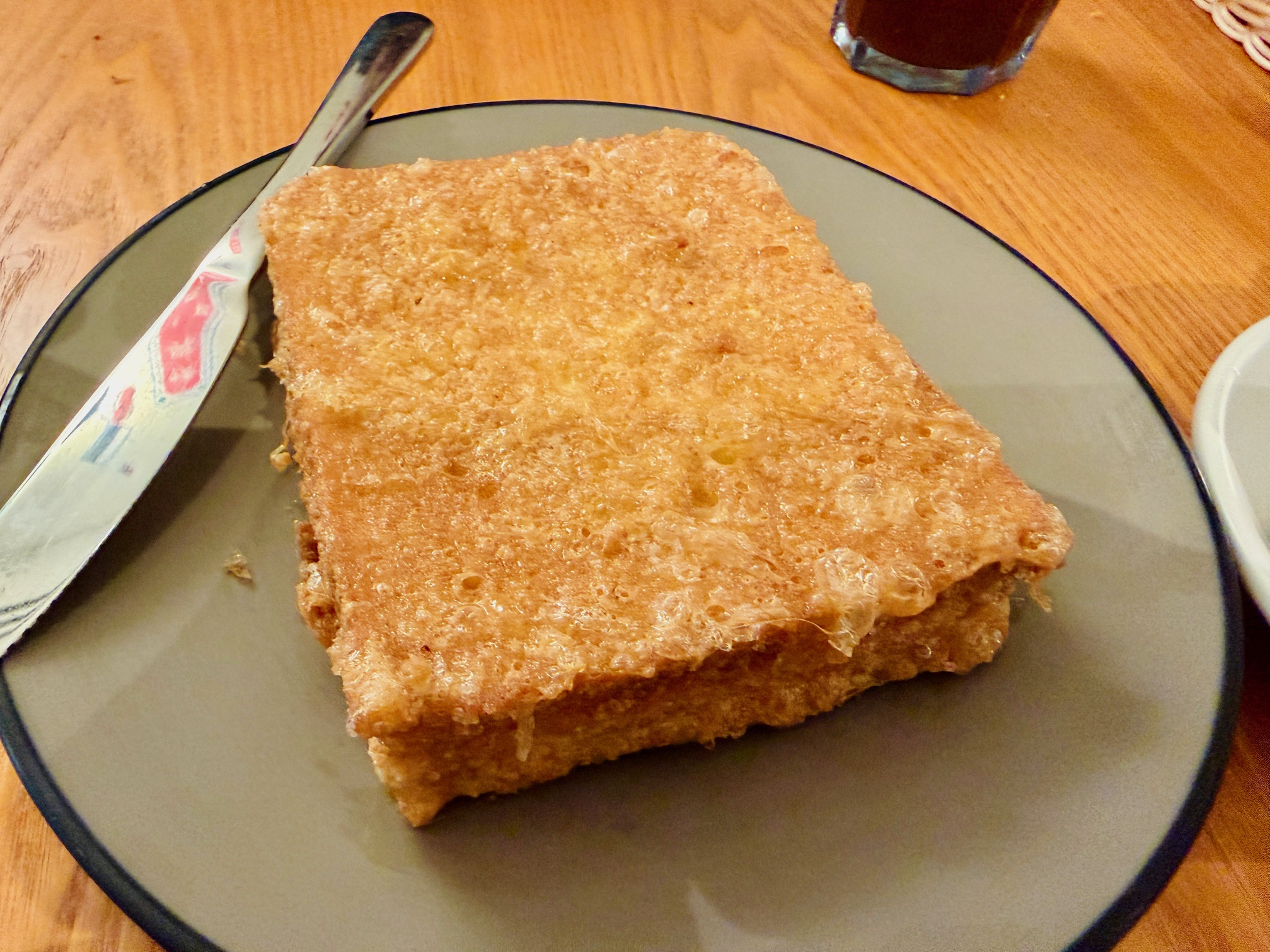
We didn’t finish it, because as an experience it was just a tad too grubby: I didn’t feel, as Marina O’Loughlin did, shame equivalent to waking up married to Gregg Wallace, but perhaps something comparable, like having a mucky dream about Nadine Dorries.
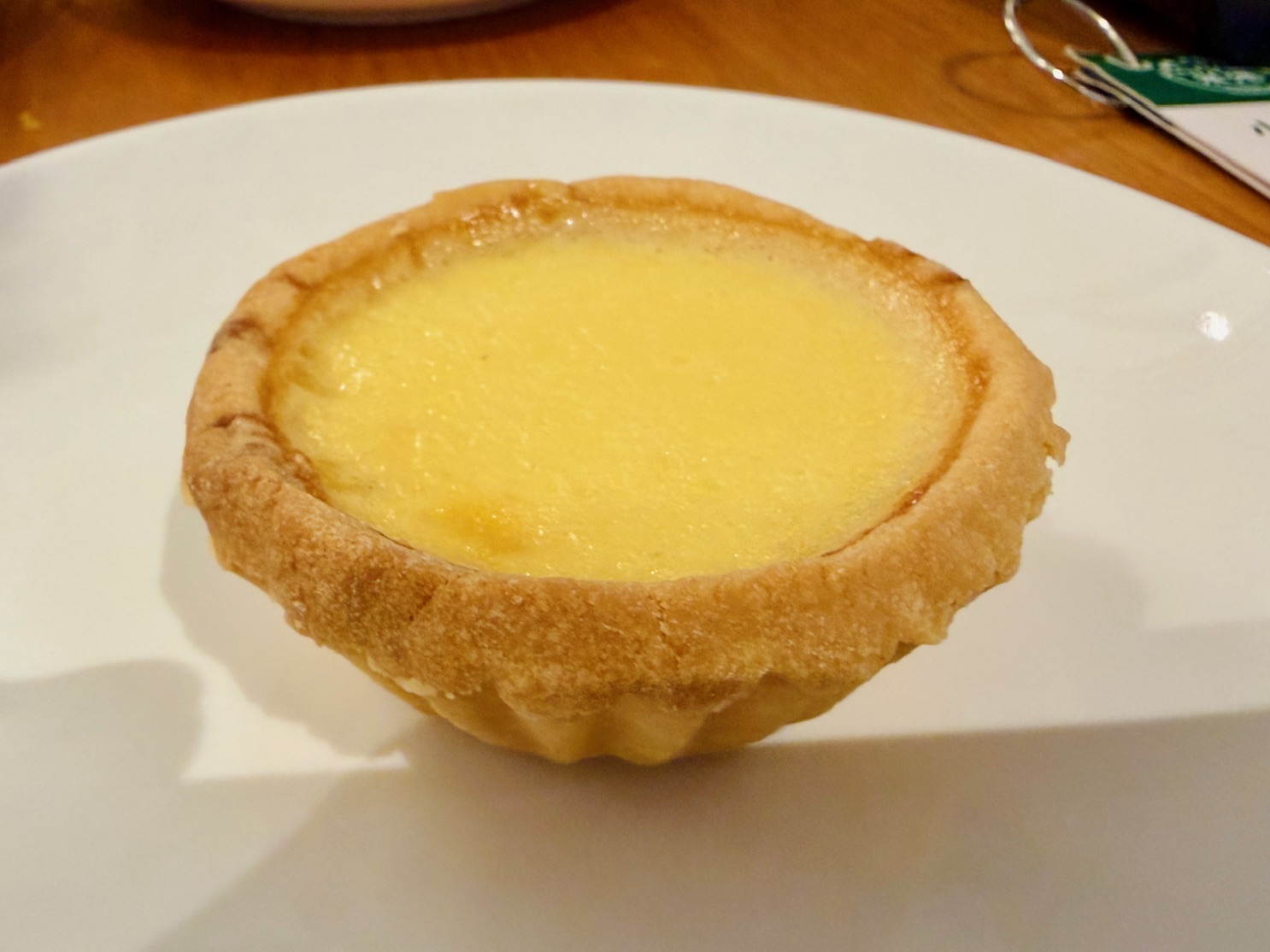
The last of our trio of desserts was a similar experience: I’d asked for an egg tart and been told that we’d have to wait twenty minutes for a fresh batch to come out of the oven. So we did, and when it came it was still warm and the pastry, buttery and short, was truly exemplary.
And yet I wanted to like the filling so much more than I did. I don’t know whether I was expecting the appealing wobble of a pastel de nata, or the nutmeg-dusted propriety of its English relative, but this was more egg white than egg yolk, somewhat lacking in richness and far more like blancmange that had found itself a very nice house. Again I wouldn’t order it again but I’m glad I tried it and for £1.70, only 10p less expensive than the pineapple bun, it was not an expensive mistake.
Our bill for everything came to just over £54, and there were two remarkable things about it. One is that if you order food they knock a very specific 51p off the price of each of your drinks, so they each cost £2.99. The second is that the service charge they add is only 8%: I questioned this with our server saying it wasn’t enough, and he laughed. “Next time you can tip a hundred pounds!” he said.
He also told me – and this might be useful to you, though it wasn’t to me – that if you spend over £40 they have a deal where you can get free parking at the Queens Road Car Park.
I hope the tip is so low because the staff there don’t need to rely on it to be fairly paid, because they very much deserve that. All of them were just terrific, and I know this has a strong whiff of and everyone stood up and clapped, but it’s true: practically every one of them said thank you to Jerry and I as we walked through the restaurant on our way out. I sent the pictures of our food to Zoë later as I was relaxing at Jerry’s with a cup of tea and a medicinal glass of red, and got exactly the reply I was expecting: perhaps you’ll take me some time soon.
This is precisely the kind of review, and the sort of restaurant, I wanted to kick off the year with. Me Kong is an absolute blast, brilliantly run and happens to do some excellent food, and I scoped out enough options on my first visit to give me plenty of food for thought on my second, third and fourth – if I can tear myself away from that chicken in black bean sauce, that is. It is already incredibly busy in a way most Reading restaurants in January would kill for, but I can see that continuing even after the novelty value has died off.
But what I also loved about it was how inclusive it was, how keen it was to tell its story far and wide. That spirit deserves to be returned in kind by Reading’s restaurant-goers. And it also made me a little proud of Reading: that our diverse, happy, tolerant town can still attract people like that and businesses like this, despite all the naysayers and bigots in the comments section of the Reading Chronicle.
I think if you read this blog you’re not like those people, and I think you’d find an awful lot to like at Me Kong. I wouldn’t be at all surprised if, in the months ahead, I see some of you there. I certainly won’t be in Rosa’s Thai, that’s for sure.
Me Kong – 8.4
St Laurence House, Abbey Square, Reading, RG1 3AG
0118 3431543
https://www.facebook.com/MeKongReadingUK/
Since January 2025, Edible Reading is partly supported by subscribers – click here if you want to read more about that, or click below to subscribe. By doing so you enable me to carry on doing what I do, and you also get access to subscriber only content. Whether you’re a subscriber or not, thanks for reading.

 Edible Reading