L’Ortolan, Shinfield

L’Ortolan closed in August 2024. I’ve left the review up for posterity.

Despite Reading being a pretty affluent town it’s always been short on Michelin stars. There’s a gathering around Bray (Orion’s Belt, if you like) and the two star Hand and Flowers out at Marlow but the only truly local “star” is L’Ortolan, in Shinfield (so close, it’s RG2 which I guess makes it our Alpha Centauri). As with most people I expect a Michelin star to make a restaurant fussy and pricey – although if Michelin themselves are to be believed, stars are awarded for food alone and, technically at least, have nothing to do with table linen or waiters in waistcoats. Even so, driving into the countryside to try L’Ortolan gave me a sense of trepidation: not just about whether the food would be any good, but also about whether I’d be up to reviewing it.

Stepping over the threshold of Ortolan is like stepping inside a machine; the smartly dressed, suited staff are everywhere, taking coats, ushering customers to the bar, bringing drinks, wiping up invisible spills from the hardwood floor, plumping cushions. Everything looks impeccable, like a modern day clockwork Downton Abbey. Over a drink in the bar we were served canapés on a slate, just enough to get our tastebuds firing. Michelin starred dining is full of these bits and bobs – pre-pre starters, pre-starters, pre-desserts – and these were a nice enough introduction. There were little airy crackers with potato and onion, a thin wooden cone full of maple and truffle popcorn, the maple hitting you first and the truffle sneaking in at the end. The best of them were goose and foie gras croquettes, smooth and rich, Eton Turkey Twizzlers.

People often say it’s possible to eat affordably at a Michelin starred restaurant (normally, ironically, in a review where they’ve made no attempt to do so) so we were both picking from the lunchtime prix fixe. Three courses, with three or four choices per course, comes to thirty-two pounds: or it will do, at least, if you don’t pick one of the dishes with a five or ten pound supplement. Narrow, yes, but not so narrow as to be constricting, with lots of interesting choices to make. So we sat in the bar, sipping our pre-prandials, feeling pampered and making our decisions. Only when our orders had been taken and our glasses were empty did we go into to the restaurant proper: places like L’Ortolan are very good at letting you take your time.

Being taken through to the dining room revealed two rooms, one on the austere side, and the other, a conservatory room with a tented ceiling, harking back to the Raj. I was glad to be sat in the latter as it felt a little more relaxed. Tables in both rooms were the same, with smart linen, a fancy glass plate at each setting (soon whisked away, which begged the question of what it was there for) and comfy if slightly awkwardly angled velvety seats.

A big bowl of bread soon arrived and we tucked in while waiting for our starters to arrive. The best of them was a small treacle baguette, which was a golden saffron colour inside and slightly sweet with a hint of black treacle, The other breads – sourdough, focaccia and a small seeded roll – were nice, if not quite at the same heights, and there was plenty of room temperature butter (stinginess with butter is one of my bugbears, but then I do like a lot of it).

Before our starters arrived there was a pre dessert – an espresso cup of soup (isn’t it always?). This was a rich but light mushroom velouté which had a hint of truffle, a tiny sourdough crouton and a deliciously sweet and sour pickled mushroom. I enjoyed it so much that fighting the urge to clean the inside of the cup with a piece of bread was quite a titanic struggle; I didn’t want to let the side down with all the other genteel tables around me.

The starters were both beautiful to look at. The duck liver (introduced as foie gras when brought to the table) with blood orange and basil marmalade was heavenly, even for something so sinful. The liver was just cooked with a slightly caramelised outside. Next to it was a small dome of creamy duck liver parfait with pain d’epice crumb, all lovely and gingery. On a slice of flattened puff pastry were neatly laid slices of blood orange, resting on some of the marmalade. The marmalade itself was more like a curd, a thick smear of it (they do love smears in restaurants like this) on one side of the plate. Ordering this involved paying a five pound supplement, but it was a good decision: it was the best thing I ate all afternoon, and writing this makes me want to have it all over again. In particular the sweet richness of the liver with the tart blood orange was fantastic, and not a combination I’d ever have imagined before.

OrtDuck

The other starter also looked gorgeous, but looks were the main thing going for it. On paper, confit salmon, pickled cucumber and ketjap manis gel sounded terrific but what turned up had a strong air of seeming like a good idea at the time. The salmon was lovely – subtle, fresh and breaking into flakes with no effort at all (which took me aback, since it looked so much like sashimi). And I wouldn’t have minded it being so petite, if it had had more interesting things on the plate to pair it with, but I wasn’t that fortunate. The pickled cucumber, big indelicate chunks, had almost no sweetness or sharpness so was watery and bland. The ketjap manis gel was sweet and intense. But the rest? Well, it felt an awful lot like sludge to me: swirls of two different other sauces spiralling round the plate, a little heap of horseradish snow and micro herbs strewn all over the shop. Wetness, wetness everywhere. Towards the end I found some sesame seeds – strong, intense, delicious – submerged where they were almost unnoticeable and beyond rescue. It was the sort of plate you never quite clean: it looked like a Pollock once I was finished. They brought more bread after that, and I started to wonder whether I’d need it.

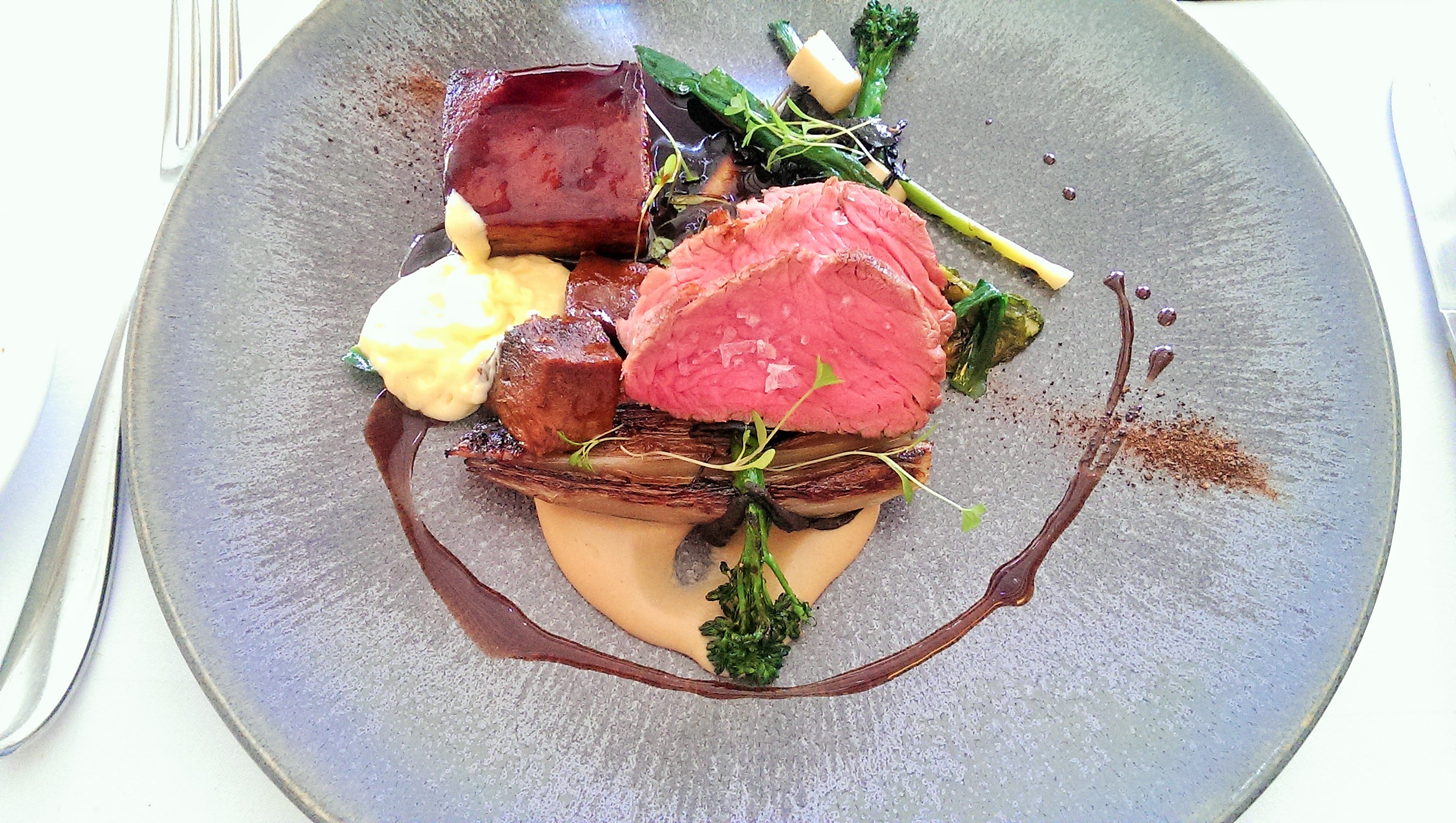
For main, the rump of beef was as lovely as the duck liver. It was three very pink (as requested) slices of beef with smoked pommes Anna on a red wine jus with bone marrow hollandaise. Underneath the beef was half a roasted banana shallot, a few pieces of tenderstem broccoli, two cubes of dense beef and a creamy mushroom sauce, dotted with mushrooms. The rump itself was a little tough under the knife but tender when chewed. The potatoes were wafer thin and richly flavoured (almost like the potatoes my mum used to cook in with the roast beef when I was a kid, although the Michelin inspectors never troubled my mum’s kitchen – or yours, I’d imagine). The shallot was sweet and the mushroom sauce was intensely flavoured. There was only one blot on the copybook – one of the cubes of beef, a big layer of fat running through it, was far too tough to cut or to eat – but apart from that, it was perfection, a high-end reinvention of a Sunday roast, where each ingredient was so concentrated and intense that size simply did not matter.

OrtBeef

The other main had sat up and begged to be ordered when I saw the menu: loin of lamb, Parmesan gnocchi, sweetbread popcorn, confit tomato. Again, it looked absolutely gorgeous, and the lamb was beautifully cooked, what there was of it anyway. But again the rest of the dish underwhelmed. The confit tomatoes were the best, little bright-coloured flashes of sweetness. The sweetbreads were an Eton reimagining of KFC popcorn chicken – nice enough but maybe not the surprise I’d been hoping for. The gnocchi was one single chewy wodge whose main role in proceedings seemed to be to show off how delicious the Pommes Anna on the other plate were. And, of course, more little spheres and splodges of sauce – along with, randomly, a smear of something that tasted like goats cheese. Oh, and more of those sesame seeds. I’ve never believed that food should ever be too beautiful to eat, but unfortunately this was more fun to look at than to eat. There was a ten pound supplement for this and I’m not really sure why, because it was smaller, lighter and far less special than the beef.

OrtLamb

More freebies followed with an impeccable pre-dessert: a little shot glass with creamy coconut rice pudding at the bottom, little cubes of rum jelly above it and a layer of passion fruit mousse at the top. I could quite easily have eaten a dessert sized portion of this. Not for the first time in a high end restaurant, I wondered why the free stuff always seems to taste the best. Maybe because it’s “free”: I know, ultimately, it isn’t but sometimes the mind is quite happy to let itself be tricked.

For dessert I simply had no choice but to have the cheese: I’d seen the cheese trolley wheeled past on several occasions while I finished the previous two courses and it was impossible to resist. There were a mind-boggling twenty cheeses on offer – going from the hard cheeses, past goats cheeses and on to some softer-rinded cheeses with varying degrees of stinkiness – all of which were explained in detail by the captain of the trolley, a really personable young man with obvious enthusiasm for his charges. I was allowed four, which were served with super thin slices of bread and crackers, and a choice of chutney and truffle honey. There were also grapes and celery just in case I wanted to offset some of the calories, although I’d given up counting by that point. The ones that stood out for me were the Burwash Rose, a rich, tangy, semi soft cheese with a rind washed in rose water and the Blue Murder, a Scottish blue so ripe it was in danger of running off the plate (or, rather, slate) and, for that matter, out of the building. The latter was particularly good with some of that honey, although the truffle couldn’t stand up to the cheese itself and was close to undetectable. This plate also attracted a five pound supplement but the variety was so good (perhaps not in the hard cheeses – I was hoping to see a really good Gruyere or Comte, but it was not to be) and the portion sufficiently generous that I didn’t begrudge them one bit.

OrtCheese

The other dessert was chocolate and cardamom ganache with orange curd and mint ice cream. Unlike many of the things I’d eaten, that was a pretty good description and – for the only time in the meal – what turned up was roughly what I’d expected to see. It was bliss: a long thin rectangle of smooth, glossy ganache, powdered with cardamom, was just gorgeous. The mint ice cream – green, fresh garden mint, a million miles from bright green mint choc chip – was so fantastic I didn’t want to pair it with anything else. The orange curd zinged with sweet sharpness. Best of all, perhaps, was the kitchen’s reinterpretation of Mint Aero – three little chunks of fluffy chocolate which imploded in the mouth, a piece of culinary pyrotechnics. Just beautiful. And, in case you’d forgotten the kitchen has a Michelin star, some pointless micro leaves.

OrtChoc

I knew the wine list would sting, and it did. As I was driving, the initial plan was to order wine by the glass but the prices by the glass were so punitive – seven or eight pounds for 125ml, easily a tenner for 175ml – that we decided it would be better value to get a bottle from the bottom end of the wine list and picked a Cote du Rhone for thirty-seven pounds (to give you an idea, that’s the fifth cheapest red they sell by the bottle). I was feeling really pleased with my bargain hunting until I got home, did some research and found that the same bottle retails for eleven pounds. Still, there was no bitter taste at the time.

Service was excellent, if a little cool. There was a constantly rotating team of waiters which served plates, cleared plates, poured wine and poured water, which gave the feeling of being continuously “served” but without a lot in the way of interaction. It was exceptionally well-run, just a tad emotionless. A few of the waiters – the captain of the cheese trolley, one of the waiters who topped up our glasses – seemed to have a little more charm, it’s just a shame that this was the exception rather than the rule. Perhaps customers at Ortolan (who do tend to be older and middle class, based on the clientèle when we were there) expect service of the “seen and not heard” variety, or perhaps my expectations have been skewed by too much casual dining. I would blame Michelin – lots of people like to – but I’ve eaten at other starred restaurants which felt a lot less, well, starchy.

The total bill, including a 12.5% “optional” service charge, for two drinks from the bar (one of them soft), a bottle of wine and three courses was one hundred and forty five pounds. So, I tried to eat cheaply at L’Ortolan and I have to say it’s just not really possible: we could have saved twenty pounds on supplements but even then it would be pretty difficult to get the bill under a hundred pounds unless neither of you were drinking.

I found L’Ortolan such a mixed bag that it’s difficult to wrap it all up in a neat and easy conclusion. I almost feel like there were two different meals here: the duck liver and beef were fantastically well-judged, well-balanced, generous and delicious dishes where it felt like there was more to them than expected. The salmon and lamb was the opposite – too delicate and light without enough oomph to stop them from being damp squibs. I guess the question is, if you went to L’Ortolan, which of those two meals you’d get. If it was the first, you’d be evangelising to friends, but if it was the second you’d be wondering what the fuss was about.

I think in the back of my mind I was partly comparing the prix fixe at L’Ortolan with the a la carte somewhere like Mya Lacarte and thinking about differences in the food, the execution, the ideas and the experience. In a straight-out comparison, I’m not sure L’Ortolan would win out very often, however stunning the building, beautiful the dishes, plentiful the freebies. Maybe that’s about me and the kind of dining I prefer, so disregard it by all means: it’s worth going to say you’ve gone, and you’re unlikely to have a bad meal if you do. But, to me at least, it still felt ever so slightly like eating in a machine – and good restaurants are a broad church of many things, but I don’t think machine is one of them.

L’Ortolan – 7.8
Church Lane, Shinfield, RG2 9BY
0118 9888500

http://www.lortolan.com/

Papa Gee

Click here to read a more recent review of Papa Gee, at its current location on Prospect Street, from September 2022.

I’m not sure many people know that Papa Gee even exists. I was out this week with a friend who lives just round the corner from it and I casually dropped into conversation that I was due to go to a restaurant in his manor. First he asked if it was the Mod. Then he guessed at Standard Tandoori. When I shook my head again and said no, it wasn’t Casa Roma either he was stumped. “But there isn’t anywhere else round by me.” he said.

Well, there is: there’s Papa Gee, a small Italian place which has somehow been plugging away at the restaurant game for ten years. I used to walk past it on my way back from Kyrenia or Mya Lacarte and think is that even a real restaurant? The lights always seemed to be off, and I’ve never met anybody who’s eaten there. Even my friend, a local, had never heard of it. Surely a restaurant can’t survive for ten years if no one has ever been?

It’s not the loveliest place, and (apologies to my friend if he’s reading this) not in the loveliest part of town. The Caversham Road is a busy street for traffic but it’s far from the footfall of the town centre and only really comes alive during Reading Festival week. Papa Gee has no real view, no garden to speak of and is pretty anonymous-looking. So why am I reviewing it? Well, you can blame Tripadvisor for that: the reviews are very positive, with repeated claims that it serves the best pizza in Reading. Could the pizzeria I’ve been waiting for all this time really be attached to the not hugely appealing Rainbows Lodge Hotel? Probably not, I thought, but I was too curious to stay away (and hopefully by now you’re curious too).

Passing the bigger, more polished places on a Tuesday night made it very clear that not many people eat out in this part of town during the week; Casa Roma and Standard Tandoori both had three of four tables of guests but were far from busy. Papa Gee’s, on the other hand, had people at seven of its dozen or so tables. At the risk of sounding creepy, I did watch most of the diners leave and only one table was occupied by hotel guests. The rest seemed to be locals. A good sign, right? The interior of the restaurant was very basic with small tables laid with cutlery and paper napkins, signs painted on the window and food themed pictures on the wall. It reminded me of something Marco from Pepe Sale said to me once, that Italians are much more interested in the food than the room. Another good sign, I hoped.

The menu at Papa Gee’s is huge, one of the biggest of any restaurant I have reviewed. It’s a bit bonkers, too: if you want to get an idea of it, look on the website. It has a mixture of fonts, some rather eccentric spelling, some comments in inverted commas after some of the dishes (Buonissimo it says about one of them, Simply Delicious is the commentary on another) and a few – very – random photographs dotted through it. Reading through it I couldn’t decide which to do first, frown or sigh. Fortunately, the waitress was superb: I said I couldn’t decide what to order and she asked me “are you in a pizza, pasta or meat mood tonight?” I asked her to recommend one of each and she did so right away – strong opinions, firm preferences, no nonsense. Suddenly my urge to either frown or sigh had vanished.

The first starter, funghi ripieni, however, jumped off the page – a dish so appealing that it kicked off a bout of plea bargaining (you can pick mains first as long as I get the funghi etc.) It was worth the battle: what arrived was a single field mushroom, stuffed (or, rather, topped) with gorgonzola and mozzarella on a bed of rocket, the whole thing drizzled with balsamic glaze. The mushroom had the balance just right – cooked enough to be soft but not watery. The cheeses were also perfectly balanced – creamy but with enough of a salty tang of blue. The balsamic glaze added just a touch of sweetness. This was divine: simple, unfussy and heavenly.

PapaShroom

Picking a second starter wasn’t so easy – who wants to be understudy to a dish like that? – but I thought that the prosciutto and mozzarella would be an interesting choice just to see what their basic ingredients were like, even if it hardly tested the kitchen’s skills. This wasn’t quite as successful. In fairness, the headline acts were both good: the ball of mozzarella was cold, fresh, firm and clean-tasting and the ham – two slices – was nicely salty. I didn’t for a second think it had been freshly sliced but it didn’t quite have that chilly plastic-wrapped texture you get in many restaurants. The green and black pitted olives on top were decent if not wildly exciting. The salad, though, really put me off: more undressed frisée (why places dish up bitter leaves with the texture of wire wool I’ll never know). It was also a bit brown round the edges, which was the final nail in the salad coffin for me. I’d rather have had more of the rocket and balsamic than this rather sad pile of space-filler leaves. This was seven pounds fifty and felt – to me at least – like too much margin and not enough fun.

PapaMozza

I went to Papa Gee fully intending to have a conventional pizza, but I was undone by the waitress’ recommendation, namely the calzone Napoli. I rarely have a calzone but she made such a good case that I found myself swept along with her enthusiasm. I’m delighted I did, because it was magnificent: a big folded pizza absolutely stuffed with meat and cheese, like the best Breville ever. As with the mushroom starter, this was a dish all about balance. It was filled with ricotta – not usually my favourite cheese, and not one I’d have on its own, but its fluffy mildness made perfect sense with the intense, thin slices of strong, salty salami. It was all bound together with that glorious molten mozzarella and – just to finish things off – the occasional surprise of a hidden basil leaf. (“Gaetano likes to put basil in everything” said the waitress when I mentioned how much I liked it, “He’s trying to convert everyone”). But the topping – or filling in this case – is only half the battle because, to quote the great Meghan Trainor, it’s all about that base. Papa Gee’s truly is splendid: crispy and bubbled at the edges but thin in the middle, with just a little note of sourdough saltiness. I could have eaten it on its own, and I did notice diners at other table rolling up their pizzas, as you should be able to do but so rarely can.

PapaCalzone

The waitress didn’t recommend my other main course, but the menu did: after the description of scialatiello (fresh, thick spaghetti, king prawns, olives, “cappers” (sic), anchovies, chilli and cherry tomato sauce) it says “Delicious”. This felt to me a bit like when you order food and the waiter tells you that you’ve made a good choice: funny how, even if you eat out a lot, a little of that sort of validation goes a long way. When it arrived I wished that I had ordered the pizza because it looked a little underwhelming but I tucked in nonetheless – in for a penny in for a pound. Reader, I loved it: the spaghetti, thicker than any I’ve ever seen, was nicely al dente and tasted freshly made (to my amateur taste buds, anyway) and the tomatoes were crushed rather than pulped, so it had more texture than your average bowl of pasta. The mixture of flavours in the sauce was fabulous and gave the opportunity for all kinds of combinations. There were only two king prawns but in the sauce there was a respectable amount of smaller prawns and the hit of chilli at the end of each mouthful was enough to give it a bit of bite without ever becoming overwhelming. It’s another great example of how you shouldn’t judge on looks – the pictures on Papa Gee’s website look unspecial, and my photos do too, but good food is not a beauty contest. I’d eat this again in a heartbeat (if I managed to avoid the lure of that pizza base, that is).

PapaPasta

The dessert menu is short and sweet (indeed) with five dishes plus ice cream – not gelato, which struck me as a missed opportunity. I picked just one dessert – the baba – a rum soaked sponge, filled with Nutella. This was so much more delicious than I expected, and by this stage I expected it to be pretty good. It was a light vanilla sponge, airy and open a bit like a buttery brioche, soaked in rum that I think had been sweetened, served split down the middle with hot Nutella spread on the insides. On top of this was a squirt of, err, squirty cream, a fan wafer and a preserved cherry. The cream, wafer and cherry were completely pointless – put there by the chef because he wanted to dress the dish, I think. It really didn’t need them (like I said, not a beauty contest) and this was worth eating whatever it looked like: the sponge was rich and boozy and the Nutella filling was effectively a choc and nut sauce. Simply gorgeous. My dining companion didn’t fancy a dessert so had an Amaro (one of those Italian digestifs that tastes simultaneously medicinal and faintly dangerous) and raved about that instead.

There’s not much to say about the wine list – it’s small but perfectly formed, with only one wine over twenty pounds (and that’s a barolo, so fair enough). We picked a nero d’avola which wasn’t half bad: nicely juicy, full bodied and very affordable at eighteen pounds. Service was very relaxed, with the one waitress happy to recommend food and chat. She was casually dressed – I’m in two minds about whether that bothered me, I feel like it shouldn’t but on some level it did – but she knew the menu inside out and showed genuine interest and concern to make sure we were enjoying everything. The total bill, for two and a half courses each with a bottle of wine and a liqueur, was sixty pounds. Yes. Sixty quid. Both mains were cooked fresh to order, and each one cost less than a tenner.

I think Papa Gee is a real find. It’s a gem of a restaurant: unpretentious and unfussy, serving really good food, friendly and relaxed and an absolute steal. Why don’t more people know about it? Or is it that people do know about it and they’re determined to make sure the secret doesn’t get out? Not sure. Either way, I’m already planning my return visit – no, I’m not telling you when, don’t be daft – so I can try more of those pizzas with that amazing base (I’m particularly drawn to the “Nonna Amalia” with Neapolitan pork sausage and wild broccoli tips). Yes, the location isn’t brilliant but that’s what taxis were invented for – and besides, there’s always the prospect of a post-dinner snifter in the Mod or the Greyfriar. So is it the pizza place I was dreaming of? You know what, I think it might be.

Papa Gee – 7.8
138 Caversham Road, RG1 8AY
0118 9556906

http://www.papagee.co.uk/

The Lyndhurst

N.B. The Lyndhurst closed under these owners in June 2016 and has reopened under new owners several times since. I’ve left this review up for posterity.

One of the most interesting pieces of food news of 2015 so far was announced by AltReading when they confirmed that the new chef at the Lyndhurst would be Tom Evans, who at the time was senior sous chef at LSB. Now generally, I’ve never been a big one for chef worship. I know to some people they’re like rock stars or footballers and when they step down from a restaurant (like Alan Murchison at l’Ortolan) their replacement is hotly anticipated with a friseé (geddit?) of excitement. But for me they’re a part of what makes a restaurant great – a big, important part, but still only a part.

The Tom Evans news was particularly interesting, though, because one thing Reading really needs is a pub which does good quality affordable food. Had my letter to Santa had the desired effect after all? At the risk of introducing a football analogy we may all come to regret, I couldn’t wait to visit the Lyndhurst and find out whether their new signing would score a hat trick or (stop sniggering) be pulled off at half time.

I’ve always felt quite emotionally attached to the place: I used to love it in its previous incarnation (their rolled, stuffed pork belly was one of the best Reading dishes you’ll never get to eat) and I was really sad when it closed. Then when it reopened just doing Pie Minister pies and curries cooked offsite by an unnamed Reading restaurant (rumoured to be House Of Flavours) I was cautiously pleased but there were still rumours that it was only a temporary respite from closure. So it’s nice to see it showing some ambition and investing in new ideas.

Inside it’s pretty much the same as it ever was – slightly spruced up but still a proper pub without pretensions: charming rustic wooden tables and cosy padded pews. On a quiet weekday evening I was starting to wonder if I’d made a mistake, with both the pub itself and the specials board looking rather empty (a real disappointment as on a previous visit the specials had looked like the most interesting bit: pulled pork and pearl barley risotto and haggis on toast were both tempting prospects).

The basic menu is short, almost spartan: three “small plates” (or starters, as most normal people still call them) and five mains. As always, I’d rather have a pared down menu that gives me confidence than an encyclopaedic one that saps it, but even by my standards it was on the minimalist side. The other thing that’s worth pointing out about the menu is that Tom Evans’ name appears all over it, with references to his secret recipe ketchup, home made burger sauce and tartare sauce and the sausages he makes daily by hand; the management is definitely setting a lot of store by their star player.

So, having said all that, how could I resist the “GIANT hand made sausage rolls”? The word “GIANT” was in a bigger font than everything else on the menu, to make the point I imagine. It was partly right – just the one sausage roll but it was indeed huge; served on a wooden board with a ramekin of the aforementioned ketchup it was quite a sight to behold. The taste was pretty good too – light, flaky pastry wrapped round substantial, coarse sausagemeat, peppery and lightly spicy. The sauce divided opinion: I couldn’t really tell it apart from Heinz, the person I had dinner with thought it was streets ahead (maybe if you go you can tell me which of us is right). So all in all not half bad, although I was struck by the contradiction of something that was neither small nor on a plate appearing in the “small plates” section (yes, I’m a pedant, I know). At seven quid it almost cost as much as the mains, so the price wasn’t that small either.

Lyndhurstroll

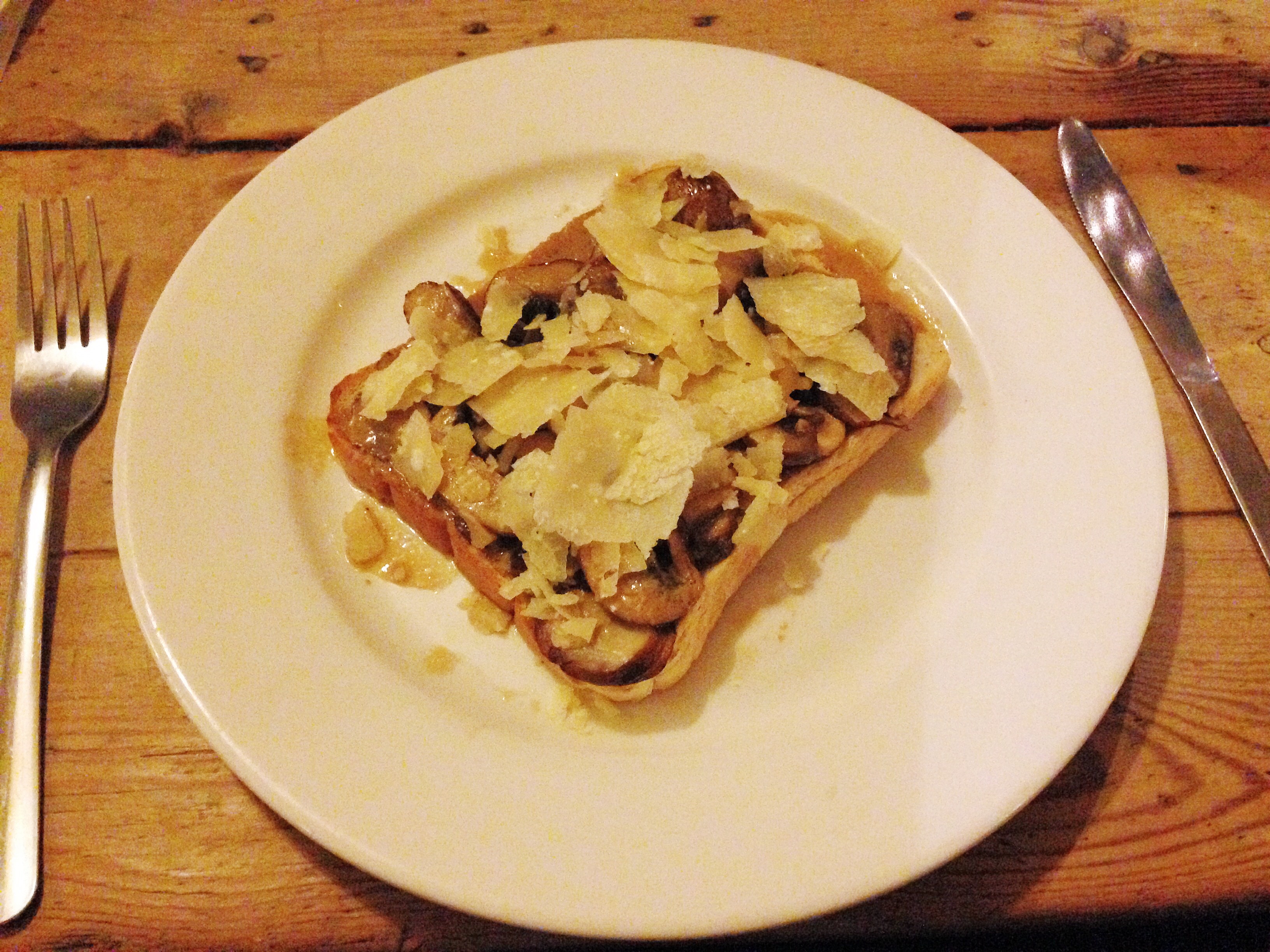
The other starter was “posh mushrooms on toast with Parmesan”, and there was a lot to like here too. I wouldn’t say the mushrooms were posh (ironically the posher mushrooms are, the more likely they are to be wild – I suppose it’s a bit like the Bullingdon Club) but they’d at least been well brought up: nicely savoury in a rich, slightly creamy sauce. The kitchen hadn’t been stingy with the parmesan either, so it was festooned with shavings. But the dish had feet of clay, because all of that was served on cheap white toast which couldn’t stand up to all those juices and just went soggy and claggy. It either needed to be better toasted or just literally made of sterner stuff: what a difference a slice of sourdough would have made (you know, posh bread). Still tasty though, and a good example of how to charge less than a fiver for pretty cheap ingredients without anyone feeling ripped off.

Lyndhurstmushrooms

The mains are almost a greatest hits of pub food: fish and chips; burger; sausage and mash; ham and chips; steak. In fairness, there were also two vegetarian mains on the blackboard, one of which – a walnut and blue cheese gnocchi – looked more imaginative than the usual, but I wanted to go for the classics to see what the kitchen’s spin on them would be.

The fish and chips were actually fishes and chips: two very lightly battered fish fillets which were a mile away from the Moby Dick style challenges served at other establishments. These were lighter and more delicate, though the fish itself wasn’t cod – it was a smaller fish with thinner flakes rather than the thick-flaked, white-fleshed fillets you get elsewhere. The menu was mute on what sort of fish it was but it did say that the chips were hand cut and the fish was “guest ale battered”. I couldn’t tell that the batter had any beer in it, but either way it was decent enough.

The chips were much tastier than they look in my (admittedly terrible) photos – I judged them on the colour and thought they were overcooked but in fact they were properly crisp on the outside, fluffy on the inside (that will teach me for being a chip racist). The mushy peas were the standout for me – they tasted bright, green and full of spring with a touch of mint, a million miles away from a tin of Batchelor’s (if the kitchen ever makes a pea soup I might just ring up and reserve a vat). Even my dining companion, who claims to hate mushy peas, loved them: that’s how good they were. The tartare sauce was also pretty good – although, again, I felt a bit guilty that I didn’t find it significantly better than shop bought. And that’s kind of how I felt about the whole dish, really – not significantly better than fish and chips at other Reading pubs. Not significantly better, truth be told, than the fish and chips the Lyndhurst used to do.

Lyndhurstfish

The other main was a burger (I know, I know – like I said, it’s a short menu). Actually, this was probably the surprise package for me: I liked it far more than I expected to. The burger itself – lovely and thick, almost pink (although not as pink as I’d have liked) – was clearly very good quality meat. It was also a sensible size which meant you could actually eat it with your hands, although once you’d started woe betide you if you tried to put it down. Also inside the brioche bun – a real one, rather than a sesame seed bun with delusions of grandeur – were several thick crunchy slices of gherkin (a personal favourite of mine) and the best bit, a terrific burger sauce which added a welcome hefty whack of tang. I was surprised by the big pile of naked salad it came with, though. I doubt anyone eats that, and it shouldn’t have been beyond the kitchen to dress it.

Lyndhurstburger

Service was friendly and efficient. Everything came quickly, I felt like they were proud of the food and they genuinely wanted to make sure I liked it. But, as often, eating in a pub it’s difficult to say much more than that. The tables are pre-laid with cutlery in vintage pots and there’s table numbers on wooden spoons, so it’s clearly very much still a pub rather than a restaurant, which felt as it should be.

I’m afraid, yet again, there was no dessert. After two substantial (if not GIANT) starters and mains I might have considered a dessert if there had been something suitably delicate, but the only dessert on the menu was a sticky toffee pudding. I was tempted: I think the STP at LSB is one of the finest school dinner desserts in all of Reading, but had I eaten it I think I’d have fallen into a lard coma. So I skipped it, and I’ll make up for it next time. Promise. As it was, the total bill for two starters, two mains and two pints of cider came to thirty-five pounds, not including tip.

Time for the post-match analysis. If I was giving marks for potential, the Lyndhurst would do brilliantly. It’s the right idea at the right time, and there are so many encouraging signs: a sensibly sized menu, a small range of specials, a cautious approach of not doing too much too soon. But I don’t think they’re quite there yet. The food doesn’t feel as accomplished as I expected: some of the little touches, like the sausagemeat and the mushy peas, are excellent, but some of the basics – the fish, that white toast – aren’t as good as they should be. I was concerned that I’d see all flair and no graft, but I went away feeling I’d experienced too much graft and not enough flair. All in all, this was a debut that was promising and frustrating in equal measure.

That sense of the place being a work in progress extends to the pub, too. There’s still some work to be done on the décor – some of the stools have their foam padding breaking free, and let’s just say the loos could do with a bit of care and attention – but the chalkboard art above the bar is very now. I hope the pub gets the time it needs to become the kind of place it’s aiming to be (I understand they plan to give the exterior a facelift, too) and the kitchen gets the time to produce the kind of food it’s capable of. A lot of that depends on them doing good trade, so – to mangle my footballing metaphor beyond all recognition – perhaps we all need to take one for the team and eat there to give them that chance.

The Lyndhurst – 6.9

88-90 Queen’s Road, RG1 4DG
0118 9617267

https://www.facebook.com/pages/The-Lyndhurst/519640051447288?fref=ts

Mangal

N.B. Mangal closed in December 2015. I’ve left the review up for posterity.

It feels like eons ago, but back in December Reading was transformed into a winter wonderland. There was an ice rink and a festive funfair in Forbury Gardens. The area down by the Oracle Riverside, occupied by the prehistoric crazy golf course in the summer, became a German-themed bar selling Glühwein and Bavarian beer. The square outside the Town Hall became a festive market, with loads of cute little cabins offering a variety of food, drink, crafts and other goodies.

Sounds marvellous, doesn’t it? There was only one catch, which was that nobody was terribly impressed. Most reports of Forbury Gardens (it was opened by camera-shy shrinking violet and brainbox Joey Essex, which with hindsight might have been a sign) were that it wasn’t great: people said that ice rink was decent enough, but that the funfair around it was a grotty way to be parted from a lot of money very quickly, the main concession to the festive season being some makeshift tinsel antlers hastily attached to the horses’ heads. I’m informed that the Glühwein at the “Wundrmarkt” was synthetic tasting, and there wasn’t any outside heating: I always felt a bit cold wandering along the riverside and looking at people huddled at tables trying to have fun.

As for the festive market, well, I wandered round it several times with a growing sense of despair mixed with indignation. Many of the food stalls were selling almost exactly the same things – a few did hog roast, a few did mulled wine, the rest were an anonymous smudge of winter kitsch. Worst of all was the horror of “Quidsticks”, a stall offering a variety of meats on a skewer for a pound (including sausages, that food so frequently found on a skewer). If you were visiting the town by train it would have been one of the first stalls you’d clap eyes on: it just looked tacky. The decent stalls – the ones that reflected what Reading was really about, that had a genuine connection with the town – stuck out like a sore thumb. I felt for the Grumpy Goat, on the edge of the market, and for Reading’s brilliant milliner Adrienne Henry. By the end she had stopped bothered opening, and many of the retailers complained to the organiser.

Apologies for starting this review with a rant, but the thing that saddens me most about all of it is the idea – prevalent among many people who don’t love Reading the way I do – that we should be grateful for anything we get. I think a lot of people think we should be happy to have a Christmas market at all, even if it looks like Lapland’s answer to Moss Side. They think an ice rink is a great thing, even if it leaves our beautiful Victorian park looking like a war zone afterwards. They don’t go to Bath, or Winchester, and think “why can’t we have a beautiful event like that?”, they think “they deserve that stuff and we don’t”. And if there’s one thing that annoys me it’s that underlying attitude that average is good enough for Reading. We have some great stuff here, we deserve better and we should aim higher. After all, surely nobody looks at the Broad Street Mall and actually says “yes, that really is Reading’s favourite mall”?

I’m afraid this train of thought was very much set off by visiting Mangal this week, because it’s another good example of this phenomenon. Some people might think “isn’t it great that Reading has a Turkish restaurant?”, whereas I want to be able to say “Reading even has a Turkish restaurant, and it’s brilliant.” But I can’t, I’m afraid, because Mangal isn’t it.

It’s not a bad space, on St Mary’s Butts just down from Monroe’s and Coconut. It’s mainly one big room packed with tables and a raised area with smaller tables (which is where they sat me). I can’t help remembering its previous location, where House Of Flavours is now, and thinking that was a much better spot for them – partly because their charcoal grill was out where you could see it, filling the air with those tantalising smells and giving you an idea of what was going to arrive on your plate. Without that the restaurant felt a bit boxy and lifeless (although perhaps the belly dancing – on Friday and Saturday nights – changes all that).

The menu is a range of hot and cold meze – no real surprises there – along with mainly grilled meats as main courses. The meze which turned up first were solid and unexceptional: sigara boreki, tubes of filo pastry filled with feta, herbs and egg, was the best of them although still very much the sum of its parts. It conjured up memories of cheese pies on holiday in Greece, which was great, but divorced of those happy thoughts it was nice but unspecial. It did fare better than the houmous though – a fridge-chilly bowl of something which was virtually indistinguishable from a two pound tub of houmous from Sainsburys. I didn’t get any garlic, any smoke or any tahini, and a few little dabs of olive oil and a dusting of paprika were never going to transform it from duckling to swan. Another disappointment: Turkish pitta is a wonderful thing, dimpled, thickier and fluffier than its Greek sibling, but this was over-flattened, crispy and brittle.

Mangalstarter

For mains I quite fancied trying pide, the distinctive boat-shaped Turkish take on pizza, but confusingly although it features on the website menu it was nowhere to be seen on the printed version. Instead I went for the grilled meats, reasoning that this was where Turkish food really excels, but that too was no more than okay. Karisik izgara was a selection of barbecued lamb and chicken, and when it turned up it looked like an embarrassment of riches. But, like the Christmas market or the ice rink, it was mainly veneer. The best thing, the lamb kofta, was quite delicious – beautifully spiced, lovely, soft and tender. But the lamb chop was oddly bland – an awful lot of work to take off the bone, not at all pink and somewhat short on flavour.

Most of the chicken was also on the bone – a couple of wings and a couple of what looked like minuscule drumsticks – and I’m not sure it was worth the effort to get it off. The first mouthful of these triggered happy thoughts – that glorious mixture of tender meat, charred skin and the hint of smoke – but the first mouthful was pretty much all there was. Last of all, there were a few chunks of chicken breast; firm rather than tender, with no evidence of any seasoning or marinade. By the time I’d finished this, the pile of bones on the edge of my plate seemed almost as big as the pile of meat that had arrived. The accompaniments – some pleasant enough rice, a puddle of yoghurt and mint with an oddly artificial taste, a rock hard tomato which had apparently once had a skewer through it – added little.

MangalMeat

The moussaka was similarly disappointing. I like a firm moussaka made up of discernible layers, tall rather than wide, with different textures for each of the layers. Instead this was a large, flat ramekin which definitely had potato, aubergine, meat and sauce in but was so (and I can’t find a more charitable word for this) runny that it wasn’t massively appealing. The top was nicely browned and I even quite liked the little bit of pointless salad (mostly rocket, dressed with something that seemed to be a mixture of balsamic vinegar and sugar; sweet yet astringent) but the moussaka itself? It was fine. Hot as the sun and sloppy as a Jackson Pollock but taste-wise it was vegetables in a tomato sauce with a bit of minced lamb in. Here’s the most damning thing of all: unlike the hummus, I think a supermarket moussaka would have been better. It also came with rice, for reasons which I can only assume somebody understands.

MangalMoussaka

It would be unkind not to mention the service, because it was efficient, smiley and friendly; we were there early on a Friday night – before the belly dancing started – but I got the impression that they wouldn’t have been fazed by a much busier restaurant. And it could be that, or the atmosphere (or the belly dancing) that attracts people, because the restaurant had a reasonable amount of tables occupied already. But good service can’t redeem average food, and sadly that was all I had during my visit. I couldn’t help thinking that there were better places to have all these things: the mixed grill at La Courbe wipes the floor with Mangal’s version, and if all you want is lamb kofte you may as well head to Kings Grill and spend the change on a pint afterwards. Dinner for two – two starters, two mains and a couple of soft drinks – was almost exactly forty pounds.

I feel sad that I can’t say more good things about Mangal. It’s independent, it has great service, it’s already made enough of a go of its business to move into a better location, and it’s doing something no other restaurant in town offers. But if I recommended it on that basis, I’d be making the same mistake as people who are glad Reading got an ice rink, or a Glühwein bar, or a row of shacks selling hog roast underneath Queen Victoria’s unamused silhouette. Because it’s not enough, and we shouldn’t pretend that it is: whatever you do, however simple your food, whether it’s independent or not, irrespective of whether you have competition, ought to be amazing. Otherwise we’re effectively patting people on the head for having a go and saying that’s all Reading should expect, and I just don’t believe that. It’s all very well to say that the best is the enemy of the good, but I reckon – when it comes to Reading, at least – that the average is a much more dangerous adversary.

Mangal – 6.3
60 St Mary’s Butts, RG1 2LG
0118 9504039

http://www.mangalreading.com/

Jamie’s Italian

Reading’s branch of Jamie’s Italian closed on July 2018, I’ve left this review up for posterity.

January, so far, has been the Month of Eating Differently here at Edible Reading. It started with me revisiting the A4074 and discovering that not all “Pack” based pubs are the same (thank goodness). Then I went even further out of town to eat top notch sushi in Windsor. For the third review of the year it seems only right that I come back to Reading and, even more, that I tuck into food at one of our ubiquitous chains – just to prove that it isn’t only about the independent out of town places.

I picked Jamie’s because it feels like a restaurant that cares about ingredients more than your average chain; there’s always been a fair amount of focus on fresh seasonal ingredients and interesting flavours at Jamie’s, and as chains go it’s not huge compared to some of its Oracle neighbours (only 37 branches according to their website, compared to 90 Bella Italias and a whopping 430 Pizza Expresses, for example). On top of that I made a promise, a resolution if you like, that I would eat one vegetarian main every month and it seemed like Jamie’s would be one of the better options for that – after all, good Italian recipes with all those fresh ingredients barely need meat at all, right?

I can’t quite remember what Chili’s, the previous restaurant in this space, looked like. All I really recall is the 6 foot plastic chilli suspended from the ceiling, covered in a thick layer of dust. Jamie’s, in comparison, is clean, smart and very contemporary: the middle of the restaurant is all concrete floors and tin chairs but round the edge of the room it’s much more inviting, with red leather banquettes looking out across the other diners. A bit like being on Dragon’s Den but without Evan Davis’ irritating recaps (why does he sum things up mere seconds after they’ve happened? So annoying! But I digress).

It’s still a dry – and increasingly long – January for me so I tucked into an elderflower and pomegranate pressé while picking from the menu. That was when it dawned on me that I was going to have to go through with the vegetarian thing and that some of you, for any of a variety of reasons, have to look at a menu and mentally cross things out every time you go out to eat (for that I can honestly say that I salute you).

To start I had the baked chestnut mushrooms on crispy music bread with smoked mozzarella, thyme and Parmesan, and in an attempt to stick to the vegetarian side of the menu I swapped out the Parmesan for another hard cheese not made with rennet (although I didn’t check whether the mozzarella was suitable for vegetarians so this might have been a waste of time).

It was a surprisingly hard dish to describe – layers of music bread on the bottom with an intricate mosaic of thinly sliced mushrooms on top, dusted with the cheese, the middle section rich with gooey smoked mozzarella. I’d almost sum it up as middle class nachos, except that Jamie’s Italian has already beaten me to it by describing another dish on their menu as “Italian nachos” (crispy fried ravioli, in fact). But that’s what it resembled most – crispy music bread at the sides and the central section soggy with juices from the mushrooms and softened by the melted cheese.

Did I like it? I’m still not sure even now. It was like a book you admire without enjoying it: more interesting than it was tasty. It was probably a less satisfying way to eat mushrooms than the myriad of other options on the menu – stuffed into arancini, heaped on bruschetta, tumbled into fettucine – options which, as I worked my way through this dish, I couldn’t help wishing I’d ordered instead.

Mushroommusic

The caponata bruschetta, on the other hand, was as pretty as it was tasty. The caponata itself was lovely – the rich, smoky aubergines were diced and mixed in with tomatoes and pine nuts with a sprinkling of grated ricotta on top. I love the earthy, slightly sweet flavour of caponata and this was a very good one. The bread it came on was less of a success, being tough and difficult to cut (I ended up tearing it with my knife and fork instead). A bit more olive oil or less time under the grill might have been better. Sitting on top of the dish were a couple of small red chillis, barely cooked with their tops chopped off. I genuinely couldn’t fathom what they were doing there – they looked small enough to be properly explosive and I couldn’t see how they fitted in at all. I wondered if it might be some kind of homage to Chili’s – that was the only decent explanation I could come up with. I didn’t eat them.

Caponatabruschetta

The vegetarian main courses at Jamie’s, according to their website, amount to two – one pasta, and one salad. There are more if you’re prepared to forego the Parmesan, but the menu doesn’t make that clear so you’re relying on the waiter (“we don’t have a vegetarian menu”, he said, “but I can talk you through it”). Pasta in tomato sauce sounded pretty humdrum, and I’d already had mushrooms, so I went for the superfood salad, thinking that anything with the word “super” in the title couldn’t be all bad. Besides, the menu made it sound like it contained so much stuff: avocado; shaved fennel; candied beetroot; broccoli; cheese; pomegranate; seeds; and a “fennel blossom Sicilian harissa”. It just sounded like a party in a bowl, and I was genuinely interested to see what turned up.

What the menu doesn’t tell you is that that description suggests that all the ingredients get equal billing, and they don’t. So I really enjoyed the sweet chunks of candied beets. They were both delicious. I liked the shaved fennel, although it had been very finely shaved indeed and got a little lost. The two smallish spears of broccoli were just dandy. The avocado, served on top, was very nice – flashed under a grill I’d guess, from the lines on top, and ever so slightly warm. Where the stone had been there was a little reservoir with cottage cheese on it, and the smallest blob of harissa, which may have involved fennel blossom in some way but was just generic hot stuff.

But really, this was about the rest of it, including many things the menu neglected to mention. So yes, there were lentils and some pumpkin and sesame seeds in there, and the occasional bit of pomegranate, and lots of mint leaves (because Jamie’s loves putting mint in everything). But there was also a lot of quinoa, along with plenty of what looked like stubby grains of wild rice but, having researched it, may have been black barley. All that amounted to a big stodgy pile of heavy going, with nowhere near enough flavour to elevate it from chore to treat. When I told a vegetarian friend about this dish, she said “personally, if they’d said there was quinoa in it I’d never have ordered it”, which pretty much hits the nail on the head. Really, it was like the contents of one of those square plastic tubs you buy for lunch from M&S in an attempt to pretend to be a better person than you really are; if this was a party in a bowl, it was the kind where you started looking at your watch half an hour in because all the fun people had already left.

Supersalad

The other main was one of the specials – an “amazing ragu of pork with tomatoes, chilli, garlic and loads of herbs tossed through home made casarecce pasta” (I’m quoting from the blackboard here, so the trumpet blowing is Jamie’s and not mine). I was expecting a bowl of pasta with a thick sauce of tomato and pork in roughly equal measure, but what in fact arrived was a bowl of pasta with a lot of shredded pork in it (and I mean a lot: the meat was generous to a fault). All the other ingredients were present as described, but apart from being slightly watery there was no discernible sauce. This was just a meat and carbs dish: none of your five-a-day here. On top of the heap of pork was a spoonful of herby, lemony breadcrumbs which really did lift the dish but it was just one spoonful, and a little more would have given the dish a lot more oomph. As it was, you couldn’t fault it for quantity but overall I’m afraid it bored me and I couldn’t finish it. Nor could I face dessert afterwards, even if their chocolate brownie is, according to the menu at least, “epic” (I can hear the strains of that trumpet again).

Porkragu

Service was decent. The chap serving us was friendly enough and happy to pick out the vegetarian options but had the disconcerting habit of saying thank you after every single item we ordered, something which started to feel robotic very quickly. I wasn’t feeling a lot of love. I also wasn’t feeling the warmth, as there seemed to be a draught coming from the back of the room, whipping round our ankles. When we asked early on if there was a door open in the kitchen we were told that this was just the colder part of the room and that the other tables they had available wouldn’t be much better. On a freezing winter’s day in January I thought this was a very poor show, especially as it got even chillier by the time our mains came (another homage to Chili’s, perhaps?). The total bill for two courses and a soft drink each for two was forty pounds. That felt like reasonable value for the food, even if the experience wasn’t anything to write home about.

After the last two reviews, writing this feels like a bit of a comedown. I know I don’t need to eat out of town to get good food but when the better chains, which to me includes Jamie’s, let me down it can seem like the Oracle doesn’t have a lot to offer (appropriately the best of the Oracle’s restaurants, Cote and Tampopo, are right at the edge: it’s almost as if they’re trying to break away and escape). I feel especially sad for the vegetarians out there, because I think they should be entitled to expect better from a restaurant like this – so for vegetarians looking at a menu this size and seeing such a short list of suitable options I can only say sorry. I haven’t found an amazing place with loads of attractive meat-free choices that you’ll be rushing to visit. Not yet. But it’s only January.

Jamie’s Italian – 6.7
Unit 1, Riverside, The Oracle, RG1 2AG
0118 9070808

http://www.jamieoliver.com/italian/restaurants/reading