Global Café Kitchen

N.B. RISC announced in June 2021 that the Global Café Kitchen would remain closed until 2022 and that when it reopened it would be run by RISC, so this review is defunct. I’ve left it up for posterity.

Reading’s vegetarians and vegans have never been served terribly well. Back in the day there was Café Iguana, which I still miss (my order was usually a Roma toasted sandwich and their delicious, if whiffy, garlic and herb fries). It was scuzzy but lovable, the service was haphazard and the whole thing was distinctly, well, nineties, but I was very sad when it closed. For a long time after that, the only destination for vegetarians was the brilliant and unsung Bhel Puri House, and plenty of people didn’t even know it existed.

It’s only in the last couple of years that things have started to shift. We’ve seen restaurants raise their game: now there are many places with credible meat-free (or plant-based, or whatever you want to call it this month) options. So now we have Pho where most of the menu can be made vegetarian or vegan, Clay’s Hyderabadi Kitchen which has an excellent vegan selection, and Honest which first introduced an excellent vegetarian fritter and then added a trailblazing vegan burger. I keep meaning to do a round-up of the best places for vegetarians in Reading – another gap in the market – and the main thing that delays it is the growing plethora of options.

In parallel, Reading saw two completely meat-free venues open this year. The first, Miami Burger, offered a vegan take on American fast food and closed its doors last week shortly after announcing a deal to sell its products in Morrisons. A cynic could almost believe that the restaurant was always just a shop window to land that kind of contract (a conspiracy theory hardly helped by Miami Burger rewriting history to describe the Reading restaurant as a “test kitchen”).

Either way I never visited Miami Burger – known to some as “Brexit Burger” because of the political views of its owner, a man who left the Tories for UKIP and once pondered on his blog whether the unemployed should have their votes taken away – and I’m not convinced I’ve missed much. Besides, for five pounds you can get one of Bhel Puri’s amazing vada pav, and that’s more than enough veggie burger for me.

The second meat-free restaurant is a more interesting proposition. Global Café for many years was home to Tutu’s Ethiopian Kitchen, a much-celebrated Reading establishment which left me baffled when I visited it on duty many years ago. Tutu left this year to take over a site in Palmer Park which used to belong to the Chalkboard Café, and as a result Global Café has taken on a new chef and is offering a regularly changing vegetarian and vegan menu under the moniker Global Café Kitchen.

I was having a drink at Global Café with my mother and my stepfather the fateful night we went to review Lemoni, and looking at their menu I was very tempted to change our plans and eat there instead. It was small (four or five main courses and a couple of starters) and reasonably priced (mains were around a tenner). But most crucially, it all looked worth eating: from a tempura mushroom burger to a vegetarian rendang, from Sri Lankan dahl to a halloumi and tabbouleh salad, I could happily have ordered practically anything on the menu. I wasn’t alone, either; my mother in particular would much rather have eaten at Global Café than Lemoni, so much so that we agreed to come back the following week and give it a whirl, with my stepfather in tow.

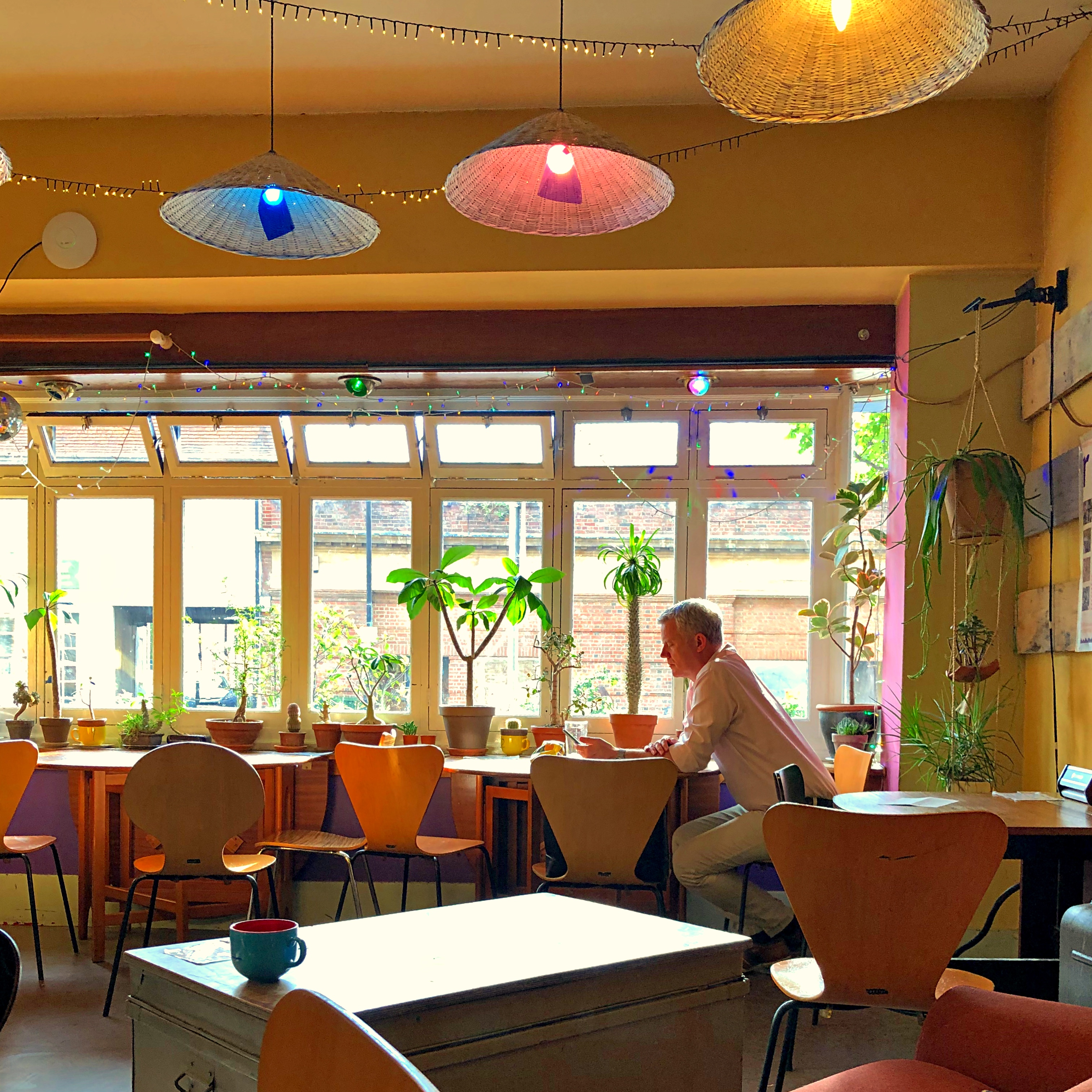
The Global Café hasn’t changed in many years, and I suspect you either think it’s one of the last great Reading institutions or an anachronism you haven’t felt the need to visit for a very long time. I veer more towards the former – even though it’s a tad on the scruffy side I’ve always had a soft spot for it. The area at the front, near the bar, gets lots of light from the lovely big windows and if all the tables and chairs don’t match and don’t seem to be designed for eating at or drinking at, it doesn’t necessarily matter. Nor does it matter that there’s a sofa randomly plonked there, with a big metal trunk serving as a table. It’s Global Café: that’s just how it is.

My stepfather found the long trip downstairs to the loos genuinely alarming (“it smells of damp down there”) and was a bit baffled by the different-coloured lights in the wicker lightshades (“you’d think they’d be LED bulbs, wouldn’t you?”) but I wouldn’t describe him as the target market for this kind of place. He was more impressed with the selection of local beers, as was I, but because it was a school night the three of us opted for an alcohol-free Erdinger Blue apiece while we decided what to order. It’s my top tip for anyone who likes the taste of beer and wants to cut down on their alcohol intake – and it cost less than £3 a bottle, considerably cheaper than the crazy prices charged at some of Reading’s pubs.

There were only a handful of starters, but all the mains from our previous visit were still on the menu, along with a couple of specials – a spiced potato and cheese “Bombay burger” and what was described as a “Banana Blossom burger”.

“What’s the banana blossom burger?” I asked the dreadlocked chap behind the bar (no table service, so that’s where you place your order).

“It’s not made from banana, it’s another part of the banana tree. It sort of has the same texture as chicken.”

“Sounds interesting.”

“They’re changing the menu all the time. I’m not even a vegetarian, but I really like the food here.”

“How long have you been running the new menu?”

“About three months, we’re still getting used to it really.”

I wasn’t sure whether this exchange inspired confidence or eroded it – but I liked his honesty and I liked the sound of the banana blossom burger, so I changed my mind about what to eat and ordered it instead.

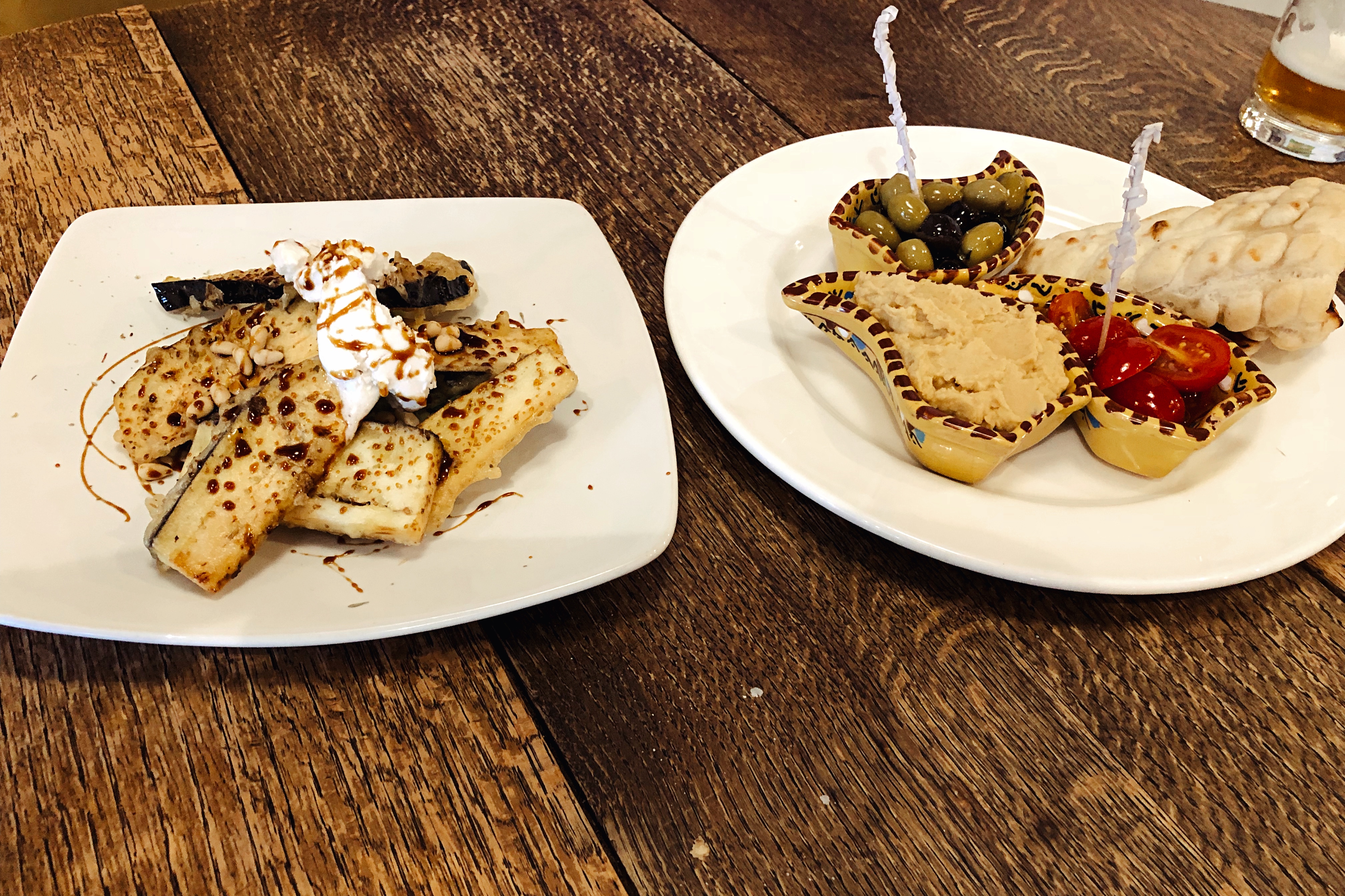
Our starters arrived reasonably quickly, brought I think by the chef. The menu had three, one of which was soup, so we ordered the other two planning to share them. The best of them was the crispy fried aubergine, cooked with a beautifully light touch and free of all the stodge and mulch I associate with aubergine done badly.

This stuff was better than versions I’ve had of the same dish, berenjanas con miel, in Andalusia and the little tweaks to make the dish vegan only added to the appeal: vegan labneh had a very pleasing touch of coconut, and the miel de cana (vegan honey) was hard to distinguish from any other kind of honey. We all ever so politely made sure we had our fair share before nicely bargaining over the final piece. A really good dish, although at six pounds it felt like it should have been a bigger portion. “I could have eaten one of those on my own” said my mother, echoing my feelings. Still, I guess that’s what happens when you share two starters between three: if you go, order your own.

The other starter was a very different kettle of quinoa. Flatbread with marinated tomatoes, olives and dip sounds like just the thing to graze on while you wait for your food to arrive, but this was a lukewarm warm-up act. The tomatoes – cherry tomatoes halved – were pleasant enough, and the olives, small and pitted, were the kind of thing you could get in any supermarket.

The houmous, though, was worse than anything you could get in a supermarket – I’ve no doubt they made it themselves, but it had no lightness, no evidence of olive oil or garlic or tahini. Calling it a dip was optimistic because it didn’t have the texture for dipping: you’d have had more luck using it to cement a wall. We did our best to scoop it on to the heavy, unremarkable flatbread.

This rogue’s gallery came to four pounds – for the same money you could have a much bigger bowl of the best houmous in Reading just up the road at Bakery House, and they’d throw in piping hot, fresh-from-the-oven pitta bread into the bargain. It felt like the restaurant had bought those little, weird-shaped dishes, and then struggled to decide what to serve in them. The answer, I think, is Not this.

The themes of the starters – glimmers of talent, inconsistency and slightly sharp pricing – followed through to the main courses (which arrived pretty quickly), although these were generally far better. My mother’s choice, the parippu – Sri Lankan dahl – was earthy and creamy with a nicely gradual heat. Her verdict was that it was “a bit monotonous” – although I suspect that, texturally at least, that’s always the way with dahl. The toasted coconut on top helped, but it needed something like toasted seeds for texture and what it really needed was plenty of fresh coriander. The rice was somewhat clumpy – brown rice might have been better – and the flatbread wasn’t required: there wasn’t enough of the dish to be able to use it. If that all sounds like faint praise, it shouldn’t entirely – I enjoyed it, but even at eight pounds it felt like it could have been a little bigger and better.

My stepfather had chosen the rendang – in this case a chickpea curry with aubergines and courgettes. I’m used to rendang being made with long-cooked, sticky strands of beef and having an intensely savoury taste. This dish didn’t have any of that, feeling more like a massaman or a Thai curry with as much sweetness as heat, if not more. Again, I liked it, and again I felt that it was a little keenly priced: eleven pounds for this one. My stepfather seemed to enjoy it, too, and polished it off in short order.

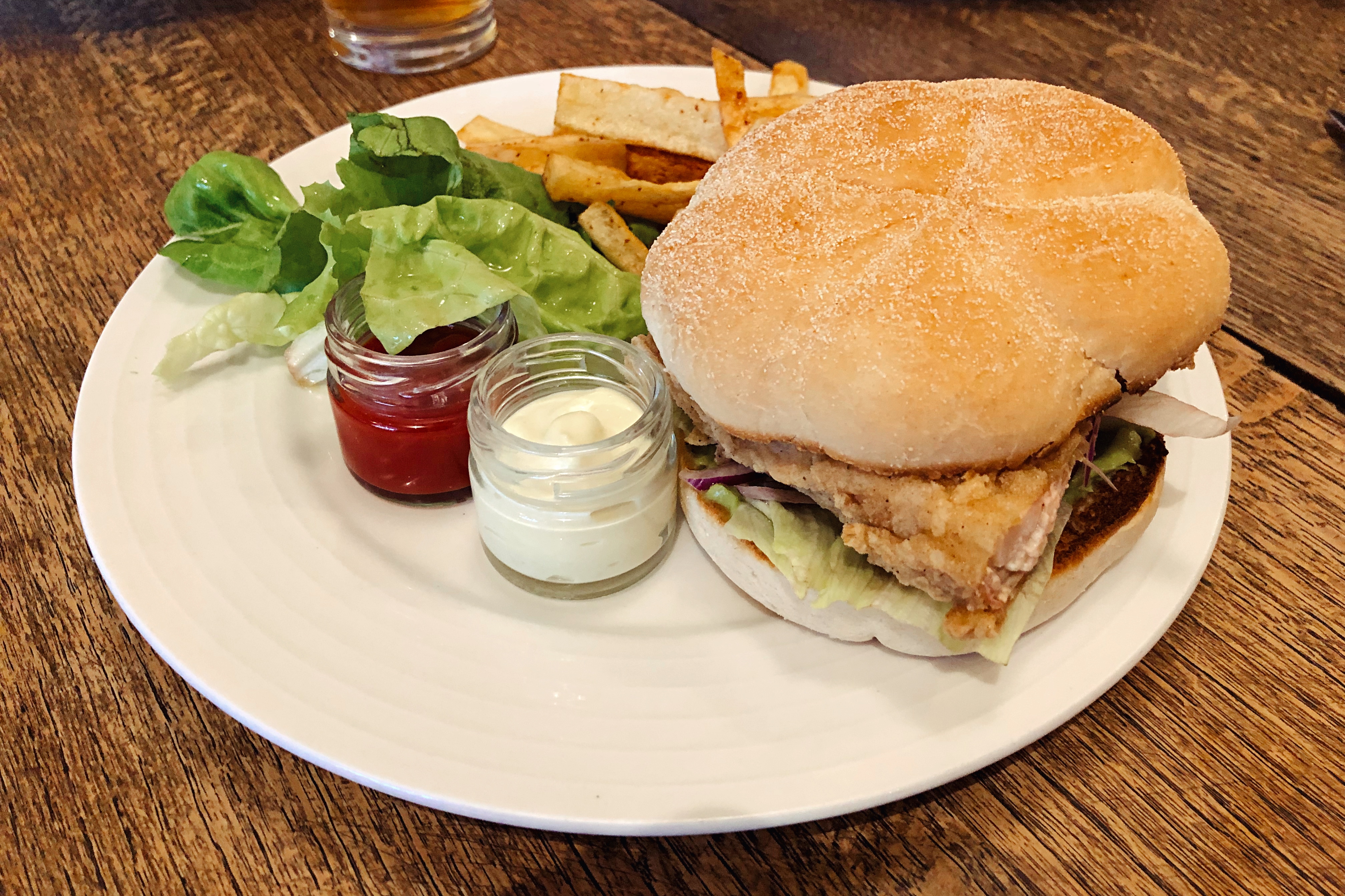
This brings us to the appropriately alliterative banana blossom burger, which I’m delighted to say was an eye opener. It didn’t have the texture of chicken, after all that: it reminded me more of artichoke hearts, and you got a couple of pieces rather than a single patty. But the coating around the banana blossom was very good – salty and savoury, reminiscent of shame-free KFC. The bun was strong enough to stand up to everything in it (so unlike, say, Honest’s buns which always seem to go soggy at the bottom) and the ripe avocado and mango mayo in it finished it off nicely.

This was a revelation to me, and I hope Global Café Kitchen moves it off the specials menu so more people can try it. A chap at the table next to me ordered it and when it arrived at his table I butted in to enthuse to him about how much I’d liked it. “It’s a bit like KFC!” I said, to which he mournfully replied “I’ve never had KFC” (I asked him his verdict as we were leaving: he thought it was too salty, so Christ knows what the poor guy would actually make of KFC).

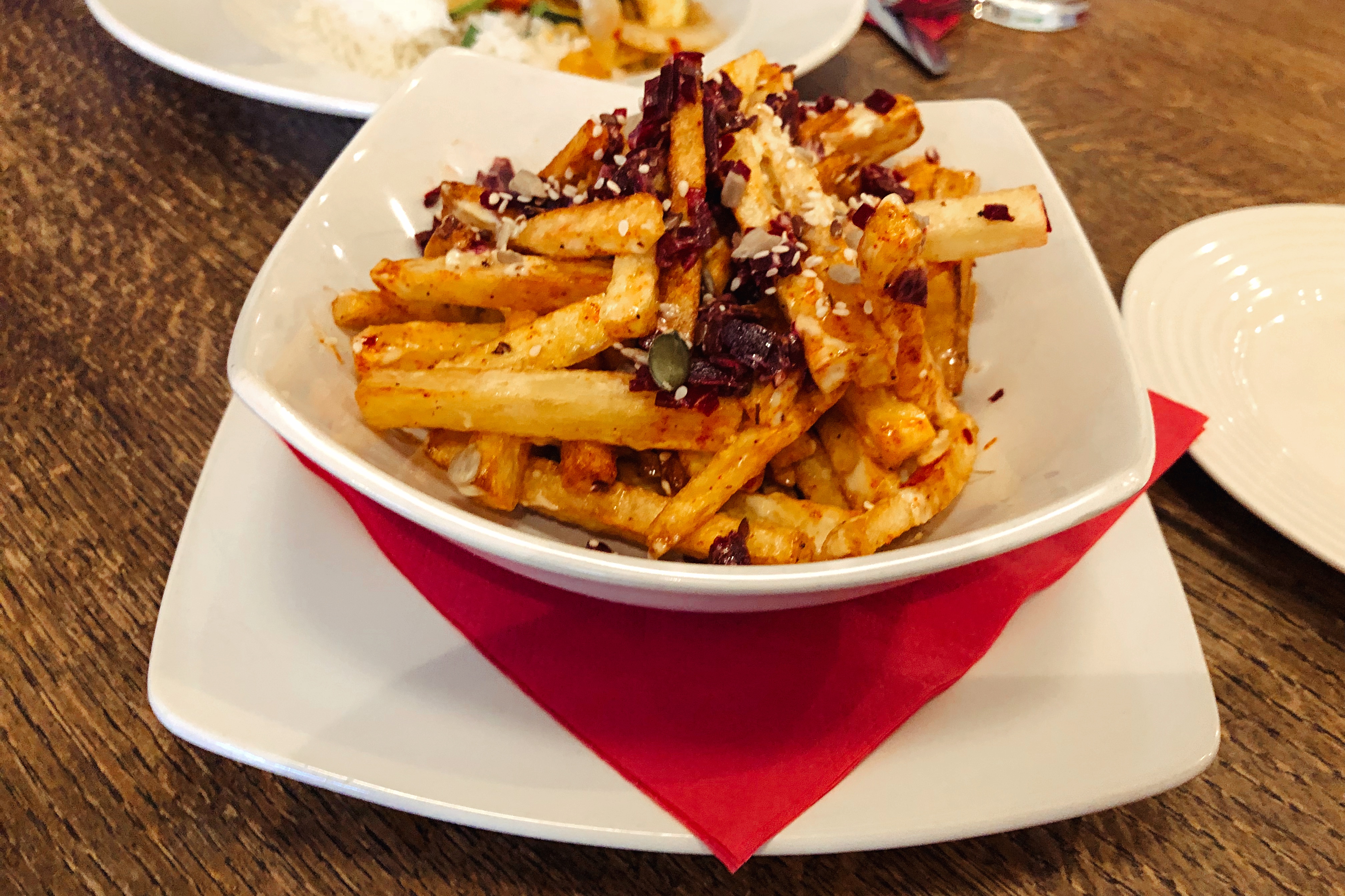
Also, I really liked Global Café Kitchen’s fries – clearly hand-cut and prepared on the premises – and the sweet tomato sauce and (presumably) vegan mayo they came with were both tasty, too. My stepfather had some “dirty fries” although it wasn’t clear what made them so sinful or indulgent: the “beetroot aioli” mainly seemed to be finely diced beetroot and the sesame seeds felt a bit unnecessary. They were still very good, though, because their fries are very good.

There isn’t much more to say about Global Café Kitchen than that – there was no dessert section, and we’d been fed so quickly and efficiently that there was nothing more to do but to head out. Our whole meal – two starters, three mains, those extra fries and three beers – came to almost bang on fifty pounds, not including service.

Service was really friendly and likeable but had a general air that they were still getting the hang of things. We had to ask for side plates, for instance, and the speed with which our mains came out gave the impression that the restaurant didn’t have masses of customers, so was used to just cooking things and getting them out of the door almost straight away. Three months should be long enough to get those teething troubles under control but, much like everything else about Global Café, I was prepared to overlook some of the less polished aspects.

Reviews like this are the hardest to conclude. A hatchet job writes itself, a rave review also builds to a natural, logical crescendo, a rallying cry of sorts. It’s far more difficult to write the sort of nuanced summary that makes half your readers think the mark at the end is far too harsh and the other half believe that you’ve let a restaurant off the hook. All the same, here goes: much of what I ate at Global Café Kitchen wasn’t perfect, and much of what I liked felt too small or too expensive (or ever so slightly beige) but in terms of imagination and range there is still plenty to celebrate.

They offer a genuine vegan menu (nearly all the dishes are vegan, and they say the rest can be made vegan on request) which offers a wide range of dishes, tries different meat substitutes rather than just doling out the same old tofu and – most crucially – offers real and interesting choices. I could have ordered any of the main courses we tried that night, and a couple we didn’t, without feeling like I was missing meat at all. There’s a lot to be said for that – whether you’re vegetarian or vegan, or know somebody who is that you’d actually like to have dinner with once in a while. Or, for that matter, if you’d just like to do your bit to eat more sensibly and help the planet from time to time. That you can do so without donning a hair shirt is quite an achievement, even if in 2019 it shouldn’t feel that way.

I never made it to Miami Burger – deliberately, I’m afraid – but the one thing I heard about it from my vegan followers was how nice it was just to have somewhere where they could order everything on the menu. Those people should make their way to Global Café and support a kitchen that may not be doing everything right quite yet but definitely has the right idea. And the rest of us? We should consider following suit from time to time, and supporting a Reading institution – one which, it seems to me, has picked up the torch from Café Iguana and is doing its best to carry it forward into an uncertain future.

Global Café Kitchen – 6.9
35-39 London Street, RG1 4PS
0118 9583555

https://www.risc.org.uk/global-cafe/global-cafe-kitchen

Lemoni

It became apparent in early 2021 that Lemoni was not going to reopen after the third national lockdown. I’ve left the review up for posterity.

It is, I think, a universal reaction when we taste something funny, or not quite right, or even plain bad, to seek a second opinion. Whether that’s saying “do you think this milk is still good?” when it’s a day past the use by date or asking “does this taste weird to you?” in a restaurant, we all do it. We like to share delicious food, providing we have enough of it to spare, but it’s when something’s awful that we really feel the need to share the pain.

I say this because I’ve had several people in the last three months ask me if I’ve been to Lemoni, the new Greek restaurant in the Oracle, or when I’m going – and not because they say the food is stellar. One message on Twitter said “OMFG, it was awful. Service took ages every time, when they arrived the flicking of long hair over food was… ugh”. Another, on Instagram, said it was so bad that they refused a discount because they wanted to leave as quickly as possible. “I never thought I’d say this” she added, “but I really miss Jamie’s Italian”. Someone else on Twitter said “I went there last weekend and I’m interested to hear your opinion”: sometimes what isn’t said shouts as loudly as what is.

As a result, despite my best efforts to stay positive, I approached my visit to Lemoni with a gradual mounting dread. On the one hand, people definitely wanted an impartial review. But on the other, looking at their website I had a real feeling of “must I?”. Part of that came from looking at the menu online, because the dishes at Lemoni were undeniably pricey. Sixteen pounds fifty for a moussaka, or for a chicken shish kebab? They’d have to be absolutely faultless to charge that much.

Matters weren’t helped by my other half sending me a picture which had been doing the rounds at her work, taken from Tripadvisor, of the lamb kebabs. They look as if they had been formed not by hand but by the combination of a colon and a sphincter, nature’s piping bag. As if to reinforce the point, one of her colleagues had effortlessly Photoshopped a single kebab into an image of a toilet bowl: it wasn’t even slightly incongruous, bobbing there.

Tripadvisor didn’t help in general, as it seemed polarised between glowing reviews (often from Greek users with very few other TA reviews) and mutinous rumblings from everybody else about poor value, indifferent food, terrible service. Who to believe?

And then there was the wider mystery – who were Lemoni anyway? Hard to tell from social media, that’s for sure: there was a glut of very polished Instagram activity when the restaurant was about to open, but since then the silence has been deafening. Trying to get any background was challenging – the suggestion had been that this was their second restaurant but from what I could glean from Companies House the first restaurant, in Southampton, had gone into liquidation before the Reading branch opened.

How did an independent business with no real footprint come out of nowhere to take on the Oracle’s biggest restaurant site, quite possibly paying an annual rent in the high six figures? How was it going to survive in such a competitive site, even (or especially) charging those prices? There was only one way to get to the bottom of it: I was going to have to go there myself.

I felt bad about asking anybody to accompany me, but in the end my mother and my stepfather gamely agreed to come along: sometimes you really do need the unconditional commitment only family can truly provide. So, despite my stepfather’s wistful looks askance at the entrance to Royal Tandoori, we walked up to Lemoni on a warm summer’s evening to take our chances.

The welcome at the door was bright and friendly, and we walked up through the stairs and through the restaurant to take a table out on the upstairs balcony, one of Reading’s better al fresco spaces. The transformation from when the restaurant was Jamie’s Italian was marked, and very nicely done: the upstairs and downstairs are both very tasteful, airy spaces with plenty of natural light, grown-up looking marble-topped tables and grey tweedy banquettes. I didn’t eat inside, but I liked the look of it – I did wonder though just how much sound would be absorbed on a busy Friday or Saturday night and whether the restaurant would feel quite as welcoming on a darker winter’s evening.

The first big surprise came when the menus arrived, because the prices have been reduced significantly since April (although Lemoni has neglected to change its website to reflect this). Mains in particular had come down by between three and five pounds per dish – badly needed, because many of the dishes skirted around the twenty pound mark which felt very expensive for this kind of food. This means that Lemoni must be the first restaurant I’ve encountered to do a soft opening in reverse: still, at least it showed they were learning from their mistakes.

We ordered a few drinks, namely a Mythos for my stepfather, a Menebrea – the Italian beer which is becoming Peroni for people who think they’re too good for Peroni – for my mother and some sparkling mineral water (don’t judge) for me. Nearly all the waiting staff, all dressed all in black, seemed to be Greek and they certainly looked efficient, darting from table to table; maybe they’d also learned from some of that early criticism.

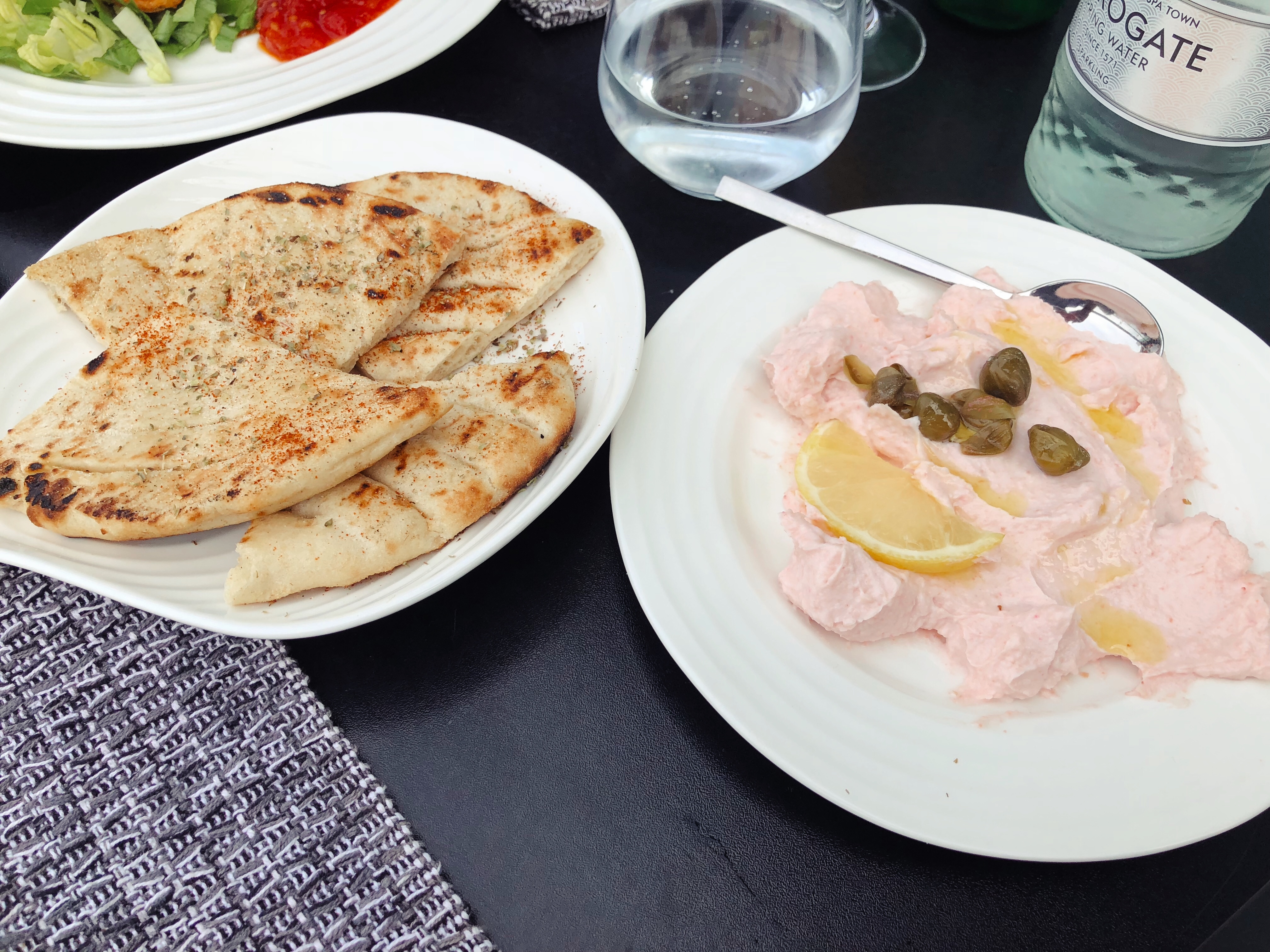
We decided to share some of the starters to begin with – these all vary between about five and eight pounds, although they charge extra for pitta which felt cheeky to me. How else did they expect you to eat houmous or taramasalata, exactly? The taramasalata, incidentally, was one of the best starters we had – brighter pink than I’m led to believe it should be but punchy all the same. I especially liked the addition of some salted capers on top, but I suspect they were more popular with me than with my mother. “It doesn’t taste that fishy” was her feedback – my stepfather and I disagreed, but she had taken against the dish and that was that.

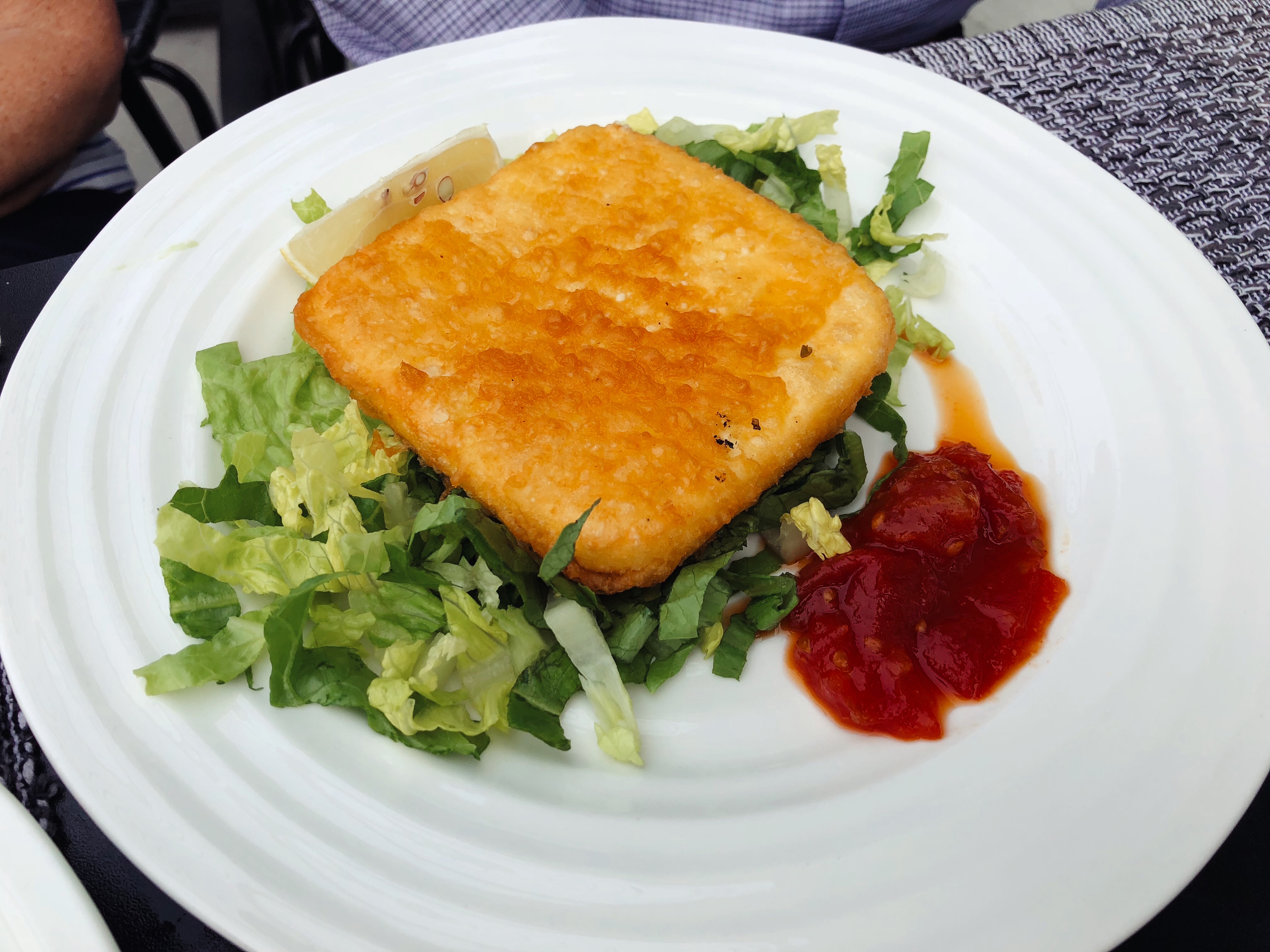
The spanakopita was a hit with all of us – light filo pastry with just enough crunch housing a beautifully molten mixture of feta, spinach and mint. The other two starters, though, were the relative duds. Saganaki is one of my favourite Greek starters and done well it’s a glorious, indulgent thing. The menu chose not to specify which cheese it was (which perhaps should have been a warning bell) but it’s usually feta and this didn’t feel like feta at all. Whatever it was, it was a lukewarm block of cheese with a leathery texture which had no give whatsoever. The “homemade tomato jam” might just have been able to paper over the cracks of this dish, but there was nowhere near enough of it.

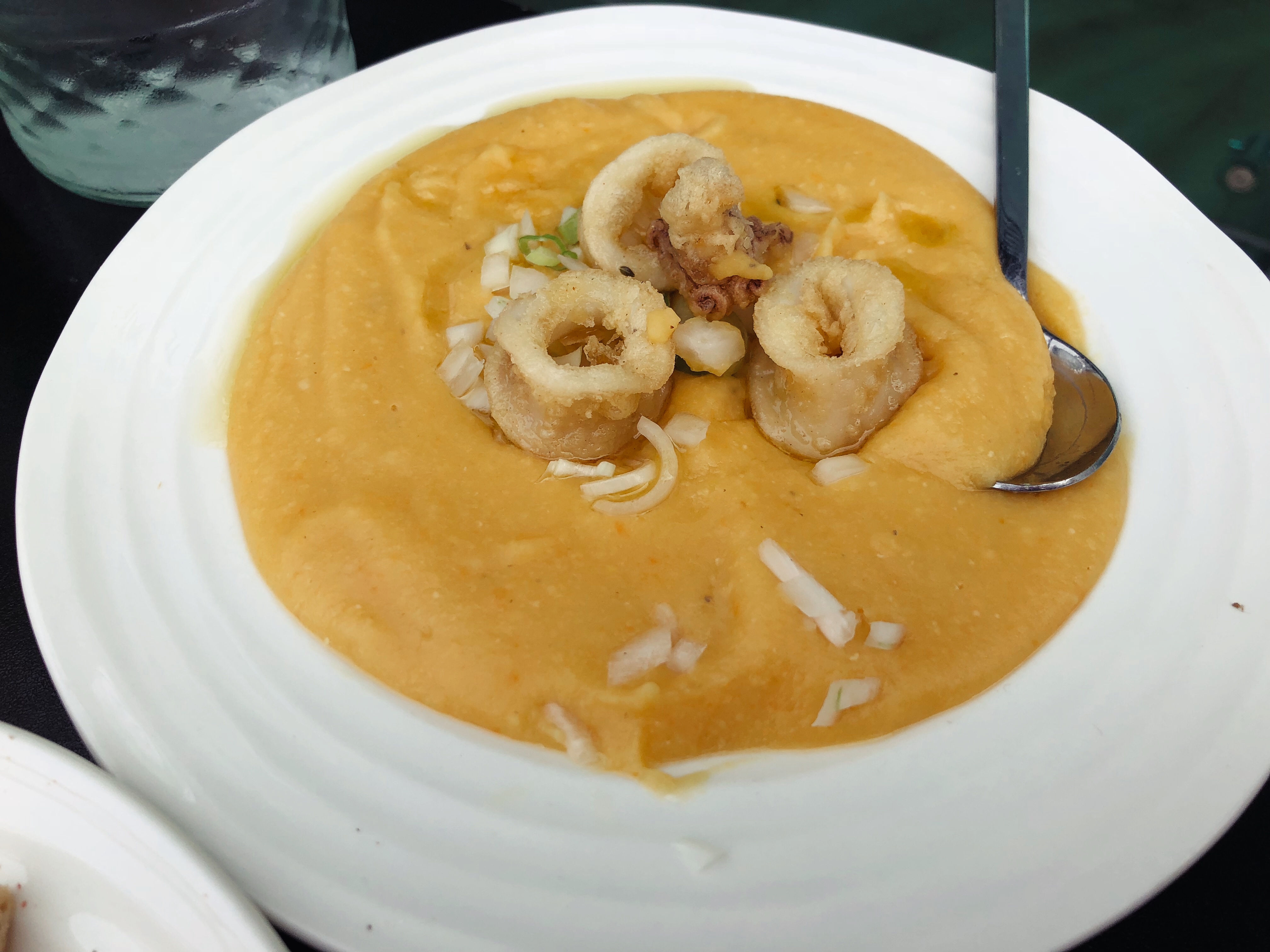
The last starter arrived after the other three, and before the side plates we’d had to ask for twice. Mashed fava beans topped with calamari were a pleasing shade of yellow and had a earthy, if subtle, taste. But I couldn’t help wishing it was hot rather than lukewarm and it also needed some pita to do it justice. Our first helping of pita – tasty, topped with something like cayenne pepper or paprika along with dried oregano but far too little of it – had already vanished by then and it took multiple attempts to flag someone down to ask for more. By the time it arrived we still just about needed it, but the moment had passed.

“That dish is bland” said my mother, pointing accusingly at the fava beans.

“It’s okay – it could do with a bit more seasoning” I said.

“Well, it’s not unpleasant” she added, the implication clearly being that not unpleasant was not good enough. I could see what she meant, but I was more disappointed that paying two pounds extra got your fava bean purée topped with precisely four tiny bits of squid. Maybe I’ve inherited her critical faculties.

Having struggled to get our side plates and struggled to get extra pita bread, we then found we were left alone with our leftovers in front of us for some time. This gave my mother enough time to do some detective work.

“Our placemats are by John Lewis” she said. “They have the tag on them.”

I inspected them. This was indeed the case.

“And the labels are still on the underside of our side plates.”

I wasn’t sure how my mother had clocked this – nothing gets past her – but lifting up my snazzy rippled white plate it was true. Sophie Conran for Portmeiron, no less, and that stuff isn’t cheap; these aren’t plates you’d want to smash at a wedding.

“It’s weird, isn’t it? It’s like they’ve picked this stuff up at a department store because money’s no object.” And again, I found myself wondering where the money came from to open this massive restaurant out of nowhere and kit it out with a lovely new refit, John Lewis placemats and Sophie Conran crockery. At this point my stepfather outlined his theory on the matter: sadly, I’ve had to omit it from the review but I’m sure you could come up with your own ideas.

I was jogged out of this reverie by the fact that as our plates were taken away the main courses were plonked in front of us, supervised by an older man who looked as if he might be the owner. The overall effect was a little menacing, especially as my stepfather had ordered the “chicken skewer” which comes to the table on a long and potentially dangerous skewer fresh from the grill. The skewer was served on a bed of undressed, pointless rocket with some soft-looking roasted potatoes, a cold couscous salad and some kind of dip. I tried some of the chicken and it wasn’t unpleasant but there was no real sign that it had been marinated. At fourteen pounds it was still more expensive than the same dish at Bakery House, with nowhere near the same whistles and bells.

“That dip is salad cream” said my mother, looking none too impressed.

“I think it’s more like burger sauce” I said. “The menu says it’s ‘Lemoni mayonnaise sauce’, apparently.”

“Well it tastes like salad cream to me.”

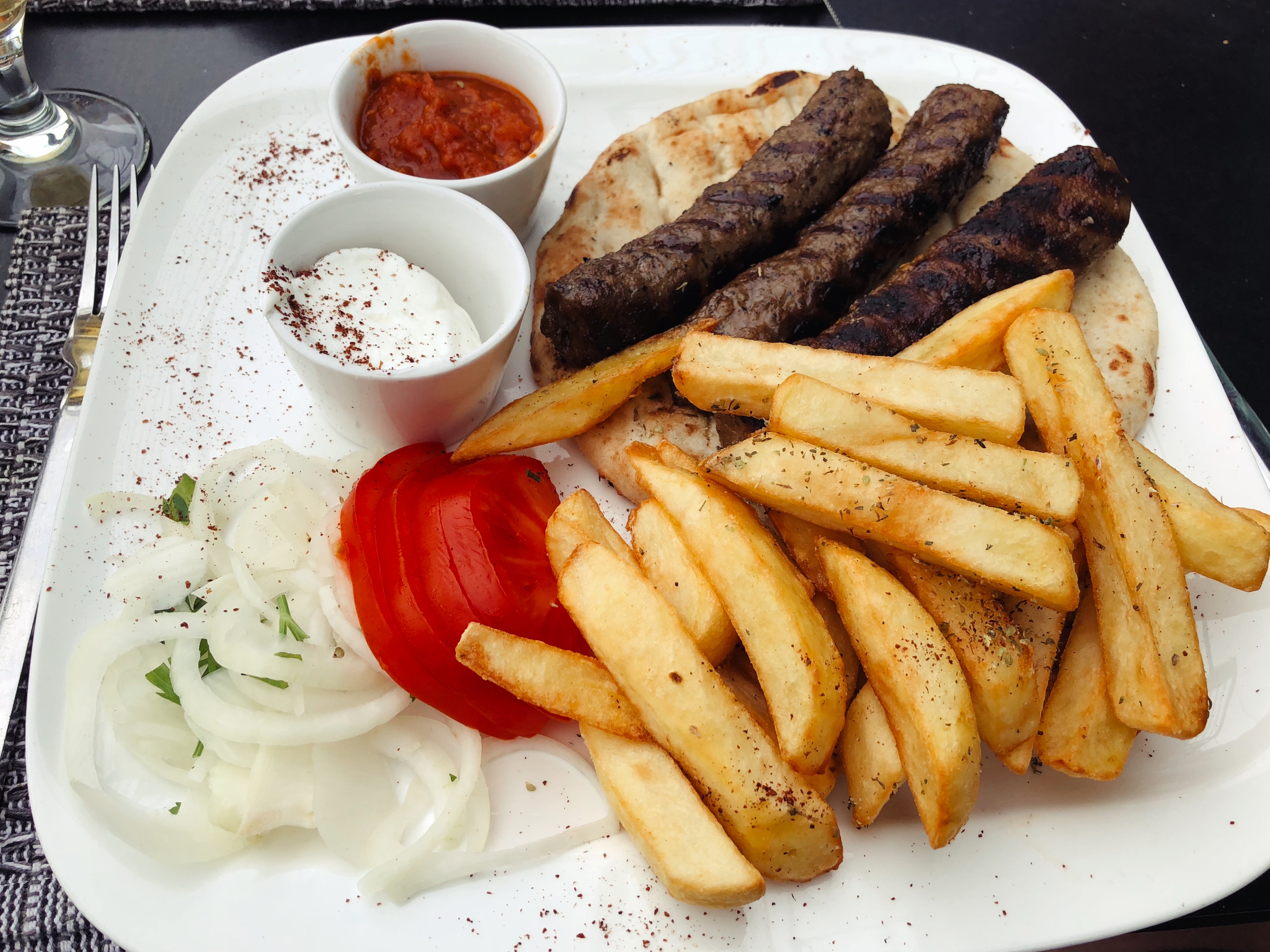
“It’s not going to be a glass half full evening, is it?” said my stepfather philosophically as he attacked the rest of his main, undeterred by any resemblance to Heinz’s finest. I had ordered the classic kebab, and I was delighted to discover that they no longer looked like the Photoshopped horror I’d been sent via Whatsapp. If anything, these were uncannily regular cylinders of meat – a mixture of beef and lamb, apparently – and I wasn’t sure whether I enjoyed them or if I was just relieved that they weren’t worse. They were nicely seasoned and although they were a little on the smooth and homogeneous side for my liking they weren’t unpleasant. They came with a yoghurt thicker and more pointless than Dominic Raab, and a tomato sauce which lacked any spice or heat at all. Nice chips, to be fair, but apart from that this was another dish that Bakery House does miles better for less.

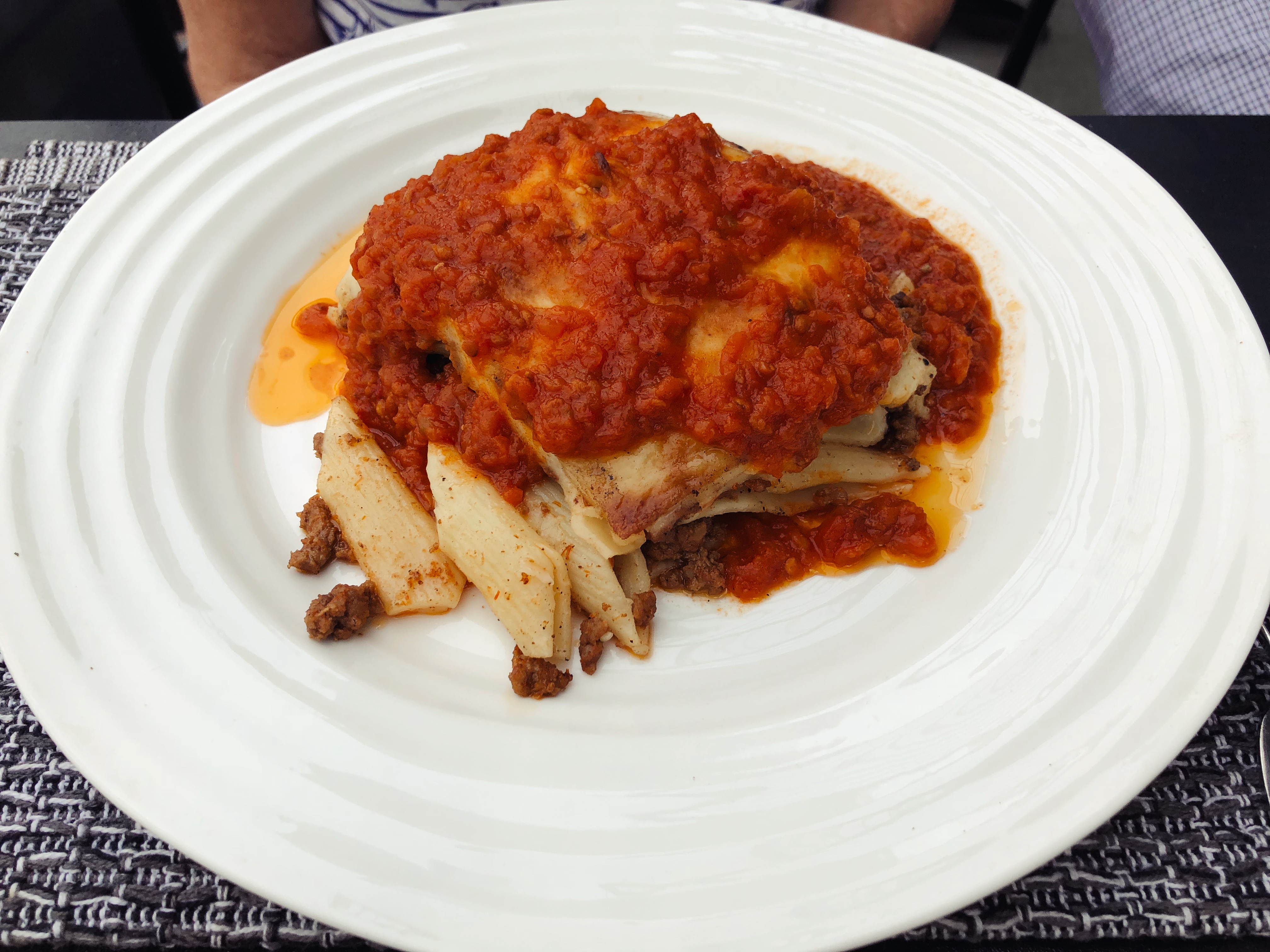
Even if the glass had been half full up to that point, it pretty much emptied when my mum started eating her pastichio, a sort of Greek lasagne which serves as an alternative to moussaka.

“This is sweet. It’s as sweet as a dessert. And there’s nowhere near enough mince. It’s just a sweet tomato sauce and some pasta. And the cheese! Well, it doesn’t taste cheesy.”

I tried some. You couldn’t knock her brevity: it would take me a whole paragraph to say a lot less.

“I think it tastes sweet because there’s definitely cinnamon in that tomato sauce.” I said, trying to put a brave face on it. Who was I trying to kid? The dish was a duffer.

It didn’t help that the accompanying Greek salad also didn’t pass muster. “It’s a nice olive” my mother said, “but it needs company.” A pity, because the feta was lovely and, again, I thought adding capers was a nice touch. But it’s difficult to argue with somebody saying that a Greek salad needs to contain more than one solitary olive.

We stayed for dessert, because I desperately wanted to give Lemoni one more chance. The big thing here is loukoumades, Greek doughnuts, so I ordered them with Greek honey and crushed walnuts. They were nicely irregularly-shaped, so obviously made by hand, but that’s as far as the plusses went. They were heavy, stodgy things, the shell not crisp and the inside a million miles from a fluffy cloud of joy. The honey was in a lake at the bottom rather than drizzled over the doughnuts, and the whole thing was heavy going. We didn’t finish them.

“Doughnuts ought to be a delight” said my mother, who by this point was turning into a one-woman Greek chorus of disapproval. “You should want to race through them.”

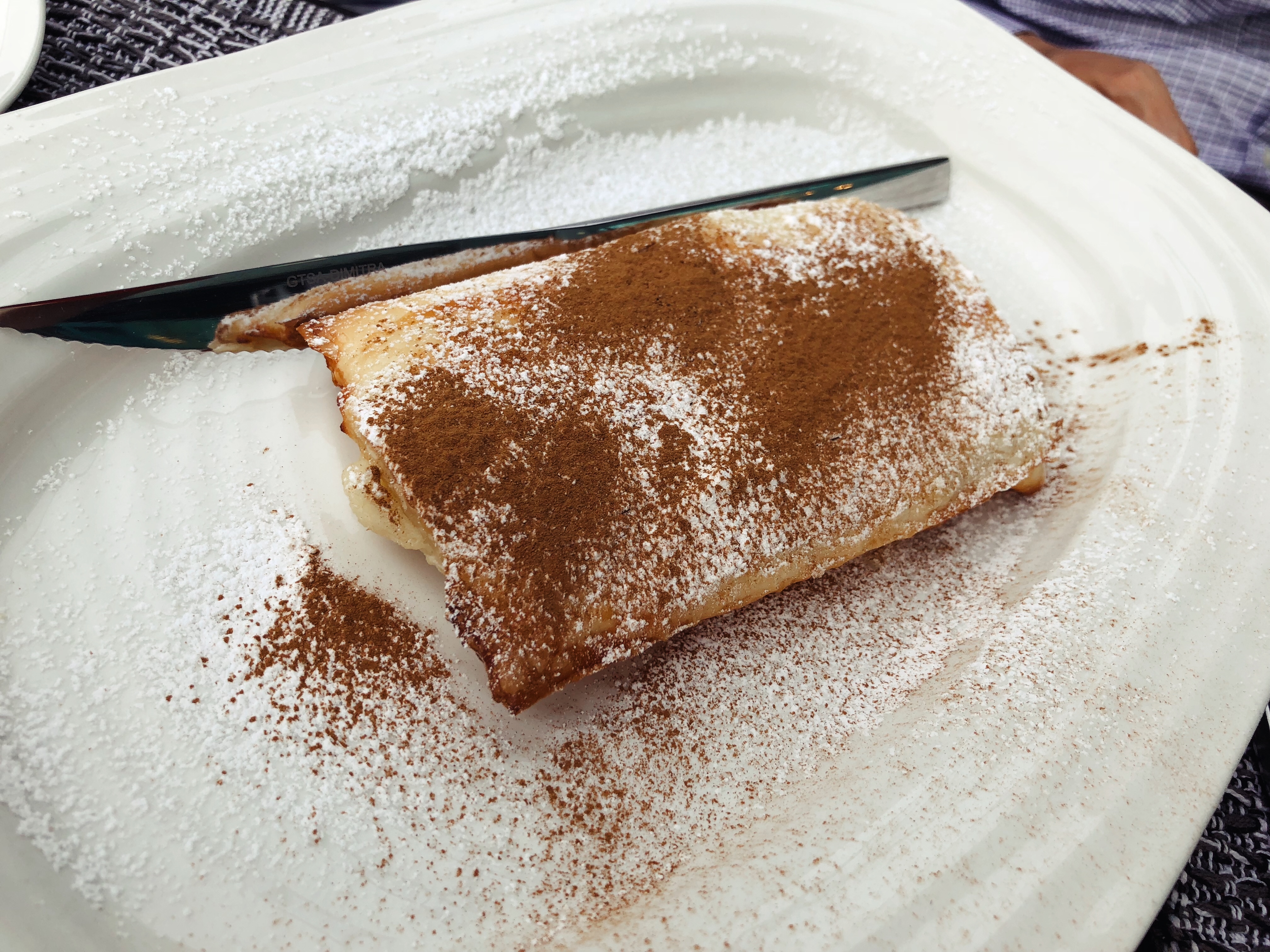
My stepfather’s bougatsa, custard in filo pastry, was better but still not right. I liked the custard very much, but this pastry didn’t have the same lightness of touch as our starters had had. Sawing through it with a knife felt like a slog. “It’s a bit tough” said – well, I’m sure you can guess who said that.

It won’t surprise you to hear that we also had to ask for the bill twice. Lemoni was busier than I expected on a Wednesday evening – the sun was still shining, the big screen on the Riverside was showing Wimbledon, people were sitting in the deckchairs on the opposite bank watching it and the beach bar was full of the kind of people who like the beach bar. It was a glorious evening, and if our meal had been better maybe we’d have been happy to sit there and digest and chat away with all the time in the world. All the best Greek food I’ve had – usually on holiday, but also in restaurants like Maida Vale’s scruffy Tsiakkos & Charcoal, or Notting Hill’s upmarket Mazi – is best eaten in a leisurely fashion, while you daydream of being somewhere in the Cyclades. But in this case, we just wanted to settle up and sod off.

Eventually, we flagged someone down and our bill – four starters, three mains, two desserts, two beers and some mineral water – came to ninety pounds, not including tip. Not hugely expensive, in the scheme of things, but when you consider that we barely drank it’s still a fair amount to spend on something so middling.

“You could come here and have quite a good meal” said my stepfather, “if you happen to order just the right things. Or if you ordered badly it would be terrible.” I nodded in agreement: I’d seen huge plates of what looked like home-made crisps turn up at other tables and I was thinking that if I’d just ordered those and some houmous I probably would have had a better, cheaper time.

So, there you have it: Lemoni isn’t the horror show I half expected, which just goes to show that anybody who reviews a new restaurant in the first month is making an error of judgment. But, even after three months of working on the pricing, the menu and the service it’s still deeply unspecial. Not better than Bakery House, not better than The Real Greek, not better than Kyrenia in its heyday. I don’t say that with any joy or any axe to grind – it would be a wonderful thing for the prime pitch in the heart of the Oracle to be occupied by a brilliant, distinctive, smartly-priced and well-run independent restaurant. But Lemoni is not that restaurant.

My closing thought about Lemoni was the saddest of all, because what my visit really did was make me think about Dolce Vita. Dolce Vita paid less rent than Lemoni, it charged more than Lemoni, it was busier than Lemoni, it did better food, it had better service and it closed for good last year. If Dolce Vita couldn’t make a go of it with so much in its favour, who would bet on Lemoni seeing out the year? More to the point: just imagine how wonderful Reading would be if a restaurant like Dolce Vita had occupied a spot like the one Lemoni has. How I wish we lived in a town like that.

Lemoni – 6.2
Unit 1, The Riverside, The Oracle, RG1 2AG
0118 9585247

https://reading.lemoniuk.com/

Revolución de Cuba

Revolución de Cuba closed in January 2026. I’ve left the review up for posterity.

Let’s get this out of the way straight away: it’s not a typo, you don’t need to adjust your set and you definitely don’t have to pay Specsavers a visit. This really is a review of Revolución de Cuba, Reading’s Latin American bar slash (chain) restaurant.

You might wonder what possessed me. Here’s what – I’ve been complaining for some time about Reading lacking a good tapas restaurant, a feeling which was compounded by a holiday in Granada at the start of the month. I returned even more bereft that I couldn’t find somewhere good to eat jamon, manchego, croquetas or chorizo in cider (let’s not dwell on the fact that in Granada you get something free with every beer: one step at a time).

On my first day back in Reading I sat in the courtyard outside Workhouse Coffee and ate paneer from Bhel Puri House while enjoying a crisp Estrella from the hotel bar next door, and it made a decent substitute but I still found myself wishing Reading had somewhere more suitable. That’s when the idea of trying the tapas menu at Revolución de Cuba entered my head.

After all, it might have been a chain but it was hardly a big one: less than twenty branches across the UK. And although it was part of the same group as Revolution, I’d been pleasantly surprised when I went to Revolution on duty back in 2015 (that said, I’d never been back, probably assuming that lightning never strikes twice in the same place). So on a Monday night I mooched over to Friar Street with my regular dining companion Zoë, wondering if my expectations would be surpassed.

My first impression was that it’s a striking – and gigantic – space. It used to be the old HMV building (I have plenty of happy memories of those days) and Revolución de Cuba waited a long time to open here, initially applying to take over the site in late 2014 and wrangling with the council before eventually opening two years later. The fit out had been nicely done – the long bar down the left looked especially inviting – and the room went back a very long way indeed, gradually getting darker and more conspiratorial.

Actually, that was probably my second impression. My first impression was that I wasn’t sure if I was in a bar or a restaurant, whether I could just plonk myself at a table or wait to be seated and whether it was bar or table service. We stood waiting near the front like lemons for some time before a solitary waitress told us to sit anywhere, before going on to explain that the two areas nearest to the front were probably more suitable for dining.

That might have been a more useful distinction at weekends when the place was busier, but when I went the place was pretty dead; there was a couple sitting at the tables nearest to the window, but the only thing they seemed to be eating was each other (in broad daylight on a Monday evening: I didn’t know whether to be appalled or impressed). Gladly they put their coats on and left seconds later – headed for the nearest Travelodge, I imagine – so we took the table next to where they’d been sitting. Was it my imagination, or did the banquette reek of sex?

The menu looked nice enough, although I don’t think it was the thing that had got them so frisky. It was divided into tapas and main plates, and was a mixture of Spanish, Tex-Mex and general 2019 box-ticking (halloumi, pulled jackfruit and so on). The tapas tended to come in around the six pound mark with three for fourteen pounds, so we decided to go for that, along with a couple of sides. While we waited for our food to turn up I had a pint of Angry Orchard which was just what I needed and not too dry (albeit oddly named: why so cross? Had it been reading the BBC website?) and Zoë had a bottle of Pacifico Clara, a serviceable crisp lager not that distinguishable from Modelo.

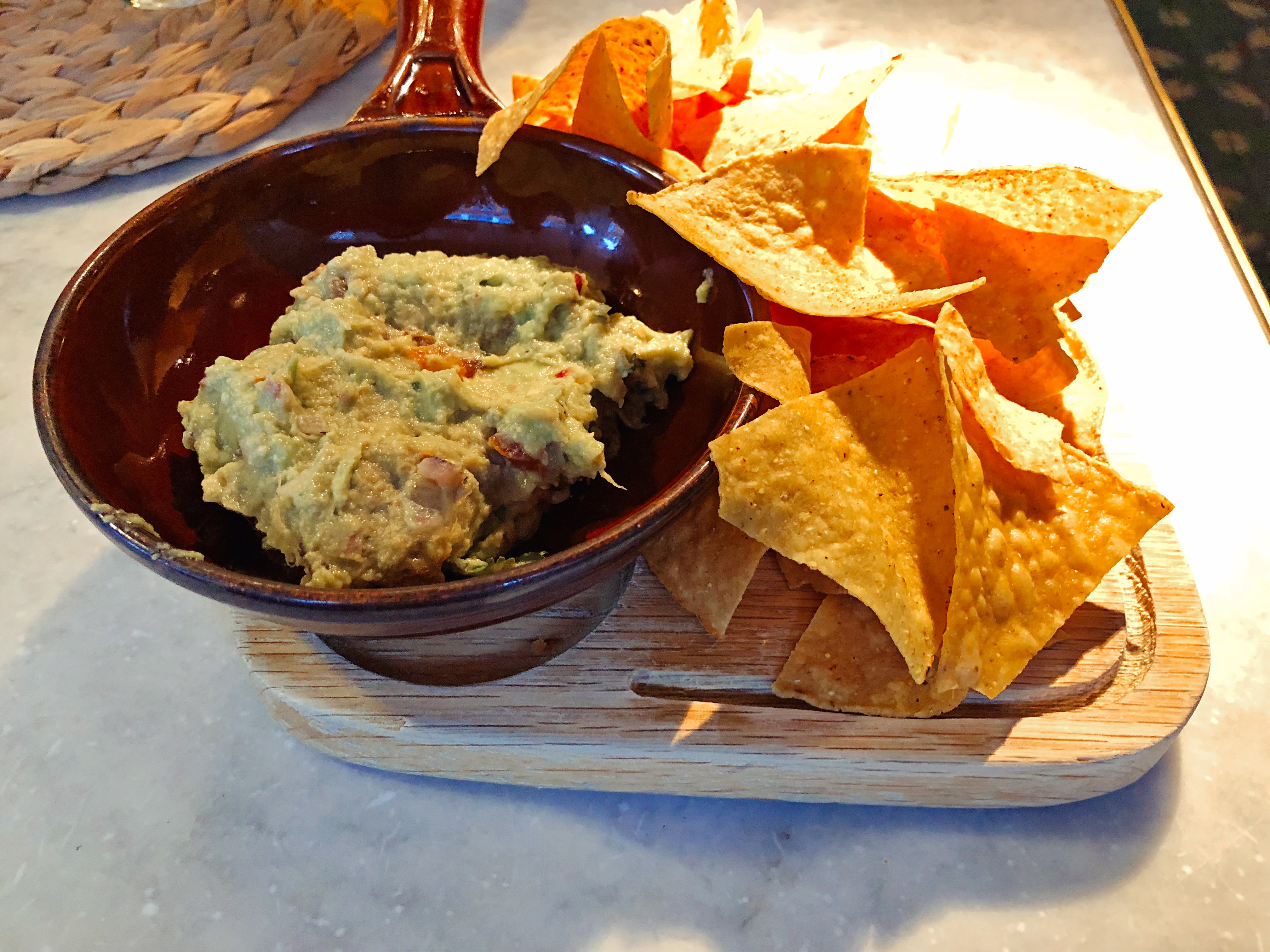
We’d asked for some guacamole and tortilla chips while we made up our mind, so this was the first thing to come out. A sign on the wall said it was freshly made, and although I wasn’t entirely sure it had been made to order it was decent, with just a little heat lurking in there. The previous week I’d been to Wahaca on the South Bank and their guacamole was better (as I had expected it to be) but not by a country mile. The tortilla chips were a little wan and not quite up to the job of dipping but again, for three pounds I was hardly devastated.

The tricky bit is what happened next: all the rest of our food was brought out at once. This wasn’t a problem in itself: god knows I’ve been known to bitch about the likes of Wagamama bringing out dishes as and when they’re ready, but for tapas this style of serving seems much more appropriate. But the real problem was that although the dishes were all brought out at the same time, some of them had clearly been sitting around a while. So much of what should have been piping hot was verging on tepid, and in many cases that made a world of difference.

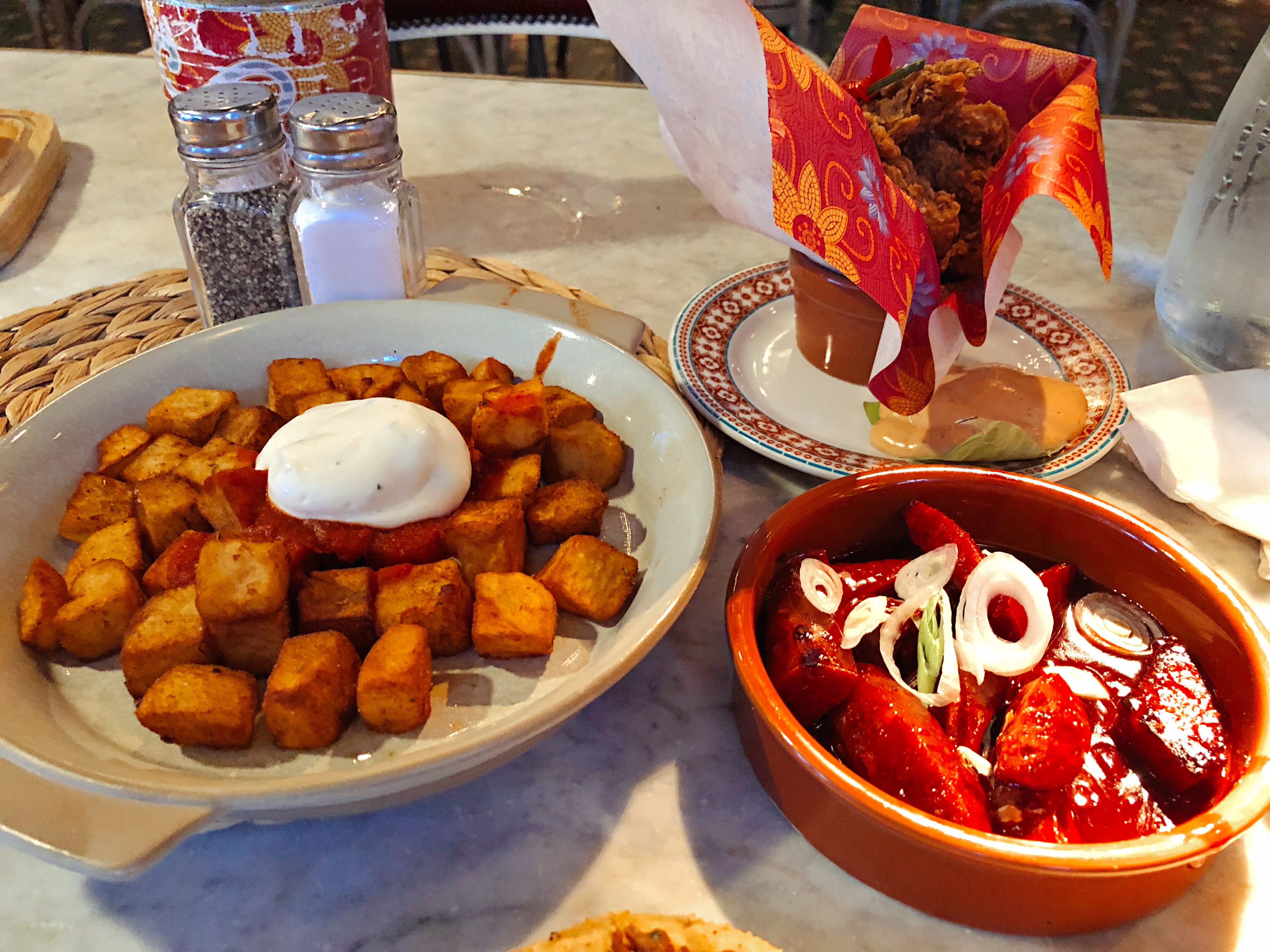
Take the chorizo in red wine and honey, for instance. Done well, this is a superb dish – I had something very similar in Granada – but Revolución de Cuba’s version was cold. Not fridge-cold, but cooked-some-time-ago-cold. It came in a terra cotta pot without any steam or sizzle, and the pot was cold to the touch. So, pretty much, was the chorizo which made me wonder if it had spent any time in the sauce or just been introduced to it right at the end like some kind of super-awkward culinary blind date. It had been cut into weirdly-shaped segments by somebody who appeared never to have seen or eaten chorizo before.

The patatas bravas – a staple of any tapas menu – were also distinctly underwhelming. They had been placed on the mat in the middle of the table as if they’d be scorching hot, but again they weren’t. There just wasn’t the crispiness I was hoping for, and the helping of spicy sauce and aioli was both disappointing and miserly: there should have been more of it, but I wasn’t especially sad that there wasn’t.

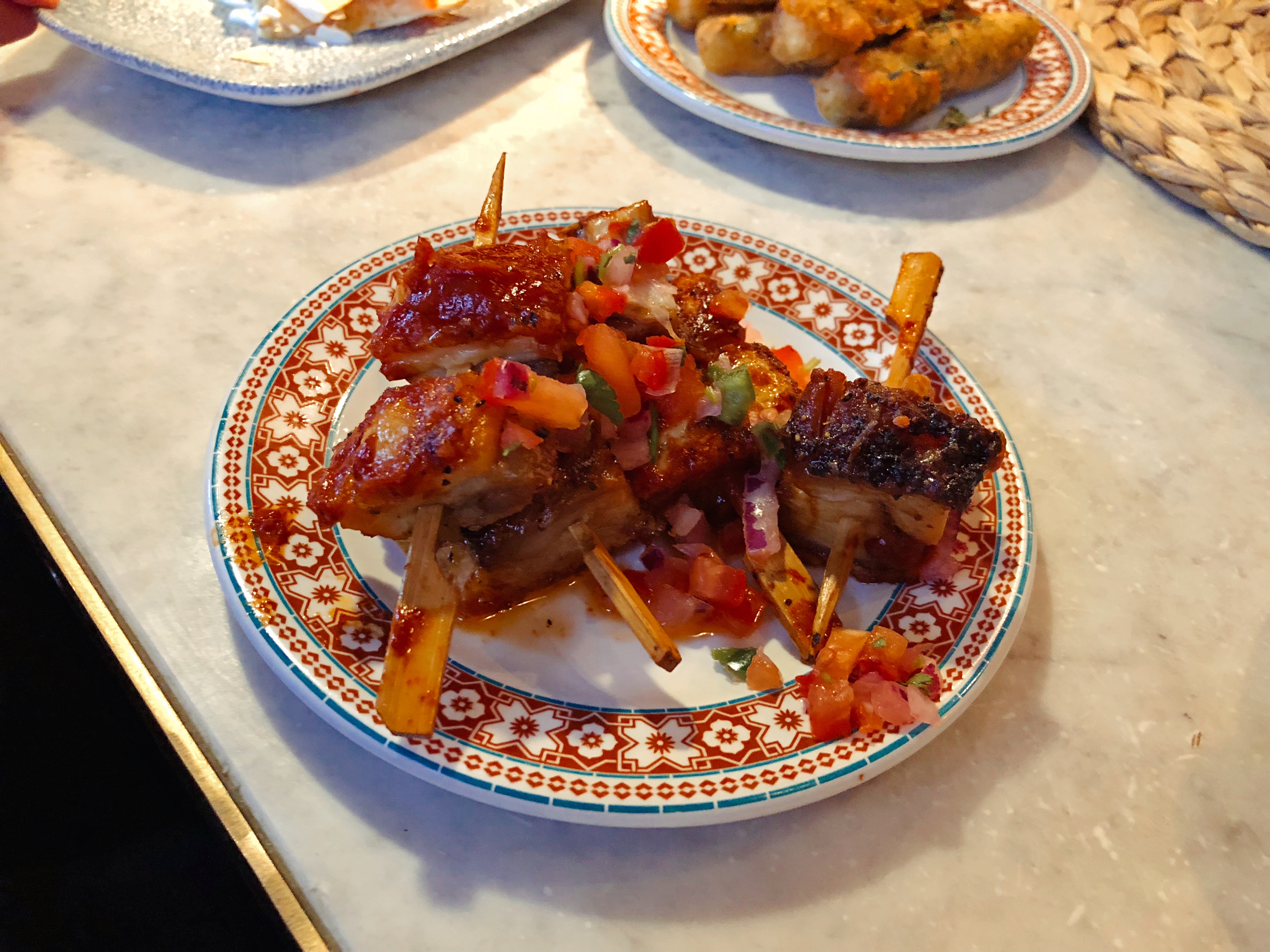
Better were the pork belly skewers, which were well cooked, all fat melted away and a crispy-crackling layer on top. I’m not sure I got the “signature spicy rum sauce” which had apparently been used, but I wasn’t complaining. These reminded me of the pork belly at The Real Greek, which is higher praise than it might sound.

I also enjoyed the jerk fried chicken, although that says more about my love of fried chicken than of Revolución de Cuba’s version. It was nicely seasoned, if a little too crunchy, and it didn’t need the rum mayo I didn’t dip it in. But even here it could have stood with being hotter, and although the texture was a long way from mechanically recovered meat, they didn’t feel like single pieces of coated chicken. Make of that what you will.

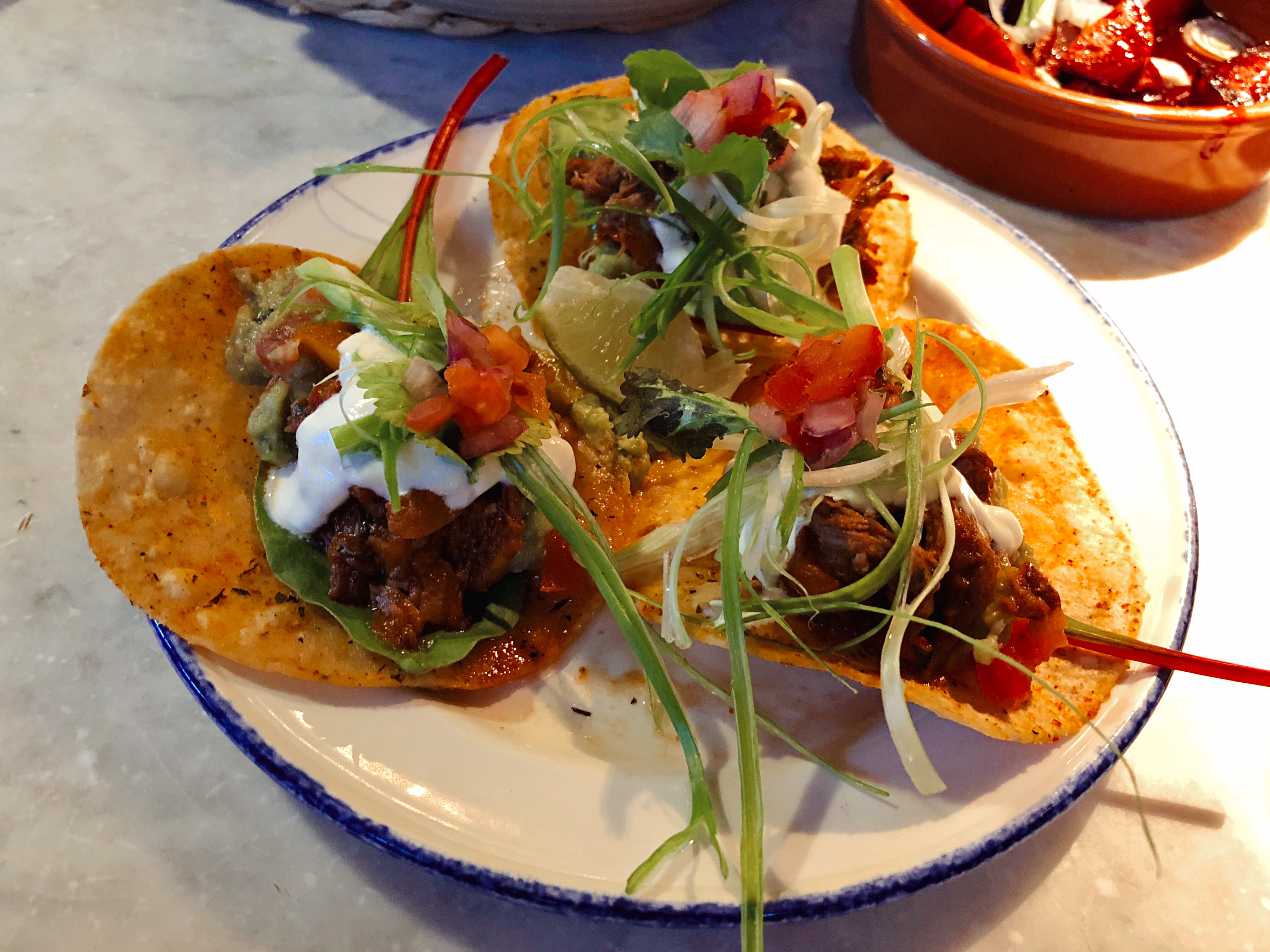
The more Latin American dishes we’d ordered were the ones that really fell flat. Chicken quesadillas might have been average if they’d been served hot but they arrived much closer to room temperature, wan anaemic things it was difficult to get excited about. We’d also ordered pulled beef tostadas, but the beef itself was claggy, bland and lukewarm. You didn’t get much of it before the dish gave way to the (cheaper) guacamole underneath and the tortilla shell, which pretty much made it the dish we’d started the meal with. The Cuban term for this beef is ropa vieja, which it turns out doesn’t translate as old rope: a shame, as it would have been apt.

Finally, we also had some crispy fried courgette. Well, two out of three anyway: it was indeed courgette but cut thick enough that getting it crispy was always going to be a challenge. I didn’t mind this, but even as I ate it I was aware of how many places do it better (especially Papa Gee). It was apparently served with Cuban gremolata, although barely enough to be noticeable, and if it had been fried in “Mojito batter” you really wouldn’t have known that either.

“This is a menu that reads much better than the food looks or tastes, isn’t it?” I said to Zoë as we surveyed the plates (mostly empty, although neither of us had shown much interest in the insipid chorizo).

“I’m afraid so. I’d come back for the guacamole, the chicken and the pork belly but that’s it.” I thought about it and tended to agree: three out of eight wasn’t exactly a stellar hit rate. I reflected on the other reviews I’d seen of Revolución de Cuba, so breathless, so enthusiastic, so positive. So comped, come to think of it. We decided to skip the churros (no doubt described somewhere on the internet as “yummy”) and asked for the bill. The whole lot – six tapas dishes, two sides, a pint and two beers – came to just under fifty pounds, not including tip. That’s not an expensive meal by most standards, but even at that price point your money would go much further in a many other places.

So far so meh, but I do have to say a word about the service. Georgina, who looked after us (and, seemingly, everyone else in Revolución de Cuba that night) was lovely – personable, polite and likeable. She came over halfway through – mid-mouthful, as wait staff always do – to check if our food was okay and we both muttered the usual pleasantries. But when she came with the bill she asked more than once, as if she actually wanted to know. So we told her. The food all came out at the same time because that’s how the kitchen did it, she said. We explained that it might be better not to and that some of the food had been cold as a result. She promised to feed that back, and I believe she did (every bit as much as I expect that feedback fell on deaf ears).

In conversation with Zoë, who tends to ask lots of questions, Georgina told us that she was studying for a Masters in criminology (a part-time job which involves looking out on Friar Street on a Friday and Saturday night probably forms part of her dissertation, come to think of it). It can be rare in chain restaurants to feel looked after rather than processed, and Revolución de Cuba would have got a lower mark if it wasn’t for the service. I wanted to tip her extra, just for enduring the canoodling couple from earlier on (“it was definitely heavy petting”, said Zoë later, “you’d get kicked out of a swimming pool for that”).

I never saw Revolución de Cuba as the kind of place I might eat on a Friday or Saturday night – I’m far too old and unfashionable for that – but I did hope it might be a serviceable small plates restaurant for a school night, or a spot of lunch on the weekend. Sadly, I think it doesn’t quite hit that level either. Some of the dishes are decent enough, but you can get them better elsewhere – Mission is better for tacos or burritos, The Real Greek better for small plates and Bhel Puri House better still. Whenever I ask what chain restaurant people would most like to see in Reading the response is overwhelming: people would love a Wahaca to open here. Based on my visit to Revolución de Cuba that gap in the market is still there. My own personal gap in the market also remains empty: if I want to feel like I’m in Andalusia, I’m going to have to get on a plane.

Revolución de Cuba – 6.6
138-141 Friar Street, RG1 1EX
0118 2077016
https://www.revoluciondecuba.com/bar/reading/

The Corn Stores

The Corn Stores closed in January 2024. I’ve left the review up for posterity.

Writing the only restaurant blog in Reading can feel like a lonely pursuit at times, but if you really want a lonely pursuit it’s this: writing a review where you say that the Corn Stores is a distinctly mediocre restaurant. The only reviews of the Corn Stores I could find online were comped, so they were all breathlessly enthusiastic and gushing. But, that aside, I know quite a few people who have been to the Corn Stores, and they’ve all raved about it. Some of them, and I know they read this blog, have been back more than once since it opened in December. So I was really hoping not to be the lone voice, the sore thumb, but I went there this week and I really didn’t get it at all.

All the blogs and Instagrammers will tell you what an amazing job the Rarebreed Dining Group did of refitting the Corn Stores when they took over the derelict building and turned it into a bar, restaurant and private members’ club. They used local company Quadrant Design, and I agree that they’ve breathed life beautifully into a lovely but unloved space (one I largely remember from lunch breaks with my brother in 1996, when we used to sneak across from our McJobs in Apex Plaza opposite for a rushed pint or two). He wouldn’t recognise it now: the restaurant, on the first floor, is superbly done out, with bare brick walls, leather-banquetted booths and tables with dusky-pink, scallop-backed chairs. I was there with my other half Zoë rather than my brother (mainly because I have also gone up in the world somewhat since 1996).

As we were shown to our table – past the display cabinet full of aged beef – our waitress explained the concept, that they butcher and age their own meat. There was a certain pride about it which I respected, and it made me look forward to dinner: I knew from researching the menu beforehand that the Corn Stores was an expensive restaurant, but I was hoping for a showstopper, the special occasion restaurant Reading has been missing for many years.

Our table was one of the booths, and I was impressed by how spacious it felt for two people: CAU, back in the day, would have tried to seat four people at a booth that size (the other tables for two felt a little more poky: I’m not sure how much I’d have liked one of those). The restaurant was nicely buzzing and pretty full on a weekday night, and it exuded that glow of satisfaction you get when surrounded by people who are happy they’ve made a right – and exclusive – choice (the Nirvana Spa effect, you might say). “My mum would like it here” said Zoë, adding the Corn Stores to her mental list of places to take her mum to.

We ordered a couple of pints of Meantime lager while we decided what to order: it’s kept in tanks onsite so you get it fresh, unfiltered and unpasteurised. I thought it was cold, crisp and clean and I loved it – Zoe less so, because she detected a bitter finish. I’ve already said that the Corn Stores is an expensive restaurant, and I fear this is a point we may return to often throughout the rest of this review: starters are just shy of a tenner and some of the mains are just the right side of twenty pounds, although if you order a steak you’re highly likely to pay far more than that. Oh, and there was a “whole baked sourdough” for six pounds fifty, which has to be the most expensive bread I’ve ever seen on any menu anywhere (you get “your choice of butter”: really, for six pounds fifty you should get to try them all, I reckon).

There was also a specials menu with other options including a Barnsley chop, a pork tomahawk, smoked sirloin on the bone – and a chateaubriand with lobster and some other gubbins which cost the grand total of ninety-five pounds (I know people who have ordered this, and they raved about it, but really: you could eat Michelin-starred food for that money). None of that especially appealed, but also I wanted to judge the place on their standard fare – the meat and potatoes, you could say – so we stuck to the normal menu. At the table next to us, three well-to-do ladies chatted away as their main courses, completely untouched, went cold in front of them: Zoë and I exchanged looks.

We started with the “Rarebreed Board”, a sharing selection of interesting options. It was the most expensive starter on the menu (twenty six pounds, in fact) but I figured it gave us an opportunity to try out lots of different things. It came on a sort of folding trestle table which left us limited room for our side-plates, but you couldn’t deny it looked appealing: five different beef dishes, designed to be shared between two.

Much of the sharing board was sort of a symphony of mince, so you got steak meatballs, miniature burgers and “beef and pepper sausage” – which was more like sausagemeat, on account of there being no casing. They were all quite nice, but much of a muchness – the main variations being in coarseness, but the overall texture was very similar.

We both liked the sausage best, with there not being a huge amount to choose between the burgers and the meatballs. Even at this stage though, the execution was lacking. The burgers came with lettuce and tomato in naked brioche, no cheese, no sauce (the pepper or tomato sauce in a little metal dish made a useful dip). The meatballs were apparently served with red wine gravy, but the thin lake of liquid at the bottom of the dish was largely ineffectual. Perhaps you were meant to dip the accompanying toast in it, but it was pretty hard when it arrived and, by the time we got round to it, it was even worse.

There were three burgers and three meatballs, which was odd and just made sharing trickier – I’d rather those two dishes had been better and smaller, and the price had been nudged down a little. I liked the other two dishes on the board better – the steak tartare (served, somewhat randomly, in a jar) had some real tang and pungency from the Worcester sauce, but Zoë found it too vinegary and couldn’t finish it. Similarly, the salt beef on flatbread worked beautifully for me, but amid the mustard there was also a vinegary tang that put Zoë right off it. Even in this dish there was the oddity of little segments of potato – double carbs, and extra bulk, but totally unnecessary.

By the time we finished our starters the table next to us had eaten half of their main courses, if that. One lady had cut her cod burger very precisely in two and looked like she was considering, possibly before the evening was out, embarking on eating the second half (it never occurs to me that some people go to restaurants for the company, or to see and be seen, but that might be just me). I got a second pint of Meantime and Zoë tried the Curiouser & Curiouser, a beer by Kentish wine producers Chapel Down – it tasted of grapefruit and citrus and I really liked it, although Zoë seemed less convinced.

We’d decided to tackle different ends of the menu, so we went for one of the pricier and one of the more affordable main courses. Zoë’s burger – wagyu beef, with Ogleshield cheddar and bacon – looked lovely, and the bite I had wasn’t half bad. But it cost nineteen pounds, and it didn’t feel, to me, like a nineteen pound burger (I’m not sure what a nineteen pound burger tastes like, but not this).

“It’s really nice” said Zoë.

“Better than Honest?”

“No, not really.”

I agreed with that – even when unadorned, Honest burgers have a lovely crust to them from the grill, and there’s a bit of salt in there. This was almost as good, but it cost nearly twice as much as its equivalent over on King Street.

I had gone for a two hundred gram fillet steak, served rare, with béarnaise sauce. The Corn Stores website boasts about how they baste their meat with aged beef fat and cook it on a Robata grill, getting loads of flavour into even lean cuts like fillet.

This was, it’s safe to say, not my experience: they’d managed the impressive combination of serving a steak where there was almost no char at all while simultaneously overcooking it. It was meant to be rare, but it was probably medium at best: just about pink in the middle, but with no juices oozing out as you made your way through it. I couldn’t face sending it back, because I really wanted to eat dinner at the same time as Zoë and I knew that sending it back guaranteed that wouldn’t happen. Besides, by then the damage was done – if you’re a steak restaurant, and one charging that kind of money, cooking the steak right first time was the entry level requirement.

That wasn’t all, though, because really the steak didn’t taste of very much. I didn’t get any seasoning, I certainly didn’t feel like it had been anointed with glorious, salty beef fat, nothing of the kind. The béarnaise didn’t help matters, being a little on the thin side, heavy on the vinegar (bit of a theme emerging there) and light on the tarragon. It was also a pretty mingy helping of béarnaise, because the Corn Stores seems to have missed the memo that béarnaise sauce should be as much for your chips as your steak. The salad it came with was pleasant enough, but it rankled with me that you got a big pile of salad for free but had to pay for your chips – by contrast, chips came free with the burger.

This brings us on to the chips – beef fat chips, no less. I had high hopes for these, but they were also deeply ordinary. They didn’t have the crunch-fluff ratio of a perfect chip, they were exceptionally salty and some of mine had grey patches which should have failed the most elementary quality checking. Dipped in the béarnaise they were okay, but no more, and they weren’t much better with the mayonnaise we’d asked for (which came in two minuscule pots which looked as if they had housed lip balm in a previous life). I looked round and everybody seemed to be having such a lovely time. What was I missing?

We’d asked our waitress for recommendations for a side dish and she had recommended the baked flat mushrooms, so we went for those. Four pounds got you three rather small flat mushrooms which had a meaty texture but again, didn’t feel like they’d been exposed to much in the way of butter. If I’d had them in a Beefeater I’d probably have been pleased, but here in the Corn Stores it just felt like another way of extracting funds. There was the ghost of a sprig of thyme on top, as if to say Look, we did do something with them.

By this point we were on to our third drink – a serviceable glass of Pinot Noir for me and Chapel Down’s cider (which I really liked) for Zoë, and positively planning our escape. The waitress took our dishes away and half-heartedly asked if it had been good, and we half-heartedly replied that it had been fine. The fact that both of us had half-heartedly half-left our chips didn’t seem to register. That was service in general at the Corn Stores – smiling, efficient, a little robotic. I didn’t get any real warmth or personality.

Dinner for two – a sharing starter, two mains, some chips, a side and three drinks apiece – came to one hundred and thirty pounds, including a not-that-optional 12.5% service charge. I’m almost tempted to leave that sentence to do the work on its own, but really: one hundred and thirty pounds! When I think of all the amazing meals you could buy in Reading for a fraction of that price – or all the exquisite meals you could buy in London for that money – I felt like I’d cheated rather than treated myself.

“I don’t think I would take my mum here, you know” said Zoë, unsurprisingly.

“I know. Normally with places like this I say I’d only go if someone else was paying, but in this case even if someone else was paying I wouldn’t let them take me here.”

That might sum it up, for me. I couldn’t shake the feeling, throughout my meal, that I was paying for the refurbishment, or helping Rarebreed pay off their investor (the interestingly-named Havisham Group), but I didn’t feel like I was paying for a truly luxurious experience in a terrific special occasion Reading restaurant.

The talk about the Corn Stores’ pride in their meat and butchery is all well and good, but the main thing my meal did was make me miss CAU. I think, actually, I had no better or worse a meal at Miller & Carter, where I paid a lot less money. Worst of all, I went to the Southcote (a Beefeater) last year and although it wasn’t as good as the Corn Stores it was a lot closer than the huge disparity in price would have you believe (and their béarnaise, damningly, was probably slightly better).

Anyway, it doesn’t matter what I say: I have no doubt that the Corn Stores will do really well, but I felt like if it had been half as good as it thinks it is it would be twice as good as it actually is. But what do I know? I read some lifestyle bloggers recently, and they tell me the emperor looks fantastic in that outfit.

The Corn Stores – 6.7

10 Forbury Road, RG1 1SB
0118 3246768

https://www.thecornstoresreading.co.uk/

Pan, Wokingham

I learned in early 2023 that Pan had closed. I’ve left the review up for posterity.

I was beginning to think I was cursed and that you’d never get a new review. My first attempt involved a Reading restaurant which, it turns out, is closed on Mondays. That fact came to my attention on the Monday night I was due to review it, seconds after I arrived at the pub across the road and met my dining companion for the evening. I’ve been doing this for nearly six years, and you’d think I’d know better.

Attempt number two was no better: I picked a restaurant out of town to visit with my old friend Al, mainly because every time we’d ever been there it had one amazing dish on the menu which was worth the price of admission alone. A destination dish and a destination restaurant all in one, truly the holy grail of restaurant reviewing. But, of course, on the Friday that we went there for lunch that dish – a glorious, massive pie for two, glossy, deep rich sticky beef lying in wait under a golden bubbling suet crust – was nowhere to be seen. I chalked it up to experience and had the fish, but where on earth was I going to review now?

Salvation came in the unlikely form of my friend Richard. We were due to meet up for a midweek dinner in Reading, and a couple of days before he sent me an apologetic WhatsApp. He could only get a babysitter for part of the evening, it said, and would I mind meeting in Wokingham, halfway between Reading and his place in Sunningdale? I sensed the faint knock of opportunity, and that’s why you’re reading a review of Pan today.

I’ve known Richard for many years, and wanted to bring him along on a review for ages. He’s the campest straight man I’ve ever met, a gleeful drinker, outrageously bitchy and downright good fun. He looks ever so slightly like David Gest might have done if he had (a) avoided all that shocking plastic surgery and, more importantly, (b) not died. He was a huge support to me when I joined Team Divorce a few years back, and I’ve always loved my evenings with him when he can swing a babysitter (his high-powered ex-wife is always away on business, pressing the flesh in Milan).

As for Pan, it looked like the most interesting thing to happen to Wokingham in some time – a pan-Asian restaurant opening in the space vacated by the Teak House (a Thai restaurant) offering a constantly changing monthly menu of small plates from different countries. The pictures on Instagram looked tempting, the word of mouth was promising and the menu online – all octopus, monkfish yakitori, slow braised pork and ramen – made me truly impatient to visit. Richard said it looked perfect, although I wondered if that might be because he has a much smaller appetite than me.

The website, and the pictures I’d seen made me think Pan would be a sleek, black, minimalist space, but going in it looked very much like it was still the Teak House, visually at least. There was a small bar and counter, and a small dining room up a little set of stairs with, surreally, a handrail like a banister separating it off (Richard leaned against it for much of our meal: it looked wobbly). The front room must have accommodated about a dozen diners, although there was a bigger room further into the restaurant: on our visit this had been laid out for a very large group which arrived partway through our meal.

“Have you been here before?” asked the front of house (which, on our visit, was very much a one man show) as he handed over our menus.

“No, this is our first time.”

“We’ve been open for six months, what took you so long?” he said with a smile. I liked that cockiness: it felt quite unlike Wokingham, if nothing else. “Our menu is small plates, like tapas, and two dishes per person should be enough.” I must confess I was sceptical about this, but maybe that’s because I’d been planning to try as many things as I could get away with.

“Do you have a wine list?” said Richard, somewhat betraying his priorities. The chap smiled again.

“I am the wine list.”

Again, a little confident but not jarringly so. In any case, we started with a couple of bottles of Kirin while we looked through the menu. It being March, the menu had changed completely from the one on the website (“this month we’re doing south Indian dishes”, our waiter told us). All the dishes were priced between four and eight pounds, and most of them looked tempting, with the possible exception of “chicory salad” which felt like a fig leaf for killjoys. The really noticeable thing on the menu, though, was the general absence of carbs: I had a feeling four dishes wouldn’t be anywhere near enough.

The first dish was a beautiful start – broccoli with chana dahl houmous, a clever fusion. I’m used to dipping stuff in houmous (after I’ve poured a lake of extra virgin olive oil on top of it, naturally) but having it here as the base for a heap of well-cooked purple sprouting broccoli was a very nice touch. The houmous had brilliant spice and flavour, and as a statement of intent this was hard to beat. But even this dish, with hindsight, was a taste of things to come: I expected the bowl to be slightly deeper and when my fork clanked against the bottom I did have an “is that all there is?” moment. It wasn’t to be the last time.

Shortly afterwards the kitchen sent out our next dish, crab wontons. “Too sweet” was Richard’s verdict, and I was pretty sure he wasn’t talking about me. He was right, though: they weren’t unpleasant but they were hotter than the sun and the crabmeat inside did feel too sweet with nothing to balance it out. Possibly the advertised curry butter might have offset this, but it lurked uselessly at the bottom of the plate and it was too difficult to dredge the wontons through it. Worth six pounds fifty? Probably not, and the glass plate felt like it might also have been inherited from the Teak House rather than bought for Pan, because the presentation felt a little fussy and old-fashioned.

I very much liked what came after that, flatiron steak with “kukurmutta ragu” (I Googled it: it’s mushrooms). The mushrooms lent a beautifully savoury note to the whole thing and any reservations I had about the steak were banished by the pink middle and the perfect texture. I wasn’t convinced it needed all that yoghurt, and serving it with paper underneath was a little odd, but even so it was one of my favourite dishes of the evening. Richard wasn’t so impressed, but by then I’d told him I was going to refer to us in the review as “Pan’s people” and he’d given me the first of many withering stares (“Bitch” was his response).

I found it odd that the dishes had been designed for sharing, but none of them came with spoons for us to dish up onto our plates. I asked and the waiter brought some over, but in a way which suggested that they’d never been asked before. “That was very nice, thank you” I said as he came to take our empty plates away. “You sound surprised” he replied, and again I couldn’t quite decide whether that confidence was charming or grating.

I’d been particularly looking forward to the charred carrot dish, mainly because Pan’s Instagram feed had a stunning image of what I imagined was something similar – a huge vibrant jumble of carrots, blackened on the outside, sesame seeds and coriander. I don’t think I was expecting five pieces of carrot, or for three of them to turn out to be unadvertised sweet potato (one of my least favourite things). Despite that I did enjoy them – the menu said they’d come with pearl barley and parsley, but instead they were accompanied by some kind of thickened yoghurt and tiny slivers of crispy fried chilli. It was an interesting dish, and the textures in particular were lovely, but I couldn’t quite shed the feeling that at five pounds, each piece of carrot or sweet potato had cost a quid all by itself.

Finally our last dish turned up, tandoori chicken legs with bhurani raita. I enjoyed this: the flavours were spot on and the chicken was nicely done, although I didn’t necessarily get much garlic in the pleasingly mint-green raita. Richard was less convinced – “this feels more like a dish you could get in lots of other places” – and either way it was a little difficult to justify two hardly colossal chicken legs at just shy of seven pounds.

“That was lovely” I said as the waiter collected more empty plates.

“I know”, he said. Hmm.

Despite having had more than our regulation two dishes per person, we ordered more. If there had been more carbs on the menu – some noodles or rice or anything that might fill you up – maybe I wouldn’t have needed to but as it was I was still distinctly peckish. We also ordered a couple of glasses of orvieto which was pleasingly crisp but far from bone dry. The waiter wasn’t kidding when he said he was the wine list, so he ran us through the choices – all by the glass, three or four whites if I recall. No prices were given, but I checked at the end and these were six pounds each, which didn’t feel unreasonable. Not having a list and picking after a chat with your waiter felt like the sort of thing I ought to enjoy and endorse in theory, but having done it I found it made me feel somewhat uncomfortable: too English by half, perhaps.

Throughout our meal I saw our waiter coming out of the kitchen with multiple plates of the same dishes, dropping one at our table, one at a neighbouring table and so on, and I realised that even if I was still on the hungry side I could see how this model might work beautifully for Pan. And every table in the front room was full of enthusiastic customers, so maybe it was just me who was beginning to find it a parade of not enough food for a little too much money.

I’d really fancied “cod shashlick with satay crumb” on the menu, but the waiter told us it had run out so we ordered the replacement dish, smoked trout with ginger and lime. For me, this just didn’t work – the tastes that accompanied the fish were sharp, fresh and interesting but pairing it with smoked trout felt like a strange choice. I’m far from convinced that smoked trout features heavily in South Indian cuisine: it clashed with everything else going on and the whole thing felt like a dish made with ingredients that were lying around (all very Ready Steady Cook) rather than something carefully put together. I guess, of course, that the thing with smoked trout is that you don’t have to cook it, so again convenient for the kitchen but not necessarily great for diners.

I did enjoy our final dish, a mixture of butter beans and chickpeas topped with a baked egg. Finally, a hint of the carbs I’d been craving! But even here I could see how all the dishes felt like riffs on a theme – the green squiggles matching those on the broccoli, probably the same yoghurt as we’d had on the steak, definitely the same little slices of fried chilli as had come with the carrots. Although I quite enjoyed it, and I’d have loved it if it had been the first dish I tried, by this stage I did feel like I could see the joins, as if I’d spotted the Wizard Of Oz behind the curtain. Pan passed itself off as being imaginative and varied, but a lot of work had been put into managing the experience.

I insisted on a dessert – partly because I was still hungry, and partly because the waiter told me that the chocolate brownie came with a sesame seed creme Anglaise. Normally, I don’t hold with brownies being dessert – and again, what I got differed from what was described on the menu – but this really was lovely: three dense, warm cubes of brownie with a beautifully light custard and plenty of sesame (although I thought it could have stood more).

We’d asked what we could drink with dessert and the waiter said “I’ve got some really good Filipino rum: let me bring it over”. He returned with a bottle and two little glasses full of ice and left us to it, an experience which felt faintly continental. Richard practically inhaled a glass and topped himself up.

“Hurry up and try some! This is fantastic.”

It was: ever so slightly honeyed and with a beautiful note of oak. Richard took a photo of the label, shortly before surreptitiously refreshing his glass. (“There’s no line on the side or anything” he said, with the expertise of a man who used to raid his mother’s drinks cabinet.) I loved it, although I did feel guilty about having more. How much did it cost anyway? There was simply no way of knowing, not until the bill arrived.

When it did, our whole meal – seven small plates, four beers, two glasses of wine and that rum – cost eighty-seven pounds, not including tip, and the rum was just under eight pounds in total. I made sure we tipped generously, mainly because I suspect Richard was literally drinking their profits. We then sallied forth into the Wokingham night in search of a place that could serve Richard more wine, although when we got to the pub Richard also ordered a packet of peanuts and a bag of pork scratchings: that probably tells its own story.

It’s interesting, as small plates restaurants start to jump the shark in London, that we get a swathe of them round these parts like Pan and Bench Rest, which I reviewed last year. Pan shares some of the problems that Bench Rest has: however nice the service is, the interior feels like it’s designed for a very different type of establishment and however nice the food is, the dishes are either too small or too pricey or both. But with Pan those problems were amplified – everything felt like not a lot of food for quite a lot of cash, and the interior and the plating lacked the sophistication the menu aspired to. But on the other hand I love the concept, I ate some really interesting food and combinations and I can see what they’re aiming for. It felt like a work in progress, but I do wonder if Wokingham is forgiving enough to give Pan the time it needs to become the restaurant it wants to be. I hope so: definitely if Pan was in Reading I would be following its evolution and going back to see how things progress.

And Richard? According to his Instagram he was in the gym the next morning at seven am, living the dream. His verdict was less nuanced than mine: will go back for free rum though, he told me on WhatsApp. The language of Shakespeare: I must find out when his babysitter fancies doing some more overtime.

Pan – 6.7
47-49 Peach Street, Wokingham RG40 1XJ
0118 9788893

https://www.panrestaurant.co.uk/